


Abstract
Background
Tension‐type headache (TTH) affects about 1 person in 5 worldwide. It is divided into infrequent episodic TTH (fewer than one headache day per month), frequent episodic TTH (2 to 14 headache days per month), and chronic TTH (15 headache days a month or more). Ketoprofen is one of a number of analgesics suggested for acute treatment of headaches in frequent episodic TTH.
Objectives
To assess the efficacy and safety of ketoprofen for treatment of episodic TTH in adults compared with placebo or any active comparator.
Search methods
We searched the Cochrane Central Register of Controlled Trials (CENTRAL), MEDLINE, Embase, and the Oxford Pain Relief Database up to May 2016, and also reference lists of relevant published studies and reviews. We sought unpublished studies by asking personal contacts and searching online clinical trial registers and manufacturers' websites.
Selection criteria
We included randomised, double‐blind, placebo‐controlled studies (parallel‐group or cross‐over) using oral ketoprofen for symptomatic relief of an acute episode of TTH. Studies had to be prospective, with participants aged 18 years or over, and include at least 10 participants per treatment arm.
Data collection and analysis
Two review authors independently assessed studies for inclusion and extracted data. We used the numbers of participants achieving each outcome to calculate the risk ratio (RR) and number needed to treat for one additional beneficial outcome (NNT) or one additional harmful outcome (NNH) for oral ketoprofen compared to placebo or an active intervention for a range of outcomes, predominantly those recommended by the International Headache Society (IHS).
We assessed the evidence using GRADE and created a 'Summary of findings' table.
Main results
We included four studies, all of which enrolled adults with frequent episodic TTH. They all specified using the IHS diagnostic criteria and reported mean baseline pain of at least moderate intensity. While 1253 people with TTH participated in these studies, the numbers available for any analysis were lower than this because outcomes were inconsistently reported and because many participants received active comparators.
None of the included studies were at low risk of bias across all domains considered, although for most studies and domains this was likely to be due to inadequate reporting rather than poor methods. We judged one study to be at high risk of bias due to small size.
Useful information was available only for ketoprofen 25 mg. For the IHS preferred outcome of being pain‐free at two hours the NNT for ketoprofen 25 mg compared with placebo was 9.0 (95% confidence interval (CI) 4.8 to 72) in two studies (272 participants; low quality evidence). The NNT was 3.7 (95% CI 2.6 to 6.3) for pain‐free or mild pain at two hours in two studies (272 participants; moderate quality evidence). Fewer people needed rescue medication with ketoprofen 25 mg than with placebo, with a number needed to treat to prevent one event (NNTp) of 6.2 (95% CI 4.3 to 11) in three studies (605 participants; moderate quality evidence). The number of participants reporting any adverse event was higher with ketoprofen 25 mg than placebo (NNH 15, (95% CI 8.7 to 45)) in three studies (651 participants with 66 events; low quality evidence). Most events were of mild to moderate intensity.
Ketoprofen 25 mg was not different from paracetamol 1000 mg in two studies with 276 participants for any efficacy outcomes (low to moderate quality evidence); the RR for pain‐free at two hours was 1.3 (95% CI 0.9 to 2.0). The number of participants reporting any adverse event was higher with ketoprofen 25 mg than with paracetamol (NNH 17, 95% CI 8.9 to 130)) in two studies (582 participants, 68 events; low quality evidence).
Studies reported no serious adverse events.
We judged the quality of the evidence comparing ketoprofen 25 mg with placebo or paracetamol 1000 mg as moderate to very low. Where evidence was downgraded it was because of the small number of studies and events.
Authors' conclusions
Ketoprofen 25 mg provided a small benefit compared with placebo in terms of being pain‐free at two hours or having mild or no pain at two hours for people with frequent episodic TTH who have an acute headache of moderate or severe intensity. Its use was associated with more people experiencing adverse events. Ketoprofen 25 mg was not superior to paracetamol 1000 mg for any efficacy outcome.
Plain language summary
Oral ketoprofen for treatment of acute episodic tension‐type headache in adults
Bottom line
This review found that few people with 2 to 14 tension‐type headaches a month get good pain relief from taking ketoprofen 25 mg. There are questions about how studies of this type of headache are conducted. These questions involve the type of people chosen for the studies and the types of outcomes reported. This limits the usefulness of the results, especially for people who just have an occasional headache.
Background
People with frequent episodic tension‐type headache have between 2 and 14 headaches days every month. Tension‐type headache stops people concentrating and working properly, and results in much disability. When headaches do occur, they get better over time, even without treatment.
Ketoprofen is a commonly used painkiller, available by prescription in most parts of the world but without prescription (over‐the‐counter) in some. The usual dose is 25 mg or 50 mg taken by mouth.
Study characteristics
In May 2016, we searched the medical literature and found four studies involving 1253 participants looking at ketoprofen for frequent episodic tension‐type headache. Only a fraction of the participants were involved in comparisons between ketoprofen 25 mg and placebo (a dummy tablet). Results were usually reported two hours after taking the medicine or placebo. The International Headache Society recommends the outcome of being pain‐free two hours after taking a medicine, but other outcomes are also suggested. Few studies reported these recommended outcomes, so there was limited information to analyse for some outcomes.
Key results
The outcome of being pain‐free at two hours was reported by 27 in 100 people taking ketoprofen 25 mg, and in 16 out of 100 people taking placebo, meaning that only 11 in 100 people benefited because of ketoprofen 25 mg (low quality evidence). The outcome of being pain‐free or having only mild pain at two hours was reported by 66 in 100 people taking ketoprofen 25 mg, and in 38 out of 100 people taking placebo (moderate quality evidence), meaning that 28 in 100 people benefited because of ketoprofen 25 mg.
About 14 in 100 people taking ketoprofen 25 mg reported having a side effect, which was slightly more than with placebo (7 in 100 people) (low quality evidence). Most side effects were mild or moderate in intensity. No side effects were serious.
Ketoprofen 25 mg was not different from paracetamol 1000 mg for any measure of headache relief (moderate and low quality evidence), but was associated with more side events (low quality evidence).
Quality of the evidence
The quality of the evidence for being pain‐free at two hours was low quality, and for having mild pain at two hours was moderate quality. Moderate quality evidence means that we are reasonably confident about the results. Low quality evidence means that we are not very certain about the results and they could change with more information.
Summary of findings
Summary of findings for the main comparison. Ketoprofen 25 mg compared with placebo for tension‐type headache.
| Ketoprofen 25 mg compared with placebo for tension‐type headache | ||||||
|
Patient or population: adults with episodic tension‐type headache Settings: community Intervention: ketoprofen 25 mg Comparison: placebo | ||||||
| Outcomes | Probable outcome with comparator | Probable outcome with intervention |
RR
(95% CI) NNT, NNTp or NNH (95% CI) |
No of studies, attacks, events | Quality of the evidence (GRADE) | Comments |
| Pain‐free at 2 hours | 270 in 1000 | 160 in 1000 | RR 1.7 (1.1 to 2.7) NNT 9.0 (4.8 to 72) |
2 studies, 272 attacks, 59 events | Low | Downgraded 2 levels due to sparse data: small number of studies, attacks, and events. Outcome reported by 2 of 4 studies. Consistent direction of effect |
| Pain‐free at different time points (1, 4, 24 hours) | No data | No data | ‐ | ‐ | Very low | No data |
| Pain‐free or mild pain at 2 hours | 660 in 1000 | 380 in 1000 | RR 1.7 (1.3 to 2.2) NNT 3.7 (2.6 to 6.3) |
2 studies, 272 attacks, 140 events | Moderate | Downgraded 1 level due to limited data but moderate effect: small number of studies and attacks; modest number of events. Outcome reported by 2 of 4 studies. Consistent direction of effect |
| Use of rescue medication | 200 in 1000 | 360 in 1000 | RR 0.57 (0.45 to 0.72) NNTp 6.2 (4.3 to 11) |
3 studies, 605 participants, 167 events | Moderate | Downgraded 1 level due to limited data but moderate effect: small number of studies; modest number of events. Outcome reported by 3 of 4 studies. Consistent direction of effect |
| Any adverse event | 140 in 1000 | 70 in 1000 | RR 2.0 (1.2 to 3.3) NNH 15 (8.7 to 45) |
3 studies, 651 participants, 66 events | Low | Downgraded 2 levels due to sparse data: small number of studies and events. Outcome reported by 3 of 4 studies. Consistent direction of effect |
| Specific adverse events | Reported in different ways and too few events for analysis. Gastrointestinal and nervous system complaints most common | ‐ | 4 studies, estimated 689 participants | Very low | Downgraded 3 levels due to sparse data and inconsistent reporting | |
| Serious adverse events | No events reported | No events reported | ‐ | 4 studies, estimated 689 participants | Very low | Downgraded 3 levels due to sparse data: small number of studies and no events reported in 689 participants |
| CI: confidence interval; NNT: number needed to treat for one additional beneficial outcome; NNH: number needed to treat for one additional harmful outcome; NNTp: number needed to treat to prevent an outcome; RR: risk ratio. | ||||||
| GRADE Working Group grades of evidence High quality: Further research is very unlikely to change our confidence in the estimate of effect. Moderate quality: Further research is likely to have an important impact on our confidence in the estimate of effect and may change the estimate. Low quality: Further research is very likely to have an important impact on our confidence in the estimate of effect and is likely to change the estimate. Very low quality: We are very uncertain about the estimate. | ||||||
Background
This review is based on a template for reviews of drugs used to treat acute episodic tension‐type headache (TTH) in adults. The aim is for all reviews to use the same methods.
Headaches are a commonly reported problem in community‐based surveys worldwide. The lifetime prevalence of headache is estimated to be greater than 90% (Steiner 2004), and the annual prevalence rate is estimated to be 46% in the general adult population (Stovner 2007). Variations in reported prevalence may result from differences in study design, population, inclusion or exclusion of cases of infrequent episodic TTH, overlap with probable migraine, cultural and environmental differences, or even genetic factors (Sahler 2012). TTH is more common than migraine, a finding replicated across the world (Oshinaike 2014; Vos 2012).
The management of people with headaches is, however, largely neglected (Rasmussen 2001; Steiner 2011), and may be fragmented by the involvement of clinicians from different medical specialities (neurology; ear, nose, and throat; ophthalmology; psychiatry). Because headache is rarely life‐threatening and headache pain is generally mild to moderate in intensity, people often self medicate and do not seek formal care from health services (Rasmussen 2001). People with TTH and migraine have more work absence than people without headaches (Lyngberg 2005); there is also considerable loss of productivity (Cristofolini 2008; Pop 2002). Headache‐related characteristics include significant problems with headache management, disability, pain, worry and dissatisfaction with care, as well as greater use of medical services and worse general health (Harpole 2005).
Headache can be either primary (no underlying cause) or secondary (due to other systemic or local causes) (Green 2009). TTH belongs to the group of primary headaches and is seen in nearly one‐third of people experiencing headaches; the large number of people affected imposes a significant burden on the healthcare system (Stovner 2007). Generally, episodes of TTH are mild to moderate in intensity and self limiting, but in a small group of people, they may be more severe and disabling (Green 2009). People with longer lasting or more severe headaches may seek help in a clinical setting, but the majority of people do not do so, resulting in inadequate and inappropriate management (Kernick 2008). In one community‐based telephone survey to determine medication patterns of 274 people who frequently experienced headaches, only 1% used prescription medication. The majority reported using over‐the‐counter (OTC; non‐prescription) analgesics (56% used paracetamol (acetaminophen) and 15% used aspirin), and the perceived effectiveness of OTC medication was approximately 7 on a scale of 0 to 10 (Forward 1998). There is a greater propensity to develop analgesic abuse among people who self medicate with OTC preparations, particularly people with frequent TTH. This calls for developing treatment and management guidelines that bring about substantial and sustained pain relief with minimal adverse effects.
Until recently, professional strategies for the management of TTH were largely extrapolated from strategies used for migraine. The World Health Organization (WHO) essential drug list, for example, does not include indications for the management of TTH (WHO 2015). In 2010, both the British Association for the Study of Headache (BASH) and the European Federation of Neurological Societies (EFNS), updated or published guidelines for the management of TTH (BASH 2010; Bendtsen 2010); there is also German and Austrian guidance (Haag 2011). The guidelines reflect ongoing systematic efforts to bridge the gap between clinical trial evidence and clinical practice with the aim of improving practice. While these guidelines represent a step forward, there are, nonetheless, issues relating to the quality and methodological limitations of individual studies.
Description of the condition
TTH has been known by several names in the past, including tension headache, muscle contraction headache, psychomyogenic headache, stress headache, ordinary headache, essential headache, idiopathic headache, and psychogenic headache (IHS 2004). TTH is diagnosed mainly by the absence of features found in other headache types, especially migraine. The third edition of the International Classification of Headache Disorders (ICHD‐3 beta) distinguishes between episodic and chronic varieties of TTH (IHS 2013). Chronic TTH is diagnosed when headache occurs on 15 or more days per month on average for three or more months (180 or more days per year); otherwise TTH is considered to be episodic.
Acute treatment with analgesics is more appropriate for episodic TTH, while both pharmacological and non‐pharmacological treatments are used for managing chronic TTH. Structural changes in the brain have been reported in chronic TTH (Fumal 2008; Schmidt‐Wilcke 2005). Furthermore, management of TTH in children and adolescents poses a clinically diverse situation (establishing diagnoses, dosages, nature of preparation, pharmacodynamics, etc.; Monteith 2010). For all these reasons, this review focused on the treatment of episodic TTH in adults.
Diagnosis
Episodic TTH is subdivided into infrequent and frequent types (IHS 2013).
Infrequent episodic TTH is defined by the following criteria.
Lifetime history of at least 10 episodes occurring on fewer than one day per month (fewer than 12 days per year) and satisfying criteria 2 to 4.
Headache lasting from 30 minutes to seven days.
-
Headache has at least two of the following characteristics:
bilateral location;
pressing/tightening (non‐pulsating) quality;
mild or moderate intensity;
not aggravated by routine physical activity such as walking or climbing stairs.
-
Both of the following:
no nausea or vomiting (anorexia may occur);
no more than one of photophobia or phonophobia.
Not attributed to another disorder.
Frequent episodic TTH is diagnosed when there is a lifetime history of least 10 episodes occurring on at least one, but fewer than 15, days per month for at least three months (at least 12 and fewer than 180 days per year), and when criteria 2 to 5, above, are also met.
Prevalence
The Global Burden of Diseases Study 2010 reported global prevalence of TTH as 21%, making it the second most prevalent condition after dental caries, and slightly more prevalent than migraine (Vos 2012). A series of population‐based surveys, using similar methods, have been carried out as part of the 'Lifting The Burden: the Global Campaign against Headache' initiative. These have given one‐year prevalences for TTH, for example, of 11% in China (Yu 2012), 31% in Russia (Ayzenberg 2012), 35% in India (Rao 2015), and 23% in Zambia (Mbewe 2015), and have highlighted differences between various demographic and geographic cohorts.
In previous studies, the one‐year prevalence of infrequent episodic TTH in one Danish study of 4000 people aged 40 years was 48.2%, while that for frequent episodic TTH was 33.8% (Russell 2005). Overall annual prevalence of TTH in the USA was estimated to be 38.3%, with a higher incidence among women (prevalence ratio of 1.16; Schwartz 1998). In Canada, the estimated prevalence was 29% (Edmeads 1993). One study conducted in Chile reported that TTH constituted 72.3% of all recurrent headaches, with a total prevalence of 26.9% (95% confidence interval (CI) 24.6% to 29.3%). Nearly one‐quarter (24.3%) had episodic TTH, and prevalence was greater among women (35%) when compared to men (18%) (Lavados 1998).
Causation
The exact pathogenesis of TTH is still unknown and is said to be multifactorial, including central dysfunction of pain processing pathways and peripheral myofascial factors. There is a general agreement that peripheral myofascial nociception disturbances play a greater role in the pathogenesis of both frequent and infrequent episodic TTH (Fernández‐de‐las‐Peñas 2010; Fumal 2008).
Description of the intervention
Ketoprofen is a propionic acid derivative with analgesic, anti‐inflammatory, and antipyretic properties. Ketoprofen was developed in 1967 and is used extensively throughout the world for the relief of pain and inflammation in both acute and chronic conditions. It is widely available either OTC or as a prescription‐only medicine, the latter being more common in the developed world. It is formulated as 25 mg, 50 mg, 75 mg, 100 mg, 150 mg, or 200 mg capsules; 100 mg, 150 mg, or 200 mg modified‐release capsules; patches of varying strengths; a 100 mg suppository; 2.5% gel; and in some regions for intramuscular and intravenous administration. Some immediate‐release oral formulations are also available combined with a proton pump inhibitor for gastroprotection. Maximum daily oral dosage is normally 200 mg in divided doses.
Ketoprofen has been widely used as an oral formulation to treat chronic musculoskeletal conditions, dysmenorrhoea, and a variety of other acute pain conditions, at doses of 50 mg up to four times daily (Barden 2009; Sarzi‐Puttini 2013). It is more effective than ibuprofen or diclofenac (both nonsteroidal anti‐inflammatory drugs (NSAIDs)) in acute postoperative pain, with safety comparable to diclofenac (Moore 2011).
Dexketoprofen is the S‐(+) enantiomer of racaemic ketoprofen, and not within the scope of this analysis.
How the intervention might work
Clinicians prescribe NSAIDs on a routine basis for a range of mild‐to‐moderate pains. NSAIDs are the most commonly prescribed analgesic medications worldwide, and their efficacy for treating acute pain has been well demonstrated (Moore 2011). They reversibly inhibit the activity of cyclo‐oxygenase (COX), now recognised to consist of two isoforms (COX‐1 and COX‐2), the enzyme mediating production of prostaglandins and thromboxane A2 (FitzGerald 2001). Prostaglandins mediate a variety of physiological functions, such as maintenance of the gastric mucosal barrier, regulation of renal blood flow, and regulation of endothelial tone. They also play an important role in pain and inflammation. However, relatively little is known about the mechanism of action of this class of compounds aside from their ability to inhibit COX‐dependent prostanoid formation (Hawkey 1999). Ketoprofen inhibits both COX isoforms. Suppression of prostaglandin synthesis is believed to underlie the analgesic effects of ketoprofen.
Why it is important to do this review
Episodic TTH is ubiquitous, affecting a large proportion of adults. Despite being mild to moderate in intensity, it results in considerable suffering to the person affected and contributes overall to a significant loss of productivity to society (Mannix 2001; Rasmussen 2001; Steiner 2004; Stovner 2007). The treatment of episodic TTH is essentially pharmacological. Seeking relief, people generally self medicate with one or more medicines, and OTC medicines are often used (Forward 1998). Ketoprofen varies worldwide in availability but has been shown to be effective in the management of TTH in some studies (Lange 1995; Moore 2014).
Two guidelines on the management of TTH have reviewed the effectiveness of treatments, both adopting a consensus methodology because the amount of randomised trial evidence is limited (Moore 2014). The 2010 BASH guidelines are based on a limited review of studies (BASH 2010). The 2010 EFNS guidelines are based on a more detailed and thorough search of the literature (Bendtsen 2010). Moreover, the EFNS guidelines represent an improvement over the BASH guidelines in that they used a standard, published protocol for developing management guidelines (Brainin 2004). That protocol strongly recommends active and frequent consultation of The Cochrane Library, and this suite of reviews is being carried out to provide relevant evidence (see Derry 2015 and Stephens 2016). One non‐Cochrane systematic review by Verhagen and colleagues follows methods similar to those used in Cochrane reviews and evaluates the efficacy and tolerability of analgesics for treatment of acute episodes of TTH in adults, but it analyses the non‐standard measure "pain relief or recovery over 2 to 6 hours" as the main efficacy outcome (Verhagen 2006).
Reviews explicitly adopting Cochrane methods and evaluating the more focused outcomes recommended in the International Headache Society's (IHS) 2010 guidelines for controlled trials of drugs in TTH are clearly important (IHS 2010). One survey of TTH study methods and reporting demonstrates that these are seldom adhered to in clinical trials, but does report a variety of outcomes, including IHS preferred outcomes, for aspirin, ibuprofen, ketoprofen, and paracetamol (Moore 2014).
Objectives
To assess the efficacy and safety of ketoprofen for treatment of episodic TTH in adults compared with placebo or any active comparator.
Methods
Criteria for considering studies for this review
Types of studies
We included randomised, placebo‐controlled trials (parallel‐group or cross‐over) in any setting using ketoprofen for symptomatic relief of an acute episode of TTH. Studies had to be prospective. We accepted studies reporting treatment of consecutive headache episodes if outcomes for the first, or each, episode were reported separately. We included studies regardless of publication status or language of publication. We included studies conducted in any setting (home, clinic, doctor's surgery, community centre, etc.) as long as it was clear that treatment was for an acute episode of TTH.
Cross‐over studies are well‐suited to acute episodic TTH and eliminate within‐person variation; however, they pose challenges during analysis related to dropouts, inadequate reporting (reporting only the first period), and inappropriate reporting (reporting as parallel‐group trials instead of paired observations). We included cross‐over trials only if there was adequate washout (48 hours or greater) between treatments and after ascertaining that the participants were adequately randomised to the first treatment period.
We excluded trials using alternation, date of birth, hospital record number, or other 'quasi‐random' methods of allocation of treatment.
Types of participants
Study participants were adults (18 years of age or older) with episodic TTH. We excluded studies involving participants with chronic TTH.
The diagnosis of episodic TTH we sought ideally conformed to IHS criteria (IHS 2013), but all the included studies were carried out before this time. We considered other definitions if they conformed in general to IHS diagnostic criteria and reasonably distinguished TTH from other headache types by specifying distinctive features of TTH; for example, absence of nausea or vomiting, mild‐to‐moderate head pain, character and location of pain, absence of obvious phonophobia or photophobia and aura, and differentiated from chronic daily headache.
We analysed data only for people with acute TTH episodes. Studies including people with 'mixed' migraine and TTHs or 'combination' headaches would have posed problems, as these terms may refer to people with discrete episodes of migraine and discrete episodes of TTH (IHS criteria assign a dual diagnosis of migraine and TTH), or to people with headaches that (in the view of the investigators) combined features of migraine and TTH (IHS criteria assign a diagnosis of 'probable migraine'). In such situations, we described the headache pattern denoted by these terms, and considered the inclusion of such trials or treatment groups in, or their exclusion from, the review on a case‐by‐case basis. We excluded secondary headache disorders using criteria based on ICHD (IHS 2013).
Types of interventions
Included studies had at least one arm in which ketoprofen was given orally for treatment of an acute episode of TTH. There was no restriction on dose. Included studies could use either a single dose to treat a discrete headache episode or investigate different dosing strategies.
A placebo comparator is essential to demonstrate that ketoprofen is effective in this condition. The placebo used had to be identical to ketoprofen in appearance (size, colour, etc.) and number of tablets or capsules, or a double‐dummy technique must have been used.
Types of outcome measures
Primary and secondary outcomes selected for analysis reflected the updated guidelines for controlled trials of drugs in TTH (IHS 2010).
Primary outcomes
Pain‐free rate at the end of two hours using any standard method of pain assessment and without the use of rescue medication.
Secondary outcomes
Pain‐free rate at different time points, without the use of rescue medication; we adopted one hour, four hours, and 24 hours as clinically important endpoints and analysed them separately.
Pain‐free or mild pain at two hours (equivalent to 'headache response' in migraine trials); this is an outcome regarded as useful by most people with acute or chronic pain (Moore 2013).
Pain intensity difference (PID) and sum of pain intensity difference (SPID), without the use of rescue medication, analysed separately.
Use of rescue medication. When participants used rescue medication we considered that they had withdrawn from the study because of a lack of efficacy.
Adverse events: number of participants with any adverse event, identity and rates (where data permitted) of specific adverse events, serious adverse events, and number of withdrawals due to adverse events.
Search methods for identification of studies
Electronic searches
We searched the following databases:
the Cochrane Central Register of Controlled Trials (CENTRAL) (via Cochrane Register of Studies Online) on 30 May 2016;
MEDLINE (via Ovid) 1946 to 30 May 2016;
Embase (via Ovid) 1974 to 30 May 2016;
Oxford Pain Relief Database (Jadad 1996a) on 30 May 2016.
The search strategies for CENTRAL, MEDLINE, and Embase are reported in Appendix 1, Appendix 2, and Appendix 3, respectively.
Searching other resources
We searched the WHO International Clinical Trials Registry Platform (apps.who.int/trialsearch/) and ClinicalTrials.gov (ClinicalTrials.gov) for completed or ongoing trials using the key words 'headache' or 'cephalalgia' or their variations (using wildcards).
We searched the reference lists of all eligible trials and previous systematic reviews for additional studies.
We examined web‐based clinical trials registries of manufacturers, to identify any unpublished or ongoing studies.
Data collection and analysis
Selection of studies
Two review authors (LV, SD) independently reviewed the titles and abstracts of all studies identified through searching and excluded any that clearly did not satisfy inclusion criteria, and read full copies of the remaining studies to identify those suitable for inclusion. We resolved disagreements by discussion or by referral to a third review author (RAM) for independent review and a final decision.
Data extraction and management
We adapted the Pain, Palliative and Supportive Care Review Group's (PaPaS) data extraction form to suit the requirements of the present review. Two review authors independently extracted data from each study using the data collection form. We resolved disagreements by mutual discussion. It was not necessary to involve a third author. One review author entered data into Review Manager 5 (RevMan 2014), and another checked the entries.
Assessment of risk of bias in included studies
We used the Oxford Quality Score as the basis for inclusion (Jadad 1996b), limiting inclusion to studies that were randomised and double‐blind as a minimum. The scores for each study are reported in the Characteristics of included studies table.
Two review authors independently assessed the risk of bias for each study, using the criteria outlined in Chapter 8 of the Cochrane Handbook for Systematic Reviews of Interventions (Higgins 2011), and adapted from those used by the Cochrane Pregnancy and Childbirth Group, with any disagreements resolved by discussion. We assessed the following for each study.
Random sequence generation (checking for possible selection bias). We assessed the method used to generate the allocation sequence as: low risk of bias (any truly random process, e.g. random number table; computer random number generator); unclear risk of bias (method used to generate sequence not clearly stated). We excluded studies using a non‐random process (e.g. odd or even date of birth; hospital or clinic record number).
Allocation concealment (checking for possible selection bias). The method used to conceal allocation to interventions before assignment determines whether intervention allocation could have been foreseen in advance of, or during, recruitment, or changed after assignment. We assessed the methods as: low risk of bias (e.g. telephone or central randomisation; consecutively numbered sealed opaque envelopes); unclear risk of bias (method not clearly stated). We excluded studies that did not conceal allocation (e.g. open list).
Blinding of participants and personnel (checking for possible performance bias), and blinding of outcome assessment (checking for possible detection bias). We assessed the methods used to blind study personnel and participants (all outcomes were self assessed) from knowledge of which intervention a participant received. We assessed the methods as: low risk of bias (study stated that it was blinded and described the method used to achieve blinding, e.g. identical tablets; matched in appearance and smell); unclear risk of bias (study stated that it was blinded but did not provide an adequate description of how it was achieved). We excluded studies that were not double‐blind.
Incomplete outcome data (checking for possible attrition bias due to the amount, nature, and handling of incomplete outcome data). We assessed the methods used to deal with incomplete data as: low risk of bias (fewer than 10% of participants did not complete the study or the study used 'baseline observation carried forward' analysis, or both); unclear risk of bias (used 'last observation carried forward' analysis); high risk of bias (used 'completer' analysis).
Size of study (checking for possible biases confounded by small size). We assessed studies as being at low risk of bias (200 or more participants per treatment arm); unclear risk of bias (50 to 199 participants per treatment arm); high risk of bias (fewer than 50 participants per treatment arm).
Measures of treatment effect
We used risk ratio (RR) to establish statistical difference, and numbers needed to treat for an additional beneficial outcome (NNT) and pooled percentages as absolute measures of benefit with 95% confidence intervals (CIs).
We used the following terms to describe adverse outcomes in terms of harm or prevention of harm.
When significantly fewer adverse outcomes occurred with ketoprofen than with control (placebo or active), we used the term the number needed to treat to prevent one event (NNTp).
When significantly more adverse outcomes occurred with ketoprofen compared with control (placebo or active), we used the term the number needed to treat for an additional harmful outcome or to cause one event (NNH).
We reported continuous data as the mean difference, with 95% CIs, where appropriate. As anticipated, we did not carry out any analysis of continuous data.
Unit of analysis issues
The unit of analysis was the individual participant.
Dealing with missing data
The most likely source of missing data was expected to be cross‐over studies; we planned to use only first‐period data where possible, but where those were not provided, we treated the results as if they were parallel group results, and commented on this.
For all outcomes, we carried out analyses, as far as possible, on a modified intention‐to‐treat (ITT) basis, in which we included all participants who were randomised and received an intervention. Where there was sufficient information, we re‐included missing data in the analyses undertaken. We noted where there were substantial amounts of missing data in any study, and planned to perform sensitivity analyses to investigate their effect in any analyses.
Assessment of heterogeneity
We assessed heterogeneity of response rates using L'Abbé plots, a visual method for assessing differences in results of individual studies (L'Abbé 1987). Where data were pooled, we reported the I2 statistic.
Assessment of reporting biases
We assessed publication bias by examining the number of participants in trials with zero effect (RR of 1.0) needed for the point estimate of the NNT to increase beyond a clinically useful level (Moore 2008). In this case, we specified a clinically useful level as an NNT of 10 or greater for pain‐free at two hours, and NNT of 8 or greater for no or mild pain at two hours.
Data synthesis
We planned to analyse studies using a single dose of ketoprofen in established pain of at least moderate intensity separately from studies in which medication was taken before pain was well established, or in which a second dose of medication was permitted. In the event, all the studies treated established headaches and reported moderate or severe baseline pain intensity, or a mean baseline pain of moderate intensity. None specifically treated early, or when pain was mild. None of the studies allowed a second dose of study medication.
We calculated effect sizes and combined data for analysis only for comparisons and outcomes where there were at least two studies and 200 participants (Moore 1998). We calculated RR of benefit or harm with 95% CIs using a fixed‐effect model (Morris 1995). We calculated NNT, NNTp, and NNH with 95% CIs using the pooled number of events by the method of Cook and Sackett (Cook 1995). We assumed a statistically significant difference from control when the 95% CI of the RR of benefit or harm included one.
We planned to use the z test to determine significant differences between NNT, NNTp, and NNH for different groups in subgroup and sensitivity analyses (Tramèr 1997).
We have described data from comparisons and outcomes with only one study or fewer than 200 participants in the text and summary tables where appropriate for information and comparison, but they were not analysed quantitatively.
Quality of evidence
We used the GRADE approach to assess the quality of evidence related to each of the key outcomes, and report our judgement on the quality of the evidence in the 'Summary of findings' table (Chapter 12, Higgins 2011; Appendix 4).
In addition, there may be circumstances where the overall rating for a particular outcome needs to be adjusted as recommended by GRADE guidelines (Guyatt 2013a). For example, if there are so few data that the results are highly susceptible to the random play of chance, or if a studies use LOCF imputation in circumstances where there are substantial differences in adverse event withdrawals, one would have no confidence in the result, and would need to downgrade the quality of the evidence by three levels, to very low quality. In circumstances where there were no data reported for an outcome, we reported the level of evidence as very low quality (Guyatt 2013b).
'Summary of findings' table
We have included a 'Summary of findings' table as set out in the Cochrane PaPaS author guide (Chapter 4.6.6, Higgins 2011; PaPaS 2012). The 'Summary of findings' table includes outcomes of pain‐free at two hours, pain‐free at other time points (1, 4, 24 hours), pain‐free or mild pain at two hours, use of rescue medication, participants with any adverse event, participants with specific adverse events (where these were reported), and participants with serious adverse events.
Subgroup analysis and investigation of heterogeneity
Possible issues for subgroup analysis were dose, formulation, and route of administration. A minimum of two studies and 200 participants had to be available for any subgroup analysis. In the event, there were too few data for subgroup analysis.
Sensitivity analysis
We planned sensitivity analysis for study quality (Oxford Quality Score of 2 versus 3 or more). A minimum of two studies and 200 participants had to be available for any sensitivity analysis. In the event, there were too few data for sensitivity analysis.
Results
Description of studies
Results of the search
Our searches identified 55 potentially relevant reports in CENTRAL, 48 in MEDLINE, 179 in EMBASE, and none in clinical trial registries. After removing duplicates and screening titles and abstracts, we obtained and read five full reports. We included four of these reports (Dahlöf 1996; Mehlisch 1998; Steiner 1998; van Gerven 1996), and excluded one (Lange 1995) (Figure 1).
1.
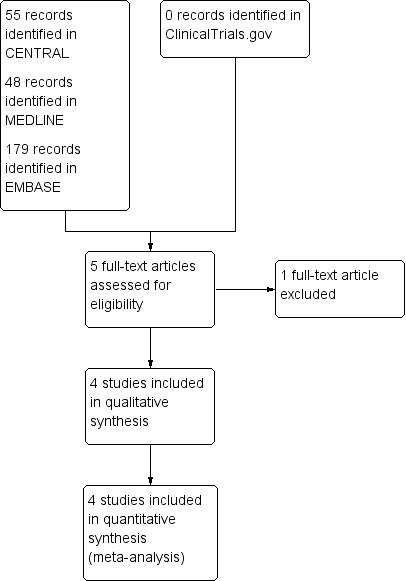
Study flow diagram.
Included studies
We included four studies (1253 participants took medication, 1158 in efficacy analyses), all of which enrolled adults with episodic TTH (see Characteristics of included studies table). They all specified using the IHS diagnostic criteria and reported mean baseline pain of at least moderate intensity. Three studies had specific inclusion criteria regarding the average headache frequency experienced by participants, as follows:
Two to eight episodes per month (Dahlöf 1996);
1 to 10 episodes per month (Mehlisch 1998);
At least four episodes per month but no more than three episodes per week (van Gerven 1996).
Most participants were therefore experiencing frequent episodic tension headache. Studies typically excluded participants who had a contraindication to one of the study medications or who were regularly taking medication that could influence the study results (e.g. analgesics, tranquillisers, or muscle relaxants). People who experienced migraines were either excluded or required to be able to distinguish between TTH and migraine.
One study used a cross‐over design (Dahlöf 1996), and three used a parallel‐group design (Mehlisch 1998; Steiner 1998; van Gerven 1996). All studies used a single dose of medication to treat a discrete headache episode. The cross‐over study specified a minimum of 72 hours between treated headache episodes (Dahlöf 1996). It did not report results separately for the first treatment period; results were provided for participants who completed all five periods (five different treatments). We chose to analyse these data as if they were from parallel groups, although the groups would clearly have reduced clinically heterogeneity.
While the included studies reported outcomes described in their methods, outcomes of interest for this review were not consistently reported across the studies. Two studies reported pain‐free at two hours (Dahlöf 1996; Steiner 1998), and one study reported pain‐free at three hours (van Gerven 1996). Two studies reported pain‐free or mild pain (or an equivalent measure) at two hours (Dahlöf 1996; Steiner 1998), and two studies reported pain‐free or mild pain at four hours (Mehlisch 1998; van Gerven 1996). None of the studies reported outcomes after more than four hours. All studies reported on some measure of PID. In addition, they all reported on adverse events, and three reported on the use of rescue medication (Mehlisch 1998; Steiner 1998; van Gerven 1996).
All studies used ketoprofen 25 mg. One study also used ketoprofen 12.5 mg (Mehlisch 1998), and two also used ketoprofen 50 mg (Dahlöf 1996; van Gerven 1996). All studies used a placebo comparator.
Active comparators were:
paracetamol 500 mg (Dahlöf 1996);
paracetamol 1000 mg (Dahlöf 1996; Mehlisch 1998; Steiner 1998);
ibuprofen 200 mg (van Gerven 1996).
The total number of participants randomised and who took study medication in the four studies was 1253, with 1213 in three parallel‐group studies (Mehlisch 1998; Steiner 1998; van Gerven 1996) and 40 in one cross‐over study (29 participants in this study contributed 5 headache episodes each) (Dahlöf 1996). Since outcomes were inconsistently reported and because many participants received active comparators, the number of participants with data for analyses for ketoprofen was much smaller than the total number.
Excluded studies
We excluded one study (see Characteristics of excluded studies table). This study did not use a placebo comparator and also included some participants with chronic TTH (Lange 1995).
Risk of bias in included studies
Figure 2 shows a summary of the risk of bias assessment.
2.
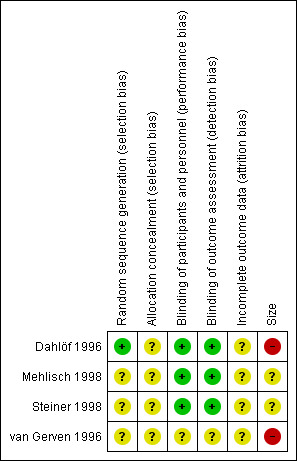
Risk of bias summary: review authors' judgements about each risk of bias item for each included study.
Allocation
All studies were randomised but only one adequately described the method used to generate the random sequence (Dahlöf 1996). None of the studies described the method used to conceal the random allocation.
Blinding
All studies were double blind. Three described a 'double‐dummy' method to conceal the intervention from participants and study personnel (Dahlöf 1996; Mehlisch 1998; Steiner 1998). The remaining study did not describe the method of blinding.
Incomplete outcome data
We judged all studies to be of unknown risk of bias due to a lack of information. Dahlöf 1996 reported results for a per protocol analysis, from which one‐quarter of participants were excluded because they did not complete all five treatment periods in the cross‐over study; it said that results for the ITT analysis were "similar", but did not provide further information. Mehlisch 1998 excluded 72 of 703 participants from the efficacy analysis (mainly for not recording data correctly) but did not indicate if these participants were evenly distributed between the groups. Steiner 1998 did not provide information about group allocation for participants excluded from the ITT analysis because of protocol violations (9/348 participants) or missing data (additional 9/348). Two studies did not report imputation methods (Steiner 1998; van Gerven 1996).
Other potential sources of bias
Two studies enrolled fewer than 50 participants per treatment arm and therefore we judged them to be at high risk of bias (Dahlöf 1996; van Gerven 1996). The other two studies had an unknown risk of bias due to size, with between 50 and 199 participants per treatment arm (Mehlisch 1998; Steiner 1998).
Effects of interventions
See: Table 1
Results for individual studies are presented in Appendix 5 (efficacy) and Appendix 6 (adverse events and withdrawals). There were sufficient data for pooled analysis only for ketoprofen 25 mg compared with placebo.
Ketoprofen 12.5 mg versus placebo
One study compared ketoprofen 12.5 mg with placebo (353 participants in comparison) (Mehlisch 1998). It did not report outcomes of pain‐free at two hours or pain‐free or mild pain at two hours (headache response). Using a 4‐point scale, the same proportion of participants reported a good or excellent response after four hours with ketoprofen 12.5 mg (45%, 82/181) as with placebo (45%; 78/172). There was no significant difference in mean pain relief intensity scores at any time point between ketoprofen 12.5 mg and placebo. Fewer participants used rescue medication within four hours with ketoprofen 12.5 mg (10/158) than with placebo (16/151).
More participants experienced adverse events with ketoprofen 12.5 mg (18/181) than with placebo (8/172). There were no serious adverse events or adverse event withdrawals.
Ketoprofen 25 mg versus placebo
All four studies compared ketoprofen 25 mg with placebo.
Pain‐free at two hours
Two studies (272 attacks or participants) contributed data for analysis of pain‐free at two hours (Dahlöf 1996; Steiner 1998).
The proportion of attacks/participants who were pain‐free at two hours with ketoprofen 25 mg was 27% (36/131, range 27% to 28%).
The proportion of attacks/participants who were pain‐free at two hours with placebo was 16% (23/141, range 16% to 17%).
The RR for ketoprofen 25 mg compared with placebo was 1.7 (95% CI 1.1 to 2.7); the NNT was 9.0 (95% CI 4.8 to 72) (Figure 3).
3.
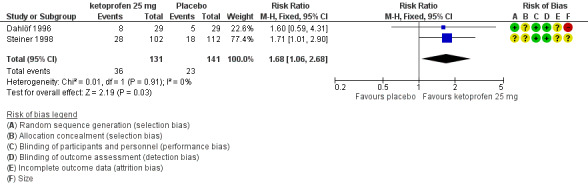
Forest plot of comparison: 1 Ketoprofen 25 mg versus placebo, outcome: 1.1 Pain‐free at 2 hours.
We downgraded the evidence for this outcome by two levels to low quality (sparse data: small number of studies, participants, attacks, and events).
Pain‐free at one hour
No studies reported pain‐free at one hour.
Pain‐free at four hours
Only one study reported pain‐free at four hours (van Gerven 1996); 7/39 participants were pain‐free at four hours compared with 1/39 with placebo. There were too few data for analysis.
Pain‐free at 24 hours
No studies reported pain‐free at 24 hours.
Pain‐free or mild pain at two hours
Two studies (272 attacks or participants) contributed data for pain‐free or mild pain at two hours (Dahlöf 1996; Steiner 1998).
The proportion of attacks/participants who were pain‐free or had only mild pain at two hours with ketoprofen 25 mg was 66% (86/131, range 52% to 70%).
The proportion of attacks/participants who were pain‐free or had only mild pain at two hours with placebo was 38% (54/141, range 36% to 48%).
The RR for ketoprofen 25 mg compared with placebo was (RR 1.7, 95% CI 1.3 to 2.2); the NNT was 3.7 (95% CI 2.6 to 6.3) (Figure 4).
4.
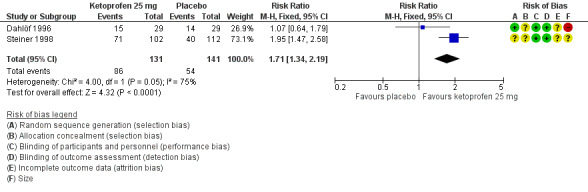
Forest plot of comparison: 1 Ketoprofen 25 mg versus placebo, outcome: 1.2 Pain‐free or mild pain at two hours.
We downgraded the evidence for this outcome by one level to moderate quality (sparse data: small number of studies and attacks; modest number of events).
Pain intensity difference or summed pain intensity difference
Dahlöf 1996 reported that the PID for ketoprofen 25 mg compared with placebo was not statistically significant at two hours.
Mehlisch 1998 did not reported either PID or SPID, but did report a composite outcome of pain relief intensity difference (PRID; sum of pain relief and pain intensity scores) for ketoprofen 25 mg of 4.9 (standard deviation (SD) 2.1) at two hours and 5.3 (SD 1.7) at four hours, compared with a PRID for placebo of 4.5 (SD 2.1) at two hours, and 4.8 (SD 1.8) at four hours.
Steiner 1998 presented data graphically for mean pain intensity in each group. We estimated that the PID at two hours was 30/100 for ketoprofen 25 mg and 17/100 for placebo.
van Gerven 1996 reported a significantly greater reduction in VAS at two hours of 41% for ketoprofen 25 mg and 17% for placebo, and at four hours of 59% for ketoprofen 25 mg and 19% for placebo.
It was not possible to pool any data for analysis.
Use of rescue medication
Participants who take rescue medication are considered to have withdrawn due to lack of efficacy. Three studies (605 participants) provided data for the number of participants who used rescue medication with ketoprofen 25 mg versus placebo (Mehlisch 1998; Steiner 1998; van Gerven 1996). In all three studies, the reported use of rescue medication was after two hours, however, the endpoint ranged from four to a possible 24 hours. It seems likely that participants with an inadequate response would have taken rescue medication soon after it was allowed (i.e. before four hours), and due to the limited amount of data available, we have combined the data for an exploratory analysis.
The proportion of participants who used rescue medication with ketoprofen 25 mg was 20% (59/302, range 4% to 43%).
The proportion of participants who used rescue medication with placebo was 36% (108/303, range 11% to 73%).
The RR for ketoprofen 25 mg compared with placebo was 0.6 (95% CI 0.5 to 0.7); the NNTp was 6.2 (95% CI 4.3 to 11) (Analysis 1.4).
1.4. Analysis.
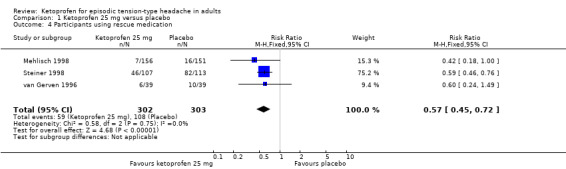
Comparison 1 Ketoprofen 25 mg versus placebo, Outcome 4 Participants using rescue medication.
We judged the quality of this evidence as moderate, downgraded by one level due to the small number of studies, but modest number of events.
Adverse events
Participant experiencing any adverse event
Three studies (651 participants) contributed data for any adverse event (Mehlisch 1998; Steiner 1998; van Gerven 1996).
The proportion of participants who experienced any adverse event with ketoprofen 25 mg was 14% (44/324; range 5% to 15%).
The proportion of participants who experienced any adverse event with placebo was 7% (22/327; range 5% to 10%).
The RR for ketoprofen 25 mg compared with placebo was 2.0 (95% CI 1.2 to 3.3); the NNH was 15 (95% CI 8.7 to 45) (Analysis 1.5).
1.5. Analysis.
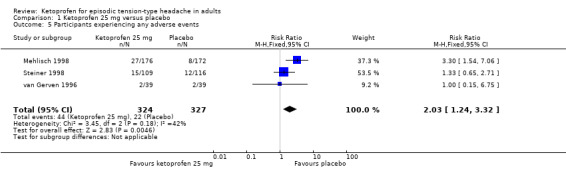
Comparison 1 Ketoprofen 25 mg versus placebo, Outcome 5 Participants experiencing any adverse events.
We assessed the evidence for this outcome to be of low quality, downgraded two levels due to sparse data (small number of studies and few events).
In addition, Steiner 1998 reported that 8% (9/112) of participants who received placebo reported pain relief of 'definitely or much worse' at two hours after medication, compared with none who received ketoprofen 25 mg.
Participants with serious adverse events
None of the studies reported any serious adverse events. We assessed the evidence of this outcome to be of very low quality, downgraded three levels due to sparse data. The true incidence of serious adverse events can be estimated at no more than 1 in 230 participants (Eypasch 1995).
Adverse event withdrawals
There were no adverse event withdrawals with ketoprofen 25 mg or placebo.
Ketoprofen 50 mg versus placebo
One study compared ketoprofen 50 mg with placebo (58 treated headache episodes in comparison) (Dahlöf 1996). It did not report our primary outcome of pain‐free at two hours, but presented results for pain‐free or mild pain at two hours graphically. This outcome was experienced in 20/29 episodes treated with ketoprofen 50 mg compared with 14/29 episodes treated with placebo. The mean PID was reported to be significantly greater with ketoprofen 50 mg than with placebo. It did not report the number of participants using rescue medication.
The study did not report the number of participants experiencing adverse events, but did report that events were "mostly mild or moderate", and "no particular difference was observed between the treatments". There were no serious adverse events or adverse event withdrawals with ketoprofen 50 mg or placebo.
Ketoprofen versus active comparators
All four studies included active treatment arms, comparing ketoprofen with paracetamol 500 mg (Dahlöf 1996), paracetamol 1000 mg (Dahlöf 1996; Mehlisch 1998; Steiner 1998), and ibuprofen 200 mg (van Gerven 1996). There were sufficient data for pooled analysis only for ketoprofen 25 mg compared with paracetamol 1000 mg.
Ketoprofen 25 mg versus paracetamol 1000 mg
Three studies compared ketoprofen 25 mg with paracetamol 1000 mg (Dahlöf 1996; Mehlisch 1998; Steiner 1998).
Pain‐free at two hours
Two studies (276 attacks or participants) contributed data for pain‐free at two hours (Dahlöf 1996; Steiner 1998).
The proportion of attacks/participants who were pain‐free at two hours with ketoprofen 25 mg was 27% (36/131, range 27% to 28%).
The proportion of attacks/participants who were pain‐free at two hours with paracetamol 1000 mg was 21% (30/145, range 17% to 22%).
The RR for ketoprofen 25 mg compared with paracetamol 1000 mg was 1.3 (95% CI 0.9 to 2.0); the NNT was not calculated (Analysis 2.1).
2.1. Analysis.
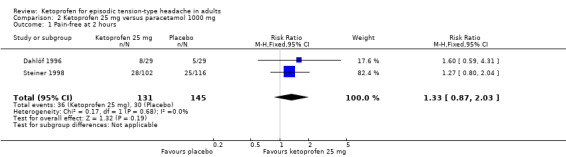
Comparison 2 Ketoprofen 25 mg versus paracetamol 1000 mg, Outcome 1 Pain‐free at 2 hours.
We downgraded the evidence for this outcome by two levels to low quality (sparse data: small number of studies, participants/attacks, and events).
Pain‐free at other time points
No studies reported pain‐free outcomes at 1, 4, or 24 hours.
Pain‐free or mild pain at two hours
Two studies (276 attacks or participants) contributed data for pain‐free or mild pain at two hours (Dahlöf 1996; Steiner 1998).
The proportion of attacks/participants who were pain‐free or had only mild pain at two hours with ketoprofen 25 mg was 66% (86/131, range 52% to 70%).
The proportion of attacks/participants who were pain‐free or had only mild pain at two hours with paracetamol 1000 mg was 57% (82/145, range 38% to 61%).
The RR for ketoprofen 25 mg compared with paracetamol 1000 mg was 1.2 (95% CI 0.97 to 1.4); the NNT was not calculated (Analysis 2.2).
2.2. Analysis.
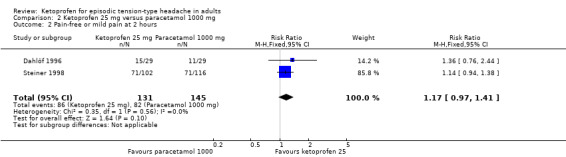
Comparison 2 Ketoprofen 25 mg versus paracetamol 1000 mg, Outcome 2 Pain‐free or mild pain at 2 hours.
We downgraded the evidence for this outcome by two levels to low quality (sparse data: small number of studies, participants, and events).
Pain intensity difference or summed pain intensity difference
Dahlöf 1996 reported that the PID for ketoprofen 25 mg compared with paracetamol 1000 mg was not statistically significant at two hours.
Mehlisch 1998 reported neither PID nor SPID, but did report a composite outcome of PRID for ketoprofen 25 mg of 4.9 (SD 2.1) at two hours and 5.3 (SD 1.7) at four hours, compared with a PRID for paracetamol 1000 mg of 4.6 (SD 2.1) at two hours, and 5.0 (SD 1.9) at four hours.
Steiner 1998 presented data graphically for mean pain intensity in each group. We estimated that the PID at two hours was 30/100 for ketoprofen 25 mg and 26/100 for paracetamol 1000 mg.
Use of rescue medication
Participants who take rescue medication are considered to have withdrawn due to lack of efficacy. Two studies (548 participants) provided data for the number of participants who used rescue medication with ketoprofen 25 mg versus paracetamol 1000 mg (Mehlisch 1998; Steiner 1998). In both studies, the reported use of rescue medication was after two hours, however, the endpoint was four hours in Mehlisch 1998 and not defined in Steiner 1998. It seems likely that participants with an inadequate response would have taken rescue medication soon after it was allowed (i.e. before four hours), and due to the limited amount of data available, we have combined the data for an exploratory analysis.
The proportion of participants who used rescue medication with ketoprofen 25 mg was 20% (53/263, range 4% to 43%).
The proportion of participants who used rescue medication with paracetamol 1000 mg was 22% (62/285, range 5% to 45%).
The RR for ketoprofen 25 mg compared with paracetamol 1000 mg was 0.95 (95% CI 0.71 to 1.3); the NNTp was not calculated (Analysis 2.3).
2.3. Analysis.
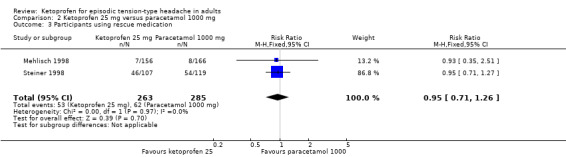
Comparison 2 Ketoprofen 25 mg versus paracetamol 1000 mg, Outcome 3 Participants using rescue medication.
Although the absolute rates of remedication differed between the studies, the RRs were very similar. We downgraded the evidence for this outcome by one level to moderate quality (sparse data: small number of studies and events).
Adverse events
Participants experiencing any adverse event
Two studies (582 participants) contributed data for any adverse event (Mehlisch 1998; Steiner 1998).
The proportion of participants who experienced any adverse event with ketoprofen 25 mg was 15% (42/285; range 14% to 15%).
The proportion of participants who experienced any adverse event with paracetamol 1000 mg was 9% (26/297; range 8% to 9%).
The RR for ketoprofen 25 mg compared with paracetamol 1000 mg was 1.7 (95% CI 1.1 to 2.7); the NNH was 17 (95% CI 8.9 to 130) (Analysis 2.4).
2.4. Analysis.
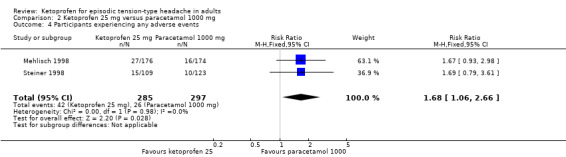
Comparison 2 Ketoprofen 25 mg versus paracetamol 1000 mg, Outcome 4 Participants experiencing any adverse events.
We downgraded the evidence for this outcome by two levels to low quality (sparse data: small number of studies and events; imprecision: wide CIs).
In addition, Steiner 1998 reported that 2% (2/116) of participants treated with paracetamol 1000 mg reported pain relief of 'definitely or much worse' at two hours after medication. No participants reported a worsening of pain with ketoprofen 25 mg.
Specific adverse events
Most events were of mild to moderate intensity. Two studies reported individual adverse events (Dahlöf 1996) or adverse events by body system (Mehlisch 1998), but there were too few events for analysis. Mild to moderate gastrointestinal events or nervous system events were the most commonly reported events, and were more numerous with ketoprofen than with placebo. Steiner 1998 reported that nausea was the most common event in all treatment groups (2.8% with ketoprofen 25 mg, 3.5% with placebo). van Gerven 1996 reported that events were mostly self‐limiting gastrointestinal complaints or 'unusual' headache.
Participants with serious adverse events
None of the studies reported any serious adverse events.
Adverse event withdrawals
There was only one adverse event withdrawal in these studies. One of 29 participants treated with paracetamol 1000 mg withdrew due to tinnitus and indigestion (Dahlöf 1996).
Results for individual studies are provided in Appendix 5 and Appendix 6.
Discussion
Summary of main results
The primary outcome of this review was pain‐free at two hours using any standard method of pain assessment and without the use of rescue medication, reflecting the updated guidelines for controlled trials of drugs in TTH issued by the IHS (IHS 2010). We included four studies with over 1200 participants, of which 689 were in comparisons of ketoprofen 25 mg versus placebo. Participants had moderate or severe pain at the start of treatment, and took just one treatment dose per headache episode.
The NNT for the outcome pain‐free at two hours for ketoprofen 25 mg compared with placebo was 9.0 (95% CI 4.8 to 72) (low quality evidence); this was close to the value of 10 that we consider the limit of clinical utility for this outcome. A better (lower) NNT was obtained for the outcome pain‐free or mild pain at two hours (3.7, 95% CI 2.6 to 6.3) (moderate quality evidence); this was significantly better than the value of 8 that we consider the limit of clinical utility for this outcome. While pain‐free or mild pain at two hours is clearly an outcome that is easier to achieve than pain‐free at two hours, it is one that is generally considered worthwhile by people with pain (Moore 2013).
Fewer participants used rescue medication with ketoprofen 25 mg than with placebo, giving an NNTp of 6.2 (95% CI 4.3 to 11) (moderate quality evidence). Fewer participants also experienced adverse events with ketoprofen 25 mg compared with placebo (NNH 15, 95% CI 8.7 to 45) (low quality evidence).
There was no statistically significant difference in efficacy or remedication rates with ketoprofen 25 mg compared to paracetamol 1000 mg, although the amount of information available (two studies, 276 attacks or participants) was insufficient to detect reliably a difference between two active comparators, especially in a pain condition and trials with a range of other potential problems (Moore 2014). However, participants taking ketoprofen 25 mg experienced more adverse events than participants taking paracetamol 1000 mg in these studies (NNH 17, 95% CI 8.9 to 130).
Overall completeness and applicability of evidence
IHS recommendations regarding outcomes of headache trials are well regarded (IHS 2010), and often, if not always, followed (Bendtsen 2010; Moore 2014). Studies included in this review largely predated those recommendations and were inconsistent in reporting them, which limited the ability to draw useful conclusions about the efficacy of ketoprofen compared with placebo or active comparators.
Although the included studies used three dosages of ketoprofen, there were sufficient data for analysis of only the 25 mg dose. More information on different doses, use of ketoprofen in combination with another agent, and different formulations, would improve our understanding of the role of ketoprofen in TTH.
All studies required participants to have frequent episodic TTH; this is defined as anywhere between 2 and 14 headache days per month. Only one of the included studies provided information on the mean number of headaches experienced by participants before study entry, and this was at the limit for frequent episodic TTH (van Gerven 1996). We do not know whether the participants in the other studies were typically experiencing 2 to 5, or 10 to 14 headaches a month. This might influence the efficacy of treatments tested in these TTH studies, but we do not know because the information was missing. Neither do we know if these results are applicable to people with infrequent episodic TTH (one headache day per month or less), which may represent a large proportion of people experiencing this type of headache who do not consult their doctors or need medical management, but who use simple analgesics for pain relief.
The overwhelming majority of participants in the included studies had moderate or severe baseline pain. There is good reason for this in clinical trials, because it gives sensitivity to demonstrate a reduction in pain. However, the pain of TTH is usually described as being of mild or moderate intensity (IHS 2010), so the participants in these trials may represent a population of people with headaches that are more severe and possibly more difficult to treat than is the norm.
To understand these important methodological points, analysis of clinical trials at the level of the individual participant is required, using substantial amounts of data. Such an analysis seems unlikely at present, but would probably be highly informative for the development of existing IHS guidance (Bendtsen 2010).
Quality of the evidence
All included studies were both randomised and double‐blind; none were considered at high risk of bias for study conduct. Inconsistent reporting of outcomes, the small number of studies for the lower dose and for active comparators, and the small size of some studies were the major problems that limited analyses and downgraded our assessments of the quality of the results. The direction of results was consistent within analyses.
We judged the overall quality of the evidence as low to moderate.
We did not assess selective reporting bias because clinical trials in TTH have until recently had no framework and so are inconsistent in outcomes used (Moore 2014). There is no indication of how selective reporting might create bias in this situation.
Potential biases in the review process
Dahlöf 1996 was a cross‐over study and reported only for participants who completed all five intervention periods. First dose data were not reported, and we chose to analyse results as if they were parallel groups. These groups would be expected to have much reduced clinical heterogeneity, since each consisted of the same participants; the results were in accord with the other parallel group study. The effect of including cross‐over data is not known (Elbourne 2002), and the effect of reporting completer analysis likely to overestimate effect (Moore 2012).
We carried out extensive searches to identify relevant studies, and consulted widely and internationally for an earlier review (Moore 2014). We think it unlikely that there is a substantial number of studies that we have missed or are unpublished. However, we calculated that the existence of as few as 30 participants in studies showing no effect would be sufficient to change the estimated NNT for the outcome of pain‐free at two hours from 9 to 10, which we considered the threshold for clinical utility. For the outcome of no pain or mild pain at two hours, there would need to be 320 participants in studies showing no effect to change the NNT from 3.7 to 8. These numbers would be achieved with one or two trials, so the estimates from this review must be interpreted with caution.
Agreements and disagreements with other studies or reviews
These results are broadly in agreement with previous reviews that concluded that ibuprofen, paracetamol, and ketoprofen were better than placebo (Moore 2014; Verhagen 2006). The guideline from the EFNS recommends ibuprofen as drug of choice among NSAIDs or paracetamol or aspirin for acute treatment of TTH (Bendtsen 2010). That guideline was not based on a systematic review. The German evidence‐based recommendations for self medication of migraine and TTH were based on systematic reviews (Haag 2011), and included only seven studies that recruited at least some people with TTH. For self medication of TTH, it recommended paracetamol in combination with other analgesics or caffeine, but not paracetamol alone.
Authors' conclusions
Implications for practice.
For people with frequent episodic tension‐type headache
Ketoprofen 25 mg may relieve headache pain, but the chance of the pain being relieved entirely by two hours is low, about 3 in 10 (27%), and this is only very slightly greater than the proportion with placebo (about 2 in 10, or 16%). We do not know how or if these results can be extrapolated to people with an occasional headache. Its use is probably associated with more adverse events than placebo.
For clinicians
Ketoprofen may provide headache relief to about 10% more people with frequent episodic tension‐type headache than placebo, but at the expense of increased adverse events. It may be that a different dose or formulation of ketoprofen, or a combination with paracetamol or caffeine might be better, but evidence on this is lacking.
For policy makers
There is insufficient information on drugs, doses, formulations, or outcomes for policy makers to be able to make strong recommendations. Policy should reflect the finding of no or little clinically useful benefit.
For funders
Because of the very limited information and small degree of efficacy found for ketoprofen, it is highly unlikely that the treatment could be regarded as cost effective even considering that this is a generic drug.
Implications for research.
General
Frequent episodic tension‐type headache (TTH) is common and debilitating. The amount of evidence was limited by reporting issues, particularly of outcomes; this is a general finding for all TTH studies, not just those involving ketoprofen. It is not sufficient just to call for more studies. What is needed is a better understanding of TTH studies, in terms of the outcomes that can be reported from clinical trials, and often are not, and the differential effects of treatments in people with different degrees of headache frequency. This can be done from individual participant‐level analyses. Given that few modern studies have been completed or are underway involving ketoprofen or other drugs, this would appear to be the research priority before new studies are commissioned.
Design
The design of studies was generally good, although some were small. Future studies should be adequately powered to detect the magnitude of any effect, not simply a statistical difference from placebo, and could usefully investigate using different doses and formulations.
Measurement (endpoints)
The measurement of pain is not a major issue as most studies, especially modern studies, have used standard pain intensity and pain relief scales. What is at issue are the outcomes reported using those pain measurements. It is not clear that the International Headache Society preferred outcome of being free of pain at two hours is entirely appropriate, and while it is reasonable by analogy with migraine, it requires substantiating.
Comparison between active treatments
No authoritative comparisons between active treatments is possible in the present state of knowledge.
What's new
| Date | Event | Description |
|---|---|---|
| 29 May 2019 | Amended | Contact details updated. |
| 11 October 2017 | Review declared as stable | No new studies likely to change the conclusions are expected. |
History
Protocol first published: Issue 5, 2016 Review first published: Issue 9, 2016
| Date | Event | Description |
|---|---|---|
| 22 September 2016 | Review declared as stable | See Published notes. |
Notes
A new search within two years is not likely to identify any potentially relevant studies likely to change the conclusions. Therefore, this review has now been stabilised following discussion with the authors and editors. If appropriate, we will update the review if new evidence likely to change the conclusions is published, or if standards change substantially which necessitate major revisions.
Acknowledgements
The Oxford Pain Research Trust provided institutional support for this protocol.
We acknowledge the contribution of Stephen Heap to the development of this protocol.
Cochrane Review Group funding acknowledgement: the National Institute for Health Research (NIHR) is the largest single funder of the Cochrane Pain, Palliative and Supportive Care Review Group (PaPaS). Disclaimer: the views and opinions expressed therein are those of the authors and do not necessarily reflect those of the NIHR, National Health Service (NHS), or the Department of Health.
Appendices
Appendix 1. CENTRAL search strategy (via CRSO)
MESH DESCRIPTOR ketoprofen EXPLODE ALL TREES (413)
(ketoprofen* OR alrheum* OR profenid OR orudis OR oruvail):TI,AB,KY (910)
#1 OR #2 (910)
MESH DESCRIPTOR headache (1608)
MESH DESCRIPTOR headache disorders EXPLODE ALL TREES (1971)
(headache* or cephalgi* or cephalalgi*):TI,AB,KY (17717)
#4 OR #5 OR #6 (18317)
#3 AND #7 (55)
Appendix 2. MEDLINE search strategy (via Ovid)
Ketoprofen/ (2395)
(ketoprofen* or alrheum* or profenid or orudis or oruvail).mp. (3410)
1 or 2 (3410)
Headache/ (24412)
exp Headache Disorders/ (29119)
(headache* or cephalgi* or cephalalgi*).mp. (69114)
4 or 5 or 6 (81670)
randomized controlled trial.pt. (415460)
controlled clinical trial.pt. (90651)
randomized.ab. (312371)
placebo.ab. (158310)
drug therapy.fs. (1854584)
randomly.ab. (220598)
trial.ab. (323081)
groups.ab. (1391694)
8 or 9 or 10 or 11 or 12 or 13 or 14 or 15 (3523448)
3 and 7 and 16 (48)
Appendix 3. Embase search strategy (via Ovid)
Ketoprofen/ (11381)
(ketoprofen* or alrheum* or profenid or orudis or oruvail).mp. (11892)
1 or 2 (11892)
Headache/ (163340)
exp Headache Disorders/ (235961)
(headache* or cephalgi* or cephalalgi*).mp. (215328)
4 or 5 or 6 (255030)
Randomized controlled trial/ (403010)
Double‐blind procedure/ (130612)
Crossover‐procedure/ (46975)
(random* or factorial* or crossover* or cross over* or cross‐over* or placebo* or (doubl* adj blind*) or assign* or allocat*).tw. (1447237)
8 or 9 or 10 or 11 (1532104)
3 and 7 and 12 (179)
Appendix 4. GRADE: criteria for assigning grade of evidence
The GRADE system uses the following criteria for assigning a quality level to a body of evidence (Chapter 12, Higgins 2011).
High: randomised trials; or double‐upgraded observational studies.
Moderate: downgraded randomised trials; or upgraded observational studies.
Low: double‐downgraded randomised trials; or observational studies.
Very low: triple‐downgraded randomised trials; or downgraded observational studies; or case series/case reports.
Factors that may decrease the quality level of a body of evidence are:
limitations in the design and implementation of available studies suggesting high likelihood of bias;
indirectness of evidence (indirect population, intervention, control, outcomes);
unexplained heterogeneity or inconsistency of results (including problems with subgroup analyses);
imprecision of results (wide confidence intervals).
high probability of publication bias.
Factors that may increase the quality level of a body of evidence are:
large magnitude of effect;
all plausible confounding would reduce a demonstrated effect or suggest a spurious effect when results show no effect;
dose‐response gradient.
Appendix 5. Summary of outcomes in individual studies: efficacy
| Study ID | Treatment | Pain‐free at 2 h | Pain‐free at 1 h | Pain‐free at 4 h | Pain‐free at 24 h | ≤ Mild pain at 2 h | Other measures of efficacy |
| Dahlöf 1996 | (1) Ketoprofen 25 mg (2) Ketoprofen 50 mg (3) Paracetamol 500 mg (4) Paracetamol 1000 mg (5) Placebo |
PP analysis (29 participants who completed all 5 attacks without major violation) (1) 8/29 (28%) (2) 9/29 (32%) (3) 5/29 (17%) (4) 5/29 (17%) (5) 5/29 (17%) |
No data | No data | No data | From graph (1) 15/29 (50%) (2) 20/29 (68%) (3) 12/29 (41%) (4) 11/29 (38%) (5) 14/29 (48%) |
PID: ketoprofen 50 mg had greater effect than paracetamol 500 mg, paracetamol 1000 mg, and placebo at 2 h (P = 0.04). Ketoprofen 25 mg had intermediate effect but not statistically significant PGE (4‐point VRS), good or very good at 2 h: (1) 10/29 (2) 11/29 (3) 7/29 (4) 7/29 (5) 5/29 |
| Mehlisch 1998 | (1) Ketoprofen 12.5 mg (2) Ketoprofen 25 mg (3) Paracetamol 1000 mg (4) Placebo |
No data | No data | No data | No data | No data | Mean (SD) PRID at 2 h: (1) 4.73 (1.98) (2) 4.87 (2.07) (3) 4.58 (2.11) (4) 4.45 (2.11) Mean (SD) PRID at 4 h: (1) 5.23 (1.62) (2) 5.33 (1.67) (3) 5.01 (1.86) (4) 4.75 (1.81) PGE (4‐point VRS), good or excellent at 4 h: (1) 82/181 (2) 98/176 (3) 93/174 (4) 78/172 |
| Steiner 1998 | (1) Ketoprofen 25 mg (2) Paracetamol 1000 mg (3) Placebo |
(1) 28/102 (2) 25/116 (3) 18/112 |
No data | No data | No data | Total relief + worthwhile effect (1) 71/102 (2) 71/116 (3) 40/112 |
Mean PID (100 mm VAS) at 2 h (from graph): (1) 30 (2) 26 (3) 17 PGE (5‐point VRS), good or excellent at 2 h: (1) 40/105 (2) 43/116 (3) 12/111 |
| van Gerven 1996 | (1) Ketoprofen 25 mg (2) Ketoprofen 50 mg (3) Ibuprofen 200 mg (4) Placebo |
No data | No data | No data | No data | No data | Strong improvement at 4 h: (1) 24/39 (62%) (2) 22/40 (55%) (3) 7/39 (18%) (4) 16/41 (39%) Reduction in PI at 2 (4) h (1) 41% (61%) (2) 47% (59%) (3) 18% (53%) (4) 17% (19%) |
| h: hour; PGE: Participant Global Evaluation; PI: pain intensity; PID: pain intensity difference; PRID: pain relief intensity difference; PP: per protocol; SD: standard deviation; VAS: visual analogue scale; VRS: verbal rating scale. | |||||||
Appendix 6. Summary of outcomes in individual studies: adverse events, withdrawals, and rescue medication
| Study ID | Treatment | Any AE | Serious AE | Withdrawals | Rescue medication |
| Dahlöf 1996 | (1) Ketoprofen 25 mg (2) Ketoprofen 50 mg (3) Paracetamol 500 mg (4) Paracetamol 1000 mg (5) Placebo |
No data Total of 30 adverse events reported within 24 h of treating 178 attacks. Most of mild or moderate severity. No difference between groups |
None | AE: (4) 1/29 (tinnitus and indigestion) 10 participants did not complete all 5 attacks 1 participant had a major protocol violation (took medication < 72 h after previous dose) |
No usable data |
| Mehlisch 1998 | (1) Ketoprofen 12.5 mg (2) Ketoprofen 25 mg (3) Paracetamol 1000 mg (4) Placebo |
(1) 18/181 (2) 27/176 (3) 16/174 (4) 8/172 Whole body, digestive and nervous system events were most common with ketoprofen, and more numerous than with placebo |
None | No AE withdrawals 72 participants not included in efficacy analysis: 5 protocol violations, 67 did not record data properly |
At 4 h: (1) 10/158 (6.3%) (2) 7/156 (4.5%) (3) 8/166 (4.8%) (4) 16/151 (10.6%) Median time to rescue medication > 4 h, no significant difference between groups |
| Steiner 1998 | (1) Ketoprofen 25 mg (2) Paracetamol 1000 mg (3) Placebo |
(1) 15/109 (14%) (2) 10/123 (8%) (3) 12/116 (10%) Nausea most common event in all groups |
None | No AE withdrawals 9 participants excluded from ITT analysis for taking medication < 1 h or > 12 h after onset Additional 9 participants excluded from ITT population for principal endpoint (PR at 2 h) analysis due to missing data |
Up to 24 h: (1) 46/107 (2) 54/119 (3) 82/113 |
| van Gerven 1996 | (1) Ketoprofen 25 mg (2) Ketoprofen 50 mg (3) Ibuprofen 200 mg (4) Placebo |
14 events reported, by 9% of participants; 9% of total participants = 14, so assumed no participant had > 1 event (1) 2/39 (2) 7/40 (3) 3/40 (4) 2/39 All of mild to moderate intensity, mostly self‐limiting gastrointestinal complaints or 'unusual' headache |
None | None | From graph, estimated remedication at 4 h: (1) 5/40 (12%) (2) 6/39 (15%) (3) 7/41 (17%) (4) 10/39 (25%) |
| AE: adverse event; h: hour; ITT: intention to treat; PR: pain relief. | |||||
Data and analyses
Comparison 1. Ketoprofen 25 mg versus placebo.
| Outcome or subgroup title | No. of studies | No. of participants | Statistical method | Effect size |
|---|---|---|---|---|
| 1 Pain‐free at 2 hours | 2 | 272 | Risk Ratio (M‐H, Fixed, 95% CI) | 1.68 [1.06, 2.68] |
| 2 Pain‐free or mild pain at 2 hours | 2 | 272 | Risk Ratio (M‐H, Fixed, 95% CI) | 1.71 [1.34, 2.19] |
| 3 Pain‐free or mild pain at 4 hours | 2 | 426 | Risk Ratio (M‐H, Fixed, 95% CI) | 1.41 [1.15, 1.72] |
| 4 Participants using rescue medication | 3 | 605 | Risk Ratio (M‐H, Fixed, 95% CI) | 0.57 [0.45, 0.72] |
| 5 Participants experiencing any adverse events | 3 | 651 | Risk Ratio (M‐H, Fixed, 95% CI) | 2.03 [1.24, 3.32] |
1.1. Analysis.
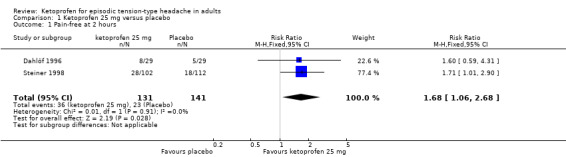
Comparison 1 Ketoprofen 25 mg versus placebo, Outcome 1 Pain‐free at 2 hours.
1.2. Analysis.
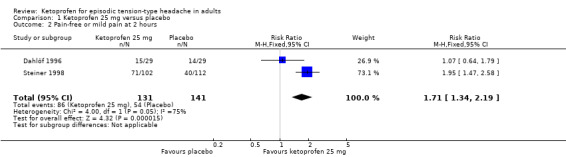
Comparison 1 Ketoprofen 25 mg versus placebo, Outcome 2 Pain‐free or mild pain at 2 hours.
1.3. Analysis.
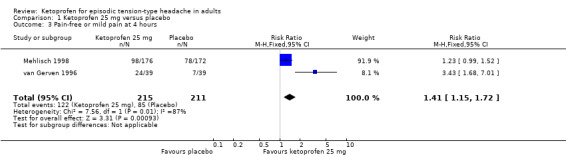
Comparison 1 Ketoprofen 25 mg versus placebo, Outcome 3 Pain‐free or mild pain at 4 hours.
Comparison 2. Ketoprofen 25 mg versus paracetamol 1000 mg.
| Outcome or subgroup title | No. of studies | No. of participants | Statistical method | Effect size |
|---|---|---|---|---|
| 1 Pain‐free at 2 hours | 2 | 276 | Risk Ratio (M‐H, Fixed, 95% CI) | 1.33 [0.87, 2.03] |
| 2 Pain‐free or mild pain at 2 hours | 2 | 276 | Risk Ratio (M‐H, Fixed, 95% CI) | 1.17 [0.97, 1.41] |
| 3 Participants using rescue medication | 2 | 548 | Risk Ratio (M‐H, Fixed, 95% CI) | 0.95 [0.71, 1.26] |
| 4 Participants experiencing any adverse events | 2 | 582 | Risk Ratio (M‐H, Fixed, 95% CI) | 1.68 [1.06, 2.66] |
Characteristics of studies
Characteristics of included studies [ordered by study ID]
Dahlöf 1996.
| Methods | Single centre, DB, R, PC, AC, cross‐over study Five attacks treated, with a single dose of each study medication. Minimum 72 h between 2 attacks Patient diary card to record attack and treatment response |
|
| Participants | Episodic TTH (IHS), ≥ 1 year, 2 to 8 episodes/month Exclusion: contraindication to NSAID, analgesic hypersensitivity, concomitant NSAID use, antiepileptics, chloramphenicol, probenecid N = 40 (M 13, F 27) Baseline PI 56/100 to 60/100 30 participants completed all 5 treatment periods but 1 had major protocol violation and was not included in analysis |
|
| Interventions | Ketoprofen 25 mg, n = 32 Ketoprofen 50 mg, n = 36 Paracetamol 500 mg, n = 36 Paracetamol 1000 mg, n = 36 Placebo, n = 36 (Used completer analysis for efficacy with n = 29) No other medication allowed within 2 h of test medication Rescue medication (usual) allowed 2 h after test medication |
|
| Outcomes | PI: 100 mm VAS and 5‐point VRS Tension/neck muscle stiffness: 5‐point VRS PGE (at 2 h): 4‐point VRS HR2, PF2, PID2 AEs Use of rescue medication Withdrawals |
|
| Notes | Oxford Quality Score: R1, DB2, W1 | |
| Risk of bias | ||
| Bias | Authors' judgement | Support for judgement |
| Random sequence generation (selection bias) | Low risk | "Determined according to a Latin square cross‐over design" |
| Allocation concealment (selection bias) | Unclear risk | Method not reported |
| Blinding of participants and personnel (performance bias) All outcomes | Low risk | "Double‐dummy method" |
| Blinding of outcome assessment (detection bias) All outcomes | Low risk | "Double‐dummy method" |
| Incomplete outcome data (attrition bias) All outcomes | Unclear risk | 11/40 participants not included in per‐protocol analysis. Reports "similar" result for ITT analysis |
| Size | High risk | < 50 participants per treatment arm (n = 29) |
Mehlisch 1998.
| Methods | Single centre, DB, R, PC, AC, parallel‐group study One attack treated, with a single dose of one study medication Patient diary card to record attack and treatment response |
|
| Participants | TTH (IHS), ≥ 1 year, average 1 to 10 episodes/month Headaches reported by participant to be at least moderate PI. In the past, participants must have experienced some PR from non‐prescription analgesics Exclusions: migraine, post‐concussion or cluster headaches in past year; history of chronic use of analgesics, tranquillisers or muscle relaxants; analgesic hypersensitivity N = 703 (631 in efficacy analysis: M 201, F 430) Baseline PI: 88% moderate; 12% severe) |
|
| Interventions | Ketoprofen 12.5 mg, n = 181 Ketoprofen 25 mg, n = 176 Paracetamol 1000 mg, n = 174 Placebo, n = 172 No other medication within 4 h of test medication Rescue medication strongly discouraged before 2 h |
|
| Outcomes | PI: 4‐point VRS PR: 5‐point VRS PGE: 4‐point VRS HR2, PID2, PRID4 Use of resource medications AEs Withdrawals |
|
| Notes | Oxford Quality Score: R1, DB2, W1 | |
| Risk of bias | ||
| Bias | Authors' judgement | Support for judgement |
| Random sequence generation (selection bias) | Unclear risk | "Subjects were randomly assigned" but method not reported |
| Allocation concealment (selection bias) | Unclear risk | Method not reported |
| Blinding of participants and personnel (performance bias) All outcomes | Low risk | "Double‐dummy" method |
| Blinding of outcome assessment (detection bias) All outcomes | Low risk | "Double‐dummy" method |
| Incomplete outcome data (attrition bias) All outcomes | Unclear risk | 72/703 excluded from efficacy analysis (5 protocol violations, 67 data recorded incorrectly) ‐ no indication if equally distributed between groups. 'Worst observation carried forward' for withdrawals, 'last observation carried forward' for other, linear interpolation for missing points |
| Size | Unclear risk | 50 to 199 participants per treatment arm (151 to 166) |
Steiner 1998.
| Methods | Multicentre, R, PC, AC, parallel‐group study One attack treated with single dose of one study medication Patient diary card to record attack and treatment response |
|
| Participants | Episodic TTH (IHS). Participants were said to be "healthy except for ETTH [episodic tension‐type headache]". Treated headache must have been at least moderate intensity Exclusions: "Patients known to investigators through earlier complaint(s) of headache"; migraines, physical or mental illness, taking regular medication N = 348 (339 analysed: M 72, F 267 ‐ but only reported on 330) PI baseline: mean 59, range 17 to 100 |
|
| Interventions | Ketoprofen 25 mg, n = 109 Paracetamol 1000 mg, n = 123 Placebo, n = 116 Rescue medication allowed after 2 h |
|
| Outcomes | PI: 100 mm VAS PR (2 h): 7‐point VRS PGE (2 h): 5‐point VRS PF2, HR2, PID2 Use of rescue medication AEs Withdrawals |
|
| Notes | Oxford Quality Score: R1, DB1, W1 | |
| Risk of bias | ||
| Bias | Authors' judgement | Support for judgement |
| Random sequence generation (selection bias) | Unclear risk | "Patients were randomly assigned in the ratio 1:1:1", but method not reported |
| Allocation concealment (selection bias) | Unclear risk | Method not reported |
| Blinding of participants and personnel (performance bias) All outcomes | Low risk | Double‐dummy method described |
| Blinding of outcome assessment (detection bias) All outcomes | Low risk | Double‐dummy method described |
| Incomplete outcome data (attrition bias) All outcomes | Unclear risk | Nine excluded from ITT analysis for dosing protocol violations. Further nine excluded from ITT population for principal endpoint analysis due to missing data. Treatment groups of excluded participants not reported "ITT analysis" reported, but numbers unclear and no mention of imputation |
| Size | Unclear risk | 50 to 199 participants per treatment arm (109 to 116) |
van Gerven 1996.
| Methods | Single‐centre, DB, R, PC, AC, parallel‐group study One attack treated, with single dose of one study medication Participants recorded attack and treatment response in an electronic diary |
|
| Participants | Episodic TTH (IHS, although physical and neurological examinations were not carried out), ≥ 4 episodes/month but ≤ 3 episodes/week. In 2 months prior to study, participants were required to have experienced 4 to 24 attacks of at least moderate severity, usually lasting ≥ 3 h and usually responsive to self medicated analgesics Exclusions: refractory headaches, migraines, cluster headache N = 162 took study medication (159 for efficacy analysis: M 50, F 109) Baseline PI: 0.26 to 0.96 ("moderate" ≥ 25/100) |
|
| Interventions | Ketoprofen 25 mg, n = 39 Ketoprofen 50 mg, n = 40 Ibuprofen 200 mg, n = 41 Placebo, n = 39 Rescue medication allowed after 2 h |
|
| Outcomes | PI: 10 cm VAS PR: 5‐point VRS PF3, HR4, PID2, PID4 Use of rescue medication AEs Withdrawals |
|
| Notes | Oxford Quality Score: R1, DB1, W1 | |
| Risk of bias | ||
| Bias | Authors' judgement | Support for judgement |
| Random sequence generation (selection bias) | Unclear risk | Method not reported |
| Allocation concealment (selection bias) | Unclear risk | Method not reported |
| Blinding of participants and personnel (performance bias) All outcomes | Unclear risk | "Double‐blind", but method not reported |
| Blinding of outcome assessment (detection bias) All outcomes | Unclear risk | "Double‐blind", but method not reported |
| Incomplete outcome data (attrition bias) All outcomes | Unclear risk | Three participants took study medication but did not provide data. Imputation method not reported |
| Size | High risk | < 50 participants per treatment arm (39 to 41) |
AC: active controlled; AE: adverse event; DB: double‐blind; F: female; h: hour; HR: headache response; IHS: International Headache Society; ITT: intention to treat; M: male; N: number of participants in study; n: number of participants in treatment arm; NSAID: nonsteroidal anti‐inflammatory drug; PC: placebo controlled; PF: pain‐free: PGE: Participant Global Evaluation; PI: pain intensity; PID: pain intensity difference; PR: pain relief; PRID: pain relief intensity difference; R: randomised; TTH: tension‐type headache; VAS: visual analogue scale; VRS: verbal rating scale; W: withdrawals.
Characteristics of excluded studies [ordered by study ID]
| Study | Reason for exclusion |
|---|---|
| Lange 1995 | No placebo comparator. Included chronic tension‐type headache |
Differences between protocol and review
We have clarified our assessment of potential performance and assessment bias in the 'Methods' section. In this review, all outcomes were self assessed, so the same considerations apply to detection bias as performance bias.
In addition, we have modified Appendix 4 (GRADE) to align it more closely with the wording used in the Handbook, and extended the description in 'Methods' of the GRADE assessment for exceptional circumstances to explain possible decisions.
Contributions of authors
LV and SD carried out searches, identified studies for inclusion, and carried out data extraction and analyses.
All authors were involved in writing the review.
Sources of support
Internal sources
-
The Oxford Pain Research Trust, UK.
Institutional support
External sources
No external source of support, UK.
Declarations of interest
LV: none known.
SD: none known.
RAM has received grant support from RB relating to individual patient level analyses of trial data on ibuprofen in acute pain and the effects of food on drug absorption of analgesics (2013), and from Grünenthal relating to individual patient level analyses of trial data regarding tapentadol in osteoarthritis and back pain (2015). He has received honoraria for attending boards with Menarini concerning methods of analgesic trial design (2014), with Novartis (2014) about the design of network meta‐analyses, and RB on understanding pharmacokinetics of drug uptake (2015).
Stable (no update expected for reasons given in 'What's new')
References
References to studies included in this review
Dahlöf 1996 {published data only}
- Dahlöf CG, Jacobs LD. Ketoprofen, paracetamol and placebo in the treatment of episodic tension‐type headache. Cephalalgia 1996;16(2):117‐23. [DOI: 10.1046/j.1468-2982.1996.1602117.x] [DOI] [PubMed] [Google Scholar]
Mehlisch 1998 {published data only}
- Mehlisch DR, Weaver M, Fladung B. Ketoprofen, acetaminophen, and placebo in the treatment of tension headache. Headache 1998;38(8):579‐89. [DOI: 10.1046/j.1526-4610.1998.3808579.x] [DOI] [PubMed] [Google Scholar]
Steiner 1998 {published data only}
- Steiner TJ, Lange R. Ketoprofen (25 mg) in the symptomatic treatment of episodic tension‐type headache: double‐blind placebo‐controlled comparison with acetaminophen (1000 mg). Cephalalgia 1998;18(1):38‐43. [DOI: ] [DOI] [PubMed] [Google Scholar]
van Gerven 1996 {published data only}
- Gerven JM, Schoemaker RC, Jacobs LD, Reints A, Ouwersloot‐van der Meij MJ, Hoedemaker HG, et al. Self‐medication of a single headache episode with ketoprofen, ibuprofen or placebo, home‐monitored with an electronic patient diary. British Journal of Clinical Pharmacology 1996;42(4):475‐81. [DOI: 10.1111/j.1365-2125.1996.tb00011.x] [DOI] [PMC free article] [PubMed] [Google Scholar]
References to studies excluded from this review
Lange 1995 {published data only}
- Lange R, Lentz R. Comparison ketoprofen, ibuprofen and naproxen sodium in the treatment of tension‐type headache. Drugs Under Experimental and Clinical Research 1995;21(3):89‐96. [PUBMED: 7555617] [PubMed] [Google Scholar]
Additional references
Ayzenberg 2012
- Ayzenberg I, Katsarava Z, Sborowski A, Chernysh M, Osipova V, Tabeeva G, et al. The prevalence of primary headache disorders in Russia: a countrywide survey. Cephalalgia 2012;32(5):373‐81. [DOI: 10.1177/0333102412438977] [DOI] [PubMed] [Google Scholar]
Barden 2009
- Barden J, Derry S, McQuay HJ, Moore RA. Single dose oral ketoprofen and dexketoprofen for acute postoperative pain in adults. Cochrane Database of Systematic Reviews 2009, Issue 4. [DOI: 10.1002/14651858.CD007355.pub2] [DOI] [PMC free article] [PubMed] [Google Scholar]
BASH 2010
- MacGregor EA, Steiner TJ, Davies PTG, for the British Association for the Study of Headache. Guidelines for all healthcare professionals in the diagnosis and management of migraine, tension‐type, cluster, and medication overuse headache. 3rd edition (1st revision), 2010. www.bash.org.uk/wp‐content/uploads/2012/07/10102‐BASH‐Guidelines‐update‐2_v5‐1‐indd.pdf (accessed 14 December 2015).
Bendtsen 2010
- Bendtsen L, Evers S, Linde M, Mitsikostas DD, Sandrini G, Schoenen J. EFNS guideline on the treatment of tension‐type headache ‐ report of an EFNS taskforce. European Journal of Neurology 2010;17(11):1318‐25. [DOI: 10.1111/j.1468-1331.2010.03070.x] [DOI] [PubMed] [Google Scholar]
Brainin 2004
- Brainin M, Barnes M, Baron JC, Gilhus NE, Hughes R, Selmaj K, et al. for the Guideline Standards Subcommittee of the EFNS Scientific Committee. Guidance for the preparation of neurological management guidelines by EFNS scientific task forces‐revised recommendations 2004. European Journal of Neurology 2004;11(9):577‐81. [DOI: 10.1111/j.1468-1331.2004.00867.x] [DOI] [PubMed] [Google Scholar]
Cook 1995
- Cook RJ, Sackett DL. The number needed to treat: a clinically useful measure of treatment effect. BMJ 1995;310(6977):452‐4. [DOI: 10.1136/bmj.310.6977.452] [DOI] [PMC free article] [PubMed] [Google Scholar]
Cristofolini 2008
- Cristofolini A, Dalla Serra P, Scherillo G, Orrico D, Micciolo R. The prevalence of headache in a population of health care workers and the effects on productivity costs. La Medicina del Lavoro 2008;99(1):8‐15. [PubMed] [Google Scholar]
Derry 2015
- Derry S, Wiffen PJ, Moore RA, Bendtsen L. Ibuprofen for acute treatment of episodic tension‐type headache in adults. Cochrane Database of Systematic Reviews 2015, Issue 7. [DOI: 10.1002/14651858.CD011474.pub2] [DOI] [PMC free article] [PubMed] [Google Scholar]
Edmeads 1993
- Edmeads J, Findlay H, Tugwell P, Pryse‐Phillips W, Nelson RF, Murray TJ. Impact of migraine and tension‐type headache on life‐style, consulting behaviour, and medication use: a Canadian population survey. Canadian Journal of Neurological Sciences 1993;20(2):131‐7. [PUBMED: 8334575] [DOI] [PubMed] [Google Scholar]
Elbourne 2002
- Elbourne DR, Altman DG, Higgins JPT, Curtin F, Worthington HV, Vail A. Meta‐analyses involving cross‐over trials: methodological issues. International Journal of Epidemiology 2002;31(1):140‐9. [DOI: 10.1093/ije/31.1.140] [DOI] [PubMed] [Google Scholar]
Eypasch 1995
- Eypasch E, Lefering R, Kum CK, Troidl H. Probability of adverse events that have not yet occurred: a statistical reminder. BMJ 1995;311(7005):619‐20. [DOI: 10.1136/bmj.311.7005.619] [DOI] [PMC free article] [PubMed] [Google Scholar]
Fernández‐de‐las‐Peñas 2010
- Fernández‐de‐las‐Peñas C, Madeleine P, Caminero AB, Cuadrado ML, Arendt‐Nielsen L, Pareja JA. Generalized neck‐shoulder hyperalgesia in chronic tension‐type headache and unilateral migraine assessed by pressure pain sensitivity topographical maps of the trapezius muscle. Cephalalgia 2010;30(1):77‐86. [DOI: 10.1111/j.1468-2982.2009.01901.x] [DOI] [PubMed] [Google Scholar]
FitzGerald 2001
- FitzGerald GA, Patrono C. The coxibs, selective inhibitors of cyclooxygenase‐2. New England Journal of Medicine 2001;345(6):433‐42. [DOI: 10.1056/NEJM200108093450607] [DOI] [PubMed] [Google Scholar]
Forward 1998
- Forward SP, McGrath PJ, MacKinnon D, Brown TL, Swann J, Currie EL. Medication patterns of recurrent headache sufferers: a community study. Cephalalgia 1998;18(3):146‐51. [DOI: 10.1046/j.1468-2982.1998.1803146.x] [DOI] [PubMed] [Google Scholar]
Fumal 2008
- Fumal A, Schoenen J. Tension‐type headache: current research and clinical management. Lancet Neurology 2008;7(1):70‐83. [DOI: 10.1016/S1474-4422(07)70325-3] [DOI] [PubMed] [Google Scholar]
Green 2009
- Green MW. Primary and secondary headaches. In: Rowland LP, Pedley TA editor(s). Merritt's Neurology. 12th Edition. Philadelphia: Lippincott Williams & Wilkins, 2009:951‐60. [ISBN: 9780781791861] [Google Scholar]
Guyatt 2013a
- Guyatt G, Oxman AD, Sultan S, Brozek J, Glasziou P, Alonso‐Coello P, et al. GRADE guidelines: 11. Making an overall rating of confidence in effect estimates for a single outcome and for all outcomes. Journal of Clinical Epidemiology 2013;66(2):151‐7. [DOI: 10.1016/j.jclinepi.2012.01.006] [DOI] [PubMed] [Google Scholar]
Guyatt 2013b
- Guyatt GH, Oxman AD, Santesso N, Helfand M, Vist G, Kunz R, et al. GRADE guidelines: 12. Preparing summary of findings tables ‐ binary outcomes. Journal of Clinical Epidemiology 2013;66(2):158‐72. [DOI: 10.1016/j.jclinepi.2012.01.012] [DOI] [PubMed] [Google Scholar]
Haag 2011
- Haag G, Diener HC, May A, Meyer C, Morck H, Straube A, et al. Self‐medication of migraine and tension‐type headache: summary of the evidence‐based recommendations of the Deutsche Migräne und Kopfschmerzgesellschaft (DMKG), the Deutsche Gesellschaft für Neurologie (DGN), the Österreichische Kopfschmerzgesellschaft (ÖKSG) and the Schweizerische Kopfwehgesellschaft (SKG). Journal of Headache and Pain 2011;12(2):201‐17. [DOI: 10.1007/s10194-010-0266-4] [DOI] [PMC free article] [PubMed] [Google Scholar]
Harpole 2005
- Harpole LH, Samsa GP, Matchar DB, Silberstein SD, Blumenfeld A, Jurgelski AE. Burden of illness and satisfaction with care among patients with headache seen in a primary care setting. Headache 2005;45(8):1048‐55. [DOI: 10.1111/j.1526-4610.2005.05186.x] [DOI] [PubMed] [Google Scholar]
Hawkey 1999
- Hawkey CJ. Cox‐2 inhibitors. Lancet 1999;353(9149):307‐14. [DOI: 10.1016/S0140-6736(98)12154-2] [DOI] [PubMed] [Google Scholar]
Higgins 2011
- Higgins JPT, Altman DG, Sterne JAC. Higgins JPT, Green S (editors). Cochrane Handbook for Systematic Reviews of Interventions Version 5.1.0 [updated March 2011]. The Cochrane Collaboration, 2011. Available from www.cochrane‐handbook.org.
IHS 2004
- Headache Classification Subcommittee of the International Headache Society. The International Classification of Headache Disorders: 2nd edition. Cephalalgia 2004;24 Suppl 1:9‐160. [DOI: 10.1111/j.1468-2982.2003.00824.x] [DOI] [PubMed] [Google Scholar]
IHS 2010
- Bendtsen L, Bigal ME, Cerbo R, Diener HC, Holroyd K, Lampl C, et al. on behalf of the International Headache Society Clinical Trials Subcommittee. Guidelines for controlled trials of drugs in tension‐type headache: second edition. Cephalalgia 2010;30(1):1‐16. [DOI: 10.1111/j.1468-2982.2009.01948.x] [DOI] [PubMed] [Google Scholar]
IHS 2013
- Headache Classification Committee of the International Headache Society (IHS). The International Classification of Headache Disorders, 3rd edition (beta version). Cephalalgia 2013;33(9):629‐808. [DOI: 10.1177/0333102413485658] [DOI] [PubMed] [Google Scholar]
Jadad 1996a
- Jadad AR, Carroll D, Moore A, McQuay H. Developing a database of published reports of randomised clinical trials in pain research. Pain 1996;66(2‐3):239‐46. [DOI: 10.1016/0304-3959(96)03033-3] [DOI] [PubMed] [Google Scholar]
Jadad 1996b
- Jadad AR, Moore RA, Carroll D, Jenkinson C, Reynolds DJM, Gavaghan DJ, et al. Assessing the quality of reports of randomized clinical trials: is blinding necessary?. Controlled Clinical Trials 1996;17(1):1‐12. [DOI: 10.1016/0197-2456(95)00134-4] [DOI] [PubMed] [Google Scholar]
Kernick 2008
- Kernick D, Stapley S, Hamilton W. GPs' classification of headache: is primary headache underdiagnosed?. British Journal of General Practice 2008;58(547):102‐4. [DOI: 10.3399/bjgp08X264072] [DOI] [PMC free article] [PubMed] [Google Scholar]
L'Abbé 1987
- L'Abbé KA, Detsky AS, O'Rourke K. Meta‐analysis in clinical research. Annals of Internal Medicine 1987;107(2):224‐33. [DOI: 10.7326/0003-4819-107-2-224] [DOI] [PubMed] [Google Scholar]
Lavados 1998
- Lavados PM, Tenhamm E. Epidemiology of tension‐type headache in Santiago, Chile: a prevalence study. Cephalalgia 1998;18(8):552‐8. [DOI: 10.1046/j.1468-2982.1998.1808552.x] [DOI] [PubMed] [Google Scholar]
Lyngberg 2005
- Lyngberg AC, Rasmussen BK, Jørgensen T, Jensen R. Secular changes in health care utilization and work absence for migraine and tension‐type headache: a population based study. European Journal of Epidemiology 2005;20(12):1007‐14. [DOI: 10.1007/s10654-005-3778-5] [DOI] [PubMed] [Google Scholar]
Mannix 2001
- Mannix LK. Epidemiology and impact of primary headache disorders. Medical Clinics of North America 2001;85(4):887‐95. [DOI: 10.1016/S0025-7125(05)70349-7] [DOI] [PubMed] [Google Scholar]
Mbewe 2015
- Mbewe E, Zairemthiama P, Yeh HH, Paul R, Birbeck GL, Steiner TJ. The epidemiology of primary headache disorders in Zambia: a population‐based door‐to‐door survey. Journal of Headache Pain 2015;16:515. [DOI: 10.1186/s10194-015-0515-7] [DOI] [PMC free article] [PubMed] [Google Scholar]
Monteith 2010
- Monteith TS, Sprenger T. Tension type headache in adolescence and childhood: where are we now?. Current Pain and Headache Reports 2010;14(6):424‐30. [DOI: 10.1007/s11916-010-0149-z] [DOI] [PMC free article] [PubMed] [Google Scholar]
Moore 1998
- Moore RA, Gavaghan D, Tramer MR, Collins SL, McQuay HJ. Size is everything ‐ large amounts of information are needed to overcome random effects in estimating direction and magnitude of treatment effects. Pain 1998;78(3):209‐16. [DOI: 10.1016/S0304-3959(98)00140-7] [DOI] [PubMed] [Google Scholar]
Moore 2008
- Moore RA, Barden J, Derry S, McQuay HJ. Managing potential publication bias. In: McQuay HJ, Kalso E, Moore RA editor(s). Systematic Reviews in Pain Research: Methodology Refined. Seattle: IASP Press, 2008:15‐24. [ISBN: 978‐0‐931092‐69‐5] [Google Scholar]
Moore 2011
- Moore RA, Derry S, McQuay HJ, Wiffen PJ. Single dose oral analgesics for acute postoperative pain in adults. Cochrane Database of Systematic Reviews 2011, Issue 9. [DOI: 10.1002/14651858.CD008659.pub2] [DOI] [PMC free article] [PubMed] [Google Scholar]
Moore 2012
- Moore RA, Straube S, Eccleston C, Derry S, Aldington D, Wiffen P, et al. Estimate at your peril: imputation methods for patient withdrawal can bias efficacy outcomes in chronic pain trials using responder analyses. Pain 2012;153(2):265‐8. [DOI: 10.1016/j.pain.2011.10.004] [DOI] [PubMed] [Google Scholar]
Moore 2013
- Moore RA, Straube S, Aldington D. Pain measures and cut‐offs ‐ 'no worse than mild pain' as a simple, universal outcome. Anaesthesia 2013;68(4):400‐12. [DOI: 10.1111/anae.12148] [DOI] [PubMed] [Google Scholar]
Moore 2014
- Moore RA, Derry S, Wiffen PJ, Straube S, Bendtsen L. Evidence for efficacy of acute treatment of episodic tension‐type headache: methodological critique of randomised trials for oral treatments. Pain 2014;155:2220‐8. [DOI: 10.1016/j.pain.2014.08.009] [DOI] [PubMed] [Google Scholar]
Morris 1995
- Morris JA, Gardner MJ. Calculating confidence intervals for relative risk, odds ratios and standardised ratios and rates. In: Gardner MJ, Altman DG editor(s). Statistics with Confidence ‐ Confidence Intervals and Statistical Guidelines. London: British Medical Journal Books, 1995:50‐63. [ISBN: 0‐7279‐0222‐0] [DOI] [PMC free article] [PubMed] [Google Scholar]
Oshinaike 2014
- Oshinaike O, Ojo O, Okubadejo N, Ojelabi O, Dada A. Primary headache disorders at a tertiary health facility in Lagos, Nigeria: prevalence and consultation patterns. Biomedical Research International 2014;2014:782915. [DOI: 10.1155/2014/782915] [DOI] [PMC free article] [PubMed] [Google Scholar]
PaPaS 2012
- Cochrane Pain, Palliative and Supportive Care Group. PaPaS author and referee guidance. papas.cochrane.org/papas‐documents (accessed 1 May 2016).
Pop 2002
- Pop PH, Gierveld CM, Karis HA, Tiedink HG. Epidemiological aspects of headache in a workplace setting and the impact on the economic loss. European Journal of Neurology 2002;9(2):171‐4. [DOI] [PubMed] [Google Scholar]
Rao 2015
- Rao GN, Kulkarni GB, Gururaj G, Stovner LJ, Steiner TJ. The burden attributable to headache disorders in India: estimates from a community‐based study in Karnataka State. Journal of Headache Pain 2015;16:94. [DOI: 10.1186/s10194-015-0574-9] [DOI] [PMC free article] [PubMed] [Google Scholar]
Rasmussen 2001
- Rasmussen BK. Epidemiology of headache. Cephalalgia 2001;21(7):774‐7. [PUBMED: 11595011] [DOI] [PubMed] [Google Scholar]
RevMan 2014 [Computer program]
- The Nordic Cochrane Centre, The Cochrane Collaboration. Review Manager (RevMan). Version 5.3. Copenhagen: The Nordic Cochrane Centre, The Cochrane Collaboration, 2014.
Russell 2005
- Russell MB. Tension‐type headache in 40‐year‐olds: a Danish population‐based sample of 4000. Journal of Headache and Pain 2005;6(6):441‐7. [DOI: 10.1007/s10194-005-0253-3] [DOI] [PMC free article] [PubMed] [Google Scholar]
Sahler 2012
- Sahler K. Epidemiology and cultural differences in tension‐type headache. Current Pain and Headache Research 2012;16(6):525‐32. [DOI: 10.1007/s11916-012-0296-5] [DOI] [PubMed] [Google Scholar]
Sarzi‐Puttini 2013
- Sarzi‐Puttini P, Atzeni F, Lanata L, Bagnasco M. Efficacy of ketoprofen vs. ibuprofen and diclofenac: a systematic review of the literature and meta‐analysis. Clinical and Experimental Pharmacology 2013;31(5):731‐8. [PUBMED: 23711416] [PubMed] [Google Scholar]
Schmidt‐Wilcke 2005
- Schmidt‐Wilcke T, Leinisch E, Straube A, Kämpfe N, Draganski B, Diener HC, et al. Gray matter decrease in patients with chronic tension type headache. Neurology 2005;65(9):1483‐6. [DOI: 10.1212/01.wnl.0000183067.94400.80] [DOI] [PubMed] [Google Scholar]
Schwartz 1998
- Schwartz BS, Stewart WF, Simon D, Lipton RB. Epidemiology of tension‐type headache. JAMA 1998;279(5):381‐3. [DOI: 10.1001/jama.279.5.381] [DOI] [PubMed] [Google Scholar]
Steiner 2004
- Steiner TJ, World Headache Alliance. Lifting the burden: the global campaign against headache. Lancet Neurology 2004;3(4):204‐5. [DOI: 10.1016/S1474-4422(04)00703-3] [DOI] [PubMed] [Google Scholar]
Steiner 2011
- Steiner TJ, Stovner LJ, Dua T, Birbeck GL, Jensen R, Katsarava Z, et al. Time to act on headache disorders. Journal of Headache and Pain 2011;12(5):501‐3. [DOI: 10.1007/s10194-011-0368-7] [DOI] [PMC free article] [PubMed] [Google Scholar]
Stephens 2016
- Stephens G, Derry S, Moore RA. Paracetamol (acetaminophen) for acute treatment of episodic tension‐type headache in adults. Cochrane Database of Systematic Reviews 2016, Issue 6. [DOI: 10.1002/14651858.CD011889.pub2] [DOI] [PMC free article] [PubMed] [Google Scholar]
Stovner 2007
- Stovner LJ, Hagen K, Jensen R, Katsarava Z, Lipton R, Scher AI, et al. The global burden of headache: a documentation of headache prevalence and disability worldwide. Cephalalgia 2007;27(3):193‐210. [DOI: 10.1111/j.1468-2982.2007.01288.x] [DOI] [PubMed] [Google Scholar]
Tramèr 1997
- Tramèr MR, Reynolds DJM, Moore RA, McQuay HJ. Impact of covert duplicate results on meta‐analysis: a case study. BMJ 1997;315(7109):635‐9. [DOI: 10.1136/bmj.315.7109.635] [DOI] [PMC free article] [PubMed] [Google Scholar]
Verhagen 2006
- Verhagen AP, Damen L, Berger MY, Passchier J, Merlijn V, Koes BW. Is any one analgesic superior for episodic tension‐type headache?. Journal of Family Practice 2006;55(12):1064‐72. [PUBMED: 17137543] [PubMed] [Google Scholar]
Vos 2012
- Vos T, Flaxman AD, Naghavi M, Lozano R, Michaud C, Ezzati M, et al. Years lived with disability (YLDs) for 1160 sequelae of 289 diseases and injuries 1990‐2010: a systematic analysis for the Global Burden of Disease Study 2010. Lancet 2012;380(9859):2163‐96. [DOI: 10.1016/S0140-6736(12)61729-2] [DOI] [PMC free article] [PubMed] [Google Scholar]
WHO 2015
- World Health Organization. WHO model list of essential medicines. 19th edition. April 2015. www.who.int/medicines/publications/essentialmedicines/en/index.html (accessed 14 December 2015).
Yu 2012
- Yu S, Liu R, Zhao G, Yang X, Qiao X, Feng J, et al. The prevalence and burden of primary headaches in China: a population‐based door‐to‐door survey. Headache 2012;52(4):582‐91. [DOI: 10.1111/j.1526-4610.2011.02061.x] [DOI] [PubMed] [Google Scholar]