


Abstract
Background
Several options exist for managing overactive bladder (OAB), including electrical stimulation (ES) with non‐implanted devices, conservative treatment and drugs. Electrical stimulation with non‐implanted devices aims to inhibit contractions of the detrusor muscle, potentially reducing urinary frequency and urgency.
Objectives
To assess the effects of ES with non‐implanted electrodes for OAB, with or without urgency urinary incontinence, compared with: placebo or any other active treatment; ES added to another intervention compared with the other intervention alone; different methods of ES compared with each other.
Search methods
We searched the Cochrane Incontinence Specialised Register, which contains trials identified from the Cochrane Central Register of Controlled Trials (CENTRAL), MEDLINE, MEDLINE In‐Process, ClinicalTrials.gov, WHO ICTRP and handsearching of journals and conference proceedings (searched 10 December 2015). We searched the reference lists of relevant articles and contacted specialists in the field. We imposed no language restrictions.
Selection criteria
We included randomised or quasi‐randomised controlled trials of ES with non‐implanted devices compared with any other treatment for OAB in adults. Eligible trials included adults with OAB with or without urgency urinary incontinence (UUI). Trials whose participants had stress urinary incontinence (SUI) were excluded.
Data collection and analysis
Two review authors independently screened search results, extracted data from eligible trials and assessed risk of bias, using the Cochrane 'Risk of bias' tool.
Main results
We identified 63 eligible trials (4424 randomised participants). Forty‐four trials did not report the primary outcomes of perception of cure or improvement in OAB. The majority of trials were deemed to be at low or unclear risk of selection and attrition bias and unclear risk of performance and detection bias. Lack of clarity with regard to risk of bias was largely due to poor reporting.
For perception of improvement in OAB symptoms, moderate‐quality evidence indicated that ES was better than pelvic floor muscle training (PFMT) (risk ratio (RR) 1.60, 95% confidence interval (CI) 1.19 to 2.14; n = 195), drug treatment (RR 1.20, 95% 1.04 to 1.38; n = 439). and placebo or sham treatment (RR 2.26, 95% CI 1.85 to 2.77, n = 677) but it was unclear if ES was more effective than placebo/sham for urgency urinary incontinence (UUI) (RR 5.03, 95% CI 0.28 to 89.88; n = 242). Drug treatments included in the trials were oestrogen cream, oxybutynin, propantheline bromide, probanthine, solifenacin succinate, terodiline, tolterodine and trospium chloride.
Low‐ or very low‐quality evidence suggested no evidence of a difference in perception of improvement of UUI when ES was compared to PFMT with or without biofeedback.
Low‐quality evidence indicated that OAB symptoms were more likely to improve with ES than with no active treatment (RR 1.85, 95% CI 1.34 to 2.55; n = 121).
Low‐quality evidence suggested participants receiving ES plus PFMT, compared to those receiving PFMT only, were more than twice as likely to report improvement in UUI (RR 2.82, 95% CI 1.44 to 5.52; n = 51).
There was inconclusive evidence, which was either low‐ or very low‐quality, for OAB‐related quality of life when ES was compared to no active treatment, placebo/sham or biofeedback‐assisted PFMT, or when ES was added to PFMT compared to PFMT‐only. There was very low‐quality evidence from a single trial to suggest that ES may be better than PFMT in terms of OAB‐related quality of life.
There was a lower risk of adverse effects with ES than tolterodine (RR 0.12, 95% CI 0.05 to 0.27; n = 200) (moderate‐quality evidence) and oxybutynin (RR 0.11, 95% CI 0.01 to 0.84; n = 79) (low‐quality evidence).
Due to the very low‐quality evidence available, we could not be certain whether there were fewer adverse effects with ES compared to placebo/sham treatment, magnetic stimulation or solifenacin succinate. We were also very uncertain whether adding ES to PFMT or to drug therapy resulted in fewer adverse effects than PFMT or drug therapy alone Nor could we tell if there was any difference in risk of adverse effects between different types of ES.
There was insufficient evidence to determine if one type of ES was more effective than another or if the benefits of ES persisted after the active treatment period stopped.
Authors' conclusions
Electrical stimulation shows promise in treating OAB, compared to no active treatment, placebo/sham treatment, PFMT and drug treatment. It is possible that adding ES to other treatments such as PFMT may be beneficial. However, the low quality of the evidence base overall means that we cannot have full confidence in these conclusions until adequately powered trials have been carried out, measuring subjective outcomes and adverse effects.
Plain language summary
Non‐invasive electrical stimulation for overactive bladder in adults
Background
People with overactive bladder (OAB) have a frequent and compelling desire to urinate, which has a significant impact on quality of life. Many people with OAB also have urinary incontinence. OAB affects around 17% of the world's population and is particularly common in elderly people. Treatment for OAB includes pelvic floor muscle training, drug therapy and electrical stimulation.
Non‐invasive electrical stimulation works by passing an electrical current through the bladder muscles, via a vaginal or anal probe, or through a fine needle inserted into the tibial nerve around the ankle. The current is intended to reduce (inhibit) contractions of the detrusor muscle (the bladder muscle which squeezes out urine); this should reduce the number of times a person will need to urinate. Invasive electrical stimulation involves implanting electrodes within the body and requires a surgical procedure.
Aim
We investigated whether electrical stimulation was better than no treatment at all or better than any other treatment available for OAB. We also investigated which type of electrical stimulation was better for OAB and whether or not electrical stimulation was safe.
Results
We identified 63 studies (4424 people altogether) comparing electrical stimulation to no treatment or any other available treatment. We found that electrical stimulation is probably better than sham electrical stimulation or pelvic floor muscle training at reducing the main symptoms of OAB.
Electrical stimulation may be better than no active treatment or drug treatment at reducing OAB symptoms but we are less certain about these results because the available evidence was less reliable.
Similarly, there was not enough evidence to tell if adding electrical stimulation to pelvic floor muscle training or to drug treatment helped to reduce OAB symptoms. Nor could we tell which type of electrical stimulation was better.
We did not find enough information to know whether or not electrical stimulation was safer than other treatments, or if one type of electrical stimulation was safer than others.
Many of the studies we identified did not report whether or not the treatment improved OAB symptoms or whether there were any side effects caused by any of the treatments.
Finally, we could not tell from the evidence whether or not any benefits of electrical stimulation continued after the course of electrical stimulation stopped.
The evidence in this review is current up to December 2015.
Summary of findings
Summary of findings for the main comparison. Electrical stimulation versus no active treatment.
| Electrical stimulation versus no active treatment | ||||||
| Patient or population: Adults with overactive bladder (OAB) Setting: Hospitals (Brazil and UK) Intervention: Electrical stimulation Comparison: No active treatment | ||||||
| Outcomes | Anticipated absolute effects* (95% CI) | Relative effect (95% CI) | № of participants (studies) | Quality of the evidence (GRADE) | Comments | |
| Risk with no active treatment | Risk with electrical stimulation | |||||
| Participants cured or improved Follow‐up: range 12 weeks to 12 months |
Study population | RR 1.85 (1.34 to 2.55) | 121 (2 RCTs) | ⊕⊕⊝⊝ LOW 1 2 | ||
| 424 per 1000 | 784 per 1000 (568 to 1000) | |||||
| Participants with improvement in urgency urinary incontinence | See comment | See comment | Not estimable | (0 studies) | ‐ | Not reported |
| OAB‐related quality of life (higher score indicates better quality of life) Follow‐up: range 5 weeks to 12 weeks |
In one trial participants in the intervention group had lower ICI‐Q scores (unclear if this was an important difference). In another no evidence of a difference was found between groups in of improvement in a range of QoL scores. | ‐ | 148 (2 RCT) | ⊕⊕⊝⊝ LOW 3 | ||
| Adverse effects | See comment | See comment | Not estimable | (0 studies) | ‐ | Not reported |
| *The risk in the intervention group (and its 95% confidence interval) is based on the assumed risk in the comparison group and the relative effect of the intervention (and its 95% CI). CI: Confidence interval; RR: Risk ratio; OR: Odds ratio | ||||||
| GRADE Working Group grades of evidence High quality: We are very confident that the true effect lies close to that of the estimate of the effect Moderate quality: We are moderately confident in the effect estimate: The true effect is likely to be close to the estimate of the effect, but there is a possibility that it is substantially different Low quality: Our confidence in the effect estimate is limited: The true effect may be substantially different from the estimate of the effect Very low quality: We have very little confidence in the effect estimate: The true effect is likely to be substantially different from the estimate of effect | ||||||
1 Downgraded one level due to serious risk of bias (high likelihood of selection bias). 2 Downgraded one level due to serious imprecision (small number of trials, small sample sizes). 3 Downgraded two levels due to very serious imprecision (two trials with small sample sizes).
Summary of findings 2. Electrical stimulation versus placebo or sham treatment.
| Electrical stimulation versus placebo or sham treatment | ||||||
| Patient or population: Adults with overactive bladder (OAB) Setting: Hospitals (Brazil, Italy, Japan, Taiwan, USA, UK) Intervention: Electrical stimulation Comparison: Placebo or sham treatment | ||||||
| Outcomes | Anticipated absolute effects* (95% CI) | Relative effect (95% CI) | № of participants (studies) | Quality of the evidence (GRADE) | Comments | |
| Risk with placebo or sham treatment | Risk with electrical stimulation | |||||
| Participants cured or improved Follow‐up: range 4 weeks to 12 weeks |
Study population | RR 2.26 (1.85 to 2.77) | 677 (10 RCTs) | ⊕⊕⊕⊝ MODERATE 1 | ||
| 262 per 1000 | 593 per 1000 (485 to 726) | |||||
| Participants with improvement in urgency urinary incontinence Follow‐up: range 4 weeks to 13 weeks |
Study population | RR 5.03 (0.28 to 89.88) | 242 (2 RCTs) | ⊕⊕⊝⊝ LOW 2 3 | ||
| 189 per 1000 | 948 per 1000 (53 to 1000) | |||||
| OAB‐related quality of life Follow‐up: range 4 weeks to 13 weeks |
3/7 trials reported significantly higher quality of life in the intervention groups. Others reported no evidence of a difference between groups. | ‐ | 627 (7 RCTs) |
⊕⊕⊝⊝ LOW 2 4 | ||
| Adverse effects Follow‐up: median 12 weeks |
Study population | RR 1.24 (0.84 to 1.83) | 450 (3 RCTs) | ⊕⊕⊝⊝ LOW 2 5 | ||
| 139 per 1000 | 172 per 1000 (117 to 254) | |||||
| *The risk in the intervention group (and its 95% confidence interval) is based on the assumed risk in the comparison group and the relative effect of the intervention (and its 95% CI). CI: Confidence interval; RR: Risk ratio; OR: Odds ratio | ||||||
| GRADE Working Group grades of evidence High quality: We are very confident that the true effect lies close to that of the estimate of the effect Moderate quality: We are moderately confident in the effect estimate: The true effect is likely to be close to the estimate of the effect, but there is a possibility that it is substantially different Low quality: Our confidence in the effect estimate is limited: The true effect may be substantially different from the estimate of the effect Very low quality: We have very little confidence in the effect estimate: The true effect is likely to be substantially different from the estimate of effect | ||||||
1 Downgraded one level due to serious risk of bias (high risk of performance and detection bias in one trial; unclear risk of bias in many domains in other trials) 2 Downgraded one level due to serious imprecision (small sample sizes and events, wide confidence interval of the pooled effect estimate) 3 Downgraded one level due to serious risk of bias (unclear sequence generation and allocation concealment in the included studies). 4 Downgraded one level due to serious risk of bias (unclear risk of bias in most domains) 5 Downgraded one level due to serious risk of bias (unclear risk of selection bias)
Summary of findings 3. Electrical stimulation versus pelvic floor muscle training (PFMT).
| Electrical stimulation versus PFMT | ||||||
| Patient or population: Adults with overactive bladder (OAB) Setting: Hospitals (Brazil, Taiwan) Intervention: Electrical stimulation Comparison: PFMT | ||||||
| Outcomes | Anticipated absolute effects* (95% CI) | Relative effect (95% CI) | № of participants (studies) | Quality of the evidence (GRADE) | Comments | |
| Risk with PFMT | Risk with electrical stimulation | |||||
| Participants cured or improved Follow‐up: median 12 months |
Study population | RR 1.60 (1.19 to 2.14) | 195 (3 RCTs) | ⊕⊕⊕⊝ MODERATE 1 | ||
| 390 per 1000 | 625 per 1000 (465 to 836) | |||||
| Participants with improvement in urgency urinary incontinence Follow‐up: 6 weeks |
Study population | RR 1.62 (0.51 to 5.12) | 52 (1 RCT) | ⊕⊝⊝⊝ VERY LOW 2 3 | ||
| 382 per 1000 | 619 per 1000 (195 to 1000) | |||||
| OAB‐related quality of life
assessed with: King's Health Questionnaire (lower scores indicate better quality of life) Follow‐up: 6 weeks |
The mean OAB‐related quality of life in the intervention group was 129.81 higher (47.83 higher to 211.79 higher) | ‐ | 49 (1 RCT) | ⊕⊝⊝⊝ VERY LOW 2 3 | ||
| Adverse effects | See comment | See comment | Not estimable | (0 studies) | ‐ | Not reported |
| *The risk in the intervention group (and its 95% confidence interval) is based on the assumed risk in the comparison group and the relative effect of the intervention (and its 95% CI). CI: Confidence interval; RR: Risk ratio; OR: Odds ratio | ||||||
| GRADE Working Group grades of evidence High quality: We are very confident that the true effect lies close to that of the estimate of the effect Moderate quality: We are moderately confident in the effect estimate: The true effect is likely to be close to the estimate of the effect, but there is a possibility that it is substantially different Low quality: Our confidence in the effect estimate is limited: The true effect may be substantially different from the estimate of the effect Very low quality: We have very little confidence in the effect estimate: The true effect is likely to be substantially different from the estimate of effect | ||||||
1 Dowgraded one level due to serious risk of bias (some risk of performance and attrition bias) 2 Downgraded two levels due to very serious risk of bias (unclear risk of selection and detection bias) 3 Downgraded two levels due to very serious imprecision (single trial, small sample size, wide confidence interval)
Summary of findings 4. Electrical stimulation versus pelvic floor muscle training (PFMT) plus biofeedback.
| Electrical stimulation versus PFMT plus biofeedback | ||||||
| Patient or population: Adults with overactive bladder (OAB) Setting: Hospital (Taiwan) Intervention: Electrical stimulation Comparison: PFMT plus biofeedback | ||||||
| Outcomes | Anticipated absolute effects* (95% CI) | Relative effect (95% CI) | № of participants (studies) | Quality of the evidence (GRADE) | Comments | |
| Risk with PFMT plus biofeedback | Risk with electrical stimulation | |||||
| Participants cured or improved | See comment | See comment | Not estimable | (0 studies) | ‐ | Not reported |
| Participants with improvement in urgency urinary incontinence Follow‐up: 6 weeks |
Study population | RR 1.06 (0.60 to 1.85) | 51 (1 RCT) | ⊕⊕⊝⊝ LOW 1 2 | ||
| 500 per 1000 | 530 per 1000 (300 to 925) | |||||
| OAB‐related quality of life
Assessed with: King's Health Questionnaire (lower scores indicate better quality of life) Follow‐up: 6 weeks |
The mean OAB‐related quality of life in the intervention group was 5.78 lower (88.99 lower to 77.43 higher) | ‐ | 51 (1 RCT) | ⊕⊕⊝⊝ LOW 1 2 | No evidence of a difference between groups in quality of life scores | |
| Adverse effects | See comment | See comment | Not estimable | (0 studies) | ‐ | Not reported |
| *The risk in the intervention group (and its 95% confidence interval) is based on the assumed risk in the comparison group and the relative effect of the intervention (and its 95% CI). CI: Confidence interval; RR: Risk ratio; OR: Odds ratio | ||||||
| GRADE Working Group grades of evidence High quality: We are very confident that the true effect lies close to that of the estimate of the effect Moderate quality: We are moderately confident in the effect estimate: The true effect is likely to be close to the estimate of the effect, but there is a possibility that it is substantially different Low quality: Our confidence in the effect estimate is limited: The true effect may be substantially different from the estimate of the effect Very low quality: We have very little confidence in the effect estimate: The true effect is likely to be substantially different from the estimate of effect | ||||||
1 Downgraded one level due to serious risk of bias (unclear risk of selection and performance bias) 2 Downgraded one level due to serious imprecision (single trial, small sample size)
Summary of findings 5. Electrical stimulation versus magnetic stimulation.
| Electrical stimulation versus magnetic stimulation | ||||||
| Patient or population: Adults with overactive bladder (OAB) Setting: Hospital (Japan) Intervention: Electrical stimulation Comparison: Magnetic stimulation | ||||||
| Outcomes | Anticipated absolute effects* (95% CI) | Relative effect (95% CI) | № of participants (studies) | Quality of the evidence (GRADE) | Comments | |
| Risk with magnetic stimulation | Risk with electrical stimulation | |||||
| Participants cured or improved | See comment | See comment | Not estimable | (0 studies) | ‐ | Not reported |
| Participants with improvement in urgency urinary incontinence | See comment | See comment | Not estimable | (0 studies) | ‐ | Not reported |
| OAB‐related quality of life | See comment | See comment | Not estimable | (0 studies) | ‐ | Not reported |
| Adverse effects Follow‐up: 4 weeks |
Not estimable | 32 (1 RCT) | ⊕⊝⊝⊝ VERY LOW 1 2 | No events reported in either group | ||
| 0 per 1,00 | 0 per 1,00 (0 to 0) | |||||
| *The risk in the intervention group (and its 95% confidence interval) is based on the assumed risk in the comparison group and the relative effect of the intervention (and its 95% CI). CI: Confidence interval; RR: Risk ratio; OR: Odds ratio | ||||||
| GRADE Working Group grades of evidence High quality: We are very confident that the true effect lies close to that of the estimate of the effect Moderate quality: We are moderately confident in the effect estimate: The true effect is likely to be close to the estimate of the effect, but there is a possibility that it is substantially different Low quality: Our confidence in the effect estimate is limited: The true effect may be substantially different from the estimate of the effect Very low quality: We have very little confidence in the effect estimate: The true effect is likely to be substantially different from the estimate of effect | ||||||
1 Downgraded two levels due to very serious imprecision (single trial, small sample size) 2 Downgraded one level due to serious risk of bias (unclear risk of selection and performance bias)
Summary of findings 6. Electrical stimulation versus laseropuncture/electro‐acupuncture.
| Electrical stimulation versus laseropuncture/electro‐acupuncture | ||||||
| Patient or population: Adults with overactive bladder (OAB) Setting: Hospital (Spain) Intervention: Electrical stimulation Comparison: Laseropuncture/electro‐acupuncture | ||||||
| Outcomes | Anticipated absolute effects* (95% CI) | Relative effect (95% CI) | № of participants (studies) | Quality of the evidence (GRADE) | Comments | |
| Risk with laseropuncture/electro‐acupuncture | Risk with electrical stimulation | |||||
| Participants cured or improved | See comment | See comment | Not estimable | (0 studies) | ‐ | Not reported |
| Participants with improvement in urgency urinary incontinence | See comment | See comment | Not estimable | (0 studies) | ‐ | Not reported |
| OAB‐related quality of life Assessed with: Bladder Self‐Assessment Questionnaire (lower scores indicate better quality of life) Follow‐up: 12 weeks |
The mean OAB‐related quality of life in the intervention group was 2.09 lower (4.1 lower to 0.08 lower) | ‐ | 22 (1 RCT) | ⊕⊕⊝⊝ LOW 1 | Significantly greater quality of life in intervention group | |
| Adverse effects | See comment | See comment | Not estimable | (0 studies) | ‐ | Not reported |
| *The risk in the intervention group (and its 95% confidence interval) is based on the assumed risk in the comparison group and the relative effect of the intervention (and its 95% CI). CI: Confidence interval; RR: Risk ratio; OR: Odds ratio | ||||||
| GRADE Working Group grades of evidence High quality: We are very confident that the true effect lies close to that of the estimate of the effect Moderate quality: We are moderately confident in the effect estimate: The true effect is likely to be close to the estimate of the effect, but there is a possibility that it is substantially different Low quality: Our confidence in the effect estimate is limited: The true effect may be substantially different from the estimate of the effect Very low quality: We have very little confidence in the effect estimate: The true effect is likely to be substantially different from the estimate of effect | ||||||
1 Downgraded two levels due to very serious imprecision (single trial, small sample size)
Summary of findings 7. Electrical stimulation versus drug therapy.
| Electrical stimulation versus drug therapy | ||||||
| Patient or population: Adults with overactive bladder (OAB) Setting: Hospitals (Brazil, China, Sweden, Taiwan) Intervention: Electrical stimulation (ES) Comparison: Drug therapy | ||||||
| Outcomes | Anticipated absolute effects* (95% CI) | Relative effect (95% CI) | № of participants (studies) | Quality of the evidence (GRADE) | Comments | |
| Risk with drugs | Risk with electrical stimulation | |||||
| Participants cured or improved Follow‐up: range 4 weeks to 2 years |
Study population | RR 1.20 (1.04 to 1.38) | 439 (8 RCTs) | ⊕⊕⊕⊝ MODERATE 1 | ||
| 585 per 1000 | 702 per 1000 (608 to 807) | |||||
| OAB‐related quality of life Follow‐up: range 4 weeks to 6 months |
One trial used OAB‐Q, PGII and PPIUS and found a significant result only in the PGII, which was in favour of ES. Another trial found no evidence of a difference between groups in I‐QoL scores. A third trial found higher QoL scores in the ES group at the end of treatment and at 3 months' follow‐up but no evidence of a difference at 6 months' follow‐up. | ‐ | 336 (3 RCTs) |
⊕⊕⊝⊝ LOW 1 2 | ||
| Adverse effects ‐ ES versus oxybutynin Follow‐up: 5 weeks |
Study population | RR 0.11 (0.01 to 0.84) | 79 (2 RCTs) | ⊕⊕⊝⊝ LOW 2 3 | ||
| 214 per 1000 | 24 per 1000 (2 to 180) | |||||
| Adverse effects ‐ ES versus tolterodine Follow‐up: range 4 weeks to 2 years |
Study population | RR 0.12 (0.05 to 0.27) | 200 (4 RCTs) | ⊕⊕⊕⊝ MODERATE 1 | ||
| 459 per 1000 | 55 per 1000 (23 to 124) | |||||
| Adverse effects ‐ ES versus solifenacin succinate Follow‐up: 4 weeks |
Study population | RR 0.09 (0.01 to 1.60) | 100 (1 RCT) | ⊕⊝⊝⊝ VERY LOW 1 4 | ||
| 100 per 1000 | 9 per 1000 (1 to 160) | |||||
| *The risk in the intervention group (and its 95% confidence interval) is based on the assumed risk in the comparison group and the relative effect of the intervention (and its 95% CI). CI: Confidence interval; RR: Risk ratio; OR: Odds ratio | ||||||
| GRADE Working Group grades of evidence High quality: We are very confident that the true effect lies close to that of the estimate of the effect Moderate quality: We are moderately confident in the effect estimate: The true effect is likely to be close to the estimate of the effect, but there is a possibility that it is substantially different Low quality: Our confidence in the effect estimate is limited: The true effect may be substantially different from the estimate of the effect Very low quality: We have very little confidence in the effect estimate: The true effect is likely to be substantially different from the estimate of effect | ||||||
1 Downgraded one level due to serious risk of bias (unclear risk of bias in most domains) 2 Downgraded one level due to serious imprecision (few trials, small sample sizes) 3 Downgraded one level due to serious risk of bias (high risk of selection and attrition bias) 4 Downgraded two levels due to very serious imprecision (single trial, wide confidence intervals)
Summary of findings 8. Electrical stimulation plus pelvic floor muscle training (PFMT) versus PFMT alone.
| Electrical stimulation plus PFMT versus PFMT alone | ||||||
| Patient or population: Adults with overactive bladder (OAB) Setting: Hospital (Belgium, Brazil, USA) Intervention: Electrical stimulation plus PFMT Comparison: PFMT alone | ||||||
| Outcomes | Anticipated absolute effects* (95% CI) | Relative effect (95% CI) | № of participants (studies) | Quality of the evidence (GRADE) | Comments | |
| Risk with PFMT alone | Risk with electrical stimulation plus PFMT | |||||
| Participants cured or improved | See comment | See comment | Not estimable | (0 studies) | ‐ | Not reported |
| Participants with improvement in urgency urinary incontinence Follow‐up: 12 weeks |
Study population | RR 2.82 (1.44 to 5.52) | 51 (1 RCT) | ⊕⊕⊝⊝ LOW 1 2 | ||
| 269 per 1000 | 759 per 1000 (388 to 1000) | |||||
| Adverse effects Follow‐up: 12 weeks |
Study population | Not estimable | 51 (1 RCT) | ⊕⊝⊝⊝ VERY LOW 3 4 | No events reported in treatment groups | |
| 0 per 1000 | 0 per 1000 (0 to 0) | |||||
| OAB‐related quality of life Follow‐up: range 8 weeks to 6 months |
One trial found greater quality of life in the intervention group (measured with ICIQ‐SF). Two other trials found no evidence of a difference between groups (measured with SF‐Qualiveen and York Incontinence Perception Scale) | ‐ | 201 (3 RCTs) |
⊕⊕⊝⊝ LOW 1 2 | ||
| Cost‐effectiveness | See comment | See comment | Not estimable | (0 studies) | ‐ | Not reported |
| *The risk in the intervention group (and its 95% confidence interval) is based on the assumed risk in the comparison group and the relative effect of the intervention (and its 95% CI). CI: Confidence interval; RR: Risk ratio; OR: Odds ratio | ||||||
| GRADE Working Group grades of evidence High quality: We are very confident that the true effect lies close to that of the estimate of the effect Moderate quality: We are moderately confident in the effect estimate: The true effect is likely to be close to the estimate of the effect, but there is a possibility that it is substantially different Low quality: Our confidence in the effect estimate is limited: The true effect may be substantially different from the estimate of the effect Very low quality: We have very little confidence in the effect estimate: The true effect is likely to be substantially different from the estimate of effect | ||||||
1 Downgraded one level due to serious risk of bias (unclear risk of bias in most domains) 2 Downgraded one level due to serious imprecision (single trial, small sample, wide confidence interval) 3 Downgraded one level due to serious risk of bias (high risk of attrition bias, unclear risk in other domains) 4 Downgraded two levels due to very serious imprecision (single trial, small sample size, no events)
Summary of findings 9. Electrical stimulation plus behavioural therapy versus behavioural therapy alone.
| Electrical stimulation plus behavioural therapy versus behavioural therapy alone | ||||||
| Patient or population: Adults with overactive bladder (OAB) Setting: Hospital (Chile) Intervention: Electrial stimulation plus behavioural therapy Comparison: Behavioural therapy | ||||||
| Outcomes | Anticipated absolute effects* (95% CI) | Relative effect (95% CI) | № of participants (studies) | Quality of the evidence (GRADE) | Comments | |
| Risk with behavioural therapy alone | Risk with electrical stimulation plus behavioural therapy | |||||
| Participants cured or improved | See comment | See comment | Not estimable | (0 studies) | ‐ | Not reported |
| Participants with improvement in urgency urinary incontinence | See comment | See comment | Not estimable | (0 studies) | ‐ | Not reported |
| OAB‐related quality of life Follow‐up: 3 months |
Intervention group reported significantly better quality of life measured with OAB‐Q and Incontinence Severity Index | ‐ | 82 (1 RCT) |
⊕⊝⊝⊝ VERY LOW 1 2 | ||
| Adverse effects | See comment | See comment | Not estimable | (0 studies) | ‐ | Not reported |
| *The risk in the intervention group (and its 95% confidence interval) is based on the assumed risk in the comparison group and the relative effect of the intervention (and its 95% CI). CI: Confidence interval; RR: Risk ratio; OR: Odds ratio | ||||||
| GRADE Working Group grades of evidence High quality: We are very confident that the true effect lies close to that of the estimate of the effect Moderate quality: We are moderately confident in the effect estimate: The true effect is likely to be close to the estimate of the effect, but there is a possibility that it is substantially different Low quality: Our confidence in the effect estimate is limited: The true effect may be substantially different from the estimate of the effect Very low quality: We have very little confidence in the effect estimate: The true effect is likely to be substantially different from the estimate of effect | ||||||
1 Downgraded one level due to serious risk of bias (high risk of attrition bias, low risk of selection bias and unclear in other domains) 2 Downgraded two levels due to very serious imprecision (single trial, small sample size, wide confidence interval)
Summary of findings 10. Electrical stimulation plus drug therapy versus drug therapy alone.
| Electrical stimulation plus drug therapy versus drug therapy alone | ||||||
| Patient or population: Adults with overactive bladder (OAB) Setting: Hospital (Turkey) Intervention: Electrical stimulation plus drug therapy Comparison: Drug therapy | ||||||
| Outcomes | Anticipated absolute effects* (95% CI) | Relative effect (95% CI) | № of participants (studies) | Quality of the evidence (GRADE) | Comments | |
| Risk with drug therapy alone | Risk with electrical stimulation plus drug therapy | |||||
| Participants cured or improved | See comment | See comment | Not estimable | (0 studies) | ‐ | Not reported |
| Participants with improvement in urgency urinary incontinence | See comment | See comment | Not estimable | (0 studies) | ‐ | Not reported |
| OAB‐related quality of life
assessed with: IIQ‐7 (lower scores indicate greater quality of life) Follow‐up: range 12 weeks to 6 months |
The mean OAB‐related quality of life in the intervention group was 1.50 lower (3.72 lower to 0.72 higher) | ‐ | 248 (2 RCTs) | ⊕⊕⊝⊝ LOW 1 2 | ||
| Adverse effects Follow‐up: 12 weeks |
Study population | RR 0.45 (0.04 to 4.55) | 38 (1 RCT) | ⊕⊝⊝⊝ VERY LOW 1 3 | ||
| 111 per 1000 | 50 per 1000 (4 to 506) | |||||
| *The risk in the intervention group (and its 95% confidence interval) is based on the assumed risk in the comparison group and the relative effect of the intervention (and its 95% CI). CI: Confidence interval; RR: Risk ratio; OR: Odds ratio | ||||||
| GRADE Working Group grades of evidence High quality: We are very confident that the true effect lies close to that of the estimate of the effect Moderate quality: We are moderately confident in the effect estimate: The true effect is likely to be close to the estimate of the effect, but there is a possibility that it is substantially different Low quality: Our confidence in the effect estimate is limited: The true effect may be substantially different from the estimate of the effect Very low quality: We have very little confidence in the effect estimate: The true effect is likely to be substantially different from the estimate of effect | ||||||
1 Downgraded one level due to serious risk of bias (unclear risk of bias in most domains) 2 Downgraded one level due to serious imprecision (few trials, confidence intervals do not overlap) 3 Downgraded one level due to very serious imprecision (single trial, small sample size, wide confidence interval)
Summary of findings 11. Electrical stimulation (ES) once a week versus ES twice a week.
| ES once a week versus ES twice a week | |||
| Patient or population: Adults with overactive bladder (OAB) Setting: Hospital (USA) Intervention: ES once a week Comparison: ES twice a week | |||
| Outcomes | Impact | № of participants (studies) | Quality of the evidence (GRADE) |
| Participants cured or improved Follow‐up: 6 months |
100% (37/37) of participants in both groups reported improvement in symptoms but only 9/37 were satisfied enough to request no further treatment | 37 (1 RCT) |
⊕⊝⊝⊝ VERY LOW 1 2 |
| Participants with improvement in urgency urinary incontinence | Not reported | (0 studies) | ‐ |
| *The risk in the intervention group (and its 95% confidence interval) is based on the assumed risk in the comparison group and the relative effect of the intervention (and its 95% CI). CI: Confidence interval; RR: Risk ratio; OR: Odds ratio | |||
| GRADE Working Group grades of evidence High quality: We are very confident that the true effect lies close to that of the estimate of the effect Moderate quality: We are moderately confident in the effect estimate: The true effect is likely to be close to the estimate of the effect, but there is a possibility that it is substantially different Low quality: Our confidence in the effect estimate is limited: The true effect may be substantially different from the estimate of the effect Very low quality: We have very little confidence in the effect estimate: The true effect is likely to be substantially different from the estimate of effect | |||
1 Downgraded one level due to serious risk of bias (unclear risk of bias in most domains) 2 Downgraded two levels due to very serious imprecision (N=37 participants in trial but numbers not reported per group)
Summary of findings 12. Electrical stimulation (ES) once a week versus ES three times a week.
| ES once a week versus ES three times a week | ||||||
| Patient or population: Adults with overactive bladder (OAB) Setting: Hospital (Italy) Intervention: ES once a week Comparison: ES 3 times a week | ||||||
| Outcomes | Anticipated absolute effects* (95% CI) | Relative effect (95% CI) | № of participants (studies) | Quality of the evidence (GRADE) | Comments | |
| Risk with ES 3 times a week | Risk with ES once a week | |||||
| Participants cured or improved (follow‐up not reported) | Study population | RR 0.97 (0.60 to 1.57) | 35 (1 RCT) | ⊕⊝⊝⊝ VERY LOW 1 2 | ||
| 667 per 1000 | 647 per 1000 (400 to 1000) | |||||
| Participants with improvement in urgency urinary incontinence (follow‐up not reported) | Study population | RR 0.80 (0.29 to 2.21) | 22 (1 RCT) | ⊕⊝⊝⊝ VERY LOW 1 2 | ||
| 455 per 1000 | 364 per 1000 (132 to 1000) | |||||
| OAB‐related quality of life (follow‐up not reported) assessed with: I‐QoL (Higher scores indicate greater quality of life) | I‐QoL scores very similar in the 2 groups (median (range) N): once a week: 77 (35‐100), 17. 3 times per week: 78 (33‐100), 18 |
‐ | 35 (1 RCT) | ⊕⊝⊝⊝ VERY LOW 1 2 | ||
| Adverse effects (follow‐up not reported) | 0 per 1000 | 0 per 1000 (0 to 0) | not estimable | 35 (1 studies) | ⊕⊝⊝⊝ VERY LOW 1 2 | |
| *The risk in the intervention group (and its 95% confidence interval) is based on the assumed risk in the comparison group and the relative effect of the intervention (and its 95% CI). CI: Confidence interval; RR: Risk ratio; OR: Odds ratio | ||||||
| GRADE Working Group grades of evidence High quality: We are very confident that the true effect lies close to that of the estimate of the effect Moderate quality: We are moderately confident in the effect estimate: The true effect is likely to be close to the estimate of the effect, but there is a possibility that it is substantially different Low quality: Our confidence in the effect estimate is limited: The true effect may be substantially different from the estimate of the effect Very low quality: We have very little confidence in the effect estimate: The true effect is likely to be substantially different from the estimate of effect | ||||||
1 Downgraded one level due to serious risk of bias (unclear risk of bias in most domains) 2 Downgraded two levels due to very serious imprecision (single trial, small sample size, wide confidence intervals around estimate of effect)
Summary of findings 13. Sensory threshold electrical stimulation (ES) versus motor threshold ES.
| Sensory threshold ES versus motor threshold ES | ||||||
| Patient or population: Adults with overactive bladder (OAB) Setting: Hospital (Brazil) Intervention: Sensory threshold ES Comparison: Motor threshold ES | ||||||
| Outcomes | Anticipated absolute effects* (95% CI) | Relative effect (95% CI) | № of participants (studies) | Quality of the evidence (GRADE) | Comments | |
| Risk with motor threshold ES | Risk with sensory threshold ES | |||||
| Participants cured or improved | See comment | See comment | Not estimable | (0 studies) | ‐ | Not reported |
| Participants with improvement in urgency urinary incontinence | See comment | See comment | Not estimable | (0 studies) | ‐ | Not reported |
| OAB‐related quality of life
assessed with: ICIQ‐OAB Follow‐up: 4 weeks |
The mean OAB‐related quality of life in the intervention group was 0.07 lower (2.21 lower to 2.07 higher) | ‐ | 28 (1 RCT) | ⊕⊝⊝⊝ VERY LOW 1 2 | No evidence of a difference between groups | |
| Adverse effects | See comment | See comment | Not estimable | (0 studies) | ‐ | Not reported |
| *The risk in the intervention group (and its 95% confidence interval) is based on the assumed risk in the comparison group and the relative effect of the intervention (and its 95% CI). CI: Confidence interval; RR: Risk ratio; OR: Odds ratio | ||||||
| GRADE Working Group grades of evidence High quality: We are very confident that the true effect lies close to that of the estimate of the effect Moderate quality: We are moderately confident in the effect estimate: The true effect is likely to be close to the estimate of the effect, but there is a possibility that it is substantially different Low quality: Our confidence in the effect estimate is limited: The true effect may be substantially different from the estimate of the effect Very low quality: We have very little confidence in the effect estimate: The true effect is likely to be substantially different from the estimate of effect | ||||||
1 Downgraded one level due to serious risk of bias (low risk of performance, detection and attrition bias but unclear risk of selection bias) 2 Downgraded two levels due to very serious imprecision (single trial, small sample, wide confidence interval)
Background
Description of the condition
Overactive bladder (OAB) is a chronic disorder with an overall prevalence in the adult population of over 10%, but that may exceed 40% in elderly groups (Irwin 2006). According to the International Continence Society, OAB is characterised by symptoms of urinary urgency (a strong compelling desire to urinate that is difficult to overcome), with or without urinary incontinence. If there is urinary incontinence accompanied by urgency, the leakage is called urgency urinary incontinence (UUI). Overactive bladder is usually accompanied by daytime frequency (increased need to urinate) and nocturia (waking during the night to urinate), but without urinary infection or other bladder pathologies (Abrams 2003). Overactive bladder with urinary incontinence is known as 'overactive bladder wet'; OAB without incontinence is known as 'overactive bladder dry'.
Overactive bladder has many potential causes, such as urinary tract infections, neurogenic diseases and pelvic organ prolapse. Urgency symptoms are often associated with involuntary contractions of the detrusor muscle in the bladder: this is termed detrusor overactivity if it is diagnosed using urodynamics. This overactivity can be related to neurogenic, myogenic, or idiopathic origins (Shaw 2011). However, currently its aetiology is unclear.
Urinary incontinence has many psychosocial implications. It appears that OAB has a greater psychological impact than stress urinary incontinence (SUI), with 60% of people with OAB reporting a history of depression compared with 14% of people with SUI (Zorn 1999).
Additionally, the financial impact of OAB can be substantial. Costs to health services and to patients are likely to be considerable given the relatively high prevalence of OAB, particularly in elderly people. The overall annual economic burden of OAB in the US in 2007 was estimated to be USD 65.9 billion, with the average annual per capita costs estimated to be USD 1925 (Gantz 2010). WIth the worldwide problems of increasingly constrained budgets and an aging population, it is imperative to ensure the efficient allocation of available resources; therefore value for money in OAB treatments must be considered.
Description of the intervention
Conservative management, such as bladder training (Wallace 2004) or pelvic floor muscle training, has been recommended as a first‐line treatment for OAB (Abrams 2003).
The main type of medical treatment for OAB is pharmacotherapy with anticholinergics, which have proven to be effective in several randomised controlled trials (RCTs) (Madhuvrata 2012). However, common side effects such as dry mouth and constipation limit long‐term compliance, with discontinuation rates of 70% to 90% within one year (D'Souza 2008). Intravesical botulinum toxin injections may be an effective and safe option to treat refractory OAB (Duthie 2011); in the UK, bladder wall injections with botulinum toxin A are recommended for women with OAB caused by proven detrusor overactivity if conservative or drug treatments have failed (NICE 2013). This is considered to be a surgical intervention in this review.
In people for whom conservative or drug treatment is not sufficient, neuromodulation is an alternative. It is thought that neuromodulation with electrical stimulation (ES) can target specific nerves in the sacral plexus that control pelvic floor function.
ES can be used to treat OAB via different routes, such as implantable or internal (sacral neuromodulation) and non‐implantable external electrodes. Stimulation with non‐implanted electrodes can be delivered invasively (percutaneous stimulation), semi‐invasively (typically vaginal or anal probes) or non‐invasively (transcutaneous stimulation).
ES can be used on its own or in association with pelvic floor muscle training, often indicated in SUI and OAB. There is currently little consensus regarding the optimum treatment regimen, the number and duration of sessions and the parameters used, such as electrical frequency and pulse width.
This review includes non‐implanted electrodes only; implanted devices are included in another Cochrane systematic review (Herbison 2009).
Routes of administration
Intravaginal electrical stimulation
Intravaginal ES for treating urinary incontinence was first reported in the literature in the 1960s (Cadwell 1963). Subsequently, it has been shown to achieve satisfactory results with frequencies below 12 Hertz (Hz) stimulating the pudendal nerve, which is thought to inhibit the detrusor muscle, reduce involuntary contractions and, consequently, reduce the number of micturitions (Messelink 1999). ES also works in a passive way, helping people with OAB become conscious of their perineal (pelvic floor) muscle contractions and this may, in turn, help to inhibit involuntary detrusor contractions (Amaro 2003).
The contraindications to intravaginal ES are pregnancy, vaginal infection or lesion, a reduced perception of vaginal sensation, menstruation, and metallic implants (Richardson 1996).
Rectal (anal) electrical stimulation
Transcutaneous electrical nerve stimulation (TENS) delivers an electrical current through an electrode placed in the ischiorectal area. Electrodes inserted in the rectal canal may inhibit detrusor contractions through contact with the pudendal nerve afferent fibres and thus may be effective in the treatment of UUI and OAB.
Posterior tibial nerve stimulation
Percutaneous tibial nerve stimulation is a form of neuromodulation that delivers retrograde stimulation to the sacral nerve plexus via a needle electrode inserted into the ankle, cephalad to the medial malleolus, an anatomical area recognised as the bladder centre. Transcutaneous tibial nerve stimulation is less invasive than percutaneous stimulation and can be delivered over the peroneal region of the ankle through surface electrodes (ICI 2013).
How the intervention might work
ES is thought to inhibit detrusor contractions, thus decreasing the number of micturitions and potentially increasing bladder capacity (Wang 2006). Electrodes can be located in the vaginal or rectal canals in such a way as to obtain direct contact with a significant quantity of afferent nerve fibres of the pudendal nerve. This stimulation of the pudendal nerve activates the skeletal pelvic floor muscles and inhibits detrusor contraction. Partial or total innervation of the pudendal nerve is necessary so that nerve stimulation can occur (Messelink 1999). The anal electrode can be used for men to stimulate the pudendal nerve, or in women where the vaginal approach is contraindicated.
There are two main mechanisms whereby ES is thought to work.
ES in the form of neurostimulation aims to stimulate motor efferent fibres of the pudendal nerve, which elicits a direct response from the effector organ, for instance a contraction of the pelvic floor muscles (Fall 1991; Scheepens 2003).
ES in the form of neuromodulation aims to remodel reflex loops, for instance the detrusor inhibition reflex, by stimulating afferent nerve fibres of the pudendal nerve that influence these reflex loops via the spinal cord (Vodusek 1986; Weil 2000).
The different sites for non‐implanted ES, for instance direct intravaginal stimulation or peripheral transcutaneous tibial nerve stimulation, may involve different mechanisms and therefore may have different degrees of effectiveness.
Why it is important to do this review
Numerous treatment options exist for OAB, including behavioural therapies such as pelvic floor muscle rehabilitation, bladder training, and dietary modification, as well as pharmacological therapy and neuromodulation. Overall, behavioural therapies are considered the mainstay of treatment for urinary incontinence. It is known that OAB can be improved through behavioural therapy or drug treatment, but it is not known whether non‐invasive ES achieves better clinical outcomes. This review aims to present an overview of current evidence related to ES in the treatment of OAB.
This systematic review aims to investigate the effects of non‐implanted ES in people with OAB with or without urgency incontinence. It also aims to compare specific subgroups to investigate whether ES might be more beneficial for some populations than for others.
Objectives
To assess the effects of electrical stimulation (ES) with non‐implanted electrodes for OAB, with or without urgency urinary incontinence (UUI), compared with: placebo or any other active treatment; ES added to another intervention compared with the other intervention alone; different methods of ES compared with each other.
Methods
Criteria for considering studies for this review
Types of studies
We included randomised controlled trials (RCTs), quasi‐RCTs (RCTs in which allocation to treatment was based on methods such as alternate medical records, date of birth, or other predictable methods) and randomised cross‐over trials.
Types of participants
Eligible studies included adults (≥18 years old, or according to study authors' definitions of adult) with either of the following:
symptomatic diagnosis of overactive bladder (OAB), urgency urinary incontinence (UUI), or mixed urinary incontinence;
urodynamic diagnosis of detrusor overactivity in addition to OAB symptoms (urgency, frequency or episodes of urgency incontinence).
Studies including participants with stress urinary incontinence (SUI), with or without OAB symptoms were included if data were reported separately for SUI and participants with OAB, or if the majority (> 50%) of the population had OAB/UUI‐predominant symptoms.
Types of interventions
Eligible comparators were any intervention intended to decrease urinary frequency and included placebo, sham treatment, conservative treatment (including complementary therapies), drugs and surgery. We also included studies comparing different electrical stimulation (ES) methods with each other. There were no restrictions by type of device, stimulation parameters (such as continuous, interrupted, or duration of stimulation), duration of treatment, route of administration (e.g. vaginal, rectal, skin, pretibial area), or other similar factors. We excluded trials of different combinations of treatments even if one of those was ES, where it was not possible to identify the effect of this treatment alone (e.g. ES plus another treatment versus ES plus other combined treatments).
We investigated the following comparisons:
ES versus no active treatment
ES versus placebo or sham treatment
ES versus other conservative treatments (e.g. bladder training, pelvic floor muscle training, biofeedback, magnetic stimulation)
ES versus drug therapy (e.g. anticholinergics)
ES versus surgery (including botulinum toxin)
ES plus another treatment versus other treatment alone
One type of electrical stimulation versus another.
Types of outcome measures
We considered the following outcomes. Where outcome data were reported at more than one follow‐up point, we extracted the data from the end of treatment and from the longest available follow‐up period.
Primary outcomes
Perception of cure (number of participants without OAB symptoms; number of participants without self‐reported UUI)
Perception of improvement (number of participants with improvement in OAB symptoms; number of participants with improvement in self‐reported UUI)
Condition‐related quality‐of‐life measures (however defined by authors or by any validated measurement scales such as the International Consultation on Incontinence Questionnaire (ICIQ))
Secondary outcomes
-
Quantification of symptoms
Number of incontinence episodes (per 24 hours)
Number of urgency episodes (per 24 hours)
Number of micturitions (per 24 hours)
Number of nocturia episodes (per night)
Number of pads used per 24 hours
-
Economic data
Costs of interventions
Cost‐effectiveness of interventions
Resource implications
-
Procedure outcome measures
Duration of procedure
Length of hospital stay
Time to return to normal activity level
-
Adverse effects
Skin damage
Pain or discomfort
Vascular, visceral or nerve injury
Voiding dysfunction
Other complications
We also included other outcomes that were not pre‐specified but were deemed important during the course of data analysis.
Grading of Recommendations Assessment, Development and Evaluation (GRADE) outcomes
We included the following outcomes in 'Summary of findings' tables (Guyatt 2008).
Number of participants with improvement in OAB symptoms or urgency symptoms
Number of participants with improvement in self‐reported UUI
OAB‐related quality of life
Number of participants with adverse effects (pain or discomfort due to treatment)
Cost‐effectiveness of interventions
Search methods for identification of studies
We did not impose any restrictions, for example language or publication status, on the searches described below.
Electronic searches
This review drew on the search strategy developed for Cochrane Incontinence. We identified relevant trials from the Cochrane Incontinence Specialised Trials Register. For more details of the search methods used to build the Specialised Register please see the Group's module in the Cochrane Library. The Register contains trials identified from the Cochrane Central Register of Controlled Trials (CENTRAL), MEDLINE, MEDLINE In‐Process, ClinicalTrials.gov, WHO International Clinical Trials Registry Platform (WHO ICTRP), UK Clinical Research Network Portfolio and handsearching of journals and conference proceedings. Most of the trials in the Cochrane Incontinence Specialised Register are also contained in CENTRAL. The date of the last search was 10 December 2015. The terms used to search the Cochrane Incontinence Specialised Register are given in Appendix 1.
Some of the review authors (OLFG, RE, MOG, AK, JLA) also searched the following databases; the search terms used are given in Appendix 1
PubMed (inception to December 2015) was searched on 12 December 2015;
CENTRAL (The Cochrane Library 2015, Issue 12 ) was searched on 12 December 2015;
Embase on OvidSP (covering from 1980 onwards) and the Latin‐American and Caribbean Center on Health Sciencies Information (LILACS) (on the Virtual Health Library/Bireme) (covering from 1982 to December 2015) were both searched on 12 December 2015. The highly sensitive Embase and LILACS strategies for identification of RCTs (Castro 1997; Castro 1999; Lefebvre 2011) were combined with search terms relating to the condition and interventions;
Information about ongoing clinical trials was sought by searching the clinical trials registration sites ClinicalTrials.gov and WHO ICTRP on 12 December 2015.
Searching other resources
Reference lists
The review authors scrutinised the reference lists of the identified relevant studies for additional citations.
Personal contact
We consulted clinical specialists and contacted authors of included trials where appropriate to obtain unpublished data.
Data collection and analysis
Selection of studies
Two review authors independently screened the trials identified by the literature search. We resolved any disagreements by consulting a third review author.
Data extraction and management
One review author extracted data, which was checked by a second reviewer, with discrepancies resolved by discussion. We used a pre‐standardised data extraction form to extract data pertaining to study characteristics (design, methods of randomisation), participants, interventions and outcomes.
Assessment of risk of bias in included studies
Two review authors independently assessed risk of bias in included trials using the Cochrane tool for assessing risk of bias (Higgins 2011), considering the following four domains: random sequence generation, allocation concealment, blinding, and incomplete outcome data. We resolved any disagreements by consulting a third review author.
Measures of treatment effect
We analysed included trial data as described in the Cochrane Handbook for Systematic Reviews of Interventions (Deeks 2011).
Binary outcomes
For dichotomous data, we calculated risk ratios (RRs) with 95% confidence intervals (CIs).
Continuous outcomes
For continuous data, we have presented mean differences (MDs) with 95% CIs.
Unit of analysis issues
The unit of analysis is each participant recruited into the trials.
We analysed studies with non‐standard designs as described in the Cochrane Handbook for Systematic Reviews of Interventions (Deeks 2011). We analysed studies with multiple treatment groups by treating each pair of arms as a separate comparison, as appropriate. For randomised cross‐over studies we used data from the first period of treatment only.
Dealing with missing data
We analysed data on an intention‐to‐treat (ITT) basis, as far as possible, whereby all participants must be analysed according to the groups to which they were randomised. Where participants were excluded after allocation or withdrew from the trial, we have reported any details provided in full. Where data from randomised cross‐over trials were incomplete we have included data from the first period of randomisation only.
We made all reasonable attempts to contact study authors for clarification of missing data. Where trials reported mean values without standard deviations (SDs) but with P values or 95% CIs, we used Review Manager's (RevMan) calculator to estimate the SDs (RevMan 2014). Where trials reported mean values only, we assumed the outcome to have a SD equal to the highest SD from the other trials within the same analysis.
Assessment of heterogeneity
We assessed clinical heterogeneity by examination of the study details and tested for statistical heterogeneity between trial results using the Chi2 test (Deeks 2011) and the I2 statistic (Higgins 2003), using the following I2 values:
less than 30% heterogeneity may not be important;
30% to 50% may represent moderate heterogeneity;
more than 50% may represent substantial or considerable heterogeneity.
Assessment of reporting biases
We intended to assess the likelihood of potential publication bias using funnel plots but insufficient data were available.
Data synthesis
We used Cochrane's statistical software, Review Manager 5 (RevMan) (RevMan 2014), for data analysis. We used the fixed‐effect model to analyse data. Where we identified significant heterogeneity (for example I2 higher than 50%), we computed pooled estimates of the treatment effect for each outcome under a random‐effects model (with two or more studies).
Where outcomes were reported which were similar to, but not precisely the same, as pre‐specified ones, we used 'surrogate' outcomes to substitute for missing data. For example, if a trial reported episodes of urinary incontinence without specifying the type of incontinence (e.g. SUI or UUI), we used the data as a substitute for UUI. Similarly, we used 'improvement in urgency symptoms' as a substitute for 'improvement in OAB symptoms'. Finally, if a subjective outcome (such as OAB symptoms) was reported as combined with an objective outcome (such as detrusor overactivity) without reporting them separately, we used that outcome as a surrogate for the subjective outcome.
In comparing ES to drug therapy we have presented subgroups for each drug but this is for presentation purposes only and is not intended to act as an indirect comparison between drugs. When comparing ES to drug therapy, in terms of adverse effects, we did not use a pooled estimate of effect because of the variation between drugs in the range of possible side effects.
Subgroup analysis and investigation of heterogeneity
In the case of substantial heterogeneity (I2 > 50%), we investigated the causes of heterogeneity and, where data permitted, carried out the following subgroup analyses:
participants with idiopathic OAB versus those with neurogenic OAB;
approaches of electrodes (transcutaneous (e.g. perineal skin, sacral, posterior pretibial nerve), endocavitary (vaginal, rectal, urethral), and percutaneous (posterior pretibial nerve).
In some cases, we have presented forest plots with subgroups for illustrative purposes only, for instance in comparison 2 (electrical stimulation compared to other conservative treatments), we wanted to demonstrate the various comparators in the trials so we conveyed this information in the names of the subgroups. Similarly, we used the same approach in comparison 4 (electrical stimulation plus another treatment compared to the other treatment alone), to demonstrate the various other treatments.
Sensitivity analysis
We intended to perform a sensitivity analysis comparing trials with low risk of selection bias to those with high risk of bias but there were insufficient numbers of eligible trials.
'Summary of findings' tables
We applied the principles of the GRADE system to assess the quality of the body of evidence associated with specific outcomes (perception of cure, perception of improvement and OAB‐related quality of life) (Guyatt 2008). The GRADE approach appraises the quality of a body of evidence based on the extent to which one can be confident that an estimate of effect or association reflects the item being assessed. The quality of a body of evidence considers within‐study risk of bias (methodological quality), the directness of the evidence, heterogeneity of the data, precision of effect estimates, and risk of publication bias. We constructed 'Summary of findings' tables using the GRADEpro GDT software (GRADEpro GDT 2015).
Results
Description of studies
See: Characteristics of included studies; Characteristics of excluded studies.
Results of the search
The search strategy identified 3862 records; after removal of duplicate references there was a total of 3428 titles and abstracts to screen. Following assessment of 230 full‐text articles, we considered 84 reports of 63 studies that met the minimal methodological requirements for inclusion in this review. Figure 1 details the screening process.
1.

PRISMA study flow diagram
Thirteen reports of 13 ongoing studies were identified and have been added to the list of ongoing studies (NTR2192; NCT01783392; NCT02456441; NCT02583529; NCT02377765; NCT01940367; NCT02582151; NCT01464372; NCT01912885; NCT02452593; NCT02110680; NCT02311634; NCT02511717) (see: Characteristics of ongoing studies).
Included studies
The individual trials are described in the Characteristics of included studies table.
Sixty‐three trials (84 reports) met the inclusion criteria and were included in this review. A total of 4224 participants were randomised across the included trials.
Design
All but five of the included studies were reported as RCTs. We included three randomised cross‐over trials (Gonzalez 2015; Soomro 2001; Vecchioli‐Scaldazza 2013) and two quasi‐RCTs (Svihra 2002; Wise 1992).
Sample size
Thirty‐seven of the included studies did not report any details relating to sample size calculation. Sample sizes ranged from 22 to 315 (median 51).
Setting
The trials took place in a variety of countries:
12 trials took place in Brazil (Alves 2015; Amaro 2006; Arruda 2008; Barroso 2002; Boaretto 2011; Bellette 2009; Marques 2008; Monteiro 2014; Schmidt 2009; Schreiner 2010; Schreiner 2014; Souto 2014);
10 in the UK (Booth 2013; Monga 2011; Oldham 2013; Seth 2014; Shepherd 1984; Shepherd 1985; Slovak 2015; Vohra 2002; Wise 1992; Wise 1993);
nine in the USA (Brubaker 1997; Firra 2013; Kennelly 2011; Lobel 1998; Peters 2009; Peters 2010; Phillips 2012; Smith 1996; Sotelo 2011);
three each in Australia (Bower 1998; Lo 2003; Soomro 2001), Italy (Finazzi‐Agrò 2005; Finazzi‐Agrò 2010; Vecchioli‐Scaldazza 2013) and Taiwan (Wang 2004; Wang 2006; Wang 2009);
two each in Chile (Gonzalez 2015; Manriquez 2013), China (Chen 2015; Lin 2004), Japan (Yamanishi 2000a; Yamanishi 2000b) the Netherlands (Berghmans 2002; Spruijt 2003);
one each in Belgium (Gaspard 2014), Egypt (Abdelbary 2015), Finland (Vahtera 1997), Iran (Eftekhar 2014), Russia (Kosilov 2013), Slovakia (Svihra 2002), Spain (Olmo Carmona 2013) and Sweden (Franzén 2010); and Turkey (Sancaktar 2010)
one in Austria and Germany (Preyer 2015).
Five studies did not report the country or any details on study setting (Aaronson 1995; Lima 2011; Orhan 2015; Preyer 2007; Walsh 2001).
Very few details were reported regarding study settings; exceptions were one trial carried out in residential care homes and sheltered accommodation (Booth 2013) and trials investigating types of ES suitable for home or portable use (Barroso 2002; Kennelly 2011; Monga 2011; Oldham 2013; Phillips 2012; Seth 2014; Shepherd 1985; Soomro 2001; Sotelo 2011; Wise 1992; Wise 1993).
Participants
The trials included a variety of participant groups.
Sex
Fourteen trials were open to men and women (Booth 2013; Olmo Carmona 2013; Gaspard 2014; Kennelly 2011; Monga 2011; Peters 2009; Peters 2010; Phillips 2012; Slovak 2015; Soomro 2001; Vahtera 1997; Walsh 2001;Yamanishi 2000a; Yamanishi 2000b), one was open only to men (Monteiro 2014), and six did not report the participants' sex (Gonzalez 2015; Lin 2004; Orhan 2015; Seth 2014; Sotelo 2011; Vohra 2002). All other trials were open to women only.
Age
One trial included only participants over 65 years (Booth 2013). Two trials included only participants over 60 years (Alves 2015; Schreiner 2014) and another imposed a lower age limit of 40 (Abdelbary 2015). The Olmo Carmona 2013 trial included participants aged 45 to 75 (mean 60 years). Fourteen trials did not report participants' mean age (Alves 2015; Lima 2011; Manriquez 2013; Marques 2008; Monga 2011; Orhan 2015; Phillips 2012; Preyer 2015; Seth 2014; Shepherd 1984; Shepherd 1985; Wang 2006; Wise 1992; Wise 1993). Across the remaining trials, the mean age of participants in the trials ranged from 46 to 70 years.
Diagnosis
The participants had a variety of diagnoses of the causes of their overactive bladder (OAB).
Fourteen trials based their inclusion criteria on urodynamic diagnosis (Aaronson 1995; Arruda 2008; Berghmans 2002; Bower 1998; Brubaker 1997; Finazzi‐Agrò 2010; Lobel 1998; Shepherd 1985; Smith 1996; Walsh 2001; Wise 1992; Wise 1993; Yamanishi 2000a; Yamanishi 2000b).
Six trials included only participants with neurogenic OAB or detrusor overactivity (Chen 2015; Eftekhar 2014; Gaspard 2014; Monteiro 2014; Seth 2014; Vahtera 1997).
All other trials reported inclusion criteria based on symptomatic diagnosis of OAB, urgency urinary incontinence (UUI), or any kind of incontinence or bladder dysfunction.
Eleven trials included participants with mixed urinary incontinence (MUI and stress urinary incontinence (SUI)) (Barroso 2002; Booth 2013; Brubaker 1997; Firra 2013; Lo 2003; Oldham 2013; Schmidt 2009; Shepherd 1984; Shepherd 1985; Smith 1996; Spruijt 2003). All other trials included participants with OAB and UUI only.
Duration of trials
Treatment duration ranged from a single one‐off session to four months. Fifteen trials followed up participants beyond the end of the treatment period (Abdelbary 2015; Amaro 2006; Arruda 2008; Barroso 2002; Gaspard 2014; Kosilov 2013; Lobel 1998; Monteiro 2014; Peters 2010; Schmidt 2009; Schreiner 2010; Slovak 2015; Souto 2014; Vahtera 1997; Vecchioli‐Scaldazza 2013). The duration of post‐treatment follow‐up ranged from one month to two years. Four trials did not report treatment duration or follow‐up.
Types of interventions
The parameters and components of the active electrical stimulation (ES) interventions varied widely and are summarised in Table 14.
1. Description of electrical stimulation interventions.
| Study | Current | Current intensity | Pulse shape & duration | Frequency (Hz) | Duty cycle | Electrodes | Treatment duration/supervision |
| Aaronson 1995 | Unclear | Unclear | Unclear | Unclear | Unclear | Intravaginal | Unclear |
| Abdelbary 2015 | 30‐60 mA according to patient tolerance (mean 43 mA) | 320 ms | 20 | Unclear | Intravaginal | Two 30‐min sessions per week for 12 weeks | |
| Alves 2015 | Unclear | "Sensory threshold, activating superficial cutaneous nerve fibers with larger diameter" | 200 µs | 10 | Unclear | Posterior tibial nerve stimulation | Two 30‐min sessions per week for 12 weeks |
| Alves 2015 | Unclear | "Motor threshold, non‐painful contraction is induced and the stimulation can simply make pain relief in the same way that sensory stimulation level (blocking activation of the peripheral or cental inhibition)" | 200 µs | 10 | Unclear | Posterior tibial nerve stimulation | Two 30‐min sessions per week for 12 weeks |
| Amaro 2006 | Bipolar | 0‐100 mA according to participant tolerance | Bipolar square wave 0.1 µs | 4 | 2 s on, 4 s off | Intravaginal | Three 20‐min sessions per week on alternate days for 7 weeks |
| Arruda 2008 | Biphasic | 10‐100 mA according to participant tolerance | 1 ms intermittent | 10 | Unclear | Intravaginal | Two 20‐min sessions per week for 12 weeks |
| Barroso 2002 | Biphasic | 0‐100 mA | Asymmetric, 1 s rise time, sustained for 5 s and resting for 5 s | 20 | 1 s rise time, sustained for 5s and resting for 5 s | Intravaginal | Home use: two 20‐min sessions per day for 12 weeks |
| Bellette 2009 | Unclear | Unclear | Unclear | Unclear | Unclear | Transcutaneous posterior tibial nerve | Two 30‐min sessions per week for 4 weeks |
| Berghmans 2002 | Biphasic | 0‐100 mA | Rectangular 200 µs stochastic variation | 4‐10 | Unclear | Intravaginal | Unclear |
| Boaretto 2011 | Unclear | Unclear | 200 µs | 10 | Unclear | Transcutaneous posterior tibial nerve | Twelve 30‐min sessions |
| Boaretto 2011 | Unclear | Unclear | 500 µs | 10 | Unclear | Intravaginal | Twelve 30‐min sessions |
| Booth 2013 | Unclear | 0‐50 mA | 200 µs | 10 | Unclear | Percutaneous tibial nerve stimulation | Two 30‐min sessions per week for 6 weeks |
| Bower 1998 | Unclear | Unclear | 200 µs | 150 | Unclear | Transcutaneous electrical nerve stimulation – suprapubic placement | Unclear |
| Bower 1998 | Unclear | Unclear | 200 µs | 10 | Unclear | Transcutaneous electrical nerve stimulation – sacral placement | Unclear |
| Brubaker 1997 | Bipolar | 0‐100 mA | Bipolar square wave 0.1 µs | 20 | 2 s on ‐ 4 s off | Intravaginal | 20 minutes daily for 8 weeks |
| Olmo Carmona 2013 | Unclear | 0‐10 mA | Square wave 320 µs | 20 | unclear | Percutaneous posterior tibial nerve stimulation | 30 min once a week for 12 weeks |
| Chen 2015 | Bipolar | According to participant tolerance | Continuous bipolar square wave 200 µs | 20 | Unclear | Percutaneous posterior tibial nerve stimulation ‐ adhesive skin electrodes | Unclear |
| Eftekhar 2014 | Unclear | Unclear | Unclear | Unclear | Unclear | Transcutaneous posterior tibial nerve stimulation ‐ "34 gauge needle placed 5 cm near internal malleolus" | 30‐min sessions |
| Finazzi‐Agrò 2010 | Unclear | 0‐10 mA, according to participant tolerance | 200 µs | 20 | Unclear | Percutaneous tibial nerve stimulation | Three 30‐min sessions per week for 4 weeks |
| Firra 2013 | Unclear | Unclear current, intensity according to participant tolerance | Unclear | 12.5 | 5 s on, 10 s off | Intravaginal | Fourteen 30‐min sessions |
| Franzén 2010 | Unclear | According to participant tolerance | Unclear | 5‐10 | Intravaginal/transanal | 10 sessions: 1‐2 20‐min sessions per week for 5‐7 weeks | |
| Gaspard 2014 | Biphasic | Unclear | Biphasic rectangular 220 µs | 10 | 20 s on, 4 s off | Transcutaneous posterior tibial nerve stimulation: external electrode 5 cm above medial malleolus, 1 cm behind the tibia. The other electrode on dorsum of foot | One 30‐min session per week for 9 weeks |
| Gonzalez 2015 | Unclear | Unclear | Unclear | Unclear | Unclear | Transcutaneous posterior tibial nerve stimulation | Twice a week for 6 weeks, performed by either physiotherapist or continence midwife |
| Kennelly 2011 | Unclear | Unclear | Unclear | Unclear | Unclear | VERV electrode patches, placed by the participant ‐ exact placement unclear | One patch per week for 12 weeks |
| Kosilov 2013 | Diadynamic | 20–40 mA, 50%‐75% intensity | Unclear | 20 | Unclear | Active electrode (50 cm2 to 70 cm2) above the pubis, and a passive electrode (150 cm2) in lumbosacral area | 15 procedures every other day |
| Lima 2011 | Unclear | Unclear | Unclear | Unclear | Unclear | Intravaginal | Twelve 30‐min sessions |
| Lima 2011 | Unclear | Unclear | Unclear | Unclear | Unclear | Transcutaneous posterior tibial nerve stimulation | Twelve 30‐min sessions |
| Lin 2004 | Unclear | 8‐70 mA | Unclear | Unclear | Unclear | Vaginal/anorectal | 20‐30 20‐min sessions |
| Lo 2003 | Unclear | According to participant tolerance | Unclear | 0‐100 | Unclear | Interferential therapy. 2 anterior flat electrodes placed over obturator foramen 1.5 cm to 2 cm lateral to symphysis, two posterior electrodes placed medial to ischial tuberosities either side of anus | 12 sessions: first session 15 min, all others 30 min |
| Lobel 1998 | Unclear | Unclear | Unclear | Unclear | Unclear | Intravaginal/transanal | Once per week |
| Lobel 1998 | Unclear | Unclear | Unclear | Unclear | Unclear | Intravaginal/transanal | Twice per week |
| Manriquez 2013 | Unclear | Unclear | Unclear | Unclear | Unclear | Transcutaneous tibial nerve stimulation | Twice a week with at least 48 hour intervals for 12 weeks |
| Marques 2008 | Biphasic | Immediately below motor threshold | 200 µs | 10 | Unclear | Transcutaneous electrical nerve stimulation through 1 channel and 2 electrodes | Two 30‐min sessions per week for 4 weeks |
| Monga 2011 | Unclear | Unclear | Unclear | Unclear | Unclear | Transdermal amplitude‐modulated signal through a patch applied to the skin, controlled by wireless handheld remote control | Patch worn for 4 weeks |
| Monteiro 2014 | Unclear | Below the threshold that causes motor contraction | 200 µs | 10 | Unclear | Posterior tibial nerve stimulation with surface electrodes. Negative electrode on medial malleolus, and the positive electrode 10 cm above negative electrode, also on the medial side. Rhythmic flexion of the second toe during the stimulation determined the correct position of the negative electrode |
30‐min twice weekly over 12 sessions (45 days) |
| Oldham 2013 | Unclear | Pre‐programmed to increase intensity over 24 s to reach therapeutic level and switch off automatically after 30 min. All devices same level of stimulation (average intensity considered comfortable and capable of producing contractions of pelvic floor muscles) | Unclear | During the 10 s ‘‘on time’’ the device delivers 10 repeats of a short high intensity burst of 50 Hz stimulation immediately preceded by a doublet (125 Hz), superimposed on continuous low frequency 2 Hz stimulation | 10 s on, 10 s off | Intravaginal, single‐use tampon‐like Pelviva device | One disposable device per day for 12 weeks except during menstruation |
| Orhan 2015 | Unclear | Unclear | Unclear | Unclear | Unclear | Percutaneous posterior tibial nerve stimulation | Unclear |
| Peters 2009 | Unclear | Unclear | Unclear | Unclear | Unclear | Percutaneous tibial nerve stimulation: 34‐gauge needle slightly cephalad to medial malleolus | One 30‐min session per week for 12 weeks |
| Peters 2010 | Unclear | 0.5‐9 mA | Unclear | 20 | Unclear | Percutaneous tibial nerve stimulation: 34‐gauge needle inserted at 60º angle 5 cm cephalad to medial malleolus, slightly posterior to tibia. Surface electrode placed on ipsilateral calcaneous | One 30‐min session per week for 12 weeks |
| Phillips 2012 | Unclear | Unclear | Unclear | Unclear | Unclear | Participant‐managed neuromodulation system patch | Subject placement versus investigator placement |
| Preyer 2007 | Unclear | Unclear | Unclear | Unclear | Unclear | Peripheral tibial neurostimulation | One 30‐min session per week for 12 weeks |
| Preyer 2015 | Unclear | Unclear | Unclear | Unclear | Unclear | Percutaneous posterior tibial nerve stimulation | One 30‐min session per week for 3 months |
| Sancaktar 2010 | Unclear | 0.5‐10 mA, according to participant tolerance | 200 µs | 20 | Unclear | Stoller afferent neurostimulation: 34‐gauge needle inserted at 30° angle 2 cm to 3 cm superior‐medial aspect of tibial medial malleolus along posterior tibial nerve trace | One 30‐min session per week for 12 weeks |
| Schmidt 2009 | Biphasic | Controlled by participant according to tolerance | 300 µs | Asymmetrical, 50 | Unclear | Intravaginal: probe with two 26 mm rings 40 mm apart | Unclear |
| Schreiner 2010 | Unclear | Unclear | 200 µs | 10 | Unclear | Transcutaneous tibial nerve stimulation | One 30 min session per week for 12 weeks |
| Schreiner 2014 | Unclear | Unclear | Unclear | Unclear | Unclear | Transcutaneous posterior tibial nerve stimulation | Unclear |
| Seth 2014 | Unclear | Unclear | Unclear | Unclear | Unclear | Transcutaneous: discrete [sic], self‐contained, portable device adhesive to the skin | One 30 min session per day for 12 weeks |
| Seth 2014 | Unclear | Unclear | Unclear | Unclear | Unclear | Transcutaneous: discrete [sic], self‐contained, portable device adhesive to the skin | One 30‐min session per week for 12 weeks |
| Shepherd 1984 | Unclear | Up to 40 v | Unclear | 10‐50 | Unclear | Maximum perineal stimulation: Scott electrode in vagina, large indifferent electrode under buttocks | Single 20‐min session |
| Shepherd 1985 | Unclear | Unclear | Unclear | 10 | Unclear | Intravaginal cushion attached to stimulator worn around waist | Cushion worn for 8 out of 24 h, day or night according to participant preference |
| Slovak 2015 | Unclear | Stimulus intensity just below that which would cause a motor contraction of toes/shoulder muscles | Unclear | Unclear | Unclear | Unilateral posterior tibial nerve stimulation with conventional TENS machine ‐ electrodes placed above and below the medial malleolus on the right ankle | Unclear |
| Slovak 2015 | Unclear | Stimulus intensity just below that which would cause a motor contraction of toes/shoulder muscles | Unclear | Unclear | Unclear | Bilateral posterior tibial nerve stimulation with conventional TENS machine ‐ electrodes placed above and below the medial malleolus on both ankles | Unclear |
| Smith 1996 | Unclear | 5‐25 mA | Unclear | Device uses 2 programmes simultaneously: 12.5 Hz and 50 Hz | 5 s impulse | Intravaginal | Twice daily for 4 months. Length of session increased monthly: 15, 30, 45, 60 minutes |
| Soomro 2001 | Unclear | Participants asked to control stimulation to achieve tickling sensation | 200 µs | 20 | Continuous | Transcutaneous. 2 self‐adhesive pads applied bilaterally over the perianal region (S2‐S3 dermatome) | Up to 6 hours daily for 6 weeks |
| Sotelo 2011 | Unclear | Unclear | Unclear | Unclear | Unclear | Transdermal. Carrier signal and pulse envelope through patch applied on skin over spinal nerves in lower back. Horizontal placement of electrode patch near sacral nerve |
Patch worn continuously for 7 days |
| Sotelo 2011 | Unclear | Unclear | Unclear | Unclear | Unclear | Transdermal. Carrier signal and pulse envelope through patch applied on skin over spinal nerves in lower back. 30° angle placement of electrode patch near sacral nerve |
Patch worn continuously for 7 days |
| Souto 2014 | Unclear | According to participant tolerance | 250 µs | 10 | Unclear | Posterior tibial nerve stimulation. Surface electrode placed behind media malleolus and another placed 10 cm above first electrode | Two 30 min sessions per week for 12 weeks |
| Spruijt 2003 | Biphasic | 0‐100 mA, according to participant tolerance | 100 µs | 20 | 2 s contraction time, duty cycle 1–2 s | Intravaginal | Three 30‐min sessions per week for 8 weeks. 5 min rest between each 15 min |
| Svihra 2002 | Square | 25 mA. 70% of intensity of maximal amplitude of registered response from abductor hallucis muscle | Square impulse 100 µs | 1 | Unclear | Stoller afferent neurostimulation. Electrodes placed behind medial ankle of left lower extremity, cathode placed proximally and anode distally | One 30 min session per week for 5 weeks |
| Vahtera 1997 | Unclear | According to participant tolerance | Unclear | 10 min of each frequency, 3 min: 5‐10 Hz, 10‐50 Hz, 50 Hz | 7 s on, 25 s off | Intravaginal/transanal | 6 sessions over two weeks |
| Vecchioli‐Scaldazza 2013 | Unclear | Unclear | Unclear | Unclear | Unclear | Percutaneous tibial nerve stimulation | Two 30‐min sessions per week for 6 weeks |
| Vohra 2002 | Unclear | 0‐10 mA | Unclear | Unclear | Unclear | Percutaneous posterior tibial nerve stimulation | One 30‐min session per week for 12 weeks |
| Walsh 2001 | Unclear | Unclear | 200 ms | 10 | Unclear | Transcutaneous neurostimulation. Electrode pads affixed bilaterally to the skin overlying S3 dermatomes (junction of buttock and upper thigh) | Single session |
| Wang 2004 | Biphasic | Minimum 20‐63 mA, maximum 40‐72 mA, according to participant tolerance | Biphasic symmetrical 400 µs | 10 | 10 s on, 5 s off | Intravaginal | Two 20‐min sessions per week for 12 weeks |
| Wang 2006 | Biphasic | Minimum 20‐63 mA, maximum 40‐72 mA, according to participant tolerance | Biphasic symmetrical 400 µs | 10 | 10 s on, 5 s off | Intravaginal | Two 20‐min sessions per week for 12 weeks |
| Wang 2009 | Biphasic | Minimum 20‐63 mA, maximum 40‐72 mA, according to participant tolerance | Biphasic symmetrical 400 µs | 10 | 10 s on, 5 s off | Intravaginal | Two 20‐min sessions per week for 12 weeks |
| Wise 1992 | Unclear | Unclear | Unclear | Unclear | Unclear | Intravaginal | One session per day (at home) for 6 weeks |
| Wise 1993 | Unclear | 0‐90 mA, according to participant tolerance | Unclear | 20 | Unclear | Intravaginal | One session per day (at home) for 6 weeks |
| Yamanishi 2000 | Square | 0‐60 mA, according to participant tolerance | Square, 1 ms | 10 | Unclear | Intravaginal (women), surface electrode or anal plug (men) Surface electrode placed on dorsal part of penis. Anal electrode bullet‐shaped, vaginal plug cylinder‐formed with ring‐formed electrodes |
Two 15‐min sessions per day for 4 weeks |
| Yamanishi 2000 | Square | 0‐60 mA, according to participant tolerance | Square, 1 ms | 10 | Unclear | Intravaginal (women), surface electrode or anal plug (men) Surface electrode placed on dorsal part of penis. Anal electrode bullet‐shaped, vaginal plug cylinder‐formed with ring‐formed electrodes |
Single session |
Control/comparator interventions included the following.
No active treatment (Berghmans 2002; Marques 2008; Monteiro 2014; Oldham 2013; Slovak 2015: Svihra 2002; Vahtera 1997)
Sham ES (Amaro 2006; Barroso 2002; Bellette 2009; Booth 2013; Bower 1998; Brubaker 1997; Finazzi‐Agrò 2010; Kennelly 2011; Peters 2010; Shepherd 1984; Shepherd 1985; Vohra 2002; Walsh 2001; Yamanishi 2000a)
Placebo (Kosilov 2013; Wang 2006; Wang 2009)
Pelvic floor muscle training (PFMT) (Arruda 2008; Berghmans 2002; Boaretto 2011; Firra 2013; Gaspard 2014; Lima 2011; Lo 2003; Schmidt 2009; Schreiner 2010; Spruijt 2003; Wang 2004)
PFMT plus biofeedback (Gaspard 2014; Schmidt 2009; Wang 2004)
Bladder training and PFMT (Schreiner 2014)
Behavioural therapy (Gonzalez 2015)
Electro‐acupunture (Olmo Carmona 2013)
Laseropuncture (Kosilov 2013)
Functional magnetic stimulation (Yamanishi 2000b)
Drug treatment (oestrogen cream, oxybutynin, propantheline bromide, probanthine, solifenacin succinate, terodiline, tolterodine and trospium chloride) (Aaronson 1995; Abdelbary 2015; Arruda 2008; Boaretto 2011; Chen 2015; Franzén 2010; Kosilov 2013; Lin 2004; Manriquez 2013; Orhan 2015; Peters 2009; Preyer 2007; Preyer 2015Sancaktar 2010; Smith 1996; Soomro 2001; Souto 2014; Svihra 2002; Vecchioli‐Scaldazza 2013; Wang 2006; Wang 2006; Wang 2009; Wise 1992; Wise 1993)
Different ES regimens (Alves 2015; Lobel 1998; Monga 2011; Phillips 2012; Seth 2014; Slovak 2015; Sotelo 2011)
In one trial (Marques 2008) it was unclear whether the comparator was no active treatment or sham treatment; the description was "the same protocol but without electrical stimulation."
Types of outcomes
Nineteen trials reported the primary outcomes of perception of cure or improvement of OAB symptoms (Aaronson 1995; Bellette 2009; Booth 2013; Kennelly 2011; Lin 2004; Lo 2003; Lobel 1998; Monteiro 2014; Peters 2009; Peters 2010; Schmidt 2009; Shepherd 1985; Smith 1996; Soomro 2001; Spruijt 2003; Vohra 2002; Wang 2004; Wang 2006; Wang 2009).
A validated measure of quality of life (QoL) was reported in 22 trials (Alves 2015; Bellette 2009; Olmo Carmona 2013; Chen 2015; Finazzi‐Agrò 2010; Firra 2013; Gaspard 2014; Gonzalez 2015; Oldham 2013; Orhan 2015; Peters 2010; Phillips 2012; Sancaktar 2010; Schmidt 2009; Schreiner 2010; Schreiner 2014; Seth 2014; Souto 2014; Svihra 2002; Vecchioli‐Scaldazza 2013; Wang 2004; Wang 2009). Two trials reported QoL, but did not state the instrument used (Abdelbary 2015; Preyer 2007), and another trial used an in‐house QoL instrument (Yamanishi 2000a).
Thirteen trials did not report any of the primary outcomes (Berghmans 2002; Bower 1998; Eftekhar 2014; Kosilov 2013; Manriquez 2013; Monga 2011; Preyer 2015; Sancaktar 2010; Slovak 2015; Sotelo 2011; Vahtera 1997; Wise 1993; Yamanishi 2000b).
Five trials reported urodynamic outcomes only (Berghmans 2002; Bower 1998; Vahtera 1997; Walsh 2001; Yamanishi 2000b).
Twenty trials reported data relating to adverse effects (Chen 2015; Finazzi‐Agrò 2005; Franzén 2010; Gaspard 2014; Kennelly 2011; Lin 2004; Lobel 1998; Oldham 2013; Peters 2010; Phillips 2012; Preyer 2007; Preyer 2015; Sancaktar 2010; Schreiner 2010; Soomro 2001; Sotelo 2011; Svihra 2002; Wise 1993; Yamanishi 2000a; Yamanishi 2000b).
None of the trials reported any data relating to procedure outcome measures.
Excluded studies
After full‐text screening, we excluded 132 reports of 128 studies from the review. The main reasons for exclusion were ineligible study design (non‐RCTs), ineligible population (participants did not have OAB or UUI), and ineligible interventions such as sacral neuromodulation with implanted devices or magnetic stimulation.
See the table 'Characteristics of excluded studies' for full details of the excluded studies.
Studies awaiting classification
One report of one study is awaiting translation (Zhao 2000).
Ongoing studies
We identified 13 reports of 13 ongoing trials that met our inclusion criteria (Characteristics of ongoing studies).
The following comparisons are being investigated in the ongoing trials.
ES versus sham ES (NCT02456441; NCT02583529; NCT01464372; NCT02582151; NCT02110680; NCT02511717)
ES versus conservative treatment (bladder training: NTR2192; PFMT: NCT02452593)
Different types of ES (NCT01783392; NCT02377765; NCT01940367; NCT01912885; NCT02311634)
Risk of bias in included studies
2.

'Risk of bias' graph: review authors' judgements about each risk of bias item presented as percentages across all included studies
3.

'Risk of bias' summary: review authors' judgements about each risk of bias item for each included study
Allocation
Random sequence generation
Two trials were judged to be at high risk of bias for random sequence generation (Monteiro 2014; Svihra 2002) because their methods of sequence generation did not appear to be truly random. Twenty‐three trials were judged to be at low risk of bias for randomisation (Abdelbary 2015; Arruda 2008; Barroso 2002; Bellette 2009; Berghmans 2002; Booth 2013; Brubaker 1997; Olmo Carmona 2013; Eftekhar 2014; Finazzi‐Agrò 2010; Firra 2013; Franzén 2010; Gonzalez 2015; Oldham 2013; Peters 2009; Preyer 2015; Sancaktar 2010; Schreiner 2010; Slovak 2015; Souto 2014; Spruijt 2003; Vohra 2002; Wang 2009). The remaining trials did not report their methods in sufficient detail to judge whether allocation to groups was fully randomised and therefore were at unclear risk of bias.
Allocation concealment
Nine trials reported adequate methods of concealment of allocation and so were at low risk of bias (Berghmans 2002; Olmo Carmona 2013; Firra 2013; Franzén 2010; Preyer 2015, Shepherd 1984; Slovak 2015; Wang 2004; Wang 2006), none were judged to be at high risk and the remainder did not report sufficient detail regarding their methods of allocation concealment and we therefore judged them to have an unclear risk of bias.
Blinding
Blinding of participants and personnel (performance bias)
Four trials (Arruda 2008; Bellette 2009; Eftekhar 2014; Preyer 2015) were judged to be at high risk of performance bias because treatment was carried out by personnel who were aware of treatment group allocation, which may have influenced their treatment methods.
Fifteen trials had adequate blinding methods to be judged at low risk of performance bias (Alves 2015; Amaro 2006; Barroso 2002; Berghmans 2002; Booth 2013; Bower 1998; Brubaker 1997; Finazzi‐Agrò 2010; Kennelly 2011; Peters 2010; Shepherd 1985; Slovak 2015; Wang 2006; Wang 2009; Yamanishi 2000a) and the remainder were unclear.
For some comparisons, blinding of participants would not be possible, for instance ES versus drug treatment, versus surgery or versus conservative treatment. Trials investigating those comparisons were judged to be at unclear risk of performance bias because knowledge of the treatment received may have had an influence on self‐reported outcomes but there was no means of avoiding it.
Blinding of outcome assessment (detection bias)
Four trials (Firra 2013; Bellette 2009; Eftekhar 2014; Preyer 2015) were at high risk of detection bias because the outcome assessors were not blinded to group allocation.
Eighteen trials were judged to be at low risk of detection bias (Alves 2015; Amaro 2006; Arruda 2008; Barroso 2002; Berghmans 2002; Brubaker 1997; Olmo Carmona 2013; Finazzi‐Agrò 2010; Gaspard 2014; Kennelly 2011; Lo 2003; Oldham 2013; Schmidt 2009; Shepherd 1984; Slovak 2015; Vecchioli‐Scaldazza 2013; Wang 2004; Wang 2006) and the remainder were unclear.
Incomplete outcome data
Four trials were at high risk of attrition bias.
Gonzalez 2015 and Seth 2014 reported differential attrition with no adequate explanation and did not report whether the analysis included all participants who were randomised.
Schreiner 2014 reported 12 month follow‐up data for a proportion of the intervention group and no 12 month data for the comparator group.
Wise 1993 experienced differential withdrawal for reasons attributable to the comparator.
Twenty‐eight trials were judged to be at low risk of attrition bias (Alves 2015; Arruda 2008; Bellette 2009; Berghmans 2002; Booth 2013; Olmo Carmona 2013; Chen 2015; Finazzi‐Agrò 2010; Franzén 2010; Gaspard 2014; Kennelly 2011; Lin 2004; Lobel 1998; Monteiro 2014; Peters 2009; Peters 2010; Preyer 2007; Preyer 2015; Schmidt 2009; Schreiner 2010; Spruijt 2003; Vecchioli‐Scaldazza 2013; Vohra 2002; Walsh 2001; Wang 2004; Wang 2009; Yamanishi 2000a; Yamanishi 2000b) and the remainder were unclear.
Effects of interventions
See: Table 1; Table 2; Table 3; Table 4; Table 5; Table 6; Table 7; Table 8; Table 9; Table 10; Table 11; Table 12; Table 13
1. Electrical stimulation versus no active treatment
Five trials with 336 participants compared ES with no active treatment (Berghmans 2002; Monteiro 2014; Oldham 2013; Svihra 2002; Vahtera 1997).
Primary outcomes
Perception of cure or improvement of OAB symptoms
Two trials reported subjective cure or improvement (Monteiro 2014; Oldham 2013). Low‐quality evidence indicated that participants receiving ES were more likely to report cure or improvement in symptoms than those receiving no active treatment (RR 1.85, 95% CI 1.34 to 2.55; n = 121) (Analysis 1.1; Table 1).
1.1. Analysis.

Comparison 1 Electrical stimulation (ES) versus no active treatment, Outcome 1 Number of participants cured or improved.
Number of participants satisfied with treatment
Not reported
Improvement in urgency urinary incontinence (UUI)
Not reported
OAB‐related quality of life
Two trials (Oldham 2013, Svihra 2002) reported QoL measured by the following instruments:
International Consultation on Incontinence Questionnaire (ICI‐Q);
Incontinence Quality of Life Questionnaire (I‐QoL);
Behavioural Urge Score (BUS); and
International Prostate Symptom Score (IPSS)
Low quality evidence indicated no evidence of a difference in quality of life between those undergoing ES and those who received no active treatment (Table 1; Table 15).
2. Electrical stimulation (ES) versus no active treatment.
| Study | Outcome |
ES (mean (SD/range), N or n/N; if available) |
No active treatment (mean (SD), N or n/N; if available) |
Result |
| Primary outcomes: cure/improvement of OAB symptoms; OAB‐related quality of life | ||||
| Svihra 2002 | Improvement in QoL measured by Incontinence Quality of Life Questionnaire, Behavioural Urge Score and International Prostate Symptom Score | 5/9 | 0/9 | RR 11.00 (95% CI 0.70 to 173.66) |
| Oldham 2013 | ICI‐Q score1 | Median (range), N: 6 (0‐17), 64 |
Median (range), N: 9 (3‐18), 60 |
Not estimable |
| Secondary outcomes | ||||
| Marques 2008 | Daytime frequency | NR | NR |
Favours ES P = 0.0001 |
| Nocturia | NR | NR |
Favours ES P = 0.0186 |
|
| Monteiro 2014 | Participants with nocturnal enuresis | 45 days' treatment: 0/12 | 45 days' treatment: 2/12 |
Favours ES RR 5.00 (95% CI 1.63 to 15.31) |
| 12 months' follow‐up: 0/12 | 12 months' follow‐up: 2/12 | |||
| Participants with nocturia | 45 days' treatment: 5/12 | 45 days' treatment: 9/12 | RR 2.33 (95% CI 0.78 to 6.94) | |
| 12 months' follow‐up: 1/12 | 12 months' follow‐up: 6/12 |
Favours ES RR 0.17 (95% CI 0.02 to 1.18) |
||
| Participants with increased daytime frequency | 45 days' treatment: 3/12 | 45 days' treatment: 11/12 |
Favours ES RR 0.27 (95% CI 0.10 to 0.74) |
|
| 12 months' follow‐up: 0/12 | 12 months' follow‐up: 9/12 |
Favours ES RR 0.05 (95% CI 0.00 to 0.81) |
||
Results in bold are statistically significant
1Higher score = greater severity
Secondary outcomes
Quantification of symptoms
One trial reported a statistically significant effect in favour of ES in terms of nocturia and daytime frequency (Marques 2008) but without giving any raw data (Table 15).
One trial reported symptom outcomes at two different time points (Monteiro 2014), which suggested that the effectiveness of ES did not diminish over time (Table 15).
Economic data
Not reported
Procedure outcomes
Not reported
Adverse effects
Not reported
2. Electrical stimulation versus placebo or sham treatment
Eighteen trials with 1569 participants compared ES to placebo or sham treatment: drug placebo: Kosilov 2013; Wang 2006; Wang 2009; and sham ES: Amaro 2006; Barroso 2002; Bellette 2009; Booth 2013; Bower 1998; Brubaker 1997; Finazzi‐Agrò 2010; Kennelly 2011; Peters 2010; Shepherd 1984; Shepherd 1985; Slovak 2015; Vohra 2002; Walsh 2001; Yamanishi 2000a.
Primary outcomes
Perception of cure or improvement of OAB symptoms
Based on four trials (Bellette 2009; Wang 2006; Wang 2009; Yamanishi 2000a), participants receiving ES were almost three times more likely than those in the placebo or sham treatment groups to be cured, according to subjective assessment (RR 2.69, 95% CI 1.39 to 5.21; n = 189) (Analysis 2.1).
2.1. Analysis.

Comparison 2 Electrical stimulation (ES) versus placebo or sham treatment, Outcome 1 Number of participants cured.
Moderate‐quality evidence, based on 10 trials, suggested that participants receiving ES were more than twice as likely as those in the placebo or sham treatment groups to report cure or improvement of OAB symptoms (RR 2.26, 95% CI 1.85 to 2.77; n = 677) (Analysis 2.2; Table 2) (Bellette 2009; Booth 2013; Finazzi‐Agrò 2010; Kennelly 2011; Peters 2010; Slovak 2015; Vohra 2002; Wang 2006; Wang 2009; Yamanishi 2000a). Heterogeneity was high (I2 = 66%) but the estimate of effect remained statistically significant with a random‐effects model (RR 2.46, 95% CI 1.60 to 3.80).
2.2. Analysis.

Comparison 2 Electrical stimulation (ES) versus placebo or sham treatment, Outcome 2 Number of participants cured or improved.
Moderate‐quality evidence relating to subjective cure or improvement showed that percutaneous tibial nerve stimulation was more effective than sham or placebo treatment (RR 3.19, 95% CI 2.22 to 4.58; n = 304) (Booth 2013; Finazzi‐Agrò 2010; Peters 2010; Vohra 2002), while intravaginal ES showed an even greater effect (RR 5.46, 95% CI 2.33 to 12.81; n = 94) (Wang 2006; Wang 2009) (Analysis 2.3).
2.3. Analysis.

Comparison 2 Electrical stimulation (ES) versus placebo or sham treatment, Outcome 3 Number of participants cured or improved: different ES routes.
Number of participants satisfied with treatment
Two small trials (Amaro 2006; Yamanishi 2000a) showed that participants undergoing ES were more likely to report satisfaction with treatment than those receiving sham ES (RR 1.44, 95% CI 1.02 to 2.04; n = 98) (Analysis 2.4).
2.4. Analysis.

Comparison 2 Electrical stimulation (ES) versus placebo or sham treatment, Outcome 4 Number of participants satisfied.
Improvement in urgency urinary incontinence
Moderate‐quality evidence supported the use of ES in terms of improvement in UUI when compared to placebo or sham treatment (RR 2.23, 95% CI 1.46 to 3.40), however, heterogeneity was high (I2 = 78%), probably due to the large differences in effect sizes between the trials (Finazzi‐Agrò 2010; Peters 2010). A random‐effects model still favoured ES but the result was no longer statistically significant (RR 5.03, 95% CI 0.28 to 89.88; n = 242) (Analysis 2.5; Table 2).
2.5. Analysis.

Comparison 2 Electrical stimulation (ES) versus placebo or sham treatment, Outcome 5 Number of participants with improvement in urgency urinary incontinence.
OAB‐related quality of life
Seven trials reported a measure of QoL related to OAB or incontinence. One trial used an instrument that was not validated (Yamanishi 2000a); the other instruments used were:
International Consultation on Incontinence Questionnaire – Urinary Incontinence (ICIQ‐UI) (Booth 2013; Oldham 2013);
Overactive Bladder Questionnaire (OAB‐Q) (Bellette 2009; Peters 2010); and
Incontinence Quality of Life (I‐QOL) (Finazzi‐Agrò 2010; Svihra 2002).
Three trials reported statistically significant differences in favour of ES in QoL scores (Bellette 2009; Peters 2010; Yamanishi 2000a) but the other trials found no evidence of a difference (Table 16); these results were based on very low‐quality evidence (Table 2).
3. Electrical stimulation (ES) versus placebo/sham treatment.
| Study | Outcome |
ES (mean (SD/range), N or n/N; if available) |
Placebo or sham treatment (mean (SD), N or n/N; if available) |
Result |
| Primary outcomes: cure/improvement of OAB symptoms; OAB‐related quality of life | ||||
| Booth 2013 | ICIQ‐SF score | Median (IQR), N: 2 (0 to ‐6), 15 |
0 (‐3 to 3), 13 | P = 0.132 |
| Participants with improvement in ICIQ‐SF score | 10/15 | 6/13 | RR 1.44 (95% CI 0.73 to 2.87) | |
| Bellette 2009 | OAB‐Q total score1 | 83.99 (16.99), 21 | 66.63 (25.06), 16 |
Favours ES MD 17.36 (95% CI 3.09 to 31.63) |
| Finazzi‐Agrò 2010 | I‐QoL score1 | 69.9 (65.8‐73.3), 17 | 70.6 (62.2‐79.1), 15 | No evidence of a difference |
| Kennelly 2011 | Change in OAB‐Q score | Median (IQR), N: 8.8 (1.6 to 20.0), 80 |
Median (IQR), N: 9.2 (‐0.8 to 27.2), 83 |
P = 0.9918 |
| Peters 2010 | Change in OAB‐Q score | 36.7 (21.5), 101 | 29.2 (20.0), 102 |
Favours ES MD 7.50 (1.79, 13.21) |
| Yamanishi 2000a | QoL score2 | 1.6 (0.7), 37 | 2.2 (0.9), 31 |
Favours ES MD ‐0.60 (95% CI ‐0.99 to ‐0.21) |
| Secondary outcomes: clinicians' observations and other quantification of symptoms | ||||
| Yamanishi 2000a | Number of pads per day | 0.8 (1.2), 37 | 1.1 (2.0), 31 | MD ‐0.30 (95% CI ‐1.10 to 0.50) |
| Other outcomes | ||||
| Amaro 2006 | Participants with reduction in analogue discomfort sensation | 8/20 | 5/20 | RR 1.60 (95% CI 0.63 to 4.05) |
| Participants with reduction in analogue wetness sensation | 6/20 | 5/20 | RR 1.20 (95% CI 0.44 to 3.30) | |
| Pelvic floor muscle strength (cmH2O) | 53.8 (18.6), 20 | 46.8 (12.5), 20 | MD 7.00 (95% CI ‐2.82 to 16.82) | |
| Yamanishi 2000a | Urgency score2 | 1.7 (0.7), 37 | sham ES: 2 (0.8), 31 | MD ‐0.30 (95 CI ‐0.66 to 0.06) |
Results in bold are statistically significant
1Lower score = greater severity 2Higher score = greater severity
Secondary outcomes
Quantification of symptoms
ES was found to be more effective than placebo or sham treatment for the following outcomes.
Incontinence episodes (per 24 hours): MD ‐1.43, 95% CI ‐1.92 to 0.95; n = 143) (Analysis 2.7) (Barroso 2002; Kosilov 2013).
Nocturia episodes (per night): MD ‐0.37, 95% CI ‐0.73 to ‐0.02; n = 245 (Analysis 2.8) (Bellette 2009; Peters 2010).
Micturitions (per 24 hours): MD ‐1.09, 95% CI ‐1.70 TO ‐0.47; n = 285 (Analysis 2.9) (Amaro 2006; Bellette 2009; Peters 2010).
2.7. Analysis.

Comparison 2 Electrical stimulation (ES) versus placebo or sham treatment, Outcome 7 Number of incontinence episodes per 24 h.
2.8. Analysis.

Comparison 2 Electrical stimulation (ES) versus placebo or sham treatment, Outcome 8 Number of nocturia episodes.
2.9. Analysis.

Comparison 2 Electrical stimulation (ES) versus placebo or sham treatment, Outcome 9 Number of micturitions per 24 h.
One trial (Kosilov 2013) measured the number of incontinence episodes at two time points. At the end of six months’ treatment there was no evidence of a difference between ES and placebo (MD ‐0.50, 95% CI ‐1.18 to 0.18) but at 12 months after baseline there were significantly fewer incontinence episodes in the ES group than the placebo group (MD ‐1.10, 95% CI‐1.82 to ‐0.38; n = 107). The pooled estimate of effect reported above used the 12‐month data from Kosilov 2013 but the result did not change substantially if the six‐month data were used (pooled MD ‐1.13, 95% CI ‐1.59 to ‐0.66).
One trial (Yamanishi 2000a) found no evidence of a difference between groups in the number of pads used per 24 hours (Table 16).
Economic data
Not reported
Procedure outcomes
Not reported
Adverse effects
Low‐quality evidence indicated no evidence of a difference between ES and placebo or sham treatment in the number of adverse effects (RR 1.24, 95% CI 0.84 to 1.83; n = 450) (Analysis 2.10) (Kennelly 2011; Peters 2010; Yamanishi 2000a) (Table 2). Adverse effects reported by participants included skin irritation, urinary tract infection, vaginal pain, discomfort and tingling.
2.10. Analysis.

Comparison 2 Electrical stimulation (ES) versus placebo or sham treatment, Outcome 10 Number of participants with adverse effects.
3. Electrical stimulation versus other conservative treatments
Eleven trials with 882 participants compared ES to other conservative treatments (Arruda 2008; Berghmans 2002; Boaretto 2011; Olmo Carmona 2013; Kosilov 2013; Lima 2011; Schreiner 2010; Schreiner 2014; Spruijt 2003; Wang 2004; Yamanishi 2000b).
i) ES versus pelvic floor muscle training (PFMT)
Seven trials (n = 519) compared ES to PFMT (Arruda 2008; Berghmans 2002; Boaretto 2011; Lima 2011; Schreiner 2014; Spruijt 2003; Wang 2004).
Primary outcomes
Perception of cure or improvement of OAB symptoms
One small trial (n = 22) reported the number of participants cured and found no significant difference between ES and PFMT (Table 17) (Arruda 2008).
4. Electrical stimulation (ES) versus pelvic floor muscle training (PFMT).
| Study | Outcome | ES (mean (SD/range), N or n/N; if available) | PFMT (mean (SD), N or n/N; if available) | Result |
| Primary outcomes: cure/improvement of OAB symptoms; OAB‐related quality of life | ||||
| Arruda 2008 | Participants cured | 14/21 | 12/21 | RR 1.17 (95% CI 0.72 to 1.88) |
| Wang 2004 | Participants with improvement in UUI | 9/18 | 13/34 | RR 1.62 (95% CI 0.51 to 5.12) |
| King's Health Questionnaire score1 | 180.08 (176.03), 35 | 50.27 (171.42), 34 |
Favours ES MD 129.81 (95% CI 47.83 to 211.79) |
|
| Secondary outcomes: clinicians' observations and other quantification of symptoms | ||||
| Arruda 2008 | Incontinence episodes per 24 hours | 7.9 (13.7), 21 | 7.8 (15.3), 21 | MD 0.10 (95% CI ‐8.68 to 8.88) |
| Micturitions per 24 hours | 7.9 (2.3), 21 | 71. (2.1), 21 | MD 0.80 (95% CI ‐0.53 to 2.13) | |
| Nocturia episodes per night | 1.2 (1.3), 21 | 1 (1.1), 21 | MD 0.20 (95% CI ‐0.53 to 0.93) | |
| Number of pads per day | 0.9 (1.7), 21 | 0.8 (1.3), 21 | MD 0.10 (95% CI ‐0.82 to 1.02) | |
1Higher score = greater QoL
Based on three trials, moderate‐quality evidence indicated that ES was better than PFMT in terms of cure or improvement of OAB symptoms (RR 1.60, 95% CI 1.19 to 2.14; n = 195) (Analysis 3.1) (Arruda 2008; Schreiner 2014; Wang 2004) (Table 3).
3.1. Analysis.

Comparison 3 Electrical stimulation (ES) versus pelvic floor muscle training (PFMT), Outcome 1 Number of participants cured or improved.
Number of participants satisfied with treatment
Data from two trials, one of which was a three‐arm trial with two different ES groups, suggested that participants were significantly more likely to be satisfied with PFMT treatment with ES (RR 0.76, 95% CI 0.60 to 0.96; n = 102) (Analysis 3.2) (Arruda 2008; Boaretto 2011).
3.2. Analysis.

Comparison 3 Electrical stimulation (ES) versus pelvic floor muscle training (PFMT), Outcome 2 Number of participants satisfied.
Improvement in urgency urinary incontinence (UUI)
Very low‐quality evidence from a single trial (Wang 2004) found no evidence of a difference between ES and PFMT in terms of improvement in UUI (RR 1.62, 95% CI 0.51 to 5.12) (Table 17, Table 3).
OAB‐related quality of life (QoL)
Very low‐quality evidence, from a single trial, suggested better QoL in the ES group than the PFMT group (Wang 2004) (Table 3).
Secondary outcomes
Quantification of symptoms
One small trial (Arruda 2008; n = 22) found no evidence of a difference between ES and PFMT in incontinence episodes, daily micturitions, pads per day or nocturia episodes (Table 17).
Economic data
Not reported
Procedure outcomes
Not reported
Adverse effects
Not reported
ii) ES versus PFMT plus biofeedback
One trial (n = 120) compared ES to biofeedback‐assisted PFMT (Wang 2004).
Primary outcomes
Perception of cure or improvement of OAB symptoms
Low‐quality evidence from one trial (Wang 2004) found no evidence of a difference between ES and PFMT plus biofeedback in terms of improvement in UUI (RR 1.06, 95% CI 0.60 to 1.85) (Table 4; Table 18).
5. Electrical stimulation (ES) versus pelvic floor muscle training (PFMT) plus biofeedback.
| Study | Outcome | ES (mean (SD/range), N or n/N; if available) | PFMT plus biofeedback (mean (SD), N or n/N; if available) | Result |
| Primary outcomes: cure/improvement of OAB symptoms; OAB‐related quality of life | ||||
| Wang 2004 | Participants with improvement in UUI | 9/17 | 17/34 | RR 1.06 (95% CI 0.60 to 1.85) |
| King's Health Questionnaire score1 | 180.08 (176.03), 35 | 185.86 (176.57), 34 | MD ‐5.78 (95% CI ‐88.99 to 77.43) | |
1Higher score = greater QoL
Number of participants satisfied with treatment
Not reported
OAB‐related quality of life (QoL)
Low‐quality evidence from the same trial (Wang 2004) suggested no evidence of a difference in OAB‐related QoL measured by the King's Health Questionnaire (MD ‐5.78 (95% CI ‐88.99 to 77.43) (Table 4; Table 18).
Secondary outcomes
None of the secondary outcomes were reported.
iii) ES versus PFMT plus behavioural therapy
One trial compared ES to PFMT plus behavioural therapy (Berghmans 2002) but none of the outcomes of interest were reported.
iv) ES versus magnetic stimulation
Primary outcomes
One trial (Yamanishi 2000b) compared ES to magnetic stimulation but did not report any of our primary outcomes.
Secondary outcomes
Quantification of symptoms
Not reported
Economic data
Not reported
Procedure outcomes
Not reported
Adverse effects
Very low‐quality evidence from one trial (n = 32) indicated no evidence of a difference between ES and magnetic stimulation in the numbers of participants with adverse effects (no adverse effects in either group) (Yamanishi 2000b) (Table 5).
v) ES versus laseropuncture/electro‐acupuncture
One trial compared ES to laseropuncture (Kosilov 2013; n = 229) and another compared ES to electro‐acupuncture (Olmo Carmona 2013; n = 22).
Primary outcomes
Perception of cure or improvement of OAB symptoms
Not reported
Number of participants satisfied with treatment
Not reported
OAB‐related quality of life
Moderate‐quality evidence, from one trial, reported significantly better QoL scores (Olmo Carmona 2013;) in the ES group than in the electro‐acupuncture group (Table 6) (Table 19).
6. Electrical stimulation (ES) versus laseropuncture/electro‐acupuncture.
| Study | Outcome | ES (mean (SD/range), N or n/N; if available) | Laseropuncture/electro‐acupuncture (mean (SD), N or n/N; if available) | Result |
| Primary outcomes: cure/improvement of OAB symptoms; OAB‐related quality of life | ||||
| Olmo Carmona 2013 | Bladder Self‐Assessment Questionnaire score | 5.18 (2.56), 11 | 7.27 (2.24), 11 |
Favours ES MD ‐2.09 (95% CI ‐4.10 to ‐0.08) |
| Secondary outcomes: clinicians' observations and other quantification of symptoms | ||||
| Olmo Carmona 2013 | Micturitions per day | 8 (1.73), 11 | 7.73 (1.67), 11 | MD 0.27 (95% CI‐1.15 to 1.69) |
| Nocturia episodes per night | 1.09 (1.51), 11 | 2.09 (1.92), 11 | MD ‐1.00 (95% CI ‐2.44 to 0.44) | |
1Higher score = greater severity
Secondary outcomes
Quantification of symptoms
Based on two trials, there were significantly fewer incontinence episodes in the ES groups than in those receiving laseropuncture or electro‐acupuncture (MD ‐1.84, 95% CI ‐2.33 to ‐1.35; n = 136) (Analysis 4.1 ) (Olmo Carmona 2013; Kosilov 2013). Kosilov 2013 (n = 114) reported the number of incontinence episodes at two time points; after six months’ treatment there were significantly fewer incontinence episodes in the ES group (MD – 1.60, 95% CI ‐1.92 to ‐1.28) and after nine months’ follow‐up the difference increased to ‐1.80 (95% CI ‐2.30 to 1.30). The pooled results reported above included the nine‐month follow‐up data from this trial; replacing it with the six‐month data changed the result to MD ‐1.62 (95% CI ‐1.93 to ‐1.30). Additionally, the other trial (Olmo Carmona 2013; n = 22) reported mean numbers of micturitions and nocturia episodes but found no evidence of a difference in number of micturitions or nocturia episodes (Table 19).
4.1. Analysis.

Comparison 4 Electrical stimulation (ES) versus laseropuncture/electro‐acupuncture, Outcome 1 Number of incontinence episodes per 24 h.
Economic data
Not reported
Procedure outcomes
Not reported
Adverse effects
Not reported
4. Electrical stimulation versus drug therapy
Twenty‐three trials with 1756 participants compared ES to the following drug treatments.
Oestrogen cream (Abdelbary 2015)
Oxybutynin: immediate release (Arruda 2008; Boaretto 2011); extended‐release (Manriquez 2013); not reported if extended or immediate release (Soomro 2001; Souto 2014; Svihra 2002; Wang 2006; Wang 2009; Wise 1993)
Probantheline bromide (Smith 1996)
Probanthine (Aaronson 1995)
Solifenacin succinate (Chen 2015; Vecchioli‐Scaldazza 2013)
Terodiline (Wise 1992)
Tolterodine, extended‐release (Peters 2009)
Tolterodine (not reported if extended or immediate release (Franzén 2010; Lin 2004; Preyer 2007; Preyer 2015; Sancaktar 2010)
Trospium and solifenacin (Kosilov 2013)
Unspecified anticholinergic agent (Orhan 2015)
Primary outcome
Perception of cure or improvement of OAB symptoms
Overall, there was no evidence of a difference between ES and drug treatment in curing OAB (RR 0.98, 95% CI 0.69 to 1.41; n = 388). Nor was there any evidence of a difference between ES and individual drugs (tolterodine (Franzén 2010; Lin 2004; Peters 2009), oxybutynin (Arruda 2008; Wang 2006; Wang 2009), propantheline bromide (Smith 1996)) (Analysis 5.1).
5.1. Analysis.

Comparison 5 Electrical stimulation (ES) versus drug therapy, Outcome 1 Number of participants cured.
When measuring cure or improvement together, moderate‐quality evidence suggested that ES was more effective than drug treatment overall (RR 1.20, 95% 1.04 to 1.38; n = 439) but no evidence of a difference was found when comparing ES to individual drugs (tolterodine (Franzén 2010; Lin 2004; Peters 2009), oxybutynin (Arruda 2008; Wang 2006; Wang 2009), propantheline bromide (Smith 1996)) (Analysis 5.2). Another trial (Aaronson 1995) reported data not suitable for meta‐analysis but found that 69% of participants receiving ES were cured or improved compared to 50% of participants taking probanthine (Table 7).
5.2. Analysis.

Comparison 5 Electrical stimulation (ES) versus drug therapy, Outcome 2 Number of participants cured or improved.
With regard to cure or improvement of OAB symptoms, a subgroup analysis based on low‐quality evidence found that ES delivered through intravaginal or transanal routes was more effective than drug treatment (RR 1.28, 95% CI 1.03 to 1.59; n = 199) (Analysis 5.3), but there was no evidence of a difference in cure or improvement between transcutaneous posterior tibial nerve stimulation and drug treatment (RR 0.51, 95% CI 0.23 to 1.13; n = 64).
5.3. Analysis.

Comparison 5 Electrical stimulation (ES) versus drug therapy, Outcome 3 Number of participants cured or improved: routes of ES.
There was no evidence of a difference in the number of people satisfied with ES or drug therapy with oxybutynin (RR 0.90, 95% CI 0.72 to 1.14; n = 125) (Arruda 2008; Boaretto 2011) (Analysis 5.4).
5.4. Analysis.

Comparison 5 Electrical stimulation (ES) versus drug therapy, Outcome 4 Number of participants satisfied.
Number of participants satisfied with treatment
Not reported
Improvement in urgency urinary incontinence
None of the trials comparing ES to drug treatment reported improvement in UUI.
OAB‐related quality of life
Based on low‐quality evidence from two trials comparing ES to solifenacin succinate (Chen 2015; Vecchioli‐Scaldazza 2013) and another trial comparing ES to vaginal oestrogen cream (Abdelbary 2015), there was no evidence of a difference between the groups in terms of I‐Qol, OAB‐Q and PPIUS scores. However, statistically significant differences in favour of ES over drug therapy were reported, measured by an unspecified QoL instrument and the Patient Globe Impression of Improvement tool (Table 7; Table 20).
7. Electrical stimulation (ES) versus drug therapy.
| Study | Outcome | ES (mean (SD/range), N or n/N; if available) | Comparator (mean (SD), N or n/N; if available) | Result |
| Primary outcomes: cure/improvement of OAB symptoms; OAB‐related quality of life | ||||
| Aaronson 1995 | Participants cured or improved | 69% (N not reported) | Probanthine 50% (N not reported) | Not estimable |
| Chen 2015 | I‐QoL score1 | 25.2 (1.0), 50 | Solifenacin succinate: 24.2 (1.0), 48 | MD 1.00 (95% CI 0.60 to 1.40) |
| Vecchioli‐Scaldazza 2013 | OAB‐Q score2 | 2.9 (0.9), 14 | Solifenacin succinate: 3.1 (1.1), 14 | MD ‐0.20 (95% CI ‐0.94 to 0.54) |
| Patient Global Impression of Improvement score2 | 2.1 (0.7), 14 | Solifenacin succinate: 2.9 (1.1), 14 |
Favours ES MD ‐0.80 (95% CI ‐1.48 to ‐0.12) |
|
| Participant Perception of Intensity of Urgency Scale score2 | 2.1 (0.9), 14 | Solifenacin succinate: 2.7 (1.2), 14 | MD ‐0.60 (95% CI ‐1.39 to 0.19) | |
| Abdelbary 2015 | ES | Oestrogen cream |
Favours ES MD ‐2.20 (95% CI ‐2.71 to ‐1.69) Favours ES MD ‐2.00 (95% CI ‐2.50 to ‐1.50) MD 1.60 [0.91, 2.29] |
|
| QoL score2 (instrument not reported) | End of treatment: 2.8 (2), 105 3 months: 4 (1.7), 105 6 months: 7.6 (3), 105 |
End of treatment: 5 (1.8), 105 3 months: 6 (2), 105 6 months: 6 (2), 105 |
||
| Secondary outcomes: clinicians' observations and other quantification of symptoms | ||||
| ES | Oestrogen cream | |||
| Abdelbary 2015 | Voids per 24 hours | End of treatment: 4.7 (0.8), 105 3 months: 5.0 (1.0), 105 6 months: 6.6 (1.5), 105 |
End of treatment: 5.0 (0.9), 105 3 months: 5.3 (0.9), 105 6 months: 5.0 (0.8), 105 |
Favours ES MD (‐0.30 (95% CI ‐0.56 to ‐0.04) Favours ES MD ‐0.30 (95% CI ‐0.53 to ‐0.07) Favours oestrogen cream MD 1.60 (95% CI 1.27 to 1.93) |
| Nocturia episodes per night | End of treatment: 0.9 (0.7), 105 3 months: 1.1 (0.9), 105 6 months: 2.2 (0.9), 105 |
End of treatment: 1.4 (0.8), 105 3 months: 1.5 (0.8), 105 6 months: 5.0 (0.8), 105 |
Favours ES MD ‐0.50 (95% CI ‐0.70 to ‐0.30) Favours ES MD ‐0.40 (95% CI ‐0.63 to ‐0.17) MD ‐2.80 (95% CI ‐3.03 to ‐2.57) |
|
| Incontinence episodes | End of treatment: 0.1 (0.3), 105 3 months: 0.1 (0.3), 105 6 months: 0.4 (0.6), 105 |
End of treatment: 0.4 (0.6), 105 3 months: 0.5 (0.6), 105 6 months: 0.4 (0.6), 105 |
Favours ES MD ‐0.30 (95% CI ‐0.43 to ‐0.17) Favours ES ‐0.40 (95% CI ‐0.53 to ‐0.27) 0.00 [‐0.16, 0.16] |
|
| Urgency episodes | End of treatment: 2 (0.7), 105 3 months: 2.7 (1.0), 105 6 months: 4.7 (1.3), 105 |
End of treatment: 4 (1.3), 105 3 months: 4.5 (1.5), 105 6 months: 4 (1.3), 105 |
‐3.00 [‐3.28, ‐2.72] ‐1.80 [‐2.14, ‐1.46]0.70 [0.35, 1.05] |
|
| Arruda 2008 | Number of pads per day | 0.9 (1.8), 21 | Oxybutynin: 0.9 (1.5), 22 | MD 0.00 (95% CI ‐0.96 to 0.96) |
| Souto 2014 | Participants with nocturia | 2/18 | Oxybutynin: 3/19 | RR 0.70 (95% CI 0.13 to 3.73) |
Results in bold are statistically significant
1Lower score = greater severity 2Higher score = greater severity
The Orhan 2015 trial reported that they found a statistically significantly higher improvement in the ES group than in the anticholinergic group according to three QoL measures; Urinary Distress Inventory (UDI‐6), Incontinence Impact Questionnaire (IIQ‐7), Over Active Bladder symptom scores (OABSS). However, no raw data were reported.
One trial reported QoL measured at three different time points; at the end of treatment and at three and six months' follow‐up (Abdelbary 2015). The data suggested better QoL of life in the ES group initially but at six months there was no evidence of a difference between ES and vaginal oestrogen cream.
Secondary outcomes
Quantification of symptoms
Overall, ES was more effective than drug treatment in terms of incontinence episodes per 24 hours (MD 0.24, 95% CI 0.09 to 0.38; n = 477); however, heterogeneity was high (I2 = 96%) and the result was no longer statistically significant in a random‐effects model (MD 0.25, 95% CI ‐1.11 to 1.60) (Analysis 5.5) (Abdelbary 2015; Arruda 2008; Kosilov 2013; Peters 2009; Vecchioli‐Scaldazza 2013).
5.5. Analysis.

Comparison 5 Electrical stimulation (ES) versus drug therapy, Outcome 5 Number of incontinence episodes per 24 h.
Comparing ES to individual drugs, one trial reported significantly more incontinence episodes in the ES group than the trospium plus solifenacin group (MD 2.20, 95% CI 1.78 to 2.62; n = 110) (Kosilov 2013) but there was no evidence of a difference between ES and tolterodine (Peters 2009), oxybutynin (Arruda 2008) or oestrogen cream (Abdelbary 2015) in incontinence episodes.
There was insufficient evidence of a difference between ES and drug treatment for the following outcomes (Analysis 5.6; Analysis 5.7; Analysis 5.8 and Table 20).
5.6. Analysis.

Comparison 5 Electrical stimulation (ES) versus drug therapy, Outcome 6 Number of urgency episodes per 24h.
5.7. Analysis.

Comparison 5 Electrical stimulation (ES) versus drug therapy, Outcome 7 Number of micturitions per 24 h.
5.8. Analysis.

Comparison 5 Electrical stimulation (ES) versus drug therapy, Outcome 8 Number of nocturia episodes per night.
Urgency episodes
Number of micturitions per 24 hours
Nocturia episodes
Number of people with nocturia
Pads used per day
Economic data
One cost‐effectiveness study (Chen 2012) found that percutaneous tibial nerve stimulation (PTNS) was not cost‐effective compared to extended release tolterodine (incremental cost‐effectiveness ratio (ICER) of USD 70,754 per quality‐adjusted life year, USD 20,754 above the USD 50,000 acceptable threshold). The probability of cost‐effectiveness at the USD 50,000 threshold was 21%.
Procedure outcomes
Not reported
Adverse effects
The reported adverse effects included dry mouth, constipation, headache, skin irritation, blurred vision, muscular pain, indigestion, nausea and dizziness. Due to the variety of adverse effects associated with different drugs, we did not pool the data to obtain one overall estimate effect, as this may have led to a misleading result.
Comparing ES to individual drugs, low‐quality evidence suggested fewer adverse effects with ES than with oxybutynin (RR 0.11, 95% CI 0.01 to 0.84; n = 79) (Svihra 2002; Wise 1993). Moderate‐quality evidence indicated fewer adverse effects with ES than with tolterodine (RR 0.12, 95% CI 0.05 to 0.27; n = 200) (Franzén 2010; Lin 2004; Preyer 2007; Preyer 2015) but there was no evidence of a difference in adverse effects between ES and solifenacin succinate (Chen 2015) (very low‐quality evidence) (Analysis 5.9) (Table 20).
5.9. Analysis.

Comparison 5 Electrical stimulation (ES) versus drug therapy, Outcome 9 Number of participants with adverse effects.
5. Electrical stimulation versus surgery
No studies were identified that compared ES with surgery. However, one economic evaluation was identified (Robinson 2010), which found that PTNS was more cost‐effective than botulinum toxin (ICER GBP 50,133 and GBP 111,953 respectively), although neither treatment would be considered cost‐effective according to the thresholds used by the UK’s National Institute for Health and Care Excellence.
6. Electrical stimulation plus another treatment versus another treatment alone
i) ES plus PFMT versus PFMT alone
Five trials (203 participants) compared ES plus PFMT to PFMT alone (Firra 2013; Gaspard 2014; Lo 2003; Schmidt 2009; Schreiner 2010).
Primary outcome
Perception of cure or improvement of OAB symptoms
None of the trials comparing ES plus another treatment versus another treatment alone reported cure or improvement.
Based on two small trials (Gaspard 2014; Schreiner 2010), significantly more participants reported satisfaction with ES plus PFMT than PFMT alone (RR 1.58, 95% CI 1.13 to 2.20; n = 82) (Analysis 6.1).
6.1. Analysis.

Comparison 6 Electrical stimulation (ES) plus pelvic floor muscle training (PFMT) versus PFMT alone, Outcome 1 Number of participants satisfied.
Number of participants satisfied with treatment
Not reported
Improvement in urgency urinary incontinence
Low‐quality evidence from one small trial (Schreiner 2010) found that participants receiving ES plus PFMT were more than twice as likely to report improvement in UUI (RR 2.82, 95% CI 1.44 to 5.52; n = 51) (Table 21; Table 8)
8. Electrical stimulation (ES) plus pelvic floor muscle training (PFMT) versus PFMT alone.
| Study | Outcome | ES plus PFMT (mean (SD/range), N or n/N; if available) | PFMT (mean (SD), N or n/N; if available) | Result |
| Primary outcomes: cure/improvement of OAB symptoms; OAB‐related quality of life | ||||
| Gaspard 2014 | SF‐Qualiveen1 | Median (IQR), N: 9 weeks: 1.000 (0.656, 1.719), 16 6 months: 1.313 (0.687, 1.625), 16. |
Median (IQR), N: 9 weeks: 1.375 (0.625, 2.188) 6 months: 1.500 (0.344, 2.094), 15 |
Not estimable |
| Firra 2013 | York Incontinence Perception Scale2 | 41.2 (10.2), 6 | 47 (5.5), 6 | MD ‐0.65 (95% CI ‐1.83 to 0.52) |
| Schreiner 2010 | Participants with improvement in UUI | 19/25 | 7/26 |
Favours ES plus PFMT RR 2.82 (95 CI 1.44 to 5.52) |
| ICIQ‐SF score1 | 7.9 (4.5), 25 | 10.6 (4.4), 26 |
Favours ES plus PFMT MD ‐2.70 (95% CI ‐5.14 to ‐0.26) |
|
| Secondary outcomes | ||||
| Schreiner 2010 | Nocturia episodes per night | 1.3 (1.5), 25 | 2.4 (1.3), 26 |
Favours ES plus PFMT MD ‐1.10 (95% CI ‐1.87 to ‐0.33) |
| Adverse effects | 0/25 | 0/26 | Not estimable | |
| Other outcomes | ||||
| Firra 2013 | Pelvic floor muscle strength (cmH2O) | 27 (16), 6 | 47.2 (22.7), 6 | MD ‐20.20 (95% CI ‐42.42 to 2.02) |
Results in bold are statistically significant
1Higher score = greater severity 2Higher score = less severity
OAB‐related quality of life
Low‐quality evidence from three trials suggested no evidence of a difference between groups in QoL scores when measured with SF‐Qualiveen and York Incontinence Perception Scale but there was better QoL in the ES plus PFMT group in one trial reporting ICIQ‐SF scores (Table 8; Table 21).
Secondary outcomes
Quantification of symptoms
Data from two trials suggested that adding ES to PFMT was more effective than PFMT alone in terms of incontinence episodes (MD ‐0.83, 95% CI ‐1.47 to ‐0.19; n = 119) (Firra 2013; Gaspard 2014). However, heterogeneity was high (I2 = 61%), probably due to the differences between trials in direction of effect. A random‐effects analysis altered the result so that it was no longer statistically significant (MD ‐0.60, 95% CI ‐1.84 to 0.64) (Analysis 6.2). In terms of urgency episodes, two trials found that ES with PFMT was better than PFMT alone (MD ‐2.49 (‐2.74 to ‐2.24) but there was unexplained heterogeneity (I2 = 87%) and a random‐effects analysis maintained a statistically significant result but with wider confidence intervals (MD ‐2.33, 95 CI ‐3.11 to ‐1.54; n = 248) (Analysis 6.3) (Firra 2013; Gaspard 2014). Data from two trials showed no evidence of a difference in micturitions per day between ES plus PFMT and PFMT alone. One trial found that adding ES to PFMT was more effective than PFMT alone in terms of number of nocturia episodes (Schreiner 2010) (Table 21).
6.2. Analysis.

Comparison 6 Electrical stimulation (ES) plus pelvic floor muscle training (PFMT) versus PFMT alone, Outcome 2 Number of incontinence episodes per 24h.
6.3. Analysis.

Comparison 6 Electrical stimulation (ES) plus pelvic floor muscle training (PFMT) versus PFMT alone, Outcome 3 Number of urgency episodes per 24 h.
Economic data
Not reported
Procedure outcomes
Not reported
Adverse effects
Very low‐quality evidence from a single trial found no evidence of a difference between ES plus PFMT and PFMT only in the number of people with adverse effects (Table 8; Table 21).
Other outcomes
Further data from a trial comparing ES plus PFMT to PFMT alone (Firra 2013) are presented in Table 21. These data relate to pelvic floor muscle strength and are inconclusive.
ii) ES plus behavioural therapy versus behavioural therapy alone
One trial (Gonzalez 2015; n = 82) compared ES plus behavioural therapy to behavioural therapy alone.
Primary outcome
Perception of cure or improvement of OAB symptoms
Not reported
Number of participants satisfied with treatment
Not reported
Improvement in urgency urinary incontinence
Not reported
OAB‐related quality of life
Very low‐quality evidence from a single trial (Gonzalez 2015) suggested higher QoL when ES was added to behavioural therapy (Table 9; Table 22).
9. Electrical stimulation (ES) plus behavioural therapy versus behavioural therapy alone.
| Study | Outcome | ES plus behavioural therapy (mean (SD/range), N or n/N; if available) | Behavioural therapy (mean (SD), N or n/N; if available) | Result |
| Primary outcomes: cure/improvement of OAB symptoms; OAB‐related quality of life | ||||
| Gonzalez 2015 | OAB‐Q score1 | 100.81 (41.5), 31 | 127.71 (40.64), 37 |
Favours ES plus behavioural therapy MD ‐26.90 (95% CI ‐46.52 to ‐7.28) |
| Incontinence Severity Index score1 | 5.15 (3.23), 31 | 7.38 (4.00), 37 |
Favours ES plus behavioural therapy MD ‐26.90, 95% CI ‐46.52 to ‐7.28 |
|
Results in bold are statistically significant
1Higher score = greater severity
Secondary outcomes
Not reported
iii) ES plus drug therapy versus drug therapy alone
Three trials compared ES plus drug therapy to drug therapy alone (Abdelbary 2015; Orhan 2015; Souto 2014)
Primary outcome
Perception of cure or improvement of OAB symptoms
Not reported
Number of participants satisfied with treatment
Not reported
Improvement in urgency urinary incontinence
Not reported
OAB‐related quality of life
Low‐quality evidence, from two trials, suggested there may be no difference in QoL when ES was added to drug therapy (tolterodine or vaginal oestrogen cream) (SMD ‐1.50 (95% CI ‐3.72 to 0.72; n = 248) (Analysis 7.1) (Table 10) (Abdelbary 2015; Sancaktar 2010)
7.1. Analysis.

Comparison 7 Electrical stimulation (ES) plus drug therapy versus drug therapy alone, Outcome 1 Quality of life.
The trial by Abdelbary 2015 measured QoL at three different time points; at the end of treatment and at three and six months' follow‐up. There was a statistically significant difference in favour of ES plus oestrogen cream at all time points (Table 23).
10. Electrical stimulation (ES) plus drug therapy versus drug therapy alone.
| Study | Outcome | ES plus drugs (mean (SD/range), N or n/N; if available) | Drugs (mean (SD), N or n/N; if available) | Result |
| Primary outcomes: cure/improvement of OAB symptoms; OAB‐related quality of life | ||||
| Sancaktar 2010 | IIQ‐7 score1 | ES plus tolterodine: 9.0 (0.8), 20 | Tolterodine: 11.2 (2.7), 18. |
Favours ES plus tolterodine MD ‐2.20 (95% CI ‐3.50 to ‐0.90 |
| Abdelbary 2015 | ES plus oestrogen cream: | Oestrogen cream: | ||
| QoL score1 (instrument not reported) | End of treatment: 2.9 (2.2), 105. 3 months: 1.6 (0.9), 105. 6 months: 2 (0.8), 105. |
End of treatment: 5 (1.8), 105 3 months: 6 (2), 105 6 months: 6 (2), 105 |
MD ‐2.10 (95% CI ‐2.64, ‐1.56] MD ‐4.40 (95% CI ‐4.82 to ‐3.98) MD ‐4.00 (95% CI ‐4.41 to ‐3.59) |
|
| Secondary outcomes | ||||
| Abdelbary 2015 | ES plus oestrogen cream: | Oestrogen cream: | ||
| Voids per day | End of treatment: 5 (0.8), 105. 3 months: 5 (0.8), 105. 6 months: 5 (0.8), 105. |
End of treatment: 5.0 (0.9), 105 3 months: 5.3 (0.9), 105 6 months: 5.0 (0.8), 105 |
MD 0.00 (95% CI ‐0.23 to 0.23) MD ‐0.30 (95% CI ‐0.53 to ‐0.07) MD 0.00 (95% CI ‐0.22 to 0.22) |
|
| Nocturia episodes per night | End of treatment: 0.5 (0.5), 105 3 months: 1 (0.9), 105 6 months: 1.5 (0.8), 105 |
End of treatment: 1.4 (0.8), 105 3 months: 1.5 (0.5), 105 6 months: 5 (0.8), 105 |
MD ‐0.90 (95% CO ‐1.08 to ‐0.72) MD ‐0.50 (95% CI ‐0.70 to ‐0.30) MD ‐3.50 (95% CI ‐3.72 to ‐3.28) |
|
| Incontinence episodes per 24 hours | End of treatment: 1.4 (0.7), 105 3 months: 0.09 (0.28), 105. 6 months: 0.09 (0.28), 105. |
End of treatment: 0.4 (0.6), 105 3 months: 0.5 (0.6), 105 6 months: 0.4 (0.6), 105 |
MD 1.00 (95% CI 0.82 to 1.18) MD ‐0.41 (95% CI ‐0.54 to ‐0.28) MD ‐0.31 (95% CI ‐0.44 to ‐0.18) |
|
| Urgency episodes per 24 hours | End of treatment: 1.4 (0.7), 105 3 months: 1.6 (0.9), 105 6 months: 2 (0.8), 105 |
End of treatment: 4 (1.3), 105 3 months: 4.5 (1.5), 105 6 months: 4 (1.3), 105 |
MD ‐2.60 (95% CI ‐2.88 to ‐2.32) MD ‐2.90 (95% CI ‐3.23 to ‐2.57) MD ‐2.00 (95% CI ‐2.29 to ‐1.71) |
|
| Sancaktar 2010 | Adverse effects | ES plus tolterodine: 1/20 | Tolterodine: 2/18 | RR 0.45 (95% CI 0.04 to 4.55) |
Results in bold are statistically significant
1Higher score = greater severity
Secondary outcomes
Quantification of symptoms
Data from two trials suggested that adding ES to drug therapy (tolterodine or oestrogen cream) resulted in significantly fewer incontinence episodes than drug therapy alone (MD ‐0.53, 95% CI ‐0.63 to ‐0.43; n = 248) (Abdelbary 2015; Sancaktar 2010) (Analysis 7.2). However, heterogeneity was very high (I2 = 97%), probably due to considerable differences in sample sizes. A random‐effects analysis altered the result slightly but it remained statistically significant (MD ‐0.60, 95% CI ‐1.18 to ‐0.02).
7.2. Analysis.

Comparison 7 Electrical stimulation (ES) plus drug therapy versus drug therapy alone, Outcome 2 Number of incontinence episodes per 24h.
ES added to drug therapy (tolterodine or oestrogen cream) also resulted in significantly fewer urgency episodes (MD ‐2.49, 95% CI ‐2.74 to ‐2.24; 248) (Abdelbary 2015; Sancaktar 2010) (Analysis 7.3). Again, heterogeneity was high (I2 = 87%) and a random‐effects analysis altered the result only slightly (MD ‐2.33, 95% CI ‐3.11 to ‐1.54).
7.3. Analysis.

Comparison 7 Electrical stimulation (ES) plus drug therapy versus drug therapy alone, Outcome 3 Number of urgency episodes per 24 hours.
However, no evidence of a difference was found in the following outcomes when comparing ES plus drug therapy to drug therapy alone micturitions per 24 hours (Abdelbary 2015; Souto 2014; n = 250) (tolterodine or oxybutynin) (Analysis 7.4)
7.4. Analysis.
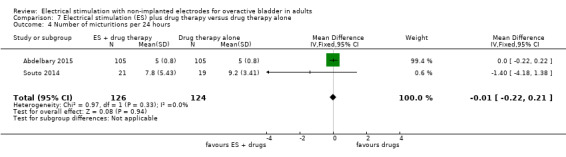
Comparison 7 Electrical stimulation (ES) plus drug therapy versus drug therapy alone, Outcome 4 Number of micturitions per 24 hours.
The trial by Abdelbary 2015 (n = 210) measured symptoms at three different time points; at the end of treatment and at three and six months' follow‐up. In almost all cases, the result suggested adding ES to oestrogen cream was more effective than oestrogen cream alone.
Economic data
Not reported
Procedure outcomes
Not reported
Adverse effects
Very low‐quality evidence from a single trial indicated no evidence of a difference in adverse effects when ES was added to tolterodine compared to tolterodine alone (Sancaktar 2010; n = 38) (Table 10; Table 23). The reported adverse effects included constipation, dry mouth, headache and skin irritation.
7. One type of electrical stimulation versus another type of electrical stimulation
Ten trials with 533 participants compared one type of ES with another (Alves 2015; Boaretto 2011; Bower 1998; Finazzi‐Agrò 2005; Lobel 1998; Monga 2011; Phillips 2012; Seth 2014; Slovak 2015; Sotelo 2011).
Primary outcome
Perception of cure or improvement of OAB symptoms
Very low‐quality evidence from a single trial (Lobel 1998; n = 37), comparing ES once a week versus ES twice a week, found that all participants were improved after five weeks of treatment and that 24% (9/37) were satisfied enough to request no further treatment. However, these data were not reported separately for the two treatment groups (Table 11); Table 24).
11. Electrical stimulation (ES) versus ES.
| Study | Outcome | ES A (mean (SD/range), N or n/N; if available) | ES B (mean (SD), N or n/N; if available) | Result |
| Primary outcomes: cure/improvement of OAB symptoms; OAB‐related quality of life | ||||
| Alves 2015 | ICIQ‐OAB score1 | Tibial nerve stimulation: sensory threshold activating superficial cutaneous nerve fibres with larger diameter: 4.46 (2.66), 15 | Tibial nerve stimulation: motor threshold, non‐painful contraction is induced: 4.53 (3.07), 13 | MD ‐0.07 (95% CI ‐2.21 to 2.07) |
| Finazzi‐Agrò 2005 | Success = > 50% reduction in micturitions/24 hours OR If incontinent, success > 50% reduction in UI episodes/24 hours |
ES once a week: 11/17 (4/11 incontinent participants) | ES 3 times per week: 12/18 (5/11 incontinent participants) | RR 0.97 (95% CI 0.60 to 1.57) Incontinence participants: RR 0.80 (95% CI 0.29 to 2.21) |
| I‐QoL score2 | ES once a week (median, range, N): 77 (35‐100), 17 | ES 3 times a week (median, range, N): 78 (33‐100), 18 | Not estimable | |
| Lobel 1998 | Participants with improvement in symptoms | ES once a week: 100% | ES twice a week: 100% | Not estimable |
| Participants satisfied enough to request no further treatment | 24% (9/37) | Not estimable, not reported per treatment group | ||
| Secondary outcomes: clinicians' observations and other quantification of symptoms | ||||
| Finazzi‐Agrò 2005 | Adverse effects | ES once a week: 0/17 | ES 3 times per week: 0/18 | Not estimable |
| Subjective improvement after 6‐8 sessions | ES once a week: 17/17 | ES 3 times a week: 18/18 | Not estimable | |
| Incontinence episodes per 24 hours | ES once a week (median, range, N): 1 (0‐3), 11 | ES 3 times a week (median, range, N): 1 (0‐3), 11 | Not estimable | |
| Micuturitions per 24 hours | ES once a week (median, range, N): 8 (5‐15), 17 | ES 3 times a week (median, range, N): 8 (6‐18), 18 | Not estimable | |
| SF‐36 score | ES once a week (median, range, N): 62 (24‐81), 17 | ES 3 times per week (median, range, N): 62 (25‐80), 18 | Not estimable | |
| Alves 2015 | UUI episodes per 24 hours | Tibial nerve stimulation: sensory threshold activating superficial cutaneous nerve fibres with larger diameter: 0.33 (0.57), 15 | Tibial nerve stimulation: motor threshold, non‐painful contraction is induced: 0.84 (1.39), 13 | MD ‐0.51 (95% CI ‐1.32 to 0.30) |
| Urgency episodes per 24 hours | Tibial nerve stimulation: sensory threshold activating superficial cutaneous nerve fibres with larger diameter: 0.79 (0.97), 15 | Tibial nerve stimulation: motor threshold, non‐painful contraction is induced: 0.58 (0.65), 13 | MD 0.21 (95% CI ‐0.39 to 0.81) | |
| Micturitions per 24 hours | Tibial nerve stimulation: sensory threshold activating superficial cutaneous nerve fibres with larger diameter: 8.33 (2.52), 15 | Tibial nerve stimulation: motor threshold, non‐painful contraction is induced: 7.89 (2.64), 13 | MD 0.44 (95% CI ‐1.48 to 2.36) | |
| Nocturia episodes per night | Tibial nerve stimulation: sensory threshold activating superficial cutaneous nerve fibres with larger diameter: 1.26 (1.21), 15 | Tibial nerve stimulation: motor threshold, non‐painful contraction is induced: 1.05 (1.01), 13 | MD 0.21 (95% CI ‐0.61 to 1.03) | |
| Bower 1998 | Maximum cystometric capacity | 150 Hz: 351 (144), 16 | 10 Hz: 305 (146), 16 | MD 46.00 (95% CI ‐54.48 to 146.48) |
| Volume at first desire to void | 150 Hz: 208.5 (132), 16 | 10 Hz: 154 (61), 16 | MD 54.50 (95% CI ‐16.75 to 125.75) | |
| Other outcomes | ||||
| Boaretto 2011 | Participants satisfied | 200 µs pulse width: 17/22 | 500 µs pulse width: 11/16 | RR 1.12 (95% CI 0.75 to 1.68) |
1Higher score = greater severity 2Lower score = greater severity
Finazzi‐Agrò 2005 (n = 35), which compared one session of percutaneous ES per week to three sessions per week, found little evidence of a difference between the groups in terms of successful treatment. Success was defined as greater than 50% reduction in micturitions per 24 hours, or as greater than 50% reduction in UUI episodes in participants who had UUI at baseline (Table 12; Table 24). Again, the quality of evidence was very low.
Number of participants satisfied with treatment
Not reported
OAB‐related quality of life
Very low‐quality evidence, from a single trial (Alves 2015; n = 28) comparing sensory threshold ES to motor threshold ES, suggested there was no evidence of a difference in QoL measured with ICIQ‐OAB (Table 13; Table 24). Similarly, very low‐quality evidence from another trial (Finazzi‐Agrò 2005) suggested little evidence of a difference in I‐QoL scores when once a week ES was compared to three times per week (Table 12).
Secondary outcomes
Quantification of symptoms
One trial (Monga 2011; n = 74), comparing ES patches placed by investigators versus patches placed by participants, reported various outcomes relating to quantification of symptoms but did not separate the data according to treatment group.
Another small trial (Alves 2015; n = 28), comparing two different kinds of tibial nerve stimulation found no evidence of a difference between treatments in the number of UUI episodes, urgency episodes, micturitions or nocturia episodes (Table 24). Similarly, the Finazzi‐Agrò 2005 trial (n = 35) comparing ES delivered once a week to ES three times per week, reported little evidence of a difference between the groups in incontinence episodes and micturitions per 24 hours (Table 24).
No other outcomes relating to quantification of symptoms were reported by any of the identified trials.
Economic data
Not reported
Procedure outcomes
Not reported
Adverse effects
One trial (n = 37; Lobel 1998), comparing ES once a week versus ES twice a week, reported the following adverse effects across all participants but not separated by treatment group.
Discomfort: 16% (6/37)
Leg tremor: 8% (3/37)
Urinary tract infection: 8% (3/37)
Another trial (n = 50; Sotelo 2011), comparing different ES patch placements, reported one participant experiencing adverse effects but did not report to which treatment group the participant belonged. Very low‐quality evidence from Finazzi‐Agrò 2005, comparing one ES session per week to three sessions per week, reported no adverse effects in either group (Table 12).
Other outcomes
One trial (Boaretto 2011) compared two different pulse widths (200 microseconds and 500 microseconds) and reported similar satisfaction in both groups (RR for number of people not satisfied: 0.73, 95% CI 0.25 to 2.10; n = 38) (Table 24).
Discussion
Summary of main results
To the best of our knowledge, this is the first systematic review to synthesise all available data from randomised controlled trials (RCTs) relating to the effectiveness of electrical stimulation (ES) with non‐implanted devices compared with any other treatment for overactive bladder (OAB). The results of the review suggest that ES shows promise in treating OAB.
Improvement of OAB symptoms
ES is likely to be more effective than placebo/sham treatment, PFMT or drug therapy (Table 2; Table 3; Table 7) in improving OAB symptoms. Specifically considering urgency urinary incontinence (UUI), ES may be more effective than placebo or sham treatment (Table 2) but we are very uncertain that ES is better for UUI than PFMT, (Table 3), nor can we be certain that adding ES to PFMT leads to improvement in UUI (Table 8). The conclusions regarding improvement in UUI should be interpreted with caution due to the lack of clarity in the trials' reporting of rates of urgency incontinence at baseline.
Furthermore, it appears that while both intravaginal ES and percutaneous tibial nerve stimulation are likely to lead to greater improvement in symptoms than sham/placebo, intravaginal ES is likely to have a larger effect.
For OAB symptoms, low‐quality evidence indicates that ES may be more effective than no active treatment (Table 1). This is supported by evidence from symptom quantification, such as the number of people with nocturia or increased frequency. Additionally, low‐quality evidence suggests that ES may be more effective than biofeedback‐assisted PFMT (Table 4) but this is based on a single trial and we did not identify any secondary outcome data to support or refute this finding.
OAB‐related quality of life
It is difficult to state with certainty that ES is likely to improve OAB‐related quality of life more than treatment with PFMT or electro‐acupuncture; notwithstanding the moderate quality of the evidence identified, these findings are based on single small trials and are therefore not conclusive (Table 3; Table 6).
Low‐quality evidence suggests that ES may lead to improved OAB‐related quality of life compared to no active treatment (Table 1). We cannot be certain there is any difference in OAB‐related QoL between ES and drug therapy Table 7), nor when ES is added to PFMT or drug therapy, compared to PFMT or drug therapy alone (Table 8; Table 10).
It is possible that ES improves OAB‐related QoL more than placebo/sham treatment, and that adding ES to behavioural therapy is better than behavioural therapy alone in terms of OAB‐related QoL, but the very low quality of the evidence means that we cannot draw these conclusions with any certainty (Table 2; Table 9).
Adverse effects
Low‐quality evidence suggests that there may be a lower risk of adverse effects with ES than with oxybutynin or tolterodine ( Table 7).
Due to the very low‐quality evidence available, we cannot be certain whether there are fewer adverse effects with ES compared to placebo/sham treatment, magnetic stimulation, electro/laseropuncture or solifenacin succinate (Table 2; Table 5; Table 6; Table 7). We are also very uncertain whether adding ES to PFMT or to drug therapy results in fewer adverse effects than PFMT or drug therapy alone (Table 8; Table 10). Nor can we tell if there is any difference in the risk of adverse effects between different types of ES (Table 11; Table 12; Table 13).
Effectiveness of ES over time
Based on the small number of trials reporting outcomes at the end of treatment as well as after a longer follow‐up period, it appears that the effect of ES diminishes after the end of treatment. However, this was also the case for most other interventions and is likely to be due to the nature of the condition. Where ES was found to be more effective than a comparator intervention at the first measurement point, this trend was generally found to be maintained at the longer‐term follow‐up. Nonetheless, this evidence should be considered in the context that the outcomes measured at multiple time points in this small set of trials tended to be objective measures rather than the more reliable and meaningful subjective report of symptoms.
Overall completeness and applicability of evidence
The included studies do not address all of the objectives of the review because many of them did not report data in a usable way or did not measure the primary outcomes, that is, a subjective report of symptoms. Five trials reported urodynamic outcomes only (Berghmans 2002; Bower 1998; Vahtera 1997; Walsh 2001; Yamanishi 2000b), which was of limited use because subjective, patient‐reported cure or improvement should take precedence over objective, clinician‐observed outcomes; for instance, a patient may still have OAB according to objective measurements but if their subjective assessment is that of no bothersome symptoms, then usually no further treatment will be required. Future trials should ensure appropriate subjective outcomes are measured and reported.
Of particular note is the absence of data on subjective cure or improvement from the trials comparing ES plus drug therapy to drug therapy alone. Furthermore, the paucity of data in many of the included trials meant that we could not draw any conclusions regarding adverse effects between ES and placebo/sham treatment or other conservative treatments. Nor can we tell if adding ES to another treatment increases the risk of adverse effects.
Another key outcome, QoL associated with OAB or incontinence, was inadequately addressed by the included studies. While 22 of the 64 trials incorporated a validated measure of QoL, it was difficult to discern a clear picture regarding clinically meaningful results. Two trials included definitions of clinical significance relating to the QoL instruments used (Oldham 2013; Svihra 2002); the QoL findings of those trials were not clinically meaningful. The remaining trials that measured QoL were unclear about the clinical significance of their QoL instruments (Abdelbary 2015; Alves 2015; Bellette 2009; Chen 2015; Finazzi‐Agrò 2010; Firra 2013; Gaspard 2014; Gonzalez 2015; Orhan 2015; Peters 2010; Phillips 2012; Sancaktar 2010; Schmidt 2009; Schreiner 2010; Schreiner 2014; Seth 2014; Souto 2014; Vecchioli‐Scaldazza 2013; Wang 2004; Wang 2009). It is therefore difficult to form any conclusions regarding the potential for ES to improve QoL in relation to OAB.
Nevertheless, the findings presented here are based on evidence from trial populations that were reasonably representative of OAB in clinical practice, including people with both OAB‐wet and OAB‐dry.
Economic commentary
To supplement the main systematic review of effects, we sought to identify economic evaluations which have compared electrical stimulation with non‐implanted electrodes to other treatments. Only one economic evaluation (Chen 2012) was identified. This study was a cost‐utility analysis, conducted using the framework of a decision model, comparing percutaneous tibial nerve stimulation (PTNS) with extended release tolterodine. The model was based on direct medical costs, in 2010 USD, during a one year time horizon and the analysis was conducted from a societal perspective.
The authors concluded that PTNS was not cost‐effective compared to tolterodine (incremental cost‐effectiveness ratio (ICER) of USD 70,754 per quality‐adjusted life year, USD 20,754 above the USD 50,000 acceptable threshold). Furthermore, sensitivity analyses indicated that the ICER was above the acceptable threshold in nine of eleven possible scenarios. The authors noted that their findings were limited by the quality of the literature.
However, there was a degree of ambiguity in the study. Firstly, it was unclear whether a Markov model or a simple decision tree model was used. Secondly, a societal perspective would generally be expected to incorporate more than direct medical costs so it may be more accurate to consider this analysis to be have been conducted from a healthcare payer perspective. Finally, it appears that the authors have inaccurately interpreted the eleven scenarios presented in the sensitivity analyses and therefore their conclusions may be misleading.
We did not subject this economic evaluation to critical appraisal and we do not attempt to draw any firm or general conclusions regarding the relative costs or efficiency. The apparent scarcity of relevant economic evaluations indicates that economic evidence regarding is currently lacking.
Quality of the evidence
Despite the large number of identified trials (64), the amount and quality of evidence is insufficient to reach a robust conclusion regarding the effectiveness of ES compared to other active treatments. The sample sizes for individual outcomes were small, which led to downgrading the quality of evidence in some instances because underpowered trials are likely to have a greater degree of imprecision. Small sample sizes in individual trials can also lead to under‐powered meta‐analyses, which then give inconclusive overall estimates of effect.
Assessing the risk of bias and methodological quality of the included trials was limited by the extent to which adequate details were provided in reports of trials. Future trials should adhere to CONSORT guidelines to ensure clarity and completeness in the reporting of methods (Schulz 2010). Risk of selection bias through randomisation and allocation concealment was generally unclear because of insufficient reporting. The risk of performance bias was also relatively unclear because of a lack of information to judge whether or not participants, healthcare providers and outcome assessors were adequately blinded. In many trials, it would not have been possible to blind participants; however, an element of risk of bias remains where participants were not blinded, because self‐reported, subjective outcomes could have been affected by participants' perception of the intervention received, leading to uncertainty regarding the extent to which the estimate of effect was truly attributable to the intervention.
Potential biases in the review process
Every attempt was made to reduce the risk of bias in the review process, with broad inclusion criteria and a comprehensive search strategy to identify eligible trials. There were no language restrictions and we obtained translations of non‐English trials wherever possible. The risk of bias was further minimised by two review authors undertaking independent screening of search results and independent data extraction.
However, unclear reporting of trial methods and data, and subsequent problems obtaining clarifications from trial authors limited the extent to which we could meaningfully compare all of the relevant data from the identified trials.
Agreements and disagreements with other studies or reviews
To the best of our knowledge, this is the first systematic review of RCTs to investigate the effectiveness of ES with non‐implanted devices compared to any other treatment for OAB. A systematic review focusing on ES of the pelvic floor found evidence in favour of ES for urinary incontinence, with or without OAB symptoms (Jerez‐Roig 2013). Similarly, a systematic review investigating ES for any kind of urinary incontinence in women (Schreiner 2013) found evidence suggesting that ES was more effective than other treatments for UUI, but that the evidence for stress urinary incontinence (SUI) or mixed urinary incontinence (MUI) was much less clear. As UUI is one of the key symptoms of OAB, our findings with regard to OAB can be taken together with the reviews by Schreiner and colleagues and Jerez‐Roig and colleagues to indicate that ES is effective in treating OAB symptoms. Additionally, our findings are in accord with Berghmans 2013, whose systematic review of ES for any kind of urinary incontinence in men found limited evidence that ES was more effective than sham treatment and that ES enhanced the effectiveness of pelvic floor muscle training (PFMT) in the short term.
Schreiner and colleagues' findings regarding different types of ES were similar to ours in that the heterogeneity of ES interventions in the identified trials was such that no conclusions could be drawn on which types of ES may be more effective than others.
The findings of our review lend further weight to another systematic review (Rai 2012) comparing drug treatment with other active treatments for OAB, which found limited evidence that ES was more effective than drugs in improving OAB symptoms and that there were fewer adverse effects associated with ES than with drug treatment. Our review identified eight additional trials not included by Rai 2012; consequently, the conclusions of our review add strength to the evidence base for ES compared to drug treatment.
Authors' conclusions
Implications for practice.
In conducting this review we have attempted to answer several clinical questions.
Is electrical stimulation (ES) with non‐implanted devices better than no active treatment, placebo or sham treatment? Moderate‐quality evidence suggests that ES is more effective than no active treatment, placebo or sham treatment in improving overactive bladder (OAB) symptoms, urgency urinary incontinence (UUI) and OAB‐related quality of life (QoL).
Is one type of ES with non‐implanted devices better than another? No clear evidence was identified to suggest that one type of ES was more effective than others. There was substantial heterogeneity in the types of ES interventions in the included studies. The variety of aspects of treatment such as duration and frequency, duty cycle, current, route of administration (e.g. vaginal, rectal) and approaches of electrodes (e.g. transcutaneous, percutaneous) could produce different effects through their different mechanisms, which means that there are many variables to take into account when considering the effectiveness of one type of ES compared to another and no conclusions could be drawn based on the identified evidence.
Is ES with non‐implanted devices better than other conservative treatments? Moderate‐quality evidence suggests that ES is more effective than pelvic floor muscle training (PFMT) in improving OAB symptoms. It is very uncertain whether ES is more effective than PFMT in improving UUI or OAB‐related QoL.
Is ES with non‐implanted devices better than drug therapy? Moderate‐quality evidence suggests that ES may be more effective than drug therapy in improving OAB symptoms, but for improving UUI and OAB‐related QoL there was no evidence to suggest a difference.
Is ES with non‐implanted devices added to other treatments better than other treatments alone? We do not know if adding ES to PFMT, to behavioural therapy or to drug therapy leads to improvement in OAB symptoms or OAB‐related QoL. There is very limited evidence to suggest that adding ES to PFMT may reduce UUI episodes.
Is ES safe? There may be a lower risk of adverse effects with ES than placebo, sham treatment, oxybutynin or tolterodine.
Is ES cost‐effective? We cannot tell from the identified evidence. It is important to consider cost‐effectiveness in any intervention to assist policymakers, healthcare providers and people with OAB in decision‐making with regard to treatment. Future trials should include a measure of costs from both the provider and patient perspective, equated to a meaningful patient‐centred outcome.
Implications for research.
This review highlights the urgent need to conduct well‐designed trials in this field. It is evident from our findings that the current evidence base is inadequate to answer fully the question of the effectiveness of ES with non‐implanted electrodes for overactive bladder, therefore it is important that future trials should be adequately powered and should measure the following.
Subjective perception of symptomatic improvement
Head‐to‐head comparisons of different types of ES
Cost‐effectiveness of ES compared to other active treatments
Clinically meaningful measurement of OAB‐related QoL
Adverse effects data
What's new
| Date | Event | Description |
|---|---|---|
| 10 February 2017 | Amended | Minor amendment to results section 3 i) ‐ we moved participant satisfaction under its own heading as it had got left in with the outcome above it. |
History
Protocol first published: Issue 9, 2012 Review first published: Issue 4, 2016
| Date | Event | Description |
|---|---|---|
| 29 November 2016 | New citation required and conclusions have changed | For this first update of this review the main outcomes were reframed to: perception of cure or cure/improvement. The search was updated and 12 new studies were included. A brief economic commentary has also been added. The conclusions have changed. |
| 9 September 2015 | New citation required and minor changes | The protocol has been amended. |
| 9 September 2015 | Amended | The protocol has been amended. |
Acknowledgements
We would like to thank members of the Cochrane Incontinence Review Group (Luke Vale, June Cody, Cathryn Glazener, Bronwyn Davidson, Suzanne MacDonald, Sheila Wallace, Muhammad Imran Omar, and Nicola Dean) for their relevant help during the preparation of this review.
We would like to thank Dwayne Boyers for his invaluable advice and help with the brief economic commentary for this review.
We would like to thank Mari Beagrie, Miriam Brazzelli, Clare de Labrusse, Beatriz Goulao, Anna Sierawska and Gavin Stewart for their invaluable help with translation.
We would like to thank the following trial authors for responding to our requests for further data: Raquel Arruda, Patricia Bellette, Linda Brubaker, Enrico Finazzi‐Agro, Karin Franzen, Laurent Gaspard, Ash Monga, Jacqueline Oldham, Kenneth Peters, Martin Slovak, Carolina Vecchioli‐Scaldazza, Tomonori Yaminishi.
Appendices
Appendix 1. Search strategies
Cochrane Incontinence Specialised Register
The terms that were used to search the Cochrane Incontinence Specialised Register are given below:
(({DESIGN.CCT*} OR {DESIGN.RCT*}) AND ({INTVENT.PHYS.ELECTSTIM*}) AND ({TOPIC.URINE.INCON*} OR {TOPIC.URINE.OVERACTIVE*})
All searches were of the keyword field of Reference Manager 2012. Date of last search 10 December 2015.
Other searches
Some of the review authors (OLFG, RE, MOG, AK, JLA) also searched the following databases, details of the searches are below:
PubMed (inception to December 2013) andCENTRAL (2013, Issue 12 ) were searched on 12 December 2013 using the following search terms:
((Overactive Bladder) OR (Overactive Urinary Bladder) OR (Overactive Detrusor) OR (Overactive Detrusor Function) OR bladder OR (urinary bladder) OR (unstable bladder) OR (urge incontinence) OR (inhibits bladder) OR (Urinary Reflex Incontinence) OR (Urinary Urge Incontinence) OR (Urge Incontinence) OR (Urinary Bladder Disease) OR (Urinary Bladder Diseases) OR (Bladder Diseases) OR (Bladder Disease)) AND ((Electrical Stimulation) OR (Electrical Stimulations) OR (Electric Stimulations) OR (Electric Stimulation) OR (Electric Stimulation Therapy) OR (Therapeutic Electrical Stimulation) OR Electrotherapy OR (Therapeutic Electric Stimulation) OR (Electrical Stimulation Therapy) OR (Transcutaneous Electrical Stimulation) OR (Percutaneous Electric Nerve Stimulation) OR (Percutaneous Electrical Nerve Stimulation) OR (Transdermal Electrostimulation) OR (Transcutaneous Electrical Nerve Stimulation) OR (Transcutaneous Nerve Stimulation) OR (Transcutaneous Electric Stimulation) OR TENS OR Electroanalgesia OR (Analgesic Cutaneous Electrostimulation))
Embase on OVID SP (from 1980 onwards) (searched on 12 December 2013) The search strategy that was be used in Embase is given below. The RCT terms (lines 1 and 2) are those recommended by Lefebvre 2011. The search was limited to those records added to Embase from January 2010 onwards as earlier trials are included in the Specialised Register search of CENTRAL. 1. (random$ or factorial$ or crossover$ or cross over$ or cross‐over$ or placebo$ or (doubl$ adj blind$) or (singl$ adj blind$) or assign$ or allocat$ or volunteer$).tw. 2. (crossover‐procedure or double‐blind procedure or randomised controlled trial or single‐blind procedure).sh. 3. 1 or 2 4. urine incontinence/ or mixed incontinence/ or stress incontinence/ or urge incontinence/ 5. overactive bladder/ 6. (Detrusor$ or bladder$ or incontinen$ or continen$).tw. 7. 4 or 5 or 6 8. (Electric$ Stimulation$ or Electric Stimulation or Electrotherap$ or TENS or Electroanalgesia or electrostimulation$ or nerve stimulation$).tw. 9. electrostimulation/ 10. electrostimulation therapy/ 11. transcutaneous nerve stimulation/ 12. 8 or 9 or 10 or 11 13. 3 and 7 and 12 14. 2010$.em. 15. 2011$.em. 16. 2012$.em. 17. 2013$.em. 18. 14 or 15 or 16 or 17 19. 13 and 18
LILACS (on the Virtual Health Library/Bireme) (from 1982 to December 2013) (searched on 12 December 2013). The terms that were used to search LILACS are given below. The RCT terms are those developed by Castro and colleagues (Castro 1997; Castro 1999). (Detrusor$ OR bladder$ OR incontinen$ OR continen$) [Words] AND ((Electric$ Stimulation$) OR (Electric Stimulation) OR Electrotherap$ OR TENS OR Electroanalgesia OR electrostimulation$ OR (nerve stimulation$)) [Words] (nb for some reason if remove (electric stimulation) it retrieves less articles!!!) ((Pt randomised controlled trial OR Pt controlled clinical trial OR Mh randomised controlled trials OR Mh random allocation OR Mh double‐blind method OR Mh single‐blind method) AND NOT (Ct animal AND NOT (Ct human and Ct animal)) OR (Pt clinical trial OR Ex E05.318.760.535$ OR (Tw clin$ AND (Tw trial$ OR Tw ensa$ OR Tw estud$ OR Tw experim$ OR Tw investiga$)) OR ((Tw singl$ OR Tw simple$ OR Tw doubl$ OR Tw doble$ OR Tw duplo$ OR Tw trebl$ OR Tw trip$) AND (Tw blind$ OR Tw cego$ OR Tw ciego$ OR Tw mask$ OR Tw mascar$)) OR Mh placebos OR Tw placebo$ OR (Tw random$ OR Tw randon$ OR Tw casual$ OR Tw acaso$ OR Tw azar OR Tw aleator$) OR Mh research design) AND NOT (Ct animal AND NOT (Ct human and Ct animal)) OR (Ct comparative study OR Ex E05.337$ OR Mh follow‐up studies OR Mh prospective studies OR Tw control$ OR Tw prospectiv$ OR Tw volunt$ OR Tw volunteer$) AND NOT (Ct animal AND NOT (Ct human and Ct animal))) [Words] Field = words
Ongoing clinical trials were sought by searching the clinical trials registration sites ClinicalTrials.gov and WHO ICTRP using the search term: overactive bladder. The date of the most recent search was 12 December 2013.
Data and analyses
Comparison 1. Electrical stimulation (ES) versus no active treatment.
| Outcome or subgroup title | No. of studies | No. of participants | Statistical method | Effect size |
|---|---|---|---|---|
| 1 Number of participants cured or improved | 2 | 121 | Risk Ratio (M‐H, Fixed, 95% CI) | 1.85 [1.34, 2.55] |
Comparison 2. Electrical stimulation (ES) versus placebo or sham treatment.
| Outcome or subgroup title | No. of studies | No. of participants | Statistical method | Effect size |
|---|---|---|---|---|
| 1 Number of participants cured | 4 | 189 | Risk Ratio (M‐H, Fixed, 95% CI) | 2.69 [1.39, 5.21] |
| 2 Number of participants cured or improved | 10 | 677 | Risk Ratio (M‐H, Fixed, 95% CI) | 2.26 [1.85, 2.77] |
| 3 Number of participants cured or improved: different ES routes | 6 | 398 | Risk Ratio (M‐H, Fixed, 95% CI) | 3.55 [2.54, 4.96] |
| 3.1 Percutaneous tibial nerve stimulation | 4 | 304 | Risk Ratio (M‐H, Fixed, 95% CI) | 3.19 [2.22, 4.58] |
| 3.2 Intravaginal | 2 | 94 | Risk Ratio (M‐H, Fixed, 95% CI) | 5.46 [2.33, 12.81] |
| 4 Number of participants satisfied | 2 | 98 | Risk Ratio (M‐H, Fixed, 95% CI) | 1.44 [1.02, 2.04] |
| 5 Number of participants with improvement in urgency urinary incontinence | 2 | 242 | Risk Ratio (M‐H, Random, 95% CI) | 5.03 [0.28, 89.88] |
| 6 Number of participants with improvement in urinary frequency | 2 | 236 | Risk Ratio (M‐H, Fixed, 95% CI) | 2.04 [1.43, 2.92] |
| 7 Number of incontinence episodes per 24 h | 2 | 143 | Mean Difference (IV, Fixed, 95% CI) | ‐1.43 [‐1.92, ‐0.95] |
| 8 Number of nocturia episodes | 2 | 245 | Mean Difference (IV, Fixed, 95% CI) | ‐0.37 [‐0.73, ‐0.02] |
| 9 Number of micturitions per 24 h | 3 | 285 | Mean Difference (IV, Fixed, 95% CI) | ‐1.09 [‐1.70, ‐0.47] |
| 10 Number of participants with adverse effects | 3 | 450 | Risk Ratio (M‐H, Fixed, 95% CI) | 1.24 [0.84, 1.83] |
2.6. Analysis.

Comparison 2 Electrical stimulation (ES) versus placebo or sham treatment, Outcome 6 Number of participants with improvement in urinary frequency.
Comparison 3. Electrical stimulation (ES) versus pelvic floor muscle training (PFMT).
| Outcome or subgroup title | No. of studies | No. of participants | Statistical method | Effect size |
|---|---|---|---|---|
| 1 Number of participants cured or improved | 3 | 195 | Risk Ratio (M‐H, Fixed, 95% CI) | 1.60 [1.19, 2.14] |
| 2 Number of participants satisfied | 2 | 102 | Risk Ratio (M‐H, Fixed, 95% CI) | 0.76 [0.60, 0.96] |
Comparison 4. Electrical stimulation (ES) versus laseropuncture/electro‐acupuncture.
| Outcome or subgroup title | No. of studies | No. of participants | Statistical method | Effect size |
|---|---|---|---|---|
| 1 Number of incontinence episodes per 24 h | 2 | 136 | Mean Difference (IV, Fixed, 95% CI) | ‐1.84 [‐2.33, ‐1.35] |
Comparison 5. Electrical stimulation (ES) versus drug therapy.
| Outcome or subgroup title | No. of studies | No. of participants | Statistical method | Effect size |
|---|---|---|---|---|
| 1 Number of participants cured | 7 | 388 | Risk Ratio (M‐H, Fixed, 95% CI) | 0.98 [0.69, 1.41] |
| 1.1 ES versus tolterodine | 3 | 210 | Risk Ratio (M‐H, Fixed, 95% CI) | 0.82 [0.46, 1.47] |
| 1.2 ES versus oxybutynin | 3 | 140 | Risk Ratio (M‐H, Fixed, 95% CI) | 1.06 [0.65, 1.72] |
| 1.3 ES versus propantheline bromide | 1 | 38 | Risk Ratio (M‐H, Fixed, 95% CI) | 1.48 [0.38, 5.74] |
| 2 Number of participants cured or improved | 8 | 439 | Risk Ratio (M‐H, Fixed, 95% CI) | 1.20 [1.04, 1.38] |
| 2.1 ES versus tolterodine | 3 | 210 | Risk Ratio (M‐H, Fixed, 95% CI) | 1.18 [1.00, 1.41] |
| 2.2 ES versus oxybutynin | 4 | 191 | Risk Ratio (M‐H, Fixed, 95% CI) | 1.17 [0.91, 1.52] |
| 2.3 ES versus propantheline bromide | 1 | 38 | Risk Ratio (M‐H, Fixed, 95% CI) | 1.44 [0.86, 2.44] |
| 3 Number of participants cured or improved: routes of ES | 5 | 250 | Risk Ratio (M‐H, Fixed, 95% CI) | 1.26 [1.04, 1.54] |
| 3.1 Transcutaneous posterior tibial nerve stimulation | 1 | 51 | Risk Ratio (M‐H, Fixed, 95% CI) | 1.20 [0.74, 1.92] |
| 3.2 Intravaginal/transanal | 4 | 199 | Risk Ratio (M‐H, Fixed, 95% CI) | 1.28 [1.03, 1.59] |
| 4 Number of participants satisfied | 2 | 94 | Risk Ratio (M‐H, Fixed, 95% CI) | 0.89 [0.64, 1.23] |
| 4.1 ES versus oxybutynin | 2 | 94 | Risk Ratio (M‐H, Fixed, 95% CI) | 0.89 [0.64, 1.23] |
| 5 Number of incontinence episodes per 24 h | 5 | 477 | Mean Difference (IV, Random, 95% CI) | 0.25 [‐1.11, 1.60] |
| 5.1 ES versus tolterodine | 1 | 84 | Mean Difference (IV, Random, 95% CI) | ‐0.60 [‐1.49, 0.29] |
| 5.2 ES versus oxybutynin | 1 | 43 | Mean Difference (IV, Random, 95% CI) | 0.90 [‐6.45, 8.25] |
| 5.3 ES versus trospium + solifenacin | 1 | 110 | Mean Difference (IV, Random, 95% CI) | 2.2 [1.78, 2.62] |
| 5.4 ES versus oestrogen cream | 1 | 210 | Mean Difference (IV, Random, 95% CI) | 0.0 [‐0.16, 0.16] |
| 5.5 ES versus solifenacin succinate | 1 | 30 | Mean Difference (IV, Random, 95% CI) | ‐0.90 [‐2.01, 0.21] |
| 6 Number of urgency episodes per 24h | 2 | 294 | Mean Difference (IV, Fixed, 95% CI) | 0.62 [0.28, 0.96] |
| 6.1 ES versus tolterodine | 1 | 84 | Mean Difference (IV, Fixed, 95% CI) | ‐0.60 [‐1.98, 0.78] |
| 6.2 ES versus oestrogen cream | 1 | 210 | Mean Difference (IV, Fixed, 95% CI) | 0.70 [0.35, 1.05] |
| 7 Number of micturitions per 24 h | 6 | 646 | Mean Difference (IV, Fixed, 95% CI) | 0.33 [0.15, 0.52] |
| 7.1 ES versus tolterodine | 2 | 116 | Mean Difference (IV, Fixed, 95% CI) | 0.22 [‐1.06, 1.50] |
| 7.2 ES versus oxybutynin | 2 | 80 | Mean Difference (IV, Fixed, 95% CI) | 0.87 [‐0.18, 1.91] |
| 7.3 ES versus solifenacin succinate | 1 | 30 | Mean Difference (IV, Fixed, 95% CI) | ‐0.60 [‐2.04, 0.84] |
| 7.4 ES versus oestrogen cream | 1 | 420 | Mean Difference (IV, Fixed, 95% CI) | 0.33 [0.15, 0.52] |
| 8 Number of nocturia episodes per night | 4 | 367 | Mean Difference (IV, Fixed, 95% CI) | ‐2.07 [‐2.27, ‐1.88] |
| 8.1 ES versus tolterodine | 1 | 84 | Mean Difference (IV, Fixed, 95% CI) | ‐0.20 [‐0.78, 0.38] |
| 8.2 ES versus oxybutynin | 1 | 43 | Mean Difference (IV, Fixed, 95% CI) | 0.30 [‐0.35, 0.95] |
| 8.3 ES versus solifenacin succinate | 1 | 30 | Mean Difference (IV, Fixed, 95% CI) | ‐0.20 [‐1.06, 0.66] |
| 8.4 ES versus oestrogen cream | 1 | 210 | Mean Difference (IV, Fixed, 95% CI) | ‐2.8 [‐3.03, ‐2.57] |
| 9 Number of participants with adverse effects | 7 | Risk Ratio (M‐H, Fixed, 95% CI) | Subtotals only | |
| 9.1 ES versus oxybutynin | 2 | 79 | Risk Ratio (M‐H, Fixed, 95% CI) | 0.11 [0.01, 0.84] |
| 9.2 ES versus tolterodine | 4 | 200 | Risk Ratio (M‐H, Fixed, 95% CI) | 0.12 [0.05, 0.27] |
| 9.3 ES versus solifenacin succinate | 1 | 100 | Risk Ratio (M‐H, Fixed, 95% CI) | 0.09 [0.01, 1.60] |
Comparison 6. Electrical stimulation (ES) plus pelvic floor muscle training (PFMT) versus PFMT alone.
| Outcome or subgroup title | No. of studies | No. of participants | Statistical method | Effect size |
|---|---|---|---|---|
| 1 Number of participants satisfied | 2 | 82 | Risk Ratio (M‐H, Fixed, 95% CI) | 1.58 [1.13, 2.20] |
| 2 Number of incontinence episodes per 24h | 2 | 119 | Mean Difference (IV, Random, 95% CI) | ‐0.60 [‐1.84, 0.64] |
| 3 Number of urgency episodes per 24 h | 2 | 248 | Mean Difference (IV, Fixed, 95% CI) | ‐2.49 [‐2.74, ‐2.24] |
| 4 Number of micturitions per 24 h | 2 | 63 | Mean Difference (IV, Fixed, 95% CI) | ‐0.75 [‐1.62, 0.12] |
6.4. Analysis.

Comparison 6 Electrical stimulation (ES) plus pelvic floor muscle training (PFMT) versus PFMT alone, Outcome 4 Number of micturitions per 24 h.
Comparison 7. Electrical stimulation (ES) plus drug therapy versus drug therapy alone.
| Outcome or subgroup title | No. of studies | No. of participants | Statistical method | Effect size |
|---|---|---|---|---|
| 1 Quality of life | 2 | 248 | Std. Mean Difference (IV, Random, 95% CI) | ‐1.50 [‐3.72, 0.72] |
| 2 Number of incontinence episodes per 24h | 2 | 248 | Mean Difference (IV, Fixed, 95% CI) | ‐0.53 [‐0.63, ‐0.43] |
| 3 Number of urgency episodes per 24 hours | 2 | 248 | Mean Difference (IV, Random, 95% CI) | ‐2.33 [‐3.11, ‐1.54] |
| 4 Number of micturitions per 24 hours | 2 | 250 | Mean Difference (IV, Fixed, 95% CI) | ‐0.01 [‐0.22, 0.21] |
Characteristics of studies
Characteristics of included studies [ordered by study ID]
Aaronson 1995.
| Methods | Study design: RCT Period: October 1992‐January 1994 |
|
| Participants | N: 47 randomised and analysed. Age: 24‐82 years Sex: women Inclusion criteria: genuine stress urinary incontinence (GSUI) or detrusor instability (DI) Exclusion criteria: not reported |
|
| Interventions | For detrusor overactivity incontinence women only (DO) A (n = x): probanthine B (n = x): ES 2nd RCT in people with GSUI C (n = x): PFMT D (n = x): ES |
|
| Outcomes | Cure ‐ defined as cessation of incontinence. A: not reported B: not reported Improvement defined as reduction in frequency of voids per 24 hours by ≥ 50%, or ≤ 10 voids per 24 hours, or decrease number of pads per 24 hours by ≥ 50%. Cured or improved: A (n = x): unclear (50% ‘responded well’), B (n = x) 69%, C (n = x) 44%, D (n = x) 66% |
|
| Notes | No useable data Study authors contacted for further data |
|
| Risk of bias | ||
| Bias | Authors' judgement | Support for judgement |
| Random sequence generation (selection bias) | Unclear risk | Not reported |
| Allocation concealment (selection bias) | Unclear risk | Not reported |
| Blinding of participants and personnel (performance bias) All outcomes | Unclear risk | Not reported |
| Blinding of outcome assessment (detection bias) All outcomes | Unclear risk | Not reported |
| Incomplete outcome data (attrition bias) All outcomes | Unclear risk | Not reported |
Abdelbary 2015.
| Methods | Study design: RCT Setting: Egypt Follow‐up: 6 weeks’ treatment, 6 months’ follow‐up |
|
| Participants | N: 315 randomised, 300 analysed Mean (SD) age: A, 49.7 (6.0); B, 47.7 (6.0); C, 48.0 (6.0) Sex: women Inclusion criteria: ≥ 40 years, no evidence of urinary tract infection, no SUI, no previous history of anti‐incontinence or pelvic surgery or anti‐incontinence drugs (within 3 months), and no history of bladder malignancy. Exclusion criteria: not reported |
|
| Interventions | A: (n = 105) vaginal ES twice weekly for 12 sessions B: (n = 105) local vaginal oestrogen 0.625 mg/g (Premarin), 2 g daily for 6 weeks C: (n = ) ES plus local vaginal oestrogen |
|
| Outcomes | Voids per day (mean, SD, N) End of treatment: A 4.7 (0.8), 105. B 5.0 (0.9), 105. C 5 (0.8), 105 3 months: A 5.0 (1.0), 105. B 5.3 (0.9), 105. C 5 (0.8), 105 6 months: A 6.6 (1.5), 105. B 5.0 (0.8), 105. C 5 (0.8), 105 Voids per night (mean SD, N): End of treatment: A 0.9 (0.7), 105. B 1.4 (0.8), 105. C 0.5 (0.5), 105 3 months: A 1.1 (0.9), 105. B 1.5 (0.8), 105. C 1 (0.9), 105 6 months: A 2.2 (0.9), 105. B 5.0 (0.8), 105. C .5 (0.8), 105 Incontinence episodes (mean SD, N) End of treatment: A 0.1 (0.3), 105. B 0.4 (0.6), 105. C 0.07 (0.25), 105 3 months: A 0.1 (0.3), 105. B 0.5 (0.6), 105. C 0.09 (0.28), 105 6 months: A 0.4 (0.6), 105. B 0.4 (0.6), 105. C 0.09 (0.28), 105 Urgency episodes (mean SD, N) End of treatment: A 2 (0.7), 105. B 4 (1.3), 105. C 1.4 (0.7), 105 3 months: A 2.7 (1.0), 105. B 4.5 (1.5), 105. C 1.6 (0.9), 105 6 months: A 4.7 (1.3), 105. B 4 (1.3), 105. C 2 (0.8), 105 QoL score (higher score = greater severity, instrument not reported) (mean SD, N) End of treatment: A 2.8 (2), 105. B 5 (1.8), 105. C 2.9 (2.2), 105 3 months: A 4 (1.7), 105. B 6 (2), 105. C 3.7 (2.5), 105 6 months: A 7.6 (3), 105. B 6 (2), 105. C 4.8 (1.9), 105 Functional bladder capacity (ml) (mean SD, N) End of treatment: A 343.8 (46), 105. B 310 (40.6), 105. C 361 (40), 105 Detrusor overactivity (mean SD, N) End of treatment: A 27/105. B 32/105. C 12/105 |
|
| Notes | ||
| Risk of bias | ||
| Bias | Authors' judgement | Support for judgement |
| Random sequence generation (selection bias) | Low risk | "computer‐generated random numeric table" |
| Allocation concealment (selection bias) | Unclear risk | Not reported |
| Blinding of participants and personnel (performance bias) All outcomes | Unclear risk | Not possible to blind participants, other blinding not reported |
| Blinding of outcome assessment (detection bias) All outcomes | Unclear risk | Not reported |
| Incomplete outcome data (attrition bias) All outcomes | Unclear risk | No differential withdrawal, no explanation for withdrawals, no indication on how missing data were dealt with in analysis |
Alves 2015.
| Methods | Study design: RCT Setting: Brazil Follow‐up: 4 weeks' treatment |
|
| Participants | N: 28 randomised Sex: women Inclusion criteria: female, ≥ 60 years with likely urinary dysfunction, identified by a score ≥ 8 points on OAB‐V8 questionnaire Exclusion criteria: urinary infection, identified by urine test, history of treatment for OAB and hormone replacement therapy in the last six months, prior surgery to treat UI, neurological diseases base, genital‐urinary cancer history, complaints of pain in the lower abdomen for more than six months, prior pelvic irradiation, genital prolapse above third degree of Baden and Walker scale, use of cardiac pacemakers, metal implants in foot and right ankle region, inability to respond to questionnaires properly and abstentions to treatment |
|
| Interventions | A: (n = 15) tibial nerve stimulation (TNS). 8 sessions (2 x 30‐minute sessions per week)F = 10 Hz, T = 200 μs. Sensory threshold, activating superficial cutaneous nerve fibres with larger diameter B: (n = 13) TNS 8 sessions (2 x 30‐minute sessions per week). F = 10 Hz, T = 200 μs. Motor threshold, non‐painful contraction was induced and "the stimulation can simply make pain relief in the same way that sensory stimulation level (blocking activation of the peripheral or central inhibition." |
|
| Outcomes | All scores are higher score = greater severity ICIQ‐OAB score (mean SD, N) A 4.46 (2.66), 15. B 4.53 (3.07), 13 Bother of daytime frequency (mean SD, N) A 3.20 (2.59), 15. B 3.38 (3.17), 13 Bother of nocturia (mean SD, N) A 3.40 (3.26), 15. B 1.84 (2.51), 13 Bother of urgency (mean SD, N) A 4.00 (2.59), 15. B 3.53 (3.59), 13 Bother of urgency incontinence (mean SD, N) A 2.73 (3.65), 15. B 4.38 (4.29) Micturitions per 24 h (mean SD N) A 8.33 (2.52), 15. B 7.89 (2.64), 13 Nocturia episodes (mean SD, N) A 1.26 (1.21), 15. B 1.05 (1.01), 13 Urgency episodes (mean SD, N) A 0.79 (0.96), 15. B 0.58 (0.65), 13 Urgency incontinence episodes A 0.33 (0.57), 15. B 0.84 (1.39), 13 |
|
| Notes | ||
| Risk of bias | ||
| Bias | Authors' judgement | Support for judgement |
| Random sequence generation (selection bias) | Unclear risk | "randomisation of two groups" |
| Allocation concealment (selection bias) | Unclear risk | Not reported |
| Blinding of participants and personnel (performance bias) All outcomes | Low risk | "blind assessment and comparison between groups" |
| Blinding of outcome assessment (detection bias) All outcomes | Low risk | "blind assessment and comparison between groups" |
| Incomplete outcome data (attrition bias) All outcomes | Low risk | No withdrawals reported |
Amaro 2006.
| Methods | Study design: RCT Multicentre or single‐centre: single‐centre Setting: Botucatu Medical School, Unesp ‐ Univ Estadual Paulista, Brazil Period: January 2001‐February 2002. Sample size: "Based on outcome measurements with no numerical variable…the statistical test sample size had previously been established as at least 40 women." Follow‐up: 7‐week treatment period, follow‐up appointments one month after end of treatment |
|
| Participants | N: 40 randomised Mean age: A: 49.0 (range 41‐79) B: 47.0 (range 40‐78) Sex: women Inclusion criteria: symptoms of predominant urge incontinence Exclusion criteria: vaginal prolapse greater than grade II (Baden), retention complaint or obstruction diagnosis during USD, urinary infection, changes in cutaneous sensitivity, metal implants, and neurological complaints |
|
| Interventions | A: (n = 20): electrostimulation. 3 x 20‐min sessions per week on alternate days over a 7‐week period, performed using Dualpex Uro996. Frequency at 4 Hz, a 2‐to 4‐s work rest cycle and a 0.1 us pulse width. The bipolar square wave could be delivered over a range of 0‐100 mA. Intensity was controlled according to participant discomfort level feedback B: (n = 20): sham. Same type of vaginal probe with wires disconnected so no electrical energy was supplied |
|
| Outcomes | Number of micturitions per 24 h (mean, SD*, N): A: 7.0 (1.78), 20; B: 7.5 (1.78), 20 P = 0.38 1 hour PAD test (g): A: 1.05; B: 1.13 Number of participants with UUI: A: 3/20 (15%), B: 6/20 (31.5%) Number of participants ‘satisfied’: A: 16/20 (80%), B: 13/20 (65%) Reduction in "analog wetness sensation": A: 31.5%. B: 26.9% Reduction in "analog discomfort sensation": A: 39.7%; B: 24.5% Pelvic floor muscle strength measured with portable perineometer (Dynamed) (cmH2O) (mean, SD, N): A: 53.8 (18.6), 20; B: 46.8 (12.5), 20 Vaginal cone weight test (g) (mean, SD, N): A: 4.0 (1.3), 20; B: 2.0 (1.1), 20 |
|
| Notes | No SDs reported (except for 2 outcomes). *SD calculated by FS using means and P value No evidence of source of data in review Information received from study authors |
|
| Risk of bias | ||
| Bias | Authors' judgement | Support for judgement |
| Random sequence generation (selection bias) | Unclear risk | "In the Randomization the participants in each groups were raffled" (from correspondence with author) |
| Allocation concealment (selection bias) | Unclear risk | "the allocations were concealed because a nurse, at each session, was responsible for carrying out the random assignment of patients" (from correspondence with author) |
| Blinding of participants and personnel (performance bias) All outcomes | Low risk | Participants blinded. ES sessions carried out by physiotherapist and outcome assessment carried out by different personnel (from correspondence with author) |
| Blinding of outcome assessment (detection bias) All outcomes | Low risk | ES sessions carried out by physiotherapist and outcome assessment carried out by different personnel (from correspondence with author) |
| Incomplete outcome data (attrition bias) All outcomes | Unclear risk | No withdrawals reported, % given without denominators, unclear if all participants present for follow‐up |
Arruda 2008.
| Methods | Study design: RCT Multicentre or single‐centre: single‐centre Setting: Department of Uroginecology, Federal University of São Paulo, Brazil Period: August 2001‐September 2005 Sample size: justified (a power calculation was performed based upon a predicted minimum difference of eight episodes of urinary leakage, with a significance level of 0.05, yielding a power estimate of 90% for a sample size of 20 women per each group) Follow‐up: 12 weeks' treatment, 1‐year follow‐up |
|
| Participants | N: 77 randomised, 64 analysed Mean age (SD): A 51.9 (13,4); B 51.5 (11.4); C 54.1 (11.6) Sex: women Inclusion criteria: OAB and DO Exclusion criteria: persistent urinary tract infection, inability to comply with regular follow‐up visits, current pregnancy, postvoid residual volume greater than 100 mL, contraindications to anticholinergic therapy, cardiac pacemaker, type III stress urinary incontinence, uncontrolled metabolic conditions or indwelling catheterisation, using medications including anticholinergic drugs, calcium antagonists, β agonists, dopamine agonists, striated muscle relaxants, or oestrogens |
|
| Interventions | A: (n = 26): oxybutynin immediate release 5 mg twice daily for 12 weeks B: (n = 25): ES. Ambulatory stimulation applied vaginally by a physiotherapist, twice a week, for 20 min at each session using 1 ms of intermittent biphasic waves, frequency 10 Hz. Current intensity ranged from 10‐100 mA, according to participant tolerance to the procedure. C: (n = 26): exercises (PFMT), performed twice a week in orthostatic, sitting, and supine positions. Each session had a total duration of 45 minutes. A total of 40 fast (2 and 5 s) and 20 sustained (10 s) contractions with an equal period of relaxation between them were administered by a physiotherapist in the outpatient setting. |
|
| Outcomes | Participants with urgency symptoms (subjective) A 8/22. B 10/21. C 9/21 Participants not satisfied (subjective) 12 weeks: A 5/22. B 10/21. C 5/21 1 year: A 12/22. B 17/21. C 12/21 Participants not cured (objective evaluation: urodynamics) A 14/22. B 9/21. C 10/21. Number of leakage episodes per 24 hours (mean, SD, N) A 7 (10.6), 22. B 7.9 (13.7), 21. C 7.8 (15.3), 21 Number of micturitions per 24 hours (mean, SD, N) A 6.4 (1.6), 22. B 7.9 (2.63), 21. C 7.1 (2.1), 21 Number of nocturia episodes per night (mean, SD, N) A 0.9 (0.8), 22. B 1.2 (1.3), 21. C 1.0 (1.1), 21 Number of pads used per 24 hours (mean, SD, N) A 0.9 (1.5), 22. B 0.9 (1.7), 21. C 0.8 (1.3), 21 Post micturition residual volume, mL (mean, SD, N) A 4.8 (9.4), 22. B 1.1 (2.5), 21. C 2.1 (3.5), 21 Maximum cystometric capacity, mL (mean, SD, N) A 517.3 (191.7), 22. B 436.7 (178.7), 21. C 489.0 (141.3), 21 Volume at FDV (mean, SD, N) A 157.3 (63.8), 22. B 123.8 (59.0), 21. C 137.6 (76.7), 21 *Involuntary detrusor contraction volume, mL (mean, SD, N) A 188.6 (183.2), 22. B 173.3 (112.4), 21. C 114.3 (154.2), 21 Involuntary detrusor contraction maximal pressure, mmH2O (mean, SD, N) A 19.6 (20.9), 22. B 22.4 (6.6), 21. C 17.2 (25.5), 21 Adverse effects Dry mouth: A 16/22. B, C not reported Difficulty on micturition: A 2/22. B, C not reported Dizziness: A 1/22. B, C not reported Blurred vision: A 1/22. B, C not reported Constipation: A 1/22. B, C not reported |
|
| Notes | *Value for group B reported in paper as 73.3; queried with author and correct value is 173.3. We contacted the main study author to clarify methodological aspects of the study and request further information. |
|
| Risk of bias | ||
| Bias | Authors' judgement | Support for judgement |
| Random sequence generation (selection bias) | Low risk | "blindly randomized to one of the three treatment groups" Additional information from study author correspondence: "Patients were randomised using a table of random numbers generated by a statistical program on a computer" |
| Allocation concealment (selection bias) | Unclear risk | Not reported |
| Blinding of participants and personnel (performance bias) All outcomes | High risk | Additional information from author correspondence: "patients and researchers knew to which group the patients belonged" |
| Blinding of outcome assessment (detection bias) All outcomes | Low risk | Additional information from author correspondence: "Data were analysed by a statistician who did not know which group the patients belonged to." |
| Incomplete outcome data (attrition bias) All outcomes | Low risk | No differential withdrawal. Adequate explanation for withdrawals |
Barroso 2002.
| Methods | Study design: RCT Setting: Department of Gynecology and Obstetrics Hospital das Clínicas de Porto Alegre, Rio Grande do Sul, Brazil Period: March 2000‐August 2001 Sample size: 36 participants for a power of 80% and a 2:1 ratio Follow‐up: 6 months |
|
| Participants | N: 36 Sex: women Mean (SD) age: A: 54 (9.5); B: 56 (12.2) Inclusion criteria: SUI, UUI or MUI, understanding and signing a letter of informed consent Exclusion criteria: prolapse or first degree urogenital prolapse, intrinsic sphincter deficiency, cardiac pacemaker, pregnancy or in the puerperal period, post‐menopausal climacteric's symptoms and signs of urogenital atrophy, genitourinary surgery during the previous 6 months, previous ES of the pelvic floor, medication chronically known to possibly change voiding function, change in the dose or if they had begun to use a new medication in the last 3 months, or during treatment with ES, reflex urinary incontinence, paradoxical urinary incontinence, urinary incontinence of intravesical obstructive factor, urinary incontinence caused by overflow, characterised by the presence of a large urinary residual volume, urgency incontinence treated with medication during last 3 months, or during treatment with ES; reflex urinary incontinence (clear presence of neurological lesions); paradoxical urinary incontinence (presence of intravesical obstructive factor); urinary incontinence caused by the presence of a large urinary residual volume; people with urge incontinence who had treatment with medication during last 3 months. |
|
| Interventions | A: transvaginal ES (n = 24). Battery‐powered, portable device, 20 or 50 Hz, a pulse width of 300 ms, with asymmetrical biphasic pulses, an adjustable current intensity (0–100 mA), a 1 s rise time, sustained for 5 s and resting for 5 s. A time‐of‐use counter allowed a check on patient compliance with treatment, because it stored in the microcontroller memory the total time of use, corresponding to the time during which current actually circulated through the electrodes. Two 20‐min sessions per day while recumbent, for 12 weeks. UUI or MUI: equipment programmed for 20 Hz Stress urinary incontinence: equipment programmed for 50 Hz. UUI or MUI: equipment programmed for 20 Hz SUI: equipment programmed for 50 Hz B: sham (n = 12). Identical equipment and regimen but without electrical stimulus All participants requested to complete 3‐day voiding diary at beginning of study and again at 12 weeks’ follow‐up. |
|
| Outcomes | Number of participants cured/improved at 12 weeks A: 21 (88%) B: not reported Number of voids per 24 hours (mean (SD) N) A: 7.5 (2.0) 24; B: 10.5 (2.8) 12 Number of nocturia episodes (mean, SD, N) A: 1.1 (0.5), 24; B: 2.3 (0.9), 12. Number of incontinence episodes per 24 h (mean, SD): A: 1.3 (1.0) 24; B: 3.0 (0.9) 12 Number of uninhibited contractions per 24 h (mean, SD): A: 2 (8), 24; B: 4 (not reported) Maximum bladder capacity (mean, SD, N) A: 425.0 mL (97.8), 24; B: 316.7 mL (71.8), 12 |
|
| Notes | Compliance: 60 h of equipment use was expected. A: 46 hours B: 40 hours We contacted the main author of the study to clarify methodological aspects of the study and request further information. Awaiting reply |
|
| Risk of bias | ||
| Bias | Authors' judgement | Support for judgement |
| Random sequence generation (selection bias) | Low risk | "The participants were randomized before the study by drawing lots" |
| Allocation concealment (selection bias) | Unclear risk | Not reported |
| Blinding of participants and personnel (performance bias) All outcomes | Low risk | "The participants were randomized before the study by drawing lots, with no participation by the examiner who, at the start of the treatment of each patient, was already receiving the group determined by randomization (study or control). Likewise the patients did not know into which group they had been placed (active or placebo). The patients in the control group were evaluated at different times from the study group, to avoid any exchange of information among them" |
| Blinding of outcome assessment (detection bias) All outcomes | Low risk | Urodynamic evaluations carried out by examiner unaware of the study. Participants also unaware of intervention allocated |
| Incomplete outcome data (attrition bias) All outcomes | Unclear risk | No withdrawals reported |
Bellette 2009.
| Methods | Study design: RCT Multicentre or single‐centre: single‐centre Setting: Female Urology Clinic of the Hospital das Clínicas at Campinas (HC/UNICAMP), Brazil Follow‐up: 4 weeks |
|
| Participants | N: 37 randomised and analysed Mean age: 47.73 (10.90) Sex: women Inclusion criteria: 18‐85 years, symptoms of OAB for > 6 months, voiding frequency > 8 micturitions daily, episodes of nocturia and/or urgency Exclusion criteria: pregnancy, neurological problems, accentuated dystopias (stages II and III in the definitions of ICS), urinary tract infection and urinary stress incontinence |
|
| Interventions | A: (n = 21): ES. Transcutaneous posterior tibial nerve stimulation. 8 sessions with Dualpex device 961, 30 min twice a week B (n = 16) sham. Electrodes placed without electricity |
|
| Outcomes | Participants with urgency A 9/21. B 10/16. Frequency of micturitions (mean, N)* A 8.29, 21 B 10.55, 16 Decrease in frequency and urgency A 62.5%. B 42.8% (P < 0.05) OAB‐Q severity score A 31.72 (18.25), 21. B 51.21 (32.11), 16 OAB‐Q total score A 83.99 (16.99), 21. B 66.63 (25.06), 16 Nocturia episodes A 1.14 (1), 21. B 2.06 (1.2), 16 |
|
| Notes | *Contacted study author to ask for SDs, no reply. Estimated SD used in meta‐analysis | |
| Risk of bias | ||
| Bias | Authors' judgement | Support for judgement |
| Random sequence generation (selection bias) | Low risk | "The randomization process was made by the FCM's statistics department" |
| Allocation concealment (selection bias) | Unclear risk | Not reported |
| Blinding of participants and personnel (performance bias) All outcomes | High risk | "The evaluations were carried out by the investigator or the physiotherapist, and treatment was performed by the same person who evaluated the patient, thus creating a bond with the physiotherapist." |
| Blinding of outcome assessment (detection bias) All outcomes | High risk | "The evaluations were carried out by the investigator or the physiotherapist, and treatment was performed by the same person who evaluated the patient, thus creating a bond with the physiotherapist." |
| Incomplete outcome data (attrition bias) All outcomes | Low risk | All randomised participants included in analysis. "All women were submitted to eight sessions of therapy, all the questionnaires were completed and none of the women failed to attend the sessions more than 3 times. The reasons for missing sessions were very variable, but did not alter the results of the study." |
Berghmans 2002.
| Methods | Study design: RCT Multicentre or single‐centre: single‐centre Setting: hospital and private clinic (University Hospital Maastricht, Department of Urology, the Netherlands) Sample size: a level of significance of 95%, a power of 80%, an expected dropout rate of 10%, and an expected improvement of bladder overactivity status of treatment groups in comparison with non‐treatment group, expressed as a decrease of approximately 30% in the Detrusor Activity Index (DAI), 20 participants in each of the 4 groups had to be recruited. Therefore, the intended sample size was set on 80 people. Follow‐up: unclear (9 weeks?) |
|
| Participants | N: 80 randomised, 68 participated and analysed (12 excluded as randomised ‘erroneously’) Mean (SD) age: A: 50.5 (11.8) B: 55.6 (14.8) C: 61.9 (13.5) D: 52.3 (15.4) Sex: women Inclusion criteria: Detrusor Activity Index 0.5 or greater; > 18 years, female, drug‐free interval of at least 4 weeks before start of the study for the following drugs: anticholinergic, beta sympathicomimetic, alpha‐blocker and psychopharmacological agents. Exclusion criteria: mechanical intravesical obstruction, urinary calculus, repetitive symptomatic UTI (> 3 x per year), colpitis, clinical evidence of disordered action of heart (Lown III), pacemaker, pregnancy of lactating period, inability to comply with follow‐up, treatment with physical therapies within 3 months before start of therapy, neurogenic or congenital disorders resulting in urinary incontinence (e.g. spina bifida), psychological disorders, irritation of the vagina (consult with the general practitioner and participant), poor adjustable diabetes mellitus: last HbA1C > 10, contra‐indication for the use of an intravaginal or anal electrode, not able to understand Dutch, not able to travel |
|
| Interventions | A: controls (n = 14) B: Lower Urinary Tract Exercises (LUTE) (n = 18). 1 session per week for 9 weeks. Patient information and education; bladder training; specific PFMT aiming at detrusor inhibition reflex (DIR); toilet behaviour aiming at the aspects of the micturition process itself C: FES (n = 17). FES was applied vaginally through plug‐mounted electrodes. The maximum level of the ES was 100 mA (Ieff = 6 mA), participant was instructed to use. The maximal characteristics were (frequency modulation of 0.1 s trains of rectangular biphasic 200 µs long pulses which varied stochastically between 4 and 10 Hz). Duration of treatment unclear D: FES + LUTE group (n = 19). Same LUTE programme plus an additional weekly FES session (for 9 weeks) Dropouts: A ?0, B 5, C 3, D 2 |
|
| Outcomes | Detrusor Activity Index (DAI): urodynamic variables of ambulatory cystometry combined with data from micturition diary (i.e. condition‐specific measure; 0‐1 scale where higher = worse) (mean, SD): A 0.80 (0.26) 14, B 0.62 (0.33) 18, C 0.57 (0.33) 17, D 0.84 (0.27) 19 |
|
| Notes | ||
| Risk of bias | ||
| Bias | Authors' judgement | Support for judgement |
| Random sequence generation (selection bias) | Low risk | "Randomization was done in blocks of four using opaque and sealed envelopes" |
| Allocation concealment (selection bias) | Low risk | "Randomization was done in blocks of four using opaque and sealed envelopes" |
| Blinding of participants and personnel (performance bias) All outcomes | Low risk | Besides the participant and the physical therapist all others, involved in randomisation, registration and evaluation were blinded for group allocation. |
| Blinding of outcome assessment (detection bias) All outcomes | Low risk | Besides the participant and the physical therapist all others, involved in randomisation, registration and evaluation were blinded for group allocation. |
| Incomplete outcome data (attrition bias) All outcomes | Low risk | No differential dropout A total number of 10 women dropped out of the trial. 1 woman stopped before start of therapy, because she considered the burden of investigation too high. During the treatment period, 5 women stopped because of illness (2 in group II and 2 in group III or allegedly reasons of too much burden felt (1 in group IV). "Missing data in the set of post‐treatment DAI‐scores were substituted by post‐treatment means of the empirical data according to the intention‐to‐treat principle." |
Boaretto 2011.
| Methods | Study design: RCT Multicentre or single‐centre: not reported Setting: Brazil Period: August 2008‐2010 Sample size: not reported Follow‐up: 4 weeks |
|
| Participants | N: 73 randomised, unclear how many included in analysis Mean (SD) age: 61.3 (not reported) Sex: women Inclusion criteria: women with OAB Exclusion criteria: not reported |
|
| Interventions | A: (n = 22) PFMT. 12 sessions. Group exercises performed in sitting, standing and supine positions with 20 contractions of 2 s, 10 contractions of 5 s and 5 contractions every 10 s. B: (n = 22) ES, pulse width 200 ms. Transcutaneous posterior tibial nerve stimulation (TPTNS). Frequency 10 Hz. 12 x 30‐min sessions C: (n = 16) functional ES with vaginal electrode, pulse width 500 microseconds. Frequency 10 Hz.12 30‐minute sessions. D: (n = 13) oxybutynin. 5 mg immediate release twice daily for 12 weeks |
|
| Outcomes | Satisfaction A 91% (20/22). B 77% (17/22). C 69% (11/16). D 61.5% (8/13) (not satisfied: A 2/22. B 5/22. C 5/16. D 5/13.) |
|
| Notes | Data presented for urinary frequency, nocturia, urgency and urgency incontinence but not usable Unable to find contact details for study authors |
|
| Risk of bias | ||
| Bias | Authors' judgement | Support for judgement |
| Random sequence generation (selection bias) | Unclear risk | "randomized into four treatment groups" |
| Allocation concealment (selection bias) | Unclear risk | Not reported |
| Blinding of participants and personnel (performance bias) All outcomes | Unclear risk | Not reported |
| Blinding of outcome assessment (detection bias) All outcomes | Unclear risk | Not reported |
| Incomplete outcome data (attrition bias) All outcomes | Unclear risk | No withdrawals reported. Outcome data presented without denominators or SDs |
Booth 2013.
| Methods | Study design: RCT Multicentre or single‐centre: not reported Setting: UK Period: not reported Sample size: not reported Follow‐up: 6 weeks |
|
| Participants | N: 30 randomised, 28 analysed Sex: men and women Mean age: 84.2 (10.0) Inclusion criteria: men and women > 65 in residential care home settings or sheltered accommodation with bothersome LUTS, urinary incontinence, faecal incontinence, or constipation; capacity to provide ongoing informed consent to participate. Exclusion criteria: pacemaker in situ, leg ulcers or broken skin on lower limb, peripheral vascular disease, reduced/absent sensation at the electrode sites, moderate or severe cognitive impairment or learning difficulties, UTI on assessment, or clinical diagnosis of only SUI |
|
| Interventions | A: (n = 15) PTNS. 2 x 30‐min sessions per week for 6 weeks. Frequency 10 Hz and pulse width 200 ms in continuous modeThe intensity level of the stimulation current range (0‐50 mA). B: (n = 13) Sham. Same procedure with stimulation current reduced to 2 mA |
|
| Outcomes | Number of participants with no improvement in incomplete bladder emptying A 7/15, B 12/13 Number of participants with no improvement in voiding frequency A 4/15, B 7/13 Number of participants with no improvement in urgency A 4/15, B 9/13 Number of participants with no improvement in nocturia A 8/15, B 10/13 Number of participants with no improvement in weak urinary stream A 6/15, B 12/13 Number of participants with no improvement in intermittency A 10/15, B 11/13 Number of participants with no improvement in urinary straining A 9/15, B 12/13 Number of participants with no improvement in frequency of UI episodes A 8/15. B 11/13. Number of participants with no improvement in amount of urine leaked A 7/15. B 11/13. Number of participants with no improvement in interference with everyday life A 6/15. B 7/13. Number of participants with no improvement in constipation A 14/15, B 6/13 Number of participants with no improvement in bowel urgency A 11/15, B 12/13 Number of participants with no improvement in faecal leakage A 8/15, B 10/13 Reduction in AUASI score (median, IQR, N): A ‐7 (‐8 to ‐3), 15. B 1 (‐1 to 4), 13. (P < 0.001, Mann‐Whitney U 16.5000, Z ‐3.742) Reduction in ICIQ‐SF score (median, IQR, N): A 2 (0 to ‐6), 15. B 0 (‐3 to 3), 13. (P = 0.132) Number of participants with no improvement in ICIQ‐SF score A 5/15. B 7/13 |
|
| Notes | Two participants had predominantly faecal incontinence. | |
| Risk of bias | ||
| Bias | Authors' judgement | Support for judgement |
| Random sequence generation (selection bias) | Low risk | "online randomization service" |
| Allocation concealment (selection bias) | Unclear risk | Not reported |
| Blinding of participants and personnel (performance bias) All outcomes | Low risk | Participants blinded. "Staff were blind to the group allocation." |
| Blinding of outcome assessment (detection bias) All outcomes | Unclear risk | Not reported |
| Incomplete outcome data (attrition bias) All outcomes | Low risk | "Fidelity to the protocol was high and 28 of the 30 participants completed the 12 session course, with two discontinued at session five because they developed infections" |
Bower 1998.
| Methods | Study design: RCT Multicentre or single‐centre: single‐centre Setting: Australia Period: January 1996–February 1997 Sample size: 40% volume increase and 35% decrease in maximum detrusor pressure 16 participants would be required per group for an 80% chance of detecting significant change Follow‐up: immediately following single ES session |
|
| Participants | DO group: 48 randomised Urgency group: 31 randomised Mean (SD) age: overall 55.4 (16.8). DO group: 56.5 (16.8). Urgency group: 56.3 (16.9) Sex: women Inclusion criteria: DO or urgency Exclusion criteria: UTI, pregnancy, cardiac pacemaker, impaired cognition, neurogenic bladder dysfunction or cystocele beyond the introitus |
|
| Interventions |
DO group A1 (n = 16) TENS – suprapubic placementFrequency 150 Hz, 200 ms pulse width B1 (n = 16) TENS – sacral placementFrequency 10 Hz, 200 ms pulse width C1 (n = 15) sham ES Urgency group A2 (n = ?) TENS – suprapubic placementFrequency 150 Hz, 200 microsecond pulse width B2 (n = ?) TENS – sacral placement Frequency 10 Hz, 200 mspulse width C3 (n = ?) sham ES |
|
| Outcomes | Vol. at FDV (mean, SD, N) A1 208.5 (132), 16. B1 154 (61), 16. C1 186 (77), 15 A2 180 (51). B2 111 (37). C2 138 (51) (n not reported) Max. cystometric capacity (mean, SD, N) A1 352 (144), 16. B1 305 (146), 16. C 313.5 (81), 15 A2 291 (51). B2 241 (53). C2 285 (45) (n not reported) |
|
| Notes | ||
| Risk of bias | ||
| Bias | Authors' judgement | Support for judgement |
| Random sequence generation (selection bias) | Unclear risk | "randomized to 3 groups" |
| Allocation concealment (selection bias) | Unclear risk | Not reported |
| Blinding of participants and personnel (performance bias) All outcomes | Low risk | "Both the supervising urogynaecologist and the patient were blind to group allocation" |
| Blinding of outcome assessment (detection bias) All outcomes | Unclear risk | Not reported |
| Incomplete outcome data (attrition bias) All outcomes | Unclear risk | Data for urgency group not presented with numbers of participants, unclear how many in urgency group were randomised to each intervention |
Brubaker 1997.
| Methods | Study design: RCT Multicentre or single‐centre: 4 centres Setting: Rush‐Presbyterian‐St.Luke's Medical Center, Chicago; Methodist Hospital, Indianopolis; Greater Baltimore Medical Center; and the Oregon Health Science University, Portland, USA Period: not reported Sample size: not reported Follow‐up: 8 weeks |
|
| Participants | N: 148 enrolled, 121 randomised and analysed Mean (SD) age for all participants (not stratified by GSUI/DO): A 56 (11.9); B 57.7 (12.4) Sex: women Inclusion criteria: women with symptoms or urodynamic evidence of genuine stress incontinence or detrusor instability Exclusion criteria: urinary incontinence other than genuine stress incontinence, detrusor instability, or mixed incontinence. Age < 25 years, leakage episodes ≤ 3/weeks, inadequate cognitive ability (investigator judgment), infected urine, anatomic defect that precluded use of device, postvoid residual > 100 mL, implanted electric device, genitourinary surgery < 6 months previously, medication alteration ≤ 3 months previously, anticipated geographic relocation during study |
|
| Interventions | For DO and mixed women only (n = 61): A (n = 33) transvaginal electric stimulation. Device: InCare Microgyn II. 20 Hz frequency, 2‐second/4‐second work‐rest cycle, pulse width 0.1‐us. Bipolar square wave could be delivered over a range of 0‐100 mA. 20 min daily B (n = 28) sham. Identical device with disconnected wire so no electricity supplied. 20 min daily |
|
| Outcomes | Definition of cure: absence of abnormality as measured objectively by urodynamics Number of participants with DO: A 14/32, B 23/28 UI frequency 2.2 No improvement 2.3 Compliance 2.4 |
|
| Notes | We contacted the main author of the study to request further information about further 3 publications of the same study. The study authors replied with information. | |
| Risk of bias | ||
| Bias | Authors' judgement | Support for judgement |
| Random sequence generation (selection bias) | Low risk | Computer‐generated random numbers, and used for stratified randomisation |
| Allocation concealment (selection bias) | Unclear risk | The study nurse at each site was responsible for carrying out the random assignment of participants in accordance with the randomisation scheme. |
| Blinding of participants and personnel (performance bias) All outcomes | Low risk | The study nurse at each site was aware of the difference in probes, however the physician investigators were masked as to the type of vaginal probe provided to each participant. |
| Blinding of outcome assessment (detection bias) All outcomes | Low risk | Data sent to centralised data manager |
| Incomplete outcome data (attrition bias) All outcomes | Unclear risk | "A total of 148 women were enrolled, 18% of whom withdrew from the study, leaving of a total 121 participants who completed the study. There was no statistically significant difference between the treatment groups with respect to withdrawal rates: 21% for the sham group and 14% for the stimulation group." No explanation reported for withdrawals |
Chen 2015.
| Methods | Study design: RCT Setting: China Follow‐up: 4 weeks’ treatment |
|
| Participants | N: 100 randomised Inclusion criteria: neurogenic DO secondary to spinal cord injury Exclusion criteria: urinary tract infection, tumour of the urinary system, urinary calculus, vesicoureteral reflux confirmed by video urodynamics, bladder compliance > 10 mL/cmH2O |
|
| Interventions | A (n = 50) PTNS using adhesive skin surface electrodes. Continuous, bi‐polar square wave form with pulse duration of 200 μs and stimulation frequency of 20 Hz. "The stimulator was controlled to determine the minimal current needed to induce a toe twitch. The intensity was then increased to the highest level tolerated by the participant who cannot induce lower limb muscle spasm in complete SCI patients and uncomfortable feeling on stimulating sites in incomplete SCI patients" B (n = 50) solifenacin succinate 5 mg per day |
|
| Outcomes | Leakage volume per day (ml) (mean SD, N) A 541.4 (47.5), 50. B 449.1 (89.2), 48 I‐QoL (mean, SD, N) A 25.2 (1.0), 50. B 24.2 (1.0), 48 Adverse effects: A 0/50 B 5/50 (all dry mouth) |
|
| Notes | ||
| Risk of bias | ||
| Bias | Authors' judgement | Support for judgement |
| Random sequence generation (selection bias) | Unclear risk | "the patients were randomized into two groups" |
| Allocation concealment (selection bias) | Unclear risk | Not reported |
| Blinding of participants and personnel (performance bias) All outcomes | Unclear risk | Not possible to blind participants, other blinding not reported |
| Blinding of outcome assessment (detection bias) All outcomes | Unclear risk | Not reported |
| Incomplete outcome data (attrition bias) All outcomes | Low risk | No differential withdrawal, adequate explanation for withdrawals |
Eftekhar 2014.
| Methods | Study design: RCT Multicentre or single‐centre: single‐centre Setting: Iran Follow‐up: 12 weeks’ treatment |
|
| Participants | N: randomised and analysed Sex: women Inclusion criteria: women with neurologic OAB confirmed by urodynamic diagnosis Exclusion criteria: not reported |
|
| Interventions | A: PTNS. 34‐gauge needle placed 5 cm near internal malleolus. Sessions lasted 30 min B: 4 mg tolterodine daily for 3 months |
|
| Outcomes | Sexual function Subjective assessment of pelvic disorders |
|
| Notes | No useable data. Contacted study author 21‐04‐2016 | |
| Risk of bias | ||
| Bias | Authors' judgement | Support for judgement |
| Random sequence generation (selection bias) | Low risk | "computer generated numbers" |
| Allocation concealment (selection bias) | Unclear risk | Not reported |
| Blinding of participants and personnel (performance bias) All outcomes | High risk | "nor patients nor the physician were blinded to the patient’s group" |
| Blinding of outcome assessment (detection bias) All outcomes | High risk | "nor patients nor the physician were blinded to the patient’s group" |
| Incomplete outcome data (attrition bias) All outcomes | Unclear risk | Before study began, 2 in PTNS group and 8 in the control group withdrew. No explanation reported |
Finazzi‐Agrò 2005.
| Methods | Study design: RCT Multicentre or single‐centre: not reported Setting: Rome, Italy Period: not reported Sample size: not reported Follow up: not reported |
|
| Participants | N: 35 randomised and analysed Mean (SD) age: not reported Sex: 28 women, 7 men Inclusion criteria: OAB not responding to antimuscarinic therapy Exclusion criteria: not reported |
|
| Interventions | Says all cases treated in the same way as detailed in Stoller 1999. A (n = 17, 14 F, 3 M) weekly PTNS B (n = 18, 14 F, 4 M ) 3 times per week PTNS – every 2 days |
|
| Outcomes | Success = > 50% reduction in micturitions/24 hours OR If incontinent, > 50% reduction in UI episodes/24 hours A 11/17 (4/11 incontinent participants). B 12/18 (5/11 incontinent participants) Subjective improvement after 6‐8 sessions A 17/17. B 18/18 Adverse effects A 0/17. B 0/18 Adverse effects: “None of the patients discontinued the treatment and all considered it tolerable and painless” Incontinence episodes per 24 hours (median, range, N) A 1 (0‐3), 11. B 1 (0‐3), 11 Micturitions per 24 hours (median, range, N) A 8 (5‐15), 17. B 8 (6‐18), 18 SF‐36 (median, range, N) A 62 (24‐81), 17. B 62 (25‐80), 18 I‐QoL (median, range, N) A 77 (35‐100), 17. B 78 (33‐100), 18 |
|
| Notes | ||
| Risk of bias | ||
| Bias | Authors' judgement | Support for judgement |
| Random sequence generation (selection bias) | Unclear risk | "randomly assigned" |
| Allocation concealment (selection bias) | Unclear risk | Not reported |
| Blinding of participants and personnel (performance bias) All outcomes | Unclear risk | Not possible to blind participants, other blinding not reported |
| Blinding of outcome assessment (detection bias) All outcomes | Unclear risk | Not reported |
| Incomplete outcome data (attrition bias) All outcomes | Low risk | All participants randomised seem to be included in analysis |
Finazzi‐Agrò 2010.
| Methods | Study design: RCT Multicentre or single‐centre: single‐centre Setting: Tor Vergata University Hospital in Rome, Italy Period: February 2007‐February 2009 Sample size: with a sample size of 15 in each group this study had a power of 82.3% to yield a statistically significant result assuming that the difference in proportions was 0.45 (specifically 0.05 vs 0.50). This effect was selected because the magnitude was reasonable according to previously published findings. To account for a dropout rate of 10% the number of participants to be recruited was set at 17 for each group, 34 total Follow‐up: 4 weeks |
|
| Participants | N: 35 randomised, 32 analysed Mean age (no SD reported): A 44.9; B 45.5 Sex: women Inclusion criteria: female, urgency incontinence and urodynamically diagnosed detrusor overactivity incontinence, unresponsive to behavioural and rehabilitation therapy or antimuscarinics, able to give written, informed consent, 18 years of age or older, mentally competent and able to understand all study requirements, able to understand the procedures, advantages and possible side effects, willing and able to complete a 3‐day voiding diary and I‐QoL questionnaire, bladder capacity 100 mL or greater, no signs of neurologic abnormalities at objective examination; no history of neurologic pathology, no pharmacological treatment or pharmacological treatment unchanged for 30 days before beginning the study. Exclusion criteria: pregnancy or intention to become pregnant during the study, active UTI or recurrent UTI (more than 4 per year), presence of urinary fistula, bladder or kidney stones, interstitial cystitis, cystoscopic abnormalities that could be malignant, diabetes mellitus, cardiac pacemaker or implanted defibrillator |
|
| Interventions | A (n = 18) PTNS. 12 sessions, 30 min, 3 times a week for 4 weeks. 34‐gauge needle inserted percutaneously approx 5 cm cephalad to the medial malleolus of right or left ankle; surface electrode placed on medial aspect of ipsilateral calcaneous. Stimulation current (0‐10 mA) with a fixed frequency of 20 Hz and a pulse width of 200 ms was increased until flexion of the big toe or fanning of all toes became noticeable. The current was set at the highest level that was tolerable to the participant. B (n = 17) sham. Same schedule as PTNS group with stimulator briefly activated for approximately 30 seconds so the participant felt a minor electrical sensation in the skin. |
|
| Outcomes | Number of participants with < 50% reduction in urgency incontinence episodes: A 5/17. B 18/18 Number of incontinence episodes per 24 hours (mean, range, N): A 1.8 (1.2‐2.2), 17. B 3.8 (3.0‐4.5), 15 Number of micturitions per 24 hours (mean, range, N): A 9.5 (8.4‐10.7), 17. B 13.9 (11.3‐16.5), 15 Voided volume mL (mean, range, N): A 150.5 (126.8‐174.3) 17. B 150.4 (125.8‐175.1), 15 I‐QoL score (mean, range, N): A 69.9 (65.8‐73.3), 17. B 70.6 (62.2‐79.1), 15 |
|
| Notes | Contacted study author asking for SDs 27‐11‐14 | |
| Risk of bias | ||
| Bias | Authors' judgement | Support for judgement |
| Random sequence generation (selection bias) | Low risk | "Computer‐generated randomization list." |
| Allocation concealment (selection bias) | Unclear risk | Not reported |
| Blinding of participants and personnel (performance bias) All outcomes | Low risk | To verify participant blindness with respect to the assigned treatment after 3 sessions participants were asked which procedure they believed they received. |
| Blinding of outcome assessment (detection bias) All outcomes | Low risk | The results of the 2 groups were collected by 2 physicians, and analysed by a third physician and a statistician, both of whom were blinded regarding the procedure used in any single participant. |
| Incomplete outcome data (attrition bias) All outcomes | Low risk | In the PTNS group 1 participant and in the placebo group 2 did not complete the study for personal reasons not related to the used technique. There remained 17 participants in the PTNS group and 15 in the placebo group. There was a loss of less than 20% so considered at low risk of bias. |
Firra 2013.
| Methods | Study design: RCT Multicentre or single‐centre: single‐centre Setting: USA Period: not reported Sample size: "to achieve a power of 0.80 with an estimated conventional large effect size (f = 0.40), we sought a sample size of 66 women (33 with urge UI and 33 with stress UI) with 11 participants per treatment by diagnosis group." Follow‐up: 8 weeks |
|
| Participants | N: 63 randomised, 48 analysed Mean (SD) age: UUI overall 61.0 (12.4), A 57.3 (12.5) B 66.5 (12.4) C 63.0 (14.5) SUI overall 55.1 (14.4), D 52.7 (15.0) E 63.6 (13.3) F 48.2 (16.2) Sex: women Inclusion criteria: SUI or UUI diagnosed by urodynamics or Medical, Epidemiological and Social Aspects of Aging (MESA) questionnaire, parous or nulliparous women 21 years or older, manual dexterity to dial the Liberty Electrical Stimulation Unit, fluent English, ≥ 3 incontinent episodes in 3 days. Women on HRT to maintain same oestrogen intake throughout study, women not taking hormones were asked not start an oestrogen regimen during study. Exclusion criteria: zero score on Oxford pelvic floor muscle strength scale, denervation injury to the sphincters, anti‐incontinence surgery, vaginal extent to extent that middle finger could not be inserted into vagina, BMI > 50, stage III/IV prolapse, pregnancy, neurologic conditions, any potentially confounding prescriptions drugs |
|
| Interventions | UUI A (n = 7) intravaginal ES plus PFMT. 14 sessions of 60 min PFMT exercises, then 30 min (12.5 Hz) at highest tolerable intensity Tampon‐shaped Liberty ES device B (n = 8) PFMT alone. 60 minutes twice a week for 8 weeks C (n = 7) no active treatment SUI D (n = 14) as per group A E (n = 15) as per group B F (n = 12) as per group C |
|
| Outcomes | York Incontinence Perception Scale (YIPS) score (higher score is better) (mean, SD, N): UUI: A 41.2 (10.2), 6. B 47.0 (5.5), 6. C 28.8 (2.9), 6 SUI: D 46.4 (7.2), 9. E SUI 44.8 (6.3), 12. F 29.9 (2.2), 9 % change in YIPS score (mean, N): UUI: A 38.7%, 6. B 78.7%, 6. C ‐2.4%, 6 SUI: D 57.8%, 9. E SUI 37.0%, 12. F 2.0%, 9 Pelvic floor muscle strength, cm H2O (mean, SD, N): UUI: A 27.0 (16.0), 6. B 47.2 (22.7), 6. C 34.3 (25.5), 6 SUI: D 36.7 (14.1), 9. E 32.5 (18.5), 12. F 26.1 (18.6), 9 % change in pelvic floor muscle strength, cm H2O: UUI: A 8.9%, 6. B 155.1%, 6. C 1.2%, 6 SUI: D 119.8%, 9. E 49.8%, 12. F 5.2%, 9 Incontinence episodes in 3 days (mean, SD, N): UUI: A 3.0 (4.4), 6. B 2.3 (2.9), 6. C 7.8 (5.9), 6 SUI: D 1.4 (1.6), 9. E 4.1 (4.2), 12. F 8.0 (5.6), 9 *incontinence episodes per day (mean, SD, N): A 1.0 (1.47), 6. B 0.8 (0.97), 6. C 2.6 (1.97), 6 D 0.5 (0.53), 9. E 1.4 (1.4), 12. F 2.7 (1.87), 9 % change in incontinence episodes in 3 days (mean, N): UUI: A ‐78.1%, 6. B ‐70.5%, 6. C ‐4.0%, 6 SUI: D SUI ‐83.7%, 9. E SUI ‐66.9%, 12. F SUI 50.9%, 9 Frequency of micturitions in 3 days (mean, SD, N): UUI: A 25.7 (9.4), 6. B 23.5 (5.9), 6. C 24.2 (10.4), 6 SUI: D 24.1 (10.4), 9. E 22.8 (8.3), 12. F 24.6 (8.9), 9 *frequency of micturitions per day (mean, SD, N): A 8.6 (3.13), 6. B 7.8 (1.97), 6. C 8.1 (3.47), 6 D 8.0 (3.47), 9. E 7.6 (2.77), 12. F 8.2 (2.97), 9 % change in frequency of micturitions in 3 days (mean, N): A ‐19.2%, 6. B ‐16.7%, 6. C 27.4%, 6 D ‐6.6%, 9. E ‐8.8%, 12. F ‐14.9%, 9 |
|
| Notes | Different numbers of participants reported in thesis and journal article. *Mean (SD) per day calculated from 3‐day data: mean and SD divided by 3 |
|
| Risk of bias | ||
| Bias | Authors' judgement | Support for judgement |
| Random sequence generation (selection bias) | Low risk | "2 containers were prepared representing diagnosis groups (urge or stress incontinence). Each container held 33 slips of paper with 11 reading “e‐stim,” 11 reading “therapeutic exercise” and 11 reading “control.” The office assistant offered the correct diagnostic container to the participant on the second visit.” |
| Allocation concealment (selection bias) | Low risk | "2 containers were prepared representing diagnosis groups (urge or stress incontinence). Each container held 33 slips of paper with 11 reading “e‐stim,” 11 reading “therapeutic exercise” and 11 reading “control.” The office assistant offered the correct diagnostic container to the participant on the second visit.” |
| Blinding of participants and personnel (performance bias) All outcomes | Unclear risk | "The primary researcher performed the outcome measures and administered the exercise programs. She was blinded to the participants’ diagnosis as determined by the MESA but was not blinded to group allocation." |
| Blinding of outcome assessment (detection bias) All outcomes | High risk | "The primary researcher performed the outcome measures and administered the exercise programs. She was blinded to the participants’ diagnosis as determined by the MESA but was not blinded to group allocation." |
| Incomplete outcome data (attrition bias) All outcomes | Unclear risk | Some differential attrition: "of those who dropped out after randomization most (11/16) were in the exercise and stimulation group...there was no indication that discomfort was a factor." |
Franzén 2010.
| Methods | Study design: RCT Multicentre or single‐centre: 3 centres in Sweden Period: September 2001 and December 2005 Sample size: the power analysis was calculated on the basis of the primary outcome measure, reduction of micturitions per 24 h. The minimal patient‐perceivable improvement has been found to be a mean reduction of micturitions per 24 h equivalent to 20%. A reduction smaller than 20% would thereby not be of any significant clinical importance. There is a large uncertainty regarding the efficacy that can be expected for both ES treatment and drug treatment being 30% to 50%. Under the assumption that ES treatment would give a 70% reduction of symptoms and drug treatment (tolterodine) a 50% reduction and thereby give a difference between treatments of 20%, a Chi2 test with a 2‐sided significance level of 5% yielded a power of 80% for a sample size of 103 participants in each group. If the assumption was even bigger difference in efficacy, 70% for ES treatment vs. 40% for tolterodine, the sample size with an additional 10% to compensate for dropouts would be 55 participants in each group. Follow‐up: 24 months |
|
| Participants | N: 72 randomised and 61 analysed at 6 months, 52 analysed at 12 months, 46 at 24 months Sex: Women Mean (SD) age: A 55 (11); B 61 (12) Inclusion criteria: urgency incontinence symptoms for ≥ 3 months, increased frequency of micturition (≥ 8 micturitions per 24 hours), mean volume of urine voided per micturition ≤ 200 mL, total urine volume per 24 hours of < 3000 mL during a 48‐hour bladder diary Exclusion criteria: Persistent UTI, post‐void volume greater than 150 mL, history of neurological disease or dementia, pregnancy, contraindications to anticholinergic therapy, and a cardiac pacemaker. Participants were also excluded if they had used tolterodine or any other anticholinergic drugs in order to treat urgency/urge incontinence during the last 2 months or had received ES treatment within the last 3 years. |
|
| Interventions | A (n = 33). ES vaginally and/or transanally with the MS‐310 Device, MIC Rehab AB. Over 5‐7 weeks, 10 stimulation treatments 1‐2 times per week for 20 min with a frequency of 5‐10 Hz. The maximum ES was done with maximum tolerable intensity, which was adjusted up to the level of tolerable discomfort. B (n =31) tolterodine SR 4 mg orally once daily for 6 months, with dose reduction allowed to tolterodine SR 2 mg daily if intolerable side effects occurred |
|
| Outcomes | Number of participants with moderate or severe urgency symptoms: A 10/33, B 12/31 Number of participants with no improvement in urgency symptoms: A 9/33, B 9/31 Change in frequency of micturition (mean, 95%CI (SD)*, N): 6 months: A ‐2.8 (‐3.6 to ‐2.2 (1.96)), 30. B −3.2 (−4.1 to −2.4 (2.41)), 31. 12 months: A −3.1 (95% CI, −4.0 to −2.1 (2.65)), n = 30. B −3.1 (95% CI, −4.3 to −1.9 (3.41)) n = 31 24 months: A −3.4 (−4.6 to −2.2 (3.35), n = 30. B −3.7 (−4.8 to −2.6 (3.12)), n = 31 Change in mean urine volume (mL) (mean, 95%CI (SD)*, N): A 54 (28‐80 (72.66)), 30. B 55 (36‐74 (53.97)), 31 Side effects: A 0/33 B** 9/30 dry mouth, 1/30 muscular pain KHQ: see Table 3. Various outcomes reported |
|
| Notes | *SD calculated by FS, using 95% CI **based on information received from study author 6‐month data used in analysis because treatment was given for 6 months. Most other included studies provided data for end of treatment period N per treatment group at 12 and 24 months not given, assumed same as 6 months |
|
| Risk of bias | ||
| Bias | Authors' judgement | Support for judgement |
| Random sequence generation (selection bias) | Low risk | "Randomization sequence was developed centrally, using a computer random number generator." |
| Allocation concealment (selection bias) | Low risk | "Assignment was enclosed in sequentially numbered opaque sealed envelopes by a person not involved in the study. Patients were included into the study and allocated to treatment group by the clinical staff responsible for the study at each participating center, by opening the lowest numbered envelope" |
| Blinding of participants and personnel (performance bias) All outcomes | Unclear risk | "Blinding of study personnel and participants to treatment assignment for the duration of the study was not possible due to the nature of the interventions." |
| Blinding of outcome assessment (detection bias) All outcomes | Unclear risk | Not reported |
| Incomplete outcome data (attrition bias) All outcomes | Low risk | No differential dropout. Adequate explanation for withdrawals |
Gaspard 2014.
| Methods | Study design: RCT Multicentre or single‐centre: unclear Setting: Belgium Period: November 2010 – November 2012 Sample size: 15 per group required for 80% power to detect between‐group difference Follow‐up: 9 weeks’ treatment, 6 months’ follow‐up |
|
| Participants | N: 31 randomised and analysed Mean (SD) age: A 43.5 (14.0). B 40.5 (9.5) Sex: women and men Inclusion criteria: EDSS score < 7 and, urgency symptoms, nocturia, urgency incontinence, urinary retention and/or weak stream, post‐voiding symptoms such as incomplete bladder emptying sensation Exclusion criteria: acute MS episodes during the study, UTI, pelvic‐perineal treatment in the past 6 months, pregnancy |
|
| Interventions | A (n = 16) PFME with biofeedback. One 30‐min session per week for 8 weeks B (n = 15) ES + PFME. As per group A plus transcutaneous posterior tibial nerve stimulation. Frequency 10 Hz, 220 µs pulse width. One 30‐min session per week for 9 weeks. Rectangular biphasic pulse. An external electrode was located 5 cm above the medial malleolus and 1 cm behind the tibia. The other electrode was positioned on the dorsum of the foot. 20 s on, 4 s off |
|
| Outcomes | Number of participants not satisfied: A 1/16. B 4/15 SF‐Qualiveen total score (higher score = greater severity) (median, IQR, N): 9 weeks: A 1.000 (0.656, 1.719), 16. B 1.375 (0.625, 2.188), 15 6 months: A 1.313 (0.687, 1.625), 16. B 1.500 (0.344, 2.094), 15 *mean, SD, N 9 weeks: A 1.07 (0.65), 16. B 1.51 (0.83), 15. 6 months: A 1.21 (0.74), 16. B 1.39 (0.91), 15 Bladder hyperactivity score (median, IQR, N): 9 weeks: 5.00 (1.50, 8.00), 16. B 6.00 (2.5, 9.25), 15 6 months: 7.00 (3.50, 9.50), 16. B 5.00 (4.25, 7.75), 15 *mean, SD, N 9 weeks: A 5.4 (3.67), 16. B 6.75 (3.91), 15 6 months: A 6.42 (3.9), 16. B 6.5 (3.45), 15 Daily urgency episodes (median, IQR, N): 9 weeks: A 1.2 (0.3, 5.0), 16. B 0.7 (0.2, 4.3), 15 6 months: A 2.0 (0.3, 2.7), 15. B 1.4 (0.0, 2.0), 15 *mean, SD, N 9 weeks: A 2.69 (3.02), 16. B 2.63 (3.08), 15 6 months: A 2.25 (2.53), 16. B 1.67 (1.64), 15 Adverse effects: A 0/16. B 0/15 |
|
| Notes | Subcategories of Qualiveen scores available in paper Emailed study authors asking for means (SDs) 2 April 2015. Replied with data marked * |
|
| Risk of bias | ||
| Bias | Authors' judgement | Support for judgement |
| Random sequence generation (selection bias) | Unclear risk | "Participants were randomised" |
| Allocation concealment (selection bias) | Unclear risk | Not reported |
| Blinding of participants and personnel (performance bias) All outcomes | Unclear risk | Blinding of participants not possible. Other blinding not reported |
| Blinding of outcome assessment (detection bias) All outcomes | Low risk | "Data analysis was blinded" |
| Incomplete outcome data (attrition bias) All outcomes | Low risk | No differential withdrawal. Adequate explanations for withdrawal not reported. Intention‐to‐treat analysis carried out |
Gonzalez 2015.
| Methods | Study design: randomised cross‐over trial Setting: Chile Follow‐up: switch modalities at 3 months, follow‐up at 6 months |
|
| Participants | N: 82 randomised Sex: not reported Inclusion criteria: OAB symptoms Exclusion criteria: unable to comply with follow‐up or had a history of neurological disease |
|
| Interventions | A (n = 40 randomised and 31 analysed): transcutaneous posterior tibial nerve stimulation and behavioural therapy. Twice a week for 6 weeks B (n = 42 randomised and 37 analysed): behavioural therapy. One‐to‐one interview and assessment with a continence physiotherapist and written information After 3 months both groups switched treatment modalities for another 3 months |
|
| Outcomes | After 3 months’ treatment: Visual analogue scale (VAS) (higher score = greater severity) (mean SD, N): A 5.81 (2.89), 31. B 7.50 (2.50), 37 Incontinence severity index (ISI) (higher score = greater severity) (mean, SD, N): A 5.15 (3.23), 31. B 7.38 (4.00), 37. Patient’s Global improvement (PGI‐I): A 85.7%. B 60.9% OAB‐Q (higher score = greater severity) (mean SD, N): A 100.81 (41.50), 31. B 127.71 (40.64), 37 |
|
| Notes | ||
| Risk of bias | ||
| Bias | Authors' judgement | Support for judgement |
| Random sequence generation (selection bias) | Low risk | "computer generated sequence" |
| Allocation concealment (selection bias) | Unclear risk | Not reported |
| Blinding of participants and personnel (performance bias) All outcomes | Unclear risk | Not possible to blind participants |
| Blinding of outcome assessment (detection bias) All outcomes | Unclear risk | Not reported |
| Incomplete outcome data (attrition bias) All outcomes | High risk | Withdrawals: A 9/40, B 5/42. No explanations for withdrawal |
Kennelly 2011.
| Methods | Study design: RCT Multicentre or single‐centre: multicentre Setting: USA Period: June 2011–December 2013 Sample size: the sample size calculation was determined using the 2‐sided Chi2test with a significance level of 5% and 80% power based upon the following assumptions: (1) proportion of responders at end of 12 weeks of treatment would be 50% in the active (test) group and 25% in the inactive (control) group; (2) a responder was defined as a subject who experienced decrease of ≥ 50% in mean UUI episodes (leaks) between baseline and week 12 of the study; (3) 20% dropout rate Follow‐up: 12 weeks |
|
| Participants | N: 163 randomised Mean age (SD): A 60.8 (14.3); B 62.4 (13.8) Sex: 138 women, 25 men Inclusion criteria: men and women, at least 18 years of age. Failure on primary OAB treatment, such as behaviour modification or fluid/diet management, AND at least 1 anti‐cholinergic drug (unless participant was contra‐indicated for anti‐cholinergic use). Symptoms of OAB for at least 6 months Exclusion criteria: Dysfunctional voiding symptoms unrelated to OAB, such as clinically significant bladder outlet obstruction, and urinary retention (pvr > 100 cc). Morbidly obese, defined as having BMI > 40 kg/m2. Stress predominant MUI. Neurological disease affecting urinary bladder function, including but not limited to Parkinson's disease, multiple sclerosis, stroke, spinal cord injury and uncontrolled epilepsy. Pelvic surgery (such as sub‐urethral sling, pelvic floor repair) within the past 6 months. Intravesical or urethral sphincter Botulinum Toxin Type A injections within the past 12 months. Any neuromodulation therapy for OAB within the past 3 months. Failure to respond to previous neuromodulation therapy for OAB. Leading edge of any vaginal prolapse beyond hymenel ring. Prior peri‐urethral or transurethral bulking agent injections for bladder problems within the past 12 months. Any skin conditions affecting treatment or assessment of the treatment sites. History of lower back surgery or injury that could impact placement of the patch, or where underlying scar tissue or nerve damage may impact treatment. Presence of an implanted electro‐medical device (e.g. pacemaker, defibrillator, InterStim®, etc.), or any metallic implant in the lower back. Pregnant, nursing, suspected to be pregnant (by urine pregnancy method), or plans to become pregnant during the course of the study. Known latex allergies, or allergies or hypersensitivity to patch materials that will be in contact with the body (e.g. hydrogel, acrylic‐based adhesive, polyurethane). Uncontrolled diabetes and/or diabetes with peripheral neuropathy. Current UTI or history of recurrent UTIs (> 3 UTIs in the past year). History of lower tract genitourinary malignancies within the last 6 months or any previous pelvic radiation. Any clinically significant systemic disease or condition that in the opinion of the Investigator would make the patient unsuitable for the study |
|
| Interventions | A (n = 80) 1 VERV electrode patch worn per week for 12 weeks B (n = 83) 1 sham electrode patch worn per week for 12 weeks |
|
| Outcomes | Change in urgency (urinary) incontinence episodes per day (median (IQR), N): A ‐3.7 (‐4.7 to ‐1.0), 68. B ‐1.7 (‐3.3 to ‐1.0), 75. P = 0.2191) Change in urinary frequency per day (median (IQR), N): A ‐1.0 (‐2.7 to 0.3), 80. B ‐1.3 (‐3.0 to ‐0.3), 83. P = 0.2893 Change in volume per void (mL) (median (IQR), N): A 1.0 (‐26.6 to 23.5), 80. B 8.8 (‐24.3 to 33.3), 83. P = 0.3387 Change in urgency episodes (median (IQR), N): A ‐1.7 (‐3.3 to 0.3), 80. B ‐1.7 (‐3.3 to 0.3). P = 0.6557 Change in OAB‐symptom composite score (median (IQR), N): A ‐5.8 (‐14.7 to 1.3), 80. B ‐8.0 (‐15.3 to 0.3), 83. P = 0.4354 Change in OAB‐Q score (median (IQR), N): A 8.8 (1.6 to 20.0), 56. B 9.2 (‐0.8 to 27.2), 66. P = 0.9918 Percentage of participants with improvement in severity according to Patient Perception of Bladder Condition scale: A 53.7% of 80 (43/80). B 44.2% of 83 (37/83) Percentage of participants with overall improvement according to Treatment Benefit Scale: A 55.4% of 56 (31/56). B 42.4% of 66 (28/66) Percentage of participants with Improvement as measured by Overactive Bladder Satisfaction With Treatment Questionnaire: A 65.3% of 32 (21/32). B 57.6% of 34 (20/34) Percentage of participants improved as measured by clinicians using Clinical Global Impressions: A 23.2% of 80 (19/80). B 24.2% of 83 (20/83) Participants with adverse effects: A 30/80. B 29/82 |
|
| Notes | Emailed study author asking for means (SDs) 6 January 2015 | |
| Risk of bias | ||
| Bias | Authors' judgement | Support for judgement |
| Random sequence generation (selection bias) | Unclear risk | "Allocation: randomized" |
| Allocation concealment (selection bias) | Unclear risk | Not reported |
| Blinding of participants and personnel (performance bias) All outcomes | Low risk | "Masking: Double Blind (Subject, Investigator)" |
| Blinding of outcome assessment (detection bias) All outcomes | Low risk | "Masking: Double Blind (Subject, Investigator)" |
| Incomplete outcome data (attrition bias) All outcomes | Low risk | No differential dropout. Adequate explanation for withdrawals |
Kosilov 2013.
| Methods | Study design: RCT Multicentre or single‐centre: not reported Setting: Russia Period: 2008‐2010 Details of sample size calculation: not reported Follow‐up: 1‐month's treatment, 12 months’ follow‐up |
|
| Participants | N: 229 randomised, 208 analysed at 12 months Mean (SD) age: 66.3 (range 65‐77) Sex: women Inclusion criteria: elderly women with urodynamic impairments and clinically confirmed OAB Exclusion criteria: not reported |
|
| Interventions | All groups: trospium 60 mg + solifenacin 40 mg for 6 weeks then one of the following, beginning 2.5 months after end of drug treatment: A (n = 59) drugs: trospium 60 mg + solifenacin 40 mg for a month B (n = 51) detrusor ES: an active electrode (50‐70 cm2) above the pubis, and a passive electrode (150 cm2) in lumbosacral area, diadynamic current, frequency 20 Hz, modulation depth 50%‐75%, intensity 20–40 mA, exposure 15 min, a course consisting of 15 procedures every other day C (n = 63) conservative treatment: laseropuncture by helium‐neon laser (632.8 nm) at acupuncture points RP 6, RP 9, VC 2 within 1‐1.5 min for each point every day, light guide output power, 2 mW, 25 procedures D (n = 56) placebo |
|
| Outcomes | Daily urinary incontinence episodes (mean, SD, N) 6 months: A 1.1 (0.7), 59. B 2.2 (0.9), 51. C 3.8 (0.8), 63. D 2.7 (1.1), 56 12 months: A 1.5 (0.9), 59. B 3.7 (1.3), 51. C 5.5 (1.4), 63. D 4.8 (2.4), 56 Volume at FDV, mL (mean, SD, N): 6 months: A 289.3 (37.6), 59. B 297.0 (45.3), 51. C 254.5 (49.1), 63. D 279.7 (54.8), 56 12 months: A 257.5 (28.9), 59. B 210.9 (28.7), 51. C 199.3 (49.4), 63. D 192.9 (28.9), 56 Volume at maximal desire to urinate, mL (mean, SD, N): 6 months: A 313.7 (47.1), 59. B 334.8 (38.3), 51. C 286.0 (36.6), 63. D 311.5 (51.7), 56 12 months: A 279.9 (33.8), 59. B 251.9 (42.9), 51. C 178.9 (29.0), 63. D 206.3 (SD missing), 56 Maximum bladder pressure, cmH2O (mean, SD, N): 6 months: A 32.8 (6.0), 59. B 35.4 (9.3), 51. C 38.9 (7.8), 63. D 31.0 (7.9), 56 12 months: A 28.8 (4.7), 59. B 30.9 (4.9), 51. C 29.8 (6.3), 63. D 23.9 (5.4), 56 |
|
| Notes | ||
| Risk of bias | ||
| Bias | Authors' judgement | Support for judgement |
| Random sequence generation (selection bias) | Unclear risk | "we randomized 229 women" |
| Allocation concealment (selection bias) | Unclear risk | Not reported |
| Blinding of participants and personnel (performance bias) All outcomes | Unclear risk | Not reported |
| Blinding of outcome assessment (detection bias) All outcomes | Unclear risk | Not reported |
| Incomplete outcome data (attrition bias) All outcomes | Unclear risk | 14 participants withdrew due to side effects, 2 discontinued due to the lack of an immediate positive effect; and 2 withdrew for reasons unrelated to the treatment course. Numbers of withdrawals not reported per treatment group. |
Lima 2011.
| Methods | Study design: RCT Multicentre or single‐centre: not reported Setting: not reported Period: not reported Sample size: not reported Follow‐up: not reported |
|
| Participants | N: 45 Sex: women Mean age: not reported Inclusion criteria: women with OAB symptoms Exclusion criteria: not reported |
|
| Interventions | A (n = 16) PFMT B (n = 14) Intravaginal ES. Twelve 30‐min sessions C (n = 15) Transcutaneous posterior tibial nerve stimulation. Twelve 30‐minsessions |
|
| Outcomes | Symptoms of urgency incontinence, defined as "absence, a little, more or less and much" | |
| Notes | No useable data | |
| Risk of bias | ||
| Bias | Authors' judgement | Support for judgement |
| Random sequence generation (selection bias) | Unclear risk | Not reported |
| Allocation concealment (selection bias) | Unclear risk | Not reported |
| Blinding of participants and personnel (performance bias) All outcomes | Unclear risk | Not reported |
| Blinding of outcome assessment (detection bias) All outcomes | Unclear risk | Not reported |
| Incomplete outcome data (attrition bias) All outcomes | Unclear risk | Not reported |
Lin 2004.
| Methods | Study design: RCT Setting: China Follow‐up: 4 weeks’ maximum treatment |
|
| Participants | N: 60 randomised Sex: not reported |
|
| Interventions | A (n = 35) vaginal/anorectal ES, 8‐70 mA, 20 min, 20‐30 sessions B (n = 25) 2 mg tolterodine daily, 2‐4 weeks |
|
| Outcomes | Cure rate: A 13/35. B 10/25 Improved: A 13/35. B 9/25 Satisfied or fairly satisfied: A 19/35. B 20/25 Side effects: Dry mouth: A 1/35. B 20/25 Uroschesis: A 0/35. B 2/25 Constipation: A 1/35. B 6/25 Blurred vision: A 0/35. B 1/25 |
|
| Notes | Only partial translation available | |
| Risk of bias | ||
| Bias | Authors' judgement | Support for judgement |
| Random sequence generation (selection bias) | Unclear risk | "randomly divided" |
| Allocation concealment (selection bias) | Unclear risk | Not reported |
| Blinding of participants and personnel (performance bias) All outcomes | Unclear risk | Not possible to blind participants, other blinding unclear |
| Blinding of outcome assessment (detection bias) All outcomes | Unclear risk | Unclear |
| Incomplete outcome data (attrition bias) All outcomes | Low risk | No differential withdrawal |
Lo 2003.
| Methods | Study design: RCT Multicentre or single‐centre: single‐centre Setting: Department of a Regional Hospital in Perth, Western Australia Period: not reported Sample size: 50 participants in each group would be sufficient to give 0.8 power at the 0.05 alpha level for two‐sided alternative. Calculation of sample size was performed using the PASS statistical software (NCSS, Kaysville, Utah, USA). Parameters used in the calculations were derived from Jundt et al and Lamhut. Follow‐up: 4 weeks |
|
| Participants | N: 24 randomised and analysed Sex: women Mean age (SD): A (n =12) 52.1 (17.5) B (n = 12) 55.1 (15.1) Inclusion criteria: women, aged 20 years or older, with stress or UUI Exclusion criteria: altered mental state, urinary incontinence caused by problems other than stress or urge, transient incontinence, or severe disability requiring full assistance with all acts of daily living |
|
| Interventions | A (n = 12) PFMT. 12 sessions (3 per week for 4 weeks): 10 sets of 5 contractions with 30‐s rest between each set. Then repeated after an hour. B (n = 12) ITT plus PFMT. 12 sessions (3 per week for 4 weeks) of 50 pelvic floor contractions followed by ITT with Nemectrodyne 5 stimulator then another 50 contractions. 2 anterior flat electrodes placed over obturator foramen 1.5cm to 2 cm lateral to symphysis, 2 posterior electrodes placed medial to ischial tuberosities either side of anus. ITT was at highest tolerable frequency between 0‐100 Hz for 15 min (session 1), then 30 min for sessions 2‐12 |
|
| Outcomes | Pelvic floor muscle strength measured with perineometer (mean, SD, N): A 9.55 (3.50), 12. B 8.08 (4.83), 12 Pad test (g) (mean, SD, N): A 1.25 (1.76), 12. B 9.00 (29.3), 12 Frequency (number of micturitions per day) (mean, SD, N): A 6.29 (2.2), 12. B 7.24 (2.62), 12 Nocturia (number of nocturia episodes per night) (mean, SD, N): A 0.45 (0.86), 12. B 0.99 (1.04), 12 Change in pelvic floor muscle strength (mean, SD, N): A 2.03 (2.10), 12. B 2.04 (2.47), 12. (P = 0.253) Change in pad test (g) (mean, SD, N): A ‐4.33 (8.37), 12. B ‐85.1 (150), 12. (P = 0.101) Change in frequency (mean, SD, N): A ‐0.07 (1.76), 12. B ‐1.81 (1.62), 12. (P = 0.006) Change in nocturia (mean, SD, N): A ‐0.49 (0.89), 12. B 0.86 (1.14), 12. (P = 0.199) No improvement in stop/start test, defined as change from unable to stop to being able to slow, or change from able to slow to able to stop: A 9/12. B 6/12 (P = 0.2) No improvement in urgency (not defined): A 8/12. B 4/12 |
|
| Notes | We contacted the main author of the study to clarify methodological aspects of the study and request further information. Awaiting reply No useable data. Not stratified by stress/urgency incontinence |
|
| Risk of bias | ||
| Bias | Authors' judgement | Support for judgement |
| Random sequence generation (selection bias) | Unclear risk | "Participants were randomly allocated as soon as they gave written consent, using the sealed envelope method". |
| Allocation concealment (selection bias) | Unclear risk | Sealed envelopes |
| Blinding of participants and personnel (performance bias) All outcomes | Unclear risk | Participants were not blinded due to the nature of the interventions but unclear if this would have effect on outcomes |
| Blinding of outcome assessment (detection bias) All outcomes | Low risk | "Only the assessor but not the patients could be blinded." |
| Incomplete outcome data (attrition bias) All outcomes | Unclear risk | Not reported |
Lobel 1998.
| Methods | Study design: RCT Multicentre or single‐centre: not reported Setting: USA Period: not reported Sample size: not reported Follow‐up: 5 weeks’ treatment then another 5 weeks’ treatment if improvement observed after first 5 weeks, then follow‐up six months after end of 10 weeks’ treatment |
|
| Participants | N: 42 recruited, 37 randomised and analysed Mean (SD) age: 61 (17) Sex: women Inclusion criteria: DO Exclusion criteria: not reported |
|
| Interventions | A (n = 18) ES once a week for 5 weeks B (n = 19) ES twice a week for 5 weeks Medicon MS‐210 with vaginal and anal probes |
|
| Outcomes | Incontinence episodes after 5 weeks (mean, N): 12 (37) Participants not improved after 5 weeks (N): 0 Participants satisfied enough to request no further treatment: 25% (9) Adverse effects: Discomfort: 16% (6/37) Leg tremor: 8% (3/37) UTI: 8% (3/37) |
|
| Notes | Data not presented by treatment – not useable | |
| Risk of bias | ||
| Bias | Authors' judgement | Support for judgement |
| Random sequence generation (selection bias) | Unclear risk | "Randomized into two treatment groups" |
| Allocation concealment (selection bias) | Unclear risk | Not reported |
| Blinding of participants and personnel (performance bias) All outcomes | Unclear risk | Blinding of participants not possible. Other blinding not reported |
| Blinding of outcome assessment (detection bias) All outcomes | Unclear risk | Not reported |
| Incomplete outcome data (attrition bias) All outcomes | Low risk | 5/42 participants withdrew before treatment; no explanation reported. All participants treated included in analysis. No withdrawals due to adverse effects |
Manriquez 2013.
| Methods | Study design: RCT Setting: Chile Follow‐up: 12 weeks’ treatment |
|
| Participants | N: 56 randomised Sex: women Age: not reported Inclusion criteria: OAB according to ICI 2002 definition Exclusion criteria: not reported |
|
| Interventions | A (n = 28?) transcutaneal tibial nerve stimulation, twice a week with at least 48 h intervals for 12 weeks B (n = 28?) long release oxybutynin 10 mg |
|
| Outcomes | Frequency (mean? range, N): A 4 (2‐7), 28. B 8 (1‐13), 28 Urgency (mean? range, N): A 4 (1‐6), 28. B 7 (4‐15), 28 Urgency incontinence (mean? range, N): A 2 (0‐3), 28. B 6 (1‐11), 28 Daily pads (mean? range, N): A 0 (0‐3), 28. B 4 (3‐6), 28 |
|
| Notes | Numbers randomised to each group not reported, assume equal numbers Table does not state if means or medians are reported. |
|
| Risk of bias | ||
| Bias | Authors' judgement | Support for judgement |
| Random sequence generation (selection bias) | Unclear risk | "the randomization was made by permuted blocks" |
| Allocation concealment (selection bias) | Unclear risk | Not reported |
| Blinding of participants and personnel (performance bias) All outcomes | Unclear risk | Not possible to blind participants |
| Blinding of outcome assessment (detection bias) All outcomes | Unclear risk | Not reported |
| Incomplete outcome data (attrition bias) All outcomes | Unclear risk | Not reported |
Marques 2008.
| Methods | Study design: RCT Multicentre or single‐centre: not reported Setting: Brazil Period: not reported Sample size: not reported Follow‐up: 4 weeks |
|
| Participants | N: 43 randomised Mean (SD) age: not reported Sex: women Inclusion criteria: OAB Exclusion criteria: not reported |
|
| Interventions | A (n = ?) ES 30 min, twice per week for 4 weeks TENS, biphasic with 200 ms pulse duration, 10 Hz frequency, variation of intensity and frequency through one channel and two electrodes. B (n = ?) unclear if sham or no active treatment: "same protocol but without electrical stimulation." |
|
| Outcomes | Daytime frequency: difference between groups P = 0.0001 (in favour of intervention) Nocturia: difference between groups P = 0.0186 (in favour of intervention) Improvement in SUI: difference between groups P = 0.0273 (in favour of intervention) Urgency symptoms: difference between groups P = not significant Participants with no involuntary detrusor contraction: A 4/?. B 5/? |
|
| Notes | No useable data | |
| Risk of bias | ||
| Bias | Authors' judgement | Support for judgement |
| Random sequence generation (selection bias) | Unclear risk | "randomized’ ‘divided into two different groups" |
| Allocation concealment (selection bias) | Unclear risk | Not reported |
| Blinding of participants and personnel (performance bias) All outcomes | Unclear risk | Not reported |
| Blinding of outcome assessment (detection bias) All outcomes | Unclear risk | Not reported |
| Incomplete outcome data (attrition bias) All outcomes | Unclear risk | Unclear how many participants included in analysis |
Monga 2011.
| Methods | Study design: RCT Multicentre or single‐centre: multi‐centre Setting: UK Period: not reported Sample size: not reported Follow‐up: 4 weeks |
|
| Participants | N: 74 randomised, 64 analysed Mean (SD) age: not reported Sex: men and women Inclusion criteria: ≥ 18 years, OAB symptoms ≥ 6 months, failure of OAB therapies such as behaviour modification and failure of ≥ anti‐cholinergic drug for OAB. Exclusion criteria: not reported |
|
| Interventions | Patient‐managed neuromodulation system (PMNS): transdermal amplitude‐modulated signal through a patch applied to the skin, controlled by wireless handheld remote control. Patch worn for 4 weeks, placed by investigator initially. A (n = 30) Investigator placement group. Participants returned every 7 days for patch removal and placement of a new patch on contra‐lateral side. B (n = 34) Subject placement group. Participants returned on day 7 for investigator observation of patch self‐placement and replaced patch at home for the remaining 2 weeks. |
|
| Outcomes | UUUI episodes (mean, SD, N): 2.2 (2.5), 64. % change from baseline in UUI episodes (mean, SD, N): ‐2.7% (3.1), 64. Change from baseline in UUI episodes (mean, SD, N): ‐47.8 (60.6), 64. Voiding frequency (mean, SD, N): 9.4 (2.7), 64. % change from baseline in voiding frequency (mean, SD, N): ‐1.9% (2.5), 64. Change from baseline in voiding frequency (mean, SD, N): ‐15.0 (19.1) Volume per void (mean, SD, N): 187.6 (75.0), 64. % change from baseline in volume per void (mean, SD, N): 8.2% (46.7), 64. Change from baseline in volume per void (mean, SD, N): 7.5 (26.4), 64. Urgency episodes (mean, SD, N): 7.8 (3.3), 64. % change from baseline in urgency episodes (mean, SD, N): ‐2.2 (2.8), 64. Change from baseline in urgency episodes (mean, SD, N): ‐21.2 (28.6), 64. |
|
| Notes | Not useable – results not presented per treatment group Contacted study author requesting data per group 17 February 2015. Author responded "The device has been withdrawn. Probably doesn’t need to be in the review." |
|
| Risk of bias | ||
| Bias | Authors' judgement | Support for judgement |
| Random sequence generation (selection bias) | Unclear risk | "subjects were randomized" |
| Allocation concealment (selection bias) | Unclear risk | Not reported |
| Blinding of participants and personnel (performance bias) All outcomes | Unclear risk | Not possible to blind participants. |
| Blinding of outcome assessment (detection bias) All outcomes | Unclear risk | Not reported |
| Incomplete outcome data (attrition bias) All outcomes | Unclear risk | No explanation reported for withdrawals. Data not presented per treatment group. |
Monteiro 2014.
| Methods | Study design: RCT Multicentre or single‐centre: single‐centre Setting: Brazil Period: February–June 2008 Sample size: "Pocock formula, with 47% of neurogenic OAB prevalence and decrease of 30% after treatment" Follow‐up: 45 days’ treatment, 12 months’ follow‐up |
|
| Participants | N: 24 randomised and analysed Mean (SD) age: A 65.1 (3.6). B 56.1 (10.9) Sex: men Inclusion criteria: ≥ 18 years with neurogenic OAB, with stroke occurring between 6 months and 3 years before recruitment Exclusion criteria: implanted cardiac pacemaker, UTI, bladder cancer, pre‐existing urinary incontinence before stroke, or surgery in the urogenital region |
|
| Interventions | A (n = 12) ES of posterior tibialis nerve. Negative electrode was placed on the medial malleolus, and the positive electrode was placed 10 cm above the negative electrode, also on the medial side. The rhythmic flexion of the second toe during the stimulation determined the correct position of the negative electrode. The intensity level was set below the threshold that causes motor contraction because the participant should be comfortable and no pain should occur during the procedure. ES of the posterior tibialis nerve was performed for 30 minutes twice weekly over 12 sessions (45 days), with a frequency of 10 Hz and a pulse width of 200 µs in continuous mode. B (n = 12) no active treatment for OAB. 12 stretching sessions of the lower limbs |
|
| Outcomes | Participants with no improvement in OAB symptoms: 12 months: A 0/12. B 9/12 Participants with urinary urgency: 45 days: A 7/12. B 10/12 12 months: A 6/12. B 9/12 Participants with UUI: 45 days: A 8/12. B 9/12 12 months: A 7/12. B 8/12 Participants with nocturnal enuresis: 45 days: A 0/12. B 2/12 12 months: A 0/12. B 2/12 Participants with nocturia: 45 days: A 5/12. B 9/12 12 months: A 1/12 B 6/12 Participants with increased daytime frequency: 45 days: A 3/12. B 11/12 12 months: A 0/12. B 9/12 |
|
| Notes | ||
| Risk of bias | ||
| Bias | Authors' judgement | Support for judgement |
| Random sequence generation (selection bias) | High risk | All participants were numbered sequentially from 1‐24 and divided into 2 groups of 12 assigned to the treatment group |
| Allocation concealment (selection bias) | Unclear risk | All participants were numbered sequentially from 1‐24 and divided into 2 groups of 12 assigned to the treatment group |
| Blinding of participants and personnel (performance bias) All outcomes | Unclear risk | Not reported. Impossible to blind participants |
| Blinding of outcome assessment (detection bias) All outcomes | Unclear risk | Not reported |
| Incomplete outcome data (attrition bias) All outcomes | Low risk | All randomised participants included in analysis. One dropout. "One patient in the placebo group died after treatment, but was analyzed as if improved." |
Oldham 2013.
| Methods | Study design: RCT Multicentre or single‐centre: not reported Setting: UK Period: not reported Sample size: the study was powered to detect a 3‐point (common standard deviation of 6) between‐group difference on the ICIQ‐UI (scale of 0‐21) with 80% power at a 5% level of significance. Follow‐up: 12 weeks |
|
| Participants | N: 124 randomised, 97 analysed Mean (SD) age: A 47.9 (8.9). B 48.2 (8.6) Sex: women Inclusion criteria: women, 18–65 years with self‐reported SUI, UUI, or MUI Exclusion criteria: Pregnancy or a baby in the last 3 months. Recent abdominal surgery and previous or current active therapy for pelvic malignancy. Implanted pacemaker. Manual dexterity insufficient to place the device. Previous treatment for incontinence (including supervised PFME. Presence of a neurological condition such as multiple sclerosis or Parkinson’s disease |
|
| Interventions | A (n = 64) ES. Pelviva device inserted like a tampon into the vagina. The stimulation programme was delivered using a duty cycle of 10‐sstimulation followed by 10‐s rest that runs for a period of 30 min, pre‐programmed to automatically gradually ramp‐up the intensity of stimulation over a 24‐s period to reach a therapeutic level and switch off automatically after 30 min. During the 10 seconds 'on time' the device delivered 10 repeats of a short high intensity burst of 50 Hz stimulation immediately preceded by a doublet (125 Hz), superimposed on continuous low frequency 2 Hz stimulation. Plus standardised advice about how and when to undertake PFME. These included 10 slow and controlled squeezing and lifting contractions and 10 quick contractions each repeated 3‐4 times a day B (n = 60) unsupervised conservative treatment (no active treatment). Standardised advice about how and when to undertake PFME. These included 10 slow and controlled squeezing and lifting contractions and 10 quick contractions each repeated 3–4 times a day. |
|
| Outcomes | Participants with no improvement in symptoms (i.e. same or worse ICIQ score): A 9/49. B 14/46 *A UUI 5/50. B 6/47. *A MUI 8/50. B 19/47. *A UUI+MUI 13/50. B 25/47 Participants with SUI, UUI or MUI A 94% (i.e. 46/49) B 100% (i.e. 46/46) International Consultation on Incontinence Questionnaire – Urinary Incontinence (ICIQ‐UI) score (higher score is increased severity) (median, range, N): A 6 (0‐17), 49. B 9 (3‐18), 46 Leak frequency (0‐5 scale, higher score is more leaks) (median, range, N): A 1 (0‐4), 49. B 2 (1‐4), 46 Leak interference (0‐10 scale, higher score is more interference) (median, range, N): A 3 (0‐10), 49. B 4 (0‐10), 46 Leak amount (0‐6 scale, higher score is greater amount) (median, range, N): A 2 (0‐6), 49. B 2 (2‐4), 46 Adverse effects: A 0/49. B 0/46 |
|
| Notes | *Outcome data not separated by SUI/UUI/MUI – contacted study author 3 February 2015, replied with supplementary data. Femeda, the company responsible for developing and producing the Pelviva device was the trial sponsor. The sponsor was responsible for developing the Pelviva device, was the funder of the study, and was engaged in the development of the trial design. The sponsor has provided full access to the data and is fully informed of this publication process. The primary author (J.O.) takes full responsibility for the integrity of the data and accuracy of the data analysis. |
|
| Risk of bias | ||
| Bias | Authors' judgement | Support for judgement |
| Random sequence generation (selection bias) | Low risk | "subjects were assigned by a simple computer generated AB randomization list to either the exercise or Pelviva group." |
| Allocation concealment (selection bias) | Unclear risk | Not reported |
| Blinding of participants and personnel (performance bias) All outcomes | Unclear risk | "Participants could not be blinded to the treatment group and were aware of the study hypothesis. Every care was taken to ensure the assessor remained blind to treatment allocation and participants were advised not to discuss their treatment with them." |
| Blinding of outcome assessment (detection bias) All outcomes | Low risk | "the assessor remained blind to treatment allocation" |
| Incomplete outcome data (attrition bias) All outcomes | Unclear risk | No differential dropout. No explanations for withdrawals |
Olmo Carmona 2013.
| Methods | Study design: RCT Multicentre or single‐centre: single Setting: Spain Period: not reported Details of sample size calculation: no previous data available for power calculation Follow up: 12 weeks |
|
| Participants | N: 24 randomised, 22 analysed Mean (SD) age: 60 (14.4) Sex: women Inclusion criteria: urgency incontinence, either men or women, 45‐75 years, moderate‐severe on ICIQ‐SF and CACV, previous conservative treatment, at least 1 year of incontinence, willing to participate Exclusion criteria: neurological damage to tibial nerve, diseases of central nervous system, previous incontinence surgery, pacemaker, not well‐controlled cardiac disease, pregnancy, important venous disease in the lower limbs, skin problems in lower limbs that would impede acupuncture, treatment with oral anticoagulants, acute infectious processes, psychiatric or cognitive impairments |
|
| Interventions | AWQ‐104L Digital. 20 Hz, 320 μs. Square wave, current 0‐10 mA. 30 mm x 1.5” needle A (n = 12) electrostimulation with SP 6 Sanyinjiao B (n = 12) percutaneous tibial nerve stimulation |
|
| Outcomes | Micturitions per day (mean (SD) N) A 7.73 (1.67), 11. B 8 (1.73), 11 Nocturia episodes (mean (SD), N) A 2.09 (1.92), 11. B 1.09 (1.51), 11 Urgency episodes per 24 h (mean (SD) N) A 5.09 (3.42), 11. B 3.09 (2.21), 11 Incontinence episodes per 24 h (mean (SD), N) A 4.55 (4.03), 11. B 1.64 (1.91), 11 B‐SAQ score score (mean, SD, N) Symptoms: A 7.82 (1.83), 11. B 5.09 (2.17), 11 Complaints/problems: A 7.27 (2.24), 11. B 5.18 (2.56), 11 ICIQ‐SF score (mean (SD), N) A 7.27 (2.24), 11. B 5.18 (2.56), 11 |
|
| Notes | ||
| Risk of bias | ||
| Bias | Authors' judgement | Support for judgement |
| Random sequence generation (selection bias) | Low risk | Randomisation table |
| Allocation concealment (selection bias) | Low risk | Allocation carried out centrally by member of research team not involved in the intervention |
| Blinding of participants and personnel (performance bias) All outcomes | Unclear risk | Participants can’t be blinded |
| Blinding of outcome assessment (detection bias) All outcomes | Low risk | Outcome assessors blinded – had no involvement in carrying out intervention |
| Incomplete outcome data (attrition bias) All outcomes | Low risk | No differential attrition |
Orhan 2015.
| Methods | Study design: RCT Period: January 2010 and April 2011 Setting: not reported Sample size: not reported Follow‐up: 12 weeks’ treatment |
|
| Participants | N: 30 randomised Sex: not reported Age: not reported Inclusion criteria: people OAB in whom all conventional therapies had failed Exclusion criteria: not reported |
|
| Interventions | A: percutaneous posterior tibial nerve stimulation B: anticholinergic agent C: PTNS plus anticholinergic agent |
|
| Outcomes | A (n = not reported) percutaneous posterior tibial nerve stimulation B (n = not reported) anticholinergic agent C (n = not reported) PTNS plus anticholinergic agent |
|
| Notes | Urinary Distress Inventory (UDI‐6) Incontinence Impact Questionnaire (IIQ‐7) Over Active Bladder symptom scores (OABSS) "there was a statistically significantly higher improvement in PTNS and PTNS + ACA groups when compared to group 2" (B: anticholinergic agent alone) |
|
| Risk of bias | ||
| Bias | Authors' judgement | Support for judgement |
| Random sequence generation (selection bias) | Unclear risk | "randomly divided into 3 groups." |
| Allocation concealment (selection bias) | Unclear risk | Not reported |
| Blinding of participants and personnel (performance bias) All outcomes | Unclear risk | Not reported |
| Blinding of outcome assessment (detection bias) All outcomes | Unclear risk | Not reported |
| Incomplete outcome data (attrition bias) All outcomes | Unclear risk | Not reported |
Peters 2009.
| Methods | Study design: RCT Multicentre or single‐centre: 11 centres in the USA Setting: not reported Period: June 2006‐September 2008 Sample size: the sample size used to support this analysis was based on the assumptions of significance level of 5%, power of 80%, and expected mean reduction in voids of 1.8 for tolterodine and 3.6 for PTNS based on previously published efficacy data. Secondary end points were analysed using 2‐sided t tests with 95% CI. An independent biostatistician performed all analyses using SAS® Version 9.2. All voiding diary data were sent to the biostatistician for compilation and analysis. Follow‐up: 12 weeks |
|
| Participants | N: 100 randomised, 85 analysed Mean (SD) age: A 57.5 (15.2); B 58.2 (11.3) Sex: 94 women, 6 men Inclusion criteria: adults with OAB symptoms, with or without a history of previous anticholinergic drug use, with at least 8 voids per 24 h documented by history and physical and voiding diary. Exclusion criteria: OAB pharmacotherapy within the previous month, primary complaint of SUI, demonstrated sensitivity to tolterodine or its ingredients, pacemakers or implantable defibrillators, excessive bleeding, urinary or gastric retention, nerve damage or neuropathy, uncontrolled narrow angle glaucoma, positive urinalysis for infection or pregnancy, or current pregnancy or planning to become pregnant during the trial |
|
| Interventions | A (n = 50) PTNS. 1 session per week for 12 weeks (no details reported on frequency, make/model of stimulator etc) B (n = 50) tolterodine. Extended‐release 4 mg daily for 90 days (decreased to 2 mg if intolerability was experienced – 2 participants reduced to 2 mg) |
|
| Outcomes | Number of participants not cured or improved (subject assessment): A 9/44. B 19/42 Number of participants not cured or improved (investigator assessment): A 9/44. B 17/42 Number of voids per 24 hours (mean, SD, N): A 9.8 (3.0), 41. B 9.9 (3.8), 43 Number of nocturia episodes (mean, SD, N): A 1.7 (1.1), 41. B 1.9 (1.6), 43 Number of urgency incontinence episodes per 24 hours (mean, SD, N): A 1.2 (1.6), 41. B 1.8 (2.5), 43 Number of moderate to severe urgency episodes per 24 hours (mean, SD, N): A 3.9 (2.8), 41. B 4.5 (3.6), 43 Volume voided per 24 hours (cc) (mean, SD, N): A 185.5 (81.1), 41. B 158.7 (99.8), 43 Change in number voids per 24 hours (mean, SD, N): A ‐2.4 (4.0), 41. B ‐2.5 (3.9), 43 Change in number of nocturia episodes per 24 hours (mean, SD, N): A ‐0.7 (1.0), 41. B ‐0.6 (1.7), 43 Change in number of urgency incontinence episodes per 24 hours (mean, SD, N): A ‐1.0 (2.2), 41. B ‐1.7 (3.8), 43 Change in number of moderate to severe urgency episodes per 24 hours (mean, SD, N): A ‐2.2 (4.3), 41. B ‐2.9 (4.8), 43 Change in volume voided per 24 hours (cc) (mean, SD, N): A 32.8 (61.3), 41. B 17.6 (58.4), 43 |
|
| Notes | ||
| Risk of bias | ||
| Bias | Authors' judgement | Support for judgement |
| Random sequence generation (selection bias) | Low risk | Random blocks design stratified by investigational site |
| Allocation concealment (selection bias) | Unclear risk | Not reported |
| Blinding of participants and personnel (performance bias) All outcomes | Unclear risk | Not reported |
| Blinding of outcome assessment (detection bias) All outcomes | Unclear risk | Not reported |
| Incomplete outcome data (attrition bias) All outcomes | Low risk | Withdrawn prior to 12 week follow‐up: withdrew consent n = 5; lost to follow‐up n = 1; withdrew consent n = 3; treatment unsuccessful n = 3; others n = 1 |
Peters 2010.
| Methods | Study design: RCT Multicentre or single‐centre: multicentre Setting: USA Period: September 2008‐January 2009 Sample size: "A sample size estimate of approximately 214 participants, 107 per study arm, calculated using a 2‐sided Fisher’s exact binomial test based on an estimated 60% responder rate in the PTNS group and a 40% responder rate in the sham group with a 5% significance level and 80% power." Follow‐up: 13 weeks |
|
| Participants | N: 220 randomised (174 women, 46 men), 208 analysed Mean age (no SD): A 62.5; B 60.2 Sex: men and women Inclusion criteria: > 18 years of age, score of > 4 on the OAB‐Q short form for urgency, average urinary frequency of > 10 voids per day, self‐reported bladder symptoms > 3 months, self‐reported failed conservative care, discontinued all antimuscarinics for > 2 weeks, capable of giving informed consent, ambulatory and able to use toilet independently without difficulty, capable and willing to follow all study‐related procedures Exclusion criteria: pregnant or planning to become pregnant during study duration, neurogenic bladder, Botox® use in bladder or pelvic floor muscles within past year, pacemakers or implantable defibrillators, current UTI, current vaginal infection, Use of Interstim®, use of Bion®, Current use of TENS in pelvic region, back or legs, previous PTNS treatment, use of investigational drug/device therapy within past 4 weeks, participation in any clinical investigation involving or impacting gynaecologic, urinary or renal function within past 4 weeks |
|
| Interventions | A (n = 110) PTNS. One 30‐minute session per week for 12 weeks. 34‐gauge needle electrode inserted at a 60º angle approximately 5 cm cephalad to the medial malleolus, slightly posterior to the tibia. PTNS surface electrode placed on the ipsilateral calcaneus and 2 inactive sham surface electrodes, 1 under the little toe and 1 on the top of the foot. Current level of 0.5‐9 mA at 20 Hz was selected based on each participant’s foot and plantar motor and sensory responses. B (n = 110) sham PTNS. One 30‐minute session per week for 12 weeks. Streitberger placebo needle was used to simulate the location and sensation of PTNS needle electrode insertion. An inactive PTNS surface electrode was placed on the ipsilateral calcaneus. Two active TENS surface electrodes were placed, 1 under the little toe and 1 on the top of the foot. |
|
| Outcomes | "responder was defined as reporting bladder symptoms as moderately or markedly improved on a 7‐level GRA at week 13" Moderate or marked improvement on global response assessment: A 60/110. B 23/110 No improvement in OAB symptoms: A 50/110. B 87/110 No improvement in urinary urgency: A 59/103. B 81/105 No improvement in urinary frequency: A 54/103. B 82/105 No improvement in urgency incontinence: A 64/103. B 81/104 Frequency of voiding per 24 hours (mean, SD, N): A 9.8 (2.8), 103. B 11.0 (3.1), 105 Frequency of nocturia (mean, SD, N): A 2.1 (1.4), 103. B 2.6 (1.6), 105 Mean voided vol (cc) (mean, SD, N): A 183.0 (75.6), 103. B 172.6 (90.6), 102 Adverse effects: A 6/110. B 0/110 Change in OAB‐Q symptom score (mean, SD, N) (lower score is better): A ‐36.7 (21.5), 101. B ‐29.2 (20.0), 102 Change in SF‐36 score (mean, SD, N) (higher score is better): A 34.2 (21.3), 103. B 20.6 (20.6), 105 |
|
| Notes | ||
| Risk of bias | ||
| Bias | Authors' judgement | Support for judgement |
| Random sequence generation (selection bias) | Unclear risk | "All subjects were randomized 1:1 at the first intervention visit to PTNS or sham using a random block design stratified by investigational site." |
| Allocation concealment (selection bias) | Unclear risk | Not reported |
| Blinding of participants and personnel (performance bias) All outcomes | Low risk | "Subjects and study coordinators were blinded to the intervention" |
| Blinding of outcome assessment (detection bias) All outcomes | Unclear risk | Not reported |
| Incomplete outcome data (attrition bias) All outcomes | Low risk | No differential dropout. ITT analysis carried out for primary outcome |
Phillips 2012.
| Methods | Study design: RCT Setting: USA Follow‐up: 4 weeks |
|
| Participants | N: 74 randomised Sex: men and women Age: not reported Inclusion criteria: symptoms OAB with UUI for at least 6 months, other therapies previously failed, including ≥ anticholinergic drug Exclusion criteria: not reported |
|
| Interventions | A (n = 34 patient‐managed neuromodulation system (PMNS) patch – subject placement B (n = 30) patient‐managed neuromodulation system (PMNS) patch – investigator placement |
|
| Outcomes | % reduction in UUI episodes OAB‐Q score Adverse effects |
|
| Notes | No useable data. Numbers per group not reported | |
| Risk of bias | ||
| Bias | Authors' judgement | Support for judgement |
| Random sequence generation (selection bias) | Unclear risk | "randomized between two treatment groups" |
| Allocation concealment (selection bias) | Unclear risk | Not reported |
| Blinding of participants and personnel (performance bias) All outcomes | Unclear risk | Not reported |
| Blinding of outcome assessment (detection bias) All outcomes | Unclear risk | Not reported |
| Incomplete outcome data (attrition bias) All outcomes | Unclear risk | Not reported |
Preyer 2007.
| Methods | Study design: RCT Multicentre or single‐centre: not reported Setting: not reported Period: June 2004 and July 2006 Sample size: not reported Follow‐up: 12 weeks |
|
| Participants | N: 31 randomised (n analysed unclear) Sex: women Mean (SD) age: 59.4 (10.9) Inclusion criteria: adults with urgency incontinence and urge symptoms Exclusion criteria: contraindications against anticholinergics, pregnancy, tolterodine before |
|
| Interventions | A (n = 16) PTNS, one 30‐min session per week for 12 weeks B (n =15) tolterodine 2 mg daily for 12 weeks. |
|
| Outcomes | Change in number of micturitions per 24 h (mean, 95%CI (SD)*, N): A ‐0.1 (‐3.3 to 3.6 (7.04)), 16. B ‐0.7 (‐2.3 to 3.7 (5.93)), 15. (P = 0.77) Change in number of incontinence episodes per 24 hours (mean, 95%CI (SD)*, N): A ‐1.3 (0.6 to 3.2 (2.65)), 16. B ‐2.6 (0.1 to 5.3 (5.14)), 15 Change in number of urgency episodes per 24 hours (mean, 95%CI (SD)*, N): A ‐9.3 (7.0 to 11.7 (4.80)), 16. B ‐9.5 (6.3 to 12.7 (6.32)), 15 Side effects: A 1/16. B 6/15 Change in QoL (instrument used not reported) (mean, 95%CI (SD)*, N): A 4.4 (1.7 to 7.1 (5.51)), 16. 4.6 (2.1 to 7.0 (4.84)), 15. |
|
| Notes | *SD calculated by FS Dropouts: A 3. B 2. Unclear if these participants included in analysis We contacted the main author of the study to clarify methodological aspects of the study and request further information. Awaiting reply |
|
| Risk of bias | ||
| Bias | Authors' judgement | Support for judgement |
| Random sequence generation (selection bias) | Unclear risk | Not reported |
| Allocation concealment (selection bias) | Unclear risk | Not reported |
| Blinding of participants and personnel (performance bias) All outcomes | Unclear risk | Not reported |
| Blinding of outcome assessment (detection bias) All outcomes | Unclear risk | Not reported |
| Incomplete outcome data (attrition bias) All outcomes | Low risk | 3 participants (10.3%) in the PTNS group and; 2 (6.9%) in the drug group (tolterodine) |
Preyer 2015.
| Methods | Study design: RCT Multicentre or single‐centre: multicentre Setting: 3 centres in Austria and Germany Period: not reported Details of sample size calculation: "A provisional power calculation based on an exaggerated difference of 20% was performed for this pilot study. A reduction from a mean micturition per 24 h after a 3 months treatment with tolterodine of 13–10.4 under PTNS (assuming a common standard deviation of 2.7) could have been detected with 80% power and a two‐sided significance level of 5% with 18 patients per group" Follow up: 3 months’ treatment |
|
| Participants | N: 36 randomised and 32 analysed Mean (SD) age:not reported Sex: women Inclusion criteria: female; minimum age of 18 years; complaints of OAB dry or wet consistent with the IUGA/ICS criteria; no prior treatment with PTNS or anticholinergics Exclusion criteria: pregnancy or intention to become pregnant during the study period; active or recurrent UTIs (more than 4 per year); residual urine of more than 100 ml; history of urinary fistula, bladder or kidney stones, interstitial cystitis; history of cystoscopic abnormalities or possible malignancy, diabetes mellitus, cardiac pacemaker or implanted defibrillator; history of anatomic or post traumatic malformations of the lower limbs; immobility; contraindications for anticholinergics or PTNS; disability to understand the study requirements and procedures, advantages and possible side effects |
|
| Interventions | A (n = 18 randomized and 16 analysed) PTNS. One 30 min session per week for 3 months. "PTNS was performed as described by Stoller et al. (Stoller 1999) and Vandoninck et al. (Vandoninck 2003) (Urgent PC1 device by UroplastyTM" B (n = 18 randomised and 16 analysed) tolterodine 2 mg twice daily |
|
| Outcomes | Micturitions per 24 h (mean, SD, N): A 10.4 (4.1), 16. B 9.1 (3.6), 16 QoL measured by VAS (higher score = greater severity) (median, range, N): A 1.9 (0‐8), 16. B 2.7 (0‐8.5), 16 Incontinence episodes in 24 h (median, range, N): A 0 (0‐6), 16. B 1 (0‐5), 16 Adverse effects: A 3/18 (pain at puncture site). B 9/18 (dry mouth and dizziness) |
|
| Notes | ||
| Risk of bias | ||
| Bias | Authors' judgement | Support for judgement |
| Random sequence generation (selection bias) | Low risk | "Randomisation was centralised by telephone and the random allocation sequence was generated by computer assistance using a method of adaptive randomisation" "Stratification for randomisation was done for micturitions per 24 h (0–8, 9–12, 13–24, 25), incontinence episodes in 24 h (0–2, 3–10, 11–18, 19–24, 25), age (18–44, 45–55, 56–65, 66 years), and smoking." |
| Allocation concealment (selection bias) | Low risk | "the random allocation sequence was generated by computer assistance using a method of adaptive randomisation" |
| Blinding of participants and personnel (performance bias) All outcomes | High risk | "The patients and assessors were not blinded" |
| Blinding of outcome assessment (detection bias) All outcomes | High risk | "The patients and assessors were not blinded" |
| Incomplete outcome data (attrition bias) All outcomes | Low risk | No differential withdrawal. Adequate reasons for withdrawals (not related to interventions) |
Sancaktar 2010.
| Methods | Study design: RCT Multicentre or single‐centre: not reported Setting: Turkey Period: not reported Sample size: not reported Follow‐up: 12 weeks |
|
| Participants | N: 40 randomised Sex: women Mean age (range): overall 46.4 (33 to 61); mean (SD): A 45.4 (8.7). B 47.4 (10.1) Inclusion criteria: severe OAB symptoms defined as median 6 urgency incontinence episodes per 48 hours Exclusion criteria: stress incontinence, genital prolapse higher than Stage II on POP‐Q system, ocular, cardiological, neurological or metabolic disease, history of pelvic surgery ultrasonographic evidence of postvoidal retention more than 100 mL and bladder capacity less than 200 mL, menopausal symptoms indicating significant decrease in QoL, presence of UTI, prior treatment for OAB |
|
| Interventions | A (n = 20) tolterodine 4 mg daily for 12 weeks B (n = 20) Stoller Afferent Neuro‐stimulation (SANS) plus tolterodine 4 mg daily for 12 weeks. One 30‐min session per week for 12 weeks. 34‐G acupuncture needle inserted at 30º angle into 2‐3 cm superior‐medial aspect of tibial medial malleolus along posterior tibial nerve trace. 20 Hz frequency, 0.2 ms duration, amplitude of stimulus adjusted according to participant toleration |
|
| Outcomes | Frequency per 24 hours (mean, SD, N): A 6.4 (0.6), 18. B 4.5 (0 [sic]), 20. (P < 0.05) Urgency episodes per 24 hours (mean, SD, N): A 7.6 (0.9), 18. B 5.7 (0.6), 20. (P < 0.05) Incontinence episodes per week (mean, SD, N): A 12.3 (0.8), 18. B 6.4 (0.5), 20. (P < 0.001) IIQ‐7 score (mean, SD, N) (higher score is worse incontinence): A 11.2 (2.7), 18. B 9.0 (0.8), 20. Adverse events: Severe dry mouth: A 3/18. B 2/20 Severe constipation: A 2/18. B 2/20 Headache: A 1/18. B. 0/20 Local irritation on puncture site: A N/A. B 1 > 1 adverse event: A 2/18. B 1/20 |
|
| Notes | We contacted the main author of the study to clarify methodological aspects of the study and request further information. Awaiting reply | |
| Risk of bias | ||
| Bias | Authors' judgement | Support for judgement |
| Random sequence generation (selection bias) | Low risk | "Randomisation was obtained using a list of random numbers." |
| Allocation concealment (selection bias) | Unclear risk | Not reported |
| Blinding of participants and personnel (performance bias) All outcomes | Unclear risk | Not reported |
| Blinding of outcome assessment (detection bias) All outcomes | Unclear risk | Not reported |
| Incomplete outcome data (attrition bias) All outcomes | Unclear risk | 2 withdrawals from tolterodine alone group; no reason reported |
Schmidt 2009.
| Methods | Study design: RCT Multicentre or single‐centre: single‐centre Setting: Hosptial das Clínicas de Porto Alegre (HCPA), Brazil Period: January 2006‐May 2007 Sample size: to detect a difference of one standard deviation in the study variables after 12 weeks of treatment, the sample size was established as 11 participants per group. This sample size assumes a significance level of 5% power of 90% and a correlation between measurements at the 2 different points of 0.5. Follow‐up: 12 weeks' treatment, 6 months' follow‐up |
|
| Participants | N: 32 randomised Sex: Women Age mean (SD): A 54.7 (6.94); B 49.18 (6.06); C 52.09 (13.78) Inclusion criteria: women were older than 30 years of age; SUI or MUI; had not received any clinical or surgical treatment during the previous 6 months; were free of significant genital prolapse (below stage 2 on the pelvic organ prolapse quantification system); and had no urethral sphincter involvement (leak point pressure less than 60 cmH20). The criteria for prolapse classification were defined in accordance with International Continence Society (ICS) guidelines. Exclusion criteria: not reported |
|
| Interventions | All participants received identical specially designed equipment, providing real‐time information on the contraction waveform and information or guidance. Vaginal probe transducer for monitoring pelvic muscle contraction pressure during exercises. Programmable for either PFMT plus biofeedback, PFMT plus ES or PFMT without feedback All participants same exercise programme: supine position with rapid contractions (2 seconds contraction, 4 seconds rest) then slow contractions (4 seconds contraction, 4 seconds of rest), repeated 3 times with rest interval. A (n = 10) PFMT plus biofeedback for 12 weeks. Device displays information on contraction intensity B (n = 11) PFMT plus ES for 12 weeks. Frequency 50 Hz and pulse duration of 300 μs C (n = 11) PFMT alone for 12 weeks. Participants received no information from device on contraction intensity |
|
| Outcomes | Subjective self‐evaluation at 12 weeks: Cure or significant improvement: 71.9% (23/32) Partial improvement: 18.8% (6/32) Poor response: 9.4% (3/32) Perineometric intensity (pelvic floor muscle strength) (IC cm H2O) (mean, SD, N): 12 weeks: A 57.93 (26.15), 10. B 49.7 (25.87), 11. C 47.67 (25.26), 11 6 months: A 51.12 (28.69), 10. B 41.85 (26.1), 11. C 48.88 (19.25), 11 Number of daytime micturitions (median, IQR, N): 12 weeks: A 7 (4‐8.25), 10. B 5 (5‐6), 11. C 7 (5‐10), 11 6 months: A 7.5 (6‐9.25), 10. B 4.5 (4‐6), 11. C 1.5 (0‐3), 11 Number of nocturia episodes (median, IQR, N): 12 weeks: A 1 (1‐2), 10. B 0 (0‐1), 11. C 2 (1‐2), 11 6 months: A 1.5 (0‐3), 10. B 1 (0.75‐2.25), 11. C, 1 (0.75‐2.25), 11 Number of SUI episodes (median, IQR, N): 12 weeks: A 1 (0‐2), 10. B 0 (0‐1), 11. C 2 (0‐3), 11 6 months: A 1 (0.75‐2.25), 10. B 0.5 (0‐1.25), 11. C 0 (0‐5.25), 11 Number of UUI episodes (median, IQR, N): 12 weeks: A 0 (0‐1.25), 10. B 0 (0‐0), 11. C 1 (0‐2), 11 6 months: A 0.5 (0‐1), 10. B 0 (0‐0), 11. C 2 (1‐3), 11 KHQ scores (mean, SD, N): 12 weeks: A 44.25 (9.11), 10. B 33.12 (19.54), 11. C 48.7 (22.21), 11 6 months: A 41.12 (15.44), 10. B 28.25 (11), 11. C 49.3 (24.96), 11 |
|
| Notes | No useable data because SUI and MUI participants not separated. Cure/significant improvement not stratified by treatment group Emailed study author 19/12/2014 |
|
| Risk of bias | ||
| Bias | Authors' judgement | Support for judgement |
| Random sequence generation (selection bias) | Unclear risk | "Patients were randomly allocated" |
| Allocation concealment (selection bias) | Unclear risk | Not reported |
| Blinding of participants and personnel (performance bias) All outcomes | Unclear risk | Not reported. Blinding of participants not possible |
| Blinding of outcome assessment (detection bias) All outcomes | Low risk | "The examiner who performed perineometry was blinded to the patients [sic] group." |
| Incomplete outcome data (attrition bias) All outcomes | Low risk | All randomised participants included in the analysis. No dropouts reported |
Schreiner 2010.
| Methods | Study design: RCT Multicentre or single‐centre: single‐centre Setting: Urogynecology Section of the Gynecology Department in São Lucas Hospital of Pontificia Universidade Católica do Rio Grande do Sul, Brazil Period: February 2008‐October 2008 Sample size: not reported Follow‐up: 12 weeks' treatment, 2 years' follow‐up |
|
| Participants | N: 52 randomised, 51 analysed Mean (SD) age: overall: 68.3 (5.3); A 67.6 (5.2); B 68.9 (5.4) Sex: women Inclusion criteria: UUI and age of 60 years of more Exclusion criteria: the presence of urinary infection during the recruitment process, prior surgery for urinary incontinence, history of genito‐urinary cancer, prior pelvic irradiation, pure SUI, genital prolapse above the second degree of Baden Walker, and inability to perform the Kegel exercises |
|
| Interventions | All participants: PFMT (Kegel exercises); 15 contractions 3 times per day for 12 weeks A (n = 25) transcutaneous tibial nerve stimulation. One 30‐minute session per week for 12 weeks. Pulse duration 200 ms, frequency 10 Hz B (n = 26) PFMT only |
|
| Outcomes | Daytime frequency (mean, SD, N): A 5.9 (1.4), 25. B 6.8 (1.9), 26 Change in daytime frequency (mean, SD, N): A ‐1.4 (2), 25. B ‐0.2 (0.9), 26 Number of nocturia episodes (mean, SD, N): A 1.3 (1.5), 25. B 2.4 (1.3), 26 Change in nocturia (mean, SD, N): A ‐1.6 (1.1), 25. B ‐0.4 (1.1), 26 Number of SUI episodes (mean, SD, N): A 2.4 (3.4), 25. B 4.0 (6.0), 26 Change in SUI episodes (mean, SD, N): A ‐1.1 (4.9), 25. B ‐1.9 (3.1), 26 Number of UUI episodes (mean, SD, N): A 1.8 (2.7), 25. B 4.6 (3.7), 26 Change in UUI episodes (mean, SD, N): A ‐6.3 (5.3), 25. B ‐1.3 (1.6), 26 Number of participants with > 50% reduction in UUI episodes: A 76.0% (19/25). B 26.9% (7/26) (P = 0.001) Subjective global satisfaction: 12 weeks: A 68.0% (17/25). B 34.6% (9/26) (P = 0.017) 2 years: A 64.7%. B not reported Number of participants with UUI: A 44.0% (11/25). B 80.8% (20/26) ICIQ‐SF score (mean, SD, N): A 7.9 (4.5), 25. B 10.6 (4.4), 26 Adverse effects: A 0. B 0 |
|
| Notes | ||
| Risk of bias | ||
| Bias | Authors' judgement | Support for judgement |
| Random sequence generation (selection bias) | Low risk | "The patients were randomly divided (through simple random number generator) into two groups." |
| Allocation concealment (selection bias) | Unclear risk | Not reported |
| Blinding of participants and personnel (performance bias) All outcomes | Unclear risk | Not reported |
| Blinding of outcome assessment (detection bias) All outcomes | Unclear risk | Not reported |
| Incomplete outcome data (attrition bias) All outcomes | Low risk | "One patient from group 1 (with electrical stimulation of the tibial nerve) left the study due to health problems unrelated to the therapy |
Schreiner 2014.
| Methods | Study design: RCT Setting: Brazil Follow‐up: 3 months’ treatment, 12 months’ follow‐up |
|
| Participants | N: 106 randomised Sex: women Inclusion criteria: elderly women (> 60 years) with UUI Exclusion criteria: not reported |
|
| Interventions | A (n = 50) conservative treatment. 12 weeks of bladder retraining and PFME B (n = 51) transcutaneous tibial nerve ES |
|
| Outcomes | ICIQ‐SF: "there was a greater improvement in the group treated with ES in all parameters." Recurrence of incontinence within 12 months: A not reported. B 16/34 Satisfaction at end of treatment: A 32.0% (16/50). B 66.7% (34/51) |
|
| Notes | 71% had associated stress incontinence | |
| Risk of bias | ||
| Bias | Authors' judgement | Support for judgement |
| Random sequence generation (selection bias) | Unclear risk | "the study design was a randomized clinical trial, parallel group" |
| Allocation concealment (selection bias) | Unclear risk | Not reported |
| Blinding of participants and personnel (performance bias) All outcomes | Unclear risk | Not possible to blind participants, other blinding not reported |
| Blinding of outcome assessment (detection bias) All outcomes | Unclear risk | Not reported |
| Incomplete outcome data (attrition bias) All outcomes | High risk | 12‐month data reported only for proportion of ES participants satisfied at end of treatment, no 12‐month data for bladder training group |
Seth 2014.
| Methods | Study design: RCT Multicentre or single‐centre: single‐centre Setting: UK Period: not reported Sample size: not reported Follow‐up: 12 weeks |
|
| Participants | N: 48 randomised and 35 analysed Mean (SD) age: not reported Sex: not reported Inclusion criteria: either multiple sclerosis or idiopathic OAB Exclusion criteria: not reported |
|
| Interventions | A (n = 24*) 30 min stimulation once per day for 12 weeks with Geko device B (n = 24*) 30 min stimulation once per week for 12 weeks with Geko device |
|
| Outcomes | Improvement in ICIQOAB score: ‐10.2 (‐13.5 to ‐6.9, P = 0.001) Improvement in ICIQLUTS‐QOL score: ‐40.8 (‐57.4 to ‐24.3, P = 0.000) *Responders: 18/34 |
|
| Notes | N randomised per group not reported. Outcome data not presented per group. Contacted study author for more information 5 February 2014 – replied with data marked * |
|
| Risk of bias | ||
| Bias | Authors' judgement | Support for judgement |
| Random sequence generation (selection bias) | Unclear risk | "randomized" |
| Allocation concealment (selection bias) | Unclear risk | Not reported |
| Blinding of participants and personnel (performance bias) All outcomes | Unclear risk | Not reported |
| Blinding of outcome assessment (detection bias) All outcomes | Unclear risk | Not reported |
| Incomplete outcome data (attrition bias) All outcomes | High risk | 48 randomised, 35 completed study (differential attrition: 20 with MS, 15 with idiopathic OAB). Unclear how many withdrew from each group. Unclear if all randomised participants were included in analysis |
Shepherd 1984.
| Methods | Study design: RCT Multicentre or single‐centre: single‐centre Setting: UK Period: not reported Sample size: not reported Follow‐up: 12 weeks |
|
| Participants | N: 107 randomised, 94 analysed SUI 42 UUI 26 MUI 39 Mean (SD) age: not reported Sex: women Inclusion criteria: SUI, UUI or MUI Exclusion criteria: not reported |
|
| Interventions | A (n = 53) ES under general anaesthesia. Single session. Scott electrode in vagina, large indifferent electrode under buttocks. Current up to 40 v, 10‐50 Hz for 20 min B (n = 54) sham treatment. Single session. Vaginal electrode but no current |
|
| Outcomes | Participants with no improvement in frequency of incontinence: A 16/45. B 18/49 Participants not dry: A 37/45. B 43/49 Participants with no improvement in pad changes: A 27/45. B 31/49 Participants with no improvement in objectively measured pelvic floor control: A 23/45. B 23/49 Participants with no improvement in incontinence: A 18/45. B 16/49 |
|
| Notes | Not useable because data not presented by SUI/UUI/MUI groups | |
| Risk of bias | ||
| Bias | Authors' judgement | Support for judgement |
| Random sequence generation (selection bias) | Unclear risk | "Allocated at random into trial and control groups." |
| Allocation concealment (selection bias) | Low risk | "a sealed envelope was opened stating which group the patient was in" |
| Blinding of participants and personnel (performance bias) All outcomes | Unclear risk | Participants blinded. Other blinding not reported |
| Blinding of outcome assessment (detection bias) All outcomes | Low risk | "Patients’ subjective statements were recorded by a single observer who was unaware of the treatment allocation" |
| Incomplete outcome data (attrition bias) All outcomes | Unclear risk | No differential dropout. No explanation reported for withdrawals |
Shepherd 1985.
| Methods | Study design: RCT Multicentre or single‐centre: not reported Setting: UK Period: not reported Sample size: not reported Follow‐up: 6 months |
|
| Participants | N: 40 randomised, 15 analysed Mean (SD) age: not reported Sex: women Inclusion criteria: genuine stress incontinence or DO Exclusion criteria: not reported |
|
| Interventions | A (n = 6 SUI, 4 DO) ES. Intra‐vaginal cushion attached to stimulator worn around the waist. Cushion worn for 8 h per 24, night or day according to participant preference. Stimulation: 50 Hz (SUI participants), 10 Hz (DO participants) B (n = 3 SUI, 2 DO) sham ES. Identical device to Group A but not activated |
|
| Outcomes | Subjective and objective improvement in symptoms | |
| Notes | No useable data | |
| Risk of bias | ||
| Bias | Authors' judgement | Support for judgement |
| Random sequence generation (selection bias) | Unclear risk | Not reported |
| Allocation concealment (selection bias) | Unclear risk | Not reported |
| Blinding of participants and personnel (performance bias) All outcomes | Low risk | All participants given identical devices but unaware which were activated. "The code was held by the manufacturer and only broken when the trial was completed." |
| Blinding of outcome assessment (detection bias) All outcomes | Unclear risk | Not reported |
| Incomplete outcome data (attrition bias) All outcomes | Unclear risk | Withdrawal per group not reported. Substantial withdrawal overall: 15/40 completed trial |
Slovak 2015.
| Methods | Study design: RCT Multicentre or single‐centre: not reported Setting: UK Period: June 2013 and December 2014 Sample size: not reported Follow up: 4 weeks’ treatment, then 4 weeks’ follow‐up |
|
| Participants | N: 22 randomised, 19 analysed Mean (SD) age: 59 (7.9) Sex: 9 men, 10 women Inclusion criteria: people with idiopathic OAB symptoms who had not responded or could not tolerate (due to side effects) conventional drug therapy, Exclusion criteria: not reported |
|
| Interventions | A (n = 7 analysed) ES with unilateral PTNS with conventional TENS* machine using a pair of adhesive surface electrodes and a stimulus intensity just below that which would cause a motor contraction of toes/shoulder muscles. Electrodes placed above and below the medial malleolus on the right ankle B (n = 6 analysed) ES with bilateral PTNS. Electrodes placed in same position as unilateral stimulation group but on both ankles. C (n = 6 analysed) sham stimulation, electrodes placed on the anterior aspect of the left shoulder |
|
| Outcomes | Decrease in micturitions per 24 h (mean, 95%CI, N): A 1.7 (‐9 to 3.7), 7. B 2.8 (‐6.7 to 1.1), 6. C 0.7 (‐2.1 to 6.3) Decrease in urgency episodes (mean, 95%CI, N): A 1.3 (‐5.0 to 2.2), 7. B 3.2 (‐8.5 to 2.1), 6. C 0.7 (‐5.0 to 3.7) Number of responders (defined as > 30% reduction in daily micturitions and/or urgency episodes, and self‐reported subjective improvement: A 3/7. B 2/6. C 1/6 |
|
| Notes | *no explanation given for TENS abbreviation "Initial effects were reported after the first week of the therapy in all responders. In the majority of responders the effects ceased at the follow‐up visit, four weeks after therapy had finished." |
|
| Risk of bias | ||
| Bias | Authors' judgement | Support for judgement |
| Random sequence generation (selection bias) | Low risk | "computer‐generated" |
| Allocation concealment (selection bias) | Low risk | "opaque sealed envelopes" |
| Blinding of participants and personnel (performance bias) All outcomes | Low risk | Participants blinded. “The participants were unaware that one of the stimulation groups was considered as a placebo group.” "The researcher who provided the training to participants was not blinded…data were recorded only by the participants" |
| Blinding of outcome assessment (detection bias) All outcomes | Low risk | "the research team did not interact with participant’s outcome questionnaires and bladder diary, and data were recorded only by the participants" |
| Incomplete outcome data (attrition bias) All outcomes | Unclear risk | Per‐protocol analysis. No reasons given for participant withdrawal |
Smith 1996.
| Methods | Study design: RCT Multicentre or single‐centre: single‐centre Setting: Department of Urology, Lahey Clinic, Burlington, Massachusetts, USA Period: October 1992‐ January 1994 Sample size: not reported Follow‐up: 16 weeks |
|
| Participants | N: 57 randomised in total. 38 with DI randomised and analysed Mean age (range): A 65 (45‐82) B 60 (44‐73) Sex: Women Inclusion criteria: genuine SUI or DI Exclusion criteria: type 3 SUI, pregnancy, history of prolonged urinary retention, vaginal vault prolapse, diminished sensory perception or cardiac pacemaker |
|
| Interventions | A (n = 20) propantheline bromide 7.5 mg to 45 mg 2‐3 times daily ("or until side effects prevented its continuance") for at least 4 months B (n = 18) ES. 5‐s impulse time, duty cycle 1‐2, increasing monthly treatment time from 15, 30, 45 and 60 min. Amplitude started at 5 mA and did not exceed 25 mA. Twice daily for 4 months |
|
| Outcomes | Number of participants cured (defined as cessation of incontinence and no longer requiring pads): A 3/20. B 4/18 Number of participants with objective improvement (defined as reduction of ≥ 50% in episodes and pads, and ≤ 10 voiding episodes per 24 hours): A 7/20. B 9/18 Number of participants with no improvement: A 10/20. B 5/18 |
|
| Notes | ||
| Risk of bias | ||
| Bias | Authors' judgement | Support for judgement |
| Random sequence generation (selection bias) | Unclear risk | "patients were randomized to 1 of 2 treatment arms" |
| Allocation concealment (selection bias) | Unclear risk | Not reported |
| Blinding of participants and personnel (performance bias) All outcomes | Unclear risk | Not possible to blind participants. Blinding of others not reported |
| Blinding of outcome assessment (detection bias) All outcomes | Unclear risk | Not reported |
| Incomplete outcome data (attrition bias) All outcomes | Unclear risk | Not reported |
Soomro 2001.
| Methods | Study design: cross‐over RCT Multicentre or single‐centre: single‐centre Setting: University of New South Wales, New South Wales, Australia Period: not reported Sample size: the study was designed to obtain a type 1 error of 5% and a power of 85% which gave a sample size of 35 Follow‐up: 6 weeks |
|
| Participants | N: 43 randomised and analysed Mean (SD) age: 50 (15) Sex: 13 men, 30 women Inclusion criteria: history of frequency, urgency and urge incontinence with no previous treatment for at least 6 months Exclusion criteria: not reported |
|
| Interventions | A (n = 43) oxybutynin 2.5 mg twice daily, titrated to 5 mg 3 times daily by day 7 B (n = 43) TENS 20 Hz, pulse width 0.2 ms on a continuous mode up to 6 hours daily for 6 weeks All participants had washout period of 2 weeks then 6 weeks of the other treatment. |
|
| Outcomes | Number of daily voids (mean, SD, N): A 9 (5), 43. B 9 (4), 43 Number of participants with no subjective improvement: A 30/40. B 29/38 Total bladder capacity (mL) (mean, SD, N): A 303.3 (142.5), 43. B 222.1 (99.2), 43 Volume at first desire to void (mL) (mean, SD, N): A 191.8 (130.1), 43. B 117.4 (84.7), 43 Residual volume (mL) (mean, SD, N): A 81.3 (81.3), 43. B 38.9 (55.03), 43 Volume at instability (mL) (mean, SD, N): A 180.9 (92.8), 43. B 96.3 (55.9), 43 Number of participants with > 25% improvement in bladder capacity: A 6/43. B 2/43 Number of participants with > 25% improvement in daily voids: A 21/43. B 24/43 Number of participants with side effects (N unclear): Dry mouth: A 87.2% (37/43). B 6.2% (3/43) Blurred vision: A 52.6% (23/43). B 6.2% (3/43) Dry skin: A 29.7% (13/43). B 6.2% (3/43) Skin irritation: A 25.6% (11/43). B 28.1% (12/43) Cost per participant: A oxybutynin £15.00 for 6 weeks B ES, including consumables, £60 for 6 weeks |
|
| Notes | N assumed to be 43 unless otherwise stated Data not useable. Cross‐over design requires paired difference and SD for each outcome but paper reports insufficient data for analysis Contacted study author asking for further data 26 January 2015 |
|
| Risk of bias | ||
| Bias | Authors' judgement | Support for judgement |
| Random sequence generation (selection bias) | Unclear risk | "Patients were randomized to initial treatment with either transcutaneous electrical nerve stimulation or oxybutynin. After a washout period of 2 weeks, patients were started on the second arm of treatment" |
| Allocation concealment (selection bias) | Unclear risk | Not reported |
| Blinding of participants and personnel (performance bias) All outcomes | Unclear risk | Not possible to blind participants. Blinding of others not reported |
| Blinding of outcome assessment (detection bias) All outcomes | Unclear risk | Not reported |
| Incomplete outcome data (attrition bias) All outcomes | Unclear risk | Unclear if data available for all participants. Also risk of carry‐over effect is unclear |
Sotelo 2011.
| Methods | Study design: RCT Multicentre or single‐centre: single‐centre Setting: USA Period: not reported Sample size: not reported Follow‐up: 8 days |
|
| Participants | N: 50 randomised and analysed Mean (SD) age: 57 Sex: not reported Inclusion criteria: OAB Exclusion criteria: not reported |
|
| Interventions | A (n = 15) ES, no tub bathing or exercise. Horizontal placement of electrode patch near sacral nerve B (n = 15) ES, no tub bathing or exercise. 30º angle placement of electrode patch near sacral nerve C (n = 5) ES, with daily tub bathing or swimming. Horizontal placement of electrode patch near sacral nerve D (n = 5) ES, with daily tub bathing or swimming. 30º angle placement of electrode patch near sacral nerve E (n = 5) ES, with daily 30‐min exercise regimen. Horizontal placement of electrode patch near sacral nerve F (n = 5) ES, with daily 30‐min exercise regimen. 30‐degree angle placement of electrode patch near sacral nerve |
|
| Outcomes | Adverse effects: 1 participant (not reported by group) Patch awareness, discomfort, bother, 1‐10 VAS (mean, SD), N): A + B: 1.4 (1.1), 30. C + D: 1.2 (0.9), 10. E + F: 1.3 (1.0), 10 |
|
| Notes | No useable data | |
| Risk of bias | ||
| Bias | Authors' judgement | Support for judgement |
| Random sequence generation (selection bias) | Unclear risk | "randomized to one of two sacral placement angles" |
| Allocation concealment (selection bias) | Unclear risk | Not reported |
| Blinding of participants and personnel (performance bias) All outcomes | Unclear risk | Not possible |
| Blinding of outcome assessment (detection bias) All outcomes | Unclear risk | Not reported |
| Incomplete outcome data (attrition bias) All outcomes | Unclear risk | Data not reported per group |
Souto 2014.
| Methods | Study design: RCT Multicentre or single‐centre: not reported Setting: Brazil Period: August 2008–May 2010 Details of sample size calculation: "a prior power calculation…even after dropout, 80% sample power was kept (post hoc analysis)" Follow‐up: 12 weeks' treatment, 6 months' follow‐up |
|
| Participants | N: 75 randomised, 58 analysed Mean (range) age: A 56.9 (33‐77). B 57.7 (34‐79). C 60.1 (33‐77) Sex: women Inclusion criteria: clinical complaints of OAB: urinary frequency, nocturia, and/or urgency incontinence with negative urinalysis and urine culture Exclusion criteria: previous treatment, residual urine, cognitive and psychiatric deficits, pregnancy, glaucoma, SUI, any pelvic organ prolapse quantification system (POPQ) C grade II, neurogenic OAB, those using anticholinergic drugs, calcium antagonists, b‐antagonists, and dopamine antagonists |
|
| Interventions | A (n = 25) ES of posterior tibial nerve using Neurodyn Portable. 10 Hz frequency, pulse width of 250 µs. Two 30‐minute sessions per week for 12 weeks. B (n = 25) slow release oxybutynin 10 mg, once daily for 12 weeks C (n = 25) multimodal treatment, A + B |
|
| Outcomes | Frequency (mean*, N): 12 weeks: A 8, 18. B 7.9, 19. C 7.6, 21. (P = 0.75) 24 weeks: A 7.9, 18. B 9.2, 19. C 7.8, 21 (P = 0.51) Participants with urinary incontinence: 12 weeks: A 11% (2/18). B 31% (6/19). C 19% (4/21) 24 weeks: A 14% (3/18). B 34% (6/19). C 18% (4/21) Participants with nocturia: 12 weeks: A 11% (2/18). B 5% (1/19). C 14% (3/21). (P = 0.24) 24 weeks: A 13% (2/18). B 15% (3/19). C 14% (3/21). (P = 0.51) International Consultation on Incontinence Questionnaire (ICIQ‐SF) score (mean*, range, N): 12 weeks: A 7.2 (0‐18), 18. B 9.8 (0‐18), 19. C 7.9 (0‐14), 21 24 weeks: A 8.3 (0‐20), 18. B 13.3 (8‐20), 19. C 7.4 (0‐14), 21 ICIQ‐OAB (mean*, range, N): 12 weeks: A 5.9 (1‐11), 18. B 4.6 (0‐10), 19. C 2.9 (0‐5), 21 24 weeks: A 6.1 (1.‐12), 18. B 9.2 (4‐13), 19. C 3.0 (0‐5), 21 Bother: 0‐10 analogue scale (mean, range, N): 12 weeks: A 3.9 (0‐8), 18. B 3.4 (0‐9), 19. C 1.7 (0‐4), 21 24 weeks: A 4.2 (0‐8), 18. B 7.0 (2‐10), 19. C 1.6 (0‐4), 21 |
|
| Notes | *SD not reported | |
| Risk of bias | ||
| Bias | Authors' judgement | Support for judgement |
| Random sequence generation (selection bias) | Low risk | "patients were divided randomly into three groups using online randomization" |
| Allocation concealment (selection bias) | Unclear risk | Not reported |
| Blinding of participants and personnel (performance bias) All outcomes | Unclear risk | Not possible to blind participants. Personnel not reported |
| Blinding of outcome assessment (detection bias) All outcomes | Unclear risk | Not reported |
| Incomplete outcome data (attrition bias) All outcomes | Unclear risk | "Patients who failed to comply with the 12 weeks of treatment (Week 12) and/or did not attend the reassessment after treatment (Week 24) at 6 months follow‐up were excluded from analysis." No differential withdrawal. No reasons given for withdrawals |
Spruijt 2003.
| Methods | Study design: RCT Multicentre or single‐centre: single‐centre. Setting: Vrije University Medical Center Amsterdam, the Netherlands Period: January 1996 and May 1998 Sample size: 75 participants for this study (alpha = 5%, beta 10%, estimated difference = 10%) Follow‐up: 8 weeks |
|
| Participants | N: 72 enrolled, 37 randomised, 35 analysed Sex: women Median age (range): A 72 (65‐92); B 74 (66‐86) Inclusion criteria: women ≥ 65 with symptoms of SUI, UUI or MUI for ≥ 3 months, urinary leakage of 10 cc or more per 24 h Exclusion criteria: persistent UTI (positive urine culture after antibiotic treatment), recurrent UTI (within 4 weeks after treatment), bladder pathology or dysfunction because of fistula, tumour, pelvic irradiation, neurological or other chronic conditions (diabetes mellitus, Parkinson's disease), any incontinence treatment during the past 6 months, genital prolapse to, or beyond, the introitus, having a pacemaker, and insufficient mental condition/cognition |
|
| Interventions | A (n = 25) ES. Three 30‐min sessions, with 5 min rest between each 15 min of treatment, per week for 8 weeks. Frequency 50 Hz for predominant SUI and 20 Hz for predominant UUI. 2‐s contraction time and duty cycle of 1–2 s, stimulation intensity gradually increasing up to the level of tolerable discomfort (0‐100 mA) B (n = 12) PFMT. Verbal instructions on performing Kegel exercises at home for 8 weeks |
|
| Outcomes | Urinary leakage per day (mg) (mean, range, N): A 65 (0‐489), 24. B 26 (4‐157), 11 Number of participants with no objective improvement: A 17/24. B 7/11 Pelvic muscle strength (mean, range, N): A 15.375 (1.75–40.00), 24. B 10.00 (3.25–23.00) Number of participants with DI defined as spontaneous detrusor contraction(s) of 15 cm H2O or more on (ambulant) urodynamic registration (ICS standard): A 14/24. B 5/11 Number of participants with no subjective improvement (measured with PRAFAB score): A 13/24. B 6/11 |
|
| Notes | No useable data ‐ not presented by SUI/UUI/MUI participants Study authors contacted for data 09‐02‐2015 |
|
| Risk of bias | ||
| Bias | Authors' judgement | Support for judgement |
| Random sequence generation (selection bias) | Low risk | Blocked randomisation according to Pocock’s method |
| Allocation concealment (selection bias) | Unclear risk | Not reported |
| Blinding of participants and personnel (performance bias) All outcomes | Unclear risk | Not reported |
| Blinding of outcome assessment (detection bias) All outcomes | Unclear risk | Not reported |
| Incomplete outcome data (attrition bias) All outcomes | Low risk | There was one participant in each group lost to follow‐up. |
Svihra 2002.
| Methods | Study design: quasi‐RCT Multicentre or single‐centre: not reported Setting: Slovakia Period: 2001 Sample size: not reported Follow‐up: 5 weeks |
|
| Participants | N: 28 Sex: women Mean age (range): 54 (45‐63) Inclusion criteria: OAB without bladder outlet obstruction confirmed by urodynamic examination Exclusion criteria: not reported |
|
| Interventions | A (n = 9) SANS ES (Stoller Afferent Neuro Stimulation). One 30‐min session per week for 5 weeks. Frequency 1 Hz, square impulse duration 0.1 ms, intensity 25 mA B (n = 10) oxybutynin 3 mg 3 times per day C (n = 9) no active treatment |
|
| Outcomes | IPSS (mean, SD, N) A 6 (4), 9. B not reported. C not reported Incontinence Quality of Life Questionnaire (I‐QoL) score (mean, SD, N): A 68 (20), 9. B not reported. C not reported Behavioural Urge Score (BUS) (mean, SD, N): A 0.43 (0.16), 9. B not reported. C not reported Change in IPSS (mean, N): A 60%, 9. B 80%, 10. C 20%, 9 Change in I‐QoL (mean, N): A 100%, 9. B 90%, 10. C 25%, 9 Change in BUS (mean, N): A 30%, 9. B 30%, 10. C 5%, 9 Number of participants with no significant improvement in IPSS, IQoL, BUS: A 4/9. B not reported. C 9/9 Number of participants with adverse effects: A 0/9. B 2/10 (dry mouth). C not reported |
|
| Notes | Only adverse events data were useable We contacted the main author of the study to clarify methodological aspects of the study and request further information. Awaiting reply |
|
| Risk of bias | ||
| Bias | Authors' judgement | Support for judgement |
| Random sequence generation (selection bias) | High risk | "Nine randomly chosen females formed the group with SANS stimulation, ten females formed the oxybutynin group and nine females the group without treatment." |
| Allocation concealment (selection bias) | Unclear risk | Not reported |
| Blinding of participants and personnel (performance bias) All outcomes | Unclear risk | Not reported |
| Blinding of outcome assessment (detection bias) All outcomes | Unclear risk | Not reported |
| Incomplete outcome data (attrition bias) All outcomes | Unclear risk | Not reported |
Vahtera 1997.
| Methods | Study design: RCT Multicentre or single‐centre: single‐centre Setting: Finland Period: not reported Details of sample size calculation: not reported Follow‐up: 2 weeks’ treatment then 6 months’ follow‐up |
|
| Participants | N: 80 randomised, unclear how many analysed Mean (SD) age: A women 42.2 (8.9). A men 45.3 (6.3). B women 45.7 (10.7). B men 41.8 (11.8) Sex: 50 women, 30 men Inclusion criteria: stable phase of MS, baseline Expanded Disability Score ≤ 6.5, LUTS, postvoid residual volume < 100 mL Exclusion criteria: pregnancy, cardiac pacemaker or any metallic implant near the treated area, history of pelvic malignancy, dementia or any nervous system disorder other than MS |
|
| Interventions | A (n = 40) ES. 6 sessions over two weeks. Intravaginal electrodes for women, intra‐anal for men. 10 minutes of each frequency: 5‐10 Hz, 10‐50 Hz, 50 Hz (7 s pulse, 25 s pause), with 3 min rest in between. Currents at maximal tolerated intensity. After 6 ES sessions biofeedback used to teach PFME, participants advised to continue PFME 3‐5 times per week for ≤ 6 months B (n = 40 no active treatment |
|
| Outcomes | Urgency, urine leakage, volume of urine loss, voiding need during daytime, slow urine flow, sensation of incomplete bladder emptying, need of assistance in emptying bladder | |
| Notes | No useable data: no outcomes reported by treatment group | |
| Risk of bias | ||
| Bias | Authors' judgement | Support for judgement |
| Random sequence generation (selection bias) | Unclear risk | "Men and women were separately randomized into a treatment group" |
| Allocation concealment (selection bias) | Unclear risk | Not reported |
| Blinding of participants and personnel (performance bias) All outcomes | Unclear risk | Not possible |
| Blinding of outcome assessment (detection bias) All outcomes | Unclear risk | Not reported |
| Incomplete outcome data (attrition bias) All outcomes | Unclear risk | No outcomes reported for control group |
Vecchioli‐Scaldazza 2013.
| Methods | Study design: cross‐over RCT Multicentre or single‐centre: not reported Setting: Italy Period: June 2010‐October 2011 Sample size: not reported Follow‐up: approximately 6 months (40 days’ drug treatment, 6 weeks ES, with 3‐month washout period in between) |
|
| Participants | N: 40 randomised, 30 analysed Sex: women Mean age (range): 62 (35‐81) Inclusion criteria: women with OAB syndrome Exclusion criteria: stress incontinence, UTI, neurological disease, bladder lithiasis, genital prolapse higher than stage II on POP‐Q system, uncontrolled narrow angle glaucoma, pelvic tumours, postvoid residual urine ≥ 100 mL, or previously treated with pelvic surgery, radiation therapy or antimuscarinic agents |
|
| Interventions | A (n = 20) solifenacin succinate, 5 mg daily for 40 days. 3‐month washout period then percutaneous tibial nerve stimulation, 30‐min session twice a week for 6 weeks B (n = 20) reverse of group A |
|
| Outcomes | Number of voids per 24 hours (mean, SD, N): Post‐SS: A 10 (2.1), 14. B 10.4 (1.8), 16 Post‐ES: A 8.5 (2.3), 14. B 9.4 (1.9), 16 Number of nocturia episodes: Post‐SS: A 1.9 (1.4), 14. B 2.1 (1.4), 16 Post‐ES: A 1.6 (1.3), 14. B 1.7 (0.9), 16 Number of urgency incontinence episodes: Post‐SS: A 2.6 (1.6), 14. B 2.7 (1.6), 16 Post‐ES: A 1.7 (1.3), 14. B 1.7 (1.5), 16 Voided volume (cc?) (mean, SD, N): Post‐SS: A 147.4 (27.5), 14. B 145.5 (29.6), 16 Post‐ES: A 157.5 (25.5), 14. B 156.1 (18.4), 16 QoL measured with Overactive Bladder Questionnaire Short Form (6 item OAB‐Q SF score (mean, (SD), N)) (lower score is better): Post‐SS: A 3.2 (1.1), 14. B 3.5 (1.2), 16 Post‐ES: A 2.7 (1.0), 14. B 3.0 (1.0), 16 QoL measured with Overactive Bladder Questionnaire Short Form (13 item OAB‐Q SF score (mean, (SD), N)) (lower score is better): Post‐SS: A 3.1 (1.1), 14. B 3.4 (1.2), 16 Post‐ES: A 2.9 (0.9), 14. B 2.9 (1.1), 16 Urgency measured with Patient Perception of Intensity of Urgency Scale (PPIUS score (mean, (SD), N)) (lower score is better): Post‐SS: A 2.7 (1.2), 14. B 2.7 (1.3), 16 Post‐ES: A 2.1 (0.9), 14. B 2.2 (1.1), 16 Improvement measured with Patient Global Impression of Improvement questionnaire (PGI‐I score [mean, SD, N]) (lower score is more improvement) Post‐SS: A 2.9 (1.1), 14. B 3.1 (1), 16 Post‐ES: A 2.1 (0.7), 14. B 2.3 (0.7), 16 |
|
| Notes | We included data from first period of randomisation only | |
| Risk of bias | ||
| Bias | Authors' judgement | Support for judgement |
| Random sequence generation (selection bias) | Unclear risk | Not reported |
| Allocation concealment (selection bias) | Unclear risk | Not reported |
| Blinding of participants and personnel (performance bias) All outcomes | Unclear risk | Not reported |
| Blinding of outcome assessment (detection bias) All outcomes | Low risk | Follow‐up was performed by a physician who was not involved in the study |
| Incomplete outcome data (attrition bias) All outcomes | Low risk | A: 2 participants withdrew due to side effects, 2 withdrew after SS due to improved symptoms, 2 refused to undergo further therapy B: 3 withdrew due to improved symptoms, 1 refused to undergo further therapy |
Vohra 2002.
| Methods | Study design: RCT Multicentre or single‐centre: single‐centre Setting: Bedford, UK Period: not reported Sample size: not reported Follow‐up: 12 weeks |
|
| Participants | N: 22 randomised, 21 analysed Sex: not reported Mean age (range): 52.6 (28‐78) Inclusion criteria: symptoms of at least six months duration, clinical diagnosis of urgency, frequency syndrome and urodynamic findings of DO Exclusion criteria: not reported |
|
| Interventions | A (n = 11) Stoller Afferent Nerve Stimulation (SANS) one 30‐minsession per week for 12 weeks. Stimulation of posterior tibial nerve with percutaneous needle, current up to 10 mA B (n = 10) sham treatment without nerve stimulation |
|
| Outcomes | Number of participants with no improvement: A 2/11. B 10/10 |
|
| Notes | ‐‐‐ | |
| Risk of bias | ||
| Bias | Authors' judgement | Support for judgement |
| Random sequence generation (selection bias) | Low risk | "Patients were computer randomised to either the treatment arm or as controls" |
| Allocation concealment (selection bias) | Unclear risk | Not reported |
| Blinding of participants and personnel (performance bias) All outcomes | Unclear risk | Not reported |
| Blinding of outcome assessment (detection bias) All outcomes | Unclear risk | Not reported |
| Incomplete outcome data (attrition bias) All outcomes | Low risk | Only one participant discontinued the treatment. |
Walsh 2001.
| Methods | Study design: RCT Multicentre or single‐centre: not reported Setting: not reported Period: not reported Sample size: not reported Follow‐up: not reported |
|
| Participants | N: 146 randomised and analysed Mean age (range): 47 (17‐79) Sex: 35 men /111 women Inclusion criteria: urgency incontinence; idiopathic DI, SU, or DH secondary to either spinal injury, myelomeningocele, or multiple sclerosis Exclusion criteria: not reported |
|
| Interventions | A (n = 74) transcutaneous neurostimulation. One session: electrode pads of a transcutaneous neurostimulator (Coba 208 neurostimulator unit, Tenscare Ltd., Surrey, UK) were affixed bilaterally to the skin overlying the S3 dermatomes (situated at the junction of buttock and upper thigh) in all participants. Standard urodynamic filling cystometry was performed via a dual‐lumen 7‐Ch fluid filled catheter system at a 50 mL/minute fill rate B (n = 72) sham treatment. Standard urodynamic filling cystometry was performed via a dual‐lumen 7‐Ch fluid filled catheter system at a 50 mL/minute fill rate. Electrode pads in place but without applying current |
|
| Outcomes | Infused bladder volume (mL) at FDV (mean, SD, N): A 167.2 (11.3), 74. B 114.2 (10.7), 72 Detrusor pressure at FDV (mean, SD, N): A 8.4 (1.3), 74. B 9.4 (1.5), 72 Infused bladder volume (mL) at SDV (mean, SD, N): A 247.4 (12.8), 74. B 193.7 (18.4), 72 Detrusor pressure at SDV (mean, SD, N): A 10.9 (3.1), 74. B 10.6 (1.8), 72 Infused bladder volume (mL) at sensation of urgency (Urge) (mean, SD, N): A 331.5 (15.9), 74. B 255.4 (11.4), 72 Detrusor pressure at Urge (mean, SD, N): A 18.6 (3.2), 74. B 22.6 (5.3), 72 Maximum infused cystometric capacity (mL) (CMax) (mean, SD, N): A 404.2 (26.7), 74. B 315.9 (22.9), 72 Detrusor pressure at CMax (mean, SD, N): A 20.5 (3.2), 74. B 25.9 (3.5), 72 |
|
| Notes | We contacted the main author of the study to clarify methodological aspects of the study and request further information. Awaiting reply | |
| Risk of bias | ||
| Bias | Authors' judgement | Support for judgement |
| Random sequence generation (selection bias) | Unclear risk | "Patients were randomized into age‐ and gender‐matched control and study groups." |
| Allocation concealment (selection bias) | Unclear risk | Not reported |
| Blinding of participants and personnel (performance bias) All outcomes | Unclear risk | Not reported |
| Blinding of outcome assessment (detection bias) All outcomes | Unclear risk | Not reported |
| Incomplete outcome data (attrition bias) All outcomes | Low risk | All participants completed the study and were included in the analysis |
Wang 2004.
| Methods | Study design: RCT Multicentre or single‐centre: not reported Setting: Taiwan Period: July 2001‐December 2002 Sample size: on the basis of the outcome measures (including QOL assessment, bladder diary, participant perception of improvement and satisfaction with treatment, and the improvement rate of ES, PFMT, and BAPFMT, which was 49%, 82.39%, and 80.7%, respectively), the authors conducted a test with a significance level of 0.05 and power of 0.9 and anticipated that groups of equal size were required. The total sample size required was at least 109.5. Follow‐up: 12 weeks |
|
| Participants | N: 120 randomised, 103 analysed Mean age: A 50.09; B 52.32; C 55.74 Sex: women Inclusion criteria: OAB symptoms for ≥ 6 months, 16‐75 years old, frequency of voiding ≥ 8 times per day, ≥ 1 urgency incontinence episode per day Exclusion criteria: pregnancy, deafness, neurologic disorders, diabetes mellitus, pacemaker or intrauterine device use, genital prolapse greater than Stage II of the International Continence Society grading system, residual urine greater than 100 mL, and UTI |
|
| Interventions | A (n = 40) PFMT. At least 3 times daily, performed according to PERFECT scheme (power/endurance/repetition//fast contraction), B (n = 38) BAPFMT. Intravaginal electromyogram probe (Periform, Neen Health‐Care) twice per week, participants contracted or relaxed pelvic floor muscles according to visual EMG signals. Also encouraged to perform PFMT at home according to PERFECT scheme C (n = 42) ES. Two 20‐min sessions per week with intravaginal electrode (Periform, Neen HealthCare); biphasic, symmetric, pulsed current with frequency of 10 Hz, pulse width 400 µs, duty cycle of 10 s on, 5 s off, and intensity varying with patient tolerance (minimum 20‐63 mA, maximum 40‐72 mA) |
|
| Outcomes | Number of participants with urgency incontinence (no improvement): A 21/34. B 17/34. C 17/35 Number of participants with no improvement in OAB: A 21/34. B 17/34. C 17/35 KHQ total score (mean, SD, N) (lower score is better): A 50.27 (171.42), 34. B 185.86 (176.57), 34. C 180.08 (176.03), 35 Data for all 9 KHQ domains available: see Table II |
|
| Notes | Gives data for incontinence episodes per day but then states "We decided not to use this parameter as an outcome measure because of the large number of incomplete records, which could have resulted in a statistical bias." We contacted the main author of the study to clarify methodological aspects of the study and request further information. Awaiting reply |
|
| Risk of bias | ||
| Bias | Authors' judgement | Support for judgement |
| Random sequence generation (selection bias) | Unclear risk | Not reported |
| Allocation concealment (selection bias) | Low risk | "The allocation of the three study groups was undertaken by sequentially opening a sealed envelope, prepared by the Biostatistics Center for Chang Gung Medical College in blocks of 6" |
| Blinding of participants and personnel (performance bias) All outcomes | Unclear risk | Participants could not be blinded. "The physiotherapist conducted the regimens while unaware of the progress and outcomes of the interventions." |
| Blinding of outcome assessment (detection bias) All outcomes | Low risk | "The principal investigator was not involved in any of the interventions and was unaware of the group allocation." |
| Incomplete outcome data (attrition bias) All outcomes | Low risk | No differential dropout. Adequate explanation for dropouts |
Wang 2006.
| Methods | Study design: RCT Multicentre or single‐centre: single‐centre Setting: Taiwan Period: July 2004‐November 2005 Sample size: on the basis of the reduction rate of urge incontinence after ES, oxybutynin, and placebo (51%, 7; 76%, 5; and 19%, 8 respectively), we conducted a test with a significance level of 0.05 and power of 0.95 and anticipated that groups of equal size were required. We concluded that at least 72 women were required Follow‐up: 12 weeks |
|
| Participants | N: 74 randomised, 68 analysed Sex: women Mean age (SD): not reported Inclusion criteria: OAB ≥ 6 months, age 16‐80, in particular urinary urgency 4 times or more per day Exclusion criteria: pregnancy, neurologic disorders, diabetes mellitus, demand cardiac pacemaker or intrauterine device use, genital prolapse greater than Stage II of the International Continence Society grading system, a postvoid residual urine volume greater than 100 mL, overt SUI, a history of anti‐incontinence surgery, and UTI. |
|
| Interventions | A (n = 25) ES. Two 20‐min sessions per week. Biphasic, symmetric, pulsed current with a frequency of 10 Hz, pulse width of 400 ms, duty cycle of 10 son and 5 s off, and intensity varying with participant tolerance (minimum 20‐63 mA and maximum 40‐72 mA) B (n =26) oxybutynin 2.5 mg, 3 times per day for 12 weeks C (n = 23) placebo tablets identical to oxybutynin, 3 times per day for 12 weeks |
|
| Outcomes | No improvement in urgency: A 10/24. B 14/23. C 19/21 Daily voided volume (mL) (median, range, N): A 2270 (1210‐3106), 24. B 2100 (1619‐3200), 23. C 2305 (1351‐3221) 21 Pad count (median, range, N): A 0 (0‐2), 24. B 0 (0‐2.5), 23. C 1 (0‐3), 21 Urgency episodes per 24 h (median, range, N): A 1.0 (0.0‐12.3), 24. B 6 (0.5‐13), 23. C 7.4 (3.9‐13.4), 21 Frequency per 24 h (median, range, N): 7.8 (1.8‐13.0), 24. B 7.4 (2‐14), 23. C 10 (6.6‐16.3), 21 Nocturia episodes per night (median, range, N): A 0 (0‐3.0), 24. B 0 (0‐2.0), 23. C 1 (0‐3.6), 21 Urgency incontinence episodes per 24 h (median, range, N): A 0.5 (0‐2), 24. B 0 (0‐2), 23. C 1 (0‐2), 21 Change in daily voided volume (mL) (median, range, N): A 70 (‐216 to 1190), 24. B 10.5 (‐1031 to 962), 23. C ‐14.5 (‐590 to 413), 21 Change in pad count (median, range, N): A ‐0.9 (‐2.1 to 2), 24. B 0 (‐1 to 2), 23. C 0 (‐4 to 3), 21 Change in urgency episodes per 24 h (median, range, N): A ‐3 (‐14 to 0.5), 24. B ‐3 (‐12 to ‐0.1), 23. C ‐1.3 (‐10.5 to 2) Change in frequency per 24 h (median, range, N): A ‐3.0 (‐14 to 0.5), 24. B ‐2.15 (‐12.8 to 2.3), 23. C ‐0.75 (‐6.5 to 2.3) Change in nocturia episodes per night (median, range, N): A ‐0.8 (‐6.5 to 0.4), 24. B 0 (‐2 to 1), 23. C 0 (‐1.5 to 2) Change in urgency incontinence episodes per 24 h (median, range, N): A 0 (‐2 to 2), 24 B 0 (‐1 to 1), 23. C 0 (‐2 to 1), 21 |
|
| Notes | Contacted study author December 2014 to clarify if this is different study from Wang 2009. Awaiting reply | |
| Risk of bias | ||
| Bias | Authors' judgement | Support for judgement |
| Random sequence generation (selection bias) | Unclear risk | Not reported |
| Allocation concealment (selection bias) | Low risk | "The allocation of the three study groups was undertaken by sequentially opening a sealed envelope, prepared by the Biostatistics Center for Chang Gung Medical College in blocks of six for each patient" |
| Blinding of participants and personnel (performance bias) All outcomes | Low risk | "For the pharmacotherapy groups, the patients and all investigators were unaware of the regimen they received from the central pharmacy of our hospital." Not possible to blind ES group |
| Blinding of outcome assessment (detection bias) All outcomes | Low risk | "The principal investigator was not involved in any of the interventions and was unaware of the group allocation." "For the pharmacotherapy groups, the patients and all investigators were unaware of the regimen they received from the central pharmacy of our hospital." |
| Incomplete outcome data (attrition bias) All outcomes | Unclear risk | "One woman in the ES group withdrew because of fear of the electricity. Three women in the oxybutynin group withdrew, all because of intolerable dry mouth. Two women in the placebo group withdrew because they felt no response." |
Wang 2009.
| Methods | Study design: RCT Multicentre or single‐centre: single‐centre Setting: Taiwan Period: July 2006‐November 2007 Sample size: calculations for the treatment and placebo groups were based on the assumption that participants in the treatment groups had a 0.76 probability and others in the placebo group had a 0.36 probability of achieving a better outcome (increased UFI). To achieve 0.80 power with 0.05 significance level, it required at least 24 participants in each group. Follow‐up: 12 weeks |
|
| Participants | N: 73 randomised, 73 analysed Sex: women Mean age (SD): overall 53.14 (9.98); A 51.46 (9.92); B 54.92 (9.83); C 53.17 (10.30) Inclusion criteria: OAB for ≥ 6 months (symptom of urgency ≥ 3 times daily) Exclusion criteria: pregnancy, neurologic disorders, diabetes mellitus, demand cardiac pacemaker or intrauterine device use, genital prolapse greater than the ICS grading system stage II, overt SUI, a history of anti‐incontinence surgery, UTI and participants receiving any OAB treatment during the 14‐day washout/run‐in period preceding randomisation |
|
| Interventions | A (n = 26) ES. Two 20‐min sessions per week for 12 weeks with intravaginal electrode (Periform, Neen HealthCare). Biphasic, symmetric, pulsed current with varying intensity B (n = 24) Oxybutynin. Three 2.5 mg per day for 12 weeks C (n = 23) placebo. 1 tablet identical to oxybutynin, 3 times per day for 12 weeks |
|
| Outcomes | No improvement in urgency: A 9/26. B 12/24. C 20/23 Number of micturitions per 24 hours (median, range, N): A 7.05 (2.7, 12), 26. B 5.35 (1, 13.1), 24. C 8.8 (4.1, 13), 23 Number of incontinence episodes (median, range, N): A 0.85 (0, 2.8), 26. B 0.3 (0, 2.1), 24. C 0.8 (0, 4.3), 23 Number of urgency episodes (median, range, N): A 2.4 (0, 6.9), 26. B 3.05 (1, 8.1), 24. C 7.2 (3.5, 10.2), 23 Number of nocturia episodes per night (median, range, N): A 1.65 (0, 4.3), 26. 1.45 (0, 5.4), 24. C 3 (0.1, 4.1), 23 Change in number of micturitions per 24 hours (median, range, N): A 3.6 (−2.1, 7.2), 26. B 5.3 (−3.5, 10.9), 24. C 1.6 (−5.2, 7.7), 23 Change in number of incontinence episodes (median, range, N): A 0 (−2.8, 3.3), 26. B 0.4 (−0.3, 3.2), 24. C 0.2 (−2.5, 2.2), 23 Change in number of nocturia episodes per night (median, range, N): A 2.8 (−2.7, 7.8), 26. B. 2.35 (−3.1, 6.2), 24. C −0.3 (−6.2, 4.7), 23 Change in number of nocturia episodes per night (median, range, N): A 0 (−3.2, 3.5), 26. B 0.45 (−5.4, 3), 24. C 0 (−4.1, 2.7), 23 KHQtotal score (median, range, N): A 142.25 (‐11.5, 432.4), 26. B 104.75 (‐49.9, 383.8), 24. C 36.7 (‐137.2, 525), 23 All nine KHQ domains available: see Table 5 |
|
| Notes | Contacted author to clarify if this study is study is separate from Wang 2006. Awaiting reply. | |
| Risk of bias | ||
| Bias | Authors' judgement | Support for judgement |
| Random sequence generation (selection bias) | Low risk | "Predetermined computer‐generated randomization code’ was used. Participants were ‘assigned randomly in sequential order." |
| Allocation concealment (selection bias) | Unclear risk | Not reported. |
| Blinding of participants and personnel (performance bias) All outcomes | Low risk | "The principal investigator was not involved in any of the interventions and was unaware of the group allocation." "For the pharmacotherapy groups, [groups B and C] the subjects and all investigators were unaware of the regimen they received from the central pharmacy of our hospital." Group C received "a placebo looking exactly the same as Oxybutynin." |
| Blinding of outcome assessment (detection bias) All outcomes | Unclear risk | Not reported. |
| Incomplete outcome data (attrition bias) All outcomes | Low risk | Three patients in the ES and four each in the oxybutynin and placebo groups withdrew after randomisation, leaving 23 in the ES, 20 in the oxybutynin, and 19 in the placebo group who completed the study. Reasons for withdrawal not reported. ITT analysis carried out "based on the data obtained from initially randomized 73 subjects." |
Wise 1992.
| Methods | Study design: comparative (unclear if randomised) Multicentre or single‐centre: single‐centre Setting: UK Period: not reported Details of sample size calculation: not reported Follow‐up. not reported |
|
| Participants | N: 40 recruited Mean (SD) age: not reported Sex: women Inclusion criteria: urodynamically proven idiopathic DO Exclusion criteria: not reported |
|
| Interventions | A (n = ?) ES. Daily session at home for 6 weeks with intravaginal maximal electrical stimulator B (n = ?) terodiline 25 mg daily for 6 weeks |
|
| Outcomes | Reduction in symptoms: urgency, frequency, urgency incontinence, stress incontinence | |
| Notes | No data reported | |
| Risk of bias | ||
| Bias | Authors' judgement | Support for judgement |
| Random sequence generation (selection bias) | Unclear risk | Not reported |
| Allocation concealment (selection bias) | Unclear risk | Not reported |
| Blinding of participants and personnel (performance bias) All outcomes | Unclear risk | Not reported |
| Blinding of outcome assessment (detection bias) All outcomes | Unclear risk | Not reported |
| Incomplete outcome data (attrition bias) All outcomes | Unclear risk | Not reported |
Wise 1993.
| Methods | Study design: RCT Multicentre or single‐centre: not reported Setting: UK Period: not reported Sample size: not reported Follow‐up: 6 weeks |
|
| Participants | N: 60 randomised Sex: women Mean age: not reported Inclusion criteria: urodynamically proved DI Exclusion criteria: not reported |
|
| Interventions | A (n = 32) oxybutynin hydrochloride 5 mg B (n = 28) ES. 20‐min sessions. Participants taught to insert vaginal electrodes and gradually increase stimulus to just below level of discomfort. Frequency 20 Hz, current 0‐90 mA |
|
| Outcomes | Adverse effects: A 7/32. B 0/28 |
|
| Notes | ||
| Risk of bias | ||
| Bias | Authors' judgement | Support for judgement |
| Random sequence generation (selection bias) | Unclear risk | "Sixty women were recruited and randomised" |
| Allocation concealment (selection bias) | Unclear risk | Not reported |
| Blinding of participants and personnel (performance bias) All outcomes | Unclear risk | Not reported |
| Blinding of outcome assessment (detection bias) All outcomes | Unclear risk | Not reported |
| Incomplete outcome data (attrition bias) All outcomes | High risk | Differential dropout: "Nine patients in the oxybutynin group failed to complete the full treatment period. In seven cases this was due to unacceptable drug side effects. All patients in the MES group completed six weeks therapy and all found the method of treatment acceptable." |
Yamanishi 2000a.
| Methods | Study design: RCT Multicentre or single‐centre: not reported Setting: Japan Period: not reported Sample size: not reported Follow‐up: After 4‐week treatment, participants who were cured or improved were followed up monthly on the basis of the records in the frequency/volume chart to evaluate post‐stimulation effects. If the participant relapsed, the stimulation was repeated periodically in the same way using the same device until continence was regained. |
|
| Participants | N: 68 randomised, 58 analysed Sex: 29 men and 39 women Mean age (range): 70 (35‐87) Inclusion criteria: urinary incontinence due to DO Exclusion criteria: not reported |
|
| Interventions | A (n = 37) ES. Two 15‐min sessions per day for 4 weeksAlternating pulses of 10‐Hz square waves of 1‐ms pulse duration and a maximum output current of 60 mA, stimulation up to maximum tolerable level B (n = 31) sham device identical to active device but with no stimulus output |
|
| Outcomes | Number of daytime voids (mean, N (SD not reported)): A 8, 32. B 7.5, 26 Number of nighttime voids (mean, N (SD not reported)): A 2, 32. B 2.3, 26 Number of leaks (mean, N (SD not reported)): A 1.2, 32. B 2.4, 26 Bladder capacity at first desire to void (mL) (mean, SD, N): A 174.2 (83.1), 32. B 130.0 (69.9), 26 Maximum cystometric capacity (mL) (mean, SD, N): A 285.0 (143.4), 32. B 182.9 (99.0), 26 Detrusor pressure at maximum sensation (cm H2O) (mean, SD, N): A 34.6 (12.5), 32. B 50.9 (29.8). 26 Number of pad changes per 24 hours (mean, SD, N): A 0.8 (1.2), 37. B 1.1 (2.0), 31 Urgency score (0‐3 scale: from 0 = none to 3 = very much) (mean, SD, N): A 1.7 (0.7), 37. B 2.0 (0.8), 31 Quality of life score (0‐3 scale: from 0 = delighted to 3 = mostly dissatisfied) (mean, SD, N): A 1.6 (0.7), 37. B 2.2 (0.9), 31 Number with DO: A 24/32, B 24/26 Number of participants with no improvement in DO: A 4/32 (FS1) . B 17/26 (FS2) Subjective impressions (very good or good, fair or not good): number of participants with fair or not good (i.e. not satisfied): A 13/32. B 17/26 Not cured (cure defined as "no incontinence on the frequency/volume chart and no detrusor overactivity according to cystometry") i.e. number of participants with UUI: A 25/32. B 25/26 Not improved (improvement defined as "if the frequency of the incontinence decreased by more than 50% compared with the baseline level or the cystometric capacity increased by more than 50 mL") i.e. number of participants with no improvement in UUI: A 6/26. B 19/28. (FS3) Adverse effects: A 2/37. B 2/31 |
|
| Notes | No SDs | |
| Risk of bias | ||
| Bias | Authors' judgement | Support for judgement |
| Random sequence generation (selection bias) | Unclear risk | "Patients were randomly assigned to either the active or the sham device." |
| Allocation concealment (selection bias) | Unclear risk | Not reported |
| Blinding of participants and personnel (performance bias) All outcomes | Low risk | "The sham device was identical to the active device in appearance but with no stimulus output." 'Neither doctors, nurses, nor patients knew which device was active or sham." |
| Blinding of outcome assessment (detection bias) All outcomes | Unclear risk | Not reported |
| Incomplete outcome data (attrition bias) All outcomes | Low risk | No differential attrition. "Four patients (three in the active group and one in the sham group) did not return after the first visit, and four patients (two at both groups) discontinued because of disagreeable feelings or vaginal pain" |
Yamanishi 2000b.
| Methods | Study design: RCT Multicentre or single‐centre: not reported Setting: Japan Period: not reported Details of sample size calculation: not reported Follow‐up: single session |
|
| Participants | N: 32 randomised and analysed Mean (SD) age: A 66.8 (11.4). B 57.1 (20.1). Overall 62.3 (16.6) Sex: 15 men, 17 women Inclusion criteria: DO Exclusion criteria: not reported |
|
| Interventions | A (n = 17) functional ES. Alternating pulses of 10‐Hz square waves 1 ms duration, maximum output current 60 mA. Stimulation up to maximum tolerable level. Device designed for home use. Surface electrodes for men (dorsal part of penis), vaginal plug for women B (n = 15) functional magnetic stimulation. Magnetic coil on armchair seat; perineum positioned to feel highest contraction of vaginal/anal sphincter. Intensity gradually increased up to tolerable limit, continuous eddy current 10 Hz, maximum output at the 100% setting of at least 270 J |
|
| Outcomes | Participants with DO: A 17/17. B 12/15 Bladder capacity at first desire to void, mL (mean, SD, N): A 220.4 (110.9), 17. B 225.1 (123.7), 15 Maximum cystometric capacity, mL (mean, SD, N): A 266.9 (151.0), 17. B 290.5 (146.3), 15 Detrusor pressure at maximum capacity, cmH20 (mean, SD, N): A 15.4 (10.5), 17. B 13.9 (15.4), 15 Amplitude of detrusor overactive contraction, cmH20 (mean, SD, N): A 51.3 (36.9), 17. B 51.5 (48.2), 15 Bladder compliance at maximum sensation, mL/ cmH20 (mean, SD, N): A 24.3 (18.3), 17. B 32.7 (25.6), 15 Adverse effects: A 0/17. B 0/15 |
|
| Notes | ||
| Risk of bias | ||
| Bias | Authors' judgement | Support for judgement |
| Random sequence generation (selection bias) | Unclear risk | "randomly assigned" |
| Allocation concealment (selection bias) | Unclear risk | "using envelopes containing a card indicating FES or FMS" |
| Blinding of participants and personnel (performance bias) All outcomes | Unclear risk | Not reported |
| Blinding of outcome assessment (detection bias) All outcomes | Unclear risk | Not reported |
| Incomplete outcome data (attrition bias) All outcomes | Low risk | All randomised participants included in analysis. No withdrawals reported |
AUASI: Americal Urological Association Symptom Index BAPFMT: biofeedback‐assisted pelvic floor muscle training BMI: body mass index B‐SAQ: Bladder Self‐assessment questionnaire CI: confidence interval DH: detrusor hyperreflexia DI: detrusor instability DO: detrusor overactivity ES: electrical stimulation FDV: volume at first desire FES: functional electrical stimulation GSUI: stress urinary incontinence HRT: hormone replacement therapy ICIQ: International Consultation on Incontinence questionnaire (SF: short form) ICS: International Continence Society ITT: interferential therapy ITT analysis: intention‐to‐treat analysis IQR: interquartile range KHQ: King's Health Questionnaire LUTS: lower urinary tract symptoms MS: multiple sclerosis MUI: mixed urinary incontinence OAB: overactive bladder PFME: pelvic floor muscle exercises PFMT: Pelvic floor muscle training QoL: quality of life RCT: randomised controlled trial SANS: Stoller Afferent Neuro‐stimulation SD: standard deviation SDV: strong desire to void SU: sensory urge SUI: stress urinary incontinence TENS: transcutaneous electrical nerve stimulation UI: urinary incontinence UTI: urinary tract infection UUI: urgency urinary incontinence VAS: visual analogue score
Characteristics of excluded studies [ordered by study ID]
| Study | Reason for exclusion |
|---|---|
| Abdelghany 2001 | Not RCT |
| Abel 1996 | Not RCT |
| Al‐Mulhim 2002 | Not RCT |
| Almeida 2004 | Not RCT |
| Angioli 2013 | Not RCT |
| Baynham 2003 | Not non‐implanted device |
| Bazarim 2011 | Not OAB |
| Bidmead 2002 | Not OAB |
| Blok 2003 | Not non‐implanted device |
| Bocker 2002 | Not OAB |
| Bolukbas 2005 | Not RCT |
| Borawski 2007 | Not non‐implanted device |
| Bourcier 1994 | Not OAB |
| Boy 2007 | Not RCT |
| But 2003 | Not electrical stimulation |
| Caputo 1993 | Not RCT |
| Caraballo 2001 | Not RCT |
| Casolati 2011 | Not RCT |
| Chandi 2002 | Not RCT |
| Congregado 2004 | Not RCT |
| Das 2002 | Not non‐implanted device |
| De Laet 2005 | Not RCT |
| Delneri 2000 | Not OAB |
| Doganay 2010 | Not RCT |
| Dunkley 2002 | Not electrical stimulation |
| Edwards 1973 | Not electrical stimulation |
| Edwards 2000 | Not OAB |
| Elgamasy 1996 | Not RCT |
| Esa 1991 | Not RCT |
| Everaert 1999 | Not OAB |
| Fall 1977 | Not RCT |
| Fehrling 2007 | Not RCT |
| Finazzi‐Agró 2011 | Not RCT |
| Franco 2011 | Not RCT |
| Fujishiro 2002 | Not electrical stimulation |
| Geirsson 1997 | Not RCT |
| Glybochko 2010 | Ineligible intervention |
| Govier 2001 | Not RCT |
| Gungor 2011 | Not RCT |
| Hasan 1994 | Not non‐implanted device |
| Hoffmann 2005 | Not OAB |
| Holtedahl 1998 | RCT of PFMT + ES + oestrogen versus ‘wait’ group. Women have SUI or undefined UI, but no definite diagnosis of OAB. |
| Indrekvam 2001 | Not RCT |
| Jacomo 2013 | Not RCT |
| Jahr 2005 | Not RCT |
| Karademir 2005 | Ineligible comparison |
| Kaya 2011 | Ineligible intervention |
| Kirschner–Hermanns 2003 | Not RCT |
| Kralj 2001 | Not RCT |
| Kölle 1995 | Not RCT |
| Latini 2006 | Not RCT |
| Lu 2012 | Not RCT |
| Lucio 2013 | Not OAB |
| MacDiarmid 2010a | Not RCT |
| MacDiarmid 2010b | Not RCT |
| Madersbacher 2004 | Not RCT |
| Marcelissen 2011 | Not RCT |
| Marchal 2011 | Not RCT |
| Mauroy 2001 | Not RCT |
| McClurg 2004 | Not OAB |
| McClurg 2006 | Not OAB |
| McClurg 2008 | Not OAB |
| McGuire 2009 | Not non‐implanted device |
| McIntosh 1993 | Not RCT |
| Memtsa 2009 | Not RCT |
| Mok 2007 | Not electrical stimulation |
| Moore 2003 | Not electrical stimulation |
| NCT00534521 2007 | Not OAB |
| NCT00547378 2007 | Not non‐implanted device |
| NCT00695058 2008 | Withdrawn prior to enrolment |
| NCT00928499 2009 | Not non‐implantable device |
| NCT01023269 2009 | Not non‐implanted device |
| NCT01043848 2009 | Not OAB |
| NCT01972061 2013 | Not RCT |
| NCT02029027 2012 | Not OAB |
| NCT02107820 2014 | Ineligible comparator |
| NCT02176642 2014 | Ineligible comparator |
| NCT02185235 2014 | Not OAB |
| NCT02190851 2014 | Not OAB |
| NCT02239796 2014 | Not OAB |
| Neimark 2010 | Not RCT |
| Nuhoglu 2006 | Not RCT |
| Oh‐Oka 2007 | Not RCT |
| Okada 1998 | Not RCT |
| Onal 2012 | Not RCT |
| Ozdedeli 2010 | Ineligible comparator |
| Parsons 2004 | Not OAB |
| Pennisi 1994 | Not RCT |
| Perissinotto 2013 | Not OAB |
| Peters 2012 | Not RCT |
| Petersen 1994 | Not RCT |
| Polo 2012 | Not RCT |
| Portigliotti 1996 | Not RCT |
| Preisinger 1990 | Not OAB |
| Rasero 2005 | Not RCT |
| Reilly 2008 | Not non‐implanted device |
| Ricci 2004 | Not non‐implanted device |
| Sale 1994 | Not electrical stimulation |
| Seif 2003 | Not RCT |
| Seo 2004 | Not OAB |
| Shafik 2004 | Unclear if RCT/OAB |
| Shah 2012 | Not RCT |
| Siegel 1997 | Not RCT |
| Stein 1995 | Not RCT |
| Surwit 2010 | Not RCT |
| Suzuki 2007 | Not electrical stimulation |
| Van Del Pal 2006 | Not RCT |
| Van Meel 2012 | Not RCT |
| Van‐Balken 2001 | Not RCT |
| Van‐Balken 2006 | Not RCT |
| Vandoninck 2004 | Not RCT |
| Vecchioli‐Scaldazza 1997 | Not RCT |
| Veloso 2011 | Not RCT |
| Voorham 2006 | Not RCT |
| Voorham‐Van Der Zalm 2007 | Ineligible intervention and comparator is urodynamic evaluation only |
| Wallis 2006 | Not electrical stimulation |
| Walsh 2000 | Ineligible intervention |
| Webb 1992 | Not non‐implanted device |
| Wooldridge 2009 | Not RCT |
| Yamanishi 2006 | Not electrical stimulation |
| Yamanishi 2012 | Not electrical stimulation |
| Yamanishi 2013 | Not electrical stimulation |
| Yasar 2009 | Not RCT |
| Yaski 2013 | Not RCT |
| Yasuda 1994 | Not OAB |
| Yokoyama 2004 | Not RCT |
| Yoong 2010 | Not RCT |
| Yoong 2013 | Not RCT |
ES: electrical stimulation OAB: overactive bladder PFMT: pelvic floor muscle training RCT: randomised controlled trial SUI: stress urinary incontinence
Characteristics of studies awaiting assessment [ordered by study ID]
Zhao 2000.
| Methods | |
| Participants | |
| Interventions | |
| Outcomes | |
| Notes | Awaiting translation |
Characteristics of ongoing studies [ordered by study ID]
NCT01464372.
| Trial name or title | Electromagnetic Stimulation for the treatment of urge urinary incontinence and overactive bladder (ELEC STIM) |
| Methods | Study design: RCT Multicentre or single‐centre: unclear Setting: USA Follow‐up: unclear |
| Participants | N: 130 Sex: women Inclusion criteria: age 18 +, UUI, urinary frequency Exclusion criteria: primary complaint of stress incontinence, neurogenic bladder, overflow incontinence, functional incontinence |
| Interventions | A: Electrical field stimulation device B: Sham nerve stimulation device |
| Outcomes | Reduction of incontinence episodes Serious adverse events or unanticipated adverse device effects |
| Starting date | October 2011 |
| Contact information | info@emkinetics.com |
| Notes | Study terminated. Contacted manufacturer 20 February 2015 |
NCT01783392.
| Trial name or title | Peripheral Electrical Stimulation for the Treatment of Overactive Bladder (PESTOB) |
| Methods | Study design: RCT Multicentre or single‐centre: Setting: Follow‐up: 4 weeks |
| Participants | N: 36 Sex: men and women Inclusion criteria: at least 18 years of age, documented symptoms of idiopathic OAB for at least 3 months, failure of primary OAB treatment, such as behaviour modification or fluid/diet management, participants can remain on stable medication, willing and capable of understanding and complying with all requirements of the protocol Exclusion criteria: urinary retention or post voiding residual greater than 100 mL, clinically significant bladder outlet obstruction, stress predominant MUI, neurological disease affecting urinary bladder function, including but not limited to Parkinson's disease, multiple sclerosis, stroke, spinal cord injury, pelvic surgery (such as sub‐urethral sling, pelvic floor repair) within the past 6 months, de novo OAB following pelvic surgery, sub‐urethral sling, intravesical or urethral sphincter. Botulinum Toxin Type A injections within the past 6 months, PTNS therapy for overactive bladder within the past 6 months, any form of ES to the pelvis or lower limbs within 4 weeks, vaginal prolapse greater than Stage II in the anterior compartment of the vagina using ICS Pelvic Organ Prolapse Quantification (POPQ) criteria, prior periurethral or transurethral bulking agent injections for bladder problems within the past 12 months, history of pelvic radiation therapy, any skin conditions affecting treatment sites, lacking dexterity to properly utilise the components of the stimulator system, presence of an implanted electro‐medical device (e.g. pacemaker, defibrillator, InterStim®, etc), pregnant, nursing, suspected to be pregnant (by urine pregnancy method), or plans to become pregnant during the course of the study, recurrent UTI (> 3 UTI's in the past year), history of, or current, lower tract genitourinary malignancies, any clinically significant systemic disease or condition that in the opinion of the Investigator would make the patient unsuitable for the study, any other clinical trial within 6 months |
| Interventions | A: Unilateral PTNS. 40 min every day for a duration of 4 weeks. The participant places the cathode electrode above, and the anode electrode behind the medial malleolus, over the posterior tibial nerve and sets the stimulation intensity to a comfortable level. B: Bilateral PTNS. 40 min every day for a duration of 4 weeks. The participant places the cathode electrode above, and the anode electrode behind the medial malleolus, over the posterior tibial nerve on both legs and sets the stimulation intensity to a comfortable level. C: Shoulder stimulation. 40 min every day for a duration of 4 weeks. The participant places the cathode and the anode electrodes on the lateral side of the left shoulder. |
| Outcomes | Change in frequency of voiding Change in Patient Perception of Bladder Condition (PPBC) Changes in symptom severity score and health‐related quality of life score (HRQL) based on OAB‐Q Changes in the mental/physical scores of RAND36 Change in urinary symptoms score and bother symptom score based on the ICIQ‐OAB questionnaire |
| Starting date | March 2013 |
| Contact information | Martin Slovak m.slovak@sheffield.ac.uk |
| Notes | Contacted February 2015. Manuscript due for submission shortly. |
NCT01912885.
| Trial name or title | Comparison of posterior tibial nerve electrical stimulation protocols for overactive bladder syndrome |
| Methods | Study design: RCT Multicentre or single‐centre: unclear Setting: Brazil |
| Participants | N: 145 Sex: women Inclusion criteria: age 18 +, cognitive level adequate for understanding orientations during treatment; clinical diagnosis of OAB syndrome for at least six months prior to the study Exclusion criteria: pregnant women or women who wish to get pregnant; neurological disease; urinary infection; nephrolithiasis; SUI; MUI; women in pharmacological treatment for OAB; women undergoing hormone replacement therapy in the last 6 months; peripheral neuropathy; cystocoele stage two or higher |
| Interventions | A: Placebo: electrodes will be fixed to one leg and sessions will be held once a week B: ES on 1 leg once a week C: ES on 1 leg twice a week D: ES on 2 legs once a week E: ES on 2 legs once a week F: ES on 2 legs twice a week |
| Outcomes | Change in urinary frequency in 12 sessions Number of micturitions per day Change in nocturia in 12 sessions Number of micturitions per night, interrupting sleep Change in urinary urgency in 12 sessions Number of urgent micturitions per day Change in urinary urge‐incontinence in 12 sessions Number of leaks per day |
| Starting date | March 2012 |
| Contact information | Nanci Valeis nanci.valeis@hc.fm.usp.br PI Munick L Pierre |
| Notes | Currently recruiting participants |
NCT01940367.
| Trial name or title | Electrical nerve stimulation for overactive bladder a comparison of treatments |
| Methods | Study design: RCT Multicentre or single‐centre: unclear Setting: USA |
| Participants | N: 114 Sex: women Inclusion criteria: Female age >18 years, predominant complaint urge urinary incontinence (3 or more episodes per week) OR overactive bladder (8 or more voids per day, and/or 2 or more voids per night), failed trial of conservative therapy (bladder training, fluid modification, diet modification, caffeine restriction, pelvic floor training), failed trial of anticholinergic either due to inability to take the medication, adverse reaction to medication, or no improvement on medication, willing and mentally competent to participate in study, willing to complete study questionnaires, no contraindications to undergoing percutaneous tibial nerve stimulation or TENS therapy. Exclusion criteria: Age < 18 years, presence of urinary fistula, recurrent or current urinary tract infection (5 or more infections in the last 12 months), bladder stones, bladder cancer or suspected bladder cancer, haematuria, pregnancy or planning to become pregnant during the study (urine pregnancy test will be administered to those who are premenopausal and who have not had a hysterectomy), central or peripheral neurologic disorders such as multiple sclerosis, Parkinson's disease, spina bifida, or other spinal cord lesion, metal implants such as pacemaker, implantable defibrillator, or metal implants where percutaneous tibial nerve stimulation or TENS device needs to be placed (sacrum or ankle/leg), uncontrolled diabetes, diabetes with peripheral nerve involvement, anticoagulants, current use of anticholinergics or use within the last 4 weeks, current use of botulinum toxin bladder injections or bladder botulinum toxin injection within the last year, current use of InterStim® therapy or currently implanted InterStim® device or leads, bladder outlet obstruction, urinary retention or gastric retention, painful bladder syndrome/interstitial cystitis |
| Interventions | A: PTNS once weekly for 30 min for 12 weeks. If at 12 weeks participants are considered to have a positive response to therapy, they will continue maintenance therapy in a tapered fashion: participants will come in every 2 weeks for the next 8 weeks for 30‐mintreatments (4 visits total), then every 3‐4 weeks for 30‐min treatments for the remaining 32 weeks of the year (8‐10 visits) B: TENS. Home TENS device (EMPI TENS Select) and for self‐treatment daily for 2 h per day (1 h in the morning and 1 h in the evening) for 12 weeks. If considered to have a positive response with TENS treatment at 12 weeks, participants will continue by weaning use over a 3‐month time period, beginning with 3 x per week for 1 month, then 2 x per week for 1 month, then 1 x per week for 1 month, all at 2 h per day |
| Outcomes | Success at 1 year, defined as a 50% or more reduction in the total number of incontinence episodes, or a 25% or more reduction in number of daily or nightly voids AND that the participant continues to use the therapy at 1 year. Therefore primary response is: 50% reduction in incontinence, OR 25% reduction in nightly voids AND continued use of therapy at 1 year. Participant compliance defined as 75% adherence to the recommended use for each device Changes in the OAB‐Q Changes in urodynamic studies |
| Starting date | October 2013 |
| Contact information | PI Mary E McVearry Shannon Lamb, Physician, Walter Reed National Military Medical Cente |
| Notes | Due to complete December 2016 |
NCT02110680.
| Trial name or title | |
| Methods | RCT Setting: Israel Follow‐up: 12 weeks |
| Participants | Estimated enrolment: 40 Inclusion criteria
Exclusion criteria: children, people who were unable to or did not sign an informed consent or do not understand the study design and the treatment, implanted electric devices (e.g. cardiac stimulators etc.), post voiding residual more than 100 mL, neuropathic OAB or pelvic ongoing malignancy or prior pelvic radiation, treated in the last 6 months with SNM, posterior tibial nerve stimulation or intravesical Botox injections, de novo OAB after recent implantation of tension‐free vaginal tape (TVT) procedure, SUI predominant complaints in people with MUI, significant pelvic organ prolapse in women or an evidence of significant bladder outlet obstruction in male patients, history of recurrent UTIs during the last 2 years, any medical condition that involves skin on the lower extremity, bilateral leg amputation, any medical condition that in the investigator's opinion could have an adverse impact on the participant during the study, participation in a clinical study at the last 6 months |
| Interventions | TENS at posterior tibial nerve area Sham comparator: TENS at shoulder area |
| Outcomes | Day and night‐time frequency of micturitions OAB‐Q Participant perception of bladder condition (PPBC) Participant perception of global improvement (PPGI) Quality of life 5 dimensions (EQ5D) |
| Starting date | April 2014 May 2015 ‐ study withdrawn prior to enrolment |
| Contact information | Michael Vainrib, M.D. mvainrib@gmail.com |
| Notes | Estimated Study Completion Date: |
NCT02311634.
| Trial name or title | |
| Methods | RCT Setting: China Follow‐up: 4 weeks' treatment, 1 year follow‐up |
| Participants | N = 80 Inclusion criteria
Exclusion criteria
|
| Interventions | Electrical pudendal nerve stimulation at a frequency of 2.0 Hz and a moderate intensity (25˜35 mA); 60 min 3 times a week for a total of 4 weeks Transvaginal ES at a current intensity of < 60 mA (as high as possible to get a contraction) and frequencies of 15 Hz and 85 Hz (alternate 3‐min periods of stimulation); 20 min 3 times a week for a total of 4 weeks |
| Outcomes | Severity of UUI symptoms 24‐hour urine leakage amount |
| Starting date | December 2014 |
| Contact information | Xiaoming Feng, Ph.D fengtcm@126.com |
| Notes | Estimated Study Completion Date: Jan 2016 |
NCT02377765.
| Trial name or title | |
| Methods | RCT Setting: UK Follow‐up: 6 months |
| Participants | N = 24 Inclusion criteria
Exclusion criteria
|
| Interventions | Percutaneus Stimulation PTNS performed bilaterally every 4 weeks within the Physiotherapy Department. Transcutaneous Stimulation TPTNS applied bilaterally, using two surface, self‐adhesive, round electrodes (3 cm in diameter) in each leg at least 3 times per week |
| Outcomes | Symptom severity measured by OAB‐Q Changes in 24‐hour micturition frequency Mean number of micturition episodes recorded in 3‐day bladder chart |
| Starting date | February 2014 |
| Contact information | Louise Hardman l.hardman@lwh.nhs.uk |
| Notes | Due to complete: Feb 2016 |
NCT02452593.
| Trial name or title | |
| Methods | RCT Setting: Brazil Follow‐up: 8 weeks' treatment, 3 months' follow‐up |
| Participants | N = 30 Inclusion criteria ‐ women with UUI or MUI older than 18 years Exclusion criteria
|
| Interventions | Transcutaneous electrical stimulation of the tibial nerve at home Development of an innovative portable equipment, with domestic technology for home application of the posterior tibial nerve stimulation technique using the type SSP surface electrodes (Silver Spike Point). Frequency: 20 Hz, Pulse width: 200 us; duration: 15 minutes daily Active Comparator: "Pelvic Floor Exercises": This group will do pelvic muscle training 3 times a day . In dorsal decubitus posture, legs flexed and abductee. Perform pelvic floor contractions keeping 2 seconds and relaxing 4 seconds for 10 times, and contractions keeping 4 seconds and relaxing 8 seconds for 10 times |
| Outcomes | Number of participants with UUI |
| Starting date | January 2014 |
| Contact information | Magda Ms Aranchip mchipe@hotmail.com Luciana Dr Paiva luciana.paiva@ufrgs.br |
| Notes | Due to complete August 2015 |
NCT02456441.
| Trial name or title | |
| Methods | RCT Setting: Brazil Follow‐up: unclear |
| Participants | N = 12 Inclusion criteria
Exclusion Criteria
|
| Interventions | A: TENS: 2 self‐adhesive electrodes, one immediately behind the medial malleolus and the other 10 cm above will be used. Through a chain of 1 Hz, the aim is to correctly identify the tibial nerve. This position is confirmed with the rhythmic movement of the finger flexion. The frequency is then changed to 10 Hz, the pulse width set at 200 "microseconds" and adjusted according to the intensity threshold for each participant, below motor threshold. This current generator also has a device, the VIF (variation in intensity and frequency) that aims to ease the accommodation of sensory receptors and enhance its effects. The application time is 30 min B: Placebo: active current for 15 seconds by means of an apparatus also IBRAMED brand externally similar to that used in A. Two self‐adhesive electrodes, one immediately behind the medial malleolus and the other 10 cm above will be used. The application time 30 min |
| Outcomes | Parasympathetic and sympathetic system values obtained from heart rate variability (HRV) after TENS application |
| Starting date | March 2014 |
| Contact information | None given |
| Notes | Due to complete August 2014 |
NCT02511717.
| Trial name or title | |
| Methods | RCT Setting: Canada Follow‐up: 12 weeks |
| Participants | N = 60 Inclusion criteria
Exclusion criteria
|
| Interventions | Sham transcutaneous tibial nerve stimulation: transcutaneous stimulation in a location and with settings not related to the bladder nerves, 3 x/week for 30 min for 12 weeks. Patch electrodes applied posterior to the lateral malleolus, and 5‐10 cm above the lateral malleolus of the same leg. Bipolar stimulation setting will be used, with a frequency of 10 Hz, 200 ms pulse, and the amplitude will be set a 1 mA. This will be done by the participants at home 3 x/week for 30 min, over 12 weeks Transcutaneous tibial nerve stimulation. Patch electrodes applied posterior to the medial malleolus, and 5‐10 cm above the medial malleolus of the same leg, just behind the medial tibial edge. Bipolar stimulation setting will be used, with a frequency of 10 Hz, 200 ms pulse, and the amplitude will be titrated up to participant's maximum nonpainful tolerance (between 0.5‐10 mA). This will be done by the participants at home 3 x/week for 30 min, over 12 weeks |
| Outcomes | OAB‐Q SF Voiding diary 24‐hour pad weights Physician assessment of treatment benefit |
| Starting date | November 2015 |
| Contact information | None given |
| Notes | Due to complete Nov 2017 |
NCT02582151.
| Trial name or title | |
| Methods | RCT Setting: Canada Follow‐up: 3 months |
| Participants | N = 60 Inclusion criteria
Exclusion criteria
|
| Interventions | Sham tibial nerve stimulation Use of peripheral nerve stimulator in a location that will not actively stimulate the tibial nerve. Tibial nerve stimulation Transcutaneous peripheral nerve stimulator in a location that will actively stimulate the tibial nerve. Device: EV‐906 Digital Transcutaneous electrical nerve stimulation (TENS) machine Percutaneous patch electrodes are used to deliver low level electrical currents. |
| Outcomes | Neurogenic bladder symptom score questionnaire Qualiveen‐Short Form Questionnaire Participant‐reported urinary frequency, urgency, incontinence episodes 24‐hour incontinence pad weights Physician assessment of participant benefit |
| Starting date | December 2015 |
| Contact information | Mary McKibbon mary.mckibbon@sjhc.london.on.ca |
| Notes | Due to complete Dec 2016 |
NCT02583529.
| Trial name or title | |
| Methods | RCT Setting: Brazil Follow‐up: 12 weeks |
| Participants | N = 30 Inclusion criteria
Exclusion criteria
|
| Interventions | Back Tibial Nerve Electrostimulation The BTNE will be made with electrodes Silver Spike Point (SSP) set in an ankle with the negative pole positioned on the inner malleolus and the positive approximately 0.5 cm below the previous, and connected to a portable stimulator powered by rechargeable battery developed by the Biomedical Engineering Department of the HCPA. Placebo ES |
| Outcomes | Hoehn and Yahr Disability Stage of scale |
| Starting date | July 2014 |
| Contact information | Tatiane Gomes de Araujo tatinhaga@yahoo.com.br |
| Notes | Due to complete December 2017 |
NTR2192.
| Trial name or title | |
| Methods | Study design: RCT Multicentre or single‐centre: not reported Setting: the Netherlands Period: planned to be April 2009‐October 2010 Details of sample size calculation: not reported Follow‐up: 12 weeks |
| Participants | Inclusion criteria: OAB, defined as urgency and frequency (more than 8 voids per 24 h and the sudden urge to void can hardly be suppressed); urgency incontinence (urgency leading to urinary leakage occurring at least 3 times weekly); age > 18 years Exclusion criteria: symptoms existing for less than 6 months; pregnancy; active UTI or recurrent UTI; severe cardiopulmonary disease; diabetes with peripheral nerve involvement; neurological disorders; flowmetry < 15 mm/s; previous treatment for OAB |
| Interventions | 1. PTNS 2. Bladder training |
| Outcomes | Primary outcomes: ICIQ‐UI‐SF scores; percentage of 70% improvement on the ICIQ‐UI‐SF scores. Secondary outcomes: incontinence episodes per week; frequency of micturition per 24 h |
| Starting date | |
| Contact information | |
| Notes | Contacted study author asking for data 06 January 2015 |
DO: detrusor overactivity ES: electrical stimulation ICIQ: International Consultation on Incontinence Questionnaire ICIQ‐UI SF: International Consultation on Incontinence Questionnaire‐Urinary Incontinence‐Short Form MUI: mixed urinary incontinence OAB: overactive bladder RCT: randomised controlled trial SUI: stress urinary incontinence PTNS: posterior tibial nerve stimulation TPTNS: transcutaneous posterior tibial nerve stimulation TEVS: transcutaneous electrical nerve stimulation UUI: urgency urinary incontinence
Differences between protocol and review
Several aspects of the methods specified in the protocol were changed when conducting the review, partly due to practical considerations but mostly in response to advice from clinicians and methodologists.
Data collection and analysis
Time constraints and the large number of trials identified made it unfeasible to carry out the planned independent double data extraction and risk of bias assessment; instead, data extraction and risk of bias assessment were checked by a second reviewer.
Comparators
Electrical stimulation versus no active treatment, placebo or sham treatment: between the protocol and review stages it became apparent that it was not appropriate to treat these three comparators as one comparator. Placebo and sham treatment were considered similar enough to be grouped as one comparator while no active treatment was treated as an entirely separate comparator.
Comparison 6: ES plus another treatment versus no active treatment, placebo or sham treatment. Between publishing the protocol and conducting the review it became apparent that this comparison does not help to answer the primary research question of the effectiveness of electrical stimulation compared to other treatments because we would be unable to isolate the effects of ES from those of the other treatment under investigation.
Types of outcomes
Data relating to the following outcome, which was not a pre‐specified outcome, were reported in the review:
Number of participants satisfied with treatment
The following pre‐specified secondary outcomes were no longer considered to be clinically relevant and were not included in the review.
Pad tests
Number of participants with objectively measured incontinence (such as observation of leakage, leakage observed at urodynamics study)
Number of participants with detrusor overactivity observed at urodynamic study
Bladder capacity measured by urodynamic study
Data analysis
We did not use standardised mean difference to combine trials that measured the same outcome with different methods.
We did not identify sufficient data to carry out the planned subgroup analyses:
trials in people with OAB and/or UUI versus those with OAB, UUI and/or MUI; and
trials in people with idiopathic OAB versus neurogenic OAB.
Contributions of authors
Conceiving the review: Joao Luiz Amaro (JLA)
Co‐ordinating the review: JLA, Regina El Dib (RED), Fiona Stewart (FS)
Undertaking manual searches: Luís Felipe Orsi Gameiro (LFOG)
Screening search results: LFOG, FS, Monica Orsi Gameiro (MOG)
Organising retrieval of papers: LFOG
Screening retrieved papers against inclusion criteria: LFOG, FS, JLA, MOG, and RED
Appraising quality of papers: FS, LFOG, JLA, MOG, and RED
Abstracting data from papers: FS, LFOG, RED
Writing to authors of papers for additional information: FS, LFOG and Anil Kapoor (AK)
Providing additional data about papers: LFOG, MOG, AK, JLA
Obtaining and screening data on unpublished studies: LFOG
Data management for the review: FS, LFOG, JLA, MOG and RED
Data entry: FS, LFOG and RED
Statistical analysis using RevMan 2014: FS, LFOG, JLA, MOG, and RED
Other statistical analysis not using RevMan 2014: RED and AK
Interpretation of data: FS, LFOG, RED, MOG, AK, JLA
Statistical inferences: FS, LFOG, RED, MOG, AK, JLA
Writing the review: FS, LFOG, RED, MOG, AK, JLA
Guarantor for the review: RED
Reading and checking review before submission: FS, LFOG, RED, MOG, AK, JLA
Sources of support
Internal sources
No sources of support supplied
External sources
-
The National Institute for Health Research (NIHR), UK.
This project was supported by NIHR via Cochrane Infrastructure, Cochrane Programme Grant or Cochrane Incentive funding to Cochrane Incontinence. The views and opinions expressed therein are those of the authors and do not necessarily reflect those of the Systematic Reviews Programme, NIHR, National Health Service (NHS) or the Department of Health. The NIHR Cochrane Infrastructure grant is the single largest funder of the Cochrane Incontinence Group.
-
NHS Grampian Endowment Research Grants, UK.
This project was also supported by NHS Grampian Endowment Research Grants.
Declarations of interest
Fiona Stewart: none known
Luís Felipe Orsi Gameiro: none known
Regina El Dib: none known
Monica Orsi Gameiro: none known
Anil Kapoor: none known
Joao Luiz Amaro: none known
Edited (no change to conclusions)
References
References to studies included in this review
Aaronson 1995 {published data only}
- Aaronson PS, Loehner D, Bingham W, Smith JJ, Burlington MA. Intravaginal electrical stimulation in the treatment of genuine stress urinary incontinence and detrusor instability: a controlled study (Abstract number 1051). Journal of Urology 1995;153(4 Suppl):491A. [sr‐incont15469] [Google Scholar]
Abdelbary 2015 {published data only}
- Abdelbary AM, El‐Dessoukey AA, Massoud AM, Moussa AS, Zayed AS, Elsheikh MG, et al. Combined vaginal pelvic floor electrical stimulation (PFS) and local vaginal estrogen for treatment of overactive bladder (OAB) in perimenopausal females. Randomized controlled trial (RCT). Urology 2015;86(3):482‐6. [sr‐incont69303] [DOI] [PubMed] [Google Scholar]
Alves 2015 {published data only}
- Alves AT, Jacomo RH, Bontempo APS, Gomide LB, Botelho TL, Rett MT, et al. Randomized trial of tibial nerve stimulation (TNS) in motor and sensory thresholds for treating overactive bladder (OAB) in older women ‐ pilot study (Abstract number 256). Neurourology and Urodynamics 2015;34(S3):S227‐8. [RBR‐39dz5v; sr‐incont68746] [Google Scholar]
Amaro 2006 {published data only}
- Amaro JL, Gameiro MO, Kawano PR, Padovani CR. Intravaginal electrical stimulation: a randomized, double‐blind study on the treatment of mixed urinary incontinence. Acta Obstetricia et Gynecologica Scandinavica 2006;85(5):619‐22. [sr‐incont22410] [DOI] [PubMed] [Google Scholar]
- Amaro JL, Gameiro MO, Padovani CR. Effect of intravaginal electrical stimulation on pelvic floor muscle strength. Urogynecology Journal 2005;16:355‐8. [sr‐incont21307] [DOI] [PubMed] [Google Scholar]
Arruda 2008 {published and unpublished data}
- Arruda RM, Castro RA, Sousa GC, Sartori MG, Baracat EC, Girão MJ. Prospective randomized comparison of oxybutynin, functional electrostimulation, and pelvic floor training for treatment of detrusor overactivity in women. International Urogynecology Journal 2008;19(8):1055‐61. [sr‐incont27758] [DOI] [PubMed] [Google Scholar]
- Arruda RM, Sousa GO, Castro RA, Sartori MG, Baracat EC, Girão MJ. Detrusor overactivity: comparative study among oxybutynin, functional electrostimulation and pelvic floor muscle training. A randomized clinical trial. Revista Brasileira Ginecologia e Obstetricia 2007;29(9):452‐8. [sr‐incont64500] [Google Scholar]
Barroso 2002 {published data only}
- Barroso JC, Ramos JG, Martins‐Costa S, Sanches PR, Muller AF. Transvaginal electrical stimulation in the treatment of urinary incontinence. BJU International 2004;93(3):319‐23. [sr‐incont17268] [DOI] [PubMed] [Google Scholar]
- Barroso JCV, Ramos JGL. Estimulacao eletrica transvaginal no tratamento da incontinencia urinaria. Revista Brasileira de Gynecologia e Obstetricia 2002;24(10):685. [sr‐incont17195] [Google Scholar]
Bellette 2009 {published data only}
- Bellete PO, Rodrigues‐Palma C, Hermann V, Riccetto C, Bigozzi M, Olivares J. Posterior tibial nerve stimulation in the management of overactive bladder: a prospective and controlled study [Electroestimulacion del nervio tibial posterior para el tratamiento de la vejiga hiperactiva. Estudio prospectivo y controlado]. Actas Urológicas Espanolas 2009;33(1):58‐63. [sr‐incont31370] [DOI] [PubMed] [Google Scholar]
- Palma P, Beletti P, Riccetto C, Palma T, Herrmann V, Miyaoka R. A randomized controlled study of posterior tibial nerve stimulation for overactive bladder (Abstract number 211). International Urogynecology Journal 2008; Vol. 19, issue Suppl 2:S175. [sr‐incont31052]
- Palma PC, Bellette PO, Herrmann V, Riccetto C. Posterior tibial nerve stimulation is superior than placebo for idiopathic overactive bladder (Abstract number 470). Journal of Urology 2008;179(4 (Suppl 1)):165‐6. [sr‐incont34590] [Google Scholar]
Berghmans 2002 {published data only}
- Berghmans B, Waalwijk van Doorn ES, Nieman F, Bie R, Brandt P, Kerrebroeck P. Efficacy of physical therapeutic modalities in women with proven bladder overactivity. European Urology 2002;41(6):581‐7. [sr‐incont14439] [DOI] [PubMed] [Google Scholar]
Boaretto 2011 {published data only}
- Boaretto J, Mesquita C, Lima AC, Moreno AL, Sartori M. Prospective randomized comparison of oxybutynin, transcutaneous posterior tibial nerve stimulation, functional stimulation of the pelvic floor and pelvic floor training for treatment of overactive bladder in women (Abstract number 214). International Urogynecology Journal and Pelvic Floor Dysfunction 2011;22(Suppl 3):S1782‐3. [sr‐incont61930] [Google Scholar]
Booth 2013 {published data only}
- Booth J, Hagen S, McClurg D, Norton C, Collins B. A pilot trial of transcutaneous posterior tibial nerve stimulation for bladder and bowel dysfunction in elderly adults in residential care. Neurourology and Urodynamics 2012;31(6):881‐2. [sr‐incont46719] [DOI] [PubMed] [Google Scholar]
- Booth J, Hagen S, McClurg D, Norton C, Macinnes C, Collins B, et al. A feasibility study of transcutaneous posterior tibial nerve stimulation for bladder and bowel dysfunction in elderly adults in residential care. Journal of the American Medical Directors Association 2013;14(4):270‐4. [sr‐incont47593] [DOI] [PubMed] [Google Scholar]
Bower 1998 {published data only}
- Bower WF, Moore KH, Adams RD. Randomised sham‐controlled trial of two surface neuromodulation sites in women with detrusor instability (Abstract). Neurourology and Urodynamics 1997;16(5):428‐9. [sr‐incont5838] [Google Scholar]
- Bower WF, Moore KH, Adams RD, Shepherd R. A urodynamic study of surface neuromodulation versus sham in detrusor instability and sensory urgency. Journal of Urology 1998;160:2133‐6. [sr‐incont7842] [DOI] [PubMed] [Google Scholar]
Brubaker 1997 {published data only}
- Brubaker L, Benson JT, Bent A, Clark A. Transvaginal electrical stimulation is effective for treatment of detrusor overactivity. Neurourology and Urodynamics 1996;15(4):282‐3. [sr‐incont4612] [Google Scholar]
- Brubaker L, Benson T, Bent A, Clark A, Shott S. Transvaginal electrical stimulation for female urinary incontinence. American Journal of Obstetrics & Gynecology 1997;177(3):536‐40. [sr‐incont5526] [DOI] [PubMed] [Google Scholar]
Chen 2015 {published data only}
- Chen G, Liao L, Li Y. The possible role of percutaneous tibial nerve stimulation using adhesive skin surface electrodes in patients with neurogenic detrusor overactivity secondary to spinal cord injury. International Urology & Nephrology 2015;47(3):451‐5. [sr‐incont66370] [DOI] [PubMed] [Google Scholar]
Eftekhar 2014 {published data only}
- Eftekhar T, Teimoory N, Miri E, Nikfallah A, Naeimi M, Ghajarzadeh M. Posterior tibial nerve stimulation for treating neurologic bladder in women: a randomized clinical trial. Acta Medica Iranica 2014;52(11):816‐21. [sr‐incont64899] [PubMed] [Google Scholar]
Finazzi‐Agrò 2005 {published data only}
- Finazzi‐Agró E, Campagna A, Sciobica F, Petta F, Germani S, Zuccalà A, et al. Posterior tibial nerve stimulation: is the once‐a‐week protocol the best option?. Minerva Urologica e Nefrologica 2005;57(2):119‐23. [sr‐incont20800] [PubMed] [Google Scholar]
Finazzi‐Agrò 2010 {published data only}
- Finazzi‐Agro E, Petta F, Sciobica F, D'Amico A, Musco S, Vespasiani G. Percutaneous tibial nerve stimulation (PTNS) effects on urge incontinence patients are not caused by a placebo effect: a double blind, placebo controlled study (Abstract number 146). International Urogynecology Journal 2009;20(Suppl 2):S196‐7. [sr‐incont42056] [Google Scholar]
- Finazzi‐Agró E, Filomena P, Sciobica F, Pasqualetti P, Musco S, Pierluigi B. Percutaneous tibial nerve stimulation effects on detrusor overactivity incontinence are not due to a placebo effect: a randomized double‐blind, placebo controlled trial. Jounal of Urology 2010;184:2001‐6. [sr‐incont40343] [DOI] [PubMed] [Google Scholar]
Firra 2013 {published data only}
- Firra J, Thompson M, Smith SS. Paradoxical findings in the treatment of predominant stress and urge incontinence: a pilot study with exercise and electrical stimulation. Journal of Women's Health Physical Therapy 2013;37(3):113‐23. [sr‐incont61836] [Google Scholar]
- Firra JC. Effects of treatment of urinary incontinence in women: exercise or electrical stimulation or both [PhD thesis]. Houston, Texas: Texas Woman's University, 2008:1‐206. [sr‐incont47108] [Google Scholar]
Franzén 2010 {published data only}
- Franzén K, Johansson J, Lauridsen I, Canelid J, Heiwall B, Nilsson K. Electrical stimulation compared with tolterodine for treatment of urge/urge incontinence amongst women‐ a randomized controlled trial. International Urogynecology Journal 2010;21:1517‐24. [sr‐incont41074] [DOI] [PubMed] [Google Scholar]
Gaspard 2014 {published and unpublished data}
- Gaspard L, Tombal B, Opsomer RJ, Castille Y, Pesch V, Detrembleur C. Physiotherapy and neurogenic lower urinary tract dysfunction in multiple sclerosis patients: a randomized controlled trial. Progres en Urologie 2014;24(11):697‐707. [sr‐incont63966] [DOI] [PubMed] [Google Scholar]
Gonzalez 2015 {published data only}
- Gonzalez S, Rondini C, Urzua MJ, Alva Rez J, Braun H, Kaplan F, et al. Effect of behavioral therapy versus transcutaneous posterior tibial nerve stimulation in the management of overactive bladder: a prospective randomized cross‐over study (Abstract). International Urogynecology Journal and Pelvic Floor Dysfunction 2015;26(1 Suppl 1):S31‐2. [sr‐incont69519] [Google Scholar]
Kennelly 2011 {published data only}
- Kennelly M. Safety and effectiveness of a non‐invasive neuromodulation device on urgency urinary incontinence in overactive bladder. ClinicalTrials.gov (clinicaltrials.gov/show/NCT01369485) 2011.
Kosilov 2013 {published data only}
- Kosilov KV, Loparev SA, Ivanovskaya MA, Kosilova LV. Therapeutic effect consolidation in overactive bladder treatment in elderly women by the use of increased antimuscarinic dosages. Sovremennye Tehnologii v Medicine 2013;5(4):78‐82. [sr‐incont61659] [Google Scholar]
Lima 2011 {published data only}
- Lima AC, Boaretto J, Mesquita C, Sartori M, Girão M. Pelvic floor assessment in women with OAB symptoms before and after physiotherapic treatments (Abstract number 456). International Urogynecology Journal and Pelvic Floor Dysfunction 2011;22(Suppl 3):S1965‐6. [sr‐incont61924] [Google Scholar]
Lin 2004 {published data only}
- Lin LS, Song YF, Song J, Chen MF. A clinical study of pelvic floor electrical stimulation in treatment of overactive bladder. Chinese Journal of Obstetrics & Gynecology 2004;39(12):801‐3. [PubMed] [Google Scholar]
Lo 2003 {published data only}
- Lo SK, Naidu J, Cao Y. Additive effect of interferential therapy over pelvic floor exercise alone in the treatment of female urinary stress and urge incontinence: a randomized controlled trial. Hong Kong Physiotherapy Journal 2003;21:37‐42. [sr‐incont19176] [Google Scholar]
Lobel 1998 {published data only}
- Lobel RW, Sasso KM, Sand PK. Prospective, randomized trial of maximal electrical stimulation for treatment of detrusor instability. Neurology and Urodynamics 1998;17(4):116. [Google Scholar]
Manriquez 2013 {published data only}
- Manriquez VI, Naser ME, Gomez M, Guzman R, Valdevenito R, Lecannelier J, et al. Transcutaneal tibial nerve stimulation versus long release oxibutinin in the treatment of patients with overactive bladder. A randomized control trial (Abstract number 013). International Urogynecology Journal and Pelvic Floor Dysfunction 2013;24(Suppl 1):S14. [sr‐incont65340] [Google Scholar]
Marques 2008 {published data only}
- Marques A, Herrmann V, Ferreira N, Bellette P. Transcutaneous posterior tibial nerve stimulation in overactive bladder (Abstract number 471). Proceedings of the 38th Annual Meeting of the International Continence Society (ICS), 2008 Oct 20‐24, Cairo, Egypt. 2008. [sr‐incont31872]
Monga 2011 {published data only}
- Monga AB, Dmochowski R, Miller D, Altman D. Prospective, randomized clinical trial of a novel, noninvasive, patient‐managed neuromodulation system (PMNS) using a sacral patch for the treatment of patients with overactive bladder (Abstract number: presentation number 143). International Urogynecology Journal and Pelvic Floor Dysfunction 2011;22(1 Suppl):S138‐9. [sr‐incont49787] [Google Scholar]
- Monga AK, Dmochowski R, Miller D. A novel, patient‐managed neuromodulation system (PMNS) that uses a noninvasive sacral patch for treatment of overactive bladder (OAB): Effect on urgency incontinence in a prospective, multi‐center, randomized trial (Abstract number P73). BJU International 2012;109(Suppl s7):45. [sr‐incont65397] [Google Scholar]
- NCT01125722, Monga A. Pilot Clinical Trial to Study the Effectiveness of a Four‐week Exposure to a Transcutaneous, High‐frequency, Amplitude‐modulated, Non‐invasive Neurostimulation Device on Urgency (Urinary) Incontinence in Subjects With Idiopathic Overactive Bladder (OAB). clinicaltrials.gov/show/NCT01125722 2010 (accessed 15 February 2016). [NCT01125722; sr‐incont61577]
Monteiro 2014 {published data only}
- Monteiro ES, Carvalho LB, Fukujima MM, Lora MI, do Prado GF. Electrical stimulation of the posterior tibialis nerve improves symptoms of poststroke neurogenic overactive bladder in men: a randomized controlled trial. Urology 2014;84(3):509‐14. [sr‐incont62527] [DOI] [PubMed] [Google Scholar]
Oldham 2013 {published and unpublished data}
- Oldham J, Herbert J, McBride K. Evaluation of a new disposable "tampon like" electrostimulation technology (Pelviva®) for the treatment of urinary incontinence in women: a 12‐week single blind randomized controlled trial. Neurourology and Urodynamics 2013;32(5):460‐6. [DOI] [PubMed] [Google Scholar]
- Oldham J, McBride K, Herbert J. Evaluation of a new electrostim technology for the treatment of urinary incontinence in women: a randomized controlled trial (Abstract number 182). Neurourology and Urodynamics 2010;29(6):1067. [ISRCTN74508432; sr‐incont40151] [DOI] [PubMed] [Google Scholar]
Olmo Carmona 2013 {published data only}
- Olmo Carmona MV, Molleja AMG, Rios IL, Torronteras AR, Tamajon VMC, Obreroc IG. Percutaneous tibial nerve stimulation versus neurostimulation of SP 6 (Sanyinjiao) in urge incontinence. Revista International de Acupunctura 2013;7(4):124‐130. [Google Scholar]
Orhan 2015 {published data only}
- Orhan I, Onur R. The role of percutaneous posterior tibial nerve stimulation (PTNS) either alone or combined with an anticholinergic agent in treatment of patients with overactive bladder (Abstract number 553). Proceedings of the 45th Annual Meeting of the International Continence Society (ICS), 2015 Oct 6‐9, Montreal, Canada. 2015. [sr‐incont68768]
Peters 2009 {published data only}
- O'Toole M. Overactive Bladder Innovative Therapy Trial (OrBIT). clinicaltrials.gov/show/NCT00448175 2006. [TrialID.OrBIT.; sr‐incont49820]
- Peters K, MacDiarmid S, Wooldridge L, Leong FC, Shobeiri SA, Rovner E, et al. 6 and 12 month results from OrBIT trial comparing percutaneous tibial nerve stimulation (PTNS) vs. extended‐release tolterodine (Abstract number 242). Proceedings of the 39th Annual Meeting of the International Continence Society (ICS), 2009 Sep 29 ‐ Oct 3, San Francisco, CA. 2009. [TrialID.OrBIT.; sr‐incont34586]
- Peters KM, MacDiarmid SA, Wooldridge LS, Leong FC, Shobeiri SA, Rovner ES, et al. Randomized trial of percutaneous tibial nerve stimulation versus extended‐release tolterodine: results from the overactive bladder innovative therapy trial. Journal of Urology 2009;182(3):1055‐61. [NCT00448175; sr‐incont32074] [DOI] [PubMed] [Google Scholar]
Peters 2010 {published data only}
- NCT00771264, Manufacturing Company. Study of urgent PC versus sham effectiveness in treatment of overactive bladder symptoms (SUmiT). clinicaltrials.gov/show/NCT00771264 2008 (accessed 15 February 2016). [NCT00771264; sr‐incont49831]
- Peters K, Carrico D. Clinical insights into percutaneous tibial nerve stimulation (PTNS) versus sham therapy for the treatment of overactive bladder syndrome (OAB): secondary analysis of the SUmiT trial (Abstract number: Poster #NM89). Neurourology and Urodynamics 2013;32(2):196. [NCT00771264; sr‐incont64501] [Google Scholar]
- Peters K, Carrico D, Perez‐Marrero R, Khan A, Wooldridge L, Davis G, et al. 12 week results from the SUmiT trial: percutaneous tibial nerve stimulation vs validated sham in those exposed to pharmacologic therapy (Abstract number 125). Neurourology and Urodynamics 2010;29(6):988‐9. [sr‐incont40142] [Google Scholar]
- Peters KM, Carrico DJ, Perez‐Marrero RA, Khan AU, Wooldridge LS, Davis GL, et al. Randomized trial of percutaneous tibial nerve stimulation versus Sham efficacy in the treatment of overactive bladder syndrome: results from the SUmiT trial. Journal of Urology 2010;183(4):1438‐43. [sr‐incont39640] [DOI] [PubMed] [Google Scholar]
- Sand PK, Peters K, Carrico D. SUmiT trial outcomes: clinical insights into percutaneous tibial nerve stimulation (Abstract number 28). Neurourology and Urodynamics 2011;30(6):837‐8. [NCT00771264; TrialID.SUmiT.; sr‐incont42170] [DOI] [PubMed] [Google Scholar]
Phillips 2012 {published data only}
- Phillips M, Sotelo T, Altman D, Kennelly M, MacDiarmid S, Peters K. A novel, patient‐managed neuromodulation system (PMNS) using a transdermal patch for treatment of overactive bladder (OAB) with urgency urinary incontinence (UUI) (Abstract number 694). European Urology, Supplements 2012;11(1):e694‐e694a. [sr‐incont65387] [Google Scholar]
Preyer 2007 {published data only}
- Preyer O, Gabriel B, Mailath‐Porkorny M, Doerfler D, Laml T, Umek W, et al. Peripheral tibial neurostimulation (PTNS) versus tolterodine in the treatment of women with urge urinary incontinence and urge symptoms (Abstract number 246). International Urogynecology Journal 2007;18(Suppl 1):S139‐40. [sr‐incont26607] [Google Scholar]
Preyer 2015 {published data only}
- Preyer O, Umek W, Laml T, Bjelic‐Radisic V, Gabriel B, Mittlboeck M, et al. Percutaneous tibial nerve stimulation versus tolterodine for overactive bladder in women: a randomised controlled trial. European Journal of Obstetrics, Gynecology, & Reproductive Biology 2015;191:51‐6. [sr‐incont68187] [DOI] [PubMed] [Google Scholar]
Sancaktar 2010 {published data only}
- Sancaktar M, Ceyhan ST, Akyol I, Muhcu M, Alanbay I, Ercan CM, et al. The outcome of adding peripheral neuromodulation (stoller afferent neuro‐stimulation) to anti‐muscarinic therapy in women with severe overactive bladder. Gynecological Endocrinology 2010;26(10):729‐32. [sr‐incont40382] [DOI] [PubMed] [Google Scholar]
Schmidt 2009 {published data only}
- Schmidt AP, Sanches PR, Junior DP, Ramos JG, Nohama P. A new pelvic muscle trainer for the treatment of urinary incontinence. International Journal of Gynecology and Obstetrics 2009;105:218‐22. [DOI] [PubMed] [Google Scholar]
Schreiner 2010 {published data only}
- Schreiner L, Santos TG, Knorst MR, Silva Filho IG. Randomized trial of transcutaneous tibial nerve stimulation to treat urge urinary incontinence in older women. International Urogynecology Journal 2010;21:1065‐70. [sr‐incont40051] [DOI] [PubMed] [Google Scholar]
- Schreiner L, dos Santos TG, Nygaard CC, Knorst MR, Silva Filho IG. Long term efficacy of transcutaneous tibial nerve stimulation to treat urge urinary incontinence in older women (Abstract number 250). International Urogynecology Journal and Pelvic Floor Dysfunction 2011;22(3 Suppl):S1811‐2. [sr‐incont61929] [Google Scholar]
Schreiner 2014 {published data only}
- Schreiner L, dos Santos T, Knorst M, Silva Filho I. Transcutaneous tibial nerve stimulation to treat urge urinary incontinence in older women: 12‐month follow‐up of randomized trial (Abstract number OP 132). International Urogynecology Journal and Pelvic Floor Dysfunction 2014;25(1 Suppl 1):S211. [sr‐incont67432] [Google Scholar]
Seth 2014 {published data only}
- Seth J, Gonzales G, Haslam C, Ochulor J, Elneil S, Vashisht A, et al. Single centre randomised pilot study of two regimens (30 mins daily or 30 mins weekly for 12 weeks) of transcutaneous tibial nerve stimulation using an adhesive skin patch for the treatment of overactive bladder (OAB) symptoms (Abstract number 710). Proceedings of the 44th Annual Meeting of the International Continence Society (ICS), 2014 Oct 20‐24, Rio de Janeiro, Brazil. 2014. [sr‐incont64659]
Shepherd 1984 {published data only}
- Shepherd AM, Tribe E, Bainton D. Maximum perineal stimulation. A controlled study. British Journal of Urology 1984;56(6):644‐6. [sr‐incont657] [DOI] [PubMed] [Google Scholar]
Shepherd 1985 {published data only}
- Shepherd AM, Blannin JP, Winder A. The English experience of intra‐vaginal electrical stimulation in urinary incontinence ‐ a double blind trial. Proceedings of the International Continence Society (ICS), 15th Annual Meeting, 3‐6 Sept 1985, London, UK. 1985:224‐5. [sr‐incont10923]
Slovak 2015 {published data only}
- Slovak M, Hillary C, Osman N, Chapple C, Barker A. Home based therapeutic application of non‐invasive posterior tibial nerve stimulation in the treatment of overactive bladder symptoms: a pilot clinical trial (Abstract number 257). Neurourology and Urodynamics 2015;34(S3):S229‐30. [NCT01783392; sr‐incont68745] [Google Scholar]
Smith 1996 {published data only}
- Smith JJ. Intravaginal stimulation randomized trial. Journal of Urology 1996;155:127‐30. [PubMed] [Google Scholar]
Soomro 2001 {published data only}
- Soomro NA, Khadra MH, Robson W, Neal DE. A crossover randomized trial of transcutaneous electrical nerve stimulation and oxybutynin in patients with detrusor instability. Journal of Urology 2001;166:146‐9. [sr‐incont12329] [PubMed] [Google Scholar]
Sotelo 2011 {published data only}
- Sotelo T, Wahlgren S, Nohilly M, Jacobs D. Human assessment trial to evaluate a novel, non‐invasive, patient‐managed neuromodulation system (PMNS) patch for wearing comfort and adhesive performance (Abstract number 340). Proceedings of the 41st Annual Meeting of the International Continence Society (ICS), 2011 Aug 29 to Sept 2, Glasgow, Scotland. 2011. [42215]
Souto 2014 {published data only}
- Souto SC, Reis LO, Palma T, Palma P, Denardi F. Prospective and randomized comparison of electrical stimulation of the posterior tibial nerve versus oxybutynin versus their combination for treatment of women with overactive bladder syndrome. World Journal of Urology 2014;32(1):179‐84. [sr‐incont50405] [DOI] [PubMed] [Google Scholar]
Spruijt 2003 {published data only}
- Spruijt J, Vierhout M, Verstraeten R, Janssens J, Burger C. Vaginal electrical stimulation of the pelvic floor: a randomized feasibility study in urinary incontinent elderly women. Acta Obstetricia et Gynecologica Scandinavica 2003;82:1043‐8. [sr‐incont16434] [DOI] [PubMed] [Google Scholar]
Svihra 2002 {published data only}
- Svihra J, Kurca E, Luptak J, Kliment J. Neuromodulative treatment of overactive bladder ‐ noninvasive tibial nerve stimulation. Bratisl Lek Listy 2002;103(12):480‐3. [sr‐incont15769] [PubMed] [Google Scholar]
Vahtera 1997 {published data only}
- Vahtera T, Haaranen M, Viramo‐Koskela AL, Ruutiainen J. Pelvic floor rehabilitation is effective in patients with multiple sclerosis. Clinical Rehabilitation 1997;11(3):211‐9. [sr‐incont5519] [DOI] [PubMed] [Google Scholar]
Vecchioli‐Scaldazza 2013 {published data only}
- Vecchiolli‐Scaldazza C, Morosetti C, Berouz A, Giannubilo W, Ferrara V. Solifenacin succinate versus percutaneous tibial nerve stimulation in women with overactive bladder syndrome: results of a randomized controlled crossover study. Gynecology and Obstetric Investigation 2013;75(4):230‐4. [sr‐incont48109] [DOI] [PubMed] [Google Scholar]
Vohra 2002 {published data only}
- Vohra A, Britchford A, Neale E, Husain I, Waterfall N. The efficacy of Stoller afferent nerve stimulation in frequency/urgency syndrome: a randomised control trial (Abstract number 217). Proceedings of the 32nd Annual Meeting of the International Continence Society (ICS), 2002 Aug 28‐30, Heidelberg, Germany. 2002:133‐4. [sr‐incont14505]
Walsh 2001 {published data only}
- Walsh IK, Thompson T, Loughridge WG, Johnston SR, Keane PF, Stone AR. Non‐invasive antidromic neurostimulation: a simple effective method for improving bladder storage. Neurourology and Urodynamics 2001;20(1):73‐84. [sr‐incont12496] [DOI] [PubMed] [Google Scholar]
Wang 2004 {published data only}
- Wang A, Wang Y. Single blind, randomized trial of pelvic floor muscle training (PFMT), biofeedback assisted pelvic floor muscle training (BAPFMT) and electrical stimulation (ES) in the management of overactive bladder (OAB) (Abstract). Neurourology and Urodynamics 2003;22(5):519‐20. [sr‐incont17102] [Google Scholar]
- Wang AC, Wang YY, Chen MC. Single‐blind, randomized trial of pelvic floor muscle training, biofeedback‐assisted pelvic floor muscle training, and electrical stimulation in the management of overactive bladder. Urology 2004;63(1):61‐6. [sr‐incont17448] [DOI] [PubMed] [Google Scholar]
Wang 2006 {published data only}
- Wang AC, Chih SY, Chen MC. Comparison of electric stimulation and oxybutynin chloride in management of overactive bladder with special reference to urinary urgency : a randomized placebo‐controlled trial. Urology 2006;68(5):999‐1004. [sr‐incont22261] [DOI] [PubMed] [Google Scholar]
Wang 2009 {published data only}
- Wang AC, Chen MC, Kuo WY, Lin YH, Wang YC, Lo TS. Urgency‐free time interval as primary endpoint for evaluating the outcome of a randomized OAB treatment. International Urogynecology Journal 2009;20(7):819‐25. [sr‐incont31352] [DOI] [PubMed] [Google Scholar]
Wise 1992 {published data only}
- Wise BG, Cardozo LD, Cutner A, Kelleher C, Burton G. Maximal electrical stimulation: an acceptable alternative to anticholinergic therapy (Abstract number 32). Proceedings of the American Urogynecology Society, 13th Annual Meeting, 1992 Sept 27‐30, Cambridge, Massachussetts. 1992. [sr‐incont14580]
Wise 1993 {published data only}
- Wise BG, Cardozo LD, Plevnik S, Kelleher CJ, Abott D. A comparative study of oxybutynin and maximal electrical stimulation in the treatment of detrusor instability (Abstract number 236). Proceedings of the 23rd Annual Meeting of the International Continence Society, Sept 8‐11, Rome, Italy. 1993. [sr‐incont12049]
Yamanishi 2000a {published data only}
- Yamanishi T, Yasuda K, Sakakibara R, Hattori T, Suda S. Randomized, double‐blind study of electrical stimulation for urinary incontinence due to detrusor overactivity. Urology 2000;55(3):353‐7. [sr‐incont9011] [DOI] [PubMed] [Google Scholar]
Yamanishi 2000b {published data only}
- Yamanishi T, Sakakibara R, Uchiyama T, Suda S, Hattori T, Ito H, et al. Comparative study of the effects of magnetic versus electrical stimulation on inhibition of detrusor overactivity. Urology 2000;56(5):777‐81. [DOI] [PubMed] [Google Scholar]
References to studies excluded from this review
Abdelghany 2001 {published data only}
- Abdelghany S, Hughes J, Lammers J, Wellbrock B, Buffington PJ, Shank RA. Biofeedback and electrical stimulation therapy for treating urinary incontinence and voiding dysfunction: one center's experience. Urology Nursing 2001;21(6):401‐5. [PubMed] [Google Scholar]
Abel 1996 {published data only}
- Abel I, Ottesen B, Fischer‐Rasmussen W, Lose G. Maximal electrical study stimulation of the pelvic floor in the treatment of urge incontinence: a placebo controlled. Neurourology and Urodynamics 1996;15(4):283‐4. [Google Scholar]
Almeida 2004 {published data only}
- Almeida FG, Bruschini H, Srougi M. Urodynamic and clinical evaluation of 91 female patients with urinary incontinence treated with perineal magnetic stimulation: 1‐year follow up. Journal of Urology 2004;171(4):1571‐4, discussion 1574‐5. [DOI] [PubMed] [Google Scholar]
Al‐Mulhim 2002 {published data only}
- Al‐Mulhim AA, Al‐Gazzar SA, Bahnassy AA. Conservative treatment of idiopathic detrusor instability in elderly women. Saudi Medical Journal 2002;23(5):543‐5. [PubMed] [Google Scholar]
Angioli 2013 {published data only}
- Angioli R, Montera R, Plotti F, Aloisi A, Montone E, Zullo MA. Sucess rates, quality of life, and feasibility of sacral nerve. International Urogynecology Journal and Pelvic Floor Dysfunction 2013;24(5):789‐94. [DOI] [PubMed] [Google Scholar]
Baynham 2003 {published data only}
- Baynham T. Battery powered bion clinical investigation: an implantable microstimulator for the chronic treatment of refractory urinary urge incontinence (Trial registry number: NCT00080470). ClinicalTrials.gov (clinicaltrials.gov) (accessed 15 February 2016) 2003. [NCT00080470; sr‐incont49279]
Bazarim 2011 {published data only}
- Bazarim C, Veloso L, Torelli L, Perez M, Sartori M, Castro R, et al. Pelvic floor muscle training versus intravaginal electrostimulation to perineal awareness in women with urinary incontinence. Pilot project (Abstract number 421). International Urogynecology Journal and Pelvic Floor Dysfunction 2011;22(Suppl 3):S1943‐4. [sr‐incont61925] [Google Scholar]
Bidmead 2002 {published data only}
- Bidmead J, Mantle J, Cardozo L, Hextall A, Boos K. Home electrical stimulation in addition to conventional pelvic floor exercises: a useful adjunct or expensive distraction? (Abstract number 68). Neurourology and Urodynamics 2002;21(4):372‐3. [sr‐incont14546] [Google Scholar]
Blok 2003 {published data only}
- Blok B, Groen J, Veltman D, Bosch R, Lammertsma A. Brain plasticity and urge incontinence: PET studies during the first hours of sacral neuromodulation (Abstract). Neurourology and Urodynamics 2003;22(5):490‐1. [sr‐incont17105] [Google Scholar]
Bocker 2002 {published data only}
- Bocker B, Smolenski UC. Physical therapy of pelvic floor insufficiency ‐ comparison of methods. Journal fur Urologie und Urogynakologie 2002;9(2):20‐7. [sr‐incont15468] [Google Scholar]
Bolukbas 2005 {published data only}
- Bolukbas N, Vural M, Karan A, Yalcin O, Eskiyurt N. Effectiveness of functional magnetic versus electrical stimulation in women with urinary incontinence. Europa Medicophysica 2005;41(4):297‐301. [PubMed] [Google Scholar]
Borawski 2007 {published data only}
- Borawski KM, Foster RT, Webster GD, Amundsen CL. Predicting implantation with a neuromodulator using two different test stimulation techniques: a prospective randomized study in urge incontinent women. Neurourology and Urodynamics 2007;26(1):14‐8. [sr‐incont22575] [DOI] [PubMed] [Google Scholar]
Bourcier 1994 {published data only}
- Bourcier A, Juras J. Randomised study comparing physiotherapy and pelvic floor rehabilitation [abstract]. Proceedings of the International Continence Society (ICS), 24th Annual Meeting, 1994 Aug 30‐Sep 2, Prague, Czech Republic. 1994:146. [sr‐incont10940]
Boy 2007 {published data only}
- Boy S, Schurch B, Mehnert U, Mehring G, Karsenty G, Reitz A. The effects of tolterodine on bladder‐filling sensations and perception thresholds to intravesical electrical stimulation: method and initial results. BJU International 2007;100(3):574‐8. [DOI] [PubMed] [Google Scholar]
But 2003 {published data only}
- But I, Faganel J, Sostaric A. Functional magnetic stimulation for mixed urinary incontinence. Journal of Urology 2003;173:1644‐6. [DOI] [PubMed] [Google Scholar]
Caputo 1993 {published data only}
- Caputo RM, Benson JT, McClellan E. Intravaginal maximal electrical stimulation in the treatment of urinary incontinence. Journal of Reproductive Medicine 1993;38(9):667‐71. [PubMed] [Google Scholar]
Caraballo 2001 {published data only}
- Caraballo R, Bologna RA, Lukban J, Whitmore KE. Sacral nerve stimulation as a treatment for urge incontinence and associated pelvic floor disorders at a pelvic floor center: a follow‐up study. Urology 2001;57(6 Suppl1):121. [DOI] [PubMed] [Google Scholar]
Casolati 2011 {published data only}
- Casolati E, Chiappella C, Cortelezzi A. Pelvic floor muscle training and functional electrical stimulation in female urinary incontinence results in 170 patients. Neurourology and Urodynamics. 2011:1‐54. [DOI: 10.1002/nau] [DOI]
Chandi 2002 {published data only}
- Chandi DD, Groenendijk PM, Venema PL. Functional extracorporeal magnetic stimulation as a treatment for female urinary incontinence: 'the chair'. BJU International 2004;93(4):539‐42. [DOI] [PubMed] [Google Scholar]
Congregado 2004 {published data only}
- Congregado RB, Pena XM, Campoy MP, León DE, Leal LA. Peripheral afferent nerve stimulation for treatment of lower urinary tract irritative symptoms. European Urology 2004;45(1):65‐9. [DOI] [PubMed] [Google Scholar]
Das 2002 {published data only}
- Das AK, Benson JT, Noblett K, Siegel S. Does the measurement of urethral and levator compound muscle action potentials improve the outcome of sacral neuromodulation? (Abstract). Journal of Urology 2002;167(4 Suppl):250. [sr‐incont17667] [Google Scholar]
De Laet 2005 {published data only}
- Laet K, Wachter S, Wyndaele JJ. Current perception thresholds in the lower urinary tract: sine‐ and square‐wave currents studied in young healthy volunteers. Neurourology and Urodynamics 2005;24(3):261‐6. [DOI] [PubMed] [Google Scholar]
Delneri 2000 {published data only}
- Delneri C, Benedetto P. Pelvic floor rehabilitation. A comparison of two methods of treatment: vaginal cones versus functional electrical stimulation. Europa Medicophysica 2000;36(1):45‐8. [sr‐incont12117] [Google Scholar]
Doganay 2010 {published data only}
- Doganay M, Kilic S, Yilmaz N. Long‐term effects of extracorporeal magnetic innervations in the treatment of women with urinary incontinence: results of 3‐year follow‐up. Archives of Gynecology and Obstetrics 2010;282:49‐53. [DOI] [PubMed] [Google Scholar]
Dunkley 2002 {published data only}
- Dunkley P, Morris AR, O'Sullivan R, Allen W, Moore KH. Idiopathic detrusor instability ‐ a double‐blind, randomised controlled trial of electromagnetic stimulation therapy versus sham therapy (Abstract number 227). Proceedings of the International Continence Society (ICS), 32nd Annual Meeting, 2002 Aug 28‐30, Heidelberg, Germany. 2002:142‐3. [sr‐incont14511]
Edwards 1973 {published data only}
- Edwards L, Malvern J. Long‐term follow‐up results with the pubo‐vaginal spring device in incontinence of urine of women: comparison with electronic methods of control. British Journal of Urology 1973;45(103):94‐6. [sr‐incont2631] [PubMed] [Google Scholar]
Edwards 2000 {published data only}
- Edwards GJ, Wines H, Barrington JW. A comparison between pelvic floor exercises and pelvic floor exercises and electrical therapy with respect to urethral pressure profiles (Abstract number IDP50). International Urogynecology Journal and Pelvic Floor Dysfunction 2000;11(Suppl 1):S89. [sr‐incont11914] [Google Scholar]
Elgamasy 1996 {published data only}
- Elgamasy AN, Lewis V, Hassouna ME, Ghoniem GM. Effect of transvaginal stimulation in the treatment of detrusor instability. Urologic Nursing 1996;16(4):127‐30. [PubMed] [Google Scholar]
Esa 1991 {published data only}
- Esa A, Kiwamoto H, Sugiyama T, Park YC, Kaneko S, Kurita T. Functional electrical stimulation in the management of incontinence: studies of urodynamics. International Urology and Nephrology 1991;23(2):135‐41. [DOI] [PubMed] [Google Scholar]
Everaert 1999 {published data only}
- Everaert K, Lefevere F, Hagens P, Vanderstraeten G, Oosterlinck W. Influence of FES parameters on urethral pressure (Abstract number 315). Proceedings of the International Continence Society (ICS), 29th Annual Meeting, 1999 Aug 23‐26, Denver, Colorado. 1999:390. [sr‐incont9927]
Fall 1977 {published data only}
- Fall M, Erladson B, Nilson A, Sundin T. Long‐term intravaginal electrical stimulation in urge and stress incontinence. Scandinavian Journal of Urology and Nephrology. Supplementum 1977;44:55‐63. [PubMed] [Google Scholar]
Fehrling 2007 {published data only}
- Fehrling M, Fall M, Peeker R. Maximal functional electrical stimulation as a single treatment: is it cost‐effective?. Scandinavian Journal of Urology and Nephrology 2007;41(2):132‐7. [DOI] [PubMed] [Google Scholar]
Finazzi‐Agró 2011 {published data only}
- Finazzi‐Agró E, Valentina M, Angelo S, Filomena P, Claudio P, Annunziata P, et al. What to do if percutaneous tibial nerve stimulation (PTNS) works? A pilot study on home based transcutaneous tibial nerve stimulation. Neurourology and Urodynamics 2011;30 Suppl 1:50‐1. [Google Scholar]
Franco 2011 {published data only}
- Franco M, Souza F, Vasconcelos E, Freitas M, Ferreira C. Evaluation of quality of life and loss urine of women with overactive bladder treated with intravaginal or tibial nerve electro stimulation [Avaliação da qualidade de vida e da perda urinária em mulheres com bexiga hiperativa tratadas com eletroestimulação transvaginal ou do nervo tibial]. Fisioterapia e Pesquisa 2011;18(2):145‐50. [Google Scholar]
Fujishiro 2002 {published data only}
- Fujishiro T, Takahashi S, Enomoto H, Ugawa Y, Ueno S, Kitamura T. Magnetic stimulation of the sacral roots for the treatment of urinary frequency and urge incontinence: an investigational study and placebo controlled trial. Journal of Urology 2002;168:1036‐9. [DOI] [PubMed] [Google Scholar]
Geirsson 1997 {published data only}
- Geirsson G, Fall M. Maximal functional electrical stimulation in routine practice. Neurourology and Urodynamics 1997;16(6):559‐65. [DOI] [PubMed] [Google Scholar]
Glybochko 2010 {published data only}
- Glybochko PV, Aboian IA, Valiev AZ, Surikov VN, Raigorodskii IuM. Intravesical electrostimulation and magnetophoresis in overactive bladder in females: efficacy of Amus‐01‐Intramag device with Intrastim attachment. Urologiia (Moscow, Russia) 2010;5:61‐5. [sr‐incont41383] [PubMed] [Google Scholar]
Govier 2001 {published data only}
- Govier F, Litwiller S, Nitti V, Kreder K, Rosenblatt P. Percutaneous afferent neuromodulation for the refractory overactive bladder: results of a multicenter study. Journal of Urology 2001;165(4):1193‐8. [PubMed] [Google Scholar]
Gungor 2011 {published data only}
- Gungor F, Karamustafaoglu B, Alper N, Yalcin O. Efficacy of extracorporeal magnetic innervation therapy for urinary incontinence in women. International Urogynecology Journal and Pelvic Floor Dysfunction 2011;22 Suppl 3:S1829‐30. [Google Scholar]
Hasan 1994 {published data only}
- Hasan ST, Robson WA, Pridie AK, Neal DE. Outcome of transcutaneous electrical stimulation in patients with detrusor instability (Abstract). Neurourology and Urodynamics 1994;13(4):349‐50. [sr‐incont2686] [Google Scholar]
Hoffmann 2005 {published data only}
- Hoffmann W, Liedke S, Dombo O, Otto U. Electrical stimulation to treat postoperative incontinence. Therapeutic benefit in regard to quality of life. Urologe (Ausg.A) 2005;44(1):33‐40. [sr‐incont20402] [DOI] [PubMed] [Google Scholar]
Holtedahl 1998 {published data only}
- Holtedahl K, Verelst M, Schiefloe A. A population based,randomized controlled trial of conservative treatment for urinary incontinence in women. Acta Obestetricia et Gynecologica Scandinavica 1998;77(6):671‐7. [sr‐incont7838] [DOI] [PubMed] [Google Scholar]
Indrekvam 2001 {published data only}
- Indrekvam S, Fosse O, Hunskaar S. A Norwegian national cohort of 3198 women treated with home‐managed electrical stimulation for urinary incontinence ‐ demography and medical history. Scandinavia Journal Urololy Nephrology 2001;35(1):26‐31. [DOI] [PubMed] [Google Scholar]
Jacomo 2013 {published data only}
- Jacomo R, Alves AT, Paulino dos Santos BA, Amatuzzi TF, Barbaresco L, Karnikowski MG, et al. Effect of posterior tibial nerve stimulation on pelvic floor strength and electromyography activity in elderly women. Neurourology and Urodynamics 2013;32(6):669‐70. [Google Scholar]
Jahr 2005 {published data only}
- Jahr S, Gauruder‐Burmester A, Tunn R, Reisshauer A. Role of pelvic floor intravaginal surface EMG in the diagnosis and therapy of female urinary incontinence. Physikalische Medizin Rehabilitationsmedizin Kurortmedizin 2005;15(1):20‐6. [Google Scholar]
Karademir 2005 {published data only}
- Karademir K, Baykal K, Sen B, Senkul T, Iseri C, Erden D. A peripheric neuromodulation technique for curing detrusor overactivity: Stoller afferent neurostimulation. Scandinavian Journal of Urology and Nephrology 2005;39(3):230‐3. [sr‐incont20784] [DOI] [PubMed] [Google Scholar]
Kaya 2011 {published data only}
- Kaya S, Akbayrak T, Beksaç S. Comparison of different treatment protocols in the treatment of idiopathic detrusor overactivity: a randomized controlled trial. Clinical Rehabilitation 2011;25(4):327‐38. [DOI] [PubMed] [Google Scholar]
Kirschner–Hermanns 2003 {published data only}
- Kirschner‐Hermanns R, Jakse G. Magnet stimulation therapy: a simple solution for the treatment of stress and urge incontinence?. Urologe ‐ Ausgabe 2003;42(6):819‐22. [DOI] [PubMed] [Google Scholar]
Kölle 1995 {published data only}
- Kölle D, Madersbacher H, Kiss G, Mair D. Intravesical electrostimulation for treatment of bladder dysfunction. Initial experiences after gynecological operations. Gynakol Geburtshilfliche Rundsch 1995;35(4):221‐5. [DOI] [PubMed] [Google Scholar]
Kralj 2001 {published data only}
- Kralj B. Functional electrostimulation in the treatment of female urinary incontinence. Italian Journal of Gynaecology and Obstetrics 2001;13(2):37‐41. [Google Scholar]
Latini 2006 {published data only}
- Latini J, Alipour M, Kreder J. Efficacy of sacral neuromodulation for symptomatic treatment of refractory urinary urge incontinence. Urology 2006;67(3):550‐3. [DOI] [PubMed] [Google Scholar]
Lu 2012 {published data only}
- Lu J, Zongguo ZJ. Observation on therapeutic effect of electroacupuncture neurostimulation therapy for urge urinary incontinence. Chinese Acupuncture & Moxibustion 2012;32(8):691‐5. [PubMed] [Google Scholar]
Lucio 2013 {published data only}
- Lucio A, Perissinotto M, Damasceno B, D'Ancona C. Comparison of intravaginal neuromuscular electrical stimulation and percutaneous tibial nerve stimulation in the treatment of lower urinary tract symptoms in women with multiple sclerosis (Abstract number 105). Neurourology and Urodynamics 2013;32(6):671‐2. [sr‐incont49215] [Google Scholar]
MacDiarmid 2010a {published data only}
- MacDiarmid SA, Peters KM, Shobeiri SA, Wooldridge LS, Rovner ES, Leong FC, et al. Long‐term durability of percutaneous tibial nerve stimulation for the treatment of overactive bladder. Journal of Urology 2010;183(1):234‐40. [TrialID.OrBIT.; sr‐incont35420] [DOI] [PubMed] [Google Scholar]
MacDiarmid 2010b {published data only}
- MacDiarmid S, Peters K, Wooldridge L. 12 month percutaneous tibial nerve stimulation treatment interval results: outcomes from the OrBIT trial (Abstract number 261). Neurourology and Urodynamics 2010;29(6):1179‐80. [TrialID.OrBIT.; sr‐incont40163] [Google Scholar]
Madersbacher 2004 {published data only}
- Madersbacher H, Pilloni S. Efficacy of extracorporeal magnetic innervation therapy (ExMI) in comparison to standard therapy for stress, urge and mixed incontinence: a randomised prospective trial (Abstract number 185). European Urology Supplements 2004;3(2):49. [Google Scholar]
Marcelissen 2011 {published data only}
- Marcelissen TA, Leong RK, Serroyen J, Van‐Kerrebroeck PE, De‐Wachter SG. The use of bilateral sacral nerve stimulation in patients with loss of unilateral treatment efficacy. Journal of Urology 2011;185(3):976‐80. [DOI] [PubMed] [Google Scholar]
Marchal 2011 {published data only}
- Marchal C, Herrera B, Antua F, Saez F, Perez J, Castillo E, et al. Percutaneous tibial nerve stimulation in treatment of overactive bladder: when should retreatment be started?. Urology 2011;78(5):1046‐50. [DOI] [PubMed] [Google Scholar]
Mauroy 2001 {published data only}
- Mauroy B, Goullet E, Bonnal JL, Devillers P, Soret R, Ametepe B. Long‐term results of interferential current stimulation in the treatment of bladder instability. Progrés en Urologie 2001;11(1):34‐9. [PubMed] [Google Scholar]
McClurg 2004 {published data only}
- McClurg D, Ashe R, Marshall K, Lowe‐Strong A. A randomised study comparing the effect of pelvic floor exercises and advice with electrical stimulation and electromyography biofeedback on lower urinary tract dysfunction in a multiple sclerosis population (Abstract). Proceedings of the International Continence Society United Kingdom 11th Annual Scientific Meeting, Bournemouth, United Kingdom, 18‐19 March 2004. 2004:24. [sr‐incont17179]
McClurg 2006 {published data only}
- McClurg D, Ashe RG, Marshall K, Lowe‐Strong AS. Comparison of pelvic floor muscle training, electromyography biofeedback, and neuromuscular electrical stimulation for bladder dysfunction in people with multiple sclerosis: a randomized pilot study. Neurourology and Urodynamics 2006;25(4):337‐48. [sr‐incont22094] [DOI] [PubMed] [Google Scholar]
McClurg 2008 {published data only}
- McClurg D, Ashe RG, Lowe‐Strong AS. Neuromuscular electrical stimulation and the treatment of lower urinary tract dysfunction in multiple sclerosis ‐ a double blind, placebo controlled, randomised clinical trial. Neurourology and Urodynamics 2008;27(3):231‐7. [27151] [DOI] [PubMed] [Google Scholar]
McGuire 2009 {published data only}
- McGuire M, Peters K. InterStim therapy programming study. clinicaltrials.gov/show/NCT01009333 (accessed 15 February 2016) 2009. [NCT01009333; sr‐incont49814]
McIntosh 1993 {published data only}
- McIntosh LJ, Frahm JD, Mallett VT, Richardson DA. Pelvic floor rehabilitation in the treatment of incontinence. Journal of Reproductive Medicine 1993;38(9):662‐6. [PubMed] [Google Scholar]
Memtsa 2009 {published data only}
- Memtsa M, Dadswell R, Green L, Smith J, Yoong W. Tibial nerve stimulation for intractable detrusor instability: a pilot study in a multiethnic population. International Journal of Gynecology and Obstetrics 2009;107 Suppl(2):S265. [Google Scholar]
Mok 2007 {published data only}
- Mok N. Effectiveness of an urinary continence physiotherapy program (UCPP) for Chinese elderly women in a community setting: a randomised controlled trial. isrctn.org/ISRCTN62679410 2007. [ISRCTN62679410; sr‐incont47885]
Moore 2003 {published data only}
- Moore K, O'Sullivan R, Morris A. A prospective randomised sham control trial of extra‐corporeal magnetic stimulation in patients with idiopathic detrusor overactivity. Canberra, Australia Department Health final report the Commonwealth Government of Australia. 2003:1‐6.
NCT00534521 2007 {published data only}
- NCT00534521, Peters K. Posterior tibial nerve stimulation vs. sham. clinicaltrials.gov/show/NCT00534521 2007 (accessed 15 February 2016). [NCT00534521; sr‐incont61599]
NCT00547378 2007 {published data only}
- NCT00547378, Siegel S. Prospective, multicenter trial evaluating the safety and efficacy of InterStim© therapy in subjects with symptoms of overactive bladder (InSite OAB). clinicaltrials.gov/show/NCT00547378 2007 (accessed 15 February 2016). [NCT00547378; sr‐incont60053]
NCT00695058 2008 {published data only}
- NCT00695058, Sonksen JR, Fode M. Transcutaneous Mechanical Nerve Stimulation (TMNS) by vibration in the treatment of incontinence. clinicaltrials.gov/show/NCT00695058 2008 (accessed 15 February 2016). [NCT00695058; sr‐incont50310]
NCT00928499 2009 {published data only}
- NCT00928499, Noblett K, Lane F, Markle D, George E, Rhee J. Randomized controlled trial of continuous vs. cyclic stimulation in InterStim therapy. clinicaltrials.gov/show/NCT00928499 2009 (accessed 15 February 2016). [NCT00928499; sr‐incont63572]
NCT01023269 2009 {published data only}
- NCT01023269, Spinelli M, Everaert K, Kerrebroeck P, Chartier‐Kastler E, Ophoven A, Sievert K, et al. Phase IV, randomized, cross‐over study to demonstrate the efficacy of pudendal neuromodulation for the treatment of neurogenic overactive bladder. clinicaltrials.gov/show/NCT01023269 2009 (accessed 15 February 2016). [NCT01023269; sr‐incont61767]
NCT01043848 2009 {published data only}
- NCT01043848, Mehnert U, Schubert M. Therapeutic effects of early and late onset peripheral pudendal neurostimulation on bladder function and autonomic neuroplasticity in spinal cord injury patients ‐ a controlled European multicenter study. clinicaltrials.gov/show/NCT01043848 2009 (accessed 15 February 2016). [NCT01043848; sr‐incont61598]
NCT01972061 2013 {published data only}
- NCT01972061, Chen M. Foot neuromodulation for Overactive Bladder (OAB). clinicaltrials.gov/show/NCT01972061 2013 (accessed 15 February 2016). [NCT01972061; sr‐incont61595]
NCT02029027 2012 {published data only}
- NCT02029027, Bernardini M. Interest of intravaginal electro‐stimulation at home by GYNEFFIK© compared to usual care in incontinent patients With prior perineal reeducation. clinicaltrials.gov/show/NCT02029027 2012 (accessed 15 February 2016). [NCT02029027; sr‐incont64490]
NCT02107820 2014 {published data only}
- NCT02107820, Dua A, Freeman RM, Bombieri L, White K, George C, et al. Does bladder training (BT) improve the efficacy of percutaneous tibial nerve stimulation (PTNS) in women with refractory overactive bladder (OAB) ‐ a randomised controlled study. clinicaltrials.gov/show/NCT02107820 2014 (accessed 15 February 2016). [NCT02107820; sr‐incont61771]
NCT02176642 2014 {published data only}
- NCT02176642, Siddiqui NY, Visco AG, Weidner AC, Amundsen CL, Polin MR. Double‐blind randomized controlled trial of extended release oxybutynin versus placebo in women receiving posterior tibial nerve stimulation for treatment of urgency urinary incontinence. clinicaltrials.gov/show/NCT02176642 2014 (accessed 15 February 2016). [NCT02176642; sr‐incont63801]
NCT02185235 2014 {published data only}
- NCT02185235, Su T‐H. To evaluate the efficacy of electrical stimulation and biofeedback treatment for pelvic floor disorder women. clinicaltrials.gov/show/NCT02185235 2014 (accessed 15 February 2016). [NCT02185235; sr‐incont63818]
NCT02190851 2014 {published data only}
- NCT02190851, Game X, Castel‐Lacanal E. Evaluation of treatment by transcutaneous electrical nerve stimulation (TENS) of the posterior tibial nerve for lower urinary tract disorders in Parkinson's syndrome. clinicaltrials.gov/show/NCT02190851 2014. [NCT02190851; sr‐incont63580]
NCT02239796 2014 {published data only}
- NCT02239796, Booth J, Dickson S. A feasibility study for a randomised controlled trial of transcutaneous posterior tibial nerve stimulation to alleviate stroke‐related urinary incontinence. clinicaltrials.gov/show/NCT02239796 2014 (accessed 15 February 2016). [sr‐incont64494]
Neimark 2010 {published data only}
- Neimark AI, Riapolova MV, Mel'nik MA. Treatment of overactive urinary bladder with imperative urinary incontinence in women. Urologiia; Moscow, Russia 2010;2:36‐8. [PubMed] [Google Scholar]
Nuhoglu 2006 {published data only}
- Nuhoğlu B, Fidan V, Ayyildiz A, Ersoy E, Germiyanoğlu C. Stoller afferent nerve stimulation in woman with therapy resistant over active bladder; a 1‐year follow up. International Urogynecology Journal of Pelvic Floor Dysfunction 2006;17(3):204‐7. [DOI] [PubMed] [Google Scholar]
Oh‐Oka 2007 {published data only}
- Oh‐Oka H, Fujisawa M. Efficacy on interferential low frequency therapy for elderly overactive bladder patients with urinary incontinence. Nihon Hinyokika Gakkai Zasshi 2007;98(3):547‐51. [DOI] [PubMed] [Google Scholar]
Okada 1998 {published data only}
- Okada N, Igawa Y, Ogawa A, Nishizawa O. Transcutaneous electrical stimulation of thigh muscles in the treatment of detrusor overactivity. British Journal of Urology 1998;81(4):560‐4. [DOI] [PubMed] [Google Scholar]
Onal 2012 {published data only}
- Onal M, Urgulucan FG, Yalcin O. The effects of posterior tibial nerve stimulation on refractory overactive bladder syndrome and bladder circulation. Archives of Gynecology and Obstetrics 2012;286(6):1453‐7. [DOI] [PubMed] [Google Scholar]
Ozdedeli 2010 {published data only}
- Ozdedeli S, Karapolat H, Akkoc Y. Comparison of intravaginal electrical stimulation and trospium hydrochloride in women with overactive bladder syndrome: a randomized controlled study. Clinical Rehabilitation 2010;24(4):342‐51. [sr‐incont39629] [DOI] [PubMed] [Google Scholar]
Parsons 2004 {published data only}
- Parsons M, Mantle J, Cardozo L, Hextall A, Boos K, Bidmead J. A single blind, randomised, controlled trial of pelvic floor muscle training with home electrical stimulation in the treatment of urodynamic stress incontinence (abstract number 296). Proceedings of the Joint Meeting of the International Continence Society (ICS) (34th Annual Meeting) and the International UroGynecological Association (IUGA), 2004 Aug 23‐27, Paris, France. 2004. [sr‐incont19054]
Pennisi 1994 {published data only}
- Pennisi M, Grasso‐Leanza F, Panella P, Pepe P. Rehabilitation therapy in the treatment of female urinary incontinence. Our experience with 121 patients. Minerva Urologica Nefrologica 1994;46(4):245‐9. [PubMed] [Google Scholar]
Perissinotto 2013 {published data only}
- Perissinotto M, Lucio A, Abreu A, D'Ancona C. Posterior tibial nerve stimulation in the treatment of lower urinary tract symptoms and its impact on quality of life in patients with Parkinson's disease: randomized pilot study (Abstract number 417). Proceedings of the 43rd Annual Meeting of the International Continence Society (ICS), 2013 Aug 26‐30, Barcelona, Spain. 2013. [sr‐incont64660]
Peters 2012 {published data only}
- Peters K, Carrico D, MacDiarmid S, Wooldridge L, Khan A. 30 month study results using percutaneous tibial nerve stimulation: long term efficacy outcomes (Abstract). Journal of Urology 2012;187(4 Suppl 1):e477. [sr‐incont49791] [Google Scholar]
- Peters KM, Carrico DJ, MacDiarmid SA, Wooldrige LS, Khan AU, McCoy CE, et al. Sustained therapeutic effects of percutaneous tibial nerve stimulation: 24‐month results of the STEP study. Neurourology and Urodynamics 2013;32(1):24‐9. [NCT00928395; sr‐incont47965] [DOI] [PubMed] [Google Scholar]
- Peters KM, Carrico DJ, Wooldrige LS, Miller CJ, MacDiarmid SA. Percutaneous tibial nerve stimulation for the long‐term treatment of overactive bladder: 3‐year results of the STEP study. Journal of Urology 2013;189(6):2194‐201. [sr‐incont48052] [DOI] [PubMed] [Google Scholar]
Petersen 1994 {published data only}
- Petersen T, Christensen JE, Klemar B, Holmboe B, Volkerman, Kousgard P. Circulating stimulation of sphincter in detrusor hyper‐reflexia: a placebo‐controlled, cross‐over trial (Abstract number 249). Proceedings of the 23rd Annual Meeting of the International Continence Society, Rome, Italy, 8‐11 September. 1993. [sr‐incont12050]
- Petersen T, Just‐Christensen JE, Kousgaard P, Holmboe B, Klemar B. Anal sphincter maximum functional electrical stimulation in detrusor hyperreflexia. Journal of Urology 1994;152(5 Pt 1):1460‐2. [sr‐incont3173] [DOI] [PubMed] [Google Scholar]
Polo 2012 {published data only}
- Polo AM, Yago PF, Pacheco CI, Sanchez MM, Gomez ZA, Martin AM. Clinical efficacy in the treatment of overactive bladder refractory to anticholinergic by posterior tibial nerve stimulation. Korean Journal of Urology 2012;53(7):483‐6. [DOI] [PMC free article] [PubMed] [Google Scholar]
Portigliotti 1996 {published data only}
- Portigliotti GP, Zumaglini U, Brustia G, Carlevaris C, Genesi D. Functional electric stimulation in urinary incontinence. Minerva Urologica e Nefrologica 1996;48(2):121‐5. [sr‐incont2720] [PubMed] [Google Scholar]
Preisinger 1990 {published data only}
- Preisinger E, Hofbauer J, Nurnberger N, Sadil S, Schneider B. Possibilities of physiotherapy for urinary stress incontinence. Zeitschrift Physische Medizin, Balneologische Medizin Klimatologie 1990;19(2):75‐9. [sr‐incont6314] [Google Scholar]
Rasero 2005 {published data only}
- Rasero L, Mangani L. Urologic rehabilitation of urinary incontinence in women. Prospective study on techniques for pelvic floor rehabilitation. Assistenza Infermieristica e Ricerca 2005;24(1):20‐4. [PubMed] [Google Scholar]
Reilly 2008 {published data only}
- Reilly BA, Fynes M, Achtari C, Hiscock R, Thomas E, Murray C, et al. A prospective randomised double‐blind controlled trial evaluating the effect of trans‐sacral magnetic stimulation in women with overactive bladder. International Urogynecology Journal 2008;19:497‐502. [DOI] [PubMed] [Google Scholar]
Ricci 2004 {published data only}
- Ricci L, Minardi D, Romoli M, Galosi AB, Muzzonigro G. Acupunture reflexotherapy in the treatment of sensory urgency that persists after transurethral resection of the prostate: a preliminary report. Neurourology and Urodynamics 2004;23(1):58‐62. [DOI] [PubMed] [Google Scholar]
Sale 1994 {published data only}
- Sale PG, Wyman JF. Achievement of goals associated with bladder training by older incontinent women. Applied Nursing Research 1994;7(2):93‐6. [sr‐incont2268] [DOI] [PubMed] [Google Scholar]
Seif 2003 {published data only}
- Seif C, Horst C, Bannowsky A, Herezog J, Volkmann J, Deuschi G, et al. Impact of deep brain stimulation on the bladder function in patients with idiopathic Parkinson syndrome (Abstract). 33rd Annual Meeting of the International Continence Society (ICS), 2003 Oct 5‐9, Florence Italy. ICS, 2003:115. [sr‐incont17150]
Seo 2004 {published data only}
- Seo JT, Yoon H, Kim YH. A randomized prospective study comparing new vaginal cone and FES‐Biofeedback. Yonsei Medical Journal 2004;45(5):879‐84. [sr‐incont19426] [DOI] [PubMed] [Google Scholar]
Shafik 2004 {published data only}
- Shafik A, Sibai O, Shafik AA, Ahmed I, Mostafa RM. Vesical pacing: pacing parameters required for normalization of vesical electric activity in patients with overactive bladder. Frontiers in Bioscience 2004;9:995‐9. [sr‐incont17442] [DOI] [PubMed] [Google Scholar]
Shah 2012 {published data only}
- Shah P, Dadswell R, Green L, Melendez J, Ridout A, Yoong W. Sustained effectiveness of percutaneous tibial nerve stimulation for overactive bladder syndrome: 2 year follow up of responders. BJOG: an International Journal Of Obstetrics And Gynaecology 2012;119:192. [Google Scholar]
Siegel 1997 {published data only}
- Siegel SW, Richardson DA, Miller KL, Karram MM, Blackwood NB, Sand PK, et al. Pelvic floor electrical stimulation for the treatment of urge and mixed urinary incontinence in women. Urology 1997;50(6):934‐40. [DOI] [PubMed] [Google Scholar]
Stein 1995 {published data only}
- Stein M, Discippio W, Davia M, Taub H. Biofeedback for the treatment of stress and urge incontinence. Journal of Urology 1995;153(3 pt 1):641‐3. [DOI] [PubMed] [Google Scholar]
Surwit 2010 {published data only}
- Surwit E, Garcia R. Percutaneous tibial nerve stimulation (PTNS), pelvic floor rehabilitation (PFR) and electrical stimulation (ES) in the treatment of urinary incontinence. Neurourology and Urodynamics 2010;29(2):318. [Google Scholar]
Suzuki 2007 {published data only}
- Suzuki T, Yasuda K, Yamanishi T, Kitahara S, Nakai H, Suda S, et al. Randomized, double‐blind, sham‐controlled evaluation of the effect of functional continuous magnetic stimulation in patients with urgency incontinence. Neurourology and Urodynamics 2007;26(6):767‐72. [DOI] [PubMed] [Google Scholar]
Van‐Balken 2001 {published data only}
- Balken M, Vandoninck V, Gisolf KW, Vergunst H, Lambertus AL, Debruyne FM, et al. Posterior tibial nerve stimulation as neuromodulative treatment of lower urinary tract dysfunction. Journal of Urology 2001;166(3):914‐8. [DOI] [PubMed] [Google Scholar]
Van‐Balken 2006 {published data only}
- Van Balken MR, Vergunst H, Bemelmans BL. Prognostic factors for successful percutaneous tibial nerve stimulation. European Urology 2006;49(2):360‐5. [DOI] [PubMed] [Google Scholar]
Van Del Pal 2006 {published data only}
- Del Pal F, Balken MR, Heesakkers JP, Debruyne FM, Bemelmans BL. Percutaneous tibial nerve stimulation in the treatment of refractory overactive bladder syndrome: is maintenance treatment necessary?. BJU International 2006;97(3):547‐50. [DOI] [PubMed] [Google Scholar]
Vandoninck 2004 {published data only}
- Vandoninck V, Balken MR, Finazzi Agrò E, Heesakkers JP, Debruyne FM, Kiemeney LA, et al. Posterior tibial nerve stimulation in the treatment of voiding dysfunction: urodynamic data. Neurourology and Urodynamics 2004;23(3):246‐51. [DOI] [PubMed] [Google Scholar]
Van Meel 2012 {published data only}
- Van Meel TD, Wyndaele JJ. Reproducibility of electrical sensory testing in lower urinary tract at weekly intervals in healthy volunteers and women with non‐neurogenic detrusor overactivity. Urology 2012;79(3):526‐31. [DOI: 10.1016/j.urology. 2011.11. 038] [DOI] [PubMed] [Google Scholar]
Vecchioli‐Scaldazza 1997 {published data only}
- Vecchioli‐Scaldazza C. Rehabilitative treatment of non‐neurogenic female urinary incontinence. Clinical and urodynamic evaluation. Minerva Urologica Nefrologica 1997;49(1):5‐8. [PubMed] [Google Scholar]
Veloso 2011 {published data only}
- Veloso V, Velasquez JA, Burti J, Cassiano AC, Almeida F. Posterior tibial nerve stimulation for the treatment of overactive bladder in men: quality of life questionnaire (I‐QOL), overactive bladder symptoms questionnaires (OAB‐Q), international prostatic symptoms score (IPSS), and 3 days bladder diary evaluation. International Urogynecology Journal and Pelvic Floor Dysfunction 2011;22(SUPPL 2):S1231. [Google Scholar]
Voorham 2006 {published data only}
- Voorham VD, Pelger RC, Stiggelbout AM, Elzevier HW, Lycklama A, Nijeholt GA. Effects of magnetic stimulation in the treatment of pelvic floor dysfunction. BJU International 2006;97(5):1035‐8. [DOI] [PubMed] [Google Scholar]
Voorham‐Van Der Zalm 2007 {published data only}
- Voorham‐Van Der Zalm PJ, Pelger RCM, Ouwerkerk TJ, Elzevier HW, Lycklama a Nijeholt GAB. Impact of intra vaginal electrostimulation on urodynamic parameters in the overactive bladder syndrome (Abstract number ?90164). Proceedings of the Annual Meeting of the American Urological Association (AUA), 2007 May 19‐24, Anaheim CA. 2007. [sr‐incont23768]
Wallis 2006 {published data only}
- Wallis M, Davies E, Thalib L, Griffiths S. Effectiveness of non‐invasive, static, magnetic stimulation of the pelvis in the control of urinary incontinence. Proceedings of the 36th Annual Meeting of the International Continence Society (ICS), 2006 Nov 27‐Dec 1, Christchurch, New Zealand. 2006:455.
Walsh 2000 {published data only}
- Walsh IK, Keane PF, Stone AR. Plantar pedal neurostimulation to improve the overactive bladder (Abstract). Neurourology and Urodynamics 2000;19(3):339‐40. [sr‐incont29719] [Google Scholar]
- Walsh IK, Keane PF, Stone AR. Stimulation of the sacral pedal myotomes to improve the overactive bladder (Abstract number 228). Proceedings of the International Continence Society (ICS), 30th Annual Meeting, 2000 Aug 28‐31, Tampere, Finland. 2000. [sr‐incont9960]
Webb 1992 {published data only}
- Webb RJ, Powell PH. Transcutaneous electrical nerve stimulation in patients with idiopathic detrusor instability. Neurourology and Urodynamics 1992;11(4):327‐8. [sr‐incont4626] [Google Scholar]
Wooldridge 2009 {published data only}
- Wooldridge LS. Percutaneous tibial nerve stimulation for the treatment of urinary frequency, urinary urgency, and urge incontinence: results from a community‐based clinic. Urology Nursing 2009;29(3):177‐85. [PubMed] [Google Scholar]
Yamanishi 2006 {published data only}
- Yamanishi T, Suzuki T, Yasuda K, Kiahara S, Yoshida KL. Randomised sham‐controlled evaluation of functional continuous magnetic stimulation with pelvic floor muscle training in patients with urinary incontinence. European Urology Supplements 2006;5(2):156. [Google Scholar]
Yamanishi 2012 {published data only}
- Yamanishi T, Homma Y, Nishiwaza O, Yasuda K, Yokoyama O. Single‐blind, placebo controlled, randomized controlled study of the efficacy of a high‐frequency continuous magnetic stimulator for urgency incontinence. Urology 2012;80(3 Suppl 1):S125. [Google Scholar]
Yamanishi 2013 {published data only}
- Yamanishi T, Homma Y, Nishizawa O, Yasuda K, Yokoyama O. Multicenter, randomized, sham controlled study on the efficacy of magnetic stimulation for women with urgency urinary incontinence. International Journal of Urology 2013;21(4):395‐400. [DOI] [PubMed] [Google Scholar]
Yasar 2009 {published data only}
- Yasar L, Savan K, Sonmez S, Kandemir CS, Karahasanoglu A, Ekin M, et al. Intravaginal functional electrical stimulation in the treatment of overactive bladder: results of 3 years follow‐up. Gineco.ro 2009;5(3):192‐5. [Google Scholar]
Yaski 2013 {published data only}
- Yaski E, Capan N, Akalin E, Karan A, Eskiyurt N. Role of neuromodulation in physical therapy‐resistant urge urinary incontinence. Turkiye Fiziksel Tip ve Rehabilitasyon Dergisi 2013;59(Suppl 1):300. [Google Scholar]
Yasuda 1994 {published data only}
- Yasuda K, Kawabe K, Suzuki T, Kageyama K, Yokoyama A, Takimoto Y, et al. Interferential therapy for the treatment of pollakisuria, urinary urgency and incontinence (Abstract). Proceedings of the 24th Annual Meeting of the International Continence Society (ICS), 1994 Aug 30‐Sep 2, Prague, Czech Republic. 1994:222. [sr‐incont10944]
Yokoyama 2004 {published data only}
- Yokoyama T, Fujita O, Nishiguchi J, Nozaki K, Nose H, Inoue M, et al. Extracorporeal magnetic innervation treatment for urinary incontinence. International Journal of Urology 2004;11(8):602‐6. [DOI] [PubMed] [Google Scholar]
Yoong 2010 {published data only}
- Yoong W, Ridout AE, Damodaram M, Dadswell R. Neuromodulative treatment with percutaneous tibial nerve stimulation for intractable detrusor instability: outcomes following a shortened 6‐week protocol. BJU International 2010;106(11):1673‐6. [DOI] [PubMed] [Google Scholar]
Yoong 2013 {published data only}
- Yoong W, Shah P, Dadswell R, Green L. Sustained effectiveness of percutaneous tibial nerve stimulation for overactive bladder syndrome: 2‐year follow‐up of positive responders. International Urogynecological Journal 2013;24(5):795‐9. [DOI] [PubMed] [Google Scholar]
References to studies awaiting assessment
Zhao 2000 {published data only}
- Zhao D, Li H. Microwave combined with pelvic floor muscle exercise treatment for the middle and elderly patients with urinary incontinence. Chinese Journal of Physical Therapy 2000;23(3):141‐3. [Google Scholar]
References to ongoing studies
NCT01464372 {published data only}
- NCT01464372. Electrical field stimulation for the treatment of urge urinary incontinence and overactive bladder ‐ Version: 3.0 Dated 16 Apr 2012. clinicaltrials.gov/show/NCT01464372 (accessed 15 February 2016). [NCT01464372; sr‐incont61583]
NCT01783392 {published data only}
- NCT01783392. Peripheral electrical stimulation for the treatment of overactive bladder. clinicaltrials.gov/show/NCT01783392 (accessed 15 February 2016). [NCT01783392; sr‐incont61593]
NCT01912885 {published data only}
- NCT01912885, Pierre ML, Valeis N. Comparison of posterior tibial nerve electrical stimulation protocols for overactive bladder syndrome: randomized blind clinical trial. clinicaltrials.gov/show/NCT01912885 (accessed 15 February 2016). [sr‐incont64495]
NCT01940367 {published data only}
- NCT01940367, McVearry ME, Lamb SV. Percutaneous tibial nerve stimulation vs. transcutaneous electrical nerve stimulation for overactive bladder: a randomized trial. clinicaltrials.gov/show/NCT01940367 (accessed 15 February 2016). [NCT01940367; sr‐incont61768]
NCT02110680 {published data only}
- NCT02110680, Vainrib M. Efficacy of transcutaneous nerve stimulation on improvement of overactive bladder symptoms. clinicaltrials.gov/show/NCT02110680 (accessed 15 February 2016). [sr‐incont61770]
NCT02311634 {published data only}
- NCT02311634, Wang S, Feng X. A comparison of efficacies of electrical pudendal nerve stimulation versus transvaginal electrical stimulation in treating urge incontinence. clinicaltrials.gov/show/NCT02311634 (accessed 15 February 2016). [sr‐incont64748]
NCT02377765 {published data only}
- NCT02377765, Martin‐Garcia M. A single blind, randomised, controlled trial to evaluate the effectiveness of Transcutaneous Posterior Tibial Nerve Stimulation (TPTNS) in Overactive Bladder (OAB) symptoms in women responders to Posterior Tibial Nerve Stimulation (PTNS). clinicaltrials.gov/show/NCT02377765 2014 (accessed 15 February 2016). [sr‐incont66660]
NCT02452593 {published data only}
- NCT02452593, Ramos JG, Aranchipe M, Paiva L. Randomized trial of tibial nerve stimulation versus pelvic floor exercises for treatment of overactive bladder, urge and mixed urinary incontinence. clinicaltrials.gov/show/NCT02452593 2014 (accessed 15 February 2016). [sr‐incont68778]
NCT02456441 {published data only}
- NCT02456441, Rosa LT, Plentz RDM, Lima CHL, Stein C, Macagnan FE. The effects of transcutaneous tibial nerve stimulation in sympathetic and parasympathetic system in women with overactive bladder: randomized clinical trial. clinicaltrials.gov/show/NCT02456441 2014 (accessed 15 February 2016). [sr‐incont68783]
NCT02511717 {published data only}
- NCT02511717, Welk B, McKibbon M. A randomized trial of transcutaneous nerve stimulation for overactive bladder patients. clinicaltrials.gov/show/NCT02511717 2015 (accessed 15 February 2016). [sr‐incont68784]
NCT02582151 {published data only}
- NCT02582151. A randomized trial of transcutaneous nerve stimulation for neurogenic bladder. clinicaltrials.gov/show/NCT02582151 2015 (accessed 15 February 2016). [sr‐incont69686]
NCT02583529 {published data only}
- NCT02583529, Araujo TG. Neurogenic overactive bladder treatment on Parkinson's disease through back tibial nerve electrostimulation. clinicaltrials.gov/show/NCT02583529 2014 (accessed 15 February 2016). [sr‐incont69672]
NTR2192 {published data only}
- NTR2192, Biemans J. Bladder training with or without PTNS (Posterior Tibial Nerve Stimulation) in the treatment of Overactive Bladder ‐ PTOAB study. www.trialregister.nl/trialreg/admin/rctview.asp?TC=2192 2010 (accessed 15 February 2016). [NTR2192; sr‐incont64572]
Additional references
Abrams 2003
- Abrams P, Cardoso L, Fall M, Griffith D, Rosier P, Ulmsten U, et al. The standardization of terminology in lower urinary tract function: report from the standardization sub‐committee of International Continence Society. Urology 2003;61:37‐49. [MEDLINE: ] [DOI] [PubMed] [Google Scholar]
Amaro 2003
- Amaro JL, Gameiro MOO, Padovani CR. Treatment of urinary stress incontinence by intravaginal electrical stimulation and pelvic floor physiotherapy. International Urogynecology Journal and Pelvic Floor Dysfunction 2003;14:204‐8. [DOI] [PubMed] [Google Scholar]
Berghmans 2013
- Berghmans B, Hendriks E, Bernards A, Bie R, Omar MI. Electrical stimulation with non‐implanted electrodes for urinary incontinence in men. Cochrane Database of Systematic Reviews 2013, Issue 6. [DOI: 10.1002/14651858.CD001202.pub5] [DOI] [PMC free article] [PubMed] [Google Scholar]
Cadwell 1963
- Cadwell KPS. The electrical control of the sphincter incompetence. Lancet 1963;2:174‐5. [MEDLINE: ] [DOI] [PubMed] [Google Scholar]
Castro 1997
- Castro AA, Clark OA, Atallah AN. Optimal search strategy for clinical trials in the Latin American and Caribbean Health Science Literature Database (LILACS). Sao Paulo Medical Journal/ Revista da Associação Paulista de Medicina 1997;115(3):1423‐6. [MEDLINE: ] [DOI] [PubMed] [Google Scholar]
Castro 1999
- Castro AA, Clark OA, Atallah AN. Optimal search strategy for clinical trials in the Latin American and Caribbean Health Science Literature Database (LILACS database). Sao Paulo Medical Journal/Revista da Associação Paulista de Medicina 1999;117(3):138‐9. [MEDLINE: ] [DOI] [PubMed] [Google Scholar]
Chen 2012
- Chen HW, Bercik RS, Werner EF, Thung SF. Cost‐Effectiveness of Percutaneous Tibial Nerve Stimulation Versus Extended Release Tolterodine for Overactive Bladder. The Journal of Urology 2012;187(1):178‐184. [DOI] [PubMed] [Google Scholar]
D'Souza 2008
- D'Souza AO, Smith MJ, Miller LA, Doyle J, Ariely R. Persistence, adherence, and switch rates among extended‐release and immediate‐release overactive bladder medications in a regional managed care plan. Journal of Managed Care Pharmacy 2008;14:291‐301. [MEDLINE: ] [DOI] [PMC free article] [PubMed] [Google Scholar]
Deeks 2011
- Deeks JJ, Higgins JPT, Altman DG (editors). Chapter 9: Analysing data and undertaking meta‐analyses. In: Higgins JPT, Green S (editors). Cochrane Handbook for Systematic Reviews of Interventions Version 5.1.0 (updated March 2011). The Cochrane Collaboration, 2011. Available from handbook.cochrane.org.
Duthie 2011
- Duthie JB, Vincent M, Herbison GP, Wilson DI, Wilson D. Botulinum toxin injections for adults with overactive bladder syndrome. Cochrane Database of Systematic Reviews 2011, Issue 12. [DOI: 10.1002/14651858.CD005493.pub3] [DOI] [PMC free article] [PubMed] [Google Scholar]
Fall 1991
- Fall M, Lindstrom S. Electrical stimulation: a physiologic approach to the treatment of urinary incontinence. Urologic Clinics of North America 1991;18(2):393‐407. [PubMed] [Google Scholar]
Gantz 2010
- Gantz ML, Smalarz AM, Krupski TL, Anger JT, Hu JC, Witrup‐Jensen KU, Pashos CL. Economic costs of overactive bladder in the United States.. Urology 2010;75(3):526‐532. [DOI] [PubMed] [Google Scholar]
GRADEpro GDT 2015 [Computer program]
- McMaster University (developed by Evidence Prime Inc). GRADEpro Guideline Development Tool (GDT). Hamilton, Ontario, Canada: McMaster University (developed by Evidence Prime Inc), 2015. Available at: gradepro.org (accessed 23 June 2016).
Guyatt 2008
- Guyatt GH, Oxman AD, Kunz R, Vist GE, Falck‐Ytter Y, Schünemann HJ. GRADE Working Group. What is "quality of evidence" and why is it important to clinicians?. BMJ 2008;336:995‐8. [MEDLINE: ] [DOI] [PMC free article] [PubMed] [Google Scholar]
Herbison 2009
- Herbison GP, Arnold EP. Sacral neuromodulation with implanted devices for urinary storage and voiding dysfunction in adults. Cochrane Database of Systematic Reviews 2009, Issue 2. [DOI: 10.1002/14651858.CD004202.pub2] [DOI] [PubMed] [Google Scholar]
Higgins 2003
- Higgins JPT, Thompson SG, Deeks JJ, Altman DG. Measuring inconsistency in meta‐analyses. BMJ 2003;327(7414):557‐60. [DOI] [PMC free article] [PubMed] [Google Scholar]
Higgins 2011
- Higgins JPT, Altman DG, Sterne JAC (editors). Chapter 8: Assessing risk of bias in included studies. In: Higgins JPT, Green S (editors). Cochrane Handbook for Systematic Reviews of Interventions Version 5.1.0 (updated March 2011). The Cochrane Collaboration, 2011. Available from handbook.cochrane.org.
ICI 2013
- Abrams P, Cardozo L, Khoury S, Wein A. 5th International Consultation on Incontinence. Paris: ICUD‐EAU, 2013. [Google Scholar]
Irwin 2006
- Irwin DE, Milsom I, Hunskaar S, Reilly K, Kopp Z, Herschorn S, et al. Population‐based survey of urinary incontinence, overactive bladder, and other lower urinary tract symptoms in five countries: results of the EPIC study. European Urology 2006;50(6):1306‐15. [MEDLINE: ] [DOI] [PubMed] [Google Scholar]
Jerez‐Roig 2013
- Jerez‐Roig J, Souza DLB, Espelt A, Costa‐Marin M, Belda‐Molina AM. Pelvic floor electrostimulation in women with urinary incontinence and/or overactive bladder syndrome: a systematic review [Electroestimulación del suelo pélvico en mujeres con incontinencia urinaria y/o síndrome de vejiga hiperactiva: una revisión sistemática]. Actas Urológicas Españolas 2013;37(7):429‐44. [DOI] [PubMed] [Google Scholar]
Madhuvrata 2012
- Madhuvrata P, Cody JD, Ellis G, Herbison GP, Hay‐Smith EJC. Which anticholinergic drug for overactive bladder symptoms in adults. Cochrane Database of Systematic Reviews 2012, Issue 1. [DOI: 10.1002/14651858.CD005429.pub2] [DOI] [PMC free article] [PubMed] [Google Scholar]
Messelink 1999
- Messelink EJ. The overactive bladder and the role of pelvic floor muscles. British Journal of Urology 1999;83:31‐5. [MEDLINE: ] [DOI] [PubMed] [Google Scholar]
NICE 2013
- National Institute for Health and Care Excellence. CG171: Urinary Incontinence in Women: Management. London: NICE, 2013. [Google Scholar]
Rai 2012
- Rai BP, Cody JD, Alhasso A, Stewart L. Anticholinergic drugs versus non‐drug active therapies for non‐neurogenic overactive bladder syndrome in adults. Cochrane Database of Systematic Reviews 2012, Issue 12. [DOI: 10.1002/14651858.CD003193.pub4] [DOI] [PMC free article] [PubMed] [Google Scholar]
Reference Manager 2012 [Computer program]
- Thomson Reuters. Reference Manager Professional Edition Version 12. New York: Thomson Reuters, 2012.
RevMan 2014 [Computer program]
- The Nordic Cochrane Centre, The Cochrane Collaboration. Review Manager (RevMan). Version 5.3. Copenhagen: The Nordic Cochrane Centre, The Cochrane Collaboration, 2014.
Richardson 1996
- Richardson DA, Miller KL, Siegel SW, Kavam MM, Blackwood NB, Staskin DR. Pelvic floor electrical stimulation: a comparison of daily and every other day therapy for genuine stress incontinence. Urology 1996;48:110‐8. [MEDLINE: ] [DOI] [PubMed] [Google Scholar]
Robinson 2010
- Robinson D, Jacklin P, Carozo L. What's needling us about the management of refractory overactive bladder? An economic analysis of the use of percutaneous tibial nerve stimulation and botulinum toxin. International Urogynecology Journal and Pelvic Floor Dysfunction 2010;21:S259‐S261. [Google Scholar]
Scheepens 2003
- Scheepens WA, Koeveringe GA, Bie RA, Weil EHJ, Kerrebroeck PhEV. Urodynamic results of sacral neuromodulation correlate with subjective improvement in patients with an overactive bladder. European Urology 2003;73(3):282‐7. [DOI] [PubMed] [Google Scholar]
Schreiner 2013
- Schreiner L, dos Santos TG, Souza ABA, Nygaard CC, Silva Filho IG. Electrical stimulation for urinary incontinence in women: a systematic review. International Brazilian Journal of Urology 2013;39(4):454‐64. [DOI] [PubMed] [Google Scholar]
Schulz 2010
- Schulz KF, Altman DG, Moher D, the CONSORT Group. CONSORT 2010 statement: updated guidelines for reporting parallel group randomized trials. Annals of Internal Medicine 2010;152(11):1‐7. [DOI] [PubMed] [Google Scholar]
Shaw 2011
- Shaw HA, Burrows LJ. Etiology and treatment of overactive bladder in women. Southern Medical Journal 2011;104(1):34‐9. [MEDLINE: ] [DOI] [PubMed] [Google Scholar]
Stoller 1999
- Stoller ML. Afferent nerve stimulation for pelvic floor dysfunction.. European Urology 1999;35 Suppl. 2:132. [Google Scholar]
Vandoninck 2003
- Vandoninck V, Balken MR, Finazzi Agró E, Petta F, Caltagirone C, Heesakkers JPFA, Kiemeney LALM, Debruyne FMJ, Bemelmans BLH. Posterior tibial nerve stimulation in the treatment of urge incontinence. Neurourology and Urodynamics 2002;22(1):17‐23. [DOI] [PubMed] [Google Scholar]
Vodusek 1986
- Vodusek, DB, Light JK, Libby JM. Detrusor inhibition induced by stimulation of pudendal nerve afferents. Neurourology and Urodynamics 1986;5(4):381‐9. [Google Scholar]
Wallace 2004
- Wallace SA, Roe B, Williams K, Palmer M. Bladder training for urinary incontinence in adults. Cochrane Database of Systematic Reviews 2004, Issue 1. [DOI: 10.1002/14651858.CD001308.pub2] [DOI] [PMC free article] [PubMed] [Google Scholar]
Weil 2000
- Weil EHJ, Ruiz‐Cerda JL, Eerdmans PHA, Janknegt RA, Bemelmans BLH, Kerrebroeck PEV. Sacral root neuromodulation in the treatment of refractory urinary urge incontinence: A prospective randomized clinical trial. European Urology 2000 2000;37(2):161‐71. [DOI] [PubMed] [Google Scholar]
Yamanishi 2000
- Yamanishi T, Sakakibara R, Uchiyama T, Suda S, Hattori T, Ito H, et al. Comparative study of the effects of magnetic versus electrical stimulation on inhibition of detrusor overactivity. Urology 2000;56(5):777‐81. [DOI] [PubMed] [Google Scholar]
Zorn 1999
- Zorn BH, Montgomery H, Pieper K, Gray M, Steers WD. Urinary incontinence and depression. Journal of Urology 1999;162:82‐4. [MEDLINE: ] [DOI] [PubMed] [Google Scholar]