



Abstract
Background
Blood pressure variability (BPV) has been shown to predict cardiovascular events. Within‐visit BPV is the simplest and easiest measure of BPV, but previous studies have shown conflicts as to whether within‐visit BPV correlates with target organ damage. We aimed to evaluate whether within‐visit BPV correlates with B‐type natriuretic peptide (BNP) in a general population.
Hypothesis
Within‐visit BPV correlates with BNP in a general population.
Methods
This was a cross‐sectional study that included 633 individuals, randomly selected, age 45 to 99 years, registered in the primary care program from an urban medium‐sized town. Patients were scheduled for a single‐day visit that consisted of clinical evaluation and laboratory tests. Three blood pressure (BP) readings, 1 minute apart, were done, and within‐visit BPV was determined as the coefficient of variation (CV) of the 3 BP measures. Our main outcome was to correlate BNP and within‐visit BPV. A multivariable model was estimated using a generalized linear model to evaluate the independent effects of different variables on BNP levels.
Results
The median age was 57 years. Median BNP was 16 pg/mL, and the median systolic and diastolic BP‐CV were, respectively, 3.9% and 3.5%. There was a weak but positive correlation between BNP and both systolic BP‐CV and diastolic BP‐CV (r = 0.107 and P = 0.007 and r = 0.092 and P = 0.019, respectively). In multiple regression equation, systolic BP, diastolic BP‐CV, body mass index, and estimated glomerular filtration rate were associated with BNP.
Conclusions
In the present study, there was a positive, albeit weak, correlation between within‐visit BPV and BNP. In addition, diastolic BPV was associated with BNP even after adjustment for multiple confounders.
Keywords: Blood Pressure, Blood Pressure Variability, Brain Natriuretic Peptide
1. INTRODUCTION
Blood pressure variability (BPV) can be measured in the short, medium, and long‐term, and has been shown to predict cardiovascular events.1 Within‐visit BPV is the simplest and easiest measure of BPV, but previous studies have shown conflicts as to whether within‐visit BPV correlates with target organ damage.2, 3, 4, 5 Thus, the debate remains if within‐visit BPV can be used as a marker of increased cardiovascular risk.
B‐type natriuretic peptide (BNP) is a parameter that correlates with cardiac structural damage and is a predictor of cardiovascular events.6 Only a few studies have evaluated the relationship between BNP and BPV, and none of them studied within‐visit BPV.7, 8 Our objective was to evaluate whether within‐visit BPV correlates with BNP in a general population.
2. METHODS
2.1. Patient selection
We included 633 individuals, randomly selected, age 45 to 99 years, registered in the primary care program from an urban, medium‐sized town in Brazil.9, 10 Pregnant patients were excluded. All patients accepted the written informed consent, and the hospital ethics committee approved the study (0077.0.258.000–10).
2.2. Study design
This was a cross‐sectional study, in which patients were scheduled for a single‐day visit that consisted of clinical evaluation and laboratory tests. Office blood pressure (BP) was obtained using an electronic device (model HEM‐705CP; Omron Healthcare Inc., Lake Forest, IL) and an appropriate‐sized cuff. Before measurement, patients were seated for 30 minutes and refrained from smoking and caffeine ingestion. Three BP readings, 1 minute apart, were done, and within‐visit BPV was determined as the coefficient of variation (CV) of the 3 BP measures.
Body mass index (BMI) was calculated as body weight (in kilograms) divided by squared height (in meters). Fasting venous blood was collected to measure total cholesterol, triglycerides, high‐density lipoprotein cholesterol, glucose, and creatinine (enzymatic method). Thyroid stimulating hormone (TSH) (chemiluminescence) and morning urinary spot albumin and creatinine (nephelometry) were also measured. The low‐density lipoprotein cholesterol level was calculated by the Friedewald formula. The glomerular filtration rate was estimated (eGFR) by the Chronic Kidney Disease Epidemiology Collaboration equation. Blood was collected in chilled ethylenediaminetetraacetic acid tubes, and BNP was determined using an electrochemiluminescence immunoassay (Roche Diagnostics, Tokyo, Japan).
2.3. Statistical analysis
Statistical analysis was performed with SPSS software version 21.0 (IBM, Corp, Armonk, NY). The Kolmogorov–Smirnov test showed non‐normal distribution of most parameters. Thus, continuous variables were expressed as median ±interquartile range, and between‐group differences were compared using the Kruskal‐Wallis test. Categorical variables were summarized as percentages and analyzed using the χ2 test with Fisher exact test when applicable. The Spearman test was used to correlate continuous variables. The variables that reached significance of 0.10 in the univariate analysis were included in the multiple models, as well as variables that are known determinants of BNP, such as age, sex, BMI, and renal function. BNP as a continuous variable served as the outcome, and the multivariable model was estimated using a generalized linear model with gamma distribution and log‐link. We performed separate analysis for systolic and diastolic BPV. The level of statistical significance was 0.05.
3. RESULTS
Table 1 reports demographic and clinic characteristics of the analyzed patients. Median age was 57 years, and there were more women than men. Median BP values were 134 (range, 121 to 149) and 81 (range, 74 to 90) mm Hg for systolic and diastolic BP, respectively. The median systolic and diastolic BP‐CV were, respectively, 3.9% (range, 2.4%–5.9%) and 3.5% (range, 2.2%–5.7%). Median BNP was 16 pg/mL (range, 10–30 pg/mL). There was a weak but positive correlation between BNP and both systolic and diastolic BP‐CV (r = 0.107 and P = 0.007 and r = 0.092 and P = 0.019, respectively) (Figure).
Table 1.
Demographics and clinical characteristics (N = 633)
| Variable | Value |
|---|---|
| Age, y | 57 (51–66) |
| Men, no. (%) | 240 (38) |
| Black, no. (%) | 152 (24) |
| Smoker, no. (%) | 324 (51) |
| SBP, mm Hg | 134 (121–149) |
| DBP, mm Hg | 81 (74–90) |
| Heart rate, bpm | 70 (63–78) |
| SBP‐CV, % | 3.9 (2.4–5.9) |
| DBP‐CV, % | 3.5 (2.2–5.7) |
| BMI, kg/m2 | 27.2 (24.4–30.7) |
| BNP, pg/mL | 16.0 (10.0–30.5) |
| Glucose, mg/dL | 101 (92–113) |
| Creatinine, mg/dL | 0.85 (0.72–1.01) |
| eGFR, mL/min/1.73 m2 | 85.1 (69.9–95.3) |
| Total cholesterol, mg/dL | 214 (187–244) |
| HDL‐C, mg/dL | 52 (43–64) |
| LDL‐C, mg/dL | 132 (107–159) |
| Triglycerides, mg/dL | 118 (86–167) |
| TSH, mU/L | 2.3 (1.6–3.3) |
| ACR, mg/g | 9.9 (5.7–23.1) |
| Hypertension, no. (%) | 455 (72) |
| Diabetes mellitus, no. (%) | 158 (25) |
Abbreviations: ACR, albumin‐to‐creatinine ratio; BMI, body mass index; BNP, B‐type natriuretic peptide; CV, coefficient of variation; DBP, diastolic blood pressure; eGFR, estimated glomerular filtration rate; HDL‐C, high density lipoprotein cholesterol; LDL‐C, low density lipoprotein cholesterol; SBP, systolic blood pressure; TSH, thyroid‐stimulating hormone.
Values are expressed as median (interquartile range) or number (percent).
Figure 1.
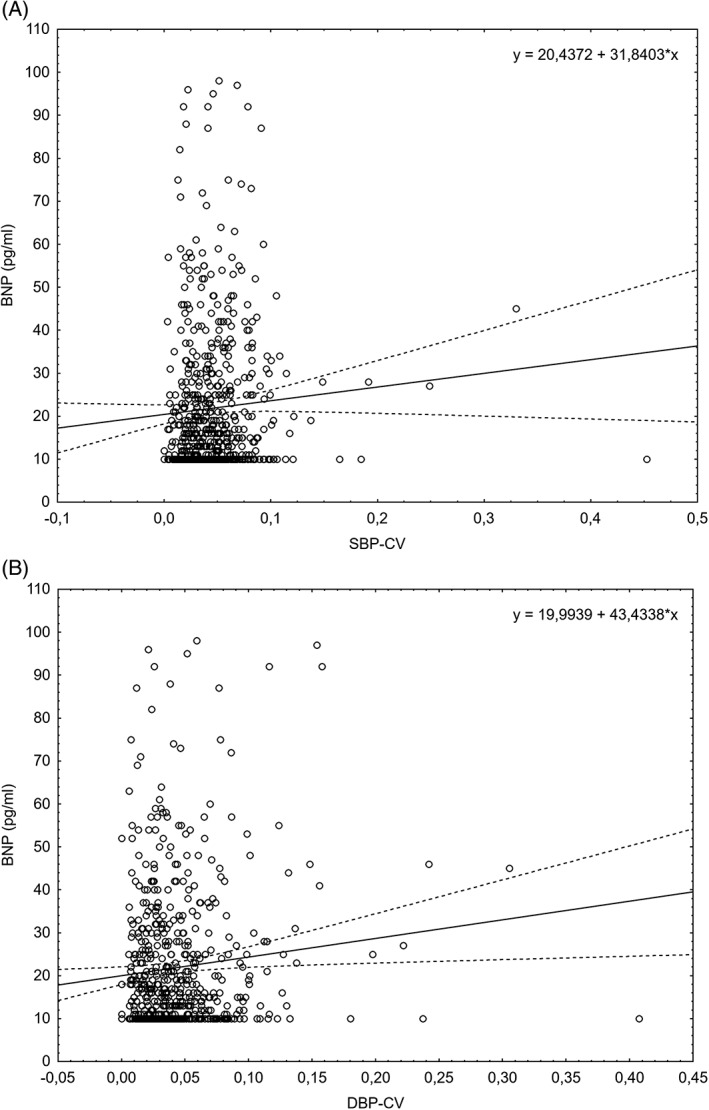
Scatterplots of BNP and the systolic (A) and diastolic (B) BP coefficient of variation. In (A) r = 0.107 and P = 0.007, and in (B) r = 0.092 and P = 0.019, Spearman test. Outliers were excluded for better viewing. Abbreviations: BP blood pressure; BNP, B‐type natriuretic peptide; DBP‐CV, diastolic blood pressure coefficient of variation; SBP‐CV, systolic blood pressure coefficient of variation
In the multiple regression equation, age, sex, race, smoking, systolic and diastolic BP, systolic and diastolic BP‐CV, BMI, eGFR, and TSH were retained (Table 2). In this model, systolic BP, diastolic BP‐CV, BMI, and eGFR were associated with BNP.
Table 2.
Multiple gamma regression results with BNP as outcomea
| Variable | Exponentiated Coefficient (95% CI) |
|---|---|
| Age | 1.02 (1.01–1.03) |
| Men | 0.91 (0.80–1.05) |
| Black | 1.04 (0.89–1.21) |
| Smoker | 0.93 (0.82–1.07) |
| SBP | 1.008 (1.003–1.012) |
| DBP | 0.993 (0.986–1.002) |
| SBP‐CV | 0.32 (0.03–2.74) |
| DBP‐CV | 20.89 (3.41–127.98) |
| BMI | 0.98 (0.97–0.99) |
| eGFR | 0.99 (0.98–0.99) |
| TSH | 0.99 (0.98–1.01) |
Abbreviations: BMI, body mass index; BNP, B‐type natriuretic peptide; CI, confidence interval; CV, coefficient of variation; DBP, diastolic blood pressure; eGFR, estimated glomerular filtration rate; SBP, systolic blood pressure; TSH, thyroid‐stimulating hormone.
Multiple gamma regression with log‐link function.
4. DISCUSSION
In this cross‐sectional study, we evaluated the relationship between within‐visit BPV and BNP. There are different methods to assess within‐visit BPV variation: amplitude, defined as maximum minus minimum BP, standard deviation, and CV. We chose CV because it considers the absolute BP value, reducing the influence of a high BP measurement.
We showed a positive correlation between within‐visit BP and BNP. Moreover, diastolic BPV was associated with BNP even after adjustment for multiple confounders. Although controversial, most of the previous studies show a relationship between BPV and target organ damage.2, 3, 4, 5 Using a similar protocol to ours, the BP‐CARE (Blood Pressure Control Rate and Cardiovascular Risk Profile) study showed that greater within‐visit BPV variabilities were associated with several cardiovascular risk factors, such as age, glucose, cholesterol, resistant hypertension, and previous cardiovascular events. However, that study did not assess BNP.4 In support of our findings, a recent study enrolled 664 participants from a general population and found that day‐to‐day variability in BP and heart rate were associated with N‐terminal prohormone of brain natriuretic peptide level.8 However, they measured BP every morning for 4 weeks and not in a single occasion. As far as we know, the present study is the first to associate within‐visit BPV and BNP.
This study has some limitations. First, as a cross‐sectional study, we cannot infer a causal relationship. In addition, our sample was relatively small for this kind of study. A strength of our study includes the adjustment for multiple confounders, including those that were previously shown to influence BNP levels.
5. CONCLUSION
Within‐visit BPV is a simple and easy way to evaluate short‐term blood pressure variability. In the present study, there was a positive, albeit weak, correlation between within‐visit BPV and BNP. In addition, diastolic BPV was associated with BNP even after adjustment for multiple confounders. Further studies are necessary to confirm if within‐visit BPV could identify patients with higher BNP levels, which is a prognostic marker of cardiovascular risk.
Conflicts of interest
The authors declare no potential conflicts of interest.
Rodrigues AB, Gismondi RA, Lagoeiro A, et al. Association between B‐type natriuretic peptide and within‐visit blood pressure variability. Clin Cardiol. 2018;41:778–781. 10.1002/clc.22953
REFERENCES
- 1. Stevens SL, Wood S, Koshiaris C, et al. Blood pressure variability and cardiovascular disease: systematic review and meta‐analysis. BMJ. 2016;354:i4098. [DOI] [PMC free article] [PubMed] [Google Scholar]
- 2. Schutte R, Thijs L, Liu Y‐P, et al. Within‐subject blood pressure level—not variability—predicts fatal and nonfatal outcomes in a general population. Hypertension. 2012;60:1138–1147. [DOI] [PMC free article] [PubMed] [Google Scholar]
- 3. Muntner P, Levitan EB, Reynolds K, et al. Within‐visit variability of blood pressure and all‐cause and cardiovascular mortality among US adults. J Clin Hypertens (Greenwich). 2012;14:165–171. [DOI] [PMC free article] [PubMed] [Google Scholar]
- 4. Grassi G, Seravalle G, Maloberti A, et al. Within‐visit BP variability, cardiovascular risk factors, and BP control in central and eastern Europe. J Hypertens. 2015;33:2250–2256. [DOI] [PubMed] [Google Scholar]
- 5. Zhou TL, Kroon AA, Reesink KD, et al. Blood pressure variability in individuals with and without (pre)diabetes: the Maastricht Study. J Hypertens. 2018;36:259–267. [DOI] [PubMed] [Google Scholar]
- 6. Di Angelantonio E, Chowdhury R, Sarwar N, et al. B‐type natriuretic peptides and cardiovascular risk: systematic review and meta‐analysis of 40 prospective studies. Circulation. 2009;120:2177–2187. [DOI] [PubMed] [Google Scholar]
- 7. Masugata H, Senda S, Inukai M, et al. Analysis of association between brain natriuretic peptide levels and blood pressure variability. Exp Ther Med. 2014;8:21–24. [DOI] [PMC free article] [PubMed] [Google Scholar]
- 8. Satoh M, Hosaka M, Asayama K, et al. Association between N‐terminal pro B‐type natriuretic peptide and day‐to‐day blood pressure and heart rate variability in a general population. J Hypertens. 2015;33:1536–1541. [DOI] [PubMed] [Google Scholar]
- 9. Jorge AJL, Rosa MLG, Fernandes LCM, et al. Heart failure prevalence study among patients enrolled in the family health program, Niterói. The DIGITALIS Study: design and method. Rev Bras Cardiol. 2011;24):320–325. [Google Scholar]
- 10. Jorge AL, Rosa MLG, Martins WA, et al. The prevalence of stages of heart failure in primary care: a population‐based study. J Card Fail. 2016;22:153–157. [DOI] [PubMed] [Google Scholar]