


Abstract
Background
Immunization rates for children and adults are rising, but coverage levels have not reached optimal goals. As a result, vaccine‐preventable diseases still occur. In an era of increasing complexity of immunization schedules, rising expectations about the performance of primary care, and large demands on primary care providers, it is important to understand and promote interventions that work in primary care settings to increase immunization coverage. One common theme across immunization programs in many nations involves the challenge of implementing a population‐based approach and identifying all eligible recipients, for example the children who should receive the measles vaccine. However, this issue is gradually being addressed through the availability of immunization registries and electronic health records. A second common theme is identifying the best strategies to promote high vaccination rates. Three types of strategies have been studied: (1) patient‐oriented interventions, such as patient reminder or recall, (2) provider interventions, and (3) system interventions, such as school laws. One of the most prominent intervention strategies, and perhaps best studied, involves patient reminder or recall systems. This is an update of a previously published review.
Objectives
To evaluate and compare the effectiveness of various types of patient reminder and recall interventions to improve receipt of immunizations.
Search methods
We searched CENTRAL, MEDLINE, Embase and CINAHL to January 2017. We also searched grey literature and trial registers to January 2017.
Selection criteria
We included randomized trials, controlled before and after studies, and interrupted time series evaluating immunization‐focused patient reminder or recall interventions in children, adolescents, and adults who receive immunizations in any setting. We included no‐intervention control groups, standard practice activities that did not include immunization patient reminder or recall, media‐based activities aimed at promoting immunizations, or simple practice‐based awareness campaigns. We included receipt of any immunizations as eligible outcome measures, excluding special travel immunizations. We excluded patients who were hospitalized for the duration of the study period.
Data collection and analysis
We used the standard methodological procedures expected by Cochrane and the Cochrane Effective Practice and Organisation of Care (EPOC) Group. We present results for individual studies as relative rates using risk ratios, and risk differences for randomized trials, and as absolute changes in percentage points for controlled before‐after studies. We present pooled results for randomized trials using the random‐effects model.
Main results
The 75 included studies involved child, adolescent, and adult participants in outpatient, community‐based, primary care, and other settings in 10 countries.
Patient reminder or recall interventions, including telephone and autodialer calls, letters, postcards, text messages, combination of mail or telephone, or a combination of patient reminder or recall with outreach, probably improve the proportion of participants who receive immunization (risk ratio (RR) of 1.28, 95% confidence interval (CI) 1.23 to 1.35; risk difference of 8%) based on moderate certainty evidence from 55 studies with 138,625 participants.
Three types of single‐method reminders improve receipt of immunizations based on high certainty evidence: the use of postcards (RR 1.18, 95% CI 1.08 to 1.30; eight studies; 27,734 participants), text messages (RR 1.29, 95% CI 1.15 to 1.44; six studies; 7772 participants), and autodialer (RR 1.17, 95% CI 1.03 to 1.32; five studies; 11,947 participants). Two types of single‐method reminders probably improve receipt of immunizations based on moderate certainty evidence: the use of telephone calls (RR 1.75, 95% CI 1.20 to 2.54; seven studies; 9120 participants) and letters to patients (RR 1.29, 95% CI 1.21 to 1.38; 27 studies; 81,100 participants).
Based on high certainty evidence, reminders improve receipt of immunizations for childhood (RR 1.22, 95% CI 1.15 to 1.29; risk difference of 8%; 23 studies; 31,099 participants) and adolescent vaccinations (RR 1.29, 95% CI 1.17 to 1.42; risk difference of 7%; 10 studies; 30,868 participants). Reminders probably improve receipt of vaccinations for childhood influenza (RR 1.51, 95% CI 1.14 to 1.99; risk difference of 22%; five studies; 9265 participants) and adult influenza (RR 1.29, 95% CI 1.17 to 1.43; risk difference of 9%; 15 studies; 59,328 participants) based on moderate certainty evidence. They may improve receipt of vaccinations for adult pneumococcus, tetanus, hepatitis B, and other non‐influenza vaccinations based on low certainty evidence although the confidence interval includes no effect of these interventions (RR 2.08, 95% CI 0.91 to 4.78; four studies; 8065 participants).
Authors' conclusions
Patient reminder and recall systems, in primary care settings, are likely to be effective at improving the proportion of the target population who receive immunizations.
Plain language summary
Do strategies to remind people to have vaccinations increase the number of people who receive vaccinations?
Aim of this review
The aim of this review is to determine whether strategies to remind people to receive vaccinations increase the number of people who receive vaccinations. This is an update of a previously published Cochrane Review.
Key messages
Reminding people to receive their vaccinations increases vaccination rates across different populations.
What was studied
Vaccinations are used to prevent a number of diseases but there is wide variation in vaccination coverage across different regions and countries. This can lead to diseases that are otherwise preventable by vaccines, having a large effect on individuals and communities. Informing people of an upcoming vaccination or telling them that they have missed a vaccination might help to increase coverage and reduce the effect and impact of disease preventable by vaccine. We reviewed 75 studies to evaluate whether reminding people to get vaccinated worked. The studies we looked at were from different settings, such as rural areas, schools, private practices, and state health departments. Most studies were done in the USA. The studies included a range of different groups: infants and children, adolescents and adults requiring routine vaccination, as well as adults who required the influenza vaccine. In most of the studies reminders took the form of person to person telephone calls, automated calls, letters or postcards. In few recent studies text messaging was used.
Main results of the review
Our review found that reminding people to have vaccinations likely increases the number of people who receive vaccinations by an average of 8 percentage points, although there was variation in the results of the studies. Reminding people by telephone and autodialer calls, sending a letter or postcard, or sending a text message increased vaccinations. Combinations of reminders were also effective. Reminding people over the telephone was more effective than the other types of reminders. The increases in vaccinations were observed among children, adolescents, and adults.
How up‐to‐date is this review?
We reviewed studies that were published to January 2017.
Summary of findings
Background
Description of the condition
Global coverage of routine immunizations varies widely (Hill 2016; European CDPC 2014; WHO 2016a). The global rate for three doses of diphtheria tetanus pertussis (DTP3) vaccine was estimated to be 86% in 2014, an increase of 66 percentage points since the 1980 level of 20% (WHO 2016a). However, approximately 18.7 million children did not receive DTP3 during 2014 (WHO 2016b). Rates vary by geographic area or country, with high levels of DTP3, ranging from 91% to 94% in the Americas, Europe, and the Western Pacific in 2014 (WHO 2016b). In 2014, the Eastern Mediterranean, South East Asia, and African regions had lower coverage rates of 73% to 84% (WHO 2016b). In the United States, immunization rates remain high and stable for infants and children, but coverage levels have not reached national goals for a number of vaccines, including the newer vaccinations introduced (Hill 2016; Seither 2016). Immunization rates remain nowhere near national coverage goals for influenza, human papillomavirus (HPV) vaccination, and adult vaccinations against herpes zoster or shingles and pneumococcal disease (Lu 2013; Reagan‐Steiner 2016; Stokley 2014). Vaccination rates also vary by state, race, and ethnicity (CDC 2016a; Hill 2015; Reagan‐Steiner 2015; Seither 2015; Williams 2015). For example, influenza immunization rates during the 2013 to 2014 influenza season varied by race or ethnicity, with reports of 46.7% among whites 19 years and older, compared with 36.5% among blacks, and 33.2% among Hispanics or Latinos (Williams 2016).
Burden of vaccine‐preventable diseases
As a result of unmet immunization goals, vaccine‐preventable diseases still have a significant effect in a number of countries (Clemmons 2015; European CDPC 2014; Williams 2016). This is evidenced by the continued occurrence of measles outbreaks, for example in Disneyland in California during 2015 (Clemmons 2015). In the European Union and three European Economic Area countries, 11,316 cases of measles were reported during 2012 (European CDPC 2014). The burden of vaccine‐preventable illnesses has also included approximately 226,000 influenza‐related hospitalizations, 3000 to 49,000 influenza‐related deaths, and 13,500 cases of invasive pneumococcal disease that occur each year in the US (Williams 2016). In Europe, an estimated four to 50 million symptomatic cases of influenza occur each year, and 15,000 to 70,000 deaths have been attributed to influenza annually (European CDPC 2016). Further, human papillomavirus (HPV) vaccination rates in the US and in some other nations are far lower than optimal, leading to many new cases of HPV infection and ultimately HPV‐related cancers (Viens 2016). Each year, 6.2 million persons are newly infected with HPV, and 26,000 new HPV‐related cancers are diagnosed in the US (Jemal 2013; Weinstock 2004). Cancers attributable to HPV infections lead to more than USD 4 billion in annual medical expenses in the US (Markowitz 2014).
Description of the intervention
Patient reminders notify populations, patients, or their parents or legal guardians of vaccines that are due because of age or other risk factors (AHRQ 2015; Jacobson 2016; Jacobson Vann 2005). The notification is delivered to populations or patients. Patient recalls refer to notifications of vaccines that are past due. For example, a letter sent to a patient at 60 years of age, informing her that she is now due for the shingles vaccine, is a patient reminder (Hales 2014; Jacobson Vann 2005). The patient who receives a notice at age 61 years about the shingles vaccine is getting a recall because the patient is past due, but would still benefit from receiving a shingles vaccination. Reminders and recalls require the source of the notification, whether a care provider, health services organization, public health authority, or community organization, to have access to the patient's contact information to facilitate the notification. The notification may be delivered by letter, postcard, telephone call, computerized telephone call, or text message (AHRQ 2015). The process would require the source of the notification to have determined the individual patient's status, in terms of being recommended for the vaccine by nature of the patient's age or risk condition or both, and not being vaccinated at the time of the notification.
How the intervention might work
Patient reminder or recall interventions work by addressing the common reasons that immunizations may be missed, such as forgetting or missing appointments, not knowing immunization schedules (Ahmed 2013; AHRQ 2015), and having concerns about vaccinations. The success of the patient or reminder recall intervention depends upon several factors, such as accuracy or currency of contact information, accuracy and completeness of vaccination records, viability of contact medium, readability or comprehensibility of the contact medium or message by the patient or patient's parent or legal guardian or caretaker, beliefs and attitudes about vaccinations, and access to health services or vaccinations (Esposito 2014; Pereira 2012; Thomas 2014).
Why it is important to do this review
In an era of increasing complexity of immunization schedules (CDC 1999a), rising expectations about the performance of primary care, and large demands on primary care physicians, it is important to understand and promote interventions that work in primary care settings. One strategy involves patient reminder or recall systems, which was recommended by the Task Force on Community Preventive Services (CPS Task Force 2016) and the Standards for Immunization Practices (National Vaccine Advisory Committee 2014). Despite the successes made in vaccinating populations under‐vaccination still occurs, resulting in vaccine‐preventable deaths and illnesses (Clemmons 2015; European CDPC 2014; Williams 2016).
Experts recommend that care providers utilize reminder or recall systems (CPS Task Force 2016; National Vaccine Advisory Committee 2014); however, there is evidence to suggest that few primary care providers actually use immunization reminder or recall systems, or both (Kempe 2012c; Pereira 2012; Tierney 2003). In a national survey of pediatric practices, only 16% of responding practices utilized them (Tierney 2003).
A range of different types of reminders and systems of recall are being implemented. Ten countries, including a number in Europe, have adopted computerized immunization information services or registries (Groom 2014). Immunization registries offer the potential to become the backbone of patient reminder or recall systems by identifying the populations at risk, providing algorithms to determine who is eligible based on vaccination recommendations, and providing systems to send postcards, letters, autodialer messages, and text message reminders (Kempe 2012c).
Centralized systems can include health systems, health maintenance organizations, practice 'networks' that share electronic health records, and state or national immunization registries. Several recent studies have demonstrated that centralized reminder and recall systems sent from health systems rather than from practices can raise immunization rates (Hofstetter 2015a; Hofstetter 2015b; Kempe 2013; Kempe 2015; Stockwell 2012a; Stockwell 2015; Szilagyi 2013). This strategy is intriguing because of the economies of scale that can be obtained from centralized reminder and recall.
This is an update of Jacobson Vann 2005 and Jacobson Vann 2008.
Objectives
To evaluate and compare the effectiveness of various types of patient reminder and recall interventions to improve receipt of immunizations.
Methods
Criteria for considering studies for this review
Types of studies
We included randomized trials, controlled before and after studies, and interrupted time series studies. We included good quality, controlled, non‐randomized studies to provide a sufficiently large number of studies to assess each intervention sub‐type. We excluded observational studies in which participants self‐selected to intervention groups. We reviewed the methods of each study to determine the study design, not relying on the authors' specified designs. We accepted a study that randomly selected intervention participants and selected matched controls in a non‐random fashion as a controlled before‐after design if pre‐intervention and post‐intervention immunization data were collected. Due to limited resources, we excluded non‐English language publications.
Types of participants
We included as participants children, from birth to 18 years, or adults who receive immunizations in any setting, including academic or non‐academic, and developed or developing countries. We excluded studies of patients who were hospitalized for the study duration.
Types of interventions
We included patient reminder or recall interventions, or both, that either reminded patients of upcoming immunizations or immunization visits that were due (reminders) or overdue (recall). Reminder and recall systems could be delivered by telephone, letter, postcard, text message, automatic electronic telephone calls (autodialer), within a secure online patient portal system, or in person, for example, a care provider giving a face‐to‐face reminder during a home visit, but not a clinic visit. Reminder and recall cues could also vary in specificity, number, and whether combined with other interventions, such as provider reminders or outreach. Specificity may vary from generic immunization reminders to personal reminders that address patient‐specific immunization needs. Frequency may be one‐time or multiple reminders. We included studies with multiple interventions if at least one study arm included immunization patient reminders or recall. We added text messages and messages occurring within patient portal systems in the current update.
Control activities
We included no‐intervention control groups, standard practice activities that did not include immunization‐focused patient reminder or recall interventions, media‐based activities aimed at promoting immunizations, and simple practice‐based immunization awareness campaigns.
Types of outcome measures
Our primary outcome measure was receipt of immunizations. We selected this outcome measure over other possible outcomes because of certain limitations, for example: the total number of vaccines would vary based on country, age group, and other factors; the proportion of the population that received all vaccines would depend on the specific population, such as age group; and on‐time vaccination is restrictive and is not expected to support clinicians' efforts to optimize receipt of vaccinations.
We accepted outcomes for individual vaccinations or standard combinations of recommended vaccinations, such as all recommended vaccinations by a specific date or age. If outcomes for a study were measured at multiple time points, we selected the outcomes designated as primary by the study authors. If unclear, we averaged outcomes over time periods.
We excluded immunizations that were sought for purposes of traveling to a destination where the disease may be widespread, and immunization orders or visits that did not also measure immunization status.
Search methods for identification of studies
We conducted searches of electronic databases, references lists of articles and reviews, grey literature, clinical trials websites, and identified articles from our team members, those already in use by our team for other clinical, teaching or project work, and experts in the field.
Electronic searches
For this update, we conducted a series of searches between February 2013 and 31 January 2017. We revised all our search strategies in January 2017 in order to reduce excess retrieval of papers and update the study design filter. We searched the Database of Abstracts of Reviews of Effects (DARE) for related systematic reviews and the following databases for primary studies on 31 January 2017:
Cochrane Central Register of Controlled Trials (CENTRAL; 2016, Issue 11) in the Cochrane Library;
Health Technology Assessment Database (HTA; 2016, Issue 4) in the Cochrane Library;
NHS Economic Evaluation Database (NHSEED; 2015, Issue 2) in the Cochrane Library;
MEDLINE Ovid, including Epub Ahead of Print, In‐Process & Other Non‐Indexed Citations: 1946 to 31 January 2017;
Embase Ovid: 1974 to 30 January 2017;
CINAHL EBSCO (Cumulative Index to Nursing and Allied Health Literature): 1981 to 31 January 2017.
The search strategies are presented in full in Appendix 1. Details of the previous search strategies are available in Jacobson Vann 2005 and Jacobson Vann 2008.
Searching other resources
We searched the reference lists of articles and reviews, and the files of study collaborators, for additional studies. Potentially relevant studies were also identified by experts in the field and by prior knowledge.
We conducted a grey literature search utilizing the sources below:
Agency for Healthcare Research and Quality website (www.ahrq.gov): searched March 2016;
ClinicalTrials.gov (www.clinicaltrials.gov): searched to February 2017;
World Health Organization International Clinical Trials Registry Platform (apps.who.int/trialsearch): searched 31 January 2017.
We also:
screened abstracts and conference proceedings (e.g. handsearching);
reviewed the reference lists of included studies, relevant systematic reviews, and primary studies;
contacted researchers with expertise relevant to the review topic or EPOC interventions.
Data collection and analysis
Selection of studies
One review author (JJV) screened all titles and abstracts, and two review authors (RMJ, TCB) independently reviewed half of all titles and abstracts.
Data extraction and management
Two review authors (JJV, RMJ, TCB) independently read and abstracted each potentially relevant study to assess for inclusion using a checklist developed by the Cochrane Effective Practice and Organisation of Care Group (EPOC) (EPOC 2017), and a supplemental form to collect new data elements to meet revised Cochrane guidelines. For each included study, we collected information on study design, study duration, intervention description, outcome measures, study findings, study setting, provider characteristics, participant characteristics, unit of allocation, unit of analysis, ethical approval, power or sample size calculations, and risk of bias assessments (EPOC 2017; Higgins 2011). We attempted to contact study authors when the data presented were not sufficiently detailed to include them in the analyses. One review author (JJV) compared both abstracts for each study and identified disagreements on inclusion and abstraction results. We resolved disagreements between review authors on study inclusion and abstraction results by a formal reconciliation process to achieve consensus.
We tracked the review process and status of each article and managed the study‐level data using Excel spreadsheets (Excel 2005). We assigned unique study identification numbers to support the tracking process. In the current update, we further tracked the major study activities and timelines in a project management system.
We entered dichotomous data from included randomized trials into RevMan 5 analysis data tables for intervention type, an overall summary measure, and participant‐immunization category: routine childhood, child influenza, other adult, adult influenza, and adolescent vaccinations.
Assessment of risk of bias in included studies
We assessed the risk of bias of the included studies using the Cochrane 'Risk of bias' tool (Higgins 2011). We scored each criterion, for each study, as low risk, unclear risk, or high risk of bias. We assessed the risk for the following.
Selection bias: random sequence generation, allocation concealment, and baseline measurement.
Performance bias: blinding of participants and personnel.
Detection bias: blinding of outcome assessment.
Attrition bias: incomplete outcome data.
Reporting bias: selective reporting.
Other bias: other sources of bias.
The results of our assessment are reported in the 'Risk of bias' tables (Characteristics of included studies), and are summarized by type of bias in our results (Risk of bias in included studies).
Measures of treatment effect
We used RevMan 5 to analyze data from randomized trials using risk ratios (RRs). We also computed absolute changes in immunizations received, as percentage point differences between pre‐intervention and post‐intervention measures because absolute changes are clinically meaningful to practitioners who make decisions about the types of interventions to adopt in their clinical practices. We computed absolute differences as post‐intervention immunization proportions minus pre‐intervention immunization proportions for each study group. We compared differences between study groups.
Unit of analysis issues
We did not combine data from randomized trials that allocated families, households, practices, or other clusters with trials that allocated individuals.
Dealing with missing data
When the reported data were insufficient to conduct our meta‐analyses, we attempted to contact study authors to obtain additional data, and analyzed all the available data (Pigott 2001). We excluded studies from the review if no relevant data were reported, based on the study protocol and minimum methodological inclusion criteria.
Assessment of heterogeneity
We used random‐effects models if Cochrane's Q test detected significant heterogeneity across studies. This test has low sensitivity, so we used a 0.1 significance level.
Assessment of reporting biases
We assessed for possible reporting biases, including publication bias, using a funnel plot (Egger 1997b). We created a funnel plot for the patient reminder or recall summary measure using the metafor package in R version 3.2.3 (Viechtbauer 2010), and also in RevMan 5 (Analysis 1.1), plotting the standard errors of log RRs against RRs (Sterne 2001). We also included a 95% confidence region based on a random‐effects model, where absence of bias is indicated by the inclusion of approximately 95% of the studies within this region (Sterne 2004).
1.1. Analysis.

Comparison 1 Patient reminders (summary), Outcome 1 Immunized.
Data synthesis
We combined published data using random‐effects meta‐analysis for the number of people receiving immunizations. We grouped trials by population, including routine childhood, child influenza, other adult, adult influenza, and adolescent vaccinations, and the type of intervention. For studies with more than one patient reminder or with similar intervention types, such as two postcards groups with different messages, we combined intervention group data. For randomized trials with outcomes reported in multiple outcome categories, we reported each outcome separately by reminder type and combined data for the summary measure. For randomized trials with interventions delivered over time and multiple data collection points, we used average sample sizes.
We calculated risk ratios (RRs) and 95% confidence intervals (CIs) in RevMan for individual studies or study comparisons to assess the effect of patient reminder or recall interventions on receipt of immunizations. We computed pooled RRs and risk differences for each intervention type, and stratified the results within each intervention type by the five participant‐immunization categories. For example, we computed an overall pooled random‐effects RR for letter interventions, then stratified relevant study comparisons for participant‐immunization category.
Summary of findings
We summarized the findings of the main intervention comparison(s) for the most important outcome(s), specifically receipt of immunizations for each intervention type and participant‐immunization categories in two 'Summary of findings' tables. Two review authors (JJV, JKAA) independently assessed the certainty of the evidence or confidence in the estimate (high, moderate, low, and very low) for each outcome and intervention type using GRADE (BMJ 2016; Ryan 2016; Schünemann 2011). Our assessment included study design, risk of bias, inconsistency of effect size, indirectness, imprecision, and other considerations, including publication bias (EPOC 2017b). We present the certainty of evidence assessment results in GRADE evidence profiles (Appendix 2) and the 'Summary of findings' tables (Table 1; Table 2).
Summary of findings for the main comparison. Overview: Patient reminder or recall interventions for receipt of immunizations ‐ any kind.
| Patient reminder or recall interventions compared with no patient reminder or recall for receipt of immunizations | ||||||
|
Patient or population: children, adolescents, and adults with a need for routine immunizations, excluding travel immunizations Settings: patient telephone reminder or recall interventions are typically received in the home; the interventions originate from outpatient departments of hospitals, community‐based clinical settings, local and state public health departments, and other clinical settings Intervention: patient reminder or recall interventions Comparison: no‐intervention control groups, standard practice activities that did not include immunization‐focused patient reminder or recall interventions, media‐based activities aimed at promoting immunizations, and simple practice‐based immunization awareness campaigns | ||||||
| Intervention type | Outcome: received immunizations | |||||
| Illustrative comparative risks* (95% CI) | Relative effect (95% CI) | No of participants (studies) | Certainty of the evidence (GRADE) | Comments | ||
| Assumed risk | Corresponding risk | |||||
| Without intervention | With intervention | |||||
| Patient reminder or recall summary measure | 290 per 1000 | 371 per 1000 (357 to 392) |
RR 1.28a (1.23 to 1.35) | 138,625 (55) | Moderateb | — |
| Patient telephone reminder or recall | 164 per 1000 | 287 per 1000 (197 to 417) |
RR 1.75 (1.20 to 2.54) | 9120 (7) |
Moderatec | — |
| Patient letter reminder or recall | 320 per 1000 | 412 per 1000 (387 to 442) |
RR 1.29 (1.21 to 1.38) | 81,100 (27) |
Moderated | — |
| Patient postcard reminder or recall | 327 per 1000 | 386 per 1000 (353 to 425) |
RR 1.18 (1.08 to 1.30) | 27,734 (8) |
Highe | — |
| Patient text message reminder or recall | 161 per 1000 | 208 per 1000 (185 to 232) |
RR 1.29 (1.15 to 1.44) | 7772 (6) |
High | — |
| Patient autodialer message reminder or recall | 365 per 1000 | 427 per 1000 (376 to 482) |
RR 1.17 (1.03 to 1.32) | 11,947 (5) |
High | — |
| Combination of patient mail and telephone reminder or recall | 277 per 1000 | 354 per 1000 (316 to 402) |
RR 1.28 (1.14 to 1.45) | 6506 (8) |
Moderatef | — |
| Combination of patient reminder or recall with outreach intervention | 360 per 1000 | 439 per 1000 (396 to 486) |
RR 1.22 (1.10 to 1.35) | 2701 (3) |
High | — |
| Combination of patient reminder or recall with provider reminder intervention | 202 per 1000 | 588 per 1000 (540 to 644) |
RR 2.91 (2.67 to 3.19) | 4120 (2) |
Moderateg | — |
| *The basis for the assumed risk, e.g. the median control group risk across studies, is provided in footnotes. The corresponding risk, and its 95% confidence interval, is based on the assumed risk in the comparison group and the relative effect of the intervention, and its 95% CI. CI: confidence interval; RR: risk ratio | ||||||
| GRADE Working Group grades of evidence High quality: Further research is very unlikely to change our confidence in the estimate of effect. Moderate quality: Further research is likely to have an important impact on our confidence in the estimate of effect and may change the estimate. Low quality: Further research is very likely to have an important impact on our confidence in the estimate of effect and is likely to change the estimate. Very low quality: We are very uncertain about the estimate. | ||||||
aIt is important to note that this review is the third update of the initial review that was published in 2002; the results for each update have been relatively stable and consistent with the original review.
bWe downgraded the certainty of the evidence by 1 point. GRADE was reduced by 0.5 points because of a small degree of inconsistency in outcomes. Generally, most included studies reported relatively small positive risk ratios, with several negative outliers and several with stronger positive effects; the patient reminder recall interventions also varied. We downgraded precision slightly (‐0.5) because the confidence intervals were wide for several included studies.
cWe downgraded the certainty of the evidence by 1 point. GRADE was reduced by 0.5 points because of a small degree of inconsistency in outcomes; the interventions were relatively homogeneous. We downgraded precision slightly (‐0.5) because the confidence intervals were wide for a few included studies.
dWe downgraded the certainty of the evidence by 1 point because of a small degree of inconsistency in outcomes (0.5 point); the interventions were relatively homogeneous. We downgraded precision slightly (‐0.5) because the confidence intervals were wide for several included studies.
eWe downgraded the certainty of the evidence by 0.5 points because of a high risk of bias for one or two of eight criteria for 15 studies.
fWe downgraded the certainty of the evidence by 1 point. GRADE was reduced by 0.5 points because of a small degree of inconsistency in outcomes, with one outlier; the interventions were more varied than the single intervention types. We downgraded precision slightly (‐0.5) because the confidence interval was wide for one outlier.
gWe downgraded the certainty of the evidence by 1.5 points. GRADE was reduced by 0.5 points because of a moderate risk of bias in one of three comparisons within two studies. We downgraded precision by 1 point because of two wide confidence intervals in three comparisons.
Summary of findings 2. Summary: Patient reminder or recall interventions by type of immunization.
| Patient reminder or recall intervention for receipt of immunization, by type of immunization | ||||||
|
Patient or population: children, adolescents, and adults with a need for routine immunizations, excluding travel immunizations Settings: patient reminder or recall interventions are typically received in the home; the interventions originate from outpatient departments of hospitals, community‐based clinical settings, local and state public health departments, and other clinical settings Interventions: patient reminder or recall interventions, including telephone calls, autodialer calls, letters, postcards, text messages, combination of mail or telephone, or combination of patient reminder or recall with outreach; this summary measure excludes patient reminder or recall interventions combined with provider reminders Comparison: no‐intervention control groups, standard practice activities that did not include immunization‐focused patient reminder or recall interventions, media‐based activities aimed at promoting immunizations, and simple practice‐based immunization awareness campaigns | ||||||
| Outcomes | Illustrative comparative risks* (95% CI) | Relative effect (95% CI) | No of participants (studies) | Certainty of the evidence (GRADE) | Comments | |
| Assumed risk | Corresponding risk | |||||
| Without intervention | With intervention | |||||
| Childhood immunizations | 333 per 1000 | 406 per 1000 (383 to 430) |
RR 1.22 (1.15 to 1.29) | 31,099 (23) |
Higha | — |
| Childhood influenza immunizations | 431 per 1000 | 651 per 1000 (491 to 857) |
RR 1.51 (1.14 to 1.99) | 9265 (5) |
Moderateb | — |
| Adult immunizations ‐ other than influenza or travel ('Other adult') | 109 per 1000 | 227 per 1000 (99 to 521) |
RR 2.08 (0.91 to 4.78) | 8065 (4) |
Lowc | — |
| Adult influenza immunizations | 292 per 1000 | 376 per 1000 (342 to 418) |
RR 1.29 (1.17 to 1.43) | 59,328 (15) |
Moderated | — |
| Adolescent immunizations | 244 per 1000 | 314 per 1000 (285 to 346) |
RR 1.29 (1.17 to 1.42) | 30,868 (10) |
Highe | — |
| *The basis for the assumed risk, e.g. the median control group risk across studies, is provided in footnotes. The corresponding risk, and its 95% confidence interval, is based on the assumed risk in the comparison group and the relative effect of the intervention, and its 95% CI. CI: confidence interval; RR: risk ratio | ||||||
| GRADE Working Group grades of evidence High quality: Further research is very unlikely to change our confidence in the estimate of effect. Moderate quality: Further research is likely to have an important impact on our confidence in the estimate of effect and may change the estimate. Low quality: Further research is very likely to have an important impact on our confidence in the estimate of effect and is likely to change the estimate. Very low quality: We are very uncertain about the estimate. | ||||||
aWe did not downgrade the certainty of the evidence: no serious risk of bias, serious inconsistency, serious indirectness, or serious imprecision was identified among the 23 studies; however, one study was an outlier (RR 5.33).
bWe downgraded the certainty of the evidence by 1.5 points because of some imprecision (‐1) and inconsistency (‐0.5). One of five studies had a wide confidence interval and effect sizes ranged from 1.08 to 4.6.
cWe downgraded the certainty of the evidence by 2 points because of lack of agreement between studies (‐1) and some imprecision (‐1). Effect sizes ranged from 1.08 to 3.61 and two of five studies had wide confidence intervals.
dWe downgraded the certainty of the evidence by 1.5 points because of some inconsistency in results (‐0.5) and some imprecision (‐1). Effect sizes ranged from 0.91 to 3.11 and one of 15 studies had a wide confidence interval.
eWe did not downgrade the certainty of the evidence: no serious risk of bias, serious inconsistency, serious indirectness, or serious imprecision was identified among the 10 studies.
Subgroup analysis and investigation of heterogeneity
We structured the table of comparisons in RevMan 5 to examine study results, using RRs, by type of patient reminder or recall intervention and created subcategories within each intervention type, to perform subgroup analyses by each of the five participant‐immunization categories.
Sensitivity analysis
We conducted sensitivity analyses for the patient reminder or recall summary measure to assess the effects of two separate methodological decisions in this review. First, we assessed the effect of including versus excluding studies from our analysis with a high risk of bias rating for random sequence generation, allocation concealment, and/or incomplete outcome data. Second, we assessed the effect of defining our primary outcome as receipt of any needed immunizations, whether one or all needed immunizations, by omitting studies from the patient reminder or recall summary measure that defined outcomes as up‐to‐date with all needed immunizations.
Results
Description of studies
Results of the search
We reviewed 4966 studies for potential inclusion in this review update and retrieved and screened 271 full texts (Figure 1). We included 75 studies, 28 of which we identified during this update (Bangure 2015; Brigham 2012; Brown 2016; CDC 2012; Chao 2015; Daley 2002; Dini 2000; Dombkowski 2012; Dombkowski 2014; Haji 2016; Hambidge 2009; Humiston 2011; Lemstra 2011; Marron 1998; Mason 2000; McCaul 2002; Moniz 2013; O'Leary 2015; Rand 2015; Rand 2017; Roca 2012; Staras 2015; Stockwell 2012a; Suh 2012; Szilagyi 2011; Szilagyi 2013; Vivier 2000; Winston 2007) (Characteristics of included studies).
1.

Study flow diagram.
Included studies
See Characteristics of included studies for full details.
Study designs
Of the 75 included studies, five used a controlled before and after design (LeBaron 1998; Lemstra 2011; Lieu 1998; Margolis 1992; Stockwell 2012a). The remaining studies used a randomized trial design. One controlled before‐after study randomized intervention participants to four study groups; control participants were not randomized (Lieu 1998).
Fifteen studies allocated participants by area, practice, provider, or family and analyzed data at the patient level. Three studies clustered allocation by local government area, community, practice, or provider and analyzed at the individual person level (Brown 2016; Buffington 1991; Ornstein 1991). Twelve studies clustered families, including married couples or siblings, and conducted analyses at the patient level (Dini 2000; Frame 1994; Haji 2016; Lukasik 1987; McDowell 1986; Puech 1998; Rodewald 1999; Rosser 1991; Rosser 1992; Spaulding 1991; Szilagyi 2011; Szilagyi 2013). One of the 12 studies also analyzed data at the family level; however, it did not present specific family‐level data (McDowell 1986).
Settings
Studies were performed in diverse settings, ranging from urban to rural, and public to private to university‐based. Examples of study settings are state health departments, health maintenance organizations (HMO), public health departments, urban teaching facilities, private practices, senior centers, rural practices, and schools. Fifty‐eight studies were performed in the US. The remainder were conducted in Australia (two) (Ferson 1995; Puech 1998), Canada (six) (Hogg 1998; Lemstra 2011; Lukasik 1987; McDowell 1986; Rosser 1991; Rosser 1992), Denmark (one) (Nexoe 1997), New Zealand (two) (Satterthwaite 1997; Soljak 1987), the UK (two) (Hull 2002; Mason 2000), Spain (one) (Roca 2012), Zimbabwe (one) (Bangure 2015), Kenya (one) (Haji 2016), and Nigeria (one) (Brown 2016).
Participants
We classified participants into five categories based on the types of immunizations received and broad age groups: infants and children needing routine immunizations, children needing influenza vaccination, adolescents, adults needing routine immunizations, and adults needing influenza vaccination. Twenty‐nine of the included studies examined routine vaccinations of infants and children (Alto 1994; Bangure 2015; Brown 2016; Campbell 1994; CDC 2012; Daley 2002; Daley 2004b; Dini 2000; Dombkowski 2014; Ferson 1995; Haji 2016; Hambidge 2009; Irigoyen 2006; Kempe 2001; LeBaron 1998; LeBaron 2004; Lemstra 2011; Lieu 1997; Lieu 1998; Linkins 1994; Mason 2000; Oeffinger 1992; Rodewald 1999; Soljak 1987; Stehr‐Green 1993; Tollestrup 1991; Vivier 2000; Wood 1998; Young 1980); and five studied influenza vaccinations among children and infants (Daley 2004a; Dombkowski 2012; Kempe 2005; Kemper 1993; Szilagyi 1992). Twenty‐four studies assessed the effectiveness of patient reminder or recall interventions on receipt of adult influenza immunizations (Baker 1998; Becker 1989; Brimberry 1988; Buchner 1987; Buffington 1991; Carter 1986; Hogg 1998; Hull 2002; Humiston 2011; Larson 1982; Lukasik 1987; Margolis 1992; McCaul 2002; McDowell 1986; Moniz 2013; Moran 1992; Mullooly 1987; Nexoe 1997; Puech 1998; Roca 2012; Rosser 1991; Satterthwaite 1997; Siebers 1985; Spaulding 1991). Eight assessed the effectiveness of patient reminder or recall on receipt of any or all of adult vaccinations, including tetanus, pneumococcal, hepatitis B, diphtheria tetanus pertussis (DTP), Haemophilus influenzae type B (Hib), measles, mumps, rubella (MMR), and trivalent oral polio vaccine (TOPV) (Frame 1994; Hogg 1998; Ornstein 1991; Rosser 1991; Rosser 1992; Sansom 2003; Siebers 1985; Winston 2007). Twelve studies examined the effect of patient reminder or recall on receipt of adolescent immunizations (Brigham 2012; Chao 2015; Marron 1998; O'Leary 2015; Rand 2015; Rand 2017; Staras 2015; Stockwell 2012a; Suh 2012; Szilagyi 2006; Szilagyi 2011; Szilagyi 2013). The total number of studies described by target population‐immunization category exceeds the 75 included studies because several studies examined more than one category.
Interventions
Fourteen studies examined the effect of immunization reminder person‐to‐person telephone calls on receipt of immunizations (Brigham 2012; Brimberry 1988; Brown 2016; Ferson 1995; Frame 1994; Hull 2002; Lemstra 2011; Lukasik 1987; McDowell 1986; Rosser 1991; Rosser 1992; Sansom 2003; Vivier 2000; Winston 2007). Thirty‐two studies examined the effect of immunization reminder or recall letters to patients or parents on receipt of immunization (Brimberry 1988; Campbell 1994; Carter 1986; CDC 2012; Chao 2015; Daley 2004a; Dini 2000; Dombkowski 2012; Dombkowski 2014; Hogg 1998; Kempe 2005; Kemper 1993; Lieu 1997; Lieu 1998; Marron 1998; Mason 2000; McCaul 2002; McDowell 1986; Moran 1992; Mullooly 1987; Nexoe 1997; Oeffinger 1992; Ornstein 1991; Roca 2012; Rosser 1991; Rosser 1992; Satterthwaite 1997; Siebers 1985; Szilagyi 1992; Szilagyi 2013; Vivier 2000; Young 1980). Ten studies assessed the effect of immunization reminder or recall postcards on immunization receipt (Baker 1998; Buchner 1987; Campbell 1994; Irigoyen 2006; Larson 1982; Puech 1998; Soljak 1987; Spaulding 1991; Staras 2015; Tollestrup 1991). Six studies examined the effect of text messages on immunization receipt (Bangure 2015; Haji 2016; Moniz 2013; O'Leary 2015; Rand 2017; Stockwell 2012a). Seven studies assessed the effect of immunization reminder or recall autodialer interventions on immunization receipt (Dini 2000; Lieu 1998; Linkins 1994; Rand 2017; Stehr‐Green 1993; Szilagyi 2006; Szilagyi 2013). Nine studies examined the effect of some combination of letter or postcard plus telephone or autodialer on immunization receipt (Alto 1994; Daley 2002; Daley 2004b; Dini 2000; Kempe 2001; LeBaron 1998; Lieu 1998; Suh 2012; Vivier 2000). Seven studies examined the effect of some combination of patient reminder or recall with outreach on immunization receipt (Hambidge 2009; LeBaron 1998; LeBaron 2004; Lemstra 2011; Rodewald 1999; Szilagyi 2011; Wood 1998). We also included six randomized trials that examined the effect of provider reminders, combined with patient reminder or recall interventions, on immunization receipt (Becker 1989; Buffington 1991; Frame 1994; Humiston 2011; Ornstein 1991; Rodewald 1999), and one controlled before‐after study (Margolis 1992). The duration of the intervention, per participant, ranged from a momentary reminder or recall at a point in time to interventions delivered intermittently over an approximate one‐year time period for multiple vaccinations. The total number of studies sorted by intervention type exceeds the 75 included studies because many studies had more than one intervention arm.
Excluded studies
We briefly describe the reasons individual studies were excluded from our review in the Characteristics of excluded studies table.
Risk of bias in included studies
The risk of bias is summarized for all included studies in Figure 2. Full details of our assessment of risk of bias for each study is provided in the 'Risk of bias' tables in the Characteristics of included studies.
2.

'Risk of bias' summary: review authors' judgements about each risk of bias item for each included study.
Allocation
Random sequence generation
We classified the potential risk for selection bias, based on random sequence allocation assessment, as low risk in 44.0 per cent (33 studies; Alto 1994; Bangure 2015; Brigham 2012; Brimberry 1988; CDC 2012; Daley 2002; Daley 2004a; Daley 2004b; Dombkowski 2012; Dombkowski 2014; Haji 2016; Hambidge 2009; Hull 2002; Irigoyen 2006; Kemper 1993; LeBaron 2004; Lieu 1997; Mason 2000; Moniz 2013; O'Leary 2015; Puech 1998; Rand 2015; Rand 2017; Roca 2012; Rodewald 1999; Rosser 1991; Rosser 1992; Spaulding 1991; Staras 2015; Suh 2012; Szilagyi 2006; Szilagyi 2011; Szilagyi 2013; Vivier 2000; Winston 2007; Wood 1998). We classified the risk as unclear for 40.0 per cent (30 studies; Baker 1998; Becker 1989; Brown 2016; Buchner 1987; Buffington 1991; Campbell 1994; Carter 1986; Chao 2015; Dini 2000; Ferson 1995; Frame 1994; Kempe 2001; Kempe 2005; Larson 1982; Linkins 1994; Marron 1998; McCaul 2002; McDowell 1986; Moran 1992; Mullooly 1987; Nexoe 1997; Ornstein 1991; Satterthwaite 1997; Siebers 1985; Stehr‐Green 1993; Szilagyi 1992; Young 1980), and high risk for 16.0 per cent (12 studies; Hogg 1998; Humiston 2011; LeBaron 1998; Lemstra 2011; Lieu 1998; Lukasik 1987; Margolis 1992; Oeffinger 1992; Sansom 2003; Soljak 1987; Stockwell 2012a; Tollestrup 1991).
Allocation concealment
We classified the potential risk for selection bias, based on concealment of allocation, as low risk in 44.0 per cent (33 studies) (Bangure 2015; Brigham 2012; Brimberry 1988; CDC 2012; Daley 2002; Daley 2004a; Dombkowski 2012; Dombkowski 2014; Hambidge 2009; Hull 2002; Irigoyen 2006; Kemper 1993; LeBaron 2004Lieu 1997; Linkins 1994; Mason 2000; Moniz 2013; O'Leary 2015; Puech 1998; Rand 2015; Rand 2017; Roca 2012; Rodewald 1999; Rosser 1991; Rosser 1992; Spaulding 1991; Suh 2012; Szilagyi 2006; Szilagyi 2011; Szilagyi 2013; Vivier 2000; Winston 2007; Wood 1998). We classified allocation concealment as unclear risk in 42.7 per cent (32 studies) (Alto 1994; Baker 1998; Becker 1989; Brown 2016; Buchner 1987; Buffington 1991; Campbell 1994; Carter 1986; Chao 2015; Daley 2004b; Dini 2000; Ferson 1995; Frame 1994; Haji 2016; Hogg 1998; Kempe 2001; Kempe 2005; Larson 1982; Lieu 1998; Marron 1998; McCaul 2002; McDowell 1986; Moran 1992; Mullooly 1987; Nexoe 1997; Ornstein 1991; Satterthwaite 1997; Siebers 1985; Staras 2015; Stehr‐Green 1993; Szilagyi 1992; Young 1980), and we classified it as high risk in 13.3 per cent (10 studies; Humiston 2011; LeBaron 1998; Lemstra 2011; Lukasik 1987; Margolis 1992; Oeffinger 1992; Sansom 2003; Soljak 1987; Stockwell 2012a; Tollestrup 1991).
Baseline measurement
We classified the risk for selection bias, based on baseline measurement of outcomes and participant characteristics, as low risk in 69.3 per cent (52 studies) (Alto 1994; Baker 1998; Bangure 2015; Becker 1989; Brigham 2012; Brimberry 1988; Campbell 1994; Carter 1986; CDC 2012; Chao 2015; Daley 2002; Daley 2004a; Daley 2004b; Dini 2000; Dombkowski 2012; Dombkowski 2014; Frame 1994; Haji 2016; Hull 2002; Humiston 2011; Kempe 2001; Kempe 2005; Kemper 1993; LeBaron 1998; LeBaron 2004; Lemstra 2011; Lieu 1997; Linkins 1994; Lukasik 1987; Marron 1998; McCaul 2002; McDowell 1986; Moniz 2013; Oeffinger 1992; O'Leary 2015; Puech 1998; Rand 2015; Rand 2017; Roca 2012; Rodewald 1999; Siebers 1985; Soljak 1987; Stockwell 2012a; Suh 2012; Szilagyi 1992; Szilagyi 2006; Szilagyi 2011; Szilagyi 2013; Tollestrup 1991; Vivier 2000; Winston 2007; Wood 1998). We classified the risk as unclear in 24.0 per cent (18 studies) (Buchner 1987; Buffington 1991; Hambidge 2009; Irigoyen 2006; Lieu 1998; Margolis 1992; Mason 2000; Moran 1992; Mullooly 1987; Nexoe 1997; Rosser 1991; Rosser 1992; Sansom 2003; Satterthwaite 1997; Spaulding 1991; Staras 2015; Stehr‐Green 1993; Young 1980), and we classified it as high risk in 6.7 per cent (five studies) (Brown 2016; Ferson 1995; Hogg 1998; Larson 1982; Ornstein 1991).
Blinding
We classified the potential risk for performance bias, based on blinding of participants and personnel, as low risk in 28.0 per cent (21 studies) (Brimberry 1988; Campbell 1994; CDC 2012; Daley 2002; Daley 2004a; Daley 2004b; Hull 2002; Kempe 2001; Mason 2000; Moniz 2013; Moran 1992; Nexoe 1997; O'Leary 2015; Puech 1998; Roca 2012; Spaulding 1991; Suh 2012; Szilagyi 2006; Szilagyi 2011; Szilagyi 2013; Winston 2007). We classified the risk of performance bias, based on blinding of participants and personnel, as unclear in 66.7 per cent (50 studies) (Alto 1994; Baker 1998; Bangure 2015; Becker 1989; Brigham 2012; Brown 2016; Buchner 1987; Buffington 1991; Carter 1986; Chao 2015; Dini 2000; Dombkowski 2012; Dombkowski 2014; Ferson 1995; Frame 1994; Haji 2016; Hambidge 2009; Hogg 1998; Humiston 2011; Irigoyen 2006; Kempe 2005; Larson 1982; LeBaron 2004; Lemstra 2011; Lieu 1997; Lieu 1998; Linkins 1994; Margolis 1992; Marron 1998; McCaul 2002; McDowell 1986; Mullooly 1987; Oeffinger 1992; Ornstein 1991; Rand 2015; Rand 2017; Rodewald 1999; Rosser 1991; Sansom 2003; Satterthwaite 1997; Siebers 1985; Soljak 1987; Staras 2015; Stehr‐Green 1993; Stockwell 2012a; Szilagyi 1992; Tollestrup 1991; Vivier 2000; Wood 1998; Young 1980), and we classified it as high risk in 5.3 per cent (four studies; Kemper 1993; LeBaron 1998; Lukasik 1987; Rosser 1992).
We classified the potential risk for detection bias, based on blinded assessment of primary outcomes, as low risk in 29.3 per cent (22 studies) (Baker 1998; Brigham 2012; CDC 2012; Daley 2002; Daley 2004a; Daley 2004b; Hambidge 2009; Hull 2002; Kempe 2001; Kemper 1993; Linkins 1994; McCaul 2002; Moniz 2013; Moran 1992; O'Leary 2015; Puech 1998; Roca 2012; Rodewald 1999; Suh 2012; Szilagyi 2006; Szilagyi 2013; Winston 2007). We classified the risk of detection bias as unclear in 68.0 per cent (51 studies) (Alto 1994; Bangure 2015; Becker 1989; Brimberry 1988; Brown 2016; Buchner 1987; Buffington 1991; Campbell 1994; Carter 1986; Chao 2015; Dini 2000; Dombkowski 2012; Dombkowski 2014; Ferson 1995; Frame 1994; Haji 2016; Hogg 1998; Irigoyen 2006; Kempe 2005; Larson 1982; LeBaron 1998; Lemstra 2011; Lieu 1997; Lieu 1998; Lukasik 1987; Margolis 1992; Marron 1998; Mason 2000; McDowell 1986; Mullooly 1987; Nexoe 1997; Oeffinger 1992; Ornstein 1991; Rand 2015; Rand 2017; Rosser 1991; Rosser 1992; Sansom 2003; Satterthwaite 1997; Siebers 1985; Soljak 1987; Spaulding 1991; Staras 2015; Stehr‐Green 1993; Stockwell 2012a; Szilagyi 1992; Szilagyi 2011; Tollestrup 1991; Vivier 2000; Wood 1998; Young 1980), and we classified it as high risk in 2.7 per cent (two studies; Humiston 2011; LeBaron 2004).
Incomplete outcome data
We classified the potential risk for attrition bias, based on the degree of participant follow‐up and complete outcome data, as low risk in 58.7 per cent (44 studies) (Bangure 2015; Brigham 2012; Brimberry 1988; Brown 2016; Buffington 1991; Campbell 1994, Carter 1986; CDC 2012; Daley 2004a; Dombkowski 2012; Dombkowski 2014; Hambidge 2009; Hogg 1998; Hull 2002; Humiston 2011; Irigoyen 2006; Kempe 2005; Kemper 1993; Lieu 1997; Lukasik 1987; Mason 2000; McCaul 2002; Nexoe 1997; Oeffinger 1992; O'Leary 2015; Puech 1998; Rand 2015; Roca 2012; Rodewald 1999; Rosser 1992; Siebers 1985; Soljak 1987; Spaulding 1991; Stehr‐Green 1993; Stockwell 2012a; Suh 2012; Szilagyi 1992; Szilagyi 2006; Szilagyi 2011; Szilagyi 2013; Tollestrup 1991; Vivier 2000; Winston 2007; Wood 1998). We classified the risk for attrition bias as unclear in 38.7 per cent (29 studies) (Alto 1994; Baker 1998; Becker 1989; Chao 2015; Daley 2002; Daley 2004b; Dini 2000; Ferson 1995; Haji 2016; Kempe 2001; Larson 1982; LeBaron 1998; LeBaron 2004; Lemstra 2011; Lieu 1998; Linkins 1994; Margolis 1992; Marron 1998; McDowell 1986; Moniz 2013; Moran 1992; Mullooly 1987; Ornstein 1991; Rand 2017; Rosser 1991; Sansom 2003; Satterthwaite 1997; Staras 2015; Young 1980), and high risk in 2.7 per cent (two studies) (Buchner 1987; Frame 1994).
Selective reporting
We classified the potential risk for reporting bias, based on selective reporting of outcomes, as low risk in 94.7 per cent (71 studies) and as unclear risk in 5.3 per cent (four studies) (Carter 1986; Dombkowski 2012; Margolis 1992; Stockwell 2012a).
Other potential sources of bias
We classified the risk for other sources of bias as low risk in 69.3 per cent (52 studies) (Alto 1994; Baker 1998; Bangure 2015; Becker 1989; Brigham 2012; Brimberry 1988; Brown 2016; Buchner 1987; Buffington 1991; Campbell 1994; Daley 2002; Dini 2000; Dombkowski 2012; Hambidge 2009; Hull 2002; Humiston 2011; Kempe 2001; Kemper 1993; Larson 1982; Lemstra 2011; Lieu 1997; Lieu 1998; Linkins 1994; Lukasik 1987; Mason 2000; McCaul 2002; Moniz 2013; Moran 1992; Mullooly 1987; Nexoe 1997; Oeffinger 1992; O'Leary 2015; Puech 1998; Rand 2015; Roca 2012; Rodewald 1999; Rosser 1991; Rosser 1992; Satterthwaite 1997; Siebers 1985; Soljak 1987; Spaulding 1991; Stehr‐Green 1993; Stockwell 2012a; Suh 2012; Szilagyi 1992; Szilagyi 2006; Szilagyi 2011; Tollestrup 1991; Vivier 2000; Wood 1998; Young 1980). We classified the risk as unclear in 26.7 per cent (20 studies) (CDC 2012; Chao 2015; Daley 2004a; Daley 2004b; Dombkowski 2014; Frame 1994; Haji 2016; Hogg 1998; Irigoyen 2006; LeBaron 1998; LeBaron 2004; Margolis 1992; Marron 1998; McDowell 1986; Ornstein 1991; Rand 2017; Sansom 2003;Staras 2015; Szilagyi 2013; Winston 2007), and high risk in 4.0 per cent (three studies) (Carter 1986; Ferson 1995; Kempe 2005). For details of other sources of bias, please refer to Characteristics of included studies.
Effects of interventions
Patient reminder or recall
Patient reminder or recall interventions, which are patient‐focused, probably increase the number of immunizations (risk ratio (RR) 1.28, 95% confidence interval (CI) 1.23 to 1.35; 55 trials; 138,625 participants) with moderate certainty evidence (Table 1; Analysis 1.1).
Fourteen studies were included in the review but not included in the meta‐analyses because these studies generally randomized families, households, practices, or communities (Brown 2016; Dini 2000; Frame 1994; Haji 2016; Lukasik 1987; McDowell 1986; Ornstein 1991; Puech 1998; Rodewald 1999; Rosser 1991; Rosser 1992; Spaulding 1991; Szilagyi 2011; Szilagyi 2013). In seven of these 14 studies, the proportion of intervention group participants receiving immunizations was at least 20 percentage points higher than among controls (Brown 2016; Lukasik 1987; McDowell 1986; Rodewald 1999; Rosser 1991; Rosser 1992); in six studies intervention effects ranged from at least 10 to less than 20 percentage points (Buffington 1991; Haji 2016; McDowell 1986; Ornstein 1991; Spaulding 1991; Szilagyi 2011); and in four studies the intervention effect sizes were less than a 10 percentage point increase over controls (Dini 2000; Ornstein 1991; Puech 1998; Szilagyi 2013). Three additional studies are also analyzed separately because they are controlled before‐after studies (LeBaron 1998; Lemstra 2011; Margolis 1992). Differences in improvements, among controlled before and after studies, in pre‐intervention to post‐intervention immunization rates between intervention and control groups did not exceed 15 percentage points. Three studies were not included in the summary meta‐analyses because they combined patient and provider reminders (Becker 1989; Buffington 1991; Humiston 2011).
Different types of reminder or recall systems
Patient telephone reminder or recall interventions
Fourteen included studies evaluated the effect of telephone reminder or recall interventions on receipt of immunizations. Of these studies, seven (9120 participants) were included in the meta‐analysis (Brigham 2012; Brimberry 1988; Ferson 1995; Hull 2002; Sansom 2003; Vivier 2000; Winston 2007). The RR was 1.75 (95% CI 1.20 to 2.54) (Analysis 2.1). One study was not included because it had a controlled before‐after study design with unequal baseline immunization levels (Lemstra 2011).
2.1. Analysis.

Comparison 2 Patient telephone reminder or recall, Outcome 1 Immunized.
In all seven studies not included in the meta‐analyses (Brown 2016; Frame 1994; Lemstra 2011; Lukasik 1987; McDowell 1986; Rosser 1991; Rosser 1992), receipt of immunizations was higher among participants in the intervention group compared with control participants. In the five studies with adult participants (Frame 1994; Lukasik 1987; McDowell 1986; Rosser 1991; Rosser 1992), influenza, tetanus diphtheria (Td), and tetanus immunization rates were 20.0 to 27.2 percentage points higher among intervention participants compared with controls. In one controlled before‐after study of children who had not received two MMR vaccinations by two years of age, pre‐intervention to post‐intervention increases in immunization receipt was 3.9 percentage points higher among children in the telephone reminder group compared with controls (Lemstra 2011).
Patient telephone reminder or recall interventions probably improve receipt of immunizations based on moderate certainty evidence (Table 1).
Patient letter reminder or recall interventions
Letter reminder or recall interventions were evaluated in 32 included studies and more than 40 per cent of the comparisons overall. Of these, we included 26 studies (81,100 participants) in the meta‐analyses (Brimberry 1988; Campbell 1994; Carter 1986; CDC 2012; Chao 2015; Daley 2004a; Dombkowski 2012; Dombkowski 2014; Hogg 1998; Kempe 2005; Kemper 1993; Lieu 1997; Lieu 1998; Marron 1998; Mason 2000; McCaul 2002; Moran 1992; Mullooly 1987; Nexoe 1997; Oeffinger 1992; Roca 2012; Satterthwaite 1997; Siebers 1985; Szilagyi 1992; Vivier 2000; Young 1980). Intervention participants in letter reminder or recall groups were 1.29 times more likely to receive immunizations than control group participants (95% CI 1.21 to 1.38) (Analysis 3.1). Six studies were excluded from meta‐analyses because they allocated families, households, clinicians, or practices (Dini 2000; McDowell 1986; Ornstein 1991; Rosser 1991; Rosser 1992; Szilagyi 2013).
3.1. Analysis.

Comparison 3 Patient letter reminder or recall, Outcome 1 Immunized.
The effectiveness of letter reminder and recall interventions in improving receipt of immunizations varied between and within target population and immunization categories. All five comparisons for letter reminder or recall interventions increased child influenza vaccination rates (Daley 2004a; Dombkowski 2012; Kempe 2005; Kemper 1993; Szilagyi 1992); risk ratios ranged from 1.08 (95% CI 1.03 to 1.12) to 4.60 (95% CI 1.66 to 12.74). Eight of nine comparisons involving childhood immunizations increased immunization rates (Campbell 1994; CDC 2012; Lieu 1997; Lieu 1998; Mason 2000; Oeffinger 1992; Vivier 2000; Young 1980); RRs for letter interventions and childhood vaccinations ranged from 0.85 (95% CI 0.80 to 0.90) to 5.07 (95% CI 1.14 to 22.60). Nine of 11 comparisons involving adult influenza vaccinations increased immunization rates (Baker 1998; Brimberry 1988; Carter 1986; McCaul 2002; Mullooly 1987; Nexoe 1997; Roca 2012; Satterthwaite 1997; Siebers 1985); risk ratios ranged from 0.91 (95% CI 0.70 to 1.19) to 3.11 (95% CI 1.16 to 8.36). Studies recruiting adults increased other immunizations (RR 3.13, 95% CI 1.44 to 6.84) (Hogg 1998; Siebers 1985). Those recruiting adolescents also increased immunizations (RR 1.91, 95% CI 0.71 to 5.11) (Chao 2015; Marron 1998). One randomized trial evaluated the effectiveness of a mailed informational letter on hepatitis B vaccination rates among freshman college students (RR 3.31, 95% CI 1.81 to 6.05) (Marron 1998). The letter was sent to both students and parents; the mailing also included a reminder card with a hepatitis B logo and the appointment telephone number. Vaccination rates for the first hepatitis B dose were 8.1 percentage points higher among participants compared with controls and 10.1 percentage points higher for the second dose. However, control group hepatitis B vaccination rates were very low: 3.6 per cent and 1.9 per cent for the first and second doses respectively.
In the six studies that we excluded from meta‐analyses because they allocated families, households, clinicians, or practices, receipt of immunizations was higher among participants in intervention groups compared with control groups (Dini 2000; McDowell 1986; Ornstein 1991; Rosser 1991; Rosser 1992; Szilagyi 2013). In the three studies and four comparisons with adult participants, influenza and tetanus immunization outcomes were 25.3 to 27.4 percentage points higher among intervention participants compared with controls (McDowell 1986; Rosser 1991; Rosser 1992). In one study of adolescents routine vaccination outcomes were 6 percentage points higher among comparison participants compared with controls (Szilagyi 2013). In one study of childhood vaccinations outcomes were 7.3 percentage points higher among intervention participants compared with controls (Dini 2000).
For studies of letter reminder or recall interventions, we assigned a GRADE of moderate when assessing the certainty of evidence (Table 1), because of inconsistency in the findings, variation in the delivery and content of letter reminder or recall interventions, and imprecision attributable to wide confidence intervals for several studies (Appendix 2). Patient letter reminder or recall interventions probably improve receipt of immunizations.
Patient postcard reminder or recall interventions
Postcard reminder or recall interventions were evaluated in 10 included studies. Of these, we included eight in the meta‐analyses (27,734 participants) (Baker 1998; Buchner 1987; Campbell 1994; Irigoyen 2006; Larson 1982; Soljak 1987; Staras 2015; Tollestrup 1991). We excluded two studies from meta‐analyses because they allocated couples or families (Puech 1998; Spaulding 1991). Participants in postcard reminder or recall intervention groups, for the seven studies, were more likely to receive immunization (RR 1.18, 95% CI 1.08 to 1.30) (Analysis 4.1).
4.1. Analysis.
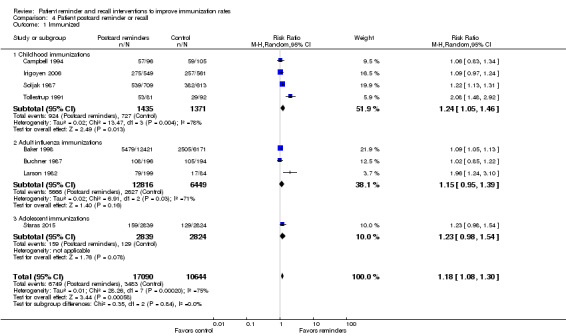
Comparison 4 Patient postcard reminder or recall, Outcome 1 Immunized.
Two studies that we excluded from meta‐analyses reported an increase in adult influenza immunization rates of 9.5 and 16.1 percentage points higher in the intervention groups compared with controls, respectively (Puech 1998; Spaulding 1991). Patient postcard reminder or recall interventions improve receipt of immunizations, with a high certainty of evidence (Table 1).
Patient text message reminder or recall interventions
Seven studies with text message interventions were included, and data from six contributed to the meta‐analysis (7772 participants) (Bangure 2015; Haji 2016; Moniz 2013; O'Leary 2015; Rand 2015; Rand 2017; Stockwell 2012a). Participants in the text message groups were more likely to receive immunizations than control group participants (RR 1.29, 95% CI 1.15 to 1.44) (Analysis 5.1).
5.1. Analysis.

Comparison 5 Patient text message reminder or recall, Outcome 1 Immunized.
Patient text message reminder or recall interventions improve receipt of immunizations based on high certainty evidence (Table 1) (Appendix 2).
Patient autodialer reminder or recall interventions
Seven studies evaluated the effectiveness of autodialer reminder or recall interventions on receipt of immunizations. Among the five studies included in meta‐analyses (11,947 participants), participants in the autodialer intervention groups were more likely to receive immunizations than control group participants (RR 1.17, 95% CI 1.03 to 1.32 (Analysis 6.1) (Lieu 1998; Linkins 1994; Rand 2017; Stehr‐Green 1993; Szilagyi 2006). All five studies reported positive findings. Two autodialer studies were not included in the meta‐analyses and are reported qualitatively because they allocated families or households (Dini 2000; Szilagyi 2013).
6.1. Analysis.

Comparison 6 Patient autodialer message reminder or recall, Outcome 1 Immunized.
One study assessed the effect of autodialer reminder and recall messages on immunization coverage during the first two years of life for children who had received the first dose of DTP or poliovirus vaccines (Dini 2000). One reminder message was sent before a scheduled immunization visit; a weekly recall message was sent after the scheduled date for up to four weeks. Immunization receipt, at 24 months of age, was 8.4 percentage points higher among the autodialer group compared with the no notification control group. A second study evaluated the effect of centralized autodialer reminder and recall interventions on immunization receipt among low‐income adolescents (Szilagyi 2013). Messages were sent at 10‐week intervals for Tdap vaccine, MCV4 and the first dose of human papillomavirus (HPV) vaccine, and at five‐week intervals for HPV‐2 and HPV‐3. Immunization receipt at the end of the study was 3 percentage points higher among autodialer participants compared with controls.
Patient autodialer message reminder or recall interventions improve receipt of immunizations based on high certainty evidence (Table 1) (Appendix 2).
Patient portal‐based reminder or recall interventions
No studies with immunization reminder or recall interventions within secure online patient portal systems met our inclusion criteria.
Combination patient mail and telephone reminder or recall interventions ('mail and phone')
Interventions that included a combination of postcards or letters and telephone or autodialer messages were evaluated in nine included studies. Of these studies, we included eight in meta‐analyses (6506 participants) (Alto 1994; Daley 2002; Daley 2004b; Kempe 2001; LeBaron 2004; Lieu 1998; Suh 2012; Vivier 2000). We excluded one study from analyses because it allocated children within a household (Dini 2000). Intervention participants that received this combination intervention were 1.28 times more likely to receive immunizations than control group participants (95% CI 1.14 to 1.45) (Analysis 7.1). The study not included in meta‐analyses evaluated the effect of autodialer messages, followed by letters, on receipt of all needed immunizations at 24 months of age (Dini 2000). Immunization receipt was 9.3 percentage points higher among intervention children compared with controls.
7.1. Analysis.

Comparison 7 Combination patient mail and telephone reminder or recall, Outcome 1 Immunized.
A combination of patient mail and telephone reminder or recall interventions probably improves receipt of immunizations with moderate certainty of the evidence (Table 1).
Combination patient reminder or recall with outreach interventions
Seven studies examined the effect of combined patient reminder and outreach interventions on immunization outcomes. Of these studies, we included three in meta‐analyses (2701 participants) (Hambidge 2009; LeBaron 2004; Wood 1998). We excluded two from analyses for allocating families or households (Rodewald 1999; Szilagyi 2011). We excluded two studies with controlled before and after study designs (LeBaron 1998; Lemstra 2011). Intervention participants for three studies included in the meta‐analysis were more likely to receive immunizations than control group participants (RR 1.22, 95% CI 1.10 to 1.35) (Analysis 8.1). Three of four studies not included in meta‐analysis reported pre‐intervention to post‐intervention increases in receipt of vaccinations that were 12.3 to 21.0 percentage points higher among intervention participants compared with control participants (LeBaron 1998; Rodewald 1999; Szilagyi 2011). The fourth study not included in analyses compared telephone reminders combined with an offer to have a public health nurse vaccinate the child during a home visit to a telephone reminder only control group (Lemstra 2011).
8.1. Analysis.

Comparison 8 Combination patient reminder or recall with outreach, Outcome 1 Immunized.
A combination of patient reminder or recall with outreach interventions improves receipt of immunizations based on high certainty evidence; however, the small number of studies in this subgroup is a potential concern (Table 1) (Appendix 2).
Combination patient reminder or recall and provider reminder interventions
Six studies assessed the effect of patient reminder or recall combined with provider reminder interventions on receipt of immunizations (Becker 1989; Buffington 1991; Humiston 2011; Margolis 1992; Ornstein 1991; Rodewald 1999). We included three comparisons from two of the six studies in the meta‐analyses (4120 participants) (Becker 1989; Humiston 2011). Intervention group participants were more likely to receive immunizations than control group participants (RR 2.91, 95% CI 2.67 to 3.19) (Analysis 9.1). We excluded four studies from analyses: three randomized trials because they randomized practices, providers, families, or households (Buffington 1991; Ornstein 1991; Rodewald 1999), and one controlled before and after study (Margolis 1992). The three randomized trials not included in the meta‐analyses reported increases in immunization receipt that were 13.4 to 21 percentage points higher among intervention groups compared with control groups. The controlled before and after study reported mixed results that varied by clinic, with the following pre‐intervention to post‐intervention changes in immunization outcomes: a 16 percentage point increase in one intervention clinic; a 5 percentage point decrease in a second intervention clinic; a 3 percentage point increase in one control clinic; and a 4 percentage point decrease in a second control clinic (Margolis 1992).
9.1. Analysis.
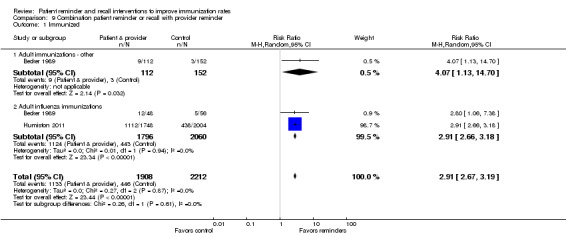
Comparison 9 Combination patient reminder or recall with provider reminder, Outcome 1 Immunized.
A combination of patient reminder or recall with provider reminder interventions probably improves receipt of immunizations based on moderate certainty evidence (Table 1) (Appendix 2).
Patient reminder or recall interventions in different immunization types and patient populations
Childhood immunizations
Childhood immunizations, excluding influenza vaccinations, were the focus of 29 included studies. In the 23 studies included in the meta‐analysis (31,099 participants), children in reminder or recall intervention groups were more likely to receive routine immunizations than children in control groups (RR 1.22, 95% CI 1.15 to 1.29) (Analysis 1.1).
We excluded four eligible randomized trials from the meta‐analyses because they allocated households, families, practices, or geographic areas (Brown 2016; Dini 2000; Haji 2016; Rodewald 1999). In one of these studies immunization receipt at 24 months of age was 7.3 to 9.3 percentage points higher in the intervention groups than in the control group (Dini 2000). In the second study, immunization receipt was 21 percentage points higher in the intervention groups compared with the control group (Rodewald 1999). Two controlled before‐after studies were not included in the meta‐analysis (LeBaron 1998; Lemstra 2011). One reported a 15 percentage point increase in immunization rates among intervention participants and no change in the control group (LeBaron 1998). The other controlled before and after study enrolled children who had not received two MMR vaccinations by two years of age; the pre‐intervention to post‐intervention increase in MMR vaccination receipt was 6.6 percentage points in the intervention group and 2.7 percentage points in the control group (Lemstra 2011).
Patient reminder or recall interventions improve receipt of childhood vaccinations based on high certainty evidence (Table 2) (Appendix 2).
Childhood influenza immunizations
Five included studies (9265 participants), focusing on childhood influenza vaccinations, reported an increase in immunizations (RR 1.51, 95% CI 1.14 to 1.99) (Analysis 1.1) (Daley 2004a; Dombkowski 2012; Kempe 2005; Kemper 1993; Szilagyi 1992). In three studies improvement in receipt of influenza immunization was 17 to 26 percentage points higher among intervention groups compared with controls (Daley 2004a; Kemper 1993; Szilagyi 1992). One study examined the effect of patient reminder and recall letters on receipt of influenza vaccination for healthy six‐ to 23‐month old children (Kempe 2005), in contrast to the previous studies, which targeted children with high‐risk conditions. This study reported the lowest RR (1.08, 95% CI 1.03 to 1.12) of this subgroup analysis and reported several limitations, including a vaccine shortage, a pandemic with extensive media coverage, and the use of a telephone survey prior to the intervention to assess attitudes and intentions regarding influenza vaccination (Kempe 2005). Another study tested the effect of letter reminders on increasing influenza vaccination rates among children, aged 24 to 60 months, with chronic conditions and served by local health departments (Dombkowski 2012). The post‐intervention immunization rates were higher among the intervention group compared with the control group (RR 1.26, 95% CI 1.10 to 1.46; risk difference of 6.5%).
Patient reminder or recall interventions probably improve receipt of childhood influenza vaccinations with moderate certainty of evidence (Table 2) (Appendix 2).
Adult immunizations – other than influenza or travel ('other adult')
Eight included randomized trials (8065 participants) examined the relationship between patient reminder or recall interventions and routine adult immunizations, including tetanus, pneumococcal, hepatitis B, DTP, Hib, MMR, and TOPV (Frame 1994; Hogg 1998; Ornstein 1991; Rosser 1991; Rosser 1992; Sansom 2003; Siebers 1985; Winston 2007). The RR for the four studies included in the meta‐analyses was 2.08 (95% CI 0.91 to 4.78) (Analysis 1.1) (Hogg 1998; Sansom 2003; Siebers 1985; Winston 2007).
We excluded four of the eight included randomized trials from meta‐analyses because they allocated families or providers (Frame 1994; Ornstein 1991; Rosser 1991; Rosser 1992). In three of these studies the tetanus or Td immunization rates among participants in the letter or telephone intervention groups were at least 20 percentage points higher than for controls (Frame 1994; Rosser 1991; Rosser 1992). The fourth study evaluated the effect of a computer‐generated letter, alone or combined with provider reminders, on rates of adult tetanus vaccination rates (Ornstein 1991). The post‐intervention vaccination rates were 3.6 percentage points higher in the letter only group compared with controls; this increased to 13.4 percentage points when the letter was combined with provider reminders (Ornstein 1991).
Patient reminder or recall interventions may improve receipt of adult vaccinations other than influenza and travel based on low certainty evidence (Table 2) (Appendix 2).
Adult influenza immunizations
Twenty‐four included studies examined the relationship between patient reminder or recall interventions and receipt of adult influenza immunizations. Of these, we included 15 studies in the meta‐analysis (59,328 participants) (Baker 1998; Brimberry 1988; Buchner 1987; Carter 1986; Hogg 1998; Hull 2002; Larson 1982; McCaul 2002; Moniz 2013; Moran 1992; Mullooly 1987; Nexoe 1997; Roca 2012; Satterthwaite 1997; Siebers 1985). We included two studies in the patient reminder or recall combined with provider reminders analysis (Becker 1989; Humiston 2011). We excluded six randomized trials from analyses because they randomized households, families, clinicians, or practices (Buffington 1991; Lukasik 1987; McDowell 1986; Puech 1998; Rosser 1991; Spaulding 1991), which could not be adjusted for in our analyses. We excluded one controlled before and after study from meta‐analysis. The pooled random‐effects RR for the 15 studies in this subgroup analysis was 1.29 (95% CI 1.17 to 1.43) (Analysis 1.1). Among the 15 analyzed studies, risk ratios ranged from 0.91 (95% CI 0.70 to 1.09) to 3.11 (95% CI 1.16 to 3.86). The median OR for the six studies that allocated households, families, clinicians, or practices was 3.08 (Buffington 1991; Lukasik 1987; McDowell 1986; Puech 1998; Rosser 1991; Spaulding 1991).
Patient reminder or recall interventions probably improve receipt of adult influenza vaccinations based on moderate certainty evidence (Table 2) (Appendix 2).
Adolescent immunizations
Twelve included studies evaluated the effect of patient reminder or recall interventions on receipt of immunizations among adolescents (Brigham 2012; Chao 2015; Marron 1998; O'Leary 2015; Rand 2015; Rand 2017; Staras 2015; Stockwell 2012a; Suh 2012; Szilagyi 2006; Szilagyi 2011; Szilagyi 2013). Of these, 10 (30,868 participants) are included in the patient reminder or recall subgroup meta‐analysis (RR 1.29, 95% CI 1.17 to 1.42) (Analysis 1.1) (Brigham 2012; Chao 2015; Marron 1998; O'Leary 2015; Rand 2015; Rand 2017; Staras 2015; Stockwell 2012a; Suh 2012; Szilagyi 2006). We excluded two studies from the subgroup analysis because they allocated households or families (Szilagyi 2011; Szilagyi 2013). All 12 studies of adolescents reported higher percentage point changes in receipt of immunizations among intervention groups compared with control groups; these differences ranged from 0.6 to 18 percentage points.
Patient reminder or recall interventions improve receipt of adolescent vaccinations based on high certainty evidence (Table 2).
Assessment of reporting biases
There is no evidence of reporting bias, as suggested in the funnel plot (Figure 3), based on the inclusion of approximately 95% of the studies within the 95% confidence region (Sterne 2004).
3.
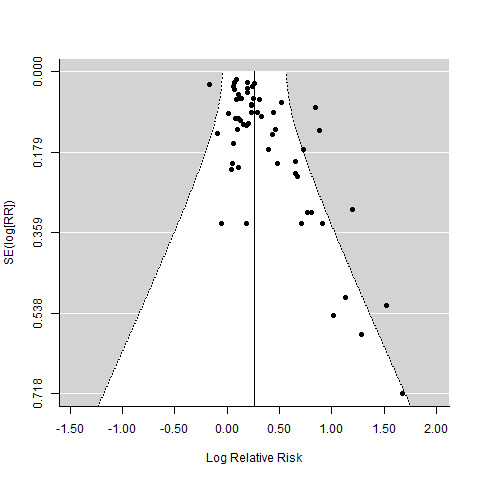
Funnel plot of comparison: Patient reminder or recall summary measure versus control
Sensitivity analysis
Both sensitivity analyses tend to support the robustness of our primary analyses. In our first sensitivity analysis, we examined the effect of excluding studies from our patient reminder recall summary measure analysis with a high risk of bias rating for random sequence generation, allocation concealment, and/or incomplete outcome data. We removed eight studies (Buchner 1987; Hogg 1998; Lieu 1998; Oeffinger 1992; Sansom 2003; Soljak 1987; Stockwell 2012a; Tollestrup 1991), recalculated the pooled random‐effects RRs, and compared these results with the RRs calculated prior to deleting the eight studies. The RRs were nearly identical for the overall summary measure, childhood, adult, adult influenza subgroup, and adolescent subgroups; and were identical for the childhood influenza subgroup (Table 3). The overall patient reminder recall RR was 1.28 (95% CI 1.23 to 1.3) when including all studies, versus 1.29 (95% CI 1.23 to 1.36) after excluding studies with a high risk of bias rating for random sequence generation, allocation concealment, and/or incomplete outcome data.
1. Sensitivity analyses ‐ omitted studies from patient reminder or recall summary measure.
| Group or subgroup | RR (CI) for full set of included studies | RR (CI) after deleting studies with 'high' risk of bias for random sequence generation, allocation concealment, and/or incomplete outcomes | RR (CI) after deleting studies with primary outcome of received all needed vaccinations |
| Summary measure | 1.28 (1.23 to 1.35) | 1.29 (1.23 to 1.36) | 1.32 (1.25 to 1.39) |
| Child | 1.22 (1.15 to 1.29) | 1.19 (1.12 to 1.27) | 1.24 (1.15 to 1.34) |
| Influenza – child | 1.51 (1.14 to 1.99) | 1.51 (1.14 to 1.99) | 1.37 (1.05 to 1.77) |
| Adult – other | 2.08 (0.91 to 4.78) | 2.35 (2.02 to 2.74) | 2.08 (0.91 to 4.78) |
| Influenza – adult | 1.29 (1.17 to 1.43) | 1.33 (1.20 to 1.48) | 1.29 (1.17 to 1.43) |
| Adolescent | 1.29 (1.17 to 1.42) | 1.26 (1.15 to 1.39) | 1.33 (1.20 to 1.48) |
CI: confidence interval RR: risk ratio
In our second sensitivity analysis, we examined the effect of our decision to define our primary outcome as receipt of needed immunizations, whether one or multiple. We computed RRs and CIs after removing nine studies from the patient reminder or recall summary measure that defined the primary outcome as 'up‐to‐date' with all needed immunizations (CDC 2012; Daley 2004b; Hambidge 2009; Irigoyen 2006; Kempe 2001; LeBaron 2004; Szilagyi 2006; Vivier 2000; Wood 1998). When comparing RRs for the full set of included studies ('before') with the subset after deleting nine studies from the meta‐analyses ('after'), the before and after RRs were very similar for the overall measure, and childhood immunizations and adolescent immunization subgroups. The other subgroups were unchanged. The overall patient reminder recall RR was 1.28 (95% CI 1.23 to 1.35) when including the full set of articles, versus 1.32 (95% CI 1.25 to 1.39) after excluding studies with primary outcomes measured as receiving all needed immunizations.
Discussion
Summary of main results
We found that reminder and recall systems were effective for children, adolescents, and adults, in all types of medical or health settings, including private practices, academic medical centers, and public health department clinics, and for universally recommended vaccinations such as routine childhood vaccinations, as well as targeted vaccinations, such as influenza vaccine. In addition, all types of patient reminder and recall were found to be effective, with increases in immunization rates tending to range from 5 to 20 percentage points higher in the intervention groups compared with controls. Telephone reminders were the most effective single intervention type, followed by letter reminders, which were somewhat more effective than text message, postcard, and autodialer interventions. In general, combinations of patient reminder or recall interventions, including patient reminder or recall combined with outreach or some type of mailing combined with telephone calls, were not observed to be as effective as the telephone or letter intervention studies included in the meta‐analyses. However, some single type reminder or recall interventions used repeated contacts, which may have provided them the same expected advantages as combination interventions. Patient reminder or recall combined with provider reminder systems were the most effective intervention category in this review; however, the number of studies was small.
Overall completeness and applicability of evidence
Our systematic review is comprehensive in terms of including all known types of patient reminder or recall interventions and all routine immunization types. We focused primarily on strategies to increase immunizations in non‐institutional settings because provider‐based interventions may be more applicable than patient reminder or recall interventions in hospitals and skilled nursing facilities.
This study has several potential limitations. First, the scope of the review was limited to studies published in English. The potential effect of limiting included studies to English language is mixed. At least one study has found that randomized trials published in English were more likely to have positive findings than studies published in German journals (Egger 1997). However, such language bias was not noted in another study (Heidenreich 1999). A study of meta‐analyses, which included five or more trials with binary outcomes and used comprehensive literature searches, found English‐language trials were more likely to have more study participants, be of higher quality methodologically, and be less likely to produce positive results (Juni 2002). The estimates of treatment effects were, on average, 16% more beneficial in non‐English language trials compared with English language trials (Juni 2002). A second systematic review, focusing on systematic reviews of conventional medical care, found that none of the studies showed major differences in reported treatment effects when comparing those that included versus excluded non‐English language studies (Morrison 2012).
Second, it is possible that the effect of some types of reminders might diminish in the current world in which phone calls, autodialer calls, and even email and text messages are widespread. Some of these interventions may be included as 'standard practice' in the control groups, leading to attenuated findings. Or, as use of technologies changes, it may alter the way in which people respond to different message delivery modes.
A third potential limitation is publication bias, because the majority of studies in this review were located from MEDLINE, EMBASE, Cochrane Library, CINAHL, other bibliographic databases, and references from other studies. Publication bias typically results in failure to publish studies with negative or null findings (Chalmers 1990; Dickerson 1992; Easterbrook 1991), therefore it is possible that our findings of positive outcomes in the majority of reviewed studies is partly affected by publication bias, and that the effect of reminder and recall is lower than noted in this review. We attempted to minimize publication bias by searching the files of the review authors and immunization experts, searching references of published reviews for abstracts, and reviewing abstracts or proceedings of major scientific meetings. In addition, funnel plot analyses did not detect publication bias, thereby increasing the plausibility of our positive findings. We conducted searches of grey literature and a clinical trials register to try to identify unpublished studies.
A fourth limitation resulted from omitting studies from the meta‐analyses that allocated families, households, clinicians, practices, or communities. Fifteen generally well‐designed studies, included in the initial review and meta‐analyses, were omitted from the current analyses because they randomized families, households, providers, practices, or communities and analyzed patient‐level data. While studies of health practice interventions, such as reminder or recall, can minimize contamination by randomizing at the practice level rather than the individual level, and many of these studies did that, reminder or recall of vaccines cannot avoid the effect on household members who may undergo vaccination as a result. That behavior may affect the measured outcomes of the study, but our meta‐analysis could not control or adjust for this effect on household members.
Most of the studies in this review were performed in health systems of developed countries in settings in which the potential recipients generally have primary care providers who they see on a regular or as‐needed basis and are followed over time. The providers could be public or private, physicians, nurse practitioners, or other health services experts, generalists, or more specialized providers, such as pediatricians in the US. The cornerstone is that there is a population of potential recipients who would need annual influenza vaccinations, or periodic vaccinations on some schedule, in the case of children. In many developing countries or regions, such a situation does not exist and although health services providers do serve patients, there is little ability to determine the population of eligible vaccine recipients. Thus reminder or recall interventions are found primarily in higher‐income countries (WHO Working Group 2014). However, a few studies have been done which, while not eligible for inclusion in our systematic review, show promising results in terms of acceptability, including Guatemala (Domek 2016), and Nigeria (Brown 2015). Furthermore, a few studies, while of low quality, have been conducted in low‐income countries and found an overall positive, albeit relatively low, effect of reminders or recalls on immunizations (Muehleisen 2007; Usman 2009; Usman 2011; WHO Working Group 2014). More recently, a randomized trial in Zimbabwe found positive effects of reminders or recalls on immunization (Bangure 2015). However, in virtually all settings in which patient reminder and recall interventions were rigorously evaluated, and these settings were generally those in which patients were connected with a health system, the reminder and recall systems were found to be effective in improving immunization rates.
Our review does not include cost data to address questions of cost‐effectiveness. The costs of patient reminder or recall interventions were reported in 16 studies, including eight pediatric studies (Campbell 1994; Lieu 1997; Lieu 1998; Linkins 1994; Rodewald 1999; Stehr‐Green 1993; Wood 1998; Young 1980), and six studies of adults (Baker 1998; Buchner 1987; Hull 2002; McDowell 1986; Nexoe 1997; Rosser 1992). Eight studies estimated the cost‐effectiveness of reminder and recall systems (LeBaron 2004; Lieu 1997; Lieu 1998; McDowell 1986; Rodewald 1999; Rosser 1992; Young 1980). Costs varied widely across studies, due to variability in methods of calculating costs and items included in analyses, such as existing staff or computer programming; different types of reminders used; different levels of intensity of interventions, from single postcard reminders to repeated reminders plus home visits; and different study time periods. As a result of the limited cost data reported and variations in the methods, the cost information is of limited use and is not reported. We did not track studies reporting cost data in the current review.
Finally, it is important to note that even relatively small effect sizes for interventions aimed at increasing immunizations are clinically meaningful because vaccinations are recommended for virtually every individual at some point. Therefore, even a small effect of a patient reminder or recall intervention, if scaled to a population level, might have a large beneficial effect on public health.
Certainty of the evidence
We assessed the certainty of the evidence in the estimate for each outcome and intervention type in our review using GRADE (Appendix 2). The GRADE assessment for our overall patient reminder recall summary measure was moderate (3; Appendix 2) rather than high because of some inconsistencies in the findings, with a few effect size outliers in each direction, and variation in the type of reminder or recall delivery mechanisms and messages, and because of some imprecision for several included study arms (Appendix 2). However, we consider the results to be of moderate certainty because of consistency of the estimates of effect for this outcome from our previous reviews, and the positive findings for all patient reminder or recall intervention types individually.
We rated the certainty of the evidence as high in four intervention subgroups (postcard; text message; autodialer; combination patient reminder or recall with outreach) and moderate for four subgroups (telephone; letter; combination of mail and phone; combination patient reminder or recall and provider reminder). We rated the certainty of the evidence as high in the childhood and adolescent vaccination subgroup analyses, moderate in the childhood and adult influenza vaccination sub‐analyses, and low in the other adult vaccination sub‐analysis. We downgraded the certainty of the evidence for other adult vaccinations because only four studies were included in this subgroup, risk ratios ranged from 1.08 to 3.61, and some imprecision was observed in two studies. In general, the risk of bias was not serious for the majority of our 75 included studies, with one of eight risk of bias criteria rated as high in 11 studies, two criteria rated as high in nine studies, and three criteria rated as high in three studies. Fifty‐two included studies had ratings of low or unclear risk of bias for all nine criteria.
Potential biases in the review process
Our review process has potential limitations with respect to our method of pooling data, particularly in light of heterogeneity of some of the data, which is often present in meta‐analyses (Gottlieb 1982; Thompson 1991). These reminder or recall studies were performed in a variety of populations, using different interventions, in multiple settings, targeting different types and numbers of immunizations, and across five decades; therefore it is not surprising that there is between‐study heterogeneity in the results. Indeed, we found heterogeneity in study components. Populations ranged from infants due for their well‐child visit vaccinations, to adolescents past due for the human papillomavirus vaccine, to older adults due for influenza or pneumococcal vaccines, and adults who had not received the influenza vaccination during the prior year. Some study populations represented the general public, while others targeted those at high risk for vaccine‐preventable diseases. Some populations represented practice panels, whereas others a specific geographical region. The interventions varied by mode, including telephone, letter, postcard, text message, and autodialer, and intensity, in terms of number as well as perhaps tone, and complexity, from single to step‐wise interventions. Text messages, as a medium, introduce another source for heterogeneity across studies ‐ that is, self‐selection ‐ because these studies required patients or their parents to provide their cell phone numbers and specifically approve text messaging for this intervention.
By necessity, our investigation could not separate high‐intensity interventions from low‐intensity interventions. Studies that employed more than one study arm, where one arm used a high‐intensity intervention and a second used a low‐intensity intervention, contributed to the meta‐analysis with the average of their effect. Similarly, the control groups differed somewhat in terms of the types of other practice, media, and community‐based interventions that may have influenced immunizations. In general, we excluded studies that implemented interventions in the control groups that were expected to have a substantial influence on immunization rates. However, we chose to include a few studies with lower‐intensity interventions in the control group if they were standard practice, thereby potentially diminishing the observed effect (Carter 1986; Ferson 1995; LeBaron 2004). Some concerns with control group exposure are not very amenable to change, such as external media campaigns, however, some of these factors may have exerted similar influences on intervention and control participants.
Our outcomes also varied in terms of the number of immunizations needed per participant and types of immunizations. We defined our primary outcome as receipt of any needed immunizations. In some studies, participants were targeted to receive only one immunization, such as one dose of the influenza vaccine. In some studies participants were targeted to receive a series of the same vaccine, such as human papillomavirus (HPV). In others, especially for children, participants were targeted to receive a series of immunizations. We addressed this, in part, by conducting sub‐analyses by participant and immunization type, such as adult influenza, child influenza, and other child vaccinations, which tended to group similar types of outcomes. In addition, we conducted sensitivity analysis to assess whether omitting studies that defined outcomes as up‐to‐date for immunizations changed our findings; however, our results were very similar after removing studies with outcomes defined as up‐to‐date.
Agreements and disagreements with other studies or reviews
The findings of our systematic review are similar to other published reviews of patient and parent‐focused interventions aimed at increasing receipt of immunizations (Groom 2015; Harvey 2015; Niccolai 2015; Odone 2015; Thomas 2014; Watterson 2015; Williams 2011). Groom 2015 examined the effectiveness of immunization information systems in supporting interventions aimed at increasing immunization rates. Of the 240 included studies, 30 focused on client reminder and recall systems. All but one of these were US studies. Thirteen studies measured the effect of intervention on immunization rates; the median absolute percentage point improvement in immunization among these studies was 6 percentage points. Harvey 2015 assessed the effect of parental reminder and recall and education interventions on early childhood immunizations. All intervention types were found to be effective, with mailed and telephone reminders being the most effective, with a risk difference of 0.11 (95% confidence interval 0.03 to 0.19). Niccolai 2015 specifically focused on HPV vaccination among adolescents. Of the 14 included studies, seven examined the effect of reminder and recall systems, four using randomized designs. Interventions included letters, telephone calls, text messages, and outreach visits. Each of the seven studies reported increases in at least one HPV vaccination outcome attributable to the intervention. Odone 2015 focused on the effect of 'new media' interventions, such as text messaging, smart‐phone applications, YouTube videos, Facebook, targeted websites and portals, software for health professionals, and emails, on vaccination coverage. Most of the 19 included studies were conducted in the US; both text messaging and patient‐held web‐based portals were found to be somewhat effective in increasing immunization rates. Oyo‐Ita 2016 examined the effect of several intervention types on improving immunization coverage among children in low‐ and middle‐income countries. Of the six included studies, one examined the effect of patient immunization cards on immunization rates. This intervention type is not considered to be patient reminder or recall in our review because of the passive nature of the card. Thomas 2014 assessed the effect of patient‐focused and other interventions on older adult influenza immunization rates. Of the 57 included randomized trials, four examined the effect of letters, postcards, or telephone calls in immunizations. Odds ratios for patient reminder or recall studies were positive; however, the comparison groups tended to include similar interventions. Last, Williams 2011 studied the effect of interventions aimed at improving immunizations among children in developed countries. Fourteen of 41 intervention arms among 22 studies of parental reminders and recalls showed positive outcomes. The overall median change in immunizations was 11 percentage points, with a range of –11 to 19 percentage points. Positive results were reported for telephone only and combined telephone and mailed interventions (Williams 2011).
These reviews are briefly outlined in Appendix 3. It is important to note that some of the systematic reviews had considerable overlap with our review in terms of included studies (Williams 2011). Some of these reviews focused on multiple interventions and did not exclude studies with interventions received by control group participants. Our systematic review was the most comprehensive of those examining patient reminder and recall interventions.
Authors' conclusions
Implications for practice.
The findings from this updated systematic review continue to show that implementing patient reminder and recall systems improve immunization coverage levels in primary care. Evidence from our review is supportive of recommendations from a number of bodies (AdHoc Working Group; Shefer 1999; Task Force 1999; Udovic 1998). In all settings that were evaluated, patient reminder and recall systems appear to be effective for improving immunization rates. As such, methods to incorporate reminder and recall systems into practices should have a positive effect on vaccine‐preventable diseases. Different types of reminder and recall systems can be tailored to suit specific provider or practice needs. While person‐to‐person telephone reminders are most effective, they may also be more costly than other methods, and have not been studied extensively in children, except for the use of autodialers, which were found to have smaller but positive effects. However, for this update we identified five new studies that assessed the effect of letter reminder or recall interventions on immunization rates, and one new study focused on childhood influenza vaccination. Practical issues relevant to choices of reminder and recall systems include: characteristics of current computer systems, staffing, perceived accuracy of patient telephone numbers or addresses, availability of computer programmers, and estimated patient responsiveness to different types of reminders. These factors vary widely across nations or geographic regions; therefore immunization leaders will want to interpret the findings in this review with respect to their own setting. For example, settings with widely used computerized immunization registries could adopt postcard reminders sent by the registries. Practitioners today can tailor their own billing systems to function as reminder and recall systems for simple procedures, such as selecting all patients over 65 years of age for reminders about influenza or pneumococcal vaccination. Many billing systems have recently incorporated separate modules that can track immunization status.
A critical issue involves the complexity of 'rules' required for a reminder or recall system. The simplest scenario involves older adults, because no special immunization algorithm is needed, and eligible patients can be selected by birth dates. A slightly more complex scenario involves 'flagging' adult patients with problems such as end‐stage renal disease, including those receiving hemodialysis, with HIV infection, or with chronic liver disease that may require hepatitis B vaccinations. More sophisticated algorithms are required to track prior immunization status, particularly for the complicated pediatric immunization schedule. A very promising approach involves vaccine providers recording the administered vaccines in computerized immunization registries shared across the region. These have been developed in many European countries (Johansen 2012), as well as Australia (Chin 2012), Canada (Canadian 1998), New Zealand (Wansbrough 2009), and the United States (CDC 1998c; NVAC 1999; USDHHS 2000), and are being developed in various forms in developing nations (Bosch‐Capblanch 2009). These registries already contain the necessary algorithms to assess the up‐to‐date status of children, and could be modified to deliver patient reminders. Finally, databases of managed care organizations and accountable care organizations can be modified to become reminder and recall systems. For practitioners, the usefulness of such databases depends on the proportion of a practice's patients covered by the managed care plan and the accuracy of the database information.
Overall, the technology exists, in the developed world, to incorporate patient reminder and recall into routine primary care practice. There are additional benefits to the patient and practice, beyond improving immunization rates. Studies have shown that patients behind with immunizations are also behind in other measures of preventive care (Fairbrother 1996; Rodewald 1995), and that reminder or recall systems targeting immunizations can also have "spillover effects" to improve other aspects of preventive care (Rodewald 1999), if they are used within primary care practices.
The use of patient reminder and recall systems provides the primary care practitioner with real‐life experience at practicing population‐based care, by improving the care for the entire population served by the practice (Halpern 2000). Although medicine is traditionally taught and practiced one patient at a time, and preventive services such as immunizations are delivered to individual patients, the measures of success, such as immunization rates, are population‐based. Such population‐based primary care, while not easy to do in a busy practice, has the potential to improve the quality of care and performance of primary care providers (Halpern 2000; OConnor 1998; Rivo 1998).
Implications for research.
This study also has implications for research. Again, this updated systematic review includes 28 new studies and addresses two new technologies not addressed previously. They include electronic simple‐message system text messages and electronic medical record messages in secured patient portals. As these technologies mature, researchers should consider how they can enhance reminder and recall interventions and what improvements in their effect can be achieved. We suspect that additional new technologies will also debut and researchers should test those platforms as well. Indeed, the Ericsson Mobility Report, published in 2015, reported 7.1 billion mobile phone subscriptions worldwide in 2014 (Ericsson 2015). That number included 2.6 billion smartphones, telephones with data plans that perform many of the functions of a computer, typically having Internet access and capable of running downloaded applications or apps. Ericsson predicts that in 2020 these numbers will increase to 9.2 and 7.7 billion respectively. That means that in 2020 Ericsson predicts that 70 per cent of the world's population will have a smartphone. Much of the growth will occur in the Middle East and Africa and parts of the Asia Pacific region. Thus the growth of smartphone availability, even in the next five years, promises new opportunities for reminder and recall innovation.
With the plethora of studies showing that patient reminder and recall systems improve immunization rates in all types of settings, future researchers should consider not simply repeating prior studies but rather building on them and addressing gaps. For example, only six included studies focused on text message interventions (Bangure 2015; Moniz 2013; O'Leary 2015; Rand 2015; Rand 2017; Stockwell 2012a). Four of these studies examined text message reminders and the effect on adolescent immunizations (O'Leary 2015; Rand 2015; Rand 2017; Stockwell 2012a), one focused on pregnant women and influenza vaccinations (Moniz 2013), and one focused on childhood immunizations (Bangure 2015). None of these included studies examined the effect of text messages on childhood influenza or other adult vaccinations. The effect sizes were generally positive, with only two demonstrating a relatively strong effect size (Rand 2017; Stockwell 2012a). There is a need to explore the characteristics and intensity of the interventions, target populations, and target immunizations to identify the most effective use of text message reminder and recall interventions. This need to learn more about characteristics of the most effective text message interventions was also a conclusion in a review of systematic reviews (Hall 2015), which found text messages to be generally effective in improving several types of health behaviors, such as diabetes, weight loss, physical activity, and smoking cessation.
Much of the focus, so far, with reminder and recall interventions is the evaluation of the effect on vaccines received. Reminders, rather than recalls, also have the theoretical ability to maintain a patient with on‐time vaccinations, i.e. receipt of vaccinations by the recommended age or time, as opposed to up‐to‐date, i.e. the number or proportion of the population who have received the vaccine at a certain point in time, whether or not they received the vaccine by the recommended age or time. Researchers should consider testing the effect of patient reminders on on‐time vaccination as a particular outcome.
Only five included studies examined the effect of reminder and recall interventions on childhood influenza vaccinations (Daley 2004a; Dombkowski 2012; Kempe 2005; Kemper 1993; Szilagyi 1992); four of five studies used letter reminders and one used a combination of letter and postcard (Daley 2004a). No included studies examined the use of telephone calls, autodialer, text messages, or other combination interventions on influenza vaccination among children. With approximately 40 percent of children, ages six months to 17 years, not having received the influenza vaccination during the 2014 to 2015 influenza season (CDC 2016b), it is important to better understand how to improve these rates.
Previously we had identified a single study that reviewed adolescent immunization delivery in an urban setting (Szilagyi 2006). This study did not demonstrate significant improvement with use of autodialer reminders. However, we have now identified 11 additional studies that examined the effect of reminder and recall interventions on immunization rates among adolescents. These studies examined the effect of letters (Chao 2015; Marron 1998; Szilagyi 2013), telephone (Brigham 2012), autodialer (Rand 2017; Szilagyi 2006; Szilagyi 2013), text messages (O'Leary 2015; Rand 2015; Stockwell 2012a); postcard (Staras 2015); combination of letter and autodialer (Suh 2012), and a tiered reminder or recall with outreach (Szilagyi 2011) on immunization outcomes. With the rising importance of adolescent immunizations and the multiple settings in which adolescents receive care, additional studies of adolescents would be useful for determining which strategies may be most effective.
The rapid implementation of computerized immunization registries presents opportunities for research in implementing, on a community‐wide basis, reminder and recall interventions that appear to be effective in single practice settings. In addition, managed care plans have databases that could be used as the backbone of reminder and recall interventions; studies incorporating such linkages would be helpful. The relatively recent implementation of patient portal systems and secure messaging with patients within these systems is another area to be further explored. None of the patient portal studies we reviewed met the inclusion criteria for this review. Patient portals linking the electronic health record systems, for example, could support reminders and recalls for additional vaccinations based on high‐risk indications. Studies about 'fine‐tuning' patient reminder and recall interventions would be helpful, such as investigations of the degree to which different combinations improve outcomes, or the degree to which combinations of patient reminder and recall and other types of interventions improve outcomes. Finally, because the majority of reviewed studies of patient reminder and recall interventions found positive effects, any studies that do not find improved immunization uptake should carefully investigate the reasons for lack of improvement. Such detailed investigations may uncover important barriers to care delivery that are likely to be useful in better understanding how to improve services for patients.
What's new
| Date | Event | Description |
|---|---|---|
| 31 January 2017 | New search has been performed | Updated searches conducted to 31 January 2017. |
| 31 January 2017 | New citation required but conclusions have not changed | Added text messages as a new reminder or recall intervention. Changed statistical method from odds ratio to risk ratio. Updated the review methods and reporting to align with current Cochrane and EPOC guidance. Added one additional author, a biostatistician. |
History
Protocol first published: Issue 4, 1997 Review first published: Issue 4, 2002
| Date | Event | Description |
|---|---|---|
| 30 June 2016 | New search has been performed | Updated searches conducted to 31 May 2013; 22 new studies identified. This review includes 69 studies. |
| 12 November 2008 | Amended | Minor changes. |
| 14 August 2008 | New citation required but conclusions have not changed | New search July 2007; four new studies. |
| 12 June 2008 | Amended | Converted to new review format. |
| 15 February 2008 | New search has been performed | New searches; no changes to findings. |
| 25 May 2005 | New citation required and conclusions have changed | Substantive amendment. |
Notes
Minor update November 2002: changed the titles on the graphs to reflect the interventions.
Acknowledgements
We wish to acknowledge:
Sharon Humiston for her help and wisdom;
Lisa Bero and Jeremy Grimshaw for editorial assistance and guidance with the review process;
Bridget Hochwalt for obtaining and formatting full references for excluded studies;
Sharlini Yogasingam for conducting literature searches, and creating and importing full references into RevMan;
Julia Worswick and Daniela Gonçalves Bradley for supporting the review update process, providing expertise, guidance and editorial assistance;
Elizabeth Moreton for editing the search process text;
Paul Miller for conducting updated searches and editing search‐related text;
Sasha Shepperd and Simon Lewin for reviewing drafts and providing methodological guidance and support;
Sofia Massa, Cillyen Nkengafac Motaze, Kumanan Wilson, and Nigel Crawford for reviewing and providing feedback on drafts of the review.
National Institute for Health Research, via Cochrane Infrastructure funding to the Effective Practice and Organisation of Care Group. The views and opinions expressed therein are those of the authors and do not necessarily reflect those of the Systematic Reviews Programme, NIHR, NHS or the Department of Health.
Appendices
Appendix 1. Search strategies
MEDLINE (OVID)
Ovid MEDLINE(R) Epub Ahead of Print, In‐Process & Other Non‐Indexed Citations, Ovid MEDLINE(R) Daily and Ovid MEDLINE(R), 1946 to Present
| No. | Search terms | Results |
| 1 | reminder systems/ | 2870 |
| 2 | preventive health services/ | 12000 |
| 3 | primary prevention/ | 16132 |
| 4 | immunization/ | 47274 |
| 5 | vaccination/ | 70736 |
| 6 | or/2‐5 | 141554 |
| 7 | 1 and 6 | 305 |
| 8 | (postcard? or post‐card? or mail* or text messag* or sms or short messag* service or letter? or brochur* or pamphlet?).ti,ab. | 126817 |
| 9 | (recall or remind*).ti,ab. | 58576 |
| 10 | 8 or 9 | 182258 |
| 11 | (vaccine? or vaccinat* or immunis* or immuniz* or flu).ti,ab. | 331177 |
| 12 | 10 and 11 | 3890 |
| 13 | ((vaccine? or vaccination? or immunization? or immunisation?) adj3 (registry or registries)).ti,ab. | 461 |
| 14 | or/7,12‐13 | 4431 |
| 15 | randomized controlled trial.pt. | 446587 |
| 16 | controlled clinical trial.pt. | 91788 |
| 17 | multicenter study.pt. | 217408 |
| 18 | pragmatic clinical trial.pt. | 521 |
| 19 | (randomis* or randomiz* or randomly).ti,ab. | 723931 |
| 20 | groups.ab. | 1670897 |
| 21 | (trial or multicenter or multi center or multicentre or multi centre).ti. | 205750 |
| 22 | (intervention? or effect? or impact? or controlled or control group? or (before adj5 after) or (pre adj5 post) or ((pretest or pre test) and (posttest or post test)) or quasiexperiment* or quasi experiment* or pseudo experiment* or pseudoexperiment* or evaluat* or time series or time point? or repeated measur*).ti,ab. | 7875589 |
| 23 | non‐randomized controlled trials as topic/ | 119 |
| 24 | interrupted time series analysis/ | 236 |
| 25 | controlled before‐after studies/ | 213 |
| 26 | or/15‐25 | 8803258 |
| 27 | exp animals/ | 20689610 |
| 28 | humans/ | 16378297 |
| 29 | 27 not (27 and 28) | 4311313 |
| 30 | review.pt. | 2218518 |
| 31 | meta analysis.pt. | 74177 |
| 32 | news.pt. | 180911 |
| 33 | comment.pt. | 677926 |
| 34 | editorial.pt. | 424399 |
| 35 | cochrane database of systematic reviews.jn. | 12903 |
| 36 | comment on.cm. | 677925 |
| 37 | (systematic review or literature review).ti. | 89860 |
| 38 | or/29‐37 | 7513987 |
| 39 | 26 not 38 | 6141300 |
| 40 | 14 and 39 | 1849 |
Embase (OVID)
1974 to 2017 January 30
| No. | Search terms | Results |
| 1 | reminder system/ | 2189 |
| 2 | preventive health service/ | 27782 |
| 3 | primary prevention/ | 37986 |
| 4 | immunization/ | 101462 |
| 5 | vaccination/ | 140849 |
| 6 | or/2‐5 | 278922 |
| 7 | 1 and 6 | 300 |
| 8 | (postcard? or post‐card? or mail* or text messag* or sms or short messag* service or letter? or brochur* or pamphlet?).ti,ab. | 206800 |
| 9 | (recall or remind*).ti,ab. | 76062 |
| 10 | 8 or 9 | 278359 |
| 11 | (vaccine? or vaccinat* or immunis* or immuniz* or flu).ti,ab. | 382994 |
| 12 | 10 and 11 | 5296 |
| 13 | ((vaccine? or vaccination? or immunization? or immunisation?) adj3 (registry or registries)).ti,ab. | 554 |
| 14 | or/7,12‐13 | 5896 |
| 15 | randomized controlled trial/ | 476973 |
| 16 | controlled clinical trial/ | 470972 |
| 17 | quasi experimental study/ | 4383 |
| 18 | pretest posttest control group design/ | 352 |
| 19 | time series analysis/ | 24245 |
| 20 | experimental design/ | 25398 |
| 21 | multicenter study/ | 163492 |
| 22 | (randomis* or randomiz* or randomly).ti,ab. | 960724 |
| 23 | groups.ab. | 2220371 |
| 24 | (trial or multicentre or multicenter or multi centre or multi center).ti. | 266746 |
| 25 | (intervention? or effect? or impact? or controlled or control group? or (before adj5 after) or (pre adj5 post) or ((pretest or pre test) and (posttest or post test)) or quasiexperiment* or quasi experiment* or pseudo experiment* or pseudoexperiment* or evaluat* or time series or time point? or repeated measur*).ti,ab. | 9891492 |
| 26 | or/15‐25 | 11047488 |
| 27 | (systematic review or literature review).ti. | 107227 |
| 28 | "cochrane database of systematic reviews".jn. | 5410 |
| 29 | exp animals/ or exp invertebrate/ or animal experiment/ or animal model/ or animal tissue/ or animal cell/ or nonhuman/ | 24416220 |
| 30 | human/ or normal human/ or human cell/ | 18532434 |
| 31 | 29 not (29 and 30) | 5930624 |
| 32 | 27 or 28 or 31 | 6042488 |
| 33 | 26 not 32 | 8472209 |
| 34 | 14 and 33 | 2588 |
Cochrane Library
| No. | Search terms | Results |
| #1 | [mh "reminder system"] | 765 |
| #2 | [mh "preventive health service"] | 28875 |
| #3 | [mh "primary prevention"] | 4122 |
| #4 | [mh immunization] | 4715 |
| #5 | [mh vaccination] | 2485 |
| #6 | {or #2‐#5} | 30429 |
| #7 | #1 and #6 | 328 |
| #8 | (postcard? or post‐card? or mail* or text messag* or sms or short messag* service or letter? or brochur* or pamphlet?):ti,ab | 7408 |
| #9 | (recall or remind*):ti,ab | 6902 |
| #10 | #8 or #9 | 13394 |
| #11 | (vaccine? or vaccinat* or immunis* or immuniz* or flu):ti,ab | 12154 |
| #12 | #10 and #11 | 384 |
| #13 | ((vaccine? or vaccination? or immunization? or immunisation?) near/3 (registry or registries)):ti,ab | 2 |
| #14 | {or #7, #12‐#13} | 621 |
CINAHL (EBSCO)
| No. | Search terms | Results | |
| S1 | MH Reminder Systems | 1,517 | |
| S2 | (MH "Preventive Health Care") | 10,568 | |
| S3 | (MH "Immunization+") | 14,501 | |
| S4 | S2 OR S3 | 24,671 | |
| S5 | S1 AND S4 | 170 | |
| S6 | postcard? or post‐card? or mail* or text messag* or sms or short messag* service or letter? or brochur* or pamphlet? | 31,509 | |
| S7 | recall or remind* | 13,658 | |
| S8 | S6 OR S7 | 44,296 | |
| S9 | vaccine? or vaccinat* or immunis* or immuniz* or flu | 35,591 | |
| S10 | S8 AND S9 | 804 | |
| S11 | ((vaccine? or vaccination? or immunization? or immunisation?) N3 (registry or registries)) | 10 | |
| S12 | S5 OR S10 OR S11 | 855 | |
| S13 | PT randomized controlled trial | 30,865 | |
| S14 | PT clinical trial | 52,906 | |
| S15 | PT research | 996,158 | |
| S16 | (MH "Randomized Controlled Trials") | 30,097 | |
| S17 | (MH "Clinical Trials") | 87,564 | |
| S18 | (MH "Intervention Trials") | 6,156 | |
| S19 | (MH "Nonrandomized Trials") | 182 | |
| S20 | (MH "Experimental Studies") | 15,224 | |
| S21 | (MH "Pretest‐Posttest Design+") | 27,974 | |
| S22 | (MH "Quasi‐Experimental Studies+") | 8,859 | |
| S23 | (MH "Multicenter Studies") | 21,526 | |
| S24 | (MH "Health Services Research") | 7,563 | |
| S25 | TI (randomis* or randomiz* or randomly) OR AB (randomis* or randomiz* or randomly) | 119,848 | |
| S26 | TI (trial or effect* or impact* or intervention* or before N5 after or pre N5 post or ((pretest or "pre test") and (posttest or "post test")) or quasiexperiment* or quasi W0 experiment* or pseudo experiment* or pseudoexperiment* or evaluat* or "time series" or time W0 point* or repeated W0 measur*) OR AB (trial or effect* or impact* or intervention* or before N5 after or pre N5 post or ((pretest or "pre test") and (posttest or "post test")) or quasiexperiment* or quasi W0 experiment* or pseudo experiment* or pseudoexperiment* or evaluat* or "time series" or time W0 point* or repeated W0 measur*) | 809,802 | |
| S27 | S13 OR S14 OR S15 OR S16 OR S17 OR S18 OR S19 OR S20 OR S21 OR S22 OR S23 OR S24 OR S25 OR S26 | 1,347,398 | |
| S28 | S12 AND S27 | 650 | |
WHO International Clinical Trials Registry Platform (ICTRP)
vaccination AND reminder vaccination AND recall immunisation AND reminder immunisation AND recall immunization AND reminder immunization AND recall
Appendix 2. GRADE evidence profiles
1. Certainty assessment of evidencea for each outcome ‐ Patient reminder or recall summary measure
| No of studies | Design | Risk of bias | Inconsistency | Indirectnessb | Imprecision | Otherc |
Certainty (overall score)d |
| Outcome: Receipt of immunizations ‐ for summary measure | |||||||
| 55 | Randomized trials | No serious risk of bias | Some inconsistency exists (‐0.5) | No serious indirectness |
Some imprecision exists (‐0.5) | None | Moderate (3) |
Footnotes
aThis can also be referred to as 'quality of the evidence' or 'confidence in the estimate.' The 'certainty of the evidence' is an assessment of how good an indication the research provides of the likely effect; i.e. the likelihood that the effect will be substantially different from what the research found. By 'substantially different' we mean a large enough difference that it might affect a decision.
bIndirectness includes consideration of:
indirect or between‐study comparisons;
indirect or surrogate outcomes;
applicability: study populations, interventions, or comparisons that are different than those of interest.
cOther considerations for downgrading include publication bias. Other considerations for upgrading include a strong association with no plausible confounders, a dose response relationship, and if all plausible confounders or biases would decrease the size of the effect, if there is evidence of an effect, or increase it if there is evidence of no harmful effect (safety).
dOverall score:
4 (high): This research provides a very good indication of the likely effect. The likelihood that the effect will be substantially different** is low. 3 (moderate): This research provides a good indication of the likely effect. The likelihood that the effect will be substantially different** is low to moderate. 2 (low): This research provides some indication of the likely effect. However, the likelihood that it will be substantially different** is high. 1 (very low): This research does not provide a reliable indication of the likely effect. The likelihood that the effect will be substantially different** is very high.
** Substantially different = a large enough difference that it might affect a decision.
EPOC resources for authors ‐ Worksheets for preparing Summary of Findings tables using GRADE
2. Certainty assessment of evidencea for each outcome ‐ patient telephone reminder or recall
| No of studies | Design | Risk of bias | Inconsistency | Indirectnessb | Imprecision | Otherc |
Certainty (overall score)d |
| 7 | Randomized trials (4) |
No serious risk of bias | Some inconsistency exists (‐0.5) |
No serious indirectness | Some imprecision exists (‐0.5) |
None | Moderate (3) |
a‐dSee Table 1 above.
3. Certainty assessment of evidencea for each outcome ‐ patient letter reminder or recall
| No of studies | Design | Risk of bias | Inconsistency | Indirectnessb | Imprecision | Otherc | Certainty (overall score)d |
| 27 | Randomized trials (4) |
No serious risk of bias | Some inconsistency exists (‐0.5) | No serious indirectness | Some imprecision exists (‐0.5) | None | Moderate (3) |
a‐dSee Table 1 above.
4. Certainty assessment of evidencea for each outcome ‐ patient postcard reminder or recall
| No of studies | Design | Risk of bias | Inconsistency | Indirectnessb | Imprecision | Otherc | Certainty (overall score)d |
| 8 | Randomized trials (4) |
No serious risk of bias (‐ 0.5) | No serious inconsistency | No serious indirectness | No serious imprecision | None | High (3.5) |
a‐dSee Table 1 above.
5. Certainty assessment of evidencea for each outcome ‐ Patient text message reminder or recall
| No of studies | Design | Risk of bias | Inconsistency | Indirectnessb | Imprecision | Otherc | Certainty (overall score)d |
| 6 | Randomized trials (4) |
No serious risk of bias | No serious inconsistency | No serious indirectness | No serious imprecision | None | High (4) |
a‐dSee Table 1 above.
6. Certainty assessment of evidencea for each outcome ‐ patient autodialer reminder or recall
| No of studies | Design | Risk of bias | Inconsistency | Indirectnessb | Imprecision | Otherc | Certainty (overall score)d |
| 5 | Randomized trials (4) |
No serious risk of bias | No serious inconsistency | No serious indirectness | No serious imprecision | None | High (4) |
a‐dSee Table 1 above.
7. Certainty assessment of evidencea for each outcome ‐ combination patient mail and phone reminder and recall
| No of studies | Design | Risk of bias | Inconsistency | Indirectnessb | Imprecision | Otherc | Certainty (overall score)d |
| 8 | Randomized trials (4) |
No serious risk of bias | Some inconsistency exists (‐0.5) |
No serious indirectness | Some imprecision exists (‐0.5) |
None | Moderate (3) |
a‐dSee Table 1 above.
8. Certainty assessment of evidencea for each outcome ‐ combination patient reminder or recall and outreach
| No of studies | Design | Risk of bias | Inconsistency | Indirectnessb | Imprecision | Otherc | Certainty (overall score)d |
| 3 | Randomized trials (4) |
No serious risk of bias | No serious inconsistencies | No serious indirectness | No serious imprecision | None | High (4) |
a‐dSee Table 1 above.
9. Certainty assessment of evidencea for each outcome ‐ combination patient reminder or recall and provider reminder
| No of studies | Design | Risk of bias | Inconsistency | Indirectnessb | Imprecision | Otherc | Certainty (overall score)d |
| 2 | Randomized trials (4) |
Moderate risk of bias (‐0.5*) | No serious inconsistency | No serious indirectness | Some imprecision exists (‐1) | None | Moderate (2.5) |
a‐dSee Table 1 above.
* 0.5 = Midpoint
10. Certainty assessment of evidencea for each outcome ‐ childhood vaccinations
| No of studies | Design | Risk of bias | Inconsistency | Indirectnessb | Imprecision | Otherc | Certainty (overall score)d |
| 23 | Randomized trials (4) |
No serious risk of bias |
No serious inconsistency |
No serious indirectness |
No serious imprecision |
None | High (4) |
a‐dSee Table 1 above.
11. Certainty assessment of evidencea for each outcome ‐ childhood influenza vaccinations
| No of studies | Design | Risk of bias | Inconsistency | Indirectnessb | Imprecision | Otherc | Certainty (overall score)d |
| 5 | Randomized trials (4) |
No serious risk of bias |
Some inconsistency exists (‐0.5*) |
No serious indirectness |
Some imprecision (‐1) |
None | Moderate (2.5) |
a‐dSee Table 1 above.
* 0.5 = Midpoint
12. Certainty assessment of evidencea for each outcome ‐ adult pneumococcal, tetanus, hepatitis B, and other non‐influenza vaccinations
| No of studies | Design | Risk of bias | Inconsistency | Indirectnessb | Imprecision | Otherc | Certainty (overall score)d |
| 4 | Randomized trials (4) |
No serious risk of bias |
Lack of agreement between studies (‐1) |
No serious indirectness |
Some imprecision (‐1) |
None | Low (2) |
a‐dSee Table 1 above.
13. Certainty assessment of evidencea for each outcome ‐ adult influenza vaccinations
| No of studies | Design | Risk of bias | Inconsistency | Indirectnessb | Imprecision | Otherc | Certainty (overall score)d |
| 15 | Randomized trials (4) |
No serious risk of bias |
Some inconsistency exists (‐0.5*) |
No serious indirectness |
Some imprecision (‐1) |
None | Moderate (2.5) |
a‐dSee Table 1 above.
* 0.5 = Midpoint
14. Certainty assessment of evidencea for each outcome ‐ adolescent immunizations
| No of studies | Design | Risk of bias | Inconsistency | Indirectnessb | Imprecision | Otherc | Certainty (overall score)d |
| 10 | Randomized trials (4) |
No serious risk of bias |
No serious inconsistency |
No serious indirectness |
No serious imprecision |
None | High (4) |
a‐dSee Table 1 above.
Appendix 3. Examples of systematic reviews
| First author last name | Year of publication | Study designs (# of patient reminder‐recall studies) | Participants | Types of immunizations | Results |
| Groom | 2015 | Not clear (30) | Persons in high‐income countries | Vaccination rates | Median percentage point improvement: 6 |
| Harvey | 2015 | Controlled studies (28 overall) | Children | Childhood | Risk difference (RD)2: Postal: RD 0.11 (95% Confidence Interval (CI) 0.08 to 0.13) Telephone: RD 0.04 (95% CI 0.01 to 0.07) |
| Niccolai | 2015 | Randomized (4 patient reminder recall (PRR)) and non‐randomized (3 PRR) | Adolescents | HPV | All 7 studies reported increases in at least 1 HPV vaccination outcome |
| Odone | 2015 | Observational or experimental (7 text messages; 1 smartphone application) | Parents of children and adolescents, pregnant women, providers | Variety of vaccination outcomes | Some evidence that text messaging, patient‐held web‐based portals and computerized reminders were effective |
| Oyo‐Ita | 2011 | Randomized trials, non‐randomized trials, interrupted time series (1) | Children in low‐ and middle‐income countries | Childhood | Not clear; study was patient card, not matching our eligibility criteria |
| Thomas | 2014 | Randomized trials (4) | 60 years and older | Influenza | Pooled odds ratio 1.11 (95% CI 1.07 to 1.15) and 3.33 (95% CI 1.79 to 6.22) |
| Watterson | 2015 | Randomized trials and observational studies (3 vaccine) | Children in low‐ or middle‐income country | Childhood | 9.7 percentage point increase in one study; positive qualitative findings in other studies |
| Williams | 2011 | Randomized trials (26), before and after studies (11), controlled intervention (9) (22 PRR) | Children in developed countries | Childhood | Median percentage point change of 11%; range of ‐11 to 24 percentage points |
Data and analyses
Comparison 1. Patient reminders (summary).
| Outcome or subgroup title | No. of studies | No. of participants | Statistical method | Effect size |
|---|---|---|---|---|
| 1 Immunized | 55 | 138625 | Risk Ratio (M‐H, Random, 95% CI) | 1.28 [1.23, 1.35] |
| 1.1 Childhood immunizations | 23 | 31099 | Risk Ratio (M‐H, Random, 95% CI) | 1.22 [1.15, 1.29] |
| 1.2 Childhood influenza immunizations | 5 | 9265 | Risk Ratio (M‐H, Random, 95% CI) | 1.51 [1.14, 1.99] |
| 1.3 Adult immunizations ‐ other | 4 | 8065 | Risk Ratio (M‐H, Random, 95% CI) | 2.08 [0.91, 4.78] |
| 1.4 Adult influenza immunizations | 15 | 59328 | Risk Ratio (M‐H, Random, 95% CI) | 1.29 [1.17, 1.43] |
| 1.5 Adolescent immunizations | 10 | 30868 | Risk Ratio (M‐H, Random, 95% CI) | 1.29 [1.17, 1.42] |
Comparison 2. Patient telephone reminder or recall.
| Outcome or subgroup title | No. of studies | No. of participants | Statistical method | Effect size |
|---|---|---|---|---|
| 1 Immunized | 7 | 9120 | Risk Ratio (M‐H, Random, 95% CI) | 1.75 [1.20, 2.54] |
| 1.1 Childhood immunizations | 2 | 234 | Risk Ratio (M‐H, Random, 95% CI) | 2.27 [1.12, 4.63] |
| 1.2 Adult immunizations ‐ other | 2 | 6630 | Risk Ratio (M‐H, Random, 95% CI) | 1.58 [0.55, 4.57] |
| 1.3 Adult influenza immunizations | 2 | 1838 | Risk Ratio (M‐H, Random, 95% CI) | 1.53 [0.73, 3.20] |
| 1.4 Adolescent immunizations | 1 | 418 | Risk Ratio (M‐H, Random, 95% CI) | 2.04 [1.05, 3.95] |
Comparison 3. Patient letter reminder or recall.
| Outcome or subgroup title | No. of studies | No. of participants | Statistical method | Effect size |
|---|---|---|---|---|
| 1 Immunized | 27 | 81100 | Risk Ratio (M‐H, Random, 95% CI) | 1.29 [1.21, 1.38] |
| 1.1 Childhood immunizations | 9 | 13009 | Risk Ratio (M‐H, Random, 95% CI) | 1.16 [1.06, 1.27] |
| 1.2 Childhood influenza immunizations | 5 | 9265 | Risk Ratio (M‐H, Random, 95% CI) | 1.51 [1.14, 1.99] |
| 1.3 Adult immunizations ‐ other | 2 | 1435 | Risk Ratio (M‐H, Random, 95% CI) | 3.13 [1.44, 6.84] |
| 1.4 Adult influenza immunizations | 11 | 44454 | Risk Ratio (M‐H, Random, 95% CI) | 1.35 [1.19, 1.52] |
| 1.5 Adolescent immunizations | 2 | 12937 | Risk Ratio (M‐H, Random, 95% CI) | 1.91 [0.71, 5.11] |
Comparison 4. Patient postcard reminder or recall.
| Outcome or subgroup title | No. of studies | No. of participants | Statistical method | Effect size |
|---|---|---|---|---|
| 1 Immunized | 8 | 27734 | Risk Ratio (M‐H, Random, 95% CI) | 1.18 [1.08, 1.30] |
| 1.1 Childhood immunizations | 4 | 2806 | Risk Ratio (M‐H, Random, 95% CI) | 1.24 [1.05, 1.46] |
| 1.2 Adult influenza immunizations | 3 | 19265 | Risk Ratio (M‐H, Random, 95% CI) | 1.15 [0.95, 1.39] |
| 1.3 Adolescent immunizations | 1 | 5663 | Risk Ratio (M‐H, Random, 95% CI) | 1.23 [0.98, 1.54] |
Comparison 5. Patient text message reminder or recall.
| Outcome or subgroup title | No. of studies | No. of participants | Statistical method | Effect size |
|---|---|---|---|---|
| 1 Immunized | 6 | 7772 | Risk Ratio (M‐H, Random, 95% CI) | 1.29 [1.15, 1.44] |
| 1.1 Childhood immunizations | 1 | 304 | Risk Ratio (M‐H, Random, 95% CI) | 1.22 [1.11, 1.33] |
| 1.2 Adult influenza immunizations | 1 | 204 | Risk Ratio (M‐H, Random, 95% CI) | 1.05 [0.71, 1.58] |
| 1.3 Adolescent immunizations | 4 | 7264 | Risk Ratio (M‐H, Random, 95% CI) | 1.38 [1.16, 1.64] |
Comparison 6. Patient autodialer message reminder or recall.
| Outcome or subgroup title | No. of studies | No. of participants | Statistical method | Effect size |
|---|---|---|---|---|
| 1 Immunized | 5 | 11947 | Risk Ratio (M‐H, Random, 95% CI) | 1.17 [1.03, 1.32] |
| 1.1 Childhood immunizations | 3 | 8583 | Risk Ratio (M‐H, Random, 95% CI) | 1.27 [1.19, 1.35] |
| 1.2 Adolescent immunizations | 2 | 3364 | Risk Ratio (M‐H, Random, 95% CI) | 1.08 [0.99, 1.17] |
Comparison 7. Combination patient mail and telephone reminder or recall.
| Outcome or subgroup title | No. of studies | No. of participants | Statistical method | Effect size |
|---|---|---|---|---|
| 1 Immunized | 8 | 6506 | Risk Ratio (M‐H, Random, 95% CI) | 1.28 [1.14, 1.45] |
| 1.1 Childhood immunizations | 7 | 4910 | Risk Ratio (M‐H, Random, 95% CI) | 1.27 [1.09, 1.48] |
| 1.2 Adolescent immunizations | 1 | 1596 | Risk Ratio (M‐H, Random, 95% CI) | 1.36 [1.20, 1.53] |
Comparison 8. Combination patient reminder or recall with outreach.
| Outcome or subgroup title | No. of studies | No. of participants | Statistical method | Effect size |
|---|---|---|---|---|
| 1 Immunized | 3 | 2701 | Risk Ratio (M‐H, Random, 95% CI) | 1.22 [1.10, 1.35] |
| 1.1 Childhood immunizations | 3 | 2701 | Risk Ratio (M‐H, Random, 95% CI) | 1.22 [1.10, 1.35] |
Comparison 9. Combination patient reminder or recall with provider reminder.
| Outcome or subgroup title | No. of studies | No. of participants | Statistical method | Effect size |
|---|---|---|---|---|
| 1 Immunized | 2 | 4120 | Risk Ratio (M‐H, Random, 95% CI) | 2.91 [2.67, 3.19] |
| 1.1 Adult immunizations ‐ other | 1 | 264 | Risk Ratio (M‐H, Random, 95% CI) | 4.07 [1.13, 14.70] |
| 1.2 Adult influenza immunizations | 2 | 3856 | Risk Ratio (M‐H, Random, 95% CI) | 2.91 [2.66, 3.18] |
Characteristics of studies
Characteristics of included studies [ordered by study ID]
Alto 1994.
| Methods | Study design: randomized trial; allocated children without grouping children in same family
Study duration: 6 months; 1 January 1991 to 30 June 1991 Study aim: evaluate effectiveness of mail and telephone interventions in increasing immunization rates among children less than 7 years of age in family practice residency clinic |
|
| Participants | Inclusion: children actively enrolled in family practice residency clinic; not up‐to‐date with immunizations Age: older than 2 months of age as of 1 January 1991 and less than 7 years as of 30 June 1991 Setting: family practice residency clinic (USA) n = 464 randomized, 446 analyzed | |
| Interventions | Intervention: sent postcard reminder to parents, indicating types of immunizations needed by child, and urging parents to make appointment; made telephone calls to parents of unimmunized children, 6 weeks after postcard intervention; written in English; n = 213 Control: no intervention; no special contact; n = 233 | |
| Outcomes | Number and percent of children immunized: intervention 8.8 percentage point increase over controls Number and percent of children receiving all needed immunizations: intervention 8.7 percentage point increase over controls | |
| Notes | 13% of postcards sent were returned as undeliverable Approximately 1% of families in practice Spanish‐speaking; postcards may not have been understood; 17.8% of telephones were disconnected 41 of 177 intervention families not reached by telephone Results seem to be inconsistently reported for children brought up‐to‐date with immunizations; reversed in study abstract compared with results in Table 3 |
|
| Risk of bias | ||
| Bias | Authors' judgement | Support for judgement |
| Random sequence generation (selection bias) | Low risk | "immunization records of the 519 children were entered into a minicomputer” Probably randomized within computer even though method not explicitly specified |
| Allocation concealment (selection bias) | Unclear risk | Charts of infants were reviewed for immunizations received; supplemented these data with immunizations recorded in health department registry; entered immunization records into minicomputer prior to randomizing children; procedures not explicitly described |
| Blinding of participants and personnel (performance bias) All outcomes | Unclear risk | No information provided |
| Blinding of outcome assessment (detection bias) All outcomes | Unclear risk | Blinding not specified for review of practice billing codes and charts |
| Incomplete outcome data (attrition bias) All outcomes | Unclear risk | Number of reviewed records not specified; asked parents by telephone about immunizations received Immunization status confirmed by reviewing practice billing codes and charts and county health department's records Did not confirm or record immunizations received at other sites |
| Selective reporting (reporting bias) | Low risk | Study purpose and methods are described; published data included all expected outcomes |
| Other bias | Low risk | Randomized patients within residency clinic; authors noted there may have been some contamination of control group because children with different surnames living in same household could have been assigned to different study groups |
| Baseline measurement | Low risk | "Immunization records of the county health department were reviewed." At baseline, reviewed charts of all infants actively enrolled in practice and older than 2 months and less than 7 years of age; supplemented information from health department immunization registry; selected participants behind on immunizations |
Baker 1998.
| Methods | Study design: randomized trial
Study duration: perhaps 1 influenza season; mailed reminders during third week of September 1995 Study aim: evaluate effect of 3 types of computer‐generated mailed reminders on influenza immunization rates |
|
| Participants | Inclusion: adult patients aligned with primary care physician within health system and at high risk for influenza complications based on age 65 years or older, or diagnosis of asthma, diabetes, end stage renal disease, sickle cell disease, ischemic cardiomyopathy, or nephrotic syndrome Age: adults; mean age = 67.2 years Setting: multispecialty group practice that serves patients in health system's affiliated nonprofit, mixed‐model health maintenance organization and patients in other fee‐for‐service health financing programs; southeastern Michigan (USA) n = 24,743 randomized | |
| Interventions | Intervention group 1: generic postcard to patient, standard message; n = 6169 Intervention group 2: personalized postcard from patient's primary care physician; n = 6252 Intervention group 3: personalized letter from the patient's primary care physician, addressed to specific patient; message tailored to specific health risk of patient; n = 6151 Control: no reminder, but comprehensive immunization program for all 4 groups; n = 6171 Comprehensive program included: walk‐in influenza vaccination clinics during October at all health system outpatient clinic locations, display of posters and take‐home postcards in clinic entrances and waiting areas, toll‐free information telephone line, developed program logo and theme used in all print media, and standard message in printed materials was based on Health Belief Model |
|
| Outcomes | Number and percent receiving influenza vaccination Group 1: 2.9 percentage point increase over control group Group 2: 4.1 percentage point increase over control group Group 3: 4.6 percentage point increase over control group | |
| Notes | Patient reminders were one component of comprehensive influenza immunization program. Used billing data to calculate rate of immunizations in study groups; some vaccinations may have been received at unaffiliated clinics, some of which provided vaccinations free of charge Authors identified possible threshold effect |
|
| Risk of bias | ||
| Bias | Authors' judgement | Support for judgement |
| Random sequence generation (selection bias) | Unclear risk | Patients were identified as being eligible for study using computerized appointment scheduling system and demographic data and computerized billing data; patients were randomized to 4 groups; method is not described |
| Allocation concealment (selection bias) | Unclear risk | Randomized patients into one of 4 groups; method not described |
| Blinding of participants and personnel (performance bias) All outcomes | Unclear risk | No information provided |
| Blinding of outcome assessment (detection bias) All outcomes | Low risk | Measured outcomes using billing data; blinding not specified |
| Incomplete outcome data (attrition bias) All outcomes | Unclear risk | Used billing data to obtain immunization rates Authors note possibility that some participants may have received immunizations at non‐study clinics, some of which offered free vaccinations |
| Selective reporting (reporting bias) | Low risk | Study purpose and methods are described; published data included all expected outcomes to answer study questions |
| Other bias | Low risk | Study seems to be free of other sources of bias |
| Baseline measurement | Low risk | Identified eligible patients using computerized billing data Obtained data on date of birth, sex, race, and marital status Demographic characteristics similar between study groups |
Bangure 2015.
| Methods | Study design: randomized trial Study duration: participants followed for 14 weeks; recruitment began 1 January 2013; study follow‐up ended 31 August 2013 Study aim: determine effectiveness of short message service reminders on immunization receipt |
|
| Participants | Inclusion: women or caregivers were recruited into study soon after delivery or during third and seventh day visits after delivery of baby; must have cell phone and resident of Kadoma city
Age: mothers of infants Exclusion: no cell phone Setting: clinics in Zimbabwe n = 304 |
|
| Interventions | Intervention group: short message service reminders indicating next appointment date and health education; 7, 3, and 1 day before immunization due date; repeated for 6‐, 10‐, and 14‐week appointments; message indicated immunization protects your child against deadly diseases, and reminder of vaccination appointment; n = 152 Control group: informed mothers or caregivers about next scheduled immunization visit and provided routine health education; n = 152 |
|
| Outcomes | Receipt of scheduled vaccines at 6, 10, and 14 weeks 6 weeks OPV1, Penta1 and PCV: 97% versus 82%; 15 percentage point difference 10 weeks OPV2, Penta2 and PCV2: 96% versus 80%; 16 percentage point difference 14 weeks OPV3, Penta3 and PCV3: 95% versus 75%; 20 percentage point difference |
|
| Notes | Immunizations may have been measured at the date due or day after | |
| Risk of bias | ||
| Bias | Authors' judgement | Support for judgement |
| Random sequence generation (selection bias) | Low risk | Participants were assigned by computer‐generated random numbers to intervention and control groups |
| Allocation concealment (selection bias) | Low risk | Participants were assigned by computer‐generated random numbers to intervention and control groups |
| Blinding of participants and personnel (performance bias) All outcomes | Unclear risk | Blinding of participants and personnel not specified |
| Blinding of outcome assessment (detection bias) All outcomes | Unclear risk | Blinding of outcome assessment not specified Entered and analyzed data in Epi Info 7 |
| Incomplete outcome data (attrition bias) All outcomes | Low risk | 152 participants randomized and analyzed in each group; obtained outcomes by telephone follow‐up and clinic immunization registry; compared data sources |
| Selective reporting (reporting bias) | Low risk | Reported pre‐specified outcomes of interest |
| Other bias | Low risk | Did not identify other sources of bias |
| Baseline measurement | Low risk | Reported characteristics of mothers; similar for marital status, place of residence, educational levels, employment status, religion, and median age |
Becker 1989.
| Methods | Study design: randomized trial
Study duration: 8 months; enrolled patients in study between August 1986 and April 1987; reviewed charts from April through August 1987 Study aim: evaluated effect of patient and provider reminders on immunization rates and other preventive services |
|
| Participants | Inclusion: patients with recorded telephone number, at least 1 clinic visit within 18 months of study, 40 to 60 years of age, and house officer or general medicine fellow assigned as primary physician Exclusion: residence in nursing home or long‐term care psychiatric facility Age: 40 to 60 years Setting: University of Virginia internal medicine clinic (USA) n = 1050; 350 patients in each study arm; 1055 patients eligible |
|
| Interventions | Intervention group 1: mailed memo to patient, and physician reminder clipped to chart; individualized patient reminder, specified which preventive services were needed and when they should be obtained Preventive services included: blood pressure check, dental exam, ocular pressure measurement, stool exam for occult blood, influenza, pneumococcal and tetanus vaccinations, mammogram, and Papanicolaou smears; n = 350 Intervention group 2: physician reminder clipped to chart; ineligible intervention; n = 350 Control: no reminder; no intervention; n = 350 |
|
| Outcomes | Immunization rates for Intervention group 1: Pneumococcal: 0.8 percentage point increase over control group Tetanus: 8.2 percentage point increase over control group Influenza: 16 percentage point increase over control group |
|
| Notes | Multiple interventions, including patient and provider reminders "Limited and variable follow‐up times" for outcome measures because intent was to complete study within a 12‐month period with same group of house staff Number of patients not meeting inclusion criteria was higher than expected; this limited power to detect differences in outcomes between study groups |
|
| Risk of bias | ||
| Bias | Authors' judgement | Support for judgement |
| Random sequence generation (selection bias) | Unclear risk | Used computerized clinic database to select eligible patients; "they were randomly assigned to three study groups"; specific method not described |
| Allocation concealment (selection bias) | Unclear risk | Specific allocation procedure not specified; participants potentially meeting eligibility were selected using computerized clinic database |
| Blinding of participants and personnel (performance bias) All outcomes | Unclear risk | Study hypothesis "was not revealed" to physicians; physicians received reminders in groups 1 and 2; blinding not specified |
| Blinding of outcome assessment (detection bias) All outcomes | Unclear risk | Blinding not specified Reviewed outpatient medical records Re‐interviewed 20% random sample of each study group to identify whether preventive services were obtained at non‐affiliated clinics, specifically for dental and ophthalmologic services |
| Incomplete outcome data (attrition bias) All outcomes | Unclear risk | Obtained outcome data by reviewing full outpatient medical records at least 4 months after telephone interview to assess whether services were obtained within medical clinic, other clinics, or emergency department |
| Selective reporting (reporting bias) | Low risk | Study purpose and methods are described; published data included outcomes for all 8 preventive services, including 3 immunization types |
| Other bias | Low risk | Study appears to be free of other sources of bias |
| Baseline measurement | Low risk | Used patient telephone interviews and clinic chart reviews to develop individualized schedule of preventive care services for each participant; if patient's belief about whether a service had been received differed from chart, based recommended need for service on patient's recall Obtained demographic data for all eligible patients, including age, sex, race, and distance from medical center Study groups similar in need for preventive services and demographic characteristics |
Brigham 2012.
| Methods | Study design: randomized trial Study duration: interventions conducted between 12 May 2010 and 19 July 2010; assessed receipt of vaccinations at 4 weeks and 1 year after randomization Study aim: evaluate whether adolescent immunization rates can be increased by calling parents or guardians, or parents or guardians and adolescents |
|
| Participants | Inclusion: billing codes for physical exam at adolescent practice within 3 years prior to 13 May 2010; not received MCV4; not received Tdap in past 5 years; or received only 1 VAR, but did not have documented history of chickenpox Age: 13 to 17 year olds Exclusion: in custody of Department of Children and Families or Department of Youth Services; having sibling enrolled in study; or having no record of any immunizations or only influenza vaccinations Setting: Adolescent Medicine Practice at Boston Children's Hospital, Boston, Massachusetts (USA) n = 424 allocated; 142 to control; 141 to parent reminder only; and 141 to parent and adolescent reminder; 1099 assessed for eligibility; excluded 675 |
|
| Interventions | Intervention group 1: telephone calls to parent or guardian only, indicating adolescent was overdue for immunizations; study investigator made calls and used telephone script to briefly describe vaccine‐preventable illnesses, inquire about immunizations received in other locations, and offer to schedule vaccination appointment Up to 4 call attempts were made in 1 week until content was delivered or parent asked not to be contacted; did not leave voicemail messages Made telephone calls between 9 am and 7 pm on weekdays only Medical interpreters were used, when necessary; n = 141 Intervention group 2: telephone calls to parent or guardian and adolescent, indicating adolescent was overdue for immunizations; similar script; parents were asked permission to contact adolescent; n = 141 Control: no specific outreach regarding immunizations; usual care; n = 142 |
|
| Outcomes | Used intention‐to‐treat analysis Primary outcome: new record of 1 or more of the 3 vaccines of interest, Tdap, MCV4 or VAR within 4 weeks after the first phone call attempt Secondary outcomes: receipt of 1 or more of 3 vaccines within 1 year after the intervention; receipt of any other vaccines by 4 weeks or 1 year after the Group 1 intervention: 7.4 percentage point increase over control group, for 1 or more of 3 vaccines within 4 weeks; 14.4% versus 7.0% Group 2 intervention: 7.5 percentage point increase over control group, for 1 or more of 3 vaccines within 4 weeks; 14.5% versus 7.0% |
|
| Notes | Only reached 30 adolescents by telephone in Group 2 intervention Power calculations: a priori power calculations indicated 174 participants were required in each group to detect "15%" difference between groups with 80% power; study group sizes did not meet this estimate; post‐hoc power calculations indicated that actual participant numbers and data provided enough power to detect "12%" difference between outcomes for intervention and control groups |
|
| Risk of bias | ||
| Bias | Authors' judgement | Support for judgement |
| Random sequence generation (selection bias) | Low risk | Randomization software was used to develop randomization assignment lists; "assignments were designated in randomly permuted blocks of 6 or 9" |
| Allocation concealment (selection bias) | Low risk | Randomized adolescents using randomization software |
| Blinding of participants and personnel (performance bias) All outcomes | Unclear risk | "trial was not blinded to investigators"; however, it is not clear whether the outcome could be influenced by lack of blinding |
| Blinding of outcome assessment (detection bias) All outcomes | Low risk | "Immunization status was assessed by using … electronic medical record"; outcome measurement is not expected to be influenced by lack of blinding by investigators |
| Incomplete outcome data (attrition bias) All outcomes | Low risk | Assessed immunization status using hospital's electronic medical record Reviewed immunization records at 4 weeks and 1 year after intervention to determine vaccination status During telephone calls, asked parents whether immunizations were received at different location; if so, asked parents to have records mailed or faxed to practice Changed script during study to ask all parents to have records of immunizations received in other locations mailed or faxed to practice Did not reach 269 of 424 participants at 4 weeks and 270 of 424 participants at 1 year (Figure 1) |
| Selective reporting (reporting bias) | Low risk | Study purpose and methods are described; published data included outcomes for all 3 immunization types |
| Other bias | Low risk | Study appears to be free of other sources of bias |
| Baseline measurement | Low risk | Reviewed hospital billing and immunization databases to identify adolescents with physical exam billing code at adolescent practice within 3 years before 13 May 2010, and met eligibility criteria Study groups were similar with respect to age, sex, race and ethnicity, insurance type, and vaccines needed |
Brimberry 1988.
| Methods | Study design: randomized trial
Study duration: 3 months; 1984 to 1985 influenza season Study aim: evaluate and compare effectiveness of telephone and letter reminders at improving influenza vaccination rates |
|
| Participants | Inclusion: listed in active patient computer files of family medical center; high risk for influenza and complications; not yet received influenza vaccination in current season Age: not clear Setting: Family Medical Center, University of Arkansas (USA) n = 787 patients | |
| Interventions | Intervention group 1: mailed form letter using first class mail; letter emphasized influenza could pose serious threat because of certain health conditions, and patient's physician recommended influenza vaccination; signed by influenza vaccination director; n = 267 No appointment was needed; patients were informed of cost Intervention group 2: personal telephone reminder with same information as letter; added reference to each patient's diagnosis and physician; made up to 2 telephone call attempts, 1 during daytime hours and 1 in evening; used standard script to provide uniform information; n = 258 Control: no intervention; no effort to contact patients; n = 262 |
|
| Outcomes | Number and percent receiving influenza vaccination Group 1: 5.9 percentage point increase over control group Group 2: 5.5 percentage point increase over control group | |
| Notes | Authors indicated outside efforts to encourage vaccination, such as local media promotions, may have influenced vaccination rates | |
| Risk of bias | ||
| Bias | Authors' judgement | Support for judgement |
| Random sequence generation (selection bias) | Low risk | Eligible patients "were randomly assigned by computer to one of three groups" |
| Allocation concealment (selection bias) | Low risk | Identified patients from active computer files; randomly allocated participants to study groups by computer |
| Blinding of participants and personnel (performance bias) All outcomes | Low risk | "To avoid bias, physicians at the Family Medical Center were not informed of the purpose or nature of the study." |
| Blinding of outcome assessment (detection bias) All outcomes | Unclear risk | Outcome assessment blinding not specified; "clinic nurses used a standard form to keep a record of all patients who received their vaccination during the study period." |
| Incomplete outcome data (attrition bias) All outcomes | Low risk | Clinic nurses collected immunization data for all patients during study period, using standard form |
| Selective reporting (reporting bias) | Low risk | Study purpose and methods are described; published data included immunization outcomes for all 3 study arms |
| Other bias | Low risk | Study appears to be free of other sources of bias |
| Baseline measurement | Low risk | Influenza immunization data not available prior to 1984; determined influenza immunization status at baseline for persons considered at high risk for influenza and related complications prior to randomization |
Brown 2016.
| Methods | Study design: group randomized trial Study duration: followed each infant for 9 to 12 months until 12 months of age; recruited from August to November 2012; cell phone reminder and recall occurred for 14 months, 2012 August through 2013 September Study aim: evaluated the effect of reminder‐recall intervention and primary care immunization provider training on routine immunization completion among infants |
|
| Participants | Inclusion: age 0 to 12 weeks at first immunization visits; parents living in study communities
Age: up to 12 months; 0 to 12 weeks of age at recruitment Exclusion: no cell phone; infant died; left service area Setting: immunization clinics in Ibadan, Southwest Nigeria n = 605 |
|
| Interventions | Intervention group 1: 2 cell reminder phone calls to child's parent or other contact person; made 2 and 1 day before immunization appointment; recall for missed appointments; n = 148 Intervention group 2: Primary Health Care Immunization Providers’ Training (PHCIPT); 2 days refresher training on theory and practice of immunization conducted for nurses, midwives, community health officers, and community health extension workers; 4 modules adapted from World Health Organization immunization training manual; not our intervention; n = 150 Intervention group 3: telephone reminder and recall with provider training; n = 147 Control group: usual care; no intervention; n = 150 |
|
| Outcomes | Receipt of routine immunizations at 12 months of age Intervention group 1: 98.6% versus 57.3%; 41.3 percentage point difference |
|
| Notes | Data not included in meta‐analyses | |
| Risk of bias | ||
| Bias | Authors' judgement | Support for judgement |
| Random sequence generation (selection bias) | Unclear risk | Randomly selected 2 local government areas from urban and 2 from suburban area; used ballot system to allocate areas into 3 intervention and 1 control group; randomly selected 1 ward from each area and purposively selected 1 primary health services facility from each ward |
| Allocation concealment (selection bias) | Unclear risk | As above |
| Blinding of participants and personnel (performance bias) All outcomes | Unclear risk | Blinding of participants and personnel was not specified |
| Blinding of outcome assessment (detection bias) All outcomes | Unclear risk | Outcome assessment blinding was not specified Researchers and research assistants used paper‐based immunization data system; integrated data collection into health facility activities; collected data using immunization records and cards, and qualitative feedback from mothers in reminder‐recall group |
| Incomplete outcome data (attrition bias) All outcomes | Low risk | 10 of 605 participants were lost to follow‐up |
| Selective reporting (reporting bias) | Low risk | Outcomes reported for study questions |
| Other bias | Low risk | Did not identify other sources of bias |
| Baseline measurement | High risk | Groups were similar with respect to mother’s age Groups differed for children’s mean age at first immunization visit, children’s sex, family type, birth order, family’s religion, maternal education, and place of delivery |
Buchner 1987.
| Methods | Study design: randomized trial
Study duration: possibly 1 influenza season; vaccination cue sent in October 1984, about a month after influenza vaccinations became available Study aim: evaluate effectiveness of simple vaccination reminder at increasing influenza vaccination |
|
| Participants | Inclusion: active patients Exclusion: nursing home resident, allergy to influenza vaccine or eggs Age: at least 65 years Setting: private practices of 3 board‐certified internists near Seattle, Washington; sites differed in patient demographic mix; 1 site generally served lower middle class population in rural area; 2 sites generally served suburban, middle and upper middle class populations (USA) n = 655 patients randomized; 540 analyzed |
|
| Interventions | Intervention: postcard reminder; short message on 3‐inch by 5‐inch card, mailed in business envelope with physician's return address; message indicated flu season was coming, some people are at greater risk for influenza and complications, flu shots can decrease risks with minimal side effects, and it is needed each year; also provided instructions for where to obtain flu shots; n = 262 analyzed Control: no intervention; n = 278 analyzed | |
| Outcomes | Percent of participants receiving influenza vaccination Intervention group: 1.0 percentage point increase over control group | |
| Notes | Eligibility criteria specify 65 years of age or older; however, introduction specified over 65 years of age 1 site had used mailed reminders in past Power calculations: number of patients was sufficient to detect vaccination increase from baseline of 30% to at least 45%, with 90% power |
|
| Risk of bias | ||
| Bias | Authors' judgement | Support for judgement |
| Random sequence generation (selection bias) | Unclear risk | Study personnel assisted each site with providing a roster of active patients for the study; eligible patients were randomly assigned to study groups by unspecified method |
| Allocation concealment (selection bias) | Unclear risk | Randomly assigned patients to study or control groups Allocation method not described |
| Blinding of participants and personnel (performance bias) All outcomes | Unclear risk | Blinding not specified |
| Blinding of outcome assessment (detection bias) All outcomes | Unclear risk | Obtained outcome data from clinic records; process not described; questionnaires were mailed to patients to estimate compliance; blinding not specified |
| Incomplete outcome data (attrition bias) All outcomes | High risk | Mailed follow‐up questionnaires to randomized patients to estimate compliance because many patients obtain influenza vaccinations outside study clinics; 77.1% of participants responded to vaccination status questionnaire |
| Selective reporting (reporting bias) | Low risk | Study purpose and methods are described; influenza vaccination rates are reported for intervention and control groups |
| Other bias | Low risk | Study appears to be free of other sources of bias |
| Baseline measurement | Unclear risk | Prior year vaccination rates obtained by questionnaire |
Buffington 1991.
| Methods | Study design: randomized trial
Study duration: 3 months; 23 September 1989 to 30 December 1989 Identified target populations by late September 1989 in 2 intervention groups, and in December 1989 for control group physicians Study aim: evaluate effect of population‐based tracking system, postcard reminder, and immunization tracking chart on increasing influenza vaccinations |
|
| Participants | Inclusion: patients active in private physician office setting affiliated with 1 teaching hospital; cared for at least once in physician's office within 2 years of study start Age: 65 years or older, as of 1 January 1990 Setting: private physician office settings; 13 private practice groups, Rochester, New York (USA) n = 45 of 56 active physician practitioners agreed to participate; 8376 patients in 2 arms included in our review; 2149 included in poster only group, and ineligible intervention | |
| Interventions | Intervention: postcard reminder and provider poster or chart; n = 3,604 Poster included 11‐inch by 17‐inch chart, displaying target population for each physician, the patient denominator; used chart to track percent of target patients immunized each week, over time Control: no intervention; no new immunization initiatives; n = 4772 |
|
| Outcomes | Percent of patients receiving influenza vaccination
Intervention group: 17 percentage point increase over control group Odds ratio 2.0, CI 0.67 to 5.93, adjusted for intra‐practice variation |
|
| Notes | Randomized at practice or provider level, analyzed at patient level Data not entered in RevMan Potential for under‐reporting of vaccinations obtained at county health department because incomplete linkage of patients with primary care providers and inaccuracies in spelling of primary care clinicians' names in health department records Reported intervention costs |
|
| Risk of bias | ||
| Bias | Authors' judgement | Support for judgement |
| Random sequence generation (selection bias) | Unclear risk | Stratified 13 private practice groups based on estimated numbers of patients > 65 years in physicians' practices; randomized practices based on stratification; method not described |
| Allocation concealment (selection bias) | Unclear risk | Allocated 13 private practice groups to 3 study groups: 17 physicians to control group, 13 physicians to clinician poster group, and 15 physicians to postcard and clinician poster group; method not specified |
| Blinding of participants and personnel (performance bias) All outcomes | Unclear risk | Blinding not specified |
| Blinding of outcome assessment (detection bias) All outcomes | Unclear risk | Blinding not specified; tracked immunization rates on physician‐specific posters in intervention and control practices; insufficient information to assess whether high risk or low risk |
| Incomplete outcome data (attrition bias) All outcomes | Low risk | Outcome data collection procedures were extensive; specific number and pe cent of participants with outcome data not specified Tracked influenza vaccinations using computer‐generated billing codes in 4 provider groups Asked physicians and clinic staff to record all influenza immunizations given to persons 65 years and older and graph percent of target population on poster Study coordinators visited office personnel in intervention clinics approximately every 2 weeks during study period to verify that charts were updated All participating practices billed USD 8.00 administrative fee for influenza vaccination; used data to help determine number of vaccinations given Obtained immunization data from county health department at study end Did not record verbal reports of vaccinations received outside physicians' offices |
| Selective reporting (reporting bias) | Low risk | Study purpose and methods are described; influenza vaccination rates are reported for 2 intervention and 1 control group, stratified by type of practice |
| Other bias | Low risk | Study appears to be free of other sources of bias |
| Baseline measurement | Unclear risk | Baseline measurement not described Used computer‐generated patient lists to identify target population in some practices Used billing records and treatment files to identify patients not computerized |
Campbell 1994.
| Methods | Study design: randomized trial
Study duration: 7 to 13 months Study aim: assess and compare effect of patient‐specific letters and appointment postcards on well‐child appointment show rates and immunizations |
|
| Participants | Inclusion: newborn infants enrolled at clinic, but not those receiving well care from first author of paper Age: infants from birth to 7 months Setting: pediatric continuity clinic in teaching hospital in Rochester, New York; almost all clinic providers were pediatric residents; clinic served approximately 7300 children from predominantly poor backgrounds in urban areas; 71% of visits made by Medicaid beneficiaries (USA) n = 288 patients enrolled and analyzed | |
| Interventions | Intervention group 1: sent letter to parents 1 week before scheduled well‐care appointment patient‐specific and visit‐specific reminder letters designed using Health Belief Model; specified appointment date and time, and age‐specific interventions to be received by patients; n = 87 Intervention group 2: sent postcard reminder to parents 1 week before each scheduled well‐care appointment; only specified appointment date and time; n = 96 Control: no reminder letter or postcard; n = 105 |
|
| Outcomes | Number and percent receiving 3 DTP by 7 months of age Group 1 (letter): 5.9 percentage point increase over control group Group 2 (postcard): 2.5 percentage point increase over control group | |
| Notes | Letters reminded patients of appointments and discussed several topics Postcards reminded patients of clinic appointment date and time only, but not specific immunizations needed |
|
| Risk of bias | ||
| Bias | Authors' judgement | Support for judgement |
| Random sequence generation (selection bias) | Unclear risk | Methods to randomize patients not specified |
| Allocation concealment (selection bias) | Unclear risk | Random allocation of patients; process not described |
| Blinding of participants and personnel (performance bias) All outcomes | Low risk | "Medical group providers were blinded to study group assignment" |
| Blinding of outcome assessment (detection bias) All outcomes | Unclear risk | Blinding not specified for chart auditing process |
| Incomplete outcome data (attrition bias) All outcomes | Low risk | Charts were audited after patients completed study to determine "date of DTP immunizations received" |
| Selective reporting (reporting bias) | Low risk | Study purpose and methods are described; published data included all expected outcomes |
| Other bias | Low risk | Study appears to be free of other sources of bias |
| Baseline measurement | Low risk | Enrolled infants; interviewed mothers to obtain demographic and socioeconomic data Compared demographic data between study groups, differences not identified |
Carter 1986.
| Methods | Study design: randomized trial, stratified by age and diagnosis
Study duration: 2‐week influenza shot clinic in October of study year Study aim: evaluate and compare effectiveness of letters and informational brochure on increasing influenza vaccination among persons who had not received vaccine in prior year and at high risk of getting influenza or complications |
|
| Participants | Inclusion: patients cared for in general medical clinic of 1 hospital; at high risk for influenza complications Exclusion: received influenza vaccination in previous year; living in nursing home; severe disabling mental, visual, or hearing impairment Defined high risk as: 65 years and older, or diagnosed with diabetes, chronic lung disorders, or chronic heart disorders Age: adults Setting: Veterans Administration Medical Center, general medical clinic, Seattle, Washington (USA) n = 284 patients of 1093 eligible |
|
| Interventions | Intervention group 1: standard letter and informational brochure; developed using multi‐attribute utility‐based messages; sent to patients approximately 10 days before 2‐week special flu shot clinic in October; n = 66 Intervention group 2: augmented letter; added statement to standard letter that 70% of veterans from medical center were vaccinated last year; n = 57 Intervention group 3: augmented letter and informational brochure; n = 55 Control: standard letter; considered standard practice because it was in use prior to study; mentioned that flu season is approaching, potential risk for getting flu complication because at high risk, safety and effectiveness of flu vaccine, recommendation by doctor to receive flu shot each year, and time and location of flu shot clinic; signed by clinic chief; n = 57 |
|
| Outcomes | Number and percent receiving influenza immunization Group 1: 13 percentage point increase over standard letter control group Group 2: 7 percentage point increase over standard letter control group Group 3: 23 percentage point increase over standard letter control group | |
| Notes | Control group includes patient reminder (standard letter), so no true control group Study participants had not received influenza vaccination in previous year, not general population Active influenza vaccination program had been operational in study setting since 1978; included sending mailed letters to patients at high risk of influenza, inviting them to receive vaccine |
|
| Risk of bias | ||
| Bias | Authors' judgement | Support for judgement |
| Random sequence generation (selection bias) | Unclear risk | Patients identified as high risk were stratified into risk groups and randomly assigned to one of 4 groups; allocation method not described |
| Allocation concealment (selection bias) | Unclear risk | Stratified high risk patients without history of influenza vaccination at the start of year 2 of larger study into those 65 years and older and less than 65 years, then randomly assigned to 1 of 4 groups; allocation process not described |
| Blinding of participants and personnel (performance bias) All outcomes | Unclear risk | Blinding of participants and personnel not specified |
| Blinding of outcome assessment (detection bias) All outcomes | Unclear risk | Blinding not specified Mailed vaccination status questionnaire to each participant to obtain outcome data; conducted second mailing and telephone follow‐up, if needed; also used clinic vaccination records |
| Incomplete outcome data (attrition bias) All outcomes | Low risk | 83% of participants remained in study at end of intervention Compared self‐report of immunization with clinic records; 94% agreement between data sources |
| Selective reporting (reporting bias) | Unclear risk | Study purpose and methods are described; published data included all expected outcomes |
| Other bias | High risk | Control group includes patient reminder (standard letter), so no true control group Study participants had not received influenza vaccination in previous year, so not general population |
| Baseline measurement | Low risk | All eligible patients had not received an influenza vaccination in the prior year |
CDC 2012.
| Methods | Study design: randomized trial Study duration: 3‐ to 4‐month follow‐up period; extracted baseline data from Medicaid billing files on 28 December 2010; during June 2011, reassessed vaccination status with claims files, including vaccinations administered through 30 April 30 2011 Study aim: evaluate effectiveness of recall letter, sent to parents of Medicaid beneficiaries, in improving immunization series completion among young children |
|
| Participants | Inclusion: parents of children enrolled in Montana Medicaid; known not to have completed some vaccinations with routinely recommended series; birth dates from 2 December 2008 through 1 May 2009 Age: 19 to 23 months of age Exclusion: children known to have completed vaccination series; or home address outside Montana Setting: Montana Medicaid program and Montana Department of Public Health and Human Services; state‐wide (USA) n = 878 eligible for study participation; recall letter sent to 438 parents of eligible children |
|
| Interventions | Intervention: sent 1 state‐generated recall letter to parents, reminding them to take their children to health services providers to receive missed vaccinations; did not list specific missing vaccinations; n = 438 Control: no letter sent from state; n = 440 |
|
| Outcomes | Received all needed childhood vaccinations Intervention group: 4 percentage points over control group; not statistically significant |
|
| Notes | 1865 children enrolled in Montana Medicaid were 19 to 23 months of age at the time of the study; of these 47% were not up‐to‐date with immunizations Individual practices may have delivered reminder‐recall interventions; 21% of respondents to survey of Montana Medicaid health services providers indicated use of immunization reminder or recall strategies Power calculations: if 250 participated in each study group, study had 99.9% likelihood of detecting statistically significant difference with 15 percentage point difference, or 72% likelihood with 6 percentage point difference |
|
| Risk of bias | ||
| Bias | Authors' judgement | Support for judgement |
| Random sequence generation (selection bias) | Low risk | "Using the Comprehensive Clinic Assessment Software Application random generator tool, … randomly assigned." |
| Allocation concealment (selection bias) | Low risk | Centrally allocated children enrolled in Montana Medicaid using random number generator tool |
| Blinding of participants and personnel (performance bias) All outcomes | Low risk | Blinding of participants or personnel not specified; however, health services providers that administered vaccinations and submitted Medicaid claims were not involved with intervention or data collection |
| Blinding of outcome assessment (detection bias) All outcomes | Low risk | Blinding not specified; used Medicaid billing records to determine vaccination receipt |
| Incomplete outcome data (attrition bias) All outcomes | Low risk | Reassessed vaccination status 3 months after recall letter was sent using Medicaid claims and immunization registry data; health services "providers have up to 1 year to bill Medicaid for vaccines administered, so delays in billing for some vaccines might hide some differences in vaccination coverage between intervention and control cohorts." Missing outcome data are not expected to differ between groups |
| Selective reporting (reporting bias) | Low risk | Study purpose and methods are described; published data included all expected outcomes for each immunization type |
| Other bias | Unclear risk | Individual practices may have delivered reminder‐recall interventions; 21% of respondents to survey of Montana Medicaid health services providers indicated use of immunization reminder or recall strategies |
| Baseline measurement | Low risk | Extracted data from Medicaid billing records and web‐based immunization registry to determine whether children received all immunizations in vaccination series Study groups did not differ for age, sex, American Indian‐Alaskan Native classification, population density within county of residence, and number of missing vaccinations |
Chao 2015.
| Methods | Study design: randomized intervention study Study duration: assessed HPV vaccination status 3 months after mailing; 12‐month evaluation period; 13 February 2013 to 12 February 2014 Study aim: evaluated effectiveness of reminder letter on HPV vaccine 3‐dose series completion |
|
| Participants | Inclusion: female members of health system for at least 1 year prior to study; received at least 1 dose of HPV4 during 3‐month period before 13 February 2013; valid address in membership file Age: 9 to 26 years when received first HPV4 dose Exclusion: more than 2 doses of HPV4; unresolved pregnancy; had not met the minimum HPV vaccine dosing intervals specified by ACIP; terminated health plan membership during evaluation period Setting: Kaiser Permanente Southern California Health Plan n = 12,205 |
|
| Interventions | Customized reminder letter; 9th or 10th grade reading level; English and Spanish; indicating HPV4 immunization schedule, date of first dose and telephone numbers; encouraging follow‐up vaccination visits; sent to patients if 12 to 26 years and to parents if 9 to 11 years; 4 waves of mailings were scheduled quarterly; therefore, letters did not reach participants when a dose was due; n = 9760 Control group: usual care; author does not have information about reminder or recall systems used in individual clinical practices; n = 2445 System‐wide provider reminders in electronic medical records for intervention and control group |
|
| Outcomes | HPV vaccine 3‐dose series completion Intervention group: 56.4% versus 46.6%; 9.8 percentage point difference |
|
| Notes | Inconsistency in study method descriptions | |
| Risk of bias | ||
| Bias | Authors' judgement | Support for judgement |
| Random sequence generation (selection bias) | Unclear risk | Randomization process not described; inconsistent description of allocation process; either 80% of eligible persons were randomly selected for intervention group and 20% for control group; or patients were randomized |
| Allocation concealment (selection bias) | Unclear risk | Randomization process not described |
| Blinding of participants and personnel (performance bias) All outcomes | Unclear risk | Blinding of participants or personnel not described |
| Blinding of outcome assessment (detection bias) All outcomes | Unclear risk | Blinding of outcome assessment and outcomes data source(s) not described |
| Incomplete outcome data (attrition bias) All outcomes | Unclear risk | Data source(s) and follow‐up not described Not all reminder letters were successfully delivered; some were returned as undeliverable (n = 388; 4%); intention‐to‐treat analysis |
| Selective reporting (reporting bias) | Low risk | Reported results for all study questions |
| Other bias | Unclear risk | Methods are not fully described |
| Baseline measurement | Low risk | HPV4 vaccination history, including 1 or 2 doses, and age, race and ethnicity, Medicaid insurance, and length of managed care membership were reported and similar across study groups |
Daley 2002.
| Methods | Study design: randomized trial Study duration: October to December 2010 Study aim: evaluate efficacy of registry‐based letter and telephone recall intervention on rates of pneumococcal conjugate vaccine (PCV7) |
|
| Participants | Inclusion: all children included in immunization registry Age: 6 weeks to 22 months Exclusion: siblings of included participants; registry documentation of having received PCV7; duplicate registry record; moved; died Setting: primary care clinic of The Children's Hospital, Denver, Colorado; teaching clinic predominantly serving Medicaid beneficiaries and uninsured patients (USA) n = 1234; 610 intervention and 624 control participants |
|
| Interventions | Intervention: letter and telephone call from vaccination registry; English‐Spanish letter; indicated new vaccine protected against some types of specified infections; recommended in children less than 2 years of age; letter signed by 11 attending physicians; instructed all clinic trainees about dosing schedule and indications for PCV7; research nurse made up to 6 telephone calls per participant, beginning 10 days after letter was sent; during daytime, weekend, and evening hours; asked parents questions about recall letter and gave information about PCV7; encouraged parents to make vaccination appointments for children; n = 610 Control: no intervention; clinic did not routinely contact patients by telephone or letter to remind them of appointment reminders or interventions; n = 624 |
|
| Outcomes | Receipt of one or more doses of pneumococcal (PCV7) vaccine during 2‐month study period Intervention: 2.8 percentage points above control group; 23% versus 20.2% Intervention group, received reminder letter and call: 9.4 percentage points above control group; 29.6% versus 20.2% Used intention‐to‐treat analysis |
|
| Notes | All attending physicians of the clinic agreed to immunize all children less than 24 months of age with PCV7, a new vaccine at time of study Abundant supply of PCV7 vaccine during study period Immunization registry in operation since May 1998 Power calculations: with estimated sample size of 1410, study would have 80% power to detect 5 percentage point difference in immunization rates between intervention and control groups with 5% significance level Difficult to contact intervention group |
|
| Risk of bias | ||
| Bias | Authors' judgement | Support for judgement |
| Random sequence generation (selection bias) | Low risk | "All children aged 6 weeks to 22 months were selected from an immunization registry database." Used Microsoft Excel 96 "to randomly assign subjects to study arms." |
| Allocation concealment (selection bias) | Low risk | Randomized children using Microsoft Excel 97; one child was randomly selected if eligible siblings |
| Blinding of participants and personnel (performance bias) All outcomes | Low risk | "Attending physicians, trainees, nurses, and control subjects were blinded to subject group assignment." Blinded intervention participants to study objectives |
| Blinding of outcome assessment (detection bias) All outcomes | Low risk | Blinded care providers to study group assignments Outcomes were obtained from documentation in the immunization registry, maintained by the clinic; data are entered in the registry daily |
| Incomplete outcome data (attrition bias) All outcomes | Unclear risk | Entered vaccinations in registry each day Registry error rate of 8% when reviewing small sample "There may have been underascertainment of immunization status because of underrecording in the registry or because patients obtained vaccinations at a site that was not captured by the registry." |
| Selective reporting (reporting bias) | Low risk | Study purpose and methods are described; published data included all expected outcomes |
| Other bias | Low risk | Study appears to be free of other sources of bias Checked 40 charts to assess reliability of immunization registry data; 8% error rate with missing vaccination in registry; < 1% duplicate records |
| Baseline measurement | Low risk | Assessed PCV7 vaccination status at baseline Study groups similar for age, sex, insurance status, and immunization rates for the primary vaccination series |
Daley 2004a.
| Methods | Study design: randomized trial
Study duration: 11 months; July 2002 through May 2003 Study aim: evaluate effectiveness of letter reminder and postcard recall intervention on influenza immunization rates among children with high risk conditions |
|
| Participants | Inclusion: pediatric patients with high‐risk conditions, record in registry and billing database, and clinic visit to participating practices within 18 months When 2 or more siblings with high‐risk conditions in same household, randomly selected 1 child to participate Providers: pediatricians and advanced practice registered nurses or physician assistants Age: 6 to 72 months Setting: 4 private pediatric practices in metropolitan Denver, Colorado (USA) n = 1851 |
|
| Interventions | Intervention: staged reminder letter and postcard recall; letter strongly encouraged parents to have their children vaccinated for influenza; provided telephone number to schedule appointment; sent second reminder 4 weeks later to those not yet vaccinated, emphasizing that child may have a condition that increases risk for influenza infection; sent postcard to those not immunized 4 weeks after second letter, stating there was still time to vaccinate child; mailings used practice letterhead and were addressed to parents of participants; n = 920 Control: standard practice; may have included some personal reminders; n = 931 | |
| Outcomes | Number and percent receiving influenza vaccination Intervention group: 17 percentage point increase over control group | |
| Notes | Authors mentioned that reminder‐recall intervention may have increased clinician awareness about influenza immunization; this may have increased vaccinations in control group | |
| Risk of bias | ||
| Bias | Authors' judgement | Support for judgement |
| Random sequence generation (selection bias) | Low risk | Allocated patients within each study practice; used SAS software |
| Allocation concealment (selection bias) | Low risk | Participating practices used a common billing system and registry Participants were "assigned to intervention versus control groups by simple random allocation using SAS software" |
| Blinding of participants and personnel (performance bias) All outcomes | Low risk | "We did not inform providers about which of their patients had been identified or recalled." |
| Blinding of outcome assessment (detection bias) All outcomes | Low risk | Blinding not specified; however, providers were not informed about patient study group assignment, and outcome data were obtained using immunization registry and billing data |
| Incomplete outcome data (attrition bias) All outcomes | Low risk | Obtained immunization data for each study participant using immunization registry and billing data, during March 2003 Telephoned randomly selected group of those not immunized to ask about influenza vaccinations at other locations, during April to May 2003 |
| Selective reporting (reporting bias) | Low risk | Study purpose and methods are described; published data included all expected outcomes |
| Other bias | Unclear risk | Authors mentioned that reminder‐recall intervention may have increased clinician awareness about influenza immunization; this may have increased vaccinations in control group During November and December 2002, before study began, comparison of medical record data and registry immunization data revealed 14% of vaccines not entered or incorrectly entered in immunization registry |
| Baseline measurement | Low risk | In year prior to study, entered data about all children less than 72 months of age in study practices into regional immunization registry Compared demographic characteristics of intervention and control group participants; found to be similar for age category, insurance status, and percent up‐to‐date with immunizations by 24 months of age |
Daley 2004b.
| Methods | Study design: randomized trial
Study duration: 2 months, June 2000 to July 2000 Study aim: evaluate effectiveness of patient postcard reminders and telephone recall interventions on increasing immunizations among young children |
|
| Participants | Inclusion: children with record in immunization registry and not up‐to‐date with immunizations Age: 5 to 17 months Setting: pediatric primary care clinic of inner‐city teaching hospital, Denver, Colorado; 51% of patients served by clinic were enrolled in Medicaid or other public insurance, 20% had private health insurance, and 29% uninsured; clinic staffed by pediatric attending physicians who supervise care provided by medical students, residents, and physical assistant interns (USA) n = 420 | |
| Interventions | Intervention: sent postcard reminder to parents, indicating child needed immunizations and parents should call clinic to schedule nurse‐only or physicians visit; re‐mailed postcards returned with forwarding address; called parents to obtain forwarding address if card returned without it; conducted telephone recall 1 month after postcard mailing if patient not seen or scheduled to be seen; made up to 4 telephone call attempts; n = 205 Control: standard practice, including quality improvement initiative, chart prompts, and provider reminders; n = 215 | |
| Outcomes | Number and percent up‐to‐date with immunizations; point estimates Intervention group: 1 percentage point increase over control group | |
| Notes | Follow‐up study to previous randomized trial that evaluated immunization reminder and recall; focused on addressing barriers identified in earlier study; no overlap in study participants between 2 trials Quality improvement initiative did not improve accuracy of parent contact information Other socio‐economic status barriers may have contributed to results Clinic had computerized database of immunization records, since May 1998, for all patients seen |
|
| Risk of bias | ||
| Bias | Authors' judgement | Support for judgement |
| Random sequence generation (selection bias) | Low risk | "subjects were randomized by simple random allocation" |
| Allocation concealment (selection bias) | Unclear risk | Participants randomized by "simple random allocation" to intervention and control groups Specific process not described |
| Blinding of participants and personnel (performance bias) All outcomes | Low risk | Blinded staff and providers to study group assignment |
| Blinding of outcome assessment (detection bias) All outcomes | Low risk | "Clinic staff and providers were blinded to study group assignment, and group allocation was not identified in the registry." Front office staff access the immunization registry; however, it is not clear who enters immunizations |
| Incomplete outcome data (attrition bias) All outcomes | Unclear risk | Extent of follow‐up not explicitly specified Obtained immunization status at baseline for all participants by immunization registry and medical record review Asked parents about immunizations received outside of clinic to update records; then obtained medical record releases, faxed to outside clinics, and tracked Unable to reach 90 of 205 families by mail and telephone when conducting assessment of missed immunization opportunities Majority of immunization providers in area were not participating in registry at time of study |
| Selective reporting (reporting bias) | Low risk | Study purpose and methods are described; published data included all expected outcomes |
| Other bias | Unclear risk | Immunization registry data found to have 8% error rate and duplicate record rate of less than 1% Brief study period of 2 months to get children up‐to‐date with immunizations may have been insufficient to achieve desired goals |
| Baseline measurement | Low risk | Obtained baseline data by immunization registry and medical record review for all participants Intervention and control groups were similar for age, sex, and prior clinic utilization |
Dini 2000.
| Methods | Study design: randomized trial
Study duration: enrollment occurred over a 15‐month period until the sample size was reached; 22‐month follow‐up period; 1993 through 1996 Study aim: assess sustained effect of computer‐generated telephone and letter reminders on immunization coverage during first 2 years of life |
|
| Participants | Inclusion: children who received first dose of diphtheria‐tetanus‐pertussis (DTP) or poliovirus (PV) vaccines; telephone numbers listed in computerized health department database Age: 60 through 90 days Setting: 4 public health clinics in Denver metropolitan area; tri‐county health jurisdiction; Denver, Colorado (USA) n = 1227 enrolled; 861 reached 24‐month follow‐up point at study end; 735 received full intervention during 22‐month follow‐up period |
|
| Interventions | Intervention group 1: computerized telephone messages (autodialer) followed by letters; 1 autodialer reminder message prior to scheduled immunization date and up to 4 recall messages, 1 per week, over 4‐week period after due date; if no response, 1 letter was sent a week after fifth autodialer contact; sent second letter 1 week later, if needed Intervention group 2: computerized telephone messages (autodialer) only; 1 autodialer reminder message prior to scheduled immunization date and up to 4 recall messages, 1 per week, over 4‐week period after due date; made up to 9 attempts for each autodialer call, from 6 pm to 9 pm on weekdays, and noon to 8 pm on Saturdays Intervention group 3: letters only; up to 4 computer‐generated letters; sent first letter 2 days after scheduled immunization was missed; follow‐up letters were sent at 1‐week intervals Conducted all interventions from main office according to schedule Letter and autodialer messages were simple, indicating children were due for immunizations, immunizations are important, they prevent children from getting diseases that can make them very sick, and parents should make appointments or keep existing ones Delivered messages in English and Spanish according to specified preferred language Control: no notification |
|
| Outcomes | Received all immunization in series at 24 months of age Group 1 ‐ autodialer and letter: 9.3 percentage points over control group Group 2 ‐ autodialer only: 8.4 percentage points over control group Group 3 ‐ recall letter only: 7.3 percentage points over control group Analysis based on families reached |
|
| Notes | Data not entered in RevMan data tables | |
| Risk of bias | ||
| Bias | Authors' judgement | Support for judgement |
| Random sequence generation (selection bias) | Unclear risk | Identified participants through the computerized health department database; randomization procedure not described |
| Allocation concealment (selection bias) | Unclear risk | 4 public health clinics in 3 counties had computerized databases that were linked to the main office; interventions were conducted from the main office; Randomized children within households; allocation method not explicitly described |
| Blinding of participants and personnel (performance bias) All outcomes | Unclear risk | Blinding of participants and personnel not specified; clinic staff entered immunization due dates into computerized immunization records |
| Blinding of outcome assessment (detection bias) All outcomes | Unclear risk | Blinding not specified; "Data were abstracted from the same computerized databases that were used to make decisions about scheduling of both immunization visits and the interventions associated with those visits." |
| Incomplete outcome data (attrition bias) All outcomes | Unclear risk | At the end of clinic visits, entered immunization due dates in computerized immunization database; abstracted immunization data from database Of 1227 randomized children, 861 were 24 months of age by study end; followed 735 of 1227; "Study completion rates, however, did not differ by group or by demographic characteristics." Investigators did not attempt to obtain vaccination data at other sites |
| Selective reporting (reporting bias) | Low risk | Study purpose and methods are described; published data included all expected outcomes, including intention‐to‐treat and receipt analyses |
| Other bias | Low risk | Study appears to be free of other sources of bias |
| Baseline measurement | Low risk | Study groups were similar for number of children in household, sex, and Medicaid insurance status Differences between study groups observed for ethnicity and language preference |
Dombkowski 2012.
| Methods | Study design: randomized trial Study duration: November 2008 to February 2009 Study aim: assess effectiveness of statewide immunization information system and letter reminders to increase influenza vaccination among children with chronic conditions |
|
| Participants | Inclusion: children with high‐risk chronic conditions living in 3 county local health department jurisdictions; currently or previously enrolled in Medicaid Age: 24 to 60 months Exclusion: children had already received influenza vaccination during fall 2008; ineligible for reminder‐recall notices through Michigan Care Improvement Registry because they opted out, moved, or died Setting: local health departments; 3 Michigan counties (USA) n = 3618 potentially eligible children were identified; after excluding ineligible children, 1372 were mailed reminder letters; 1358 were allocated to control group; total study sample = 2730; 2001 children with valid addresses were included in effectiveness analyses |
|
| Interventions | Intervention: letter reminder; generated notices using Michigan Care Improvement Registry, statewide immunization information system with data on at least 95% of children up to 6 years; generated English‐language reminders during first week of November 2008; letters noted importance of annual influenza vaccination, especially for persons with chronic conditions, and encouraged parents to contact local health department or child's clinician; sent letters using first class mail with "return service requested" to help track undeliverable letters; n = 1372 Control: no reminder; n = 1358 |
|
| Outcomes | Entered 1 or more seasonal influenza vaccination doses into Michigan Care Improvement Registry during follow‐up period, from November 2008 to February 2009 Intervention: 6.5 percentage point increase over control group Only included participants with valid addressed in analyses |
|
| Notes | "The degree to which [children] received reminders from health plans or other providers during the study period is unknown." | |
| Risk of bias | ||
| Bias | Authors' judgement | Support for judgement |
| Random sequence generation (selection bias) | Low risk | Sorted eligible children by random number within each of 3 local health department jurisdictions; allocated half to reminder and half to control group |
| Allocation concealment (selection bias) | Low risk | Identified children through Michigan Care Improvement Registry, a statewide immunization information system; sorted children by random number; immunization reminders were generated using the registry |
| Blinding of participants and personnel (performance bias) All outcomes | Unclear risk | Blinding of participants and personnel not specified |
| Blinding of outcome assessment (detection bias) All outcomes | Unclear risk | Blinding not specified |
| Incomplete outcome data (attrition bias) All outcomes | Low risk | Randomized 3618 potentially eligible children; 2730 (75%) were included in study after excluding ineligible children; after randomization, 687 were excluded because they already received vaccination; 201 were excluded for other reasons, such as opted out of registry or were deceased; included 2001 children with valid addresses in effectiveness analyses, 55% of children randomized; 73% of included children; attrition is balanced between intervention and control groups for each reason |
| Selective reporting (reporting bias) | Unclear risk | Only children with valid addresses were included in the immunization reminder effectiveness analysis |
| Other bias | Low risk | Study appears to be free of other sources of bias |
| Baseline measurement | Low risk | Identified participants using Michigan Care Improvement Registry; registry data were used to compare study groups for demographic characteristics and vaccination history, including receipt of any influenza vaccination dose during previous season No differences were reported in demographic characteristics between intervention and control groups |
Dombkowski 2014.
| Methods | Study design: randomized trial Study duration: June 2008 to June 2009 Study aim: evaluate effectiveness of reminder‐recall strategies in increasing vaccination rates among children living in urban area |
|
| Participants | Inclusion: not up‐to‐date for at least 1 vaccination for 7‐ or 19‐month recall study arms; turning 12 months of age during August 2008, regardless of vaccination status Age: 7 to 19 months Setting: local health departments in greater Detroit area, including city and surrounding area in Wayne County, Michigan (USA) n = 12,762 eligible; 10,175 analyzed; 2072 in 7‐month recall; 3502 in 12‐month reminder; and 4601 in 19‐month recall |
|
| Interventions | Intervention group 1: letter intervention; recall of children not up‐to‐date at 7 months, indicating specific doses needed; n = 2072 Intervention group 2: letter reminder of all children aged 12 months, regardless of vaccination status; noted vaccinations due after first birthday; n = 3502 Intervention group 3: letter intervention; recall of children not up‐to‐date at age 19 months; n = 4601 All letters centralized using the Michigan Care Improvement Registry, a statewide immunization information system Control: no reminder letters; n = 3887, including 1014 for 7‐month recall, 1761 for 12‐month reminder, and 1112 for 19‐month recall |
|
| Outcomes | Immunization activity: new dose administered within 60 days of any reminder‐recall cycle Group 1, 7‐month recall: 2 percentage points over control group; 35% versus 33% Group 2, 12‐month reminder: 1 percentage point over control group; 50% versus 49% Group 3, 19‐month recall: 3 percentage points over control group; 18% versus 15% |
|
| Notes | — | |
| Risk of bias | ||
| Bias | Authors' judgement | Support for judgement |
| Random sequence generation (selection bias) | Low risk | Allocated children using "automated group assignment process" |
| Allocation concealment (selection bias) | Low risk | Michigan Care Improvement Registry, a statewide immunization information system, was used to identify eligible children and send reminder and recall interventions; allocated children using "automated group assignment process" |
| Blinding of participants and personnel (performance bias) All outcomes | Unclear risk | Blinding of participants and personnel not specified; staff at the health departments mailed the reminder‐recall letters |
| Blinding of outcome assessment (detection bias) All outcomes | Unclear risk | Blinding not specified; registry was source of intervention delivery and outcome data |
| Incomplete outcome data (attrition bias) All outcomes | Low risk | State of Michigan law requires that all immunizations administered to persons younger than 20 years be entered in Michigan Care Improvement Registry Reported outcomes for 79.7% of randomized patients |
| Selective reporting (reporting bias) | Low risk | Study purpose and methods are described; published data included all expected outcomes |
| Other bias | Unclear risk | "Unknown whether pediatric offices or other local providers independently sent reminder/recall notifications concurrently with this study" |
| Baseline measurement | Low risk | Used registry to identify eligible children Compared demographic characteristics between study groups, stratified by children's age at time of notifications Characteristics of children in 3 study groups similar for local health department jurisdiction and location of prior immunizations; observed differences in Medicaid enrollment between intervention and control group for 7‐month recall groups only |
Ferson 1995.
| Methods | Study design: randomized trial
Study duration: approximately 3 to 5 months Study aim: evaluate and compare 2 interventions used by school nurses to increase immunizations among children entering school |
|
| Participants | Inclusion: children enrolled in schools that were located where child health screening was to be conducted during 1991 Age: 5 to 6 years, in kindergarten Setting: 28 primary schools in Eastern Sydney (Australia) n = 239 children | |
| Interventions | Intervention: "active intervention"; telephone call, letter and brochure to parents; school nurses sent letter and brochure to parents of children with missed immunizations, informing parents that children needed immunizations; 1 to 2 months later, school nurse called parents to inquire about vaccination status and encourage parents to have children immunized if not completed; n = 120
Control: "passive intervention"; school health nurses sent letters and health department brochure on immunization to parents of children with missed immunizations; letter encouraged parents to get children immunized; n = 119 Materials generally sent in English; also available in 15 other languages |
|
| Outcomes | Number and percent immunized for measles, mumps and DTP Intervention group: 34 percentage point increase over control group | |
| Notes | — | |
| Risk of bias | ||
| Bias | Authors' judgement | Support for judgement |
| Random sequence generation (selection bias) | Unclear risk | "For each school, the cards for children who appeared to have missed either the measles or before‐school boosters were randomized into two groups, the passive and active intervention groups." |
| Allocation concealment (selection bias) | Unclear risk | Randomized children to 2 groups; allocation procedure not described; school nurses sent passive and active intervention materials to parents and conducted telephone follow‐up; a research office from the Public Health Unit ascertained immunization status |
| Blinding of participants and personnel (performance bias) All outcomes | Unclear risk | School nurses delivered the interventions; insufficient information to classify as low risk or high risk |
| Blinding of outcome assessment (detection bias) All outcomes | Unclear risk | Blinding not specified; research officers obtained outcomes verbally from parents |
| Incomplete outcome data (attrition bias) All outcomes | Unclear risk | 34% (41) were lost to follow‐up in passive intervention group, and 24 were initially misclassified at baseline and had actually been immunized; 25.8% (3) were lost to follow‐up in active intervention group, and 40 had been fully immunized at baseline but were misclassified Contacted parents by telephone to determine whether children had received immunizations Insufficient information to permit judgment of low risk or high risk |
| Selective reporting (reporting bias) | Low risk | Study purpose and methods are described; published data included all expected outcomes |
| Other bias | High risk | Not a true control group; control participants received all components of intervention except telephone call |
| Baseline measurement | High risk | Baseline immunization status was obtained by questionnaire for children in kindergarten; misclassification of immunization status was a problem for 24 in passive intervention group and 40 in intervention group |
Frame 1994.
| Methods | Study design: randomized trial; stratified using 4 criteria, including clinical office, whether woman older than 50 years of age was in household, whether all family members were active in practice, and whether family had health insurance
Study duration: 2‐year study; 1‐year follow‐up per intervention Study aim: evaluate and compare manual health maintenance tracking system with computerized tracking system that generated patient reminders for all patients |
|
| Participants | Inclusion: families active in practice, defined as seen in clinic within past 2 years Exclusion: patients living in group homes and those living outside practice area; families that could not be reached by telephone or did not return mailed questionnaire to obtain demographic data for all adult family members; transferred care to another practice; or charts could not be located Age: 21 years of age or older Setting: rural, nonprofit, fee‐for‐service, family practice center that cares for patients in 5 offices; 4 of 5 offices participated; Dansville, New York (USA) n = 1008 families; 1665 adult family members |
|
| Interventions | Intervention: telephone reminders to patients, computer‐generated health maintenance status report on chart and 2‐hour provider instruction session; n = 829 Control: manual flowchart‐based health maintenance tracking system; n = 836 | |
| Outcomes | Provider compliance with 11 health maintenance procedures within protocol, including per cent of participants immunized for tetanus diphtheria Considered providers compliant if: procedure was documented as done, not indicated, offered but patient refused, or it was provided somewhere else Intervention group: 20 percentage point increase over control group |
|
| Notes | Randomized families; data not entered in RevMan Study focused on 11 health maintenance procedures, with only one immunization measure: tetanus‐diphtheria immunization Other non‐immunization outcomes studied: tobacco use, blood pressure, weight, serum cholesterol, fecal occult blood test, physician breast exam, mammography, Papanicolaou test, teaching self‐examination, and teaching women to report post‐menopausal bleeding Control families received telephone reminders for health maintenance if requested by provider |
|
| Risk of bias | ||
| Bias | Authors' judgement | Support for judgement |
| Random sequence generation (selection bias) | Unclear risk | "Randomly assigned" families to intervention or control group within each of 32 strata based on 4 criteria; randomization procedure not described |
| Allocation concealment (selection bias) | Unclear risk | Randomized families to study groups; allocation procedure not described |
| Blinding of participants and personnel (performance bias) All outcomes | Unclear risk | Blinding of participants and personnel not specified; however, the statement "the system must allow providers to specify or cancel sending patient reminders as well as specify the month in which reminders will be sent" implies that providers were not blinded; information is not sufficient to assess whether low risk or high risk |
| Blinding of outcome assessment (detection bias) All outcomes | Unclear risk | Blinding not specified for conducting chart audits |
| Incomplete outcome data (attrition bias) All outcomes | High risk | Final chart audit was conducted at end of intervention Outcomes were defined as provider compliance with Td vaccination, as defined above; immunization rates were not reported |
| Selective reporting (reporting bias) | Low risk | Outcome data were presented for all 11 health maintenance procedures |
| Other bias | Unclear risk | Control families received telephone reminders for health maintenance if requested by provider Generated a list of guarantor numbers for each participating practice, randomly; investigators attempted to contact families by telephone or mailed questionnaire to obtain demographic data; families were not included if demographic data not obtained |
| Baseline measurement | Low risk | Manually audited intervention and control charts at baseline Baseline characteristics of intervention and control groups were compared; small differences were observed in health insurance coverage for office visits; other characteristics were similar at baseline |
Haji 2016.
| Methods | Study design: randomized trial; randomized 9 practices in 3 districts Sequentially enrolled children in each practice until met sample sizes Study duration: not clear; measured vaccination of infants at 10 and 14 weeks; enrolled between February and October 2014 Study aim: evaluate the effect of text message and sticker reminders on vaccination of children |
|
| Participants | Inclusion: Kenyan districts with pentavalent 3 vaccine drop outs rates exceeding 10%; brought to selected health facilities in 3 districts for first dose of pentavalent vaccine; enrolled until sample sizes were reached Age: less than 12 months of age; media age 45 days; range of 31 to 99 days Exclusion: districts with high pentavalent vaccine coverage rates, geographically hard to reach, or security concerns; mothers did not have telephone number Setting: 9 practices providing vaccination in 3 districts; Kenya n: 1126 children assessed; 10 excluded; enrolled 1116 |
|
| Interventions | Intervention group 1: short text messages reminding caretakers to return children for second and third doses of pentavalent vaccine 2 reminders from automated web‐based system 2 days before and on the day of second and third scheduled pentavalent vaccination due dates; Kiswahili and English; routine health education and advice on vaccinations; n = 372 Intervention group 2: stickers reminding caretakers to return children for second and third doses of pentavalent vaccine; not eligible intervention; n = 372 Control group: "no extra reminder messages"; next appointment date in a well‐child booklet; routine health education and advice on vaccinations; investigator contacted caretaker 2 weeks or more after immunization due date to determine reason for missed vaccinations; n = 372 |
|
| Outcomes | Received scheduled pentavalent vaccines at 10 and 14 weeks Intervention group 1, 10 weeks: 98% versus 91% received pentavalent vaccine dose 2; 7 percentage point difference Intervention group 1, 14 weeks: 96% versus 83%; 13 percentage point difference |
|
| Notes | Not sure vaccines were only counted vaccines if given on the exact due date | |
| Risk of bias | ||
| Bias | Authors' judgement | Support for judgement |
| Random sequence generation (selection bias) | Unclear risk | Random sequence generation not specified |
| Allocation concealment (selection bias) | Unclear risk | Randomization process not specified |
| Blinding of participants and personnel (performance bias) All outcomes | Unclear risk | Blinding not specified; randomized practices |
| Blinding of outcome assessment (detection bias) All outcomes | Unclear risk | Blinding not specified |
| Incomplete outcome data (attrition bias) All outcomes | Unclear risk | Data collection process not clearly described; data possibly obtained by caretaker questionnaire or clinic records; data not obtained if immunizations obtained at other facilities |
| Selective reporting (reporting bias) | Low risk | Outcomes reported for study questions |
| Other bias | Unclear risk | Not able to determine if other sources of bias because methods not fully described |
| Baseline measurement | Low risk | Study groups were similar for demographic characteristics of caregivers and children |
Hambidge 2009.
| Methods | Study design: randomized trial Study duration: 1 February 2004 through 31 May 2006; children monitored through 15 months of age Study aim: evaluate multi‐step reminder‐recall and case management intervention on childhood immunization rates |
|
| Participants | Inclusion: newborn infant in which family was planning to receive care at one of 3 participating clinics; infant birth weight greater than 1500 grams Age: infants from birth to 15 months of age Setting: Denver Health Medical Center and 3 of its affiliated community health centers predominantly serving socioeconomically disadvantaged populations, many of which are Hispanic; Denver Health is a vertically integrated community health center system (USA) In 2005, 90% of patients less than 15 months of age and served by these 3 clinics were eligible for Medicaid n = 811 infants; 409 intervention; 402 control |
|
| Interventions | Intervention: stepped intervention of case management or patient navigators, telephone reminders, telephone and postcard recall, and home visitation; initially case managers or patient navigators contacted mothers using scripts, in hospital, by phone, or home visit, to identify barriers to care and risks for under‐immunization; mothers were provided with refrigerator magnet with care manager contact information, an immunization schedule, and bag of educational materials; intervention progressed in steps, depending on response from families; n = 409 Step 1: language‐appropriate reminder postcards sent 10 days before each well‐child visit Step 2: mothers received telephone reminder 10 days before each well‐child visit and postcard and telephone recall intervention for each missed well‐child visit or immunization 10 and 21 days after overdue Step 3: infants missing well‐child visits or behind on immunizations received intensive outreach and home visits 30 days after overdue; calls and home visits were made by Master's prepared patient navigators; conducted outreach conduct on evenings, weekdays, and weekends Control: not specified; n = 402 |
|
| Outcomes | Outcome 1: primary, continuous number of days under‐immunized in first 15 months of life; ineligible outcome Outcome 2: received all needed childhood immunizations at 15 months of age: 2 pneumococcal; 4 DPT; 3 poliovirus; 1 MMR; 3 H. flu; 3 hepatitis B; 1 varicella; Outcome 3: influenza immunization rates: before and after without comparison group; ineligible study arm Results: Intervention ‐ Outcome 2: 11 percentage points above control group; 44% versus 33% Used intention‐to‐treat analyses |
|
| Notes | Intervention intensity similar among 3 study clinics | |
| Risk of bias | ||
| Bias | Authors' judgement | Support for judgement |
| Random sequence generation (selection bias) | Low risk | Allocated infants to groups using random blocks of 2, 4, or 6 infants, using numbered non‐translucent envelopes Randomization sequence generated and maintained by study personnel |
| Allocation concealment (selection bias) | Low risk | Used newborn nursery log to identify eligible infants; "Research assistants who were responsible for opening the envelopes and assigning the treatment arm were blinded to the randomization sequence"; "randomization sequence was generated by an analyst who was not otherwise involved in the study and it was maintained by the principle investigator, who was not involved in the actual random assignment of patients" |
| Blinding of participants and personnel (performance bias) All outcomes | Unclear risk | Blinding of participants or clinicians not specified |
| Blinding of outcome assessment (detection bias) All outcomes | Low risk | Blinding not specified; however, outcome data obtained from the Denver Health electronic immunization registry, a "system‐wide legal repository for pediatric immunizations" |
| Incomplete outcome data (attrition bias) All outcomes | Low risk | Used Denver Health electronic immunization registry to obtain immunization outcome data; registry records pediatric immunizations throughout health system and captures an estimated > 97% of immunizations given in health system Only 1 of 409 intervention infants and 3 of 402 control infants excluded from analyses All children monitored through 15 months of age Patients not tracked after leaving Denver Health system |
| Selective reporting (reporting bias) | Low risk | Study purpose and methods are described; published data included all expected outcomes |
| Other bias | Low risk | Study appears to be free of other sources of bias |
| Baseline measurement | Unclear risk | Used newborn nursery log to identify potentially eligible infants Obtained demographic and other data from medical chart review; downloaded billing and diagnosis data from Denver Health computer system Study participants were primarily covered by public insurance or uninsured, Hispanic, Spanish‐speaking, and urban families Intervention group had higher proportions of women with maternal alcohol use and tobacco use than women in control group; trends toward more illicit drug use and fewer Hispanic mothers in intervention group |
Hogg 1998.
| Methods | Study design: randomized trial
Study duration: 1 year; 1990 to 1991 Study aim: evaluate effectiveness of customized family reminder letters on improving preventive services, including immunizations |
|
| Participants | Inclusion: patients registered with medical practice for at least 1 year and had made at least 1 visit to the clinic in previous 2 years Age: mean = 37.1 to 41.6 years Setting: community‐based care; rural family medicine center, western Quebec, 40 kilometers north of Ottawa (Canada) n = 1998 patients; 719 families | |
| Interventions | Letters sent between September 1990 and March 1991 Intervention group 1: computer‐generated customized letters, reminding patients of needed preventive services using plain language in standardized format; mailed packet had cover letter and one page for each family member, describing preventive services that participants were eligible to receive; dates of previously obtained preventive services were listed on individualized letters; n = 613 patients within 204 families Intervention group 2: form letter to patients, which described all recommended preventive procedures for all ages and both sexes; dates of previously received services not included; n = 676 patients within 252 families Control: no letters, but physician reminder system existed for all patients; n = 682 patients within 263 families |
|
| Outcomes | Number and percent of overdue vaccines received: adult tetanus, influenza, MMR, Hib, DPT and TOPV; procedures, including immunizations, considered completed if documented as ordered by clinician; influenza vaccination stratified by age over 65 years and persons with chronic disease Outcome range for intervention groups compared with control group: 5.9 percentage point decrease to 2.6 percentage point increase for different immunization types and interventions | |
| Notes | Medical center computerized since 1984 | |
| Risk of bias | ||
| Bias | Authors' judgement | Support for judgement |
| Random sequence generation (selection bias) | High risk | Randomly selected patients to participate using computerized patient registration numbers; after individual patients were selected, families of patients were randomized to study arms |
| Allocation concealment (selection bias) | Unclear risk | After individual patients were selected, families of patients were randomized to study arms; specific method not described |
| Blinding of participants and personnel (performance bias) All outcomes | Unclear risk | "not blinded in that physicians could be aware that a patient was a member of a family in the study if the patient mentioned that the family had received a letter" |
| Blinding of outcome assessment (detection bias) All outcomes | Unclear risk | Collected outcome data from patient charts and encounter forms; blinding not specified |
| Incomplete outcome data (attrition bias) All outcomes | Low risk | Data available for 1971 of 1988 patients Data collected at 2, 4 and 6 months after letters were mailed by reviewing patients' charts and encounter forms Compared patient charts with encounter forms to assess accuracy of physician documentation of preventive services; error rates were measured; in a 5% sample, 3.7% of electronic patient records were missing documentation of 6 preventive services Outcomes were defined based on whether or not service was ordered; unclear whether ordered procedures were completed |
| Selective reporting (reporting bias) | Low risk | Study purpose and methods are described; published data included all expected outcomes |
| Other bias | Unclear risk | Physicians could refuse to have letters sent to individuals Procedure was considered done when it was ordered |
| Baseline measurement | High risk | Collected data at baseline; differences in baseline measures were observed between study groups for proportion of procedures up‐to‐date, number of family members, and mean family age |
Hull 2002.
| Methods | Study design: randomized trial
Study duration: 2 months; September 2000 to October 2000 Study aim: assess whether telephone calls made by receptionists at a clinic increase influenza immunization uptake |
|
| Participants | Inclusion: registered patients without chronic disease Unit of allocation: household Exclusion: patients with chronic disease, including asthma, diabetes, chronic obstructive pulmonary disease, ischemic heart disease, and renal disease Age: 65 to 74 years Setting: 3 general practices in east London and Essex areas that serve multi‐ethnic, mobile, inner‐city populations (UK) n = 1261 patients |
|
| Interventions | Intervention: telephone call to patient during a 2‐ week period between 25 September 2000 and 6 October 2000; receptionist made up to 2 telephone calls at different times of day to patients; receptionists were provided with information sheets and suggested invitation language; however, they were not trained on how to deliver the intervention; n = 660 individuals within 605 households Control: untargeted activity; city sent letter and brochure; 658 individuals within 601 households | |
| Outcomes | Receive of influenza immunization
Intervention group: 5.9 percentage point increase over control group Immunization uptake varied by practice |
|
| Notes | Reported differences as "percent" changes rather than percentage point changes; this may be a reporting error Allocated households; adjusted OR reported in paper showed minimal effect of this allocation approach Included data in RevMan data tables Only 60% of intervention households were reached by telephone A national television campaign occurred during September 2000 to promote influenza vaccination Participating practices had conducted influenza immunization recall in past Practices use EMIS computer system for clinical and administrative documentation Measured and reported some costs of intervention |
|
| Risk of bias | ||
| Bias | Authors' judgement | Support for judgement |
| Random sequence generation (selection bias) | Low risk | Used STATA to allocate list of households to study groups within in each practice |
| Allocation concealment (selection bias) | Low risk | Each practice identified registered patients, ages 65 to 74 years; study coordinator used STATA to allocate list of households to study groups within in each practice |
| Blinding of participants and personnel (performance bias) All outcomes | Low risk | Nurses who worked in immunization clinics were "unaware of the household allocation to control or intervention group"; "immunization is almost exclusively done by appointment at clinics run by practice nurses" Receptions, who made the telephone reminder calls, were not blinded |
| Blinding of outcome assessment (detection bias) All outcomes | Low risk | Practice nurses recorded immunizations in practice computer system; nurses were unaware of household allocation |
| Incomplete outcome data (attrition bias) All outcomes | Low risk | Obtained immunization outcome data for all 1261 participants |
| Selective reporting (reporting bias) | Low risk | Study purpose and methods are described; published data included all expected outcomes |
| Other bias | Low risk | Study appears to be free of other sources of bias |
| Baseline measurement | Low risk | Process of obtaining baseline characteristics was not reported; baseline patient characteristics were similar between study groups, and patient characteristics were included in statistical modeling, including age, sex, household size, and practice |
Humiston 2011.
| Methods | Study design: randomized trial Study duration: 2003 to 2004 Practices were recruited during summer 2002; intervention began on different dates starting between 29 September 2003 and 13 October 2003 Intervention ended 22 January 2004 Study aim: evaluate effect of practice‐based interventions on influenza immunization among older adults |
|
| Participants | Inclusion: all active patients of participating primary care centers; residents of New York; "active" was defined differently for different practices, but included at least 1 visit to practice in past 2 to 5 years Age: 65 years and older Exclusion: patients who had received influenza vaccination before intervention began Setting: 6 of 7 large urban primary care practices that serve large proportion of Rochester, New York's African American and Hispanic older adults agreed to participate (USA) Practices included 2 internal medicine neighborhood health centers, 2 family medicine neighborhood health centers, 1 internal medicine hospital clinic, and 1 internal medicine ‐ pediatric practice n = 3752 patients were randomized; 1748 intervention and 2004 controls |
|
| Interventions | Intervention: combination of patient tracking and reminder‐recall, outreach, and provider reminders; n = 1748 Step‐wise practice‐based intervention; patient tracking; provider reminders using bright‐colored sheet with reminder stating "REMEMBER, This patient needs influenza vaccine"; patient recall using letter or card; outreach to patients by telephone; transportation assistance was offered; 1 patient was vaccinated by a home visit Control: standard of care was based on each office routine; 1 practice reported sending some form of notification regarding the influenza vaccination to patients; n = 2004 All: community‐based campaign; enhanced vaccine delivery through non‐traditional venues |
|
| Outcomes | Number and percent receiving influenza vaccination during study period Intervention: 42 percentage points over control group |
|
| Notes | Sample size calculations were conducted; at least 170 patients per study group were needed to demonstrate at least "15%" difference in vaccination rates with control rates of 50%; enrollment exceeded these requirements 7 control participants (0.35%) were contacted by telephone or mail by mistake |
|
| Risk of bias | ||
| Bias | Authors' judgement | Support for judgement |
| Random sequence generation (selection bias) | High risk | Randomized patients using last digit of social security number; odd numbers were allocated to intervention group; even numbers were allocated to control group |
| Allocation concealment (selection bias) | High risk | Downloaded patient names and demographic data from individual primary care centers' patient information systems into study site‐specific database; randomized patients using last digit of social security number; odd numbers were allocated to intervention group; even numbers were allocated to control group |
| Blinding of participants and personnel (performance bias) All outcomes | Unclear risk | "Use of patient reminders/recall precluded blinding of either patients or outreach workers, and use of provider prompts precluded blinding PCC staff"; however, health services "providers tended to be unaware of group assignment for an individual patient except during health‐care visits if the patient chart included a provider prompt" |
| Blinding of outcome assessment (detection bias) All outcomes | High risk | Outreach workers conducted intervention and reviewed medical records for influenza immunization status |
| Incomplete outcome data (attrition bias) All outcomes | Low risk | Assessed all participants for vaccination status; none lost to follow‐up Reviewed charts 2 months after study end Performed quality assessment checks with "extremely high accuracy" |
| Selective reporting (reporting bias) | Low risk | Study purpose and methods are described; published data included all expected outcomes |
| Other bias | Low risk | Study appears to be free of other sources of bias |
| Baseline measurement | Low risk | Collected patient demographic data according to processes approved by each primary care center's institutional review board Intervention group had higher proportion covered by Medicare and higher proportion of males than control group Groups similar for race and ethnicity |
Irigoyen 2006.
| Methods | Study design: randomized trial
Study duration: 6.5 months; 11 September 2001 to 31 March 2002 After randomization, children remained in the study for 6 months Study aim: evaluate effectiveness of registry‐generated patient reminder and recall postcards on childhood immunization rates |
|
| Participants | Inclusion: made at least 1 visit to inner city practice network and due or late for DTaP
Age: 6 weeks to 15 months
Setting: 5 community‐based pediatric practices, New York city (USA) Payer mix: approximately 85% of visits covered by Medicaid n = 1662 of 13,886 eligible children |
|
| Interventions | Postcards were registry‐generated with photograph of a baby; each postcard had a standard bilingual English or Spanish message indicating need for immunizations and encouraging parents to call the clinic to make an appointment Intervention group 1: continuous reminders; weekly postcards; n = 549 Intervention group 2: limited reminders; up to 3 postcards; n = 552 Control: no intervention; n = 561 |
|
| Outcomes | Up‐to‐date with DTaP; analysis based on intention‐to‐treat Intervention group: 4.3 percentage point increase over control group | |
| Notes | Network of practices did not previously have reminder systems in place Postcards were returned for 13.6% children 25.6% of children were misclassified as due or late for a DTaP dose and were sent reminders that were not needed One in 6 children not reached because of incorrect addresses One in 6 children not vaccinated because of missed opportunities |
|
| Risk of bias | ||
| Bias | Authors' judgement | Support for judgement |
| Random sequence generation (selection bias) | Low risk | Programmed EzVAC, a provider‐based registry, to identify eligible children every week based on need for DTaP vaccine, randomly sample 12% of those eligible, and then randomly assign those to 1 of 3 study groups |
| Allocation concealment (selection bias) | Low risk | Randomly selected and randomly assigned children to study groups within EzVAC, a computerized system |
| Blinding of participants and personnel (performance bias) All outcomes | Unclear risk | Blinding of participants and personnel not specified |
| Blinding of outcome assessment (detection bias) All outcomes | Unclear risk | Immunizations are entered in EzVAC, a provider‐based registry, at the point of service Blinding was not specified |
| Incomplete outcome data (attrition bias) All outcomes | Low risk | Used EzVAC registry every week to identify if participants needed repeated reminder Outcomes were measured at 3 and 6 months after randomization Tracked immunizations in EzVAC; for children who were not up‐to‐date in EzVAC, NY Citywide Immunization Registry was checked for out‐of‐network received immunizations (16%) |
| Selective reporting (reporting bias) | Low risk | Study purpose and methods are described; published data included all expected outcomes |
| Other bias | Unclear risk | 29 children were recorded as not having received the vaccine because of a vaccine shortage; for these children, investigators simulated the vaccine as being given on date ordered Misclassification rate for DTaP dose was 30% |
| Baseline measurement | Unclear risk | Checked data in EzVAC registry to determine immunization needs at baseline; 25.6% were sent false reminders because they were misclassified as being due or late for a DTaP dose; misclassified children were distributed evenly across study groups |
Kempe 2001.
| Methods | Study design: randomized trial
Study duration: 6 to 7 months; January to July 1999 Study aim: evaluate effectiveness of immunization recall for young children served by an urban teaching clinic |
|
| Participants | Inclusion: seen for well‐child care or acute illness in clinic
Age: 5 to 17 months
Setting: urban children's hospital‐based teaching clinic that serves primarily low‐income families; clinic has section for acute illness visits and a second section for training residents in a continuity clinic that does the majority of well‐child care, Denver, Colorado (USA) Clinic population: 63% covered by Medicaid or a state‐subsidized insurance program; 21% commercial insurance; 16% uninsured; highly transient with at least 50% of families changing addresses or telephone numbers each year n = 603 were randomized |
|
| Interventions | Intervention: postcard and attempts to call; provider prompts with child's immunization record attached to front of child's chart Postcard indicated that children needed immunizations and asked parents to call to schedule a visit; provided telephone number; postcards remailed if returned with updated address; up to 4 call attempts were made 2 weeks after postcards were mailed; n = 294 Control: provider prompts with child's immunization record attached to front of chart; n = 309 |
|
| Outcomes | Received all needed immunizations at 7, 12, and 19 months of follow‐up Intervention group: 4 percentage point decrease to 12 percentage point increase compared with control group, with the largest positive effect being observed at 12 months follow‐up | |
| Notes | Used computerized database for immunization records | |
| Risk of bias | ||
| Bias | Authors' judgement | Support for judgement |
| Random sequence generation (selection bias) | Unclear risk | Randomization process not described |
| Allocation concealment (selection bias) | Unclear risk | Used computerized immunization database to identify eligible children; randomly assigned children who were not up‐to‐date with immunizations; allocation procedures were not explicitly described |
| Blinding of participants and personnel (performance bias) All outcomes | Low risk | Blinded clinic providers to study group assignment |
| Blinding of outcome assessment (detection bias) All outcomes | Low risk | Per clinic policy, nurses enter immunization data directly into the computerized database at the time of administration or shortly after; this process also occurs for historical records received by the clinic; providers were blinded to children’s study group assignment |
| Incomplete outcome data (attrition bias) All outcomes | Unclear risk | Charts for 2 children in intervention group and 5 in control group were not available for outcome review Authors report incomplete immunization records Unable to contact 28.1% of intervention group participants Inadequate immunization records were reported for approximately 18% of participants |
| Selective reporting (reporting bias) | Low risk | Study purpose and methods are described; published data included all expected outcomes |
| Other bias | Low risk | Study appears to be free of other sources of bias |
| Baseline measurement | Low risk | At baseline, determined immunization status for 742 children using clinic database and medical records; children who were up‐to‐date with immunizations were excluded |
Kempe 2005.
| Methods | Study design: randomized trial
Study duration: 6 months; 1 September 2003 to 29 February 2004 Study aim: achieve universal immunization of 6‐ to 21‐month old children against influenza during the 2003 to 2004 influenza season; evaluate effect of reminder or recall letters on immunization receipt |
|
| Participants | Inclusion: children visiting practices during the previous 18 months and had a record in regional immunization registry
Age: 6 to 21 months Exclusion: children with chronic medical condition, died, or there was documentation that family moved to non‐participating practice Setting: 5 pediatric practices in metropolitan Denver, Colorado (USA) n = 5193 |
|
| Interventions | Intervention group: up to 3 reminder or recall letters were generated by immunization registry; first reminder letter was sent in October 2003 to all intervention participants; second recall letter was sent during November 2003 to those not vaccinated; letters indicated that providers were recommending annual influenza vaccinations for all children 6 to 23 months of age and for children of parents receiving letters; letters also noted how to schedule an appointment; letters for some practices provided information about special walk‐in or influenza vaccination clinics; n = 2595 2 of 5 practices sent third recall letter in December 2003 Control: standard practice; n = 2598 |
|
| Outcomes | Receipt of one or more influenza immunizations during the 2003 ‐ 2004 season Intervention group: 4.4 percentage point increase over the control group | |
| Notes | — | |
| Risk of bias | ||
| Bias | Authors' judgement | Support for judgement |
| Random sequence generation (selection bias) | Unclear risk | "Used random allocation of subjects stratified according to practice site" to distribute participants equally to intervention and control groups for each practice; randomization method not described |
| Allocation concealment (selection bias) | Unclear risk | Randomly allocated participants, stratified by practice site, to include equal numbers of control and intervention participants at each site; method of randomization not described |
| Blinding of participants and personnel (performance bias) All outcomes | Unclear risk | Blinding of participants and personnel not specified |
| Blinding of outcome assessment (detection bias) All outcomes | Unclear risk | Blinding not specified |
| Incomplete outcome data (attrition bias) All outcomes | Low risk | All participating practices used the regional immunization registry and shared a common computerized billing system Both administrative and registry data were used to assess whether an influenza vaccination had been given Staff members are expected to enter immunizations given into registry within 24 hours after administration Quality assessment of 30 charts per practice, comparing registry data to medical record data, showed 97.4% completeness of children in practice that were in the registry Reported error rate of 7.2% in the immunization registry |
| Selective reporting (reporting bias) | Low risk | Study purpose and methods are described; published data included all expected outcomes |
| Other bias | High risk | 3 of 5 practices were experiencing an influenza vaccination shortage in their offices, so did not send third letter to intervention participants Conducted telephone survey August to October 2003 to describe characteristics of study practice populations and assess parents' attitudes and intentions for influenza immunization; contamination may have attenuated observed effect A pandemic was occurring with extensive media coverage |
| Baseline measurement | Low risk | Infants were enrolled, so prior influenza vaccination histories were not generally applicable Intervention and control group participants were similar for age, sex, and insurance coverage |
Kemper 1993.
| Methods | Study design: randomized trial
Study duration: 1 influenza season; fall 1991 Study aim: assess whether computer‐generated reminder letters improve influenza immunization receipt among children seen at urban teaching clinic |
|
| Participants | Inclusion: received primary care at 1 children's clinic; had 2 or more emergency or clinic visits in past year for asthma Age: children at least 6 months old Setting: primary clinic serving poor, urban children in Seattle, Washington (USA) n = 96 randomized | |
| Interventions | Intervention: 1 computer‐generated letter to parent and standing order for influenza immunization; n = 43 Letter included: child's name and address; reason for immunization; need for 2 shots for children younger than 9 years of age, at least 1 month apart; request to bring letter to clinic so immunization could be given without an appointment or without seeing physician; signed by clinic's medical director Control: standard practice, memo to providers on recommendations; n = 53 |
|
| Outcomes | Number and percent of children immunized with influenza vaccine Intervention group: 26 percentage point increase over control group | |
| Notes | During October 1991, memo sent to care providers, reminding them about influenza vaccination recommendations Nurses could give influenza immunizations without individual physician order Relatively small sample size; power calculations not reported During fall 1991, local media launched campaign to inform public about dangers of influenza and need for vaccination |
|
| Risk of bias | ||
| Bias | Authors' judgement | Support for judgement |
| Random sequence generation (selection bias) | Low risk | Used computer system to randomly assign patients to intervention and control groups |
| Allocation concealment (selection bias) | Low risk | Clinic‐based computer system generated list of eligible patients, randomly assigned them to intervention or control groups, and generated personalized reminder letters for intervention group participants |
| Blinding of participants and personnel (performance bias) All outcomes | High risk | "Parents were asked to bring the letter to clinic so the immunization could be given without an appointment and without having to see a physician"; this implies lack of blinding of participants and personnel |
| Blinding of outcome assessment (detection bias) All outcomes | Low risk | Research assistant, blinded to study group assignment, reviewed medical records for influenza immunization status |
| Incomplete outcome data (attrition bias) All outcomes | Low risk | Research assistant reviewed medical records for each participant to obtain number of influenza vaccinations received for each child |
| Selective reporting (reporting bias) | Low risk | Study purpose and methods are described; published data included all expected outcomes |
| Other bias | Low risk | Study appears to be free of other sources of bias |
| Baseline measurement | Low risk | Generated list of eligible patients from clinic‐based computer system Intervention and control groups similar for sex, age, and number of visits because of asthma in year prior to study Baseline data not reported for prior year influenza vaccination status or overall immunization status |
Larson 1982.
| Methods | Study design: randomized trial
Study duration: 1 influenza season; 1978 to 1979 influenza season Study aim: evaluate and compare effectiveness of postcard reminders with different messages on improving influenza vaccination rates |
|
| Participants | Inclusion: patients at high risk for serious complications from influenza infection based on age over 65 years or diagnosis of chronic heart disease, bronchopulmonary disease, renal disease, or diabetes mellitus
Age: mean = 66.7 years
Setting: University of Washington Family Medical Center (USA)
n = 395 were identified and randomized to study groups Data were collected on 283 participants |
|
| Interventions | Intervention group 1: neutral postcard mentioned influenza vaccine now available; listed telephone number for nurse appointments; addressed to "Dear Patient"; n = 68 Intervention group 2: health belief model postcard, emphasizing severity of influenza, susceptibility of at risk persons to influenza, and benefits of vaccination; addressed to "Dear Patient"; n = 70 Intervention group 3: personal postcard; addressed to patient's name and signed by clinician; postcard mentioned that influenza season is approaching and recommended the patient come in for flu shot; it listed telephone number to call and make appointment with nurse; n = 61 Control: no intervention; n = 84 |
|
| Outcomes | Percent vaccinated for influenza Group 1: 4.8 percentage point increase over control group Group 2: 31.2 percentage point increase over control group Group 3: 20.8 percentage point increase over control group | |
| Notes | Study timeframes unclear | |
| Risk of bias | ||
| Bias | Authors' judgement | Support for judgement |
| Random sequence generation (selection bias) | Unclear risk | Randomization process not described |
| Allocation concealment (selection bias) | Unclear risk | Eligible participants were identified based on diagnostic codes stored in the family medical center’s computer; randomly assigned patients to one of 4 groups; allocation process not described |
| Blinding of participants and personnel (performance bias) All outcomes | Unclear risk | Blinding of participants and personnel not specified |
| Blinding of outcome assessment (detection bias) All outcomes | Unclear risk | Blinding of outcome assessment not specified; data collection "occurred either when study patients came to the FMC for vaccination or ….when they were called and interviewed by phone." |
| Incomplete outcome data (attrition bias) All outcomes | Unclear risk | Data collection occurred when intervention patients came to clinic during study period In mid‐December patients were called and interviewed by telephone; control participants were asked if they had received influenza vaccination Obtained vaccination status by self‐report for large proportion of participants because nearly two‐thirds of clinic patients are vaccinated at other varied sites Completed follow‐up on 71.6% of persons initially selected and randomized, and on 92% of persons remaining in study |
| Selective reporting (reporting bias) | Low risk | Study purpose and methods are described; published data included all expected outcomes |
| Other bias | Low risk | Study appears to be free of other sources of bias |
| Baseline measurement | High risk | Baseline demographic data obtained when patients were assigned to study groups Health Belief Model and Personal postcard groups had more patients that had received influenza vaccinations in past year or anytime in past 5 years than control group or neutral postcard group Treatment groups similar for age, sex, prior history of influenza, adverse reaction to vaccine, diagnostic classification, and clinic utilization rates |
LeBaron 1998.
| Methods | Study design: controlled before and after
Study duration: 1 year; 1 September 1992 to 31 August 1993 Study aim: assess the effect of interventions delivered by community‐based organization on immunization rates |
|
| Participants | Inclusion: children in Fulton County; patients of 4 public clinics or residents of one of 9 lower socioeconomic communities
Age: 3 to 59 months
Setting: community based organization in operation since 1984, serving disadvantaged populations in Fulton county, Georgia (USA)
n = 4 public clinics and 9 inner city communities; 2093 housing units within the 9 study communities; 755 parents of children were surveys in the housing units 2 clinics served predominantly African American populations, and 2 served predominantly Hispanic populations Allocated clinics to 1 intervention and 1 control clinic for each ethnic‐race category Communities consisted of 6 public housing communities with primarily African American populations, and 3 private housing communities Allocated public housing communities to 3 intervention and 3 control groups Allocated private housing communities to 2 intervention and 1 control group |
|
| Interventions | Intervention group 1: "clinic" group; telephone, mail or home visit with family Usually contacts with families were made by telephone or mail, but home visits were made when necessary; n = 2 clinics Intervention group 2: "community"; door‐to‐door campaign to identify under‐vaccinated children, provide immunization education, provide culturally sensitive promotional materials, and introduce them to services; these interventions were followed by a weekly mobile vaccination van or temporary on‐site vaccination stations, free child care, and incentives of food and baby products; ineligible intervention Interventions were applied for 1 year; n = 3 public housing communities and 2 private housing communities Control: no intervention; n = 2 clinics, 3 public housing communities, and 1 private housing community |
|
| Outcomes | Age‐appropriate vaccination rates and series completion rates
Intervention groups: immunizations increased by 15 percentage points Controls: no change in immunization rates |
|
| Notes | Data not entered in RevMan data tables Selection of intervention sites was based on the community‐based organization's ties and perceptions of intervention feasibility Organization participated in selection of control sites |
|
| Risk of bias | ||
| Bias | Authors' judgement | Support for judgement |
| Random sequence generation (selection bias) | High risk | Allocation process was not random |
| Allocation concealment (selection bias) | High risk | Allocation occurred by community and practice; intervention clinics not located in control community; control clinics not located in intervention communities; allocation process was not randomized |
| Blinding of participants and personnel (performance bias) All outcomes | High risk | Participants and personnel not blinded |
| Blinding of outcome assessment (detection bias) All outcomes | Unclear risk | Outcome assessment blinding not specified |
| Incomplete outcome data (attrition bias) All outcomes | Unclear risk | Georgia Department of Public Health district immunization officer visited each county clinic and reviewed health records of all children seen in clinic and who were 21 to 23 months of age at time of officer's visit In 2 intervention clinics, vaccination records were reviewed monthly |
| Selective reporting (reporting bias) | Low risk | Study purpose and methods are described; published data included all expected outcomes |
| Other bias | Unclear risk | Selection of intervention sites was based on the community‐based organization's ties and perceptions of intervention feasibility Organization participated in selection of control sites |
| Baseline measurement | Low risk | Reported baseline measures; in 1992, age‐appropriate immunization rate for children 3 to 59 months was 44% overall, and for intervention and control arm participants General characteristics of populations served by clinics and communities were similar between intervention and control groups |
LeBaron 2004.
| Methods | Study design: randomized trial
Study duration: 2 years; September 1996 to August 1998 Study aim: evaluate effect of large‐scale, registry‐based reminder and recall intervention on childhood immunization rates in inner city population with history of low vaccination rates |
|
| Participants | Inclusion: children residing in Fulton County; had received care through Fulton County health department clinics or public hospital health system; and born between 1 July 1995 and 6 August 1996 Children were identified in MATCH immunization registry Providers: city‐wide hospital, clinic, health department Age: 1 to 14 months Setting: Atlanta, Georgia (USA) n = 3050 |
|
| Interventions | Intervention group 1: autodialer and postcard; autodialer reminder 7 days before dose was due from health department; repeated every 30 to 60 minutes if no answer or a busy signal; if contacts not successful, postcard was sent at least 5 days before vaccination due date; autodialer recall 6 days after due date if needed dose not in registry; autodialer was repeated on days 11, 17, and 23, if needed, followed by postcard on day 28; Spanish‐language option was available; n = 763 Intervention group 2: outreach; within 7 days after an immunization due date, an outreach worker attempted to reach the family by telephone; sent a postcard if no working telephone; a postcard was sent 7 days later, followed by a home visit 30 days later if a dose was missing; efforts continued monthly until contact was made with the family; n = 760 Intervention group 3: autodialer and outreach; see descriptions for each intervention above; n = 764 Control: standard practice; in some cases this included non‐automated recall postcards; n = 763 |
|
| Outcomes | Age‐appropriate vaccination rates Group 1, autodialer and postcard: 6 percentage point increase over control group Group 2, outreach: 3 percentage point increase over control group Group 3, autodialer and outreach: 4 percentage point increase over control group | |
| Notes | Power calculations: a sample size of 3050 was reported to provide 80% power to detect 5% differences in immunization rates between study groups Study sample had relatively high vaccination coverage at the start, with most children only needing 1 or 2 visits to complete vaccination series |
|
| Risk of bias | ||
| Bias | Authors' judgement | Support for judgement |
| Random sequence generation (selection bias) | Low risk | Allocated participants using computer‐generated random numbers |
| Allocation concealment (selection bias) | Low risk | Allocated participants using computer‐generated random numbers |
| Blinding of participants and personnel (performance bias) All outcomes | Unclear risk | "We did not attempt blinding"; reminders and recall interventions encouraged participants to obtain immunizations from health provider; personnel conducting outreach were not health care providers |
| Blinding of outcome assessment (detection bias) All outcomes | High risk | Blinding not attempted; "all intervention contact attempts and outcomes were recorded in a study database" |
| Incomplete outcome data (attrition bias) All outcomes | Unclear risk | Entered vaccination data each day, in any Fulton County clinic, into electronic vaccination record; downloaded data weekly to MATCH immunization registry, which has vaccination records from the largest vaccination providers in Atlanta metropolitan area; Authors mention the possibility of registry inaccuracies Did not include non‐registry immunization records |
| Selective reporting (reporting bias) | Low risk | Study purpose and methods are described; published data included all expected outcomes |
| Other bias | Unclear risk | Non‐automated recall postcards were sent to some participants in the control group |
| Baseline measurement | Low risk | At baseline, the intervention and control groups were "essentially identical" for demographic and vaccination characteristics |
Lemstra 2011.
| Methods | Study design: controlled before and after, with historical comparison and contemporaneous geographic comparison Study duration: 1‐year follow‐up for telephone reminders Study aim: determine causes of the low MMR immunization coverage rates in young children and evaluate effectiveness of telephone reminders and telephone reminders combined with home visits on improving childhood MMR immunization rates |
|
| Participants | Inclusion: parents of children behind with MMR immunizations, defined as not receiving 2 MMRs by 2 years of age as of October 2007 to September 2008; born between October 2005 and September 2006 Age: children greater than 2 years of age Setting: Saskatoon Health Region, Saskatchewan; comparison in Regina Qu'Appelle Health Region, Saskatchewan (Canada) n = 911 were behind on at least 1 immunization |
|
| Interventions | Intervention group 1: telephone reminder; n = 115 in one subgroup analysis Intervention group 2: telephone reminder and offer to have a public health nurse give vaccinations during a home visit; n = 142 in one subgroup analysis Control for group 1: no telephone reminder; "without enhanced intervention" Control for group 2: telephone reminder |
|
| Outcomes | Number and percent received MMR immunization by 24 months of age Group 1: pre‐intervention to post‐intervention increase by 6.6 percentage points in intervention group and 2.7 percentage points in comparison region |
|
| Notes | Data not entered in RevMan data tables In Saskatchewan, children are recommended to receive 2 MMR vaccinations by 18 months of age; incomplete coverage is defined as fewer than 2 MMR immunizations by 24 months of age Intervention 1 compared with control group Intervention 2 compared with intervention 1 Historical comparison: used 5‐year average |
|
| Risk of bias | ||
| Bias | Authors' judgement | Support for judgement |
| Random sequence generation (selection bias) | High risk | Regions were not randomized for eligible intervention; "block randomization through using computer allocation was used to divide the six neighborhoods into two blocks" for ineligible intervention |
| Allocation concealment (selection bias) | High risk | Intervention group was compared with a control health region |
| Blinding of participants and personnel (performance bias) All outcomes | Unclear risk | Blinding of participants and personnel not specified; this study was conducted in a health region; it is not clear whether clinicians were involved with or aware of the study |
| Blinding of outcome assessment (detection bias) All outcomes | Unclear risk | Outcome assessment blinding not specified |
| Incomplete outcome data (attrition bias) All outcomes | Unclear risk | Survey: of 911 children who were behind on at least 1 immunization; 787 (86%) of parents or guardians could not be contacted by telephone; however, 629 of 787 agreed to participate in the survey (69%) Extent of outcome data not clear for telephone reminder |
| Selective reporting (reporting bias) | Low risk | Study purpose and methods are described; published data included all expected outcomes |
| Other bias | Low risk | Study appears to be free of other sources of bias |
| Baseline measurement | Low risk | Saskatchewan Immunization Management System combines vital statistics and health insurance information to identify children that have not received recommended vaccinations for their respective age |
Lieu 1997.
| Methods | Study design: randomized trial
Study duration: 4 months per subject Study aim: evaluate effectiveness of computer‐generated recall letters and immunization tracking system on childhood immunization rates |
|
| Participants | Inclusion: enrolled children at 2 medical centers, Santa Clara and Santa Theresa medical centers
Age: reached 20 months of age between January 1994 and November 1994 Exclusion: patients with gap in health plan membership between 12 and 19 months of age Setting: Kaiser Permanente, a group model health maintenance organization (HMO), northern California (USA) n = 321 patients randomized |
|
| Interventions | Intervention: personalized letter and brochure; in English and Spanish; letter indicated that Kaiser's record showed that the child was overdue for an immunization, and parent should call clinic to make appointment for preventive visit; printed on stationery of local medical center; generated and mailed by regional Division of Research to parents; brochure listed recommended immunizations; n = 172 randomized and 153 analyzed Control: no letter; n = 149 randomized and 136 analyzed | |
| Outcomes | Number and percent of MMR vaccinations recorded in the Kaiser immunization tracking system, or parental report of MMR received outside the system, between 20 and 24 months of age Intervention group: 19 percentage point increase over control group |
|
| Notes | No copayments within HMO for immunizations, although there were copayments for office visits for some HMO participants, up to USD 15 High literacy level in study population, based on a previous study in this population |
|
| Risk of bias | ||
| Bias | Authors' judgement | Support for judgement |
| Random sequence generation (selection bias) | Low risk | Randomized patients using a random number generator |
| Allocation concealment (selection bias) | Low risk | Eligible children were identified each month through a regional computerized immunization tracking system; randomized patients using a random number generator; recall letters were computer‐generated |
| Blinding of participants and personnel (performance bias) All outcomes | Unclear risk | Blinding of participants and personnel not specified; intervention letters were mailed by the regional Division of Research using letterhead from the individual clinics; the mailing included a "slip" that a parent could take to the injection clinic to obtain immunizations without an appointment |
| Blinding of outcome assessment (detection bias) All outcomes | Unclear risk | Blinding not specified; immunization data were obtained from the Kaiser immunization tracking system |
| Incomplete outcome data (attrition bias) All outcomes | Low risk | Primary analysis included immunizations recorded in Kaiser immunization tracking system Secondary analysis included immunizations recorded in tracking system and immunizations reported by parents in follow‐up survey; 22 families of 160 families whose children had not received MMR vaccine by 24 months of age were not interviewed Kaiser immunization tracking system allows data entry of immunizations received outside of Kaiser Permanente; it is possible that these immunizations are not entered Study results similar between primary analysis with Kaiser immunization tracking system data only and secondary analysis, where parental report data were also included with Kaiser tracking system data |
| Selective reporting (reporting bias) | Low risk | Study purpose and methods are described; published data included all expected outcomes |
| Other bias | Low risk | Study appears to be free of other sources of bias |
| Baseline measurement | Low risk | Children were identified as not having received MMR by 20 months of age in regional computerized immunization tracking system 5 of 321 children were excluded after randomization because they had already received MMR vaccine based on parent report and chart review |
Lieu 1998.
| Methods | Study design: randomized trial; controlled before and after Intervention participants were randomized to 4 groups; controls were not randomized Study duration: September 1996 to January 1997 Study aim: assess effectiveness of sending letters to families, delivering automated telephone messages to families, or both, in improving immunization adherence among under‐immunized 20‐month old children in health maintenance organization (HMO) setting |
|
| Participants | Inclusion and age: underimmunized 20‐month olds identified by HMO; lived in residence areas of 10 northern California medical centers of Kaiser Permanents Medical Care Program of Northern California
Setting: non‐profit group model HMO, Northern California (USA) n = 867 included in analysis, including 648 randomized to intervention groups and 219 non‐randomized controls; initially 752 were selected and randomized to 4 intervention groups; 67 were excluded because of gap in health insurance coverage |
|
| Interventions | Intervention group 1: automated telephone message followed by a letter 1 week later; n = 167 Intervention group 2: automated telephone message; 1‐minute prerecorded message stating that child was overdue for immunizations; it provided telephone numbers for advice or appointment lines at nearest Kaiser clinics; message was personalized with child's first name; system prompted listener to select language for message, either English, Spanish, or Cantonese; n = 165 Intervention group 3: letter; n = 162 Intervention group 4: letter followed by an automated telephone message 1 week later; n = 154 Control: no systematic intervention; n = 219 |
|
| Outcomes | Primary outcome: receipt of any needed immunization by the 24‐month birthday Odds ratios for combined interventions = 2.1 and 2.5 Group 1: 17.7 percentage point increase over control group Group 2: 8.2 percentage point increase over control group Group 3: 8.6 percentage point increase over control group Group 4: 22.2 percentage point increase over control group |
|
| Notes | Power: sample size was expected to have 80% power to detect a "16%" difference in immunization outcomes Reported intervention costs |
|
| Risk of bias | ||
| Bias | Authors' judgement | Support for judgement |
| Random sequence generation (selection bias) | High risk | Randomized patients to 4 intervention groups; selected comparison group of "similar patients" |
| Allocation concealment (selection bias) | Unclear risk | Eligible participants were identified by a computerized immunization tracking system; Randomized patients to 4 intervention groups but not a comparison group because their previous study found letters to be an effective intervention; investigators added "a comparison group of similar patients who turned 20 months old during January 1996"; selection of comparisons not described |
| Blinding of participants and personnel (performance bias) All outcomes | Unclear risk | Interventions were sent from the health maintenance organization's regional office; blinding of participants and personnel not described |
| Blinding of outcome assessment (detection bias) All outcomes | Unclear risk | Outcome assessment blinding not specified |
| Incomplete outcome data (attrition bias) All outcomes | Unclear risk | Computerized immunization tracking system may not have complete vaccine information for children enrolled in the health maintenance organization after 42 days of age Tracking system does not consistently include data about immunizations that are given after child leaves health plan 67 of 752 patients were excluded because their follow‐up data may have been incomplete |
| Selective reporting (reporting bias) | Low risk | Study purpose and methods are described; published data included all expected outcomes |
| Other bias | Low risk | Study appears to be free of other sources of bias |
| Baseline measurement | Unclear risk | Children were identified using regional immunization tracking system Selected only underimmunized children Characteristics of participants were not described and contrasted between study groups |
Linkins 1994.
| Methods | Study design: randomized trial
Study duration: 4‐month enrollment period; 30‐day follow‐up period per study participant Study aim: assess effectiveness of computer‐generated telephone reminder and recall messages in increasing immunization visits |
|
| Participants | Inclusion: preschool children; if computerized immunization record included telephone number; and if children were due or overdue for immunizations at any time during enrollment Age: less than 2 years Exclusion: more than 1 child in household younger than 2 years, to avoid randomizing multiple children from same household Setting: 14 counties and county health departments in urban and rural Georgia (USA) n = 8002 patients Grouped children into 6 immunization categories, A through F, based on immunizations due (Groups A, C and E) or overdue (Groups B, D and F) |
|
| Interventions | Intervention: autodialer; computer‐generated phone reminders; general versus specific reminders; n = 4636 Placed automated calls twice a day for 7 days until made contact Delivered second call during week following first successful contact if an immunization visit was not made Control: no intervention; n = 3366 |
|
| Outcomes | Rates of immunization visits for childhood vaccines
Intervention: 7.9 percentage point increase over control group; 36.3% versus 28.4% Immunization rates were higher for children due for immunization than those overdue |
|
| Notes | Telephone numbers listed in computerized immunization database for 94% of children in largest county Contacted 70.3% of intervention households using computer‐generated telephone reminder system It is possible that automated phone messages were received by household members other than parents, such as siblings Measured immunization visits rather than immunizations administered Percentage of intervention households successfully contacted varied by county of residence and ethnicity, with Hispanic and "other" ethnic children having highest percentages of unsuccessful contacts |
|
| Risk of bias | ||
| Bias | Authors' judgement | Support for judgement |
| Random sequence generation (selection bias) | Unclear risk | Sorted computerized files of eligible children into 6 immunization categories Within each of 4 categories, telephone numbers were sorted and assigned identification numbers sequentially; allocated children with odd identification numbers to intervention group; assigned all other children to non‐intervention group Within 2 remaining categories, telephone numbers were sequentially assigned values of 1, 2, or 3; children in group 1 were allocated to receive a general message, group 2 were to receive a specific message, and group 3 were assigned to the non‐intervention group |
| Allocation concealment (selection bias) | Low risk | Used computerized files of eligible children from 14 county health departments to randomize children to study groups |
| Blinding of participants and personnel (performance bias) All outcomes | Unclear risk | Blinding of participants and personnel not specified; immunization visits were recorded in each health department’s immunization database; following each autodialer call session, "this information was uploaded and merged with the study file" |
| Blinding of outcome assessment (detection bias) All outcomes | Low risk | Outcome assessment blinding not specified; outcomes assessed using computerized immunization records |
| Incomplete outcome data (attrition bias) All outcomes | Unclear risk | Immediately recorded immunization visits in each health department's immunization database when children arrived to receive immunizations Followed study participants for 30 days, beginning on start date of follow‐up or date an immunization was due; for children late for immunizations, start date was first date of successful contact |
| Selective reporting (reporting bias) | Low risk | Reported immunization status for all 6 immunization categories, as described in the methods |
| Other bias | Low risk | Study appears to be free of other sources of bias |
| Baseline measurement | Low risk | Created county‐specific computerized study files of all eligible children Allocated children after immunization status was determined Measured and compared characteristics of children; groups similar for county and type of residence, ethnicity, sex, and age |
Lukasik 1987.
| Methods | Study design: randomized trial
Study duration: 3 months; mid‐September 1985 to December 1985 Study aim: evaluate effectiveness of simple office interventions in increasing influenza vaccination rates |
|
| Participants | Inclusion and age: all active registered patients in practice, 65 years and older Exclusion: patients chronically hospitalized or in nursing homes; persons unable to communicate by telephone or house‐bound Setting: single family practice center; teaching practice affiliated with University of Western Ontario; London, Ontario (Canada) n = 243 |
|
| Interventions | Intervention: telephone call to patient and bright‐colored reminder sticker on clinic chart to remind health services team to promote influenza vaccination; n = 120 Telephone calls were made by staff physician, registered nurse, and registered nursing assistant, in approximately equal numbers During calls, informed patients that influenza vaccine was available and they could schedule a regular or nurse visit Made maximum of 3 telephone call attempts to each household Telephone calls were not made if patients made clinic visit before the call was planned Control: notification at clinic visit and reminder sticker on clinic chart; n = 123 |
|
| Outcomes | Number and percent receiving influenza vaccine; intention‐to‐treat analysis Intervention group: 24 percentage point increase over control group |
|
| Notes | An 8" by 11" advertisement was displayed in the waiting room, saying "Be Keen about Flu Vaccine" Data not entered in RevMan data tables; allocated households No outreach interventions during prior years to promote influenza vaccination |
|
| Risk of bias | ||
| Bias | Authors' judgement | Support for judgement |
| Random sequence generation (selection bias) | High risk | "After a random start, patients were alternately assigned to each group" |
| Allocation concealment (selection bias) | High risk | Alternate assignment to groups within one family medicine center; allocated households; related persons in same household were assigned to same group |
| Blinding of participants and personnel (performance bias) All outcomes | High risk | "Brightly coloured sticker was applied to the charts of the entire study population as a reminder to the health‐care team that the study was under way and that they were expected to promote the flu vaccine"; staff physician, registered nurse, and nursing assistant made telephone calls; callers were provided a call sheet with 5 names each week |
| Blinding of outcome assessment (detection bias) All outcomes | Unclear risk | Outcome assessment blinding not specified; "following the immunization period, collaborators reviewed all charts" |
| Incomplete outcome data (attrition bias) All outcomes | Low risk | Collaborators reviewed all charts following immunization period |
| Selective reporting (reporting bias) | Low risk | Reported influenza immunization outcomes, as described in the methods |
| Other bias | Low risk | Study appears to be free of other sources of bias |
| Baseline measurement | Low risk | Presented influenza immunization rates for participants for 2 years preceding the study; significant differences not observed during 1983 or 1984 Study groups did not vary for sex, mean age, marital status, household composition, number of clinic visits, adverse reactions to medication, and presence of chronic illnesses |
Margolis 1992.
| Methods | Study design: controlled before and after with concurrent control groups
Study duration: approximately 7 months; August 1989 to March 1990 Study aim: assess effect of multifaceted influenza vaccination program, in a community setting, that was previously effective in an academic medical center |
|
| Participants | Inclusion: patients enrolled in 1 of 4 clinics Age: 65 years and older Setting: 4 clinics in staff model, closed‐panel, non‐profit health maintenance organization (HMO), Minneapolis, Minnesota (USA) 2 intervention clinics, 1 suburban and 1 urban, each with an estimated 2800 and 1600 older adults, respectively 2 control clinics selected based on similar locations and comparable numbers of older adults n = 600 |
|
| Interventions | Intervention: letter to patients, standing order for nurses, and reminder sticker on appointment roster; n = 300 Standing order allowed nurses to vaccinate patients without signed physician order Reminder sticker placed on appointment rosters each day for eligible persons; Convenient walk‐in vaccination times made available and publicized in informational mailing Held inservice education session for nurses Described program to physicians at 1‐hour lunch meeting Control: no intervention; n = 300 |
|
| Outcomes | Number and percent of patients receiving influenza vaccination
Intervention clinic 1: 5 percentage point decrease in influenza vaccination rate compared to baseline Intervention clinic 2: 16 percentage point increase in influenza vaccination rate compared to baseline Control clinic 1: 3 percentage point increase in influenza vaccination compared to baseline Control clinic 2: 4 percentage point decrease in influenza vaccination compared to baseline Pre‐intervention to post‐intervention odds ratio: 1.32 |
|
| Notes | HMO patients cared for in 19 primary care clinics No special influenza immunization programs in place at clinics prior to study Data not entered in RevMan data tables One intervention clinic, with baseline vaccination rate of 75%, may have experienced a ceiling effect |
|
| Risk of bias | ||
| Bias | Authors' judgement | Support for judgement |
| Random sequence generation (selection bias) | High risk | Included 2 intervention and 2 control clinics of 19 primary care clinics serving older adults of a health maintenance organization; control clinics were selected based on location and similar numbers of older adults served |
| Allocation concealment (selection bias) | High risk | Allocated clinics to study groups |
| Blinding of participants and personnel (performance bias) All outcomes | Unclear risk | Blinding of participants and personnel not specified |
| Blinding of outcome assessment (detection bias) All outcomes | Unclear risk | Outcome assessment blinding not specified |
| Incomplete outcome data (attrition bias) All outcomes | Unclear risk | Sent postcard survey to randomly selected participants from each of 4 clinics to assess immunization status Pre‐intervention survey response rates were 73% to 89% Post‐intervention survey response rates were 86% to 93% Did not report use of health records or administrative databases to verify immunization outcome data |
| Selective reporting (reporting bias) | Unclear risk | Study purpose and methods are described; published data included all expected outcomes |
| Other bias | Unclear risk | One intervention clinic, with baseline vaccination rate of 75%, may have experienced a ceiling effect |
| Baseline measurement | Unclear risk | Obtained baseline immunization rates; clinic‐specific rates ranged from 51% to 75% Participants in 4 clinics were similar for age and risk‐factors, based on patient survey responses |
Marron 1998.
| Methods | Study design: randomized trial Study duration: 6‐week intervention phase from 5 October 1994 to 18 November 1994; follow‐up period from 22 November 1994 to 3 April 1995 Study aim: evaluate effectiveness of mailed informational letter in increasing hepatitis B vaccination among college students |
|
| Participants | Inclusion: freshman university students; not received hepatitis B vaccine; US citizens Age: less than 20 years Exclusion: international students, because of short study timeframe and time it would take for the letter to reach other countries Setting: University of Rochester, a private university n = 732 |
|
| Interventions | Intervention: mailed informational letter was sent to college students and their parents; provided information about hepatitis B vaccine and recommended vaccination; enclosed reminder card with hepatitis B logo and appointment telephone number; n = 366 Control: no informational letter; n = 366 |
|
| Outcomes | Number and percent receiving first and second hepatitis B vaccinations Intervention, first hepatitis B: 8.1 percentage points over control group; 11.7% versus 3.6% Intervention, second hepatitis B: 10.1 percentage points over control group; 12% versus 1.9% |
|
| Notes | Vaccine charge: USD 66 per series or USD 22 per dose Power and sample size calculations: 365 students per study group were needed, assuming an 18% immunization rate in control group and 28% in intervention group; alpha = 0.05; beta = 0.10 |
|
| Risk of bias | ||
| Bias | Authors' judgement | Support for judgement |
| Random sequence generation (selection bias) | Unclear risk | 50% of freshman students and their parents received the intervention letter; "prospective randomized study"; details of randomization not provided |
| Allocation concealment (selection bias) | Unclear risk | Allocation procedure not specified |
| Blinding of participants and personnel (performance bias) All outcomes | Unclear risk | Blinding of participants and personnel not specified |
| Blinding of outcome assessment (detection bias) All outcomes | Unclear risk | Outcome assessment blinding not specified |
| Incomplete outcome data (attrition bias) All outcomes | Unclear risk | Used university health database; no other sources of vaccination data; documentation process not described |
| Selective reporting (reporting bias) | Low risk | Study purpose and methods are described; published data included all expected outcomes |
| Other bias | Unclear risk | During September 1994, an intensive campus‐wide educational campaign was conducted to inform students about hepatitis B virus infection and vaccine availability; campaign used articles and announcements in school newspaper, notices on bulletin boards, brochures, and peer‐led education |
| Baseline measurement | Low risk | Used university records to identify students who had not received hepatitis B vaccination; Used health history forms to compare baseline characteristics; study groups did not differ with respect to receipt of care for chronic condition, or history of pelvic infection or viral hepatitis Intervention participants more likely to report exercising than controls; no other differences observed |
Mason 2000.
| Methods | Study design: randomized trial
Study duration: September 1998 to April 1999 Recruited participants monthly from September 1998 to January 1999 Obtained immunization status at end of study, during April 1999 Study aim: evaluate effect of letter and leaflet on uptake of MMR vaccine |
|
| Participants | Inclusion: not received MMR vaccine by 21 months; residents of 1 health authority
Age: 21 months; born between November 1 1996 and April 31 1997 Setting: 1 health authority, Iechyd Morgannwg Health (United Kingdom) n = 511 children; 255 intervention group; 256 control group Identified children every month during study |
|
| Interventions | Intervention: personal reminder letter and "posting leaflet" regarding MMR vaccine; letter was copied to child's general practitioner and health visitor; n = 255 Control: usual practice; no action; n = 256 |
|
| Outcomes | Number and percent of participants receiving MMR vaccine between 21 and 24 months of age Intervention: 1.3 percentage points over control group; 7.1% versus 5.8% |
|
| Notes | Uptake of first MMR vaccine dose had fallen dramatically after adverse publicity about vaccine Power calculations estimated that 219 participants were needed in intervention and control groups to detect a "10%" difference in proportions immunized, using a 5% significance level, and assuming an intention‐to‐treat analysis |
|
| Risk of bias | ||
| Bias | Authors' judgement | Support for judgement |
| Random sequence generation (selection bias) | Low risk | Randomized parents of children using computer‐generated random numbers |
| Allocation concealment (selection bias) | Low risk | Each month a list of children was obtained from the computerized child health record system; parents were randomized using computer‐generated random numbers |
| Blinding of participants and personnel (performance bias) All outcomes | Low risk | "Parents and health professionals were not informed of the trial"; personal reminder letters were "copied to the child’s general practitioner and health visitor." |
| Blinding of outcome assessment (detection bias) All outcomes | Unclear risk | Immunization status was obtained from the child health record and system; blinding not specified |
| Incomplete outcome data (attrition bias) All outcomes | Low risk | Obtained immunization status of 493 children at study end from child health records and system (96.5%) |
| Selective reporting (reporting bias) | Low risk | Study purpose and methods are described; published data included all expected outcomes |
| Other bias | Low risk | Study seems to be free of other sources of bias |
| Baseline measurement | Unclear risk | Enrolled children who had not received MMR vaccine Obtained list of eligible children monthly from computerized child health record system Did not report characteristics of participants and prior vaccination status, by study group |
McCaul 2002.
| Methods | Study design: randomized trial Study duration: not specified Study aim: evaluate effectiveness of different types of messages on influenza vaccination |
|
| Participants | Inclusion: Medicare beneficiaries without influenza vaccine the previous year based on Medicare reimbursement requests Age: not clear Setting: 49 counties in North Dakota; estimated 89% of counties; generally rural (USA) n = 23,733; 15,837 intervention and 7896 controls 29 intervention counties and 20 control counties |
|
| Interventions | Intervention group 1: reminder letter from peer review organization (PRO); addressed to individuals; on PRO letterhead: allocated into 3 different message groups; message indicated that influenza shot should be received every year; Medicare will pay for vaccination; shot is safe; and shot should be obtained soon Intervention group 1a: reminder letter with gain‐framed insert; letter stated patient was at risk for getting serious case of influenza; insert included picture of woman with positive testimonial; n = 3260 Intervention group 1b: reminder letter with loss‐framed insert; letter stated patient was at risk for getting serious case of influenza; insert included picture of woman with negative testimonial, indicating she had not received flu shot and spent several days in bed, sick with the flu; n = 3262 Intervention group 1c: brief reminder from North Dakota peer review organization; n = 3258 Intervention group 2: action letter; county health officers sent one‐page letters with explicit action instructions; n = 6057 Control; group 3: no letters; n = 20 counties; 7896 participants |
|
| Outcomes | Number and percent receiving influenza vaccination Group 1a, reminder letter only: 4.9 percentage point increase over control group Group 1b, reminder letter with gain‐framed insert: 3.9 percentage point increase over control group Group 1c, reminder letter with loss‐framed insert: 4.9 percentage point increase over control group Group 2, action letter: 8.6 percentage point increase over control group |
|
| Notes | All interventions were letter reminders, therefore they were grouped for analysis | |
| Risk of bias | ||
| Bias | Authors' judgement | Support for judgement |
| Random sequence generation (selection bias) | Unclear risk | Randomized 29 counties to the intervention group and 20 counties to the control group; the randomization process was not described |
| Allocation concealment (selection bias) | Unclear risk | Randomized counties to 3 groups Randomized patients within reminder letter group to 3 subgroups |
| Blinding of participants and personnel (performance bias) All outcomes | Unclear risk | County health officers were asked to mail a single letter from their own offices |
| Blinding of outcome assessment (detection bias) All outcomes | Low risk | Blinding not specified; however, used claims to determine immunization status |
| Incomplete outcome data (attrition bias) All outcomes | Low risk | Determined vaccination rates by analyzing Medicare claims for 6 months following intervention In 20 control counties, tracked randomly selected participants for behavior; did not include returned letters in numbers Participant loss was estimated at 6% |
| Selective reporting (reporting bias) | Low risk | Study purpose and methods are described; published data included all expected outcomes |
| Other bias | Low risk | Study seems to be free of other sources of bias |
| Baseline measurement | Low risk | Selected participants that had not received influenza vaccination during previous year, based on Medicare claims files |
McDowell 1986.
| Methods | Study design: randomized trial Study duration: 2 months; 23 October 1984 to 31 December 1984 Study aim: compared 3 ways to remind patients about influenza vaccination |
|
| Participants | Inclusion: patients registered in 4 practices Age: at least 65 years, for influenza vaccination study arm Exclusion: patients in an institution Setting: University of Ottawa Family Medicine Center, Civic Hospital (Canada) n = 1420 patients in 6 practices included in influenza vaccination trial; 939 patients in 4 of 6 practices elected to participate and were allocated to study groups |
|
| Interventions | Intervention group 1: patient reminder in person by physician; not an eligible intervention Intervention group 2: patient reminder by telephone; called by their nurse within 10 days after the start of the study; made up to 5 attempts to contact each family Intervention group 3: patient reminder letter; single letter sent on October 23, encouraging patients to receive vaccination; printed and addressed by computer; signed by patient's physician and practice nurse; letter recommended influenza vaccination, mentioned availability, and encouraged patient to call clinic and schedule vaccination appointment Control group 1: no intervention control group Control group 2: non‐participating controls; 2 practices that opted not to join the study |
|
| Outcomes | Number and percent receiving influenza vaccination
Intervention group 1: 13.1 percentage point increase over control group
Intervention group 2: 27.2 percentage point increase over control group
Intervention group 3: 25.3 percentage point increase over control group Patients in 2 non‐participating practices had lowest vaccination percentages |
|
| Notes | All patients attending medical center had been registered on computerized record system since 1976; updated system data to prepare for the study Data not included in RevMan data tables Only 2 of 239 letters were returned as undeliverable |
|
| Risk of bias | ||
| Bias | Authors' judgement | Support for judgement |
| Random sequence generation (selection bias) | Unclear risk | Randomization process not described |
| Allocation concealment (selection bias) | Unclear risk | Allocated families; grouped family members at same address Patient information included in computerized record system Allocation procedure not described |
| Blinding of participants and personnel (performance bias) All outcomes | Unclear risk | Letters were printed and addressed by the computer; blinding of participants and personnel not specified |
| Blinding of outcome assessment (detection bias) All outcomes | Unclear risk | Blinding not specified; vaccinations given at the family medicine center were recorded in the computer and used for analysis in the database |
| Incomplete outcome data (attrition bias) All outcomes | Unclear risk | Recorded vaccinations given at family medical center in computer database Difficult to assess follow‐up of patients who did not come to clinic; investigators called random samples of patients from each study group to estimate underreporting of vaccination, 8 weeks after study ended; 97 were contacted |
| Selective reporting (reporting bias) | Low risk | Study purpose and methods are described; published data included all expected outcomes |
| Other bias | Unclear risk | "Because the physicians in the randomized trial would be asked to remind some but not all of their patients, they might tend to remind every patient they saw and thereby inflate the rates of vaccination…"; authors analyzed vaccination data for 2 additional non‐randomized controls to attempt to assess the extent of possible bias Of 97 patients contacted by phone, 15 indicated they received vaccine, including 8 at the center; 7 of 8 (87.5%) were confirmed as having received the vaccine by reviewing physician consultation notes |
| Baseline measurement | Low risk | Determined vaccination status prior to study Prior year immunization data not reported Compared groups for family size, age, and sex; differences in characteristics were not detected |
Moniz 2013.
| Methods | Study design: randomized trial Study duration: September 2010 to February 2012; 2 consecutive influenza seasons Study aim: evaluate effectiveness of text message reminders on increasing influenza vaccination among ambulatory pregnant women, especially those unsure about or unwilling to receive the vaccine |
|
| Participants | Inclusion: obstetrics patients less than 28 weeks of gestation; have cell phone with text messaging capabilities Age: 14 to 50 years Exclusion: received influenza vaccination that season, prior to the study; wanted to receive vaccination the day of potential study enrollment; contraindications, such as egg allergy or prior adverse reaction; or previously participated in study Setting: women recruited at routine obstetrics visits at Magee‐Women's Hospital outpatient clinic; academic medical center (USA) n = 216 enrolled women; 158 included in pre‐protocol analysis |
|
| Interventions | Intervention: 12 weekly text messages encouraging general pregnancy health plus influenza vaccination; texts mentioned benefits and safety of influenza vaccination during pregnancy; n = 104 Control: 12 weekly text messages encouraging general pregnancy health General texts covered topics such as prenatal vitamins, nutritional foods, and seat belt use during pregnancy; n = 100 |
|
| Outcomes | Number and percent receiving influenza vaccination Intervention: 2 percentage points over control group; 33% versus 31%; not statistically significant |
|
| Notes | Offered influenza vaccine to patients at prenatal visits; offered at no cost to clinic patients Power calculations: sample size of 70 women per study group was estimated to have 80% power to detect vaccination rate change from 55% at baseline to at least 70% |
|
| Risk of bias | ||
| Bias | Authors' judgement | Support for judgement |
| Random sequence generation (selection bias) | Low risk | "The randomization sequence was generated and group assignments were placed in sequentially numbered, sealed, opaque envelopes by a researcher" |
| Allocation concealment (selection bias) | Low risk | Randomized participants "to two study arms with equal frequency using a permuted block design with random block sizes of two, four and six"; using sequentially numbered, sealed, opaque envelopes; the researcher managing the randomization was "uninvolved in participant recruitment or clinical care" |
| Blinding of participants and personnel (performance bias) All outcomes | Low risk | Health services "providers were blind to the groups to which participants were randomized" |
| Blinding of outcome assessment (detection bias) All outcomes | Low risk | "Record review was conducted after exit surveys were completed by a researcher (M.H.M.) unaware of participants’ random allocation" |
| Incomplete outcome data (attrition bias) All outcomes | Unclear risk | Data were available for 140 of 216 enrolled women (64.8%); 18 women in the control and 28 in the intervention were "nonevaluable" because they did not receive text messages, pregnancy was terminated early, or they were lost to follow‐up One researcher reviewed medical records to verify vaccine receipt after exit surveys were completed Electronic health record automatically updated vaccination date when administered, through unspecified mechanism |
| Selective reporting (reporting bias) | Low risk | Study purpose and methods are described; published data included all expected outcomes |
| Other bias | Low risk | Study seems to be free of other sources of bias |
| Baseline measurement | Low risk | Women were potentially eligible if they had not received influenza vaccination during current season, based on self‐report and documentation in electronic health record Participants completed anonymous surveys before and after intervention to determine sociodemographic characteristics, beliefs about prevention, and attitudes about text messaging Groups similar at baseline for age, race, education, marital status, household income category, and insurance status Pre‐intervention surveys were self‐administered at enrollment; post‐intervention surveys were conducted by telephone approximately 12 weeks after enrollment by research staff |
Moran 1992.
| Methods | Study design: randomized trial
Study duration: possibly one influenza season Study aim: evaluate whether 1 or 2 sequentially mailed reminder letters would improve receipt of influenza immunization among high‐risk patients |
|
| Participants | Inclusion: high risk patients seen between February and September 1990 Age: half less than 65 years, half at least 65 years Setting: urban community health center (USA) n = 409 | |
| Interventions | Intervention group 1: 1 reminder letter to patients; n = 135 Intervention group 2: 2 reminder letters to patients; n = 138 Reminder letters were written at fifth grade reading level; described need for influenza vaccination, mentioned vaccine does not cause influenza, possibility of minor side effects, and vaccine could be obtained free of charge without an appointment Control: no intervention; n = 136 |
|
| Outcomes | Number and percent received influenza vaccination
Group 1, 1 letter: 1.8 percentage point increase over control group Group 2, 2 letters: 8.5 percentage point decrease over control group |
|
| Notes | Immunizations obtained at scheduled appointments, annual health fair that promotes health for older adults, and on a walk‐in basis at the clinic | |
| Risk of bias | ||
| Bias | Authors' judgement | Support for judgement |
| Random sequence generation (selection bias) | Unclear risk | Randomization methods not described |
| Allocation concealment (selection bias) | Unclear risk | Eligible patients were identified by searching a computerized clinical tracking system using date of birth and diagnosis codes recorded by primary care providers; randomized patients to 1 of 3 groups; method not described |
| Blinding of participants and personnel (performance bias) All outcomes | Low risk | Health center providers blinded to study group assignment |
| Blinding of outcome assessment (detection bias) All outcomes | Low risk | Outcome assessment blinding not specified; however, only immunizations given at the health center were analyzed; and providers were blinded to study group assignment |
| Incomplete outcome data (attrition bias) All outcomes | Unclear risk | Immunization data only obtained from health center, not other sites |
| Selective reporting (reporting bias) | Low risk | Study purpose and methods are described; published data included all expected outcomes |
| Other bias | Low risk | Study seems to be free of other sources of bias |
| Baseline measurement | Unclear risk | Baseline data not reported |
Mullooly 1987.
| Methods | Study design: randomized trial Study duration: outcomes measured during 8‐month period, from October 1984 through May 1985 Study aim: evaluate mailed cue that promotes influenza vaccination by emphasizing risk of influenza complications among older high‐risk adults | |
| Participants | Inclusion: high risk elderly members of health maintenance organization (HMO); discharged alive from hospital between October 1983 and September 1984 Discharge diagnoses: cardiovascular, pulmonary, renal, metabolic or nutritional, neurological, or malignant diseases Age: at least 65 years Setting: Kaiser Permanente HMO, Portland, Oregon and Vancouver, Washington metropolitan area (USA) n = 2217 |
|
| Interventions | Intervention: personalized persuasive letter sent to patients; letter emphasized importance of influenza vaccination for older adults at high risk for influenza and complications, benefits of vaccination, and how and where to obtain the vaccine; n = 1105 Control: standard practice; members notified by newsletter about how to obtain vaccination; n = 1112 | |
| Outcomes | Percent of eligible persons receiving influenza vaccination Intervention: 8.8 percentage point increase over control group Pneumococcal vaccinations also measured; but not targeted by intervention |
|
| Notes | Immunizations covered by HMO health plan; can be obtained by members at affiliated immunization clinic without an appointment Power calculations not specified |
|
| Risk of bias | ||
| Bias | Authors' judgement | Support for judgement |
| Random sequence generation (selection bias) | Unclear risk | Randomized patients using "pseudo‐random digit" of individual membership identification number |
| Allocation concealment (selection bias) | Unclear risk | Participants were identified by computerized inpatient records using age, discharge status, and discharge diagnoses; randomized patients using "pseudo‐random digit" of individual membership identification number |
| Blinding of participants and personnel (performance bias) All outcomes | Unclear risk | Blinding of participants and personnel not specified |
| Blinding of outcome assessment (detection bias) All outcomes | Unclear risk | Outcome assessment blinding not specified |
| Incomplete outcome data (attrition bias) All outcomes | Unclear risk | Obtained influenza vaccination data by retrospective review of medical records at end of study period; measured from October 1984 through May 1985 Did not specify proportion of outcomes obtained |
| Selective reporting (reporting bias) | Low risk | Study purpose and methods are described; published data included all expected outcomes |
| Other bias | Low risk | Study seems to be free of other sources of bias |
| Baseline measurement | Unclear risk | Intervention and control groups similar for age and chronic condition distribution; intervention group has a somewhat higher proportion of males Baseline immunization rates for influenza or other vaccinations not specified |
Nexoe 1997.
| Methods | Study design: randomized trial
Study duration: 3 months; September 1995 to December 1995 Study aim: evaluate effect of postal reminder and vaccination fee on influenza vaccination rates |
|
| Participants | Patient inclusion: 45 patients, selected consecutively per practice; persons being treated for chronic conditions of pulmonary or cardiovascular systems, persons with acquired or congenital immunodeficiencies, other chronic diseases identified by physician as being high‐risk, and residents of nursing homes
Age: at least 65 years Practitioner inclusion: planned to select 15 practitioners; did not send mailed reminders in previous years; serving at least 45 elderly patients in specified risk group Setting: 13 general practitioners working in solo practices; 11 male and 2 females; practices ranged in size from 661 to 1754 patients on their lists, with a mean of 1300; counties of Funen and Vejle (Denmark) n = 585 patients, 234 males and 351 females |
|
| Interventions | Intervention group 1: postal invitation and free vaccine; invitation letter, personalized with patient's name and general practitioner's signature; n = 195 Intervention group 2: postal invitation and usual charge; n = 195 Letters personalized with patient's name and clinician's signature Control: no intervention; n = 195 |
|
| Outcomes | Number and percent receiving influenza vaccine
Group 1: 47 percentage point increase over control group
Group 2: 24 percentage point increase over control group Combined intervention more effective than postal letter alone |
|
| Notes | Only solo practitioners were invited to participate; characteristics of participating providers similar to other general practitioners in Denmark for age and number of patients; few female clinicians participated in study Among 51 general practitioners who did not want to participate, 1 used reminders in past, 1 considered randomization to be unethical, and 49 either considered study workload to be too heavy or did not provide a reason Financial incentives, such as providing vaccine free versus a charge, were not eligible interventions |
|
| Risk of bias | ||
| Bias | Authors' judgement | Support for judgement |
| Random sequence generation (selection bias) | Unclear risk | Randomization process not specified |
| Allocation concealment (selection bias) | Unclear risk | Selected 45 patients from each practice, consecutively with a random starting point; then randomized patients within each practice to 3 study groups; method of allocation not specified |
| Blinding of participants and personnel (performance bias) All outcomes | Low risk | "Randomization was blinded for the GPs" |
| Blinding of outcome assessment (detection bias) All outcomes | Unclear risk | General practitioners blinded to randomization; practitioners apparently knew which patients were randomized; the date of vaccination was "registered"; data collection process not described; outcome assessment blinding not specified |
| Incomplete outcome data (attrition bias) All outcomes | Low risk | For all patients vaccinated, documentation included: indication for vaccination, date of birth, sex, vaccination date, and whether patient was vaccinated during previous year; Possible data misclassifications were checked with practitioners |
| Selective reporting (reporting bias) | Low risk | Study purpose and methods are described; published data included all expected outcomes |
| Other bias | Low risk | Study seems to be free of other sources of bias |
| Baseline measurement | Unclear risk | Recorded vaccination status for previous year for all vaccinated patients; differences between groups not specified 83% of control group participants that received vaccinations during study period were vaccinated in prior year |
O'Leary 2015.
| Methods | Study design: randomized trial Study duration: September 2012 to August 2013 Study aim: evaluate effectiveness of bi‐directional text messages in increasing immunization rates among adolescents |
|
| Participants | Inclusion: adolescents needing recommended adolescent vaccination or well child check; seen at participating practice at least once in previous 2 years; parents had cell phone number Age: 11 to 17 years Exclusion: sibling participating in study Setting: 5 urban‐suburban private pediatric and 2 safety‐net practices in Colorado (USA) n = 4587; 2228 intervention and 2359 control |
|
| Interventions | Intervention: up to 3 (abstract) or 4 (page e1222) brief text messages with script, sent to parents, indicating that patient is due for either vaccination, checkup, or both; reply options: request to be called by clinic to schedule an appointment, plan to call the clinic, or stop texts; n = 2228 Control: usual care; no reminders; n = 2359 Practices did not use reminders during the study other than texts to intervention participants |
|
| Outcomes | Outcome 1: receipt of all needed vaccinations, including Tdap, MCV4 and HPV Outcome 2: receipt of any vaccination Intervention, outcome 1: 4.1 percentage points over control group; 15.0% versus 11.9% Intervention, outcome 2: 5.2 percentage points over control group; 15.0% versus 20.2% Intention‐to‐treat approach used for primary analysis |
|
| Notes | Intervention was developed with focus group input from adolescents, parents, and care providers, from 7 practices | |
| Risk of bias | ||
| Bias | Authors' judgement | Support for judgement |
| Random sequence generation (selection bias) | Low risk | Randomized patients within each practice using random number generation with SAS 9.3 |
| Allocation concealment (selection bias) | Low risk | Randomized patients within each practice using random number generation with SAS 9.3; providers were blinded to group allocation Selected practices purposefully to enroll a diverse cross section of patients |
| Blinding of participants and personnel (performance bias) All outcomes | Low risk | Care providers blinded to group assignment Blinded intervention parents and adolescents to which sibling was enrolled in study when household had multiple potentially eligible adolescents; non‐study siblings also received intervention, but were not included in analyses |
| Blinding of outcome assessment (detection bias) All outcomes | Low risk | Outcome assessment blinding not specified; however, care providers were blinded, and investigators used administrative data from practices' electronic billing systems and the immunization information system |
| Incomplete outcome data (attrition bias) All outcomes | Low risk | Included practices participate in the Colorado Immunization Information System, which was used in most primary care practices, school‐based health centers, public health departments, and some pharmacies All outcomes were assessed 6 months after last text message; no patients lost to follow‐up 1877 of 2228 received the text messages in the intervention group |
| Selective reporting (reporting bias) | Low risk | Study purpose and methods are described; published data included all expected outcomes |
| Other bias | Low risk | Study seems to be free of other sources of bias Data in Colorado Immunization Information System, for new interfaces, are reviewed for quality and validity |
| Baseline measurement | Low risk | Used practice administrative data to determine study eligibility; merged electronic billing systems data with Colorado Immunization Information System data Study groups similar for age, sex, immunization status, or other primary outcomes at baseline |
Oeffinger 1992.
| Methods | Study design: randomized trial Study duration: 1 year Study aim: evaluate effect of brief educational session and letter reminder on receipt of childhood vaccinations | |
| Participants | Inclusion: mothers and newborns delivered by Family Practice residents
Age: enrolled as infants Exclusion: child with serious neonatal illness, such as extreme prematurity, that may require different immunization schedule; living outside county Setting: McLennan County Family Practice residency (USA) n = 238 infants and postpartum mothers |
|
| Interventions | Intervention: reminder letter to parents 2 months post delivery, 10‐ to 15‐minute parent education session about immunizations on first day postpartum, delivered by nurse or physician, and one page handout summarizing key points from immunization discussion; n = 116 Control: no intervention; n = 122 | |
| Outcomes | Percent immunized for DTP and oral polio (OPV), first, second, and third doses 2‐ and 4‐month vaccinations considered on time if occurred within 3 months and 5 months after delivery, respectively Intervention, at 3 months: 2 percentage point decrease compared with controls Intervention, at 5 months: 7 percentage point increase over controls Intervention, at 12 months: 4 percentage point increase over controls |
|
| Notes | Authors mentioned concerns about dual system for indigent care in the area and restricted hours of immunization clinic | |
| Risk of bias | ||
| Bias | Authors' judgement | Support for judgement |
| Random sequence generation (selection bias) | High risk | "postpartum mothers were assigned to either the intervention or the control group according to delivery date"; Intervention: Sunday, Tuesday, Thursday; Control: Saturday, Monday, Wednesday |
| Allocation concealment (selection bias) | High risk | Used date of birth of infant; infants and their mothers allocated to intervention or control group based on delivery date |
| Blinding of participants and personnel (performance bias) All outcomes | Unclear risk | Blinding of participants and personnel not specified |
| Blinding of outcome assessment (detection bias) All outcomes | Unclear risk | Outcome assessment blinding not specified |
| Incomplete outcome data (attrition bias) All outcomes | Low risk | Followed children for 2‐ and 4‐month DPT and OPV vaccinations; reviewed immunization records for completion of first 3 DPT and OPV immunizations at 1 year of age Contacted several physicians' offices to determine if vaccinations were obtained at private physicians' practices Immunizations are costly, so authors do not believe many immunizations are obtained from private practitioners; however, records of 1 clinician that administered vaccinations through the Medicaid Early and Periodic Screening, Diagnosis and Treatment (EPSDT) program were reviewed for study patients, and immunization data were included |
| Selective reporting (reporting bias) | Low risk | Study purpose and methods are described; published data included all expected outcomes |
| Other bias | Low risk | Study seems to be free of other sources of bias |
| Baseline measurement | Low risk | Study began at birth, so no prior immunization data Groups were similar for age, race, previous number of children, and prenatal care |
Ornstein 1991.
| Methods | Study design: randomized trial Study duration: 1‐year intervention program Study aim: compare effect of computer‐generated reminders to patients, clinicians, or both on patient adherence to preventive services, including tetanus vaccination | |
| Participants | Inclusion: active patients at family medicine center; at least 1 family member had clinic visit within previous 2 years Age: at least 18 years Setting: Family Medicine Center, Medical University of South Carolina (USA) n = 7397 patients | |
| Interventions | Intervention group 1: 2 computer‐generated personalized reminder letters to patients describing needed preventive services and requesting they make physician appointment to receive them; letters printed on letterhead stationery and signed by patient's primary physician Sent first letter during August 1998; sent second letter in January or February 1989, unless first letter was returned without forwarding address; n = 1925 patients; 12 physicians Intervention group 2: computer‐generated reminder letters to patients and computer‐generated physician reminders; generated 1‐page physician reminders the night before scheduled appointments; nursing staff attached them to medical record the morning of scheduled visit; form used by clinicians to check off actions taken for each preventive service; n = 1908 patients; 13 physicians Intervention group 3: computer‐generated physician reminders only; this group is not an intervention in our review; n = 1988 patients; 14 physicians Control: educational sessions for residents, quarterly audits and flow sheet on chart; n = 1576 patients; 10 physicians All groups received educational and administrative interventions; resident physicians attended educational sessions about health promotion and targeted preventive services; performed quarterly audits to identify percentage of patients up‐to‐date with the 5 preventive services, per physician practice; health maintenance flow sheet was placed in medical record for all adult patients |
|
| Outcomes | Percent of persons receiving tetanus vaccine
Group 1: 3.6 percentage point increase over control group
Group 2: 13.4 percentage point increase over control group Other outcomes tracked: serum cholesterol measurement; fecal occult blood testing; mammography; Papanicolaou smears |
|
| Notes | Allocated providers; data not included in RevMan | |
| Risk of bias | ||
| Bias | Authors' judgement | Support for judgement |
| Random sequence generation (selection bias) | Unclear risk | "Patients and their physicians were randomly assigned by practice group into one of 4 study groups" |
| Allocation concealment (selection bias) | Unclear risk | Conducted study at 1 family medicine center; used computerized database to identify patients; did not specify randomization process |
| Blinding of participants and personnel (performance bias) All outcomes | Unclear risk | Blinding of participants and personnel not specified |
| Blinding of outcome assessment (detection bias) All outcomes | Unclear risk | Outcome assessment blinding not specified |
| Incomplete outcome data (attrition bias) All outcomes | Unclear risk | Research assistants collected physician reminder checklist forms each day; data on tetanus immunizations received outside the clinic could be entered in the computer by clinic nurses |
| Selective reporting (reporting bias) | Low risk | Study purpose and methods are described; published data included all expected outcomes |
| Other bias | Unclear risk | Allowed physicians to withhold letters from individual patients Compared accuracy of computerized database with 500 patients' medical records; Kappa value for tetanus vaccines was 0.67 |
| Baseline measurement | High risk | Reviewed computerized medical records to assess whether patients were up to date with 5 preventive services, including tetanus vaccine At baseline, most patients had made at least 1 prior visit to the clinic Study groups differed for race distribution, insurance coverage, and visit frequency |
Puech 1998.
| Methods | Study design: randomized trial
Study duration: 4 months; 1 April 1996 to 31 July 1996 Study aim: assess effectiveness of postcard reminder on influenza vaccination |
|
| Participants | Inclusion: all nonresidential patients of the practice Age: at least 65 years Exclusion: received influenza vaccine by 1 April 1996, left the practice, allergic to egg protein, known by the practice to object to influenza vaccination, severe or terminal illness, dementia or unstable psychiatric conditions, or in nursing home; patients in nursing homes were not included in the registry from which patients were identified Setting: 3‐partner urban general practice (Australia) n=325 patients, stratified by sex |
|
| Interventions | Intervention: single large postcard reminder with large print; sent on 1 April 1996 in a hand‐addressed envelope, encouraging patients to visit the practice for influenza vaccination before month end; stressed seriousness of influenza and provided availability and cost information; had practice logo; Flesch readability score of 68, needing a minimum IQ of 90 to understand it; n = 154; 96 women and 58 men
Control: standard care; n = 171; 104 women and 67 men Controls may have been exposed to mass media campaign |
|
| Outcomes | Number and percent receiving influenza vaccination
Intervention group: 9.5 percentage point increase over control group Intervention more effective for men |
|
| Notes | Data not entered in RevMan | |
| Risk of bias | ||
| Bias | Authors' judgement | Support for judgement |
| Random sequence generation (selection bias) | Low risk | Used computer‐generated random number facility to allocate patients to study groups |
| Allocation concealment (selection bias) | Low risk | Identified participants from a computerized age, sex, and disease register at the practice Used computer‐generated random number facility to allocate patients to study groups Allocated both members of married couples to same group |
| Blinding of participants and personnel (performance bias) All outcomes | Low risk | General practitioners blind to randomization |
| Blinding of outcome assessment (detection bias) All outcomes | Low risk | Record reviewer was blind to study group allocation |
| Incomplete outcome data (attrition bias) All outcomes | Low risk | Medical records were reviewed for influenza vaccination 4 months after intervention postcard was sent Vaccination was considered not given if influenza vaccination prescription was given to patient but vaccination was not recorded in medical record |
| Selective reporting (reporting bias) | Low risk | Study purpose and methods are described; published data included all expected outcomes |
| Other bias | Low risk | Study seems to be free of other sources of bias |
| Baseline measurement | Low risk | Collected and analyzed baseline data; influenza vaccination rates similar between study groups during 1995 |
Rand 2015.
| Methods | Study design: randomized trial Study duration: July 2013 to March 2014 Study aim: evaluate effectiveness of centralized text message reminder on increasing receipt of first HPV vaccination dose among low‐income adolescents |
|
| Participants | Inclusion: no prior HPV vaccinations; enrolled in Monroe Plan, a single health maintenance organization; patients having primary care provider at one of 39 primary care practices; phone number listed in the insurer's database; eligible as of 1 July 2013 Age: 11 to 16 years Exclusion: sibling of participating adolescent; transferred out of participating practice, or no longer insured by managed care organization during study period Setting: managed care organization; 39 primary care practices, 29 pediatric and 10 family medicine; each practice served more than 175 adolescents enrolled in the managed care organization (USA) n = 3812 publicly insured adolescents |
|
| Interventions | Intervention: sent up to 4 text message reminders to parents; generated by programmer at managed care organization, using third party vendor; initial text message allowed parents to opt out of text reminders; first reminder text indicated the adolescent was due for HPV vaccination, and were asked to call to schedule clinic appointment; n = 1893 Control: received initial message regarding health, with message that the parent could opt out; this was followed by different general adolescent health topic messages, such as eat breakfast, each time reminders were sent to intervention group parents; n = 1919 |
|
| Outcomes | Primary outcome: received first HPV vaccine dose Secondary outcomes: received second and third HPV vaccine doses Intervention group, first dose, persons with cell phone: 2.1 percentage points over control group; 14.4% versus 12.3% Intervention, second dose, persons with cell phone: 0.9 percentage point over control group; 6.1% versus 5.2% Intervention, third dose, persons with cell phone: 0.6 percentage point over control group; 2.0% versus 1.4% |
|
| Notes | We requested and obtained detailed numerator and denominator data from first author Almost half of parents did not have a working telephone number or a phone capable of receiving text messages, including 760 control and 730 intervention participants; 278 controls and 205 in intervention group opted out of text messages |
|
| Risk of bias | ||
| Bias | Authors' judgement | Support for judgement |
| Random sequence generation (selection bias) | Low risk | Stata was used to generate a randomization table |
| Allocation concealment (selection bias) | Low risk | Study was based centrally at a large not‐for‐profit managed care organization; randomized adolescents within each practice; used Stata to generate randomization table |
| Blinding of participants and personnel (performance bias) All outcomes | Unclear risk | Blinding of participants and personnel not specified |
| Blinding of outcome assessment (detection bias) All outcomes | Unclear risk | Outcome assessment blinding not specified; managed care organization programmer reviewed vaccination data to identify need for text messages using billing and registry data |
| Incomplete outcome data (attrition bias) All outcomes | Low risk | New York law requires documentation of immunizations in state immunization registry for persons less than 19 years Examined results for all participants |
| Selective reporting (reporting bias) | Low risk | Study purpose and methods are described; published data included all expected outcomes |
| Other bias | Low risk | Study seems to be free of other sources of bias |
| Baseline measurement | Low risk | Obtained baseline HPV vaccination status by reviewing billing data or New York state's immunization registry Managed care organization programmer reviewed immunization data Intervention and control participants were similar for age distribution, Medicaid and State Children's Health Insurance Program (SCHIP) coverage, practice specialty, and urban or suburban versus rural residence None had received HPV vaccination prior to enrollment |
Rand 2017.
| Methods | Study design: randomized trial Study duration: patients recruited from April 2012 to December 2013; follow‐up to April 2014 Study aim: assess effect of phone or text message reminders to parents of adolescents on receipt of human papillomavirus vaccinations |
|
| Participants | Inclusion: parents of adolescents who received HPV vaccine and filled out consent form at first or second dose Age: 11 to 17 years at enrollment Exclusion: completed HPV vaccine series or did not get first HPV vaccine dose; sibling of participant; incomplete forms; no longer interested; language barrier Setting: 3 urban primary care practices in Rochester, NY, USA n = 749 randomized |
|
| Interventions | Intervention group 1: autodialer; maximum of 3 successful reminders for each dose due; sent to parents 1 week apart using Televox communication system; up to 6 attempts; message indicates adolescent due for next HPV vaccination and to call to schedule appointment; n = 178 Intervention group 2: text messages; maximum of 3 successful reminders for each dose due; sent to parents 1 week apart using Televox communication system; shorter version than autodialer message; reminders continued through April 2014 if needed; n = 191 Control group 1, for autodialer: not described; n = 180 Control group 2, for text: not described; n = 200 |
|
| Outcomes | Outcome 1 ‐‐ primary: time from enrollment to receipt of second and third doses of HPV vaccine; intent‐to‐treat analysis Outcome 2 ‐‐ secondary: HPV vaccination; doses 1, 2, and 3 Outcome 2, autodialer: 48% versus 40%; 8 percentage point difference Outcome 2, text message: 49% versus 31%; 18 percentage point difference |
|
| Notes | Sparse methodological details | |
| Risk of bias | ||
| Bias | Authors' judgement | Support for judgement |
| Random sequence generation (selection bias) | Unclear risk | Participants consented to participate and selected preferred reminder method, and were randomized in a blocked format to reminder or usual care |
| Allocation concealment (selection bias) | Low risk | Analyst managing the randomization was blinded to individual group assignment |
| Blinding of participants and personnel (performance bias) All outcomes | Unclear risk | Analyst was blinded; but blinding not described for clinical, participant or other study personnel |
| Blinding of outcome assessment (detection bias) All outcomes | Unclear risk | Outcome assessment blinding and data sources not described |
| Incomplete outcome data (attrition bias) All outcomes | Unclear risk | Data collection procedures and follow‐up were not described |
| Selective reporting (reporting bias) | Low risk | Reported outcomes for study questions |
| Other bias | Unclear risk | Insufficient information to assess other bias |
| Baseline measurement | Low risk | Phone and text groups similar for sex, practice, insurance, and ethnicity; adolescents in text arm slightly older than phone arm; whites more likely to choose text arm compared with blacks |
Roca 2012.
| Methods | Study design: randomized trial Study duration: September 2009 to 30 April 2010 Study aim: assess efficacy of educational program and personalized letter on improving influenza vaccination rates among patients 60 years and older |
|
| Participants | Inclusion: patients of participating practices Age: at least 60 years on first day of 2009 influenza vaccination season Exclusion: patients with egg allergy or diagnosed with Guillain‐Barre syndrome within 6 weeks of influenza vaccination in previous years Setting: practices of 13 family physicians; Centro de Slud Rafalafena, a health center in Castellon, Comunidad Valenciana (Spain) n = 2402 adults |
|
| Interventions | Intervention: Education Program Group (EPG); personalized letter was sent once to participants by surface mail during the first few days of September 2009, a few weeks before the official influenza vaccination campaign began; written in Spanish; included information about clinical manifestations of influenza and possible complications, vaccine efficacy, and recommendations from Centers for Disease Control and Prevention and local authorities of Comunidad Valenciana; addressed common vaccine concerns; written in plain language; n = 1201 Control: no program group; n = 1201 |
|
| Outcomes | Number and percent of participants receiving influenza vaccination Intervention group: 5.4 percentage point increase over control group |
|
| Notes | No letters were returned as undeliverable No participants were excluded because of egg allergy or previous diagnosis of Guillain‐Barre Syndrome Power calculations determined that 1187 participants were needed per study group to detect at least a "5%" difference in influenza vaccination rates, with significance level of 0.05 and power of 80%; sample size was achieved |
|
| Risk of bias | ||
| Bias | Authors' judgement | Support for judgement |
| Random sequence generation (selection bias) | Low risk | Used computer random number generator to randomly assign participants |
| Allocation concealment (selection bias) | Low risk | Patients were included or excluded using Abucasis II, an Internet application used for clinical follow‐up of all patients in the Agencia Valenciana de Salud Used computer random number generator to randomly assign participants |
| Blinding of participants and personnel (performance bias) All outcomes | Low risk | Blinded health services workers |
| Blinding of outcome assessment (detection bias) All outcomes | Low risk | Personal identification information was replaced with codes and use throughout all study phases Obtained vaccination data from Internet application, Abucasis II |
| Incomplete outcome data (attrition bias) All outcomes | Low risk | Collected data for all participants, including 2009 influenza vaccination coverage All data available for 2241 of 2402 patients (93%) |
| Selective reporting (reporting bias) | Low risk | Study purpose and methods are described; published data included all expected outcomes |
| Other bias | Low risk | Study seems to be free of other sources of bias |
| Baseline measurement | Low risk | Collected data for all participants: sex, age, nationality, race, labor status, primary care physician, district or town of residence, 2008 influenza vaccination status Groups were similar for sex, age, employment status, city of residence, and 2008 influenza vaccination rates |
Rodewald 1999.
| Methods | Study design: randomized trial; 2 by 2 factorial design
Study duration: interventions delivered over 18 months; March 1994 to August 1995 Study aim: measure effect of multi‐modal tracking and outreach intervention on improving vaccination coverage among children |
|
| Participants | Inclusion: all children in 9 practices, born between 1 March 1993 and 28 February 1994
Age: 0 to 12 months Exclusion: children who changed to nonparticipating provider or moved from Monroe County, New York were excluded from analyses Setting: 9 primary care practices serving impoverished and middle class children; practices served more than half the city's preschool children, Rochester, New York (USA) Practices included: 2 pediatric urban group practices; 2 family medicine neighborhood health centers; 1 pediatric neighborhood health center; 1 hospital‐based clinic; 3 rural health centers n = 3015 patients |
|
| Interventions | Intervention group 1: tracking with outreach; lay outreach workers, recruited from respective practice neighborhoods, were assigned to at least 1 practice; workers reviewed medical records to determine immunization status, and worked with parents of underimmunized children by sending postcards and making telephone calls; they made home visits to non‐responding parents; n = 630 Caseload: approximately 300 per outreach worker Intervention group 2: provider prompts; not an eligible intervention; n = 744 Intervention group 3: tracking, outreach, and provider prompts; received group 1 interventions, and distinct marker and "missed opportunity card" were placed on charts for children needing immunizations; n = 648 Control: no intervention; n = 719 |
|
| Outcomes | Number and percent completing age‐appropriate vaccination series, including DTP, OPV, MMR, and Hib Group 1: 21 percentage point increase over control group Group 3: 21 percentage point increase over control group | |
| Notes | Used 1‐month grace period to determine series completion outcomes Allocated patients; siblings not split between study groups; data not entered in RevMan Baseline immunization rates in area were relatively high, similar to national rates |
|
| Risk of bias | ||
| Bias | Authors' judgement | Support for judgement |
| Random sequence generation (selection bias) | Low risk | Allocated children to study groups using computer program |
| Allocation concealment (selection bias) | Low risk | Computer billing or encounter files were used to identify names and identifiers for participants Allocated children to study groups using computer program; outreach workers were provided with lists of intervention participants to conduct outreach and track |
| Blinding of participants and personnel (performance bias) All outcomes | Unclear risk | Blinding of participants and personnel not specified; outreach workers did not document their interventions in the medical charts |
| Blinding of outcome assessment (detection bias) All outcomes | Low risk | Collected data by chart abstraction; chart reviewers were blind to study group assignment |
| Incomplete outcome data (attrition bias) All outcomes | Low risk | Independent research information group collected outcome data by conducting medical chart abstraction Study completion ranged from 88% to 94% within study groups Monroe County Health Department generally provided less than 1% of immunizations; health department provided written documentation to primary care providers or administered immunizations |
| Selective reporting (reporting bias) | Low risk | Study purpose and methods are described; published data included all expected outcomes |
| Other bias | Low risk | Study seems to be free of other sources of bias Performed quality control checks with dual independent review of 10% of charts; only provider‐validated immunization histories were accepted |
| Baseline measurement | Low risk | Independent research group at the University of Rochester collected baseline data by medical chart abstraction; this group was not involved with conducting interventions Study groups were similar for age, sex, insurance type, and baseline immunization status; study groups differed for racial composition; race was not recorded in charts for almost half the participants |
Rosser 1991.
| Methods | Study design: randomized trial
Study duration: 4 months for influenza, October 1984 to January 1985; 1 year for tetanus, 1 April 1985 to 31 March 1986 Study aim: compare effectiveness of patient telephone or letter reminders and physician reminders in improving rates of preventive services, including influenza and tetanus vaccinations |
|
| Participants | Inclusion: patients active in practice, based on response to letters sent to patients in 1984 Exclusion: in hospital or institution Age: at least 15 years; 65 years and older for influenza vaccination; 18 years and older for tetanus toxoid Setting: Ottawa Civic Hospital Family Medicine Centre (Canada) Clinical practice was organized into 6 teams, each team served approximately 1200 patients and comprised 1 physician, 1 nurse, and 3 to 5 residents; patients visited their team during regular office appointments n = 5883 patients randomized |
|
| Interventions | Intervention group 1: telephone reminder to patient; practice nurse attempted to call family, trying up to 5 times; nurse informed patient about needed procedures and attempted to arrange to have them performed; n = 1104 families; 1468 people Intervention group 2: sent computer‐generated reminder letter to patient and families; signed by physician and nurse; described needed procedures and importance of having them performed; sent second reminder to nonresponders after 21 days; 1168 families; 1541 people Intervention group 3: computer‐generated physician reminder included on routinely printed encounter form before any office visit to inform physician of outstanding preventive services; ineligible intervention; 1122 families; 1471 people Control: no intervention; n = 1056 families; 1403 people |
|
| Outcomes | Percent of procedures performed Group 1, telephone, tetanus vaccination: 20.8 percentage point increase over control group Group 2, letter, tetanus vaccination: 27.4 percentage point increase over control group Group 1, telephone, influenza vaccination: 27.2 percentage point increase over control group Group 2, letter, influenza vaccination: 25.4 percentage point increase over control group | |
| Notes | Allocated families; data not entered in RevMan 67 participants in the telephone group were not contacted because no phone, hearing impairment, or did not understand English or French; of remaining 1037 in phone group, 66% were contacted 164 letters were returned as undeliverable (14%) |
|
| Risk of bias | ||
| Bias | Authors' judgement | Support for judgement |
| Random sequence generation (selection bias) | Low risk | Used a standard randomization computer program to allocate families to study groups |
| Allocation concealment (selection bias) | Low risk | All patients of family medicine center registered in computer database since 1976; used a standard randomization computer program to allocate families to study groups For the active reminder groups, the computer printed a list of names and telephone numbers of persons needing the interventions each 2‐week study period |
| Blinding of participants and personnel (performance bias) All outcomes | Unclear risk | Blinding of participants and personnel not specified |
| Blinding of outcome assessment (detection bias) All outcomes | Unclear risk | Outcome assessment blinding not specified; obtained outcome data from computer database and asked patients about immunizations and other procedures obtained at other sites |
| Incomplete outcome data (attrition bias) All outcomes | Unclear risk | Obtained outcome data from computer database for analysis Asked patients about procedures completed at other facilities and if they could be verified; procedures were recorded as completed if the patient said yes |
| Selective reporting (reporting bias) | Low risk | Study purpose and methods are described; published data included all expected outcomes |
| Other bias | Low risk | Study seems to be free of other sources of bias |
| Baseline measurement | Unclear risk | Reviewed all patients' computerized records to identify whether procedures were completed prior to study period within appropriate timeframe Similar distribution of sex between study groups; not clear about other characteristics |
Rosser 1992.
| Methods | Study design: randomized trial
Study duration: 1 year; 1 April 1985 to 31 March 1986 Followed‐up 1 year after reminder intervention; some patients had almost 2 years of follow‐up Study aim: evaluate effect of 3 computerized reminders on tetanus immunization rates |
|
| Participants | Inclusion: clinic patients Exclusion: in hospital or institution Age: at least 20 years Setting: 4 of 6 practices with Ottawa Civic Hospital Family Medicine Centre (Canada) Each practice consists of a team of 1 staff physician, 1 nurse, and 3 or 4 residents n = 5589 |
|
| Interventions | Intervention group 1: physician reminder and in‐person patient reminder by physician; computer‐generated reminder was printed on encounter form used for billing; to ask patient about tetanus vaccination; ineligible intervention n =1399 Intervention group 2: telephone patient reminder; practice nurse attempted to contact family by phone, making up to 5 calls per family during office hours; n = 1390 Intervention group 3: computer‐generated patient reminder letter was sent to the family; signed by physician and nurse; inquired about tetanus vaccination and recommended booster every 10 years; enclosed prepaid envelope so patients could send a reply; n = 1471 Control group 1: no reminder; n = 1329 Control group 2: 2 non‐participating practices; n = 2480 |
|
| Outcomes | Percent of patients vaccinated during study period with tetanus booster or clear statement of receipt in past 10 years
Group 1, physician reminder: 19.6 percentage point increase over control group 1; ineligible intervention
Group 2, telephone: 20.8 percentage point increase over control group 1
Group 3, letter: 27.4 percentage point increase over control group 1 Analyses completed with 1 randomly selected person from each family; analyses repeated using data for all patients in sample |
|
| Notes | Data for 1 patient per family were entered in RevMan | |
| Risk of bias | ||
| Bias | Authors' judgement | Support for judgement |
| Random sequence generation (selection bias) | Low risk | Randomized patients, as family groups, to study groups using standard randomization computer program |
| Allocation concealment (selection bias) | Low risk | Since 1976, all clinic patients have been registered in computer database; randomized families to study groups using standard randomization computer program; each family was given a unique identifier; each 2‐week study period, the computer printed a list of patients and telephone numbers to receive telephone calls and letters |
| Blinding of participants and personnel (performance bias) All outcomes | High risk | "Each family member was given a unique identifier, and the group allocation was transcribed onto the file of each family member" |
| Blinding of outcome assessment (detection bias) All outcomes | Unclear risk | Outcome assessment blinding not specified |
| Incomplete outcome data (attrition bias) All outcomes | Low risk | Each patient was followed up for at least 1 year |
| Selective reporting (reporting bias) | Low risk | Study purpose and methods are described; published data included all expected outcomes |
| Other bias | Low risk | Study seems to be free of other sources of bias |
| Baseline measurement | Unclear risk | At baseline, reviewed charts of 5589 patients; any tetanus vaccination information was added to computerized database Authors noted incomplete baseline records Patients in reminder groups were asked to provide year of last tetanus vaccination Study groups were similar for age, sex, and family size; family size was different between groups when data from non‐participating practices were included |
Sansom 2003.
| Methods | Study design: randomized trial, allocated participants by week
Study duration: 11 months; enrollment from 19 January 1999 through 19 November 1999 Vaccine series completion was assessed through 16 June 2000 Study aim: evaluate effectiveness of telephone reminder‐recall intervention on increasing rates of hepatitis B vaccinations |
|
| Participants | Inclusion: male patients who reported susceptibility to hepatitis A or B; had accepted first dose of hepatitis A or B vaccine before enrollment; provided telephone number for nurse to call and leave a message with reminders about due or overdue doses; only men who have sex with men were included in analyses Age: 18 years and older Setting: Los Angeles Gay and Lesbian Center's Sexual Health Program, California (USA) n = 524 | |
| Interventions | Intervention: telephone reminders; receive reminder 1 week before vaccination dose was due, and recalls at 2 and 6 weeks after dose was due; at least 1 other call attempt a different time of day, if patients not reached; n = 279 Control: no intervention; standard clinic follow‐up with appointment card listing date for next scheduled vaccine appointment and telephone number to reschedule appointment; n = 245 | |
| Outcomes | Number and percent receiving second hepatitis B vaccine dose Intervention group: 6.3 percentage point increase over control group | |
| Notes | Hepatitis A and B vaccines were provided free‐of‐charge to clinic 16.1% of intervention patients did not receive full intervention for second hepatitis B vaccine dose Vaccinations were free to patients |
|
| Risk of bias | ||
| Bias | Authors' judgement | Support for judgement |
| Random sequence generation (selection bias) | High risk | Allocated participants by week enrolled |
| Allocation concealment (selection bias) | High risk | Allocated participants by week enrolled |
| Blinding of participants and personnel (performance bias) All outcomes | Unclear risk | Blinding of participants and personnel not specified; "Vaccine‐eligible clients were asked their willingness to be enrolled in an evaluation of a strategy to enhance completion of the vaccination series." |
| Blinding of outcome assessment (detection bias) All outcomes | Unclear risk | Outcome assessment blinding not specified |
| Incomplete outcome data (attrition bias) All outcomes | Unclear risk | Clinic employees recorded vaccination‐related information on vaccination record forms, including dates vaccinations were received at clinic, serious vaccine‐related adverse reactions, and reasons for dropping out of vaccine program 524 of 541 patients who accepted first vaccine dose included in evaluation |
| Selective reporting (reporting bias) | Low risk | Study purpose and methods are described; published data included all expected outcomes |
| Other bias | Unclear risk | To be eligible for the study, "clients had to accept a first dose of at least one of the vaccines…" Written information about hepatitis A and B infections, and availability, safety, and efficacy of the vaccines was available in clinic waiting room At the beginning of clinic visits, patients were informed by the interviewer about the availability of free hepatitis A and B vaccines Clinicians were asked to discuss availability of and recommend hepatitis vaccines to eligible patients Nurses explained to patients about vaccinations number and schedule |
| Baseline measurement | Unclear risk | Collected demographic data from each patient at each clinic visit: age, race, ethnicity, highest level of educational attainment; data were displayed for all clients, vaccine‐eligible clients, and clients who accepted the vaccine, but not stratified by study group Vaccine eligibility was based on self‐report of previous hepatitis B infection or vaccination |
Satterthwaite 1997.
| Methods | Study design: randomized trial Study duration: not clear Study aim: assess effects of 2 interventions, including reminder letters, on influenza vaccination rates | |
| Participants | Inclusion of patients: patients of 16 general practitioners
Age: over 65 years Inclusion of practitioners: capacity to generate list of names and addresses of all patients over 65 years; normally provide influenza vaccination to patients; work at least 80% full time equivalent; do not currently have postal influenza vaccination reminder in place Setting: general practitioners in the Auckland region (New Zealand) Patient n = 2791 Clinician n = 16 participated of 31 contacted; 8 not eligible; 7 eligible but not interested in participating |
|
| Interventions | Intervention group 1: personalized letter to patients, recommending visit to general practitioner to receive influenza vaccination; n = 931 Intervention group 2: personalized letter to patients, recommending visit to general practitioner to receive the influenza vaccination at no charge; letters signed by principal investigator; n = 930 Control: no intervention; n = 930 |
|
| Outcomes | Number and percent receiving influenza vaccination Group 1, letter: 10 percentage point increase over control group Group 2, letter and free vaccination: 28 percentage point increase over control group | |
| Notes | Vaccination sales in New Zealand suggested that no more than 20% of older adults were vaccinated for influenza each year; Typical cost of influenza vaccination was NZD 20 |
|
| Risk of bias | ||
| Bias | Authors' judgement | Support for judgement |
| Random sequence generation (selection bias) | Unclear risk | Random sequence generation not specified |
| Allocation concealment (selection bias) | Unclear risk | General practitioners were randomly selected from a list of those currently active in the region Each practitioner generated a list of up to 210 patients over 65 years; randomized patients; process not specified |
| Blinding of participants and personnel (performance bias) All outcomes | Unclear risk | Blinding of participants and personnel not specified |
| Blinding of outcome assessment (detection bias) All outcomes | Unclear risk | Outcome assessment blinding not specified |
| Incomplete outcome data (attrition bias) All outcomes | Unclear risk | List of patients was used to document receipt of influenza vaccination, number of influenza vaccines given in each group and each general practitioner Full results were available for 15 of 16 participating general practitioners; data not available for control group and letter and free vaccine group for one practitioner; "the major potential source of bias in this study is incomplete recording of the administration of vaccine to people enrolled"; "Because people receiving free vaccine were required to hand in their individually signed letter, all of which were returned to the principle investigator, administration of flu vaccine to group 3 was readily verified." |
| Selective reporting (reporting bias) | Low risk | Study purpose and methods are described; published data included all expected outcomes |
| Other bias | Low risk | Study seems to be free of other sources of bias |
| Baseline measurement | Unclear risk | Baseline measurement and data not reported |
Siebers 1985.
| Methods | Study design: randomized trial Study duration: 1 year Study aim: evaluate effect of reminders on pneumococcal vaccination rates | |
| Participants | Inclusion: continuing care patients of the General Internal Medicine Clinic, listed in computer file Age: at least 65 years Setting: General Internal Medicine Clinic, University of Wisconsin, Madison (USA) n = 243 patients | |
| Interventions | Intervention: patient reminder letter and seminar on pneumococcal vaccination to clinic staff; letters sent in October 1982, encouraging patients to receive pneumococcal vaccination or update clinic records; n = 163 Control: seminar to staff on pneumococcal vaccination; n = 80 | |
| Outcomes | Intervention group, pneumococcal vaccine: 20 percentage point increase over control group Intervention group, influenza vaccine: 22 percentage point increase over control group | |
| Notes | — | |
| Risk of bias | ||
| Bias | Authors' judgement | Support for judgement |
| Random sequence generation (selection bias) | Unclear risk | Randomization process not described |
| Allocation concealment (selection bias) | Unclear risk | Used computer file to generate list of patients; randomized them to intervention and control group; process not described |
| Blinding of participants and personnel (performance bias) All outcomes | Unclear risk | Blinding of participants and personnel not specified |
| Blinding of outcome assessment (detection bias) All outcomes | Unclear risk | Charts were examined for changes in vaccination status; outcome assessment blinding not specified |
| Incomplete outcome data (attrition bias) All outcomes | Low risk | In October 1983, reviewed charts of intervention and control patients for changes in vaccination status Data reported for 80 of 92 (87%) randomized control group and 163 of 173 (94.2%) intervention group patients |
| Selective reporting (reporting bias) | Low risk | Study purpose and methods are described; published data included all expected outcomes |
| Other bias | Low risk | Study seems to be free of other sources of bias |
| Baseline measurement | Low risk | Reviewed all charts of study group patients for vaccination status between July and September 1982 Study groups similar for age, sex, provider, prior year influenza vaccination status, and number of patients dropped from study |
Soljak 1987.
| Methods | Study design: randomized trial nested within a larger study
Study duration: 5 months Study aim: evaluate effect of centralized computerized immunization register and reminder postcards on childhood immunization rates |
|
| Participants | Inclusion: infants entered in health department's computer system; intervention group participants were all infants born between 20 April 1985 and 31 December 1985; control group participants were all infants born between 1 January 1985 and 20 April 1985 Age: infants Setting: Northland area (New Zealand) n = 2088 patients | |
| Interventions | Intervention: reminder card sent to parent early during any month in which vaccinations were due; monthly printout was sent to general practitioner with names of children due for immunizations; n = 709
Control: standard practice; infants' names were listed on printout if they needed vaccinations; n = 766 Non‐randomized controls: 613 |
|
| Outcomes | Receipt of childhood immunizations: percent immunized at 6 weeks: 18.2% point increase, and at 3 and 5 months | |
| Notes | Established centralized computerized immunization registry in New Zealand to address concerns about immunization data, such as using payment records that are grouped and not linked to patient‐level information, and overestimated vaccination levels using parent questionnaires, administered by public health nurses, which monitor children's immunization at the time of school entry | |
| Risk of bias | ||
| Bias | Authors' judgement | Support for judgement |
| Random sequence generation (selection bias) | High risk | Allocated patients by even and odd dates of birth |
| Allocation concealment (selection bias) | High risk | Allocated patients to larger study based on date of birth, then further allocated into patient reminder study by even and odd dates of birth |
| Blinding of participants and personnel (performance bias) All outcomes | Unclear risk | Practitioners received a monthly printout of names of all infants in the study with infants' dates of birth; blinding of participants and personnel not specified |
| Blinding of outcome assessment (detection bias) All outcomes | Unclear risk | Outcome assessment blinding not specified |
| Incomplete outcome data (attrition bias) All outcomes | Low risk | Completed printouts, listing patients needing vaccinations, by placing check mark in appropriate immunization column for each infant; wrote in unlisted infants that received vaccinations; lists were submitted monthly as claims; payments were made, and infants' computer files were updated with immunizations given Immunizations among infants who moved in and out of the area after birth were not recorded |
| Selective reporting (reporting bias) | Low risk | Study purpose and methods are described; published data included all expected outcomes |
| Other bias | Low risk | Study seems to be free of other sources of bias |
| Baseline measurement | Low risk | Infants were registered in a computer database as soon as possible after birth, with infant's date of birth, mother's name and address, and general practitioner's name |
Spaulding 1991.
| Methods | Study design: randomized trial Study duration: 6 months Study aim: determine baseline rate of influenza immunization among military beneficiaries with high‐risk conditions, and evaluate effectiveness of postcard reminder on influenza immunization rates | |
| Participants | Inclusion: high risk patients
Age: all ages Exclusion: patients 65 years and older without other risk factors Setting: Department of Family Practice, Madigan Army Medical Center, Fort Lewis, Washington (USA) n = 1068 patients |
|
| Interventions | Intervention: reminder postcard sent during 2 weeks before influenza vaccine was available, indicating that physician had determined they were at high risk for flu complications, and strongly urging them to come to clinic for immunization; n = 519 Control: no intervention; routine care; n = 549 | |
| Outcomes | Percent of persons receiving influenza vaccine
Intervention: 16.1 percentage point increase over control group Postcard was observed to be effective for sex and rank subcategories, and most age subcategories, except those less than 21 years and 21 to 40 years of age |
|
| Notes | Allocated families, patients analyzed; data not entered in RevMan Registered information about all practice patients in computer: name, demographic data, and diagnoses Influenza vaccines were available to all eligible patients on walk‐in basis, without an appointment, and free of charge |
|
| Risk of bias | ||
| Bias | Authors' judgement | Support for judgement |
| Random sequence generation (selection bias) | Low risk | Allocated families to study groups using table of random numbers |
| Allocation concealment (selection bias) | Low risk | Last 2 digits of military sponsor's social security number were used for all members of a family to group them in allocation process; then families were allocated using table of random numbers |
| Blinding of participants and personnel (performance bias) All outcomes | Low risk | Physicians in the department "were aware that a study was in progress and that some of their patients might receive postcards about influenza immunization" Offered vaccination to all eligible patients on a walk‐in basis, without appointment, and free of charge |
| Blinding of outcome assessment (detection bias) All outcomes | Unclear risk | "The physician or a nurse completed the standard department computer form for each patient receiving influenza immunization"; outcome assessment blinding not specified |
| Incomplete outcome data (attrition bias) All outcomes | Low risk | Physician or nurse completed standard computer form for each patient that received an influenza vaccination |
| Selective reporting (reporting bias) | Low risk | Study purpose and methods are described; published data included all expected outcomes |
| Other bias | Low risk | Study seems to be free of other sources of bias |
| Baseline measurement | Unclear risk | Collected data on all identified patients at high risk for influenza complications: age, sex, rank of sponsor, and whether the patient received the influenza vaccine during the 6‐month study period Study groups similar for age distribution; intervention group had more female participants and officers than control group |
Staras 2015.
| Methods | Study design: randomized trial; study subset randomized to intervention and control groups Study duration: 8‐month study; drew sample 1 August 2013 through 15 November 2013; study began 19 August 2013; claims reported by 1 April 2014 Study aim: evaluate feasibility of implementing multi‐level intervention to increase HPV vaccination among adolescents |
|
| Participants | Inclusion: enrolled in Medicaid or CHIP in June 2013; no HPV vaccine claims; residential zip code in North Central Florida; Gainesville, FL or surrounding primary care service area; at least 1 regular office visit between 1 July 2011 and 1 August 2013 Age: 11 to 17 years; mean = 13.7 years Exclusion: previously received HPV vaccine based on Medicaid or CHIP claims data Setting: clinics in Gainesville, Florida and surrounding service areas (USA) n: 5663 in non‐health information technology (HIT) groups |
|
| Interventions | Intervention group 1: 2 postcards sent to parents, one at study start and one 2 months later; sex‐specific; used learner verification framework; behavioral experts developed and refined postcards using iterative approach with focus groups of parents of Florida Medicaid and CHIP‐enrolled adolescents; 6‐ by 8‐inch full color postcards with images of adolescents and parents; English and Spanish; described vaccine benefits, costs, side effects, and safety; urged parents to discuss vaccination with the adolescent’s health services provider; n = 2839 Intervention group 2: HIT system; not eligible intervention; n = 1774 Control, non‐HIT: no patient reminder or recall; n = 2824 |
|
| Outcomes | Initiation of human papillomavirus vaccine series Intervention group 1: 5.6% versus 4.6%; 1 percentage point higher |
|
| Notes | Randomly selected 200 parents of girls and 200 parents of boys to receive 3‐page survey to assess the acceptability of postcards; enclosed USD 5 cash and hand‐stamped return envelope; survey sent on 1 November 2013; follow‐up survey sent 28 January 2014 to non‐respondents | |
| Risk of bias | ||
| Bias | Authors' judgement | Support for judgement |
| Random sequence generation (selection bias) | Unclear risk | Randomly assigned half of the boys and half of the girls in the HIT and comparison arms to receive postcard intervention; method of randomization not described |
| Allocation concealment (selection bias) | Unclear risk | As above |
| Blinding of participants and personnel (performance bias) All outcomes | Unclear risk | Blinding of participants and personnel not described |
| Blinding of outcome assessment (detection bias) All outcomes | Unclear risk | Used Medicaid and Children's Health Insurance Program (CHIP) claims and patient surveys to assess vaccinations; blinding not specified |
| Incomplete outcome data (attrition bias) All outcomes | Unclear risk | Obtained immunization data from Medicaid and CHIP claims; however, 36% of adolescents without vaccination claims reported initiating HPV vaccination series |
| Selective reporting (reporting bias) | Low risk | Reported results for all groups and subgroups, answering study questions |
| Other bias | Unclear risk | Study methods not sufficiently detailed to assess other potential sources of bias |
| Baseline measurement | Unclear risk | Baseline vaccination rates initially differed between HIT and non‐HIT providers; investigators modified geographic areas to create better balance; did not present demographic characteristics, stratified by study group |
Stehr‐Green 1993.
| Methods | Study design: randomized trial
Study duration: 1‐month follow‐up period for each child; enrollment during February and March 1990 Study aim: evaluate effect of computer‐generated telephone reminders on improving on‐time vaccinations among children attending public clinics |
|
| Participants | Inclusion: previously vaccinated at 2 public health clinics in southwest Fulton County; listed in clinics' file of current patients; due to receive DTP, OPV, or MMR during 6‐week study enrollment period; Atlanta, Georgia (USA) Participating clinics provide care for poor, minority populations Age: younger than 2 years n = 222 randomized |
|
| Interventions | Intervention: autodialer, 1 per patient; calls made by telecomputer with pre‐programmed standard message using a normal human voice; message indicated the health department was reminding family that the child was due for an immunization or shot, bring child to health center any day during current week, immunizations are important to protect child's health from specific diseases, and immunizations are required for day care or school; calls made at beginning of the day before child was due for an immunization; up to 9 attempts were made, not counting wrong numbers; some attempts were made during evenings; n = 112 Control: no intervention; n = 110 | |
| Outcomes | Childhood vaccines: number and percent of children receiving vaccinations on time
Intervention group: 2.8 percentage point increase over control group Girls were slightly more likely to be vaccinated on time than boys Blacks, Hispanics, and children attending the larger clinic were somewhat more likely to have been vaccinated on time than whites, non‐Hispanics, and those attending the smaller clinic Younger children were more likely to receive vaccinations on time compared with older children |
|
| Notes | 67.3% of intervention homes were reached with autodialer system Estimated intervention costs |
|
| Risk of bias | ||
| Bias | Authors' judgement | Support for judgement |
| Random sequence generation (selection bias) | Unclear risk | Randomization methods not described |
| Allocation concealment (selection bias) | Unclear risk | Reviewed clinic files to identify eligible children; randomized children; specific allocation method not described; intervention was delivered by telecomputer |
| Blinding of participants and personnel (performance bias) All outcomes | Unclear risk | Blinding of participants and personnel not specified |
| Blinding of outcome assessment (detection bias) All outcomes | Unclear risk | Outcome assessment blinding not specified |
| Incomplete outcome data (attrition bias) All outcomes | Low risk | Followed children for 1 month beginning the date they became due to receive an immunization Abstracted data from clinic records at end of study Of 229 who met eligibility criteria, 6 were lost to follow‐up, and 1 was deferred from needing additional immunizations; randomized remaining 222 to study groups |
| Selective reporting (reporting bias) | Low risk | Study purpose and methods are described; published data included all expected outcomes |
| Other bias | Low risk | Study seems to be free of other sources of bias |
| Baseline measurement | Unclear risk | Reviewed immunization records of children less than 2 years of age; abstracted information from patients' charts: date of birth, sex, race, ethnicity, date and type of previous immunizations, telephone number, and other services received at health center Children in control group were slightly younger, more likely to be female, and more likely to attend the larger clinic, than intervention participants Control participants were less likely to participate in other services offered by clinics than intervention participants |
Stockwell 2012a.
| Methods | Study design: controlled before and after for adolescent study; "randomized trial"; 2 intervention sites and 4 control sites Selected random sample and compared to age‐ and sex‐matched controls Study duration: January 2009 to June 2009 Study aim: assess feasibility and efficacy of text message reminder‐recall on return of adolescents to their medical home for routine vaccinations |
|
| Participants | Inclusion: parents or guardians of 11‐ to 18‐year olds with any visits at participating study site within previous 12 months; patients in need of meningococcal (MCV‐4), tetanus‐diphtheria‐acellular pertussis (Tdap) or both; and cell phone number was listed in registration system Age: adolescents, 11 to 18 years Exclusion: parents of adolescents who had received a different tetanus‐containing vaccine within previous 2 years Setting: network of 6 community‐based clinics affiliated with an academic medical center in New York City (USA); clinics primarily served low‐income minority populations n = 361; 195 parents randomly selected for the intervention group; included 166 controls, matched for age and sex 1656 patients at intervention sites and 1460 at control sites needed Tdap or MCV; 625 of these had a cell phone listed in registration system |
|
| Interventions | Intervention: Text 4 Health ‐ Adolescents; parents received text messages at weeks 1, 2, 3, 6, and 7, to notify them of child's need for vaccination(s); messages were stopped if vaccination was recorded in electronic system; n = 2 practice sites and 195 patients Text messages included patient's first name, clinic name, a list of when immunizations could be obtained at the clinic, and how to discontinue additional messages Messages were sent in English or Spanish, based on listed preference Control: standard of care; did not include immunization reminders; n = 4 practice sites and 166 patients |
|
| Outcomes | Primary outcome: receipt of 1 or both of 2 routinely recommended adolescent vaccines, meningococcal (MCV‐4) and tetanus‐diphtheria‐acellular pertussis (Tdap), at 4, 12, and 24 weeks after study assignment Secondary outcome: receipt of any vaccine, including MCV, Tdap, HPV, influenza, or others Intervention, for primary outcome at 12 weeks: 12.8 percentage points over control group; 26.7% versus 13.9% Intervention, for primary outcome at 4 weeks: 11.2 percentage points over control group; 15.4% versus 4.2% |
|
| Notes | EzVac text messaging platform was developed and integrated into the hospital's immunization information system; system is linked to hospital registration and computerized order entry systems; immunization data synchronized with New York City's immunization registry Reported power calculations; sample size of 150 participants, 80% power, and alpha of 5% was conservatively powered to detect a 15 percentage point difference between intervention and control groups; this outcome was achieved by 24 weeks of follow‐up Authors report limitation of not knowing how persons without cell phone numbers in their system would differ from those with cell phone numbers in the system, other than demographic data |
|
| Risk of bias | ||
| Bias | Authors' judgement | Support for judgement |
| Random sequence generation (selection bias) | High risk | "Two intervention and four control sites were assigned to provide comparable baseline populations…" |
| Allocation concealment (selection bias) | High risk | Each week a computer algorithm was used to automatically randomly select sample of eligible parents from intervention sites; selected control participants from control practices, matching for age and sex with intervention participants |
| Blinding of participants and personnel (performance bias) All outcomes | Unclear risk | Blinding of participants and personnel not specified |
| Blinding of outcome assessment (detection bias) All outcomes | Unclear risk | Collected immunization data from EzVac; outcome assessment blinding not specified |
| Incomplete outcome data (attrition bias) All outcomes | Low risk | New York City Citywide immunization registry captures more than 85% of the immunizations administered in the city and an estimated 93% of free immunizations distributed through Vaccines for Children program |
| Selective reporting (reporting bias) | Unclear risk | "We did not include the human papillomavirus (HPV) and influenza vaccines because their uptake may have reflected unique parental attitudes and beliefs; in addition, the intervention extended beyond the influenza season." |
| Other bias | Low risk | Study seems to be free of other sources of bias |
| Baseline measurement | Low risk | Baseline characteristics similar between study groups for sex, race and ethnicity, insurance status, primary language, and adolescent and childhood immunizations |
Suh 2012.
| Methods | Study design: randomized trial Study duration: February 2008 to August 2009 Study aim: assess effect of letter and autodialer reminder‐recall interventions on adolescent immunization rates |
|
| Participants | Inclusion: adolescents seen at their practice at least once in 2 years before the study; needed one or more targeted adolescent vaccinations, including tetanus‐diphtheria‐acellular pertussis (Tdap), meningococcal conjugate (MCV4), or first dose of human papillomavirus (HPV1) vaccine for females Age: 11 to 18 years Setting: 4 suburban private pediatric practices in metropolitan Denver, Colorado (USA) n = 1600; 400 adolescents from each of 4 practices |
|
| Interventions | Intervention: up to 2 letters separated by 2 autodialer telephone calls; all families were sent a first letter and autodialer call; adolescents who needed a targeted vaccination 1 month later received a second autodialer call; a second letter was sent 2 months after initial reminder‐recall if adolescent still needed immunizations Letters were printed on practice letterhead Letters and autodialer indicated that adolescents were due for at least 1 vaccine and briefly described each vaccination; n = 800 Control: usual care; did not include reminder‐recall; n = 800 |
|
| Outcomes | Outcome 1: received at least 1 targeted vaccine, or more than 1 vaccine, 6 months after the intervention; described inconsistently between the abstract and page e1438 Outcome 2: received all targeted vaccines, 6 months after intervention Intervention ‐ Outcome 1: 12.5 percentage points above control group Intervention ‐ Outcome 2: 11 percentage points above control group Intention‐to‐treat used for all analyses |
|
| Notes | 751 of 800 adolescents in intervention group received at least 1 recall autodialer call and letter If more than 1 adolescent in a family met the inclusion criteria, 1 was randomly selected to have data included; siblings received same intervention type as the enrolled sibling Power calculations were reported; with 200 adolescents per practice, study would have 80% power to detect a 7 percentage point difference in immunization rates between study groups |
|
| Risk of bias | ||
| Bias | Authors' judgement | Support for judgement |
| Random sequence generation (selection bias) | Low risk | Randomized patients within each practice using random number generation (SAS 9.1) |
| Allocation concealment (selection bias) | Low risk | Practices participate in the Colorado Immunization Information System, a statewide immunization registry and share a common billing system; used data combined from these systems to determine study eligibility; randomized within each practice using random number generator |
| Blinding of participants and personnel (performance bias) All outcomes | Low risk | "Providers were blinded to group allocation" |
| Blinding of outcome assessment (detection bias) All outcomes | Low risk | Outcome assessment blinding not specified; however, providers were blinded and outcome data were obtained from registry and billing data |
| Incomplete outcome data (attrition bias) All outcomes | Low risk | Obtained outcome data from Colorado Immunization Registry; supplemented with billing data Final cohort sizes were 799 intervention and 797 control |
| Selective reporting (reporting bias) | Low risk | Study purpose and methods are described; published data included all expected outcomes |
| Other bias | Low risk | Study seems to be free of other sources of bias |
| Baseline measurement | Low risk | Administrative data from practices' electronic billing systems were merged with the Colorado Immunization Registry data to determine eligibility at baseline based on immunization records Intervention and control groups similar for age, sex, and insurance status Baseline vaccination rates varied by practice; not clear whether baseline rates varied by study group |
Szilagyi 1992.
| Methods | Study design: randomized trial Study duration: 4 months Study aim: evaluate effectiveness of computerized database and reminder letters on improving vaccination rates among children with asthma | |
| Participants | Inclusion: moderate to severe asthma; had acute asthma attack with administration of bronchodilators in prior year, or use of medications on a chronic basis
Age: 1 to 18 years
Setting: Pediatric Clinic at Strong Memorial Hospital of the University of Rochester School of Medicine and Dentistry; clinic serves impoverished urban children, Rochester, New York (USA) 70% of visits are covered by Medicaid n = 124 patients |
|
| Interventions | Intervention: sent 1 computer‐generated letter to parents during October 1990; explaining that influenza season was approaching, child may develop influenza complications, influenza shot is highly protective and has minimal side effects, and asking parents to schedule a visit for influenza shot; written in sixth grade reading level; n = 63 Control: standard practice; provider education and computerized checklist on medical record; n = 61 | |
| Outcomes | Number and percent of patients receiving at least 1 influenza vaccination Intervention group: 23 percentage point increase over control group | |
| Notes | Initiated computerized database in 1987; database included 5400 patients by November 1989 Instructed all clinic nurses and doctors about importance of influenza vaccination for children with asthma; reminded them about clinic vaccination policy Placed checklist in front of medical charts of all eligible patients Did not report cost of intervention data |
|
| Risk of bias | ||
| Bias | Authors' judgement | Support for judgement |
| Random sequence generation (selection bias) | Unclear risk | Randomized children; allocation method not described |
| Allocation concealment (selection bias) | Unclear risk | Computer database was used to identify children with diagnosis of asthma; conducted chart review for those children to assess study eligibility; randomized children; method not described |
| Blinding of participants and personnel (performance bias) All outcomes | Unclear risk | Blinding of participants and personnel not specified |
| Blinding of outcome assessment (detection bias) All outcomes | Unclear risk | Outcome assessment blinding not specified |
| Incomplete outcome data (attrition bias) All outcomes | Low risk | January 1991: reminder group parents that received letter were contacted to determine parent characteristics February 1991: influenza vaccination status was determined by medical chart review |
| Selective reporting (reporting bias) | Low risk | Study purpose and methods are described; published data included all expected outcomes |
| Other bias | Low risk | Study seems to be free of other sources of bias |
| Baseline measurement | Low risk | Children in intervention and control groups were similar for age, sex, Medicaid enrollment, taking chronic asthma medications, and emergency department visit for asthma within 6 months of study enrollment Conducted cross‐validation study the next year by sending computer‐generated reminders to all patients with active asthma to assess whether influenza immunization rates would be similar; vaccination rates were similar between this group (27%) and prior year intervention group (29%) |
Szilagyi 2006.
| Methods | Study design: randomized trial
Study duration: 18 months; 8 August 1998 to 29 February 2000 Study aim: assess the effect of telephone reminder‐recall interventions on adolescent immunization rates in urban practices |
|
| Participants | Inclusion: adolescents with 1 or more visits at participating clinics
Age: 11 to 14 years at beginning of intervention Exclusion: siblings, randomly selecting one adolescent per family; no practice visits within 24 months; residing outside the county; no telephone number in database Setting: 4 large urban primary care practices located in Rochester, New York (USA), serve approximately 19% of county's children; 1 hospital‐based pediatric clinic, 2 pediatric group practices, 1 family medicine neighborhood health center Rochester has high rates of childhood poverty N = 3006 randomized and analyzed |
|
| Interventions | Intervention: autodialer; automated telephone message reminder system; number of calls varied per participant, based on need for immunizations or well child visits and responses to reminder calls Calls attempted 6 of 7 days a week, during day or early evening; made in English using a voice recording Interventions managed by central office; n = 1496; 132 considered inactive but included Control: not clear; n = 1510; 168 considered inactive but included |
|
| Outcomes | Intervention group, hepatitis B: 4.2 percentage point increase over control group; 62.0% versus 57.8%; difference is reported as 2.2 in Table 2 Intervention group, tetanus diphtheria (Td): 2.1 percentage point increase over control group; 52% versus 49.9% Intervention group, average values: 3.2 percentage point increase over control group Used intention‐to‐treat analysis |
|
| Notes | Power calculations reported; more than 750 adolescents per practice were required to detect a "10%" improvement in vaccination rates; 3006 were eligible for randomization 62.8% did not respond to reminders; 3.4% were no longer clinic patients; 9.8% wanted calls discontinued Conducted medical record review to identify participant telephone numbers at beginning of study; investigators experienced difficulty with obtaining accurate numbers |
|
| Risk of bias | ||
| Bias | Authors' judgement | Support for judgement |
| Random sequence generation (selection bias) | Low risk | Allocated adolescents into study groups using random‐number generator |
| Allocation concealment (selection bias) | Low risk | Eligible adolescents identified through practice billing databases; stratified adolescents into 2 groups based on age, 11 to 12 years and 13 to 14 years, then randomly allocated into groups using random‐number generator; research personnel located at a central office |
| Blinding of participants and personnel (performance bias) All outcomes | Low risk | Health services personnel unaware of group allocation for study participants |
| Blinding of outcome assessment (detection bias) All outcomes | Low risk | Obtained primary outcome measures by blinded medical record review at study end using abstraction form |
| Incomplete outcome data (attrition bias) All outcomes | Low risk | Tracked adolescents and need for reminders using database; research assistant verified weekly upcoming appointments, immunizations, and telephone number changes Conducted medical chart review at study end; records not found for 132 intervention and 168 control participants Some adolescents may have received vaccinations in other locations |
| Selective reporting (reporting bias) | Low risk | Study purpose and methods are described; published data included all expected outcomes |
| Other bias | Low risk | Conducted quality assessment checks for 5% of participant records; 98% reliability |
| Baseline measurement | Low risk | At baseline, intervention and control groups were similar for hepatitis B, Td coverage and well child visit rates Collected demographic data from billing files Intervention and control groups similar for age group, sex, practice distribution, insurance, race, and ethnicity |
Szilagyi 2011.
| Methods | Study design: randomized trial Study duration: conducted intervention from 1 October 2007 to 31 December 2008; assessed outcomes for 3 months after intervention Study aim: evaluate effect of tiered patient immunization navigator intervention, which included telephone calls and letters, on improving immunizations among adolescents living in urban areas |
|
| Participants | Inclusion: adolescents enrolled in participating practices Age: 11 to 15 years; birth dates from 1 July 1992 to 30 June 1997 Setting: 8 largest urban primary care practices serving adolescents in Rochester, New York; included 2 federally qualified community health centers, 2 pediatric hospital‐based clinics, 1 family medicine teaching clinic, 1 hospital‐associated medicine‐pediatrics practice, and 2 urban private practices (USA) n = 7546 from 6682 families; 5910 families had one adolescent Almost 80% of adolescents in Rochester live below poverty line |
|
| Interventions | Intervention: tiered intervention; population‐based approach with progressively more intensive intervention, based on need; n = 3707 Step 1: track participants in tracking system Step 2: reminders and recall for vaccination or preventive care visit with 1 month grace period; 2 telephone calls at least 1 week apart, made by navigators; offered transportation assistance, if needed; 2 letters 2 weeks apart after calls or if telephone numbers not available Step 3: navigators made home visit to assess barriers to seeking care, promote prevention, and encourage appointments Control: standard of care; n = 3839 |
|
| Outcomes | Immunization rates for 3 individual vaccine types, and all 3 vaccines combined; meningococcus, pertussis, and HPV for girls Differences in immunization rates between intervention and control groups ranged between "12% to 16%," depending on vaccine Intervention ‐ MCV4: 14.3 percentage points over control group; 63.9% versus 49.6% Intervention ‐ Tdap: 12.1 percentage points over control group; 65.5% versus 53.4% Intervention ‐ first HPV: 15.6 percentage points over control group; 58.5% versus 42.9% Intervention ‐ second HPV: 15.8 percentage points over control group; 52.0% versus 36.2% Intervention ‐ third HPV: 12.4 percentage points over control group; 36.5% versus 24.1% Intervention ‐ all 3 vaccines: 12.3 percentage points over control group; 44.7% versus 32.4% |
|
| Notes | Data not entered in RevMan data tables; allocated families, grouping siblings; stratified by practice, age and sex Intervention complexity makes it difficult to determine effectiveness of each component Study occurred before practices used state's immunization registry for adolescent immunizations All participating practices routinely used telephone or letter reminders for families with upcoming scheduled visits; reminders did not include active immunization reminders or recall |
|
| Risk of bias | ||
| Bias | Authors' judgement | Support for judgement |
| Random sequence generation (selection bias) | Low risk | Randomly assigned each family to study groups using commercially available software program, stratifying on practice, age and sex |
| Allocation concealment (selection bias) | Low risk | Identified families with age‐eligible adolescents from major insurance company databases and billing systems; randomly selected referent adolescent; randomly assigned families using computer program |
| Blinding of participants and personnel (performance bias) All outcomes | Low risk | Health services providers not aware of study group assignment |
| Blinding of outcome assessment (detection bias) All outcomes | Unclear risk | Trained patient immunization navigators delivered the intervention and used a web‐based database to track adolescents and document immunizations, preventive care visits, and tasks performed |
| Incomplete outcome data (attrition bias) All outcomes | Low risk | Created web‐based database for navigators to track adolescents and document immunizations, preventive care visits, and tasks Reviewed medical records after intervention period and used abstraction form to obtain all adolescent immunization dates Searched New York State immunization registry for additional immunizations given |
| Selective reporting (reporting bias) | Low risk | Study purpose and methods are described; published data included all expected outcomes |
| Other bias | Low risk | Assessed reliability of medical record review abstraction using 5% sample; Kappa >= 0.89 for interrater reliability |
| Baseline measurement | Low risk | Obtained vaccination history from medical record review Identified eligible participants using lists from 2 major insurance plan databases for 8 practices and from billing systems Searched New York State immunization registry for additional immunizations given at baseline Intervention and control groups similar for demographic characteristics and baseline immunization and preventive care visit rates |
Szilagyi 2013.
| Methods | Study design: randomized trial Study duration: 1 year; 11 December 2009 to 12 December 2010 Study aim: evaluate effect of managed care‐based letter and autodialer reminders and recall on immunization rates among low‐income adolescents |
|
| Participants | Inclusion: adolescents enrolled in Monroe Plan on 31 December 2009; primary care provider participating in study Age: 10.5 through 17 years; mean age at study start was 14.4 years Exclusion: adolescents enrolled in Monroe Plan for less than 6 months because insufficient data on prior health care services and immunizations; contraindication to vaccinations, such as anaphylaxis caused by vaccination Setting: 15 counties in upstate New York state; 37 participating primary care practices that each served at least 30 eligible adolescents, enrolled in Monroe Plan for Medical Care, a large not‐for‐profit managed care organization that serves more than 72,000 publicly insured children enrolled in Medicaid or New York State Children's Health Insurance Program Practices: 22 pediatric; 13 family medicine; 2 internal medicine; 1 other dropped out n = 7404 adolescents from 5559 families were randomized into 3 study groups; 3289 lacked a telephone or geocodable address; 4115 youths remained in the study |
|
| Interventions | Intervention group 1: mailed letter asking parents to call primary care practice to schedule appointment; listed telephone number; centralized reminder and recall; letters written in English and Spanish; 2‐sided; written at less than seventh grade reading level; specified age of child, but not name, managed care organization, primary care practice, and recommended services; letters sent at 10‐week intervals for Tdap, MCV4, and first HPV dose; sent letters at 5‐week intervals for HPV‐2 and HPV‐3, with maximum of 8 reminders per vaccine dose; n = 1396 Intervention group 2: autodialer telephone reminders in English or Spanish; centralized reminder‐recall; same content and frequency as letters; n = 1423 Managed care organization developed automatic algorithm that reviewed vaccination status every 5 weeks, triggering reminders, starting at 10.8 years of age Control: standard of care; some practices used visit or immunization reminders or recall; n = 1296 |
|
| Outcomes | Immunizations rates for routine adolescent vaccines: meningococcus, pertussis, HPV Outcome 1: received all needed immunizations among adolescents missing any vaccinations at study beginning Outcome 2: immunization rates at study end, among all eligible adolescents at study start Group 1, letter, outcome 1: 8 percentage points over control group; 21% versus 13% Group 2, autodialer, outcome 1: 4 percentage points over control group; 17% versus 13% Group 1, letter, outcome 2: 6 percentage points over control; 56% versus 50% Group 2, autodialer, outcome 2: 3 percentage points over control; 53% versus 50% |
|
| Notes | Data not entered in RevMan; allocated siblings to same study group; 73% of families had 1 adolescent Survey of participating practices revealed 12 of 24 respondents used telephone or mailed reminders for adolescents with scheduled preventive care visits; 6 of 24 used telephone or mailed reminders for patients behind on vaccines Managed care organization lacked telephone numbers for 41% of those initially randomized to study groups |
|
| Risk of bias | ||
| Bias | Authors' judgement | Support for judgement |
| Random sequence generation (selection bias) | Low risk | Used Stata to randomly assign referent adolescent per family and age‐eligible siblings to study groups |
| Allocation concealment (selection bias) | Low risk | Study was based at a managed care organization serving 72,404 children and adolescents; used managed care database to select practices serving at least 30 adolescents; randomized families and adolescents within each participating practice using computer program (Stata); allocated siblings to same group based on address and geo‐coding software Stratified based on practice, age in years, and sex |
| Blinding of participants and personnel (performance bias) All outcomes | Low risk | Health services providers not aware of study group assignments |
| Blinding of outcome assessment (detection bias) All outcomes | Low risk | Outcome assessment blinding not specified; however, immunization outcomes obtained from claims data and immunization registry data; and health services providers not aware of study group assignments |
| Incomplete outcome data (attrition bias) All outcomes | Low risk | Used managed care organization claims files to obtain vaccination data; merged data with New York immunization registry data |
| Selective reporting (reporting bias) | Low risk | Study purpose and methods are described; published data included all expected outcomes |
| Other bias | Unclear risk | Survey of participating practices revealed 12 of 24 respondents used telephone or mailed reminders for adolescents with scheduled preventive care visits; 6 of 24 used telephone or mailed reminders for patients behind on vaccines; randomized within practices to minimize so the effect of these interventions would be similar across study groups Many adolescents did attend clinic visits |
| Baseline measurement | Low risk | Determined eligibility for vaccines based on 2010 Advisory Committee on Immunization Practices (ACIP) guidelines Obtained demographic data from managed care organization's enrollment files and vaccination data from claims files Intervention and control groups similar, at baseline, for demographic characteristics, immunization status, and preventive visit rates |
Tollestrup 1991.
| Methods | Study design: randomized trial Study duration: 12‐week study enrollment period, from February to April 1987; followed each child for 5 months; 8‐month full study period Study aim: design a pilot follow‐up system for immunizations in 1 large county health department and evaluate effectiveness of system and use of postcards in increasing childhood immunization rates | |
| Participants | Inclusion: received first or second DTP from main health department clinic
Age: less than 5 years Exclusion: siblings of included participants Setting: county health department in urban area in western Washington state; Snohomish County, Everett, Washington (USA) Main clinic and study site in Everett; 2 other clinics in southern and eastern sections of county; immunizations also available at well‐child clinics throughout county, 1 day each month n = 425 enrolled; 393 followed; 32 eliminated because of recording errors, lack of current mailing address, or another family member was enrolled |
|
| Interventions | Intervention: sent 1 to 2 postcard reminders to parent or guardian listed in immunization record; sent first postcard to children overdue for immunizations 1 month after due date; sent second postcard a month later if immunization not received; n = 182 followed Control: no intervention; n = 211 followed | |
| Outcomes | Number and percent immunized for DTP Intervention group: 33.9 percentage point increase over control group | |
| Notes | Washington State Immunization Program required use of manual or computerized follow‐up and recall system in all local health departments that obtain state‐purchased vaccines; each county had flexibility to develop their own systems and methods | |
| Risk of bias | ||
| Bias | Authors' judgement | Support for judgement |
| Random sequence generation (selection bias) | High risk | Sequence generated by week children received vaccination at time of enrollment |
| Allocation concealment (selection bias) | High risk | Allocated children to the intervention or control group systematically using alternate weeks |
| Blinding of participants and personnel (performance bias) All outcomes | Unclear risk | Blinding of participants and personnel not specified |
| Blinding of outcome assessment (detection bias) All outcomes | Unclear risk | Outcome assessment blinding not specified |
| Incomplete outcome data (attrition bias) All outcomes | Low risk | Followed 393 children, including 182 intervention and 211 control, for 5 months from enrollment or until the next DTP was administered At study end, parents of children in both groups without evidence of returning to clinic for immunizations were sent letter explaining study and enclosed questionnaire to determine if immunizations obtained at different location and name of site; made telephone calls to parents not returning questionnaire Immunization status obtained for 87.9% of children in intervention group and 84.4% in control group |
| Selective reporting (reporting bias) | Low risk | Study purpose and methods are described; published data included all expected outcomes |
| Other bias | Low risk | Study seems to be free of other sources of bias |
| Baseline measurement | Low risk | Used birth certificates to collect demographic and other data about child and family Study groups similar for family size at birth, socioeconomic status, race, age of child, age of parents, and month prenatal care began |
Vivier 2000.
| Methods | Study design: randomized trial Study duration: 10 weeks follow‐up; reviewed medical records between October 1998 to December 1998 to determine baseline immunization levels Study aim: evaluate whether mailed and telephone recall systems are effective for increasing immunization among young children in Medicaid managed care practice |
|
| Participants | Inclusion: children enrolled in Rite Care, Rhode Island's Medicaid managed care program; continuously enrolled in participating primary care clinics during July, August, and September 1998; underimmunized, defined as overdue for diphtheria and tetanus toxoids, pertussis, polio, Haemophilus influenzae type b, measles‐mumps‐rubella, or hepatitis B vaccines Age: less than 6 years as of 30 September 1998 Setting: primary care clinics at Hasbro Children's Hospital ‐ Rhode Island Hospital, university‐affiliated teaching hospital; Rite Care, Rhode Island's Medicaid managed care program, Providence, Rhode Island (USA) Clinics serve more than 10% of 50,000 children enrolled in Rite Care n = 264; control = 71; telephone group = 60; mail reminder = 63; sequential mail and telephone = 70 |
|
| Interventions | Intervention group 1: telephone reminder; telephone calls made to families by clinic receptions who spoke English and Spanish; informed parents that children were overdue for immunizations and requested they make appointments with primary care provider during the call, if possible; made at least 3 call attempts per family, morning, afternoon, and early evening; n = 60 Intervention group 2: mail reminder; sent letter to family, indicating child was overdue for immunizations; parents were encouraged to call clinic to schedule appointment with primary care provider; n = 63 Intervention group 3: sequential mail and telephone reminder; mailed letter, following by telephone call one week later, if appointment not in scheduling system; n = 70 Control: no intervention; n = 71 |
|
| Outcomes | Outcome 1: children received all needed immunizations at end of 10‐week follow‐up period Outcome 2: children received immunizations during study period Group 1, telephone, outcome 1: 10.5 percentage points over control group; 13.3% versus 2.8% Group 2, letter, outcome 1: 11.5 percentage points over control group; 14.3% versus 2.8% Group 3, letter and telephone, outcome 1: 14.3 percentage points over control group; 17.1% versus 2.8% Group 1, telephone, outcome 2: 11.5 percentage points over control group; 16.7% versus 4.2% Group 2, letter, outcome 2: 14.8 percentage points over control group; 19.0% versus 4.2% Group 3, letter and telephone, outcome 2: 21.5 percentage points over control group; 25.7% versus 4.2% |
|
| Notes | Participating clinics did not have immunization outreach program before this study 53% in phone reminder group not contacted; 30.2% of letters returned |
|
| Risk of bias | ||
| Bias | Authors' judgement | Support for judgement |
| Random sequence generation (selection bias) | Low risk | Used computer‐generated random numbers to randomize children |
| Allocation concealment (selection bias) | Low risk | Children were enrolled in Rhode Island’s Medicaid managed care program; determined eligibility and randomized children using computerized immunization tracking system, which operated in a commercially available database |
| Blinding of participants and personnel (performance bias) All outcomes | Unclear risk | English and Spanish‐speaking receptions made calls for the telephone reminder group Blinding of participants and personnel not specified |
| Blinding of outcome assessment (detection bias) All outcomes | Unclear risk | Outcome assessment blinding not specified for medical record reviews, conducted to obtain baseline data, and to determine nurse‐only visits and newly received or documented immunizations after 10‐week follow‐up Assessed immunization status using these data and immunization tracking system |
| Incomplete outcome data (attrition bias) All outcomes | Low risk | Used immunization tracking system to obtain immunization outcome data Reviewed medical records to determine nurse‐only visits, and newly received or newly documented vaccinations |
| Selective reporting (reporting bias) | Low risk | Study purpose and methods are described; published data included all expected outcomes to answer study questions |
| Other bias | Low risk | Study seems to be free of other sources of bias |
| Baseline measurement | Low risk | Used computerized immunization tracking system to identify immunization status at baseline Groups similar at baseline for age, sex, and vaccine‐specific rates |
Winston 2007.
| Methods | Study design: randomized trial Study duration: 6‐month follow‐up period; telephone calls made to persons with chronic conditions during June 2004 and older adults during July 2004 Study aim: evaluate effect of telephone reminder on pneumococcal vaccination rates, and compare effectiveness among primarily non‐Hispanic black versus non‐Hispanic white patient populations |
|
| Participants | Inclusion: all patients at 5 participating managed care network general medicine clinics; unvaccinated based on administrative database; chronic disease specified as diabetes mellitus, chronic heart failure, or coronary artery disease in database Age: 18 years and older for chronic disease group; older than 65 years for older adult group Exclusion: patients vaccinated or indicated, by postcard, they had received vaccine at different site within 3 months after mailed reminder Setting: 5 managed care network general medicine clinics; Atlanta, Georgia (USA) n = 6106; 3711 with chronic disease; 2395 older adults |
|
| Interventions | Intervention: telephone reminder; nurses made calls, asked patients about pneumococcal vaccination and explained vaccine is recommended and is covered benefit of health plan with copayment; asked patients if they wanted to receive vaccine; could schedule vaccination appointment during call; n = 3043, including 1845 with chronic diseases and 1198 older than 65 years During spring 2004, before intervention, practice sent letter to intervention and control participants, to introduce study and indicate a nurse would call in next few weeks Control: usual care; did not receive introductory study letter; n = 3063, including 1866 with chronic diseases and 1197 older than 65 years Sent mailed reminders to both groups during March and April 2004, encouraging patients to schedule clinic visit to receive pneumococcal vaccination, or return enclosed postcard if received at different setting |
|
| Outcomes | Number and percent of persons receiving pneumococcal vaccination Intervention ‐ chronic disease group: 10 percentage points over control group; 16% versus 6% Intervention ‐ greater than 65 years: 9 percentage points over control group; 17% versus 8% Intervention ‐ combined: 9.2 percentage points over control group; 16.1% versus 6.9% Intention‐to‐treat analysis |
|
| Notes | Posted preventive services reminders in all medical offices | |
| Risk of bias | ||
| Bias | Authors' judgement | Support for judgement |
| Random sequence generation (selection bias) | Low risk | Allocated patients to intervention and control groups using random number generator; one‐to‐one ratio |
| Allocation concealment (selection bias) | Low risk | Identified eligible participants using administrative database for 5 clinics; allocated patients to intervention and control groups using random number generator; one‐to‐one ratio |
| Blinding of participants and personnel (performance bias) All outcomes | Low risk | "The study was blinded; randomization assignment was not known to the patient’s primary care physician or home medical office." |
| Blinding of outcome assessment (detection bias) All outcomes | Low risk | "Used Current Procedural Technology code for vaccination as the outcome"; "The study was blinded" |
| Incomplete outcome data (attrition bias) All outcomes | Low risk | Obtained primary outcome by identifying participants with CPT code 90732 in administrative database |
| Selective reporting (reporting bias) | Low risk | Study purpose and methods are described; published data included all expected outcomes to answer study questions |
| Other bias | Unclear risk | Sent mailed reminders to intervention and control patients during spring 2004 At baseline, "large proportion" of intervention participants reported receipt of pneumococcal vaccination previously, but not documented in their records; these patients were included in study; similar data not available for controls |
| Baseline measurement | Low risk | Identified vaccination status at baseline and enrolled participants without pneumococcal vaccination Compared study groups for age, length of HMO enrollment, sex, and chronic disease distribution; observed minor differences between intervention and control group |
Wood 1998.
| Methods | Study design: randomized trial Study duration: enrolled during 3‐month period from February to early May 1994; 15 months of follow‐up Study aim: evaluate effectiveness of telephone calls and case management in increasing childhood vaccination rates among African American children in an inner city | |
| Participants | Inclusion: inner‐city children within 10 zip code areas; born to African American woman; enrolled infants during the first few weeks of life Area children predominantly African American and from low income families Age: infants; mean of 17.8 days and range of 0 to 42 days at enrollment Setting: low‐income area of Los Angeles, California (USA) n = 419 mother‐infant pairs |
|
| Interventions | Intervention: case management with phone calls and health passport Case managers conducted in‐depth assessments in home before children were 6 months of age; home visits scheduled 2 weeks before next immunization due date; discussed immunization schedules and misconceptions about contraindications for vaccinations; made telephone calls or home visits after scheduled well‐child visits to assess compliance with care; assisted families with overcoming barriers, such as transportation or lapses in Medicaid coverage Visit frequency varied based on parent compliance with care Home visits occurred at approximately 3.5 and 5.5 months of age for children receiving timely visits and immunizations; n = 209 Control: health passport, which consisted of schedule of recommended well child visits and immunizations; n = 210 |
|
| Outcomes | Number and percent up‐to‐date with childhood immunizations at 1 year of age Intervention group: 13.2 percentage point increase over control group | |
| Notes | — | |
| Risk of bias | ||
| Bias | Authors' judgement | Support for judgement |
| Random sequence generation (selection bias) | Low risk | RAND survey employees randomized mother‐infant pairs in blocks of 4, prior to baseline interview |
| Allocation concealment (selection bias) | Low risk | Obtained lists of names and addresses from the county vital statistics branch to identify births in 10 target zip code areas; randomization was conducted centrally by RAND survey employees |
| Blinding of participants and personnel (performance bias) All outcomes | Unclear risk | Blinding of participants and personnel not specified |
| Blinding of outcome assessment (detection bias) All outcomes | Unclear risk | Outcome assessment blinding not specified |
| Incomplete outcome data (attrition bias) All outcomes | Low risk | Survey staff made one contact with parent when infants were 4 to 5 months of age to update addresses and telephone numbers Collected information from both groups by face‐to‐face interview at end of intervention period; included recalled information only if parents had complete dates and specific immunization provided 71% of mothers provided written records with valid immunization information at exit interview Immunization data also obtained by abstracting provider charts for 299 (82%) children Provider records incomplete or unavailable for 40 children Combined data, then omitted redundant information; immunization data available for 89% of final sample |
| Selective reporting (reporting bias) | Low risk | Study purpose and methods are described; published data included all expected outcomes to answer study questions |
| Other bias | Low risk | Compared immunizations recorded in provider records and hand‐held records with recall data, if provided; 7.4% of group recalled at least 1 immunization not recorded in provider or hand‐held records Validated recall data with provider records for 66 of 106 respondents Recall data for 17 children (4.7%) met data inclusion criteria |
| Baseline measurement | Low risk | Collected baseline data from both groups by face‐to‐face interviews Intervention and control groups were similar for child's birth order, mother's educational level, maternal age, knowledge of immunization schedule, level of support available from family, maternal work in past year, life difficulties score, and receipt of prenatal care Control group less likely to be living with a partner than intervention group |
Young 1980.
| Methods | Study design: randomized trial Study duration: enrollment using birth records from 1 month, March 1978 Study aim: assess effect of letter reminder on increasing immunization rates among infants at high risk of failing to complete immunization schedule | |
| Participants | Inclusion: 25% sample from Ohio's live, legitimate resident births during March 1978, classified as "high risk"; High risk: had at least 1 parent with less than high school education, regardless of family size; or only 1 parent with some college education and family consisted of 4 or more children, including enrolled child Age: 6 months Controls: selected 10% sample from infants identified as "high risk" Setting: Ohio (USA) n = 507 patients randomized; 355 respondents |
|
| Interventions | Intervention: reminder letter to parents of high risk children, timed to be received 1 October 1978; n = 253 randomized; 179 responded to questionnaire (69.2%) Control: no reminder letter; n = 254 selected at random; 179 responded to questionnaire (70.5%) | |
| Outcomes | Outcome 1, number and percent of children receiving childhood vaccines: 16 percentage point increase over control group Outcome 2, number and per cent of children receiving all needed vaccinations: 12 percentage point increase over control group |
|
| Notes | Based on survey of 2‐year old immunization levels, parental education and family size were found to be risk factors for failing to complete immunization series by 2 years of age | |
| Risk of bias | ||
| Bias | Authors' judgement | Support for judgement |
| Random sequence generation (selection bias) | Unclear risk | Selected 10 percent sample from a list of all live births from 1 month and 1 state, classified as high risk children, to serve as controls; parents of other high risk children received the intervention; randomization method not described |
| Allocation concealment (selection bias) | Unclear risk | Used Ohio Department of Health birth certificate data to identify eligible children and classify them, by computer, as high or low risk; randomization procedures not described |
| Blinding of participants and personnel (performance bias) All outcomes | Unclear risk | Blinding of participants and personnel not specified |
| Blinding of outcome assessment (detection bias) All outcomes | Unclear risk | Outcome assessment blinding not specified |
| Incomplete outcome data (attrition bias) All outcomes | Unclear risk | November 1978: sent questionnaire to intervention and control parents to inquire about immunization actions taken during October 1978 Contacted parents by telephone if did not respond to mailed questionnaire Obtained questionnaire responses from 70% of participants, 70.5% of control and 69.6% of intervention parents |
| Selective reporting (reporting bias) | Low risk | Study purpose and methods are described; published data included all expected outcomes to answer study questions |
| Other bias | Low risk | Compared random sample of mailed questionnaire and telephone responses with provider records; "No inaccuracies were detected"; size of this sample not clear |
| Baseline measurement | Unclear risk | Based on the questionnaire and telephone data, groups similar for DTP and polio immunization rates before letter was sent; did not report comparisons for other characteristics |
Abbreviations:
ACIP: Advisory Committee on Immunization Practices CBA: controlled before and after study CHIP: Children's Health Insurance Program CI: confidence interval DTP or DTaP: diphtheria tetanus pertussis vaccine GP: general practitioner H. flu: Haemophilus influenzae Hib: Haemophilus influenzae type B vaccine HIT: health information technology HMO: health maintenance organization MCV: meningococcal vaccine MMR: measles, mumps, rubella vaccine OPV: oral poliovirus vaccine OR: odds ratio PCV: pneumococcal vaccine PV: poliovirus Td: tetanus diphtheria Tdap: tetanus diphtheria acellular pertussis vaccine TOPV: trivalent oral polio vaccine VAR: varicella vaccine
Characteristics of excluded studies [ordered by study ID]
| Study | Reason for exclusion |
|---|---|
| Abramson 1995 | Article was retracted (USA) |
| Abramson 2010 | Multi‐modal intervention, consisting of lecture, email reminders, and recruitment of key staff member in each clinic who personally approached each staff member to ask them to get influenza vaccine (Israel) |
| Ahlers‐Schmidt 2012 | Primary intervention was text messages; however, intervention and comparison group used appointment card and financial incentives for enrollment; intervention group also received financial incentive for completing post‐intervention interview (USA) |
| Ahmed 2004 | Influenza vaccination collected through self‐report by telephone and mailed survey; 4 study groups included: 1 postcard; 2 postcards; 1 postcard and employer toolkit; 2 postcards and employer toolkit; no true control group (USA) |
| Alemi 1996 | Study design: not randomized trial, CBA, or ITS (USA) |
| Anderson 1979 | Study design: cross‐sectional; no controls (USA) |
| Aragones 2015 | Self‐selected participants; first 24 consecutive participants received intensive educational intervention; next 45 participants received educational intervention and text message follow‐up; HPV vaccination data obtained by self‐report by telephone (USA) |
| Armstrong 1999 | Obtained immunization data by self‐report through telephone survey; compared postcard reminder to mailed informational brochure; not a true control group (USA) |
| Arthur 2002 | Compared reminder letter with invitation letter for home visit health check by nurse with immunization offered in home; no true control group; Melton Mowbray, Leicestershire (England) |
| Asch‐Goodkin 2006 | Not a study |
| Bar‐Shain 2015 | 4 potential interventions, varied based on contact information; no control (USA) |
| Barnes 1999 | Primary intervention was use of community volunteers to conduct outreach, generally home visits, with some telephone follow‐up and initial letters to introduce study (USA) |
| Barton 1990 | Study design: not randomized trial, CBA, or ITS (USA) |
| Bell 1993 | Study design: survey (Australia) |
| Berg 2004 | Intervention: mailed "marketing" piece Primary outcomes: inpatient hospitalizations and emergency department visits Secondary outcomes: immunizations; clustered participants by family (USA) |
| Berg 2008 | Sent intervention letters in bulk mail, those not delivered were not identified or tracked; presented immunization outcome data as numbers per 10,000 persons rather than presenting numerators and denominators; influenza vaccination was measured using insurance claims data only (USA) |
| Berhane 1993 | Sticker intervention did not meet intervention type inclusion criteria. (Ethiopia) |
| Bjornson 1999 | Immunization data obtained by parent report from approximately 43% of participants; MMR vaccination rates may have been influenced by other vaccination campaigns that occurred in relation to large, university‐based measles outbreak (Canada) |
| Bjorsness 2003 | Only 3 time periods in a time series; Great Fall, Montana (USA) |
| Bond 2009 | Intervention included standing order policies (USA) |
| Bond 2011 | Intervention included audit and feedback, provider education, and other interventions (USA) |
| Britto 2006 | Study design unclear, possible ITS; cannot determine effects of patient reminder because a package of interventions was tested; no true baseline data (USA) |
| Browngoehl 1997 | Not randomized trial, CBA, or ITS; retrospective cohort study design (USA) |
| Bryan 2011 | Study results not presented; letter intervention not clearly described, possibly a handout when patients went to a pharmacy |
| Burns 2002 | Intervention was provider reminders through chart‐based prompts (USA) |
| Bussey 1979 | Outcome was measles, not vaccination (England and Wales) |
| Busso 2015 | Health workers in all communities were expected to provide some type of reminder; no true control group (Guatemala) |
| Byrne 1970 | Not CBA, randomized trial or ITS (USA) |
| Campbell 2007 | Offered participants free vaccines on a flexible schedule (USA) |
| Caskey 2011 | Intervention included educational posters and clinical reminder in electronic health record |
| Cassidy 2014 | Quasi‐experimental design; possibly before and after with historical comparison; convenience samples (USA?) |
| CDC 2005 | Tested multiple interventions to improve influenza vaccinations, such as use of vaccine cart, vaccine days, free vaccinations, and education; not specifically patient reminder or recall (USA) |
| Cecinati 2010 | Compared 3 different types of personal telephone calls (Italy) |
| Charles 1994 | Assessed whether a required signed written consent affected influenza vaccination acceptance among older adults; sent letters to study and control participants (Canada) |
| Chen2016 | Both study groups received text messages (China) |
| Christensen 2000 | Intervention is not fully clear; included tracking effort and clinician notification (USA) |
| Chung 2015 | Multiple interventions including mailed reminders, clinician training, quality improvement, clinician financial incentives to send reminders, school‐based intervention with phone calls (USA) |
| Clayton 1999 | Sent postcard to intervention group; comparison group received standard educational intervention, not clearly described (USA) |
| Cleary 1995 | Study design: not randomized trial, CBA, or ITS (USA) |
| Coleman 2014 | Text messages and letter versus letter; no true control group; outcomes were timeliness of vaccination (USA) |
| Coyne 2000 | Intervention involved clinician education and surveys |
| Crawford 2011 | Intervention was postcard‐sized handout distributed at a clinic (Australia) |
| Crittenden 1994 | Study design: not randomized trial, CBA, or ITS (UK) |
| Daniels 2007 | Church‐based intervention; one group received immunization education; other group involved on‐site immunizations (USA) |
| Desai 2013 | Intervention included point‐of‐service provider reminders (USA) |
| Dexheimer 2006 | Intervention was computerized provider reminder system in emergency department (USA) |
| Dey 2001 | Intervention was public health nurse visit to work sites that included distribution of promotional materials and information about where to obtain free vaccines (UK) |
| Dini 1995 | Outcome: kept immunization appointments (USA) |
| Djibuti 2009 | Intervention consisted of several activities, including guidelines for managers, training in supportive supervision, monitoring and evaluation, and funding for immunization‐related activities (Republic of Georgia) |
| Dombkowski 2014b | Probably retrospective cohort study; if reminders were not received, participants were classified as controls; controls were not‐comparable (USA) |
| Domek 2016 | Outcome vaccination data were collected by nurse from parents, possibly by self‐report; usual care comparison received written reminders in immunization card; study protocol was reviewed with all participants (Guatemala) |
| Doratotaj 2008 | Comparison group received general intervention, including exposure to posters, newsletters, t‐shirts, buttons, departmental meetings, access to expanded hours at influenza vaccination stations; no true control group (USA) |
| Esposito 2009 | Compared 3 different telephone recall interventions contrasting different people making calls (Italy) |
| Eubelen 2011 | Intervention was audiovisual message about tetanus booster vaccination in clinic waiting rooms (Belgium) |
| Eze 2015 | Participants were swapped from intervention and control group after randomization if they did not have cell phones (Nigeria) |
| Fiks 2009 | Intervention was influenza vaccine provider clinical alerts (USA) |
| Fishbein 2006 | Intervention included provider prompts and tested the Immunization Action Coalition's "Do I need any vaccinations today?" (USA) |
| Frank 1985 | Methods described in separate report (Canada) |
| Frank 2004 | Intervention: provider reminders (Australia) |
| Franzini 2000 | Cost and cost‐effectiveness study (USA) |
| Franzini 2007 | Intervention was academic detailing (USA) |
| Freed 1999 | Sent letters and postcards to intervention groups; health information group received message "Health is the prize when you immunize"; Law Message group received message "If your kids don't get their shots on time ‐‐ it's a crime"; interventions not specifically reminders or recall (USA) |
| Froehlich 2001 | Randomized study groups to 2 different immunization schedules; used various interventions to remind parents about vaccination, including home visits, telephone calls, and postcards; may have provided interventions to both study groups (USA) |
| Fu 2012 | Uncontrolled before and after study with family reminders, provider reminders, education and other interventions (USA) |
| Fuchs 2006 | Intervention is in person discussion between patient and pharmacist and provision of vaccine record to patient; before and after study design (Germany) |
| Gargano 2011 | Adolescents in one county received school‐based influenza vaccination education and free vaccination at school‐based vaccine clinic; in provider‐based county, adolescents received education and free vaccination by local health provider; and controls received neither intervention; non‐randomized study (USA) |
| Garr 1992 | Study design: not randomized trial, CBA, or ITS (USA) |
| Gerace 1988 | Study design: not randomized trial, CBA, or ITS (Canada) |
| Gill 2000 | Intervention included patient and provider reminders; before and after study design (USA) |
| Glenton 2011 | Systematic review; interventions delivered by lay health workers |
| Gnanasekaran 2006 | Randomly assigned participants to telephone interview group or comparison group; some telephone reminders occurred; not clearly reminder or recall study; tested effect of parental survey of attitudes on immunization rates (USA) |
| Goldstein 1999 | Intervention consisted of door‐to‐door outreach by emergency medical technicians to determine immunization status and encourage participants to get well‐care visits and immunizations; before and after study design (USA) |
| Goodyear‐Smith 2012 | Randomized practices to multi‐component intervention group or usual care control group; intervention consisted of brief introduction letter, enclosed immunization information, and follow‐up telephone calls; intervention was only delivered to 42% of eligible children; some practices were doing recall before the study (New Zealand) |
| Gottlieb 2001 | Tested Put Prevention Into Practice intervention utilizing office‐based interventions; before and after study design (USA) |
| Grabowski 1996 | Editorial |
| Greengold 2009 | Randomized trial with 3 study groups: nurse case management plus tracking and incentives; standard management, incentives, and tracking; standard management and incentives (USA) |
| Guay 2003 | Compared clinic‐based vaccination with school‐based vaccination (Canada) |
| Gupta 2003 | Study of mammography with discussions of immunizations (Canada) |
| Hak 1997 | Study design: not randomized trial, CBA, or ITS; retrospective questionnaire of one‐third of all 4758 general practitioners (The Netherlands) |
| Hambidge 2004 | Intervention includes intensive reminder and recall with audit and feedback, incentives, and other interventions; does not specifically test effect for patient reminder or recall intervention (USA) |
| Harper 1994 | Study design: compared 2 interventions; no real control group Study location: Minnesota (USA) |
| Hawe 1998 | Compared postcard with message based on health belief model to postcard with neutral message (Australia) |
| Hellerstedt 1999 | Intervention included health education, reminders, registry, newsletter, and refrigerator memo with contact information; insufficient data points in time series (USA) |
| Henderson 2004 | Comparison practices used own call or recall system; not a true comparison (Scotland) |
| Herrett 2016 | Comparison practices implemented usual seasonal influenza vaccination campaign, such as posters, and letters to patients (UK) |
| Hicks 2007 | Uncontrolled before and after study with recall cards combined with posters in clinic examination rooms (USA) |
| Hoekstra 1999 | Intervention participants enrolled in Women's Infant and Children (WIC) food and nutrition program were given vouchers once per month instead of every 3 months, until child was up‐to‐date; intervention was supplemented with telephone calls and mailings when voucher intervention did not work (USA) |
| Hofstetter 2015a | Usual care control group included influenza vaccine clinical decision support in the electronic health record and "automated phone call reminders for appointments and general information about influenza vaccination procedures provided in the clinic." (USA) |
| Hofstetter 2015b | Usual care included automated telephone appointment reminders (USA) |
| Honkanen 1997 | Study design: controlled study without baseline data (Finland) |
| Hutchinson 1995 | Study design: survey (USA) |
| Hutchison 1991 | Study design: longitudinal study without control group (Canada) |
| Irigoyen 2000 | Postcard and telephone reminders focused on appointments and were blinded to immunization status; unclear whether reminders focused on immunizations (USA) |
| Jacobson 1999 | Intervention was brochure given to patients at visits (USA) |
| Johnson 2003 | Study design: possibly CBA; randomly selected intervention participants from rural area to receive immunization reminder letter; this geographic area also received multi‐faceted community‐wide pneumococcal immunization campaign, including television and newspaper advertisements, posters, and brochures; additional participants were selected from a geographic area that did not receive media campaign; compared pneumococcal vaccination rates between patient reminder letter group and education campaign plus letter group (USA) |
| Jordan 2015 | Randomized to "usual" text message or "enhanced" text message; no true control group (USA) |
| Juon 2016 | Control participants were sent mailing with list of resources that offered free vaccines (USA) |
| Kellerman 2000 | Intervention was postcard reminder followed by telephone reminder; comparison group also received postcards; no true control group (USA) |
| Kempe 2004 | Intervention not patient reminders; study design not randomized trial, CBA, or ITS (USA) |
| Kempe 2012a | Involved 3 recall methods within school setting: sent pass to students in class to go to clinic; phone call was made to classroom; and clinic staff member went to classroom to take student to clinic (USA) |
| Kempe 2012b | Compared centralized versus practice‐based reminder and recall; no true control group (USA) |
| Kempe 2013 | Practice‐based versus population‐based recall (USA) |
| Kempe 2015 | Compared centralized reminder and recall intervention with practice‐based reminder and recall interventions (USA) |
| Kempe 2016 | Text messages were either delivered alone, with autodialer, or with email; results not provided separately (USA) |
| Kempe 2017 | Centralized reminder and recall versus practice‐based reminder and recall; no true control group (USA) |
| Kennedy 1994 | Study design: not randomized trial, CBA, or ITS (USA) |
| Kharbanda 2011a | Parents self‐selected to receive text messages; parents who opted not to receive test messages served as comparison group; also used historical comparison group (USA) |
| Kharbanda 2011b | Parents self‐selected into intervention group to receive text message reminders; controls had opted out of text message interventions (USA) |
| Kljakovic 1994 | Study design: cohort study (New Zealand) |
| Kreuter 1996 | Study design: pre‐test post‐test (USA) |
| Krieger 2000 | Obtained immunization outcomes by self‐report; control group received some interventions; multiple interventions (USA) |
| Larson 1979 | Study design: cross‐sectional (USA) |
| Leirer 1989 | Study design: not randomized trial, CBA, or ITS (USA) |
| Loeser 1983 | Study design: survey; used registry for intervention (Canada) |
| Ludwig‐Beymer 2001 | Study design: not randomized trial, CBA, or ITS (USA) |
| MacIntyre 2003 | Study design: compared 2 reminders; no true control group (Australia) |
| Macknin 2000 | Telephone reminder focused on well‐child visits (USA) |
| Margolis 2004 | Patient reminders may have been integrated into broader intervention, consisting of continuing medical education and office systems; immunization outcomes cannot be clearly associated with patient reminders (USA) |
| Marshall 1995 | Study design: not randomized trial, CBA, or ITS (Hong Kong) |
| McDowell 1990 | Sustainability of previous study (Canada) |
| Melnikow 2000 | Study design: not randomized trial, CBA, or ITS; multiple interventions and outcomes; complete data not presented (USA) |
| Milkman 2011 | Sent reminder letters to all participants; some were influenza vaccine reminder letters; some with either a prompt to write date when planning to get vaccine or date and time to get vaccine; midwestern utility firm |
| Minor 2010 | Some outcomes were assessed by self‐report (USA) |
| Moore 1981 | Study design: not randomized trial, CBA, or ITS (USA) |
| Moore 2006 | Probably a retrospective or prospective cohort study design (USA) |
| Morgan 1998 | In one intervention group, sent questionnaire to parents to obtain details about immunization status; data source for analysis not clearly described (Wales) |
| Morris 2015 | Primary control group comprised people who declined participation; secondary control group comprised people who "were not contacted by phone" but met eligibility criteria (USA) |
| Muehleisen 2007 | Intervention was immunization reminders to parents when child was hospitalized, reminding parents to contact care provider for immunization appointment after hospitalization; measured immunization status by self‐report (Switzerland) |
| Nace 2007 | Intervention included vaccine planning, staff education, paycheck notices reminding employees where to obtain vaccines, vaccination access at work, contact with unimmunized staff, data tracking, and performance feedback; time series lacked sufficient data points (USA) |
| Newman 1983 | Study design: not randomized trial, ITS, or CBA; study of computer intervention (England and Wales) |
| Nichol 1990 | Study design: not randomized trial, CBA, or ITS (USA) |
| Nichol 1992 | Study design: cross‐sectional; not randomized trial, CBA, or ITS (USA) |
| Nichol 1998 | Multiple interventions, including annual publicity mailing, walk‐in clinics, and nurse standing orders; time series did not include sufficient baseline data collection or clear intervention points; vaccination status obtained by survey (USA) |
| Niederhauser 2015 | All participants received routine reminders from health services providers; financial incentives were given to encourage study participation (USA) |
| Norman 1995 | Report; not a study Location: Swedish Family Medicine Clinic (USA) |
| Nowalk 2005 | Each of 5 intervention sites delivered combination of patient‐, provider‐, and system‐oriented strategies; specific interventions not clearly described for each site (USA) |
| Nowalk 2008 | Interventions were menu of patient reminders, provider reminders, provider education, and systems‐based interventions; combination interventions did not clearly fit into our comparison categories (USA) |
| Nowalk 2010 | Control group received emails and other advertising; collected data from employer surveys; one intervention group received financial incentive (USA) |
| Nuttall 2003 | Study groups included: invitation letter to receive influenza vaccination; letter and "leaflet"; and letter and invitation to visit at home; no true control group (United Kingdom) |
| Nyamathi 2009 | Interventions included nurse case management with incentives and tracking, standard care with incentives and tracking, and standard care with incentives (USA) |
| Ornstein 1995 | Study design: ITS with fewer than 2 data points (USA) |
| Parraga‐Martinez 2015 | Focus on adherence to lifestyle and other medical recommendations; not clear if immunizations will be an outcome in this proposed trial (Spain) |
| Paskett 2016 | Financial incentive for questionnaire; mailing of information to intervention and comparison group; no true control group; multi‐level intervention (USA) |
| Patel 2012 | Intervention: face‐to‐face discussion at clinic, review of written information, and mailing of packet with reminder letter and information; comparison: given flier about HPV vaccination at clinic visit; used self‐report for some outcomes (USA) |
| Patel 2014 | Mailed reminders were sent from 2 control practices; participants self‐selected intervention types, including text, email, phone, Facebook, or standard mail; excluded patients who did not want to be contacted with reminders (USA) |
| Paunio 1991 | Study design: not clear; polio campaign may distort findings (Finland) |
| Payaprom 2011 | Compared 3 different brochures to enhance influenza vaccination (Thailand) |
| Payne 1993 | Study aim: validate computer tracking system (USA) |
| Persell 2011 | Intervention involved outreach, telephone call attempts, and mailed brochures about 5 refused preventive services; may be refusal conversion study rather than reminder or recall; possibly CBA study design (USA) |
| Phibbs 2006 | Study design: post‐hoc analysis of clustered randomized trial; tracked "inactive" infants; not focused specifically on patient reminders (USA) |
| Pierce 1996 | Intervention is "Standards for Pediatric Immunization Practice" rather than patient reminders Study location: New Mexico (USA) |
| Quinley 2004 | Intervention was audit and feedback with supplemental outreach to intervention group providers (USA) |
| Reid 1984 | Study design: not randomized trial, CBA, ITS; no control group (probably New Zealand) |
| Rhew 1999 | Study design: "prospective controlled trial"; possibly prospective cohort study; no true control group; not patient reminders (USA) |
| Richman 2016 | Participants received financial incentive and opportunity to receive Apple iPad; text message and email reminder data not separated; data collect by survey (USA) |
| Rock 2009 | Combination intervention, including SMS texting regarding availability of influenza vaccination; cannot clearly distinguish effect of patient reminder |
| Rosenberg 1995 | Study design: not randomized trial, CBA, or true ITS; not enough data points (USA) |
| Russell 2012 | Compared text message appointment reminder with traditional appointment reminder on visit attendance and immunization series completion |
| Saunders 1970 | Study aim: cost analysis (England and Wales) |
| Sellors 1997 | Study design: randomized trial of 2 interventions; compared telephone and mail reminder with mail only reminders; no true control group (Canada) |
| Shefer 2006 | Not a study; results of symposium (USA) |
| Shoup 2015 | 3 intervention groups; no true control group (USA) |
| Smith 1999 | Obtained vaccination data from self‐report; Indiana (USA) |
| Stewart 1997 | Study design: not randomized trial, ITS, or CBA; compared 2 interventions (Canada) |
| Stockwell 2012b | Intervention and control groups received automated telephone reminder for influenza vaccination; intervention group also received text message reminder (USA) |
| Stockwell 2014 | Intervention was text message reminders for influenza vaccination; both groups received telephone reminders; no true control group (USA) |
| Stockwell 2015 | Compared written reminder, basic text reminder, and educational text reminder; no true control group (USA) |
| Szilagyi 2002 | Electronic abstract only (USA) |
| Terrell‐Perica 2001 | Launched full immunization campaign during study period, including press releases, special immunization clinics at pharmacies and stores, and health education kits mailed to physicians; interventions were reminder letters for influenza vaccination only and pneumococcal and influenza vaccination; Medicare beneficiaries (USA) |
| Thompson 1995 | Discussion of large number of preventive practices over 20 years, but study details not reported (USA) |
| Tiro 2015 | Financial incentive; all participants had scheduled visits; invitational letters and educational materials sent to all 1 to 2 weeks before the visit (USA) |
| Tucker 1987 | Study design: post‐test; mailed cues (USA) |
| Turner 1990 | Intervention: patient carried cards; not true patient reminder (USA) |
| Turner 1994 | Intervention: patient carried cards; no real control group (USA) |
| Van Essen 1997 | Study design: "non‐equivalent control group design"; pre‐test, post‐test; interventions include organizational changes, such as mail prompt, stocking of vaccine, and others; not able to measure effect of mail prompt (The Netherlands) |
| Vernon 1976 | Study design: not randomized trial, CBA, or ITS; no control group; not patient reminder or recall intervention study (USA) |
| Vilella 2004 | Study design: not randomized trial, CBA, or ITS (Spain) |
| Vincent 1995 | Study design: pre‐test post‐test (USA) |
| Wakadha 2013 | Comparison group included interventions; provided financial incentives as conditional cash transfers ("mMoney") or airtime (Kenya) |
| Walter 2008 | Compared 2 postcard reminders; sent postcard reminder with educational message about influenza vaccination safety for persons with asthma to intervention group; comparison postcard did not include educational message; no true control group (USA) |
| Waterman 1996 | Multiple interventions (USA) |
| Weaver 2003 | Obtained vaccination data from mailed surveys and telephone follow‐up Veterans Affairs centers (USA) |
| Weaver 2007 | Combined mailed reminder letters with other interventions; time series lacked sufficient number of measures; no control group (USA) |
| Wilcox 2001 | Reported data on community outreach intervention (USA) |
| Wojciechowski 1993 | Published abstract; manuscript unpublished (USA) |
| Wright 2012 | Intervention: combination of patient reminder within electronic personal health record and provider reminders, with both groups receiving provider reminder; convenience sample of patients who agreed to participate in study (USA) |
| Yanagihara 2005 | Combination of population‐based and other interventions; not clear who received various types of interventions; study design not clear (USA) |
| Yokley 1984 | Outcome: number of immunization visits and number of immunizations (USA) |
| Yudin 2017 | Obtained outcome data by telephone interview (Canada) |
| Zimmerman 2003 | Study design: not randomized trial, CBA, or ITS; no true control group; interventions varied by practice; possibility of patient reminders being included (USA) |
CBA: controlled before and after study HPV: human papillomavirus ITS: interrupted time series MMR: measles, mumps, rubella
Differences between protocol and review
In this update, we changed our analysis method from odds ratio (OR) to risk ratio (RR) because of changes to RevMan (RevMan 5). Because of this change, the current RRs are not comparable to our previously published ORs. However, when we compared the updated patient reminder or recall summary measure, using a random effects OR, with the previous findings the results were nearly identical.
We updated the risk of bias criteria from previous standards to current standards; expanded descriptions in the Characteristics of included studies tables; added 'Risk of bias' tables for each included study; added GRADE assessments; added 'Certainty assessment of evidence for each outcome' methods and tables; added 'Summary of findings' tables for each intervention; added funnel plots to assess for reporting bias; conducted sensitivity analyses; and added text messages as a new intervention type.
Since the last published version we have added three authors: Drs. Robert Jacobson, Tamera Coyne‐Beasley, and Josephine Asafu‐Adjei, respectively, two pediatric and adolescent physicians and one biostatistician.
Contributions of authors
Julie Jacobson Vann (JJV): directed and coordinated the review; conceived the review; designed the review; collected data for the review; designed search strategies for grey literature and clinical trials registers; conducted searches; screened search results; organized retrieval of papers; retrieved papers; screened retrieved papers against eligibility criteria; appraised quality of papers; extracted data from papers; wrote to authors for additional information; managed data for the review; entered data into RevMan; analyzed data; interpreted data; provided a methodological perspective; provided a policy perspective; wrote the review; provided general and detailed advice on the review; attempted to secure funding for the review; and performed previous work that was the foundation for the current review.
Robert M Jacobson (RMJ): collected data for the review; screened search results; retrieved papers; screened retrieved papers against eligibility criteria; appraised quality of papers; extracted data from papers; interpreted data; provided a clinical perspective; provided a policy perspective; wrote sections of the review; and attempted to secure funding for the review.
Tamera Coyne‐Beasley (TCB): collected data for the review; screened search results; retrieved papers; screened retrieved papers against eligibility criteria; appraised quality of papers; extracted data from papers; and provided a clinical perspective.
Josephine Asafu‐Adjei (JAA): analyzed data; interpreted data; provided a methodological perspective; wrote sections of the review; and created funnel plots.
Peter Szilagyi (PS): conceived the original review; designed the original review; interpreted data; provided a clinical perspective; provided a policy perspective; wrote sections of the review; edited the review; provided general and detailed advice on the review; and performed many years of previous work that was the foundation for the current review.
Sources of support
Internal sources
No sources of support supplied
External sources
-
Centers for Disease Control & Prevention, USA.
For initial review only
-
Health Technology Assessment Programme, UK.
For the 2005 update
Declarations of interest
JCJV: none known
RMJ: while I declare my work as a monitor or referee for vaccines as relevant financial activities outside the submitted work, I do not believe these affect my interpretation of studies.
TCB: none known
KJAA: none known
PS: author on five of the included studies; he did not participate in making inclusion or exclusion decisions or assessing risk of bias in these studies.
New search for studies and content updated (no change to conclusions)
References
References to studies included in this review
Alto 1994 {published data only}
- Alto W, Fury D, Condo A, Doran M, Aduddell M. Improving the immunization coverage of children less than 7 years old in a family practice residency. Journal of the American Board of Family Medicine 1994;7(6):472‐7. [PubMed] [Google Scholar]
Baker 1998 {published data only}
- Baker A, McCarthy B, Gurley V, Yood M. Influenza immunization in a managed care organization. Journal of General Internal Medicine 1998;13:469‐75. [DOI] [PMC free article] [PubMed] [Google Scholar]
Bangure 2015 {published data only}
- Bangure DC, Chirundu D, Gombe N, Marufu T, Mandozana G, Tshimanga M, et al. Effectiveness of short message services reminder on childhood immunization programme in Kadoma, Zimbabwe ‐ a randomized controlled trial. BMC Public Health 2015;15(137):1‐8. [DOI] [PMC free article] [PubMed] [Google Scholar]
Becker 1989 {published data only}
- Becker D, Gomez E, Kaiser D, Yoshihasi A, Hodge R. Improving preventive care at a medical clinic: how can the patient help?. American Journal of Preventive Medicine 1989;5(6):353‐9. [PubMed] [Google Scholar]
Brigham 2012 {published data only}
- Brigham KS, Woods ER, Steltz SK, Sandora TJ, Blood EA. Randomized controlled trial of an immunization recall intervention for adolescents. Pediatrics 2012;130(3):507‐14. [DOI] [PubMed] [Google Scholar]
Brimberry 1988 {published data only}
- Brimberry R. Vaccination of high‐risk patients for influenza. A comparison of telephone and mail reminder methods. Journal of Family Practice 1988;26(4):397‐400. [PubMed] [Google Scholar]
Brown 2016 {published data only}
- Brown VB, Oluwatosin OA, Akinyemi JO, Adeyemo AA. Effects of community health nurse‐led intervention on childhood routine immunization completion in primary health care centers in Ibadan, Nigeria. Journal of Community Health 2016;41(2):265‐73. [DOI] [PubMed] [Google Scholar]
Buchner 1987 {published data only}
- Buchner D, Larson E, White R. Influenza vaccination in community elderly. A controlled trial of postcard reminders. Journal of the American Geriatrics Society 1987;35(8):755‐60. [DOI] [PubMed] [Google Scholar]
Buffington 1991 {published data only}
- Buffington J, Bell K, LaForce F. A target‐based model for increasing influenza immunizations in private practice. Genesee Hospital Medical Staff. Journal of General Internal Medicine 1991;6(3):204‐9. [DOI] [PubMed] [Google Scholar]
Campbell 1994 {published data only}
- Campbell JR, Szilagyi PG, Rodewald LE, Doane C, Roghmann KJ. Patient‐specific reminder letters and pediatric well‐child‐care show rates. Clinical Pediatrics 1994;33(5):268‐72. [DOI] [PubMed] [Google Scholar]
Carter 1986 {published data only}
- Carter W, Beach L, Inui T. The flu shot study: using multiattribute utility theory to design a vaccination intervention. Organizational Behavior and Human Decision Processes 1986;38:378‐91. [DOI] [PubMed] [Google Scholar]
CDC 2012 {published data only}
- Center for Disease Control and Prevention. Evaluation of vaccination recall letter system for Medicaid‐enrolled children aged 19‐23 months‐‐Montana, 201. Morbidity & Mortality Weekly Report 2012;61(40):811‐5. [PubMed] [Google Scholar]
Chao 2015 {published data only}
- Chao C, Preciado M, Slezak J, Xu L. A randomized intervention of reminder letter for human papillomavirus vaccine series completion. Journal of Adolescent Health 2015;56:85‐90. [DOI] [PubMed] [Google Scholar]
Daley 2002 {published data only}
- Daley MF, Steiner JF, Brayden RM, Xu S, Morrison S, Kempe A. Immunization registry‐based recall for a new vaccine. Ambulatory Pediatrics 2002;2(6):438‐43. [DOI] [PubMed] [Google Scholar]
Daley 2004a {published data only}
- Daley MF, Barrow J, Pearson K, Crane LA, Gao D, Stevenson JM, et al. Identification and recall of children with chronic medical conditions for influenza vaccination. Pediatrics 2004;113(1):e26‐33. [DOI] [PubMed] [Google Scholar]
Daley 2004b {published data only}
- Daley MF, Steiner JF, Kempe A, Beaty BL, Pearson KA, Jones JS, et al. Quality improvement in immunization delivery following an unsuccessful immunization recall. Ambulatory Pediatrics 2004;4(3):217‐23. [DOI] [PubMed] [Google Scholar]
Dini 2000 {published data only}
- Dini EF, Linkins RW, Sigafoos J. The impact of computer‐generated messages on childhood immunization coverage. American Journal of Preventive Medicine 2000;18(2):132‐9. [DOI] [PubMed] [Google Scholar]
Dombkowski 2012 {published data only}
- Dombkowski KJ, Harrington LB, Dong S, Clark SJ. Seasonal influenza vaccination reminders for children with high‐risk conditions: a registry‐based randomized trial. American Journal of Preventive Medicine 2012;42(1):71‐5. [DOI] [PubMed] [Google Scholar]
Dombkowski 2014 {published data only}
- Dombkowski KJ, Costello LE, Harrington LB, Dong S, Kolasa M, Clark SJ. Age‐specific strategies for immunization reminders and recalls. American Journal of Preventive Medicine 2014;47(1):1‐8. [DOI] [PubMed] [Google Scholar]
Ferson 1995 {published data only}
- Ferson M, Fitzsimmons G, Christie D, Woollett H. School health nurse interventions to increase immunisation uptake in school entrants. Public Health 1995;109(1):25‐9. [DOI] [PubMed] [Google Scholar]
Frame 1994 {published data only}
- Frame P, Zimmer J, Werth P, Hall W, Eberly S. Computer‐based vs manual health maintenance tracking. A controlled trial. Archives of Family Medicine 1994;3(7):581‐8. [DOI] [PubMed] [Google Scholar]
Haji 2016 {published data only}
- Haji A, Lowther S, Ngan'ga Z, Gura Z, Tabu C, Sandhu H, et al. Reducing routine vaccination dropout rates: evaluating two interventions in three Kenyan districts, 2014. BMC Public Health 2016;16(152):1‐8. [DOI] [PMC free article] [PubMed] [Google Scholar]
Hambidge 2009 {published data only}
- Hambidge SJ, Phibbs SL, Chandramouli V, Fairclough D, Steiner JF. A stepped intervention increases well‐child care and immunization rates in a disadvantaged population. Pediatrics 2009;124(2):455‐64. [DOI] [PubMed] [Google Scholar]
Hogg 1998 {published data only}
- Hogg W, Bass M, Calonge N, Crouch H, Satenstein G. Randomized controlled study of customized preventive medicine reminder letters in a community practice. Canadian Family Physician 1998;44:81‐8. [PMC free article] [PubMed] [Google Scholar]
Hull 2002 {published data only}
- Hull S, Hagdrup N, Hart B, Griffiths C, Hennessy E. Boosting uptake of influenza immunisation: a randomised controlled trial of telephone appointing in general practice. British Journal of General Practice 2002;52(482):712‐6. [PMC free article] [PubMed] [Google Scholar]
Humiston 2011 {published data only}
- Humiston SG, Bennett NM, Long C, Eberly S, Arvelo L, Stankaitis J, et al. Increasing inner‐city adult influenza vaccination rates: a randomized controlled trial. Public Health Reports 2011;126(Suppl 2):39‐47. [DOI] [PMC free article] [PubMed] [Google Scholar]
Irigoyen 2006 {published data only}
- Irigoyen MM, Findley S, Wang D, Chen S, Chimkin F, Pena O, et al. Challenges and successes of immunization registry reminders at inner‐city practices. Ambulatory Pediatrics 2006;6(2):100‐4. [DOI] [PubMed] [Google Scholar]
Kempe 2001 {published data only}
- Kempe A, Lowery E, Pearson KA, Renfrew BL, Jones JS, Steiner JF, et al. Immunization recall: effectiveness and barriers to success in an urban teaching clinic. Journal of Pediatrics 2001;139(5):630‐5. [DOI] [PubMed] [Google Scholar]
Kempe 2005 {published data only}
- Kempe A, Daley MF, Barrow J, Allred N, Hester N, Beaty BL, et al. Implementation of universal influenza recommendations for healthy young children: results of a randomized, controlled trial with registry‐based recall. Pediatrics 2005;115(1):146‐54. [DOI] [PubMed] [Google Scholar]
Kemper 1993 {published data only}
- Kemper K, Goldberg H. Do computer‐generated reminder letters improve the rate of influenza immunization in an urban pediatric clinic?. American Journal of Diseases of Children 1993;147(7):717‐8. [DOI] [PubMed] [Google Scholar]
Larson 1982 {published data only}
- Larson E, Bergman J, Heidrich F, Alvin B, Schneeweiss R. Do postcard reminders improve influenza compliance? A prospective trial of different postcard "cues". Medical Care 1982;20(6):639‐48. [DOI] [PubMed] [Google Scholar]
LeBaron 1998 {published data only}
- LeBaron CW, Starnes D, Dini EF, Chambliss JW, Chaney M. The impact of interventions by a community‐based organization on inner‐city vaccination coverage. Archives of Pediatrics & Adolescent Medicine 1998;152:327‐32. [DOI] [PubMed] [Google Scholar]
LeBaron 2004 {published data only}
- LeBaron CW, Starnes DM, Rask KJ. The impact of reminder‐recall interventions on low vaccination coverage in an inner‐city population. Archives of Pediatrics & Adolescent Medicine 2004;158(3):255‐61. [DOI] [PubMed] [Google Scholar]
Lemstra 2011 {published data only}
- Lemstra M, Rajakumar D, Thompson A, Moraros J. The effectiveness of telephone reminders and home visits to improve measles, mumps and rubella immunization coverage rates in children. Paediatrics & Child Health 2011;16(1):e1‐5. [DOI] [PMC free article] [PubMed] [Google Scholar]
Lieu 1997 {published data only}
- Lieu T, Black S, Ray P, Schwalbe J, Lewis E, Lavetter A, et al. Computer‐generated recall letters for underimmunized children: how cost effective?. Pediatric Infectious Disease Journal 1997;16(1):28‐33. [DOI] [PubMed] [Google Scholar]
Lieu 1998 {published data only}
- Lieu TA, Capra AM, Makol J, Black SB, Shinefield HR. Effectiveness and cost‐effectiveness of letters, automated telephone messages, or both for underimmunized children in a health maintenance organization. Pediatrics 1998;101(4):e3‐13. [DOI] [PubMed] [Google Scholar]
Linkins 1994 {published data only}
- Linkins R, Dini E, Watson G, Patriarca P. A randomized trial of the effectiveness of computer‐generated telephone messages in increasing immunization visits among preschool children. Archives of Pediatrics & Adolescent Medicine 1994;148(9):908‐14. [DOI] [PubMed] [Google Scholar]
Lukasik 1987 {published data only}
- Lukasik MH, Pratt G. The telephone: an overlooked technology for prevention in family medicine. Canadian Family Physician 1987;33:1997‐2001. [PMC free article] [PubMed] [Google Scholar]
Margolis 1992 {published data only}
- Margolis K, Nichol K, Wuorenma J, Sternberg T. Exporting a successful influenza vaccination program from a teaching hospital to a community outpatient setting. Journal of the American Geriatrics Society 1992;40(10):1021‐3. [DOI] [PubMed] [Google Scholar]
Marron 1998 {published data only}
- Marron RL, Lanphear BP. Efficacy of informational letters on hepatitis B immunization rates in university students. Journal of American College Health 1998;47(3):123‐7. [DOI] [PubMed] [Google Scholar]
Mason 2000 {published data only}
- Mason BW, Donnelly PD. Targeted mailing of information to improve uptake of measles, mumps, and rubella vaccine: a randomised controlled trial. Communicable Disease & Public Health 2000;3(1):67‐8. [PubMed] [Google Scholar]
McCaul 2002 {published data only}
- McCaul KD, Johnson RJ, Rothman AJ. The effects of framing and action instructions on whether older adults obtain flu shots. Health Psychology 2002;21(6):624‐8. [DOI] [PubMed] [Google Scholar]
McDowell 1986 {published data only}
- McDowell I, Newell C, Rosser W. Comparison of three methods of recalling patients for influenza vaccination. CMAJ 1986;146(6):911‐7. [PMC free article] [PubMed] [Google Scholar]
Moniz 2013 {published data only}
- Moniz MH, Hasley S, Meyn LA, Beigi RH. Improving influenza vaccination rates in pregnancy through text messaging: a randomized controlled trial. Obstetrics and Gynecology 2013;121(4):734‐40. [DOI] [PubMed] [Google Scholar]
Moran 1992 {published data only}
- Moran W, Nelson K, Wofford J, Velez R. Computer‐generated mailed reminders for influenza immunization: a clinical trial. Journal of General Internal Medicine 1992;7(5):535‐7. [DOI] [PubMed] [Google Scholar]
Mullooly 1987 {published data only}
- Mullooly JP. Increasing influenza vaccination among high‐risk elderly: A randomized controlled trial of a mail cue in an HMO setting. American Journal of Public Health 1987;77(5):626‐7. [DOI] [PMC free article] [PubMed] [Google Scholar]
Nexoe 1997 {published data only}
- Nexoe J, Kragstrup J, Ronne T. Impact of postal invitations and user fee on influenza vaccination rates among the elderly. Scandinavian Journal of Primary Health Care 1997;15:109‐12. [DOI] [PubMed] [Google Scholar]
O'Leary 2015 {published data only}
- O’Leary ST, Lee M, Lockhart S, Eisert S, Furniss A, Barnard J, et al. Effectiveness and cost of bidirectional text messaging for adolescent vaccines and well care. Pediatrics 2015;136(5):e1220‐7. [DOI] [PMC free article] [PubMed] [Google Scholar]
Oeffinger 1992 {published data only}
- Oeffinger K, Roaten S, Hitchcock M, Oeffinger P. The effect of patient education on pediatric immunization rates. Journal of Family Practice 1992;35(3):288‐93. [PubMed] [Google Scholar]
Ornstein 1991 {published data only}
- Ornstein S, Garr D, Jenkins R, Rust P, Arnon A. Computer‐generated physician and patient reminders. Tools to improve population adherence to selected preventive services. Journal of Family Practice 1991;32(1):82‐90. [PubMed] [Google Scholar]
Puech 1998 {published data only}
- Puech M, Ward J, Lajoie V. Postcard reminders from GPs for influenza vaccine: are they more effective than an ad hoc approach?. Australian and New Zealand Journal of Public Health 1998;22(2):254‐6. [DOI] [PubMed] [Google Scholar]
Rand 2015 {published and unpublished data}
- Rand CM, Brill H, Albertin C, Humiston SG, Schaffer S, Shone LP, et al. Effectiveness of centralized text message reminders on human papillomavirus immunization coverage for publicly insured adolescents. Journal of Adolescent Health 2015;56:S17‐20. [DOI] [PubMed] [Google Scholar]
Rand 2017 {published data only}
- Rand CM, Vincelli P, Goldstein NPN, Blumkin A, Szilagyi PG. Effects of phone and text message reminders on completion of the human papillomavirus vaccine series. Journal of Adolescent Health 2017;60(1):113‐9. [DOI] [PubMed] [Google Scholar]
Roca 2012 {published data only}
- Roca B, Herrero E, Resino E, Torres V, Penades M, Andreu C. Impact of education program on influenza vaccination rates in Spain. American Journal of Managed Care 2012;18(12):e446‐52. [PubMed] [Google Scholar]
Rodewald 1999 {published data only}
- Rodewald L, Szilagyi P, Humiston S, Barth R, Kraus R, Raubertas R. A randomized study of tracking with outreach and provider prompting to improve immunization coverage and primary care. Pediatrics 1999;103(1):31‐8. [DOI] [PubMed] [Google Scholar]
Rosser 1991 {published data only}
- Rosser W, McDowell I, Newell C. Use of reminders for preventive procedures in family medicine. CMAJ: Canadian Medical Association Journal 1991;145(7):807‐4. [PMC free article] [PubMed] [Google Scholar]
Rosser 1992 {published data only}
- Rosser W, Hutchison B, McDowell I, Newell C. Use of reminders to increase compliance with tetanus booster vaccination. CMAJ: Canadian Medical Association Journal 1992;146(6):911‐7. [PMC free article] [PubMed] [Google Scholar]
Sansom 2003 {published data only}
- Sansom S, Rudy E, Strine T, Douglas W. Hepatitis A and B vaccination in a sexually transmitted disease clinic for men who have sex with men. Sexually Transmitted Diseases 2003;30(9):685‐8. [DOI] [PubMed] [Google Scholar]
Satterthwaite 1997 {published data only}
- Satterthwaite P. A randomised intervention study to examine the effect on immunisation coverage of making influenza vaccine available at no cost. New Zealand Medical Journal 1997;110:58‐60. [PubMed] [Google Scholar]
Siebers 1985 {published data only}
- Siebers M, Hunt V. Increasing the pneumococcal vaccination rate of elderly patients in a general internal medicine clinic. Journal of the American Geriatrics Society 1985;33(3):175‐8. [DOI] [PubMed] [Google Scholar]
Soljak 1987 {published data only}
- Soljak M, Handford S. Early results from the Northland immunisation register. New Zealand Medical Journal 1987;100(822):244‐6. [PubMed] [Google Scholar]
Spaulding 1991 {published data only}
- Spaulding S, Kugler J. Influenza immunization: the impact of notifying patients of high‐risk status. Journal of Family Practice 1991;33(5):495‐8. [PubMed] [Google Scholar]
Staras 2015 {published data only}
- Staras SAS, Vadaparampil ST, Livingston MD, Thompson LA, Sanders AH, Shenkman EA. Increasing human papillomavirus vaccine initiation among publicly insured Florida adolescents. Journal of Adolescent Health 2015;56(5 Suppl):S40‐6. [DOI] [PMC free article] [PubMed] [Google Scholar]
Stehr‐Green 1993 {published data only}
- Stehr‐Green P, Dini E, Lindegren M, Patriarca P. Evaluation of telephoned computer‐generated reminders to improve immunization coverage at inner‐city clinics. Public Health Reports 1993;108(4):426‐30. [PMC free article] [PubMed] [Google Scholar]
Stockwell 2012a {published data only}
- Stockwell MS, Kharbanda EO, Martinez RA, Lara M, Vawdrey D, Natarajan K, et al. Text4Health: impact of text message reminder‐recalls for pediatric and adolescent immunizations. American Journal of Public Health 2012;102(2):e15‐21. [DOI] [PMC free article] [PubMed] [Google Scholar]
Suh 2012 {published data only}
- Suh CA, Saville A, Daley MF, Glazner JE, Barrow J, Stokley S, et al. Effectiveness and net cost of reminder/recall for adolescent immunizations. Pediatrics 2012;129(6):e1437‐45. [DOI] [PubMed] [Google Scholar]
Szilagyi 1992 {published data only}
- Szilagyi P, Rodewald L, Savageau J, Yoos L, Doane C. Improving influenza immunization vaccination rates in children with asthma: a test of a computerized reminder system and an analysis of factors predicting vaccination. Pediatrics 1992;90(6):871‐5. [PubMed] [Google Scholar]
Szilagyi 2006 {published data only}
- Szilagyi PG, Schaffer S, Barth R, Shone LP, Humiston SG, Ambrose S, et al. Effect of telephone reminder/recall on adolescent immunization and preventive visits: results from a randomized clinical trial. Archives of Pediatric & Adolescent Medicine 2006;160:157‐63. [DOI] [PubMed] [Google Scholar]
Szilagyi 2011 {published data only}
- Szilagyi PG, Humiston SG, Gallivan S, Albertin C, Sandler M, Blumkin A. Effectiveness of a citywide patient immunization navigator program on improving adolescent immunizations and preventive care visit rates. Archives of Pediatrics & Adolescent Medicine 2011;165(6):547‐53. [DOI] [PubMed] [Google Scholar]
Szilagyi 2013 {published data only}
- Szilagyi PG, Albertin C, Humiston SG, Rand CM, Schaffer S, Brill H, et al. A randomized trial of the effect of centralized reminder/recall on immunizations and preventive care visits for adolescents. Academic Pediatrics 2013;13(3):204‐13. [DOI] [PMC free article] [PubMed] [Google Scholar]
Tollestrup 1991 {published data only}
- Tollestrup K, Hubbard B. Evaluation of a follow‐up system in a county health department's immunization clinic. American Journal of Preventive Medicine 1991;7(1):24‐8. [PubMed] [Google Scholar]
Vivier 2000 {published data only}
- Vivier PM, Alario AJ, O'Haire C, Dansereau LM, Jakum EB, Peter G. The impact of outreach efforts in reaching underimmunized children in a Medicaid managed care practice. Archives of Pediatrics & Adolescent Medicine 2000;154(12):1243‐7. [DOI] [PubMed] [Google Scholar]
Winston 2007 {published data only}
- Winston CA, Mims AD, Leatherwood KA. Increasing pneumococcal vaccination in managed care through telephone outreach. American Journal of Managed Care 2007;13(10):581‐8. [PubMed] [Google Scholar]
Wood 1998 {published data only}
- Wood D, Halfon N, Donald‐Sherbourne C, Mazel R, Schuster M, Hamlin J, et al. Increasing immunization rates among inner‐city, African American children. A randomized trial of case management. JAMA 1998;279(1):29‐34. [DOI] [PubMed] [Google Scholar]
Young 1980 {published data only}
- Young S, Halpin T, Johnson D, Irvin J, Marks J. Effectiveness of a mailed reminder on the immunization levels of infants at high risk of failure to complete immunizations. American Journal of Public Health 1980;70(4):422‐4. [DOI] [PMC free article] [PubMed] [Google Scholar]
References to studies excluded from this review
Abramson 1995 {published data only}
- Abramson J, O'Shea M, Ratledge D, Lawless M, Givner L. Development of a vaccine tracking system to improve the rate of age‐appropriate primary immunization in children of lower socioeconomic status. Journal of Pediatrics 1995;126(4):583‐6. [DOI] [PubMed] [Google Scholar]
Abramson 2010 {published data only}
- Abramson ZH, Avni O, Levi O, Miskin IN. Randomized trial of a program to increase staff influenza vaccination in primary care clinics. Annals of Family Medicine 2010;8(4):293‐8. [DOI] [PMC free article] [PubMed] [Google Scholar]
Ahlers‐Schmidt 2012 {published data only}
- Ahlers‐Schmidt CR, Chesser AK, Nguyen T, Brannon J, Hart TA, Williams KS, et al. Feasibility of a randomized controlled trial to evaluate Text Reminders for Immunization Compliance in Kids (TRICKs). Vaccine 2012;30(36):5305‐9. [DOI] [PubMed] [Google Scholar]
Ahmed 2004 {published data only}
- Ahmed F, Friedman C, Franks A, Latts LM, Nugent EW, France EK, et al. Effect of the frequency of delivery of reminders and an influenza tool kit on increasing influenza vaccination rates among adults with high‐risk conditions. American Journal of Managed Care 2004;10(10):698‐702. [PubMed] [Google Scholar]
Alemi 1996 {published data only}
- Alemi A, Alemagno SA, Goldhagen J, Ash L, Finkelstein B, Lavin A, et al. Computer reminders improve on‐time immunization rates. Medical Care 1996;34(10 Suppl):OS45‐51. [DOI] [PubMed] [Google Scholar]
Anderson 1979 {published data only}
- Anderson C, Martin H. Effectiveness of patient recall system on immunization rates for influenza. Journal of Family Practice 1979;9(4):727‐30. [PubMed] [Google Scholar]
Aragones 2015 {published data only}
- Aragones AB, Bruno DM, Ehrenberg M, Tonda‐Salcedo J, Gany FM. Parental education and text messaging reminders as effective community based tools to increase HPV vaccination rates among Mexican American children. Preventive Medicine Reports 2015;2:554‐8. [DOI] [PMC free article] [PubMed] [Google Scholar]
Armstrong 1999 {published data only}
- Armstrong K, Berlin M, Schwartz JS, Propert K, Ubel PA. Educational content and the effectiveness of influenza vaccination reminders. Journal of General Internal Medicine 1999;14(11):695‐8. [DOI] [PMC free article] [PubMed] [Google Scholar]
Arthur 2002 {published data only}
- Arthur AJ, Matthews RJ, Jagger C, Clarke M, Hipkin A, Bennison DP. Improving uptake of influenza vaccination among older people: a randomised controlled trial. British Journal of General Practice 2002;52(482):717‐22. [PMC free article] [PubMed] [Google Scholar]
Asch‐Goodkin 2006 {published data only}
- Asch‐Goodkin J. Your ever‐present practice challenge: keeping the immunization level high. Contemporary Pediatrics 2006;23(8):72‐8. [Google Scholar]
Barnes 1999 {published data only}
- Barnes K, Friedman SM, Namerow PB, Honig J. Impact of community volunteers on immunization rates of children younger than 2 years. Archives of Pediatrics & Adolescent Medicine 1999;153(5):518‐24. [DOI] [PubMed] [Google Scholar]
Bar‐Shain 2015 {published data only}
- Bar‐Shain DS, Stager MM, Runkle AP, Leon JB, Kaelber DC. Direct messaging to parents/guardians to improve adolescent immunizations. Journal of Adolescent Health 2015;56(5 Suppl):S21‐6. [DOI] [PubMed] [Google Scholar]
Barton 1990 {published data only}
- Barton S. Improving influenza vaccination performance in an HMO setting: the use of computer‐generated reminders and peer comparison feedback. American Journal of Public Health 1990;80(5):534‐6. [DOI] [PMC free article] [PubMed] [Google Scholar]
Bell 1993 {published data only}
- Bell J, Whitehead P, Chey T, Smith W, Capon A, Jalaludin B. The epidemiology of incomplete childhood immunization: an analysis of reported immunization status in outer western Sydney. Journal of Paediatrics and Child Health 1993;29:384‐8. [DOI] [PubMed] [Google Scholar]
Berg 2004 {published data only}
- Berg GD, Thomas E, Silverstein S, Neel CL, Mireles M. Reducing medical service utilization by encouraging vaccines, randomized controlled trial. American Journal of Preventive Medicine 2004;27(4):284‐8. [DOI] [PubMed] [Google Scholar]
Berg 2008 {published data only}
- Berg GD, Silverstein S, Thomas E, Korn AM. Cost and utilization avoidance with mail prompts: a randomized controlled trial. American Journal of Managed Care 2008;14(11):748‐54. [PubMed] [Google Scholar]
Berhane 1993 {published data only}
- Berhane Y, Pickering J. Are reminder stickers effective in reducing immunization dropout rates in Addis Ababa, Ethiopia?. Journal of Tropical Medicine and Hygiene 1993;96(3):139‐45. [PubMed] [Google Scholar]
Bjornson 1999 {published data only}
- Bjornson GL, Scheifele DW, LaJeunesse C, Bell A. Effect of reminder notices on the timeliness of early childhood immunizations. Paediatrics & Child Health 1999;4(6):400. [PMC free article] [PubMed] [Google Scholar]
Bjorsness 2003 {published data only}
- Bjorsness DK, Pellett KM, Unruh J, Snipes DR, Hannula SL, McDowall JM, et al. Increasing pneumococcal immunizations among people with diabetes using patient reminders. Diabetes Care 2003;26(6):1943‐5. [DOI] [PubMed] [Google Scholar]
Bond 2009 {published data only}
- Bond TC, Patel PR, Krisher J, Sauls L, Deane J, Strott K, et al. Improving immunization rates among ESRD clinics: a group‐randomized evaluation of a quality improvement intervention. American Journal of Epidemiology 2009;169:s82. [DOI] [PubMed] [Google Scholar]
Bond 2011 {published data only}
- Bond TC, Patel PR, Krisher J, Sauls L, Deane J, Strott K, et al. A group‐randomized evaluation of a quality improvement intervention to improve influenza vaccination rates in dialysis centers. American Journal of Kidney Diseases 2011;57(2):283‐90. [DOI] [PubMed] [Google Scholar]
Britto 2006 {published data only}
- Britto MT, Pandzik GM, Meeks CS, Kotagal UR. Combining evidence and diffusion of innovation theory to enhance influenza immunization. Joint Commission Journal on Quality and Patient Safety/Joint Commission Resources 2006;32(8):426‐32. [DOI] [PubMed] [Google Scholar]
Browngoehl 1997 {published data only}
- Browngoehl K, Kennedy K, Krotki K, Mainzer H. Increasing immunization: a Medicaid managed care model. Pediatrics 1997;99(1):e4. [DOI] [PubMed] [Google Scholar]
Bryan 2011 {published data only}
- Bryan AR, Liu Y, Kuehl PG. Advocating zoster vaccination to a targeted population through use of a proactive marketing strategy within a community pharmacy workflow. Journal of the American Pharmacists Association 2011;51:Meeting Abstracts. [Google Scholar]
Burns 2002 {published data only}
- Burns IT, Zimmerman RK, Santibanez TA. Effectiveness of chart prompt about immunizations in an urban health center. Journal of Family Practice 2002;51(12):1018. [PubMed] [Google Scholar]
Bussey 1979 {published data only}
- Bussey A, Harris A. Computers and the effectiveness of the measles vaccination campaign in England and Wales. Community Medicine 1979;1(1):29‐35. [DOI] [PubMed] [Google Scholar]
Busso 2015 {published data only}
- Busso M, Cristia J, Humpage S. Did you get your shots? Experimental evidence on the role of reminders. Journal of Health Economics 2015;44:226‐37. [DOI] [PubMed] [Google Scholar]
Byrne 1970 {published data only}
- Byrne EB, Schaffner W, Dini EF, Case GE. Infant immunization surveillance: cost vs. effect. A prospective controlled evaluation of a large‐scale program in Rhode Island. JAMA 1970;212(5):770‐3. [DOI] [PubMed] [Google Scholar]
Campbell 2007 {published data only}
- Campbell JV, Garfein RS, Thiede H, Hagan H, Ouellet LJ, Golub ET, et al. Convenience is the key to hepatitis A and B vaccination uptake among young adult injection drug users. Drug & Alcohol Dependence 2007;91:S64‐72. [DOI] [PubMed] [Google Scholar]
Caskey 2011 {published data only}
- Caskey R, Weiner S, Gerber B. Exam‐room based education to influence vaccination behavior among veteran patients in a primary care setting. Journal of General Internal Medicine. 2011; Vol. 26:S271.
Cassidy 2014 {published data only}
- Cassidy B, Braxter B, Charron‐Prochownik D, Schlenk EA. A quality improvement initiative to increase HPV vaccine rates using an educational and reminder strategy with parents of preteen girls. Journal of Pediatric Health Care 2014;28(2):155‐64. [DOI] [PubMed] [Google Scholar]
CDC 2005 {published data only}
- Centers for Disease Control and Prevention (CDC). Interventions to increase influenza vaccination of health‐care workers‐‐California and Minnesota. MMWR. Morbidity and Mortality Weekly Report 2005;54(8):296. [PubMed] [Google Scholar]
Cecinati 2010 {published data only}
- Cecinati V, Esposito S, Schicchitano B, Delvecchio GC, Amato D, Pelucchi C, et al. Effectiveness of recall systems for improving influenza vaccination coverage in children with oncohematological malignancies. Human Vaccines 2010;6(2):194‐7. [DOI] [PubMed] [Google Scholar]
Charles 1994 {published data only}
- Charles J, Lewis J. Requiring elderly patients to give signed consent for influenza vaccine: does it affect acceptance?. Canadian Family Physician 1994;40:474‐7. [PMC free article] [PubMed] [Google Scholar]
Chen2016 {published data only}
- Chen L, Du X, Zhang L, Velthoven MH, Wu Q, Yang R, et al. Effectiveness of a smartphone app on improving immunization of children in rural Sichuan Province, China: a cluster randomized controlled trial. BMC Public Health 2016;16:909. [DOI] [PMC free article] [PubMed] [Google Scholar]
Christensen 2000 {published data only}
- Christensen MJ. Davison County I‐3 pilot project for childhood immunizations in children under two years of age. South Dakota Journal of Medicine 2000;53(5):181‐4. [PubMed] [Google Scholar]
Chung 2015 {published data only}
- Chung RJ, Walter EB, Kemper AR, Dayton A. Keen on teen vaccines: improvement of adolescent vaccine coverage in rural North Carolina. Journal of Adolescent Health 2015;56(5 Suppl):S14‐6. [DOI] [PubMed] [Google Scholar]
Clayton 1999 {published data only}
- Clayton AE, McNutt LA, Homestead HL, Hartman TW, Senecal S. Public health in managed care: a randomized controlled trial of the effectiveness of postcard reminders. American Journal of Public Health 1999;89(8):1235‐7. [DOI] [PMC free article] [PubMed] [Google Scholar]
Cleary 1995 {published data only}
- Cleary K. Using claims data to measure and improve the MMR immunization rate in an HMO. Joint Commission Journal on Quality Improvement 1995;21(5):211‐7. [DOI] [PubMed] [Google Scholar]
Coleman 2014 {published data only}
- Coleman HR. Evaluation of the effectiveness of text message reminders for timely influenza immunization in preschool children. Wayne, New Jersey: The William Paterson University, 2014. [Google Scholar]
Coyne 2000 {published data only}
- Coyne DW, Taylor LF, Yelton S, Long C, Preston SD. Network 12 hepatitis B vaccination quality improvement program: an educational program directed at physicians, staff, and patients. Advances in Renal Replacement Therapy 2000;7(Suppl 1):S71‐5. [PubMed] [Google Scholar]
Crawford 2011 {published data only}
- Crawford N, Royle J, Sonja Elia RN, South M, Buttery J. Effect of a postcard immunisation reminder in hospital outpatients: a randomised controlled trial. Journal of Paediatrics and Child Health 2011;47 Suppl 2:Meeting Abstracts. [Google Scholar]
Crittenden 1994 {published data only}
- Crittenden P, Rao M. The immunisation coordinator: improving uptake of childhood immunisation. Communicable Disease Report 1994;4(7):R79‐81. [PubMed] [Google Scholar]
Daniels 2007 {published data only}
- Daniels NA, Juarbe T, Moreno‐John G, Pérez‐Stable EJ. Effectiveness of adult vaccination programs in faith‐based organizations. Ethnicity and Disease 2007;17(1):S1. [PubMed] [Google Scholar]
Desai 2013 {published data only}
- Desai SP, Lu B, Szent‐Gyorgyi LE, Bogdanova AA, Turchin A, Weinblatt M, et al. Increasing pneumococcal vaccination for immunosuppressed patients: a cluster quality improvement trial. Arthritis and Rheumatism 2013;65(1):39‐47. [DOI] [PubMed] [Google Scholar]
Dexheimer 2006 {published data only}
- Dexheimer JW, Jones I, Waitman R, Talbot T, Gregg W, Aronsky D. Prospective evaluation of a closed‐loop, computerized reminder system for pneumococcal vaccination in the emergency department. AMIA Annual Symposium Proceedings 2006;910:Meeting Abstracts. [PMC free article] [PubMed] [Google Scholar]
Dey 2001 {published data only}
- Dey P, Halder S, Collins S, Benons L, Woodman C. Promoting uptake of influenza vaccination among health care workers: a randomized controlled trial. Journal of Public Health Medicine 2001;23(4):346‐8. [DOI] [PubMed] [Google Scholar]
Dini 1995 {published data only}
- Dini E, Linkins R, Chaney M. Effectiveness of computer‐generated telephone messages in increasing clinic visits. Archives of Pediatrics & Adolescent Medicine 1995;149:902‐5. [DOI] [PubMed] [Google Scholar]
Djibuti 2009 {published data only}
- Djibuti M, Gotsadze G, Zoidze A, Mataradze G, Esmail LC, Kohler JC. The role of supportive supervision on immunization program outcome‐a randomized field trial from Georgia. BMC International Health and Human Rights 2009;9 Suppl 1:S11. [DOI] [PMC free article] [PubMed] [Google Scholar]
Dombkowski 2014b {published data only}
- Dombkowski KJ, Cowan AE, Potter RC, Dong S, Kolasa M, Clark SJ. Statewide pandemic influenza vaccination reminders for children with chronic conditions. American Journal of Public Health 2014;104(1):e39‐44. [DOI] [PMC free article] [PubMed] [Google Scholar]
Domek 2016 {published data only}
- Domek GJ, Contreras‐Roldan IL, O'Leary ST, Bull S, Furniss A, Kempe A, et al. SMS text message reminders to improve infant vaccination coverage in Guatemala: a pilot randomized controlled trial. Vaccine 2016;34(21):2437‐43. [DOI] [PMC free article] [PubMed] [Google Scholar]
Doratotaj 2008 {published data only}
- Doratotaj S, Macknin ML, Worley S. A novel approach to improve influenza vaccination rates among health care professionals: a prospective randomized controlled trial. American Journal of Infection Control 2008;36(4):301‐3. [DOI] [PubMed] [Google Scholar]
Esposito 2009 {published data only}
- Esposito S, Pelucchi C, Tel F, Chiarelli G, Sabatini C, Semino M, et al. Factors conditioning effectiveness of a reminder/recall system to improve influenza vaccination in asthmatic children. Vaccine 2009;27(5):633‐5. [DOI] [PubMed] [Google Scholar]
Eubelen 2011 {published data only}
- Eubelen C, Brendel F, Belche JL, Freyens A, Vanbelle S, Giet D. Effect of an audiovisual message for tetanus booster vaccination broadcast in the waiting room. BMC Family Practice 2011;12(1):104. [DOI] [PMC free article] [PubMed] [Google Scholar]
Eze 2015 {published data only}
- Eze GU, Adeleye AO. Enhancing routine immunizaiton performance using innovative technology in an urban area of Nigeria. West African Journal of Medicine 2015;34(1):3‐10. [PubMed] [Google Scholar]
Fiks 2009 {published data only}
- Fiks AG, Hunter KF, Localio AR, Grundmeier RW, Bryant‐Stephens T, Luberti AA, et al. Impact of electronic health record‐based alerts on influenza vaccination for children with asthma. Pediatrics 2009;124(1):159‐69. [DOI] [PubMed] [Google Scholar]
Fishbein 2006 {published data only}
- Fishbein DB, Willis BC, Cassidy WM, Marioneaux D, Winston CA. A comprehensive patient assessment and physician reminder tool for adult immunization: effect on vaccine administration. Vaccine 2006;24(18):3971‐83. [DOI] [PubMed] [Google Scholar]
Frank 1985 {published data only}
- Frank J, McMurray L, Henderson M. Influenza vaccination in the elderly: 2. The economics of sending reminder letters. CMAJ 1985;132(5):516‐21. [PMC free article] [PubMed] [Google Scholar]
Frank 2004 {published data only}
- Frank O, Litt J, Beilby J. Opportunistic electronic reminders. Improving performance of preventive care in general practice. Australian Family Physician 2004;33(1‐2):87‐90. [PubMed] [Google Scholar]
Franzini 2000 {published data only}
- Franzini L, Rosenthal J, Spears W, Martin HS, Balderas L, Brown M, et al. Cost‐effectiveness of childhood immunization reminder/recall systems in urban private practices. Pediatrics 2000;106(1):177‐83. [PubMed] [Google Scholar]
Franzini 2007 {published data only}
- Franzini L, Boom J, Nelson C. Cost‐effectiveness analysis of a practice‐based immunization education intervention. Ambulatory Pediatrics 2007;7(2):167‐75. [DOI] [PubMed] [Google Scholar]
Freed 1999 {published data only}
- Freed GL, Freeman VA, Mauskopf A. Age‐appropriate immunization laws: a randomized trial of information dissemination. Ambulatory Child Health 1999;5:43‐51. [Google Scholar]
Froehlich 2001 {published data only}
- Froehlich H, West DJ. Compliance with hepatitis B virus vaccination in a high‐risk population. Ethnicity & Disease 2000;11(3):548‐53. [PubMed] [Google Scholar]
Fu 2012 {published data only}
- Fu LY, Weissman M, McLaren R, Thomas C, Campbell J, Mbafor J, et al. Improving the quality of immunization delivery to an at‐risk population: a comprehensive approach. Pediatrics 2012;129(2):e496‐503. [DOI] [PMC free article] [PubMed] [Google Scholar]
Fuchs 2006 {published data only}
- Fuchs J. The provision of pharmaceutical advice improves patient vaccination status. Pharmacy Practice (Granada) 2006;4(4):163‐7. [DOI] [PMC free article] [PubMed] [Google Scholar]
Gargano 2011 {published data only}
- Gargano LM, Pazol K, Sales JM, Painter JE, Morfaw C, Jones LM, et al. Multicomponent interventions to enhance influenza vaccine delivery to adolescents. Pediatrics 2011;128(5):e1092‐9. [DOI] [PMC free article] [PubMed] [Google Scholar]
Garr 1992 {published data only}
- Garr D, Ornstein S, Jenkins R, Zemp L. The effect of routine use of computer‐generated preventive reminders in a clinical practice. American Journal of Preventive Medicine 1993;9(1):55‐61. [PubMed] [Google Scholar]
Gerace 1988 {published data only}
- Gerace T, Sangster J. Influenza vaccination: a comparison of two outreach strategies. Family Medicine 1988;20(1):43‐5. [PubMed] [Google Scholar]
Gill 2000 {published data only}
- Gill JM, Saldarriaga AM. The impact of a computerized physician reminder and a mailed patient reminder on influenza immunizations for older patients. Delaware Medical Journal 2000;72(10):425‐30. [PubMed] [Google Scholar]
Glenton 2011 {published data only}
- Glenton C, Scheel IB, Lewin S, Swingler GH. Can lay health workers increase the uptake of childhood immunisation? Systematic review and typology. Tropical Medicine & International Health 2011;16(9):1044‐53. [DOI] [PubMed] [Google Scholar]
Gnanasekaran 2006 {published data only}
- Gnanasekaran SK, Finkelstein JA, Hohman K, O'Brien M, Kruskal B, Lieu TA. Parental perspectives on influenza vaccination among children with asthma. Public Health Reports 2006;121(2):181‐8. [DOI] [PMC free article] [PubMed] [Google Scholar]
Goldstein 1999 {published data only}
- Goldstein KP, Lauderdale DS, Glushak C, Walter J, Daum RS. Immunization outreach in an inner‐city housing development: reminder–recall on foot. Pediatrics 1999;104(6):e69. [DOI] [PubMed] [Google Scholar]
Goodyear‐Smith 2012 {published data only}
- Goodyear‐Smith F, Grant C, Poole T, Petousis‐Harris H, Turner N, Perera R, et al. Early connections: effectiveness of a pre‐call intervention to improve immunisation coverage and timeliness. Journal of Primary Health Care 2012;4(3):189‐98. [PubMed] [Google Scholar]
Gottlieb 2001 {published data only}
- Gottlieb NH, Huang PP, Blozis SA, Guo JL, Smith MM. The impact of Put Prevention into Practice on selected clinical preventive services in five Texas sites. American Journal of Preventive Medicine 2001;21(1):35‐40. [DOI] [PubMed] [Google Scholar]
Grabowski 1996 {published data only}
- Grabowsky M, Orenstein W, Marcuse E. The critical role of provide practices in undervaccination. Pediatrics 1996;97(5):735‐7. [PubMed] [Google Scholar]
Greengold 2009 {published data only}
- Greengold B, Nyamathi A, Kominski G, Wiley D, Lewis MA, Hodge F, et al. Cost‐effectiveness analysis of behavioral interventions to improve vaccination compliance in homeless adults. Vaccine 2009;27(5):718‐25. [DOI] [PMC free article] [PubMed] [Google Scholar]
Guay 2003 {published data only}
- Guay M, Clouâtre AM, Blackburn M, Baron G, Wals P, Roy C, et al. Effectiveness and cost comparison of two strategies for hepatitis B vaccination of schoolchildren. Canadian Journal of Public Health/Revue Canadienne de Sante'e Publique 2003;1:64‐7. [DOI] [PMC free article] [PubMed] [Google Scholar]
Gupta 2003 {published data only}
- Gupta S, Roos LL, Walld R, Traverse D, Dahl M. Delivering equitable care: comparing preventive services in Manitoba. American Journal of Public Health 2003;93(12):2086‐92. [DOI] [PMC free article] [PubMed] [Google Scholar]
Hak 1997 {published data only}
- Hak E, Hermens R, Essen G, Kuyvenhoven M, Melker R. Population‐based prevention of influenza in Dutch general practice. British Journal of General Practice 1997;47:363‐6. [PMC free article] [PubMed] [Google Scholar]
Hambidge 2004 {published data only}
- Hambidge SJ, Davidson AJ, Phibbs SL, Chandramouli V, Zerbe G, LeBaron CW, et al. Strategies to improve immunization rates and well‐child care in a disadvantaged population: a cluster randomized controlled trial. Archives of Pediatrics & Adolescent Medicine 2004;158(2):162‐9. [DOI] [PubMed] [Google Scholar]
Harper 1994 {published data only}
- Harper P, Madlon‐Kay D. Adolescent measles vaccination. Response rates to mailings addressed to patients vs parents. Archives of Family Medicine 1994;3(7):619‐22. [DOI] [PubMed] [Google Scholar]
Hawe 1998 {published data only}
- Hawe P, McKenzie N, Scurry R. Randomised controlled trial of the use of a modified postal reminder card on the uptake of measles vaccination. Archives of Disease in Childhood 1998;79(2):136‐40. [DOI] [PMC free article] [PubMed] [Google Scholar]
Hellerstedt 1999 {published data only}
- Hellerstedt WL, Olson SM, Oswald JW, Pirie PL. Evaluation of a community‐based program to improve infant immunization rates in rural Minnesota. American Journal of Preventive Medicine 1999;16(3):50‐7. [DOI] [PubMed] [Google Scholar]
Henderson 2004 {published data only}
- Henderson R, Oates K, MacDonald H, Smith WC, Selvaraj S. Factors influencing the uptake of childhood immunisation in rural areas. British Journal of General Practice 2004;54(499):114‐8. [PMC free article] [PubMed] [Google Scholar]
Herrett 2016 {published data only}
- Herrett E, Williamson E, Staa T, Ranopa M, Free C, Charborn T, et al. Text messaging reminders for influenza vaccine in primary care: a cluster randomised controlled trial (TXT4FLUJAB). BMJ Open 2016;6(2):1‐11. [DOI] [PMC free article] [PubMed] [Google Scholar]
Hicks 2007 {published data only}
- Hicks P, Tarr GA, Hicks XP. Reminder cards and immunization rates among Latinos and the rural poor in Northeast Colorado. Journal of the American Board of Family Medicine 2007;20(6):581‐6. [DOI] [PubMed] [Google Scholar]
Hoekstra 1999 {published data only}
- Hoekstra EJ, LeBaron CW, Johnson‐Partlow T. Does reminder‐recall augment the impact of voucher incentives on immunization rates among inner‐city infants enrolled in WIC?. Journal of Pediatrics 1999;135(2):261‐3. [DOI] [PubMed] [Google Scholar]
Hofstetter 2015a {published and unpublished data}
- Hofstetter AM, Vargas CY, Camargo S, Holleran S, Vawdrey DK, Kharbanda EO, et al. A randomized controlled trial of text message reminders. American Journal of Preventive Medicine 2015;48(4):392‐401. [DOI] [PubMed] [Google Scholar]
Hofstetter 2015b {published data only}
- Hofstetter AM, DuRivage N, Vargas CY, Camargo S, Vawdrey DK, Fisher A, et al. Text message reminders for timely routine MMR vaccination: a randomized controlled trial. Vaccine 2015;33(43):5741‐6. [DOI] [PMC free article] [PubMed] [Google Scholar]
Honkanen 1997 {published data only}
- Honkanen PO, Keistinen T, Kivela SL. The impact of vaccination strategy and methods of information on influenza and pneumococcal vaccination coverage in the elderly population. Vaccine 1997;15(3):317‐20. [DOI] [PubMed] [Google Scholar]
Hutchinson 1995 {published data only}
- Hutchinson H, Norman L. Compliance with influenza immunization: a survey of high‐risk patients at a family medicine clinic. Journal of the American Board of Family Practice 1995;8(6):448‐51. [PubMed] [Google Scholar]
Hutchison 1991 {published data only}
- Hutchison B, Shannon H. Effect of repeated annual reminder letters on influenza immunization among elderly patients. Journal of Family Practice 1991;33(2):187‐9. [PubMed] [Google Scholar]
Irigoyen 2000 {published data only}
- Irigoyen MM, Findley S, Earle B, Stambaugh K, Vaughan R. Impact of appointment reminders on vaccination coverage at an urban clinic. Pediatrics 2000;106(4 Suppl):919‐23. [PubMed] [Google Scholar]
Jacobson 1999 {published data only}
- Jacobson TA, Thomas DM, Morton FJ, Offutt G, Shevlin J, Ray S. Use of a low‐literacy patient education tool to enhance pneumococcal vaccination rates: a randomized controlled trial. JAMA 1999;282(7):646‐50. [DOI] [PubMed] [Google Scholar]
Johnson 2003 {published data only}
- Johnson EA, Harwell TS, Dohahue PM, Weisner M, McInerney MJ, Holzman GS, et al. Promoting pneumococcal immunizations among rural Medicare beneficiaries using multiple strategies. Journal of Rural Health 2003;19(4):506‐10. [DOI] [PubMed] [Google Scholar]
Jordan 2015 {published data only}
- Jordan ET, Bushar JA, Kendrick JS, Johnson P, Wang J. Encouraging influenza vaccination among Text4baby pregnant women and mothers. American Journal of Preventive Medicine 2015;49(4):563‐72. [DOI] [PMC free article] [PubMed] [Google Scholar]
Juon 2016 {published data only}
- Juon HS, Strong C, Kim F, Park E, Lee S. Lay health worker intervention improved compliance with hepatitis B vaccination in Asian Americans: randomized controlled trial. PLoS One 2016;11(9):e0162683. [DOI] [PMC free article] [PubMed] [Google Scholar]
Kellerman 2000 {published data only}
- Kellerman RD, Allred CT, Frisch LE. Enhancing influenza immunization: postcard and telephone reminders and the challenge of immunization site shift. Archives of Family Medicine 2000;9(4):368. [DOI] [PubMed] [Google Scholar]
Kempe 2004 {published data only}
- Kempe A, Beaty BL, Steiner JF, Pearson KA, Lowery E, Daley MF, et al. The regional immunization registry as a public health tool for improving clinical practice and guiding immunization delivery policy. American Journal of Public Health 2004;94(6):967‐72. [DOI] [PMC free article] [PubMed] [Google Scholar]
Kempe 2012a {published data only}
- Kempe A, Barrow J, Stokley S, Saville A, Glazner JE, Suh C, et al. Effectiveness and cost of immunization recall at school‐based health centers. Pediatrics 2012;129(6):e1446‐52. [DOI] [PubMed] [Google Scholar]
Kempe 2012b {published data only}
- NCT01557621. Comparative effectiveness trial of two reminder/recall methods to increase immunization rates in young children. https://clinicaltrials.gov/ct2/show/NCT01557621 (first received 19 March 2012).
Kempe 2013 {published data only}
- Kempe A, Saville A, Dickinson LM, Eisert S, Reynolds J, Herrero D, et al. Population‐based versus practice‐based recall for childhood immunizations: a randomized controlled comparative effectiveness trial. American Journal of Public Health 2013;103(6):1116‐23. [DOI] [PMC free article] [PubMed] [Google Scholar]
Kempe 2015 {published data only}
- Kempe A, Saville AW, Dickinson LM, Beaty B, Eisert S, Gurfinkel D, et al. Collaborative centralized reminder/recall notification to increase immunization rates among young children: a comparative effectiveness trial. JAMA Pediatrics 2015;169(4):365‐73. [DOI] [PubMed] [Google Scholar]
Kempe 2016 {published data only}
- Kempe A, O'Leary ST, Shoup JA, Stokley S, Lockhart S, Furniss A, et al. Parental choice of recall method for HPV vaccination: a pragmatic trial. Pediatrics 2016;137(3):e20152857. [DOI] [PMC free article] [PubMed] [Google Scholar]
Kempe 2017 {published data only}
- Kempe AS, Saville AW, Beaty B, Dickinson LM, Gurfinkel D, Eisert S, et al. Centralized reminder/recall to increase immunization rates in young children: How much bang for the buck?. Academic Pediatrics 2017;17(3):330‐8. [DOI] [PubMed] [Google Scholar]
Kennedy 1994 {published data only}
- Kennedy K, Browngoehl K. A "high‐tech," "soft‐touch" immunization program for members of a Medicaid managed care organization. HMO Practice 1994;8(3):115‐21. [PubMed] [Google Scholar]
Kharbanda 2011a {published data only}
- Kharbanda EO. Text messaging to promote HPV vaccination. Journal of Adolescent Health 2011;48(2):S4‐5. [Google Scholar]
Kharbanda 2011b {published data only}
- Kharbanda EO, Stockwell MS, Fox HW, Andres R, Lara M, Rickert VI. Text message reminders to promote human papillomavirus vaccination. Vaccine 2011;29(14):2537‐41. [DOI] [PubMed] [Google Scholar]
Kljakovic 1994 {published data only}
- Kljakovic M. The cost of tracking a cohort of women in a general practice using rubella immune status as an example. New Zealand Medical Journal 1994;107(970):6‐8. [PubMed] [Google Scholar]
Kreuter 1996 {published data only}
- Kreuter M, Vehige E, McGuire A. Using computer‐tailored calendars to promote childhood immunization. Public Health Reports 1996;111(2):176‐8. [PMC free article] [PubMed] [Google Scholar]
Krieger 2000 {published data only}
- Krieger JW, Castorina JS, Walls ML, Weaver MR, Ciske S. Increasing influenza and pneumococcal immunization rates: a randomized controlled study of a senior center–based intervention. American Journal of Preventive Medicine 2000;18(2):123‐31. [DOI] [PubMed] [Google Scholar]
Larson 1979 {published data only}
- Larson E, Olsen E, Cole W, Shortell S. The relationship of health beliefs and a postcard reminder to influenza vaccination. The Journal of Family Practice 1979;8(6):1207‐11. [PubMed] [Google Scholar]
Leirer 1989 {published data only}
- Leirer V, Morrow D, Pariante G, Doksum T. Increasing influenza vaccination adherence through voice mail. Journal of the American Geriatrics Society 1989;37:1147‐50. [DOI] [PubMed] [Google Scholar]
Loeser 1983 {published data only}
- Loeser H, Zvagulis I, Hercz L, Pless IB. The organization and evaluation of a computer‐assisted, centralized immunization registry. American Journal of Public Health 1983;73(11):1298‐301. [DOI] [PMC free article] [PubMed] [Google Scholar]
Ludwig‐Beymer 2001 {published data only}
- Ludwig‐Beymer P, Hefferan C. Evaluation of baby advocate, a childhood immunization reminder system. Journal of Nursing Care Quality 2001;16(1):15‐23. [DOI] [PubMed] [Google Scholar]
MacIntyre 2003 {published data only}
- MacIntyre CR, Kainer MA, Brown GV. A randomised, clinical trial comparing the effectiveness of hospital and community‐based reminder systems for increasing uptake of influenza and pneumococcal vaccine in hospitalised patients aged 65 years and over. Gerontology 2003;49:33‐40. [DOI] [PubMed] [Google Scholar]
Macknin 2000 {published data only}
- Macknin J, Marks M, Macknin ML. Effect of telephone follow‐up on frequency of health maintenance visits among children attending free immunization clinics: a randomized, controlled trial. Clinical Pediatrics 2000;39:679‐81. [DOI] [PubMed] [Google Scholar]
Margolis 2004 {published data only}
- Margolis PA, Lannon CM, Stuart JM, Fried BJ, Keyes‐Elstein L, Moore DE. Practice based education to improve delivery systems for prevention in primary care: randomized trial. BMJ 2004;328(7436):388‐93. [DOI] [PMC free article] [PubMed] [Google Scholar]
Marshall 1995 {published data only}
- Marshall IB. Screening and vaccination for hepatitis B in Hong Kong University students. Journal of American College Health 1995;44(2):59‐62. [DOI] [PubMed] [Google Scholar]
McDowell 1990 {published data only}
- McDowell I, Newell C, Rosser W. A follow‐up study of patients advised to obtain influenza immunizations. Family Medicine 1990;22(4):303‐6. [PubMed] [Google Scholar]
Melnikow 2000 {published data only}
- Melnikow J, Kohatsu ND, Chan BKS. Put prevention into practice: a controlled evaluation. American Journal of Public Health 2000;90(10):1622‐5. [DOI] [PMC free article] [PubMed] [Google Scholar]
Milkman 2011 {published data only}
- Milkman KL, Beshears J, Choi JJ, Laibson D, Madrian BC. Using implementation intentions prompts to enhance influenza vaccination rates. Proceedings of the National Academy of Sciences 2011;108(26):10415‐20. [DOI] [PMC free article] [PubMed] [Google Scholar]
Minor 2010 {published data only}
- Minor DS, Eubanks JT, Butler KR, Wofford MR, Penman AD, Replogle WHI. Improving influenza vaccination rates by targeting individuals not seeking early seasonal vaccination. American Journal of Medicine 2010;123(11):1031‐5. [DOI] [PubMed] [Google Scholar]
Moore 1981 {published data only}
- Moore B, Morris D, Burton B, Kilcrease D. Measuring effectiveness of service aides in infant immunization surveillance program in North Central Texas. American Journal of Public Health 1981;71(6):634‐6. [DOI] [PMC free article] [PubMed] [Google Scholar]
Moore 2006 {published data only}
- Moore ML, Parker AL. Influenza vaccine compliance among pediatric asthma patients: What is the better method of notification?. Pediatric Asthma, Allergy & Immunology 2006;19(4):200‐4. [Google Scholar]
Morgan 1998 {published data only}
- Morgan MZ, Evans MR. Initiatives to improve childhood immunisation uptake: a randomised controlled trial. BMJ 1998;326(7144):1570‐1. [DOI] [PMC free article] [PubMed] [Google Scholar]
Morris 2015 {published data only}
- Morris J, Wang W, Wang L, Peddecord KM, Sawyer MH. Comparison of reminder methods in selected adolescents with records in an immunization. Journal of Adolescent Health 2015;56(5 Suppl):S27‐32. [DOI] [PubMed] [Google Scholar]
Muehleisen 2007 {published data only}
- Muehleisen B, Baer G, Schaad UB, Heininger U. Assessment of immunization status in hospitalized children followed by counseling of parents and primary care physicians improves vaccination coverage: an interventional study. Journal of Pediatrics 2007;151(6):704‐6. [DOI] [PubMed] [Google Scholar]
Nace 2007 {published data only}
- Nace DA, Hoffman EL, Resnick NM, Handler SM. Achieving and sustaining high rates of influenza immunization among long‐term care staff. Journal of the American Medical Directors Association 2007;8(2):128‐33. [DOI] [PubMed] [Google Scholar]
Newman 1983 {published data only}
- Newman CPSJ. Immunization in childhood and computer scheme participation. Public Health 1983;97:208‐13. [DOI] [PubMed] [Google Scholar]
Nichol 1990 {published data only}
- Nichol K, Korn J, Margolis K, Poland G, Petzel R, Lofgren R. Achieving the national health objective for influenza immunization: success of an institution‐wide vaccination program. American Journal of Medicine 1990;89(2):156‐60. [DOI] [PubMed] [Google Scholar]
Nichol 1992 {published data only}
- Nichol K. Long‐term success with the national health objective for influenza vaccination: an institution‐wide model. Journal of General Internal Medicine 1992;7(6):595‐600. [DOI] [PubMed] [Google Scholar]
Nichol 1998 {published data only}
- Nichol KL. Ten‐year durability and success of an organized program to increase influenza and pneumococcal vaccination rates among high‐risk adults. American Journal of Medicine 1998;105(5):385‐92. [DOI] [PubMed] [Google Scholar]
Niederhauser 2015 {published data only}
- Niederhauser V, Johnson M, Tavakoli AS. Vaccines4Kids: assessing the impact of text message reminders on immunization rates in infants. Vaccine 2015;33(26):2984‐9. [DOI] [PubMed] [Google Scholar]
Norman 1995 {published data only}
- Norman L, Hardin P, Lester E, Stinton S, Vincent E. Computer‐assisted quality improvement in an ambulatory care setting: a follow‐up report. The Joint Commission Journal on Quality Improvement 1995;21(3):116‐31. [DOI] [PubMed] [Google Scholar]
Nowalk 2005 {published data only}
- Nowalk MP, Lin CJ, Zimmerman RK, Troy JA, Hoberman A, Kearney DH, et al. Tailored interventions to introduce influenza vaccination among 6‐ to 23‐month‐old children at inner‐city health centers. American Journal of Managed Care 2005;11(11):717‐24. [PubMed] [Google Scholar]
Nowalk 2008 {published data only}
- Nowalk MP, Zimmerman RK, Lin CJ, Raymund M, Tabbarah M, Wilson SA, et al. Raising adult vaccination rates over 4 years among racially diverse patients at inner‐city health centers. Journal of the American Geriatrics Society 2008;56(7):1177‐82. [DOI] [PubMed] [Google Scholar]
Nowalk 2010 {published data only}
- Nowalk MP, Lin CJ, Toback SL, Rousculp MD, Eby C, Raymund M, et al. Improving influenza vaccination rates in the workplace: a randomized trial. American Journal of Preventive Medicine 2010;38(3):237‐46. [DOI] [PubMed] [Google Scholar]
Nuttall 2003 {published data only}
- Nuttall D. The influence of health professionals on the uptake of the influenza immunization. British Journal of Community Nursing 2003;8(9):391‐6. [DOI] [PubMed] [Google Scholar]
Nyamathi 2009 {published data only}
- Nyamathi AM, Sinha K, Saab S, Marfisee M, Greengold B, Leake B, et al. Feasibility of completing an accelerated vaccine series for homeless adults. Journal of Viral Hepatitis 2009;16(9):666‐73. [DOI] [PMC free article] [PubMed] [Google Scholar]
Ornstein 1995 {published data only}
- Ornstein S, Garr D, Jenkins R, Musham C, Hamadeh G, Lancaster C. Implementation and evaluation of a computer‐based preventive services system. Family Medicine 1995;27(4):260‐6. [PubMed] [Google Scholar]
Parraga‐Martinez 2015 {published data only}
- Párraga‐Martínez IR‐S, Rabanales‐Sotos J, Lago‐Deibe F, Téllez‐Lapeira JM, Escobar‐Rabadán F, Villena‐Ferrer A, et al. Effectiveness of a combined strategy to improve therapeutic compliance and degree of control among patients with hypercholesterolaemia: a randomised clinical trial. BMC Cardiovascular Disorders 2015;15(8):1‐7. [DOI] [PMC free article] [PubMed] [Google Scholar]
Paskett 2016 {published data only}
- Paskett ED, Krok‐Schoen JL, Pennell ML, Tatum CM, Reiter PL, Peng J, et al. Results of a multilevel intervention trial to increase human papillomavirus (HPV) vaccine uptake among adolescent girls. Cancer Epidemiology Biomarkers and Prevention 2016;25(4):593‐602. [DOI] [PMC free article] [PubMed] [Google Scholar]
Patel 2012 {published data only}
- Patel DA, Zochowski M, Peterman S, Dempsey AF, Ernst S, Dalton VK. Human papillomavirus vaccine intent and uptake among female college students. Journal of American College Health 2012;60(2):151‐61. [DOI] [PMC free article] [PubMed] [Google Scholar]
Patel 2014 {published data only}
- Patel A, Stern L, Unger Z, Debevec E, Roston A, Hanover R, et al. Staying on track: a cluster randomized controlled trial of automated reminders aimed at increasing human papillomavirus vaccine completion. Vaccine 2014;32(21):2428‐33. [DOI] [PubMed] [Google Scholar]
Paunio 1991 {published data only}
- Paunio M, Virtanen M, Peltola H, Cantell K, Paunio P, Valle M, et al. Increase of vaccination coverage by mass media and individual approach: intensified measles, mumps, and rubella prevention program in Finland. American Journal of Epidemiology 1991;133:1152‐60. [DOI] [PubMed] [Google Scholar]
Payaprom 2011 {published data only}
- Payaprom Y, Bennett P, Alabaster E, Tantipong H. Using the Health Action Process Approach and implementation intentions to increase flu vaccine uptake in high risk Thai individuals: a controlled before‐after trial. Health Psychology 2011;30(4):492‐500. [DOI] [PubMed] [Google Scholar]
Payne 1993 {published data only}
- Payne T, Kanvik S, Seward R, Beeman D, Salazar A, Miller Z, et al. Development and validation of an immunization tracking system in a large health maintenance organization. American Journal of Preventive Medicine 1993;9(2):96‐100. [PubMed] [Google Scholar]
Persell 2011 {published data only}
- Persell SD, Friesema EM, Dolan NC, Thompson JA, Kaiser D, Baker DW. Effects of standardized outreach for patients refusing preventive services: a quasiexperimental quality improvement study. American Journal of Managed Care 2010;17(7):e249‐54. [PubMed] [Google Scholar]
Phibbs 2006 {published data only}
- Phibbs SL, Hambidge SJ, Steiner JF, Davidson AJ. The impact of inactive infants on clinic‐based immunization rates. Ambulatory Pediatrics 2006;6(3):173‐7. [DOI] [PubMed] [Google Scholar]
Pierce 1996 {published data only}
- Pierce C, Goldstein M, Suozzi K, Gallaher M, Dietz V, Stevenson J. The impact of the standards for pediatric immunization practices on vaccination coverage levels. JAMA 1996;276(8):626‐30. [PubMed] [Google Scholar]
Quinley 2004 {published data only}
- Quinley JC, Shih A. Improving physician coverage of pneumococcal vaccine: a randomized trial of a telephone intervention. Journal of Community Health 2004;29(2):103‐15. [DOI] [PubMed] [Google Scholar]
Reid 1984 {published data only}
- Reid J, Graham‐Smith H. Childhood immunisations: a recall system is worthwhile. New Zealand Medical Journal 1984;97(765):688‐9. [PubMed] [Google Scholar]
Rhew 1999 {published data only}
- Rhew DC, Glassman PA, Goetz MB. Improving pneumococcal vaccine rates, nurse protocol versus clinical reminders. Journal of General Internal Medicine 1999;14:351‐6. [DOI] [PMC free article] [PubMed] [Google Scholar]
Richman 2016 {published data only}
- Richman AR, Maddy L, Torres E, Goldberg EJ. A randomized intervention study to evaluate whether electronic messaging can increase human papillomavirus vaccine completion and knowledge among college students. Journal of American College Health 2016;64(4):269‐78. [DOI] [PubMed] [Google Scholar]
Rock 2009 {published data only}
- Rock C. The impact of structured vaccine programme of care on vaccine uptake in the HIV population attending an urban clinic ‐ a 5‐year review (O174). Clinical Microbiology and Infection 2009;15(4):S38. [Google Scholar]
Rosenberg 1995 {published data only}
- Rosenberg Z, Findley S, McPhillips S, Penachio M, Silver P. Community‐based strategies for immunizing the "hard‐to‐reach" child: the New York State immunization and primary health care initiative. American Journal of Preventive Medicine 1995;11(3 Suppl):14‐20. [PubMed] [Google Scholar]
Russell 2012 {published data only}
- Russell SL. Effectiveness of text message reminders for improving vaccination appointment attendance and series completion among adolescents and adults. Value in Health 2012;15(4):A248. [Google Scholar]
Saunders 1970 {published data only}
- Saunders J. Results and costs of a computer‐assisted immunization scheme. British Journal of Preventive and Social Medicine 1970;24:187‐91. [DOI] [PMC free article] [PubMed] [Google Scholar]
Sellors 1997 {published data only}
- Sellors J, Pickard L, Mahoney J, Jackson K, Nelligan P, Zimic‐Vincetic M, et al. Understanding and enhancing compliance with the second dose of hepatitis B vaccine: a cohort analysis and a randomized controlled trial. CMAJ 1997;157(2):143‐8. [PMC free article] [PubMed] [Google Scholar]
Shefer 2006 {published data only}
- Shefer A, Santoli J, Wortley P, Evans V, Fasano N, Kohrt A, et al. Status of quality improvement activities to improve immunization practices and delivery: findings from the immunization quality improvement symposium, October 2003. Journal of Public Health Management and Practice 2006;12(1):77‐89. [DOI] [PubMed] [Google Scholar]
Shoup 2015 {published data only}
- Shoup JAM, Madrid C, Koehler C, Lamb C, Ellis J, Ritzwoller DP, et al. Effectiveness and cost of influenza vaccine reminders for adults with asthma or chronic obstructive pulmonary disease. American Journal of Managed Care 2015;21(7):e405‐13. [PubMed] [Google Scholar]
Smith 1999 {published data only}
- Smith DM, Zhou XH, Weinberger M, Smith F, McDonald RC. Mailed reminders for area‐wide influenza immunization: a randomized controlled trial. Journal of the American Geriatrics Society 1999;47(1):1‐5. [DOI] [PubMed] [Google Scholar]
Stewart 1997 {published data only}
- Stewart P, MacDonald N, Manion I. School‐based hepatitis B immunization program: follow‐up of non‐participants at first school clinic. Canadian Journal of Public Health 1997;88(3):192‐6. [DOI] [PMC free article] [PubMed] [Google Scholar]
Stockwell 2012b {published data only}
- Stockwell MS, Kharbanda EO, Martinez RA, Vargas CY, Vawdrey DK, Camargo S. Effect of a text messaging intervention on influenza vaccination in an urban, low‐income pediatric and adolescent population: a randomized controlled trial. JAMA 2012;307(16):1702‐8. [DOI] [PubMed] [Google Scholar]
Stockwell 2014 {published data only}
- Stockwell MS, Westhoff C, Kharbanda EO, Vargas CY, Carmargo S, Vawdrewy DK, et al. Influenza vaccine text message reminders for urban, low‐income pregnant women: a randomized controlled trial. American Journal of Public Health 2014;104(S1):e7‐12. [DOI] [PMC free article] [PubMed] [Google Scholar]
Stockwell 2015 {published data only}
- Stockwell MS, Hofstetter AM, DuRivage N, Barrett A, Fernandez N, Vargas CY, et al. Text message reminders for second dose of influenza vaccine: a randomized controlled trial. Pediatrics 2015;135(1):e83‐91. [DOI] [PMC free article] [PubMed] [Google Scholar]
Szilagyi 2002 {published data only}
- Szilagyi PG, Schaffer S, Shone L, Barth R, Humiston SG, Sandler M, et al. Reducing geographic, racial, and ethnic disparities in childhood immunization rates by using reminder/recall interventions in urban practices. Pediatrics 2002;110(5):e999‐1000. [DOI] [PubMed] [Google Scholar]
Terrell‐Perica 2001 {published data only}
- Terrell‐Perica SM, Effler PV, Houck PM, Lee L, Crosthwaite GH. The effect of a combined influenza/pneumococcal immunization reminder letter. American Journal of Preventive Medicine 2001;21(4):256‐60. [DOI] [PubMed] [Google Scholar]
Thompson 1995 {published data only}
- Thompson R, Taplin S, McAfee T, Mandelson M, Smith A. Primary and secondary prevention services in clinical practice: twenty years' experience in development, implementation, and evaluation. JAMA 1995;273(14):1130‐5. [PubMed] [Google Scholar]
Tiro 2015 {published data only}
- Tiro JA, Sanders JM, Pruitt SL, Frey Stevens C, Sugg Skinner C, Bishop WP, et al. Promoting HPV vaccination in safety‐net clinics: a randomized trial. Pediatrics 2015;136(5):850‐9. [DOI] [PMC free article] [PubMed] [Google Scholar]
Tucker 1987 {published data only}
- Tucker J, DeSimone J. Patient response to mail cues recommending influenza vaccine. Family Medicine 1987;19(3):209‐12. [PubMed] [Google Scholar]
Turner 1990 {published data only}
- Turner R, Waivers L, O'Brien K. The effect of patient‐carried cards on the performance of health maintenance measures. Archives of Internal Medicine 1990;150(3):645‐7. [PubMed] [Google Scholar]
Turner 1994 {published data only}
- Turner R, Peden J, O'Brien K. Patient‐carried card prompts vs computer‐generated prompts to remind private practice physicians to perform health maintenance measures. Archives of Internal Medicine 1994;154(17):1957‐60. [PubMed] [Google Scholar]
Van Essen 1997 {published data only}
- Essen GA, Kuyvenhoven MM, Melker RA. Implementing the Dutch College of General Practitioner's guidelines for influenza vaccination: an intervention study. British Journal of General Practice 1997;47(414):25‐9. [PMC free article] [PubMed] [Google Scholar]
Vernon 1976 {published data only}
- Vernon T, Conner J, Shaw B, Lampe J, Doster M. An evaluation of three techniques for improving immunization levels in elementary schools. American Journal of Public Health 1976;66:457‐60. [DOI] [PMC free article] [PubMed] [Google Scholar]
Vilella 2004 {published data only}
- Vilella A, Bayas J, Diaz M, Guinovart C, Diez C, Simo D, et al. The role of mobile phones in improving vaccination rates in travelers. Preventive Medicine 2004;38(4):503‐9. [DOI] [PubMed] [Google Scholar]
Vincent 1995 {published data only}
- Vincent E, Hardin P, Norman L, Lester E, Stinton S. The effects of a computer‐assisted reminder system on patient compliance with recommended health maintenance procedures. Proceedings. Symposium on Computer Applications in Medical Care. 1995:656‐60. [PMC free article] [PubMed]
Wakadha 2013 {published data only}
- Wakadha H, Chandir S, Were EV, Rubin A, Obor D, Levine OS, et al. The feasibility of using mobile‐phone based SMS reminders and conditional cash transfers to improve timely immunization in rural Kenya. Vaccine 2013;31(6):987‐93. [DOI] [PMC free article] [PubMed] [Google Scholar]
Walter 2008 {published data only}
- Walter EB, Hellkamp AS, Goldberg KC, Montgomery D, Patterson B, Dolor RJ. Improving influenza vaccine coverage among asthmatics: a practice‐based research network study. Journal of Clinical Outcomes Management 2008;15(5):227‐34. [Google Scholar]
Waterman 1996 {published data only}
- Waterman S, Hill L, Robyn B, Yeager K, Maes E, Stevenson J, et al. A model immunization demonstration for preschoolers in an inner‐city barrio, San Diego, California, 1992‐1994. American Journal of Preventive Medicine 1996;12(Suppl 1):8‐13. [PubMed] [Google Scholar]
Weaver 2003 {published data only}
- Weaver FM, Goldstein B, Evans CT, Legro MW, LaVela S, Smith B, et al. Influenza vaccination among veterans with spinal cord injury: Part 2. Increasing vaccination rates. Journal of Spinal Cord Medicine 2002;26(3):210‐8. [DOI] [PubMed] [Google Scholar]
Weaver 2007 {published data only}
- Weaver FM, Smith B, LaVela S, Wallace C, Evans CT, Hammond M, et al. Interventions to increase influenza vaccination rates in veterans with spinal cord injuries and disorders. Journal of Spinal Cord Medicine 2007;30(1):10‐9. [DOI] [PMC free article] [PubMed] [Google Scholar]
Wilcox 2001 {published data only}
- Wilcox SA, Koepke CP, Levenson R, Thalheimer JC. Registry‐driven, community‐based immunization outreach: a randomized controlled trial. American Journal of Public Health 2001;91(9):1507‐11. [DOI] [PMC free article] [PubMed] [Google Scholar]
Wojciechowski 1993 {published data only}
- Wojciechowski B, Darden PM, Ector WL. Effectiveness of postcard prompts for increasing immunizations in children. American Journal of Diseases of Children 1993;147:437. [Google Scholar]
Wright 2012 {published data only}
- Wright A, Poon EG, Wald J, Feblowitz J, Pang JE, Schnipper JL, et al. Randomized controlled trial of health maintenance reminders provided directly to patients through an electronic PHR. Journal of General Internal Medicine 2012;27(1):85‐92. [DOI] [PMC free article] [PubMed] [Google Scholar]
Yanagihara 2005 {published data only}
- Yanagihara DM, Taira DA, Davis J, Gronley KA, Marciel C, Lee E, et al. A health plan intervention to improve pneumococcal vaccination in the elderly. Managed Care Interface 2005;18(9):25‐30. [PubMed] [Google Scholar]
Yokley 1984 {published data only}
- Yokley JM, Glenwick DS. Increasing the immunization of preschool children: an evaluation of applied community interventions. Journal of Applied Behavior Analysis 1984;17(3):313‐25. [DOI] [PMC free article] [PubMed] [Google Scholar]
Yudin 2017 {published data only}
- Yudin MH, Mistry N, Souza LR, Besel K, Patel V, Blanco Mejia S, et al. Text messages for influenza vaccination among pregnant women: a randomized controlled trial. Vaccine 2017;35(5):842‐8. [DOI] [PubMed] [Google Scholar]
Zimmerman 2003 {published data only}
- Zimmerman RK, Nowalk MP, Raymund M, Tabbarah M, Hall DG, Wahrenberger JT, et al. Tailored interventions to increase influenza vaccination in neighborhood health centers serving the disadvantaged. American Journal of Public Health 2003;93(10):1699‐705. [DOI] [PMC free article] [PubMed] [Google Scholar]
Additional references
AdHoc Working Group
- Ad Hoc Working Group for the Development of the Standards for Pediatric Immunization Practices. Standards for pediatric immunization practices. JAMA 1993;269:1817‐22. [PubMed] [Google Scholar]
Ahmed 2013
- Ahmed SM, Abd‐El Rahman TA, Massoed ES. Mothers' awareness and knowledge of under five years children regarding immunization in Minia city Egypt. Life Sciences Journal 2013;19(4):1224‐32. [Google Scholar]
AHRQ 2015
- Agency for Healthcare Research and Quality. Reminder systems for immunizations and preventive services. http://www.ahrq.gov/cahps/quality‐improvement/improvement‐guide/6‐strategies‐for‐improving/health‐promotion‐education/strategy6r‐reminder‐systems.html 2015.
BMJ 2016
- BMJ Publishing Group. What is GRADE?. BMJ Clinical Evidence 2016:http://clinicalevidence.bmj.com/x/set/static/ebm/learn/665072.html.
Bosch‐Capblanch 2009
- Bosch‐Capblanch X, Ronveaux O, Doyle V, Remedios V, Bchir A. Accuracy and quality of immunization information systems in forty‐one low income countries. Tropical Medicine & International Health 2009;14:2‐10. [DOI] [PubMed] [Google Scholar]
Brown 2015
- Brown VB, Oluwatosin A, Ogundeji MO. Experiences, perceptions and preferences of mothers towards childhood immunization reminder/recall in Ibadan, Nigeria: a cross‐sectional study. Pan African Medical Journal 2015;20:243. [DOI] [PMC free article] [PubMed] [Google Scholar]
Canadian 1998
- Canadian Consensus Conference. Canadian Consensus Conference on A National Immunization Records System. Available at: http://publications.gc.ca/collections/collection_2015/sc‐hc/H12‐21‐24‐17‐eng.pdf 1998. [PubMed]
CDC 1998c
- Centers for Disease Control and Prevention. Morbidity and Mortality Report. Initiative on Immunization Registries. http://www.cdc.gov/mmwr/preview/mmwrhtml/rr5017a1.htm.
CDC 1999a
- Centers for Disease Control and Prevention. Achievements in public health, 1900‐1999. Impact of vaccines universally recommended for children ‐‐ United States, 1990‐1998. MMWR, Morbidity and Mortality Weekly Report 1999;48:243‐8. [PubMed] [Google Scholar]
CDC 2016a
- Centers for Disease Control and Prevention. Flu vaccination coverage, United States, 2014‐15 influenza season. Available from: http://www.cdc.gov/flu/fluvaxview/coverage‐1415estimates.htm 23 June 2016.
CDC 2016b
- Centers for Disease Control and Prevention. Flu vaccination coverage, United States, 2014 – 15 influenza season. http://www.cdc.gov/flu/fluvaxview/coverage‐1415estimates.htm 2016.
Chalmers 1990
- Chalmers TC, Frank CS, Reitman D. Minimizing the three stages of publication bias. JAMA 1990;263:1392‐5. [PubMed] [Google Scholar]
Chin 2012
- Chin LK, Crawford NW, Rowles G, Buttery JP. Australian immunisation registers: established foundations and opportunities for improvement. Euro Surveillance 2012;17(16):pii: 20148. [PubMed] [Google Scholar]
Clemmons 2015
- Clemmons NS, Gastanaduy PA, Parker Fiebelkorn A, Redd SB, Wallace GS. Measles‐‐United States, January 4–April 2, 2015. MMWR. Morbidity and Mortality Weekly Report 2015;64(14):373‐6. [PMC free article] [PubMed] [Google Scholar]
CPS Task Force 2016
- Community Preventive Services Task Force. Increasing appropriate vaccination: Client reminder and recall systems: Task Force finding and rationale statement. https://www.thecommunityguide.org/sites/default/files/assets/Vaccination‐Client‐Reminders.pdf 15 July 2015.
Dickerson 1992
- Dickerson K, Min YI, Meinert CL. Factors influencing publication of research results. JAMA 1992;267:374‐8. [PubMed] [Google Scholar]
Easterbrook 1991
- Easterbrook PJ, Berlin JA, Gopalon R, Matthews DR. Publication bias in clinical research. Lancet 1991;337:867‐72. [DOI] [PubMed] [Google Scholar]
Egger 1997
- Egger M, Zellweger‐Zahner T, Schneider M, Junker C, Lengeler C, Antes G. Language bias in randomized controlled trials published in English and German. Lancet 1997;350:326‐9. [DOI] [PubMed] [Google Scholar]
Egger 1997b
- Egger M, Davey Smith G, Schneider M, Minder C. Bias in meta‐analysis detected by a simple, graphical test. BMJ 1997;315(7109):629‐34. [DOI] [PMC free article] [PubMed] [Google Scholar]
EPOC 2017
- Cochrane Effective Practice, Organisation of Care (EPOC). Data collection form. EPOC Resources for review authors, 2017. Available at: http://epoc.cochrane.org/resources/epoc‐resources‐review‐authors.
EPOC 2017b
- Cochrane Effective Practice, Organisation of Care (EPOC). EPOC worksheets for preparing a Summary of Findings (SoF) table using GRADE. EPOC Resources for review authors, 2017. Available at: http://epoc.cochrane.org/resources/epoc‐resources‐review‐authors.
Ericsson 2015
- Cerwall P, Jonsson P, Carlson S. Ericsson mobility report on the pulse of the networked society. Ericsson 2015; Vol. November:1‐32.
Esposito 2014
- Esposito S, Principi N, Cornaglia G. Barriers to the vaccination of children and adolescents and possible solutions. Clinical Microbiology and Infection 2014;20(Suppl 5):25‐31. [DOI] [PubMed] [Google Scholar]
European CDPC 2014
- European Centre for Disease Prevention and Control. Annual epidemiological report 2014 ‐ vaccine‐preventable diseases. Available at: https://ecdc.europa.eu/sites/portal/files/media/en/publications/Publications/AER‐2014‐VPD‐FINAL.pdf.
European CDPC 2016
- European Centre for Disease Prevention and Control. Factsheet for health professionals. Available at: http://ecdc.europa.eu/en/healthtopics/seasonal_influenza/basic_facts/Pages/factsheet_professionals_seasonal_influenza.aspx 2016.
Excel 2005 [Computer program]
- Microsoft Corporation. Microsoft Excel. Microsoft Corporation, 2005.
Fairbrother 1996
- Fairbrother G, Friedman S, DuMont KA, Loback KS. Markers for primary care: missed opportunities to immunize and screen for lead and tuberculosis by private physicians serving large numbers of inner‐city Medicaid‐eligible children. Pediatrics 1996;97:785‐90. [PubMed] [Google Scholar]
Gottlieb 1982
- Gottlieb MS, Carr JK, Clarkson JR. Drinking water and cancer in Louisiana: a retrospective mortality study. American Journal of Epidemiology 1982;116:652‐67. [DOI] [PubMed] [Google Scholar]
Groom 2014
- Groom H. Immunization information systems to increase vaccination rates: a community guide systematic review. Journal of Public Health Management Practice 2014;00:1‐22. [DOI] [PubMed] [Google Scholar]
Groom 2015
- Groom H, Hopkins DP, Pabst LJ, Murphy Morgan J, Patel M, Colonge N, et al. Immunization information systems to increase vaccination rates: a community guide systematic review. Journal of Public Health Management and Practice 2015;21(3):227‐48. [DOI] [PubMed] [Google Scholar]
Hales 2014
- Hales CM, Harpaz R, Ortega‐Sanchez I, Bialek SR. Update on recommendations for use of herpes zoster vaccine. Morbidity and Mortality Weekly Report 2014;63(33):729‐31. [PMC free article] [PubMed] [Google Scholar]
Hall 2015
- Hall AK, Cole‐Lewis H, Bernhardt JM. Mobile text messaging for health: a systematic review of reviews. Annual Review of Public Health 2015;36:393‐415. [DOI] [PMC free article] [PubMed] [Google Scholar]
Halpern 2000
- Halpern R, Boulter P. Population‐based health care: definitions and applications. Tufts Managed Care Institute 2000:https://www.thci.org/downloads/topic11_00.PDF.
Harvey 2015
- Harvey H, Reissland N, Mason J. Parental reminder, recall and educational interventions to improve early childhood immunisation uptake: a systematic review and meta‐analysis. Vaccine 2015;33(25):2862‐80. [DOI] [PubMed] [Google Scholar]
Heidenreich 1999
- Heidenreich PA, McDonald KM, Hastie T, Fadel B, Hagan V, Lee BK, et al. Meta‐analysis of trials comparing B‐blockers, calcium antagonists, and nitrates for stable angina. JAMA 1999;281:1927‐36. [DOI] [PubMed] [Google Scholar]
Higgins 2011
- Higgins JPT, Altman DG, Sterne JAC (editors). Chapter 8: Assessing risk of bias in included studies. In: Higgins JPT, Green S (editors). Cochrane Handbook for Systematic Reviews of Interventions Version 5.1.0 [updated March 2011]. The Cochrane Collaboration, 2011. Available from www.cochrane‐handbook.org.
Hill 2015
- Hill HA, Elam‐Evans LD, Yankey D, Singleton JA, Kolasa M. National, state, and selected local area vaccination coverage among children aged 19‐35 months‐‐United States, 2014. MMWR. Morbidity and Mortality Weekly Report 2015;64(3):889‐96. [DOI] [PubMed] [Google Scholar]
Hill 2016
- Hill HA, Elam‐Evans LD, Yankey D, Singleton JA, Dietz V. Vaccination coverage among children aged 19‐35 months ‐‐ United States, 2015. Morbidity and Mortality Weekly Report 2016;65(39):21‐7. [DOI] [PubMed] [Google Scholar]
Jacobson 2016
- Jacobson RM, Agunwamba AA, Sauver JL, Finney Rutten LJ. The most effective and promising population health strategies to advance human papillomavirus vaccination. Expert Review of Vaccines 2016;15(2):257‐69. [DOI] [PMC free article] [PubMed] [Google Scholar]
Jemal 2013
- Jemal A, Simard EP, Dorell C, Noone AM, Markowitz LE, Kohler B, et al. Annual report to the nation on the status of cancer, 1975‐2009, featuring the burden and trends in human papillomavirus(HPV)‐associated cancers and HPV vaccination coverage levels. Journal of the National Cancer Institute 2013;105:175‐201. [DOI] [PMC free article] [PubMed] [Google Scholar]
Johansen 2012
- Johansen K, Lopalco PL, Giesecke J. Immunisation registers – important for vaccinated individuals, vaccinators and public health. Euro Surveillance 2012;17(16):pii: 20151. [PubMed] [Google Scholar]
Juni 2002
- Juni P, Holenstein F, Sterne J, Bartlett C, Egger M. Direction and impact of language in meta‐analyses of controlled trials: empirical study. International Journal of Epidemiology 2002;31(1):115‐23. [DOI] [PubMed] [Google Scholar]
Kempe 2012c
- Kempe A, Wortley P, O'Leary S, Crane LA, Daley MF, Stokley S, et al. Pediatricians' attitudes about collaborations with other community vaccinators in the delivery of seasonal influenza vaccine. Academic Pediatrics 2012;12(1):26‐35. [DOI] [PubMed] [Google Scholar]
Lu 2013
- Lu PJ, Santibanez TA, Williams WW, Zhang J, Ding H, Bryan L, O'Halloran A, et al. Surveillance of influenza vaccination coverage‐‐United States, 2007‐08 through 2011‐12 influenza seasons. Morbidity and Mortality Weekly Surveillance Summaries 2013;62(4):1‐28. [PubMed] [Google Scholar]
Markowitz 2014
- Markowitz LE, Dunne EF, Saraiya M, Chesson HW, Curtis CR, Gee J, et al. Centers for Disease Control and Prevention. Human papillomavirus vaccination: recommendations of the Advisory Committee on Immunization Practices (ACIP). Morbidity and Mortality Weekly 2014;63:1‐30. [PubMed] [Google Scholar]
Morrison 2012
- Morrison A, Polisena J, Husereau D, Moulton K, Clark M, Fiander M, et al. The effect of English‐language restriction on systematic review‐based meta‐analyses: a systematic review of empirical studies. International Journal of Technology Assessment in Health Care 2012;28(2):138‐44. [DOI] [PubMed] [Google Scholar]
National Vaccine Advisory Committee 2014
- National Vaccine Advisory Committee. Recommendations from the National Vaccine Advisory Committee: standards for adult immunization practice. Public Health Reports 2014;129(2):115‐23. [DOI] [PMC free article] [PubMed] [Google Scholar]
Niccolai 2015
- Niccolai LM, Hansen CE. Practice‐ and community‐based interventions to increase human papillomavirus vaccine coverage: a systematic review. JAMA Pediatrics 2015;169(7):686‐92. [DOI] [PMC free article] [PubMed] [Google Scholar]
NVAC 1999
- National Vaccine Advisory Committee. Development of community and state‐based immunization registries; approved January 12, 1999. Atlanta, GA: US Dept of Health & Human Services, CDC. Available at: https://archive.hhs.gov/nvpo/report071100.pdf 1999.
OConnor 1998
- O'Connor PJ, Pronk NP. Integrating population health concepts, clinical guidelines, and ambulatory medical systems to improve diabetes care. Journal of Ambulatory Care Management 1998;21(1):67‐73. [DOI] [PubMed] [Google Scholar]
Odone 2015
- Odone A, Ferrari A, Spagnoli F, Visciarelli S, Shefer A, Pasquarella C, et al. Effectiveness of interventions that apply new media to improve vaccine uptake and vaccine coverage. Human Vaccines and Immunotherapeutics 2015;11(1):72‐82. [DOI] [PMC free article] [PubMed] [Google Scholar]
Oyo‐Ita 2016
- Oyo‐Ita A, Nwachukwu CE, Oringanje C, Meremikwu MM. Interventions for improving coverage of childhood immunisation in low‐ and middle‐income countries. Cochrane Database of Systematic Reviews 2016, Issue 7. [DOI: 10.1002/14651858.CD008145.pub3] [DOI] [PMC free article] [PubMed] [Google Scholar]
Pereira 2012
- Pereira JA, Quach S, Heidebrecht CL, Quan SD, Kolbe F, Finkelstein M, et al. Barriers to the use of reminder/recall interventions for immunizations: a systematic review. BMC Medical Informatics and Decision Making 2012;12:145, 1‐10. [DOI] [PMC free article] [PubMed] [Google Scholar]
Pigott 2001
- Pigott TD. A review of methods for missing data. Educational Research and Evaluation 2001;7(4):353‐83. [Google Scholar]
Reagan‐Steiner 2015
- Reagan‐Steiner S, Yankey D, Jeyarajah J, Elam‐Evans LD, Singleton JA, Curtis CR, et al. National, regional, state, and selected local area vaccination coverage among adolescents aged 13–17 years — United States, 2014. MMWR. Morbidity and Mortality Weekly Report 2015;64(29):784‐92. [DOI] [PMC free article] [PubMed] [Google Scholar]
Reagan‐Steiner 2016
- Reagan‐Steiner S, Yankey D, Jeyarajah J, Elam‐Evans LD, Curtis CR, MacNeil J, et al. National, regional, state, and selected local area vaccination coverage among adolescents aged 13‐17 years ‐‐ United States, 2015. Morbidity and Mortality Weekly Report 2016;65(33):850‐8. [DOI] [PubMed] [Google Scholar]
RevMan 5 [Computer program]
- Nordic Cochrane Centre, The Cochrane Collaboration. Review Manager 5 (RevMan 5). Version 5.3. Copenhagen: Nordic Cochrane Centre, The Cochrane Collaboration, 2014.
Rivo 1998
- Rivo ML. It's time to start practicing population‐based health care. Family Practice Management 1998;5(6):37‐46. [PubMed] [Google Scholar]
Rodewald 1995
- Rodewald LE, Szilagyi PG, Shiuh T, Humiston SG, LeBaron C, Hall CB. Is underimmunization a marker for insufficient utilization of preventive and primary care?. Archives of Pediatric & Adolescent Medicine 1995;149:393‐7. [DOI] [PubMed] [Google Scholar]
Ryan 2016
- Ryan R, Hill S. How to GRADE the quality of the evidence. Cochrane Consumers and Communication Group, available at http://cccrg.cochrane.org/author‐resources 2016:Version 3.0.
Schünemann 2011
- Schünemann HJ, Oxman AD, Vist GE, Higgins JPT, Deeks JJ, Glasziou P, et al. Chapter 12: Interpreting results and drawing conclusions. In: Higgins JPT, Green S (editors). Cochrane Handbook for Systematic Reviews of Interventions Version 5.1.0 [updated March 2011]. The Cochrane Collaboration, 2011. Available from www.cochrane‐handbook.org.
Seither 2015
- Seither R, Calhoun K, Knighton CL, Mellerson J, Meador S, Tippins A, et al. Vaccination coverage among children in kindergarten — United States, 2014‐15 school year. MMWR. Morbidity and Mortality Weekly Report 2015;64(33):897‐904. [DOI] [PubMed] [Google Scholar]
Seither 2016
- Seither R, Calhoun K, Mellerson J, Knighton CL, Street E, Dietz V, et al. Vaccination coverage among children in kindergarten ‐‐ United States, 2015‐16 school year. Morbidity and Mortality Weekly Report 2016;65(39):13‐20. [DOI] [PubMed] [Google Scholar]
Shefer 1999
- Shefer AM, Briss PA, Rodewald L, Bernier R, Strikas R, Yusuf H, et al. Improving immunization coverage rates: an evidence‐based review of the literature. Epidemiologic Reviews 1999;21(1):96‐142. [DOI] [PubMed] [Google Scholar]
Sterne 2001
- Sterne JAC, Egger M. Funnel plots for detecting bias in meta‐analysis: guidelines on choice of axis. Journal of Clinical Epidemiology 2001;54(10):1046‐55. [DOI] [PubMed] [Google Scholar]
Sterne 2004
- Sterne, JAC, Harbord RM. Funnel plots in meta‐analysis. Stata Journal 2004;4(2):127‐41. [Google Scholar]
Stokley 2014
- Stokley S, Jeyarajah J, Yankey D, Cano M, Gee J, Roark J, et al. Human papillomavirus vaccination coverage among adolescents, 2007‐2013, and postlicensure vaccine safety monitoring, 2006‐2014‐‐United States. MMWR. Morbidity and Mortality Weekly Report 2014;63(29):620‐4. [PMC free article] [PubMed] [Google Scholar]
Task Force 1999
- Task Force on Community Preventive Services. Vaccine‐preventable diseases: improving vaccination coverage in children, adolescents, and adults. MMWR. Morbidity and Mortality Weekly Report 1999;48:1‐15. [PubMed] [Google Scholar]
Thomas 2014
- Thomas RE, Lorenzetti DL. Interventions to increase influenza vaccination rates of those 60 years and older in the community. Cochrane Database of Systematic Reviews 2014, Issue 7. [DOI: 10.1002/14651858.CD005188.pub3] [DOI] [PMC free article] [PubMed] [Google Scholar]
Thompson 1991
- Thompson SG, Pocock SJ. Can meta‐analyses be trusted?. Lancet 1991;338:1127‐30. [DOI] [PubMed] [Google Scholar]
Tierney 2003
- Tierney CD, Yusuf H, McMahon SR, Rusinak D, O' Brien MA, Massoudi MS, et al. Adoption of reminder and recall messages for immunizations by pediatricians and public health clinics. Pediatrics 2003;112(5):1076‐82. [DOI] [PubMed] [Google Scholar]
Udovic 1998
- Udovic S, Lieu TA. Evidence on office‐based interventions to improve childhood immunization delivery. Pediatric Annals 1998;27:355‐61. [DOI] [PubMed] [Google Scholar]
USDHHS 2000
- US Department of Health & Human Services. Immunizations and infectious diseases. Healthy People 2010 (available at http://www.health.gov/healthypeople). Conference. Vol. 1, Washington, DC: USA: US Department of Health & Human Services, 2000:41‐2. [Google Scholar]
Usman 2009
- Usman HR, Akhtar S, Habib F, Jehan I. Redesigned immunization card and center‐based education to reduce childhood immunization dropouts in urban Pakistan: a randomized controlled trial. Vaccine 2009;27(3):467‐72. [DOI] [PubMed] [Google Scholar]
Usman 2011
- Usman HR, Rahbar MH, Kristensen S, Vermund SH, Kirby RS, Habib F, et al. Randomized controlled trial to improve childhood immunization adherence in rural Pakistan: redesigned immunization card and maternal education. Tropical Medicine & International Health 2011;16(3):334‐42. [DOI] [PMC free article] [PubMed] [Google Scholar]
Viechtbauer 2010
- Viechtbauer W. Conducting meta‐analyses in R with the metafor package. Journal of Statistical Software 2010;36(3):1‐48. [Google Scholar]
Viens 2016
- Viens LJ, Henley SJ, Watson M, Markowitz LE, Thomas CC, Thompson TD, et al. Human papillomavirus–associated cancers — United States, 2008–2012. MMWR. Morbidity and Mortality Weekly Report 2016;65:661‐6. [DOI] [PubMed] [Google Scholar]
Wansbrough 2009
- Wansbrough D, Guthrie R. National immunisation register inaccuracies and duplications: Ministry of Health response. New Zealand Medical Journal 2009;122(1295):90‐1. [PubMed] [Google Scholar]
Watterson 2015
- Watterson JL, Walsh J, Madeka I. Using mHealth to improve usage of antenatal care, postnatal care, and immunization: a systematic review of the literature. BioMed Research International 2015;2015:153402. [DOI] [PMC free article] [PubMed] [Google Scholar]
Weinstock 2004
- Weinstock H, Berman S, Cates W Jr. Sexually transmitted diseases among American youth: incidence and prevalence estimates, 2000. Perspectives on Sexual and Reproductive Health 2004;36:6‐10. [DOI] [PubMed] [Google Scholar]
WHO 2016a
- World Health Organization. Global and regional immunization profile. Available from: http://www.who.int/immunization/monitoring_surveillance/data/gs_gloprofile.pdf?ua=1 2016.
WHO 2016b
- World Health Organization. Data, statistics and graphics. Immunization, vaccines and biologicals. Available from: http://www.who.int/immunization/monitoring_surveillance/data/en/ 2016.
WHO Working Group 2014
- WHO SAGE Working Group Dealing with Vaccine Hesitancy. Report of the Sage Working Group on vaccine hesitancy. World Health Organization (available at: http://www.who.int/immunization/sage/meetings/2014/october/1_Report_WORKING_GROUP_vaccine_hesitancy_final.pdf) 2014; Vol. 1:1‐63.
Williams 2011
- Williams N, Woodward H, Majeed A, Saxena S. Primary care strategies to improve childhood immunization uptake in developed countries: systematic review. Journal of the Royal Society of Medicine Short Reports 2011;2(81):1‐21. [DOI] [PMC free article] [PubMed] [Google Scholar]
Williams 2015
- Williams WW, Peng‐Jun L, O'Halloran A, Bridges CB, Kim D, Pilishvili T, et al. Vaccination coverage among adults, excluding influenza vaccination‐‐United States, 2013. MMWR. Morbidity and Mortality Weekly Report 2015;64(4):95‐102. [PMC free article] [PubMed] [Google Scholar]
Williams 2016
- Williams WW, Lu P, O’Halloran A, Kim DK, Grohskopf LA, Pilishvili T, et al. Surveillance of vaccination coverage among adult populations — United States, 2014. MMWR. Surveillance Summaries: Morbidity and Mortality Weekly Report 2016;65(1):1‐36. [DOI] [PubMed] [Google Scholar]
References to other published versions of this review
Jacobson Vann 2005
- Jacobson Vann JC, Szilagyi P. Patient reminder and patient recall systems for improving immunization rates. Cochrane Database of Systematic Reviews 2005, Issue 3. [DOI: 10.1002/14651858.CD003941.pub2] [DOI] [PMC free article] [PubMed] [Google Scholar]
Jacobson Vann 2008
- Jacobson Vann JC, Szilagyi P. Patient reminder and recall systems to improve immunization rates. Cochrane Database of Systematic Reviews 2008, Issue 4. [DOI: 10.1002/14651858.CD003941.pub2] [DOI] [PMC free article] [PubMed] [Google Scholar]
Szilagyi 2000b
- Szilagyi PG, Bordley C, Vann JC, Chelminski A, Kraus RM, Margolis PA, et al. Effect of patient reminder/recall interventions on immunization rates. JAMA 2000;284(14):1820‐7. [DOI] [PubMed] [Google Scholar]
Szilagyi 2002
- Szilagyi P, Vann J, Bordley C, Chelminski A, Kraus R, Margolis P, et al. Interventions aimed at improving immunization rates. Cochrane Database of Systematic Reviews 2002, Issue 4. [DOI: 10.1002/14651858.CD003941] [DOI] [PubMed] [Google Scholar]