


Abstract
Background
Traditional Chinese herbal medicine (TCHM) is widely used for treating vascular dementia (VaD) in China. Recent studies of a number of TCHMs have demonstrated in vitro biological activity and therapeutic effects in animals, but the published clinical evidence has not been systematically appraised.
Objectives
To evaluate the efficacy and safety of TCHMs listed in either the Chinese Pharmacopoeia (CP) or the Chinese National Essential Drug List (NEDL) that are used to treat VaD. A secondary aim was to identify promising TCHMs for further clinical research.
Search methods
We searched ALOIS, the Cochrane Dementia and Cognitive Improvement Group’s Specialised Register (on 14 March 2018) and also several Chinese biomedical databases: the Chinese Biological Medicine Database (January 1979 to May 2015), Wanfang database (January 1998 to May 2015), Chongqing VIP Information Co. Ltd or Weipu (January 1998 to May 2015) and the Chinese National Knowledge Infrastructure (January 1979 to May 2015).
Selection criteria
We included randomised controlled trials (RCTs) of TCHMs compared to placebo, to Western medicine (WM) or to routine therapy for VaD risk factors. Eligible participants were men and women aged 18 years and above, diagnosed with VaD by any of the following four criteria: (1) Diagnostic and Statistical Manual of Mental Disorders (DSM) versions III, III‐R, IV, IV‐TR; (2) National Institute of Neurological Disorders and Stroke (NINDS‐AIREN); (3) International Classification of Diseases 9 or 10; (4) the Hachinski or the Modified Hachinski Ischaemic Score. We required the use of an imaging technique to differentiate VaD from other dementias. We excluded (1) trials with participants diagnosed with mixed dementia or those that did not use an imaging technique to ascertain VaD; (2) trials of NEDL‐listed Gingko biloba or Huperzine A as experimental interventions, to avoid duplication of existing Cochrane Reviews; (3) trials using acupuncture alone as the experimental intervention; (4) trials using another CP‐ or NEDL‐listed TCHM (except for Huperzine A and Gingko which are popular in Western practice) as the control intervention; and (5) trials using purely non‐pharmacological interventions as the control intervention unless explicitly described as 'routine therapy for VaD risk factors'.
Data collection and analysis
We assessed the risks of bias using the Cochrane 'Risk of bias' tool and adapted the Outcome Reporting Bias in Trials (ORBIT) classification system for outcome reporting bias. We assessed TCHM effects on five clinically important outcomes: cognition, global performance, safety, activities of daily living and behaviour and summarised the effects using mean differences for continuous outcomes and risk ratios or risk differences for binary outcomes. We stratified the studies into those that estimated the TCHM versus 'no treatment' effect and those that estimated the TCHM versus the WM effect, with further stratification by the specific TCHM tested or by one of the four modes of action. We pooled using a random‐effects model. Due to substantial clinical and design heterogeneity, we did not estimate an 'overall TCHM effect'.
Main results
We only found studies (47 studies, 3581 participants) for 18 of the 29 eligible TCHMs as defined by our inclusion criteria. All were superiority trials conducted in China between 1997 and 2013, with most employing a two‐arm parallel design with sample sizes ranging from 26 to 240 and a median treatment duration of 12 weeks (range: 2 to 24 weeks).
We found that reporting and trial methodology were generally poor; in particular, there was a lack of information on randomisation, an absence of blinding of participants and outcome assessors and incomplete reporting of adverse events (AEs). None of the 30 trials published from 2007 onwards adopted the CONSORT recommendations for reporting RCTs of herbal interventions.
We found seven TCHMs which each had potentially large benefits in studies estimating the TCHM versus 'no treatment' effect and in studies estimating the TCHM versus the WM effect. Two TCHMs (NaoXinTong and TongXinLuo) were common to both groups. Three of these TCHMs – Nao XinTong, NaoMaiTai and TongXinLuo – had the strongest evidence to justify further research. Two TCHMs (NaoMaiTai and TongXinLuo) had a 5% or more increased risk of AEs compared to the 'no Treatment' control, but the quality of this evidence was poor.
Authors' conclusions
We found moderate‐ to very low‐quality evidence of benefit and harm of TCHMs for VaD. Methodological inadequacies need to be addressed by better conducted and reported trials. We identified NaoMaiTai, NaoXinTong and TongXinLuo as warranting special research priority.
Plain language summary
Traditional Chinese herbal medicine for vascular dementia
Background
Vascular dementia is a common form of dementia which is caused by problems with the blood supply to the brain. Some but not all people with vascular dementia have had strokes. There are no Western medicines licensed to treat vascular dementia. Traditional Chinese herbal medicines (TCHMs) are often used to treat it in China.
Review question
We wanted to find out whether any TCHMs were effective treatments for vascular dementia and whether they had any harmful effects. We also wanted to identify promising TCHMs for further research.
What we did
We searched for randomised controlled trials (RCTs) which had studied the use of any TCHM listed in either the Chinese Pharmacopoeia (CP) or the Chinese National Essential Drug List (NEDL) for the treatment of vascular dementia. In these studies, participants should have been randomly assigned to either a group given the TCHM or to a comparison (control) group that did not get the TCHM, but may have been given a placebo (dummy pill), a Western medicine or standard medical treatment to reduce the risk of strokes.
What we found
We included 47 trials with 3581 participants of 18 TCHMs in this review. All were conducted in mainland China between 1997 and 2013 with participant numbers ranging from 26 to 240 and an average study duration of 12 weeks. There were significant problems with the methods in many of the trials, particularly with how participants were allocated to treatments, how outcomes were measured and how thoroughly harmful effects were monitored. For these and other reasons, we rated the overall quality of the evidence as variable, ranging from moderate to very low. This means that we are uncertain, and often very uncertain, about the accuracy of the results.
Despite these reservations, we found seven TCHMs which each had potentially large benefits in studies comparing TCHMs to no treatment or Western Medicine. Three of these – Nao XinTong, NaoMaiTai and TongXinLuo – had the strongest evidence to justify further research. We found that the risk of harmful effects was at least 5% higher than the risk for participants in the control group for NaoMaiTai and TongXinLuo, but the quality of this evidence was poor.
Conclusion
We think further research of some TCHMs for vascular dementia is justified, but it is important that the quality of trial conduct and reporting be improved by adhering to published best‐practice standards.
Summary of findings
Background
Description of the condition
Vascular dementia (VaD) is recognised as the second most common type of dementia after Alzheimer's disease (Kalaria 2008) and represents 15% to 20% of all dementia cases (O’Brien 2015; Roman 2004). It is a clinical syndrome that includes a wide range of cognitive dysfunctions resulting from hypoxic brain tissue death caused by reduced perfusion from diseased brain blood vessels. The predominant underlying pathology is an ischaemic stroke (cortical and subcortical) event, although other events, such as a haemorrhagic stroke and subarachnoid bleeding, can also lead to vascular dementia. The two main VaD subtypes are a) cortical vascular dementia or multi‐infarct dementia, and b) subcortical ischaemic vascular dementia or small vessel dementia (Erkinjuntti 2009).
Although symptoms may be most obvious soon after a major stroke, there is wide variation depending on the acuteness and severity of damage to the blood vessels and the part of the brain affected. Symptoms may include confusion, disorientation, difficulty in concentration, speaking or understanding speech, forgetfulness, incontinence, physical weakness or paralysis, vision loss, aggression, delusions, depression, epileptic seizures, hallucinations, restlessness and wandering (Alagiakrishnan 2018). The clinical course can manifest as a gradual worsening or a stepwise decline, with symptoms remaining at a stable level followed by an abrupt deterioration.
The risk factors for vascular dementia are those associated with progressive damage to the brain vasculature, such as atrial fibrillation, diabetes, high blood cholesterol, obesity, sedentary lifestyle and smoking. Currently, there is no effective disease‐modifying therapy, hence emphasis is focused on symptomatic improvement and the prevention of further damage to the brain vasculature (McVeigh 2006). Vascular dementia is considered to be clinically and pathologically distinct from Alzheimer's dementia, Lewy body dementia, or frontotemporal dementia. However, many patients may also have concurrent Alzheimer's or other types of dementia (mixed dementia).
Description of the intervention
By 'traditional Chinese herbal medicine' (TCHM) we mean the collection of herbal medicines used according to traditional Chinese medicine (TCM) theory, an ancient holistic system of healing based on the notion of harmony and balance, and employing ideas of moderation and prevention. The theories and concepts of prevention, diagnosis and treatment of illness in TCM rely on a holistic approach towards the individual, and disturbances are treated on the physical, emotional, mental, spiritual, and environmental levels simultaneously (WHO 2000). In contemporary TCM practice, the prescription of herbal medicine depends on making the correct TCM 'zheng' (syndrome) diagnosis (Wang 2017) through the complementary methodologies of 'bian bing' (identification of the disease) which is most similar to Western medicine diagnosis and disease classification, and 'bian zheng' (identification of the syndrome) (Frierman 2006). The syndromic diagnosis is crucial because the goal is to personalise the treatment to the person's syndrome (zheng) rather than just to the disease (bing) (Pan 2010). In spirit, this is identical to the current Western medicine concept of 'personalised medicine', the difference being that TCM has always had this personalised focus and the syndromic diagnosis is based on correlated signs and symptoms derived largely from history‐taking and physical examination, using the TCM methods of 'wang' (visual inspection), 'wen'(second pronunciation tone) (listening and smelling), 'wen'(fourth pronunciation tone) (inquiry) and 'qie' (pulse taking and palpation) and not by employing the methods of modern molecular medicine (Zhou 2014). Additional details on TCHM and TCM are provided in Appendix 1.
This review adopts the definitions of herbs, herbal materials, herbal preparations, finished herbal products and herbal medicines as stated in the General Guidelines for Methodologies on Research and Evaluation of Traditional Medicine (WHO 2000) (see Appendix 2).The TCHMs eligible for this review are 'finished herbal products', not herbs or crude plant material (e.g. leaves, flowers, fruits, seeds, stems wood, roots, rhizomes, other plant parts which may be entire, fragmented or powdered), nor herbal materials (fresh juices, gums, fixed oils, essential oils, resins or dry powders from herbs processed by various procedures such as steaming, roasting, stir‐baking with honey, alcoholic beverages or other materials). Finished herbal products are made from herbal preparations which may include comminuted or powdered herbal materials, or extracts, tinctures and fatty oils of herbal materials. These herbal preparations are produced by extraction, fractionation, purification, concentration, or other physical or biological processes including steeping or heating herbal materials in alcoholic beverages or in other materials. Finished herbal products may contain excipients of animal or mineral origin in addition to active plant ingredients. However, finished products to which chemically defined active substances have been added (e.g. synthetic compounds or isolated constituents, or both, from herbal materials) are not considered to be 'herbal'. Although most TCHMs are of plant origin, occasionally minerals, shells or animal products are also a part of the formulations, but they are not regarded as key active components.
Of almost 100 TCHMs used to treat vascular dementia in China, we have only reviewed those recognised in the Pharmacopoeia of the People's Republic of China (ChP 2010) or the National Essential Drug List of the People's Republic of China (NEDL 2009). The Pharmacopoeia of the People's Republic of China or Chinese Pharmacopoeia (CP) is an official and authoritative compendium of drugs, assembled by the Pharmacopoeia Commission of the Chinese Ministry of Public Health. As a national legal source, the CP details the minimum standards to be met by all drug and TCM companies throughout development, manufacturing, distribution, use, and management (Zhong‐zi 2010). The National Essential Drug List of the People's Republic of China (NEDL) includes drugs in the country's basic health insurance catalogue with a higher reimbursement percentage; these essential drugs are sold at government‐controlled prices. The NEDL encompasses treatments for at least 60% of the most common illnesses in China and is updated every three years. The CP or NEDL is the most scientifically standardised TCHM formulary because of the requirements for standardisation of components and the manufacturing processes.
How the intervention might work
Traditional Chinese herbal medicines for memory enhancement
A variety of mechanisms have been targeted in the treatment of cognitive disorders. These include (1) modulation of the cholinergic system through the inhibition of acetylcholinesterase (AChE) or direct stimulation of muscarinic and nicotinic receptors; (2) neuroprotection against glutamate‐induced overstimulation of N‐methyl D‐aspartate (NMDA) receptors; and (3) anti‐inflammatory, antioxidant and oestrogenic activities. Among several plants reputed to enhance cognitive function in TCM, including those TCHMs covered in this review, only a few have been investigated in depth to ascertain the pharmacological basis for their use:
(1) Evodia ruticarpa (E. ruticarpa) (Juss.) ('Wu zhu yu'). Four compounds, namely, dehydroevodiamine, evodiamine, rutaecarpine and synephrine and an ethanol extract were demonstrated to be anti‐inflammatory in vitro. The alkaloid rutaecarpine was reported to inhibit cyclo‐oxygenase‐2 (COX‐2) activity in vitro and be anti‐inflammatory in vivo; evodiamine was shown to inhibit COX‐2 induction and NF‐κB activation and NF‐κB‐regulated gene expression; dehydroevodiamine resulted in increased cerebral blood flow in vivo and may have a neuroprotective action as it inhibited glutamate uptake and release in vitro.
(2) Gingko biloba. The active components are primarily flavonoids and terpenoids. The potential mechanisms of action are a combination of increasing blood flow by dilating blood vessels (Koltringer 1989), interfering with platelet activation and hence blood clotting, changing in nerve cell metabolism (DeFeudis 1991) and protecting cell membranes from free radical attack (Pincemail 1989).
(3) Ginseng. Ginsenosides Rg3(S) and Rg5/Rk1 from Ginseng, a popular invigorant in China, have been shown to significantly reverse the memory dysfunction induced by ethanol or scopolamine (Bao 2005). In addition, ginsenosides Rg1, Rg3, and RE were demonstrated to significantly reduce the amount of β‐amyloid detected in brains of animals after a single oral dose (Chen 2006). A possible mechanism of action may be through improving systemic glucose metabolism (Prabhakar 2011).
(4) Huperzia serrata (Thunb.) Trevis. ('Qian Ceng Ta'). Huperzine A (hupA) is a single‐component quinolizidine‐related alkaloid isolated from Huperzia serrata and is a reversible, potent and selective AChE inhibitor. HupA also possesses antioxidation and anti‐apoptosis neuroprotective effects (Wang 2006; Zhang 2006).
(5) Polygala tenuifolia (P. tenuifolia) (Willd.) ('Yuan zhi'). Extracts from the root showed neuroprotective action against glutamate and amyloid precursor protein and dose‐dependent inhibition of AChE activity in vitro. Some cinnamic acid derivatives have apparent cholinergic activity since extracts of sinapic acid escalated choline acetyltransferase (ChAT) activity in the frontal cortex in brain‐lesioned rats. Tenuigenin extract inhibited β‐amyloid secretion through β‐secretase inhibition in vitro. Other compounds with in vitro effects include saponins, with the aglycone presenegenin (onjisaponins A, B, E, F and G), which raised NGF levels in astrocyte cultures. Onjisaponin F also induced the ChAT messenger ribonucleic acid level in rat basal forebrain cells.
(6) Salvia miltiorhiza (S. miltiorhiza) (Bunge) ('Dan Shen'). Extracts from the root have been shown to modulate the action of some neuropeptides involved in cerebral ischaemia such as vasoactive intestinal peptide and somatostatin. Several compounds such as tanshinone IIb have demonstrated antioxidant effects. Other compounds seem to influence the action of substance P, which is linked to ischaemic neuronal damage and which is also reduced in the brains of people with Alzheimer's disease. Tanshinones were also shown to be anti‐inflammatory in vivo and were active against 5‐lipoxygenase (LOX) in vitro. In addition to anti‐inflammation in vivo, tanshinone I inhibited phospholipase A2 and prostaglandin (PG) E2 formation in vitro but did not affect COX‐2 activity or expression. Other reported activities of S. miltiorhiza extracts are the inhibition of neuronal cell death by inhibition of presynaptic glutamate release (crude extract), protection against β‐amyloid‐induced neuropathological changes in the hippocampus in vivo (tanshinones) and AChE inhibitory activity (diterpenoids) (Howes 2009).
Traditional Chinese herbal medicines (TCHMs) for stroke prevention
In people with vascular disease, stroke prevention is a main goal of therapy. Neuroprotection by TCHMs is hypothesised to be mediated through antioxidative, anti‐inflammatory and anti‐glutamatergic mechanisms, but it is difficult to be precise since the herbs contain many active compounds with disparate mechanisms of action.
Why it is important to do this review
Reviews of TCHMs for vascular dementia are scant, despite their widespread use in China and the increasing demand for TCHMs in the West in recent years. In China, almost 100 TCHMs are used to treat vascular disease (Huang 2004), with the most frequently reported being shichangpu (Zhang 2008b), yuanzhi (Lee 2003), extracts of danshen (Nomura 1997), safflower (Huang 2007), ginseng (Lim 1997) and danggui‐shayao (Lu 2001). Although there have been several systematic reviews on specific TCHMs (Birks 2009; Hao 2009; Wu 2007), no review has systematically assessed the evidence for clinical benefit and safety of most of the commonly‐used TCHMs for vascular dementia.
Objectives
To evaluate the efficacy and safety of TCHMs listed in either the Chinese Pharmacopoeia (CP) or the Chinese National Essential Drug List (NEDL) that are used to treat VaD.
To identify promising TCHMs for further clinical research.
Methods
Criteria for considering studies for this review
Types of studies
We included only randomised controlled trials (RCTs). We defined a study as a RCT if the allocation of participants to the comparison groups was described as randomised (including terms such as 'randomly', 'random' or 'randomisation') and if we considered the description of the randomisation method to be valid. If no further description of the method was provided, we still included the study but appraised it as being at unclear risk of bias for the random sequence generation (selection bias) domain.
Types of participants
Men and women aged 18 years and older, diagnosed with vascular dementia (VaD) by any one of the following criteria: (1) Diagnostic and Statistical Manual of Mental Disorders (DSM) versions III, III‐R, IV, IV‐TR (APA 1980; APA 1987; APA 1994); (2) National Institute of Neurological Disorders and Stroke (NINDS‐AIREN) (Roman 1993); (3) International Classification of Diseases 9 or 10 (WHO 1992); (4) the Hachinski Ischaemic Score (Hachinski 1975) or the Modified Hachinski Ischaemic Score (Rosen 1980). We also required a consensus about the presence of cerebrovascular disease (CVD) and a link between CVD and the onset of dementia. CVD was demonstrated by the presence of multiple infarcts or extensive white matter change. We required the use of an imaging technique to establish the subtype‐specific diagnosis of dementia, particularly to differentiate vascular dementia from other dementias such as Alzheimer's disease (presence of cortical and subcortical infarcts, lacunes and extensive white matter lesions). Examples of acceptable imaging techniques were (1) structural neuroimaging (computed tomography (CT) or magnetic resonance imaging (MRI)); (2) functional imaging (single photon emission computed tomography or positron emission tomography); or (3) other neuroimaging techniques (such as functional MRI, magnetic resonance spectroscopy, diffusion‐weighted magnetic resonance). We excluded people diagnosed with mixed dementia or studies that did not use an imaging technique/brain scan to establish a subtype‐specific diagnosis of dementia.
Types of interventions
Experimental interventions
Eligible TCHMs must have been listed in the Chinese Pharmacopoeia (CP) (ChP 2005; ChP 2010) or the National Essential Drug List (NEDL 2009) of the People's Republic of China. We describe the included TCHMs in Table 11, together with a description of their components. We provide the scientific names of the herbal components in Table 12.
1. Traditional Chinese herbal medicines (TCHMs) to treat vascular dementia in the Chinese Pharmacopeia or National Essential Drug List.
| No. | Abbreviation (Name) | Primary Mode of action | Herbal componentsb | Non‐herbal components |
| 1 | CWJ (CiWuJia) | Anti‐inflammation | CiWuiJia | ‐ |
| 2 | CXQa(ChuanXiongQin) | Anti‐thrombotic | ChuanXiong | ‐ |
| 3 | DS (DanShen) | Anti‐thrombotic | DanShen | ‐ |
| 4 | DZHSa (DengZhanHuaSu, Breviscapine) | Anti‐thrombotic | DengZhanXiXin | ‐ |
| 5 | DZXXa (DengZhanXiXin) | Neuroprotection | DengZhanXiXin | ‐ |
| 6 | FFDSa (FuFangDanShen) | Anti‐thrombotic | BingPian, DanShen, SanQi | ‐ |
| 7 | FFHSa (FuFangHaiShe) | Neuroprotection | ShiChangPu, YuanZhi | HaiShe (sea snake), HaiShen (sea cucumber) |
| 8 | GGSa (GeGenSu) | Anti‐thrombotic | GeGen | ‐ |
| 9 | HQa (HuangQi) | Anti‐inflammation | HuangQi | ‐ |
| 10 | HTZZ (HuaTuoZaiZao) | Anti‐thrombotic | BingPian, ChuanXiong, WuZhuYu | ‐ |
| 11 | KNS (KangNaoShuai) | Neuroprotection | BaiShao, DanShen, DangShen, GeGen, GouQi, HeShouWu, HuangQi, HuangQin, JuHua, MaiMenDong, Ren Shen, ShanYao, ShiChangPu, ShuDiHuang, SuanZaoRen, XiangFu, YuanZhi | Fushen (Porea fungus sclerotium), LongGuFen (powdered animal bones) |
| 12 | LM (LeMai) | Anti‐thrombotic | ChiShao, ChuanXiong, DanShen, HongHua, MuXiang, ShanZha, XiangFu | ‐ |
| 13 | MLN (MaiLuoNing) | Anti‐thrombotic | JinYinHua, NiuXi, ShiHu, XuanShen | ‐ |
| 14 | NAa (NaoAn) | Neuroprotection | BingPian, ChuanXiong, DangGui, HongHua, Ren Shen | ‐ |
| 15 | NMTa (NaoMaiTai) | Neuroprotection | DanShen, DangGui, GeGen, HeShouWu, HongHua, JiXueTeng, JuHua, Ren Shen, SanQi, ShanZha, ShiChangPu, ZhiZi | ShiJueMing (abalone shell) |
| 16 | NXTa (NaoXinTong) | Anti‐thrombotic | ChiShao, ChuanXiong, DanShen, DangGui, GuiZhi, HongHua, HuangQi, JiXueTeng, MoYao, NiuXi, RuXiang, SangZhi, ShuiZhi, TaoRen, | DiLong (earthworm), QuanXie (scorpion) |
| 17 | QKLa (QingKaiLing) | Diaphoretic and antipyretic | BanLanGen, HuangQin, JinYinHua, ZhiZi | NiuHuang (cattle gallstone), ShuiNiuJiao (water buffalo horn), ZhenZhuMu (mother of pearl, nacre) |
| 18 | RMLa (RuanMaiLing) | Anti‐thrombotic | BaiShao, ChuanXiong, DanShen, DangGui, GouQi, HeShouWu, HuaiNiuXi, HuangQi, ShuDiHuang, Ren Shen, WuWeiZi, YinYangHuo | ‐ |
| 19 | SM (ShenMai) | Neuroprotection | MaiMenDong, RenShen, WuWeiZi | ‐ |
| 20 | SFTa (ShenFuTang) | Anti‐inflammation | FuZi, Ren Shen | ‐ |
| 21 | SQFZ (ShenQiFuZheng) | Anti‐inflammation | DangShen, HuangQi | ‐ |
| 22 | TJTT (TaiJiTongTian) | Neuroprotection | BaiZhi, BoHe, ChaYe, ChiShao, ChuanXiong, FangFeng, GanCao, JuHua, QiangHuo, TianMa, XiXin | ‐ |
| 23 | TXLa (TongXinLuo) | Neuroprotection | RenShen, TanXiang | ChanTui (cicada moult), QuanXie (scorpion), ShuiZhi (leech), TuBieChong (wingless cockroach), WuGong (centipede) |
| 24 | XNJ (XingNaoJing) | Diaphoretic and antipyretic | BingPian, YuJin, ZhiZi | SheXiang (navel gland secretions of musk deer), |
| 25 | XNZZa (XingNaoZaiZao) | Neuroprotection | BaiFuZi, BaiShu, BingPian, ChiShao, ChuanXiong, DaHuang, DanNanXing, DangGui, GeGen, GouQi, HeShouWu, HongHua, HuangQi, JueMingZi, RenShen, SanQi, ShiChangPu, TaoRen, TianMa, XiXin, YinYangHuo, ZeXie, ZhuYaZao | DiLong (earthworm), JiangCan (silkworm), ZhenZhu (pearl) |
| 26 | XST (XueSaiTong) | Anti‐thrombotic | SanQi | ‐ |
| 27 | YDXNTa (YinDanXinNaoTong) | Anti‐thrombotic | AiPian, DaSuan, DanShen, DengZhanXiXin, JiaoGuLan, SanQi, ShanZha, YinXingYe | ‐ |
| 28 | YXQNa (YangXueQingNao) | Neuroprotection | BaiShao, ChuanXiong, DangGui, GouTeng, JiXueTeng, JueMingZi, ShuDiHuang, XiXin, XiaKuCao, YanHuSuo | ZhenZhuMu (mother of pearl, nacre) |
| 29 | ZZWa (25 Wei ZhenZhuWan) | Neuroprotection | CaoGuo, DingXiang, JiangXiang, RouDouKou, TanXiang, YuGanZi, ZangHongHua | NiuHuang (cattle gallstone), ShiHuiHua (limestone powder) ShuiNiuJiao (water buffalo horn), ZhenZhu (pearl) |
aThe 18 TCHMS that were evaluated in the 47 included studies. bScientific name, common name and part of plant used are given in Table 12. In TCHMs which contain a mixture of herbal components, those in bold are the major active herb/s according to TCM theory.
2. Scientific names of Traditional Chinese herbal medicine (TCHM) components in Table 1.
| No. | Herbal components (English common name(s)) [Mandarin]; Plant part used | Scientific name (1) from www.plantlist.org; (2) from www.eflora.cn)a | Major active components (where known)b |
| 1 | AiPian (Borneol crystal, Ngai camphor) [ 艾片 ]; leaf | Blumea balsamifera (L.) DC. | |
| 2 | BaiFuZi (Giant Typhonium) [ 白附子 ]; rhizome | Typhonium giganteum Engl. | |
| 3 | BaiShao (White Peony) [ 白芍 ]; root | Paeonia lactiflora Pall. | Monoterpene glycosides e.g. paeoniflorin (> 1.25%), ox‐paeonoflorin, benzoylpaeoniflorin, albiflorin R1, paeoniflorigenone, paeonilactones (A ‐ C) etc. |
| 4 | BaiShu (White Atractylodes) [ 白术 ]; rhizome | (1)Atractylodes japonica (Koidz. ex Kitam.) Kitag.; (2) Atractylodes macrocephala Koidz | Volatile oils e.g. α and β‐humulene, β‐elemol, atraction etc. Lactones e.g. atractylenolides I ‐ IV, atractylenolactam, beishulenolide A, etc. |
| 5 | BaiZhi (Dahurian Angelica) [ 白芷 ]; root | Angelica dahurica (Hoffm.) Benth. & Hook.f. ex Franch. & Sav. | ‐ |
| 6 | BanLanGen (Dyers Woad) [ 板蓝根 ]; root | Isatis tinctoria L.; Isatis indigotica Fortune | ‐ |
| 7 | BingPian (Borneol flake) [ 冰片 ]; resin | Dryobalanops aromatica C.F.Gaertn, Blumea balsamifera (L.) DC. | ‐ |
| 8 | BoHe (Field Mint, Mentha) [ 薄荷 ]; whole plant | Mentha canadensis L. | ‐ |
| 9 | CaoGuo (Grass fruit, Tsaoko) [ 草果 ]; fruit | Amomum tsao‐ko Crevost & Lemarié | ‐ |
| 10 | ChaYe (Tea leaves) [ 茶叶 ]; leaf | Camellia sinensis (L.) Kuntze | ‐ |
| 11 | ChiShao (Red Peony) [ 赤芍 ]; root | Paeonia lactiflora Pall. or Paeonia veitchii Lynch. | ‐ |
| 12 | ChuanXiong (Szechuan Lovage) [ 川芎 ]; rhizome | (1) Ligusticum striatum DC.; (2) Ligusticum chuanxiong Hort. | ‐ |
| 13 | CiWuJia (Manyprickle acanthopanax, Siberian Ginseng) [ 刺五加 ]; root | (1) Eleutherococcus senticosus (Rupr. & Maxim.) Maxim.; (2) Acanthopanax senticosus (Rupr. et Maxim.) Harms | ‐ |
| 14 | DaHuang (Sorrel rhubarb) [ 大簧 ]; root and rhizome | Rheum palmatum L. | Ahoursaquinone glycosides, tannins and analogues |
| 15 | DaSuan (Garlic) [ 大蒜 ]; bulb | Allium sativum L. | ‐ |
| 16 | DanNanXing (Jack‐in‐the‐Pulpit, Bile Arisaema) [ 胆南星 ]; rhizome | Arisaema heterophyllum Blume | ‐ |
| 17 | DanShen (Red Sage, Salvia) [ 丹参 ]; root | Salvia miltiorhiza Bunge, Salvia miltiorhiza var. charbonnelii (H. Lév.) C.Y. Wu | Tanshinones: I, IIA, IIB, V, VI, cryptotanshinone, isotanshinones III, isocrptotanshinones I‐III etc. Acids: salvianolic acids A ‐ G, rosmarinic acid, lithospermic acid caffeic acid, isoferulic acid etc. |
| 18 | DangGui (Chinese Angelica) [ 当归 ]; root | Angelica sinensis (Oliv.) Diels | Volatile oils: ligustilid, angelicone, n‐butylidene phthalide, carvacrol Acids: freulic acid, batanedioic acid, nicotinic acid, vanillic acid etc. |
| 19 | DangShen (Pilose Asiabell, Codonopsis) [ 党参 ]; root | Codonopsis pilosula (Franch.) Nannf. | ‐ |
| 20 | DengZhanXiXin (Erigerontis) [ 灯盏细辛 ]; whole plant | Erigeron breviscapus (Vaniot) Hand.‐Mazz. | Flavonoids: scutellarin, apigenin‐β‐glucoside |
| 21 | DingXiang (Clove) [ 丁香 ]; flower bud | (1) Syzygium aromaticum (L.) Merr. & L.M.Perry, Eugenia caryophyllata Thunb.; (2) Syringa oblata Lindl. |
‐ |
| 22 | FangFeng (Ledebouriella, Divaricate Saposhnikovia) [ 防风 ]; root | Saposhnikovia divaricata (Turcz.) Schischk. | ‐ |
| 23 | FuZi (Common Monkshood, Aconite) [ 附子 ]; root | Aconitum carmichaelii Debeaux | ‐ |
| 24 | GanCao (Ural licorice) [ 甘草 ]; rhizome and root | Glycyrrhiza uralensis Fisch. | Flavones: liquiritin, neoliquiritin, isoliquiritin, isoliquiritigenin. Glucuronic acid, glycyrrhetinic acid, glycrrhizin |
| 25 | GeGen (Kudzu root) [ 葛根 ]; root | Pueraria thunbergiana (Siebold & Zucc.) Benth.,Pueraria lobata (Willd.) Ohwi | Isolavones: puerarin (> 2.4%), daidzein, daidzin etc. Saponins: sophoradiol, cantoniensistriol, soyasapogenols A ‐ B etc |
| 26 | GouQi (Chinese Wofberry) [ 枸杞 ]; fruit | Lycium chinense Mill. | Lycium barbarum (Lb) conjugates: LbGp1‐5 Lb polysaccharides: LbP1a‐1,2,2a,3a‐1,3a‐2,3 etc. Alkaloids: betain Carotenoids: zeaxanthin, cryptosxanthin, zeaxanthin diplamitate |
| 27 | GouTeng (Gambir vine) [ 钩藤 ]; vine and branch | Uncaria rhynchophylla (Miq.) Miq. ex Havil.,Uncaria hirsuta Havil.,Uncaria sinensis (Oliv.) Havil. | ‐ |
| 28 | GuiZhi (Cassia, Cinnamon) [ 桂枝 ]; branch | Cinnamomum cassia (L.) J.Presl | ‐ |
| 29 | HeShouWu (Fleeceflower) [ 何首乌 ]; root | (1) Polygonum multiflorum Thunb.; (2) Fallopia multiflora (Thunb.) Harald. | Anthraquinones: emodin, chrysophanol, physcion, rhein etc. Stilbenes: resveratrol, piceid, tetrahyroxystilbene glucoside etc. |
| 30 | HongHua (Safflower) [ 红花 ]; flower | Carthamus tinctorius L. | ‐ |
| 31 | HuaiNiuXi (Twotooth Achyranthes vine) [ 懷牛膝 ]; root | Achyranthes bidentata Blume | ‐ |
| 32 | HuangQi (Astragalus, Membranous Milkvetch) [ 黄芪 ]; root | (1) Astragalus propinquus Schischkin, Astragalus mongholicus Bunge; (2) Astragalus membranaceus (Fisch.) Bunge | Glucans: AG‐1 and 2 and heteroglycans 1 and 2. Polysaccharides: D‐glucose, D‐galactose, L‐araban. Flavonoids: dimercapto‐methoxyisoflavones, catycosin, kumatakenin, fomononetin |
| 33 | HuangQin (Bailkal Skullcap) [ 黄芩 ]; root | Scutellaria baicalensis Georgi | ‐ |
| 34 | JiangXiang (Dalbergia, Odoriferous Rosewood) [ 降香 ]; heartwood | Dalbergia odorifera T.C.Chen | ‐ |
| 35 | JiaoGuLan (Fiveleaf Gynostemma) [ 绞股蓝 ]; whole plant | Gynostemma pentaphyllum (Thunb.) Makino | ‐ |
| 36 | JinYinHua (Honeysuckle), [ 金银花 ]; flower | Lonicera japonica Thunb. | Chlorogenic acid and flavone derivatives |
| 37 | JiXueTeng (Millettia vine, Spatholobus) [ 鸡血藤 ]; stem | Spatholobus suberectus Dunn, Millettia dielsiana Harms | Flavonoids: formononetin, ononin, prunetin etc. Triterpenes: friedelinol, friedelin Sterol and glycosides: β‐sitosterol, daucosterol, anthemisol etc. Anthraquinones: aloe‐emodin, emodin‐3‐methyl‐ether |
| 38 | JueMingZi (Cassia) [ 决明子 ]; seeds | (1) Senna tora (L.) Roxb., Senna obtusifolia (L.) H.S.Irwin & Barneby; (2) Cassia tora L. | ‐ |
| 39 | JuHua (Chrysanthemum) [ 菊花 ]; flower | Chrysanthemum morifolium Ramat.; Chrysanthemum morifolium Ramat.t.Dulce. var. sinense (Sabine) Makino | Volatile oils: borneol, chrysanthemon, camphor etc. Flavones: apigenin, acacetin, cosmosin, quercetin, luteolin etc. Sesquiterpenes: chrysanthediol‐A, chrysanthediacetates B ‐ C. Triterpenes: taraxasterol, faradiol, maniladiol etc. |
| 40 | MaiMenDong (Dwarf Lilyturf, Ophiopogon tuber) [ 麦门冬 ]; tuber | Ophiopogon japonicus (Thunb.) Ker Gawl. | ‐ |
| 41 | MoYaoZi (Myrrh) [ 没药 ]; resin | Commiphora myrrha (Nees) Engl. | ‐ |
| 42 | MuXiang (Common Aucklandia, Costus root) [ 木香 ]; root | Saussurea costus (Falc.) Lipsch or Dolomiaea souliei (Franch.) C.Shih; Aucklandia costus Falc. or | ‐ |
| 43 | NiuXi (Twotooth Achryanthes root) [ 牛膝 ]; root | Achyranthes bidentata Blume | ‐ |
| 44 | QiangHuo (Incised Notopterygium root) [ 羌活 ]; rhizome | Notopterygium incisum K.C.Ting ex H.T.Chang | ‐ |
| 45 | RenShen (Asian ginseng, Red Ginseng) [ 人参 ]; root | Panax ginseng C.A.Mey. | Saponins: ginsenosides Rg1, Rg2, Rc, Rd, Re, Rf, Rb1, Rb2, Rb0 etc. |
| 46 | RouDouKou (Nutmeg) [ 肉豆蔻 ], seed | Myristica fragrans Houtt. | ‐ |
| 46 | RuXiang (Franckincense) [ 乳香 ]; resin | (1) Boswellia sacra Flueck.; (2) Boswellia carteri Birdw. | ‐ |
| 47 | SanQi (Notoginseng, Pseudoginseng) [ 三七 ]; root | (1) Panax notoginseng (Burkill) F.H.Chen; (2) Panax pseudo‐ginseng Wall. var. notoginseng (Burkill) Hoo & Tseng | Saponins: notoginsenosides A ‐ E, G ‐ N, U, etc. ginsenosides Rb1, Rb2, Rd, Re etc. Favonosides and others: quercetin, sanchian A, denicichine, daucosterol, panaxydol etc. |
| 48 | SangZhi (Mulberry twig) [ 桑枝 ]; branch | Morus alba L. | ‐ |
| 49 | ShanYao (Chinese Yam, Common Yam) [ 山药 ]; root | Dioscorea oppositifolia L. | Mucopolysaccharides, diosgenin, allantoin, batatasin i, saponins, dopamine etc. |
| 50 | ShanZha (Hawthorn) [ 山楂 ]; fruit | Crataegus pinnatifida Bunge | ‐ |
| 51 | ShiChangPu (Grassleaf Sweetflag) [ 石菖蒲 ]; rhizome | Acorus gramineus Sol.; Acorus gramineus Soland. var. crassispadix Lingelsh. | ‐ |
| 52 | ShiHu (Dendrobium) [ 石斛 ]; whole plant | Dendrobium nobile Lindl. | ‐ |
| 53 | ShuDiHuang (Chinese Foxglove, Rehmannia) [ 熟地黄 ]; rootzanh | Rehmannia glutinosa (Gaertn.) DC. | Acteoside (> 0.02%), sterols, glycosides and polysaccharides |
| 54 | SuanZaoRen (Sour jujube, Spiney date) [ 酸枣仁 ]; seed | Ziziphus jujuba var. spinosa (Bunge) Hu ex H.F.Chow | ‐ |
| 55 | TanXiang (Sandalwood) [ 檀香 ]; heartwood | Santalum album L. (Santalaceae) | ‐ |
| 56 | TaoRen (Peach) [ 桃仁 ]; seeds | Prunis persica (L.) Stokes; Amygdalus persica L. | ‐ |
| 57 | TianMa (Tall Gastrodia) [ 天麻 ]; tuber | Gastrodia elata Bl. (Orchidaceae) | Gastrodin (> 0.2%), gastrodioside, vanillal alcohol, vanilline etc. |
| 58 | WuWeiZi (Chinese Magnoliavine, Schisandra) [ 五味子 ]; fruit | Schisandra chinensis (Turcz.) Baill | Volatile oils: sesquicarene, bisabolene, cahmigrene, ylangene. Organic acids: citric, malic, tartaric, succinic acids Lignans: schisandrin and derivatives, gomisins and derivatives |
| 59 | WuZhuYu (Medicinal Evodia) [ 吴茱萸 ]; fruit | Evodia ruticarpa (Juss.) Benth. | ‐ |
| 60 | XiaKuCao (Prunella, Selfheal Spike) [ 夏枯草 ]; spike or whole plant | Prunella vulgaris L. | ‐ |
| 61 | XiangFu (Nutgrass Galingale) [ 香附 ]; rhizome | Cyperus rotundus L. | ‐ |
| 62 | XiXin (Chinese/Manchurian Wildginger) [ 细辛 ], rhizome | Bei Xi Xin : Asiarum heterothropoides Fr. Schmidt/Asarum heterotropoides f. mandshuricum (Maxim.) Kitag. Hua Xi Xin : Asarum sieboldii Miq. |
‐ |
| 63 | XuanShen (Ningpo Figwort) [ 玄参 ], root | Scrophularia ningpoensis Hemsl. | ‐ |
| 64 | YanHuSuo (Corydalis) [ 延胡索 ], rhizome | Corydalis yanhusuo (Y.H.Chou & Chun C.Hsu) W.T.Wang ex Z.Y.Su & C.Y.Wu | ‐ |
| 65 | YinXingYe (Gingko, Ginkgo) [ 銀杏叶 ], leaf | Ginkgo biloba L. | ‐ |
| 66 | YinYangHuo (Longspur Epimedium) [ 淫羊藿 ], leaf | (1) Epimedium grandiflorum C.Morren; (2) Epimedium brevicornu Maxim. | ‐ |
| 67 | YuGanZi (Emblic Leafflower) [ 于甘子 ], fruit | Phyllanthus emblica L. | ‐ |
| 68 | YuJin (Common turmeric) [ 郁金 ], root | (1) Curcuma longa L.; (2) Curcuma aromatica Salisb. | ‐ |
| 69 | YuanZhi (Chinese Senega, Thinleaf Milkwort) [ 元志 ], root | (1) Polygala tenuifolia Willd., (2) Polygala sibirica L. | ‐ |
| 70 | ZangHongHua (Saffron) [ 藏红花 ] ; stigma | Crocus sativus L. | ‐ |
| 71 | ZeXie (Oriental Waterplantain) [ 泽泻 ], rhizome | Alisma plantago‐aquatica subsp. orientale (Sam.) Sam. | ‐ |
| 72 | ZhiZi (Cape Jasmine, Gardenia) [ 栀子 ], fruit | Gardenia jasminoides J.Ellis | ‐ |
| 73 | ZhuYaZao (Chinese Honeylocust) [ 猪牙皂 ], pod and seed | Gleditsia sinensis Lam. | ‐ |
aSources of information: (1) www.plantlist.org and (2) www.eflora.cn (Flora of China,中国植物志). Only one scientific name is given unless the two sources differ. bSource of information: (1) www.shen‐nong.com and (2) TM‐MC database at informatics.kiom.re.kr/compound
Control interventions
Eligible comparators for estimating the 'TCHM effect' were placebo and conventional pharmacological interventions ('Western' medicine (WM)).
A placebo TCHM was the preferred representation of the 'no treatment' comparator, as it serves to blind participants and study personnel. However, we anticipated that it might not be used consistently, especially in studies where there were co‐interventions common to both treatment arms. For example, studies estimating the effect of TCHM versus 'no treatment' that enrolled participants also taking WM (in both groups), should ideally have randomised participants to either (TCHM with WM) or (placebo TCHM with WM). However we expected that some studies would not have used a placebo in the control arm, i.e. (TCHM with WM) versus (WM alone).
We use the terms 'conventional' and 'Western' interchangeably to describe a type of intervention distinct from TCHM interventions. Such interventions could include AChE inhibitors (e.g. donepezil, galantamine, rivastigmine) or anti‐dementia drugs (e.g. memantine), psychostimulants and nootropics (e.g. citicoline, piracetam), peripheral vasodilators (e.g. hydergine), selective calcium channel blockers with mainly vascular effects (e.g. nimodipine), vasoprotective capillary stabilising agents (e.g. troxerutin), anti‐inflammatory agents (non‐steroidal anti‐inflammatory drugs (NSAIDS), e.g. indomethacin), antioxidants (Vitamin E), Vitamin B12, folate (folacin, folic acid) and other compounds (e.g. almitrine, cerebroprotein hydrolysate).
Interventions common to all study arms
In addition to the experimental and control interventions, we accepted other interventions common to all treatment groups such as WM, placebo and routine therapy (RT) for control of cerebrovascular risk factors. RT would typically be pharmacologic agents such as antihypertensives, anti‐diabetics, antiplatelets, lipid‐lowering drugs and blood flow‐improving drugs (e.g. pentoxifylline, propentofylline). We also accepted non‐pharmacologic agents when they were clearly described by the authors as being used for such a purpose.
Types of group comparisons eligible for meta‐analysis
We recognised several distinct types of experimental‐control group comparisons in our review:
| No. | Experimental group interventions | Control group interventions | Effect being estimated |
| 1 | TCHM alone | Placebo | TCHM versus No treatment |
| 2 | TCHM and WM | WM | TCHM versus No treatment (in presence of WM) |
| 3 | TCHM and RT | RT | TCHM versus No treatment (in presence of RT) |
| 4 | TCHM and WM and RT | WM and RT | TCHM versus No treatment (in presence of WM and RT) |
| 5 | TCHM alone | WM | TCHM versus WM |
| 6 | TCHM and RT | WM and RT | TCHM versus WM (in presence of RT) |
These in turn we further categorised into two major groups: (1) comparisons estimating the TCHM versus the 'no treatment' effect; and (2) comparisons estimating the TCHM versus the WM effect.
For all three‐arm trials, we performed pairwise comparisons categorised according to the classification above, taking care not to double‐count a common comparator group in any subsequent meta‐analysis.
Excluded interventions and comparisons
We considered the use of other pharmacological interventions as an exclusion criterion on a case‐by‐case basis. We excluded comparisons of a single or combination of TCHMs versus a single or combination of non‐pharmacological interventions, unless the non‐pharmacological comparator was explicitly described as a form of standard care. Examples of non‐pharmacological interventions used were exercise/physical therapy, psychological interventions (e.g. cognitive stimulation, memory/cognitive training, creative arts therapy, music therapy, light therapy, and relaxation, etc.), behavioural interventions, educational interventions, medical or nursing care interventions or interventions involving working with caregivers.
We also excluded the following:
Trials of NEDL‐listed Gingko biloba or Huperzine A as experimental interventions for vascular dementia. This avoided duplication of existing Cochrane Reviews (Birks 2009; Hao 2009).
Trials using another CP‐ or NEDL‐listed TCHM as control interventions. This comparison is not relevant to the main question. Huperzine A and Gingko biloba were the exceptions to this rule, as they are popular in Western practice.
Trials using acupuncture therapy alone as the experimental intervention. While acupuncture is a component of TCM, it is not a herbal preparation. However, we included trials that used acupuncture therapy as a common co‐intervention.
Trials using purely non‐pharmacological interventions in the control, unless explicitly described as 'routine therapy for vascular dementia risk factors' by the study authors.
Types of outcome measures
Our choice of outcomes was based on those relevant to the attainment of recommended therapeutic goals in dementia care, namely "maintenance of function including cognitive functions, management of behaviours that challenge and reduction of comorbid emotional disorders" (Dementia NICE‐SCIE Guidelines 2007, NICE‐SCIE 2006).
Primary outcomes
Cognition
We reported general cognitive function if it was measured by scales such as: Mini‐Mental State Examination (MMSE), Hasegawa Dementia Scale (HDS), Alzheimer's Disease Assessement Scale‐cognitive subscale (ADAS‐Cog), Cognitive Capacity Screening Examination (CCSE), Wechsler Adult Intelligence Scale (WAIS‐R), and the Clock Drawing Test (CDT).
Global performance
We reported the clinical impression of global improvement if it was measured by scales such as: the Clinical Global Impression (CGI), Global Deterioration Scale (GDS), Sandoz Clinical Assessment ‐ Geriatric (SCAG), Blessed Dementia Rating Scale (Blessed‐D), and the Gottfies‐Brane‐Steen Scale (GBS) or any other standardised and validated scales.
Safety
We reported safety as the occurrence of treatment‐emergent adverse events (AEs) (including study dropouts because of AEs), and the types of adverse events.
Secondary outcomes
Activities of daily living
Daily functioning and degree of dependence on caregivers was reported if measured by scales such as: Activities of Daily Living (ADL), Activities of Daily Living Checklist (ADL‐C), Barthel ADL Index (BI), the Disability Assessment for Dementia (DAD), the Instrumental Activities of Daily Living (IADL) or other standardised and validated scales.
Behaviour
Non‐cognitive behavioural and psychological symptoms or neuropsychiatric symptoms was reported if measured by scales such as: Blessed‐Roth Behaviour Scale (BBS), Neuropsychiatric Inventory (NPI), the Behavioural Pathology in Alzheimer's Disease Rating Scale (BEHAVE‐AD) or other standardised and validated scales.
Search methods for identification of studies
Electronic searches
We searched ALOIS (www.medicine.ox.ac.uk/alois), the Cochrane Dementia and Cognitive Improvement Group’s Specialised Register, on 14 March 2018.
ALOIS is maintained by the Information Specialists of the Cochrane Dementia and Cognitive Improvement Group and contains studies in the areas of dementia (prevention and treatment), mild cognitive impairment and cognitive improvement. The studies are identified from:
Monthly searches of a number of major healthcare databases: MEDLINE, Embase, CINAHL, PsycINFO and LILACS
Monthly searches of a number of trial registers: ISRCTN; UMIN (Japan's Trial Register); the WHO portal (which covers ClinicalTrials.gov; ISRCTN; the Chinese Clinical Trials Register; the German Clinical Trials Register; the Iranian Registry of Clinical Trials and the Netherlands National Trials Register, plus others)
Quarterly search of the Cochrane Library’s Central Register of Controlled Trials (CENTRAL)
Six‐monthly searches of a number of grey literature sources: ISI Web of Knowledge Conference Proceedings; Index to Theses; Australasian Digital Theses
To view a list of all sources searched for ALOIS see About ALOIS on the ALOIS website.
Details of the search strategies used for the retrieval of reports of trials from the healthcare databases, CENTRAL and conference proceedings can be viewed in the ‘Methods used in reviews’ section within the editorial information about the Dementia and Cognitive Improvement Group.
We performed additional searches in many of the sources listed above, to cover the timeframe from the last searches performed for ALOIS to ensure that the search for the review was as up‐to‐date and as comprehensive as possible. The search strategies used are described in Appendix 3. The most recent search was carried out in March 2018.
Five review authors (YY, LL, JTL, WL, YZ) also independently identified trials through searches of the China Biological Medicine Database (CBM) (1979 to 2013), Wanfang Database (Wanfang) (1998 to 2013), Chongqing VIP Information Co., Ltd (Weipu) (1989 to 2013) and the China National Knowledge Infrastructure (CNKI) (1979 to February 2013) in December 2013. In May 2015 two review authors (WL, YZ) searched these four databases again to find potential new studies. The search strategies used are described in Appendix 4.
Searching other resources
We searched the bibliographies of all relevant articles for further studies. After de‐duplication, there were no further articles to assess.
We handsearched the Journal of Traditional Chinese Medicine, English edition (1981 through Feb 2013) and the Journal of Chinese Medicine (2005 to February 2013). The most recent search was on 26 October 2017, which retrieved no new results. The previous search (May 2015) had produced no results.
Data collection and analysis
Selection of studies
YY, YZ, JTL and WL reviewed the titles and abstracts of publications accessed from the Chinese electronic databases, to eliminate patently irrelevant reports. YZ and DB did the same for English titles and abstracts. We retrieved full‐text reports of titles or abstracts, or both.
Review authors in Chinese (YY, YZ, JTL) and English (YZ, DB) articles then checked the full text for conformity with eligibility criteria and corresponded with the primary authors to clarify study eligibility as the need arose. The review authors discussed and decided on study inclusion by consensus and proceeded to data collection.
Data extraction and management
DB, YZ, YY and WL independently extracted data on characteristics of included studies using a structured form. This included study design, hospital level for trials conducted in China (1, 2a, 2b, 3a, 3b), participants, diagnostic criteria, study size, interventions, when from the onset of stroke diagnosis was the treatment started, treatment duration, assessment period/s and outcome measures (Wu 2009).
DB, YZ, YY, and WL independently extracted numerical results of primary and secondary outcomes using a structured form. We resolved discrepancies by examining the original papers and by discussion.
We entered all extracted information into the Review Manager 5 software (Revman 2014).
Assessment of risk of bias in included studies
DB, YZ, and YY jointly assessed the risks of bias according to the methodology provided in the Cochrane Handbook for Systematic Review of Interventions (Higgins 2011). We appraised and recorded the following domains in a structured form: adequacy of sequence generation; adequacy of allocation concealment; adequacy of blinding of participant, caregivers, and outcome assessors; completeness of follow‐up or appropriate treatment of incomplete data; complete outcome reporting; and other biases such as baseline balance. For a given outcome, we took the overall risk of bias judgement across the domains as the worst of the set of judgements. We resolved disagreements by referring to the original reports and by discussion with a fourth party (EC or CC).
Measures of treatment effect
Continuous outcomes
We analysed cognition, ADL and behaviour as continuous outcomes. Where possible the group summaries were the mean change scores, i.e. mean of the (post‐treatment score minus the baseline score). We estimated the treatment effect by the mean difference (MD) of the change scores, or in situations where different scales were used we reported the standardised mean difference (SMD). The interpretation of the direction of the effect is dependent on the specific scale being used and is tabulated in Effects of interventions.
Dichotomous outcomes
We analysed global performance as a binary outcome ('improved' versus 'not improved'). The group summaries were the respective risks of improved global performance and we estimated the treatment effect by the risk ratio (RR). A RR greater than one favoured the TCHM group.
We analysed safety (AE occurrence) as a binary outcome ('occurrence of one or more treatment‐emergent AEs' versus 'no treatment‐emergent AE'). The group summaries were the respective risks of one or more treatment‐emergent AEs and we estimated the treatment effect by the risk ratio (RR) or a risk difference (RD) when the RR was not estimable. A RR greater than one favoured the control group.
Unit of analysis issues
All included studies used the standard parallel‐arm RCT design with the participant as the unit of analysis.
Dealing with missing data
We intended to contact the investigators of studies for missing information, which was predominantly in the reporting of methods (e.g. randomisation details) and safety outcomes (e.g. incidence and type of adverse events by treatment arm). However only seven of 50 studies with missing information provided a corresponding author with an email address. We contacted all seven authors by email but did not receive any response. For the other 43 studies with no corresponding author, we searched the Internet for official (institutional) contact details of the first author only. The search produced a low yield: one email address (that was no longer valid at the time of contact), 23 departmental (telephone) main lines and 19 general hospital main lines, either from official hospital websites or non‐official websites that were located using the search engines 'Google' (www.google.com) and 'Baidu' (www.baidu.com), a Chinese search engine. Due to the non‐specificity of contact information, we did not pursue additional attempts to contact by telephone.
In view of this limitation, when there were missing details on methods (e.g. randomisation) we made a judgement of unclear risk of bias. For missing outcomes we described the status of reporting for each and, where possible, performed a meta‐analysis including only studies without missing data. We discuss the implications of missingness in our synthesis.
Assessment of heterogeneity
We planned to assess heterogeneity of study characteristics and treatment estimates (statistical heterogeneity). Judging by the review's scope and eligibility criteria, we expected significant clinical and design heterogeneity. We assessed important differences from the Characteristics of included studies table, examining the nature and pharmacological action of the TCHM interventions, the variation in the implementations of the interventions (strength, mode of administration, time of treatment initiation relative to stroke onset, duration of treatment, choice of comparators), the participant mix (diagnosis, diagnostic criteria, study setting, baseline severity) and differences in the rigour of trial design and conduct (randomisation, allocation concealment, blinded assessment, reliable measurement of outcomes).
Where meta‐analysis was feasible we assessed and quantified heterogeneity of the treatment effect estimates within subgroups using the I2statistic.
Assessment of reporting biases
For each of the five review outcomes (cognition, global performance, AEs, ADL, behaviour), we described the reporting status ‐ outcomes either (fully reported/partially reported/not reported but mentioned in Methods/not assessed) in a format adapted from Dwan 2010, by comparing the outcomes mentioned in the Methods section with those reported in the Results section of the studies. We did not generate funnel plots because of the small number of studies in each clinically homogeneous group.
Data synthesis
We created six strata according to the categorisation of the Experimental‐Control group combinations described below. Within each stratum we pooled effect sizes for two prespecified subgroups: by common TCHM interventions and by class of TCHM primary mode of action. We used a random‐effects model based on DerSimonian and Laird's method to calculate the pooled treatment effect (DerSimonian 1986). We reported the precision of the treatment effects as 95% confidence intervals (95% CIs). We did not pool across subgroups. However we did pool across the strata nested within the larger TCHM versus 'no treatment' and TCHM versus WM strata.
| No. |
Experimental group interventions |
Control group interventions |
Strata categories | |
| 1 | TCHM alone | Placebo | TCHM alone versus placebo | TCHM versus 'no treatment' |
| 2 | TCHM and WM | WM | (TCHM and WM) versus WM | |
| 3 | TCHM and RT | RT | (TCHM and RT) versus RT | |
| 4 | TCHM and WM and RT | WM and RT | (TCHM,WM and RT) versus (WM and RT) | |
| 5 | TCHM alone | WM | TCHM alone versus WM | TCHM versus WM |
| 6 | TCHM and RT | WM and RT | (TCHM and RT) versus (WM and RT) | |
Subgroup analysis and investigation of heterogeneity
We defined the following two types of subgroups:
'Common TCHM intervention' subgroup ‐ the categories within this subgroup were the 18 eligible specific TCHMs. We performed this analysis to address the second review aim of identifying promising TCHM interventions for further research.
-
'TCHM primary mode of action' subgroup ‐ the four categories within this subgroup were:
TCHMs for 'channel‐collateral stroke patients' or for treating exterior syndrome (diaphoretics) and dispersing internal heat (antipyretics). This mode of action is intimately linked to TCM theory and is least accessible to pharmacological research;
Anti‐inflammatory TCHMs or those for relieving rheumatism (anti‐rheumatics);
Anti‐thrombotic TCHMs used to unblock obstructed blood vessels and promote blood circulation;
Neuroprotective TCHMs used to treat neurological symptoms and stroke sequelae such as spasm with high fever, dizziness, strong headaches, flushed face, sudden syncope and facial paralysis.
Sensitivity analysis
We anticipated that not all trials would report the standard error of the change score treatment effect, so we undertook sensitivity analyses to explore the impact of using different values of the correlation coefficient (ρchange score) to compute the standard deviation (SD) of the change score for continuous outcomes. We performed a meta‐analysis at ρchange score = 0.25, 0.50, and 0.75.
'Summary of fIndings' tables
We presented the quantity and quality of evidence in 'Summary of findings' tables for any TCHM that was evaluated in two or more studies in any of the comparison groups. We appraised five outcomes (cognition, global performance, safety, daily functioning, behaviour) as we considered them clinically important. We rated the quality of evidence for the treatment effect estimates as either high, moderate, low or very low, using the GRADE approach (Balshem 2011). The rating expresses the level of confidence that the treatment estimate reflects the true effect, taking account of study limitations (GRADE risk of bias), imprecision, inconsistency, indirectness, and publication bias. The study limitations incorporated the study and outcome‐specific Cochrane overall 'Risk of bias' judgements aggregated across all studies that reported the outcome. Where possible, we judged clinical significance with reference to published threshold criteria. When there were no published criteria we judged a 'potentially large' benefit when the 95% CI lower bound for the MD of the HDS, ADAS‐Cog and ADL outcomes was 2.0 or more, and for the global performance outcome the 95% CI lower bound of the RR needed to be 1.5 or more. We judged imprecision by whether the relevant lower or upper bound of the 95% CI crossed the threshold of statistical or clinical significance. We judged inconsistency qualitatively by consistency of effect direction (consistently favouring treatment or control) and the magnitude of the I2. We prepared the 'Summary of findings' (SoF) tables using the online GRADEpro Guideline Development Tool (gradepro.org; GRADEproGDT 2015).
Results
Description of studies
Results of the search
Four review authors (YY, JTL, YZ, WL) searched the Chinese databases individually by using a common set of key search terms: we retrieved 88 full‐text articles out of 6875 hits in CNKI; 45 full‐text articles out of 1935 hits in CBM; 20 full‐text articles out of 1141 hits in Weipu; 19 full‐text articles out of 1230 hits in Wanfang in December 2013. Two review authors (WL, YZ) searched the Chinese databases again in May 2015, retrieving eight full‐text articles out of 220 hits in CNKI; six full‐text articles out of 145 hits in CBM; seven full‐text articles out of 226 hits in Weipu; three full‐text articles out of 115 hits in Wanfang. The Cochrane CRG searched the ALOIS database and found 139 hits, none of which were eligible. We did not find any potentially relevant studies from handsearching in the Journal of Traditional Chinese Medicine or the Journal of Chinese Medicine. After removing duplicates, we retrieved 117 full‐text articles (Figure 1).
1.
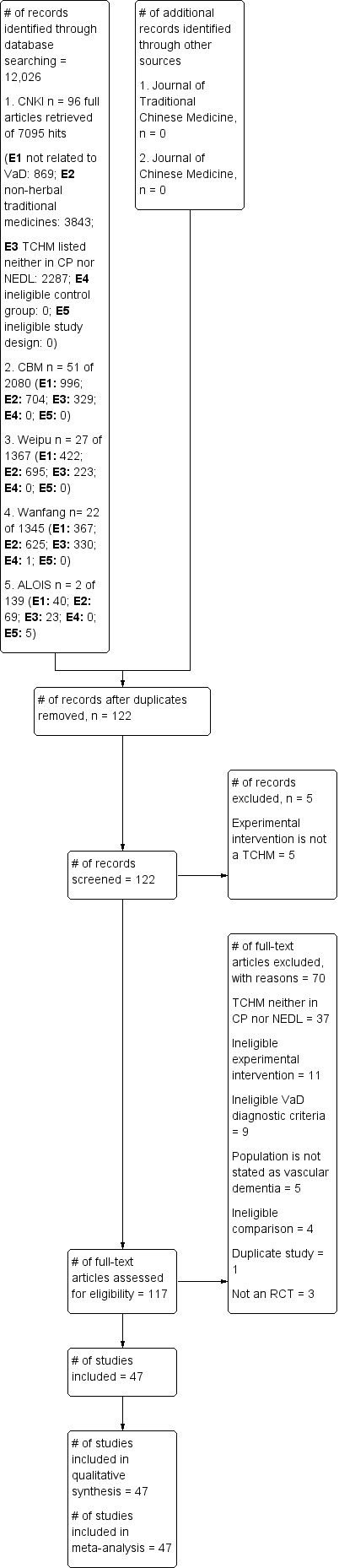
Study flow diagram.
Forty‐seven studies (3581 participants) of 18 TCHMs satisfied the eligibility criteria ‐ ChuanXiongQin (CXQ), DengZhanHuaSu (DZHS), DengZhanXiXin (DZXX), FuFangDanShen (FFDS), FuFangHaiShe (FFHS), GeGenSu (GGS), combination HuangQi (HQ) and FFDS, NaoAn (NA), NaoMaiTai (NMT), NaoXinTong (NXT), QingKaiLing (QKL), RuanMaiLing (RML), ShenFuTang (SFT), TongXinLuo (TXL), XinNaoZaiZao (XNZZ), YinDanXingNaoTong (YDXNT), YangXueQingNao (YXQN), 25 Wei ZhenZhuWan (ZZW). All studies evaluated the TCHM effect (as monotherapy or as adjunctive therapy to WM, RT or WM and RT) in a superiority trial using one or a combination of the following as a control: placebo, conventional WM or routine therapy for VaD risk factors. We did not find any eligible studies for 11 TCHMs (CiWuJia, DanShen, HuaTuoZaiZao, KangNaoShuai, LeMai, MaiLuoNing, ShenMai, ShenQiFuZheng, TaiJiTongTian, XinNaoJing, XueSaiTong).
Included studies
Study design and settings
All trials were conducted in China between 1997 and 2013. Forty‐seven studies reported randomly allocating participants to treatment groups. Sample sizes were generally small, ranging from 26 to 240 with a median of 68.
Hospitals in China are classified into three levels, with level 3a or 3b having the highest capability. A recent study reported that the adequacy of randomisation in studies that claimed to be RCTs was related to the hospital level (Wu 2009). Information on hospital levels is provided by the Hospital Quality Monitoring System (www.hqms.org.cn).
| Hospital setting of study | No. of studies | References |
| Health Centre or clinic | 2 | Liushujuan 2002; Zhangyujin 2002 |
| TCM Hospital | 13 | Baiweijie 2006; Dengguiying 2011; Guoweiling 2009; Hanzucheng 2010; Piaozhiyong 2005; Qianrenyi 1999; Tianjinzhou 2013; Wanghan 2004; Wengyinghong 2011; Xuke 2011; Zhangjinsheng 2003; Zhangyoutai 2012; Zhufengmei 2003 |
| Non‐TCM Hospital (Level II) | 5 | Guoqingjun 2013; Jiangyouyi 2006; Shiliangrong 2010; Xujingqiang 2007; Zhouqiang 2003 |
| Non‐TCM Hospital (Level III) | 24 | Chenhonghua 2008; Dingyang 2005; Hanxingguo 2007; Haoweiping 2006; Heyuping 2006; Huangchaoyun 2004; Lican 2007; Lifuhui 2011; Lijingyi 2009; Liuyujin 1997; Luohaidong 2013; Mayu 2013; Shaopeng 2012; Wangjingming 2007; Wangyihu 2011; Wuhongbin 2007; Yanyongxing 2007; Yaoxinsheng 2011; Yudecai 2008; Zhangjianping 2006; Zhangtao 2000; Zhengtaolin 2013; Zhoulongshou 2013; Zhouwei 2009 |
| Non‐TCM Hospital (unknown level) | 3 | Gaoli 2012;Huanggenxian 2013; Wanglinglin 2005 |
Only two studies reported funding sources: one was funded by the government (Lijingyi 2009) and the other was sponsored by a pharmaceutical company (Hanxingguo 2007). A summary of the characteristics of included studies can be found in Characteristics of included studies tables.
Participants
Vascular dementia was diagnosed according to one or a combination of the following criteria: DSM (versions III, III‐R, IV, IV‐R), ICD‐10, NINDS‐AIREN and Hachinski Ischaemic Score. The proportion of men across the studies ranged from 45% to 88%, with a median age of approximately 67 years (range 43 to 96 years).
The onset of treatment from stroke diagnosis varied significantly from one to 360 months, with a median of 27 months based on 31 studies (Chenhonghua 2008; Dengguiying 2011; Dingyang 2005; Gaoli 2012; Guoqingjun 2013; Guoweiling 2009; Hanxingguo 2007; Haoweiping 2006; Huanggenxian 2013; Jiangyouyi 2006; Lican 2007; Lifuhui 2011; Liushujuan 2002; Mayu 2013; Piaozhiyong 2005; Wangjingming 2007; Wanglinglin 2005; Wangyihu 2011; Wuhongbin 2007; Xuke 2011; Yanyongxing 2007; Yaoxinsheng 2011; Yudecai 2008; Zhangjianping 2006; Zhangjinsheng 2003; Zhangyoutai 2012; Zhangyujin 2002; Zhoulongshou 2013; Zhouqiang 2003; Zhouwei 2009; Zhufengmei 2003).
Treatment duration was relatively short, between 2 to 24 weeks with a median of 12 weeks. Nine studies had treatment durations lasting from two weeks to four weeks. Final assessments occurred at the end of the treatment period in all 47 studies, with a median duration of 12 weeks and a range from two weeks to six months. None of the studies followed participants up for as long as a year.
| Treatment duration | No. of studies | References |
| From 2 to 4 weeks | 9 | Baiweijie 2006; Chenhonghua 2008; Lifuhui 2011; Piaozhiyong 2005; Shiliangrong 2010; Wanghan 2004; Wangjingming 2007; Zhangjinsheng 2003; Zhangtao 2000 |
| More than 4 to 12 weeks | 10 | Huangchaoyun 2004; Huanggenxian 2013; Jiangyouyi 2006; Liushujuan 2002; Liuyujin 1997; Luohaidong 2013; Qianrenyi 1999; Wuhongbin 2007; Zhoulongshou 2013; Zhufengmei 2003 |
| More than 12 to 24 weeks | 26 | Dengguiying 2011; Dingyang 2005; Gaoli 2012; Guoqingjun 2013; Guoweiling 2009; Hanxingguo 2007; Hanzucheng 2010; Haoweiping 2006; Heyuping 2006; Lican 2007; Lijingyi 2009; Mayu 2013; Shaopeng 2012; Tianjinzhou 2013; Wanglinglin 2005; Wengyinghong 2011; Xuke 2011; Xujingqiang 2007; Yanyongxing 2007; Yaoxinsheng 2011; Yudecai 2008; Zhangjianping 2006; Zhengtaolin 2013; Zhangyoutai 2012; Zhangyujin 2002; Zhouwei 2009 |
| Not reported | 2 | Wangyihu 2011; Zhouqiang 2003 |
Interventions and comparator groups
There was substantial clinical heterogeneity among studies in the composition of both the experimental TCHM and the control interventions, as well as the use or non‐use of a common co‐intervention such as WM, RT or a combination of WM and RT. The relevant pairwise comparisons from the three three‐arm studies are included in the following summaries of the clinical heterogeneity:
-
Clinical heterogeneity of the experimental group TCHM Interventions
We found eligible studies for 18 out of the 29 eligible TCHM formulations (Table 11). Four TCHMs accounted for half of the included studies and more than half of the number of participants: NXT (12 studies, 926 participants), NMT (six studies, 420 participants), SFT (four studies, 323 participants) and TXL (three studies, 240 participants).
The herbal composition ranged from single herbs to 26‐herb mixtures with four‐ to five‐herb mixtures being the most common. We identified 73 types of herbs (Table 12). The eight most frequently used, in descending order, were ChuanXiong, DanShen, RenShen, DangGui, BingPian, HongHua, HuangQi and SanQi. There were also 18 non‐herbal components (Table 11).
The four primary modes of action (Table 11) were: diaphoretic/antipyretic (two TCHMs: QKL, XNJ), anti‐inflammatory (four TCHMs: CWJ, HQ, SFT, SQFZ), anti‐thrombotic (11 TCHMs: CXQ, DS, DZHS, FFDS, GGS, HTZZ, MLN, NXT, RML, XST and YDXNT) and neuroprotective (11 TCHMs: DZXX, FFHS, KNS, NA, NMT, SM, TJTT, TXL, XNZZ, YXQN and ZZW).
-
Clinical heterogeneity of the control group Interventions
The control group interventions were placebo, WM, RT or a combination of WM and RT.
31 studies used single WM control therapies, five studies used combination WM therapy and nine studies used some form of RT control such as anti‐coagulants, anti‐hypertensives, anti‐inflammatories, electrolytes, hypoglycaemics, lipid‐lowering agents etc., but details were often poorly described.
3. Clinical heterogeneity of experimental‐control group combinations
Eighteen studies essentially estimated the TCHM versus 'no treatment' effect using four different comparator combinations: TCHM alone against placebo (4 studies), TCHM as an adjuvant to WM (11 studies), RT (1 study) and (WM with RT) (2 studies).
| Experimental group | Control group | Reference |
| TCHM alone | Placebo | Dengguiying 2011; Huangchaoyun 2004; Tianjinzhou 2013; Wengyinghong 2011 |
| TCHM and WM | WM | Gaoli 2012; Jiangyouyi 2006; Lifuhui 2011; Luohaidong 2013; Shaopeng 2012; Shiliangrong 2010; Wangyihu 2011; Xuke 2011; Yanyongxing 2007; Zhangtao 2000; Zhouqiang 2003 |
| TCHM and RT | RT | Xujingqiang 2007 |
| TCHM and WM and RT | WM and RT | Yaoxinsheng 2011; Zhoulongshou 2013 |
Thirty‐one studies essentially estimated the TCHM versus WM effect using two different comparator combinations ‐ TCHM alone against WM (25 studies) and (TCHM and RT) against (WM and RT) (six studies).
| Experimental group | Control group | Reference |
| TCHM alone | WM (25) | Dingyang 2005; Guoqingjun 2013; Guoweiling 2009; Hanxingguo 2007; Hanzucheng 2010; Haoweiping 2006; Heyuping 2006; Huangchaoyun 2004; Lican 2007; Liuyujin 1997; Mayu 2013; Piaozhiyong 2005; Wanghan 2004; Wangjingming 2007; Wanglinglin 2005; Wuhongbin 2007; Yanyongxing 2007; Yudecai 2008; Zhangjianping 2006; Zhangjinsheng 2003; Zhangyoutai 2012; Zhangyujin 2002; Zhengtaolin 2013; Zhouwei 2009; Zhufengmei 2003 |
| TCHM and RT | WM and RT (6) | Baiweijie 2006; Chenhonghua 2008; Huanggenxian 2013; Lijingyi 2009; Liushujuan 2002; Qianrenyi 1999 |
Primary outcomes: cognition, global performance and safety
All 47 studies (3581 participants) assessed cognition using one or a combination of the following scales: MMSE (41 studies; 3227 participants), HDS (21 studies; 1544 participants), ADAS‐Cog (5 studies; 481 participants), CCSE (1 study; 26 participants) and CDT (1 study; 60 participants).
32 studies (2267 participants) assessed global performance which was also called 'efficacy rate'. One study (26 participants) used the Sandoz Clinical Assessment‐Geriatric scale and one study (60 participants) used the Global Deterioration Scale. All other studies measured global performance on an ordinal scale based on different criteria: two studies (160 participants) used TCM criteria to define three response levels, 20 studies (1455 participants) used one or a combination of the MMSE‐, HDS‐ and ADL‐derived scores to define three or four response levels, and eight studies (566 participants) did not specify the criteria used to define the response levels. The three‐level ordinal responses were labelled 'very effective', 'effective' and 'no effect'; where a fourth level was recognised it was labelled either 'worsening', 'almost controlled' or 'almost normal'.
| Global performance scale | No. of studies | Reference |
| Sandoz Clinical Assessment‐Geriatric scale | 1 | Liuyujin 1997 |
| Global Deterioration Scale | 1 | Xujingqiang 2007 |
| TCM‐based scale | 2 | Zhangjinsheng 2003; Zhangyujin 2002 |
| Cognition or ADL‐based scale | 20 | Baiweijie 2006; Dingyang 2005; Guoqingjun 2013; Guoweiling 2009; Heyuping 2006; Huangchaoyun 2004; Huanggenxian 2013; Jiangyouyi 2006; Liushujuan 2002; Piaozhiyong 2005; Qianrenyi 1999; Shiliangrong 2010; Wanghan 2004; Wangyihu 2011; Wengyinghong 2011; Yaoxinsheng 2011; Zhangtao 2000; Zhoulongshou 2013; Zhouqiang 2003; Zhufengmei 2003 |
| Unspecified | 8 | Gaoli 2012; Haoweiping 2006; Lican 2007; Lijingyi 2009; Mayu 2013; Wanglinglin 2005; Zhangyoutai 2012; Zhouwei 2009 |
Thirty‐two studies (2445 participants) explicitly reported collecting safety data but none reported the exact number of AE episodes. Twenty‐nine studies (2296 participants) reported the number of participants experiencing one or more AEs as well as the type of AEs. Two studies (123 participants) reported only the number experiencing one or more AEs without describing the AEs, and one study (26 participants) assessed safety based on electroencephalogram and regional cerebral blood flow measurements (Liuyujin 1997). Fifteen studies (1208 participants) did not report AEs, neither the number of participants experiencing AEs nor the type and number of AEs. Two of these studies (167 participants) reported the presence of dropouts without specifying reasons (Dengguiying 2011; Huangchaoyun 2004), and three studies (204 participants) drew a conclusion about the safety of the TCHM (Wuhongbin 2007; Yaoxinsheng 2011; Zhangtao 2000).
| Reporting | No. of studies | Reference |
| Participants experiencing one or more AEs and AE types | 29 | Chenhonghua 2008; Guoqingjun 2013; Guoweiling 2009; Hanxingguo 2007; Hanzucheng 2010; Haoweiping 2006; Heyuping 2006; Huanggenxian 2013; Lican 2007; Lijingyi 2009; Luohaidong 2013; Mayu 2013; Qianrenyi 1999; Shaopeng 2012; Shiliangrong 2010; Tianjinzhou 2013; Wanghan 2004; Wangjingming 2007; Wanglinglin 2005; Wangyihu 2011; Wengyinghong 2011; Xuke 2011; Yudecai 2008; Zhangjianping 2006; Zhangjinsheng 2003; Zhangyoutai 2012; Zhangyujin 2002; Zhengtaolin 2013; Zhouwei 2009 |
| Participants experiencing one or more AEs | 2 | Xujingqiang 2007; Yanyongxing 2007 |
| AEs not reported | 15 | Baiweijie 2006; Dengguiying 2011; Dingyang 2005; Gaoli 2012; Huangchaoyun 2004; Jiangyouyi 2006; Lifuhui 2011; Liushujuan 2002; Piaozhiyong 2005; Wuhongbin 2007; Yaoxinsheng 2011; Zhangtao 2000; Zhoulongshou 2013; Zhouqiang 2003; Zhufengmei 2003 |
Secondary outcomes: activities of daily living (ADL) and behaviour
Twenty‐eight studies (2297 participants) assessed daily function using one of the following scales: Activities of Daily Living (23 studies; 1868 participants), Instrumental Activities of Daily Living (2 studies; 203 participants), and the Functional Activities Questionnaire (3 studies; 226 participants).
| Daily functioning scale | No. of studies | Reference |
| ADL | 23 | Chenhonghua 2008; Dengguiying 2011; Gaoli 2012; Guoqingjun 2013; Huanggenxian 2013; Lican 2007; Lifuhui 2011; Lijingyi 2009; Luohaidong 2013; Qianrenyi 1999; Shaopeng 2012; Tianjinzhou 2013; Wangjingming 2007; Wangyihu 2011; Wengyinghong 2011; Wuhongbin 2007; Xuke 2011; Yanyongxing 2007; Yaoxinsheng 2011; Zhangjinsheng 2003; Zhangyoutai 2012; Zhangyujin 2002; Zhengtaolin 2013 |
| IADL | 2 | Haoweiping 2006; Heyuping 2006 |
| Functional Activities Questionnaire | 3 | Liuyujin 1997; Wanglinglin 2005; Zhouwei 2009 |
Only two studies (148 participants) assessed behaviour using the Blessed‐Roth Behavioural Scale (48 participants) (Hanzucheng 2010) and the Neuropsychiatirc Inventory (100 participants) (Haoweiping 2006).
Excluded studies
We excluded 70 studies (Excluded studies): 37 evaluated an experimental TCHM intervention that was listed neither in the CP nor in the NEDL (Caijing 2003; Caijing 2003‐2; Changdennis 2015; Chenrong 2006; Dengpinrui 2011; Duguiyou 2003; Gaoqi 2007; Guolei 2009; Guoqiang 2015; Guozhisheng 2009; Hejinbo 2012; Hejun 2010; Jiajianping 2014; Jianghaipeng 2010; Lishilin 2011; Liuguirong 2009; Liuxifei 2007; Liweiwei 2013; Liying 2009; Liyuehua 2011; Qinfusheng 2009; Shidehai 2011; Shihaiting 2011; Taogenyu 2004; Wangdongming 2003; Weichunhua 2013; Wutianchen 2012; Yinjunxiang 2000; Zhangchunyan 2009; Zhangfeng 2011; NCT02641886; Zhangyunling 2016; Zhaoyan 2010; Zhaoyun 2010; Zhuaihua 2005; Zhuanghuikui 2007; Zhuning 2011); 11 evaluated ineligible interventions (Houderen 2009; Jiajianping 2016; Liuq 2016; Liuwei 2009; Shiguangxia 2014; Wangguang 2006; Wanglixin 2000; Wangyankuo 2010; Xieyongyong 1996; Yangxiaoli 2011; Zhangxuehong 2013); nine failed to have eligible diagnostic criteria for vascular dementia, e.g. lack of imaging technique to establish the subtype‐specific diagnosis of dementia (Caoxiongbin2015; Liguolin2013; Lihong2013; Majingmei 2006; Wanglixin 1999; Wangsongzhen 2002; Yufangchen 1999; Zhangdaodong 1999; Zhaoyiming 1994); five studies did not involve people with vascular dementia (Fengjiong 2010; NCT02728180; Huangliwu 2006; NCT02802072; NCT02693795); four did not have an eligible comparison (Gongxuhai 2004; Hejun 2006; Sunmeibo 2005; Zhangzhipeng2014), one was a duplicate report (Zhangzuodan 2007a), and three were not RCTs (Wanjifeng 2012; Xudongmei 2009; Xuhaibo 2007).
Risk of bias in included studies
Incomplete reporting of methods and results complicated the 'Risk of bias' assessment. None of the 29 trials published in 2007 or later adopted the CONSORT reporting recommendations for randomised controlled trials of herbal interventions (Gagnier 2006). This is a modification of the 22‐item CONSORT checklist for standardised reporting of parallel‐group RCTs (Moher 2001), with particularly extensive elaboration of Item 4 which concerns the description of the intervention (i.e. herbal product name, plant part source, extraction characteristics, authentification, dosage regimen, quantitative mixture composition, chemical fingerprint, impurity assays, biochemical standardisation, required training and practice experience of practitioners). We provide a summary of the 'Risk of bias' (RoB) judgements for each study at the study and outcome level in Figure 2. A blank cell in the figure indicates an RoB domain that was not appraised because that particular outcome was not reported. The last five columns in the figure are the overall (summary) RoB judgements across all domains for each of the five review outcomes. We added this to facilitate the GRADE RoB assessment of quality of evidence.
2.

Risk of bias summary: review authors' judgements about each risk of bias item for each included study.
Allocation
All 47 studies reported random allocation of interventions, but we judged only two as adequately randomised, i.e. low risk of bias in both sequence generation and allocation concealment. Seven studies partially reported randomisation procedures by mentioning the use of a table of random numbers, but with no information about allocation concealment we judged these as having low risk of bias in sequence generation and unclear risk in allocation concealment. Thirty‐eight studies did not provide information on randomisation procedures and we rated them at unclear risk of bias in both sequence generation and allocation concealment.
Blinding
We judged six studies as having a low risk of both performance and detection bias on account of a low or unclear risk of selection bias and use of placebos or identical forms of TCHM and control treatments. We judged all other studies as having high risk of performance or detection bias or both as a result of differences that we inferred from the form or delivery of the competing interventions, such as differences in preparation (tablet versus capsule) , colour of injectables, odour of treatments, the kind and quantity of medications (related to dosage), the frequency of administration (three versus two times a day) or the form of treatment (TCHM + RT versus RT only, etc.).
Incomplete outcome data
We judged 29 studies to be at low risk. Twenty‐four of these (1751 participants) or 52.0% of included studies reported no losses to follow‐up. We deemed this to be plausible as the included trials were generally of short duration and the result was consistent with a previous systematic review on the quality of RCTs conducted in China which reported that the proportion of studies reporting zero losses to follow‐up was 53.7% (Zhang 2008a). We judged the remaining five studies (346 participants) as probably having no losses to follow‐up because the trials were conducted within hospital premises (Guoqingjun 2013; Hanxingguo 2007; Qianrenyi 1999; Wanglinglin 2005; Wangyihu 2011). We could not ascertain the adequacy of follow‐up for eight studies (642 participants), as investigators did not report the sample size at the end of trial (or the number of participants analysed), nor did they describe the completeness of follow‐up, so we judged these as having unclear risk of attrition bias. We found 10 studies (914 participants) that reported the incidence of dropouts. The median dropout rate was 4.4% (range: 1% to 13%). By treatment arm, the median and range of dropout rates were 5.3% (2% to 20%) in the TCHM group and 1.3% (< 1% to 17%) in the control group. Some studies' dropout rates were in the vicinity of their respective adverse‐event rates (taken as the number of participants experiencing adverse events). Two studies explicitly reported the reasons for dropouts, citing perceived lack of drug efficacy (Yudecai 2008) and experience of AEs (Zhoulongshou 2013). One study defined the conditions for dropout (experience of side effects, development of complications, unblinding of allocation status or withdrawal of consent) but did not give the distribution of the dropouts observed (Dengguiying 2011). For these reasons, we judged these 10 studies as having a high risk of attrition bias. In these 10 studies where either an intention‐to‐treat (ITT) approach or sensitivity analyses (to assess the impact of missing data) was appropriate, only one study (Dengguiying 2011) made an attempt by implementing an ITT primary analysis using a 'last observation carried forward' (LOCF) imputation method.
| Risk of bias judgment | No. of studies | Reference |
| Low risk | 29 | Baiweijie 2006; Dingyang 2005; Gaoli 2012; Guoqingjun 2013; Guoweiling 2009; Hanxingguo 2007; Haoweiping 2006; Heyuping 2006; Huanggenxian 2013; Jiangyouyi 2006; Lican 2007; Lijingyi 2009; Liushujuan 2002; Liuyujin 1997; Piaozhiyong 2005; Qianrenyi 1999; Shiliangrong 2010; Wanghan 2004; Wanglinglin 2005; Wangyihu 2011; Wengyinghong 2011; Yaoxinsheng 2011; Zhangjinsheng 2003; Zhangtao 2000; Zhangyujin 2002; Zhengtaolin 2013; Zhouqiang 2003; Zhouwei 2009; Zhufengmei 2003 |
| Unclear risk | 8 | Lifuhui 2011; Luohaidong 2013; Shaopeng 2012; Wangjingming 2007; Xujingqiang 2007; Yanyongxing 2007; Zhangjianping 2006; Zhangyoutai 2012 |
| High risk | 10 | Chenhonghua 2008; Dengguiying 2011; Hanzucheng 2010; Huangchaoyun 2004; Mayu 2013; Tianjinzhou 2013; Wuhongbin 2007; Xuke 2011; Yudecai 2008; Zhoulongshou 2013 |
Selective reporting
Although all 47 included studies were conducted in China, none was registered in the Chinese Clinical Trials Register (www.chictr.org/en/about.aspx), either prospectively or retrospectively. We provide a summary of the reporting status of the review outcomes for each study in Table 13. Only one study (Haoweiping 2006) fully reported cognition, daily function, behaviour and global performance outcomes. Twenty‐nine studies fully reported safety outcomes. The proportion of studies judged as having a high risk of reporting bias was greatest for the safety outcome (48.9%, see Figure 2).
3. Review outcome reporting status by study.
| No. | Study ID | Review outcomes | |||||
| Cognition | Global performance | ADL | Behaviour | AEs | Other trial outcomes | ||
| 1 | Baiweijie 2006 | MMSEa | N/A | N/A | N/A | N/A | ‐ |
| 2 | Chenhonghua 2008 | MMSEa | N/A | ADLa | N/A | a | ‐ |
| 3 | Dengguiying 2011 | MMSEa; ADAS‐Coga | N/A | ADLa | N/A | N/A | ‐ |
| 4 | Dingyang 2005 | MMSEa; HDSa | N/A | N/A | N/A | N/A | ‐ |
| 5 | Gaoli 2012 | MMSEa | Efficacy ratea | ADLa | N/A | N/A | ‐ |
| 6 | Guoqingjun 2013 | MMSEa; HDSa | N/A | ADLa | N/A | a | MDAa; GSHa; SODa; GSH‐PXa |
| 7 | Guoweiling 2009 | MMSEa | N/A | N/A | N/A | a | whole blood viscositya; plasma viscositya; fibrinogena; haematocrita |
| 8 | Hanxingguo 2007 | MMSEa; HDSa | N/A | N/A | N/A | a | HDS‐Ra; brain CT scanb |
| 9 | Hanzucheng 2010 | MMSEb | N/A | N/A | BBSb | a | ‐ |
| 10 | Haoweiping 2006 | MMSEa | Efficacy ratea | IADLa | NPIa | a | ‐ |
| 11 | Heyuping 2006 | MMSEa | N/A | ADLa | N/A | a | ‐ |
| 12 | Huangchaoyun 2004 | MMSEb; HDSc | N/A | N/A | N/A | N/A | ‐ |
| 13 | Huanggenxian 2013 | MMSEa | N/A | ADLa | N/A | a | ‐ |
| 14 | Jiangyouyi 2006 | HDSa | N/A | N/A | N/A | N/A | ‐ |
| 15 | Lican 2007 | MMSEa; HDSa | Efficacy ratea | ADLa | N/A | a | whole blood viscositya; plasma viscositya |
| 16 | Lifuhui 2011 | MMSEa | N/A | ADLa | N/A | N/A | ‐ |
| 17 | Lijingyi 2009 | MMSEa | Efficacy ratea | ADLa | N/A | a | Hcya; ETa; TXB2a; TXA2/PGI2a |
| 18 | Liushujuan 2002 | HDSa | N/A | N/A | N/A | N/A | HDLb; LDLb; CHOb; TGb |
| 19 | Liuyujin 1997 | MMSEb; HDSb; CCSEb | Efficacy ratea | FAQb | N/A | b | EEGb; rCBFb |
| 20 | Luohaidong 2013 | MMSEa; HDSa | N/A | ADLa | N/A | a | ‐ |
| 21 | Mayu 2013 | MMSEa | Efficacy ratea | N/A | N/A | a | P300 latencya; P300 amplitudea |
| 22 | Piaozhiyong 2005 | MMSEa | N/A | N/A | N/A | N/A | ‐ |
| 23 | Qianrenyi 1999 | MMSEa; HDSa | N/A | ADLa | N/A | a | ‐ |
| 24 | Shaopeng 2012 | MMSEa | N/A | ADLa | N/A | a | ‐ |
| 25 | Shiliangrong 2010 | MMSEa; HDSa | N/A | N/A | N/A | a | Neurological Function Defects Scalea |
| 26 | Tianjinzhou 2013 | MMSEb; ADAS‐Cogb | N/A | ADLa | N/A | a | ‐ |
| 27 | Wanghan 2004 | MMSEa | N/A | N/A | N/A | a | ‐ |
| 28 | Wangjingming 2007 | MMSEa; HDSa | N/A | ADLa | N/A | a | ‐ |
| 29 | Wanglinglin 2005 | MMSEa; HDSa | Efficacy ratea | FAQa | N/A | a | ‐ |
| 30 | Wangyihu 2011 | MMSEa | N/A | ADLa | N/A | a | ‐ |
| 31 | Wengyinghong 2011 | MMSEa; ADAS‐Coga | N/A | ADLa | N/A | a | ‐ |
| 32 | Wuhongbin 2007 | MMSEa | N/A | ADLa | N/A | N/A | DNDa |
| 33 | Xujingqiang 2007 | HDSa; CDTa | GDSa | N/A | N/A | b | HDS‐Ra |
| 34 | Xuke 2011 | MMSEa; HDSa | N/A | ADLa | N/A | a | ‐ |
| 35 | Yanyongxing 2007 | MMSEa; ADAS‐Coga | N/A | ADLa | N/A | b | TSHa; TT3a; TT4a; FT3a; FT4a |
| 36 | Yaoxinsheng 2011 | MMSEa | N/A | ADLa | N/A | N/A | Vsa; Vma; PIa |
| 37 | Yudecai 2008 | MMSEa; ADAS‐Coga | N/A | N/A | N/A | a | CDRa; P300 latencya; P300 amplitudea |
| 38 | Zhangjianping 2006 | MMSEa | N/A | N/A | N/A | a | P300 latencya; P300 amplitudea |
| 39 | Zhangjinsheng 2003 | MMSEa; HDSa | Efficacy ratea | ADLa | N/A | a | Neurological Function Defects Scalea |
| 40 | Zhangtao 2000 | HDSa | N/A | N/A | N/A | N/A | TCD Vma; TCD PIa |
| 41 | Zhangyoutai 2012 | MMSEb; HDSb | Efficacy ratea | ADLb | N/A | a | plasma viscositya; fibrinogena; whole blood viscositya; haematocrita; erythrocyte electrophoresisa |
| 42 | Zhangyujin 2002 | MMSEa | Efficacy ratea | ADLa | N/A | a | maximum platelet aggregation ratea; whole blood viscositya; plasma viscositya; haematocrita |
| 43 | Zhengtaolin 2013 | MMSEa | N/A | ADLa | N/A | a | |
| 44 | Zhoulongshou 2013 | MMSEa | N/A | N/A | N/A | N/A | |
| 45 | Zhouqiang 2003 | HDSa | N/A | N/A | N/A | N/A | whole blood viscositya; plasma contrast viscositya; fibrinogena; haematocrita; erythrocyte sedimentation ratea; whole blood reduced viscositya |
| 46 | Zhouwei 2009 | MMSEa; HDSa | Efficacy ratea | FAQa | N/A | a | ‐ |
| 47 | Zhufengmei 2003 | HDSa | N/A | N/A | N/A | N/A | ‐ |
aResults fully reported bResults partially reported cMentioned in Methods section, but no results reported N/A: Not assessed
ADAS‐Cog: Alzheimer’s Disease Assessment Scale‐cognitive subscale; ADL: Activities of Daily Living; BBS: Blessed‐Roth Behaviour Scale; CDR: clinical dementia rating; CHO:cholestrol; CT: Computed Tomography; DND: delayed neuronal death; ECG: electrocardiogram; EEG: electroencephalogram; ET: endothelin; FAQ: Functional Activities Questionnaire; FT3: free triiodothyronine; FT4: free thyroxine; GSH: glutathione; GSH‐PX: Glutathione peroxidase; Hcy: homocysteine; HDL: High‐density lipoprotein; HDS: Hasegawa Dementia Scale; HDS‐R: Hasegawa Dementia Scale‐revised; LDL: Low‐density lipoprotein; MDA: Malondialdehyde; MMSE: Mini‐Mental State Examination; NPI: Neuropsychiatric Inventory; PGI2: prostaglandin I2; PI: pulsatility index; rCBF: regional cerebral blood flow; SOD: Superoxide Dismutase; TCD: Transcranial Doppler; TG: Triglyceride; TSH: thyroid stimulating hormone; TT3: Total‐triiodothyronine; TT4: total thyroxine; TXA2: thromboxane A2; TXB2: thromboxane B2; Vm: mean velocity; Vs: systolic velocity; WMS: Wechsler memory scale;
General cognitive function
Forty‐two studies fully reported a cognition outcome. We judged the five studies that had incomplete reporting as having a high risk of reporting bias (Hanzucheng 2010; Huangchaoyun 2004; Liuyujin 1997; Tianjinzhou 2013; Zhangyoutai 2012). One of these studies analysed the MMSE categorically rather than continuously, without giving a rationale and without offering evidence supporting the validity of the cut‐offs used. We could therefore not rule out the possibility that the choice of cut‐offs was data‐driven (Hanzucheng 2010; Characteristics of included studies).
Global performance
In 32 studies that assessed global performance, 20 derived their global performance ratings from their MMSE, HDS or ADL scores by categorisation (e.g. 'very effective', 'effective' or 'no effect') or by calculating the percentage change from the baseline scores (Baiweijie 2006; Dingyang 2005; Guoqingjun 2013; Guoweiling 2009; Heyuping 2006; Huangchaoyun 2004; Huanggenxian 2013; Jiangyouyi 2006; Liushujuan 2002; Piaozhiyong 2005; Qianrenyi 1999; Shiliangrong 2010; Wanghan 2004; Wangyihu 2011; Wengyinghong 2011; Yaoxinsheng 2011; Zhangtao 2000; Zhoulongshou 2013; Zhouqiang 2003; Zhufengmei 2003). To avoid duplication or double‐counting or both of information already extracted, we excluded these results and appraised the remaining 12 studies for selective reporting bias and for inclusion into the meta‐analysis (Gaoli 2012; Haoweiping 2006; Lican 2007; Lijingyi 2009; Liuyujin 1997; Mayu 2013; Wanglinglin 2005; Xujingqiang 2007; Zhangjinsheng 2003; Zhangyoutai 2012; Zhangyujin 2002; Zhouwei 2009). All 12 studies reported the outcome completely so we judged them as having a low risk of selective reporting bias (Figure 2).
Safety
Twenty‐nine studies fully reported safety outcomes (Table 13). Three studies collected but partially or wholly failed to report safety assessments (Liuyujin 1997; Xujingqiang 2007; Yanyongxing 2007) and 15 studies probably measured safety outcomes but did not mention or report them (Baiweijie 2006; Dengguiying 2011; Dingyang 2005; Gaoli 2012; Huangchaoyun 2004; Jiangyouyi 2006; Lifuhui 2011; Liushujuan 2002; Piaozhiyong 2005; Wuhongbin 2007; Yaoxinsheng 2011; Zhangtao 2000; Zhoulongshou 2013; Zhouqiang 2003; Zhufengmei 2003). We judged 13 studies as having a low risk of reporting bias (Guoqingjun 2013; Guoweiling 2009; Hanxingguo 2007; Hanzucheng 2010; Huanggenxian 2013; Lijingyi 2009; Luohaidong 2013; Mayu 2013; Wangjingming 2007; Wengyinghong 2011; Zhangjianping 2006; Zhangjinsheng 2003; Zhengtaolin 2013), 11 studies with unclear risk (Chenhonghua 2008; Lican 2007; Qianrenyi 1999; Shaopeng 2012; Shiliangrong 2010; Tianjinzhou 2013; Wanglinglin 2005; Wangyihu 2011; Xuke 2011; Zhangyoutai 2012; Zhouwei 2009) and 23 studies with high risk of reporting bias (Figure 2); these included all 15 studies that we judged as having probably measured safety outcomes but failing to report them.
ADL
Twenty‐five studies fully reported ADL (Chenhonghua 2008; Dengguiying 2011; Gaoli 2012; Guoqingjun 2013; Haoweiping 2006; Heyuping 2006; Huanggenxian 2013; Lican 2007; Lijingyi 2009; Luohaidong 2013; Qianrenyi 1999; Shaopeng 2012; Tianjinzhou 2013; Wangjingming 2007; Wanglinglin 2005; Wangyihu 2011; Wengyinghong 2011; Wuhongbin 2007; Xuke 2011; Yanyongxing 2007; Yaoxinsheng 2011; Zhangjinsheng 2003; Zhangyujin 2002; Zhengtaolin 2013; Zhouwei 2009). Three studies clearly collected but only partially reported it (Lifuhui 2011; Liuyujin 1997; Zhangyoutai 2012) and 20 studies did not report it at all. We judged 25 studies as low risk of reporting bias (Figure 2), one as unclear (Lifuhui 2011) and two as high risk of reporting bias (Liuyujin 1997; Zhangyoutai 2012).
Behaviour
One of two studies that assessed this outcome reported the results completely and we judged it to be at low risk (Haoweiping 2006). The other study (Hanzucheng 2010) reported it partially, presenting and analysing the data categorically rather than continuously. They provided neither a rationale for this, nor the validity of the number of categories and thresholds used to define the categories. We judged it as having a high risk of reporting bias.
Other potential sources of bias
We did not identify other potential biases in 26 of 47 studies (Baiweijie 2006; Chenhonghua 2008; Dingyang 2005; Guoqingjun 2013; Guoweiling 2009; Hanxingguo 2007; Haoweiping 2006; Heyuping 2006; Huanggenxian 2013; Jiangyouyi 2006; Lican 2007; Lifuhui 2011; Piaozhiyong 2005; Shiliangrong 2010; Wanglinglin 2005; Wangyihu 2011; Wuhongbin 2007; Xujingqiang 2007; Yanyongxing 2007; Yaoxinsheng 2011; Yudecai 2008; Zhangjinsheng 2003; Zhengtaolin 2013; Zhoulongshou 2013; Zhouqiang 2003; Zhouwei 2009). In 21 studies that we rated at unclear risk of other biases, 18 did not provide data to support their claims that experimental and control groups were prognostically similar at baseline (Gaoli 2012; Hanzucheng 2010; Huangchaoyun 2004; Lijingyi 2009; Liushujuan 2002; Liuyujin 1997; Luohaidong 2013; Qianrenyi 1999; Shaopeng 2012; Tianjinzhou 2013; Wanghan 2004; Wangjingming 2007; Wengyinghong 2011; Zhangjianping 2006; Zhangtao 2000; Zhangyoutai 2012; Zhangyujin 2002; Zhufengmei 2003). We required a supporting table or a section in the text showing baseline prognostic balance between groups, because 38 of the 47 studies did not explicitly describe their randomisation methods. Given that baseline imbalance could have occurred, we were also uncertain whether the study analysis methods were adequate, particularly where statistical adjustments by regression or stratification could have been merited in the primary or in a sensitivity analysis.
In two of the three studies with unclear risk of other biases (Mayu 2013; Xuke 2011), one participant (a completer) was excluded from the analysis without providing reasons. The impact of exclusion on the estimated effect size was not investigated. In the other study (Dengguiying 2011), there was evidence of imbalance in cardiovascular risk factors between the intervention groups and the aggregation of disparate reasons (e.g. dropout due to safety reasons, unblinding, participant choice) in the report of the dropout rate was questionable.
We noted another potential source of bias in the assessment of global performance wherein at least one of the MMSE, HDS or ADL scores was categorised in a somewhat arbitrary fashion. None of the trialists offered a rationale behind this operational definition of global performance; neither was the choice of the number of categories (three or four were common) nor the specific cut‐points used to define the categories supported with independent validation studies. However, since we did not analyse such derived global performance outcomes, this potential bias does not affect our conclusions about the effect on global performance.
Effects of interventions
See: Table 1; Table 2; Table 3; Table 4; Table 5; Table 6; Table 7; Table 8; Table 9; Table 10
Summary of findings for the main comparison. FuFangDanShen compared to 'no treatment'.
| FFDS compared to no treatment | ||||||
| Patient or population: people with vascular dementia Setting: Hospitals in mainland China Intervention: FFDS Comparison: no treatment | ||||||
| Outcomes | Anticipated absolute effects* (95% CI) | Relative effect (95% CI) | № of participants (studies) | Certainty of the evidence (GRADE) | Table 11Comments | |
| Risk with no treatment | Risk with FFDS | |||||
| Cognition‐MMSE
assessed with: MMSE
Scale from: 0 to 30 (higher score better outcome)
follow‐up: mean 24 weeks MD of change score |
The mean change in cognition‐MMSE ‐ FFDS ranged from −0.83 to −0.52 | MD 3 higher (0.39 lower to 6.39 higher) | ‐ | 95 (2 RCTs) | ⊕⊕⊝⊝ LOW a, b | Analysis 1.1 (subgroup 1.1.3) |
| Cognition‐HDS ‐ not measured | ‐ | ‐ | ‐ | ‐ | ‐ | ‐ |
| Cognition‐ADAS‐Cog
assessed with: ADAS‐Cog
Scale from: 0 to 70 (lower score better outcome) follow‐up: mean 24 weeks MD of change score |
The mean change in cognition‐ADAS‐Cog ‐ FFDS ranged from 0.22 to 2.80 | MD 4.34 lower (6.23 lower to 2.46 lower) | ‐ | 321 (3 RCTs) | ⊕⊕⊕⊝ MODERATEa | Analysis 1.3 (subgroup 1.3.1) |
| Global performance (improved) ‐ not measured | ‐ | ‐ | ‐ | ‐ | ‐ | ‐ |
| Adverse events (AEs) (1 or more) follow‐up: mean 24 weeks | Study populationc | RD 0.02 (−0.05 to 0.09) | 322 (3 RCTs) | ⊕⊕⊝⊝ LOW b,d | Analysis 1.5 (subgroup 1.5.2) | |
| 88 per 1000 | 108 per 1000 | |||||
| Lowe | ||||||
| 0 per 1000 | 20 per 1000 | |||||
| Highf | ||||||
| 167 per 1000 | 187 per 1000 | |||||
| Activities of Daily Living (ADL) assessed with: ADL Chinese version Scale from: 14 to 56 (lower score better outcome) follow‐up: mean 24 weeks MD of change score |
The mean change in activities of Daily Living (ADL) ranged from −0.55 to 1.13 | MD 2.33 lower (5.60 lower to 0.94 higher) | ‐ | 95 (2 RCTs) | ⊕⊕⊕⊝ MODERATEb | Analysis 1.6 (subgroup 1.6.2) |
| Behaviour ‐ not measured | ‐ | ‐ | ‐ | ‐ | ‐ | ‐ |
| *The risk in the intervention group (and its 95% confidence interval) is based on the assumed risk in the comparison group and the relative effect of the intervention (and its 95% CI). CI: Confidence interval; MD: Mean difference; RD: Risk difference | ||||||
| GRADE Working Group grades of evidence High certainty: We are very confident that the true effect lies close to that of the estimate of the effect Moderate certainty: We are moderately confident in the effect estimate: The true effect is likely to be close to the estimate of the effect, but there is a possibility that it is substantially different Low certainty: Our confidence in the effect estimate is limited: The true effect may be substantially different from the estimate of the effect Very low certainty: We have very little confidence in the effect estimate: The true effect is likely to be substantially different from the estimate of effect | ||||||
aNon‐overlapping 95% CIs, with high I2 exceeding 75%. b95% CI is wide and not statistically significant. cAverage control group risk of the included studies. dPoint estimates differ in direction of effect. eLowest control group risk of the included studies. fHighest control group risk of the included studies.
Summary of findings 2. FuFangHaiShe compared to 'no treatment'.
| FFHS compared to no treatment | ||||||
| Patient or population: People with vascular dementia Setting: Hospitals in mainland China Intervention: FFHS Comparison: no treatment | ||||||
| Outcomes | Anticipated absolute effects* (95% CI) | Relative effect (95% CI) | № of participants (studies) | Certainty of the evidence (GRADE) | Comments | |
| Risk with no treatment | Risk with FFHS | |||||
| Cognition‐MMSE
assessed with: MMSE
Scale from: 0 to 30 (higher score better outcome)
follow up: mean 24 weeksa MD of change score |
The mean change in cognition‐MMSE ‐ FFHS ranged from 4.20 to 4.62 | MD 1.42 higher (0.21 higher to 2.63 higher) | ‐ | 110 (2 RCTs) | ⊕⊕⊝⊝ LOWb,c | Analysis 1.1 (subgroup 1.1.4) |
| Cognition‐HDS ‐ not measured | ‐ | ‐ | ‐ | ‐ | ‐ | ‐ |
| Cognition‐ADAS‐Cog ‐ not measured | ‐ | ‐ | ‐ | ‐ | ‐ | ‐ |
| Global performance (improved) ‐ not measured | ‐ | ‐ | ‐ | ‐ | ‐ | ‐ |
| Adverse events (AEs) (1 or more) follow‐up: mean 24 weeksa | Study populationd | RD 0.00 (‐0.05 to 0.05) | 110 (2 RCTs) | ⊕⊕⊝⊝ LOW b, e | Analysis 1.5 (subgroup 1.5.3) | |
| 57 per 1000 | 57 per 1000 | |||||
| Activities of Daily Living (ADL) assessed with: ADL Chinese version (lower score better outcome) follow‐up: mean 24 weeksa MD of change score |
The mean change in activities of Daily Living (ADL) ranged from −10.70 to −2.25 | MD 2.3 lower (4.98 lower to 0.39 higher) | ‐ | 110 (2 RCTs) | ⊕⊕⊝⊝ LOWb,e | Analysis 1.6 (subgroup 1.6.3) |
| Behaviour ‐ not measured | ‐ | ‐ | ‐ | ‐ | ‐ | ‐ |
| *The risk in the intervention group (and its 95% confidence interval) is based on the assumed risk in the comparison group and the relative effect of the intervention (and its 95% CI). CI: Confidence interval; MD: Mean difference; RD: Risk difference | ||||||
| GRADE Working Group grades of evidence High certainty: We are very confident that the true effect lies close to that of the estimate of the effect Moderate certainty: We are moderately confident in the effect estimate: The true effect is likely to be close to the estimate of the effect, but there is a possibility that it is substantially different Low certainty: Our confidence in the effect estimate is limited: The true effect may be substantially different from the estimate of the effect Very low certainty: We have very little confidence in the effect estimate: The true effect is likely to be substantially different from the estimate of effect | ||||||
aFollow‐up only reported by Yanyongxing 2007. bIn all studies, we judged most of the RoB criteria to be unclear or low RoB. But we judged the blinding of participants criteria to be high RoB and as the outcome is calculated from participant‐reported information we judged the overall study limitation to be serious. cThe 95% CI overlaps the threshold for a clinically significant difference. dAverage control group risk of the included studies. eThe effect is not statistically significant.
Summary of findings 3. NaoXinTong compared to 'no treatment'.
| NXT compared to no treatment | ||||||
| Patient or population: People with vascular dementia Setting: Hospitals in mainland China Intervention: NXT Comparison: no treatment | ||||||
| Outcomes | Anticipated absolute effects* (95% CI) | Relative effect (95% CI) | № of participants (studies) | Certainty of the evidence (GRADE) | Comments | |
| Risk with no treatment | Risk with NXT | |||||
| Cognition‐MMSE
assessed with: MMSE
Scale from: 0 to 30 (higher score better outcome)
follow‐up: range 8 weeks to 12 weeks MD of change score |
The mean change in cognition‐MMSE ranged from 1.9 to 3.2 | MD 4.29 higher (2.66 higher to 5.93 higher) | ‐ | 225 (3 RCTs) | ⊕⊕⊝⊝ LOWa,b | Analysis 1.1 (subgroup 1.1.6) |
| Cognition‐HDS ‐ only measured in one study | ‐ | ‐ | ‐ | ‐ | ‐ | Analysis 1.2 (subgroup 1.2.4) |
| Cognition‐ADAS‐Cog ‐ not measured | ‐ | ‐ | ‐ | ‐ | ‐ | ‐ |
| Global performance (improved) ‐ only measured in one study | ‐ | ‐ | ‐ | ‐ | ‐ | Analysis 1.4 (subgroup 1.4.1) |
| Adverse events (AEs) (one or more events) ‐ only measured in one study | ‐ | ‐ | ‐ | ‐ | ‐ | Analysis 1.5 (subgroup 1.5.5) |
| Activities of Daily Living (ADL) assessed with: ADL Chinese version (lower score better outcome) follow up: mean 12 weeks MD of change score |
The mean change in activities of Daily Living (ADL) ranged from ‐4.7 to ‐4.3 | MD 6.18 lower (7.02 lower to 5.33 lower) | ‐ | 166 (2 RCTs) | ⊕⊕⊕⊝ MODERATEa | Analysis 1.6 (subgroup 1.6.5) |
| Behaviour ‐ not measured | ‐ | ‐ | ‐ | ‐ | ‐ | ‐ |
| *The risk in the intervention group (and its 95% confidence interval) is based on the assumed risk in the comparison group and the relative effect of the intervention (and its 95% CI). CI: Confidence interval; MD: Mean difference; RR: Risk ratio; RT: routine therapy | ||||||
| GRADE Working Group grades of evidence High certainty: We are very confident that the true effect lies close to that of the estimate of the effect Moderate certainty: We are moderately confident in the effect estimate: The true effect is likely to be close to the estimate of the effect, but there is a possibility that it is substantially different Low certainty: Our confidence in the effect estimate is limited: The true effect may be substantially different from the estimate of the effect Very low certainty: We have very little confidence in the effect estimate: The true effect is likely to be substantially different from the estimate of effect | ||||||
aIn all studies, we judged most of the RoB criteria to be unclear or low RoB. But we judged the blinding of participants criteria to be high RoB and as the outcome is calculated from participant‐reported information we judged the overall study limitation to be serious. bNon‐overlapping 95% CIs, with high I2 exceeding 75%.
Summary of findings 4. YinDanXingNaoTong compared to 'no treatment'.
| YDXNT compared to no treatment | ||||||
| Patient or population: People with vascular dementia Setting: Hospitals in mainland China Intervention: YDXNT Comparison: no treatment | ||||||
| Outcomes | Anticipated absolute effects* (95% CI) | Relative effect (95% CI) | № of participants (studies) | Certainty of the evidence (GRADE) | Comments | |
| Risk with no treatment | Risk with YDXNT | |||||
| Cognition‐MMSE
assessed with: MMSE
Scale from: 0 to 30 (higher score better outcome)
follow‐up: mean 24 weeks MD of change score |
The mean change in cognition‐MMSE ‐ YDXNT ranged from 3.98 to 4.07 | MD 1.61 higher (0.74 higher to 2.48 higher) | ‐ | 139 (2 RCTs) | ⊕⊕⊝⊝ LOWa,b | Analysis 1.1 (subgroup 1.1.7) |
| Cognition‐HDS ‐ only measured in one study | ‐ | ‐ | ‐ | ‐ | ‐ | Analysis 1.2 (subgroup 1.2.6) |
| Cognition‐ADAS‐Cog ‐ not measured | ‐ | ‐ | ‐ | ‐ | ‐ | ‐ |
| Global performance (improved) ‐ not‐ measured | ‐ | ‐ | ‐ | ‐ | ‐ | ‐ |
| Adverse events (AEs) (1 or more events) follow‐up: mean 24 weeks | Study populationc | RD 0.00 (−0.05 to 0.05) | 138 (2 RCTs) | ⊕⊕⊝⊝ LOWa,d | Analysis 1.5 (subgroup 1.5.7) | |
| 29 per 1000 | 0 per 1000 (−1 to 1) | |||||
| Activities of Daily Living (ADL) assessed with: ADL Chinese version (lower score better outcome) follow‐up: mean 24 weeks MD of change score |
The mean change in ADL ranged from −25.59 to −2.4 | MD 1.59 lower (2.09 lower to 1.09 higher) | ‐ | 139 (2 RCTs) | ⊕⊕⊕⊝ MODERATEa | Analysis 1.6 (subgroup 1.6.6) |
| Behaviour ‐ not measured | ‐ | ‐ | ‐ | ‐ | ‐ | ‐ |
| *The risk in the intervention group (and its 95% confidence interval) is based on the assumed risk in the comparison group and the relative effect of the intervention (and its 95% CI). CI: Confidence interval; MD: Mean difference; RD: Risk difference | ||||||
| GRADE Working Group grades of evidence High certainty: We are very confident that the true effect lies close to that of the estimate of the effect Moderate certainty: We are moderately confident in the effect estimate: The true effect is likely to be close to the estimate of the effect, but there is a possibility that it is substantially different Low certainty: Our confidence in the effect estimate is limited: The true effect may be substantially different from the estimate of the effect Very low certainty: We have very little confidence in the effect estimate: The true effect is likely to be substantially different from the estimate of effect | ||||||
aIn all studies, we judged most of the RoB criteria] to be high or unclear RoB. bThe 95% CI overlaps the threshold for a clinically significant difference. cAverage control group risk of the included studies. d95% CI is wide and not statistically significant.
Summary of findings 5. FuFangHaiShe compared to Western medicine.
| FFHS compared to WM | ||||||
| Patient or population: People with vascular dementia Setting: Hospitals in mainland China Intervention: FFHS Comparison: WM | ||||||
| Outcomes | Anticipated absolute effects* (95% CI) | Relative effect (95% CI) | № of participants (studies) | Certainty of the evidence (GRADE) | Comments | |
| Risk with WM | Risk with FFHS | |||||
| Cognition‐MMSE
assessed with: MMSE
Scale from: 0 to 30 (higher score better outcome)
follow‐up: range 12 weeks to 24 weeks MD of change score |
The mean change in cognition‐MMSE ranged from 2.57 to 4.20 | MD 0.78 higher (3.05 lower to 4.60 higher) | ‐ | 143 (2 RCTs) | ⊕⊝⊝⊝ VERY LOWa,b,c | Analysis 3.1 (subgroup 3.1.3) |
| Cognition‐HDS ‐ not measured | ‐ | ‐ | ‐ | ‐ | ‐ | ‐ |
| Cognition‐ADAS‐Cog ‐ only measured in one study | ‐ | ‐ | ‐ | ‐ | ‐ | Analysis 3.3 (subgroup 3.3.1) |
| Global performance (improved) ‐ not measured | ‐ | ‐ | ‐ | ‐ | ‐ | ‐ |
| AE (1 or more events) follow‐up: range 12 weeks to 24 weeks | Study populationd | RD −0.04 (−0.26 to 0.19) | 143 (2 RCTs) | ⊕⊝⊝⊝ VERY LOWa,b,c | Analysis 3.5 (subgroup 3.5.2) | |
| 43 per 1000 | 3 per 1000 | |||||
| Highe | ||||||
| 158 per 1000 | 118 per 1000 | |||||
| Activities of Daily Living (ADL) assessed with: ADL Chinese version (lower score better outcome) follow‐up: range 12 weeks to 24 weeks MD of change score |
The mean change in activities of Daily Living (ADL) ranged from −10.7 to −4.29 | MD 1.35 higher (4.86 lower to 7.56 higher) | ‐ | 143 (2 RCTs) | ⊕⊝⊝⊝ VERY LOWa,b,c | Analysis 3.6 (subgroup 3.6.2) |
| Behaviour ‐ not measured | ‐ | ‐ | ‐ | ‐ | ‐ | ‐ |
| *The risk in the intervention group (and its 95% confidence interval) is based on the assumed risk in the comparison group and the relative effect of the intervention (and its 95% CI). CI: Confidence interval; MD: Mean difference; RD: Risk difference | ||||||
| GRADE Working Group grades of evidence High certainty: We are very confident that the true effect lies close to that of the estimate of the effect Moderate certainty: We are moderately confident in the effect estimate: The true effect is likely to be close to the estimate of the effect, but there is a possibility that it is substantially different Low certainty: Our confidence in the effect estimate is limited: The true effect may be substantially different from the estimate of the effect Very low certainty: We have very little confidence in the effect estimate: The true effect is likely to be substantially different from the estimate of effect | ||||||
aIn all studies, we judged most of the RoB criteria to be unclear or low RoB. But we judged the blinding of participants criteria as high RoB and as the outcome is calculated from participant‐reported information we judged the overall study limitation to be serious. bDirection of the two treatment effects differ and the I2 is large (> 80%). cThe 95% CI is wide and is not statistically significant. dAverage control group risk of the included studies. eHighest control group risk of the included studies.
Summary of findings 6. NaoMaiTai compared to Western medicine.
| NMT compared to WM | ||||||
| Patient or population: People with vascular dementia Setting: Hospitals in mainland China Intervention: NMT Comparison: WM | ||||||
| Outcomes | Anticipated absolute effects* (95% CI) | Relative effect (95% CI) | № of participants (studies) | Certainty of the evidence (GRADE) | Comments | |
| Risk with WM | Risk with NMT | |||||
| Cognition‐MMSE
assessed with: MMSE
Scale from: 0 to 30 (higher score better outcome)
follow‐up: mean 12 weeks MD of change score |
The mean change in cognition‐MMSE ranged from 2.87 to 4.24 | MD 3.08 higher (2.27 higher to 3.89 higher) | ‐ | 289 (4 RCTs) | ⊕⊕⊕⊝ MODERATEa | Analysis 3.1 (subgroup 3.1.5) |
| Cognition‐HDS ‐ only measured in one study | ‐ | ‐ | ‐ | ‐ | ‐ | Analysis 3.2 (subgroup 3.2.3) |
| Cognition‐ADAS‐Cog ‐ only measured in one study | ‐ | ‐ | ‐ | ‐ | ‐ | Analysis 3.3 (subgroup 3.3.2) |
| Global performance (improved) ‐ not measured | ‐ | ‐ | ‐ | ‐ | ‐ | ‐ |
| Adverse events (AEs) (1 or more events) follow‐up: mean 12 weeks |
Lowb | RD 0.02 (−0.03 to 0.07) | 277 (4 RCTs) | ⊕⊝⊝⊝ VERY LOWc,d,e | Analysis 3.5 (subgroup 3.5.4) | |
| 0 per 1000 | 40 per 1000 | |||||
| Moderatef | ||||||
| 12.2 per 1000 | 52.2 per 1000 | |||||
| Highg | ||||||
| 83 per 1000 | 123 per 1000 | |||||
| Activities of Daily Living (ADL) ‐ not measured | ‐ | ‐ | ‐ | ‐ | ‐ | ‐ |
| Behaviour ‐ not measured | ‐ | ‐ | ‐ | ‐ | ‐ | ‐ |
| *The risk in the intervention group (and its 95% confidence interval) is based on the assumed risk in the comparison group and the relative effect of the intervention (and its 95% CI). CI: Confidence interval; MD: Mean difference; RD: Risk difference; | ||||||
| GRADE Working Group grades of evidence High certainty: We are very confident that the true effect lies close to that of the estimate of the effect Moderate certainty: We are moderately confident in the effect estimate: The true effect is likely to be close to the estimate of the effect, but there is a possibility that it is substantially different Low certainty: Our confidence in the effect estimate is limited: The true effect may be substantially different from the estimate of the effect Very low certainty: We have very little confidence in the effect estimate: The true effect is likely to be substantially different from the estimate of effect | ||||||
aIn all studies,we judged most of the RoB criteria as unclear or low RoB. But we judged the blinding of participants criteria as High RoB and as the outcome is calculated from participant‐reported information we judge the overall study limitation to be serious. bLowest control group risk of the included studies. cIn all studies, we rated most of the RoB criteria as high or unclear. d95% CI is wide and not statistically significant. eVery different point estimates and moderately high I2. fMedian control group risk of the included studies. gHighest control group risk of the included studies.
Summary of findings 7. NaoXinTong compared to Western medicine.
| NXT compared to WM | ||||||
| Patient or population: People with vascular dementia Setting: Hospitals in mainland China Intervention: NXT Comparison: WM | ||||||
| Outcomes | Anticipated absolute effects* (95% CI) | Relative effect (95% CI) | № of participants (studies) | Certainty of the evidence (GRADE) | Comments | |
| Risk with WM | Risk with NXT | |||||
| Cognition‐MMSE
assessed with: MMSE
Scale from: 0 to 30 (higher score better outcome)
follow‐up: range 8 weeks to 24 weeks MD of change score |
The mean change in cognition‐MMSE ranged from 1.58 to 6.89 | MD 2.26 higher (1.50 higher to 3.02 higher) | ‐ | 461 (6 RCTs) | ⊕⊕⊕⊝ MODERATEa | Analysis 3.1 (subgroup 3.1.6) |
| Cognition‐HDS
assessed with: HDS Scale from: 0 to 30 (higher score better outcome) follow‐up: range 12 weeks to 24 weeks MD of change score |
The mean change in cognition‐HDS ‐ NXT ranged from 2.45 to 3.33 | MD 1.80 higher (0.31 higher to 3.30 higher) | ‐ | 258 (3 RCTs) | ⊕⊕⊝⊝ LOWa,b | Analysis 3.2 (subgroup 3.2.4) |
| Cognition‐ADAS‐Cog ‐ not measured | ‐ | ‐ | ‐ | ‐ | ‐ | ‐ |
| Global performance (improved) follow‐up: range 12 weeks to 24 weeks |
Study populationc | RR 1.43 (1.15 to 1.78) | 168 (2 RCTs) | ⊕⊕⊕⊝ MODERATEd | Analysis 3.4 (subgroup 3.4.4) | |
| 548 per 1,000 | 783 per 1000 (630 to 975) | |||||
| Moderatee | ||||||
| 571 per 1000 | 816 per 1000 (656 to 1000) | |||||
| Adverse events (AEs) (1 or more events) follow‐up: range 8 weeks to 24 weeks |
Study populationc | RD −0.00 (−0.03 to 0.02) | 515 (7 RCTs) | ⊕⊕⊕⊝ MODERATEa | Analysis 3.5 (subgroup 3.5.5) | |
| 66 per 1000 | 66 per 1000 | |||||
| Lowf | ||||||
| 0 per 1000 | 0 per 1000 | |||||
| Highg | ||||||
| 150 per 1000 | 150 per 1000 | |||||
| Activities of Daily Living (ADL) assessed with: ADL Chinese version (lower score better outcome) follow‐up: range 8 weeks to 24 weeks MD of change score |
The mean change in ADL ranged from −6.5 to 0.0 | MD 4.72 lower (5.85 lower to 3.58 lower) | ‐ | 227 (3 RCTs) | ⊕⊕⊕⊝ MODERATEa | Analysis 3.6 (subgroup 3.6.4) |
| Behaviour ‐ not measured | ‐ | ‐ | ‐ | ‐ | ‐ | ‐ |
| *The risk in the intervention group (and its 95% confidence interval) is based on the assumed risk in the comparison group and the relative effect of the intervention (and its 95% CI). CI: Confidence interval; MD: Mean difference; RR: Risk ratio; RD: Risk difference; RT: routine therapy | ||||||
| GRADE Working Group grades of evidence High certainty: We are very confident that the true effect lies close to that of the estimate of the effect Moderate certainty: We are moderately confident in the effect estimate: The true effect is likely to be close to the estimate of the effect, but there is a possibility that it is substantially different Low certainty: Our confidence in the effect estimate is limited: The true effect may be substantially different from the estimate of the effect Very low certainty: We have very little confidence in the effect estimate: The true effect is likely to be substantially different from the estimate of effect | ||||||
aIn all studies, we judged most of the RoB criteria to be unclear or low RoB. But we judged the blinding of participants criteria as high RoB and as the outcome is calculated from participant‐reported information we judged the overall study limitation to be serious. bVery different point estimates, barely overlapping 95% CIs and high I2 exceeding 75%. cAverage control group risk of the included studies. dIn all studies, most of the RoB criteria were judged as high or unclear RoB. eMedian control group risk of the included studies. fLowest control group risk of the included studies. gHighest control group risk of the included studies.
Summary of findings 8. QingKaiLing compared to Western medicine.
| QKL compared to WM | ||||||
| Patient or population: People with vascular dementia Setting: Hospitals in mainland China Intervention: QKL Comparison: WM | ||||||
| Outcomes | Anticipated absolute effects* (95% CI) | Relative effect (95% CI) | № of participants (studies) | Certainty of the evidence (GRADE) | Comments | |
| Risk with WM | Risk with QKL | |||||
| Cognition‐MMSE ‐ only measured in one study | ‐ | ‐ | ‐ | ‐ | ‐ | Analysis 3.1 (subgroup 3.1.7) |
| Cognition‐HDS
assessed with: HDS
Scale from: 0 to 30 (higher score better outcome)
follow‐up: range 4 weeks to 8 weeks MD of change score |
The mean change in cognition‐HDS ‐ QKL ranged from 2.38 to 3.2 | MD 2.77 higher (1.11 higher to 4.43 higher) | ‐ | 150 (2 RCTs) | ⊕⊕⊝⊝ LOWa,b | Analysis 3.2 (subgroup 3.2.5) |
| Cognition‐ADAS‐Cog ‐ not measured | ‐ | ‐ | ‐ | ‐ | ‐ | ‐ |
| Global performance (improved) ‐ not measured | ‐ | ‐ | ‐ | ‐ | ‐ | ‐ |
| Adverse events (AEs) (one or more events) ‐ only measured in one study | ‐ | ‐ | ‐ | ‐ | ‐ | Analysis 3.5 (subgroup 3.5.6) |
| Activities of Daily Living (ADL) ‐ only measured in one study | ‐ | ‐ | ‐ | ‐ | ‐ | Analysis 3.6 (subgroup 3.6.5) |
| Behaviour ‐ not measured | ‐ | ‐ | ‐ | ‐ | ‐ | ‐ |
| *The risk in the intervention group (and its 95% confidence interval) is based on the assumed risk in the comparison group and the relative effect of the intervention (and its 95% CI). CI: Confidence interval; MD: Mean difference; RT: routine therapy | ||||||
| GRADE Working Group grades of evidence High certainty: We are very confident that the true effect lies close to that of the estimate of the effect Moderate certainty: We are moderately confident in the effect estimate: The true effect is likely to be close to the estimate of the effect, but there is a possibility that it is substantially different Low certainty: Our confidence in the effect estimate is limited: The true effect may be substantially different from the estimate of the effect Very low certainty: We have very little confidence in the effect estimate: The true effect is likely to be substantially different from the estimate of effect | ||||||
aIn all studies, we judged most of the RoB criteria to be unclear or low RoB. But we judged the blinding of participants criteria as high RoB and as the outcome is calculated from participant‐reported information we judged the overall study limitation to be serious. bVery different point estimates and moderately high I2 exceeding 50%.
Summary of findings 9. ShenFuTang compared to Western medicine.
| SFT compared to WM | ||||||
| Patient or population: People with vascular dementia Setting: Hospitals in mainland China Intervention: SFT Comparison: WM | ||||||
| Outcomes | Anticipated absolute effects* (95% CI) | Relative effect (95% CI) | № of participants (studies) | Certainty of the evidence (GRADE) | Comments | |
| Risk with WM | Risk with SFT | |||||
| Cognition‐MMSE
assessed with: MMSE
Scale from: 0 to 30 (higher score better outcome)
follow‐up: range 3 weeks to 4 weeks MD of change score |
The mean change in cognition‐MMSE ‐ SFT ranged from 0.88 to 1.98 | MD 3.63 higher (1.02 higher to 6.25 higher) | ‐ | 323 (4 RCTs) | ⊕⊝⊝⊝ VERY LOWa,b,c | Analysis 3.1 (subgroup 3.1.9) |
| Cognition‐HDS ‐ only measured in one study | ‐ | ‐ | ‐ | ‐ | ‐ | Analysis 3.2 (subgroup 3.2.6) |
| Cognition‐ADAS‐Cog ‐ not measured | ‐ | ‐ | ‐ | ‐ | ‐ | ‐ |
| Global performance (improved) ‐ not measured | ‐ | ‐ | ‐ | ‐ | ‐ | ‐ |
| Adverse events (AEs) (1 or more events) follow‐up: mean 4 weeks | Study populationd | RD −0.01 (−0.05 to 0.04) | 166 (2 RCTs) | ⊕⊕⊝⊝ LOWa,e | Analysis 3.5 (subgroup 3.5.8) | |
| 38 per 1000 | 28 per 1000 | |||||
| Highf | ||||||
| 91 per 1,000 | 81 per 1000 | |||||
| Activities of Daily Living (ADL) assessed with: ADL Chinese version (lower score better outcome) follow‐up: range 3 weeks to 4 weeks MD of change score |
The mean change in ADL ranged from −3.9 to −0.68 | MD 10.16 lower (16.61 lower to 3.71 lower) | ‐ | 189 (2 RCTs) | ⊕⊝⊝⊝ VERY LOWa,g,h | Analysis 3.6 (subgroup 3.6.7) |
| Behaviour ‐ not measured | ‐ | ‐ | ‐ | ‐ | ‐ | ‐ |
| *The risk in the intervention group (and its 95% confidence interval) is based on the assumed risk in the comparison group and the relative effect of the intervention (and its 95% CI). CI: Confidence interval; MD: Mean difference; RD: Risk difference | ||||||
| GRADE Working Group grades of evidence High certainty: We are very confident that the true effect lies close to that of the estimate of the effect Moderate certainty: We are moderately confident in the effect estimate: The true effect is likely to be close to the estimate of the effect, but there is a possibility that it is substantially different Low certainty: Our confidence in the effect estimate is limited: The true effect may be substantially different from the estimate of the effect Very low certainty: We have very little confidence in the effect estimate: The true effect is likely to be substantially different from the estimate of effect | ||||||
aIn all studies, we judged most of the RoB criteria as unclear or low RoB. But we judged the blinding of participants criteria as high RoB and as the outcome is calculated from participant‐reported information we judged the overall study limitation to be serious. bNon‐overlapping 95% CIs, with high I2 exceeding 75%. cThe 95% CI overlaps the threshold for a clinically significant difference and is wide. dAverage control group risk of the included studies. e95% CI is wide and not statistically significant. fHighest control group risk of the included studies. gVery different point estimates, barely overlapping 95% CIs and high I‐square exceeding 75%. h95% CI is wide.
Summary of findings 10. TongXingLuo compared to Western medicine.
| TXL compared to WM | ||||||
| Patient or population: People with vascular dementia Setting: Hospitals in mainland China Intervention: TXL Comparison: WM | ||||||
| Outcomes | Anticipated absolute effects* (95% CI) | Relative effect (95% CI) | № of participants (studies) | Certainty of the evidence (GRADE) | Comments | |
| Risk with WM | Risk with TXL | |||||
| Cognition‐MMSE
assessed with: MMSE
Scale from: 0 to 30 (higher score better outcome)
follow‐up: mean 24 weeks MD of change score |
The mean change in cognition‐MMSE ranged from 1.97 to 2.56 | MD 2.58 higher (1.54 higher to 3.62 higher) | ‐ | 180 (2 RCTs) | ⊕⊕⊕⊝ MODERATEa | Analysis 3.1 (subgroup 3.1.10) |
| Cognition‐HDS ‐ only measured in one study | ‐ | ‐ | ‐ | ‐ | ‐ | Analysis 3.2 (subgroup 3.2.7) |
| Cognition‐ADAS‐Cog ‐ not measured | ‐ | ‐ | ‐ | ‐ | ‐ | ‐ |
| Global performance (improved) follow‐up: mean 24 weeks | Study populationb | RR 1.26 (1.00 to 1.60) | 180 (2 RCTs) | ⊕⊕⊝⊝ LOWa,c | Analysis 3.4 (subgroup 3.4.7) | |
| 544 per 1000 | 686 per 1000 (544 to 871) | |||||
| Adverse events (AEs) (1 or more) follow‐up: mean 24 weeks | Lowd | RD −0.16 (−042 to 0.10) | 180 (2 RCTs) | ⊕⊕⊝⊝ LOWa,e | Analysis 3.5 (subgroup 3.5.9) | |
| 180 per 1000 | 90 per 1000 (40 to 205) | |||||
| Moderatef | ||||||
| 315 per 1000 | 158 per 1000 (69 to 359) | |||||
| Highg | ||||||
| 450 per 1000 | 225 per 1000 (99 to 513) | |||||
| Activities of Daily Living (ADL) ‐ only measured in one study | ‐ | ‐ | ‐ | ‐ | ‐ | Analysis 3.6 (subgroup 3.6.8) |
| Behaviour ‐ only measured in one study | ‐ | ‐ | ‐ | ‐ | ‐ | Analysis 3.7 (subgroup 3.7.1) |
| *The risk in the intervention group (and its 95% confidence interval) is based on the assumed risk in the comparison group and the relative effect of the intervention (and its 95% CI). CI: Confidence interval; MD: Mean difference; RD: risk difference; RR: Risk ratio | ||||||
| GRADE Working Group grades of evidence High certainty: We are very confident that the true effect lies close to that of the estimate of the effect Moderate certainty: We are moderately confident in the effect estimate: The true effect is likely to be close to the estimate of the effect, but there is a possibility that it is substantially different Low certainty: Our confidence in the effect estimate is limited: The true effect may be substantially different from the estimate of the effect Very low certainty: We have very little confidence in the effect estimate: The true effect is likely to be substantially different from the estimate of effect | ||||||
aIn all studies, we judged most of the RoB criteria as unclear or low RoB. But we judged the blinding of participants criteria as high RoB and as the outcome is calculated from participant‐reported information we judged the overall study limitation to be serious. bAverage control group risk of the included studies. cLower limit of 95% CI for the RR is 1. dLowest control group risk of the included studies. e95% CI is wide and not statistically significant. fMedian control group risk of the included studies. gHighest control group risk of the included studies.
We report separate intervention effects for two categories of comparisons: (1) the effect of TCHM versus 'no treatment', and (2) the effect of TCHM versus WM. In each category, we report the five outcomes in the order: cognitive function, global performance, safety, daily function and behaviour. For each outcome, we first discuss the effects of the specific TCHMs followed by the effects of specific primary modes of action. We conclude with our confidence in the reported results.
The following table summarises for the continuous outcomes the treatment effect estimator and the interpretation of the direction of change that favours the TCHM group:
| Outcome | Treatment effect estimator | Favours TCHM group |
| Cognition‐MMSE | Mean difference (MD) of change score from baseline | Postive MD |
| Cognition‐HDS | MD of change score from baseline | Postive MD |
| Cognition‐ADAS‐Cog | MD of change score from baseline | Negative MD |
| Cognition‐CDT | MD of change score from baseline | Postive MD |
| Activities of Daily Living | MD or standardised mean difference (SMD) of change score from baseline | Negative MD or SMD |
| Behaviour | MD of change score from baseline | Negative MD |
Effect of TCHM versus 'no treatment'
We summarise the pooled effects on each of the five outcomes for specific TCHMs that were evaluated in more than one study. We do not report pooled effects across TCHMs because of clinical heterogeneity in the interventions in both experimental and control groups. We did not conduct sensitivity analyses when there was no pooling.
Primary outcomes
1. Cognition
All 18 studies assessed cognition, of which six used MMSE only (Gaoli 2012; Lifuhui 2011; Shaopeng 2012; Wangyihu 2011; Yaoxinsheng 2011; Zhoulongshou 2013), three used HDS only (Jiangyouyi 2006; Zhangtao 2000; Zhouqiang 2003), four used both MMSE and HDS (Huangchaoyun 2004; Luohaidong 2013; Shiliangrong 2010; Xuke 2011), four used MMSE and ADAS‐Cog (Dengguiying 2011; Tianjinzhou 2013; Wengyinghong 2011; Yanyongxing 2007) and one used HDS and CDT (Xujingqiang 2007).
1.1 MMSE
Of the 14 studies using MMSE, two studies of one TCHM (NXT: Huangchaoyun 2004; Tianjinzhou 2013) did not report either a mean or a measure of dispersion and therefore did not contribute to the forest plots. The remaining 12 studies tested seven TCHMs (Analysis 1.1); four were tested in more than one study ‐ FFDS, FFHS, NXT, YDXNT. All treatment effects favoured TCHM. Our judgement of a clinically significant effect was based on two reported minimally clinically important difference (MCID) thresholds: ≥ 1.4 points (Howard 2011) and > 3 points (Qaseem 2008). We summarise the results of the four TCHMs tested in more than one study below:
1.1. Analysis.

Comparison 1 TCHM versus 'no treatment' (Subgroup: specific TCHM and comparators), Outcome 1 Cognition‐MMSE.
FFDS may improve cognition compared to 'no treatment' (MD 3.00, 95% confidence interval (CI) −0.39 to 6.39, I2 = 89%; 2 studies, 95 participants) with placebo in the control groups; low‐certainty evidence due to inconsistency and imprecision (Table 1). The pooled point estimate was clinically significant but the 95% CI indicates that FFDS might make little or no difference.
FFHS may slightly improve cognition compared to 'no treatment' (MD 1.42, 95% CI 0.21 to 2.63, I2 = 0%; 2 studies, 110 participants) with WM (donepezil) in both treatment and control groups; low quality of evidence due to serious study limitations and imprecision (Table 2). The pooled point estimate was clinically significant by the Howard 2011 criteria, but the 95% CI indicates that FFHS might make little or no difference.
NXT may improve cognition compared to 'no treatment' (MD 4.29, 95% CI 2.66 to 5.93, I2 = 81%; 3 studies, 225 participants, with nimodipine (Gaoli 2012), nimodipine and RT (Yaoxinsheng 2011) and donepezil and RT (Zhoulongshou 2013) in both treatment and control groups; low quality of evidence due to serious study limitations and inconsistency (Table 3)). The pooled point estimate was clinically significant by both criteria, and was precise.
YDXNT may slightly improve cognition compared to 'no treatment' (MD 1.61, 95% CI 0.74 to 2.48, I2 = 8%; 2 studies, 139 participants, with nimodipine (Shaopeng 2012) and donepezil (Xuke 2011) in both treatment and control groups; low quality of evidence due to serious study limitations and imprecision (Table 4)). The pooled point estimate was clinically significant by the Howard 2011 criteria, but the 95% CI indicates that YDXNT might make little or no difference.
Sensitivity analyses using different values of the correlation coefficient for the estimation of the standard deviation (SD) of the change score did not change the magnitude of the effects, except for FFHS in which the pooled effect became non‐significant and hence imprecise (Table 14) .
4. Sensitivity analysis ‐ common TCHM ‐ vs no treatment.
| Outcome | TCHM | No of studies | No of participants | Summary statistics | ||||||
| TCHM | Control | rho = 0.25 | 95% CI | rho = 0.50 | 95% CI | rho = 0.75 | 95% CI | |||
| Cognition_MMSE (MD) | FFDS | 2 | 48 | 47 | 2.78 | −0.57 to 6.13 | 2.89 | −0.49 to 6.27 | 3.00 | −0.39 to 6.39 |
| FFHS | 2 | 57 | 53 | 1.41 | −0.66 to 3.49 | 1.42 | −0.29 to 3.12 | 1.42 | 0.21 to 2.63 | |
| NXT | 3 | 116 | 109 | 4.19 | 2.53 to 5.85 | 4.24 | 2.58 to 5.9 | 4.29 | 2.66 to 5.93 | |
| YDXNT | 2 | 70 | 69 | 1.47 | 0.65 to 2.29 | 1.50 | 0.69 to 2.31 | 1.61 | 0.74 to 2.48 | |
| Cognition_ADAS‐COG (MD) | FFDS | 3 | 162 | 159 | −4.12 | −6.1 to −2.13 | −4.18 | −6.14 to −2.22 | −4.34 | −6.23 to −2.46 |
| ADL (MD) | FFDS | 2 | 48 | 47 | −0.44 | −0.84 to −0.03 | −0.48 | −0.89 to −0.07 | −0.57 | −0.98 to −0.16 |
| FFHS | 2 | 57 | 53 | −0.27 | −0.66 to 0.12 | −0.34 | −0.82 to 0.13 | −0.48 | −1.13 to 0.17 | |
| NXT | 2 | 85 | 81 | −1.33 | −1.78 to −0.89 | −1.60 | −2.09 to −1.11 | −2.17 | −2.68 to −1.65 | |
| YDXNT | 2 | 70 | 69 | −0.80 | −2.34 to 0.75 | −0.80 | −2.34 to 0.74 | −0.80 | −2.33 to 0.73 | |
ADAS‐Cog: Alzheimer's disease assessment scale: cognition subscale; ADL: activities of daily living; MD: mean difference; MMSE: Mini mental state examination; TCHM: traditional Chinese herbal medicine
Of the three TCHMs (CXQ, DZXX, NMT) tested in single studies, all had a high overall risk of bias. Only one (Shiliangrong 2010) had a large clinically significant effect in favour of TCHM: CXQ (MD 6.10, 95% CI 4.47 to 7.73; 91 participants; moderate‐certainty evidence).
There were two primary modes of action:
Anti‐thrombotic (MD 3.60, 95% CI 2.25 to 4.96, I2 = 88%; 8 studies, 550 participants; Analysis 2.1). The overall risk of bias was high in all studies, mainly due to lack of blinding of participants (Figure 2). All individual study effects favoured TCHM but they were inconsistent in magnitude. The pooled point estimate was clinically significant by both threshold criteria and also precise enough by the Howard 2011 criteria but not by the Qaseem 2008 criteria.
Neuroprotective (MD 1.22, 95% CI 0.54 to 1.90, I2 = 0%; 4 studies, 313 participants). The overall risk of bias was high in all studies, mainly due to lack of blinding of participants (Figure 2). The pooled point estimate was not clinically significant by either threshold criterion and it was also imprecise.
2.1. Analysis.
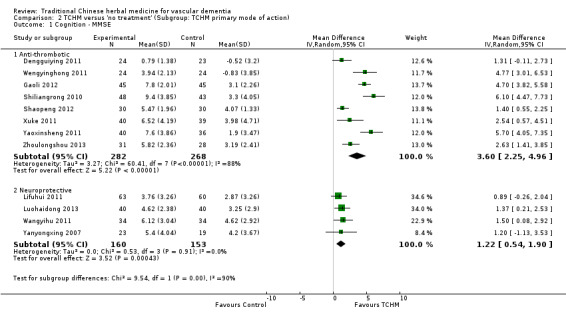
Comparison 2 TCHM versus 'no treatment' (Subgroup: TCHM primary mode of action), Outcome 1 Cognition ‐ MMSE.
Sensitivity analyses using different values of the correlation coefficient for the estimation of the SD of the change score did not change the magnitude of the effects (Table 15).
5. Sensitivity analysis ‐ primary mode of action ‐ vs no treatment.
| Outcome | TCHM | No of studies | No of participants | Summary statistics | ||||||
| TCHM | Control | rho = 0.25 | 95% CI | rho = 0.50 | 95% CI | rho = 0.75 | 95% CI | |||
| Cognition_MMSE (MD) | Anti‐thrombotics | 8 | 282 | 268 | 3.54 | 2.03 to 5.05 | 3.57 | 2.12 to 5.02 | 3.60 | 2.25 to 4.96 |
| Neuroprotection | 4 | 160 | 153 | 1.17 | 0.40 to 1.93 | 1.18 | 0.44 to 1.92 | 1.22 | 0.54 to 1.90 | |
| Cognition_ HDS (MD) | Anti‐thrombotics | 4 | 154 | 144 | 4.60 | 3.18 to 6.02 | 4.45 | 3.00 to 5.91 | 4.29 | 2.83 to 5.76 |
| Neuroprotection | 3 | 102 | 86 | 4.10 | 2.30 to 5.91 | 4.13 | 2.32 to 5.94 | 4.15 | 2.34 to 5.96 | |
| Cognition_ ADAS‐COG (MD) | Anti‐thrombotics | 3 | 162 | 159 | −4.12 | −6.10 to −2.13 | −4.18 | −6.14 to −2.22 | ‐4.34 | −6.23 to −2.46 |
| ADL (MD) | Anti‐thrombotics | 6 | 203 | 197 | −3.55 | −5.71 to −1.39 | −3.60 | −5.87 to −1.33 | ‐3.60 | −5.95 to −1.24 |
| Neuroprotection | 4 | 160 | 153 | −1.22 | −3.87 to 1.42 | −1.29 | −3.86 to 1.29 | ‐1.37 | −3.85 to 1.12 | |
ADAS‐Cog: Alzheimer's disease assessment scale: cognition subscale; ADL: activities of daily living; MD: mean difference; MMSE: Mini mental state examination; TCHM: traditional Chinese herbal medicine
In conclusion, we are very uncertain of the MMSE effect estimates, as the overall risk of bias was high in all 12 studies of the seven TCHMs and the GRADE quality of evidence was low.
1.2 HDS
Of the eight studies using HDS, seven reported sufficient data and each tested a different TCHM (CXQ, GGS, NMT, NXT, TXL, YDXNT, ZZW; Analysis 1.2). One study did not report either a mean or a measure of dispersion and is therefore not included in the forest plot (NXT: Huangchaoyun 2004).
1.2. Analysis.
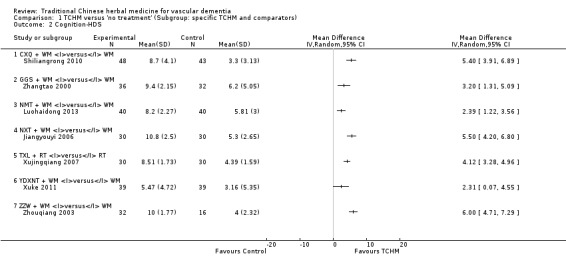
Comparison 1 TCHM versus 'no treatment' (Subgroup: specific TCHM and comparators), Outcome 2 Cognition‐HDS.
All studies had a high overall risk of bias mainly due to lack of blinding of participants (Figure 2). The treatment effects favoured TCHM but with high inconsistency (I2 = 78%).
There were two primary modes of action:
Anti‐thrombotic (MD 4.29, 95% CI 2.83 to 5.76, I2 = 67%; 4 studies, 298 participants; Analysis 2.2). The overall risk of bias was high in three of the four studies, mainly due to lack of blinding of participants (Figure 2). All individual study effects favoured TCHM but they were inconsistent in magnitude. The pooled point estimate was large and statistically significant.
Neuroprotective (MD 4.15, 95% CI 2.34 to 5.96 I2 = 88%; 3 studies, 188 participants). The overall risk of bias was high in all studies, mainly due to lack of blinding of participants (Figure 2). All individual study effects favoured TCHM but they were inconsistent in magnitude.The pooled point estimate was large and statistically significant.
2.2. Analysis.
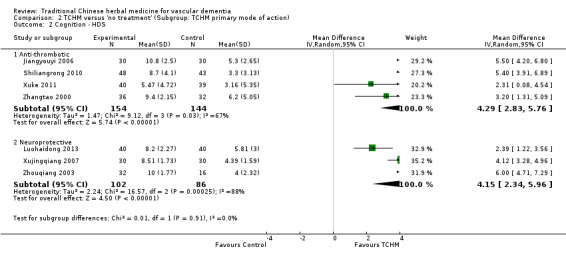
Comparison 2 TCHM versus 'no treatment' (Subgroup: TCHM primary mode of action), Outcome 2 Cognition ‐ HDS.
Sensitivity analyses using different values of the correlation coefficient for the estimation of the SD of the change score did not change the magnitude of the effects (Table 15).
Of the seven TCHMs, four had potentially large effects in favour of TCHM, with the lower bound of the 95% CI for the MD greater than or equal to 2.0: CXQ (MD 5.40, 95% CI 3.91 to 6.89, Shiliangrong 2010), NXT (MD 5.50, 95% CI 4.20 to 6.80, Jiangyouyi 2006), TXL (MD 4.12, 95% CI 3.28 to 4.96, Xujingqiang 2007) and ZZW (MD 6.00, 95% CI 4.71 to 7.29, Zhouqiang 2003).
In conclusion, we are very uncertain of the HDS effect estimates as the overall risk of bias was high in six of the seven studies, and the evidence was sparse, with only one study for each specific TCHM.
1.3 ADAS‐Cog
Four studies tested two TCHMS: FFDS (three studies) and FFHS (one study) using the ADAS‐Cog (Analysis 1.3). All treatment effects favoured TCHM but three of the four studies had a high overall risk of bias, mainly due to lack of blinding of participants (Figure 2). We summarise the results of the FFDS studies below:
1.3. Analysis.
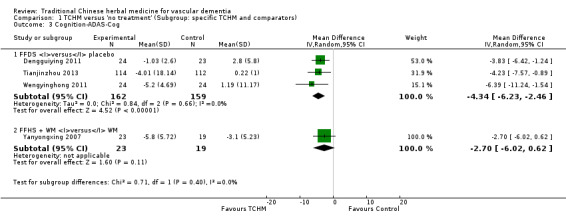
Comparison 1 TCHM versus 'no treatment' (Subgroup: specific TCHM and comparators), Outcome 3 Cognition‐ADAS‐Cog.
FFDS probably improves cognition compared to 'no treatment' (MD −4.34, 95% CI −6.23 to −2.46, I2 = 0%; 3 studies, 321 participants; moderate‐certainty evidence) with placebo in the control groups; low to moderate quality of evidence due to inconsistency and imprecision (Table 1). The pooled point estimate was clinically significant.
There were two primary modes of action ‐ anti‐thrombotic (FFDS) and neuroprotection (FFHS) (see Analysis 2.3). The anti‐thrombotic action had the same studies as summarised for FFDS above.
2.3. Analysis.
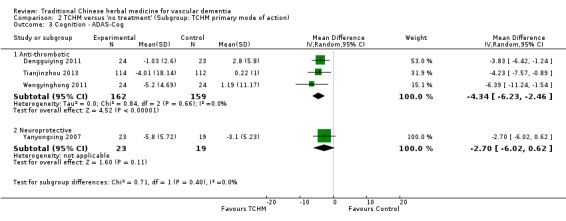
Comparison 2 TCHM versus 'no treatment' (Subgroup: TCHM primary mode of action), Outcome 3 Cognition ‐ ADAS‐Cog.
Sensitivity analyses using different values of the correlation coefficient for the estimation of the SD of the change score did not change the magnitude of the effects (Table 15).
In conclusion, we are very uncertain of the ADAS‐Cog effect estimates, as the overall risk of bias was high in the single FFHS study and the GRADE quality of evidence was low in the FFDS studies.
1.4 Other cognitive outcomes: CDT and CCSE
Only one study comparing TXL plus RT versus RT alone (Xujingqiang 2007) used CDT. The treatment effect favoured TCHM (MD 0.35, 95% CI 0.16 to 0.54) but we are uncertain of the effect as the overall risk of bias was high because of lack of blinding (Figure 2).
2. Global performance
Eleven studies reported global performance but nine of these studies derived it secondarily from the primary MMSE, HDS or ADL assessment (Huangchaoyun 2004; Jiangyouyi 2006; Shiliangrong 2010; Wangyihu 2011; Wengyinghong 2011; Yaoxinsheng 2011; Zhangtao 2000; Zhoulongshou 2013; Zhouqiang 2003). We therefore did not analyse these results to avoid double‐counting. The remaining two studies assessed global performance using an ordinal scale: one used the single‐item Global Deterioration scale (Xujingqiang 2007) and the other classified global performance into three categories: 'very effective', 'effective', 'no effect (Gaoli 2012). We dichotomised global performance as 'improvement' (the event of interest) comprising those participants for whom the treatment was 'effective' or 'very effective', and 'no improvement' (non‐events) comprising those participants for whom the treatment had 'no effect' or caused a worsening of state. We eventually excluded Xujingqiang 2007 because it was not possible to map its GDS seven‐point Likert response format to our binary partition of 'improvement' without significant loss of information. The lowest GDS response, option 'one', representing the ideal outcome of 'no cognitive decline', did not distinguish between participants who improved (event) and those who neither experienced improvement nor worsened (non‐events). The remaining study (Gaoli 2012; Analysis 1.4) compared the antithrombotic NXT plus nimodipine versus nimodipine alone. The effect favoured NXT (RR 1.23, 95% CI 1.04 to 1.45; Analysis 2.4) but we are uncertain of the effect as the overall risk of bias was high and the result imprecise.
1.4. Analysis.
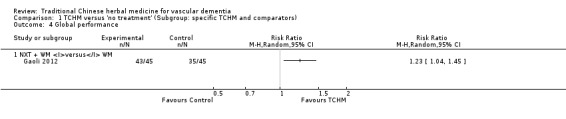
Comparison 1 TCHM versus 'no treatment' (Subgroup: specific TCHM and comparators), Outcome 4 Global performance.
2.4. Analysis.
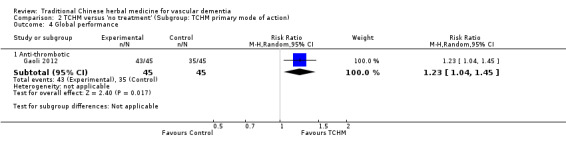
Comparison 2 TCHM versus 'no treatment' (Subgroup: TCHM primary mode of action), Outcome 4 Global performance.
3. Adverse events
Eleven studies reported AEs for seven TCHMs (CXQ, FFDS, FFHS, NMT, NXT, TXL, YDXNT; Analysis 1.5). The median proportion of participants experiencing AEs in these 11 studies was 7.5% (TCHM group: range 0% to 36.7%, control group: range 0% to 16.7%). We found the reporting of the type and frequency of AE episodes to be imprecise or inadequate or both. None of the studies tabulated AEs and the corresponding number of episodes by treatment arm. In addition, the types of AEs reported were not likely to be exhaustive, as studies in general did not describe the scope or regularity of safety assessments. Occurrences of mild and non‐serious AEs are particularly likely to be under‐reported in the studies that reported no "obvious" side effects without explaining what they meant by "obvious" (Shiliangrong 2010; Wangyihu 2011).
1.5. Analysis.
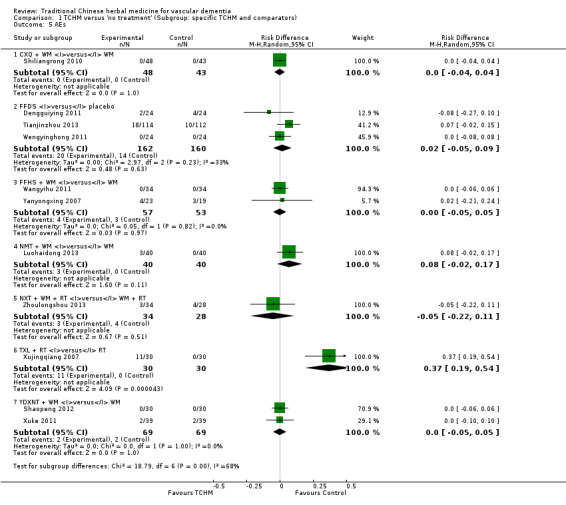
Comparison 1 TCHM versus 'no treatment' (Subgroup: specific TCHM and comparators), Outcome 5 AEs.
Five studies may have had dropouts because of AEs. We confirmed AEs as the reason in one study: 8.8% (NXT) versus 12.5% (control group) (Zhoulongshou 2013), and thought it to be highly likely in another study: 8.3% (FFDS) versus 16.7% (placebo) (Dengguiying 2011). We could not rule out the possibility in the remaining studies (Huangchaoyun 2004; Tianjinzhou 2013;Xuke 2011).
A risk ratio (RR) less than one or a risk difference (RD) less than zero indicates a lower chance of participants experiencing one or more AEs in the TCHM compared to the control groups. We summarise the results of the three TCHMs tested in more than one study below:
FFDS may make little or no difference to the risk of AEs compared to 'no treatment' (RD 0.02, 95% CI −0.05 to 0.09, I2 = 33%; 3 studies, 322 participants) with placebo in the control groups; low quality of evidence due to inconsistency and imprecision (Table 1).
FFHS may make little or no difference to the risk of AEs compared to 'no treatment' (RD 0.00, 95% CI −0.05 to 0.05, I2 = 0%; 2 studies, 110 participants) with WM (donepezil) in both the treatment and control groups; low quality of evidence due to serious study limitations and imprecision (Table 2).
YDXNT may make little or no difference to the risk of AEs compared to 'no treatment' (RD 0.00, 95% CI −0.05 to 0.05, I2 = 0%; 2 studies, 138 participants) with nimodipine (Shaopeng 2012) and donepezil (Xuke 2011) in both treatment and control groups; low quality of evidence due to serious study limitations and imprecision (Table 4).
Of the four TCHMs tested only in single studies, all had a high overall risk of bias. One study reported no difference: CXQ (RD 0.00, 95% CI −0.04 to 0.04; 91 participants Shiliangrong 2010), another reported a large and precise effect in favour of the control: TXL (RD 0.37, 95% CI 0.19 to 0.54, 60 participants Xujingqiang 2007), the remaining two reported conflicting moderate but imprecise effects in favour of the control: NMT (RD 0.07, 95% CI −0.02 to 0.17; 80 participants Luohaidong 2013) and in favour of TCHM: NXT (RD −0.05, 95% CI −0.22 to 0.11; 62 participants Zhoulongshou 2013).
There were two primary modes of action (Analysis 2.5)
2.5. Analysis.
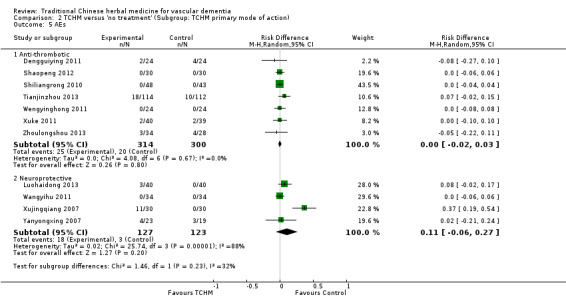
Comparison 2 TCHM versus 'no treatment' (Subgroup: TCHM primary mode of action), Outcome 5 AEs.
Anti‐thrombotic (RD 0.00, 95% CI −0.02 to 0.03, I2 = 0%; 7 studies, 614 participants). The overall risk of bias was high in five studies, mainly due to lack of blinding of participants (Figure 2). Due to the small event rate, the pooled result was not precise enough to exclude net benefit or harm.
Neuroprotective (RD 0.11, 95% CI −0.06 to 0.27, I2 = 88%; 4 studies, 250 participants). The overall risk of bias was high in all studies, mainly due to lack of blinding of participants (Figure 2) and inconsistency. The pooled point estimate favoured the control arm, but was imprecise.
In conclusion, we are uncertain about the safety effect estimates, as the overall risk of bias was high in nine of the 11 studies of the seven TCHMs, and the GRADE quality of evidence was low.
Secondary outcomes
4. Activities of daily living
Ten studies of six TCHMs reported daily functioning using what we suspected was a Chinese version of the Activities of Daily Living Questionnaire (Dengguiying 2011; Gaoli 2012; Lifuhui 2011; Luohaidong 2013; Shaopeng 2012; Wangyihu 2011; Wengyinghong 2011; Xuke 2011; Yaoxinsheng 2011; Analysis 1.6), but no details were given. Four TCHMs were tested in more than one study (FFDS, FFHS, NXT, YDXNT). One other study did not report the mean and standard deviation (FFDS: Tianjinzhou 2013) and we therefore do not include it in the forest plot. We summarise the results of the four TCHMs tested in more than one study below:
1.6. Analysis.
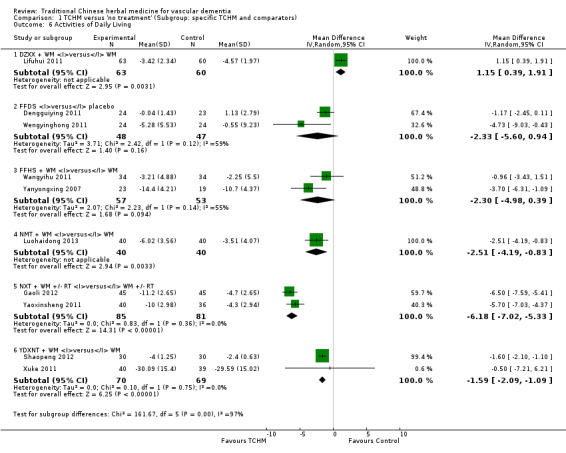
Comparison 1 TCHM versus 'no treatment' (Subgroup: specific TCHM and comparators), Outcome 6 Activities of Daily Living.
FFDS probably slightly improves daily functioning compared to 'no treatment' (MD −2.33, 95% CI −5.60 to 0.94, I2 = 59%; 2 studies, 95 participants; Analysis 1.6) with placebo in the control groups; low quality of evidence due to inconsistency and imprecision (Table 1). The pooled point estimate is of uncertain clinical significance, but the 95% CI indicates that FFDS might make little or no difference.
FFHS may slightly improve daily functioning compared to 'no treatment' (MD −2.30, 95% CI −4.98 to 0.39, I2 = 55%; 2 studies, 110 participants), WM (donepezil) in both treatment and control groups; low quality of evidence due to serious study limitations and imprecision (Table 2). The pooled point estimate is of uncertain clinical significance, but the 95% CI indicates that FFHS might make little or no difference.
NXT probably improves daily functioning compared to 'no treatment' (MD −6.18, 95% CI −7.02 to −5.33, I2 = 0%; 2 studies, 166 participants) with nimodipine (Gaoli 2012), nimodipine plus RT ( Yaoxinsheng 2011) in both treatment and control groups; moderate quality of evidence due to serious study limitations (Table 3). The pooled point estimate favoured TCHM and was precise.
YDXNT probably slightly improves daily functioning compared to 'no treatment' (MD −1.59, 95% CI −2.09 to −1.09, I2 = 0%; 2 studies, 139 participants) with nimodipine (Shaopeng 2012) and donepezil (Xuke 2011) in both treatment and control groups; moderate quality of evidence due to serious study limitations (Table 4). The pooled point estimate is of uncertain clinical significance, but the 95% CI indicates that YDXNT might make little or no difference.
Sensitivity analyses using different values of the correlation coefficient for the estimation of the SD of the change score negligibly changed the magnitude of the effects (Table 14).
Of the two TCHMs tested in single studies, both had a high overall risk of bias, and neither had potentially large effects, although both were statistically significant; one was in favour of the control (DZXX: Lifuhui 2011) and the other in favour of the TCHM (NMT: Luohaidong 2013).
There were two primary modes of action:
Anti‐thrombotic (MD −3.60, 95% CI −5.95 to −1.24, I2 = 95%, 6 studies, 400 participants, Analysis 2.6). The overall risk of bias was high in five of the six studies, mainly due to lack of blinding of participants (Figure 2), all individual study effects favoured TCHM but were inconsistent in magnitude.
Neuroprotective (MD −1.37, 95% CI −3.85 to 1.12, I2 = 88%; 4 studies, 313 participants). The overall risk of bias was high in all studies, mainly due to lack of blinding of participants (Figure 2). The pooled point estimate favoured TCHM but the study effects were inconsistent.
2.6. Analysis.
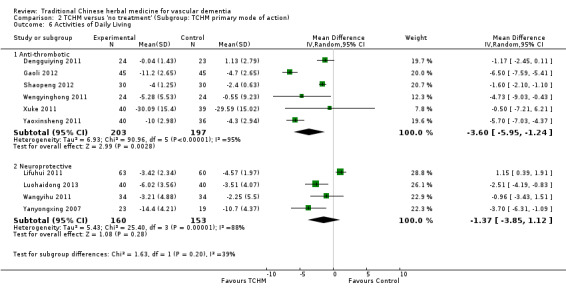
Comparison 2 TCHM versus 'no treatment' (Subgroup: TCHM primary mode of action), Outcome 6 Activities of Daily Living.
In conclusion, we are uncertain of the daily functioning effect estimates, as the overall risk of bias was high in nine of the 10 studies and the GRADE quality of evidence was low to moderate.
5. Behaviour
No studies assessed changes in behaviour.
Effect of TCHM versus Western medicine (WM)
We summarise the pooled effects for each of the five outcomes with specific TCHMs that were tested in more than one study. We do not report pooled effects across TCHMs because of clinical heterogeneity in the interventions in both experimental and control groups. We did not conduct sensitivity analyses when there was no pooling.
Primary outcomes
1. Cognition
All 31 studies assessed cognition, of which 15 used MMSE only (Baiweijie 2006; Chenhonghua 2008; Guoweiling 2009; Hanzucheng 2010; Haoweiping 2006; Heyuping 2006; Huanggenxian 2013; Lijingyi 2009; Mayu 2013; Piaozhiyong 2005; Wanghan 2004; Wuhongbin 2007; Zhangjianping 2006; Zhangyujin 2002; Zhengtaolin 2013), two used HDS only (Liushujuan 2002; Zhufengmei 2003), 11 used both MMSE and HDS (Dingyang 2005; Guoqingjun 2013; Hanxingguo 2007; Huangchaoyun 2004; Lican 2007; Qianrenyi 1999; Wangjingming 2007; Wanglinglin 2005; Zhangjinsheng 2003; Zhangyoutai 2012; Zhouwei 2009), two used MMSE and ADAS‐Cog (Yanyongxing 2007; Yudecai 2008), and one used MMSE, HDS and CCSE (Liuyujin 1997).
1.1 MMSE
Of the 29 studies using MMSE, four studies of three TCHMs (DZHS: Liuyujin 1997; NMT: Hanzucheng 2010; NXT: Huangchaoyun 2004; Zhangyoutai 2012) did not report either a mean or a measure of dispersion and we therefore did not include them in the forest plot. The remaining 25 studies tested 12 TCHMs (Analysis 3.1), five of them being tested in more than one study: FFHS, NMT, NXT, SFT, and TXL. All but one treatment effect favoured TCHM. our judgement of a clinically significant effect was based on two reported minimally clinically important difference (MCID) thresholds: ≥ 1.4 points (Howard 2011) and > 3 points (Qaseem 2008). We summarise the results of the five TCHMs tested in more than one study below:
3.1. Analysis.
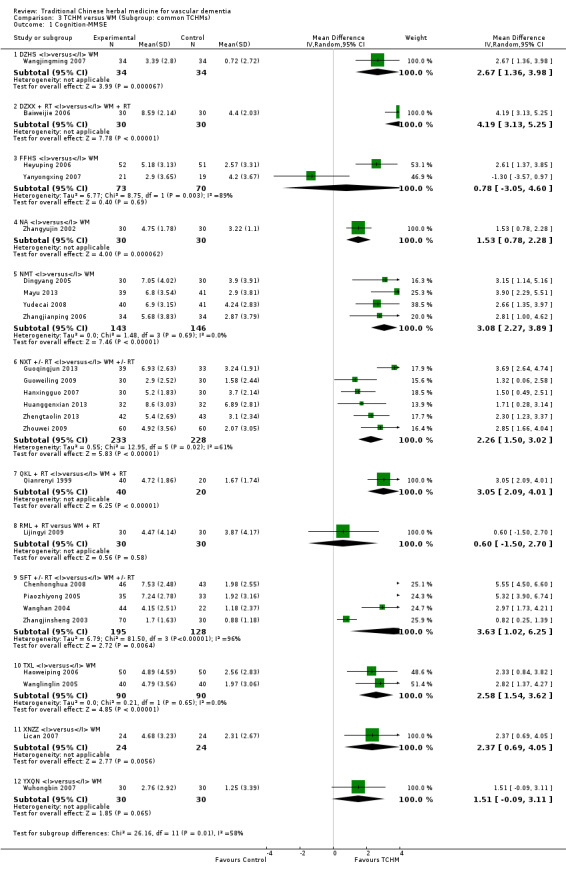
Comparison 3 TCHM versus WM (Subgroup: common TCHMs), Outcome 1 Cognition‐MMSE.
FFHS: we are very uncertain if FFHS improves cognition compared to WM (MD 0.78, 95% CI −3.05 to 4.60, I2 = 89%; 2 studies, 143 participants) with piracetam (Heyuping 2006) and donepezil (Yanyongxing 2007) in the control groups; very low quality of evidence due to serious study limitations, inconsistency and imprecision (Table 5). The pooled point estimate was not clinically significant by either the Howard 2011 or the Qaseem 2008 criteria.
NMT probably improves cognition compared to WM (MD 3.08, 95% CI 2.27 to 3.89, I2 = 0%; 4 studies, 289 participants) with sermion (Dingyang 2005), piracetam (Mayu 2013; Zhangjianping 2006), and cerebroprotein hydrolysate (Yudecai 2008) in the control groups; moderate quality of evidence due to serious study limitations (Table 6). The pooled point estimate was clinically significant by both criteria, and was precise.
NXTprobably slightly improves cognition compared to WM (MD 2.26, 95% CI 1.50 to 3.02, I2 = 61%; 6 studies, 461 participants) with nimodipine (Guoqingjun 2013), duxil (Guoweiling 2009), hydergine (Hanxingguo 2007), donepezil and RT (Huanggenxian 2013), oxiracetam (Zhengtaolin 2013) and aniracetam ( Zhouwei 2009) in the control groups. Huanggenxian 2013 also used RT in the TCHM group; moderate quality of evidence due to serious study limitations (Table 7). The pooled point estimate was clinically significant by the Howard 2011 criteria, and was precise.
SFT: we are very uncertain if SFT improves cognition compared to WM (MD 3.63, 95% CI 1.02 to 6.25, I2 = 96%; 4 studies, 323 participants) with citicoline and RT (Chenhonghua 2008); citicoline (Piaozhiyong 2005; Zhangjinsheng 2003) and piracetam (Wanghan 2004) in the control groups. Chenhonghua 2008 also used RT in the TCHM group; very low quality of evidence due to serious study limitations, inconsistency and imprecision (Table 9). The pooled point estimate was clinically significant by both criteria but the 95% CI indicates that SFT might make little or no difference.
TXL probably slightly improves cognition compared to WM (MD 2.58, 95% CI 1.54 to 3.62, I2 = 0%; 2 studies, 180 participants) with piracetam (Haoweiping 2006) and huperzine A (Wanglinglin 2005) in the control groups; moderate quality of evidence due to serious study limitations (Table 10). The pooled point estimate was clinically significant by the Howard 2011 criteria, and was precise.
Sensitivity analyses using different values of the correlation coefficient for the estimation of the SD of the change score did not change the magnitude of the effects (Table 16) .
6. Sensitivity analysis ‐ common TCHM ‐ vs WM.
| Outcome | TCHM | No of studies | No of participants | Summary statistics | ||||||
| TCHM | Control | rho = 0.25 | 95% CI | rho = 0.50 | 95% CI | rho = 0.75 | 95% CI | |||
| Cognition_MMSE (MD) | FFHS | 2 | 73 | 70 | 1.00 | −2.77 to 4.77 | 0.89 | −2.92 to 4.69 | 0.78 | −3.05 to 4.60 |
| NMT | 4 | 143 | 146 | 3.09 | 1.71 to 4.46 | 3.09 | 1.96 to 4.21 | 3.08 | 2.27 to 3.89 | |
| NXT | 6 | 233 | 228 | 2.27 | 1.52 to 3.03 | 2.28 | 1.53 to 3.02 | 2.26 | 1.50 to 3.02 | |
| SFT | 4 | 195 | 128 | 3.57 | 0.93 to 6.20 | 3.60 | 0.97 to 6.23 | 3.63 | 1.02 to 6.25 | |
| TXL | 2 | 90 | 90 | 2.53 | 0.99 to 4.06 | 2.54 | 1.22 to 3.86 | 2.58 | 1.54 to 3.62 | |
| Cognition_HDS (MD) | NXT | 3 | 129 | 129 | 1.76 | 0.21 to 3.30 | 1.78 | 0.25 to 3.31 | 1.80 | 0.31 to 3.30 |
| QKL | 2 | 86 | 64 | 2.91 | 1.25 to 4.57 | 2.84 | 1.17 to 4.51 | 2.77 | 1.11 to 4.43 | |
| ADL (MD) | FFHS | 2 | 73 | 70 | 1.21 | −4.99 to 7.41 | 1.28 | −4.93 to 7.49 | 1.35 | −4.86 to 7.56 |
| NXT | 3 | 113 | 114 | −4.66 | −6.25 to −3.07 | −4.67 | −5.99 to −3.35 | −4.72 | −5.85 to −3.58 | |
| SFT | 2 | 116 | 73 | −10.50 | −16.88 to −4.11 | −10.33 | −16.75 to −3.90 | −10.16 | −16.61 to −3.71 | |
ADAS‐Cog: Alzheimer's disease assessment scale: cognition subscale; ADL: activities of daily living; MD: mean difference; MMSE: Mini mental state examination; TCHM: traditional Chinese herbal medicine
Of the seven TCHMs (DZHS, DZXX, NA, QKL, RML, XNZZ, YXQN) tested in single studies, two had large and precise clinically significant effects in favour of TCHM: DZXX (MD 4.19, 95% CI 3.13 to 5.25; 60 participants (Baiweijie 2006)), QKL (MD 3.05, 95% CI 2.09 to 4.01; 60 participants (Qianrenyi 1999)), but both studies' overall risk of bias was high.
There were four primary modes of action, three with multiple studies (Analysis 4.1):
4.1. Analysis.
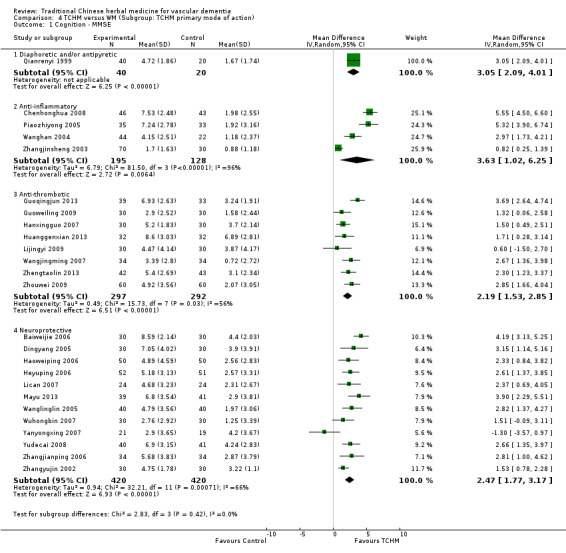
Comparison 4 TCHM versus WM (Subgroup: TCHM primary mode of action), Outcome 1 Cognition ‐ MMSE.
Diaphoretic or antipyretic, or both (MD 3.05, 95% CI 2.09 to 4.01; 1 study, 60 participants (Qianrenyi 1999)). The overall risk of bias was high, mainly due to lack of blinding of participants (Figure 2). The study effect favoured TCHM and was clinically significant by the Howard 2011 criteria, and was precise.
Anti‐inflammatory (MD 3.63, 95% CI 1.02 to 6.25, I2 = 96%; 4 studies, 323 participants). The overall risk of bias was high in all studies, mainly due to lack of blinding of participants (Figure 2). Each study favoured TCHM, but they were inconsistent in magnitude. The pooled point estimate was clinically significant by both criteria, but was imprecise.
Anti‐thrombotic (MD 2.19, 95% CI 1.53 to 2.85, I2 = 56%; 8 studies, 589 participants). The overall risk of bias was high in all studies, mainly due to lack of blinding of participants (Figure 2). All study effects favoured TCHM but they were moderately inconsistent in magnitude. The pooled point estimate was clinically significant by the Howard 2011 criteria, and was precise.
Neuroprotective (MD 2.47, 95% CI 1.77 to 3.17, I2 = 66%; 12 studies, 840 participants). The overall risk of bias was high in all studies, mainly due to lack of blinding of participants (Figure 2). All but one individual study favoured TCHM but they were moderately inconsistent in magnitude. The pooled point estimate was clinically significant by the Howard 2011 criteria, and was precise.
Sensitivity analyses using different values of the correlation coefficient for the estimation of the SD of the change score did not change the magnitude of the effects (Table 17).
7. Sensitivity analysis ‐ primary mode of action ‐ vs WM.
| Outcome | TCHM | No of studies | No of participants | Summary statistics | ||||||
| TCHM | Control | rho = 0.25 | 95% CI | rho = 0.50 | 95% CI | rho = 0.75 | 95% CI | |||
| Cognition_MMSE (MD) | Anti‐inflammation | 4 | 195 | 128 | 3.57 | 0.93 to 6.20 | 3.60 | 0.97 to 6.23 | 3.63 | 1.02 to 6.25 |
| Anti‐thrombotics | 8 | 297 | 292 | 2.21 | 1.56 to 2.86 | 2.21 | 1.55 to 2.86 | 2.19 | 1.53 to 2.85 | |
| Neuroprotection | 12 | 420 | 420 | 2.49 | 1.71 to 3.26 | 2.49 | 1.75 to 3.23 | 2.47 | 1.77 to 3.17 | |
| Cognition_ HDS (MD) | Diaphoretics and antipyretics | 2 | 86 | 64 | 2.91 | 1.25 to 4.57 | 2.84 | 1.17 to 4.51 | 2.77 | 1.11 to 4.43 |
| Anti‐thrombotics | 4 | 163 | 163 | 1.78 | 0.45 to 3.11 | 1.82 | 0.46 to 3.18 | 1.85 | 0.48 to 3.22 | |
| Cognition_ ADAS‐COG (MD) | Neuroprotection | 2 | 61 | 60 | 2.19 | 2.06 to 2.32 | 2.19 | 2.08 to 2.30 | 2.19 | 2.11 to 2.27 |
| ADL (SMD) | Anti‐inflammation | 2 | 116 | 73 | −0.73 | −1.36 to −0.11 | −0.90 | −1.66 to −0.13 | −1.27 | −2.35 to −0.19 |
| Anti‐thrombotics | 5 | 177 | 178 | −0.59 | −0.85 to −0.33 | −0.68 | −1.01 to −0.35 | −0.87 | −1.36 to −0.38 | |
| Neuroprotection | 6 | 207 | 204 | −0.77 | −1.43 to −0.11 | −0.75 | −1.43 to −0.08 | −0.73 | −1.44 to −0.01 | |
ADAS‐Cog: Alzheimer's disease assessment scale: cognition subscale; ADL: activities of daily living; MD: mean difference; MMSE: Mini mental state examination; TCHM: traditional Chinese herbal medicine
In conclusion, we are very uncertain of the MMSE effect estimates, as the overall risk of bias was high in all 25 studies of the 12 TCHMs, and the GRADE quality of evidence ranged from moderate to very low.
1.2 HDS
Eleven studies used HDS to test eight TCHMs (Analysis 3.2), with two tested in multiple studies (NXT, QKL) and six single‐study comparisons (DZHS, HQ + DS, NMT, SFT, TXL, XNZZ). Three other studies reported neither an average nor a measure of dispersion (NXT: Huangchaoyun 2004; Zhangyoutai 2012; DZHS: Liuyujin 1997) and we therefore did not include them in the forest plot.
3.2. Analysis.
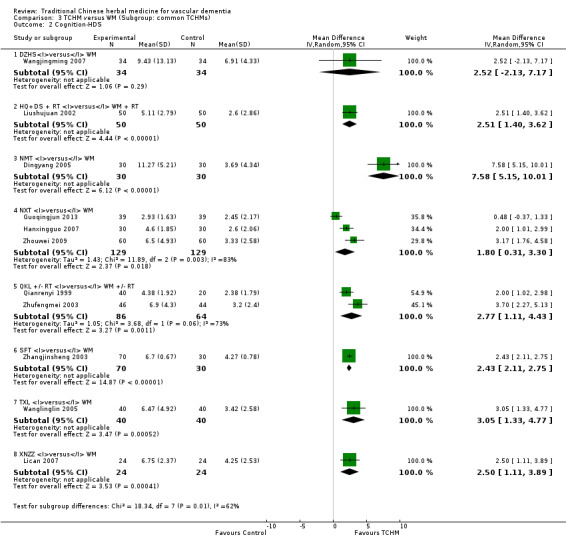
Comparison 3 TCHM versus WM (Subgroup: common TCHMs), Outcome 2 Cognition‐HDS.
We summarise the results of the two TCHMs tested in more than one study below:
NXT may slightly improve cognition compared to WM (MD 1.80, 95% CI 0.31 to 3.30, I2 = 83%; 3 studies, 258 participants) with nimodipine (Guoqingjun 2013), hydergine (Hanxingguo 2007), and aniracetam (Zhouwei 2009) in the control groups; low quality of evidence due to serious study limitations and inconsistency (Table 7). The pooled estimate is of uncertain clinical significance and the 95% CI indicates that NXT might make little or no difference.
QKL may slightly improve cognition compared to WM (MD 2.77, 95% CI 1.11 to 4.43, I2 = 73%; 2 studies, 150 participants) with citicoline and RT (Qianrenyi 1999), citocoline and piracetam (Zhufengmei 2003) in the control groups. Qianrenyi 1999 also used RT in the TCHM group; low quality of evidence due to serious study limitations and inconsistency (Table 8). The pooled estimate is of uncertain clinical significance and the 95% CI indicates that QKL might make little or no difference.
Of the six TCHMs tested in single studies, two had potentially large effects in favour of TCHM, with the lower bound of the 95% CI for the MD greater than or equal to 2.0: NMT (MD 7.58, 95% CI 5.15 to 10.01, Dingyang 2005; 60 participants), SFT (MD 2.43, 95% CI 2.11 to 2.75, Zhangjinsheng 2003; 100 participants), but their overall risk of bias was high.
There were four primary modes of action, all with multiple studies (Analysis 4.2):
4.2. Analysis.
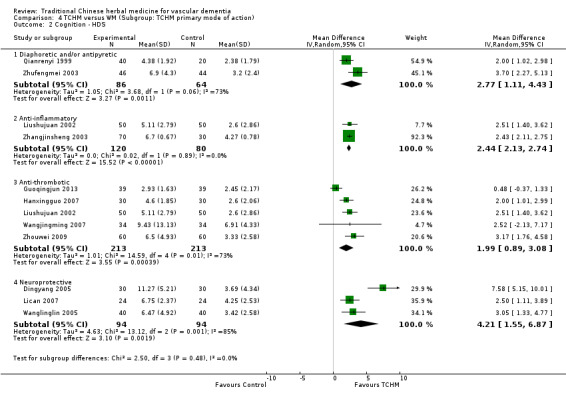
Comparison 4 TCHM versus WM (Subgroup: TCHM primary mode of action), Outcome 2 Cognition ‐ HDS.
Diaphoretic or antipyretic, or both: this is the same group of studies summarised for QKL above.
Anti‐inflammatory (MD 2.44, 95% CI 2.13 to 2.74, I2 = 0%; 2 studies, 200 participants). The overall risk of bias was high in both studies, mainly due to lack of blinding of participants (Figure 2). Each study favoured TCHM and they were consistent in magnitude. The pooled estimate was statistically significant and precise.
Anti‐thrombotic (MD 1.99, 95% CI 0.89 to 3.08, I2 = 73%; 5 studies, 426 participants). The overall risk of bias was high in all studies, mainly due to lack of blinding of participants (Figure 2). All study effects favoured TCHM but they were inconsistent in magnitude. The pooled estimate was statistically significant but imprecise.
Neuroprotective (MD 4.21, 95% CI 1.55 to 6.87, I2 = 85%; 3 studies, 188 participants). The overall risk of bias was high in all studies, mainly due to lack of blinding of participants (Figure 2). All study effects favoured TCHM but they were inconsistent in magnitude. The pooled point estimate was statistically significant but imprecise.
The Liushujuan 2002 study appears twice in Analysis 4.2, because a combination of two TCHMs were used one with anti‐inflammatory action (HQ) and the other with anti‐thrombotic action (DS).
In conclusion, we are very uncertain of the HDS effect estimates, as the overall risk of bias was high in all 11 studies of the eight TCHMs, and the GRADE quality of evidence was low.
1.3 ADAS‐Cog
Both TCHMs that used HDS to measure outcomes were tested in single studies (FFHS, NMT; Analysis 3.3). Both studies had a high overall risk of bias, mainly due to lack of blinding of participants (Figure 2). Treatment effects consistently favoured the control group.
3.3. Analysis.
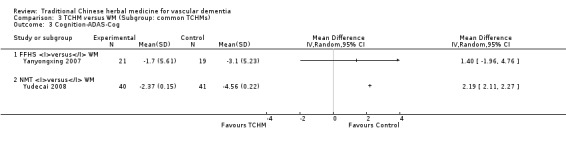
Comparison 3 TCHM versus WM (Subgroup: common TCHMs), Outcome 3 Cognition‐ADAS‐Cog.
There was one primary mode of action (Analysis 4.3):
4.3. Analysis.
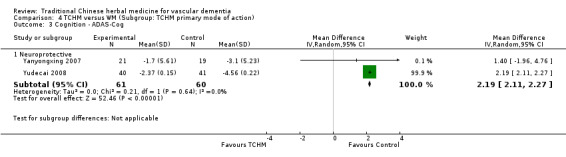
Comparison 4 TCHM versus WM (Subgroup: TCHM primary mode of action), Outcome 3 Cognition ‐ ADAS‐Cog.
Neuroprotective (MD 2.19, 95% CI 2.11 to 2.27, I2 = 0%; 2 studies, 121 participants). Both studies had a high overall risk of bias, mainly due to lack of blinding of participants (Figure 2). Treatment effects consistently favoured the control group.
Sensitivity analyses using different values of the correlation coefficient for the estimation of the SD of the change score did not change the magnitude of the effects (Table 17).
In conclusion, we are very uncertain of the ADAS‐Cog effect estimates, as the overall risk of bias was high in both studies.
1.4 Other cognitive outcomes
Only one study comparing DZHS versus hydergine used the CCSE (Liuyujin 1997). However, the investigators did not report quantitative results (means and standard deviations), but only mentioned that the difference was not statistically significant at the 5% level.
2. Global performance
Nineteen studies reported global performance but nine of them derived it secondarily from the primary MMSE, HDS or ADL assessment ( Huangchaoyun 2004; Jiangyouyi 2006; Shiliangrong 2010; Wangyihu 2011; Wengyinghong 2011; Yaoxinsheng 2011; Zhangtao 2000; Zhoulongshou 2013; Zhouqiang 2003). We therefore have not analysed these results, to avoid double‐counting. The remaining 10 studies of eight TCHMs (Analysis 3.4) assessed global performance using an ordinal scale: seven studies used three categories: 'very effective'' "effective', 'no effect' (Lican 2007; Liuyujin 1997; Mayu 2013; Zhangjinsheng 2003; Zhangyoutai 2012; Zhangyujin 2002; Zhouwei 2009), including one study that categorised the Sandoz Clinical Assessment‐Geriatric Scale (Liuyujin 1997). Three studies used four categories: 'very effective', 'effective', 'clinical control/almost normal', 'no effect or worsening' (Haoweiping 2006; Lijingyi 2009; Wanglinglin 2005). We dichotomised global performance into 'improvement' (the event of interest) and 'no improvement' (non‐events). 'Improvement' comprised those participants for whom the treatment was 'very effective', 'effective' or resulted in an 'almost normal' status, whilst 'no improvement' comprised those for whom the treatment had 'no effect' or caused a worsening of state. All treatment effects favoured TCHM. A risk ratio greater than one indicates a greater chance of improvement in global performance in the TCHM compared to the control group. We summarise the results of the two TCHMs tested in more than one study below:
3.4. Analysis.
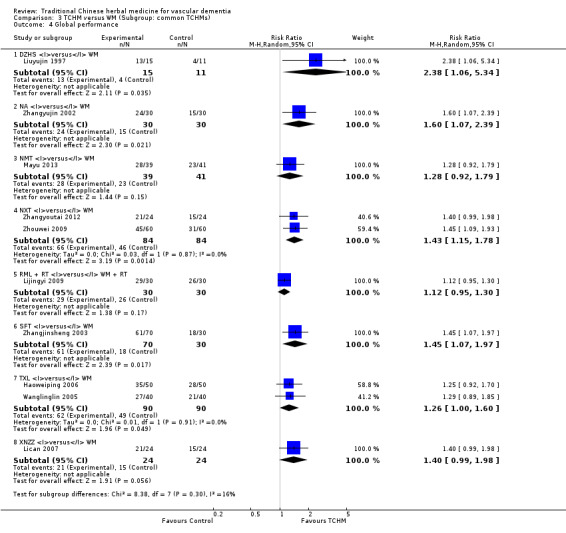
Comparison 3 TCHM versus WM (Subgroup: common TCHMs), Outcome 4 Global performance.
NXT probably slightly improves global performance compared to WM (RR 1.43, 95% CI 1.15 to 1.78, I2 = 0%; 2 studies, 168 participants; Analysis 3.4) with duxil and nimodipine (Zhangyoutai 2012) and aniracetam (Zhouwei 2009) in the control groups; moderate quality of evidence due to serious study limitations (Table 7). The 95% CI indicates that NXT might make little or no difference.
TXL may make little or no difference to global performance compared to WM (RR 1.26, 95% CI 1.00 to 1.60, I2 = 0%; 2 studies, 180 participants) with piracetam (Haoweiping 2006) and huperzine A (Wanglinglin 2005) in the control groups; low quality of evidence due to serious study limitations and imprecision (Table 10).
Of the six TCHMs tested in a single study, all had a high overall risk of bias and none had potentially large effects (lower bound of the 95% CI for the RR greater than or equal to 1.5) in favour of TCHM.
There were three primary modes of action, two with multiple studies:
Anti‐inflammatory (RR 1.45, 95% CI 1.07 to 1.97; 1 study, 100 participants; Analysis 4.4). The overall risk of bias was high and the result was not of clinical significance.
Anti‐thrombotic (RR 1.37, 95% CI 1.03 to 1.81, I2 = 68%; 4 studies, 254 participants). The overall risk of bias was high in all studies, mainly due to lack of blinding of participants (Figure 2). All individual study effects favoured TCHM but were inconsistent in magnitude. The pooled estimate was statistically significant but imprecise.
Neuroprotective (RR 1.34, 95% CI 1.15 to 1.56, I2 = 0%; 5 studies, 368 participants). The overall risk of bias was high in all studies, mainly due to lack of blinding of participants (Figure 2). All individual study effects favoured TCHM and were consistent in magnitude. The pooled estimate was statistically significant and precise.
4.4. Analysis.
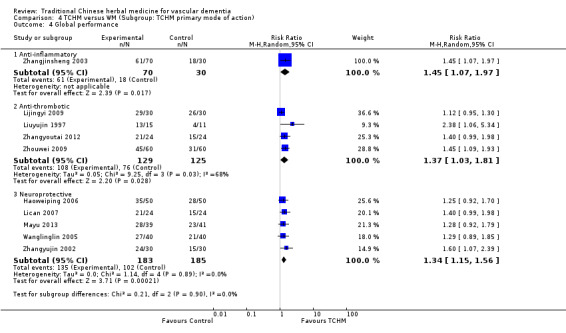
Comparison 4 TCHM versus WM (Subgroup: TCHM primary mode of action), Outcome 4 Global performance.
In conclusion, we are very uncertain about the global performance effect estimates as the overall risk of bias was high in all 10 studies of the eight TCHMs, and the GRADE quality of evidence was low.
3. Adverse events
Twenty‐two studies reported AEs on 10 TCHMs (DZHS, FFHS, NA, NMT, NXT, QKL, RML, SFT, TXL, XNZZ; Analysis 3.5). The median proportion of participants experiencing adverse events in these studies was 1.25% (range TCHM group: 0% to 30.6%; Control group: 0% to 45%). One study might have had dropouts because of AEs (Huangchaoyun 2004).
3.5. Analysis.
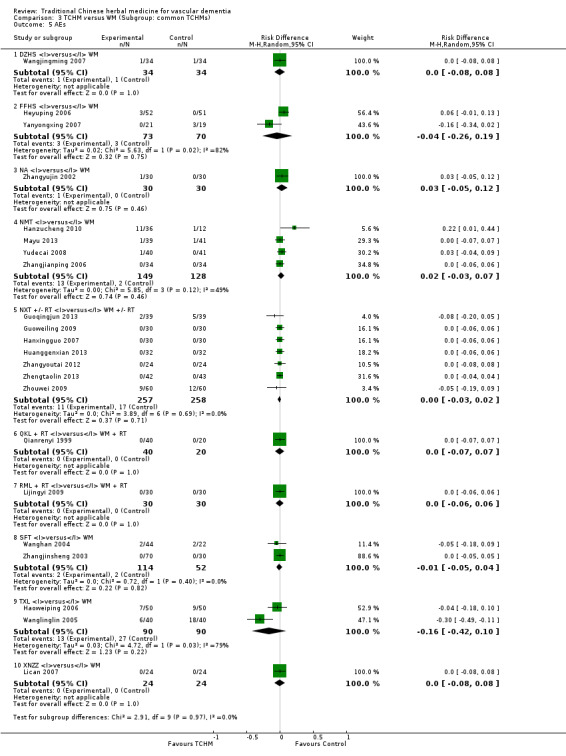
Comparison 3 TCHM versus WM (Subgroup: common TCHMs), Outcome 5 AEs.
A risk ratio less than one or a risk difference less than zero indicates a lower chance of participants experiencing one or more AEs in the TCHM compared to the control group. We summarise the results of the five TCHMs tested in more than one study below:
FFHS: we are very uncertain if FFHS changes the risk of AEs compared to WM (RD −0.04, 95% CI −0.26 to 0.19, I2 = 82%; 2 studies, 143 participants) with piracetam (Heyuping 2006) and donepizil (Yanyongxing 2007) in the control groups; very low quality of evidence due to serious study limitations, inconsistency and imprecision (Table 5).
NMT: we are very uncertain if NMT changes the risk of AEs compared to WM (RD 0.02, 95% CI −0.03 to 0.07, I2 = 49%; 4 studies, 277 participants) with hydergine (Hanzucheng 2010), piracetam (Mayu 2013; Zhangjianping 2006), and cerebroprotein hydrolysate (Yudecai 2008) in the control groups; very low quality of evidence due to serious study limitations, inconsistency and imprecision (Table 6).
NXT probably makes little or no difference to the risk of AEs compared to WM (RD 0.00, 95% CI −0.03 to 0.02, I2 = 0%; 7 studies, 515 participants) with nimodipine (Guoqingjun 2013), duxil (Guoweiling 2009), hydergine (Hanxingguo 2007), donepezil and RT (Huanggenxian 2013), duxil and nimodipine (Zhangyoutai 2012), oxiracetam (Zhengtaolin 2013) and aniracetam ( Zhouwei 2009) in the control groups; moderate quality of evidence due to serious study limitations (Table 7).
SFT may make little or no difference to the risk of AEs compared to WM (RD −0.01, 95% CI −0.05 to 0.04, I2 = 0%; 2 studies, 166 participants) with piracetam (Wanghan 2004) and citicoline (Zhangjinsheng 2003) in the control groups; low quality of evidence due to serious study limitations and imprecision (Table 9).
TXL may slightly decrease the risk of AEs compared to WM (RD −0.16, 95% CI −0.42 to 0.10, I2 = 79%; 2 studies, 180 participants) with piracetam (Haoweiping 2006) and huperzine A (Wanglinglin 2005); low quality of evidence due to serious study limitations and imprecision (Table 10). The 95% CI indicates that TXL might make little or no difference.
Of the five TCHMs tested in single studies, all had a high overall risk of bias. Four studies reported no difference: DZHS (RD 0.00, 95% CI −0.08 to 0.08, 68 participants (Wangjingming 2007)), QKL (RD 0.00, 95% CI −0.07 to 0.07, 60 participants (Qianrenyi 1999)), RML (RD 0.00, 95% CI −0.06 to 0.06, 60 participants (Lijingyi 2009)), XNZZ (RD 0.00, 95% CI −0.08 to 0.08, 48 participants (Lican 2007)) and the remaining one reported a small effect in favour of control: NA (RD 0.03, 95% CI −0.05 to 0.12, 60 participants (Zhangyujin 2002)).
There were four primary modes of action, three with multiple studies (Analysis 4.5):
4.5. Analysis.
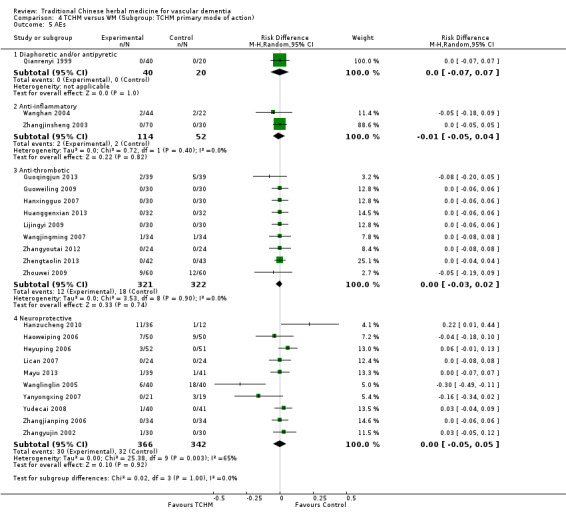
Comparison 4 TCHM versus WM (Subgroup: TCHM primary mode of action), Outcome 5 AEs.
Diaphoretic or antipyretic or both (RD 0.00 95% CI −0.07 to 0.07; 1 study, 60 participants (Qianrenyi 1999)). The overall risk of bias was high and the result imprecise.
Anti‐inflammatory (RD −0.01, 95% CI −0.05 to 0.04, I2 = 0%; 2 studies,166 participants (Wanghan 2004; Zhangjinsheng 2003)). The overall risk of bias was high in both studies, mainly due to lack of blinding of participants (Figure 2). The individual study effects were consistent. The pooled point estimate was not statistically significant and was imprecise.
Anti‐thrombotic (RD 0.00, 95% CI −0.03 to 0.02, I2 = 0%; 9 studies, 643 participants). The overall risk of bias was high in all studies, mainly due to lack of blinding of participants (Figure 2). Two individual study effects favoured TCHM and the rest showed no difference between the groups. The pooled point estimate was not statistically significant and was imprecise.
Neuroprotective (RD −0.00, 95% CI −0.05 to 0.05, I2 = 65%; 10 studies, 708 participants). The overall risk of bias was high in all studies, mainly due to lack of blinding of participants (Figure 2). Three individual study effects favoured TCHM but the estimates were generally inconsistent. The pooled point estimate was not statistically significant and was imprecise.
In conclusion, we are uncertain about the safety effect estimates, as the overall risk of bias was high in all 22 studies of the 10 TCHMs, and the GRADE quality of evidence ranged from moderate to very low.
Secondary outcomes
4. Activities of Daily Living
Fourteen of 31 studies reported daily functioning; 13 used what we suspected was a Chinese version of the Activities of Daily Living Questionnaire (Chenhonghua 2008; Guoqingjun 2013; Heyuping 2006; Huanggenxian 2013; Lican 2007; Lijingyi 2009; Qianrenyi 1999; Wangjingming 2007; Wuhongbin 2007; Yanyongxing 2007; Zhangjianping 2006; Zhangyujin 2002; Zhengtaolin 2013; Analysis 3.6), but no details were given. The remaining study (Haoweiping 2006) used the IADL Questionnaire, but the exact version (either five‐ or eight‐item) was not specified. Three TCHMs were tested in more than one study (FFHS, NXT, SFT). We summarise the results of the three TCHMs tested in more than one study below:
3.6. Analysis.
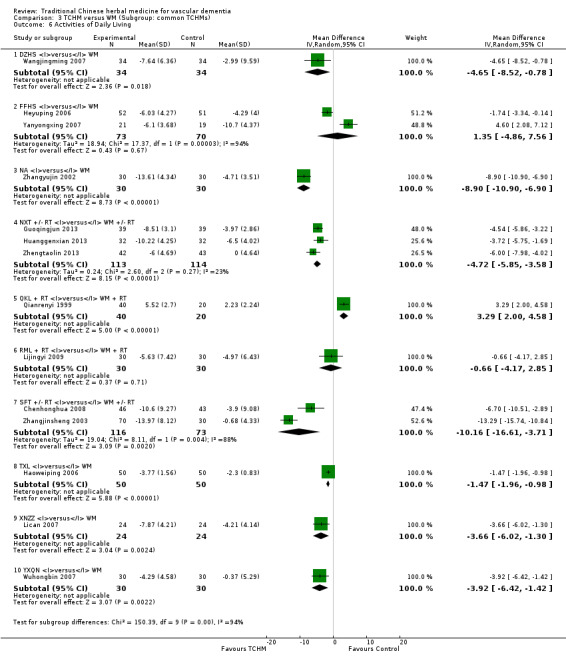
Comparison 3 TCHM versus WM (Subgroup: common TCHMs), Outcome 6 Activities of Daily Living.
FFHS: we are very uncertain if FFHS affects daily functioning compared to WM (MD 1.35, 95% CI −4.86 to 7.56, I2 = 94%; 2 studies, 143 participants) with piracetam (Heyuping 2006) and donepezil (Yanyongxing 2007) in the control groups; very low quality of evidence due to serious study limitations, inconsistency and imprecision (Table 5). The pooled point estimate favoured WM but the 95% CI indicates that FFHS might make little or no difference.
NXT probably improves daily functioning compared to WM (MD −4.72, 95% CI −5.85 to −3.58, I2 = 23%; 3 studies, 227 participants) with nimodipine (Guoqingjun 2013), donepezil and RT (Huanggenxian 2013) and oxiracetam (Zhengtaolin 2013) in the control groups; moderate quality of evidence due to serious study limitations (Table 7). The pooled estimate favoured TCHM and was consistent and precise.
SFT: we are very uncertain if SFT improves daily functioning compared to WM (MD −10.16, 95% CI −16.61 to −3.71, I2 = 88%; 2 studies, 189 participants) with citicoline and RT (Chenhonghua 2008) and citicoline (Zhangjinsheng 2003) in the control groups; very low quality of evidence due to serious study limitations, inconsistency and imprecision (Table 9). The pooled estimate favoured TCHM but was inconsistent.
Of the seven TCHMs tested in single studies, three reported potentially large effects, two in favour of TCHM: NA (MD −8.90, 95% CI −10.90 to −6.90, 60 participants (Zhangyujin 2002)); XNZZ (MD −3.66, 95% CI −6.02 to −1.30, 48 participants (Lican 2007)); and one in favour of control: QKL (MD 3.29, 95% CI 2.00 to 4.58, 60 participants (Qianrenyi 1999)). But all three had a high overall risk of bias.
Sensitivity analyses using different values of the correlation coefficient for the estimation of the SD of the change score negligibly changed the magnitude of the effects (Table 16).
There were four primary modes of actions, three with multiple studies (Analysis 4.6):
4.6. Analysis.

Comparison 4 TCHM versus WM (Subgroup: TCHM primary mode of action), Outcome 6 Activities of Daily Living.
Diaphoretic or antipyretic or both (MD 1.27 95% CI 0.68 to 1.86; 1 study, 60 participants, Qianrenyi 1999). The overall risk of bias was high.
Anti‐inflammatory (MD ‐10.16, 95% CI ‐16.61 to ‐3.71, I2 = 88%; 2 studies, 189 participants). The overall risk of bias was high in both studies, mainly due to lack of blinding of participants (Figure 2). The individual study effects were inconsistent. The pooled estimate was statistically significant but imprecise.
Anti‐thrombotic (MD ‐4.26, 95% CI ‐5.63 to ‐2.90, I2 = 46%; 5 studies, 355 participants). The overall risk of bias was high, mainly due to lack of blinding of participants (Figure 2). All treatment effects favoured TCHM and were moderately inconsistent. The pooled estimate was statistically significant and precise.
Neuroprotective (MD −2.54, 95% CI −5.19 to 0.11, I2 = 94%; 6 studies, 411 participants). The overall risk of bias was high in all studies, mainly due to lack of blinding of participants (Figure 2). The pooled estimate favoured TCHM but the study effects were inconsistent.
Sensitivity analyses using different values of the correlation coefficient for the estimation of the SD of the change score negligibly changed the magnitude of the effects (Table 17). Also there was minimal impact of using the RD effect measure (rather than the SMD) to pool the results of the single study that used the IADL Questionnaire (Haoweiping 2006) with the five others that used the Chinese ADL Questionnaire for the neuroprotective TCHMs.
In conclusion, we are uncertain about the ADL effect estimates as the overall risk of bias was high in all 14 studies of the 10 TCHMs, and the GRADE quality of evidence ranged from moderate to very low.
5. Behaviour
Only one study validly using TXL assessed behaviour (Haoweiping 2006;Analysis 3.7, Analysis 4.7), using the Neuropsychiatric Inventory Scale, (MD −9.00, 95% CI −13.33 to −4.67; 100 participants). The overall risk of bias was high due to lack of blinding of participants (Figure 2). The treatment effect favoured TCHM and was potentially large but we are uncertain about the behaviour effect estimate, as the overall risk of bias was high and the treatment estimate imprecise.
3.7. Analysis.
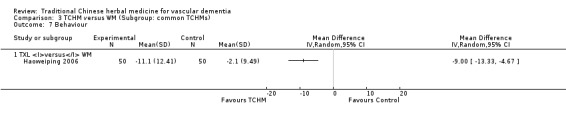
Comparison 3 TCHM versus WM (Subgroup: common TCHMs), Outcome 7 Behaviour.
4.7. Analysis.
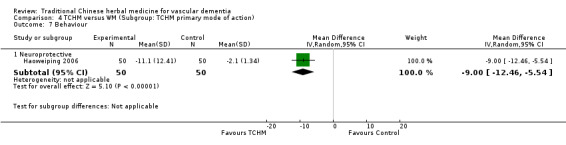
Comparison 4 TCHM versus WM (Subgroup: TCHM primary mode of action), Outcome 7 Behaviour.
Discussion
Vascular dementia (VaD) is not a condition explicitly recognised in classical TCM theory, so there is no specific set of TCHM prescriptions for VaD. Here we identify potentially useful therapies from published clinical trials of TCHMs that were also listed in the Chinese Pharmacopoeia or the Chinese National Essential Drug List.
We included 47 studies (3581 participants) of 18 TCHMs, of which (by primary mode of action) seven were anti‐thrombotic (CXQ, DZHS, FFDS, GGS, NXT, RML and YDXNT), eight were neuroprotective (DZXX, FFHS, NA, NMT, TXL, XNZZ, YXQN and ZZW); two were anti‐inflammatory (SFT and HQ) and one was diaphoretic/antipyretic (QKL). We did not find eligible studies for 11 TCHMs (CWJ, DS, HTZZ, KNS, LM, MLN, SM, SQFZ, TJTT, XNJ and XST).
Summary of main results
Effect of TCHM versus 'no treatment'
We addressed the effect of traditional Chinese herbal medicine (TCHM) versus 'no treatment' in four different ways (see Table 3). The studies of TCHM alone versus placebo directly estimate the effect of TCHM versus no treatment. The other three types of studies estimate that effect in the presence of an additional intervention common to both intervention groups; either Western medicine (WM), routine therapy (RT), or both. The overall risk of bias was high in 17 of the 18 studies and unclear in the remaining one. This was because of a lack of blinding of participants, caregivers and outcome assessors which threatened the validity of all the subjective outcome assessments. Only Wengyinghong 2011 ensured blinding by using a placebo control.
For the two primary efficacy outcomes (cognition, global performance), other than the problem of unblinded assessment, there were generally no issues with the incomplete data or selective reporting domains. The cognition treatment effects of the four TCHMs with multiple studies were consistently in favour of TCHM and clinically significant by at least one of the two criteria (MMSE), but we are very uncertain of the benefits for cognition because of the low GRADE quality of evidence (MMSE, HDS, ADAS‐Cog) and the small number of studies (HDS, ADAS‐Cog). For the two studies that measured global performance independent of cognition, we could not extract usable results from one study and we have very low certainty about the other study's result as it was imprecise.
For the primary safety outcome (one or more adverse events (AEs)), we judged nine of 11 studies as having unclear or high risk of bias both for the incomplete outcome data and the selective reporting domains. For the three TCHMs with multiple studies, the point estimates were at or very close to no difference, but we have low certainty about these estimates because of the low GRADE quality of evidence.
For the two secondary outcomes (activities of daily living (ADL), behaviour), we judged seven of 10 studies that reported ADL as having unclear or high risk of bias for the incomplete outcome data domain. There were no issues with the selective reporting domain. For the four TCHMs with multiple studies, although the treatment effect was in favour of TCHM, we are uncertain about the ADL estimates because the GRADE quality of evidence ranged from moderate to low. No studies assessed behaviour.
When classified by primary mode of action, all the cognition effects were in favour of TCHM; antithrombotics appeared to have a slightly greater efficacy than neuroprotectives, but we are very uncertain about the effects. For the safety outcome, the estimate for antithrombotics is closer to no difference than for neuroprotectives (slightly in favour of control), but our certainty is low. For the ADL outcome, the effect is slightly in favour of TCHM, with antithrombotics slightly better than neuroprotectives, but our certainty is low.
The table below summarises those TCHMs for which the reported results suggested either a clinically significant or a potentially large benefit compared to no treatment.
Table of TCHMs with clinically significant or potentially large efficacy effects versus 'no treatment'
| TCHM | Effect | Outcome | Reference |
| CXQ | MD 6.10, 95% CI 4.47 to 7.73 MD 5.40, 95% CI 3.91 to 6.89 |
Cognition‐MMSE Cognition‐HDS |
Shiliangrong 2010 |
| FFDS | MD 3.00, 95% CI −0.39 to 6.39 MD −4.34, 95% CI −6.23 to −2.46 |
Cognition‐MMSE Cognition‐ADAS |
Table 1 |
| FFHS | MD 1.42, 95% CI 0.21 to 2.63 | Cognition‐MMSE | Table 2 |
| NXT | MD 4.29, 95% CI 2.66 to 5.93 MD 5.50, 95% CI 4.20 to 6.80 MD −6.18, 95% CI −7.02 to −5.33 |
Cognition‐MMSE Cognition‐HDS ADL |
Table 3 Jiangyouyi 2006 Table 3 |
| TXL | MD 4.12, 95% CI 3.28 to 4.96 | Cognition‐HDS | Xujingqiang 2007 |
| YDXNT | MD 1.61, 95% CI 0.74 to 2.48 | Cognition‐MMSE | Table 4 |
| ZZW | MD 6.00, 95% CI 4.71 to 7.29 | Cognition‐HDS | Zhouqiang 2003 |
The table below summarises those TCHMs for which the reported results suggest a 5% or more increased risk of AEs in favour of control.
Table of TCHMs with greater than 5% increased risk of AEs versus 'no treatment'
| TCHM | Effect | Reference |
| NMT | RD 0.07, 95% CI −0.02 to 0.17 | Luohaidong 2013 |
| TXL | RD 0.37, 95% CI 0.19 to 0.54 | Xujingqiang 2007 |
Effect of TCHM versus WM
We addressed the effect of TCHM versus WM in two different ways (see Table 3). The studies of TCHM alone versus WM directly estimate the effect of TCHM versus WM. The other type of study estimates the effect in the presence of additional RT common to both intervention groups. The overall risk of bias was high in all 31 studies. This was because of a lack of blinding of participants, caregivers and outcome assessors which threatened the validity of all the subjective outcome assessments.
For the primary cognition outcome, we judged 10 of 31 studies as having unclear or high risk of bias for the incomplete outcome data domain and four of 31 studies as having unclear or high risk of bias for the selective reporting domain. For the five TCHMs with multiple studies, although the cognition treatment effects were consistently in favour of TCHM and clinically significant by at least one of the two criteria (MMSE), we are very uncertain about the MMSE effect estimates because the GRADE quality of evidence ranged from moderate to very low.
For the primary global performance outcome, we judged two of 10 studies as having unclear or high risk of bias for the incomplete outcome data domain and none as having unclear or high risk of bias for the selective reporting domain. For the two TCHMs with multiple studies, although the treatment effects were consistently in favour of TCHM, we are uncertain of the global performance effect estimates because the GRADE quality of evidence ranged from moderate to low.
For the primary safety outcome, we judged 16 of 31 studies as having unclear or high risk of bias for the incomplete outcome data domain, and 17 of 31 as having unclear or high risk of bias for the selective reporting domain. For the five TCHMs with multiple studies, the point estimates were at or very close to no difference (three TCHMs) or favoured TCHM (two TCHMs), but we have low confidence in these estimates because the GRADE quality of evidence ranged from moderate to very low.
For the secondary outcomes (ADL, behaviour), we judged five of 14 studies that reported ADL as having unclear or high risk of bias for the incomplete outcome data domain, and two of 14 studies as having unclear or high risk of bias for the selective reporting domain. For three TCHMs with multiple studies, two favoured TCHM, but we have low certainty about these estimates because the GRADE quality of evidence ranged from moderate to very low. For the two studies that measured behaviour, we could not extract usable results from one study and we have low certainty about the other study's result which favoured TCHM as it was imprecise.
When classified by primary mode of action, all the cognition effects were in favour of TCHM. Anti‐inflammatories appeared to have a slightly greater efficacy than antithrombotics and neuroprotectives, but we are very uncertain about the effects. For the safety outcome, all estimates are very close to no difference, but our certainty is low, especially for the neuroprotectives, because of inconsistency. For the ADL outcome, the effect is in favour of TCHM for anti‐inflammatories, antithrombotics and neuroprotectives, but not for diaphoretics/antipyretics (single study), but our certainty is low because of inconsistency.
The table below summarises those TCHMs for which the reported results suggested either a clinically significant or a potentially large benefit compared to no treatment. Our definition of a 'potentially large' benefit was that the 95% CI lower bound for the MD of the HDS, ADAS‐Cog and ADL MD should be 2.0 or more, and for global performance the 95% CI lower bound of the RR should be 1.5 or more.
Table of TCHMs with clinically significant or potentially large efficacy effects versus WM
| TCHM | Effect | Outcome | Reference |
| DZXX | MD 4.19, 95% CI 3.13 to 5.25 | Cognition‐MMSE | Baiweijie 2006 |
| NA | MD −8.90, 95% CI −10.90 to −6.90 | ADL | Zhangyujin 2002 |
| NMT | MD 3.08, 95% CI 2.27 to 3.89 MD 7.58, 95% CI 5.15 to 10.01 MD 2.19, 95% CI 2.11 to 2.27 |
Cognition‐MMSE Cognition‐HDS Cognition‐ADAS |
Table 6 Dingyang 2005 Yudecai 2008 |
| NXT | MD 2.26, 95% CI 1.50 to 3.02 MD −4.72, 95% CI −5.85 to −3.58 |
Cognition‐MMSE ADL |
Table 7 |
| QKL | MD 3.05, 95% CI 2.09 to 4.01 | Cognition‐MMSE | Qianrenyi 1999 |
| SFT | MD 2.43, 95% CI 2.11 to 2.75 | Cognition‐HDS | Zhangjinsheng 2003 |
| TXL | MD 2.58, 95% CI 1.54 to 3.62 MD −9.00, 95% CI −13.33 to −4.67 |
Cognition‐MMSE Behaviour |
Table 10 |
There were no TCHMs in which the risk of AEs was greater than 5% compared to the WM control.
Overall completeness and applicability of evidence
Trial setting
All 47 included studies were conducted in China between 1997 and 2015. Trials were conducted in either TCM (28%) or non‐TCM (72%) hospital settings. Most of the trials conducted in non‐TCM hospital settings were in Level III hospitals (with the highest capability). Nearly all trials recruited participants in tertiary care settings.
Characteristics of randomised participants
In terms of gender and age distribution, men accounted for between 45% and 88% of participants across studies; the median age was approximately 67 years, with a range of 43 to 96 years. Participants were diagnosed according to one or a combination of the following criteria: DSM (versions III, III‐R, IV, IV‐R), ICD‐10, NINDS‐AIREN and Hachinski Ischaemic Score. Onset of treatment from stroke diagnosis was from 1 month to 30 years, with a median of 2.3 years. The duration of treatment was relatively short, between 2 and 24 weeks with a median of 12 weeks.
Differences between trial protocol and routine practice
We could not ascertain whether the administration of the reviewed interventions differed in routine clinical practice (e.g. in formulation and bioavailability of TCHMs) or whether the control group used a less than optimal dose of what is recommended as best practice.
Outcome measures and follow‐up
Almost all of the assessment tools used to assess cognition (e.g. MMSE, ADAS‐Cog, CDT, CCSE), daily function (ADL, IADL) and behaviour (NPI, BBS) were developed originally for native English speakers in North America or in Europe. The measurement properties (reliability, validity and responsiveness) of the Chinese versions of these scales are not well‐established. There was little information on the short‐term TCHM effect on behaviour and global performance. The results for the global performance outcome are also not likely to be generalisable outside of China, as TCM criteria are incorporated into its assessment.
The safety results were incomplete due to partial or under‐reporting. Trials generally did not precisely report the number of participants who dropped out for treatment‐related reasons. Using the total dropout rate as an estimate, the group‐specific rates ranged from 1% to 13%, with a median of 4.4%. A number of trials also reported no "obvious" side effects, without qualifying the descriptor. Hence mild to moderate or non‐serious AEs may not have been reported. This low AE incidence rate may also be due to the belief that some AEs (e.g. diarrhoea) are part of the expected therapeutic response to treatment with TCHMs.
Vascular dementia is a chronic disease. Given the short treatment period and short follow‐up time of the included studies (maximum treatment and follow‐up was 24 weeks), we can draw no conclusions on the long‐term effects of treatment on cognition, global performance, daily functioning, behaviour and safety.
Quality of the evidence
Using the GRADE approach, the quality of evidence (certainty) rating for all outcomes ranged form moderate to very low. The principal reason for the moderate rating was because the overall 'Risk of bias' judgment was consistently rated high for most outcomes in all but two studies (Tianjinzhou 2013; Wengyinghong 2011). This high rating was due to the consistent lack of participant and outcome assessor blinding, which we thought might affect the accuracy of all the five outcome assessments, all of which had a subjective dimension. There were also occasional additional issues with the incomplete data and selective reporting domains. Outcomes rated as low certainty were principally due to further imprecision or inconsistency. Outcomes rated as very low certainty were for both imprecision and inconsistency issues.
Potential biases in the review process
We were not successful in contacting authors to clarify aspects of RCT design that were partially reported, e.g. details of randomisation, completeness of the follow‐up by treatment arm, reasons for dropout or exclusion from analysis, scope of safety evaluation and safety outcomes as well as missing data for meta‐analyses.
All but one of the included studies were reported in Chinese. Our 'Risk of bias' appraisal relied on the translations by our review team members who are native Chinese speakers. We were not able to test the reproducibility of the translations or the effect of multiple translators on the results of our appraisal.
Agreements and disagreements with other studies or reviews
We found four published systematic reviews on traditional Chinese Herbal Medicines on vascular dementia: Man 2012 (47 studies on 42 TCHMs, 3725 participants), Qin 2013 (31 studies on 29 TCHMs, 2868 participants), Zeng 2015 (27 studies on at least 15 TCHMs, 1961 participants) and Xu 2018 (40 studies on 34 TCHMs, 3572 participants).
Man 2012 evaluated the efficacy and safety of Chinese herbal medicines as either monotherapy or in combination with WM versus placebo or WM in people with vascular dementia. The review examined the effect of 42 TCHMs on cognition as assessed by the MMSE and HDS, daily function as assessed by the Activities of Daily Living Scale and safety outcomes as assessed by the frequency of adverse events, number of withdrawals due to adverse events and biomarker events. All included studies were conducted in China and published in Chinese. The sample size ranged from 18 to 300 with a median of 68. Review authors rated the heterogeneity in clinical design of included studies as significant and decided to perform a narrative synthesis. Of 43 TCHM monotherapy studies, 37 reported TCHM to be better than WM or placebo, and six reported similar efficacy between TCHM and WM. The review concluded that the studies suggested that TCHM can be a safe and effective treatment for vascular dementia, either alone or in conjunction with WM. However, it also noted that methodological flaws in the design limited the extent to which results could be interpreted. For clinical recommendations to be made, the review authors stated the necessity of conducting multicentre trials with adequate power, high methodological quality and standardised TCHM ingredients.
Qin 2013 evaluated the efficacy of Chinese herbal medicines (mono‐ or polytherapy) against placebo or WM (mono‐ or polytherapy) in people with vascular dementia. The review examined the effect of 29 TCHMs on cognition, global performance (“effective” rate), and incidence of adverse events by estimating an overall TCHM effect. All included studies were conducted in China and published in Chinese. The sample size ranged from 40 to 300, with a median of 70. Treatment lasted from 4 (30 days) to 24 weeks (168 days). Pooled analyses indicated a statistically significant benefit of TCHM in cognition and global performance (“effective rate”), daily function and safety. They found that, compared to WM or placebo, TCHMs significantly improved the “effective rate” (RR 1.27, 95% CI 1.18 to 1.38), showed benefits in cognition as assessed by MMSE (SMD 2.83, 95% CI 2.55 to 3.12) and by the HDS (SMD 2.41, 95% CI 1.48 to 3.34) and resulted in fewer adverse events (RR 0.20, 95% CI 0.08 to 0.47). The review concluded that TCHMs appeared more effective and safer compared to placebo or WM in people with vascular dementia. However, review authors noted that the RCTs were generally of low quality, and recommended the conduct of well‐designed and high‐quality trials to provide stronger evidence to support claims of efficacy and safety of TCHMs for VaD.
Zeng 2015 evaluated the efficacy of Chinese herbal medicines as adjunctive therapy to routine pharmacotherapy (CHMAT) against routine pharmacotherapy (RP) alone in people with senile vascular dementia. The review examined the effect of at least 15 TCHMs on cognition, global performance (“effective” rate), daily function and safety parameters by estimating an overall TCHM effect in subgroups defined by treatment duration (4, 8, 12, 24 weeks from time of onset) and across all subgroups. All included studies were conducted in China and published in Chinese. The sample size ranged from 42 to 120, with a median of 63. Pooled analyses indicated a statistically significant additive benefit of CHMAT in cognition, response rate (“effective rate”), daily function, and significant improvements in various biomarkers, i.e. blood fat levels (TC, TG, HDL‐C, LDL‐C, Apo‐E), platelet aggregation rate (PAG1, PAG5, MPAG) and in some indices of blood rheology (WBV and HCT). They found that compared to RP alone, CHMAT significantly improved the “effective rate” (odds ratio (OR) 2.98, 95% CI 2.30 to 3.86) and showed benefits in cognition as assessed by changes in MMSE from time of onset to four weeks (SMD 3.01, 95% CI 2.15 to 3.87), to eight weeks (SMD 2.30, 95% CI 1.28 to 3.32), to 12 weeks (SMD 2.93, 95% CI 2.17 to 3.69) and to 24 weeks (SMD 3.25, 95% CI 2.61 to 3.88). It likewise showed benefits in daily function as assessed by the Activities of Daily Living Scale from time of onset to four weeks (SMD −4.64, 95% CI −6.12 to −3.17), to eight weeks (SMD −4.30, 95% CI −6.04 to −2.56), to 12 weeks (SMD −3.89, 95% CI −4.68 to −3.09) and 24 weeks (SMD −4.04, 95% CI −6.51 to −1.57). They saw similar beneficial effects in HDS, National Institutes of Health Stroke Scale, Clinical Dementia Rating and Montreal Cognitive Assessment Scores. On safety, trials did not report any serious or frequently‐occurring adverse events. The review concluded that CHMAT can improve cognitive impairment and enhance immediate response and quality of life in people with senile vascular dementia. However, noting serious limitations in the methodology of the included studies, the review authors assessed the GRADE quality of evidence as “very low”, and called for further research using well‐designed and well‐executed RCTs.
Xu 2018 evaluated the efficacy of Chinese herbal medicines (CHM) as monotherapy versus placebo or WM and as an adjunct to WM against WM alone in people with vascular dementia. The review examined the effect of 34 TCHMs on cognition, daily function, behaviour, global performance ("effective" rate) and adverse events. They considered their review as an update of two earlier reviews (Qin 2013; Zeng 2015), but they only reviewed "high‐quality" studies by excluding "not‐so‐good" studies that failed to meet the requirement of at least a low risk of bias judgement in four of the seven Cochrane 'Risk of bias' domains. In spite of this, of the 40 included studies (42 comparisons) seven had unclear risk of bias for random sequence generation, 37 had high risk of bias for allocation concealment, 16 had high risk of bias for blinding of participants and personnel, and 34 had high risk of bias for blinding of outcome assessment. If the authors had further penalised the 28 studies that did not report adverse events, they would have only included 12 to at most 23 studies in their review. Thirty‐nine studies were conducted in China and one in Japan. The duration of treatment ranged from 21 days to three months, with sample sizes from 48 to 469. Thirty‐six comparisons were CHM versus WM, two compared CHM and WM versus WM alone, and four compared CHM versus placebo. Only three studies reported follow‐up beyond the duration of treatment (one to six months). They pooled effects across all CHMs and reported standardised mean differences for all continuous outcomes (MMSE, HDS, ADL, BBS), despite the measurements being on the same scale. Pooled analyses found CHMs more beneficial than placebo for MMSE (SMD 0.44, 95% CI 0.13 to 0.75) but not for behaviour. Analyses with WM controls showed benefit for CHMs for MMSE (SMD 0.27, 95% CI 0.19 to 0.35), HDS (SMD 0.38, 95% CI 0.12 to 0.63), ADL (SMD −0.40, 95% CI −0.53 to −0.27) and effective rate (RR 1.16, 95% CI 1.07 to 1.27). There was no advantage for behaviour. As an adjuvant to WM, they concluded that CHMs had an additive benefit (SMD 0.42, 95% CI 0.06 to 0.79). Adverse event risks were crudely summarised across all treatment arms (treatment group: 5.33% (40/751) versus control group: 15.13% (77/509)). Based on the most commonly occurring herbal components, they recommended the following seven for further development: ChuanXiong, DangGui, DanShen, HeShouWu, HuangQi, RenShen and ShiChangPu.
The review questions investigated in Zeng 2015 and Qin 2013 are more restrictive compared to the review question addressed by Xu 2018 and Man 2012, which are more similar in scope to this review. In terms of eligibility criteria, our review differs from all previous systematic reviews in its explicit requirement that the TCHMs be listed or recognised in the Chinese Pharmacopoeia or the Chinese National Essential Drug List as some form of assurance of standardisation of TCHM components and manufacturing processes. Unlike Xu 2018, we did not exclude studies based on a cumulative risk of bias "score". This difference has resulted in a different set of TCHMs and studies reviewed. Our review also differs from the other reviews in that it synthesises effect sizes of individual TCHMs and does not estimate an overall 'TCHM' effect. It recognises that the question of the efficacy of TCHM versus 'no treatment' has been investigated using at least four different intervention‐control group comparisons: (1) TCHM alone versus placebo; (2) TCHM plus WM versus WM alone; (3) TCHM plus RT versus RT alone; (4) TCHM plus WM plus RT versus WM plus RT. If we assume there is no effect modification then all comparisons would estimate the TCHM versus no treatment effect. Similarly it recognises that the efficacy of TCHM versus WM has been investigated using at least two different intervention‐control group comparisons: (1) TCHM alone versus WM; (2) TCHM plus RT versus WM plus RT. If we assume there is no effect modification then all comparisons would estimate the TCHM versus WM effect. These six comparisons are separately synthesised. We also report a type of mechanistic class‐effect by pooling TCHMs with a common primary mode of action, i.e. diaphoretic/anti‐pyretic, anti‐inflammation, anti‐thrombosis and neuroprotection. Unlike the other reviews, we report the treatment effects on continuous outcomes (cognition, daily function, behaviour) as MDs instead of SMDs, which facilitates judgement about clinical significance.
Despite these important differences, we found broad agreement in the following results and recommendations:
Inadequate reporting for trials conducted after 2007, as assessed by compliance with the reporting standards recommended in the CONSORT extension statement for herbal interventions, published in 2007. Most of these trials did not explicitly mention methods of randomisation, of outcome assessment especially concerning safety, or of data analyses. Complete reporting of results was also lacking, particularly for safety, i.e. mild AEs and types of AEs.
Poor methodological quality in the execution of RCTs: adequacy of randomisation by attainment of baseline balance of known prognostic factors was seldom demonstrated, ways to ensure blinded outcome assessments where outcomes were participant‐ or caregiver‐reported were poorly described or not undertaken, short follow‐up periods, and lack of long‐term follow‐up to ascertain the long‐term effects of TCHMs.
Weak support for the finding of benefit of TCHMs (in both efficacy and safety) in view of the poor methodology that led to low confidence in the accuracy of the results and hence a consistent recommendation that further research with better‐designed and well‐executed trials are needed.
The three TCHMs we propose for further research (see Implications for research) have as their major active herbs, components also identified as promising by Xu 2018, i.e. DangGui, HuangQi, RenShen and ShiChangPu.
Authors' conclusions
Implications for practice.
There are no available licensed treatments for vascular dementia (VaD). Due to the poor methodology of the included trials, this review found only moderate to very weak evidence to support the routine use of any traditional Chinese herbal medicines (TCHMs), whether as monotherapy or as adjunctive therapy to Western medicine (WM) or to routine therapy (RT), or both, for the treatment of people with VaD. Of the 18 TCHMs, we considered NMT (a neuroprotectant) and NXT (an antithrombotic) to be the best supported by the current evidence base for clinical practice.
We have moderate confidence that NMT (four studies) clinically significantly improves MMSE cognition compared to WM. Three of the four studies reported little difference in adverse event (AE) risks between groups, and in the single study which reported a much increased risk of AEs in the NMT group, these were all mild elevations of liver biochemical tests. However this must be viewed against the results of the corresponding comparison of NMT versus 'no treatment' which is based on a single study. If NMT is indeed efficacious, we would expect that effect to be even more evident in the 'no treatment' control group studies. In fact the cognition effects (MMSE and HDS) are both less than the effect compared to WM. Given this inconsistency, we are therefore quite uncertain about the magnitude of cognition improvement of NMT.
We also have moderate confidence that NXT (six studies) clinically significantly improves MMSE cognition compared to WM. We also have moderate confidence that there is improvement in other efficacy measures such as global performance and ADL and that there is no increased risk of AEs. In the corresponding 'no treatment' studies (three studies), the effect on MMSE cognition and ADL is as expected better, but the global performance is slightly worse.
Implications for research.
1. Potential TCHMs for future research
The active component(s) in most TCHM formulae and the underlying mechanism of action remain unidentified. More detailed mechanistic studies using modern scientific methodology and approaches are needed to elucidate the therapeutic potential of TCHM for VaD. Well‐designed animal studies and RCTs are also required to validate the physiological and pathological roles of these agents in the treatment of people with VaD.
Despite the study limitations in design and execution, we identify NMT and NXT as having relatively stronger evidence of efficacy, based on the number of trials and consistency of effects across outcomes.
Adequately‐designed RCTs are needed to establish the consistency of the beneficial effect seen for SFT (an anti‐inflammatory), TXL (neuroprotectant) across cognition, global performance, daily function, behaviour and the balance of harms and benefits. Since SFT is an intravenous injection and therefore unsuitable for long‐term use in people with dementia, further research on TXL in addition to NMT and NXT would appear to be more sensible.
2. Design of RCTs of TCHMs for VaD
2.1 Evaluation of therapeutic efficacy
Follow‐up for efficacy should be for at least one year. Improvement of symptoms must be assessed in three domains: cognition as measured by objective tests (cognitive end point), instrumental activities of daily living (functional end point), and overall clinical response, as evaluated by global performance (or global assessment of change). Efficacy end points should be specified for each of these domains. The co‐primary end point approach is generally preferred as it promotes the clinical interpretability of any cognitive and functional gains that may be seen, so that two primary end points representing the cognitive and functional domains are used. When function is prioritised over the global domain, the latter should still be evaluated as a secondary end point. In mild to moderate VaD where it is difficult to establish symptomatic improvement in function (due to lack of symptoms), one would choose the cognitive and global as co‐primary end points. In advanced stages of VaD where cognitive deficiencies co‐occur with marked functional impairments, stabilising or improving the ADL may be a more important end point. In severe dementia where improvement in cognitive performance is less likely, using the functional and global domains as co‐primary end points may be more appropriate.
The study should be powered to demonstrate statistically significant differences in each of the co‐primary end points. If both are shown to be statistically significant, then an assessment of the overall clinical benefit in each participant should be made. This could be summarised by the proportion of participants who achieved a clinically meaningful benefit. For instance, a claim of short‐term overall treatment benefit could define 'responders' as participants who at six months achieved a prespecified level of improvement in cognition without deterioration in the other two domains. Proposals for the minimal clinically important difference (MCID) in cognition and behaviour are given in Howard 2011 and Qaseem 2008.
Neuropsychiatric and behavioural symptoms may be considered as secondary end points, as behavioural problems (e.g. agitation and aggression) have a significant impact on patients and their caregivers. These symptoms should be measured using specific and validated scales.
Investigators may require multiple instruments to evaluate the efficacy of TCMHs for two reasons: first, there is currently no instrument shown in the literature to possess the desired properties of validity, reproducibility, sensitivity to change and user‐friendliness. Thus the choice of instruments remains open, so long as investigators explain the rationale for their use; second, people with dementia are poor observers and reporters of their own symptoms, particularly in moderate to severe dementia. Caregiver evaluations should therefore be part of the assessment. It would be desirable for each domain (cognition, function, clinical response) to be evaluated by a different assessor who should be blinded to treatment allocation.
2.2 Evaluation of safety
Safety assessment should be conducted regularly at intervals determined by the expected rapidity of action of the TCHM test drug and the trial duration. After the treatment period, participants should be followed up for possible AEs related to withdrawal of treatment for a period appropriate for the TCHM test drug.
All AEs should be fully documented with separate analysis of serious AEs, i.e. those AEs leading to dropouts and mortality. The documentation should facilitate the precise estimation of the (total and organ‐class‐specific) AE incidence rate by treatment arm. This entails a minimum report of the number of participants experiencing AEs, the type and frequency of AE episodes, and the total follow‐up time by treatment arm. Clinical observations should be supplemented by appropriate laboratory tests and electrophysiological recordings. Special attention must also be paid to differences in age groups (e.g. younger, old and very old) when reporting AEs. Depending on the TCHM's mechanism of action and target site, specific neurological AEs (e.g. cerebrovascular events, extrapyramidal symptoms, disorientation, further impairment of gait), psychiatric AEs (e.g. hallucinations, signs and symptoms of affective or psychotic disorders and neuro‐behavioural abnormalities including agitation or aggressive behaviour) or cardiovascular AEs (e.g. orthostatic hypotension, induction of arrhythmias or increased risk of myocardial infarction) might also be expected.
AEs associated with combination therapy, e.g. TCHM plus WM or TCHM plus RT where RT involves components of WM should also be assessed to shed light on the drug‐drug interaction of particular combinations of TCHMs and WMs.
2.3 Design of treatment arms
The viability of long‐term placebo‐controlled studies may be questioned on ethical grounds due to the availability of approved symptomatic treatments. However, different dementia trials have shown important differences between placebo participants, and given that improvement without treatment is possible, the preferred design option is still a three‐arm parallel design comparing the following arms: (TCHM versus WM versus placebo) or (TCHM plus WM) versus (WM plus placebo1) versus (placebo1 + placebo2), with the placebo or double‐placebo for assay sensitivity.
3. Other recommendations
Prospective registration of the trial protocol (in, for example, the Chinese Clinical Trials Registry) and adherence to the CONSORT standard for the reporting of the results of RCTs on herbal interventions would be highly desirable.
Adherence to best practices for designing RCTs for investigating TCHMs, such as those proposed by Flower 2012.
Acknowledgements
The review team acknowledges and is grateful for the invaluable support and assistance provided by Sue Marcus, Managing Editor of the Cochrane Dementia and Cognitive Improvement Group (CDCIG) and Anna Noel Storr (Information Specialist for CDCIG) who helped in the search for studies using ALOIS. We also acknowledge the contribution of Ms Lu Ling in the search for studies in the Chinese databases and Ms Tiffany Gan, Nanyang Technological University, for help in identifying the major active herbal components.
Appendices
Appendix 1. Traditional Chinese herbal medicine (TCHM): background
Traditional Chinese herbal medicine (TCHM) formulation
In the clinic, common dosage forms of TCHMs are decoction (Tang‐Ji), powder (San‐Ji), bolus (Wan‐Ji), or paste (Jin‐Gao). Contemporary pharmaceutical processes have improved the manufacture of TCHMs: active ingredients from herbs are extracted and concentrated, then formulated into granules or tablets, oral liquid or liquid dosage forms for intravenous injection. The manufacture of granules can be described in these steps: raw herbal materials are cut into thin pieces followed by extraction with hot water. After filtration, the water extract is concentrated (to improve the stability of chemical ingredients), granulated and then packed. Compared to a liquid decoction, granules are more convenient to administer and allow more efficiency in extraction. Household decoction via simmering can extract 45% of the active ingredients. Various methods of extraction vary in their efficiency and may be ordered from the most to the least efficient as follows: pressurised liquid extraction, sonification extraction, supercritical fluid extraction, hydrolisation and decoction (Pan 2010). Currently, the traditional decoction process is being modified by modern pharmaceutical processing technology (e.g. suspension freeze‐concentration, progressive freeze‐concentration, reverse osmosis concentration, membrane distillation, macroporous resin adsorption, and recently nanotechnology).
Traditional Chinese herbal medicine (TCHM) formulae
In traditional Chinese medicine (TCM) practice, the multiple‐herb or multi‐component formula is usually prescribed for three reasons: (1) to optimise the therapeutic efficacy by enhancing the effects of the individual components which may act synergistically; (2) to treat the varieties of syndromes detected, and (3) to minimise or prevent adverse reactions associated with the toxicity of individual components (Gong 2002). About 91% of the 6986 herbal formulas are multi‐component. A certain principle of formulation in TCM (which has yet to be established scientifically), guides the selection of herbs (herb‐matching). The formulation principle infers two outcomes from the herbal interaction in the mixture: (1) synergistic interaction of component herbs, and (2) the generation of secondary compounds from the decoction process. The latter implies that the overall efficacy of a TCHM formula is not necessarily the sum of the individual components' effects ‐ one or more new compounds can arise from the herb‐herb interaction. In fact, seeking new chemical entities in multicomponent herbal formulae is proving to be a promising approach to drug discovery. The multi‐component nature of TCHMs also makes them apt to produce a large number of metabolites, possibly acting on multiple targets in the body. Pharmacological investigations of TCHMs and their metabolites can potentially reveal the complexity of inter‐organ functional relationship, an important step in characterising the therapeutic action of multicomponent herbal remedies.
Traditional Chinese herbal medicine (TCHM)‐derived chemical composition
Many factors affect the chemical composition of naturally grown herbs, which ultimately affect their pharmacological activity: climactic conditions, harvest time, and storage condition, etc. The same herb species can vary in composition and concentrations of chemical constituents from one batch to another. Thus the identification and extraction of active ingredients or chemical groups from a herbal remedy represents a new area in the development of TCHM. Herb‐derived chemical drugs, having well‐defined pharmacodynamic and pharmacokinetic profiles, are manufactured in pharmaceutical grade following standardised chemical compositions. Currently, there are 15 major categories of active ingredients in TCHM: flavones, alkaloids, glucides, glycosides, volatile oils, resins, phytochromes, organic acids, amino acids, tannins, proteins, enzymes, trace elements, polysaccharides and mineral salts. Preparations containing concentrated phytochemical compounds are preferred for use as herbal drugs. As an example, Yu‐Feng‐Ning‐Xin‐Pian, a formula for treating hypertension, senile cerebrovascular disease and angina pectoris, consists of total flavonoids derived from Radix Pueraria.
Modernisation of Traditional Chinese herbal medicine (TCHM)
Notwithstanding the long history of TCM, the herbal drug industry in China was established only a century ago with the uptake of modern technologies, and the institution of a system for the production and distribution of herbal products (Jia 2001). National authorities monitor and regulate affairs in health care and the pharmaceutical industry: the State Food and Drug Administration addresses drug regulatory concerns; the Ministry of Labor and Social Security deals with issues of medical insurance, reimbursement and co‐payment; the Ministry of Health oversees health service and hospitals; the State Administration of Industry and Commerce takes charge of ethical promotion and business transition; and the State Development and Planning Commission controls prices. Guidance is provided on quality control, supervision and standardisation of TCM through statements of current good agriculture practice, current good manufacturing practice, current good laboratory practice for consistent book‐keeping, current good clinical practice for TCM development, current good quality control practice and current good extraction practice.
Status of Chinese prepared medicinal herbs
In the TCM industry a sector called 'prepared medicinal herbs' (Jia 2001) lies midway from the cultivation of medicinal plants at one end, to the extraction/manufacturing of herbal products at the other. Manufacturers in this sector collect, clean, cut and sometimes process the herbs through boiling or steaming procedures. Quality control methods and standards of prepared herbs have been put in place with the aid of modern analytical technologies, including microscopic analysis and chromatographic fingerprints. Additionally, regulatory and market control laws are being reinforced to purge false and low‐quality Chinese prepared herbs. In fact, the granule of herbal extracts has been developed to meet the increasing demand for consistency in herbal medicinal handling and quality control. However, the direct use of granule preparations in hospitals is not regulated or controlled.
Status of traditional Chinese medicine (TCM) manufacturing
In the 1950s, the professional factories producing herbal drug products were concentrated into herbal pharmacies using simple and crude equipment, with poor preparation technology. In time, the conventional mode of production was superseded by modern facilities and technology along with the enhancement of administrative and technical standards. With the modernisation of TCM, the working environment, level of technology and equipment, and total quality control of products have been raised to current good manufacturing practice standards in about two‐thirds of the TCM manufacturers. The total output value of the herbal drug industry reached USD 10 to 13 billion by the end of 2001. At the same time, pharmaceutical companies specialising in herbal drug product manufacturing and marketing have evolved, equipped with advanced processing technology, strong research and development, and effective marketing capabilities (Jia 2001).
Appendix 2. Definition of terms
This review adopts the definitions stated in the World Health Organization General Guidelines for methodologies on research and evaluation of traditional medicine (WHO 2000).
'Traditional medicine' is the sum total of the knowledge, skills, and practices based on theories, beliefs, and experiences indigenous to different cultures, whether explicable or not, used in the maintenance of health, as well as in the prevention, diagnosis, improvement, or treatment of physical and mental illnesses. The terms complementary/alternative/non‐conventional medicine are used interchangeably with traditional medicine in some countries.
'Herbs' include crude plant material such as leaves, flowers, fruits, seed, stems, wood, bark, roots, rhizomes, or other plant parts, which may be entire, fragmented, or powdered.
'Herbal materials' include, in addition to herbs, fresh juices, gums, fixed oils, essential oils, resins and dry powders of herbs. In some countries, these materials may be processed by various local procedures, such as steaming, roasting, or stir‐baking with honey, alcoholic beverages or other materials.
'Herbal preparations' are the basis for finished herbal products and may include comminuted or powdered herbal materials, or extracts, tinctures and fatty oils of herbal materials. They are produced by extraction, fractionation, purification, concentration, or other physical or biological processes. They also include preparations made by steeping or heating herbal materials in alcoholic beverages or honey, or both, or in other materials.
'Finished herbal products' consist of herbal preparations made from one or more herbs. If more than one herb is used, the term 'mixture herbal product' can also be used. Finished herbal products and mixture herbal products may contain excipients in addition to the active ingredients. However, finished products or mixture products to which chemically‐defined active substances have been added (including synthetic compounds or isolated constituents, or both) from herbal materials, are not considered to be herbal.
'Herbal medicines' include herbs, herbal materials, herbal preparations and finished herbal products, that contain as active ingredients parts of plants, or other plant materials, or combinations.
Appendix 3. English language databases ‐ search syntax
| Source | Search strategy | Hits retrieved |
| 1. ALOIS (www.medicine.ox.ac.uk/alois) [Date of most recent search: 14 March 2018] |
Chinese OR china OR traditional | May 2015: 41 Jul 2016: 4 May 2017: 0 Mar 2018: 0 |
| 2. MEDLINE In‐process and other non‐indexed citations and MEDLINE 1946‐present (Ovid SP) [Date of most recent search: 14 March 2018] |
1. Dementia, Vascular/ 2. cadasil/ or dementia, multi‐infarct/ 3. vascular dement*.ti,ab. 4. (VaD or VCI or "vascular cognitive impairment*").ti,ab. 5. "subcortical ischaemic vascular disease*".ti,ab. 6. Medicine, Chinese Traditional/ 7. Medicine, Kampo/ 8. Drugs, Chinese Herbal/ 9. ((china or chinese) adj2 (medicin* or herb* or drug* or traditional)).ti,ab. 10. (Acanthopanax or Ciwujia or Ciwujias).ti,ab. 11. (Breviscapine or Dengzhanhuasu or Dengzhanhua).ti,ab. 12. (Salvia or "Fufang Dan shen" or "Fu Fang Dan shen").ti,ab. 13. (Fufang haishe or Fufanghaishe).ti,ab. 14. Gegensu.ti,ab. 15. (Huangqi or "Huang qi" or "Jin huang qi" or "Jian Qi" or "Kuo qi" or "milkvetch root" or "yellow vetch" or "Astralagus" or "Radix astragali").ti,ab. 16. ("Huatuo zaizao" or "Hua tuo zai zao").ti,ab. 17. (Evodia adj3 Rutaecarpa).ti,ab. 18. "Huatuo qing nao".ti,ab. 19. (Kangnaoshuai or "Kangnao shuai" or "Kang nao shuai" or Kangnao).ti,ab. 20. (Lemai or "Le Mai" or "Le‐mai").ti,ab. 21. Mailuoning.ti,ab. 22. (Naoan or "Nao'an").ti,ab. 23. Naomaitai.ti,ab. 24. (Naoxintong or "Naoxin tong").ti,ab. 25. (QingKaiLing or "Qing kai ling").ti,ab. 26. ("Red ginseng" or Shenmai or Shengmai or Shengmaisan).ti,ab. 27. (Aconite or Aconitum).ti,ab. 28. ("Radix Ginseng" and "Radix Aconitum Carmichaeli").ti,ab. 29. Shenfu.ti,ab. 30. (Taijitongtian or "Taiji tongtian").ti,ab. 31. (Tongxinluo or "Tong xin luo" or "Tong‐xin‐luo").ti,ab. 32. (Xingnaojing or Xinnaojing).ti,ab. 33. ("Xingnao zaizao" or "Xing nao zaizao" or "Astraloside").ti,ab. 34. (Xueshuangtong or "Xueshuang tong" or "Xue shuang tong" or Xueshuantong or "Xue shuangtong").ti,ab. 35. "Yangxueqingnao".ti,ab. 36. "Zhenzhu*".ti,ab. 37. (TCM or TCHM).ti,ab. 38. or/1‐5 39. or/6‐38 40. 38 and 39 41. randomized controlled trial.pt. 42. controlled clinical trial.pt. 43. random*.ab. 44. placebo.ab. 45. drug therapy.fs. 46. trial.ab. 47. groups.ab. 48. or/41‐47 49. (animals not (humans and animals)).sh. 50. 48 not 49 51. 40 and 50 |
May 2015: 1784 Jul 2016: 19 May 2017: 14 Mar 2018: 3 |
| 3. EMBASE 1974‐2018 March 13 (Ovid SP) [Date of most recent search: 14 March 2018] |
1. multiinfarct dementia/ 2. CADASIL/ 3. vascular dement*.ti,ab. 4. (VaD or VCI or "vascular cognitive impairment*").ti,ab. 5. "subcortical ischaemic vascular disease*".ti,ab. 6. Chinese medicine/ 7. ((china or chinese) adj2 (medicin* or herb* or drug* or traditional)).ti,ab. 8. (Acanthopanax or Ciwujia or Ciwujias).ti,ab. 9. (Breviscapine or Dengzhanhuasu or Dengzhanhua).ti,ab. 10. (Salvia or "Fufang Dan shen" or "Fu Fang Dan shen").ti,ab. 11. (Fufang haishe or Fufanghaishe).ti,ab. 12. Gegensu.ti,ab. 13. (Huangqi or "Huang qi" or "Jin huang qi" or "Jian Qi" or "Kuo qi" or "milkvetch root" or "yellow vetch" or "Astralagus" or "Radix astragali").ti,ab. 14. ("Huatuo zaizao" or "Hua tuo zai zao").ti,ab. 15. (Evodia adj3 Rutaecarpa).ti,ab. 16. "Huatuo qing nao".ti,ab. 17. (Kangnaoshuai or "Kangnao shuai" or "Kang nao shuai" or Kangnao).ti,ab. 18. (Lemai or "Le Mai" or "Le‐mai").ti,ab. 19. Mailuoning.ti,ab. 20. (Naoan or "Nao'an").ti,ab. 21. Naomaitai.ti,ab. 22. (Naoxintong or "Naoxin tong").ti,ab. 23. (QingKaiLing or "Qing kai ling").ti,ab. 24. ("Red ginseng" or Shenmai or Shengmai or Shengmaisan).ti,ab. 25. (Aconite or Aconitum).ti,ab. 26. ("Radix Ginseng" and "Radix Aconitum Carmichaeli").ti,ab. 27. Shenfu.ti,ab. 28. (Taijitongtian or "Taiji tongtian").ti,ab. 29. (Tongxinluo or "Tong xin luo" or "Tong‐xin‐luo").ti,ab. 30. (Xingnaojing or Xinnaojing).ti,ab. 31. ("Xingnao zaizao" or "Xing nao zaizao" or "Astraloside").ti,ab. 32. (Xueshuangtong or "Xueshuang tong" or "Xue shuang tong" or Xueshuantong or "Xue shuangtong").ti,ab. 33. "Yangxueqingnao".ti,ab. 34. "Zhenzhu*".ti,ab. 35. (TCM or TCHM).ti,ab. 36. or/1‐5 37. or/6‐35 38. 36 and 37 39. randomized controlled trial/ 40. controlled clinical trial/ 41. random*.ab. 42. placebo.ab. 43. trial.ab. 44. groups.ab. 45. "double‐blind*".ti,ab. 46. (RCT or CCT).ti,ab. 47. or/39‐46 48. 38 and 47 |
May 2015: 76 Jul 2016: 18 May 2017: 6 Mar 2018: 14 |
| 4. PSYCINFO 1806‐March week 2 2018 (Ovid SP) [Date of most recent search: 14 March 2018] |
1. exp Vascular Dementia/ 2. cadasil.mp. 3. vascular dement*.ti,ab. 4. (VaD or VCI or "vascular cognitive impairment*").ti,ab. 5. "subcortical ischaemic vascular disease*".ti,ab. 6. or/1‐5 7. exp "Medicinal Herbs and Plants"/ 8. Chinese.ti,ab. 9. 7 and 8 10. ((china or chinese) adj2 (medicin* or herb* or drug* or traditional)).ti,ab. 11. (Acanthopanax or Ciwujia or Ciwujias).ti,ab. 12. (Breviscapine or Dengzhanhuasu or Dengzhanhua).ti,ab. 13. (Salvia or "Fufang Dan shen" or "Fu Fang Dan shen").ti,ab. 14. (Fufang haishe or Fufanghaishe).ti,ab. 15. Gegensu.ti,ab. 16. (Huangqi or "Huang qi" or "Jin huang qi" or "Jian Qi" or "Kuo qi" or "milkvetch root" or "yellow vetch" or "Astralagus" or "Radix astragali").ti,ab. 17. ("Huatuo zaizao" or "Hua tuo zai zao").ti,ab. 18. (Evodia adj3 Rutaecarpa).ti,ab. 19. "Huatuo qing nao".ti,ab. 20. (Kangnaoshuai or "Kangnao shuai" or "Kang nao shuai" or Kangnao).ti,ab. 21. (Lemai or "Le Mai" or "Le‐mai").ti,ab. 22. Mailuoning.ti,ab. 23. (Naoan or "Nao'an").ti,ab. 24. Naomaitai.ti,ab. 25. (Naoxintong or "Naoxin tong").ti,ab. 26. (QingKaiLing or "Qing kai ling").ti,ab. 27. ("Red ginseng" or Shenmai or Shengmai or Shengmaisan).ti,ab. 28. (Aconite or Aconitum).ti,ab. 29. ("Radix Ginseng" and "Radix Aconitum Carmichaeli").ti,ab. 30. Shenfu.ti,ab. 31. (Taijitongtian or "Taiji tongtian").ti,ab. 32. (Tongxinluo or "Tong xin luo" or "Tong‐xin‐luo").ti,ab. 33. (Xingnaojing or Xinnaojing).ti,ab. 34. ("Xingnao zaizao" or "Xing nao zaizao" or "Astraloside").ti,ab. 35. (Xueshuangtong or "Xueshuang tong" or "Xue shuang tong" or Xueshuantong or "Xue shuangtong").ti,ab. 36. "Yangxueqingnao".ti,ab. 37. "Zhenzhu*".ti,ab. 38. (TCM or TCHM).ti,ab. 39. or/9‐38 40. 6 and 39 |
May 2015: 0 Jul 2016: 1 May 2017: 0 Mar 2018: 0 |
| 5. CINAHL (EBSCOhost) [Date of most recent search: 14 March 2018] |
S1 (MH "Dementia, Vascular") S2 (MH "CADASIL") S3 TX "vascular dement*" S4 TX VaD or VCI or "vascular cognitive impairment*" S5 TX "subcortical ischaemic vascular disease*" S6 S1 OR S2 OR S3 OR S4 OR S5 S7 (MH "Medicine, Chinese Traditional") S8 AB (china or chinese) AND (medicin* or herb* or drug* or traditional) S9 TI (china or chinese) AND (medicin* or herb* or drug* or traditional) S10 TX Acanthopanax or Ciwujia or Ciwujias S11 TX Breviscapine or Dengzhanhuasu or Dengzhanhua S12 TX Salvia or "Fufang Dan shen" or "Fu Fang Dan shen" S13 TX Fufang haishe or Fufanghaishe S14 TX Gegensu S15 TX Huangqi or "Huang qi" or "Jin huang qi" or "Jian Qi" or "Kuo qi" or "milkvetch root" or "yellow vetch" or "Astralagus" or "Radix astragali" S16 TX "Huatuo zaizao" or "Hua tuo zai zao" S17 TX Evodia AND Rutaecarpa S18 TX "Huatuo qing nao" S19 TX Kangnaoshuai or "Kangnao shuai" or "Kang nao shuai" or Kangnao S20 TX Lemai or "Le Mai" or "Le‐mai" S21 TX Mailuoning S22 TX Naoan or "Nao'an" S23 TX Naomaitai S24 TX Naoxintong or "Naoxin tong" S25 TX QingKaiLing or "Qing kai ling" S26 TX "Red ginseng" or Shenmai or Shengmai or Shengmaisan S27 TX Aconite or Aconitum S28 TX "Radix Ginseng" and "Radix Aconitum Carmichaeli" S29 TX Shenfu S30 TX Taijitongtian or "Taiji tongtian" S31 TX Tongxinluo or "Tong xin luo" or "Tong‐xin‐luo" S32 TX Xingnaojing or Xinnaojing S33 TX "Xingnao zaizao" or "Xing nao zaizao" or "Astraloside" S34 TX Xueshuangtong or "Xueshuang tong" or "Xue shuang tong" or Xueshuantong or "Xue shuangtong" S35 TX "Yangxueqingnao" S36 TX "Zhenzhu*" S37 TX TCM or TCHM S38 S7 OR S8 OR S9 OR S10 OR S11 OR S12 OR S13 OR S14 OR S15 OR S16 OR S17 OR S18 OR S19 OR S20 OR S21 OR S22 OR S23 OR S24 OR S25 OR S26 OR S27 OR S28 OR S29 OR S30 OR S31 OR S32 OR S33 OR S34 OR S35 OR S36 OR S37 S39 S6 AND S38 |
May 2015: 14 Jul 2016: 3 May 2017: 3 Mar 2018: 5 |
| 6. Web of Science Core collection (ISI and Clarivate Analytics) [Date of most recent search: 14 March 2018] |
Topic = ("vascular dement*" OR "vascular cognitive impairment*" OR cadasil OR VaD OR VCI OR "subcortical ischaemic vascular disease*") AND Topic = (("Chinese medicine" AND traditional) OR (Chinese AND herbal) OR Acanthopanax OR Ciwujia OR Ciwujias OR Breviscapine OR Dengzhanhuasu OR Dengzhanhua OR Salvia OR "Fufang Dan shen" OR "Fu Fang Dan shen" OR Fufang haishe OR Fufanghaishe OR Gegensu OR Huangqi or "Huang qi" or "Jin huang qi" or "Jian Qi" OR "Kuo qi" OR "milkvetch root" OR "yellow vetch" OR "Astralagus" OR "Radix astragali" OR "Huatuo zaizao" OR "Hua tuo zai zao" OR "Huatuo qing nao" OR Kangnaoshuai OR "Kangnao shuai" OR "Kang nao shuai" OR Kangnao OR Lemai OR "Le Mai" OR "Le‐mai" OR Mailuoning OR Naoan OR Naomaitai OR Naoxintong OR "Naoxin tong" OR QingKaiLing OR "Qing kai ling" OR "Red ginseng" OR Shenmai OR Shengmai OR Shengmaisan OR Aconite OR Aconitum OR "Radix Ginseng" OR "Radix Aconitum Carmichaeli" OR Shenfu OR Taijitongtian OR "Taiji tongtian" OR Tongxinluo OR "Tong xin luo" OR "Tong‐xin‐luo" OR Xingnaojing OR Xinnaojing OR "Xingnao zaizao" OR "Xing nao zaizao" OR "Astraloside" OR Xueshuangtong OR "Xueshuang tong" OR "Xue shuang tong" OR Xueshuantong OR "Xue shuangtong" OR "Yangxueqingnao" OR "Zhenzhu*" OR TCM or TCHM) AND Topic = (random* OR placebo OR "double‐blind*" OR trial OR RCT OR CCT) Timespan = All Years. Databases = SCI‐EXPANDED, SSCI, A&HCI, CPCI‐S, CPCI‐SSH. |
May 2015: 17 Jul 2016: 11 May 2017: 7 Mar 2018: 8 |
| 7. LILACS (BIREME) [Date of most recent search: 14 March 2018] |
(medicina tradicional chinesa OR (China AND medicine) OR (Chinese AND medicine) OR (herbal AND china) OR (herbal AND Chinese) OR (herbal AND chinesa)) AND (estudio controlado aleatorizado OR estudo controlado aleatorizado OR randomized OR randomized OR clinical trial OR placebo) | May 2015: 3 Jul 2016: 1 May 2017: 0 Mar 2018: 0 |
| 8. CENTRAL (The Cochrane Library) (Issue 3 of 12, 2018) [Date of most recent search: 14 March 2018] |
#1 "vascular dement*" #2 MeSH descriptor: [Dementia, Vascular] explode all trees #3 CADASIL #4 VaD or VCI or "vascular cognitive impairment*" #5 "subcortical ischaemic vascular disease*" #6 #1 or #2 or #3 or #4 or #5 #7 MeSH descriptor: [Medicine, Chinese Traditional] explode all trees #8 MeSH descriptor: [Drugs, Chinese Herbal] explode all trees #9 china or chinese #10 medicin* or herb* or drug* or traditional #11 #9 and #10 #12 Breviscapine or Dengzhanhuasu or Dengzhanhua #13 Salvia or "Fufang Dan shen" or "Fu Fang Dan shen" #14 Fufang haishe or Fufanghaishe #15 Gegensu #16 Huangqi or "Huang qi" or "Jin huang qi" or "Jian Qi" or "Kuo qi" or "milkvetch root" or "yellow vetch" or "Astralagus" or "Radix astragali" #17 "Huatuo zaizao" or "Hua tuo zai zao" #18 Evodia and Rutaecarpa #19 "Huatuo qing nao" #20 Kangnaoshuai or "Kangnao shuai" or "Kang nao shuai" or Kangnao #21 Lemai or "Le Mai" or "Le‐mai" #22 Mailuoning #23 Naoan or "Nao'an" #24 Naomaitai #25 Naoxintong or "Naoxin tong" #26 QingKaiLing or "Qing kai ling" #27 "Red ginseng" or Shenmai or Shengmai or Shengmaisan #28 Aconite or Aconitum #29 "Radix Ginseng" and "Radix Aconitum Carmichaeli" #30 Shenfu #31 Taijitongtian or "Taiji tongtian" #32 Tongxinluo or "Tong xin luo" or "Tong‐xin‐luo" #33 Xingnaojing or Xinnaojing #34 "Xingnao zaizao" or "Xing nao zaizao" or "Astraloside" #35 Xueshuangtong or "Xueshuang tong" or "Xue shuang tong" or Xueshuantong or "Xue shuangtong" #36 "Yangxueqingnao" #37 "Zhenzhu*" #38 TCM or TCHM #39 #7 or #8 or #11 or #12 or #13 or #14 or #15 or #16 or #17 or #18 or #19 or #20 or #21 or #22 or #23 or #24 or #25 or #26 or #27 or #28 or #29 or #30 or #31 or #32 or #33 or #34 or #35 or #36 or #37 or #38 #40 #6 and #39 |
May 2015: 137 Jul 2016: 7 May 2017: 7 Mar 2018: 17 |
| 9. Clinicaltrials.gov (www.clinicaltrials.gov) [Date of most recent search: 14 March 2018] |
Interventional Studies | vascular dementia OR vascular cognitive impairment OR ischaemic vascular disease | Chinese OR china OR kampo | Adult, Senior | May 2015: 43 Jul 2016: 0 May 2017: 22 Mar 2018: 2 |
| 10. ICTRP Search Portal (http://apps.who.int/trialsearch) [includes: Australian New Zealand Clinical Trials Registry; ClinicalTrilas.gov; ISRCTN; Chinese Clinical Trial Registry; Clinical Trials Registry – India; Clinical Research Information Service – Republic of Korea; German Clinical Trials Register; Iranian Registry of Clinical Trials; Japan Primary Registries Network; Pan African Clinical Trial Registry; Sri Lanka Clinical Trials Registry; The Netherlands National Trial Register] [Date of most recent search: 14 March 2018] |
Interventional Studies | vascular dementia OR vascular cognitive impairment OR ischaemic vascular disease | Chinese OR china OR kampo | | May 2015: 49 July 2016: 0 May 2017: 0 Mar 2018: 1 |
| TOTAL before de‐duplication | May 2015: 459 July 2016: 64 May 2017: 59 Mar 2018: 50 TOTAL: 632 |
|
| TOTAL after de‐duplication and first assessment based on titles and abstracts by CDCIG information specialist | May 2015: 124 July 2016: 19 May 2017: 13 Mar 2018: 10 TOTAL: 166 |
|
Appendix 4. Chinese language databases ‐ search syntax
| Source | Keywords |
| Chinese Biomedical Database (CBM) from 1979 to 2013 中国生物医学数据库 |
#1 关键词&标题&摘要 "痴呆and随机对照试验“ + “痴呆and 临床对照试验” + ’痴呆 and 临床观察 ’’ + ” 痴呆 and 临床研究” #2 "含血管性痴呆" AND #1 #3 "含中草药文章" AND #2 |
| Chinese Biomedical Database (CBM) from 2013 to May 2015 中国生物医学数据库 |
#1 关键词&标题&摘要 "痴呆and随机对照试验“ + “痴呆and 临床对照试验” + ’痴呆 and 临床观察 ’’ + ” 痴呆 and 临床研究” #2 "含血管性痴呆" AND #1 #3 "含中草药文章" AND #2 |
| Chinese National Knowledge Infrastructure database (CNKI) from 1979 to February 2013 中国知网 |
#1 关键词&标题&摘要 “痴呆 and 随机对照试验 “ + “痴呆 and 临床对照试验 ” + ’痴呆 and 临床观察 ’’ + ” 痴呆 and 临床研究” #2 "含血管性痴呆" AND #1 #3 "含中草药文章" AND #2 |
| Chinese National Knowledge Infrastructure database (CNKI) March 2013 to May 2015 中国知网 |
#1 关键词&标题&摘要 “痴呆 and 随机对照试验 “+ “痴呆 and 临床对照试验 ”+’痴呆 and 临床观察 ’’+” 痴呆 and 临床研究” #2 "含血管性痴呆" AND #1 #3 "含中草药文章" AND #2 |
| Wanfang database 万方 from 1998 to 2013 |
#1 关键词&标题 “痴呆 and 随机对照试验 “+ “ 痴呆 and 临床对照试验 ”+’ 痴呆 and 临床观察 ’’+”痴呆 and 临床研究” #2 "含血管性痴呆" AND #1 #3 "含中草药文章" AND #2 |
| Wanfang database 万方 from 2013 to May 2015 |
#1 关键词&标题 “痴呆 and 随机对照试验 “+ “ 痴呆 and 临床对照试验 ”+’ 痴呆 and 临床观察 ’’ + ”痴呆 and 临床研究” #2 "含血管性痴呆" AND #1 #3 "含中草药文章" AND #2 |
| Weipu database 维普 from 1989 to 2013 | #1 关键词&标题 “痴呆 and 随机对照试验 “ + “ 痴呆 and 临床对照试验 ” + ’ 痴呆 and 临床观察 ’’ + ”痴呆 and 临床研究” #2 "含血管性痴呆" AND #1 #3 "含中草药文章" AND #2 |
| Weipu database 维普 from 2013 to May 2015 | #1 关键词&标题 “痴呆 and 随机对照试验 “ + “ 痴呆 and 临床对照试验 ” + ’ 痴呆 and 临床观察 ’’ + ”痴呆 and 临床研究” #2 "含血管性痴呆" AND #1 #3 "含中草药文章" AND #2 |
| Total before de‐duplication | |
| Total after de‐duplication and first‐assess |
Data and analyses
Comparison 1. TCHM versus 'no treatment' (Subgroup: specific TCHM and comparators).
| Outcome or subgroup title | No. of studies | No. of participants | Statistical method | Effect size |
|---|---|---|---|---|
| 1 Cognition‐MMSE | 12 | Mean Difference (IV, Random, 95% CI) | Subtotals only | |
| 1.1 CXQ + WM versus WM | 1 | 91 | Mean Difference (IV, Random, 95% CI) | 6.10 [4.47, 7.73] |
| 1.2 DZXX + WM versus WM | 1 | 123 | Mean Difference (IV, Random, 95% CI) | 0.89 [‐0.26, 2.04] |
| 1.3 FFDS versus placebo | 2 | 95 | Mean Difference (IV, Random, 95% CI) | 3.00 [‐0.39, 6.39] |
| 1.4 FFHS + WM versus WM | 2 | 110 | Mean Difference (IV, Random, 95% CI) | 1.42 [0.21, 2.63] |
| 1.5 NMT + WM versus WM | 1 | 80 | Mean Difference (IV, Random, 95% CI) | 1.37 [0.21, 2.53] |
| 1.6 NXT + WM +/‐ RT versus WM +/‐ RT | 3 | 225 | Mean Difference (IV, Random, 95% CI) | 4.29 [2.66, 5.93] |
| 1.7 YDXNT + WM versus WM | 2 | 139 | Mean Difference (IV, Random, 95% CI) | 1.61 [0.74, 2.48] |
| 2 Cognition‐HDS | 7 | Mean Difference (IV, Random, 95% CI) | Totals not selected | |
| 2.1 CXQ + WM versus WM | 1 | Mean Difference (IV, Random, 95% CI) | 0.0 [0.0, 0.0] | |
| 2.2 GGS + WM versus WM | 1 | Mean Difference (IV, Random, 95% CI) | 0.0 [0.0, 0.0] | |
| 2.3 NMT + WM versus WM | 1 | Mean Difference (IV, Random, 95% CI) | 0.0 [0.0, 0.0] | |
| 2.4 NXT + WM versus WM | 1 | Mean Difference (IV, Random, 95% CI) | 0.0 [0.0, 0.0] | |
| 2.5 TXL + RT versus RT | 1 | Mean Difference (IV, Random, 95% CI) | 0.0 [0.0, 0.0] | |
| 2.6 YDXNT + WM versus WM | 1 | Mean Difference (IV, Random, 95% CI) | 0.0 [0.0, 0.0] | |
| 2.7 ZZW + WM versus WM | 1 | Mean Difference (IV, Random, 95% CI) | 0.0 [0.0, 0.0] | |
| 3 Cognition‐ADAS‐Cog | 4 | Mean Difference (IV, Random, 95% CI) | Subtotals only | |
| 3.1 FFDS versus placebo | 3 | 321 | Mean Difference (IV, Random, 95% CI) | ‐4.34 [‐6.23, ‐2.46] |
| 3.2 FFHS + WM versus WM | 1 | 42 | Mean Difference (IV, Random, 95% CI) | ‐2.70 [‐6.02, 0.62] |
| 4 Global performance | 1 | Risk Ratio (M‐H, Random, 95% CI) | Totals not selected | |
| 4.1 NXT + WM versus WM | 1 | Risk Ratio (M‐H, Random, 95% CI) | 0.0 [0.0, 0.0] | |
| 5 AEs | 11 | Risk Difference (M‐H, Random, 95% CI) | Subtotals only | |
| 5.1 CXQ + WM versus WM | 1 | 91 | Risk Difference (M‐H, Random, 95% CI) | 0.0 [‐0.04, 0.04] |
| 5.2 FFDS versus placebo | 3 | 322 | Risk Difference (M‐H, Random, 95% CI) | 0.02 [‐0.05, 0.09] |
| 5.3 FFHS + WM versus WM | 2 | 110 | Risk Difference (M‐H, Random, 95% CI) | 0.00 [‐0.05, 0.05] |
| 5.4 NMT + WM versus WM | 1 | 80 | Risk Difference (M‐H, Random, 95% CI) | 0.08 [‐0.02, 0.17] |
| 5.5 NXT + WM + RT versus WM + RT | 1 | 62 | Risk Difference (M‐H, Random, 95% CI) | ‐0.05 [‐0.22, 0.11] |
| 5.6 TXL + RT versus RT | 1 | 60 | Risk Difference (M‐H, Random, 95% CI) | 0.37 [0.19, 0.54] |
| 5.7 YDXNT + WM versus WM | 2 | 138 | Risk Difference (M‐H, Random, 95% CI) | 0.0 [‐0.05, 0.05] |
| 6 Activities of Daily Living | 10 | Mean Difference (IV, Random, 95% CI) | Subtotals only | |
| 6.1 DZXX + WM versus WM | 1 | 123 | Mean Difference (IV, Random, 95% CI) | 1.15 [0.39, 1.91] |
| 6.2 FFDS versus placebo | 2 | 95 | Mean Difference (IV, Random, 95% CI) | ‐2.33 [‐5.60, 0.94] |
| 6.3 FFHS + WM versus WM | 2 | 110 | Mean Difference (IV, Random, 95% CI) | ‐2.30 [‐4.98, 0.39] |
| 6.4 NMT + WM versus WM | 1 | 80 | Mean Difference (IV, Random, 95% CI) | ‐2.51 [‐4.19, ‐0.83] |
| 6.5 NXT + WM +/‐ RT versus WM +/‐ RT | 2 | 166 | Mean Difference (IV, Random, 95% CI) | ‐6.18 [‐7.02, ‐5.33] |
| 6.6 YDXNT + WM versus WM | 2 | 139 | Mean Difference (IV, Random, 95% CI) | ‐1.59 [‐2.09, ‐1.09] |
Comparison 2. TCHM versus 'no treatment' (Subgroup: TCHM primary mode of action).
| Outcome or subgroup title | No. of studies | No. of participants | Statistical method | Effect size |
|---|---|---|---|---|
| 1 Cognition ‐ MMSE | 12 | Mean Difference (IV, Random, 95% CI) | Subtotals only | |
| 1.1 Anti‐thrombotic | 8 | 550 | Mean Difference (IV, Random, 95% CI) | 3.60 [2.25, 4.96] |
| 1.2 Neuroprotective | 4 | 313 | Mean Difference (IV, Random, 95% CI) | 1.22 [0.54, 1.90] |
| 2 Cognition ‐ HDS | 7 | Mean Difference (IV, Random, 95% CI) | Subtotals only | |
| 2.1 Anti‐thrombotic | 4 | 298 | Mean Difference (IV, Random, 95% CI) | 4.29 [2.83, 5.76] |
| 2.2 Neuroprotective | 3 | 188 | Mean Difference (IV, Random, 95% CI) | 4.15 [2.34, 5.96] |
| 3 Cognition ‐ ADAS‐Cog | 4 | Mean Difference (IV, Random, 95% CI) | Subtotals only | |
| 3.1 Anti‐thrombotic | 3 | 321 | Mean Difference (IV, Random, 95% CI) | ‐4.34 [‐6.23, ‐2.46] |
| 3.2 Neuroprotective | 1 | 42 | Mean Difference (IV, Random, 95% CI) | ‐2.70 [‐6.02, 0.62] |
| 4 Global performance | 1 | Risk Ratio (M‐H, Random, 95% CI) | Subtotals only | |
| 4.1 Anti‐thrombotic | 1 | 90 | Risk Ratio (M‐H, Random, 95% CI) | 1.23 [1.04, 1.45] |
| 5 AEs | 11 | Risk Difference (M‐H, Random, 95% CI) | Subtotals only | |
| 5.1 Anti‐thrombotic | 7 | 614 | Risk Difference (M‐H, Random, 95% CI) | 0.00 [‐0.02, 0.03] |
| 5.2 Neuroprotective | 4 | 250 | Risk Difference (M‐H, Random, 95% CI) | 0.11 [‐0.06, 0.27] |
| 6 Activities of Daily Living | 10 | Mean Difference (IV, Random, 95% CI) | Subtotals only | |
| 6.1 Anti‐thrombotic | 6 | 400 | Mean Difference (IV, Random, 95% CI) | ‐3.60 [‐5.95, ‐1.24] |
| 6.2 Neuroprotective | 4 | 313 | Mean Difference (IV, Random, 95% CI) | ‐1.37 [‐3.85, 1.12] |
Comparison 3. TCHM versus WM (Subgroup: common TCHMs).
| Outcome or subgroup title | No. of studies | No. of participants | Statistical method | Effect size |
|---|---|---|---|---|
| 1 Cognition‐MMSE | 25 | Mean Difference (IV, Random, 95% CI) | Subtotals only | |
| 1.1 DZHS versus WM | 1 | 68 | Mean Difference (IV, Random, 95% CI) | 2.67 [1.36, 3.98] |
| 1.2 DZXX + RT versus WM + RT | 1 | 60 | Mean Difference (IV, Random, 95% CI) | 4.19 [3.13, 5.25] |
| 1.3 FFHS versus WM | 2 | 143 | Mean Difference (IV, Random, 95% CI) | 0.78 [‐3.05, 4.60] |
| 1.4 NA versus WM | 1 | 60 | Mean Difference (IV, Random, 95% CI) | 1.53 [0.78, 2.28] |
| 1.5 NMT versus WM | 4 | 289 | Mean Difference (IV, Random, 95% CI) | 3.08 [2.27, 3.89] |
| 1.6 NXT +/‐ RT versus WM +/‐ RT | 6 | 461 | Mean Difference (IV, Random, 95% CI) | 2.26 [1.50, 3.02] |
| 1.7 QKL + RT versus WM + RT | 1 | 60 | Mean Difference (IV, Random, 95% CI) | 3.05 [2.09, 4.01] |
| 1.8 RML + RT versus WM + RT | 1 | 60 | Mean Difference (IV, Random, 95% CI) | 0.60 [‐1.50, 2.70] |
| 1.9 SFT +/‐ RT versus WM +/‐ RT | 4 | 323 | Mean Difference (IV, Random, 95% CI) | 3.63 [1.02, 6.25] |
| 1.10 TXL versus WM | 2 | 180 | Mean Difference (IV, Random, 95% CI) | 2.58 [1.54, 3.62] |
| 1.11 XNZZ versus WM | 1 | 48 | Mean Difference (IV, Random, 95% CI) | 2.37 [0.69, 4.05] |
| 1.12 YXQN versus WM | 1 | 60 | Mean Difference (IV, Random, 95% CI) | 1.51 [‐0.09, 3.11] |
| 2 Cognition‐HDS | 11 | Mean Difference (IV, Random, 95% CI) | Subtotals only | |
| 2.1 DZHSversus WM | 1 | 68 | Mean Difference (IV, Random, 95% CI) | 2.52 [‐2.13, 7.17] |
| 2.2 HQ+DS + RT versus WM + RT | 1 | 100 | Mean Difference (IV, Random, 95% CI) | 2.51 [1.40, 3.62] |
| 2.3 NMT versus WM | 1 | 60 | Mean Difference (IV, Random, 95% CI) | 7.58 [5.15, 10.01] |
| 2.4 NXT versus WM | 3 | 258 | Mean Difference (IV, Random, 95% CI) | 1.80 [0.31, 3.30] |
| 2.5 QKL +/‐ RT versus WM +/‐ RT | 2 | 150 | Mean Difference (IV, Random, 95% CI) | 2.77 [1.11, 4.43] |
| 2.6 SFT versus WM | 1 | 100 | Mean Difference (IV, Random, 95% CI) | 2.43 [2.11, 2.75] |
| 2.7 TXL versus WM | 1 | 80 | Mean Difference (IV, Random, 95% CI) | 3.05 [1.33, 4.77] |
| 2.8 XNZZ versus WM | 1 | 48 | Mean Difference (IV, Random, 95% CI) | 2.5 [1.11, 3.89] |
| 3 Cognition‐ADAS‐Cog | 2 | Mean Difference (IV, Random, 95% CI) | Totals not selected | |
| 3.1 FFHS versus WM | 1 | Mean Difference (IV, Random, 95% CI) | 0.0 [0.0, 0.0] | |
| 3.2 NMT versus WM | 1 | Mean Difference (IV, Random, 95% CI) | 0.0 [0.0, 0.0] | |
| 4 Global performance | 10 | Risk Ratio (M‐H, Random, 95% CI) | Subtotals only | |
| 4.1 DZHS versus WM | 1 | 26 | Risk Ratio (M‐H, Random, 95% CI) | 2.38 [1.06, 5.34] |
| 4.2 NA versus WM | 1 | 60 | Risk Ratio (M‐H, Random, 95% CI) | 1.6 [1.07, 2.39] |
| 4.3 NMT versus WM | 1 | 80 | Risk Ratio (M‐H, Random, 95% CI) | 1.28 [0.92, 1.79] |
| 4.4 NXT versus WM | 2 | 168 | Risk Ratio (M‐H, Random, 95% CI) | 1.43 [1.15, 1.78] |
| 4.5 RML + RT versus WM + RT | 1 | 60 | Risk Ratio (M‐H, Random, 95% CI) | 1.12 [0.95, 1.30] |
| 4.6 SFT versus WM | 1 | 100 | Risk Ratio (M‐H, Random, 95% CI) | 1.45 [1.07, 1.97] |
| 4.7 TXL versus WM | 2 | 180 | Risk Ratio (M‐H, Random, 95% CI) | 1.26 [1.00, 1.60] |
| 4.8 XNZZ versus WM | 1 | 48 | Risk Ratio (M‐H, Random, 95% CI) | 1.4 [0.99, 1.98] |
| 5 AEs | 22 | Risk Difference (M‐H, Random, 95% CI) | Subtotals only | |
| 5.1 DZHS versus WM | 1 | 68 | Risk Difference (M‐H, Random, 95% CI) | 0.0 [‐0.08, 0.08] |
| 5.2 FFHS versus WM | 2 | 143 | Risk Difference (M‐H, Random, 95% CI) | ‐0.04 [‐0.26, 0.19] |
| 5.3 NA versus WM | 1 | 60 | Risk Difference (M‐H, Random, 95% CI) | 0.03 [‐0.05, 0.12] |
| 5.4 NMT versus WM | 4 | 277 | Risk Difference (M‐H, Random, 95% CI) | 0.02 [‐0.03, 0.07] |
| 5.5 NXT +/‐ RT versus WM +/‐ RT | 7 | 515 | Risk Difference (M‐H, Random, 95% CI) | ‐0.00 [‐0.03, 0.02] |
| 5.6 QKL + RT versus WM + RT | 1 | 60 | Risk Difference (M‐H, Random, 95% CI) | 0.0 [‐0.07, 0.07] |
| 5.7 RML + RT versus WM + RT | 1 | 60 | Risk Difference (M‐H, Random, 95% CI) | 0.0 [‐0.06, 0.06] |
| 5.8 SFT versus WM | 2 | 166 | Risk Difference (M‐H, Random, 95% CI) | ‐0.01 [‐0.05, 0.04] |
| 5.9 TXL versus WM | 2 | 180 | Risk Difference (M‐H, Random, 95% CI) | ‐0.16 [‐0.42, 0.10] |
| 5.10 XNZZ versus WM | 1 | 48 | Risk Difference (M‐H, Random, 95% CI) | 0.0 [‐0.08, 0.08] |
| 6 Activities of Daily Living | 14 | Mean Difference (IV, Random, 95% CI) | Subtotals only | |
| 6.1 DZHS versus WM | 1 | 68 | Mean Difference (IV, Random, 95% CI) | ‐4.65 [‐8.52, ‐0.78] |
| 6.2 FFHS versus WM | 2 | 143 | Mean Difference (IV, Random, 95% CI) | 1.35 [‐4.86, 7.56] |
| 6.3 NA versus WM | 1 | 60 | Mean Difference (IV, Random, 95% CI) | ‐8.90 [‐10.90, ‐6.90] |
| 6.4 NXT +/‐ RT versus WM +/‐ RT | 3 | 227 | Mean Difference (IV, Random, 95% CI) | ‐4.72 [‐5.85, ‐3.58] |
| 6.5 QKL + RT versus WM + RT | 1 | 60 | Mean Difference (IV, Random, 95% CI) | 3.29 [2.00, 4.58] |
| 6.6 RML + RT versus WM + RT | 1 | 60 | Mean Difference (IV, Random, 95% CI) | ‐0.66 [‐4.17, 2.85] |
| 6.7 SFT +/‐ RT versus WM +/‐ RT | 2 | 189 | Mean Difference (IV, Random, 95% CI) | ‐10.16 [‐16.61, ‐3.71] |
| 6.8 TXL versus WM | 1 | 100 | Mean Difference (IV, Random, 95% CI) | ‐1.47 [‐1.96, ‐0.98] |
| 6.9 XNZZ versus WM | 1 | 48 | Mean Difference (IV, Random, 95% CI) | ‐3.66 [‐6.02, ‐1.30] |
| 6.10 YXQN versus WM | 1 | 60 | Mean Difference (IV, Random, 95% CI) | ‐3.92 [‐6.42, ‐1.42] |
| 7 Behaviour | 1 | Mean Difference (IV, Random, 95% CI) | Totals not selected | |
| 7.1 TXL versus WM | 1 | Mean Difference (IV, Random, 95% CI) | 0.0 [0.0, 0.0] |
Comparison 4. TCHM versus WM (Subgroup: TCHM primary mode of action).
| Outcome or subgroup title | No. of studies | No. of participants | Statistical method | Effect size |
|---|---|---|---|---|
| 1 Cognition ‐ MMSE | 25 | Mean Difference (IV, Random, 95% CI) | Subtotals only | |
| 1.1 Diaphoretic and/or antipyretic | 1 | 60 | Mean Difference (IV, Random, 95% CI) | 3.05 [2.09, 4.01] |
| 1.2 Anti‐inflammatory | 4 | 323 | Mean Difference (IV, Random, 95% CI) | 3.63 [1.02, 6.25] |
| 1.3 Anti‐thrombotic | 8 | 589 | Mean Difference (IV, Random, 95% CI) | 2.19 [1.53, 2.85] |
| 1.4 Neuroprotective | 12 | 840 | Mean Difference (IV, Random, 95% CI) | 2.47 [1.77, 3.17] |
| 2 Cognition ‐ HDS | 11 | Mean Difference (IV, Random, 95% CI) | Subtotals only | |
| 2.1 Diaphoretic and/or antipyretic | 2 | 150 | Mean Difference (IV, Random, 95% CI) | 2.77 [1.11, 4.43] |
| 2.2 Anti‐inflammatory | 2 | 200 | Mean Difference (IV, Random, 95% CI) | 2.44 [2.13, 2.74] |
| 2.3 Anti‐thrombotic | 5 | 426 | Mean Difference (IV, Random, 95% CI) | 1.99 [0.89, 3.08] |
| 2.4 Neuroprotective | 3 | 188 | Mean Difference (IV, Random, 95% CI) | 4.21 [1.55, 6.87] |
| 3 Cognition ‐ ADAS‐Cog | 2 | Mean Difference (IV, Random, 95% CI) | Subtotals only | |
| 3.1 Neuroprotective | 2 | 121 | Mean Difference (IV, Random, 95% CI) | 2.19 [2.11, 2.27] |
| 4 Global performance | 10 | Risk Ratio (M‐H, Random, 95% CI) | Subtotals only | |
| 4.1 Anti‐inflammatory | 1 | 100 | Risk Ratio (M‐H, Random, 95% CI) | 1.45 [1.07, 1.97] |
| 4.2 Anti‐thrombotic | 4 | 254 | Risk Ratio (M‐H, Random, 95% CI) | 1.37 [1.03, 1.81] |
| 4.3 Neuroprotective | 5 | 368 | Risk Ratio (M‐H, Random, 95% CI) | 1.34 [1.15, 1.56] |
| 5 AEs | 22 | Risk Difference (M‐H, Random, 95% CI) | Subtotals only | |
| 5.1 Diaphoretic and/or antipyretic | 1 | 60 | Risk Difference (M‐H, Random, 95% CI) | 0.0 [‐0.07, 0.07] |
| 5.2 Anti‐inflammatory | 2 | 166 | Risk Difference (M‐H, Random, 95% CI) | ‐0.01 [‐0.05, 0.04] |
| 5.3 Anti‐thrombotic | 9 | 643 | Risk Difference (M‐H, Random, 95% CI) | ‐0.00 [‐0.03, 0.02] |
| 5.4 Neuroprotective | 10 | 708 | Risk Difference (M‐H, Random, 95% CI) | ‐0.00 [‐0.05, 0.05] |
| 6 Activities of Daily Living | 14 | Mean Difference (IV, Random, 95% CI) | Subtotals only | |
| 6.1 Diaphoretic and/or antipyretic | 1 | 60 | Mean Difference (IV, Random, 95% CI) | 3.29 [2.00, 4.58] |
| 6.2 Anti‐inflammatory | 2 | 189 | Mean Difference (IV, Random, 95% CI) | ‐10.16 [‐16.61, ‐3.71] |
| 6.3 Anti‐thrombotic | 5 | 355 | Mean Difference (IV, Random, 95% CI) | ‐4.26 [‐5.63, ‐2.90] |
| 6.4 Neuroprotective | 6 | 411 | Mean Difference (IV, Random, 95% CI) | ‐2.54 [‐5.19, 0.11] |
| 7 Behaviour | 1 | Mean Difference (IV, Random, 95% CI) | Subtotals only | |
| 7.1 Neuroprotective | 1 | 100 | Mean Difference (IV, Random, 95% CI) | ‐9.0 [‐12.46, ‐5.54] |
Characteristics of studies
Characteristics of included studies [ordered by study ID]
Baiweijie 2006.
| Methods | Randomised controlled trial, 2 arms Duration of the study: January 2001 ‐ December 2004 |
|
| Participants | Participants were all inpatients TCHM: n = 30, 60% men; Mean age = 65.7 (SD = 0.62) years Control: n = 30, 66.7% men; Mean age = 64.0 (SD = 0.86) |
|
| Interventions | TCHM: DengZhanXiXin 40 ml + NaCl 250 ml injection + routine therapy, once a day Control: Citicoline 6 ml (0.25 g/2 ml) + routine therapy, once a day |
|
| Outcomes | Cognition: MMSE Activities of daily living: not assessed Behaviour: not assessed Global performance: efficacy rate based on MMSE score Safety: Adverse events probably collected but not mentioned |
|
| Level of Hospital or Health Centre and location | 3a, self‐reported Zhongshan city, Guangdong province |
|
| Diagnostic criteria | ICD‐10, Hachinski TCM zheng diagnosis: not reported |
|
| Treatment onset and duration | Onset of treatment: not reported Duration of treatment: 21 days |
|
| Notes | Funding: Not reported | |
| Risk of bias | ||
| Bias | Authors' judgement | Support for judgement |
| Random sequence generation (selection bias) | Low risk | Quote:"根据随机数字量表法分为两组。" Translation: Table of random numbers were used to allocate patients into 2 groups |
| Allocation concealment (selection bias) | Unclear risk | Quote:"根据随机数字量表法分为两组。" Translation: Table of random numbers were used to allocate patients into 2 groups Remark: No details as to whether random sequence was concealed and if so, how |
| Blinding of participants and personnel (performance bias) All outcomes | High risk | Quote:"(1)观察组:除基础治疗外,给予生理盐水 250ml加灯盏细辛注射液(云南生物谷公司, 10ml/支)40ml静脉滴注, 1次/d,治疗21d。(2)对照组:予生理盐水250ml加胞二磷胆碱注射液(哈药集团公司, 0.25g/2ml)6ml静脉滴注,1次/d,治疗21d。" Translation: Routine therapy + DengZhanXiXin 40 ml + NaCl 250 ml injection, once a day, in treatment group; citocoline 6 ml (0.25 g/2 ml) + NaCl 250 ml injection, once a day, in control group Remark: Likely to differentiate between TCHM and control interventions due to difference in appearance of medications; no mention of placebo use |
| Blinding of outcome assessment (detection bias) All outcomes | High risk | Quote:"(1)观察组:除基础治疗外,给予生理盐水 250ml加灯盏细辛注射液(云南生物谷公司, 10ml/支)40ml静脉滴注, 1次/d,治疗21d。(2)对照组:予生理盐水250ml加胞二磷胆碱注射液(哈药集团公司, 0.25g/2ml)6ml静脉滴注,1次/d,治疗21d。" Translation: Routine therapy + DengZhanXiXin 40 ml + NaCl 250 ml injection, once a day, in treatment group; citocoline 6 ml (0.25 g/2 ml) + NaCl 250 ml injection, once a day, in control group. Remark: Likely to differentiate between TCHM and control interventions due to difference in appearance of medications; no mention of placebo use |
| Incomplete outcome data (attrition bias) Cognition | Low risk | Remark: Complete follow‐up reported. |
| Incomplete outcome data (attrition bias) AEs | Unclear risk | Remark: Safety data probably collected but not mentioned |
| Selective reporting (reporting bias): Cognition | Low risk | Remark: MMSE outcomes fully reported |
| Selective reporting (reporting bias): AEs | High risk | Remark: Probably collected but not mentioned |
| Other bias | Low risk | No other biases identified |
| Overall risk of bias Cognition | High risk | |
| Overall risk of bias AEs | High risk | |
Chenhonghua 2008.
| Methods | Randomised controlled trial, 2 arms Duration of the study: October 2006 ‐ December 2007 |
|
| Participants | Participants were all inpatients TCHM: n = 46, 63.0% men; Mean age = 71.8 (SD = 9.83) years Control: n = 43, 62.8% men; Mean age = 72.4 (SD = 6.54) |
|
| Interventions | TCHM: NaCl 250 mL + citocoline injection 0.75 mL + routine therapy + ShenFuTang injection 40 mL, once a day Control: NaCl 250 mL + citocoline injection 0.75 mL + routine therapy, once a day |
|
| Outcomes | Cognition: MMSE Activities of daily living: Activities of Daily Living Behaviour: not assessed Global performance: not assessed Safety: Adverse events (AEs), number of participants experiencing AEs Clinical parameters: heart rate, blood pressure Laboratory parameters: blood glucose, urea, creatinine and transaminase levels Dropouts: 1 in TCHM, 3 in control; reasons not given |
|
| Level of Hospital or Health Centre and location | 3a, Chinese Ministry of Health Qingdao city, Shandong province |
|
| Diagnostic criteria | DSM‐4 TCM zheng diagnosis: Not reported |
|
| Treatment onset and duration | Onset of treatment: TCHM: Mean = 17.0 (SD = 11.62) months; Control: Mean = 18.5 (SD = 11.14) Duration of treatment: 3 weeks |
|
| Notes | Funding: Not reported | |
| Risk of bias | ||
| Bias | Authors' judgement | Support for judgement |
| Random sequence generation (selection bias) | Unclear risk | Quote: "将93例VD病人随机分为两组。" Translation: 93 patients were randomly allocated into 2 groups Remark: No details |
| Allocation concealment (selection bias) | Unclear risk | Quote: "将93例VD病人随机分为两组。" Translation: 93 patients were randomly allocated into 2 groups Remark: No details |
| Blinding of participants and personnel (performance bias) All outcomes | High risk | Quote: "对照组用生理盐水注射液250mL加胞二磷胆碱注射液0.75mL静脉注射,每日1次。 治疗组在对照组的用药基础之上联用生理盐水注射液250mL加参附注射液40 mL 静脉注射,每日1 次。 Translation: In control group, NaCl 250 mL + citocoline injection 0.75 mL, once a day In treatment group, besides treatment in control group, patients take NaCl 250 mL + ShenFu injection 40 mL, once a day. Remark: Likely to differentiate between TCHM and control interventions due to differences in appearance of medication; no mention of placebo use |
| Blinding of outcome assessment (detection bias) All outcomes | High risk | Quote: "对照组用生理盐水注射液250mL加胞二磷胆碱注射液0.75mL静脉注射,每日1次。 治疗组在对照组的用药基础之上联用生理盐水注射液250mL加参附注射液40 mL 静脉注射,每日1 次。 Translation: In control group, NaCl 250 mL + citocoline injection 0.75 mL, once a day In treatment group, besides treatment in control group, patients take NaCl 250 mL + ShenFu injection 40 mL, once a day Remark: Likely to differentiate between TCHM and control interventions due to differences in appearance of medication; no mention of placebo use |
| Incomplete outcome data (attrition bias) Cognition | High risk | Quote: "治疗组1 例失访,对照组3 例失访。" Translation: 1 dropout in treatment group and 3 dropouts in control group Remark: Reasons for dropout not provided; Completers analysis performed without sensitivity analyses |
| Incomplete outcome data (attrition bias) AEs | High risk | Remark: Best‐case‐worst case analyses (on # of participants with AEs), lead to different conclusion regarding safety |
| Incomplete outcome data (attrition bias) ADL | High risk | Quote: "治疗组1 例失访,对照组3 例失访。" Translation: 1 dropout in treatment group and 3 dropouts in control group Remark: Reasons for dropout not provided; Completers analysis performed without sensitivity analyses |
| Selective reporting (reporting bias): Cognition | Low risk | Remark: MMSE outcomes fully reported |
| Selective reporting (reporting bias): AEs | Unclear risk | Quote 1: "治疗组1 例失访,对照组3 例失访。 Translation: 1 dropout in treatment group and 3 dropouts in control group. Quote 2: "两组在治疗期间,其临床与实验室指标未见异常,如心率、血压、血糖、 尿素、肌酐和转氨酶均正常,未观察到其他不良反应。" Translation: There were no abnormal clinical and laboratory conditions found during treatment. Results of heart rate, blood pressure, blood glucose, urea, creatinine and transaminase levels were normal before and after treatment. Remark: Safety (experience of adverse events) as a reason for dropout in 1 and 3 participants in TCHM and control arms could not be ruled out |
| Selective reporting (reporting bias): ADL | Low risk | Remark: Activities of Daily Living outcomes fully reported |
| Other bias | Low risk | No other biases identified. |
| Overall risk of bias Cognition | High risk | |
| Overall risk of bias AEs | High risk | |
| Overall risk of bias ADL | High risk | |
Dengguiying 2011.
| Methods | Randomised controlled trial, 2 arms Duration of the study: January 2009 ‐ June 2010 |
|
| Participants | Participants were out‐ and inpatients TCHM: n = 24, 67.7% men, Mean age = 66.9 (SD = 7.04) Control: n = 24, 67.7% men; Mean age = 62.5 (SD = 8.51) |
|
| Interventions | TCHM: 3 FuFangDanShen tablets each time, 3 times a day Control: 3 placebo tablets each time, 3 times a day |
|
| Outcomes | Cognition: MMSE, Alzheimer’s Disease Assessment Scale‐cognitive subscale Activities of daily living: Activities of Daily Living Behaviour: not assessed Global performance: not assessed Safety: Adverse events probably collected but not mentioned Dropouts: TCHM 2; Control 4 |
|
| Level of Hospital or Health Centre and location | 3a, self‐reported Beijing municipality |
|
| Diagnostic criteria | National Institute of Neurological Disorders and Stroke TCM diagnosis: YuZhuNaoLuo Zheng |
|
| Treatment onset and duration | Onset of treatment: TCHM: Mean = 25.24 (SD = 17.62) months, Control: Mean = 17.54 (SD = 10.94) Duration: 24 weeks |
|
| Notes | Funding: Not reported | |
| Risk of bias | ||
| Bias | Authors' judgement | Support for judgement |
| Random sequence generation (selection bias) | Low risk | Quote: "采用随机化方法将治疗组与对照组按1:1 的比例产生随机编码" Translation: random numbers used to generate sequence with a 1:1 allocation ratio Remark: Review authors judged that sequence was probably computer‐generated |
| Allocation concealment (selection bias) | Low risk | Quote:"根据此随机数由与本试验无关的人员对药品进行编码并保存随机表" Translation: sequence was kept by staff not involved in the trial Remark: third party kept allocation sequence |
| Blinding of participants and personnel (performance bias) All outcomes | Low risk | Quote:"选用安慰剂作为对照药物。" Translation: Placebo was used as control Remark: Allocation sequence concealed and placebo used in control |
| Blinding of outcome assessment (detection bias) All outcomes | Low risk | Quote:"选用安慰剂作为对照药物。" Translation: Placebo was used as control Remark: Allocation sequence concealed and placebo used in control. |
| Incomplete outcome data (attrition bias) Cognition | High risk | Quote: " 剔除脱落病例6例,其中治疗组脱落2例,对照组脱落4例。
治疗组与对照组之间的比较采用意向性治疗分析 和完成性治疗分析相结合,ITT分析应用了末次观测值结转法 ,即ITT‐LOCF分析 " Translation: 2 dropouts in treatment group and 4 dropouts in control group. Intention‐to‐treat last observation carried forward (ITT‐LOCF) and completers‐only analysis approach was used in the analyses Remarks: 8% and 16% dropout rate in treatment and control groups respectively. No reasons provided for dropouts. LOCF analyses prone to bias in estimating treatment effect |
| Incomplete outcome data (attrition bias) AEs | Unclear risk | Remark: Probably collected but not mentioned |
| Incomplete outcome data (attrition bias) ADL | High risk | Quote: " 剔除脱落病例6例,其中治疗组脱落2例,对照组脱落4例。
治疗组与对照组之间的比较采用意向性治疗分析 和完成性治疗分析相结合,ITT分析应用了末次观测值结转法 ,即ITT‐LOCF分析 " Translation: 2 dropouts in treatment group and 4 dropouts in control group. ITT‐LOCF and observed cases approach was used in the analyses. Remarks: 8% and 16% dropout rate in treatment and control groups respectively. No reasons provided for dropouts. LOCF analyses prone to bias in estimating treatment effect |
| Selective reporting (reporting bias): Cognition | Low risk | Remark: Full report of MMSE and ADAS‐Cog subscale outcomes. |
| Selective reporting (reporting bias): AEs | High risk | Remark: Review authors judged that safety was probably assessed but not reported |
| Selective reporting (reporting bias): ADL | Low risk | Remark: Full report of ADL outcomes |
| Other bias | Unclear risk | Remarks:
1. Randomisation may not have been successful in achieving baseline balance in prognostic factors between TCHM and control arms. Prevalence of hypertension higher in TCHM arm; Prevalence of hyperlipidaemia and coronary heart disease higher in control; Participants in TCHM arm were less educated; 2. Trialists defined conditions of "dropout" as any one of the following: severe side effects and/or development of complications that make continuation of treatment unsuitable; participant unblinding of treatment allocation status; participant withdrawal of consent |
| Overall risk of bias Cognition | High risk | |
| Overall risk of bias AEs | High risk | |
| Overall risk of bias ADL | High risk | |
Dingyang 2005.
| Methods | Randomised controlled trial, 2 arms Duration of the study: not reported |
|
| Participants | Location of participants: not reported. TCHM: n = 30, 70.0% men, Mean age = 69.0 (SD = 5.41) Control: n = 30, 73.3% men; Mean age = 68.9 (SD = 4.47) |
|
| Interventions | TCHM: 2 NaoMaiTai capsules each time, 3 times a day Control: 1 nicergoline (sermion) tablet each time, 3 times a day |
|
| Outcomes | Cognition: MMSE, Hasegawa Dementia Scale Activities of daily living: not assessed Behaviour: not assessed Global performance: categorised based on MMSE score into: "almost controlled", "very effective", "effective", "no effect" Safety: Adverse events probably collected but not mentioned |
|
| Level of Hospital or Health Centre and location | 3a, Chinese Ministry of Health Shijiazhuang city, Hebei province |
|
| Diagnostic criteria | DSM‐IV TCM zheng diagnosis: Done but not reported |
|
| Treatment onset and duration | Onset of treatment: TCHM: Mean 3 years ± 2.04; Control: 2.77 years ± 1.80 Duration: 3 months |
|
| Notes | Funding: Not reported | |
| Risk of bias | ||
| Bias | Authors' judgement | Support for judgement |
| Random sequence generation (selection bias) | Unclear risk | Quote: " 将60例VD患者随机分为两组。" Translation: 60 vascular dementia patients were allocated into 2 groups Remark: No details |
| Allocation concealment (selection bias) | Unclear risk | Quote: " 将60例VD患者随机分为两组。" Translation: 60 vascular dementia patients were allocated into 2 groups. Remark: No details |
| Blinding of participants and personnel (performance bias) All outcomes | High risk | Quote: "治疗组予脑脉泰胶囊,每次2 粒,每日3 次口服。对照组予脑通,每次10 mg,每日3 次口服。" Translation: 2 NaoMaiTai capsules each time, 3 times a day. In treatment group; 1 nicergoline (sermion) tablet each time, 3 times a day, in control group Remarks: Possible to differentiate between interventions (2 capsules vs 1 tablet each time). Trialists did not mention use of placebo |
| Blinding of outcome assessment (detection bias) All outcomes | High risk | Quote: "治疗组予脑脉泰胶囊,每次2 粒,每日3 次口服。对照组予脑通,每次10 mg,每日3 次口服。" Translation: 2 NaoMaiTai capsules each time, in tr3 times a day, treatment group; 1 nicergoline (sermion) tablet each time, 3 times a day, in control group. Remarks: Possible to differentiate between interventions (2 capsules vs 1 tablet each time). Trialists did not mention use of placebo. |
| Incomplete outcome data (attrition bias) Cognition | Low risk | Remark: Complete follow‐up reported |
| Incomplete outcome data (attrition bias) AEs | Unclear risk | Remarks: Probably collected but not mentioned |
| Selective reporting (reporting bias): Cognition | Low risk | Remark: MMSE and Hasegawa Dementia Scale outcomes fully reported |
| Selective reporting (reporting bias): AEs | High risk | Remarks: Probably assessed but not repoted. |
| Other bias | Low risk | Remarks: Global performance data was based on categorising MMSE scores; the categorisation appears arbitrary (no evidence offered to qualify it as a valid measure of global performance). Trialists did not provide a rationale or justification for the number of categories and the boundaries used to define the categories. Review authors decided not to extract global performance as it would double‐count the MMSE data |
| Overall risk of bias Cognition | High risk | |
| Overall risk of bias AEs | High risk | |
Gaoli 2012.
| Methods | Randomised controlled trial, 2 arms Duration of the study: June 2009 ‐ June 2011 |
|
| Participants | Participants were all inpatients TCHM: n = 45, 62.2% men, Mean age = 63.8 (SD = 6.20) Control: n = 45, 60.0% men; Mean age = 65.1 (SD = 5.6) |
|
| Interventions | TCHM: 1.6 g NaoXinTong capsule and 30 mg Nimodipine tablet each time, 3 times a day Control: 30 mg nimodipine tablet each time, 3 times a day |
|
| Outcomes | Cognition: MMSE Activities of daily living: Activities of Daily Living Behaviour: not assessed Global performance: "very effective", "effective", "no effect" Safety: Adverse events probably collected but not mentioned |
|
| Level of Hospital or Health Centre and location | Unknown (no record in Chinese Ministry of Health) Dengzhou city, Henan province |
|
| Diagnostic criteria | Hachinski TCM zheng diagnosis: Not reported |
|
| Treatment onset and duration | Onset of treatment: TCHM: Mean 2.4 months ± 1.2, Control: 2.6 months ±1.3 Duration: 12 weeks |
|
| Notes | Funding: Not reported | |
| Risk of bias | ||
| Bias | Authors' judgement | Support for judgement |
| Random sequence generation (selection bias) | Unclear risk | Quote: "将90例患者随机分为观察组和对照组" Translation: 90 patients were randomly allocated into treatment group and control group Remark: No details. |
| Allocation concealment (selection bias) | Unclear risk | Quote: "将90例患者随机分为观察组和对照组" Translation: 90 patients were randomly allocated into treatment group and control group Remark: No details. |
| Blinding of participants and personnel (performance bias) All outcomes | High risk | Quote: "观察组患者给予尼莫地平片治疗,每次服用30 mg,每天3次, 同时给予步长脑心通治疗,每次1.6g,每天3次,连续服药12 周。对照组患者给予尼莫地平,具体剂量和用法同观察组。" Translation: 1.6 g NaoXinTong capsule and 30 mg Nimodipine tablet each time, 3 times a day, in treatment group; 30 mg nNimodipine tablet each time, 3 times a day, in control group Remark: Likely to differentiate between experimental and control interventions, no mention of use of placebo |
| Blinding of outcome assessment (detection bias) All outcomes | Unclear risk | Quote: "观察组患者给予尼莫地平片治疗,每次服用30 mg,每天3次, 同时给予步长脑心通治疗,每次1.6g,每天3次,连续服药12 周。对照组患者给予尼莫地平,具体剂量和用法同观察组。" Translation: 1.6 g NaoXinTong capsule and 30 mg nimodipine tablet each time, 3 times a day, in treatment group; 30 mg nimodipine tablet each time, 3 times a day, in control group Remark: Likely to differentiate between experimental and control interventions, no mention of use of placebo |
| Incomplete outcome data (attrition bias) Cognition | Low risk | Remark: Complete follow‐up reported |
| Incomplete outcome data (attrition bias) Global Performance | Low risk | Remark: Complete follow‐up reported |
| Incomplete outcome data (attrition bias) AEs | Unclear risk | Remark: Likely to have been measured but not reported |
| Incomplete outcome data (attrition bias) ADL | Low risk | Remark: Complete follow‐up reported |
| Selective reporting (reporting bias): Cognition | Low risk | Remark: MMSE outcomes fully reported |
| Selective reporting (reporting bias): Global performance | Low risk | Remark: Global performance fully reprted |
| Selective reporting (reporting bias): AEs | High risk | Remark: Unclear that the outcome was measured |
| Selective reporting (reporting bias): ADL | Low risk | Remark: Activities of Daily Living outcomes fully reported |
| Other bias | Unclear risk | Quote: "两组患者一般临床资料方面差异无统计学意义(P > 0.05), 具有可比性。" Translation: General clinical information was comparable between 2 groups (P > 0.05) Remark: Actual differences not reported, unclear whether baseline prognostic balance was achieved |
| Overall risk of bias Cognition | High risk | |
| Overall risk of bias Global Performance | High risk | |
| Overall risk of bias AEs | High risk | |
| Overall risk of bias ADL | High risk | |
Guoqingjun 2013.
| Methods | Randomised controlled trial, 2 arms Duration of the study: January 2008 ‐ September 2011 |
|
| Participants | Participants were all inpatients TCHM: n = 39, 61.5% men, Mean age = 66.9 (SD = 8.90); Control: n = 39, 53.8% men; Mean age = 64.2 (SD = 10.80) |
|
| Interventions | TCHM: 2 ‐ 4 NaoXinTong capsule each time, 3 times a day Control: 1 nimodipine tablet each time, 3 times a day |
|
| Outcomes | Cognition: MMSE, Hasegawa Dementia Scale Activities of daily living: Activities of Daily Living Behaviour: not assessed Global performance: "very effective", "effective", "no effect", based on MMSE Safety: AEs, number of participants experiencing AEs |
|
| Level of Hospital or Health Centre and location | 2a, Chinese Ministry of Health Liaocheng city, Shandong province |
|
| Diagnostic criteria | DSM‐4 TCM zheng diagnosis: Not reported |
|
| Treatment onset and duration | Onset of treatment: TCHM: Mean 3.97 months ± 0.95, Control: 4.12 months ± 0.90 Duration: 6 months |
|
| Notes | Funding: Not reported | |
| Risk of bias | ||
| Bias | Authors' judgement | Support for judgement |
| Random sequence generation (selection bias) | Low risk | Quote: "按随机数字表随机分为治疗组和对照组各39 例。" Translation: Table of random numbers was used to allocate treatment and control groups, 39 cases in each group |
| Allocation concealment (selection bias) | Unclear risk | Quote: "按随机数字表随机分为治疗组和对照组各39 例。" Translation: Table of random numbers was used to allocate treatment and control groups, 39 cases in each group Remark: No further details provided on allocation concealment |
| Blinding of participants and personnel (performance bias) All outcomes | High risk | Quote: 对照组予尼莫地平片(德国拜耳医药保健有限公司,批号:20003010,规格:30 mg/片, 1片/次,每天3次。治疗组予脑心通胶囊(陕西步长制药有限公司,批号:20025001,规格: 0.4 g/粒),2~4 粒/次,每天3 次。" Translation: 1 nimodipine tablet each time, 3 times a day, in control group; 2 ‐ 4 NaoXinTong capsule each time, 3 times a day, in treatment group Remark: Likely to differentiate between TCHM and control arms due to difference in preparation forms. No mention of use of placebo |
| Blinding of outcome assessment (detection bias) All outcomes | High risk | Quote: 对照组予尼莫地平片(德国拜耳医药保健有限公司,批号:20003010,规格:30 mg/片, 1片/次,每天3次。治疗组予脑心通胶囊(陕西步长制药有限公司, 批号:20025001,规格: 0.4 g/粒),2~4 粒/次,每天3 次。" Translation: 1 nimodipine tablet each time, 3 times a day, in control group; 2 ‐ 4 NaoXinTong capsule each time, 3 times a day, in treatment group Remark: Likely to differentiate between TCHM and control arms due to difference in preparation forms. No mention of use of placebo |
| Incomplete outcome data (attrition bias) Cognition | Low risk | Quote: "所选78例VD患者系2008年1月-2011年9月我院住院患者。" Translation: 78 included participants were all inpatient in our hospital Remark: Inpatient trial; all participants followed up. All participants completed study |
| Incomplete outcome data (attrition bias) AEs | Low risk | Quote: "所选78例VD患者系2008年1月-2011年9月我院住院患者。" Translation: 78 included participants were all inpatient in our hospital. Remark: Inpatient trial; all participants followed up. All participants completed study |
| Incomplete outcome data (attrition bias) ADL | Low risk | Quote: "所选78例VD患者系2008年1月-2011年9月我院住院患者。" Translation: 78 included participants were all inpatient in our hospital Remark: Inpatient trial; all participants followed up. All participants completed study |
| Selective reporting (reporting bias): Cognition | Low risk | Remark: MMSE and Hasegawa Dementia Scale outcomes fully reported |
| Selective reporting (reporting bias): AEs | Low risk | Remark: Number of adverse events in each arm was were reported In‐hospital trial |
| Selective reporting (reporting bias): ADL | Low risk | Remark: Activities of Daily Living outcomes fully reported |
| Other bias | Low risk | No other biases identified |
| Overall risk of bias Cognition | High risk | |
| Overall risk of bias AEs | High risk | |
| Overall risk of bias ADL | High risk | |
Guoweiling 2009.
| Methods | Randomised controlled trial, 2 arms Duration of the study: July 2004 ‐ July 2008 |
|
| Participants | Participants were out‐ and inpatients TCHM: n = 30, 61.5% men, Mean age = 65.6 (SD = 8.53); Control: n = 30, 53.8% men; Mean age = 67.8 (SD = 8.80) |
|
| Interventions | TCHM: 3 NaoXinTong capsules each time, 3 times a day Control: 1 almitrine (duxil) tablet each time, twice a day |
|
| Outcomes | Cognition: MMSE Activities of daily living: not assessed Behaviour: not assessed Global performance: "very effective", "effective", "no effect", based on MMSE Safety: liver and kidney function before and after treatment |
|
| Level of Hospital or Health Centre and location | Unknown (no record in Chinese Ministry of Health) Wenzhou city, Zhejiang province |
|
| Diagnostic criteria | DSM‐4 and criteria set by Chinese Medical Association TCM zheng diagnosis: Not reported |
|
| Treatment onset and duration | Onset of treatment: TCHM: Mean 2.43 months ± 1.49, Control: 2.90 months ± 2.23 Duration: 6 months |
|
| Notes | Funding: Not reported | |
| Risk of bias | ||
| Bias | Authors' judgement | Support for judgement |
| Random sequence generation (selection bias) | Unclear risk | Quote: "将60例确诊为血管性痴呆的患者随机分为两组。" Translation: 60 vascular dementia patients were randomly allocated into 2 groups Remark: No details |
| Allocation concealment (selection bias) | Unclear risk | Quote: "将60例确诊为血管性痴呆的患者随机分为两组。" Translation: 60 vascular dementia patients were randomly allocated into 2 groups Remark: No details |
| Blinding of participants and personnel (performance bias) All outcomes | High risk | Quote: "治疗组予以步长脑心通胶囊(咸阳步长制药有限公司生产)每次3粒, 每日3次口服;对照组给服都可喜片每次1片,每日2次。" Translation: 3 NaoXinTong capsules each time, 3 times a day, in treatment group; 1 almitrine (duxil) tablet each time, twice a day, in control group Remark: Likely to differentiate TCHM and control interventions due to difference in forms (capsule vs tablet) and frequency of administration. No mention of use of placebo |
| Blinding of outcome assessment (detection bias) All outcomes | High risk | Quote: "治疗组予以步长脑心通胶囊(咸阳步长制药有限公司生产)每次3粒, 每日3次口服;对照组给服都可喜片每次1片,每日2次。" Translation: 3 NaoXinTong capsules each time, 3 times a day, in treatment group; 1 almitrine (duxil) tablet each time, twice a day in control group Remark: Likely to differentiate TCHM and control interventions due to difference in forms (capsule vs tablet) and frequency of administration; No mention of use of placebo |
| Incomplete outcome data (attrition bias) Cognition | Low risk | Remark: Complete follow‐up reported |
| Incomplete outcome data (attrition bias) AEs | Low risk | Remark: Complete follow‐up likely |
| Selective reporting (reporting bias): Cognition | Low risk | Remark: MMSE outcomes fully reported |
| Selective reporting (reporting bias): AEs | Low risk | Quote: "步长脑心通胶囊组在治疗过程中未出现任何不适症状, 肝肾功能均无异常,使用安全,因而是治疗血管性痴呆的有效而安全的药物, 值得临床推广应用。" Translation: There were no side effects found during treatment. Results of liver and kidney function were normal before and after treatment. This is therefore a safe treatment available for vascular dementia. Remark: Results of lab tests reported, though actual figures not tabulated |
| Other bias | Low risk | No other biases identified |
| Overall risk of bias Cognition | High risk | |
| Overall risk of bias AEs | High risk | |
Hanxingguo 2007.
| Methods | Randomised controlled trial, 2 arms Duration of the study: not reported |
|
| Participants | Participants were out‐ and inpatients TCHM: n = 30, 60% men, Mean age = 69.4 (SD = 7.2) Control: n = 30, 56.7% men, Mean age = 68.3 (SD = 6.6) |
|
| Interventions | TCHM: 0.4 g of NaoXinTong capsules each time, 3 times a day Control: 2 mg of ergoloid mesylates (hydergine) tablets each time, 3 times a day |
|
| Outcomes | Cognition: MMSE, Hasegawa Dementia Scale Activities of daily living: not assessed Behaviour: not assessed Global performance: not assessed Safety: Adverse events, number of participants experiencing AEs |
|
| Level of Hospital or Health Centre and location | 3a, Chinese Ministry of Health Qiqihar city, Heilongjiang province |
|
| Diagnostic criteria | DSM‐3, Hachinski TCM zheng diagnosis: Not reported |
|
| Treatment onset and duration | Onset of treatment: 12 months Duration: 3 months |
|
| Notes | Sponsored by a pharmaceutical company Funding: Not reported |
|
| Risk of bias | ||
| Bias | Authors' judgement | Support for judgement |
| Random sequence generation (selection bias) | Unclear risk | Quote: "..随机分为两组"
Translation: Patients were randomly allocated into 2 groups Remarks: No details |
| Allocation concealment (selection bias) | Unclear risk | Quote: "..随机分为两组"
Translation: Patients were randomly allocated into 2 groups Remarks: No details |
| Blinding of participants and personnel (performance bias) All outcomes | High risk | Quote: "给予脑心通胶囊(咸阳步长制药厂生产),每次0.4g,每日三次, 对照组:给予喜得镇(天津华津制药厂生产),每次2 mg,每日3次。" Translation: In treatment group, patients had 0.4 g of NaoXinTong capsules each time, 3 times a day; in control group, participants had 2 mg of ergoloid mesylates (hydergine) tablets each time, 3 times a day Remarks: non‐identical forms of treatment (capsule versus tablet) and dosage |
| Blinding of outcome assessment (detection bias) All outcomes | High risk | Quote: "给予脑心通胶囊(咸阳步长制药厂生产),每次0.4g,每日三次, 对照组:给予喜得镇(天津华津制药厂生产),每次2 mg,每日3次。" Translation: In treatment group, patients had 0.4 g of NaoXinTong capsules each time, 3 times a day; in control group, participants had 2 mg of ergoloid mesylates (hydergine) tablets each time, 3 times a day Remarks: non‐identical forms of treatment (capsule versus tablet) and dosage |
| Incomplete outcome data (attrition bias) Cognition | Low risk | Complete follow‐up of MMSE and Hasegawa Dementia Scale (HDS) outcomes |
| Incomplete outcome data (attrition bias) AEs | Low risk | Complete follow‐up of adverse events (number of participants) |
| Selective reporting (reporting bias): Cognition | Low risk | Remarks: Full report of MMSE and HDS outcomes |
| Selective reporting (reporting bias): AEs | Low risk | Remarks: Full report of number of AE episodes |
| Other bias | Low risk | Remarks: No other biases identified |
| Overall risk of bias Cognition | High risk | |
| Overall risk of bias AEs | High risk | |
Hanzucheng 2010.
| Methods | Randomised controlled trial, 2 arms Duration of the study: June 2005 ‐ April 2006 |
|
| Participants | Participants were out‐ and inpatients TCHM: n = 360, 58.3% men; Age range: 49 ‐ 76 years Control: n = 120, 58.3% men; Age range: 51 ‐ 74 years |
|
| Interventions | TCHM: 2 NaoMaiTai capsules and 1 placebo tablet each time, 3 times a day Control: 1 ergoloid mesylates (hydergine) tablet and 2 placebo capsules each time, 3 times a day |
|
| Outcomes | Cognition: MMSE Activities of daily living: not assessed Behaviour: Blessed‐Roth Behaviour Scale Global performance: not assessed Safety: Adverse events, number of participants experiencing AEs Laboratory parameters: kidney and liver function, stool, blood, urine, electrocardiograph Dropouts: TCHM 1, Control 0; Exclusions: TCHM 1, Control 0 |
|
| Level of Hospital or Health Centre and location | 3a, as self‐reported in journal article (TCM hospital) Xi'an city, Shanxi province |
|
| Diagnostic criteria | D‐4R, Hachinski, NINDS‐AIREN (National Institute of Neurological Disorders and Stroke) TCM zheng diagnosis: Done but not reported |
|
| Treatment onset and duration | Onset of treatment: not reported Duration: 12 weeks |
|
| Notes | Funding: Sponsored by the GuiLinSanJin pharmaceutical company | |
| Risk of bias | ||
| Bias | Authors' judgement | Support for judgement |
| Random sequence generation (selection bias) | Low risk | Quote: "运用cDAS软件产生480例受试者所接受处理(试验药和对照药)的随机安排, 即列出流水号为001‐480所对应的治疗分配表" Translation: Allocation table was generated randomly by cDAS software Remark: A computer software to generate randomisation sequence |
| Allocation concealment (selection bias) | Low risk | Quote: "该表交主要研究单位及申办方两处妥善保管" Translation: Allocation table was kept by sponsor and main research institutions Remark: Trialists did not have access to randomisation sequence |
| Blinding of participants and personnel (performance bias) All outcomes | Low risk | Quote: "治疗组:脑脉泰胶囊(2粒,0.5g/粒) + 安慰剂片(每次1片,1 mg/片),口服,一日3次。 对照组:甲磺酸双氢麦角毒碱片(1片,l mg/片) + 安慰剂胶囊(每次2粒,0.5g/粒),口服,一日3次。" Translation: In treatment group, patients had 2 NaoMaiTai capsules and 1 placebo tablet each time, 3 times a day; In control group, patients had 1 ergoloid mesylates (hydergine) tablet and 2 placebo capsules each time, 3 times a day Remark: Identical forms and dosage of treatment and control interventions |
| Blinding of outcome assessment (detection bias) All outcomes | Low risk | Quote: "治疗组:脑脉泰胶囊(2粒,0.5g/粒) + 安慰剂片(每次1片,1 mg/片),口服,一日3次。 对照组:甲磺酸双氢麦角毒碱片(1片,l mg/片) + 安慰剂胶囊(每次2粒,0.5g/粒),口服,一日3次。" Translation: In treatment group, patients had 2 NaoMaiTai capsules and 1 placebo tablet each time, 3 times a day; In control group, patients had 1 ergoloid mesylates (hydergine) tablet and 2 placebo capsules each time, 3 times a day Remark: Identical forms and dosage of treatment and control interventions |
| Incomplete outcome data (attrition bias) Cognition | High risk | Remark: There was one dropout and one exclusion in TCHM arm, but trialists provided no reasons for the dropout and exclusion |
| Incomplete outcome data (attrition bias) AEs | High risk | Remark: There was one dropout and one exclusion in TCHM arm, but trialists provided no reasons for the dropout and exclusion |
| Selective reporting (reporting bias): Cognition | High risk | Quote: "疗效指数 = (治疗后积分‐治疗前积分)/治疗前积分×100%
(I)显效:疗效指数 ≥ 20%, (2)有效:疗效指数 ≥ 12% < 20%
(3)无效:疗效指数 < 12%
(4)恶化:疗效指数 < 0%;
安全性评价指标:(1)一般体检项目,如生命体征,(2)血、尿、便常规化验, (3)心电图、肝功能(ALT、AST)、肾功能(BUN、Cr)检查。" Translation: Treatment index = (score after treatment − score before treatment)/score before treatment × 100%. (I) Very effective: index ≥ 20%, (2) effective: index ≥ 12% < 20%, (3) no change: index < 12%, (4) deteriorate: index < 0% Remark: MMSE was categorised when it could have been analysed continuously, as is conventionally done. No explanation was provided why this particular categorisation was chosen among many other alternatives and the lack of an explanation does not exclude the possibility that cut‐offs were data‐driven |
| Selective reporting (reporting bias): AEs | Low risk | Remarks: Trialists reported 10 participants experiencing mild liver dysfunction in treatment group and 1 participant experiencing a cold in control group. Mentioned specific laboratory parameters measured (kidney and liver function, stool, blood, urine, electrocardiogram), but only results for liver function were not reported. |
| Selective reporting (reporting bias): Behaviour | High risk | Quote: "疗效指数 = (治疗后积分‐治疗前积分)/治疗前积分×100%
(I)显效:疗效指数 ≥ 20%, (2)有效:疗效指数 ≥ 12% < 20%
(3)无效:疗效指数 < 12%
(4)恶化:疗效指数 < 0%;
安全性评价指标:(1)一般体检项目,如生命体征,(2)血、尿、便常规化验, (3)心电图、肝功能(ALT、AST)、肾功能(BUN、Cr)检查。" Translation: Treatment index = (score after treatment − score before treatment)/score before treatment × 100%. (I) Very effective: index ≥ 20%, (2) effective: index ≥ 12% < 20%, (3) no change: index < 12%, (4) deteriorate: index < 0% Remark: Blessed‐Roth Behaviour Scale was categorised when it could have been analysed continuously, as is conventionally done. No explanation was provided why this particular categorisation was chosen among many other alternatives and the lack of an explanation does not exclude the possibility that cut‐offs were data‐driven |
| Other bias | Unclear risk | Quote: "治疗前两组患者在性别、年龄、身高、体重、性别、婚姻状况、民族、 工作性质、文化程度等一般资料比较,组间差异均无统计意义(P > 0.05)。具有可比性。" Translation: Participants in 2 groups are comparable in gender, age, height, weight, marriage status, education level and so on before treatment Remark: Table of baseline characteristics not shown, thus review authors were unsure whether randomisation was successful, i.e. whether baseline prognostic balance was achieved |
| Overall risk of bias Cognition | High risk | |
| Overall risk of bias AEs | High risk | |
Haoweiping 2006.
| Methods | Randomised controlled trial, 2 arms Duration of the study: not reported. |
|
| Participants | Participants were all inpatients TCHM: n = 50, 60% men; mean age = 70.2 (SD = 5.24) Control: n = 50, 56% men; mean age = 71.3 (SD = 5.80) |
|
| Interventions | TCHM: 9 TongXinLuo capsules a day, 3 times a day Control: 2.4 g piracetam a day, 3 times a day |
|
| Outcomes | Cognition: MMSE Activities of daily living: Instrumental Activities of Daily Living Behaviour: Neuropsychiatric Inventory Global performance: "very effective", "effective", "no effect", "worsening" Safety: Adverse events, number of participants experiencing AEs |
|
| Level of Hospital or Health Centre and location | 3a, self‐reported Taiyuan city, Shanxi province |
|
| Diagnostic criteria | ICD‐10, Hachinski TCM zheng diagnosis: Not reported |
|
| Treatment onset and duration | Onset of treatment: 7 ‐ 118 months Duration: 6 months |
|
| Notes | Funding: Not reported | |
| Risk of bias | ||
| Bias | Authors' judgement | Support for judgement |
| Random sequence generation (selection bias) | Unclear risk | Quote: " 将入组病例随机分为两组各50例。" Translation: included patients were randomly allocated into 2 groups, 50 cases each group Remark: no details |
| Allocation concealment (selection bias) | Unclear risk | Quote: " 将入组病例随机分为两组各50例。" Translation: included patients were randomly allocated into 2 groups, 50 cases each group Remark: no details |
| Blinding of participants and personnel (performance bias) All outcomes | High risk | Quote: " 两组均在躯体疾病常规治疗的基础上研究组给予通心络胶囊9粒/d.Tid治疗 对照组给予脑复康2.4g/d.Tid, 6mo为1疗程。" Translation: "In treatment group, patients had 9 TongXinLuo capsules per day, 3 times a day. In control group, patients had 2.4 g piracetam a day, 3 times a day" Remarks: Possible to differentiate TCHM and control interventions due to differences in appearance: TCHM (TongXinLuo in capsule form) and control (piracetam in tablet form). No mention of placebo use |
| Blinding of outcome assessment (detection bias) All outcomes | High risk | Quote: " 两组均在躯体疾病常规治疗的基础上研究组给予通心络胶囊9粒/d.Tid治疗 对照组给予脑复康2.4g/d.Tid, 6mo为1疗程。" Translation: "In treatment group, patients had 9 TongXinLuo capsules a day, 3 times a day. In control group, patients had 2.4 g piracetam a day, 3 times a day" Remarks: Possible to differentiate TCHM and control interventions due to differences in appearance: TCHM (TongXinLuo in capsule form) and control (piracetam in tablet form). No mention of placebo use |
| Incomplete outcome data (attrition bias) Cognition | Low risk | Remark: Complete follow‐up reported |
| Incomplete outcome data (attrition bias) Global Performance | Low risk | Remark: Complete follow‐up reported |
| Incomplete outcome data (attrition bias) AEs | Low risk | Remark: Complete follow‐up reported |
| Incomplete outcome data (attrition bias) ADL | Low risk | Remark: Complete follow‐up reported |
| Incomplete outcome data (attrition bias) Behaviour | Low risk | Remark: Complete follow‐up reported |
| Selective reporting (reporting bias): Cognition | Low risk | Remark: Full report of MMSE outcome |
| Selective reporting (reporting bias): Global performance | Low risk | Remark: Full report of Global performance outcome |
| Selective reporting (reporting bias): AEs | High risk | Remark: Actual number of adverse events per arm not reported; only a lower bound can be obtained; number of AEs or incidence rate of AE likely to be underestimated |
| Selective reporting (reporting bias): ADL | Low risk | Remark: Full report of Instrumental Activities of Daily Living outcome |
| Selective reporting (reporting bias): Behaviour | Low risk | Remark: Full report of Neuropsychiatric Inventory outcome |
| Other bias | Low risk | Remark: No other biases identified |
| Overall risk of bias Cognition | High risk | |
| Overall risk of bias Global Performance | High risk | |
| Overall risk of bias AEs | High risk | |
| Overall risk of bias ADL | High risk | |
| Overall risk of bias Behaviour | High risk | |
Heyuping 2006.
| Methods | Randomised controlled trial, 2 arms Duration of the study: May 2002 ‐ May 2004 |
|
| Participants | Participants were out‐ and inpatients TCHM: n = 52, 57.7% men, Mean age = 62.4 (SD = 6.97) Control: n = 51, 52.9% men, Mean age = 59.8 (SD = 9.30) |
|
| Interventions | TCHM: 3 FuFangHaiShe capsules each time, 3 times a day Control: 2 piracetam tablets each time, 3 times a day |
|
| Outcomes | Cognition: MMSE Activities of daily living: Activities of Daily Living Behaviour: not assessed Global performance: "very effective", "effective", "no effect" based on ADL Safety: Adverse events, number of participants experiencing AEs Laboratory parameters: Electrocardiograph, blood, liver and kidney function, blood glucose level and electrolyte |
|
| Level of Hospital or Health Centre and location | 3b, Chinese Ministry of Health Zhuji city, Zhejiang province |
|
| Diagnostic criteria | DSM‐3, Hachinski TCM zheng diagnosis: Not reported |
|
| Treatment onset and duration | Onset of treatment: not reported Duration: 3 months |
|
| Notes | Funding: Not reported | |
| Risk of bias | ||
| Bias | Authors' judgement | Support for judgement |
| Random sequence generation (selection bias) | Unclear risk | Quote: "103例痴呆患者随机分为两组。" Translation: "103 patients were randomly allocated into 2 groups" Remark: No details |
| Allocation concealment (selection bias) | Unclear risk | Quote: "103例痴呆患者随机分为两组。" Translation: "103 patients were randomly allocated into 2 groups" Remark: No details |
| Blinding of participants and personnel (performance bias) All outcomes | High risk | Quote: "治疗组给予复方海蛇胶囊口服,用法为3次/d,3粒/次; 对照组给予脑复康片口服,3次/d,2粒/次。" Translation: 3 FuFangHaiShe capsules each time, 3 times a day in treatment group; 2 piracetam tablets each time, 3 times a day in control group. Remarks: Possible to differentiate TCHM and control interventions due to apparent differences in form (capsule vs tablet). No mention of placebo use. |
| Blinding of outcome assessment (detection bias) All outcomes | High risk | Quote: "治疗组给予复方海蛇胶囊口服,用法为3次/d,3粒/次; 对照组给予脑复康片口服,3次/d,2粒/次。" Translation: 3 FuFangHaiShe capsules each time, 3 times a day in treatment group; 2 piracetam tablets each time, 3 times a day in control group. Remarks: Possible to differentiate TCHM and control interventions due to apparent differences in form (capsule vs tablet). No mention of placebo use. |
| Incomplete outcome data (attrition bias) Cognition | Low risk | Remark: Complete follow‐up reported |
| Incomplete outcome data (attrition bias) AEs | Low risk | Remark: Complete follow‐up reported |
| Incomplete outcome data (attrition bias) ADL | Low risk | Remark: Complete follow‐up reported |
| Selective reporting (reporting bias): Cognition | Low risk | Remark: Full report of MMSE outcome |
| Selective reporting (reporting bias): AEs | High risk | Quote: "治疗前后查心电图、血常规、肝肾功能、血糖、电解质等。" Translation: electrocardiogram, blood, liver and kidney function, blood glucose level and electrolyte were tested before and after treatment Remark: Assessment of laboratory parameters mentioned but not reported Type of adverse events and frequency of type not reported |
| Selective reporting (reporting bias): ADL | Low risk | Remark: Full report of Activities of Daily Living outcome |
| Other bias | Low risk | No other biases identified |
| Overall risk of bias Cognition | High risk | |
| Overall risk of bias AEs | High risk | |
| Overall risk of bias ADL | High risk | |
Huangchaoyun 2004.
| Methods | Randomised controlled trial, 3 arms Duration of the study: June 1998 ‐ December 2003. |
|
| Participants | Participants were out‐ and inpatients in the hospital, n = 119 Gender distribution: 61.3% men; Age distribution: Mean = 64.2 (SD = 4.8) years; range: 54 ‐ 78 |
|
| Interventions | TCHM: 2 NaoXinTong capsules each time, 3 times a day (n = 50) Control 1: 2 ergoloid mesylates (hydergine) capsules each time, 3 times a day (n = 47) Control 2: 2 placebo capsules each time, 3 times a day (n = 22) |
|
| Outcomes | Cognition: MMSE, Hasegawa Dementia Scale Activities of daily living: not assessed Behaviour: not assessed Global Performance: efficacy rate based on MMSE Safety: Adverse events probably collected but not mentioned |
|
| Level of Hospital or Health Centre and location | 3a, Chinese Ministry of Health Wuhan city, Hubei province |
|
| Diagnostic criteria | Hachinski TCM zheng diagnosis: Not reported |
|
| Treatment onset and duration | Onset of treatment: not reported Duration of treatment: 60 days |
|
| Notes | Funding: Not reported | |
| Risk of bias | ||
| Bias | Authors' judgement | Support for judgement |
| Random sequence generation (selection bias) | Unclear risk | Quote: "将病例随机分为3组。" Translation: Patients were randomly allocated into 3 groups Remark: No details |
| Allocation concealment (selection bias) | Unclear risk | Quote: "将病例随机分为3组。" Translation: Patients were randomly allocated into 3 groups Remark: No details |
| Blinding of participants and personnel (performance bias) All outcomes | Low risk | Quote: 中药治疗组:给予步长脑心通胶囊(步长制药有限公司生产,批准文号: 陕卫药准字[19961000313号),每次2粒,每日3次;西药对照组: 喜得镇(瑞士山德士制药厂与天津华津制药厂合作生产),每片1 mg,每日3次,每次2片; 空白对照组:胶囊内含炒麦芽及苦味素。对3种药重新包装,使其外形、大小、 颜色完全相同,双盲给药。" Translation: TCHM group: 2 NXT capsules each time, 3 times a day; WM control group: 2 ergoloid mesylates (hydergine) each time, 3 times a day; blank control group: capsules contains fried wheat germ and bitter flavour. 3 drugs in are re‐packaged to make them identical in appearance, size and colour. Double‐blind |
| Blinding of outcome assessment (detection bias) All outcomes | Low risk | Quote: 中药治疗组:给予步长脑心通胶囊(步长制药有限公司生产,批准文号: 陕卫药准字[19961000313号),每次2粒,每日3次;西药对照组: 喜得镇(瑞士山德士制药厂与天津华津制药厂合作生产),每片1 mg,每日3次,每次2片; 空白对照组:胶囊内含炒麦芽及苦味素。对3种药重新包装,使其外形、大小、 颜色完全相同,双盲给药。" Translation: TCHM group: 2 NaoXinTong capsules each time, t.i.d.; Western control group: 2 Ergoloid mesylates (Hydergine) each time, t.i.d.; blank control group: capsules contains fried wheat germ and bitter flavour. 3 drugs are re‐packaged to make them identical in appearance, size and colour. Double blind. |
| Incomplete outcome data (attrition bias) Cognition | High risk | Quote: "门诊及住院病例119例。其中男76例,女48例。 Translation: There are 119 clinical and inpatient participants. 76 men/48 women Remark: Number of men and women add up to 124 which is not equal to 119. It is likely that there were 5 dropouts. If so, the dropouts per arm and reasons for dropout were not reported; probably a completers analysis was performed |
| Incomplete outcome data (attrition bias) AEs | Unclear risk | Remark: probably collected the data but no results provided |
| Selective reporting (reporting bias): Cognition | High risk | Remark: No means and SDs reported for MMSE; only efficacy rate based on MMSE was provided. Measured Hasegawa Dementia Scale (HDS) but did not report results |
| Selective reporting (reporting bias): AEs | High risk | Remark: Possibility of dropouts, and dropouts for safety reasons could not be ruled out; likely that safety data were collected but not reported |
| Other bias | Unclear risk | Quote:"观察组、文化程度等一般资料比较、痴呆程度均无明显差异。" Translation: Patients in 3 groups are comparable in age, level of education, level of dementia. Remark 1: No supporting data shown; unclear whether randomisation was successful in producing baseline prognostic balance Remark 2: Global performance was assessed based on MMSE cut‐offs that apparently lacked prior validation. Thus review authors did not extract global performance data, also because doing so would double‐count MMSE data |
| Overall risk of bias Cognition | High risk | |
| Overall risk of bias AEs | High risk | |
Huanggenxian 2013.
| Methods | Randomised controlled trial, 2 arms | |
| Participants | Participants were out‐ and inpatients in the hospital TCHM: n = 32, 65.6% men; mean age = 76.4 (SD = 7.8) years Control: n = 32, 65.6% men; mean age = 74.0 (SD = 5.8) |
|
| Interventions | TCHM: 3 NaoXinTong capsules each time, 3 times a day + 1 donepezil tablet each time, twice a day Control: 1 donepezil tablet each time, twice a day |
|
| Outcomes | Cognition: MMSE Activities of daily living: Activities of Daily Living Behaviour: not assessed Global Performance: efficacy rate based on MMSE Safety: Laboratory parameters: blood, stool, urine, liver and kidney function, electrocardiograph Adverse events |
|
| Level of Hospital or Health Centre and location | Unknown (no record in Chinese Ministry of Health) Huzhou city, Zhejiang province |
|
| Diagnostic criteria | Hachinski TCM zheng diagnosis: Not reported |
|
| Treatment onset and duration | Onset of treatment: TCHM: 2.98 ± 6.1 years; Control: 3.15 ± 5.60 years Duration of treatment: 8 weeks |
|
| Notes | Funding: Not reported, but the second author is affiliated to the DingHengSheng pharmaceutical company of HeiLongJiang province | |
| Risk of bias | ||
| Bias | Authors' judgement | Support for judgement |
| Random sequence generation (selection bias) | Unclear risk | Quote: "随机分为治疗组32例,对照组32例" Translation: Patients were randomly allocated into 2 groups‐‐ 32 in each group" Remark: No further details given |
| Allocation concealment (selection bias) | Unclear risk | Quote: "随机分为治疗组32例,对照组32例" Translation: Patients were randomly allocated into 2 groups‐‐ 32 in each group" Remark: No further details given |
| Blinding of participants and personnel (performance bias) All outcomes | High risk | Quote: "两组病人常规治疗基础上,对照组单用多奈哌齐
5mg,早晚餐前各1片口服。治疗组加用步长脑心通胶囊3粒, 1天3次" Translation: "1 Donepezil tablet each time, twice a day in control group; 1 donepezil tablet each time, twice a day + 3 NaoXinTong capsules each time, 3 times a day in treatment group Remark: Likely to differentiate between TCHM and control interventions due to differences in quantity of medications and frequency of administration |
| Blinding of outcome assessment (detection bias) All outcomes | High risk | Quote: "两组病人常规治疗基础上,对照组单用多奈哌齐
5mg,早晚餐前各1片口服。治疗组加用步长脑心通胶囊3粒, 1天3次" Translation: "1 Donepezil tablet each time, twice a day in control group; 1 donepezil tablet each time, twice a day + 3 NaoXinTong capsules each time, 3 times a day in treatment group Remark: Likely to differentiate between TCHM and control interventions due to differences in quantity of medications and frequency of administration |
| Incomplete outcome data (attrition bias) Cognition | Low risk | Remark: Complete follow‐up reported |
| Incomplete outcome data (attrition bias) AEs | Low risk | Remark: Complete follow‐up reported |
| Incomplete outcome data (attrition bias) ADL | Low risk | Remark: Complete follow‐up reported |
| Selective reporting (reporting bias): Cognition | Low risk | Remark: Full results reported |
| Selective reporting (reporting bias): AEs | Low risk | Quote: "两组治疗前后均行血、尿、便常规及肝、肾功能及心电图检查, 未发现明显不良反应" Translation: "Blood, urine,stool, liver, kidney function and electrocardiogram were tested before and after treatment. There was no AE during and after treatment, showing good safety profile of NXT capsule." Remark: unclear whether AEs other than abnormal or clinically significant laboratory results were systematically collected and recorded |
| Selective reporting (reporting bias): ADL | Low risk | Remark: Full results reported |
| Other bias | Low risk | Global performance was assessed based on MMSE cut‐offs that apparently lacked prior validation. Thus review authors did not extract global performance data, also because doing so would double‐count MMSE data |
| Overall risk of bias Cognition | High risk | |
| Overall risk of bias AEs | High risk | |
| Overall risk of bias ADL | High risk | |
Jiangyouyi 2006.
| Methods | Randomised controlled trial, 2 arms Duration of the study: June 2003 ‐ March 2006 |
|
| Participants | Participants were all from Neurology Department in the hospital TCHM: n = 30, 60% men, Mean age = 65.5 (SD = 4.2) Control: n = 30, 56.7% men, Mean age = 64.7 (SD = 5.0) |
|
| Interventions | TCHM: 3 NaoXinTong capsules 3 times a day and 1 almitrine (duxil) tablet twice a day Control: 1 almitrine (duxil) tablet twice a day |
|
| Outcomes | Cognition: Hasegawa Dementia Scale (HDS) Activities of daily living: not assessed Behaviour: not assessed Global performance: "very effective", "effective", "no effect" based on HDS Safety: Adverse events probably collected but not mentioned |
|
| Level of Hospital or Health Centre and location | 2a, Chinese Ministry of Health Longyan city, Fujian province |
|
| Diagnostic criteria | DSM‐3, Hachinski TCM zheng diagnosis: Not reported |
|
| Treatment onset and duration | Onset of treatment: TCHM: Mean = 1.45 (SD = 1.3) years; Control: Mean = 1.39 (SD = 1.3) Duration: 2 months |
|
| Notes | Funding: Not reported | |
| Risk of bias | ||
| Bias | Authors' judgement | Support for judgement |
| Random sequence generation (selection bias) | Unclear risk | Quote: "人选病例共60例。按随机抽签分组原则分为治疗组30例, 对照组30例。" Translation: 60 patients were randomly allocated into treatment group and control group, 30 patients in each group by drawing lots Remark: No details on how lots were drawn (by whom, when and how) |
| Allocation concealment (selection bias) | Unclear risk | Quote: "人选病例共60例。按随机抽签分组原则分为治疗组30例, 对照组30例。" Translation: 60 patients were randomly allocated into treatment group and control group, 30 patients in each group by drawing lots Remark: No details on how lots were drawn (by whom, when and how) |
| Blinding of participants and personnel (performance bias) All outcomes | High risk | Quote: " 治疗组:采用步长脑心通胶囊3粒,口服,每日3次;都可喜l片, 口服,每日2次。连续服用1个月为1个疗程,连续应用2个疗程后, 观察疗效。对照组:采用都可喜l片,口服,每日2次,服用1个月为1个疗程, 连续应用2个疗程后,观察疗效。" Translation: 3 NaoXinTong capsules 3 times a day and 1 almitrine (duxil) tablet twice a day in treatment group; 1 almitrine (duxil) tablet twice a day in control group Remarks: Possible to differentiate between TCHM and Control arms due to differences in appearance (capsule + tablet vs tablet). No mention of placebo use |
| Blinding of outcome assessment (detection bias) All outcomes | High risk | Quote: " 治疗组:采用步长脑心通胶囊3粒,口服,每日3次;都可喜l片, 口服,每日2次。连续服用1个月为1个疗程,连续应用2个疗程后, 观察疗效。对照组:采用都可喜l片,口服,每日2次,服用1个月为1个疗程, 连续应用2个疗程后,观察疗效。" Translation: 3 NaoXinTong capsules 3 times a day and 1 almitrine (duxil) tablet twice a day in treatment group; 1 almitrine (duxil) tablet twice a day in control group Remarks: Possible to differentiate between TCHM and Control arms due to differences in appearance (capsule + tablet vs tablet). No mention of placebo use |
| Incomplete outcome data (attrition bias) Cognition | Low risk | Remark: Complete follow‐up reported |
| Incomplete outcome data (attrition bias) AEs | Unclear risk | Remark: Probaably assessed but not mentioned (therefore review authors could not establish whether follow‐up rate was complete) |
| Selective reporting (reporting bias): Cognition | Low risk | Remark: Hasegawa Dementia Scale outcome fully reported |
| Selective reporting (reporting bias): AEs | High risk | Remark: Number of participants experiencing AEs not mentioned |
| Other bias | Low risk | No other biases identified |
| Overall risk of bias Cognition | High risk | |
| Overall risk of bias AEs | High risk | |
Lican 2007.
| Methods | Randomised controlled trial, 2 arms Duration of the study: July 2003 ‐ July 2006. |
|
| Participants | Participants were out‐ and inpatients TCHM: n = 24, 83.3% men, Mean age = 69.7 (SD = 4.70) Control: n = 24, 87.5% men, Mean age = 70.9 (SD = 5.60) |
|
| Interventions | TCHM: 3 XingNaoZaiZao capsules each time 3 times a day Control: Almitrine (duxil) tablet 40 mg each time twice a day + nimodipine tablets 30 mg each time 3 times a day |
|
| Outcomes | Cognition: MMSE, Hasegawa Dementia Scale Activities of daily living: Activities of Daily Living Behaviour: not assessed Global performance: "very effective", "effective", "no effect" Safety: Adverse events, number of participants experiencing AEs |
|
| Level of Hospital or Health Centre and location | 3a, Chinese Ministry of Health Changsha city, Hunan province |
|
| Diagnostic criteria | DSM‐4, Hachinski TCM zheng diagnosis: Not reported |
|
| Treatment onset and duration | Onset of treatment: 5 ‐ 22 months Duration: 12 weeks |
|
| Notes | Funding: Not reported | |
| Risk of bias | ||
| Bias | Authors' judgement | Support for judgement |
| Random sequence generation (selection bias) | Unclear risk | Quote: "48例vD患者随机分为两组" Translation: 48 vascular dementia patients were randomly allocated into 2 groups Remark: No details |
| Allocation concealment (selection bias) | Unclear risk | Quote: "48例vD患者随机分为两组" Translation: 48 vascular dementia patients were randomly allocated into 2 groups Remark: No details |
| Blinding of participants and personnel (performance bias) All outcomes | High risk | Quote: "治疗组口服醒脑再造胶囊(贵州远程制药有限公司生产, 每粒0.35g),1.05g/次,3次/d,疗程12周。对照组口服都可喜片, 40 mg/次,2次/d;尼莫地平片,30 mg/次,3次/d,疗程12周。" Translation: 3 XingNaoZaiZao capsules each time 3 times a day in treatment group; almitrine (duxil) tablet 40 mg each time twice a day + nimodipine tablets 30 mg each time3 times a day in control group, 12 weeks Remark: Likely to differentiate TCHM and control interventions due to differences in form and standard dosage. No mention of use of placebo. |
| Blinding of outcome assessment (detection bias) All outcomes | High risk | Quote: "治疗组口服醒脑再造胶囊(贵州远程制药有限公司生产, 每粒0.35g),1.05g/次,3次/d,疗程12周。对照组口服都可喜片, 40 mg/次,2次/d;尼莫地平片,30 mg/次,3次/d,疗程12周。" Translation: 3 XingNaoZaiZao capsules each time 3 times a day in treatment group; almitrine (duxil) tablet 40 mg each time twice a day + nimodipine tablets 30 mg each time3 times a day in control group, 12 weeks Remark: Likely to differentiate TCHM and control interventions due to differences in form and standard dosage. No mention of use of placebo. |
| Incomplete outcome data (attrition bias) Cognition | Low risk | Remark: Complete follow‐up reported |
| Incomplete outcome data (attrition bias) Global Performance | Low risk | Remark: Complete follow‐up reported |
| Incomplete outcome data (attrition bias) AEs | Low risk | Remark: Complete follow‐up reported |
| Incomplete outcome data (attrition bias) ADL | Low risk | Remark: Complete follow‐up reported |
| Selective reporting (reporting bias): Cognition | Low risk | Remark: MMSE and Hasegawa Dementia Scale outcomes fully reported |
| Selective reporting (reporting bias): Global performance | Low risk | Remark: Global performance outcomes fully reported |
| Selective reporting (reporting bias): AEs | Unclear risk | Quote: "治疗期间未见明显毒副反应。治疗后血尿常规及肝肾功能复查未见异常" Translation: No obvious side effect. Blood, urine, liver and kidney function were normal after treatment. Remark: AE results partially reported. "Obvious" not qualified; occurrences of mild or non‐serious AEs not ruled out |
| Selective reporting (reporting bias): ADL | Low risk | Remark: Activities of Daily Living outcome fully reported |
| Other bias | Low risk | No other biases identified |
| Overall risk of bias Cognition | High risk | |
| Overall risk of bias Global Performance | High risk | |
| Overall risk of bias AEs | High risk | |
| Overall risk of bias ADL | High risk | |
Lifuhui 2011.
| Methods | Randomised controlled trial, 2 arms Duration of the study: October 2007 ‐ October 2009. |
|
| Participants | Participants were recruited in the hospital TCHM: n = 63, 52.4% men, Mean age = 68.4 (SD = 10.5) Control: n = 60, 51.7% men, Mean age = 69.1 (SD = 8.9) |
|
| Interventions | TCHM: Piracetam capsule 0.8 g each time 3 times a day combined with DengZhanXiXin injection 40 mL + NaCl 250 mL twice a day Control: Piracetam capsule 0.8 g each time, 3 times a day |
|
| Outcomes | Cognition: MMSE Activities of daily living: Activities of Daily Living Behaviour: not assessed Global performance: not assessed Safety: Adverse events probably collected but no results reported |
|
| Level of Hospital or Health Centre and location | 3a, Chinese Ministry of Health Nanyang city, Henan province |
|
| Diagnostic criteria | DSM‐4 TCM zheng diagnosis: Not reported |
|
| Treatment onset and duration | Onset of treatment: TCHM: Mean = 3.1 (SD = 1.4) years Control: Mean = 3.2 (SD = 1.3) Duration: 12 weeks |
|
| Notes | Funding: Not reported | |
| Risk of bias | ||
| Bias | Authors' judgement | Support for judgement |
| Random sequence generation (selection bias) | Unclear risk | Quote: "随机分为观察组和对照组。 " Translation: patients were randomly allocated into treatment and control groups Remark: No details |
| Allocation concealment (selection bias) | Unclear risk | Quote: "随机分为观察组和对照组。 " Translation: patients were randomly allocated into treatment and control groups Remark: No details |
| Blinding of participants and personnel (performance bias) All outcomes | High risk | Quote: "对照组口服脑复康胶囊0.8 g, 3 次/ d, 共服用 12 周。 观察组患者口服脑复康胶囊0.8 g , 3 次/ d, 共服用12周; 同时给予灯盏细辛射液40 mL 加入0.9%氯化钠注射液250 mL 中静滴, 2 次/ d, 连续应用4 周。" Translation: Piracetam capsule 0.8 g each time, 3 times a day in control group; piracetam capsule 0.8 g each time 3 times a day combined with DengZhanXiXin injection 40 mL + NaCl 250 mL twice a day in treatment group Remark: Likely to differentiate TCHM and control interventions due to difference number of medications; no mention of use of placebo. |
| Blinding of outcome assessment (detection bias) All outcomes | High risk | Quote: "对照组口服脑复康胶囊0.8 g, 3 次/ d, 共服用 12 周。 观察组患者口服脑复康胶囊0.8 g , 3 次/ d, 共服用12周; 同时给予灯盏细辛射液40 mL 加入0.9%氯化钠注射液250 mL 中静滴, 2 次/ d, 连续应用4 周。" Translation: Piracetam capsule 0.8 g each time, 3 times a day in control group; piracetam capsule 0.8 g each time 3 times a day combined with DengZhanXiXin injection 40 mL + NaCl 250 mL twice a day in treatment group Remark: Likely to differentiate TCHM and control interventions due to difference number of medications; no mention of use of placebo. |
| Incomplete outcome data (attrition bias) Cognition | Unclear risk | Remark: Unclear how many participants in each arm were available for or included, or both, in the analysis; participant completion rate not reported |
| Incomplete outcome data (attrition bias) AEs | Unclear risk | Remark: Unclear how many participants in each arm were available for or included, or both, in the analysis; participant completion rate not reported |
| Incomplete outcome data (attrition bias) ADL | Unclear risk | Remark: Unclear how many participants in each arm were available for or included, or both, in the analysis; participant completion rate not reported |
| Selective reporting (reporting bias): Cognition | Low risk | Remark: Means and SDs were reported in the table of results but not sample sizes |
| Selective reporting (reporting bias): AEs | High risk | Remark: Unclear that outcome was assessed |
| Selective reporting (reporting bias): ADL | Unclear risk | Remark: Means and SDs were reported in the table of results but not sample sizes |
| Other bias | Low risk | No other biases identified |
| Overall risk of bias Cognition | High risk | |
| Overall risk of bias AEs | High risk | |
| Overall risk of bias ADL | High risk | |
Lijingyi 2009.
| Methods | Randomised controlled trial, 2 arms Duration of the study: not reported |
|
| Participants | Participants were recruited from 2 hospitals TCHM: n = 30, 50.0% men, Mean age = 72.0 (SD = 6.7) Control: n = 30, 56.7% men, Mean age = 73.9 (SD = 6.3) |
|
| Interventions | TCHM: Routine therapy + 1 RuanMaiLing oral liquid each time, 3 times a day Control: Routine therapy + 1 donepezil tablet each time, once a day |
|
| Outcomes | Cognition: MMSE Activities of daily living: Activities of Daily Living Behaviour: not assessed Global performance: "clinical control", "very effective", "effective", "no effect" Safety: Adverse events, number of participants experiencing AEs Laboratory parameters: blood, urine, liver and kidney function |
|
| Level of Hospital or Health Centre and location | 3a, Chinese Ministry of Health Fuzhou city, Fujian |
|
| Diagnostic criteria | NINDS‐AIREN, Hachinski TCM zheng diagnosis: Xu(GanShenYinXu or QiXu) mixed with Shi (XueYu) |
|
| Treatment onset and duration | Onset of treatment: not reported Duration: 3 months |
|
| Notes | Funding: Government "为福州市科技计划社会发展基金资助项目( No. 2007‐s‐125)" | |
| Risk of bias | ||
| Bias | Authors' judgement | Support for judgement |
| Random sequence generation (selection bias) | Low risk | Quote:"患者按数字表法随机分为两组。" Translation: Table of random numbers was used to allocate patients into 2 groups |
| Allocation concealment (selection bias) | Unclear risk | Quote:"患者按数字表法随机分为两组。" Translation: Table of random numbers was used to allocate patients into 2 groups Remark: No details whether random sequence was concealed or not |
| Blinding of participants and personnel (performance bias) All outcomes | High risk | Quote:"治疗组在基础治疗同时加服软脉灵口服液( 福建新大陆药业公司生产, 每支10 mL) , 每次1 支, 每日3 次口服, 1 个月为1 个疗程,连服3个疗程。对照组在基础治疗的同时, 加服盐酸多奈哌齐( 思博海, 重庆桑田药业有限公司生产,国药准字H20010723), 每片5 mg,每次1片,每日1次临睡前服用, 疗程同治疗组。" Translation: 1 RuanMaiLing oral liquid each time, 3 times a day + routine therapy in treatment group; 1 donepezil tablet each time, once a day + routine therapy in control group Remark: Likely to differentiate between TCHM and control interventions due to difference in appearance of medications;no mention of placebo use. |
| Blinding of outcome assessment (detection bias) All outcomes | High risk | Quote:"治疗组在基础治疗同时加服软脉灵口服液( 福建新大陆药业公司生产, 每支10 mL) , 每次1 支, 每日3 次口服, 1 个月为1 个疗程,连服3个疗程。对照组在基础治疗的同时, 加服盐酸多奈哌齐( 思博海, 重庆桑田药业有限公司生产,国药准字H20010723), 每片5 mg,每次1片,每日1次临睡前服用, 疗程同治疗组。" Translation: 1 RuanMaiLing oral liquid each time, 3 times a day + routine therapy in treatment group; 1 donepezil tablet each time, once a day + routine therapy in control group Remark: Likely to differentiate between TCHM and control interventions due to difference in appearance of medications;no mention of placebo use. |
| Incomplete outcome data (attrition bias) Cognition | Low risk | Remark: Complete follow‐up reported |
| Incomplete outcome data (attrition bias) Global Performance | Low risk | Remark: Complete follow‐up reported |
| Incomplete outcome data (attrition bias) AEs | Low risk | Remark: Complete follow‐up reported |
| Incomplete outcome data (attrition bias) ADL | Low risk | Remark: Complete follow‐up reported |
| Selective reporting (reporting bias): Cognition | Low risk | Remark: Mini‐Mental State Examination outcomes fully reported |
| Selective reporting (reporting bias): Global performance | Low risk | Remark: Global performance outcomes fully reported |
| Selective reporting (reporting bias): AEs | Low risk | Quote:"两组患者治疗过程中均未见不良反应发生。治疗前后两组病例的血、 尿、粪常规, 肝、肾功能及心电图均无明显改变, 两组比较差异亦无统计学意义。" Translation: There were no side effects found during treatment. Results of blood, urine, stool, liver and kidney function were normal before and after treatment. Remark: Results of lab tests reported but actual figures not tabulated |
| Selective reporting (reporting bias): ADL | Low risk | Remark: Activities of Daily Living outcomes fully reported |
| Other bias | Unclear risk | Quote:"两组在年龄、性别及文化程度分布上具有可比性。" Translation: Patients in 2 groups are comparable in gender, age and level education. Remark: No results to support claim of baseline prognostic balance. |
| Overall risk of bias Cognition | High risk | |
| Overall risk of bias Global Performance | High risk | |
| Overall risk of bias AEs | High risk | |
| Overall risk of bias ADL | High risk | |
Liushujuan 2002.
| Methods | Randomised controlled trial, 2 arms Duration of the study: not reported |
|
| Participants | Participant location: not reported Overall: n = 100; 57.0% men; Age range: 57 ‐ 81, mean = 62.6 (SD = 3.9) years |
|
| Interventions | TCHM: 0.9% NaCl 400 mL + HuangQi injection 60 mL + FuFangDanShen injection 20 mL, once a day (n = 50) Control: Troxerutin 0.3 g + piracetam 0.8 g each time, 3 times a day (n = 50) |
|
| Outcomes | Cognition: HDS (Hasegawa Dementia Scale) Activities of daily living: not assessed Behaviour: not assessed Global performance: efficacy rate based on HDS score Safety: Adverse events probably collected but not mentioned |
|
| Level of Hospital or Health Centre and location | 1, www.tmmu.edu.cn Linyi city, Shandong province |
|
| Diagnostic criteria | Hachinski TCM zheng diagnosis: Not reported |
|
| Treatment onset and duration | Onset of treatment: 4 ‐ 5 years from stroke onset Duration of treatment: 8 weeks |
|
| Notes | Funding: Not reported | |
| Risk of bias | ||
| Bias | Authors' judgement | Support for judgement |
| Random sequence generation (selection bias) | Unclear risk | Quote:"将100例早期VD随机分为治疗组和对照组各50 例。" Translation: 100 early stage vascular dementia patients were randomly allocated into treatment group and control group, 50 patients in each group. Remark: No details |
| Allocation concealment (selection bias) | Unclear risk | Quote:"将100例早期VD随机分为治疗组和对照组各50 例。" Translation: 100 early stage vascular dementia patients were randomly allocated into treatment group and control group, 50 patients in each group. Remark: No details |
| Blinding of participants and personnel (performance bias) All outcomes | High risk | Quote: "治疗组用成都地奥九泓制药厂生产的黄芪注
射液60 mL及复方丹参注射液20 mL共同加于0.9 %生理盐水400 mL中静脉滴注,每天1 次, 8周为一疗程。并结合病情调整血压,防治并发症,必要时给予脱水剂、抗感染、 维持水电解质平衡,及适时的针灸治疗。对照组除不用黄芪注射液及复方丹参注射液, 代之维脑路通0.3 g 和脑复康0.8 g 口服每日三次以外,其他治疗措施均与治疗组相同,8周为一疗程。" Translation: 0.9% NaCl 400 mL + HuangQi injection 60 mL + FuFangDanShen injection 20 mL, once a day in treatment group; troxerutin 0.3 g + piracetam 0.8 g each time, 3 times a day in control group Remark: Likely to differentiate between TCHM and control interventions due to difference in appearance of medications; no mention of placebo use. |
| Blinding of outcome assessment (detection bias) All outcomes | High risk | Quote: "治疗组用成都地奥九泓制药厂生产的黄芪注
射液60 mL及复方丹参注射液20 mL共同加于0.9 %生理盐水400 mL中静脉滴注,每天1 次, 8周为一疗程。并结合病情调整血压,防治并发症,必要时给予脱水剂、抗感染、 维持水电解质平衡,及适时的针灸治疗。对照组除不用黄芪注射液及复方丹参注射液, 代之维脑路通0.3 g 和脑复康0.8 g 口服每日三次以外,其他治疗措施均与治疗组相同,8周为一疗程。" Translation: 0.9% NaCl 400 mL + HuangQi injection 60 mL + FuFangDanShen injection 20 mL, once a day in treatment group; troxerutin 0.3 g + piracetam 0.8 g each time, 3 times a day in control group Remark: Likely to differentiate between TCHM and control interventions due to difference in appearance of medications; no mention of placebo use. |
| Incomplete outcome data (attrition bias) Cognition | Low risk | Remark: Complete follow‐up likely based on full accounting of participants' Hasegawa Dementia Scale (HDS) outcomes |
| Incomplete outcome data (attrition bias) AEs | Unclear risk | Remark: data probably collected but not mentioned |
| Selective reporting (reporting bias): Cognition | Low risk | Remark: HDS outcome fully reported |
| Selective reporting (reporting bias): AEs | High risk | Remark: probably collected but not reported. |
| Other bias | Unclear risk | Quote: "两组基本情况如病程、年龄、痴呆程度、伴随疾病、就诊年限等均相似, P > 0. 05 ,有可比性。" Translation: Patients in 2 groups are comparable in disease duration, age, level of dementia, concomitant disease, treatment time and other parameter scores, P > 0.05. Remark 1: No table of results given; unclear whether baseline prognostic balance was achieved Remark 2: Global performance was assessed based on HDS cut‐offs that apparently lacked prior validation. Thus review authors did not extract global performance outcomes, also because doing so would double‐count HDS data |
| Overall risk of bias Cognition | High risk | |
| Overall risk of bias AEs | High risk | |
Liuyujin 1997.
| Methods | Randomised controlled trial, 2 arms Duration of the study: 1994 ‐ 1996. |
|
| Participants | Participant location: not reported. Gender distribution not reported; Age range: 45 ‐ 82 (includes Alzheimer's disease, vascular dementia and mixed dementia patients) Total n = 26 |
|
| Interventions | TCHM: 2 DZHS tablets each time, twice a day (n = 15) Control: 1 mg ergoloid mesylates (hydergine) tablets each time, 3 times a day (n = 11) |
|
| Outcomes | Cognition: MMSE, Hasegawa Dementia Scale, Cognitive Capacity Screening Examination Activities of daily living: Functional Activities Questionnaire Behaviour: not assessed Global performance: Sandoz Clinical Assessment ‐ Geriatric Safety: electroencephalograph and rCBF (regional Cerebral Blood Flow) |
|
| Level of Hospital or Health Centre and location | 3a, Chinese Ministry of Health Shanghai municipality |
|
| Diagnostic criteria | DSM‐4 TCM zheng diagnosis: Not reported |
|
| Treatment onset and duration | Onset of treatment: not reported Duration of treatment: 2 months |
|
| Notes | Original study enrolled 23 participants with AD, 26 with VaD and 11 with mixed dementia Review authors extracted results of the VaD participants only Funding: Not reported |
|
| Risk of bias | ||
| Bias | Authors' judgement | Support for judgement |
| Random sequence generation (selection bias) | Unclear risk | Quote: "随机分为治疗组35 例, 对照组 25" Translation: Patients were randomly allocated into 2 groups ‐‐ 35 in treatment group and 25 in control group Remark: No details |
| Allocation concealment (selection bias) | Unclear risk | Quote: "随机分为治疗组35 例, 对照组 25" Translation: Patients were randomly allocated into 2 groups ‐‐ 35 in treatment group and 25 in control group Remark: No details |
| Blinding of participants and personnel (performance bias) All outcomes | High risk | Quote: "治疗组口服灯盏花素片, 每次2 片, 每日2 次; 对照组口服喜得镇片, 每日3 次, 每次1 mg , 疗程为2 个月。" Translation: In treatment group, participants had 2 DengZhanHuaSu tablets each time, twice a day; In control group, participants had 1 mg ergoloid mesylates (hydergine) tablets each time, .3 times a day Remark: Likely to differentiate between TCHM and control interventions due to differences in appearance of medications; no mention of placebo use. |
| Blinding of outcome assessment (detection bias) All outcomes | High risk | Quote: "治疗组口服灯盏花素片, 每次2 片, 每日2 次; 对照组口服喜得镇片, 每日3 次, 每次1 mg , 疗程为2 个月。" Translation: In treatment group, participants had 2 DengZhanHuaSu tablets each time, twice a day; In control group, participants had 1 mg ergoloid mesylates (hydergine) tablets each time, .3 times a day Remark: Likely to differentiate between TCHM and control interventions due to differences in appearance of medications; no mention of placebo use. |
| Incomplete outcome data (attrition bias) Cognition | Low risk | Remark: Complete follow‐up likely based on full accounting of patients' outcomes of global performance outcome |
| Incomplete outcome data (attrition bias) Global Performance | Low risk | Remark: Complete follow‐up reported |
| Incomplete outcome data (attrition bias) AEs | Unclear risk | Remark: No results reported for electroencephalogram and regional cerebral blood flow |
| Incomplete outcome data (attrition bias) ADL | Low risk | Remark: Complete follow‐up likely based on full accounting of patients' outcomes of global performance outcome |
| Selective reporting (reporting bias): Cognition | High risk | Remark: No means and SDs reported for MMSE, Hasegawa Dementia Scale and Cognitive Capacity Screening Examination |
| Selective reporting (reporting bias): Global performance | Low risk | Remark: No means and SDs reported for SCAG |
| Selective reporting (reporting bias): AEs | High risk | Remark: reported an "effective rate" for EEG and rCBF |
| Selective reporting (reporting bias): ADL | High risk | Remark: No means and SDs reported for Functional Activities Questionnaire |
| Other bias | Unclear risk | Quote: "两组在痴呆的类型、性别、年龄和量表积分等方面均无显著性差异。" Translation: Patients in 2 groups are comparable in level of dementia type, gender, age and other parameter scores Remark: Actual results not shown, unclear whether baseline prognostic balance was achieved |
| Overall risk of bias Cognition | High risk | |
| Overall risk of bias Global Performance | High risk | |
| Overall risk of bias AEs | High risk | |
| Overall risk of bias ADL | High risk | |
Luohaidong 2013.
| Methods | Randomised controlled trial, 2 arms Duration of the study: not reported |
|
| Participants | Participants were all inpatients Gender and age distributions not reported Total n = 80 |
|
| Interventions | TCHM: 2 NaoMaiTai capsules each time, 3 times a day and 5 mg donepezil hydrochloride tablet (take orally every night before sleep) (n = 40) Control: 5 mg donepezil hydrochloride tablet (take orally every night before sleep) (n = 40) |
|
| Outcomes | Cognition: MMSE, Hasegawa Dementia Scale Activities of daily living: Activities of Daily Living Behaviour: not assessed Global performance: not assessed Safety: Adverse events, number of participants experiencing AEs Laboratory parameters: blood, urine, liver, kidney function and electrocardiograph |
|
| Level of Hospital or Health Centre and location | 3a, Chinese Ministry of Health Meizhou city, Guangdong province |
|
| Diagnostic criteria | ICD‐10 TCM zheng diagnosis: Not reported |
|
| Treatment onset and duration | Onset of treatment: not reported Duration: 6 weeks |
|
| Notes | Funding: Not reported | |
| Risk of bias | ||
| Bias | Authors' judgement | Support for judgement |
| Random sequence generation (selection bias) | Unclear risk | Quote: "将80例VD患者随机分成治疗组和对照组,各40 例。" Translation: 80 vascular dementia patients were randomly allocated into treatment group and control group, 40 patients in each group Remark: No details. |
| Allocation concealment (selection bias) | Unclear risk | Quote: "将80例VD患者随机分成治疗组和对照组,各40 例。" Translation: 80 vascular dementia patients were randomly allocated into treatment group and control group, 40 patients in each group Remark: No details. |
| Blinding of participants and personnel (performance bias) All outcomes | High risk | Quote:"治疗组采用脑脉泰胶囊(桂林三金药业集团),2粒/次,3次/d, 同时给予盐酸多奈哌齐❲安理申,卫材(中国)药业有限公司❳5 mg, 每晚睡前口服,共治疗6周。对照组采用盐酸多奈哌齐5 mg,每晚睡前口服, 共治疗6 周。" Translation: 2 NaoMaiTai capsules each time, 3 times a day and 5 mg donepezil hydrochloride tablet (take orally every night before sleep) in treatment group; donepezil hydrochloride tablet (take orally every night before sleep) in control group; treatment duration is 6 weeks for both groups Remark: Likely to differentiate TCHM and control interventions due to difference in number and appearance of medications; no mention of use of placebo. |
| Blinding of outcome assessment (detection bias) All outcomes | High risk | Quote:"治疗组采用脑脉泰胶囊(桂林三金药业集团),2粒/次,3次/d, 同时给予盐酸多奈哌齐❲安理申,卫材(中国)药业有限公司❳5 mg, 每晚睡前口服,共治疗6周。对照组采用盐酸多奈哌齐5 mg,每晚睡前口服, 共治疗6 周。" Translation: 2 NaoMaiTai capsules each time, 3 times a day and 5 mg donepezil hydrochloride tablet (take orally every night before sleep) in treatment group; donepezil hydrochloride tablet (take orally every night before sleep) in control group; treatment duration is 6 weeks for both groups Remark: Likely to differentiate TCHM and control interventions due to difference in number and appearance of medications; no mention of use of placebo |
| Incomplete outcome data (attrition bias) Cognition | Unclear risk | Remark: Unclear how many participants in each arm were available for or included in the analysis, or both; participant completion rate not reported |
| Incomplete outcome data (attrition bias) AEs | Unclear risk | Remark: Unclear how many participants in each arm were available for or included in the analysis, or both; participant completion rate not reported |
| Incomplete outcome data (attrition bias) ADL | Unclear risk | Remark: Unclear how many participants in each arm were available for or included in the analysis, or both; participant completion rate not reported |
| Selective reporting (reporting bias): Cognition | Low risk | Remark: Means and SDs were reported in the table of results but not sample sizes |
| Selective reporting (reporting bias): AEs | Low risk | Quote: "应两组患者在治疗前后血、尿常规,肝、肾功能及心电图无明显变化,治疗组在用药期间出现3 例轻度头痛
及腹胀,患者耐受好,均完成治疗。" Translation: No obvious change in blood, urine, liver, kidney function and electrocardiogram results after treatment. 3 participants in treatment group experienced slight headache and abdominal distention and they fulfilled treatment. Remark: Type of AEs reported; number of AE episodes inferred |
| Selective reporting (reporting bias): ADL | Low risk | Remark: Means and SDs were reported in the table of results but not sample sizes |
| Other bias | Unclear risk | Quote: ""两组患者在性别、年龄、病程及痴呆严重程度方面具有可比性。" Translation: Patients in 2 groups are comparable in gender, age, disease duration and level of severity of dementia. Remark: No data reported to support this statement of baseline prognostic balance |
| Overall risk of bias Cognition | High risk | |
| Overall risk of bias AEs | High risk | |
| Overall risk of bias ADL | High risk | |
Mayu 2013.
| Methods | Randomised controlled trial, 2 arms Duration of the study: May 2010 ‐ May 2012 |
|
| Participants | Participants were out‐ and inpatients TCHM: n = 41, 53.7% men, Mean age = 69.2 (SD = 5.40) Control: n = 41, 51.2% men, Mean age = 68.6 (SD = 5.80) |
|
| Interventions | TCHM: 2 NaoMaiTai capsules each time, 3 times a day Control: 2 piracetam tablets each time,3 times a day |
|
| Outcomes | Cognition: MMSE Activities of daily living: not assessed Behaviour: not assessed Global performance: "very effective", "effective", "no effect" Safety: Adverse events, number of participants experiencing AEs Laboratory parameters: Blood, urine,stool, electrocardiograph, liver and kidney function Dropouts: TCHM 1, Control 0, reasons not given Exclusions: TCHM 1, Control 0, reasons not given |
|
| Level of Hospital or Health Centre and location | 3a, Chinese Ministry of Health Zhengzhou city, Henan Province |
|
| Diagnostic criteria | DSM‐4 TCM zheng diagnosis: Not reported |
|
| Treatment onset and duration | Onset of treatment: 6 months ‐ 2.6 years Duration: 12 weeks |
|
| Notes | Funding: Not reported | |
| Risk of bias | ||
| Bias | Authors' judgement | Support for judgement |
| Random sequence generation (selection bias) | Low risk | Quote: "我院门诊或住院的血管性痴呆病例82例, 采用随机数字表法分为观察组和对照组。 " Translation: Table of random numbers was used to allocate 82 clinical and inpatient cases into treatment and control groups Remark: Used table of random numbers |
| Allocation concealment (selection bias) | Unclear risk | Quote: "我院门诊或住院的血管性痴呆病例82例, 采用随机数字表法分为观察组和对照组。 " Translation: Table of random numbers was used to allocate 82 clinical and inpatient cases into treatment and control groups Remark: No further details |
| Blinding of participants and personnel (performance bias) All outcomes | High risk | Quote: "观察组给予脑脉泰胶囊(桂林三金药业股份有限公司),0.5g/粒,2粒,3次/d。 对照组给予脑复康( 湖南迪诺制药有限公司) ,0. 4 g /片,2片,3次/d。" Translation: 2 NaoMaiTai capsules each time, 3 times a day, in treatment group; 2 piracetam tablets each time, 3 times a day, in control group Remark: Likely to differentiate between TCHM and control interventions due to differences in preparation; no mention of use of placebo |
| Blinding of outcome assessment (detection bias) All outcomes | High risk | Quote: "观察组给予脑脉泰胶囊(桂林三金药业股份有限公司),0.5g/粒,2粒,3次/d。 对照组给予脑复康( 湖南迪诺制药有限公司) ,0. 4 g /片,2片,3次/d。" Translation: 2 NaoMaiTai capsules each time, 3 times a day, in treatment group; 2 piracetam tablets each time, 3 times a day, in control group Remark: Likely to differentiate between TCHM and control interventions due to differences in preparation; no mention of use of placebo |
| Incomplete outcome data (attrition bias) Cognition | High risk | Remarks: 1 participant in TCHM arm excluded without providing a reason; 1 dropout in TCHM arm, no reason provided |
| Incomplete outcome data (attrition bias) Global Performance | Low risk | Remark: After best case‐worst case analyses, 1 excluded and 1 dropout in TCHM arm did not affect risk ratio (RR) estimate substantially, hence the conclusion in favour of treatment was sustained |
| Incomplete outcome data (attrition bias) AEs | High risk | Remark: Safety reasons for 1 exclusion and 1 dropout in TCHM arm cannot be ruled out; Best case‐worst case analyses provided substantially different RR estimates, leading to different conclusions regarding comparative safety of TCHM compared to control |
| Selective reporting (reporting bias): Cognition | Low risk | Remark: MMSE results partially reported (i.e. 1 excluded participant in TCHM arm not included in calculation, no reasons provided for exclusion) |
| Selective reporting (reporting bias): Global performance | Low risk | Remark: Global performance results partially reported (i.e. 1 excluded participant in TCHM arm not included in calculation, no reasons provided for exclusion) |
| Selective reporting (reporting bias): AEs | Low risk | Quote 1: "观察组39例中1例出现乏力,经判定与用药无关。 对照组41例中1例患者出现上呼吸道感染症状,与用药无关。 两组治疗后血常规、肝功能、生化等检查均无异常,未发现明显药物不良反应。" Translation: 1 of 39 participants in treatment group experienced fatigue, which was assessed as irrelevant to treatment. 1 out of 41 participants in control group had symptoms of upper respiratory tract infection, which was assessed as irrelevant to control treatment. Blood, liver function and biochemical test results were normal after treatment in both groups. No obvious side effect Quote 2: "观察治疗前后血、尿、大便常规,心电图,肝肾功能[丙氨酸氨基转移酶( ALT) ,血尿素氮(BUN) ,血肌酐( SCr)]及不良反应,评价安全性。" Translation: Blood, urine,stool, ECG, liver and kidney function were tested before and after treatment. Remarks: Full report |
| Other bias | Unclear risk | Remark: Non‐report of the reasons for excluding 1 participant in TCHM arm may be related to efficacy; non‐intention‐to‐treat analyses may overestimate TCHM benefit (efficacy and safety) |
| Overall risk of bias Cognition | High risk | |
| Overall risk of bias Global Performance | High risk | |
| Overall risk of bias AEs | High risk | |
Piaozhiyong 2005.
| Methods | Randomised controlled trial, 2 arms Duration of the study: not reported |
|
| Participants | Participant location: not reported TCHM: n = 35, 57.1% men, Mean age = 65.2 (SD = 7.36) Control: n = 33, 69.7% men, Mean age = 65.8 (SD = 8.42) |
|
| Interventions | TCHM: 5% glucose 250 mL + ShenFu injection 40 mL Control: 5% glucose 250 mL + citocoline injection 0.75 mL |
|
| Outcomes | Cognition: MMSE Activities of daily living: not assessed Behaviour: not assessed Global performance: "very effective", "effective", "no effect" based on MMSE Safety: Adverse events probably collected but no results reported |
|
| Level of Hospital or Health Centre and location | 3a, self‐reported Shenyang city, Liaoning province |
|
| Diagnostic criteria | Hachinski TCM zheng diagnosis: Not reported |
|
| Treatment onset and duration | Onset of treatment: TCHM: Mean ‐ 1.85 years ± 0.55, Control: 1.92 years ± 0.53 Duration: 3 weeks |
|
| Notes | Funding: Not reported | |
| Risk of bias | ||
| Bias | Authors' judgement | Support for judgement |
| Random sequence generation (selection bias) | Unclear risk | Quote: "将患者随机分为2组" Translaton: patients were randomly allocated into 2 groups Remark: No details |
| Allocation concealment (selection bias) | Unclear risk | Quote: "将患者随机分为2组" Translaton: patients were randomly allocated into 2 groups Remark: No details |
| Blinding of participants and personnel (performance bias) All outcomes | High risk | Quote: " 治疗组用5%葡萄糖注射液250 mL加参附注射液40 mL,每日1次, 静脉注射。一般治疗组用5%葡萄糖注射液250 mL加胞二磷胆碱注射液0.75 mL, 每日1次,静脉注射。2组均以3w为1疗程,1个疗程后观察疗效。" Translation: 5% glucose 250 mL + ShenFu injection 40 mL in treatment group; 5% glucose 250 mL + citocoline injection 0.75 mL in control group Remark: Likely to differentiate between TCHM and control interventions due to difference in volume of injection and colour (ShenFu is yellow and citicoline is a clear transparent liquid); no mention of use of placebo |
| Blinding of outcome assessment (detection bias) All outcomes | High risk | Quote: " 治疗组用5%葡萄糖注射液250 mL加参附注射液40 mL,每日1次, 静脉注射。一般治疗组用5%葡萄糖注射液250mL加胞二磷胆碱注射液0.75mL, 每日1次,静脉注射。2组均以3w为1疗程,1个疗程后观察疗效。" Translation: 5% glucose 250 mL + ShenFu injection 40 mL in treatment group; 5% glucose 250 mL + citocoline injection 0.75 mL in control group Remark: Likely to differentiate between TCHM and control interventions due to difference in volume of injection and colour (ShenFu is yellow and citicoline is a clear transparent liquid); no mention of use of placebo |
| Incomplete outcome data (attrition bias) Cognition | Low risk | Remark: Complete follow‐up reported |
| Incomplete outcome data (attrition bias) AEs | Unclear risk | Remark: Safety data probably collected but not reported |
| Selective reporting (reporting bias): Cognition | Low risk | Remark: MMSE outcomes fully reported |
| Selective reporting (reporting bias): AEs | High risk | Remark: Unclear that outcome was measured |
| Other bias | Low risk | No other biases identified |
| Overall risk of bias Cognition | High risk | |
| Overall risk of bias AEs | High risk | |
Qianrenyi 1999.
| Methods | Randomised controlled trial, 2 arms Duration of the study: September 1996 ‐ September 1998. |
|
| Participants | Participants were inpatients TCHM: n = 40, 70.0% men, Age range: 63.0 ‐ 81.0 years Control: n = 20, 60.0% men, Age range: 64.0 ‐ 79.0 |
|
| Interventions | TCHM: QingKaiLing injection 40 mL + 0.6 troxerutin + 0.75 citocoline, once a day Control: 0.6 troxerutin + 0.75 citocoline, once a day |
|
| Outcomes | Cognition: MMSE, Hasegawa Dementia Scale Activities of daily living: Activities of Daily Living Behaviour: not assessed Global performance: "very effective", "effective", "no effect" based on MMSE, HDS Safety: Adverse events, number of participants experiencing AEs |
|
| Level of Hospital or Health Centre and location | 3a, self‐reported (TCM hospital) Zhengzhou city, Henan province |
|
| Diagnostic criteria | DSM‐3R TCM zheng diagnosis: TanRe Zheng |
|
| Treatment onset and duration | Onset of treatment: not reported Duration: 6 weeks |
|
| Notes | Funding: Not reported | |
| Risk of bias | ||
| Bias | Authors' judgement | Support for judgement |
| Random sequence generation (selection bias) | Unclear risk | Quote: "选择60例我院中风科诊断为轻中度血管性痴呆的住院病人为观察对象,以2:1 的比例随机分为清开灵注射液治疗组治疗组例和西药常规治疗组对照组例。" Translation: 60 inpatient cases in our hospital were randomly allocated into 2 groups. The case ratio of QingKaiLing to control is 2:1 Remark: No details |
| Allocation concealment (selection bias) | Unclear risk | Quote: "选择60例我院中风科诊断为轻中度血管性痴呆的住院病人为观察对象,以2:1 的比例随机分为清开灵注射液治疗组治疗组例和西药常规治疗组对照组例。" Translation: 60 in‐patient cases in our hospital were randomly allocated into 2 groups. The case ratio of QingKaiLing to control is 2:1. Remark: No details |
| Blinding of participants and personnel (performance bias) All outcomes | High risk | Quote: "治疗组在西药常规治疗基础上给予清开灵注射液40 mL,加液体静滴,每d1次。 对照组给予西药常规治疗维脑路通0.6, 胞二磷胆碱0.75, 加液体静滴, 每d1次。" Translation: QingKaiLing injection 40 mL + 0.6 troxerutin + 0.75 citocoline, once a day, in treatment group; 0.6 troxerutin + 0.75 citocoline, once a day, in control group Remark: Likely to differentiate between TCHM and control due to differences in the appearance of interventions (standard dosage and colour) |
| Blinding of outcome assessment (detection bias) All outcomes | High risk | Quote: "治疗组在西药常规治疗基础上给予清开灵注射液40 mL,加液体静滴,每d1次。 对照组给予西药常规治疗维脑路通0.6, 胞二磷胆碱0.75, 加液体静滴, 每d1次。" Translation: QingKaiLing injection 40 mL + 0.6 troxerutin + 0.75 citocoline, once a day, in treatment group; 0.6 troxerutin + 0.75 citocoline, once a day, in control group Remark: Likely to differentiate between TCHM and control due to differences in the appearance of interventions (standard dosage and colour) |
| Incomplete outcome data (attrition bias) Cognition | Low risk | Remark: Inpatient trial; complete follow‐up likely |
| Incomplete outcome data (attrition bias) AEs | Low risk | Remark: Inpatient trial; complete follow‐up likely |
| Incomplete outcome data (attrition bias) ADL | Low risk | Remark: Inpatient trial; complete follow‐up likely |
| Selective reporting (reporting bias): Cognition | Low risk | Remark: MMSE and Hasegawa Dementia Scale outcomes fully reported |
| Selective reporting (reporting bias): AEs | Unclear risk | Quote: "治疗过程中两组均未发现明显副作用。" Translation: No obvious side effects were found during treatment in 2 groups. Remark: Inpatient trial. Although safety is likely to have been monitored and assessed systematically, report of results appears to be partial as occurrences of mild or non‐serious adverse events or both could not be ruled out from report |
| Selective reporting (reporting bias): ADL | Low risk | Remark: Activities of Daily Living outcome fully reported |
| Other bias | Unclear risk | Quote: ""两组在年龄,病程和文化程度方面无明显差异(P > 0.05), 具有可比性。" Translation: Patients in 2 groups are comparable in age, disease duration and level of education. Remark: No table of results to support claim that 2 groups were comparable in age, duration of disease and level of education |
| Overall risk of bias Cognition | High risk | |
| Overall risk of bias AEs | High risk | |
| Overall risk of bias ADL | High risk | |
Shaopeng 2012.
| Methods | Randomised controlled trial, 2 arms Duration of the study: January 2010 ‐ December 2010 |
|
| Participants | Participants were recruited from the hospital TCHM: n = 30, 66.7% men, Mean age = 65.6 (SD = 6.20) Control: n = 30, 70.0% men, Mean age = 63.8 (SD = 6.80) |
|
| Interventions | TCHM: 2 YinDanXinNaoTong soft capsules + 30 mg nimodipine tablets each time, 3 times a day Control: 30 mg nimodipine tablets each time, 3 times a day |
|
| Outcomes | Cognition: MMSE Activities of daily living: Activities of Daily Living Behaviour: not assessed Global Performance: not assessed Safety: Adverse events, number of participants experiencing AEs |
|
| Level of Hospital or Health Centre and location | 3b, Chinese Ministry of Health Yantai city, Shandong province |
|
| Diagnostic criteria | DSM‐4, Hachinski TCM zheng diagnosis: Not reported |
|
| Treatment onset and duration | Onset of treatment: not reported Duration: 24 weeks |
|
| Notes | Funding: Not reported | |
| Risk of bias | ||
| Bias | Authors' judgement | Support for judgement |
| Random sequence generation (selection bias) | Unclear risk | Quote:"将60例血管性痴呆患者随机分成两组。" Translation: 60 vascular dementia patients were randomly allocated into 2 groups Remark: No details |
| Allocation concealment (selection bias) | Unclear risk | Quote:"将60例血管性痴呆患者随机分成两组。" Translation: 60 vascular dementia patients were randomly allocated into 2 groups Remark: No details |
| Blinding of participants and personnel (performance bias) All outcomes | High risk | Quote:"对照组给予尼莫同30 mg口服,每日3次, 共治疗24周;治疗组则在对照组治疗的基础上加用银丹心脑通软胶囊2粒口服, 每日3 次,共治疗24 周。" Translation: 2 YinDanXinNaoTong soft capsules + 30 mg nimodipine tablets each time, 3 times a day in treatment group; 30 mg nimodipine tablets each time, 3 times a day, in control group Remark: Likely to differentiate between TCHM and control interventions due to difference in appearance between medications; no mention of placebo use |
| Blinding of outcome assessment (detection bias) All outcomes | High risk | Quote:"对照组给予尼莫同30 mg口服,每日3次, 共治疗24周;治疗组则在对照组治疗的基础上加用银丹心脑通软胶囊2粒口服, 每日3 次,共治疗24 周。" Translation: 2 YinDanXinNaoTong soft capsules + 30 mg nimodipine tablets each time, 3 times a day in treatment group; 30 mg nimodipine tablets each time, 3 times a day, in control group Remark: Likely to differentiate between TCHM and control interventions due to difference in appearance between medications; no mention of placebo use |
| Incomplete outcome data (attrition bias) Cognition | Unclear risk | Remark: Follow‐up rate not reported; sample size at the end of trial not given |
| Incomplete outcome data (attrition bias) AEs | Unclear risk | Remark: Follow‐up rate not reported; sample size at the end of trial not given. |
| Incomplete outcome data (attrition bias) ADL | Unclear risk | Remark: Follow‐up rate not reported; sample size at the end of trial not given. |
| Selective reporting (reporting bias): Cognition | Low risk | Remark: Means and SDs of MMSE change scores reported except sample size |
| Selective reporting (reporting bias): AEs | Unclear risk | Quote: "服药半年所有患者均未出现药物不良反应。" Translation: Side effects were not found during treatment of half a year. Remark: Unclear how safety was assessed: whether lab tests were taken or whether occurrence of expected AEs was monitored or whether AEs were based entirely on participant report |
| Selective reporting (reporting bias): ADL | Low risk | Remark: Means and SDs of Activities of Daily Living change scores reported except sample size |
| Other bias | Unclear risk | Quote:"两组年龄、性别、病程等差异无统计学意义,具有可比性。" Translation: Patients in 2 groups are comparable in gender, age and disease duration. Remark: Disease duration not shown in control group; unclear whether baseline prognostic balance was achieved; assuming there was a difference, unclear whether analysis adjusted for this imbalance |
| Overall risk of bias Cognition | High risk | |
| Overall risk of bias AEs | High risk | |
| Overall risk of bias ADL | High risk | |
Shiliangrong 2010.
| Methods | Randomised controlled trial, 2 arms Duration of the study: June 2005 ‐ December 2008 |
|
| Participants | Participants were out‐ and inpatients TCHM: n = 48, 68.8% men, Mean age = 76.0 (SD = 4.11) years Control: n = 43, 69.8% men, Mean age = 74.0 (SD = 4.41) |
|
| Interventions | TCHM: ChuanXiongQin 80 mg solved in NaCl or glucose injection 250 mL + paracetam injection 50 mL, once a day Control: Paracetam injection 50 mL, once a day |
|
| Outcomes | Cognition: MMSE, HDS Activities of daily living: not assessed Behaviour: not assessed Global Performance: "very effective", "effective", "no effect" based on MMSE, HDS Safety: Adverse events, number of participants experiencing AEs |
|
| Level of Hospital or Health Centre and location | 2a, Chinese Ministry of Health Shangqiu city, Henan province |
|
| Diagnostic criteria | DSM‐3R, Hachinski TCM zheng diagnosis: Not reported |
|
| Treatment onset and duration | Onset of treatment: not reported Duration: 14 days |
|
| Notes | Funding: Not reported | |
| Risk of bias | ||
| Bias | Authors' judgement | Support for judgement |
| Random sequence generation (selection bias) | Low risk | Quote:" 91例按随机数字表分两组。" Translation: Table of random numbers was used to allocate 91 patients into 2 groups |
| Allocation concealment (selection bias) | Unclear risk | Quote:" 91例按随机数字表分两组。" Translation: Table of random numbers was used to allocate 91 patients into 2 groups Remark: No details as to whether random sequence was concealed, and if so, how |
| Blinding of participants and personnel (performance bias) All outcomes | High risk | Quote:"治疗组给川芎嗪注射液(国药准字H20040692)80 mg,加入50 g/L葡萄糖注射液或生理盐水250 mL, 联合吡啦西坦氯化钠10 g/50 mL(国药准字H20030244)静滴,1次/d,14d为1个疗程。 对照组单用吡啦西坦氯化钠注射液10 g 静滴,1次/d,14d 为1 个疗程。" Translation: ChuanXiongQin 80 mg solved in NaCl or glucose injection 250 mL + paracetam injection 50 mL, once a day in treatment group; paracetam injection 50 mL, once a day in control group Remark: Likely to differentiate between TCHM and control interventions due to difference in appearance between medications; no mention of placebo use |
| Blinding of outcome assessment (detection bias) All outcomes | High risk | Quote:"治疗组给川芎嗪注射液(国药准字H20040692)80mg,加入50g/L葡萄糖注射液或生理盐水250 mL, 联合吡啦西坦氯化钠10 g/50 mL(国药准字H20030244)静滴,1次/d,14d为1个疗程。 对照组单用吡啦西坦氯化钠注射液10g 静滴,1次/d,14d 为1 个疗程。" Translation: ChuanXiongQin 80 mg solved in NaCl or glucose injection 250 mL + paracetam injection 50 mL, once a day in treatment group; paracetam injection 50 mL, once a day in control group Remark: Likely to differentiate between TCHM and control interventions due to difference in appearance between medications; no mention of placebo use |
| Incomplete outcome data (attrition bias) Cognition | Low risk | Remark: Complete follow‐up probably based on full account of global performance outcome of participants |
| Incomplete outcome data (attrition bias) AEs | Unclear risk | Remark: Unclear whether safety was systematically (or completely) assessed |
| Selective reporting (reporting bias): Cognition | Low risk | Remark: MMSE and HDS outcomes fully reported |
| Selective reporting (reporting bias): AEs | Unclear risk | Quote:"两组治疗过程中均未见明显不良反应发生。" Translation: No obvious side effect during treatment Remark: Partial report of safety; occurrences of mild or non‐serious AEs in participants could not be ruled out |
| Other bias | Low risk | Remark: No other biases identified |
| Overall risk of bias Cognition | High risk | |
| Overall risk of bias AEs | High risk | |
Tianjinzhou 2013.
| Methods | Randomised controlled trial, 2 arms | |
| Participants | Participants were recruited from hospital Gender and age distribution were not reported Total n = 240 |
|
| Interventions | TCHM: 3 FuFangDanShen tablets each time, 3 times a day (n = 120) Control: 3 placebo tablets each time, 3 times a day (n = 120) |
|
| Outcomes | Cognition: MMSE, ADAS‐cog Activities of daily living: Activities of Daily Living Behaviour: not assessed Global Performance: not assessed Safety: frequency of adverse events |
|
| Level of Hospital or Health Centre and location | 3a, (self‐reported) Traditional Chinese Medicine hospital Beijing municipality |
|
| Diagnostic criteria | Not reported TCM zheng diagnosis: Not reported |
|
| Treatment onset and duration | Onset of treatment: not reported Duration: 24 weeks |
|
| Notes | Source of information was a conference poster Funding: Not reported |
|
| Risk of bias | ||
| Bias | Authors' judgement | Support for judgement |
| Random sequence generation (selection bias) | Unclear risk | Remark: reported as a 24‐week randomised, double‐blind, placebo, parallel‐controlled trial, without further details |
| Allocation concealment (selection bias) | Unclear risk | Remark: reported as a 24‐week randomised, double‐blind, placebo, parallel‐controlled trial, without further details |
| Blinding of participants and personnel (performance bias) All outcomes | Low risk | Remark: a placebo control was used; The administration of interventions in both groups appear identical (both groups in tablet form, both used 3 tablets each time, and frequency of administration was the same) |
| Blinding of outcome assessment (detection bias) All outcomes | Low risk | Remark: a placebo control was used; The administration of interventions in both groups appear identical (both groups in tablet form, both used 3 tablets each time, and frequency of administration was the same) |
| Incomplete outcome data (attrition bias) Cognition | High risk | Quote: "240 patients with vascular dementia (VaD) were assigned in a ratio of 1:1 to the FuFangDanShen group and placebo group, respectively received FuFangDanShen tablets or placebo 3 tablets per time, and 3 times per day. 226 patients were valid for intent‐to‐treat analysis." Remark: There is no mention about 14 participants (6 in TCHM and 8 in control) who were not included in the intention‐to‐treat analysis; reasons for missingness not reported (lost to follow‐up, withdrew consent due to safety reasons, etc.) |
| Incomplete outcome data (attrition bias) AEs | Unclear risk | Quote: "240 patients with vascular dementia (VaD) were assigned in a ratio of 1:1 to the FuFangDanShen group and placebo group, respectively received FuFangDanShen tablets or placebo 3 tablets per time, and 3 times per day. 226 patients were valid for intent‐to‐treat analysis." Remark: There is no mention about 14 participants (6 in TCHM and 8 in control) who were not included in the intention‐to‐treat analysis; reasons for missingness not reported (lost to follow‐up, withdrew consent due to safety reasons, etc.) |
| Incomplete outcome data (attrition bias) ADL | Unclear risk | Quote: "240 patients with vascular dementia (VaD) were assigned in a ratio of 1:1 to the FuFangDanShen group and placebo group, respectively received FuFangDanShen tablets or placebo 3 tablets per time, and 3 times per day. 226 patients were valid for intent‐to‐treat analysis." Remark: There is no mention about 14 participants (6 in TCHM and 8 in control) who were not included in the intention‐to‐treat analysis; reasons for missingness not reported (lost to follow‐up, withdrew consent due to safety reasons, etc.) |
| Selective reporting (reporting bias): Cognition | High risk | Remark: No results were reported for MMSE; partial report consisting of group means (of change scores) and P values for ADAS‐Cog change scores for treatment and control but not the SD |
| Selective reporting (reporting bias): AEs | Unclear risk | Quote: "The frequency of adverse events was similar in the two groups (placebo, 8.8%; FuFangDanShen tablet, 15.8%, P = 0.112)." Remark: Crude incidence rate reported with P value; however the actual AEs in each group are not reported |
| Selective reporting (reporting bias): ADL | Low risk | Remark: Partial report (mean of change scores and P value) of Activities of Daily Living |
| Other bias | Unclear risk | Remark: Uncertain whether randomisation was successful in creating prognostic balance between treatment groups at the start of trial |
| Overall risk of bias Cognition | High risk | |
Wanghan 2004.
| Methods | Randomised controlled trial, 2 arms Duration of the study: not reported |
|
| Participants | Participant location: not reported. TCHM: n = 44, 70.5% men, Mean age = 69.7, range: 58 ‐ 87 years Control: n = 22, 72.7% men, Mean age = 68.4, range: 62 ‐ 81 |
|
| Interventions | TCHM: ShenFuTang injection 50 mL + 5% glucose injection, once a day Control: Piracetam injection 250 mL, once a day |
|
| Outcomes | Cognition: MMSE Activities of daily living: not assessed Behaviour: not assessed Global performance: efficacy rate based on MMSE score Safety: Adverse events, number of participants experiencing AEs |
|
| Level of Hospital or Health Centre and location | 3a, self‐reported (Traditional Chinese Medicine hospital) Nanjing city, Jiangsu province |
|
| Diagnostic criteria | Hachinski TCM zheng diagnosis: Not reported |
|
| Treatment onset and duration | Onset of treatment: not reported Duration of treatment: 4 weeks |
|
| Notes | Funding: Not reported | |
| Risk of bias | ||
| Bias | Authors' judgement | Support for judgement |
| Random sequence generation (selection bias) | Unclear risk | Quote:"随机按2∶1比例分为治疗组44例,对照组22例。" Translation: Patients were randomly allocated into 2 groups: 44 in treatment group and 22 in control group. The case ratio of treatment to control is 2:1 Remark: No details |
| Allocation concealment (selection bias) | Unclear risk | Quote:"随机按2∶1比例分为治疗组44例,对照组22例。" Translation: Patients were randomly allocated into 2 groups: 44 in treatment group and 22 in control group. The case ratio of treatment to control is 2:1 Remark: No details |
| Blinding of participants and personnel (performance bias) All outcomes | High risk | Quote:"治疗组用参附注射液50 mL加入5%葡萄糖液中静脉滴注,每日1次。 对照组用脑复康注射液250 mL静脉滴注,每日1 次。" Translation: In treatment group, ShenFuTang injection 50 mL + 5% glucose injection, once a day. In control group, piracetam injection 250 mL, once a day Remark: Likely to differentiate between TCHM and control interventions due to difference in treatment administration and appearance of medications (SF injection is yellow and piracetam is clear) |
| Blinding of outcome assessment (detection bias) All outcomes | High risk | Quote:"治疗组用参附注射液50 mL加入5%葡萄糖液中静脉滴注,每日1次。 对照组用脑复康注射液250 mL静脉滴注,每日1 次。" Translation: In treatment group, ShenFuTang injection 50 mL + 5% glucose injection, once a day. In control group, piracetam injection 250 mL, once a day Remark: Likely to differentiate between TCHM and control interventions due to difference in treatment administration and appearance of medications (SF injection is yellow and piracetam is clear) |
| Incomplete outcome data (attrition bias) Cognition | Low risk | Remark: Complete follow‐up reported |
| Incomplete outcome data (attrition bias) AEs | Low risk | Remark: Complete follow‐up likely |
| Selective reporting (reporting bias): Cognition | Low risk | Remark: MMSE outcomes fully reported |
| Selective reporting (reporting bias): AEs | High risk | Quote:"用药过程中除个别患者出现面部潮红、血压升高外,未见明显不良反应。" Translation: There are no obvious side effects besides a few rash in face and blood pressure increase in a few patients Remark: Number of episodes of rashes or blood pressure increase in each group not reported |
| Other bias | Unclear risk | Quote:"2组在性别、年龄、文化程度及合并症方面分布一致, MMSE 积分2 组间无显著性差异,梗死部位及面积亦基本相近,2 组间有可比性。" Translation: Patients in 2 groups are comparable in gender, age, level of education and concomitant disease. There is no significant difference in MMSE scores between 2 groups. The infarct location and infarct area are also similar. Remark: No supporting data shown. Unclear whether baseline prognostic balance was achieved Remark 2: Global performance assessment based on categorised MMSE scores; no prior validation of cut‐offs used, hence review authors did not extract global performance data; doing so would also double‐count MMSE data |
| Overall risk of bias Cognition | High risk | |
| Overall risk of bias AEs | High risk | |
Wangjingming 2007.
| Methods | Randomised controlled trial, 2 arms Duration of the study: February 2003 ‐ June 2005. |
|
| Participants | Participants were inpatients Overall gender distribution: 47.0% men Overall age distribution: 64.3 (SD = 7.19) years Total n = 68 |
|
| Interventions | TCHM: DengZhanHuaSu 100 mg + 0.9% NaCl 150 mL injection, once a day (n = 34) Control: Citocoline 0.75 mg + 0.9% NaCl 150 mL injection, once a day (n = 34) |
|
| Outcomes | Cognition: MMSE, Hasegawa Dementia Scale Activities of daily living: Activities of Daily Living Behaviour: not assessed Global performance: not assessed Safety: Adverse events, number of participants experiencing AEs |
|
| Level of Hospital or Health Centre and location | 3a, Chinese Ministry of Health Weifang city, Shandong province |
|
| Diagnostic criteria | DSM‐4R, Hachinski TCM zheng diagnosis: Not reported |
|
| Treatment onset and duration | Onset of treatment: > 6 months (stroke onset) Duration: 20 days |
|
| Notes | Funding: Not reported | |
| Risk of bias | ||
| Bias | Authors' judgement | Support for judgement |
| Random sequence generation (selection bias) | Unclear risk | Quote: "68例血管性痴呆患者随机分灯盏花素组和对照组各34例。" Translation: 68 vascular dementia patients were randomly allocated into DengZhanHuaSu treatment group and control group, 34 patients in each group Remark: No details |
| Allocation concealment (selection bias) | Unclear risk | Quote: "68例血管性痴呆患者随机分灯盏花素组和对照组各34例。" Translation: 68 vascular dementia patients were randomly allocated into DengZhanHuaSu treatment group and control group, 34 patients in each group Remark: No details |
| Blinding of participants and personnel (performance bias) All outcomes | High risk | Quote:" 治疗组应用灯盏花素100 mg (商品名: 培
斯汀, 衡阳恒生制药有限公司产。批准文号:
Z43021046,50 mg/支)加入0.9%生理盐水150 mL中,每日1次,静脉滴注。 对照组采用胞二磷胆碱0. 75g加入0. 9% 生理盐水150 mL中每日1 次,静脉滴注。 疗程均为20d。" Translation: DengZhanHuaSu 100 mg + 0.9% NaCl 150 mL injection, once a day in treatment group; citocoline 0.75 mg + 0.9% NaCl 150 mL injection, once a day in control group Remark: Possible to differentiate between TCHM and control interventions due to differences in dosage and appearance (DengZhanHuaSu is yellow while citicoline is a clear transparent liquid); no mention of use of placebo |
| Blinding of outcome assessment (detection bias) All outcomes | High risk | Quote:" 治疗组应用灯盏花素100 mg (商品名: 培
斯汀, 衡阳恒生制药有限公司产。批准文号:
Z43021046,50 mg/支)加入0.9%生理盐水150 mL中,每日1次,静脉滴注。 对照组采用胞二磷胆碱0. 75g加入0. 9% 生理盐水150m l中每日1 次,静脉滴注。 疗程均为20d。" Translation: DengZhanHuaSu 100 mg + 0.9% NaCl 150 mL injection, once a day in treatment group; citocoline 0.75 mg + 0.9% NaCl 150 mL injection, once a day in control group Remark: Possible to differentiate between TCHM and control interventions due to differences in dosage and appearance (DengZhanHuaSu is yellow while citicoline is a clear transparent liquid); no mention of use of placebo |
| Incomplete outcome data (attrition bias) Cognition | Unclear risk | Remark: Number of participants completing the trial or sample size at the end of trial was not reported; follow‐up rate is unclear |
| Incomplete outcome data (attrition bias) AEs | Unclear risk | Remark: Number of patients completing the trial or sample size at the end of trial was not reported; follow‐up rate is unclear |
| Incomplete outcome data (attrition bias) ADL | Unclear risk | Remark: Number of patients completing the trial or sample size at the end of trial was not reported; follow‐up rate is unclear |
| Selective reporting (reporting bias): Cognition | Low risk | Remark: Except for sample sizes at the end of the trial, means and SDs (for MMSE and Hasegawa Dementia Scale) before and after trial in both TCHM and control arms were reported |
| Selective reporting (reporting bias): AEs | Low risk | Quote_1: "2组患者治疗前后血、尿Rt、肝功肾功检查均无明显变化, 治疗组患者在用药期间曾有面潮红1例,对照组出现轻微头昏1例, 患者耐受性好, 均完成治疗。 Translation: Blood, urine routine, liver and kidney function were tested before and after treatment in 2 groups. There were no obvious change in the results. 1 participant in treatment group had face flush and 1 participant in control group had slight dizziness during treatment. Both these participants fulfilled their treatment. Remark: Results of lab tests reported but actual figures not tabulated (except for blood) |
| Selective reporting (reporting bias): ADL | Low risk | Remark: Except for sample sizes at the end of the trial, means and SDs (for MMSE and Hasegawa Dementia Scale) before and after trial in both TCHM and control arms were reported |
| Other bias | Unclear risk | Quote:"2组的性别、病程、年龄、病情轻重等经统计学处理无显著差异, 具有可比性。" Translation:Participants in 2 groups are comparable in gender, age, disease duration and level of disease severity Remark: No table of results presented to support this claim |
| Overall risk of bias Cognition | High risk | |
| Overall risk of bias AEs | High risk | |
| Overall risk of bias ADL | High risk | |
Wanglinglin 2005.
| Methods | Randomised controlled trial, 2 arms Duration of the study: not reported |
|
| Participants | Participants were inpatients in hospital or from nursing home TCHM: n = 40, 65.0% men, Mean age = 62.8 (SD = 6.54) Control: n = 40, 67.5% men, Mean age = 63.6 (SD = 6.58) |
|
| Interventions | TCHM: 3 TongXinLuo capsules each time, 3 times a day Control: 0.1 mg huperzine A tablet each time, twice a day |
|
| Outcomes | Cognition: MMSE, Hasegawa Dementia Scale Activities of daily living: Functional Activities Questionnaire Behaviour: not assessed Global performance: "effective", "very effective", "almost normal", "no effect" Safety: Adverse events, number of participants experiencing AEs |
|
| Level of Hospital or Health Centre and location | Unknown (no record in Chinese Ministry of Health) Shanghai municipality |
|
| Diagnostic criteria | DSM‐4, NINDS‐AIREN TCM zheng diagnosis: Not reported |
|
| Treatment onset and duration | Onset of treatment: 6 ‐ 122 months Duration: 6 months |
|
| Notes | Funding: Not reported | |
| Risk of bias | ||
| Bias | Authors' judgement | Support for judgement |
| Random sequence generation (selection bias) | Unclear risk | Quote: "选取血管性痴呆患者80 例,随机分成治疗组和对照组。 Translation: 80 vascular dementia patients were randomly allocated into treatment group and control group Remark: No details. |
| Allocation concealment (selection bias) | Unclear risk | Quote: "选取血管性痴呆患者80 例,随机分成治疗组和对照组。 Translation: 80 vascular dementia patients were randomly allocated into treatment group and control group Remark: No details |
| Blinding of participants and personnel (performance bias) All outcomes | High risk | Quote: "治疗组服用中药通心络胶囊(石家庄以岭药业股份有限公司生产)3片, 每日3次,6个月为1个疗程。 对照组服用哈伯因(河南竹林众生制药股份有限公司豫中制药厂生产)0.1 mg,每日2次,疗程同治疗组。" Translation: 3 TongXinLuo capsules each time, 3 times a day in treatment group; 0.1 mg huperzine A tablet each time, twice a day in control group Remark: Likely to differentiate between TCHM and control interventions due to difference in preparations and frequency of administration; no mention of use of placebo |
| Blinding of outcome assessment (detection bias) All outcomes | High risk | Quote: "治疗组服用中药通心络胶囊(石家庄以岭药业股份有限公司生产)3片, 每日3次,6个月为1个疗程。 对照组服用哈伯因(河南竹林众生制药股份有限公司豫中制药厂生产)0.1 mg,每日2次,疗程同治疗组。" Translation: 3 TongXinLuo capsules each time, 3 times a day in treatment group; 0.1 mg huperzine A tablet each time, twice a day in control group Remark: Likely to differentiate between TCHM and control interventions due to difference in preparations and frequency of administration; no mention of use of placebo |
| Incomplete outcome data (attrition bias) Cognition | Low risk | Remark: an in‐hospital trial, complete follow‐up likely |
| Incomplete outcome data (attrition bias) Global Performance | Low risk | Remark: Complete follow‐up apparent from results of global performance outcome of participants |
| Incomplete outcome data (attrition bias) AEs | Low risk | Remark: an in‐hospital trial, complete follow‐up likely |
| Incomplete outcome data (attrition bias) ADL | Low risk | Remark: an in‐hospital trial, complete follow‐up likely |
| Selective reporting (reporting bias): Cognition | Low risk | Remark: MMSE and Hasegawa Dementia Scale outcomes fully reported |
| Selective reporting (reporting bias): Global performance | Low risk | Remark: Global performance outcomes fully reported |
| Selective reporting (reporting bias): AEs | Unclear risk | Quote: "治疗组,但出现恶心、嗳气、腹胀、食欲下降6 例(15.0%), 经加用吗丁林症状缓解完成治疗。对照组出现恶心、嗳气、腹胀、食欲下降6 例( 15. 0%), 精神兴奋、言语多、失眠7例( 17. 5%) , 血压升高2 例( 5. 0%) , 人格丧失、胡言乱语3 例( 7. 5%)。" Translation: 6 patients (15%) in treatment group had nausea, bloating, belching and loss of appetite. In control group, 6 patients (15%) had nausea, bloating, belching and loss of appetite; 7 patients (17.5%) had hyperphrenia, logorrhea and insomnia; 2 patients (5%) had increase in blood pressure; 3 patients (7.5%) had loss of personality and gibberish. Remark: Unclear how many AE episodes occurred in each arm |
| Selective reporting (reporting bias): ADL | Low risk | Remark: Functional Activities Questionnaire outcomes fully reported |
| Other bias | Low risk | No other biases identified |
| Overall risk of bias Cognition | High risk | |
| Overall risk of bias Global Performance | High risk | |
| Overall risk of bias AEs | High risk | |
| Overall risk of bias ADL | High risk | |
Wangyihu 2011.
| Methods | Randomised controlled trial, 2 arms Duration of the study: June 2006 to June 2009. |
|
| Participants | Patients were inpatient in our hospital. TCHM: n = 34, 61.8% males, Mean age = 75.5 (SD = 8.2) years Control: n = 34, 58.8% males, Mean age = 73.9 (SD = 6.5) |
|
| Interventions | TCHM: 3 FuFangHaiShe capsules each time, t.i.d., + 5 mg Donepezil tablets each time, b.i.d. Control: 5 mg Donepezil tablets each time, b.i.d. |
|
| Outcomes | Cognition: MMSE (Mini‐Mental State Examination) Activities of daily living: Activities of Daily Living Behaviour: not assessed Global performance: "very effective", "effective", "no effect" based on MMSE Safety: Adverse events (AE), number of patients experiencing AEs Laboratory parameters: Blood, urine, stool, liver and kidney function |
|
| Level of Hospital or Health Centre and location | 3a, Chinese Ministry of Health Huzhou city, Zhejiang province |
|
| Diagnostic criteria | Diagnostic and Statistical Manual of Mental Disorders‐4, Hachinski TCM zheng diagnosis: Not reported |
|
| Treatment onset and duration | Onset of treatment: 4 months ‐ 11 years Duration: not reported |
|
| Notes | t.i.d.: three times per day b.i.d.: two times per day Funding: Not reported |
|
| Risk of bias | ||
| Bias | Authors' judgement | Support for judgement |
| Random sequence generation (selection bias) | Unclear risk | Quote: "68 例随机分为治疗组34 例,对照组34 例。 " Translation: 68 vascular dementia patients were randomly allocated into treatment group and control group, 34 patients in each group Remark: No details. |
| Allocation concealment (selection bias) | Unclear risk | Quote: "68 例随机分为治疗组34 例,对照组34 例。 " Translation: 68 vascular dementia patients were randomly allocated into treatment group and control group, 34 patients in each group Remark: No details. |
| Blinding of participants and personnel (performance bias) All outcomes | High risk | Quote: "治疗组口服盐酸多奈哌齐(商品名:安理申)5 mg,早晚餐前各1片, 复方海蛇胶囊3片,1天3次。对照组单用多奈哌齐5 mg,早晚餐前各1片口服。" Translation: 3 FuFangHaiShe capsules each time, t.i.d., + 5 mg Donepezil tablets each time, b.i.d., in treatment group; 5 mg Donepezil tablets each time, b.i.d., in control group. Remark: Possible to differentiate between TCHM and control interventions due to differences in preparation; no mention of use of placebo |
| Blinding of outcome assessment (detection bias) All outcomes | High risk | Quote: "治疗组口服盐酸多奈哌齐(商品名:安理申)5 mg,早晚餐前各1片, 复方海蛇胶囊3片,1天3次。对照组单用多奈哌齐5 mg,早晚餐前各1片口服。" Translation: 3 FuFangHaiShe capsules each time, t.i.d., + 5 mg Donepezil tablets each time, b.i.d., in treatment group; 5 mg Donepezil tablets each time, b.i.d., in control group. Remark: Possible to differentiate between TCHM and control interventions due to differences in preparation; no mention of use of placebo |
| Incomplete outcome data (attrition bias) Cognition | Low risk | Remark: in‐hospital trial; complete follow‐up likely. |
| Incomplete outcome data (attrition bias) AEs | Low risk | Remark: in‐hospital trial; complete follow‐up likely. |
| Incomplete outcome data (attrition bias) ADL | Low risk | Remark: in‐hospital trial; complete follow‐up likely. |
| Selective reporting (reporting bias): Cognition | Low risk | Remark: Mini‐Mental State Examination outcome fully reported. |
| Selective reporting (reporting bias): AEs | Unclear risk | Quote: "两组治疗前后均行血、尿、便常规及肝肾功能检查, 未发现明显不良反应。" Translation: Blood, urine, stool, liver and kidney function were tested before and after treatment. There were no obvious side effects found. Remark: Partial reporting of safety; occurrence of mild and/or n on‐serious AEs in patients cannot be ruled out. |
| Selective reporting (reporting bias): ADL | Low risk | Remark: Activities of Daily Living outcome fully reported. |
| Other bias | Low risk | No other biases identified |
| Overall risk of bias Cognition | High risk | |
| Overall risk of bias AEs | High risk | |
| Overall risk of bias ADL | High risk | |
Wengyinghong 2011.
| Methods | Randomised controlled trial, 2 arms Duration of the study: April 2009 ‐ September 2010 |
|
| Participants | Participants were recruited either voluntarily or from clinic TCHM: n = 24, 58.3% men, Mean age = 64.9 (SD = 9.46) Control: n = 24, 54.2% men, Mean age = 66.9 (SD = 9.24) |
|
| Interventions | TCHM: 3 FuFangDanShen tablets each time, 3 times a day Control: 3 placebo tablets each time, 3 times a day |
|
| Outcomes | Cognition: MMSE, ADAS‐Cog Activities of daily living: Activities of Daily Living Behaviour: not assessed Global performance: "worsening","no effect", "effective", "very effective" based on MMSE, ADL Safety: Adverse events, number of participants experiencing AEs Vital signs: respiration, blood pressure, heart rate Laboratory parameters: blood, urine, stool, liver function, kidney function, blood coagulation function and electrocardiograph |
|
| Level of Hospital or Health Centre and location | 3a, self‐reported (Traditional Chinese Medicine hospital) Guangzhou city, Guangdong province |
|
| Diagnostic criteria | DSM‐4, NINDS‐AIREN TCM zheng diagnosis: YuXueZuLuo Zheng |
|
| Treatment onset and duration | Onset of treatment: not reported Duration: 24 weeks |
|
| Notes | Funding: Not reported | |
| Risk of bias | ||
| Bias | Authors' judgement | Support for judgement |
| Random sequence generation (selection bias) | Unclear risk | Quote: "采用随机分组方法,两组病例数比例为1:1, 将合格受试者随机分为治疗组(24例),对照组(24例). " Translation: Patients were randomly allocated into treatment group and control group, 24 patients in each group Remark: No details |
| Allocation concealment (selection bias) | Unclear risk | Quote: "采用随机分组方法,两组病例数比例为1:1, 将合格受试者随机分为治疗组(24例),对照组(24例). " Translation: Patients were randomly allocated into treatment group and control group, 24 patients in each group Remark: No details |
| Blinding of participants and personnel (performance bias) All outcomes | Low risk | Quote: "进行严格的随机双盲、安慰剂对照试验。试验组采用复方丹参片,每次3片, 每日3次,于早中晚饭后0.5一1小时温开水送服;对照组口服安慰剂即模拟复方丹参片, 每次3片,每日3次,于早中晚饭后0.5一1小时温开水送服。" Translation:3 FuFangDanShen tablets each time, 3 times a day, in treatment group; 3 placebo tablets each time, 3 times a day, in control group. Participants had their medicine within ½ ‐ 1 hour after breakfast, lunch and dinner |
| Blinding of outcome assessment (detection bias) All outcomes | Low risk | Quote: "进行严格的随机双盲、安慰剂对照试验。试验组采用复方丹参片,每次3片, 每日3次,于早中晚饭后0.5一1小时温开水送服;对照组口服安慰剂即模拟复方丹参片, 每次3片,每日3次,于早中晚饭后0.5一1小时温开水送服。" Translation:3 FuFangDanShen tablets each time, 3 times a day, in treatment group; 3 placebo tablets each time, 3 times a day, in control group. Participants had their medicine within ½ ‐ 1 hour after breakfast, lunch and dinner |
| Incomplete outcome data (attrition bias) Cognition | Low risk | Remark: Complete follow‐up likely based on full accounting of participants' outcomes in global performance |
| Incomplete outcome data (attrition bias) AEs | Low risk | Remark: Complete follow‐up likely |
| Incomplete outcome data (attrition bias) ADL | Low risk | Remark: Complete follow‐up likely based on full accounting of participants' outcomes in global performance |
| Selective reporting (reporting bias): Cognition | Low risk | Remark: MMSE and ADAS‐Cog outcomes fully reported |
| Selective reporting (reporting bias): AEs | Low risk | Quote: "复方丹参片治疗组与空白对照组所有病例的安全性观察指标:包括呼吸、血压、心率、 血常规、尿常规、大便常规 + 潜血、肝肾功能、凝血功能、心电图在试验研究过程中均未见异常改变。 两组受试者在临床用药观察期间未见药物不良反应。" Translation: Respiration, blood pressure, heart rate,blood, urine, stool, liver function, kidney function, blood coagulation function and ECG were tested before and after treatment. There were no side effects found Remark: Results of lab tests mentioned but not tabulated |
| Selective reporting (reporting bias): ADL | Low risk | Remark: Activities of Daily Living outcome fully reported. |
| Other bias | Unclear risk | Remark: General demographic information was collected, including: age, sex, height, weight, ethnic group, occupation, respiration rate, blood pressure, heart rate and history of disease. However actual results not shown, thus unclear whether baseline prognostic balance was achieved |
Wuhongbin 2007.
| Methods | Randomised controlled trial, 2 arms Duration of the study: February 2006 ‐ February 2007 |
|
| Participants | Participants were out‐ and inpatients TCHM: n = 30, 70.0% men, Mean age = 69.0 (SD = 5.7) Control: n = 30, 63.3% men, Mean age = 68.0 (SD = 6.1) |
|
| Interventions | TCHM: 1 package of YangXueQingNao granule each time, 3 times a day Control: 0.8g of piracetam each tablet each time, 3 times a day |
|
| Outcomes | Cognition: MMSE Activities of daily living: Activities of Daily Living Behaviour: not assessed Global performance: not assessed Safety: Adverse events probably collected but not reported Dropouts: 6 for entire trial, not reported by arm |
|
| Level of Hospital or Health Centre and location | 3a, Chinese Ministry of Health Shanxi province |
|
| Diagnostic criteria | DSM‐4, Hachinski TCM zheng diagnosis: Not reported |
|
| Treatment onset and duration | Onset of treatment: 20 ‐ 30 years Duration: 2 months |
|
| Notes | Funding: Not reported | |
| Risk of bias | ||
| Bias | Authors' judgement | Support for judgement |
| Random sequence generation (selection bias) | Unclear risk | Quote: "将60例病人随机分为养血清脑颗粒组(治疗组)和对照组" Translation: 60 patients were randomly allocated into YangXueQingNao group and control group Remark: No details |
| Allocation concealment (selection bias) | Unclear risk | Quote: "将60例病人随机分为养血清脑颗粒组(治疗组)和对照组" Translation: 60 patients were randomly allocated into YangXueQingNao group and control group Remark: No details |
| Blinding of participants and personnel (performance bias) All outcomes | High risk | Quote: "治疗组病人予以养血清脑颗粒, 1次1袋,1日3次口服;对照组采用脑复康片, 1次0.8g,1日3次口服,疗程均为2个月。" Translation: 1 package of YangXueQingNao granule each time, 3 times a day in treatment group; 0.8 g of piracetam each tablet each time, 3 times a day in control group Remark: Likely to differentiate TCHM and control interventions due to difference in appearance (bag of granules vs tablets); no mention of use of placebo |
| Blinding of outcome assessment (detection bias) All outcomes | High risk | Quote: "治疗组病人予以养血清脑颗粒, 1次1袋,1日3次口服;对照组采用脑复康片, 1次0.8g,1日3次口服,疗程均为2个月。" Translation: 1 package of YangXueQingNao granule each time, 3 times a day in treatment group; 0.8 g of piracetam each tablet each time, 3 times a day in control group Remark: Likely to differentiate TCHM and control interventions due to difference in appearance (bag of granules vs tablets); no mention of use of placebo |
| Incomplete outcome data (attrition bias) Cognition | High risk | Quote: "将60例病人随机分为养血清脑颗粒组(治疗组)和对照组,失访6例,实际入选60倒" Translation: 60 patients were randomly allocated into YangXueQingNao group and control group There were 6 dropouts. There were 60 patients actually included Remarks: Unclear how the 6 dropouts were included in the analysis; no mention of ITT; Dropouts per arm and reasons for dropout not reported |
| Incomplete outcome data (attrition bias) AEs | Unclear risk | Remark: Safety data probably collected but not reported; Dropouts for safety reasons cannot be ruled out |
| Incomplete outcome data (attrition bias) ADL | High risk | Quote: "将60例病人随机分为养血清脑颗粒组(治疗组)和对照组,失访6例,实际入选60倒" Translation: 60 patients were randomly allocated into YangXueQingNao group and control group. There were 6 drop‐outs. There were 60 patients actually included. Remarks: Unclear how the 6 drop‐outs were included in the analysis; no mention of intention‐to‐treat; Dropouts per arm and reasons for dropout not reported |
| Incomplete outcome data (attrition bias) Behaviour | Unclear risk | Translation: 60 patients were randomly allocated into YangXueQingNao group and control group There were 6 dropouts. There were 60 patients actually included Remarks: Unclear how the 6 dropouts were included in the analysis; no mention of ITT; Dropouts per arm and reasons for dropout not reported |
| Selective reporting (reporting bias): Cognition | Low risk | Remark: MMSE outcome fully reported |
| Selective reporting (reporting bias): AEs | High risk | Quote: "养血清脑颗粒治疗VD疗效显著,安全性高,依从性好。" Translation: YangXueQingNao granule has good efficacy, safety and compliance profile for the treatment of vascular dementia Remarks: Clear that outcome was measured, but no results reported; also dropouts for safety reasons in the TCHM arm cannot be ruled out |
| Selective reporting (reporting bias): ADL | Low risk | Remark: Activities of Daily Living outcome fully reported |
| Other bias | Low risk | No other biases identified |
| Overall risk of bias Cognition | High risk | |
| Overall risk of bias AEs | High risk | |
| Overall risk of bias ADL | High risk | |
Xujingqiang 2007.
| Methods | Randomised controlled trial, 2 arms Duration of the study: September 2002 ‐ December 2005. |
|
| Participants | Participants were out‐ and inpatients TCHM: n = 30, 76.7% men, Mean age = 77.0 (SD = 2.36) years Control: n = 30, 73.3% men, Mean age = 70.5 (SD = 2.35) |
|
| Interventions | TCHM: TongXinLuo + Routine therapy Control: Routine therapy |
|
| Outcomes | Cognition: Hasegawa Dementia Scale, Clock Drawing Test Activities of daily living: not assessed Behaviour: not assessed Global performance: Global Deterioration Scale Safety: Adverse events, number of participants experiencing AEs |
|
| Level of Hospital or Health Centre and location | Multisite trial: Hospital 1: 2b, Chinese Ministry of Health Hospital 2: 3a, Chinese Ministry of Health Fuzhou city, Fujian |
|
| Diagnostic criteria | Hachinski TCM zheng diagnosis: Not reported |
|
| Treatment onset and duration | Onset of treatment: not reported Duration of treatment: 6 months |
|
| Notes | Funding: Not reported | |
| Risk of bias | ||
| Bias | Authors' judgement | Support for judgement |
| Random sequence generation (selection bias) | Unclear risk | Quote:"随机分为通心络胶囊试验组30例与对照组30例。" Translation: vascular dementia patients were randomly allocated into TXL capsule group and control group, 30 patients in each group Remark: No details |
| Allocation concealment (selection bias) | Unclear risk | Quote:"随机分为通心络胶囊试验组30例与对照组30例。" Translation: vascular dementia patients were randomly allocated into TXL capsule group and control group, 30 patients in each group Remark: No details |
| Blinding of participants and personnel (performance bias) All outcomes | High risk | Quote:"对照组常规给予“ 甘露醇” 降颅压, “ 脑蛋白水解物” 营养脑神经, “银杏叶注射液”改善微循环,“VitB1,VitB12”营养神经以及降压、降脂、抗凝、 控制血糖, 同时纠正水电解质紊乱,保护肝、肾功能等治疗。 试验组在常规治疗的基础上加用通心络胶囊石家庄以岭药业有限公司生产, 生产批准文号:(96)卫药准字2‐65号。" Translation: Routine therapy (including mannitol to reduce intracranial pressure, cerebroprotein hydrolysate to nourish brain nerves, gingko leaves to improve microcirculation, Vitamin B1 and Vitamin B12 to nourish nerves, drugs for blood pressure reduction, drugs for blood lipid reduction, anticoagulant, drugs to control blood glucose level, drugs for electrolyte disturbance, drugs for liver and kidney protection) in control group; routine therapy + TongXinLuo capsule in treatment group Remark: Likely to differentiate between TCHM and control interventions due to non‐use of placebo |
| Blinding of outcome assessment (detection bias) All outcomes | High risk | Quote:"对照组常规给予“ 甘露醇” 降颅压, “ 脑蛋白水解物” 营养脑神经, “银杏叶注射液”改善微循环,“VitB1,VitB12”营养神经以及降压、降脂、抗凝、 控制血糖, 同时纠正水电解质紊乱,保护肝、肾功能等治疗。 试验组在常规治疗的基础上加用通心络胶囊石家庄以岭药业有限公司生产, 生产批准文号:(96)卫药准字2‐65号。" Translation: Routine therapy (including mannitol to reduce intracranial pressure, cerebroprotein hydrolysate to nourish brain nerves, gingko leaves to improve microcirculation, Vitamin B1 and Vitamin B12 to nourish nerves, drugs for blood pressure reduction, drugs for blood lipid reduction, anticoagulant, drugs to control blood glucose level, drugs for electrolyte disturbance, drugs for liver and kidney protection) in control group; routine therapy + TongXinLuo capsule in treatment group Remark: Likely to differentiate between TCHM and control interventions due to non‐use of placebo |
| Incomplete outcome data (attrition bias) Cognition | Unclear risk | Remark: Follow‐up rate not reported; sample size at the end of the trial not given |
| Incomplete outcome data (attrition bias) Global Performance | Unclear risk | Remark: Follow‐up rate not reported; sample size at the end of the trial not given |
| Incomplete outcome data (attrition bias) AEs | Unclear risk | Remark: Follow‐up rate not reported; sample size at the end of the trial not given |
| Selective reporting (reporting bias): Cognition | Low risk | Remark: Mean and SDs of Hasegawa Dementia Scale and Clock Drawing Test reported, except for sample sizes |
| Selective reporting (reporting bias): Global performance | Low risk | Remark: Mean and SDs of GDS reported, except for sample sizes |
| Selective reporting (reporting bias): AEs | High risk | Quote:"试验组有6例服药一周后出现胃部轻微不适,给予常规胃粘膜保护药物后症状消失; 有5例出现舌质红、口干,经多饮水及饮食调理后症状消失。 Translation: In treatment group, 6 patients had slight stomach discomfort after 1 week treatment. Stomach discomfort was relieved after taking drugs for gastric mucosa protection. There are also 5 participants who experienced tongue reddishness, dry mouth, and symptoms were relieved after drinking water and diet adjustment Remark: Number of AE episodes in TCHM group is not precisely stated. There are no results stated for control group |
| Other bias | Low risk | Remark: No other biases identified |
| Overall risk of bias Cognition | High risk | |
| Overall risk of bias Global Performance | High risk | |
| Overall risk of bias AEs | High risk | |
Xuke 2011.
| Methods | Randomised controlled trial, 2 arms Duration of the study: October 2008 ‐ June 2010. |
|
| Participants | Participants were recruited from Department of Neurology TCHM: n = 40, 62.5% men, Mean age = 65.8 (SD = 4.0) years Control: n = 40, 67.5% men, Mean age = 66.7 (SD = 3.4) |
|
| Interventions | TCHM: 3 YinDanXinNaoTong soft capsules each time, 3 times a day + donepezil (same dosage as in control group) Control: 1 donepezil tablet a day in the first month; for the following 5 month, dosage was increased to 2 tablets a day |
|
| Outcomes | Cogntion: MMSE, Hasegawa Dementia Scale Activities of daily living: Activities of Daily Living Behaviour: not assessed Global Performance: not assessed Safety: Adverse events, number of participants experiencing AEs Laboratory parameters: blood, urine, stool, liver, kidney function and electrocardiograph Dropouts: TCHM 1; Control 0; Exclusions: TCHM 0; Control 1 |
|
| Level of Hospital or Health Centre and location | 2a, self‐reported Panjin city, Liaoning province |
|
| Diagnostic criteria | DSM‐4, Hachinski TCM zheng diagnosis: Not reported |
|
| Treatment onset and duration | Onset of treatment: TCHM: Mean = 2.5 (SD 0.3, range: 0.8 ‐ 4.6) years Control: Mean = 2.6 (SD 0.8; range: 0.6 ‐ 4.7) Duration: 6 months |
|
| Notes | Funding: Not reported | |
| Risk of bias | ||
| Bias | Authors' judgement | Support for judgement |
| Random sequence generation (selection bias) | Low risk | Quote:"采用随机数字表法随机分成盐酸多奈哌齐组(对照组) 和盐酸多奈哌齐联合银丹心脑通软胶囊组(观察组) 。" Translation: Table of random numbers was used to allocate patients into donepezil group and donepezil + YinDanXinNaoTong group |
| Allocation concealment (selection bias) | Unclear risk | Quote:"采用随机数字表法随机分成盐酸多奈哌齐组(对照组) 和盐酸多奈哌齐联合银丹心脑通软胶囊组(观察组) 。" Translation: Table of random numbers was used to allocate patients into donepezil group and donepezil + YinDanXinNaoTong group Remark: No details as to whether random sequence was concealed and how |
| Blinding of participants and personnel (performance bias) All outcomes | High risk | Quote:"对照组给予盐酸多奈哌齐( 商品名: 安理申, 卫材中国药业有限公司生产, 每片5 mg, 注册证号: BH20040116) , 晚间睡前口服, 5 mg / d, 治疗1 个月后,剂量增加至10 mg/d,继续服用5个月。 观察组在对照组治疗基础上加用银丹心脑通软胶囊(贵州百灵企业集团制药股份有限公司生产, 每粒0.4g,国药准字:Z20027144) , 餐后30 min 口服, 3 粒/ 次, 3 次/ 日。" Translation: In control group, patients had 1 donepezil tablet a day in the first month; for the following 5 month, dosage was increased to 2 tablets a day. In treatment group, patients had donepezil in the same dosage as control group, as well as 3 YinDanXinNaoTong soft capsules each time, 3 times a day Remark: Likely to differentiate between TCHM and control interventions due to differences in appearance between medications; no mention of placebo use |
| Blinding of outcome assessment (detection bias) All outcomes | High risk | Quote:"对照组给予盐酸多奈哌齐( 商品名: 安理申, 卫材中国药业有限公司生产, 每片5 mg, 注册证号: BH20040116) , 晚间睡前口服, 5 mg / d, 治疗1 个月后,剂量增加至10 mg/d,继续服用5个月。 观察组在对照组治疗基础上加用银丹心脑通软胶囊(贵州百灵企业集团制药股份有限公司生产, 每粒0.4g,国药准字:Z20027144) , 餐后30 min 口服, 3 粒/ 次, 3 次/ 日。" Translation: In control group, patients had 1 donepezil tablet a day in the first month; for the following 5 month, dosage was increased to 2 tablets a day. In treatment group, patients had donepezil in the same dosage as control group, as well as 3 YinDanXinNaoTong soft capsules each time, 3 times a day Remark: Likely to differentiate between TCHM and control interventions due to differences in appearance between medications; no mention of placebo use |
| Incomplete outcome data (attrition bias) Cognition | High risk | Remark: Reasons for 1 exclusion in control and 1 dropout in TCHM were not provided; unclear whether intention‐to‐treat (ITT) analyses were performed |
| Incomplete outcome data (attrition bias) AEs | High risk | Remark: Reasons for 1 exclusion in control and 1 dropout in TCHM were not provided; Best case‐worst case analyses demonstrate sensitivity of effect size to assumptions about occurrence of adverse event (AEs) in participants who were excluded or dropped out |
| Incomplete outcome data (attrition bias) ADL | High risk | Remark: Reasons for 1 exclusion in control and 1 dropout in TCHM were not provided; unclear whether ITT analyses were performed |
| Selective reporting (reporting bias): Cognition | Low risk | Remark: MMSE and Hasegawa Dementia Scale scores fully reported |
| Selective reporting (reporting bias): AEs | Unclear risk | Quote:治疗后,两组药物对患者的生命体征及血、尿、粪常规,肝、 肾功能,心电图等实验室检查均无影响,两组各有2例在用药中期出现轻度胆碱能兴奋症状, 如腹泻、便秘、疲劳、越激等不良反应。不良反应发生率均为5%,两组的TESS评分比较无统计学意义(P > 0.05)。 继续用药不良反应消失,无死亡等严重不良事件发生。" Translation: Results of blood, urine, stool, liver, kidney function and ECG were normal before and after treatment. 2 participants in both groups had diarrhoea, constipation, fatigue et al. Side effect rate is 5%. There is no significant difference for TESS score between 2 groups (P > 0.05). After continuation of treatment, side effect disappeared. No severe side effect such as death, etc. Remark: Type and frequency of AEs not precisely reported ("...fatigue, et.al.") |
| Selective reporting (reporting bias): ADL | Low risk | Remark: Activities of Daily Living scores fully reported |
| Other bias | Unclear risk | Unclear whether ITT analyses were used to account for 1 case of exclusion |
| Overall risk of bias Cognition | High risk | |
| Overall risk of bias AEs | High risk | |
| Overall risk of bias ADL | High risk | |
Yanyongxing 2007.
| Methods | Randomised controlled trial, 3 arms Duration of the study: May 2004 ‐ October 2006 |
|
| Participants | Participants were out‐ and inpatients TCHM: n = 21, 42.9% men, Mean age = 67.5 (SD = 8.9) Control 1: n = 19, 57.9% men, Mean age = 69.3 (SD = 9.6) Control 2: n = 23, 56.5% men, Mean age = 68.5 (SD = 9.5) |
|
| Interventions | TCHM: 3 FuFangHaiShe capsules each time, 3 times a day Control 1: 1 or 2 donepezil HCl tablets each time, once a day Control 2: 3 FuFangHaiShe capsules each time, 3 times a day + 1 or 2 donepezil HCl tablets each time, once a day |
|
| Outcomes | Cognition: MMSE, ADAS‐Cog Activities of daily living: Activities of Daily Living Behaviour: not assessed Global performance: not assessed Safety: Adverse events, number of participants experiencing AEs Laboratory parameters: blood, urine, stool, liver, kidney function and electrocardiograph |
|
| Level of Hospital or Health Centre and location | 3b, self‐reported Hangzhou city, Zhejiang province |
|
| Diagnostic criteria | DSMs‐4, Hachinski TCM zheng diagnosis: Not reported |
|
| Treatment onset and duration | Onset of treatment: 7 months ‐ 4 years Duration: 6 months |
|
| Notes | Funding: Not reported | |
| Risk of bias | ||
| Bias | Authors' judgement | Support for judgement |
| Random sequence generation (selection bias) | Unclear risk | Quote:"63 例患者随机分为RSC 治疗组、盐酸多奈哌齐治疗组、 联合(RSC加盐酸多奈哌齐) 治疗组治疗。" Translation: 63 patients were randomly allocated into FuFangHaiShe treatment group, donepezil HCl group and combined group Remark: No details |
| Allocation concealment (selection bias) | Unclear risk | Quote:"63 例患者随机分为RSC 治疗组、盐酸多奈哌齐治疗组、 联合(RSC加盐酸多奈哌齐) 治疗组治疗。" Translation: 63 patients were randomly allocated into FuFangHaiShe treatment group, donepezil HCl group and combined group Remark: No details |
| Blinding of participants and personnel (performance bias) All outcomes | High risk | Quote:"RSC组采用RSC(由海蛇、海参、远志、石菖蒲组成,0.3g/粒,浙江杭康海洋生物药业有限公司生产, 批号:Z20000130)3粒,每天3次口服;盐酸多奈哌齐组采用盐酸多奈哌齐 (卫材中国药业有限公司,5 mg/片,批号:H20020978)5˜10 mg,每天1次口服。" Translation: 3 FuFangHaiShe capsules each time, 3 times a day in treatment group; 1 or 2 donepezil HCl tablets each time, once a day in control group Remark: Likely to differentiate between TCHM and control interventions due to differences in appearance of treatments; no mention of use of placebo |
| Blinding of outcome assessment (detection bias) All outcomes | High risk | Quote:"RSC组采用RSC(由海蛇、海参、远志、石菖蒲组成,0.3g/粒,浙江杭康海洋生物药业有限公司生产, 批号:Z20000130)3粒,每天3次口服;盐酸多奈哌齐组采用盐酸多奈哌齐 (卫材中国药业有限公司,5 mg/片,批号:H20020978)5˜10 mg,每天1次口服。" Translation: 3 FuFangHaiShe capsules each time, 3 times a day in treatment group; 1 or 2 donepezil HCl tablets each time, once a day in control group Remark: Likely to differentiate between TCHM and control interventions due to differences in appearance of treatments; no mention of use of placebo |
| Incomplete outcome data (attrition bias) Cognition | Unclear risk | Remark: Follow‐up rate not reported; sample size at the end of the trial not given |
| Incomplete outcome data (attrition bias) AEs | Unclear risk | Remark: Follow‐up rate not reported; sample size at the end of the trial not given |
| Incomplete outcome data (attrition bias) ADL | Unclear risk | Remark: Follow‐up rate not reported; sample size at the end of the trial not given |
| Selective reporting (reporting bias): Cognition | Low risk | Remark: Means and SDs of MMSE and ADA‐Cog reported but not sample size (i.e. number completing the trial in each arm) |
| Selective reporting (reporting bias): AEs | High risk | Quote: "RSC组未见任何不良反应;盐酸多奈哌齐组有3例患者出现恶心、 呕吐;联合治疗组有3例患者出现恶心、呕吐;1例出现厌食、全身不适,均经对症治疗后症状消失。 3 组患者血、尿、粪常规, 肝、肾功能, 心电图等检查, 与治疗前比较差异无显著性( P > 0.05) 。" Translation: In FuFangHaiShe group, there were no side effects. In donepezil HCl group, 3 participants vomited and felt nauseous. In combined group, 3 participants vomited and felt nauseous, 1 participant had loss of appetite and body discomfort. There were no obvious side effects found in blood, urine, stool, liver, kidney function and electrocardiogram before and after treatment Remark: Partial reporting of safety; Frequency of adverse event episodes not clear from report. Incidence of AEs probably underestimated |
| Selective reporting (reporting bias): ADL | Low risk | Remark: Means and SDs of MMSE and ADA‐Cog reported but not sample size (i.e. number completing the trial in each arm) |
| Other bias | Low risk | No other biases identified |
| Overall risk of bias Cognition | High risk | |
| Overall risk of bias AEs | High risk | |
| Overall risk of bias ADL | High risk | |
Yaoxinsheng 2011.
| Methods | Randomised controlled trial, 2 arms Duration of the study: April 2005 ‐ September 2008 |
|
| Participants | Participants were out‐ and inpatients TCHM: n = 40, 55.0% men, Mean age = 65.4 (SD = 6.3) Control: n = 36, 47.2 % men, Mean age = 66.2 (SD = 7.9) |
|
| Interventions | TCHM: 4 NaoXinTong capsules each time, 3 times a day + 1 nimodipine tablet each time, 3 times a day + routine therapy Control: 1 nimodipine tablet each time, 3 times a day + routine therapy | |
| Outcomes | Cognition: MMSE Activities of daily living: Activities of Daily Living Behaviour: not assessed Global performance: "very effective", "effective", "no effect" based on MMSE, ADL Safety: Adverse events probably collected but not reported |
|
| Level of Hospital or Health Centre and location | 3a, Chinese Ministry of Health Wuhan city, Hubei province |
|
| Diagnostic criteria | DSM‐4, Hachinski TCM zheng diagnosis: Not reported |
|
| Treatment onset and duration | Onset of treatment: TCHM: Mean = 1.8 (SD 0.6) years Control: Mean = 1.8 (SD 0.8) Duration: 3 months |
|
| Notes | Funding: Not reported | |
| Risk of bias | ||
| Bias | Authors' judgement | Support for judgement |
| Random sequence generation (selection bias) | Unclear risk | Quote: "选择2005年4月至2008年9月来武汉市普爱医院就诊并确诊为VD 的住院及门诊患者76例,随机分为两组。" Translation: 76 patients who came to hospital and diagnosed with vascular dementia during April 2005 to September 2008 were randomly allocated into treatment group and control group Remark: No details |
| Allocation concealment (selection bias) | Unclear risk | Quote: "选择2005年4月至2008年9月来武汉市普爱医院就诊并确诊为VD 的住院及门诊患者76例,随机分为两组。" Translation: 76 patients who came to hospital and diagnosed with vascular dementia during April 2005 to September 2008 were randomly allocated into treatment group and control group Remark: No details |
| Blinding of participants and personnel (performance bias) All outcomes | High risk | Quote:"尼莫地平组接受常规治疗并服用尼莫地平片( 拜耳医药保健有限公司, 批号: H20050652, 30 mg/片),每次30 mg口服,每日3次,联合用药组在此基础上加服脑心通胶囊 (咸阳步长制药有限公司, 0.4g/ 粒, 批号: Z20025001) 每次4 粒口服,每日3次,均连续服用3个月。" Translation: 4 NaoXinTong capsules each time, 3 times a day, + 1 nimodipine tablet each time, 3 times a day, in treatment group; 1 nimodipine tablet each time, 3 times a day, in control group Remark: Likely to differentiate between TCHM and control interventions due to differences in appearnnce of medications;no mention of placebo use |
| Blinding of outcome assessment (detection bias) All outcomes | Unclear risk | Quote:"尼莫地平组接受常规治疗并服用尼莫地平片( 拜耳医药保健有限公司, 批号: H20050652, 30 mg/片),每次30 mg口服,每日3次,联合用药组在此基础上加服脑心通胶囊 (咸阳步长制药有限公司, 0.4g/ 粒, 批号: Z20025001) 每次4 粒口服,每日3次,均连续服用3个月。" Translation: 4 NaoXinTong capsules each time, 3 times a day, + 1 nimodipine tablet each time, 3 times a day, in treatment group; 1 nimodipine tablet each time, 3 times a day, in control group Remark: Likely to differentiate between TCHM and control interventions due to differences in appearnnce of medications;no mention of placebo use |
| Incomplete outcome data (attrition bias) Cognition | Low risk | Remark: Complete follow‐up likely based on full account of participants' global performance accounts |
| Incomplete outcome data (attrition bias) AEs | Unclear risk | Remark: Clear that safety data were collected, but unclear whether systematically (or completely) captured |
| Incomplete outcome data (attrition bias) ADL | Low risk | Remark: Complete follow‐up likely based on full account of participants' global performance accounts |
| Selective reporting (reporting bias): Cognition | Low risk | Remark: MMSE outcomes fully reported |
| Selective reporting (reporting bias): AEs | High risk | Quote:"是VD安全有效、可供选择的治疗方法。" Translation: This is a safe treatment available for vascular dementia Remark: Safety data not mentioned but clinical judgment says likely to have been measured and analysed |
| Selective reporting (reporting bias): ADL | Low risk | Remark: Activities of Daily Living outcomes probably fully reported |
| Other bias | Low risk | No other biases identified |
| Overall risk of bias Cognition | High risk | |
| Overall risk of bias AEs | High risk | |
| Overall risk of bias ADL | High risk | |
Yudecai 2008.
| Methods | Randomised controlled trial, 2 arms Duration of the study: March 2005 ‐ April 2007. |
|
| Participants | Participants were out‐ and inpatients TCHM: n = 41, 65.9% men, Mean age = 64.2 (SD = 6.7) years Control: n = 41, 68.3% men, Mean age = 63.5 (SD = 5.8) |
|
| Interventions | TCHM: 2 NaoMaiTai capsules each time, 3 times a day Control: 43.6 mg cerebroprotein hydrolysate tablets each time, 3 times a day |
|
| Outcomes | Cognition: MMSE, ADAS‐Cog Activities of daily living: not assessed Behaviour: not assessed Global Performance: not assessed Safety: Adverse events, number of participants experiencing AEs Laboratory parameters: blood tests, liver and kidney function Dropouts: TCHM 1 (perceived inefficacy), Control 0 |
|
| Level of Hospital or Health Centre and location | 3a, Chinese Ministry of Health Lianyungang city, Jiangsu province |
|
| Diagnostic criteria | Hachinski TCM zheng diagnosis: Not reported |
|
| Treatment onset and duration | Onset of treatment: TCHM: Mean = 3.1 (SD = 1.2) years Control: Mean = 3.2 (SD = 1.3) Duration: 12 weeks |
|
| Notes | Funding: Not reported | |
| Risk of bias | ||
| Bias | Authors' judgement | Support for judgement |
| Random sequence generation (selection bias) | Unclear risk | Quote:"随机分为治疗组和对照组。" Translation: Patients were allocated into treatment and control groups Remark: No details |
| Allocation concealment (selection bias) | Unclear risk | Quote:"随机分为治疗组和对照组。" Translation: Patients were allocated into treatment and control groups Remark: No details |
| Blinding of participants and personnel (performance bias) All outcomes | High risk | Quote: "治疗组服用脑脉泰胶囊(桂林三金药业股 份有限公司产品)2粒/次,3次/d,连续服用12周为疗程; 对照组服用脑蛋白水解物片, 每次43.2 mg,3次/d,同样是连续服用12周为疗程。" Translation: 2 NaoMaiTai capsules each time, 3 times a day in treatment group; 43.6 mg cerebroprotein hydrolysate tablets each time, 3 times a day in control group. Remark: Likely to differentiate between TCHM and control interventions due to differences in appearance between medications; no mention of placebo use |
| Blinding of outcome assessment (detection bias) All outcomes | High risk | Quote: "治疗组服用脑脉泰胶囊(桂林三金药业股 份有限公司产品); 对照组服用脑蛋白水解物片。" Translation: 2 NaoMaiTai capsules each time, 3 times a day in treatment group; 43.6 mg cerebroprotein hydrolysate tablets each time, 3 times a day in control group. Remark: Likely to differentiate between TCHM and control interventions due to differences in appearance between medications; no mention of placebo use |
| Incomplete outcome data (attrition bias) Cognition | High risk | Quote: "无脱落,有l例认为药物治疗缺乏疗效而退出。" Translation: 1 participart thought the drug did not have positive effect and quit the trial Remark: Almost complete follow‐up; 1 participasnt in TCHM arm quit trial due to perceived inefficacy; intention‐to‐treat analyses not mentioned |
| Incomplete outcome data (attrition bias) AEs | Low risk | Remark: Best case‐worst case analysis (involving 1 dropout in TCHM) did not affect conclusion on safety |
| Selective reporting (reporting bias): Cognition | Low risk | Remark: MMSE and ADAS‐Cog outcomes fully reported |
| Selective reporting (reporting bias): AEs | High risk | Quote: "两组治疗前后都常规进行肝肾功能、血凝常规、血常规检查, 都在正常范围。" Translation: Results of liver and kidney function, blood coagulation and blood routine tests were normal before and after treatment Remarks: Lab results mentioned but not tabulated; also reports that 1 participant suffered stomach discomfort but did not say in which treatment arm |
| Other bias | Low risk | No other biases identified |
| Overall risk of bias Cognition | High risk | |
| Overall risk of bias AEs | High risk | |
Zhangjianping 2006.
| Methods | Randomised controlled trial, 2 arms Duration of the study: February 2005 ‐ April 2006 |
|
| Participants | Participants were out‐ and inpatients Gender distribution: 63.2% men Age: Mean = 66.1 (SD = 7.13) years, range: 58 ‐ 73 Total n = 68 |
|
| Interventions | TCHM: 2 NaoMaiTai capsules each time, 3 times a day (n = 34) Control: 0.8 g piracetam each time, 3 times a day (n = 34) |
|
| Outcomes | Cognition: MMSE Activities of daily living: not assessed Behaviour: not assessed Global performance: not assessed Safety: Adverse events, number of participants experiencing AEs Laboratory parameters: blood, liver function and biochemistry parameters |
|
| Level of Hospital or Health Centre and location | 3b, Chinese Ministry of Health Shangqiu city, Henan province |
|
| Diagnostic criteria | DSM‐4R TCM zheng diagnosis: Not reported |
|
| Treatment onset and duration | Onset of treatment: Mean = 6.31 (SD = 3.26) months Duration of treatment: 12 weeks |
|
| Notes | Funding: Not reported | |
| Risk of bias | ||
| Bias | Authors' judgement | Support for judgement |
| Random sequence generation (selection bias) | Unclear risk | Quote: "按随机方法分为治疗组和对照组各34 例。" Translation: vascular dementia patients were randomly allocated into treatment group and control group, 34 patients in each group Remark: No details |
| Allocation concealment (selection bias) | Unclear risk | Quote: "按随机方法分为治疗组和对照组各34 例。" Translation: vascular dementia patients were randomly allocated into treatment group and control group, 34 patients in each group Remark: No details |
| Blinding of participants and personnel (performance bias) All outcomes | High risk | Quote: "治疗组服用脑脉泰胶囊(桂林三金药业股份有限公司产品) 2 粒, 每日3 次, 服用12 周; 对照组服用脑复康0.8g,每日3 次, 服用12 周。" Translation: In treatment group, patients had 2 NaoMaiTai capsules each time, 3 times a day; in control group, patients had 0.8 g piracetam each time, 3 times a day Remark: Likely to differentiate between TCHM and control interventions due to difference in physical appearance of medications. No mention of placebo use |
| Blinding of outcome assessment (detection bias) All outcomes | High risk | Quote: "治疗组服用脑脉泰胶囊(桂林三金药业股份有限公司产品) 2 粒, 每日3 次, 服用12 周; 对照组服用脑复康0.8g,每日3 次, 服用12 周。" Translation: In treatment group, patients had 2 NaoMaiTai capsules each time, 3 times a day; in control group, patients had 0.8 g piracetam each time, 3 times a day Remark: Likely to differentiate between TCHM and control interventions due to difference in physical appearance of medications. No mention of placebo use |
| Incomplete outcome data (attrition bias) Cognition | Unclear risk | Remark: Sample size at the end of trial not reported |
| Incomplete outcome data (attrition bias) AEs | Unclear risk | Remark: Sample size at the end of trial not reported |
| Selective reporting (reporting bias): Cognition | Low risk | Remark: MMSE means and SDs reported, except for sample size at the end of trial |
| Selective reporting (reporting bias): AEs | Low risk | Quote:"治疗组治疗前后血常规、肝功、生化等检查差异无显著
性, 未发现药物不良反应。" Translation: There were no side effects found during treatment Results of blood, liver function and biochemistry lab results were normal before and after treatment. Remark: Partial report of safety; occurrences of mild and/or non‐serious AEs in participants could not be ruled out |
| Other bias | Unclear risk | Quote:"两组患者的性别、年龄、文化程度、病程、病情及合并症等资料均无显著性差异(P > 0.05)。" Translation: Patients in 2 groups are comparable in gender, age, level of education, disease duration, level of dementia, concomitant disease and other parameter scores (P > 0.05) Remark: No supporting data shown. Unclear whether baseline prognostic balance was achieved |
| Overall risk of bias Cognition | High risk | |
| Overall risk of bias AEs | High risk | |
Zhangjinsheng 2003.
| Methods | Randomised controlled trial, 2 arms Duration of the study: March 2001 ‐ April 2002 |
|
| Participants | Participants were all inpatients TCHM: n = 70, 45.7% men, Mean age = 54.3 (SD = 2.12) Control: n = 30, 53.3% men, Mean age = 52.3 (SD = 2.93) |
|
| Interventions | TCHM: 5% glucose or 0.9% NaCl 250 mL + ShenFu injection 30 mL Control: 5% glucose or 0.9% NaCl 250 mL + citocoline 1 g |
|
| Outcomes | Cognition: MMSE, Hasegawa Dementia Scale Activities of daily living: Activities of Daily Living Behaviour: not assessed Global performance: Traditional Chinese Medicine criteria "very effective", "effective", "no effect" Safety: Adverse events, number of participants experiencing AEs Laboratory: Blood, urine,stool, liver, kidney function and electrocardiograph |
|
| Level of Hospital or Health Centre and location | 3a, self‐reported Zhengzhou city, Henan province |
|
| Diagnostic criteria | DSM‐3 TCM zheng diagnosis: Done but not reported |
|
| Treatment onset and duration | Onset of treatment: TCHM: Mean = 7.82 (SD = 2.14) months Control: Mean = 7.52 (SD = 1.15) Duration: 1 month |
|
| Notes | Funding: Not reported | |
| Risk of bias | ||
| Bias | Authors' judgement | Support for judgement |
| Random sequence generation (selection bias) | Unclear risk | Quote: "100例均为本院住院病例,随机分为两组。" Translation: 100 inpatient cases in our hospital were randomly allocated into 2 groups Remarks: No details |
| Allocation concealment (selection bias) | Unclear risk | Quote: "100例均为本院住院病例,随机分为两组。" Translation: 100 inpatient cases in our hospital were randomly allocated into 2 groups Remarks: No details |
| Blinding of participants and personnel (performance bias) All outcomes | High risk | Quote: "治疗组予参附注射液(雅安三九药业有限公司生产)30 mL加入0.9% 氯化钠注射液或5% 葡萄糖注射液250 mL静滴;对照组予胞二磷胆碱1.0g加0.9%氯化钠注射液或5%葡萄糖注射液250 mL静滴。" Translation: 5% glucose or 0.9% NaCl 250 mL + ShenFu injection 30 mL in treatment group; 5% glucose or 0.9%NaCl 250 mL + citocoline 1 g in control group Remark: Likely to differentiate between TCHM and control interventions due to differences in stanard dosage and appearance (280 ml versus 250 ml; SF is a yellow liquid whereas citicoline is clear and transparent); no mention of use of placebo |
| Blinding of outcome assessment (detection bias) All outcomes | High risk | Quote: "治疗组予参附注射液(雅安三九药业有限公司生产)30ml加入0.9% 氯化钠注射液或5% 葡萄糖注射液250ml静滴;对照组予胞二磷胆碱1.0 g加0.9%氯化钠注射液或5%葡萄糖注射液250 mL静滴。" Translation: 5% glucose or 0.9% NaCl 250 mL + ShenFu injection 30 mL in treatment group; 5% glucose or 0.9%NaCl 250 mL + citocoline 1 g in control group Remark: Likely to differentiate between TCHM and control interventions due to differences in stanard dosage and appearance (280 ml versus 250 ml; SF is a yellow liquid whereas citicoline is clear and transparent); no mention of use of placebo |
| Incomplete outcome data (attrition bias) Cognition | Low risk | Remark: Complete follow‐up reported |
| Incomplete outcome data (attrition bias) Global Performance | Low risk | Remark: Complete follow‐up reported |
| Incomplete outcome data (attrition bias) AEs | Low risk | Remark: Complete follow‐up reported |
| Incomplete outcome data (attrition bias) ADL | Low risk | Remark: Complete follow‐up reported |
| Selective reporting (reporting bias): Cognition | Low risk | Remark: MMSE and Hasegawa Dementia Scale outcomes fully reported |
| Selective reporting (reporting bias): Global performance | Low risk | Remark: Global performance outcome fully reported |
| Selective reporting (reporting bias): AEs | Low risk | Quote: "治疗前后均进行血、尿、粪常规,肝、肾功能,心电图等检查。
治疗过程中及治疗后未见不良反应,表明参附注射液安全性好" Translation: Blood, urine,stool, liver, kidney function and ECG were tested before and after treatment. There was no AE during and after treatment, showing good safety profile of ShenFu injection Remark: Type and frequency of AEs reported; results of lab tests stated but not tabulated |
| Selective reporting (reporting bias): ADL | Low risk | Remark: Activities of Daily Living outcome fully reported |
| Other bias | Low risk | Remark: No other biases identified |
| Overall risk of bias Cognition | High risk | |
| Overall risk of bias Global Performance | High risk | |
| Overall risk of bias AEs | High risk | |
| Overall risk of bias ADL | High risk | |
Zhangtao 2000.
| Methods | Randomised controlled trial, 2 arms Duration of the study: not reported |
|
| Participants | Participant location: not reported TCHM: n = 36, 80.6% men, Mean age = 66.3 (SD = 7.42) Control: n = 32, 75.0% men, Mean age = 64.8 (SD = 8.33) |
|
| Interventions | TCHM: Citocoline 500 mg + GeGenSu 400 mg injection Control: Citocoline 500 mg injection |
|
| Outcomes | Cognition: Hasegawa Dementia Scale ADL: not assessed Behaviour: not assessed Global Performance: based on HDS score Safety: Adverse events probably collected but not reported |
|
| Level of Hospital or Health Centre and location | 3a, Chinese Ministry of Health Jinan city, Shandong province |
|
| Diagnostic criteria | DSM‐3, Hachinski TCM zheng diagnosis: Not reported |
|
| Treatment onset and duration | Onset of treatment: not reported Duration of treatment: 20 days |
|
| Notes | On age of control group, article reports that mean = 64.78 and SD = 36; range = 56 ‐ 81 Review authors judged SD = 36 to be a typo error and approximated the SD to be 8.33 following the empirical formula (range˜6*SD) Funding: Not reported |
|
| Risk of bias | ||
| Bias | Authors' judgement | Support for judgement |
| Random sequence generation (selection bias) | Unclear risk | Quote: "68 例确诊为VD 的病人被随机分为 两组。" Translation: 68 vascular dementia patients were randomly allocated into 2 groups Remark: No details |
| Allocation concealment (selection bias) | Unclear risk | Quote: "68 例确诊为VD 的病人被随机分为 两组。" Translation: 68 vascular dementia patients were randomly allocated into 2 groups Remark: No details |
| Blinding of participants and personnel (performance bias) All outcomes | Low risk | Quote: "观察组应用胞二磷胆碱500 mg葛根素注射液400 mg加入液体静脉滴注, 连续20d为1个疗程。对照组单用胞二磷胆碱500 mg加入液体静脉滴注, 连续20 d为1 个疗程" Translation: Citocoline 500 mg + GeGenSu 400 mg injection in treatment group; citocoline 500 mg injection in control group. Remark: GeGenSu and Citicoline are both clear and transparent; even if the dosage is not the same (500 mg + 400 mg powder versus 500 mg of powder), the volume of injectable is probably the same (pharmacology expert) |
| Blinding of outcome assessment (detection bias) All outcomes | Low risk | Quote: "观察组应用胞二磷胆碱500 mg葛根素注射液400 mg加入液体静脉滴注, 连续20d为1个疗程。对照组单用胞二磷胆碱500 mg加入液体静脉滴注, 连续20 d为1 个疗程" Translation: Citocoline 500 mg + GeGenSu 400 mg injection in treatment group; citocoline 500 mg injection in control group. Remark: GeGenSu and Citicoline are both clear and transparent; even if the dosage is not the same (500 mg + 400 mg powder versus 500 mg of powder), the volume of injectable is probably the same (pharmacology expert) |
| Incomplete outcome data (attrition bias) Cognition | Low risk | Remark: Complete follow‐up probably based on full accounting of participants' outcomes in global performance |
| Incomplete outcome data (attrition bias) AEs | Unclear risk | Remark: probably collected but not mentioned |
| Selective reporting (reporting bias): Cognition | Low risk | Remark: Hasegawa Dementia Scale outcome fully reported |
| Selective reporting (reporting bias): AEs | High risk | Quote: "临床应用更安全可靠。" Translation: Clinical application of this drug is safe and reliable Remark: No supporting safety data reported |
| Other bias | Unclear risk | Remark: Only age and gender distribution were given; unclear whether baseline prognostic balance was achieved. Remark: Global performance efficacy rate based on categorised HDS score; no prior evidence of validation provided for the cut‐offs, thus review authors did not extract global performance data; doing so would also double‐count HDS data |
| Overall risk of bias AEs | High risk | |
Zhangyoutai 2012.
| Methods | Randomised controlled trial, 2 arms Duration of the study: July 2009 ‐ July 2010 |
|
| Participants | Participants were out‐ and inpatients TCHM: n = 24, 83.3% men, Mean age = 69.7 (SD = 4.7) Control: n = 24, 87.5% men, Mean age = 70.9 (SD = 5.6) |
|
| Interventions | TCHM: 3 NaoXinTong capsules each time, 3 times a day Control: 40 mg almitrine (duxil) tablet each time, twice a day, and 30 mg nimodipine tablet each time, 3 times a day |
|
| Outcomes | Cognition: MMSE, Hasegawa Dementia Scale Activities of daily living: Activities of Daily Living Behaviour: not assessed Global Performance: "very effective", "effective", "no effect" Safety: Adverse events, number of participants experiencing AEs Laboratory parameters: blood, urine, liver and kidney function |
|
| Level of Hospital or Health Centre and location | Unknown (no record in Chinese Ministry of Health) Liaocheng city, Shandong province |
|
| Diagnostic criteria | DSM‐4, Hachinski TCM zheng diagnosis: Not reported |
|
| Treatment onset and duration | Onset of treatment: Overall range: 5 ‐ 22 months Duration: 12 weeks |
|
| Notes | Funding: Not reported | |
| Risk of bias | ||
| Bias | Authors' judgement | Support for judgement |
| Random sequence generation (selection bias) | Unclear risk | Quote:"48例VD患者随机分为两组。" Translation: 48 vascular dementia patients were randomly allocated into 2 groups Remark: No details |
| Allocation concealment (selection bias) | Unclear risk | Quote:"48例VD患者随机分为两组。" Translation: 48 vascular dementia patients were randomly allocated into 2 groups Remark: No details |
| Blinding of participants and personnel (performance bias) All outcomes | High risk | Quote:"治疗组口服脑心通胶囊(陕西步长制药有限公司生产, 每粒0.4g),1.2g/次,3 次/d,疗程12周。对照组口服都可喜片, 40 mg/次,2次/d;尼莫地平片,30 mg/次,3 次/d,疗程12周。" Translation: 3 NaoXinTong capsules each time, 3 times a day in treatment group; 40 mg almitrine (duxil) tablet each time, twice a day and 30 mg nimodipine tablet each time, 3 times a day in control group Remark: Likely to differentiate between TCHM and control interventions due to differences in appearance of medications; no mention of use of placebo |
| Blinding of outcome assessment (detection bias) All outcomes | High risk | Quote:"治疗组口服脑心通胶囊(陕西步长制药有限公司生产, 每粒0.4g),1.2g/次,3 次/d,疗程12周。对照组口服都可喜片, 40 mg/次,2次/d;尼莫地平片,30 mg/次,3 次/d,疗程12周。" Translation: 3 NaoXinTong capsules each time, 3 times a day in treatment group; 40 mg almitrine (duxil) tablet each time, twice a day and 30 mg nimodipine tablet each time, 3 times a day in control group Remark: Likely to differentiate between TCHM and control interventions due to differences in appearance of medications; no mention of use of placebo |
| Incomplete outcome data (attrition bias) Cognition | Unclear risk | Remark: Follow‐up rate not reported; Sample size at the end of trial not given |
| Incomplete outcome data (attrition bias) Global Performance | Unclear risk | Remark: Follow‐up rate not reported; Sample size at the end of trial not given |
| Incomplete outcome data (attrition bias) AEs | Unclear risk | Remark: Follow‐up rate not reported; Sample size at the end of trial not given |
| Incomplete outcome data (attrition bias) ADL | Unclear risk | Remark: Follow‐up rate not reported; Sample size at the end of trial not given |
| Selective reporting (reporting bias): Cognition | High risk | Remark: MMSE and Hasegawa Dementia Scale outcomes analysed but no results given |
| Selective reporting (reporting bias): Global performance | Low risk | Remark: Global performance results fully reported |
| Selective reporting (reporting bias): AEs | Unclear risk | Quote: "治疗期间未见明显毒副反应,治疗后血尿常规及肝肾功能复查未见异常。" Remark: There were no obvious side effects found during treatment Results of blood, urine, stool, liver and kidney function were normal before and after treatment Remark: Occurence of mild or non‐serious AEs or both in participants could not be ruled out |
| Selective reporting (reporting bias): ADL | High risk | Remark: Activities of Daily Living outcome analysed but no results given |
| Other bias | Unclear risk | Quote:""两组病情、文化程度及相关合并症等差异无统计学意义(P > 0.05)。" Translation: Patients in 2 groups are comparable in level of disease severity, level of educaton and other complications Remark: Actual results not shown; unclear whether baseline prognostic balance was achieved |
| Overall risk of bias Cognition | High risk | |
| Overall risk of bias Global Performance | High risk | |
| Overall risk of bias AEs | High risk | |
| Overall risk of bias ADL | High risk | |
Zhangyujin 2002.
| Methods | Randomised controlled trial, 2 arms Duration of the study: not reported |
|
| Participants | Participant location: not reported. TCHM: n = 30, 66.7% men, Mean age = 68.2 (SD = 9.10) years Control: n = 30, 63.3% men, Mean age = 67.5 (SD = 7.90) |
|
| Interventions | TCHM: 2 NaoAn capsules each time, twice a day Control: 3 piracetam tablets each time, 3 times a day |
|
| Outcomes | Cognition: MMSE Activities of daily living: Activities of Daily Living Behaviour: Not assessed Global Performance: assessed using Traditional Chinese Medicine criteria Safety: Adverse events, number of participants experiencing AEs Laboratory parameters: blood, urine, liver and kidney function |
|
| Level of Hospital or Health Centre and location | 1, hospital website Nanjing city, Jiangsu province |
|
| Diagnostic criteria | DSM‐4R, Hachinski TCM zheng diagnosis: Done but not reported |
|
| Treatment onset and duration | Onset of treatment: TCHM: Mean = 3.16 (SD 2.10) years; Control: Mean = 2.79 (SD 2.18) years Duration of treatment: 3 months |
|
| Notes | Funding: Not reported | |
| Risk of bias | ||
| Bias | Authors' judgement | Support for judgement |
| Random sequence generation (selection bias) | Unclear risk | Quote:"60 例随机分成两组。" Translation: 60 patients were randomly allocated into 2 groups Remark: No details |
| Allocation concealment (selection bias) | Unclear risk | Quote:"60 例随机分成两组。" Translation: 60 patients were randomly allocated into 2 groups Remark: No details |
| Blinding of participants and personnel (performance bias) All outcomes | High risk | Quote:"治疗组服用脑安胶囊(由川芎、当归、人参等组成, 每粒0. 4g, 上海祥鹤制药厂生产, 批号234001)每次2粒,1天2次。对照组服用脑复康片 (每片含吡拉西坦0. 4g, 锦州制药一厂生产, 批号980708) 每次3 片, 1 天3 次, 3 个月为一疗程, 1个疗程后判断疗效。" Translation: In treatment group, patients had 2 NaoAn capsules each time, twice a day; In control group, patients had 3 piracetam tablets each time, 3 times a day Remark: Likely to differentiate between TCHM and control interventions due to apparent differences in treatment administration (2 NA capsules twice a day vs 3 piracetamir tablets 3 times a day) |
| Blinding of outcome assessment (detection bias) All outcomes | High risk | Quote:"治疗组服用脑安胶囊(由川芎、当归、人参等组成, 每粒0. 4g, 上海祥鹤制药厂生产, 批号234001)每次2粒,1天2次。对照组服用脑复康片 (每片含吡拉西坦0. 4g, 锦州制药一厂生产, 批号980708) 每次3 片, 1 天3 次, 3 个月为一疗程, 1个疗程后判断疗效。" Translation: In treatment group, patients had 2 NaoAn capsules each time, twice a day; In control group, patients had 3 piracetam tablets each time, 3 times a day Remark: Likely to differentiate between TCHM and control interventions due to apparent differences in treatment administration (2 NA capsules twice a day vs 3 piracetamir tablets 3 times a day) |
| Incomplete outcome data (attrition bias) Cognition | Low risk | Remark: Complete follow‐up probably based on full accounting of participants' outcomes in global improvement |
| Incomplete outcome data (attrition bias) Global Performance | Low risk | Remark: Full accounting of global improvement |
| Incomplete outcome data (attrition bias) AEs | Unclear risk | Remark: Clearly collected but not systematically reported |
| Incomplete outcome data (attrition bias) ADL | Low risk | Remark: Complete follow‐up probably based on full accounting of participants' outcomes in global improvement |
| Selective reporting (reporting bias): Cognition | Low risk | Remark: MMSE outcome fully reported |
| Selective reporting (reporting bias): Global performance | Low risk | Remark: Global performance outcome fully reported |
| Selective reporting (reporting bias): AEs | High risk | Quote:"在使用中除有少数患者出现头痛、头胀外, 未见明显的毒副作用。" Translation: There was no obvious side effect except a few headache cases. Remark: Partial report of safety; occurrences of mild or non‐serious AEs or both could not be ruled out; number of participants experiencing headaches in each treatment arm not reported |
| Selective reporting (reporting bias): ADL | Low risk | Remark: Activities of Daily Living outcome fully reported |
| Other bias | Unclear risk | Quote: " 两组患者在性别、年龄、病程、MM SE 计分、ADL 计分、Hachinski缺血计分方面,统计学处理无显著性差异。并排除严重心血管、 肝、肾和出血倾向性疾病。" Translation: Patients in 2 groups are comparable in gender, age, disease duration, MMSE scores, ADL scores, Hachinski scores. There are no severe cardiovascular diseases, liver dysfunction, kidney dysfunction and bleeding tendency in patients. Remark: No supporting data shown; unclear whether baseline prognostic balance was achieved |
| Overall risk of bias Cognition | High risk | |
| Overall risk of bias Global Performance | High risk | |
| Overall risk of bias AEs | High risk | |
| Overall risk of bias ADL | High risk | |
Zhengtaolin 2013.
| Methods | Randomised controlled trial, 2 arms Duration of the study: not reported |
|
| Participants | Participant location: not reported TCHM: n = 42, 47.6% men, Mean age = 66.0 (SD = 7.0) years Control: n = 43, 51.2% men, Mean age = 66.0 (SD = 7.0) |
|
| Interventions | TCHM: 3 NaoXinTong capsules each time, 3 times a day Control: 2 Oxiracetam tablets each time, 3 times a day |
|
| Outcomes | Cognition: MMSE Activities of daily living: Activities of Daily Living Behaviour: Not assessed Global Performance: Not assessed Safety: Adverse events, number of participants experiencing AEs Laboratory: Blood, urine, liver and kidney function |
|
| Level of Hospital or Health Centre and location | 3, self‐reported Changsha city, Hunan province |
|
| Diagnostic criteria | DSM‐IV R,NINDS‐AIREN TCM zheng diagnosis: Not reported |
|
| Treatment onset and duration | Onset of treatment: Not reported Duration of treatment: 12 weeks |
|
| Notes | Funding: Not reported | |
| Risk of bias | ||
| Bias | Authors' judgement | Support for judgement |
| Random sequence generation (selection bias) | Low risk | Quote: "按随机数字表将患者分为2组" Translation: Table of random numbers was used to allocate patients into 2 groups |
| Allocation concealment (selection bias) | Unclear risk | Quote: 按随机数字表将患者分为2组 Translation: Table of random numbers was used to allocate patients into 2 groups Remark: No further details provided |
| Blinding of participants and personnel (performance bias) All outcomes | High risk | Quote: "步长脑心通胶囊(国药准字Z20025001,咸阳步长制药有限公司,0.4g/粒)3粒, 每日3次;奥拉西坦(国药准字H20031033,石药集团欧意药业有限公司,0.4g)0.8g, 每日3次" Translation: 3 NaoXinTong capsules each time, 3 times a day in treatment group; 2 oxiracetam capsules each time, 3 times a day in control group Remark: Likely to differentiate between TCHM and control interventions due to apparent differences in treatment administration (3 NaoXinTong capsules 3 times a day versus 2 oxiracetam tablets 3 times a day) |
| Blinding of outcome assessment (detection bias) All outcomes | High risk | Quote: "步长脑心通胶囊(国药准字Z20025001,咸阳步长制药有限公司,0.4g/粒)3粒, 每日3次;奥拉西坦(国药准字H20031033,石药集团欧意药业有限公司,0.4g)0.8g, 每日3次" Translation: 3 NaoXinTong capsules each time, 3 times a day in treatment group; 2 oxiracetam capsules each time, 3 times a day in control group Remark: Likely to differentiate between TCHM and control interventions due to apparent differences in treatment administration (3 NaoXinTong capsules 3 times a day versus 2 oxiracetam tablets 3 times a day) |
| Incomplete outcome data (attrition bias) Cognition | Low risk | Remark: Review authors assumed complete follow‐up based on sample size reported in the Results section |
| Incomplete outcome data (attrition bias) AEs | Low risk | Remark: Review authors assumed complete follow‐up based on sample size reported in the Results section |
| Incomplete outcome data (attrition bias) ADL | Low risk | Remark: Review authors assumed complete follow‐up based on sample size reported in the Results section |
| Selective reporting (reporting bias): Cognition | Low risk | Remark: Full report of MMSE outcome |
| Selective reporting (reporting bias): AEs | Low risk | Quote: "所有患者治疗前后均行血常规、尿常规及肝肾功能检查,均无异常变化, 且治疗期间生命体征平稳,无特殊不适主诉." Translation: Blood, urine, liver and kidney function were tested before and after treatment. There was no AEs during and after treatment Remark: Partial report of safety; occurrences of mild and/or non‐serious AEs in participants could not be ruled out |
| Selective reporting (reporting bias): ADL | Low risk | Remark: Full report of Activities of Daily Living outcome |
| Other bias | Low risk | Quote: "2组性别、年龄及文化程度、吸烟、MMSE评分、日常生活能力量表(ADL) 及神经功能缺损量表(NIHSS)评分比较差异无统计学意义(P>0.05)" Translation: Patients in 2 groups are comparable in gender, age, level of education, smoking status, MMSE score, ADL score and NIHSS score Remark: Table of results showing baseline characteristics not shown; unclear whether prognostic balance was achieved |
| Overall risk of bias Cognition | High risk | |
| Overall risk of bias AEs | High risk | |
| Overall risk of bias ADL | High risk | |
Zhoulongshou 2013.
| Methods | Randomised controlled trial, 2 arms Duration of the study: not reported |
|
| Participants | Participant location: not reported TCHM: n = 34, 52.9% men, Mean age = 64.3 (SD = 6.7) years Control: n = 32, 55.9% men, Mean age = 57.6 (SD = 7.8) |
|
| Interventions | TCHM: 1 NaoXinTong capsule each time, 3 times a day and 5 mg donepezil each time, once a day Control: 5 mg donepezil each time, once a day |
|
| Outcomes | Cognition: MMSE Activities of daily living: Not assessed Behaviour: Not assessed Global Performance: assessed based on MMSE ("effective rate") Safety: Adverse events, number of participants experiencing AEs |
|
| Level of Hospital or Health Centre and location | 3, Baidu Wenzhou city, Zhejiang province |
|
| Diagnostic criteria | DSM‐4R TCM zheng diagnosis: Not reported |
|
| Treatment onset and duration | Onset of treatment: TCHM: Mean = 15.9 (SD = 9.1) months Control: Mean = 14.8 (SD = 7.2) months Duration of treatment: 8 weeks |
|
| Notes | Funding: Not reported | |
| Risk of bias | ||
| Bias | Authors' judgement | Support for judgement |
| Random sequence generation (selection bias) | Unclear risk | Quote: "门诊血管性痴呆患者66例。随机分为观察组34例,对照组32例。" Translation: 66 patients from clinics were randomly allocated into 2 groups‐‐ 34 in treatment group and 32 in control group Remark: No further details given |
| Allocation concealment (selection bias) | Unclear risk | Quote: "门诊血管性痴呆患者66例。随机分为观察组34例,对照组32例。" Tranlsation: 66 patients from clinics were randomly allocated into 2 groups‐‐ 34 in treatment group and 32 in control group Remark: No further details given |
| Blinding of participants and personnel (performance bias) All outcomes | High risk | Quote: "观察组口服安理申5 mg,1天1次;脑心通胶囊3粒,1天3次,连续8周。 对照组口服安理申5 mg,1天1次,连续8周。 Translation: 5 mg donepezil each time, once a day + 1 NaoXinTong capsule each time, 3 times a day, 8 weeks in treatment group; 5 mg donepezil each time, once a day, 8 weeks in control group Remark: Likely to differentiate between TCHM and control interventions due to apparent differences in treatment administration |
| Blinding of outcome assessment (detection bias) All outcomes | High risk | Quote: "观察组口服安理申5 mg,1天1次;脑心通胶囊3粒,1天3次,连续8周。 对照组口服安理申5 mg,1天1次,连续8周。 Translation: 5 mg donepezil each time, once a day + 1 NaoXinTong capsule each time, 3 times a day, 8 weeks in treatment group; 5 mg donepezil each time, once a day, 8 weeks in control group Remark: Likely to differentiate between TCHM and control interventions due to apparent differences in treatment administration |
| Incomplete outcome data (attrition bias) Cognition | High risk | Quote: "观察组出现腹泻3例,对照组出现腹泻3例,恶心1 例,均做脱落病例处理。 Translation: There were 3 cases of diarrhoea in treatment group; there were 3 cases of diarrhoea and 1 case of nausea in control group. All these cases were regarded as dropouts. Remark: Unclear whether the exclusion of these cases was sanctioned by the protocol or whether the decision was made by an independent committee; the action of regarding these diarrhoea cases as dropouts violates the intention‐to‐treat principle; authors provide no rationale for regarding diarrhoea cases as dropouts |
| Incomplete outcome data (attrition bias) AEs | Unclear risk | Quote: "观察组出现腹泻3例,对照组出现腹泻3例,恶心1 例,均做脱落病例处理。 Translation: There were 3 cases of diarrhoea in treatment group; there were 3 cases of diarrhoea and 1 case of nausea in control group. All these cases were regarded as dropouts. Remark: Unclear whether the exclusion of these cases was sanctioned by the protocol or whether the decision was made by an independent committee; the action of regarding these diarrhoea cases as dropouts violates the intention‐to‐treat principle; authors provide no rationale for regarding diarrhoea cases as dropouts |
| Selective reporting (reporting bias): Cognition | Low risk | Remark: Full report of MMSE results |
| Selective reporting (reporting bias): AEs | High risk | Quote: "观察组出现腹泻3例,对照组出现腹泻3例,恶心1例,均做脱落病例处理。" Translation: There were 3 cases of diarrhoea in treatment group; there were 3 cases of diarrhoea and 1 case of nausea in control group. All these cases were regarded as dropouts Remarks: Besides these adverse events (diarrhoea and nausea), there are no further reports of adverse events; it is unclear whether other adverse events, those not considered as dropouts, were observed in any treatment group |
| Other bias | Low risk | Remarks: No other biases identified |
| Overall risk of bias Cognition | High risk | |
| Overall risk of bias AEs | High risk | |
Zhouqiang 2003.
| Methods | Randomised controlled trial, 2 arms Duration of the study: August 2000 ‐ October 2002 |
|
| Participants | Participant location: not reported TCHM: n = 32, 56.3% men, Mean age = 67.4 (SD = 9.68) years Control: n = 16, 62.5% men, Mean age = 68.3 (SD = 10.09) |
|
| Interventions | TCHM: 4 g ZhenZhuWan each time, twice a day + treatment in control group Control: 30 mg nimodipine, 3 times a day + 2.5 mg dihydroergotoxine mesylate tablets, twice a day + 20 mg fluoxetine HCL, once a day + psychological therapy |
|
| Outcomes | Cognition: Hasegawa Dementia Scale Activities of daily living: not assessed Behaviour: not assessed Global performance: efficacy rate based on HDS score Safety: Adverse events likely collected but not reported |
|
| Level of Hospital or Health Centre and location | 2a, self‐reported Fuzhou city, Fujian province |
|
| Diagnostic criteria | DSM‐4 TCM zheng diagnosis: Not reported |
|
| Treatment onset and duration | Onset of treatment: TCHM: Mean = 1.43 (SD 1.2) years; Control: Mean = 1.76 (SD 1.5) Duration of treatment: not reported |
|
| Notes | Funding: Not reported | |
| Risk of bias | ||
| Bias | Authors' judgement | Support for judgement |
| Random sequence generation (selection bias) | Unclear risk | Quote:"VD 患者48 例(收集时间2000年8 月~2002年10月), 按照2∶1比例,随机分为观察组(加用25味珍珠丸综合治疗组) 32例和对照组(西药组)16 例。" Translation: 48 vascular dementia patients (recruited between August 2000 and October 2002) were randomly allocated into treatment group (32 patients) and control group (16 patients), the case ratio of treatment to control is 2:1 Remark: No details |
| Allocation concealment (selection bias) | Unclear risk | Quote:"VD 患者48 例(收集时间2000年8 月~2002年10月), 按照2∶1比例,随机分为观察组(加用25味珍珠丸综合治疗组) 32例和对照组(西药组)16 例。" Translation: 48 vascular dementia patients (recruited between August 2000 and October 2002) were randomly allocated into treatment group (32 patients) and control group (16 patients), the case ratio of treatment to control is 2:1 Remark: No details |
| Blinding of participants and personnel (performance bias) All outcomes | High risk | Quote:"两组均给予以下方法治疗。①改善脑循环的药物:尼莫地平30 mg,口服,每日3次。 ②促进脑功能的药物:甲磺酸二氢麦角碱缓释片2.5 mg,口服,每日2 次。 ③抗抑郁改善精神症状的药物:盐酸氟西汀胶囊20 mg,口服,每日1次。 ④心理治疗:了解患者心理状态及精神状况,运用解释、安慰、鼓励、 暗示等系统的心理疗法,帮助患者克服恐惧、失望、多虑等心理。 观察组在上述治疗中加用25 味珍珠丸4g,口服,每日2次。 Translation: In control group, patients had 30 mg nimodipine, t.i.d. + 2.5 mg dihydroergotoxine mesylate tablets, twice a day + 20 mg fluoxetine HCL, once a day + psychological therapy. In treatment group, patients had same treatment as control group, as well as 4 g ZhenZhuWan each time, twice a day Remark: Likely to differentiate between TCHM and control interventions due to non‐use of placebo |
| Blinding of outcome assessment (detection bias) All outcomes | High risk | Quote:"两组均给予以下方法治疗。①改善脑循环的药物:尼莫地平30 mg,口服,每日3次。 ②促进脑功能的药物:甲磺酸二氢麦角碱缓释片2.5 mg,口服,每日2 次。 ③抗抑郁改善精神症状的药物:盐酸氟西汀胶囊20 mg,口服,每日1次。 ④心理治疗:了解患者心理状态及精神状况,运用解释、安慰、鼓励、 暗示等系统的心理疗法,帮助患者克服恐惧、失望、多虑等心理。 观察组在上述治疗中加用25 味珍珠丸4g,口服,每日2次。 Translation: In control group, patients had 30 mg nimodipine, t.i.d. + 2.5 mg dihydroergotoxine mesylate tablets, twice a day + 20 mg fluoxetine HCL, once a day + psychological therapy. In treatment group, patients had same treatment as control group, as well as 4 g ZhenZhuWan each time, twice a day Remark: Likely to differentiate between TCHM and control interventions due to non‐use of placebo |
| Incomplete outcome data (attrition bias) Cognition | Low risk | Remark: Complete follow‐up reported |
| Incomplete outcome data (attrition bias) AEs | Unclear risk | Remark: Probably collected but no results reported |
| Selective reporting (reporting bias): Cognition | Low risk | Remark: Hasegawa Dementia Scale outcome fully reported |
| Selective reporting (reporting bias): AEs | High risk | Remark: Probably collected but not mentioned |
| Other bias | Low risk | Remark: No other biases identified Remark: Global performance efficacy rates based on categorised HDS score. No evidence of prior validation provided for cut‐offs, thus review authors did not extract data; doing so would also double‐count HDS score |
| Overall risk of bias Cognition | High risk | |
| Overall risk of bias AEs | High risk | |
Zhouwei 2009.
| Methods | Randomised controlled trial, 2 arms Duration of the study: not reported |
|
| Participants | Participants were all inpatients TCHM: n = 60, 50.0% men, Mean age = 70.3 (SD = 5.2) Control: n = 60, 50.0% men, Mean age = 71.5 (SD = 5.9) |
|
| Interventions | Treatment: 4 NaoXinTong capsules each time, 3 times a day Control: 2 aniracetam capsules each time, 3 times a day |
|
| Outcomes | Cognition: MMSE, Hasegawa Dementia Scale Activities of daily living: Functional Activities Questionnaire Behaviour: not assessed Global Performance: "very effective", "effective", "no effect" Safety: Adverse events, number of participants experiencing AEs |
|
| Level of Hospital or Health Centre and location | 3a, self‐reported Shizuishan city, Ningxia Hui autonomous region |
|
| Diagnostic criteria | ICD‐10, Hachinski TCM zheng diagnosis: Not reported |
|
| Treatment onset and duration | Onset of treatment: Range 8 ‐ 109 months Duration: 6 months |
|
| Notes | Funding: Not reported | |
| Risk of bias | ||
| Bias | Authors' judgement | Support for judgement |
| Random sequence generation (selection bias) | Unclear risk | Quote: "...将入组病例随机分为两组" Translation: ...included patients were randomly allocated into 2 groups Remarks: No details |
| Allocation concealment (selection bias) | Unclear risk | Quote: "将入组病例随机分为两组" Translation: ......included patients were randomly allocated into 2 groups Remarks: No details |
| Blinding of participants and personnel (performance bias) All outcomes | High risk | Quote: "脑心通胶囊,每次4粒,3次/d;对照组在躯体疾病常规治疗的基础上, 给予茴拉西坦胶囊,每次2粒,3次/d" Translation: In treatment group, patients had 4 NaoXinTong capsules each time, 3 times a day; In control group, patients had 2 aniracetam capsules each time, 3 times a day Remarks: Possible to tell treatment allocation from difference in Rx administration |
| Blinding of outcome assessment (detection bias) All outcomes | High risk | Quote: "脑心通胶囊,每次4粒,3次/d;对照组在躯体疾病常规治疗的基础上, 给予茴拉西坦胶囊,每次2粒,3次/d" Translation: In treatment group, patients had 4 NaoXinTong capsules each time, 3 times a day; In control group, patients had 2 aniracetam capsules each time, 3 times a day Remarks: Possible to tell treatment allocation from difference in Rx administration |
| Incomplete outcome data (attrition bias) Cognition | Low risk | Remarks: No dropouts reported; 100% follow‐up assumed based on complete follow‐up results of global performance endpoint |
| Incomplete outcome data (attrition bias) Global Performance | Low risk | Quote: "研究组显效15例、有效3O例、无效l5例,总有效率75.O% ;对照组显效9例、有效22例、无效24例、恶化5例,总有效率51.60%。" Translation: In treatment group, 15 cases of "very effective", 30 "effective" and 15 "no effect", with overall effective rate of 75%. In control group, 9 cases of "very effective", 22 "effective" and 24 "no effect", with overall effective rate of 51.6% Remarks: Numbers add up to total participants randomised. Complete follow‐up |
| Incomplete outcome data (attrition bias) AEs | Low risk | Remarks: Complete follow‐up |
| Incomplete outcome data (attrition bias) ADL | Low risk | Remarks: No dropouts reported; 100% follow‐up assumed based on complete follow‐up results of global performance endpoint |
| Selective reporting (reporting bias): Cognition | Low risk | Remarks: Full report of MMSE and Hasegawa Dementia Scale outcomes |
| Selective reporting (reporting bias): Global performance | Low risk | Remarks: Full report of Global performance outcome |
| Selective reporting (reporting bias): AEs | Unclear risk | Quote:"不良反应:研究组9例(15.0%)出现胃部不适、恶心、食欲不振,经对症治疗后症状缓解; 对照组12例(20.0%)出现食欲减退、恶心,经对症治疗后症状缓解。" Translation: 9 patients (15%) in treatment group had stomach discomfort, nausea, loss of appetite. 12 patients (20%) in control group had nausea, loss of appetite Remarks: Total number of AE episodes cannot be determined from report |
| Selective reporting (reporting bias): ADL | Low risk | Remarks: Full report of Functional Activities Questionnaire outcome |
| Other bias | Low risk | Remarks: No other biases identified |
| Overall risk of bias Cognition | High risk | |
| Overall risk of bias Global Performance | High risk | |
| Overall risk of bias AEs | High risk | |
| Overall risk of bias ADL | High risk | |
Zhufengmei 2003.
| Methods | Randomised controlled trial, 2 arms Duration of the study: 1990 ‐ 1999 |
|
| Participants | Participants were all recruited from clinic TCHM: n = 46, 58.7% men, Mean age = 62.6 (SD = 9.0) years, range: 45 ‐ 81 Control: n = 44, 54.5 % men, Mean age = 60.0 (SD = 9.0), range: 43 ‐ 79 |
|
| Interventions | TCHM: 4 mL QingKaiLing + 500 mL NaCl injection each time, once a day, 2 ‐4 treatment courses. After first treatment course, participants take 4 mL QingKaiLing intramuscular injection, twice a day for 7 days Control: 0.75 g citocoline + 500 mL NaCl injection each time, once a day, 2 ‐ 4 treatment courses. Meanwhile, participants also take 0.8 g piracetam + 0.3 g troxerutin each time, 3 times a day. After first treatment course, stop injection for 7 days before next treatment course |
|
| Outcomes | Cognition: Hasegawa Dementia Scale ADL: not assessed Behaviour: not assessed Global performance: efficacy rate based on HDS score Safety: Adverse events probably collected but not reported |
|
| Level of Hospital or Health Centre and location | Unknown (no record in Chinese Ministry of Health) Shijiazhuang city, Hebei province |
|
| Diagnostic criteria | DSM‐4 TCM zheng diagnosis: Not reported |
|
| Treatment onset and duration | Onset of treatment: TCHM: 3 ‐ 6 months (27 participants), ½ ‐ 1 year (14 participants), > 1 year (5 participants) Control :3 ‐ 6 months (28 participants), ½ ‐ 1 year (12 participants), > 1 year (4 participants) Duration of treatment: 2 ‐ 4 treatment courses (15 days for each course), 7 days between treatment courses |
|
| Notes | Funding: Not reported | |
| Risk of bias | ||
| Bias | Authors' judgement | Support for judgement |
| Random sequence generation (selection bias) | Unclear risk | Quote:" 随机分为治疗组46例,对照组44例。" Translation: Patients were randomly allocated into 2 groups‐‐ 46 in treatment group and 44 in control group Remark: No details |
| Allocation concealment (selection bias) | Unclear risk | Quote:" 随机分为治疗组46例,对照组44例。" Translation: Patients were randomly allocated into 2 groups‐‐ 46 in treatment group and 44 in control group Remark: No details |
| Blinding of participants and personnel (performance bias) All outcomes | High risk | Quote: "治疗组用清开灵注射液40mL,加入5%葡萄糖500mL或生理盐水500mL中静脉滴注,每日1次,15日为1疗程,第1疗程后肌3 times a day注清开灵注射液4mL,每日2次,共用7日。再用第2疗程静脉滴注, 一般治疗2~4个疗程。对照组用胞磷胆碱(商品名:胞二磷胆碱)0.75 g加入5%葡萄糖500 mL静脉滴注, 每日1次,15日为1疗程,同时服用吡拉西坦(商品名:脑复康)0.8 g,每日3次,曲克芦丁 (商品名:维脑路通)0.3 g,每日3次,第1疗程后停静脉滴注,7日后再继续第2个疗程, 一般治疗2~4 个疗程。" Translation: In treatment group, patients had 4 mL QingKaiLing + 500 mL NaCl injection each time, once a day, 2 ‐ 4 treatment courses. After first treatment course, patients take 4 mL QingKaiLing intramuscular injection, twice a day, for 7 days. In control group, patients had 0.75 g citocoline + 500 mL NaCl injection each time, once a day, 2 ‐ 4 treatment courses. Meanwhile, patients also take 0.8 g piracetam + 0.3 g troxerutin each time, in treatment courses. After first treatment course, stop injection for 7 days before next treatment course. Remark: Likely to differentiate between TCHM and control interventions due to differences in treatment administration and quantity of medications. No mention of placebo use |
| Blinding of outcome assessment (detection bias) All outcomes | High risk | Quote: "治疗组用清开灵注射液40ml,加入5%葡萄糖500mL或生理盐水500mL中静脉滴注,每日1次, 15日为1疗程,第1疗程后肌注清开灵注射液4 mL,每日2次,共用7日。再用第2疗程静脉滴注, 一般治疗2~4个疗程。对照组用胞磷胆碱(商品名:胞二磷胆碱)0.75g加入5%葡萄糖500 mL静脉滴注, 每日1次,15日为1疗程,同时服用吡拉西坦(商品名:脑复康)0.8g,每日3次,曲克芦丁 (商品名:维脑路通)0.3g,每日3次,第1疗程后停静脉滴注,7日后再继续第2个疗程, 一般治疗2~4 个疗程。" Translation: In treatment group, patients had 4 mL QingKaiLing + 500 mL NaCl injection each time, once a day, 2 ‐ 4 treatment courses. After first treatment course, patients take 4 mL QingKaiLing intramuscular injection, twice a day, for 7 days. In control group, patients had 0.75 g citocoline + 500 mL NaCl injection each time, once a day, 2 ‐ 4 treatment courses. Meanwhile, patients also take 0.8 g piracetam + 0.3 g troxerutin each time, in treatment courses. After first treatment course, stop injection for 7 days before next treatment course. Remark: Likely to differentiate between TCHM and control interventions due to differences in treatment administration and quantity of medications. No mention of placebo use |
| Incomplete outcome data (attrition bias) Cognition | Low risk | Remark: Complete follow‐up reported |
| Incomplete outcome data (attrition bias) AEs | Unclear risk | Remark: Probably collected but no results reported |
| Selective reporting (reporting bias): Cognition | Low risk | Remark: Hasegawa Dementia Scale outcome fully reported |
| Selective reporting (reporting bias): AEs | High risk | Remark: Probably collected but no results reported |
| Other bias | Unclear risk | Quote:"两组在年龄、性别、病程、文化程度及痴呆程度等方面均相似,具有可比性。" Translation: Patients in 2 groups are comparable in age, gender, disease duration, level of education, level of dementia and other parameter scores. Remark: No supporting data shown; unclear whether baseline prognostic balance was achieved Remark: Global performance efficacy rates based on HDS score; no evidence of prior validation provided, thus review authors did not extract global performance data; doing so would also double‐count the HDS data |
| Overall risk of bias Cognition | High risk | |
| Overall risk of bias AEs | High risk | |
ADAS‐Cog: Alzheimer's Disease Assessment Scale: cognitive subscale; ADL: activities of daily living; DSM: Diagnostic and Statistical Manual of Mental Disorders; ECG: electrocardiograph; EEG: electroencephalograph; HDS: Hasegawa dementia scale; ICD: International Classification of Diseases; MMSE: Mini‐mental state examination; NINDS‐AIREN: National Institute of Neurological Disorders and Stroke and the Association Internationale pour la Recherche et l'Enseignement en Neurosciences; rCBF: regional cerebral blood flow; RCT: randomised controlled trial; WM: Western medicine
Characteristics of excluded studies [ordered by study ID]
| Study | Reason for exclusion |
|---|---|
| Caijing 2003 | TCHM is not in CP nor NEDL |
| Caijing 2003‐2 | TCHM is not in CP nor NEDL |
| Caoxiongbin2015 | No brain imaging performed; diagnostic criteria are ineligible |
| Changdennis 2015 | TCHM is not in CP nor NEDL |
| Chenrong 2006 | TCHM is not in CP nor NEDL |
| Dengpinrui 2011 | TCHM is not in CP nor NEDL |
| Duguiyou 2003 | TCHM is not in CP nor NEDL |
| Fengjiong 2010 | Not vascular dementia |
| Gaoqi 2007 | TCHM is not in CP nor NEDL |
| Gongxuhai 2004 | Control is ineligible |
| Guolei 2009 | TCHM is not in CP nor NEDL |
| Guoqiang 2015 | TCHM is not in CP nor NEDL |
| Guozhisheng 2009 | TCHM is not in CP nor NEDL |
| Hejinbo 2012 | TCHM is not in CP nor NEDL |
| Hejun 2006 | Control is TCHM |
| Hejun 2010 | TCHM is not in CP nor NEDL |
| Houderen 2009 | Tested drug is not TCHM |
| Huangliwu 2006 | Not vascular dementia |
| Jiajianping 2014 | TCHM not in CP nor NEDL |
| Jiajianping 2016 | Tested drug is not TCHM |
| Jianghaipeng 2010 | TCHM is not in CP nor NEDL |
| Liguolin2013 | No brain imaging performed |
| Lihong2013 | VaD diagnostic criteria unspecified; no brain imaging performed |
| Lishilin 2011 | TCHM is not in CP nor NEDL |
| Liuguirong 2009 | TCHM is not in CP nor NEDL |
| Liuq 2016 | Tested drug is not TCHM |
| Liuwei 2009 | Tested drug is not TCHM |
| Liuxifei 2007 | TCHM is not in CP nor NEDL |
| Liweiwei 2013 | TCHM is not in CP nor NEDL |
| Liying 2009 | TCHM is not in CP nor NEDL |
| Liyuehua 2011 | TCHM is not in CP nor NEDL |
| Majingmei 2006 | Unclear VAD diagnostic criteria |
| NCT02641886 | TCHM is not in CP nor NEDL |
| NCT02693795 | Not vascular dementia |
| NCT02728180 | Not vascular dementia |
| NCT02802072 | Not vascular dementia |
| Qinfusheng 2009 | TCHM is not in CP nor NEDL |
| Shidehai 2011 | TCHM is not in CP nor NEDL |
| Shiguangxia 2014 | Tested drug is not TCHM |
| Shihaiting 2011 | TCHM is not in CP nor NEDL |
| Sunmeibo 2005 | Control is TCHM |
| Taogenyu 2004 | TCHM is not in CP nor NEDL |
| Wangdongming 2003 | TCHM is not in CP nor NEDL |
| Wangguang 2006 | TCHM combined with acupuncture |
| Wanglixin 1999 | Did not meet diagnostic criteria |
| Wanglixin 2000 | TCHM combined with hyperbaric oxygen |
| Wangsongzhen 2002 | Did not meet diagnostic criteria |
| Wangyankuo 2010 | Tested drug is not TCHM |
| Wanjifeng 2012 | A CCT ‐ method of treatment allocation not random |
| Weichunhua 2013 | TCHM is not in CP nor NEDL |
| Wutianchen 2012 | TCHM is not in CP nor NEDL |
| Xieyongyong 1996 | Self‐made TCHM, no standardised manufacturing |
| Xudongmei 2009 | A CCT ‐ method of treatment allocation not random |
| Xuhaibo 2007 | Not a RCT |
| Yangxiaoli 2011 | Tested drug is not TCHM |
| Yinjunxiang 2000 | TCHM is not in CP nor NEDL |
| Yufangchen 1999 | Did not meet diagnostic criteria |
| Zhangchunyan 2009 | TCHM is not in CP nor NEDL |
| Zhangdaodong 1999 | Did not meet diagnostic criteria |
| Zhangfeng 2011 | TCHM is not in CP nor NEDL |
| Zhangxuehong 2013 | Tested drug is not TCHM |
| Zhangyunling 2016 | TCHM is not in CP nor NEDL |
| Zhangzhipeng2014 | Ineligible control group |
| Zhaoyan 2010 | TCHM is not in CP nor NEDL |
| Zhaoyiming 1994 | Did not meet diagnostic criteria |
| Zhaoyun 2010 | TCHM is not in CP nor NEDL |
| Zhuaihua 2005 | TCHM is not in CP nor NEDL |
| Zhuanghuikui 2007 | TCHM is not in CP nor NEDL |
| Zhuning 2011 | TCHM is not in CP nor NEDL |
CCT: controlled clinical trial: CP: Chinese Pharmacopoeia; NEDL: Chinese National Essential Drug List; RCT: randomised controlled trial; TCHM: traditional Chinese herbal medicine
Characteristics of ongoing studies [ordered by study ID]
NCT01761227.
| Trial name or title | Tianjinzhou 2015 |
| Methods | A 24‐week, double‐blind, randomised, parallel, placebo‐controlled trial |
| Participants | Both men and women, 45‐80 years; Inclusion:
Exclusion:
|
| Interventions | TCHM: Fufangdanshen tablets: 1 tablets contains tanshinone ⅡA 0.67 mg , salvianolic acid B 8.2 mg, Panax Notoginsenosides R1 0.53 mg, ginsenoside Rb1 3.03 mg, ginsenoside Rg1 2.73 mg, 3 tablets at a time, 3 times a day for 24 weeks Control: Placebo for 3 tablets at a time, 3 times a day for 24 weeks |
| Outcomes | Primary outcomes
Secondary outcomes
|
| Starting date | Study start date: September 2012 Estimated study completion date: December 2015 |
| Contact information | Limited information provided by: Jinzhou Tian, Dongzhimen Hospital, Beijing email address: jztian@hotmail.com Sponsor: Dongzhimen Hospital, Beijing Collaborator: Hutchison Whampoa Guangzhou Baiyunshan Chinese Medicine Company |
| Tianjinzhou 2015 | Study is ongoing but not recruiting Estimated enrolment: 240 participants |
| Notes | Taken from ClinicalTrials.gov (NCT01761227) |
AD: Alzheimer's disease; ADL: activities of daily living; CIBIC: clinician's interview‐based impression of change; DSM: Diagnostic and Statistical Manual of Mental Disorders; HAMD: Hamilton depression index; MMSE: mini‐mental state examination; MRI: magnetic resonance imaging; NINDS‐AIREN: National Institute of Neurological Disorders and Stroke and the Association Internationale pour la Recherche et l'Enseignement en Neurosciences
Differences between protocol and review
AUTHORSHIP
1. Added one new author: Yanan Zhu. 2. Dropped one author: Lu Ling but formally acknowledged her contribution in the search phase.
BACKGROUND
3. Shortened How the intervention might work section, to focus on summarising just the mechanistic information.
ELIGIBILITY
4. Excluded controlled clinical trials (CCT). 5. Broadening of the list of eligible TCHMs in Table 11: three new TCHMs added: Chuan Xiong Qin (CX), Ruan Mai Ling (RML) and Yin Dan Xin Nao Tong (YDXNT); one TCHM deleted Hua Tao Qing Nao (HTQN). We have consequently updated Table 12 on the scientific names of TCHM components.
SEARCHES
6. Added two new databases for electronic search: Wanfang Database (Wanfang) and Chongqing VIP Information Co., Ltd (Weipu). 7. Searched the Chinese Clinical Trial Registry for the registered protocols of included studies to enhance the appraisal of outcome reporting bias. 8. No longer performed handsearches of the American Journal of Chinese Medicine, the Chinese Journal of Integrated Traditional and Western Medicine and the Journal of Alternative and Complementary Medicine, as originally planned. We later found these journals to have been indexed or abstracted in at least one of the electronic databases on which the review team performed searches: the CNKI, CINAHL, Embase. 9. All included articles had missing details on either methods (45 studies did not describe randomisation adequately) or results (32 did not clearly report the number of participants experiencing adverse events or the frequency of adverse events by treatment arm). We had initially planned to establish missing details by contacting corresponding authors by email, after acquiring contact details from written reports or the Internet. However, only seven of 50 studies indicated a corresponding author, none of whom replied to our email correspondences. We searched the Internet via the Google and Baidu search engines for contact information of first authors but found general and non‐specific information (e.g. departmental or hospital main telephone lines) that minimised our chances of establishing successful contact. Due to lack of manpower and the likelihood of low yield, we made no further contact attempts.
COMPARISONS
10. Reorganised the Data collection and analysis section by removing the third comparison (by class of TCHM comparator) and created more specific intervention‐control comparisons for the two distinct type of effect estimations: TCHM versus 'no treatment' (Table 7) and TCHM versus WM (Table 8).
OUTCOMES
11. We used the risk ratio (RR) instead of the odds ratio (OR) to summarise the TCHM effect on global performance. While writing the protocol, we anticipated heterogeneity in the measurement scales used to assess global performance (binary, ordinal and interval). Since we were aware of special statistical approaches to re‐express SMDs as ORs, we therefore set the OR as the default measure of treatment effect. However, all 12 studies that we eventually considered for meta‐analysis assessed or reported global performance on an ordinal scale with at least three categories. In 11 of these studies it was possible to dichotomise it ('improvement' versus 'no improvement'). There being no heterogeneity in the measurement scales, we used the RR to summarise the TCHM effect, since it is simpler to understand and interpret. 12. We used the MD rather than the SMD to summarise the TCHM effect on the cognition outcomes. We found a strong consensus on the use of the MMSE (44/50) and to a lesser extent the HDS (22/50), with 16 studies using both measures. Twenty‐two studies assessed cognition using two or three measures. A single meta‐analysis including all cognition outcomes would have to account for dependencies produced by studies contributing multiple cognition outcomes. A simpler approach would have been to select just one outcome from each study but this would have amounted to some loss of information. Since there were a sufficient number of studies, we decided to meta‐analyse each cognition outcome, i.e. one meta‐analysis each for the MMSE and HDS, using the MD to summarise the TCHM effect. 13. We decided to extract all the eligible pairwise comparisons from the three‐arm studies and not to exclude any relevant comparison. 14. For the safety outcome we only summarised the group result by the proportion of participants experiencing at least one adverse event, and not by the mean number of adverse events.
Contributions of authors
EC and CC facilitated consensus as the need arose, were involved in analyses and interpretation; EC and CC are experts on methodology and neurology, respectively.
YY is an expert on neurology who has access to TCM information. YY determined study eligibility, extracted study characteristics, appraised studies for risk of bias, and contacted authors of studies for missing data.
JTL searched Chinese sources, determined study eligibility, and contacted authors of included studies for missing data.
YZ and WL searched Chinese sources and determined study eligibility.
YZ extracted relevant excerpts in the original Chinese and translated to English, and performed sensitivity analyses.
CC, DTB, EC, YY and YZ searched English sources, determined study eligibility, extracted study characteristics, appraised studies for risk of bias, performed statistical analyses, prepared the SoF Tables and drafted the review.
Sources of support
Internal sources
No sources of support supplied
External sources
-
NIHR, UK.
This review was supported by the National Institute for Health Research (NIHR), via Cochrane Infrastructure funding to the Cochrane Dementia and Cognitive Improvement group. The views and opinions expressed therein are those of the authors and do not necessarily reflect those of the Systematic Reviews Programme, NIHR, National Health Service or the Department of Health
Declarations of interest
Edwin SY Chan: None known Dianne T Bautista: None known Yanan Zhu: None known Yong You: None known Jian Ting Long: None known Wenyun Li: None known Christopher Chen: None known
New
References
References to studies included in this review
Baiweijie 2006 {published data only}
- Bai WJ, Tan JL, Liu YX. Clinical efficacy of DengZhanXiXin injection for 30 patients with vascular dementia [灯盏细辛注射液治疗血管性痴呆30例临床疗效观察]. Chinese Journal of Contemporary Neurology and Neurosurgery 2006;6(3):216‐7. [Google Scholar]
Chenhonghua 2008 {published data only}
- Chen HH, Wang JX, Guo MY. The efficacy of ShenFu injection in the treatment of elderly patients with vascular dementia on cognition function [参附注射液对老年血管性痴呆的治疗效果]. Medical Journal of Qilu 2008;23(5):413‐5. [Google Scholar]
Dengguiying 2011 {published and unpublished data}
- Deng GY. A follow‐up study of patients with vascular dementia after treating with compound Salvia tablet for 24 weeks [复方丹参片治疗血管性痴呆后的随访研究]. Thesis for Master of Chinese Medicine from Beijing University of Chinese Medicine 2011.
Dingyang 2005 {published data only}
- Ding Y. Clinical observation on NaoMaiTai capsule for the treatment of vascular dementia [脑脉泰胶囊治疗老年血管性痴呆临床观察]. Chinese Journal of Information on TCM 2005;12(3):60. [Google Scholar]
Gaoli 2012 {published data only}
- Gao L. Clinical analysis on NaoXinTong combined with nimodipine for the treatment of 45 patients with vascular dementia [脑心通联合尼莫地平治疗血管性痴呆45 例临床分析]. China Modern Medicine 2012;19(25):92‐4. [Google Scholar]
Guoqingjun 2013 {published data only}
- Guo QJ, Shi Y. Therapeutic efficacy of NaoXinTong capsule on vascular dementia and effect of it on oxidative stress [脑心通胶囊治疗血管性痴呆的疗效及对患者氧化应激指标影响的临床观察]. China Pharmacy 2013;24(3):262‐4. [Google Scholar]
Guoweiling 2009 {published data only}
- Guo WL, Liu SJ, Lin WJ. Clinical efficacy observation on BuChang NaoXinTong capsule for the treatment of vascular dementia [步长脑心通胶囊治疗血管性痴呆疗效观察]. Journal of Emergency in Traditional Chinese Medicine 2009;18(5):696,711. [Google Scholar]
Hanxingguo 2007 {published data only}
- Han XG, Sun KZ, Zhang RS, Wang Y. Clinical investigation of effect of NaoXinTong capsules on vascular dementia on 30 cases [脑心通胶囊治疗血管性痴呆30例临床观察]. Health Horizon · Medical Science Fascicule 2007;4:6‐7. [Google Scholar]
Hanzucheng 2010 {published data only}
- Han ZC, Wang C, Qiao SZ, Liu DL, Hui ZL, Tian LQ. Clinical study on NaoMaiTai capsule for the treatment of vascular dementia [脑脉泰胶囊治疗血管性痴呆的临床研究]. China Medicine 2010;5(8):715‐6. [Google Scholar]
- Han ZC, Wang C, Qiao SZ, Liu DL, Hui ZL, Tian LQ, Wang L. Therapeutic efficacy and safety profile of NaoMaiTai capsul on vascular dementia: results of a randomized,double‐blind, placebo‐controlled, multicenter clinical trial [[脑脉泰胶囊治疗血管性痴呆(气虚血瘀兼痰浊阻窍证)有效性、安全性的随机、双盲、平行对照、多中心临床研究分中心报告]]. World Federation of Chinese Medicine Societies, International TCM Forum (Xi'an). 2010.
Haoweiping 2006 {published data only}
- Hao WP, Ye FH, Li LZ. Clinical observations of TongXinLuo capsule in the treatment of vascular dementia [通心络胶囊治疗血管性痴呆患者临床观察]. Journal of Clinical Psychosomatic Diseases 2006;12(6):424‐5. [Google Scholar]
Heyuping 2006 {published data only}
- He YP, Yang Y, Zhang WP, Lv HQ. Clinical efficacy observation on FuFangHaiShe capsule for the treatment of vascular dementia [复方海蛇胶囊治疗血管性痴呆的疗效观察]. Chinese Journal of Practical Nervous Diseases 2006;9(2):66‐7. [Google Scholar]
Huangchaoyun 2004 {published data only}
- Huang CY, Zhang JJ, Zhang XQ. Clinical study on NaoXinTong for the treatment of 50 cases of vascular dementia [脑心通治疗血管性痴呆50例临床研究]. Chinese Journal of Integrative Medicine on Cardio‐/Cerebrovascular Disease October 2014;2(10):610‐1. [Google Scholar]
Huanggenxian 2013 {published data only}
- Huang GX, Lu JB. NaoXinTong capsule combined with Donepezil in treatment of 32 cases of vascular dementia [脑心通胶囊联合多奈哌齐治疗血管性痴呆32例]. Zhejiang Journal of Traditional Chinese Medicine 2013;48(10):775‐6. [Google Scholar]
Jiangyouyi 2006 {published data only}
- Jiang YY. BuChang NaoXinTong for the treatment of 30 cases of vascular dementia [步长脑心通治疗血管性痴呆30例]. Fujian Journal of TCM 2006;37(5):7,9. [Google Scholar]
Lican 2007 {published data only}
- Li C, Zhong BW, He MD. Clinical observation on XingNaoZaiZao capsule for the treatment of vascular dementia [醒脑再造胶囊治疗血管性痴呆临床观察]. Journal of TCM Univ. of Hunan 2007;27(5):61‐2. [Google Scholar]
Lifuhui 2011 {published data only}
- Li FH. Clinical research of fleabane injection combined with piracetam on vascular dementia [灯盏细辛注射液联合吡拉西坦治疗血管性痴呆临床研究]. Chinese Journal of Practical Nervous Diseases 2011;14(5):10‐3. [Google Scholar]
Lijingyi 2009 {published data only}
- Li JY, Huang JS, Zhang ZD, Lin J, Zhang WB, Zheng XM, et al. Clinical study on RuanMaiLing oral liquid in treatment of vascular dementia [软脉灵口服液治疗血管性痴呆的临床研究]. Chinese Journal of Integrative Medicine on Cardio‐/Cerebrovascular Disease 2009;7(9):1032‐4. [Google Scholar]
- Zhang ZD. The clinical observation and the influence on SOD, VEGF, E2, T of RuanMaiLing koufuye on vascular dementia (Master's degree thesis) [软脉灵口服液治疗血管性痴呆的临床观察及其对SOD,VEGF,E2,T等的影响]. Fujian University of Traditional Chinese Medicine 2007.
Liushujuan 2002 {published data only}
- Liu SJ, Liu JM. Clinical study of HuangQi with FuFangDanShen for 50 patients with vascular dementia [黄芪注射液加复方丹参注射液治疗早期血管性痴呆50 例临床研究]. Pharmacology & Clinic of TCM 2002;18(5):45‐6. [Google Scholar]
Liuyujin 1997 {published data only}
- Liu YJ, Tai XF, Huang FH, Xia X. Clinical observation of DengZhanHuaSu for 35 patients with vascular dementia [灯盏花素片治疗老年痴呆35 例临床观察]. Liaoning Journal of Traditional Chinese Medicine 1997;24(6):362. [Google Scholar]
Luohaidong 2013 {published data only}
- Luo HD, Luo HL. The clinical effect observation of NaoMaiTai capsule combined with Donepezil Hydrochloride in treatment of vascular dementia [脑脉泰胶囊联合盐酸多奈哌齐治疗血管性痴呆的临床疗效观察]. Practical Journal of Cardiac Cerebral Pneumal and Vascular Disease 2013;21(4):72‐3. [Google Scholar]
Mayu 2013 {published data only}
- Ma Y, Pan XQ, Ren YQ, Li YL, Zhang JW. Clinical effect of NaoMaiTai capsule on vascular dementia patients [脑脉泰胶囊治疗血管性痴呆41例]. Chinese Journal of Experimental Traditional Medical Formulae 2013;19(9):339‐41. [Google Scholar]
Piaozhiyong 2005 {published data only}
- Piao ZY, Piao MA. Clinical observation on ShenFu injection for the treatment of vascular dementia [参附注射液治疗血管性痴呆的临床观察]. Acta Chinese Medicine and Pharmacology 2005;33(6):47. [Google Scholar]
Qianrenyi 1999 {published data only}
- Qian RY, Song Q. Clinical observation on QingKaiLing injection for the treatment of 40 cases of vascular dementia [清开灵注射液治疗血管性痴呆40例临床观察]. Chinese Journal of Traditional Medical Science and Technology 1999;6(4):264‐5. [Google Scholar]
Shaopeng 2012 {published data only}
- Shao P, Zheng J, Shao P. Clinical efficacy observation on YinDanXinNaoTong capsule for the treatment of vascular dementia [银丹心脑通软胶囊治疗血管性痴呆的临床疗效观察]. For all Health 2012;6(11):21‐2. [Google Scholar]
Shiliangrong 2010 {published data only}
- Shi LR. Clinical observation on ChuanXiongQin combined with Piracetam for the treatment of vascular dementia [川芎嗪联合吡啦西坦治疗血管性痴呆的临床观察]. Practical Clinical Journal of Integrated Traditional Chinese and Western Medicine 2010;10(5):22‐3. [Google Scholar]
Tianjinzhou 2013 {published data only}
- Tian JZ, Shi J, Wei MQ, Qin RA, Chen YP, Wang YY. Efficacy and safety of FFDS tablets in people with mild‐to‐moderate vascular dementia: A 24‐week randomized, double‐blind, placebo, parallel‐controlled trial. Alzheimer's & Dementia 2013;4(9):P670‐1. [Google Scholar]
Wanghan 2004 {published data only}
- Wang H. Clinical study of ShenFu injection for vascular dementia [参附注射液治疗血管性痴呆的疗效观察]. Modern Journal of Integrated Traditional Chinese and Western Medicine 2004;13(21):2486‐7. [Google Scholar]
Wangjingming 2007 {published data only}
- Wang JM, Lv XY, Wang CH. Clinical study of Breviscapine treated the patients with vascular dementia [灯盏花素治疗血管性痴呆的临床研究]. Acta Academiae Medicinae Weifang 2007;29(6):428‐30. [Google Scholar]
Wanglinglin 2005 {published data only}
- Wang LL, Ying PZ, Wang XM. Clinical efficacy of TongXinLuo capsule in the treatment of vascular dementia [通心络胶囊治疗血管性痴呆患者的临床疗效观察]. Chinese Journal of Difficult and Complicated Cases 2005;4(5):260‐2. [Google Scholar]
Wangyihu 2011 {published data only}
- Wang YH. Donepezil combined with FuFangHaiShe for the treatment of 68 patients with vascular dementia [多奈哌齐联合复方海蛇胶囊治疗血管性痴呆68例]. Zhejiang Journal of Integrated Traditional Chinese and Western Medicine 2011;21(7):488‐9. [Google Scholar]
Wengyinghong 2011 {published data only}
- Weng YH. Clinical study of FuFangDanShen tablets on treatment of vascular dementia [复方丹参片治疗瘀血阻络型血管性痴呆的临床研究]. Thesis for Master of Internal Medicine in Chinese Medicine from Guangzhou University of Chinese Medicine 2011.
Wuhongbin 2007 {published data only}
- Wu HB, Xu HN, He HG. Clinical observation of YangXueQingNao granula for 80 cases of vascular dementia [养血清脑颗粒治疗血管性痴呆病人临床观察]. Chinese Journal of Integrative Medicine on Cardio‐/Cerebrovascular Disease 2007;5(11):1069‐70. [Google Scholar]
Xujingqiang 2007 {published data only}
- Xu JQ, Lu X. The efficacy of TongXinLuo capsule for senile vascular dementia [通心络胶囊治疗老年血管性痴呆疗效观察]. World Health Digest Medical Periodical 2007;4(10):32‐3. [Google Scholar]
Xuke 2011 {published data only}
- Xu K, Wang KF. Impact of Donepezil Hydrochloride combined with YinDanXinNaoTong soft capsule on cognitive function in patients of vascular dementia [盐酸多奈哌齐联合银丹心脑通软胶囊对血管性痴呆患者认知功能的影响]. Chinese Journal of Integrative Medicine on Cardio‐/Cerebrovascular Disease 2011;9(10):1213‐5. [Google Scholar]
Yanyongxing 2007 {published data only}
- Yan YX, Liang LZ, Zhou ZL. Clinical study of combined treatment with compound Reinhartdt and sea cumber and Donepezil for vascular dementia [复方海蛇胶囊及盐酸多奈哌齐联合治疗血管性痴呆的临床研究]. Chinese Journal of Integrated Traditional and Western Medicine 2007;27(10):887‐90. [PubMed] [Google Scholar]
Yaoxinsheng 2011 {published data only}
- Yao XS. Combined treatment of NaoXinTong with Nimodipine for vascular dementia [脑心通联合尼莫地平治疗血管性痴呆的临床研究]. Acta Medicinae Universitatis Scientiae et Technologiae Huazhong 2011;40(4):490‐2. [Google Scholar]
Yudecai 2008 {published data only}
- Yu DC, Zhang YY, Liu QL. Clinical study on NaoMaiTai capsule for the treatment of vascular dementia [脑脉泰胶囊治疗血管性痴呆的相关性研究]. China Clinical Practical Medicine 2008;2(7):58‐9. [Google Scholar]
Zhangjianping 2006 {published data only}
- Zhang JP, Hu YT, Zhang XY. The rehabilitation effect of NaoMaiTai capsule on cognitive dysfunction of vascular dementia patients [脑脉泰胶囊对血管性痴呆患者认知功能障碍的康复作用]. China Medical Herald 2006;3(29):141‐2. [Google Scholar]
Zhangjinsheng 2003 {published data only}
- Zhang JS, Zheng LH. Clinical observation on ShenFu injection for the treatment of vascular dementia [参附注射液治疗血管性痴呆临床观察]. Journal of Emergency in Traditional Chinese Medicine 2003;12(4):334‐5. [Google Scholar]
Zhangtao 2000 {published data only}
- Zhang T, Zhang XQ, Zhu RH. GeGenSu with Citicoline for 36 patients with vascular dementia [葛根素配合胞二磷胆碱治疗血管性痴呆36例]. Journal of Shandong University of TCM 2000;24(1):37‐8. [Google Scholar]
Zhangyoutai 2012 {published data only}
- Zhang YT. Effect of NaoXinTong capsule in treating vascular dementia [脑心通胶囊治疗血管性痴呆]. Journal of Liaoning University of TCM 2012;14(6):174‐5. [Google Scholar]
Zhangyujin 2002 {published data only}
- Zhang YJ, Zhang WZ. The efficacy of NaoAn capsule for vascular dementia [脑安胶囊治疗脑血管性痴呆疗效观察]. Journal of Practical TCM 2002;18(12):32. [Google Scholar]
Zhengtaolin 2013 {published data only}
- Zheng TL, Wang Z, Liu C, He W. Clinical study of BuChang NaoXinTong capsule for the treatment of 85 cases of vascular dementia [步长脑心通胶囊治疗血管性痴呆85例临床研究]. Shanxi Medical Journal 2014;43(2):205‐7. [Google Scholar]
Zhoulongshou 2013 {published data only}
- Zhou LS, Wang JX. The clinical observation of Donepezil Hydrochloride combined with NaoXinTong capsule in the treatment of vascular dementia after cerebral infarction [安理申联合脑心通胶囊治疗脑梗死后血管性痴呆临床观察]. Zhejiang Journal of Integrated Traditional Chinese and Western Medicine 2013;23(12):981‐2. [Google Scholar]
Zhouqiang 2003 {published data only}
- Zhou Q, Zhuang YL. Clinical observations of 25 wei ZhenZhuWan in the treatment of vascular dementia [25味珍珠丸综合治疗血管性痴呆疗效观察]. Chinese Journal of Information on Traditional Chinese Medicine 2003;10(10):55‐6. [Google Scholar]
Zhouwei 2009 {published data only}
- Zhou W, Wu YB, Xu XR. Clinical observation on NaoXinTong capsule for the treatment of vascular dementia [脑心通胶囊治疗血管性痴呆患者临床观察]. Shandong Medical Journal 2009;49(8):99‐100. [Google Scholar]
Zhufengmei 2003 {published data only}
- Zhu FM, Sun GQ. The treatment of QingKaiLing injection for 46 patients with vascular dementia [清开灵注射液治疗血管性痴呆46例]. Clinical Focus 2003;18(23):1352‐3. [Google Scholar]
References to studies excluded from this review
Caijing 2003 {published data only}
- Cai J, Du J, Huang JS, Lin QC, Chen KY. Clinical observation of KangXin capsule on the influence of vascular dementia [康欣胶囊对血管性痴呆影响的临床观察]. Chinese Journal of Gerontology 2003;23(8):482‐4. [Google Scholar]
Caijing 2003‐2 {published data only}
- Cai J, Du J, Huang JS, Lin QC, Chen KY. Efficacy of Kangxin capsule on Homocysteine and β‐amyloid protein in vascular dementia patients [康欣胶囊对血管性痴呆患者血浆同型半胱氨酸及β‐淀粉样蛋白的影响]. Chinese Journal of Integrated Traditional and Western Medicine September 2003;23(9):664‐7. [PubMed] [Google Scholar]
Caoxiongbin2015 {published data only}
- Cao XB, Gong L, Dai J, Kuang LH, Liu YF, Sun YP, et al. Clinical study of Oxiracetam combined with LeMai capsule for the dialectical treatment of vascular dementia [奥拉西坦联合乐脉颗粒辨证治疗血管性痴呆临床研究]. Chinese Journal of Practical Nervous Diseases 2015;18(3):60‐1. [Google Scholar]
Changdennis 2015 {unpublished data only}
- Chang D, Steiner G, Yeung A, Blasio F, Pipingas A, Scholey A, et al. Sailuotong (SLT), a standardised Chinese herbal medicine formula, enhances working memory in healthy adults: a pilot study. Conference: Integrative Medicine Research. 2015.
Chenrong 2006 {published data only}
- Chen R, Chen ZB, Wang T, Cai MH, Su QJ. Impact of GuHong injection on cognitive function in patients of vascular dementia [谷红注射液对血管性痴呆患者智能的影响]. Chinese Journal of Clinical Healthcare 2006;9(5):470‐1. [Google Scholar]
Dengpinrui 2011 {published data only}
- Deng PR, Su YJ. Clinical observation of ZhuYuTongMai capsule for the treatment of multi‐infarct dementia [逐瘀通脉胶囊治疗多梗死性痴呆的临床观察]. Guide of China Medicine 2011;9(7):131‐2. [Google Scholar]
Duguiyou 2003 {published data only}
- Du GY, Zhu XC, Zhao JJ, Wang J, Tian JZ, Liu XF, et al. Clinical observation of TianZhi granule for the treatment of senile vascular dementia [天智颗粒治疗老年血管性痴呆临床观察]. China Journal of Chinese Materia Medica 2003;28(1):73‐7. [PubMed] [Google Scholar]
Fengjiong 2010 {published data only}
- Feng J, Zang M. Clinical study on LiuWeiDiHuangWan for the treatment of mild and moderate vascular cognitive impairment [六味地黄丸治疗轻中度血管性认知障碍的临床研究]. Clinical Journal of Traditional Chinese Medicine April 2010;22(2):131‐2. [Google Scholar]
Gaoqi 2007 {published data only}
- Gao Q. Clinical study of ShuMaiYiNao capsule for the treatment of 58 cases of vascular dementia [疏脉益脑胶囊治疗血管性痴呆58例临床研究]. Journal of Gansu College of TCM 2007;24(5):14‐6. [Google Scholar]
Gongxuhai 2004 {published data only}
- Gong XH, Yang FM, He XH, Li XS, Zhang JH, Yu RL, et al. The efficacy of ShenQiFuZheng injection for vascular dementia [参芪扶正注射液治疗血管性痴呆的疗效观察]. Chinese Journal for Clinicians 2004;32(6):37‐8. [Google Scholar]
Guolei 2009 {published data only}
- Guo L, Feng HS. Efficacy of TianZhi Granule combined with Nunodipine in the treatment of vascular dementia [天智颗粒联合尼莫地平治疗老年血管性痴呆的临床疗效观察]. Medical Information August 2009;22(8):4‐6. [Google Scholar]
Guoqiang 2015 {published data only}
- Guo Q, Cao WZ, Zhao H, Zhu YX, Yang DD, Zhong S, et al. Effect of Sancaijiangtang on plasma nitric oxide and endothelin‐1 levels in patients with type 2 diabetes mellitus and vascular dementia: a single‐blind randomized controlled trial. Journal of Traditional Chinese Medicine 2015;35(4):375‐80. [DOI] [PubMed] [Google Scholar]
Guozhisheng 2009 {published data only}
- Guo ZS, Jin J, Jia JX. Clinical observation of DanHong injection for the treatment of 42 cases of vascular dementia [丹红注射液治疗气滞血瘀型血管性痴呆42例疗效观察]. Chinese Journal of Practical Nervous Diseases 2009;12(1):59‐61. [Google Scholar]
Hejinbo 2012 {published data only}
- He JB, Jin J. Clinical research of ShenXiong glucose injection treating vascular dementia and influence on AVP [参芎葡萄糖注射液治疗血管性痴呆的疗效及对AVP的影响]. Chinese Journal of Experimental Traditional Medical Formulae 2012;18(21):306‐10. [Google Scholar]
Hejun 2006 {published data only}
- He J, Cai YY, Wang HW, Zang DJ, Tan XM. Danshen injection with cerebrolysin for vascular dementia [丹参联合脑神经生长素对血管性痴呆病人智能状况的改善]. Chinese Journal of Integrative Medicine on Cardio‐/Cerebrovascular Disease February 2006;4(2):104‐5. [Google Scholar]
Hejun 2010 {published data only}
- He J, Zang DJ, Zhai J. DanHong injection and Vinpocetine injection improve intelligence of vascular dementia patients in clinic [丹红注射液联合长春西汀对于老年血管性痴呆患者智能康复的临床研究]. Journal of Chengdu University of TCM 2010;33(1):32‐4. [Google Scholar]
Houderen 2009 {published data only}
- Hou DR, Chen K, Wang Y, Tian Y, Wan S, Tang JC, et al. Efficacy and mechanism of Butylphthalide for the treatment of vascular dementia [丁苯酞治疗血管性痴呆的疗效和作用机制]. Journal of Southern Medical University 2009;29(3):574‐5,8. [Google Scholar]
Huangliwu 2006 {published data only}
- Huang LW, Yuan JF, Wu Y, Mai LS, Pan HZ. Mongolian milkvetch root injection for improving the cognitive disorder of chronic cerebral ischaemic patients [黄芪注射液改善慢性脑缺血患者认知功能障碍的效应]. Chinese Journal of Clinical Rehabilitation 2006;10(43):34‐6. [Google Scholar]
Jiajianping 2014 {published and unpublished data}
- Jia Jianping (study leader). Phase 2 clinical trial of SaiLuoTong capsule for vascular dementia:A 26‐week, multicentre, randomized, double‐blind, placebo‐controlled trial with a 26‐week open‐label extension. www.chictr.org/en/proj/show.aspx?proj=6441 (first received 7 May 2014). [Trial registration: ChiCTR‐TRC‐14004613]
Jiajianping 2016 {published data only}
- Jia JP, Wei CB, Liang JH, Zhou AH, Zuo XM, Song HQ, et al. The effects of DL‐3‐n‐butylphthalide in patients with vascular cognitive impairment without dementia caused by subcortical ischaemic small vessel disease: A multicentre, randomized, double‐blind, placebo‐controlled trial. Alzheimer's & Dementia 2016;12(2):89‐99. [DOI] [PubMed] [Google Scholar]
Jianghaipeng 2010 {published data only}
- Jiang HP, Kuang SX. Early efficacy observation of NaoTong capsule for the treatment of vascular dementia [脑通胶囊治疗血管性痴呆早期疗效观察]. Journal of Emergency in Traditional Chinese Medicine 2010;19(10):1669‐70,78. [Google Scholar]
Liguolin2013 {published data only}
- Li GL. Clinical study on FuFangDanShen injection combined with HuangQi injection for the treatment of vascular dementia [复方丹参注射液与黄芪注射液联合治疗血管性痴呆临床研究]. Nei Mongol Journal of Traditional Chinese Medicine 2013;32(19):33‐4. [Google Scholar]
Lihong2013 {published data only}
- Li H. Clinical study on FuFangDanShen injection combined with HuangQi injection for the treatment of vascular dementia [复方丹参注射液联合黄芪注射液治疗血管性痴呆临床研究]. China Health Industry 2013;10(5):67. [Google Scholar]
Lishilin 2011 {published data only}
- Li SL. Clinical observation of TianZhi granule for the treatment of 62 cases of vascular dementia [天智颗粒治疗血管性痴呆62例临床观察]. Chinese Journal of Practical Nervous Diseases 2011;14(13):35‐7. [Google Scholar]
Liuguirong 2009 {published data only}
- Liu GR. Efficacy observation on TianZhi granule for the treatment of mild and moderate vascular dementia [天智颗粒治疗轻度及中度血管性痴呆疗效观察]. Chinese Community Doctors 2009;19:119. [Google Scholar]
Liuq 2016 {published data only}
- Liu Q, Wang X‐J, Zhang Z‐C, Xue R, Li P, Li B. Neuroprotection against vascular dementia after acupuncture combined with donepezil hydrochloride: P300 event related potential. Neural Regeneration Research 2016;11(3):460‐4. [DOI] [PMC free article] [PubMed] [Google Scholar]
Liuwei 2009 {published data only}
- Liu W. Clinical observation of Butylphthalide for the treatment of vascular dementia [丁苯酞治疗血管性痴呆临床观察]. Clinical Focus 2009;24(17):1533‐4. [Google Scholar]
Liuxifei 2007 {published data only}
- Liu XF, Du J, Cai J, Liu XF, Wang LL, Xu GL, et al. Clinical observation of KangXin capsule for the treatment of vascular dementia [康欣胶囊治疗老年肾虚血瘀型血管性痴呆的临床观察]. Journal of Nanjing TCM University 2007;23(3):148‐51. [Google Scholar]
Liweiwei 2013 {published data only}
- Li WW, Wang MC, Yu PP, Wang Y. Observation on clinical effects of Oxiracetam capsule and SanQiTongShu capsule in treating vascular dementia [奥拉西坦联合三七通舒治疗血管性痴呆的临床疗效观察]. Western Journal of Traditional Chinese Medicine 2013;26(2):81‐3. [Google Scholar]
Liying 2009 {published data only}
- Li Y, Du XH, Zhao XW. Clinical efficacy of ShuXueTong injection for vascular dementia [疏血通注射液治疗血管性痴呆的临床观察]. China Pharmacy 2009;20(33):2620‐1. [Google Scholar]
Liyuehua 2011 {published data only}
- Li YH. Clinical observation of PeiYuanTongNao capsule for the treatment of vascular dementia [培元通脑胶囊治疗老年血管性痴呆的临床观察]. Seek Medical And Ask The Medicine 2011;9(6):143,110. [Google Scholar]
Majingmei 2006 {published data only}
- Ma JM. The efficacy of ShenMai injection for patients with vascular dementia [参麦注射液治疗血管性痴呆的疗效观察]. Chinese Journal of Practical Nervous Diseases 2006;9(1):89. [Google Scholar]
NCT02641886 {unpublished data only}
- Zhang YL. The study of Jian Pi Yi Shen Hua Tan granules in cognitive impairment after acute cerebral infarction. clinicaltrials.gov/show/NCT02641886 (first received 30 December 2015). [NCT02641886]
NCT02693795 {unpublished data only}
- Mao S. Baduanjin exercise prevents post‐myocardial infarction left ventricular remodeling (BE‐PREMIER Trial). clinicaltrials.gov/show/NCT02693795 (first received 29 February 2016). [NCT02693795] [DOI] [PubMed]
NCT02728180 {unpublished data only}
- Gao Y. Xingnaojing for Moderate‐to‐severe Acute Ischaemic Stroke (XMAS). clinicaltrials.gov/show/NCT02728180 (first received 5 April 2016). [NCT02728180]
NCT02802072 {unpublished data only}
- Meng Ji. Enterprise stent implantation in the treatment of carotid artery stenosis with ischaemic stroke. clinicaltrials.gov/show/NCT02802072 (first received 16 June 2016). [NCT02802072]
Qinfusheng 2009 {published data only}
- Qin FS, Liu XM. Clinical observation on DanHong injection for the treatment of 68 cases of vascular dementia [丹红注射液治疗血管性痴呆68例临床观察]. Chinese Journal of Modern Drug Application 2009;3(11):141‐2. [Google Scholar]
Shidehai 2011 {published data only}
- Shi DH, Zhang HT, Zhao MY, He L, Sun Q, Tan JW, et al. Clinical research of DanHong injection combined with piracetam on vascular dementia [丹红注射液联合吡拉西坦治疗血管性痴呆临床研究]. Clinical Journal of Medical Officers 2011;39(1):43‐5. [Google Scholar]
Shiguangxia 2014 {published data only}
- Shi GX, Liu CZ, Guan W, Wang ZK, Wang L, Xiao C. Effects of acupuncture on Chinese medicine syndromes of vascular dementia. Chinese Journal of Integrative Medicine 2014;20(9):661‐6. [DOI] [PubMed] [Google Scholar]
Shihaiting 2011 {published data only}
- Shi HT. Efficacy observation on TianZhi granule for the treatment of vascular dementia [天智颗粒治疗血管性痴呆疗效观察]. Chinese Journal of Integrative Medicine on Cardio‐/Cerebrovascular Disease 2011;9(8):955‐6. [Google Scholar]
Sunmeibo 2005 {published data only}
- Sun MB, Chen XZ. Effect of tetramethylpyrazine in improving cognitive function and content of arginine vasopressin in plasma and cerebrospinal fluid of patients with vascular dementia [川芎嗪对血管性痴呆患者认知功能及血浆和脑脊液中精氨酸加压素含量的提高效应]. Chinese Journal of Clinical Rehabilitation 2005;9(24):194‐6. [Google Scholar]
Taogenyu 2004 {published data only}
- Tao GY. Clinical research on treatment of vascular dementia with Brain‐refreshing Pill [醒脑丸治疗血管性痴呆临床研究]. Journal of Shaanxi College of Traditional Chinese Medicine 2004;27(1):5‐7. [Google Scholar]
Wangdongming 2003 {published data only}
- Wang DM, Li AM, Yuan YG, Wang L, Yi RB, Lin YJ, et al. Study of effect of treatment of vascular dementia on event related potential by Tzepao Sanpien pills [三鞭丸治疗血管性痴呆对事件相关电位影响的研究]. Journal of Chinese Clinical Medicine 2003;4(7):30‐1. [Google Scholar]
Wangguang 2006 {published data only}
- Wang G. Clinical study of YangXueQingNao granule and needing in treating vascular dementia [养血清脑颗粒配合针刺治疗血管性痴呆的临床研究]. Hebei Medicine 2006;12(2):131‐3. [Google Scholar]
Wanglixin 1999 {published data only}
- Wang LX, Liu GH, Yan RP, Zheng XL, Li LH. The treatment of XingNaoJing injection for 39 patients with vascular dementia [醒脑静治疗血管性痴呆39例临床分析]. Chinese Journal of Information on Traditional Chinese Medicine 1999;6(5):54‐5. [Google Scholar]
Wanglixin 2000 {published data only}
- Wang LX, Li LH, Liu GH, Ma ZJ, Ma YQ. Effect of XingNaoJing injection and hyperbaric oxygen on intelligence and apolipoprotein in treating vascular dementia [醒脑静注射液联合高压氧对血管性痴呆患者智能和载脂蛋白的影响]. Chinese Journal of Integrated Traditional and Western Medicine in Intensive and Critical Care 2000;7(3):158‐60. [Google Scholar]
Wangsongzhen 2002 {published data only}
- Wang SZ, Zhang YJ. XingNaoJing injection for 31 patients with dementia [醒脑静注射液治疗痴呆症31 例]. TCM Research 2002;15(6):32. [Google Scholar]
Wangyankuo 2010 {published data only}
- Wang YK, Sun LP, Zhang M. Butylphthalide soft capsules joint donepezil treatment of vascular dementia in clinical efficacy [丁苯酞软胶囊联合多奈哌齐治疗血管性痴呆临床疗效观察]. Journal of Brain and Nervous Diseases 2010;18(5):387‐90. [Google Scholar]
Wanjifeng 2012 {published data only}
- Wan JF, Lu Y, Xu YY, Liu CC, Chang SJ, Zhou WD. Clinical effect of LeMai granule combined with Oxiracetam on treatment of vascular dementia [乐脉颗粒联合奥拉西坦治疗血管性痴呆疗效观察]. Chinese Journal of General Practice 2012;10(1):31,82. [Google Scholar]
Weichunhua 2013 {published data only}
- Wei CH. Clinical observation on TianZhi granule for the treatment of vascular dementia [天智颗粒治疗血管性痴呆的临床观察]. Chinese Journal of Practical Nervous Diseases 2013;16(16):83‐4. [Google Scholar]
Wutianchen 2012 {published data only}
- Wu TC, Xu RQ. Clinical observation on HuanShaoDan for the treatment of 32 patients with vascular dementia [还少丹加减治疗血管性痴呆32例临床观察]. Hunan Journal of Traditional Chinese Medicine 2012;28(5):43‐4. [Google Scholar]
Xieyongyong 1996 {published data only}
- Xie YY. FuFangDanShen injection for the treatment of 15 cases of vascular dementia [复方丹参注射液治疗血管性痴呆15例]. Zhejiang Journal of Traditional Chinese Medicine 1997;4:156. [Google Scholar]
Xudongmei 2009 {published data only}
- Xu DM, Zhang YL, Ma XQ. Clinical efficacy observation on YangXueQingNao granule for the treatment of 60 cases of vascular dementia [养血清脑颗粒治疗血管性痴呆60例疗效观察]. Chinese Journal of Practical Nervous Diseases 2009;12(19):64. [Google Scholar]
Xuhaibo 2007 {published data only}
- Xu HB, Chen H. Clinical observation of TongXinLuo capsule for vascular dementia [通心络胶囊联合氢麦角碱治疗血管性痴呆效果观察]. Medical Journal of Communications 2007;21(4):390‐1. [Google Scholar]
Yangxiaoli 2011 {published data only}
- Yang XL. Butylphthalide soft capsules and nimodipine treatment of vascular dementia after stroke effect assessment (Master Degree Thesis) [丁苯酞软胶囊与尼莫地平治疗卒中后血管性痴呆的疗效评价]. HeBei Medical University 2008.
Yinjunxiang 2000 {published data only}
- Yin JX, Tian JZ, Yang CZ, Liu H. A single‐blind controlled study of Jian Nao An( JNA) treatment of the syndrome of deficiency of the kidney and phlegm turbidness of vascular dementia [健脑安治疗血管性痴呆肾虚痰浊证的单盲对照研究]. Chinese Journal of Natural Medicine 2000;2(4):212‐5. [Google Scholar]
Yufangchen 1999 {published data only}
- Yu FC, Yu MQ, Song JC. The efficacy of HuaTuoZaiZao pill for age‐related dementia [华佗再造丸治疗老年期痴呆205例疗效观察]. Journal of Chinese Medicinal Materials 1999;22(5):269‐70. [Google Scholar]
Zhangchunyan 2009 {published data only}
- Zhang CY, Li YP, Li MX, Wang RL. Efficacy observation on TianMaSu for the treatment of vascular dementia [天麻素治疗血管性痴呆疗效观察]. Journal of Emergency in Traditional Chinese Medicine 2009;18(8):1220‐1. [Google Scholar]
Zhangdaodong 1999 {published data only}
- Zhang DD, Yang YQ. MaiLuoNing injection for 64 patients with vascular dementia [脉络宁注射液治疗脑血管性痴呆64例]. Journal of PLA Junior College of Medicine 1999;27(2):110‐2. [Google Scholar]
Zhangfeng 2011 {published data only}
- Zhang F, He L, Zhu C, Zhu QF. HuanShaoDan for the treatment of 60 cases of vascular dementia [还少丹加减治疗血管性痴呆60例]. GuangMing Chinese Medicine 2011;26(8):1591‐2. [Google Scholar]
Zhangxuehong 2013 {published data only}
- Zhang XH. Efficacy observation on Butylphthalide soft capsule combined with Donepezil for the treatment of vascular dementia [丁苯酞软胶囊联合多奈哌齐治疗血管性痴呆疗效观察]. Chinese Journal of Practical Nervous Diseases 2013;16(3):70‐1. [Google Scholar]
Zhangyunling 2016 {unpublished data only}
- Zhang YL. An fMRI Study of the Efficacy and Safety of Jianpi Yishen Huatan Granules for Cognitive Impairment After Acute Cerebral Infarction. clinicaltrials.gov 2016; Vol. ClinicalTrials.gov Identifier: NCT02752867.
Zhangzhipeng2014 {published data only}
- Zhang ZP, Gao JF, Dong SX, Zhang RK, Wang YL, Li HS. Clinical observation on YangXueQingNao granule for the treatment of vascular dementia [养血清脑颗粒治疗血管性痴呆临床观察]. Clinical Journal of Clinical Rational Drug Use 2014;7(11A):48‐9. [Google Scholar]
Zhaoyan 2010 {published data only}
- Zhao Y. Clinical observation of DanHong injection treatment of vascular dementia [丹红注射液治疗血管性痴呆的临床观察]. Journal of China Traditional Chinese Medicine Information 2010;2(10):113. [Google Scholar]
Zhaoyiming 1994 {published data only}
- Zhao YM, Wu XS. Observation of MaiLuoNing for 36 patients with vascular dementia [脉络宁治疗血管性痴呆36例疗效观察]. Journal of Zheijiang College of TCM 1994;18(6):19‐20. [Google Scholar]
Zhaoyun 2010 {published data only}
- Zhao Y, Li ZX. HuanShaoDan for the treatment of 80 cases of vascular dementia [还少丹治疗肝肾亏虚型血管性痴呆80例]. Henan Traditional Chinese Medicine 2010;30(4):380‐1. [Google Scholar]
Zhuaihua 2005 {published data only}
- Zhu AH, Tian JZ, Zhong J, Shi J. A clinical study on a randomized, double‐blind control of Tianzhi granules in treatment of the senile vascular dementia [天智颗粒治疗老年人血管性痴呆的随机双盲临床对照研究]. Chinese Journal of Gerontology 2005;12:1435‐8. [Google Scholar]
Zhuanghuikui 2007 {published data only}
- Zhuang HK, Chi YL, Gao HF. Clinical study of HuaZhuoQingNao decoction for vascular dementia [化浊清脑合剂治疗血管性痴呆临床研究]. Journal of Shandong University of TCM 2007;31(1):28‐30. [Google Scholar]
Zhuning 2011 {published data only}
- Zhu N, Zhu HS, Liu HY. Effect of Tianzhi granule combined oxiracetam on mild or moderate vascular dementia [天智颗粒联合奥拉西坦治疗轻中度血管性痴呆临床观察]. Chinese Journal of Practical Nervous Diseases 2011;14(17):29‐31. [Google Scholar]
References to ongoing studies
NCT01761227 {unpublished data only}
- Jinzhou Tian. Efficacy and safety of Fufangdanshen tablets in mild to moderate vascular dementia. ClinicalTrials.gov/show/ NCT01761227 (first received 4 January 2013). [NCT01761227 ]
Additional references
Alagiakrishnan 2018
- Alagiakrishnan K, Masaki K. Vascular Dementia Clinical Presentation. emedicine.medscape.com/article/292105‐clinical#a0216 (accessed 25 October 2018).
APA 1980
- American Psychiatric Association. Diagnostic and Statistical Manual of Mental Disorders (DSM‐III). 3rd Edition. Washington, DC: American Psychiatric Association, 1980. [Google Scholar]
APA 1987
- American Psychiatric Association. Diagnostic and Statistical Manual of Mental Disorders (DSM‐III). 3rd Edition. Washington, DC: American Psychiatric Association, 1987. [Google Scholar]
APA 1994
- American Psychiatric Association. Diagnostic and Statistical Manual of Mental Disorders (DSM‐IV). 4th Edition. Washington, DC: American Psychiatric Association, 1994. [Google Scholar]
Balshem 2011
- Balshem H, Helfand M, Schünemann HJ, Oxman AD, Kunz R, Brozek J, et al. GRADE guidelines: 3. Rating the quality of evidence.. Journal of Clinical Epidemiology 2011;64(4):401‐6. [DOI] [PubMed] [Google Scholar]
Bao 2005
- Bao HY, Zhang J, Yeo SJ, Myung CS, Kim HM, Kim JM, et al. Memory‐enhancing and neuroprotective effects of selected ginsenosides. Archives of Pharmacal Research 2005;28(3):335‐42. [DOI] [PubMed] [Google Scholar]
Birks 2009
- Birks J, Grimley Evans J. Gingko biloba for cognitive impairment and dementia. Cochrane Database of Systematic Reviews 2009, Issue 1. [DOI: 10.1002/14651858.CD003120.pub3] [DOI] [PubMed] [Google Scholar]
Chen 2006
- Chen F, Eckman EA, Eckman CB. Reductions in levels of the Alzheimer's amyloid beta peptide after oral administration of ginsenosides. Federation of American Societies for Experimental Biology 2006;20(8):1269‐71. [DOI] [PubMed] [Google Scholar]
ChP 2005
- National Pharmacopeia Committee. Chinese Pharmacopeia. Pharmacopeia of the People's Republic of China. Chemical Industry Press, 2005. [Google Scholar]
ChP 2010
- Chinese Pharmacopoeia Commission. Pharmacopoeia of the People's Republic of China 2010. 9th Edition. Vol. I, II, III, Chinese Pharmacopoeia Commission, August 2011. [Google Scholar]
DeFeudis 1991
- DeFeudis FV. Ginkgo biloba extract (EGb 761): pharmacological activities and clinical applications. Editions Scientifiques. Trends in Pharmacological Sciences. Paris: Elsevier, 1991:78‐84. [Google Scholar]
DerSimonian 1986
- DerSimonian R, Laird N. Meta‐analysis in clinical trials. Controlled Clinical Trials 1986;7(3):177‐88. [DOI] [PubMed] [Google Scholar]
Dwan 2010
- Dwan K, Gamble C, Kolammunage‐Dona R, Mohammad S, Powell C, Williamson P. Assessing the potential for outcome reporting bias in a review: a tutorial. Trials 2010;11:52. [DOI] [PMC free article] [PubMed] [Google Scholar]
Erkinjuntti 2009
- Erkinjuntti T, Gauthier S. The concept of vascular cognitive impairment. Front Neurology and Neurosciences 2009;24:79‐85. [DOI] [PubMed] [Google Scholar]
Flower 2012
- Flower A, Witt C, Liu JP, Ulrich‐Merzenich G, Yu H, Lewith G. Guidelines for randomised controlled trials investigating Chinese herbal medicine. Journal of Ethnopharmacology 2012;140(3):550‐4. [DOI: 10.1016/j.jep.2011.12.017] [DOI] [PubMed] [Google Scholar]
Frierman 2006
- Fierman D. Understanding and Applying Differential Diagnosis (ZhenDuan): The Heart of TCM Clinical Methodology. www.acupuncturetoday.com/mpacms/at/article.php?id=31280&no_paginate=true&no_b=true (accessed 23 Apr 2018).
Gagnier 2006
- Gagnier J, Boon H, Rochon P, Moher D, Barnes J, Bombardier C, CONSORT group. Recommendations for the reporting of randomized controlled trials of herbal interventions: explanation and elaboration. Journal of Clinical Epidemiology 2006;59(11):1134‐49. [DOI] [PubMed] [Google Scholar]
Gong 2002
- Gong X, Sucher NJ. Stroke therapy in Traditional Chinese Medicine (TCM): prospects for drug discovery and development. Phytomedicine 2002;9(5):478‐84. [DOI] [PubMed] [Google Scholar]
GRADEproGDT 2015 [Computer program]
- Evidence Prime. GRADEpro GDT: GRADEpro GUideline Development Tool [Software]. McMaster University, 2015.
Hachinski 1975
- Hachinski VC, Iliff LD, Zilhka E, Du Boulay GH, McAllister VL, Marshall J, et al. Cerebral blood flow in dementia. Archives of Neurology 1975;32(9):632‐7. [DOI] [PubMed] [Google Scholar]
Hao 2009
- Hao Z, Liu M, Liu Z, Lu D. Huperzine A for vascular dementia. Cochrane Database of Systematic Reviews 2009, Issue 2. [DOI: 10.1002/14651858.CD007365.pub2] [DOI] [PMC free article] [PubMed] [Google Scholar]
Higgins 2011
- Higgins JP, Green S, editor(s). Cochrane Handbook of Systematic Reviews of Interventions Version 5.1.0 (updated March 2011). The Cochrane Collaboration, 2011. Available from handbook.cochrane.org.
Howard 2011
- Howard R, Phillips P, Johnson T. Determining the minimum clinically important differences for outcomes in the DOMINO trial. International Journal of Geriatric Psychiatry 2011;26(8):812‐7. [DOI] [PubMed] [Google Scholar]
Howes 2009
- Howes MJ, Houghton P. Traditional medicine for memory enhancement. In: Ramawat KG editor(s). Herbal Drugs: Ethnomedicine to Modern Medicine. Berlin Heidelberg: Springer‐Verlag, 2009:239‐91. [Google Scholar]
Huang 2004
- Huang WM. 中国老年病秘方全书. 1st Edition. Scientific and Technical Documentation Press, 2004. [Google Scholar]
Huang 2007
- Huang JL, Fu ST, Jiang YY, Cao YB, Guo ML, Wang Y, et al. Protective effects of Nicotiflorin on reducing memory of dysfunction, energy metabolism failure and oxidative stress in multi‐infarct dementia model rats. Pharmacology, Biochemestry and Behaviour 2007;86(4):741‐8. [DOI] [PubMed] [Google Scholar]
Jia 2001
- Jia W, Zhang LX. Challenges and opportunities in the Chinese herbal drug industry. In: Zhang L, Demain AL editor(s). Natural Products: Drug Discovery and Therapeutic Medicine. Totowa, New Jersey: Humana Press Inc, 2001:229‐50. [Google Scholar]
Kalaria 2008
- Kalaria RN, Maestre GE, Arizaga R, Friedland RP, Galasko D, Hall K, et al. World Federation of Neurology Dementia Research Group. Alzheimer's disease and vascular dementia in developing countries: prevalence, management, and risk factors. Lancet Neurology 2008;7(9):812‐26. [DOI] [PMC free article] [PubMed] [Google Scholar]
Koltringer 1989
- Koltringer P, Eber O, Klima G, Rothlauer W, Wakonig P, Langsteger W, et al. Microcirculation in parenteral Ginkgo biloba extract therapy [Die mikrozirkulation unter parenteraler Ginkgo‐biloba‐extrakt‐therapie]. Wiener Klinische Wochenschrift 1989;101(6):198‐200. [PubMed] [Google Scholar]
Lee 2003
- Lee B, Choi Y, Kim H, Kim SY, Hahm DH, Lee HJ, et al. Protective effects of methanol extract of Acori graminei rhizome and Uncariae Ramulus et Uncus on ischaemia‐induced neuronal death and cognitive impairments in the rat. Life Sciences 2003;74(4):435‐50. [DOI] [PubMed] [Google Scholar]
Lim 1997
- Lim JH, Wen TC, Matsuda S, Tanaka J, Maeda N, Peng H, et al. Protection of ischaemic hippocampal neurons by ginsenoside Rbl, a main ingredient of ginseng root. Neuroscience Research 1997;28(3):191‐200. [DOI] [PubMed] [Google Scholar]
Lu 2001
- Lu MC. Danggui shaoyao san improves colchicine‐induced learning acquisition impairment in rats. Acta Pharamcologica Sinica 2001;22(12):1149‐53. [PubMed] [Google Scholar]
Man 2012
- Man SC, Chan KW, Lu JH, Durairajan SS, Liu LF, Li M. hSystematic review on the efficacy and safety of Herbal medicines for vascular dementia. Evidence‐Based Complementary and Alternative Medicine 2012;2012:426215. [DOI: 10.1155/2012/426215] [DOI] [PMC free article] [PubMed] [Google Scholar]
McVeigh 2006
- McVeigh C, Passmore P. Vascular dementia: prevention and treatment. Clinical Interventions in Aging 2006;1(3):229‐35. [DOI] [PMC free article] [PubMed] [Google Scholar]
Moher 2001
- Moher D, Schulz KF, Altman DG. The CONSORT statement: revised recommendations for improving the quality of reports of parallel‐group randomized trials. Annals of Internal Medicine 2001;134(8):657‐62. [PUBMED: 11154618] [DOI] [PubMed] [Google Scholar]
NEDL 2009
- State Food, Drug Administration. National Essential Drug List of the People's Republic of China. app1.sfda.gov.cn/datasearch/face3/base.jsp (accessed 7 Nov 2012).
NICE‐SCIE 2006
- National Institute for Clinical Excellence, Social Care Institute for Excellence. Dementia ‐ Supporting people with dementia and their carers in health and social care. NICE Clinical Guidelines, No. 42 (www.nice.org.uk/guidance/CG42) (accessed 29 Oct 2012).
Nomura 1997
- Nomura Y, Arima T, Namba T, Hattori M, Kadota S. Ameliorating effects of dan‐shen and its major ingredient calcium/magnesium lithospermate B on cognitive deficiencies in senescence‐accelerated mouse. Nippon Yakurigaku Zasshi 1997;110:142‐7. [DOI] [PubMed] [Google Scholar]
O’Brien 2015
- O’Brien JT, Thomas A. Vascular dementia. Lancet 2015;386(10004):1698‐706. [DOI: 10.1016/S0140-6736(15)00463-8] [DOI] [PubMed] [Google Scholar]
Pan 2010
- Pan SY, Chen SB, Dong HG, Yu ZL, Dong JC, Long ZX, et al. New perspectives on Chinese herbal medicine (zhong‐yao) research and development. Evidence‐Based Complimentary and Alternative Medicine 2011; Vol. 2011:403709. [DOI] [PMC free article] [PubMed]
Pincemail 1989
- Pincemail J, Dupuis M, Nasr C, Hans P, Haag‐Berrurier M, Anton R, et al. Superoxide anion scavenging effect and superoxide dismutase activity of Ginkgo biloba extract. Experientia 1989;45(8):708‐12. [PUBMED: 2547645] [DOI] [PubMed] [Google Scholar]
Prabhakar 2011
- Prabhakar PK, Doble M. Mechanism of action of natural products used in the treatment of diabetes mellitus. Chinese Journal of Integrated Medicine 2011;17(8):563‐74. [DOI: 10.1007/s11655-011-0810-3] [DOI] [PubMed] [Google Scholar]
Qaseem 2008
- Qaseem A, Snow V, Cross JT Jr. Current pharmacologic treatment of dementia: a clinical practice guideline from the American Academy of Family Physicians. Annals of Internal Medicine 2008;148(5):370‐8. [DOI] [PubMed] [Google Scholar]
Qin 2013
- Qin XD, Liu Y, Wu YQ, Wang S, Wang DD, Zhu JQ, et al. A meta‐analysis of Chinese herbal medicines for vascular dementia. Neural Regeneration Research 2013;8(18):1685‐92. [DOI] [PMC free article] [PubMed] [Google Scholar]
Revman 2014 [Computer program]
- The Nordic Cochrane Centre, The Cochrane Collaboration. Review Manager (RevMan). Version 5.3. Copenhagen: The Nordic Cochrane Centre, The Cochrane Collaboration, 2008.
Roman 1993
- Roman GC, Tatemichi TK, Erkinjuntti T, Cummings JL, Masdeu JC, Garcia JH, et al. Vascular dementia: diagnostic criteria for research studies: Report of the NINDS‐AIREN International Workshop. Neurology 1993;43(2):250‐60. [DOI] [PubMed] [Google Scholar]
Roman 2004
- Roman, GC. Facts, myths and controversies in vascular dementia. Journal of Neurological Sciences 2004;226(1‐2):49‐52. [DOI] [PubMed] [Google Scholar]
Rosen 1980
- Rosen WG, Terry RD, Fuld PA, Katzman R, Peck A. Pathological verification of Ischaemic Score in differentiation of dementias. Annals of Neurology 1980;7(5):486‐8. [DOI] [PubMed] [Google Scholar]
Wang 2006
- Wang R, Yan H, Tang XC. Progress in huperzine A, a natural cholinesterase inhibitor from Chinese herbal medicine. Acta Pharmacologica Sinica 2006;27(1):1‐26. [DOI] [PubMed] [Google Scholar]
Wang 2017
- Wang TF, Dong J. What is “zheng” in traditional Chinese medicine?. Journal of Traditional Medical Sciences 2017;4:14‐15. [Google Scholar]
WHO 1992
- World Health Organization. International Classification of Diseases (ICD‐10). Classification of Mental and Behavioural Disorders. www.who.int/classifications/icd/en/bluebook.pdf (accessed 29 Oct 2012).
WHO 2000
- World Health Organization. General Guidelines for Methodologies on Research and Evaluation of Traditional Medicine. apps.who.int/iris/bitstream/handle/10665/66783/WHO_EDM_TRM_2000.1.pdf;jsessionid=729E57C6EFF0CF24E8F4E65DF8C968D8?sequence=1 (accessed 25 October 2018).
Wu 2007
- Wu T, Li Q, Yuan Z. Yizhi capsule for vascular dementia. Cochrane Database of Systematic Reviews 2007, Issue 2. [DOI: 10.1002/14651858.CD005382.pub2] [DOI] [PMC free article] [PubMed] [Google Scholar]
Wu 2009
- Wu T, Li Y, Bian Z, Liu G, Moher D. Randomized trials published in some Chinese journals: how many are randomized?. Trials 2009;10:46. [DOI] [PMC free article] [PubMed] [Google Scholar]
Xu 2018
- Xu QQ, Shan CS, Wang Y, Shi YH, Zhang QH, Zheng GQ. Chinese herbal medicine for vascular dementia: a systematic review and meta‐analysis of high‐quality randomized controlled trials. Journal of Alzheimers Disease 2018;62(1):429‐56. [DOI: 10.3233/JAD-170856] [DOI] [PubMed] [Google Scholar]
Zeng 2015
- Zeng LF, Zou YP, Kong LS, Wang NS, Wang Q, Wang L, et al. Can Chinese herbal medicine adjunctive therapy improve outcomes of senile vascular dementia? Systematic review with meta‐analysis of clinical trials. Phytotherapy Research 2015;29(12):1843‐57. [DOI] [PubMed] [Google Scholar]
Zhang 2006
- Zhang HY, Tang XC. Neuroprotective effects of huperzine A: new therapeutic targets for neurodegenerative disease. Trends in Pharmacological Sciences 2006;27(12):619‐25. [DOI] [PubMed] [Google Scholar]
Zhang 2008a
- Zhang D, Yin P, Freemantle N, Jordan R, Zhong N, Cheng K. An assessment of the quality of randomised controlled trials conducted in China. Trials 2008;9(22):doi:10.1186/1745‐6215‐9‐22.. [DOI] [PMC free article] [PubMed] [Google Scholar]
Zhang 2008b
- Zhang H, Han T, Zhang L, Yu CH, Wan DG, Rahman K, et al. Effects of tenuifolin extracted from radix polygalae on learning and memory: a behavioral and biochemical study on aged and amnesic mice. Phytomedicine 2008;15(8):587‐94. [DOI] [PubMed] [Google Scholar]
Zhong‐zi 2010
- Zhong‐zhi Q, Dan Y, Yan‐ze L, Yong P. Pharmacopoeia of the People’s Republic of China (2010 Edition): a milestone in development of China’s healthcare. Chinese Herbal Medicines 2010;2(2):157‐60. [Google Scholar]
Zhou 2014
- Zhou XZ, Li YB, Peng YH, Hu JQ, Zhang RS, He LY, et al. Clinical phenotype network: the underlying mechanism for personalized diagnosis and treatment of traditional Chinese medicine. Frontiers in Medicine 2014;8(3):337‐46. [DOI: 10.1007/s11684-014-0349-8] [DOI] [PubMed] [Google Scholar]
References to other published versions of this review
Chan 2013
- Chan ESY, Bautista DT, Zhu Y, You Y, Long JT, Li W, Chen C. Traditional Chinese herbal medicine for vascular dementia. Cochrane Database of Systematic Reviews 2013, Issue 1. [DOI: 10.1002/14651858.CD010284] [DOI] [PMC free article] [PubMed] [Google Scholar]