



Abstract
The azafullerene Tb2@C79N is found to be a single‐molecule magnet with a high 100‐s blocking temperature of magnetization of 24 K and large coercivity. Tb magnetic moments with an easy‐axis single‐ion magnetic anisotropy are strongly coupled by the unpaired spin of the single‐electron Tb−Tb bond. Relaxation of magnetization in Tb2@C79N below 15 K proceeds via quantum tunneling of magnetization with the characteristic time τ QTM=16 462±1230 s. At higher temperature, relaxation follows the Orbach mechanism with a barrier of 757±4 K, corresponding to the excited states, in which one of the Tb spins is flipped.
Keywords: endohedral fullerenes, exchange coupling, metal–metal bonds, single-molecule magnets, terbium
The ongoing quest for lanthanide single‐molecule magnets (SMMs) operating at ever higher temperatures resulted in impressive progress over the last decades,1 culminating in the recent discovery of blocking of magnetization above liquid‐nitrogen temperature in Dy‐metallocenes.2 On the next step from fundamental research to prospective applications, that is, as components of spintronic devices, the stability and processability of SMM materials has to be considered. Air‐stability, thermal stability, and the ability to form thin molecular layers on different substrates are among the critical issues. Encapsulation of magnetic species within robust molecular containers appears to be a practical route towards SMMs fulfilling the required stability criteria.
The chemical and thermal stability of fullerenes makes them perfectly suitable for this goal. They can encapsulate up to four metal atoms within their inner space (hence the term endohedral metallofullerenes, EMFs),3 and a number of lanthanide EMFs exhibit SMM properties.4 Besides, EMF‐SMMs can form monolayers by sublimation or by self‐assembly from solution, and such monolayers retain their SMM properties on metallic substrates.5 Herein, we demonstrate that encapsulation of a Tb2 dimer within the azafullerene C79N gives an excellent air‐stable SMM.
Dimetallofullerenes Ln2@C80‐Ih of early lanthanides (Ln=La–Nd) were among the first synthesized EMF species.6 In these molecules, metal atoms adopt a trivalent state, and the Ln2 dimer transfers six valence electrons to the carbon cage. At the same time, Ln2@C80 molecules for heavier lanthanides (Gd and beyond) or Y could not be isolated, despite the high abundance of other EMFs with these metals. In 2008, it was found that a stable form of Ln2@C80 species with heavy lanthanides is obtained if one carbon atom is substituted by nitrogen with the formation of azafullerenes, Ln2@C79N (Ln=Y, Gd, Tb).7
The reason for the low stability of Ln2@C80 molecules with heavy lanthanides is the low energy of the Ln−Ln bonding molecular orbital (MO) in the Ln2 dimers. When Ln2 is encapsulated in the C80 cage, only five electrons are transferred to the fullerene instead of six required to obtain stable closed‐shell electronic structure of C80‐Ih.8 Ln2 5+@C80 5− can be indeed stabilized by a single‐electron reduction in the anionic form Ln2 5+@C80 6−,9 and the stable neutral derivative Ln2@C80(CH2Ph) can then be obtained by a substitution reaction of Ln2@C80 − with benzyl bromide.4g,4j Substitution of carbon by nitrogen is another way to add a “missing” electron to C80 5−, as the closed‐shell C79N5− azafullerene cage is isoelectronic to C80 6− (Figure 1).7
Figure 1.
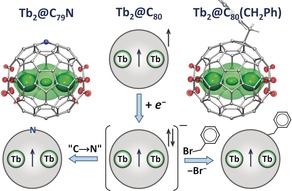
Schematic depiction of Tb2@C80 with a single‐electron Tb−Tb bond and an unpaired spin on the fullerene cage, which can be stabilized by addition of an electron, substitution of one carbon atom by nitrogen to yield azafullerene Tb2@C79N, or by functionalization with a radical group, as realized in Tb2@C80(CH2Ph). Also shown are spin density distributions in Ln2@C79N and Ln2@C80(CH2Ph) (low isovalue for semitransparent isosurface, and high isovalue for solid isosurface). Three regions with high spin density correspond to 4f‐electrons of two Ln atoms and to the unpaired electron residing on the Ln−Ln bonding orbital.
A distinctive feature of Ln2@C79N and Ln2@C80(CH2Ph) molecules is the single‐electron Ln−Ln bond (whose presence does not affect the air‐stability). As follows from DFT calculations and EPR spectroscopic studies, the Ln−Ln bonding MO has an spd character (e.g., large contribution of 5s atomic orbitals is evidenced by the large hyperfine coupling constant in Y analogues).4g, 7b The electron delocalized between metal atoms acts as a mediator between two localized Ln spins and strongly couples them together.10 EPR spectroscopy revealed that Gd and electron spins in Gd2@C79N are coupled ferromagnetically giving the total spin of S=15/2,7a, 11 and magnetometry studies showed that the Gd‐electron coupling constant in Gd2@C79N is as large as K eff=170±10 cm−1 (spin Hamiltonian ).11a, 12 Similar characteristics were also found in Gd2@C80(CH2Ph)4j as both molecules have three‐center spin system [Gd3+‐e‐Gd3+]. The single‐electron bond can thus be considered as an ultimate realization of the radical‐bridge concept.13 Exploiting this concept gave a number of poly‐nuclear lanthanide compounds with enhanced lanthanide‐radical exchange coupling and interesting SMM properties.14 For anisotropic lanthanides, the [Ln3+‐e‐Ln3+] system with strong coupling may result in outstanding SMM behavior. A large relaxation barrier was predicted for Dy2@C79N.10b Dy2@C80(CH2Ph) was found to be a SMM with a high 100‐s blocking temperature of 18 K.4g Even better SMM performance was found in Tb2@C80(CH2Ph).4j Herein, we report the first magnetic study of a dimetallo‐azafullerene with an anisotropic lanthanide, Tb2@C79N, and demonstrate that the [Tb3+‐e‐Tb3+] spin system protected inside the C79N cage yields exceptional SMM properties.
Tb2@C79N was previously prepared via a Krätschmer‐Huffman electric‐arc process with a He/N2 (280/20 torr) atmosphere by vaporizing packed Tb4O7 graphite rods,7b but the sample for the current study was synthesized by a 3‐phase electric arc discharge evaporation of graphite rods with Tb4O7 powder injection into the 3‐phase electric arc zone in only a N2 atmosphere.15 This leads to a significant change in the EMF distribution with a higher concentration of nitrogen containing metallofullerene species after a usual amino silica separation step (Figure S1–S3 in the Supporting Information).16 In a final step, recycling HPLC was used to obtain pure Tb2@C79N (Figure S4–S5). HPLC separation also showed the presence of a new EMF in the Tb2@C79N fraction with the composition Tb2C80N2 (Figure S3 and S5). The most likely structure of this compound is Tb2CN@C79N with the charge distribution (Tb3+)2(CN)−@(C79N)5−. This di‐metallic cyanide‐clusterfullerene complements a series of TbCN@C2n EMFs discovered by Yang et al.4a, 17 Unfortunately, the low yield of Tb2CN@C79N precludes its detailed characterization at this time.
The molecular structure of Tb2@C79N was elucidated earlier by single‐crystal X‐ray diffraction proving that the fullerene cage is based on the C80‐Ih isomer with one carbon atom substituted by nitrogen.7b The exact position of the nitrogen atom cannot be determined from diffraction data. DFT calculations18 show that in the most stable isomers, the nitrogen substitutes carbon on the pentagon/hexagon/hexagon vertex. The Tb2 dimer has several virtually isoenergetic orientations inside the C79N cage, including the one shown in Figure 1 (see Table S1 for all stable conformers).
Magnetic properties of the Tb2@C79N powder sample were studied by SQUID magnetometry. Figure 2 a shows the magnetic susceptibility χ of the zero‐field cooled sample measured during in‐field heating to the one measured during in‐field cooling of the same sample. The blocking temperature of magnetization T B, determined from these measurements, is 28 K (temperature sweep rate of 5 K min−1). This is only 1 K short of 29 K determined for Tb2@C80(CH2Ph).4j Thus, the [Tb3+‐e‐Tb3+] spin system with two local Tb spins and delocalized unpaired electron offers the highest T B among dinuclear and radical‐bridged SMMs. The only dinuclear SMM with similarly high blocking temperature is a Tb complex with a N2 3− radical bridge.14a In agreement with its high T B, Tb2@C79N exhibits magnetic hysteresis up to 27 K when measured with a moderate sweep rate of 2.9 mT s−1. The hysteresis is very broad with a coercive field of 3.8 T between 1.8 and 10 K.
Figure 2.

a) Determination of the blocking temperature of magnetization, T B, for Tb2@C79N (μ0 H=0.2 T, temperature sweep rate 5 K min−1); b) Magnetic hysteresis of Tb2@C79N measured between 1.8 and 26 K (sweep rate 2.9 mT s−1).
Zero‐field relaxation times of magnetization τ m below 24 K were determined by stretched exponential fitting of magnetization decay curves recorded after the fast sweep of magnetic field from 7 T to 0 T (Table S2, Figure S6). Between 31 and 39 K, τ m values were determined from χ′/χ′′ susceptibilities and Cole–Cole plots measured by AC magnetometry (Figure 3 and Figure S7, Table S3).
Figure 3.

Relaxation times of magnetization of Tb2@C79N measured in zero field (dots); lines are results of the fit with Equation (1) and contributions of different relaxation mechanisms. The inset shows the out‐of‐phase magnetic susceptibility χ′′ measured at different temperatures (dots) and fits with generalized Debye model (lines).
The temperature dependence of τ m of Tb2@C79N can be described by a combination of the temperature‐independent quantum tunneling of magnetization (QTM), the Raman mechanism with power dependence on temperature, and the Orbach mechanism with exponential temperature dependence [Eq. (1)]:
| (1) |
Fitting the τ m values with Equation (1) shows that below 15 K the relaxation proceeds via the QTM with τ QTM of 16 462±1230 s. Orbach mechanism with a barrier of U eff=757±4 K and an attempt time τ 0=(2.4±0.4)×10−12 s dominates at T>22 K (linear regime in Arrhenius coordinates, Figure 3). In the transition region between 15 and 22 K, a contribution of the Raman mechanism with n=3.9±1.0 is also visible. From the τ m−T dependence, the 100‐s blocking temperature is determined as T B100=24.1 K.
The following spin Hamiltonian is used for Tb2@C79N [Eq. (2)]:
| (2) |
where is the single‐ion ligand‐field Hamiltonian for the i‐th terbium site, K eff is an isotropic exchange coupling constant between the localized terbium moment and electron spin , and is the Zeeman term. In essence, the molecule is treated as a three‐center spin system,10a,10b, 12, 14a, 19 where direct Tb⋅⋅⋅Tb exchange is neglected (hence the effective coupling constant K eff in the exchange term4j, 12). Terbium moments are treated in the basis sets of each ion (7 F 6 multiplet). Powder averaging is used as implemented in the PHI code.20
To obtain the ligand‐field parameters for Tb ions, we performed ab initio calculations at the CASSCF(8,7)/SO‐RASSI21 level for TbY@C79N−. Calculations for the non‐charged TbY@C79N molecule would require inclusion of the unpaired valence electron and its MO into the active space, which makes calculations less tractable. Besides, the ligand field parameters would then lose their clear physical meaning. Ab initio calculations showed that in TbY@C79N−, the Tb3+ ion has easy‐axis magnetic anisotropy with the quantization axis aligned along the Tb−Tb bond, but tilted from it by approximately 7°. The tilting angle is varying slightly depending on the orientation of the Tb2 dimer inside C79N (Figure S8). Although Tb3+ is not a Kramers ion, the strong axiality results in the grouping of the ligand‐field states into pseudo‐doublets (pKD) with a small splitting within each pKD. In basis, the low‐energy pKD states have almost pure composition (Table S4–S8). The contribution of =6 in the ground pKD is 99.9 %, the second pKD at 265 cm−1 is =5 (99.6 %), and the third pKD at 511 cm−1 is =4 (98.9 %). The overall ligand‐field splitting is 1014 cm−1.
Figure 4 a shows simulated χT curves for different values of K eff to the experimental curve measured in a field of 1 T. Reasonable agreement is achieved at K eff values of 40–45 cm−1. Magnetization curves simulated for the K eff constant of 45 cm−1 agree well with the experimental data (Figure 4 b). Note that the sign of K eff is difficult to determine because magnetization data does not change much when the sign of K eff is reversed. However, magnetization and EPR data on the Gd analogue, Gd2@C79N, clearly point to the positive value of K eff in that molecule.7a, 11, 12 We thus suggest that the positive sign of K eff is more likely for Tb2@C79N as well.
Figure 4.

a) Experimental χT curve for Tb2@C79N measured in the field of 1 T and the simulations with different values of K eff (lines); note that below T B, the experimental curve does not represent the thermodynamic behavior and cannot be reproduced by simulations. b) Experimental magnetization curves of Tb2@C79N measured at different temperatures above T B and the simulations with K eff=45 cm−1. Experimental data are in arbitrary units scaled to match simulated curves.
It is instructive to analyze the spectrum of the Hamiltonian (2) shown in Figure 5 (and Table S9) for the understanding of the relaxation behavior of Tb2@C79N. As a Kramers system, [Tb3+‐e‐Tb3+] has a rigorous two‐fold degeneracy of the spin states in zero magnetic field. In the ground state doublet, all three spins are aligned along the Tb–Tb axis (Figure 5 a,b) giving a total magnetic moment of 18.9 μB. This giant‐spin state can be described as a pseudospin S=1/2 with the g‐tensor (0, 0, 37.789). Negligible transverse (x,y) components of the g‐tensor and the large total spin result in the low efficiency of the QTM, in which the total spin flips as a whole (hence the long QTM relaxation time of ca. 5 hours).
Figure 5.

a) Alignment of individual spins in Tb2@C79N in the ground state (quantization axes of Tb ions are shown as green arrows, the red arrow represents the unpaired electron spin, whereas red isosurfaces represent the valence spin density distribution). b) Low‐energy part of the spectrum of the Hamiltonian (2) with K eff=45 cm−1; dashed arrows denote QTM and Orbach relaxation mechanisms, numbers are transition probabilities (in μB 2), thickness of the red lines between the levels scales with transition probability. c) Dependence of the energy (left) and gy component (right) of the lowest‐energy exchange‐excited states as a function of the tilting angle α. Green and red arrows schematically show alignment of the magnetic moments of Tb (green) and the unpaired electron (red).
The lowest energy excited states at 251 and 310 cm−1 correspond to the ligand‐field excitation in one of the Tb ions to the second pKD. Further states with ligand‐field excitations to the third pKD, or when both Tb centers are excited to the second pKD, are found at 494, 541, and 609 cm−1. All these states are characterized by negligible g x,y components and g z values of 34.7–34.8 (states at 251 and 310 cm−1) and 31.7–31.8 (states at 494, 541, and 609 cm−1). The transition probabilities within these doublets are very low (below 10−7 μB 2).
More important for the relaxation of magnetization in Tb2@C79N are exchange‐excited states, in which one of the Tb spins is flipped. If two symmetry‐equivalent and collinear Tb spins are ferromagnetically coupled to the spin 1/2, the exchange‐excited states with flipping of one Tb spin would form a quartet. But if Tb ions are not magnetically equivalent, or if their spins are tilted from the Tb‐Tb axis, then the quartet is split into two doublets. Our simulations with Equation (2) and K eff of 45 cm−1 show that the splitting increases very quickly with increasing tilting angle α (Figure 5 c). Furthermore, when one Tb spin is reversed, both Tb spins cancel each other in the z direction, but tilting leads to the emergence of y‐component (if tilting is defined as a rotation around the x‐axis). The unpaired electron spin then orients itself along the y‐axis either parallel or antiparallel to the projection of Tb moments as illustrated schematically in Figure 5 b,c. The two states thus have different gy factors (Figure 5 c; gx and gz are virtually zero). In particular, for Tb2@C79N with a tilting angle of 7.2° and isotropic K eff=45 cm−1, the lowest‐energy exchange‐excited states are found at 410 cm−1 (gy=11.61) and 505 cm−1 (gy=0.79). Note that these energies deviate significantly from 2JK eff=540 cm−1.
With negligible gz components, exchange excited states should be very efficient for the spin reversal. When ligand‐field excited and exchange‐excited states have similar energies, transition probabilities between them can become sufficiently high (Figure 5 b), and this may be a relevant relaxation pathway for the Orbach relaxation mechanism. Alternatively, the system can be excited to the exchange states directly from the ground state. A simple spin Hamiltonian employed in this work gives a very low transition probability for such a process. However, more refined treatment proposed by Chibotaru et al. for the radical‐bridged di‐Tb complex showed that exchange excitations may have a rather high transition probability.19 In either case, we can conclude that the Orbach relaxation with U eff of 757 K (526 cm−1) proceeds via flipping of one of the Tb moments.
It is interesting to compare SMM properties of Tb2@C79N and Tb2@C80(CH2Ph), as these molecules have identical spin system encapsulated in the same fullerene cage but with different “defects” (one nitrogen atom in the azafullerene versus one C‐sp3 atom in the benzyl adduct). It appears that Tb2@C80(CH2Ph) is the slightly stronger SMM with T B and T B100 values of 29 and 25 K, respectively.4j It also shows broader hysteresis, longer QTM relaxation time of 18 h and a higher thermal relaxation barrier of U eff=799 K. Thus, despite the overall similarity of the two SMMs, we can conclude that the fullerene cage is not just an inert container but has a certain influence on the SMM behavior. Importantly, magnetic moments of Tb ions in Tb2@C80(CH2Ph) are not tilted from the Tb⋅⋅⋅Tb axis. The role of the substitutional “defect” in C80 cage is clearly seen in the electrostatic potential (ESP) distribution (Table S10). In C80 6− the ESP is virtually isotropic, which is consistent with the Ih symmetry of the fullerene cage. Substitution of one carbon by nitrogen imposes a strong asymmetry of the ESP. This strong variation of the ESP may explain why metal atoms in Tb2@C79N tend to avoid positions near nitrogen atom. Presumably, tilting of the quantization axes of Tb ions in Tb2@C79N from the Tb⋅⋅⋅Tb axis is also caused by this strong anisotropy of the ESP. C‐sp3 atom in C80(CH2Ph)5− also imposes similar asymmetry in ESP, but it is less pronounced than in the azafullerene. Therefore, a modification of the fullerene host, for example, by chemical derivatization, may be used to further tune magnetic properties of endohedral lanthanide dimers.
To conclude, we have demonstrated that Tb2@C79N is a strong single‐molecule magnet with a 100‐s blocking temperature of magnetization of 24 K and a large Tb‐electron exchange coupling constant of 40–45 cm−1. Together with the recently studied Tb2@C80(CH2Ph), this system shows that encapsulation of the Tb2 dimer with a single‐electron Tb−Tb bond inside fullerene cages is a viable route to air‐stable single‐molecule magnets with high blocking temperatures and large coercive fields. Furthermore, unlike Tb2@C80(CH2Ph), Tb2@C79N has no exohedral substituents on the fullerene cage, which leads to a higher thermal stability and allows growth of thin molecular films via sublimation.
Conflict of interest
The authors declare no conflict of interest.
Supporting information
As a service to our authors and readers, this journal provides supporting information supplied by the authors. Such materials are peer reviewed and may be re‐organized for online delivery, but are not copy‐edited or typeset. Technical support issues arising from supporting information (other than missing files) should be addressed to the authors.
Supplementary
Acknowledgements
We acknowledge funding from the European Union's Horizon 2020 research and innovation programme, European Research Council (grant agreement No 648295 to A.A.P.), and Marie Skłodowska‐Curie action (grant agreement No. 748635 to S.M.A.), and the Deutsche Forschungsgemeinschaft (grants PO 1602/4‐1 and 1602/5‐1 to A.A.P.). K.K. acknowledges financial support from a Luther & Alice Hamlett Scholarship. Computational resources were provided by the Center for High Performance Computing at the TU Dresden. We appreciate the help from Dr. Anja U. B. Wolter and Sebastian Gaß in magnetic measurements and technical support with computational resources in IFW Dresden by Ulrike Nitzsche.
G. Velkos, D. S. Krylov, K. Kirkpatrick, L. Spree, V. Dubrovin, B. Büchner, S. M. Avdoshenko, V. Bezmelnitsyn, S. Davis, P. Faust, J. Duchamp, H. C. Dorn, A. A. Popov, Angew. Chem. Int. Ed. 2019, 58, 5891.
Contributor Information
Prof. Dr. Harry C. Dorn, Email: hdorn@vt.edu.
Dr. Alexey A. Popov, Email: a.popov@ifw-dresden.de.
References
- 1.
- 1a. Luzon J., Sessoli R., Dalton Trans. 2012, 41, 13556–13567; [DOI] [PubMed] [Google Scholar]
- 1b. Sorace L., Benelli C., Gatteschi D., Chem. Soc. Rev. 2011, 40, 3092–3104; [DOI] [PubMed] [Google Scholar]
- 1c. Liu J.-L., Chen Y.-C., Tong M.-L., Chem. Soc. Rev. 2018, 47, 2431–2453; [DOI] [PubMed] [Google Scholar]
- 1d. Liddle S. T., van Slageren J., Chem. Soc. Rev. 2015, 44, 6655–6669; [DOI] [PubMed] [Google Scholar]
- 1e. Dreiser J., J. Phys. Condens. Matter 2015, 27, 183203. [DOI] [PubMed] [Google Scholar]
- 2.
- 2a. Goodwin C. A. P., Ortu F., Reta D., Chilton N. F., Mills D. P., Nature 2017, 548, 439–442; [DOI] [PubMed] [Google Scholar]
- 2b. Guo F.-S., Day B. M., Chen Y.-C., Tong M.-L., Mansikkamäki A., Layfield R. A., Angew. Chem. Int. Ed. 2017, 56, 11445–11449; [DOI] [PubMed] [Google Scholar]; Angew. Chem. 2017, 129, 11603–11607; [Google Scholar]
- 2c. Guo F.-S., Day B. M., Chen Y.-C., Tong M.-L., Mansikkamäki A., Layfield R. A., Science 2018, 362, 1400–1403; [DOI] [PubMed] [Google Scholar]
- 2d. McClain K. R., Gould C. A., Chakarawet K., Teat S., Groshens T. J., Long J. R., Harvey B. G., Chem. Sci. 2018, 9, 8492–8503. [DOI] [PMC free article] [PubMed] [Google Scholar]
- 3.
- 3a. Popov A. A., Yang S., Dunsch L., Chem. Rev. 2013, 113, 5989–6113; [DOI] [PubMed] [Google Scholar]
- 3b. Yang S., Wei T., Jin F., Chem. Soc. Rev. 2017, 46, 5005–5058. [DOI] [PubMed] [Google Scholar]
- 4.
- 4a. Liu F., Gao C.-L., Deng Q., Zhu X., Kostanyan A., Westerström R., Wang S., Tan Y.-Z., Tao J., Xie S.-Y., Popov A. A., Greber T., Yang S., J. Am. Chem. Soc. 2016, 138, 14764–14771; [DOI] [PMC free article] [PubMed] [Google Scholar]
- 4b. Junghans K., Schlesier C., Kostanyan A., Samoylova N. A., Deng Q., Rosenkranz M., Schiemenz S., Westerström R., Greber T., Büchner B., Popov A. A., Angew. Chem. Int. Ed. 2015, 54, 13411–13415; [DOI] [PMC free article] [PubMed] [Google Scholar]; Angew. Chem. 2015, 127, 13609–13613; [Google Scholar]
- 4c. Westerström R., Dreiser J., Piamonteze C., Muntwiler M., Weyeneth S., Krämer K., Liu S.-X., Decurtins S., Popov A., Yang S., Dunsch L., Greber T., Phys. Rev. B 2014, 89, 060406; [Google Scholar]
- 4d. Westerström R., Dreiser J., Piamonteze C., Muntwiler M., Weyeneth S., Brune H., Rusponi S., Nolting F., Popov A., Yang S., Dunsch L., Greber T., J. Am. Chem. Soc. 2012, 134, 9840–9843; [DOI] [PubMed] [Google Scholar]
- 4e. Krylov D., Liu F., Brandenburg A., Spree L., Bon V., Kaskel S., Wolter A., Buchner B., Avdoshenko S., Popov A. A., Phys. Chem. Chem. Phys. 2018, 20, 11656–11672; [DOI] [PMC free article] [PubMed] [Google Scholar]
- 4f. Krylov D. S., Liu F., Avdoshenko S. M., Spree L., Weise B., Waske A., Wolter A. U. B., Büchner B., Popov A. A., Chem. Commun. 2017, 53, 7901–7904; [DOI] [PMC free article] [PubMed] [Google Scholar]
- 4g. Liu F., Krylov D. S., Spree L., Avdoshenko S. M., Samoylova N. A., Rosenkranz M., Kostanyan A., Greber T., Wolter A. U. B., Büchner B., Popov A. A., Nat. Commun. 2017, 8, 16098; [DOI] [PMC free article] [PubMed] [Google Scholar]
- 4h. Chen C.-H., Krylov D. S., Avdoshenko S. M., Liu F., Spree L., Yadav R., Alvertis A., Hozoi L., Nenkov K., Kostanyan A., Greber T., Wolter A. U. B., Popov A. A., Chem. Sci. 2017, 8, 6451–6465; [DOI] [PMC free article] [PubMed] [Google Scholar]
- 4i. Dreiser J., Westerström R., Zhang Y., Popov A. A., Dunsch L., Krämer K., Liu S.-X., Decurtins S., Greber T., Chem. Eur. J. 2014, 20, 13536–13540; [DOI] [PubMed] [Google Scholar]
- 4j. Liu F., Velkos G., Krylov D. S., Spree L., Zalibera M., Ray R., Samoylova N. A., Chen C.-H., Rosenkranz M., Schiemenz S., Ziegs F., Nenkov K., Kostanyan A., Greber T., Wolter A. U. B., Richter M., Büchner B., Avdoshenko S. M., Popov A. A., Nat. Commun. 2019, 10, 571; [DOI] [PMC free article] [PubMed] [Google Scholar]
- 4k. Schlesier C., Spree L., Kostanyan A., Westerström R., Brandenburg A., Wolter A. U. B., Yang S., Greber T., Popov A. A., Chem. Commun. 2018, 54, 9730–9733; [DOI] [PMC free article] [PubMed] [Google Scholar]
- 4l. Brandenburg A., Krylov D. S., Beger A., Wolter A. U. B., Büchner B., Popov A. A., Chem. Commun. 2018, 54, 10683–10686. [DOI] [PMC free article] [PubMed] [Google Scholar]
- 5.
- 5a. Chen C. H., Krylov D. S., Avdoshenko S. M., Liu F., Spree L., Westerström R., Bulbucan C., Studniarek M., Dreiser J., Wolter A. U. B., Büchner B., Popov A. A., Nanoscale 2018, 10, 11287–11292; [DOI] [PMC free article] [PubMed] [Google Scholar]
- 5b. Westerström R., Uldry A.-C., Stania R., Dreiser J., Piamonteze C., Muntwiler M., Matsui F., Rusponi S., Brune H., Yang S., Popov A., Büchner B., Delley B., Greber T., Phys. Rev. Lett. 2015, 114, 087201. [DOI] [PubMed] [Google Scholar]
- 6.
- 6a. Suzuki T., Maruyama Y., Kato T., Kikuchi K., Nakao Y., Achiba Y., Kobayashi K., Nagase S., Angew. Chem. Int. Ed. Engl. 1995, 34, 1094–1096; [Google Scholar]; Angew. Chem. 1995, 107, 1228–1230; [Google Scholar]
- 6b. Ding J. Q., Yang S. H., J. Am. Chem. Soc. 1996, 118, 11254–11257; [Google Scholar]
- 6c. Ding J., Yang S., Angew. Chem. Int. Ed. Engl. 1996, 35, 2234–2235; [Google Scholar]; Angew. Chem. 1996, 108, 2369–2371. [Google Scholar]
- 7.
- 7a. Fu W., Zhang J., Fuhrer T., Champion H., Furukawa K., Kato T., Mahaney J. E., Burke B. G., Williams K. A., Walker K., Dixon C., Ge J., Shu C., Harich K., Dorn H. C., J. Am. Chem. Soc. 2011, 133, 9741–9750; [DOI] [PMC free article] [PubMed] [Google Scholar]
- 7b. Zuo T., Xu L., Beavers C. M., Olmstead M. M., Fu W., Crawford T. D., Balch A. L., Dorn H. C., J. Am. Chem. Soc. 2008, 130, 12992–12997. [DOI] [PMC free article] [PubMed] [Google Scholar]
- 8. Wang Z., Kitaura R., Shinohara H., J. Phys. Chem. C 2014, 118, 13953–13958. [Google Scholar]
- 9. Velloth A., Imamura Y., Kodama T., Hada M., J. Phys. Chem. C 2017, 121, 18169–18177. [Google Scholar]
- 10.
- 10a. Cimpoesu F., Frecus B., Oprea C. I., Ramanantoanina H., Urland W., Daul C., Mol. Phys. 2015, 113, 1712–1727; [Google Scholar]
- 10b. Rajaraman G., Singh M. K., Yadav N., Chem. Commun. 2015, 51, 17732–17735; [DOI] [PubMed] [Google Scholar]
- 10c. Mansikkamäki A., Popov A. A., Deng Q., Iwahara N., Chibotaru L. F., J. Chem. Phys. 2017, 147, 124305. [DOI] [PubMed] [Google Scholar]
- 11.
- 11a. Hu Z., Dong B.-W., Liu Z., Liu J.-J., Su J., Yu C., Xiong J., Shi D.-E., Wang Y., Wang B.-W., Ardavan A., Shi Z., Jiang S.-D., Gao S., J. Am. Chem. Soc. 2018, 140, 1123–1130; [DOI] [PubMed] [Google Scholar]
- 11b. Wang X., McKay J. E., Lama B., van Tol J., Li T., Kirkpatrick K., Gan Z., Hill S., Long J. R., Dorn H. C., Chem. Commun. 2018, 54, 2425–2428. [DOI] [PubMed] [Google Scholar]
- 12. Velkos G., Krylov D. S., Kirkpatrick K., Liu X., Spree L., Wolter A. U. B., Buchner B., Dorn H. C., Popov A. A., Chem. Commun. 2018, 54, 2902–2905. [DOI] [PMC free article] [PubMed] [Google Scholar]
- 13. Demir S., Jeon I.-R., Long J. R., Harris T. D., Coord. Chem. Rev. 2015, 289–290, 149–176. [Google Scholar]
- 14.
- 14a. Demir S., Gonzalez M. I., Darago L. E., Evans W. J., Long J. R., Nat. Commun. 2017, 8, 2144; [DOI] [PMC free article] [PubMed] [Google Scholar]
- 14b. Meihaus K. R., Corbey J. F., Fang M., Ziller J. W., Long J. R., Evans W. J., Inorg. Chem. 2014, 53, 3099–3107; [DOI] [PubMed] [Google Scholar]
- 14c. Rinehart J. D., Fang M., Evans W. J., Long J. R., Nat. Chem. 2011, 3, 538–542; [DOI] [PubMed] [Google Scholar]
- 14d. Rinehart J. D., Fang M., Evans W. J., Long J. R., J. Am. Chem. Soc. 2011, 133, 14236–14239. [DOI] [PubMed] [Google Scholar]
- 15. Bezmelnitsyn V., Davis S., Zhou Z., Fullerenes Nanotubes Carbon Nanostruct. 2015, 23, 612–617. [Google Scholar]
- 16. Stevenson S., Harich K., Yu H., Stephen R. R., Heaps D., Coumbe C., Phillips J. P., J. Am. Chem. Soc. 2006, 128, 8829–8835. [DOI] [PubMed] [Google Scholar]
- 17.
- 17a. Liu F., Wang S., Guan J., Wei T., Zeng M., Yang S., Inorg. Chem. 2014, 53, 5201–5205; [DOI] [PubMed] [Google Scholar]
- 17b. Liu F., Wang S., Gao C.-L., Deng Q., Zhu X., Kostanyan A., Westerström R., Jin F., Xie S.-Y., Popov A. A., Greber T., Yang S., Angew. Chem. Int. Ed. 2017, 56, 1830–1834; [DOI] [PMC free article] [PubMed] [Google Scholar]; Angew. Chem. 2017, 129, 1856–1860. [Google Scholar]
- 18. Hafner J., J. Comput. Chem. 2008, 29, 2044–2078. [DOI] [PubMed] [Google Scholar]
- 19. Vieru V., Iwahara N., Ungur L., Chibotaru L. F., Sci. Rep. 2016, 6, 24046. [DOI] [PMC free article] [PubMed] [Google Scholar]
- 20. Chilton N. F., Anderson R. P., Turner L. D., Soncini A., Murray K. S., J. Comput. Chem. 2013, 34, 1164–1175. [DOI] [PubMed] [Google Scholar]
- 21.
- 21a. Aquilante F., Autschbach J., Carlson R. K., Chibotaru L. F., Delcey M. G., De Vico L., Galván I. Fdez., Ferré N., Frutos L. M., Gagliardi L., Garavelli M., Giussani A., Hoyer C. E., Li Manni G., Lischka H., Ma D., Malmqvist P. Å., Müller T., Nenov A., Olivucci M., Pedersen T. B., Peng D., Plasser F., Pritchard B., Reiher M., Rivalta I., Schapiro I., Segarra-Martí J., Stenrup M., Truhlar D. G., Ungur L., Valentini A., Vancoillie S., Veryazov V., Vysotskiy V. P., Weingart O., Zapata F., Lindh R., J. Comput. Chem. 2016, 37, 506–541; [DOI] [PubMed] [Google Scholar]
- 21b. Chibotaru L. F., Ungur L., J. Chem. Phys. 2012, 137, 064112. [DOI] [PubMed] [Google Scholar]
Associated Data
This section collects any data citations, data availability statements, or supplementary materials included in this article.
Supplementary Materials
As a service to our authors and readers, this journal provides supporting information supplied by the authors. Such materials are peer reviewed and may be re‐organized for online delivery, but are not copy‐edited or typeset. Technical support issues arising from supporting information (other than missing files) should be addressed to the authors.
Supplementary