



Abstract
Many adolescents in majority world countries emulate U.S. American culture, which can influence their development. Globalization allows adolescents from majority world countries to learn about U.S. American culture through mass media and the exchange of information via the internet and other forms of communication. As such, youth in Mexico may experience remote acculturation, which can influence their smoking behaviors. We developed and tested a measure of remote acculturation (i.e., orientation to U.S. American and Mexican culture) among adolescents in Mexico and examined the association of remote acculturation with adolescents’ smoking-related cognitions. Data came from a school-based survey of 5492 never-smoker, urban adolescents (51% female, M age = 14.07 years). Confirmatory factor analyses supported two latent factors–one for U.S. American and another for Mexican cultural orientation. Structural equation models revealed that stronger Mexican cultural orientation was associated with lower positive smoking-related attitudes, which were related with lower smoking susceptibility. Consistent with research on acculturation among U.S. Hispanic youth, findings indicate that stronger orientation toward U.S. culture may put adolescents in Mexico at risk for cigarette smoking, while greater orientation toward Mexican culture may prevent youth smoking in Mexico. We discuss directions for future research and policymaking strategies to prevent youth smoking in Mexico.
Keywords: Remote acculturation, cigarette smoking susceptibility, adolescents, Mexico
Many adolescents in majority world countries emulate U.S. American culture (e.g., Ferguson, Muzaffar, Iturbide, Chu, & Meeks Gardner, 2017; Islam & Johnson, 2007) which can influence their development (Jensen & Arnett, 2012). Globalization allows adolescents from majority world countries to learn about U.S. American culture through mass media and the exchange of information via the internet and other forms of communication (Ferguson & Bornstein, 2015; Ozer & Schwartz, 2016). As such, adolescents in majority world countries can acculturate to U.S. American culture remotely (Ferguson et al., 2017). One majority world country with high exposure to U.S. American culture is Mexico, given Mexico’s close proximity to and ongoing relations with the U.S. (Stepler & Brown, 2013). Thus, adolescents in Mexico may experience remote acculturation – non-immigrant, globalization-based acculturation - and draw from U.S. American and Mexican culture when constructing their cultural identities and behaviors (Ferguson & Bornstein, 2012).
Research on acculturation with Mexican-heritage adolescents in the U.S. has focused on immigration-based acculturation, where scholars assume that intercultural contact with U.S. American culture begins when immigrant youth move to the U.S. or when U.S.-born youth begin to have direct, firsthand contact with U.S. American institutions (e.g., Ferguson & Bornstein, 2015). However, research with youth in Thailand (Goldberg & Baumgartner, 2002), Jamaica (e.g., Ferguson & Bornstein, 2015), India (Ozer & Schwartz, 2016), Hong Kong (Cheung-Blunden & Juang, 2008), Mexico (Lorenzo-Blanco et al., 2017), and Egypt (Islam & Johnson, 2007) suggest that as a result of globalization, adolescents can have remote intercultural contact with the U.S. through exchange of media, ideas, products, advertisements, tourism, and information via the phone and internet. Remote intercultural contact with U.S. culture may influence Mexican youth’s behaviors, including their cigarette smoking.
We focus on youth cigarette smoking because the prevalence of cigarette smoking among adolescents in Mexico is high (Reynales-Shigematsu et al., 2011). Understanding how remote acculturation impacts smoking-related cognitions can inform preventive interventions to reduce youth smoking in Mexico (Stigler, Neusel, & Perry, 2011), such as the World Health Organization’s (2015) recommendation to give films with tobacco content an adult rating to reduce youth exposure to positive tobacco imagery. Moreover, studies with Hispanic adolescents in the U.S. (the majority of whom are of Mexican heritage) indicate that immigration-based acculturation can influence youth smoking (e.g., Epstein, Botvin, & Diaz, 1998; Lorenzo-Blanco, Unger, Ritt-Olson, Soto, & Baezconde-Garbanati, 2011).
Immigration-Based Acculturation and Cigarette Smoking among Mexican-heritage Youth
Acculturation is the cultural, social, psychological, and behavioral changes that individuals can experience when they come into direct and continuous contact with other cultural groups (Schwartz, Unger, Zamboanga, Szapocznik, 2010). Among Hispanic youth, acculturation has traditionally been conceptualized as a bidimensional process in which Hispanic youth can simultaneously engage with and participate in U.S. American and Hispanic cultures (Schwartz et al., 2010). U.S. Hispanic adolescents may adopt more positive attitudes about smoking (e.g., Marin, Ossmarin, Sabogal, Sabogal, & Perez-Stable, 1989) as they are increasingly exposed to U.S. American media and other venues that glamorize and normalize cigarette smoking (e.g., Islam & Johnson, 2007; Ferguson et al., 2017; Wilkinson et al., 2009). Consistent with this notion, studies have linked acculturation to U.S. culture with higher (Epstein et al., 1998) and acculturation to Hispanic culture with lower smoking risk among U.S. Hispanic youth (Epstein et al., 1998; Lorenzo-Blanco, Unger, Ritt-Olson, Soto, & Baezconde-Garbanati, 2013; Lorenzo-Blanco et al., 2015). For example, in one study with recent immigrant Hispanic adolescents, acculturation to Hispanic culture related with more negative smoking norms, which in turn, protected youth from intending to smoke cigarettes in the future (Lorenzo-Blanco et al., 2015).
Remote Acculturation and Cigarette Smoking among Youth in Mexico
Evidence for remote acculturation comes from studies with adolescents in several countries (Ferguson et al., 2017; Islam & Johnston, 2007; Golberg & Baumgarnter, 2002; Ozer & Schwartz, 2016). In one study with youth in Jamaica, over one third of adolescents strongly identified with U.S. American culture (Ferguson & Bronstein, 2015). Moreover, compared to adolescents who more strongly identified with traditional Jamaican culture, adolescents who identified with U.S. American culture reported stronger preference for U.S. entertainment. In research in Thailand, 30% of adolescents felt attracted to U.S. culture, which was associated with greater likelihood of smoking susceptibility and experimentation (Goldberg & Baumgartner, 2002). In research with youth in Mexico (Thrasher et al., 2009) and Egypt (Islam & Johnson, 2007), exposure to U.S./Western media and preference for watching movies in English (Lorenzo-Blanco et al., 2017) was associated with more positive smoking-related cognitions. These data suggest that youth in Mexico may experience remote acculturation, which, in turn, may influence their smoking-related cognitions. However, except for a related study on the association of Mexican youth’s English- and Spanish-language movie orientation with movie smoking exposure and positive smoking-related expectancies, no studies have investigated the influence of remote acculturation on the smoking cognitions of youth in Mexico (Lorenzo-Blanco et al., 2017).
The Theory of Reasoned Action (TRA)
The TRA provides a framework for understanding why youth smoke (McMillan, Higgins, & Conner, 2005). It postulates that youth’s intentions to smoke cigarettes are the primary influence on youth’s decision to smoke cigarettes, and that intentions, in turn, are determined by youth’s smoking-related attitudes and perceived norms (e.g., Madden, Ellen, & Ajzen, 1992). The TRA model meaningfully explains the link from attitudes and norms to smoking intentions (McMillen et al., 2005); however, the TRA does not consider how smoking-related attitudes and norms can be influenced by cultural factors, including those that accompany acculturation (e.g., Lorenzo-Blanco et al., 2015).
The Current Study
The present study advances theory and research on acculturation and cigarette smoking by developing a novel measure of remote acculturation (i.e., U.S. American and Mexican cultural orientation) and investigating how remote acculturation influences smoking risk among youth in Mexico. The hypothesized model in Figure 1 is based on the literature reviewed above, in which remote acculturation influences smoking-related health risk perceptions and smoking-related attitudes, which, in turn, influence smoking susceptibility. First, we adapted and pre-tested questions commonly used to study acculturation among U.S. Hispanics to measure remote acculturation, defined as adolescents’ orientations toward both U.S. American and Mexican culture. Second, we conducted factor analysis of the items and evaluated construct validity by examining associations between each cultural orientation dimension (i.e., U.S. and Mexico) and hypothesized correlates (i.e., family affluence, media access, and sensation seeking). We expected that adolescents with higher family affluence would have greater access to media sources that are key vehicles for remote acculturation (Ferguson et al., 2017; Islam & Johnson, 2007). Similarly, adolescents with greater sensation seeking tendencies may be more likely to seek stimulation through cultural practices (e.g., media, food) and cigarettes (Wellman et al., 2016). We also examined the associations of various media behaviors (e.g., social media use, movie streaming) with remote acculturation because media is one vehicle by which adolescents learn about U.S. American and Mexican culture (e.g., Ferguson et al., 2017; Islam & Johnson, 2007). Third, we investigated the degree to which smoking-related health risk perceptions and smoking-related attitudes mediated the relationships from remote acculturation to smoking susceptibility. We also tested whether U.S. American and Mexican cultural orientations mediated the links from family affluence, media access, and sensation seeking to smoking-related health risk perceptions and attitudes. We propose the following hypotheses which are summarized in Figure 1, showing which relationships are expected (as indicated by an arrow between constructs) and the anticipated valence of each relationship (positive or negative):
Because U.S. American culture may lead to more positive smoking-related attitudes, we expected that U.S. American cultural orientation would be associated with lower smoking-related health risk perceptions and more positive smoking-related attitudes.
Conversely, we hypothesized that orientation toward Mexican culture would be associated with greater smoking-related health risk perceptions and more negative smoking-related attitudes.
Moreover, as suggested by the TRA, we hypothesized that greater smoking-related health risk perceptions would be associated with lower smoking susceptibility, and more positive smoking-related attitudes would be associated with higher smoking susceptibility.
We expected that adolescents with greater family affluence would report higher orientation toward U.S. American and lower orientation toward Mexican culture. We also expected that adolescents with greater access to media would score higher on U.S. American and lower on Mexican cultural orientation. Lastly, we hypothesized that adolescents with higher scores on sensation seeking would score higher on U.S. American and lower on Mexican cultural orientation.
Figure 1.
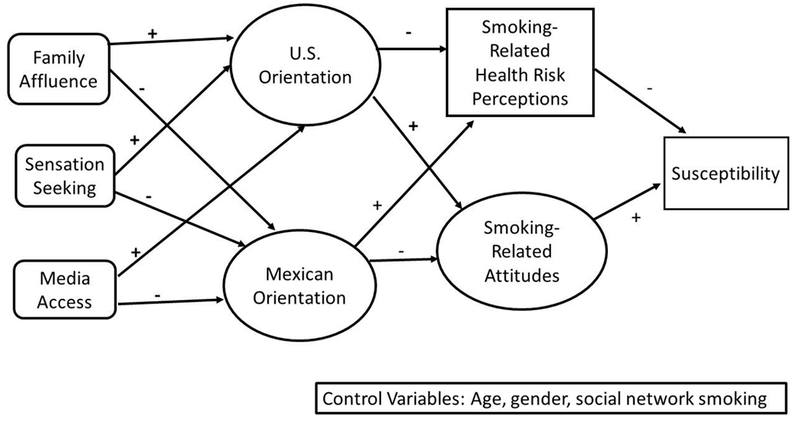
Hypothesized model based on the TRA and remote acculturation theory, showing all expected relationships and their predictive valence. We control for age, gender, and social network smoking in all the structural paths.
Methods
Sample & Procedure
Data came from a school-based survey on media, marketing, and tobacco use among middle-school students in the three largest cites in Mexico (Mexico City, Guadalajara, Monterrey). In October and November 2016, 8747 students in middle school completed a self-administered survey. Because of the cross-sectional nature of the study and concerns regarding the temporal ordering of remote acculturation and smoking behaviors, we excluded students who reported having ever tried cigarettes, resulting in an analytic sample of 5492 never-smokers. The final analytic sample was 51% female, and the mean age was 14.07 years (SD = 0.51, range 12-17). Data were collected in October and November of 2016. A more detailed description of the sample and procedures has been described elsewhere (Thrasher et al., 2016).
Measures
All measures were administered in Spanish. The Spanish language survey was created with committee translation (Harkness, 2003). First, different translators individually translated the survey from English to Spanish. Then, translations were compared and discussed to determine the wording that best conveyed the intended meaning of each survey question. Lastly, translators decided on which translation to keep, which could have been one, the other, a combination, or neither of the original translation. Additionally, we tested the translated items by conducting cognitive interviews with adolescents in Mexico (Willis, 2005).
Main study variables
Remote acculturation was assessed with eight questions modeled after the short form of the Revised Acculturation Rating Scale for Mexican Americans-II (ARSMA-II; Cuellar, Arnold, Maldonado, 1995), which has been widely used with Mexican-origin youth in the U.S. to assess orientations towards both U.S. American and Mexican culture. We first conducted 20 semi-structured cognitive interviews (Willis, 2005) in May of 2016 to evaluate 20 questions - 10 questions tapped into U.S. American and 10 tapped into Mexican cultural orientation. The purpose of the cognitive interviews was to ensure clarity of wording in questions, appropriate content and format for the Mexico context, and students’ accurate interpretation of questions (Willis, 2005). Transcripts from the 20 cognitive interviews were analyzed by two independent coders, and results were discussed with the Mexican research team to decide on selection and wording of final questions. Four items were selected for measuring U.S. American cultural orientation: 1. “I like watching movies, TV programs and series that are from the United States,” 2. “I like listening to music from the United States,” 3. “I like eating food from the United States such as hamburgers and hot dogs,” and 4. “I would like to be from the United States.” Four parallel items were selected for assessing Mexican cultural orientation: 1. “I like watching movies, TV programs and series that are from Mexico,” 2. “I like listening to music from Mexican singers or Mexican bands,” 3. “I like eating Mexican food,” 4. “I like being Mexican.” Response options for each question ranged from 1 (Totally Agree) to 5 (Totally Disagree). Responses were re-coded so that higher scores represented stronger U.S. American and Mexican cultural orientation (Cronbach’s α = .633 and .614, respectively).
Smoking-related health risk perceptions were assessed with two questions on the perceived likelihood of experiencing negative health consequences of cigarette smoking (Cohn, Macfarlane, Yanez, & Imai, 1995) if the student smoked for the rest of his/her life: 1) a serious illness and 2) a heart attack. Response options ranged from 1 (Would not happen) to 5 (Would happen for sure) and were averaged for the two items (r = .73, p < .001).
Smoking-related attitudes were assessed with five questions about expected outcomes from smoking (e.g., “I think I would enjoy smoking,” “I think smoking would make me look older”) (Sargent et al., 2002). Response options ranged from 1 (Completely agree) to 5 (Completely disagree). Responses were reverse coded and averaged, so that higher scores indicated more positive smoking-related attitudes (α = .818).
Smoking susceptibility, the absence of a firm commitment not to smoke, is a consistent predictor of smoking among nonsmoking youth (Pierce, Choi, Gilpin, Farkas, & Merritt, 1996), and was assessed with two questions (“Do you think you will smoke a cigarette in the next twelve months?”; “Would you smoke a cigarette if one of your best friends offered you one?”). Response options ranged from 1 (Definitely Not) to 4 (Definitely Yes). Higher scores represent higher susceptibility (r = .60, p < .001).
Family affluence was assessed with the Family Affluence Scale (Boyce, Torsheim, Currie, & Zambon, 2006) which consists of four items: 1. How many cars or trucks does your family own?, 2. Do you have your own room?, 3. In the past year, how often have you gone on vacation with your family?, and 4. How many computers are in your home?. Response options for question 1 included 0 (None), 1 (One), and 2 (2 or more). Response options for question 2 included 1 (Yes) and 0 (No). Response options for questions 3 and 4 options from 0 (None) and 3 (3 or more). Responses were summed. Higher scores represent higher family affluence.
Media access was assessed with six questions adapted from the Kaiser Foundation Media and Health study (Rideout, Foehr, & Roberts, 2010). Students reported their access to a range of media, including: cable TV, computer in own room, tablet, video game player, smartphone with internet access, and internet access in own room. A sample item included: “Do you have access to cable TV in your room?” Response options were 1 (Yes) and 0 (No). Items were summed with higher scores representing greater media access.
Sensation seeking, a consistent predictor of both smoking and frequent media use among adolescents, was assessed with the Brief Sensation Seeking Scale-4 (BSSS-4; Stephenson, Hoyle, Pamgreen, & Slater, 2003) which has good measurement properties among Mexican youth (Thrasher et al., 2009). Response options ranged from 1 (Totally Agree) to 5 (Totally Disagree), describing respondents’ tendency to seek out and enjoy high sensory experiences (Sample item: “I like to do frightening things”). Items were averaged (Cronbach’s α = .748), with higher scores representing greater sensation seeking tendencies.
Covariates
Social network smoking was assessed by asking whether the student’s mother, father, any of their siblings, and other relatives who lived at home smoked cigarettes (0 = No or 1 = Yes, for each question). Adolescents also reported how many of their five best friends smoked cigarettes, with responses ranging from 0 (None) to 5 (5 out of 5 friends). We recoded this question to 0 (None) and 1 (At least one friend) due to its skewed distribution.
Gender was self-reported and dummy coded as 1 = female and 0 = male.
Age ranged from 1 (12 years or less) to 6 (17 years or more).
Additional Variables
We assessed additional media behavior variables and parental education to examine whether and how theoretical meaningful variables related with our newly developed remote acculturation measure.
Information seeking via the internet was assessed with the following question: “How frequently do you seek information via the internet?” Response options ranged from 0 (Never) to 4 (Very Frequently –At least Once a Day).
File sharing via the internet was assessed with the following question: “How frequently do you share music, video or audio files via the internet?” Response options ranged from 0 (Never) to 4 (Very Frequently –At least Once a Day).
Past-month social media use was assessed with one question: “In the past 30 days, how frequently did you connect to social media such as Facebook, Snapchat, Twitter, or Instagram?” Response options ranged from 0 (Never) to 4 (Very Frequently –At least Once a Day).
Past-month paid movie streaming was assessed with the following question: “In the past 30 days, how frequently did you watch or download movies on paid internet sites such as Netflix, iTunes, or Clarovideo?” Response options ranged from 0 (Never) to 4 (Very Frequently –At least Once a Day).
Past-month free movie streaming was assessed with the following question: “In the past 30 days, how frequently did you watch or download movies on free internet sites such as Vidocio, Veocine, Divxonaline or YouTube?” Response options ranged from 0 (Never) to 4 (Very Frequently –At least Once a Day).
Parental education.
Students reported their mother’s and father’s educational level: 1 (No schooling), 2 (Did not complete primary school), 3 (Completed primary school), 4 (Did not complete secondary school), 5 (Completed secondary school), 6 (Did not complete high school), 7 (Completed high school), 8 (Attended university), 9 (Don’t Know), and 10 (No mother/father). Response options 9 (Don’t Know) and 10 (No mother/father) were treated as missing values.
Analytic Plan
First, we computed descriptive statistics for key study variables with SPSS version 24.0 (IBM SPSS, 2016). We tested for gender differences using t-tests for continuous variables and chi-square tests for categorical variables. Second, we assessed construct validity by conducting bivariate and adjusted linear regression analyses to examine the relationships between remote acculturation and other variables (i.e., information seeking and file sharing via the internet, past-month social media use, past-month paid, free movie streaming, and parental education) for which we had theory- or empirically-based a priori expectations for associations. Third, we used Mplus Version 7.3 (Muthén & Muthén, 1998 - 2012) to conduct a confirmatory factor analysis (CFA) to assess the fit of two latent constructs (U.S. American cultural orientation, Mexican cultural orientation). Fourth, we employed Structural Equation Modeling (SEM) with full-information maximum likelihood estimation (FIML) in Mplus Version 7.3 (Muthén & Muthén, 1998 – 2012) to test our hypothesized model (Figure 1). FIML has been demonstrated to be superior to other missing data techniques (e.g., listwise and pairwise deletion) in terms of model estimation, bias, and efficiency, and it produces results that are approximately equivalent to multiple imputation techniques (Asparouhov & Muthén, 2010). For all models, we evaluated overall fit using the comparative fit index (CFI ≥ .95), the root mean square error of approximation (RMSEA ≤ .05; Kline, 2011), and the chi-square test of model fit (χ2 >.05). We report but did not consider the p-value of the chi-square test because large sample sizes inflate the chi-square value, making it difficult to achieve a non-significant chi-square statistic with samples like ours (West, Taylor, & Wu, 2012). Fifth, we conducted mediation analyses by calculating confidence intervals using the Rmediation software (Tofighi & MacKinnon, 2011), where mediation is assumed if the confidence interval does not include zero.
Results
Descriptive Statistics
Table 1 displays descriptive statistics for all key study variables, separately for girls (N = 2806) and boys (N = 2682). Compared to boys, girls scored higher on U.S. orientation, smoking-related health risk perceptions, and smoking susceptibility. Boys, on the other hand, scored higher on sensation seeking, media access, and smoking-related attitudes. Table 2 shows bivariate correlations among all key study variables. Higher levels of U.S. orientation were associated with higher family affluence (r = .14, p < .001), sensation seeking (r = .21, p < .001), media access (r = 20, p < .001), and more positive smoking-related attitudes (r = .03, p = .045). Higher Mexican orientation was associated with more sensation seeking (r = .13, p < .001), lower family affluence (r = −. 04, p < .001), lower media access (r = −. 06, p < .001), and more friend smoking (r = .04, p < .001).
Table 1.
Descriptive Characteristics for Overall Sample, Girls, and Boys
| Overall Sample | Girls | Boys | ||
|---|---|---|---|---|
| N = 5490 | n = 2806 | n = 2682 | ||
| Variables | N (%) or M (SD) | N (%) or M (SD) | N (%) or M (SD) | |
| Age | ** | |||
| 13 years | 467 (8.5) | 253 (9.0) | 214 (7.9) | |
| 14 years | 4254 (77.5) | 2214 (78.9%) | 2037 (76.0) | |
| 15 years | 700 (12.7) | 310 (11.1%) | 390 (14.5) | |
| 16 years | 69 (1.3) | 28 (1.0%) | 40 (1.4) | |
| Sensation Seeking | 3.72 (.88) | 3.66 (.87) | 3.77 (.88) | ** |
| Family Affluence | 5.08 (2.69) | 4.98 (2.71) | 5.18 (2.68) | |
| Media Access | 3.52 (1.63) | 3.37 (1.58) | 3.67 (1.65) | ** |
| U.S. Cultural Orientation | 3.76 (0.82) | 3.80 (.81) | 3.71 (.83) | ** |
| Mexican Cultural Orientation | 4.19 (0.68) | 4.21 (.66) | 4.18 (.69) | |
| Health Risk Perceptions | 3.76 (1.39) | 3.81 (1.01) | 3.70 (1.69) | * |
| Smoking-related Attitudes | 1.89 (0.77) | 1.85 (.74) | 1.93 (.80) | ** |
| Susceptibility | 0.30 (0.51) | .31(.53) | .28 (.49) | * |
| Friend Smoking | 2301 (42.1) | 1203 (43) | 1096 (41) | |
| Mother Smoking | 808 (14.7) | 436 (15.5) | 372 (13.9) | |
| Father Smoking | 1753 (32.0) | 923 (32.9) | 830 (31) | |
| Sibling Smoking | 729 (13.3) | 416 (14.8) | 313 (11.7) | * |
| Other Relative Smoking | 1615 (29.4) | 859 (30.7) | 756 (28.2) | * |
p < .05
p < .01
Note. Significance levels refer to differences between boys and girls. We lost 2 cases due to missing cases on the gender variable.
Table 2.
Intercorrelations Between Key Study Variables
| 01 | 02 | 03 | 04 | 05 | 06 | 07 | 08 | 09 | 10 | 11 | 12 | 13 | 14 | 15 | |
|---|---|---|---|---|---|---|---|---|---|---|---|---|---|---|---|
| 01. Age | 1 | ||||||||||||||
| 02. Sex | −.05** | 1 | |||||||||||||
| 03. Sensation Seeking | −.00 | −.06** | 1 | ||||||||||||
| 04. Family Affluence | −.06** | −.04 | .07** | 1 | |||||||||||
| 05. Media Access | −.04** | −.09** | .13** | .40** | 1 | ||||||||||
| 06. U.S. Cultural Orientation | −.04** | .06** | .21** | .14** | .20** | 1 | |||||||||
| 07. Mexican Cultural Orientation | .01 | .02 | .13** | −.04** | −.06** | .11** | 1 | ||||||||
| 08. Health Risk Perceptions | −.01 | .04** | −.06** | .02 | −.05** | −.00 | −.01 | 1 | |||||||
| 09. Smoking-related Attitudes | .04** | −.06** | .20** | .00 | .04** | .03* | .00 | −.16** | 1 | ||||||
| 10. Susceptibility | .01 | .03* | .16** | .02 | .05** | .02 | −.02 | −.11** | .37** | 1 | |||||
| 11. Friend Smoking | .03** | .02 | .12** | .01 | .03** | .00 | .04** | −.03* | .20** | .22** | 1 | ||||
| 12. Mother Smoking | .04** | .02 | .07** | −.00 | .01 | −.01 | .00 | −.04** | .09** | .07** | .07** | 1 | |||
| 13. Father Smoking | .03* | .02 | .06** | −.05** | −0.02 | −.01 | .01 | −.05** | .09** | .07** | .07** | .24** | 1 | ||
| 14. Sibling Smoking | .03* | .05** | .06** | −.00 | .01 | −.03 | .01 | −.04** | .13** | .09** | .09** | .14** | .09** | 1 | |
| 15. Other Relative Smoking |
.02 | .03* | .06** | −.01 | .08** | −.02 | −.00 | −.03* | .11** | .10** | .08** | .15** | .11** | .08** | 1 |
Note. Categorical measures: gender, friend smoking, mother smoking, father smoking, sibling smoking, other relative smoking.
p< .05;
p<.01
Bivariate and Adjusted Correlates of U.S. and Mexican Cultural Orientation.
As shown in Table 3, higher U.S. American cultural orientation was associated with more information seeking via the internet (β = .12, p < .001), file sharing via the internet (β = .14, p < .001), past-month social media use (β = .15, p < .001), past-month paid (β = .16, p < .001) and free online movie streaming (β = .13, p < .001). Higher Mexican orientation was associated with more information seeking via the internet (β = .05, p = .007) and lower past-month paid (β = −.03, p < .001) and free (β = −.02, p = .006) online movie streaming.
Table 3.
Additional Bivariate and Adjusted Correlates of U.S. and Mexican Orientation
| Bivariate Correlates |
Adjusted Covariates by Gender, Age, Family Affluence, Mother and Father Education |
|||||||
|---|---|---|---|---|---|---|---|---|
| Mexican Orientation |
U.S. Orientation |
Mexican Orientation |
U.S. Orientation |
|||||
| r | r | B (SEB) | β | B (SEB) | β | |||
| Age | .01 | −.04** | Age | − | − | − | ||
| Gender | .02 | .06** | Gender | − | − | − | ||
| Mother Education | −.080** | .153** | Mother Education | − | − | − | ||
| Father Education | −.096** | .170** | Father Education | − | − | − | ||
| Family Affluence | −.038** | .135** | Family Affluence | − | − | − | ||
| Sensation Seeking | .127** | .225** | Sensation Seeking | .092 (.011) | .12** | .205 (.013) | .22** | |
| Media Access | −.059** | .205** | Media Access | −.017 (.007) | −.04* | .081 (.008) | .16** | |
| Information Seeking via the Internet | .022 | .147** | Information Seeking via the Internet | .023 (.009) | .05* | .073 (.010) | .12** | |
| File Sharing via the Internet | −.004 | .170** | File Sharing via the Internet | .003 (.008) | .01 | .090 (.010) | .14** | |
| Past-Month Social Media Use | .011 | .197** | Past-Month Social Media Use | .008 (.007) | .02 | .092 (.009) | .15** | |
| Past-Month Paid Online Movie Use | −.083** | .217** | Past-Month Paid Online Movies Use | −.031 (.007) | −.07** | .088 (.008) | .16** | |
| Past-Month Free Online Movies Use | −.058** | .153** | Past-Month Fee Online Movies Use | −.019 (.007) | −.04* | .073 (.008) | .13** | |
CFA for U.S. American and Mexican Cultural Orientation.
As shown in Figure 2, the two separate CFA’s for U.S. American and Mexican cultural orientation had acceptable factor loadings. According to Brown (2006), standardized factor loadings of at least 0.30 or higher are acceptable in survey research. Also, the latent factor models for U.S. American [χ2 (1) = .024, p = .88; CFI = 1.00; RMSEA = .000, 90% CI (.000 – .018)] and Mexican cultural orientation [χ2 (1) = 1.665, p = .197; CFI = 1.00; RMSEA = .01, 90% CI (.000 – .040)] provided excellent fit.
Figure 2.
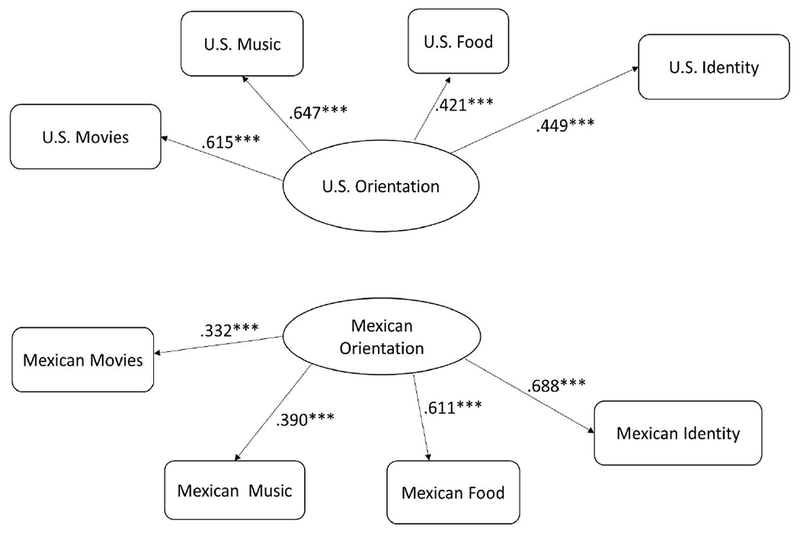
Latent Variables for U.S. and Mexican Orientation. *** p <.001
Structural Equation Modeling (SEM)
We used a two-stage SEM approach to test our hypothesized model (Anderson & Gerbing, 1988). First, we estimated a measurement model including all latent variables with more than two indicators (i.e., U.S. American cultural orientation, Mexican cultural orientation, smoking-related attitudes) to ensure adequate psychometric properties. We specified correlated error terms for items with very similar wording (i.e., U.S. movies with Mexican movies; U.S. music with Mexican music; U.S. food with Mexican food; U.S. identity with Mexican identity; U.S. movies with U.S. music; Mexican movies with Mexican music; Bollen, 1989). This measurement model with all three latent variables produced excellent model fit [χ2 (56) = 588.496, p < .001; CFI = .966; RMSEA = .042, 90% CI (.039 – .045)].
In the second stage, we estimated the structural model (Figure 1). The structural model also provided a good fit to the data [χ2 (198) = 1341.377, p < .001; CFI = .935; RMSEA = .033, 90% CI (.032 – .035)]. We controlled for gender, age, and social network smoking in all the structural paths depicted in Figure 1. As shown in Figure 3, standardized path coefficients suggest that scoring higher on family affluence (β = .08, p <.001), sensation seeking (β = .26, p <.001), and media access (β = .21, p <.001) were associated with higher U.S. cultural orientation. Higher U.S. cultural orientation was associated with higher positive smoking-related attitudes (β = .11, p <.001), and higher positive smoking-related attitudes were, in turn, associated with higher smoking susceptibility (β = .36, p < .001). Also, standardized path coefficients indicated that higher sensation seeking was associated with higher Mexican cultural orientation (β = .17, p < .001), and higher media access was associated with lower Mexican cultural orientation (β = −.07, p <.001). Higher Mexican cultural orientation was associated with lower positive smoking-related attitudes (β = −.05, p <.001), and higher positive smoking-related attitudes were, in turn, associated with higher smoking susceptibility (β = .36, p < .001). Higher smoking-related health risk perceptions were related with lower smoking susceptibility (β = −.04, p <.05).
Figure 3.
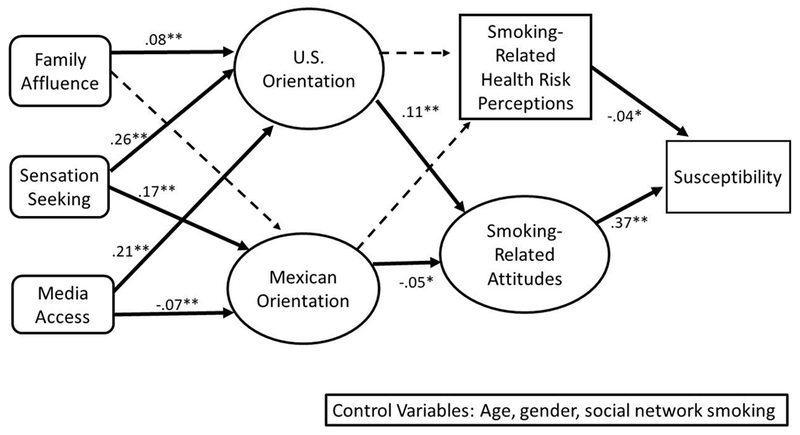
Results of the SEM with the overall sample (N = 5490). Notes: Dashed lines indicate non-significant paths and bold lines indicate significant paths. We controlled for age, gender, and social network smoking in all the structural paths. *p<.05, **p<.001
Mediation Analyses
We conducted mediation analyses to determine whether U.S. and Mexican cultural orientation mediated the associations from sensation seeking and media access to more positive smoking-related attitudes and whether smoking-related attitudes mediated the relationships of U.S. and Mexican cultural orientation with smoking susceptibility. U.S. orientation did not mediate the association from sensation seeking (β = .027, SE = .26, 95% CI [−.483, .538]) and media access (β = .022, SE = .214, 95% CI [−.398, .443]) to more positive smoking related attitudes. However, Mexican orientation did mediate the associations of sensation seeking (β = −.008, SE = .003, 95% CI [−.015, −.002]) and media access (β = .006, SE = .003, 95% CI [.001, .007]) with more positive smoking-related attitudes. Moreover, higher positive smoking-related attitudes mediated the relationships of U.S. and Mexican cultural orientation with smoking susceptibility (β = .038, SE = .007, 95% CI [.026, .053 ] and β = −.018, SE = .007, 95% CI [−.032, −.005], respectively).
Discussion
Globalization allows adolescents from outside the U.S. to engage with U.S. American culture remotely (e.g., Ferguson & Bornstein, 2015; Lorenzo-Blanco et al., 2017). Adolescents in Mexico may experience remote acculturation, a modern form of globalization-based acculturation (Ferguson et al., 2017), and this may influence their smoking behaviors (Islam & Johnson, 2007; Lorenzo-Blanco et al., 2015). This study investigated this possibility by combining scholarship and theory on immigration- and globalization-based acculturation with the TRA (McMillan et al. 2005).
We first evaluated the structure of a newly developed measure of remote acculturation among adolescents in Mexico. Consistent with bi-dimensional immigration-based acculturation theory among Mexican-heritage adolescents in the U.S., our measure assessed U.S. American and Mexican cultural orientations (Schwartz et al., 2010). Confirmatory factor analysis revealed that remote acculturation may consist of two factors (i.e., U.S. American and Mexican cultural orientation) and that asking adolescents about their preferences for U.S. American and Mexican food, music, television/movies, and their identity may allow researchers to assess remote acculturation in Mexico. Our findings also indicate that similar to immigration-based acculturation in the U.S., adolescents in Mexico may, as a result of globalization, draw from U.S. American and Mexican cultural streams in constructing their identities, values, and behaviors.
Next, we confirmed that our measure of remote acculturation was associated in expected and theoretically meaningful ways with media through which adolescents may be exposed to U.S. American and Mexican culture (Islam & Johnson, 2007; Lorenzo-Blanco et al., 2017). Consistent with our expectation that adolescents with higher SES (i.e., mother and father education, family affluence) would score higher on U.S. American and lower on Mexican cultural orientation, we observed that higher parental education and family affluence were associated with higher U.S. American and lower Mexican cultural orientation. It is possible that adolescents from wealthier and more educated families have greater access to media and other sources that may expose them to U.S. culture remotely. This, in turn, may influence their preference for U.S. American and Mexican cultural practices (e.g., Mexican foods, television, movies, music, and identification). Similarly, it is possible that more educated and wealthier parents are more oriented toward U.S. American culture themselves and they may transmit their values, behaviors, and identities to their adolescent children through their parenting practices.
As hypothesized, adolescents with higher access to media and use of the internet (e.g., movie streaming) scored higher on American cultural orientation and lower on Mexican cultural orientation. These findings indicate that media may constitute one potential vehicle of remote acculturative processes (e.g., Ferguson & Bornstein, 2015) and that adolescents may acquire information about U.S. and Mexican culture through media. While our cross-sectional results indicate that media access may influence Mexican adolescents’ orientation to U.S. and Mexican culture, it is equally possible that adolescents’ cultural orientation influences their media behaviors (e.g., Lorenzo-Blanco et al., 2017; Ferguson et al., 2017). In a related cross-sectional study, adolescents in Mexico who preferred watching movies in English were more likely to report higher movie smoking exposure through U.S. and Mexico-produced movies, while adolescents who preferred watching movies in Spanish were more likely to report lower movie-smoking exposure through U.S.-produced movies (Lorenzo-Blanco et al., 2017). In a cross-sectional study with adolescent-mother dyads in Jamaica, higher orientation to U.S. American culture was associated with higher frequency of engaging with U.S. media (Ferguson et al., 2017). Thus, extant cross-sectional studies point to a possible bidirectional relationship of remote acculturation with media, and longitudinal research is needed to better understand these relationships.
Contrary to our expectations, sensation seeking was associated with higher Mexican and higher U.S. American cultural orientation. It is possible that adolescents who tend to seek out and enjoy high sensory experiences enjoy engaging in cultural practices such as consuming food and media regardless of the country of origin of these activities.
Next, informed by acculturation scholarship and the TRA, we investigated (1) the association of remote acculturation (i.e., U.S. American and Mexican cultural orientation) with smoking-related health risk perceptions and smoking-related attitudes, and (2) the associations of smoking-related health risk perceptions and smoking-related attitudes with adolescents’ smoking susceptibility. Partially supporting our hypotheses, Mexican cultural orientation was associated with more negative and U.S. cultural orientation with more positive smoking-related attitudes. However, adolescents’ cultural orientation did not relate with their health risk perceptions. Moreover, higher positive smoking-related attitudes were associated with greater smoking susceptibility. These findings suggest that U.S. cultural orientation may increase Mexican adolescents’ risk for cigarette smoking while Mexican cultural orientation may protect them from it. Our results further indicate that U.S. cultural orientation may increase adolescents’ smoking risk by instilling the perception that smoking has positive outcomes such as having fun, feeling good, and looking older, while Mexican cultural orientation may instill the opposite perceptions. These findings are consistent with research on immigration-based acculturation among recent immigrant Hispanic adolescents in the U.S. (Marsiglia, Kulis, Hussaini, Nieri, & Becerra, 2010). The present study extends these findings to adolescents in Mexico.
Similar to immigration-based acculturation research (e.g., Abraido-Lanza, Dohrenwend, Ng-Nak, & Turner, 1999), our findings point to an important paradox – greater orientation towards U.S. culture seems to increase adolescents’ risk for cigarette smoking, and orientation towards Mexican culture seems to protect youth from it - although cigarette smoking prevalence among U.S. adolescents (2.1% for boys and 1.6% for girls) is lower than the prevalence of adolescent smoking in Mexico (15.9% for boys and 12.9% for girls; Eriksen, Mackay, Schluger, Gomeshtape, & Drope, 2015). These data suggest that it may not be the actual smoking behaviors of adolescents in the U.S. that may influence Mexican adolescents’ smoking cognitions, but another process such as youth’s attraction to the behaviors that they perceive to be popular in the United States (Lorenzo-Blanco et al., 2017). Future research could benefit from unpacking these relationships.
Importantly, positive smoking-related attitudes mediated the associations from U.S. and Mexican cultural orientation to smoking susceptibility. This points to one possible area for preventive interventions to reduce youth smoking in Mexico – targeting adolescent smoking-related attitudes. This might be done by promoting Mexican cultural practices (e.g., watching Mexican TV shows) that may protect adolescents from positive smoking-related attitudes and reduce their smoking risk (WHO, 2015; Stigler et al., 2011). Additionally, adolescent smoking-prevention programs may benefit from having discussions with adolescents about differences in how smoking is portrayed in media and how smoking is viewed in U.S. society, where the prevalence of adolescent smoking is lower than the prevalence of adolescent smoking in Mexico (Eriksen et al., 2015). Another possible avenue for preventing youth smoking in Mexico might be the distribution of knowledge regarding health risks associated with cigarette smoking (Botvin & Kantor, 2000), as is currently done through warnings on cigarette packs to which youth appear to have relatively strong responses (Thrasher et al., 2012). In the present study, higher perceptions that smoking can result in a serious illness and/or heart attack was associated with lower smoking susceptibility.
Adolescents who reported higher access to media reported lower Mexican cultural orientation and higher U.S. cultural orientation. Lower Mexican cultural orientation, in turn, related with lower smoking susceptibility by way of less positive smoking-related attitudes. Higher U.S. cultural orientation, on the other hand, related with higher smoking susceptibility by way of more positive smoking related attitudes. This indicates that it might be possible to reduce cigarette smoking among adolescents in Mexico by monitoring or restricting their media access (Mejia et al., 2016). This might be done through parent education efforts that discuss the health implications of allowing adolescents to freely watch TV, movies, play video games, and use the internet. Additionally, policies could be implemented to incorporate anti-smoking messages and ban pro-smoking messages from U.S.- and Mexico-produced media.
In the present study, U.S. cultural orientation was associated with higher and Mexican cultural orientation with lower smoking risk. However, research among adolescent-mother dyads in Jamaica indicates that U.S. cultural orientation but not orientation toward Jamaican culture may influence Jamaican adolescents’ unhealthy eating habits (Ferguson et al., 2017). Moreover, in a study with adolescents in Hong Kong (Cheung-Blunden & Juang, 2008) orientation toward Chinese culture related with higher academic achievement while orientation toward Western culture related with lower academic achievement. Taken together, these data indicate that the influence of remote acculturation on adolescent development may depend on context (e.g., their country of residence) and the outcome under investigation. More research is needed to examine how globalization influences the health of adolescents in diverse countries and contexts.
Limitations
Although the present study is innovative in its focus on remote acculturation among youth in Mexico and makes important contributions to the adolescent acculturation and cigarette smoking literatures, our findings should be interpreted in light of some limitations. First, the cross-sectional design does not allow making causal inferences about our findings. For example, we could not determine whether remote acculturation predicts smoking-related attitudes and susceptibility over time or vice versa. However, our study is informed by immigration- and globalization-based acculturation theory which suggests that remote acculturation comes first (e.g., Lorenzo-Blanco et al., 2015). Similarly, due to the cross-sectional design and concerns of the temporal order between remote acculturation and cigarette smoking, we excluded students who reported ever smoking from our analyses and utilized smoking susceptibility as the primary outcome. Theory and empirical evidence indicates that smoking susceptibility is a strong predictor of cigarette smoking (e.g., McMillen et al., 2005), including amongst Mexican youth (Morello et al., 2018). Nonetheless, longitudinal and experimental studies are needed to better understand the predictors of remote acculturation and to determine whether remote acculturation leads to increased smoking susceptibility (e.g., Lorenzo-Blanco et al, 2011; Guendelman, Cheryan, & Monin, 2011). Additionally, longitudinal and experimental research is needed to better understand predictors of remote acculturation. Second, although our measure for remote acculturation was modeled after a well-established acculturation measure for Mexican-origin youth in the U.S. and was modified to reflect the context of adolescents in Mexico, our measure consisted of eight items about practices and identity. Recent acculturation theory indicates that cultural values are also important acculturation components (Schwartz et al., 2010). Thus, future research on remote acculturation among youth in Mexico could develop measures that assess U.S. and Mexican cultural practices, values, and identifications. Lastly, our results reflect the experiences of urban Mexican youth who have never smoked cigarettes. As such, our findings may not generalize to rural youth or youth who have smoked in the past.
Acknowledgments
Preparation of this manuscript was supported by the National Institute of Health/Fogarty International Center (Grant # 3R01TW009274-04S1).
Contributor Information
Elma I. Lorenzo-Blanco, Department of Human Development and Family Sciences, University of Texas at Austin
Edna Arillo-Santillán, Department of Tobacco Control, Instituto Nacional de Salud Publica.
Jennifer B. Unger, Institute for Health Promotion and Disease Prevention Research, Keck School of Medicine, University of Southern California
James Thrasher, Department of Health Promotion, Education, & Behavior, Arnold School of Public Health, University of South Carolina.
References
- Abraido-Lanza AF, Dohrenwend BP, Ng-Mak DS, & Turner JB (1999). The Latino mortality paradox: A test of the” salmon bias” and healthy migrant hypotheses. American Journal of Public Health, 89, 1543–1548. [DOI] [PMC free article] [PubMed] [Google Scholar]
- Anderson JC, & Gerbing DW (1988). Structural equation modeling in practice: A review and recommended two-step approach. Psychological Bulletin, 103, 411–423. doi: 10.1037/0033-2909.103.3.411 [DOI] [Google Scholar]
- Asparouhov T, & Muthen B (2010). Weighted least squares estimation with missing data. Retrieved from http://www.statmodel.com/download/GstrucMissingRevision.pdf
- Bollen KA (1989). Structural Equations with Latent Variables. New York, NY: Wiley. [Google Scholar]
- Botvin GJ, & Kantor LW (2000). Preventing alcohol and tobacco use through life skills training. Alcohol Research and health, 24, 250–257. [PMC free article] [PubMed] [Google Scholar]
- Boyce W, Torsheim T, Currie C, & Zambon A (2006). The family affluence scale as a measure of national wealth: Validation of an adolescent self-report measure. Social Indicators Research, 78, 473–487. doi: 10.1007/s11205-005-1607-6 [DOI] [Google Scholar]
- Brown TA (2006). Confirmatory Factor Analysis for Applied Research. New York, NY: Guilford Press. [Google Scholar]
- Cheung-Blunden VL, & Juang LP (2008). Expanding acculturation theory: Are acculturation models and the adaptiveness of acculturation strategies generalizable in a colonial context? International Journal of Behavioral Development, 32, 21–33. doi: 10.1177/0165025407084048 [DOI] [Google Scholar]
- Cohn LD, Macfarlane S, Yanez C, & Imai WK (1995). Risk-perception: differences between adolescents and adults. Health Psychology, 14, 217–222. doi: 10.1037%2F0278-6133.14.3.217 [DOI] [PubMed] [Google Scholar]
- Cuellar I, Arnold B, & Maldonado R (1995). Acculturation rating scale for Mexican Americans-II: A revision of the original ARSMA scale. Hispanic Journal of Behavioral Sciences, 17, 275–304. doi: 10.1177/07399863950173001 [DOI] [Google Scholar]
- De La Rosa M (2002). Acculturation and Latino adolescents’ substance use: A research agenda for the future. Substance Use & Misuse, 37, 429–456. doi: 10.1081/JA-120002804 [DOI] [PubMed] [Google Scholar]
- Epstein JA, Botvin GJ, & Diaz T (1998). Linguistic acculturation and gender effects on smoking among Hispanic youth. Preventive Medicine, 27, 583–589. doi: 10.1006/pmed.1998.0329 [DOI] [PubMed] [Google Scholar]
- Ferguson GM, & Bornstein MH (2012). Remote acculturation: The “Americanization” of Jamaican islanders. International Journal of Behavioral Development, 36, 167–177. doi: 10.1177/0165025412437066 [DOI] [Google Scholar]
- Ferguson GM, & Bornstein MH (2015). Remote acculturation of early adolescents in Jamaica towards European American culture: A replication and extension. International Journal of Intercultural Relations, 45, 24–35. doi: 10.1016/j.ijintrel.2014.12.007 [DOI] [PMC free article] [PubMed] [Google Scholar]
- Ferguson GM, Muzaffar H, Iturbide MI, Chu H, & Meeks Gardner J (2017). Feel American, watch American, eat American? Remote acculturation, TV, and nutrition among adolescent-mother dyads in Jamaica. Child Development, 0, 1–18. doi: 10.1111/cdev.12808 [DOI] [PubMed] [Google Scholar]
- Goldberg ME, & Baumgartner H (2002). Cross-country attraction as a motivation for product consumption. Journal of Business Research, 55, 901–906. doi: 10.1016/S0148-2963(01)00209-0 [DOI] [Google Scholar]
- Guendelman MD, Cheryan S, & Monin B (2011). Fitting in but getting fat: Identity threat and dietary choices among US immigrant groups. Psychological Science, 22, 959–967. doi: 10.1177/0956797611411585 [DOI] [PubMed] [Google Scholar]
- Harkness JA (2003). In Cross-cultural survey research In Harkness JA, Van de Vijver FJR, & Mohler PP (Eds.), Questionnaire Translation, Hoboken, NJ: Wiley. [Google Scholar]
- IBM Corporation. (2016). IBM SPSS Statistics for Windows, version 24.0 [Computer software].
- Islam SM, & Johnson CA (2007). Western media’s influence on Egyptian adolescents’ smoking behavior: The mediating role of positive beliefs about smoking. Nicotine & Tobacco Research, 9, 57–64. doi: 10.1080/14622200601078343 [DOI] [PubMed] [Google Scholar]
- Jensen LA, & Arnett JJ (2012). Going global: New pathways for adolescents and emerging adults in a changing world. Journal of Social Issues, 68, 473–492. doi: 10.1111/j.1540-4560.2012.01759.x [DOI] [Google Scholar]
- Lorenzo-Blanco EI, Abad-Vivero EN, Barrientos-Gutierrez I, Arillo-Santillán E, Pérez Hérnandez R, Unger JB, & Thrasher JF (2017). Movie Language Orientation, Gender, Movie Smoking Exposure, and Smoking Susceptibility among Youth in Mexico. Nicotine & Tobacco Research. [DOI] [PMC free article] [PubMed] [Google Scholar]
- Lorenzo-Blanco EI, Schwartz SJ, Unger JB, Zamboanga BL, Des Rosiers SE, Huang S, Villamar J, Soto DW, Pattarroyo M, & Baezconde-Garbanati L (2015). Latino/a youth intentions to smoke cigarettes: Exploring the roles of culture and gender. Journal of Latina/o Psychology, 3, 129–143. doi: 10.1037/lat0000034 [DOI] [PMC free article] [PubMed] [Google Scholar]
- Lorenzo-Blanco EI, Unger JB, Ritt-Olson A, Soto D, & Baezconde-Garbanati L (2011). Acculturation, gender, depression, and cigarette smoking among U.S. Hispanic youth: The mediating role of perceived discrimination. Journal of Youth and Adolescence, 40, 1519–1533. doi: 10.1007/s10964-011-9633-y [DOI] [PMC free article] [PubMed] [Google Scholar]
- Lorenzo-Blanco EI, Unger JB, Ritt-Olson A, Soto D, & Baezconde-Garbanati L (2012). A longitudinal analysis of Hispanic youth acculturation and cigarette smoking: The roles of gender, culture, family, and discrimination. Nicotine & Tobacco Research, 15, 957–968. doi: 10.1093/ntr/nts204 [DOI] [PMC free article] [PubMed] [Google Scholar]
- Madden TJ, Ellen PS, & Ajzen I (1992). A comparison of the theory of planned behavior and the theory of reasoned action. Personality and SocialPsychology Bulletin, 18, 3–9. doi: 10.1177/0146167292181001 [DOI] [Google Scholar]
- Marin G, Ossmarin BV, Sabogal RO, Sabogal F, & Perezstable EJ (1989). The role of acculturation in the attitudes, norms, and expectancies of Hispanic smokers. Journal of Cross-Cultural Psychology, 20, 399–415. doi: 10.1177/0022022189204005 [DOI] [Google Scholar]
- Marsiglia FF, Kulis S, Hussaini SK, Nieri TA, & Becerra D (2010). Gender differences in the effect of linguistic acculturation on substance use among Mexican-origin youth in the southwest United States. Journal of ethnicity in substance abuse, 9(1), 40–63. [DOI] [PMC free article] [PubMed] [Google Scholar]
- McMillan B, Higgins AR, & Conner M (2005). Using an extended theory of planned behaviour to understand smoking amongst schoolchildren. Addiction Research & Theory, 13, 293–306. doi: 10.1080/16066350500053679 [DOI] [Google Scholar]
- Mejia R, Pérez A, Peña L, Morello P, Kollath-Cattano C, Braun S, & Sargent JD (2016). Parental restriction of mature-rated media and its association with substance use among Argentinean adolescents. Academic Pediatrics, 16, 282–289. doi: 10.1016/j.acap.2015.11.004 [DOI] [PMC free article] [PubMed] [Google Scholar]
- Morello P, Pérez A, Braun SM, Thrasher JF, Barrientos I, Arrillo-Santillán E, Mejía R (2018). Susceptibility to smoke cigarettes as a predictive measure of cigarette and e-cigarette use among early adolescents in Argentina and Mexico. Salud Pública de México, 60, 423–431. [DOI] [PMC free article] [PubMed] [Google Scholar]
- Muthén LK, & Muthén BO (1998 –2012). Mplus user’s guide (7th ed.). Los Angeles, CA: Author. [Google Scholar]
- Ozer S, & Schwartz SJ (2016). Measuring globalization-based acculturation in Ladakh: Investigating possible advantages of a tridimensional acculturation scale. International Journal of Intercultural Relations, 53, 1–15. doi: 10.1016/j.ijintrel.2016.05.002 [DOI] [Google Scholar]
- Reynales-Shigematsu LM, R. R-B, Ortega-Ceballos P, Flores Escartín MG, Lazcano-Ponce E, H.-Á. M (2011). Encuesta de Tabaquismo en Jóvenes. México: Instituto Nacional de Salud Pública, 2011. [Google Scholar]
- Rideout VJ, Foehr UG, & Roberts DF (2010). Generation M: Media in the Lives of 8-to 18-Year-Olds Henry J. Kaiser Family Foundation. [Google Scholar]
- Pierce JP, Choi WS, Gilpin EA, Farkas AJ, & Merritt RK (1996). Validation of susceptibility as a predictor of which adolescents take up smoking in the United States. Health Psychology, 15, 355–361. doi: 10.1037/0278-6133.15.5.355 [DOI] [PubMed] [Google Scholar]
- Sargent JD, Dalton MA, Beach ML, Mott LA, Tickle JJ, Ahrens MB, & Heatherton TF (2002) Viewing tobacco use in movies: does it shape attitudes that mediate adolescent smoking? American Journal of Preventive Medicine, 22, 137–145. doi: 10.1016/S0749-3797(01)00434-2 [DOI] [PubMed] [Google Scholar]
- Schwartz SJ, Unger JB, Zamboanga BL, & Szapocznik J (2010). Rethinking the concept of acculturation: implications for theory and research. American Psychologist, 65, 237–251. doi: 10.1037/a0019330 [DOI] [PMC free article] [PubMed] [Google Scholar]
- Schwartz SJ, Weisskirch RS, Zamboanga BL, Castillo LG, Ham LS, Huynh QL, & Davis MJ (2011). Dimensions of acculturation: associations with health risk behaviors among college students from immigrant families. Journal of Counseling Psychology, 58, 27. doi: 10.1037/a0021356 [DOI] [PMC free article] [PubMed] [Google Scholar]
- Stephenson MT, Hoyle RH, Palmgreen P, & Slater MD (2003). Brief measures of sensation seeking for screening and large-scale surveys. Drug and Alcohol Dependence, 72, 279–286. doi: 10.1016/j.drugalcdep.2003.08.003 [DOI] [PubMed] [Google Scholar]
- Stepler R, & Brown A (2013). Statistical portrays of Hispanics in the U.S. Washington, D.C.: Pew Hispanic Center; Retrieved July 24, 2017 from: http://www.pewhispanic.org/2016/04/19/statistical-portrait-of-hispanics-in-the-united-states-about-the-data/ [Google Scholar]
- Stigler MH, Neusel E, & Perry CL (2011). School-based programs to prevent and reduce alcohol use among youth. Alcohol Research & Health, 34, 157–162. doi: [PMC free article] [PubMed] [Google Scholar]
- Thrasher JF, Abad-Vivero EN, Barrientos-Gutíerrez I, Pérez-Hernández R, Reynales-Shigematsu LM, Mejía R, ARillo-Santillan E, Hernandez-Avila M, & Sargent JD (2016). Prevalence and correlates of e-cigarette perceptions and trial among early adolescents in Mexico. Journal of Adolescent Health, 58, 358–365. doi: 10.1016/j.jadohealth.2015.11.008 [DOI] [PMC free article] [PubMed] [Google Scholar]
- Thrasher JF, Arillo-Santillán E, Villalobos V, Pérez-Hernández R, Hammond D, Carter J, & Regalado-Piñeda J (2012). Can pictorial warning labels on cigarette packages address smoking-related health disparities? Field experiments in Mexico to assess pictorial warning label content. Cancer Causes & Control, 23, 69–80. doi: 10.1007/s10552-012-9899-8 [DOI] [PMC free article] [PubMed] [Google Scholar]
- Thrasher JF, Sargent JD, Huang L, Arillo-Santillán E, Dorantes-Alonso A, & Pérez-Hernández R (2009). Does film smoking promote youth smoking in middle-income countries?: A longitudinal study among Mexican adolescents. Cancer Epidemiology and Prevention Biomarkers, 18, 3444–3450. [DOI] [PMC free article] [PubMed] [Google Scholar]
- Tofighi D, & MacKinnon DP (2011). RMediation: An R package for mediation analysis confidence intervals. Behavior Research Methods, 43, 692–700. doi: 10.3758/s13428-011-0076-x [DOI] [PMC free article] [PubMed] [Google Scholar]
- Wellman RJ, Dugas EN, Dutczak H, O’Loughlin EK, Datta GD, Lauzon B, & O’Loughlin J (2016). Predictors of the onset of cigarette smoking: a systematic review of longitudinal population-based studies in youth. American Journal of Preventive Medicine, 51, 767–778. doi: 10.1016/j.amepre.2016.04.003. [DOI] [PubMed] [Google Scholar]
- West SG, Taylor AB, Wu W (2012). Model fit and model selection in structural equation modeling In: Hoyle RH, ed. Handbook of Structural Equation Modeling (pp. 209–231). New York, NY: Guilford. [Google Scholar]
- Wilkinson AV, Spitz MR, Prokhorov AV, Bondy ML, Shete S, Sargent JD (2009). Exposure to smoking imagery in the movies and experimenting with cigarettes among Mexican heritage youth. Cancer Epidemiology, Biomarkers, & Preventions, 18, 3435–3443. doi: 10.1158/1055-9965.EPI-09-0766 [DOI] [PMC free article] [PubMed] [Google Scholar]
- Willis GB (2005). Cognitive Interviewing: A Tool for Improving Questionnaire Design. Thousand Oaks, CA: Sage Publications. [Google Scholar]
- World Health Organization (2015). Smoke-free movies: From evidence to action. Third Edition. [Google Scholar]