


Abstract
Background:
Traditional medicine is widely used for patients with primary insomnia, but the studies showed inconsistent results. We performed a meta-analysis of randomized controlled trials (RCTs) to evaluate the effectiveness of Chinese herbal medicine (CHM) versus placebo for primary insomnia patients.
Methods:
The electronic databases including PubMed, EmBase, Cochrane library, and China National Knowledge Infrastructure were searched to identify the RCTs published from inception till July 2018. The summary weighted mean difference (WMD) with its 95% confidence interval (CI) for Pittsburgh sleep quality index (PSQI), sleep onset latency, total sleep duration, Athens insomnia scale (AIS), and sleep efficiency were calculated using random-effects model.
Results:
Fifteen RCTs comprising 1500 patients were finally included in the meta-analysis. Overall, patients who received CHM had lower levels of PSQI (WMD: −2.36; 95% CI: −4.02 to −0.70; P = .005), sleep onset latency (WMD: −11.54; 95% CI: −20.55 to −2.54; P = .012), and AIS (WMD: −0.59; 95% CI: −0.97 to −0.22; P = .002) as compared with placebo. Moreover, the summary WMDs of CHM versus placebo were associated with higher total sleep duration (WMD: 0.79; 95% CI: 0.56–1.02; P < .001), and sleep efficiency (WMD: 9.72; 95% CI: 6.49–12.96; P < .001). The treatment effect on PSQI might be affected by publication year, sample size, mean age, percentage male, diagnostic tool, duration of insomnia, treatment duration, and study quality.
Conclusion:
The findings of this meta-analysis indicated that CHM could significantly improve the symptoms of insomnia than placebo for patients with primary insomnia.
Keywords: Chinese herbal medicine, meta-analysis, primary insomnia, randomized controlled trials
1. Introduction
Primary insomnia is a widely prevalent sleep disorder, and is affected by multiple behavioral, medical, environmental, and psychological factors, accounting for 25% to 30% of adults.[1–3] Approximately 10% of patients have severe insomnia with clinical symptoms of the condition for at least several weeks.[4,5] Numerous studies have indicated that insomnia significantly affects health and quality of life, including memory problems, depression, irritability, and cardio-cerebrovascular diseases.[6–10] Furthermore, insomnia patients show a significant decrease in their work efficiency, work absenteeism, and work-related accidents, causing heavy burden to individuals and society.[11] Currently, the widely used treatment regimens for insomnia include medication, psychotherapy, physical therapy, and behavioral therapy.[12,13] However, the treatment effects of the above methods could be affected by compliance of medication, and adverse side-effects such as memory and performance impairment. Therefore, additional treatment methods are required as the number of patients with insomnia is increasing.[14]
The treatment regimens of traditional medicine including acupuncture, moxibustion, and Chinese herbal medicine (CHM) are widely used to treat patients with primary insomnia. According to a study, acupuncture is widely used for insomnia and could improve the clinical symptoms associated with it, while the current evidence was based on studies with poor methodological quality.[15] Furthermore, a meta-analysis of 22 randomized controlled trials (RCTs) indicated moxibustion as a more effective treatment for insomnia patients than those who received western medications, CHM, and other therapies. But the evidence level was low due to insufficient quality of RCTs.[16] Moreover, another important meta-analysis study indicated that patients receiving CHM demonstrated significant improvement in the sleep quality as compared with other treatment regimens.[17] However, the usage of the background medicine could mask the treatment effects of CHM, and could bias the summary results.
Currently, the RCTs that investigated the effectiveness of CHB versus placebo in patients with insomnia were not systematically reviewed and showed no pooled analysis. Therefore, the current meta-analysis study was conducted to provide a comprehensive quantitative analysis of the effectiveness of CHB for primary insomnia. Hence, the main purpose of this study was to calculate the effectiveness of CHB versus placebo for patients with primary insomnia based on the published RCTs.
2. Methods
2.1. Data sources, search strategy, and selection criteria
This review was conducted and reported according to the Preferred Reporting Items for Systematic Reviews and Meta-Analysis Statement issued in 2009.[18] Ethics approval was not required due to this study does not involve human or animals. Studies designed as RCTs and that evaluated the effectiveness of CHB versus placebo for primary insomnia were eligible for inclusion in this meta-analysis, without restriction of publication status and language. We systematically searched the PubMed, EmBase, Cochrane library, and China National Knowledge Infrastructure electronic databases for RCTs published from inception till July 2018. The following search terms (“Sleep Initiation and Maintenance Disorders” [Mesh] OR “primary insomnia”) AND (“Traditional Chinese Medicine” [Mesh] OR “Chinese Traditional Medicine” OR “Chinese Herbal Drugs” OR “Herbal Medicine”) were used. The manual search of the reference lists from eligible RCTs and relevant reviews were performed to select any potentially eligible studies. The study inclusion criteria were based on the PICOS criteria.
Two authors independently performed the literature search and study selection following a standardized method. Any disagreements between these 2 authors were resolved by an additional author. The study inclusion criteria are as follows:
-
(1)
Patients: primary insomnia;
-
(2)
Intervention: CHM;
-
(3)
Control: placebo;
-
(4)
Outcomes: the study reported at least 1 of the following outcomes: Pittsburgh sleep quality index (PSQI), sleep onset latency, total sleep duration, Athens insomnia scale (AIS), and sleep efficiency;
-
(5)
Study design: randomized controlled design.
Observational studies were excluded as overestimation of treatment effects might bias the pooled results.
2.2. Data collection and quality assessment
The data abstraction and quality assessment were conducted by 2 authors, and any inconsistencies between these 2 authors were settled by the primary author by referring to the original study. The data collected included the first authors’ surname, publication year, country, sample size, mean age, percentage male, diagnostic tool, duration of disease, intervention, treatment duration, and investigated outcomes. The study quality was evaluated by the JADAD scale[19] based on randomization (1 or 0), concealment of the treatment allocation (1 or 0), blinding (1 or 0), completeness of follow-up (1 or 0), and the use of intention-to-treat analysis (1 or 0). The best quality study scored 5 and the poorest quality study scored 0.
2.3. Statistical analysis
The results from individual RCTs were analyzed as continuous data, and the effect estimates of each study were calculated using means, standard deviation, and sample size in CHB and placebo group. The summary results for PSQI, sleep onset latency, total sleep duration, AIS, and sleep efficiency were calculated using weighted mean differences (WMD) and its 95% confidence interval (CI) with random-effects model.[20,21] Heterogeneity across the included studies was calculated using I-square and P value for Q statistic, and I-square ≥50% or P < .10 were regarded as significant heterogeneity.[22,23] Sensitivity analyses were conducted for PSQI, sleep onset latency, and total sleep duration to assess the impact of individual study from overall analysis.[24] The univariable meta-regression and subgroup analyses were conducted for PSQI based on publication year, sample size, mean age, percentage male, diagnostic tool, duration of insomnia, treatment duration, and JADAD scale to explore potential heterogeneity among the included studies. Publication bias for PSQI was calculated by using funnel plot, Egger,[25] and Begg[26] tests, and P < .10 was considered to be statistically significant. All P values for pooled results are 2-sided, and inspection level was 0.05. STATA software (version 10.0 StateCorp, Texas) was employed to conduct all analyses.
3. Results
3.1. Literature search
The electronic search from electronic databases produced 3782 studies, and 3697 articles were excluded due to duplicates and irrelevant studies. A total of 85 potential studies were further evaluated. Of these, 70 studies were excluded due to comparison of CHM with other drugs (n = 43), no desirable outcomes (n = 9), and patients receiving other interventions (n = 18). Finally, 15 RCTs were selected for the final analysis.[27–41] Manual searching of the reference lists yielded no new eligible studies. The study selection process, and the baseline characteristics of the included studies are presented in Figure 1 and Table 1.
Figure 1.
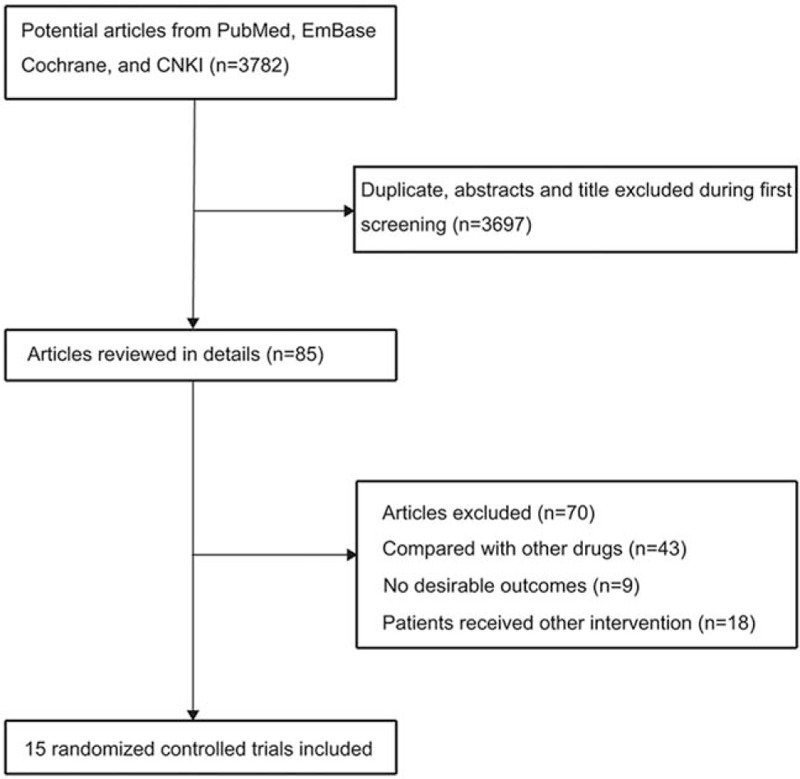
Flow diagram of selection process of trials.
Table 1.
Baseline characteristic of studies included in this study.

3.2. Study characteristics
Fifteen RCTs comprising a total of 1500 patients with primary insomnia were included in this study. These studies published were between 2013 and 2014, and each trial included 33 to 227 patients. The mean age of patients in each trial ranged from 29.00 to 44.85 years, and the percentage male ranged from 18.33% to 60.00%. The duration of insomnia ranged from 1.62 to 75.76 months, and the treatment duration ranged from 2 weeks to 5.0 months. Of the included studies, 10 studies used Chinese classification and diagnosis of mental disease-3 (CCMD-3) for diagnosing insomnia, while the remaining 5 studies used other diagnostic tools. Study quality was evaluated by JADAD scale, where 8 studies had a score of 3, 4 studies had a score of 2, and 3 studies had a score of 1.
3.3. Meta-analysis
A total of 12 studies evaluated the effect of CHM on PSQI level. The summary WMD indicated that CHM was associated with lower PSQI level as compared with placebo (WMD: −2.36; 95% CI: −4.02 to −0.70; P = .005; Fig. 2). A significant heterogeneity among the included studies was observed (I-square: 95.9%; P < .001), and sensitivity analysis results indicated that the pooled results remained stable by excluding any specific trial (Table 2).
Figure 2.
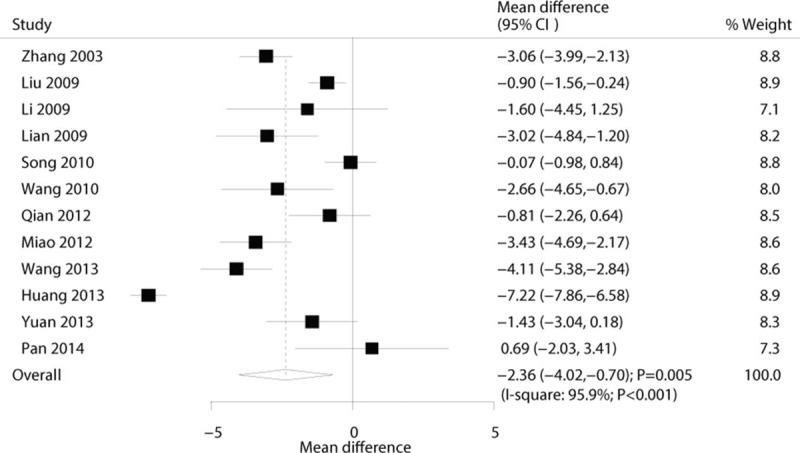
CHM versus placebo on PSQI for patients with primary insomnia. CHM = Chinese herbal medicine, PSQI = Pittsburgh sleep quality index.
Table 2.
Sensitivity analysis for PSQI.

The breakdown for the number of trials for sleep onset latency and total sleep duration was 6 trials and 4 trials, respectively. We noted that CHM significantly reduced the duration of sleep onset latency (WMD: −11.54; 95% CI: −20.55 to −2.54; P = .012; Fig. 3), but it was associated with an increased total sleep duration as compared with placebo (WMD: 0.79; 95% CI: 0.56–1.02; P < .001; Fig. 4). Further, we noted a significant heterogeneity for sleep onset latency (I-square: 71.9%; P = .013) and no evidence of heterogeneity among the included trials for total sleep duration (I-square: 0.0%; P = .706). Sensitivity analyses results indicated that the effects of CHM versus on sleep onset latency varied, while for total sleep duration remained stable.
Figure 3.
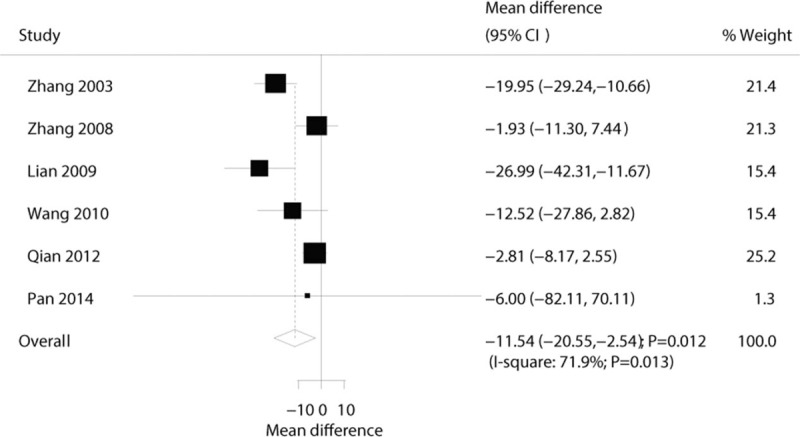
CHM versus placebo on sleep onset latency for patients with primary insomnia. CHM = Chinese herbal medicine.
Figure 4.
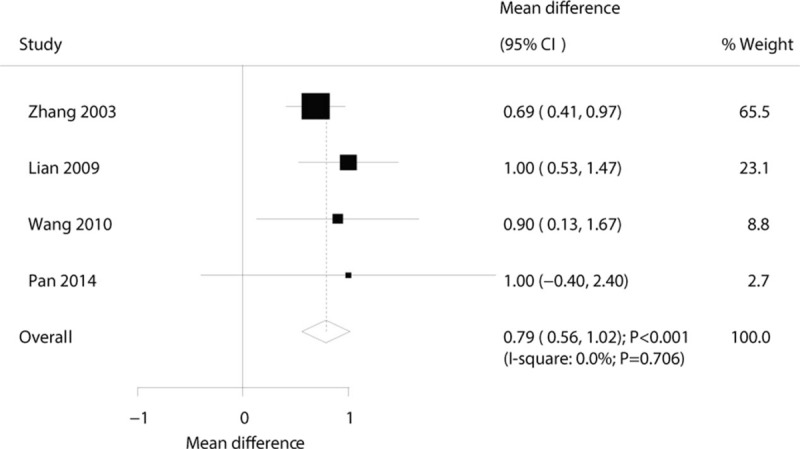
CHM versus placebo on total sleep duration for patients with primary insomnia. CHM = Chinese herbal medicine.
Data for the effects of CHM on AIS and sleep efficiency were available from 3 and 2 trials, respectively. Overall, the results revealed that CHM was associated with lower AIS level as compared with placebo (WMD: −0.59; 95% CI: −0.97 to −0.22; P = .002; with no evidence of heterogeneity; Fig. 5). Further, patients who received CHM demonstrated high sleep efficiency as compared with placebo (WMD: 9.72; 95% CI: 6.49–12.96; P < .001; with no evidence of heterogeneity; Fig. 6). Sensitivity analyses were not conducted for AIS and sleep efficiency due to smaller number of included trials.
Figure 5.
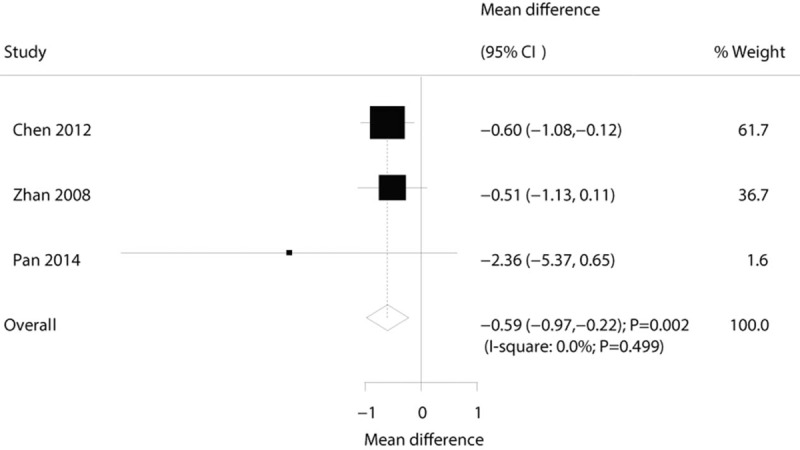
CHM versus placebo on AIS for patients with primary insomnia. AIS = Athens insomnia scale, CHM = Chinese herbal medicine.
Figure 6.
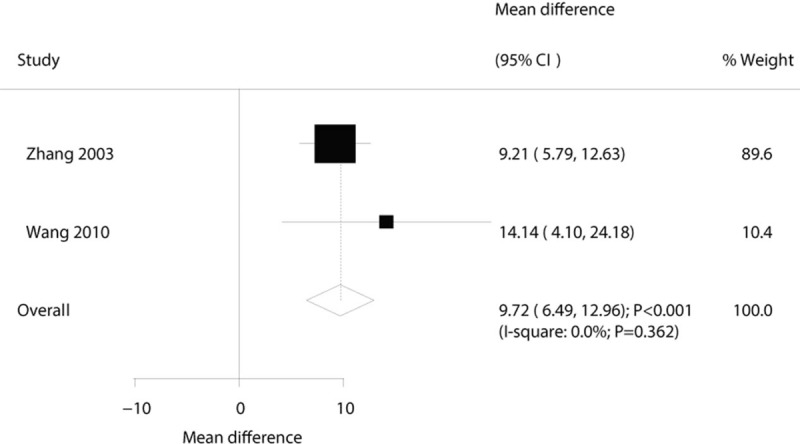
CHM versus placebo on sleep efficiency for patients with primary insomnia. CHM = Chinese herbal medicine.
3.4. Subgroup analysis
The results of univariable meta-regression analyses indicated publication year, sample size, mean age, percentage male, diagnostic tool, duration of insomnia, treatment duration, and JADAD scale might affect the treatment of CHM on PSQI (Table 3). Subgroup analyses results demonstrated significant differences between CHM and placebo for PSQI in most of the subsets. However, CHM showed no significant effect on PSQI as compared with placebo in patients with a mean age of <40.0 years, percentage male ≥40.0, treatment duration >4 weeks, or the study with lower quality (Table 2).
Table 3.
Subgroup analysis for PSQI.

3.5. Publication bias
The qualitative analysis of publication bias for PSQI was shown in Figure 7, and the results could not rule out publication bias. Furthermore, quantitative analysis based on Egger (P = .365) and Begg tests (P = .837) indicated no significant publication bias for PSQI.
Figure 7.
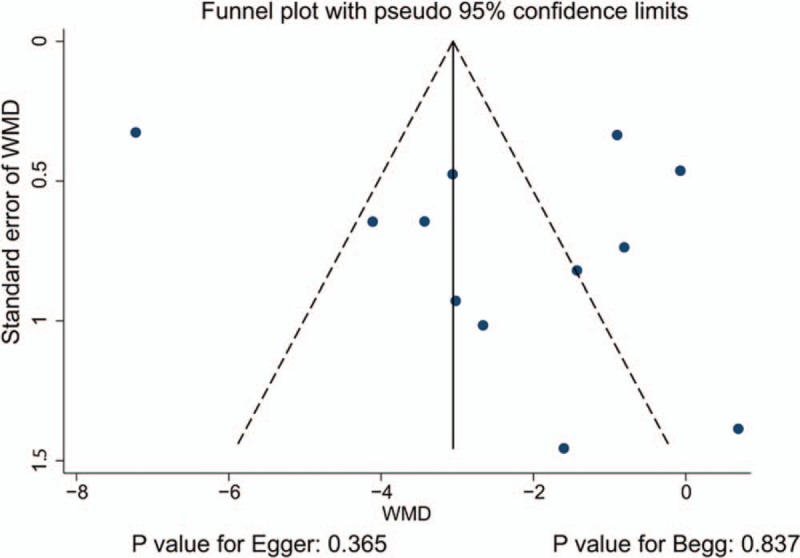
Publication bias test for PSQ. PSQI = Pittsburgh sleep quality index.
4. Discussion
Numerous studies have indicated that CHM could improve the clinical symptoms for patients with primary insomnia, while the treatment effects of CHM versus placebo have not been determined till date. The current quantitative meta-analysis was based on RCTs and evaluated the effectiveness of CHM versus placebo on the outcomes of PSQI, sleep onset latency, total sleep duration, AIS, and sleep efficiency. This meta-analysis included 1500 insomnia patients from 15 RCTs with wide range of patient characteristics. The summary results indicated that CHM was superior to placebo for patients with primary insomnia in terms of PSQI, sleep onset latency, total sleep duration, AIS, and sleep efficiency. The treatment effects of CHM were affected by various study or patient characteristics and require a large-scale high-quality RCT to confirm these results.
As reviewed previous meta-analyses, we noted patients received acupuncture was associated with a significant improvement in sleep quality as compared with no treatment. Moreover, acupuncture as an adjunct to other treatment produce marginally increases the incidence of improved sleep quality.[15] Sun et al found moxibustion was associated with better treatment effects as compared with western medications, oral Chinese medicine, and other traditional Chinese medicine therapies.[16] However, stratified analyses of these 2 meta-analyses only based on treatment strategies and control drugs. Ni et al conducted a meta-analysis based on 76 studies indicated that CHM alone was superior over placebo and benzodiazepine drugs for PSQI. Further, combined CHM and benzodiazepine significantly improved PSQI than benzodiazepine drugs or cognitive and behavioral therapy alone. Finally, CHM produced more beneficial effects and did not yield high-frequency adverse events.[17] The findings of previous meta-analysis remained robust, whereas the stratified analysis was mainly conducted based on control drugs. To avoid additional factors biases on the treatment effects of CHM for primary insomnia, this meta-analysis focused on the effectiveness of CHM versus placebo, and explored the potential impact of publication year, sample size, mean age, percentage male, diagnostic tool, duration of insomnia, treatment duration, and JADAD scale.
The pooled results indicated that CHM was superior over placebo for PSQI. Although most of the included studies reported consistent results, while 5 of the included trials indicated no significant differences between CHM and placebo for PSQI. The reason for this could be the biases caused by the evidence level and the statistical power, and was associated with broad 95% CI and showed no statistically significant differences between CHM and placebo. Furthermore, the effect of placebo for insomnia patients showed significant improvement in PSQI, total sleep duration, and sleep onset latency compared with no treatment.[42] The results of sensitivity analysis indicated robust pooled results and confirmed the treatment effect of CHM than patients who received placebo.
Additionally, the levels of sleep onset latency, total sleep duration, AIS, and sleep efficiency were significantly improved in patients receiving CHM. Although numerous studies reported no significant differences between CHM and placebo for the above factors, all studies reported a positive trend for the effects of CHM versus placebo for patients with primary insomnia. These results showed confirmed conclusions regarding the effectiveness of CHM in reducing the daytime functioning and improving the life quality, and supporting the use of CHM for patients with primary insomnia.
Subgroup analysis was conducted for PSQI based on the available characteristics. No significant differences between CHM and placebo in several subsets were observed. The reason for this could be due to the smaller number of trials in the corresponding subsets. Furthermore, studies published in 2010 or after, sample size <100, mean age <40.0 years, percentage male ≥40.0%, used CCMD-3 as diagnostic tool, the duration of insomnia <24.0 months, and treatment duration >4.0 weeks produced more beneficial effects than corresponding subsets. These results could be due to the following reasons:
-
(1)
the recruited periods of the patients were correlated with medical education level and background therapeutic drugs;
-
(2)
sample size of the included studies was associated with statistical power and deviation in each group;
-
(3)
the mean age of insomnia patients varies by differential etiology of insomnia across the lifespan[43];
-
(4)
females had excess risk of insomnia and the trend of female predisposition was consistent across age, with more severity in the elderly age[44];
-
(5)
different diagnostic tools could affect the severity of patients and were correlated with the treatment effects of CHM; and
-
(6)
the duration of insomnia was associated with the severity of disease and the treatment duration contributed to various effects on symptoms.
Our meta-analysis has some limitations that should be noted:
-
(1)
the investigated outcomes of individual trials were based on self-rating scales, which might introduce additional difficulty for accurate assessment regarding the severity of sleep disorder;
-
(2)
most of the included trials were conducted in 1 hospital, restricting the representative of sample size;
-
(3)
all the included trials are published in Chinese, which might cause selection bias and potential publication bias;
-
(4)
different dosages and categories of herbal medicine and severity of insomnia could bias the pooled results and induce heterogeneity among the included trials; and
-
(5)
most of the included studies had low study quality, and the evidence levels of these trials should be verified in large-scale RCTs in future.
5. Conclusions
In conclusion, the pooled results of available RCTs indicated that CHM versus placebo could significantly improve the clinical symptoms for patients with primary insomnia. The improved parameters include PSQI, sleep onset latency, total sleep duration, AIS, and sleep efficiency. Furthermore, large-scale RCTs should be conducted to compare the treatment effects of CHM with placebo for insomnia patients according to the patients’ characteristics.
Author contributions
Conceptualization: Hongshi Zhang.
Data curation: Xingquan Wu, Yan Zhang.
Formal analysis: Peng Liu.
Investigation: Xingquan Wu, Deyu Cong.
Methodology: Hongshi Zhang, Peng Liu.
Project administration: Yan Zhang, Deyu Cong.
Resources: Peng Liu, Xingquan Wu.
Software: Hongshi Zhang.
Supervision: Peng Liu, Yan Zhang, Deyu Cong.
Validation: Hongshi Zhang, Xingquan Wu.
Writing – original draft: Hongshi Zhang, Deyu Cong.
Writing – review and editing: Hongshi Zhang, Peng Liu, Xingquan Wu, Deyu Cong.
Footnotes
Abbreviations: AIS = Athens insomnia scale, CHM = Chinese herbal medicine, CI = confidence interval, PSQI = Pittsburgh sleep quality index, RCTs = randomized controlled trials, WMD = weighted mean difference.
HZ and PL contributed equally to this work.
This study funded by the Natural Science Foundation of China.
Topic: Abdominal tuina therapy type glove 2 virtual brain gut interactive mechanism research of primary insomnia.
Topic source: 81574094.
Ethical approval and informed consent are not applicable in this study.
The authors declare that they have no conflicts of interest.
References
- [1].Edinger JD, Bonnet MH, Bootzin RR, et al. Derivation of research diagnostic criteria for insomnia: report of an American Academy of Sleep Medicine Work Group. Sleep 2004;27:1567–96. [DOI] [PubMed] [Google Scholar]
- [2].Trauer JM, Qian MY, Doyle JS, et al. Cognitive behavioral therapy for chronic insomnia: a systematic review and meta-analysis. Ann Intern Med 2015;163:191–204. [DOI] [PubMed] [Google Scholar]
- [3].Roth T, Zammit G, Lankford A, et al. Nonrestorative sleep as a distinct component of insomnia. Sleep 2010;33:449–58. [DOI] [PMC free article] [PubMed] [Google Scholar]
- [4].Morin CM, LeBlanc M, Daley M, et al. Epidemiology of insomnia: prevalence, self-help treatments, consultations, and determinants of help-seeking behaviors. Sleep Med 2006;7:123–30. [DOI] [PubMed] [Google Scholar]
- [5].Roth T, Jaeger S, Jin R, et al. Sleep problems, comorbid mental disorders, and role functioning in the national comorbidity survey replication. Biol Psychiatry 2006;60:1364–71. [DOI] [PMC free article] [PubMed] [Google Scholar]
- [6].Janson C, Lindberg E, Gislason T, et al. Insomnia in men-a 10-year prospective population based study. Sleep 2001;24:425–30. [DOI] [PubMed] [Google Scholar]
- [7].Baglioni C, Battagliese G, Feige B, et al. Insomnia as a predictor of depression: a meta-analytic evaluation of longitudinal epidemiological studies. J Affect Disord 2011;135:10–9. [DOI] [PubMed] [Google Scholar]
- [8].Roane BM, Taylor DJ. Adolescent insomnia as a risk factor for early adult depression and substance abuse. Sleep 2008;31:1351–6. [PMC free article] [PubMed] [Google Scholar]
- [9].Staner L. Comorbidity of insomnia and depression. Sleep Med Rev 2010;14:35–46. [DOI] [PubMed] [Google Scholar]
- [10].Chien KL, Chen PC, Hsu HC, et al. Habitual sleep duration and insomnia and the risk of cardiovascular events and all-cause death: report from a community-based cohort. Sleep 2010;33:177–84. [DOI] [PMC free article] [PubMed] [Google Scholar]
- [11].Laugsand LE, Strand LB, Vatten LJ, et al. Insomnia symptoms and risk for unintentional fatal injuries – the HUNT study. Sleep 2014;37:1777–86. [DOI] [PMC free article] [PubMed] [Google Scholar]
- [12].Hauk L. Treatment of chronic insomnia in adults: ACP guideline. Am Fam Physician 2017;95:669–70. [PubMed] [Google Scholar]
- [13].Neu D, Mairesse O, Le Bon O. What about sleep homeostasis in insomnia? Comment on the European guideline for the diagnosis and treatment of insomnia. J Sleep Res 2017;26:701. [DOI] [PubMed] [Google Scholar]
- [14].Pearson NJ, Johnson LL, Nahin RL. Insomnia, trouble sleeping, and complementary and alternative medicine: analysis of the 2002 national health interview survey data. Arch Intern Med 2006;166:1775–82. [DOI] [PubMed] [Google Scholar]
- [15].Cheuk DK, Yeung YW, Chung KF, et al. Acupuncturefor insomnia. Cochrane Database Syst Rev 2012;9:CD005472. [DOI] [PMC free article] [PubMed] [Google Scholar]
- [16].Sun YJ, Yuan JM, Yang ZM. Effectiveness and safety of moxibustion for primary insomnia: a systematic review and meta-analysis. BMC Complement Altern Med 2016;16:217. [DOI] [PMC free article] [PubMed] [Google Scholar]
- [17].Ni X, Shergis JL, Guo X, et al. Updated clinical evidence of Chinese herbal medicine for insomnia: a systematic review and meta-analysis of randomized controlled trials. Sleep Med 2015;16:1462–81. [DOI] [PubMed] [Google Scholar]
- [18].Moher D, Liberati A, Tetzlaff J, et al. Preferred reporting items for systematic reviews and meta-analyses: the PRISMA statement. PLoS Med 2009;6:e1000097. [DOI] [PMC free article] [PubMed] [Google Scholar]
- [19].Jadad AR, Moore RA, Carroll D, et al. Assessing the quality of reports of randomized clinical trials: is blinding necessary? Control Clin Trials 1996;17:1–2. [DOI] [PubMed] [Google Scholar]
- [20].DerSimonian R, Laird N. Meta-analysis in clinical trials. Control Clin Trials 1986;7:177–88. [DOI] [PubMed] [Google Scholar]
- [21].Ades AE, Lu G, Higgins JP. The interpretation of random-effects meta-analysis in decision models. Med Decis Making 2005;25:646–54. [DOI] [PubMed] [Google Scholar]
- [22].Deeks JJ HJ, Altman DG. Analyzing data and undertaking meta-analyses. !Higgins J GS, eds., editors. Oxford, UK: The Cochrane Collaboration; 2008. [Google Scholar]
- [23].Higgins JP, Thompson SG, Deeks JJ, et al. Measuring inconsistency in meta-analyses. BMJ 2003;327:557–60. [DOI] [PMC free article] [PubMed] [Google Scholar]
- [24].Assessing the influence of a single study in meta-analysis. Stata Tech Bull 1999;47:15–7. [Google Scholar]
- [25].Egger M, Davey Smith G, Schneider M, et al. Bias in meta-analysis detected by a simple, graphical test. BMJ 1997;315:629–34. [DOI] [PMC free article] [PubMed] [Google Scholar]
- [26].Begg CB, Mazumdar M. Operating characteristics of a rank correlation test for publication bias. Biometrics 1994;50:1088–101. [PubMed] [Google Scholar]
- [27].Chinese Academy of Chinese Medical Sciences, Zhang JF. Evaulation of Effect of Suan Zao Ren Soft Extract for Primary Insomnia and Relevant Methodological Study. 2003. [Google Scholar]
- [28].2008;Zhan SQ, Wang YP, Gao L. Observation on the effect of huo li su oral solution for insomnia. [Google Scholar]
- [29].Zhang JP. Observation on the effect of ye he jian nao tablet combined with zopiclone for insomnia syndrome 2008. [Google Scholar]
- [30].Liu Y, Nan DY. Clinical observation on zao ren an shen capsule for psychophysiological insomnia 2009. [Google Scholar]
- [31].Li Y, Xu BY, Xiao F. Effect of modified xiaoyao powder for improving sleep in patients with psychological stress insomnia. Zhongguo Zhong Xi Yi Jie He Za Zhi 2009;29:208–11. [PubMed] [Google Scholar]
- [32].Lian FM, Gui-Cheng XU, Liu K, et al. Placebo controlled clinical trial of Chanyeanshen capsules in insomnia patients. Chin J New Drugs 2009. [Google Scholar]
- [33].SongXH Randomized Double-blind Control Research of Wuling Capsule in Clinical Treatment of Mild Insomnia [Dissertation]. 2010. [Google Scholar]
- [34].Wang ZT, Min H, Jian J. Sanqi granule the treatment of insomnia of deficiency heart blood and stagnant heat type randomized double-blind clinical curative effect observation. Liaoning J Tradit Chin Med 2010. [Google Scholar]
- [35].Chen W, Qian Y, Song X. Effects of tian wang buxin dan on hypothalamus—hypophysis—thyroid hormones of insomnia patients of fire hyperactivity caused by YIN deficiency. Hebei J Tradit Chin Med 2012. [Google Scholar]
- [36].Nanjing University of Chinese Medicine, Qian C. Clinical Study of Kadusura Longepedunculata Soft Capsule on Insomnia, in First School of Clinical Medicine [Dissertation]. 2012. [Google Scholar]
- [37].Miao WH. Observation of Xinrenshenan capsule on the treatment of insomnia. Hebei J Tradit Chin Med 2012. [Google Scholar]
- [38].Wang S, Liu J, Guifen MA. Clinical study of Zaorenanshen tablet treating anhypnia. Hebei J Tradit Chin Med 2013. [Google Scholar]
- [39].2013;Huang HB, Sha R, Wan ZX. Efficacy of valeriana pseudo officinalis C.Y. Cheng et H. B Chen on insomnia and its effect on plasma melatonin level. [Google Scholar]
- [40].Yuan CX, Chen Y, Jun LI, et al. Adjuvant treatment of insomnia of liver-yin deficiency pattern by “Mei’an Granule”: a randomized double-blind and placebo-controlled trial. Shanghai J Tradit Chin Med 2013. [Google Scholar]
- [41].Shanghai Jiao Tong University, Pan SKYP. The Use of Compound Sea Snake Capsule for Patients with Chronic Insomnia [Dissertation]. 2014. [Google Scholar]
- [42].Neukirch N, Colagiuri B. The placebo effect, sleep difficulty, and side effects: a balanced placebo model. J Behav Med 2015;38:273–83. [DOI] [PubMed] [Google Scholar]
- [43].Hoban TF. Sleep disorders in children. Ann N Y Acad Sci 2010;1184:1–4. [DOI] [PubMed] [Google Scholar]
- [44].Zhang B, Wing YK. Sex differences in insomnia: a meta-analysis. Sleep 2006;29:85–93. [DOI] [PubMed] [Google Scholar]