


Abstract
Aim:
To explore whether the total pain experience differs after (partial) kidney tumour nephrectomies via flank, transabdominal or laparoscopic access.
Materials and methods:
We analyzed retrospectively 107 patients with flank, 12 with transabdominal and 21 with laparoscopic interventions. For pain treatment, conventional analgesics (A) or intravenous patient-controlled analgesia (PCIA) or thoracic peridural analgesia (tPDA) were used. Self-reported pain was measured with a Visual Analogue Scale three times daily. The area under the curve (AUC) at rest (R) and during a standardized body movement (M) were calculated from the intervention till the end of the second T(0–2) and seventh postoperative day T(0–7), respectively.
Results:
The median AUC for T(0–2) at R was more intense for laparoscopy (13) than for flank incision (A, 9) and approximately the same during M. For flank incisions (A), the median AUC at R rises from 9 for T(0–2) to 22 for T(0–7) and at M the median AUC increases from 18 to 37. In contrast, laparoscopy did not cause further pain after the second postoperative day. Furthermore, with flank incision for T(0–2), at R, tPDA was superior to A (median AUC: 5 versus 9, p = 0.02) and at M again tPDA (median AUC: 12) had a better pain-control as A (18) or even as PCIA (19, p = 0.005).
Conclusion:
Laparoscopic nephrectomies cause a relatively intense mean cumulative pain for T(0–2) and a subsequent absence of pain. However, flank incisions went on to increased pain levels until the seventh postoperative day with tPDA as most effective therapy.
Keywords: Area under the curve, flank incision, laparoscopic nephrectomy, partial tumour nephrectomy, postoperative pain
Introduction
Important indications for (partial) nephrectomy are either kidney tumours or organ harvesting of living donors for kidney transplantation. In the United States, about 40,000 tumour and about 5500 donor nephrectomies are performed per year. Nephrectomy is either an open or a minimal invasive procedure. The access for open nephrectomy is flank, lumbar or transabdominal. Minimal invasive nephrectomies are either done by laparoscopy, retroperitoneoscopy or by robotics.
Postoperative pain following flank incision is known to be intense. Less is known about postoperative pain after laparoscopic nephrectomy. However, there are several studies comparing laparoscopic and open living donor nephrectomy regarding the early postoperative pain experience.1–3 Pain following laparoscopic kidney surgery is multifactorial. Port pain, abdominal incision to retrieve the kidney, pelvic organ nociception, diaphragmatic irritation (shoulder tip discomfort from residual pneumoperitoneum) and urinary catheter discomfort add up and contribute to the total pain experience.4 Several studies showed that laparoscopic and hand-assisted donor nephrectomy produce less pain on defined time-points compared with an open access.5–8 Other studies did not find a difference between laparoscopic and open living donor nephrectomy regarding the early postoperative pain experience. In a randomized study comparing laparoscopic versus open donor nephrectomy by Visual Analogue Scale (VAS) assessment on the second postoperative day, the pain intensity was low and there were no differences between the two groups.9
Laparoscopic tumour nephrectomies are more complex procedures than laparoscopic living donor nephrectomies done on oncologic patients in comparison with healthy donors. There are only two studies comparing postoperative pain of open versus laparoscopic nephrectomy in patients with renal carcinoma.10,11 Both studies did not show a significant lessening of postoperative pain for the laparoscopic nephrectomy in patients with renal carcinoma; however, VAS scores were not measured every postoperative day on the ward. One of these studies compared acute and chronic pain after open nephrectomy versus laparoscopic nephrectomy in patients with renal carcinoma.11 In this prospective trial, patients were assessed for VAS pain scores at 0.5, 1, 2, 4, 6, 12 and 24 hours postoperatively. Overall, postoperative average VAS pain scores were not different between the open and the laparoscopic nephrectomy groups. Postoperative morphine consumption and analgesic demand were found to be similar in both groups. Chronic postsurgical pain is defined as pain that develops after surgery and lasts at least for 3 months postoperatively. Both groups had an equal risk of developing chronic postsurgical pain.
At our department, patients received less analgesia after laparoscopic tumour nephrectomy as compared to the open operation, because urologists and anaesthesiologists expected less pain after minimal invasive surgery. This prompted us to query whether it is possible to quantify the total pain experience after laparoscopic tumour nephrectomy and whether it can be shown that laparoscopic tumour nephrectomy is more comfortable than open surgery. Our Urological Department is certified for standardized pain management by Certkom e.V., Bochum, Germany. As a consequence, algorithms are used for analgesia depending on the type of intervention, and pain levels of all in-patients are well documented at least three times per day. This supplies us with a complete time-line of the postoperative pain, being a good measure for the total pain experience. We performed a retrospective analysis of postoperative pain after renal (and very few) adrenal interventions in 2012 at our Department of Urology depending on the access chosen.
Materials and methods
All patients (n = 214) who underwent surgery on the kidneys or adrenals at our institution in the year of 2012 were considered for retrospective study of their postoperative patient notes, provided they were subsequently found to be complete. The choice of the operative procedure chosen depended primarily on the clinical staging of the kidney tumour, the anatomical situation, but also on the surgeon’s and patient’s preference. These patients were grouped in 163 flank incisions, 21 transabdominal and 30 laparoscopic interventions. This retrospective study was approved by the ethical board of the institution (#26-331 ex 13/14). This article was written as recommended by the Strengthening the Reporting of Observational Studies in Epidemiology (STROBE) criteria.12 Standardized bed-side patient interviews were performed by staff nurses to register self-reported pain postoperatively at least three times daily. In the recovery room and in the intensive care unit, the self-reported pain level was documented more frequently than on the ward. However, for this study, we chose three representative pain levels, that is, in the morning, at noon and in the evening. We used a 10-cm horizontal VAS to measure the pain intensity at rest (R) and at standardized body movement (M). Patients were asked to name a value representing the level of pain intensity, anchored on the left with words ‘no pain’ (= 0) and on the right-hand side with words ‘the worst imaginable pain’ (= 10).
Patients who underwent flank or transabdominal incisions received conventional analgesics, intravenous patient-controlled analgesia (PCIA) or thoracic peridural analgesia (tPDA). The responsible anaesthesiologist decided which kind of pain regimen an individual patient received. However, based on the assumption that laparoscopic approaches are less traumatic, anaesthesiologists at our department did not consider PCIA or tPDA approaches. Therefore, patients with laparoscopic interventions all received conventional analgesics. That is why we investigated seven subgroups of patients: those with flank incisions and (a) conventional analgesics, (b) PCIA or (c) tPDA; patients with transabdominal incisions with (d) conventional analgesics, (e) PCIA or (f) tPDA and (g) patients treated by laparoscopic surgery, receiving conventional analgesics.
Statistical analysis
The area under the curve (AUC) of self-reported pain at rest and of self-reported pain during a standardized body movement was calculated for each patient (with complete data) for the following two intervals: from the day of the intervention till the end of the second (T(0–2)) and till the end of the seventh postoperative day (T(0–7)), respectively. Note, very few patients were discharged later than the eighth postoperative day. The AUC relates to the sum of postoperative pain and is therefore a relative measure of the cumulative postoperative pain.
The AUC enables us to compare postoperative pain between groups using the nonparametric Kruskal–Wallis tests for all four situations (R or M for two time intervals). Following comparisons were made: flank versus transabdominal intervention versus laparoscopic operation (different pain regimes summarized); with flank access, the different pain regimes (conventional, PCIA and tPDA) were tested. Bonferroni correction was applied for the post hoc tests. All analyses were repeated as a sensitivity analysis with ‘last observation carried forward’ to deal with the missing values. Age distributions between the three operation methods were compared using the nonparametric Kruskal–Wallis test and gender and American Society of Anaesthesiologists (ASA) Score were compared using Fisher’s exact test. A p value <0.05 was considered significant. Statistical analyses were performed using SPSS for Windows (Version 20) and with the statistical software R (version 3.3.2).
Results
At our Urological Department, 214 patients underwent renal or adrenal surgery in 2012. Since partial nephrectomies are predominantly performed by flank incision at our department, most (n = 163) patients had a flank incision, followed by 30 laparoscopic interventions and 21 transabdominal operations. However, due to missing data and incomplete patient charts, the case histories of only 140 patients (median age of 66 years, range = 19–86 years) were accessible for review and analysis. These patients were grouped in 107 flank incisions, 21 laparoscopic and 12 transabdominal interventions. According to their analgesic regimen, they were further grouped into seven subgroups (Table 1). There were no significant differences in age (p = 0.483), gender (p = 0.637) and ASA-Score (p = 0.995) between the groups. The histologic examination of the specimen confirmed a malignant tumour in 65 (60.7%) patients via flank, in 12 (100%) via transabdominal access and in 14 (66.6%) patients via laparoscopy.
Table 1.
The subgroups according to the access and the pain therapy chosen, their median age, gender and their ASA Score and number of observations at days 2 and 7.
| N | Flank/conv. |
Flank/PCIA |
Flank/tPDA |
Trans-abd./conv. |
Trans-abd./PCIA |
Trans-abd./tPDA |
Lap. |
Total |
|---|---|---|---|---|---|---|---|---|
| 27 | 47 | 33 | 2 | 6 | 4 | 21 | 140 | |
| Median age (years) | 68.7 (19–86) | 66.1 (19–81) | 66.9 (41–82) | 63.4 (63–63) | 67.6 (40–82) | 70.0 (50–76) | 64.2 (27–80) | |
| Female (N) | 13 | 18 | 16 | 0 | 4 | 3 | 9 | 63 |
| Male (N) | 14 | 29 | 17 | 2 | 2 | 1 | 12 | 77 |
| Female (%) | 48.1 | 38.3 | 48.5 | 0 | 66.7 | 75.0 | 42.9 | 45.0 |
| Male (%) | 51.9 | 61.7 | 51.5 | 100.0 | 33.3 | 25.0 | 57.1 | 55.0 |
| ASA 1 (N) | 2 | 3 | 5 | 0 | 1 | 0 | 2 | 13 |
| ASA 2 (N) | 8 | 23 | 12 | 1 | 2 | 3 | 9 | 58 |
| ASA 3 (N) | 14 | 21 | 16 | 1 | 3 | 1 | 10 | 66 |
| ASA 4 (N) | 3 | 0 | 0 | 0 | 0 | 0 | 0 | 3 |
| ASA 1 (%) | 7.4 | 6.4 | 15.2 | 0.0 | 16.7 | 0.0 | 9.5 | 9.3 |
| ASA 2 (%) | 29.6 | 48.9 | 36.4 | 50.0 | 33.3 | 75.0 | 42.9 | 41.4 |
| ASA 3 (%) | 51.9 | 44.7 | 48.5 | 50.0 | 50.0 | 25.0 | 47.6 | 47.1 |
| ASA 4 (%) | 11.1 | 0.0 | 0.0 | 0.0 | 0.0 | 0.0 | 0.0 | 2.1 |
| Number of observations (VAS score) Day 2 R/M (N) | 25/25 | 47/47 | 33/33 | 2/2 | 6/6 | 4/4 | 19/19 | 136/136 |
| Day 7 R/M (N) | 13/13 | 22/22 | 15/15 | 0/0 | 2/2 | 1/2 | 0/0 | 53/52 |
There were no significant differences between the groups.
conv.: conventional analgesics; PCIA: intravenous patient-controlled analgesia; tPDA: thoracic peridural analgesia; Lap.: laparoscopy; R/M: at rest/during movement; ASA: American Society of Anesthesiologists; VAS: Visual Analogue Scale.
Laparoscopic surgery (median AUC: 13, interquartile range (IQR): 4–22) was not significantly more comfortable at R for patients till the end of the second postoperative day (T(0–2)) as compared to flank incision (median: 8, IQR: 4–14) and transabdominal access (median: 6, IQR: 3–12.5; Table 2). The AUC is the sum of the self-reported pain scores of a patient. It is a relative measure of the cumulative pain that a patient experienced during a period of time. A higher median AUC signifies that this group of patients reported more intense postoperative pain than other groups.
Table 2.
The three main groups according to the access, their median age with range, gender, their ASA Score and the median AUC of the self-reported pain with IQR.
| Flank | Transabdominal | Laparoscopy | p value | |
|---|---|---|---|---|
| N | 107 | 12 | 21 | |
| Age (years) | 67.2 (19–86) | 65.5 (40–82) | 64.2 (27–80) | 0.483 |
| Gender | 0.637 | |||
| Female | 47 (43.9%) | 7 (58.3%) | 9 (42.9%) | |
| Male | 60 (56.1%) | 5 (41.7%) | 12 (57.1%) | |
| ASA Score | 0.945 | |||
| 1 | 10 (9.3%) | 1 (8.3%) | 2 (9.5%) | |
| 2 | 43 (40.2%) | 6 (50.0%) | 9 (42.9%) | |
| 3 | 51 (47.7%) | 5 (41.7%) | 10 (47.6%) | |
| 4 | 3 (2.8%) | 0 (0.0%) | 0 (0.0%) | |
| AUC Pain | ||||
| T(0–2) R | 8 (4–14) | 6 (3–12.5) | 13 (4–22) | 0.253 |
| T(0–2) M | 17 (12–24) | 13.5 (4.5–21.5) | 19 (12–29) | 0.259 |
| T(0–7) R | 17.5 (10–26) | 14 (5–20) | – | – |
| T(0–7) M | 35 (22–46) | 33 (10–45) | – | – |
AUC: area under the curve; IQR: interquartile range; T(0–2): interval from intervention till second post-operative day; T(0–7): interval from intervention till seventh postoperative day; R: at rest; M: at standardized body movement.
Figure 1 shows the median AUC at R and at M for T(0–2) for all seven subgroups. Patients with laparoscopic (median: 13, IQR: 4–22) and transabdominal (median: 13, IQR: 3–23, conventional analgesics) access experienced more intense pain at R than all three subgroups of patients operated via flank for T(0–2). The median AUC for T(0–2) at R for flank (conventional analgesics), flank (PCIA) and flank (tPDA) were 9, 10 and 5, respectively. At M, patients with flank (conventional analgesics), flank (PCIA), transabdominal (conventional analgesics) and laparoscopic access had a similar median AUC for T(0–2) of 18, 19, 17 and 19, respectively. In comparison, patients with tPDA had less pain for T(0–2) and M (flank median 12 and transabdominal median 4.5). The cumulative pain experience at R for T(0–2) seemed to be more intense for laparoscopically operated patients (median: 13, IQR: 4–22) compared to those with flank incision and conventional analgesics (median: 9, IQR: 7–17; Figure 1(a)). At M, the patients after laparoscopic surgery reported for T(0–2) approximately the same pain experience compared to those with an open flank incision and conventional analgesics (Figure 1(b)).
Figure 1.
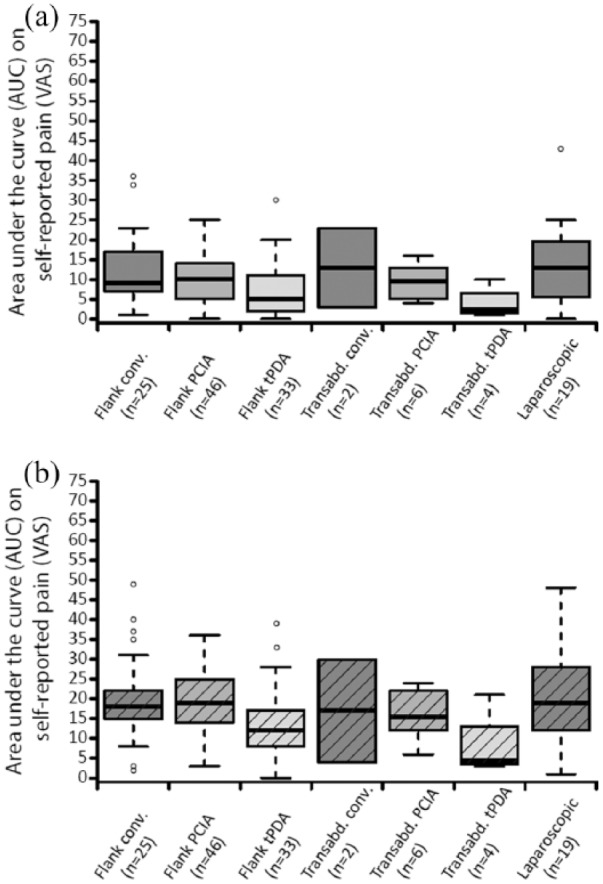
The area under the curve (AUC) from the day of the intervention till the end of the second postoperative day for all seven subgroups (a) at rest and (b) at standardized body movements. Note, maximal AUC is 90 VAS.
The median AUC from the day of the intervention till the end of the seventh postoperative day T(0–7) and R was 17.5 for flank (IQR 10–26) and 14 for transabdominal (IQR5–20), whereas for T(0–7) and M, the corresponding medians were 35 for flank (IQR 22–46) and 33 for transabdominal (IQR 10–45; Table 2). Figure 2 illustrates the median AUC for T(0–7) at R and at M for all seven subgroups (note, maximal AUC is 240). For flank incisions with conventional analgesics, the median AUC at R increases from 9 for T(0–2) to 22 for T(0–7). Similarly, at M, the AUC after a flank incision with conventional analgesics increases from 18 for T(0–2) to 37 for T(0–7). These data show that there is considerable additional pain between the third and seventh postoperative day for patients with flank incisions and conventional analgesics. This increase in cumulative pain from the third postoperative day until the end of the first postoperative week is also true for patients with flank incisions and PCIA or tPDA.
Figure 2.
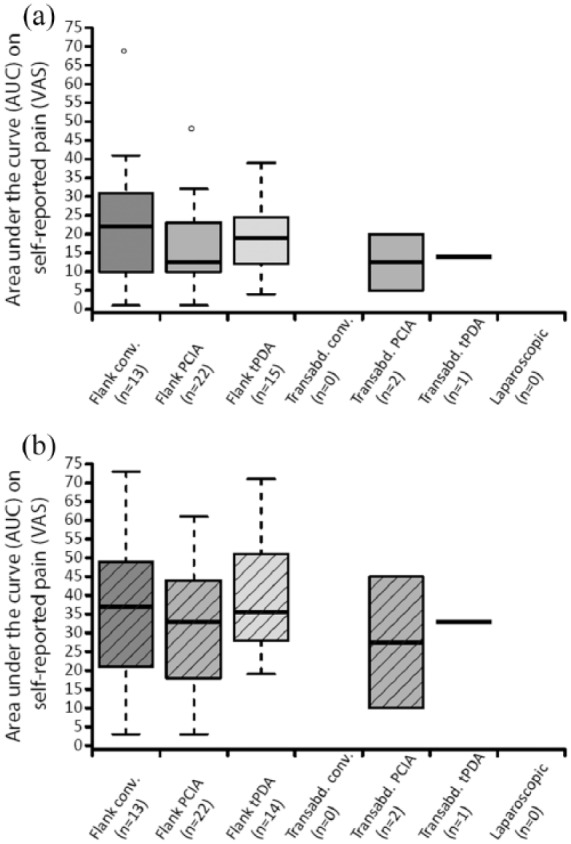
The area under the curve (AUC) from the day of the intervention up to the end of the seventh postoperative day (T(0–7)) for all seven subgroups (a) at rest and (b) during a standardized body movement. Note that maximal AUC is 240 VAS. For patients operated by laparoscopic surgery, no AUC could be calculated for T(0–7), since most patients had already been discharged.
The AUC for T(0–7) could not be calculated for patients operated by laparoscopic surgery since most patients had already been discharged. Figure 3 depicts the time line of AUC of laparoscopically treated patients. The majority of patients at R (Figure 3(a)) or at M (Figure 3(b)) did not have a substantial increase of the cumulative pain experience after the second postoperative day. Only one patient with polycystic kidney disease, who had laparoscopic fenestration of several cysts, displayed an increase in cumulative pain at both R and M after the second post op day, with unusually high levels of pain. However, excluding this patient did not alter the results (not shown).
Figure 3.
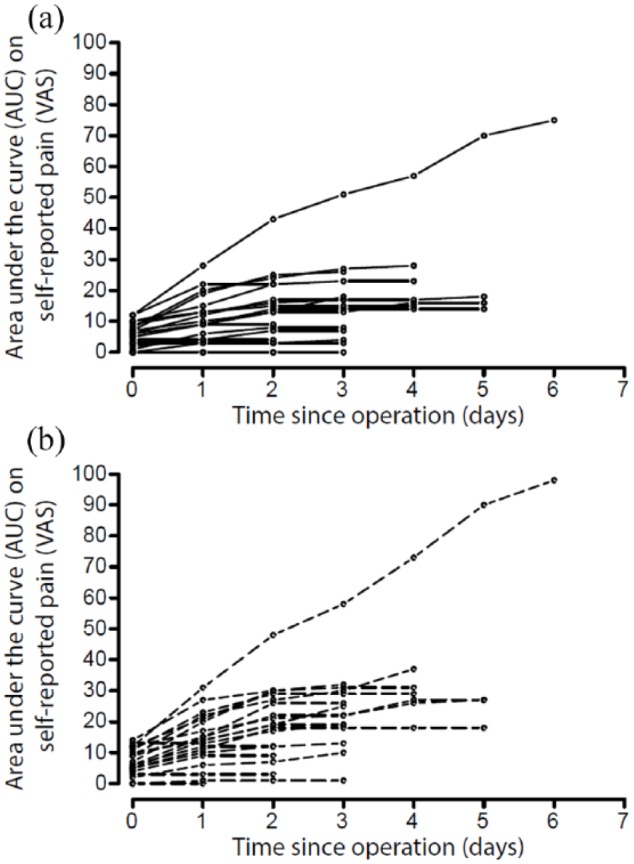
The area under the curve (AUC) of self-reported pain of the laparoscopic patients (a) at rest and (b) during a standardized body movement in dependence of time.
There were significant differences for the median AUC with flank incisions comparing the different pain regimens for T(0–2) at R (p = 0.015) and at M (p = 0.003). At R, tPDA (median = 5; IQR = 2–11) performed significantly better than conventional analgesics (median = 9; IQR = 7–17, p = 0.02), and although it seems to provide better pain control than PCIA, this difference was not statistically significant (median = 10, IQR = 5–14, p = 0.07). At M, again tPDA (median = 12; IQR = 8–17) gave better pain control than both conventional analgesics (median = 18; IQR = 15–22, p = 0.018) and PCIA (median = 19; IQR = 14–25, p = 0.005). No differences were found for T(0–7). The results did not change when we used ‘last observation carried forward’ AUC calculations.
Discussion
Our most important finding is the relatively intense early pain experience after laparoscopic tumour nephrectomy. This effect is short-lived and pain subsides by the second post-op day, markedly earlier than that from the flank or transabdominal incisions. Although there was no statistically significant difference, the cumulative pain in the first 48 hours postoperatively was for the laparoscopic intervention at least equivalent to the other two open surgery procedures. The unexpected finding of laparoscopic patients experiencing more pain maybe explained by the fact that urologists and anaesthesiologists do not expect laparoscopic surgeries to be painful and hence may have provided sub-optimal analgesia. PCIA or tPDA were avoided in laparoscopic patients as well. This study shows that our early baseline post-op analgesia for patients treated by laparoscopic surgery for renal cancer was inadequate and responsible for the surprisingly high pain scores we observed. That is why, we revised our pain algorithm, and these patients receive more intense baseline analgesia for the first two post-op days now including parenteral opioids.
With flank incision, tPDA was the most effective pain therapy for T(0–2) as compared to conventional analgesics and PCIA. This effect was no longer detectable for T(0–7) since PCIA or tPDA was in most cases removed after 2–4 days postoperatively. Another possible explanation that this effect was no longer detectable for T(0–7) could be that our transitional baseline analgesia after removal of PCIA/tPDA was inadequate. Our quality circles are currently reviewing this.
The number of laparoscopically treated patients is relatively small at our department, because partial nephrectomies are performed mainly by flank access. So, only nephrectomies, adrenalectomies and a few partial nephrectomies were done by laparoscopy.
A study by Wang et al.13 compares postoperative morphine requirements and VAS pain scores at several time points during the first two postoperative days of renal donors and patients with renal carcinoma undergoing laparoscopic nephrectomy. Interestingly, donors required more intravenous doses of morphine and had significantly higher VAS scores at 2 and 4 hours postoperatively.
There is evidence that laparoscopic living donor nephrectomy causes less pain than the open procedure. Using two questionnaires, Perry et al.6 quote a decreased mean pain intensity of 4.1 for laparoscopic kidney donors as compared to 6.1 for patients operated by open mini-incision for the first night after the intervention. Also, for the first postoperative day, the mean pain intensity was less for patients treated by laparoscopy (4.6) compared to patients with an open mini-incision (6.3). No pain values are available in this study for the second postoperative day. In a single-centre, retrospective study at Basel, Switzerland, the mean VAS was significantly lower after retroperitoneoscopic donor nephrectomy and hand-assisted laparoscopic donor nephrectomy than after open donor nephrectomy on the second postoperative day.5 VAS, however, was determined only twice a day.
A recent study14 demonstrated that the cumulative overall pain score after 72 h was less for laparoscopic donor nephrectomies performed under a low-pressure pneumoperitoneum of 7 mmHg as compared to a standard pneumoperitoneum of 12–14 mmHg, the latter was used in our patients. Interestingly, the low-pressure intervention was safe and the frequency and the severity of complications were not different from the standard approach. However, the mean operation time was longer by about 40 min.
The AUC is a relative measure, allowing the comparison of the total pain experience between different types of operations. It has already been used by other authors dealing with postoperative pain after non-urological interventions.15
The main limitation of this study is its retrospective work-up. Another limitation is that we had to exclude 74 patients from the analysis, because their pain data and patient charts were incomplete or not found. The reason is mainly that since the end of 2012, patient charts are no longer archived in our hospital, but digitalized. Several pain charts were not digitalized explaining the missing data. Another limitation is this study did not explore the dosage levels applied in the three different analgesic approaches. This study does not attempt to consider the nevertheless significant personal, social and economic benefits of early postoperative recovery and return to normal life.
In conclusion, patients treated by laparoscopic oncological renal or adrenal surgery in our patient cohort reported a relatively intense initial postoperative pain which resolved at the end of the first 48 hours. During this period, these patients need an adequate analgesic plan given the evidence of higher reported pain intensity than assumed preoperatively.
Acknowledgments
The authors thank Mr M. Maguire for new insights and for proof reading.
Footnotes
Contributorship: B.H., R.Z. and K.P. conceived the study. Ba.H. was involved in patient recruitment, S.A.H. and A.S.K. were involved in data analysis. B.H. wrote the first draft of the manuscript. B.H. is the guarantor of the study. All authors reviewed and edited the manuscript and approved the final version of the manuscript.
Conflict of interest: The author(s) declare(s) that there is no conflict of interest.
Ethical approval: This retrospective study was approved by the ethical board of the institution (#26-331 ex 13/14).
Funding: This research received no specific grant from any funding agency in the public, commercial, or not-for-profit sectors.
Informed consent: There was no informed consent necessary, because it is a retrospective study.
Trial Registration: Not applicable as this is not a trial.
Guarantor: B.H.
ORCID iD: Boris Hager  https://orcid.org/0000-0001-8124-2375
References
- 1. Nicholson ML, Elwell R, Kaushik M, et al. Health-related quality of life after living donor nephrectomy: a randomized controlled trial of laparoscopic versus open nephrectomy. Transplantation 2011; 91(4): 457–461. [DOI] [PubMed] [Google Scholar]
- 2. Wilson CH, Sanni A, Rix DA, et al. Laparoscopic versus open nephrectomy for live kidney donors. Cochrane Database Syst Rev 2011; 11: CD006124. [DOI] [PubMed] [Google Scholar]
- 3. Greco F, Hoda MR, Alcaraz A, et al. Laparoscopic living-donor nephrectomy: analysis of the existing literature. Eur Urol 2010; 58(4): 498–509. [DOI] [PubMed] [Google Scholar]
- 4. Thiyagarajan UM, Baul A, Nicholson ML. Pain management in laparoscopic donor nephrectomy: a review. Pain Res Treat 2012; 2012: 201852. [DOI] [PMC free article] [PubMed] [Google Scholar]
- 5. Bachmann A, Wolff T, Giannini O, et al. How painful is donor nephrectomy? Retrospective analysis of early pain and pain management in open versus laparoscopic versus retroperitoneoscopic nephrectomy. Transplantation 2006; 81(12): 1735–1738. [DOI] [PubMed] [Google Scholar]
- 6. Perry KT, Freedland SJ, Hu JC, et al. Quality of life, pain and return to normal activities following laparoscopic donor nephrectomy versus open mini-incision donor nephrectomy. J Urol 2003; 169(6): 2018–2021. [DOI] [PubMed] [Google Scholar]
- 7. Andersen MH, Mathisen L, Veenstra M, et al. Quality of life after randomization to laparoscopic versus open living donor nephrectomy: long-term follow-up. Transplantation 2007; 84(1): 64–69. [DOI] [PubMed] [Google Scholar]
- 8. Fonouni H, Mehrabi A, Golriz M, et al. Comparison of the laparoscopic versus open live donor nephrectomy: an overview of surgical complications and outcome. Langenbecks Arch Surg. 2014; 399(5): 543–51. [DOI] [PubMed] [Google Scholar]
- 9. Andersen MH, Mathisen L, Oyen O, et al. Postoperative pain and convalescence in living kidney donors-laparoscopic versus open donor nephrectomy: a randomized study. Am J Transplant 2006; 6(6): 1438–1443. [DOI] [PubMed] [Google Scholar]
- 10. Acar C, Bilen C, Bayazit Y, et al. Quality of life survey following laparoscopic and open radical nephrectomy. Urol J 2014; 11(6): 1944–1950. [PubMed] [Google Scholar]
- 11. Alper I, Yüksel E. Comparison of acute and chronic pain after open nephrectomy versus laparoscopic nephrectomy: a prospective clinical trial. Medicine 2016; 95(16): e3433. [DOI] [PMC free article] [PubMed] [Google Scholar]
- 12. von Elm E, Altman DG, Egger M, et al. The Strengthening the Reporting of Observational Studies in Epidemiology (STROBE) statement: guidelines for reporting observational studies. Int J Surg 2014; 12(12): 1495–1499. [DOI] [PubMed] [Google Scholar]
- 13. Wang J, Ma H, Fu Y, et al. Comparison of postoperative morphine requirements in renal donors and patients with renal carcinoma undergoing laparoscopic nephrectomy. Transplant Proc 2016; 48(1): 31–34. [DOI] [PubMed] [Google Scholar]
- 14. Warlé MC, Berkers AW, Langenhuijsen JF, et al. Low-pressure pneumoperitoneum during laparoscopic donor nephrectomy to optimize live donors’ comfort. Clin Transplant 2013; 27(4): E478–E483. [DOI] [PubMed] [Google Scholar]
- 15. Mozet C, Prettin C, Dietze M, et al. Use of Floseal and effects on wound healing and pain in adults undergoing tonsillectomy: randomised comparison versus electrocautery. Eur Arch Otorhinolaryngol 2012; 269(10): 2247–2254. [DOI] [PubMed] [Google Scholar]