



Summary
Although quantitative disease resistance (QDR) is a durable and broad‐spectrum form of resistance in plants, the identification of the genes underlying QDR is still in its infancy. RKS 1 (Resistance related K ina S e1) has been reported recently to confer QDR in A rabidopsis thaliana to most but not all races of the bacterial pathogen X anthomonas campestris pv. campestris (X cc). We therefore explored the genetic bases of QDR in A . thaliana to diverse races of X . campestris (X c). A nested genome‐wide association mapping approach was used to finely map the genomic regions associated with QDR to X cc12824 (race 2) and X cc CFBP 6943 (race 6). To identify the gene(s) implicated in QDR, insertional mutants (T‐DNA) were selected for the candidate genes and phenotyped in response to X c. We identified two major QTLs that confer resistance specifically to Xcc12824 and XccCFBP6943. Although QDR to X cc12824 is conferred by At5g22540 encoding for a protein of unknown function, QDR to X cc CFBP 6943 involves the well‐known immune receptor pair RRS1/RPS4. In addition to RKS 1, this study reveals that three genes are involved in resistance to X c with strikingly different ranges of specificity, suggesting that QDR to X c involves a complex network integrating multiple response pathways triggered by distinct pathogen molecular determinants.
Keywords: Arabidopsis thaliana, GWA mapping, mutant analysis, quantitative disease resistance, RRS1/RPS4, Xanthomonas campestris
Introduction
A fundamental constraint on agricultural productivity is the responsiveness of plants to biotic stress in their natural environment. Plants are under continuous stress caused by different bioaggressors (e.g. bacteria, fungi, viruses, oomycetes, nematodes and insects) that compromises plant performance and survival. Consequently, plants have evolved complex resistance mechanisms that are constitutively expressed or induced after pathogen attack (Glazebrook, 2005; Panstruga et al., 2009). Defence traits are not cost free (Bergelson et al., 1996; Vila‐Aiub et al., 2011), most probably because metabolite allocation to resistance may negatively impact growth and yield components (Strauss et al., 2002). These physiological constraints, together with the co‐existence between plants and natural pests, have driven the evolution of the plant innate immune system as a dynamic and complex network interconnecting different defensive layers in various cellular components (Chisholm et al., 2006; Panstruga et al., 2009; Schulze‐Lefert and Panstruga, 2011).
Plants can detect conserved molecular signatures of the pathogen (pathogen‐associated molecular patterns, or PAMPs) by host cell surface pattern recognition receptors, which activate pattern‐triggered immunity (PTI). Successful pathogens deliver effector proteins into the host that suppress these defences (effector‐triggered susceptibility, ETS). To counter ETS, plants possess a second layer of immune receptors [encoded by resistance (R) genes] that detect the presence of effectors, leading to effector‐triggered immunity (ETI) (Jones and Dangl, 2006). Dominant R‐gene‐mediated ETI is considered to be the most efficient form of resistance in plants. Thus, our current knowledge of plant disease resistance mechanisms is largely derived from the characterization of R genes mediating the strain‐specific recognition of biotrophic or hemibiotrophic pathogens. This has been a powerful approach to understand fundamental processes in plant–pathogen recognition. R genes that have been most extensively characterized express a highly effective local resistance response that is often associated with hypersensitive cell death (the hypersensitive response, or HR). Consequently, this creates a strong evolutionary pressure for the selection of virulent pathogen strains that can bypass recognition (McDonald and Linde, 2002).
Because ETI fails to provide durable and broad‐spectrum resistance in an agricultural context in most cases, increasing attention has been devoted recently to quantitative disease resistance (QDR; Fukuoka et al., 2015; Roux et al., 2014a). In addition, QDR is much more prevalent than specific resistance in crops and natural plant populations (Young, 1996; Zuo et al., 2015). QDR is a form of resistance which leads to a reduction in disease, rather than an absence of disease (Poland et al., 2009), and is typically polygenic (Roux et al., 2014a). Although numerous disease resistance quantitative trait loci (QTLs) have been identified in plants, the genes and associated mechanisms underlying QDR remain largely unknown. The recent cloning of a limited number of QDR genes underlying QTLs identified by traditional linkage mapping approaches has suggested that few QDR genes correspond to nucleotide‐binding leucine‐rich repeat (NB‐LRR) genes (Broglie et al., 2011; Fukuoka et al., 2014; Staal et al., 2006). On the contrary, a broad range of molecular functions is represented by the different QDR genes identified so far (Balint‐Kurti and Holland, 2015; Roux et al., 2014a). For instance, although the kinase‐START WKS1 confers resistance to wheat stripe rust (Fu et al., 2009), the putative ABC transporter LR34 confers resistance to multiple fungal pathogens in wheat (Krattinger et al., 2009). In addition, the serine hydroxymethyltransferase RGH4 confers cyst nematode resistance in soybean (Liu et al., 2012). These molecular functions have not been associated previously with plant disease resistance, suggesting that the molecular mechanisms underlying QDR may be more diverse than anticipated (Roux et al., 2014a).
Recently, we have reported the identification, map‐based cloning and functional validation of RKS1 (Resistance related KinaSe1) conferring QDR in the model plant Arabidopsis thaliana to the bacterial vascular species Xanthomonas campestris (Xc), which is responsible for black rot, an important disease of crucifers worldwide (Huard‐Chauveau et al., 2013). RKS1 encodes an atypical kinase lacking some critical domains in the kinase catalytic core that are essential for catalysis (Roux et al., 2014b). Interestingly, atypical kinases (or pseudokinases) have been described as important regulators of signalling networks. Furthermore, in addition to the presence of polymorphic populations across the native range of A. thaliana, a signature of balancing selection acting on RKS1 with the active maintenance of two highly divergent haplotypes on an evolutionary time scale highlights that QDR to Xc may be maintained as a long‐lived polymorphism at the species level (Huard‐Chauveau et al., 2013). Finally, we demonstrated that RKS1 confers a broad‐spectrum resistance to Xc. RKS1‐dependent immunity is effective not only against the strain Xcc568 of Xanthomonas campestris pv. campestris (Xcc, race 3), but also against strains in four additional races of Xcc (races 1, 5, 7 and 9). RKS1 has also been found to confer resistance to additional pathovars of Xc: raphani (Xcr), armoriaceae and incanae.
Because RKS1 does not confer resistance to all races of Xcc, in this study, we explored the RKS1‐independent genetic bases of quantitative resistance in A. thaliana to diverse races of Xcc. Using a nested genome‐wide association (GWA) mapping approach (Huard‐Chauveau et al., 2013; Ogura and Busch, 2015) to finely map genomic regions associated with quantitative phenotypic traits, we identified two major QTLs that confer resistance specifically to Xcc12824 (race 2) and XccCFBP6943 (race 6). Through mutant analysis, we first identified the At5g22540 gene conferring QDR to Xcc12824 (race 2), which encodes a protein of unknown function. Interestingly, we identified the dual resistance gene system RRS1/RPS4 (Narusaka et al., 2009a) as being involved in QDR to XccCFBP6943 (race 6). Together with RKS1, these genes confer strikingly different recognition specificities to other races and pathovars of Xc, suggesting that QDR to Xc involves a complex network integrating multiple response pathways triggered by distinct pathogen molecular determinants.
Results
Two major QTLs confer resistance specifically to X cc12824 (race 2) and X cc CFBP 6943 (race 6)
Based on the phenotyping data obtained on 380 natural accessions of A. thaliana, we found substantial natural genetic variation for QDR to the strain Xcc12824 [race 2; disease index at 10 days post‐inoculation (dpi); accession effect F = 4.32, P < 0.0001; broad‐sense heritability H 2 = 0.81], with a prevalence of resistant accessions (Fig. 1a). GWA mapping revealed a unique neat peak of association on the short arm of chromosome 5 (Fig. 1b), with SNP‐5‐7481857 being the most associated single‐nucleotide polymorphism (SNP) [P = 5.29 × 10⁻³⁴; minor allele relative frequency (MARF) = 0.478] and located in the gene At5g22540. To identify other putative association peaks, we adopted an approach of nested GWA mapping (Huard‐Chauveau et al., 2013) by first splitting the set of 380 accessions by the C/A polymorphism at this top SNP. Although substantial genetic variation of the disease index was detected within the more susceptible (S) SNP‐5‐7481857‐C allelic group (Fig. 1a), we found no obvious association peak (Fig. 1c). In contrast, although little genetic variation was found in the more resistant (R) SNP‐5‐7481857‐A allelic group (Fig. 1a), we found a unique neat peak of association located 6 kb upstream from the first peak of association (Fig. 1d), with SNP‐5‐7475828 being the most associated SNP (P = 2.74 × 10⁻²³; MARF = 0.083) and located in the gene At5g22510. Nested GWA mapping thus suggests a second susceptible allele, SNP‐5‐7475828‐A, segregating within the R allelic group SNP‐5‐7481857‐A. The three allelic groups (SNP‐5‐7481857‐C, SNP‐5‐7481857‐A/SNP‐5‐7475828‐A, SNP‐5‐7481857‐A/SNP‐5‐7475828‐G) explained 51.1% of the natural genetic variation.
Figure 1.
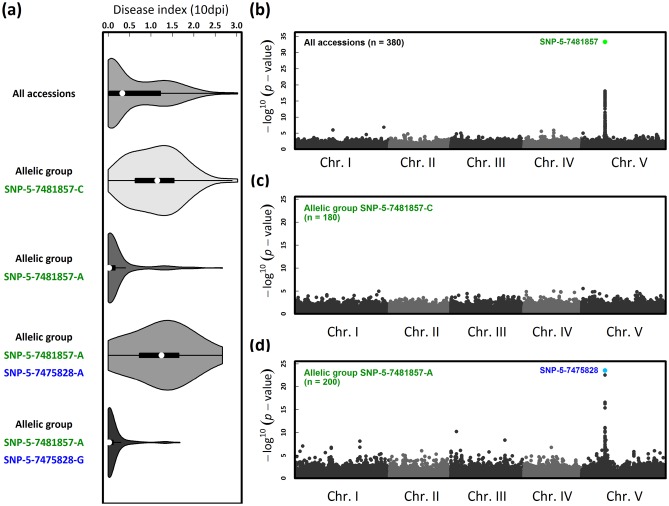
The genetics of quantitative disease resistance to the strain X cc12824 identified by nested genome‐wide association (GWA) mapping. (a) Violin plots (i.e. box‐and‐whisker plot overlaid with a kernel density plot) of the phenotypic variation of our disease index. Whole‐genome scan of 214 051 single‐nucleotide polymorphisms (SNPs) for association with disease index at 10 days post‐inoculation (dpi) across (b) 380 accessions, (c) within the allelic group SNP‐5‐7481857‐C and (d) within the allelic group SNP‐5‐7481857‐A.
Based on the phenotyping data obtained on 171 natural accessions of A. thaliana, extensive natural genetic variation was also found for QDR to the strain XccCFBP6943 (race 6; disease index at 10 dpi; accession effect F = 5.01, P < 0.0001; H 2 = 0.80; Fig. 2a). In contrast with the strain Xcc12824, most natural accessions were susceptible to the strain XccCFBP6943 (Fig. 2a). GWA mapping revealed a unique peak of association on the long arm of chromosome 5 (Fig. 2b), with SNP‐5‐18325565 being the most associated SNP (P = 1.41 × 10⁻¹⁰; MARF = 0.246) and located in the gene At5g45250. After splitting the set of 171 accessions by the G/A polymorphism at this top SNP, extensive genetic variation for QDR was still observed within both allelic groups (Fig. 2a). No obvious association peak was found within the more resistant SNP‐5‐18325565‐G allelic group (Fig. 2c). In the more susceptible SNP‐5‐18325565‐A allelic group, we identified several peaks that were weakly associated with QDR (i.e. not significant at the stringent Bonferroni threshold, i.e. P = 2.30 × 10⁻⁸), including one association peak located in the 5′ region of the gene At5g45250 (SNP‐5‐18320658; P = 1.12 × 10⁻⁶; MARF = 0.300). Nested GWA mapping thus suggests an allelic series in the vicinity of At5g45250. The three allelic groups (SNP‐5‐18325565‐G, SNP‐5‐18325565‐A/SNP‐5‐18320658‐A, SNP‐5‐18325565‐A/SNP‐5‐18320658‐T) explained 30.3% of the natural genetic variation.
Figure 2.

The genetics of quantitative disease resistance to the strain XccCFBP 6943 identified by nested genome‐wide association (GWA) mapping. (a) Violin plots (i.e. box‐and‐whisker plot overlaid with a kernel density plot) of the phenotypic variation of our disease index. Whole‐genome scan of 214 051 single‐nucleotide polymorphisms (SNPs) for association with disease index at 10 days post‐inoculation (dpi) across (b) 171 accessions, (c) within the allelic group SNP‐5‐18325565‐G and (d) within the allelic group SNP‐5‐18325565‐A.
QDR to X cc12824 (race 2) is conferred by the A t5g22540 gene
On the basis of the results of GWA mapping performed on the natural variation of QDR to Xcc12824, two candidate genes were identified: At5g22540 corresponding to SNP‐5‐7481857 being the most associated SNP, and At5g22510 corresponding to SNP‐5‐7475828 in the more resistant SNP‐5‐7481857‐A allelic group. To identify the gene(s) implicated in resistance to Xcc12824, insertional mutants (T‐DNA) in a Xcc12824‐resistant Col‐0 genetic background were selected for these two candidate genes, as well as for some other genes within the genomic region of interest when available (notably At5g22500, At5g22530). These mutants were inoculated with the strain Xcc12824 and the disease index was evaluated at four time points after inoculation. Although the mutants At5g22500‐1 (SALK N654537), At5g22500‐2 (SALK N667597), At5g22500‐3 (SALK N664670), At5g22510 (SALK N670195), At5g22530‐1 (SALK N682427) and At5g22530‐2 (SALK N681954) never showed disease symptoms, the mutant At5g22540 (hereafter called the mut540 mutant, SALK‐N667062) exhibited a high level of susceptibility, which was, however, slightly lower than that of the susceptible accession Kas‐1 (Table S1, see Supporting Information; Fig. 3a,b). These observations were confirmed by evaluation of in planta bacterial growth, with the gene At5g22540 being involved in the resistance to bacterial colonization (Fig. 3c). In mut540, the T‐DNA insertion located at position 1253 of the coding region leads to enhanced expression of the At5g22540 gene (37‐fold relative to Col‐0 in healthy leaves; Fig. S1, see Supporting Information). At5g22540 encodes a predicted protein of 440 amino acids, whose function is unknown. The expression of this gene was assessed during the interaction with Xcc12824, and showed a significant decrease during the first 6 h following bacterial inoculation (Fig. S1c). In addition, by testing different Xcc strains belonging to the nine races identified by Fargier et al. (2011) and diverse Xc strains belonging to Xcr, At5g22540 appeared to be involved in resistance not only to race 2, but also, to a lesser extent, to races 1 and 4 at 7 dpi (Table 1). Interestingly, at later time points (10 dpi), resistance to race 3 (strain Xcc568) was also significantly affected in the mutant mut540 (Table S2, see Supporting Information). As demonstrated previously (Huard‐Chauveau et al., 2013), the mutant rks1‐1, used as a control in these experiments, was affected in resistance to races 1, 3, 5, 7 and 9 (and, to a much lesser extent, to race 8) and to strains belonging to Xcr, but not to races 2 and 4 (Table 1).
Figure 3.

The mutant mut540 (affected in the A t5g22540 gene) is susceptible to X cc12824. (a) Disease symptoms were observed at 7 and 10 days post‐inoculation (dpi) on leaves of wild‐type and mut540 mutant (SALK 113262C) plants inoculated with X cc12824 (race 2 defined by Fargier et al., 2011 and Vicente et al., 2001). (b) Time course evaluation of disease index was performed in the mut540 line (blue) relative to the susceptible accession Kas‐1 (red) and the resistant accession Col‐0 (green), after inoculation with X cc12824. Means and standard errors were calculated from 8–15 plants (three independent experiments). (c) Bacterial growth measurement [colony‐forming units (CFU)/cm2 expressed on a log10 scale] in leaves of the mut540 line relative to the wild‐type accession Col‐0. The susceptible accession Kas‐1 was included as a positive control. Bacterial growth was measured 0 dpi (grey bars) and 7 dpi (black bars) with X cc12824. Data were collected from two independent experiments; each time point corresponds to six independent measurements, each on three to five individual plants (four leaves/plant). *Statistically significant difference using Kruskal–Wallis test (P < 0.05).
Table 1.
Disease index (7 days post‐inoculation) of the mut540 mutant after inoculation with different strains belonging to X anthomonas campestris pv. campestris (X cc) races, as defined by Fargier et al. (2011) and Vicente et al. (2001), and to the pathovar raphani (X cr)
| Mutant accession |
Xcc1869
(race 1)* |
Xcc12824
(race 2)* |
Xcc568
(race 3)* |
Xcc147
†
(race 4)* |
Xcc1712
(race 5)† |
Xcc6943
(race 6)* |
Xcc4953
(race 7)† |
Xcc1124
(race 8)* |
Xcc8004
(race 9)† |
Xcr756C † | Xcr5828 † | Xcr7144 † |
|---|---|---|---|---|---|---|---|---|---|---|---|---|
| mut540 | 1.39 ± 0.19b | 2.02 ± 0.19b | 0.58 ± 0.19a | 0.84 ± 0.17b | 0.58 ± 0.18a | 1.58 ± 0.32a | 0.67 ± 0.22a | 0.17 ± 0.11a | 0.92 ± 0.22a | 0.92 ± 0.30ab | 0.08 ± 0.08a | 0.00 ± 0.00a |
| Col‐0 | 0.53 ± 0.13a | 0.37 ± 0.08a | 0.33 ± 0.08a | 0.32 ± 0.07a | 0.81 ± 0.25a | 2.61 ± 0.13b | 0.88 ± 0.17a | 0.08 ± 0.04a | 0.56 ± 0.18a | 0.42 ± 0.25a | 0.63 ± 0.17a | 0.06 ± 0.06a |
| Kas‐0 | 3.63 ± 0.08c | 3.2 ± 0.15c | — | 2.77 ± 0.18c | — | — | — | — | — | — | — | — |
| rks1‐1 | 1.80 ± 0.16b | 0.40 ± 0.08a | 1.67 ± 0.26b | 0.63 ± 0.12ab | 2.25 ± 0.27b | 1.42 ± 0.28a | 2.25 ± 0.27b | 0.57 ± 0.13b | 2.67 ± 0.25b | 1.58 ± 0.30b | 1.25 ± 0.29b | 0.92 ± 0.43a |
*Numbers are the averages of the inoculation scores of three to six plants, and four leaves per plant, in two to three independent experiments. †Numbers are the averages of the inoculation scores of three to four plants, and four leaves per plant, in one experiment. —, not determined.
For each Xc strain, different letters indicate different groups after pairwise comparisons using a Tukey honestly significant difference (HSD) test.
The dual resistance gene system RRS 1/RPS 4 confers resistance to XccCFBP 6943 (race 6)
In response to the strain XccCFBP6943, a candidate gene was also identified on the basis of the GWA mapping results: At5g45250 corresponding to SNP‐5‐18325565 being the most associated SNP. This gene encodes for RPS4 (RESISTANCE TO PSEUDOMONAS SYRINGAE4) (Gassmann et al., 1999; Hinsch and Staskawicz, 1996), a well‐characterized R protein that confers recognition to the AvrRps4 effector from leaf‐infecting Pseudomonas syringae pv. tomato strain DC3000 (Pst‐avrRps4) (Hinsch and Staskawicz, 1996; Sohn et al., 2012).
Because the accession Col‐0 is highly susceptible to XccCFBP6943 and the accession Ws‐0 is rather resistant, we used the rps4‐21 mutant line (Narusaka et al., 2009b), identified in the Ws‐0 background, to test whether RPS4Ws was involved in resistance to this strain (Fig. 4a). Both Ws‐0 and the rps4‐21 mutant were inoculated with the strain XccCFBP6943 and the disease index was scored at four time points after inoculation. At 7 dpi, the mutant showed a high level of susceptibility relative to the resistant wild‐type (Fig. 4a,b). By measuring in planta bacterial growth in leaves at 7 dpi, we found that the rps4‐21 mutant line displayed the same level of susceptibility as Col‐0, confirming that resistance to XccCFBP6943 involves RPS4.
Figure 4.

The mutants rrs1‐1, rps4‐21, rps4‐21 rrs1‐1 and eds1‐1 are susceptible to XccCFBP 6943. (a) Disease symptoms were observed at 7 days post‐inoculation (dpi) on leaves of wild‐type plants (Ws‐0 and Col‐0) and mutants inoculated with the XccCFBP 6943 strain (race 6 defined by Fargier et al., 2011 and Vicente et al., 2001). (b) Time course evaluation of the disease index was performed in the mutants rrs1‐1 (blue cross), rps4‐21 (green circle), eds1‐1 (orange circle), rps4‐21 rrs1‐1 double mutant (rps4 rrs1, purple cross), the parental line Ws‐0 (blue square) and Col‐0 (green triangle) after inoculation with XccCFBP 6943. Means and standard errors were calculated from 10 plants (two independent experiments). (c) Bacterial growth measurement [colony‐forming units (CFU)/cm2 expressed on a log10 scale] in leaves of the mutants rrs1‐1, rsp4‐21, rps4‐21 rrs‐1 or eds1‐1 and the parental line Ws‐0. The susceptible accession Col‐0 was included as a positive control. Bacterial growth was measured 0 dpi (grey bars) and 7 dpi (black bars) with XccCFBP 6943. Data were collected from four independent experiments; each time point corresponds to six independent measurements, each on three to five individual plants (four leaves/plant). *Statistically significant difference using Kruskal–Wallis test (P < 0.05).
RPS4 has been described previously to cooperate genetically and molecularly with RRS1 (RESISTANCE TO RALSTONIA SOLANACEARUM1) (Birker et al., 2009; Deslandes et al., 2002; Narusaka et al., 2009b; Williams et al., 2014) in resistance to different pathogens, including Pst‐AvrRps4 and the root‐infecting Ralstonia solanacearum bacterium expressing the PopP2 effector (Deslandes et al., 2003). We therefore investigated whether RRS1Ws and RPS4Ws could also function cooperatively in response to XccCFBP6943. The wild‐type accession Ws‐0, single rps4‐21 and rrs1‐1 mutants, and the rps4‐21 rrs1‐1 double‐mutant (Narusaka et al., 2009b) were inoculated with XccCFBP6943 and in planta bacterial growth was measured in leaves at 7 dpi (Fig. 4a–c). Both the rrs1‐1 single mutant and rps4‐21 rrs1‐1 double mutant displayed a similar level of susceptibility to the rps4‐21 single mutant. Therefore, the NLR (nucleotide‐binding, leucine‐rich repeat receptors) pair, RPS4Ws with RRS1Ws, also operates against XccCFBP6943.
Finally, EDS1 (ENHANCED DISEASE SUSCEPTIBILITY1), a central regulator of basal resistance and of ETI mediated by resistance proteins belonging to the Toll‐interleukin‐1 receptor‐nucleotide binding‐leucine‐rich repeat (TIR‐NB‐LRR) class of resistance proteins, forms protein complexes with RPS4 (Bhattacharjee et al., 2011; Heidrich et al., 2011). Thus, we tested whether EDS1 could also play a role in RPS4/RRS1‐mediated resistance to XccCFBP6943. The eds1‐1 mutant exhibits a similar level of susceptibility to rps4‐21 and rrs1‐1 single and double mutants (Fig. 4), indicating that EDS1 is also required for RPS4/RRS1‐mediated resistance to XccCFBP6943.
These results were confirmed using other strains of race 6 of Xcc (data not shown). However, RRS1, RPS4 and EDS1 seem to confer resistance specifically to this race, as the mutant lines are not significantly more susceptible than Ws‐0 in response to other Xcc races in our experimental conditions (Table S3, see Supporting Information).
Discussion
Although QDR is a durable and broad‐spectrum form of resistance in plants, the identification of the genes underlying QDR and an understanding of the associated molecular mechanisms are still in their early stages (Balint‐Kurti and Holland, 2015; Roux et al., 2014a). Recently, we have identified RKS1 as a QDR gene conferring resistance in A. thaliana to the bacterial pathogen Xc. As for the majority of the few other QDR genes already identified, RKS1 does not encode an NB‐LRR resistance protein. Instead, RKS1 encodes an atypical kinase (Huard‐Chauveau et al., 2013; Roux et al., 2014b) that confers broad‐spectrum resistance to most, but not all, Xc races.
Here, the power of nested GWA mapping to finely map genomic regions associated with the natural variation of quantitative traits was once again demonstrated in A. thaliana. We identified two new QTLs explaining between 30% and 51% of the phenotypic variation at the species level and conferring resistance to different races of Xcc: (i) the gene At5g22540 conferring QDR to the strain Xcc12824 (race 2); and (ii) the dual resistance gene system RRS1/RPS4 conferring resistance to the strain XccCFBP6943 (race 6). In the latter case, the RRS1 and RPS4 receptor gene pair that cooperates genetically and molecularly has been studied extensively (Birker et al., 2009; Narusaka et al., 2009b; Williams et al., 2014). RPS4 and RRS1 function as a heteromeric ‘sensor–signalling’ pair in ETI against AvrRps4 and PopP2, two unrelated effectors from the bacterial pathogens Pseudomonas syringae and Ralstonia solanacearum, respectively (Le Roux et al., 2015; Sarris et al., 2015; Williams et al., 2014). In addition, Narusaka et al. (2009b) have demonstrated that the A. thaliana RCH2 (for recognition of Colletotrichum higginsianum) locus conferring resistance to C. higginsianum involves both RRS1 and RPS4. We show here that these two R genes located in a conserved head‐to‐head orientation confer QDR to the bacterial vascular pathogen Xcc. These results indicate that these R genes not only confer resistance to multiple pathogens with different infectious strategies, but are also involved in different forms of resistance, including QDR (as demonstrated previously for the R gene Pi35 conferring resistance in rice to the fungal pathogen Magnaporthe oryzae; Fukuoka et al., 2014). Indeed, both rrs1‐1 and rps4‐21 null mutants display a quantitatively increased susceptibility to XccCFBP6943 (disease index of 2.5–2.7; Table S3), whereas the most susceptible accessions display a disease index of about 4.0 (Fig. 2).
The susceptibility level of rrs1‐1 rps4‐21 is similar to that of single mutants, suggesting that, as for the other pathogen species, RRS1 and RPS4 function cooperatively, possibly through effector sensing by RRS1, followed by the activation of RPS4 for resistance signalling (Cui et al., 2015; Griebel et al., 2014). The identification of the effector(s) from Xcc recognized by this (these) receptor(s) would be of primary interest in order to investigate the molecular mechanisms underlying this form of resistance. Interestingly, EDS1 is also required for RPS4/RRS1‐mediated resistance to XccCFBP6943. Numerous NB‐LRRs, including RPS4, interact in nuclear complexes with EDS1, which is considered to be a key resistance signalling component. Thus, EDS1 represents a molecular bridge connecting R protein effector activation to downstream defence reprogramming (Bhattacharjee et al., 2011; Heidrich et al., 2011; Kim et al., 2012), although direct interaction between AvrRps4 and EDS1 has not always been detected (Sohn et al., 2012). Although the QDR genes identified to date do not generally correspond to typical immune receptors and encode a broad range of molecular functions (Huard‐Chauveau et al., 2013), in this case, as in a few other studies (Broglie et al., 2011; Fukuoka et al., 2014; Staal et al., 2006), the same perception and signalling components as ETI are utilized to confer a quantitative resistance to Xcc. In this case, the RRS1/RPS4‐dependent ETI response can be considered as one of the multiple signalling pathways initiated by potential multiple recognition events accounting finally for QDR (Roux et al., 2014a).
Similarly, for At5g22540, the mut540 mutant exhibits a quantitatively higher susceptibility to Xcc12824 (disease index of 2.0) than the wild‐type Col‐0 accession, whereas the most susceptible accessions display a disease index of about 3.2 (Table 1). However, in this case, At5g22540 gene expression (as evaluated using a primer located downstream of the T‐DNA insertion) is highly enhanced in the mutant, suggesting that either: (i) the overexpression of the 3′ end of the transcript affects the expression of At5g22540; or (ii) At5g22540 encodes a quantitative disease susceptibility factor. In agreement with the latter, At5g22540 expression is down‐regulated during the infection process in the wild‐type accession Col‐0, suggesting that At5g22540 might play an active role by suppression of resistance. It will be interesting to generate silenced and overexpressing At5g22540 lines in order to confirm this hypothesis. In addition, in contrast with the well‐characterized dual resistance gene system RRS1/RPS4, the gene At5g22540 encodes a protein with an unknown function. Together with RKS1, which encodes an atypical kinase, this study highlights the diversity of molecular functions underlying QDR to Xc. Such a complexity of molecular functions for the genetic control of QTL‐mediated resistance to the same pathogen has also been demonstrated in wheat to stripe rust (Fu et al., 2009; Krattinger et al., 2009), in rice to M. oryzae (Fukuoka et al., 2015) and in soybean to nematode (Cook et al., 2012; Liu et al., 2012).
QDR genes typically provide broad‐spectrum resistance. For example, wheat Yr36 provides high‐temperature‐dependent QDR to eight stripe rust races (Fu et al., 2009) and Lr34 provides resistance to two rust diseases of wheat, Puccinia striiformis and Puccinia triticina (Krattinger et al., 2009). Broad‐spectrum resistance conferred by QDR genes may relate to the perception and response pathways to well‐conserved microbial signatures, such as conserved effectors and PAMPs. For instance, expression of the PRR‐encoding gene EFR confers QDR to adapted and non‐adapted pathogens in several plant families (Lacombe et al., 2010). Alternatively, QDR genes may correspond to downstream effector response components: this is the case for most QDR genes identified to date. These could either act at the intersection of several effector perception pathways or represent common host targets indirectly manipulated by different effectors (Roux et al., 2014a). In the case of QDR to Xcc, we identified several genes displaying strikingly different ranges of specificity (Fig. 5): (i) RKS1 confers resistance to races 1, 3, 5, 7 and 9 (and, to a much lesser extent, race 8) and to strains belonging to Xcr, but not to races 2 and 4; (ii) At5g22540 is involved in resistance to different strains of Xcc belonging to races 1, 2, 3 and 4; and (iii) the RRS1/RPS4 gene pair confers resistance only to race 6 of Xcc. However, all only confer partial resistance to Xc (Tables 1 and S3). Interestingly, both RKS1 and At5g22540 confer resistance to races 1 and 3, suggesting that they cooperate through dependent or independent pathways to mount resistance against these races. To our knowledge, this study provides the first example of the identification of several QDR genes conferring, together, resistance to all races of a pathogen.
Figure 5.

Quantitative resistance conferred by the genes RKS 1, A t5g22540 and RPS 4/ RRS 1 to the nine races of X anthomonas campestris pv. campestris (X cc) (as defined by Fargier et al., 2011 and Vicente et al., 2001), as well as to X anthomonas campestris pv. raphani (X cr). Top: ratio of disease index (DI) at 7 days post‐inoculation of mutant against disease index (DI) of corresponding wild‐type. Data correspond to one to three independent experiments, each on three to five individual plants (four leaves/plant). For each X . campestris strain, the ratios of rks1‐1/Col‐0, mut540/Col‐0 and rps4‐21 rrs1‐1/Ws‐0 are represented by red, blue and green circles, respectively. Filled circles indicate significant differences between a mutant line and its corresponding wild‐type after pairwise comparisons using a Tukey honestly significant difference (HSD) test (see Tables 1 and S3). The strains correspond to X cc1869 (race 1), X cc12824 (race 2), X cc568 (race 3), X cc147 (race 4), X cc1712 (race 5), X cc6943 (race 6), X cc4953 (race 7), X cc1124 (race 8), X cc8004 (race 9) and X cr756C (Xcr). Bottom: summary of broad‐spectrum resistance conferred by the genes RKS 1, A t5g22540 and RPS 4/ RRS 1. Filled squares indicate significant differences between a mutant line and its corresponding wild‐type after pairwise comparisons using a Tukey HSD test (see Tables 1 and S3).
Intensive genetic mapping of resistance loci operating for pathogens for which QDR is the predominant form of plant resistance has highlighted, in a large number of cases, a complex genetic architecture underlying the control of QDR (Cook et al., 2012; Fukuoka et al., 2015; Roux et al., 2014a). However, because of their small phenotypic effects, the identification of the genes underlying QTLs remains a challenge. In addition, as for RKS1 (Huard‐Chauveau et al., 2013), our approach of nested GWA mapping suggests an allelic series for both QTLs identified in this study, reinforcing the importance of exploring the complete allelic diversity at a QDR gene to fully understand the genetic control of QTL‐mediated resistance (Fukuoka et al., 2014). Finally, as observed previously for RKS1 (Huard‐Chauveau et al., 2013), numerous populations across the native range of A. thaliana are polymorphic for the two major QTLs identified in this study (Fig. S2, see Supporting Information), stressing the need to study the adaptive dynamics of multiple QTL‐mediated resistance to Xc at a small spatial scale. Linking the dissection of QDR pathways to eco‐evolutionary dynamics at a local scale is of major importance for the development of realistic models aimed at the evaluation of the suitability of the pyramiding of QDR genes for crop disease management in an agro‐ecological context.
Experimental Procedures
Bacterial material
The strains Xcc12824 and XccCFBP6943 belong to races 2 and 6, respectively, as defined by Fargier and Manceau (2007), Fargier et al. (2011) and Vicente et al. (2001). Spontaneous resistant clones of Xcc12824 and XccCFBP6943 were selected on Kado medium (Kado and Heskett, 1970) supplemented with 50 mg/mL rifampicin.
Broad‐spectrum resistance was estimated by inoculation tests with different races of Xcc and Xcr [CIRM‐CFBP collection, INRA Angers, France]. All Xcc and Xcr strains were grown on Kado medium. Cultures of Xcc568 (LUX) were supplemented with 50 mg/mL rifampicin and 25 mg/mL kanamycin.
Plant material
To investigate the natural variation of resistance to Xcc, we used a set of A. thaliana natural accessions. For Xcc12824, we used the same set of 384 natural accessions that have been phenotyped previously for QDR to strain Xcc568 (race 3; Huard‐Chauveau et al., 2013). This set of 384 natural accessions includes 179 worldwide accessions (WA), 188 French accessions (FA), as part of the French RegMap (Bergelson and Roux, 2010), and 17 accessions that are both WA and FA. For XccCFBP6943, we used a subset of 176 WA. All the 384 natural accessions were genotyped for 214 051 SNPs evenly spaced across the genome (Horton et al., 2012).
Some mutants used in this study were identified in the SALK library (http://signal.salk.edu) and are in the A. thaliana accession Columbia (Col‐0) background: the lines N654537, N664670 and N667597 for gene At5g22500, line N670195 for gene At5g22510, lines N682427 and N681954 for gene At5g22530 and line N667062 (mut540 mutant) for gene At5g22540. The position of the T‐DNA insertion was confirmed by polymerase chain reaction (PCR) using T‐DNA‐LB (5′CCCTTTAGGGTTCCGATTTAGTGCT) and 540‐seq848F (5′ATAGTAATGGTGTGCTTCAC) primers and sequencing. The rrs1‐1, rps4‐21, rrs1‐1 rps4‐21 (Narusaka et al., 2009b) and eds1‐1 (Parker et al., 1996) mutants originated from the accession Wassilewskija (Ws‐0).
Plant inoculation and phenotyping
Plants were grown on Jiffy pots under controlled conditions (Lacomme and Roby, 1996). The virulence of Xcc strains and other pathovars was tested on 28‐day‐old plants after inoculation by piercing and scoring of the symptoms according to a scale from 0 to 4, as described in Meyer et al. (2005).
In planta bacterial growth analysis [colony forming units (CFU)/cm2, expressed on a log10 scale] was performed as described by Froidure et al. (2010). Because Xcc is a vascular bacterial species, bacterial growth was measured at 0 and 7 dpi by piercing inoculation with either Xcc12824 or Xcc6943 (rifampicin‐resistant derived clones) at a distance from the inoculation zone (at the tip of the inoculated leaves). Data were collected from at least two independent experiments; each time point corresponds to six independent measurements, each on three to five individual plants (four leaves per plant). At the inoculation site (base of the inoculated leaves), bacterial growth was measured and found to be similar in the different lines (Xcc12824: 5.3 ± 0.2 to 5.4 ± 0.2 log10 CFU/cm2 at T0; 9.4 ± 1 to 10.1 ± 1 log10 CFU/cm2 at 7 dpi; XccCFBP6943: 5.5 ± 0.1 to 5.8 ± 0.3 log10 CFU/cm2 at T0).
Natural variation of QDR
Experimental design
For Xcc12824, an experiment with 1728 plants was set up at the University of Lille 1 (France) according to a completely randomized design involving four experimental blocks, each block being an independent randomization of one replicate per accession. Infected plants were placed in plastic mini‐glasshouses, including two control accessions, Col‐5 (resistant) and Kas‐1 (susceptible), in the same positions within each mini‐glasshouse. Mini‐glasshouses were placed in phytotrons (22 °C, 9‐h photoperiod, 100% humidity).
For XccCFBP6943, an experiment with 768 plants was set up at INRA in Castanet‐Tolosan (France) according to a completely randomized design involving four experimental blocks, each block being an independent randomization of one replicate per accession. Infected plants were placed in plastic trays, including two control accessions, Col‐5 (resistant) and Kas‐1 (susceptible), in the same positions within each tray. Trays were placed in growth chambers (22 °C, 9‐h photoperiod, 100% humidity).
Statistical analyses
For each Xcc strain, we used the following general linear model (GLM procedure in SAS9.1; SAS Institute Inc., Cary, NC, USA) to explore the natural genetic variation of the disease index:
 |
(1) |
where μ is the overall mean of the phenotypic data, ‘block’ accounts for differences among the four experimental blocks, ‘accession’ corresponds to the differences among the natural accessions, covCol‐5 and covKas‐1 are covariates accounting for mini‐glasshouse (or plastic trays) effects and ε is the residual term. Normality of the residuals was not improved by transformation of the data. The least‐square mean (LSmean) was obtained for each natural accession and was subsequently used for GWA mapping analyses.
Broad‐sense heritabilities (H 2) were estimated from the mean square (MS) of Equation (1) using a formula adapted from Gallais (1990).
GWA mapping
In order to fine map the genomic regions associated with natural disease index variation, we ran a mixed model implemented in the software EMMAX (Efficient Mixed‐Model Association eXpedited; Kang et al., 2010). This mixed model includes a genetic kinship matrix based on the 214 051 SNPs as a covariate to control for population structure in the mapping panel.
RNA isolation and quantitative reverse transcription‐polymerase chain reaction (Q‐RT‐PCR)
RNA extraction and Q‐RT‐PCR analysis were performed as described by Froidure et al. (2010) using leaves from healthy plants. Q‐RT‐PCR analysis of transcript accumulation in wild‐type Col‐0 and mut540 mutant Arabidopsis leaves was performed using two pairs of primers: QF4‐540 (TCTTCTGTTTGCGGCTTTG) + 3′UTR‐R (CAAGAATCAAAACACTTAACTT) and QF4‐540 (TCTTCTGTTTGCGGCTTTG) + QR4‐540 (AGTCTTTTCTTTTGGAGGACG) (Fig. S1).
Supporting information
Fig. S1 Molecular characterization of the T‐DNA mutant line mut540. (a) Schematic representation of the insertion site of the T‐DNA in the mutant line mut540 (SALK‐113262C). The T‐DNA insertion occurs at position 1253, as shown by sequencing of the T‐DNA borders and of the flanking regions. The location of the primers used for gene expression analysis is represented. (b) At5g22540 gene expression analysis in leaves of the wild‐type accession (Col‐0) and the mutant line (mut540) by gel analysis of polymerase chain reaction (PCR) products using the primers [QF4‐540 + 3′UTR‐R]. (c) Time course analysis of At5g22540 expression by quantitative reverse transcription (RT)‐PCR (using the primers QF4‐540 + QR4‐540) in the wild‐type (black diamonds) relative to the mut540 line (grey triangles) after inoculation with Xcc12824. Means and standard errors were calculated from nine leaves in one representative experiment.
Fig. S2 Geographical distribution of polymorphisms associated with quantitative disease resistance to either Xcc12824 or Xcc6943. (a) Geographical distribution of the two alleles at the top SNP 5_7481857 detected by genome‐wide association (GWA) mapping for quantitative disease resistance to Xcc12824. Alleles ‘A’ and ‘C’ are associated with resistance and susceptibility to Xcc12824, respectively. (b) Geographical distribution of the two alleles at the top SNP 5_18325565 detected by GWA mapping for quantitative disease resistance to XccCFBP6943. Alleles ‘G’ and ‘A’ are associated with resistance and susceptibility to XccCFBP6943, respectively. Maps were based on 948 natural accessions with accurate GPS coordinates, genotyped for 214 051 single‐nucleotide polymorphisms (SNPs) (Hancock et al., 2011) and generated with the R packages ‘maptools’ and ‘plotrix’. The size of the circles depends on the number of accessions genotyped for 214 051 SNPs in the collection sites.
Table S1 Mutants identified in the At5g22540 locus and their phenotype in response to inoculation with Xcc12824, at 7 days post‐inoculation.
Table S2 Disease index (10 days post‐inoculation) of the mut540 mutant after inoculation with different strains belonging to Xanthomonas campestris pv. campestris (Xcc) races (as defined by Fargier et al., 2011 and Vicente et al., 2001) and with the pathovar raphani (Xcr).
Table S3 Disease index of the rps4‐21, rrs1‐1, eds1‐1, rks1‐1 single mutants and the rps4‐21 rrs1‐1 double mutant after inoculation with different strains belonging to Xanthomonas campestris pv. campestris (Xcc) races (as defined by Fargier et al., 2011 and Vicente et al., 2001) and with the pathovar raphani (Xcr). Disease index at 7 days post‐inoculation.
Acknowledgements
We thank Jane Parker (Max Planck Institute, Köln, Germany) for providing the Arabidopsis mutants rrs1‐1, eds1‐1, rps4‐21 and rrs1‐1 rps4‐21. We are also grateful to Laurent Deslandes for critical reading of the manuscript. This work was supported by the French Agence Nationale de la Recherche—ANR blanc grant (ANR‐09‐BLAN‐0072). This work was also supported by the French Laboratory of Excellence project ‘TULIP’ (ANR‐10‐LABX‐41; ANR‐11‐IDEX‐0002‐02).
References
- Balint‐Kurti, P.J. and Holland, J.B. (2015) New insight into a complex plant–fungal pathogen interaction. Nat. Genet. 47, 101–103. [DOI] [PubMed] [Google Scholar]
- Bergelson, J. and Roux, F. (2010) Towards identifying genes underlying ecologically relevant traits in Arabidopsis thaliana . Nat. Rev. Genet. 11, 867–879. [DOI] [PubMed] [Google Scholar]
- Bergelson, J. , Purrington, C.B. , Palm, C.J. and López‐Gutiérrez, J.C. (1996) Costs of resistance: a test using transgenic Arabidopsis thaliana . Proc. Biol. Sci. 263, 1659–1663. [DOI] [PubMed] [Google Scholar]
- Bhattacharjee, S. , Halane, M.K. , Kim, S.H. and Gassmann, W. (2011) Pathogen effectors target Arabidopsis EDS1 and alter its interactions with immune regulators. Science, 334, 1405–1408. [DOI] [PubMed] [Google Scholar]
- Birker, D. , Heidrich, K. , Takahara, H. , Narusaka, M. , Deslandes, L. , Narusaka, Y. , Reymond, M. , Parker, J.E. and O'Connell, R. (2009) A locus conferring resistance to Colletotrichum higginsianum is shared by four geographically distinct Arabidopsis accessions. Plant J. 60, 602–613. [DOI] [PubMed] [Google Scholar]
- Broglie, K.E. , Butler, K.H. , Butruille, M.G. , da Silva Conceiçao, A. , Frey, T.A. , Hawk, J.A. , Jaqueth, S. , Jones, E.S. , Multani, D.S. and Wolters, P.J.C.C. (2011) Method for identifying maize plants with RCG1 gene conferring resistance to Colletotrichum infection. US patent 8,062,847.
- Chisholm, S.T. , Coaker, G. , Day, B. and Staskawicz, B.J. (2006) Host–microbe interactions: shaping the evolution of the plant immune response. Cell, 124, 803–814. [DOI] [PubMed] [Google Scholar]
- Cook, D.E. , Lee, T.G. , Guo, X. , Melito, S. , Wang, K. , Bayless, A.M. , Wang, J. , Hughes, T.J. , Willis, D.K. , Clemente, T.E. , Diers, B.W. , Jiang, J. , Hudson, M.E. and Bent, A.F. (2012) Copy number variation of multiple genes at Rgh1 mediates nematode resistance in soybean. Science, 338, 1206–1209. [DOI] [PubMed] [Google Scholar]
- Cui, H. , Tsuda, K. and Parker, J.E. (2015) Effector‐triggered immunity: from pathogen perception to robust defense. Annu. Rev. Plant Biol. 66, 487–511. doi: 10.1146/annurev-arplant-050213-040012. Epub 2014 Dec 8. [DOI] [PubMed] [Google Scholar]
- Deslandes, L. , Olivier, J. , Theulieres, F. , Hirsch, J. , Feng, D.X. , Bittner‐Eddy, P. , Beynon, J. and Marco, Y. (2002) Resistance to Ralstonia solanacearum in Arabidopsis thaliana is conferred by recessive RRS1‐R gene, a member of a novel family of resistance genes. Proc. Natl. Acad. Sci. USA, 99, 2404–2409. [DOI] [PMC free article] [PubMed] [Google Scholar]
- Deslandes, L. , Olivier, J. , Peeters, N. , Feng, D.X. , Khounlotham, M. , Boucher, C. , Somssich, I. , Genin, S. and Marco, Y. (2003) Physical interaction between RRS1‐R, a protein conferring resistance to bacterial wilt, and Pop2, a type III effector targeted to the plant nucleus. Proc. Natl. Acad. Sci. USA, 100, 8024–8029. [DOI] [PMC free article] [PubMed] [Google Scholar]
- Fargier, E. and Manceau, C. (2007) Pathogenicity assays restrict the species Xanthomonas campestris into three pathovars and reveal nine races within X. campestris pv. campestris . Plant Pathol. 56, 805–818. [Google Scholar]
- Fargier, E. , Fischer‐Le Saux, M. and Manceau, C. (2011) A multilocus sequence analysis of Xanthomonas campestris reveals a complex structure within crucifer attacking pathovars of this species. Syst. Appl. Microbiol. 34, 156–165. [DOI] [PubMed] [Google Scholar]
- Froidure, S. , Canonne, J. , Daniel, X. , Jauneau, A. , Briere, C. , Roby, D. and Rivas, S. (2010) AtsPLA2‐alpha nuclear relocalization by the Arabidopsis transcription factor AtMYB30 leads to repression of the plant defense response. Proc. Natl. Acad. Sci. USA, 107, 15 281–15 286. [DOI] [PMC free article] [PubMed] [Google Scholar]
- Fu, D. , Uauy, C. , Distelfeld, A. , Blechi, A. , Epstein, L. , Che, X. , Sela, H. , Fahima, T. and Dubcovsky, J. (2009) A kinase‐START gene confers temperature‐dependent resistance to wheat stripe rust. Science, 323, 1357–1360. [DOI] [PMC free article] [PubMed] [Google Scholar]
- Fukuoka, S. , Yamamoto, S.‐I. , Mizobuchi, R. , Yamanouchi, U. , Ono, K. , Kitazawa, N. , Yasuda, N. , Fujita, Y. , Thanh Nguyen, T.T. , Koizumi, S. , Sugimoto, K. , Matsumoto, T. and Yano, M. (2014) Multiple functional polymorphisms in a single disease resistance gene in rice enhance durable resistance to blast. Sci. Rep. 4(4550), 1–7. [Google Scholar]
- Fukuoka, S. , Saka, N. , Mizukami, Y. , Koga, H. , Yamanouchi, U. , Yoshioka, Y. , Hayashi, N. , Ebana, K. , Mizobuchi, R. and Yano, M. (2015) Gene pyramiding enhances durable blast disease resistance in rice. Sci. Rep. 5(7773), 1–7. [DOI] [PMC free article] [PubMed] [Google Scholar]
- Gallais, A. (1990) Théorie de la Sélection en Amélioration des Plantes. Paris: Masson. [Google Scholar]
- Gassmann, W. , Hinsch, M.E. and Staskawicz, B.J. (1999) The Arabidopsis RPS4 bacterial‐resistance gene is a member of the TIR‐NBS‐LRR family of disease‐resistance genes. Plant J. 20 (3), 265–277. [DOI] [PubMed] [Google Scholar]
- Glazebrook, J. (2005) Contrasting mechanisms of defense against biotrophic and necrotrophic pathogens. Annu. Rev. Phytopathol. 43, 205–227. [DOI] [PubMed] [Google Scholar]
- Griebel, T. , Maekawa, T. and Parker, J.E. (2014) NOD‐like receptor cooperativity in effector‐triggered immunity. Trends Immunol. 35, 562–570. [DOI] [PubMed] [Google Scholar]
- Hancock, A.M. , Brachi, B. , Faure, N. , Horton, M.W. , Jarymowycz, L.B. , Sperone, F.G. , Toomajian, C. , Roux, F. and Bergelson, J. (2011) Adaptation to climate across the Arabidopsis thaliana genome. Science, 334, 83–86. [DOI] [PubMed] [Google Scholar]
- Heidrich, K. , Wirthmueller, L. , Tasset, C. , Pouzet, C. , Deslandes, L. and Parker, J.E. (2011) Arabidopsis EDS1 connects pathogen effector recognition to cell compartment‐specific immune responses. Science, 334, 1401–1404. [DOI] [PubMed] [Google Scholar]
- Hinsch, M. and Staskawicz, B. (1996) Identification of a new Arabidopsis disease resistance locus, RPS4, and cloning of the corresponding avirulence gene, avrRps4, from Pseudomonas syringae pv. pisi . Mol. Plant–Microbe Interact. 9, 55–61. [DOI] [PubMed] [Google Scholar]
- Horton, M.W. , Hancock, A.M. , Huang, Y.S. , Toomajian, C. , Atwell, S. , Auton, A. , Muliyati, N.W. , Platt, A. , Sperone, F.G. , Vilhjálmsson, B.J. , Nordborg, M. , Borevitz, J.O. and Bergelson, J. (2012) Genome‐wide patterns of genetic variation in worldwide Arabidopsis thaliana accessions from the RegMap panel. Nat. Genet. 44, 212–216. [DOI] [PMC free article] [PubMed] [Google Scholar]
- Huard‐Chauveau, C. , Perchepied, L. , Debieu, M. , Rivas, S. , Kroj, T. , Kars, I. , Bergelson, J. , Roux, F. and Roby, D. (2013) An atypical kinase under balancing selection confers broad‐spectrum disease resistance in Arabidopsis. PLoS Genet. 9, e1003766. [DOI] [PMC free article] [PubMed] [Google Scholar]
- Jones, J.D. and Dangl, J.L. (2006) The plant immune system. Nature, 444, 323–329. [DOI] [PubMed] [Google Scholar]
- Kado, C.I. and Heskett, M.G. (1970) Selective media for isolation of Agrobacterium, Corynebacterium, Erwinia, Pseudomonas, and Xanthomonas . Phytopathology, 60, 969–976. [DOI] [PubMed] [Google Scholar]
- Kang, H.M. , Sul, J.H. , Service, S.K. , Zaitlen, N.A. and Kong, S.Y. , Freimer, N.B. , Sabatti, C. and Eskin, E. (2010) Variance component model to account for sample structure in genome‐wide association studies. Nat. Genet. 42 (4), 348–354. [DOI] [PMC free article] [PubMed] [Google Scholar]
- Kim, T.H. , Kunz, H.H. , Bhattacharjee, S. , Hauser, F. , Park, J. , Engineer, C. , Liu, A. , Ha, T. , Parker, J.E. , Gassmann, W. and Schroeder, J.I. (2012) Natural variation in small molecule induced TIR‐NB‐LRR signaling induces root growth arrest via EDS1‐ and PAD4‐complexed R protein VICTR in Arabidopsis. Plant Cell, 24, 5177–5192. [DOI] [PMC free article] [PubMed] [Google Scholar]
- Krattinger, S.G. , Lagudah, E.S. , Spielmeyer, W. , Singh, R.P. , Huerta‐Espino, J. , McFadden, H. , Bossolini, E. , Selter, L.L. and Keller, B. (2009) A putative ABC transporter confers durable resistance to multiple fungal pathogens in wheat. Science, 323, 1360–1363. [DOI] [PubMed] [Google Scholar]
- Lacombe, S. , Rougon‐Cardoso, A. , Sherwood, E. , Peeters, N. , Dahlbeck, D. , van Esse, H.P. , Smoker, M. , Rallapalli, G. , Thomma, B.P.H.J. , Staskawicz, B. , Jones, J.D. and Zipfel, C. (2010) Interfamily transfer of a plant pattern‐recognition receptor confers broad‐spectrum bacterial resistance. Nat. Biotechnol. 28, 365–369. [DOI] [PubMed] [Google Scholar]
- Lacomme, C. and Roby, D. (1996) Molecular cloning of a sulfotransferase in Arabidopsis thaliana and regulation during development and in response to infection with pathogenic bacteria. Plant Mol. Biol. 30, 995–1008. [DOI] [PubMed] [Google Scholar]
- Le Roux, C. , Huet, G. , Jauneau, A. , Camborde, L. , Trémousaygue, D. , Kraut, A. , Zhou, B. , Levaillant, M. , Adachi, H. , Yoshioka, H. , Raffaele, S. , Berthomé, R. , Couté, Y. , Parker, J.E. and Deslandes, L. (2015) A receptor decoy converts pathogen disabling of transcription factors into immunity. Cell, 161, 1074–1088. doi: 10.1016/j.cell.2015.04.025. [DOI] [PubMed] [Google Scholar]
- Liu, S. , Kandoth, P.K. , Warren, S.D. , Yeckel, G. , Heinz, R. , Alden, J. , Yang, C. , Jamai, A. et al (2012) A soybean cyst nematode resistance gene points to a new mechanism of plant resistance to pathogens. Nature, 492, 256–260. [DOI] [PubMed] [Google Scholar]
- McDonald, B.A. and Linde, C. (2002) Pathogen population genetics, evolutionary potential, and durable resistance. Annu. Rev. Phytopathol. 40, 349–379. [DOI] [PubMed] [Google Scholar]
- Meyer, D. , Lauber, E. , Roby, D. , Arlat, M. and Kroj, T. (2005) Optimization of pathogenicity assays to study the Arabidopsis thaliana–Xanthomonas campestris pv. campestris pathosystem. Mol. Plant Pathol. 6, 327–333. [DOI] [PubMed] [Google Scholar]
- Narusaka, M. , Kubo, Y. , Shiraishi, T. , Iwabuchi, M. and Narusaka, Y. (2009a) A dual resistance gene system prevents infection by three distinct pathogens. Plant Signal. Behav. 4, 954–955. [DOI] [PMC free article] [PubMed] [Google Scholar]
- Narusaka, M. , Shirasu, K. , Noutoshi, Y. , Kubo, Y. , Shiraishi, T. , Iwabuchi, M. and Narusaka, Y. (2009b) RRS1 and RPS4 provide a dual Resistance‐gene system against fungal and bacterial pathogens. Plant J. 60, 218–226. [DOI] [PubMed] [Google Scholar]
- Ogura, T. and Busch, W. (2015) From phenotypes to causal consequences: using genome wide association studies to dissect the sequence basis for variation of plant development. Curr. Opin. Plant Biol. 23, 98–108. [DOI] [PubMed] [Google Scholar]
- Panstruga, R. , Parker, J.E. and Schulze‐Lefert, P. (2009) SnapShot: plant immune response pathways. Cell, 136(5), 978.e1–9783. doi: 10.1016/j.cell.2009.02.020. [DOI] [PubMed] [Google Scholar]
- Parker, J.E. , Holub, E.B. , Frost, L.N. , Falk, A. , Gunn, N.D. and Daniels, M.J. (1996) Characterization of eds1, a mutation in Arabidopsis suppressing resistance to Peronospora parasitica specified by several different RPP genes. Plant Cell, 8, 2033–2046. [DOI] [PMC free article] [PubMed] [Google Scholar]
- Poland, J.A. , Balint‐Kurti, P.J. , Wisser, R.J. , Pratt, R.C. and Nelson, R.J. (2009) Shades of gray: the world of quantitative disease resistance. Trends Plant Sci. 14, 21–29. [DOI] [PubMed] [Google Scholar]
- Roux, F. , Voisin, D. , Badet, T. , Balagué, C. , Barlet, X. , Huard‐Chauveau, C. , Roby, D. and Raffaele, S. (2014a) Resistance to phytopathogens e tutti quanti: placing plant quantitative disease resistance on the map. Mol. Plant Pathol. 15, 427–432. [DOI] [PMC free article] [PubMed] [Google Scholar]
- Roux, F. , Noël, L. , Rivas, S. and Roby, D. (2014b) ZRK atypical kinases: emerging signaling components of plant immunity. New Phytol. 203, 713–716. [DOI] [PubMed] [Google Scholar]
- Sarris, P.F. , Duxbury, Z. , Huh, S. , Ma, Y. , Segonzac, C. , Sklenar, J. , Derbyshire, P. , Cevik, V. , Rallapalli, G. , Saucet, S.B. , Wirthmueller, L. , Menke, F.L. , Sohn, K.H. and Jones, J.D. (2015) A plant immune receptor detects two effectors that target WRKY transcription factors. Cell, 161(5), 1089–1100. doi: 10.1016/j.cell.2015.04.024. [DOI] [PubMed] [Google Scholar]
- Schulze‐Lefert, P. and Panstruga, R. (2011) A molecular evolutionary concept connecting nonhost resistance, pathogen host range, and pathogen speciation. Trends Plant Sci. 16, 117–125. [DOI] [PubMed] [Google Scholar]
- Sohn, K.H. , Hughes, R.K. , Piquerez, S.J. , Jones, J.D. and Banfield, M.J. (2012) Distinct regions of the Pseudomonas syringae coiled‐coil effector AvrRps4 are required for activation of immunity. Proc. Natl. Acad. Sci. USA, 109 (40), 16 371–16 376. [DOI] [PMC free article] [PubMed] [Google Scholar]
- Staal, J. , Kaliff, M. , Bohman, S. and Dixelius, C. (2006) Transgressive segregation reveals two Arabidopsis TIR‐NB‐LRR resistance genes effective against Leptosphaeria maculans, causal agent of blackleg disease. Plant J. 46, 218–230. [DOI] [PubMed] [Google Scholar]
- Strauss, S.Y. , Rudgers, J.A. , Lau, J.A. and Irwin, R.E. (2002) Direct and ecological costs of resistance to herbivory. Trends Ecol. Evol. 17, 278–285. [Google Scholar]
- Vicente, J.G. , Conway, J. , Roberts, S.J. and Taylor, J.D. (2001) Identification and origin of Xanthomonas campestris pv. campestris races and related pathovars. Phytopathology, 91, 492–499. [DOI] [PubMed] [Google Scholar]
- Vila‐Aiub, M.M. , Neve, P. and Roux, F. (2011) A unified approach to the estimation and interpretation of resistance costs in plants. Heredity, 107, 386–394. [DOI] [PMC free article] [PubMed] [Google Scholar]
- Williams, S.J. , Sohn, K.H. , Wan, L. , Bernoux, M. , Sarris, P.F. , Segonzac, C. , Ve, T. , Ma, Y. , Saucet, S.B. , Ericsson, D.J. , Casey, L.W. , Lonhienne, T. , Winzor, D.J. , Zhang, X. , Coerdt, A. , Parker, J.E. , Dodds, P.N. , Kobe, B. and Jones, J.D. (2014) Structural basis for assembly and function of a heterodimeric plant immune receptor. Science, 344, 299–303. [DOI] [PubMed] [Google Scholar]
- Young, N.D. (1996) QTL mapping and quantitative disease resistance in plants. Annu. Rev. Phytopathol. 34, 479–501. [DOI] [PubMed] [Google Scholar]
- Zuo, W. , Chao, Q. , Zhang, N. , Ye, J. , Tan, G. , Li, B. , Xing, Y. , Zhang, B. , Liu, H. , Fengler, K.A. , Zhao, J. , Zhao, X. , Chen, Y. , Lai, J. , Yan, J. and Xu, M. (2015) A maize wall‐associated kinase confers quantitative resistance to head smut. Nat. Genet. 47, 151–157. [DOI] [PubMed] [Google Scholar]
Associated Data
This section collects any data citations, data availability statements, or supplementary materials included in this article.
Supplementary Materials
Fig. S1 Molecular characterization of the T‐DNA mutant line mut540. (a) Schematic representation of the insertion site of the T‐DNA in the mutant line mut540 (SALK‐113262C). The T‐DNA insertion occurs at position 1253, as shown by sequencing of the T‐DNA borders and of the flanking regions. The location of the primers used for gene expression analysis is represented. (b) At5g22540 gene expression analysis in leaves of the wild‐type accession (Col‐0) and the mutant line (mut540) by gel analysis of polymerase chain reaction (PCR) products using the primers [QF4‐540 + 3′UTR‐R]. (c) Time course analysis of At5g22540 expression by quantitative reverse transcription (RT)‐PCR (using the primers QF4‐540 + QR4‐540) in the wild‐type (black diamonds) relative to the mut540 line (grey triangles) after inoculation with Xcc12824. Means and standard errors were calculated from nine leaves in one representative experiment.
Fig. S2 Geographical distribution of polymorphisms associated with quantitative disease resistance to either Xcc12824 or Xcc6943. (a) Geographical distribution of the two alleles at the top SNP 5_7481857 detected by genome‐wide association (GWA) mapping for quantitative disease resistance to Xcc12824. Alleles ‘A’ and ‘C’ are associated with resistance and susceptibility to Xcc12824, respectively. (b) Geographical distribution of the two alleles at the top SNP 5_18325565 detected by GWA mapping for quantitative disease resistance to XccCFBP6943. Alleles ‘G’ and ‘A’ are associated with resistance and susceptibility to XccCFBP6943, respectively. Maps were based on 948 natural accessions with accurate GPS coordinates, genotyped for 214 051 single‐nucleotide polymorphisms (SNPs) (Hancock et al., 2011) and generated with the R packages ‘maptools’ and ‘plotrix’. The size of the circles depends on the number of accessions genotyped for 214 051 SNPs in the collection sites.
Table S1 Mutants identified in the At5g22540 locus and their phenotype in response to inoculation with Xcc12824, at 7 days post‐inoculation.
Table S2 Disease index (10 days post‐inoculation) of the mut540 mutant after inoculation with different strains belonging to Xanthomonas campestris pv. campestris (Xcc) races (as defined by Fargier et al., 2011 and Vicente et al., 2001) and with the pathovar raphani (Xcr).
Table S3 Disease index of the rps4‐21, rrs1‐1, eds1‐1, rks1‐1 single mutants and the rps4‐21 rrs1‐1 double mutant after inoculation with different strains belonging to Xanthomonas campestris pv. campestris (Xcc) races (as defined by Fargier et al., 2011 and Vicente et al., 2001) and with the pathovar raphani (Xcr). Disease index at 7 days post‐inoculation.