



Abstract
Electron-withdrawing/coordinating o-phenolacetyl-substituted viologen can act as a visual sensor for solvents, bases, and temperature in organic solvents. Due to chelating phenolacetyl groups, this viologen can coordinate to Fe(III), Cu(II), and ZnCl2 in aqueous and DMF solutions. Interestingly, this viologen can respond to temperature, grind, and NH3 vapor in its solid state. Stimuli response is visible, fast, and fully reversible in air at room temperature. The color change is attributed to the enolic and/or free radical structure. This is the most versatile chromic material that responds to chemical and physical stimuli in both solution and solid state.
Introduction
Viologens (1,1′-disubstituted 4,4′-bipyridinium) have gained much attention over the past 80 years.1 Acting as strong electron acceptors, viologens undergo two reversible reduction steps generating a radical cation (V•+) and a neutral form (V0) under appropriate external chemical or physical stimuli, such as pH, light, or electric potential.2−5 Interest in viologen derivatives has grown, amongst other things, because of the simplicity of synthesis and tunability, the high degree of control over their reversible redox process, the range of colors from being colorless (V2+) to green/blue/purple (V•+), the paramagnetic nature of V•+, and the strong structural templating effects (V2+).6 These possibilities have led to the incorporation of viologens in a series of donor–acceptor complexes developed for various applications such as photochromic and electrochromic displays,2−4,7 solar energy storage devices,8,9 fluorescence,10,11 supramolecular host–guest complexes12,13 and molecular machines,14 and ferroelectrics.15
Key to the design and successful use of viologens is a basic understanding of their physical and chemical responses to external stimuli. Recently, two viologen-based covalent organic polymers have been reported by Trabolsi et al.16 Their research showed that the viologen-based polymer displayed solid-state thermochromism owing to the formation of radical cations. Crystalline materials of viologens also showed thermochromism mostly caused by the donor–acceptor interactions in a complex that lead to charge-transfer absorption due to the donor–acceptor interactions in a complex. They showed the chromic properties only in solid state,17−20 possibly because solution studies are hindered by an unsteady color change and the poor solubility of these materials in proper solvents. Thermochromism of viologens in solution has no precedent and is a challenge that remains to be explored.
Mechanochromic dyes are a unique type of stimuli responsive materials that change their color in response to external stimuli such as hydrostatic pressure or shear force. Tetraphenylethylene and carbazole have shown mechanochromism because of fluorescence change after grinding.21−25 By introducing electron-poor aromatics in organic sulfide, Verolet et al. studied a planarizable push–pull mechanofluorochromic material.26 Recently, Qi et al. reported high-contrast mechanochromism and polymorphism-dependent fluorescence of difluoroboron β-diketonate complexes.22 The mechanofluorochromic effect is based on aggregation-induced emission. Existing mechanochromic dyes are generally monitored by fluorescence but not by the naked eye.27 Thus, high-contrast, naked-eye-detectable mechanochromic material is of great interest. Thermochromic materials have wide applications and have received great attention of late. Although viologen compounds as thermochromic compounds have been reported at temperatures higher than 200 °C, their response is slow (20 min) and insignificant28,29 with a continuous need to improve sensitivity and contrast.
Ammonia is widely used for industrial applications, such as fertilizers and refrigeration. It is a hazardous material with toxic, corrosive effects and is difficult to handle as contact with skin or its inhalation is extremely dangerous to health. Development of new materials for ammonia sensory and capture, therefore, is essential for the safe containment and management of ammonia. Trabolsi et al. synthesized viologen polymer as an NH3 sensor, which darkens in color upon exposure to gaseous NH3 for ∼1 min. The NH3-fumed dark-colored polymer can then be re-oxidized into light color species using gaseous HCl (7 min).16 For practical applications, faster response is needed, in our opinion.
Taking into account that the chromism of viologen is due to the electron transfer from donor to acceptor (viologen), electron-withdrawing substituents tend to increase the electron-deficiency and thus may increase their chromic sensitivity. Although viologen-containing metal–organic frameworks have been reported, viologen as a ligand that interacts with metal ions in solution is still absent. To investigate viologen complexes in solution, we introduce o-phenolacetyl as the coordination/chelate group (Scheme 1). Interestingly, this phenolacetyl viologen (1,1′-bis[2-(2-hydroxyphenyl)-2-oxoethyl]-4,4′-bipyridinium bromide, abbreviated as H4pavBr2) with highly active methylene can respond to bases (halochromic), solvents, temperature, metal ions in solution, as well as temperature, grind, and gaseous NH3 and HCl in solid state instantly. These stimuli responses are not only fast but also fully reversible and obvious to the naked eye. To our knowledge, this is the most versatile chromic material that produces visually obvious responses to different chemical and physical stimuli.
Scheme 1. Structure of Phenolacetyl Functionalized Viologen H4pavBr2.

Experimental Section
4,4-Bipyridine (Sinopharm Chemical Reagent), 2-bromo-2′-hydroxyacetophenone (ENERGY Reagent), all other chemicals were used as received without further purification. Solutions were prepared with subboiled distilled water in an all-quartz apparatus. Synthetic details are summarized in Supporting Information.
1H and 13C NMR spectra were measured on a Bruker AV 500 MHz spectrometer. TOF mass spectra were collected on an Agilent 6510Q. ESI mass spectra were performed on a Shimadzu LCMS-2020. The elemental analyses (C, H, and N) were obtained on a Vario EL III analyzer. UV–vis absorption spectra were performed using a Puxi TU-1900 spectrometer with a 1.0 and 0.1 cm quartz cell equipped with a temperature-controlled water bath (25 °C). Pure solvents were used as references. Electron paramagnetic resonance (EPR) spectra were recorded using a JES-FA 200 spectrometer fitted with the DICE ENDOR accessory, EN801 resonator, and an ENI A-500 rf power amplifier.
NH3 and HCl vapor sensing was performed in air at room temperature. NH3 vapor (on top of 25% NH3 aqueous solution) was withdrawn using a syringe. The vapor in the syringe was injected on the surface of the sample or paper from ∼5 cm. HCl vapor was taken from 36% HCl aqueous solution. Other experimental procedures were identical to those reported in the literature.30
Results and Discussion
Solvatochromic and Halochromic
H4pavBr2 was synthesized according to a reported procedure and characterized by elemental analysis, 1H NMR, 13C NMR, IR, and MS (see Supporting Information). 1H NMR indicates that free H4pavBr2 exists in the ketone form (Figure S1). The color of H4pavBr2 in solution depends on concentrations, solvents, and NaOH (Figure 1). The spectrometric data in different solvents are summarized in Table S1. Regressing maximum absorption wavelength λ (1.0 × 10⁻⁵ M) with solvent polarity (ETN)31 (i.e., λ = aET + b), we have a = −45 and b = 580. Stronger polarity shifted wavelength shorter. H4pavBr2 turned out to be a negative solvatochromic dye.
Figure 1.

Photographic images exhibiting the solvatochromic and halochromic behaviors. 1.0 × 10⁻⁴ M (a) and 1.0 × 10⁻⁵ M (b) H4pavBr2 in different solvents. The color in the presence of different equivalents of NaOH in H2O (5.0 × 10⁻⁵ M, c), DMSO (1.0 × 10⁻⁵ M, d), and DMF (1.0 × 10⁻⁴ M, e). NaOH equivalence and pH (in H2O) are labeled in black and red, respectively.
The color of H4pavBr2 in the presence of NaOH differs greatly in different equivalents of NaOH in H2O, DMF, and DMSO (Figure 1). From Figure 1, it can be seen that H4pavBr2 is not only solvatochromic but also halochromic. The halochromic effect is much more effective in organic solvents than in H2O. These phenomena are roughly comparable with previous reports.30,32 For reference, spectra details are shown in Figures S2–S4.
1H NMR of H4pavBr2 shows quite clean spectra in DMSO (Figure S5, red line). Upon adding 0.5 equiv NaOD (purple color), the CH2 group splits into two signal in a 2:1 ratio (Figure S5). This may indicate that one ketone is tautomerized into the enolic structure (Scheme 1) or ylide.33,34 The purple-blue color that peaked at 610 nm (in 1–2 equiv NaOD) refers to obviously deprotonated enolic species.
Figure S2 shows UV–vis spectral changes of 5.0 × 10⁻⁵ M H4pav2+ upon gradually adding NaOH in aqueous solution. At 0.5, 1.5, 2.5, and 3.5 equiv NaOH (half-protonation), the pH values are 6.46, 6.58, 7.14, and 8.61, respectively, indicating the four pKas. The first two pKas correspond to the enolic protons, whereas the last two correspond to the phenol hydroxyl pKas.32 A weakly acidic medium can deprotonate enolic protons, whereas a basic medium will deprotonate the phenol protons. The disappearance of phenol proton in 1–3 equiv NaOD in DMSO (Figure S5) is possibly due to proton exchange with D2O (in the NaOD solution). Based on the pH titration (Figure S2), the proposed deprotonation processes are illustrated in Scheme S1.
EPR spectra were investigated to elucidate the possible species. H4pavBr2 at 1.0 × 10⁻³ M is colorless and EPR-silent. After 5 equiv NaOH was added, it became pale blue with an EPR signal of free radical at g = 2.00. Adding hyposulfite will deepen the color and strengthen the EPR signal (Figure S6).30,32 It is worth to mention that the colored sample in DMSO seems EPR-silent. The color in organics is from the enolic and/or deprotonated enolic structure.
Interaction with Metal Ions
As the phenolacetyl contains two coordinating oxygen atoms, it may interact with metal ions. Fosso et al. reported that there were no differences between the curves obtained in the absence and presence of CuCl2, suggesting that this phenol ketone (2′-hydroxychalcone) does not bind Cu(II) at room temperature from pH 2 to 12 in aqueous solution.35 Although Křikavová have recently proved that 2′-hydroxychalcone can coordinate with Cu(II) in the chelate mode in the presence of triethylamine in methanol solution,36 there is no report on whether viologen-containing ligands can interact with metal ions and how metal ions influence the color of viologen compounds in solution.
Figure S7 shows the spectral changes of 1.0 × 10⁻³ M H4pavBr2 upon gradually adding 4 equiv metal ions into DMF solution. NiCl2, CoCl2, and BaCl2 have insignificant interactions with H4pavBr2 in DMF as the 562 nm peak is almost identical to that of free H4pavBr2. Although AlCl3, FeCl3, and CuCl2 can significantly decrease the 562 nm absorbance, ZnCl2 can obviously increase the 562 nm absorbance. Figure 2a shows the spectral changes of 1.0 × 10⁻³ M H4pavBr2 upon gradually adding ZnCl2 into DMF solution. The color deepens as the 562 nm absorbance increases with the increase in ZnCl2. 1H NMR spectra (Figure 2b) show the deprotonated enolic structure in the presence of ZnCl2, which is similar to that of NaOH. This indicates that Zn(II) is chelated to the enolic structure of phenolacetyl. However, there is essentially no interaction between ZnCl2 and H4pavBr2 in aqueous solution.
Figure 2.

Metal ion response of H4pavBr2. (a) UV–vis spectral changes of 1.0 × 10⁻³ M H4pavBr2 upon gradual addition of ZnCl2 in DMF solution. Color changes from purple to deep blue. (b) 1H NMR of H4pavBr2 in the absence or presence of different amounts of ZnCl2 in DMSO. (c) Spectra of a 5.0 × 10⁻⁴ M H4pavBr2 and 1.0 × 10⁻³ M Fe(NO3)2 aqueous solution in the presence of different amounts of NaOH (0.10 cm cell). (d) Spectra of a 5.0 × 10⁻⁴ M H4pavBr2 and 1.0 × 10⁻³ M Cu(NO3)2 aqueous solution in the presence of different amounts of NaOH (0.10 cm cell).
Fe(III) and Cu(II) have a significant interaction with H4pavBr2 in the presence of NaOH (Figure 2). H4pavBr2 is essentially colorless (Figures 1 and S2) in aqueous solution at pH 6–10. In the presence of 2 equiv Fe(NO3)3, the solution is colorless at pH < 4 (4 equiv NaOH or less). The solution becomes pink-orange at pH 4–5.7 (Figure 2c). Further increase in pH will significantly darken the color (5 equiv NaOH or higher). The purple-blue color peaked at ∼544 and ∼650, which are different from those in the absence of metal ions. This also indicates that enolic phenolacetyl may possibly chelate to Fe(III). Cu(II) has a similar spectral change except higher pH is needed, indicating less chromic sensitivity compared with Fe(III). Different from those of Fe(III), there is no peak at >600 nm. A similar structure, 2′-hydroxychalcone (without viologen), can form copper complex with maximum absorbance at 533 nm.36 The color of Cu(II) complex is obviously lighter than that of the corresponding Fe(III) complex at the same pH. Further increase will form a very dark precipitation of the corresponding complex. The FT-IR spectra clearly show the deprotonation of phenol proton (3392 cm–1) and the carbonyl shifted from 1646 cm–1 in H4pavBr2 to 1557 (Fe complex) and 1569 cm–1 (Cu complex), which agrees well with the enolic phenolacetyl chelate. H4pavBr2 can sense Fe(III) and Cu(II) in aqueous solution and ZnCl2 in DMF solution.
Thermochromic in Solution
The color of H4pavBr2 is also temperature-sensitive both in organic solution and in solid state. Figure 3 shows 562 nm absorbance of 1.0 × 10⁻³ M H4pavBr2 at different temperatures in DMF solution. The 562 nm absorbance gradually increases with the increase in temperature. Once the solution has cooled, the color reverts. The thermochromic behavior is relatively stable up to 5 cycles (Figure 3). Variable-temperature NMR in DMSO solution did provide evidence for thermochromism (Figure S9). The chemical shift of phenolic hydroxyl hydrogen shifted to a higher field as temperature increases, whereas the methylene hydrogen shifted to a lower field. All aromatic protons remained constant. The single methylene peak splits slightly into two peaks at 60 °C or higher (Figure S9). Higher temperature favors enolic tautomerism. Thermochromic behavior in solid state is also visible to the naked eye. Increased temperature will also significantly deepen the color, especially at 80 °C. The thermochromic change in solid state has a much better reversibility. Deepening of color with increase in temperature is quite fast (<1 min), whereas color bleach in lower temperature needed much longer times (∼5 min). We were able to recycle the material tens of times without observable degradation. To the best of our knowledge, this is the first example of a thermochromic viologen in solution. The thermochromic behavior in solid state at 60–80 °C is also much sensitive than the literature values at higher than 200 °C and 20 min.28,29 We believe this viologen may open an avenue for future development of thermochromic materials for daily life and industry.
Figure 3.

Thermochromic behavior of H4pavBr2 in solution (top) and solid state (bottom). Absorbance at 562 nm of 1.0 × 10⁻³ M H4pavBr2 at different temperatures in DMF (top). Filter paper (soaked in 1.0 × 10⁻³ M H4pavBr2 aqueous solution and dried in air) as the temperature indicator at different temperatures.
Mechanochromic and Thermochromic in Solid State
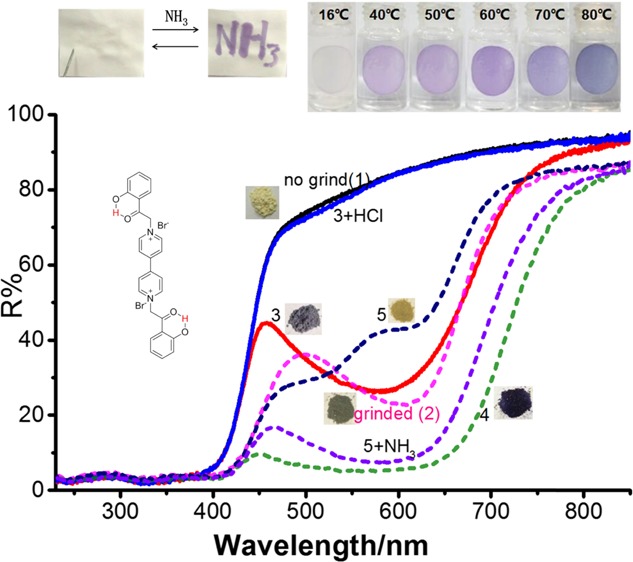
In running IR experiments, we found that H4pavBr2 changes color after grinding, which directed us to investigate its mechanochromism. Mechanochromics are manifolds ranging from simple changes in the molecular geometries and phase transitions from one structure to another to distinct disturbance of the ground and excited states.23,24 The color of H4pavBr2 turns from pale yellow to dark green after grinding (Figure 4). Reflectance spectra indicate that H4pavBr2 essentially has no absorbance at >450 nm. The green ground sample has very strong absorbance at 600 nm. 1H NMR of H4pavBr2 before and after grinding (in DMSO) shows that protons adjacent to pyridinium have the largest shift (−0.025 ppm for aromatic H and −0.022 for methylene H). This indicates that the positive charge on pyridinium decreased. EPR spectra show free radical formation after grinding (Figure S11). The XRD patterns of H4pavBr2 before and after grinding are essentially the same except for slightly broader and weaker signals in the ground sample (Figure S12). The TG–DSC curve of the ground green sample is almost identical to that of the unground one (Figure S14) except that the ground sample decomposes at 10 °C lower than the unground sample. This value is obviously larger than the 3 °C difference reported in the literature.21
Figure 4.

Mechanochromic and NH3 sensor in solid state. (a) Schematic presentation of mechanochromic and NH3 sensor (samples are numbered). (b) 1.0 × 10⁻⁴ M H4pavBr2 aqueous solution written on filter paper that responds to NH3 gas instantly. (c) Reflectance spectra of H4pavBr2 before and after grinding and NH3 fume.
NH3 Vapor Sensor in Solid State
H4pavBr2 can respond to bases not only in solution but also in solid state (Figures 4, S11, and S12). Light yellow H4pavBr2 immediately becomes purple-blue once fumed with NH3 vapor (from 25% ammonia aqueous solution). This purple-blue sample immediately reverts to light yellow when fumed with HCl vapor. The result is similar to that of our previous work and attributed to the formation of viologen radicals (Figure S11).30 The ground H4pavBr2 changes from dark green to black-purple once fumed with NH3 and reverted to yellow when fumed with HCl. The NH3 coloration and HCl bleaching are fast and fully reversible at room temperature. Notably, the ground sample (green) underwent self-recovery to its original light yellow after standing at room temperature for several days. The ground sample is more sensitive to NH3 than the original unground sample as it has a much dark color compared with the unground H4pavBr2 (Figure 4a). Reflectance spectra of H4pavBr2 before and after grinding and their response to NH3 (gas) and HCl (gas) are shown in Figure 4. Sample 4 is almost black as it has no reflectance at <700 nm. Unground H4pavBr2 has strong absorbance at ∼590 nm after NH3 fume, whereas the ground green sample has absorbance at ∼620 nm. All colored samples reverted to their original yellow after standing at room temperature for days.
To better/conveniently use this compound as an NH3 sensor, 1.0 × 10⁻⁴ M H4pavBr2 aqueous solution was used as invisible ink written on cellulose filter paper. The colorless paper (dried at room temperature) immediately became purple-blue when fumed with NH3. Removal from fume rendered it completely colorless within 5 s (Supporting Information video). HCl fume will immediately bleach the paper. This paper can be used in NH3 production, transportation, and storage as an indicator of vapor leakage. Such a sensor can also be reused several hundred times without observable degradation. With electron-withdrawing ketone group, H4pavBr2 has much better sensitivity than the literature-reported viologen polymer, which has NH3 response (1 min) and HCl (7 min).16
Conclusions
In conclusion, a novel phenolacetyl viologen was synthesized. This viologen not only exhibits solvatochromism, halochromism, thermochromism, and mechanochromism and sensors solvents, pH, temperature, and mechanical force but also exhibits metallochromism and vapochromism and can respond to Zn(II), Cu(II), and Fe(III) in solution and NH3 in vapor. No other compounds have such versatile chromic properties. The chromic behavior is mainly due to the enolic structure in solution and free radicals in solid state.
Acknowledgments
This project was supported by the National Natural Science Foundation of China (grants 21401127 and 21571126) and the Natural Science Foundation of Shanghai (grant 14ZR1416300). We thank the Instrumental Analysis and Research Center of Shanghai University for measurements.
Supporting Information Available
The Supporting Information is available free of charge on the ACS Publications website at DOI: 10.1021/acsomega.7b00035.
The authors declare no competing financial interest.
Supplementary Material
References
- Michaelis L.; Hill E. S. The Viologen Indicators. J. Gen. Physiol. 1933, 16, 859–873. 10.1085/jgp.16.6.859. [DOI] [PMC free article] [PubMed] [Google Scholar]
- Bird C. L.; Kuhn A. T. Electrochemistry of the viologens. Chem. Soc. Rev. 1981, 10, 49–82. 10.1039/CS9811000049. [DOI] [Google Scholar]
- Alesanco Y.; Viñuales A.; Palenzuela J.; Odriozola I.; Cabañero G.; Rodriguez J.; Tena-Zaera R. Multicolor Electrochromics: Rainbow-Like Devices. ACS Appl. Mater. Interfaces 2016, 8, 14795–14801. 10.1021/acsami.6b01911. [DOI] [PubMed] [Google Scholar]
- Li H.-Y.; Wei Y.-L.; Dong X.-Y.; Zang S.-Q.; Mak T. C. W. Novel Tb-MOF Embedded with Viologen Species for Multi-Photofunctionality: Photochromism, Photomodulated Fluorescence, and Luminescent pH Sensing. Chem. Mater. 2015, 27, 1327–1331. 10.1021/cm504350q. [DOI] [Google Scholar]
- Yang H.; Chen H.; Tan Y. Cucurbit[8]uril inducing supramolecular hydrogels by adjusting pH. RSC Adv. 2013, 3, 3031–3037. 10.1039/c2ra22837h. [DOI] [Google Scholar]
- Mercier N. The Templating Effect and Photochemistry of Viologens in Halometalate Hybrid Crystals. Eur. J. Inorg. Chem. 2013, 19–31. 10.1002/ejic.201201125. [DOI] [Google Scholar]
- Palenzuela J.; Viñuales A.; Odriozola I.; Cabañero G.; Grande H. J.; Ruiz V. Flexible Viologen Electrochromic Devices with Low Operational Voltages Using Reduced Graphene Oxide Electrodes. ACS Appl. Mater. Interfaces 2014, 6, 14562–14567. 10.1021/am503869b. [DOI] [PubMed] [Google Scholar]
- Atienzar P.; de Victoria-Rodriguez M.; Juanes O.; Rodríguez-Ubis J. C.; Brunet E.; García H. Layered γ-zirconium phosphate as novel semiconductor for dye sensitized solar cells: Improvement of photovoltaic efficiency by intercalation of a ruthenium complex-viologen dyad. Energy Environ. Sci. 2011, 4, 4718–4726. 10.1039/c1ee02158c. [DOI] [Google Scholar]
- Amao Y.; Shuto N.; Furuno K.; Obata A.; Fuchino Y.; Uemura K.; Kajino T.; Sekito T.; Iwai S.; Miyamoto Y.; Matsuda M. Artificial leaf device for solar fuel production. Faraday Discuss. 2012, 155, 289–296. 10.1039/c1fd00097g. [DOI] [PubMed] [Google Scholar]
- Yu L.; Li L.; Ding Y.; Lu Y. A Fluorescent Switch Sensor for Glutathione Detection Based on Mn-doped CdTe Quantum Dots—Methyl Viologen Nanohybrids. J. Fluoresc. 2016, 26, 651–660. 10.1007/s10895-015-1751-6. [DOI] [PubMed] [Google Scholar]
- Singh A.; Yip W.-T.; Halterman R. L. Fluorescence-On Response via CB7 Binding to Viologen–Dye Pseudorotaxanes. Org. Lett. 2012, 14, 4046–4049. 10.1021/ol300963c. [DOI] [PubMed] [Google Scholar]
- Fathalla M.; Strutt N. L.; Sampath S.; Katsiev K.; Hartlieb K. J.; Bakr O. M.; Stoddart J. F. Porphyrinic supramolecular daisy chains incorporating pillar[5]arene–viologen host–guest interactions. Chem. Commun. 2015, 51, 10455–10458. 10.1039/c5cc03717d. [DOI] [PubMed] [Google Scholar]
- Zhang W.; Gan S.; Vezzoli A.; Davidson R. J.; Milan D. C.; Luzyanin K. V.; Higgins S. J.; Nichols R. J.; Beeby A.; Low P. J.; Li B.; Niu L. Single-Molecule Conductance of Viologen–Cucurbit[8]uril Host–Guest Complexes. ACS Nano 2016, 10, 5212–5220. 10.1021/acsnano.6b00786. [DOI] [PubMed] [Google Scholar]
- Kolivoška V.; Gál M.; Pospíšil L.; Valášek M.; Hromadová M. Electron dopable molecular wires based on the extended viologens. Phys. Chem. Chem. Phys. 2011, 13, 11422–11429. 10.1039/c1cp20652d. [DOI] [PubMed] [Google Scholar]
- Leblanc N.; Mercier N.; Zorina L.; Simonov S.; Auban-Senzier P.; Pasquier C. Large Spontaneous Polarization and Clear Hysteresis Loop of a Room-Temperature Hybrid Ferroelectric Based on Mixed-Halide BiI3Cl2 Polar Chains and Methylviologen Dication. J. Am. Chem. Soc. 2011, 133, 14924–14927. 10.1021/ja206171s. [DOI] [PubMed] [Google Scholar]
- Das G.; Prakasam T.; Nuryyeva S.; Han D. S.; Abdel-Wahab A.; Olsen J.-C.; Polychronopoulou K.; Platas-Iglesias C.; Ravaux F.; Jouiad M.; Trabolsi A. Multifunctional redox-tuned viologen-based covalent organic polymers. J. Mater. Chem. A 2016, 4, 15361–15369. 10.1039/c6ta06439f. [DOI] [Google Scholar]
- Wu J.; Tao C.; Li Y.; Li J.; Yu J. Methyl viologen-templated zinc gallophosphate zeolitic material with dual photo-/thermochromism and tuneable photovoltaic activity. Chem. Sci. 2015, 6, 2922–2927. 10.1039/c5sc00291e. [DOI] [PMC free article] [PubMed] [Google Scholar]
- Wan F.; Qiu L.-X.; Zhou L.-L.; Sun Y.-Q.; You Y. A fluorescent, photochromic and thermochromic trifunctional material based on a layered metal–viologen complex. Dalton Trans. 2015, 44, 18320–18323. 10.1039/c5dt03405a. [DOI] [PubMed] [Google Scholar]
- Sun J.-K.; Wang P.; Yao Q.-X.; Chen Y.-J.; Li Z.-H.; Zhang Y.-F.; Wu L.-M.; Zhang J. Solvent- and anion-controlled photochromism of viologen-based metal–organic hybrid materials. J. Mater. Chem. 2012, 22, 12212–12219. 10.1039/c2jm30558e. [DOI] [Google Scholar]
- Kinuta T.; Sato T.; Tajima N.; Kuroda R.; Matsubara Y.; Imai Y. Solid-state thermochromism observed in charge-transfer complex composed of binaphthol and viologen. J. Mol. Struct. 2010, 982, 45–49. 10.1016/j.molstruc.2010.07.048. [DOI] [Google Scholar]
- Zhan Y.; Gong P.; Yang P.; Jin Z.; Bao Y.; Li Y.; Xu Y. Aggregation-induced emission and reversible mechanochromic luminescence of carbazole-based triphenylacrylonitrile derivatives. RSC Adv. 2016, 6, 32697–32704. 10.1039/c6ra03310e. [DOI] [Google Scholar]
- Qi Y.; Wang Y.; Yu Y.; Liu Z.; Zhang Y.; Du G.; Qi Y. High-contrast mechanochromism and polymorphism-dependent fluorescence of difluoroboron β-diketonate complexes based on the effects of AIEE and halogen. RSC Adv. 2016, 6, 33755–33762. 10.1039/c5ra27819h. [DOI] [Google Scholar]
- Xu B.; Mu Y.; Mao Z.; Xie Z.; Wu H.; Zhang Y.; Jin C.; Chi Z.; Liu S.; Xu J.; Wu Y.-C.; Lu P.-Y.; Lien A.; Bryce M. R. Achieving remarkable mechanochromism and white-light emission with thermally activated delayed fluorescence through the molecular heredity principle. Chem. Sci. 2016, 7, 2201–2206. 10.1039/c5sc04155d. [DOI] [PMC free article] [PubMed] [Google Scholar]
- Ma Z.; Wang Z.; Meng X.; Ma Z.; Xu Z.; Ma Y.; Jia X. A Mechanochromic Single Crystal: Turning Two Color Changes into a Tricolored Switch. Angew. Chem., Int. Ed. 2016, 55, 519–522. 10.1002/anie.201507197. [DOI] [PubMed] [Google Scholar]
- Gong Y.; Chen G.; Peng Q.; Yuan W. Z.; Xie Y.; Li S.; Zhang Y.; Tang B. Z. Achieving Persistent Room Temperature Phosphorescence and Remarkable Mechanochromism from Pure Organic Luminogens. Adv. Mater. 2015, 27, 6195–6201. 10.1002/adma.201502442. [DOI] [PubMed] [Google Scholar]
- Verolet Q.; Rosspeintner A.; Soleimanpour S.; Sakai N.; Vauthey E.; Matile S. Turn-On Sulfide π Donors: An Ultrafast Push for Twisted Mechanophores. J. Am. Chem. Soc. 2015, 137, 15644–15647. 10.1021/jacs.5b10879. [DOI] [PubMed] [Google Scholar]
- Xue S.; Qiu X.; Sun Q.; Yang W. Alkyl length effects on solid-state fluorescence and mechanochromic behavior of small organic luminophores. J. Mater. Chem. C 2016, 4, 1568–1578. 10.1039/c5tc04358a. [DOI] [Google Scholar]
- Sun C.; Wang M.-S.; Li P.-X.; Guo G.-C. Conductance Switch of a Bromoplumbate Bistable Semiconductor by Electron-Transfer Thermochromism. Angew. Chem., Int. Ed. 2016, 56, 554–558. 10.1002/anie.201610180. [DOI] [PubMed] [Google Scholar]
- Wan F.; Qiu L.-X.; Zhou L.-L.; Sun Y.-Q.; You Y. A fluorescent, photochromic and thermochromic trifunctional material based on a layered metal–viologen complex. Dalton Trans. 2015, 44, 18320–18323. 10.1039/c5dt03405a. [DOI] [PubMed] [Google Scholar]
- Shi W.; Xing F.; Bai Y.-L.; Hu M.; Zhao Y.; Li M.-X.; Zhu S. High Sensitivity Viologen for a Facile and Versatile Sensor of Base and Solvent Polarity in Solution and Solid State in Air Atmosphere. ACS Appl. Mater. Interfaces 2015, 7, 14493–14500. 10.1021/acsami.5b03932. [DOI] [PubMed] [Google Scholar]
- Machado V. G.; Stock R. I.; Reichardt C. Pyridinium N-phenolate betaine dyes. Chem. Rev. 2014, 114, 10429–10475. 10.1021/cr5001157. [DOI] [PubMed] [Google Scholar]
- Gao J.; Xing F.; Bai Y.; Zhu S. Synthesis, spectroscopy, and binding constants of ketocatechol-containing iminodiacetic acid and its Fe(III), Cu(II), and Zn(II) complexes and reaction of Cu(II) complex with H2O2 in aqueous solution. Dalton Trans. 2014, 43, 7964–7978. 10.1039/c4dt00118d. [DOI] [PubMed] [Google Scholar]
- Postolachi R.; Danac R.; Buurma N. J.; Pui A.; Balan M.; Shova S.; Deleanu C. New cycloimmonium ylide ligands and their palladium(II) affinities. RSC Adv. 2013, 3, 17260–17270. 10.1039/C3RA41911H. [DOI] [Google Scholar]
- Danac R.; Mangalagiu I. I. Antimycobacterial activity of nitrogen heterocycles derivatives: Bipyridine derivatives. Part III 13 and 14. Eur. J. Med. Chem. 2014, 74, 664–670. 10.1016/j.ejmech.2013.09.061. [DOI] [PubMed] [Google Scholar]
- Fosso M. Y.; LeVine H. III; Green K. D.; Tsodikov O. V.; Garneau-Tsodikova S. Effects of structural modifications on the metal binding, anti-amyloid activity, and cholinesterase inhibitory activity of chalcones. Org. Biomol. Chem. 2015, 13, 9418–9426. 10.1039/C5OB01478F. [DOI] [PubMed] [Google Scholar]
- Křikavová R.; Vančo J.; Trávníček Z.; Hutyra J.; Dvořák Z. Design and characterization of highly in vitro antitumor active ternary copper(II) complexes containing 2′-hydroxychalcone ligands. J. Inorg. Biochem. 2016, 163, 8–17. 10.1016/j.jinorgbio.2016.07.005. [DOI] [PubMed] [Google Scholar]
Associated Data
This section collects any data citations, data availability statements, or supplementary materials included in this article.