



Abstract

Ag/Co3O4 catalysts using three different modes of solution combustion synthesis were developed and characterized by X-ray diffraction, X-ray photoelectron spectroscopy, scanning electron microscopy, and transmission electron microscopy to identify crystallite size, oxidation state, composition, and morphology. Cyclic voltammetry and linear sweep voltammetry measurements for the oxygen reduction reaction (ORR) and oxygen evolution reaction (OER) confirm the bifunctionality of the electrocatalysts. The electrochemical evaluation indicates that a synergic effect between Ag and Co enhances the activity through the fast breaking of O–O bond in the molecular oxygen to enhance the reduction mechanism. The high content of cobalt (Co) in the catalyst Ag/Co3O4-12, synthesized by second wave combustion, improves the activity for ORR, and the reaction mechanism follows a 3.9 number of electron transfer in overall reaction. The kinetic and limiting current densities of Ag/Co3O4-12 are maximum when compared to those of other Ag/Co3O4 catalysts and are very close to commercial Pt/C. Moreover, the maximum current density of OER for Ag/Co3O4-12 makes it a promising candidate for various bifunctional electrocatalytic applications such as fuel cells and metal–air batteries.
Introduction
Energy conversion electrochemical technologies such as polymer electrolyte fuel cells and metal–air batteries show highly efficient performance based on the oxygen catalyst in the reaction mechanism.1−5 Platinum (Pt) has been recognized as the most efficient catalyst for anode and cathode of the fuel cells.6−10 However, its high cost and availability limit its use, and it is an urgent task to find the replacement of Pt with readily available and cheaper ones. Oxygen reduction reaction (ORR) and oxygen evolution reaction (OER) are cathodic and anodic reaction techniques that are applicable for fuel cells, water splitting, and CO2 reduction and in energy-storage solar fuel synthesis.11−14 Precious metals such as Pt, Ru, and Ir are well-known OER catalysts with moderate overpotential.15 It is reported that RuO2 is thermodynamically unstable, whereas Pt and Ir cause agglomeration in the atomic scale, which prevents them to act as bifunctional catalysts over time.16,17 It is challenging to introduce a bifunctional oxygen catalyst for both ORR and OER.17−20
A bimetallic catalyst shows distinct physical and chemical properties that differ from its monometallic catalyst because of the high synergy between the individual metals.21 The bimetals of transition metals has different applications in the field of catalysis, batteries, and solar energy conversion by the presence of hybrid sites and its concomitant functionalities.22−28 Bimetallic catalysts have the exciting tuning properties to enhance the reaction pathway. Previous studies have reported on the extensive behavior of bimetals in catalysis, which possess unique properties strongly associated with their intrinsic electronic or geometric structures.24,29−32 Effective oxygen reduction catalyst with high activity and low cost remains a great challenge. In this work, we demonstrate the synthesis of bifunctional catalysts that are active for ORR and OER suitable to be used in fuel cells and water electrolysis-related applications.
Silver (Ag) shows high activity, better tolerance, stability, and longer performance for ORR mechanism.33,34 The weaker Ag–O2 interaction results in a stronger O–O bond that causes difficulty in breaking the bond of the electrolyte. Therefore, the Ag–O interaction must be stronger to enhance the electrochemical activity of the catalyst and consequently increases the kinetics of ORR. This can be achieved by incorporating the cheaper metals along with Ag. Cobalt (Co) is a better option because of its low cost, electrical resistance, and corrosion-free nature in basic medium. An active Co3+ site in Co3O4 shows great performance in ORR. The high interaction of adsorbed oxygen with Ag in the Ag–Co/C particle increases the ORR activity by rupturing the O–O bond. Also, the adsorption of oxygen to Ag from the well-oxidized Co3O4 results in increase in the oxygen transport rate. Lin et al. reported that the presence of Co in Au–Co for ORR changes the electronic structure of the gold.35 Wang et al. reported on the hydrothermal method of the synthesis of Ag–C, Co3O4–C, and Ag/Co3O4–C and compared the monometal and bimetal effect in the catalytic activity.36
We followed a fast, simple, and single-step solution combustion synthesis (SCS) resulted with the preparation of a wide range of nanoparticles (NPs) of high surface area and porosity in cost-effective way.37,38 SCS mode is based on the redox reaction between the oxidizing agent (metal nitrate) and the fuel (e.g., urea, glycine, and hydrazine). The fuels mostly used are sources of carbon and hydrogen that are ideally highly water-soluble cyclic and linear organic amines and amino acids with low decomposition temperature.39 The exothermic reactions between the reactive group (NH3) of fuel and nitric acid (HNO3) from metal nitrate are the primary source of energy to initiate the combustion mode. Hydrogen-rich atmosphere formed during combustion determines the phase of the resulted NPs whether it is pure metal (H2 rich) or its oxides (H2 lean), which results in the formation of NPs with a high crystalline structure without any postthermal treatments such as calcination.40,41 It is possible to synthesize various metals, metal oxides, metal sulfides, and alloys with different properties and dimensions through the precise control of specific fuel and the fuel-to-oxidizer ratio.42−44 The large amount of gases such as carbon dioxide, nitrogen, and water formed during the combustion causes the significant expansion of gaseous product and reduces the temperature after reduction that would help in the formation of finely dispersed porous nanostructures.45,46 Manukyan and co-workers studied the mechanism of SCS for the synthesis of nanocrystalline metallic materials using different in situ techniques.47 They found the effect of fuel-to-oxidizer ratio on the transformation of metal oxides to metals and vice versa. The stoichiometric equation and the mechanism behind the combustion synthesis of NP were reported in our previous work.48,49 In this work, we first propose a single-step combustion synthesis of Ag/Co3O4 through three different modes, which shows good ORR and OER response in basic medium.
Results and Discussion
X-ray diffraction (XRD) patterns indicate the phases of the synthesized Ag/Co3O4 catalysts (Figure 1). In all the three synthesis modes, Ag is in metallic form, whereas Co is present in the form of its oxides (CoO and Co3O4). Ag/Co3O4-12 and Ag/Co3O4-21 show the presence of both CoO and Co3O4, but in Ag/Co3O4-11, Co is present only in the higher oxidation state (Co3O4). The presence of cubic-structured Co3O4 (PDF#43-1003) can be observed at 31.28°, 36.6°, 59.21°, and 65.32° along with the presence of CoO in Ag/Co3O4-12 and Ag/Co3O4-21 compounds at 43.54°. Likewise, the presence of Ag(111), Ag(200), Ag(220), and Ag(331) can be identified with the peaks located at 38.2°, 44.3°, 64.6°, and 77.6°, respectively.36 The formation of CoO in Ag/Co3O4-12 and Ag/Co3O4-21 samples could be due to the second wave of combustion where additional fuel is added to synthesize the second phase that could partially reduce Co3O4 to CoO as reported earlier.49
Figure 1.
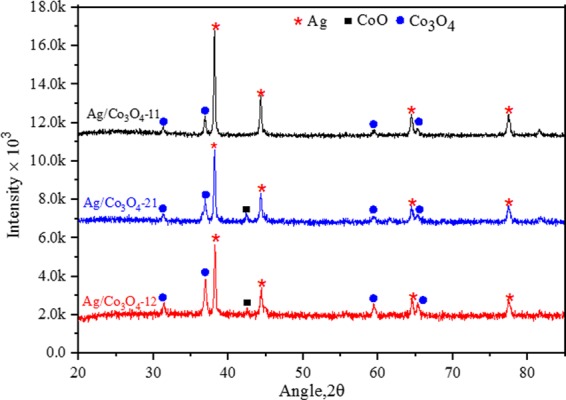
XRD pattern of three synthesis modes of Ag–Co using combustion synthesis.
The absorption spectrum of monometallic Ag NP gave the surface plasmon resonance (SPR) peak at 470 nm (Figure 2a). Co shows that two SPR peaks centered at lower band (540 nm) are associated with O2– to Co2+ and those centered at higher band (800 nm) correspond to O2– to Co3+ transition.50,51 Ag/Co3O4 showing one absorption peak at the lower band in the region between the resonance peak of monometals Ag and Co clearly indicates the formation of an Ag–Co NP alloy not only a mixture of Ag and Co NPs. In Ag/Co3O4-12, the lower resonance peak was observed at 450 nm with a clear blue shift when compared to Ag/Co3O4-11 and Ag/Co3O4-21. The blue shift in Ag/Co3O4-12 could be due to the strong quantum confinement effect that shifts the energy levels of conduction and valence bands with decrease in particle size.52
Figure 2.

(a) UV–visible absorption spectrum of monometallic and bimetallic Ag–Co. (b–d) Tauc plot to determine the optical band gap in Ag/Co3O4-11, Ag/Co3O4-12, and Ag/Co3O4-21.
The optical band gap for the bimetallic Ag–Co was calculated based on the Tauc equation
 |
1 |
where h is the Planck constant, ν is the frequency of the vibration, A is the absorption coefficient, Eg is the band gap of the semiconductor, and n is a constant, which is 1/2 for a direct transition or 2 for an indirect transition. The Tauc plot (Figure 2b–d) corresponds to two band gap values: the lower band gap value is assigned to d–d spin-allowed transition between Co3+ and Co2+ ion and the higher band gap value is originated from p–d charge transfer within Co3+ and O2– in Co3O4.50,53−55 The dual band gap is the possibility of interband transition in spinel cobalt oxide (Co3O4). Ag/Co3O4-12 holds a larger band gap value of 1.23 eV possibly because of the quantum particle size confinement that makes the conduction and valence band shifts apart.
Fourier transform infrared (FTIR) spectrum shows the absorbance spectrum of monometal and bimetals of Ag–Co (Figure 3). The vibration in the range of 400–700 cm–1 generally corresponds to metal–oxygen bonding. The vibration spectrum for Ag in this range gets flattened because of the presence of Ag in pure metallic form without any kind of oxygen bonding present in it or because of the possible sintering at higher temperature with increase in fuel ratio.56,57 In Co spectrum, the two absorption peaks at 652 and 549 cm–1 originate from the stretching vibration of the Co–O bond where Co2+ (3d7) is tetrahedrally coordinated at 653 cm–1 and Co3+ (3d6) is octahedrally coordinated at 550 cm–1 confirming the presence of spinel Co3O4.58,59 The peak at 1043 cm–1 corresponds to the characteristic vibration of surface bidentate carbonate from the gaseous CO2 that interacts between the lattice oxygen present in spinel Co3O4.60,61
Figure 3.

FTIR absorbance spectrum of Ag/Co3O4 catalysts prepared using the SCS technique.
The weak absorption peak at 835 cm–1 is attributed to the twisting vibrations of unburned carbonyl impurity (O–C≡O) from the unburned fuel.62 The absorption band of Ag/Co3O4-11 is similar to pure Co but with reduced peak intensity, indicating the reduction in the amount of Co on the surface. In Ag/Co3O4-12, the peak and its intensities are exactly matching with monometallic Co3O4, which confirms the predominant phase of Co on the surface of the catalyst. The vibration peaks in Ag/Co3O4-21 tend to merge together, and diminishing the peak intensity could be due to the presence of more metallic Ag. The peaks corresponding to the spinel Co3O4 exist because of the presence of Co with higher molar ratio (1:1.83) in the overall composition.
Scanning electron microscopy (SEM) images display the microstructure of the three synthesized samples (Figure 4). In all the three cases, a typical structure of SCS-synthesized nanomaterials with porous surface composed of agglomerated NPs is observed. Synthesis conditions tend to affect the particle size and porosity obtained during the SCS process, and a detailed discussion can be found in previously reported articles on the synthesis of Cu–Ni48 and Co49 nanopowders. Ag/Co3O4-11 nanopowder indicates a broad size distribution with smaller particles dispersed over large size particles (Figure 4a). Ag/Co3O4-12 compound shows a similar microstructure with larger agglomerated particles (Figure 4b).
Figure 4.

SEM images of the Ag–Co nanopowders synthesized using the SCS technique: (a) Ag/Co3O4-11, (b) Ag/Co3O4-12, and (c) Ag/Co3O4-21.
Ag/Co3O4-21 shows a more uniform size distribution of smaller NPs that agglomerate to form a porous structure (Figure 4c). At this stage, it is difficult to identify Ag and Co from each other; however, transmission electron microscopy (TEM) results (Figure 5) indicate Ag particles to be smaller in size as compared to Co in all the three samples. A relatively better control on Ag NP size was observed as compared to Co NPs.
Figure 5.

TEM images of the as-synthesized NPs and their corresponding lattice fringes at high magnification for (a,d) Ag/Co3O4-11, (b,e) Ag/Co3O4-12, and (c,f) Ag/Co3O4-21.
TEM images of three Ag–Co NPs are presented in Figure 5. On the basis of their phase contrast, the Ag NPs (Ag atomic weight = 107.8682) are expected to appear darker as compared to Co (Co atomic weight = 58.933). NPs are found to be agglomerated in all the three samples; nonetheless, Ag NPs seem to be well dispersed in Ag/Co3O4-11 (Figure 5a,d) and Ag/Co3O4-21 (Figure 5c,f) samples as compared to Ag/Co3O4-12 (Figure 5b,e). Agglomeration is reported to be a common challenge in SCS-synthesized samples,48,49,63 and in the case of Ag/Co3O4, Ag NPs seem to be relatively less affected as compared to Co, possibly because they are smaller in size and anchored to Co NPs. For Ag/Co3O4-11, isolated Ag particles in the range of 8–15 nm size are distributed over the larger cobalt oxide particles (Figure 5a). In the case of Ag/Co3O4-12, Ag particles are expected to be partially/fully covered by Co particles that are synthesized in the second combustion wave (Figure 5b), whereas in the case of Ag/Co3O4-21 (Figure 5c), Co particles are synthesized first and Ag particles are deposited on the Co surface. A size distribution study indicates that Ag NPs are in the range of 7–14 nm.
High-resolution TEM images indicating lattice fringes (Figure 5d–f) confirm that NPs are highly crystalline in nature. Fast Fourier transform (FFT) analysis of Ag NPs in Ag/Co3O4-11 samples (Figure 5d) indicates an atomic plane spacing of 0.235 nm correlating with (111) lattice planes of Ag crystals, which is in good agreement with XRD data (Figure 1). This indicates the presence of Ag(111) planes having face-centered cubic structures.64 FFT analysis on Co crystals indicates the presence of Co3O4 with lattice spacings of 0.286 and 0.25 nm corresponding to the (220) and (311) crystal planes. In Ag/Co3O4-21 (Figure 5e), it is difficult to analyze the lattice spacing of Ag NPs, whereas Co-oxide crystals’ plane spacings of 0.28 and 0.212 nm corresponding to Co3O4(220) and CoO(200) planes are seen65 and found in the phases as detected by XRD. Ag/Co3O4-21 shows the presence of Ag(111) and Co3O4(220) crystal planes66 (Figure 5e).
X-ray photoelectron spectroscopy (XPS) was used to identify the surface composition and oxidation states of metals in the catalysts synthesized via different modes (Figure 6). A survey scan (not shown) was conducted to identify the elements present in the samples indicating Ag, Co, O, and C without any other impurities. The Ag XPS spectra (Ag 3d) show the higher content of Ag in Ag/Co3O4-21 and Ag/Co3O4-11 than that in Ag/Co3O4-12 (Figure 6a). This result is expected as in the case of Ag/Co3O4-12, Co synthesis was carried out on the surface of Ag, leading to a higher content of Co on the surface that reduces the content of surface Ag. Ag spectrum shows the two peaks of Ag 3d3/2 and Ag 3d5/2 at 368.1 and 374.1 eV, respectively, with an orbital spin splitting of about 6.1 eV denoting the presence of metallic form of Ag67 (Figure 6b). There was no apparent shift in the binding energy of Ag in any of the samples, indicating that there is no change in surface Ag oxidation state because of second wave combustion synthesis (SWCS). The XPS spectra for Co 2p do indicate an increase in surface Co present in the Ag/Co3O4-12 sample (Figure 6c). Surface Co content is anticipated to be higher in the case of Ag/Co3O4-12 as most of Co will be synthesized on the surface of Ag in SWCS.
Figure 6.

XPS spectra comparison for all the samples and the detailed study on individual elements: (a,b) Ag 3d, (c,d) Co 2p, and (e,f) O 1s.
On the basis of the XPS peak, the Co surface atomic concentration in three samples decreases as Ag/Co3O4-12 > Ag/Co3O4-21 > Ag/Co3O4-11, whereas in the case of Ag, the content on surface followed a trend of Ag/Co3O4-21 ≈ Ag/Co3O4-11 > Ag/Co3O4-12. This trend in Co and Ag surface content can be explained in the light of surface carbon content. The presence of carbon is expected in SCS samples because glycine is used as a fuel, and in many cases, complete combustion and removal of carbon are not observed. A quantitative analysis of surface carbon shows the atomic concentration of 29.98, 17.93, and 16.93% for Ag/Co3O4-11, Ag/Co3O4-21, and Ag/Co3O4-12, respectively. The results indicate that a decrease in carbon content in SWSC could be due to the possibility of further combustion of carbon in the second wave of SWCS and subsequent rearrangement of elements on the surface. A higher content of surface carbon in the Ag/Co3O4-11 sample indicates a lower total metallic content of (Ag + Co) as compared to that in other two samples. This could be the reason why a similar amount of surface Ag is present in Ag/Co3O4-21 and Ag/Co3O4-11, whereas Ag/Co3O4-21 has a higher amount of Co as compared to the Ag/Co3hasO4-11 sample. A detailed study by deconvoluting Co 2p peak to estimate the distribution of oxidation states shows the presence of +3 cations at two peaks of 780.2 eV (2p3/2) and 795.6 eV (2p1/2) with a separation of 15.6 eV between them68 (Figure 6d). Also, the less dominant satellite peaks at 789.5 and 804.5 eV further confirm the existence of Co3+ cations.69 Likewise, the weak peaks identified after the curve fitting at 782.4 and 796.8 eV confirm the coexistence of Co4+ in the measured sample. The surface analysis of elemental oxygen in all the three modes displays the presence of higher content of oxygen in Ag/Co3O4-12 and an overall trend of Ag/Co3O4-12 > Ag/Co3O4-21 ≈ Ag/Co3O4-11 (Figure 6e). This could be because of the oxygen being linked with Co atoms to form cobalt oxide over the surface. The O 1s spectrum (Figure 6f) shows the presence of a strong peak at 529.6 eV corresponding to the presence of oxygen in M–O bond (M metal) and a less dominant peak after the curve fitting at 532.5 eV indicating the adsorbed oxygen in the surface.70
The electrocatalytic activity of the Ag/Co3O4 catalyst synthesized via different schemes has been examined with cyclic voltammetry (CV) to test the bifunctionality in N2- (Figure 7a)/O2-saturated (Figure 7b) 1.0 M KOH electrolyte at a scan rate of 50 mV s–1. The ORR activity was assessed by comparing the two CVs in O2-saturated electrolytes. The complete electrocatalytic activity of Ag–Co (ORR and OER) includes the redox reaction that involves the oxidation of Ag and reduction of Ag oxides. The redox reaction peaks (Figure 7a) at 0.87 V versus normal hydrogen electrode (NHE) (A2) and 0.85 V versus NHE (C2) are due to the formation and reduction of AgO,71 respectively, that can be represented as follows:
 |
2 |
Figure 7.

CV for Ag/Co3O4-11/C, Ag/Co3O4-12/C, and Ag/Co3O4-21/C catalysts in (a) N2-saturated and (b) O2-saturated 1 M KOH electrolyte at 0.05 V s–1 in a wide potential range to demonstrate the ORR and OER performance. The arrow indicates the scan direction.
The second pair of redox reaction peaks at A1 and C1 at 0.7–0.75 V and around 0.5–0.6 V is attributed to the formation and reduction of Ag2O72 as represented below
 |
3 |
The redox reactions A2 and C2 are same for all the three types of catalysts, whereas A1 and C1 are different. A clear shift of C1 in the cathodic direction is visible toward a negative potential in the order of 0.58, 0.54, and 0.51 V for Ag/Co3O4-21/C, Ag/Co3O4-11/C, and Ag/Co3O4-12/C, respectively, is due to the strong interaction of the absorbed oxygenated species and highest for Ag/Co3O4-12 when compared to other catalysts could be due to the presence of more Co species over the surface.73 The extra reduction peak of C3 in O2-saturated 1.0 M KOH electrolyte (Figure 7b) is due to the ORR. The cathodic reaction on Ag/Co3O4-12/C is positively shifted by 0.208 in comparison with Ag/Co3O4-11/C and Ag/Co3O4-21/C. As reported before, the electrochemical activity has been enhanced through the ligand mechanism of charge transfer between the catalyst metals where the Co particles perturb the active sites of Ag NPs.74,75 The catalytic activities of all the samples were obtained using the linear sweep voltammetry (LSV) measurement at a speed range of 400–1600 rpm in O2-saturated 1.0 M KOH solution (Figure 8a). The activity of the catalyst was determined by the half-wave potential of the ORR curve. The positive shift on the onset potential is more on Ag/Co3O4-12/C in comparison with that on Ag/Co3O4-11/C and Ag/Co3O4-21/C, and the calculated limiting current density on Ag/Co3O4-12/C is greater than that of other two Ag–Co catalysts but lower than that of standard Pt/C. Ag/Co3O4-12/C shows comparable kinetics with Pt/C. The limiting diffusion current density in the disk increases with the increase in rotation speed for the Ag/Co3O4-12/C catalyst (Figure 8b). This expected trend is due to the decrease in diffusion barrier that enables an easy pathway for the passage of electrons at high speed.
Figure 8.

(a) Rotating disk electrode I–V polarization curve (potential V vs NHE) in O2-saturated 1 M KOH at 1600 rpm for different Ag–Co alloys synthesized with SCS at a scan rate of 5 mV s–1 (−0.6 to 1.2 V vs NHE), (b) LSV performance of Ag/Co3O4-12/C at different rotation rates from 1600 to 400 rpm 1 (−0.2 to 0.9 V vs NHE), (c) KL plot for ORR at 0.15 V (inset—bar plot shows the kinetic current density and the number of electron transfer in each catalyst), and (d) bifunctional ORR and OER performance of different catalysts.
Levich plot shows (Figure 8c) the electron transfer that occurs in the overall ORR. The number of electrons transferred is independent of the rotation speed, but they are greatly influenced by the catalytic material used and the reaction environment. The number of electron transfer (n) calculated from the Levich line slope of the catalyst by eq 7 is explained earlier. It is observed that Ag/Co3O4-12/C results in the transfer of 3.9 electrons, whereas Ag/Co3O4-11/C and Ag/Co3O4-21/C are involved in 3.7 and 3.8 electron exchange, respectively, at a potential of 0.15 V. The inset bar plot shows the kinetic current density in which Ag/Co3O4-12/C has the value very close to standard Pt/C. The bifunctionality of the Ag–Co catalyst shows the anodic current (OER) and cathodic current (ORR) for the RDE–LSV experiment at 1600 rpm (Figure 8d). It was observed that all the samples possess a characteristic peak centered between 0.7 and 1 V NHE, which are attributed to the oxidation of lower state Ag species formed during the linear sweep.76 These metal oxidations provide active centers with higher valences that could help to improve the OER. In OER, Ag/Co3O4-12/C has higher anodic current than the other two catalysts. This suggests the rapid transfer of electrons between the electrolyte and the catalyst. An increase in the catalytic activity of the electrochemical reaction for Ag/Co3O4-12/C is evident from all the above results. The presence of Co3O4 and CoO in the sample is mentioned in the XRD (Figure 1) and TEM (Figure 5) analyses, respectively. Cobalt oxide network formed over Ag particles increases the binding energy to the oxygen adsorbed and facilitates the O–O bond splitting.73 Also, the oxygen adsorbed on Co3O4 is transferred to the adjacent Ag particles and gets reduced there. Likewise, if the rate of oxygen transport to the Ag is higher in Ag/Co3O4-12/C, it will increase the activity in the ORR and OER.
Tafel plot has proved another way to analyze the electrocatalytic activity and reaction mechanism of electrocatalysts. Mass-transfer-corrected Tafel plot is obtained from the log(JK) versus V, where JK is the kinetic current density calculated from the modified Koutecky–Levich (KL) eq 6 as shown below:
 |
4 |
where J and JL are the measured current and mass-corrected limiting current, respectively. Two different linear Tafel slopes were noticed at low and higher overpotentials in each catalyst. Lower slope at lower potential and a slope with larger values at higher overpotential corresponding to Temkin isotherm and Langmuir isotherm are preferred for better reduction mechanism.77 Tafel slopes (Figure 9a) for Ag/Co3O4-11/C, Ag/Co3O4-12/C, and Ag/Co3O4-21/C are in the order of 35, 29, and 30 mV dec–1, respectively, for higher potential and 79, 85, and 81 mV dec–1 for lower potential. Lower Tafel slope for Ag/Co3O4-12/C when compared with other catalysts indicates the fast transport of electrons between the catalyst and the electrolyte. The catalytic efficiency was identified by calculating the exchange current density78 using the equation shown below
 |
5 |
where η is the overpotential, b the Tafel slope, J the current density, and Jex the exchange current density. The exchange current density Jex values for Ag/Co3O4-11/C, Ag/Co3O4-12/C, and Ag/Co3O4-21/C are 2.7 × 10⁻⁵ A/cm–2 (5.5 × 10⁻⁴ A/cm–2), 1.06 × 10⁻⁴ A/cm–2 (4.2 × 10⁻³ A/cm–2), and 4.4 × 10⁻⁵ A/cm–2 (1.3 × 10⁻³ A/cm–2), respectively, for high overpotentials (low overpotential). Jex provides a strong evidence showing that Ag/Co3O4-12/C is more sensible for the electric current response with the potential and a promising catalyst for the ORR reaction. Tafel plot for OER corresponding to the three Ag–Co catalysts with the smallest slope for Ag/Co3O4-12/C displays better catalytic performance for the water electrolysis reaction (OER) to generate oxygen (Figure 9b). Overall, the Ag/Co3O4-12/C catalyst shows the best performance for OER and ORR among the three catalysts tested. Bard and co-workers reported the hypothesis for enhancing the ORR in Ag–Co/C as the ability of breaking O–O bond and the adsorbed O atom was migrated to Ag that causes electroreduction.79 This is more evident from the shifting of Ag oxide reduction peak in CV toward lower potential (Figure 7) for Ag/Co3O4-12/C compared to other two Ag/Co3O4 catalysts, which is attributed to the stronger interaction of absorbed oxygen with active Ag sites. This high activity could be ascribed to its synergic coupling between the monometals and a fast charge transport in it. The current state-of-the-art of some selected Ag–Co-modified electrodes in terms of onset potential and limiting current densities was compared with Ag/Co3O4 combustion synthesis catalyst (Table 1).
Figure 9.

Mass-transport-corrected Tafel plot for (a) ORR and (b) OER of various catalysts in 1 M KOH solution corresponding to the 1600 rpm LSV plot.
Table 1. Comparison of Ag/Co3O4 Combustion Synthesis Catalyst with Other Ag–Co-Modified Electrodes in Terms of Onset Potential and Limiting Current Density.
| catalyst | method | onset potential (V) | limiting current density (mA cm–2) | medium | refs |
|---|---|---|---|---|---|
| Ag/Co3O4-12 | combustion synthesis | 0.43 NHE | –5.31 | 1 M KOH | this work |
| AgCo composite | electrospinning | –0.067 SCE | –4.75 | 0.1 M NaOH | (80) |
| Ag–Co/C | seed growth | 0.92 RHE | –5.41 | 0.1 M NaOH | (81) |
| Ag–Co3O4 hybrid | 0.91 RHE | –4.3 | 0.1 LiOH | (82) | |
| Ag/Mn3O4/C | pyrolysis | 0.92 RHE | –5.5 | 0.1 M KOH | (83) |
| MnOx–Co3O4/C | hydrothermal reaction | 0.875 RHE | –2.5 | 1 M KOH | (84) |
| Ag–CoFe2O4/C | solvothermal | –0.19 Hg/HgO | –5.3 | 0.1 M KOH | (85) |
| AgCo/ERGO | electroreduction | –0.08 Ag/AgCl | –5 | 0.1 M KOH | (86) |
Conclusions
Ag–Co catalysts with three different compositions were synthesized by combustion-based techniques. These NPs were applied for ORR and OER in alkaline medium. Among the three catalysts, the catalyst with high content of Co in Ag/Co3O4-12/C displayed better performance for electrocatalytic ORR and OER. In general, the presence of Co oxide on the surface of the Ag/Co3O4-12/C catalyst is anticipated to enhance the adsorption and transport of oxygen involved in ORR. The Ag atoms in the catalyst activate the O–O bond splitting and increase the reaction kinetics of ORR. High performance for OER can be achieved because of the presence of more active centers with high valence that was generated through the metal oxidation of Ag. All the three catalysts were found to follow the four-electron transfer mechanism for ORR. The catalytic activity of Ag/Co3O4-12/C for ORR was confirmed with low Tafel slope and lower exchange current density at high potential and high exchange density and larger Tafel slope at lower potentials. Therefore, it can be concluded that Ag/Co3O4-12/C is a promising catalyst for the application of fuel cell and water electrolysis owing to the presence of more Co atoms on the surface that promote the transfer of oxygen to Ag where it is reduced by releasing electrons.
Experimental Section
Catalyst Synthesis
All the catalysts in this work were synthesized using the SCS technique. The detailed synthesis procedure is outlined in our previous reports,48,49,87 explaining the effect of synthesis conditions on the nanomaterials’ properties. The bimetallic Ag–Co catalysts were synthesized in three modes as described below using the following metallic ratio:
1.5 g Ag and 1.5 g Co = 1:1 weight ratio and molar ratio of (Ag/Co = 1:1.83).
Mode 1—Silver–Cobalt (Ag/Co3O4-11)
Bimetallic Ag–Co was prepared from an aqueous solution of Ag nitrate (AgNO3), Co nitrate (Co(NO3)2·6H2O), and glycine (C2H5NO2) with a fuel ratio (φ) of 1.75.48 The quantity of metal nitrates and glycine was adjusted to obtain 1.5 g of the solid product (with Ag/Co atomic ratio of 1:1.83) by using the stoichiometric equation reported elsewhere.40,41,48,88 In the first mode of synthesis, the metal nitrates of Ag and Co along with glycine in desired quantities were dissolved in 25 mL of deionized water (DIW) and kept aside for 1 h to achieve a homogeneous solution. The beaker containing reactive solution was placed on a hotplate heater at 250 °C. After sometime, the water evaporates and the reactive mixture temperature increases to reach the self-ignition temperature, where combustion starts and converts the precursor mixture into Ag–Co bimetallic nanopowder in a single step.
Mode 2—Silver First Cobalt Second (Ag/Co3O4-12)
In the second mode of synthesis, a two-step SWCS89 process was utilized. Ag nanopowder was synthesized in the first step by following the procedure of mode 1 using silver nitrate and glycine with a fuel ratio of φ = 1.75. In the second step, the synthesized Ag nanopowder was placed in the solution containing cobalt nitrate and glycine. This mixture, when combusted, is expected to give Co NPs on the surface of Ag NPs. This mode of combustion, termed as SWCS, is illustrated in Scheme 1. SWCS consists of two combustion steps to maximize the surface dispersion of Co on Ag NPs.
Scheme 1. Stepwise Synthesis of Ag/Co3O4-12 Sample (Mode 2) Using the Solution Combustion Technique.

Mode 3—Cobalt First Silver Second (Ag/Co3O4-21)
The third mode of synthesis is similar to mode 2 except that Co was synthesized first and Ag later. In this case, Ag content on the surface is expected to be more as compared to other two modes. In all the three cases, the synthesized nanopowder was collected, ground using mortar–pestle, and sieved to get a uniform size of <75 μm agglomerated particles that were used for electrocatalytic testing. These materials were dispersed on carbon black to increase the electrical conductivity to be used on the cathode side of the electrochemical system. A 30 mg of Ag–Co was mixed with 3.5 mL of DIW and sonicated for 1 h; thereafter, 70 mg of carbon black was slowly added in the mixture that was further sonicated for 3 h at 60 °C. The well-mixed sample was dried at 110 °C until all the water evaporates and the sample becomes dry. The dried sample was further ground to get uniform size.
Material Characterization
The crystalline structure of Ag/Co3O4 was identified using a Rigaku MiniFlexII Desktop X-ray powder diffractometer with a wavelength of Cu Kα radiation and 10–80° scan range. Optical properties of the synthesized catalysts were studied using Thermo Scientific Evolution 300 UV–visible spectroscopy. FTIR spectroscopy (Thermo Nicolet FTIR 6700) spectra of the as-synthesized samples were recorded in the range of 400–1800 cm–1 to understand the chemical bonding on the surface of the catalyst. Morphology of the particles synthesized was analyzed with SEM (Nova Nano 450, FEI). A high-resolution transmission electron microscope (Tecnai G2, F20, FEI) has been used to identify the presence of NPs and its size distribution. XPS (Kratos AXIS Ultra DLD) was used to analyze the elemental composition and the bonding configuration on the surface of bimetallic NPs.
Electrochemical Measurement
Electrochemical activities were measured in a standard three-cell PINE instrument bipotentiostat (WaveDriver 20) with 1 M KOH aqueous electrolyte at the room temperature. A 5 mm diameter glassy electrode was used as the working electrode and Hg/Hg2SO4 single junction electrode and platinum wire were used as reference electrode and counter electrode, respectively. All the potentials are reported relative to the NHE by adding a +0.64 V to the potential versus Hg/Hg2SO4. The working electrode was prepared by dispersing 10 mg of the Ag–Co/C sample in 2.5 mL of water and sonicating it for 1 h. A 20 μL of the dispersed solution was added dropwise on the glassy carbon attached to the Teflon RDE housing (Pine Instruments) that can be connected to the rotator. Once dried, a 20 μL of Nafion (0.125 wt %) solution was dropped on the surface to bind the catalyst over the electrode.
The working electrode was pretreated electrochemically with a scan rate of 500 mV s–1 for 100 cycles in the potential range of −0.8 to 0.2 V before conducting CV experiments. The electrolyte solution was purged by bubbling high-purity N2 gas for 1 h before conducting CV experiments. CV data were recorded from −0.8 to 0.8 V at a scan rate of 50 mV s–1. Oxygen reduction and evolution studies were conducted after purging the electrolyte solution with O2 for 1 h. LSV data were collected at 5 mV s–1 scan rate with a rotation speed ranging from 400 to 1600 rpm. KL plot was analyzed for each sample, and the number of electron transferred (n) was calculated from the slope of the best linear fit based on the KL equation.90,91
 |
6 |
 |
7 |
 |
8 |
where J, JL, and JK are measured current densities, diffusion-limited current densities owing to transport, and kinetic current densities related to charge transfer, respectively. Also, ω is the electrode angular rotation velocities, n is the overall electron transfer, F is the Faraday constant (96 485 C mol–1), C0 is the bulk concentration of O2 dissolved in the electrolyte (7.8 × 10⁻⁷ mol cm–3 for 1 M KOH), v is the kinematic velocity of the electrolyte (0.01 cm2 s–1), D0 is the O2 diffusion coefficient (1.9 × 10⁻⁵ cm2 s–1), and k is the electron-transfer rate constant.92
Acknowledgments
This publication was made possible by NPRP grant (NPRP8-145-2-066) from the Qatar National Research Fund (a member of Qatar Foundation). The statements made herein are solely the responsibility of the author(s). The authors also wish to gratefully acknowledge the Gas Processing Centre (GPC) at Qatar University for carrying out XPS analysis and the Central Laboratory Unit (CLU) for services related to electron microscopy.
Glossary
Abbreviations
- ORR
oxygen reduction reaction
- OER
oxygen evolution reaction
- SCS
solution combustion synthesis
- SWCS
second wave combustion synthesis
- KL
Koutecky–Levich
- Ag/Co3O4-11
silver and cobalt together
- Ag/Co3O4-12
silver first then cobalt synthesized
- Ag/Co3O4-21
cobalt first then silver synthesized
The authors declare no competing financial interest.
References
- Rabis A.; Rodriguez P.; Schmidt T. J. Electrocatalysis for polymer electrolyte fuel cells: recent achievements and future challenges. ACS Catal. 2012, 2, 864–890. 10.1021/cs3000864. [DOI] [Google Scholar]
- Cao R.; Lee J.-S.; Liu M.; Cho J. Recent progress in non-precious catalysts for metal-air batteries. Adv. Energy Mater. 2012, 2, 816–829. 10.1002/aenm.201200013. [DOI] [Google Scholar]
- Zhang Z.; Liu J.; Gu J.; Su L.; Cheng L. An overview of metal oxide materials as electrocatalysts and supports for polymer electrolyte fuel cells. Energy Environ. Sci. 2014, 7, 2535–2558. 10.1039/c3ee43886d. [DOI] [Google Scholar]
- Jiang S.; Song S.; Du Y.; Zhai C.; Zhu M. Constructing highly stretchable and superstable electrode with N-doped double-walled carbon nanotubes/poly(m-phenylene isophthalamide) for oxygen reduction reaction. Chem. Eng. J. 2017, 327, 1077–1084. 10.1016/j.cej.2017.07.014. [DOI] [Google Scholar]
- Zheng F.; Yin Z.; Xia H.; Bai G.; Zhang Y. Porous MnO@C nanocomposite derived from metal-organic frameworks as anode materials for long-life lithium-ion batteries. Chem. Eng. J. 2017, 327, 474–480. 10.1016/j.cej.2017.06.097. [DOI] [Google Scholar]
- Jiang Y.; Lu Y.; Lv X.; Han D.; Zhang Q.; Niu L.; Chen W. Enhanced catalytic performance of Pt-free iron phthalocyanine by graphene support for efficient oxygen reduction reaction. ACS Catal. 2013, 3, 1263–1271. 10.1021/cs4001927. [DOI] [Google Scholar]
- Zhang J.; Mo Y.; Vukmirovic M. B.; Klie R.; Sasaki K.; Adzic R. R. Platinum Monolayer Electrocatalysts for O2Reduction: Pt Monolayer on Pd(111) and on Carbon-Supported Pd Nanoparticles. J. Phys. Chem. B 2004, 108, 10955–10964. 10.1021/jp0379953. [DOI] [Google Scholar]
- Ghosh S.; Raj C. R. Shape-controlled synthesis of Pt nanostructures and evaluation of catalytic and electrocatalytic performance. Catal. Sci. Technol. 2013, 3, 1078. 10.1039/c2cy20652h. [DOI] [Google Scholar]
- Wu J.; Yang H. Platinum-based oxygen reduction electrocatalysts. Acc. Chem. Res. 2013, 46, 1848–1857. 10.1021/ar300359w. [DOI] [PubMed] [Google Scholar]
- Jeong S.-M.; Kim M. K.; Kim G.-P.; Kim T. Y.; Baeck S.-H. Preparation of Pt-Au/carbon catalysts by a reduction method and their electrocatalytic activities for oxygen reduction reactions. Chem. Eng. J. 2012, 198–199, 435–439. 10.1016/j.cej.2012.04.002. [DOI] [Google Scholar]
- Kanan M. W.; Nocera D. G. In situ formation of an oxygen-evolving catalyst in neutral water containing phosphate and Co2+. Science 2008, 321, 1072–1075. 10.1126/science.1162018. [DOI] [PubMed] [Google Scholar]
- Nocera D. G. Chemistry of personalized solar energy. Inorg. Chem. 2009, 48, 10001–10017. 10.1021/ic901328v. [DOI] [PMC free article] [PubMed] [Google Scholar]
- Chinnappan A.; Bandal H.; Ramakrishna S.; Kim H. Facile synthesis of polypyrrole/ionic liquid nanoparticles and use as an electrocatalyst for oxygen evolution reaction. Chem. Eng. J. 2018, 335, 215–220. 10.1016/j.cej.2017.10.108. [DOI] [Google Scholar]
- Gao Q.; Wang X.; Shi Z.; Ye Z.; Wang W.; Zhang N.; Hong Z.; Zhi M. Synthesis of porous NiCo 2 S 4 aerogel for supercapacitor electrode and oxygen evolution reaction electrocatalyst. Chem. Eng. J. 2018, 331, 185–193. 10.1016/j.cej.2017.08.067. [DOI] [Google Scholar]
- Reier T.; Oezaslan M.; Strasser P. Electrocatalytic oxygen evolution reaction (OER) on Ru, Ir, and Pt catalysts: a comparative study of nanoparticles and bulk materials. ACS Catal. 2012, 2, 1765–1772. 10.1021/cs3003098. [DOI] [Google Scholar]
- Fuentes R. E.; Colón-Mercado H. R.; Martínez-Rodríguez M. J. Pt-Ir/TiC electrocatalysts for PEM fuel cell/electrolyzer process. J. Electrochem. Soc. 2014, 161, F77–F82. 10.1149/2.050401jes. [DOI] [Google Scholar]
- Gorlin Y.; Jaramillo T. F. A bifunctional nonprecious metal catalyst for oxygen reduction and water oxidation. J. Am. Chem. Soc. 2010, 132, 13612–13614. 10.1021/ja104587v. [DOI] [PubMed] [Google Scholar]
- Liang Y.; Li Y.; Wang H.; Zhou J.; Wang J.; Regier T.; Dai H. Co3O4 nanocrystals on graphene as a synergistic catalyst for oxygen reduction reaction. Nat. Mater. 2011, 10, 780–786. 10.1038/nmat3087. [DOI] [PubMed] [Google Scholar]
- Sasikala N.; Ramya K.; Dhathathreyan K. S. Bifunctional electrocatalyst for oxygen/air electrodes. Energy Convers. Manage. 2014, 77, 545–549. 10.1016/j.enconman.2013.10.010. [DOI] [Google Scholar]
- Ashok A.; Kumar A.; Bhosale R. R.; Almomani F.; Malik S. S.; Suslov S.; Tarlochan F. Combustion synthesis of bifunctional LaMO 3 (M = Cr, Mn, Fe, Co, Ni) perovskites for oxygen reduction and oxygen evolution reaction in alkaline media. J. Electroanal. Chem. 2018, 809, 22–30. 10.1016/j.jelechem.2017.12.043. [DOI] [Google Scholar]
- Babu S. G.; Gopiraman M.; Deng D.; Wei K.; Karvembu R.; Kim I. S. Robust Au-Ag/graphene bimetallic nanocatalyst for multifunctional activity with high synergism. Chem. Eng. J. 2016, 300, 146–159. 10.1016/j.cej.2016.04.101. [DOI] [Google Scholar]
- Kim D.; Resasco J.; Yu Y.; Asiri A. M.; Yang P. Synergistic geometric and electronic effects for electrochemical reduction of carbon dioxide using gold–copper bimetallic nanoparticles. Nat. Commun. 2014, 5, 4948. 10.1038/ncomms5948. [DOI] [PubMed] [Google Scholar]
- Wang G.-H.; Hilgert J.; Richter F. H.; Wang F.; Bongard H.-J.; Spliethoff B.; Weidenthaler C.; Schüth F. Platinum-cobalt bimetallic nanoparticles in hollow carbon nanospheres for hydrogenolysis of 5-hydroxymethylfurfural. Nat. Mater. 2014, 13, 293–300. 10.1038/nmat3872. [DOI] [PubMed] [Google Scholar]
- Wang R.; Wu Z.; Chen C.; Qin Z.; Zhu H.; Wang G.; Wang H.; Wu C.; Dong W.; Fan W.; Wang J. Graphene-supported Au-Pd bimetallic nanoparticles with excellent catalytic performance in selective oxidation of methanol to methyl formate. Chem. Commun. 2013, 49, 8250. 10.1039/c3cc43948h. [DOI] [PubMed] [Google Scholar]
- Zhang Z.; Ji Y.; Li J.; Zhong Z.; Su F. Synergistic effect in bimetallic copper-silver (CuxAg) nanoparticles enhances silicon conversion in Rochow reaction. RSC Adv. 2015, 5, 54364–54371. 10.1039/c5ra04575d. [DOI] [Google Scholar]
- Lee Y.-W.; An G.-H.; Lee S.; Hong J.; Kim B.-S.; Lee J.; Kwak D.-H.; Ahn H.-J.; Huh W.; Cha S. N.; Park K.-W.; Sohn J. I.; Kim J. M. Synergistic incorporation of hybrid heterobimetal-nitrogen atoms into carbon structures for superior oxygen electroreduction performance. Catal. Sci. Technol. 2016, 6, 2085–2091. 10.1039/c5cy02016f. [DOI] [Google Scholar]
- Suntivich J.; Xu Z.; Carlton C. E.; Kim J.; Han B.; Lee S. W.; Bonnet N.; Marzari N.; Allard L. F.; Gasteiger H. A.; Hamad-Schifferli K.; Shao-Horn Y. Surface Composition Tuning of Au-Pt Bimetallic Nanoparticles for Enhanced Carbon Monoxide and Methanol Electro-oxidation. J. Am. Chem. Soc. 2013, 135, 7985–7991. 10.1021/ja402072r. [DOI] [PubMed] [Google Scholar]
- Shan S.; Luo J.; Yang L.; Zhong C.-J. Nanoalloy catalysts: structural and catalytic properties. Catal. Sci. Technol. 2014, 4, 3570–3588. 10.1039/c4cy00469h. [DOI] [Google Scholar]
- Iglesia E.; Soled S. L.; Fiato R. A.; Via G. H. Bimetallic synergy in cobalt ruthenium Fischer-Tropsch synthesis catalysts. J. Catal. 1993, 143, 345–368. 10.1006/jcat.1993.1281. [DOI] [Google Scholar]
- Mizukoshi Y.; Fujimoto T.; Nagata Y.; Oshima R.; Maeda Y. Characterization and Catalytic Activity of Core–Shell Structured Gold/Palladium Bimetallic Nanoparticles Synthesized by the Sonochemical Method. J. Phys. Chem. B 2000, 104, 6028–6032. 10.1021/jp994255e. [DOI] [Google Scholar]
- Wang Y.; Balbuena P. B. Design of oxygen reduction bimetallic catalysts: ab-initio-derived thermodynamic guidelines. J. Phys. Chem. B 2005, 109, 18902–18906. 10.1021/jp0543779. [DOI] [PubMed] [Google Scholar]
- Huang X.; Zhao Z.; Cao L.; Chen Y.; Zhu E.; Lin Z.; Li M.; Yan A.; Zettl A.; Wang Y. M.; Duan X.; Mueller T.; Huang Y. High-performance transition metal-doped Pt3Ni octahedra for oxygen reduction reaction. Science 2015, 348, 1230–1234. 10.1126/science.aaa8765. [DOI] [PubMed] [Google Scholar]
- Yuan L.; Jiang L.; Zhang T.; Wang G.; Wang S.; Bao X.; Sun G. Electrochemically synthesized freestanding 3D nanoporous silver electrode with high electrocatalytic activity. Catal. Sci. Technol. 2016, 6, 7163–7171. 10.1039/c6cy01174h. [DOI] [Google Scholar]
- Qaseem A.; Chen F.; Wu X.; Johnston R. L. Pt-free silver nanoalloy electrocatalysts for oxygen reduction reaction in alkaline media. Catal. Sci. Technol. 2016, 6, 3317–3340. 10.1039/c5cy02270c. [DOI] [Google Scholar]
- Lin H.; Tang W.; Kleiman-Shwarsctein A.; McFarland E. W. Oxygen electroreduction on gold-cobalt oxide binary nanocluster catalysts. J. Electrochem. Soc. 2008, 155, B200. 10.1149/1.2818786. [DOI] [Google Scholar]
- Wang Y.; Lu X.; Liu Y.; Deng Y. Silver supported on Co3O4 modified carbon as electrocatalyst for oxygen reduction reaction in alkaline media. Electrochem. Commun. 2013, 31, 108–111. 10.1016/j.elecom.2013.03.017. [DOI] [Google Scholar]
- Cross A.; Kumar A.; Wolf E. E.; Mukasyan A. S. Combustion synthesis of a nickel supported catalyst: effect of metal distribution on the activity during ethanol decomposition. Ind. Eng. Chem. Res. 2012, 51, 12004–12008. 10.1021/ie301478n. [DOI] [Google Scholar]
- Kumar A.; Mukasyan A. S.; Wolf E. E. Combustion synthesis of Ni, Fe and Cu multi-component catalysts for hydrogen production from ethanol reforming. Appl. Catal., A 2011, 401, 20–28. 10.1016/j.apcata.2011.04.038. [DOI] [Google Scholar]
- Varma A.; Mukasyan A. S.; Rogachev A. S.; Manukyan K. V. Solution combustion synthesis of nanoscale materials. Chem. Rev. 2016, 116, 14493–14586. 10.1021/acs.chemrev.6b00279. [DOI] [PubMed] [Google Scholar]
- Kumar A.; Wolf E. E.; Mukasyan A. S. Solution combustion synthesis of metal nanopowders: Copper and copper/nickel alloys. AIChE J. 2011, 57, 3473–3479. 10.1002/aic.12537. [DOI] [Google Scholar]
- Kumar A.; Wolf E. E.; Mukasyan A. S. Solution combustion synthesis of metal nanopowders: Nickel-Reaction pathways. AIChE J. 2011, 57, 2207–2214. 10.1002/aic.12416. [DOI] [Google Scholar]
- Tukhtaev R. K.; Boldyrev V. V.; Gavrilov A. I.; Larionov S. V.; Myachina L. I.; Savel’eva Z. A. Metal sulfide synthesis by self-propagating combustion of sulfur-containing complexes. Inorg. Mater. 2002, 38, 985–991. 10.1023/a:1020508817410. [DOI] [Google Scholar]
- Jiang Y.; Yang S.; Hua Z.; Huang H. Sol-Gel Autocombustion Synthesis of Metals and Metal Alloys. Angew. Chem. 2009, 121, 8681–8683. 10.1002/ange.200903444. [DOI] [PubMed] [Google Scholar]
- Rao G. R.; Mishra B. G.; Sahu H. R. Synthesis of CuO, Cu and CuNi alloy particles by solution combustion using carbohydrazide and N-tertiarybutoxy-carbonylpiperazine fuels. Mater. Lett. 2004, 58, 3523–3527. 10.1016/j.matlet.2004.05.082. [DOI] [Google Scholar]
- Varma A.; Mukasyan A. S.; Deshpande K. T.; Pranda P.; Erri P. R. Combustion synthesis of nanoscale oxide powders: mechanism, characterization and properties. MRS Proc. 2003, 800, AA4. 10.1557/proc-800-aa4.1. [DOI] [Google Scholar]
- Rogachev A. S.; Mukasyan A. S. Combustion of heterogeneous nanostructural systems (Review). Combust., Explos. Shock Waves 2010, 46, 243–266. 10.1007/s10573-010-0036-2. [DOI] [Google Scholar]
- Manukyan K. V.; Cross A.; Roslyakov S.; Rouvimov S.; Rogachev A. S.; Wolf E. E.; Mukasyan A. S. Solution combustion synthesis of nano-crystalline metallic materials: mechanistic studies. J. Phys. Chem. C 2013, 117, 24417–24427. 10.1021/jp408260m. [DOI] [Google Scholar]
- Ashok A.; Kumar A.; Bhosale R. R.; Saleh M. A. H.; van den Broeke L. J. P. Cellulose assisted combustion synthesis of porous Cu-Ni nanopowders. RSC Adv. 2015, 5, 28703–28712. 10.1039/c5ra03103f. [DOI] [Google Scholar]
- Ashok A.; Kumar A.; Bhosale R. R.; Saleh M. A. H.; Ghosh U. K.; Al-Marri M.; Almomani F. A.; Khader M. M.; Tarlochan F. Cobalt oxide nanopowder synthesis using cellulose assisted combustion technique. Ceram. Int. 2016, 42, 12771–12777. 10.1016/j.ceramint.2016.05.035. [DOI] [Google Scholar]
- Xu R.; Zeng H. C. Self-Generation of Tiered Surfactant Superstructures for One-Pot Synthesis of Co3O4Nanocubes and Their Close- and Non-Close-Packed Organizations. Langmuir 2004, 20, 9780–9790. 10.1021/la049164+. [DOI] [PubMed] [Google Scholar]
- Meher S. K.; Rao G. R. Effect of microwave on the nanowire morphology, optical, magnetic, and pseudocapacitance behavior of Co3O4. J. Phys. Chem. C 2011, 115, 25543–25556. 10.1021/jp209165v. [DOI] [Google Scholar]
- Lin K.-F.; Cheng H.-M.; Hsu H.-C.; Lin L.-J.; Hsieh W.-F. Band gap variation of size-controlled ZnO quantum dots synthesized by sol-gel method. Chem. Phys. Lett. 2005, 409, 208–211. 10.1016/j.cplett.2005.05.027. [DOI] [Google Scholar]
- Dhas C. R.; Venkatesh R.; Sivakumar R.; Raj A. M. E.; Sanjeeviraja C. Fast electrochromic response of porous-structured cobalt oxide (Co3O4) thin films by novel nebulizer spray pyrolysis technique. Ionics 2016, 22, 1911–1926. 10.1007/s11581-016-1707-0. [DOI] [Google Scholar]
- Meher S. K.; Rao G. R. Effect of microwave on the nanowire morphology, optical, magnetic, and pseudocapacitance behavior of Co3O4. J. Phys. Chem. C 2011, 115, 25543–25556. 10.1021/jp209165v. [DOI] [Google Scholar]
- Wang X.; Chen X.; Gao L.; Zheng H.; Zhang Z.; Qian Y. One-Dimensional Arrays of Co3O4Nanoparticles: Synthesis, Characterization, and Optical and Electrochemical Properties. J. Phys. Chem. B 2004, 108, 16401–16404. 10.1021/jp048016p. [DOI] [Google Scholar]
- Jadhav L. D.; Patil S. P.; Jamale A. P.; Chavan A. U. Solution Combustion Synthesis: Role of Oxidant to Fuel Ratio on Powder Properties. Mater. Sci. Forum 2013, 757, 85–98. 10.4028/www.scientific.net/msf.757.85. [DOI] [Google Scholar]
- Jamale A. P.; Shanmugam S.; Bhosale C. H.; Jadhav L. D. Physiochemical properties of combustion synthesized La0.6Sr0.4Co0.8Fe0.2O3−δ perovskite: A role of fuel to oxidant ratio. Mater. Sci. Semicond. Process. 2015, 40, 855–860. 10.1016/j.mssp.2015.07.091. [DOI] [Google Scholar]
- Farhadi S.; Safabakhsh J.; Zaringhadam P. Synthesis, characterization, and investigation of optical and magnetic properties of cobalt oxide (Co3O4) nanoparticles. J. Nanostruct. Chem. 2013, 3, 69. 10.1186/2193-8865-3-69. [DOI] [Google Scholar]
- Makhlouf M. T.; Abu-Zied B. M.; Mansoure T. H. Direct fabrication of cobalt oxide nano-particles employing glycine as a combustion fuel. Phys. Chem. 2013, 2, 86–93. 10.5923/j.pc.20120206.01. [DOI] [Google Scholar]
- Lin H.-K.; Wang C.-B.; Chiu H.-C.; Chien S.-H. In situ 0FTIR study of cobalt oxides for the oxidation of carbon monoxide. Catal. Lett. 2003, 86, 63–68. 10.1023/a:1022659025068. [DOI] [Google Scholar]
- Du H.; Williams C. T.; Ebner A. D.; Ritter J. A. In SituFTIR Spectroscopic Analysis of Carbonate Transformations during Adsorption and Desorption of CO2in K-Promoted HTlc. Chem. Mater. 2010, 22, 3519–3526. 10.1021/cm100703e. [DOI] [Google Scholar]
- Zhou W.; Shao Z.; Ran R.; Gu H.; Jin W.; Xu N. LSCF Nanopowder from Cellulose-Glycine-Nitrate Process and its Application in Intermediate-Temperature Solid-Oxide Fuel Cells. J. Am. Ceram. Soc. 2008, 91, 1155–1162. 10.1111/j.1551-2916.2007.02242.x. [DOI] [Google Scholar]
- Altman I. S.; Agranovski I. E.; Choi M. Mechanism of nanoparticle agglomeration during the combustion synthesis. Appl. Phys. Lett. 2005, 87, 053104. 10.1063/1.2005387. [DOI] [Google Scholar]
- Li B.; Wen X.; Li R.; Wang Z.; Clem P. G.; Fan H. Stress-induced phase transformation and optical coupling of silver nanoparticle superlattices into mechanically stable nanowires. Nat. Commun. 2014, 5, 4179. 10.1038/ncomms5179. [DOI] [PubMed] [Google Scholar]
- Ramakrishnan V.; Kim H.; Park J.; Yang B. Cobalt oxide nanoparticles on TiO2 nanorod/FTO as a photoanode with enhanced visible light sensitization. RSC Adv. 2016, 6, 9789–9795. 10.1039/c5ra23200g. [DOI] [Google Scholar]
- Xiao J.; Kuang Q.; Yang S.; Xiao F.; Wang S.; Guo L. Surface structure dependent electrocatalytic activity of Co3O4 anchored on graphene sheets toward oxygen reduction reaction. Sci. Rep. 2013, 3, 2300. 10.1038/srep02300. [DOI] [PMC free article] [PubMed] [Google Scholar]
- Larrude D. G.; da Costa M. E. H. M. Synthesis and characterization of silver nanoparticle-multiwalled carbon nanotube composites. J. Nanomater. 2014, 2014, 654068. 10.1155/2014/654068. [DOI] [Google Scholar]
- Schenck C. V.; Dillard J. G.; Murray J. W. Surface analysis and the adsorption of Co(II) on goethite. J. Colloid Interface Sci. 1983, 95, 398–409. 10.1016/0021-9797(83)90199-6. [DOI] [Google Scholar]
- Wei W.; Chen W.; Ivey D. G. Rock Salt–Spinel Structural Transformation in Anodically Electrodeposited Mn–Co–O Nanocrystals. Chem. Mater. 2008, 20, 1941–1947. 10.1021/cm703464p. [DOI] [Google Scholar]
- Marik S.; Morán E.; Labrugère C.; Toulemonde O.; Alario-Franco M. A. MoxCu1–xSr2YCu2Oy (0.3≤x≤1) revisited: Superconductivity, magnetism and the molybdenum oxidation state. J. Solid State Chem. 2012, 191, 40–45. 10.1016/j.jssc.2012.02.015. [DOI] [Google Scholar]
- Innocenti M.; Zafferoni C.; Lavacchi A.; Becucci L.; Di Benedetto F.; Carretti E.; Vizza F.; Foresti M. L. Electroactivation of Microparticles of Silver on Glassy Carbon for Oxygen Reduction and Oxidation Reactions. J. Electrochem. Soc. 2014, 161, D3018–D3024. 10.1149/2.003407jes. [DOI] [Google Scholar]
- Guo J.; Hsu A.; Chu D.; Chen R. Improving oxygen reduction reaction activities on carbon-supported Ag nanoparticles in alkaline solutions. J. Phys. Chem. C 2010, 114, 4324–4330. 10.1021/jp910790u. [DOI] [Google Scholar]
- Lima F. H. B.; de Castro J. F. R.; Ticianelli E. A. Silver-cobalt bimetallic particles for oxygen reduction in alkaline media. J. Power Sources 2006, 161, 806–812. 10.1016/j.jpowsour.2006.06.029. [DOI] [Google Scholar]
- Holewinski A.; Idrobo J.-C.; Linic S. High-performance Ag-Co alloy catalysts for electrochemical oxygen reduction. Nat. Chem. 2014, 6, 828–834. 10.1038/nchem.2032. [DOI] [PubMed] [Google Scholar]
- Park S.-A.; Lee E.-K.; Song H.; Kim Y.-T. Bifunctional enhancement of oxygen reduction reaction activity on Ag catalysts due to water activation on LaMnO3 supports in alkaline media. Sci. Rep. 2015, 5, 13552. 10.1038/srep13552. [DOI] [PMC free article] [PubMed] [Google Scholar]
- Huang X.; Xie M.; Chen Y.; Zong Q.; Liu Z.; Jin Y. Copper-silver oxide nanowires grown on an alloy electrode as an efficient electrocatalyst for water oxidation. RSC Adv. 2015, 5, 26150–26156. 10.1039/c5ra00820d. [DOI] [Google Scholar]
- Damjanovic A.; Genshaw M. A.; Bockris J. O. Distinction between Intermediates Produced in Main and Side Electrodic Reactions. J. Chem. Phys. 1966, 45, 4057–4059. 10.1063/1.1727457. [DOI] [Google Scholar]
- Zhao Y.; Chen S.; Sun B.; Su D.; Huang X.; Liu H.; Yan Y.; Sun K.; Wang G. Graphene-Co3O4 nanocomposite as electrocatalyst with high performance for oxygen evolution reaction. Sci. Rep. 2015, 5, 7629. 10.1038/srep07629. [DOI] [PMC free article] [PubMed] [Google Scholar]
- Fernández J. L.; Walsh D. A.; Bard A. J. Thermodynamic Guidelines for the Design of Bimetallic Catalysts for Oxygen Electroreduction and Rapid Screening by Scanning Electrochemical Microscopy. M–Co (M: Pd, Ag, Au). J. Am. Chem. Soc. 2005, 127, 357–365. 10.1021/ja0449729. [DOI] [PubMed] [Google Scholar]
- Yu A.; Lee C.; Lee N.-S.; Kim M. H.; Lee Y. Highly Efficient Silver-Cobalt Composite Nanotube Electrocatalysts for Favorable Oxygen Reduction Reaction. ACS Appl. Mater. Interfaces 2016, 8, 32833–32841. 10.1021/acsami.6b11073. [DOI] [PubMed] [Google Scholar]
- Zeng L.; Zhao T. S.; An L. A high-performance supportless silver nanowire catalyst for anion exchange membrane fuel cells. J. Mater. Chem. A 2015, 3, 1410–1416. 10.1039/c4ta05005c. [DOI] [Google Scholar]
- Amin H. M. A.; Baltruschat H.; Wittmaier D.; Friedrich K. A. A highly efficient bifunctional catalyst for alkaline air-electrodes based on a Ag and Co3O4 hybrid: RRDE and online DEMS insights. Electrochim. Acta 2015, 151, 332–339. 10.1016/j.electacta.2014.11.017. [DOI] [Google Scholar]
- Park S.-A.; Lim H.; Kim Y.-T. Enhanced oxygen reduction reaction activity due to electronic effects between Ag and Mn3O4 in alkaline media. ACS Catal. 2015, 5, 3995–4002. 10.1021/acscatal.5b00495. [DOI] [Google Scholar]
- Wang Y.; Ma X.; Lu L.; He Y.; Qi X.; Deng Y. Carbon supported MnOx-Co3O4 as cathode catalyst for oxygen reduction reaction in alkaline media. Int. J. Hydrogen Energy 2013, 38, 13611–13616. 10.1016/j.ijhydene.2013.08.048. [DOI] [Google Scholar]
- Wang Y.; Liu Q.; Zhang L.; Hu T.; Liu W.; Liu N.; Du F.; Li Q.; Wang Y. One-pot synthesis of Ag-CoFe 2 O 4 /C as efficient catalyst for oxygen reduction in alkaline media. Int. J. Hydrogen Energy 2016, 41, 22547–22553. 10.1016/j.ijhydene.2016.05.287. [DOI] [Google Scholar]
- Joo Y.; Ahmed M. S.; Han H. S.; Jeon S. Preparation of electrochemically reduced graphene oxide-based silver-cobalt alloy nanocatalysts for efficient oxygen reduction reaction. Int. J. Hydrogen Energy 2017, 42, 21751–21761. 10.1016/j.ijhydene.2017.07.123. [DOI] [Google Scholar]
- Kumar A.; Ashok A.; Bhosale R. R.; Saleh M. A. H.; Almomani F. A.; Al-Marri M.; Khader M. M.; Tarlochan F. In situ DRIFTS Studies on Cu, Ni and CuNi catalysts for Ethanol Decomposition Reaction. Catal. Lett. 2016, 146, 778–787. 10.1007/s10562-016-1706-9. [DOI] [Google Scholar]
- Kumar A.; Mukasyan A. S.; Wolf E. E. Combustion synthesis of Ni, Fe and Cu multi-component catalysts for hydrogen production from ethanol reforming. Appl. Catal., A 2011, 401, 20–28. 10.1016/j.apcata.2011.04.038. [DOI] [Google Scholar]
- Kumar A.; Mukasyan A. S.; Wolf E. E. Impregnated layer combustion synthesis method for preparation of multicomponent catalysts for the production of hydrogen from oxidative reforming of methanol. Appl. Catal., A 2010, 372, 175–183. 10.1016/j.apcata.2009.10.032. [DOI] [Google Scholar]
- Liu R.; Wu D.; Feng X.; Müllen K. Nitrogen-doped ordered mesoporous graphitic arrays with high electrocatalytic activity for oxygen reduction. Angew. Chem. 2010, 122, 2619–2623. 10.1002/ange.200907289. [DOI] [PubMed] [Google Scholar]
- Masa J.; Batchelor-McAuley C.; Schuhmann W.; Compton R. G. Koutecky-Levich analysis applied to nanoparticle modified rotating disk electrodes: electrocatalysis or misinterpretation. Nano Res. 2014, 7, 71–78. 10.1007/s12274-013-0372-0. [DOI] [Google Scholar]
- Qiao J.; Xu L.; Ding L.; Shi P.; Zhang L.; Baker R.; Zhang J. Effect of KOH concentration on the oxygen reduction kinetics catalyzed by heat-treated Co-Pyridine/C electrocatalysts. Int. J. Electrochem. Sci. 2013, 8, 1189–1208. [Google Scholar]