



Abstract
Occupational exposure to certain substances would cause cancer. Herein, we report on a case of a 58-year-old former orthoprostethist who died from a lung adenocarcinoma. He had a 3 pack-year history of smoking and a single exposure to asbestos during his professional career. Between 1979 and 2010, he used vermiculite plaques daily to build medical prostheses, using no personal protective equipment. Contamination of vermiculite with amphibole asbestos has been described in Libby, Montana. Expert opinion on this case has raised the hypothesis of the use of this kind of vermiculite during this period and the occupational etiology of this cancer. It seems important to point out the possibility of vermiculite-related lung cancers in unusual occupations in order to better document such cases in the future.
Keywords: Vermiculite, Asbestos, Lung neoplasms, Occupational diseases
Introduction
Occupational exposure to certain substances such as benzene, vinyl chloride, silica, asbestos, and wood dust, increases the risk of malignancies. Herein, we report on a case of an orthoprosthetist with lung cancer who had longterm exposure to vermiculite.
Case Report
Figure 1.
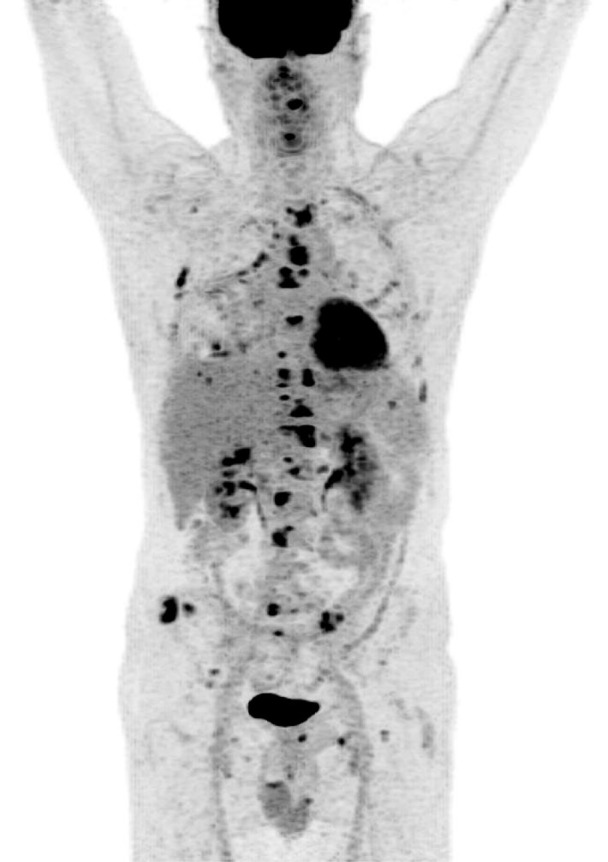
Positron emission tomography (PET), frontal reconstruction
A 58-year-old man with a three pack-year history of smoking was diagnosed with right lung adenocarcinoma in April 2016. He had no familial history of lung carcinoma or any other carcinoma. Immunostaining included analysis of anti-WT1, anti-calretinine, TTFI, Ber-ep4 which were all negative as well as the following biomarkers: Kras, EGFR, ALK, cMET and ROS1. At the time of diagnosis, he had multiple metastatic localizations visible on FDG PET/CT-scan (Fig 1) in both lungs, in the left adrenal, and in multiple bones. CT-scan pictures have been analyzed by a pneumoconiosis specialist who did not identify any silicosis. Cerebral scan had shown no metastatic localization. Immunotherapy with durvalumab and tremelimumab was first administered, then chemotherapy with carboplatin and pemetrexed without any response. The patient died in November 2016 because of the progression of his cancer.
He had graduated as an orthoprosthetist in 1979 and worked in this field until 2010. To build medical prostheses such as corsets, he had to use plaster powder and vermiculite. He had to break vermiculite plaques and mix it with the plaster powder. This was performed several times a day and generated dust. He did not use any personal protective equipment (PPE) for this task during these years. He also had a short exposure to asbestos. In 1995, he had renovated his workshop for 10 days. During this renovation in particular, he removed the asbestos heat insulation by himself using a simple cartridge mask. In 2010, he sold his business and worked as a horse breeder until he was diagnosed with lung cancer.
We considered his cancer as possibly related to his occupational exposure to vermiculite and have asked the social insurance for compensation.
Discussion
Vermiculite (CAS number 1318-00-9) is a natural silicate which expands when heated.1 According to the Vermiculite Association, which comprises producers of vermiculite amongst its members, vermiculite can be found all around the world—in Australia, Brazil, Bulgaria, Kenya, Russia, South Africa, Uganda, USA, and Zimbabwe. The mine of Libby, Montana, USA, was one of the most important sources of vermiculite worldwide between 1920 and its closure in 1990.2 Contamination of Libby's vermiculite with amphibole asbestos has been described elsewhere with its consequences in terms of asbestos-related occupational and environmental morbidity and mortality. Cases of mesothelioma have been reported among former employees of the mine. But, cases related to environmental exposures have also been described among Libby's inhabitants.3 To date, no major toxic effect has been acknowledged linked with vermiculite. There is no specific entry for vermiculite in the list of agents classified by the International Agency for Research on Cancer (IARC). However, the IARC is fully aware of the existence of asbestos-contaminated vermiculite. The list states that “mineral substances (eg, talc or vermiculite) that contain asbestos should also be regarded as carcinogenic to humans.”4
We have no strong evidence that our patient was ever exposed to Libby's vermiculite. The patient's business has closed and we cannot perform mineral analysis of any material. Besides, the hypothesis of a cancer induced by asbestos-contaminated vermiculite has been raised six months after the diagnosis. Unfortunately, no mineral analysis has been performed. But, on the one hand, his occupation was uncommon and possibly exposed him to asbestos fibers. We discussed the case with several occupational hygienists and asbestos experts confirming our hypothesis as being credible. On the other hand, the patient described small tobacco consumption and one short exposure to pure asbestos during his life.
We believe, this case would highlight health issues related to vermiculite exposure. It seems important to point out the possibility of vermiculite-related lung cancers in order to better document such cases in the future. Furthermore, it could be helpful to perform mineral analysis at the time of diagnosis.
Acknowledgments
We would like to thank Annie Thébaud-Mony and Vincent Clamagirand for sharing their expertise on this case-report.
Conflicts of Interest:
None declared.
Cite this article as: Durand-Moreau Q, Dezutter M, Quéré G, et al. Lung cancer in an orthoprosthetist using vermiculite. Int J Occup Environ Med 2017;8:241-243. doi: 10.15171/ijoem.2017.1133
References
- 1.Antao VC, Larson TC, Horton DK. Libby vermiculite exposure and risk of developing asbestos-related lung and pleural diseases. Curr Opin Pulm Med. 2012;18:161–7. doi: 10.1097/MCP.0b013e32834e897d. [DOI] [PMC free article] [PubMed] [Google Scholar]
- 2.Lampert Naik S, Lewin M, Young R. et al. Mortality from asbestos-associated disease in Libby Montana 1979-2011. J Expo Sci Environ Epidemiol. 2017;27:207–13. doi: 10.1038/jes.2016.18. [DOI] [PMC free article] [PubMed] [Google Scholar]
- 3.Whitehouse AC, Black B, Heppe MS. et al. Environmental exposure to Libby asbestos and mesotheliomas. Am J Ind Med. 2008;51:877–80. doi: 10.1002/ajim.20620. [DOI] [PubMed] [Google Scholar]
- 4. World Health Organization. International agency for research on cancer. List of agents classified by the IARC monographs. Vol 1-119, updated on June 28th, 2017. Available from http://monographs.iarc.fr/ENG/Classification/ClassificationsAlphaOrder.pdf (Accessed 2017 July 5 2017).