


Abstract
Objective:
Veterans with “invisible injuries” (a mental health diagnosis or a traumatic brain injury) often pursue higher education to enhance employment and community reintegration, but frequently experience challenges to success. This mixed methods study examined how the educational experiences of Veterans with invisible injuries become intertwined with broader transitions between military and civilian life and the resulting implications for rehabilitation services.
Method:
Thirty-eight veterans with mental illness or a traumatic brain injury who served in a post-9/11 conflict and attended a post-secondary institution within the past 60 months completed in-depth interviews and questionnaires. We used a constant comparative approach to analyze barriers and facilitators to educational functioning and community reintegration.
Results.
Managing school-specific challenges, coping with mental and physical health problems, forming a new sense of self, and forging new career pathways were major factors influencing education experiences and reintegration. Participants discussed the challenges of balancing these processes while progressing toward an academic degree, which often resulted in a longer, non-linear educational pathway. While some participants attempted to “compartmentalize” educational goals, separate from health and family concerns, these aims were inevitably interlaced. In addition, multiple and longer military deployments tended to lengthen the time to degree completion.
Conclusions and Implications for Practice:
Many Veterans with invisible injuries face complex challenges stemming from military experiences, the family dynamics to which they return, and reintegration issues that demand novel forms of resilience. Collaboration between university staff and health practitioners may be important in enhancing support for student Veterans coping with invisible disabilities.
Among service members separating from the US military, the pursuit of higher education is a common pathway for career development, housing stability, and community reintegration (Hammond, 2017). Evidence suggests that among Veterans, degree completion is linked to economic opportunities and increased lifetime savings (Harmon, Oosterbeek, & Walker, 2003; Tamborini, Kim, & Sakamoto, 2015). Since 2008, returning Veterans have had access to an unprecedented set of educational benefits through the post-9/11 Veterans Education Assistance Act, which included increased funds for tuition, a housing stipend, and extended time to use benefits up to 15 years (Buckley & Cleary, 2010). Consequently, Veterans and their dependents have enrolled in higher education at the greatest rate since the post-WWII era (US Department of Veterans Affairs, 2016). The passage of the Harry W. Colmery Veterans Educational Assistance Act of 2017, also known as the “Forever GI Bill,” is projected to further improve education benefits for Veterans and family members by eliminating the expiration date for using benefits and by expanding benefits for surviving dependents and Purple Heart recipients.
Recent systematic reviews of student military service members and Veterans in higher education found that, compared to civilian peers, this population has difficulties adjusting to campus life (Barry, 2015; Barry, Whiteman, & MacDermid-Wadsworth, 2014; Borsari et al., 2017). Mental health disorders and traumatic brain injuries acquired during military service, in particular, have been shown to create additional barriers to achieving educational goals (Madaus, Miller, & Vance, 2009), especially because such conditions are not readily apparent and many Veterans do not receive needed services (Glover-Graf, Miller, & Samuel, 2010). For example, 58% of post-9/11 Veterans receive disability benefits for a service-related condition, with PTSD being most common; Veterans with probable PTSD report more reintegration problems and express greater need for health and social services than Veterans without PTSD (Sayer, Carlson, & Frazier, 2014). Moreover, many Veterans are unfamiliar or uncomfortable with the processes of self-disclosure and documentation required to receive campus disability services (Burnett, 2009; Shackelford, 2009), while administrators, faculty, and staff have relatively little experience working with student Veterans (Branker, 2009). In qualitative studies with a general Veteran population, several adjustment difficulties have been identified, including interacting with civilians (DiRamio, Ackerman, & Mitchell, 2008), working within the architecture of university campuses, and challenges with reenrollment (Livingston, Havice, Cawthon, & Fleming, 2011). Studies with student Veterans with TBI or PTSD have documented additional challenges, including disclosing information about health conditions and receiving disability accommodations, coping with crowds, and in seeking social support (Elnitsky, Blevins, Findlow, Alverio, & Wiese, 2018, Hamrick & Rumann, 2013).
Transitions to academic life are part of a larger transition from military to community life, which may manifest at universities as a tendency toward self-isolation (Rumann & Hamrick, 2010), challenges in communicating with non-Veteran civilians (Demers, 2011), or feeling alienated (Elliott, Gonzalez, & Larsen, 2011). Given the significant resources being invested in education benefits and the potential positive impacts of a college degree on economic status and reintegration outcomes, understanding the barriers they face in utilizing GI Bill education benefits and obtaining a degree is essential to supporting Veterans and maximizing benefits to Veterans and society at large (Teachman, 2007). With the wide range of experiences, tailored and flexible support programs may be more effective than “one-size-fits-all” approaches (McCaslin et al., 2014; Norman et al., 2015).
Current literature suggests several important unresolved issues. First, researchers and policy makers tend to address educational and health issues as separate domains (Ahern et al., 2015; Ellison et al., 2012). In this paper, Veteran education is viewed as a component of community reintegration, which is defined as participation in community life, home or family life, work or a productive activity, and social relationships at satisfactory levels (Resnik et al., 2012; Sayer et al., 2011). Frameworks for understanding military to community transitions must consider the wider contexts that shape environments to which Veterans return, strategies for transitioning into educational or career opportunities, and potential conflicts that may arise in various stages of reintegration (Crocker, Powell-Cope, Brown, & Besterman-Dahan, 2014; Dillahunt-Aspillaga & Powell-Cope, 2018). While the most recent GI Bill offers additional benefits aimed at providing housing and tuition to fully cover the expenses of four years of higher education, the complex social, personal, and health challenges faced by the increasing number of returning Veterans who choose to enroll in universities are not well understood (Ackerman, DiRamio, & Mitchell, 2009; DiRamio et al., 2008; Ellison et al., 2012).
This study was designed to address experiences of Veterans pursuing academic degrees while adjusting to life with what has been termed an “invisible injury,” a condition resulting from battle field trauma, a stressful deployment, or other military experience (Tanielian & Jaycox, 2008). The study aimed to characterize the facilitators and barriers described by Veterans with invisible injuries as they pursue educational goals and to situate how Veterans respond to challenges associated with educational within broader transitions between military and civilian life.
Method
Design
We designed a mixed-method approach using an in-depth interview and written questionnaires with 38 Veteran participants with invisible injuries. A convergent, parallel study design entailed simultaneous collection of qualitative and quantitative data with separate analysis (Creswell & Plano-Clark, 2011) that were later integrated by the research team. The COREQ guided reporting of the qualitative results (see Appendix A) (Tong, Sainsbury, & Craig, 2007).
Sampling and Participant Selection
Participants were recruited from three outpatient clinics (i.e., post deployment integrated health clinic, women’s health clinic, and primary mental health clinic) at an urban, midwestern VA medical center. Veterans were eligible if they had an invisible injury, which was defined as a diagnosis of a mental health or cognitive health disorder (including PTSD, traumatic brain injury, mood disorder, or anxiety disorder), as documented in their electronic health record, and had been enrolled in post-secondary coursework within the last 60 months. It is important to note that some conditions (e.g. anxiety) may have been preexisting and may have been exacerbated by military employment. Participants were excluded if they had a severe medical condition, dementia, or another severe cognitive impairment that would prevent study participation.
Procedure.
Frontline clinicians informed potentially eligible Veterans about the study and provided study information sheets. Interested Veterans contacted the study team by phone. In addition, the study team received a list of Veterans who fit the study’s eligibility criteria from VA’s electronic health record and mailed letters describing the study. After a minimum of three days from mailing the letters, the study team contacted eligible Veterans by phone to confirm interest and eligibility and schedule an in-person meeting. Among a total of 75 Veterans contacted, thirty-eight completed interviews; nine were contacted by phone but found ineligible; three refused to participate; fourteen could not be reached by mail or phone after at least three attempts. After enrollment, no Veterans dropped out. Participants met once in-person in an interview room in the research department with either the first author (a male research scientist/Ph.D. anthropologist) or one of the two trained research assistants (both females with Bachelor’s degrees). After discussing the study aims with the participant, the interviewer obtained written consent, collected demographic information, administered two brief questionnaires, and conducted a semi-structured interview that lasted 30–90 minutes. The first author conducted 27 of the interviews. Participants who completed the study received a $35 gift card. The study protocol was approved by the VAMC and university Institutional Review Boards.
Measures
Background characteristics included gender, ethnicity, age, marital status, disability status, VA benefit status, residential status, current employment status, income level, and year of separation from military service. Chart review of electronic health record data confirmed questionnaire responses concerning deployment, health conditions, and combat status.
Educational data included total number of weeks enrolled in post-secondary institutions in the last 24 months, hours per week spent on educational activities, number and nature of post-secondary institutions attended, use of VA educational benefits, use of non-VA educational benefits, student loan status, and highest degree obtained.
Community reintegration was measured using the Military to Civilian questionnaire (M2C-Q), a self-reported scale intended to measure different dimensions of community reintegration. The 16-item questionnaire asks about social relations; productivity (in education, work, and domestic life); community engagement; and perceived meaning in life, self-care, and leisure. Participants respond using a 5-point scale, with higher scores indicating worse reintegration (0 = Doesn’t play a role, 1 = Plays a slight role, 2 = Plays a moderate role, 3 = Plays a large role, 4 = Plays a very large role). The M2C-Q was developed for Veterans and in this sample has good internal consistency (α = 0.87; Sayer et al., 2011).
Factors impacting educational experiences were measured using 10 items developed specifically for this study. We drew from factors identified in the literature on work functioning and adapted items from an existing study we are conducting with Veterans on this topic. (Authors Reference 3, Authors Reference 4). Participants were asked to rate the degree to which each item (e.g., confidence, university support, VA benefits, personal motivation, etc.) impacted their educational success. Each item was rated from 1 to 5 with greater scores indicating a larger impact of that factor (1 = Doesn’t play a role, 2 = Plays a slight role, 3 = Plays a moderate role, 4 = Plays a large role, 5 = Plays a very large role).
Qualitative data was collected through a semi-structured interview guide that was organized around a “grand tour” question to establish rapport and encourage detailed, personal responses (Spradley, 1979). First, participants were asked to describe their experiences with post-secondary education. Sample grand tour questions included: “In your own words, can you tell me about your experiences using your GI benefits for education or training purposes? Can you guide me through the path that you’ve taken in pursuing educational goals since leaving the military?” Next, the interviewer asked specific questions about how participants defined success, barriers and facilitators to integrating into university environments, and key transitions that Veterans experienced from deployment to separation from military service and reintegration into civilian life. Prior to the study, the interview guide and questionnaires were pilot tested with two Veterans who fit the eligibility criteria; we used cognitive interviewing techniques that encourage mock participants to “think aloud” about each of the questions, which led to rewording and reordering of specific questions for the purpose of clarity (Willis, 2005). Pilot participants were additionally asked to provide feedback on the interview guide and questionnaires. The research team developed a suicide assessment protocol to deal with potential distress or suicide ideation by the participant during the interview, which involved a brief screener for suicide ideation and contacting the study’s clinical psychologist if needed. Additional contact information for a back-up clinical psychologist and the VA Medical Center’s suicide prevention team were listed on the protocol.
Analyses
Quantitative survey data were summarized using SPSS 21. Descriptive statistics (e.g., mean, frequencies) were used to characterize the sample in terms of demographic variables and educational outcomes. M2C-Q total scores represented the degree of community reintegration difficulty. For qualitative analyses, the digitally recorded interviews were transcribed verbatim, checked for accuracy by listening to the tapes and comparing them with the transcripts, de-identified, and coded and analyzed using NVivo (NVivo qualitative data analysis software, 2012). A constant comparative approach (Glaser, 1965) based on grounded theory was used. The constant comparative method (CCM) consists of comparing incidents or experiences (in this case transcribed responses to interviewers’ questions) of a group of individuals. It typically employs an iterative consensus-building process that includes developing and integrating categories, and using the results to develop a theory and, in some cases, testing a hypothesis. CCM is “discovery oriented” and is particularly appropriate in situations, like the one studied here, where little is known about a phenomenon (Strauss and Corbin, 2008). First, three coders independently read interview transcripts in “open coding,” where each analyst inductively identified relevant excerpts with a provisional label; subsequently comparing, refining and coming to consensus on the results (Miles, Huberman, & Saldaña, 2014). Analytic memos were regularly composed to connect emergent content related to community reintegration. Next, case summaries were compared using a data matrix with discrepancies resolved by consensus; these summaries enabled ongoing development of themes and evaluation of data saturation (Averill, 2002). A codebook was developed and refined until a shared understanding was achieved. The third step involved independent coding of the transcripts by at least two team members. The coders for each transcript met in person to review the double coded transcripts and resolve discrepancies through consensus. Analysis ceased when data saturation was reached. Quantitative and qualitative data were integrated by comparing M2C-Q scores measures to analyst-derived scores based on analytic memos composed by each analyst. Scores were finalized during consensus meetings to enhance the trustworthiness of the findings (see Appendix 2). Additionally, selected qualitative themes were matched to individual M2C-Q items (see Table 4).
Table 4.
Integrated Results of Qualitative Findings and Reintegration Difficulties
| Qualitative Theme |
Type of Difficulty (M2C-Q) |
n (%) scored 2+ |
Representative Quotations |
|---|---|---|---|
| “The problem isn’t the money. It’s the problem of not receiving what we were told that we were gonna get, and that’s the [technical] school’s problem.” (P130) | |||
| “I have almost no negative experiences with being on the campus at [university]. I had a very smooth transition—administrative, financial…I’ve had very little negative perceptions from anyone. I got along with my professors.” (P134) | |||
| Managing school-specific challenges | “Keeping up with School or Work” | 25 (65.8) | “Yeah nobody told me, nobody tells you that. Nobody tells you the summer school rule right so your summer is dummy down so you don’t get VH unless you take X amount of classes over the summer. You’re like you do understand that it doesn’t work for like, the veteran population has come back. We just don’t go to school. We work. We have families. Like there is no way for me to go full time during the day.” (P105) |
| “Like the immaturity factor of these kids just kills me. Like the kids that show up to class high and stoned and just on pills. I see some of them show up drunk. Is this all that you care about your future? I’m sitting there. I’m struggling just to retain knowledge because I’ve had half my brain blown out of my head from IUDs, and I’ve been shot, and I’ve been declared dead, and you’re showing up drunk and stoned. Seriously like I’m like struggling to do homework, and you’re showing up to class high.” (P124) | |||
| “It’s a double-edged sword. It’s the greatest thing in the world because when you come home [from military deployment] everything is new, almost like being born again. But then again it goes back to the same: constantly waiting for something to blow up.” (P102) | |||
| Taking care of mental health and primary care needs | “Health” | 24 (63.2) | “Yes well just like he said, “Well you know you could’ve got that 20 points extra credit and you’d have” and because I ended up with a 77.41 which is a C+. 20 more points I would’ve got a B-. Okay he said you got your B-. I was in the hospital at the time. I kind cannot be two places at once but that was held against me. But because I went into crisis; all of a sudden I started having nightmares during the day, all of the people I’ve killed that kept flashing.” (P126) |
| “I had several cognitive problems: difficulty concentrating, paying attention, focusing…I’m surprised I was able to drive.” (P166) | |||
| “Cognitive Problems” | 32 (84.2) | “That is probably one of the hardest things that’s affecting me right now is just being able to focus. Being able to focus is my biggest hurdle right now. Being able to sit down and stay focused on what I’m doing is probably one of the biggest things that is just killing me right now with school. Like I’ve been. I started on the 24th and I’m just now getting to the point where I’m getting my binders organized. Like it took my wife saying like get in the office. You’re not leaving the office until your shit’s organized, and I’m like fuck. okay fine. Then, it’s over a month later and I’m just now getting to appoint where I finally have my school stuff organized. Like I can’t focus on 1 thing. I start doing 1 thing. Like I’ll just be doing 1 thing, (P124) | |
| “So I had to go get a degree or a certification or something so I went to [TECH INSTITUTE] and started in uh Electrical Engineering um; took my probably two and a half closer to three years to get that. I was having problems with attendance and really staying focused in class um. It’s hard for me to sit towards the front of the classroom. I don’t like having people and doors and stuff behind me. It kind of it’s really distracting” (P131) | |||
| “Making New Friends” | 27 (71.0) | “That was a healing process for me in the sense of learning how to like be a human again. Like I wasn’t this broken down machine or something and I mean it was challenging because I was dealing with my headaches and dealing with 2 young kids.” (P160) “I personally believe that that was gonna be the most beneficial to my recovery, and my transition was putting myself out there and communicating and talking to people and engaging with the community. So I wasn’t gonna hide in the back of the classroom.” (P134) |
|
| Re-establishing Roots with Family or Friends | “When I got out [of the military], it was kind of hard to find my place. I stayed home with my kids for a while. I found myself I guess depressed and just withdrawn so I had to find something for me.”(P143) | ||
| “Sharing Personal Thoughts” | 29 (76.3) | “Well- well some of it’s I have never shared with anyone; not even my wife and so now- now- now- now my wife also knows the story and. Of course and uh- I guess uh it’s just kind of hard you know it’s uh so- so- so there’s some things my wife knows more about and some things the psychologist knows more about.” (P111) | |
| “There’s a pride factor there and I’ve kind of lost my pride after. You know because after deploying, you kind of have to just break down and admit you know like something’s wrong. You know and then when other people are telling you or your family and your kids are saying you know these things about you and it’s not good. You’ve got to admit stuff.” (P144) | |||
| “The biggest issue for anyone going to school, including Veterans, is there’s trying to find this thing in life that makes the money that you know they believe they need to live and be happy. A lot of people just put off the passion thing. Well I’ve put up with so much bullshit already like over the past years with healing and everything else and dealing with pain that I almost need the passion in my life. So anyone going to school with these benefits, you might as well pursue something that you enjoy or you’re passionate about.” (P160) | |||
|
Establishing A Sense of Self as a Civilian |
“Finding meaning in life” |
18 (47.4) |
“We had like these regular homeless guys that we know some of them were veterans that I would always take food to or I would invite people over who didn’t have a place to go and cook dinner for them. And so this gave me a chance to be able to still help people and just not destroy (laugh) my family in the process. But it’s hard. It’s hard; you know and everyone keeps telling me like that the officer who was helping us with the case, [OFFICER 1]. He was like, “You can’t have a bleeding heart for everyone and not everyone deserves to be saved.” And I’m still trying to learn that but I’m still like I need to; I have this. You know so I’m fighting this whole like; where am I going to go with my life? You know like I really really really want to help people; like that is my passion. I love to see someone you know like make a difference.” (P143) |
Results
Sample Characteristics
As shown in Table 1, the mean age of participants was 33.6 (SD = 8.6). Thirty-one participants (72%) were male; the sample was similar to the current racial/ethnic demographics of the US military with 9 participants (24%) who identified as non-white. The mean level of service-connected disability was 67%; over half had diagnoses of posttraumatic stress disorder and 21% had traumatic brain injuries. Sixty percent served in at least one deployment to Iraq (OIF), while 40% were deployed to Afghanistan (OEF). The mean number of years since military separation was 4.3 (SD=3.5).
Table 1.
Participant Characteristics
| Age Mean (Range, SD) | 33 (21–63, 8.6) |
| Gender: female n (%) | 7 (18) |
| Race/Ethnicity n (%) | |
| African American | 4 (10.5) |
| White | 29 (76.3) |
| More than one race | 4 (10.5) |
| Hispanic | 3 (7.9) |
| Mental health diagnosis n (%) | |
| Bipolar Disorder | 2 (5) |
| Post-traumatic stress disorder | 22 (58) |
| Depressive disorder | 15 (39.5) |
| Anxiety disorder | 10 (26) |
| Adjustment disorder | 12 (32) |
| Diagnosis of Traumatic Brain Injury n (%) | 8 (21) |
| Disability Service Connection mean %(range, SD) | 67 (0–100, 30.1) |
| Education n (%) | |
| Completed high school or GED | 2 (5.3) |
| Some college (includes Associates) | 24 (63.2) |
| Completed 4 years of college | 6 (15.8) |
| Beyond 4 years (Masters or higher) | 6 (15.8) |
| Service Branch n (%) | |
| Army | 21 (55.3) |
| Navy | 8 (21) |
| National Guard | 7 (18.4) |
| Marines | 6 (15.8) |
| Air Force | 2 (5) |
| Combat Experience n (%) | 33 (86.8) |
| Time Since Separation by Years Mean (SD) | 4.3 (3.5) |
| Annual Income (USD) n (%) | |
| Less than 30,000 | 11 (29) |
| 30,000–39,000 | 12 (31.6) |
| 40,000–59,999 | 9(23.7) |
| 60,000 or higher | 6(15.8) |
| Total number of weeks enrolled in post-secondary institutions in the last 12 months | |
| 0 weeks | 2 (5.3) |
| Less than one semester (1–10 weeks) | 5 (13.2) |
| Full semester/term (10–16 weeks) | 13 (34.2) |
| Full academic year (16–32 weeks) | 12 (31.6) |
| Academic year and summer (more than 32 weeks) | 6 (15.8) |
| Hours per week spent on educational activities | |
| 0–5 hours per week | 3 (7.9) |
| 5–10 hours per week | 9(23.7) |
| 10–20 hours per week | 12 (31.6) |
| More than 20 hours per week | 14 (36.8) |
| Received Chapter 30 (Vocational Rehab) educational benefits | 6 (15.8) |
| Received Chapter 30 (Montgomery GI) educational benefits | 12 (31.6) |
| Received Chapter 33 (Post-9/11) educational benefits | 30 (78.9) |
| Received non-VA educational benefits | 12 (31.6) |
Reintegration Difficulties
Overall, 57.9% of study participants had “some or more difficulty” with community reintegration (total score of 2 or more). The mean score on the M2C-Q was 1.97 (SD = 0.8). In addition, scores on the education and work reintegration item indicates that on average, participants are having some difficulty. Overall, two-thirds of participants indicated at least some difficulty keeping up with school or work. Table 2 displays the remaining items ordered by the mean score with scores above “some difficulty” (2) with community reintegration in italics. Cognitive problems (84% of participants with “2” or higher) were reported most frequently as a source of difficulty, followed by feeling a sense of belonging (76%), and difficulty with sharing personal thoughts (76%). Participants also reported some or more difficulty engaging with new friends (71%) and in attending events/celebrations in the community (74%).
Table 2.
Reintegration Difficulties in Military to Civilian Questionnaire
| Item | mean score (SD) |
|---|---|
| Cognitive Problems | 2.55 (1.11) |
| Sense of Belonging | 2.53 (1.27) |
| Making New Friends | 2.43 (1.46) |
| Sharing Personal Thoughts | 2.42 (1.29) |
| Community Events/Celebrations | 2.38 (1.38) |
| Keeping up with School or Work | 2.00 (1.25) |
| Keeping up with civilian friendships | 1.97 (1.38) |
| Health | 1.97 (1.24) |
| Dealing with people | 1.89 (1.20) |
| Finding meaning in life | 1.84 (1.24) |
| Enjoying free time | 1.79 (1.28) |
| Getting along with relatives | 1.68 (1.19) |
| Getting along with spouse/partner | 1.67 (1.41) |
| Finding or keeping a job | 1.61 (1.63) |
| Keeping up with military friendships | 1.24 (1.12) |
| Getting along with children | 1.21 (1.26) |
Note: 0=No difficulty; 1= A little difficulty; 2= Some difficulty; 3= A lot of difficulty; 4=Extreme difficulty
Factors Influencing Education Reintegration and Educational Characteristics
Table 3 summarizes scores regarding factors that Veterans reported as having an influence on their educational success. Use of VA educational benefits and personal motivation were rated by participants as playing a large role (“4” or above). The next most important factors were match with chosen major, level of confidence, mental health, and university support. Whereas 52% of participants attended four-year educational institutions, 47% attended a technical college, vocational school, for-profit, community college, or exclusively online institution. While most participants had attended one (34.2%, n=13) or two (28.9%, n=11) institutions, 23.7% (n=9) had attended three, 7.9% (n=3) had attended four, and 5.3% (n=2) had attended five different institutions in the past with two in three attending at least two different institutions. Among those who completed 4-year degrees (n=12), 15.8% (n=6) completed Masters or higher. Although 39.5% of participants worked and others also had a family, most spent more than 20 hours per week on educational activities (n=14, 36.8%), while 31.6% (n=12) spent 10–20 hours per week and the remainder (n=12) under 10 hours. In terms of enrollment, 34.2% (n=13) were enrolled in a full semester (10–16 weeks), 31.6% (n=12) were enrolled in a full academic year (16–32 weeks), 15.8% (n=6) were enrolled in a full academic year and summer school (more than 32 weeks), 21.2% (n=7) were enrolled in less than one semester (1–10 weeks).
Table 3.
Factors impacting educational success
| Mean (SD) | |
|---|---|
| VA benefits | 4.1 (1.06) |
| Personal Motivation | 4.0 (1.03) |
| Confidence | 3.8 (1.21) |
| Match with Major/Career | 3.8 (1.22) |
| Mental Health | 3.6 (1.22) |
| University Support | 3.5 (1.18) |
| Medication for Mental Illness | 3.1 (1.45) |
| Social Stigma re: Mental Illness | 3.0 (1.32) |
| Relationships with Other Students | 2.5 (1.22) |
| Use of Alcohol/Substance | 2.2 (1.37) |
Note: 1=doesn’t play a role, 2=slight, 3=moderate; 4=large; 5=very large role
Veterans’ Educational Experiences: Qualitative Findings
Challenges related to transitioning from military service into educational institutions fell into four themes: managing school-specific challenges, taking care of their mental health and primary care needs, re-establishing roots with their family or friends, and establishing a sense of self as a civilian.
Managing school-specific challenges.
Barriers faced by students at four-year “bricks and mortar” institutions illustrated generic problems experienced by all students. While participants reported few challenges applying, enrolling, and determining eligibility for educational benefits through the Veterans Benefits Administration, experiences with university staff were mixed. Some Veterans described the university staff at the Veteran center as “amazing,” “critical to my success,” and as a “lifesaver.” Yet, several described struggles in interacting with staff (both at Veteran centers and more general staff), particularly regarding tuition reimbursement, registering for classes, and approval for transferred academic credit. One participant appeared frustrated by counselors who suggested using the phone or websites rather than in-person, personalized assistance:
It’s like no I’m sitting in your office… I don’t want to get on the computer. I want to have a talk with you … I don’t want to read 38 pages of documents that you put up online that’s generic. I want to know what’s pertinent to my situation. (P105)
Other Veterans described frustration with university policies regarding the timing of payments for benefits when they were in precarious financial circumstances.
… [t]he hardest part is the lag in the benefits because the school expects you to pay upfront but the VA benefits don’t kick in until after you’ve already been going to school—tuition and books come out to like $2,500 and now you’re trying to figure out, “How am I going to pay for this so I can go to school? And if I don’t go to school, I don’t pay for this, then I’m not going to get paid later.” (P136)
Though benefits are meant to relieve financial burdens and to allow Veterans to pursue educational and career goals, having gaps in benefits and spending time fixing paperwork can be perceived as a “Catch-22” dilemma with no easy solution.
Although study participants at traditional institutions reported some barriers to applying, registering, and receiving GI Benefits, those enrolled at non-traditional schools fared worse. For instance, one participant described his negative experience with a for-profit trade school that provided inconsistent service and communication between the school and the VA:
I probably missed out on $1000 to $1500 just because they didn’t know how to file the paperwork … Half of the people in school got benefits and the other half didn’t… The schools are making millions of dollars off of Veterans, and they’re not taking care of the Veterans. I honestly don’t know how that school has permission to take benefits. (P130)
This Veteran noted how the idiosyncratic schedule of his institution led to a loss in a portion of his benefits or, for others in his class, all their benefits. Although his situation was extreme, several Veterans commented that more oversight by outside entities or monitoring by the VA was necessary at non-traditional schools.
Taking care of mental health and primary care needs.
Participants reported significant challenges with mental and physical health while attending courses and pursuing academic degrees. They described several aspects of campus environments that served as additional stressors for those diagnosed with PTSD or anxiety. First, large numbers of people in public spaces, loud sounds, and quantity of social interactions were challenging. Compared to their home or work environments, academic activities could exacerbate symptoms of anxiety or depression. Some participants found interacting with civilian students and faculty unexpectedly stressful, especially when class discussions addressed moral issues related to the military or entailed self-disclosure of Veteran status. The physical layout of the classroom could trigger hyperarousal for those who preferred to monitor their surroundings and sit facing doorways rather than with their back to an entrance. Other participants with physical injuries found sitting in the classroom for a long period of time to be physically painful. Participants situated their experiences on campus as representative of similar discomfort they faced in other civilian contexts such as shopping malls, crowded urban areas, or at outdoor events.
Apart from their immediate surroundings, Veterans reported how achieving medium-term goals such as earning good grades or completing projects were impacted by their injuries. Some participants described how issues with concentration or memory surfaced after taking tests or studying. Several participants acknowledged that their initial goals were too ambitious given their cognitive capacity, which led to withdrawal from classes or lower than expected academic performance. A few participants with severe mental health conditions discussed taking fewer classes made more sense than trying to manage “a full load of courses.” Managing this stress was weighed against the potential loss of benefits from a reduced course load.
A major issue faced by participants was deciding if, when, or how to disclose information about their mental health or disability to faculty, student services staff, or fellow students. While all participants had experience disclosing information to VA medical providers, many felt apprehensive about sharing such information on campus. One Marine discussed his angst about how he might be perceived as a disabled student:
I don’t wanna feel like I have a disability. It hits my pride button, and it sucks, and that also sends me into depression… If you say hey, this student gets that, then they need to drive that home with the professors and go hey, we’re not saying that this person gets special privileges, but he gets special privileges to a certain extent, and it’s because he’s got a TBI. He doesn’t work like everyone else. (P176)
Other Veterans who returned to school struggled with sharing information about his PTSD and the stigma associated with a mental health diagnosis. Discomfort with being labeled as “broken” was reported by several participants as a reason for not disclosing their disability status to campus staff.
Establishing roots with family or friends.
Part of the stress that accompanied higher education pursuits stemmed from the pressure of moving into or resuming family roles. Participants described how service-connected disabilities and injuries affected their ability to act as a breadwinner or as a caregiver on top of the demands associated with coursework. One participant with a severe TBI described the dual pressures of returning to school and caring for his family:
I go to Iraq and come back all messed up—I was an honors’ student before I left, and now I’m like a B student. It’s really been tough. It’s been very, very hard to be a student. To be a father. To have my responsibilities and try to hold down the fort for my family. (P170)
The participant reflected on how the competing demands of providing for one’s family while coping with the aftereffects of a service related injury made academic success more difficult than anticipated. These tensions extended beyond coursework; although he felt a “sense of control and independence” in his role as a father, he felt it he was unworthy of requesting disability accommodations like extra test time or a note-taker.
Study participants also chose to reorient themselves around their roles as civilians by reclaiming their positions within their families as a parent and a spouse. Six of the seven female participants discussed how caring for children competed with their educational goals. As one woman (P143) who cared for five children while working on a bachelor’s degree explained, “everything I do is basically for my kids.” Caring for her children played a role in her inability to establish a new sense of purpose. Another discussed planning to take classes: “My husband’s like, ‘Who’s going to keep the kids?’ I said: ‘They’re your kids too!’” These two women expressed how although they were taking classes, they were unable to dedicate enough time to develop a direction for their post-military careers. Another participant (P106) described the importance of his wife and son and how he was willing to forfeit his pride and stoicism as a Marine in order to be successful as a student: “My son is my salvation. And if it takes me asking for help; I will. I will put hot sauce on my pride and put some feta cheese on it and I’m going to eat my pride.”
Several discussed how separation or divorce following deployment indirectly made pursuing higher education more challenging due to financial constraints and the logistics of joint custody. Particularly for Veterans without adequate social support, family can be the primary source of stress. One person described how he learned he was getting divorced through Facebook and arrived to find an empty house:
Got divorce papers in (laugh) the mail. She still had a power of attorney—Took my name off of our house, she sold my truck out from under me and emptied the bank accounts. She got me for about 60 grand of cash and a house and a truck. (P108)
Whether family was a source of support or stress, most who described having had successful transitions to educational campuses pointed to the importance of creating new social relationships with non-Veteran peers or supporters.
Establishing a sense of self as a civilian.
Several study participants described higher education as an opportunity for self-reflection and long-term personal development. Following military careers that often resulted in premature separation due to an injury or health condition, they viewed post-secondary institutions in order to build a new professional reputation. These Veterans were aware of the need to translate their military skills and also to build a network to develop a new career path. Several participants reported complex educational paths including multiple degree programs, enrollment during and between military deployments interspersed with paid civilian employment. For some, a mental health diagnosis or injury motivated them to reconsider their academic goals, while others decided to withdraw from school due to mental health exacerbations, financial issues, or family responsibilities, often re-enrolling once these impediments were addressed.
In narrating their journeys from military service to higher education, study participants highlighted how repeated deployments, shifts in priorities, and service-related injuries led to unexpected disruptions in their careers. Reflecting on the meaning of their education, participants linked career development to a broader sense of transitioning back into the civilian world. Three representative pathways are depicted in Figure 1. Military deployments are indicated in dotted green, with educational enrollments in arrows with lavender vertical lines. Completed degrees (Associate, Bachelor, or Master) are outlined in black. Cross-hatched, red block arrows indicate injuries or diagnosed mental health conditions, and light gray indicates civilian employment.
Figure 1.
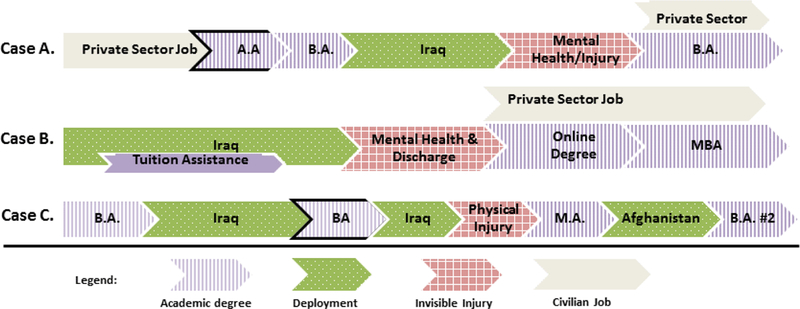
Three typical student Veterans educational trajectories
Case A illustrates the trajectory of a Marine who pursued a second undergraduate degree after a lengthy deployment in Iraq. Influenced by his struggles to cope with service-connected PTSD, he returned to the same corporate position but with a different occupational role that entailed less social interaction and reduced hours. Case B describes a situation in which premature discharge following deployment to Iraq led to the pursuit of a Master’s in Business Administration (MBA) and a new career direction. This Army Veteran had taken online courses throughout her military career, and earned her Bachelor’s degree and MBA online. The third case (C) shows a complex, but not unusual, path that included two deployments to Iraq and one to Afghanistan. In terms of education, this individual completed a degree over a period of seven years, followed by a Master’s degree, and then a second Bachelor’s degree necessitated by a significant physical injury that required vocational and physical rehabilitation. These cases demonstrate how injuries, shifts in career interests, and military deployments complicate academic and career objectives.
In Table 4, items from the M2C-Q reintegration survey are matched with the themes identified in our analysis and illustrated with representative quotations. We found convergence between M2C-Q items where a majority of respondents had “some, a lot, or extreme” reintegration difficulty and the qualitative data on these topics. For example, narratives about how attending school was particularly challenging while coping with health issues may explain why the M2C-Q scores for Health (63.2%) and Cognitive Problems (84.2%) were reported as difficult for most participants.
Discussion
In this study of educational experiences among post-9/11 Veterans with mental health and/or TBI diagnoses, managing school-specific challenges, coping with invisible injuries, and forging a new sense of self and career pathways were pervasive. In terms of reintegration difficulties, the mean M2C-Q scores were similar to Sayer and colleagues (2011). Across participants, we found consistent differences between Veterans who attended four-year institutions with largely robust support systems versus vocational or technical schools where administrative barriers were more significant. In relation to comparable studies (DiRamio et al., 2008; Ellison et al., 2012; Author’s Reference 1 Removed; Smith-Osborne, 2009), participants reported fewer challenges with receiving benefits and enrolling in educational institutions. Furthermore, participants discussed the challenges of coping with ongoing physical and mental health issues, staying employed, and fulfilling family roles while continuing to progress toward an academic degree. While a few participants attempted to “compartmentalize” educational goals from health and family concerns, our findings suggest that these three processes were inevitably intertwined.
Several cases demonstrate critical junctures where the emotional turmoil stemming from pressure to withhold information about mental health conditions lead to disciplinary actions or a decision for early withdrawal from military service (Dichter and True, 2014). Following separation, mental or physical health conditions often take months or years to manifest. This delay in symptoms, coupled with reluctance to disclose health conditions, can lead to barriers in receiving both health care and support services. Amid feelings of alienation from civilian society and feeling a lack of purpose (Ahern et al., 2015), difficulties related to planning for the future may arise. Establishing a sense of civilian and family life is critical but takes time and work, which may lengthen the total time spent in pursuit of an academic degree. A recent study has suggested that when we consider a six-year timeframe rather than five years, Veterans and non-Veterans have similar completion rates (Cate, 2014). Our study expands on those findings by explaining how conditions that necessitate six years may vary. Veterans may pursue new degrees due to injuries or face challenges unique to their Veterans status that the generous educational benefits cannot necessarily address. University disability offices may need to make deliberate efforts to ensure that Veterans realize that that may be eligible for accommodation under the Americans with Disabilities Act even if they are not eligible for VA benefits (Mikelson, 2014).
The gendered effects of working status on Veterans and their families is an important finding. Six of the seven female participants in the study were either a single parent or sole caretaker for their children. One of the implications for female Veterans pursuing higher education goals is to consider dedicated resources for childcare. Study participants expressed ambivalence about caring for their children and spending time with their partners, while also desiring to regain a means of legitimate breadwinning. Both women and men often moved from all-encompassing involvement in their occupation in the military to the domestic sphere. Moving from the public domain of productivity to what economists label the domain of social reproduction, many struggle with the feelings of “being unproductive.”
This study offers insights into the psychosocial factors affecting Veterans returning from Iraq and Afghanistan with mental or cognitive health conditions. The limitations of the study include the cross-sectional sample selected from Veterans receiving care primarily at a single VA, and thus is not intended to generalize to broader Veteran populations. Despite these limitations, this study furthers understanding of how Veterans with invisible injuries faced barriers in a range of different types of higher education institutions. We triangulated self—reported scores for reintegration with close analysis of qualitative themes related to the meaning of reintegration to strengthen the ecological validity of the study findings.
Based the current findings, some recommendations can be made about how to improve services for Veterans in higher education. At universities, strong Veteran Resource Centers offer a dedicated space for social support and a central place for coordinating services across campus (e.g. disability services, admissions, counseling) where staff can be trained on Veteran-specific issues. Participants specifically called for better coordination between VA and university staff, and requested a “case manager” approach. Participants also suggested closer regulation of for-profit institutions as well as new policies aimed at allowing Veterans to transfer academic credits and to re-enroll as necessary. Finally, participants suggested more extensive counseling during out-processing (i.e. the Army’s “Transition Assistance Program”) with enforced follow-up.
Although standardized assessments and screening have been put in place as an early detection system, Veterans may still slip through with “unacknowledged, unrecognized, and undiagnosed disease and illness” (Reisinger, Hunt, Burgo-Black, & Agarwal, 2012). Veterans arrive on university campuses and at workplaces still in need of screening and support. These findings underscore the need for integrated, recovery-oriented services geared toward education and designed for Veterans with invisible injuries. Though the VHA has begun to offer such services, they are not systematically available. Future research may consider supported education programs to better serve these Veterans and address common barriers identified in this study (Ellison et al., 2012; Smith-Osborne, 2012).
This study offers a window into the perspectives of Veterans with invisible injuries seeking career development through educational benefits. While we have improved in conceptualizing invisible injuries, important gaps remain in understanding the transition between military service and civilian life and the psychosocial stressors associated with the reintegration process itself. Despite flexible educational benefits, many Veterans face complex challenges stemming from military experiences, the family conditions to which they return, and unexpected reintegration issues that demands novel forms of resilience and the formation of a new civilian sense of self. These challenges can result in prolonged time to complete degrees and uncertainty with career goals and their sense of purpose.
Supplementary Material
Impact and Implications.
This study highlights the experience of student Veterans with invisible injuries who served in the US military after 2001. Given the complex and interrelated challenges Veterans face in establishing a renewed sense of self through attainment of higher education following military service, flexible and integrative service models like supported education and supported employment are needed.
Acknowledgments
Funding:
The research was funded by the Center for Health Information and Communication, Department of Veterans Affairs (VA), Veterans Health Administration, Health Services Research and Development Service (CIN 13–416) and the Indiana Institute for Medical Research.
Footnotes
Declaration of Conflicting Interests:
The authors declared no potential conflicts of interest with respect to the research, authorship, and/or publication of this article.
References
- Ackerman R, DiRamio D, & Mitchell RLG (2009). Transitions: Combat veterans as college students. New Directions for Student Services, 2009 (126), 5–14. doi: 10.1002/ss.311 [DOI] [Google Scholar]
- Ahern J, Worthen M, Masters J, Lippman SA, Ozer EJ, & Moos R (2015). The challenges of Afghanistan and Iraq Veterans’ transition from military to civilian life and approaches to reconnection. PLoS One, 10(7), e0128599. doi: 10.1371/journal.pone.0128599 [DOI] [PMC free article] [PubMed] [Google Scholar]
- Averill JB (2002). Matrix analysis as a complementary analytic strategy in qualitative inquiry. Qualitative Health Research, 12(6), 855–866. [DOI] [PubMed] [Google Scholar]
- Barry AE (2015). Student Service Members/Veterans Participating in Higher Education: What We Know to Date. Journal of American College Health, 63(7), 415–417. [DOI] [PubMed] [Google Scholar]
- Barry AE, Whiteman SD, & MacDermid Wadsworth S (2014). Student Service Members/Veterans in Higher Education: A Systematic Review. Journal of Student Affairs Research and Practice, 51(1), 30–42. doi: 10.1515/jsarp-2014-0003 [DOI] [Google Scholar]
- Borsari B, Yurasek A, Miller MB, Murphy JG, McDevitt-Murphy ME, Martens MP,… Carey KB (2017). Student service members/veterans on campus: Challenges for reintegration. Am J Orthopsychiatry, 87(2), 166–175. doi: 10.1037/ort0000199 [DOI] [PMC free article] [PubMed] [Google Scholar]
- Branker C (2009). Deserving Design: The New Generation of Student Veterans. Journal of Postsecondary Education and Disability, 22(1), 59–66. [Google Scholar]
- Buckley KK, & Cleary B (2010). The restoration and modernization of educational benefits under the post-9/11 veterans assistance act of 2008. Veterans Law Review (second ed). 185, 1–35. Retrieved from http://www.bva.va.gov/docs/VLR_VOL2/Copy6--KatherineKiemleBuckleyandBridgidCleary.pdf [Google Scholar]
- Burnett SE, & Segoria SJ (2009). Collaboration for Military Transition Students from Combat to College: It Takes a Community. Journal of Postsecondary Education and Disability, 22(1), 53–58. [Google Scholar]
- Cate CA (2014). Million Records Project: Research from Student Veterans of America. Retrieved from https://studentveterans.org/images/Reingold_Materials/mrp/download-materials/mrp_Full_report.pdf
- Creswell JW, & Plano Clark VL (2011). Designing and conducting mixed methods research. Los Angeles: SAGE Publications. [Google Scholar]
- Crocker T, Powell-Cope G, Brown LM, & Besterman-Dahan K (2014). Toward a Veteran-centric view on community (re)integration. J Rehabil Res Dev, 51(3), xi–xviii. doi: 10.1682/JRRD.2014.01.00111 [DOI] [PubMed] [Google Scholar]
- Demers A (2011). When Veterans return: The role of community in reintegration. Journal of Loss and Trauma, 16(2), 160–179. [Google Scholar]
- Dichter ME and True G (2014). ““This Is the Story of Why My Military Career Ended Before It Should Have”: Premature Separation From Military Service Among U.S. Women Veterans.” Affilia. 30(2), 187–199. [Google Scholar]
- Dillahunt-Aspillaga C and Powell-Cope G (2018). “Community Reintegration, Participation, and Employment Issues in Veterans and Service Members With Traumatic Brain Injury.” Arch Phys Med Rehabil 99(2, Supplement): S1–S3. [DOI] [PubMed] [Google Scholar]
- DiRamio D, Ackerman R, & Mitchell RL (2008). From combat to campus: Voices of student-Veterans. NASPA Journal, 45(1), 73–102. [Google Scholar]
- Elliott M, Gonzalez C, & Larsen B (2011). U.S. Military Veterans transition to college: Combat, PTSD, and alienation on campus. Journal of Student Affairs Research and Practice, 48(3), 279–296. doi: 10.2202/1949-6605.6293 [DOI] [Google Scholar]
- Ellison ML, Mueller L, Smelson D, Corrigan PW, Torres Stone RA, Bokhour BG,… Drebing C (2012). Supporting the education goals of post-9/11 veterans with self-reported PTSD symptoms: A needs assessment. Psychiatr Rehabil J, 35(3), 209–217. doi: 10.2975/35.3.2012.209.217 [DOI] [PubMed] [Google Scholar]
- Elnitsky CA, Blevins C, Findlow JW, Alverio MA, & Wiese D (2018). “Student Veterans Reintegrating From the Military to the University With Traumatic Injuries: How Does Service Use Relate to Health Status?” Arch Phys Med Rehabil (2, Supplement): S58–S64. [DOI] [PubMed] [Google Scholar]
- Glaser BG (1965). The Constant Comparative Method of Qualitative Analysis. Social Problems, 12(4), 436–445. doi: 10.2307/798843 [DOI] [Google Scholar]
- Glover-Graf Miller, N M, & Samuel EF. (2010). Accommodating Veterans with Posttraumatic Stress Disorder symptoms in the academic setting. Rehabilitation Education, 24(1–2), 43–56. [Google Scholar]
- Hammond S (2017). Student Veterans in higher education: A conversation six decades in the making. New Directions for Institutional Research, 2016(171), 11–21. [Google Scholar]
- Hamrick FA, & B., R. C (2013). Called to serve: A handbook on student veterans and higher education. San Francisco: Jossey-Bass. [Google Scholar]
- Harmon C, Oosterbeek H, & Walker I (2003). The returns to education: Microeconomics. JOES Journal of Economic Surveys, 17(2), 115–156. [Google Scholar]
- Kukla M, Bonfils KA, & Salyers MP (2015). Factors impacting work success in Veterans with mental health disorders: A Veteran-focused mixed methods pilot study. Journal of Vocational Rehabilitation, 43(1), 51–66. 10.3233/JVR-150754 [DOI] [Google Scholar]
- Kukla M, Rattray NA & Salyers MP (2015). “A mixed methods study examining work reintegration experiences from the perspectives of Veterans with mental health disorders.” Journal of Rehabilitation Research and Development 52(4): 477–490. [DOI] [PubMed] [Google Scholar]
- Livingston WG, Havice PA, Cawthon TW, & Fleming DS (2011). Coming home: Student Veterans’ articulation of college re-enrollment. Journal of Student Affairs Research and Practice, 48(3), 315–331. doi: 10.2202/1949-6605.6292 [DOI] [Google Scholar]
- Madaus JW, Miller WK II, & Vance ML (2009). Veterans with Disabilities in Postsecondary Education. Journal of Postsecondary Education and Disability, 22(1), 10–17. [Google Scholar]
- McCaslin SE, Thiede J, Vinatieri T, Passi H, Lyon KB, Ahern DA,… Chitaphong K (2014). Facilitating Veterans’ academic success: Veterans integration to academic leadership (VITAL) initiative. Career Planning and Adult Development Journal, 30(3), 191–209. [Google Scholar]
- Mikelson JD (2014). Wounded warriors. In Vance ML, Lipsitz NE, & Parks K (Eds.), Beyond the Americans with Disabilities Act: Inclusive policy and practice for higher education (pp. 85–96). Washington, DC: NASPA-Student Affairs Administrators in Higher Education. [Google Scholar]
- Miles MB, Huberman AM, & Saldana J (2014). Qualitative data analysis: A methods sourcebook. Thousand Oaks, CA: Sage. [Google Scholar]
- Norman SB, Rosen J, Himmerich S, Myers US, Davis B, Browne KC, & Piland N (2015). Student Veteran perceptions of facilitators and barriers to achieving academic goals. J Rehabil Res Dev, 52(6), 701–712. doi: 10.1682/jrrd.2015.01.0013 [DOI] [PubMed] [Google Scholar]
- NVivo qualitative data analysis software. (2012). QSR International Pty Ltd. . [Google Scholar]
- Reisinger HS, Hunt SC, Burgo-Black AL, & Agarwal MA (2012). A population approach to mitigating the long-term health effects of combat deployments. Prev Chronic Dis, 9, E54. [DOI] [PMC free article] [PubMed] [Google Scholar]
- Resnik L, Bradford DW, Glynn SM, Jette AM, Johnson Hernandez C, & Wills S (2012). Issues in defining and measuring veteran community reintegration: proceedings of the Working Group on Community Reintegration, VA Rehabilitation Outcomes Conference, Miami, Florida. J Rehabil Res Dev, 49(1), 87–100. [DOI] [PubMed] [Google Scholar]
- Rumann CB, & Hamrick FA (2010). Student Veterans in Transition: Re-Enrolling after War Zone Deployments. Journal of Higher Education, 81(4), 431–458. [Google Scholar]
- Sayer NA, Carlson KF, & Frazier PA (2014). Reintegration challenges in U.S. service members and Veterans following combat deployment. SIPR Social Issues and Policy Review, 8(1), 33–73. [Google Scholar]
- Sayer NA, Frazier P, Orazem RJ, Murdoch M, Gravely A, Carlson KF,… Noorbaloochi S (2011). Military to civilian questionnaire: A measure of postdeployment community reintegration difficulty among veterans using Department of Veterans Affairs medical care. Journal of Traumatic Stress, 24(6), 660–670. [DOI] [PubMed] [Google Scholar]
- Shackelford A (2009). Documenting the needs of student Veterans with disabilities: intersections, roadblocks, solutions, and legal realities. Journal of Postsecondary Education and Disability, 22(1), 36–42. [Google Scholar]
- Smith-Osborne A (2009). Does the GI Bill support educational attainment for veterans with disabilities? Implications for current Veterans in resuming civilian life. J. Sociol. Soc. Welf. Journal of Sociology and Social Welfare, 36(4), 111–125. [Google Scholar]
- Smith-Osborne A (2012). Supported education for returning Veterans with PTSD and other mental disorders. Journal of Rehabilitation, 78(2), 4–12. [Google Scholar]
- Spradley JP (1979). The ethnographic interview. New York: Holt, Rinehart and Winston Corbin J., & Strauss A (2008). Basics of qualitative research: Techniques and procedures for developing grounded theory, 3rd ed Thousand Oaks, CA, US: Sage Publications, Inc. [Google Scholar]
- Tamborini CR, Kim C, & Sakamoto A (2015). Education and Lifetime Earnings in the United States. Demography Demography, 52(4), 1383–1407. [DOI] [PMC free article] [PubMed] [Google Scholar]
- Tanielian TL, & Jaycox L (2008). Invisible wounds of war : psychological and cognitive injuries, their consequences, and services to assist recovery. Santa Monica, CA: RAND. [Google Scholar]
- Teachman J (2007). Military Service and Educational Attainment in the All-Volunteer Era. Sociology of Education, 80(4), 359–374. doi:doi: 10.1177/003804070708000404 [DOI] [Google Scholar]
- Tong A, Sainsbury P, & Craig J (2007). Consolidated criteria for reporting qualitative research (COREQ): A 32-item checklist for interviews and focus groups. Int J Qual Health Care, 19(6), 349–357. doi: 10.1093/intqhc/mzm042 [DOI] [PubMed] [Google Scholar]
- US Department of Veterans Affairs. (2016). Annual Benefits Report: fiscal year 2015. Retrieved from http://www.benefits.va.gov/REPORTS/abr/ABR-Education-FY15-12122016.pdf
- Willis GB (2005). Cognitive interviewing : A tool for improving questionnaire design. Thousand Oaks, Calif.: Sage Publications. [Google Scholar]
Associated Data
This section collects any data citations, data availability statements, or supplementary materials included in this article.