



Abstract
We describe a case of a 46-year-old man with schizophrenia treated with clozapine who presented as an emergency with abdominal pain on the background of a 1 month history of constipation. The initial presenting symptoms were vague and a diagnosis was difficult to establish. Initial CT of the abdomen and pelvis demonstrated only minor abnormalities. He continued to deteriorate until a further CT scan revealed worsening stercoral colitis. He subsequently underwent an emergency total colectomy and ileostomy formation and had a complicated prolonged postoperative recovery. This case highlights the risks that clozapine can have on slowing bowel transit and the dangerous consequences that can occur if not identified early.
Keywords: gastrointestinal surgery, schizophrenia, drugs: psychiatry
Background
Schizophrenia is a common mental health condition with an incidence of 15.2 per 100 000.1 Clozapine is the gold standard treatment for patients with resistant schizophrenia and schizophrenia with suicidal ideation.2 A recognised side-effect is clozapine-induced gastrointestinal hypomotility (CIGH),3 4 which can result in chronic constipation. The associated faecal impaction may result in stercoral colitis and perforation,5 which is recognised to be associated with a high mortality rate.6
We present a case of a 46-year-old man taking clozapine who developed mild lower abdominal pain on a background of a 1 month history of constipation. He presented to the emergency general surgical team with only non-specific symptoms and the eventual diagnosis of bowel obstruction secondary to clozapine was difficult to establish. Despite the initial mild symptoms, he subsequently deteriorated rapidly and required significant surgical intervention followed by a long postoperative recovery.
Although the association between stercoral perforation and clozapine has been previously described, this is the first case report to describe the difficulty in establishing a diagnosis and presents several key learning points from a surgical point of view in respect of the diagnosis and management of full-blown stercoral colitis.
Case presentation
A 46-year-old man presented to the emergency department with mild lower abdominal pain, one episode of black stools the previous day on the background of a month-long history of new-onset constipation.
Previous medical history included obsessive compulsive disorder, depression and schizophrenia with persistent delusional ideas for over 10 years managed by the community psychiatry team. There was no previous surgical history and he had not previously been treated for constipation. He was taking clozapine 300 mg midday and 400 mg nocte (most recent dose taken immediately prior to admission), fluoxetine 60 mg, lansoprazole 30 mg twice a day and cholecalciferol 800 units. He was a smoker and drank a moderate amount of alcohol.
On examination, his heart rate was 124 beats/minute, blood pressure 80/48 mm Hg, oxygen saturation of 96% on air, temperature 36.4°C and respiratory rate 24 breaths/min (summarised in table 1). He appeared sweaty. His abdomen was mildly distended but soft and non-tender. Digital rectal examination revealed loose and non-bloody stools.
Table 1.
Vitals on admission
| Vitals | Results |
| Heart rate | 124 beats/min |
| Respiratory rate | 24 breaths/min |
| Blood pressure | 88/48 mmHg |
| Saturations | 96% on air |
| Temperature | 36.4°C |
Investigations
Bloods on admission
Haemoglobin: 171 g/L (131–166 g/L).
White cell count: 17.7×10⁹/L (3.5–9. 5×10⁹/L).
Platelets: 337×109/L (150−400×109/L).
Neutrophils: 15.68×10⁹/L (1.7–6.5×10⁹/L).
Sodium: 138 mmol/L (133–146 mmol/L).
Potassium: 4.4 mmol/L (3.5–5.3 mmol/L).
Urea: 6.9 mmol/L (2.5–7.8 mmol/L).
Creatinine: 147 umol/L (62–106 umol/L).
C reactive protein: 3.8 mg/L (0–5 mg/L).
Albumin: 41 g/L (35–50 g/L).
Total bilirubin: 23 umol/L (0–21 umol/L).
Alkaline phosphatase: 123 IU/L (30–130 IU/L).
Alanine transaminase: 31 IU/L (0–41 IU/L).
Prothrombin time: 10.9 s (9.5–11 s).
Venous blood gas
pH: 7.49 (7.35–7.45).
pCO2 2.95.
pHCO3: 16.9.
Lactate: 4.1 mmol/L (<1.2 mmol/L).
Blood cultures revealed scanty growth of E. coli sensitive to piperacillin/gentamicin. Urine cultures were negative.
Further blood tests were taken 13 hours later following intravenous fluid resuscitation.
Bloods 13 hours later
Haemoglobin: 129 g/L (131–166 g/L).
White cell count: 10.0 × 10⁹/L (3.5–9. 5×10⁹/L).
Platelets: 283×109/L (150−400×109/L).
Neutrophils: 6.08×10⁹/L (1.7–6.5×10⁹/L).
Sodium: 137 mmol/L (133–146 mmol/L).
Potassium: 6.5 mmol/L (3.5–5.3 mmol/L).
Urea: 15.3 mmol/L (2.5–7.8 mmol/L).
Creatinine: 335 umol/L (62–106 umol/L).
C reactive protein: 95.3 mg/L (0–5 mg/L).
Albumin: 19 g/L (35–50 g/L).
Total bilirubin: 45 umol/L (0–21 umol/L).
Alkaline phosphatase: 118 IU/L (30–130 IU/L).
Alanine transaminase: 198 IU/L (0–41 IU/L).
Prothrombin time: 15.6 s (9.5–11 s).
Lactate: 2.8 mmol/L (2.5–7.8 mmol/L).
Deranged values are represented in bold.
CT abdomen and pelvis on admission (day 1)
Grossly distended rectum and sigmoid which are packed full of faeces, the rectum itself is markedly thick walled. There is also thickening of the wall of the sigmoid colon (figure 1). This is most likely chronic, and in the absence of an obstruction at the actual anorectal junction this looks like chronic pseudo-obstruction/constipation. There is also marked distention in the rest of the colon with a combination of fluid and faeces.
Figure 1.
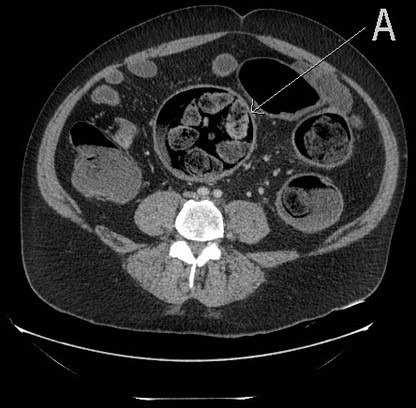
Axial CT image showing thickening of the wall of the sigmoid colon (A).
CT thorax, abdomen and pelvis (day 2)
Appearances have changed since yesterday’s CT and have progressed with an increase in the degree of bowel wall thickening, and the descending colon now becoming more involved. Additionally, there are now traces of fluid and inflammation surrounding the distended loops of large bowel (figure 2). Appearances raise the suspicion of a stercoral colitis. There is free fluid within the paracolic gutters, but no free gas and no intra-abdominal collections. There is now consolidation most likely consistent with infection within all lobes of both lungs and most marked at the lung bases.
Figure 2.
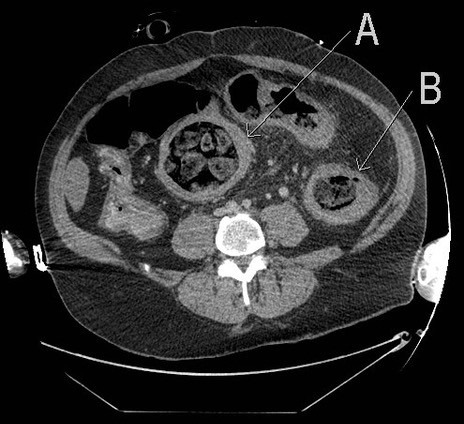
Axial CT image at a similar level showing increased thickening of the wall of the sigmoid (A) and descending colon (B).
CT abdomen and pelvis (day 3)
There has been further deterioration and thickening particularly involving the rectum, sigmoid and descending colon. Suspicious areas of reduced wall enhancement in the descending colon raise the possibility of ischaemic changes (figure 3). No pneumatosis. There has been also some increase in the volume of ascites as well as mesenteric oedematous changes. No free gas or portal venous gas. Bibasal consolidation and pleural effusion are essentially unchanged.
Figure 3.
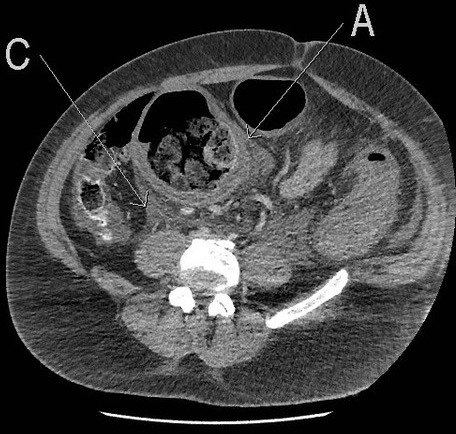
Axial CT image showing increased thickening of the sigmoid colon (A) and ascites (C).
Differential diagnosis
Inflammatory bowel disease.
Constipation.
Acute colonic pseudo-obstruction.
Treatment
Treatment was started with intravenous coamoxiclav and the patient transferred to a general surgical ward where a manual rectal evacuation was performed. With the mild abdominal pain, lack of significant abdominal findings and the non-specific CT findings, no specific diagnosis was able to be formulated. There was not felt to be any indication for any surgical intervention and treatment was continued with intravenous piperacillin/gentamicin.
The following day the patient developed multisystem deterioration (table 2), with an associated Glasgow Coma Score of 3. His abdomen remained soft with no evidence of peritonitis. No bowel movements were recorded. He was transferred to the intensive treatment unit (ITU) and a second CT scan performed which demonstrated some deterioration in the appearances of the colon. He was reviewed by the gastroenterology team who did not feel that his clinical picture was consistent with inflammatory bowel disease. A further CT scan was therefore performed which demonstrated worsening thickening of the rectum, sigmoid and descending colon, suggestive of ischaemia. The patient was taken for an emergency laparotomy later that day, at which the colon and rectum were noted to be hugely dilated with unusually thick walls. A total colectomy and formation of end ileostomy were performed. His postoperative recovery was notable for the requirement of positive-pressure ventilation, haemodialysis and total parenteral nutrition. Ten days postoperatively, he suffered full-thickness abdominal wall dehiscence which required further surgery in the form of a mesh closure and application of vacuum-assisted closure dressing. He also developed lower lobe pneumonia and intra-abdominal collections, which were treated with a month-long regime of intravenous antibiotics. The abdominal wound was subsequently treated with a split skin graft (day 68 of admission).
Table 2.
Vitals 13 hours later
| Vitals | Results |
| Heart rate | 116 pm |
| Respiratory rate | 40 pm |
| Blood pressure | 145/96 mm Hg |
| Saturations | 100% on 50% |
The patient was also reviewed by the psychiatry team, who decided against restarting his clozapine given the ongoing requirement for haemodialysis. Risperidone was started, with good control of his psychiatric symptoms.
Outcome and follow-up
He was discharged home 109 days following admission. Unfortunately, his renal function did not recover and the patient remains on haemodialysis.
Discussion
Clozapine is a second-generation antipsychotic which antagonises the following receptors: serotonin, dopamine, muscarinic, histamine, alpha-1 and alpha 2.2 7 Clozapine is considered the most effective treatment for refractory schizophrenia; however, careful clinical monitoring is essential.8 Ideally, patients should be followed up in a monthly nurse-led clinic for haematological monitoring and prescription collection.9 This presents an opportunity to assess the patient’s bowel habit and physical health. There have been recent published cases of clozapine related death attributed to suboptimal monitoring of patients10 11 and thorough checks from nurses and care staff may identify areas of antipsychotic-related issues, allowing prompt early preventative measures to be instituted.12 13
It is estimated that 50%–80% of clozapine-treated patients have objective evidence of CIGH.14 A systematic review concluded risk factors such as age, ethnicity, gender and length of treatment did not affect the incidence of CIGH although an increased risk of CIGH was noted with higher doses of clozapine.14
Despite the potentially severe side-effects of clozapine, awareness of CIGH is poor with only 50% of psychiatric nurses aware that clozapine could cause constipation.15 There is no published data on the awareness of CIGH among general surgical staff, although an informal assessment of the knowledge of this condition among junior and senior medical staff on the general surgical unit caring for this patient showed a very poor understanding of CIGH (George, unpublished data).
The largest pharmacoepidemiological study to date on CIGH analysed New Zealand and Australian data over a 22-year period. The estimated prevalence of severe CIGH in these countries was 37 people every 10 000 (0.37%) with a case fatality of 18%.14 These numbers are not insignificant and highlight the serious nature of a relatively unknown side-effect of clozapine.
Mortality secondary to clozapine-induced constipation16 has been previously reported, with death resulting from faecal peritonitis, bowel necrosis and aspiration of faeculent vomitus.17–19 Most of these cases reported a prior history of significant abdominal pain and/or constipation. The case described herein is notable for the short history, with only very mild initial symptoms of abdominal pain and constipation. The difficulty in diagnosing this condition is also emphasised by a recent report of a 78-year-old patient treated with clozapine presenting with what appeared to be appendicitis before the diagnosis of stercoral colitis was subsequently made at surgery.20
The mechanism underlying stercoral colitis is unclear, but it is postulated that faecal impaction because of hypomotility increases the intraluminal pressure. Once this exceeds the capillary perfusion pressure there is ischaemia and infarction of the colon, resulting in stercoral colitis.21
CT scanning is the main diagnostic tool of choice, as clinical signs, including abdominal girth measurement, may be non-specific. Typically, there is a thickened rectum impacted with faeces and a dilated rectosigmoid colon with pericolic fat stranding.22 These findings are, however, relatively non-specific and in themselves do not normally mandate surgical intervention. Therefore, based on this case and the few previous descriptions of CIGH, we advocate a low threshold for surgical intervention should such CT findings be present in a patient taking clozapine who demonstrates evidence of sepsis.
Previous descriptions of CIGH and its side-effects are almost exclusively published in the psychiatry-based literature. However, patients taking clozapine may also present within primary care and acutely to secondary care, as in the case we describe. Failure to adopt a structured adverse drug reaction monitoring may lead to life-changing outcomes such as a permanent stoma and haemodialysis. It is therefore important that clinicians are aware that schizophrenic patients may be taking clozapine and, if so, that clozapine-induced stercoral colitis may be associated with significant and potentially life-threatening consequences. Such awareness may aid early identification of such patients, expediting intervention and hopefully preventing major complications.
Learning points.
Clozapine-induced gastrointestinal hypomotility can lead to rare but potentially fatal conditions such as stercoral colitis.
Clozapine monitoring should occur in primary care through nurse-led clinics, allowing an opportunity to identify patients at risk of developing clozapine-related side-effects.
Stercoral colitis carries a high risk of mortality and morbidity if not managed in time.
Be aware of all patients presenting with evidence of septic shock and history of clozapine use.
Acknowledgments
The authors would like to thank Dr James Hampton Consultant radiologist for attaining and annotating the images. Mr Jaimin Thakrar Specialist surgical pharmacist for capturing the patients medications.
Footnotes
Contributors: JG: constructing and editing the manuscript, editing images. RH: constructing and editing the manuscript. WM: editing and attaining images. KC: concept design, proofing.
Funding: The authors have not declared a specific grant for this research from any funding agency in the public, commercial or not-for-profit sectors.
Competing interests: None declared.
Provenance and peer review: Not commissioned; externally peer reviewed.
Patient consent for publication: Obtained.
References
- 1. McGrath J, Saha S, Chant D, et al. Schizophrenia: a concise overview of incidence, prevalence, and mortality. Epidemiol Rev 2008;30:67–76. 10.1093/epirev/mxn001 [DOI] [PubMed] [Google Scholar]
- 2. Lehman AF, Lieberman JA, Dixon LB, et al. Practice guideline for the treatment of patients with schizophrenia, second edition. Am J Psychiatry 2004;161:1–56. [PubMed] [Google Scholar]
- 3. Baptista T, Carrizo E, Fernandez E, et al. Colonic transit diagnostic test shows significant gastrointestinal hypomotility in clozapine-treated patients in comparison with subjects treated with other antipsychotics. Schizophr Res 2015;166:207–11. 10.1016/j.schres.2015.05.025 [DOI] [PubMed] [Google Scholar]
- 4. Every-Palmer S, Nowitz M, Stanley J, et al. Clozapine-treated Patients Have Marked Gastrointestinal Hypomotility, the Probable Basis of Life-threatening Gastrointestinal Complications: A Cross Sectional Study. EBioMedicine 2016;5:125–34. 10.1016/j.ebiom.2016.02.020 [DOI] [PMC free article] [PubMed] [Google Scholar]
- 5. Serpell JW, Nicholls RJ. Stercoral perforation of the colon. Br J Surg 1990;77:1325–9. 10.1002/bjs.1800771204 [DOI] [PubMed] [Google Scholar]
- 6. Saksonov M, Bachar GN, Morgenstern S, et al. Stercoral Colitis. J Comput Assist Tomogr 2014;38:721–6. [DOI] [PubMed] [Google Scholar]
- 7. Oke V, Schmidt F, Bhattarai B, et al. Unrecognized clozapine-related constipation leading to fatal intra-abdominal sepsis - a case report. Int Med Case Rep J 2015;8:189 10.2147/IMCRJ.S86716 [DOI] [PMC free article] [PubMed] [Google Scholar]
- 8. Taylor D, Barnes TRE, Young AH, et al. The Maudsley prescribing guidelines in psychiatry. 13th edn Hoboken, NJ: Wiley, 2018. [Google Scholar]
- 9. Swansea University. ADRE – the adverse drug reaction profile. 2018. https://www.swansea.ac.uk/adre/
- 10. Dyer C. Coroners warn health secretary of clozapine deaths. BMJ 2018;363:k5421 10.1136/bmj.k5421 [DOI] [PubMed] [Google Scholar]
- 11. Jordan S, Hughes D. Clozapine deaths: monitoring adverse drug reactions. BMJ 2019;364:l482 10.1136/bmj.l482 [DOI] [PubMed] [Google Scholar]
- 12. Jordan S. Managing adverse drug reactions: an orphan task. J Adv Nurs 2002;38:437–48. 10.1046/j.1365-2648.2002.02205.x [DOI] [PubMed] [Google Scholar]
- 13. Jones R, Moyle C, Jordan S. Nurse-led medicines monitoring: a study examining the effects of the West Wales Adverse Drug Reaction Profile. Nurs Stand 2016;31:42–53. 10.7748/ns.2016.e10447 [DOI] [PubMed] [Google Scholar]
- 14. Every-Palmer S, Ellis PM. Clozapine-Induced Gastrointestinal Hypomotility: A 22-Year Bi-National Pharmacovigilance Study of Serious or Fatal ’Slow Gut' Reactions, and Comparison with International Drug Safety Advice. CNS Drugs 2017;31:699–709. 10.1007/s40263-017-0448-6 [DOI] [PMC free article] [PubMed] [Google Scholar]
- 15. Ally BAS, Stallman HM. Evaluation of a clozapine decision support tool in a mental health facility. J Pharm Pract Res 2016;46:137–8. 10.1002/jppr.1208 [DOI] [Google Scholar]
- 16. Townsend G, Curtis D. Case report: rapidly fatal bowel ischaemia on clozapine treatment. BMC Psychiatry 2006;6:43 10.1186/1471-244X-6-43 [DOI] [PMC free article] [PubMed] [Google Scholar]
- 17. Drew L, Herdson P. Clozapine and constipation: a serious issue. Aust N Z J Psychiatry 1997;31:149–50. [PubMed] [Google Scholar]
- 18. Hayes G, Gibler B. Clozapine-induced constipation. Am J Psychiatry 1995;152:298. [DOI] [PubMed] [Google Scholar]
- 19. Levin TT, Barrett J, Mendelowitz A. Death from clozapine-induced constipation: case report and literature review. Psychosomatics 2002;43:71–3. 10.1176/appi.psy.43.1.71 [DOI] [PubMed] [Google Scholar]
- 20. Elkoundi A, Bensghir M, Haimeur C. Stercoral colitis mimicking appendicitis. Int J Emerg Med 2017;10:7 10.1186/s12245-017-0134-y [DOI] [PMC free article] [PubMed] [Google Scholar]
- 21. Chakravartty S, Chang A, Nunoo-Mensah J. A systematic review of stercoral perforation. Colorectal Dis 2013;15:930–5. 10.1111/codi.12123 [DOI] [PubMed] [Google Scholar]
- 22. Wu CH, Huang CC, Wang LJ, et al. Value of CT in the discrimination of fatal from non-fatal stercoral colitis. Korean J Radiol 2012;13:283 10.3348/kjr.2012.13.3.283 [DOI] [PMC free article] [PubMed] [Google Scholar]