


Abstract
Background:
Previous studies have reported that self-selection of the training intensity can be an interesting strategy to improve adherence in aerobic exercise programs. However, its effectiveness with weight training has not been systematically reviewed and remains unclear. In this study, we will describe a systematic review protocol that aims to investigate if people are able to self-select an intensity during weight training sufficient to enhance muscular strength.
Methods:
This protocol is guided by the Preferred Reporting Items for Systematic Reviews and Meta-Analyses Protocols. In this study, we will search the following electronic databases: PubMed, Science Direct, Scopus, Web of Science and SPORTDiscus. Intervention studies with at least one weight training session performed at self-selected intensity, with people from both genders and all age ranges will be included. The Downs & Black checklist will be used for methodological quality assessment. Two experienced reviewers will independently perform the selection of studies, data extraction, and evaluation of the methodological quality.
Conclusion:
This will be the first systematic review describing the results of weight training intervention studies with self-selected intensity. This study will provide high-quality and reliable evidence for health professionals and may direct methodological recommendations for further studies.
PROSPERO registration number:
CRD42019120323
Keywords: adherence, self-selected, strength training, systematic review, training load, weight training
1. Introduction
Regular physical activity represents a cornerstone in the primary prevention of at least 35 chronic diseases, even those that do not necessarily affect the locomotor system.[1] In the United States, inadequate levels of physical activity have been associated with a significant percentage of health care expenditures.[2] The same was observed in Brazil,[3] Canada,[4] the United Kingdom,[5] China,[6] and in at least 140 other countries.[7]
There is no doubt that exercise represents one of the most important strategies for the prevention of many diseases. This is the reason it has been called medicine, and has been increasingly recommended by health professionals.[8] It is also known that low muscular strength is a strong predictor of mortality.[9] Even though people know that exercise is good for health, however, a large proportion of the population remains physically inactive.[10,11]
Previous literature has shown that high rates of early dropout in exercise programs have an important impact on physical inactivity rates.[11,12] In this sense, some studies have concluded that the loss of autonomy over the activity performed, such as the imposition of intensity by exercise professionals (especially the higher intensities), could have a significant impact on the feelings of pleasure/displeasure and result in early withdrawal from the exercise program.[13–15]
Following this conception, several studies have emerged testing the use of self-selected intensities and observed whether these intensities met those recommended by the main guidelines. A previous review proposed to analyze these studies and observe if these self-selected loads reached the intensities recommended by the guidelines.[16] In most cases, self-selected intensities were in accordance with the guidelines. However, this review only included studies conducted with aerobic exercise.
In the last 5 years, several studies have been published testing this strategy in weight training.[17–21] In studies with sedentary elderly, it was observed that they self-selected intensities according to the last guidelines.[18,21] In a study by Elsangedy et al,[19] sedentary male subjects selected intensities above the intensity suggested to increase their strength. However, in studies conducted with recreationally trained adults (minimum of 6 months of resistance training experience), it was observed that these loads were below the recommended intensity to enhance muscle strength.[17,20]
With this variety of results and the growing number of publications in recent years, it is important to systematically review the existing research on self-selected intensity during weight training. A systematic review is important for health professionals to help clarify what the literature is showing about this topic and to drive safer and more efficient decision-making. Therefore, the purpose of this paper is to describe a systematic review protocol that aims to investigate the existing research on self-selected intensity during weight training and identify if people select intensities that are conducive to enhance muscular strength according to current guidelines.
2. Methods
2.1. Protocol and registration
This protocol was prepared in accordance with the guidelines described by the Preferred Reporting Items for Systematic Reviews and Meta-Analyses Protocols (PRISMA-P).[22]
The protocol was registered with the International Prospective Register of Systematic Reviews (PROSPERO) on 05 April 2019 (CRD42019120323).
2.2. Inclusion criteria
For this review, articles that meet the eligibility criteria based on the study Population, Intervention, Comparison, Outcome and Study design (PICOS) will be included. The details are expressed in Table 1.
Table 1.
PICOS description.

Studies will be eligible for further analysis if the following inclusion criteria are met: original articles published in English language; intervention studies with at least 1 session of weight training performed at self-selected intensity; studies conducted with humans, regardless of gender and age group; and reported the self-selected intensity based on the one repetition maximum test.
2.3. Exclusion criteria
This will not be considered for analysis studies that used subjects with osteomyoarticular or intellectual problems, and studies that did not report clearly the physical activity level of participants.
2.4. Search methods for the identification of studies
A comprehensive search of the PubMed, Science Direct, Scopus, Web of Science, and SPORTDiscus databases will be conducted.
In each database, the title, abstract, and keywords search fields will be searched. The following terms will be used: “weight training,” “resistance training,” and “strength training,” in conjunction with such descriptors as “self-selected,” “self-regulated,” and “preferred.” The search equation was created based on the combination of OR and AND Boolean operators, according to the characteristics of each database. The search strategy details are presented in Table 2.
Table 2.
Search strategy applied in the databases.

Two reviewers will independently select all literatures according to the PRISMA flowchart and predesigned eligibility criteria. At the end of the database searches, the articles will be compiled into the EndNote bibliographical reference manager and duplicate articles will be removed.
Titles and abstracts of identified articles will be checked for relevance in the first and second stages of screening, respectively. In the third stage, full-text articles will be retrieved and considered for inclusion. In addition, references cited in articles will be reviewed to locate any additional relevant articles not retrieved within the primary search (Fig. 1). Any divergences between 2 reviewers will be settled down by discussion with a third reviewer.
Figure 1.
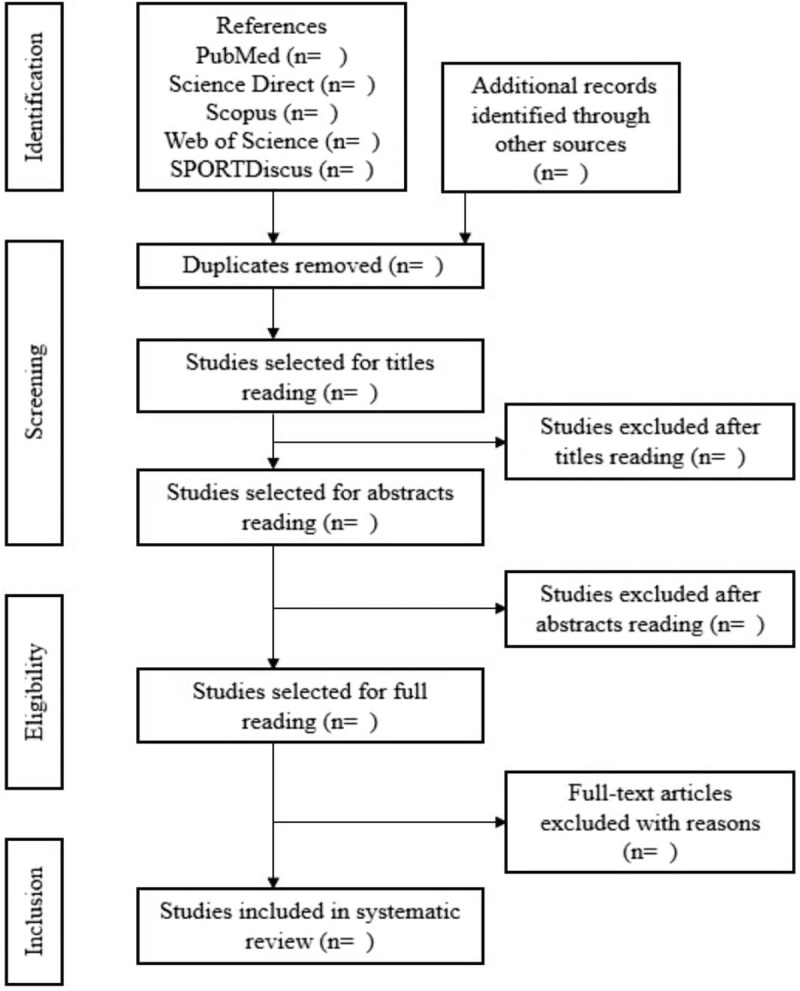
Article selection flowchart. Adapted from PRISMA-P.[22]
2.5. Quality assessment
To conduct an appraisal of the studies’ methodological quality, each of the included articles will be evaluated and allocated a score according the quality index for randomized and nonrandomized studies proposed by Downs and Black.[23] Each published paper will be evaluated independently by 2 authors. To settle any disagreements in assigned scores, a third author will be consulted.
The quality index is a 26-item checklist including 5 subscales: reporting; external validity; internal validity—bias; internal validity—confounding; and power. Items are scored 0 or 1, except for 1 item in the reporting subscale, scored 0 to 2, and the single power item, scored 0 to 5. The total maximum score for quality is 32.
This quality index has demonstrated high internal consistency (Kuder–Richardson 20: 0.89), good test–retest (r = 0.88) and inter-rater (r = 0.75) reliability, and high correlations (r = 0.86–0.90) with other validated quality assessment instruments.[23]
2.6. Data extraction
Two reviewers will independently extract data by using a predefined standard data extraction form. This will be extracted information about the study (author and year of publication), participant characteristics (n°, sex, age and resistance training experience), methods (design of interventions and exercises), outcome measurements, and main findings.
Sub-analyses on age range and level of experience in weight training will be performed. All disagreements regarding the data extraction will be handled by discussion with a third reviewer.
3. Discussion
To our knowledge, this is the first systematic review that will summarize the findings on self-selected intensity during weight training. In a previous review investigating this strategy during aerobic exercise, the results showed that, in most cases, people self-selected intensities in accordance with the guidelines.[16] It is important to mention that be free to choose the training intensity may play a role in the activation of brain reward systems and can, consequently, induce higher adherence rates.[24] This is explained by the self-determination theory.[25]
Recent studies conducted with sedentary elderly showed that their self-selected intensity during weight training was just within current recommendations.[18,21] However, another study with sedentary elderly women found intensities less than those recommended for improvements in muscle strength.[26] The same was observed in most of the exercises in a study performed with sedentary adolescent girls.[27]
In studies with resistance-trained people (at least 12 months of experience with weight training), the self-selected loads were lower than those recommended for eliciting strength gains.[17,20] These studies consisted of only 1 experimental session. In the study of Faries and Lutz[28] that lasted 6 weeks, the authors observed that in the fifth training session, the loads reached those recommended by the guidelines. This finding reinforces the idea that even if self-selected loads are initially low, they are likely to quickly increase.
It has already been highlighted that individuals differ greatly in the levels of intensity they self-select. Consequently, some may choose intensities that are too low to be effective or too high to be safe.[16] The study by Elsangedy et al[26] showed these differences not only between individuals but also between types of exercise.
In studies with young adults, trained men[29] and women[30] self-selected loads below those recommended to enhance muscular strength. Conversely, sedentary men[19] and women[31] self-selected loads that met those recommended for novice individuals. These findings suggest that the level of experience in weight training can influence the individual's preferences. In addition, there is much heterogeneity in study designs with exercise training, as has been noted in other systematic review protocols.[32,33]
This wide range of information reinforces the need for a systematic review on the topic. It is also important not to lose sight of the impact these findings may have on public health spending. The protocol for this systematic review is presented in a clear and systematic way for the extraction of information and presentation of the findings. The results of this study will provide a summary of information and may benefit both health professionals and researchers.
Author contributions
Conceptualization: Victor Hugo de Oliveira Segundo, Maria Irany Knackfuss.
Data curation: Victor Hugo de Oliveira Segundo, Grasiela Piuvezam, Kesley Pablo Morais de Azevedo.
Formal analysis: Victor Hugo de Oliveira Segundo, Grasiela Piuvezam, Kesley Pablo Morais de Azevedo.
Investigation: Victor Hugo de Oliveira Segundo, Kesley Pablo Morais de Azevedo, Humberto Jefferson de Medeiros.
Methodology: Victor Hugo de Oliveira Segundo, Grasiela Piuvezam, José Carlos Leitão, Maria Irany Knackfuss.
Project administration: Victor Hugo de Oliveira Segundo, Humberto Jefferson de Medeiros, Maria Irany Knackfuss.
Supervision: Grasiela Piuvezam, Humberto Jefferson de Medeiros, José Carlos Leitão, Maria Irany Knackfuss.
Writing – original draft: Victor Hugo de Oliveira Segundo, Kesley Pablo Morais de Azevedo.
Writing – review & editing: Grasiela Piuvezam, José Carlos Leitão, Maria Irany Knackfuss.
Victor Hugo de Oliveira Segundo orcid: 0000-0002-4596-9590.
Footnotes
Abbreviations: PRISMA-P = Preferred Reporting Items for Systematic Reviews and Meta-Analyses Protocols.
How to cite this article: Segundo VH, Piuvezam G, Azevedo KP, Medeiros HJ, Leitão JC, Knackfuss MI. Can people self-select an exercise intensity sufficient to enhance muscular strength during weight training? Medicine. 2019;98:38(e17290).
The research was funded by the Federal University of Rio Grande do Norte, through the Postgraduate Pro-rectory, and the Postgraduate Program in Public Health. In addition, we thank the Coordination of Improvement of Higher Education Personnel (CAPES) for the incentive with the grant of a doctorate scholarship.
All authors have read and approved the final manuscript.
The authors have no conflicts of interest to disclose.
References
- [1].Pedersen BK, Saltin B. Exercise as medicine–evidence for prescribing exercise as therapy in 26 different chronic diseases. Scand J Med Sci Sports 2015;25:1–72. [DOI] [PubMed] [Google Scholar]
- [2].Carlson SA, Fulton JE, Pratt M, et al. Inadequate physical activity and health care expenditures in the United States. Prog Cardiovasc Dis 2015;57:315–23. [DOI] [PMC free article] [PubMed] [Google Scholar]
- [3].Codogno JS, Turi BC, Kemper HC, et al. Physical inactivity of adults and 1-year health care expenditures in Brazil. Int J Public Health 2015;60:309–16. [DOI] [PubMed] [Google Scholar]
- [4].Katzmarzyk PT, Gledhill N, Shephard RJ. The economic burden of physical inactivity in Canada. CMAJ 2000;163:1435–40. [PMC free article] [PubMed] [Google Scholar]
- [5].Allender S, Foster C, Scarborough P, et al. The burden of physical activity-related ill health in the UK. J Epidemiol Community Health 2007;61:344–8. [DOI] [PMC free article] [PubMed] [Google Scholar]
- [6].Zhang J, Chaaban J. The economic cost of physical inactivity in China. Prev Med 2013;56:75–8. [DOI] [PubMed] [Google Scholar]
- [7].Ding D, Lawson KD, Kolbe-Alexander TL, et al. The economic burden of physical inactivity: a global analysis of major non-communicable diseases. Lancet 2016;388:1311–24. [DOI] [PubMed] [Google Scholar]
- [8].Sallis R. Exercise is medicine: a call to action for physicians to assess and prescribe exercise. Phys Sportsmed 2015;43:22–6. [DOI] [PubMed] [Google Scholar]
- [9].Volaklis KA, Halle M, Meisinger C. Muscular strength as a strong predictor of mortality: a narrative review. Eur J Intern Med 2015;26:303–10. [DOI] [PubMed] [Google Scholar]
- [10].Backhouse SH, Ekkekakis P, Biddle SJ, et al. Exercise makes people feel better but people are inactive: paradox or artifact? J Sport Exerc Psychol 2007;29:498–517. [DOI] [PubMed] [Google Scholar]
- [11].Sperandei S, Vieira MC, Reis AC. Adherence to physical activity in an unsupervised setting: explanatory variables for high attrition rates among fitness center members. J Sci Med Sport 2016;19:916–20. [DOI] [PubMed] [Google Scholar]
- [12].Clavel San Emeterio I, García-Unanue J, Iglesias-Soler E, et al. Prediction of abandonment in Spanish fitness centres. Eur J Sport Sci 2019;19:217–24. [DOI] [PubMed] [Google Scholar]
- [13].Perri MG, Anton SD, Durning PE, et al. Adherence to exercise prescriptions: effects of prescribing moderate versus higher levels of intensity and frequency. Health Psychol 2002;21:452. [PubMed] [Google Scholar]
- [14].Ekkekakis P, Parfitt G, Petruzzello SJ. The pleasure and displeasure people feel when they exercise at different intensities. Sports Med 2011;41:641–71. [DOI] [PubMed] [Google Scholar]
- [15].Williams DM. Exercise, affect, and adherence: an integrated model and a case for self-paced exercise. J Sport Exerc Psychol 2008;30:471–96. [DOI] [PMC free article] [PubMed] [Google Scholar]
- [16].Ekkekakis P. Let them roam free? Sports Med 2009;39:857–88. [DOI] [PubMed] [Google Scholar]
- [17].Dias MR, Simão R, Saavedra FJ, et al. Self-selected training load and RPE during resistance and aerobic training among recreational exercisers. Percept Mot Skills 2018;125:769–87. [DOI] [PubMed] [Google Scholar]
- [18].de Oliveira VH, Rebouças GM, Felipe TR, et al. Self-selected intensity by controlled hypertensive older women during a weight training session. J Sports Phys Educ 2016;3:09–13. [Google Scholar]
- [19].Elsangedy HM, Krinski K, da Silva Machado DG, et al. Self-selected intensity, ratings of perceived exertion, and affective responses in sedentary male subjects during resistance training. J Phys Ther Sci 2016;28:1795–800. [DOI] [PMC free article] [PubMed] [Google Scholar]
- [20].Cotter JA, Garver MJ, Dinyer TK, et al. Ratings of perceived exertion during acute resistance exercise performed at imposed and self-selected loads in recreationally trained women. J Strength Cond Res 2017;31:2313–8. [DOI] [PubMed] [Google Scholar]
- [21].de Oliveira VH, Câmara GLG, Azevedo KPM, et al. Treinamento com pesos em intensidade imposta e autosselecionada sobre a composição corporal de idosos: um ensaio clínico randomizado. Rev Andal Med Deport 2019;12:11–4. [Google Scholar]
- [22].Moher D, Shamseer L, Clarke M, et al. Preferred reporting items for systematic review and meta-analysis protocols (PRISMA-P) 2015 statement. Syst Rev 2015;4:1. [DOI] [PMC free article] [PubMed] [Google Scholar]
- [23].Downs SH, Black N. The feasibility of creating a checklist for the assessment of the methodological quality both of randomised and non-randomised studies of health care interventions. J Epidemiol Community Health 1998;52:377–84. [DOI] [PMC free article] [PubMed] [Google Scholar]
- [24].Reed J, Ones DS. The effect of acute aerobic exercise on positive activated affect: a meta-analysis. Psychol Sport Exerc 2006;7:477–514. [Google Scholar]
- [25].Deci EL, Ryan RM. The“ what” and“ why” of goal pursuits: Human needs and the self-determination of behavior. Psychol Inq 2000;11:227–68. [Google Scholar]
- [26].Elsangedy HM, Krause MP, Krinski K, et al. Is the self-selected resistance exercise intensity by older women consistent with the American college of sports medicine guidelines to improve muscular fitness? J Strength Cond Res 2013;27:1877–84. [DOI] [PubMed] [Google Scholar]
- [27].Alves RC, Prestes J, Souza-Junior T, et al. Acute effect of weight training at a self-selected intensity on affective responses in obese adolescents. J Exerc Physiol Online 2014;17:66–73. [Google Scholar]
- [28].Faries MD, Lutz R. Self-selected intensity and adherence in a campus recreation center with novice, female weight lifters: a preliminary investigation. Recreat Sports J 2016;40:56–68. [Google Scholar]
- [29].Portugal EM, Lattari E, Santos TM, et al. Affective responses to prescribed and self-selected strength training intensities. Percept Mot Skills 2015;121:465–81. [DOI] [PubMed] [Google Scholar]
- [30].Focht BC, Garver MJ, Cotter JA, et al. Affective responses to acute resistance exercise performed at self-selected and imposed loads in trained women. J Strength Cond Res 2015;29:3067–74. [DOI] [PubMed] [Google Scholar]
- [31].Focht BC. Perceived exertion and training load during self-selected and imposed-intensity resistance exercise in untrained women. J Strength Cond Res 2007;21:183. [DOI] [PubMed] [Google Scholar]
- [32].Azevedo KPM, Oliveira Segundo VH, Medeiros GCBS, et al. Effects of exercise on the levels of BDNF and executive function in adolescents: a protocol for systematic review and meta-analysis. Medicine (Baltimore) 2019;98:e16445. [DOI] [PMC free article] [PubMed] [Google Scholar]
- [33].Liu J-X, Zhu L, Deng J-M. The effects of high-intensity interval training versus moderate-intensity continuous training on fat loss and cardiometabolic health in pediatric obesity: A protocol of systematic review and meta-analysis. Medicine (Baltimore) 2019;98: e14751. [DOI] [PMC free article] [PubMed] [Google Scholar]