



We report the case of a 19-year-old female patient who required supraclavicular defect coverage. She suffered from congenital brachial plexus palsy and had undergone 17 prior operations. Due to instability, the clavicle had to be shortened. Wound dehiscence and piercing of the end of the clavicle through the skin occurred (Fig. 1). As the patient desired a maximally safe operation with an optimal aesthetic result, we chose a short-scar pectoralis major flap (PMF). The pectoralis major (PM) muscle appeared clinically unaffected, while the back showed extensive scarring from prior operations. A magnetic resonance imaging scan depicted the thoracoacromial artery. The patient provided written informed consent for surgery and publication. The operation was rated as a category C procedure according to Bernstein and Bampoe [1] (amendment to the technique of an established operation) and therefore exempt from institutional review board approval. Debridement with smoothening of the clavicular end was performed first. An 8-cm submammary incision was made and the PM was identified. After dissection, the flap was flipped cranially, pulled through a tunnel up into the defect and fixed above the clavicular stump (Fig. 2). The postoperative result was aesthetically pleasing (Fig. 3). Defect coverage in the shoulder region by PMFs is not new, and PMFs compete with a vast choice of free fasciocutaneous and musculocutaneous flaps. The complications of PMFs range from breast distortion to complete flap necrosis [2]. The PMF is not known for good cosmesis, usually leaving extensive scars. An inframammary approach was described by Zbar et al. [3], but with an incision leaving a longer scar. This led us to think about a scar-sparing approach, and making an incision of the type used for breast augmentation seemed natural.
Fig. 1.

Tissue defect with exposure of the clavicle. Soft tissue defect with exposure of the left clavicle after several attempts to perform secondary sutures, with extensive scarring on the back.
Fig. 2.

Defect coverage with the pectoralis major muscle. Soft tissue coverage of the supraclavicular region by a pectoralis major flap.
Fig. 3.
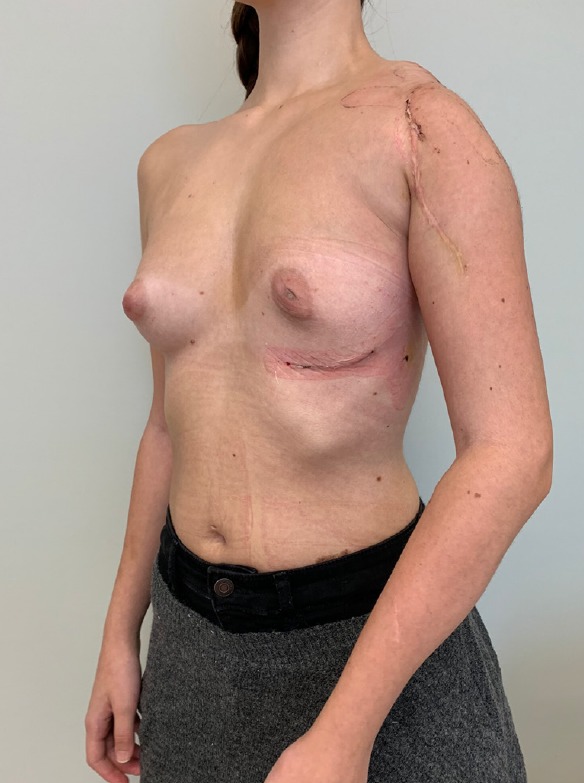
Postoperative view 2 weeks after surgery. Good defect coverage and favorable aesthetic results after flap elevation through the submammary fold incision were obtained.
Footnotes
No potential conflict of interest relevant to this article was reported.
Ethical approval
The study was performed in accordance with the principles of the Declaration of Helsinki. Written informed consent was obtained.
Patient consent
The patient provided written informed consent for the publication and the use of her images.
Author contribution
Methodology, data curation: Sattler S, von Kohout M, Kraus A. Project administration: Sattler S. Visualization, writing original draft: Kraus A. Review&editing: Sattler S, von Kohout M. Approval of final manuscript: all authors.
References
- 1.Bernstein M, Bampoe J. Surgical innovation or surgical evolution: an ethical and practical guide to handling novel neurosurgical procedures. J Neurosurg. 2004;100:2–7. doi: 10.3171/jns.2004.100.1.0002. [DOI] [PubMed] [Google Scholar]
- 2.Kruse AL, Luebbers HT, Obwegeser JA, et al. Evaluation of the pectoralis major flap for reconstructive head and neck surgery. Head Neck Oncol. 2011;3:12. doi: 10.1186/1758-3284-3-12. [DOI] [PMC free article] [PubMed] [Google Scholar]
- 3.Zbar RI, Funk GF, McCulloch TM, et al. Pectoralis major myofascial flap: a valuable tool in contemporary head and neck reconstruction. Head Neck. 1997;19:412–8. doi: 10.1002/(sici)1097-0347(199708)19:5<412::aid-hed8>3.0.co;2-2. [DOI] [PubMed] [Google Scholar]