



Abstract
Objective:
In the United States, underemployment is more common among ethnic minorities, especially African Americans. At the same time, African American couples are at higher risks of marital difficulties than other racial/ethnic groups. This study used a dyadic approach to examine implications of underemployment, as perceived by African American mothers and fathers, for their own and their partners’ couple relationship experiences, including relational love and coparenting satisfaction. The vulnerability-stress-adaptation framework of couple relationships guided tests of moderation by depressive symptoms, work hours, workplace discrimination, and expressive personality.
Method:
The sample included 164 African American dual-earner parents (mean age = 40.53 and 43.11 for mothers and fathers) who were interviewed on two occasions across two years. Actor-partner interdependence modeling was used for the analyses.
Results:
Fathers’ underemployment perceptions negatively predicted their own reports of love and coparenting satisfaction. Significant interactions indicated that the negative effects of fathers’ perceived underemployment on their own relational love were stronger for fathers with more depressive symptoms, and, for less expressive mothers, on mothers’ love and coparenting satisfaction. However, mothers’ perceived underemployment was a positive predictor of mothers’ love when they worked fewer hours and a negative predictor of mothers’ coparenting satisfaction when they had high expressive personality.
Conclusion:
Implications of underemployment experiences for couple relationships differ across gender and need to be considered in the context of partners’ vulnerabilities, adaptive characteristics and other stressors. Findings advance understanding of underemployment and work-marriage linkages among African Americans, and highlight the utility of a dyadic approach.
Keywords: African American couple relationships, parents, perceived underemployment, ethnic homogeneous design, dyadic analysis
Compared to other racial/ethnic groups in the U.S., African Americans experience poorer labor market outcomes (U.S. Department of Labor, 2012). One such experience is underemployment, defined as the gap between employees’ abilities and the requirements of their current jobs, either objective or perceived, an experience that has been linked to poorer functioning in long-term career achievement, physical and mental health, and interpersonal relationship quality (Feldman, 1996; Harari, Manapragada, & Viswesvaran, 2017; Liu & Wang, 2012). Underemployment is prevalent within the U.S. workforce: Measuring underemployment objectively as the gap between the educational level required for a job and the employee’s actual education, one study found that underemployment increased from about 30% to 55% between 1972 and 2002 (Vaisey, 2006). More recent 2010 data showed that 48.1% of the nation’s employed, four-year college graduates held jobs that required less than a Bachelor’s degree (Vedder, Denhart, & Robe, 2013). Importantly, underemployment is more common among ethnic minorities, especially African Americans, a pattern that is evident even after controlling for education (Slack & Jenson, 2011). African Americans have a unique history in the U.S. labor market including its opportunity structure (U.S. Department of Labor, 2012), and their experiences with underemployment may be likewise unique. We know very little, however, about the implications of underemployment experienced by African American women and men. Advancing understanding of African Americans’ underemployment experiences may be a step toward mitigating the negative impacts of underemployment on their personal and family lives.
Accordingly, this study aimed to assess the implications of perceived underemployment for couple relationship experiences, specifically love and coparenting satisfaction, among African American couples. Connections between work and family, including couple relationship quality, are well established (Perry-Jenkins & Wadsworth, 2017). Although subjective underemployment experiences, including perceived underemployment, are hypothesized to influence interpersonal relationships, few studies have focused on this linkage, and evidence is sorely needed (Liu & Wang, 2012). African Americans are understudied in research on couple relationships, but available data suggest that they are more likely to experience marital difficulties compared to other racial/ethnic groups, including higher divorce rates and lower marital satisfaction (Bulanda & Brown, 2007). Moreover, marital difficulties of African American parents may have negative impacts on their parenting practices and children’s psychological health (Riina & McHale, 2014; Sutton, Simons, Simons, & Cutrona, 2016). Therefore, investigating the implications of underemployment for couple relationships can not only advance understanding of its larger costs, but also illuminate a key determinant of relationship quality among African American parents, and thereby, family functioning more generally. Accordingly, using longitudinal dyadic data, we tested the links between African American parents’ own and their partners’ perceived underemployment and each parent’s reports of their relationship experiences, specifically, relational love, a robust predictor of divorce and marital stability (Gottman, 2014), and satisfaction with coparenting, a relationship dimension with important implications for couple and parent-child relationship functioning (Feinberg, 2003; Riina & McHale, 2014). Moving beyond a group comparison approach, we used an ethnic homogeneous design to illuminate the sources of within-group variation among African American couples.
Operationalization of underemployment has been various, including objective measurements and subjective evaluations (McKee-Ryan & Harvey, 2011). In this study, grounded in Feldman’s (1996) conceptualization, we operationalized underemployment as individuals’ perceptions that their job status and work experiences required lower levels of education, skills, and experience than they had actually achieved. We focused on perceived underemployment because, beyond capturing the mismatch between job outcomes and abilities, it also may reflect the inequalities African Americans experience in the labor market, more generally, with implications for their interpersonal relationships (Liu & Wang, 2012). We controlled for objective measures of socioeconomic status, including income, education, and job prestige, however, to determine whether perceived underemployment explained unique variance in couple relationship experiences. Further, given that perceived underemployment is a source of stress (Harari et al., 2017), and grounded in the vulnerability-stress-adaptation model of couple relationships (Karney & Bradbury, 1995), we tested whether depressive symptoms (a vulnerability), work hours and workplace discrimination (stressors), or expressive personality (an adaptive characteristic) moderated underemployment-couple relationship linkages for African American mothers and fathers. To address interdependencies in the couple system (Karney & Bradbury, 1995), we examined longitudinal dyadic data from parents using the Actor-Partner Interdependence Model (APIM; Kenny, Kashy, & Cook, 2006).
Underemployment Perceptions and Relationships of African American Couples: Spillover, Crossover and the Role of Gender
Although some data indicate that African American couples experience more marital difficulties than couples from other racial/ethnic groups, research on their couple relationship experiences, including linkages to the world beyond the family is limited (Sun, McHale, Crouter, & Jones, 2017). High levels of underemployment among African Americans mean that study of this work-related dimension may be fruitful. According to relative deprivation theory (Crosby, 1976), individuals develop feelings of frustration when they fail to achieve anticipated outcomes; through such a process, underemployment may promote negative affect (Feldman, 2011). Indeed, research has identified perceived underemployment as an important stressor that can negatively impact individual well-being (Harari et al., 2017). Research on linkages between underemployment and couple relationships has focused on White samples and on couples’ adjustment to financial loss from husbands’ underemployment (Feldman, 1996; Zvonkovic, 1988). In one of the few studies of African American couples, analyses using data from the current sample revealed that external stressors, including economic strain and racial discrimination, were linked to poorer couple relationship quality (author citation). More generally, the work-family literature has documented negative impacts of individuals’ workplace stressors on their family relationships, a process termed work-to-family spillover (Perry-Jenkins & Wadsworth, 2017), which in African American couples, takes the form of negative associations between work pressure and marital satisfaction (Sun et al., 2017). Accordingly, in this study we expected negative spillover effects of African American parents’ perceived underemployment on their own relationship experiences, specifically, marital love and coparenting satisfaction (Hypothesis 1).
Within couples, workplace experiences can influence not only individuals’ own, but their partner’s relationship experiences, as when one partner’s feelings of stress are transmitted to the other (Larson & Almeida, 1999). Prior research documents that individuals’ negative work experiences are related to their partners’ marital satisfaction, a process termed crossover (Westman, 2001). To our knowledge, however, crossover effects of underemployment have not yet been examined, and thus were a focus of the present study. Specifically, we expected negative crossover effects of African American parents’ perceived underemployment on their partners’ couple relationship experiences (Hypothesis 2).
Although work-to-family spillover and crossover effects have been found among both men and women, the strengths of these effects may differ across gender. Given men’s stereotypical role as breadwinner and closer connections between their work roles and identities (Cinamon & Rich, 2002), their job experiences may have stronger implications for family relationships. In contrast, women tend to set stronger boundaries between work and family that limit work-to-family spillover (Sears, Repetti, Robles, & Reynolds, 2016). They are generally more susceptible to their partners’ emotion transmission, however, and hence, more likely than men to experience crossover effects from their partners’ work experiences (Westman, 2001). Thus, we expected that the spillover effects of perceived underemployment on couple relationships would be stronger for fathers than for mothers (Hypothesis 3), and that the crossover effects would be stronger for mothers than for fathers (Hypothesis 4).
Moderators of Underemployment-Relationship Linkages: A Vulnerability-Stress-Adaptation Framework
In addition to gender, we also tested whether spillover and crossover effects of perceived underemployment on mothers’ and fathers’ relationship experiences were moderated by their individual characteristics and other contextual factors related to couple relationships. Given that perceived underemployment has been identified as an external stressor (Harari et al., 2017), its implications for couple relationships can be analyzed within a couple stress model—the vulnerability-stress-adaptation framework (Karney & Bradbury, 1995). This framework was developed to explain marital dynamics. Central tenets are that changes in marital quality are grounded in both spousal interactions and in the cumulative marital experiences of each spouse, and that the contexts within which the relationship is embedded, particularly external stressors and the ways couples react and adapt to those stressors, have implications for relationship quality. Thus, couple relationship outcomes can be explained by the combinations of partners’ enduring vulnerabilities, stressors, and adaptive characteristics—termed, the vulnerability-stress-adaptation process, because the effects of each of these sets of factors are best understood in relation to the other two. In this study, we examined the effects on couple relationships of interactions between: perceived underemployment (the stressor) and depressive symptoms (a vulnerability factor), work hours and workplace discrimination (workplace stressors), and expressive, other-oriented personality characteristics (adaptive qualities for close relationships).
We examined moderation by parents’ depressive symptoms to capture the vulnerability-stress process. Although depression is often treated as an outcome variable, individuals with more depressive symptoms have more negative affect and biased attribution styles that can make them more vulnerable to stressors and negative marital outcomes—a moderation mechanism, a process documented in African American couples (Sutton et al., 2016; Trombello, Schoebi, & Bradbury, 2011). Within the stress-adaptation process, however, partners can empathize and support each other to alleviate negative impacts of stress on their relationships (Randall & Bodenmann, 2009). Accordingly, we also examined the interaction between perceived underemployment and expressive personality, which encompasses a cluster of adaptive characteristics for close relationships, including empathy, sensitivity, and other-orientations, and has been found to buffer negative effects of contextual stressors (e.g., racial discrimination) on African Americans’ couple relationships (Riina & McHale, 2010) and benefit coparenting interactions (Kolak & Volling, 2007). We expected that depressive symptoms would exacerbate, and expressive personality mitigate the negative effects of parents’ perceived underemployment on their own and their partners’ couple relationship experiences (Hypotheses 5 and 6).
We also examined the interactions between perceived underemployment and two workplace stressors, long work hours and workplace discrimination, both of which have been linked to poorer marital quality (Hostetler, Desrochers, Kopko, & Moen, 2012; Riina & McHale, 2010). Based on the vulnerability-stress-adaptation tenet that stressors cumulatively impact couple relationships, in combination with the stress amplification theory tenet that one stressor can intensify the effects of another on family relationships (Young & Schieman, 2012), we expected that work hours and discrimination would exacerbate the negative effects of parents’ perceived underemployment on their and their partners’ relationship experiences (Hypothesis 7).
The Present Study
In sum, we examined the implications of perceived underemployment for African American mothers’ and fathers’ couple relationship experiences, focusing on relational love and coparenting satisfaction. Based on theory and previous research, we expected negative associations between parents’ perceived underemployment and both their own (spillover) and their partners’ (crossover) couple relationship experiences, with spillover effects stronger among men and crossover effects stronger among women. To account for dyadic interdependencies and potential connections between spillover and crossover effects, we simultaneously examined these two processes using a dyadic approach, APIM (Kenny et al., 2006). Further, treating perceived underemployment as an external stressor for couple relationships, and grounded in the vulnerability-stress-adaptation framework (Karney & Bradbury, 1995), we examined whether depressive symptoms (vulnerability), work hours and discrimination (stressors), and expressive personality (a cluster of adaptive characteristics) moderated spillover and crossover effects by exacerbating or mitigating the negative effects of perceived underemployment on parents’ and their partners’ reports of couple relationship experiences.
Method
Participants
The data were drawn from the first two years of a longitudinal study of family relationships among African American families (N = 202) when the data of interest were collected. To increase the homogeneity of the sample for the present analyses, we omitted 38 families, including14 families in which the couple was not in a marital or cohabitating relationship (e.g., a mother living with her father), 6 families in which couples had been living together for fewer than three years, and 18 families in which at least one parent was unemployed during the two years of the study. Thus, this study included 164 dual-earner, African American, heterosexual couples who were mothers and fathers of at least two youth in middle childhood to late-adolescence at home. Mean ages of mothers and fathers at Time 1 were 40.53 years (SD = 5.48) and 43.11 (SD = 6.96), respectively, and families were generally working and middle class. Regarding couple relationships, 149 couples were married, with an average marital duration of 12.72 (SD = 6.30) years at Time 1, and the rest had been cohabitating for at least three years, with an average cohabitating duration of 7.87 years (SD = 3.98). (Couples’ marital status and duration of marriage/living together were tested as covariates but omitted in final models due to nonsignificant effects.) At Time 2, 6 families withdrew, but analyses revealed that they did not differ from other families on demographics including parents’ education, income, or duration of marriage/living together.
Procedures
To address the study’s larger goals, we recruited families that self-identified as Black or African American and that included a mother and father figure and at least two pre- to late-adolescent offspring living in the home. Families were recruited in two northeast urban centers with sizeable African American populations using two strategies (author citation). First, African Americans residing in targeted communities provided information about the study to local businesses, churches, and community events; about half the sample (116 families) was recruited in this way. Second, we recruited the rest of the sample (86 families) by purchasing a marketing list of names and addresses of African American/Black families with pre-adolescent-aged offspring living in the same geographical region and sending letters to all families describing the study. Interested and eligible families called a toll-free number or returned a postcard. Of 1,796 letters sent, 131 were returned as undeliverable. Of the 142 families that responded to letters with interest, 93 were eligible; 7 could not be located based on the information they provided or were too busy to participate, resulting in 86 participating families with this recruitment strategy.
Annual interviews were conducted in families’ homes primarily by teams of two African American interviewers. Here, we used mothers’ and fathers’ individual reports of their underemployment, socioeconomic, individual and other work characteristics, and couple relationships. Interviews began with informed consent procedures and lasted 2 to 3 hours; and families received a $200 honorarium each year. All procedures were approved by the university’s institutional review board.
Measures
Perceived underemployment was assessed at Time 1 using a measure we developed based on Feldman’s (1996) conceptualization of underemployment. Using a 4-point scale (1 = strongly disagree, 4= strongly agree), parents rated the extent to which they agreed with seven items: “Given my skills, education, and experience, I should be: in a better job; be making more money; in a more prestigious job; in a job that offers better benefits; in a job with more independence; in a job with more responsibility; in a job with more job security.” Principal component analysis revealed the unidimensional nature of this measure: Only one eigenvalue exceeded 1.0 (i.e., 4.17), and this component accounted for 59.6% of the variance; the second eigenvalue was .86 and only accounted for 12.4% of the variance. Cronbach’s alpha was .86 and .89 for mothers and fathers, respectively. Thus, item scores were averaged to create a mean score, with higher scores signifying higher levels of perceived underemployment.
Depressive symptoms were measured at Time 1 using the 12-item, 4-point (1= rarely, 4= most of the time) Center for Epidemiological Studies Depression Scale (CES-D; Radloff, 1977), which has documented convergent and discriminant validity (Devins & Orme, 1985). An example item is, “I felt that everything was an effort”. Ratings were averaged, with higher scores reflecting more depressive symptoms; Cronbach’s alphas were for .75 mothers and .79 for fathers.
Other work-related stressors were work hours and discrimination, also assessed at Time 1. Work hours for each parent were summed from reports of weekly hours spent at work and on work-related tasks at home. Work discrimination was measured using the 4-item, 4-point (1 = strongly disagree, 4 = strongly agree) Institutional Discrimination subscale of the Workplace Racial Bias Scale that was developed with an African American sample and established validity (Hughes & Dodge, 1997), e.g., “In my place of work, there is discrimination against African Americans in hiring.” Ratings were averaged, with higher scores reflecting higher discrimination at work. Cronbach’s alpha was .87 for mothers and .86 for fathers.
Expressive personality was assessed using the Bem Sex Role Inventory (Bem, 1974), for which validity has been documented in African American samples (Harris, 1994). Using a 7-point scale (1= never or almost never true, 7 = always or almost always true), mothers and fathers rated the extent to which a list of 20 expressive and other-oriented, stereotypically feminine adjectives (e.g., “affectionate”, “understanding”, “tender”) applied to their personalities. Ratings were averaged, with higher scores reflecting higher levels of expressive personality. Cronbach’s alpha was .86 for mothers and .82 for fathers.
Parents also reported on socioeconomic characteristics at Time 1. First, they rated their educational attainment on scale where 12 = high school graduate, 13 = high school graduate plus vocational/technical/job training, 14 = some college but no degree, 15 = associate’s degree, 16 = bachelor’s degree, 17 = some education after undergraduate degree but no advanced degree, 18 = master’s degree, 19 = professional degree (e.g., Law, Medicine), 20 = Ph.D. They reported the title of their current job, based on which we coded their occupational prestige using the National Opinion Research Council’s codes (Nakao & Treas, 1994). Mothers’ occupational prestige scores ranged from 24.30 (e.g., bill and account collector) to 74.77 (e.g., lawyer), and fathers’ ranged from 22.33 (e.g., janitor) to 74.77. Finally, parents reported their gross income for the past year from all their jobs (before taxes); medians were $35,500 (SD = $23,356) for mothers and $46,000 (SD = 46,118) for fathers.
Parents reported on their couple relationships at Times 1 and 2. Relational love was measured using the Relationship Questionnaire (Braiker & Kelley, 1979), which has established validity with African American couples (Crohan & Veroff, 1989). Parents used a 9-point scale (1 = not at all, 9 = very much) to rate nine items, e.g., “How close do you feel toward your partner?” Coparenting satisfaction was measured using items from the Couple Relationship Domains Questionnaire (Huston, McHale, & Crouter, 1986) on which parents used a 9-point scale (1 = extremely dissatisfied, 9 = extremely satisfied) to respond to three questions, e.g., “How satisfied are you with your partner’s fundamental principles about how to bring up children (e.g., values, discipline, etc.)?” This measure was based on Campbell, Converse and Rodgers’ (1976) measure of life satisfaction that was developed and used in a nationally representative sample. Cronbach’s alphas ranged from .90 to .94 for the love scale and from .75 to .81 for the coparenting satisfaction scale across gender and time points. Mean scores on each of the couple relationship measures were created by averaging item ratings, with higher scores signifying higher relational love or satisfaction.
Analytic Strategies
We tested whether perceived underemployment predicted parents’ reports of couple relationships by applying the actor-partner interdependence model (APIM), which allowed us to estimate actor (parents’ spillover from underemployment to relationship) and partner (crossover from one member of the couple to the other) effects simultaneously (Kenny et al., 2006). We estimated APIM with multilevel modeling (Raudenbush & Bryk, 2002) using PROC MIXED in SAS Version 9.4 (SAS Institute Inc., Cary, NC). Because all dyads were distinguishable (i.e., one mother and one father for each dyad), we applied two-intercept, two-level models where intercepts and coefficients were estimated for mothers and fathers separately while dyadic interdependencies were accounted by using compound symmetry in residual estimation (Kenny et al., 2006). An advantage of the two-intercept model (compared to the one-intercept) is that it allows for free estimation of covariance between mothers’ and fathers’ intercepts instead of constraining it as positive (Kenny et al., 2006). Two models were estimated: to predict relational love and coparenting satisfaction. In each model, we tested main effects of the actor’s and the partner’s perceived underemployment (Time 1) on mothers’ and fathers’ reports on couple relationships (Time 2), as well as their moderation by depressive symptoms, work hours, work discrimination, and expressive personality—tested as interaction terms simultaneously in an initial omnibus model, with nonsignificant interactions omitted from the final model (Aiken & West, 1991). We controlled for the corresponding relational reports at Time 1 to partial out the contemporaneous correlations between perceived underemployment and couple relationships. We also included the measures of parents’ socioeconomic characteristics, omitting nonsignificant covariates from the final models (Aiken & West, 1991). All independent variables were centered around the sample means for analyses. Within each model, we compared main effects across mothers and fathers by testing the interaction between perceived underemployment and parent gender in an equivalent one-intercept model (Kenny et al., 2006). For each model, we computed pseudo R2, the proportion of variance of the dependent variable explained by all of the independent variables, as a measure of effect size (Peugh & Heck, 2016).
Results
Preliminary Analyses
Means, standard deviations, and correlations for study variables are shown in Table 1. The levels of perceived underemployment fell around the midpoint of the 4-point scale. In contrast to prior results (Harari et al., 2017), we did not find a gender difference in parents’ ratings of underemployment. Mothers’ education was significantly higher than fathers’, t(155) = 2.26, p = .02, whereas mothers earned significantly less and worked significantly fewer hours than fathers, t(142) = −4.57, p < .001, and t(153) = −5.38, p < .001. In addition, consistent with prior theory and research (Bem, 1974), mothers’ expressive personality was significantly higher than fathers’, t(155) = 5.15, p < .001. Bivariate correlations between perceived underemployment and measures of socioeconomic, work, and individual characteristics were low to moderate, indicating that perceived underemployment was a distinct construct. In addition, these correlations revealed different patterns between mothers and fathers. First, perceived underemployment was negatively correlated with education, income, occupational prestige and work hours for fathers but these associations were at trend level or nonsignificant for mothers. Depressive symptoms and workplace discrimination, however were positive correlates of perceived underemployment for both mothers and fathers. Finally, the positive correlation between expressive personality and perceived underemployment reached trend level for mothers but was nonsignificant for fathers.
Table 1.
Means (M), Standard Deviations (SD), and Correlations Between Study Variables For Mothers (Above Diagonal), Fathers (Below Diagonal), and Between Parents (on Diagonal).
| Mother | Father | |||||||||||||||
|---|---|---|---|---|---|---|---|---|---|---|---|---|---|---|---|---|
| Variables | 1 | 2 | 3 | 4 | 5 | 6 | 7 | 8 | 9 | 10 | 11 | 12 | M (SD) | M (SD) | ||
| 1. Perceived underemployment | .10† | .08 | −.15† | −.12 | .21** | −.08 | .25** | .15† | −.07 | −.05 | −.09 | −.09 | 2.38 | (0.77)a | 2.36 | (0.87)a |
| 2. Education | −.38** | .43** | .43** | .37** | −.05 | .25** | .02 | -.03 | .01 | −.08 | −.02 | −.03 | 14.81 | (1.77)a | 14.45 | (2.20)b |
| 3. Income | −.32** | .53** | .24** | .40** | −.07 | .48** | .15* | −.19* | .01 | .00 | .05 | −.03 | 37.23 | (23.15)a | 55.77 | (46.12)b |
| 4. Occupational prestige | −.33** | .62** | .48** | .31** | −.07 | .18** | −.10† | −.12 | −.05 | −.04 | .05 | .08 | 49.01 | (11.81)a | 48.11 | (13.50)a |
| 5. Depressive symptoms | .24** | −.24** | −.25** | −.19* | .13 | −.22** | .14† | −.04 | −.22** | −.27** | −.20** | .22** | 1.49 | (0.38)a | 1.62 | (0.45)b |
| 6. Work hours | −.20** | .30** | .27** | .21** | −.06 | .07 | .02 | −.09 | .21** | .00 | .13 | −.04 | 37.90 | (16.69)a | 48.68 | (19.09)b |
| 7. Work discrimination | .34** | −.12* | .00 | .02 | .33** | −.04 | .02 | −.12 | −.07 | −.01 | −.06 | −.02 | 2.02 | (0.89)a | 1.98 | (0.92)a |
| 8. Expressive personality | .04 | .01 | −.01 | −.00 | .05 | −.08 | .09 | −.11 | .11 | .27** | .10 | .14† | 5.05 | (0.64)a | 4.64 | (0.66)b |
| 9. Relational love (T1) | −.05 | −.11* | .02 | −.02 | −.26** | −.17** | −.14* | −.27** | .53** | .62** | .51** | .37** | 7.67 | (1.28)a | 7.90 | (1.12)b |
| 10. Relational love (T2) | −.23** | −.00 | .02 | −.02 | −.25** | −.07 | −.11† | −.25** | .71** | .55** | .34** | .53** | 7.65 | (1.46)a | 7.84 | (1.15)a |
| 11. Coparenting satisfaction (T1) | −.12 | −.12 | −.03 | −.11 | −.16* | −.25** | −.15† | .08 | .61** | .56** | .27** | .51** | 6.76 | (1.85)a | 7.40 | (1.50)b |
| 12. Coparenting satisfaction (T2) | −.20* | −.05 | .01 | −.04 | −.37** | −.07 | −.06 | .20* | .49** | .56** | .59** | .35** | 6.90 | (1.64)a | 7.28 | (1.47)b |
Note. Correlations between mothers and fathers in bold. Variables 1–7 were all measured at Time 1. T1 = Time 1; T2 = Time 2.
p <.10
p <.05
p<.01.
Within each row, means with different superscripts are significantly different according to the results of paired t-tests, p < .05.
Also as shown in Table 1, paired t-tests revealed that mothers reported lower mean levels of love (at Time 1) and coparenting satisfaction (at both Times 1 and 2) compared to the fathers, t(155) = −2.17, p = .03, and t(155) = −3.94, p < .001 and t(137) = −2.60, p = .01, respectively. Further, love and satisfaction at Time 2 were significantly correlated with perceived underemployment for fathers, but those correlations were nonsignificant for mothers, supporting the utility of two-intercept models that separately examined associations for mothers and fathers in following analyses. Although relational love and coparenting satisfaction were correlated, they are conceptually distinct constructs and reflect different processes in couple relationships (Feinberg, 2003), and thus were examined separately.
Perceived Underemployment Predicting Couple Relationship Experiences
Results of models estimating the actor and partner effects of mothers’ and fathers’ perceived underemployment on couple relationships are shown in Table 2. The socioeconomic characteristics were all nonsignificant covariates and thus were omitted from the final models and are not shown. In addition, all interactions between perceived underemployment and work discrimination were nonsignificant and thus were also omitted and not shown. Finally, the effects of the Time 1 couple relationship measures on Time 2 relationships did not significantly differ across gender, and so were not estimated separately for mothers and fathers in the final models. The levels of pseudo R2 were moderate (.43 and .34).
Table 2.
Unstandardized Coefficients (γ) and Standard Errors (SE) From Two-Intercept APIMs Predicting Mothers’ (M) and Fathers’ (F) Relational Love and Coparenting Satisfaction (Time 2) From Actors’ and Partners’ Perceived Underemployment (Time 1), and Their Moderation by Depressive Symptoms, Work Hours, and Expressive Personality
| Relational Love | Coparenting Satisfaction | |||||||
|---|---|---|---|---|---|---|---|---|
| γ | SE | p value | γ | SE | p value | |||
| Intercepts | ||||||||
| M | 1.58 | .43 | .00 | 3.37 | .34 | .00 | ||
| F | 1.85 | .44 | .00 | 3.57 | .37 | .00 | ||
| Covariates and moderators | ||||||||
| Time 1 relational outcome | .77 | .05 | .00 | .51 | .05 | .00 | ||
| M Depressive symptoms | −.37 | .19 | .04 | - | - | - | ||
| F Depressive symptoms | −.08 | .19 | .66 | - | - | - | ||
| M Work hours | −.00 | .00 | .78 | - | - | - | ||
| F Work hours | .00 | .00 | .45 | - | - | - | ||
| M Expressive personality | .26 | .11 | .02 | .07 | .17 | .68 | ||
| F Expressive personality | .20 | .13 | .11 | .40 | .17 | .02 | ||
| Underemployment main effects | ||||||||
| M –Actor | .04 | .11 | .71 | −.06 | .14 | .65 | ||
| F –Actor | −.22 | .10 | .03 | −.37 | .13 | .01 | ||
| M –Partner | −.17 | .10 | .09 | −.16 | .13 | .23 | ||
| F –Partner | .09 | .11 | .41 | −.16 | .16 | .31 | ||
| Underemployment interaction effects | ||||||||
| M –Actor ×Depressive symptoms | .54 | .26 | .04 | - | - | - | ||
| F –Actor ×Depressive symptoms | −.55 | .23 | .01 | - | - | - | ||
| M –Partner ×Depressive symptoms | - | - | - | - | - | - | ||
| F –Partner ×Depressive symptoms | - | - | - | - | - | - | ||
| M –Actor ×Work hours | −.02 | .01 | .02 | - | - | - | ||
| F –Actor × Work hours | .00 | .00 | .87 | - | - | - | ||
| M –Partner × Work hours | - | - | - | - | - | - | ||
| F –Partner × Work hours | - | - | - | - | - | - | ||
| M –Actor × Expressive personality | - | - | - | −.56 | .20 | .01 | ||
| F –Actor × Expressive personality | - | - | - | −.05 | .19 | .81 | ||
| M –Partner × Expressive personality | .30 | .13 | .02 | .42 | .19 | .02 | ||
| F –Partner × Expressive personality | −.19 | .15 | .21 | .00 | .21 | .98 | ||
| pseudo R2 | .43 | .34 | ||||||
Note. Nonsignificant covariates and interaction terms were omitted from final models.
Estimation of the model focused on relational love revealed that fathers’ actor effect of perceived underemployment was negative, γ = −.22, SE = .10, p = .03, and was significantly stronger than mothers’ nonsignificant actor effect, comparison: γ = .30, SE = .15, p = .04, consistent with Hypothesis 1 for fathers and Hypothesis 3 for the gender difference. Fathers’ actor effect, however, was qualified by fathers’ depressive symptoms, γ = −.55, SE = .23, p = .01, and as illustrated in Figure 1, simple slope follow-up tests showed that for fathers with high levels of depressive symptoms, their own perceived underemployment was negatively related to their ratings of love, simple slope: γ = −.45, SE = .13, p < .001, whereas there was no such association when they reported low levels of depressive symptoms, simple slope: γ = .01, SE = .15, p = .95. In other words, fathers with high levels of depressive symptoms were more vulnerable to the effects of perceived underemployment on their relational love, consistent with Hypothesis 5 and the vulnerability-stress process. In contrast, no actor main effect emerged for mothers, and despite the significant interaction between mothers’ perceived underemployment and depressive symptoms, simple slopes follow-up tests were nonsignificant, γ =.27, SE = .18, p = .13 and γ = −.18, SE = .13, p = .17 for high and low levels of depressive symptoms, respectively. An interaction between mothers’ perceived underemployment and work hours, γ = −.02, SE = .01, p = .02, together with simple slope follow-up tests as illustrated in Figure 2, however, showed that perceived underemployment was a positive predictor of their ratings of love when mothers worked fewer hours, simple slope: γ = .35, SE = .14, p = .01, but this association was nonsignificant when mothers worked longer hours, simple slope: γ = −.27, SE = .20, p = .19. This interactive effect was inconsistent with Hypothesis 7 and our expectation of a stress amplification pattern, and that low work hours (−1 SD = 21.21 hours/week) seemed to protect mothers from potential negative effects of perceived underemployment. Further, although inconsistent with Hypothesis 2, in that the main effect of partners’ perceived underemployment was not significant for mothers or fathers, the partner effect was moderated by expressive personality for mothers, γ = .30, SE = .13, p = .02: As illustrated in Figure 3, simple slope follow-up tests showed that the partner effect of perceived underemployment on mothers’ ratings of love was nonsignificant when mothers had high levels of expressive personality, simple slope: γ = .04, SE = .11, p = .71, but this partner effect was significant and negative when mothers had low levels of expressive personality, γ = −.37, SE = .15, p = .01. In other words, mothers’ expressive, other-oriented personality characteristics seemed to buffer the negative effect of their partners’ underemployment on their relational love, consistent with Hypothesis 6 and the expected stress-adaptation process.
Figure 1.

Fathers’ depressive symptoms moderate the link between their reports of relational love and underemployment.
Figure 2.

Mothers’ work hours moderate the link between their reports of relational love and underemployment.
Figure 3.
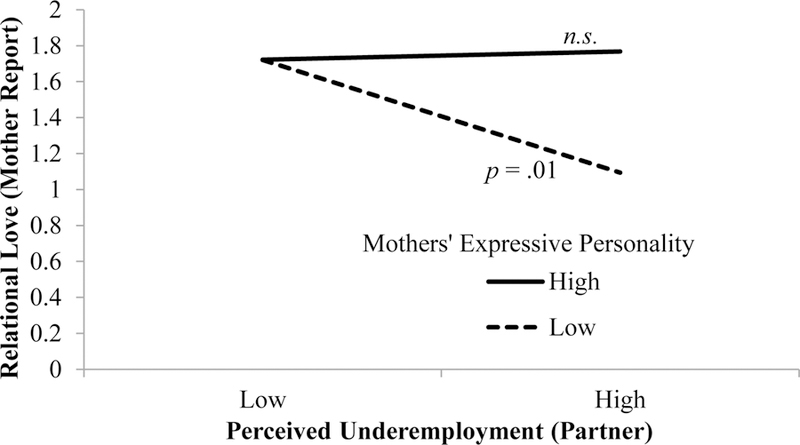
Mothers’ expressive personality moderates the link between their reports of relational love and their partners’ reports of underemployment.
Turning to coparenting satisfaction and consistent with Hypothesis 1, the actor effect of perceived underemployment was significant for fathers, γ = −.37, SE = .13, p = .01: Fathers’ perceived underemployment was a negative predictor of their coparenting satisfaction, controlling for Time 1 satisfaction, and this association was not qualified by their vulnerability or adaptive characteristics or work stressors. This actor main effect did not differ significantly for mothers versus fathers, however, γ = −.19, SE = .19, p = .31, inconsistent with Hypothesis 3. In contrast to fathers, mothers’ expressive personality qualified both the actor and partner effects of perceived underemployment on their coparenting satisfaction, γ = −.56, SE = .20, p = .01 and γ = .42, SE = .19, p = .02, respectively. For the actor effect (Figure 4 left panel), when mothers’ expressive personality was high, their perceived underemployment negatively predicted their coparenting satisfaction, simple slope: γ = −.56, SE = .20, p = .01, but this association was nonsignificant when mothers’ expressive personality was low, simple slope: γ = 31, SE = .22, p = .15. For the partner effect (Figure 4 right panel), in contrast, when mothers’ expressive personality was low, their partners’ perceived underemployment negatively predicted their coparenting satisfaction, simple slope: γ = −.45, SE = .21, p = .03, but this association was nonsignificant when mothers’ expressive personality was high, simple slope: γ = .12, SE = .15, p = .41. In other words, mothers’ other-oriented personality characteristics seemed to buffer the negative effect of their partners’ underemployment, again consistent with the stress-adaptive process, but their social sensitivity appeared to make them more vulnerable to the negative effect of their perceptions of their own underemployment. Other moderation effects were all nonsignificant for mothers and fathers and thus were omitted from the final model.
Figure 4.

Mothers’ expressivity moderates the links between their reports of coparenting and their own (left panel) and their partners’ reports of underemployment.
Discussion
Underemployment is a prevalent but rarely investigated experience of African Americans (Slack & Jensen, 2011). Using an ethnic homogeneous design, this study examined implications of African American parents’ perceived underemployment for their couple relationship quality, an understudied, but important focus of investigation for African American couples given their risk of marital disruption (Bulanda & Brown, 2007). Using a dyadic approach and grounded in the vulnerability-stress-adaptation framework of couple relationships (Karney & Bradbury, 1995), we tested both spillover and crossover effects of perceived underemployment on mothers’ and fathers’ couple relationship experiences, as well as moderations by their depressive symptoms, work hours and discrimination, and expressive, other-oriented personality characteristics.
Implications of Perceived Underemployment for Couple Relationships
This study contributes to the underemployment literature by testing associations between parents’ perceived underemployment and both their own and their partners’ reports of couple relationship quality, as research on the implications of underemployment for social relationships has been very limited (McKee-Ryan & Harvey, 2011). In addition, African American couple relationships are understudied, including how they may be impacted by work experiences. We focused on relational love and coparenting satisfaction, two related yet distinct constructs that have proved to be robust predictors of marriage stability and family functioning (Feinberg, 2003; Gottman, 2014). Using two-wave data, we were able to control for the contemporaneous linkages between perceived underemployment and relationship qualities and test its longitudinal implications, both in the form of main effects and interactions with potential moderators.
Applying the APIM approach, the only main effect we identified was a negative spillover (actor) effect of fathers’ perceived underemployment on their own reports of coparenting satisfaction, consistent with theory and previous findings about individuals’ underemployment as a source of stress that has negative implications for their personal lives, including couple relationships (Feldman, 2011; Harari et al., 2017). Other significant spillover and crossover effects of perceived underemployment were qualified by depressive symptoms, work hours, and/or expressive personality, findings consistent with the vulnerability-stress-adaptation tenet that impacts of external stressors on couple relationships must be considered in the context of partners’ vulnerabilities, adaptive characteristics, and other stressors (Karney & Bradbury, 1995).
Consistent with the vulnerability-stress process, fathers with more depressive symptoms were more susceptible to the negative effect of their own perceived underemployment on their relational love. This finding qualifies the conditions under which men’s underemployment experiences may affect their couple relationship quality. And, it adds to the literature on the implications of depression for African American parents’ couple relationships by extending findings on the main effects of depressive symptoms (Sutton et al., 2016) to their role as a vulnerability that may increase susceptibility to external stressors. Beyond spillover, fathers’ perceived underemployment also had negative crossover (partner) effects on mothers’ love and coparenting satisfaction, though these were buffered when mothers had high expressive, other-oriented personality characteristics. Consistent with the stress-adaptation process, mothers who were more emotionally sensitive to others may be more aware and understanding of and thus able to adapt better to their partners’ stressful experiences, including underemployment. Mothers’ perceived underemployment, however, did not cross over to fathers’ couple relationship experiences under conditions we examined; this pattern is consistent with the proposition that men are less subject than women to emotion transmission from their partners (Westman, 2001).
Further, the gender difference in spillover effects, specifically the stronger effect of perceived underemployment on relational love among fathers than among mothers, is consistent with the proposition that the work role is more central to men’s than to women’s identities, and that men’s work stressors are more likely than women’s to permeate their family lives (Cinamon & Rich, 2002). Nevertheless, women are not immune to effects of their own underemployment experiences. Although mothers’ perceived underemployment was not significant as a main effect, mothers’ work hours moderated its effect on their reports of love: Perceived underemployment predicted higher levels of love for mothers who worked fewer hours, suggesting that effects of underemployment experiences may be positive under certain conditions. That is, for mothers, underemployment due to part-time work may not be a stressor, but instead, may be beneficial for their couple relationship functioning—at least when their partners also are employed, as was the case in this sample. Specifically, mothers who are overqualified for their jobs may finish work more easily, leaving energy and psychological resources for family life, a phenomenon that may be especially prominent among part-time employed mothers for whom work is less central to their identities. Mothers’ perceived underemployment did have negative effects, however, on their coparenting satisfaction when they were high in expressive personality. Expressive personality characteristics such as social sensitivity may have made women more susceptible to the stress and negative affect from their own underemployment experiences such as because they feel they are not pulling their weight in their family or because they are attuned to the relatively low status of their jobs; at the same time these expressive characteristics can buffer the potential negative influences of their partners’ underemployment. In this way, an adaptive characteristic that protects women from crossover effects of their partners’ stressors becomes a vulnerability in the context of their own work-to-family spillover processes. These findings not only highlight the importance of incorporating both spillover and crossover effects in studies of work and couple relationships, but also contributes to the vulnerability-stress-adaptation theoretical framework in showing that the same characteristics can serve as both protective and risk factors, depending on the context and stress transmission process.
Limitations and Future Directions
In the face of its strengths, limitations of this study provide directions for future research. First, given the study’s correlational design, conclusions about causality cannot be drawn. This study’s two-year time frame also meant that we were unable to test antecedents of perceived underemployment or examine its longer-term implications for couple relationships. Intervention studies aimed at reducing African American parents’ underemployment experiences may illuminate such long-term, causal linkages. Second, although socioeconomic status was variable, this sample was relatively advantaged compared to the African American population, and given the goals of the larger study, all parents had adolescent-age offspring in the home, limiting the generalizability of our findings. This limitation, along with the complex pattern of the findings, highlight the importance of replication in a representative sample. Finally, we used an underemployment scale that was created based on Feldman’s (1996) operationalization, and an important future direction is to test this measure using other measurement approaches.
Taken together, however, our findings advance understanding of the implications of underemployment on African American parents, an understudied group by illuminating for whom and under what conditions underemployment impacts which couple relationship experiences. Beyond main effects, the moderation effects we detected direct attention to targeted interventions for addressing underemployment, particularly for fathers who also experience depressive symptoms, and for focusing on mothers’ social sensitivity as both a risk and protective characteristic. More generally, these findings suggest the importance of investing resources to reduce not just unemployment, a focus of much attention (Feldman, 2011), but also underemployment, perhaps most especially among parents in African American families whose marital relationships are vulnerable to disruption (Bulanda & Brown, 2007).
Acknowledgements:
This study was funded by a grant from the National Institute of Child Health and Human Development (R01-HD32336) to Susan M. McHale and Ann C. Crouter, Co-Principal Investigators. Xiaoran Sun was supported by National Science Foundation under IGERT Grant (DGE-1144860), “Big Data Social Science”. The authors are grateful to the undergraduate and graduate assistants, staff, and faculty collaborators for their help in conducting this study, as well as the participating families for their time and insights about family relationships.
Contributor Information
Susan M. McHale, Email: x2u@psu.edu.
Ann C. Crouter, Email: ac1@psu.edu.
References
- Aiken LS & West SG (1991). Multiple regression: Testing and interpreting interactions Newbury Park, CA: Sage. [Google Scholar]
- Bem SL (1974). The measurement of psychological androgyny. Journal of Consulting and Clinical Psychology, 42, 155–162. 10.1037/h0036215 [DOI] [PubMed] [Google Scholar]
- Braiker H, & Kelley HH (1979). Conflict in the development of close relationships. In Burgess RL & Huston TL (Eds.), Social exchange in developing relationships (pp. 135–168). New York: Academic. [Google Scholar]
- Bulanda JR, & Brown SL (2007). Race-ethnic differences in marital quality and divorce. Social Science Research, 36, 945–967. 10.1016/j.ssresearch.2006.04.001 [DOI] [Google Scholar]
- Campbell A, Converse P & Rodgers W (1976). The quality of American life New York: Russell Sage. [Google Scholar]
- Cinamon RG, & Rich Y (2002). Gender differences in the importance of work and family roles: Implications for work-family conflict. Sex Roles, 47, 531–541. 10.1023/A:1022021804846 [DOI] [Google Scholar]
- Crohan SE, & Veroff J (1989). Dimensions of marital well-being among White and Black newlyweds. Journal of Marriage and the Family, 51, 373–383. 10.2307/352500 [DOI] [Google Scholar]
- Crosby F (1976). A model of egoistical relative deprivation. Psychological Review, 83, 85–113. 10.1037//0033-295x.83.2.85 [DOI] [Google Scholar]
- Devins GM, & Orme CM (1985). Center for epidemiologic studies depression scale. In Keyser DJ, and Sweetland RC (Eds.), Test critiques, (pp. 144–160). Kansas City, MO: Test Corporation of America. [Google Scholar]
- Feinberg ME (2003). The internal structure and ecological context of coparenting: A framework for research and intervention. Parenting: Science and Practice, 3, 95–131. 10.1207/S15327922PAR0302_01 [DOI] [PMC free article] [PubMed] [Google Scholar]
- Feldman DC (1996). The nature, antecedents and consequences of underemployment. Journal of Management, 22, 385–407. 10.1016/S0149-2063(96)90030-6 [DOI] [Google Scholar]
- Feldman DC (2011). Theoretical frontiers for underemployment research. In Maynard DC, & Feldman DC (Eds.), Underemployment: Psychological, economic, and social challenges (pp. 277–306). New York: Springer; 10.1007/978-1-4419-9413-4_7 [DOI] [Google Scholar]
- Gottman JM (2014). What predicts divorce? The relationship between marital processes and marital outcomes New York: Psychology Press. [Google Scholar]
- Harari MB, Manapragada A, & Viswesvaran C (2017). Who thinks they’re a big fish in a small pond and why does it matter? A meta-analysis of perceived overqualification. Journal of Vocational Behavior, 102, 28–47. 10.1016/j.jvb.2017.06.002 [DOI] [Google Scholar]
- Harris AC (1994). Ethnicity as a determinant of sex role identity: A replication study of item selection for the Bem Sex Role Inventory. Sex roles, 31, 241–273. 10.1007/BF01547717 [DOI] [Google Scholar]
- Hostetler AJ, Desrochers S, Kopko K, & Moen P (2012). Marital and family satisfaction as a function of work–family demands and community resources: Individual- and couple-level analyses. Journal of Family Issues, 33, 316–340. 10.1177/0192513X11413877 [DOI] [Google Scholar]
- Hughes D, & Dodge MA (1997). African American women in the workplace: Relationships between job conditions, racial bias at work, and perceived job quality. American Journal of Community Psychology, 25, 581–599. 10.1023/a:1024630816168 [DOI] [PubMed] [Google Scholar]
- Huston TL, McHale SM, & Crouter AC (1986). Changes in the marital relationship during the first year of marriage. In Gilmour R, & Duck S (Eds.), The emerging field of personal relationships (pp. 109–132). Hillsdale, NJ: Erlbaum. [Google Scholar]
- Karney BR, & Bradbury TN (1995). The longitudinal course of marital quality and stability: A review of theory, methods, and research. Psychological Bulletin, 118, 3–34. 10.1037/0033-2909.118.1.3 [DOI] [PubMed] [Google Scholar]
- Kenny DA, Kashy DA, & Cook WL (2006). Dyadic data analysis New York: Guilford. [Google Scholar]
- Kolak AM, & Volling BL (2007). Parental expressiveness as a moderator of coparenting and marital relationship quality. Family Relations, 56, 467–478. 10.1111/j.1741-3729.2007.00474.x [DOI] [PMC free article] [PubMed] [Google Scholar]
- Larson RW, & Almeida DM (1999). Emotional transmission in the daily lives of families: A new paradigm for studying family process. Journal of Marriage and the Family, 61, 5–20. 10.2307/353879 [DOI] [Google Scholar]
- Liu S, & Wang M (2012). Perceived overqualification: A review and recommendation for research and practice. Research in Occupational Stress and Well-being, 10,1–42. 10.1108/S1479-3555(2012)0000010005 [DOI] [Google Scholar]
- McKee-Ryan F, & Harvey J (2011). “I have a job, but…”: A review of underemployment. Journal of Management, 37, 962–996. 10.1177/0149206311398134 [DOI] [Google Scholar]
- Nakao K, & Treas J (1994). Updating occupational prestige and socioeconomic scores: How the new measures measure up. Sociological Methodology, 24,1–72. 10.2307/270978 [DOI] [Google Scholar]
- Perry‐Jenkins M, & Wadsworth SM (2017). Work and family research and theory: Review and analysis from an ecological perspective. Journal of Family Theory & Review, 9, 219–237. 10.1111/jftr.12188 [DOI] [Google Scholar]
- Peugh JL, & Heck RH (2016). Conducting three-level longitudinal analyses. The Journal of Early Adolescence, 37, 7–58. 10.1177/0272431616642329 [DOI] [Google Scholar]
- Radloff LS (1977). The CES-D Scale: A self-report depression scale for research in the general population. Applied Psychological Measurement, 1, 385–401. 10.1177/014662167700100306 [DOI] [Google Scholar]
- Randall AK, & Bodenmann G (2009). The role of stress on close relationships and marital satisfaction. Clinical Psychology Review, 29, 105–115. 10.1016/j.cpr.2008.10.004 [DOI] [PubMed] [Google Scholar]
- Raudenbush SW, & Bryk AS (2002). Hierarchical linear models: Applications and data analysis methods (2nd ed.). Thousand Oaks, CA: Sage. [Google Scholar]
- Riina EM, & McHale SM (2010). Parents’ experiences of discrimination and family relationship qualities: The role of gender. Family Relations, 59, 283–296. 10.1111/j.1741-3729.2010.00602.x [DOI] [PMC free article] [PubMed] [Google Scholar]
- Riina EM, & McHale SM (2014). Bidirectional influences between dimensions of coparenting and adolescent adjustment. Journal of Youth and Adolescence, 43, 257–269. 10.1007/s10964-013-9940-6 [DOI] [PMC free article] [PubMed] [Google Scholar]
- Sears M, Repetti R, Robles T, & Reynolds B (2016). I just want to be left alone: Daily overload and marital behavior. Journal of Family Psychology, 30, 569–579. 10.1037/fam0000197 [DOI] [PubMed] [Google Scholar]
- Slack T, & Jensen L (2011). Underemployment among minorities and immigrants. In Maynard DC, & Feldman DC (Eds.), Underemployment: Psychological, economic, and social challenges (pp. 127–144). New York: Springer; 10.1007/978-1-4419-9413-4_7 [DOI] [Google Scholar]
- Sun X, McHale SM, Crouter AC, & Jones DE (2017). Longitudinal links between work experiences and marital satisfaction in African American dual-earner couples. Journal of Family Psychology, 31, 1029–1039. 10.1037/fam0000381 [DOI] [PMC free article] [PubMed] [Google Scholar]
- Sutton TE, Simons LG, Simons RL, & Cutrona C (2016). Psychological distress, couple interactions, and parenting: A dyadic analysis of African American couples: Distress, couple interactions, and parenting. Journal of Marriage and Family, 79, 850–864. 10.1111/jomf.12352 [DOI] [Google Scholar]
- Trombello JM, Schoebi D, & Bradbury TN (2011). Relationship functioning moderates the association between depressive symptoms and life stressors. Journal of Family Psychology, 25, 58–67. 10.1037/a0022138 [DOI] [PMC free article] [PubMed] [Google Scholar]
- U.S. Department of Labor. (2012). The African-American labor force in the recovery Retrieved from https://www.dol.gov/_sec/media/reports/BlackLaborForce/BlackLaborForce.pdf.
- Vaisey S (2006). Education and its discontents: Overqualification in America, 1972–2002. Social Forces, 85, 835–864. 10.1353/sof.2007.0028 [DOI] [Google Scholar]
- Vedder R, Denhart C, & Robe J (2013). Why are recent college graduates underemployed? University enrollments and labor market realities Retrieved from Center for College Affordability and Productivity: http://centerforcollegeaffordability.org/uploads/Underemployed%20Report%202.pdf
- Westman M (2001). Stress and strain crossover. Human Relations, 54, 717–751. 10.1177/0018726701546002 [DOI] [Google Scholar]
- Young M, & Schieman S (2012). When hard times take a toll: The distressing consequences of economic hardship and life events within the family-work interface. Journal of Health and Social Behavior, 53, 84–98. 10.1177/0022146511419204 [DOI] [PubMed] [Google Scholar]
- Zvonkovic AM (1988). Underemployment: Individual and marital adjustment to income loss. Lifestyles, 9, 161–178. 10.1007/BF00986937 [DOI] [Google Scholar]