



Abstract
The availability of diverse ecological niches can promote adaptation of trophic specializations and related traits, as has been repeatedly observed in evolutionary radiations of freshwater fish. The role of genetics, environment, and history in ecologically driven divergence and adaptation, can be studied on adaptive radiations or populations showing ecological polymorphism. Salmonids, especially the Salvelinus genus, are renowned for both phenotypic diversity and polymorphism. Arctic charr (Salvelinus alpinus) invaded Icelandic streams during the glacial retreat (about 10,000 years ago) and exhibits many instances of sympatric polymorphism. Particularly, well studied are the four morphs in Lake Þingvallavatn in Iceland. The small benthic (SB), large benthic (LB), planktivorous (PL), and piscivorous (PI) charr differ in many regards, including size, form, and life history traits. To investigate relatedness and genomic differentiation between morphs, we identified variable sites from RNA‐sequencing data from three of those morphs and verified 22 variants in population samples. The data reveal genetic differences between the morphs, with the two benthic morphs being more similar and the PL‐charr more genetically different. The markers with high differentiation map to all linkage groups, suggesting ancient and pervasive genetic separation of these three morphs. Furthermore, GO analyses suggest differences in collagen metabolism, odontogenesis, and sensory systems between PL‐charr and the benthic morphs. Genotyping in population samples from all four morphs confirms the genetic separation and indicates that the PI‐charr are less genetically distinct than the other three morphs. The genetic separation of the other three morphs indicates certain degree of reproductive isolation. The extent of gene flow between the morphs and the nature of reproductive barriers between them remain to be elucidated.
Keywords: genetic variability, Lake Thingvallavatn, pooled sequencing, RNA‐Seq, Salvelinus alpinus
Analysis of genetic variation in transcriptome shows extensive differentiation among sympatric Arctic charr morphs which have evolved within the last 10,000 years (in lake Þingvallavatn, Iceland).

1. INTRODUCTION
Organismal diversity reflects the process of evolution and highlights the importance of natural selection in building and maintaining adaptations (Darwin, 1859). While purifying selection preserves adaptations and biological functions, positive selection alters phenotypic traits and frequencies of genetic variations influencing them (Via, 2001, 2009). Feeding is a primary function in all animals and in nature, we see many examples of spectacular adaptive radiation where natural selection has generated a range of adaptations in specific feeding structures and foraging behavior (Losos & Ricklefs, 2009; Seehausen & Wagner, 2014). Recently, studies have demonstrated how positive selection can shift phenotypic distributions on generational time scales (Grant & Grant, 2002; Nosil, 2012). The recurrent ecological specializations, like for feeding (Seehausen & Wagner, 2014), found in many species and populations of freshwater fish, represent interesting study systems and set of functional phenotypes for analyses of evolutionary change, convergence, and parallel adaptation (Muschick, Indermaur, & Salzburger, 2012).
1.1. Genome‐wide divergence or islands of differentiation?
The genomics revolution has spawned powerful tools for studying relatedness of populations and species, the connections between genetic and phenotypic variation, for example, how variations in the form of feeding structures are caused by differential expression of key developmental genes (Abzhanov et al., 2006; Guðbrandsson et al., 2018), and to determine to what extent these differences are due to genetic differences (and how they are distributed in genomes; Wolf & Ellegren, 2016). These methods have enabled studies evaluating feedback between the organism and its environment, the role of plasticity in generating functional variation and possibly promoting adaptation (Abouheif et al., 2014; Morris & Rogers, 2014). Central to this study, genomic methods can reveal differences between populations and ecotypes, and highlight genes and pathways that may be under positive selection in natural populations (Malinsky et al., 2015; Wolf & Ellegren, 2016).
The differentiation and divergence between related groups (populations, subspecies, or species) are influenced by genomic parameters, population history, and evolutionary forces (Seehausen et al., 2014; Vijay et al., 2017). The genetic separation may be rather uniform over the entire genome or localized to “genomic islands of differentiation,” depending on multiple factors, for example, the strength of selection, the nature of the adaptive traits, genomic structure, population genetic parameters, and history (Malinsky et al., 2015; Wolf & Ellegren, 2016). Studies of closely related groups can detect the genetic correlates of adaptive traits (Pease, Haak, Hahn, & Moyle, 2016), but this is not straightforward for a number of reasons. Selection operates on multiple genes influencing all aspects of fitness, at the same time, for instance standing variation and recent variants (Vijay et al., 2017), alleles derived from introgression, even possibly balanced ancestral polymorphism (Guerrero & Hahn, 2017; Pardo‐Diaz et al., 2012). Furthermore, recently separated groups adapting to different environments can be viewed as being scattered along a “speciation continuum” (Seehausen et al., 2014; Theis, Ronco, Indermaur, Salzburger, & Egger, 2014). Under this view, changes in environmental or population genetic parameters can move a population along this continuum (Grant & Grant, 2008). Specifically, such changes can lead to the merging of previously distinct populations, speed up their divergence or produce reproductively isolated species (Hendry, Bolnick, Berner, & Peichel, 2009; Lowry & Gould, 2016; Seehausen et al., 2014). We are keen to explore the genetic differentiation of recently evolved populations within a species, that coexist in the same lake, with the aim to study the genetics of ecological specializations.
1.2. Resource polymorphism along a benthic–limnetic axis
It is widely acknowledged that varying resource utilization of allopatric populations can lead to divergence of traits which, given time, can result in adaptive divergence among these populations. However, discrete variation in resource use among individuals in the same area, for example, foraging in different habitats, can also generate divergent traits within populations (Bernatchez et al., 2010; Skúlason & Smith, 1995). The occurrence of discrete phenotypes (morphs) of a species living in sympatry and diverging in traits that relate to the utilization of different resources (food, breeding grounds, etc) has been called resource polymorphism. Typically, diverging traits of resource morphs involve morphology, behavior and/or life history characteristics (Skúlason & Smith, 1995; Smith & Skúlason, 1996). Resource polymorphism can arise through developmental plasticity within a homogenic population, by natural selection on genetically encoded traits or a combination of these mechanisms. For instance, the broad and narrow‐headed morphs of the European eel (Anguilla anguilla) were found to be determined to a large extent by diet (De Meyer, Christiaens, & Adriaens, 2016) and ecomorphs of killer whales (Orcinus orca) were hypothesized to have originated through plastic responses of a small founder population (Foote et al., 2016). Examples of genetically determined resource polymorphism can be found in crater lake cichlid fishes, for example, were a single locus effects jaw and body shape (Fruciano et al., 2016). Likewise, in benthic and limnetic “species” of threespine stickleback (Gasterosteus aculeatus), the same loci show signs of differentiation (Jones et al., 2012).
Salmonids are renowned for their phenotypic diversity, both among and within populations, with multiple examples of resource polymorphism. The most phenotypically diverse and polymorphic species seem to be in the Salvelinus genus, including Arctic charr Salvelinus alpinus (Klemetsen, 2013), Lake charr (also called Lake trout) Salvelinus namaycush (Muir, Hansen, Bronte, & Krueger, 2016) and Dolly Varden charr (Salvelinus malma; also called Dolly Varden trout) with as many as seven morphs found in the same lake (Markevich, Esin, & Anisimova, 2018). Arctic charr colonized lakes and rivers on the northern hemisphere after the last glaciation period (approx 9,000–12,000 years ago; Klemetsen, 2010; Noakes, 2008; Snorrason & Skúlason, 2004). In Iceland, multiple lakes harbor polymorphic Arctic charr (Skúlason, Antonsson, Gudbergsson, Malmquist, & Snorrason, 1992; Snorrason & Skúlason, 2004; Wilson et al., 2004; Woods et al., 2012b) and a unique small benthic morphotype is found in many streams and ponds across the country, especially in cold springs with a lava‐rock bottom in the geologically younger parts of the island (Kapralova et al., 2011; Kristjánsson, Skúlason, Snorrason, & Noakes, 2012). One of four sympatric charr morphs found in Lake Þingvallavatn, Iceland's largest lake, is of this type. Population genetics show that populations of Arctic charr in Iceland group by geography, not morphotype (Gíslason, 1998; Kapralova et al., 2011), supporting the notion that small benthic morphs and other derived forms have evolved independently in different locations. For instance, the four Lake Þingvallavatn morphs are more closely related to one another than to other charr populations (Kapralova et al., 2011). Genetic analysis also indicates closely related sympatric morphs in Norway, Scotland, and Transbaikalia (Gordeeva, Alekseyev, Matveev, Samusenok, & Taylor, 2015; Hindar, Ryman, & Ståhl, 1986; Jacobs et al., 2018), while in other cases sympatric charr morphs seem to have emerged by more than one invasion (Verspoor, Knox, Greer, & Hammar, 2010).
1.3. The four sympatric charr morphs in Lake Þingvallavatn
Lake Þingvallavatn formed in a rift zone as the Icelandic ice‐cap receded ~10,000 years ago and was shaped by volcanic activity and the isostatic rebound. The lake has been influenced by tectonic movements, causing extensive subsidence, and horizontal extension with extensive rift‐forming in the central graben (Saemundsson, 1992). The lake harbors four distinct Arctic charr morphs: Small benthic (SB), Large benthic (LB), Planktivorous (PL) and Piscivorous (PI) charr, that differ along a benthic—limnetic axis and this is reflected in their form, size, habitat use, diet, life history characteristics, and parasite loads (Frandsen, Malmquist, & Snorrason, 1989; Jonsson et al., 1988; Kapralova et al., 2013; Malmquist et al., 1992; Sandlund et al., 1987) and represent genuine resource polymorphism (Skúlason & Smith, 1995; Figure 1). The morphs also differ in spawning times (Skúlason, Snorrason, Noakes, Ferguson, & Malmquist, 1989). Common garden experiments on embryos/offspring indicated heritable differences in various traits between morphs, for example, morphology, sexual maturation rates, foraging behavior (Kapralova et al., 2015; Skúlason, Noakes, & Snorrason, 1989; Skúlason, Snorrason, Noakes, & Ferguson, 1996; Skúlason, Snorrason, Ota, & Noakes, 1993) but plasticity was also found to be significant (Parsons, Sheets, Skúlason, & Ferguson, 2011; Parsons, Skúlason, & Ferguson, 2010).
Figure 1.

The phenotypically distinct sympatric Arctic charr from Lake Þingvallavatn and the sampling strategy. (a) The four sympatric morphs are Small benthic (SB), Large benthic (LB), Planktivorous (PL), and Piscivorous (PI) charr. They differ in size (size bars = 5 cm), head and feeding morphology and pigmentation. Adapted from Sandlund et al. (1992) ©Wiley‐Blackwell, drawings by Eggert Pétursson. (b) Sampling of charr for transcriptome sequencing (circles) and genotyping (squares) of population samples. The top 3 morphs were mined for genetic variation in the transcriptome and population samples were studied from all four, to confirm genetic variants. The transcriptome samples came from embryos at six developmental stages prior to hatching, from 100τs to 200τs, in the three morphs (circles) (Guðbrandsson et al., 2018). The sampling of each morph and developmental timepoint combination was replicated three times (biological replicates), each sample is a pool of mRNA from three embryos. Six timepoints were sampled of SB‐charr, and five of LB‐ and PL‐charr embryos. The population samples (squares) were obtained by gill netting on the spawning grounds, see Section 2. The morph coloring scheme (SB: blue, LB: green, PL: red, and PI: purple) will be retained throughout the article
The earliest population genetic studies of the Lake Þingvallavatn charr found variation in some markers, but like in the RFLP analyses on mtDNA, generally weak if significant separation of morphs (Danzmann, Ferguson, Skulason, Snorrason, & Noakes, 1991; Magnusson & Ferguson, 1987; Volpe & Ferguson, 1996). The estimated relationship of the morphs varied by studies (and markers), SB‐charr (Gíslason, 1998; Magnusson & Ferguson, 1987), LB‐charr (Kapralova, 2008), and PL‐charr (Volpe & Ferguson, 1996) have all been estimated as the outgroup. PI‐charr, on the other hand, tended clustered with both PL‐ and LB‐charr. A study of nine microsatellite markers in SB‐ and PL‐charr from five spawning sites and LB‐charr revealed significant but weak morph difference (average F ST = 0.039) but did not resolve their relationship (Kapralova et al., 2011). Importantly, coalescence simulations on those data best supported a short initial phase of PL‐ and SB‐charr allopatry followed by coexistence, rather than a pure sympatric origin of these morphs (Kapralova et al., 2011). More recent studies found loci with strong genetic differences (F ST = 0.13–0.67) in two immunological genes (Kapralova et al., 2013) and rRNA genes within the mtDNA between morphs (Gudbrandsson et al., 2016).
Recent studies have studied the developmental and molecular correlates of morph divergence in the lake, by analyzing the morphology of embryos, miRNA, and mRNA expression (Ahi et al., 2014; Gudbrandsson et al., 2016; Guðbrandsson et al., 2018; Kapralova, Franzdóttir, Jónsson, Snorrason, & Jónsson, 2014; Kapralova et al., 2015). Most recently, RNA sequencing of embryos of three of the four morphs (excluding PI‐charr) reared in a common garden, revealed about 2,000 transcripts with expression differences between morphs (Guðbrandsson et al., 2018). The PL‐, LB‐, and SB‐charr differed at the transcriptome level, and the results suggested a closer relationship between the two benthic morphs (LB‐ and SB‐charr), with PL‐charr more distinct. Also, qPCR approaches have revealed differential expression between the morphs in the lake in genes related to extracellular matrix organization and skeletogenesis in early development (Ahi et al., 2013, 2014, 2015) and genes in the mTOR‐pathway in muscles of SB‐charr in Iceland (Macqueen, Kristjánsson, Paxton, Vieira, & Johnston, 2011).
Relatively few genomic resources have been available for Arctic charr, until recently when a reference genome was published Christensen, Rondeau, et al. (2018). Reference genomes for other salmonid species have been made available in recent years, such as for Rainbow trout (Oncorhynchus mykiss, Berthelot et al., 2014; Pearse et al., 2018), Atlantic salmon (Salmo salar, Lien et al., 2016), Grayling (Thymallus thymallus, Varadharajan et al., 2018; Sävilammi et al., 2019), Chinhook salmon (Oncorhynchus tshawytscha, Christensen, Leong, et al., 2018) and one more (Coho salmon, Oncorhynchus kisutch) is available on NCBI (Genebank assembly GCA_002021735.1). About 88–103 million years ago an ancestor of Salmonids underwent a whole genome duplication (Ss4R), the fourth on the vertebrate lineage (Allendorf & Thorgaard, 1984; Berthelot et al., 2014; Macqueen & Johnston, 2014). Comparisons of several salmonids found significant synteny in their linkage groups (Danzmann et al., 2005; Sutherland et al., 2016), despite rearrangements (Nugent, Easton, Norman, Ferguson, & Danzmann, 2017; Timusk et al., 2011). Thus, a substantial fraction of genes in salmonids is paralogs in large syntenic regions (Christensen, Rondeau, et al., 2018; Nugent et al., 2017).
Here, we mined the developmental transcriptome (Guðbrandsson et al., 2018) of three of the morphs (LB‐, SB‐, and PL‐charr) to test for genetic differences between them, elucidate their evolutionary relationship and identify loci and developmental pathways that may relate to morph differentiation. The data were used to evaluate three hypotheses about the causes of morph separation:
Because the salmonid's homing behavior leads offspring to spawn in the same location as their parents, heterogeneity in spawning places and micro‐environments can lead to environmentally induced gene expression and phenotypic differences. In this scenario, morphs are environmentally induced, and genetic differences between them minor.
Ecological selection on specific traits has led to genetic separation of morphs, seen as allele frequency differences at variants in key genes related to fitness traits, in the face of gene flow between morphs (Seehausen et al., 2014; Wolf & Ellegren, 2016). Under this model, genomic islands of differentiation are expected, with limited genetic differences between morphs in the rest of the genome.
Prezygotic barriers such as spatial and temporal separation in spawning between morphs (Skúlason, Snorrason, et al., 1989) or behavioral/mating differences have kept the morphs reproductively isolated for some time (as has been indicated for SB‐ and PL‐charr [Kapralova et al., 2011]). Under this scenario, modest genetic separation among the morphs is expected, on all linkage groups.
These three hypotheses are not mutually exclusive, and some may apply to specific pairs of morphs. The data enabled analyses of the genetic separation of three of the sympatric morphs, the origin of the rare piscivorous charr, the genomic patterns of differentiation between morphs and the genes and molecular systems that may associate with their specializations.
2. MATERIALS AND METHODS
2.1. Sampling for transcriptome and population genetics
The fishing of parents for crosses from Lake Þingvallavatn and sampling of embryos for developmental transcriptome analysis is described in Guðbrandsson et al. (2018). Briefly, we caught SB‐, LB‐, and PL‐charr on the spawning grounds, ready to release eggs and milt, made crosses and reared embryos from each cross separately in a common garden at the Hólar Aquaculture station, Verið (Sauðárkrókur). Samples of embryos were taken at 5–6 developmental timepoints depending on morph (see Figure 1). The relative age in τs‐units was defined be Gorodilov (1996) and is a nonlinear function of time and temperature (see formula in Guðbrandsson et al., 2018). For each morph and developmental timepoint three biological replicates were analyzed, each of those isolated from pools of 3 embryos to a total of 48 samples (Figure 1). The crosses were made using multiple parents from the same morph. For most samples, the embryos came from crosses created in the 2010 spawning season (SB 150–200 τs, PL 140–170 τs, LB 140–200 τs). For SB‐ and PL‐charr, gametes from ten males and ten females were mixed for the cross but five parents of each sex for LB. Due to poor RNA quality of some samples, we had to add samples collected in 2011. For PL timepoint 100 τs, we used a cross from the 2011 spawning season with a pool of gametes, from 10 males and 10 females. For SB timepoints 100 τs and 140 τs, we had to rely on two single pair crosses (one male and one female) due to difficulties of finding running SB‐charr in 2011. Samples SB100A and SB100B came from one cross (referred to as SB‐2011_A) and SB100C and the three samples for timepoint 140 τs came from another (cross SB‐2011_B).
For verification of single‐nucleotide polymorphism's (SNP's) and comparisons between morphs, we sampled sexually mature individuals at the spawning grounds of the three morphs; 23 SB‐, 24 LB‐, and 25 Pl‐charr, by gillnet fishing in Ólafsdrattur and Mjóanes in 2015. To gain insight the genetic status of the PI‐charr, we genotype 21 individuals which have been collect as by‐catch in other surveys in the period 2010–2016. They could not be collected in a single season as PI‐charr is the rarest morph and spawning grounds not as well defined as for the other morphs.
As before (Guðbrandsson et al., 2018), all fishing in Lake Þingvallavatn was with permissions obtained from the farmers in Mjóanes and from the Þingvellir National Park Commission. Ethics committee approval is not needed for regular or scientific fishing in Iceland (The Icelandic law on Animal protection, Law 15/1994, last updated with Law 55/2013).
2.2. RNA isolation and sequencing
Total mRNA was isolated from a pool of three embryos for each sample. The RNA was quality‐checked and used as a template for 48 cDNA libraries subjected to Illumina sequencing. The sequencing was performed on Hiseq2000 at deCODE genetics (Reykjavík, Iceland) yielding 1,188 million 101 paired‐end reads. The sequencing reads from the 48 samples were deposited into the NCBI SRA archive under BioProject identifier PRJNA391695 and with accession numbers: SRS2316381 to SRS2316428. For a more detailed description about RNA isolation, quality checks, and library construction see Guðbrandsson et al. (2018).
2.3. Transcriptome assembly, abundance estimation, and annotation
The transcriptome assembly and annotation were described previously (Guðbrandsson et al., 2018), but briefly, the reads were quality‐trimmed and adapters removed using Trim Galore! (version 0.3.3, Krueger, 2012). The filtered reads from all samples were assembled with Trinity (version v2.1.0, Grabherr et al., 2011). We used kallisto (version v0.42.4, Bray, Pimentel, Melsted, & Pachter, 2016) to estimate transcripts abundance. To speed up the annotation process transcripts with fewer than 200 mapped reads were not retained for annotation, another reason being that lowly expressed transcripts are unlikely to supply variants with enough coverage to surpass quality filters. The transcripts were annotated with the Trinotate pipeline (version 2.0.2, Haas, 2015). Orthologs of the transcripts in salmon (Salmo salar) and rainbow trout (Oncorhynchus mykiss) mRNA and protein sequences were found using blastn and blastx respectively (Altschul, Gish, Miller, Myers, & Lipman, 1990). Annotation from NCBI Salmo salar Annotation Release 100 (https://www.ncbi.nlm.nih.gov/genome/annotation_euk/Salmo_salar/100/, retrieved 2015‐12‐17) and SalmoBase (Samy et al., 2017, http://salmobase.org/, version from 2015‐09‐18) were both used for salmon and annotation for rainbow trout came from Berthelot et al. (2014, http://www.genoscope.cns.fr/trout/data/, version from 2014‐05‐19). Only the best match was retained for each reference database. For further details about the annotation process and parameters, we refer to Guðbrandsson et al. (2018).
2.4. Variant calling and quality filtering
To identify genetic variation in the transcriptome, we mapped the quality‐trimmed reads to the complete Trinity assembly (annotated and nonannotated transcripts). Pseudobam files generated by kallisto were supplied to eXpress (version 1.5.1 Roberts & Pachter, 2012) to get single alignment for multimapping reads. eXpress uses expectation–maximization (EM) algorithm to get posterior probabilities for read placements and assigns reads to transcripts by the posterior probability. We used the default eXpress parameters except we set the batch option to 10 to get more EM rounds and better assignment of reads. Reads with more than 10 mismatches were removed using samtools (version 1.1, Li et al., 2009) and bamtools (version 2.3.0, Barnett, Garrison, Quinlan, Stromberg, & Marth, 2011).
Candidate variants (hereafter variants) were called with FreeBayes (version v1.0.1‐2‐g0cb2697, Garrison & Marth, 2012) on all the samples simultaneously. The coverage threshold was set to 480 reads and the threshold for a variant allele to be called to 48 reads. Due to our experimental setup of pooled sampling of three individuals, we added the options ‐‐pooled‐discrete and ‐‐ploidy 6. As we were sequencing RNA and to reduce run time other options used for FreeBayes were; ‐‐use‐duplicate‐reads and ‐‐use‐best‐n‐alleles 4. Only bi‐allelic variants were processed further. Variants were filtered based on coverage and allele frequency. We only consider positions with a minimum coverage of 10 reads in at least 30 samples, thereof the minimum of eight samples in each morph. Minimum allele frequency of the alternative allele was set to 10% and the maximum to 70%.
Due to the genome duplication in the salmonid ancestor (Allendorf & Thorgaard, 1984; Moghadam, Ferguson, & Danzmann, 2011), some of the candidate variants might reflect sequence divergence of paralogous genes rather than true segregating variants. We removed such candidates by identifying variants with negligible differences in allele frequency between samples (and thus individuals). Recall, each sample represents three individuals, with six copies of each chromosome. Thus, true bi‐allelic segregating markers only have seven possible genotype combinations (0:6, 1:5, 2:4, 3:3, etc). This should result in allele frequency differences among samples, as it is highly unlikely that the same combination of genotypes will be found in all cases. In contrast, candidate variants due to fixed differences in paralogous genes will have similar allele frequency in all samples. To estimate this, we calculated hierarchical F‐statistics (Hartl & Clark, 2006, p. 280–283) in R (R Core Team, 2015). First, we estimated the variation between samples, with a statistic termed F PT; were P stands for pool (each sample is a pool of three individuals) and T the total population. We also calculated a traditional F ST, to capture variation in allele frequencies between morphs (subpopulations). Note, because of the sampling of related individuals the values of F ST are not comparable to other studies (see Section 3).
The F PT statistic is analogous to the classical F IT, so low F PT values indicate a low variation between samples just as low F IT values indicate low variation among individuals (excess heterozygosity). Filtering on F PT is therefore similar to removing markers that deviate from Hardy–Weinberg equilibrium when genotypes are on an individual basis. To determine a reasonable cutoff for F PT, we simulated 288 chromosomes with eight different alternative allele frequencies (0.01, 0.1, 0.2, 0.3, 0.4, 0.5, 0.6, 0.7). Chromosomes were distributed randomly among samples with the same experimental setup as in our study and hierarchical F‐statistics were calculated. For each alternative allele frequency, 10,000 replicates were simulated. Based on this simulation (see Figure S1), we chose F PT = 0.1 as a cutoff and all variants below this value were removed. Samples with coverage of five reads or less were not included in the calculations of F‐statistics.
We ran FreeBayes again on the filtered variants in order to phase fully coupled variants into longer haplotypes. We used a haplotype length window of 70 basepairs (bp, option ‐‐haplotype‐length 70) and only asked for bi‐allelic variants (‐‐use‐best‐n‐allels 2). Nevertheless, nine variants in the output were tri‐allelic and therefore removed. We also removed variants if the new estimate of F PT was the below the cutoff (0.1) in the new run. No further filtering of variants was performed.
2.5. Analysis of variant functionality and distribution among morphs
Open reading frame prediction with Transdecoder (Haas & Papanicolaou, 2015) in the Trinotate pipeline (see above) was used to estimate the position (UTR, CDS) of the variants and determine if they affected the protein sequence. Further statistical analysis was performed in the R environment (R Core Team, 2015) using the VariantAnnotation package (Obenchain et al., 2014) to handle the variant data. The alternative allele frequency (based on read counts) for each sample was used for further analysis of genetic separation between groups. To study the distribution of variation among samples, we did principal component analysis (PCA) with the built in prcomp‐function in R. Missing values in the dataset were populated with the mean alternative allele frequency for the variant (21,087 out of 1,848,192 values were missing or 1.14%), prior to the PCA analyses. We calculated the mean allele frequency of each variant for each morph and also the deviation from the other two as the sum of the allele frequency difference between them. For example, the deviation for PL is d PL = d(PL,SB) + d(PL,LB) where d(PL,SB) is the difference in mean allele frequency for PL‐ and SB‐charr. To screen for morph separation, we calculated F ST comparing allele frequency by morphs (see above). Variants with F ST above 0.2 were analyzed for gene ontology (GO) enrichment. The GO tests were performed with the goseq package in R (Young, Wakefield, Smyth, & Oshlack, 2010), separately for variants with the largest deviation of mean allele frequency for each morph. The goseq package accounts for transcript length as more variants are expected in longer transcripts. All transcripts with variants (8,961 transcripts) were used as the reference set for GO enrichment tests. We also ran GO tests on the gene level using annotation to Salmobase. Gene length was not taken into account in that case and the reference set consisted of 7,317 genes. GO categories were also mapped to their ancestor using the GO.db‐package in R (Carlson, 2015). We only tested biological processes, omitting categories closer than 3 steps from the root of the annotation tree. The gene ontology annotation was based on SalmoBase, see above and Guðbrandsson et al. (2018). Categories with false‐discovery rate (Benjamini & Hochberg, 1995) below 0.01 were considered significant. We used 0.01 instead of the classic 0.05 as six tests were conducted (each morph on transcript and gene level). We cataloged variants private to one morph, the criterion being less than 1% frequency of the alternative allele in the other morphs. Morph‐specific lists of private alleles were analyzed for GO enrichment the same way.
2.6. Genomic distribution of candidate variants
With the Arctic charr reference genome (Christensen, Rondeau, et al., 2018), Assembly GCA_002910315.2ASM291031v2), it became possible to assign variants to linkage groups. A sequence 200 bp upstream and downstream of each variant in the transcriptome contigs were mapped to the genome with blastn within R (Hahsler & Nagar, 2017) using: ‐max_target_seqs 2 ‐max_hsps 12 ‐culling_limit 2. In the case of more than one blast hit for each subsequence, hits with the highest bit score that included the variant was chosen. If no hit included the variant the hit with highest bit score was used. If more than one hit was equally likely, hits to chromosomes were priorities to hits to contigs or scaffolds. If equally likely hits mapped to the same chromosome or scaffold in the genome and were within 50 kb from each other the hit with the lower position was chosen. The remaining variants were left unplaced.
2.7. Genotyping of candidate variants in a population sample
We genotyped 93 adult fish from the four morphs, PI‐ (21) PL‐ (24), LB‐ (24), and SB‐charr (24). DNA was extracted with phenol–chloroform according to standard protocols. Markers for genotyping were chosen based on high F ST values, predicted biological functions of the genes they affected and for some to evaluate LD between linked markers. To design primers for genotyping, we aligned regions around candidate variants, contigs from the assembly and similar regions in O. mykiss and S. salar (retrieved by blast). Locations where updated when the S. alpinus genome became available (Christensen, Rondeau, et al., 2018). Markers were also chosen to tag independent linkage groups, but a handful was picked to survey variation in specific chromosomal regions. Sequences surrounding 23 variants (Table S5) were submitted to LGC genomics which designed KASP TM primers (He, Holme, & Anthony, 2014). The reactions were run on an Applied Biosystems 7,500 Real‐Time PCR machine, with the standard KASP program. All but one set of primers (mrpl52_T76A) passed test runs and were run on 93 samples (with three blank controls). Analyses of genotype and allele frequencies, correspondence of genotypes to Hardy–Weinberg proportions, and the correlation of allele frequencies in the transcriptome and charr populations (PL, LB, and SB‐charr) were conducted with R packages (pegas, adegenet and hierfstat) and custom‐made scripts (Goudet, 2005; Jombart, 2008; Paradis, 2010).
3. RESULTS
3.1. Genetic variation separating three sympatric Arctic charr morphs
To estimate the relatedness of sympatric charr, to study genome‐wide patterns of differentiation and to look for candidate genes related to morph separation, we screened for genetic variation in developmental transcriptomes of three Þingvallavatn morphs (SB, LB, and PL‐charr; Guðbrandsson et al., 2018). Because of the extra whole genome duplication in the ancestor of salmonids (Allendorf & Thorgaard, 1984; Moghadam et al., 2011) and as each sample was a pool from three individuals, we developed a F‐statistic based filter (F PT, see Section 2) to remove spurious variants caused by sequence divergence of paralogous genes. Variants with similar frequency in all samples most likely reflect sequence differences between stably expressed paralogs, but true polymorphisms should differ in frequency among samples. Simulations confirmed this assumption (see Figure S1), and from them we decided on F PT = 0.1 as a threshold. It should be noted that paralogs differing in expression levels between morphs and/or timepoints escaped this F PT‐filter and some variants in the dataset could be of that nature, thus a subset of variants was subject to validation (see below). After filtering, 19,252 variants remained, in 8,961 transcripts of 7,968 genes (Tables 1 and S1 and File S2). As the data came from genetically related samples (each sample a pool of three embryos, from families produced by multiparent crosses), we could not apply standard population genetic analyses. Instead, we conducted principal component analyses, calculated F ST between groups, tested for GO enrichment, and mapped variants to linkage groups in order to characterize the patterns of genetic variation.
Table 1.
The number of variants after each filtering step in the variant‐calling pipeline
| Variants | |
|---|---|
| Freebayes first run | 143,744 |
| Cov and freq filters | 59,292 |
| F PT filter | 23,408 |
| Freebayes second run | 19,575 |
| Final set | 19,252 |
The three morphs separated at the genetic level. The first principal component (based on all variants) distinguished the planktivorous morph (PL‐charr) from the two benthic morphs (LB‐ and SB‐charr), which in turn separated on the second axis (Figure 2a). The first two axes explain 19.5% and 12.7% of the variation, and other axes 4.2% at the most each (data not show). As most samples came from pooled crosses with 5–10 parents of each sex (see Section 2), then the individuals sequenced may be more related than a random sample from the lake. But the distinct crosses for PL‐ and SB‐charr cluster together in the first two PC axis indicating that the separation of morphs is not an artifact of the experimental setup (see Figure 2a). To further investigate the genetic difference between morphs, we studied variants with high F ST values and private alleles in each morph (note that due to the sequencing of pooled samples from sibling embryos, the F ST could be inflated). A F ST > 0.2 cutoff yielded 2,331 variants (Figure 2b). Variants were categorized by the magnitude of the absolute allele frequency difference between one morph and the other two, and called LB‐, SB‐, or PL‐charr specific variants. For instance, the SB‐specific variants differed most strongly in allele frequency in SB‐charr versus the average allele frequency of LB‐ and PL‐charr. A significant excess (χ 2 = 140.3, df = 2, p < .0001) of variants (1,174) belonged to the PL‐specific category (separating PL‐charr and the two benthic morphs), while 605 and 552 variants associated with SB‐ and LB‐charr, respectively.
Figure 2.
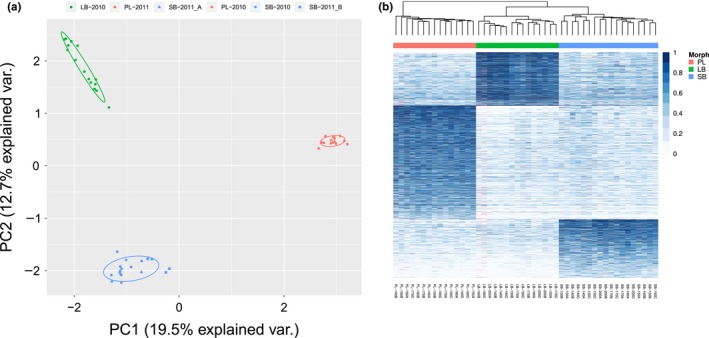
(a) Genetic separation of samples from three sympatric Arctic charr morphs, based on principal component analysis of 19,252 transcriptome variants. The first and second principal components are depicted with the proportion of variance explained. Colors and shapes indicate which morphs (SB: blue, LB: green and PL: red) and crosses the embryos originated from (see legend). Note, while the samples from the three SB crosses do not overlap entirely, then they are very distinct from the PL and LB specimens. Overlaid are 68% normal data ellipses for each morph. (b) Separation of morphs based on the 2,331 variants with F ST > 0.2. Each column represents a sample, name below indicates morph, developmental timepoint, and biological replicate. The white‐blue scale depicts allele frequency, higher frequency of the alternative allele with darker blue. Hierarchical clustering grouped samples and variants. This separated the morphs (abscissa) and similar variants by allele frequency (ordinate). A total of 1,174 variants had a higher frequency in PL‐charr, 552 in LB‐, and 605 in SB‐charr. Missing values are indicated by pink. Coloring of individuals by morph, SB: blue, LB: green and PL: red
A more stringent F ST cutoff (>0.4) exacerbated the PL‐charr versus benthic division (Figure S4). A higher fraction of variants (χ 2 = 56.6, df = 2, p > .0001) separated PL‐charr from the other two (202 Pl‐specific, 71 SB‐specific, and 51 LB‐specific variants). The same pattern was observed for private variants (alleles with frequency <1% were considered absent from a morph), 56, 18, and 13 were private to PL‐, SB‐, and LB‐charr, respectively (Table S3). Note, differences in allele frequencies were between groups and not evolutionarily polarized (ancestral vs. derived). Based on these data we concluded that the largest genetic separation of the sympatric charr in Lake Þingvallavatn was between PL‐charr and the two benthic morphs.
3.2. Genetic differences between benthic and limnetic morphs in collagen metabolism and environmental sensing
In order to gauge if certain biological systems differed between the morphs, we tested for GO enrichment in variants associating with specific morphs. As some variants were annotated to different transcript isoforms of the same gene, testing was done both on transcripts and gene level using annotation of salmon genes. No GO categories were significant for SB‐specific and LB‐specific variants. However, PL‐specific variants were significantly enriched in 10 GO categories (Table 2). Nine categories were found at the transcripts level and seven on the gene level. Only one of the gene level categories significant was not at the transcript level (collagen fibril organization) but it was close to being significant (FDR = 0.015). Also, variants were enriched in one other category related to the extracellular matrix collagen catabolic process. That may have led to two higher level categories to be significant at the transcript level but not at the gene level (multicellular organismal catabolic process and macromolecule metabolic process). Interestingly, four of the categories relate to environmental sensing and responses, that is, light and sound and showed a strong signal both on transcript and gene level, for example, inner ear morphogenesis and visual perception. The final two categories were tooth mineralization and odontogenesis, both related to tooth development. GO enrichment tests on private variants only revealed three GO categories related to tRNA aminoacylation significant at the transcript level for variants private to PL‐charr. The signal is most likely because three transcripts are annotated to the same gene rather than being a real biological pattern (Table S4). Together, the GO analyses of biological functions point to genetic differences in sensing, collagen metabolism, and mineralization, between benthic and limnetic morphs. This could be linked to distinct differences in the main feeding habitats and principal prey species of PL‐ versus LB‐ and SB‐charr and to differences in craniofacial features of these morphs.
Table 2.
Gene ontology categories enriched in variants with F ST above 0.2 and highest mean allele frequency deviation for PL‐charr on the transcripts (tr) and gene (ge) level
| Category | Term | PLtr | Tottr | FDRtr | PLge | Totge | FDRge |
|---|---|---|---|---|---|---|---|
| GO:0007601 | Visual perception | 30 | 122 | 0.0020 | 32 | 114 | 0.0014 |
| GO:0050953 | Sensory perception of light stimulus | 30 | 122 | 0.0020 | 32 | 114 | 0.0014 |
| GO:0007605 | Sensory perception of sound | 34 | 156 | 0.0025 | 36 | 137 | 0.0014 |
| GO:0034505 | Tooth mineralization | 10 | 18 | 0.0025 | 9 | 13 | 0.0031 |
| GO:0030574 | Collagen catabolic process | 23 | 89 | 0.0069 | 20 | 60 | 0.0071 |
| GO:0042472 | Inner ear morphogenesis | 30 | 137 | 0.0083 | 32 | 128 | 0.0087 |
| GO:0030199 | Collagen fibril organization | 19 | 73 | 0.0150 | 18 | 51 | 0.0073 |
| GO:0044243 | Multicellular organismal catabolic process | 23 | 93 | 0.0087 | 20 | 65 | 0.0140 |
| GO:0042476 | Odontogenesis | 26 | 109 | 0.0083 | 24 | 92 | 0.0359 |
| GO:0043170 | Macromolecule metabolic process | 499 | 4,790 | 0.0083 | 490 | 4,155 | 0.3650 |
The number of transcripts and genes with high divergence is shown (PLtr and PLge) and the total number of transcripts and genes tested in the category as well (Tottr and Totge). The multiple testing corrected p‐value or false‐discovery rate (FDR) is also shown for both levels.
3.3. Genome‐wide divergence of sympatric charr morphs
To explore if the genetic differences between morphs were restricted to specific chromosomal regions or more widely distributed, we mapped the variants to the Arctic charr genome using blastn (see Section 2). A large fraction (93%, 17,933 of 19,252) mapped to the genome. Of those variants 10,956 or 61% mapped to chromosomes but the rest to unplaced scaffolds and contigs. The number of variants mapped on each linkage group was, as expected, related to the linkage group size (Figure S2). Markers with F ST > 0.2 were found on all linkage groups, and peaks of more pronounced differentiation were found on many chromosomes. Similarly, the three types of high F ST markers (PL‐, SB‐, and LB‐charr specific) were found on almost all linkage groups (Figure 3b).
Figure 3.
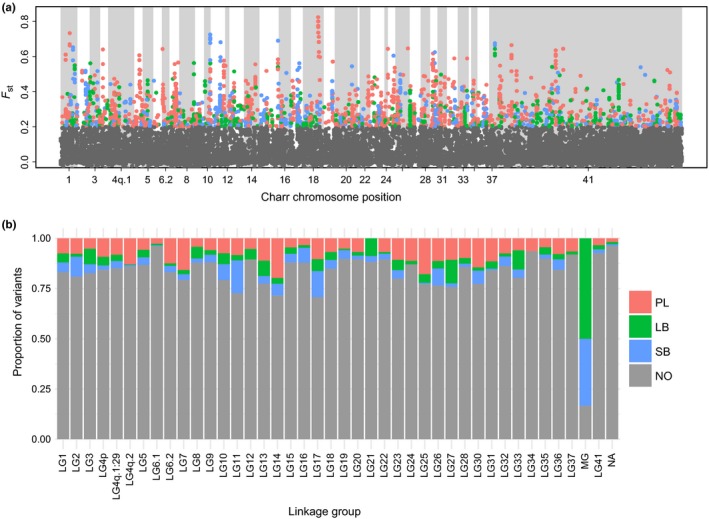
(a) F ST values plotted by position of variants on the Arctic charr genome from Christensen, Rondeau, et al. (2018). The colors indicate which morph differs most strongly in allele frequency from the other two for variants with F ST above 0.2 (SB: blue, LB: green, and PL: red) and gray represents variants with F ST below 0.2. (b) Proportion of each variant group on each linkage group (MG: mitochondrial chromosome). Unplaced scaffolds and contigs are represented by “linkage” group 41 and in (b) NA refers to unmapped markers
There were indications of enrichment of high F ST variants of a particular type in particular linkage groups, most dramatically on the mitochondrial chromosome. Previously, we found genetic differentiation between SB‐charr and Aquaculture charr in the mtDNA (Gudbrandsson et al., 2016), using transcriptome data and genotyping of population samples. There we observed a high frequency of derived alleles in LB‐ and SB‐charr. In the current dataset, six variants were observed in the mtDNA (Table S1) and all but one had high F ST (Figure 3). Consistent with previous results, these variants were LB‐ or SB‐specific and three of those (m1829G>A, m3211T>C and m3411C>T) were within the 12s and 16s rRNA genes (Gudbrandsson et al., 2016). A lower fraction of markers had high F ST's on other linkage groups. Distinct chromosomal regions harbored variants with high differentiation associating with particular morphs. For instance, a high peak of PL‐specific variants was observed on LG18, and a peak of SB‐specific markers on LG10 (Figure 3) and on LG1 high F ST variants of all categories (PL, SB, LB‐ specific) were found. In sum, the genetic separation between morphs was found on all linkage groups, including strong differences in the mitochondrial DNA.
3.4. Verification of variants in population sample confirms morph separation and regions of differentiation
As the candidate variants were derived from sequenced pools of embryos from multiparent families, we wanted to verify them in population samples from the wild to address three questions: First, do estimates of allele frequencies in the transcriptome and in wild populations correspond? Second, do the three morphs differ genetically in population samples? Third, do some markers associate fully with morph status? Fourth, how broad are the regions of differentiation? Fifth, does the understudied Piscivorous (PI) charr differ genetically from the other three morphs?
Candidate variants (23 in total, Table S5) were chosen based on high F ST values in the transcriptome sequencing, chromosomal location, biological functions, and/or differential expression (Guðbrandsson et al., 2018). Sexually mature individuals of all four morphs in Lake Þingvallavatn were genotyped. All markers but one amplified successfully and behaved as true single‐nucleotide polymorphisms (SNPs, Table S5). The allele frequencies and estimated F ST values in the transcriptome and population sample were highly correlated (Kendall's τ = 0.76, p < .0001, and τ = 0.58, p < .001 respectively; Figure S5). Allele frequencies seemed to be underestimated in the transcriptome, particularly lower frequencies (<0.3; Figure S5a). The overall F ST's for individual markers ranged from 0.01 (gnl3l_G795T) to 0.66 (gas1l_A3641C and wee1_T305A; Table S7). The correspondence of allele frequencies in the transcriptome and the population sample suggests the large scale patterns in the former are real. Majority of markers (18/22) deviated significantly from Hardy–Weinberg equilibrium when tested on the 93 samples (all four morphs), but almost all were in HWE within each morph (Table S7). Consistently, the majority of the variance in genotypes associated with morph (Figure 4a). PC1 (45.2% of variance explained) separated benthic–limnetic morphs while PC2 (14.4%) distinguished three morphs (SB, LB, and PL‐charr). Note, the higher proportion of variance explained by the first two PC's for the genotyped SNPs (compared to transcriptome) likely reflects the nonrandom selection of variants with large frequency differences for genotyping.
Figure 4.
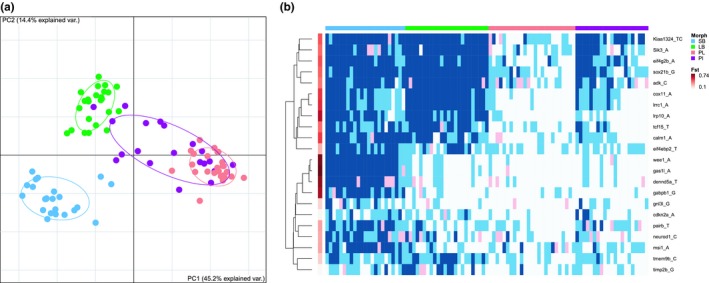
(a) Genetic separation of the four morphs sympatric charr morphs depicted with principal component analyses of 22 variants genotyped in population samples. Individuals are graphed according to scores of the first two PC's, along with 68% normal data ellipses for each morph (SB: blue, LB: green, PL: red and PI: purple). (b) Heatmap of genetic variation in population samples of four morphs, depicting association of variants with morphology and linkage of markers. Genotypes of the 22 variants were clustered by genes. F ST values (shades of red) for morphs are graphed for each marker. The morphs are color coded as in (a), and genotypes, homozygous reference allele (white), heterozygous (light‐blue), and homozygous alternate allele (blue), with pink indicating missing data
Eleven markers that separated benthic–limnetic morphs were genotyped (Figure 4b), but despite strong associations, no marker coupled fully to a morph or morphotype. The 22 genotyped variants mapped to 12 separate linkage groups and 3 unplaced scaffolds (Table S5, Figure S6). Note that the resolution of the data is limited. For instance, the region around calm1 on LG4.q2 had numerous variants with high differentiation between PL and the benthic morphs in the transcriptome (Figure 5a), but it is unclear whether that reflects a single or many differentiated regions.
Figure 5.

Detailed view of chromosomal regions and variants showing high divergence in the KASP assay. (a) Region on LG4q.2 that includes calm1 and many other variants with high F ST values (not validated). (b) A large region on LG26 that includes Kiaa1324 and eif4g2b. (c) A region on LG11 that includes msi1 and tcf15. (d) A region on LG18 that includes lrcc1, cox11 and adk. (e) A region on LG10 that includes dennd5a, wee1. The location of the second best blast hit for the variant in gas1 is shown with a vertical line. (f) A region on LG15 that includes tmem9b and gas1l. The location of the best blast hit for the variant in gas1 is shown with a vertical line. The regions on LG10 and LG15 shown in (e) and (f) are ohnologous and some of the markers might belong in the opposite linkage group as we suspect is the case for gas1l. Colored dots are values from the transcriptome as in Figure 3 and validated variants are marked with a black circle (○). The triangles (▽) show the F ST value from the KASP assay for three morphs (PL, SB, and LB) and the diamonds (♢) F ST for all morphs (including PI)
To ask whether there were multiple independent regions of differentiation within the same chromosome, we chose several supposedly linked variants (from four specific linkage groups) from the transcriptome for genotyping in the population samples and for linkage disequilibrium (LD) within each morph. Note, the LD estimates must be interpreted cautiously as they are imprecise because only 21 or 24 fish were sampled from each morph (Yan et al., 2009).
We surveyed four sets of putatively linked markers. Two pairs of markers were separated by more than 10 Mb and showed very low or no association. These were PL‐specific markers (Kiaa1324_TC393AA and eif4g2b_G652A) on LG26 (Figure 5b) and two markers in (msi1 and tcf15) on LG11 (Figure 5c, Table 3). More tightly spaced were three markers mapping to LG1 that separated PL‐charr from the benthic morphs (Figure 5d). While lrrc1 and cox11 are 2.8 Mb apart the markers showed tight LD (r 2 > .72; Table 3) but the third marker (adk_C1075T), located 3.4 Mb downstream of cox11, had weak or no LD with the other two (Table 3). This suggests there are two differentiated regions within this ~6 Mb region of the genome.
Table 3.
Estimates of LD (r 2), within each morph, and genomic distance for pairs of genotyped variants that mapped to the same linkage group or showed a strong association
| Var1 | Var2 | Pattern of divergencea | Linkage group | Genomic distance (bp) | SB | LB | PL | PI |
|---|---|---|---|---|---|---|---|---|
| lrrc1 | cox11 | PL | LG18 | 2,762,681 | 0.90 | 1.00 | 0.73 | 0.90 |
| cox11 | adk | PL | LG18 | 3,370,151 | 0.04 | NA | 0.06 | 0.23 |
| lrrc1 | adk | PL | LG18 | 6,132,832 | 0.03 | NA | 0.00 | 0.32 |
| eif4g2b | Kiaa1324 | PL | LG26 | 16,793,974 | 0.08 | 0.00 | 0.00 | 0.06 |
| msi1 | tcf15 | SB, PL | LG11 | 11,914,739 | 0.02 | 0.06 | 0.01 | 0.00 |
| dennd5a | wee1 | SB | LG10 | 118,070 | 0.82 | 0.92 | 0.52 | 1.00 |
| wee1 | gas1l | SB | LG10b | 210,891b | 0.51 | 0.85 | 0.51 | 0.95 |
| dennd5a | gas1l | SB | LG10b | 328,961b | 0.42 | 0.79 | 0.47 | 0.95 |
| gas1l | tmem9b | SB, PL | LG15 | 400,866 | 0.02 | 0.00 | 0.00 | 0.26 |
NA, not available, because variant adk was not polymorphic in LB.
In which morph did the variant differ most in frequency, first description for Var1 and second for Var2.
Second best blast hit for gas1l was on LG10, the best was on LG15.
Three SB‐specific variants (gas1l_A3641C, wee1_T305A and dennd5a_A2555T) on LG10 were in strong LD (r 2 > .45) in all morphs. While the variants in dennd5a and wee1 mapped 118 kb apart, then the region containing the gas1l variant aligned to LG15 (The second best hit was on LG10 close to the other two, Figure 5e). LG10 and LG15 are ohnologous and have over 90% sequence similarity (Christensen, Rondeau, et al., 2018). Notably, the gas1l variant was in linkage equilibrium with another variant on LG15 (in tmem9b, Figure 5f, Table 3). These discrepancies may be due to assembly errors in the Arctic charr draft genome by Christensen, Rondeau, et al. (2018) as the regions with the three SB‐specific variants all mapped to the same chromosome in S. salar (ssa26) and O. mykiss (omy06) genomes. Otherwise, there was low LD between variants (Table S8).
Finally, the phyletic relationship of the rare PI‐charr to the other morphs is unknown (Gíslason, 1998; Volpe & Ferguson, 1996). It was hypothesized that PI‐charr could be an ontogenetic morph of PL‐charr that learn to utilize three‐spined sticklebacks as prey (Snorrason et al., 1989). No transcriptome data were available for PI‐charr, but we genotyped 21 individuals. Contrary to the other three morphs, PI individuals did not group in the PC plot (Figure 4a). This may depend on some technical shortcomings, (a) too few markers, (b) ascertainment bias or (c) incorrect classification of PI individuals. If technical biases do not dominate, then the data may reflect biological patterns. At face value, the data suggest the PI‐charr are more heterogeneous genetically than the other morphs. And the data do not support the ontogenetic shift hypothesis (which predicted the PI should cluster with the PL‐charr). Curiously, half of the PI‐charr were in the PL‐cluster but the rest (except one) fell in between the PL‐ and LB‐clusters. Thus, while the other three morphs separated clearly genetically, determination of the genetic status and nature of the piscivorous charr requires more data.
In summary, while no single variant associated fully with specific morph many distinct regions within chromosomes harbor variants separating the morphs.
4. DISCUSSION
The four sympatric morphs of Arctic charr in Lake Þingvallavatn differ in a host of phenotypic attributes, for example, in adult morphology, habitat choice, feeding preferences, growth pattern, size, and age at maturity (see references in Sandlund et al., 1992). Common garden rearing experiments indicate these differences are based on genotype but also influenced by the environment, and emerge during embryonic and juvenile development (Kapralova et al., 2015; Parsons et al., 2010; Skúlason, Noakes, et al., 1989). While population genetics indicated a genetic separation of PL‐, LB‐, and SB‐charr (Magnusson & Ferguson, 1987; Volpe & Ferguson, 1996), the degrees of relatedness and phyletic relationships of these morphs have been unresolved. Here we utilized SNPs from RNA‐Seq data derived from embryos of pure crosses of three morphs (Guðbrandsson et al., 2018) to assess their genetic separation. For each variant, we asked if one of the morphs was more diverged, and if so, how morph‐specific variants were distributed in the genome and whether they related to particular functional systems. Although the experimental design, pools of individuals from bulk crosses of each morph, was not optimal for these purposes the data yielded many informative variants. Consistently, 22 of the 23 selected variants genotyped in independent population samples were real variants. Estimates of F ST in the transcriptome may have been inflated relative to the population samples (15 out of 22 markers had lower F ST in the latter, Figure S5). Notably, the frequencies of rare alleles were underestimated in the transcriptome as expected (Konczal, Koteja, Stuglik, Radwan, & Babik, 2014) but might be exaggerated due to the sequencing of related individuals, pooling of three embryos in individual samples or Beavis effects (Beavis, 1994) because high F ST SNPs were chosen for verification. These facts limit the interpretation of this dataset, precluding for example estimation of the site frequency spectrum. But they do not negate the observed widespread genetic differentiation between morphs, as the correspondence of allele frequencies estimated with the two methods used (RNA‐Seq and KASP assay) and the genetic differentiation of morphs is stronger than the variation between crosses within the same morph. This argues that the patterns observed are biological and not a side effect of the experimental design.
Previously, we (Gudbrandsson et al., 2016) extracted variants from RNA‐Seq data from SB‐charr of Þingvallavatn and an aquaculture breeding stock derived from several populations (mainly from the north of Iceland [Svavarsson, 2007]—an outgroup for Þingvallavatn charr). While that study also yielded ~20,000 candidate variants, the proportion of variants with high F ST was larger, probably reflecting more divergence between the aquaculture charr and the SB‐charr than among the three Þingvallavatn morphs studied here. It is unknown how many of the variants observed in these RNA‐Seq data are shared with other populations in Iceland and across the species range (Brunner, Douglas, Osinov, Wilson, & Bernatchez, 2001).
4.1. Genetic separation of recently evolved sympatric morphs
Geological forces, volcanic activity, isostatic rebound as well as underground rivers and springs in the rift zone generate specific niches for the Icelandic biota (Gudmundsdóttir, Kornobis, Kristjánsson, & Pálsson, 2017; Kornobis, Pálsson, Kristjánsson, & Svavarsson, 2010; Kristjánsson et al., 2012; Marteinsson et al., 2013), but also perturb them. Lake Þingvallavatn formed ~10,000 years ago but resides in a geologically active rift zone, with the most recent eruption ~2000 years ago (Saemundsson, 1992). Furthermore, the tempo of the Ice‐age glacial retreat was uneven, interleaved with periods of glacial advance (Norðdahl, Ingólfsson, Pétursson, & Hallsdóttir, 2008; Saemundsson, 1992). Thus, the history of colonization and adaptations by Arctic charr and other organisms in this geographic region may be quite complex.
Studying the relatedness of the morphs can shed some light on the history of colonization and divergence in Lake Þingvallavatn. The morphs (PL‐, LB‐ and SB‐charr) are more closely related to one another than to other Icelandic populations (Kapralova et al., 2011). The data presented here firmly reject hypothesis I, that the PL‐, LB‐, and SB‐charr morphs are formed by environmental influence on individuals of a shared gene pool (the PI‐charr may be an exception, see below). The data also suggest that the benthic morphs (LB‐ and SB‐charr) are more closely related. This is congruent with patterns of differential expression in this transcriptome (Guðbrandsson et al., 2018) and one previous study (Volpe & Ferguson, 1996) but not others (Danzmann et al., 1991; Gíslason, 1998; Magnusson & Ferguson, 1987). This incongruence and the observed distribution of the high F ST variants into PL‐, LB‐, and SB‐specific categories may reflect limited resolution due to few markers in earlier studies of Lake Þingvallavatn charr, incomplete sorting of alleles or differential effects of selection on distinct traits and variants. Coalescence simulations based on microsatellite data were more consistent with a brief phase of allopatric separation of the ancestors of PL‐ and SB‐charr Lake Þingvallavatn, rather than sympatric evolution (Kapralova et al., 2011). That study considered two demographic scenarios and two parameters (migration and population size). Analyses of other scenarios, that is, with changing migration rates or introgression would be most interesting (see for example Jacobs et al., 2018). Considering the episodic nature of ice retreat and the high geological activity in the Þingvallavatn area during the formation of the lake (Norðdahl et al., 2008; Saemundsson, 1992) charr may have invaded the waters more than once, or experienced intromittent isolation of populations in rifts. The current study lacks a natural outgroup, and future population genomic surveys of these morphs should include populations from the neighboring geographic area, including the Þingvallavatn outflow river Sog and its downstream Lake Úlfljótsvatn. Lake Úlfljótsvatn is particularly interesting as it also hosts landlocked morphs of charr, including forms similar to the PL‐ and SB‐charr (Jóhannsson, Guðbergsson, Antonsson, & Guðjónsson, 1994; Woods et al., 2012a).
The Salvelinus genus is particularly interesting for sympatric polymorphism (Klemetsen, 2010; Markevich et al., 2018; Muir et al., 2016; Noakes, 2008) that seems to run counter to the predominant mode of allopatric speciation. Smith and Skúlason (1996) argued resource polymorphism and phenotypic plasticity could potentiate ecological speciation, even within a geographic area. The question remains if charr morphs in sympatry (e.g., in the Transbaikalian lakes (Gordeeva et al., 2015), Lake Galtarból in northern Iceland (Wilson et al., 2004), and Lower Tazimina Lake in Alaska (May‐Mcnally, Quinn, Woods, & Taylor, 2015) differentiated in true sympatry, or originate by repeated invasions of the water bodies. The morphs in Loch Stack (Adams, Wilson, & Ferguson, 2008) and Loch Tay (Garduño‐Paz, Adams, Verspoor, Knox, & Harrod, 2012) are clearly of allopatric origin. A recent genome‐wide study of sympatric charr in Scotland and Siberia is consistent with sympatric origins of charr morphs (Jacobs et al., 2018). Ecological specialization can lead to differential growth, behavior, and maturity that may influence both choice of spawning sites and timing of spawning. Within Lake Þingvallavatn, the timing of spawning differs between the three best‐studied morphs. The LB‐charr spawns in August, PL‐charr in October, but SB‐charr over a broader period from September to November (PI‐charr spawn in October; Sandlund et al., 1992; Skúlason, Snorrason, et al., 1989). Although all morphs appear to spawn in the same habitat, that is, among loose stones in the littoral zone, there may be microhabitat preferences for spawning sites. Variation in mating behavior can in principle lead parents to choose specific nesting sites, for example, close to inflow of cold water. Such differences in environmental conditions could, in turn, influence development of ecological functional traits and adult form of the morphs.
The ambiguous genetic status of the large, rare, and piscivorous morph is quite intriguing. PI‐charr was only studied by genotyping 22 markers, but curiously PI individuals did not cluster as tightly as the other morphs. PI individuals grouped with LB, PL‐charr, and a few in between. Previous studies found PI individuals affiliated with either or both morphs (Magnusson & Ferguson, 1987; Volpe & Ferguson, 1996). Several scenarios may explain the data and the origin of PI‐charr. First, classification of the morph based on phenotype may not be stringent enough and thus some LB‐charr might have been misidentified as PI‐charr. As the LB‐ and PI‐charr utilize different prey and differ in spawning periods (the former in August and later in October [Skúlason, Snorrason, et al., 1989]), this misidentification is unlikely. However, it is possible that some LB‐charr males might be erroneously classified as PI because of an extended jaw‐hook, as some are still running in October. Secondly, it is possible that PI‐charr is genetically distinct, but that the markers chosen for genotyping may not suffice to distinguish them. Thirdly, Snorrason et al. (1989) postulated that PI‐charr emerges as certain PL‐charr learn to eat fish. PI‐charr would then be environmentally induced, genetically identical to PL‐charr. The fact that PI‐charr does not overlap exclusively with PL‐charr argues against this theory. Fourthly, PI‐charr may actually be more heterogeneous at the genetic level than the other three morphs. This might reflect recent origin or perhaps a combination of ontogenetic shift of some individuals from PL stock with repeated hybridizations with other morphs (most likely LB‐charr because of the size). Currently, we can not distinguish between these possibilities.
We conclude that three of the Lake Þingvallavatn morphs differ genetically, and considering the differences in trophic traits and spawning, may even be reproductively isolated (hypothesis III). It remains to be determined if the PI‐charr are genetically separated from the other morphs or if some of them may be an environmentally induced form, as may be the case certain ecomorphs of Sockeye salmon Oncorhynchus nerka (Limborg, Larson, Shedd, Seeb, & Seeb, 2018).
4.2. Genome‐wide separation of sympatric morphs
How extensive is the genetic separation of morphs and how is the genetic differentiation distributed in the genome? For instance, are differentiating variants localized to a few islands (Andrew & Rieseberg, 2013; Malinsky et al., 2015; Nadeau et al., 2012) as stated in hypothesis II or are there multiple signals on many chromosomes (Hohenlohe et al., 2010; Jones et al., 2012) according to hypothesis III?
Variants with relatively high F ST (>0.2) mapped to all 40 S. alpinus linkage groups (including the mitochondrial chromosome), which supports hypothesis III. The clustering of variants, some with F ST > 0.5, suggests specific genes/regions associated with the specializations of particular morphs. Analyses of LD between genotyped variants implied that peaks on the same linkage group were independent. The distribution of variants on linkage groups was rather even, except the mtDNA had a high fraction of LB‐ and SB‐specific variants (consistent with earlier findings [Gudbrandsson et al., 2016]). This might reflect history or adaptive evolution of mitochondrial functions in the benthic morphs. The extensive genetic separation of these three morphs suggests many differentiating genes on many (or all) linkage groups. While the data seem to refute hypothesis II, that few genomic islands differentiate the morphs, it is plausible that ecological specialization has driven differentiation in certain genomic regions.
Previous studies of salmonids have found genome‐wide differences between populations and ecological morphs. Significant genetic differences were found between migratory and nonmigratory Rainbow trout (Hale, Thrower, Berntson, Miller, & Nichols, 2013), the lake, river, and stream ecotypes of sockeye salmon (Larson et al., 2017) and ecologically different subpopulations of salmon (Cauwelier, 2017; Vincent, Dionne, Kent, Lien, & Bernatchez, 2013). Sympatric ecotypes are found in several salmonid species, for example, whitefish (Gagnaire, Pavey, Normandeau, & Bernatchez, 2013), but are most pronounced in Arctic charr and Lake charr Salvelinus namaycush. Genomic studies of the latter revealed varying degrees of genetic separation of sympatric morphs in large lakes in North America (Harris et al., 2015; Perreault‐Payette et al., 2017). A study on five pairs of benthic–limnetic whitefish morphs (Gagnaire et al., 2013) found a correlation between genetic and phenotypic differentiation and considerable overlap of genomic regions that differentiated morph pairs in each lake. Notably, the significant degree of genetic parallelism broke up at the finer level, with different haplotypes associating with morphotype, suggesting genetic and/or allelic heterogeneity of the causative loci (Gagnaire et al., 2013). Recently, genome‐wide analyses of Scottish and Siberian Arctic charr suggested limited genetic parallelism in benthic–limnetic specializations (Jacobs et al., 2018). Fine‐scale analyses of peaks of differentiation could not be conducted with the current data, but the genome‐wide distribution of differentiated variants suggests restricted gene flow between at least three of the morphs (PL‐, LB‐, and SB‐charr) and that they may be reproductively isolated.
Genomic differentiation reflects the history and evolution of groups, degree, and age of separation of groups, extent of gene flow, and hybridization events (Seehausen et al., 2014; Shapiro, Leducq, & Mallet, 2016). But intrinsic factors, such as genes and their biological actions, chromosomal inversions and polymorphisms, also shape the rates of differentiation and divergence, and genomic features, such as centromeres, gene density, recombination, and GC content influence estimates of sequence divergence and allele frequency differences (Burri et al., 2015; Seehausen et al., 2014; Sutherland et al., 2016; Vijay et al., 2017). Population genomic data and analyses are needed to disentangle the role of positive selection and intrinsic factors on patterns of differentiation in this system. More broadly, the confirmed synteny of large genomic regions (Nugent et al., 2017), the range of species, subspecies, and ecologically distinct populations (Jacobs et al., 2018; Klemetsen, 2013) sets the stage for future studies of the genomic and ecological correlates of divergence and polymorphism in salmonids.
4.3. Potential mechanisms of phenotypic and developmental differences between sympatric morphs
Which genes influence the many phenotypic differences between the morphs? Genetic variation in transcribed sequences tags large fraction of the potentially functional regions of the genome. The genome‐wide differentiation between morphs implies polygenic basis of their differences, but major genes influencing specific traits may be segregating. The genomic resolution of the current data is low, and while we can describe frequency differences in specific genes, it is more likely that other linked polymorphisms/loci are actually contributing to phenotypic differences.
The current data can inform future studies by bringing attention to particular chromosomal regions, genes and systems that may influence differences between charr morphs. The GO results suggest the limnetic and benthic morphs differ genetically in three systems (collagen metabolism, tooth mineralization, and sensory functions). The enrichment of variants in collagen organization/catabolism and extracellular matrix categories is consistent with observed differential expression of ECM related and cartilage remodeling genes in benthic and limnetic morphs (Ahi et al., 2014, 2015). Strong differentiation was found for a variant in calm1. Calmodulins are broadly expressed in vertebrate tissues, including bone and articular cartilage in humans (Mototani et al., 2005), and notably higher expression of Calm1 was found in beak primordia of finches with longer beaks (Abzhanov et al., 2006). Secondly, we found frequency difference of a variant in eif4ebp1 between morphs (F ST = 0.28). This gene had higher expression in SB compared to PL‐charr in developing embryos (this transcriptome [Guðbrandsson et al., 2018]). Curiously, the same was seen in adult muscles of SB‐charr from other locations in Iceland (Macqueen et al., 2011). eif4ebp1 is involved in the insulin receptor signaling pathway and mTOR signaling (Banko et al., 2007; Bidinosti et al., 2010; Gkogkas et al., 2012). However, the eif4ebp1 variant associated with benthic morphotype not small benthic charr, which is at odds with the proposition that reduced growth of the SB populations is mediated through changes in the mTOR activity. Finally, three SB‐specific variants on linkage group 10 (or 15) had high F ST's. This might represent long haplotypes with strong differentiation between morphs, that associate with the small benthic phenotype. Curiously one gene in the region (Wee1) is a key regulator of the timing of mitosis and cell size, first identified in fission yeast (Nurse & Thuriaux, 1980) and another (gas1, Growth arrest‐specific protein 1) associates with embryonic cranial skeleton morphogenesis and palate development (Seppala et al., 2007).
Few traits have been mapped to a gene in salmonids. The most celebrated exception being vgll3 which associates with the age of maturity in wild populations, with very curious sex‐dependent dominance of alleles (Ayllon et al., 2015; Barson et al., 2015). Unfortunately, the vgll3 gene was not transcribed in our data, but SB‐specific variants with F ST around 0.4 are found ~1 Mb from the location of vgll3 on LG2 (Figure S6K). Further work is needed to check if variants in vgll3, tulp4 (see Larson et al., 2017), Greb1L (see Prince et al., 2017) or other genes contribute to phenotypic differences in charr. QTL and fine‐scale association mapping (Dworkin, Palsson, & Gibson, 2005; Palsson & Gibson, 2004; Zimmerman, Palsson, & Gibson, 2000) are needed to find the causative variants. In sum, the data presented here can lead to the identification of genes influencing specific phenotypes separating the sympatric morphs, but more crucially suggest a polygenic basis for the morph differences.
4.4. Conclusion and future perspective
We mined genetic variation from three of the four morphs in Lake Þingvallavatn to address questions about their genetic separation, genome‐wide differentiation of morphs and potential functionality of loci separating them. We started with three hypotheses about the putative causes of morph differences: Hypothesis I stated that the morphs are environmentally induced. According to hypothesis II, ecological specialization led to few genomic islands of strong genetic differentiation between morphs, with low background separation across the genome. Hypotheses III postulated substantial differentiation across the genome due to reduced gene flow, with the bulk of the genome showing separation between morphs. Estimates of genetic differentiation between the Þingvallavatn morphs have yield different results from low (Kapralova et al., 2011; Volpe & Ferguson, 1996) to extremely high (Kapralova et al., 2013) depending on the marker used. Based on the genetic differentiation observed in this study, we conclude that three of the morphs (SB, LB, and PL‐charr) are distinct populations and find it highly unlikely that these morphs are environmentally induced (rejecting hypothesis I). Furthermore, we interpret the data as suggesting genome‐wide differentiation over weak differentiation with a few islands of differentiation (hypothesis III over II). This is supported by the facts that the background F ST in the transcriptome was rather high and high F ST peaks were found on all linkage groups (and even multiple peaks on some). The fact that spawning times of certain morphs do not overlap (LB‐charr spawn in August, but PL‐ and SB‐charr in September–October) also argues that gene flow has been reduced between these morphs. Note however that hybrids of specific morphs, SB‐, PL‐, and PI‐charr can be generated in the laboratory (Kapralova, 2014) but their fitness and how common they are in nature is unknown. Thus, we conclude that the three studied morphs in Lake Þingvallavatn are not one panmictic population and that gene flow between them has been limited. The nature of the PI‐charr is still in doubt, some PI‐charr may arise every generation by ontogenetic shift as suggested by Snorrason et al. (1989) while other PI may propagate, and even hybridize with the LB‐charr. Population ddRAD‐seq data of sexually mature/spawning charr of all morphs confirm the clear demarcation of three of the morphs and offer insights into the nature of the PI‐charr (H. Xiao, B. Sigurgeirsson, J. Guðbrandsson, K. H. Kapralova, S. R. Franzdóttir, Z. O. Jónsson, A. Pálsson, S. S. Snorrason, unpublished data). Future studies of the fertilization success of hybrids and pure morphs, analyses of the development and fitness of hybrids and pure morph, and behavioral studies of spawning behavior, reed locations and properties, and mate choice have can cast light on potential pre‐ and postzygotic barriers to gene flow between morphs. In the future, the phenotypic and genetic differences between sympatric and locally adapted Arctic charr populations can aid studies of ecological adaptation and the synthesis of evolutionary, ecological, and developmental biology.
CONFLICT OF INTEREST
None declared.
AUTHOR CONTRIBUTIONS
JG, AP, ZOJ, SSS, SRF, KHK conceived and designed the study. SSS, KHK, SRF, ZOJ, AP, JG were involved in sampling. ZOJ, SRF, KHK, VH, ÞMB gathered the data. JG was involved in retrieval and analyses of variants data. KHK, AP, VH, ÞMB, JG were involved in SNP confirmation. JG, AP, KHK performed the analyses. AP, JG, SSS, KHK, SRF, ZOJ wrote the manuscript.
Supporting information
ACKNOWLEDGMENTS
Special thanks to present and past members of the Arctic charr group at the University of Iceland for support, comments and suggestions. Thanks to Bjarni K. Kristjansson, Camille LeBlanc and colleagues at Holar University College for support. Thanks to Ben Sutherland and Eric Normandeau for excellent advice and open communication about MapComp and methods for placing variants on linkage maps. This project was supported by The Icelandic Center for Research (RANNIS #100204011) to SSS and coworkers, The University of Iceland Doctoral Fund to JG and University of Iceland research fund to AP, SSS and ZOJ.
Guðbrandsson J, Kapralova KH, Franzdóttir SR, et al. Extensive genetic differentiation between recently evolved sympatric Arctic charr morphs. Ecol Evol. 2019;9:10964–10983. 10.1002/ece3.5516
DATA AVAILABILITY STATEMENT
The sequencing reads from the 48 RNA‐seq samples were deposited into the NCBI SRA archive under BioProject identifier PRJNA391695 and with accession numbers: SRS2316381–SRS2316428. Supplementary tables and files are available on figshare https://doi.org/10.6084/m9.figshare.c.4565735.v2 (specific hyperlinks in Supporting Information).
REFERENCES
- Abouheif, E. , Favé, M.‐J. , Ibarrarán‐Viniegra, A. S. , Lesoway, M. P. , Rafiqi, A. M. , & Rajakumar, R. (2014). Eco‐evo‐devo: The time has come In Landry C. R. & Aubin‐Horth N. (Eds.), Ecological genomics – Ecology and the evolution of genes and genomes (chapter 6, pp. 107–125). Dordrecht, The Netherlands: Springer. [DOI] [PubMed] [Google Scholar]
- Abzhanov, A. , Kuo, W. P. , Hartmann, C. , Grant, B. R. , Grant, P. R. , & Tabin, C. J. (2006). The calmodulin pathway and evolution of elongated beak morphology in Darwin's finches. Nature, 442(7102), 563–567. [DOI] [PubMed] [Google Scholar]
- Adams, C. E. , Wilson, A. J. , & Ferguson, M. M. (2008). Parallel divergence of sympatric genetic and body size forms of Arctic charr, Salvelinus alpinus, from two Scottish lakes. Biological Journal of the Linnean Society, 95(4), 748–757. [Google Scholar]
- Ahi, E. P. , Gudbrandsson, J. , Kapralova, K. H. , Franzdóttir, S. R. , Snorrason, S. S. , Maier, V. H. , & Jónsson, Z. O. (2013). Validation of reference genes for expression studies during craniofacial development in Arctic charr. PLoS ONE, 8(6), e66389. [DOI] [PMC free article] [PubMed] [Google Scholar]
- Ahi, E. P. , Kapralova, K. H. , Pálsson, A. , Maier, V. H. , Gudbrandsson, J. , Snorrason, S. S. , … Franzdóttir, S. R. (2014). Transcriptional dynamics of a conserved gene expression network associated with craniofacial divergence in Arctic charr. EvoDevo, 5(1), 40. [DOI] [PMC free article] [PubMed] [Google Scholar]
- Ahi, E. P. , Steinhäuser, S. S. , Pálsson, A. , Franzdóttir, S. R. , Snorrason, S. S. , Maier, V. H. , & Jónsson, Z. O. (2015). Differential expression of the aryl hydrocarbon receptor pathway associates with craniofacial polymorphism in sympatric Arctic charr. EvoDevo, 6(1), 27. [DOI] [PMC free article] [PubMed] [Google Scholar]
- Allendorf, F. W. , & Thorgaard, G. H. (1984). Tetraploidy and the evolution of Salmonid fishes In Turner B. J. (Ed.), Evolutionary genetics of fishes (pp. 1–53). New York, NY: Springer. [Google Scholar]
- Altschul, S. F. , Gish, W. , Miller, W. , Myers, E. W. , & Lipman, D. J. (1990). Basic local alignment search tool. Journal of Molecular Biology, 215(3), 403–410. [DOI] [PubMed] [Google Scholar]
- Andrew, R. L. , & Rieseberg, L. H. (2013). Divergence is focused on few genomic regions early in speciation: Incipient speciation of sunflower ecotypes. Evolution, 67(9), 2468–2482. [DOI] [PubMed] [Google Scholar]
- Ayllon, F. , Kjærner‐Semb, E. , Furmanek, T. , Wennevik, V. , Solberg, M. F. , Dahle, G. , … Wargelius, A. (2015). The vgll3 locus controls age at maturity in wild and domesticated Atlantic Salmon (Salmo salar L.) males. PLoS Genetics, 11(11), e1005628. [DOI] [PMC free article] [PubMed] [Google Scholar]
- Banko, J. L. , Merhav, M. , Stern, E. , Sonenberg, N. , Rosenblum, K. , & Klann, E. (2007). Behavioral alterations in mice lacking the translation repressor 4E‐BP2. Neurobiology of Learning and Memory, 87(2), 248–256. [DOI] [PubMed] [Google Scholar]
- Barnett, D. W. , Garrison, E. K. , Quinlan, A. R. , Stromberg, M. P. , & Marth, G. T. (2011). BamTools: A C++ API and toolkit for analyzing and managing BAM files. Bioinformatics, 27(12), 1691–1692. [DOI] [PMC free article] [PubMed] [Google Scholar]
- Barson, N. J. , Aykanat, T. , Hindar, K. , Baranski, M. , Bolstad, G. H. , Fiske, P. , … Primmer, C. R. (2015). Sex‐dependent dominance at a single locus maintains variation in age at maturity in salmon. Nature, 528(7582), 405–408. [DOI] [PubMed] [Google Scholar]
- Beavis, W. D. (1994). The power and deceit of QTL experiments: Lessons from comparitive QTL studies In Wilkinson D. B. (Ed.), Proceedings of the Forty‐Ninth Annual Corn and Sorghum Industry Research Conference (pp. 250–266). Washington DC: American Seed Trade Association. [Google Scholar]
- Benjamini, Y. , & Hochberg, Y. (1995). Controlling the false discovery rate: A practical and powerful approach to multiple testing. Journal of the Royal Statistical Society: Series B (Methodological), 57(1), 289–300. [Google Scholar]
- Bernatchez, L. , Renaut, S. , Whiteley, A. R. , Derome, N. , Jeukens, J. , Landry, L. , … St‐Cyr, J. (2010). On the origin of species: Insights from the ecological genomics of lake whitefish. Philosophical Transactions of the Royal Society of London. Series B, Biological Sciences, 365(1547), 1783–1800. [DOI] [PMC free article] [PubMed] [Google Scholar]
- Berthelot, C. , Brunet, F. , Chalopin, D. , Juanchich, A. , Bernard, M. , Noël, B. , … Guiguen, Y. (2014). The rainbow trout genome provides novel insights into evolution after whole‐genome duplication in vertebrates. Nature Communications, 5, 3657. [DOI] [PMC free article] [PubMed] [Google Scholar]
- Bidinosti, M. , Ran, I. , Sanchez‐Carbente, M. R. , Martineau, Y. , Gingras, A.‐C. , Gkogkas, C. , … Sonenberg, N. (2010). Postnatal deamidation of 4E‐BP2 in brain enhances its association with raptor and alters kinetics of excitatory synaptic transmission. Molecular Cell, 37(6), 797–808. [DOI] [PMC free article] [PubMed] [Google Scholar]
- Bray, N. L. , Pimentel, H. , Melsted, P. , & Pachter, L. (2016). Near‐optimal probabilistic RNA‐seq quantification. Nature Biotechnology, 34(5), 525–527. [DOI] [PubMed] [Google Scholar]
- Brunner, P. C. , Douglas, M. R. , Osinov, A. , Wilson, C. C. , & Bernatchez, L. (2001). Holarctic phylogeography of Arctic charr (Salvelinus alpinus L.) inferred from mitochondrial DNA sequences. Evolution, 55(3), 573–586. [DOI] [PubMed] [Google Scholar]
- Burri, R. , Nater, A. , Kawakami, T. , Mugal, C. F. , Olason, P. I. , Smeds, L. , … Ellegren, H. (2015). Linked selection and recombination rate variation drive the evolution of the genomic landscape of differentiation across the speciation continuum of Ficedula flycatchers. Genome Research, 25(11), 1656–1665. [DOI] [PMC free article] [PubMed] [Google Scholar]
- Carlson, M. (2015). GO.db: A set of annotation maps describing the entire Gene Ontology. [Google Scholar]
- Cauwelier, E. , Gilbey, J. , Sampayo, J. , Stradmeyer, L. , & Middlemas, S. J. (2017). Identification of a single genomic region associated with seasonal river return timing in adult Scottish Atlantic salmon (Salmo salar L.) identified using a genome‐wide association study. Canadian Journal of Fisheries and Aquatic Sciences, 75, cjfas‐2017‐0293. [Google Scholar]
- Christensen, K. A. , Leong, J. S. , Sakhrani, D. , Biagi, C. A. , Minkley, D. R. , Withler, R. E. , … Devlin, R. H. (2018). Chinook salmon (Oncorhynchus tshawytscha) genome and transcriptome. PLoS ONE, 13(4), e0195461. [DOI] [PMC free article] [PubMed] [Google Scholar]
- Christensen, K. A. , Rondeau, E. B. , Minkley, D. R. , Leong, J. S. , Nugent, C. M. , Danzmann, R. G. , … Koop, B. F. (2018). The Arctic charr (Salvelinus alpinus) genome and transcriptome assembly. PLoS ONE, 13(9), e0204076. [DOI] [PMC free article] [PubMed] [Google Scholar] [Retracted]
- Danzmann, R. G. , Cairney, M. , Davidson, W. S. , Ferguson, M. M. , Gharbi, K. , Guyomard, R. , … Woram, R. A. (2005). A comparative analysis of the rainbow trout genome with 2 other species of fish (Arctic charr and Atlantic salmon) within the tetraploid derivative Salmonidae family (subfamily: Salmoninae). Genome, 48(6), 1037–1051. [DOI] [PubMed] [Google Scholar]
- Danzmann, R. G. , Ferguson, M. M. , Skulason, S. , Snorrason, S. S. , & Noakes, D. L. G. (1991). Mitochondrial DNA diversity among four sympatric morphs of Arctic charr, Salvelinus alpinus L., from Thingvallavatn, Iceland. Journal of Fish Biology, 39(5), 649–659. [Google Scholar]
- Darwin, C. (1859). On the origin of species by means of natural selection, or the preservation of favoured races in the struggle for life, vol. 5 London, UK: John Murray. [PMC free article] [PubMed] [Google Scholar]
- De Meyer, J. , Christiaens, J. , & Adriaens, D. (2016). Diet‐induced phenotypic plasticity in European eel (Anguilla anguilla). Journal of Experimental Biology, 219(3), 354–363. [DOI] [PubMed] [Google Scholar]
- Dworkin, I. , Palsson, A. , & Gibson, G. (2005). Replication of an Egfr‐wing shape association in a wild‐caught cohort of Drosophila melanogaster . Genetics, 169(4), 2115–2125. [DOI] [PMC free article] [PubMed] [Google Scholar]
- Foote, A. D. , Vijay, N. , Ávila‐Arcos, M. C. , Baird, R. W. , Durban, J. W. , Fumagalli, M. , … Wolf, J. B. (2016). Genome‐culture coevolution promotes rapid divergence of killer whale ecotypes. Nature Communications, 7, 11693. [DOI] [PMC free article] [PubMed] [Google Scholar]
- Frandsen, F. , Malmquist, H. J. , & Snorrason, S. S. (1989). Ecological parasitology of polymorphic Arctic charr, Salvelinus alpinus (L.), in Thingvallavatn, Iceland. Journal of Fish Biology, 34(2), 281–297. [Google Scholar]
- Fruciano, C. , Franchini, P. , Kovacova, V. , Elmer, K. R. , Henning, F. , Meyer, A. , … de Una‐Alvarez, J. (2016). Genetic linkage of distinct adaptive traits in sympatrically speciating crater lake cichlid fish. Nature Communications, 7, 12736. [DOI] [PMC free article] [PubMed] [Google Scholar]
- Gagnaire, P. A. , Pavey, S. A. , Normandeau, E. , & Bernatchez, L. (2013). The genetic architecture of reproductive isolation during speciation‐with‐gene‐flow in lake whitefish species pairs assessed by RAD sequencing. Evolution, 67(9), 2483–2497. [DOI] [PubMed] [Google Scholar]
- Garduño‐Paz, M. V. , Adams, C. E. , Verspoor, E. , Knox, D. , & Harrod, C. (2012). Convergent evolutionary processes driven by foraging opportunity in two sympatric morph pairs of Arctic charr with contrasting post glacial origins. Biological Journal of the Linnean Society, 106(4), 794–806. [Google Scholar]
- Garrison, E. , & Marth, G. (2012). Haplotype‐based variant detection from short‐read sequencing. arXiv preprint 7(arXiv:1207.3907v2 [q‐bio.GN]). [Google Scholar]
- Gíslason, D. (1998). Genetic and morphological variation in polymorphic Arctic Charr Salvelinus Alpinus, from Icelandic Lakes. Master's thesis, The University of Guelph. [Google Scholar]
- Gkogkas, C. G. , Khoutorsky, A. , Ran, I. , Rampakakis, E. , Nevarko, T. , Weatherill, D. B. , … Sonenberg, N. (2012). Autism‐related deficits via dysregulated eIF4E‐dependent translational control. Nature, 493, 371–377. [DOI] [PMC free article] [PubMed] [Google Scholar]
- Gordeeva, N. V. , Alekseyev, S. S. , Matveev, A. N. , Samusenok, V. P. , & Taylor, E. (2015). Parallel evolutionary divergence in Arctic char Salvelinus alpinus complex from Transbaikalia: Variation in differentiation degree and segregation of genetic diversity among sympatric forms. Canadian Journal of Fisheries and Aquatic Sciences, 72(1), 96–115. [Google Scholar]
- Gorodilov, Y. N. (1996). Description of the early ontogeny of the Atlantic salmon, Salmo salar, with a novel system of interval (state) identification. Environmental Biology of Fishes, 47(2), 109–127. [Google Scholar]
- Goudet, J. (2005). Hierfstat, a package for R to compute and test hierarchical F‐statistics. Molecular Ecology Notes, 5(1), 184–186. [Google Scholar]
- Grabherr, M. G. , Haas, B. J. , Yassour, M. , Levin, J. Z. , Thompson, D. A. , Amit, I. , … Regev, A. (2011). Full‐length transcriptome assembly from RNA‐Seq data without a reference genome. Nature Biotechnology, 29(7), 644–652. [DOI] [PMC free article] [PubMed] [Google Scholar]
- Grant, B. , & Grant, P. R. (2008). Fission and fusion of Darwin's finches populations. Philosophical Transactions of the Royal Society B: Biological Sciences, 363(1505), 2821–2829. [DOI] [PMC free article] [PubMed] [Google Scholar]
- Grant, P. R. , & Grant, B. R. (2002). Unpredictable evolution in a 30‐year study of Darwin's finches. Science, 296(5568), 707–711. [DOI] [PubMed] [Google Scholar]
- Gudbrandsson, J. , Ahi, E. P. , Franzdottir, S. R. , Kapralova, K. H. , Kristjansson, B. K. , Steinhaeuser, S. S. , … Palsson, A. (2016). The developmental transcriptome of contrasting Arctic charr (Salvelinus alpinus) morphs [version 3; referees: 2 approved, 1 approved with reservations]. F1000Research, 10.12688/f1000research.6402.2 [DOI] [PMC free article] [PubMed] [Google Scholar]
- Guðbrandsson, J. , Franzdóttir, S. R. , Kristjánsson, B. K. , Ahi, E. P. , Maier, V. H. , Kapralova, K. H. , … Pálsson, A. (2018). Differential gene expression during early development in recently evolved and sympatric Arctic charr morphs. PeerJ, 6, e4345. [DOI] [PMC free article] [PubMed] [Google Scholar]
- Gudmundsdóttir, R. , Kornobis, E. , Kristjánsson, B. K. , & Pálsson, S. (2017). Genetic analysis of ciliates living on the groundwater amphipod Crangonyx islandicus (Amphipoda: Crangonyctidae). Acta Zoologica, 99(2), 188–198. [Google Scholar]
- Guerrero, R. F. , & Hahn, M. W. (2017). Speciation as a sieve for ancestral polymorphism. Molecular Ecology, 26(20), 5362–5368. [DOI] [PubMed] [Google Scholar]
- Haas, B. J. (2015). Trinotate: Transcriptome functional annotation and analysis. http://trinotate.github.io/ [Google Scholar]
- Haas, B. J. , & Papanicolaou, A. (2015). TransDecoder (find coding regions within transcripts). [Google Scholar]
- Hahsler, M. , & Nagar, A. (2017). rBLAST: Interface to the Basic Local Alignment Search Tool (BLAST). [Google Scholar]
- Hale, M. C. , Thrower, F. P. , Berntson, E. A. , Miller, M. R. , & Nichols, K. M. (2013). Evaluating adaptive divergence between migratory and nonmigratory ecotypes of a Salmonid Fish, Oncorhynchus mykiss . G3: Genes, Genomes, Genetics 3(8), 1273–1285. [DOI] [PMC free article] [PubMed] [Google Scholar]
- Harris, L. N. , Chavarie, L. , Bajno, R. , Howland, K. L. , Wiley, S. H. , Tonn, W. M. , & Taylor, E. B. (2015). Evolution and origin of sympatric shallow‐water morphotypes of Lake Trout, Salvelinus namaycush, in Canada's Great Bear Lake. Heredity, 114(1), 94–106. [DOI] [PMC free article] [PubMed] [Google Scholar]
- Hartl, D. L. , & Clark, A. G. (2006). Principles of population genetics, 4th ed. Sunderland, MA: Sinauer Associates Inc. [Google Scholar]
- He, C. , Holme, J. , & Anthony, J. (2014). SNP genotyping: The KASP assay. Methods in Molecular Biology, 1145, 75–86. [DOI] [PubMed] [Google Scholar]
- Hendry, A. P. , Bolnick, D. I. , Berner, D. , & Peichel, C. L. (2009). Along the speciation continuum in sticklebacks. Journal of Fish Biology, 75(8), 2000–2036. [DOI] [PubMed] [Google Scholar]
- Hindar, K. , Ryman, N. , & Ståhl, G. (1986). Genetic differentiation among local populations and morphotypes of Arctic charr, Salvelinus alpinus . Biological Journal of the Linnean Society, 27(3), 269–285. [Google Scholar]
- Hohenlohe, P. A. , Bassham, S. , Etter, P. D. , Stiffler, N. , Johnson, E. A. , & Cresko, W. A. (2010). Population genomics of parallel adaptation in threespine stickleback using sequenced RAD tags. PLoS Genetics, 6(2), e1000862. [DOI] [PMC free article] [PubMed] [Google Scholar]
- Jacobs, A. , Carruthers, M. , Yurchenko, A. , Gordeeva, N. V. , Alekseyev, S. , Hooker, O. … Elmer, K. R. (2018). Convergence in form and function overcomes non‐parallel evolutionary histories in Arctic charr. bioRxiv, 265272. [Google Scholar]
- Jóhannsson, M. , Guðbergsson, G. , Antonsson, T. , & Guðjónsson, S. (1994). Fiskrannsóknir á Úlfljótsvatni 1993‐ VMST‐S/94001X. Technical Report VMST‐S/94001X, Veiðimálastofnun, Selfoss. [Google Scholar]
- Jombart, T. (2008). Adegenet: A R package for the multivariate analysis of genetic markers. Bioinformatics, 24(11), 1403–1405. [DOI] [PubMed] [Google Scholar]
- Jones, F. C. , Chan, Y. F. , Schmutz, J. , Grimwood, J. , Brady, S. D. , Southwick, A. M. , … Kingsley, D. M. (2012). A Genome‐wide SNP genotyping array reveals patterns of global and repeated species‐pair divergence in sticklebacks. Current Biology, 22(1), 83–90. [DOI] [PMC free article] [PubMed] [Google Scholar]
- Jonsson, B. , Skúlason, S. , Snorrason, S. S. , Sandlund, O. T. , Malmquist, H. J. , Jónasson, P. M. , … Lindem, T. (1988). Life history variation of polymorphic Arctic Charr (Salvelinus alpinus) in Thingvallavatn, Iceland. Canadian Journal of Fisheries and Aquatic Sciences, 45(9), 1537–1547. [Google Scholar]
- Kapralova, K. H. (2008). Evolutionary origins of widespread small benthic charr (Salvelinus alpinus) over different geographic scales in Iceland. MSc., University of Iceland, Reykjavík, Iceland. [Google Scholar]
- Kapralova, K. H. (2014). Study of morphogenesis and miRNA expression associated with craniofacial diversity in Arctic Charr (Salvelinus alpinus) morphs. PhD thesis, University of Iceland, Reykjavík, Iceland. [Google Scholar]
- Kapralova, K. H. , Franzdóttir, S. R. , Jónsson, H. , Snorrason, S. S. , & Jónsson, Z. O. (2014). Patterns of MiRNA expression in Arctic Charr development. PLoS ONE, 9(8), e106084. [DOI] [PMC free article] [PubMed] [Google Scholar]
- Kapralova, K. H. , Gudbrandsson, J. , Reynisdottir, S. , Santos, C. B. , Baltanás, V. C. , Maier, V. H. , … Palsson, A. (2013). Differentiation at the MHCII and Cath2 loci in sympatric Salvelinus alpinus resource morphs in Lake Thingvallavatn. PLoS ONE, 8(7), e69402. [DOI] [PMC free article] [PubMed] [Google Scholar]
- Kapralova, K. H. , Jónsson, Z. O. , Palsson, A. , Franzdóttir, S. R. , le Deuff, S. , Kristjánsson, B. K. , & Snorrason, S. S. (2015). Bones in motion: Ontogeny of craniofacial development in sympatric arctic charr morphs. Developmental Dynamics, 244(9), 1168–1178. [DOI] [PubMed] [Google Scholar]
- Kapralova, K. H. , Morrissey, M. B. , Kristjánsson, B. K. , Ólafsdóttir, G. Á. , Snorrason, S. S. , & Ferguson, M. M. (2011). Evolution of adaptive diversity and genetic connectivity in Arctic charr (Salvelinus alpinus) in Iceland. Heredity, 106(3), 472–487. [DOI] [PMC free article] [PubMed] [Google Scholar]
- Klemetsen, A. (2010). The charr problem revisited: Exceptional phenotypic plasticity promotes ecological speciation in postglacial lakes. Freshwater Reviews, 3(1), 49–74. [Google Scholar]
- Klemetsen, A. (2013). The most variable vertebrate on earth. Journal of Ichthyology, 53(10), 781–791. [Google Scholar]
- Konczal, M. , Koteja, P. , Stuglik, M. T. , Radwan, J. , & Babik, W. (2014). Accuracy of allele frequency estimation using pooled RNA‐Seq. Molecular Ecology Resources, 14(2), 381–392. [DOI] [PubMed] [Google Scholar]
- Kornobis, E. , Pálsson, S. , Kristjánsson, B. K. , & Svavarsson, J. (2010). Molecular evidence of the survival of subterranean amphipods (Arthropoda) during Ice Age underneath glaciers in Iceland. Molecular Ecology, 19(12), 2516–2530. [DOI] [PubMed] [Google Scholar]
- Kristjánsson, B. K. , Skúlason, S. , Snorrason, S. S. , & Noakes, D. L. G. (2012). Fine‐scale parallel patterns in diversity of small benthic Arctic charr (Salvelinus alpinus) in relation to the ecology of lava/groundwater habitats. Ecology and Evolution, 2(6), 1099–1112. [DOI] [PMC free article] [PubMed] [Google Scholar]
- Krueger, F. (2012). Trim Galore!. http://www.bioinformatics.babraham.ac.uk/projects/trim_galore/ [Google Scholar]
- Larson, W. A. , Limborg, M. T. , McKinney, G. J. , Schindler, D. E. , Seeb, J. E. , & Seeb, L. W. (2017). Genomic islands of divergence linked to ecotypic variation in sockeye salmon. Molecular Ecology, 26(2), 554–570. [DOI] [PubMed] [Google Scholar]
- Li, H. , Handsaker, B. , Wysoker, A. , Fennell, T. , Ruan, J. , Homer, N. , … Durbin, R. (2009). The sequence alignment/map format and SAMtools. Bioinformatics, 25(16), 2078–2079. [DOI] [PMC free article] [PubMed] [Google Scholar]
- Lien, S. , Koop, B. F. , Sandve, S. R. , Miller, J. R. , Kent, M. P. , & Nome, T. , … Davidson, W. S. (2016). The Atlantic salmon genome provides insights into rediploidization. Nature, 533(7602), 200–205. [DOI] [PMC free article] [PubMed] [Google Scholar]
- Limborg, M. T. , Larson, W. A. , Shedd, K. , Seeb, L. W. , & Seeb, J. E. (2018). Novel RAD sequence data reveal a lack of genomic divergence between dietary ecotypes in a landlocked salmonid population. Conservation Genetics Resources, 10(2), 169–171. [Google Scholar]
- Losos, J. B. , & Ricklefs, R. E. (2009). Adaptation and diversification on islands. Nature, 457, 830–836. [DOI] [PubMed] [Google Scholar]
- Lowry, D. , & Gould, B. (2016). Speciation continuum In Encyclopedia of evolutionary biology (vol. 4 pp. 159–165). Amsterdam, The Netherlands: Elsevier. [Google Scholar]
- Macqueen, D. J. , & Johnston, I. A. (2014). A well‐constrained estimate for the timing of the salmonid whole genome duplication reveals major decoupling from species diversification. Proceedings of the Royal Society B: Biological Sciences, 281(1778), 20132881. [DOI] [PMC free article] [PubMed] [Google Scholar]
- Macqueen, D. J. , Kristjánsson, B. K. , Paxton, C. G. M. , Vieira, V. L. A. , & Johnston, I. A. (2011). The parallel evolution of dwarfism in Arctic charr is accompanied by adaptive divergence in mTOR‐pathway gene expression. Molecular Ecology, 20(15), 3167–3184. [DOI] [PubMed] [Google Scholar]
- Magnusson, K. P. , & Ferguson, M. M. (1987). Genetic analysis of four sympatric morphs of Arctic charr, Salvelinus alpinus, from Thingvallavatn, Iceland. Environmental Biology of Fishes, 20(1), 67–73. [Google Scholar]
- Malinsky, M. , Challis, R. J. , Tyers, A. M. , Schiffels, S. , Terai, Y. , Ngatunga, B. P. , … Turner, G. F. (2015). Genomic islands of speciation separate cichlid ecomorphs in an East African crater lake. Science, 350(6267), 1493–1498. [DOI] [PMC free article] [PubMed] [Google Scholar]
- Malmquist, H. J. , Snorrason, S. S. , Skulason, S. , Jonsson, B. , Sandlund, O. T. , & Jonasson, P. M. (1992). Diet differentiation in polymorphic Arctic Charr in Thingvallavatn, Iceland. The Journal of Animal Ecology, 61(1), 21–35. [Google Scholar]
- Markevich, G. , Esin, E. , & Anisimova, L. (2018). Basic description and some notes on the evolution of seven sympatric morphs of Dolly Varden Salvelinus malma from the Lake Kronotskoe Basin. Ecology and Evolution, 8(5), 2554–2567. [DOI] [PMC free article] [PubMed] [Google Scholar]
- Marteinsson, V. T. , Rúnarsson, Á. , Stefánsson, A. , Thorsteinsson, T. , Jóhannesson, T. , Magnússon, S. H. , … Gaidos, E. (2013). Microbial communities in the subglacial waters of the Vatnajökull ice cap, Iceland. ISME Journal, 7, 427–437. [DOI] [PMC free article] [PubMed] [Google Scholar]
- May‐Mcnally, S. L. , Quinn, T. P. , Woods, P. J. , & Taylor, E. B. (2015). Evidence for genetic distinction among sympatric ecotypes of Arctic char (Salvelinus alpinus) in south‐western Alaskan lakes. Ecology of Freshwater Fish, 24(4), 562–574. [Google Scholar]
- Moghadam, H. K. , Ferguson, M. M. , & Danzmann, R. G. (2011). Whole genome duplication: Challenges and considerations associated with sequence orthology assignment in Salmoninae. Journal of Fish Biology, 79(3), 561–574. [DOI] [PubMed] [Google Scholar]
- Morris, M. , & Rogers, S. M. (2014). Integrating phenotypic plasticity within an ecological genomics frame work: Recent insights from the genomics, evolution, ecology, and fitness of plasticity In Landry C. R. & Aubin‐Horth N. (Eds.), Ecological genomics – Ecology and the evolution of genes and genomes (chapter 5, pp. 73–105). Dordrecht, The Netherlands: Springer. [DOI] [PubMed] [Google Scholar]
- Mototani, H. , Mabuchi, A. , Saito, S. , Fujioka, M. , Iida, A. , Takatori, Y. , … Ikegawa, S. (2005). A functional single nucleotide polymorphism in the core promoter region of CALM1 is associated with hip osteoarthritis in Japanese. Human Molecular Genetics, 14(8), 1009–1017. [DOI] [PubMed] [Google Scholar]
- Muir, A. M. , Hansen, M. J. , Bronte, C. R. , & Krueger, C. C. (2016). If Arctic charr Salvelinus alpinus is ‘the most diverse vertebrate’, what is the lake charr Salvelinus namaycush? Fish and Fisheries, 17(4), 1194–1207. [Google Scholar]
- Muschick, M. , Indermaur, A. , & Salzburger, W. (2012). Convergent evolution within an adaptive radiation of Cichlid fishes. Current Biology, 22(24), 2362–2368. [DOI] [PubMed] [Google Scholar]
- Nadeau, N. J. , Whibley, A. , Jones, R. T. , Davey, J. W. , Dasmahapatra, K. K. , Baxter, S. W. , … Jiggins, C. D. (2012). Genomic islands of divergence in hybridizing Heliconius butterflies identified by large‐scale targeted sequencing. Philosophical Transactions of the Royal Society B: Biological Sciences, 367(1587), 343–353. [DOI] [PMC free article] [PubMed] [Google Scholar]
- Noakes, D. L. G. (2008). Charr truth: Sympatric differentiation in Salvelinus species. Environmental Biology of Fishes, 83(1), 7–15. [Google Scholar]
- Norðdahl, H. , Ingólfsson, Ó. , Pétursson, H. G. , & Hallsdóttir, M. (2008). Late Weichselian and Holocene environmental history of Iceland. Jökull, 58, 343–364. [Google Scholar]
- Nosil, P. (2012). Ecological speciation. Oxford series in Ecology and Evolution. Oxford, NY: Oxford University Press. [Google Scholar]
- Nugent, C. M. , Easton, A. A. , Norman, J. D. , Ferguson, M. M. , & Danzmann, R. G. (2017). A SNP based linkage map of the Arctic Charr (Salvelinus alpinus) genome provides insights into the diploidization process after whole genome duplication. G3: Genes, Genomes, Genetics, 7(2), 543–556. [DOI] [PMC free article] [PubMed] [Google Scholar]
- Nurse, P. , & Thuriaux, P. (1980). Regulatory genes controlling mitosis in the fission yeast Schizosaccharomyces pombe . Genetics, 96(3), 627–637. [DOI] [PMC free article] [PubMed] [Google Scholar]
- Obenchain, V. , Lawrence, M. , Carey, V. , Gogarten, S. , Shannon, P. , & Morgan, M. (2014). Variant annotation: A bioconductor package for exploration and annotation of genetic variants. Bioinformatics, 30(14), 2076–2078. [DOI] [PMC free article] [PubMed] [Google Scholar]
- Palsson, A. , & Gibson, G. (2004). Association between nucleotide variation in Egfr and wing shape in Drosophila melanogaster . Genetics, 167(3), 1187–1198. [DOI] [PMC free article] [PubMed] [Google Scholar]
- Paradis, E. (2010). Pegas: An R package for population genetics with an integrated‐modular approach. Bioinformatics, 26(3), 419–420. [DOI] [PubMed] [Google Scholar]
- Pardo‐Diaz, C. , Salazar, C. , Baxter, S. W. , Merot, C. , Figueiredo‐Ready, W. , Joron, M. , … Jiggins, C. D. (2012). Adaptive introgression across species boundaries in Heliconius butterflies. PLoS Genetics, 8(6), e1002752. [DOI] [PMC free article] [PubMed] [Google Scholar]
- Parsons, K. J. , Sheets, H. D. , Skúlason, S. , & Ferguson, M. M. (2011). Phenotypic plasticity, heterochrony and ontogenetic repatterning during juvenile development of divergent Arctic charr (Salvelinus alpinus). Journal of Evolutionary Biology, 24(8), 1640–1652. [DOI] [PubMed] [Google Scholar]
- Parsons, K. J. , Skúlason, S. , & Ferguson, M. (2010). Morphological variation over ontogeny and environments in resource polymorphic arctic charr (Salvelinus alpinus). Evolution and Development, 12(3), 246–257. [DOI] [PubMed] [Google Scholar]
- Pearse, D. E. , Barson, N. J. , Nome, T. , Gao, G. , Campbell, M. A. , Abadía‐Cardoso, A. , … Lien, S. (2018). Sex‐dependent dominance maintains migration supergene in rainbow trout. bioRxiv, 504621. [DOI] [PubMed] [Google Scholar]
- Pease, J. B. , Haak, D. C. , Hahn, M. W. , & Moyle, L. C. (2016). Phylogenomics reveals three sources of adaptive variation during a rapid radiation. PLOS Biology, 14(2), e1002379. [DOI] [PMC free article] [PubMed] [Google Scholar]
- Perreault‐Payette, A. , Muir, A. M. , Goetz, F. , Perrier, C. , Normandeau, E. , Sirois, P. , & Bernatchez, L. (2017). Investigating the extent of parallelism in morphological and genomic divergence among lake trout ecotypes in Lake Superior. Molecular Ecology, 26(6), 1477–1497. [DOI] [PubMed] [Google Scholar]
- Prince, D. J. , O'Rourke, S. M. , Thompson, T. Q. , Ali, O. A. , Lyman, H. S. , Saglam, I. K. , … Miller, M. R. (2017). The evolutionary basis of premature migration in Pacific salmon highlights the utility of genomics for informing conservation. Science Advances, 3(8), e1603198. [DOI] [PMC free article] [PubMed] [Google Scholar]
- R Core Team (2015). R: A language and environment for statistical computing. Vienna, Austria: R Foundation for Statistical Computing. [Google Scholar]
- Roberts, A. , & Pachter, L. (2012). Streaming fragment assignment for real‐time analysis of sequencing experiments. Nature Methods, 10(1), 71–73. [DOI] [PMC free article] [PubMed] [Google Scholar]
- Saemundsson, K. (1992). Geology of the Thingvallavatn area. Oikos, 64(1/2), 40–68. [Google Scholar]
- Samy, J. K. A. , Mulugeta, T. D. , Nome, T. , Sandve, S. R. , Grammes, F. , Kent, M. P. , … Våge, D. I. (2017). SalmoBase: An integrated molecular data resource for Salmonid species. BMC Genomics, 18(1), 482. [DOI] [PMC free article] [PubMed] [Google Scholar]
- Sandlund, O. T. , Gunnarsson, K. , Jónasson, P. M. , Jonsson, B. , Lindem, T. , Magnússon, K. P. , … Snorrason, S. S. (1992). The arctic charr Salvelinus alpinus in Thingvallavatn. Oikos, 64(1/2), 305–351. [Google Scholar]
- Sandlund, O. T. , Jonsson, B. , Malmquist, H. J. , Gydemos, R. , Lindem, T. , Skúlason, S. , … Jónasson, P. M. (1987). Habitat use of arctic charr Salvelinus alpinus in Thingvallavatn, Iceland. Environmental Biology of Fishes, 20(4), 263–274. [Google Scholar]
- Sävilammi, T. , Primmer, C. R. , Varadharajan, S. , Guyomard, R. , Guiguen, Y. , Sandve, S. R. , … Lien, S. (2019). The chromosome‐level genome assembly of European grayling reveals aspects of a unique genome evolution process within salmonids. G3: Genes, Genomes, Genetics, 9(5), 1283–1294. [DOI] [PMC free article] [PubMed] [Google Scholar]
- Seehausen, O. , Butlin, R. K. , Keller, I. , Wagner, C. E. , Boughman, J. W. , Hohenlohe, P. A. , … Widmer, A. (2014). Genomics and the origin of species. Nature Reviews Genetics, 15(3), 176–192. [DOI] [PubMed] [Google Scholar]
- Seehausen, O. , & Wagner, C. E. (2014). Speciation in freshwater fishes. Annual Review of Ecology, Evolution, and Systematics, 45(1), 621–651. [Google Scholar]
- Seppala, M. , Depew, M. J. , Martinelli, D. C. , Fan, C. M. , Sharpe, P. T. , & Cobourne, M. T. (2007). Gas1 is a modifier for holoprosencephaly and genetically interacts with sonic hedgehog. Journal of Clinical Investigation, 117, 1575–1584. [DOI] [PMC free article] [PubMed] [Google Scholar]
- Shapiro, B. J. , Leducq, J.‐B. , & Mallet, J. (2016). What is speciation? PLOS Genetics, 12(3), e1005860. [DOI] [PMC free article] [PubMed] [Google Scholar]
- Skúlason, S. , Antonsson, T. , Gudbergsson, G. , Malmquist, H. J. , & Snorrason, S. S. (1992). Varibility in Icelandic Arctic charr. Icelandic Agricultural Sciences, 6, 143–153. [Google Scholar]
- Skúlason, S. , Noakes, D. L. , & Snorrason, S. S. (1989). Ontogeny of trophic morphology in four sympatric morphs of arctic charr Salvelinus alpinus in Thingvallavatn, Iceland. Biological Journal of the Linnean Society, 38(3), 281–301. [Google Scholar]
- Skúlason, S. , & Smith, T. B. (1995). Resource polymorphisms in vertebrates. Trends in Ecology & Evolution, 10(9), 366–370. [DOI] [PubMed] [Google Scholar]
- Skúlason, S. , Snorrason, S. , Noakes, D. , & Ferguson, M. (1996). Genetic basis of life history variations among sympatric morphs of Arctic char Salvelinus alpinus . Canadian Journal of Fisheries and Aquatic Sciences, 53(8), 1807–1813. [Google Scholar]
- Skúlason, S. , Snorrason, S. S. , Noakes, D. L. G. , Ferguson, M. M. , & Malmquist, H. J. (1989). Segregation in spawning and early life history among polymorphic Arctic charr, Salvelinus alpinus, in Thingvallavatn, Iceland. Journal of Fish Biology, 35(Suppl. A), 225–232. [Google Scholar]
- Skúlason, S. , Snorrason, S. , Ota, D. , & Noakes, D. (1993). Genetically based differences in foraging behaviour among sympatric morphs of arctic charr (Pisces: Salmonidae). Animal Behaviour, 45(6), 1179–1192. [Google Scholar]
- Smith, T. B. , & Skúlason, S. (1996). Evolutionary significance of resource polymorphisms in fishes, amphibians, and birds. Annual Review of Ecology and Systematics, 27, 111–133. [Google Scholar]
- Snorrason, S. S. , & Skúlason, S. (2004). Adaptive speciation in northern freshwater fishes In Dieckmann U., Doebeli M., Metz J. A. J., & Tautz D. (Eds.), Adaptive speciation (chapter 10, pp. 210–228). Cambridge, UK: Cambridge University Press. [Google Scholar]
- Snorrason, S. S. , Skúlason, S. , Sandlund, O. T. , Malmquist, H. J. , Jonsson, B. , & Jonasson, P. M. (1989). Shape polymorphism in Arctic charr, Salvelinus alpinus . Physiology and Ecology Japan, 1, 393–404. [Google Scholar]
- Sutherland, B. J. G. , Gosselin, T. , Normandeau, E. , Lamothe, M. , Isabel, N. , Audet, C. , & Bernatchez, L. (2016). Salmonid chromosome evolution as revealed by a novel method for comparing RADseq linkage maps. Genome Biology and Evolution, 8(12), evw262. [DOI] [PMC free article] [PubMed] [Google Scholar]
- Svavarsson, E. (2007). Árangur í kynbótum á bleikju og næstu skref. Fræða�ing Landbúnaðarsins, 4, 121–125. [Google Scholar]
- Theis, A. , Ronco, F. , Indermaur, A. , Salzburger, W. , & Egger, B. (2014). Adaptive divergence between lake and stream populations of an East African cichlid fish. Molecular Ecology, 23(21), 5304–5322. [DOI] [PubMed] [Google Scholar]
- Timusk, E. R. , Ferguson, M. M. , Moghadam, H. K. , Norman, J. D. , Wilson, C. C. , & Danzmann, R. G. (2011). Genome evolution in the fish family salmonidae: Generation of a brook charr genetic map and comparisons among charrs (Arctic charr and brook charr) with rainbow trout. BMC Genetics, 12, 68. [DOI] [PMC free article] [PubMed] [Google Scholar]
- Varadharajan, S. , Sandve, S. R. , Gillard, G. , Tørresen, O. K. , Mulugeta, T. , Hvidsten, T. R. , … Jakobsen, K. S. (2018). The grayling genome reveals selection on gene expression regulation after whole genome duplication. Genome Biology and Evolution, 10(10), 2785–2800. [DOI] [PMC free article] [PubMed] [Google Scholar]
- Verspoor, E. , Knox, D. , Greer, R. , & Hammar, J. (2010). Mitochondrial DNA variation in Arctic charr (Salvelinus alpinus (L.)) morphs from Loch Rannoch, Scotland: Evidence for allopatric and peripatric divergence. Hydrobiologia, 650(1), 117–131. [Google Scholar]
- Via, S. (2001). Sympatric speciation in animals: The ugly duckling grows up. Trends in Ecology & Evolution, 16(7), 381–390. [DOI] [PubMed] [Google Scholar]
- Via, S. (2009). Natural selection in action during speciation. Proceedings of the National Academy of Sciences of the United States of America, 106(Suppl. 1), 9939–9946. [DOI] [PMC free article] [PubMed] [Google Scholar]
- Vijay, N. , Weissensteiner, M. , Burri, R. , Kawakami, T. , Ellegren, H. , & Wolf, J. B. (2017). Genomewide patterns of variation in genetic diversity are shared among populations, species and higher‐order taxa. Molecular Ecology, 26(16), 4284–4295. [DOI] [PubMed] [Google Scholar]
- Vincent, B. , Dionne, M. , Kent, M. P. , Lien, S. , & Bernatchez, L. (2013). Landscape genomics in Atlantic salmon (Salmo salar): Searching for gene‐environment interactions driving local adaptation. Evolution, 67(12), 3469–3487. [DOI] [PubMed] [Google Scholar]
- Volpe, J. P. , & Ferguson, M. M. (1996). Molecular genetic examination of the polymorphic Arctic charr Salvelinus alpinus of Thingvallavatn, Iceland. Molecular Ecology, 5(6), 763–772. [DOI] [PubMed] [Google Scholar]
- Wilson, A. J. , Gíslason, D. , Skúlason, S. , Snorrason, S. S. , Adams, C. E. , Alexander, G. , … Ferguson, M. M. (2004). Population genetic structure of Arctic charr, Salvelinus alpinus from northwest Europe on large and small spatial scales. Molecular Ecology, 13(5), 1129–1142. [DOI] [PubMed] [Google Scholar]
- Wolf, J. B. W. , & Ellegren, H. (2016). Making sense of genomic islands of differentiation in light of speciation. Nature Reviews Genetics, 18(2), 87–100. [DOI] [PubMed] [Google Scholar]
- Woods, P. J. , Skúlason, S. , Snorrason, S. S. , Kristjánsson, B. K. , Malmquist, H. J. , & Quinn, T. P. (2012a). Intraspecific diversity in Arctic charr, Salvelinus alpinus, in Iceland: I. Detection using mixture models. Evolutionary Ecology Research, 14, 973–992. [Google Scholar]
- Woods, P. J. , Skúlason, S. , Snorrason, S. S. , Kristjánsson, B. K. , Malmquist, H. J. , & Quinn, T. P. (2012b). Intraspecific diversity in Arctic charr, Salvelinus alpinus, in Iceland: II. Which environmental factors influence resource polymorphism in lakes? Evolutionary Ecology Research, 14(8), 993–1013. [Google Scholar]
- Yan, J. , Shah, T. , Warburton, M. L. , Buckler, E. S. , McMullen, M. D. , & Crouch, J. (2009). Genetic characterization and linkage disequilibrium estimation of a global maize collection using SNP markers. PLoS ONE, 4(12), e8451. [DOI] [PMC free article] [PubMed] [Google Scholar]
- Young, M. D. , Wakefield, M. J. , Smyth, G. K. , & Oshlack, A. (2010). Gene ontology analysis for RNA‐seq: Accounting for selection bias. Genome Biology, 11(2), R14. [DOI] [PMC free article] [PubMed] [Google Scholar]
- Zimmerman, E. , Palsson, A. , & Gibson, G. (2000). Quantitative trait loci affecting components of wing shape in Drosophila melanogaster . Genetics, 155(2), 671–683. [DOI] [PMC free article] [PubMed] [Google Scholar]
Associated Data
This section collects any data citations, data availability statements, or supplementary materials included in this article.
Supplementary Materials
Data Availability Statement
The sequencing reads from the 48 RNA‐seq samples were deposited into the NCBI SRA archive under BioProject identifier PRJNA391695 and with accession numbers: SRS2316381–SRS2316428. Supplementary tables and files are available on figshare https://doi.org/10.6084/m9.figshare.c.4565735.v2 (specific hyperlinks in Supporting Information).