



Abstract
On September 12, 2016, a ML 5.8 earthquake hit Gyeongju in the southeastern part of the Korean Peninsula (SeKP), although the area is known to be far from the boundary of the active plate. A number of strike-slip faults are observed in heavily populated city areas (e.g., Busan, Ulsan, Pohang, and Gyeongju). However, dissolved gases related to the active faults have rarely been studied despite many groundwater wells and hot springs in the area. Here we report new results of gas compositions and isotope values of helium and carbon dioxide (CO2) in fault-related fluids in the region. Based on gas geochemistry, the majority of gas samples are abundant in CO2 (up to 99.91 vol.%). Measured 3He/4He ratios range from 0.07 to 5.66 Ra, showing that the mantle contribution is up to 71%. The range of carbon isotope compositions (δ13C) of CO2 is from −8.25 to −24.92‰, showing mantle-derived CO2 is observed coherently where high 3He/4He ratios appear. The weakening of faults seems to be related to enhanced pressures of fluids containing mantle-derived helium and CO2 despite the ductile lower crust underneath the region. Thus, we suggest that the SeKP strike-slip faults penetrate into the mantle through ductile shearing.
Subject terms: Geochemistry, Tectonics, Volcanology
Introduction
Helium and carbon dioxide (CO2) are favorable gas components to investigate sources of volatiles released at volcanic and hydrothermal regions. Helium and CO2 are closely related because CO2 is considered a carrier gas for helium transport1. Isotopic compositions of both helium and CO2 provide information about mantle-derived volatiles. First, helium has 3He (primordial) and 4He (radiogenic) and gives reference values for geochemical reservoirs, such as mid-ocean ridge basalts (MORB, 8 ± 1Ra) and crust (0.02Ra), where the 3He/4He ratio of air (1Ra) is 1.389 × 10⁻⁶ (ref.2). For CO2, it is reported that the range of carbon isotope compositions (δ13C versus the standard of Vienna Pee Dee Belemnite (V-PDB)) of MORB, carbonate, and organic sediment are between 0 and −30‰3.
On the basis of helium and CO2 geochemistry, many studies have reported that continental rift fault zones (e.g., Eger Rift and East African Rift) release mantle-derived volatiles through fault-related springs4,5. Additionally, diffusive soil degassing of mantle-derived CO2 has been observed in nonvolcanic young extensional fault zones6. Strike-slip faults are also regarded permeable pathways for degassing of mantle-derived volatiles (e.g., San Andreas and North Anatolian faults). However, magmatism is believed to be absent7–11.
Fluids are thought to enhance pore fluid pressures in association with fault weakening7,12. In the San Andreas fault zones, ref.7 proposed that mantle fluids are related to fault weakening. Subsequently, ref.8 found that shear zones with high strain rates discharge more mantle fluids through the ductile lower crust. Also, seismicity likely coincides with mantle-derived fluids according to many studies. Deep earthquakes (<35 km depths) were observed in East Africa, together with mantle-derived volatiles released at normal faults5,6. Strike-slip faults show a correlation between deep earthquakes and high 3He/4He ratios, reported in the Newport-Inglewood fault zone, Southern California13.
The southeastern Korean Peninsula (SeKP) is above the Gyeongsang Basin which was formed in the Cretaceous period. The Gyeongsang Basin is an area related to the Cretaceous intrusive and Tertiary volcanic activities14. During the early Cretaceous period, the Gyeongsang Basin formed a number of pull-apart basins and strike-slip faults in association with the subduction of the Izanagi plate, which resulted in the accumulation of lacustrine siliciclastic sediments15,16. In the late Cretaceous, the subduction of the Pacific plate caused the NW-SE trending compressive stress in the Korean peninsula17 (Fig. 1b). There were dike swarms in the southeastern part of the Gyeongsang basin in the early Paleogene18,19. It is known that the Pacific plate subduction was further directed to the west, resulting in the NE-SE compression and crustal thinning of the East (Japan) sea during the late Paleogene17. The opening of the East (Japan) sea began at ~25 Ma with normal faulting and dike swarms and formed the Miocene basins in the SeKP area20. Due to the subduction of the Philippine Sea plate, the opening was ceased at ~16 Ma (Fig. 1b), and compression appeared in the faults and basins17. According to the Quaternary fault slip data, the SeKP faults in are under compressive stress and are also suggested to be due to the subduction of the plates of the Pacific and Philippine seas and the collision of the Eurasian continent of India14,17.
Figure 1.

Locations of sampling and strike-slip faults in the Southeastern Korean Peninsula (SeKP). (a) Location of the study area. The map showing the Korean peninsula and the Japanese arc was created using GeoMapApp 3.6.10 (ref.56). (b) Tectonic evolution of the Korean peninsula between Late Cretaceous and Middle Miocene (modified based on ref.17). The movement of the plates and the direction of the stress are shown on the basis of ref.17. Abbreviated names of the subducting plates and faults are displayed. PA: Pacific plate; PS: Philippine Sea plate; YF: Yangsan fault; UF: Ulsan fault. (c) Helium isotope compositions of sampled sites. The Gyeongsang is displayed with the Mesozoic igneous rocks (dark orange dashed lines) and the Miocene basin (bright orange dashed lines)17. Different colors of the sampling sites represent that samples have different contributions of mantle-derived volatiles. Sampling IDs are labeled on the symbols. Red diamonds have more than 50% of the mantle-derived helium (8 Ra). Green and blue colored samples contain less amounts of 3He. The yellow star is the location of the ML 5.8 Earthquake, which occurred in Gyeongju on September 12, 2016. The black stars show earthquakes (M > 3) reported by the Korea Meteorological Agency near the Gyeongju area since 1986. Major cities (Busan, Ulsan, Pohang, and Gyeongju) are displayed on the map. Abbreviated names of the faults are shown. YF: Yangsan fault; UF: Ulsan fault; IF: Ilkwang fault; DF: Dongrae fault; MOF: Moryang fault; MIF: Milyang fault; JF: Jain fault.
In the SeKP region, there are a number of NNE-SSW trending dextral strike-slip faults, such as Yangsan, Ulsan, Ilkwang, Dongrae, Moryang, Milyang, and Jain faults (Fig. 1c). The faults are believed to be active faults due to recent earthquakes occurring in this region, such as the ML 5.8 Gyeongju Earthquake at 11:32 a.m. on September 12, 2016 after the ML 5.1 foreshock at 10:44 a.m. on the same day (Fig. 1c). It is known that high geothermal heat flow is present in this area, and hot springs and groundwater circulation associated with the fault are shown. However, dissolved gases in fluids related to the active fault lines have rarely been studied. Moreover, geochemistry and isotopic compositions of dissolved gases in fluids are poorly known to better understand the faulting mechanism and seismic activities in the SeKP region. Here we report new results of gas geochemistry, 3He/4He ratios and δ13C-CO2 of dissolved gases in fault-related fluids in the SeKP area to constrain sources of volatiles in association with fault weakening and seismic activities.
Results and Discussion
Gas geochemistry of the fault fluids
We report the first results of gas geochemistry in fluids released along the SeKP fault zones (Tables 1 and 2). The SeKP fault gases are dominated by the atmospheric sources (e.g., air and ASW) as shown on the N2-Ar-He ternary diagram that simply distinguishes sources of volcanic and geothermal gases21. Measured He and Ar contents (0.4 to 614 ppm and 0.02 to 1.42 vol.%, respectively) produce lower He/Ar ratios (0.0004 to 0.05) than that of MORB (He/Ar = 2, ref.22), plotting data points towards the air/ASW side on the ternary diagram. This is commonly observed in spring gas compositions in nonvolcanic regions such as forearc areas (e.g., refs.23,24).
Table 1.
Sampling information and gas compositions of the SeKP fluids.
| Sample ID | Latitude (°N) | Longitude (°E) | Sampling Date | Typea | T (°C) | pH | well depth (m) |
|---|---|---|---|---|---|---|---|
| G1 | 35.784863 | 129.32511 | 2018-01-19 | GW | 9.8 | 6.4 | 150 |
| G2 | 35.92999 | 129.20593 | 2019-02-11 | spring | 12.5 | 6.4 | — |
| U1 | 35.552748 | 129.12584 | 2018-01-18 | GW | 13.7 | 7.5 | 200 |
| U3 | 35.59307 | 129.11579 | 2018-01-18 | GW | 15.7 | 7.8 | 296 |
| U4 | 35.570406 | 129.33711 | 2018-01-18 | GW | 13.4 | 6.0 | 130 |
| U5a | 35.623588 | 129.22283 | 2018-01-18 | HS | 36.0 | 10.3 | 750 |
| U5b | 2018-11-11 | HS | 30.0 | 9.3 | 750 | ||
| U8a | 35.537891 | 129.25591 | 2018-11-11 | HS | 24.1 | 6.3 | 650 |
| U8b | 2019-02-19 | HS | 23.9 | 6.3 | |||
| P1a | 36.159214 | 129.27773 | 2018-01-19 | HS | 51.8 | 9.2 | 700 |
| P1b | 2018-11-12 | HS | 53.3 | 9.4 | 700 | ||
| P3 | 36.194684 | 129.32737 | 2018-01-19 | GW | 16.1 | 6.5 | 180 |
| B1a | 35.161686 | 129.16648 | 2018-01-17 | HS | 54.6 | 7.0 | 153 |
| B1b | 2018-11-13 | HS | 56.7 | 6.7 | 153 | ||
| B2a | 35.22062 | 129.08095 | 2018-11-13 | HS | 63.7 | 7.4 | 230 |
| B2b | 2018-01-17 | HS | 60.1 | 7.8 | 230 |
aGW: groundwater well; HS: hot spring.
Table 2.
Gas and isotopic compositions of the SeKP fluids.
| Sample ID | He | CH4 | N2 | O2 | Ar | CO2 | He/Ar | N2/Ar | N2/He | 4He/20Ne | 3He/4He | δ13C-CO2a | error | ||
|---|---|---|---|---|---|---|---|---|---|---|---|---|---|---|---|
| ppmv | (vol.%) | R/Ra | error | Rc/Ra | |||||||||||
| G1 | 4 | 0.02 | 77.29 | 21.55 | 0.99 | 0.15 | 0.0004 | 78 | 196,022 | 0.4 | 1.09 | 0.02 | 1.20 | −24.92 | 0.29 |
| G2 | 80 | 0.01 | 10.59 | 0.03 | 0.21 | 89.16 | 0.04 | 50 | 1,316 | 38 | 5.51 | 0.01 | 5.54 | −12.18 | 0.30 |
| U1 | 126 | — | 6.62 | — | 0.26 | 93.10 | 0.05 | 25 | 524 | 0.4 | 0.84 | 0.02 | 0.55 | −14.50 | 0.29 |
| U3 | 175 | 0.04 | 23.47 | 3.31 | 0.60 | 72.56 | 0.03 | 39 | 1,344 | 0.7 | 0.70 | 0.02 | 0.55 | −19.80 | 0.27 |
| U4 | 362 | 0.08 | 45.65 | 5.51 | 1.26 | 47.46 | 0.03 | 36 | 1,263 | 0.3 | 0.96 | 0.03 | 0.87 | — | — |
| U5a | 348 | 0.06 | 75.51 | 11.89 | 1.22 | 11.29 | 0.03 | 62 | 2,168 | 12 | 0.07 | 0.03 | 0.05 | −23.73 | 0.32 |
| U5b | 4 | 0.04 | 78.30 | 20.61 | 0.93 | 0.12 | 0.0005 | 85 | 175,614 | 2.8 | 0.17 | 0.04 | 0.09 | −23.84 | 0.35 |
| U8a | 4 | 0.01 | 0.66 | — | 0.02 | 99.31 | 0.02 | 29 | 1,742 | 17 | 4.84 | 0.10 | 4.90 | −8.53 | 0.10 |
| U8b | 0.4 | — | 0.08 | 0.00 | 0.00 | 99.91 | 0.02 | 36 | 2,067 | 38 | 5.66 | 0.01 | 5.69 | −8.25 | 0.30 |
| P1a | 61 | — | 82.58 | 16.46 | 0.95 | — | 0.01 | 87 | 13,445 | 19 | 1.38 | 0.03 | 1.39 | — | — |
| P1b | 614 | 0.15 | 95.31 | — | 1.19 | 3.25 | 0.05 | 80 | 1,553 | 33 | 1.27 | 0.04 | 1.27 | −20.24 | 2.69 |
| P3 | 263 | — | 63.76 | — | 1.15 | 35.07 | 0.02 | 56 | 2,423 | 0.5 | 1.34 | 0.03 | 1.68 | — | — |
| B1a | 64 | 0.04 | 79.59 | 17.83 | 0.98 | 1.57 | 0.01 | 81 | 12,510 | 24 | 0.34 | 0.01 | 0.33 | — | — |
| B1b | 87 | 0.09 | 83.43 | 12.46 | 0.92 | 3.07 | 0.01 | 91 | 9,560 | 39 | 0.31 | 0.04 | 0.30 | −22.67 | 0.57 |
| B2a | 496 | 0.07 | 95.80 | 0.00 | 1.42 | 2.66 | 0.04 | 68 | 1,930 | 37 | 0.34 | 0.03 | 0.34 | −20.80 | 0.55 |
| B2b | 12 | 0.02 | 78.49 | 20.28 | 0.88 | 0.33 | 0.001 | 89 | 65,358 | 25 | 0.46 | 0.01 | 0.46 | −16.69 | 0.27 |
aδ13C-CO2 values of U4, P1, P3, and B1a were not measured due to small amount of gas in the samples.
In the majority of the SeKP fault fluid samples, dissolved CO2 concentrations are higher than in the atmosphere (up to 99.91 vol.%, Table 2). CO2 is the most abundant component for G2, U1, U3, U4, U8 and P3, ranging from 35.07 to 99.91 vol.%. The other samples (G1, U5, P1, B1 and B2) have abundant N2 (>75 vol.%) and O2 (11.89 to 21.55 vol.%), except for P1b (N2 = 95.31 vol.%) and B2b (N2 = 95.80 vol.%). The samples displaying both abundant N2 and O2 are likely to be contaminated by air during sample procedures at the sites. Thus, the SeKP faults are possibly permeable for CO2 transport as shown in other non-volcanic faulted areas, such as the San Andreas fault25,26, the North Anatolian fault9, and the East African Rift5,6.
The SeKP fault gases follow the trend of continental gases rather than the subducting slab components (Fig. 2). The N2-Ar-He relative abundances show a mixing trend between MORB and atmospheric sources. The CO2-rich samples generally have higher He/Ar ratios from 0.02 to 0.05 than the values of the N2-rich samples (He/Ar = 0.0004 to 0.04). Moreover, they have lower N2/Ar ratios ranging from 25 to 56, which are close to the ASW composition (38 at 20 °C, ref.27). N2/Ar ratios of the N2-rich gases range from 62 to 91, which is close to that of air (84, ref.27) and plot towards air on the N2-Ar-He ternary diagram (Fig. 2). N2/He ratios of all samples (524 to 196,022) are higher than the MORB ratio (N2/He = 150, refs.22,28). The samples (G1, U5b, and B2a) with higher O2 contents (> 20 vol.%) have higher N2/He ratios (65,358 to 196,022) like air (N2/He = 148,900, ref.2). N2/He ratios (524 to 13,445) of the other samples are still lower than that of the subducting slab (N2/He = 20,000, ref.29).
Figure 2.

N2-Ar-He ternary plot. Relative N2, Ar, and He abundances of dissolved gases in fault-related fluids in the SeKP region are displayed. Referenced data of continental gases5 and arc gases21 are shown. The SeKP gases are plotted on the trend for continental gases, mixed by MORB and atmospheric components (air and ASW).
Mantle-derived helium degassing through the SeKP fault zones
Based on the range of measured 3He/4He ratios (0.07 to 5.66 Ra) and inverse values of measured 4He/20Ne (0.34 to 38.5) in the SeKP fault gases, there are linear relationships between helium sources and the atmospheric component (ASW). All of the groundwater samples have lower 4He/20Ne ratios from 0.3 to 0.7 due to their shallower well depths (130 to 296 m), enhancing air contribution. Nevertheless, the other samples with elevated 4He/20Ne ratios (2.8 to 38.5) show that the 3He/4He ratios of those samples largely well maintain the sources (Fig. 3). It is attributed that 4He flux can be derived from both mantle and crust5,30.
Figure 3.
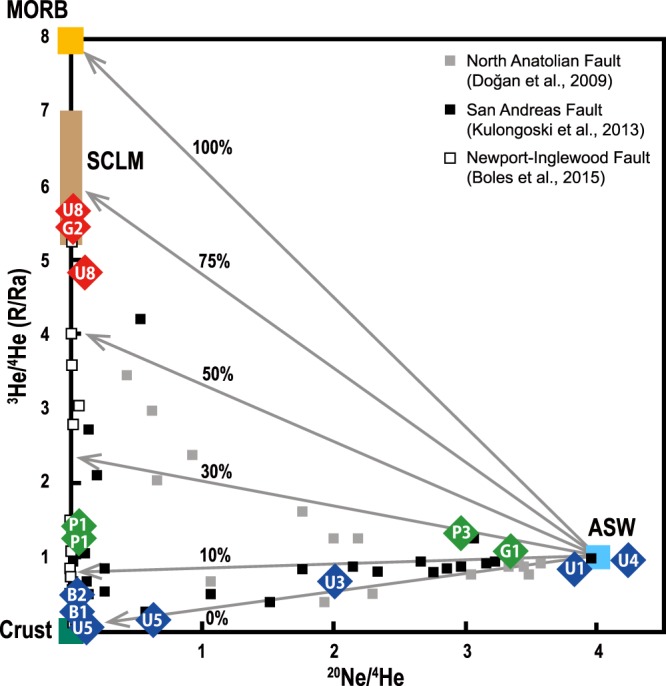
3He/4He (R/Ra) versus 20Ne/4He plot. Three reference values of MORB, crust and ASW are displayed as well as subcontinental lithospheric mantle (SCLM, 6.1 ± 0.9 Ra, ref.31). Each gray line shows linear mixing trends between mantle/crust and ASW with different MORB (8 Ra) contribution ratios. Referenced data of other strike-slip fault zones in the world are shown.
We divided the SeKP fault fluids into three groups based on mantle-derived helium portions (Figs. 1c and 3). The first group shows that 3He/4He ratios are > 50% of MORB-derived helium. They were found at G2 (3He/4He = 5.51 Ra) near the Yangsan fault zone and U8 (3He/4He = 4.84 and 5.66 Ra) near the Ilkwang fault zone with 61% to 71% of MORB-derived helium (Figs. 1c and 3). Also, it is probable that the values are rather close to the subcontinental lithospheric mantle (SCLM) ratio which is 6.1 ± 0.9 Ra (ref.31), but lower than the average of arc volcano, 7.4 ± 1.3 Ra (ref.32). These 3He/4He ratios are comparable to reported values of other strike-slip fault systems, such as the San Andreas (3He/4He max = 5.3 Ra, ref.11), North Anatolian (3He/4He max = 4.6 Ra, refs.9,33), and Karakoram (3He/4He max = 2.2 Ra, ref.34) fault zones (Fig. 3).
The second group has MORB-derived helium portions between 10 and 50%, implying that the mantle-derived helium has interacted with the crust during upward migration. This type is found at P1a and P1b (16% and 17% of the MORB-derived helium with elevated 4He/20Ne ratio of 19 and 33) which is located at the Pohang section of the Yangsan fault (Fig. 1c). However, G1 and P3 are atmospheric (4He/20Ne = 0.43 and 0.49) likely due to shallower well depths (150 m and 180 m, respectively) than P1 of 700 m (Fig. 3), although they have 3He/4He ratios of 1.09 and 1.34 Ra, respectively.
The last group seems to be contributed somewhat by radiogenic helium from the crust (Figs. 1c and 3), showing < 10% of MORB-derived helium. This group has 3He/4He ratios from 0.07 to 0.96 Ra with Rc/Ra values from 0.05 to 0.87 (Table 2). It is known that the SeKP strike-slip faults are developed by cutting the Cretaceous granitic rocks (~75 Ma, ref.35, Fig. 1c) in association with abundant radiogenic 4He production by the alpha decay of U and Th. It is experimentally reported that granitic rocks release radiogenic 4He during deformation36,37. However, excluding groundwater samples with low 4He/20Ne ratios possibly due to air contamination, the hot spring samples in this group have 3He/4He ratios > 0.1 Ra, except for U5a (0.07 Ra), indicating that the majority of these samples still have mantle-derived helium according to ref.1.
CO2 sources of the SeKP fault fluids
Heavier δ13C values (−8.25‰ to −12.18‰) of CO2 are observed where higher 3He/4He ratios are found (Fig. 4). The possible scenario is that the δ13C values of G2, U8a and U8b with higher 3He/4He ratio (Rc/Ra = 4.90 to 5.69) are closer to the MORB value (δ13C = −6.5 ± 2‰, ref.3) due to less contribution of biogenic CO2 than other samples (δ13C = −14.50 to −24.92‰; Rc/Ra = 0.05 to 1.68) (Fig. 4). It is attributed that mantle-derived CO2 plays a role as a carrier gas for 3He (ref.1). In a number of tectonically active areas, fault-related springs discharge mantle-derived CO2 together with 3He, such as the East African Rift, Eger Rift and San Andreas Fault4–6,10,11. δ13C values of other samples fall between the mean values of C3 (δ13C = −27‰) and C4 (δ13C = −13‰) plants38, which is similar to the results of other strike-slip faults, such as the San Andreas and North Anatolian fault zones releasing biogenic soil CO2 with the range of δ13C from −11.87 to −24.0‰ (refs.9,10,25,26) (Fig. 4). The SeKP fault zones are developed in the lacustrine sedimentary Gyeongsang Basin formed in the Cretaceous period14, containing organic materials with δ13C values of −20.7 to −26.4‰ (ref.39). Miocene basins formed by the Yangsan and Ulsan faults14 may have C4 plants-derived sediments, which have heavier biogenic δ13C values than the C3 plant likely due to global vegetation change in the Miocene and Pliocene periods40. However, The interaction of CO2 and water could result in carbon isotope fractionation between gaseous CO2 and dissolved HCO3− and/or CO32−, depending on the pH of water samples41. The pH range of the SekP fluids are between 6.0 and 10.3 (Table 1), implying some portion of CO2 was not sufficiently degassed when dissolved gases were extracted from fluid samples. In the Gyeongju area, δ13C values of dissolved inorganic carbon (DIC) in groundwater samples have been reported with the range of −12.72 to −17.17‰ (ref.42), which is included in the range of our results (Fig. 4). Thus, the carbon isotope fractionation could be insignificant based on the differences in δ13C values between CO2 and DIC.
Figure 4.
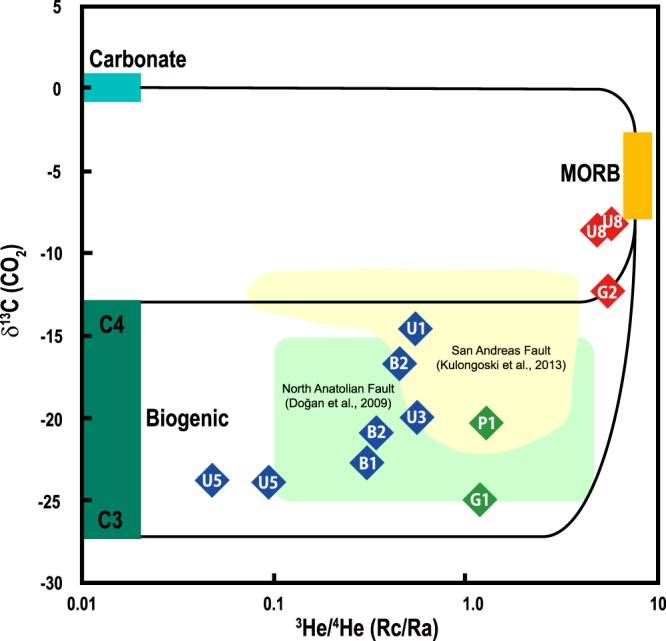
δ13C-CO2 and corrected 3He/4He (Rc/Ra) plot. Mixing lines are defined between the MORB and crustal (carbonate and biogenic carbon) end-members. δ13C values of MORB and carbonate components are from ref.3. The biogenic source is displayed based on the mean δ13C values of C3 and C4 plants38. Referenced data of the San Andreas and North Anatolian fault zones is displayed.
Fault weakening and strike-slip shearing into the lithospheric mantle
The fault zones in the SeKP region may be weakened in association with fluids containing mantle-derived volatiles. Ref.43 observed fault gouges containing clay minerals to reduce friction of the Yangsan fault, providing evidence for fault weakening. It is well known that highly pressured fluids interacting with country rocks can invoke fault weakening12,44. Ref.7 also proposed that the San Andreas Fault weakening can be related to 3He-rich mantle fluids which are incorporated into the seismogenic zone to enhance pore fluid pressures. On the basis of mantle-derived helium (3He/4He ratio up to 5.3Ra) and CO2 (δ13C = 0 to −10‰), ref.11 proposed mantle degassing in the Newport-Inglewood strike-slip fault zone, where magmatism is absent. In the case of the Gyeongju area (Fig. 1c), ref.45 observed a low velocity layer in the seismogenic zone (<15 km, ref.46), with depths of 4 to 14 km. Ref.47 suggested that Cretaceous adakite intrusions and/or the high geothermal gradient are possible causes for the low velocity layer. However, the intrusions can be sources to produce radiogenic 4He as discussed above, indicating the hypothesis is implausible due to the elevated 3He/4He ratio (5.51 Ra for G2) in the region. Even though the SeKP region shows high heat flow values due to shallow Moho depths (~80 mW/m2, ref.47), the low velocity zone only exists in a limited depth range (4 to 14 km). Instead, we propose that the low velocity zone may contain aqueous fluids to weaken the fault zones. Ref.48 showed a low velocity zone within the crust beneath northeast Japan (>10 km depths), suggesting the presence of aqueous fluids related to the 2008 Iwate earthquake (M7.2). Therefore, mantle-derived volatiles observed near the localities of the ML 5.8 Gyeongju earthquake (Fig. 1c) provide information about fluids related to mantle degassing for the seismically active fault.
Mantle degassing in the SeKP region illustrates that the fault zones appear to penetrate into the lithospheric mantle. The Moho depths of the SeKP region ranges between 26 and 32 km based on S-wave velocities45, with the seismogenic depth of 15 km (ref 46). Hence, the brittle-ductile transitions zone may be located at the depth of 15 km, which is consistent with the lower crustal thickness approximately ranging from 15 and 30 km (ref.45). The ductile lower crust is thought to be impermeable for mantle-derived helium transport7,8,44. To resolve the mantle-derived helium migration through the impermeable lower crust, active degassing via magmatism49 and diffusive transport at extensional settings30 have been suggested. However, magmatism underneath the SeKP region is unlikely because volcanism has been ceased in the Miocene period. Also, diffusion of mantle-derived helium is ambiguous for strike-slip faults despite magmatic helium and CO2 found in the continental rift fault zones4–6. The alternative scenario for penetration of mantle-derived volatiles is to have permeable pathways, such as deep faults through the lower crust7,11,13. However, deep earthquakes (depths > 15 km) are poorly observed in the SeKP region, although GPS data reported by ref.50 shows higher shear strain rates occurring in the area. Therefore, we propose high strain localized shearing through the lower crust and lithospheric mantle. Ref.8 suggested that the San Andreas fault zones release mantle fluids at high strain shear zones through the ductile lower crust based on the correlation between 3He/4He ratios and GPS strain rates. Moreover, ref.51 showed that highly deformed ultramylonite peridotites are enriched in mantle helium. Furthermore, higher helium contents were found in the highly sheared peridotites52.
Conclusions
We first report the results of gas geochemistry, 3He/4He ratios and δ13C of CO2 from fluids in the SeKP fault system (Fig. 1c). The N2-Ar-He abundances illustrate that the SeKP fault gases are unlikely to be the arc gases but are likely derived from the mantle source like other continental gases despite some samples are almost atmospheric owing to shallow well depths (Fig. 2). Mantle-derived helium (3He/4He > 0.1 Ra) are observed in entire the SeKP fault zones although heavier δ13C values appear only where higher 3He/4He ratios are shown. These features are also observed in other strike-slip fault zones (e.g., North Anatolian, San Andreas, and Newport-Inglewood fault zones) in the world (Figs. 3 and 4). The seismically active SeKP faults are weakened, which can be attributed to high pressures of fluids containing mantle-derived volatiles like the San Andreas fault area. In the SeKP region, there should be potential pathways for mantle-derived volatiles to migrate through the ductile lower crust because the Moho depth (~30 km) is deeper than the possible brittle-ductile transitions zone (~15 km) beneath this area. Thus, we suggest that the SeKP strike-slip faults extend in the form of ductile shear zones to the lithospheric mantle below the seismogenic depth (~15 km).
Sampling and Analytical Methods
Samples were collected in the Gyeongju, Ulsan, Pohang, and Busan areas (Table 1 and Fig. 1). Fluid samples containing dissolved gases were delivered into glass containers for measuring gas compositions and carbon isotopes of CO2. Copper tubes were also used to sample fluids for noble gas analyses in order to prevent helium-loss through silicate glasses. Dissolved gases in fluids were extracted by using a high vacuum pumping system, and all analyses were carried out in the Atmosphere and Ocean Research Institute (AORI), the University of Tokyo. Concentrations of CO2, N2, O2, CH4, Ar, and He in dissolved gases were obtained by a quadrupole mass spectrometer (QMS) using a secondary electron multiplier (Pfeiffer Prisma QMS 200). The analytical errors of relatively abundant gas components (CO2, N2 and O2) and minor gases (CH4, Ar and He) were about 10% and 30% at 2σ, respectively, which were determined by repeated measurements of air. Helium isotope ratios (3He/4He) were measured by a VG-5400 noble gas mass spectrometer. He and Ne were purified by titanium getters (at 400 °C) and charcoal traps at liquid nitrogen temperature. Neon was trapped by a cryogenic trap (at 40 K) after measuring 4He/20Ne ratios by an on-line QMS. Calibration of He isotope ratios was conducted by using the internal He standard of Japan53. Measured helium isotope compositions were corrected for atmospheric helium by using measured 4He/20Ne ratios since 20Ne is assumed to be mostly atmospheric54. As described in ref.55:
| 1 |
| 2 |
where Rc/Ra is the corrected 3He/4He ratio, and (4He/20Ne)ASW is the 4He/20Ne ratio of air saturated water (ASW). Analytical errors for 3He/4He and 4He/20Ne ratios are about 3.5% and 5% (1σ), respectively. Carbon isotope compositions (δ13C) of CO2 which is extracted from fluids were measured by an isotope ratio mass spectrometer (IsoPrime 100) with an elemental analyzer. The analytical error was approximately 0.3‰ (2σ).
Acknowledgements
This study was funded by the Research Settlement Fund for the new faculty of Seoul National University. We were also supported by the Korea Meteorological Administration (KMI2018-09110) and the National Research Foundation of Korea (NRF) grant funded by the Korea government (MSIT) (NRF-2019R1G1A1002297). We thank C.H. Jeong, Y.C. Lee, and Y.J. Lee for their support in sampling. We appreciate Marco Viccaro for his editorial handling. We thank two anonymous reviewers for their critical comments to improve the manuscript.
Author contributions
H.L., T.K., J.P. and Y.S. planned the field campaign, and. H.L., H.K., T.K., J.P. and Y.S. collected water samples in South Korea. H.L. H.K., T.K. and N.T. analyzed samples to acquire results of gas geochemistry, carbon isotope values, and noble gas compositions. H.L. wrote the manuscript.
Competing interests
The authors declare no competing interests.
Footnotes
Publisher’s note Springer Nature remains neutral with regard to jurisdictional claims in published maps and institutional affiliations.
References
- 1.O’nions RK, Oxburgh ER. Helium, volatile fluxes and the development of continental crust. Earth Planet. Sci. Lett. 1988;90:331–347. doi: 10.1016/0012-821X(88)90134-3. [DOI] [Google Scholar]
- 2.Ozima, M. & Podosek, F.A. Noble gas geochemistry (Cambridge University Press 2002).
- 3.Sano Y, Marty B. Origin of carbon in fumarolic gas from island arcs. Chem. Geol. 1995;119:265–274. doi: 10.1016/0009-2541(94)00097-R. [DOI] [Google Scholar]
- 4.Bräuer K, Kämpf H, Niedermann S, Strauch G, Tesař J. Geochem. Geophys. Geosyst. 2008. Natural laboratory NW Bohemia: Comprehensive fluid studies between 1992 and 2005 used to trace geodynamic processes; pp. 1–30. [Google Scholar]
- 5.Lee H, et al. Incipient rifting accompanied by the release of subcontinental lithospheric mantle volatiles in the Magadi and Natron basin, East. Africa. J. Volcanol. Geotherm. Res. 2017;346:118–133. doi: 10.1016/j.jvolgeores.2017.03.017. [DOI] [Google Scholar]
- 6.Lee H, et al. Massive and prolonged deep carbon emissions associated with continental rifting. Nat. Geosci. 2016;9:145–149. doi: 10.1038/ngeo2622. [DOI] [Google Scholar]
- 7.Kennedy BM, et al. Mantle fluids in the San Andreas fault system, California. Science. 1997;278:1278–1281. doi: 10.1126/science.278.5341.1278. [DOI] [Google Scholar]
- 8.Kennedy BM, Van Soest MC. Flow of mantle fluids through the ductile lower crust: Helium isotope trends. Science. 2007;318:1433–1436. doi: 10.1126/science.1147537. [DOI] [PubMed] [Google Scholar]
- 9.Doğan Turhan, Sumino Hirochika, Nagao Keisuke, Notsu Kenji, Tuncer M. Kemal, Çelik Cengiz. Adjacent releases of mantle helium and soil CO2from active faults: Observations from the Marmara region of the North Anatolian Fault zone, Turkey. Geochemistry, Geophysics, Geosystems. 2009;10(11):n/a-n/a. doi: 10.1029/2009GC002745. [DOI] [Google Scholar]
- 10.Kulongoski JT, et al. Volatile fluxes through the Big Bend section of the San Andreas Fault, California: Helium and carbon-dioxide systematics. Chem. Geol. 2013;339:92–102. doi: 10.1016/j.chemgeo.2012.09.007. [DOI] [Google Scholar]
- 11.Boles JR, Garven G, Camacho H, Lupton JE. Mantle helium along the Newport‐Inglewood fault zone, Los Angeles basin, California: A leaking paleo‐subduction zone. Geochem. Geophys. Geosyst. 2015;16:2364–2381. doi: 10.1002/2015GC005951. [DOI] [Google Scholar]
- 12.Byerlee JD. Friction, overpressure and fault normal compression. Geophys. Res. Lett. 1990;17:2109–2112. doi: 10.1029/GL017i012p02109. [DOI] [Google Scholar]
- 13.Inbal A, Ampuero JP, Clayton RW. Localized seismic deformation in the upper mantle revealed by dense seismic arrays. Science. 2016;354:88–92. doi: 10.1126/science.aaf1370. [DOI] [PubMed] [Google Scholar]
- 14.Choi JH, Yang SJ, Han SR, Kim YS. Fault zone evolution during Cenozoic tectonic inversion in SE Korea. J. Asian Earth Sci. 2015;98:167–177. doi: 10.1016/j.jseaes.2014.11.009. [DOI] [Google Scholar]
- 15.Chun, S. S. & Chough, S. K. Tectonic history of Cretaceous sedimentary basins in the southwestern Korean Peninsula and Yellow Sea. In: Chough, S.K. Ed., Sedimentary Basins in the Korean Peninsula and Adjacent Seas. Korean Sediment. Res. Group Spec. Publ. Harnlimwon Publishers, Seoul, 60–76 (1992).
- 16.Lee DW. Strike-slip fault tectonics and basin formation during the Cretaceous in the Korean Peninsula. ISL ARC. 1999;8:218–231. doi: 10.1046/j.1440-1738.1999.00233.x. [DOI] [Google Scholar]
- 17.Cheon Y, et al. Tectonically controlled multiple stages of deformation along the Yangsan Fault Zone, SE Korea, since Late Cretaceous. J ASIAN EARTH SCI. 2019;170:188–207. doi: 10.1016/j.jseaes.2018.11.003. [DOI] [Google Scholar]
- 18.Kim, J. S., Son, M., Kim, J. S. & Kim, J. 40Ar/39Ar ages of the Tertiary dike swarm and volcanic rocks, SE Korea. J. Petrol. Soc. Korea, 14, 93–107 (in Korean with English abstract) (2005).
- 19.Son, M. et al. Paleogene dyke swarms in the eastern Geoje Island, Korea: their absolute ages and tectonic implications. J. Petrol. Soc. Korea, 16, 82–99 (in Korean with English abstract) (2007).
- 20.Son M, et al. Miocene tectonic evolution of the basins and fault systems, SE Kora: dextral, simple shear during the East Sea (Sea of Japan) opening. J. Geol. Soc. 2015;172:664–680. doi: 10.1144/jgs2014-079. [DOI] [Google Scholar]
- 21.Giggenbach WF. The composition of gases in geothermal and volcanic systems as a function of tectonic setting. Proc. Int. Symp. Water Rock Interact. 1992;WRI-8:873–878. [Google Scholar]
- 22.Marty B, Zimmermann L. Volatiles (He, C, N, Ar) in mid-ocean ridge basalts: Assessment of shallow-level fractionation and characterization of source composition. Geochim. Cosmochim. Acta. 1999;63:3619–3633. doi: 10.1016/S0016-7037(99)00169-6. [DOI] [Google Scholar]
- 23.Umeda K, Ogawa Y, Asamori K, Oikawa T. Aqueous fluids derived from a subducting slab: Observed high 3He emanation and conductive anomaly in a non-volcanic region, Kii Peninsula southwest Japan. J. Volcanol. Geotherm. Res. 2006;149:47–61. doi: 10.1016/j.jvolgeores.2005.06.005. [DOI] [Google Scholar]
- 24.Lee H, et al. Nitrogen recycling at the Costa Rican subduction zone: The role of incoming plate structure. Sci. Rep. 2017;7:13933. doi: 10.1038/s41598-017-14287-y. [DOI] [PMC free article] [PubMed] [Google Scholar]
- 25.Lewicki JL, Brantley SL. CO2 degassing along the San Andreas fault, Parkfield, California. Geophys. Res. Lett. 2000;27:5–8. doi: 10.1029/1999GL008380. [DOI] [Google Scholar]
- 26.Lewicki, J. L. et al. Shallow soil CO2 flow along the San Andreas and Calaveras faults, California. J. Geophys. Res., 108 (2003).
- 27.Taran YA. N2, Ar, and He as a tool for discriminating sources of volcanic fluids with application to Vulcano, Italy. Bull. Volcanol. 2011;73:395–408. doi: 10.1007/s00445-011-0448-1. [DOI] [Google Scholar]
- 28.Fischer TP, et al. Subduction and recycling of nitrogen along the Central American margin. Science. 2002;297:1154–1157. doi: 10.1126/science.1073995. [DOI] [PubMed] [Google Scholar]
- 29.Staudacher T, Allègre CJ. Recycling of oceanic crust and sediments: The noble gas subduction barrier. Earth Planet. Sci. Lett. 1988;89:173–183. doi: 10.1016/0012-821X(88)90170-7. [DOI] [Google Scholar]
- 30.Torgersen T. Defining the role of magmatism in extensional tectonics: Helium 3 fluxes in extensional basins. J. Geophys. Res. 1993;98:16257–16269. doi: 10.1029/93JB00891. [DOI] [Google Scholar]
- 31.Gautheron C, Moreira M. Helium signature of the subcontinental lithospheric mantle. Earth Planet. Sci. Lett. 2002;199:39–47. doi: 10.1016/S0012-821X(02)00563-0. [DOI] [Google Scholar]
- 32.Sano, Y. & Fischer, T. P. The analysis and interpretation of noble gases in modern hydrothermal systems. In The Noble Gases as Geochemical Tracers, edited by P. Burnard, 249–317, Springer, Berlin (2013).
- 33.Burnard P, et al. Constraints on fluid origins and migration velocities along the Marmara Main Fault (Sea of Marmara, Turkey) using helium isotopes. Earth Planet. Sci. Lett. 2012;341:68–78. doi: 10.1016/j.epsl.2012.05.042. [DOI] [Google Scholar]
- 34.Klemperer SL, et al. Mantle fluids in the Karakoram fault: Helium isotope evidence. Earth Planet. Sci. Lett. 2013;366:59–70. doi: 10.1016/j.epsl.2013.01.013. [DOI] [Google Scholar]
- 35.Kim SW, et al. SHRIMP U–Pb dating and geochemistry of the Cretaceous plutonic rocks in the Korean Peninsula: A new tectonic model of the Cretaceous Korean Peninsula. Lithos. 2016;262:88–106. doi: 10.1016/j.lithos.2016.06.027. [DOI] [Google Scholar]
- 36.Honda M, Kurita K, Hamano Y, Ozima M. Experimental studies of He and Ar degassing during rock fracturing. Earth Planet. Sci. Lett. 1982;59:429–436. doi: 10.1016/0012-821X(82)90144-3. [DOI] [Google Scholar]
- 37.Bauer SJ, Gardner WP, Lee H. Release of radiogenic noble gases as a new signal of rock deformation. Geophys. Res. Lett. 2016;43:10–688. [Google Scholar]
- 38.Cheng W. Measurement of rhizosphere respiration and organic matter decomposition using natural 13 C. Plant Soil. 1996;183:263–268. doi: 10.1007/BF00011441. [DOI] [Google Scholar]
- 39.Hong SK, Lee YI. Palaeogeogr. Palaeoclimatol. Palaeoecol. 2013. Contributions of soot to δ13C of organic matter in Cretaceous lacustrine deposits, Gyeongsang Basin, Korea: Implication for paleoenvironmental reconstructions; pp. 54–61. [Google Scholar]
- 40.Cerling TE, et al. Global vegetation change through the Miocene/Pliocene boundary. Nature. 1997;389:153–158. doi: 10.1038/38229. [DOI] [Google Scholar]
- 41.Zhang J, Quay PD, Wilbur DO. Carbon isotope fractionation during gas–water exchange and dissolution of CO2. Geochim. Cosmochim. Acta. 1995;59:107–114. doi: 10.1016/0016-7037(95)91550-D. [DOI] [Google Scholar]
- 42.Kaown D, et al. Evaluating the responses of alluvial and bedrock aquifers to earthquakes (ML 5.1 and ML 5.8) using hydrological and environmental tracer data. Hydrogeol. J. 2019;27:2011–2025. doi: 10.1007/s10040-019-01966-5. [DOI] [Google Scholar]
- 43.Kim CM, Han R, Jeong GY, Jeong JO, Son M. Internal structure and materials of the Yangsan fault, Bogyeongsa area, Pohang, South Korea. Geosci. J. 2016;20:759–773. doi: 10.1007/s12303-016-0019-8. [DOI] [Google Scholar]
- 44.Byerlee JD. Model for episodic flow of high-pressure water in fault zones before earthquakes. Geology. 1993;21:303–306. doi: 10.1130/0091-7613(1993)021<0303:MFEFOH>2.3.CO;2. [DOI] [Google Scholar]
- 45.Lee DH, Lee JM, Cho HM, Kang TS. 3D crustal velocity structure beneath the broadband seismic array in the Gyeongju area of Korea by receiver function analyses. Tectonophy. 2016;689:89–106. doi: 10.1016/j.tecto.2016.08.022. [DOI] [Google Scholar]
- 46.Uchide T, Song SG. Fault rupture model of the 2016 Gyeongju, South Korea, earthquake and its implication for the underground fault system. Geophys. Res. Lett. 2018;45:2257–2264. doi: 10.1002/2017GL076960. [DOI] [Google Scholar]
- 47.Kim, H.C. & Lee, Y. Heat flow in the Republic of Korea. J. Geophys. Res. 112 (2007).
- 48.Wang, Z., Fukao, Y., Kodaira, S. & Huang, R. Role of fluids in the initiation of the 2008 Iwate earthquake (M7. 2) in northeast Japan. Geophys. Res. Lett., 35 (2008).
- 49.Ballentine CJ, Burnard PG. Production, release and transport of noble gases in the continental crust. Rev. Mineral. Geochem. 2002;47:481–538. doi: 10.2138/rmg.2002.47.12. [DOI] [Google Scholar]
- 50.Kim S, Ree JH, Yoon HS, Choi BK, Park PH. Crustal Deformation of South Korea After the Tohoku‐Oki Earthquake: Deformation Heterogeneity and Seismic Activity. Tectonics. 2018;37:2389–2403. doi: 10.1029/2018TC004967. [DOI] [Google Scholar]
- 51.Kurz MD, Warren JM, Curtice J. Mantle deformation and noble gases: Helium and neon in oceanic mylonites. Chem. Geol. 2009;266:10–18. doi: 10.1016/j.chemgeo.2008.12.018. [DOI] [Google Scholar]
- 52.Recanati, A., Kurz, M. D., Warren, J. M. & Curtice, J. Helium distribution in a mantle shear zone from the Josephine Peridotite. Earth Planet. Sci. Lett., 162–172 (2012).
- 53.Matsuda J, et al. The 3He/4He ratio of the new internal He Standard of Japan (HESJ) Geochem. J. 2002;36:191–195. doi: 10.2343/geochemj.36.191. [DOI] [Google Scholar]
- 54.Craig H, Clarke WB, Beg MA. Excess 3He in deep water on the East Pacific Rise. Earth Planet. Sci. Lett. 1975;26:125–132. doi: 10.1016/0012-821X(75)90079-5. [DOI] [Google Scholar]
- 55.Sano Y, Takahata N, Seno T. Geographical distribution of 3He/4He ratios in the Chugoku district, Southwestern Japan. Pure Appl. Geophys. 2006;163:745–757. doi: 10.1007/s00024-006-0035-0. [DOI] [Google Scholar]
- 56.Ryan WBF, et al. Global Multi-Resolution Topography synthesis. Geochem. Geophys. Geosyst. 2009;10:Q03014. doi: 10.1029/2008GC002332. [DOI] [Google Scholar]