



Abstract
Communication involves successfully deriving a speaker's meaning beyond the literal expression. Using fMRI, it was investigated how the listener's brain realizes distinctions between enrichment‐based meanings and literal semantic meanings. The neural patterns of the Mandarin scalar quantifier you‐de (similar to some in English) which implies the meanings not all and not most via scalar enrichment, with the specific quantifier shao‐shu‐de (similar to less than half in English) which lexico‐semantically encodes the meanings not all and not most, were compared. Listeners heard sentences using either quantifier, paired with pictures in which either less than half, more than half, or all of the people depicted in the picture were doing the described activity; thus, the conditions included both implicature‐based and semantics‐based picture‐sentence mismatches. Imaging results showed bilateral ventral IFG was activated for both kinds of mismatch, whereas basal ganglia and left dorsal IFG were activated uniquely for implicature‐based mismatch. These findings suggest that resolving conflicts involving inferential aspects of meaning employs different neural mechanisms than the processing based on literal semantic meaning, and that the dorsal prefrontal/basal ganglia pathway makes a contribution to implicature‐based interpretation. Furthermore, within the implicature‐based conditions, different neural generators were implicated in the processing of strong implicature mismatch (you‐de in the context of a picture in which “all” would have been true) and weak implicature mismatch (you‐de in the context of a picture in which “most” would have been true), which may have important implications for theories of pragmatic comprehension. Hum Brain Mapp 38:3848–3864, 2017. © 2017 Wiley Periodicals, Inc.
Keywords: scalar implicature, pragmatics, semantics, picture–sentence verification, fMRI
INTRODUCTION
The complexity of human communication is one of the hallmarks of our species. A striking demonstration of the sophisticated nature of our communication system is the distinction between so‐called “sentence meaning” (i.e., meaning that is realized by retrieving the semantic meanings of lexical items from long‐term memory and combining them based on compositional constraints) and “speaker meaning” (i.e., meaning that is realized by performing pragmatic inferences to recognize what a speaker intends to convey). The inference from sentence meaning to speaker meaning is guided by the expectation that the speakers tailor their utterance to be optimally relevant to the conversational situation, during which any departures from this relevance drive the listener to infer additional meaning [Grice, 1975; Levinson, 2000; Sperber and Wilson, 1995; Wilson and Sperber, 2004]. For example, although the statement “some of the children are riding bicycles” semantically conveys an inherent, existential meaning that is consistent with all of the children are riding bicycles (i.e., the fact a nonzero number of children are riding bicycles does not rule out the possibility that some and in fact all of the children are riding bicycles), it still often drives the listener to infer that only some, and not all, of the children are riding bicycles. This latter implicature that arises is the negation of a stronger alternative statement, all, that the cooperative speaker could have been made but did not [Geurts, 2010; Grice, 1975; Horn, 1972]. As these different forms of meaning (literal and inferred) have different linguistic and representational status [for instance, inferences are defeasible and literal meaning is not; see Geurts, 2010, among others], a topic of particular interest in language processing is how the neural mechanisms underlying the effective derivation of implicated pragmatic meaning can be distinguished from those underlying the interpretation of literal semantic meaning in sentence comprehension.
Several studies have directly compared the neural processing of pragmatic versus semantic meaning, although many did not fully separate various cognitive demands from the pragmatic/semantic manipulation. In a classic study, Hagoort et al. [2004] compared neural responses to so‐called semantic violations (The Dutch trains are sour) and so‐called pragmatic violations (The Dutch trains are white—in reality, Dutch trains were yellow at the time the experiment was conducted), and found both types of sentences activated left inferior frontal gyrus (IFG), reflecting the greater cost of unifying the unexpected or mismatched input into the sentential context. In this study, however, such violations do not actually qualitatively differ in terms of the linguistic rules they violate—that is, it is not the case that one violation is truly semantic and the other truly pragmatic. Rather, both are violations of world knowledge, and they differ only in level of granularity [see, for example, Pylkkänen, et al., 2011]: The Dutch trains are white conflicts with the rather specific world knowledge that Dutch trains are yellow in the world in which we live (in 2004), and The Dutch trains are sour conflicts with the broad world knowledge that trains are not edible in the world in which we live. This study, therefore, does not distinguish between the neural processing of semantic (literal, linguistically inherent) and pragmatic (socially inferred) meaning. Adopting another approach, Shibata et al. [2011] compared neural responses to indirect replies (e.g., “What did you think of my presentation?”—“It's hard to give a good presentation”) and literal statements (e.g., “what do you think of my oil painting?”—“Your painting is very good”), and found that a frontotemporal network was activated in both conditions for contextual mismatch detection, whereas the medial frontal cortex was activated only for indirect reply to generate the inference to make sense of remarks. However, the scenario information, and the following implied or stated meaning, of the indirect reply and the literal statement are not matched across conditions. Hence this study did not compare pragmatic and semantic aspects of meaning under maximally similar contexts.
A linguistic phenomenon that offers a powerful means for comparing pragmatic and semantic aspects of meaning is scalar implicature, like the above example some of the children are riding bikes and its implicature that not all of the children are riding bikes. Scalar implicatures introduce an enriched, putatively pragmatic, aspect of meaning that is distinct from semantic meaning in ways that are linguistically motivated and theoretically explicit. Moreover, its pragmatic and semantic meaning are maximally similar in structure and illocutionary force—for example, both the enriched meaning “not all of the children are riding bicycles” and the semantic meaning “more than zero of the children are riding bikes” share roughly the same structure and both are indicative statements, as opposed to many classical examples of pragmatic meaning (e.g., the statement It's hot here and its implication “Turn on the air conditioner!,” which differs substantially in both structure and illocutionary force). While there is substantial debate over whether scalar implicatures are actually derived pragmatically as opposed to syntactically [e.g., Chierchia et al., 2012], it is uncontroversial that the enriched meaning (e.g., “not all”) is derived in a qualitatively different way than the lexico‐semantic meaning (e.g., “more than zero”). Furthermore, it is likely that both pragmatic and syntactic operations are involved in the derivation of scalar implicatures [Chemla and Singh, 2014]. In the following, we will refer to the “not all” interpretation of a quantifier like some as “implicature‐based” to avoid making a commitment to pragmatic versus semantic accounts of scalar implicature realization (while it is possible under a semantic account that this meaning is not based on implicatures and inferences per se, but rather on semantic operations, here we use it as a catch‐all term to refer to the enriched aspect of meaning that is putatively not the core lexical meaning).
Several recent studies have examined the processing of implicature versus semantic aspects of scalar implicatures using neurolinguistic methods. Using a picture–sentence verification paradigm and event‐related potentials (ERP) technique, Politzer‐Ahles et al. [2013] compared auditory sentences beginning with a Mandarin scalar quantifier (you‐de, roughly equivalent to English some of) which were preceded by a picture describing an action that was performed by not all versus all characters (three out of six girls were sitting on a blanket, or six out of six girls were sitting on a blanket), creating conditions that either were matched or mismatched because of the scalar implicature. At the onset of the scalar quantifier, different neural responses were elicited depending on whether picture–sentence mismatch was implicature‐based or semantic‐based. When the implicature‐based interpretation of the quantifier was inconsistent with the context, a sustained broadly distributed negative component was elicited, which suggested a pragmatic reanalysis: inhibiting the enriched interpretation of some and strengthening the core lexical reading. Using similar constructions in English, Shetreet et al. [2014a] conducted an fMRI study and found that the left middle frontal gyrus and the medial frontal gyrus were activated by implicature mismatch (i.e., some‐related mismatch). In these two studies, however, the semantic control mismatch, against which the some‐related mismatch were compared, were every sentences—for example, a picture in which some children are riding bikes and some are not, paired with a sentence every child is riding a bike. While such a sentence is unambiguously a semantic mismatch, it differs from the some‐related mismatch in ways other than scalar implicature; every and some have different denotations and possibly different verification strategies [see Politzer‐Ahles and Gwilliams, 2015 for discussion]. It would be preferable to compare the processing of the implicature‐based “not all” interpretation of some to that of a word which also expresses “not all” but does so without scalar implicatures, for instance, the comparison between processing of some and that of only some [Bott et al., 2012; Hartshorne et al., 2014; Marty and Chemla, 2013; Politzer‐Ahles and Gwilliams, 2015]. Recently, Shetreet et al. [2014b] directly compared number‐based semantic mismatch (e.g., three penguins are on the bus, paired with a picture in which five penguins are on the bus) and some‐based scalar implicature mismatch, and found two conditions activated similar brain regions (i.e., middle frontal gyrus and medial frontal gyrus). However, it should be noted that the extent to which number processing differs from quantifier processing is still under debate [e.g., Breheny, 2008; Carston, 1988; Geurts, 2006; Spector, 2013].
The present study aimed to compare the processing of the implicature‐based and semantic‐based aspects of a scalar quantifier against that of a maximally similar quantifier whose upper bound (i.e., “not all” interpretation) is based on the literal semantic meaning. To accomplish this, we focused on the Mandarin quantifiers you‐de (approximately “some of”) and shao‐shu‐de (approximately “less than half of”). While the “not all” interpretation of you‐de is based on a scalar implicature, the “not all” interpretation of shao‐shu‐de is explicitly semantically encoded. One critical piece of evidence for this distinction is that the “not all” interpretation implied by you‐de or some can be revised or cancelled without resulting in a nonsensical sentence [e.g., Some of the students passed this exam. In fact, all of them did; Doran et al., 2012; Rullman and You, 2006], while the “not all” meaning that is semantically encoded by shao‐shu‐de or less is uncancellable (e.g., *Less than half of the students passed this exam. In fact, all of them did).
Based on the studies reviewed above, we expect that implicature mismatch may recruit the left middle frontal gyrus and the medial frontal gyrus indexing successful implementation of meaning enrichment [Shetreet et al., 2014a, 2014b]. Conflict between scalar quantifier and contextual quantity may also activate regions related to inhibition and executive control, such as the right IFG [Li et al., 2014; Nieuwland, 2012; Ye and Zhou, 2009a, 2009b] and the basal ganglia (BG) [Mestres‐Missé et al., 2014], as well as the left LIFG that supports the meaning unification [Hagoort, 2005]. For the semantic meaning mismatch, previous studies showed that numeric mismatch (e.g., listening to three penguins are on buses while seeing a picture in which all of the penguins are on buses) engendered brain regions similar to the scalar mismatch [e.g., listening to some of the penguins are on buses while seeing a picture in which all of the penguins are on buses; Shetreet et al., 2014b]. Hence, we expect that bilateral IFG will also be activated in dealing with semantic mismatch [Hagoort et al., 2004; Ni et al., 2000; Tesink et al., 2009] for conflict resolution and semantic unification. However, since no context‐appropriate meaning is available in the mental lexicon for the specific quantifier you‐de and no successful switching could take place in the semantic mismatch condition, no activation of the BG was predicted for this condition.
An additional goal of the present study was to test for more fine‐grained distinctions between implicature‐based interpretations than what has been done in previous neurolinguistic experiments. Specifically, in addition to examining neural responses to the “not all” interpretation of some, we also examined responses to the potential “not most” interpretation. While some previous studies failed to show online processing consequences of this interpretation in Mandarin [Politzer‐Ahles, 2012, 2014], there is both a strong intuition and strong empirical evidence that some elicits such an interpretation. For example, in a naturalness rating task in English [Degen and Tanenhaus, 2015; see also Newstead, 1988], some was considered most natural when describing subsets of slightly less than half of a superset (e.g., five or six out of thirteen), less natural when describing subsets close to the full superset (e.g., twelve out of thirteen), and least natural when describing the whole set (thirteen out of thirteen). Moreover, under a traditional alternatives‐based account of how scalar inferences are derived [e.g., Levinson, 2000], it would be predicted that such an interpretation would be realized, as long as most is a relevant alternative to some in the same way that all is. Such an account would, furthermore, predict that the not most and not all inferences are realized in a qualitatively similar way, as they would be derived by the same mechanism, even though they could show quantitative dissimilarities based on differences in the salience or relevance of the alternatives all and most. In the present study, therefore, we test both types of inferences, by creating “weak” and “strong” mismatch conditions in the experimental design, to see if they are processed in similar ways. The comparison between the conditions would also help address the question of whether the some‐as‐“not all” inference is representative of pragmatic processing in general, or different inferences are processed differently.
METHOD
Participants
Thirty‐six university students (19 women, ages: 18–25, mean: 22.1) participated in the experiment. They were native Chinese speakers without neurological or psychiatric disorders. None of them suffered from any hearing or language disorders. All were right‐handed with normal or corrected‐to‐normal vision. All participants provided written informed consent, and the study was approved by the Ethics Committee of the Department of Psychology at Peking University.
Design and Materials
A total of 108 critical sentences were created. Sentences began with a scalar quantifier (you‐de) or a specific quantifier (shao‐shu‐de) stated a general description of the quantities of characters or objects in the corresponding pictures. Sentences were recorded by a female native Chinese speaker, and intensity was normalized using CoolEdit (Syntrillium Software) to 70 dB. Pictures were used to establish the context for the sentences.
Each sentence was preceded by a simple picture containing six or seven characters or objects. There were three types of pictures, based on the proportion of characters or objects that met the description in the following sentence. In less‐than‐half pictures, two of six/seven individuals had the same property stated in the sentence, and thus these were congruent with a following you‐de sentence (the Match condition); in most pictures, five of six, or six of seven individuals had the same property stated in the sentence, making the picture weakly mismatched with a following you‐de sentence (the Weakly Mismatch condition); and in all pictures, all individuals had the same property stated in the sentence, making the picture strongly mismatched with a following you‐de sentence (the Strongly Mismatch condition). Note, while we did not consider these mismatch conditions were fundamentally different in the case of shao‐shu‐de sentences, we named them this way in accordance with the extent of mismatch on the pragmatic scale. The difference between the implicature of you‐de and the meaning of “most” is considered to be smaller or weaker than the difference between the implicature of you‐de and the meaning of “all.” Factorially crossing sentence type and picture type yielded six conditions (Table 1). Crucially, we expect effects related to scalar implicature processing to appear in the you‐de sentences (in which the upper bound of the quantifier must be inferred via pragmatics or enrichment) and not the shao‐shu‐de sentences (in which the upper bound of the quantifier is semantically explicit).
Table 1.
Experimental design
| Conditions | Picture examples | Sentence examples |
|---|---|---|
| Strong implicature mismatch | All children are riding bicycles |

|
| Weak implicature mismatch | Six of seven children are riding bicycles | Picture in has seven children, you‐de children are riding bicycle |
| Scalar quantifier match | Two of seven children are riding bicycles | There are six children in the picture, some children are riding bicycles |
| Strong semantic mismatch | All children are riding bicycles |

|
| Weak semantic mismatch | Six of seven children are riding bicycles | Picture in has seven children, shao‐shu‐de children are riding bicycle |
| Specific quantifier match | Two of seven children are riding bicycles | There are six children in the picture, less than half of the children are riding bicycles |
The critical stimuli were assigned into six test versions using a Latin square design. Six conditions created from the same scenario (i.e., children are riding bicycles) were split into different versions. Eighteen scenarios of utterance‐picture pairs were generated. The all/most pictures always mismatched quantity information inferred or stated in the sentences, and less‐than‐half pictures were always matched. As fillers, we additionally created 84 picture–sentence pairs to prevent participants from predicting their response by judging from the quantity information in the pictures. Among these, 20 were all pictures paired with suo‐you‐de (similar to all in English) sentences, 20 were most pictures that paired with duo‐shu‐de (similar to most in English) sentences, and 20 were less‐than‐half pictures that paired with suo‐you‐de or duo‐shu‐de sentences. Another 24 picture–sentence pairs were included that had matched quantifiers but with an object that did not match any of the objects in the picture, or a verb that did not match the activity shown. This manipulation encouraged the participants to deploy their attention evenly to each part of the sentence. The same fillers were used in all versions. Altogether there were 192 picture–sentence pairs in each version, and the order of the pairs was pseudo‐randomized, with the restriction that no more than three consecutive trials were from the same condition. Participants were randomly assigned to one of the versions and gender was counterbalanced across versions.
PROCEDURE
Each trial began with a fixation point presented at the center of the screen for 500 ms, followed by the picture display, which was presented at the center of the screen for 4,000 ms (Fig. 1A). When the picture disappeared, a fixation point appeared on the screen for another 500 ms and then the auditory sentence was presented while the fixation point remained on screen. The sentence varied in its duration from 2,800 to 4,000 ms. Following a varied period of time interval of 1,000–2,000 ms after the disappearance of the fixation point, a 1–7 scale was shown on the screen and lasted for 5,000 ms. Participants were asked to rate the extent to which the sentence was matched with the preceding picture and the end of the scale indicating matched or not was counterbalanced across participants (1 = very matched, 7 = very mismatched). The interval between the disappearance of the rating screen and the beginning of the next trial was randomized between 3,000 and 5,000 ms, with a fixation point presented on the screen.
Figure 1.

(A) demonstrates the experimental procedure. (B) shows the behavioral results for each critical condition in the online picture–sentence consistence rating. Error bars represent ±1 standard error of the mean.
The fMRI scan was divided into two sessions, lasting about 30 min per session. During the break between the two sessions, participants were asked to close their eyes and to keep their head still. At the beginning of each session, a fixation cross was displayed for 10 s to allow the scanner to reach stability. Before entering the scanner, all the participants completed a practice session following the same procedure as the formal test.
Data Acquisition
Functional images were acquired on a 3‐T Siemens Trio system, using a T2*‐weighted echo planar imaging (EPI) sequence, with 2,200 ms repetition time, 30 ms echo time, and 90° flip angle. Each image consisted of 32 axial slices covering the whole brain. Slice thickness was 3 mm and inter‐slice gap was 0.75 mm, with a 220 mm field of view (FOV), 64 × 64 matrix, and 3.4 × 3.4 × 3.4 mm³ voxel size. Head motion was minimized using pillows and cushions around the head and a forehead strap.
Data Analysis
Data were pre‐processed with Statistical Parametric Mapping (SPM) software SPM8 (Wellcome Department of Imaging Neuroscience, London, http://www.fil.ion.ucl.ac.uk). The first five volumes were discarded to allow stabilization of magnetization. The remaining images were time sliced and realigned to the sixth volume of the first session for head movement. A temporal high‐pass filter with a cutoff frequency of 1/128 Hz was used to remove low‐frequency drifts in the fMRI time series, and the mean functional image for each subject was coregistered to the EPI template provided by SPM8. Images were anatomically normalized to the MNI space (resampled to 2 × 2 × 2 mm³ isotropic voxel) by matching gray matter [Ashburner and Friston, 2005], and smoothed with a Gaussian kernel of 6 mm full‐width half‐maximum (FWHM). No participants' head movement exceeded 3 mm.
Statistical analysis was based on the general linear model (GLM). The hemodynamic response to each event was modeled with a canonical hemodynamic response function. We defined seventeen regressors: eight for the picture presentation, eight for the sentence presentation, and one for the rating. The rating‐related regressors were additionally accompanied by parametric regressors containing the number of button‐press in a trial. For both the picture and sentence presentation regressors, six were defined as the conditions of interest (i.e., strong implicature mismatch, weak implicature mismatch, implicature match; strong semantic mismatch, weak semantic mismatch, semantic match), one as the filler condition, and one as the non‐response trials and outliers (which fell outside the range of mean ± 2.5 * SD). The six sentence regressors were defined as regressors of interest. Six rigid body parameters were also included to correct for the head motion artifact. The onset of the regressors of interest was set to the onset of each auditory sentence. To pinpoint regions significantly activated for the conditions of interest, we first calculated the simple effects in each condition. The first‐level individual images of six conditions of interest were then fed to a flexible factorial repeated measures analysis of variance in the second‐level design matrix.
Firstly, we are interested in the brain activity for strong and weak implicature mismatches and the two corresponding semantic mismatches independently. To this end, we defined two contrasts between each individual level of mismatch for the you‐de condition (i.e., strong implicature mismatch vs. implicature match, weak implicature mismatch vs. implicature match) and the shao‐shu‐de condition (strong semantic mismatch vs. match, weak semantic mismatch vs. match). We also defined three main contrasts of mismatch and two main contrasts of mismatch type by collapsing across quantifier (i.e., strong and weak mismatch vs. match, strong mismatch vs. match, weak‐mismatch vs. match, strong vs. weak mismatch, weak vs. strong mismatch).
Then we directly examined the difference between the neural representation of implicature and semantic mismatch, by defining four interaction contrasts: (1) (strong implicature mismatch > implicature match) > (strong semantic mismatch > semantic match), (2) (strong semantic mismatch > semantic match) > (strong implicature mismatch > implicature match), (3) (weak implicature mismatch > implicature match) > (weak semantic mismatch > semantic match), and (4) (weak semantic mismatch > semantic match) > (weak implicature mismatch > implicature match). The overlap between the brain activation of implicature and semantic mismatch were also investigated by conducting two conjunction analyses: (1) (strong implicature mismatch > implicature match) ∩ (strong semantic mismatch > semantic match), and (2) weak implicature mismatch > implicature match) ∩ (weak semantic mismatch > semantic match). Brain regions survived with voxel‐level threshold of P < 0.001 uncorrected and a cluster‐level threshold of P < 0.05, FWE (family‐wise error) corrected for multiple comparisons. The corresponding contrasts for above comparisons survived with voxel‐level threshold of P < 0.001 uncorrected and a cluster‐level threshold of P < 0.05, FWE corrected for multiple comparisons.
To examine how specific activations are associated with the behavioral rating, we extracted the beta value in four regions of interest (ROIs, i.e., ventral LIFG, dorsal LIFG, RIFG, and BG) based on the contrast in above GLM. The ventral LIFG and RIFG were activated in all mismatch condition. The BG and dorsal LIFG were specifically activated in implicature‐based mismatch conditions where the former one was for both implicature‐based mismatches and the latter one was only for weak implicature‐based mismatch. Pearson correlation was conducted to examine the association between brain activation and the behavioral response in the same contrast.
In addition to above factorial design, we also performed a parametric analysis to further reveal the brain regions manipulated by the mismatch level (strong > weak > match, and vice versa), independently for implicature‐based condition and semantic‐based condition. This analysis would reveal the neural activity underlying the fine‐grained distinctions (in terms of the extent of mismatch on the semantic or pragmatic scale) between semantic‐based interpretations or between implicature‐based interpretations. In the GLM model for this parametric analysis, we included four regressors for the picture presentation (implicature condition, semantic condition, filler, and outlier and nonresponse trial). Then we included four regressors for the sentence presentation (implicature condition, semantic condition, filler, and outlier and nonresponse trial). Importantly, the sentence regressors of implicature and semantic conditions were additionally accompanied by parametric regressors containing the design manipulated mismatch level. Rating regressor was also included and accompanied by the number of button‐press in the trial. Brain regions survived in parametric analysis with voxel‐level threshold of P < 0.001 uncorrected and a cluster‐level threshold of P < 0.05, FWE corrected for multiple comparisons.
Psychophysiological Interaction Analysis
Psychophysiological interaction (PPI) analysis is used to investigate the physiological connectivity between two brain regions that is varied with the psychological context [Friston et al., 1997]. Here we were interested in the connectivity that is modulated by implicature and semantic mismatch. Firstly, we chose the regions shared by the implicature and semantic mismatch (i.e., ventral LIFG, BA47; RIFG, BA45/47) as the seed regions and searched in the whole brain for regions whose functional connectivity with these seed regions was modulated by implicature and semantic mismatch, respectively. Secondly, we chose brain regions which were only involved in implicature mismatch contrasts (i.e., dorsal LIFG for weak mismatch, BG for both strong and weak mismatch) as seed regions and investigated the physiological connectivity that was varied only within the context of implicature mismatch. For semantic mismatch, no region was activated specifically. Moreover, we were interested in identifying target regions whose change in connectivity with the seed regions were modulated by behavioral performance. Here, the difference in mismatch rating between four types of mismatch and their respective matched sentences in a certain sentence type over all trials was computed as an index to reflect the severity of the mismatch the participants perceived.
RESULTS
Behavioral Data
Figure 1B shows the average consistency rating between the visual context and the sentence over the 36 participants. A repeated measure ANOVA was conducted with both quantifier type (implicature‐based you‐de vs. semantic‐based shao‐shu‐de) and mismatch type (strong mismatch vs. weak mismatch vs. match) as within‐participant factors. The main effect of quantifier type was significant, F (1, 35) = 95.79, P < 0.001, with the compatibility in the implicature based (you‐de) (mean = 5.15, SE = 0.30) significantly higher than the rating in the semantic‐based (shao‐shu‐de) group (3.71 ± 0.30). There was also a significant main effect of mismatch type, F (2, 34) = 264.06, P < 0.001, suggesting that the compatibility increased from the strong mismatch to the weak mismatch to the match conditions (3.17 ± 0.25 vs. 3.65 ± 0.17 vs. 6.47 ± 0.36), with uncorrected P < 0.001 between each pair of conditions. Importantly, the interaction between quantifier type and mismatch type was significant, F (2, 34) = 103.01, P < 0.001. For you‐de sentences (implicature mismatch), compatibility monotonically increased from the strong mismatch to the weak mismatch to the match condition (all Ps < 0.001). For the shao‐shu‐de (semantic mismatch) sentences, on the other hand, strong and weak mismatch were both rated as less consistent than congruent sentences (Ps < 0.001) but were not quite significantly different from one another (uncorrected P = 0.017, Bonferroni α = 0.016). These results indicate that the mismatch type affected compatibility rating more for implicature mismatch than for semantic mismatch.
Previous studies have classified the participants into pragmatic and semantic responders [Bott and Noveck, 2004; Noveck and Posada, 2003; Tavano, 2010]. Response distribution across participants in terms of subjective mismatch rating (mean across trials) under the strong and the weak implicature mismatch condition are shown in Supporting Information Figure S1A (see Supporting Information Materials), suggesting no clear distinction of logical and pragmatic responder in our participants group [Spotorno et al., 2015]. Performance data showing the rating distribution across trials based on all participants in six critical conditions can be found in Supporting Information Figure S1B (see Supporting Information Materials).
fMRI Data
General linear model
For the main effect of mismatch type (by collapsing the strong and weak mismatch over quantifiers), the mismatch conditions, compared with the match conditions, evoked greater activity in the left ventral IFG (BA47), right IFG (BA45/47), bilateral BG (caudate), and left lingual (BA18; Table 2).
Table 2.
Brain regions revealed by all contrasts of simple effect
| ALL | PRAGMATIC | SEMANTIC | ||||||||||
|---|---|---|---|---|---|---|---|---|---|---|---|---|
| Mismatch > | Region | Size | BA | Coordinate | Region | Size | BA | Coordinate | Region | Size | BA | Coordinate |
| Match | L IFG | 235 | 11/47 | −24, 23, −23 | L IFG* | 119 | 11/47 | −39, 41, −17 | L IFG* | 12 | 11/47 | −42, 41, −11 |
| 45 | −45, 38, −2 | 33 | −24, 20, −26 | |||||||||
| – | – | – | – | L caudate/putamen | 74 | 48 | −15, 8, −8 | – | – | – | – | |
| L lingual | 58 | 18 | −15, −88, −17 | – | – | – | – | – | – | |||
| R IFG | 247 | 45/47 | 45, 41, −2 | R IFG | 232 | 44/45 | 51, 41, 13 | R IFG | 55 | 47 | 45, 41, −11 | |
| R caudate | 82 | – | 12, 17, −2 | R caudate/putamen | 96 | – | 15, 17, 1 | – | – | – | – | |
| Strong > | L IFG | 294 | 11/47 | −51, 32, −2 | L IFG | 111 | 47 | −51, 32, −2 | L IFG* | 76 | 47 | −27, 29, −14 |
| Match | 20 | −42,41, −11 | ||||||||||
| L caudate/putamen* | 84 | – | −21, 14, −8 | L caudate/putamen* | 116 | – | −24, 14, −8 | – | – | – | – | |
| L lingual | 135 | 18 | −21, −100, −17 | L lingual | 146 | 18 | −12, −85, −17 | – | – | – | – | |
| R SFG | 117 | 8/9 | 9, 38, 55 | – | – | – | – | – | – | – | – | |
| R IFG | 507 | 45/47 | 45, 41, −2 | R IFG | 352 | 45/47 | 42, 41, −2 | R IFG | 170 | 47 | 42, 38, −11 | |
| – | – | – | – | R caudate/putamen* | 85 | – | 12, 17, −2 | – | – | – | – | |
| R angular | 153 | 39 | 48, −67, 34 | R angular | – | – | – | R angular | 106 | 39 | 48, −67, 34 | |
| R IOG/MOG/lingual | 196 | 18/19 | −18, −94, −8 | R IOG/MOG/fusiform | 168 | 18/19 | 33, −88, −11 | – | – | – | – | |
| Weak > | L IFG* | 21 | 11/47 | −39, 41, −17 | L IFG* | 15 | 11/47 | −39, 41, −17 | L IFG* | 6 | 47 | −42, 38, −14 |
| Match | 31 | −24, 36, −23 | 20 | −21, 26, −23 | ||||||||
| – | – | – | – | L IFG | 57 | 45 | −45, 35, 16 | – | – | – | – | |
| L caudate/putamen* | 43 | – | −21, 17, −8 | L caudate/putamen* | 64 | – | −18, −14, −8 | – | – | – | – | |
| R IFG* | 19 | 47 | 48, 38, −8 | R IFG | 62 | 45/48 | 51, 14, 13 | R IFG* | 15 | 47 | 45, 38, −11 | |
| R caudate | 168 | – | 15, 14, 7 | R caudate/putamen | 143 | – | 12, 5, 4 | – | – | – | – | |
| Strong > | R IFG | 251 | 10/47 | 51, 32, −5 | – | – | – | – | – | – | – | – |
| Weak | R MFG | 187 | 9 | 30, 29, 43 | – | – | – | – | R MFG | 68 | 9 | 27, 32, 40 |
| R postcentral | 106 | 7 | 30, −46, 67 | – | – | – | – | – | – | – | – | |
| R SMG | 107 | 40 | 66, −28, 43 | – | – | – | – | R SMG | 170 | 40 | 63, −31, 43 | |
| R angular | 203 | 39 | 45, −70, 34 | – | – | – | – | R angular | 215 | 39 | 45, −70, 31 | |
| – | – | – | – | – | – | – | – | R Precuneus | 65 | 23 | 18, −58, 25 | |
| R MOG/IOG | 261 | 19 | 33, −85, −11 | R MOG/IOG | 66 | 19 | 33, −82, −8 | R MOG/IOG | 144 | 19 | 33, −82, 4 | |
| Weak > | L IFG/Precentral | 392 | 44 | −42, 20, 28 | L IFG | 289 | 45 | −48, 29, 31 | L IFG/Precentral | 152 | 44 | −42, 8, 31 |
| Strong | L ITG | 130 | 37 | −51, −55, −17 | L ITG | 139 | 37 | −45, −61, −8 | – | – | – | – |
| L MOG | 533 | 7 | −27, −55, 37 | L MOG | 517 | 7 | −22, −55, 37 | L MOG | 186 | 7 | −27, −55, 37 | |
Note: L, left; R, right; BA, Broadman area. * These regions were activated under ROI masks analysis.
As we were interested in the differential activations associated with different types of mismatch, the mismatch‐type‐specific pattern was revealed by contrasting strong and weak mismatch conditions with the corresponding matched controls in both quantifier types respectively (Table 2). Compared with the matched controls, the strong implicature mismatch activated left ventral IFG (BA47), right IFG (from ventral to dorsal part, BA45/47), bilateral BG (putamen/caudate), left lingual (BA18), and right visual regions (inferior/middle occipital gyrus, fusiform; BA19); the weak implicature mismatch activated a similar network including left ventral IFG (BA47), right IFG (BA44/45), and bilateral BG (putamen/caudate), and in addition, the dorsal LIFG (BA45). As for the implicature mismatch, both the strong and weak semantic mismatches activated left and right ventral IFG (BA47) compared with the matched controls, and the strong mismatch additionally activated right Angular gyrus (BA39). Direct comparison between strong and weak implicature mismatch showed that the right occipital gyrus (BA19) was activated under strong over weak mismatch; and the left dorsal IFG (BA45), left inferior temporal gyrus (BA37), and left middle occipital gyrus were activated by weak over strong. For semantic mismatch, we found more activation in right middle frontal gyrus (BA9), supramarginal gyrus (BA40), angular gyrus (BA39), precuneus (BA23), and occipital gyrus (BA19) for strong than weak mismatch, and more activation in left IFG/precentral gyrus (BA44) and middle occipital gyrus (BA7) for weak than strong mismatch.
Further interaction analysis in four ROIs (i.e., left ventral IFG, left dorsal IFG, RIFG, and BG) showed the activation of left dorsal IFG (BA45) and BG specific to implicature mismatch. We did not find any regions activated for semantic mismatch effect over the implicature mismatch effect. Conjunction analysis showed the activation of bilateral ventral IFG (left BA11, right BA47) in both implicature and semantic strong mismatches (Table 3). For weak mismatch, though both implicature and semantic mismatches activated bilateral IFG (BA47) compared with the match conditions (Table 3), we did not find any significant regions under conjunction analysis (P < 0.001 at voxel level). When we lowered the threshold (P < 0.005 at voxel level), we found bilateral IFG (BA47, left voxel size = 4, right voxel size = 1) activation under both weak mismatches. The type‐specific effects in the regions of interest are shown in Figure 2A. Full results based on the whole brain and ROIs are shown in Table 3.
Table 3.
Brain regions revealed in interaction and conjunction analysis
| CONTRAST | Region | Size | BA | Coordinate | |
|---|---|---|---|---|---|
| Interaction | Implicature Strong > Implicature Match | L IFG* | 23 | 45/48 | −42, 26, 22 |
| vs. | SMA | 197 | 6 | 0, −4,67 | |
| Semantic Strong > Semantic Match | L putamen* | 46 | – | −18, 5, 10 | |
| R putamen* | 39 | – | 18, 14, 10 | ||
| Implicature Weak > Implicature Match | L IFG* | 35 | 45/48 | −42, 26, 22 | |
| vs. | L putamen* | 12 | 48 | −33, −13, −5 | |
| Semantic Weak > Semantic Match | R Thalamus | 59 | 27 | 21, −28, 1 | |
| R SMG | 104 | 40 | 54, −31, 46 | ||
| R IPL | 149 | 40 | 30, −49, 49 | ||
| R ITG | 58 | 20 | 51, −37, −23 | ||
| R Lingual | 130 | 18 | 18, −76, −2 | ||
| Semantic Strong > Semantic Match | – | – | – | – | |
| vs. | |||||
| Implicature Strong > Implicature Match | |||||
| Semantic Weak > Semantic Match | – | – | – | – | |
| vs. | |||||
| Implicature Weak > Implicature Match | |||||
| Conjunction | Implicature Strong > Implicature Match | L IFG | 60 | 11 | −24, 23, −23 |
| ∩ | R IFG | 118 | 47 | 48, 38, −8 | |
| Semantic Strong > Semantic Match | |||||
| Implicature Weak > Implicature Match | – | – | – | – | |
| ∩ | |||||
| Semantic Strong > Semantic Match |
Note: L, left; R, right; BA, Broadman area. * These regions were activated under ROI masks analysis.
Figure 2.

(A) shows different type of mismatch effect in bilateral IFG and Basal Ganglia, and beta values in these regions under six conditions. S, strong; W, weak; M, match. (B) reveals the correlation between the behavioral rating difference and the beta value difference in the dorsal LIFG, under the weak‐implicature versus strong‐implicature contrast.
The parametric analysis, which aimed to examine the brain regions modulated by the mismatch level, revealed a positive correlation between bilateral IFG (BA47) and the mismatch level, and a negative correlation between left IPL (BA7) and the mismatch level. The activation of bilateral IFGs was stronger as the mismatch was stronger (strong implicature mismatch > weak implicature mismatch > implicature matched), and the activation of left IPL was stronger as the mismatch was weaker (implicature matched > weak implicature mismatch > strong implicature mismatch). For the specific quantifier shao‐shu‐de, we only found a negative correlation between IPL (bilateral, BA 7) and mismatch level. When we lowered the threshold (P < 0.005 at voxel level), there was a negative correlation between right ventral IFG (BA 7) and mismatch level.
The behavioral results showed that the weak implicature mismatch was given higher ratings than the strong implicature mismatch (Figure 1B); this difference might be the behavioral consequence of the neural response in the left dorsal IFG (BA45), uniquely present in the weak mismatch sentences (see “Discussion”). We performed a subsequent analysis to further delineate the brain regions which were especially activated by the weak implicature mismatch. We first performed correlations between brain activations and behavioral ratings across individual participants. We found that the difference in beta values in the left dorsal IFG (BA45) between the weak and strong implicature mismatches was significantly and positively correlated with the difference in ratings between these two conditions (r = 0.3, P < 0.05; Fig. 2B), suggesting that this region plays a specific role in processing the weak implicature mismatch. No significant correlations were observed between other regions (left ventral IFG, RIFG, and BG) and behavioral ratings.
PPI Analysis
Using RIFG as a seed region, the PPI analysis revealed an increased functional connectivity with bilateral superior temporal gyrus (STG) under the contrast “strong implicature mismatch versus matched scalar quantifier” (Fig. 3A, 1st row), and an increased functional connectivity with left STG under the contrast “strong semantic mismatch versus matched specific quantifier” (Fig. 3C). Using left BG as a seed region, the PPI analysis revealed an increased functional connectivity with bilateral STG under the contrast “strong implicature mismatch versus matched scalar quantifier” (Fig. 3A, 2nd row). With left dorsal IFG as the seed region (BA45), PPI comparing the weak implicature mismatch and matched scalar quantifier revealed a decreased functional connectivity with right superior frontal gyrus (SFG, BA8); and more importantly, the amount of rating difference across participants between weak implicature mismatch and matched scalar quantifier strongly modulated the change in connectivity between left dorsal IFG (BA45) and left inferior parietal lobe (IPL, BA40): individuals who perceived the weak implicature mismatch condition as more mismatched showed a more positive change than those who perceived this condition as more congruent (Fig. 3B, see also the PPI results in Table 4).
Figure 3.
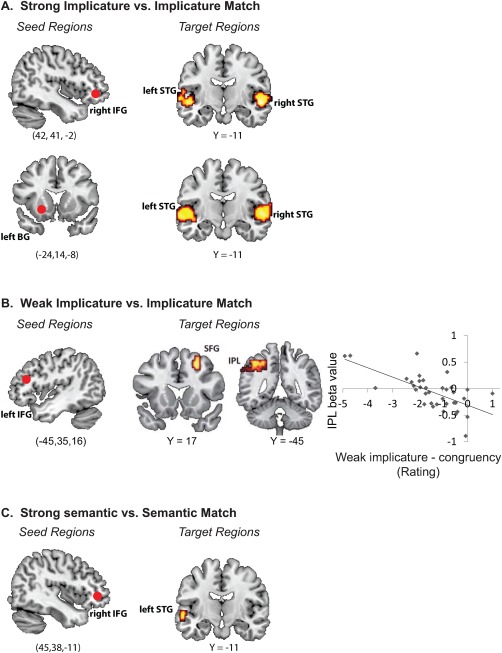
PPI results under different contrast. (A) shows increased connectivity between ventral RIFG/LBG and bilateral STG, under the strong‐implicature mismatch versus implicature match contrast. (B) shows the decreased connectivity between dorsal LIFG and right SFG, and response‐modulated increased connectivity between dorsal LIFG and left IPL, under the weak‐implicature mismatch versus implicature match contrast. (C) shows the increased connectivity between ventral RIFG and left STG, under the strong‐semantic mismatch versus semantic match contrast. [Color figure can be viewed at http://wileyonlinelibrary.com]
Table 4.
Regions showing functional connectivity with seed regions for the contrast “Implicature Strong Mismatch vs. Implicature Match,” “Implicature Weak Mismatch vs. Implicature Match,” “Semantic Strong Mismatch vs. Semantic Match”
| Contrast | Seed region | Connectivity | Target region | Size | BA | Coordinate |
|---|---|---|---|---|---|---|
| Implicature Strong vs. Implicature Match | R IFG | Increased | L STG | 83 | 22 | −60, −31, 10 |
| 167 | −57, −7, −5 | |||||
| R STG | 269 | 22 | 54, −10, −8 | |||
| L BG | Increased | L ventral IFG | 86 | 47 | −36, 32, −11 | |
| Increased | L STG | 828 | 22/48 | 54, −7, −5 | ||
| R STG | 471 | 22/48 | 54, −16, −2 | |||
| Implicature Weak vs. Implicature Match | L dorsal IFG | Increased | L IPL | 445 | 7/40 | −30, −40,43 |
| Decreased | R SFG | 97 | 8 | 24,20,49 | ||
| Semantic Strong vs. Semantic Match | R IFG | Increased | L STG | 200 | 22 | −66, −19, 7 |
Notably, the connectivity between dorsal LIFG and left IPL were modulated by the rating difference between “Implicature Weak Mismatch vs. Implicature Match.”
Note: L, left; R, right; BA, Broadman area. “Implicature Strong” means implicature strong mismatch, and “Implicature Weak” means implicature weak mismatch. Coordinates a displayed in MNI system.
DISCUSSION
The main goal of the present study was to characterize the difference between scalar‐implicature‐based and semantic‐based meaning processing, and to isolate the neural correlates of these two processes in a picture–sentence verification task. To do this, we manipulated the level of mismatch between the quantitative information displayed in pictures and the information either implied by a quantifier (you‐de) or stated by a quantifier (shao‐shu‐de). Behaviorally, we found that sentences were considered less mismatched with their corresponding pictures when the mismatch was based on a scalar implicature rather than on inherent semantics; more importantly, the implicature mismatch conditions showed a difference between weak and strong mismatch that was not observed as strongly in the semantic‐based mismatch conditions. These results suggest that implicature‐inducing quantifier you‐de and specific quantifier shao‐shu‐de are processed differently, even though both encoded (either via implicature or via lexical semantics) the same interpretations, not most and not all. At the neural level, we found that compared with the implicature match, the implicature mismatch, regardless of the strength, was associated with activity in left ventral IFG (BA47), right IFG (BA 45/47), and bilateral BG, and showed an increased connectivity between right IFG/left BG and bilateral STG. Moreover, left dorsal IFG (BA45) was additionally activated in the weak implicature mismatch; this region had a decreased connectivity with right SFG and a behaviorally modulated increased connectivity with left IPL. For the semantic conditions, compared with the matched control, both strong and weak mismatch also evoked left ventral IFG (BA47) and right IFG (BA47) activity; an increased connectivity between right IFG and left STG was also found for strong mismatch. These findings suggest that reinterpretation of meaning in implicature and semantic failures have both common and distinct neural substrates. Moreover, consistent with theoretical models associating sub‐regions in left IFG with different linguistic processes [Badre et al., 2005; Friederici, 2012; Hagoort, 2005; Jung‐Beeman, 2005; Lau et al., 2008; Zhu et al., 2013; see Bookheimer, 2002; Price, 2012; Rogalsky and Hickok, 2011 for reviews], we revealed a division of labor between left ventral (BA47) and dorsal (BA45) IFG. Whereas the ventral IFG was activated for mismatch conditions regardless of the type of meaning and may have played a domain‐general role for meaning unification, the dorsal IFG (BA45) was specific to the weak implicature mismatch in the current study and may have played a pragmatic‐specific role for scalar implicature realization.
Below we explore three issues related to: (1) brain areas commonly involved in both the implicature‐based and semantic‐based meaning failures and the brain network involved in dealing with the domain‐general mismatch; (2) brain areas uniquely involved in the implicature‐based meaning failure and the brain network involved specifically in resolving such mismatch; and (3) neural differences between strong and weak implicature mismatch processing and their implications for theories of pragmatic comprehension.
Domain‐General Mismatch Processing: left IFG (BA47), Right IFG (BA45/47), and Bilateral STG
In both implicature (you‐de) and semantic (shao‐shu‐de) conditions, the strong and weak mismatch between the quantity information displayed in pictures and the information implied by the scalar quantifier activated left ventral IFG (BA47) and right IFG (BA45/47). Left ventral IFG has been found to be activated in contexts that require unifying sentence meaning based on pragmatic inference into the sentential context [Chan et al., 2012; Tesink et al., 2009; see also Shetreet et al., 2014a for scalar implicature], and also implicated in sentences containing mismatch of counterfactual [Nieuwland, 2012] or event possibility [Li et al., 2014]. Therefore, the ventral IFG may function as a general meaning unification: on one hand, it works for combinatorial processing of the semantic representations of the individual words to form a meaningful and coherent representation in face of semantic mismatch [Hagoort, 2005; see, however, Bemis and Pylkkänen, 2011], and on the other hand, it utilizes background knowledge and discourse context to bridge successive utterances in face of pragmatic mismatch [Li et al., 2014]. When a conflict is detected, the executive control region right IFG (BA 47) is activated for conflict inhibition [Badre and Wagner, 2007; Badre et al., 2005; Li et al., 2014; Miller and Cohen, 2001; Ye and Zhou, 2009a, 2009b]. For implicature mismatch, right IFG allows the individuals to suppress the inappropriate implicatures using the contextual information and to implement retrospective reevaluation in search of the origin of conflict. For semantic mismatch sentences, since no alternative interpretation is available, the RIFG functions to inhibit or replace the inappropriate access of the lexical meaning [Li et al., 2014; Nieuwland et al., 2007]. The general role of left ventral IFG for meaning unification and right IFG for conflict meaning inhibition is also supported by the results of parametric analysis for implicature mismatch. We found a monotonic increasing activation in ventral LIFG and RIFG under three implicature conditions: implicature match, weak implicature mismatch, strong implicature mismatch, in which the perceived mismatch rating is monotonic increasing and therefore more cognitive resources are required to resolve the mismatch.
For strong mismatch in both “you‐de” and “shao‐shu‐de” conditions, we additionally found an increased connectivity between right IFG and STG. The STG is a multimodal association area [Beauchamp et al., 2004; Calvert et al., 2001; Hein et al., 2007; Taylor et al., 2006; Van Atteveldt et al., 2004], and this connectivity may reflect how the executive control system was involved in resolving both implicature and semantic failure in a multi‐modal presentation of the context and sentence information. In face of an infelicitous scalar inference, the frontal‐temporal system recruits right IFG to suppress a context‐inappropriate interpretation (e.g., some but not all) and strengthen the context‐appropriate information (e.g., some [at least one, up to and including all]). The subsequent representation may or may not be integrated with the pictorial context through the audio‐visual integration in STG, which cross‐modal integration may ease the access of the logic meaning of some, allowing for the number information (some and possibly all) in the sentence to be re‐integrated into the picture context that was dependent on the activation of BG (see detailed discussion later). In face of the semantic mismatch between quantifier information and the proportion of entities shown in the visual context, the right IFG suppresses the quantity expression of shao‐shu‐de, also inducing large efforts in the cross‐modal integration in STG. This effort results in a final replacement of this violated quantifiers with the appropriate ones that match the picture [Li et al., 2014], or reinterpret the meaning of specific quantifier based on the contextual quantity.
It is worth noting that, compared with the strong semantic mismatch, there is a decreasing activation of left ventral IFG and right IFG for weak semantic mismatch, and no frontal–temporal connectivity was engaged in comparing weakly‐semantic mismatch with matched sentences. This was surprising, as no significant difference between the participants mismatch rating under weak and strong semantic condition, for which we should expect for both mismatches the same activation of left ventral IFG and right IFG, and similar conflict resolution strategies: the inhibition of inappropriate meaning and the replacement/reinterpretation with the appropriate ones. Indeed, a direct comparison between strong and weak semantic mismatch shows different network involved for different mismatch (e.g., right SMG, AG for strong mismatch, left IFG/precentral gyrus for weak mismatch). Further research is need in order to determine what guided the behavioral and neural processing difference between strong and weak semantic mismatch in quantity processing.
Implicature‐Specific Mismatch Processing: Basal Ganglia
In addition to frontal‐temporal network, we found BG which is specifically activated to resolve implicature mismatch. Different from the quantifier shao‐shu‐de, coherence between the picture and sentence in the you‐de condition could be achieved by accessing the logical meaning of you‐de (some [at least one, up to and including all]). This processing is likely to be operated in BG, which has been implicated in determining which of several possible behaviors is to execute at a certain time [Cameron et al., 2010; Van Schouwenburg et al., 2010]. In particular, the activation of BG facilitates the processing of meaning switching [e.g., reinterpreting the input from the nonliteral and mismatched meaning into a literal but matched meaning; Mestres‐Missé et al., 2014], and through an visual‐auditory integration operation in STG (for strong implicature mismatch) implements the comprehension of sentences with infelicitous but technically true quantifiers like you‐de. For semantic mismatch, no “switching” process is available as there is no alternative interpretation of shao‐shu‐de, and therefore no activation occurred in BG.
In a neuropsychological study [McNamara et al., 2010], the author found that Parkinson's patients suffering from basal ganglia dysfunction have difficulty in comprehending indirect replies. Understanding an indirect requires the comprehension system to reorganize the input information into a plausible, nonliteral interpretation of sentence. This result, together with our findings, points to a role of BG in contextual‐based “frame‐shifting” [Coulson and Williams, 2005; Coulson and Wu, 2005], which means that, if an activated meaning does not fit the contextual expectancy, an alternative one is derived/retrieved. Future studies should be carried out to investigate the functions of BG in pragmatic meaning processing, based on the current findings about the role of such subcortical activity in both non‐literal meaning generation but also in such meaning failure.
The activation of BG, together with the bilateral IFG, allows us to hypothesize that executive function resources are involved in the processing of scalar implicature mismatch; this hypothesis remains to be confirmed in future research [see Ye and Zhou, 2009b]. It is worth noting that, while various individual difference measures other than the executive function (e.g., social skill and working memory) have been implicated in scalar implicature processing in other studies, most of these have used paradigms very different from the present study [e.g., downstream processing, Nieuwland et al., 2010; explicit implicature cancellation, Husband, 2014; implicature generation, Politzer‐Ahles et al., 2014]. In paradigms that do explicitly test the comprehension of infelicitous scalar implicatures, however, correlations with individual working memory [De Neys and Schaeken, 2007; Dieussaert et al., 2011] and logical ability [Politzer‐Ahles, 2013, Experiment 3] have been observed more often than correlations with executive function.
We note that a potential alternative explanation of the BG activation may have to do with semantic processing. While we have interpreted the difference between the pattern observed in response to the quantifier you‐de and the quantifier shao‐shu‐de as being due to the fact that you‐de has an implicature‐based upper bound and shao‐shu‐de has a semantically explicit upper bound, there are other potentially relevant differences between these quantifiers. For example, “less than half” is downward entailing whereas “some” is not [Deschamps et al., 2015], and their Mandarin equivalents shao‐shu‐de and you‐de appear to also have these properties (we thank an anonymous reviewer for pointing out this possibility). However, we are not aware of any a priori reason to predict that this difference would have interacted with the context manipulation to produce the effects we have observed, which are consistent with effects related to realizing scalar inferences. These effects might also be consistent with an effect related to entailment or some similar semantic property, but we are not currently aware of a theory that would make this prediction.
Weak Versus Strong Implicature‐Specific Mismatch Processing: Left Dorsal IFG
While the weak implicature activated mostly similar regions as the strong implicature mismatch [i.e., left ventral IFG (BA47), right IFG (BA45/47) and BG], it also activated more dorsal regions of the IFG (BA45) than the strong mismatch did, and also showed different patterns of connectivity. It could be the case that comprehension of the weak mismatch involved widening the interpretation while still keeping some scalar‐inference‐based interpretations active (e.g., eschewing the “not most” interpretation while retaining the “not all”), in which case the left dorsal IFG activation may be related to nearby activation previously shown in inferior or middle prefrontal cortex for scalar inference realization [Politzer‐Ahles and Gwilliams, 2015; Shetreet et al., 2014a]. Indeed, the rating difference between the weak and strong implicature mismatch was positively correlated with the activation in dorsal LIFG. This suggests that individuals who recruited more cognitive resources to infer the contextually appropriate, alternative scalar implicature also were more willing to accept the weakly mismatching sentence. Moreover, the activation of left dorsal IFG further inhibited the activation of right SFG, seeing the decreased connectivity between left dorsal IFG and right SFG for the weak implicature mismatch relative to the matched one, and increased the activation of left IPL in which the connectivity increased in proportion to how mismatched the participants found the weak mismatch sentences. As the SFG has been found to be activated for conflict detection [Braver and Barch, 2006; Nee et al., 2007; Ye and Zhou, 2009a], the inference process can effectively help individuals to call off the mismatch they originally perceived. As the left IPL has been found to be activated for quantity processing [Heim et al., 2012; McMillan et al., 2005; Sandrini et al., 2004; Wei et al., 2014], it is possible that the re‐realizing of the alternative pragmatic interpretation recruited cognitive resources for quantitative re‐analysis, especially for individuals who perceived the weakly mismatch sentences as more mismatched. These individuals might have difficulty in realizing the not all interpretation effectively, and accordingly to make efforts to identify the alternative set for the sentence you‐de.
A traditional account of scalar inference processing may not straightforwardly predict such differences between the weak and strong implicature mismatches. From a linguistic standpoint, both the “not all” and “not most” interpretations are assumed to be realized in qualitatively similar ways (by negating an alternative, all or most, which is informationally stronger than some). Realizing that some can be consistent with “most” and that some can be consistent with “all” would also be assumed to work in qualitatively similar ways: both would just involve re‐allowing a stronger alternative term. Under such an account, there is no clear reason why the endpoint of a scale (e.g., all) should have a privileged status relative to a middle point (e.g., most) that would make inferences associated with it be processed differently. The present results, however, suggest that it did [see similar arguments about scalar adjectives, Kennedy and McNally, 2005, among others]. Another possibility is that it is not the endpoint or ordering of the scale that has special relevance, but that certain alternatives on the scale differ in their salience and relevance to a given discourse context [see, e.g., Geurts, 2010]. On the <some, most, all> scale, it is possible that most and all differ in terms of their prototypicality or default relevance on this scale (with most being less prototypical or less relevant) in which case their processing may also differ. If this were the case, changing the context to make one or the other alternative more relevant or more salient could also change the pattern of brain activity between them; this is an open question for future research.
If the present results can be taken as evidence that strong and weak implicature were processed in a qualitatively different way, this would pose a strong challenge to the notion that research on the some‐as‐“not all” inference (which constitutes the vast majority of studies in the field of experimental pragmatics) represents well the phenomenon of pragmatic processing in general. If two inferences as similar as some‐as‐“not all” and some‐as‐“not most” are processed in different ways, then even more different implicatures [e.g., argument saturation: the interpretation of Rachel picked up a hammer and smashed a vase as meaning that Rachel used the hammer to smash the vase; see, e.g., Doran et al., 2012, for other examples] are likely to be processed in even more different ways. However, while this is a reasonable expectation (indeed, inference is not a monolithic phenomenon and it is highly unlikely that all inferences are processed in the same way) we believe such an interpretation of the results may be premature. First of all, even though weak mismatch did elicit activity in a different region than strong mismatch, this was nonetheless a very nearby region (a more dorsal portion of the same gyrus); without more specific hypotheses about the functional significance of each of these regions and effects, it is difficult to quantify how different the BOLD activation patterns must be to really represent qualitatively different processing mechanisms. Secondly, while different brain activation patterns were observed, this occurred in an exploratory, effect‐nonspecific test, and thus these differences should be confirmed through replication in targeted experiments before concluding that weak and strong implicature mismatch absolutely do have different neural substrates.
According to the classic linguistic approach to scalar implicatures, mentalizing is assumed to be involved in generating implicatures as other types of pragmatic meaning [Wilson and Wharton, 2006], since the listener speculates about the intentions of the speaker [Flobbe et al., 2008; Grice, 1975; Pijnacker et al., 2009]. However, neither strong nor weak implicature mismatch in our study reveals activation in the mentalizing (i.e., Theory of Mind) network. It is possible that different networks are involved in realizing the scalar inference versus revising the interpretation when the inference is infelicitous [see, e.g., Shetreet et al., 2014a; although neither this study nor Politzer‐Ahles and Gwilliams, 2015, observed activation in the mentalizing network even for inference realization, let alone inference failure]. Another possibility is that scalar implicatures are generated only by a grammatical‐semantic component [for detailed accounts, see Chierchia, 2004; Chierchia et al., 2012], resulting in activation in IFG rather than in regions related to mentalizing [Shetreet et al., 2014a]. Our result seems consistent with such an argument, in that it revealed an additional involvement of the ventral IFG in processing weak pragmatic incongruence that has high demand of inference, as well as dorsal IFG. Of course, finding that semantic mechanisms are involved in scalar implicature does not rule out the possibility that pragmatic mechanisms are also crucially involved [Chemla and Singh, 2014], and might be revealed in future studies with different methods or manipulations. Likewise, potential differences between the neural representation of scalar implicatures and other, arguably more “pragmatic” implicatures (such as irony, indirect replies, bridging inferences, manner implicatures, etc.), should be investigated in future study, as evidence for involvement of the semantic network in scalar implicatures does not necessarily entail that this network will be involved in other types of pragmatic meaning
CONCLUSION
By manipulating the consistency between quantitative information of referents in a picture and the quantifier used in a sentence, we investigated the brain activity underlying the processing of inference‐based meaning and explicit lexical meaning. Behaviorally, we found that sentences that mismatched the context because of a scalar implicature were more acceptable than sentences that mismatched the context because of their semantic meaning. Neurally, implicature mismatch elicited activity in several regions that semantic mismatch did not, including the basal ganglia and dorsal IFG. Interestingly, somewhat different regions were activated for strong implicature mismatch, in which the scalar quantifier you‐de (“some”) was used in a context where all was expected, versus for weak implicature mismatch, in which you‐de was used in a context where most was expected. These results both point to unique roles played by the basal ganglia and dorsal IFG in the realization of meaning enrichment in quantity implicatures, and raise important questions about the nature of pragmatic processing in general and its neural substrates.
Supporting information
Supporting Information
REFERENCES
- Ashburner J, Friston KJ (2005): Unified segmentation. Neuroimage 26:839–851. [DOI] [PubMed] [Google Scholar]
- Badre D, Poldrack RA, Paré‐Blagoev EJ, Insler RZ, Wagner AD (2005): Dissociable controlled retrieval and generalized selection mechanisms in ventrolateral prefrontal cortex. Neuron 47:907–918. [DOI] [PubMed] [Google Scholar]
- Badre D, Wagner AD (2007): Left ventrolateral prefrontal cortex and the cognitive control of memory. Neuropsychologia 45:2883–2901. [DOI] [PubMed] [Google Scholar]
- Beauchamp MS, Lee KE, Argall BD, Martin A (2004): Integration of auditory and visual information about objects in superior temporal sulcus. Neuron 41:809–824. [DOI] [PubMed] [Google Scholar]
- Bemis D, Pylkkänen L (2011): Simple composition: A magnetoencephalography investigation into the comprehension of minimal linguistic phrases. J Neurosci 31:2801–2814. [DOI] [PMC free article] [PubMed] [Google Scholar]
- Bookheimer S (2002): Functional MRI of language: New approaches to understanding the cortical organization of semantic processing. Annu Rev Neurosci 25:151–188. [DOI] [PubMed] [Google Scholar]
- Bott L, Bailey T, Grodner D (2012): Distinguishing speed from accuracy in scalar implicatures. J Mem Lang 66:123–142. [Google Scholar]
- Bott L, Noveck I (2004): Some utterances are underinformative: The onset and time course of scalar inferences. J Mem Lang 51:437–457. [Google Scholar]
- Braver TS, Barch DM (2006): Extracting core components of cognitive control. Trends Cogn Sci 10:529–632. [DOI] [PubMed] [Google Scholar]
- Breheny R (2008): A new look at the semantics and pragmatics of numerically quantifed noun phrases. J Semant 25:93–140. [Google Scholar]
- Calvert GA, Hansen PC, Iversen SD, Brammer MJ (2001): Detection of audio‐visual integration sites in humans by application of electrophysiological criteria to the BOLD effect. Neuroimage 14:427–438. [DOI] [PubMed] [Google Scholar]
- Cameron IG, Watanabe M, Pari G, Munoz DP (2010): Executive impairment in Parkinson's disease: Response automaticity and task switching. Neuropsychologia 48:1948–1957. [DOI] [PubMed] [Google Scholar]
- Carston R ( 1988): Implicature, explicature, and truth‐theoretic semantics In: Kempson R, editor. Mental Representations: The Interface Between Language and Reality. Cambridge: Cambridge University Press; pp. 155–181. [Google Scholar]
- Chan YC, Chou TL, Chen HC, Liang KC (2012): Segregating the comprehension and elaboration processing of verbal jokes: An fMRI study. Neuroimage 61:899–906. [DOI] [PubMed] [Google Scholar]
- Chemla E, Singh R (2014): Remarks on the experimental turn in the study of scalar implicature. Lang Linguist Comp 8:373–386. [Google Scholar]
- Chierchia G ( 2004): Scalar implicatures, polarity phenomena, and the syntax/pragmatics interface In: Belletti A, editor. Structures and Beyond: The Cartography of Syntactic Structures, Vol. 3 Oxford: Oxford University Press; pp. 39–103. [Google Scholar]
- Chierchia G, Fox D, Spector B (2012): Scalar implicature as a grammatical phenomenon In: Maienborn C, von Heusinger H, Portner P, editors. Semantics: An International Handbook of Natural Language Meaning, Vol. 3 Berlin: Mouton de Gruyter; pp. 2297–2331. [Google Scholar]
- Coulson S, Wu YC (2005): Right hemisphere activation of joke‐related information: An event‐related brain potential study. J Cogn Neurosci 17:494–506. [DOI] [PubMed] [Google Scholar]
- Coulson S, Williams RF (2005): Hemispheric asymmetries and joke comprehension. Neuropsychologia 43:128–141. [DOI] [PubMed] [Google Scholar]
- De Neys W, Schaeken W (2007): When people are more logical under cognitive load. Exp Psychol 54:128–133. [DOI] [PubMed] [Google Scholar]
- Degen J, Tanenhaus MK (2015): Processsing scalar implicature: A Constraint‐Based approach. Cogn Sci 39:667–710. [DOI] [PMC free article] [PubMed] [Google Scholar]
- Deschamps I, Agmon G, Loewenstein Y, Grodzinsky Y (2015): The processing of polar quantifiers, and numerosity perception. Cognition 143:115–128. [DOI] [PubMed] [Google Scholar]
- Dieussaert K, Verkerk S, Gillard E, Schaeken W (2011): Some effort for some: Further evidence that scalar implicatures are effortful. Q J Exp Psychol 64:2352–2367. [DOI] [PubMed] [Google Scholar]
- Doran R, Ward G, Larson M, McNabb Y, Baker R (2012): A novel experimental paradigm for distinguishing between what is said and what is implicated. Language 88:124–154. [Google Scholar]
- Flobbe L, Verbrugge R, Hendriks P, Kramer I (2008): Children's application of theory of mind in reasoning and language. J Logic Lang Inform 17:417–442. [Google Scholar]
- Friederici AD (2012): The cortical language circuit: From auditory perception to sentence comprehension. Trends Cogn Sci 16:262–268. [DOI] [PubMed] [Google Scholar]
- Friston KJ, Buechel C, Fink GR, Morris J, Rolls E, Dolan RJ (1997): Psychophysiological and modulatory interactions in neuroimaging. Neuroimage 6:218–229. [DOI] [PubMed] [Google Scholar]
- Geurts B (2006): Take “five”: the meaning and use of a number word In: Vogeleer S, Tasmowski L, editors. Non‐Definiteness and Plurality. Amsterdam/Philadelphia: Benjamins; pp. 311–329. [Google Scholar]
- Geurts B (2010): Quantity Implicatures. Cambridge: Cambridge University Press. [Google Scholar]
- Grice HP (1975): Logic and conversation In Cole P, Morgan JL, editors. Syntax and Semantics Vol.3 New York: Academic Press; pp. 41–58. [Google Scholar]
- Hagoort P (2005): On Broca, brain, and binding: A new framework. Trends Cogn Sci 9:416–423. [DOI] [PubMed] [Google Scholar]
- Hagoort P, Hald L, Bastiaansen M, Petersson K (2004): Integration of word meaning and world knowledge in language comprehension. Science 304:438–441. [DOI] [PubMed] [Google Scholar]
- Hartshorne J, Liem Azar S, Snedeker J, Kim A (2014): The neural computation of scalar implicature. Lang Cogn Neurosci 30:620–634. [DOI] [PMC free article] [PubMed] [Google Scholar]
- Heim S, Amunts K, Drai D, Eickhoff SB, Hautvast S, Grodzinsky Y (2012): The language–number interface in the brain: A complex parametric study of quantifiers and quantities. Front Evol Neurosci 4:4. [DOI] [PMC free article] [PubMed] [Google Scholar]
- Hein G, Doehrmann O, Müller NG, Kaiser J, Muckli L, Naumer MJ (2007): Object familiarity and semantic congruency modulate responses in cortical audiovisual integration areas. J Neurosci 27:7881–7887. [DOI] [PMC free article] [PubMed] [Google Scholar]
- Horn L (1972): On the semantic properties of logical operators in English, Ph.D. dissertation. University of California, Los Angeles. [Google Scholar]
- Husband E ( 2014): A subclinical study of the cognitive resources underlying scalar implicature: A focus on scalar adjectives In: Schütze CT, Stockall L, editors. UCLA Working Papers in Linguistics. pp. 189–211. [Google Scholar]
- Jung‐Beeman M (2005): Bilateral brain processes for comprehending natural language. Trends Cogn Sci 9:512–518. [DOI] [PubMed] [Google Scholar]
- Kennedy C, McNally L (2005): Scale structure and the semantic typology of gradable predicates. Language 81:345–381. [Google Scholar]
- Lau EF, Phillips C, Poeppel D (2008): A cortical network for semantics constructing the N400. Nat Rev Neurosci 9:920–933. [DOI] [PubMed] [Google Scholar]
- Levinson SC (2000): Presumptive Meanings. Cambridge, MA: MIT Press. [Google Scholar]
- Li S, Jiang X, Yu H, Zhou X (2014): Cognitive empathy modulates the processing of pragmatic constraints during sentence comprehension. Soc Cogn Affect Neurosci 9:1166–1174. [DOI] [PMC free article] [PubMed] [Google Scholar]
- McMillan CT, Clark R, Moore P, Devita C, Grossman M (2005): Neural basis for generalized quantifier comprehension. Neuropsychologia 43:1729–1737. [DOI] [PubMed] [Google Scholar]
- Marty P, Chemla E (2013): Scalar implicatures: Working memory and a comparison with only. Front Psychol 4:403. [DOI] [PMC free article] [PubMed] [Google Scholar]
- McNamara P, Holtgraves T, Durso R, Harris E (2010): Social cognition of indirect speech: Evidence from Parkinson's disease. J Neurolinguist 23:162–171. [DOI] [PMC free article] [PubMed] [Google Scholar]
- Mestres‐Missé A, Bazin PL, Trampel R, Turner R, Kotz SA (2014): Dorsomedial striatum involvement in regulating conflict between current and presumed outcomes. Neuroimage 98:159–167. [DOI] [PubMed] [Google Scholar]
- Miller EK, Cohen JD (2001): An integrative theory of prefrontal cortex function. Annu Rev Neurosci 24:167–202. [DOI] [PubMed] [Google Scholar]
- Nee TE, Wagner TD, Jonides J (2007): Interference resolution: Insights from a metaanalysis of neuroimaging tasks. Cogn Affect Behav Neurosci 7:1–17. [DOI] [PubMed] [Google Scholar]
- Newstead S (1988): Quantifiers as fuzzy concepts In: Zétényi T, editor. Advances in Psychology, Vol. 56 New York: North‐Holland; pp. 51–72. [Google Scholar]
- Ni W, Constable RT, Mencl WE, Pugh KR, Fulbright RK, Shaywitz SE, Shaywitz BA, Gore JC, Shankweiler D (2000): An event‐related neuroimaging study distinguishing form and content in sentence processing. J Cogn Neurosci 12:120–133. [DOI] [PubMed] [Google Scholar]
- Nieuwland MS (2012): Establishing propositional truth‐value in counterfactual and real world contexts during sentence comprehension: Differential sensitivity of the left and right inferior frontal gyri. Neuroimage 59:3433–3440. [DOI] [PubMed] [Google Scholar]
- Nieuwland MS, Petersson KM, Van Berkuma JJA (2007): On sense and reference: Examining the functional neuroanatomy of referential processing. Neuroimage 37:993–1004. [DOI] [PubMed] [Google Scholar]
- Nieuwland MS, Ditman T, Kuperberg GR (2010): On the incrementality of pragmatic processing: An ERP investigation of informativeness and pragmatic abilities. J Mem Lang 63:324–346. [DOI] [PMC free article] [PubMed] [Google Scholar]
- Noveck I, Posada A (2003): Characterizing the time course of an implicature: An evoked potentials study. Brain and Language 85:203–210. [DOI] [PubMed] [Google Scholar]
- Pijnacker J, Hagoort P, Buitelaar J, Teunisse J, Geurts B (2009): Pragmatic inferences in high‐functioning adults with autism and Asperger syndrome. J Autism Dev Disorders 39:607–618. [DOI] [PubMed] [Google Scholar]
- Politzer‐Ahles S (2014): Self‐paced reading experiment on SOME and MOST. unpublished manuscript. https://osf.io/7swt2/
- Politzer‐Ahles S (2012): Are intermediate levels of the scale used during online comprehension of scalar implicatures? Kansas Work Pap Linguist 33:1–15. [Google Scholar]
- Politzer‐Ahles S (2013): Psycholinguistic and neurolinguistics investigations of scalar implicature Doctoral dissertation, University of Kansas. [Google Scholar]
- Politzer‐Ahles S, Gwilliams L (2015): Involvement of prefrontal cortex in scalar implicatures: Evidence from magnetoencephalography. Lang Cogn Neurosci 30:853–866. [DOI] [PMC free article] [PubMed] [Google Scholar]
- Politzer‐Ahles S, Fiorentino R, Jiang X, Zhou X (2013): Distinct neural correlates for pragmatic and semantic meaning processing: An event‐related potential investigation of scalar implicature processing using picture–sentence verification. Brain Res 1490:134–152. [DOI] [PMC free article] [PubMed] [Google Scholar]
- Politzer‐Ahles S, Fiorentino R, Durbin J, Li L (2014): The role of working memory in the online realization of scalar inferences Poster presented at 27th CUNY Conference on Human Sentence Processing, Columbia, SC, USA. [Google Scholar]
- Price CJ (2012): A review and synthesis of the first 20 years of PET and fMRI studies of heard speech, spoken language and reading. Neuroimage 62:816–847. [DOI] [PMC free article] [PubMed] [Google Scholar]
- Pylkkänen L, Brennan J, Bemis DK (2011): Grounding the cognitive neuroscience of semantics in linguistic theory. Lang Cogn Processes 26:1317–1337. [Google Scholar]
- Rogalsky C, Hickok G (2011): The role of Broca′s area in sentence comprehension. J Cogn Neurosci 23:1664–1680. [DOI] [PubMed] [Google Scholar]
- Rullman H, You A (2006): General number and the semantics and pragmatics of indefinite bare nouns in Mandarin Chinese In: von Heusinger K, Turner KP, editors. Where Semantics Meets Pragmatics. Amsterdam: Elsevier; pp. 175–196. [Google Scholar]
- Sandrini M, Rossini PM, Miniussi C (2004): The differential involvement of inferior parietal lobule in number comparison: A rTMS study. Neuropsychologia 42:1902–1909. [DOI] [PubMed] [Google Scholar]
- Shetreet E, Chierchia G, Gaab N (2014a): When some is not every: Dissociating scalar implicature generation and mismatch. Hum Brain Mapp 35:1503–1514. [DOI] [PMC free article] [PubMed] [Google Scholar]
- Shetreet E, Chierchia G, Gaab N (2014b): When three is not some: On the Pragmatics of Numerals. J Cogn Neurosci 26:854–863. [DOI] [PubMed] [Google Scholar]
- Shibata M, Abe JI, Itoh H, Shimada K, Umeda S (2011): Neural processing associated with comprehension of an indirect reply during a scenario reading task. Neuropsychologia 49:3542–3550. [DOI] [PubMed] [Google Scholar]
- Spector B (2013): Bare numerals and scalar implicatures. Lang Linguist Comp 7:273–294. [Google Scholar]
- Sperber D, Wilson D ( 1995): Relevance: Communication and Cognition, 2nd ed Oxford: Blackwell. [Google Scholar]
- Spotorno N, McMillan C, Rascovsky K, Irwin D, Clark R, Grossman M (2015): Beyond words: Pragmatic inference in behavioral variant of frontotemporal degeneration. Neuropsychologia 75:556–564. [DOI] [PMC free article] [PubMed] [Google Scholar]
- Tavano E (2010): The Balance of Scalar Implicature. Doctoral dissertation, University of Southern California. Los Angeles. [Google Scholar]
- Taylor KI, Moss HE, Stamatakis EA, Tyler LK (2006): Binding crossmodal object features in perirhinal cortex. Proc Natl Acad Sci USA 103:8239–8244. [DOI] [PMC free article] [PubMed] [Google Scholar]
- Tesink CM, JY, Petersson KM, Van Berkum JJA, Van den Brink D, Buitelaar JK, Hagoort P (2009): Unification of speaker and meaning in language comprehension: An fMRI study. J Cogn Neurosci 21:2085–2099. [DOI] [PubMed] [Google Scholar]
- Van Atteveldt N, Formisano E, Goebel R, Blomert L (2004): Integration of letters and speech sounds in the human brain. Neuron 43:271–282. [DOI] [PubMed] [Google Scholar]
- Van Schouwenburg MR, den Ouden HE, Cools R (2010): The human basal ganglia modulate frontal‐posterior connectivity during attention shifting. J Neurosci 30:9910–9918. [DOI] [PMC free article] [PubMed] [Google Scholar]
- Wei W, Chen C, Yang T, Zhang H, Zhou X (2014): Dissociated neural correlates of quantity processing of quantifiers, numbers, and numerosities. Hum Brain Mapp 35:444–454. [DOI] [PMC free article] [PubMed] [Google Scholar]
- Wilson D, Sperber D (2004): Relevance theory In: Horn LR, Ward G, editors. The Handbook of Pragmatics. Oxford: Blackwell; pp. 607–632. [Google Scholar]
- Wilson D, Wharton T (2006): Relevance and prosody. J Pragmat 38:1559–1579. [Google Scholar]
- Ye Z, Zhou X (2009a): Conflict control during sentence comprehension: fMRI evidence. Neuroimage 48:280–290. [DOI] [PubMed] [Google Scholar]
- Ye Z, Zhou X (2009b): Executive control in language processing. Neurosci Biobehav Rev 33:1168–1177. [DOI] [PubMed] [Google Scholar]
- Zhu Z, Feng G, Zhang JX, Li G, Li H, Wang S (2013): The role of the left prefrontal cortex in sentence‐level semantic integration. Neuroimage 76:325–331. [DOI] [PubMed] [Google Scholar]
Associated Data
This section collects any data citations, data availability statements, or supplementary materials included in this article.
Supplementary Materials
Supporting Information