



Abstract
The purpose of the present study was to conduct a review of the research on the Sport Education (SE) studies that have examined the development of students’ personal and social skills. Research articles selected were found through Web of Science, SCOPUS, Academic Search Complete, ERIC, SPORTDiscus with Full Text, Education Source, PsycINFO and PsycARTICLES databases. The keywords “Sport Education” and “physical education” were used in different combinations. The articles were included for analysis if the following criteria were met: (i) were published in peer-reviewed international journals indexed in JCR (Journal Citation Reports) or SJR (Scientific Journal Rankings); (ii) were available in full-text; (iii) examined personal and social variables included or measured as main outcomes within the SE model. The quality of the selected studies was scored using a quality assessment list. Fifty-one studies were included. Results showed that, considering the development of social and personal competencies, the majority of SE research took place in Spain and USA in a co-educational PE context (high school). Enjoyment/satisfaction, enthusiasm and engagement were the predominant outcome measures, using a non-experimental design and multiple qualitative tools in more than half of the studies. Few studies established the fidelity of the model implementation. There is a need for future research to consider other samples, contexts, cultures and types of sports seeking to reinforce the positive impact of SE on the personal and social competencies. Longer units with a good planning, mixed and quantitative methodological designs and the report of the model fidelity would be also particularly important for future investigations.
Key points.
Considering the development of social and personal competencies, the majority of SE research took place in Spain and USA in a co-educational PE context (high school).
Enjoyment/satisfaction, enthusiasm and engagement were the predominant outcome measures, using a non-experimental design and multiple qualitative tools in more than half of the studies.
Few studies established the fidelity of the model implementation.
Future studies should consider other samples, contexts, cultures, types of sports and longer units seeking to reinforce the positive impact of SE on the personal and social competencies.
Key words: Sport Education model, physical education, pedagogical models, personal skills, social skills
Introduction
Physical Education (PE) is recognized by its crucial role in students’ acquisition of values and competencies that contribute to their motor, cognitive, emotional, personal and social development and facilitate the inclusion in current society, preparing them for the future (Giraldéz, 2006; Mesquita, 2012; Rosado and Mesquita, 2011; Taggart, 1988).
The explicit and formal character of the instructional process, evident in the traditional pedagogical approaches (called teacher-centered approaches) have tended to dominate PE instruction for much of the 20th century (Gubacs-Collins, 2015; Gubacs-Collins and Olsen, 2010; Lee, 1993). The teaching/learning process is one in which the role of the teacher is primarily as instructional leader and students are expected to demonstrate more compliance than initiative (Metzler, 1989; Rosado and Mesquita, 2009; Rosenshine, 1979). This direct style has the potential to compromise students’ capabilities of building their own learning, and reduce the role of their cognitive and social processes, decision-making and autonomy (Bruning et al., 2004; Ennis, 2014; Metzler, 2011; Siedentop et al., 2011). As a result, a number of student-centered approaches (SCA) have been developed which are based on the constructive and social theories of learning (Hastie and Siedentop, 1999; Mesquita et al., 2012; Putnam et al., 1990). SCA are designed to stimulate the ability of students to make decisions, to reflect, and to solve problems (Dyson et al., 2004; Hastie and Mesquita, 2016). This then allows students to have a more proactive than reactive role in their own learning and changes the role of the teacher to one more of a facilitator (Ennis, 2014; Hattie, 2012; Jones, 2007; Mesquita, 2013).
In PE, one of the most widely implemented and researched “second generation of models that build on strong statements of democratic, student-centered practice” (Ennis, 2014, p.63) is SE (Siedentop et al., 2011). SE is a pedagogical model that incorporates the tenets of socio-constructivist learning theories recognized by its valences for "learning focused, provide measurable student outcomes, and assist students to become engaged in positive, learning-oriented sport environments" (Ennis, 2014, p.67). It is characterized by prioritizing more implicit and informal teaching strategies (prevails questioning) allowing students to make decisions during the learning process, and encouraging them to learn autonomously and responsibly (Mesquita et al., 2012). The features that underpin SE (seasons, affiliation, formal competition, culminating events, record keeping and festivity) aim to fulfil Siedentop’s (2002) goal of educating students to be “athletes in the fullest sense and to help them develop as competent, literate and enthusiastic sportspersons”. To do this, students are given opportunities to engage in a variety of roles, beyond that of simply as player. These can include coaches, referees, score keepers, statisticians, members of the sports organizing board or sports director.
According to the Cochrane Collaboration (Higgins et al., 2019), systematic reviews are important because they provide a high-level summary of primary research on a specific research question that attempts to identify, select, synthesize, and appraise all high-quality evidence relevant to that question to answer it. Further, systematic reviews collate all evidence pertinent to a priori selected criteria for eligibility to address the specific research question. Without them, researchers lack an understanding of the subject, of what has already been examined, how it has been researched, and what key concerns have been identified.
Previous systematic reviews of SE research (Araújo et al., 2014; Evangelio et al., 2018; Hastie et al., 2011; Hastie and Wallhead, 2016; Wallhead and O'Sullivan, 2005) have been structured with different focus. For example, Wallhead and O’Sullivan (2005) and Hastie, Martínez de Ojeda and Calderón (2011) focused on the achievement of the “big 5” aims of PE, namely students’ attitudes and values, personal and social skills, fitness, as well as motor skills and tactical knowledge. Later, Araújo, Mesquita and Hastie (2014) reviewed studies where there was a specific examination of students’ learning outcomes, while Hastie and Wallhead (2016) focused on the extent to which the competent, literate and enthusiastic goals of SE were achievable. Most recently, Evangelio et al. (2018) organized their review around SE’s impact on cognitive, social, affective and physical outcomes.
During recent years, PE programs have been challenged by the needs of children and youth in a changing environment (Chin and Edginton, 2014; Ennis, 2014; O’Sullivan, 2013) and the development of personal and social skills have become particularly valued. Hence, it is necessary to perform this review including the most prominent research, indicating which are the most studied and valued personal and social variables within the SE model, in order to answer specific research questions and indicate directions that future research and practice might follow.
The purpose of this study was to systematically review and synthesize the SE studies that have examined the development of students’ personal and social skills. The five research questions which guided the review of these studies were:
(Q1) Which contexts are the most prevalent with respect to research on the development of personal and social skills within SE?
(Q2) Who are the participants included in SE studies that consider the development of personal and social skills?
(Q3) What were the most frequently analyzed variables when participating in a SE season?
(Q4) What are the methodologies that have been used to investigate the development of personal and social skills within SE classes?
(Q5) How many studies have established the fidelity of the model implementation?
Methods
Search strategy
The systematic review followed the PRISMA protocol for reporting systematic reviews (Moher et al., 2009), and was conducted through electronic searches on eight databases. These include Web of Science, SCOPUS, Academic Search Complete, ERIC, SPORTDiscus with Full Text, Education Source, PsycINFO and PsycARTICLES. The search included all papers published up until March 2018, using the Boolean operators (AND, OR) to concatenate the search terms “Sport Education”, “physical education”. A secondary search was performed by screening the reference lists of the included studies and relevant review articles. The study selection was carried out independently by two authors to minimize potential selection bias. Both these authors have experience in this methodology and are knowledgeable of instructional models in PE, and any discrepancies were resolved by consensus.
Inclusion/Exclusion Criteria
Studies for this review were included according to the following criteria: (i) were published in peer-reviewed international journals indexed in JCR or SJR; (ii) were available in full-text; (iii) examined personal and social variables as either included or measured as main outcomes within the SE model.
Studies were excluded if they: (i) were review or opinion articles; (ii) were articles without full-text availability; or (iii) addressed issues related with SE other than the development of personal and social skills. Duplicate documents, opinion articles, books, book chapters, review articles, conference papers or theses were also excluded from this review.
Articles’ titles and abstracts generated from this process were read and included or excluded on the basis of the above criteria.
Study Selection Process
Figure 1 presents the study selection processes. The initial search, from the wide range of articles that identified “Sport Education” AND “physical education” in either the title, abstract or keywords (n = 1644), only peer-reviewed articles with impact factor related to SE research were selected for reading (n = 99). From this number, only those related to social and personal development were selected (n = 59). Review articles (n = 3) and articles without full text (n = 5) were excluded for this review. After a review of titles and abstracts, 49 articles were selected, and their full text was analyzed. Therefore, only peer review journal articles, published in journals with impact factor, that specifically studied the development of personal and social skills with SE were included to the present review (n = 51).
Figure 1.
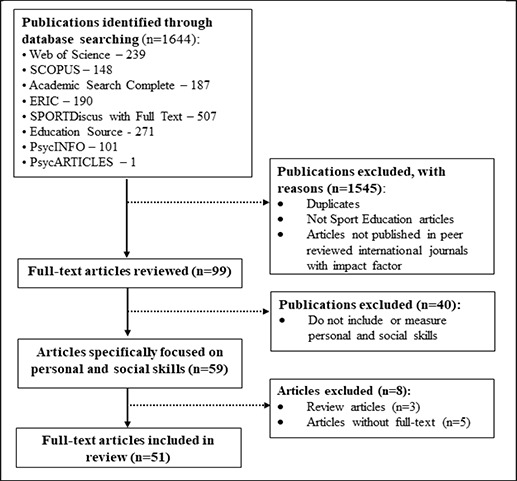
Study flowchart.
Data Extraction and codification of the studies
In order to extract all relevant data from the 51 studies included in this review, content analysis was performed. Studies are presented in Table 1, in alphabetical order according to the first last name of the principal author. The review categories used were defined a priori (Harris et al., 2014) seeking to answer the research questions. The categories are listed below (Table 1) with the legends used for each one in Table 2 appearing in brackets.
Table 1.
Categories and legend.
| Category | Legends |
|---|---|
| Author(s) / Country | Identifies the authors, the year and the country where the study took place |
| Purpose | Describes the purpose of the study |
| P - Participants | St – Students T – Teachers A – Athletes C – Coaches Pa – Parents |
| SP - School Population | E – Elementary School M – Middle School H – High School |
| CL - Classes | Sx – Single Sex Classes Mx – Mixed Sex Classes |
| D/R - Skills of the participants | Whether disabled or at-risk students are included in the study: Y – Yes N – No |
| S – Sport | Whether the investigated SE season were with: TS – Team Sports IS – Individual Sports MA – Multiactivities |
|
DES – Study Design |
QL – Qualitative QT – Quantitative MIX – Both qualitative and quantitative E – Experimental QE – Quasi-experimental NE – Non-experimental |
| LS – Length of the SE Season | Number of lessons |
| F - Fidelity of the SE model | Whether is performed in the study: Y – Yes N – No |
| Variables | Personal and social variables that were analyzed across the study |
| Main Results | Main results of the study provided by the author/s |
| Q – Study Quality | Methodological quality of the study |
Table 2.
Modified version of the checklist.
| Reporting |
|
| External Validity |
|
| Internal Validity - Bias |
|
| Internal Validity - Confounding (selection bias) |
|
Methodological Quality Assessment
To assess the methodological quality of the included 51 studies we used the validated Downs and Black checklist (1998). Items that were not applied to the design of the analyzed studies were removed from the 27-item checklist. The modified version consisted of items 1-4, 6, 10-13, and 18-24, with the highest possible score of 16 (Table 2). Two main evaluators independently performed the assessment of the selected studies. Both researchers discussed and agreed upon the reconciliation of observed differences. In the present systematic review, no study was excluded due to a significantly low quality assessment score.
Results
Table 3 provides an overview of each of the 51 studies included in this review.
Table 3.
Characteristics of included studies.
| Author(s)/Country | Purpose | P | SP | CL | D/R | S | DES | L | F | Variables | Main results | Q |
|---|---|---|---|---|---|---|---|---|---|---|---|---|
| Alexander & Luckman (2001) Australia |
Identify the teachers' perceptions and uses of the SE curriculum model | T | E/H | Mx | N | Ma | QT/NE | - | N | Equity Inclusion Enjoyment |
|
9 |
| Alexander et al., (1996) Australia | Report the Australian national trial of SE: Program change, educational impact, inclusivity, SE as a management tool | T/St | E/H | Mx | N | Ma | MIX/QE | - | N | Leadership Ownership Equity Teamwork Peer-support |
|
8 |
| Ang & Penney (2013) Singapore | Explore the modification of the SE and utilization of pedagogical strategies to respond to students’ limited skills and abilities to handle failure in the context of PE. | St | E | Mx | N | TS | MIX/E | 30 | N | Confidence Resilience Inclusion Peer-support Fair-play |
|
12 |
| Browne et al., (2004) Australia |
Examine the impact that two instructional approaches (traditional and SE) to teaching rugby had on students’ learning, enjoyment and affection. | St | M | Sx (Boys) |
N | TS | MIX/QE | 20 | N | Affiliation Enjoyment Responsibility Autonomy |
|
14 |
| Brunton (2003) United Kingdom |
See whether SE is a curriculum model that can successfully change power hierarchies in school PE. | St | H | Mx | N | IS | MIX/QE | 20 | N | Responsibility Teamwork Engagement |
|
12 |
| Burgueño et al., (2017) Spain |
Examine the influence of an intervention based on SEM, in comparison with Traditional Teaching Model, on motivational regulation in high school students in PE class. | St | H | Mx | N | TS | QT/QE | 12 | N | Motivation |
|
12 |
| Calderón et al., (2010) Spain |
Analyze the initial implementation experiences of SE of a teacher and his students, in the elementary education. | St | E | Mx | N | TS | MIX/NE | 14 | Y | Enthusiasm Engagement Affiliation Satisfaction |
|
12 |
| Calderón et al., (2013) Spain |
Compare the students and teachers’ perceptions after practice with different pedagogical models (SE and Traditional Style). | St/T | E | Mx | N | TS | QL/NE | 8 | Y | Engagement Enthusiasm Satisfaction |
|
12 |
| Calderón et al., (2016) Spain |
Investigate the effect of shared teaching or co-teaching using the SEM in Primary, on the Social Climate Pre and post-intervention classroom. | St | E | Mx | N | TS | MIX/QE | 10 | N | Teamwork Satisfaction Autonomy Engagement Fair-play Responsibility |
|
|
| Carlson & Hastie (1997) Australia |
Examination of the social system as it occurred in a unit of SE. | St/T | H | Mx | N | TS | QL/NE | 16 | N | Leadership Trust Responsibility Cooperation Engagement Enjoyment Fair-play Inclusion |
|
9 |
| Clarke & Quill (2003) UK |
SE as a vehicle to enhance learning aligned with the National Curriculum | St | M | Mx | N | Ma | QL/NE | 44 | N | Inclusion Autonomy Leadership Motivation Empathy Ownership Fair-play Responsibility |
|
8 |
| Cuevas et al., (2015) Spain |
Analyze the impact of SEM in psychological basic need satisfaction in PE secondary students. | St | H | Mx | N | TS | QT/QE | 19 | Y | Autonomy Social interactions |
|
13 |
| Cuevas et al., (2016) Spain |
Analyze the impact of the SEM in self-determination and motivation, psychological basic need thwarting, enjoyment-satisfaction, boredom, and intention to be physically active in PE secondary school students in Spain. | St | H | Mx | N | TS | QT/QE | 19 | Y | Motivation Self-determination Enjoyment |
|
13 |
| Curtner-Smith & Sofo (2004) USA |
Determine 15 American preservice teachers’ (PTs) conceptions of the teaching–learning process while teaching Sport Education and Multi-activity units during an early field experience. | T | M | Mx | N | TS | QL/NE | 10 | N | Enjoyment Ownership Motivation |
|
9 |
| Farias et al., (2018) Portugal |
Examine students’ development of Game Performance and Game Involvement during participation in three consecutive SE seasons of invasion games. | St/T | M | Mx | N | TS | QT/QE | 54 | Y | Engagement Ownership |
|
9 |
| Fernandez-Rio & Menéndez Santurio (2017) Spain |
Assess students and teachers’ perceptions concerning their participation in an educational kickboxing learning unit based on a hybridization of two pedagogical models: Sport Education and Teaching for Personal and Social Responsibility. | St/T | H | Mx | N | IS | QL/NE | 16 | N | Responsibility Enjoyment Cooperation Affiliation Friendship |
|
11 |
| García-Lopez & Gutiérrez (2015) Spain |
Analyze the effect of a SE season on student empathy and assertiveness. | St | E/M | Mx | N | TS | QT/QE | 18 | N | Assertiveness Empathy |
|
10 |
| García-Lopez et al., (2012) Spain |
Analyze the development of empathy, assertiveness and social relations that are usually attributed to this instructional model. | St | M | Mx | N | TS | QT/QE | 18 | Y | Friendship Engagement Responsibility Empathy Assertiveness |
|
12 |
| Gil-Arias et al., (2017) Spain |
Investigate the effect a hybrid TGfU/SE unit, in comparison to direct instruction, on Students' perceptions of various aspects of their motivation to engage in physical education | St | H | Mx | N | TS | QT/QE | 8 | Y | Autonomy Enjoyment Empowerment |
|
13 |
| Gutierrez Diaz del Campo et al., (2014) Spain |
Analyze the viability of the SEM in the 2nd year of Elementary School, based on the analysis of the perceptions of teacher, and students. | St/T | E | Mx | N | TS | MIX/NE | 10 | Y | Motivation Inclusion Affiliation |
|
10 |
| Grant (1992) New Zealand |
Report the teacher perspectives of curriculum in terms of student gains. | T | H | Mx | N | Ma | QL/NE | 22 | N | Ownership Responsibility Inclusion Cooperation Enthusiasm Decision-making |
Teacher perceptions suggested that students:
|
7 |
| Hastie (1996) USA |
Examine the student role involvement in SE. | St | M | Sx (Boys) |
N | IS | MIX/NE | 12 | N | Engagement Responsibility Ownership Enthusiasm |
|
9 |
| Hastie & Buchanan (2000) USA |
Analyze the combined SE-TPSR model. | St | M | Sx (Boys) |
N | TS | QL/NE | 26 | N | Responsibility Empowerment Problem-solving |
|
11 |
| Hastie et al., (2014) USA |
Implement a SE season designed to be mastery involving and examine the degree of congruence between the objective measure of the presented climate with the students’ perceptions of the saliency of this motivational climate. | St | H | Sx (Boys) |
N | TS | QT/NE | 12 | Y | Satisfaction Engagement Autonomy |
|
11 |
| Hastie & Sinelnikov (2006) Rússia |
Examine the participation and perceptions of Russian students to SE | St | M | Mx | N | TS | MIX/NE | 18 | Y | Engagement Ownership Enjoyment Compliance Empathy |
|
12 |
| Hastie & Sharpe (1999) USA |
Examine the effect of SE curriculum on prosocial behavior. | St | M | Sx (Boys) |
Y (At risk) |
TS | QT/QE | 20 | N | Compliance Friendship Leadership |
|
11 |
| MacPhail et al (2004) UK |
Analyze year-5 students’ experiences of SE and the effects of membership of persisting groups on team affiliation. | St | E | Mx | N | TS | QL/NE | 16 | N | Ownership Confidence Empathy Friendship Cooperation |
|
11 |
| MacPhail et al (2008) UK |
Explore childrens’ experiences of fun and enjoyment during SE. |
St | E | Mx | N | TS | MIX/NE | 16 | N | Ownership Enjoyment Autonomy Motivation |
|
11 |
| Méndez-Gimenez et al., (2015) Spain |
Compare the effects of three different instructional models: Traditional, Sport Education and Sport Education with Self-Made Materials on PE students' motivation and sportsmanship. | St | M/H | Mx | N | TS | QT/QE | 12 | N | Friendship Fair-play Sportsmanship Autonomy |
|
11 |
| Menéndez & Fernandez-Rio (2017) Spain |
Explore the impact of the combination of two pedagogical models, SE and Teaching for Personal and Social- Responsibility, for learners with disabilities experiencing a contactless kickboxing learning unit. | St/T | H | Mx | Y (Disability) |
IS | QL/QE | 16 | Y | Ownership Enjoyment Inclusion Cooperation Friendship |
|
11 |
| Meroño et al., (2015) Spain |
Analyze the effect of an intervention program based on Sports Education, on the perception of autonomy; the degree of enjoyment and perceived competence, and the degree of commitment; in a group of swimmers belonging to a sports club. | A/C | M/H | Mx | N | IS | MIX/QE | 32 | Y | Autonomy Enjoyment Commitment Motivation |
|
13 |
| Meroño et al., (2016) Spain |
Examine the effect of a Sport Education season on the technical learning of four swimming strokes and the perceived motivational climate. | A/C | M/H | Mx | N | IS | MIX/QE | 32 | N | Motivation |
|
12 |
| Mowling et al., (2006) USA |
Examine student drawings to determine what they perceived as most important during SE. | St | E | Mx | N | TS | QL/NE | 20 | N | Affiliation Responsibility Engagement |
|
12 |
| Mesquita et al., (2016) Portugal |
Examine the perceptions of a physical education teacher and her students about the educational value of SEM regarding the development of competence, literacy and enthusiasm. | St/T | M | Mx | N | IS | QL/NE | 20 | N | Autonomy Equity Responsibility Enthusiasm Teamwork Motivation Engagement |
|
11 |
| O’Donovan (2003) UK |
Analyze the effect of SE on student social goals and peer culture. | St | M | Mx | N | Ma | QL/NE | 170 | N | Inclusion Peer-support |
|
11 |
| Perlman (2010) USA |
Examine the influence of Sport Education on amotivated students affect and needs satisfaction. | St | H | Mx | N | TS | QT/QE | 15 | Y | Enjoyment Satisfaction |
|
12 |
| Perlman (2011) USA |
Examine the influence of the SEM on students’ self-determined motivation and underlying psychological need(s) in PE. | St | H | Mx | N | TS | QT/QE | 20 | Y | Self-determination Motivation |
|
12 |
| Perlman (2012) USA |
Examine the perceptions and experiences of 33 amotivated students (during four consecutive seasons of the SEM. | St | H | Mx | N | Ma | QL/NE | 12 | Y | Engagement |
|
11 |
| Perlman & Goc Karp (2010) USA |
Examine the perceptions of students and teachers from their experiences in two consecutive units of SE. |
St/T | H | Mx | N | TS | QL/NE | 12 | Y | Self-determination Fair-play Inclusion |
|
11 |
| Pill (2010) Australia |
Explore a SE pilot project as a case study of the approach in a primary school setting. | St/T | M | Mx | N | Ma | QL/NE | 10 | N | Equity Responsibility Motivation Teamwork Engagement |
|
11 |
| Romar et al., (2016) Finland |
Describe and understand players’, coaches’ and parents’ perceptions and experiences of a soccer season when using the model in a Finnish junior sport club. | A/C/Pa | M | Mx | N | TS | QL/NE | 11 | Y | Affiliation Enjoyment Autonomy Responsibility Empowerment Enthusiasm |
|
11 |
| Sinelnikov and Hastie (2008) Rússia |
Study the ecology of SE in one Russian school. | St | H | Mx | N | TS | QL/NE | 18 | Y | Responsibility Ownership Fair-play Empowerment Enjoyment |
|
12 |
| Sinelnikov and Hastie (2010) Russia |
Measure and describe the objective motivational climate of a Sport Education season conducted in a Russian school. |
ST | H | Mx | N | TS | QT/QE | 18 | Y | Motivation |
|
11 |
| Smither & Xihe (2011) USA |
Examine high school students’ experiences in a Sport Education unit being implemented with smaller teams and fewer roles. | St/T | H | Mx | N | TS | QL/NE | 280 | N | Engagement Autonomy Problem- solving |
|
11 |
| Spittle & Byrne (2009) Australia |
Investigated the influence of SE on student motivation. | St | M | Mx | N | TS | QT/QE | 10 | N | Motivation |
|
12 |
| Tindall (2013) Ireland |
Provide a detailed description of post primary students’ reactions to a disability awareness experience using extended contact theory, SE and the disability sport of sit-volleyball as the framework. | St | H | Sx (Girls) |
Y | TS | QL/NE | 16 | N | Enjoyment Empathy (experience) |
|
11 |
| Vidoni & Ward (2009) USA |
Examine the effects of fair-play instruction on student social skills during SE. | St | M | Mx | N | TS | QT/QE | 18 | N | Engagement Enjoyment Fair-play |
|
11 |
| Wallhead et al., (2010) USA |
Analyze the effects of SE on students’ voluntary participation in a lunch-time recess sport club. | St | E/H | Mx | N | TS | QT/QE | 24 | Y | Motivation |
|
12 |
| Wallhead & Ntoumanis (2004) UK |
Analyze the changes in student motivation as a result of SE. | St | H | Sx (Boys) |
N | TS | QT/QE | 6 | N | Enjoyment Engagement Motivation |
|
11 |
* P= participants, St= students, T= teachers, A= athletes, C= coaches, Pa= parents, SP= school population, E= elementary, M= middle school, H= high school, CL= classes, Sx= single-sex, Mx= mixed-sex, D/R= disabled or at-risk students, Y= yes, N= no, S= sport, TS= team sports, IS= individual sports, MA= multiactivities, DES= study design, QL= qualitative, QN= quantitative, MIX= qualitative and quantitative, E= experimental, QE= quasi-experimental, NE= non-experimental, LS= length of the Sport Education season (number of lessons), F= fidelity of the Sport Education model, Q= methodological quality of the study.
The results of this study are presented in response to the research questions mentioned above.
Q1. Which contexts are most likely to research the development of personal and social skills within SE?
Countries: According to the country where the research on the development of personal and social skills using the SE took place, the United States (29%) and Spain (29%) represented over half of all publications (58%), followed by Australia (12%) and the United Kingdom (12%), Russia (6%), Portugal (4%), Finland (2%), Ireland (2%), New Zealand (2%) and Singapore (2%).
Context: Regarding the studies’ context, the majority of research (94%) took place in school contexts and within PE lessons. Only three studies (6%) were conducted within sport club settings. Studies with involving data from only students were more frequent (67%). Ten studies (20%) used student and teacher data, whereas only 4 studies (8%) focused exclusively on teachers. Two studies (4%) were focused on athletes as participants while one study (2%) involved at same time coaches, athletes and parents.
Classification of sport type: With respect to the type of sport/activity studied, the predominance of team sports in 37 studies (72%) was noticeable, whereas only 7 studies (14%) incorporated individual sports (such as kickboxing, badminton, swimming) in their seasons. The remaining 7 studies (14%) were developed with multiactivities (individual and team sports).
Q2. Who are the participants included in SE studies that consider the development of personal and social skills?
Participants: The total sample of the included studies was 2949 students (83%) (1301 boys and 1118 girls, considering that in eight studies the gender of 353 participants was not specified), 496 teachers (15%) (107 with experience in teaching SE), 68 athletes (2%) (22 boys and 23 girls, considering that in two studies the participants’ gender was not specified), 8 coaches (0.2%) (without previous experience in SE) and 4 parents (0.1%).
School level: The most frequent school level studied (40%) was high school (considered as grades 9-12), followed by the middle school (31%), which is from 6th until 8th grade. Fewer studies (18%) took place in elementary schools (1st to 5th grade), and of those, the most common grade level were 4th and 5th.
Class composition: 36 studies (70%) were in a co-educational PE context, two examined only girls (4%), and 6 examined only boys (12%) in a single-sex PE context. Class composition was not reported in 7 (14%) of the studies.
Students with special needs or “at risk”: In 49 studies (96%) participants were not students with special needs or “at-risk” of failure due to undisciplinary behaviors or in process of early dropout. Of interest, only 2 studies (4%) included participants who had a disability (intellectual or motor) or were considered as “at risk” of failure or early dropout.
(Q3) What were the most frequently analyzed variables when participating in a SE season?
Figure 2 provides an illustration of the range of variables examined in studies in this review. As can be seen in the figure enjoyment/satisfaction, enthusiasm and engagement are the predominant outcome measures.
Figure 2.
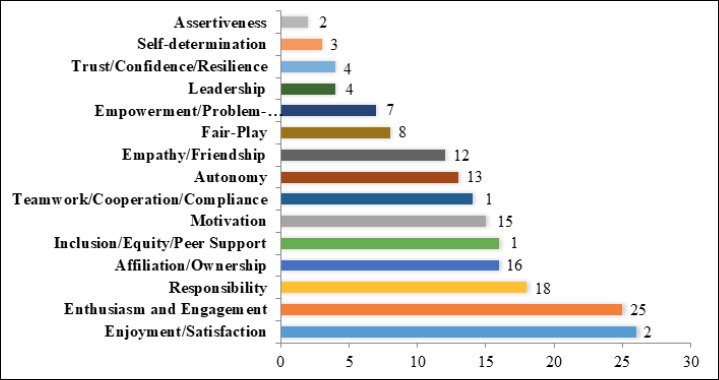
Personal and social variables studied in a Sport Education season.
(Q4) What are the methodologies that have been used to investigate the development of personal and social skills within SE classes?
Study approach: Almost half of all studies adopted a qualitative approach (23; 44%), of the remainder, 14 adopted a quantitative approach (27%), while 14 assumed a mixed approach combining both quantitative and qualitative approaches (27%).
Study design: More than half of the studies (26) included in this review utilized a non-experimental design (51%) to describe the development of students’ personal and social skills within SE (without control, manipulation or alteration of the variables, focused on teachers and students’ perceptions).
However, is that of the 24 studies that involved a quasi-experimental design (49%) (being able to manipulate and control the variables with pre-posttest designs), only two included a control group. Further, there was no randomization of participants within these studies.
Instruments: The use of questionnaires was reported in all quantitative studies (27) and focused on students’ perceptions, and two collected data with direct observation. The analyzed qualitative studies have focused on students and teachers’ perceptions, and adopted semi-structured interviews and drawings to collect data. Data collection with mixed methods studies was mostly conducted using individual or group interviews and questionnaires, as well as through diaries, interviews and questionnaires.
The most widely used instruments to collect data in studies with a qualitative multimethod strategy were interviews (12/18), followed by diaries and/or field notes (8/18), focus group interviews (6/18), participant observation (5/18), journals and/or reflective logs (3/18), videotape (3/18), drawings (2/18), photovoice (1/18) and document analysis (1/18). One study adopted a quantitative multimethod strategy (with multiple forms of quantitative data) using the questionnaires and the field work.
Length of the season: In 18 studies, the SE season extended for more than 20 lessons (35%), 15 studies for between 15 and 19 lessons (29%), 13 between 10 and 14 (6%) and 4 with less than 9 lessons (4%). Each lesson lasted 45-60 minutes.
No information was given about the length of the SE season implementation in 2 studies (4%).
Q5. How many studies have established the fidelity of the model implementation?
In 19 studies (37%) the fidelity of the SE implementation was confirmed, that is, the authors performed the validation of the model implementation and presented a detailed description of the program and curricular elements of the unit (Hastie and Casey, 2014). In 25 studies (49%), the authors presented only a description of the program or curricular elements of the unit, failing to carry out the validation of the model, that is, did not assure that the instruction was indeed consistent within the accepted standards for the SE.
Discussion
The aim of this systematic review was to describe and examine what is currently known concerning students’ development of personal and social competencies when participating in PE classes with SE, in order to give directions for future research and practice.
The SE research included in this systematic review was published between 1992 and 2018 with an increasing number of publications over the years. The fact that the majority of studies took place in USA and Spain (58%) is in line with previous reviews. Although studies have been developed in other countries, namely in Australia and elsewhere in Europe (such as United Kingdom, Russia, Portugal), it would be important to expand the impact of the SE on those and other contexts and cultures.
The findings revealed that studies regarding the development of personal and social competencies focused mostly on students’ perceptions (83%), and were located in school contexts (94%), and involved co-educational classes (70%). However, in the main, there was minimal research that involved students with disabilities, or those considered “at-risk” of failure or who were in the process of early dropout (96%).
One of the long-term purposes of the SE is to make sport more widely accessible so that race, disability, or socioeconomic status are not barriers to participation, thereby promoting inclusion and equity (Siedentop, 1994). By consequence, samples that consider participants with those particular characteristics must be taken into account in SE season implementations. Moreover, given that it is recognized that sport is a privileged space for the development of personal and social skills (Fraser-Thomas et al., 2005; Wright and Côté, 2003) the implementation of SE should not be limited only to the area of PE. It should focus on addressing the level of transfer to other contexts, namely sport training settings, seeking to reinforce the positive impact of SE on the personal and social skills of athletes found in studies of Meroño et al. (2015; 2016).
Results showed that the development of personal and social competencies was more studied in high-school (40%) and 9th grade (30%), which is in contrast to other reviews which identified middle (Araújo et al., 2014; Hastie et al., 2011) and elementary schools (Evangelio et al., 2018) as the most frequent levels studied. These findings are supported by studies (Ntoumanis and Standage, 2009; Van den Berghe et al., 2014) which report that older students, when participating in a SE program, are likely to develop personal and social skills. Furthermore, Layne and Hastie (2016) reported that in very young students the implementation of an SE season requires greater teacher preparation, presenting itself as a potential limitation when studying early grade levels.
Consistent with the previous reviews of (Araújo et al., 2014; Chu and Zhang, 2018; Hastie et al., 2011), the majority of studies in this review investigated team sports in SE programs (70%). This has the potential of undervaluing the possibility of different results in individual sports. As such, it is imperative to conduct further studies in individual and performance sports given that research has shown that students engaging in SE seasons of involving these activities are more likely to participate in these sports more regularly, and that participation may extend to adulthood (Tammelin et al., 2003).
From this systematic review, the personal and social variables that appeared more often were the same as those considered to be crucial for learning in PE irrespective of the teaching approaches. These included enjoyment and satisfaction (n=26), enthusiasm and engagement (n=25) and motivation (n=15) as the most prevalent. Findings suggested high levels of enjoyment and satisfaction in SE (e.g. Alexander and Luckman, 2001; Curtner-Smith, 2004; Menéndez and Fernandez-Rio, 2017; Meroño et al., 2015; Sinelnikov and Hastie, 2008), increases in enthusiasm and engaged participation (e.g. García-López et al., 2012; Grant, 1992; Hastie, 1996; Meroño et al., 2016; Mesquita et al., 2016; Smither and Xihe, 2011), and enhanced feelings of motivation (e.g. Burgueño et al., 2017; Hastie et al., 2014; MacPhail et al., 2008; Pill, 2010; Sinelnikov and Hastie, 2010). These results could be associated to the structural features of SE such as longer seasons, consistent team membership, and a significant amount of time allocated to game play, as well as features such as competition, festivity, and the presence of a culminant event. Further, the diversity of students’ roles within the team (playing and non-playing roles) as well their opportunity to make decisions may have a strong influence on enthusiasm and engagement. With regard to the more specific variables strongly foregrounded with SE, due to its own structure and pedagogical principles, the personal and social variables mostly studied were responsibility (n=18), affiliation and ownership (n=16), inclusion, peer support and equity (n=16), teamwork, cooperation and compliance (n=14), autonomy (n=13), empathy and friendship (n=12). Fair-play (n=8), empowerment, problem-solving and decision-making (n=7), leadership (n=4), trust and confidence (n=4), self-determination (n=3), assertiveness (n=2) were also present.
The theme of responsibility was found in a number of studies (e.g. Browne et al., 2004; Brunton, 2003; Fernandez-Rio and Menéndez-Santurio, 2017; Hastie, 1996; Hastie and Buchanan, 2000; Sinelnikov and Hastie, 2008). Students’ ability within SE to take on roles (e.g. referee, coach, and statistician) and the opportunities to solve problems were identified as key points to the perceptions of greater levels of responsibility developed by students. Nevertheless, in the study of Mowling et al. (2006) involving fourth grade students, a minimal representation of roles and responsibilities were noted. The author attributed this finding to the early age of the students who sought victory as their primary agenda. However, it should be noted that this study did find that students placed a strong focus on affiliation and festivity.
Studies gathered to this review highlighted the value of team affiliation in developing students’ ownership within a SE experience (e.g. Curtner-Smith and Sofo, 2004; Farias et al., 2018; Gutierrez Diaz del Campo et al., 2014; Hastie, 1998; Hastie and Sinelnikov, 2006; MacPhail et al., 2008). In a similar vein, a sense of cooperation, teamwork and compliance within the teams were all reported as important outcomes of participation in a season of SE. This feature was seen as crucial to ensuring the success and maintenance of team affiliation during the season (e.g. Alexander et al., 1996; Brunton, 2003; Fernandez-Rio and Menéndez-Santurio, 2017; Mesquita et al., 2016).
The focus of SE in promoting inclusion, equity and peer support was also suggested in a number of studies (Alexander and Luckman, 2001; Browne et al., 2004; Curtner-Smith and Sofo, 2004; Gutierrez Diaz del Campo et al., 2014; Hastie, 1998; Menéndez and Fernandez-Rio, 2017; O'Donovan, 2003; Pill, 2010). Here, the importance given to all team members (regardless of a student’s gender or skill level), the opportunities provided for inclusion participation and the emphasis on “doing your best” were highlighted. Nevertheless, in the Alexander et al. (1996) study, the analysis of female students’ journals indicated that they did not perceive such equitable participation as players in coeducational SE learning environments. However, in subsequent studies of gender inequity and marginalization (e.g. Alexander and Luckman, 2001; Hastie, 1998; Hastie and Sinelnikov, 2006) girls did not consider these inequities as problematic as they continued to feel a useful part of their teams, and continued to prefer SE over traditional models.
This review also showed that an enhanced level of autonomy was perceived by students, teachers and athletes as a result of their participation in SE (e.g. MacPhail et al., 2008; Méndez-Gimenez et al., 2015; Meroño et al., 2015; Romar et al., 2016; Smither and Xihe, 2011). Autonomy was seen as deriving from allowing students to select their teams, choosing the roles they wished to take within their team, as well as establishing and managing their own practices and games. The study of Cuevas(2015), however, provided evidence on only minor (but not significant) improvements in students’ autonomy after experiencing a SE season. The main argument for this finding was that students with higher social status tended to restrain more introverted students’ behaviors, thereby limiting their perceptions of autonomy.
Some studies also reported the development of perceived empowerment by students mostly due to the opportunities of SE to solve problems, make decisions and take control over their learning environment (e.g. Gil-Arias et al., 2017; Hastie and Buchanan, 2000; Romar et al., 2016; Sinelnikov and Hastie, 2008). Furthermore, students and teachers recognized that SE provides an excellent training for leadership capacity given the students’ ability to take on roles within the various activities in a season (e.g. Alexander et al., 1996; Clarke and Quill, 2003; Hastie and Sharpe, 1999). Similarly, there is empirical evidence with respect to the impact of pedagogical strategies used in SE seasons (e.g., particular roles students such as coach or reporter) on the development of students’ trust, resilience and self-confidence (e.g. Ang and Penney, 2013; Carlson and Hastie, 1997; MacPhail et al., 2004). The increases of students’ self-determination were also reported in some studies due to the features of SE (e.g. team affiliation and an affective game play rubric) (Cuevas et al., 2016; Perlman, 2011; Perlman and Goc Karp, 2010).
The findings also reported enhanced feelings of empathy and friendship among students in their experience with SE, producing positive changes in classmates’ perceptions (Fernandez-Rio and Menéndez-Santurio, 2017; Hastie and Sinelnikov, 2006; Menéndez and Fernandez-Rio, 2017; Wallhead and Ntoumanis, 2004). Nonetheless, the different interests and motivations among students that occur throughout the SE season can lead some students to adopt more egocentric positions, and not to put themselves in the place of the other. This was highlighted in the studies of e García-López et al. (2015; 2012) where they reported that empathy has decreased maybe due to large number of situations that occur within a SE season in which there is a clash of interests between students.
Regarding fair-play, studies with SE mentioned improvements including respect for oneself, others, adults and rules (e.g. Calderón et al., 2016; Clarke and Quill, 2003; Méndez-Gimenez et al., 2015), and decreases in the number of negative sporting behaviors (Perlman and Goc Karp, 2010; Vidoni and Ward, 2009).
The development of students’ assertiveness was only examined in two studies García-López et al. (2015; 2012). In the earlier study (García-López et al., 2012), students’ assertiveness did not increase. It was suggested that for this to occur, specific strategies related with assertiveness need to be deliberately implemented within the SE season design. Following this recommendation, in the García-Lopez (2015) study, findings suggested that SE proved to be a useful instructional model for improving students’ assertiveness.
Concerning the designs of the reviewed studies, almost half used a qualitative approach (47%) and a non-experimental design (53%) using multiple qualitative tools (35%). These tools included interviews, diaries and/or field notes, focus group interviews and participant observation. These findings are consistent with the reviews of Hastie et al. (2011) and Pozo et al. (2016). However, the most recent reviews of SE (Chu and Zhang, 2018; Evangelio et al., 2018) have indicated that significantly more studies in SE are following a quantitative (Chu and Zhang, 2018) or mixed method research approach (Evangelio et al., 2018). This divergence can be explained with the fact that Chu and Zhang’s (2018) review focused specifically on motivation. Nevertheless, due to the preponderance of qualitative studies in SE focusing on the development of personal and social competencies, new studies might begin to consider including mixed and quantitative methods, as these might provide objective and controlled measures and allow for their findings to be more widely generalized.
In quasi-experimental designs (47%), previously created class groups have always been used because it is very difficult to randomly distribute students in a school setting. However, when multiple classes are used it is important that the appropriate unit of analysis is used. Research has shown that usually the articles disregarded the unit of analysis and most of the articles applied the interventions to classes/groups, but used individual students as unit of analysis (Li et al., 2017).
Although the recommended length for a SE season is a minimum of 20 lessons (Siedentop, 1994) most studies (61%) did not comply with this principle. According to Siedentop (1994), seasons need to be long enough to allow for meaningful experiences, particularly since SE has more to accomplish. Specifically, when sport is taught more completely and authentically, it takes more time for students to develop the different roles and capabilities promoted by the model. Therefore, considering the main assumptions of the model, and the findings that development of social skills needs time (Ang and Penney, 2013; Farias et al., 2017; Hastie and Mesquita, 2016), in order to succeed and ensure more reliable results, future research must prioritize appropriate planning and design of the SE seasons themselves before any investigation of dependent measures is considered.
Fidelity of the implementation refers to the degree to which an intervention is delivered as intended and it is critical to successful translation of evidence-based interventions into practice (Carroll et al., 2007). Hastie and Casey (2014) consider that for an accurate and complete understanding of a study’s results, the methods section should include a rich description of the curricular elements of the unit, a detailed validation of model implementation, and a detailed description of the program context. Even though the research on SE highlights the importance of reporting the fidelity of the model implementation (Hastie and Casey, 2014; Ko et al., 2006), only 37% of the studies were in compliance with this aspect of design. This lack of model fidelity is consistent by with those of O’Donnell and Carol (2008) who state that fidelity of a model implementation is rarely reported in educational studies. The evaluation of the model implementation fidelity is essential because (a) it allows readers to moderate the relationship between an intervention and its outcomes, and (b) its assessment may also prevent potentially false conclusions.
Conclusion
Research concerning the impact of SE on students’ personal and social development has shown unequivocal results. In particular, the most examined personal and social variables within SE tend to be related with more general variables, which are crucial for learning in PE in all teaching approaches (p.e. enjoyment, satisfaction, enthusiasm and engagement). However, the interest of knowing the effect on variables strongly foregrounded with SE, due to its own structure and pedagogical principles (p.e. affiliation, ownership, peer support and fair-play) has been growing and becoming more specific (p.e. assertiveness, self-determination, compliance). In order to reinforce the positive impact of SE on the personal and social competencies it would be important that research consider other cultures, samples (e.g. coaches, athletes, disabled students), contexts (sport club setting) and types of sports (e.g. individual sports). A more equitable balance of research designs (mixed and quantitative methods), longer units with an effective planning of the SE season itself, as well as report of model fidelity is critical in future studies, as they might provide more robust and objective findings that can possibly be generalized.
Acknowledgements
This work was supported by the Portuguese Foundation for Science and Technology (FCT) [grant number SFRH / BD / 121421/2016]. The authors have no conflict of interest to declare. The experiments comply with the current laws of the country in which they were performed.
Biographies

Cristiana Helena de Assunção Bessa PEREIRA
Employment
Lecture at Faculty of Sport, University of Porto, Portugal.
PhD student at Faculty of Sport, University of Porto, Portugal.
Degree
MSc
Research interests
Instructional models, physical education, volleyball.
E-mail: cbessa@hotmail.com

Peter Andrew HASTIE
Employment
Professor at Auburn University, Auburn, Alabama, USA.
Degree
PhD
Research interests
Instructional models and physical education.
E-mail: hastipe@auburn.edu

Rui Manuel Flores ARAÚJO
Employment
Lecture at Faculty of Sport, University of Porto, Portugal.
Degree
PhD
Research interests
Instructional models, physical education, volleyball.
E-mail: raraujo@fade.up.pt

Isabel Maria Ribeiro MESQUITA
Employment
Professor at Faculty of Sport, University of Porto, Portugal.
Degree
PhD
Research interests
Coaching, instructional models, physical education, volleyball.
E-mail: imesquita@fade.up.pt
References
- Alexander K., Luckman J. (2001) Australian teachers’ perceptions and uses of the sport education curriculum model. European Physical Education Review 7, 243-267. [Google Scholar]
- Alexander K., Taggart A., Thorpe S. (1996) A spring in their steps? Possibilities for professional renewal through sport education in Australian schools. Sport, Education and Society 1, 23-46. [Google Scholar]
- Ang S., Penney D. (2013) Promoting Social and Emotional Learning Outcomes in Physical Education: Insights from a School-Based Research Project in Singapore. Asia-Pacific Journal of Health, Sport and Physical Education 4, 267-286. [Google Scholar]
- Araújo R., Mesquita I., Hastie P. (2014) Review of the Status of Learning in Research on Sport Education: Future Research and Practice. Journal of Sports Science and Medicine 13, 846-858. [PMC free article] [PubMed] [Google Scholar]
- Browne T., Carlson T., Hastie P. (2004) A comparison of rugby seasons presented in traditional and sport education formats. European Physical Education Review 10, 199-214. [Google Scholar]
- Bruning R., Schraw G., Norby M., Ronning R. (2004) Cognitive psychology and instruction. Upper Saddle River, NJ: Prentice Hall. [Google Scholar]
- Brunton J. (2003) Changing hierarchies of power in physical education using sport education. European Physical Education Review 9, 267-284. [Google Scholar]
- Burgueño R., Medina-Casaubón J., Morales-Ortiz E., Cueto-Martín B., Sánchez-Gallardo I. (2017) Sport Education versus Traditional Teaching: Influence on motivational regulation in High School students. Cuadernos de Psicologia del Deporte 17, 87-89. [Google Scholar]
- Calderón A., Martinez de Ojeda D., José Valverde J., Mendez-Gimenez A. (2016) "Now we help ourselves more": Team-teaching and social classroom climate. Experience with Sport Education. Ricyde-Revista Internacional De Ciencias Del Deporte 12, 121-136. [Google Scholar]
- Carlson T., Hastie P. (1997) The student social system within Sport Education. Journal of Teaching in Physical Education 16, 176-195. [Google Scholar]
- Carroll C., Patterson M., Wood S., Booth A., Rick J., Balain S. (2007) A conceptual framework for implementation fidelity. Implementation Science 2, 40. [DOI] [PMC free article] [PubMed] [Google Scholar]
- Chin M., Edginton C. (2014) Physical education and health. Practices around the world. Physical education and health. Global perspectives and best practice. Eds: Chin M.K., Edginton C.R. Urbana, IL: Sagamore; 1-13. [Google Scholar]
- Chu T., Zhang T. (2018) Motivational processes in Sport Education programs among high school students:A systematic review. European Physical Education Review 24, 372-394. [Google Scholar]
- Clarke G., Quill M. (2003) Researching sport education in action: a case study. European Physical Education Review 9, 253-266. [Google Scholar]
- Cuevas R., García-Lopez L., Contreras O. (2015) Influencia del modelo de Educación Deportiva en las necesidades psicológicas básicas. Cuadernos de Psicologiía del Deporte 15, 155-162. [Google Scholar]
- Cuevas R., García-López L., Serra-Olivares J. (2016) Sport education model and self-determination theory: An intervention in secondary school children. Kinesiology 48, 30-38. [Google Scholar]
- Curtner-Smith M. (2004) A Hybrid Sport Education-Games for Understanding Striking/Fielding Unit for Upper Elementary Pupils. Teaching Elementary Physical Education 15, 7-16. [Google Scholar]
- Curtner-Smith M., Sofo S. (2004) Preservice Teachers' Conceptions of Teaching within Sport Education and Multi-activity Units. Sport, Education and Society 9, 347-377. [Google Scholar]
- Downs S., Black N. (1998) The feasibility of creating a checklist for the assessment of the methodological quality both of randomised and non-randomised studies of health care interventions. 52, 377-384. [DOI] [PMC free article] [PubMed] [Google Scholar]
- Dyson B., Griffin L., Hastie P. (2004) Sport Education, Tactical Games, and Cooperative Learning: Theoretical and Pedagogical Considerations. Quest 56, 226-240. [Google Scholar]
- Ennis C. (2014) What goes around comes around ... or does it? Disrupting the cycle of traditional, sport-based physical education. Kinesiology Review 3, 63-70. [DOI] [PMC free article] [PubMed] [Google Scholar]
- Evangelio C., Sierra-Díaz J., Gonzalez-Víllora S., Fernández-Rio J. (2018) The Sport Education model in elementary and secondary education: A systematic review. Movimento 24, 931-946. [Google Scholar]
- Farias C., Mesquita I., Hastie P. (2017) Towards a more equitable and inclusive learning environment in Sport Education: results of an action research-based intervention. Sport, Education and Society 22, 460-476. [Google Scholar]
- Farias C., Valerio C., Mesquita I. (2018) Sport Education as a Curriculum Approach to Student Learning of Invasion Games: Effects on Game Performance and Game Involvement. Journal of Sports Science and Medicine 17, 56-65. [PMC free article] [PubMed] [Google Scholar]
- Fernandez-Rio J., Menéndez-Santurio J. (2017) Teachers and Students' Perceptions of a Hybrid Sport Education and Teaching for Personal and Social Responsibility Learning Unit. Journal of Teaching in Physical Education 36, 185-196. [Google Scholar]
- Fraser-Thomas J., Côté J., Deakin J. (2005) Youth sport programs: An avenue to foster positive youth development. Physical Education and Sport Pedagogy 10, 19-40. [Google Scholar]
- García-López L., Gutiérrez D. (2015) The effects of a sport education season on empathy and assertiveness. Physical Education and Sport Pedagogy 20, 1-16. [Google Scholar]
- García-López L., Gutiérrez D., Gonzalez-Víllora S., Valero Valenzuela A. (2012) Cambios en la empatía, la asertividad y las relaciones sociales por la aplicación del modelo de instrucción educación deportiva. Revista de Psicologia del Deporte 21, 321-330. [Google Scholar]
- Gil-Arias A., Harvey S., Cárceles A., Práxedes A., Del Villar F. (2017) Impact of a hybrid TGfU-Sport Education unit on student motivation in physical education. PLoS ONE 12, e0179876. [DOI] [PMC free article] [PubMed] [Google Scholar]
- Giraldéz V. (2006) Educación motriz: Hacia una óptima formación del deportista. La iniciación deportiva: Un enfoque multidisciplinar Eds: Giraldéz J.M.V.A., Soidám J.L. Santiago de Compostela: Associación Cultural; 267-284. [Google Scholar]
- Grant B. (1992) Integrating sport into the physical education in New Zealand secondary schools. Quest 44, 304-316. [Google Scholar]
- Gubacs-Collins K. (2015) The Socratic Gymnasium: Learning Lessons of Life Through Physical Education. Physical Educator 72, 76-98. [Google Scholar]
- Gubacs-Collins K., Olsen E. (2010) Implementing a Tactical Games Approach with Sport Education. JOPERD: The Journal of Physical Education, Recreation & Dance 81, 36-42. [Google Scholar]
- Gutierrez Diaz del Campo D., García López L., Chaparro Jilete R., Fernández Sánchez A.J. (2014) Sport education model in second grade. Teachers and students' perceptions. Cuadernos de Psicologia del Deporte 14, 131-144. [Google Scholar]
- Harris J., Quatman C., Manring M., Siston R., Flanigan D. (2014) How to Write a Systematic Review. The American Journal of Sports Medicine 42, 2761-2768. [DOI] [PubMed] [Google Scholar]
- Hastie P. (1996) Student Role Involvement During a Unit of Sport Education. Journal of Teaching in Physical Education 16, 88-103. [Google Scholar]
- Hastie P. (1998) The Participation and Perceptions of Girls Within a Unit of Sport Education. Journal of Teaching in Physical Education 17, 157-171. [Google Scholar]
- Hastie P., Buchanan A. (2000) Teaching Responsibility Through Sport Education: Prospects of a Coalition. Research Quarterly for Exercise and Sport 71, 25-35. [DOI] [PubMed] [Google Scholar]
- Hastie P., Casey A. (2014) Fidelity in models-based practice research in sport pedagogy: A guide for future investigations. Journal of Teaching in Physical Education 33, 422-431. [Google Scholar]
- Hastie P., Martinez de Ojeda D., Calderón A. (2011) A Review of Research on Sport Education: 2004 to the Present. Physical Education and Sport Pedagogy 16, 103-132. [Google Scholar]
- Hastie P., Mesquita I. (2016) Sport-based Physical Education. Routledge Handbook of Physical Education Pedagogies. Ed: Ennis C. London, UK: Routledge; 367-379. [Google Scholar]
- Hastie P., Sharpe T. (1999) Effects of a sport education curriculum on the positive social behavior of at-risk rural adolescent boys. Journal of Education for Students Placed At Risk 4, 417-430. [Google Scholar]
- Hastie P., Siedentop D. (1999) An ecological analysis of a Sport Education season. European Physical Education Review 5, 9-30. [Google Scholar]
- Hastie P., Sinelnikov O. (2006) Russian students' participation in and perceptions of a season of Sport Education. European Physical Education Review 12, 131-150. [Google Scholar]
- Hastie P., Sinelnikov O., Wallhead T., Layne T. (2014) Perceived and actual motivational climate of a mastery-involving Sport Education season. European Physical Education Review 20, 215-228. [Google Scholar]
- Hastie P., Wallhead T. (2016) Models-based practice in physical education: The case for Sport Education. Journal of Teaching in Physical Education 35, 390-399. [Google Scholar]
- Hattie J. (2012) Visible learning for teachers: Maximizing impact on learning. New York, NY, US: Routledge/Taylor & Francis Group. [Google Scholar]
- Higgins J., Thomas J., Chandler J., Cumpston M., Li T., Page M., Welch V. (2019) Cochrane Handbook for Systematic Reviews of Interventions. Chichester (UK): John Wiley & Sons. [Google Scholar]
- Jones L. (2007) The student-centered classroom. Cambridge, UK: Cambridge University Press. [Google Scholar]
- Ko B., Wallhead T., Ward P. (2006) Chapter 4: Professional Development Workshops—What Do Teachers Learn and Use? Journal of Teaching in Physical Education 25, 397-412. [Google Scholar]
- Layne T., Hastie P. (2016) Analysis of teaching physical education to second-grade students using sport education. Education 3-13 44, 226-240. [Google Scholar]
- Lee C. (1993) Operant strategies in sport and exercise: Possibilities for theoretical development. International Journal of Sport Psychology 24, 306-325. [Google Scholar]
- Li W., Xiang P., Chen Y., Xie X., Li Y. (2017) Unit of Analysis: Impact of Silverman and Solmon’s Article on Field-Based Intervention Research in Physical Education in the U.S.A. Journal of Teaching in Physical Education 36, 131-141. [Google Scholar]
- MacPhail A., Gorely T., Kirk D., Kinchin G. (2008) Children’s Experiences of Fun and Enjoyment During a Season of Sport Education. Research Quarterly for Exercise and Sport 79, 344-355. [DOI] [PubMed] [Google Scholar]
- MacPhail A., Kirk D., Kinchin G. (2004) Sport Education: Promoting Team Affiliation Through Physical Education. Journal of Teaching in Physical Education 23, 106-122. [Google Scholar]
- Méndez-Gimenez A., Fernandez-Rio J., Méndez-Alonso D. (2015) Sport Education Model versus Traditional Model: Effects on motivation and sportsmanship. Revista Internacional De Medicina Y Ciencias De La Actividad Fisica Y Del Deporte 15, 449-466. [Google Scholar]
- Menéndez J., Fernandez-Rio J. (2017) Hybridising Sport Education and Teaching for Personal and Social Responsibility to include students with disabilities. European Journal of Special Needs Education 32, 508-524. [Google Scholar]
- Meroño L., Calderón A., Hastie P. (2015) Efecto de una intervención basada en el modelo de Educación Deportiva sobre variables psicológicas en nadadores federados. Cuadernos de Psicologiía del Deporte 15, 35-46. [Google Scholar]
- Meroño L., Calderón A., Hastie P. (2016) Effect of Sport Education on the technical learning and motivational climate of junior high performance swimmers. RICYDE. Revista Internacional de Ciencias del Deporte 12, 182-198. [Google Scholar]
- Mesquita I. (2012) Fundar o lugar do Desporto na escola através do Modelo de Educação Desportiva. Professor de Educação Física: Fundar e dignificar a profissão. Eds: Mesquita I., Bento J. Belo Horizonte: Casa da Educação Física. [Google Scholar]
- Mesquita I. (2013) Perspetiva construtivista da aprendizagem no ensino do jogo. Jogos Desportivos: Formação e investigação. Eds: Nascimento J., Ramos V., Tavares F. Florianópolis: Coleção Temas Movimento; 103-132. [Google Scholar]
- Mesquita I., Farias C., Hastie P. (2012) The impact of a hybrid Sport Education-Invasion Games Competence Model soccer unit on students' decision making, skill execution and overall game performance. European Physical Education Review 18, 205-219. [Google Scholar]
- Mesquita I., Pereira J., Araújo R., Farias C., Rolim R. (2016) Representação dos alunos e professora acerca do valor educativo do Modelo de Educação Desportiva numa unidade didática de Atletismo. Motricidade 12, 26-42. [Google Scholar]
- Metzler M. (1989) A Review of Research on Time in Sport Pedagogy. Journal of Teaching in Physical Education 8, 87-103. [Google Scholar]
- Metzler M. (2011) Instructional Models for Physical Education. Scottsdale, Arizona: Holcomb Hathaway. [Google Scholar]
- Moher D., Liberati A., Tetzlaff J., Altman D.G., The P.G. (2009) Preferred Reporting Items for Systematic Reviews and Meta-Analyses: The PRISMA Statement. PLOS Medicine 6, e1000097. [DOI] [PMC free article] [PubMed] [Google Scholar]
- Mowling C., Brock S., Hastie P. (2006) Fourth Grade Students’ Drawing Interpretations of a Sport Education Soccer Unit. Journal of Teaching in Physical Education 25, 9-35. [Google Scholar]
- Ntoumanis N., Standage M. (2009) Motivation in physical education classes: A self-determination theory perspective. School Field 7, 194-202. [Google Scholar]
- O'Donnell C. (2008) Defining, Conceptualizing, and Measuring Fidelity of Implementation and Its Relationship to Outcomes in K–12 Curriculum Intervention Research. Review of Educational Research 78, 33-84. [Google Scholar]
- O'Donovan T. (2003) A changing culture? Interrogating the dynamics of peer affiliations over the course of a season. European Physical Education Review 9, 237-252. [Google Scholar]
- O’Sullivan M. (2013) New directions, new questions: Relationships between curriculum, pedagogy, and assessment in physical education. Sport, Education, and Society 18, 1-5. [Google Scholar]
- Perlman D. (2011) Examination of Self-Determination within the Sport Education Model. Asia-Pacific Journal of Health, Sport & Physical Education 2, 79-92. [Google Scholar]
- Perlman D., Goc Karp G. (2010) A self-determined perspective of the Sport Education Model. Physical Education and Sport Pedagogy 15, 401-418. [Google Scholar]
- Pill S. (2010) Student reflections of Sport Education in one urban Australian primary school. Asia-Pacific Journal of Health, Sport & Physical Education 1, 29-36. [Google Scholar]
- Pozo P., Grao-Cruces A., Pérez-Ordás R. (2016) Teaching personal and social responsibility model-based programmes in physical education:A systematic review. European Physical Education Review 24, 56-75. [Google Scholar]
- Putnam L., Wilson S., Turner D. (1990) The evolution of policy arguments in teachers’ negotiations. Argumentation 4, 129-152. [Google Scholar]
- Romar J., Sarén J., Hastie P. (2016) Athlete-Centred coaching using the Sport Education model in youth soccer. Journal of Physical Education & Sport 16, 380-391. [Google Scholar]
- Rosado A., Mesquita I. (2009) Melhorar a aprendizagem optimizando a instrução. Pedagogia do Desporto. Eds: Rosado A., Mesquita I. Lisboa: Edições FMH - UTL; 69-130. [Google Scholar]
- Rosado A., Mesquita I. (2011) Promoção do desenvolvimento interpessoal e moral dos praticantes. Manual de psicologia do desporto para treinadores. Eds: Alves J., Brito A. Lisboa: Edições Visão e Contextos. [Google Scholar]
- Rosenshine B. (1979) Content, time and direct instruction. Research on teaching: concepts, findings and implications. Ed: Walberg P.P.H. California: Mccutchan. [Google Scholar]
- Siedentop D. (1994) Sport Education: Quality PE through positive sport experiences. Champaingn, IL: Human Kinetics. [Google Scholar]
- Siedentop D. (2002) Sport Education: A Retrospective. Journal of Teaching in Physical Education 21, 409-418. [Google Scholar]
- Siedentop D., Hastie P., van der Mars H. (2011) Complete Guide to Sport Education (2nd Ed.). Champaign, IL: Human Kinetics. [Google Scholar]
- Sinelnikov O., Hastie P. (2008) Teaching sport education to Russian students: An ecological analysis. European Physical Education Review 14, 203-222. [Google Scholar]
- Sinelnikov O., Hastie P. (2010) A motivational analysis of a season of Sport Education. Physical Education and Sport Pedagogy 15, 55-69. [Google Scholar]
- Smither K., Xihe Z. (2011) High school students’ experiences in a Sport Education unit: The importance of team autonomy and problem-solving opportunities. European Physical Education Review 17, 203-217. [Google Scholar]
- Taggart A. (1988) The Endangered Species Reviseted. ACHPER National Journal 131, 34-50. [Google Scholar]
- Tammelin T., Näyhä S., Hills A., Riitta Järvelin M. (2003) Adolescent Participation in Sport and Adult Physical Activity. [DOI] [PubMed] [Google Scholar]
- Van den Berghe L., Vansteenkiste M., Cardon G., Kirk D., Haerens L. (2014) Research on self-determination in physical education: key findings and proposals for future research Physical Education and Sport Pedagogy 19, 97-121. [Google Scholar]
- Vidoni C., Ward P. (2009) Effects of Fair Play Instruction on student social skilIs during a middle school Sport Education unit. Physical Education and Sport Pedagogy 14, 285-310. [Google Scholar]
- Wallhead T., Ntoumanis N. (2004) Effects of a Sport Education Intervention on Students’ Motivational Responses in Physical Education. Journal of Teaching in Physical Education 23, 4-18. [Google Scholar]
- Wallhead T., O'Sullivan M. (2005) Sport Education: physical education for the new millenium? Physical Education and Sport Pedagogy 10, 181-210. [Google Scholar]
- Wright A., Côté J. (2003) A Retrospective Analysis of Leadership Development Through Sport. The Sport Psychologist 17, 268-291. [Google Scholar]