



ABSTRACT
Statement of problem
Interactions are suspected between resin coating and elastomeric impression material.
Purpose
The purpose of this study was to identify possible interactions between two impression materials and resin-coated tooth surfaces.
Materials and methods
Extracted molars (n = 10) underwent 1 of the 4 procedures: control group (unsealed tooth surface/impression); IDS group (immediate dentin sealing/impression); IDS/AB group (immediate dentin sealing/air blocking/impression); IDS/AB-P group (immediate dentin sealing/air blocking/pumicing/impression). Dentin bonding agents used were Adper single bond 2 and Clearfil SE bond. Impression materials used were Impregum Soft (polyether) and Aquasil (A silicone). A stereomicroscope was used to detect any residual impression material on the bonded tooth surface.
Results
The IDS group showed 100% faulty impressions. Air blocking the resin coating did not completely eliminate the oxygen-inhibited layer of Adper single bond 2. Clearfil SE Bond along with Aquasil generated ideal impressions in group IDS/AB, while all other combinations resulted in faulty impressions. The IDS/AB-P group yielded ideal impressions with Aquasil but generated faulty impressions with Impregum soft in most specimens.
Conclusion
Immediate dentin sealing should be followed by air blocking and pumicing to generate ideal impressions with Aquasil (A silicone). Impregum Soft (polyether) is not recommended in combination with immediate dentin sealing.
How to cite this article
Khakiani MI, Kumar V, et al. Effect of Immediate Dentin Sealing on Polymerization of Elastomeric Materials: An Ex Vivo Randomized Controlled Trial. Int J Clin Pediatr Dent 2019;12(4):288–292.
Keywords: Dentin bonding agent, Elastomers, Immediate dentin sealing, Oxygen inhibition layer
INTRODUCTION
Tooth preparation for indirect bonded restorations such as inlays, onlays, veneers, and crowns can generate significant dentin exposure. It is recommended to seal these freshly cut dentin surfaces with a dentin bonding agent (DBA) immediately following tooth preparation but prior to impression making.1–5
This application procedure, called immediate dentin sealing (IDS), is reported to achieve improved bond strength, fewer gap formations, decreased bacterial leakage, reduced dentin sensitivity, tooth structure preservation, patient comfort, and long-term survival of indirect bonded restorations.5–15
Cured DBA thicknesses can vary significantly according to surface geometry, on average 60–80 microns on a smooth convex surface and up to 200–300 microns on concave structures such as marginal chamfers.5,16
However, a problematic step following immediate dentin sealing is the final impression of the resin-coated preparation surface. This is because dentin bonding agents show a superficial oxygen-inhibition layer (OIL) when they are light polymerized.17,18 The OIL has a thickness of up to 40 microns and is due to an increasingly low conversion rate of the resin because of the oxygen inhibition of the radicals that normally induce the polymerization reaction.18,19
This OIL may in turn inhibit the polymerization of elastic impression materials. It has been reported that the formation of the OIL can be prevented by the application of a glycerine jelly during polymerization (“air blocking”), which is usually recommended in the IDS technique.5,6,10,12,20
There are findings that DBAs and impression materials display the inhibition phenomena or adhesion and tearing.21 This study was undertaken with the objective of (1) identifying possible interactions between two popular impression materials and IDS-treated tooth surfaces using two different DBAs, and (2) proposing an optimized clinical protocol.
MATERIALS AND METHODS
An estimated 10 freshly extracted, sound human molars stored in normal saline were used. After removal of the occlusal, half of the crown using a model trimmer (Orthodontic Model Trimmer; Apex Industrial Electronics, India), flat midcoronal dentin surfaces were created. These surfaces were evaluated for the presence of any remaining enamel, which was removed by additional trimming/finishing when observed. These were then finished with 600-grit SiC paper (John Oakey and Mohan LTD., India) under water until a smooth dentin surface was obtained.
For easier handling, teeth were mounted in an acrylic resin base (DPI-RR Cold Cure; Dental Products of India, Mumbai, India). The prepared surface of each tooth was assessed following 1 of the 4 treatments:
Group I: control group: impressions were made of the unsealed tooth surfaces.
Group II: IDS group: IDS was performed followed by impression making.
Group III: IDS/AB group: IDS was followed by air blocking and then impressions made. Air blocking was accomplished by applying a layer of glycerine jelly (K-Y Jelly; Johnson & Johnson, India) to the sealed surface and beyond with an additional 10 seconds of light polymerization (Bluephase; Ivoclar Vivadent) to eliminate the oxygen-inhibited layer of the resin. The glycerine jelly was then removed by rinsing with water.
Group IV: IDS/AB-P group: IDS was followed by air blocking, pumicing, and then impressions made. Pumicing was accomplished by gentle application of a pumice–water mix with a soft rubber prophy cup and a slow-speed contra angle handpiece (NSK, Japan) at 500 rpm.
The allocation ratio was such that each trial was repeated using the same teeth (following nondestructive removal of the adhesive with a blade and refinishing of the dentin surface with 600-grit SiC paper) with four different combinations of DBA and impression materials. The bonding agents used in this study were Adper Single Bond 2 (3M ESPE) and Clearfil SE Bond (Kuraray Medical). Both were used according to the manufacturer's instructions. The impression materials used in this study were a 2-phase polyvinyl siloxane (PVS), Aquasil Putty and Ultra Light Body; Dentsply and a monophase polyether Impregum Soft Medium Body; 3M ESPE.
A stereomicroscope was used to examine the surface of the adhesive resin for the presence of unpolymerized/residual impression material left on the untreated/treated tooth surface.
RESULTS
All results are presented in Table 1.
Table 1.
Results
| Aquasil | Impregum Soft | |||
|---|---|---|---|---|
| Adper Single Bond 2 | Clearfil SE Bond | Adper Single Bond 2 | Clearfil SE Bond | |
| Control group | Impressions without defects, 100% | Impressions without defects, 100% | ||
| IDS group | Unpolymerized impression material on tooth surface, 100% | Unpolymerized impression material on tooth surface, 100% | ||
| IDS/AB group | Unpolymerized impression material on tooth surface, 100% | Impressions without defects, 100% | Unpolymerized impression material on tooth surface, 80% | Unpolymerized impression material on tooth surface, 70% |
| Impressions with adherences, 30% | Impressions with, adherences, 20% | |||
| IDS/ AB-P group | Impressions without defects, 100% | Impressions without defects, 100% | Unpolymerized impression material on tooth surface, 80% | Unpolymerized impression material on tooth surface, 60% |
| Impressions with adherences, 60% | Impressions with adherences, 40% | |||
Group I: in the control group, all impressions were defect free.
Group II: in the IDS group, unpolymerized impression material was found on all specimens, generally covering the entire preparation surface (Fig. 1), regardless of the type of adhesive or impression material used.
Group III: in the IDS/AB group, Adper Single Bond 2 with Aquasil displayed similar results to IDS group but displayed a possibly thinner unpolymerized residue. Clearfil SE Bond with Aquasil generated 100% defect-free impressions (Fig. 2).
Fig. 1.

Impression of the unsealed tooth surface
Figs 2A and B.

Immediate dentin sealing
Adper Single Bond 2 in combination with Impregum Soft showed an unpolymerized residue in 8/10 samples and adhesions in 3 samples. Clearfil SE Bond with Impregum Soft showed an unpolymerized residue in 7/10 samples (Fig. 3) and adhesions in 2 samples.
Fig. 3.

IDS followed by ‘air blocking’ using K–Y Jelly
Group IV: single Bond 2 and Clearfil SE Bond generated 100% defect-free impressions with Aquasil.
Single Bond 2 with Impregum Soft showed unpolymerized residue in 8/10 samples and adhesions in 6 samples. Clearfil SE Bond with Impregum Soft showed an unpolymerized residue in 6/10 samples and adhesions in 4 samples (Fig. 4).
Fig. 4.

Pumicing of samples in group IV
DISCUSSION
The principles for dentin bonding are well established today based on the work of Nakabayashi et al. in the 1980s, the principle of which is to create an interphase or interdiffusion layer, also called the hybrid layer.22 This approach was landmark because once the infiltrating resin is polymerized, it can generate a “structural” bond somewhat similar to the interphase formed at the dentinoenamel junction (DEJ).23 Consequently, the clinical performance of present-day DBA has significantly improved, allowing adhesive restorations to be placed with a highly predictable level of clinical success (Fig. 5).
Figs 5A and B.

Unpolymerized impression material over the entire dentin bonded surface in IDS group (Adper Single Bond 2 with Impregum Soft)
The immediate dentin sealing (IDS) concept was originally suggested as a protection for the pulp1 and was later shown to provide optimized bond strength and marginal and internal adaptation (Fig. 6).2–5
Fig. 6.
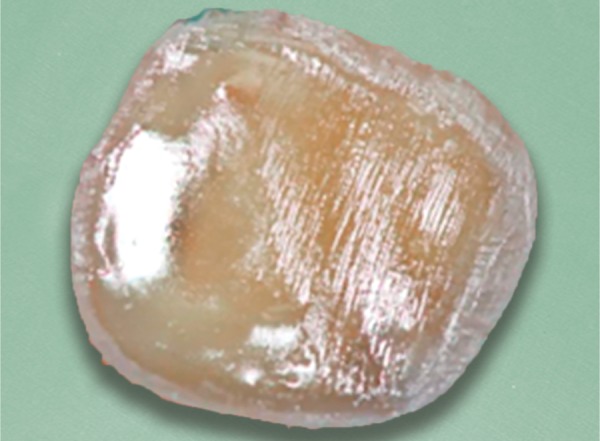
On the left half of the tooth; IDS/AB group shows a defect-free dentin bonded surface. On the right half of the tooth, IDS group shows unpolymerized impression material (Clearfil SE Bond with Aquasil)
The idea of having an additional resin coating placed on the preparation raised concerns about the thickness of this coating and possible interferences with complete seating of the restoration. This dilemma was resolved by proper sequencing of the procedure and placement of the DBA before impression-making.6
Impression materials have their own catalyst; therefore, no interferences with DBAs were expected, in theory.21 However, IDS-group impressions in the present study were faulty. It is clear that, unless removed, the OIL will inhibit the polymerization of both PVS and polyether materials. The use of glycerine and air blocking (IDS/AB group) significantly reduced the thickness of the OIL; however, a thin OIL was still present with Adper Single Bond 2. As a result, the resin-coated surface was still slightly tacky. This could explain the residual inhibition of Adper Single Bond 2 in group IDS/AB (Fig. 7).
Fig. 7.
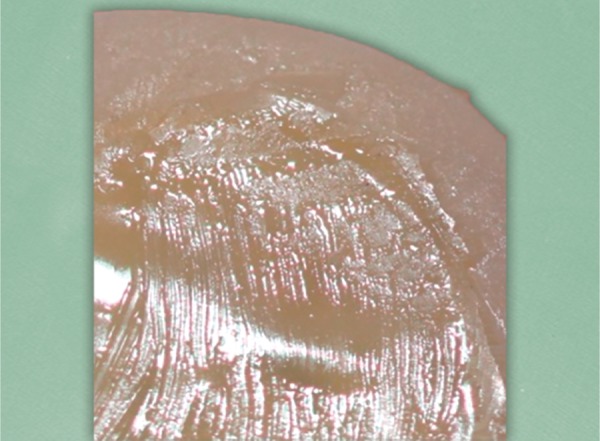
Unpolymerized impression material over entire dentin bonded surface in IDS/AB group (Clearfil SE Bond with Impregum Soft)
Because the use of die spacer is necessary for indirect restorations, this may not affect the accurate fit of restorations. The contamination of the resin coating by the impression material, however, remains an issue, as it may alter the bond between the existing resin coating and the luting agent. Therefore, it is recommended that the resin-coated preparation surface be thoroughly cleaned using a diamond rotary cutting instrument at a low speed or by airborne-particle abrasion just prior to cementation (Fig. 8).5,10,12
Fig. 8.

Defect-free dentin bonded surface in IDS/AB-P group (Single Bond 2 with Aquasil)
The residual inhibition phenomenon was not observed using SE Bond with air blocking and Aquasil, probably because it created a thinner adhesive layer than Adper Single Bond 2 and air blocking was therefore more effective. Impregum Soft generated 100% faulty impressions with adhesion and tearing of both air-blocked DBAs in more than 20% of the specimens. This interaction may be explained by the polarity (ionic polymerization) and hydrophilicity of the material.21 No such phenomenon was observed with Aquasil. The presence of HEMA (2-hydroxyethyl methacrylate), a well known hydrophilic monomer, in the adhesive resin of both DBAs, as well as the high stiffness and low tear strength of polyethers,24 constitute potential causes for the development of these adhesions (Fig. 9).
Fig. 9.

Adhesions and tearing of polyether impression material in IDS/AB-P group (Single Bond 2 with Impregum Soft)
Additional pumicing of the resin coating (IDS/AB-P group) was shown to be the ideal surface treatment for impressions with Aquasil (100% defect-free regardless of the type of DBA). Pumicing the DBA, however, increased the risk of development of adhesions and tearing (up to 60% of impressions) with Impregum Soft. It may be hypothesized that pumicing produced a rougher surface, while weak tear strength produced the adhesions. Limitations of this study include the ex vivo nature of this study in the level of contributory scientific evidence as per Sackett's pyramid of hierarchy (Fig. 10).
Fig. 10.

Adhesions and tearing of polyether impression material in IDS/AB-P group (Clearfil SE Bond with Impregum Soft)
CONCLUSION
Within the limitations of this in vitro qualitative evaluation, it can be concluded that both air blocking and pumicing the existing resin coatings are necessary to obtain defect-free Aquasil (A silicone) impressions, regardless of the type of DBA. At this time, Impregum Soft (polyether) cannot be recommended with IDS because of a high incidence of faulty impressions.
Footnotes
Source of support: Nil
Conflict of interest: None
REFERENCES
- 1.Pashley EL, Comer RW, et al. Dentin permeability: sealing the dentin in crown preparations. Oper Dent. 1992;17:13–20. [PubMed] [Google Scholar]
- 2.Bertschinger C, Paul SJ, et al. Dual application of dentin bonding agents: effect on bond strength. Am J Dent. 1996;9:115–119. [PubMed] [Google Scholar]
- 3.Paul SJ, Schärer P. The dual bonding technique: a modified method to improve adhesive luting procedures. Int J Periodontics Restorative Dent. 1997;17:536–545. [PubMed] [Google Scholar]
- 4.Dietschi D, Herzfeld D. In vitro evaluation of marginal and internal adaptation of class II resin composite restorations after thermal and occlusal stressing. Eur J Oral Sci. 1998;106:1033–1042. doi: 10.1046/j.0909-8836.1998.eos106609.x. DOI: [DOI] [PubMed] [Google Scholar]
- 5.Magne P, Douglas WH. Porcelain veneers: dentin bonding optimization and biomimetic recovery of the crown. Int J Prosthodont. 1999;12:111–121. [PubMed] [Google Scholar]
- 6.Magne P. Immediate dentin sealing: a fundamental procedure for indirect bonded restorations. J Esthet Restor Dent. 2005;17:144–154. doi: 10.1111/j.1708-8240.2005.tb00103.x. DOI: [DOI] [PubMed] [Google Scholar]
- 7.Ozturk N, Aykent F. Dentin bond strengths of two ceramic inlay systems after cementation with three different techniques and one bonding system. J Prosthet Dent. 2003;89:275–281. doi: 10.1067/mpr.2003.37. DOI: [DOI] [PubMed] [Google Scholar]
- 8.Jayasooriya PR, Pereira PN, et al. Efficacy of a resin coating on bond strengths of resin cement to dentin. J Esthet Restor Dent. 2003;15:105–113. doi: 10.1111/j.1708-8240.2003.tb00325.x. DOI: [DOI] [PubMed] [Google Scholar]
- 9.Jayasooriya PR, Pereira PN, et al. The effect of a “resin coating” on the interfacial adaptation of composite inlays. Oper Dent. 2003;28:28–35. [PubMed] [Google Scholar]
- 10.Magne P, Kim TH, et al. Immediate dentin sealing improves bond strength of indirect restorations. J Prosthet Dent. 2005;94:511–519. doi: 10.1016/j.prosdent.2005.10.010. DOI: [DOI] [PubMed] [Google Scholar]
- 11.Islam MR, Takada T, et al. Effect of resin coating on adhesion of composite crown restoration. Dent Mater J. 2006;25:272–279. doi: 10.4012/dmj.25.272. DOI: [DOI] [PubMed] [Google Scholar]
- 12.Magne P, So WS, et al. Immediate dentin sealing supports delayed restoration placement. J Prosthet Dent. 2007;98:166–174. doi: 10.1016/S0022-3913(07)60052-3. DOI: [DOI] [PubMed] [Google Scholar]
- 13.Okuda M, Nikaido T, et al. Microtensile bond strengths to cavity floor dentin in indirect composite restorations using resin coating. J Esthet Restor Dent. 2007;19:38–46. doi: 10.1111/j.1708-8240.2006.00062.x. DOI: [DOI] [PubMed] [Google Scholar]
- 14.Lee JI, Park SH. The effect of three variables on shear bond strength when luting a resin inlay to dentin. Oper Dent. 2009;34:288–292. doi: 10.2341/08-82. DOI: [DOI] [PubMed] [Google Scholar]
- 15.Swift EJ., Jr. Critical appraisal: immediate dentin sealing for indirect bonded restorations. J Esthet Restor Dent. 2009;21:62–67. doi: 10.1111/j.1708-8240.2008.00232.x. DOI: [DOI] [PubMed] [Google Scholar]
- 16.Pashley EL, Comer RW, et al. Dentin permeability: sealing the dentin in crown preparations. Oper Dent. 1992;17:13–20. [PubMed] [Google Scholar]
- 17.Eliades GC, Caputo AA. The strength of layering technique in visible light-cured composites. J Prosthet Dent. 1989;61:31–38. doi: 10.1016/0022-3913(89)90104-2. DOI: [DOI] [PubMed] [Google Scholar]
- 18.Rueggeberg FA, Margeson DH. The effect of oxygen inhibition on an unfilled/filled composite system. J Dent Res. 1990;69:1652–1658. doi: 10.1177/00220345900690100501. DOI: [DOI] [PubMed] [Google Scholar]
- 19.Erickson RL. Mechanism and clinical implications of bond formation for two dentin bonding agents. Am J Dent. 1989;2:117–123. [PubMed] [Google Scholar]
- 20.Stavridakis MM, Krejci I, et al. Immediate dentin sealing of onlay preparations: thickness of pre-cured dentin bonding agent and effect of surface cleaning. Oper Dent. 2005;30:747–757. [PubMed] [Google Scholar]
- 21.Magne P, Nielsen B. Interactions between impression materials and immediate dentin sealing. J Prosthet Dent. 2009;102:298–305. doi: 10.1016/S0022-3913(09)60178-5. DOI: [DOI] [PubMed] [Google Scholar]
- 22.Nakabayashi N, Nakamura M, et al. Hybrid layer as a dentin-bonding mechanism. J Esthet Dent. 1991;3:133–138. doi: 10.1111/j.1708-8240.1991.tb00985.x. DOI: [DOI] [PubMed] [Google Scholar]
- 23.Lin CP, Douglas WH. Structure-property relations and crack resistance at the bovine dentin-enamel junction. J Dent Res. 1994;73:1072–1078. doi: 10.1177/00220345940730050901. DOI: [DOI] [PubMed] [Google Scholar]
- 24.Lawson NC, Burgess JO, et al. Tear strength of five elastomeric impression materials at two setting times and two tearing rates. J Esthet Restor Dent. 2008;20:186–193. doi: 10.1111/j.1708-8240.2008.00176.x. DOI: [DOI] [PubMed] [Google Scholar]