



Abstract
Background:
Self-defining memories refer to events that are vivid, effectively intense, and include enduring concerns about oneself.
Objective:
We investigated the relationship between the production of these memories in normal aging and the ability to integrate new information into existing knowledge in memory (i.e., updating).
Method:
Older participants were asked to perform an updating task as well as to retrieve autobiographical memories that were later analyzed for their self-defining relevance.
Results:
Analyses showed significant positive correlations between updating and the production of self-defining memories.
Conclusion:
Updating our life story is an important psychological process,which enables us to refine and enrich our life story with new experiences, roles and/or challenges, and this ability seems to be related to the capacity to produce memories that draw on the pursuit of long-term goals, meaning making, emotional regulation, and/or activation of self-images (i.e., self-defining memories). These findings suggest that updating one’s identity throughout life, at least in normal aging, may be related to the shaping and retrieval of self-defining memories, memories that lead to the creation of narrative scripts, which themselves serve as the ingredients for “chapters” across the lifespan.
Keywords: Aging, autobiographical memory, executive function, self-defining memories, updating, normal aging
1. INTRODUCTION
Self-defining memories, a component of autobiographical memory, refer to events that are highly relevant to identity processes [1, 2]. These events are vivid, emotionally intense, repetitively recalled, and focused on enduring concerns or unresolved conflicts [3]. In addition, self-defining memories help maintain self-consistency and self-coherence, particularly during times of upheaval or difficult transitions [4]. In line with these assumptions, empirical research has demonstrated the involvement of self-defining memories in the pursuit of long-term goals [5], the anticipation of significant future events [6], meaning making [2, 7, 8], emotional regulation [9-11], personality traits [10], and activation of specific self-representations [12]. Moreover, individuals frequently communicate about themselves and their life stories by sharing self-defining memories with others, a process that facilitates intimacy and the transmission of personal experience [7, 13]. Guided by these findings, Singer, Blagov (3) proposed an integrated model of narrative identity, according to which self-defining memories lead to the creation of narrative scripts that serve as the ingredients for “chapters” across the lifespan.
Self-defining memories in normal aging were assessed by Singer, Rexhaj [1] who found that these memories received higher ratings in vividness and importance in older than in younger participants. When reporting their self-defining memories, the older participants mentioned serious and meaningful topics involving achievements, relationships, child rearing, political events, illnesses, and deaths. Self-defining memories in the older participants were also found to trigger a positive emotional tone as well as an integrative meaning. According to Singer, Rexhaj [1], the positive valence of self-defining memories in older adults serves to avoid excessive rumination or distress. Other studies conducted on self-defining memories in normal aging reported the high specificity of these memories [14, 15]. These findings are of interest as older adults may demonstrate a lower production of episodic memories (i.e., specific events describing information about locations, time, perceptions, and thoughts) [16-24]. Owing to their relevance to life story and identity, self-defining memories may enable older adults to go beyond their difficulties to reach specificity.
Our study investigated the relationship between updating deficits and underproduction of self-defining memories. In our view, the integration of events that are highly relevant to identity processes (i.e., the formation of self-defining memories) involves updating one’s identity with new self-images, representations, and/or goals. Therefore, updating deficits in aging may result in underproduction of self-defining memories. To assess the putative relationship between updating deficits and the underproduction of self-defining memories, we asked older adults to generate autobiographical memories and to perform an executive battery, including an updating task. We expected positive correlations between updating ability and the production of self-defining memories in normal aging.
2. METHOD
2.1. Participants
Forty-three older adults (23 women and 20 men; M age = 69.09 years, SD = 9.12, M years of formal education = 9.12 years, SD = 2.49) were recruited through flyers posted in community centers. Participants were non-institutionalized and managed their own household. Their Mini-Mental State Examination [25] score (M = 28.33/30, SD = 1.51) showed normal cognitive functioning. They also showed no signs of depression, as evaluated by the short Geriatric Depression Scale [26] (M = 3.47/15, SD = 1.68, cut-off for significant depressive symptoms = 6). All participants were native French speakers with normal or corrected-to-normal vision and hearing. Exclusion criteria were a history of neurological, psychiatric, or learning disorders. Prior to inclusion in the study, all participants gave their informed consent in accordance with the principles laid down by the Helsinki Declaration.
2.2. Procedures
Participants were assessed using tests of episodic memory and executive function (scores are presented in Table 1). Autobiographical memory was also assessed. Participants were tested in one session, and tests were randomized without a predetermined order.
2.2.1. Episodic Memory
Episodic memory was evaluated with the task of Grober and Buschke [27]. The participants had to retain 16 words and after an immediate cued recall, they proceeded to a 20 s distraction phase during which they had to count numbers aloud. This phase was followed by two minutes of free recall and the score from this phase (out of a maximum of 16) was retained as the episodic score.
2.2.2. Executive Function
Executive functioning was evaluated according to the model of Miyake, Friedman [28] who not only defined three core executive functions (i.e., shifting, updating, and inhibition) but also related each of these functions to a specific task (e.g., updating to the 2-back task).
Shifting: the Plus-Minus task included three lists, each containing 20 numbers (the numbers ranged from 10-99 and were randomly chosen). On the first list, participants added one to each number, and on the second list they subtracted one from each number. On the third list, they added and subtracted one alternately. The shifting score was the difference between the time taken for list three and the average of the times taken for lists one and two (the higher the score the lower the shifting).
Updating: in the 2-back task, 30 letters were sequentially presented and participants had to decide whether each letter was the same as the letter presented two items before or not. For instance, if the letter K was followed by R then K, the latter letter corresponded to the one presented two items before. The updating score corresponded to the number of correct responses (the higher the score the better the updating).
Inhibition: the Stroop task involved three subtests. In the word reading subtest, participants read words printed in black ink, all words naming colors. In the color naming subtest, they named the color of the ink. In the color-word interference subtest, they named the color of the color-word printed in incongruously colored ink. The inhibition score was the completion time for the interference condition – the average completion time for word reading and color naming conditions (the higher the score the lower the inhibition).
2.2.3. Autobiographical Memory
Participants were asked to retrieve three autobiographical memories, one memory cued by each of the following three cues “family, profession, and holidays”. These cues were chosen as they have been found to elicit autobiographical memories in aging [15, 18, 29, 30]. Cues were counterbalanced and, for each cue, participants were required to recount in detail an event in their life. The participants were given three minutes to describe their memories; this time limit was made clear so that participants could structure their memories accordingly and to the best of their ability. It was also used to avoid bias, such as redundancy or distractibility. This three-minute limit has been found to be amply sufficient for autobiographical recollection [31-33].
Following the definition of Singer, Rexhaj [1], an event was considered a self-defining memory if it was situated in time and space with phenomenological details (thoughts, feelings, perceptions), and also if it contributed to the way the participant saw herself or himself, and/or if the event was related to personality construction, concerns or unresolved conflicts (for a similar scoring of self-defining memories, see [14, 15]. For instance, with the cue “holidays”, one participant recounted: “I can remember the holiday in the Pyrenees Mountains, I was twelve years old and it was a rainy night, my father didn’t allow me to go out so I waited till he was asleep to go out. I was pleased to be alone and also to be able to climb the hill nearby, but after a while, I got scared by the darkness. Luckily my father searched for me otherwise I wouldn’t have been able to find my way back. He was so angry with me but I didn’t understand his anger until I got older myself and saw how difficult it is to raise a child…perhaps that’s why I was always strict with my own kids”. To prevent scoring bias, self-defining memories were rated by two independent raters(trained psychologists who were not affiliated with the project) who were blind to the hypotheses. Using Cohen’s Kappa coefficient (K) [34], a high inter-rater agreement coefficient was obtained (K = .89). Disagreements were discussed until a consensus was reached.
The proportion of self-defining memories was calculated based on the total number of memories (i.e., three). For instance, if a participant retrieved one self-defining memory, the proportion was .33. This proportion for our participants is depicted in Fig. (1).
Fig. (1).
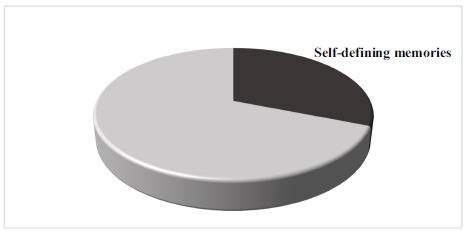
Proportion of self-defining memories produced by our participants (Mean = .32, SD = .33, Median = 33.00, Range = 1.00).
Note. The proportion of self-defining memories was calculated based on the total number of memories (i.e., three). For instance, if a participant retrieved one self-defining memory, the proportion was .33.
3. RESULTS
Here we report the correlations between self-defining memories, shifting, updating, and inhibition. We applied Pearson's product moment correlation after verifying data normality with Shapiro-Wilk tests. Because correlations involved four comparisons, a Bonferroni correction was applied, considering only those correlations reaching a threshold of p< .012 significant; this level was obtained by dividing the alpha level by the number of comparisons (0.05/4). Regression analyses were also performed to identify the variables that best predicted the production of self-defining memories.
As depicted in Table 2, significant positive correlations were observed between the production of self-defining memories and updating. In other words, high updating ability was correlated with high ability to produce memories rich inself-images, representations, and/or goals. A stepwise regression analysis was also performed in which the dependent variable was self-defining memories and predictors were performance in shifting, updating, and inhibition. The analysis showed that updating was the main and only variable predicting self-defining memories (adjusted R2 = .38, p< .001).
3.1. Additional Analysis
To assess the potential relationship between updating and specificity of memories, we analyzed correlations between updating performance and specificity score. Analysis demonstrated no significant correlation between updating and specificity (r = .27, p> .10). Note that the specificity score was assessed with the TEMPau scale (Test épisodique de mémoire du passé [30]) which was derived from classic autobiographical evaluations [35] and adapted in French. For each retrieved event, we attributed zero if there was no memory or only general information about a theme; one point for a repeated or an extended event; two points for an event situated in time and/or space; three points for a specific event lasting less than 24 h and situated in time and space; and four points for a specific event situated in time and space enriched with subjective details such as perceptions, feelings, or thoughts.
4. DISCUSSION
This paper assessed the relationship between updating and the ability to produce self-defining memories in normal aging. As expected, high updating ability was correlated with high ability to produce memories rich inself-images, representations, and/or goals (i.e., self-defining memories).
A compromised ability to remember specific autobiographical events has been observed in normal aging [16-24]. However, older adults seem to overcome this difficulty when describing memories that are highly relevant to the self (i.e., self-defining memories) [14, 15]. In the present study, nearly one-third of memories mentioned by older adults were self-defining memories, and the production of these memories was positively correlated with updating. Updating our life story with new experiences, roles and/or challenges is an important psychological process, which enables us to refine and enrich our identity throughout life. This dynamic transformation enables a better understanding and narration of our own personal biography, as well as a better attribution of meaning to this biography. Hence, updating our life story is likely to be a crucial process to understand and construct our own personal identities, which may explain the relationship between updating and the ability to construct memories that are highly related to the self and identity (i.e., self-defining memories).
Besides highlighting the relationship between updating, a psychological process that enriches one’s life story, and the production of self-defining memories, our findings can be considered in the context of the more general relationship between executive function and autobiographical memory. According to Conway’s Self Memory System [36, 37], the formation of autobiographical memory depends, among other factors, on the working-self, a dynamic executive center that commands the encoding and retrieval of memories in line with current goals and self-images.
In the same vein, a recent model (AMAD, Autobiographical Memory in Alzheimer’s Disease) [38, 39] attributes autobiographical decline, and the impaired sense of self and identity, in pathological aging to disruption in the working-self and its executive resources. According to this model, one core consequence of autobiographical memory decline in Alzheimer’s Disease is decreased access to memories that shape self-consciousness, self-knowledge, and self-images, leading to a diminished sense of identity and self. More specifically, the model attributes, among other factors, autobiographical impairment in Alzheimer’s Diseasetoexecutive dysfunction affect organization, elaboration, and memory search strategies.
A relationship between the reduced specificity of autobiographical memory and executive dysfunction has also been demonstrated in depression [40-42]. As for normal aging, a study has reported that the decline of autobiographical specificity is largely mediated by updating and inhibition [19], supporting the relationship between self-defining memories and updating observed in our study. The study of Piolino, Coste [19] is of interest because it highlights the role of inhibition in decline of autobiographical in normal aging, mirroring the important, but not significant relationship between inhibition and the production of self-defining memories in our study. The involvement of inhibition in decline of autobiographical in aging has been pointed out by a study showing a diminished ability to inhibit no-longer relevant semantic autobiographical memories in normal aging [43]. According to these authors, difficulties in inhibiting irrelevant information hamper memory retrieval by activating irrelevant memories at the expense of relevant ones (for a similar view, see [44-46]. Interestingly, another study has found that updating, rather than inhibition, is the source of diminished autobiographical specificity in normal aging, supporting the core role of updating in autobiographical functioning in aging [47].
In the above-mentioned literature [19, 47], the involvement of updating in the over generality of autobiographical memory is attributed to general executive/frontal deficits during memory retrieval. Our study extends this literature by not only demonstrating the relationship between updating deficits and the underproduction of self-defining memories in aging, but also suggesting a psychological account, according to which a poor ability to update one’s life story can be associated with a poor ability to produce memories that draw on the pursuit of long-term goals, meaning making, and/or activation of self-images (i.e., self-defining memories).
Our study did not include younger adults because, unlike older adults, this population tends to show little emotional regulation and responsiveness to self-defining memories [1]. According to Singer, Rexhaj [1], the benefit of more time having elapsed since an event occurred is that older adults, unlike younger ones, have more freedom to see the overlapping themes and linkages between memories, leading to greater integration of self-defining memories into their life story. However, future studies may investigate whether difficulties in updating one’s life story may result in a poor ability to produce self-defining memories in disorders associated with deficits in these memories, such as depression, Alzheimer’s disease, or schizophrenia (for a study on self-defining memories in schizophrenia, see [48]).
CONCLUSION
In conclusion, our study demonstrates, for the first time, how updating ability can be related with the ability to produce memories rich in self-images, representations, and/or goals (i.e., self-defining memories) in normal aging.
Table 1. Performances in the evaluation of episodic memory and executive function (i.e., shifting, updating, and inhibition).
| Episodic Memory | Grober and Buschke | 10.56 (2.96) |
|---|---|---|
| Shifting | Plus-Minus | 6.67 (3.89) |
| Updating | 2-back | 19.56 (5.51) |
| Inhibition | Stroop | 38.60 (15.57) |
Note. Standard deviations are given between brackets; score on the Grober and Buschke task corresponded to the number of correctly remembered words/16; scores on the Stroop and Plus-Minus tasks corresponded to the reaction time; score on the 2-back task corresponded to the number of correct responses/30.
Table 2. Correlation matrix for self-defining memories and executive function (i.e., shifting, updating, and inhibition).
| - | Self-defining Memories | Shifting | Updating | Inhibition |
|---|---|---|---|---|
| Self-defining memories | - | - | - | - |
| Shifting | -.28 (p> .10) | - | - | - |
| Updating | .52(p < .001) | -.23 (p> .10) | - | - |
| Inhibition | -.36(p = .045) | .53(p< .001) | -.34 (p= .059) | - |
Note. The correlation coefficients in bold are significant after applying a Bonferroni correction at p< .008.
ACKNOWLEDGEMENTS
Declared none.
ETHICS APPROVAL AND CONSENT TO PARTICIPATE
The present observational protocol was approved by the Local Ethics Committee of the University of Nantes, France.
HUMAN AND ANIMAL RIGHTS
No animals were used in this study. All the experiments conducted on the humans were in accordance with the ethical standards of the committee responsible for human experimentation (institutional and national), and with the Helsinki Declaration of 1975, as revised in 2013 (http://ethics.iit.edu/ecodes/node/3931).
CONSENT FOR PUBLICATION
All participants gave their informed consent.
AVAILABILITY OF DATA AND MATERIALS
The data that support the finding of this study are available from the corresponding author Dr. Mohamad El Haj (mohamad. elhaj@univ-nantes.fr), upon reasonable request.
FUNDING
None.
CONFLICT OF INTEREST
The authors declare no conflict of interest, financial or otherwise.
REFERENCES
- 1.Singer J.A., Rexhaj B., Baddeley J. Older, wiser, and happier? Comparing older adults’ and college students’ self-defining memories. Memory. 2007;15(8):886–898. doi: 10.1080/09658210701754351. [DOI] [PubMed] [Google Scholar]
- 2.Blagov P.S., Singer J.A. Four dimensions of self‐defining memories (specificity, meaning, content, and affect) and their relationships to self‐restraint, distress, and repressive defensiveness. J. Pers. 2004;72(3):481–511. doi: 10.1111/j.0022-3506.2004.00270.x. [DOI] [PubMed] [Google Scholar]
- 3.Singer J.A., Blagov P., Berry M., Oost K.M. Self-defining memories, scripts, and the life story: Narrative identity in personality and psychotherapy. J. Pers. 2013;81(6):569–582. doi: 10.1111/jopy.12005. [DOI] [PubMed] [Google Scholar]
- 4.Conway M.A., Singer J.A., Tagini A. The self and autobiographical memory: Correspondence and coherence. Soc. Cogn. 2004;22(5):491–529. [Google Scholar]
- 5.Moffitt K.H., Singer J.A. Continulty in the life story: Self-defining memories, affect, and approach/avoidance personal strivings. J. Pers. 1994;62(1):21–43. [Google Scholar]
- 6.D’Argembeau A., Lardi C. Van der LM. Self-defining future projections: Exploring the identity function of thinking about the future. Memory. 2012;20(2):110–120. doi: 10.1080/09658211.2011.647697. [DOI] [PubMed] [Google Scholar]
- 7.Thorne A., McLean K.C., Lawrence A.M. When remembering is not enough: reflecting on self-defining memories in late adolescence. J. Pers. 2004;72(3):513–542. doi: 10.1111/j.0022-3506.2004.00271.x. [DOI] [PubMed] [Google Scholar]
- 8.Lardi C., D’Argembeau A., Chanal J., Ghisletta P. Van der LM. Further characterisation of self-defining memories in young adults: A study of a Swiss sample. Memory. 2010;18(3):293–309. doi: 10.1080/09658211003601522. [DOI] [PubMed] [Google Scholar]
- 9.Wood W.J., Conway M.A. Subjective impact, meaning making, and current and recalled emotions for self-defining memories. J. Pers. 2006;74(3):811–845. doi: 10.1111/j.1467-6494.2006.00393.x. [DOI] [PubMed] [Google Scholar]
- 10.Sutin A.R., Robins R.W. Continuity and correlates of emotions and motives in self-defining memories. J. Pers. 2005;73(3):793–824. doi: 10.1111/j.1467-6494.2005.00329.x. [DOI] [PubMed] [Google Scholar]
- 11.Lardi C., Ghisletta P. Van der LM. What is the nature of the self-defining memories of repression-prone individuals? Self. Ident. 2012;11(4):492–515. [Google Scholar]
- 12.Çili S., Stopa L. The retrieval of self-defining memories is associated with the activation of specific working selves. Memory. 2015;23(2):233–253. doi: 10.1080/09658211.2014.882955. [DOI] [PubMed] [Google Scholar]
- 13.Thorne A., McLean K. Gendered reminiscence practices and self-definition in late adolescence. Sex Roles. 2002;46(9-10):267–277. [Google Scholar]
- 14.El Haj M., Antoine P., Nandrino J.L., Gely-Nargeot M.C., Raffard S. Self-defining memories during exposure to music in Alzheimer’s disease. Int. Psychogeriatr. 2015;27(10):1719–1730. doi: 10.1017/S1041610215000812. [DOI] [PubMed] [Google Scholar]
- 15.Martinelli P., Anssens A., Sperduti M., Piolino P. The influence of normal aging and Alzheimer’s disease in autobiographical memory highly related to the self. Neuropsychology. 2013;27(1):69–78. doi: 10.1037/a0030453. [DOI] [PubMed] [Google Scholar]
- 16.Addis D.R., Wong A.T., Schacter D.L. Age-related changes in the episodic simulation of future events. Psychol. Sci. 2008;19(1):33–41. doi: 10.1111/j.1467-9280.2008.02043.x. [DOI] [PubMed] [Google Scholar]
- 17.Levine B., Svoboda E., Hay J.F., Winocur G., Moscovitch M. Aging and autobiographical memory: Dissociating episodic from semantic retrieval. Psychol. Aging. 2002;17(4):677–689. [PubMed] [Google Scholar]
- 18.Piolino P., Desgranges B., Clarys D., Guillery-Girard B., Taconnat L., Isingrini M., et al. Autobiographical memory, autonoetic consciousness, and self-perspective in aging. Psychol. Aging. 2006;21(3):510–525. doi: 10.1037/0882-7974.21.3.510. [DOI] [PubMed] [Google Scholar]
- 19.Piolino P., Coste C., Martinelli P., Mace A.L., Quinette P., Guillery-Girard B., et al. Reduced specificity of autobiographical memory and aging: Do the executive and feature binding functions of working memory have a role? Neuropsychologia. 2010;48(2):429–440. doi: 10.1016/j.neuropsychologia.2009.09.035. [DOI] [PubMed] [Google Scholar]
- 20.St Jacques P.L., Levine B. Ageing and autobiographical memory for emotional and neutral events. Memory. 2007;15(2):129–144. doi: 10.1080/09658210601119762. [DOI] [PMC free article] [PubMed] [Google Scholar]
- 21.Habermas T., Diel V., Welzer H. Lifespan trends of autobiographical remembering: Episodicity and search for meaning. Conscious. Cogn. 2013;22(3):1061–1073. doi: 10.1016/j.concog.2013.07.010. [DOI] [PubMed] [Google Scholar]
- 22.El Haj M., Clément S., Fasotti L., Allain P. Effects of music on autobiographical verbal narration in Alzheimer’s disease. J. Neurolinguist. 2013;26(6):691–700. [Google Scholar]
- 23.El Haj M., Fasotti L., Allain P. The involuntary nature of music-evoked autobiographical memories in Alzheimer’s disease. Conscious. Cogn. 2012;21(1):238–246. doi: 10.1016/j.concog.2011.12.005. [DOI] [PubMed] [Google Scholar]
- 24.El Haj M., Postal V., Allain P. Music enhances autobiographical memory in mild Alzheimer’s disease. Educ. Gerontol. 2012;38(1):30–41. [Google Scholar]
- 25.Folstein M.F., Folstein S.E., McHugh P.R. “Mini-mental state”. A practical method for grading the cognitive state of patients for the clinician. J. Psychiatr. Res. 1975;12(3):189–198. doi: 10.1016/0022-3956(75)90026-6. [DOI] [PubMed] [Google Scholar]
- 26.Yesavage J.A., Sheikh J.I. 9/Geriatric Depression Scale (GDS) recent evidence and development of a shorter violence. Clin. Gerontol. 1986;5(1-2):165–173. [Google Scholar]
- 27.Grober E., Buschke H. Genuine memory deficits in dementia. Dev. Neuropsychol. 1987;3(1):13–36. [Google Scholar]
- 28.Miyake A., Friedman N.P., Emerson M.J., Witzki A.H., Howerter A., Wager T.D. The unity and diversity of executive functions and their contributions to complex “frontal lobe” tasks: A latent variable analysis. Cognit. Psychol. 2000;41(1):49–100. doi: 10.1006/cogp.1999.0734. [DOI] [PubMed] [Google Scholar]
- 29.Addis D.R., Roberts R.P., Schacter D.L. Age-related neural changes in autobiographical remembering and imagining. Neuropsychologia. 2011;49(13):3656–3669. doi: 10.1016/j.neuropsychologia.2011.09.021. [DOI] [PMC free article] [PubMed] [Google Scholar]
- 30.Piolino P., Desgranges B., Benali K., Eustache F. Episodic and semantic remote autobiographical memory in ageing. Memory. 2002;10(4):239–257. doi: 10.1080/09658210143000353. [DOI] [PubMed] [Google Scholar]
- 31.El Haj M., Antoine P., Kapogiannis D. Similarity between remembering the past and imagining the future in Alzheimer’s disease: Implication of episodic memory. Neuropsychologia. 2015;66(0):119–125. doi: 10.1016/j.neuropsychologia.2014.11.015. [DOI] [PMC free article] [PubMed] [Google Scholar]
- 32.El Haj M., Antoine P., Kapogiannis D. Flexibility decline contributes to similarity of past and future thinking in Alzheimer’s disease. Hippocampus. 2015;25(11):1447–1455. doi: 10.1002/hipo.22465. [DOI] [PMC free article] [PubMed] [Google Scholar]
- 33.El Haj M., Delerue C., Omigie D., Antoine P., Nandrino J.L., Boucart M. Autobiographical recall triggers visual exploration. J. Eye Mov. Res. 2014;7(5):1–7. [Google Scholar]
- 34.Brennan R.L., Prediger D.J. Coefficient kappa: Some uses, misuses, and alternatives. Educ. Psychol. Meas. 1981;41(3):687–699. [Google Scholar]
- 35.Kopelman M.D. The Autobiographical Memory Interview (AMI) in organic and psychogenic amnesia. Memory. 1994;2(2):211–235. doi: 10.1080/09658219408258945. [DOI] [PubMed] [Google Scholar]
- 36.Conway M.A., Pleydell-Pearce C.W. The construction of autobiographical memories in the self-memory system. Psychol. Rev. 2000;107(2):261–288. doi: 10.1037/0033-295x.107.2.261. [DOI] [PubMed] [Google Scholar]
- 37.Conway M.A. Memory and the self. J. Mem. Lang. 2005;53(4):594–628. [Google Scholar]
- 38.El Haj M, Antoine P, Nandrino JL, Kapogiannis D. Autobiographical memory decline in Alzheimer's disease, a theoretical and clinical overview. 2015. [DOI] [PMC free article] [PubMed]
- 39.El Haj M., Roche J., Gallouj K., Gandolphe M.C. Autobiographical memory compromise in Alzheimer’s disease: A cognitive and clinical overview. Geriatr. Psychol. Neuropsychiatr. Vieil. 2017;15(4):443–451. doi: 10.1684/pnv.2017.0704. [DOI] [PubMed] [Google Scholar]
- 40.Dalgleish T., Williams J.M., Golden A.M., Perkins N., Barrett L.F., Barnard P.J., et al. Reduced specificity of autobiographical memory and depression: The role of executive control. J. Exp. Psychol. Gen. 2007;136(1):23–42. doi: 10.1037/0096-3445.136.1.23. [DOI] [PMC free article] [PubMed] [Google Scholar]
- 41.Williams J.M., Barnhofer T., Crane C., Herman D., Raes F., Watkins E., et al. Autobiographical memory specificity and emotional disorder. Psychol. Bull. 2007;133(1):122–148. doi: 10.1037/0033-2909.133.1.122. [DOI] [PMC free article] [PubMed] [Google Scholar]
- 42.Sperduti M., Martinelli P., Kalenzaga S., Devauchelle A.D., Lion S., Malherbe C., et al. Don’t be too strict with yourself! rigid negative self-representation in healthy subjects mimics the neurocognitive profile of depression for autobiographical memory. Front. Behav. Neurosci. 2013;7:41. doi: 10.3389/fnbeh.2013.00041. [DOI] [PMC free article] [PubMed] [Google Scholar]
- 43.El Haj M., Postal V., Le Gall D., Allain P. Directed forgetting of autobiographical memory in mild Alzheimer’s disease. Memory. 2011;19(8):993–1003. doi: 10.1080/09658211.2011.626428. [DOI] [PubMed] [Google Scholar]
- 44.Hasher L., Lustig C., Zacks R. Inhibitory mechanisms and the control of attention. Var Work Memory; 2007. pp. 227–249. [Google Scholar]
- 45.El Haj M., Gandolphe M.C., Allain P., Fasotti L., Antoine P. “Forget to whom you have told this proverb”: Directed forgetting of destination memory in Alzheimer’s disease. Behav. Neurol. 2015;2015:215971. doi: 10.1155/2015/215971. [DOI] [PMC free article] [PubMed] [Google Scholar]
- 46.El Haj M., Fasotti L., Allain P. Directed forgetting of source memory in normal aging and Alzheimer’s disease. Aging Clin. Exp. Res. 2015;27(3):329–336. doi: 10.1007/s40520-014-0276-1. [DOI] [PubMed] [Google Scholar]
- 47.Holland C.A., Ridout N., Walford E., Geraghty J. Executive function and emotional focus in autobiographical memory specificity in older adults. Memory. 2012;20(8):779–793. doi: 10.1080/09658211.2012.703210. [DOI] [PubMed] [Google Scholar]
- 48.Raffard S., D’Argembeau A., Lardi C., Bayard S., Boulenger J.P., Van Der L.M. Exploring self-defining memories in schizophrenia. Memory. 2009;17(1):26–38. doi: 10.1080/09658210802524232. [DOI] [PubMed] [Google Scholar]
Associated Data
This section collects any data citations, data availability statements, or supplementary materials included in this article.
Data Availability Statement
The data that support the finding of this study are available from the corresponding author Dr. Mohamad El Haj (mohamad. elhaj@univ-nantes.fr), upon reasonable request.