



Abstract
Background
The past decade has witnessed a rapid increase in the number of contributors per article, which has made explicitly defining the roles of each contributor even more challenging. The Contributor Roles Taxonomy (CRediT) was developed to explicitly define author roles, but there is a lack of empirical data on how CRediT is used in clinical trials. This study aimed to provide empirical data on the use of CRediT in randomized controlled trials (RCTs) and discuss some limitations of CRediT. A new taxonomy (CRediT-RCT) is proposed to explicitly define the author roles in RCTs.
Methods
The electronic database of PubMed was searched from July 2017 to October 2019 to identify component trials with a randomized controlled design. Publications from the Public Library of Science (PLoS) were included because they embed the CRediT roles within the authors’ metadata rather than solely as a separate paragraph of text.
Results
A total of 446 articles involving 4,185 authors were included in the study. Most authors participated in the study’s conceptualization (44.9%) and investigation (48.8%), but only a fraction of the authors participated in software management (7.4%). Many CRediT roles were correlated with each other: the strongest correlation was the one between funding acquisition and conceptualization (correlation metric =0.39), followed by the one between conceptualization and methodology (0.37). The authors who acquired funding (OR: 2.06; 95% CI: 1.54–2.76; P<0.001), did project administration (OR: 1.54; 95% CI: 1.17–2.03; P=0.002), performed supervision (OR: 2. 60; 95% CI: 1.93–3.52; P<0.001), wrote the original draft (OR: 4.83; 95% CI: 3.54–6.60; P<0.001), or were the first author (OR: 7.85; 95% CI: 5.71–10.87; P<0.001), were more likely to be the corresponding author. Also, while the original draft writing was significantly associated with the designation of the first author (OR: 37.49; 95% CI: 25.29–57.57; P<0.001), the first author did not perform review and editing (OR: 0.55; 95% CI: 0.40–0.75; P<0.001), supervision (OR: 0.49; 95% CI: 0.36–0.67; P<0.001), or resource management (OR: 0.71; 95% CI: 0.50–1.00; P=0.053). We further propose a novel Contributor Roles Taxonomy for Randomized Controlled Trials (CRediT-RCT) which includes 10 roles.
Conclusions
The present study provides empirical data on the use of CRediT for RCTs, and some limitations of the taxonomy are discussed. We further propose a new CRediT-RCT which includes 10 roles.
Keywords: Contribution, authorship, contributor roles, taxonomy, randomized controlled trial
Introduction
The authorship of a scientific research paper is of vital importance because it not only confers credit and academic rewards but also entails responsibility and accountability (1,2). The number of contributors per publication is increasing due to the trend toward “big science” in clinical trials. One empirical study reviewed papers published between 1995 and 2005, and found that the mean number of authors per article increased from 4.66 to 5.73 between 1995 and 2005 (P<0.0001) (3). Commonly, contributors from different areas of expertise make separate contributions to a project (1). In such a situation, it is challenging to clarify the role of each contributor, and authorship guidelines for medical authors often vary across different journals (4). In response to this challenge, a meeting involving publishers, funders, and academics was convened at Harvard University. This resulted in the development of the Contributor Roles Taxonomy (CRediT) system (https://www.casrai.org/credit.html), which is designed to transparently define the roles of each contributor listed in the byline of a paper (5). The interests in CRediT continue to grow, and many publishers, including the Public Library of Science (PLoS), Cell Press, and the British Medical Journal (BMJ), have adopted this system to credit the authorship of scientific papers (6,7).
Clinical research is a special scientific research field that has witnessed rapid growth of the number of contributors to a study in recent years. Unlike some scientific subjects such as mathematics and physics, the number of authors participating in a clinical study can number into dozens or even hundreds (8,9). Thus, the correct identification of the roles for each contributor is of vital importance for both the crediting and accountability of authors. However, there is a lack of empirical data on how the CRediT is being used in clinical studies. Thus, the present study aimed to review some published randomized controlled trial (RCT) papers to explore how the roles of contributors were assigned. Since there can be significant difference between diverse research areas in defining the role of a contributor, we primarily focused on RCTs. The reasons for this focus on RCTs were as follows: (I) an RCT is a well-defined study type with standard reporting guidelines; (II) the pipeline for conducting an RCT is standardized; and (III) it is easy to propose a modified CRediT for RCT. The second purpose of the study was to propose a modified CRediT for RCT, because we believe that the existing CRediT may not properly accommodate the authorship assignment for RCTs.
Methods
Search strategy
The electronic database of PubMed was searched from July 2017 to October 2019 to identify clinical trials with a randomized controlled design. The quality of included RCTs was not assessed. We focused on the Public Library of Science (PLoS) One and PLoS Medicine because these databases report the roles of contributors in the standard CRediT format. The other PLoS sister journals are not publishing clinical studies. We included studies with the key word “randomized” in the title and/or abstract, while systematic reviews and meta-analysis were excluded from the analysis. We further employed the PubMed filter function to restrict our paper type to clinical trials (e.g., animal studies can be excluded with this approach). The specific details of our search strategy are as follows:
Search ((("2017/07/01"[Date - Publication]: "3000"[Date - Publication]) AND Clinical Trial[ptyp])) AND (((("PloS one"[Journal] OR "PLoS medicine"[Journal]) AND randomized[Title/Abstract]) NOT (systematic review[Title/Abstract] OR meta-analysis[Title/Abstract])) AND Clinical Trial[ptyp]) Filters: Clinical Trial.
Variables extracted from component trials
The study level information including title, Digital object identifier (DOI), and authors were extracted from each study. The corresponding author was identified as the author with an email address in the author list. There could be more than one corresponding author. The author order was determined according to the position of an author on the byline of a paper. The number of roles per author was the total roles an author declared as his/her own. The CRediT roles included the following 14 items: conceptualization, data curation, formal analysis, funding acquisition, investigation, methodology, project administration, resources, software, supervision, validation, visualization, writing-original draft, and writing-review & editing. Each role has been well defined elsewhere (5).
Statistical analysis
The differences of CRediT roles assigned to the corresponding versus non-corresponding authors were identified by using Chi-square test. The categorical variables were presented as numbers and percentages. The number of roles per author was considered as skewed data and expressed as median and interquartile range (IQR), which were compared between the two groups using the Wilcoxon rank-sum test (10). All items listed in the original CRediT roles were then included in a binary logistic regression model to explore the association between independent factors and the designation of the corresponding author. We further differentiated authors by whether he/she was the first author (i.e., we did not distinguish between co-first authors) and compared the CRediT roles associated with them. The binary logistic regression model was employed to explore the association of independent factors and the designation of the first author. Finally, the order of the authorship was regressed on CRediT roles to examine the independent factors that could influence the author order. Coefficients and confidence intervals were reported. All statistical analyses were performed using RStudio (Version 1.1.463). All codes used to generate the results are fully available at https://github.com/zh-zhang1984/MyStudies/blob/master/AuthorContribution.R.
Results
Correlation between CRediT roles
The correlation between each CRediT role is shown in Figure 1. The strongest correlation was the one between funding acquisition and conceptualization (correlation meter =0.39), followed by the one between conceptualization and methodology (0.37), and the one between formal analysis and original draft writing (0.36). The authors who performed the formal analysis were also very likely to be responsible for data curation, the original draft writing, software, and visualization.
Figure 1.

Heatmap showing the pairwise correlation of author roles defined in the CRediT.
Factors associated with the corresponding author
A total of 446 articles involving 4,185 authors were included in the study. Most authors participated in the conceptualization (44.9%) and investigation (48.8%), but only a fraction of authors participated in the software management (7.4%). The median number of roles per author was 4 (IQR: 2–6). Overall, the corresponding authors were more likely to take any of the 14 CRediT roles (Table 1). Of note, the majority of corresponding authors were also the first author 252/460 (54.8%). The corresponding authors took more roles than the non-corresponding authors [8 (6–10) vs. 4 (2–5); P<0.001, Figure 2].
Table 1. Comparison of CRediT roles between corresponding author and other co-authors.
| Variables | Overall (n=4,185) | Non-corresponding author (n=3,725) | Corresponding author (n=460) | P |
|---|---|---|---|---|
| Conceptualization, n (%) | 1,880 (44.9) | 1,490 (40.0) | 390 (84.8) | <0.001 |
| Data curation, n (%) | 1,386 (33.1) | 1,151 (30.9) | 235 (51.1) | <0.001 |
| Formal analysis, n (%) | 1,358 (32.4) | 1,063 (28.5) | 295 (64.1) | <0.001 |
| Funding acquisition, n (%) | 825 (19.7) | 601 (16.1) | 224 (48.7) | <0.001 |
| Investigation, n (%) | 2,041 (48.8) | 1,738 (46.7) | 303 (65.9) | <0.001 |
| Methodology, n (%) | 1,951 (46.6) | 1,596 (42.8) | 355 (77.2) | <0.001 |
| Project administration, n (%) | 1,157 (27.6) | 882 (23.7) | 275 (59.8) | <0.001 |
| Resources, n (%) | 924 (22.1) | 769 (20.6) | 155 (33.7) | <0.001 |
| Software, n (%) | 310 (7.4) | 234 (6.3) | 76 (16.5) | <0.001 |
| Supervision, n (%) | 1,263 (30.2) | 1,006 (27.0) | 257 (55.9) | <0.001 |
| Validation, n (%) | 684 (16.3) | 532 (14.3) | 152 (33.0) | <0.001 |
| Visualization, n (%) | 455 (10.9) | 307 (8.2) | 148 (32.2) | <0.001 |
| Writing-original draft, n (%) | 1,078 (25.8) | 706 (19.0) | 372 (80.9) | <0.001 |
| Writing-review & editing, n (%) | 3,151 (75.3) | 2,772 (74.4) | 379 (82.4) | <0.001 |
| Author order, median (IQR) | 5 (3, 9) | 6 (3, 9) | 1 (1, 6) | <0.001 |
| Study group, n (%) | 511 (12.2) | 479 (12.9) | 32 (7.0) | <0.001 |
| First author, n (%) | 446 (10.7) | 194 (5.2) | 252 (54.8) | <0.001 |
| Number of roles per author, median (IQR) | 4 (2, 6) | 4 (2, 5) | 8 (6, 10) | <0.001 |
IQR, interquartile range.
Figure 2.
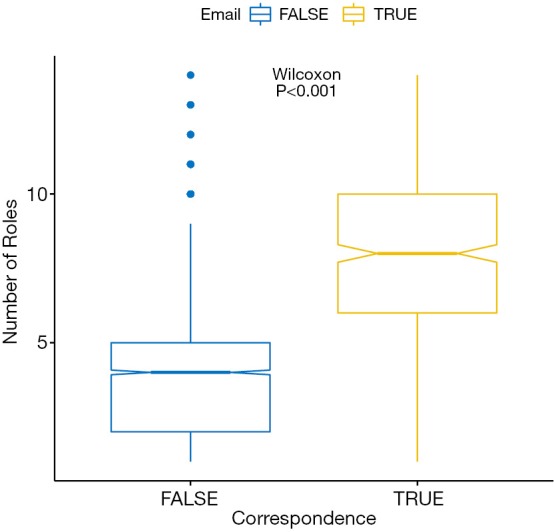
Comparisons of the number of roles per author between corresponding (TRUE) and non-corresponding (FALSE) authors.
A multivariable regression model showed that the authors who performed conceptualization were twice more likely to be the corresponding author (OR: 2.35; 95% CI: 1.69–3.29; P<0.001). Similarly, the authors who performed funding acquisition (OR: 2.06; 95% CI: 1.54–2.76; P<0.001), project administration (OR: 1.54; 95% CI: 1.17–2.03; P=0.002), supervision (OR: 2. 60; 95% CI: 1.93–3.52; P<0.001), original draft writing (OR: 4.83; 95% CI: 3.54–6.60; P<0.001) and taking the role of the first author (OR: 7.85; 95% CI: 5.71–10.87; P<0.001), were more likely to be the corresponding author (Table 2).
Table 2. Multivariable regression model investigating the factors associated with the corresponding author role.
| OR (95% CI) | P | |
|---|---|---|
| Conceptualization | 2.35 (1.69, 3.29) | <0.001 |
| Data curation | 0.85 (0.63, 1.13) | 0.255 |
| Formal analysis | 1.58 (1.18, 2.11) | 0.002 |
| Funding acquisition | 2.06 (1.54, 2.76) | <0.001 |
| Investigation | 0.94 (0.71, 1.23) | 0.645 |
| Methodology | 1.14 (0.84, 1.55) | 0.402 |
| Project administration | 1.54 (1.17, 2.03) | 0.002 |
| Resources | 1.17 (0.86, 1.58) | 0.316 |
| Software | 1.24 (0.79, 1.91) | 0.342 |
| Supervision | 2.60 (1.93, 3.52) | <0.001 |
| Validation | 1.03 (0.74, 1.42) | 0.853 |
| Visualization | 1.17 (0.84, 1.64) | 0.355 |
| Writing-original draft | 4.83 (3.54, 6.60) | <0.001 |
| Writing-review editing | 1.24 (0.89, 1.75) | 0.205 |
| First author | 7.85 (5.71, 10.87) | <0.001 |
OR, odds ratio; CI, confidence interval.
Factors associated with the first author
Because there is a significant overlap between the first and corresponding author roles, the comparisons of CRediT roles between the first and non-first authors were similar to those for the corresponding authors. There were, however, a few minor differences. The supervision and resources roles were not significantly different between the first and non-first authors (Table 3). The author order was significantly associated with the number of roles per author (R2 =0.032, P<0.001, Figure 3). The multivariable regression model showed that writing the original draft was significantly associated with the designation of the first author (OR: 37.49; 95% CI: 25.29–57.57; P<0.001). However, the first author did not perform review and editing (OR: 0.55; 95% CI: 0.40–0.75; P<0.001), supervision (OR: 0.49; 95% CI: 0.36–0.67; P<0.001), or resource management (OR: 0.71; 95% CI: 0.50–1.00; P=0.053) (Table 4).
Table 3. Comparison of CRediT roles between the first author and other co-authors.
| Factors | Non-first author (n=3,739) | First author (n=446) | P |
|---|---|---|---|
| Conceptualization, n (%) | 1,543 (41.3) | 337 (75.6) | <0.001 |
| Data curation, n (%) | 1,114 (29.8) | 272 (61.0) | <0.001 |
| Formal analysis, n (%) | 1,037 (27.7) | 321 (72.0) | <0.001 |
| Funding acquisition, n (%) | 679 (18.2) | 146 (32.7) | <0.001 |
| Investigation, n (%) | 1,728 (46.2) | 313 (70.2) | <0.001 |
| Methodology, n (%) | 1,622 (43.4) | 329 (73.8) | <0.001 |
| Project administration, n (%) | 917 (24.5) | 240 (53.8) | <0.001 |
| Resources, n (%) | 815 (21.8) | 109 (24.4) | 0.226 |
| Software, n (%) | 236 (6.3) | 74 (16.6) | <0.001 |
| Supervision, n (%) | 1,119 (29.9) | 144 (32.3) | 0.331 |
| Validation, n (%) | 550 (14.7) | 134 (30.0) | <0.001 |
| Visualization, n (%) | 297 (7.9) | 158 (35.4) | <0.001 |
| Writing-original &draft, n (%) | 661 (17.7) | 417 (93.5) | <0.001 |
| Writing-review & editing, n (%) | 2,829 (75.7) | 322 (72.2) | 0.122 |
| Corresponding author, n (%) | 208 (5.6) | 252 (56.5) | <0.001 |
| Study Group, n (%) | 479 (12.8) | 32 (7.2) | 0.001 |
| Number of roles per author, median (IQR) | 4.00 (2.00, 5.00) | 7.00 (5.00, 9.00) | <0.001 |
IQR, interquartile range.
Figure 3.
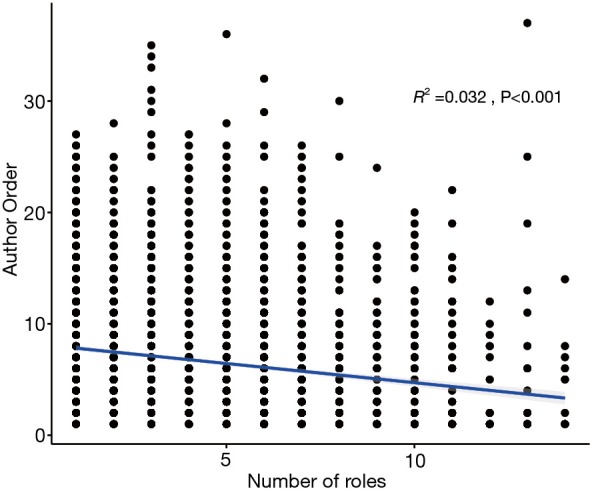
Scatter plot showing the correlation between the author order and the number of roles per author. There was significant correlation (R2 =0.032; P<0.001) between the two variables.
Table 4. Multivariable regression model investigating the factors (contributor roles) associated with the first author designation.
| OR (95% CI) | P | |
|---|---|---|
| Conceptualization | 1.79 (1.30, 2.48) | <0.001 |
| Data curation | 1.63 (1.24, 2.14) | 0.001 |
| Formal analysis | 1.88 (1.41, 2.52) | <0.001 |
| Funding acquisition | 0.89 (0.64, 1.23) | 0.484 |
| Investigation | 1.94 (1.46, 2.57) | <0.001 |
| Methodology | 1.18 (0.86, 1.61) | 0.312 |
| Project administration | 2.07 (1.54, 2.78) | <0.001 |
| Resources | 0.71 (0.50, 1.00) | 0.053 |
| Software | 0.99 (0.65, 1.52) | 0.977 |
| Supervision | 0.49 (0.36, 0.67) | <0.001 |
| Validation | 0.79 (0.56, 1.10) | 0.165 |
| Visualization | 2.10 (1.52, 2.91) | <0.001 |
| Writing-original & draft | 37.49 (25.29, 57.57) | <0.001 |
| Writing-review & editing | 0.55 (0.40, 0.75) | <0.001 |
OR, odds ratio; CI, confidence interval.
Table 5 shows the multivariable linear regression model exploring the factors associated with author order. As expected, conceptualization, data curation, formal analysis, and methodology were associated with a higher ranking order. For example, an author who performed conceptualization was 0.61 (95% CI: 0.26–0.97) places higher in the order of the author list (i.e., the lower order number) compared to the authors not participating in the conceptualization.
Table 5. Multivariable linear regression model investigating the factors associated with the author order.
| Coefficient (95% CI) | P | |
|---|---|---|
| Conceptualization | –0.61 (–0.97, –0.26) | 0.001 |
| Data curation | –0.63 (–0.96, –0.30) | <0.001 |
| Formal analysis | –0.89 (–1.25, –0.52) | <0.001 |
| Funding acquisition | 1.55 (1.13, 1.97) | <0.001 |
| Investigation | –0.10 (–0.40, 0.20) | 0.519 |
| Methodology | –0.49 (–0.82, –0.16) | 0.003 |
| Project administration | –0.22 (–0.58, 0.14) | 0.228 |
| Resources | 0.78 (0.41, 1.15) | <0.001 |
| Software | –1.00 (–1.61, –0.39) | 0.001 |
| Supervision | 0.21 (–0.15, 0.57) | 0.252 |
| Validation | 0.03 (–0.41, 0.47) | 0.887 |
| Visualization | –0.35 (–0.89, 0.18) | 0.197 |
| Writing-original & draft | –2.57 (–2.95, –2.18) | <0.001 |
| Writing-review & editing | 0.12 (–0.23, 0.47) | 0.508 |
Proposal of a modified CRediT
In our study, we found that many CRediT roles naturally correlated with each other. It is strange, for example, to consider formal analysis and software to be separate roles because statisticians need to use software to perform formal analysis; meanwhile, other important roles such as randomization, patient enrollment, and follow-up are not clearly defined. With this in mind, we propose a novel Contributor Roles Taxonomy for Randomized Controlled Trials (CRediT-RCT). Specifically, we propose 10 roles for conducting RCTs. Some items in the original CRediT including software, formal analysis, and visualization were merged due to the following reasons: (I) they were found to be correlated with each other in our study, and (II) they were typically conducted by the same statistician. The item “methodology” was confusing for RCT, and we reframed it as “the statistical analysis plan”. Typically, multicenter RCTs require principal investigators on site, and their roles are important for the enrollment of participants; thus, we created the role of “site principal investigator” (Table 6).
Table 6. The Proposed Contributor Roles Taxonomy for Randomized Controlled Trials (CRediT-RCT).
| Number | Role | Definition |
|---|---|---|
| 1 | Conceptualization | Ideas; formulation or evolution of overarching research goals and aims |
| 2 | Funding acquisition | Acquisition of the financial support for the project leading to this publication |
| 3 | Project administration | Management and coordination responsibility for conducting the trial, including the training of participating centers |
| 4 | Site principal investigator | For multi-center trials, the principal investigator coordinating all study affairs in a participating center |
| 5 | Statistical analysis plan | Detailed elaboration of the principal features of the analysis described in a clinical trial protocol, which includes procedures for statistical analysis of the primary and secondary variables and other data |
| 6 | Investigation | Conducting a research and investigation process, specifically sequence generation, allocation concealment, medical procedures of the intervention and control arms, data entry, outcome assessment, and follow up |
| 7 | Data curation | Management activities to annotate (produce metadata), scrub data and maintain research data (including software code, where it is necessary for interpreting the data itself) for initial use and later re-use |
| 8 | Formal analysis | Application of statistical, mathematical, computational, or other formal techniques to analyze or synthesize study data |
| 9 | Writing-original & draft | Preparation, creation and/or presentation of the published work, specifically writing the initial draft (including substantive translation) |
| 10 | Writing-review & editing | Preparation, creation, and/or presentation of the published work by those from the original research group, specifically critical review, commentary or revision, including pre- or post-publication stages |
Discussion
The present study analyzed the use of CRediT roles in RCT. The results showed that there were some strong correlations between CRediT roles in an RCT, suggesting that some roles can be merged. Corresponding authors took more roles than non-corresponding authors. Interestingly, our study found that a substantial proportion (54.8%) of the corresponding authors were also the first author, which contrasts with the misperception that the corresponding author is usually the senior author in the last position. Perhaps, an RCT typically requires many contributors from different centers and it is usually not easy to quantify and rank the amount of contribution. In biomedical research, designating the last author as the corresponding author means that the work has been conducted in that author’s laboratory or research group under his/her supportive guidance of the novice researchers (11,12). A survey conducted among surgical and medical chairpersons showed that the overall prestige of the last author position increased significantly when he/she was designated as the corresponding author (13). We also found that the majority of corresponding authors (80.9%) wrote the original draft.
The authorship order was found to be determined by the number of CRediT roles in RCT. However, this phenomenon does not happen in other scientific fields. For example, many disciplines such as physics, mathematics, and theoretical computer science order the authors alphabetically regardless of their individual contributions to the work (14,15). The general rule recommended by the American Psychological Association (APA) is that the name of the principal contributor should appear first, with subsequent names in order of decreasing contribution (12). However, quantitative measurement of the contribution is challenging. As discovered by our study, different CRediT roles are generally assigned equal weights if they are simply counted. However, some CRediT roles like funding acquisition and resources were associated with latter positions in the author list, and it may be due to the fact that the last author usually takes the corresponding role.
There are several limitations of the present study. First, we did not screen the included studies manually to ensure that all studies were primary reports of the RCT; and thus some included papers may be the secondary analysis of an RCT. However, we believe that the authorship of these secondary investigations should also be addressed. Second, the present results were derived from those PLoS publications, and it is unclear whether the present results can be generalized to other journals. The reasons for us to include only RCTs from the PLoS publications were that those publications embed the CRediT roles within the authors’ metadata rather than solely as a separate paragraph of text linked to author initials. The authors’ metadata is machine readable and can be easily extracted by using sophisticated web scraping approaches. Third, CRediT was developed by experts from general science and thus may not be fully suitable for RCTs; therefore, we here propose a new CRediT-RCT.
In conclusion, the present study provides empirical data on the use of CRediT for RCTs, and some limitations of the taxonomy are discussed. We further propose a new CRediT-RCT which includes 10 roles. The CRediT-RCT is more suitable for clinical trials and explicitly defines some important roles in RCTs that have not yet been well defined in the original CRediT.
Acknowledgments
The authors would like to thank Mr Gabriel Harp from the MIT Press for providing suggestions for the study and editing support for this manuscript.
Funding: Z Zhang received funding from the Public Welfare Research Project of Zhejiang Province (LGF18H150005) and the National Natural Science Foundation of China (Grant No. 81901929).
Ethical Statement: The authors are accountable for all aspects of the work in ensuring that questions related to the accuracy or integrity of any part of the work are appropriately investigated and resolved.
Footnotes
Conflicts of Interest: The authors have no conflicts of interest to declare.
References
- 1.Rennie D, Yank V, Emanuel L. When authorship fails. A proposal to make contributors accountable. JAMA 1997;278:579-85. 10.1001/jama.1997.03550070071041 [DOI] [PubMed] [Google Scholar]
- 2.Alfonso F, Zelveian P, Monsuez JJ, et al. Authorship: from credit to accountability. Reflections from the Editors' Network. Basic Res Cardiol 2019;114:23. 10.1007/s00395-019-0729-y [DOI] [PubMed] [Google Scholar]
- 3.Levsky ME, Rosin A, Coon TP, et al. A descriptive analysis of authorship within medical journals, 1995-2005. South Med J 2007;100:371-5. 10.1097/01.smj.0000257537.51929.4b [DOI] [PubMed] [Google Scholar]
- 4.Stocks A, Simcoe D, Toroser D, et al. Substantial contribution and accountability: best authorship practices for medical writers in biomedical publications. Curr Med Res Opin 2018;34:1163-8. 10.1080/03007995.2018.1451832 [DOI] [PubMed] [Google Scholar]
- 5.Brand A, Allen L, Altman M, et al. Beyond authorship: attribution, contribution, collaboration, and credit. Learn Publ 2015;28:151-5. 10.1087/20150211 [DOI] [Google Scholar]
- 6.Kim TI. Endorsement of the Contributor Roles Taxonomy for the clarification of authorship. J Periodontal Implant Sci 2017;47:1. 10.5051/jpis.2017.47.1.1 [DOI] [PMC free article] [PubMed] [Google Scholar]
- 7.McNutt MK, Bradford M, Drazen JM, et al. Transparency in authors' contributions and responsibilities to promote integrity in scientific publication. Proc Natl Acad Sci U S A 2018;115:2557-60. 10.1073/pnas.1715374115 [DOI] [PMC free article] [PubMed] [Google Scholar]
- 8.Whellan DJ, Kraus WE, Kitzman DW, et al. Authorship in a multicenter clinical trial: The Heart Failure-A Controlled Trial Investigating Outcomes of Exercise Training (HF-ACTION) Authorship and Publication (HAP) scoring system results. Am Heart J 2015;169:457-63.e6. 10.1016/j.ahj.2014.11.022 [DOI] [PMC free article] [PubMed] [Google Scholar]
- 9.Mentz RJ, Peterson ED. Site Principal Investigators in Multicenter Clinical Trials: Appropriately Recognizing Key Contributors. Circulation 2017;135:1185-7. 10.1161/CIRCULATIONAHA.116.026650 [DOI] [PMC free article] [PubMed] [Google Scholar]
- 10.Zhang Z. Univariate description and bivariate statistical inference: the first step delving into data. Ann Transl Med 2016;4:91. 10.21037/atm.2016.02.11 [DOI] [PMC free article] [PubMed] [Google Scholar]
- 11.Roberts LW. Addressing Authorship Issues Prospectively: A Heuristic Approach. Acad Med 2017;92:143-6. 10.1097/ACM.0000000000001285 [DOI] [PubMed] [Google Scholar]
- 12.Minshew LM, McLaughlin JE. Authorship Considerations for Publishing in Pharmacy Education Journals. Am J Pharm Educ 2019;83:7463. [DOI] [PMC free article] [PubMed] [Google Scholar]
- 13.Bhandari M, Guyatt GH, Kulkarni AV, et al. Perceptions of authors' contributions are influenced by both byline order and designation of corresponding author. J Clin Epidemiol 2014;67:1049-54. 10.1016/j.jclinepi.2014.04.006 [DOI] [PubMed] [Google Scholar]
- 14.Dance A. Authorship: Who's on first? Nature 2012;489:591-3. 10.1038/nj7417-591a [DOI] [PubMed] [Google Scholar]
- 15.Ma WJ, Zhang QN, Shi SZ, et al. Preoperative chemoradiation may be more effective for esophageal squamous cell carcinoma compared with adenocarcinoma: results from 15 randomized controlled trials of 2,250 patients. Transl Cancer Res 2018;7:1421-30. 10.21037/tcr.2018.11.04 [DOI] [Google Scholar]