



Abstract
Following a request from the European Commission, the EFSA Panel on Food Additives and Nutrient sources added to Food (ANS) was asked to deliver a scientific opinion on the re‐evaluation of 12 modified starches (E 1404, E 1410, E 1412, E 1413, E 1414, E 1420, E 1422, E 1440, E 1442, E 1450, E 1451 and E 1452) authorised as food additives in the EU in accordance with Regulation (EC) No 1333/2008 and previously evaluated by JECFA and the SCF. Both committees allocated an acceptable daily intake (ADI) ‘not specified’. In humans, modified starches are not absorbed intact but significantly hydrolysed by intestinal enzymes and then fermented by the intestinal microbiota. Using the read‐across approach, the Panel considered that adequate data on short‐ and long‐term toxicity and carcinogenicity, and reproductive toxicity are available. Based on in silico analyses, modified starches are considered not to be of genotoxic concern. No treatment‐related effects relevant for human risk assessment were observed in rats fed very high levels of modified starches (up to 31,000 mg/kg body weight (bw) per day). Modified starches (e.g. E 1450) were well tolerated in humans up to a single dose of 25,000 mg/person. Following the conceptual framework for the risk assessment of certain food additives, the Panel concluded that there is no safety concern for the use of modified starches as food additives at the reported uses and use levels for the general population and that there is no need for a numerical ADI. The combined exposure to E 1404–E 1451 at the 95th percentile of the refined (brand‐loyal) exposure assessment scenario for the general population was up to 3,053 mg/kg bw per day. Exposure to E 1452 for food supplement consumers only at the 95th percentile was up to 22.1 mg/kg bw per day.
Keywords: modified starches, E 1404, E 1410, E 1412, E 1413, E 1414, E 1420, E 1422, E 1440, E 1442, E 1450, E 1451, E 1452
Summary
Following a request from the European Commission, the EFSA Panel on Food Additives and Nutrient Sources added to Food (ANS) was asked to deliver a scientific opinion re‐evaluating the safety of oxidised starch (E 1404), monostarch phosphate (E 1410), distarch phosphate (E 1412), phosphated distarch phosphate (E 1413), acetylated distarch phosphate (E 1414), acetylated starch (E 1420), acetylated distarch adipate (E 1422), hydroxypropyl starch (E 1440), hydroxypropyl starch phosphate (E 1442), starch sodium octenyl succinate (E 1450), acetylated oxidised starch (E 1451) and starch aluminium octenyl succinate (E 1452) when used as food additives.
The aforementioned modified starches are authorised as food additives in accordance with Regulation (EC) No 1333/2008.
Starch typically consists of two polymers of glucose, namely amylose, with an almost linear structure, and amylopectin, which is highly branched. In amylose, the glucose monomers (pyranosic form) are linked by α‐1,4‐glycosidic links, while amylopectin contains additionally α‐1,6‐glycosidic bonds. Commercial starches are composed of about 20–25% amylose and 75–80% amylopectin. High amylose starches typically consist of 50–80% amylose and 20–50% amylopectin. Starches for commercial use are generally produced from potatoes, cereals or other sources.
In modified starches, the chemical and physical characteristics of the native substances are altered in order to improve the functional properties for particular food applications: the observed effects on such properties depend on the type and extent of the modification (e.g. degree of substitution (DS)) and the source starch (e.g. cereal, potato, tapioca). In general, the extent of modification required to distinctly alter the functional characteristics of native starches is low, as imposed by Commission Regulation (EU) No 231/2012. In conclusion, for a large number of food applications, modified starches are used because of their superior properties compared to the native substances.
Modified starches have been previously evaluated by the Scientific Committee for Food (1976, 1981, 1990 and 1995) and by the Joint FAO/WHO Expert Committee on Food Additives (1969, 1971, 1973, 1982, 2014 and 2016). An acceptable daily intake (ADI) ‘not specified’ was allocated by both committees.
Data on in vitro degradation of modified starches by digestive enzymes indicated that their digestibility was slightly reduced or showed no differences when compared to corresponding unmodified starches. In vivo data are in agreement with in vitro studies indicating that the two major components of starches, amylose and amylopectin, would be fermented during their passage through the large intestine by strains of bacteria found in the human colon. The main end products of this colonic anaerobic digestive process are short‐chain fatty acids (SCFA) such as acetic, propionic and butyric acids, which are absorbed from the colon. Despite the absence of absorption, distribution, metabolism and excretion (ADME) data for two modified starches (E 1451 and E 1452) and the absence of in vivo studies in humans for some other modified starches, the Panel considered this database sufficient to conclude that modified starches would not be absorbed intact but significantly hydrolysed by intestinal enzymes and then fermented by intestinal microbiota in humans.
Toxicity data were not available for all of the modified starches evaluated in the present opinion and for all endpoints. In general, the most complete data sets were available for acetylated distarch phosphate (E 1414) and acetylated distarch adipate (E 1422). However, given their structural, physicochemical and biological similarities, it is possible to read‐across between all the modified starches.
Data concerning acute oral toxicity are available for several animal species for distarch phosphate (E 1412) only. These indicate low oral acute toxicity.
Short‐term and/or subchronic (90‐day) studies were available in rats for all modified starches, except monostarch phosphate (E 1410). Occasionally also, studies in dogs, pigs or hamsters were available. The modified starches were given at dietary levels up to 70%. The test duration was up to 90 days. Effects on body weight and feed consumption were not observed up to dietary levels of 25%. Caecum weight was increased at exposure levels of 30% and higher, but histopathological changes were not observed. The only frequently observed significant histopathological change was the presence of pelvic and/or corticomedullary mineralisation in the kidneys, which was observed with modified as well as unmodified starches, and occurred more pronounced in females than in males.
In a 90‐day study with acetylated oxidised starch (E 1451) in rats, a no‐observed‐adverse‐effect level (NOAEL) of 10% in the diet, equal to 5,900 mg/kg per day, was determined based on hyperplasia of the transitional epithelium of the urinary bladder and the kidneys.
Evaluation of genotoxicity of the modified starches evaluated in the present opinion was performed in silico, since no genotoxicity studies were available. The Panel concluded that the in silico analyses of the substructures of modified starch moieties did not identify any relevant alert for genotoxicity, and concluded that modified starches do not raise concern for genotoxicity.
Two chronic (52‐week) studies were available, one with acetylated distarch phosphate (E 1414) and one with acetylated distarch adipate (E 1422). At necropsy, relative organ weights showed no differences between the groups, except for caecal enlargement. Histopathological examination of kidneys demonstrated the presence of treatment‐related pelvic nephrocalcinosis. A clear correlation was observed between the increased incidence of pelvic nephrocalcinosis, increased accumulation of calcium in the kidneys and increased urinary excretion of calcium.
Carcinogenicity studies were available for E 1413, E 1414, E 1420, E 1422, E 1442 and E 1450 in rats and for E 1442 in mice. There was no evidence for carcinogenicity. The long‐term studies in rats did not reveal any significant effect, except for caecal enlargement. As this effect was observed without associated histopathological changes, it was considered to be of no toxicological significance for humans.
Kidney lesions (pelvic and corticomedullary mineralisation) occurred in rats (sub)chronically fed high levels (up to 62% in the diet, equivalent to 31,000 mg/kg body weight (bw) per day) of phosphated distarch phosphate (E 1413), acetylated distarch phosphate (E 1414), acetylated starch (E 1420), acetylated distarch adipate (E 1422) and hydroxypropyl distarch phosphate (E 1442). The lesions were considered to be associated with an imbalance of Ca/P and Mg in the diet. The mechanism is considered to be related to increased calcium absorption in the lower intestine caused by the formation of absorbable breakdown products. As the rat is a particularly sensitive species for pelvic nephrocalcinosis, while these lesions were not observed in the hamster and the pig, it was considered to be of no relevance for risk assessment in humans.
Dietary reproductive toxicity studies in rats were available for phosphate distarch phosphate (E 1413), acetylated distarch phosphate (E 1414), acetylated starch (E 1420) and acetylated distarch adipate (E 1422). No effects on reproductive performance or maternal and developmental effects were observed in the three‐generation reproductive toxicity studies at dietary levels of up to 62% (equivalent to 31,000 mg/kg bw per day).
No developmental toxicity studies were available.
Studies in healthy human volunteers with phosphated distarch phosphate (E 1413), acetylated distarch phosphate (E 1414) and acetylated starch (E 1420) reported no adverse effects at doses of 60,000 mg/person.
Starch sodium octenyl succinate (E 1450) up to a single dose of 25,000 mg was well tolerated by fasting healthy adults. However, the Panel noted reports on gastrointestinal symptoms conducted in infants with hypoallergenic formula containing 2% octenyl succinic anhydride (OSA)‐modified starch (24,000 mg/person).
To assess the dietary exposure to modified starches (E 1404–E 1451) from their use as food additives, the combined exposure was calculated based on (1) maximum reported use levels provided to EFSA (defined as the maximum level exposure assessment scenario), and (2) reported use levels (defined as the refined exposure assessment scenario, brand‐loyal and non‐brand‐loyal consumer scenario).
Modified starches are authorised in a wide range of foods. The Panel did identify brand loyalty to specific food categories in infants and toddlers (e.g. processed cereal baby foods, unflavoured fermented milk products and flavoured fermented milk products). Further, the Panel considered that the non‐brand‐loyal scenario covering other population groups was appropriate and realistic scenario for risk characterisation because it is assumed that the population would probably be exposed long‐term to the food additive present at the mean reported use in processed food.
A refined estimated exposure assessment scenario taking into account the food for special medical purposes (FSMP) for infants and young children (FC 13.1.5.1 Dietary foods for infants for special medical purposes and special formulae for infants and FC 13.1.5.2 Dietary foods for babies and young children for special medical purposes as defined by Commission Directive 1999/22/EC) was also performed to estimate exposure of infants and toddlers who may be on a specific diet. Considering that this diet is required due to specific needs, it is assumed that consumers are loyal to the food brand; therefore, the refined brand‐loyal estimated exposure scenario was performed.
A specific food supplement consumers only scenario was also performed to estimate exposure for children, adolescents, adults and the elderly, as exposure via food supplements may deviate largely from that via food, and the number of food supplement consumers may be low depending on populations and surveys.
The refined estimates were based on 36 out of 72 food categories in which modified starches are authorised. The Panel considered that the uncertainties identified would, in general, result in an overestimation of the exposure to modified starches as a food additive in European countries for the maximum level exposure scenario. However, the Panel noted that given the information from the Mintel's Global New Products Database (GNPD), it may be assumed that modified starches are used in food categories (n = 13) for which no data have been provided by food industry. The main food categories, in terms of amount consumed, not taken into account were processed fish and fishery products, including molluscs and crustaceans, breakfast cereals, salads and savoury‐based sandwich spreads. According to the Mintel GNPD, in the European Union (EU) market, these categories are labelled with modified starches. Therefore, the Panel considered that if these uncertainties were confirmed, it would therefore result in an underestimation of the exposure.
The Panel further noted that the exposure to modified starches (E 1404–E 1451) from their use according Annex III to Regulation (EC) No 1333/2008 (Parts 1, 3 and 5) was not considered in the exposure assessment.
Separate scenarios were carried out for the exposure assessment of starch aluminium octenyl succinate (E 1452), taking into account the consumption of food supplements for consumers only and based on the maximum permitted level (MPL) (regulatory maximum exposure assessment scenario) and on the maximum reported use level (maximum reported level exposure assessment scenario). Exposure to aluminium from the use of E 1452 as a food additive was also estimated.
Exposure to aluminium from the use of E 1452 in the regulatory maximum level exposure assessment scenario ranged for all population groups from 0.8% to 26% of the tolerable weekly intake (TWI) of 1 mg aluminium/kg bw established by EFSA (2008) at the mean, and up to 47% at the 95th percentile. For the maximum reported level exposure assessment scenario, based on the usage levels provided by food industry, exposure to aluminium from E 1452 ranged from < 0.1 at the mean, up to 2.5% for the 95th percentile across population groups. Furthermore, according to the information provided by industry, the content of aluminium in E 1452 is significantly lower than the limit set in the EU specifications for E 1452.
The Panel also noted that the refined exposure estimates are based on information provided on the reported levels of use of modified starches. If actual practice changes, this refined estimates may no longer be representative and should be updated.
Following the conceptual framework for the risk assessment of certain food additives re‐evaluated under Commission Regulation (EU) No 257/2010 (EFSA ANS Panel, 2014) and given that:
adequate combined exposure data were available; in the general population, the 95th percentile of the refined exposure, calculated based on the use levels reported from food industry, was up to 3,053 mg/kg bw per day for toddlers (brand‐loyal consumer scenario);
an indicative refined exposure to modified starches (E 1404–E 1451) of up to 991 mg/kg bw per day has been calculated at the 95th percentile for children, for the population consuming food supplements;
exposure to starch aluminium octenyl succinate (E 1452) for food supplement consumers only at the 95th percentile was 22.1 mg/kg bw per day (regulatory maximum level exposure assessment scenario) and 1.2 mg/kg bw per day (maximum reported level exposure scenario) in the elderly;
their structural, physicochemical and biological similarities, allow for read‐across between all the modified starches;
the ADME database is sufficient to conclude that, in humans, modified starches would not be absorbed intact, but significantly hydrolysed by intestinal enzymes and then fermented by the intestinal microbiota;
using the read‐across approach, adequate data on short‐ and long‐term toxicity and carcinogenicity and reproductive toxicity are available;
no treatment‐related effects relevant for human risk assessment were observed in long‐term studies in rats fed very high levels of modified starches (up to 31,000 mg/kg bw per day);
although no genotoxicity data on the modified starches evaluated in the present opinion were available, modified starches are not of genotoxic concern based on in silico analysis;
modified starches (i.e. E 1413, E 1414, E 1420 and E 1450) were well tolerated in adults up to a single daily dose of 60,000 mg/person (860 mg/kg bw);
the Panel concluded that there is no safety concern for the use of modified starches as food additives at the reported uses and use levels and that there is no need for a numerical ADI.
Concerning the use of starch sodium octenyl succinate (E 1450) in ‘dietary foods for special medical purposes and special formulae for infants’ (food category 13.1.5.1) and of E 1404, E 1410, E 1412, E 1413, E 1414, E 1420, E 1450 and E 1451 in food belonging to food category 13.1.5.2 and given that:
for populations consuming foods for special medical purposes and special formulae, the 95th percentile of exposure calculated based on the maximum use levels reported from food industry was up to 5,286 mg/kg bw per day for infants;
infants and young children consuming foods belonging to these food categories may show a higher susceptibility to the gastrointestinal effects of modified starches than their healthy counterparts due to their underlying medical condition;
no effects on body weight and food intake were observed in male and female neonatal pigs exposed to 10,000 mg/kg bw per day of OSA‐modified starch (E 1450) in formula for 21 days;
OSA‐modified starch (E 1450), up to a single dose of 25,000 mg/person, was well tolerated by fasting healthy adults, but gastrointestinal symptoms were reported in infants with hypoallergenic formula containing 2% of OSA‐modified starch (about 24,000 mg/person);
available information on the clinical studies in infants is limited and results refer to the feeding of formula containing OSA‐modified starch in concentrations below 2%, the current authorised MPL,
the Panel concluded, that the available data do not allow for an adequate assessment of the safety of the use of starch sodium octenyl succinate (E 1450) in ‘dietary foods for special medical purposes and special formulae for infants’ (food category 13.1.5.1) or of E 1404, E 1410, E 1412, E 1413, E 1414, E 1420, E 1450 and E 1451 in foods belonging to food category 13.1.5.2, in infants and young children consuming these foods at the presently authorised maximum use levels of 20,000 or 50,000 mg/kg, respectively.
The Panel recommended that:
the European Commission considers revising the maximum limits for the toxic elements arsenic, lead and mercury present as impurities in the EU specifications for all modified starches re‐evaluated in the present opinion (E 1404, E 1410, E 1412, E 1413, E 1414, E 1420, E 1422, E 1440, E 1442, E 1450, E 1451 and E 1452) to ensure that these food additives will not be a significant source of exposure to these toxic elements in food;
the European Commission considers revising specifications, including harmonisation of microbiological criteria for polysaccharides such as modified starches and gums, and taking into account future availability of specific methods of analysis of modified starches;
the European Commission seeks confirmation on the actual use of starch aluminium octenyl succinate (E 1452) in its currently permitted use limited to food supplements (only vitamin preparations for encapsulation purposes);
additional data should be generated to assess the potential health effects of starch sodium octenyl succinate (E 1450) when used in ‘dietary foods for special medical purposes and special formulae for infants’ (food category 13.1.5.1) or of E 1404, E 1410, E 1412, E 1413, E 1414, E 1420, E 1450 and E 1451 in foods belonging to food category 13.1.5.2;
due to the discrepancies observed between the data reported from industry and the Mintel database, where modified starches (E 1404–E 1451) are labelled in more products than in food categories for which data were reported from industry, the Panel recommended collection of data on usage and use levels of modified starches (E 1404–E 1451) in order to perform a more realistic exposure assessment.
1. Introduction
The present opinion deals with the re‐evaluation of the safety of oxidised starch (E 1404), monostarch phosphate (E 1410), distarch phosphate (E 1412), phosphated distarch phosphate (E 1413), acetylated distarch phosphate (E 1414), acetylated starch (E 1420), acetylated distarch adipate (E 1422), hydroxypropyl starch (E 1440), hydroxypropyl distarch phosphate (E 1442), starch sodium octenyl succinate (E 1450), acetylated oxidised starch (E 1451) and starch aluminium octenyl succinate (E 1452) when used as food additives. These modified starches are authorised food additives in the EU according to Annex II and Annex III to Regulation (EC) No 1333/20081.
1.1. Background and Terms of Reference as provided by the European Commission
1.1.1. Background
Regulation (EC) No 1333/2008 of the European Parliament and of the Council on food additives requires that food additives are subject to a safety evaluation by the European Food Safety Authority (EFSA) before they are permitted for use in the European Union (EU). In addition, it is foreseen that food additives must be kept under continuous observation and must be re‐evaluated by EFSA.
For this purpose, a programme for the re‐evaluation of food additives that were already permitted in the European Union before 20 January 2009 has been set up under Regulation (EU) No 257/20102. This Regulation also foresees that food additives are re‐evaluated whenever necessary in light of changing conditions of use and new scientific information. For efficiency and practical purposes, the re‐evaluation should, as far as possible, be conducted by group of food additives according to the main functional class to which they belong.
The order of priorities for the re‐evaluation of the currently approved food additives should be set on the basis of the following criteria: the time since the last evaluation of a food additive by the Scientific Committee on Food (SCF) or by EFSA, the availability of new scientific evidence, the extent of use of a food additive in food and the human exposure to the food additive taking also into account the outcome of the Report from the Commission on Dietary Food Additive Intake in the EU3 of 2001. The report ‘Food additives in Europe 2000’ submitted by the Nordic Council of Ministers to the Commission, provides additional information for the prioritisation of additives for re‐evaluation.
In 2003, the Commission already requested EFSA to start a systematic re‐evaluation of authorised food additives. However, as a result of adoption of Regulation (EU) 257/2010, the 2003 Terms of References are replaced by those below.
1.1.2. Terms of Reference
The Commission asks EFSA to re‐evaluate the safety of food additives already permitted in the Union before 2009 and to issue scientific opinions on these additives, taking especially into account the priorities, procedures and deadlines that are enshrined in Regulation (EU) No 257/2010 of 25 March 2010 setting up a programme for the re‐evaluation of approved food additives in accordance with Regulation (EC) No 1333/2008 of the European Parliament and of the Council on food additives.
1.1.3. Interpretation of Terms of Reference
The Panel on Food Additives and Nutrient Sources added to Food (ANS) described its risk assessment paradigm in the Guidance for submission for food additive evaluations in 2012 (EFSA ANS Panel, 2012). This Guidance states, that in carrying out its risk assessments, the Panel sought to define a health‐based guidance value, e.g. an acceptable daily intake (ADI) (IPCS, 2004) applicable to the general population. According to the definition above, the ADI as established for the general population does not apply to infants below 12 weeks of age (JECFA, 1978; SCF, 1998). In this context, the re‐evaluation of the use of starch sodium octenyl succinate (E 1450) in food for infants below 12 weeks represents a special case for which specific recommendations were given by the Joint FAO/WHO Expert Committee on Food Additives (JECFA, 1972a, 1978) and by the SCF (1996, 1998). The Panel endorsed these recommendations.
In the current EU legislation (Regulation (EC) No 1333/2008), use levels of additives in food for infants under the age of 12 weeks in categories 13.1.1 and 13.1.5.14 (Annex II) and uses of food additives in nutrient preparations for use in food for infants under the age of 12 weeks and maximum levels for the carry‐over from these uses (Annex III, Part 5, section B) are included. The Panel considers that these uses would require a specific risk assessment in line with the recommendations given by JECFA and the SCF and endorsed by the Panel in its current Guidance for submission for food additives evaluations (EFSA ANS Panel, 2012). Therefore, risk assessments for the general population are not considered applicable for infants under the age of 12 weeks and will be performed separately.
This re‐evaluation refers exclusively to the uses of modified starches as food additives in food, including food supplements and does not include a safety assessment of other uses of modified starches.
1.2. Information on existing authorisations and evaluations
Oxidised starch (E 1404), monostarch phosphate (E 1410), distarch phosphate (E 1412), phosphated distarch phosphate (E 1413), acetylated distarch phosphate (E 1414), acetylated starch (E 1420), acetylated distarch adipate (E 1422), hydroxypropyl starch (E 1440), hydroxypropyl distarch phosphate (E 1442), starch sodium octenyl succinate (E 1450), acetylated oxidised starch (E 1451) and starch aluminium octenyl succinate (E 1452) are listed in Commission Regulation (EC) No 1333/2008 as authorised food additives in the EU and have been previously evaluated by JECFA and by the SCF. An acceptable daily intake (ADI) ‘not specified’ was allocated by both committees in their evaluations.
A group of modified starches was evaluated by the SCF in 1976 (SCF, 1976). The starches E 1404–1422 were assigned to group B: ‘starches may be used temporarily until 31 December 1980 but the numbers and amounts used should be limited in infant foods. For these latter foods every effort should be made to work within a maximum of 3.5%. If technologically necessary for the manufacture of certain products, the Committee could accept a maximum of 5%’. The starches E 1440 and E 1442 were assigned to Group C (starches that should not be allowed in infant foods). They were acceptable for use in food, other than that prepared for infants, on a temporary basis until 31 December 1980, subject to a limit for total chlorohydrins of 1 mg/kg in the relevant specifications.
The group of modified starches was evaluated a second time by the SCF in 1981 (SCF, 1982). Additional short‐term, long‐term and reproductive toxicity studies on starches previously classified into group B or C5 were reviewed. The SCF considered the appearance and mechanism of corticomedullary and of pelvic nephrocalcinosis (PN) as a finding to be specific for the rat as the most sensitive species and to have little relevance for the safety assessment of modified starches for man. The SCF considered that E 1440 and E 1442 could be transferred to group B provided residues of chlorohydrin did not exceed 0.1 mg/kg as determined by an agreed method. The Panel noted that according to the current specifications, the residues of propylene chlorohydrin should not exceed 1 mg/kg (Commission Regulation (EU) No 231/20126).
Starch sodium octenyl succinate (E 1450; octenyl succinic anhydride (OSA)‐modified starch) was evaluated by the SCF in 1990 (SCF, 1994), and acetylated oxidised starch (E 1451) was evaluated by the SCF in 1995 (SCF, 1997) and were included among the other modified starches in group B, for which use was considered acceptable and for which the establishment of individual ADIs was judged by the SCF to be unnecessary, provided the technological usage remained at present‐day levels.
The group of ‘modified starches’ was discussed by JECFA in 1969 (JECFA, 1970), in 1971 (JECFA, 1972b), in 1973 (JECFA, 1974c) and in 1982 (JECFA, 1982a). The group ‘modified starches’ comprised the following substances: E 1404, E 1410, E 1412, E 1413, E 1414, E 1420, E 1422, E 1440, E 1442 and E 1450. At this meeting, JECFA established an ADI ‘not specified’ for all modified starches listed above except for acetylated oxidised starch (E 1451), for which an ADI ‘not specified’ was established at the 57th JECFA meeting (JECFA, 2002a).
Starch sodium octenyl succinate (OSA‐modified starch; E 1450) was evaluated at the 79th JECFA meeting (JECFA, 2015). Since the 26th meeting, where an ADI ‘not specified’ was assigned to OSA‐modified starch, new data became available, including a 90‐day oral toxicity study, genotoxicity studies and a long‐term toxicity and carcinogenicity study. The Committee confirmed the low toxicity of the additive and also confirmed the ADI ‘not specified’ for the general population. The Committee ‘took into account the overall low toxicity of OSA‐modified starch, the conservatism in the no‐observed‐adverse‐effect level (NOAEL), which was the highest dose tested in a study in neonatal animals, and in the exposure assessments, as well as the supporting evidence from clinical trials and post‐marketing surveillance and concluded that the consumption of OSA‐modified starch in infant formula or formula for special medical purposes intended for infants is not of concern at use levels up to 20 g/L’.
Additionally, in 2010, the EFSA Panel on Dietetic Products, Nutrition and Allergies (EFSA NDA Panel, 2010) evaluated phosphated distarch phosphate for use as a novel food ingredient. The starch was prepared with a novel maize starch source. The NDA Panel concluded that the novel ingredient was safe at the proposed conditions of use and intake levels.
In 1979, the Federation of American Societies for Experimental Biology (FASEB, 1979) evaluated starch and modified starches for status as generally recognised as safe (GRAS) food ingredients.
In 2008, the safety of aluminium from dietary intake has been evaluated by the EFSA Panel on Food Additives, Flavourings, Processing Aids and Food Contact Materials (AFC). The Panel established a tolerable weekly intake (TWI) for aluminium of 1 mg/kg body weight (bw) per week (EFSA, 2008).
In 2011, JECFA established a provisional tolerable weekly intake (PTWI) for aluminium of 2 mg/kg bw per week (JECFA, 2012).
2. Data and methodologies
2.1. Data
The ANS Panel was not provided with a newly submitted dossier. EFSA launched public calls for data,7, 8, 9, 10 to collect relevant information from interested parties.
The Panel based its assessment on information submitted to EFSA following the public calls for data, information from previous evaluations and additional available literature up to the date of the last Working Group (WG) meeting before the adoption of the opinion.11 Attempts were made to retrieve relevant original study reports on which previous evaluations or reviews were based, however, not always these were available to the Panel.
The EFSA Comprehensive European Food Consumption Database (Comprehensive Database12) was used to estimate the dietary exposure.
The Mintel's Global New Products Database (GNPD) is an online database which was used for checking the labelling of products containing modified starches within the EU's food products, as GNPD shows the compulsory ingredient information presented in the labelling of products.
2.2. Methodologies
The assessment was conducted in line with the principles described in the EFSA Guidance on transparency in the scientific aspects of risk assessment (EFSA Scientific Committee, 2009) and following the relevant existing Guidances from the EFSA Scientific Committee.
The ANS Panel assessed the safety of modified starches (E 1404, E 1410, E 1412, E 1413, E 1414, E 1420, E 1422, E 1440, E 1442, E 1450, E 1451 and E 1452) as food additives in line with the principles laid down in Regulation (EU) 257/2010 and the relevant guidance documents: Guidance on submission for food additive evaluations by the SCF (2001) and taking into consideration the Guidance for submission for food additive evaluations in 2012 (EFSA ANS Panel, 2012).
When the test substance was administered in the feed or in the drinking water, but doses were not explicitly reported by the authors as mg/kg bw per day based on actual feed or water consumption, the daily intake was calculated by the Panel using the relevant default values as indicated in the EFSA Scientific Committee Guidance document (EFSA Scientific Committee, 2012) for studies in rodents or, in the case of other animal species, by JECFA (2000). When in human studies in adults (aged above 18 years) the dose of the test substance administered was reported in mg/person per day, the dose in mg/kg bw per day was calculated by the Panel using a body weight of 70 kg as default for the adult population, as described in the EFSA Scientific Committee Guidance document (EFSA Scientific Committee, 2012).
Dietary exposure to modified starches from their use as food additives was estimated combining the food consumption data available within the EFSA Comprehensive European Food Consumption Database with the maximum permitted levels (MPLs) and/or reported use levels submitted to EFSA following a call for data. Different scenarios were used to calculate the exposure (see Section 3.7.1). Uncertainties in the exposure assessment were identified and discussed.
In the context of this re‐evaluation, the Panel followed the conceptual framework for the risk assessment of certain food additives re‐evaluated under Commission Regulation (EC) No 257/2010 (EFSA ANS Panel, 2014).
3. Assessment
3.1. Technical data
3.1.1. Identity of the substances
According to Regulation (EC) No 1333/2008, ‘modified starches’ are substances obtained by one or more chemical treatments of edible starches, which may have undergone a physical or enzymatic treatment, and may be acid or alkali thinned or bleached. According to the same regulation, the following are not considered to be food additives: white or yellow dextrin, roasted or dextrinated starch, starch modified by acid or alkali treatment, bleached starch, physically modified starch and starch treated by amylolytic enzymes. In contrary, JECFA considers dextrin roasted starch (INS No 1400), acid‐treated starch (INS No 1401), alkaline‐treated starch (INS No 1402), bleached starch (INS No 1403) and enzyme‐treated starch (INS No 1405) as food additives, with separate specifications.
Starch typically consists of two polymers of glucose, namely amylose, with almost linear structure, and amylopectin, which is highly branched (EFSA NDA Panel, 2010). In amylose, the glucose monomers (pyranosic form) are linked by α‐1,4‐glycosidic links, while amylopectin contains additionally α‐1,6‐glycosidic bonds (Heyns, 1983). The chemical structure of both main components of starch is shown in Figure 1. Commercial starches are composed of about 20–25% amylose and 75–80% amylopectin (Heyns, 1983). High amylose starches typically consist of 50–80% amylose and 20–50% amylopectin.
Figure 1.
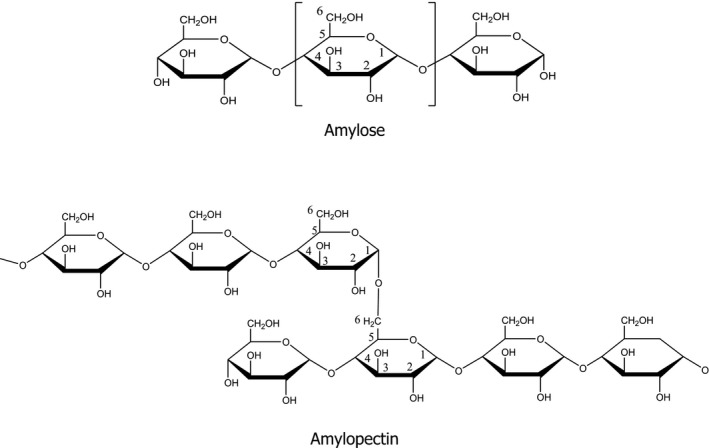
Structural formula of amylose and an example of branching in amylopectin
Starch is deposited as insoluble microsize semicrystalline granules primarily in plants' storage tissues. The physicochemical properties of a given starch, including the dimensions of starch polymers and granules, can vary remarkably depending upon the plant source – even the same plant cultivar grown under different conditions – and possibly upon the starch extraction method (Jackson, 2003; Ratnayake and Jackson, 2003; BeMiller, 2004; Copeland et al., 2009). Therefore, polymer molecular weights (and the correlated degrees of polymerisation) can only indicatively be given (rounding‐off to one figure): for amylopectins, molecular weight estimates have been reported to vary from 50 × 106 Da to 500 × 106 Da, with an average near 100 × 106 Da (higher values have been reported by Yoo and Jane, 2002); for amyloses, estimates appear to fall between 2 × 10³ Da and 4,000 × 103 Da. Molecular weights of 50 × 106 Da and 200 × 103 Da for amylopectin and amylose, respectively, were reported (EFSA NDA Panel, 2010). In different varieties of rice, Ma et al. (2007) determined the weight‐average molecular weight (MW) of amylopectins to be between 40 × 106 and 300 × 106, while Zhong et al. (2006) reported MW estimates for starch with varying amylose content in the range from 60 × 106 to 130 × 106. Due to starch chemical complexity, combinations of analytical techniques have been used to investigate the molecular organisation within starch granules (Zhong et al., 2006; Copeland et al., 2009): the type of analysis carried out can be responsible for some of the differences in the reported molecular weights of amylopectins and amyloses. The limitations of the different methods for the determination of starch molecular weights have recently been reviewed by Harding et al. (2016).
Starches for commercial use are generally produced from potatoes, cereals, or other sources (Documentation provided to EFSA n. 1 ). The chemical structure of starch provides a great possibility of modifications (Fortuna, 1991). The most common chemical modification of the so‐called ‘native’ starches includes oxidation, esterification and etherification (Xie et al., 2005).
The identity of oxidised starch (E 1404), monostarch phosphate (E 1410), distarch phosphate (E 1412), phosphated distarch phosphate (E 1413), acetylated distarch phosphate (E 1414), acetylated starch (E 1420), acetylated distarch adipate (E 1422), hydroxypropyl starch (E 1440), hydroxypropyl distarch phosphate (E 1442), starch sodium octenyl succinate (E 1450), acetylated oxidised starch (E 1451) and starch aluminium octenyl succinate (E 1452) are summarised in Table 1.
Table 1.
Identity of modified starches
| Food additive | CAS No | EC noa | Synonyms |
|---|---|---|---|
| Oxidised starch (E 1404) | 910452‐67‐4b | – | Modified starch, INS No 1404; starch, oxidised |
| Monostarch phosphate (E 1410) | 63100‐01‐6 | – | Modified starch, INS No 1410; starch, dihydrogen phosphate |
| Distarch phosphate (E 1412) | 55963‐33‐2 | 611‐338‐9 | Modified starch, INS No 1412; starch, hydrogen phosphate |
| Phosphated distarch phosphate (E 1413) | 11120‐02‐8 | 601‐054‐3 | Modified starch, INS No 1413; starch, phosphate |
| Acetylated distarch phosphate (E 1414) | 68130‐14‐3 | – | Modified starch, INS No 1414; starch, hydrogen phosphate acetate |
| Acetylated starch (E 1420) | 9045‐28‐7 | 618‐556‐3 | Modified starch, INS No 1420; starch, acetate |
| Acetylated distarch adipate (E 1422) | 63798‐35‐6 | 613‐382‐4 | Modified starch, INS No 1422; starch, acetate hexanedioate |
| Hydroxypropyl starch (E 1440) | 9049‐76‐7 | 618‐565‐2 | Modified starch, INS No 1440; starch, 2‐hydroxypropyl ether |
| Hydroxypropyl distarch phosphate (E 1442) | 53124‐00‐8 | 610‐966‐0 | Modified starch, INS No 1442; starch, hydrogen phosphate, 2‐hydroxypropyl ether |
| Starch sodium octenyl succinate (E 1450) | 66829‐29‐6 | – | Modified starch, INS No 1450; starch, hydrogen 2‐(octen‐1‐yl)butanedioate, sodium salt; SSOS; OSA‐modified starch |
| Acetylated oxidised starch (E 1451) | 68187‐08‐6 | 614‐359‐1 | Modified starch, INS No 1451; starch, acetylated oxidised |
| Starch aluminium octenyl succinate (E 1452) | 9087‐61‐0 | 618‐671‐9 | Starch, hydrogen 2‐(octen‐1‐yl)butanedioate, aluminium salt; starch octenyl succinate aluminium salt |
CAS: Chemical Abstract Service; EC: Enzyme Commission.
According to the ECHA database ( https://echa.europa.eu/information-on-chemicals), EC numbers with format 6xx‐xxx‐x have no official status and no legal significance.
The Panel is aware that the CAS number 65996‐62‐5 is registered for a broadly defined oxidised starch: this CAS number appears to be paired with EC number 613‐862‐3.
The CAS Registry numbers and EC numbers reported in Table 1 were subject to confirmatory steps to minimise the uncertainty of an equivocal identification met in few cases. According to Starch Europe (Documentation provided to EFSA n. 2), ‘it is not possible to easily match a CAS number directly to an E‐number for modified starches’, as the identity requirements for the E‐numbering of food additives and for CAS registration of chemicals are different. The CAS registration scheme is not directly concerned with toxicological and health safety issues and can unintentionally allow that multiple, possibly erratic, or redundant entries exist for identification of the same or similar starch substances. In contrast, the primary aim of E‐numbering is to reflect the food safety aspects of modified starches. As a consequence, Starch Europe members ‘do not believe that CAS numbers are an appropriate parameter for defining or identifying a particular modified starch. Furthermore, any CAS number reference to an E‐number may suggest unrealistic and misleading safety aspects for the respective CAS number. Therefore, it is not anticipated that there would be any added value in assigning a particular CAS number reference to an E‐number identity and it would not be appropriate to restrict or confine a modified starch with only certain CAS numbers’.
Although Starch Europe's observations reflect possible difficulties in attributing unequivocal CAS identification numbers to complex chemical structures such as modified starches, yet, the Panel noted that attributing CAS numbers, which are as reliable as possible, to such structures is probably the ‘best’ available way for a reasonably accurate identification of the chemicals.
According to Commission Regulation (EU) No 231/2012, all modified starches described in the present document are white or nearly white powder or granules or (if pregelatinised) flakes, amorphous powder or coarse particles. The particle size of commercial starches has been reported to be greater than 0.5 μm (Documentation provided to EFSA n. 2).
3.1.1.1. Oxidised starch (E 1404)
According to Commission Regulation (EU) No 231/2012, oxidised starch is starch treated with sodium hypochlorite. Oxidised starches are normally whiter than unmodified starches, because pigments as minor residues in the molecules are bleached (Xie et al., 2005). When heated in water, oxidised starches form clear fluid solutions. On cooling, however, the solutions are more stable or resistant to thickening and forming gels or pastes than their acid‐converted counterparts (Wurzburg, 2006).
3.1.1.2. Monostarch phosphate (E 1410)
According to Commission Regulation (EU) No 231/2012, monostarch phosphate is starch esterified with orthophosphoric acid, or sodium or potassium orthophosphate or sodium tripolyphosphate. Based on structural evaluations, the phosphoric ester groups are mainly attached to C‐6 and to a lesser extent to C‐2 and C‐3 of the glucopyranose units (JECFA, 1974a; Lim and Seib, 1993). The content of residual phosphate is limited by the Commission Regulation (EU) to 0.5% bound P for wheat and potato starches, and 0.4% for starches from other sources.
Compared to native starch, the starch phosphates display greater water solubility and water‐binding capacity, and both characteristics increase with increasing phosphate substitution (Fortuna et al., 1990). Phosphorylation causes higher viscosities and greater clarity of the dispersions (Wurzburg, 2006). Higher degrees of phosphate lower the pasting temperature, while maximum viscosity is slightly increased (Fortuna et al., 1990).
3.1.1.3. Distarch phosphate (E 1412)
In Commission Regulation (EU) No 231/2012, distarch phosphate is defined as starch cross‐linked with sodium trimetaphosphate or phosphorus oxychloride. Thereby, phosphate groups form crosswise bindings between the neighbouring chains of glucose rests (Fortuna et al., 1992). The approximate rate of phosphate groups per glucopyranose unit is, depending on the production process, 1:620 or 1:100 (JECFA, 1974b). The content of residual phosphate is limited by the Commission Regulation (EU) No 231/2012 to 0.5% bound P for wheat and potato starches, and 0.4% for starches from other sources.
An example of a phosphate cross‐link between two glucopyranose units in distarch phosphate is shown in Figure 2.
Figure 2.
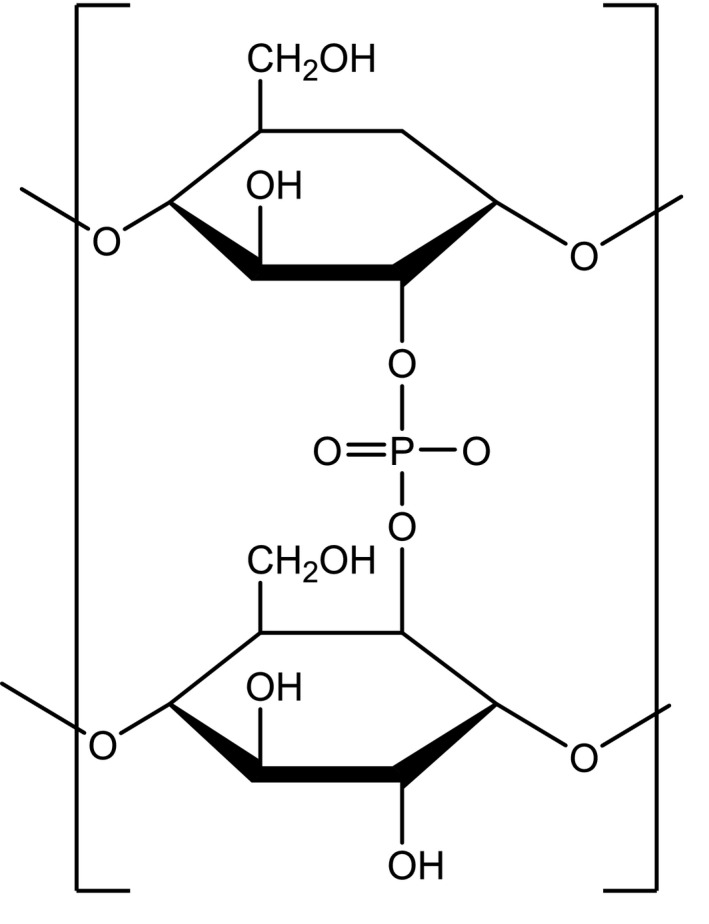
Structural representation of a phosphate cross‐link between two glucopyranose units in distarch phosphate
In aqueous solutions, starch with a low level of cross‐linking shows higher viscosity than native starch. Increase of the cross‐linking level decreases the peak viscosity (Lewandowicz et al., 2004; Xie et al., 2005). The effects of acidification are depending on the level of cross‐linking: while in slightly cross‐linked starch preparations viscosity decreases, in medium and high cross‐linked preparations viscosity is higher at pH 3.5 than at pH 5.5 (Lewandowicz et al., 2004). The properties are depending on the origin of the starch, both water‐binding capacity and viscosity of the gels being higher in cereal starches than in potato starch (Fortuna, 1991).
3.1.1.4. Phosphated distarch phosphate (E 1413)
According to Commission Regulation (EU) No 231/2012, phosphated distarch phosphate is starch having undergone a combination of treatments as described for monostarch phosphate and for distarch phosphate. The content of residual phosphate is limited by the Commission Regulation (EU) No 231/2012 to 0.5% bound P for wheat and potato starches, and 0.4% for starches from other sources. Phosphorus in the phosphate cross‐links and in the esterified groups represents 0.01% and 0.32%, respectively (EFSA NDA Panel, 2010).
Phosphated distarch phosphate (E 1413) consists of covalently linked phosphated starch (≥ 70%), residual unreacted starch (7–14%), water (10–14%), lipids (0.8%) and proteins (0.8%) (EFSA NDA Panel, 2010).
3.1.1.5. Acetylated distarch phosphate (E 1414)
In Commission Regulation (EU) No 231/2012, acetylated distarch phosphate is defined as starch cross‐linked with sodium trimetaphosphate or phosphorus oxychloride and esterified by acetic anhydride or vinyl acetate. According to the EU purity criteria, the content of residual phosphate is limited to 0.14% bound P for wheat and potato starches, 0.04% for starches from other sources, and to 2.5% acetyl groups.
The behaviour of acetylated distarch phosphate in aqueous solutions is similar to that of distarch phosphate (E 1412). Viscosity decreases with increasing level of cross‐linking. The effects of acidification are depending on the level of cross‐linking: while in slightly cross‐linked starch preparations viscosity decreases, in medium and high cross‐linked preparations viscosity is higher at pH 3.5 than at pH 5.5 (Lewandowicz et al., 2004).
3.1.1.6. Acetylated starch (E 1420)
In Commission Regulation (EU) No 231/2012, acetylated starch is defined as starch esterified with acetic anhydride or vinyl acetate. According to the EU purity criteria, the content of acetyl groups is limited to a maximum of 2.5%, corresponding to a maximum degree of substitution (DS) of 0.1. The level of acetyl groups is significantly lower in most commercial products (JECFA, 1982f; Wurzburg, 2006).
Compared to native starch, acetylation increases the water solubility and water‐binding capacity (Khalil et al., 1995; Bello‐Perez et al., 2000; Berski et al., 2011). The influence of acetylation on viscosity of pastes is inconsistent: while in some cases lower viscosity was observed, some authors observed increased viscosity in the case of acetyl starches (Berski et al., 2011). Acetylated starch is stable against hydrolysis under mild and moderate acidic conditions. However, it is sensitive to alkaline hydrolysis: at pH 11 complete deacetylation is achieved after 4 h at 25°C (Wurzburg, 2006).
3.1.1.7. Acetylated distarch adipate (E 1422)
According to Commission Regulation (EU) No 231/2012, acetylated distarch adipate is starch cross‐linked with adipic anhydride and esterified with acetic anhydride. Thereby, adipate groups form crosswise bindings between the adjacent chains of glucose rests. According to the EU purity criteria, the content of adipate is limited to a maximum of 0.135%. In general, the concentration is below 0.09%, corresponding to one adipyl molecule per 1,000 glucose units (JECFA, 1982b; Wurzburg, 2006). The content of acetyl groups is limited by the regulation to 2.5%.
An exemplified structure of distarch adipate is shown in Figure 3.
Figure 3.
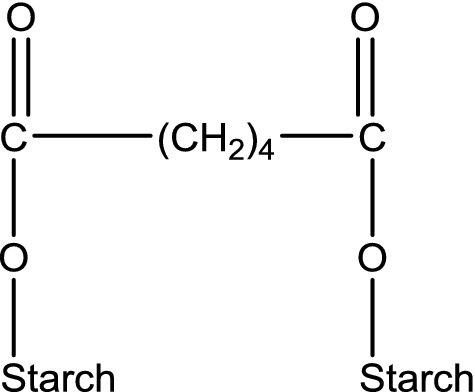
Structural representation of distarch adipate; the acetyl groups present in acetylated distarch adipate are not shown (Reproduced with permission of CCR Press, from Xie et al., 2005)
In water, acetylated distarch adipate forms viscous solutions. Viscosity decreases slowly with pH decrease. Investigations with potato starch revealed improved acid resistance, salt tolerance and good viscosity breakdown properties of acetylated distarch adipate, compared to the native starch (Luo et al., 2009).
3.1.1.8. Hydroxypropyl starch (E 1440)
In Commission Regulation (EU) No 231/2012, hydroxypropyl starch is defined as starch etherified with propylene oxide. The DS is a maximum of four ether linkages per 10 glucopyranose units (i.e. 13.3%) if 25% propylene oxide is used, and four to six ether linkages per 100 glucopyranose units if 5% propylene oxide is used (JECFA, 1982d). According to Xie et al. (2005), commercial food grade starches have hydroxypropyl levels in the range of 3.3–11.5%. Under the alkaline conditions utilised, propylene oxide reacts with starch with a nucleophilic bimolecular substitution mechanism (SN2‐type reaction): hydroxypropylation takes place primarily on the secondary hydroxyl at the C‐2 position (Xie et al., 2005; Wurzburg, 2006). The hydroxypropyl groups have been reported to be distributed with a ratio of 7:2:1 at, respectively, the C‐2, C‐3 and C‐6 positions of the glucose units (the aforesaid positions are also identified as 2‐O, 3‐O, and 6‐O) (Xie et al., 2005).
An exemplified structure of hydroxypropyl starch is shown in Figure 4.
Figure 4.
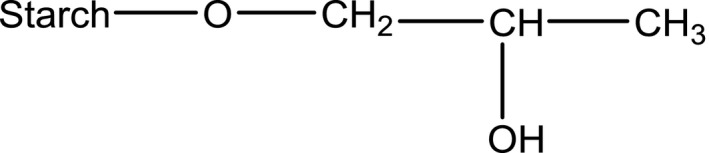
Structural representation of hydroxypropyl starch (Reproduced with permission of CCR Press, from Xie et al., 2005)
In aqueous media, hydroxypropyl starch forms viscous solutions, viscosity being highly dependent on the shear rate (Vorwerg et al., 2004). The pasting temperature decreases with an increase of the level of hydroxypropyl substitution (Xie et al., 2005). At a certain level of substitution, the starches become cold water‐swelling (Xie et al., 2005).
3.1.1.9. Hydroxypropyl distarch phosphate (E 1442)
According to Commission Regulation (EU) No 231/2012, hydroxypropyl distarch phosphate is starch cross‐linked with sodium trimetaphosphate or phosphorus oxychloride and etherified with propylene oxide. Thereby, phosphate groups form crosswise bindings between the neighbouring chains of glucose rests. According to the EU purity criteria, the content of phosphorus is limited to 0.04% and 0.14% bound P (depending on the origin of the starch), and to 7% hydroxypropyl groups.
3.1.1.10. Starch sodium octenyl succinate (E 1450)
In Commission Regulation (EU) No 231/2012, starch sodium octenyl succinate is defined as starch esterified with octenylsuccinic anhydride. According to the EU purity criteria, the content of octenylsuccinyl groups is limited to a maximum of 3% and the content of octenylsuccinic acid residue to a maximum of 0.3%. According to JECFA, the product has a DS of 0.02 (JECFA, 1982g).
An exemplified structure of starch sodium octenyl succinate is shown in Figure 5.
Figure 5.
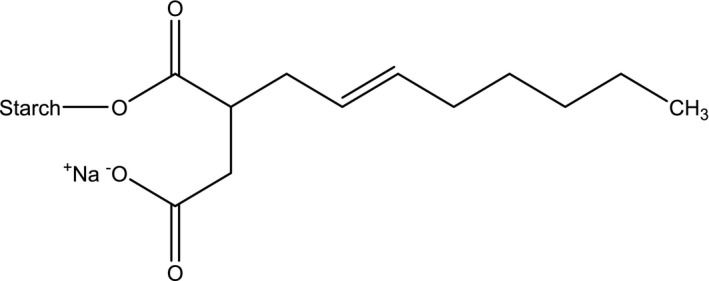
Structural representation of starch sodium octenyl succinate (Documentation provided to EFSA n. 1)
The free carboxylate group in the starch sodium octenyl succinate molecule increases the water‐holding power, the tendency to swell in cold water and the viscosity. The capability of cold water‐swelling increases when the level of substitution increases. Viscosity is highest at neutral pH and is considerably reduced in acid media (Xie et al., 2005).
3.1.1.11. Acetylated oxidised starch (E 1451)
According to Commission Regulation (EU) No 231/2012, acetylated oxidised starch is starch treated with sodium hypochlorite followed by esterification with acetic anhydride.
The water solubility of acetylated oxidised starch increases with increasing acetyl content (Khalil et al., 1995). Acetylation of oxidised starch enhances gel strength and clarity, resulting in a gummy, clear jelly. The substance hydrolyses slowly in the presence of strong acids (JECFA, 2002b).
3.1.1.12. Starch aluminium octenyl succinate (E 1452)
In Commission Regulation (EU) No 231/2012, starch aluminium octenyl succinate is defined as starch esterified with octenylsuccinic anhydride and treated with aluminium sulfate. According to the EU purity criteria, the content of octenylsuccinyl groups is limited to a maximum of 3%, octenylsuccinic acid residue to a maximum of 0.3% and aluminium to a maximum of 0.3%. The chemical structure is equal to that of starch sodium octenyl succinate (E 1450), except that aluminium is present as cation (Nair and Yamarik, 2002).
Compared to native starch, starch aluminium octenyl succinate has a reduced tendency to associate in solution, lose clarity and form gels. Due to the introduction of the succinate ester groups, the substance has polyelectrolyte properties (Nair and Yamarik, 2002).
3.2. Specifications
Specifications for modified starches (E 1404, E 1410, E 1412, E 1413, E 1414, E 1420, E 1422, E 1440, E 1442, E 1450, E 1451 and E 1452) as defined in Commission Regulation (EU) No 231/2012 and by JECFA (2016a) are listed in Tables 2–13.
Table 13.
Specifications for starch aluminium octenyl succinate (E 1452) according to Commission Regulation 231/2012
| Commission Regulation (EU) No 231/2012 | |
|---|---|
| Definition | Starch aluminium octenyl succinate is starch esterified with octenylsuccinic anhydride and treated with aluminium sulfate |
| Description | White or nearly white powder or granules or (if pregelatinised) flakes, amorphous powder or coarse particles |
| Identification | |
| Microscopic observation | Passes test (if not pregelatinised) |
| Iodine staining | Passes test (dark blue to light red colour) |
| Purity | |
| Loss on drying | Not more than 21.0% |
| Octenylsuccinyl groups | Not more than 3% (on an anhydrous basis) |
| Octenylsuccinic acid residue | Not more than 0.3% (on an anhydrous basis) |
| Sulfur dioxide |
Not more than 50 mg/kg for modified cereal starches (on an anhydrous basis) Not more than 10 mg/kg for other modified starches, unless otherwise specified (on an anhydrous basis) |
| Arsenic | Not more than 1 mg/kg |
| Lead | Not more than 2 mg/kg (on an anhydrous basis) |
| Mercury | Not more than 0.1 mg/kg |
| Aluminium | Not more than 0.3% (on an anhydrous basis) |
3.2.1. Oxidised starch (E 1404)
Table 2.
Specifications for oxidised starch (E 1404) according to Commission Regulation (EU) No 231/2012 and JECFA (2016a)
| Commission Regulation (EU) No 231/2012 | JECFA (2016a) | |
|---|---|---|
| Definition | Oxidised starch is starch treated with sodium hypochlorite |
Oxidised starch is a modified starch. It is obtained by treatment of food starch in accordance with good manufacturing practice with sodium hypochlorite. Oxidation involves the deliberate production of carboxyl groups Oxidised starch may additionally be subjected to acid, alkali, enzyme or bleaching treatment in accordance with good manufacturing practice |
| Description | White or nearly white powder or granules or (if pregelatinised) flakes, amorphous powder or coarse particles | White or nearly white powder or granules or (if pregelatinised) flakes, or amorphous powder or coarse particles |
| Identification | ||
| Microscopic observation | Passes test (if not pregelatinised) | Passes test |
| Iodine staining | Passes test (dark blue to light red colour) | Passes test |
| Solubility | – | Insoluble in cold water (if not pregelatinised); forming typical colloidal solutions with viscous properties in hot water; insoluble in ethanol |
| Copper reduction | − | Passes test |
| Test for hypochlorite oxidised starch | − | Passes test |
| Purity | ||
| Loss on drying |
Not more than 15.0% for cereal starch Not more than 21.0% for potato starch Not more than 18.0% for other starches |
Cereal starch: not more than 15.0% Potato starch: not more than 21.0% Other starches: not more than 18.0% (120°, 4 h, vacuum not exceeding 100 mmHg) |
| Carboxyl groups | Not more than 1.1% (on an anhydrous basis) | Not more than 1.3% on the dried basis |
| Sulfur dioxide |
Not more than 50 mg/kg for modified cereal starches (on an anhydrous basis) Not more than 10 mg/kg for other modified starches, unless otherwise specified (on an anhydrous basis) |
Not more than 50 mg/kg on the dried basis for modified cereal starches Not more than 10 mg/kg on the dried basis for other modified starches |
| Arsenic | Not more than 1 mg/kg | − |
| Lead | Not more than 2 mg/kg (on an anhydrous basis) | Not more than 2 mg/kg on the dried basis |
| Mercury | Not more than 0.1 mg/kg | − |
| Manganese | − | Not more than 50 mg/kg on the dried basis |
3.2.2. Monostarch phosphate (E 1410)
Table 3.
Specifications for monostarch phosphate (E 1410) according to Commission Regulation (EU) No 231/2012 and JECFA (2016a)
| Commission Regulation (EU) No 231/2012 | JECFA (2016a, tentative specifications) | |
|---|---|---|
| Definition | Monostarch phosphate is starch esterified with orthophosphoric acid, or sodium or potassium orthophosphate or sodium tripolyphosphate | Monostarch phosphate is a modified starch. It is obtained by esterification of food starch with orthophosphoric acid, or sodium or potassium orthophosphate, or sodium tripolyphosphate in accordance with good manufacturing practice. This treatment results in partial substitution in the 2, 3‐ or 6‐ position of the anhydroglucose unit unless the 6‐position is occupied for branching. Monostarch phosphate may additionally be subjected to acid, alkali, enzyme or bleaching treatment in accordance with good manufacturing practice |
| Description | White or nearly white powder or granules or (if pregelatinised) flakes, amorphous powder or coarse particles | White or nearly white powder or granules or (if pregelatinised) flakes, or amorphous powder or coarse particles |
| Identification | ||
| Solubility | − | Insoluble in cold water (if not pregelatinised); forming typical colloidal solutions with viscous properties in hot water; insoluble in ethanol |
| Microscopic observation | Passes test (if not pregelatinised) | Passes test |
| Iodine staining | Passes test (dark blue to light red colour) | Passes test |
| Copper reduction | − | Passes test |
| Purity | ||
| Loss on drying |
Not more than 15.0% for cereal starch Not more than 21.0% for potato starch Not more than 18.0% for other starches |
Cereal starch: not more than 15.0% Potato starch: not more than 21.0% Other starches: not more than 18.0% (120°, 4 h, vacuum not exceeding 100 mmHg) |
| Residual phosphate |
Not more than 0.5% (as P) for wheat or potato starch (on an anhydrous basis) Not more than 0.4% (as P) for other starches (on an anhydrous basis) |
Not more than 0.5% on the dried basis for potato or wheat starches Not more than 0.4% on the dried basis for other starches |
| Carboxyl groups | − | Not more than 0.1% on the dried basis |
| Sulfur dioxide |
Not more than 50 mg/kg for modified cereal starches (on an anhydrous basis) Not more than 10 mg/kg for other modified starches, unless otherwise specified (on an anhydrous basis) |
Not more than 50 mg/kg on the dried basis for modified cereal starches Not more than 10 mg/kg on the dried basis for other modified starches |
| Arsenic | Not more than 1 mg/kg | – |
| Lead | Not more than 2 mg/kg (on an anhydrous basis) | Not more than 2 mg/kg on the dried basis |
| Mercury | Not more than 0.1 mg/kg | – |
| Manganese | − | Not more than 50 mg/kg on the dried basis |
3.2.3. Distarch phosphate (E 1412)
Table 4.
Specifications for distarch phosphate (E 1412) according to Commission Regulation (EU) No 231/2012 and JECFA (2016a)
| Commission Regulation (EU) No 231/2012 | JECFA (2016a) | |
|---|---|---|
| Definition | Distarch phosphate is starch cross‐linked with sodium trimetaphosphate or phosphorus oxychloride | Distarch phosphate is a modified starch. It is obtained by esterification of food starch with sodium trimetaphosphate or phosphorus oxychloride in accordance with good manufacturing practice. This treatment results in cross‐linking, where a polyfunctional substituting agent, such as phosphorus oxychloride, connects two chains. The structure can be represented by: Starch–O–R–O–Starch, where R = cross‐linking group and Starch refers to the linear and/or branched structure. Distarch phosphate may additionally be subjected to acid, alkali, enzyme or bleaching treatment in accordance with good manufacturing practice |
| Description | White or nearly white powder or granules or (if pregelatinised) flakes, amorphous powder or coarse particles | White or nearly white powder or granules or (if pregelatinised) flakes, or amorphous powder or coarse particles |
| Identification | ||
| Solubility | − | Insoluble in cold water (if not pregelatinised); forming typical colloidal solutions with viscous properties in hot water; insoluble in ethanol |
| Microscopic observation | Passes test (if not pregelatinised) | Passes test |
| Iodine staining | Passes test (dark blue to light red colour) | Passes test |
| Copper reduction | – | Passes test |
| Purity | ||
| Loss on drying |
Not more than 15.0% for cereal starch Not more than 21.0% for potato starch Not more than 18.0% for other starches |
Cereal starch: not more than 15.0% Potato starch: not more than 21.0% Other starches: not more than 18.0% (120°, 4 h, vacuum not exceeding 100 mmHg) |
| Residual phosphate |
Not more than 0.5% (as P) for wheat or potato starch (on an anhydrous basis) Not more than 0.4% (as P) for other starches (on an anhydrous basis) |
Not more than 0.5% on the dried basis for potato or wheat starch Not more than 0.4% on the dried basis for other starches |
| Carboxyl groups | – | Not more than 0.1% on the dried basis |
| Sulfur dioxide |
Not more than 50 mg/kg for modified cereal starches (on an anhydrous basis) Not more than 10 mg/kg for other modified starches, unless otherwise specified (on an anhydrous basis) |
Not more than 50 mg/kg on the dried basis for modified cereal starches Not more than 10 mg/kg on the dried basis for other modified starches |
| Arsenic | Not more than 1 mg/kg | – |
| Lead | Not more than 2 mg/kg (on an anhydrous basis) | Not more than 2 mg/kg on the dried basis |
| Mercury | Not more than 0.1 mg/kg | – |
| Manganese | – | Not more than 50 mg/kg on the dried basis |
3.2.4. Phosphated distarch phosphate (E 1413)
Table 5.
Specifications for phosphated distarch phosphate (E 1413) according to Commission Regulation (EU) No 231/2012 and JECFA (2016a)
| Commission Regulation (EU) No 231/2012 | JECFA (2016a) | |
|---|---|---|
| Definition | Phosphated distarch phosphate is starch having undergone a combination of treatments as described for monostarch phosphate and for distarch phosphate | Phosphated distarch phosphate is a modified starch. It is obtained by esterification/cross‐linking of food starch with sodium trimetaphosphate or phosphorus oxychloride combined with esterification with orthophosphoric acid, or sodium or potassium orthophosphate, or sodium tripolyphosphate, in accordance with good manufacturing practice. The esterification results in partial substitution in the 2, 3‐ or 6‐ position of the anhydroglucose unit unless the 6‐position is occupied for branching. In the case of cross‐linking, where a polyfunctional substituting agent, such as phosphorus oxychloride, connects two chains, the structure can be represented by: Starch–O–R–O–Starch, where R = cross‐linking group and Starch refers to the linear and/or branched structure. Phosphated distarch phosphate may additionally be subjected to acid, alkali, enzyme or bleaching treatment in accordance with good manufacturing practice |
| Description | White or nearly white powder or granules or (if pregelatinised) flakes, amorphous powder or coarse particles | White or nearly white powder or granules or (if pregelatinised) flakes, or amorphous powder or coarse particles |
| Identification | ||
| Solubility | − | Insoluble in cold water (if not pregelatinised); forming typical colloidal solutions with viscous properties in hot water; insoluble in ethanol |
| Microscopic observation | Passes test (if not pregelatinised) | Passes test |
| Iodine staining | Passes test (dark blue to light red colour) | Passes test |
| Copper reduction | − | Passes test |
| Purity | ||
| Loss on drying |
Not more than 15.0% for cereal starch Not more than 21.0% for potato starch Not more than 18.0% for other starches |
Cereal starch: not more than 15.0% Potato starch: not more than 21.0% Other starches: not more than 18.0% (120°, 4 h, vacuum not exceeding 100 mmHg) |
| Residual phosphate |
Not more than 0.5% (as P) for wheat or potato starch (on an anhydrous basis) Not more than 0.4% (as P) for other starches (on an anhydrous basis) |
Not more than 0.5% on the dried basis for potato or wheat starch Not more than 0.4% on the dried basis for other starches |
| Carboxyl groups | − | Not more than 0.1% on the dried basis |
| Sulfur dioxide |
Not more than 50 mg/kg for modified cereal starches (on an anhydrous basis) Not more than 10 mg/kg for other modified starches, unless otherwise specified (on an anhydrous basis) |
Not more than 50 mg/kg on the dried basis for modified cereal starches Not more than 10 mg/kg on the dried basis for other modified starches |
| Arsenic | Not more than 1 mg/kg | – |
| Lead | Not more than 2 mg/kg (on an anhydrous basis) | Not more than 2 mg/kg on the dried basis |
| Mercury | Not more than 0.1 mg/kg | – |
| Manganese | − | Not more than 50 mg/kg on the dried basis |
3.2.5. Acetylated distarch phosphate (E 1414)
Table 6.
Specifications for acetylated distarch phosphate (E 1414) according to Commission Regulation (EU) No 231/2012 and JECFA (2016a)
| Commission Regulation (EU) No 231/2012 | JECFA (2016a) | |
|---|---|---|
| Definition | Acetylated distarch phosphate is starch cross‐linked with sodium trimetaphosphate or phosphorus oxychloride and esterified by acetic anhydride or vinyl acetate | Acetylated distarch phosphate is a modified starch. It is obtained by esterification/cross‐linking of food starch with sodium trimetaphosphate or phosphorus oxychloride combined with esterification with acetic anhydride or vinyl acetate in accordance with good manufacturing practice. Acetylation results in substitution of hydroxyl groups with acetyl esters. In cases of cross‐linking, where a polyfunctional substituting agent, such as phosphorus oxychloride, connects two chains, the structure can be represented by: Starch–O–R–O–Starch, where R = cross‐linking group and Starch refers to the linear and/or branched structure. Acetylated distarch phosphate may additionally be subjected to acid, alkali, enzyme or bleaching treatment in accordance with good manufacturing practice |
| Description | White or nearly white powder or granules or (if pregelatinised) flakes, amorphous powder or coarse particles | White or nearly white powder or granules or (if pregelatinised) flakes, or amorphous powder or coarse particles |
| Identification | ||
| Microscopic observation | Passes test (if not pregelatinised) | Passes test |
| Iodine staining | Passes test (dark blue to light red colour) | Passes test |
| Solubility | − | Insoluble in cold water (if not pregelatinised); forming typical colloidal solutions with viscous properties in hot water; insoluble in ethanol |
| Copper reduction | − | Passes test |
| Specific reaction for acetyl groups | − | Passes test |
| Ester groups | − | Passes test |
| Purity | ||
| Loss on drying |
Not more than 15.0% for cereal starch Not more than 21.0% for potato starch Not more than 18.0% for other starches |
Cereal starch: not more than 15.0% Potato starch: not more than 21.0% Other starches: not more than 18.0% (120°, 4 h, vacuum not exceeding 100 mmHg) |
| Acetyl groups | Not more than 2.5% (on an anhydrous basis) | Not more than 2.5% on the dried basis |
| Carboxyl groups | − | Not more than 0.1% on the dried basis |
| Residual phosphate |
Not more than 0.14% (as P) for wheat or potato starch (on an anhydrous basis) Not more than 0.04% (as P) for other starches (on an anhydrous basis) |
Not more than 0.14% on the dried basis for potato and wheat starch Not more than 0.04% on the dried basis for other starches |
| Vinyl acetate | Not more than 0.1 mg/kg (on an anhydrous basis) | Not more than 0.1 mg/kg |
| Sulfur dioxide |
Not more than 50 mg/kg for modified cereal starches (on an anhydrous basis) Not more than 10 mg/kg for other modified starches, unless otherwise specified (on an anhydrous basis) |
Not more than 50 mg/kg on the dried basis for modified cereal starches Not more than 10 mg/kg on the dried basis for other modified starches |
| Arsenic | Not more than 1 mg/kg | − |
| Lead | Not more than 2 mg/kg (on an anhydrous basis) | Not more than 2 mg/kg on the dried basis |
| Mercury | Not more than 0.1 mg/kg | − |
| Manganese | − | Not more than 50 mg/kg on the dried basis |
3.2.6. Acetylated starch (E 1420)
Table 7.
Specifications for acetylated starch (E 1420) according to Commission Regulation (EU) No 231/2012 and JECFA (2016a)
| Commission Regulation (EU) No 231/2012 | JECFA (2016a) | |
|---|---|---|
| Definition | Acetylated starch is starch esterified with acetic anhydride or vinyl acetate | Starch acetate is a modified starch. It is obtained by esterification of food starches with acetic anhydride or vinyl acetate in accordance with good manufacturing practice. The esterification/acetylation results in substitution of hydroxyl groups with acetyl esters. Starch acetate may additionally be subjected to acid, alkali, enzyme or bleaching treatment in accordance with good manufacturing practice |
| Description | White or nearly white powder or granules or (if pregelatinised) flakes, amorphous powder or coarse particles | White or nearly white powder or granules or (if pregelatinised) flakes, or amorphous powder or coarse particles |
| Identification | ||
| Microscopic observation | Passes test (if not pregelatinised) | Passes test |
| Iodine staining | Passes test (dark blue to light red colour) | Passes test |
| Solubility | − | Insoluble in cold water (if not pregelatinised); forming typical colloidal solutions with viscous properties in hot water; insoluble in ethanol |
| Copper reduction | − | Passes test |
| Specific reaction for acetyl groups | − | Passes test |
| Ester groups | − | Passes test |
| Purity | ||
| Loss on drying |
Not more than 15.0% for cereal starch Not more than 21.0% for potato starch Not more than 18.0% for other starches |
Cereal starch: not more than 15.0% Potato starch: not more than 21.0% Other starches: not more than 18.0% (120°, 4 h, vacuum not exceeding 100 mmHg) |
| Acetyl groups | Not more than 2.5% (on an anhydrous basis) | Not more than 2.5% on the dried basis |
| Carboxyl groups | − | Not more than 0.1% on the dried basis |
| Vinyl acetate | Not more than 0.1 mg/kg (on an anhydrous basis) | Not more than 0.1 mg/kg |
| Sulfur dioxide |
Not more than 50 mg/kg for modified cereal starches (on an anhydrous basis) Not more than 10 mg/kg for other modified starches, unless otherwise specified (on an anhydrous basis) |
Not more than 50 mg/kg on the dried basis for modified cereal starches Not more than 10 mg/kg on the dried basis for other modified starches |
| Arsenic | Not more than 1 mg/kg | − |
| Lead | Not more than 2 mg/kg (on an anhydrous basis) | Not more than 2 mg/kg on the dried basis |
| Mercury | Not more than 0.1 mg/kg | − |
| Manganese | − | Not more than 50 mg/kg on the dried basis |
3.2.7. Acetylated distarch phosphate (E 1422)
Table 8.
Specifications for acetylated distarch adipate (E 1422) according to Commission Regulation (EU) No 231/2012 and JECFA (2016a)
| Commission Regulation (EU) No 231/2012 | JECFA (2016a) | |
|---|---|---|
| Definition | Acetylated distarch adipate is starch cross‐linked with adipic anhydride and esterified with acetic anhydride | Acetylated distarch adipate is a modified starch. It is obtained by esterification of food starch with acetic anhydride and esterification/cross‐linking with adipic anhydride, in accordance with good manufacturing practice. Acetylation results in substitution of hydroxyl groups with acetyl esters. In cases of cross‐linking, where adipic anhydride connects two chains, the structure can be represented by: Starch–O–R–O–Starch, where R = CO–(CH2)4–CO and Starch refers to the linear and/or branched structure. Acetylated distarch adipate may additionally be subjected to acid, alkali, enzyme or bleaching treatment in accordance with good manufacturing practice |
| Description | White or nearly white powder or granules or (if pregelatinised) flakes, amorphous powder or coarse particles | White or nearly white powder or granules or (if pregelatinised) flakes, or amorphous powder or coarse particles |
| Identification | ||
| Microscopic observation | Passes test (if not pregelatinised) | Passes test |
| Iodine staining | Passes test (dark blue to light red colour) | Passes test |
| Solubility | − | Insoluble in cold water (if not pregelatinised); forming typical colloidal solutions with viscous properties in hot water; insoluble in ethanol |
| Copper reduction | − | Passes test |
| Specific reaction for acetyl groups | − | Passes test |
| Ester groups | − | Passes test |
| Purity | ||
| Loss on drying |
Not more than 15.0% for cereal starch Not more than 21.0% for potato starch Not more than 18.0% for other starches |
Cereal starch: not more than 15.0% Potato starch: not more than 21.0% Other starches: not more than 18.0% (120°, 4 h, vacuum not exceeding 100 mmHg) |
| Acetyl groups | Not more than 2.5% (on an anhydrous basis) | Not more than 2.5% on the dried basis |
| Adipate groups | Not more than 0.135% (on an anhydrous basis) | Not more than 0.135% on the dried basis |
| Carboxyl groups | − | Not more than 0.1% on the dried basis |
| Sulfur dioxide |
Not more than 50 mg/kg for modified cereal starches (on an anhydrous basis) Not more than 10 mg/kg for other modified starches, unless otherwise specified (on an anhydrous basis) |
Not more than 50 mg/kg on the dried basis for modified cereal starches Not more than 10 mg/kg on the dried basis for other modified starches |
| Arsenic | Not more than 1 mg/kg | − |
| Lead | Not more than 2 mg/kg (on an anhydrous basis) | Not more than 2 mg/kg on the dried basis |
| Mercury | Not more than 0.1 mg/kg | − |
| Manganese | − | Not more than 50 mg/kg on the dried basis |
3.2.8. Hydroxypropyl starch (E 1440)
Table 9.
Specifications for hydroxypropyl starch (E 1440) according to Commission Regulation (EU) No 231/2012 and JECFA (2016a)
| Commission Regulation (EU) No 231/2012 | JECFA (2016a) | |
|---|---|---|
| Definition | Hydroxypropyl starch is starch etherified with propylene oxide | Hydroxypropyl starch is a modified starch. It is obtained by etherification of food starch with propylene oxide, in accordance with good manufacturing practice. Hydroxypropylation results in substitution of hydroxyl groups with 2‐hydroxypropyl ether. Hydroxypropyl starch may additionally be subjected to acid, alkali, enzyme or bleaching treatment in accordance with good manufacturing practice |
| Description | White or nearly white powder or granules or (if pregelatinised) flakes, amorphous powder or coarse particles | White or nearly white powder or granules or (if pregelatinised) flakes, or amorphous powder or coarse particles |
| Identification | ||
| Solubility | − | Insoluble in cold water (if not pregelatinised); forming typical colloidal solutions with viscous properties in hot water; insoluble in ethanol |
| Microscopic observation | Passes test (if not pregelatinised) | Passes test |
| Iodine staining | Passes test (dark blue to light red colour) | Passes test |
| Copper reduction | − | Passes test |
| Hydroxypropyl ether groups | − | Passes test |
| Purity | ||
| Loss on drying |
Not more than 15.0% for cereal starch Not more than 21.0% for potato starch Not more than 18.0% for other starches |
Cereal starch: not more than 15.0% Potato starch: not more than 21.0% Other starches: not more than 18.0% (120°, 4 h, vacuum not exceeding 100 mmHg) |
| Hydroxypropyl groups | Not more than 7.0% (on an anhydrous basis) | Not more than 7.0% on the dried basis |
| Carboxyl groups | − | Not more than 0.1% on the dried basis |
| Propylene chlorohydrin | Not more than 1 mg/kg (on an anhydrous basis) | Not more than 1 mg/kg |
| Sulfur dioxide |
Not more than 50 mg/kg for modified cereal starches (on an anhydrous basis) Not more than 10 mg/kg for other modified starches, unless otherwise specified (on an anhydrous basis) |
Not more than 50 mg/kg on the dried basis for modified cereal starches Not more than 10 mg/kg on the dried basis for other modified starches |
| Arsenic | Not more than 1 mg/kg | − |
| Lead | Not more than 2 mg/kg (on an anhydrous basis) | Not more than 2 mg/kg on the dried basis |
| Mercury | Not more than 0.1 mg/kg | − |
| Manganese | − | Not more than 50 mg/kg on the dried basis |
3.2.9. Hydroxypropyl distarch phosphate (E 1442)
Table 10.
Specifications for hydroxypropyl distarch phosphate (E 1442) according to Commission Regulation (EU) No 231/2012 and JECFA (2016a)
| Commission Regulation (EU) No 231/2012 | JECFA (2016a) | |
|---|---|---|
| Definition | Hydroxypropyl distarch phosphate is starch cross‐linked with sodium trimetaphosphate or phosphorus oxychloride and etherified with propylene oxide | Hydroxypropyl distarch phosphate is a modified starch. It is obtained in accordance with good manufacturing practice by esterification of food starch with sodium trimetaphosphate or phosphorus oxychloride combined with etherification by propylene oxide. Hydroxypropylation results in substitution of hydroxyl groups with 2‐hydroxypropyl ether. In cases of cross‐linking, where phosphorus oxychloride connects two chains, the structure can be represented by: Starch–O–R–O–Starch, where R = cross‐linking group and Starch refers to the linear and/or branched structure. Hydroxypropyl distarch phosphate may additionally be subjected to acid, alkali, enzyme or bleaching treatment in accordance with good manufacturing practice |
| Description | White or nearly white powder or granules or (if pregelatinised) flakes, amorphous powder or coarse particles | White or nearly white powder or granules or (if pregelatinised) flakes, or amorphous powder or coarse particles |
| Identification | ||
| Solubility | − | Insoluble in cold water (if not pregelatinised); forming typical colloidal solutions with viscous properties in hot water; insoluble in ethanol |
| Microscopy | Passes test (if not pregelatinised) | Passes test |
| Iodine stain | Passes test (dark blue to light red colour) | Passes test |
| Copper reduction | − | Passes test |
| Hydroxypropyl ether groups | − | Passes test |
| Purity | ||
| Loss on drying |
Not more than 15.0% for cereal starch Not more than 21.0% for potato starch Not more than 18.0% for other starches |
Cereal starch: not more than 15.0% Potato starch: not more than 21.0% Other starches: not more than 18.0% (120°, 4 h, vacuum not exceeding 100 mmHg) |
| Hydroxypropyl groups | Not more than 7.0% (on an anhydrous basis) | Not more than 7.0% (calculated on dry substance) |
| Carboxyl groups | − | Not more than 0.1% on the dried basis |
| Propylene chlorohydrin | Not more than 1 mg/kg (on an anhydrous basis) | Not more than 1 mg/kg |
| Residual phosphate |
Not more than 0.14% (as P) for wheat or potato starch (on an anhydrous basis) Not more than 0.04% (as P) for other starches (on an anhydrous basis) |
Not more than 0.14% on the dried basis for potato and wheat starch Not more than 0.04% on the dried basis for other starches |
| Sulfur dioxide |
Not more than 50 mg/kg for modified cereal starches (on an anhydrous basis) Not more than 10 mg/kg for other modified starches, unless otherwise specified (on an anhydrous basis) |
Not more than 50 mg/kg on the dried basis for modified cereal starches Not more than 10 mg/kg on the dried basis for other modified starches |
| Arsenic | Not more than 1 mg/kg | − |
| Lead | Not more than 2 mg/kg (on an anhydrous basis) | Not more than 2 mg/kg on the dried basis |
| Mercury | Not more than 0.1 mg/kg | − |
| Manganese | – | Not more than 50 mg/kg on the dried basis |
3.2.10. Starch sodium octenyl succinate (E 1450)
Table 11.
Specifications for starch sodium octenyl succinate (E 1450) according to Commission Regulation 231/2012 and JECFA (2016a)
| Commission Regulation (EU) No 231/2012 | JECFA (2016a) | |
|---|---|---|
| Definition | Starch sodium octenyl succinate is starch esterified with octenylsuccinic anhydride | Starch sodium octenylsuccinate is a modified starch. It is obtained by esterification of food starch with octenylsuccinic anhydride, and neutralisation with either sodium hydroxide or sodium carbonate as a pH buffer, in accordance with good manufacturing practice. Starch sodium octenylsuccinate may additionally be subjected to acid, alkali, enzyme or bleaching treatment in accordance with good manufacturing practice |
| Description | White or nearly white powder or granules or (if pregelatinised) flakes, amorphous powder or coarse particles | White or nearly white powder or granules or (if pregelatinised) flakes, or amorphous powder or coarse particles |
| Identification | ||
| Solubility | Insoluble in cold water (if not pregelatinised); forming typical colloidal solutions with viscous properties in hot water; insoluble in ethanol | |
| Microscopic observation | Passes test (if not pregelatinised) | Passes test |
| Iodine staining | Passes test (dark blue to light red colour) | Passes test |
| Copper reduction | – | Passes test |
| Ester groups | – | Passes test |
| Purity | ||
| Loss on drying |
Not more than 15.0% for cereal starch Not more than 21.0% for potato starch Not more than 18.0% for other starches |
Cereal starch: not more than 15.0% Potato starch: not more than 21.0% Other starches: not more than 18.0% (120°, 4 h, vacuum not exceeding 100 mmHg) |
| Octenylsuccinyl groups | Not more than 3% (on an anhydrous basis) | Not more than 3% on the dried basis |
| Octenylsuccinic acid residue | Not more than 0.3% (on an anhydrous basis) | Not more than 0.3% on the dried basis |
| Carboxyl groups | – | Not more than 0.1% on the dried basis |
| Sulfur dioxide |
Not more than 50 mg/kg for modified cereal starches (on an anhydrous basis) Not more than 10 mg/kg for other modified starches, unless otherwise specified (on an anhydrous basis) |
Not more than 50 mg/kg on the dried basis for modified cereal starches Not more than 10 mg/kg on the dried basis for other modified starches |
| Arsenic | Not more than 1 mg/kg | – |
| Lead | Not more than 2 mg/kg (on an anhydrous basis) | Not more than 2 mg/kg on the dried basis |
| Mercury | Not more than 0.1 mg/kg | – |
| Manganese | – | Not more than 50 mg/kg on the dried basis |
3.2.11. Acetylated oxidised starch (E 1451)
Table 12.
Specifications for acetylated oxidised starch (E 1451) according to Commission Regulation (EU) No 231/2012 and JECFA (2016a)
| Commission Regulation (EU) No 231/2012 | JECFA (2016a) | |
|---|---|---|
| Definition | Acetylated oxidised starch is starch treated with sodium hypochlorite followed by esterification with acetic anhydride | Acetylated oxidised starch is a modified starch. It is obtained by treatment of food starch with sodium hypochlorite followed by esterification with acetic anhydride in accordance with good manufacturing practice. Oxidation involves the deliberate production of carboxyl groups. Acetylation results in substitution of hydroxyl groups with acetyl esters. Acetylated oxidised starch may additionally be subjected to acid, alkali, enzyme or bleaching treatment in accordance with good manufacturing practice |
| Description | White or nearly white powder or granules or (if pregelatinised) flakes, amorphous powder or coarse particles | White or nearly white powder or granules or (if pregelatinised) flakes, or amorphous powder or coarse particles |
| Identification | ||
| Microscopic observation | Passes test (if not pregelatinised) | Passes test |
| Iodine staining | Passes test (dark blue to light red colour) | Passes test |
| Solubility | − | Insoluble in cold water (if not pregelatinised); forming typical colloidal solutions with viscous properties in hot water; insoluble in ethanol |
| Copper reduction | − | Passes test |
| Hypochlorite oxidised starch | − | Passes test |
| Specific reaction for acetyl groups | − | Passes test |
| Ester groups | − | Passes test |
| Purity | ||
| Loss on drying |
Not more than 15.0% for cereal starch Not more than 21.0% for potato starch Not more than 18.0% for other starches |
Cereal starch: not more than 15.0% Potato starch: not more than 21.0% Other starches: not more than 18.0% (120°, 4 h, vacuum not exceeding 100 mmHg) |
| Carboxyl groups | Not more than 1.3% (on an anhydrous basis) | Not more than 1.3% on the dried basis |
| Acetyl groups | Not more than 2.5% (on an anhydrous basis) | Not more than 2.5% on the dried basis |
| Sulfur dioxide |
Not more than 50 mg/kg for modified cereal starches (on an anhydrous basis) Not more than 10 mg/kg for other modified starches, unless otherwise specified (on an anhydrous basis) |
Not more than 50 mg/kg on the dried basis for modified cereal starches Not more than 10 mg/kg on the dried basis for other modified starches |
| Arsenic | Not more than 1 mg/kg | − |
| Lead | Not more than 2 mg/kg (on an anhydrous basis) | Not more than 2 mg/kg on the dried basis |
| Mercury | Not more than 0.1 mg/kg | − |
| Manganese | − | Not more than 50 mg/kg on the dried basis |
3.2.12. Starch aluminium octenyl succinate (E 1452)
No JECFA specification for starch aluminium octenyl succinate (E 1452) is available. According to industry, ‘this additive is not commonly marketed in the EU given its limited use as an additive in food supplements; consequently, the EU Starch Industry Association and its members are not aware of any common trade names for food additive use’ (Documentation provided to EFSA n. 1).
3.2.13. General remarks on specifications
In addition to the information reported in the tables, the original JECFA monographs contain details on analytical tests to be used for identification purposes and purity determination. However, in most cases, JECFA assigned a tentative status to the specifications, as it was recognised that some critical information was required for setting full specifications and removal of the provisional condition.
The Panel noted that, according to the EU specifications for these modified starches, impurities of the toxic elements arsenic, lead and mercury are accepted up to a concentration of 1, 2 and 0.1 mg/kg. Contamination at such levels could have a significant impact on the exposure to these metals, for which exposure is already close to the health‐based guidance values benchmark doses (lower confidence limits) established by EFSA (EFSA CONTAM Panel (2009, 2010, 2012a). The Panel noted that in JECFA specifications, no limits for arsenic and mercury are available; limits were established only for lead and manganese (JECFA, 2016a).
The Panel further noted that the description of regulatory specifications for modified starches is frequently incomplete and in general not consistent with the format used for other food additives, in that the parameters that permit to differentiate between modified starches should come as part of the assay rather than under purity. Maximum limits for the chemical modifiers linked to starches and chemical residues should be established and presented in the assay and purity sections, respectively. The Panel also noted that it is not clear if the maximum limit for aluminium (0.3%) in E 1452 refers to aluminium linked to the starch or to residual aluminium.
In its report in 2014, JECFA noted that the Eighth Session of the Codex Committee on Contaminants in Foods (CCCF, 2014) agreed to a maximum level (ML) of 0.01 mg/kg for lead in infant formula (as consumed) (JECFA, 2014). The Committee also noted that the use of starch sodium octenyl succinate as a food additive at the proposed use levels could result in an exceedance of the ML of lead in infant formula. This situation was estimated to occur if lead were present in the additive at the specified limit of 2 mg/kg starch sodium octenyl succinate. This estimation was calculated without considering the contribution of other ingredients to the overall lead level in infant formulas. The Committee also noted that the responsibility for ensuring that the final infant formulas comply with the ML for lead remains with infant formula producers. Furthermore, the Committee noted that data provided by the sponsors indicate that the food additive can be produced with lead levels below the limit of 2 mg/kg starch sodium octenyl succinate.
Considering this, the Committee noted that lower lead limits in the specifications, for instance, 0.1 mg/kg for starch sodium octenyl succinate, would not result in the additive exceeding the ML for lead in the final infant formula (i.e. 0.01 mg/kg) (JECFA, 2014).
The Panel noted that there are monographs in the European Pharmacopoeia (European Pharmacopoeia, 2014) on modified starches, ‘hydroxypropyl starch’ and ‘pregelatinised hydroxypropyl starch’. They may be partially hydrolysed using acid or enzyme treatment. In these monographs, limits for total anaerobic microbial count (TAMC) and total combined yeast and mould count (TYMC) are defined, and the absence of Escherichia coli and Salmonella is required.
According to industry, the analytical data demonstrate that the residual levels of microorganisms are not a safety concern in any of the modified starches. Microbiological contamination is not considered a significant concern for modified starches, as the process steps during the manufacturing process including reactants, pH and high temperatures generate an environment that is not suitable for microbiological survival and growth. While no microbial specifications exist in Commission Regulation (EC) No 231/2012 for any individual modified starch, routine analyses of hazardous microorganisms are conducted by manufacturers to ensure that microbiological contamination is not a concern in the final ingredient. Moreover, microbial contamination is further prevented during the production of modified starches given that all manufacturers have appropriate quality control systems in place (i.e. good hygiene practices (GHP), good manufacturing practices (GMP) and Hazard Analysis Critical Control Point (HACCP) systems) as required under Regulation (EC) No 852/200413 (Documentation provided to EFSA n. 2).
However, the Panel noted that during post‐manufacturing handling, microbial contamination of the additives can occur.
The Panel noted that, different from other polysaccharides, no microbiological criteria were defined for modified starches by the EU Regulation. The Panel also noted that the microbiological specifications for polysaccharidic thickening agents, such as starches and gums, should be harmonised, as it is the case for other polysaccharidic thickening agents (e.g. alginic acid and its salts (E 400–E 404), agar (E 406), carrageenan (E 407), processed eucheuma seaweed (E 407a), xanthan gum (E 415), gellan gum (E 418)).
3.3. Manufacturing process
The native starch used for the manufacture of modified starches is obtained from potatoes, cereals (e.g. corn or maize), or other sources (e.g. tapioca) (Documentation provided to EFSA n. 1). Although manufacturers can use different specific conditions to produce the modified starches dealt with in this Opinion, the utilised processes reflect the same general scheme: native starch is first subject to chemical modification(s) following treatment with chemical reagent(s) and processing aid(s) as described below; the reaction product is then washed, dewatered, ground and sieved, and packaged. The percent concentrations appearing in the following paragraphs are given on the dry weight of the starch.
3.3.1. Oxidised starch (E 1404)
A slurry of native starch is adjusted to a mildly alkaline pH by addition of a base, and then oxidised using sodium hypochlorite. The desired degree of oxidation is measured by fluidity or viscosity. When the reaction is complete, the slurry is neutralised, the excess of hypochlorite is destroyed by addition of a reducing agent (e.g. bisulfite) and the starch granules are washed, dewatered and dried (Documentation provided to EFSA n. 1; Wurzburg, 2006). As these modified starches are obtained by treatment with hypochlorite, they are also known as ‘chlorinated’ starches, although no chlorine is present in their structure.
During manufacture of oxidised starch, four possible types of oxidation occur. First, oxidation of primary hydroxyl groups at C‐6 position leads to uronic acids. The content of carboxyl groups is restricted by Commission Regulation (EU) No 231/2012 to ≤ 1.1%. Secondly, secondary hydroxyls are oxidised to ketone groups. Thirdly, the glucopyranose ring is broken between C‐2 and C‐3, with subsequent oxidation of the aldehydic to carboxyl groups at C‐2 and C‐3. Fourthly, oxidation of the end groups plays a minor role (Documentation provided to EFSA n. 1; Wurzburg, 2006). According to JECFA (1975b), oxidised starches contain normally 1% (w/w) of carboxyl and 0.5% (w/w) of keto groups.
3.3.2. Monostarch phosphate (E 1410)
These monosubstituted modified starches are phosphate esters in which one starch hydroxyl is esterified by phosphoric acid to form the monoester. Monostarch phosphate is produced by reaction of orthophosphoric acid, sodium or potassium orthophosphate or sodium tripolyphosphate, with native starch. The production process may be carried out via a wet, semidry or dry process, temperature and pH being important reaction parameters (Documentation provided to EFSA n. 1; Wurzburg, 2006). In the wet process, the phosphating agent is added to an aqueous slurry of native starch, in which temperature and pH are adjusted as necessary, the latter normally being in the 5.5–6.0 range (a low pH can determine hydrolysis of the starch, while a high pH increases the probability of cross‐linking and formation of distarch phosphates). In the semidry or dry processes, native starch is mixed with the phosphating agent and heated to ca 120–170°C. The commercial modified starch is obtained by filtration and drying (Documentation provided to EFSA n. 1), as appropriate.
3.3.3. Distarch phosphate (E 1412)
Distarch phosphate is manufactured by treatment of an aqueous slurry of native starch with either sodium trimetaphosphate or phosphorus oxychloride under alkaline conditions. Once cross‐linking is achieved, the suspended reacted starch is recovered after neutralisation with acid; the product is subject to thorough washing with water until salt‐free, dewatering, and drying (Documentation provided to EFSA n. 1). In the first process, a trimetaphosphate salt is added to an aqueous suspension of starch in the presence of an alkaline catalyst (Kite, 1971); the starch chains are cross‐linked at an approximate rate of one phosphate link per 620 glucopyranose units (JECFA, 1974b). In the second process, 0.15–0.25% phosphorus oxychloride is added slowly to a slurry of 40% starch in water at pH 10 and ca 27°C (Kite, 1971); the maximum number of phosphate bridges could reach one per 100 glucopyranose units (JECFA, 1974b). According to Wurzburg (2006), in the preparation of distarch phosphates, treatment is limited to a maximum of 1% of sodium trimetaphosphate or up to 0.1% phosphorus oxychloride.
3.3.4. Phosphated distarch phosphate (E 1413)
Phosphated distarch phosphate has been described as manufactured from high‐amylose corn whose starch typically consists of 50–70% amylose and 30–50% amylopectin (Ratnayake and Jackson, 2003; EFSA NDA Panel, 2010). In the production process, an aqueous slurry of native starch is treated with a combination of the reagents permitted for production of monostarch phosphate (E 1410) (i.e. orthophosphoric acid, sodium or potassium orthophosphate or sodium tripolyphosphate) and of distarch phosphate (E 1412) (sodium trimetaphosphate or phosphorus oxychloride) under alkaline conditions. After the appropriate extent of phosphorylation and cross‐linking is achieved, the modified starch is recovered by neutralisation, washing thoroughly with water and drying (Documentation provided to EFSA n. 1).
3.3.5. Acetylated distarch phosphate (E 1414)
Acetylated distarch phosphate has been described as manufactured by treatment of a slurry or suspension of native starch in water with sodium trimetaphosphate or phosphorous oxychloride under alkaline conditions. After the appropriate degree of cross‐linking is achieved, the starch is esterified by treatment with either acetic anhydride under mildly alkaline conditions (pH 8−9.5) or with vinyl acetate under alkaline conditions. The modified starch is recovered by neutralisation with acid, washing thoroughly with water, dewatering and drying (Documentation provided to EFSA n. 1). Modification is usually performed by the use of up to 0.1% phosphorus oxychloride and 5% acetic anhydride (JECFA, 1982c). The free and combined phosphate, calculated as phosphorus, must not exceed 0.04% for distarch phosphate made from cereal starch other than wheat and 0.14% for that made from potato and wheat starch (JECFA, 2016a).
3.3.6. Acetylated starch (E 1420)
Acetylated starch is manufactured by treatment of a slurry or suspension of native starch in water with either acetic anhydride under mildly alkaline conditions or vinyl acetate under alkaline conditions. In the first case, esterification is performed with up to 8% acetic anhydride at a pH in the range of 8–9.5 and a temperature of 25–30°C. In the alternative approach, up to 7.5% vinyl acetate is used at a pH in the range of 7.5–12.5 (JECFA, 1982f; Xie et al., 2005; Wurzburg, 2006). After the appropriate degree of esterification is achieved, the modified starch is recovered by neutralisation with acid, washing thoroughly with water, dewatering and drying (Documentation provided to EFSA n. 1).
3.3.7. Acetylated distarch adipate (E 1422)
Acetylated distarch adipate is manufactured by treatment of an aqueous slurry of native starch with a mixture of adipic anhydride and acetic anhydride under mildly alkaline conditions. The reaction is quenched by addition of acid after the appropriate degree of cross‐linking and acetylation is reached, and the modified starch is recovered by washing thoroughly with water, dewatering and drying (Documentation provided to EFSA n. 1; JECFA, 1982b; Wurzburg, 2006). According to JECFA (1982b), the number of adipic cross‐links does not exceed 1 in about 1,000 glucopyranose units (up to approximately 0.09% adipyl groups).
3.3.8. Hydroxypropyl starch (E 1440)
Hydroxypropyl starch is manufactured by treatment of a slurry or suspension of native starch in water with maximum 10% propylene oxide in the presence of 0.5–1.0% sodium hydroxide. In general, sodium sulfate is added to minimise the gelatinisation or swelling of the starch granules. The reaction is usually carried out at temperatures in the range of 38–52°C for 24 h: below 38°C, the rate of reaction is very slow, while the starch granules may swell at temperatures above 52°C. The resultant starch is usually lightly oxidised, bleached or acid modified after etherification. After the appropriate hydroxypropylation is achieved, the modified starch is neutralised by the addition of acid, washed thoroughly, dewatered and dried (Documentation provided to EFSA n. 1; JECFA, 1982d; Wurzburg, 2006).
3.3.9. Hydroxypropyl distarch phosphate (E 1442)
Hydroxypropyl distarch phosphate is manufactured by treatment of a slurry or suspension of native starch in water with sodium trimetaphosphate or phosphorus chloride under alkaline conditions, followed by etherification with propylene oxide. After the appropriate extent of cross‐linking and etherification are achieved, the modified starch is recovered by neutralisation with acid, washing thoroughly with water, dewatering and drying (Documentation provided to EFSA n. 1). According to Wurzburg (2006), in the preparation of distarch phosphates, treatment is limited to a maximum of 1% of sodium trimetaphosphate or up to 0.1% phosphorus oxychloride. The free and combined phosphate, calculated as phosphorus, must not exceed 0.04% for distarch phosphate made from cereal starch other than wheat and 0.14% for that made from potato and wheat starch (JECFA, 2016a).
3.3.10. Starch sodium octenyl succinate (E 1450)
Starch sodium octenyl succinate is manufactured by treatment of a slurry of native starch in water with octenylsuccinic anhydride under mildly alkaline conditions. Reaction is carried out by slowly adding octenylsuccinic anhydride to a suspension of granular starch while maintaining the pH at 7.0 or higher and stirring vigorously. The maximum DS is approximately one octenyl monosuccinate substituent group for about every 50 anhydroglucose units. After the appropriate extent of esterification is achieved, the modified starch is recovered by neutralisation with acid, washing with water, dewatering and drying (Documentation provided to EFSA n. 1; Wurzburg, 2006).
3.3.11. Acetylated oxidised starch (E 1451)
Acetylated oxidised starch is manufactured in a two‐step process. In the first step, an alkaline aqueous slurry is treated with sodium hypochlorite at low temperature (21–38°C). The reaction progress can typically be monitored by following changes in viscosity of the mixture. The excess of hypochlorite is destroyed by adding sodium bisulfite, and the resulting organic salts are removed by washing with water. In the second step, the oxidised starch is then esterified with acetic anhydride under mildly alkaline conditions. The resulting product is recovered by neutralisation with acid, washing thoroughly with water, dewatering and drying (Documentation provided to EFSA n. 1; JECFA, 2002b).
3.3.12. Starch aluminium octenyl succinate (E 1452)
Starch aluminium octenyl succinate is manufactured by treatment of a slurry of native starch in water with maximum 3% octenylsuccinic anhydride under mildly alkaline conditions (Documentation provided to EFSA n. 1; Wurzburg, 2006). According to Nair and Yamarik (2002), when the appropriate extent of esterification is achieved, the mixture is treated with an amount of aluminium sulfate, not exceeding 2% of the starch weight. The modified starch is recovered by neutralisation with acid, washing with water, dewatering and drying (Documentation provided to EFSA n. 1).
3.4. Methods of analysis
According to the European Starch Industry Association (Association des Amidonniers et Féculiers (AAF)) (Documentation provided to EFSA n. 1), there are no validated methods available for the identification of modified starches in foodstuffs for a number of reasons, amongst which:
‘whilst a product specific identification method might in theory be possible, given the diverse composition of food matrices to which modified starches are added (egg products, beverages, bakery products, etc.), a general protocol of practical use is not feasible;
similarly, specific identification methods based on the modification of the starch might in theory be possible but in a practical sense, the DS is relatively low and the modified starches are often used in combination in foodstuffs, making development of a general protocol not feasible.'
Methods of analysis that might be applicable to detect modified starch identifiers could typically be based on the analysis of specific compositional parameters (e.g. the content of phosphorous and aluminium and of carboxyl, acetyl, adipate, hydroxypropyl and octenylsuccinyl groups) (JECFA, 2016a). According to the conclusions of the 82nd JECFA meeting (JECFA, 2016b), missing data were identified that are required by JECFA to define specifications for a number of modified starches: these data include, among others, the availability of suitable tests to identify the phosphate, adipate and octenyl succinate groups, propylene chlorohydrin, and to evaluate cross‐linking.
What follows are relevant examples of methods developed in the 1980s and 1990s for the analysis of starches and modified starches in foods: at that time, methods to analyse starches with enzymatic treatments were already taking over the commonly used chemical methods due to a lack of specificity of the latter and their dependence on corrosive and dangerous reagents (Karkalas, 1985).
A method for the analysis of starch and chemically modified starches in different foods was published by Karkalas (1985). The method was based on sequential hydrolysis with thermostable bacterial α‐amylase and fungal amyloglucosidase; the formed glucose – ultimate product of starch hydrolysis – was determined colorimetrically by a glucose oxidase–peroxidase–chromogen system at pH 7. Native normal and waxy starches, and distarch phosphate, gave quantitative yields of glucose with a high degree of precision (coefficient of variation, < 1%); oxidised starch did not yield glucose quantitatively due to the presence of dicarboxylic groups in the polymer. Acetylated distarch phosphate, high‐amylose starch and retrograded amylose were initially treated with 1M NaOH for 30 min, then neutralised and analysed as normal starch. After neutralisation, α‐amylase was added to hydrolyse starch to glucose. Interfering oligosaccharides were removed by a previous treatment with 75% (v/v) 2‐propanol, an extraction technique adequate for various types of samples. In conclusion, the Karkalas' method yielded quantitative recoveries of starch from normal and waxy varieties; quantitative recoveries were also obtained from acetylated distarch phosphate and retrograde amylose after alkaline pretreatment and neutralisation. The method was found to be accurate, reproducible and rapid, and useful to determine the starch content in foods; however, it could not distinguish between native starch and its different modifications.
Chatel et al. (1996) provided an example of starch identification and determination in sweetened food products such as sweetened fruit preparations. Dialysis was used as a purification technique that allowed the preservation of starch while simultaneously eliminating sucrose. The study of experimental parameters such as dialysis membrane cut‐off, treatment time, temperature and water renewal indicated a yield of sucrose elimination of 99.4% (relative standard deviation (RSD) 0.1%) for strawberry preparations. Enzymatic hydrolysis of starch was carried out by α‐amylase and amyloglucosidase. Previous gelatinisation–alkalinisation treatment, starch modification, hydrolysis time and pH were observed to have a considerable effect on the efficacy of hydrolysis. The glucose released by hydrolysis was determined with hexokinase and glucose‐6‐phosphate dehydrogenase. The use of this method in strawberry preparations containing 3.0% (w/w) acetylated distarch adipate led to the determination of 92% (RSD, 3.1%) starch. The method was considered to be efficient, specific and reproducible for the samples analysed.
In a subsequent paper, Chatel et al. (1997) optimised the dialysis and gelatinisation steps and the infrared (IR) identification of starch chemical modifications. The study was set out in recognition that identification and quantification of starch used as a thickening and gelling agent in sweetened fruit preparations were difficult due to the low levels of concentration and the heterogeneous, gelified and highly sweetened nature of the medium. In a first step, starches were identified by optical microscopy; acetyl and hydroxypropyl modifications were characterised by Fourier transform IR spectroscopy (FT‐IR). For quantification, starch was first extensively purified by dialysis to remove most (> 99%) of the sucrose. The experimental conditions of this step were optimised. A previous gelatinisation treatment improved significantly the enzymatic hydrolysis of starch and the quantification of the released glucose. The method developed, applied to 15 different sweetened fruit preparations, allowed reliable determinations of distarch phosphate, acetylated distarch phosphate and acetylated distarch adipate. According to the authors, it also provided an appropriate tool for the special case of a hydroxypropylated distarch phosphate.
3.5. Reaction and fate in food
For all the modified starches dealt with in this opinion, AAF recommends a storage time not longer than 2 years (Documentation provided to EFSA n. 1), as the moisture content may gradually increase to the extent of impairing starch physical properties (Lloyd and Kirst, 1963). In practice, the typical shelf‐life is 5 years under appropriate storage conditions, which include a dry place at room temperature and the original packaging kept unopened (Documentation provided to EFSA n. 1). The stability of modified starches – as indicated by the lack of known relevant degradation or reaction products and acknowledged on the basis of a vast patrimony of commercial data – is supported by history of use (over 20 years) and the chemical nature of the additives. Stability is further supported by:
chemical modifications and their influence on the properties of the material are clearly understood;
the extent of chemical modification is set by legislation to reflect the maximum treatment necessary to achieve the desired properties in food applications, and is generally low (cfr. Commission Regulation (EU) 231/2012 laying down specifications for food additives);
stability is indirectly demonstrated by the retention of effect under the conditions of use in different foods.
As reported by AAF (Documentation provided to EFSA n. 1), native starches have useful applications as food additives; however, their use has a number of limitations reflecting their chemical and physical properties, like poor solubility and high hydrophilicity, which in fact restrict their use. In modified starches, the chemical and physical characteristics of the native substances are altered in order to improve the functional properties for particular food applications: the observed effects on such properties depend on the type and extent of the modification (e.g. DS) and the source starch (e.g. cereal, potato, tapioca). The grain size of the starch also affects its reactivity; the larger the grains are, the higher the modification susceptibility is (Lewicka et al., 2015). As a general rule, the extent of modification required to distinctly alter the functional characteristics of native starches is low, as observed above with reference to the limitations imposed by Commission Regulation (EU) No 231/2012. In conclusion, for a large number of food applications, modified starches are used because of their superior properties compared to the native substances, a feature touched upon by many authors as, for instance, may be inferred from Ačkar et al. (2015), Committee on Nutrition (1978), FASEB (1979), Fortuna et al. (1992), JECFA (2002a), Khalil et al. (1995), Kite (1971), Liu et al. (1999), and references cited therein.
It can be observed that modified starches are not only a product of modifications due to chemical reactions but can also be obtained by making native starches undergo physical modification in order to weaken or degrade the crystalline structure responsible for the integrity of starch granules (Documentation provided to EFSA n. 1; Xie et al., 2005). Contrary to native starches, these physically modified starches will swell in cold or lukewarm water thereby avoiding the need to cook the starch. Chemically modified starches may also be subject to physical modifications.
The rheological properties of starch pastes, as viscosity, are very important for their applications as thickeners or as gelling agents. Acetylated starch is characterised by lower pasting temperature in comparison to the native one (Berski et al., 2011).
Gelatinisation is one of the most important functional properties of starch and microwave processing is able to change the gelatinisation mechanism (Lewicka et al., 2015). The microwave effect on structural changes of the starch leads to a reduction of its viscosity (Lewandowicz et al., 1998).
Sun et al. (2016), studied in a simulation yoghurt environment, the interactions of starches (phosphate starch, hydroxypropyl starch and starch ester of octenyl succinate) and casein, demonstrating that these interactions included electrostatic adhesion, steric stabilisation and hydrogen bond. They found that the interactions of modified starches and casein had a lot of differences with respect to native starches. It was reported that phosphate starch interacted with casein closely due to electrostatic adhesion, while in the hydroxypropyl starch/casein gel the interactions were also due to hydrogen bond and steric stabilisation. Starch ester of octenyl succinate being both hydrophilic and hydrophobic, was adsorbed with casein by steric stabilisation, increasing the structure tightness.
3.6. Authorised uses and use levels
Maximum levels of modified starches have been defined in Annex II to Regulation (EC) No 1333/2008 on food additives, as amended. In this document, these levels are referred to as MPLs.
Currently, oxidised starch (E 1404), monostarch phosphate (E 1410), distarch phosphate (E 1412), phosphated distarch phosphate (E 1413), acetylated distarch phosphate (E 1414), acetylated starch (E 1420), acetylated distarch adipate (E 1422), hydroxypropyl starch (E 1440), hydroxypropyl distarch phosphate (E 1442), starch sodium octenyl succinate (E 1450) and acetylated oxidised starch (E 1451) are authorised food additives in the EU at quantum satis (QS) in almost all foods apart from processed cereal‐based foods and baby foods for infants and young children and other foods for young children (50,000 mg/kg) and dietary foods for infants, babies and young children for special medical purposes and special formulae for infants (50,000 mg/kg and 20,000 mg/kg for E 1450). These modified starches are included in Group I (food additives authorised at QS).
Table 14 summarises foods that are permitted to contain the modified starches evaluated in the present opinion and the corresponding MPLs as set by Annex II to Regulation (EC) No 1333/2008.
Table 14.
MPLs of modified starches (E 1404, E 1410, E 1412, E 1413, E 1414, E 1420, E 1422, E 1440, E 1442, E 1450 and E 1451) in foods according to Annex II to Regulation (EC) No 1333/2008
| Food category number | Food category name | E‐number/group | Restrictions/exceptions | MPL (mg/L or mg/kg as appropriate) |
|---|---|---|---|---|
| 01.3 | Unflavoured fermented milk products, heat‐treated after fermentation | Group I | QS | |
| 01.4 | Flavoured fermented milk products including heat‐treated products | Group I | QS | |
| 01.6.2 | Unflavoured live fermented cream products and substitute products with a fat content of less than 20% | E 1404, E 1410, E 1412, E 1413, E 1414, E 1420, E 1422, E 1440, E 1442, E 1450, E 1451 | QS | |
| 01.6.3 | Other creams | Group I | QS | |
| 01.7.1 | Unripened cheese excluding products falling in category 16 | Group I | Except mozzarella | QS |
| 01.7.5 | Processed cheese | Group I | QS | |
| 01.7.6 | Cheese products (excluding products falling in category 16) | Group I | QS | |
| 01.8 | Dairy analogues, including beverage whiteners | Group I | QS | |
| 02.2.2 | Other fat and oil emulsions including spreads as defined by Council Regulation (EC) No 1234/2007 and liquid emulsions | Group I | QS | |
| 02.3 | Vegetable oil pan spray | Group I | QS | |
| 03 | Edible ices | Group I | QS | |
| 04.2.1 | Dried fruit and vegetables | Group I | QS | |
| 04.2.2 | Fruit and vegetables in vinegar, oil, or brine | Group I | QS | |
| 04.2.4.1 | Fruit and vegetable preparations excluding compote | Group I | QS | |
| 04.2.5.4 | Nut butters and nut spreads | Group I | QS | |
| 04.2.6 | Processed potato products | Group I | QS | |
| 05.1 | Cocoa and Chocolate products as covered by Directive 2000/36/EC | Group I | Only energy‐reduced or with no added sugar | QS |
| 05.2 | Other confectionery including breath freshening microsweets | Group I | QS | |
| 05.3 | Chewing gum | Group I | QS | |
| 05.4 | Decorations, coatings and fillings, except fruit‐based fillings covered by category 4.2.4 | Group I | QS | |
| 06.2.2 | Starches | Group I | QS | |
| 06.3 | Breakfast cereals | Group I | QS | |
| 06.4.2 | Dry pasta | Group I | Only gluten free and/or pasta intended for hypoproteic diets in accordance with Directive 2009/39/EC | QS |
| 06.4.4 | Potato gnocchi | Group I | Except fresh refrigerated potato gnocchi | QS |
| 06.4.5 | Fillings of stuffed pasta (ravioli and similar) | Group I | QS | |
| 06.5 | Noodles | Group I | QS | |
| 06.6 | Batters | Group I | QS | |
| 06.7 | Pre‐cooked or processed cereals | Group I | QS | |
| 07.1 | Bread and rolls | Group I | Except products in 7.1.1 and 7.1.2 | QS |
| 07.2 | Fine bakery wares | Group I | QS | |
| 08.3.1 | Non‐heat‐treated meat products | Group I | QS | |
| 08.3.2 | Heat‐ treated meat products | Group I | Except foie gras, foie gras entier, blocs de foie gras, Libamáj, libamáj egészben, libamáj tömbben | QS |
| 08.3.3 | Casings and coatings and decorations for meat | Group I | QS | |
| 09.2 | Processed fish and fishery products including molluscs and crustaceans | Group I | QS | |
| 09.3 | Fish roe | Group I | Only processed fish roe | QS |
| 10.2 | Processed eggs and egg products | Group I | QS | |
| 11.2 | Other sugars and syrups | Group I | QS | |
| 12.1.2 | Salt substitutes | Group I | QS | |
| 12.2.2 | Seasonings and condiments | Group I | QS | |
| 12.3 | Vinegars | Group I | QS | |
| 12.4 | Mustard | Group I | QS | |
| 12.5 | Soups and broths | Group I | QS | |
| 12.6 | Sauces | Group I | QS | |
| 12.7 | Salads and savoury‐based sandwich spreads | Group I | QS | |
| 12.8 | Yeast and yeast products | Group I | QS | |
| 12.9 | Protein products, excluding products covered in category 1.8 | Group I | QS | |
| 13.1.3 | Processed cereal‐based foods and baby foods for infants and young children as defined by Directive 2006/125/EC | E 1404, E 1410, E 1412, E 1413, E 1414, E 1420, E 1422, E 1450, E 1451 | Only processed cereal‐based foods and baby foods | 50,000a |
| 13.1.4 | Other foods for young children | E 1404, E 1410, E 1412, E 1413, E 1414, E 1420, E 1422, E 1450 | 50,000a | |
| 13.1.5.1 | Dietary foods for infants for special medical purposes and special formulae for infants | E 1450 | Only in infant formulae and follow‐on formulae | 20,000a |
| 13.1.5.2 | Dietary foods for babies and young children for special medical purposes as defined in Directive 1999/21/EC | E 1404, E 1410, E 1412, E 1413, E 1414, E 1420, E 1422, E 1451 | 50,000a | |
| 13.1.5.2 | Dietary foods for babies and young children for special medical purposes as defined in Directive 1999/21/EC | E 1450 | 20,000a | |
| 13.2 | Dietary foods for special medical purposes defined in Directive 1999/21/EC (excluding products from food category 13.1.5) | Group I | QS | |
| 13.3 | Dietary foods for weight control diets intended to replace total daily food intake or an individual meal (the whole or part of the total daily diet) | Group I | QS | |
| 13.4 | Foods suitable for people intolerant to gluten as defined by Regulation (EC) No 41/2009 | Group I | Including dry pasta | QS |
| 14.1.2 | Fruit juices as defined by Directive 2001/112/EC and vegetable juices | Group I | Only vegetable juices | QS |
| 14.1.3 | Fruit nectars as defined by Directive 2001/112/EC and vegetable nectars and similar products | Group I | Only vegetable nectars | QS |
| 14.1.4 | Flavoured drinks | Group I | QS | |
| 14.1.5.2 | Other | Group I | Excluding unflavoured leaf tea; including flavoured instant coffee | QS |
| 14.2.3 | Cider and perry | Group I | QS | |
| 14.2.4 | Fruit wine and made wine | Group I | QS | |
| 14.2.5 | Mead | Group I | QS | |
| 14.2.6 | Spirit drinks as defined in Regulation (EC) No 110/2008 | Group I | Except whisky or whiskey | QS |
| 14.2.7.1 | Aromatised wines | Group I | QS | |
| 14.2.7.2 | Aromatised wine‐based drinks | Group I | QS | |
| 14.2.7.3 | Aromatised wine‐product cocktails | Group I | QS | |
| 14.2.8 | Other alcoholic drinks including mixtures of alcoholic drinks with non‐alcoholic drinks and spirits with less than 15% of alcohol | Group I | QS | |
| 15.1 | Potato‐, cereal‐, flour‐ or starch‐based snacks | Group I | QS | |
| 15.2 | Processed nuts | Group I | QS | |
| 16 | Desserts excluding products covered in category 1, 3 and 4 | Group I | QS | |
| 17.1 b | Food supplements supplied in a solid form including capsules and tablets and similar forms, excluding chewable forms | Group I | QS | |
| 17.2 b | Food supplements supplied in a liquid form | Group I | QS | |
| 17.3 b | Food supplements supplied in a syrup‐type or chewable form | Group I | QS | |
| 18 | Processed foods not covered by categories 1–17, excluding foods for infants and young children | Group I | QS |
MPL: maximum permitted level; QS: quantum satis; FCS: Food Categorisation System (food nomenclature presented in Annex II to Regulation (EC) No 1333/2008).
The maximum levels of use indicated refer to foods ready for consumption prepared following manufacturers' instructions. E 1450 shall be used in conformity with the limits set in the Annexes to Directive 2006/141/EC.
FCS 17 refers to food supplements as defined in Directive 2002/46/EC of the European Parliament and of the Council excluding food supplements for infants and young children.
According to Annex III, Part 1, of Regulation (EC) No 1333/2008, oxidised starch (E 1404), monostarch phosphate (E 1410), distarch phosphate (E 1412), phosphated distarch phosphate (E 1413), acetylated distarch phosphate (E 1414), acetylated starch (E 1420), acetylated distarch adipate (E 1422), hydroxypropyl starch (E 1440), hydroxypropyl distarch phosphate (E 1442), starch sodium octenyl succinate (E 1450) and acetylated oxidised starch (E 1451) are authorised as carriers in all food additives at QS.
In addition, according to Annex III, Part 3 of Regulation (EC) No 1333/2008, E 1404, E 1410, E 1412, E 1413, E 1414, E 1420, E 1422, E 1440, E 1442, E 1450 and E 1451 are also authorised as food additives (including carriers) in food enzymes at QS.
Furthermore, according to Annex III, Part 5, Section A, of Regulation (EC) No 1333/2008, E 1404, E 1410, E 1412, E 1413, E 1414, E 1420, E 1422, E 1440, E 1442, E 1450 and E 1451 are also authorised as food additives (including carriers) in all nutrients at QS, except for nutrients intended to be used in foodstuffs for infants and young children listed in point 13.1 of Part E of Annex II.
However, according to Annex III, Part 5, Section B, E 1420 and E 1451 are authorised as food additive in all nutrients intended to be used in processed cereal based foods and baby foods for infants and young children as defined by Directive 2006/125/EC, under the condition that the maximum level in foods mentioned in point 13.1.3 of Part E of Annex II is not exceeded. Additionally, starch sodium octenyl succinate (E 1450) is authorised as a food additive in vitamin preparations and in polyunsaturated fatty acid preparations intended to be used in foods for infants and young children. When E 1450 is added in nutrients intended to be used in foodstuffs for infants and young children under FCS 13.1, maximum levels of carry‐over are 100 mg/kg for vitamin preparations and 1,000 mg/kg for polyunsaturated fatty acid preparations.
3.6.1.
Starch aluminium octenyl succinate (E 1452)
Starch aluminium octenyl succinate (E 1452) is an authorised food additive in the EU according to Annex III, Part 5, Section A to Regulation (EC) No 1333/2008 on food additives. Starch aluminium octenyl succinate (E 1452) is authorised for use only as a food additive and carrier in food supplements as defined in Directive 2002/46/EC due to its use in vitamin preparations for encapsulation purposes. The maximum level permitted in the final food is 35,000 mg/kg.
3.7. Exposure data
3.7.1. Reported use levels
Most food additives in the EU are authorised at a specific MPL. However, a food additive may be used at a lower level than the MPL. Therefore, information on actual use levels is required for performing a more realistic exposure assessment, especially for those food additives for which no MPL is set and which are authorised according to QS.
In the framework of Regulation (EC) No 1333/2008 on food additives and of Commission Regulation (EU) No 257/2010 regarding the re‐evaluation of approved food additives, EFSA issued a public call14 in 2010 for occurrence data (usage level and/or concentration data) on modified starches (E 1404, E 1410, E 1412, E 1413, E 1414, E 1420, E 1422, E 1440, E 1442, E 1450, E 1451 and E 1452). In response to this call, some information became available for 11 modified starches (E 1404–E 1450), to be used in combination (Documentation provided to EFSA n. 1). The usage data provided were representing use level ranges for any of these starches (i.e. not for a specific starch) and therefore could not be used in the present exposure assessment. Some additional information was made available to EFSA on E 1422 and E 1450, which was not taken into account in the assessment, as more up to date information was available (Documentation provided to EFSA n. 3).
In October 2015, a public call15 for food additive usage level and/or concentration data in food and beverages intended for human consumption, including modified starches, was launched, with a deadline in May 2016. In response to this public call, updated information on the actual use levels of 11 modified starches (E 1404, E 1410, E 1412, E 1413, E 1414, E 1420, E 1422, E 1440, E 1442, E 1450 and E 1451) in foods was made available to EFSA by industry and Member States.
In addition, a public call16 for usage level data of starch aluminium octenyl succinate (E 1452) has been launched in October 2016. Some information on the use of E 1452 in combinations of vitamin and mineral supplements has been provided to EFSA by industry.
Information on the levels of starch aluminium octenyl succinate (E 1452) in combination with sodium aluminium silicate (E 554) in raw materials used for the production of food supplements were also provided, but these data were not used in the present assessment, as the proportion of their presence in the final products was not specified.
3.7.1.1. Summarised data on reported use levels in foods provided by industry
In total, industry provided EFSA with data on use levels (n = 873) of modified starches (E 1404, E 1410, E 1412, E 1413, E 1414, E 1420, E 1422, E 1440, E 1442, E 1450, E 1451 and E 1452) in foods.
Information on the use levels of modified starches in foods was made available to EFSA by Krueger GmbH & Co., the Association of the European Self‐Medication Industry (AESGP), Aviko, the European Dairy Association (EDA), FoodDrinkEurope (FDE), the International Chewing Gum Association (ICGA), Specialised Nutrition Europe (SNE) and Food Supplements Europe (FSE) (Documentation provided to EFSA n. 3–10).
The Panel noted that 67 usage levels provided for the food categories of other creams (FC 1.6.3), decorations, coatings and fillings (FC 5.4), fine bakery wares (FC 7.2), flavoured drinks (FC 14.1.4), desserts (FC 16), dietary foods for infants for special medical purposes and special formulae for infants (FC 13.1.5.1), dietary foods for babies and young children for special medical purposes (FC 13.1.5.2), dietary foods for special medical purposes (FC 13.2) and dietary food for weight control diets (FC 13.3) referred to niche product(s). Since other usage levels were available for all the aforementioned food categories, the Panel decided to exclude these niche product usage levels from further analysis in the refined scenarios, except for dietary foods for infants for special medical purposes and special formulae for infants (FC 13.1.5.1) and dietary foods for babies and young children for special medical purposes (FC 13.1.5.2), where only data from niche products were available.
The number of usage data provided by industry for each modified starch and the number of food categories for which usage data were provided, out of the total authorised food categories are presented in Table 15.
Table 15.
Number of usage data provided by industry for each modified starch and number of food categories for which usage data were provided, out of the total authorised food categories
| E‐number | ||||||||||||
|---|---|---|---|---|---|---|---|---|---|---|---|---|
| E 1404 | E 1410 | E 1412 | E 1413 | E 1414 | E 1420 | E 1422 | E 1440 | E 1442 | E 1450 | E 1451 | E 1452 | |
| Usage level data (n) | 9 | 2 | 53 | 2 | 26 | 57 | 275 | 4 | 116 | 307 | 15 | 7 |
| Number of food categories | 9 | 2 | 11 | 2 | 8 | 14 | 26 | 3 | 16 | 23 | 4 | 1 |
| Authorised food categories | 71 | 71 | 71 | 71 | 71 | 71 | 71 | 68 | 68 | 72 | 70 | 1 |
Appendix A provides data on the use levels of modified starches in foods as reported by industry. Where the usage levels were given on the basis of the powdered (dehydrated) product and not of the final (ready‐to‐consume) food, dilution factors were applied for the risk assessment.
The wide range of reported usage levels has been justified by the data providers with the fact that the reported values represented several products within each category (i.e. milk‐based ice cream and non‐milk based ice cream, etc.). Very low values were reported when the additive was present in one minor ingredient of the final product.
3.7.2. Summarised data extracted from the Mintel's Global New Products Database
The Mintel Global New Products Database (GNPD) is an online database which monitors product introductions in consumer packaged goods markets worldwide. It contains information of over 2 million food and beverage products, of which more than 900,000 are or have been available on the European food market. Mintel started covering European Union's food markets in 1996, currently having 20 out of its 28 member countries and Norway presented in the Mintel GNPD.17
For the purpose of this scientific opinion, the Mintel GNPD18 was used for checking the labelling of products containing modified starches within the EU's food products, as the Mintel GNPD shows the compulsory ingredient information presented in the labelling of products.
It should be noted that, according to Regulation (EU) No 1169/201119, for foodstuffs containing modified starches it is not obligatory to report on the food product label the exact E number; only the term ‘modified starches’ may be used on the label instead. Taking this into account, it was noted that according to the Mintel GNPD, the food products reported to contain ‘modified starches’ (E number unspecified) are much more than the products reported to contain these food additives labelled with the respective E number.
Information on both ‘modified starches’‐labelled and specific E‐number‐labelled food products is presented in Appendix B. Appendix B presents the number and percentage of the food products labelled between January 2011 and September 2016, out of the total number of food products, per food subcategory, according to the Mintel GNPD food classification.
The Mintel database does not contain any products labelled with monostarch phosphate (E 1410) or phosphated distarch phosphate (E 1413) in the given period. However, their use cannot be excluded taken into account the high number of products where only unspecified ‘modified starches’ is indicated on the label.
For E 1452, two products (grated cheese and ready‐to‐eat salad) were identified in the Mintel database labelled with this specific E‐number; however, the use of E 1452 is not authorised in these foodstuffs.
The overall percentage of food products labelled with the term ‘modified starches’ (E number unspecified) considering all relevant food products available (n = 463,158) in Mintel by the time of the query was 8.73% (n = 40,569). However, only 0.53% (n = 2,444) of these products were labelled with the exact E number of the given modified starch.
Considering the Mintel subcategories, the highest percentage of products labelled with the term ‘modified starches’ was identified for soft cheese desserts (57.75%; 927 out of 1,588 products), chilled desserts (41.24%; 2,681 out of 6,501 products) and mayonnaise (36.92%; 353 out of 956 products). The highest number of products labelled with the term ‘modified starches’ was found in the subcategories of prepared meals (n = 3,336), spoonable yogurt (n = 3,296) and chilled desserts (n = 2,681).
According to Mintel, modified starches are also used in products of the following food categories, however no usage levels were provided for these food categories by the food industry:
06.3 Breakfast cereals
06.7 Pre‐cooked or processed cereals
09.2 Processed fish and fishery products
10.2 Processed eggs and egg products
11.2 Other sugars and syrups
12.7 Salads and savoury‐based sandwich spreads
12.9 Protein products
14.1.2 Fruit juices (only vegetable juices)
14.1.3 Fruit nectars (only vegetable nectars)
14.2.6 Spirit drinks
14.2.7.3 Aromatised wine‐product cocktails
14.2.8 Other alcoholic drinks including mixtures of alcoholic drinks with non‐alcoholic drinks and spirits with less than 15% alcohol
15.2 Processed nuts
This may result in an underestimation of the exposure.
3.7.3. Food consumption data used for exposure assessment
3.7.3.1. EFSA Comprehensive European Food Consumption Database
Since 2010, the EFSA Comprehensive European Food Consumption Database (Comprehensive Database) has been populated with national data on food consumption at a detailed level. Competent authorities in the European countries provide EFSA with data on the level of food consumption by the individual consumer from the most recent national dietary survey in their country (cf. Guidance of EFSA on the ‘Use of the EFSA Comprehensive European Food Consumption Database in Exposure Assessment’ (EFSA, 2011a). New consumption surveys added in the Comprehensive database were also taken into account in this assessment.12
The food consumption data gathered by EFSA were collected by different methodologies and thus direct country‐to‐country comparisons should be interpreted with caution. Depending on the food category and the level of detail used for exposure calculations, uncertainties could be introduced owing to possible subjects' underreporting and/or misreporting of the consumption amounts. Nevertheless, the EFSA Comprehensive Database represents the best available source of food consumption data across Europe at present.
Food consumption data from the following population groups: infants, toddlers, children, adolescents, adults and the elderly were used for the exposure assessment. For the present assessment, food consumption data were available from 33 different dietary surveys carried out in 19 European countries (Table 16).
Table 16.
Population groups considered for the exposure estimates of modified starches
| Population | Age range | Countries with food consumption surveys covering more than one day |
|---|---|---|
| Infants | From more than 12 weeks up to and including 11 months of age | Bulgaria, Denmark, Finland, Germany, Italy, UK |
| Toddlers | From 12 months up to and including 35 months of age | Belgium, Bulgaria, Denmark, Finland, Germany, Italy, Netherlands, Spain, UK |
| Childrena | From 36 months up to and including 9 years of age | Austria, Belgium, Bulgaria, Czech Republic, Denmark, Finland, France, Germany, Greece, Italy, Latvia, Netherlands, Spain, Sweden, UK |
| Adolescents | From 10 years up to and including 17 years of age | Austria, Belgium, Cyprus, Czech Republic, Denmark, Finland, France, Germany, Italy, Latvia, Spain, Sweden, UK |
| Adults | From 18 years up to and including 64 years of age | Austria, Belgium, Czech Republic, Denmark, Finland, France, Germany, Hungary, Ireland, Italy, Latvia, Netherlands, Romania, Spain, Sweden, UK |
| The elderlya | From 65 years of age and older | Austria, Belgium, Denmark, Finland, France, Germany, Hungary, Ireland, Italy, Romania, Sweden, UK |
The terms ‘children’ and ‘the elderly’ correspond, respectively, to ‘other children’ and the merge of ‘elderly’ and ‘very elderly’ in the Guidance of EFSA on the ‘Use of the EFSA Comprehensive European Food Consumption Database in Exposure Assessment’ (EFSA, 2011a).
Consumption records were codified according to the FoodEx classification system (EFSA, 2011b). Nomenclature from the FoodEx classification system has been linked to the food categorisation system (FCS) as presented in Annex II to Regulation (EC) No 1333/2008, part D, to perform exposure estimates. In practice, FoodEx food codes were matched to the FCS food categories.
3.7.3.2. Food categories selected for the exposure assessment of modified starches
The food categories in which the use of modified starches is authorised were selected from the nomenclature of the EFSA Comprehensive Database (FoodEx classification system), at the most detailed level possible (up to FoodEx Level 4) (EFSA, 2011b).
Some food categories are not referenced in the EFSA Comprehensive Database and could therefore not be taken into account in the present estimate. This was the case for 10 food categories (Appendix C) and may have resulted in an underestimation of the exposure. However, no usage levels were received for these food categories either. The food categories which were not taken into account are described below (in ascending order of the FCS codes):
01.7.6 Cheese products (excluding products falling in category 16); however, these products were reclassified under 01.7.5 Processed cheese
02.3 Vegetable oil pan spray
06.6 Batters
06.7 Pre‐cooked or processed cereals
08.3.3 Casings and coatings and decorations for meat
12.1.2 Salt substitutes
14.1.3 Fruit nectars as defined by Directive 2001/112/EC and vegetable nectars and similar products, only vegetable nectars
14.2.5 Mead
14.2.7.2 Aromatised wine‐based drinks
14.2.7.3 Aromatised wine‐product cocktails
For the following food categories, the restrictions/exceptions which apply to the use of modified starches could not be taken into account, and therefore the whole food category was considered in the exposure assessment. This applies to three food categories (Appendix C) and may have resulted in an overestimation of the exposure:
05.1 Cocoa and Chocolate products as covered by Directive 2000/36/EC, only energy‐reduced or with no added sugar
14.1.5.2 Other, excluding unflavoured leaf tea; including flavoured instant coffee
17.1/17.2/17.3 Food supplements, in solid, liquid, syrup‐type or chewable form.
According to Annex III, Part 5 to Regulation (EC) No 1333/2008 on food additives, starch aluminium octenyl succinate (E 1452) is authorised for use only as a food additive and carrier in food supplements as defined in Directive 2002/46/EC due to its use in vitamin preparations for encapsulation purposes; thus, considering the whole food category 17 results an overestimation in the exposure.
As regards FC 01.3 Unflavoured fermented milk products, heat‐treated after fermentation, differentiating this food category from food category 01.2 Unflavoured fermented milk products, including natural unflavoured buttermilk (excluding sterilised buttermilk) non‐heat treated after fermentation, in the Comprehensive database is not possible, therefore these categories were considered together in the estimation.
Similarly, for the food category 01.6.2 Unflavoured live fermented cream products and substitute products with a fat content of less than 20%, the whole food category 01.6 was taken into account in the assessment, as it is not possible to differentiate between FC 01.6.2 and FC 01.6.3 Other creams.
Considering that the food category 18 (Processed foods not covered by categories 1–17, excluding foods for infants and young children) is extremely unspecific (e.g. composite foods), processed foods, prepared or composite dishes belonging to the food category 18 were reclassified under food categories in accordance to their main component. Therefore, food category 18 is not taken into account as contributor to the total exposure estimates.
For all scenarios, four food categories were included in the exposure assessment without considering the restrictions/exceptions as set in Annex II to Regulation (EC) No 1333/2008. Ten food categories were not taken into account in the exposure assessment because these are not referenced in the EFSA Comprehensive Database. Thirty‐six food categories were not taken into account because no concentration data were provided (Appendix C). For the remaining food categories, the refinements considering the restrictions/exceptions as set in Annex II to Regulation No 1333/2008 were applied. Overall, for the maximum level exposure scenario and for the refined scenarios, 31 food categories were included in the present exposure assessment to modified starches.
3.8. Exposure estimates
3.8.1. Exposure to modified starches from their use as food additives
The Panel estimated chronic exposure to modified starches for the following population groups: infants, toddlers, children, adolescents, adults and the elderly.
A combined dietary exposure estimate was calculated for the modified starches E 1404, E 1410, E 1412, E 1413, E 1414, E 1420, E 1422, E 1440, E 1442, E 1450 and E 1451 by selecting, within each food category, the highest use level among the use levels reported for each of the different E‐numbers.
A separate scenario was carried out for starch aluminium octenyl succinate (E 1452) which is authorised in EU as a food additive and carrier only in food supplements as defined in Directive 2002/46/EC due to its use in vitamin preparations for encapsulation purposes according to Annex III, Part 5 to Regulation (EC) No 1333/2008 on food additives. Furthermore, exposure to aluminium from E 1452 was also estimated for food supplement consumers.
Dietary exposure to modified starches was calculated by multiplying modified starches concentrations for each food category (Appendix C) with their respective consumption amount per kilogram of body weight for each individual in the Comprehensive Database. The exposure per food category was subsequently added to derive an individual total exposure per day. These exposure estimates were averaged over the number of survey days, resulting in an individual average exposure per day for the survey period. Dietary surveys with only one day per subject were excluded, as they are considered as not adequate to assess repeated exposure.
This was carried out for all individuals per survey and per population group, resulting in distributions of individual exposure per survey and population group (Table 16). On the basis of these distributions, the mean and 95th percentile of exposure were calculated per survey and per population group. The 95th percentile of exposure was only calculated for those population groups where the sample size was sufficiently large to allow this calculation (EFSA, 2011a). Therefore, in the present assessment, 95th percentile of exposure for infants from Italy and for toddlers from Belgium, Italy and Spain were not included.
Exposure assessment to modified starches was carried out by the ANS Panel based on two different sets of concentration data: (1) maximum reported use levels provided to EFSA (defined as the maximum level exposure assessment scenario) and, (2) reported use levels (defined as the refined exposure assessment scenario). These scenarios are discussed in detail below.
These scenarios do not consider the consumption of food supplements (FC 17.1, FC 17.2 and FC 17.3), which is covered in an additional exposure scenario (food supplement consumers only scenario).
A possible additional exposure from the use of modified starches E 1404, E 1410, E 1412, E 1413, E 1414, E 1420, E 1422, E 1440, E 1442, E 1450 and E 1451 as carriers in food additives at QS, as food additives (including carriers) in food enzymes and in all nutrients at QS, in accordance with Annex III to Regulation (EC) No 1333/2008 (Parts 1, 3 and 5) was not considered in any of the exposure assessment scenarios, due to the absence of information on use levels.
3.8.1.1. Maximum level exposure assessment scenario
The regulatory maximum level exposure assessment scenario is based on the MPLs as set in Annex II to Regulation (EC) No 1333/2008 and listed in Table 14. As modified starches are authorised at QS in almost all food categories, a maximum level exposure assessment scenario was estimated based on the maximum reported use levels provided by food industry (excluding exposure via food supplements and foods for special medical purposes (FSMP)) as described in the EFSA Conceptual framework (EFSA ANS Panel, 2014). The maximum reported use levels used in this exposure scenario are listed in Appendix C.
The Panel considered the exposure estimates derived following this scenario as the most conservative, as it is assumed that the population group will be exposed to these modified starches present in food at the maximum reported use levels over a longer period of time, and assuming that modified starches are only used in the food categories for which data were submitted by food industry.
3.8.1.2. Refined exposure assessment scenarios
The refined exposure assessment scenario is based on use levels reported by industry. This exposure scenario can consider only food categories for which the above data were available to the Panel.
Appendix C summarises the concentration levels of modified starches used in the refined exposure assessment scenarios. Based on the available dataset, the Panel calculated two refined exposure estimates using different model populations, and excluding exposure via food supplements and FSMP:
-
The brand‐loyal consumer scenario: it was assumed that a consumer is exposed long‐term to modified starches present at the maximum reported use level for one food category. This exposure estimate is calculated as follows:
-
–
Combining food consumption with the maximum of the reported use levels for the main contributing food category at the individual level;
-
–
Using the mean of the typical reported use levels for the remaining food categories.
-
–
The non‐brand‐loyal consumer scenario: it was assumed that a consumer is exposed long‐term to modified starches present at the mean reported use levels in food. This exposure estimate is calculated using the mean of the typical reported use levels.
3.8.1.3. Specific exposure assessment scenarios
-
Food supplement consumers only scenario: Modified starches are authorised in the food category 17 Food supplements as defined in Directive 2002/46/EC, excluding food supplements for infants and young children. As exposure via food supplements may deviate largely from the one via other food, and the number of food supplement consumers may be low depending on populations and surveys, an additional scenario was calculated in order to reflect the additional exposure to food additives from food supplements, compared to exposure to food additives excluding these sources. This scenario was estimated as follows:
-
–
Consumers only of food supplements were assumed to be exposed to modified starches present at the maximum reported use level on a daily basis via consumption of food supplements. For the remaining food categories, the mean of the typical reported use levels was used.
-
–
As food category 17 does not include food supplements for infants and toddlers (Regulation (EC) No 1333/2008), exposure to modified starches from food supplements was not estimated for these two population groups.
Separate food supplements exposure scenarios based on the MPLs and the maximum reported levels for consumers only were carried out for starch aluminium octenyl succinate (E 1452), which is only authorised in food supplements as defined in Directive 2002/46/EC due to its use in vitamin preparations for encapsulation purposes. Exposure to aluminium from starch aluminium octenyl succinate was also estimated.
FSMP consumers only scenario:
As modified starches are also authorised in the food category 13.1.5 (13.1.5.1 and 13.1.5.2), an additional exposure assessment scenario taking into account this food category was performed to estimate the exposure of infants and toddlers who may eat and drink these FSMP:
-
–
Consumers only of FSMP were assumed to be exposed to modified starches present at the maximum reported use level on a daily basis via consumption of food categories 13.1.5.1 and 13.1.5.2.
-
–
For the remaining food categories, the mean of the typical reported use levels was used.
The consumption of these foods under FC 13.1.5 is not reported in the EFSA Comprehensive database. To consider the exposure to food additives via consumption of these foods, the Panel assumed that the amount of FSMP consumed by infants and toddlers resembles that of comparable foods by infants and toddlers from the general population. Thus, the consumption of FSMP categorised as food category 13.1.5 is assumed to equal that of formulae and food products categorised as food categories 13.1.1, 13.1.2, 13.1.3 and 13.1.4.
FSMP consumed in other population groups (children, adolescents, adults and the elderly) may be very diverse; they cannot be considered because of very limited information on consumption. Eating occasions belonging to the food categories 13.2, 13.3 and 13.4 were therefore reclassified under food categories in accordance to their main component.
These scenarios do not consider the consumption of food supplements.
3.8.1.4. Dietary exposure to modified starches (E 1404–E 1451)
Table 17 summarises the estimated exposure to modified starches from their use as food additives in six population groups (Table 16) according to the different exposure scenarios (Section 3.8.1). Detailed results per population group and survey are presented in Appendix D.
Table 17.
Summary of dietary exposure to modified starches (E 1404–E 1451) from their use as food additives in the maximum level exposure assessment scenario and in the refined exposure assessment scenarios, in six population groups (minimum–maximum across the dietary surveys in mg/kg bw per day)
| Infants (12 weeks–11 months) | Toddlers (12–35 months) | Children (3–9 years) | Adolescents (10–17 years) | Adults (18–64 years) | The elderly (≥ 65 years) | |||||||
|---|---|---|---|---|---|---|---|---|---|---|---|---|
| Min | Max | Min | Max | Min | Max | Min | Max | Min | Max | Min | Max | |
| Maximum level exposure assessment scenario | ||||||||||||
| Mean | 36 | 1,527 | 296 | 2,087 | 424 | 1,766 | 212 | 1,093 | 142 | 591 | 113 | 474 |
| 95th percentile | 140 | 4,219 | 849 | 3,670 | 854 | 3,386 | 462 | 2,188 | 418 | 1,382 | 335 | 1,118 |
| Refined estimated exposure assessment scenarios | ||||||||||||
| Brand‐loyal scenario | ||||||||||||
| Mean | 29 | 797 | 247 | 1,455 | 312 | 1,332 | 149 | 760 | 104 | 468 | 88 | 415 |
| 95th percentile | 109 | 2,567 | 735 | 3,053 | 667 | 2,998 | 309 | 1,601 | 285 | 1,202 | 240 | 1,020 |
| Non‐brand‐loyal scenario | ||||||||||||
| Mean | 22 | 505 | 141 | 790 | 193 | 652 | 110 | 406 | 55 | 218 | 40 | 170 |
| 95th percentile | 84 | 1,947 | 402 | 1,448 | 419 | 1,160 | 241 | 777 | 155 | 453 | 104 | 349 |
In the maximum level exposure assessment scenario, mean exposure to modified starches from their use as food additives ranged from 36 mg/kg bw per day in infants to 2,087 mg/kg bw per day in toddlers. The 95th percentile of exposure to modified starches ranged from 140 to 4,219 mg/kg bw per day in infants.
In the refined estimated exposure assessment scenario, in the brand‐loyal scenario, mean exposure to modified starches from their use as food additives ranged from 29 mg/kg bw per day in infants to 1,455 mg/kg bw per day in toddlers. The 95th percentile of exposure to modified starches ranged from 109 mg/kg bw per day in infants to 3,053 mg/kg bw per day in toddlers. In the non‐brand‐loyal scenario, mean exposure to modified starches from their use as food additives ranged from 22 mg/kg bw per day in infants to 790 mg/kg bw per day in toddlers. The 95th percentile of exposure to modified starches ranged from 84 to 1,947 mg/kg bw per day in infants.
In the maximum level exposure assessment scenario and in the refined brand‐loyal exposure assessment scenario, the main contributing food categories to the total mean exposure estimates were: foods for infants and young children, fine bakery wares, unflavoured fermented milk products for infants; flavoured fermented milk products, snacks and flavoured drinks for toddlers and children; fine bakery wares, flavoured drinks and snacks for adolescents and adults; and fine bakery wares, sauces and soups for the elderly. In the non‐brand‐loyal scenario, the main contributing food categories were almost the same, except that for infants, flavoured fermented milk products, and for the elderly, fat and oil emulsions, mainly of water‐in‐oil type (e.g. margarines), were also considered important contributing categories. The main food categories contributing to the exposure to modified starches are presented in Appendix E.
In the food supplement consumers only exposure scenario, mean exposure to modified starches (E 1404–E 1451) from their use as food additives ranged from 220 to 876 mg/kg bw per day for children and from 108 to 210 mg/kg bw per day for adults. The 95th percentile of exposure ranged from 439 to 991 mg/kg bw per day for children and from 264 to 434 mg/kg bw per day for adults.
In the FSMP consumers only scenario for infants and toddlers, the mean exposure ranged from 362 mg/kg bw per day for toddlers to 3,466 mg/kg bw per day for infants. For the same age groups, the 95th percentile exposure ranged from 1,085 mg/kg bw per day for toddlers to 5,286 mg/kg bw per day for infants.
3.8.1.5. Dietary exposure to starch aluminium octenyl succinate (E 1452)
Table 18 summarises the estimated exposure to starch aluminium octenyl succinate (E 1452), from its use as a food additive in food supplements in four population groups (Table 16) according to the specific exposure assessment scenarios for food supplement consumers only (Section 3.8.1.3).
Table 18.
Summary of dietary exposure to E 1452 from its use as a food additive in the regulatory maximum level (MPL) exposure assessment scenario and in the maximum reported level exposure assessment scenario, in four population groups (minimum–maximum across the dietary surveys in mg/kg bw per day)
| Children (3–9 years) | Adolescents (10–17 years) | Adults (18–64 years) | The elderly (≥ 65 years) | |||||
|---|---|---|---|---|---|---|---|---|
| Min | Max | Min | Max | Min | Max | Min | Max | |
| Regulatory maximum level (MPL) exposure assessment scenario ‐ consumers only | ||||||||
| Mean | 1.45 | 12.13 | 0.92 | 2.92 | 0.40 | 3.13 | 1.13 | 8.73 |
| 95th percentile | 4.24 | 17.07 | 2.24 | 3.57 | 2.54 | 15.21 | 3.40 | 22.12 |
| Maximum reported level exposure assessment scenario – consumers only | ||||||||
| Mean | 0.08 | 0.65 | 0.05 | 0.16 | 0.02 | 0.17 | 0.06 | 0.47 |
| 95th percentile | 0.23 | 0.91 | 0.12 | 0.19 | 0.14 | 0.81 | 0.18 | 1.18 |
In the food supplement consumers only regulatory maximum level (MPL) exposure assessment scenario, mean exposure to E 1452 from its use as a food additive in food supplements ranged from 0.4 mg/kg bw per day in adults to 12.1 mg/kg bw per day in children. The 95th percentile of exposure to E 1452 ranged from 2.2 mg/kg bw per day in adolescents to 22.1 mg/kg bw per day in the elderly.
In the food supplement consumers only maximum reported level exposure assessment scenario, mean exposure to E 1452 from its maximum reported use as a food additive in food supplements ranged from 0.02 mg/kg bw per day in adults to 0.65 mg/kg bw per day in children. The 95th percentile of exposure to E 1452 ranged from 0.12 mg/kg bw per day in adolescents to 1.2 mg/kg bw per day in the elderly.
3.8.1.6. Uncertainty analysis
Uncertainties in the exposure assessment of modified starches have been discussed above. In accordance with the guidance provided in the EFSA opinion related to uncertainties in dietary exposure assessment (EFSA, 2007a,b), the following sources of uncertainties have been considered and summarised in Table 19.
Table 19.
Qualitative evaluation of influence of uncertainties on the dietary exposure estimate for the general population
| Sources of uncertainties | Directiona |
|---|---|
| Consumption data: different methodologies/representativeness/underreporting/misreporting/no portion size standard | +/– |
| Use of data from food consumption survey of a few days to estimate long‐term (chronic) exposure for high percentiles (95th percentile) | + |
| Correspondence of reported use levels to the food items in the EFSA Comprehensive Food Consumption Database: uncertainties to which types of food the levels refer to | +/– |
| Uncertainty in possible national differences in use levels of food categories | +/– |
| Food categories selected for the exposure assessment: exclusion of food categories due to missing FoodEx linkage (n = 10 out of 72 food categories) | – |
| Food categories selected for the exposure assessment: inclusion of food categories without considering the restrictions/exceptions (n = 4 out of 72 food categories) | + |
| Food categories included in the exposure assessment: data not available for certain food categories, which were excluded from the exposure estimates (n = 36 only for the refined scenarios out of 72 food categories) | – |
| 12–79% of the amount of food consumed taken into account in the refined exposure assessment scenarios out of all authorised food (n = 36 out of 72 food categories) | |
|
Maximum level exposure assessment scenario (E 1404–E 1451):
|
+ – – |
|
Refined exposure assessment scenarios (E 1404–E 1451):
|
– +/– – |
|
Food supplement consumers only scenario (E 1404–E 1451):
|
+ – – |
|
Food supplement consumers only scenario for E 1452/aluminium:
|
+ + |
|
FSMP consumers only scenarios:
|
+ +/– – |
+, uncertainty with potential to cause overestimation of exposure; –, uncertainty with potential to cause underestimation of exposure.
Modified starches are authorised as Group I food additives in 67 food categories and also have specific authorised uses in five other food categories (Table 14). Since the majority of food categories correspond to the general Group I food additives authorisation, modified starches may not necessarily be used in some of these food categories. This may explain why use levels of modified starches were not reported by the food industry for 36 food categories. However, the Panel noted that information from the Mintel GNPD (Appendix B) indicated that some of these 36 food categories were labelled with modified starches (e.g. processed fish and fishery products including molluscs and crustaceans, breakfast cereals).
Overall, the Panel considered that the uncertainties identified would, in general, result in an overestimation of the exposure to modified starches as food additives in European countries for the maximum level exposure scenario. The Panel noted that food categories which may contain modified starches due to carry‐over (Annex III, Part 1, 3, 5) were not considered in the current exposure assessment.
For the exposure assessment scenario for starch aluminium octenyl succinate (E 1452), taking into account the entire food category of food supplements (FC 17.1, 17.2 and 17.3), the Panel considered that the uncertainties identified would result in an overestimation of the exposure, as E 1452 is authorised as a food additive and carrier in food supplements as defined in Directive 2002/46/EC, due to its use in vitamin preparations for encapsulation purposes only.
3.8.2. Exposure to aluminium from the use of E 1452
According to the EU purity criteria, the content of aluminium in starch aluminium octenyl succinate (E 1452) is limited to a maximum of 0.3%. Based on this information, exposure to aluminium from the use of E 1452 as a food additive in food supplements for the regulatory maximum level exposure assessment scenario and the maximum reported level exposure assessment scenario was also assessed.
Table 20 summarises the estimated exposure to aluminium from the use of starch aluminium octenyl succinate (E 1452) as a food additive in food supplements in four population groups (Table 16) according to the different exposure scenarios (Section 3.8.1.5).
Table 20.
Summary of dietary exposure to aluminium from the use of starch aluminium octenyl succinate (E 1452) as a food additive in food supplements at the regulatory maximum level (MPL) exposure assessment scenario and in the maximum reported level exposure assessment scenario, in four population groups (minimum–maximum across the dietary surveys in mg/kg bw per day)
| Children (3–9 years) | Adolescents (10–17 years) | Adults (18–64 years) | The elderly (≥ 65 years) | |||||
|---|---|---|---|---|---|---|---|---|
| Min | Max | Min | Max | Min | Max | Min | Max | |
| Regulatory maximum level exposure assessment scenario | ||||||||
| Mean | 0.0044 | 0.0364 | 0.0028 | 0.0088 | 0.0012 | 0.0094 | 0.0034 | 0.0262 |
| 95th percentile | 0.0127 | 0.0512 | 0.0067 | 0.0107 | 0.0076 | 0.0456 | 0.0102 | 0.0664 |
| Maximum reported level exposure assessment scenario | ||||||||
| Mean | 0.00023 | 0.00195 | 0.00015 | 0.00047 | 0.00006 | 0.00050 | 0.00018 | 0.00140 |
| 95th percentile | 0.00068 | 0.00274 | 0.00036 | 0.00057 | 0.00041 | 0.00244 | 0.00055 | 0.00355 |
Mean exposure to aluminium from the use of E 1452 as a food additive in the maximum regulatory level exposure assessment scenario ranged from 0.0012 mg/kg bw per day in adults to 0.0364 mg/kg bw per day in children. The 95th percentile of exposure to aluminium ranged from 0.0067 mg/kg bw per day in adolescents to 0.0664 mg/kg bw per day in the elderly.
Mean exposure to aluminium from the use of E 1452 as a food additive in the maximum reported level exposure assessment scenario ranged from 0.00006 mg/kg bw per day in adults to 0.00195 mg/kg bw per day in children. The 95th percentile of exposure to aluminium ranged from 0.00036 mg/kg bw per day in adolescents to 0.00355 mg/kg bw per day in the elderly.
Furthermore, according to the information provided by industry, the content of aluminium in E 1452 is significantly lower (0.0004–0.16%) than the limit set in the EU specifications for E 1452.
3.8.3. Exposure via other sources
This re‐evaluation refers exclusively to the use of modified starches as food additives in food, including food supplements, and does not include a safety assessment of other uses of modified starches.
Pharmaceutical uses
From data provided by the European Medicines Agency (EMA), information about the current medicinal usage of modified starches and their usage as an excipient, was retrieved (Documentation provided to EFSA n. 11).
Modified starches are used as excipients in medicinal products and, in particular, in medicinal products that come in various types of tablet forms, such as sustained/extended release tablets, film‐coated tablets, orally disintegrating tablets and chewable tablets (mostly analgesics). Their function in pharmaceuticals is described as tablet disintegrant for immediate drug release, as controlled/sustained release polymer for drugs and hormones (Singh and Nath, 2010; Ochubiojo and Rodrigues, 2012; Rumman et al., 2015) and for encapsulation purposes. They are also used in medicinal products that come in powder form (such as antiflu preparations to be taken orally or antifungal powders for local external use) and as plasma volume expander for trauma, heavy blood loss and cancer.
Commonly used modified starches are oxidised starch, acetylated starch, hydroxypropyl starch, hydroxypropyl distarch phosphate and starch phosphate. Furthermore, starch aluminium octenyl succinate (E 1452) is extensively used in corticosteroid medicinal creams to be applied dermally for the treatment of various skin diseases such as eczema.
4. Biological and toxicological data
Toxicity data were not available for all of the modified starches evaluated in the present opinion and for all endpoints. In general, the most complete datasets were available for acetylated distarch phosphate (E 1414) and acetylated distarch adipate (E 1422). However, given their structural, physicochemical and biological similarities, the Panel considered it possible to read‐across between all the modified starches.
4.1. Absorption, distribution, metabolism and excretion
There is evidence that certain high molecular weight dietary polysaccharides, such as starches, could be partially broken down by enzymes (e.g. amylase) in the digestive tract of man. Thereafter, intermediate metabolites, such as lactic, acrylic or fumaric acid, are formed and the main end products of the colonic anaerobic digestive process by bacteria are short‐chain fatty acids (SCFA) such as acetic, propionic and butyric acids, which are absorbed from the colon (Cummings and Englyst, 1987).
The following in vitro data on microbial fermentation of the two major components of starches, amylose and amylopectin, were available:
A total of 188 strains of 10 species of Bacteroides found in the human colon were tested for their ability to ferment mucins and plant polysaccharides (Salyers et al., 1977a). Many of the Bacteroides strains tested were able to ferment a variety of plant polysaccharides, including amylose, dextran, pectins and gums. The ability to utilise mucins and plant polysaccharides varied considerably among the Bacteroides species. Amylose and amylopectin were shown to be mainly fermented by 8 species of Bacteroides.
A total of 154 strains of 22 species of Bifidobacterium, Peptostreptococcus, Lactobacillus, Ruminococcus, Coprococcus, Eubacterium and Fusobacterium, which are present in high concentrations in the human colon, were tested for their ability to ferment 21 different complex carbohydrates (Salyers et al., 1977b). Among them, amylose and amylopectin were fermented by many strains of Bifidobacterium, Eubacterium, Peptostreptococcus and Ruminococcus species.
Two hundred and ninety strains of 29 species of bifidobacteria of human and animal origin (mainly of faecal origin) were tested for their ability to ferment complex carbohydrates (Crociani et al., 1994). Amylose and amylopectin were among the substrates fermented by the largest number of species (22 out of 29 species tested).
Fermentation of 10 polysaccharides, including amylopectin, by species of the family Enterobacteriaceae (Klebsielleae and other gram‐negative facultative bacillia) was examined by Ochuba and Von Riesen (1980). Amylopectin was fermented by most of the species, including Klebsiella, Enterobacter, Aeromonas, E. coli, Vibrio and Yersinia strains. According to the authors, this study demonstrated the fermentation of amylopectin by enteric bacteria.
4.1.1. Oxidised starch (E 1404)
In vitro study
In vitro digestibility by pancreatin or saliva was used to compare slightly and highly oxidised corn starch with unmodified cornstarch and reference starch (unspecified compounds). Maltose production following a fixed interval of enzyme action was taken as a measure of digestibility. The oxidised starch was 10–15% less digestible by pancreatin than unmodified starch, but there was no obvious difference as regards salivary digestion (Documentation provided to EFSA n. 12).
In vivo studies
The digestibility20 of a great number of unmodified or modified starches was compared in rats (Booher et al., 1951). Among them, the digestibility of a commercial wheat preparation oxidised with hypochlorite, a ‘thin‐boiling’ product, was tested in weanling male rats (n = 6, body weight 45–60 g, strain not specified) over a feeding period of 28 days. Matched‐feeding techniques were used, with the modified starch as the sole source of carbohydrate at a level of 63.7% (on dry basis) of the diet. Body weight changes, faecal residues and digestibility coefficients for each starch were investigated. After sacrifice, changes were noted in the gastrointestinal tracts of the animals. The digestibility coefficients were calculated from the starch content of ingested food, residues found in faeces and post‐mortem gastrointestinal contents. There were no significant differences in body weight gain and digestibility coefficients between the oxidised and the corresponding control wheat starch. Post‐mortem examination showed no differences.
Cornstarch oxidised with 2.5%, 6% and 43.2% hypochlorite calculated as chlorine (= carboxyl groups introduced: 0.32%; 1.15 COOH per 100 glucopyranose units, 0.9%; 3.81 COOH per 100 glucopyranose units, 1.46%; 5.23 COOH per 100 glucopyranose units) was fed to rats (6 animals per sex and group, Wistar−Purdue strain) (Whistler and Belfort, 1961). The animals were kept for 7 days on 5 g basal diet and then given either 1 or 2 g starch supplements for 21 days. The weight gain was unaffected. Poor weight gain with diarrhoea was noted only with the highly oxidised material (43.2%) at both dietary levels. One rat from each of the high dietary level groups was examined. Marked caecal dilation was seen only in animals fed the highly oxidised starch. According to the authors, this very highly oxidised non‐commercial starch was prepared only to determine whether any effect on weight gain could be produced by feeding an overoxidised product.
Cornstarch oxidised with 3.9%, 4.5% or 5.5% hypochlorite calculated as chlorine (= carboxyl groups introduced: 0.57%; 2.04 COOH groups per 100 glucopyranose units, 0.8%; 2.86 COOH groups per 100 glucopyranose units, 0.9%; 3.57 COOH groups per 100 glucopyranose units) was fed to rats (3 animals per group, strain and sex not specified) for 10 days (White, 1963). One, 2 or 4 g modified or control starch were added to 5 g basal diet. With increasing oxidation, digestibility slightly decreased, but no effect on caloric values was observed. No tissue damage was associated with the diarrhoea and caecal enlargements observed in the groups receiving 2 or 4 g starch. Liver, kidney, heart and spleen weights were normal. Diarrhoea and caecal enlargement are known to occur in rats fed starches of poor digestibility or other carbohydrates.
4.1.2. Monostarch phosphate (E 1410)
In vitro studies
In vitro enzymatic hydrolysis of monostarch phosphate by wheat α‐amylase was compared with that of unmodified wheat starch. No difference was noted in the rate of production of reducing substances (LIMCC, 1955; cited in JECFA, 1974a).
In vivo studies
The nutritional value of chemically modified cornstarches was compared in male and female rats (6 animals per sex and group, Wistar−Purdue strain) (Whistler and Belfort, 1961). Animals were fed daily 5 g of a balanced diet supplemented with 1 or 2 g of cornstarch or modified starches, including corn starch phosphate (0.5–0.9 DS), for 21 days. Cornstarch phosphate produced similar weight gain as the commercial unmodified cornstarch, used as control.
The metabolic behaviour of the phosphate radical in starch phosphate was studied in vivo by comparing the distribution of 32P after oral administration of labelled starch phosphate to rats, with that from either labelled orthophosphate or pyrophosphate (LIMCC, 1955; cited in JECFA, 1974a). The percentage activity excreted in urine and faeces over 48 h, as well as the percentage activity retained in liver, kidney, blood plasma and bone, showed no significant difference for the three types of phosphate examined. The phosphate moiety of starch phosphate probably behaves metabolically like any other ionic phosphate. The Panel considered that the complete in vivo dissociation of the phosphate radicals would give evidence of the complete degradation of starch phosphates in the animal body.
4.1.3. Distarch phosphate (E 1412)
In vitro studies
The in vitro digestibility of a distarch phosphate using trimetaphosphate, by salivary, pancreatic and intestinal amylase was measured by the production rate of reducing sugar (Rosner, 1960; cited in JECFA, 1974b). No deleterious effect was shown on enzymic depolymerisation.
The in vitro digestibility of distarch phosphate (E 1412) and phosphated distarch phosphate (E 1413) by pancreatic amylase were compared (Documentation provided to EFSA n. 13). Following an incubation of 20 min, the digestibility of the modified starches measured by the production of maltose was similar or slightly reduced (by 18%) to that of normal starches.
The in vitro digestibility, by pancreatin, of corn or potato starch modified with 0.05% or 0.1% phosphorus oxychloride was found to be similar to that of the unmodified starch (Janzen, 1969; unpublished report, cited in JECFA, 1974b). When starch modified with 0.5% or 1.5% of phosphorus oxychloride was used, the resulting cross‐linkage considerably inhibited digestibility in vitro in a manner related to the concentration of cross‐linking agent used.
Distarch phosphate (Fielders Pty Ltd., Australia, DS 0.06) was hydrolysed with porcine pancreatic α‐amylase (~ 0.4 mg) for 1 h (Wootton and Chaudhry, 1979). The digestibility was estimated by increase in reducing power and by decrease in the ratio of spectrophotometric absorbance of digested to undigested starches (blue value). The digestibility of distarch phosphate after 60 min was 79.3 ± 2.0% and similar to that of unmodified wheat starch used as a control (81.3 ± 0.6%).
Modified potato starches, including distarch phosphate (in a raw, as well as in a drum‐dried form, Starkelsen, Sweden) were hydrolysed with porcine pancreatic α‐amylase (~ 1 mg) for 1 h (Oestergaard et al., 1988). The rate of hydrolysis of distarch phosphate with pancreatic α‐amylase after 60 min was 95–100% compared to that of unmodified starch. Raw products, not boiled prior to hydrolysis, showed similar results as drum‐dried products. According to the authors, cross‐linking with phosphate only did not appear to reduce the rate of hydrolysis with α‐amylase.
In vivo studies
The caloric value and digestibility of a distarch phosphate using trimetaphosphate were tested in groups of 10 rats fed for 7 days a 4 g basal diet supplemented with either 0.9 or 3.6 g starch (Hixson, 1960; cited in JECFA, 1974b). No significant differences were observed in body weight gain and liver, kidney, heart and spleen weights after the feeding period between animals fed the modified and the unmodified starches.
The in vivo digestibility was examined in groups of 10 male rats fed for 10 days with a 5 g basal diet supplemented with 1, 2 or 4 g trimetaphosphate modified starch or two ‘reference starches’ used as controls (Documentation provided to EFSA n. 14). Weight gains were identical for all types of starch tested at all three levels of supplementation. No unusual behavioural reactions were observed.
The caloric value of starch treated with 0.06% phosphorus oxychloride was determined in groups of six male and six female rats receiving a diet containing 52% distarch phosphate as the sole carbohydrate source, for 6 weeks (Oser, 1954; cited in JECFA, 1974b). No differences were noted between rats fed modified and unmodified starches.
4.1.4. Phosphated distarch phosphate (E 1413)
In vitro studies
The in vitro digestibility of phosphated distarch phosphate (E 1413) (prepared from cornstarch), by pancreatic amylase, was somewhat reduced (measured as maltose, 118 mg maltose), compared with ‘reference starches’ (141 mg maltose) after 20 min (Documentation provided to EFSA n. 13).
The in vitro digestibility of two maize starches (unmodified and phosphated distarch phosphate) was compared by using incubation (5 h) with pancreatin, in combination with porcine mucosal enzymes (Documentation provided to EFSA n. 15). The phosphated modified starch (up to 0.04% phosphorus) showed a similar in vitro digestibility (95%, no information on statistical significance) when compared to the unmodified maize starch.
In vivo studies
The in vivo digestibility was examined in groups of 10 male rats fed for 10 days with a 5 g basal diet supplemented with 1, 2 or 4 g unmodified starch, distarch phosphate (E 1412) or phosphated distarch phosphate (E 1413) (Documentation provided to EFSA n. 14). Weight gains were comparable for all types of starches tested at all three levels of supplementation. No unusual behavioural reactions were observed.
4.1.5. Acetylated distarch phosphate (E 1414)
In vitro studies
The digestibility of various potato starches, including unmodified potato starch and acetylated distarch phosphate (modified to 2.3% acetyl content) was compared by using incubation (5 h) with pancreatin, in combination with porcine mucosal enzymes (Documentation provided to EFSA n. 15). The acetylated distarch phosphate showed a lower in vitro digestibility (81%, no information on statistical significance) when compared to the unmodified potato starch used as control.
Acetylated distarch phosphate (Fielders Pty Ltd., Australia, DS 0.04) was hydrolysed with porcine pancreatic α‐amylase (about 0.4 mg) for 1 h (Wootton and Chaudhry, 1979). The digestibility was estimated by increase in reducing power and by decrease in the ratio of spectrophotometric absorbance of digested to undigested starches (blue value). The digestibility of acetylated distarch phosphate after 60 min was 75.2 ± 0.2%, compared to 81.3 ± 0.6% for the unmodified wheat starch, used as control.
Modified potato starches, including acetylated distarch phosphate (in a raw, as well as in a drum‐dried form, Starkelsen, Sweden), were hydrolysed with porcine pancreatic α‐amylase (about 1 mg) for 1 h (Oestergaard et al., 1988). The rate of hydrolysis of acetylated distarch phosphate with pancreatic α‐amylase after 60 min was 71–97% compared to that of unmodified starch. Raw products, not boiled prior to hydrolysis, showed similar result as drum‐dried products.
4.1.6. Acetylated starch (E 1420)
In vitro studies
Digestibility of acetylated starches (not further specified) by fungal amyloglucosidase was shown to be 68–81% of that of native starch (Kruger, 1970; unpublished report, cited in JECFA, 1982f).
The digestibility of various potato starches, including unmodified starch and starch acetate (modified to 1.98% acetyl content) was compared by using incubation (5 h) with pancreatin, in combination with porcine mucosal enzymes (Documentation provided to EFSA n. 15). The starch acetate showed a lower in vitro digestibility (90%, no information on statistical significance) when compared to the unmodified potato starch used as a control.
Acetylated starch (Fielders Pty Ltd., Australia, DS 0.07) was hydrolysed with porcine pancreatic α‐amylase (about 0.4 mg) for 1 h (Wootton and Chaudhry, 1979). The digestibility was estimated by increase in reducing power and by decrease in the ratio of spectrophotometric absorbance of digested to undigested starches (blue value). The digestibility of acetylated starch after 60 min was 70.5 ± 0.8% compared to 81.3 ± 0.6% for unmodified wheat starch used as control.
In vivo studies
Caloric value was determined in groups of 10 male rats fed for 4 weeks a diet supplemented with graded doses of 0, 1.5, 3.0, 4.5 and 6.0 g dextrose (equivalent to 0, 6, 12, 18 and 24 calories) (Oser, 1961a; cited in JECFA, 1982f). The dose–response curve was used to estimate the caloric value of supplements of 3 and 4.5 g of acetylated (1.8% acetyl) or native starch. No significant difference was found between the starch samples with regard to caloric value.
Preliminary to in vivo studies, the digestibility of an acetylated starch containing 2.5% acetyl groups (‘type 2.5–0.20’) was measured by the biochemical oxygen demand (BOD) of samples incubated with bacteria or fungal amyloglucosidase ((Documentation provided to EFSA n. 16). An increase of the acetyl content corresponded to decreased BOD values and decreased digestibility. Starch acetate was only 93.7% as digestible as native starch. In a first in vivo experiment, the effect of varying the degrees of acetylation and cross‐linking of native starch on the weight gain, feed efficiency, caecal weight and incidence of diarrhoea was measured in male weanling rats during 28 days of feeding. Acetylated starch containing 2.6% acetyl groups had no significant effect on feed efficiency or rate of survival, but slightly reduced the rate of weight gain. The observed caecal enlargement and diarrhoea were not accompanied by tissue damage or inflammation. In another in vivo experiment in rats, the relative digestibilities and caloric values of various acetylated starches (0.46, 1.77, 2.20 and 3.50 acetyl groups) were compared to those of native starch. The results of this experiment indicated that the relative digestibilities and caloric values of native and acetylated starches were essentially equivalent under the conditions used in the experiment. The author concluded that ‘acetylated starch type 2.5–0.20, which represents the highest degree of acetylation and cross‐linking requested in this application, can be used safely as a complete replacement for native starch in human foods. Although it appears to digest somewhat more slowly than native starch, their relative digestibilities and caloric values are essentially equivalent. It causes no observable tissue damage or irritation.’
Annisson et al. (2003) described experiments in rats to determine whether feeding of starches acylated with acetate, propionate or butyrate could elevate SCFA concentrations in the large bowel. In this study, maize starch was acylated with acetic anhydride to produce the corresponding acetylated starch (DS of ~ 0.18). Body weight gain did not differ between rats fed acetylated starch or a control starch for 14 days. Large bowel pH was significantly lower and digesta mass significantly higher throughout the large bowel in rats fed the acylated starches. Caecal and distal colonic starch averaged 12 mg in rats fed the control starch and 103 mg in rats fed acetylated starch, respectively. Large bowel SCFA concentrations and pools were significantly higher in rats fed acetylated starch. In the caecum, acetate, propionate and butyrate pools were 280% higher in rats fed the acetylated starch than in those fed the control diet. In the distal colon, the corresponding increase was 320%. These data indicated that acetylated starches are resistant starches (RS) and raise large bowel SCFA concentrations, apparently through bacterial release of the esterified fatty acid and fermentation of the residual starch.
Human studies
The excretion of starch and esterified SCFA by ileostomy subjects after ingestion of acylated starches was described by Clarke et al. (2007). The aim of the study was to determine whether cooked, highly acylated starches were resistant to small intestine digestion in ileostomy volunteers. Volunteers consumed single doses of custards containing 20 g cooked acetylated, propionylated or butyrylated high‐amylose maize starches (HAMSA, HAMSP and HAMSB, respectively) on each collection day. The amounts of starch and of esterified SCFA ingested and subsequently excreted in the stoma effluent were measured. Custards containing unacylated high‐amylose maize starch (Hylon VII, HAMS) and low‐amylose maize starch (3401C, LAMS) were consumed as controls. 73.9% of the esterified SCFA survived small intestine digestion, which showed the potential of acetylated starches to deliver specific SCFA to the large bowel. The resistance of starches to small intestine digestion, as measured by ileal excretion, was significantly greater for HAMSA, HAMSP, HAMSB and HAMS than for LAMS. The concentration of acetate in stoma digesta was higher than expected in all groups; this additional acid may have been derived from endogenous sources. The authors concluded that ‘acylated starches are a potentially effective method of delivering significant quantities of specific SCFA to the colon in humans.’
4.1.7. Acetylated distarch adipate (E 1422)
In vitro studies
The in vitro digestibility of acetylated distarch adipate (code 78‐1087; 2% acetate and 0.14% adipate) by pancreatin, compared to unmodified starch (control), was investigated (Documentation provided to EFSA n. 17). Two types of 14C‐labelled acetylated distarch adipates were used: (a) 1‐14C‐acetate, 12C‐adipate; and (b) 12C acetate, 1,6‐14C‐adipate. The control starch was more extensively hydrolysed than the acetylated distarch adipate. Pancreatin, in vitro, failed to hydrolyse acetylated distarch adipate completely to yield free adipic acid and glucose, although the acetate ester bond was split to liberate free acetic acid from the same sample preparation.
The digestibility of acetylated distarch adipate in vitro using amyloglucosidase was 98.3% (Kruger, 1970; cited in JECFA, 1982f).
In vivo studies
The metabolic fate of adipate‐esterified starch was investigated in male rats (strain not specified, body weight ~ 200 g) using 1,6‐14C adipic acid (Documentation provided to EFSA n. 18). The rate of appearance of 14CO2 was compared for 24 h, between starch esterified with 1,6‐14C adipic acid and free 1,6‐14C adipic acid in rats receiving 250 mg of starch by gavage. When free labelled adipic acid was mixed with base starch (unmodified), it was rapidly absorbed and completely metabolised and excreted by the rat. 99.3% of the 14C‐activity of the free adipic acid was recovered in the exhaled air, whereas 5.8% appeared in the urine; none was detected in the faeces, in the gastrointestinal tract or in the carcass. When labelled adipate was esterified to starch, it was not as readily available for absorption or metabolism. However, it was metabolised by the rat, with the carbon of the adipate moiety entering the carbon pool and appearing in the exhaled air and urine. Only 70.5% of the 14C‐activity of the esterified adipic acid appeared in the respired air and 7.2% in the urine, whereas 24.5% was found in the faeces. Only traces of radioactivity appeared in the carcass.
The caloric equivalent of a modified starch, treated with 0.2% adipic anhydride and 5.5% acetic anhydride, was determined in groups of 10 male rats fed for 28 days on a basal diet containing either 1.5 or 3.0 g of starch supplement (Oser, 1961b; cited in JECFA, 1982b). Native starch was used as the control. Caloric values were determined from a dose‐response curve obtained by the use of 0, 0.75, 1.5, 3.0 and 4.5 g of sucrose supplements (equivalent to 0, 3, 6, 12 and 18 calories per day). There was no difference in the caloric value between the modified and unmodified starches.
4.1.8. Hydroxypropyl starch (E 1440)
In vitro studies
The in vitro digestibility, by pancreatin, of low (1 in 10) and high (4 in 10) substituted starches was estimated by comparing the amount of reducing material liberated with that formed from native wheat starch. No significant difference could be detected between low (1 in 10) and high (4 in 10) substituted starches compared with unmodified starch (Kay and Calandra, 1962; cited in JECFA, 1982d).
The in vitro digestibility of hydroxypropyl starches with various degrees of substitution was determined by incubation with a relatively large amount of pancreatin (4 mg) for 4 h (Leegwater and Luten, 1971). The digestibility was estimated from the reduction of an alkaline ferricyanide solution by the digests. It was found that the digestibility decreased exponentially with increasing DS. At DS of 0.04, 0.068, 0.135, 0.23 or 0.45, the digestibility was respectively 80%, 68%, 46%, 20% and 3.8% of that of unmodified starch used as control.
Hydroxypropyl starch (Fielders Pty Ltd, Australia, DS 0.06) was hydrolysed with porcine pancreatic α‐amylase (about 0.4 mg) for 1 h (Wootton and Chaudhry, 1979). The digestibility was estimated by increase in reducing power and by decrease in the ratio of spectrophotometric absorbance of digested to undigested starches (blue value). The digestibility of hydroxypropyl starch after 60 min was 62.3 ± 1.0% compared to 81.3 ± 0.6% for unmodified wheat starch, used as control.
In vivo studies
Excretion of hydroxypropyl‐2‐14C starch (DS 0.12) was investigated in one male rat (strain not specified, weight 143 g) ((Documentation provided to EFSA n. 19). A quantity of 15 mg were given by gavage as 0.75 mL of a 2% (w/v) aqueous solution of gelatinised hydroxypropyl‐2‐14C starch. Over the next 50 h, more than 95% of the radioactivity was excreted in the faeces and 4% in the urine. The urinary activity was probably derived from propylene glycol in the test material. At least six labelled compounds were detected by thin layer chromatography after in vitro digestion of the labelled starch by pancreatin. At least four compounds were detected after digestion by pancreatin in combination with enzymes from porcine intestinal mucosa. The major compound in the pancreatin/mucosal enzyme digest was also detected in the contents of both the small and large intestine of the rat, 4 h after administration. The major metabolite mentioned above was isolated on a larger scale from an enzyme digest of an unlabelled hydroxypropyl starch, and it was tentatively identified as a mixture of hydroxypropyl maltoses.
In a further study (Leegwater and Speek, 1972), several hydroxypropyl oligoglucoses were detected in the faeces of rats on diets containing hydroxypropyl starches with DS of 0.025, 0.047 or 0.106. The major components were tentatively identified as hydroxypropyl maltose, dihydroxypropyl maltotriose, and dihydroxypropyl maltotetraose. The digestibility of the hydroxypropyl starches was found to decrease with increasing DS.
Leegwater et al. (1972) confirmed these data in rats fed with diets containing hydroxypropylated potato starches with a DS of up to 0.11. In these animals, the major metabolite isolated from the faeces was shown, by mass spectrometry (MS) and proton magnetic resonance (PMR) spectrometry of its peracetate, to be 4‐O‐(2‐O‐[(RS)‐2‐hydroxypropyl]‐α‐d‐glucopyranosyl)‐d‐glucopyranose.
4.1.9. Hydroxypropyl distarch phosphate (E 1442)
In vitro studies
Hydroxypropyl distarch phosphate (Fielders Pty Ltd., Australia, DS 0.06) was hydrolysed with porcine pancreatic α‐amylase (about 0.4 mg) for 1 h (Wootton and Chaudhry, 1979). The digestibility was estimated by increase in reducing power and by decrease in the ratio of spectrophotometric absorbance of digested to undigested starches (blue value). The digestibility of hydroxypropyl distarch phosphate after 60 min was 60.8 ± 0.7%, compared to 81.3 ± 0.6% for unmodified wheat starch, used as control.
Modified potato starches, including hydroxypropyl distarch phosphate (in a raw, as well as in a drum‐dried form, Starkelsen, Sweden) were hydrolysed with porcine pancreatic α‐amylase (about 1 mg) for 1 h (Oestergaard et al., 1988). The rate of hydrolysis of hydroxypropyl distarch phosphate with pancreatic α‐amylase after 60 min was 58–60% compared to that of unmodified starch. Raw products, not boiled prior to hydrolysis, showed similar result to drum‐dried products.
Studies on the in vitro digestibility of hydroxypropyl distarch phosphate (from tapioca) with pancreatic or fungal amylase, showed that the extent of hydrolysis depends on gelatinisation conditions (time, temperature and pH) of the starch (Hood, 1973).
In vivo studies
Digestibility of hydroxypropyl distarch phosphate was tested in groups of five rats fed for 7 days on a basal diet supplemented with 0, 1 and 3 g modified or control starch. No difference in weight gain was observed (Prier, 1961; cited in JECFA, 1975a).
4.1.10. Starch sodium octenyl succinate (E 1450)
In vitro study
The in vitro digestibility of OSA‐modified starch by porcine pancreatic and human salivary α‐amylase, a fungal (Aspergillus niger) glucoamylase and a barley β‐amylase was compared with that of the corresponding unmodified starch from which it was prepared (NSCC, 1984; cited in JECFA, 2015). The digestibility of OSA‐modified starch, measured by the rate of production of reducing substances, ranged from 83% to 98% of that of its corresponding native starch. It was suggested that the slight differences in the rate of digestibility were likely due to those anhydroglucose units in the starch substituted with OSA (about 1 in 50) inhibiting the hydrolysis of the α1‐4 and α1‐6 bonds. The in vitro enzyme digestibility of OSA‐modified starch was comparable to that reported for other modified food starches.
In vivo studies
In a caloric utilisation study, groups of 10 male albino rats each, 20–22 days old, were fed either 2.74 g of a basal diet, or the basal diet supplemented with 1.5 or 3.0 g cornstarch or 1.5 or 3.0 g starch sodium octenyl succinate (OS), or with 0.75, 1.5, 3.0 or 4.5 g sucrose for a period of 4 weeks. No adverse effects were noted during the test period. The weight gains of the test group fed starch or substitutes were similar to those in the sucrose fed group. The caloric value of the substituted cornstarch (OS) was similar to cornstarch (Anonymous, 1960; cited in JECFA, 1982g).
Based on metabolism studies with 14C‐labelled OSA in male Sprague–Dawley rats (8–10 weeks) and female Beagle dogs (RLMD, 1990; cited in JECFA, 2015), the authors concluded that both the rat and the dog were able to metabolise the labelled OSA, but neither were able to metabolise OSA to carbon dioxide and water. Instead, OSA was metabolised to tricarboxylic acid or was excreted unchanged.
Two proprietary infant formulas intended for use in infants aged 0–12 months were used in a study designed to determine the urinary excretion levels of OSA and its metabolites following administration to rats by gavage (MJRC, 1992; cited in JECFA, 2015). Juvenile rats (four per group, sex and strain not specified) were randomised to receive a single dose of: (1) a 28% weight per volume (w/v) aqueous suspension of proprietary formula 1 (control), (2) a 28% (w/v) suspension of proprietary formula 1 to which OSA (0.72 mg/mL) was added or, (3) a 28% (w/v) suspension of proprietary formula 2 containing OSA‐modified starch, with an OSA content of 0.42 mg/mL. The total dose of OSA equivalents was zero for the proprietary formula 1 control group, 120 μmol/kg bw for the proprietary formula 1 plus OSA group and 69.1 μmol/kg bw for the proprietary formula 2 group. All animals were healthy, and no changes in behaviour were observed following administration. The total urinary excretion of OSA and its metabolites was approximately 35 ± 12% and 19 ± 2% of the oral dose in the proprietary formula 1 plus OSA and proprietary formula 2 groups, respectively. Higher levels of OSA and its metabolites were detected in the urine of rats administered proprietary formula 1 plus OSA compared with those administered proprietary formula 2, corresponding to the greater amount of total OSA equivalents administered.
Human studies
The excretion of OSA and its related metabolites was analysed in 17 hospitalised infants and children (aged 2 months–6 years) fed one of three commercial hydrolysed protein formulas containing OSA‐modified starch for an unspecified duration (Kelley, 1991). Random or 24‐h urine samples were collected, and urinary metabolites were identified using gas chromatography–mass spectrometry (GC–MS). In addition, plasma samples were collected from five patients and analysed for free fatty acids and organic acids. The results indicated that between 10% and 25% of the OSA hydrolysed from ingested OSA‐modified starch was absorbed and excreted in the urine. The average amount of OSA absorbed was estimated to be approximately 50–70 mg/kg bw. The principal compounds identified in the urine were OSA and at least nine metabolites that appeared to be produced from the oxidation of OSA by a combination of microsomal and mitochondrial or peroxisomal processes. The levels of OSA detected in the urine ranged from 121 to 1,353 mg/g creatinine, whereas urinary levels of OSA‐related metabolites ranged from 73 to 2,168 mg/g creatinine. In the plasma, measurable concentrations of OSA (9.5–57.9 μmol/L) were detected, but no other related metabolites were detected at concentrations higher than 1 μg/mL. Based on the molecular weight and mass fragmentation of the nine identified metabolites associated with the excretion of OSA, the author proposed that OSA is metabolised in infants by a combination of ω‐, ω‐1 and β‐oxidation steps, similar to valproic acid.
One hundred and seven female healthy term infants (aged 2–16 days), comprising 55 infants administered a milk‐based formula containing OSA‐modified starch (concentration not specified) and 52 administered a milk‐based formula containing distarch phosphate modified tapioca starch (control), were fed for 120 days ad libitum (MJNR, 1994; cited in JECFA, 2015). Urine samples collected on day 90 were analysed for OSA and related metabolites. In the infants consuming OSA‐modified starch, urinary OSA levels ranged from 0 to 1,398.6 μg/mg creatinine (mean of 546.1 μg/mg creatinine). The concentration of 1,2,9‐non‐4‐enetricarboxylate, a metabolite of OSA, ranged from 0 to 865.5 μg/mg creatinine (mean of 343.8 μg/mg creatinine).
4.1.11. Acetylated oxidised starch (E 1451)
No data were available.
4.1.12. Starch aluminium octenyl succinate (E 1452)
No data were available.
4.1.13. Summary
Data on in vitro degradation of modified starches by digestive enzymes indicated that their digestibility was slightly reduced or showed no differences when compared to the corresponding unmodified starches.
In studies using porcine pancreatic α‐amylase, the digestibility of the starch appeared to be reduced by substitution with hydroxypropyl and acetate groups, while cross‐linking with phosphate had a smaller effect on its digestibility. Etherification with hydroxypropyl groups reduced the digestibility of the starch to a larger extent than esterification with acetate.
The action of amylase on modified starches would lead to the formation of glucose, maltose or oligosaccharides and/or their modified derivatives.
The Panel noted that in the case of starch sodium octenyl succinate, as demonstrated in infants, free OSA and its oxidative metabolites would be excreted in urine.
Despite the absence of ADME data for two of the modified starches (E 1451 and E 1452) and the availability of in vivo studies in humans for only two modified starches (E 1420 and E 1450), the Panel considered the ADME database sufficient to conclude that modified starches would not be absorbed intact but significantly hydrolysed by intestinal enzymes and then fermented by the intestinal microbiota in animals and humans.
In vivo data are in agreement with in vitro studies indicating that the two major components of starches, amylose and amylopectin, would be fermented during their passage through the large intestine by strains of bacteria found in the human colon. The main end products of this colonic anaerobic digestive process are SCFA such as acetic, propionic and butyric acids, which are absorbed from the colon. Based on the available knowledge on the role of SCFA as end products of the fermentation of dietary fibres by the anaerobic intestinal microbiota (Topping and Clifton, 2001; Den Besten et al., 2013), the Panel considered that their potential formation as fermentation products from modified starches does not raise any safety concern.
4.2. Toxicological data
4.2.1. Acute oral toxicity
No data on the acute oral toxicity of oxidised starch (E 1404), monostarch phosphate (E 1410), phosphated distarch phosphate (E 1413), acetylated distarch phosphate (E 1414), acetylated starch (E 1420), acetylated distarch adipate (E 1422), hydroxypropyl starch (E 1440), hydroxypropyl starch phosphate (E 1442), starch sodium octenyl succinate (E 1450), acetylated oxidised starch (E 1451) and starch aluminium octenyl succinate (E 1452) were available.
4.2.1.1. Distarch phosphate (E 1412)
Two acute toxicity studies with distarch phosphate were conducted using mice, rats, guinea pigs, rabbits and cats (Hodge, 1954, 1956 cited in JECFA 1974b). These tests gave high LD50 values of between 7 and 35 g/kg bw, depending on the species. Only small numbers of animals were used but no deaths occurred from the quantities administered. Livers and kidneys of guinea pigs, rabbits and cats showed no histopathological abnormalities related to the administration of the modified starch.
Overall, acute oral toxicity data for distarch phosphate were available for several species. All LD50 values were above 7 g/kg bw.
4.2.2. Short‐term and subchronic toxicity
4.2.2.1. Oxidised starch (E 1404)
Starch treated at a level of 0.375% with chlorine was fed to weanling albino rats at 70% of their diet (equal to 63,000 mg/kg bw per day) for 10 weeks, using cornstarch as the control (Garton & Sons Co. Ltd., 1967; cited in JECFA, 1975a). Feeding was either unrestricted or followed the paired‐feeding technique. No toxic effects were noted. No details of this work, carried out in 1944–1945, were available.
An oxidised starch, obtained by treating cornstarch with 5.5% chlorine, using sodium hypochlorite (carboxyl content 0.90), was fed to groups of 15 male and 15 female weanling albino Wistar rats at dietary levels of 0.5%, 10% or 25% for 90 days (equal to 450, 9,000 and 22,500 mg/kg bw per day) (Documentation provided to EFSA n. 20). General condition, behaviour and survival were not adversely affected at any dietary level of the modified starch. Growth and food intake showed no distinct differences between the test groups and the controls in either sex. The water content of the faeces was comparable in all groups. Gross and microscopic pathological examination showed no treatment‐related pathological changes. Diarrhoea was not observed, but the production of faeces dry matter at 25% of the oxidised starch‐treated animals was increased compared to the controls. This phenomenon was accompanied by an increase in the weight of the caecum, both filled and empty, at the 25% level, in females only. However, no histological changes could be detected in this organ. Haematological indices, biochemical blood values and urine composition showed no treatment‐related differences. From the results of this study it was concluded that feeding of the modified starch at levels up to 25% in the diet in rats did not induce any distinct adverse effects.
4.2.2.2. Monostarch phosphate (E 1410)
No data were available.
4.2.2.3. Distarch phosphate (E 1412)
Rats
Groups of 10 male and 10 female Wistar rats received 0%, 5%, 15% and 45% of two types of distarch phosphate (equivalent to 4,500, 13,500 and 40,500 mg/kg bw per day) in their diet for 90 days (Documentation provided to EFSA n. 21). One type was cross‐linked to the extent of a normal food starch, while the other was excessively cross‐linked by maintaining a high pH during treatment and using a relatively high concentration of POCl3 (0.085% and 0.128% esterified phosphate, respectively). No abnormalities, compared with controls, were seen as regards general appearance, behaviour, mortality, food consumption, haematology, serum chemistry and urinalysis, which could be ascribed to the action of either of the test substances. No diarrhoea or increased caecal weights were observed. Gross and histopathological examinations revealed no abnormalities attributable to the test substances. It was concluded that the two starches modified with phosphorus oxychloride did not induce any treatment‐related changes when fed to rats at dietary levels up to 45% for three months.
Dogs
Groups of three male and three female Beagle dogs were given daily for 90 days gelatine capsules containing 50, 250 and 1,250 mg/kg bw distarch phosphate (Documentation provided to EFSA n. 22). No significant differences in body weight among the groups were reported. Food consumption was comparable for all groups. No untoward behavioural reactions were noted during the entire testing period. The results of haematology, clinical blood chemistry, urine analyses and liver function tests did not show significant abnormalities. Gross or histopathological findings showed no adverse effects in any of the animals. Organ weight data and organ‐body weight ratios calculated from these data did not reveal any significant inter‐group differences.
Pigs
Groups of eight Pitman−Moore miniature pigs were weaned at 3 days of age, and were fed formula diets containing 5.4% unmodified starch or 5.6% distarch phosphate (treatment with 0.08% phosphorus oxychloride) for 25 days (Anderson et al., 1973a). Body weight gain was comparable among the groups. At termination of the study, no differences due to treatment were observed in any of the chemical values for blood (haemoglobin) and serum (cholesterol, triglyceride, calcium, phosphorus, alkaline phosphatase, urea nitrogen, total protein, albumin and globulin). Relative organ weight, as well as carcass composition (water, fat, protein, ash, Ca, PO4, Na, Mg) and liver composition (water, fat, protein and ash) were similar for test and control animals.
4.2.2.4. Phosphated distarch phosphate (E 1413)
Rats
Groups of 10 male and 10 female rats (strain unspecified) were fed a diet containing 1%, rising to 35%, of phosphated distarch phosphate (cross‐linking obtained by trimetaphosphate) for a total of 60 days (equivalent to 9,000−31,500 mg/kg bw per day) (Kohn et al., 1964a cited in JECFA, 1974b). The mean body weight gain showed a consistent reduction throughout the study in female rats. Although four test and two control animals died during the study, these incidents were regarded as unrelated to the test substance. All animals behaved normally. Haematology and urinalysis results were within physiological ranges and comparable among the various groups. The liver weights of male rats were lower for the test group than for controls and the kidney weights were lower for both sexes, but these findings were not associated with any gross or histopathological changes. The Panel noted the high number of animals that died during the study, therefore the results of the study were of limited value for risk assessment.
Groups of 10 male and 10 female rats (CIVO colony, Wistar derived) received in their diet 0%, 25% and 50% of phosphated distarch phosphate (0.3% phosphorus; code Snow Flake 4832) for 8 weeks (equivalent to 22,500 and 45,000 mg/kg bw per day) (Documentation provided to EFSA n. 23). There were no detectable adverse effects on body weight. Faecal water content appeared to be higher in animals fed the 50% modified starch, but the results were too variable to allow for any definite conclusions. Production of faeces appeared to be unaffected when compared with controls. No diarrhoea occurred at any test level. Caecal weight in males was slightly increased, but showed no dose‐response relationship. Caecum weights of the females were very similar to, or even slightly lower than those of the corresponding control.
Groups of 10 male and 10 female rats (albino, not further specified) were fed a diet containing 10%, rising to a diet containing 35%, of phosphated distarch phosphate (E 1413) for 60 days (equivalent to 9,000–31,500 mg/kg bw per day) (Documentation provided to EFSA n. 24). Female rats showed consistent reduced weight gain throughout the test. Although four test and two control animals died during the test, these incidents were not attributed to ingestion of the test starch. No abnormal behavioural reactions were noted during the investigation. Haematological examination and urinalysis were normal and comparable in the various groups. The absolute liver weights of male rats were lower for the test group than for controls and the absolute kidney weights were lower for both sexes, but these findings were not associated with any gross or histopathological changes. The Panel noted the high number of animals that died during the study, therefore the results of the study were of limited value for risk assessment.
Groups of 25 male and 25 female rats (albino, not further specified) were fed diets containing 1.0 and 5.0% phosphated distarch phosphate (E 1413) or unmodified starch for 90 days (equivalent to 900 and 4,500 mg/kg bw per day) (Documentation provided to EFSA n. 25). Eleven controls and six test animals died. All deaths were attributed to respiratory disease. Body weight gain and food consumption showed no differences between the groups. Organ weights and haematological examination on day 45 and 90 showed no differences between the two groups. Pooled urinalysis was comparable for all groups. No obvious gross or histopathological changes were observed. The Panel noted the high number of animals that died during the study, therefore the results of the study were of limited value for risk assessment.
Dogs
Groups of three male and three female Beagle dogs were given daily for 90 days gelatine capsules containing 50, 250 and 1,250 mg/kg bw phosphated distarch phosphate (E 1413) (Documentation provided to EFSA n. 22). No effects were observed on body weight, food consumption and behavioural reactions. The results of haematology, clinical blood chemistry, urine analyses and liver function tests showed no differences between the groups. Gross or histopathologic findings were unaffected. Organ weight data and organ‐body weight ratios did not reveal any significant differences.
Pigs
Groups of eight Pitman−Moore miniature pigs were weaned at 3 days of age, and fed formula diets containing 5.4% unmodified starch or 5.6% phosphated distarch phosphate (treatment with 4.8% sodium tripolyphosphate and 0.59% sodium trimetaphosphate, both on a dry weight basis; residual phosphorus 0.4%; DS 0.02) for 25 days (Anderson et al., 1973a,b cited in JECFA, 1982e). Growth was normal during the test period. At termination of the study, biochemical analyses of blood (haemoglobin) and serum (cholesterol, triglyceride, calcium, phosphorus, alkaline phosphatase, urea nitrogen, total protein, albumin and globulin) were similar for test and control animals. Relative organ weight as well as carcass composition (water, fat, protein, ash, Ca, PO4, Na, Mg) and liver composition (water, fat, protein and ash), were similar for test and control animals.
4.2.2.5. Acetylated distarch phosphate (E 1414)
Rats
Groups of 10 male and 10 female rats (CIVO colony, Wistar derived) were given 25% and 50% of acetylated distarch phosphate (cross‐linked with 0.02% phosphorus oxychloride and acetylated with 8% acetic anhydride; acetyl content 2.33%) in the diet (equal to 30,000 and 60,000 mg/kg bw per day) for 7 days (Documentation provided to EFSA n. 23). Thereafter, 4% cellulose was added in the diet for a further 3 days. Body weights were slightly reduced in both sexes at the 50% level after 7 days. Faecal dry matter was increased in all test groups. Moderate diarrhoea occurred only at the 50% level in both sexes and was unaffected by the feeding of additional cellulose in the diet. No loss of hair was noted.
Groups of 10 male and 10 female rats (CIVO colony, Wistar derived) were fed 0%, 25% and 50% of acetylated distarch phosphate (cross‐linked with 0.02% phosphorus oxychloride and acetylated with 8% acetic anhydride; acetyl content 2.33%) in their diet (equal to 22,500 and 45,000 mg/kg bw per day; applying the default value of 0.09 for the conversion of absolute concentrations in feeding studies with subchronic duration in rat) for 8 weeks (Documentation provided to EFSA n. 23). Differences in body weights were not statistically significant. At the 50% treatment group, body weights of males were slightly lower compared to the control and the 25% groups. The water content of the faeces was higher in males but not in females. Faeces dry matter was increased in both sexes at the higher level tested and slightly so at the 25% dietary level. The incidence of diarrhoea was insignificant. A dose‐related increase in caecal weight occurred in both sexes. Histological examination showed no abnormalities compared to the control.
Pigs
Groups of four male and four female pigs were given 0%, 35% or 70% of acetylated distarch phosphate (equal to 8,750 and 17,500 mg/kg bw per day; applying the default value of 0.025 for the conversion of absolute concentrations in feeding studies with pigs, according to WHO, 2009) in their diet over 14.5 weeks (Shillam et al., 1971; cited in JECFA, 1982b). Growth rate and food consumption were satisfactory. Haematology, blood chemistry and urinalysis revealed no treatment‐related abnormalities. Ophthalmoscopy showed no abnormalities associated with the test substance. Organ weight, gross and histopathological examination revealed no abnormalities in the test or control groups. Three pigs in the higher dose test group died suddenly at various intervals during the study without any evidence pointing to the cause of their death. In one of these three pigs, evidence of neurological disorders was observed before death. The neurological disorders were also observed in one of the animals in the 35% group, although in this case the animal recovered. No histopathological evidence of nervous system involvement was noted in these two or in any other animal. The Panel noted that because of neurological disorders which cannot be explained, this study cannot be used for evaluation.
In a further study, groups of eight pigs were fed 0%, 5%, 15% and 25% acetylated distarch phosphate (equal to 1,250, 2,500 and 6,250 mg/kg bw per day; applying the default value of 0.025 for the conversion of absolute concentrations in feeding studies with pigs, according to WHO, 2009) in the diet for 14 weeks (Shillam et al., 1973; cited in JECFA, 1982b). No effect on growth, food consumption, haematology or biochemistry was observed. One pig (treatment group not specified) died of unknown cause. No significant abnormalities were found at post mortem, but histological examination was not performed, except in the animal which died.
Hamsters
Groups of 10 male and 10 female Syrian golden hamsters, weighing 30–40 g, were fed a diet containing either 30% acetylated distarch phosphate or 30% untreated starch for 30 days (Documentation provided to EFSA n. 26). Hamsters fed the test diet showed a slightly lower daily intake (no statistics reported), but the daily body weight gain was comparable or slightly higher than that of the control. No effects were observed in haematology, clinical chemistry or urine analysis data. Histopathological evaluation of liver and kidney showed no treatment‐related effects.
4.2.2.6. Acetylated starch (E 1420)
Rats
Groups of 10 male and 10 female rats (CIVO colony, Wistar derived) were given 25% and 50% of starch acetate (prepared with 5% acetic anhydride; acetyl content 1.98%) in a low residue diet (equal to 30,000 and 60,000 mg/kg bw per day) for 7 days (Documentation provided to EFSA n. 23). Thereafter, 4% cellulose was added to the diet for a further 3 days. Body weights were slightly reduced in both sexes at the 50% level after 7 days. Faecal dry matter was increased in all test groups but not in a dose‐related manner. Slight diarrhoea occurred only at the 50% level in both sexes and was unaffected by the feeding of additional cellulose in the diet. No loss of hair was noted.
Groups of 10 male rats (Sprague–Dawley) were given diets containing 60% of various starch acetates (using vinyl acetate and acrolein, the degree of acetylation varied from 0%, 1.24%, 2%, 2.56% to 3.25%) for 28 days (equal to 72,000 mg/kg bw per day) (Documentation provided to EFSA n. 16). Weight gain was reduced in groups receiving starch acetates with more than 2% acetylation, but feed efficiency remained unaffected. Diarrhoea occurred at degrees of acetylation of 2% and higher and there was noticeable caecal enlargement at the same levels. No tissue damage or inflammation was noted in association with the diarrhoea.
In a further experiment, groups of 10 male and 10 female rats (CIVO colony, Wistar derived) were given 25% and 50% of starch acetate (prepared with 5% acetic anhydride; acetyl content 1.98%) in the diet (equal to 22,500 and 45,000 mg/kg bw per day) for 8 weeks (Documentation provided to EFSA n. 23). No effects were noted on growth and body weight. Water content of faeces and faecal production, as measured by dry matter content, showed no consistent effects, but there was a tendency towards increased faecal dry matter at the 50% dietary level in both sexes. No diarrhoea was observed in any dietary level. Caecal weight and caecal enlargement occurred in a dose‐related manner in all treatment groups. However, histological examination revealed no abnormality of the caeca examined.
In another experiment, potato starch acetate (treated with 5% acetic acid anhydride; acetylated to 1.36%) was fed for 13 weeks to groups of 10 male and 10 female Wistar rats at levels of 5%, 15% and 45% of the diet (equal to 4,500, 13,500 and 40,500 mg/kg bw per day) (Documentation provided to EFSA n. 27). The 5% level was fed for only 4 weeks. No animals died. Growth rates and haematological findings were not significantly affected. The relative organ weights showed relatively small, sometimes statistically significant differences between groups, however these effects showed no dose‐response relationship. Caecal weights were slightly higher in treated animals than controls (difference reached statistical significance in males at 45%). No histopathological changes due to starch acetate administration were seen.
4.2.2.7. Acetylated distarch adipate (E 1422)
Rats
In a study focussing on kidney lesions associated with dietary modified starches, rats (six male and female per group, Sprague–Dawley) were given diets containing 30% acetylated distarch adipate (2.14% acetyl) plus 10% unmodified starch or a control diet, consisting of 40% unmodified starch (equivalent to 36,000 mg/kg bw per day), for 30 days (Documentation provided to EFSA n. 28). The mineral mix in the diet was held constant, but Ca, P and Mg varied according to the study design, thus altering the Ca/P content ratios to 1.5/1.36, 1.0/0.96 and 0.5/0.56. The level of magnesium was 0.06% (the required intake). Control groups with the same mineral composition in the diet were used. In addition, at a Ca/P ratio of 0.5/0.56, the magnesium level was lowered to 0.04%. Body weights, clinical and gross observations at necropsy, as well as haematology, were unaffected. At necropsy, organ weights showed no treatment‐related effects, except for enlargement of the caecum. Histopathological evaluation of kidney sections from control and test animals revealed a characteristic lesion consisting of mineral deposits in tubules at the corticomedullary junction. This was more common in females than in males. The Panel noted that this lesion is a common finding in older rats, especially in females. There were no other compound‐related effects. Histological examination of bone tissue and parathyroid glands showed no effect, even with relatively severely imbalanced Ca/P ratios.
Groups of 15 male and 15 female weanling albino rats, FDRL strain, were fed diets containing either 50% acetylated distarch adipate (equal to 45,000 mg/kg bw per day) or 50% ‘thin‐boiling’ starch as the control diet, for 90 days (Documentation provided to EFSA n. 29). Treated males showed a significantly reduced growth rate (~ 20%). Also food intake and utilisation efficiency was reduced. Relative weights of caeca, empty or full, were higher in both sexes of the test group compared to controls. No treatment‐related changes were observed in relative weights of liver and kidneys, or in haematology or blood chemistry analyses. However, female rats on the test diet experienced alkaline urine, compared to the control, at week 6 of the study. No treatment‐related adverse effects were observed in the histological sections. Calcification at the corticomedullary junction was observed in six control females and three treated females.
Hamsters
In a special study on kidney lesions associated with dietary modified starch, groups of 10 male and 10 female Syrian golden hamsters, weighing 30–40 g, were fed diets containing either 30% acetylated distarch adipate (E 1422) or 30% untreated starch, for 30 days (Documentation provided to EFSA n. 26). Hamsters fed the test diet showed a slightly lower daily food intake (no statistics reported), but the daily body weight gain was comparable or slightly higher compared to the control. No effects were observed in haematology, clinical chemistry or urinalysis data. Histopathology evaluation of liver and kidney showed no treatment‐related effects.
Groups of 8 male and 12 female Syrian golden hamsters (weanlings) were fed diets containing either 30% acetylated distarch adipate at 5 different Mg levels (ranging from deficient to excess) or 30% untreated starch, for periods of either 30 or 60 days (Documentation provided to EFSA n. 30). The diets contained Ca (0.51%), P (0.4%) and Mg (levels of 0.017%, 0.06%, 0.09%, 0.12% or 0.21%; 0.06% is the normal requirement). Half of the animals (4 male/6 female per group) were sacrificed at day 30, and the remaining animals at day 60. At necropsy, animals on test diet showed increased caecal weight. No weight difference was observed for liver and kidney. Haematological studies showed no compound‐related effects. Histological sections from kidneys showed mild tubular dilation and small cortical scarring after 30 days in two animals fed 0.017% Mg. After 60 days, in the Mg‐deficient diet the effects where more severe, as in nine animals these were judged mild, while in single animals these were judged moderate and severe. No effects were observed in the Mg‐excess diet, except effects in one animal in the 0.09% Mg group, judged mild (tubular dilation and small cortical scarring) after 30 days. The dietary magnesium levels or the severity of renal lesions had no impact on kidney magnesium levels, as analysed by neutron activation analysis.
4.2.2.8. Hydroxypropyl starch (E 1440)
Rats
Groups of 10 male and 10 female rats (not further specified) were fed diets containing 0%, 2%, 5%, 10% and 25% (equivalent to 1,800, 4,500, 9,000 and 22,500 mg/kg bw per day) of highly modified starch (25% propylene oxide) and 25% unmodified starch for 90 days (Kay and Calandra, 1961; cited in JECFA, 1982c). No systemic toxicity was noted. There were no adverse effects regarding mortality, urinalysis or haematology at any treatment level. There was slight reduction in growth rate at the highest dietary level, with lower food utilisation and without an equivalent increase in food consumption. Mild diarrhoea occurred at the 25% dietary level. No adverse effects occurred at any other level. At autopsy, there were no significant differences in the organ weights for liver, kidney, spleen, gonad, heart or brain. Gross and histopathological examination of all major tissues revealed no abnormalities due to the feeding of highly modified starch.
In another experiment, groups of 10 male and 10 female Wistar rats were maintained for 90 days on diets containing 0%, 5%, 155% and 45% (equivalent to 4,500, 13,500 and 40,500 mg/kg bw per day) of low modified starch (5% propylene oxide) (Documentation provided to EFSA n. 31). Body weights did not differ significantly from controls but were consistently lower in male rats only. Food efficiency was similar in all groups. Haematological findings at 12 weeks were comparable for all groups. Caecal enlargement was seen at the 45% level and very slightly at the 15% level. Moderate diarrhoea was observed in both sexes throughout the first 4 weeks at the 45% hydroxypropyl starch level (only slight after 84 days). No histopathological abnormalities related to the test substance were detected in any major organs. The enlarged caeca showed no evidence of inflammation or changes in the muscular tissue.
The effect of hydroxypropyl starches (DS 0.025–0.106) on caecal size and content constituents was studied in a series of experiments over a period of 10 days to 3 months in male Wistar rats (Leegwater et al., 1974). The amount in the diet varied from 10% to 50% (equivalent to 9,000 and 36,000 mg/kg bw per day). The severity of diarrhoea, as well as relative caecal weights, both filled and empty, increased with increasing concentrations of hydroxypropyl starches in the diet, when compared with pregelatinised potato starch controls. Caecal weight also tended to correlate with the DS. Concentrations of sodium, potassium and chloride were decreased in the groups given hydroxypropyl distarch glycerol. The caecum enlargement was reversible after a 4‐week recovery period on unmodified, pregelatinised starch.
4.2.2.9. Hydroxypropyl distarch phosphate (E 1442)
Rats
Groups of 10 male rats were fed diets containing 25%, 50%, 75% and 100% hydroxypropyl distarch phosphate (17%, 34%, 51% or 68% as carbon source) for 28 days (equivalent to 30,000, 60,000, 90,000 and 120,000 mg/kg bw per day) (Documentation provided to EFSA n. 32). Sucrose served as a control and was used to complete the diet up to 100%. At the highest levels tested, growth and body weights were reduced compared with controls. For the same levels, the relative liver weights were slightly increased compared with controls fed food grade unmodified starch. The relative organ weights of empty caeca were increased at all levels tested. No histological abnormalities were seen in heart, liver, spleen, kidney and caecum.
Groups of 15 male and 15 female weanling rats (FDRL−Wistar) were fed diets containing 5%, 10% or 25% of starch modified with 10% propylene oxide (equivalent to 4,500, 9,000 and 22,500 mg/kg bw per day), or 25% unmodified starch, for a period of 90 days (FDRL, 1973; cited in JECFA, 1975b). Four rats died during the test period, but deaths were judged by the authors to be no treatment‐related. At the highest level of intake of the modified starch, the faeces were soft and bulky during the first 7 weeks of the study, but normal for the rest of the test period. Growth, food intake and food efficiency of all groups was normal, with the exception of a slight decrease in feed efficiency in males in the 25% modified starch group. Haematological, biochemical and urine analysis were within normal limits. At autopsy, absolute and relative organ weights of test and control animals were comparable, with the exception of the caecum. Full caecum weights showed a treatment‐related response, however, in the case of empty caeca, significant increase in weight was only observed in males on the 25% diet. Histopathological examination showed that several rats in the test groups had mineralisation of the renal pelvis (5% group: 18/30, 10% group: 20/30, 25% group: 22/30). No other compound‐related changes were observed, with the exception of a slight thinning of the caeca, which was not accompanied by histopathological changes.
Groups of 15 male and 15 female rats were fed diets containing 0%, 5%, 10% and 25% of a modified starch prepared by treating cornstarch with 0.1% phosphorus oxychloride and 5% propylene oxide (hydroxypropyl DS 0.07) (equivalent to 4,500, 9,000 and 22,500 mg/kg bw per day) for 90 days (Documentation provided to EFSA n. 33). General condition, growth, food intake and efficiency, haematology, serum chemistry and urine analyses were not affected at any dietary level. Diarrhoea did not occur, but the water content of the faeces and the amount of faeces dry matter per 100 g food consumed was increased at the 10% and 25% feeding level. The caecal weights, both filled and empty, were distinctly increased only in the 25% diet group in both sexes. Males of this group also showed slightly decreased relative weights of the testes. Macroscopically, no compound‐related differences were observed amongst the various groups.
4.2.2.10. Starch sodium octenyl succinate (E 1450)
Rats
In a 8‐week study, groups of 12 weanling albino rats (6/sex) were maintained on diets containing 64% carbohydrate ingredients consisting of 29% cellulose, with the remaining 35% consisting of starch sodium octenyl succinate, or cornstarch as a control (Documentation provided to EFSA n. 34). Water was provided ad libitum. Body weight and feed consumption were measured weekly: the animals were also observed for behaviour and general physical condition, and complete blood counts and blood sugar and non‐protein nitrogen concentrations were measured at the end of the study. Rats fed the substituted starch showed a slightly slower growth rate than control rats fed cornstarch. The decreased growth rate was associated with decreased food consumption. Efficiency of food utilisation was not affected by the test compound.
Rats (Charles River) received a diet containing 6%, 12% or 30% starch sodium octenyl succinate (plus cornstarch at a 30% level of the diet) or 30% cornstarch and were allowed to breed twice (Buttolph and Newberne, 1980). No data and information on reproduction were presented. The animals were allowed to mate twice. The F1b generation was maintained on the same test diet as the parents and used for the study. One hundred weanling rats (equally divided by sex) were used for the 6% and 12% groups, and 120 weanling rats (equally divided by sex) were used for the 30% starch sodium octenyl succinate group and 30% cornstarch group. Twenty animals from the 30% starch sodium octenyl succinate and control groups were killed at 30 days post‐weaning, and the remainder of the animals killed 90 days post‐weaning. Body weights and food intake were measured during the course of the study. Clinical chemistry (sodium, potassium, chloride, glucose, BUN, magnesium, alkaline phosphatase, serum glutamic‐oxaloacetic transaminase (SGOT), serum glutamic‐pyruvic transaminase (SGPT), calcium, phosphates, total protein and albumin), haematology (RBC, WBC, haematocrit, haemoglobin, total protein and differential blood count) and urinalysis (pH, total protein, glucose, ketone, occult blood, sodium, potassium, creatinine, calcium and magnesium) was carried out in selected animals at the termination of the study. All animals killed at intervals or at the termination of the study were subjected to complete necropsy. Relative and absolute weights of organs (kidneys, liver, spleen, brain, thymus, testes or uterus) were determined, and a complete histopathological evaluation of the principal organs and tissues was made. There was no significant effect on growth rate. Serum chemistry and haematology were within normal levels and showed no compound‐related effects. Urine chemistry showed higher concentrations of urinary calcium and magnesium in females but not in males. Relative organ weight data showed a trend for increased liver and kidney weight with increased concentration of the substituted starch in the diet. There was an increased caecal weight in the animals fed 30% starch sodium octenyl succinate in both sexes after 30 days, but this was only observed in females after 90 days on the test diet. The only significant histological finding was an incidence of corticomedullary mineralisation in the kidneys. The effect was more severe in females than in males, and occurred in animals fed either the modified or unmodified starch.
In a 90‐day study (Unilever, 1984; cited in JECFA, 2015), groups of 10 male and 10 female Colworth−Wistar rats were fed one of the following diets: an ‘in‐house’ developed purified diet containing 10% fat, 25% protein, 0.05% magnesium and 30% unmodified starch (control diet 1); an Environmental Safety Laboratory (ESL)‐modified American Institute of Nutrition (AIN‐76) diet containing 5% fat, 20% protein, starch in replacement of sucrose, 0.2% magnesium and 30% unmodified starch (control diet 2); the ESL‐modified AIN‐76 diet supplemented with a trace element mixture and 30% unmodified starch (control diet 3); or the same diets but replacing the 30% unmodified starch with OSA‐modified starch (test diets 1, 2 and 3). Therefore, the control diets for each of the OSA‐modified test groups contained unmodified starch. The modified starch diets provided approximately 37,000 mg/kg bw per day of OSA‐modified starch. Animals were routinely monitored for clinical signs, body weights and feed intake. The parameters evaluated included serum biochemistry, urine analysis, organ weights, liver composition and histopathology.
There were no differences in body weight gain, feed consumption, plasma chemistry measurements or urine analysis parameters when comparing animals on the test diets (OSA‐modified starch) with those on the corresponding basal control diets. The fact that the feed intake was not reduced in this study supports the view that the reduction in feed intake noted in the first study (Documentation provided to EFSA n. 34) was due to the poor palatability of the diet. Similarly, no significant test article‐related changes in liver, kidney or caecum weights were observed when comparing the animals on the test diets with those on the corresponding basal control diets. Although the liver weights in male rats fed test diet 3 (the modified AIN‐76 diet supplemented with a trace element mixture and OSA‐modified starch) were lower than those of the corresponding control group, the authors noted that the liver weights in this control diet 3 group were significantly higher than in the other control groups. Increased liver weights were seen in animals fed the AIN‐76 diets and increased kidney weights were observed in those fed the ‘in‐ house’ developed purified diets'. However, the higher kidney weights observed in rats fed the ‘in‐ house’ purified diets compared with the AIN‐76 diets were considered to be related to corticomedullary nephrocalcinosis. All female animals fed the ‘in‐house’ purified diets exhibited corticomedullary nephrosclerosis, and it was noted that the inclusion of OSA‐modified starch did not influence its severity. Similar effects were not apparent in male rats.
The authors concluded that the inclusion of OSA‐modified starch in the diet of rats for 90 days at a concentration of 30% (approximately 37,000 mg/kg bw per day) did not adversely affect any parameter examined, when compared with the control unmodified starch (Unilever, 1984; cited in JECFA, 2015). The Panel agreed with this conclusion.
4.2.2.11. Acetylated oxidised starch (E 1451)
In a 14‐day range‐finding study, groups of five male Wistar rats received a diet containing 0%, 10%, 30% and 50% acetylated oxidised starch (equivalent to 0, 5,000, 15,000 or 25,000 mg/kg bw per day) (Documentation provided to EFSA n. 35). The test was performed according to good laboratory practice (GLP). One group received basal diet and another received 30% unextruded acetylated oxidised starch (equivalent to 25,000 mg/kg bw per day). No deaths or differences in appearance or behaviour were observed. The difference in mean body weight was not statistically significant between the groups. Also, food intake and food efficiency were unaffected. Rats given 50% acetylated oxidised starch had soft faeces from day 2 onwards. The absolute and relative caecal weights (filled and empty) were increased in animals given 30% and 50% acetylated oxidised starch, as well as 30% unextruded acetylated oxidised starch. At the end of the study, macroscopic examination showed dilated caeca in animals fed 30% and 50% acetylated oxidised starch. The caeca of animals given 50% acetylated oxidised starch were flabby. The no‐observed‐effect level (NOEL) was 10% acetylated oxidised starch in the diet, equivalent to 5,000 mg/kg bw per day, on the basis of increased caecal weights and dilatation of the caeca.
In the following 90‐day study, groups of 10 male and 10 female Wistar rats received diets containing 0%, 5%, 10% or 30% acetylated oxidised starch (equal to 0, 3,000, 5,900 and 18,000 mg/kg bw per day for males and 0, 3,400, 6,600 and 20,000 mg/kg bw per day for females). The test was performed according to GLP and OECD Test Guideline (TG) 408 (OECD, 1981). Condition and behaviour were monitored twice daily on working days and once daily at weekends and holidays, and all clinical signs were noted. Ophthalmoscopy was carried out on all rats before the study and on all rats in the 0% or 30% groups at the end of the study. Body weight, food intake and food efficiency were recorded weekly. Haematological examinations and clinical chemistry were performed on all rats at termination. All rats were examined macroscopically and organs from all rats at 0% or 30% were examined microscopically. In addition, the kidneys, liver, lungs and gross lesions from all animals at the 5% and 10% level, and the urinary bladders of all male animals at the 5% and 10% level, were examined microscopically.
No deaths were seen. No clinical signs of toxicity or behavioural abnormalities were observed. The ophthalmoscopic parameters were unaffected. Body weight, food intake and food efficiency did not show treatment‐related differences among the groups. Haematology did not reveal dose‐related changes in red or white blood cell variables or in clotting potential. Blood biochemical characteristics were comparable in all groups. Clinical chemistry and urinary analysis revealed no significant changes. The absolute and relative weights of the filled and empty caecum were increased in rats in the 30% group. The mean relative weights of the adrenals and kidneys of males at the lowest concentration group were significantly increased, but no change was seen at the two higher concentrations or in organ weights in females. Therefore, the changes in the weights of the adrenals and kidneys in males at 5% were considered to be of no biological significance. Dilated caecum was observed in one male rat at 30%.
At microscopic examination, focal hyperplasia of the urinary bladder epithelium was observed in four male rats in the 30% group. This effect was not seen at lower concentrations, in controls, or in females fed at the 30% level. In females, at the 30% level, the incidence of hyperplasia of transitional epithelium in the kidney was higher compared to the control. However, the effect was not statistically significant. In addition, the incidence of mineralisation was slightly higher in animals fed the 30% acetylated oxidised starch diet. Mineralisation occurred not only in the pelvic area but also in the cortex and the medullary zone. The frequency of small aggregates of reticuloendothelial cells in the liver showed no dose–response relationship, and the increase reached statistical significance in males in the 5% group. This effect is a common finding in rats of the strain and age used and was considered by the authors to be an incidental finding. The NOAEL in this study was considered to be 10% in the diet, equal to 5,900 mg/kg per day, on the basis of microscopic changes in the kidney and urinary bladder epithelium (Documentation provided to EFSA n. 35).
4.2.2.12. Starch aluminium octenyl succinate (E 1452)
Groups of 10 male albino rats were fed 1.5 or 3.0 g of an aluminium octenyl succinate derivative of a waxy ‘thin‐boiling’ starch every day for 4 weeks (FDRL, 1961; cited in Nair and Yamarik, 2002). A control group was fed the non‐modified starch. Weight gain, behaviour and growth were comparable among test and control rats.
Groups of six male and six female weanling albino rats (strain not specified) were given diets containing 1% or 10% starch aluminium octenyl succinate for 8 weeks. Because no toxic signs were observed in the first 4 weeks of the study, the 1% dose was increased to 25% starch aluminium octenyl succinate for the remaining 4 weeks. Control rats were fed cornstarch at 35%. Body weight and feed consumption, as well as behaviour and conditions, were not affected by the treatment. Haematology (complete blood counts and blood sugar and nonprotein nitrogen) was similar between the treatment and the control group (Documentation provided to EFSA n. 34).
4.2.2.13. Summary
Short‐term and/or subchronic (90‐day) studies in rats were available for all modified starches, except monostarch phosphate (E 1410), but occasionally also studies in dogs, pigs or hamsters were available. The modified starches were given at dietary levels up to 70%. The test duration was up to 90 days. Effects on body weight and feed consumption were not observed up to dietary levels of 25%. Caeca weights of treated animals were not different from those of controls.
Caeca weights were increased at exposure levels of 30% and higher, but without histopathological changes. The only significant histopathological change was the presence of pelvic and/or corticomedullary mineralisation in the kidneys, which was observed with modified as well as unmodified starches, and occurred more pronounced in females than in males.
In a 90‐day study with acetylated oxidised starch (E 1451) in rats, a NOAEL of 10% in the diet, equal to 5,900 mg/kg bw per day, was identified based on microscopic changes in the kidneys and urinary bladder epithelium, which were observed at 18,000 mg/kg bw per day, the following dose in this study.
4.2.3. Genotoxicity
Evaluation of genotoxicity of modified starches was performed in silico, since no genotoxicity studies were available. On this basis, identification of structural alerts for genotoxicity for distarch phosphate, phosphated distarch phosphate, distarch adipate, acetylated distarch phosphate, acetylated starch, acetylated distarch adipate, hydroxypropyl starch, hydroxypropyl distarch phosphate and starch sodium octenyl succinate was performed using the OECD QSAR Toolbox (version 3.3.5.17).
No relevant structural alerts for genotoxicity (profilers ‘Alerts for Ames, chromosomal aberrations and micronuclei by Oasis 1.2’ and ‘in vitro (Ames test) and in vivo mutagenicity (micronucleus) by ISS’) were highlighted for distarch phosphate, phosphated distarch phosphate, hydroxypropyl starch, hydroxypropyl distarch phosphate and starch sodium octenyl succinate.
The alkyl hydroperoxide structural alert was triggered by distarch adipate. This structure (highlighted in Figure 6) is known to generate, through enzymatic and non‐enzymatic cleavage, alkoxyl, peroxyl and hydroxyl radicals (RO., ROO., HO., respectively), which may elicit DNA damage (Kovacic and Jacintho, 2001).
Figure 6.
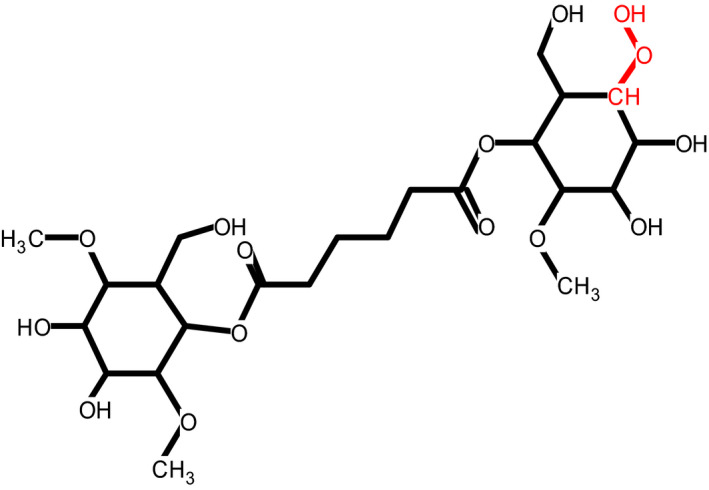
Alerting alkyl hydroperoxide group present in distarch adipate
However, the Panel noted that in general, the genotoxic effects induced by this structural alert are more relevant in vitro than in vivo, since cell antioxidant defences and the ability of the cell to cope with the formation of reactive oxygen species (ROS) are more efficient in the whole organism.
An alert for acylation (by SN2 mechanism) was highlighted by one profiler (Oasis v.1.3) for acetylated distarch phosphate, acetylated starch and acetylated distarch adipate. The structural alert detected, specific acetate esters, refers to the presence of an acetate ester with possible enhanced reactivity due to the presence of an electron‐withdrawing group attached to the carbon atom at β‐position towards the ester oxygen (represented by the oxygen pointed by the arrow in Figure 7).
Figure 7.
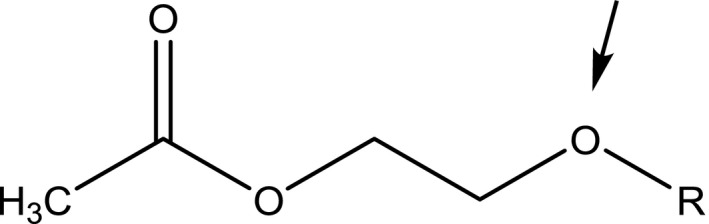
Alerting acetate ester group present in the three acetylated starches
The Panel noted that the same alert is not detected by the other endpoint specific profiler (in vitro mutagenicity (Ames test) alerts by ISS), and that this different outcome points out a not univocal interpretation of the relevance for genotoxicity of this specific structural feature, as also reported in the alert accompanying explanations: ‘Such esters belong to a very limited and specific scope of chemicals of different structures, since acetate esters are, in most cases, non‐mutagenic. Hence, no generalised chemical mechanistic schemes, associated with the positive bacterial mutagenicity (in vitro genotoxicity) of such acetate esters can be inferred, and different mechanisms may operate’.
Indeed, a search in an external database (ISSSTY) did not highlight a correlation between the alert specific acetate ester and genotoxicity (Appendix F).
One additional structural alert ‘Hacceptor‐path3‐Hacceptor’ was detected by the profiler ‘in vivo mutagenicity (micronucleus) by ISS’, for all listed compounds. However, this alert, which is present in the glucose molecule, is considered not relevant, as it refers to non‐covalent binding to DNA or proteins as a result of the presence of two bonded atoms connecting two hydrogen bond acceptors and as its positive predictivity is quite low, ranging from ‘none’ (34%) to just 63% depending on the database, with a high incidence of false positives (Benigni et al., 2010, 2012).
Overall, the Panel concluded that the in silico analysis of the substructures of modified starch moieties did not identify any relevant alert for genotoxicity, and concluded that modified starches do not raise concern for genotoxicity.
4.2.4. Chronic toxicity and carcinogenicity
No data were available for oxidised starch (E 1404), monostarch phosphate (E 1410), distarch phosphate (E 1412), hydroxypropyl starch (E 1440), acetylated oxidised starch (E 1451) and starch aluminium octenyl succinate (E 1452).
4.2.4.1. Phosphated distarch phosphate (E 1413)
Rats
Groups of 30 male and 30 female rats (Wistar‐derived) were fed phosphated distarch phosphate (maize starch ‘white milo’, cross‐linked with sodium trimetaphosphate up to 0.04% introduced phosphorus and esterified with sodium tripolyphosphate up to a total content of 0.35% bound phosphorus, commercial name Snow Flake 4832) at dietary levels of 0%, 5%, 10% and 30% (equivalent to 0, 2,500, 5,000 and 15,000 mg/kg bw per day) for 104 weeks (documentation provided to EFSA n. 36; de Groot et al., 1974). No treatment‐related effects were noted on general appearance, behaviour or mortality. Food intake, growth rate and food efficiency in treated animals were comparable to controls. Haematology, clinical chemistry and urine analysis revealed no consistent or dose‐related differences between the test groups and the controls. Relative organ weights were comparable to those of the controls, except for significantly decreased spleen weight in males and significantly increased spleen and kidney weights in females fed at 30%. These changes were not associated with any gross pathological findings. Caecal weights were not increased. Histological examination did not reveal any distinct compound‐related changes. The study did not reveal any indication of carcinogenicity. The authors stated that ‘in comparison with the controls, the males fed the 30% level of the modified starch showed a slightly increased degree and incidence of focal hyperplasia of the renal papillary and pelvic epithelium, accompanied by calcified patches in the underlying tissue. The hyperplastic and calcified tissues often protruded into the renal pelvis and were localised most often in the papilla near the junction of the papillary and pelvic epithelium. This lesion was seen to a slight or moderate degree in both sexes at most levels including the controls but was more pronounced and of higher occurrence in males at the highest dose level.’
4.2.4.2. Acetylated distarch phosphate (E 1414)
Rats
Groups of 30 male and 30 female rats (Wistar‐derived) were fed acetylated distarch phosphate (potato starch cross‐linked with 0.02% phosphorus oxychloride and acetylated with 8% acetic anhydride; acetyl content 2.33%) at dietary levels of 0%, 5%, 10% and 30% (equal to 0, 2,500, 5,000 and 15,000 mg/kg bw per day) for 104 weeks (Documentation provided to EFSA n. 37; de Groot et al., 1974). No treatment‐related effects were noted on general appearance, behaviour or mortality. Food intake, growth rate and food efficiency in treated animals were comparable to controls. The final body weight was slightly reduced and was approx. 10% lower, significant at least in males at 30%. Haematology, clinical chemistry and urine analysis revealed no consistent or dose‐related differences between the test groups and the controls. Females exhibited a dose‐related increase in relative adrenal weight (significant at 30%). There was a dose‐related increase in the caecal weight in both sexes at the 30% level, but only in males at the 10% level. The caecal enlargement was attributed to an adaptive response (fermentation) to the presence of indigestible material, rather than to a pathological response. All other organ weights showed no treatment‐related changes. The only treatment‐related effect that was observed histologically was a kidney lesion which occurred at a higher incidence in the high‐dose males. The lesion consisted of suburothelial deposits of calcium accompanied by focal hyperplasia of the epithelium of the renal pelvis. No treatment‐related effect was observed on the pattern of neoplasm development.
In a study focussing on kidney lesions associated with dietary modified starches, groups of 25 female Sprague−Dawley rats were fed diets containing either 30% acetylated distarch phosphate (equivalent to 15,000 mg/kg bw per day) or 30% unmodified starch, used as a control; this comprised a 1‐year study in weanling rats (Experiment I) and a separate 9‐month study utilising 9‐month‐old rats (Experiment II) (Hodgkinson et al., 1982). The concentration of Ca, P and Mg in the diet was 1%, 0.8% and 0.15%, respectively. Body weight, food consumption, urine volume, urine pH and crystal content or faecal mineral content showed no differences between treated and control animals in both experiments. At necropsy, caecal weight was significantly increased, but no other treatment‐related effects on relative organ weights were observed. No treatment‐related histopathological effects were observed in the uterus or lower urinary tract, liver, parathyroid, caecum or ovaries in either experiment. Histopathological examination of kidney sections demonstrated the presence of treatment‐related pelvic nephrocalcinosis. An apparent correlation was observed between the increased incidence of pelvic nephrocalcinosis, increased accumulation of calcium in the kidney and increased urinary excretion of calcium. Residues of calcium in kidney tissue were significantly higher in the test groups than in the control.
The effects of mineral deposition in the renal pelvis of rats were reviewed in 1977 by an expert (Documentation provided to EFSA n. 38). After an extensive evaluation, it was concluded that pelvic nephrocalcinosis, corticomedullary nephrocalcinosis, acute tubular nephropathy and calculus formation are manifestations of mineral imbalance and are of relatively common occurrence in untreated laboratory rats (particularly in older animals) (FASEB, 1979). The Panel agreed with this conclusion.
4.2.4.3. Acetylated starch (E 1420)
Rats
Groups of 30 male and 30 female rats (Wistar‐derived) were fed starch acetate (potato starch treated with 5% acetic anhydride; acetyl content 1.98%) at dietary levels of 0%, 5%, 10% and 30% (equivalent to 0, 2,500, 5,000 and 15,000 mg/kg bw per day) for 104 weeks (Documentation provided to EFSA n. 39; de Groot et al., 1974). No treatment‐related effects were noted on general appearance, behaviour or mortality. Food intake, growth rate and food efficiency, as well as body weight of treated animals were comparable to controls. Haematology, clinical chemistry and urine analysis revealed no consistent or dose‐related differences between the test groups and the controls. There was a dose‐related increase in the caecal weight in both sexes at the 30% level, but in males only, at the 10% level. The caecal enlargement was attributed to an adaptive response to the presence of indigestible material, rather than to a pathological response. All other organ weights showed no treatment‐related changes. The only treatment‐related effect that was observed histopathogically was a kidney lesion which occurred at a higher incidence in the high‐dose males. The lesion consisted of suburothelial deposits of calcium accompanied by focal hyperplasia of the local epithelium of the renal pelvis. Based on the renal lesions, the Panel identified a NOAEL of 5,000 mg/kg bw per day. No treatment‐related effect was observed on the pattern of neoplasm development.
4.2.4.4. Acetylated distarch adipate (E 1422)
Rats
Groups of 30 male and 30 female rats (Sprague−Dawley derived) were fed acetylated distarch adipate (modification of maize starch with acetic anhydride as stabiliser and adipic acid as cross‐linking agent; acetyl content 2.5%) at dietary levels of 62% (equal to 31,000 mg/kg bw per day) for 104 weeks (Truhaut et al., 1979). Unmodified starch at 62% served as control. Body weight was significantly lower in treated males and females compared to control. However, femur measurements indicated no accompanying differences in skeletal growth and, at autopsy, control rats contained markedly greater adipose deposits than those found in the treated rats of either group. Haematology, serum biochemical analyses, bacteriological examinations and organ‐weight determinations showed no significant differences of pathological interest (e.g. elevated SGOT) between control and treated animals. Histological examination of the main organs did not reveal any significant differences between control and treated groups for either non‐tumorous lesions or tumours. In the case of the kidney, hyperplasia of the kidney urothelium, sometimes accompanied by calcification, was observed in both control and test groups, but neither the incidence nor the severity of these effects were considered by the authors to be treatment‐related. However, independent reviewers of the data concluded that in female rats, the incidence of epithelial hyperplasia was greater in the rats fed modified starch. The Panel agreed with the conclusions of the independent reviewers.
Groups of 25 female Sprague−Dawley rats were fed diets containing either 30% acetylated distarch adipate (equivalent to 15,000 mg/kg bw per day) or 30% unmodified starch (control) in a 1‐year study with weanling rats (Experiment I) and a separate 9‐month study utilising 9‐month‐old rats (Experiment II) (Hodgkinson et al., 1982). The calcium concentration in the diet was ~ 1%, phosphorus ~ 0.8% and magnesium ~ 0.15%. Urinary calcium concentration and total daily output were significantly increased in animals on the test diet (Experiments I and II), but only minor differences were seen in phosphorus, oxalate, magnesium and creatinine excretion. No significant effects were observed on body weight, food consumption, urine volume, urine pH and crystal content or faecal mineral content in animals on the test diet. At necropsy, relative organ weights showed no differences between the groups, except for caecal enlargement. No treatment‐related histopathological effects were observed in the uterus or lower urinary tract, liver, parathyroid, caecum or ovaries in either experiment. Histopathological examination of kidney sections demonstrated the presence of treatment‐related pelvic nephrocalcinosis. An apparent correlation was observed between the increased incidence of pelvic nephrocalcinosis, increased accumulation of calcium in the kidney, and increased urinary excretion of calcium. Residues of calcium in kidney tissue were significantly higher in the test groups than in the controls.
4.2.4.5. Hydroxypropyl distarch phosphate (E 1442)
Mice
Groups of 75 male and 75 female Swiss albino SPF mice were fed a diet containing 55% hydroxypropyl distarch phosphate (equivalent to 27,500 mg/kg bw per day) or a control diet containing 55% pregelatinised potato starch for 89 weeks (Documentation provided to EFSA n. 40; Til et al., 1986). Observations were made on growth and appearance, haematology, blood biochemistry, urine composition, organ weights, mortality and gross and microscopic pathology, with special attention being given to the kidney and bladder. In week 80, 10 mice/sex per group were killed and necropsied. A thorough necropsy was also performed on those animals found dead or moribund. After 89 weeks, all survivors were killed and subjected to necropsy.
Loose stools and slight diarrhoea was observed in 12% of the males and 5% of the females. In the control group, it was slightly lower (males: 4%, females: 3%). Loss of body weight prior to death was observed in about 25% of male control animals, whereas in the other groups, at most 10% of the males was found to lose weight. Such differences between groups were not noticed in females. The death rate in the other groups was quite normal for the strain of mice used, except for a fairly high mortality in males of the control group between week 39 and week 65. The body weights of the group fed hydroxypropyl distarch phosphate were significantly decreased in males from week 16 to 48 and in females from week 40 onwards, compared to the control. Water intake was increased in both males and females of the treated group to ~ 100% in week 86. Haematocrit was reduced in both sexes at week 40 but not at week 78. Clinical chemistry was unaffected. In male mice, a higher incidence of amorph material in the urine was observed, and the rate of turbid urine was higher. Examination of the urine sediment by IR spectroscopy revealed that the sediment consisted of nearly 100% protein. The caecum weight of treated animals, with or without contents, was statistically higher compared with the control group. Similar differences were found for the colon. Histopathological evaluation revealed an increase in the incidence of intratubular mineralisation in the kidneys of treated male and female animals. There was no evidence of carcinogenicity (Documentation provided to EFSA n. 40; Til et al., 1986). The Panel agreed with this conclusion.
4.2.4.6. Starch sodium octenyl succinate (E 1450)
Rats
Male and female Colworth−Wistar rats (52 of each sex/group) were fed OSA‐modified starch in the diet at concentrations of 0%, 5%, 12.5% or 30% (equivalent to 0, 2,800, 7,100 and 17,000 mg/kg bw per day for males and 0, 3,500, 8,800 and 21,000 mg/kg bw per day for females) for 120 and 116 weeks, respectively (Parish, 1987; cited in JECFA, 2015). The rats were 4 weeks old at the beginning of dosing. Maize starch was added to compensate for the different levels of OSA‐modified starch added to the diet. Autopsy was performed when survival was below 25%, which occurred at 116 weeks for females and 120 weeks for males. The addition of OSA‐modified starch did not affect mortality. No statistically significant difference in the overall body weight gain was noted in male rats. However, an increase in body weight gain in female rats occurred in the 5% and 12.5% OSA‐modified starch group between 0 and 114 weeks. There was no treatment‐related change in feed intake, feed efficiency or ophthalmoscopy. The absolute and relative pituitary weights were found to be significantly increased in male rats in the 30% OSA‐modified starch group, which was related to pituitary adenoma in those surviving rats. This finding is common in rats of this age and strain.
The author concluded that there was no evidence for carcinogenicity or chronic toxicity of OSA‐modified starch when fed to rats at concentrations of up to 30% in the diet, equivalent to 17,000 mg/kg bw per day (Parish, 1987; cited in JECFA, 2015). The Panel agreed with this conclusion.
4.2.4.7. Summary
Two chronic studies (52‐week) were available, one with acetylated distarch phosphate (E 1414) and one with acetylated distarch adipate (E 1422) (Hodgkinson et al., 1982). At necropsy, relative organ weights showed no differences between the groups, except for caecal enlargement. Histopathological examination of kidney sections demonstrated the presence of treatment‐related pelvic nephrocalcinosis. An apparent correlation was observed between the increased incidence of pelvic nephrocalcinosis, increased accumulation of calcium in the kidney and increased urinary excretion of calcium.
A carcinogenicity study (89‐week) in mice was available for hydroxypropyl distarch phosphate (E 1442) (Documentation provided to EFSA n. 40). There was no evidence of carcinogenicity. This chronic study in mice demonstrated some histopathological changes in the kidneys characterised by intratubular mineralisation, which according to the authors, was of no toxicological significance for the human health.
Carcinogenicity studies in rats were available for phosphated distarch phosphate (E 1413), acetylated distarch phosphate (E 1414), acetylated starch (E 1420), acetylated distarch adipate (E 1422), hydroxypropyl distarch phosphate (E 1442) and starch sodium octenyl succinate (E 1450). There was no evidence of carcinogenicity. The long‐term studies in rats did not reveal any significant effects, except for caecal enlargement. As this effect was observed without associated histopathological changes, it was considered to be of no toxicological significance for humans.
Kidney lesions (pelvic and corticomedullary mineralisation) in rats fed high levels (up to 62%; 31,000 mg/kg bw per day) of phosphated distarch phosphate (E 1413), acetylated distarch phosphate (E 1414), acetylated starch (E 1420), acetylated distarch adipate (E 1422) and hydroxypropyl distarch phosphate (E 1442) were observed. The lesions were considered to be associated with an imbalance of Ca/P and Mg in the diet (Newberne and Buttolph, 1979; Documentation provided to EFSA n. 28; Documentation provided to EFSA n. 38; Hodgkinson et al., 1982). As the rat is a particularly sensitive species for PN (Ritskes‐Hoitinga et al., 1989, 1991, 1992), while the effect was not observed in the hamster and the pig, the effect was considered to be of no relevance for risk assessment in humans. These renal changes were not observed in rats fed starch sodium octenyl succinate (E 1450) at 30% in the diet for up to 120 weeks (Parish, 1987; cited in JECFA, 2015).
4.2.5. Reproductive and developmental toxicity
No data were available for oxidised starch (E 1404), monostarch phosphate (E 1410), distarch phosphate (E 1412), hydroxypropyl starch (E 1440), hydroxypropyl distarch phosphate (E 1442), acetylated oxidised starch (E 1451) and starch aluminium octenyl succinate (E 1452).
4.2.5.1. Phosphated distarch phosphate (E 1413)
Reproductive toxicity studies
A three‐generation study was performed using groups of 10 male and 20 female rats (Wistar‐derived) of the P, F1 and F2 generations to produce two successive litters in each generation by mating at weeks 12 and 20 after weaning (Documentation provided to EFSA n. 41; de Groot et al., 1974). A total of 10 males and 10 females of the F1b generation were kept for 3 weeks after weaning and then sacrificed for histopathological studies. The P, F1b and F2b parents were used for determination of implantation sites. The F3b generation was kept for 3 weeks after weaning and then sacrificed for histopathological evaluation. The phosphated distarch phosphate (maize starch ‘white milo’, cross‐linked with sodium trimetaphosphate up to 0.04% introduced phosphorus and esterified with sodium tripolyphosphate up to a total content of 0.35% bound phosphorus, commercial name Snow Flake 4832) was fed at 10% in the diet (equal to 5,000 mg/kg bw per day). The control group was fed unmodified potato starch. No adverse effects were noted regarding appearance, behaviour, body weight, fertility, litter size, resorption quotient, weights of pups and mortality. Caecal weights were not increased, except for the filled caecum weight of F1 parent males. The spleen weight of F3b females was increased significantly (p < 0.01). Gross and macroscopical examination did not reveal histopathological changes attributable to the ingestion of this starch.
4.2.5.2. Acetylated distarch phosphate (E 1414)
Reproductive toxicity studies
A three‐generation study was performed using groups of 10 male and 20 female rats (Wistar‐derived) of the P, F1 and F2 generations to produce two successive litters in each generation by mating at weeks 12 and 20 after weaning (Documentation provided to EFSA n. 41; de Groot et al., 1974). A total of 10 males and 10 females of the F1b generation were kept for 3 weeks after weaning and then sacrificed for histopathological studies. The P, F1b and F2b parents were used for determination of implantation sites. The F3b generation (10 rats/sex) was kept for 3 weeks after weaning and then sacrificed for histopathological examination. The acetylated distarch phosphate (potato starch cross‐linked with 0.02% phosphorus oxychloride and acetylated with 8% acetic anhydride; acetyl content 2.33%) was fed at 10% of the diet (equivalent to 5,000 mg/kg bw per day). No adverse effects were noted with respect to health, behaviour, mortality, growth, fertility, litter size, resorption quotient, weaning weight or mortality of the young. Caecal weight of parent rats fed the modified starch was not increased. Macroscopical examination did not reveal treatment‐related effects in F3b rats. Relative thyroid weight in males was decreased (p < 0.05) and furthermore, a slightly increased caecum weight in females (p < 0.05) was observed. Histopathology did not reveal any treatment‐related changes.
Developmental toxicity
No studies available.
4.2.5.3. Acetylated starch (E 1420)
Reproductive toxicity studies
A three‐generation study was performed using groups of 10 male and 20 female rats (Wistar‐derived) of the P, F1 and F2 generations to produce two successive litters in each generation by mating at weeks 12 and 20 after weaning (Documentation provided to EFSA n. 41; de Groot et al., 1974). A total of 10 males and 10 females of the F1b generation were kept for 3 weeks after weaning and then sacrificed for histopathological studies. The P, F1b and F2b parents were used for determination of implantation sites. The F3b generation was kept for 3 weeks after weaning and then sacrificed for histopathological studies. The starch acetate (potato starch treated with 5% acetic anhydride; acetyl content 1.98%) was fed at 10% in the diet (equivalent to 5,000 mg/kg bw per day). No adverse effects were noted with respect to health, behaviour, mortality, growth, fertility, litter size, resorption quotient, weaning weight or mortality of young animals. Relative caecum weight was significantly increased in P females (empty, p < 0.05) and F2 females (filled and empty, p < 0.05). Gross pathology of F3a rats revealed a slightly increased kidney weight (p < 0.05) and a slightly increased caecum weight (p < 0.01) in males. Histopathological examination did not reveal any treatment‐related changes.
Developmental toxicity
No studies available.
4.2.5.4. Acetylated distarch adipate (E 1422)
Reproductive toxicity studies
Groups of 10 male and 10 female rats (Sprague–Dawley derived) were selected at random from a concurrent 2‐year chronic toxicity study (see Section 4.2.4.4) and, 6 weeks after weaning, were mated to produce F1a and F1b litters (Truhaut et al., 1979). They were fed acetylated distarch adipate (maize starch modified with acetic anhydride as a stabiliser and adipic acid as a cross‐linking agent; acetyl content 2.5%) at dietary levels of 62% (equivalent to 31,000 mg/kg bw per day). Unmodified starch at 62% served as a control. After breeding was complete, parents were returned to the chronic study, while 10 male and 10 female rats from the F1b litter were bred to produce F2a and F2b litters. F3a and F3b litters were obtained in a similar way. In each generation, litters from the first mating were sacrificed at weaning, and from the second mating, 6 weeks after weaning, except for the 10 males and 10 females selected for breeding. Preweaning deaths were significantly elevated in offspring from F2b litters for both control and test animals compared to the previous generation, but were within normal limits for the strain. The remaining test parameters (litter size, incidence of stillbirths and sex ratio at weaning) were similar in treated and control animals. Growth was comparable in all groups. Terminal studies of the F3b generation (including histology of the principal organs) did not reveal evidence of anomalies. No detailed information from the histopathological examinations was provided.
Developmental toxicity
No studies available.
4.2.5.5. Starch sodium octenyl succinate (E 1450)
There were no data available from specific studies on reproductive or developmental toxicity for starch sodium octenyl succinate (E 1450). However, there was an investigation of the short‐term toxicity in F1 offspring of Fischer 344 rats that had been fed OSA‐modified starch from weaning and throughout mating, gestation and lactation. The F1 offspring were fed the same diets as their dams from weaning and for 30 or 90 days post‐weaning (see Section 4.2.2.10). No comment was made regarding any effect on the offspring (Buttolph and Newberne, 1980).
4.2.5.6. Summary
Dietary reproductive toxicity studies in rats were available for phosphate distarch phosphate (E 1413), acetylated distarch phosphate (E 1414), acetylated starch (E 1420) and acetylated distarch adipate (E 1422). No effects on reproductive performance or maternal and developmental toxicity were observed in the three‐generation reproductive toxicity studies at dietary levels of up to 62% (equivalent to 31,000 mg/kg bw per day).
No prenatal developmental toxicity studies were available.
4.2.6. Other studies
4.2.6.1. Phosphated distarch phosphate (E 1413)
Human studies
Twelve volunteers consumed on each of 4 successive days, 60 g phosphated distarch phosphate (maize starch ‘white milo’, cross‐linked with sodium trimetaphosphate up to 0.04% introduced phosphorus and esterified with sodium tripolyphosphate up to a total content of 0.35% bound phosphorus, commercial name Snow Flake 4832). No abnormalities were observed (Documentation provided to EFSA n. 42).
In an opinion of the EFSA NDA Panel, the results of one unpublished study with phosphated distarch phosphate were reported (EFSA NDA Panel, 2010). Eleven healthy non‐diabetic adults were fed biscuits containing the novel ingredient at various levels (6.8%, 13.6%, 20.4% or 27.1%) vs control biscuits. Over a period of 2 h, the novel ingredient had no effect on glycaemic response at any of the concentrations tested.
4.2.6.2. Acetylated distarch phosphate (E 1414)
Human studies
Twelve volunteers consumed on each of 4 successive days, 60 g acetylated distarch phosphate (potato starch cross‐linked with 0.02% phosphorus oxychloride and acetylated with 8% acetic anhydride; acetyl content 2.33%). No abnormalities were observed as regards frequency and amount of faeces, as well as faecal water and lactic acid content. No other adverse effects were noted (Documentation provided to EFSA n. 42).
4.2.6.3. Acetylated starch (E 1420)
Human studies
Twelve volunteers consumed on each of 4 successive days, 60 g starch acetate (potato starch treated with 5% acetic anhydride; acetyl content 1.98%). No abnormalities were observed as regards frequency and amount of faeces, as well as faecal water and lactic acid content. No other adverse effects were noted (Documentation provided to EFSA n. 42).
4.2.6.4. Hydroxypropyl starch (E 1440)
Rats
The effects of hydroxypropyl starches (HPS) of three different degrees of substitution (DS = 0.046, 0.093 and 0.232) on concentration of plasma cholesterol, apparent digestibility of protein, faecal excretion of bile acids, faecal output and caecal pool of organic acids such as acetic, propionic, butyric, lactic and succinic acid were studied in rats (Ebihara et al., 1998). Male rats (n = 6, Wistar strain) were fed a fibre‐free, purified diet containing either HPS or gelatinised unmodified potato starch (PS; 100 g/kg) as a control for 21 days. Faecal output was greater and faecal excretion of bile acids was higher in rats fed the HPS diets with higher DS compared with control rats fed the PS diet. Apparent protein digestibility in rats fed the HPS diets with higher DS was lower than that in control rats fed the PS diet. The pool size of caecal organic acids was not affected by diet. Apparent protein digestibility, faecal output and faecal bile acids excretion were significantly correlated with DS (r = −0.994, p = 0.0059; r = 0.976, p = 0.0236; and r = 0.899, p = 0.0077, respectively). Plasma cholesterol concentration was significantly lower in rats fed the HPS diets than in control rats fed the PS diet. The HPS diets resulted in higher proportions of propionic acid, lactic acid and succinic acid and a lower proportion of n‐butyric acid compared to the PS diet.
4.2.6.5. Hydroxypropyl distarch phosphate (E 1442)
Rats
The effects of hydroxypropyl distarch phosphate (HDP) of three different degrees of cross‐linking (degree of cross‐linking not specified; DS = 0.012, 0.010 and 0.013) on concentration of plasma cholesterol, apparent digestibility of protein, faecal excretion of bile acids, faecal output and caecal pool of organic acids such as acetic, propionic, butyric, lactic and succinic acid were studied in rats (Ebihara et al., 1998). The degree of cross‐linking (DC) of the hydroxypropyl distarch phosphate was as follows: HDP‐A 0.046 < HDP‐B 0.093 < HDP‐C 0.232. Male Wistar rats (n = 6) were fed a fibre‐free, purified diet containing either HDP or gelatinised PS (100 g/kg) as a control for 21 days. Faecal output and faecal excretion of bile acids were increased in rats fed the HDP diets compared to controls. Apparent protein digestibility in rats fed the HDP diets with higher DC was lower than that in controls. The pool size of caecal organic acids, expressed as micromoles per caecum, was not affected by diet. Apparent protein digestibility was significantly correlated with the degree of swelling power (DSP) (r = 0.996, p = 0.0028), which was inversely related to DC. The HDP diets did not affect plasma cholesterol concentration. The HDP diets resulted in higher proportions of acetic acid, lactic acid and succinic acid and a lower proportion of n‐butyric acid compared to the PS diet.
The physiological effects of six different types of HDP from tapioca starch with two different degrees of substitution and three different degrees of cross‐linking were investigated in rats (Kishida et al., 2001). Male Wistar rats (n = 6) were fed a fibre‐free, purified diet containing either gelatinised unmodified tapioca starch (50 g/kg diet) as control or gelatinised chemically modified tapioca starch (HDP, 50 g/kg) for 21 days. HDP with two different degrees of substitution (DS = 0.05 and 0.23) and three different DC were used as chemically modified starch sources. The wet weight and moisture of faecal output of the rats fed HDP with higher DS were 100% and 20% greater than that in the control rats, respectively. The weights of caecal wall and caecal contents were also 30% and 50% higher in the rats fed HDP with higher DS than those in the control rats. The pH of the caecal contents was more acidic in the rats fed HDP with higher DS than that in the control rats. Faecal excretion of bile acids was 40% higher in the rats fed HDP with higher DS than in the control rats. The degree of cross‐linking had little influence on these effects. Plasma cholesterol concentration was 16% lower in the rats fed HDP with higher DS and highest DC than in the control rats. The concentrations of liver lipids and plasma triglycerides and the caecal pool of organic acids were not affected by diet. The apparent absorptions of Ca and Mg were not affected by diet, but those of Zn and Fe were 75% and 70% lower in the rats fed HDP with higher DS than in the control rats.
Male weanling rats (Holtzman strain; not further specified) were fed semipurified diets containing 15% or 35% of either hydroxypropyl distarch phosphate or unmodified starch for 28 days (Bruns and Hood, 1973). At the 35% level, mean weight gains, food consumption and protein energy ratio (PER) (3.00 ± 0.13/2.74 ± 0.42, modified/unmodified) were similar. Diarrhoea, caecal enlargement and depression of caecal pH from 7.2 to 5.0 were observed in the animals fed the modified starch. Aerobic microorganisms were 10‐ to 1,000‐fold greater in the faeces from animals on the modified starch diet than those on unmodified starch. The changes were most pronounced in animals fed the 35% diet. After 180 days, all streptococci disappeared from the caecal microflora; coliforms declined from 107 to 104/g faeces, while lactobacilli remained constant.
4.2.6.6. Starch sodium octenyl succinate (E 1450)
Special studies in young animals
Dogs
Pups from five Beagle dams (four of each sex per litter, between 5 and 9 days of age, and each dose group fed by a single dam) were administered 0 (water control), 5,000 or 10,000 mg/kg bw per day of OSA‐modified starch or 5,000 or 10,000 mg/kg bw per day of a control starch for 6 weeks (RLMD, 1990; cited in JECFA, 2015). The starches were suspended in water (30%) and administered via gavage twice daily. Dams and pups had access to water and dog feed at all times. Pups were monitored for body weight, physical appearance, behaviour, unusual signs, haematology, blood chemistry, gross lesions and histopathological findings. A urine sample was collected from the bladder of each animal at necropsy. There were no significant differences in blood chemistry, haematology or urine parameters among groups. No deaths, gross lesions or histological findings were attributable to the treatment.
Pigs
JECFA (2015) reported that ‘the safety and effect of OSA‐modified starch on the growth of piglets were investigated in a GLP‐compliant 3‐week toxicity study (Mahadevan et al., 2014). Two‐day‐old domestic Yorkshire cross‐bred piglets (six of each sex per group; weighing 1.7–2.6 kg) were administered 500 mL/kg bw per day of milk containing 0, 2, 4 or 20 g OSA‐modified starch per litre (equivalent to 0, 1,000, 2,000 or 10,000 mg/kg bw per day) for 3 weeks. The control, low‐dose, mid‐dose and high‐dose groups also received amioca powder (control article) at levels of 8,000, 7,200, 6,400 or 0 mg/kg bw per day, respectively, to ensure that the total caloric intake was similar among groups, accounting for the decreased digestibility of OSA‐modified starch. All animals were offered the test materials at a dose volume of 500 mL/kg bw per day via a feeding device, 6 times per day (~ 83.33 mL/kg bw per dose, 3 ± 0.25 h between doses). Administration of the test and control articles began on lactation day 2. A complete physical examination was conducted on all animals on day 4’.
All animals survived to scheduled necropsy on day 21, and there were no compound‐related changes in clinical observations during the study. The test article was well tolerated by the piglets. No significant effects on haematology, clinical chemistry, organ weights or histopathological examination were observed. The authors concluded that administration of OSA‐modified starch in the diet for a 3‐week period after birth was well tolerated in piglets and that exposure to OSA‐modified starch did not produce any definitive compound‐related effects on growth or the clinical pathology parameters evaluated. Moreover, no effects attributable to the test article were observed upon macroscopic or microscopic evaluation. The NOAEL in this study was 10,000 mg/kg bw per day, the highest dose tested.
Observations in humans
JECFA (2015) reported that ‘in a double‐blind crossover study conducted to investigate the glycaemic response to OSA‐modified starch, 30 healthy non‐diabetic adult subjects (12 men and 18 women; mean age of 43 ± 3 years, age range 20–74 years) ingested 25 g of glucose or 25 g of OSA‐modified starch after an overnight fast (Wolf et al., 2001). Blood samples were obtained at baseline and 15, 30, 45, 60, 90 and 120 min post‐prandial for glucose analysis. There were no significant differences in mean fasting blood glucose concentrations between treatments. Mean peak incremental change from baseline and net incremental area under the curve were significantly lower in the OSA‐modified starch group compared with the glucose group. Compared with the glucose treatment group, the post‐prandial incremental change from baseline in blood glucose was significantly lower in the OSA‐modified starch treatment group at 15 and 30 min and significantly higher at 120 min. There were no clinically significant differences in gastrointestinal symptoms observed between treatments, nor were there any adverse events reported in any subject. The authors concluded that OSA‐modified starch was well tolerated by fasting healthy adults and attenuated the post‐prandial glycaemic response compared with glucose (Wolf et al., 2001)’.
Studies in infants
According to the JECFA report (2015) ‘the growth, acceptance and tolerance of female term infants fed either a milk‐based formula containing OSA‐modified starch (OSA‐modified starch content in the range of 1.33–1.47 g/100 mL) or a milk‐based formula containing distarch phosphate‐modified tapioca starch (control) were examined in a randomised, multicentre, double‐blind clinical study (MJNR, 1994; cited in JECFA, 2015). The starch content of both test formulas was the same as that in a marketed infant formula, on a weight‐to‐weight basis. One hundred and seven infants (55 in the OSA‐modified starch group and 52 in the non‐OSA‐modified starch group) between 2 and 16 days of age were enrolled in the study. All subjects were provided the study formulas as the sole source of nutrition for 120 days’.
No significant differences in discontinuation rates were observed between treatment groups. There were no significant differences in weight gain at 30, 60 or 90 days observed among the groups. Furthermore, at 90 days of age, the intake of formula in the OSA‐modified starch group was significantly higher than that in the control group, with a mean intake of 1,114 mL for the OSA‐modified starch group and 947 mL for the non‐OSA‐modified starch group, although the authors noted that formula intake was not accurately determined for some of the subjects. No significant differences in growth, product assessment (satisfaction based on parental and infant criteria, including ‘spit‐up and stool odour’), reported illnesses or ‘symptoms of concern’, or parental concerns were reported between groups' (MJNR, 1994; cited in JECFA, 2015).
The tolerability of formulas containing OSA‐modified starch was further examined in a randomised, multicentre, double‐blind, good clinical practice (GCP)‐compliant trial (Borschel and Kajzer, 2011; cited in JECFA, 2015). Healthy term infants were fed either a commercial control formula or one of two experimental casein hydrolysate formula powders (EF‐1 or EF‐2). EF‐1 was a casein hydrolysate‐based infant formula containing iron, DE1 maltodextrin, DE15 maltodextrin, sucrose and OSA‐modified starch (< 2%, not further specified). EF‐2 was a casein hydrolysate‐based infant formula containing OSA‐modified starch (< 2%, not further specified), DE15 maltodextrin and sucrose. All formulas were provided ad libitum. One hundred and sixty‐eight infants were enrolled from day 0 (birth) to day 8 of life and were followed until day 28 of life. Of these, 131 completed the study. Randomisation was achieved for sex, ethnicity, race, age, birth weight and length.
No statistically significant differences were reported for weight, length and their respective gains, as well as dropout rates due to intolerance. No statistically significant differences were observed in mean rank stool consistency, percentage of watery stools, percentage of stools of other consistencies, percentage of stool colours, predominant stool consistency or colour, percentage of feedings with spit‐up and/or vomit associated with feeding, and average daily study product intake. Infants provided the EF‐1 exhibited a statistically significant increase in the number of stools compared with those provided EF‐2. Parents of infants fed the control formula responded more favourably when ranking the formula odour in the Formula Satisfaction Questionnaire. Parents of infants fed EF‐1 reported more gassy responses in the Infant Feeding & Stool Patterns Questionnaire when compared with parents of infants fed the control formula or EF‐2.
The majority of the adverse events reported were either mild or moderate, with gastrointestinal disorders being the most frequently reported adverse event. The number of adverse vomiting events was significantly greater in the EF‐1 treatment group than in controls. For most variables, tolerance of all three formulas was similar, although a significantly greater number of stools occurred in the EF‐1 group; this was thought to be related to the absence of the stabiliser in this formula. The authors noted that there were no clinically relevant differences in serious adverse events between the treatment groups, and concluded that, overall, no safety concerns were noted with the experimental formulas, indicating a lack of concern regarding the inclusion of OSA‐modified starch (Borschel and Kajzer, 2011; cited in JECFA, 2015).
A number of additional infant growth studies have been undertaken using a proprietary infant formula containing OSA‐modified starch as a control formula for alternative experimental specialised formulas. These studies included those conducted by Burks et al. (2008), Scalabrin et al. (2009) and Borschel et al. (2013).
A similar growth study was conducted in healthy term infants fed an amino acid‐based formula or an extensively hydrolysed casein‐based formula containing 1.6% OSA‐modified starch (Borschel et al., 2013). This was a randomised, double‐blind, parallel group design study, in which 213 infants were enrolled between 0 and 9 days of age and studied until 112 days of age. The formulas were designed to be the sole source of nutrition throughout the study. The primary outcome variable was weight gain between 14 and 112 days of age, whereas secondary measures included length, head circumference, formula intake, daily stool number, mean rank stool consistency and serum albumin. The dose of formula was similar across the groups, and appropriate parameters were measured and noted at specific time intervals during the study. The dose of OSA‐modified starch was calculated to be 2.5 g/kg bw per day. A total of 134 infants completed the study, with similar demographic characteristics between groups.
Formula intakes recorded among the groups were similar, as were the numbers of infants who finished the study early because of intolerance symptoms. There were no statistically significant differences between groups in weight, length, head circumference or mean serum albumin concentration. There were significant differences in stool patterns, with the group receiving OSA‐modified starch having a significantly greater number of daily stools and average mean rank stool consistency at 14 and 28 days of age, which were considered to be due to this formula containing palm olein oil as a source of fat.
According to JECFA (2015), ‘OSA‐modified starch is also currently being marketed on an international basis within a nutritionally complete, hypoallergenic formula containing hydrolysed protein with free amino acids for infants with food allergies, sensitivity to intact protein or protein maldigestion. Distribution of the formula containing 2% OSA‐modified starch commenced in November 2012 in a number of countries located in Central and South America, Asia Pacific and the United Kingdom. Patient exposure is still fairly limited, as only 167,424 patient treatment days (a patient treatment day is defined as 0.8 L of prepared formula) had been distributed as of 30 October 2013. The adverse event reports received have been primarily related to gastrointestinal symptoms that are within the expected safety profile for this product when fed to the intended population, according to directions provided on the label or as instructed by a health‐care professional. To date, the use of OSA‐modified starch has apparently been well tolerated when administered to infants through its intentional use in a specialised infant formula’ (ISDI, 2013; cited in JECFA, 2015).
Overall, the Panel concluded that OSA‐modified starch up to a single dose of 25 g (25,000 mg/person) was well tolerated by fasting healthy adults. However, the Panel noted reports on gastrointestinal symptoms from the post‐marketing surveillance study conducted in infants with hypoallergenic formula containing 2% of OSA‐modified starch (about 24,000 mg/person) (EFSA CONTAM Panel, 2012b; DH, 2013).
4.3. Discussion
The present opinion deals with the re‐evaluation of the safety of modified starches comprising oxidised starch (E 1404), monostarch phosphate (E 1410), distarch phosphate (E 1412), phosphated distarch phosphate (E 1413), acetylated distarch phosphate (E 1414), acetylated starch (E 1420), acetylated distarch adipate (E 1422), hydroxypropyl starch (E 1440), hydroxypropyl distarch phosphate (E 1442), starch sodium octenyl succinate (E 1450), acetylated oxidised starch (E 1451) and starch aluminium octenyl succinate (E 1452) when used as food additives. These modified starches are authorised food additives in the EU according to Annex II and Annex III to Regulation (EC) No 1333/2008.
Starch typically consists of two polymers of glucose exhibiting a variable proportion: amylose with an almost linear structure, and amylopectin, which is highly branched. In amylose, the glucose monomers (pyranosic form) are linked by α‐1,4‐glycosidic links, while amylopectin contains additionally α‐1,6‐glycosidic bonds. Starches for commercial use are generally produced from potatoes, cereals or other sources. Indicatively, polymer molecular weights fall in the following ranges (rounding‐off to one figure): for amylopectins, from 50 × 106 Da to 500 × 106 Da (higher values have been reported by Yoo and Jane, 2002), with an average near 100 × 106 Da; for amyloses, from 2 × 10³ to 4,000 × 103 Da.
The most common chemical modification of the so‐called ‘native’ starches includes oxidation, esterification and etherification. In the present opinion, modified starches have been identified with CAS Registry numbers and, when available, EC numbers that were subject to confirmatory steps to minimise the uncertainty of an equivocal identification met in few cases. In modified starches, the chemical and physical characteristics of the native substances are altered in order to improve the functional properties for particular food applications. In general, the extent of modification required to distinctly alter the functional characteristics of native starches is low, as imposed by Commission Regulation (EU) No 231/2012.
The Panel noted that, according to the EU specifications, of the toxic elements arsenic, lead and mercury are accepted up to concentrations of 1, 2 and 0.1 mg/kg, respectively. The Panel considered that contamination at such levels could have a significant impact on exposure to these metals, for which exposure is already close to the health‐based guidance values benchmark doses (lower confidence limits) established by EFSA.
Several data on enzymatic degradation of modified starches are available using pancreatin, saliva or amylase. In comparison with unmodified starches, the digestibility of the modified starches was slightly reduced or showed no difference. Despite the absence of ADME data for two modified starches (E 1451 and E 1452) and the absence of in vivo studies in humans for some other modified starches, the Panel considered the ADME database sufficient to conclude that modified starches would not be absorbed intact but significantly hydrolysed by intestinal enzymes and then fermented by intestinal microbiota in humans to SCFA such as acetic, propionic and butyric acids, which are absorbed from the colon, and considered of no safety concern by the Panel.
In the case of starch aluminium octenyl succinate (E 1452) and considering the intestinal hydrolysis and fermentation of starches, the Panel noted that the biological fate of aluminium from this modified starch is not documented.
Acute oral toxicity data were available only for distarch phosphate (E 1412) in several species. LD50 values were all above 7,000 mg/kg bw.
Short‐term and/or sub‐chronic (90‐day) studies in rats were available for all modified starches, except monostarch phosphate (E 1410). Occasionally, also studies in dogs, pigs or hamsters were available. The modified starches were given at dietary levels up to 70%. The test duration was up to 90 days. Effects on body weight and feed consumption were not observed up to dietary levels of 25%. Caeca weights were increased at exposure levels of 30% and higher, but histopathological changes were not observed. The only significant histopathological change was the presence of pelvic and/or corticomedullary mineralisation in the kidneys, which was observed upon administration of modified as well as unmodified starches and occurred more pronounced in females than in males.
In a 90‐day study with acetylated oxidised starch (E 1451) in rats, a NOAEL of 10% in the diet (equal to 5,900 mg/kg bw per day) was determined, based on hyperplasia of the transitional epithelium of the urinary bladder and the kidneys, which were observed at 18,000 mg/kg bw per day, the next higher dose in this study.
Evaluation of genotoxicity of the modified starches evaluated in the present opinion was performed in silico, since no genotoxicity studies were available. The Panel concluded that the in silico analysis of the substructures of modified starch moieties did not identify any relevant alert for genotoxicity, and concluded that modified starches do not raise concern for genotoxicity.
Two chronic (52‐week) studies in rats were available, one with acetylated distarch phosphate (E 1414) and one with acetylated distarch adipate (E 1422). At necropsy, relative organ weights showed no differences among the groups, except for caecal enlargement. Histopathological examination of kidneys demonstrated the presence of treatment‐related pelvic nephrocalcinosis. A clear correlation was observed between the increased incidence of pelvic nephrocalcinosis, increased accumulation of calcium in the kidneys and increased urinary excretion of calcium.
A carcinogenicity study (89‐week) in mice was available for hydroxypropyl distarch phosphate (E 1442). There was no evidence of carcinogenicity. This study demonstrated some histopathological changes in the kidneys of mice, characterised by intratubular mineralisation, which according to the authors were of no toxicological significance for human health. The Panel agreed with this conclusion.
Carcinogenicity studies in rats were available for phosphated distarch phosphate (E 1413), acetylated distarch phosphate (E 1414), acetylated starch (E 1420), acetylated distarch adipate (E 1422), hydroxypropyl distarch phosphate (E 1442) and starch sodium octenyl succinate (E 1450). There was no evidence of carcinogenicity. These studies in rats did not reveal any significant effect, except for caecal enlargement. As the effect on the caecum observed was not associated with histopathological changes, it was considered to be of no toxicological significance for humans.
Kidney lesions (pelvic and corticomedullary mineralisation) developed in rats fed high levels (up to 62%; 31,000 mg/kg bw per day) of most of the modified starches evaluated, except starch sodium octenyl succinate (E 1450). The lesions were considered to be associated with an imbalance of Ca/P and Mg in the diet (Documentation provided to EFSA n. 28; Hodgkinson et al., 1982). The Panel noted that studies in the 1970s and 1980s demonstrated a credible mechanistic explanation for the nephrocalcinosis in rats and mice related to effects on Ca/P balance (Ritskes‐Hoitinga et al., 1989, 1991, 1992; EFSA, 2007b).
Reproductive toxicity studies in rats were available for phosphate distarch phosphate (E 1413), acetylated distarch phosphate (E 1414), acetylated starch (E 1420) and acetylated distarch adipate (E 1422). No effects on reproductive performance and no maternal and developmental effects were observed in the three‐generation reproductive toxicity studies at dietary levels of up to 62% (equivalent to 31,000 mg/kg bw per day). No prenatal developmental toxicity studies were available.
The Panel noted that starch sodium octenyl succinate (E 1450) up to a single dose of 25,000 mg was well tolerated by fasting healthy adults. However, the Panel noted reports on gastrointestinal symptoms in a post‐marketing surveillance study (ISDI, 2013; cited in JECFA, 2015) conducted in infants with hypoallergenic formula containing 2% of OSA‐modified starch (24,000 mg/person).
The Panel noted that it may be considered to establish specific purity criteria for the use of modified starches in food for infants and young children (FC 13.1).
In studies with phosphated distarch phosphate (E 1413), acetylated distarch phosphate (E 1414) and acetylated starch (E 1420) in healthy human volunteers, no adverse effects were reported at doses of 60,000 mg/person.
To assess the dietary exposure to modified starches (E 1404–E 1451) from their use as food additives, the combined exposure was calculated based on (1) maximum reported use levels provided to EFSA (defined as the maximum level exposure assessment scenario) and, (2) reported use levels (defined as the refined exposure assessment scenario, brand‐loyal and non‐brand‐loyal scenario).
Modified starches are authorised in a wide range of foods. The Panel did identify brand loyalty to specific food categories in infants and toddlers (e.g. processed cereal baby foods, unflavoured fermented milk products and flavoured fermented milk products). Further, the Panel considered that the non‐brand‐loyal scenario covering other population groups was appropriate and realistic scenario for risk characterisation because it is assumed that the population would probably be exposed long‐term to the food additive present at the mean reported use level in processed food.
A refined estimated exposure assessment scenario taking into account the FSMP for infants and young children (FC 13.1.5.1 Dietary foods for infants for special medical purposes and special formulae for infants and FC 13.1.5.2 Dietary foods for babies and young children for special medical purposes as defined by Commission Directive 1999/22/EC) was also performed to estimate exposure of infants and toddlers who may be on a specific diet. Considering that this diet is required due to specific needs, it is assumed that consumers are loyal to the food brand, therefore the refined brand‐loyal exposure assessment scenario was performed.
A specific food supplement consumers only scenario was also performed to estimate exposure of children, adolescents, adults and the elderly, as exposure via food supplements may deviate largely from that via food, and the number of food supplement consumers may be low depending on populations and surveys.
The refined estimates were based on 36 out of 72 food categories in which modified starches are authorised. The Panel considered that the uncertainties identified would, in general, result in an overestimation of the exposure to modified starches as a food additive in European countries for the maximum level exposure scenario. However, the Panel noted that given the information from the Mintel's GNPD, it may be assumed that modified starches are used in food categories (n = 13) for which no data have been provided by food industry. The main food categories, in terms of amount consumed, not taken into account were processed fish and fishery products, including molluscs and crustaceans, breakfast cereals, salads and savoury‐based sandwich spreads. According to the Mintel GNPD, in the EU market, these categories are labelled with modified starches. Therefore, the Panel considered that if these uncertainties were confirmed, it would therefore result in an underestimation of the exposure.
The Panel further noted that the exposure to modified starches (E 1404–E 1451) from their use according to Annex III to Regulation (EC) No 1333/2008 (Parts 1, 3 and 5) was not considered in the exposure assessment.
Separate scenarios were carried out for the exposure assessment of starch aluminium octenyl succinate (E 1452), taking into account the consumption of food supplements for consumers only and based on the MPL (regulatory maximum exposure assessment scenario) and on the maximum reported use level (maximum reported level exposure assessment scenario). Exposure to aluminium from the use of E 1452 as a food additive was also estimated.
Exposure to aluminium from the use of starch aluminium octenyl succinate (E 1452) in the regulatory maximum level exposure assessment scenario ranged for all population groups from 0.8% to 26% of the TWI of 1 mg aluminium/kg bw established by EFSA (2008) at the mean, and up to 47% at the 95th percentile. For the maximum reported level exposure assessment scenario, based on the usage levels provided by food industry, exposure to aluminium from E 1452 ranged from < 0.1 at the mean, up to 2.5% for the 95th percentile, across population groups. Furthermore, according to the information provided by industry, the content of aluminium in E 1452 is significantly lower than the limit set in the EU specifications for E 1452.
The Panel also noted that the refined exposure estimates are based on information provided on the reported levels of use of modified starches. If actual practice changes, this refined estimates may no longer be representative and should be updated.
5. Conclusions
5.1.
5.1.1.
General population
Following the conceptual framework for the risk assessment of certain food additives re‐evaluated under Commission Regulation (EU) No 257/2010 (EFSA ANS Panel, 2014) and given that:
adequate combined exposure data were available; in the general population, the 95th percentile of the refined exposure, calculated based on the use levels reported from food industry, was up to 3,053 mg/kg bw per day for toddlers (brand‐loyal consumer scenario);
an indicative refined exposure to modified starches (E 1404–E 1451) of up to 991 mg/kg bw per day has been calculated at the 95th percentile for children, for the population consuming food supplements;
exposure to starch aluminium octenyl succinate (E 1452) for food supplement consumers only at the 95th percentile was 22.1 mg/kg bw per day (regulatory maximum level exposure assessment scenario) and 1.2 mg/kg bw per day (maximum reported level exposure scenario) in the elderly;
their structural, physicochemical and biological similarities, allow for read‐across between all the modified starches;
the ADME database is sufficient to conclude that, in humans, modified starches would not be absorbed intact, but significantly hydrolysed by intestinal enzymes and then fermented by the intestinal microbiota,
using the read‐across approach, adequate data on short‐ and long‐term toxicity and carcinogenicity and reproductive toxicity are available,
no treatment‐related effects relevant for human risk assessment were observed in long‐term studies in rats fed very high levels of modified starches (up to 31,000 mg/kg bw per day);
although no genotoxicity data on the modified starches evaluated in the present opinion were available, modified starches are not of genotoxic concern based on in silico analysis,
modified starches (i.e. E 1413, E 1414, E 1420, E 1450) were well tolerated in adults up to a single daily dose of 60,000 mg/person (860 mg/kg bw),
the Panel concluded that there is no safety concern for the use of modified starches as food additives at the reported uses and use levels and that there is no need for a numerical ADI.
Infants and young children consuming foods for special medical purposes and special formulae
Concerning the use of starch sodium octenyl succinate (E 1450) in ‘dietary foods for special medical purposes and special formulae for infants’ (food category 13.1.5.1) and of E 1404, E 1410, E 1412, E 1413, E 1414, E 1420, E 1450 and E 1451 in food belonging to food category 13.1.5.2 and given that:
for populations consuming foods for special medical purposes and special formulae, the 95th percentile of exposure calculated based on the maximum use levels reported from food industry was up to 5,286 mg/kg bw per day for infants;
infants and young children consuming foods belonging to these food categories may show a higher susceptibility to the gastrointestinal effects of modified starches than their healthy counterparts due to their underlying medical condition;
no effects on body weight and food intake were observed in male and female neonatal pigs exposed to 10,000 mg/kg bw per day of OSA‐modified starch (E 1450) in formula for 21 days;
OSA‐modified starch (E 1450), up to a single dose of 25,000 mg/person, was well tolerated by fasting healthy adults, but gastrointestinal symptoms were reported in infants with hypoallergenic formula containing 2% of OSA‐modified starch (about 24,000 mg/person);
available information on the clinical studies in infants is limited and results refer to the feeding of formula containing OSA‐modified starch in concentrations below 2%, the current authorised MPL,
the Panel concluded, that the available data do not allow for an adequate assessment of the safety of the use of starch sodium octenyl succinate (E 1450) in ‘dietary foods for special medical purposes and special formulae for infants’ (food category 13.1.5.1) or of E 1404, E 1410, E 1412, E 1413, E 1414, E 1420, E 1450 and E 1451 in foods belonging to food category 13.1.5.2, in infants and young children consuming these foods at the presently authorised maximum use levels of 20,000 or 50,000 mg/kg, respectively.
6. Recommendations
The Panel recommended that:
the European Commission considers revising the maximum limits for the toxic elements arsenic, lead and mercury present as impurities in the EU specifications for all modified starches re‐evaluated in the present opinion (E 1404, E 1410, E 1412, E 1413, E 1414, E 1420, E 1422, E 1440, E 1442, E 1450, E 1451 and E 1452) to ensure that these food additives will not be a significant source of exposure to these toxic elements in food;
the European Commission considers revising specifications, including harmonisation of microbiological criteria for polysaccharides such as modified starches and gums, and taking into account future availability of specific methods of analysis of modified starches;
the European Commission seeks confirmation on the actual use of starch aluminium octenyl succinate (E 1452) in its currently permitted use limited to food supplements (only vitamin preparations for encapsulation purposes)
additional data should be generated to assess the potential health effects of starch sodium octenyl succinate (E 1450) when used in ‘dietary foods for special medical purposes and special formulae for infants’ (food category 13.1.5.1) or of E 1404, E 1410, E 1412, E 1413, E 1414, E 1420, E 1450 and E 1451 in foods belonging to food category 13.1.5.2
due to the discrepancies observed between the data reported from industry and the Mintel database, where modified starches (E 1404–E 1451) are labelled in more products than in food categories for which data were reported from industry, the Panel recommended collection of data on usage and use levels of modified starches (E 1404–E 1451) in order to perform a more realistic exposure assessment.
Documentation provided to EFSA
AAF (Association des Amidonniers et Féculiers, now Starch Europe), 2011. Modified starches. Data provided in response to the EFSA call for data on miscellaneous food additives. Identities, Characterisation, Specifications, Manufacture and Methods of Analysis of the Modified Starches Used as Food Additives in the European Union. Submitted by Intertek (formerly known as Cantox) on behalf of Starch Europe on 14 September 2011.
StarchEurope, 2016. Modified starches. Data provided in response to the EFSA call for technical data on certain starches and celluloses authorised as food additives in the EU. Submitted by Intertek on behalf of Starch Europe on 31 August 2016.
Krueger GmbH & Co., 2016. Data on usage levels of E 1404 and E 1420 in foods in response to the EFSA call for food additives usage level and/or concentration data in food and beverages intended for human consumption. Submitted to EFSA on 25 May 2016.
AESGP (Association of the European Self‐Medication Industry), 2016. Data on usage levels of modified starches (E 1420, E 1440, E 1450, E 1451) in foods in response to the EFSA call for food additives usage level and/or concentration data in food and beverages intended for human consumption. Submitted to EFSA on 27 May 2016.
AVIKO, 2016. Data on usage levels of modified starches (E 1412, E 1450) in foods in response to the EFSA call for food additives usage level and/or concentration data in food and beverages intended for human consumption. Submitted to EFSA on 10 May 2016.
EDA (European Dairy Association), 2016. Data on usage levels of modified starches (E 1412, E 1422, E 1442) in foods in response to the EFSA call for food additives usage level and/or concentration data in food and beverages intended for human consumption. Submitted to EFSA on 30 May 2016.
FDE (FoodDrinkEurope), 2016. Data on usage levels of modified starches (E 1404, E 1410, E 1412, E 1413, E 1414, E 1420, E 1422, E 1440, E 1442, E 1450, E 1451, E 1452) in foods in response to the EFSA call for food additives usage level and/or concentration data in food and beverages intended for human consumption. Submitted to EFSA on 31 May 2016.
ICGA (International Chewing Gum Association), 2016. Data on usage levels of E 1450 in foods in response to the EFSA call for food additives usage level and/or concentration data in food and beverages intended for human consumption. Submitted to EFSA on 31 May 2016.
SNE (Specialised Nutrition Europe), 2016. Data on usage levels of modified starches (E 1414, E 1422, E 1442, E 1450) in foods in response to the EFSA call for food additives usage level and/or concentration data in food and beverages intended for human consumption. Submitted to EFSA on 30 May 2016.
Food Suplements Europe (FSE), 2016. Data on usage levels of E 1452 in foods in response to the EFSA call for usage level data on starch aluminium octenyl succinate (E 1452) in food intended for human consumption. Submitted to EFSA on 5 December 2016.
EMA (European Medicines Agency). Communication to EFSA request of 4 May 2015, for information on a certain group of substances used as food additives.
Shuman Chemical Laboratory Inc, 1959. Starch digestibility studies for Corn Industries Research Foundation, Unpublished Report. Submitted by Intertek (formerly known as Cantox) on behalf of Starch Europe (formerly known as AAF) on 14 September 2011.
Industrial Bio‐Test Laboratories, Inc., 1963. The digestion of various starches by pancreatic amylase. Report to a Starch Europe company. Submitted by Intertek (formerly known as Cantox) on behalf of Starch Europe (formerly known as AAF), 14 September 2011.
Industrial Bio‐Test Laboratories, Inc., 1963. Nutritional assay of starch 4822. Report to a Starch Europe company. Submitted by Intertek (formerly known as Cantox) on behalf of Starch Europe (formerly known as AAF), 14 September 2011.
TNO (Netherlands Organisation for Applied Scientific Research), 1971a. Preliminary study on the in vitro digestion of a number of chemically modified starches. Report No. R 3431. Submitted by Intertek (formerly known as Cantox) on behalf of Starch Europe (formerly known as AAF), 14 September 2011.
Staley Manufacturing Company, 1961. The safety evaluation of Mira‐cleer and other acetylated types of starch. Submitted by Intertek (formerly known as Cantox) on behalf of Starch Europe (formerly known as AAF), 14 September 2011.
Food and Drug Research Laboratories, Inc., 1959. Studies on the pancreatic digestion of 78‐1087 starch. Laboratory No. 78522. Submitted by Intertek (formerly known as Cantox) on behalf of Starch Europe (formerly known as AAF), 14 September 2011.
Food and Drug Research Laboratories, Inc., 1959. Further studies on 78‐1087 starch: rate of metabolism in albino rats. Laboratory No. 79408. Submitted by Intertek (formerly known as Cantox) on behalf of Starch Europe (formerly known as AAF), 14 September 2011.
TNO (Netherlands Organisation for Applied Scientific Research), 1971. Studies on the metabolism of hydroxypropyl starches II: In vivo and in vitro digestion of hydroxypropyl‐2‐14C starch. Report No. R 3441. Submitted by Intertek (formerly known as Cantox) on behalf of Starch Europe (formerly known as AAF), 14 September 2011.
TNO (Netherlands Organisation for Applied Scientific Research), 1973. Sub‐chronic (90‐day) toxicity study with oxidised starch in rats (final report). Report No. R 4081. Submitted by Intertek (formerly known as Cantox) on behalf of Starch Europe (formerly known as AAF), 14 September 2011.
TNO (Netherlands Organisation for Applied Scientific Research), 1970. Sub‐chronic (90‐day) toxicity studies in rats with 2 starches modified with phosphorus oxychloride (distarch phosphate and highly cross‐linked distarch phosphate (tradenames withheld)). Report No. R 3303. Submitted by Intertek (formerly known as Cantox) on behalf of Starch Europe (formerly known as AAF), 14 September 2011.
Industrial Bio‐Test Laboratories Inc., 1964. Report to a Starch Europe company. Subacute oral toxicity of phosphate starch code number 4822: beagle dogs. Submitted by Intertek (formerly known as Cantox) on behalf of Starch Europe (formerly known as AAF), 14 September 2011.
TNO (Netherlands Organisation for Applied Scientific Research), 1970. Observations in rats fed on diets containing five different chemically modified starches. Report No. R 3096. Submitted by Intertek (formerly known as Cantox) on behalf of Starch Europe (formerly known as AAF), 14 September 2011.
Industrial Bio‐Test Laboratories, Inc., 1964. Report to a Starch Europe company. 60‐Day target organ study on phosphate starch, code No. 4822. Submitted by Intertek (formerly known as Cantox) on behalf of Starch Europe (formerly known as AAF), 14 September 2011.
Industrial Bio‐Test Laboratories, Inc., 1964. Report to a Starch Europe company. Subacute oral toxicity of phosphate starch code No. 4822 – albino rats. Submitted by Intertek (formerly known as Cantox) on behalf of Starch Europe (formerly known as AAF), 14 September 2011.
MIT (Massachusetts Institute of Technology), 1977. A preliminary report of a thirty‐day study in hamsters fed modified starches. Submitted by Intertek (formerly known as Cantox) on behalf of Starch Europe (formerly known as AAF), 14 September 2011.
TNO (Netherlands Organisation for Applied Scientific Research), 1967. Sub‐chronic toxicity test with a modified potato starch and an alginate in albino rats. Report No. R 2329. Submitted by Intertek (formerly known as Cantox) on behalf of Starch Europe (formerly known as AAF), 14 September 2011.
MIT (Massachusetts Institute of Technology), 1980. Final report on study No. 79‐2. Metabolism studies in rats fed modified food starch. Submitted by Intertek (formerly known as Cantox) on behalf of Starch Europe (formerly known as AAF), 14 September 2011.
Food & Drug Research Laboratories, 1964. Subacute (90‐day) feeding studies with Amioca treated with adipic acid and acetic anhydride. Report No. 85555. Submitted by Intertek (formerly known as Cantox) on behalf of Starch Europe (formerly known as AAF), 14 September 2011.
MIT (Massachusetts Institute of Technology), 1979. Review and conclusions of hamster studies with modified food starch. Study No. 78‐4. Submitted by Intertek (formerly known as Cantox) on behalf of Starch Europe (formerly known as AAF), 14 September 2011.
TNO (Netherlands Organisation for Applied Scientific Research), 1967. Sub‐chronic toxicity test with a modified potato starch (propylene oxide) and an alginate in albino rats. Report No. R 2456. Submitted by Intertek (formerly known as Cantox) on behalf of Starch Europe (formerly known as AAF), 14 September 2011.
A. E. Staley Manufacturing Co, 1971. Nutritional and Toxicological Properties of Hydroxypropyl di‐starch phosphates when fed to weanling rats as part or all of the carbohydrate source ‐ a 28‐day dietary study. Submitted by Intertek (formerly known as Cantox) on behalf of Starch Europe (formerly known as AAF), 14 September 2011.
TNO (Netherlands Organisation for Applied Scientific Research), 1974. Sub‐chronic (90‐day) toxicity study with hydroxypropyl distarch phosphate in rats. Report No. R 4082. Submitted by Intertek (formerly known as Cantox) on behalf of Starch Europe (formerly known as AAF), 14 September 2011.
Food Research Laboratories, Inc, 1950. Toxicological studies of certain starch products. Report No. 58380‐1. Submitted by Intertek (formerly known as Cantox) on behalf of Starch Europe (formerly known as AAF), 14 September 2011.
TNO (Netherlands Organisation for Applied Scientific Research), 1993. Range‐finding (14‐day) and sub‐chronic (90‐day) feeding studies with acetylated oxidized starch (tradename withheld) in rats (final report). Unpublished report number V 93.537. Submitted by Intertek (formerly known as Cantox) on behalf of Starch Europe (formerly known as AAF), 14 September 2011.
TNO (Netherlands Organisation for Applied Scientific Research), 1971. Chronic (2‐year) feeding study in albino rats with phosphated distarch phosphate (a chemically modified starch). Report No. R 3392. Submitted by Intertek (formerly known as Cantox) on behalf of Starch Europe (formerly known as AAF), 14 September 2011.
TNO (Netherlands Organisation for Applied Scientific Research), 1971. Chronic (two‐year) feeding study in rats with two chemically modified starches (acetylated distarch phosphate and acetylated diamylopectin phosphate). Report No. R 3351. Submitted by Intertek (formerly known as Cantox) on behalf of Starch Europe (formerly known as AAF), 14 September 2011.
Roe FJC, 1977. Review of toxicology of modified starches with special reference to calcification and epithelial changes in the renal pelvis (and addendum). Submitted by Intertek (formerly known as Cantox) on behalf of Starch Europe (formerly known as AAF), 14 September 2011.
TNO (Netherlands Organisation for Applied Scientific Research), 1971. Chronic (2‐year) feeding study in rats with two chemically modified starches (starch acetate and hydroxypropyl distarch glycerol). Report No. R 3363. Submitted by Intertek (formerly known as Cantox) on behalf of Starch Europe (formerly known as AAF), 14 September 2011.
TNO (Netherlands Organisation for Applied Scientific Research), 1978. Chronic (89‐week) feeding study with hydroxypropyl distarch phosphate, starch acetate, lactose and sodium alginate in mice. Report No. R 5690. Submitted by Intertek (formerly known as Cantox) on behalf of Starch Europe (formerly known as AAF), 14 September 2011.
TNO (Netherlands Organisation for Applied Scientific Research), 1971. Multi‐generational study in rats with five chemically modified starches (preliminary report). Report No. 3403. Submitted by Intertek (formerly known as Cantox) on behalf of Starch Europe (formerly known as AAF), 14 September 2011
TNO (Netherlands Organisation for Applied Scientific Research), 1971. Digestibility Studies with chemically modified starches in man. Report No. R 3433. Submitted by Intertek (formerly known as Cantox) on behalf of Starch Europe (formerly known as AAF), 14 September 2011.
TNO (Netherlands Organisation for Applied Scientific Research), 1971. Studies on the metabolism of hydroxypropyl starches I: In vitro digestion by an excess of pancreatin. Report No. R 3440. Submitted by Intertek (formerly known as Cantox) on behalf of Starch Europe (formerly known as AAF), 14 September 2011.
TNO (Netherlands Organisation for Applied Scientific Research), 1973. Studies on the metabolic fate of hydroxypropyl starch in the rat and man. Report No. R 4240. Submitted by Intertek (formerly known as Cantox) on behalf of Starch Europe (formerly known as AAF), 14 September 2011.
Leberco Laboratories Inc., 1958. Assay No 79795. Report to a Starch Europe company. Submitted by Intertek (formerly known as Cantox) on behalf of Starch Europe (formerly known as AAF), 14 September 2011.
TNO (Netherlands Organisation for Applied Scientific Research), 1966 Sub‐chronic toxicity test with two modified potato starches and one alginate in albino rats. Report No. R 2250. Submitted by Intertek (formerly known as Cantox) on behalf of Starch Europe (formerly known as AAF), 14 September 2011.
TNO (Netherlands Organisation for Applied Scientific Research), 1971 Sub‐chronic (90‐day) toxicity study in rats with amylopectin modified by cross‐linking with POCl3 (trade names withheld ‐ amylopectin starch cross‐linked with POCl3). Report No. R 3521. Submitted by Intertek (formerly known as Cantox) on behalf of Starch Europe (formerly known as AAF), 14 September 2011.
A.E. Staley Manufacturing Co, 1978 Modified 60 day oral subacute feeding study utilizing modified food starches in golden syrian hamsters. Submitted by Intertek (formerly known as Cantox) on behalf of Starch Europe (formerly known as AAF), 14 September 2011.
IFREB (Institut Français de Recherches et Essais Biologiques), 1977. 24 month feeding study in the rat of two modified maize starches E 1422 and E 1423 ‐ absence of stomachal lesions. Report No 770357. Submitted by Intertek (formerly known as Cantox) on behalf of Starch Europe (formerly known as AAF), 14 September 2011.
Food Research Laboratories, Inc, 1950. Allergenicity test with starch aluminium octenyl succinate (trade name withheld). Report No. 58381. Submitted by Intertek (formerly known as Cantox) on behalf of Starch Europe (formerly known as AAF), 14 September 2011.
TNO (Netherlands Organisation for Applied Scientific Research), 1972. Preliminary study and speculation on the aetiology of caecal enlargement in rats. Report No. R 3861. Submitted by Intertek (formerly known as Cantox) on behalf of Starch Europe (formerly known as AAF), 14 September 2011.
TNO (Netherlands Organisation for Applied Scientific Research), 1974. Reversibility of caecum enlargement in rats. Report No. R 4486 1. Submitted by Intertek (formerly known as Cantox) on behalf of Starch Europe (formerly known as AAF), 14 September 2011.
Hodgkinson A, Robertson WG, Fourman J and Davis D, 1981. A comparison of the effects on mineral metabolism of diets containing waxy maize starch, either of two chemically‐modified waxy maize starches, or lactose. Unpublished report. Submitted by Intertek (formerly known as Cantox) on behalf of Starch Europe (formerly known as AAF), 14 September 2011.
Food and Drug Research Laboratories Inc., 1955. Examination of a starch sample for its edibility. Report No 71855 a‐b. Submitted by Intertek (formerly known as Cantox) on behalf of Starch Europe (formerly known as AAF), 14 September 2011.
National Academy of Sciences, 1970. Safety and suitability of modified starches for use in baby foods. Submitted by Intertek (formerly known as Cantox) on behalf of Starch Europe (formerly known as AAF), 14 September 2011.
American Academy of Pediatrics, 1978. Review of the Safety and Suitability of modified food starches in infant foods; prepared by the Committee on Nutrition. (under FDA contract #223‐76‐2091). Submitted by Intertek (formerly known as Cantox) on behalf of Starch Europe (formerly known as AAF), 14 September 2011.
Nutricia, 2011. Data provided in response to the EFSA call for data on miscellaneous food additives. Submitted to EFSA on 27 June 2011.
Abbott Nutrition, 2016. Postmarketing safety report for Abbott Nutrition powder with OSA starch. Submitted to EFSA on 28 October 2016.
Glossary and/or Abbreviation
- AAF
Association des Amidonniers et Féculiers (European Starch Industry Association)
- ADI
acceptable daily intake
- ADME
absorption, distribution, metabolism, excretion
- AESGP
Association of the European Self‐Medication Industry
- AFC Panel
EFSA former Panel on Food Additives, Flavourings, Processing Aids and Food Contact Materials
- ANS Panel
EFSA Panel on Food Additives and Nutrient Sources added to Food
- BOD
biochemical oxygen demand
- BUN
blood urea nitrogen
- bw
body weight
- CAS
Chemical Abstract Service
- CCCF
Codex Committee on Contaminants in Foods
- CONTAM Panel
EFSA Panel on Contaminants in the Food Chain
- DC
degree of cross‐linking
- DS
degree of substitution
- DSP
degree of swelling power
- EC
Enzyme Commission.
- ECHA
European Chemicals Agency
- EDA
European Dairy Association
- EMA
European Medicines Agency
- FASEB
Federation of American Societies for Experimental Biology
- FAO/WHO
Food and Drug Organisation/World Health Organisation
- FCS
food categorisation system
- FDA
Food and Drug Administration
- FDE
FoodDrinkEurope
- FSE
Food Supplements Europe
- FT‐IR
Fourier transform IR spectroscopy
- GC–MS
gas chromatography–mass spectrometry
- GCP
good clinical practice
- GHP
good hygiene practices
- GLP
good laboratory practice
- GMP
good manufacturing practices
- GNPD
Mintel's Global New Products Database
- GRAS
generally recognised as safe
- HACCP
hazard analysis critical control point
- HAMS
high‐amylose maize starch
- HAMSA
high‐amylose maize starch, acetylated
- HAMSB
high‐amylose maize starch, butyrylated
- HAMSP
high‐amylose maize starch, propionylated
- HDP
hydroxypropyl distarch phosphate
- HPS
hydroxypropyl starches
- JECFA
Joint FAO/WHO Expert Committee on Food Additives
- ICGA
International Chewing Gum Association
- IR
infrared
- ISS
Istituto Superiore di Sanità
- LAMS
low‐amylose maize starch
- LD50
lethal dose, median
- ML
maximum level
- MPL
maximum permitted levels
- MS
mass spectrometry
- NDA Panel
EFSA Panel on Dietetic Products, Nutrition and Allergies
- NOAEL
no‐observed‐adverse‐effect level
- NOEL
no‐observed‐effect level
- OECD
Organisation for Economic Co‐operation and Development
- OSA
octenyl succinic anhydride
- PER
protein energy ratio
- PMR
proton magnetic resonance
- PN
pelvic nephrocalcinosis
- PS
potato starch
- PTWI
provisional tolerable weekly intake
- QS
quantum satis
- QSAR
quantitative structure–activity relationships
- RBC
red blood cells
- ROS
reactive oxygen species
- RS
resistant starch
- RSD
relative standard deviation
- SCF
Scientific Committee on Food
- SCFA
short‐chain fatty acids
- SGOT
serum glutamic‐oxaloacetic transaminase
- SGPT
serum glutamic‐pyruvic transaminase
- SNE
Specialised Nutrition Europe
- SSOS
starch sodium octenyl succinate
- TAMC
total anaerobic microbial count
- TG
test guideline
- TYMC
total combined yeast and mould count
- TWI
tolerable weekly intake
- WBC
white blood cells
- WG
Working Group
Appendix A – Summary of reported use levels (mg/kg or mg/L as appropriate) of modified starches (E 1404–1452) provided by industry
Appendix B – Number and percentage of food products labelled with modified starches (E 1404–1452) out of the total number of food products present in the Mintel GNPD per food subcategory between 2011 and 2016
Appendix C – Concentration levels of modified starches (E 1404–1452) used in the exposure assessment scenarios (mg/kg or mL/kg as appropriate)
Appendix D – Summary of total estimated exposure to modified starches from their use as food additives for the maximum level exposure scenario and the refined exposure assessment scenarios per population group and survey: mean and 95th percentile (mg/kg bw per day)
Appendix E – Main food categories contributing to exposure to modified starches using the maximum level exposure assessment scenario and the refined exposure assessment scenarios (> 5% to the total mean exposure)
Appendices Appendix A – Summary of reported use levels (mg/kg or mg/L as appropriate) of modified starches (E 1404–1452) provided by industry, Appendix B – Number and percentage of food products labelled with modified starches (E 1404–1452) out of the total number of food products present in the Mintel GNPD per food subcategory between 2011 and 2016, Appendix C – Concentration levels of modified starches (E 1404–1452) used in the exposure assessment scenarios (mg/kg or mL/kg as appropriate), Appendix D – Summary of total estimated exposure to modified starches from their use as food additives for the maximum level exposure scenario and the refined exposure assessment scenarios per population group and survey: mean and 95th percentile (mg/kg bw per day), Appendix E – Main food categories contributing to exposure to modified starches using the maximum level exposure assessment scenario and the refined exposure assessment scenarios (> 5% to the total mean exposure) can be found in the online version of this output (‘Supporting information’ section): https://doi.org/10.2903/j.efsa.2017.4911
Appendix F – Substances containing the alerting acetate ester group present in the ISSSTY database

The field ‘OVERALL’ refers to the overall outcome of the Ames test: Negative = 1; Positive = 3; Inconclusive = Inc.
YES/NO labels refer to the presence of other structural alerts, different from the ‘specific acetate esters’ alert.
Supporting information
Summary of reported use levels (mg/kg or mg/L as appropriate) of modified starches (E 1404–1452) provided by industry
Number and percentage of food products labelled with modified starches (E 1404–1452) out of the total number of food products present in the Mintel GNPD per food subcategory between 2011 and 2016
Concentration levels of modified starches (E 1404–1452) used in the exposure assessment scenarios (mg/kg or mL/kg as appropriate)
Summary of total estimated exposure to modified starches from their use as food additives for the maximum level exposure scenario and the refined exposure assessment scenarios per population group and survey: mean and 95th percentile (mg/kg bw per day)
Main food categories contributing to exposure to modified starches using the maximum level exposure assessment scenario and the refined exposure assessment scenarios (> 5% to the total mean exposure)
Suggested citation: EFSA ANS Panel (EFSA Panel on Food Additives and Nutrient Sources added to Food) , Mortensen A, Aguilar F, Crebelli R, Di Domenico A, Dusemund B, Frutos MJ, Galtier P, Gott D, Gundert‐Remy U, Lambré C, Leblanc J‐C, Lindtner O, Moldeus P, Mosesso P, Parent‐Massin D, Oskarsson A, Stankovic I, Waalkens‐Berendsen I, Wright M, Younes M, Tobback P, Horvath Z, Tasiopoulou S and Woutersen RA, 2017. Scientific Opinion on the re‐evaluation of oxidised starch (E 1404), monostarch phosphate (E 1410), distarch phosphate (E 1412), phosphated distarch phosphate (E 1413), acetylated distarch phosphate (E 1414), acetylated starch (E 1420), acetylated distarch adipate (E 1422), hydroxypropyl starch (E 1440), hydroxypropyl distarch phosphate (E 1442), starch sodium octenyl succinate (E 1450), acetylated oxidised starch (E 1451) and starch aluminium octenyl succinate (E 1452) as food additives. EFSA Journal 2017;15(10):4911, 96 pp. 10.2903/j.efsa.2017.4911
Requestor: European Commission
Question numbers: EFSA‐Q‐2011‐00489, EFSA‐Q‐2011‐00490, EFSA‐Q‐2011‐00491, EFSA‐Q‐2011‐00492, EFSA‐Q‐2011‐00493, EFSA‐Q‐2011‐00494, EFSA‐Q‐2011‐00495, EFSA‐Q‐2011‐00496, EFSA‐Q‐2011‐00497, EFSA‐Q‐2011‐00498, EFSA‐Q‐2011‐00499, EFSA‐Q‐2013‐00696
Panel members: Fernando Aguilar, Riccardo Crebelli, Alessandro Di Domenico, Birgit Dusemund, Maria Jose Frutos, Pierre Galtier, David Gott, Ursula Gundert‐Remy, Claude Lambré, Jean‐Charles Leblanc, Oliver Lindtner, Peter Moldeus, Alicja Mortensen, Pasquale Mosesso, Agneta Oskarsson, Dominique Parent‐Massin, Ivan Stankovic, Ine Waalkens‐Berendsen, Rudolf Antonius Woutersen, Matthew Wright and Maged Younes.
Acknowledgements: The Panel wishes to thank Jacqueline Wiesner for the support provided to this scientific output. The ANS Panel wishes to acknowledge all European competent institutions, Member State bodies and other organisations that provided data for this scientific output.
Amendment: The updated version of this scientific opinion includes minor changes of an editorial nature that do not materially affect the contents. To avoid confusion, the original version of the scientific opinion has been removed from the website, but is available on request, as is a version showing all the changes made.
Adopted: 22 June 2017
Amended: 31 October 2017
Reproduction of the images listed below is prohibited and permission must be sought directly from the copyright holder:
Figure 3 and Figure 4: CCR Press
Notes
Regulation (EC) No 1333/2008 of the European Parliament and of the Council of 16 December 2008 on food additives. OJ L 354, 31.12.2008, p. 16–33.
Commission Regulation (EU) No 257/2010 of 25 March 2010 setting up a programme for the re‐evaluation of approved food additives in accordance with Regulation (EC) No 1333/2008 of the European Parliament and of the Council on food additives. OJ L 80, 26.3.2010, p. 19–27.
COM(2001) 542 final.
Food category 13.1.1: Infant formulae as defined by Directive 2006/141/EC; Food category 13.1.5.1: Dietary foods for infants for special medical purposes and special formulae for infants. This interpretation also applies to those food additives in food category 13.1.5.2 (Dietary foods for babies and young children for special medical purposes as defined in Directive 1999/21/EC) for which exceptional uses in food for infants under the age of 12 weeks are indicated.
Group A: modified starches that may be used without special restrictions.
Commission Regulation (EU) No 231/2012 of 9 March 2012 laying down specifications for food additives listed in Annexes II and III to Regulation (EC) No 1333/2008 of the European Parliament and of the Council. OJ L 83, 22.3.2012, p. 1–295.
Call for scientific data on miscellaneous food additives permitted in the EU and belonging to several functional classes. Published: 9 June 2010. Available online: http://www.efsa.europa.eu/it/dataclosed/call/ans100609
Call for food additives usage level and/or concentration data in food and beverages intended for human consumption. Published: 12 October 2015. Available online: https://www.efsa.europa.eu/it/data/call/151012
Call for technical data on certain starches and celluloses authorised as food additives in the EU. Published: 11 February 2016. Available online: https://www.efsa.europa.eu/it/data/call/160211
Call for usage level data on starch aluminium octenyl succinate (E 1452) in food intended for human consumption. Published: 20 October 2016. Available online: https://www.efsa.europa.eu/en/data/call/161020
2 May 2017.
Available online: http://www.efsa.europa.eu/en/datexfoodcdb/datexfooddb.htm
Regulation (EC) No 852/2004 of the European Parliament and of the Council of 29 April 2004 on the hygiene of foodstuffs. OJ L 139, p. 1−54.
Call for scientific data on miscellaneous food additives permitted in the EU and belonging to several functional classes. Published: 8 June 2010. Available online: http://www.efsa.europa.eu/en/dataclosed/call/ans100609
Call for food additives usage level and/or concentration data in food and beverages intended for human consumption. Published: 12 October 2015. Available online: https://www.efsa.europa.eu/en/data/call/151012
Call for usage level data on starch aluminium octenyl succinate (E 1452) in food intended for human consumption. Published: 20 October 2016. Available at: https://www.efsa.europa.eu/it/data/call/161020
Missing Bulgaria, Cyprus, Estonia, Latvia, Lithuania, Luxembourg, Malta and Slovenia.
http://www.gnpd.com/sinatra/home/ accessed on 23/11/2016.
Regulation (EU) No 1169/2011 of the European Parliament and of the Council of 25 October 2011 on the provision of food information to consumers. OJ L 304, p. 18−63.
Digestibility of a food component is measured as the difference between the intake and the faecal output of the unchanged component (from ‘A dictionary of food and nutrition’, 2005).
References
- Ačkar Ɖ, Babić J, Jozinović A, Miličević B, Jokić S, Miličević R, Rajič M and Šubarić D, 2015. Starch modification by organic acids and their derivatives: a review. Molecules, 20, 19554–19570. [DOI] [PMC free article] [PubMed] [Google Scholar]
- Anderson TA, Filer LJ Jr, Fomon SJ, Andersen DW, Jensen RL and Rogers RR, 1973a. Effect of waxy corn starch modification on growth, serum biochemical values and body composition of Pitman−Moore miniature pigs. Food and Cosmetics Toxicology, 11, 747–754. [DOI] [PubMed] [Google Scholar]
- Anderson TA, Fomon SJ and Andersen DW, 1973b. Unpublished data submitted to Corn Refiners Association, Inc., In: Cited in JECFA, 1982e.
- Annisson G, Illman RJ and Topping DL, 2003. Acetylated, propionylated or butyrylated starches raise large bowel short‐chain fatty acids preferentially when fed to rats. The Journal of Nutrition, 133, 3523–3528. [DOI] [PubMed] [Google Scholar]
- Anonymous , 1960. Caloric evaluation of RX12XI and cornstarch. Unpublished report of Food Research Laboratories, Inc. (Report No. 80878b‐e). Submitted to the World Health Organization by the National Starch and Chemical Corporation, Bridgewater, NJ, USA. Cited in JECFA, 1982g.
- Bello‐Perez LA, Contreras‐Ramos SM, Jimenez‐Aparicio A and Paredes‐Lopez O, 2000. Acetylation and characterization of banana (Musa paradisiaca) starch. Acta Científica Venezolana, 51, 143–149. [PubMed] [Google Scholar]
- BeMiller JN, 2004. Carbohydrates. In: Kirk‐Othmer (ed.). Encyclopedia of Chemical Technology, 5th edition, Volume 4. Wiley‐Interscience, John Wiley and Sons, Inc., Hoboken, NJ. [Google Scholar]
- Benigni R, Bossa C and Worth A, 2010. Structural analysis and predictive value of the rodent in vivo micronucleus assay results. Mutagenesis, 25, 335–341. [DOI] [PubMed] [Google Scholar]
- Benigni R, Bossa C, Tcheremenskaia O, Battistelli CL and Crettaz P, 2012. The new ISSMIC database on in vivo micronucleus and its role in assessing genotoxicity testing strategies. Mutagenesis, 27, 87–92. [DOI] [PubMed] [Google Scholar]
- Berski W, Ptaszek A, Ptaszek P, Ziobro R, Kowalski G, Grzesik M and Achremowicz B, 2011. Pasting and rheological properties of oat starch and its derivatives. Carbohydrate Polymers, 83, 665–671. [Google Scholar]
- Booher LE, Behan I, Mc Means E and Boyd HM, 1951. Biologic utilizations of unmodified and modified food starches. Journal of Nutrition, 45, 75–99. [DOI] [PubMed] [Google Scholar]
- Borschel M and Kajzer J, 2011. Tolerance of healthy term infants fed infant formulas [Similac® Alimentum® Powder (CF), experimental hydrolysate formula powder 1 (EF‐1), experimental hydrolysate formula powder 1 (EF‐2)]. Unpublished final report. Study protocol AK75 from Research & Development and Scientific Affairs, Abbott Laboratories, Abbott Nutrition. Submitted to WHO by Abbott Nutrition, Columbus, OH, USA. Cited in JECFA, 2015.
- Borschel MW, Ziegler EE, Wedig RT and Oliver JS, 2013. Growth of healthy term infants fed an extensively hydrolyzed casein‐based or free amino acid‐based infant formula: a randomized, double‐blind, controlled trial. Clinical Pediatrics (Philadelphia), 52, 910–917. [DOI] [PubMed] [Google Scholar]
- Bruns P and Hood LF, 1973. Influence of modified tapioca starch on growth and intestinal microflora of the rat. Abstract 20, XXI Abstracts of Papers for the First Joint Fall Meeting of the American Institute of Nutrition and the American Society for Clinical Nutrition. Journal of Nutrition, 103, xvii–xxxi. [Google Scholar]
- Burks W, Jones SM, Berseth CL, Harris C, Sampson HA and Scalabrin DMF, 2008. Hypoallergenicity and effects on growth and tolerance of a new amino acid‐based formula with docosahexaenoic acid and arachidonic acid. Journal of Pediatrics, 153, 266–271. [DOI] [PubMed] [Google Scholar]
- Buttolph ML and Newberne PM, 1980. Subchronic studies in rats fed octenyl succinate‐modified food starch. Food and Cosmetics Toxicology, 18, 357–362. [DOI] [PubMed] [Google Scholar]
- CCCF (Codex Committee on Contaminants in Foods), 2014. Report of the eighth session of the Codex Committee on Contaminants in Foods. The Hague, The Netherlands, 31 March–4 April 2014.
- Chatel S, Voirin A, Luciani A and Artaud J, 1996. Starch identification and determination in sweetened fruit preparations. Journal of Agricultural Food Chemistry, 44, 502–506. [Google Scholar]
- Chatel S, Voirin A and Artaud J, 1997. Starch identification and determination in sweetened fruit preparations. 2. Optimization of dialysis and gelatinization steps, infrared identification of starch chemical modifications. Journal of Agricultural Food Chemistry, 45, 425–430. [Google Scholar]
- Clarke JM, Bird AR, Topping DL and Cobiac L, 2007. Excretion of starch and esterified short‐chain fatty acids by ileostomy subjects after the ingestion of acylated starches. The American Journal of Clinical Nutrition, 86, 1146–1151. [DOI] [PubMed] [Google Scholar]
- Committee on Nutrition , 1978. Review of the safety and suitability of modified food starches in infant foods; prepared by the Committee on Nutrition, American Academy of Pediatrics (under FDA contract #223‐76‐2091). May 1978.
- Copeland L, Blazek J, Salman H and Tang MC, 2009. Form and functionality of starch. Food Hydrocolloids, 23, 1527–1534. [Google Scholar]
- Crociani F, Alessandrini A, Mucci MM and Biavati B, 1994. Degradation of complex carbohydrates by Bifidobacterium spp. International Journal of Food Microbiology, 24, 199–210. [DOI] [PubMed] [Google Scholar]
- Cummings JH and Englyst HN, 1987. Fermentation in the human large intestine and the available substrates. American Journal of Clinical Nutrition, 45, 1243–1255. [DOI] [PubMed] [Google Scholar]
- Den Besten G, van Eunen K, Groen A, Venema K, Reijngoud DJ and Bakker M, 2013. The role of short‐chain fatty acids in the interplay between diet, gut microbiota, and host energy metabolism. The Journal of Lipid Research, 54, 2325–2340. [DOI] [PMC free article] [PubMed] [Google Scholar]
- DH (UK Department of Health), 2013. Diet and Nutrition Survey of Infants and Young Children (DNSIYC), 2011. Available online: https://www.gov.uk/government/publications/diet-and-nutrition-survey-of-infants-and-young-children-2011
- Ebihara K, Shiraishi R and Okuma K, 1998. Hydroxypropyl‐modified potato starch increases fecal bile acid excretion in rats. Journal of Nutrition, 128, 848–854. [DOI] [PubMed] [Google Scholar]
- EFSA (European Food Safety Authority), 2007a. Opinion of the Scientific Committee related to uncertainties in dietary exposure assessment. EFSA Journal 2007;5(1):438, 54 pp. 10.2903/j.efsa.2007.438 [DOI] [Google Scholar]
- EFSA (European Food Safety Authority), 2007b. Scientific Opinion of the Panel on Food additives, Flavourings, Processing aids and Materials in Contact with food (AFC) on a request from the Commission on calcium citrate malate as source for calcium intended for use in foods for Particular Nutritional Uses (PARNUTS) and in foods for the general population (including food supplements). EFSA Journal 2007;5(12):612, 24 pp. 10.2903/j.efsa.2007.612 [DOI] [Google Scholar]
- EFSA (European Food Safety Authority), 2008. Scientific Opinion of the Panel on Food Additives, Flavourings, Processing Aids and Food Contact Materials (AFC Panel) on a request from the European Commission on the safety of aluminium from dietary intake. EFSA Journal 2008;6(7):754, 1–34, 122 pp. 10.2903/j.efsa.2008.754 [DOI] [PMC free article] [PubMed] [Google Scholar]
- EFSA (European Food Safety Authority), 2011a. Use of the EFSA Comprehensive European Food Consumption Database in exposure assessment. EFSA Journal 2011;9(3):2097, 34 pp. 10.2903/j.efsa.2011.2097 [DOI] [Google Scholar]
- EFSA (European Food Safety Authority), 2011b. Evaluation of the FoodEx, the food classification system applied to the development of the EFSA Comprehensive European Food Consumption Database. EFSA Journal 2011;9(3):1970, 27 pp. 10.2903/j.efsa.2011.1970 [DOI] [Google Scholar]
- EFSA ANS Panel (EFSA Panel on Food Additives and Nutrient Sources added to Food), 2012. Guidance for submission for food additive evaluations. EFSA Journal 2012;10(7):2760, 60 pp. 10.2903/j.efsa.2012.2760 [DOI] [PMC free article] [PubMed] [Google Scholar]
- EFSA ANS Panel (EFSA Panel on Food Additives and Nutrient Sources Added to Food), 2014. Statement on a conceptual framework for the risk assessment of certain food additives re‐evaluated under Commission Regulation (EU) No 257/2010. EFSA Journal 2014;12(6):3697, 11 pp. 10.2903/j.efsa.2014.3697 [DOI] [Google Scholar]
- EFSA CONTAM Panel (EFSA Panel on Contaminants in the Food Chain), 2009. Scientific opinion on arsenic in food. EFSA Journal 2009;7(10):1351, 199 pp. 10.2903/j.efsa.2009.1351 [DOI] [Google Scholar]
- EFSA CONTAM Panel (EFSA Panel on Contaminants in the Food Chain), 2010. Scientific opinion on lead in food. EFSA Journal 2010;8(4):1570, 151 pp. 10.2903/j.efsa.2010.1570 [DOI] [Google Scholar]
- EFSA CONTAM Panel (EFSA Panel on Contaminants in the Food Chain), 2012a. Scientific opinion on the risk for public health related to the presence of mercury and methylmercury in food. EFSA Journal 2012;10(12):2985, 241 pp. 10.2903/j.efsa.2012.2985 [DOI] [Google Scholar]
- EFSA CONTAM Panel (EFSA Panel on Contaminants in the Food Chain), 2012b. Scientific opinion on brominated flame retardants (BFRs) in food: Brominated phenols and their derivatives. EFSA Journal 2012;10(4):2634, 42 pp. 10.2903/j.efsa.2012.2634 [DOI] [PMC free article] [PubMed] [Google Scholar]
- EFSA NDA Panel (EFSA Panel on Dietetic Products, Nutrition and Allergies), 2010. Scientific Opinion on the safety of ‘phosphated distarch phosphate’ as a novel food ingredient. EFSA Journal 2010;8(9):1772, 21pp. 10.2903/j.efsa.2010.1772 [DOI] [Google Scholar]
- EFSA Scientific Committee , 2009. Guidance of the Scientific Committee on transparency in the scientific aspects of risk assessments carried out by EFSA. Part 2: general principles. EFSA Journal 2009;7(7):1051, 22 pp. 10.2903/j.efsa.2009.1051 [DOI] [Google Scholar]
- EFSA Scientific Committee , 2012. Guidance on selected default values to be used by the EFSA Scientific Committee, Scientific Panels and Units in the absence of actual measured data. EFSA Journal 2012;10(3):2579, 32 pp. 10.2903/j.efsa.2012.2579 [DOI] [PMC free article] [PubMed] [Google Scholar]
- European Pharmacopoeia , 2014. 8th Edition.
- FASEB (Federation of American Societies for Experimental Biology), 1979. Evaluation of the health aspects of starch and modified starches as food ingredients. NTIS Report: PB80‐128804.
- FDRL (Food and Drug Research Laboratories), 1961. The caloric value of dry RX615‐9: lower viscosity type of starch with starch aluminum octenyl succinate. Unpublished report, Cited in Nair and Yamarik. 2002. [Google Scholar]
- FDRL (Food and Drug Research Laboratory), 1973. Unpublished report submitted to Corn Refiners Association Inc.. Cited in JECFA,1975b. [Google Scholar]
- Fortuna T, 1991. Comparative studies on the properties of distarch phosphates of various origin. Acta Alimentaria Polonica, 17, 275–283. [Google Scholar]
- Fortuna T, Gibinski M and Palasinski M, 1990. Properties of monostarch phosphates depending on the degree of phosphorus substitution. Acta Alimentaria Polonica, 16, 27–31. [Google Scholar]
- Fortuna T, Gibinski M and Palasinski M, 1992. Comparison of properties of amylophosphoric acid and di‐starch phosphate salts. Polish Journal of Food and Nutrition Sciences, 1, 115–120. [Google Scholar]
- Garton & Sons Co. Ltd. , 1967. Unpublished report. Cited in JECFA, 1975a.
- de Groot AP, Til HP, Feron VJ, Dreef‐van der Meulen HC and Willems MI, 1974. Two‐year feeding and multigeneration studies in rats on five chemically modified starches. Food Cosmetics Toxicology, 12, 651–664. [DOI] [PubMed] [Google Scholar]
- Harding SE, Adams GG and Gillis RB, 2016. Molecular weight analysis of starches: which technique? Starch/Stärke, 68, 846–853. [Google Scholar]
- Heyns K, 1983. Use of starch as technical material. Getreide, Mehl Brot, 37, 163–168. [Google Scholar]
- Hixson OF, 1960. Unpublished report H‐1004. Rosner‐Hixson Laboratories, Cited in JECFA. 1974b. [Google Scholar]
- Hodge HC, 1954. Unpublished report from the University of Rochester, Division of Pharmacology and Toxicology, 8 October. Cited in JECFA, 1974b.
- Hodge HC, 1956. Unpublished report from the University of Rochester, Division of Pharmacology and Toxicology, 26 May. Cited in JECFA, 1974b.
- Hodgkinson A, Davis D, Fourman J, Robertson WG and Roe FJC, 1982. A comparison of the effects of lactose and of two chemically modified waxy maize starches on mineral metabolism in the rat. Food and Chemical Toxicology, 20, 371–382. [DOI] [PubMed] [Google Scholar]
- Hood LF, 1973. In vitro digestibility of modified tapioca starch. Cereal Science Today, 18, 294. [Google Scholar]
- IPCS , 2004. IPCS Risk Assessment Terminology (Part 1: IPCS/OECD Key Generic terms used in Chemical Hazard/Risk Assessment. Available online: http://www.inchem.org/documents/harmproj/harmproj/harmproj1.pdf
- ISDI (International Special Dietary Foods Industries), 2013. Toxicological data for OSA‐modified starch. Unpublished report for consideration by the Joint Expert Committee on Food Additives. Prepared by Abbott Nutrition. Submitted to WHO by the International Special Dietary Foods Industries. Cited in JECFA, 2015.
- Jackson DS, 2003. Starch − structure, properties and determination. In: Caballero B, Trugo LC, Finglas PM, (eds.). Encyclopedia of Food Sciences and Nutrition, 2nd Edition, Volume 9. Academic Press, Oxford. pp. 840–857. [Google Scholar]
- Janzen GJ, 1969. Unpublished report. Cited in JECFA, 1974b.
- JECFA (Joint FAO/WHO Expert Committee on Food Additives), 1970. Toxicological evaluation of some food colours, emulsifiers, stabilizers, anti‐caking agents and certain other substances. 132. Introduction. FAO Nutrition Meetings Report Series No.46A WHO/FOOD ADD/70.36. [PubMed]
- JECFA (Joint FAO/WHO Expert Committee on Food Additives), 1972a. Evaluation of certain food additives and the contaminants mercury, lead, and cadmium. Sixteenth report of the Joint FAO/WHO Expert Committee on Food Additives. WHO Technical Report Series No. 505. World Health Organization, Geneva, Switzerland.
- JECFA (Joint FAO/WHO Expert Committee on Food Additives), 1972b. Toxicological evaluation of some enzymes, modified starches and certain other substances. 222. Introduction. WHO Food Additives Series No. 1. [PubMed]
- JECFA (Joint FAO/WHO Expert Committee on Food Additives), 1974a. Toxicological evaluation of some food additives including anticaking agents, antimicrobials, antioxidants, emulsifiers and thickening agents. 331. Monostarch phosphate. WHO Food Additives Series No. 5. [PubMed]
- JECFA (Joint FAO/WHO Expert Committee on Food Additives), 1974b. Toxicological evaluation of some food additives including anticaking agents, antimicrobials, antioxidants, emulsifiers and thickening agents. 326. Distarch phosphate. WHO Food Additives Series No. 5. [PubMed]
- JECFA (Joint FAO/WHO Expert Committee on Food Additives), 1974c. Toxicological evaluation of some food additives including anticaking agents, antimicrobials, antioxidants, emulsifiers and thickening agents. 318. Acetylated distarch adipate. WHO Food Additives Series No. 5. [PubMed]
- JECFA (Joint FAO/WHO Expert Committee on Food Additives), 1975a. Toxicological evaluation of some food colours, enzymes, flavour enhancers, thickening agents and certain food additives. 389. Hydroxypropyl distarch phosphate. WHO Food Additives Series No. 6.
- JECFA (Joint FAO/WHO Expert Committee on Food Additives), 1975b. Toxicological evaluation of some food colours, enzymes, flavour enhancers, thickening agents and certain food additives. 390. Oxidised starches. WHO Food Additives Series No. 6. [PubMed]
- JECFA (Joint FAO/WHO Expert Committee on Food Additives), 1978. Evaluation of certain food additives. Twenty‐first report of the Joint FAO/WHO Expert Committee on Food Additives. No. 617. World Health Organization, Geneva, Switzerland.
- JECFA (Joint FAO/WHO Expert Committee on Food Additives), 1982a. Toxicological evaluation of certain veterinary drug residues in food. 521. Introduction. WHO Food Additives Series No. 17.
- JECFA (Joint FAO/WHO Expert Committee on Food Additives), 1982b. Toxicological evaluation of certain veterinary drug residues in food. 532. Acetylated distarch adipate. WHO Food Additives Series No. 17.
- JECFA (Joint FAO/WHO Expert Committee on Food Additives), 1982c. Toxicological evaluation of certain veterinary drug residues in food. 534. Acetylated distarch phosphate. WHO Food Additives Series No. 17.
- JECFA (Joint FAO/WHO Expert Committee on Food Additives), 1982d. Toxicological evaluation of certain veterinary drug residues in food. 538. Hydroxypropyl starch. WHO Food Additives Series No. 17.
- JECFA (Joint FAO/WHO Expert Committee on Food Additives), 1982e. Toxicological evaluation of certain veterinary drug residues in food. 539. Phosphated distarch phosphate. WHO Food Additives Series No. 17.
- JECFA (Joint FAO/WHO Expert Committee on Food Additive), 1982f. Toxicological evaluation of certain veterinary drug residues in food. 540. Starch acetate. WHO Food Additives Series No. 17.
- JECFA (Joint FAO/WHO Expert Committee on Food Additives), 1982g. Toxicological evaluation of certain veterinary drug residues in food. 541. Starch sodium octenyl succinate. WHO Food Additives Series No.17.
- JECFA (Joint FAO/WHO Expert Committee on Food Additives), 2000. Guidelines for the preparation of toxicological working papers for the Joint FAO/WHO Expert Committee on Food Additives. Geneva, Switzerland.
- JECFA (Joint FAO/WHO Expert Committee on Food Additives), 2002a. Safety evaluation of certain food additives and contaminants. Introduction. WHO Food Additives Series No. 48.
- JECFA (Joint FAO/WHO Expert Committee on Food Additives), 2002b. Safety evaluation of certain food additives and contaminants. Acetylated oxidised starch. WHO Food Additives Series No. 48.
- JECFA (Joint FAO/WHO Expert Committee on Food Additives), 2012. Safety evaluation of certain food additives and contaminants. Aluminium‐containing food additives (addendum). WHO Food Additives Series No. 65.
- JECFA (Joint FAO/WHO Expert Committee on Food Additives), 2014. Evaluation of certain food additives. Limits for lead in specifications of food additives for use in infant formulas. 79th Meeting. WHO Technical Report Series No. 990.
- JECFA (Joint FAO/WHO Expert Committee on Food Additives), 2015. Safety evaluation of certain food additives. Octenyl succinic acid (OSA)‐modified starch. WHO Food Additives Series No. 70.
- JECFA (Joint FAO/WHO Expert Committee on Food Additives), 2016a. Compendium of food additive specifications. Joint FAO/WHO Expert Committee on Food Additives, 82nd Meeting. FAO/WHO, Rome, 2016.
- JECFA (Joint FAO/WHO Expert Committee on Food Additives), 2016b. Evaluation of certain food additives. 82nd Report. WHO Technical report series No. 1000.
- Karkalas J, 1985. An improved enzymic method for the determination of native and modified starch. Journal of the Science of Food and Agriculture, 36, 1019–1027. [Google Scholar]
- Kay JH and Calandra JC, 1961. Ceron N – albino rats 90‐day subacute oral toxicity and Ceron N – rats, 90‐day subacute oral toxicity. Pathologic findings. Report of Industrial Bio‐Test Laboratories, Inc., Northbrook, Ill., to Hercules Powder Company, Wilmington, Delaware. Submitted to the Federation of American Societies for Experimental Biology, Bethesda, Md., by Stein, Hall and Company, Inc., New York. Unpublished report, cited in JECFA, 1982c.
- Kay JH and Calandra JC, 1962. Starch digestion studies. Report of Industrial Bio‐Test Laboratories, Inc., Northbrook, Ill., to Hercules Powder Company, Wilmington, Delaware. Submitted to the Federation of American Societies for Experimental Biology, Bethesda, Md., by Stein, Hall and Company, Inc., New York. Unpublished report, cited in JECFA, 1982d.
- Kelley RL, 1991. Octenylsuccinic aciduria in children fed protein‐hydrolysate formulas containing modified cornstarch. Pediatric Research, 30, 564–569. [DOI] [PubMed] [Google Scholar]
- Khalil MI, Hashem A and Hebeish A, 1995. Preparation and characterization of starch acetate. Starch/Stärke, 47, 394–398. [Google Scholar]
- Kishida T, Nakai Y and Ebihara K, 2001. Hydroxypropyl‐distarch phosphate from Tapioca starch reduces zinc and iron absorption, but not calcium and magnesium absorption, in rats. Journal of Nutrition, 131, 294–300. [DOI] [PubMed] [Google Scholar]
- Kite FE, 1971. Starch phosphates. In: Deman JM and Melnychyn P (eds.). Symposium: phosphates in food processing, section III — the use of phosphates in food products, Chapter 8. The AVI Publishing Company, Inc, Westport. [Google Scholar]
- Kohn FE, Kay JH and Calandra JC, 1964a. Unpublished report, submitted by Corn Products Co. Cited in JECFA, 1974b.
- Kovacic P and Jacintho JD, 2001. Mechanism of carcinogenesis: focus on oxidative stress and electron transfer. Current Medicinal Chemistry, 8, 773–796. [DOI] [PubMed] [Google Scholar]
- Kruger L, 1970. Unpublished reports Nos. 405 & 406. Submitted by National Starch and Chemical Corporation. Cited in JECFA, 1982f.
- Leegwater DC and Luten JB, 1971. A study on the in vitro digestibility of hydroxypropyl starches by pancreatin. Starch/Stärke, 23, 430–432. [Google Scholar]
- Leegwater DC and Speek AJ, 1972. Study on the faecal metabolites of hydroxypropyl starch in the rat. Starch/Stärke, 24, 373–374. [Google Scholar]
- Leegwater DC, Noever Ten, de Brauw MC, Mackor A and Marsman JW, 1972. Isolation and identification of an O‐(2‐hydroxypropyl)‐maltose from the faeces of rats fed with O‐(hydroxypropyl)starch. Carbohydrate Research, 25, 411–418. [DOI] [PubMed] [Google Scholar]
- Leegwater DC, de Groot AP and van Kalmthout‐Kuyper M, 1974. The aetiology of caecal enlargement in the rat. Food and Cosmetics Toxicology, 12, 687–697. [DOI] [PubMed] [Google Scholar]
- Lewandowicz G, Fornal J and Walkowski A, 1998. Effect of microwave radiation on physico‐chemical properties and structure of potato and tapioca starches. Carbohydrate Polymers, 34, 213–220. [Google Scholar]
- Lewandowicz G, Walkowski A and Blaszczak W, 2004. Degree of substitution of cross‐linked starches vs. functionality in food products. In: Yuryev VP, Tomasik P, Ruck H (eds.). Starch: from starch containing sources to isolation of starches and their applications. Nova Science Publishers, New York. pp. 75–95. [Google Scholar]
- Lewicka K, Siemion P and Kurcok P, 2015. Chemical modifications of starch: microwave effect. International Journal of Polymer Science, 2015, 1–10. 10.1155/2015/867697 [DOI] [Google Scholar]
- Lim S and Seib PA, 1993. Location of phosphate esters in a wheat starch phosphate by phosphorus‐31 nuclear magnetic resonance spectroscopy. Cereal Chemistry, 70, 145–152. [Google Scholar]
- LIMCC (Laboratories of International Minerals and Chemical Corporation), 1955. Unpublished report. Cited in JECFA, 1974a.
- Liu H, Ramsden L and Corke H, 1999. Physical properties and enzymatic digestibility of phosphorylated ae, wx and normal maize starch prepared at different pH levels. Cereal Chemistry, 76, 938–943. [Google Scholar]
- Lloyd NE and Kirst LC, 1963. Some factors affecting the tensile strength of starch films. Cereal Chemistry, 40, 154–161. [Google Scholar]
- Luo F‐X, Huang Q, Fu X, Zhang L‐X and Yu S‐J, 2009. Preparation and characterisation of cross‐linked waxy potato starch. Food Chemistry, 115, 563–568. [Google Scholar]
- Ma Z, Zhao S, Cheng K, Zhang X, Xu X and Zhang L, 2007. Molecular weight and chain conformation of amylopectin from rice starch. Journal of Applied Polymer Science, 104, 3124–3128. [Google Scholar]
- Mahadevan B, Thorsrud BA, Brorby GP and Ferguson HE, 2014. A 3‐week dietary safety study of octenyl succinic anhydride (OSA)‐modified starch in neonatal farm piglets. Food and Chemical Toxicology, 72, 83–89. [DOI] [PubMed] [Google Scholar]
- MJNR (Mead Johnson Nutritional Group), 1994. The effects on growth of milk‐based formulas containing two modified food starches in female term infants. Unpublished report. Experiment project No. 3506c (Study Nos 9681–9688), Biostatistics and Data Management Department, Medical and Regulatory Affairs, Mead Johnson Nutritional Group. Submitted to WHO by Abbott Nutrition, Columbus, OH, USA. Cited in JECFA, 2015.
- MJRC (Mead Johnson Research Center), 1992. Octenylsuccinate modified starch: oral disposition in rats: final study report. Unpublished report. Experiment No. 2042‐0120, Mead Johnson Research Center. Submitted to WHO by Abbott Nutrition, Columbus, OH, USA. Cited in JECFA, 2015.
- Nair B and Yamarik TA, 2002. Final report on the safety assessment of aluminum starch octenyl succinate. International Journal of Toxicology, 21(Suppl 1), 1–7. [DOI] [PubMed] [Google Scholar]
- Newberne PM and Buttolph ML, 1979. 90‐day in utero feeding study on rats. Unpublished report prepared for National Starch and Chemical Corporation. Submitted to the World Health Organization by the National Starch and Chemical Corporation, Bridgewater, NJ, USA. Cited in JECFA, 1982g.
- NSCC (National Starch and Chemical Corporation), 1984.In vitro enzyme digestibility of starch sodium octenyl succinate (OSA). Unpublished report No. 1508, Natural Polymer Research Laboratory, National Starch and Chemical Corporation, Bridgewater, NJ, USA. Submitted to WHO by Abbott Nutrition, Columbus, OH, USA. Cited in JECFA, 2015.
- Ochuba GU and Von Riesen VL, 1980. Fermentation of polysaccharides by Klebsielleae and other facultative bacilli. Applied and Environmental Microbiology, 39, 988–992. [DOI] [PMC free article] [PubMed] [Google Scholar]
- Ochubiojo EM and Rodrigues A, 2012. Starch: from food to medicine, scientific, health and social aspects of the food industry. Dr. Benjamin Valdez (Ed.), InTech. Available online: http://www.intechopen.com/books/scientific-health-and-social-aspects-of-the-food-industry/starch-from-food-to-medicine
- OECD (Organisation for Economic Co‐operation and Development), 1981. OECD Guideline for the testing of chemicals, 408. Subchronic Oral Toxicity – Rodent: 90‐day Study. Adopted 12 May 1981.
- Oestergaard K, Bjoerck I and Gunnarsson A, 1988. A study of native and chemically modified potato starch. Part I: analysis and enzymic availability in vitro. Starch/Stärke, 40, 58–66. [Google Scholar]
- Oser BL, 1954. Unpublished Report No. 69190 a‐I. Food and Drug Laboratories, submitted by American Maize Products Co. Cited in JECFA, 1974b.
- Oser M, 1961a. Unpublished Report No. 79868b,c by Food and Drug Research Laboratories Inc. Submitted by the National Starch and Chemical Corporation. Cited in JECFA, 1982f.
- Oser M, 1961b. Unpublished report No. 81776 of Food and Drug Research Laboratories, Inc., submitted by National Starch and Chemical Corporation. Cited in JECFA, 1982b.
- Parish WE, 1987. Combined chronic toxicity and carcinogenicity study in rats fed starch sodium octenyl succinate for 130 weeks (2.5 years): part 2: 130‐233k carcinogenicity phase: Volume 1. Unpublished report No. 1369, Environmental Safety Laboratory, Unilever Research, Sharnbrook, Bedfordshire, England, United Kingdom. Submitted to WHO by Abbott Nutrition, Columbus, OH, USA. Cited in JECFCA 2015.
- Prier RT, 1961. Unpublished report by Wisconsin Alumni Research Foundation No. 1031347/8. Submitted by Stein, Hall & Co. Inc. Cited in JECFA, 1975a.
- Ratnayake WS and Jackson DS, 2003. Starch − sources and processing. In: Caballero B, Trugo LC and Finglas PM (eds.). Encyclopedia of Food Sciences and Nutrition, 2nd Edition, Volume 9. Academic Press, Oxford. [Google Scholar]
- Ritskes‐Hoitinga J, Lemmens AF, Danse LHJC and Beynen AC, 1989. Phosphorus induced nephrocalcinosis and kidney function in female rats. Journal of Nutrition, 119, 1423–1431. [DOI] [PubMed] [Google Scholar]
- Ritskes‐Hoitinga J, Mathot JNJJ, Danse LHCJ and Beynen AC, 1991. Commercial rodent diets and nephrocalcinosis in weanling female rats. Laboratory Animals, 25, 126–132. [DOI] [PubMed] [Google Scholar]
- Ritskes‐Hoitinga J, Mathot JNJJ, van Zutphen LFM and Beynen AC, 1992. Inbred strains of rats have differential sensitivity to dietary phosphorus‐induced nephrocalcinosis. Journal of Nutrition, 122, 1682–1692. [DOI] [PubMed] [Google Scholar]
- RLMD (Ross Laboratories Medical Department), 1990. Toxicology and metabolism of octenyl succinate modified starch (OSS). Unpublished final report CP‐AA82, Ross Laboratories Medical Department, North Chicago, IL, USA. Submitted to WHO by Abbott Nutrition, Columbus, OH, USA. Cited in JECFA, 2015.
- Rosner L, 1960. Unpublished Report H‐1004‐1. Rosner‐Hixson Laboratories. Cited in JECFA, 1974b.
- Rumman TA, Al‐Ani IH and Hassan SF, 2015. Coating potential of a new modified starch coating for immediate release oral tablets. Journal of Coatings Technology and Research, 12, 167–175. [Google Scholar]
- Salyers AA, Vercellotti JR, West SE and Wilkins TD, 1977a. Fermentation of mucin and plant polysaccharides by strains of Bacteroides from the human colon. Applied and Environmental Microbiology, 33, 319–322. [DOI] [PMC free article] [PubMed] [Google Scholar]
- Salyers AA, West SE, Vercellotti JR and Wilkins TD, 1977b. Fermentation of mucins and plant polysaccharides by anaerobic bacteria from the human colon. Applied and Environmental Microbiology, 34, 529–533. [DOI] [PMC free article] [PubMed] [Google Scholar]
- Scalabrin DM, Johnston WH, Hoffman DR, P'Pool VL, Harris CL and Mitmesser SH, 2009. Growth and tolerance of healthy term infants receiving hydrolyzed infant formulas supplemented with Lactobacillus rhamnosus GG: randomized, double‐blind, controlled trial. Clinical Pediatrics (Philadelphia), 48, 734–744. [DOI] [PubMed] [Google Scholar]
- SCF (Scientific Committee for Food), 1976. Some chemically modified starches. Opinion expressed on 27 February 1976. Reports of the Scientific Committee for Food, 2nd Series.
- SCF (Scientific Committee for Food), 1982. Modified starches (2nd report). Opinion expressed on 12 June 1981. Reports of the Scientific Committee for Food, 13th Series.
- SCF (Scientific Committee for Food), 1994. Revisions of previous opinions on: Modified starches ‐ starch sodium octenyl succinate. Opinion expressed on 19 October 1992. Reports of the Scientific Committee for Food, 32nd Series.
- SCF (Scientific Committee for Food), 1996. Opinion on additives in nutrient preparations for use in infant formulae, follow‐on formulae and weaning foods. Opinion expressed on 7 June 1996.
- SCF (Scientific Committee for Food), 1997. Opinion on acetylated oxidised starch. Opinion expressed on 2 June 1995. Reports of the Scientific Committee for Food, 36th Series.
- SCF (Scientific Committee for Food), 1998. Opinion of the Scientific Committee of Food on the applicability of the ADI (Acceptable Daily Intake) for food additives to infants. Opinion expressed on 17 September 1998.
- SCF (Scientific Committee on Food), 2001. Guidance on submissions for food additive evaluations by the scientific committee on food. Opinion expressed on 11 July 2001. Available online: http://ec.europa.eu/food/fs/sc/scf/out98_en.pdf
- Shillam KWG, Roy JHB and Ingrem PL, 1971. Unpublished report No. 3978/71/136. Huntingdon Research Centre. Cited in JECFA, 1982b.
- Shillam KMG, Roy JHB and Ingrem PL, 1973. Unpublished report No. CRN5/73254. Huntingdon Research Centre. Cited in JECFA, 1982b.
- Singh AV and Nath L, 2010. Pharmaceutical, food and non‐ food applications of modified starches: a critical review. Electronic Journal of Environment, Agricultural and Food Chemistry, 9, 214–221. [Google Scholar]
- Sun N‐X, Liang Y, Yu B, Tan C‐P and Cui B, 2016. Interaction of starch and casein. Food Hydrocolloids, 60, 572–579. [Google Scholar]
- Til HP, Feron VJ, Immel HR and Vogel WF, 1986. Chronic (89‐week) feeding study with hydroxypropyl distarch phosphate, starch acetate, lactose and sodium alginate in mice. Food and Chemical Toxicology, 24, 825–834. [DOI] [PubMed] [Google Scholar]
- Topping DL and Clifton PM, 2001. Short‐chain fatty acids and human colonic function: roles and resistant starch and nonstarch polysaccharides. Physiological Reviews, 81, 1031–1064. [DOI] [PubMed] [Google Scholar]
- Truhaut R, Coquet B, Fouillet X, Galland D, Guyot D, Long D and Rouaud JL, 1979. Two‐year oral toxicity and multigeneration studies in rats on two chemically modified maize starches. Food Cosmetics Toxicology, 17, 11–17. [DOI] [PubMed] [Google Scholar]
- Unilever , 1984. 90‐day feeding study in rats [starch sodium octenyl succinate]. Unpublished study No. 132. Environmental Safety Laboratory, Unilever Research, Sharnbrook, Bedfordshire, England, United Kingdom. Submitted to WHO by Abbott Nutrition, Columbus, OH, USA. Cited in JECFA, 2015.
- Vorwerg W, Dijksterhuid J, Borghuis J, Radosta S and Kroger A, 2004. Film properties of hydroxypropyl starch. Starch/Stärke, 56, 297–306. [Google Scholar]
- Whistler R and Belfort A, 1961. Nutritional value of chemically modified corn starches. Science, 133, 1599–1600. [DOI] [PubMed] [Google Scholar]
- White RA, 1963. Food starches ‐ modified. Cereal Science Today, 8, 48–55. [Google Scholar]
- WHO (World Health Organization), 2009. Principles and methods for the risk assessment of chemicals in food, International Programme on Chemical Safety, Environmental Health Criteria 240. Chapter 2: risk assessment and its role in risk analysis.
- Wolf BW, Wolever TMS, Bolognesi C, Zinker BA, Garleb KA and Firkins JL, 2001. Glycemic response to a food starch esterified by 1‐octenyl succinic anhydride in humans. Journal of Agricultural Food Chemistry, 49, 2674–2678. [DOI] [PubMed] [Google Scholar]
- Wootton M and Chaudhry MA, 1979. Enzymic digestibility of modified starches. Starch/Stärke, 31, 224–228. [Google Scholar]
- Wurzburg OB, 2006. Modified starches. In: Stephen AM, Phillips GO and Williams PA (eds.). Food polysaccharides and their applications, 2nd Edition, Chapter 3. CRC Press, Taylor & Francis, Boca Raton. [Google Scholar]
- Xie SX, Liu Q and Cui SW, 2005. Starch modification and application. In: Cui SW (ed.). Food carbohydrates: chemistry, physical properties, and applications. Taylor & Francis, Boca Raton. pp. 357–405. [Google Scholar]
- Yoo SH and Jane J, 2002. Structural and physical characteristics of waxy and other wheat starches. Carbohydrate Polymers, 49, 297–305. [Google Scholar]
- Zhong F, Yokoyama W, Wang Q and Shoemaker CF, 2006. Rice starch, amylopectin, and amylose: molecular weight and solubility in dimethyl sulfoxide‐based solvents. Journal of Agricultural and Food Chemistry, 54, 2320–2326. [DOI] [PubMed] [Google Scholar]
Associated Data
This section collects any data citations, data availability statements, or supplementary materials included in this article.
Supplementary Materials
Summary of reported use levels (mg/kg or mg/L as appropriate) of modified starches (E 1404–1452) provided by industry
Number and percentage of food products labelled with modified starches (E 1404–1452) out of the total number of food products present in the Mintel GNPD per food subcategory between 2011 and 2016
Concentration levels of modified starches (E 1404–1452) used in the exposure assessment scenarios (mg/kg or mL/kg as appropriate)
Summary of total estimated exposure to modified starches from their use as food additives for the maximum level exposure scenario and the refined exposure assessment scenarios per population group and survey: mean and 95th percentile (mg/kg bw per day)
Main food categories contributing to exposure to modified starches using the maximum level exposure assessment scenario and the refined exposure assessment scenarios (> 5% to the total mean exposure)