



Abstract
This report of the European Food Safety Authority and the European Centre for Disease Prevention and Control presents the results of zoonoses monitoring activities carried out in 2018 in 36 European countries (28 Member States (MS) and 8 non‐MS). The first and second most commonly reported zoonoses in humans were campylobacteriosis and salmonellosis, respectively. The European Union (EU) trend for confirmed human cases of these two diseases was stable during 2014–2018. The proportion of human salmonellosis cases due to Salmonella Enteritidis was at the same level in 2018 as in 2017. Of the 27 reporting MS, 16 met all Salmonella reduction targets for poultry, whereas 11 MS failed meeting at least one. The EU flock prevalence of target Salmonella serovars in breeding hens, laying hens, broilers and fattening turkeys decreased during recent years but stalled in breeding turkeys. Salmonella results from Competent Authorities for pig carcasses and for poultry tested through National Control Programmes were more frequently positive compared with food business operators. Shiga toxin‐producing Escherichia coli (STEC) infections in humans were the third most commonly reported zoonosis in the EU and increased from 2014 to 2018. Yersiniosis was the fourth most frequently reported zoonosis in humans in 2018 with a stable trend in 2014–2018. The number of reported confirmed listeriosis cases further increased in 2018, despite Listeria rarely exceeding the EU food safety limit tested in ready‐to‐eat food. In total, 5,146 food‐ and waterborne outbreaks were reported. Salmonella was the most commonly detected agent with S. Enteritidis causing one in five outbreaks. Salmonella in eggs and egg products was the highest risk agent/food pair. A large increase of human West Nile virus infections was reported in 2018. The report further updates on bovine tuberculosis, Brucella, Trichinella, Echinococcus, Toxoplasma, rabies, Coxiella burnetii (Q fever) and tularaemia.
Keywords: Campylobacter, Listeria, food‐borne outbreaks, monitoring, parasites, Salmonella, zoonoses
Introduction
Legal basis of EU‐coordinated zoonoses monitoring
The EU system for monitoring and collection of information on zoonoses is based on the Zoonoses Directive 2003/99/EC,1 which obliges European Union (EU) Member States (MS) to collect relevant and, when applicable, comparable data on zoonoses, zoonotic agents, antimicrobial resistance and food‐borne outbreaks (FBO). In addition, MS shall assess trends and sources of these agents, as well as outbreaks in their territory, submitting an annual report each year by the end of May to the European Commission covering the data collected. The European Commission should subsequently forward these reports to the European Food Safety Authority (EFSA). EFSA is assigned the tasks of examining these data and publishing the EU Annual Summary Reports. In 2004, the European Commission entrusted EFSA with the task of setting up an electronic reporting system and database for monitoring of zoonoses (EFSA Mandate No. 2004‐01782).
Data collection on human diseases from MS is conducted in accordance with Decision 1082/2013/EU3 on serious cross‐border threats to health. This Decision replaced Decision 2119/98/EC on setting up a network for the epidemiological surveillance and control of communicable diseases in the EU in October 2013. The case definitions to be followed when reporting data on infectious diseases to the European Centre for Disease Prevention and Control (ECDC) are described in Decision 2018/945/EU.4 ECDC has provided data on zoonotic infections in humans, as well as their analyses, for the EU Summary Reports since 2005. Since 2008, data on human cases have been received via The European Surveillance System (TESSy), maintained by ECDC.
Reporting requirements
According to List A of the Annex I of the Zoonoses Directive 2003/99/EC data on animals, food and feed must be reported on a mandatory basis for the following eight zoonotic agents: Salmonella, Campylobacter, Listeria monocytogenes, Shiga toxin‐producing Escherichia coli (STEC), Mycobacterium bovis, Brucella, Trichinella and Echinococcus. In addition and based on the epidemiological situations in the MS, data must be reported on the following agents and zoonoses (List B of the Annex I of the Zoonoses Directive): (i) viral zoonoses: calicivirus, hepatitis A virus, influenza virus, rabies, viruses transmitted by arthropods; (ii) bacterial zoonoses: borreliosis and agents thereof, botulism and agents thereof, leptospirosis and agents thereof, psittacosis and agents thereof, tuberculosis due to agents other than M. bovis, vibriosis and agents thereof, yersiniosis and agents thereof; (iii) parasitic zoonoses: anisakiasis and agents thereof, cryptosporidiosis and agents thereof, cysticercosis and agents thereof, toxoplasmosis and agents thereof; and (iv) other zoonoses and zoonotic agents such as Francisella, Cysticercus and Sarcocystis. Furthermore, MS provided data on certain other microbiological contaminants in foods: histamine, staphylococcal enterotoxins and Cronobacter sakazakii for which food safety criteria are set down in the EU legislation.
The general rules on monitoring of zoonoses and zoonotic agents in animals, food and feed are laid down in Article 4 of Chapter II ‘Monitoring of zoonoses and zoonotic agents’ of the Directive. Specific rules for coordinated monitoring programmes and for food business operators are, respectively, in Articles 5 and 6 of Chapter II. Specific rules for monitoring of antimicrobial resistance are in Article 7 of Chapter III ‘Antimicrobial resistance’, whereas rules for epidemiological investigation of FBO are in Article 8 of Chapter IV ‘Food‐borne outbreaks’.
According to Article 9 of Chapter V ‘Exchange of information’ of the Directive, MS shall assess trends and sources of zoonoses, zoonotic agents and antimicrobial resistance in their territory and each MS shall send to the European Commission every year by the end of May a report on trends and sources of zoonoses, zoonotic agents and antimicrobial resistance, covering the data collected under Articles 4, 7 and 8 during the previous year. Reports, and any summaries of these, shall be made publicly available. The requirements for those MS‐specific reports are described in Parts A to D of Annex IV as regards the monitoring of zoonoses, zoonotic agents and antimicrobial resistance carried out in accordance with Article 4 or 7, and in Part E of Annex IV as regards the monitoring of FBO carried out in accordance with Article 8.
Terms of reference
In accordance with Article 9 of Directive 2003/99/EC, EFSA shall examine the submitted national reports and data of the EU MS 2018 zoonoses monitoring activities as described above, and publish an EU Summary Report on the trends and sources of zoonoses, zoonotic agents and antimicrobial resistance in the EU.
The 2018 data on antimicrobial resistance in zoonotic agents submitted and validated by the MS are published in a separate EU Summary Report.
Data sources
This EU Summary Report 2018 on zoonoses, zoonotic agents and food‐borne outbreaks (FBO) was prepared by EFSA in collaboration with ECDC. The MS, other reporting countries, the European Commission, members of EFSA's Scientific Panels on Biological Hazards (BIOHAZ) and Animal Health and Welfare (AHAW) and the relevant European Union Reference Laboratories (EURLs) were consulted while preparing the report.
The efforts made by MS, the reporting non‐MS and the European Commission in the reporting of zoonoses data and in the preparation of this report are gratefully acknowledged.
The present EU Summary Report on zoonoses and FBO focuses on the most relevant information on zoonoses and FBO within the EU in 2018. If substantial changes compared with the previous year were observed, they have been reported.
1.
1.1.
Human 2018 data collection
The analyses of data from infections in human in the EU Summary Report for 2018 were prepared by the Food‐ and Waterborne Diseases and Zoonoses (FWD) programme (brucellosis, campylobacteriosis, congenital toxoplasmosis, echinococcosis, listeriosis, salmonellosis, STEC infection, trichinellosis, yersiniosis), Emerging and Vector‐borne Diseases (EVD) programme (Q fever, rabies, tularaemia, West Nile virus (WNV) infection) and tuberculosis (TB) programme (TB due to M. bovis and Mycobacterium caprae) at the ECDC. Data were based on the data submitted via The European Surveillance System (TESSy), hosted at ECDC. Please note, as explained above, that the numbers presented in the report may differ from national reports due to differences in case definitions used at EU and national level or to different dates of data submission and extraction. The latter may also result in some divergence in case numbers presented in different ECDC reports.
TESSy is a software platform that has been operational since April 2008 and in which data on 56 diseases and special health issues are collected. Both aggregated and case‐based data were reported to TESSy. Although aggregated data did not include individual case‐based information, both reporting formats were included when possible to calculate number of cases and country‐specific notification rates. Human data used in the report were extracted from TESSy as of 12 August 2019 for FWD, as of 10 September 2019 for EVD, and as of 30 September 2019 for TB due to M. bovis and M. caprae. The denominators used for the calculation of the notification rates were the human population data from Eurostat 1 January 2019 update.
Data on human zoonoses cases were received from 28 MS and from two non‐MS (Iceland and Norway). Switzerland reported its data on human cases directly to EFSA. The human data for Switzerland include data from Liechtenstein.
Interpretation of the data should take into account data quality issues and differences between MS surveillance systems, and therefore comparisons between countries should be undertaken with caution.
Data collection on food, animals and feed and food‐borne outbreaks
For the year 2018, 28 MS submitted data and national zoonoses reports on monitoring results in food, animals, feed and FBO. In addition, data and reports were submitted by four non‐MS and European Free Trade Association (EFTA) countries: Iceland, Norway, Switzerland and Liechtenstein.5 For some food, animal and feed matrices and FBO, EFSA received data and reports from pre‐accession countries Albania, Bosnia and Herzegovina, the Republic of North Macedonia, Montenegro and Serbia. Data were submitted electronically to the EFSA zoonoses database, through EFSA's Data Collection Framework (DCF). MS could also update data from previous years, before 2018.
The deadline for data submission was 31 May 2017. Two data validation procedures were implemented, by 13 June 2019 and by 15 July 2019. Validated data on food, animals and feed used in the report were extracted from the EFSA zoonoses database on 25 July 2019.
The draft EU Summary Report was sent to MS for consultation on 16 October 2019 and comments were collected by 31 October 2019. The utmost effort was made to incorporate comments and data amendments within the available time frame. The report was finalised by 30 November 2019 and published online by EFSA and ECDC on 12 December 2019.
The detailed description of the terms used in the report is available in the EFSA's manuals for reporting on zoonoses (EFSA, 2019a,b,c).
The national zoonoses reports submitted in accordance with Directive 2003/99/EC are published on the EFSA website together with the EU Summary Report. They are available online at http://www.efsa.europa.eu/en/biological-hazards-data/reports.
Data analyses and presentation
1.
1.1.
Comparability and quality of the data
Humans
For data on human infections, please note that the numbers presented in this report may differ from national zoonoses reports due to differences in case definitions used at EU and national level or because of different dates of data submission and extraction. Results are generally not directly comparable between MS and sometimes not even between different years in one country.
Food–animals–feed and FBO
For data on food, animals and feed please note that the numbers presented in this report may differ from national zoonoses reports due to different dates of data submission and extraction.
The data obtained in the EFSA DCF can vary according to the level of data quality and harmonisation. Therefore, the type of data analyses suggested by EFSA for each zoonosis and matrix (food, animals, feed or FBO) sampling results strongly depended on this level of harmonisation and can either be a descriptive summary of submitted data, or the following up of trends (trend watching) or the (quantitative) analysis of trends. EFSA carried out data analyses according to Table 1 as adapted from Boelaert et al. (2016): food, animal, feed and FBO data can be classified into three categories according to the zoonotic agent monitored and the design of the monitoring or surveillance carried out. It follows that these three distinct categories condition which type of data analyses can be implemented.
Table 1.
Categorisation of data used in EUSR 2018 (adapted from Boelaert et al., 2016)
| Category | Type of analyses | Type/comparability between MS | Examples |
|---|---|---|---|
| I |
Descriptive summaries at the national level and EU level EU trend watching (trend monitoring) Spatial and temporal trends analyses at the EU level |
Programmed harmonised monitoring or surveillance Comparable between MS; results at the EU level are interpretable |
Salmonella National Control Programmes in poultry; bovine tuberculosis; bovine and small ruminant brucellosis; Trichinella in pigs at slaughterhouse; Echinococcus granulosus at slaughterhouse |
| II |
Descriptive summaries at national level and EU level EU trend watching (trend monitoring) No trend analysis at the EU level |
Not fully harmonised monitoring or surveillance Not fully comparable between MS; caution needed when interpreting results at the EU level |
Food‐borne outbreak data Monitoring of compliance with process hygiene and food safety criteria for Campylobacter, L. monocytogenes, Salmonella and E. coli in the context of Regulation No. 2073/2005; Monitoring of rabies |
| III |
Descriptive summaries at national level and EU level No EU trend watching (trend monitoring) No trend analysis at the EU level |
Non‐harmonised monitoring or surveillance data with no (harmonised) reporting requirements Not comparable between MS; extreme caution needed when interpreting results at the EU level |
Campylobacter; Yersinia; Q fever; Francisella tularensis; West Nile virus; Taenia spp.; other zoonoses; Toxoplasma |
Rationale of the table of contents
Following the rationale of listing of zoonoses in Annex I of the Directive 2003/99/EC, of the mandatory reporting on FBO and of the above mentioned categorisation of food, animal and feed data (Table 1), a new table of contents was implemented in this annual EUSR:
-
A)
Zoonoses included in compulsory annual monitoring (Directive 2003/99/EC List A)
-
A1)
Campylobacter
-
A2)
Salmonella
-
A3)
Listeria
-
A4)
Shiga toxin‐producing Escherichia coli
-
A5)
Tuberculosis due to Mycobacterium bovis
-
A6)
Brucella
-
A7)
Trichinella
-
A8)
Echinococcus
Food‐ and waterborne outbreaks (according to Directive 2003/99/EC)
-
B)
Zoonoses monitored according the epidemiological situation (Directive 2003/99/EC List B)
-
B1)
Yersinia
-
B2)
Toxoplasma gondii
-
B3)
Rabies
-
B4)
Q fever
-
B5)
West Nile virus
-
B6)
Tularaemia
-
B7)
Other zoonoses and zoonotic agents
Microbiological contaminants subject to food safety criteria (Regulation No. 2073/2005)
A chapter on FBO is upvalued and constitutes the second section of the EUSR. The data submitted to ECDC and to EFSA for List B zoonoses are rather unbalanced (varying numbers of reporting countries and varying data volumes across years) and are collected without harmonised sampling design. Therefore these zoonoses benefited only from a simplified chapter structure underpinned by descriptive summarisation of submitted data. Moreover, links are provided to ECDC data published elsewhere in the Annual Epidemiological Reports.
Chapter sections
The current summary report for the year 2018 presents a harmonised structure for each chapter, starting with the key facts (major findings). In addition, a section explaining the monitoring and surveillance in the EU for the specific disease or for FBO is summarised. A results section summarises the major findings of 2018 as regards trends and sources. A summary table displaying the data of the last 5 years (2014–2018) for human cases and for major animal and food matrices is presented. Each chapter also contains a discussion and ends with a list of related projects and links with useful information for the specific disease.
For each chapter, overview tables present reported data by any reporting country. However, for the tables summarising MS‐specific results and providing EU‐level results, unless stated otherwise, data from industry own check programmes and hazard analysis and critical control point (HACCP) sampling as well as data from suspect sampling, selective sampling and outbreak or clinical investigations are excluded. Moreover, regional data reported by countries without statistics at the national level were also excluded from these summary tables.
Data analyses
Statistical trend analyses were carried out to evaluate the significance of temporal variations in the EU and the specifications of these analyses are explained in each separate chapter. The number of confirmed cases for the EU/EEA by month is presented as a trend figure. All countries that consistently reported cases – or reported zero cases over the whole reporting period – were included. The trend figure also shows a centred 12‐month moving average, illustrating the overall trend by smoothing seasonal and random variations. Also, in humans, the implemented general‐use statistical tests must be viewed as hypotheses generating, not as confirmatory, tests. Analyses other than trend analyses in humans are carried out for confirmed EU cases only (EEA cases were excluded).
Spatial trends in food and animals were visualised using R software ( http://www.r-project.org); packages ggplot2, lattice and tmap as well as ArcGIS from the Economic and Social Research Institute (ESRI) were used to map the data. Choropleth maps with graduated colours over a continuous scale of values were used to map the proportion of positive sample units across the EU and other reporting countries.
All summary tables and figures used for the production of this report, and that are not displayed, are published as supporting information to this report and are available as downloadable files at https://doi.org/10.5281/zenodo.3527706. All validated country‐specific data on food, animals, feed and FBO are also available at the mentioned URL.
Summary human zoonoses data 2018
The numbers of confirmed human cases of 13 zoonoses presented in this report are summarised in Figure 1. In 2018, campylobacteriosis was the most commonly reported zoonosis, as it has been since 2005, representing alone almost 70% of all the reported cases. Campylobacteriosis was followed by other bacterial diseases; salmonellosis, STEC infections and yersiniosis in being the most frequently reported. Severity of the diseases was analysed based on hospitalisation and outcome of the reported cases (Table 2). Based on data on severity, listeriosis was the most severe zoonoses with the highest hospitalisation and case‐fatality rate followed by West Nile fever (WNF) infection. Almost all confirmed cases with data available on hospitalisation for these two diseases were hospitalised. One out of every six and one out of ten confirmed listeriosis and WNF cases, respectively, with known data were fatal.
Figure 1.

Reported numbers and notification rates of confirmed human zoonoses in the EU, 2018
- Note: The total number of confirmed cases is indicated between parentheses at the end of each bar.
- 1Exception: West Nile fever where the total number of cases was used.
Table 2.
Reported hospitalisations and case fatalities due to zoonoses in confirmed human cases in the EU, 2018
| Disease | Number of confirmed human cases | Hospitalisation | Deaths | ||||||
|---|---|---|---|---|---|---|---|---|---|
| Status available (%) | Number of reporting MSb | Reported hospitalised cases | Proportion hospitalised (%) | Outcome available (%) | Number of reporting MSb | Reported deaths | Case fatality (%) | ||
| Campylobacteriosis | 246,571 | 27.7 | 18 | 20,948 | 30.6 | 72.7 | 16 | 60 | 0.03 |
| Salmonellosis | 91,857 | 43.2 | 15 | 16,556 | 41.7 | 67.0 | 17 | 119 | 0.19 |
| STEC infections | 8,161 | 37.3 | 18 | 1,151 | 37.8 | 60.4 | 20 | 11 | 0.22 |
| Yersiniosis | 6,699 | 26.4 | 14 | 519 | 29.3 | 56.8 | 15 | 3 | 0.08 |
| Listeriosis | 2,549 | 42.4 | 17 | 1,049 | 97.0 | 57.6 | 19 | 229 | 15.6 |
| West Nile fever a | 1,548 | 44.7 | 10 | 634 | 91.6 | 84.6 | 11 | 137 | 10.5 |
| Echinococcosis | 793 | 29.6 | 13 | 109 | 46.4 | 35.1 | 14 | 3 | 1.10 |
| Q fever | 789 | NAc | NA | NA | NA | 58.7 | 12 | 8 | 1.70 |
| Brucellosis | 358 | 44.4 | 9 | 159 | 71.1 | 29.9 | 10 | 1 | 0.93 |
| Tularaemia | 300 | 32.0 | 11 | 69 | 71.9 | 47.7 | 11 | 0 | 0.0 |
| Trichinellosis | 66 | 21.2 | 6 | 9 | 64.3 | 27.3 | 6 | 0 | 0.0 |
| Rabies | 1 | NAc | NA | NA | NA | 100.0 | 1 | 1 | 100.0 |
MS: Member State.
Instead of confirmed human cases, the total number of human cases were included.
Not all countries observed cases for all diseases.
NA: Not applicable as the information is not collected for this disease.
Zoonoses included in compulsory annual monitoring (Directive 2003/99/EC List A)
1. Campylobacter
1.1.
Tables and figures that are not presented in this section are published as supporting information to this report and are available as downloadable files at https://doi.org/10.5281/zenodo.3527706 and human tables and figures are retrievable using ECDC’s Surveillance Atlas at http://atlas.ecdc.europa.eu/public/index.aspx
1.2. Key facts
Campylobacteriosis is the most commonly reported gastrointestinal disease in humans in the EU and has been so since 2005.
In 2018, the number of confirmed cases of human campylobacteriosis was 246,571 corresponding to an EU notification rate of 64.1 per 100,000 population.
The trend for campylobacteriosis in humans remained stable during 2014–2018.
Most cases (93.8%) with known origin of infection were of EU origin.
In total, 524 food‐borne (N = 522) and waterborne (N = 2) campylobacteriosis outbreaks with 2,335 human cases were reported at the EU level in 2018. The most common sources for the FBOs were milk and broiler meat, as in previous years.
Ten MS reported 2018 food data collected in the context of the Campylobacter process hygiene criterion in force for food business operators (FBOp). Of the 3,746 neck skin samples from chilled broiler carcasses, 34.6% tested positive. Eight of the 10 MS provided quantified results and overall 18.4% of 2,403 tested samples exceeded the limit of 1,000 CFU/g.
Twenty‐five MS reported 2018 general monitoring data on Campylobacter in food with the highest proportion of test‐positive units observed in fresh meat from broilers (37.5%), as during previous 4 years.
Nineteen MS reported 2018 data on Campylobacter in animals, mainly from broilers (14 MS), turkeys (4 MS) and from bovine animals (9 MS): the highest overall occurrence was observed in turkeys (71.6%).
1.3. Surveillance and monitoring of Campylobacter in the EU
1.3.1. Humans
The notification of campylobacteriosis is mandatory in 21 EU MS, Iceland, Norway and Switzerland. In six MS, the notification is based on a voluntary system (Belgium, France, Greece, Italy, Luxembourg and the Netherlands) and in one country on another system (the United Kingdom). Greece started to report campylobacteriosis data in 2018. The surveillance systems for campylobacteriosis cover the whole population in all MS except in four (France, Italy, the Netherlands and Spain). The estimated coverage of the surveillance system is 20% in France and 52% in the Netherlands. These proportions of populations were used in the calculation of notification rates for these two MS. No estimate of population coverage in Italy and Spain (until 2018) was provided, so notification rates were not calculated for these two MS.
In Belgium, full national coverage was set up in 2015 and rates before this date are not displayed. All countries report case‐based data except Belgium, Bulgaria and Greece, which reported aggregated data. Both reporting formats were included to calculate annual numbers of cases and notification rates.
Diagnosis of human infection is generally based on culture from human stool samples and both culture and non‐culture methods (polymerase chain reaction (PCR)) are used for confirmation. Biochemical tests or molecular methods are used for species determination of isolates submitted to the Public Health National Reference Laboratory.
1.3.2. Food and animals
The rationale for surveillance and monitoring of Campylobacter in food‐producing animals and food at different stages along the food chain is shown in Table 3. Such monitoring data on Campylobacter from food and animals and submitted to EFSA (according to Chapter II ‘Monitoring of zoonoses and zoonotic agents’ of the Zoonoses Directive 2003/99/EC) are collected without harmonised design. These data allow for descriptive summaries at EU level to be made but they preclude EU‐level trend analyses and trend watching (Table 1). It is of note that Campylobacter monitoring data at slaughter from poultry caeca – in the framework of the annual antimicrobial resistance monitoring – are collected in a harmonised way.
Table 3.
The surveillance and monitoring of Campylobacter in food and animals according to the sampling stage, the sampler and the objective of the sampling
| Preharvest (animals) | Harvest and processing (animals and food) | Retail (food) | |
|---|---|---|---|
| Sampler and context | Official sampling by CA; industry sampling by FBOp; private sampling by veterinarians. Monitoring and surveillance; surveys; clinical investigations | Official sampling by CA; industry sampling by FBOp. Monitoring and surveillance; surveys; surveillance for verification of compliance with the process hygiene criterion (Regulation (EC) No 2073/2005) | Official sampling by CA; industry sampling by FBOp. Monitoring and surveillance; surveys |
| Samples | Animal faeces, organs, tissues, preputial lavages (artificial insemination centres) | Samples from food‐producing animals at the slaughterhousea and processing and cutting plants | Food samples at retail, catering, hospital care facilities and automatic distribution for consumers (self‐service machines) |
| Objective of the sampling | Assess the occurrence/prevalence in animals, livestock, zoo animals and pets. Clinical diagnosis or exclusion of campylobacteriosis | Compliance with own checks and HACCP systems (food management system). Compliance with the process hygiene criterion (Regulation (EC) No 2073/2005) | Compliance with own checks and HACCP systems (food management system) |
CA: Competent Authorities; FBOp: food business operators; HACCP: hazard analysis and critical control point. Regulation (EC) No. 2073/2005 regulates a process hygiene criterion for Campylobacter on chilled broiler carcasses.
Sampling of animals at slaughterhouses can also be used to reflect prevalence at preharvest.
In 2018, data on food reported to EFSA by MS and non‐MS derived mainly from official sampling, industry sampling and from HACCP and own check, in the context of national monitoring and surveillance and/or organised surveys. Other monitoring data on poultry meat were collected in 2018 in the context of the Campylobacter process hygiene criterion (PHC) (Regulation (EC) No. 2073/2005) that has been in force since 1 January 2018. The criterion applies to FBOp and a limit of 1,000 CFU/g applies to a set of 50 samples derived from 10 consecutive sampling sessions. FBOp must carry out corrective actions if the sample is unsatisfactory. This criterion aims to lower the counts of Campylobacter on broiler carcasses and to reduce the number of human campylobacteriosis cases due to the consumption or handling of poultry meat. FBOp should use the criteria to validate and verify the correct functioning of their food safety management procedures based on HACCP principles and Good Manufacturing Practices (GMPs). Official samples (Regulation No. 882/2004) taken by the Competent Authorities (CA) serve the purpose of auditing the FBOp actions and the reporting of these CA samples’ results becomes mandatory from year 2020 onwards.
Monitoring data from animals provided to EFSA derived also mainly from official sampling, industry sampling and from HACCP and own check, in the context of national monitoring and surveillance and/or organised surveys. Other reported samples were from clinical investigations by private veterinarians and industry (artificial insemination centres).
Detection of Campylobacter in food and animals is generally based on culture and both biochemical and molecular methods (PCR as well as matrix‐assisted laser desorption/ionisation, time‐of‐flight mass spectrometry (MALDI‐TOF MS)) are used for confirmation.
1.3.3. Food‐borne outbreaks of human campylobacteriosis
The reporting of food‐borne campylobacteriosis disease outbreaks in humans is mandatory according the Zoonoses Directive 2003/99/EC.
1.4. Results
1.4.1. Overview of key statistics along the food chain, EU, 2014–2018
Table 4 summarises EU‐level statistics on human campylobacteriosis, and on Campylobacter occurrence and prevalence in food and animals, respectively, during 2014–2018. Food data of interest reported were classified into the major categories ‘meat and meat products’ and ‘milk and milk products’, and aggregated by year to get an annual overview of the volume of data submitted. Data from suspect and selective sampling and from industry own check programmes and HACCP sampling were excluded. The number of sampled units reported for 2018 for ‘meat and meat products’ and ‘milk and milk products’ increased compared with 2017 as well as the number of reporting MS for ‘meat and meat products’.
Table 4.
Summary of Campylobacter statistics related to humans and major food categories, in the EU, 2014–2018
| 2018 | 2017 | 2016 | 2015 | 2014 | Data source | |
|---|---|---|---|---|---|---|
| Humans | ||||||
| Total number of confirmed cases | 246,571 | 246,194 | 246,980 | 232,226 | 236,818 | ECDC |
| Total number of confirmed cases/100,000 population (notification rates) | 64.1 | 64.9 | 66.4 | 63.0 | 66.5 | ECDC |
| Number of reporting MS | 28 | 27 | 27 | 27 | 26 | ECDC |
| Infection acquired in the EU | 116,247 | 122,280 | 122,819 | 112,808 | 135,822 | ECDC |
| Infection acquired outside the EU | 7,685 | 6,583 | 5,966 | 6,444 | 6,817 | ECDC |
| Unknown travel status or unknown country of infection | 122,639 | 117,331 | 118,195 | 112,974 | 94,179 | ECDC |
| Number of food‐borne outbreak‐related cases | 2,335 | 3,608 | 4,645 | 1,483 | 1,908 | EFSA |
| Total number of food‐borne outbreaksa | 524 | 395 | 474 | 397 | 446 | EFSA |
| Food b | ||||||
| Meat and meat products c | ||||||
| Number of sampling units | 17,900 | 17,656 | 17,458 | 15,202 | 14,586 | EFSA |
| Number of reporting MS | 24 | 21 | 19 | 17 | 19 | EFSA |
| Milk and milk products d | ||||||
| Number of sampling units | 3,049 | 2,242 | 1,896 | 2,112 | 2,708 | EFSA |
| Number of reporting MS | 11 | 11 | 10 | 10 | 10 | EFSA |
ECDC: European Centre for Disease Prevention and Control; EFSA: European Food Safety Authority; MS: Member State.
Food‐borne and waterborne outbreaks.
The summary statistics, referring to MS, were obtained by summing all sampling units (single, batch, slaughter batch), sampling stage (farm, packing centre, automatic distribution system for raw milk, processing plant, cutting plant, slaughterhouse, catering, hospital or medical care facility, restaurant or cafe or pub or bar or hotel or catering service, retail, wholesale, unspecified), sampling strategies (census, convenience sampling, objective sampling and unspecified) and sampler (official sampling, official and industry sampling, private sampling, unspecified, not applicable).
Meat/meat products refer to carcasses and fresh meat/ready‐to‐eat (RTE), cooked and fermented products.
Milk/milk products refer to raw milk/dairy products including cheeses.
A more detailed description of the FBO statistics is in the chapter on FBO.
1.4.2. Human campylobacteriosis
For 2018, 246,571 confirmed cases of human campylobacteriosis were reported by 28 EU MS, corresponding to an EU notification rate of 64.1 cases per 100,000 population (Table 5). This was at about the same level as in 2017 (64.9 cases per 100,000 population).
Table 5.
Reported human cases of campylobacteriosis and notification rates per 100,000 population in the EU/EEA, by country and year, 2014–2018
| Country | 2018 | 2017 | 2016 | 2015 | 2014 | ||||||||
|---|---|---|---|---|---|---|---|---|---|---|---|---|---|
| National coveragea | Data formata | Total cases | Confirmed cases & rates | Confirmed cases & rates | Confirmed cases & rates | Confirmed cases & rates | Confirmed cases & rates | ||||||
| Cases | Rate | Cases | Rate | Cases | Rate | Cases | Rate | Cases | Rate | ||||
| Austria | Y | C | 7,999 | 7,999 | 90.7 | 7,204 | 82.1 | 7,083 | 81.4 | 6,258 | 72.9 | 6,514 | 76.6 |
| Belgium | Y | A | 8,086 | 8,086 | 70.9 | 8,649 | 76.2 | 10,055 | 88.9 | 9,066 | 80.7 | 8,098 | – |
| Bulgaria | Y | A | 192 | 191 | 2.7 | 195 | 2.7 | 202 | 2.8 | 227 | 3.2 | 144 | 2.0 |
| Croatia | Y | C | 1,971 | 1,965 | 47.9 | 1,686 | 40.6 | 1,524 | 36.4 | 1,393 | 33.0 | 1,647 | 38.8 |
| Cyprus | Y | C | 26 | 26 | 3.0 | 20 | 2.3 | 21 | 2.5 | 29 | 3.4 | 40 | 4.7 |
| Czech Republic | Y | C | 23,765 | 22,895 | 215.8 | 24,326 | 230.0 | 24,084 | 228.2 | 20,960 | 198.9 | 20,750 | 197.4 |
| Denmark | Y | C | 4,559 | 4,559 | 78.9 | 4,255 | 74.0 | 4,712 | 82.6 | 4,327 | 76.5 | 3,773 | 67.0 |
| Estonia | Y | C | 411 | 411 | 31.2 | 285 | 21.7 | 298 | 22.6 | 318 | 24.2 | 285 | 21.7 |
| Finland | Y | C | 5,099 | 5,099 | 92.5 | 4,289 | 77.9 | 4,637 | 84.5 | 4,588 | 83.8 | 4,889 | 89.7 |
| Franceb | N | C | 7,491 | 7,491 | 56.0 | 6,579 | 49.2 | 6,698 | 50.3 | 6,074 | 45.7 | 5,958 | 45.2 |
| Germany | Y | C | 67,872 | 67,585 | 81.6 | 69,251 | 83.9 | 73,736 | 89.7 | 69,921 | 86.1 | 70,571 | 87.4 |
| Greece | Y | A | 357 | 357 | 3.3 | . | . | . | . | . | . | . | . |
| Hungary | Y | C | 7,366 | 7,117 | 72.8 | 7,807 | 79.7 | 8,556 | 87.0 | 8,342 | 84.6 | 8,444 | 85.5 |
| Ireland | Y | C | 3,044 | 3,044 | 63.0 | 2,779 | 58.1 | 2,511 | 53.1 | 2,453 | 52.4 | 2,593 | 56.3 |
| Italyc | N | C | 1,356 | 1,356 | – | 1,060 | – | 1,057 | – | 1,014 | – | 1,252 | – |
| Latvia | Y | C | 89 | 87 | 4.5 | 59 | 3.0 | 90 | 4.6 | 74 | 3.7 | 37 | 1.8 |
| Lithuania | Y | C | 925 | 919 | 32.7 | 990 | 34.8 | 1,225 | 42.4 | 1,186 | 40.6 | 1,184 | 40.2 |
| Luxembourg | Y | C | 625 | 625 | 103.8 | 613 | 103.8 | 518 | 89.9 | 254 | 45.1 | 873 | 158.8 |
| Malta | Y | C | 354 | 333 | 70.0 | 231 | 50.2 | 212 | 47.1 | 248 | 56.4 | 288 | 67.7 |
| Netherlandsd | N | C | 3,091 | 3,091 | 34.6 | 2,890 | 32.5 | 3,383 | 38.3 | 3,778 | 43.0 | 4,159 | 47.5 |
| Poland | Y | C | 726 | 719 | 1.9 | 874 | 2.3 | 773 | 2.0 | 653 | 1.7 | 650 | 1.7 |
| Portugal | Y | C | 617 | 610 | 5.9 | 596 | 5.8 | 359 | 3.5 | 271 | 2.6 | – | – |
| Romania | Y | C | 582 | 573 | 2.9 | 467 | 2.4 | 517 | 2.6 | 311 | 1.6 | 256 | 1.3 |
| Slovakia | Y | C | 8,429 | 8,339 | 153.2 | 6,946 | 127.8 | 7,623 | 140.5 | 6,949 | 128.2 | 6,744 | 124.5 |
| Slovenia | Y | C | 1,305 | 1,305 | 63.1 | 1,408 | 68.2 | 1,642 | 79.5 | 1,328 | 64.4 | 1,184 | 57.4 |
| Spainc | N | C | 18,411 | 18,411 | 57.6 | 18,860 | – | 15,542 | – | 13,227 | – | 11,481 | – |
| Sweden | Y | C | 8,132 | 8,132 | 80.4 | 10,608 | 106.1 | 11,021 | 111.9 | 9,180 | 94.2 | 8,288 | 85.9 |
| United Kingdom | Y | C | 65,246 | 65,246 | 98.4 | 63,267 | 96.1 | 58,901 | 90.1 | 59,797 | 92.2 | 66,716 | 103.7 |
| EU Total | – | – | 248,126 | 246,571 | 64.1 | 246,194 | 64.9 | 246,980 | 66.4 | 232,226 | 63.0 | 236,818 | 66.3 |
| Iceland | Y | C | 145 | 145 | 41.6 | 119 | 35.2 | 128 | 38.5 | 119 | 36.2 | 142 | 43.6 |
| Norway | Y | C | 3,669 | 3,668 | 69.3 | 3,883 | 73.8 | 2,317 | 44.5 | 2,318 | 44.9 | 3,386 | 66.3 |
| Switzerlande | Y | C | 7,675 | 7,675 | 90.1 | 7,219 | 85.4 | 7,980 | 94.4 | 7,070 | 84.5 | 7,571 | 91.5 |
Y: yes; N: no; A: aggregated data; C: case‐based data; –: no report.
Sentinel surveillance; notification rates calculated with estimated coverage of 20%.
Sentinel surveillance; no information on estimated coverage during 2014–2017. So, notification rate cannot be estimated.
Sentinel surveillance; notification rates calculated with estimated coverage 52%.
Switzerland provided data directly to EFSA. The human data for Switzerland includes data from Liechtenstein.
The highest country‐specific notification rates in 2018 were observed in the Czech Republic (215.8 cases per 100,000), Slovakia (153.2), Luxembourg (103.8) and the United Kingdom (98.4). The lowest rates in 2018 were observed in Bulgaria, Cyprus, Greece, Latvia, Poland, Portugal and Romania (≤ 5.9 per 100,000).
Most (93.8%) of the campylobacteriosis cases reported with known origin were infected in the EU (Table 4). The highest proportions of domestic cases (> 96%) were reported in the Czech Republic, Hungary, Latvia, Malta, Poland, Portugal, Romania and Slovakia. The highest proportions of travel‐associated cases were reported by the Nordic countries: Finland (79.9%), Denmark (46.8%), Sweden (54.3%), Iceland (91.0%) and Norway (60.1%). Among 15,210 travel‐associated cases with known country of infection, half of the cases were linked to travel within the EU, with most of the cases from Spain, Greece and France (15.0%, 4.6% and 3.6%, respectively). Thailand, Turkey and Morocco were most often reported as the probable country of infection outside EU (9.9%, 5.8% and 5.2%, respectively).
Between 2014 and 2018, there was a clear seasonality in the number of confirmed campylobacteriosis cases reported in the EU/EEA, with peaks in the summer months. Annual winter peaks, albeit with lower numbers compared with summer, were also observed in January annually from 2012 to 2018. Over the period from 2009 to 2018, a significant increasing trend was observed in EU/EEA (p < 0.05), however, the trend was stable during 2014–2018 (Figure 2).
Figure 2.

Trend in reported confirmed human cases of campylobacteriosis in the EU/EEA, by month, 2009–2018
- Source(s): Austria, Cyprus, the Czech Republic, Denmark, Estonia, Finland, France, Germany, Hungary, Iceland, Ireland, Italy, Latvia, Lithuania, Luxembourg, Malta, the Netherlands, Norway, Poland, Romania, Slovakia, Slovenia, Spain, Sweden and the United Kingdom. Belgium, Bulgaria, Croatia, Greece and Portugal did not report data to the level of detail required for the analysis.
At country level, 13 MS (Austria, the Czech Republic, Estonia, France, Hungary, Ireland, Italy, Latvia, Malta, Poland, Slovakia, Slovenia and Spain) reported significantly increasing trends between 2009 and 2018. Cyprus and the Netherlands reported decreasing (p < 0.05) trends, both in the period 2009–2018 and 2014–2018.
In 2014–2018, six MS continued to report increasing trends (Austria, Latvia, Poland, Romania, Slovakia, Spain). In eight MS (the Czech Republic, Estonia, France, Hungary, Ireland, Italy, Malta and Slovenia), no significant increase or decrease was observed in 2014–2018. The increasing trend in Spain is due in part to an improvement in surveillance.
Information on hospitalisation status was provided for 27.7% of all campylobacteriosis cases by 18 MS in 2018. Of cases with known hospitalisation status, 30.6% were hospitalised. The highest hospitalisation rates were reported in Latvia, Poland, Romania and the United Kingdom, where a majority of the reported cases were hospitalised.
The outcome was reported for 72.7% of all cases by 16 MS. Sixty deaths due to campylobacteriosis were reported in 2018, resulting in an EU case fatality of 0.03%. This was similar to the average percentage of fatal outcome observed over the last 5 years.
Campylobacter species information was provided by 24 MS for 55.2% of confirmed cases reported in the EU, which was at the same level as in 2017 (54.1%). Of these, 83.9% were Campylobacter jejuni, 10.3% Campylobacter coli, 0.1% Campylobacter lari, 0.1% Campylobacter fetus and 0.1% Campylobacter upsaliensis. ‘Other’ Campylobacter species accounted for 5.5%, but the large majority of those cases was reported at the national level as ‘C. jejuni/C. coli/C. lari not differentiated’.
Sporadic human campylobacteriosis cases and cases associated with food‐borne outbreaks
Campylobacter was identified in 29 strong‐evidence and 495 weak‐evidence food‐borne and waterborne outbreaks that together affected 2,335 people in EU, with 135 hospitalised and no deaths, as reported to EFSA. Overall, for the year 2018, there were 108,722 domestic (acquired within the country) cases reported to the TESSy (Table 6), which was 93.5% of the number of reported human campylobacteriosis cases infected domestically and through travel within the EU during 2018 (116,247; Table 4). Table 6 shows data reported by countries to TESSy managed by ECDC and to the FBO database managed by EFSA. It is important to clarify that the case classification for reporting is different between these two databases. In TESSy, the cases reported are classified based on the EU case definition. All these cases visited a doctor and are either confirmed by a laboratory test (confirmed case) or not (probable case and classification is based on the clinical symptoms and epidemiological link). Cases that never visited a doctor are not reported to TESSy. Moreover, there may be missing probable cases in TESSy, as these data are not analysed or published and there is no incentive for reporting such cases. Information on which case is linked to an outbreak and which not is not systematically collected. In practice, the cases reported to TESSy are considered mostly sporadic cases. In FBOs, cases can also be classified as confirmed or probable outbreak cases, but currently these specific data are not collected by EFSA.
Table 6.
Statistics related to the proportions of sporadic human campylobacteriosis cases and cases associated with food‐borne and waterborne outbreaks caused by Campylobacter, EU/EEA, 2018
| Country | ECDC | EFSA | ||||
|---|---|---|---|---|---|---|
| Confirmed human | Food‐borne outbreaks | |||||
| Total | Travel related | Domestic | Unknown or missing | Human cases (illnesses) | FBO | |
| N | N | N | N | N | N | |
| Austria | 7,999 | 771 | 7,199 | 29 | 54 | 24 |
| Belgium | 8,086 | – * | – | 8,086 | 6 | 2 |
| Bulgaria | 191 | – | – | 191 | – ** | – |
| Croatia | 1,965 | 0 | 263 | 1,702 | 13 | 2 |
| Cyprus | 26 | – | – | 26 | – | – |
| Czech Republic | 22,895 | 333 | 22,540 | 22 | 16 | 1 |
| Denmark | 4,559 | 1,524 | 1,736 | 1,299 | 25 | 2 |
| Estonia | 411 | 32 | 379 | 0 | – | – |
| Finland | 5,099 | 2,813 | 708 | 1,578 | 21 | 3 |
| France | 7,491 | – | – | 7,491 | 383 | 52 |
| Germany | 67,585 | 6,245 | 32,238 | 29,102 | 449 | 170 |
| Greece | 357 | – | – | 357 | – | – |
| Hungary | 7,117 | 8 | 7,109 | 0 | 255 | 2 |
| Ireland | 3,044 | 15 | 41 | 2,988 | 13 | 3 |
| Italy | 1,356 | 54 | 218 | 1,084 | 38 | 15 |
| Latvia | 87 | 1 | 86 | 0 | – | – |
| Lithuania | 919 | 22 | 702 | 195 | 10 | 5 |
| Luxembourg | 625 | – | – | 625 | – | – |
| Malta | 333 | 0 | 333 | 0 | 24 | 9 |
| Netherlands | 3,091 | 294 | 2,111 | 686 | – | – |
| Poland | 719 | 2 | 691 | 26 | 9 | 2 |
| Portugal | 610 | 2 | 608 | 0 | – | – |
| Romania | 573 | 0 | 573 | 0 | – | – |
| Slovakia | 8,339 | 46 | 8,293 | 0 | 448 | 202 |
| Slovenia | 1,305 | 30 | 0 | 1,275 | – | – |
| Spain | 18,411 | 8 | 7,434 | 10,969 | 322 | 19 |
| Sweden | 8,132 | 4,330 | 3,645 | 157 | 109 | 4 |
| United Kingdom | 65,246 | 1,222 | 11,815 | 52,209 | 140 | 7 |
| EU Total | 246,571 | 17,752 | 108,722 | 120,097 | 2,335 | 524 |
| Iceland | 145 | 71 | 7 | 67 | – | – |
| Norway | 3,669 | 1,829 | 1,215 | 625 | 7 | 1 |
| Serbia | – | – | – | – | 2 | 1 |
| Switzerland | 7,675 | – | – | 7,675 | – | – |
ECDC: European Centre for Disease Prevention and Control; EFSA: European Food Safety Authority; FBO: food‐borne outbreak.
No importation data reported.
No food‐borne campylobacteriosis outbreaks reported.
The highest number of Campylobacter food‐borne and waterborne outbreaks was reported by Slovakia (202 outbreaks, 38.7% of total) with 448 cases (21.4% of total) followed by Germany (170 outbreaks, 32.7%) with 449 cases (21.5%). Two Campylobacter waterborne outbreaks were reported: one strong‐evidence by Hungary affecting 240 people and one weak‐evidence by Ireland affecting four people. Out of 28 strong‐evidence outbreaks in 2018 caused by Campylobacter spp. (excluding the one strong‐evidence waterborne outbreak) 10 originated from milk and 10 from broiler meat. Broiler meat and milk still remain the most frequently reported food causing campylobacteriosis FBO (Table 7).
Table 7.
Distribution of strong‐evidence outbreaks caused by Campylobacter (excluding one strong‐evidence waterborne outbreak), by food vehicle, EU, 2017–2010 and 2018
| Food vehicle | 2018 | 2017–2010 | |||||
|---|---|---|---|---|---|---|---|
| Reporting MS | N strong‐evidence FBO | % of total | Ranka | N strong‐evidence FBO | % of total | Ranka | |
| Milk | Germany (9), Sweden (1) | 10 | 35.7 | 1 | 61 | 25.5 | 2 |
| Broiler meat (Gallus gallus) and products thereof | Austria (1), Belgium (1), Czech Republic (1), Germany (1), Italy (1), Spain (3), Sweden (1) and United Kingdom (1) | 10 | 35.7 | 1 | 106 | 44.4 | 1 |
| Mixed food | Austria, Finland and Italy | 3 | 10.7 | 3 | 11 | 4.6 | 4 |
| Other, mixed or unspecified poultry meat and products thereof | Finland and United Kingdom | 2 | 7.1 | 4 | 19 | 7.9 | 3 |
| Bovine meat and products thereof | France | 1 | 3.6 | 5 | 4 | 1.7 | 8 |
| Buffet meals | Finland | 1 | 3.6 | 5 | 3 | 1.3 | 10 |
| Other or mixed red meat and products thereof | France | 1 | 3.6 | 5 | – ** | – | – |
| Dairy products (other than cheeses) | – * | – | – | – | 5 | 2.1 | 5 |
| Other or mixed red meat and products thereof | – | – | – | – | 5 | 2.1 | 5 |
| Pig meat and products thereof | – | – | – | – | 5 | 2.1 | 5 |
| Other foods | – | – | – | – | 4 | 1.7 | 8 |
| Meat and meat products | – | – | – | – | 4 | 1.7 | 8 |
| Cheese | – | – | – | – | 3 | 1.3 | 10 |
| Turkey meat and products thereof | – | – | – | – | 2 | 0.8 | 13 |
| Unknown | – | – | – | – | 2 | 0.8 | 13 |
| Eggs and egg products | – | – | – | – | 1 | 0.4 | 14 |
| Fish and fish products | – | – | – | – | 1 | 0.4 | 14 |
| Fruit, berries and juices and other products thereof | – | – | – | – | 1 | 0.4 | 14 |
| Sheep meat and products thereof | – | – | – | – | 1 | 0.4 | 14 |
| Vegetables and juices and other products thereof | – | – | – | – | 1 | 0.4 | 14 |
| Total | 28 | 100 | 239 | 100 | |||
FBO: food‐borne outbreak.
No FBO during 2018 caused by Campylobacter reported with this food vehicle incriminated.
No FBO during 2017–2010 caused by Campylobacter reported with this food vehicle incriminated.
Rank of the food vehicle based on the number of strong‐evidence FBO in which the food vehicle was incriminated (rank 1 is the highest rank meaning the most commonly incriminated).
Norway and Serbia reported both one strong‐evidence Campylobacter FBO with reported food vehicle, respectively, ‘broiler meat (Gallus gallus) and products thereof’ and ‘meat and meat products’. Further details and statistics regarding the campylobacteriosis FBOs for 2018 are in the FBO chapter.
1.4.3. Campylobacter in food
In total, 10 MS reported 2018 data collected in the context of the Campylobacter PHC, which are data about neck skins from broiler carcases taking at slaughterhouses. Of the 3,746 neck skin samples from chilled broiler carcasses, 34.6% tested positive. Eight of the 10 MS (Bulgaria, Cyprus, Denmark, Estonia, France, Poland, Romania and Spain) provided quantified results and overall 18.4% of 2,403 tested samples exceeded 1,000 CFU/g. However, the MS‐specific percentage of quantified results exceeding that limit varied widely and ranged from absence to 100%.
Table 8 summarises the reported occurrence of Campylobacter in the most important food categories in 2018. In total, 21 MS reported data on Campylobacter in food. Highest occurrence was observed in fresh meat from broilers (37.5%; 18 MS) followed by fresh meat from turkeys (28.2%; nine MS). The total number of tested units of fresh meat from broilers reported in 2018 was approximately one‐third less than the ones reported in 2017, mainly due to the decreased number of notified units reported by three MS (United Kingdom, Belgium and Poland). In 2018, Campylobacter was reported in a single ready‐to‐eat (RTE) meat product (unspecified RTE poultry meat from Germany).
Table 8.
Summary of Campylobacter statistics related to major food categories and animal species, reporting MS and non‐MS, EU, 2018
| N reporting (MS/non‐MS) | N tested unitsa, EU | Proportion (%) of positive units, EU | ||
|---|---|---|---|---|
| Food | ||||
| Fresh meat | Broilers | 22/3 | 7,441 | 37.5 |
| Turkeys | 9/1 | 1,115 | 28.2 | |
| Poultry (other than broilers and turkeys) | 8/1 | 302 | 23.8 | |
| Pigs | 7/1 | 516 | 5.8 | |
| Bovine animals | 6/1 | 589 | 0.5 | |
| Meat products, RTE | Broilers | 4/1 | 99 | 0 |
| Turkeys | 3/0 | 25 | 0 | |
| Pigs | 5/1 | 99 | 0 | |
| Bovine animals | 2/0 | 20 | 0 | |
| Other | 6/1 | 502 | 0.2 | |
| Milk and milk products | Milk | 7/0 | 1,882 | 0.6 |
| Cheese | 6/0 | 620 | 0 | |
| Animals | ||||
| Broilers | 14/2 | 13,636 | 26.0 | |
| Turkeys | 4/1 | 1,174 | 71.6 | |
| Pigs | 6/2 | 2,481 | 2.0 | |
| Bovine animalsb | 8/2 | 4,220 | 3.2 | |
| Cats and dogs | 4/2 | 861 | 38.1 | |
| Other animalsc | 8/3 | 4,495 | 13.9 | |
MS: Member State.
The summary statistics were obtained summing all sampling units (single samples, batch samples, animals, slaughter animal batches, and herds or flocks).
‘Artificial insemination stations’ in ‘Sampling stage’ was not included in the count of the units tested.
Sheep, goat, other ruminants, birds, wild animals, other pets including exotic animals, rodents, zoo animals.
Campylobacter in milk and cheeses was reported for the year 2018 by seven and six MS, respectively. Campylobacter was detected in 11 milk sample units (0.6%) that originated from Germany, Italy and Slovakia. Approximately 85% of the collected milk samples in 2018 (N = 1,599) originated from Italy.
One sample out of 1,513 units tested (six MS) of food of non‐animal origin (i.e. fruit and vegetables) tested positive for Campylobacter.
Campylobacter species information was provided by eight MS and one non‐MS for fresh meat from broiler (N = 637), for fresh turkey meat (N = 70) and for milk (N = 6). C. jejuni was the most reported species in fresh broiler meat (N = 486), fresh turkey meat (N = 33) and in milk (N = 5). C. coli was reported in 150 fresh broiler meat, 21 fresh turkey meat and one milk sample, while C. lari was reported in two samples: one fresh broiler meat and one fresh turkey meat.
1.4.4. Campylobacter in animals
In 2018, in total, 19 MS and 4 non‐MS reported monitoring data on Campylobacter in animals. Most samples originated from broiler and from bovine animals (Table 8). The numbers of tested broiler units increased compared with 2017 (13,636 in 2018; 10,077 in 2017), mostly due to the increased number of MS reporting, from 6 in 2017 to 14 in 2018. Four MS and one non‐MS reported on turkeys compared to zero MS and two non‐MS in 2017 and the occurrence of Campylobacter for the four MS for this animal category was 71.6%. By contrast, a smaller number of MS have reported tested units in pigs compared with 2017. These overall observations on numbers of sampled units may partly be explained by the EU annual data collection on antimicrobial resistance, which in 2017 was on pig faeces and in 2018 on chicken caecum.
From 2,452 speciated Campylobacter samples from broilers, 62.6% were documented as C. jejuni and the remaining 37.4% as C. coli.
1.5. Discussion
Campylobacteriosis has been the most commonly reported zoonosis in humans in the EU since 2005. Despite comprehensive surveillance and national coverage in most MS, reported cases represent only a small proportion of Campylobacter infections occurring in the EU (Teunis et al., 2013). There was a significantly increasing trend in the number of cases at EU/EEA level and at country level in half of the MS between 2009 and 2018. In the last 5 years from 2014 to 2018, however, the EU notification rate did not change significantly as most MS reported stable trends in 2014–2018. The increase in reported cases in some countries may not only reflect changes in exposure, but also improvements in surveillance systems, a better coverage of routine diagnostics across the country, requirement for medical laboratories to report positive test results and better knowledge and awareness among physicians.
Campylobacter has a characteristic seasonality with a sharp increase of cases in the summer and early autumn. Evidence has shown that Campylobacter tends to be more prevalent in human during warmer times of the year, however a smaller but distinct winter peak has become apparent in the past few years, including 2018 in the EU. Disease onset of cases notified during winter peaks occurred predominantly in calendar weeks 52 and 1. This points towards exposures around Christmas and New Year. Winter peaks were observed in Austria, Belgium, Finland, Germany, Luxembourg, the Netherlands, Switzerland and Sweden. Increased travel during the holiday season might be an explanation of the increase in many countries. In some countries with an observed winter peak, the consumption of meat fondue or tabletop grilling is popular in festive season and could foster campylobacteriosis transmission (Bless et al., 2017).
The proportion of hospitalised campylobacteriosis cases was higher than expected in some MS, where all or the majority of the confirmed cases were hospitalised. These MS also reported the lowest notification rates and the surveillance is focusing mainly on hospitalised, i.e. severe cases. Hospitalisation status is ascertained and reported for a higher proportion by hospitals, while for cases reported from other sources, e.g. laboratories, hospitalisation status is often missing. This can result in an overestimation of the proportion of hospitalised cases in some countries.
Broiler meat is considered to be the main source of human campylobacteriosis (EFSA BIOHAZ Panel, 2010). In 2011, EFSA suggested the introduction of a microbiological criterion for Campylobacter on broiler carcasses at the slaughterhouse (EFSA, 2011), which is now in force. EFSA estimated that the public health risk from Campylobacter could be reduced by > 50% if no batches would exceed a critical limit of 1,000 CFU/gram of neck and breast skin. Although not already compulsory, 10 MS reported 2018 official control monitoring data from neck skin samples from chilled broiler carcasses collected in the context of the Campylobacter PHC that has been in force for FBOp since 1 January 2018. Overall, one in five samples with quantified results exceeded 1,000 CFU/g. However, this proportion varied substantially among the reporting MS.
From food and animals, 21 and 19 MS, respectively, reported Campylobacter monitoring data on some major categories of food and animals for the year 2018. In addition to the low volume of data reported, sampling and reporting rules are not harmonised, precluding EU‐level trend analyses and trend watching. These deficiencies prevent inference being made, beyond the sample statistics, on trends or sources of Campylobacter in food or animals (Boelaert et al., 2016). Despite this, reports from monitoring data with the aim to understand trends and sources of Campylobacter along the food chain remains essential to the overall goal of reducing campylobacteriosis, whether outbreak‐related or sporadic. Since 2016, there has been a decrease in the number of total units reported in animals and in food. However, in 2018 compared with 2017, the proportion of positive units, regardless of the sample type, increased from 17.8% to 20.5%. Poultry (i.e. broiler and turkey) and poultry meat remain the categories with the highest occurrence. In 2018, broiler meat and products thereof ranked first as incriminated food vehicle in the number of strong‐evidence Campylobacter FBO, together with milk, as during 2017–2010.
1.6. Related projects and links
| Subject | For more information see | |
|---|---|---|
| Humans | Fact sheet on Campylobacter | https://www.cdc.gov/foodsafety/diseases/campylobacter/index.html |
| Surveillance Atlas | http://atlas.ecdc.europa.eu/public/index.aspx | |
| EU case definitions | https://ecdc.europa.eu/en/infectious-diseases-public-health/surveillance-and-disease-data/eu-case-definitions | |
| European Food‐ and Waterborne Diseases and Zoonoses Network (FWD‐Net) | https://ecdc.europa.eu/en/about-us/who-we-are/disease-programmes/food-and-waterborne-diseases-and-zoonoses-programme | |
| European Food‐ and Waterborne Diseases and Zoonoses Network (FWD‐Net) | https://ecdc.europa.eu/en/about-us/partnerships-and-networks/disease-and-laboratory-networks/fwd-net | |
| World Health Organization – Campylobacter fact sheet | http://www.who.int/mediacentre/factsheets/fs255/en/ | |
| Food | European Union Reference Laboratory (EURL) for Campylobacter | http://www.sva.se/en/service-and-products/eurl-campylobacter |
| Scientific Opinion on Quantification of the risk posed by broiler meat to human campylobacteriosis in the EU | http://www.efsa.europa.eu/en/efsajournal/pub/1437 | |
| Scientific Opinion on Campylobacter in broiler meat production: control options and performance objectives and/or targets at different stages of the food chain | https://www.efsa.europa.eu/en/efsajournal/pub/2105 | |
| Annual national zoonoses country reports (reports of reporting countries on national trends and sources of zoonoses) | http://www.efsa.europa.eu/en/biological-hazards-data/reports | |
| Bad Bug Book (Second Edition), Food‐borne Pathogenic Microorganisms and Natural Toxins Handbook, Center for Food Safety and Applied Nutrition, Food and Drug Administration (FDA), USA | https://www.fda.gov/food/foodborneillnesscontaminants/causesofillnessbadbugbook/ |
2. Salmonella
2.1.
Tables and figures that are not presented in this section are published as supporting information to this report and are available as downloadable files at https://doi.org/10.5281/zenodo.3527706 and human tables and figures are retrievable using ECDC's Surveillance Atlas at http://atlas.ecdc.europa.eu/public/index.aspx
2.2. Key facts
Salmonellosis remains the second most commonly reported gastrointestinal infection in humans after campylobacteriosis, and an important cause of FBOs in the EU/EEA.
In 2018, 91,857 confirmed cases of salmonellosis in humans were reported with an EU notification rate 20.1 cases per 100 000 population, which was at the same level as in 2017.
The trend for salmonellosis in humans has stabilised over the last five years after a long period of a declining trend.
In total, 1,580 FBOs and one waterborne outbreak of salmonellosis were reported by 24 EU MS in 2018. Salmonella caused 30.7% – almost one in three – of all FBOs during 2018, causing 11,581 human cases, which was an increase of 20.6% compared with 2017. As in the previous years, most of the Salmonella outbreaks were caused by S. Enteritidis. Outbreaks by S. Enteritidis increased by 36.3% compared with 2017 but this was mostly due to a single MS (Slovakia). Salmonella and S. Enteritidis FBOs were during 2018 mostly caused by ‘eggs and egg products’, followed by ‘bakery products’ and ‘mixed food’, as during previous years.
In food, the highest levels of Salmonella‐positive samples occurred in poultry meat and other meat, intended to be cooked before consumption.
Significantly lower proportions of Salmonella‐positive pig carcasses, and of Salmonella target serovar‐positive turkey and broiler flocks were reported in sampling by FBOps (self‐monitoring) than by CA (official control), as in 2017.
The prevalence of Salmonella‐positive poultry flocks has tended to slightly increase over time since the start of the National Control Programmes (2007–2010), but to different extents among the animal categories and this increase is more noticeable for breeding turkey flocks.
A decreasing trend in the prevalence of the target Salmonella serovar‐positive flocks was observed in different poultry categories during 2007–2018. This decreasing trend, however has stabilised over the last 5 years except in breeding turkeys flocks, in which the prevalence of target Salmonella serovars fluctuated over time.
S. Infantis was the most reported serovar in fowl (Gallus gallus), accounting for 36.7% of serotyped isolates. Unlike previous years, it was widespread among most MS that sent Gallus gallus data. S. Infantis was massively reported from broilers (36.5% of all serotyped isolates) and from broiler meat (56.7%).
Figure 3 summarises the main data reported in the Salmonella chapter and the major findings. It is a ‘graphical abstract’ presenting a global overview of the data mentioned in the Key facts section.
Figure 3.

Salmonella summary infographic, EU/EEA, 2018
- On the left side of the infographic are shown: a) Map of the salmonellosis notification rates per 100,000 population in the EU/EFTA; b) the single Member States’ prevalence in the context of NCP in poultry compared to the European reduction target for laying hens (2%) and other poultry species (1%); c) the trends of the prevalence of poultry flocks positive for Salmonella target serovars in the context of NCP, and d) the comparisons between the results of the CA and FBOp data in the context of the NCP; on the right side: e) the geographical distribution of the human top‐5 Salmonella serovars isolates coming from food and animal matrices, and f) the distribution of human top‐5 Salmonella serovars isolates according to different food and animal matrices.
2.3. Surveillance and monitoring of Salmonella in the EU
2.3.1. Humans
The notification of non‐typhoidal salmonellosis in humans is mandatory in 22 MS, Iceland, Norway and Switzerland, whereas in 5 MS reporting is based on a voluntary system (Belgium, France Luxembourg and the Netherlands) or other systems (the United Kingdom). In the United Kingdom, although the reporting of food poisoning is mandatory, isolation and species identification of the causative organism is voluntary. The surveillance systems for salmonellosis cover the whole population in all MS except in France, the Netherlands and Spain. The estimated coverage of the surveillance system is 48% in France and 64% in the Netherlands. These proportions of populations were used in the calculation of country‐specific and EU‐level notification rates. No estimation for population coverage in Spain in 2014–2017 was provided, so the notification rate was not calculated. In Belgium, full national coverage was set up in 2015 and rates before this date are not displayed. All countries reported case‐based data except Bulgaria, which reported aggregated data. Both reporting formats were included to calculate annual numbers of cases and notification rates.
Diagnosis of human Salmonella infections is generally carried out by culture from human stool samples. All countries, except Bulgaria perform serotyping of isolates.
2.3.2. Food, animals and feed
Monitoring of Salmonella spp. along the food chain is conducted during preharvest (farm animals and their feed), processing (cutting plants and slaughterhouses) and postharvest (retail and catering) stages.
2.3.2.1.
Salmonella data in the context of Regulation (EC) No. 2073/2005
Regulatory limits (microbiological criteria) for Salmonella have been set out for food specified in Regulation (EC) No. 2073/2005 (Figure 4), which lays down Salmonella food safety criteria (FSC) and Salmonella PHC. Compliance with these criteria ought to be legally verified by the individual FBOp, through self‐monitoring when implementing the general and specific hygiene measures of Regulation (EC) No. 852/2002. The production of these data is not fully harmonised across MS, because the sampling objectives, the place of sampling and the sampling frequency applied varies or are interpreted differently between MS.
Figure 4.
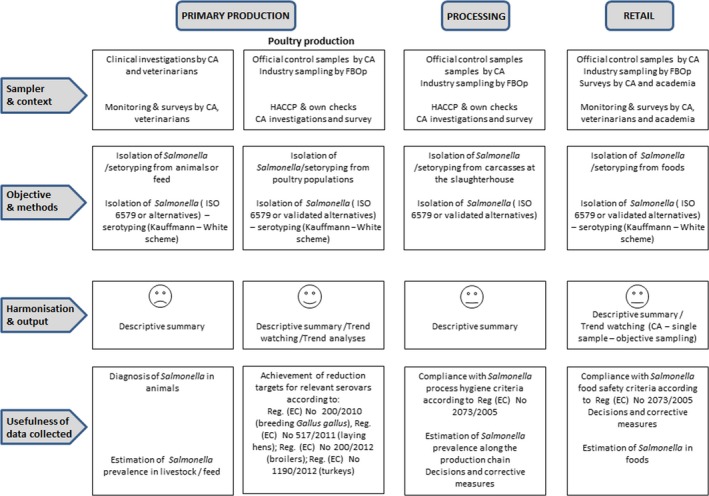
The surveillance and monitoring of Salmonella in food, food‐producing animals and feed according to the sampling stage, the sampler, the objective of the sampling, the quality of data and the degree of harmonisation
The CA, through official sampling, ensure that the FBOp comply with the regulatory requirements. The Salmonella FSC prescribe that Salmonella spp. are ‘not detected in 25 or 10 g’ for different products when they are on the market, during their shelf life. Moreover, according to Regulation (EC) No. 1086/2011, in fresh poultry meat, the FSC prescribes the ‘not detected in 25 g’ for the target serovars for poultry populations (S. Enteritidis and S. Typhimurium, including monophasic S. Typhimurium strains). Salmonella PHC are regulated for carcasses of pigs, cattle, sheep, goats, horses, broilers and turkeys. Specifically, for pigs carcasses, according to the requirement of Regulation (EC) No. 218/2014, the European Commission reinforced the supervision by CA on the own check controls carried out by FBOp. The CA has to verify whether the FBOp correctly implements and check the PHC conducted on pig carcasses (point 2.1.4, Chapter 2 of Regulation (EC) No. 2073/2005) by choosing among three different options: implementing ad hoc official samplings6 and/or using validated control programme results and/or collecting all information on Salmonella‐positive samples from own checks by the FBOp. These official monitoring data (food chain control data) are compliance checks and, although they allow for descriptive summaries to be made at the EU level (Boelaert et al., 2016), they are not suitable for trends analyses, because a reference (study) population is mostly absent and because the sampling is risk based and so, non‐representative.
In the present annual report, EFSA extracted and summarised as follows the following Salmonella food testing data (2005/2073/EC), for trend watching:
-
Data sets usable for trend watching are those with the following specified options for the different data elements:
sampling context: ‘Surveillance, based on Regulation (EC) No. 2073/2005’;
sampling unit type: ‘Single’;
sampling strategy: ‘Objective sampling’;
sampler: ‘Official sampling’, except for pig carcasses for which the sampler has to be labelled as ‘Official, based on Regulation No. 854/2004’ and/or ‘Industry sampling’ and ‘HACCP and own check’ (self‐monitoring), for the PHC;
sampling stage: exclusively sampling units collected at the retail stage, identified as ‘catering’, ‘hospital or medical care facility’, ‘restaurant or cafe or pub or bar or hotel or catering service’, ‘retail’ and ‘wholesale’. For pig carcasses (PHC), the sampling stage needed to be ‘slaughterhouse’.
Other food data (described in the next section), having other specified options for the different data aspects (including sampling context other than based on Regulation No. 2073/2005), are summarised only and do not serve the purpose of trend watching or trend analyses.
2.3.2.1.1.
Data sent by MS and labelled with specified options for the different data elements from single samples taken by the CA (classified as official sampling) at the retail stage, which means when products are placed on the market, are considered suitable for trend watching at EU and MS level. This is also the case for data PHC of Salmonella on pig carcasses from the slaughterhouses (Table 1).
Monitoring data of compliance with the Salmonella National Control Programmes in poultry
According to EU Regulation (EC) No. 2160/2003 and its following amendments, MS have to set up Salmonella National Control Programmes in poultry (NCPs) aimed at reducing the prevalence of Salmonella serovars that are considered relevant for public health (from this point forward termed target serovars), in certain animal populations. An overview of the poultry population objects of NCP, relative targets to reach and serovars to be controlled are reported in Table 9.
Table 9.
Salmonella National Control Programmes in place in the poultry populations, targets to reach and reference legislation, EU
| Population | Maximum annual percentage (%) of flocks remaining positive | Target serovars | Legislation |
|---|---|---|---|
| Adult breeding hens (Gallus gallus) | 1 | S. Enteritidis, S. Typhimurium (including monophasic variant), S. Infantis, S. Virchow, S. Hadar | Regulation (EC) No. 200/2010 |
| Adult laying hens (Gallus gallus) | 2 | S. Enteritidis, S. Typhimurium (including monophasic variant) | Regulation (EC) No. 517/2011 |
| Broilers (Gallus gallus) | 1 | Regulation (EC) No. 200/2012 | |
| Adult breeding turkeys (Meleagris gallopavo) | 1 | Regulation (EC) No. 1190/2012 | |
| Fattening turkeys (Meleagris gallopavo) | 1 | Regulation (EC) No. 1190/2012 |
It is compulsory for MS to annually report results for Salmonella NCP and in addition for broiler flocks, breeding and fattening turkeys flocks, it is moreover mandatory to report separately results for monitoring conducted by CA and FBOp.
2.3.2.1.1.
Salmonella monitoring data originating from the Salmonella NCP in poultry are collected and reported to EFSA in a fully harmonised way and are census sampling programmes. Therefore, these data allow data analyses such as assessing spatial and temporal trends at the EU level. They also allow for descriptive summaries at the EU level to be made and allow EU trends to be monitored (Table 1).
Other monitoring data of foods, animals and feed
Food, animal and feed monitoring data different from those described above are not collected in a harmonised way, because there are no requirements for sampling strategies, sampling methods, analytical tests or reporting. See the rationale for surveillance and monitoring of Salmonella spp. in food‐producing animals, feed and food at different stages along the food chain in Figure 4. Still, the CA needs to report those according to Directive 2003/99/EC on the monitoring of zoonoses at the most appropriate stage of the food chain. There are no harmonised rules on how to report these data to EFSA.
2.3.2.1.1.
Salmonella monitoring data submitted to EFSA and collected without harmonised design allow only for descriptive summaries at the EU level to be made. They preclude trend analyses and trend watching at the EU level (Table 1).
Within this category, Salmonella serovar data should also be included. MS are obliged to report the target serovars as part of the NCP in poultry populations, whereas for the remaining production categories serotyping is not mandatory and if it is performed, transmission of the serovar data is not mandatory either. Also, for the food sector, the FSC are the absence of Salmonella spp. with the exception of fresh poultry meat, for which the criterion is limited to absence of the target serovars. Therefore, some MS could decide to not report the presence of non‐target serovars, which could lead to a possible bias in the reporting of target serovars for poultry populations and for fresh poultry meat. Hence, the mandatory reporting of target serovars in the context of NCP and in the context of the FSC for fresh poultry meat guarantees the consistency of such data over many years and among MS, but could result in an overestimation of these target serovars compared with the other serovars. For the remaining matrices, serovar data collected could be strongly biased by what each MS actually serotyped and notified. Also, in this context, it is clear that detection of Salmonella serovars other than those covered by the reduction targets does not in any way equal a ‘Salmonella free’ finding.
2.3.3. Food‐borne outbreaks of human salmonellosis
The reporting of food‐borne salmonellosis disease outbreaks in humans is mandatory according Zoonoses Directive 2003/99/EC.
2.4. Data analyses
2.4.1. Comparison between Competent Authority and Food Business Operator sampling results
Comparison of Salmonella test results of CA and FBOp in the context of NCP for those programmes requiring separate reporting (NCP for broilers, fattening turkeys and breeding turkeys) as well as Salmonella PHC monitoring data from pigs carcasses, was carried out. The significance of differences was verified by the one‐tailed Fisher's exact probability test, in cases in which the expected values in any of the cells of a contingency table were below 5; otherwise the z‐statistic one‐tailed test was calculated. A p‐value < 0.10 (Clayton and Hills, 1993) was considered significant to take into account every possible evidence of differences between FBOp and CA. Differences in official control sampling results by CA and self‐monitoring results by FBOp were expressed by exact binomial confidence interval (95% level).
STATA software (StataCorp, 2001. Statistical Software: Release 12. College Station, TX: Stata Corporation) was used to conduct the above‐mentioned analyses.
2.4.2. Statistical trend analyses (methods) of poultry monitoring data
Statistical trend analyses were carried out with the objectives of evaluating the significance of temporal variations in the EU‐level flock prevalence as regards Salmonella spp. and target Salmonella serovars in poultry, since the start of the implementation of the NCPs.
As the temporal variations of Salmonella spp. prevalence were difficult to model during the whole period 2007–2017, the analyses concentrated on the last 6–7 years, except for laying hens for which – in the light of the results of previous years – the entire period of implementation of NCP was considered. Moreover, the trends during the last 3 years were verified in detail for outcomes of target serovars and of Salmonella spp. The tested flocks could be positive or negative for target serovars and Salmonella spp., and so the state of the flocks is a dichotomous outcome variable. Therefore, the binomial probability distribution for the response variable was assumed and the logit link function was computed in the model for the trend analysis. The logit is defined as the logarithm of p/(1 – p), where p/(1 – p) is the odds of being positive for the outcome.
According to the temporal trend of prevalence in the MS, polynomial models for the logit of the probability of flocks being positive were fitted for the different poultry categories. Marginal and conditional generalised linear models for repeated measures were used to perform these trend analyses (EFSA, 2009a, 2011). Details about the estimated parameters of the models, odds ratios, prevalence and graphical analyses (conditional and marginal) are reported in the supporting information to this report.
To investigate the EU‐level prevalence considering the relevant heterogeneity among MS for flock prevalence of Salmonella spp. and target serovars over time, the results obtained using the conditional generalised mixed model for longitudinal binary data were summarised and are discussed in the report, for all poultry categories covered by the NCP. To take into account the different levels (baselines) of risk of MS having positive flocks, but similar patterns over time, a random MS‐specific intercept effect was included in the model. To consider the trend over time, the variable ‘time’ was included in the model as a fixed effect.
The correlation among repeated observations in the same MS in subsequent years was considered using a first autoregressive or exchangeable structure of the correlation matrix for the residuals (EFSA and ECDC, 2017a).
To evaluate the significance of the overall effect of fixed factors specified in the model, Type III F‐tests were applied, whereas the receiver operating characteristic (ROC) curve was used to assess the goodness of fit of the model. A p‐value < 0.10 (Clayton and Hills, 1993) was considered to be significant for both random and fixed effects.
GLIMMIX and SGPLOT procedures in SAS 9.4 software were used to fit the models and to produce the graphical outputs, respectively.
2.4.3. Descriptive analyses of Salmonella serovars
With the aim of evaluating the distribution of Salmonella serovars along the food chain and identifying the potential sources for human infections, descriptive analyses were made from data on food and food‐producing animals for the most commonly reported Salmonella serovars in the current year from human cases acquired within the EU (domestically or during travel within the EU). For animal categories covered by the NCPs, only serovar data reported in the context of these programmes were presented. For cattle, meat‐producing animals were considered, whereas for pigs data from fattening animals were used. To interpret serovar data, it must be kept in mind that for NCPs the mandatory reporting is limited to target serovars and this could lead to a possible bias towards the reporting of these regulated serovars to the detriment of non‐regulated ones. For all the other animal species–food matrices the reporting of serovar data is carried out on a voluntary basis by the MS. Apart from possible reporting bias as regards serovars, also the reporting on animal or food categories may be unbalanced and certain sources (e.g. cattle) may be underrepresented.
Sankey diagrams of the most reported Salmonella serovars from humans in relation to their food and animal sources and in relation to the MS reporting them (geographical provenance) were produced in HTML format and Google Chart libraries ( http://developers.google.com/chart/).
Stacked bar plots for each of the serovars of interest were prepared to show for each source the frequency of reporting in animal and food sources using R software ( http://www.r-project.org).
The infographic, showing the most relevant results of the Salmonella chapter, was produced using Adobe Illustrator and InDesign.
2.5. Results
2.5.1. Overview of key statistics along the food chain, EU, 2014–2018
Table 10 summarises EU‐level statistics on human salmonellosis and on Salmonella in food and animals, respectively, during 2014–2018. Food data of interest reported were classified into the major categories and aggregated by year to get an annual overview of the volume of data submitted.
Table 10.
Summary of Salmonella statistics related to humans, major food categories and major animals species, EU, 2014–2018
| 2018 | 2017 | 2016 | 2015 | 2014 | Data source | |
|---|---|---|---|---|---|---|
| Humans | ||||||
| Total number of confirmed cases | 91,857 | 91,590 | 94,425 | 94,477 | 92,012 | ECDC |
| Total number of confirmed cases/100,000 population (notification rates) | 20.1 | 19.7 | 20.5 | 21.0 | 20.7 | ECDC |
| Number of reporting MS | 28 | 28 | 28 | 28 | 28 | ECDC |
| Infection acquired in the EU | 59,763 | 59,643 | 52,852 | 51,898 | 48,451 | ECDC |
| Infection acquired outside the EU | 6,375 | 6,001 | 6,466 | 6,830 | 6,202 | ECDC |
| Unknown travel status or unknown country of infection | 25,719 | 25,946 | 35,107 | 35,749 | 37,359 | ECDC |
| Number of outbreak‐related cases | 11,581 | 9,607 | 11,428 | 8,531 | 9,208 | EFSA |
| Total number of outbreaks | 1,581 | 1,241 | 1,372 | 1,216 | 1,048 | EFSA |
| Food | ||||||
| Meat and meat products | ||||||
| Number of sampled units | 417,886 | 364,979 | 247,749 | 183,733 | 507,116 | EFSA |
| Number of reporting countries | 28 | 28 | 26 | 27 | 24 | EFSA |
| Milk and milk products | ||||||
| Number of sampled units | 44,078 | 30,796 | 24,337 | 29,034 | 70,298 | EFSA |
| Number of reporting countries | 24 | 24 | 24 | 22 | 23 | EFSA |
| Fish and fishery products | ||||||
| Number of sampled units | 17,123 | 13,507 | 12,287 | 11,373 | 17,053 | EFSA |
| Number of reporting countries | 22 | 22 | 21 | 22 | 20 | EFSA |
| Eggs and egg products | ||||||
| Number of sampled units | 10,611 | 15,435 | 10,933 | 9,650 | 23,303 | EFSA |
| Number of reporting countries | 21 | 23 | 20 | 19 | 18 | EFSA |
| Fruits and vegetables (and juices) | ||||||
| Number of sampled units | 10,888 | 7,579 | 7,515 | 6,797 | 10,372 | EFSA |
| Number of reporting countries | 22 | 25 | 20 | 22 | 22 | EFSA |
| Animals | ||||||
| Fowl | ||||||
| Number of sampled units | 725,356 | 736,534 | 699,116 | 531,533 | 541,245 | EFSA |
| Number of reporting countries | 27 | 28 | 27 | 28 | 26 | EFSA |
| Turkeys | ||||||
| Number of sampled units | 67,643 | 74,739 | 79,245 | 56,569 | 43,864 | EFSA |
| Number of reporting countries | 24 | 26 | 24 | 24 | 23 | EFSA |
| Ducks and geese | ||||||
| Number of sampled units | 9,846 | 5,743 | 2,640 | 4,518 | 3,906 | EFSA |
| Number of reporting countries | 6 | 8 | 11 | 8 | 9 | EFSA |
| Pigs | ||||||
| Number of sampled units | 88,874 | 91,099 | 25,114 | 60,309 | 61,320 | EFSA |
| Number of reporting countries | 14 | 18 | 17 | 16 | 16 | EFSA |
| Bovine animals | ||||||
| Number of sampled units | 30,302 | 654,732 | 53,467 | 120,432 | 105,259 | EFSA |
| Number of reporting countries | 14 | 16 | 17 | 17 | 13 | EFSA |
ECDC: European Centre for Disease Prevention and Control; EFSA: European Food Safety Authority; MS: Member State.
More detailed descriptions of these statistics are in the results section of this chapter and in the chapter on FBO.
Humans
In 2018, the number of reported human salmonellosis cases acquired in the EU (i.e. by domestic infection and through travel within the EU) was at the same level as in 2017. The number of EU acquired cases increased in 2017 compared with previous years and was the highest since 2013. The increase was due to one large country reporting case‐based data for the first time in 2017. The number of outbreak‐related cases and the total number of food‐borne salmonellosis outbreaks was higher in 2018 compared with 2017 and at a higher level compared with 2016 and previous years.
Food categories
The number of sampled units reported in 2018 for the general food category ‘meat and meat products’ was higher compared with the previous 3 years. This was generally also the case with other food categories (‘milk and milk products’, ‘fish and fishery products’, ‘fruits and vegetables including juices’) with the exception of ‘eggs and egg products’. The number of reporting MS was fairly stable during the last years.
Animal categories
The number of sampled units reported by MS decreased for all animal species in 2018 compared with the previous year, with the exception of the category ‘ducks and geese’, in which the number of flocks with monitoring data submitted to EFSA markedly increased compared with 2017. In this last case, a single MS contributed almost 95% of the data reported for this category, as in 2017. Hence, the variation in the number of sampled units for this category must be attributed to this single MS. A marked reduction in terms of number of units reported in 2018 compared with 2017 by MS was reported for the ‘bovine animals’ category. The marked difference in terms of number of units reported for the ‘bovine animals’ category in 2018 compared with 2017 was also related to just one MS.
2.5.2. Human salmonellosis
In total, 94,203 human salmonellosis cases were reported by 28 EU MS in 2018, with 91,857 confirmed cases resulting in an EU notification rate of 20.1 cases per 100,000 population (Table 11). This was about at the same level as in 2017 (19.7 cases per 100,000 population). As in the previous year, the highest notification rates in 2018 were reported by Slovakia (124.8 cases per 100,000 population) and the Czech Republic (102.7 cases per 100,000 population), while the lowest rates were reported by Cyprus, Greece, Italy and Portugal (≤ 6.0 cases per 100,000 population).
Table 11.
Reported human cases of salmonellosis and notification rates per 100,000 population in the EU/EFTA, by country and year, 2014–2018
| Country | 2018 | 2017 | 2016 | 2015 | 2014 | ||||||||
|---|---|---|---|---|---|---|---|---|---|---|---|---|---|
| National coveragea | Data formata | Total cases | Confirmed cases & rates | Confirmed cases & rates | Confirmed cases & rates | Confirmed cases & rates | Confirmed cases & rates | ||||||
| Cases | Rate | Cases | Rate | Cases | Rate | Cases | Rate | Cases | Rate | ||||
| Austria | Y | C | 1,538 | 1,538 | 17.4 | 1,667 | 19.0 | 1,415 | 16.3 | 1,544 | 18.0 | 1,654 | 19.4 |
| Belgium | Y | C | 2,958 | 2,958 | 26.0 | 2,298 | 20.2 | 2,699 | 23.9 | 3,050 | 27.1 | 2,698 | – |
| Bulgaria | Y | A | 587 | 586 | 8.3 | 796 | 11.2 | 718 | 10.0 | 1,076 | 14.9 | 730 | 10.1 |
| Croatia | Y | C | 1,345 | 1,323 | 32.2 | 1,242 | 29.9 | 1,240 | 29.6 | 1,593 | 37.7 | 1,494 | 35.2 |
| Cyprus | Y | C | 44 | 44 | 5.1 | 59 | 6.9 | 77 | 9.1 | 65 | 7.7 | 88 | 10.3 |
| Czech Republic | Y | C | 11,340 | 10,901 | 102.7 | 11,473 | 108.5 | 11,610 | 110.0 | 12,408 | 117.7 | 13,255 | 126.1 |
| Denmark | Y | C | 1,168 | 1,168 | 20.2 | 1,067 | 18.6 | 1,081 | 18.9 | 925 | 16.3 | 1,124 | 20.0 |
| Estonia | Y | C | 323 | 314 | 23.8 | 265 | 20.1 | 351 | 26.7 | 112 | 8.5 | 92 | 7.0 |
| Finland | Y | C | 1,430 | 1,430 | 25.9 | 1,535 | 27.9 | 1,512 | 27.6 | 1,650 | 30.2 | 1,622 | 29.8 |
| Franceb | N | C | 8,936 | 8,936 | 27.8 | 7,993 | 24.9 | 8,876 | 27.7 | 10,305 | 32.3 | 8,880 | 28.1 |
| Germany | Y | C | 13,529 | 13,293 | 16.1 | 14,051 | 17.0 | 12,858 | 15.6 | 13,667 | 16.8 | 16,000 | 19.8 |
| Greece | Y | C | 649 | 640 | 6.0 | 672 | 6.2 | 735 | 6.8 | 466 | 4.3 | 349 | 3.2 |
| Hungary | Y | C | 4,640 | 4,161 | 42.6 | 3,922 | 40.0 | 4,722 | 48.0 | 4,894 | 49.7 | 5,249 | 53.1 |
| Ireland | Y | C | 367 | 352 | 7.3 | 379 | 7.9 | 299 | 6.3 | 270 | 5.8 | 259 | 5.6 |
| Italy | Y | C | 3,656 | 3,635 | 6.0 | 3,347 | 5.5 | 4,134 | 6.8 | 3,825 | 6.3 | 4,467 | 7.3 |
| Latvia | Y | C | 439 | 409 | 21.1 | 225 | 11.5 | 454 | 23.1 | 380 | 19.1 | 278 | 13.9 |
| Lithuania | Y | C | 793 | 779 | 27.7 | 1,005 | 35.3 | 1,076 | 37.3 | 1,082 | 37.0 | 1,145 | 38.9 |
| Luxembourg | Y | C | 135 | 135 | 22.4 | 118 | 20.0 | 108 | 18.7 | 106 | 18.8 | 110 | 20.0 |
| Malta | Y | C | 116 | 116 | 24.4 | 107 | 23.2 | 162 | 36.4 | 126 | 29.3 | 132 | 31.0 |
| Netherlandsc | N | C | 1,061 | 1,061 | 9.6 | 954 | 8.7 | 1,150 | 10.6 | 974 | 9.0 | 970 | 9.0 |
| Poland | Y | C | 9,651 | 9,064 | 23.9 | 8,921 | 23.5 | 9,718 | 25.6 | 8,245 | 21.7 | 8,042 | 21.2 |
| Portugal | Y | C | 322 | 302 | 2.9 | 462 | 4.5 | 376 | 3.6 | 325 | 3.1 | 244 | 2.3 |
| Romania | Y | C | 1,443 | 1,410 | 7.2 | 1,154 | 5.9 | 1,479 | 7.5 | 1,330 | 6.7 | 1,512 | 7.6 |
| Slovakia | Y | C | 7,222 | 6,791 | 124.8 | 5,789 | 106.5 | 5,299 | 97.7 | 4,841 | 89.3 | 4,078 | 75.3 |
| Slovenia | Y | C | 274 | 274 | 13.3 | 275 | 13.3 | 311 | 15.1 | 401 | 19.4 | 597 | 29.0 |
| Spaind | N | C | 8,730 | 8,730 | 26.5 | 9,426 | – | 9,818 | – | 9,015 | – | 6,633 | – |
| Sweden | Y | C | 2,041 | 2,041 | 20.2 | 2,280 | 22.8 | 2,247 | 22.8 | 2,312 | 23.7 | 2,211 | 22.9 |
| United Kingdom | Y | C | 9,466 | 9,466 | 14.3 | 10,108 | 15.4 | 9,900 | 15.1 | 9,490 | 14.6 | 8,099 | 12.6 |
| EU Total | – | – | 94,203 | 91,857 | 20.1 | 91,590 | 19.7 | 94,425 | 20.5 | 94,477 | 21.0 | 92,012 | 20.7 |
| Iceland | Y | C | 63 | 63 | 18.1 | 64 | 18.9 | 39 | 11.7 | 44 | 13.4 | 40 | 12.3 |
| Norway | Y | C | 961 | 961 | 18.2 | 992 | 18.9 | 865 | 16.6 | 928 | 18.0 | 1,118 | 21.9 |
| Switzerlande | Y | C | 1,467 | 1,467 | 17.2 | 1,848 | 21.9 | 1,517 | 17.9 | 1,375 | 16.4 | 1,241 | 15.0 |
Y: yes; N: no; A: aggregated data; C: case‐based data; –: no report.
Sentinel system; notification rates calculated with an estimated population coverage of 48%.
Sentinel system; notification rates calculated with an estimated population coverage of 64%.
Sentinel surveillance; no information on estimated coverage during 2014–2017. So, notification rate cannot be estimated.
Switzerland provided data directly to EFSA. The human data for Switzerland include data from Liechtenstein.
The proportion of domestic vs travel‐associated cases varied markedly between countries, but most of the confirmed salmonellosis cases were acquired in the EU (65.1% cases acquired in the EU, 6.9% travel outside EU and 28.0% of unknown origin) (Table 10). Considering all cases regardless of the origin, the highest proportions of domestic cases, ranging from 92.8% to 100% were reported by the Czech Republic, Estonia, Hungary, Latvia, Malta, the Netherlands, Portugal, Romania and Slovakia. The highest proportions of travel‐related cases were reported by four Nordic countries: Finland (76.4%), Sweden (66.1%), Iceland (78.4%) and Norway (72.2%). Among 8,047 travel‐associated cases with known information on probable country of infection, 71.9% of the cases represented travel outside EU and 20.8% travel within EU. Turkey, Thailand, Egypt and India were the most frequently reported travel destinations (12.7%, 11.6%, 8.9% and 6.8%, respectively). In the EU, Spain and Greece were the most common travel destinations.
A seasonal trend was observed for confirmed salmonellosis cases in the EU/EEA in 2014–2018, with more cases reported during summer months (Figure 5). The EU/EEA trend for salmonellosis did not show any significant increase or decrease in 2014–2018.
Figure 5.

Trend in reported confirmed human cases of non‐typhoidal salmonellosis in the EU/EEA, by month, 2009–2018
- Source: Austria, Belgium, Cyprus, the Czech Republic, Denmark, Estonia, Finland, France, Germany, Greece, Hungary, Iceland, Ireland, Italy, Lithuania, Luxembourg, Latvia, Malta, the Netherlands, Norway, Poland, Portugal, Romania, Slovakia, Slovenia, Spain, Sweden and the United Kingdom. Bulgaria and Croatia did not report data to the level of detail required for the analysis.
At the country level, eight MS (Cyprus, Denmark, Finland, Germany, Hungary, Italy, Lithuania and Sweden) reported decreasing trends from 2009 to 2018, whereas two MS (Finland and Slovenia) reported a decreasing trend in the last 5 years (2014 to 2018).
A significantly increasing trend was observed in one MS (Slovakia) in 2009–2018 and in four MS (France, Portugal, Slovakia and Spain) in 2014–2018. The increasing trend in Spain was due in part to an improvement in surveillance.
Fifteen MS provided information on hospitalisation. The proportion of confirmed cases with known hospitalisation status at the EU level was 43.2%. Among these, the proportion of hospitalised cases was 41.7%, which was at the same level as in 2017. The highest proportions of hospitalised cases were reported, as in previous years, in Cyprus, Greece, Lithuania, Poland and the United Kingdom, where the majority of the cases were hospitalised. This was probably in part an artefact of reporting. Two of these countries also reported the lowest notification rates of salmonellosis, which indicates that the surveillance systems in these countries primarily capture the more severe cases.
Seventeen MS provided data on the outcome of salmonellosis and, among these, 10 MS reported 119 fatal cases. The EU reported case fatality was 0.19%. Fifty‐seven fatal cases (47.9%) were reported by the United Kingdom.
Human serovar data are described in Section 2.4.6.
Sporadic human salmonellosis cases and cases associated with food‐borne outbreaks
Salmonella was identified in 1,580 FBOs causing 11,579 human cases in 24 MS. Additionally one waterborne salmonellosis outbreak was reported by Poland with strong evidence and caused by S. Enteritidis with two ill people. Overall, for the year 2018, there were 58,091 domestic (acquired within the country) cases reported to the TESSy (Table 12), this was 97.2% of the number of reported human salmonellosis cases infected domestically and through travel within EU during 2018 (59,763; Table 10). Table 12 shows data reported by countries to TESSy managed by ECDC and to the FBO database managed by EFSA. It is important to clarify that the case classification for reporting is different between these two databases. In TESSy, the cases reported are classified based on the EU case definition. All these cases visited a doctor, and were either confirmed by laboratory test (confirmed case) or not (probable case and classification is based the clinical symptoms and epidemiological link). Cases that never visited a doctor are not reported to TESSy. Moreover, probable cases may be missing as there is little incentive for reporting such cases. Information on which case is linked to an outbreak and which not, is not systematically collected. In practice, the cases reported to TESSy are considered mostly sporadic cases. In FBOs, cases can also be classified as confirmed or probable outbreak cases, but currently these specific data are not collected by EFSA.
Table 12.
Statistics related to the proportions of sporadic human salmonellosis cases and cases associated with the food‐borne and waterborne outbreaks caused by Salmonella, EU/EFTA, 2018
| Country | ECDC | EFSA | ||||
|---|---|---|---|---|---|---|
| Confirmed human | Food‐borne and waterborne outbreaks | |||||
| Total | Travel related | Domestic | Unknown or missing | Human cases (illnesses) | FBO | |
| N | N | N | N | N | N | |
| Austria | 1,538 | 349 | 1,184 | 5 | 79 | 21 |
| Belgium | 2,958 | 92 | 2,865 | 1 | 554 | 3 |
| Bulgaria | 586 | –a | – | 586 | 14 | 2 |
| Croatia | 1,323 | 2 | 69 | 1,252 | 98 | 14 |
| Cyprus | 44 | – | – | 44 | 35 | 2 |
| Czech Republic | 10,901 | 279 | 10,614 | 8 | 279 | 13 |
| Denmark | 1,168 | 484 | 402 | 282 | 187 | 19 |
| Estonia | 314 | 29 | 285 | 0 | 146 | 15 |
| Finland | 1,430 | 920 | 284 | 226 | 56 | 5 |
| France | 8,936 | 930 | 869 | 7,137 | 1,019 | 172 |
| Germany | 13,293 | 2,209 | 11,084 | 0 | 724 | 128 |
| Greece | 640 | 10 | 467 | 163 | 40 | 3 |
| Hungary | 4,161 | 5 | 4,156 | 0 | 634 | 12 |
| Ireland | 352 | 157 | 164 | 31 | 9 | 2 |
| Italy | 3,635 | – | – | 3,635 | 155 | 34 |
| Latvia | 409 | 10 | 399 | 0 | 232 | 22 |
| Lithuania | 779 | 10 | 651 | 118 | 144 | 24 |
| Luxembourg | 135 | 13 | 5 | 117 | –b | – |
| Malta | 116 | 3 | 113 | 0 | 30 | 10 |
| Netherlands | 1,061 | 144 | 917 | 0 | – | – |
| Poland | 9,064 | 44 | 9,018 | 2 | 2,153 | 289 |
| Portugal | 302 | 8 | 285 | 9 | – | – |
| Romania | 1,410 | – | – | 1,410 | 494 | 6 |
| Slovakia | 6,791 | 56 | 6,735 | 0 | 1,872 | 540 |
| Slovenia | 274 | 5 | 31 | 238 | – | – |
| Spain | 8,730 | 18 | 4,655 | 4,057 | 1,829 | 229 |
| Sweden | 2,041 | 1,317 | 677 | 47 | 125 | 6 |
| United Kingdom | 9,466 | 2,981 | 2,162 | 4,323 | 673 | 10 |
| EU Total | 91,857 | 10,075 | 58,091 | 23,691 | 11,581 | 1,581 |
| Bosnia and Herzegovina | – | – | – | – | 66 | 4 |
| Iceland | 63 | 29 | 8 | 26 | 11 | 1 |
| Montenegro | – | – | – | – | 13 | 1 |
| Norway | 961 | 588 | 230 | 143 | 32 | 4 |
| Republic of North Macedonia | – | – | – | – | 163 | 6 |
| Serbia | – | – | – | – | 515 | 54 |
| Switzerland | 1,467 | – | – | 1,467 | 19 | 3 |
ECDC: European Centre for Disease Prevention and Control; EFSA: European Food Safety Authority; FBO: food‐borne outbreak.
No importation data reported.
No FBO caused by Salmonella reported.
The most frequently detected causative agent of FBOs during 2018 was Salmonella and 1,580 Salmonella food‐borne were reported by 24 MS, which was 30.7% of the total number of outbreaks, compared with 24.4% for 2017. Twenty MS reported a total of 296 salmonellosis FBOs with strong evidence linking the implicated food vehicle. ‘Eggs and egg products’ still remain an important source of human infection and accounted for 45.6% of strong‐evidence salmonellosis FBOs (Table 13). Various meat and meat products subcategories totalled 18.9%, bakery products 9.8% and mixed food 9.1% of strong‐evidence Salmonella FBO. Further details and statistics for the salmonellosis FBO reported by MS for 2018 are in the FBO chapter. Sixteen MS reported 178 FBO caused by S. Enteritidis with strong‐evidence and 100 of these (56.2%) were reported by Poland. ‘Eggs and egg products’ accounted for 47.2% of strong‐evidence S. Enteritidis FBO followed by bakery products 14.6% and mixed food 12.4%. Trend watching of distribution of strong‐evidence FBO over the years from 2010 to 2017 (Table 14), comparing to 2018, confirmed ‘eggs and egg products’, ‘bakery products’ and ‘mixed food’ as the top‐three food vehicles both for Salmonella and S. Enteritidis, with an increasing tendency in 2018 for ‘eggs and egg products’. Percentage distribution of ‘broiler meat (Gallus gallus) and products thereof’ as food vehicle decreased from 5.3 and 4.7 in 2010–2017 to 2.4 and 2.2 in 2018 for strong‐evidence FBO caused by Salmonella and S. Enteritidis, respectively. The same trend has been observed for FBO caused by ‘pig meat and products thereof’ with 7.1% and 1.2% vs 5.4% and 0.6% related to Salmonella and S. Enteritidis, respectively.
Table 13.
Distribution of strong‐evidence food‐borne outbreaks caused by Salmonella and by Salmonella Enteritidis, by food vehicle, EU, 2018
| Food vehicle | Salmonella | Salmonella Enteritidis | ||
|---|---|---|---|---|
| N strong‐evidence FBO | % of total | N strong‐evidence FBO | % of total | |
| Eggs and egg products | 135 | 45.6 | 84 | 47.2 |
| Bakery products | 29 | 9.8 | 26 | 14.6 |
| Mixed food | 27 | 9.1 | 22 | 12.4 |
| Pig meat products thereof | 16 | 5.4 | 1 | 0.6 |
| Meat and meat products | 13 | 4.4 | 6 | 3.4 |
| Other foods | 11 | 3.7 | 5 | 2.8 |
| Other, mixed or unspecified poultry meat and products thereof | 9 | 3.0 | 7 | 3.9 |
| Cheese | 8 | 2.7 | 1 | 0.6 |
| Sweets and chocolate | 8 | 2.7 | 8 | 4.5 |
| Broiler meat (Gallus gallus) and products thereof | 7 | 2.4 | 4 | 2.2 |
| Vegetables and juices and other products thereof | 6 | 2.0 | 3 | 1.7 |
| Buffet meals | 5 | 1.7 | 1 | 0.6 |
| Bovine meat and products thereof | 3 | 1.0 | 2 | 1.1 |
| Crustaceans, shellfish, molluscs and products thereof | 3 | 1.0 | –a | – |
| Dairy products (other than cheeses) | 3 | 1.0 | 3 | 1.7 |
| Other or mixed red meat and products thereof | 3 | 1.0 | – | – |
| Sheep meat and products thereof | 3 | 1.0 | – | – |
| Fish and fish products | 2 | 0.7 | 2 | 1.1 |
| Fruit, berries and juices and other products thereof | 2 | 0.7 | 2 | 1.1 |
| Unknown | 2 | 0.7 | 1 | 0.6 |
| Milk | 1 | 0.3 | – | – |
| Total | 296 | 100.0 | 178 | 100.0 |
FBO: food‐borne outbreak.
Note: Data from 296 strong‐evidence Salmonella outbreaks are included reported by 20 MS: Poland, 115; Spain, 65; France, 30; Slovakia, 21; Italy, 16; Germany, 8; Hungary, 7; Romania, 6; the United Kingdom, 6; Czech Republic, 4; Austria, 3; Finland, 3; Malta, 1; Belgium, 2; Latvia, 2; Lithuania, 2; Bulgaria, 2; Croatia, 1; Denmark, 1; Greece, 1. Data from 178 strong‐evidence Salmonella Enteritidis outbreaks are included reported by 16 MS: Poland, 100; Spain, 20; Slovakia, 19; France, 9; Germany, 5; Czech Republic, 4; Hungary, 4; Italy, 4; Austria, 3; Latvia, 2; Romania, 2; United Kingdom, 2; Belgium, 1; Bulgaria, 1; Greece, 1; Lithuania, 1.
No FBO during 2018 caused by Salmonella Enteritidis reported with this food vehicle incriminated.
Table 14.
Distribution of strong‐evidence food‐borne outbreaks caused by Salmonella and by Salmonella Enteritidis, by food vehicle, EU, 2017–2010
| Food vehicle | Salmonella | Salmonella Enteritidis | ||
|---|---|---|---|---|
| N strong‐evidence FBO | % of total | N strong‐evidence FBO | % of total | |
| Eggs and egg products | 790 | 39.4 | 602 | 46.7 |
| Bakery products | 195 | 9.7 | 165 | 12.8 |
| Mixed food | 187 | 9.3 | 129 | 10.0 |
| Pig meat and products thereof | 143 | 7.1 | 16 | 1.2 |
| Broiler meat (Gallus gallus) and products thereof | 107 | 5.3 | 60 | 4.7 |
| Other foods | 102 | 5.1 | 44 | 3.4 |
| Cheese | 74 | 3.7 | 26 | 2.0 |
| Sweets and chocolate | 74 | 3.7 | 71 | 5.5 |
| Meat and meat products | 65 | 3.2 | 50 | 3.9 |
| Bovine meat and products thereof | 52 | 2.6 | 27 | 2.1 |
| Buffet meals | 35 | 1.7 | 23 | 1.8 |
| Other or mixed red meat and products thereof | 34 | 1.7 | 10 | 0.8 |
| Vegetables and juices and other products thereof | 31 | 1.5 | 15 | 1.2 |
| Fish and fish products | 24 | 1.2 | 7 | 0.5 |
| Dairy products (other than cheeses) | 19 | 0.9 | 15 | 1.2 |
| Other, mixed or unspecified poultry meat and products thereof | 15 | 0.7 | 10 | 0.8 |
| Crustaceans, shellfish, molluscs and products thereof | 13 | 0.6 | 1 | 0.1 |
| Turkey meat and products thereof | 13 | 0.6 | 3 | 0.2 |
| Cereal products including rice and seeds/pulses (nuts, almonds) | 10 | 0.5 | 6 | 0.5 |
| Milk | 8 | 0.4 | 2 | 0.2 |
| Unknown | 5 | 0.2 | 2 | 0.2 |
| Herbs and spices | 4 | 0.2 | 2 | 0.2 |
| Sheep meat and products thereof | 3 | 0.1 | 2 | 0.2 |
| Fruit, berries and juices and products thereof | 2 | 0.1 | 2 | 0.2 |
| Canned food products | 1 | 0.0 | –a | – |
| Total | 2,006 | 100.0 | 1,290 | 100.0 |
FBO: food‐borne outbreak.
‘–’ : not reported.
No FBO caused by Salmonella Enteritidis reported with this food vehicle incriminated.
Additionally to FBOs, one waterborne salmonellosis outbreak was reported for 2018 by Poland with strong evidence and caused by S. Enteritidis. During 2010–2017, three salmonellosis waterborne outbreaks were reported with weak evidence, by Croatia, France and Poland, respectively, caused by S. Enteritidis, unspecified Salmonella and S. Enteritidis.
2.5.3. Salmonella in food
Data collected in the context of Regulation (EC) No. 2073/2005 on microbiological criteria
Food safety criteria
As pointed out in 2017, as in 2018, the data that should potently serve the purpose of trend watching (selective criteria – sampling context: ‘Surveillance, based on Regulation (EC) No. 2073/2005’; sampling unit type: ‘single’; sampling strategy: ‘objective sampling’; sampler: ‘official sampling’; sampling stage: ‘catering’, ‘hospital or medical care facility’, ‘restaurant or cafe or pub or bar or hotel or catering service’, ‘retail’ and ‘wholesale’) were too scarce and unrepresentative to describe the situation at the EU level, because a very limited number of MS reported few data corresponding to these restricted assumptions. Therefore, the panel of data collected within this specific context is negligible with the exception of very few food categories. In particular, of the 18 transmitting MS, only 13 MS reported data on the sampling units collected at the retail stage, which is the phase of the food chain considered according to the selective criteria used in this context. Moreover, at the level of those reporting MS, data were not available for all food categories, some of which were absent or poorly represented (i.e. were in low amounts) on the retail market.
Even though the number of samples reported in this specific context is marginal, a few Salmonella‐positive single samples from official control investigations by CA were reported for fresh poultry meat (1.8%), minced meat and meat preparations from other species than poultry intended to be eaten cooked (1.3%), minced meat and meat preparations from poultry intended to be eaten cooked (0.9%), cooked crustaceans and molluscan shellfish (0.8%), minced meat and meat preparations to be eaten raw (0.7%) and ice cream (0.2%).
Process hygiene criteria
As regards Salmonella PHC monitoring data from pigs carcasses, before chilling, 17 MS provided data collected as official samples by CA (Belgium, Cyprus, the Czech Republic, Ireland, Hungary, Luxembourg, Malta, United Kingdom) or by FBOp as own check (Austria, Estonia, France, Germany, Greece, Latvia, Portugal, Slovakia and Slovenia) (Table 15). Six MS (Bulgaria, Italy, the Netherlands, Poland, Romania and Spain) reported data from official controls by CA and from self‐monitoring by FBOp. Considering pigs carcasses data sent by these six MS, the proportions of Salmonella‐positive single samples from carcasses were 3.40% (N = 15,708) for samples collected by CA and 1.81% (N = 29,796) for samples collected by FBOp, respectively. For Italy, the Netherlands, Poland and Spain, the proportion based on official controls was significantly higher than that from self‐monitoring. Considering all Salmonella PHC monitoring data from pigs carcasses sent by the 17 MS, the proportion of Salmonella‐positive single samples from carcasses based on official controls was 2.69% (N = 28,246) and was significantly higher than that based on self‐monitoring (1.57%, N = 93,633).
Table 15.
Comparisons of proportions (%) of Salmonella‐positive single samples from pig carcasses before chilling, by sampler, reporting MS, EU, 2018
| Country | Competent Authority (CA) | Food Business Operator (FBOp) | p‐valuea | Interpretation | ||||||||
|---|---|---|---|---|---|---|---|---|---|---|---|---|
| Sample weight | N samples tested | N samples positive | % samples positive | CI95 | Sample weight | N samples tested | N samples positive | % samples positive | CI95 | |||
| Austria | 400 cm2 | 5,605 | 0 | 0.00 | [0.00; 2.91]a | |||||||
| Belgium | 600 cm2 | 1,068 | 49 | 4.59 | [3.47; 6.02] | |||||||
| Bulgaria | 400 cm2 | 2,077 | 0 | 0.00 | [0.00; 0.18]a | 400 cm2 | 282 | 1 | 0.35 | [0.01; 1.96] | NS | |
| Cyprus | 400 cm2 | 25 | 0 | 0.00 | [0.00; 13.72]a | |||||||
| Czech Republic | 400 | 5,041 | 31 | 0.61 | [0.42; 0.87] | |||||||
| Estonia | 400 cm2 | 1,815 | 1 | 0.06 | [0.00; 0.31] | |||||||
| France | 400 cm2 | 14,232 | 631 | 4.43 | [4.10; 4.78] | |||||||
| Germany | 400 cm2 | 29,924 | 253 | 0.85 | [0.74; 0.96] | |||||||
| Greece | 400 cm2 | 540 | 0 | 0.00 | [0.00; 0.68] a | |||||||
| Ireland | 100 cm2 | 383 | 18 | 4.70 | [2.81; 7.32] | |||||||
| Italy | 400 cm2 | 6,386 | 368 | 5.76 | [5.21; 6.36] | 400 cm2 | 14,672 | 194 | 1.32 | [1.14; 1.52] | *** | CA > FBO |
| Hungary | 400 cm2 | 1,811 | 13 | 0.72 | [0.38; 1.22] | |||||||
| Luxembourg | 400 cm2 | 311 | 1 | 0.32 | [0.01; 1.78] | |||||||
| Latvia | 400 cm2 | 601 | 0 | 0.00 | [0.00; 0.61]a | |||||||
| Malta | 400 cm2 | 60 | 5 | 8.33 | [2.76; 18.38] | |||||||
| Netherlands | 400 cm2 | 378 | 29 | 7.67 | [5.20; 10.83] | *** | CA > FBO | |||||
| 100 cm2 | 5,501 | 189 | 3.44 | [2.97; 3.95] | ||||||||
| Poland | 400 cm2 | 3,239 | 34 | 1.05 | [0.73; 1.46] | 400 cm2 | 2,033 | 0 | 0.00 | [0.00; 0.18]a | *** | CA > FBO |
| Portugal | 400 cm2 | 5,828 | 48 | 0.82 | [0.61; 1.09] | |||||||
| Romania | 400 cm2 | 2,413 | 2 | 0.08 | [0.01; 0.30] | 400 cm2 | 4,246 | 0 | 0.00 | [0.00; 0.09]a | NS | |
| Slovakia | 400 cm2 | 4,196 | 0 | 0.00 | [0.00; 0.09]a | |||||||
| Slovenia | 400 cm2 | 1,096 | 1 | 0.09 | [0.00; 0.51] | |||||||
| Spain | 400 cm2 | 1,215 | 101 | 8.31 | [6.82; 10.01] | 400 cm2 | 3,062 | 155 | 5.06. | [4.31; 5.90] | *** | CA > FBO |
| United Kingdom | 400 cm2 | 3,839 | 110 | 2.87 | [2.36; 3.44] | |||||||
| Total EU MS | 28,246 | 761 | 2.69 | [2.51; 2.89] | 93,633 | 1,473 | 1.57 | [1.49; 1.65] | *** | CA > FBO | ||
| Total MS b | 15,708 | 534 | 3.40 | [3.12; 3.69] | 29,796 | 539 | 1.81 | [1.66; 1.97] | *** | CA > FBO | ||
MS: Member State.
One‐sided, 97.5% confidence interval; p‐value interpretation: NS: not significant; ***p < 0.001.
Total number of samples considering only the MS that provided both CA and FBOp data.
As regards Salmonella PHC monitoring data collected as official samples by CA from:
Chilled carcasses of broilers and turkeys: six MS (Bulgaria, Croatia, Cyprus, Estonia, Greece and Romania) provided data on chilled carcasses of broilers. The proportion of Salmonella‐positive samples was 15.24% (N = 335). Nevertheless, 306 of 335 Salmonella‐positive samples from carcasses of broilers were reported by one single MS (Croatia). As regards chilled carcasses of turkeys, only three MS (Croatia, Romania and Spain) reported data with a proportion of 12.63% Salmonella‐positive samples (N = 24). All positive samples were reported by one single MS (Spain). Of the 2,381 carcasses tested, 15.07% were Salmonella positive (N = 359).
Carcasses of cattle, sheep, goats and horses, before chilling: in total, eight MS reported data (Belgium, Bulgaria, Cyprus, Estonia, Greece, Latvia, Romania and Spain). Of the 3,848 carcasses tested, 0.54% were Salmonella positive (N = 21) corresponding to 18 carcasses of cattle and three carcasses of sheep. Positive findings from carcasses of bovine were reported by Belgium, Bulgaria, Romania and Spain, whereas Belgium and Spain sent data on positive samples from carcasses of sheep.
Occurrence in food
Meat and meat products
For data collected from food samples that do not fit with the criteria described in the previous paragraphs, these data are presented by merging investigations from all the monitoring and surveillance activities, from all the sampling stages (retail, slaughterhouse, processing, border inspection activities and unspecified) and from all the sampling units (single and batch).
Considering the entire production chain for meat and meat products, the highest percentages of positive samples were found for ‘fresh broiler’ and ‘turkey meat’ (respectively, 7.15 and 7.07%) and for these matrices the positive samples were collected mainly at the slaughterhouse. For the other categories, 2.02% of the ‘fresh poultry meat other than broiler’ samples were positive and these were reported mainly at the processing plants, as found for ‘RTE products from turkey meat’ (1.61% positive samples). 1.58% of the ‘pig meat’ samples were positive for Salmonella, with most of the positive samples collected at the slaughterhouse.
A summary of monitoring results from major meat and meat products categories and the sampling points is reported in Figure 6, considering all sampling units (single and batch).
Figure 6.

Summary of Salmonella monitoring results, by major meat and meat products categories and by sampling stage in the food chain, EU, 2018
Eggs and egg products
In total, 23 (0.37%) of the 6,252 tested table egg units reported by 13 MS were Salmonella positive and the positive eggs were reported by Bulgaria, the Czech Republic, Italy, Poland, Portugal, Slovakia, Spain and Romania. As regards egg products, 31 (3.52%) of the 880 sampling units collected by nine MS (Austria, Bulgaria, the Czech Republic, Germany, Greece, Poland, Romania, Spain and Sweden) were Salmonella positive. All positive findings were reported by Romania.
Live bivalve molluscs
In total, results of 1,315 live bivalve molluscs sampling units were reported, by 12 MS and, overall, eight (0.6%) were positive for Salmonella. Positive findings were reported by Greece, Portugal, Spain and the Netherlands.
Other foodstuffs
Of the 2,061 units of fruit and vegetables tested, 0.05% were Salmonella positive corresponding to only one sample of fruits and vegetables, precut and collected at retail by Spain. For fruit, only 2 samples from 1,575 units were found to be Salmonella‐positive by Italy and Ireland, accounting for 0.1% of examined samples in the EU. When vegetables are concerned, 0.6% (28 of 4,490) of examined samples was Salmonella positive. Fourteen of these vegetable samples that contained Salmonella were found by Ireland and were from processing plants. For spices and herbs, of 2,440 units examined, 0.90% were Salmonella positive. Salmonella was found in 0.5% of 32,693 tested samples of other RTE food.
2.5.4. Salmonella in animals
Poultry monitoring data according to the Salmonella National Control Programmes
Achievement of Salmonella reduction targets
Breeding flocks of Gallus gallus
Twenty‐five MS and three non‐MS reported Salmonella NCP data from fowl breeding flocks. Luxembourg and Malta do not have such flocks, whereas Hungary has flocks, but did not send any data. The total number of EU‐tested flocks decreased from 15,676 in 2017 to 14,494 in 2018, also partly because Hungary contributed with 812 flocks in 2017, but did not send any data for the last year. In the EU in 2018, Salmonella was found in 295 (2.04%) of the flocks tested, compared with 1.90% in 2017. The prevalence of flocks that were positive to any of the five target serovars (S. Enteritidis, S. Typhimurium including its monophasic variant, S. Virchow, S. Infantis and S. Hadar) was 0.54% in 2018 (or 78 flocks) compared with 0.57% in 2017. Therefore, 26.4% (78 of 295) of reported Salmonella‐positive breeding flocks were positive for target serovars. Thirteen MS and three non‐MS reported no single flock positive for target Salmonella serovars. All reporting countries except Austria, Belgium, Poland and Romania met the flock prevalence target of maximum 1% (Table 9 and Figure 7). During 2016–2018, from these four MS Austria, Belgium and Poland did not meet the target twice. The commonest reported target serovar was S. Enteritidis (0.25%), with 26 of the 36 target Salmonella serovar‐positive flocks (72.2%) notified by Poland. The number of fowl breeding flocks that were positive for S. Enteritidis (36) remained unchanged compared with 2017, when 37 flocks were positive for this serovar. S. Infantis overcame S. Typhimurium and was the second most frequently notified target serovar in breeding flocks (0.14%, 20 positive flocks, with seven positive flocks notified by Belgium). Next was S. Typhimurium including its monophasic variant (0.12%, with 10 of the 18 positive flocks reported by France). Two flocks tested positive for S. Virchow, reported by Spain and two for S. Hadar, reported by France.
Figure 7.

Prevalence of poultry flocks (breeding flocks of Gallus gallus, laying hens, broilers, breeding turkeys and fattening turkeys) positive for target Salmonella serovars, EU, 2018
- Red vertical bars indicate the target to be reached, which was fixed at 1% for all categories with the exception of laying hens for which it was 2% for all MS with the exception of Poland, for which it was 3.1%.
Figure 8.

Prevalence of S. Enteritidis‐positive breeding flocks of Gallus gallus during the production period, 2018
- AL: Albania; BA: Bosnia and Herzegovina; ME: Montenegro; MK: the Republic of North Macedonia; and SR: Serbia.
Figure 9.
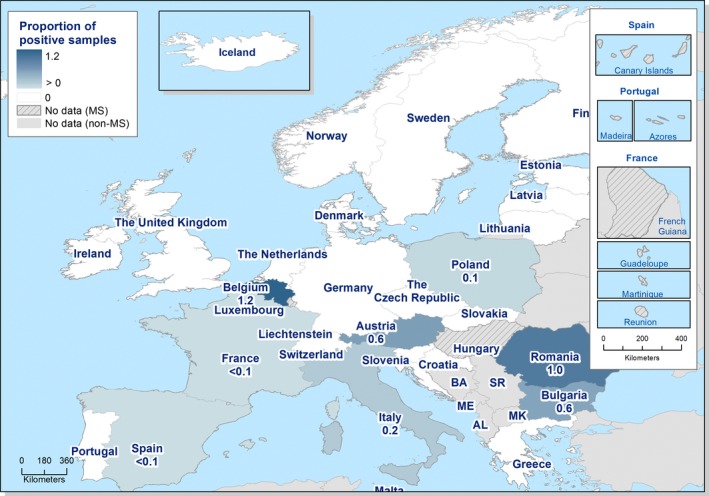
Prevalence of S. Infantis‐positive breeding flocks of Gallus gallus during the production period, 2018
- AL: Albania; BA: Bosnia and Herzegovina; ME: Montenegro; MK: the Republic of North Macedonia; and SR: Serbia.
Figure 10.

Prevalence of S. Typhimurium‐positive (including monophasic variants) breeding flocks of Gallus gallus during the production period, 2018
- AL: Albania; BA: Bosnia and Herzegovina; ME: Montenegro; MK: the Republic of North Macedonia; and SR: Serbia.
Flocks of laying hens
Twenty‐seven MS and three non‐MS reported Salmonella NCP data for laying hen flocks. No data were sent by Hungary. Salmonella was found in 1,539 or 4.0% of the flocks, compared with 3.7% in 2017. For three MS (Bulgaria, Croatia and France) there was a marked increase in the prevalence of flocks positive for Salmonella in 2018 compared with 2017. For Bulgaria and Croatia this increase in prevalence was due to a stable number of positive flocks while the number of tested flocks was much lower compared with 2017. Instead, for France, the number of tested flocks remained quite stable, whereas the number of flocks positive for Salmonella almost doubled (5,433 tested flocks and 193 Salmonella‐positive flocks in 2017, 5,651 tested flocks and 371 Salmonella‐positive flocks in 2018).
In 2018, the prevalence of laying hen flocks that were positive for any of the two target serovars was 1.1% (413 flocks), and the situation remained unchanged compared with 2017, when 1.1% of the tested flocks were positive for target serovars. Therefore, 26.8% (413 of 1,539) of reported Salmonella‐positive laying hen flocks were positive for target serovars. Six MS and three non‐MS reported no single laying hen flock positive for target Salmonella serovars. Six MS (Croatia, Denmark, Estonia, Malta, Poland and Romania) did not meet their reduction target of maximum 2% (Table 9 and Figure 7). Croatia, Estonia and Poland also failed to reach their reduction target in 2016 and in 2017. The commonest reported target serovar was S. Enteritidis (0.86%), with 93 of the 312 positive flocks (29.8%) notified by Poland. For S. Typhimurium, 101 positive flocks were notified and 34.6% of them were reported by France (Figures 11 and 12).
Figure 11.

Prevalence of S. Enteritidis‐positive laying hen flocks of Gallus gallus during the production period, 2018
- AL: Albania; BA: Bosnia and Herzegovina; ME: Montenegro; MK: the Republic of North Macedonia; and SR: Serbia.
Figure 12.

Prevalence of S. Typhimurium‐positive (including monophasic variants) laying hen flocks of Gallus gallus during the production period, 2018
- AL: Albania; BA: Bosnia and Herzegovina; ME: Montenegro; MK: the Republic of North Macedonia; and SR: Serbia.
Broiler flocks
Twenty‐seven MS and two non‐MS reported Salmonella NCP data from broiler flocks. No data were sent by Hungary and Norway. In the EU in 2018, Salmonella was found in 12,591 or 3.5% of the flocks compared with 3.3% in 2017. The prevalence of broiler flocks positive for any of the two target Salmonella serovars was 0.20% (corresponding to 705 flocks) compared with 0.19% in 2017. Therefore, 5.6% (705 of 12,591) of reported Salmonella‐positive broiler flocks were positive for target serovars, confirming the situation reported in 2017. Nine MS and two non‐MS reported no single flock positive for target Salmonella serovars. All reporting MS met the target of maximum 1% (Table 9 and Figure 7) of broiler flocks positive for S. Enteritidis and/or S. Typhimurium, except the Czech Republic as in previous years. The EU flock prevalence was higher for S. Typhimurium (0.12%) (Figure 13) than for S. Enteritidis (0.08%) (Figure 14). The number of flocks positive for S. Typhimurium increased in 2018 (N = 433) compared with 2017 (N = 363) and France accounted for 65.6% of the broiler flocks positive for this serovar, confirming the scenario of the previous year.
Figure 13.

Prevalence of S. Typhimurium‐positive (including monophasic variants) broiler flocks of Gallus gallus before slaughter, 2018
- AL: Albania; BA: Bosnia and Herzegovina; ME: Montenegro; MK: the Republic of North Macedonia; and SR: Serbia.
Figure 14.

Prevalence of S. Enteritidis‐positive broiler flocks of Gallus gallus before slaughter, 2018
- AL: Albania; BA: Bosnia and Herzegovina; ME: Montenegro; MK: the Republic of North Macedonia; and SR: Serbia.
Most MS (21) complied with the legal requirement to report separately investigations carried out by CA and by FBOp in broiler flocks. Six MS (France, Hungary, Italy, Lithuania, Luxembourg and the Netherlands) did not comply and one MS (Croatia) provided exclusively data for CA sampling. Considering all data sent by MS reporting both data related to investigations conducted by CA and FBOp, the prevalence of target Salmonella‐positive flocks was, respectively, 1.59% (4,160 tested flocks by the CA) and 0.10% (243,021 tested flocks by FBOp). At the EU level, the prevalence of target Salmonella serovar‐positive broiler flocks obtained by the CA was significantly higher than that obtained from the FBOp’ self‐monitoring results. The same finding was also evident individually for the Czech Republic, Germany, Poland, Portugal, Romania, Slovakia, Spain and the United Kingdom. For the remaining reporting MS, the differences between the results of both samplers were not significant or the sample size for one or both samplers was too low for analyses, or some data were missing (Table 16).
Table 16.
Comparisons of prevalence of Salmonella target serovar‐positive broiler flocks, by sampler and by reporting MS, EU, 2018
| Country | Competent Authority (CA) | Food Business Operator (FBOp) | p‐value a | Interpretation | ||||||
|---|---|---|---|---|---|---|---|---|---|---|
| N flocks tested | N flocks positive to target serovars | % flocks positive to target serovars | CI95 | N flocks tested | N flocks positive to target serovars | % flocks positive to target serovars | CI95 | |||
| Austria | 85 | 0 | 0.00 | [0.00; 4.25]a | 5,155 | 2 | 0.04 | [0.00; 0.14] | NS | |
| Belgium | 77 | 1 | 1.30 | [0.00; 7.02] | 10,749 | 23 | 0.21 | [0.13; 0.32] | NS | |
| Bulgaria | 207 | 0 | 0.00 | [0.00; 1.77]a | 5,711 | 0 | 0.00 | [0.00; 0.06] | NS | |
| Croatia | 20 | 0 | 0.00 | [0.00; 16.84]a | ||||||
| Cyprus | 8 | 0 | 0.00 | ‐‐‐ | 1,007 | 0 | 0.00 | [0.00; 0.36]a | ||
| Czech Republic | 36 | 4 | 11.11 | [3.11; 26.06] | 4,667 | 75 | 1.61 | [1,27; 2,01] | ** | CA > FBO |
| Denmark | 259 | 0 | 0.00 | [0.00; 1.41]a | 4,245 | 30 | 0.71 | [0.47; 1.01] | NS | |
| Estonia | 332 | 0 | 0.00 | [0.00; 1.10]a | 440 | 0 | 0.00 | [0.00; 0.83]a | NS | |
| Finland | 500 | 0 | 0.00 | [0.00; 0.73]a | 3,475 | 0 | 0.00 | [0.00; 0.11]a | NS | |
| Germany | 341 | 18 | 5.28 | [3.16; 8.21] | 21,265 | 14 | 0.07 | [0.36; 0.11] | *** | CA > FBO |
| Greece | 132 | 0 | 0.00 | [0.00; 2.75]a | 8,002 | 0 | 0.00 | [0.00; 0.05]a | NS | |
| Ireland | 68 | 0 | 0.00 | [0.00; 5.28]a | 4,158 | 0 | 0.00 | [0.00; 0.09]a | NS | |
| Latvia | 5 | 0 | 0.00 | ‐‐‐ | 758 | 0 | 0.00 | [0.00; 0.48]a | ||
| Malta | 5 | 3 | 60.00 | ‐‐‐ | 337 | 0 | 0.00 | [0.00; 1.09]a | ||
| Poland | 768 | 24 | 3.13 | [2.01; 4.61] | 41,758 | 33 | 0.08 | [0.05; 0.11] | *** | CA > FBO |
| Portugal | 125 | 1 | 0.80 | [0.02; 4.37] | 11,419 | 4 | 0.04 | [0.01; 0.09] | + | CA > FBO |
| Romania | 340 | 3 | 0.88 | [0.18; 2.56] | 12,189 | 0 | 0.00 | [0.00; 0.03]a | *** | CA > FBO |
| Slovakia | 55 | 3 | 5.45 | [1.14; 15.12] | 2,670 | 6 | 0.22 | [0.08; 0.49] | *** | CA > FBO |
| Slovenia | 33 | 0 | 0.00 | [0.00; 10.58]a | 2,428 | 1 | 0.04 | [0.00; 0.23] | NS | |
| Spain | 465 | 8 | 1.72 | [0.74; 3.36] | 40,778 | 43 | 0.11 | [0.08; 1.14] | *** | CA > FBO |
| Sweden | 156 | 0 | 0.00 | [0.00; 2.34]a | 4,799 | 2 | 0.04 | [0.00; 0.15] | NS | |
| United Kingdom | 163 | 1 | 0.61 | [0.01; 3.37] | 57,011 | 20 | 0.04 | [0.02; 0.05] | + | CA > FBO |
| Total all MS | 4,180 | 66 | 1.58 | [1.22; 2.00] | 243,021 | 253 | 0.10 | [0.09; 0.12] | *** | CA > FBO |
| Total MS b | 4,160 | 66 | 1.59 | [1.23; 2.01] | 243,021 | 253 | 0.10 | [0.09; 0.12] | *** | CA > FBO |
‐‐‐, The confidence interval is not provided because of the small sample size.
One‐sided, 97.5% confidence interval; p‐value interpretation: NS: not significant; +, p < 0.10; **, p < 0.01; ***, p < 0.001.
Total number of flocks considering only the MS that provided both CA and FBOp data.
Breeding flocks of turkeys
For breeding turkeys, 13 MS and 1 non‐MS reported Salmonella NCP data. Although Hungary and Norway had breeding flocks of turkeys, they did not report such data. Salmonella was found in 82 or 3.85% of the flocks tested (N = 2,129), compared with 2.63% in 2017. A marked increase of breeding turkey flocks positive for Salmonella was reported by the United Kingdom (2.0% of positive flocks in 2017, 7.6% in 2018).
In 2018, the prevalence of flocks positive to any of the two target serovars was 0.47% compared with 0.50% in 2017. S. Typhimurium was isolated from all flocks (10) identified as positive for target serovars. Therefore, 12.19% (10 of 82) of reported Salmonella‐positive flocks were positive for any of the two target serovars. Germany (as in the previous 2 years) and the United Kingdom did not meet the flock prevalence target of maximum 1% (Table 9 and Figure 7). For the United Kingdom, since the beginning of NCP implementation up to 2017, all tested flocks were negative for target serovars whereas, in 2018, 2.1% of tested flocks were positive for S. Typhimurium or a monophasic variant of S. Typhimurium (Figure 15).
Figure 15.

Prevalence of S. Typhimurium‐positive (including monophasic variants) turkey breeding flocks during the production period, 2018
- AL: Albania; BA: Bosnia and Herzegovina; ME: Montenegro; MK: the Republic of North Macedonia; and SR: Serbia.
Salmonella NCP monitoring data for turkey breeding flocks must be reported separately for investigations performed by CA and by FBOp. Four MS (Croatia, France, Greece and Italy) did not comply with this reporting requirement, whereas nine MS provided data from FBOp and from CA separately. Unexpectedly, the number of tested flocks sampled by CA was higher than that sampled by FBOp, differently from all other poultry animal categories, for which the number of tested flocks by FBOp was markedly higher than those sampled by CA (Table 17). The prevalence of flocks positive for target serovars from official samples taken by the CA and from self‐monitoring conducted by the FBOp were 0.40% (N = 741) and 0% (N = 727), respectively. At the EU level as well as for single MS, the prevalence of Salmonella target serovar‐positive turkey breeding flocks from official control samples was comparable with the prevalence obtained by self‐monitoring.
Table 17.
Comparisons of prevalence of Salmonella target serovar‐positive flocks of breeding turkeys, by sampler and by reporting MS, EU, 2018
| Country | Competent Authority (CA) | Food Business Operator (FBOp) | p‐value | ||||||
|---|---|---|---|---|---|---|---|---|---|
| N flocks tested | N flocks positive to target serovars | % flocks positive to target serovars | CI95 | N flocks tested | N flocks positive to target serovars | % flocks positive to target serovars | CI95 | ||
| Bulgaria | 3 | 0 | 0.00 | – | 3 | 0 | 0.00 | ‐‐‐ | |
| Finland | 7 | 0 | 0.00 | – | 7 | 0 | 0.00 | ‐‐‐ | |
| Germany | 76 | 1 | 1.32 | [0.03; 7.11] | 92 | 0 | 0.00 | [0.00; 3.93]a | NS |
| Ireland | 5 | 0 | 0.00 | – | 6 | 0 | 0.00 | ‐‐‐ | |
| Poland | 134 | 0 | 0.00 | [0.00; 2.71]a | 180 | 0 | 0.00 | [0.00; 2.03]a | NS |
| Slovakia | 42 | 0 | 0.00 | [0.00; 8.41]a | 47 | 0 | 0.00 | [0.00; 7.54]a | NS |
| Spain | 66 | 1 | 1.52 | [0.03; 8.16] | 98 | 0 | 0.00 | [0.00; 3.69]a | NS |
| Sweden | 4 | 0 | 0.00 | – | 4 | 0 | 0.00 | ‐‐‐ | |
| United Kingdom | 404 | 1 | 0.25 | [0.00; 1.37] | 290 | 0 | 0.00 | [0.00; 1.26]a | NS |
| Total | 741 | 3 | 0.40 | [0.08; 1.18] | 727 | 0 | 0.00 | [0.00; 0.51]a | NS |
–, The confidence interval is not provided because of the small sample size.
One‐sided, 97.5% confidence interval; p‐value interpretation: NS: not significant.
Flocks of fattening turkeys
For fattening turkeys flocks, 23 MS and 2 non‐MS provided data. Hungary and Norway had flocks of fattening turkeys, but did not send any data. In the EU in 2018, Salmonella was found in 2,530 or 6.37% of fattening turkeys flocks compared with 5.95% in 2017. The increase of fattening turkey flocks positive for Salmonella was particularly noticeable for some MS, i.e. Belgium (0.5% of positive flocks in 2017, 6.4% in 2018), Ireland (3.6% of positive flocks in 2017, 11.8% in 2018) and Spain (19.5% of positive flocks in 2017, 23.8% in 2018).
The prevalence of flocks that were positive for any of the two target Salmonella serovars was 0.34% (or 134 flocks) (Figure 16) compared with 0.28% in 2017. Therefore, 5.3% (134 of 2,530) of reported Salmonella‐positive fattening turkey flocks were positive for either of the two target serovars. Ten MS and two non‐MS reported no single flock positive for target serovars. Belgium, the Czech Republic and Greece did not meet the flock prevalence target of maximum 1% (Table 9 and Figure 7). The Czech Republic did not meet the reduction target in the last 3 years. Belgium reported seven flocks positive for target serovars (S. Typhimurium) in 2018 compared with a single positive flock in 2017. The flock prevalence was higher for S. Typhimurium (0.27%) than for S. Enteritidis (0.07%), with almost 50% of positive flocks for both serovars being notified by France, as had occurred in 2017.
Figure 16.

Prevalence of S. Enteritidis and/or S. Typhimurium‐positive (including monophasic variants) flocks of fattening turkeys before slaughter, 2018
- AL: Albania; BA: Bosnia and Herzegovina; ME: Montenegro; MK: the Republic of North Macedonia; and SR: Serbia.
Salmonella NCP monitoring data for turkey fattening flocks must also be reported separately for investigations carried out by CA and by FBOp. Seventeen MS complied with the requirement, while eight MS (Croatia, France, Hungary, Italy, Lithuania, the Netherlands, Latvia and Malta) did not send separate data from CA and FBOp and one MS (the Czech Republic) reported only data from FBOp. Considering all data sent by MS reporting both data related to investigations conducted by CA and FBOp the proportions of target Salmonella‐positive flocks were, respectively, 2.07% (725 tested flocks by the CA) and 0.24% (21,063 tested flocks by FBOp). The proportion of positive flocks for target serovars reported for sampling carried out by the CA was significantly higher than the FBOp's self‐monitoring results and the same finding was also evident for data reported by Germany and Spain (Table 18).
Table 18.
Comparisons of prevalence of Salmonella target serovar‐positive flocks of fattening turkeys, by sampler and by reporting MS, EU, 2018
| Country | Competent Authority (CA) | Food Business Operator (FBOp) | p‐value a | Interpretation | ||||||
|---|---|---|---|---|---|---|---|---|---|---|
| N flocks tested | N flocks positive to target serovars | % flocks positive to target serovars | CI95 | N flocks tested | N flocks positive to target serovars | % flocks positive to target serovars | CI95 | |||
| Austria | 22 | 0 | 0.00 | [0.00; 15.44]a | 443 | 2 | 0.45 | [0.05; 1.62] | NS | |
| Belgium | 4 | 0 | 0.00 | ‐‐‐ | 202 | 7 | 3.47 | [1.40; 7.01] | ||
| Bulgaria | 1 | 0 | 0.00 | ‐‐‐ | 3 | 0 | 0.00 | ‐‐‐ | ||
| Cyprus | 4 | 0 | 0.00 | ‐‐‐ | 10 | 0 | 0.00 | ‐‐‐ | ||
| Czech Republic | 248 | 3 | 1.21 | [0.25; 3.49] | ||||||
| Denmark | 13 | 0 | 0.00 | ‐‐‐ | 22 | 0 | 0.00 | [0.00; 15.44]a | ||
| Finland | 50 | 0 | 0.00 | [0.00; 7.11]a | 286 | 0 | 0.00 | [0.00; 1.28]a | NS | |
| Germany | 210 | 5 | 2.38 | [0.08; 5.47] | 4,618 | 12 | 0.26 | [0.13; 0.45] | *** | CA > FBO |
| Greece | 6 | 0 | 0.00 | — | 69 | 1 | 1.45 | [0.04; 7.81] | ||
| Ireland | 29 | 0 | 0.00 | [0.00; 11.95]a | 432 | 2 | 0.46 | [0.06; 1.66] | NS | |
| Poland | 162 | 1 | 0.62 | [0.01; 3.39] | 6,614 | 5 | 0.08 | [0.02; 0.18] | NS | |
| Portugal | 14 | 0 | 0.00 | ‐‐‐ | 1,056 | 0 | 0.00 | [0.00; 0.35]a | ||
| Romania | 38 | 0 | 0.00 | [0.00; 9.25]a | 222 | 1 | 0.45 | [0.01; 2.48] | NS | |
| Slovakia | 6 | 0 | 0.00 | ‐‐‐ | 41 | 0 | 0.00 | [0.00; 8.60]a | ||
| Slovenia | 9 | 0 | 0.00 | ‐‐‐ | 113 | 0 | 0.00 | [0.00; 3.21]a | ||
| Spain | 84 | 9 | 10.71 | [5.02; 19.37] | 4,183 | 12 | 0.29 | [0.15; 0.50] | *** | CA > FBO |
| Sweden | 21 | 0 | 0.00 | [0.00; 16.11]a | 145 | 0 | 0.00 | [0.00; 2.51]a | NS | |
| United Kingdom | 52 | 0 | 0.00 | [0.00; 6.84]a | 2,604 | 8 | 0.31 | [0.13; 0.60] | NS | |
| Total EU MS | 725 | 15 | 2.07 | [1.16; 3.39] | 21,311 | 53 | 0.25 | [0.19; 0.32] | *** | CA > FBO |
| Total EU MS b | 725 | 15 | 2.07 | [1.16; 3.39] | 21,063 | 50 | 0.24 | [0.18; 0.31] | *** | CA > FBO |
‐‐‐, The confidence interval is not provided because of the small sample size.
One‐sided, 97.5% confidence interval; p‐value interpretation: NS: not significant; ***, p < 0.001.
Total number of flocks considering only the MS that provided both CA and FBOp data.
Trends of Salmonella prevalence in poultry flocks
The Netherlands and Romania reported changed poultry Salmonella data past the reviewing deadline during October and November 2019. These updated data were accounted for in all Salmonella report sections except in the present EU trend analyses described in this section, because their impact on the overall EU Salmonella prevalence was assessed to be negligible.
The trends in the EU flock prevalence of Salmonella target serovars in poultry flocks since the implementation of the EU‐wide NCPs 2007–2018 are displayed in Figure 17.
Figure 17.

Overall reported prevalence of poultry flocks positive for Salmonella target serovars relevant for public health in different poultry animal populations, reporting MS, EU, 2007–2018
In the supporting information to this report (at https://doi.org/10.5281/zenodo.3527706), the EU trends for Salmonella, non‐target serovars and S. Enteritidis are shown and compared for each species covered by the NCP. Moreover, figures showing the prevalence trends of Salmonella and target Salmonella serovars in poultry flocks at the MS level and, finally, the detailed outputs of EU trend analyses (at subject level and at population level) are reported.
Breeding flocks of Gallus gallus
As observed during previous years, S. Enteritidis was by far the commonest target serovar reported in 2018 in breeding flocks of Gallus gallus. Moreover, the temporal trend of S. Enteritidis in breeding Gallus gallus flocks was very similar to those of the target serovars, of Salmonella spp. and of non‐target serovars.
The data used to model the trend in EU Salmonella flock prevalence for target serovars in breeding Gallus gallus for the period 2007–2018 were from 26 MS. Two MS (Estonia and Latvia) reported no single flocks positive for target serovars during this entire period of implementation of NCP.
Since the beginning of the NCP, there has been a decreasing overall trend for the prevalence of flocks positive to target serovars (Figures 17 and 19); the estimated prevalence decreased from 1.09% CI95[0.61; 1.95] in 2007 to 0.39% CI95[0.30; 0.52] in 2015. In the next 2 years, there was a slight increase in the prevalence to 0.44% CI95[0.32; 0.61] in 2017, but it decreased again to 0.41% CI95[0.27; 0.60] in 2018, i.e. to the same prevalence level reported in 2015. Nevertheless, the prevalence in the last year, 2018, was not significantly different from those in the previous years (2016 and 2017).
Figure 19.

Estimates of the prevalence (represented as a probability taking any value between 0 and 1) of poultry flocks positive for Salmonella target serovars, at the EU level and in different poultry animal populations, 2007–2018
After an initial fluctuation of the EU prevalence of Salmonella‐positive breeding flocks, the estimated prevalence decreased from 2.59% CI95[1.36; 4.88] in 2012 to 1.24% CI95[0.84; 1.84] in 2015 and then it increased slightly to 1.70% CI95[1.18; 2.44] in 2018. However, this latter prevalence was not significantly different from those of the previous 2 years.
Flocks of laying hens
As observed during previous years in laying hen flocks, the temporal trends for S. Enteritidis, for target serovars, for non‐target serovars and for Salmonella spp. were similar, even though the prevalence differed.
Data used to model the trend in the EU Salmonella flock prevalence for target serovars in laying hens over the period 2008–2018 were from all MS. No MS reported 0% prevalence for target serovars during this period. Since the beginning of NCP, there has been a decreasing overall trend for the prevalence of flocks positive for target serovars (Figures 17 and 19); the estimated prevalence was 3.75% CI95[2.47; 5.65] in 2008 and decreased to 0.87% CI95[0.62; 1.23] in 2014, with a steep downturn. From 2015 onwards, it increased slightly and stabilised to 1% CI95[0.68; 1.47] in 2018, when it was not significantly different compared with the previous 2 years.
The estimated EU laying hens flock Salmonella prevalence was 7.27% CI95[4.44; 11.69] in 2008 and decreased to 2.03% CI95[1.29; 3.19] in 2014, with a steep downturn. During the following years, it increased to 3.28% CI95[1.95; 5.47] in 2018. This increase seems to be due to the increased reporting of non‐target serovars. Nevertheless, the Salmonella 2018 flock prevalence was not significantly different compared with the previous 2 years.
Figure 18 displays the EU S. Enteritidis flock prevalence in laying hens and the number of human cases due to S. Enteritidis infection acquired in the EU. The EU S. Enteritidis prevalence in laying hen flocks decreased from 2012 to 2014, where after it significantly increased during 2015 and 2016. It then decreased again during 2017 to 0.9%. During 2012–2018, the number of human cases of S. Enteritidis infection acquired in the EU steadily increased and was highest during 2018 (32,727 cases) after a sharp decrease in human S. Enteritidis in 2013 (21,621 cases) compared with 2012.
Figure 18.

Percentage of laying hen flocks positive for S. Enteritidis and number of human salmonellosis cases due S. Enteritidis infection acquired in the EU, 2012–2018
Broiler flocks
As observed during previous years, in broiler flocks, the temporal trend of S. Enteritidis mimics that of the target serovars. Moreover, the temporal trends of Salmonella spp. and non‐target serovars are analogous.
The data from 27 MS were used to model the trend in the EU Salmonella flock prevalence for target serovars in broilers for the period 2009–2018. Two MS (Finland and Estonia) reported no single broiler flock positive for Salmonella target serovars during this entire period. Since the beginning of NCP, the estimated flock prevalence for target serovars steeply decreased in the first time interval (until 2011) and underwent a further decrease in the remaining observation time (Figure 19). The prevalence was 0.39% CI95[0.18; 0.83] in 2009 and decreased to 0.12% CI95[0.06; 0.24] in 2018. This latter prevalence was not significantly different from those of the previous 2 years.
After an initial fluctuation of the EU prevalence of Salmonella‐positive broiler flocks, the estimated prevalence decreased from 1.53% CI95[0.80; 2.91] in 2013 to 1.17% CI95[0.64; 2.14] in 2015 and next increased again to 1.85% CI95[0.98; 3.48] in 2018. This increase is probably related to the increased reporting of non‐target serovars, in particular for S. Infantis, the most frequently reported serovar from broiler flocks. Nevertheless, the prevalence in 2018 was not significantly different from those of the previous 2 years.
Breeding turkey flocks
In breeding turkey flocks, the temporal trends of S. Enteritidis and target serovar were similar although with different levels of prevalence, whereas the trends of Salmonella and non‐target serovars overlapped.
The data used to model the trend in EU Salmonella flock prevalence for target serovars in breeding turkeys for the period 2010–2018 were from 15 MS. Six MS reported no single breeding turkey flock positive for target Salmonella serovars over this entire period. The remaining MS had, from time to time, some positive flocks. The prevalence of Salmonella target serovar‐positive breeding turkey flocks fluctuated for the entire period around an estimated value of 0.36% CI95[0.29; 0.44].
After an initial fluctuation of the EU prevalence of Salmonella‐positive breeding turkey flocks, the estimated prevalence decreased from 4.32% CI95[1.32; 13.27] in 2013 to 1.21% CI95[0.6; 2.44] in 2016 and next increased significantly (p‐value = 0.007) to 4.96% CI95[2.71; 8.92] in 2018. This increase was related to the increased reporting of non‐target serovars.
Fattening turkeys
In fattening turkeys, the temporal trends of S. Enteritidis and the target serovars are different. Conversely, the temporal trends of Salmonella and non‐target serovars are very similar.
The data used to model the trend in the EU Salmonella flock prevalence for target serovars in fattening turkeys for the period 2010–2018 were from 25 MS. Three MS (the Netherlands, Slovenia and Sweden) reported no single fattening turkey flock positive for target Salmonella serovars during this entire period. The estimated target serovars flock prevalence was 0.41% CI95[0.26; 0.64] in 2010, it decreased to 0.24% CI95[0.17; 0.36] in 2013 and next increased to 0.27% CI95[0.18; 0.41] in 2018, after a slightly decrease in 2017 (0.25%, CI95[0.15; 0.39]). Overall, the fattening turkey flock prevalence of target Salmonella serovars decreased slightly, but with small temporal fluctuations (Figure 19). Nevertheless, there were no significant differences among the prevalence of the target Salmonella serovars in the last 3 years.
Also for this poultry species, after an initial fluctuation of the EU prevalence of Salmonella‐positive flocks reported during the first years of implementation of NCP, the estimated flock prevalence decreased from 5.07% CI95[2.35; 10.61] in 2013 to 2.10% CI95[0.87; 4.99] in 2015 and next increased to 4.19% CI95[2.13; 8.08] in 2018. This increase was related to the increased reporting of non‐target serovars. Nevertheless, the 2018 prevalence was not significantly different to those of the previous 2 years.
Salmonella monitoring data in other animals
Four MS (Italy, Latvia, Poland and Sweden) and one non‐MS (Norway) reported monitoring data on Salmonella flock prevalence in ducks and geese for 2018. Of 9,409 flocks, 0.72% were positive for Salmonella, whereas 0.43% were positive for S. Enteritis and/or S. Typhimurium.
Thirteen MS and two non‐MS (Norway and Switzerland) reported data on Salmonella prevalence in pigs. Overall, 41.26% of the 92,089 reported sampled units were positive for Salmonella. Among these, about 95% (N = 87,098) were collected at the slaughterhouse and 43.50% were positive.
In cattle, based on data reported by 13 MS and three non‐MS, the overall prevalence of Salmonella‐positive sampling units was 3.86% with 35,524 sampled units.
2.5.5. Salmonella in feed
The overall prevalence of Salmonella‐positive units in animal‐ and vegetable‐derived feed supplies in 2018 in the EU was 0.93% of 28,680 reported units.
In compound feed (the finished feed for animals), the prevalence of Salmonella‐positive units in 2018 was low for all animal populations: 0.52% of 10,497 tested samples for poultry, 0.45% of 7,259 tested samples for cattle and 0.33% of 4,251 tested samples for pigs.
2.5.6. Salmonella in serovars in humans, food and animals
Humans
Serovars among all confirmed salmonellosis cases
For humans, information on Salmonella serovars was available for 86.1% of the total number of confirmed cases (79,698 cases out of 91,857) from 27 MS (Bulgaria did not report case‐based serovar data), Iceland and Norway. Data include all cases reported with serovar information regardless of the importation/travel status. As in previous years, the three most commonly reported Salmonella serovars in 2018 were S. Enteritidis, S. Typhimurium and monophasic S. Typhimurium (1,4,[5],12:i:‐), representing 71.0% of the 79,698 confirmed human cases with known serovar in 2018 (Table 19). The proportion of these three serovars was at the same level as in 2017, as well as S. Infantis, which was the fourth most commonly reported serovar. The fifth most common serovar S. Newport increased by 18.0% and 43.3%, compared with 2017 and 2016, respectively. Serovar S. Coeln increased by 218.7% compared with 2016. S. Braenderup entered the top 20 list in 2018 and replaced serovar Kottbus.
Table 19.
Distribution of reported confirmed cases of human salmonellosis in the EU/EEA, 2016–2018, by the 20 most frequent serovars in 2018
| Serovar | 2018 | 2017 | 2016 | ||||||
|---|---|---|---|---|---|---|---|---|---|
| Cases | MSs | % | Cases | MSs | % | Cases | MSs | % | |
| Enteritidisa | 39,781 | 27 | 49.9 | 38,781 | 27 | 49.2 | 33,325 | 25 | 47.4 |
| Typhimuriuma | 10,395 | 27 | 13.0 | 10,590 | 27 | 13.4 | 9,789 | 25 | 13.9 |
| Monophasic Typhimurium 1.4.[5].12:i:‐ a | 6,427 | 17 | 8.1 | 6,322 | 16 | 8.0 | 6,340 | 16 | 9.0 |
| Infantisa | 1,859 | 26 | 2.3 | 1,803 | 26 | 2.3 | 1,658 | 24 | 2.4 |
| Newport | 1,086 | 21 | 1.4 | 920 | 24 | 1.2 | 758 | 17 | 1.1 |
| Derby | 710 | 23 | 0.9 | 612 | 23 | 0.8 | 620 | 20 | 0.9 |
| Kentucky | 663 | 22 | 0.8 | 617 | 19 | 0.8 | 559 | 19 | 0.8 |
| Agona | 602 | 18 | 0.8 | 645 | 20 | 0.8 | 452 | 16 | 0.6 |
| Virchowa | 541 | 24 | 0.7 | 510 | 21 | 0.6 | 509 | 20 | 0.7 |
| Stanley | 521 | 22 | 0.7 | 554 | 21 | 0.7 | 543 | 19 | 0.8 |
| Bovismorbificans | 465 | 18 | 0.6 | 344 | 20 | 0.4 | 393 | 20 | 0.6 |
| Napoli | 457 | 15 | 0.6 | 406 | 17 | 0.5 | 300 | 14 | 0.4 |
| Coeln | 443 | 20 | 0.6 | 265 | 21 | 0.3 | 139 | 15 | 0.2 |
| Java | 415 | 16 | 0.5 | 387 | 16 | 0.5 | 418 | 15 | 0.6 |
| Chester | 369 | 19 | 0.5 | 329 | 18 | 0.4 | 302 | 17 | 0.4 |
| Saintpaul | 324 | 20 | 0.4 | 330 | 21 | 0.4 | 456 | 20 | 0.6 |
| Hadara | 312 | 20 | 0.4 | 334 | 19 | 0.4 | 274 | 17 | 0.4 |
| Bareilly | 299 | 16 | 0.4 | 427 | 18 | 0.5 | 262 | 15 | 0.4 |
| Brandenburg | 299 | 17 | 0.4 | 290 | 19 | 0.4 | 190 | 16 | 0.3 |
| Braenderup | 259 | 17 | 0.3 | 260 | 18 | 0.3 | 387 | 17 | 0.6 |
| Other | 13,471 | – | 16.9 | 14,174 | – | 17.7 | 12,564 | – | 17.9 |
| Total | 79,698 | 27 | 100.0 | 78,900 | 27 | 100.0 | 70,238 | 25 | 100.0 |
MS: Member State.
Target Salmonella serovars in poultry species. See Table 9 for details.
Source(s): Twenty‐seven MS and two non‐MS; Austria, Belgium, Croatia, Cyprus, the Czech Republic, Denmark, Estonia, Finland, France, Germany, Greece, Hungary, Ireland, Italy, Latvia, Lithuania, Luxembourg, Malta, the Netherlands, Poland, Portugal, Romania, Slovakia, Slovenia, Spain, Sweden, the United Kingdom and Iceland and Norway.
Serovars acquired in the EU
To estimate the impact of the Salmonella infections acquired at the EU level, serovar data were analysed for domestic and travel‐associated cases in which the probable country of infection was an EU MS (Table 20). Information on Salmonella serovars with importation/travel data was available from 25 MS, representing 77.0% of cases with known serovar data in 2018. Most cases (96.7%) with known data on serovar and importation were infected within EU. Among the travel‐related cases, the most frequently reported travel destinations were Spain (30.8%), Greece (14.6%), Poland (8.1%), Italy (6.5%) and Croatia (6.1%), as in 2017.
Table 20.
Distribution of reported cases of human salmonellosis acquired in the EU, 2016–2018, by the six most frequent serovars in 2018
| Serovar | 2018 | 2017 | 2016 | ||||||
|---|---|---|---|---|---|---|---|---|---|
| Cases | MSs | % | Cases | MSs | % | Cases | MSs | % | |
| Enteritidis | 32,727 | 24 | 60.9 | 32,262 | 25 | 61.2 | 26,781 | 23 | 57.1 |
| Typhimurium | 7,410 | 25 | 13.8 | 6,806 | 25 | 12.9 | 6,725 | 23 | 14.3 |
| Monophasic Typhimurium 1.4.[5].12:i:‐ | 2,553 | 23 | 4.7 | 2,096 | 22 | 4.0 | 2,688 | 21 | 5.7 |
| Infantis | 1,221 | 23 | 2.3 | 1,163 | 22 | 2.2 | 1,099 | 21 | 2.3 |
| Derby | 414 | 19 | 0.8 | 295 | 18 | 0.6 | 372 | 17 | 0.8 |
| Newport | 411 | 18 | 0.8 | 383 | 19 | 0.7 | 316 | 16 | 0.7 |
| Other | 9,047 | – | 16.8 | 9,724 | – | 18.4 | 8,938 | – | 19.0 |
| Total | 53,783 | 100.0 | 52,729 | 26 | 100.0 | 46,919 | 24 | 100.0 | |
Source(s): Twenty‐five MS; Austria, Belgium, Croatia, the Czech Republic, Denmark, Estonia, Finland, France, Germany, Greece, Hungary, Ireland, Italy, Latvia, Lithuania, Luxembourg, Malta, the Netherlands, Poland, Portugal, Slovakia, Slovenia, Spain, Sweden and the United Kingdom.
From reported cases of human salmonellosis acquired in the EU, S. Enteritidis dominated and almost two in three (60.9%) of the reported cases were infected by this serovar. Together with S. Typhimurium and monophasic S. Typhimurium 1,4,[5],12:i:‐, these three serovars represented 79.4% of the confirmed human cases acquired in the EU in 2018 (Table 20). S. Enteritidis cases were predominantly (93.0%) infected within EU. The proportion of S. Enteritidis was about at the same level as in 2017. The proportion increased in 2017, which was mainly due to one large MS (Poland) starting to report case‐based serotype data for the first time in 2017. Without Poland, the proportion of S. Enteritidis was at the same level as in 2016 (57.1%) and slightly decreased (56.7%) in 2018. The proportion of S. Typhimurium and its monophasic variant strains 1,4,[5],12:i:‐ slightly increased and S. Infantis remained at the same level as in 2017. Among the cases acquired in the EU, S. Newport and S. Derby have alternated in fifth and sixth places in the top‐five serovars. In 2018, S. Derby increased by 40.3% and by 11.5% and S. Newport increased by 7.3% and 30.1% compared with 2017 and 2016, respectively.
The trend for S. Enteritidis cases acquired in the EU in 2009–2018 and from 2014 to 2018 did not show any significant increase or decrease (Figure 20).
Figure 20.

Trend in reported confirmed human cases of S. Enteritidis acquired in the EU, by month, 2009–2018
- Source(s): Austria, the Czech Republic, Denmark, Estonia, Finland, Germany, Greece, Hungary, Ireland, Italy, Latvia, Malta, the Netherlands, Portugal, Slovakia, Spain, Sweden and the United Kingdom. Belgium, Bulgaria, Cyprus, Croatia, France, Lithuania, Luxembourg, Poland, Romania and Slovenia did not report data to the level of detail required for the analysis.
At the country level, nine MS (Estonia, Finland, Germany, Hungary, Italy, Latvia, Malta, the Netherlands and Spain) reported a decreasing trend of S. Enteritidis cases acquired within the EU in 2009–2018, whereas four MS (the Czech Republic, Ireland, Portugal and Slovakia) reported an increasing trend over the same period.
Finland was the only MS reporting a significantly decreasing trend of S. Enteritidis cases acquired within the EU over the last 5 years (2014–2018). A significant increasing trend was observed in three MS (Estonia, Ireland and Slovakia) for the last 5 years.
Food and animals
Descriptive analyses were made from food and animal data from 2018 for the five Salmonella serovars that were most commonly reported from domestic human cases in the EU (including cases that travelled within EU) for 2018 (Table 20). These five most commonly reported serovars were S. Enteritidis, S. Typhimurium, monophasic S. Typhimurium, S. Infantis and S. Derby. Only isolates related to food‐producing animals and major food categories were aggregated into the following categories: broiler flocks, broiler meat, laying hen flocks, eggs, fattening turkey flocks, turkey meat, pigs, pig meat, cattle and bovine meat. From, in total, 16,438 serotyped Salmonella isolates, the number of isolates comprising these five serovars for the different matrices were, in decreasing order, 10,093 isolates from broiler flocks (61.4%), 1,989 isolates from broiler meat (12.1%), 1,367 isolates from turkey flocks (8.3%), 1,274 isolates from laying hen flocks (7.8%), 1,125 isolates from pig meat (6.8%), 320 isolates from turkey meat (1.9%), 105 isolates from pigs (0.6%), 99 isolates from cattle (0.6%), 50 isolates from eggs (0.3%) and 16 isolates from cattle meat (0.1%).
The Sankey diagram (Figure 21) illustrates how the EU top‐five Salmonella serovars in human salmonellosis cases acquired in the EU are associated with the most important animal species. S. Enteritidis was primarily associated with broiler sources (57.4% of the S. Enteritidis isolates were from broiler flocks and meat) and secondly with layers (37.4%). A marginal number of S. Enteritidis isolates was obtained from turkey (3.7%) sources. S. Typhimurium was associated with all matrices, in decreasing order: 43.6% of the S. Typhimurium isolates were from broiler sources, 27.3% from pig, 13.9% from layers, 13.1% from turkey and 2.3% from cattle sources. Monophasic S. Typhimurium was associated mainly with broiler (43.4%) and pig (39.6%) sources. S. Infantis was markedly related to broiler sources (93%). S. Derby was primarily associated with pig (61.8%) and secondly with turkey (30.3%) sources.
Figure 21.

Sankey diagram of the distribution of the human EU top‐five Salmonella serovars, across different food and animal sources (broiler, cattle, pig, turkey and layers), EU, 2018
- The left side of the diagram shows the five commonest reported Salmonella serovars from human salmonellosis cases acquired in the EU: S. Infantis (blue), S. Typhimurium (green), S. Enteritidis (pink), monophasic S. Typhimurium (yellow) and S. Derby (violet). Animal and food data from the same source were merged: ‘broiler’ includes isolates from broiler flocks and broiler meat, ‘cattle’ includes isolates from bovines for meat production and bovine meat, ‘pig’ includes isolates from fattening pigs and pig meat, ‘turkey’ includes isolates from fattening turkey flocks and turkey meat and ‘layers’ includes laying hen flocks and eggs. The right side shows the five sources considered (broiler, cattle, pig, turkey and layers). The width of the coloured bands linking sources and serovars is proportional to the percentage of isolation of each serovar from each source.
The Sankey diagram in Figure 22 illustrates how the EU top‐five Salmonella serovars in human salmonellosis acquired in the EU are distributed across the reporting MS in 2018. Twenty‐six MS reported the top‐five Salmonella serovars from the above sources. S. Enteritidis was widely reported from most MS, even though Poland accounted for the greatest percentage (36.5%) of the S. Enteritidis reported by any MS. Similarly, S. Typhimurium and monophasic S. Typhimurium isolates were reported from all MS, but the highest percentage of both of these serovars was reported from France, accounting for 35.2% and 35.8%, respectively. S. Infantis isolates were mostly reported from Italy (39.4%), whereas S. Derby, was mainly reported from the United Kingdom (24.5%), Denmark (20.6%) and Italy (19.7%).
Figure 22.
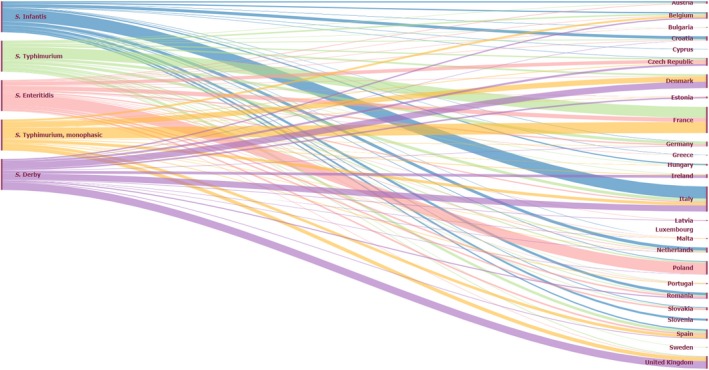
Sankey diagram of the distribution of the human EU top‐five Salmonella serovars found in food and animal matrices by reporting MSs, EU, 2018
- The left side of the diagram shows the five commonest reported Salmonella serovars from human salmonellosis cases acquired in the EU: S. Infantis (blue), S. Typhimurium (green), S. Enteritidis (pink), monophasic S. Typhimurium (yellow) and S. Derby (violet). The right side shows the reporting MS. The width of the coloured bands linking MSs and serovars is proportional to the percentage of isolation of each serovar reported from each MS.
EU top‐five Salmonella serovars: food and animal sources comparison
Considering all fowl (Gallus gallus, including breeding hens, laying hens and broilers), S. Enteritidis was the fourth most commonly reported serovar, accounting for 5.9% of the isolates, even though for some MS (e.g. the Czech Republic, Estonia, Germany and Poland), it was the most commonly reported serovar. S. Enteritidis accounted for 58% of all Salmonella isolates serotyped from eggs and 24.5% of the serotyped isolates from layer flocks. It also accounted for 25% and 12.6% of all serotyped isolates from cattle meat and broiler meat, respectively. For the other sources, a negligible number of S. Enteritidis isolates was reported by only a few MS (Figure 23).
Figure 23.

Stacked bar plots showing the percentages of the EU top‐five Salmonella serovars in human salmonellosis acquired in the EU, by food‐animal category with isolates, EU, 2018
- The percentages were calculated on the total number of isolates serotyped for each of the five animal/food categories (bovine, broiler, layers, pig and turkey). The values at the top of each box are the numbers of Salmonella serovar isolates and the numbers in parentheses are the number of reporting MS, for animal matrices (grey) and food matrices (black). Each plot shows the percentage of isolates belonging to the reported serovar out of the total number of serotyped isolates.
S. Typhimurium and its monophasic variants showed similar patterns, with S. Typhimurium accounting for 12.4% and 13.9% of the serotyped isolates from pig herds and pig meat and its monophasic variants accounting for 25.7% and 12.4% of serotyped isolates from these matrices. For bovines and cattle meat, around 12% and 6% of serotyped isolates were S. Typhimurium and its monophasic variants, respectively (Figure 23).
In fattening turkey flocks, the most common serovar reported was classified as ‘S. group B’, accounting for 172 (13.7%) isolates and sent only by the UK. So, for this group, a definite serovar was not available and, although it shares the antigenic group with S. Typhimurium and its monophasic variant, it cannot clearly be attributed to these serovars.
S. Infantis was the most reported serovar in fowl (Gallus gallus), accounting for 3,848 of 10,493 (36.7%) serotyped isolates. Unlike previous years, it was widespread among most MS that sent Gallus gallus data. S. Infantis was massively reported for broiler matrices, both for animals (36.5% of all serotyped isolates) and for food matrices (56.7%). It was also present, but to a lesser extent, in turkey flocks (11.6% of all serotyped isolates), turkey meat (6.6%) and cattle meat (6.3%) (Figure 23). Most of the S. Infantis isolated in 2018 from broiler (50.1%) and fattening turkey flocks (85%) was notified by Italy.
S. Derby accounted for 53.3% of all the serotyped isolates from pigs and 20.6% of all serotyped pig meat isolates, while the percentages from turkeys were considerably lower (9.8% and 2.2% of all serotyped isolates from turkeys and turkey meat, respectively). Among the remaining animal/food categories, this serotype was of negligible relevance (Figure 23).
2.6. Discussion
Salmonellosis remains the second most common zoonosis in humans in the EU after campylobacteriosis. The previous decreasing trend has stabilised in the last 5 years. In 2018, the number of reported confirmed human cases and the EU notification rate were at the same level as in 2017. Few MS reported a decreasing trend during 2009–2018 and in most those countries the trend has stabilised since 2014. Some MS reported a significantly increasing trend in 2014–2018, which could be partly attributable to more complete reporting and improvements in the surveillance of salmonellosis in these countries.
S. Enteritidis increased in 2015–2018 in human cases acquired within the EU. S. Enteritidis is predominantly acquired in the EU, more frequently than other serovars. The marked increase of EU casesin 2017 was mainly due to one MS (Poland) starting to report case‐based serovar data for the first time. A large European multicountry outbreak of S. Enteritidis associated with contaminated eggs from Poland was confirmed in 14 EU/EEA countries in 2016. Poland implemented control measures and the cases declined in 2017, but started to increase again at the end of the year. It is likely that this multicountry outbreak had already existed since 2012 and was still ongoing during 2018. After 2016, the number of confirmed human cases has steadily increased and cases have been confirmed in 18 EU/EEA countries, with the most recent epidemiological update reported in November 2018 (EFSA and ECDC, 2016, 2017a,b,c, 2018a).
The three most commonly reported serovars S. Enteritidis and S. Typhimurium (including monophasic variants) accounted for almost 80% of human cases acquired in the EU. S. Infantis has been consistently the fourth most frequently reported serovar in the domestically acquired and travel‐associated cases. There was an increase of S. Newport infections, which was the fifth most commonly reported serovar and replaced S. Derby in 2018. This was mainly due to one MS, Belgium starting to report importation data for serovars in 2018 and four countries reporting increased of domestic cases compared with previous year. There was a substantial increase of S. Coeln infections in the EU in the last 2 years. Several MS (Austria, Croatia, the Czech Republic, Germany and Slovakia) reported increase of cases in 2018 compared with previous years. Investigations of a possible multicountry outbreak are ongoing.
Notification rates for salmonellosis in humans vary between MS, reflecting variations in, for example, quality, coverage and severity focus of the surveillance systems, practices in sampling and testing, disease prevalence in the production animal population, food and animal trade between MS and the proportion of travel‐associated cases. The variation in national surveillance systems is reflected for example by the fact that countries reporting the lowest notification rate for salmonellosis had the highest proportions of hospitalisation, suggesting that the surveillance systems in these countries are focusing on the most severe cases.
The most valuable data on the monitoring of Salmonella in foods are those reported by MS in the context of Regulation (EC) No. 2073/2005, as they guarantee a certain level of harmonisation in terms of matrices considered, analytical methods used and sampling points. Therefore, in 2018, a set of different criteria was fixed by EFSA to identify, among the food data sent, those collected as single samples by CA as part of verification of implementation of Salmonella FSC, in the context of Regulation (EC) No. 2073/2005. However, for the second year after the definition of this approach, the panel of data collected within this specific context, with the exception of a limited number of food categories, is negligible and reported by very few MS, so barring the possibility of performing any analyses or temporal evaluation of these data. As the scenario obtained considering these data seems to be unrepresentative of the real effort of MS, in terms of official samples collected and analysed, to guarantee the safety of food products on the market, further investigations should be conducted to understand the reasons for the limited amount of data sent by MS in this context.
In 2018, the highest prevalence of Salmonella‐positive single samples from official control investigations by CA was reported for poultry meat and minced meat and meat preparations intended to be cooked, irrespective of the species, confirming the scenarios described for the previous year. The importance of these food categories as sources of human Salmonella infections can also be obtained from data about FBO, for which meat and meat products ranked as the second most common subcategory associated with strong‐evidence Salmonella outbreaks. ‘Egg and egg products’, being associated with almost 50% of Salmonella strong‐evidence FBO, was confirmed as the primary food in the list of those causing FBO, even though the prevalence of Salmonella in this food category, according to monitoring data, is negligible. Although the prevalence of Salmonella is lower in egg than in meat matrices, ‘egg and egg products’ are more frequently associated with Salmonella outbreaks than any other food matrix for a variety of reasons. First, due to vertical transmission of the pathogen, eggs can be internally contaminated; secondly, eggs are commonly used as raw products to prepared different food specialities; and, finally, there is the risk of temperature abuse of such products (EFSA, 2014a; EFSA BIOHAZ Panel, 2019). The importance of eggs as source of human Salmonella infections has been already mentioned in relation to the large European multicountry salmonellosis outbreak (with 838 confirmed and 371 probable cases) occurring during the last 3 years (2016–2018) and originating from a large agricultural business consortium in Poland (Pijnacker et al., 2019). This experience demonstrates that, although we continue to maintain a general positive trend in terms of prevalence of Salmonella and of target Salmonella serovars both in breeding flocks of Gallus and laying hens, effective control measures must be continuously maintained and improved to prevent any type of flaw in the system that could have negative consequences.
Pork is another important source of human salmonellosis cases and the lack of harmonised control programme in the pig and pork sectors in the EU has led the European Commission to reinforce the supervision by the CA in this area. Regulation (EC) No. 218/2014 required the evaluation by CA of correct implementation of the own checks carried out by FBOp for the presence of Salmonella in pig carcasses at the slaughterhouse, according to the requirement of Regulation (EC) No. 2073/2005 by choosing among three different options: implementing ad hoc official samplings and/or using validated control programme results and/or collecting all information on Salmonella‐positive samples about own checks by FBOp. In 2018, comparison between data collected by CA and FBOp in this context, as reported in 2017, confirmed that the prevalence of Salmonella‐positive samples from official controls was significantly higher than self‐monitoring results. Plausible explanations for such differences should be found by each MS according to its specific epidemiological situation and according to the criteria/strategy used for implementing the controls, to identify effective corrective measures, when necessary.
Trend analyses, implemented with data from 2018, confirmed the observations already formulated in the previous year. For the estimated prevalence of target Salmonella serovars a slight decreasing trend was reported for the different poultry species with a tendency to stabilisation over the last years. An exception was observed for breeding turkeys, for which a stationary trend fluctuating around an estimated prevalence of 0.36% was reported. When we considered the prevalence of Salmonella spp., there was a general increasing trend that was associated with non‐target serovars. In spite of that, the prevalence of Salmonella over the last 3 years were not significantly different within each of the poultry categories, with the exception of breeding turkey flocks, in which the Salmonella prevalence increased significantly. For this last category, an unexpected increase in the number of breeding turkey flocks that was positive for monophasic variant of S. Typhimurium was reported by the UK. This change reflected (personal communication by R. Davies) contamination from pig farms to breeding turkey farms in a specific geographical area and specific temporal period. Meticulous epidemiological investigations and the characterisation of Salmonella isolates by whole‐genome sequencing (WGS) have clarified the scenarios and sources of contamination.
Among the non‐target serovars for poultry categories other than breeding Gallus gallus, S. Infantis continues to be an important serovar along the poultry production chain and its relevance is further reinforced by this serovar's high levels of multidrug resistance and persistence along the chain, especially for broilers (Franco et al., 2015; Carfora et al., 2018). Serovar data collected from broiler flocks and broiler meat cannot be considered robust, as their transmission by MS is not mandatory and nor is it consistent over the years. Nonetheless, if we compare the notification of S. Infantis from breeding Gallus gallus (mandatory) with that from broiler flocks (non‐mandatory), there is no direct correspondence among the MS with the highest prevalence of S. Infantis‐positive flocks in the two categories. Although this finding could be biased by the limitations of the available data (especially for broilers), this evidence is consistent with literature data (Karacan Sever and Akan, 2019), demonstrating that S. Infantis enters broiler flocks not through the breeders, but through environmental factors. However, in 2018, for the first time, S. Infantis was the second serovar isolate from breeding Gallus gallus in the context of NCP, although this finding was markedly related to the situation of a single MS. The other important evidence from these data is that S. Infantis, in contrast with other serovars commonly found in broiler farms (e.g. S. Mbandaka, which was the second most common serovar notified from broiler flocks in 2018), is persistently isolated along the entire broiler chain. It is, in fact, effectively identified both from animals and broiler meat.
Moreover, as part of the NCP for broiler and turkeys flocks, it is mandatory for MS to report separately the data on tested and positive flocks both for monitoring implemented by CA (official control samples) and FBOp (self‐monitoring). As already reported for the data sent in 2017, the prevalence data calculated from CA data were significantly higher than those calculated from FBOp for broilers and fattening turkeys. The other unexpected finding related to these data was that for breeding turkey flocks, a higher number of samples was notified for controls carried out by CA than for self‐monitoring by FBOp. As NCP mainly rely on controls carried out by FBOp, the scenario provided by the collected data seems to be inconsistent with the requirements of the current legislation. Hence, as previously mentioned, the reasons for such differences in terms of prevalence between CA and FBOp should be investigated; the correct implementation of control programmes by MS requires proper assessment, as both aspects can seriously compromise the effectiveness of Salmonella NCP.
2.7. Related projects and Internet sources
| Subject | For more information see | |
|---|---|---|
| Humans | Surveillance Atlas | http://atlas.ecdc.europa.eu/public/index.aspx |
| EU case definitions | https://ecdc.europa.eu/en/infectious-diseases-public-health/surveillance-and-disease-data/eu-case-definitions | |
| Food‐ and waterborne diseases and zoonoses Programme | https://ecdc.europa.eu/en/about-us/who-we-are/disease-programmes/food-and-waterborne-diseases-and-zoonoses-programme | |
| European Food‐ and Waterborne Diseases and Zoonoses Network (FWD‐Net) | https://ecdc.europa.eu/en/about-us/partnerships-and-networks/disease-and-laboratory-networks/fwd-net | |
| World Health Organization – Salmonella (non‐typhoidal) fact sheet | http://www.who.int/mediacentre/factsheets/fs139/en/ | |
| Food | European Union Reference Laboratory (EURL) for Salmonella | http://www.eurlsalmonella.eu |
| Microbiological criteria | https://ec.europa.eu/food/safety/biosafety/food_hygiene/microbiological_criteria_en | |
| Scientific Opinion on Public health risks of table eggs due to deterioration and development of pathogens | https://www.efsa.europa.eu/en/efsajournal/pub/3782 | |
| Scientific Opinion on the link between Salmonella criteria at different stages of the poultry production chain | https://www.efsa.europa.eu/en/efsajournal/pub/1545 | |
| Bad Bug Book (Second Edition), Food‐borne Pathogenic Microorganisms and Natural Toxins Handbook, Center for Food Safety and Applied Nutrition, Food and Drug Administration (FDA), USA | https://www.fda.gov/food/foodborneillnesscontaminants/causesofillnessbadbugbook/ | |
| Animals | Control of Salmonella in animals | https://ec.europa.eu/food/safety/biosafety/food_borne_diseases/salmonella_en |
| General information on National Veterinary Programmes, in EU | https://ec.europa.eu/food/funding/animal-health/national-veterinary-programmes_en | |
| Scientific Opinion on a quantitative estimation of the public health impact of setting a new target for the reduction of Salmonella in laying hens | http://onlinelibrary.wiley.com/doi/10.2903/j.efsa.2010.1546/abstract | |
| Scientific Opinion on public health impact of new target for the reduction of Salmonella in turkey flocks | https://www.efsa.europa.eu/en/efsajournal/pub/2616 | |
| Scientific Opinion on public health impact new target for the reduction of Salmonella in broiler flocks | https://www.efsa.europa.eu/en/efsajournal/pub/2106 | |
| Scientific Opinion on Salmonella in slaughter and breeder pigs | https://www.efsa.europa.eu/en/efsajournal/pub/1547 |
3. Listeria
3.1.
Tables and figures that are not presented in this section are published as supporting information to this report and are available as downloadable files at https://doi.org/10.5281/zenodo.3527706 and human tables and figures are retrievable using ECDC's Surveillance Atlas at http://atlas.ecdc.europa.eu/public/index.aspx
3.2. Key facts
In 2018, 28 MS reported, 2,549 confirmed invasive human cases of listeriosis with an EU notification rate of 0.47 cases per 100,000 population, which was comparable with 2017.
Listeria infections were most commonly reported in the age group over 64 years and particularly in the age group over 84 years.
A statistically significant increasing trend of confirmed listeriosis cases in the EU/EEA has been observed in 2009–2018 as well as during the last 5 years (period 2014–2018).
The case fatality was high (15.6%), which makes listeriosis one of the most serious food‐borne diseases under EU surveillance.
In 2018, 14 food‐borne listeriosis outbreaks causing 158 human cases were reported in the EU. Three countries reported 46 cases related to the multicountry outbreak of L. monocytogenes ST6 linked to frozen vegetables. FBO case numbers corresponded to 9.8% of EU domestic cases. During 2018, ‘vegetables and juices and other products thereof’ was the food vehicle causing the most strong‐evidence FBOs (two), whereas in 2010–2017, food vehicles causing strong‐evidence FBOs were first ‘mixed food’, followed by ‘fish and fish products’, next ‘vegetables and juices and other products thereof’ equally with ‘crustaceans, shellfish, molluscs and products thereof’.
At processing and retail, depending on the RTE food category, up to 3.18% and 0.48% of single units, respectively, were considered as unsatisfactory according to Regulation No. 2073/2005. The highest proportion of positive results were reported for ‘fish and fishery products’, as earlier.
The occurrence of L. monocytogenes varied according to the RTE food category and ranged from 0.09% for ‘hard cheeses made from pasteurised milk’ up to 3.1% for ‘RTE bovine meat’.
3.3. Surveillance and monitoring of Listeria monocytogenes in the EU
3.3.1. Humans
Notification of listeriosis in humans is mandatory in most EU MS, Iceland, Norway and Switzerland, except for three MS, where notification is based on a voluntary system (Luxembourg and the United Kingdom) and another, non‐specified system (Belgium). The surveillance systems for listeriosis cover the whole population in all MS, except in Belgium and Spain. In 2015–2018, the coverage of the surveillance system is estimated to be 80% in Belgium and this proportion of populations was used in the calculation of notification rates. No estimate for the population coverage was provided for Spain in 2014–2017, so the notification rate was not calculated. All countries report case‐based data except Bulgaria, which reported aggregated data. Both reporting formats were included to calculate numbers of cases and notification rates.
Surveillance of listeriosis in humans in the EU is based on invasive forms of L. monocytogenes infection, mostly manifested as septicaemia, meningitis or spontaneous abortion. Diagnosis of Listeria infections in humans is generally carried out by culture from blood, cerebrospinal fluid and vaginal swabs.
3.3.2. Food, animals and feed
Monitoring of L. monocytogenes is conducted along the food chain during preharvest (e.g. animals at the farm and their feed), processing (e.g. cutting plant, slaughterhouses) and post‐processing (e.g. retail and catering). The public health risk of L. monocytogenes posed by RTE food also depends on the effectiveness of its control, which include the implementation of Good Agricultural Practices (GAPs) at the farm level, the GMP and HACCP programme during processing and retail in FBOp. Regulation (EC) No. 2073/20057 on microbiological criteria (see Section 3.3.1) lays down the microbiological criteria and the implementing rules to be complied with by the FBOp when implementing the general and specific hygiene measures of Regulation (EC) No. 852/2002. The National CAs conduct investigations (official sampling) to verify whether the FBOp implement correctly the legal framework of own check programmes (compliance with FSC, including for L. monocytogenes) as well as the analyses as part of HACCP (industry monitoring) according to the General Food Law principles.
The rationale for surveillance and monitoring of L. monocytogenes in animals, feed and food at the different stages along the food chain and the number of samples provided to EFSA for 2018 is shown in Figure 24. In 2018, 24 MS reported 158,097 samples tested for L. monocytogenes on different RTE food categories and 12 MS reported 16,885 samples tested at primary production level. The most sampled food categories were ‘meat and meat products’ and ‘milk and milk products’ with 75% of the samples taken (Table 22).
Figure 24.
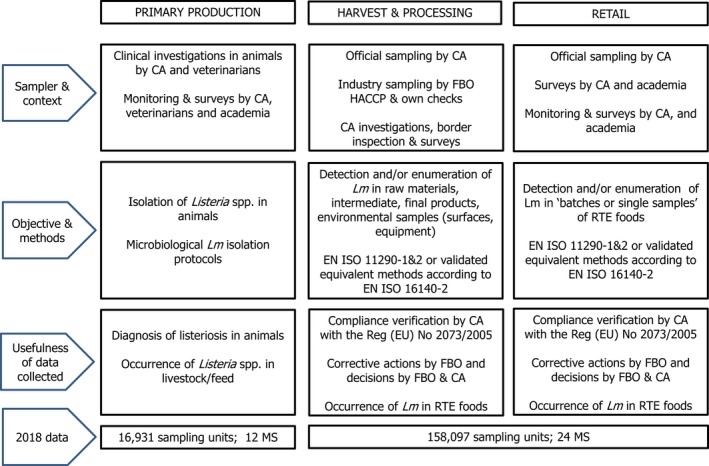
Overview of L. monocytogenes testing along the food chain according to the sampling stage, the sampler and the objective of the sampling
- CA: Competent Authority; FBOp: Food business operator; Lm: Listeria monocytogenes; MS: Member State; RTE: ready‐to‐eat.
Table 22.
Summary statistics on human invasive L. monocytogenes infections and on sampled major RTE food categories in the EU, 2014–2018
| 2018 | 2017 | 2016 | 2015 | 2014 | Data source | |
|---|---|---|---|---|---|---|
| Humans | ||||||
| Total number of confirmed cases | 2,549 | 2,479 | 2,503 | 2,183 | 2,217 | ECDC |
| Total number of confirmed cases/100,000 population (notification rates) | 0.47 | 0.48 | 0.47 | 0.43 | 0.46 | ECDC |
| Number of reporting MS | 28 | 28 | 28 | 28 | 27 | ECDC |
| Infection acquired in the EU | 1,637 | 1,635 | 1,532 | 1,450 | 1,498 | ECDC |
| Infection acquired outside the EU | 8 | 4 | 6 | 7 | 6 | ECDC |
| Unknown travel status or unknown country of infection | 904 | 840 | 66 | 726 | 713 | ECDC |
| Number of outbreak‐related cases | 158a | 39 | 27 | 233 | 93 | ECDC |
| Total number of outbreaks | 14 | 10 | 6 | 15 | 13 | ECDC |
| RTE food categoriesb | ||||||
| RTE milk and milk products | N = 59,313; 23 MS | N = 56,428; 25 MS | N = 34,850; 26 MS | N = 45,996; 24 MS | N = 68,497; 24 MS | EFSA |
| RTE meat and meat products | N = 57,861; 22 MS | N = 45,219; 24 MS | N = 25,195; 210 MS | N = 25,396; 22 MS | N = 18,720; 21 MS | EFSA |
| RTE fish and fishery products | N = 14,081; 22 MS | N = 12,604; 24 MS | N = 6,601; 23 MS | N = 7,986; 25 MS | N = 29,341; 21 MS | EFSA |
| Other RTE food products | N = 25,179; 22 MS | N = 23,915; 23 MS | N = 21,085; 22 MS | N = 25,544; 23 MS | N = 32,126; 23 MS | EFSA |
| RTE foods intended for infants and for special medical purposes | N = 1,663; 18 MS | N = 1,462; 20 MS | N = 1,274; 16 MS | N = 1,754; 12 MS | N = 1,233; 10 MS | EFSA |
ECDC: European Centre for Disease Prevention and Control; EFSA: European Food Safety Authority; MS: Member States; RTE: ready‐to‐eat.
Sweden reported one strong‐evidence listeriosis outbreak with one illness, which was due to a multicountry listeriosis outbreak.
Most of the monitoring data on L. monocytogenes in animals and feed provided are generated by non‐harmonised monitoring schemes across MS and for which no mandatory reporting requirements exist. The 2018 data originated primarily from clinical investigations of listeriosis cases from suspect animals. Among several transmission routes, listeriosis in animals can be acquired via the consumption of contaminated feed such as poor‐quality silage. Data on L. monocytogenes occurrence in feed are only collected as part of clinical investigations in farm animals. Hence, monitoring data on L. monocytogenes in animal feed are rarely available.
Reported data on L. monocytogenes in RTE food are, in the most part, food chain control data (official monitoring) and are collected by the CA conducting investigations to verify whether FBOp implement correctly the above‐mentioned FSC, which have been in force since January 2006. Data provided to EFSA within that context only allow a descriptive summary at the EU level and are not harmonised (Table 1). In addition, samples collected for L. monocytogenes not in the context of FSC are mainly from the food categories targeted for those FSC listed in Regulation (EC) No. 2073/2005.
3.3.3. Food‐borne outbreaks of human listeriosis
The reporting of FBO is mandatory according to Zoonoses Directive 2003/99/EC and the reported data represent the most comprehensive set of data available at the EU level for assessing their burden – including those caused by L. monocytogenes.
3.4. Data analyses
The following two data streams were distinguished for summarising the information on L. monocytogenes in RTE foods.
3.4.1. Data of RTE food in the context of Regulation (EC) No. 2073/2005 on microbiological criteria
The first stream of data is the official food chain control data and these data comprise samples collected by the CA as part of verification of the compliance of L. monocytogenes FSC listed in Regulation (EC) No. 2073/2005 to verify whether FBOp implement correctly the legal framework of own check programmes as well as the analyses as part of HACCP according to the General Food Law principles. These data were extracted using the filters (data aspects) ‘official sampling’ for the sampler, ‘single units’ for the sampling unit and ‘objective sampling’ for the sampling strategy.
L. monocytogenes FSC of the Regulation (EC) No. 2073/2005, which are to be complied with by FBOp and which are batch based, are specified by RTE food category, by sampling stage and are underpinned by the results of either the detection (ISO, 2017a) or enumeration (ISO, 2017b) analytical methods (Table 21). In this Regulation, RTE food is defined, as ‘Food intended by the producer or the manufacturer for direct human consumption without the need for cooking or other processing effective to cut out or reduce to acceptable level microorganisms of concern’.
Table 21.
L. monocytogenes FSC as described in Regulation (EC) No. 2073/2005 for the different RTE categories across the food chain
| Sampling stage | RTE foods intended for infants and RTE foods for special medical purposes | Other RTE foods | |
|---|---|---|---|
| Able to support the growth of Lm | Unable to support the growth of Lm | ||
| Processing stagea | NA | Based on detection method: Lm not detected in 25 g of sample (n = 5, c = 0)c | NA |
| Retailb | Based on detection method: Lm not detected in 25 g of sample (n = 10, c = 0) | Based on enumeration method: limit of 100 CFU/g (n = 5, c = 0)d | Based on enumeration method: limit of 100 CFU/g (n = 5, c = 0) |
Lm: Listeria monocytogenes; NA: not applicable; RTE: ready‐to‐eat.
Before the food has left the immediate control of the food business operator, who has produced it.
Products placed on the market during their shelf life.
n = number of units comprising the sample (number of sample units per food batch that are required for testing); c = the maximum allowable number of sample units yielding unsatisfactory test results. In a two‐class attributes sampling plan defined by n = 10, c = 0 and a microbiological limit of ‘not detected in 25 g’, in order for the food batch to be considered acceptable, L. monocytogenes must not be detected in qualitative (detection) analyses of 25‐g food test portions obtained from each one of 10 sample units taken from the batch. If even one of the sample units from the batch is found to contain L. monocytogenes (detected in 25 g), then the entire batch is deemed unacceptable. This criterion applies to products before they have left the immediate control of the producing food business operator, when he is not able to demonstrate, to the satisfaction of the competent authority, that the product will not exceed the limit of 100 CFU/g throughout the shelf‐life.
This criterion applies if the manufacturer is able to demonstrate, to the satisfaction of the competent authority, that the product will not exceed the limit 100 CFU/g throughout the shelf‐life. The operator may fix intermediate limits during the process that should be low enough to guarantee that the limit of 100 CFU/g is not exceeded at the end of the shelf‐life.
Data reported by MS were separated into the different categories of RTE food/sampling stages based on the assumptions described in the EUSR of 2016.8 Briefly these assumptions are: all sampling units that were collected from ‘cutting plants’, ‘packing centres’ and ‘processing plants’ were considered as units collected at the processing stage, while sampling units that were obtained from ‘catering’, ‘hospital or medical care facility’, ‘retail’, ‘wholesale’, ‘unspecified’, ‘restaurant or cafe or pub or bar or hotel or catering service’ and ‘automatic distribution system for raw milk’ were considered as units collected at retail. The data reported from investigations of RTE foods during ‘border inspection activities’ were not considered. As no data on physicochemical parameters of the sampled foods such as pH, water activity (aw), levels and types of preservatives are provided to EFSA, it was considered that all RTE foods are able to support the growth of L. monocytogenes. So, the criterion applied for samples collected at the processing stage within the context of Regulation (EC) No. 2073/2005 was ‘not detected in 25 g’. Two exceptions were applied for the ‘hard cheeses’ and ‘fermented sausages’, for which the criterion of ‘≤ 100 CFU/g’ was applied. EFSA assumes that ‘hard cheeses’ and ‘fermented sausages’ belong to the category of foods that are unable to support the growth of L. monocytogenes, because foods classified under these two categories of RTE products undergo ripening/fermentation and are expected to have low pH and moderate aw values. More information on the impact of RTE food processing like fermentation and drying on pathogen loads in the RTE food can be found elsewhere (EFSA BIOHAZ Panel, 2018a). The RTE foods that are considered able to support the growth of L. monocytogenes are expected to have near‐neutral or moderately low pH and relatively high aw values or can be very heterogeneous in terms of their manufacturing technology and physicochemical characteristics (‘other products’). In assessing RTE food category ‘other dairy products’, EFSA is presenting the results in a conservative way by considering all ‘other dairy products’ as capable of supporting the growth of L. monocytogenes.
3.4.2. Other monitoring data of Listeria monocytogenes in RTE food
The second subset of data includes all monitoring and surveillance activities results reported by MS and non‐MS to assess the occurrence L. monocytogenes in different RTE food categories. In this case, only the data retrieved using detection methods were used as these have a higher sensitivity compared with the quantitative investigations (using L. monocytogenes enumeration methods). All levels of sampling unit (single units and batches), sampling stage (processing and retail) and sampling context (surveillance, monitoring and surveillance – based on Regulation (EC) No. 2073/2005) were considered. Data obtained from sampling strategies such as ‘census sampling’, ‘convenient sampling’ and ‘objective sampling’ were used, excluding data reported from ‘suspect sampling’, ‘selective sampling’ and ‘other’ context. When the sampling strategy was not spelled out (either not reported, not available or not specified), the data were included assuming that these would not fall into the category of suspect or selective sampling. All samplers’ data were included except those from ‘HACCP and own check’.
Specific graphs were prepared to illustrate the occurrence in different RTE food categories during the 2016–2018 period. Each point of these graphs represents the overall observed occurrence and the 2.5th and 97.5th percentiles of the uncertainty distributions of these occurrences. Data used for calculating uncertainty levels were the total number of samples (n) and the number of positive samples (s) observed. The uncertainty distributions were calculated with beta distribution beta(s + 1, n‐s + 1) (Vose, 1998).
3.4.3. Monitoring data of Listeria monocytogenes in animals and feed
To describe the occurrence of L. monocytogenes in animals and feed, in addition to the above‐mentioned criteria for RTE food, all the sampling strategies were included (so also ‘suspect sampling’ and ‘selective sampling’).
3.5. Results
3.5.1. Overview of key statistics along the food chain, EU, 2014–2018
Table 22 summarises EU‐level statistics on human listeriosis and on samples from RTE food tested for L. monocytogenes during 2014–2018. Food data of interest reported were classified into the major categories and aggregated by year to get an annual overview of the volume of data submitted.
More detailed descriptions of these statistics are in the results section of this chapter and in the chapter on FBO.
In 2018, as in previous years, the most sampled RTE food categories for L. monocytogenes detection and/or enumeration were ‘RTE meat and meat products’ (37.5% from total RTE food samples) and ‘RTE milk and milk products’ (36.6%). In 2018, these categories contributed to about 75% of the samples taken. All the categories remain quite stable in term of number of sample units tested except for the category ‘RTE meat and meat products’ that increased by 28% from 2017 to 2018. ‘RTE fish and fish products’ was also a relatively important food group with 9% of samples taken. About 16% of samples were assigned to the group ‘other RTE food products’ (Table 22).
The sampling effort of the MS in 2018 for L. monocytogenes in some major RTE food categories can be found in Appendix A (Table A1). These are all the samples taken at processing and retail levels. ‘RTE milk and milk products’ were data mainly provided by Bulgaria, Italy, Poland and Romania, while ‘RTE meat and meat products’ were mainly from the Czech Republic, Poland and Romania. ‘Other RTE products’ were mainly reported by Germany, Ireland and Spain. The category ‘RTE fish and fishery products’ were mainly reported by France, Germany, Italy and Poland. Relatively few samples (1.1%) were reported for ‘RTE foods intended for infants and for medical purposes’.
Table A.1.
Number of tested samples for the main ready‐to‐eat (RTE) food categories, by reporting MS and non‐MS, in the EU, 2018
| RTE milk and milk products | RTE fish and fishery products | RTE meat and Meat products | Other RTE products | RTE food intended for infants and for medical purposes | |
|---|---|---|---|---|---|
| Austria | 1,001 | 161 | 574 | 947 | 3 |
| Belgium | 2,584 | 780 | 2,432 | 1,902 | 395 |
| Bulgaria | 6,151 | 786 | 1,773 | 905 | 9 |
| Croatia | 684 | 76 | 374 | 281 | 23 |
| Cyprus | 420 | 32 | 136 | 529 | 27 |
| Czech Republic | 2,957 | 185 | 7,255 | 987 | 35 |
| Denmark | 240 | 380 | 435 | 250 | 80 |
| Estonia | 90 | 86 | 133 | 65 | 2 |
| France | 1,723 | 1,040 | 1,926 | 2,098 | 16 |
| Germany | 839 | 1,573 | 257 | 4,628 | 236 |
| Greece | 431 | 30 | 68 | 29 | / |
| Ireland | 1,033 | 243 | 2,316 | 2,708 | 110 |
| Italy | 14,055 | 1,048 | 271 | 1,371 | 146 |
| Latvia | 40 | 130 | 30 | / | / |
| Lithuania | / | / | / | 53 | / |
| Luxembourg | 1 | / | 113 | / | / |
| Netherlands | 4,495 | 929 | 316 | 1,498 | 84 |
| Poland | 8,478 | 5,112 | 28,013 | 166 | / |
| Portugal | 786 | 85 | 144 | 1,322 | 30 |
| Romania | 9,290 | 321 | 9,162 | 691 | 17 |
| Slovakia | 2,336 | 457 | 1,283 | 1,512 | 406 |
| Slovenia | 60 | 15 | 55 | 165 | 10 |
| Spain | 1,606 | 582 | 795 | 2,977 | 34 |
| Sweden | 13 | 30 | / | 95 | / |
| EU | 59,313 | 14,081 | 57,861 | 25,179 | 1,663 |
| Iceland | / | 10 | / | / | / |
| Montenegro | 2,482 | 51 | 232 | / | / |
| Republic of North Macedonia | 89 | 10 | 79 | / | / |
| Switzerland | 1,342 | / | / | / | / |
| Non‐EU | 3,913 | 71 | 311 | / | / |
| Total (EU and non‐EU) | 63,226 | 14,152 | 58,172 | 25,179 | 1,663 |
RTE: ready‐to‐eat; –: no data available.
For each food category, the number of samples reported in the table were obtained without exclusion criteria.
3.5.2. Human listeriosis
In 2018, 28 MS reported 2,549 confirmed cases of invasive listeriosis in humans (Table 23). The EU notification rate was 0.47 cases per 100,000 population, which was about at the same level as in 2017 (0.48 cases per 100,000 population). The highest notification rates were observed for Estonia, Finland, Sweden and Denmark with 2.05, 1.45, 0.88 and 0.85 cases per 100,000 population, respectively. The lowest notification rates were reported by Bulgaria, Croatia, Cyprus and Romania (≤0.15 per 100,000).
Table 23.
Reported cases of human invasive listeriosis and notification rates per 100,000 population in the EU/EFTA, by country and year, 2014–2018
| Country | 2018 | 2017 | 2016 | 2015 | 2014 | ||||||||
|---|---|---|---|---|---|---|---|---|---|---|---|---|---|
| National coveragea | Data formata | Total cases | Confirmed cases & rates | Confirmed cases & rates | Confirmed cases & rates | Confirmed cases & rates | Confirmed cases & rates | ||||||
| Cases | Rate | Cases | Rate | Cases | Rate | Cases | Rate | Cases | Rate | ||||
| Austria | Y | C | 27 | 27 | 0.31 | 32 | 0.36 | 46 | 0.53 | 38 | 0.44 | 49 | 0.58 |
| Belgiumb | Y | C | 74 | 74 | 0.81 | 73 | 0.80 | 103 | 1.14 | 83 | 0.74 | 84 | 0.75 |
| Bulgaria | Y | A | 9 | 9 | 0.13 | 13 | 0.18 | 5 | 0.07 | 5 | 0.07 | 10 | 0.14 |
| Croatia | Y | C | 4 | 4 | 0.10 | 8 | 0.19 | 4 | 0.10 | 2 | 0.05 | 4 | 0.09 |
| Cyprus | Y | C | 1 | 1 | 0.12 | 0 | 0.00 | 0 | 0.00 | 0 | 0.00 | 0 | 0.00 |
| Czech Republic | Y | C | 35 | 31 | 0.29 | 30 | 0.28 | 47 | 0.45 | 36 | 0.34 | 38 | 0.36 |
| Denmark | Y | C | 49 | 49 | 0.85 | 58 | 1.01 | 40 | 0.70 | 44 | 0.78 | 92 | 1.64 |
| Estonia | Y | C | 27 | 27 | 2.05 | 4 | 0.30 | 9 | 0.68 | 11 | 0.84 | 1 | 0.08 |
| Finland | Y | C | 80 | 80 | 1.45 | 89 | 1.62 | 67 | 1.22 | 46 | 0.84 | 65 | 1.19 |
| France | Y | C | 338 | 338 | 0.51 | 370 | 0.55 | 375 | 0.56 | 412 | 0.62 | 373 | 0.57 |
| Germany | Y | C | 684 | 683 | 0.82 | 725 | 0.88 | 665 | 0.81 | 557 | 0.69 | 573 | 0.71 |
| Greece | Y | C | 19 | 19 | 0.18 | 20 | 0.19 | 20 | 0.19 | 31 | 0.29 | 10 | 0.09 |
| Hungary | Y | C | 24 | 24 | 0.25 | 36 | 0.37 | 25 | 0.25 | 37 | 0.38 | 39 | 0.40 |
| Ireland | Y | C | 21 | 21 | 0.43 | 14 | 0.29 | 13 | 0.28 | 19 | 0.41 | 15 | 0.33 |
| Italy | Y | C | 180 | 178 | 0.29 | 164 | 0.27 | 179 | 0.30 | 153 | 0.25 | 132 | 0.22 |
| Latvia | Y | C | 15 | 15 | 0.78 | 3 | 0.15 | 6 | 0.30 | 8 | 0.40 | 3 | 0.15 |
| Lithuania | Y | C | 20 | 20 | 0.71 | 9 | 0.32 | 10 | 0.35 | 5 | 0.17 | 7 | 0.24 |
| Luxembourg | Y | C | 5 | 5 | 0.83 | 5 | 0.85 | 2 | 0.35 | 0 | 0.00 | 5 | 0.91 |
| Malta | Y | C | 1 | 1 | 0.21 | 0 | 0.00 | 1 | 0.22 | 4 | 0.93 | 1 | 0.24 |
| Netherlands | Y | C | 69 | 69 | 0.40 | 108 | 0.63 | 89 | 0.52 | 71 | 0.42 | 90 | 0.54 |
| Poland | Y | C | 128 | 128 | 0.34 | 116 | 0.31 | 101 | 0.27 | 70 | 0.18 | 87 | 0.23 |
| Portugal | Y | C | 64 | 64 | 0.62 | 42 | 0.41 | 31 | 0.30 | 28 | 0.27 | – | – |
| Romania | Y | C | 28 | 28 | 0.14 | 10 | 0.05 | 9 | 0.05 | 12 | 0.06 | 5 | 0.03 |
| Slovakia | Y | C | 18 | 17 | 0.31 | 12 | 0.22 | 10 | 0.18 | 18 | 0.33 | 29 | 0.54 |
| Slovenia | Y | C | 10 | 10 | 0.48 | 13 | 0.63 | 15 | 0.73 | 13 | 0.63 | 18 | 0.87 |
| Spainc | N | C | 372 | 370 | 0.89 | 284 | – | 362 | – | 206 | – | 161 | – |
| Sweden | Y | C | 89 | 89 | 0.88 | 81 | 0.81 | 68 | 0.69 | 88 | 0.90 | 125 | 1.30 |
| United Kingdom | Y | C | 170 | 168 | 0.25 | 160 | 0.24 | 201 | 0.31 | 186 | 0.29 | 201 | 0.31 |
| EU Total | – | – | 2,561 | 2,549 | 0.47 | 2,479 | 0.48 | 2,503 | 0.47 | 2,183 | 0.43 | 2,217 | 0.46 |
| Iceland | Y | C | 2 | 2 | 0.57 | 6 | 1.77 | 0 | 0.00 | 0 | 0.00 | 4 | 1.23 |
| Norway | Y | C | 24 | 24 | 0.45 | 16 | 0.30 | 19 | 0.37 | 18 | 0.35 | 29 | 0.57 |
| Switzerlandd | Y | C | 52 | 52 | 0.61 | 45 | 0.53 | 50 | 0.59 | 54 | 0.65 | 98 | 1.18 |
Y: yes; N: no; A: aggregated data; C: case‐based data; –: not reported or not applicable.
Sentinel system; notification rates calculated with estimated population coverage of 80% in 2015–2018 and 70% in 2013–2014.
Sentinel surveillance; no information on estimated coverage during 2014–2017. So, the notification rate cannot be estimated.
Switzerland provided data directly to EFSA. The human data for Switzerland includes data from Liechtenstein.
The vast majority (99.5%) of listeriosis cases with known origin of infection was reported to be acquired in the EU (Table 23). Six MS reported 15 travel‐associated listeriosis cases (eight cases outside EU and seven cases within EU) in 2018. The proportion of reported listeriosis cases without data on travel status or with unknown country of infection was 35.5% of all confirmed cases in 2018 (Table 24).
Table 24.
Statistics related to the proportions of sporadic human listeriosis cases and cases associated with the food‐borne listeriosis outbreaks, EU/EFTA, 2018
| Country | ECDC | EFSA | ||||
|---|---|---|---|---|---|---|
| Confirmed human | Food‐borne outbreaks | |||||
| Total | Travel related | Domestic | Unknown or missing | Human cases (illnesses) | FBO | |
| N | N | N | N | N | N | |
| Austria | 27 | 0 | 27 | 0 | 30 | 1 |
| Belgium | 74 | 0 | 74 | 0 | – ** | – |
| Bulgaria | 9 | – * | – | 9 | – | – |
| Croatia | 4 | – | – | 4 | – | – |
| Cyprus | 1 | 1 | 0 | 0 | – | – |
| Czech Republic | 31 | 0 | 31 | 0 | – | – |
| Denmark | 49 | – | – | 49 | 14 | 3 |
| Estonia | 27 | 0 | 27 | 0 | – | – |
| Finland | 80 | 2 | 66 | 12 | 30 | 1 |
| France | 338 | 0 | 338 | 0 | – | – |
| Germany | 683 | 8 | 330 | 345 | 40 | 4 |
| Greece | 19 | 0 | 16 | 3 | – | – |
| Hungary | 24 | 0 | 24 | 0 | – | – |
| Ireland | 21 | 0 | 12 | 9 | – | – |
| Italy | 178 | – | – | 178 | – | – |
| Latvia | 15 | 0 | 15 | 0 | – | – |
| Lithuania | 20 | 0 | 20 | 0 | – | – |
| Luxembourg | 5 | – | – | 5 | – | – |
| Malta | 1 | 0 | 1 | 0 | – | – |
| Netherlands | 69 | 3 | 65 | 1 | – | – |
| Poland | 128 | 1 | 127 | 0 | – | – |
| Portugal | 64 | 0 | 64 | 0 | – | – |
| Romania | 28 | 0 | 27 | 1 | 19 | 1 |
| Slovakia | 17 | 0 | 17 | 0 | – | – |
| Slovenia | 10 | 0 | 1 | 9 | – | – |
| Spain | 370 | 0 | 262 | 108 | – | – |
| Sweden | 89 | 2 | 86 | 1 | 9 *** | 2 |
| United Kingdom | 168 | – | – | 168 | 17 | 2 |
| EU Total | 2,549 | 17 | 1,630 | 902 | 158 | 14 |
| Iceland | 2 | 2 | 0 | 0 | – | – |
| Norway | 24 | 23 | 1 | 0 | 13 | 1 |
| Switzerland | 52 | – | – | 52 | – | – |
ECDC: European Centre for Disease Prevention and Control; EFSA: European Food Safety Authority; FBO: food‐borne outbreak.
No importation data reported.
No food‐borne listeriosis outbreaks reported.
Sweden reported one strong‐evidence listeriosis outbreak with one illness, which was due to a multicountry listeriosis outbreak.
In the period 2009–2018, a seasonal pattern was observed in the listeriosis cases reported in the EU/EEA, with high summer peaks followed by smaller winter peaks. Over the same 10‐year period, a statistically significant increasing trend of confirmed listeriosis cases was observed in the EU/EEA (p < 0.01), as well as in the last 5 years in 2014–2018 (p < 0.05) (Figure 25).
Figure 25.

Trend in reported confirmed human cases of listeriosis in the EU/EEA, by month, 2009–2018
- Source: Austria, Belgium, Cyprus, the Czech Republic, Denmark, Estonia, Finland, France, Germany, Greece, Hungary, Iceland, Ireland, Italy, Latvia, Lithuania, Malta, the Netherlands, Norway, Poland, Romania, Slovakia, Slovenia, Spain, Sweden and the United Kingdom. Bulgaria, Croatia, Luxembourg and Portugal did not report data to the level of detail required for the analysis.
Fourteen MS (Belgium, Estonia, Finland, France, Germany, Greece, Hungary, Ireland, Italy, the Netherlands, Poland, Romania, Slovenia and Spain) had a significantly increasing trend of confirmed listeriosis cases (p < 0.01) since 2009. None of the 28 MS had significantly decreasing trends between 2009 and 2018 or 2014 and 2018.
Nine MS had significantly increasing trends (Germany, Estonia, Finland, Italy, Latvia, Lithuania, Poland, Romania and Spain) in 2014–2018. The increasing trend in Spain was in part due to an improvement in surveillance. In seven MS (Belgium, France, Greece, Hungary, Ireland, the Netherlands and Slovenia), which had an increasing overall trend in 2009–2018, no significant increase was observed in the last 5 years (2014–2018).
Information on hospitalisation was provided by 18 MS for 42.4% of all confirmed cases in 2018. Among the cases with information on hospitalisation status, 97.0% were hospitalised. Listeriosis had the highest proportion of hospitalised cases of all zoonoses under EU surveillance.
The outcome was reported for 1,469 confirmed cases (57.6%). Nineteen MS reported 229 deaths due to listeriosis in 2018. There was a steady increase in the annual number of deaths between 2008 and 2016 (annual average: 187). The overall EU case fatality among cases with known outcome was 15.6% and increased from 13.6% in 2017. Poland reported the highest number of fatal cases (56) followed by France (42).
Listeria infections were most commonly reported in the age group over 64 years. At the EU level, the proportion of listeriosis cases in this age group has steadily increased from 56.0% in 2008 to 69.1% in 2018 and especially in the age group over 84 years, with an increase from 7.3% to 14.5%. The proportion of fatal cases in the age group over 65 years of age increased from 64.9% in 2008 to 74.2% in 2018. The case fatality was 16.2% and 17.9% in the age group over 64 years and over 84 years, respectively, in 2018.
Sporadic human listeriosis cases and cases associated with food‐borne outbreaks
Listeria monocytogenes was identified in 14 FBO affecting 158 people (notified FBO cases) in seven MS in 2018, as reported to EFSA. Overall, there were 1,630 domestic (acquired within the country) cases reported to the TESSy (Table 24), which was 99.6% of the number of reported human listeriosis cases infected domestically and through travel within EU during 2018 (1,637, Table 22). Table 24 shows data reported by countries to TESSy managed by ECDC and to the FBO database managed by EFSA. It is important to clarify that the case classification for reporting is different between these two databases. In TESSy, the cases reported are classified based on the EU case definition. All these cases visited a doctor and are either confirmed by lab test (confirmed case) or not (probable case and classification is based the clinical symptoms and epidemiological link). Cases that never visited a doctor are not reported to TESSy. Moreover, there may be missing probable cases in TESSy, as these data are not analysed or published and there is no incentive for reporting such cases. Information on which case is linked to an outbreak and which not, is not systematically collected. In practice, the cases reported to TESSy are considered mostly sporadic cases. In FBOs, cases can also be classified as confirmed or probable outbreak cases, but currently these specific data are not collected by EFSA.
Details for the implicated food vehicles in reported strong‐evidence FBO during 2018 and during 2010–2017 due to L. monocytogenes are given in Table 25. The category ‘vegetables and juices and other products thereof’ was the food vehicle category causing the higher number of FBO (two) with strong evidence in 2018. During 2010–2017, the ranking of the food vehicles implicated in strong evidence FBO was as follows: first ‘mixed food’ followed by ‘fish and fish products’ and then ‘vegetables and juices and other products thereof’ equally with ‘crustaceans, shellfish, molluscs and products thereof’. Also Norway reported one strong‐evidence listeriosis FBO with reported food vehicle ‘fish and fishery products’ in 2018. Further details and statistics for the listeriosis food outbreaks for 2018 are in the FBO chapter. The multicountry outbreak of L. monocytogenes ST6 was linked to frozen vegetables (EFSA and ECDC, 2018b). Three countries (Denmark, Finland and UK) reported cases linked to this outbreak under the food vehicle ‘vegetables and juices and other products thereof’ with, in total, 46 cases of which all were hospitalised and five died. Denmark reported it as a weak‐evidence FBO.
Table 25.
Distribution of strong‐evidence food‐borne outbreaks (FBO) caused by L. monocytogenes, by food vehicle, EU, 2010–2017 and 2018
| Food vehicle | 2018 | 2017–2010 | |||||
|---|---|---|---|---|---|---|---|
| Reporting MS | N strong‐evidence FBO | % of total | Ranka | N strong‐evidence FBO | % of total | Ranka | |
| Vegetables and juices and other products thereof | Finland, United Kingdom | 2b | 28.6 | 1 | 3 | 9.4 | 3 |
| Buffet meals | Romania | 1c | 14.3 | 2 | 2 | 6.3 | 5 |
| Cereal products including rice and seeds/pulses (nuts, almonds) | Sweden | 1 | 14.3 | 2 | – ** | – | – |
| Mixed food | Sweden | 1 | 14.3 | 2 | 7 | 21.9 | 1 |
| Other foods | Austria | 1 | 14.3 | 2 | 2 | 6.3 | 5 |
| Pig meat and products thereof | Germany | 1d | 14.3 | 2 | – | – | – |
| Fish and fish products | – ** | – | – | – | 5 | 15.6 | 2 |
| Crustaceans, shellfish, molluscs and products thereof | – | – | – | – | 3 | 9.4 | 3 |
| Cheese | – | – | – | – | 2 | 6.3 | 5 |
| Meat and meat products | – | – | – | – | 2 | 6.3 | 5 |
| Other or mixed red meat and products thereof | – | – | – | – | 2 | 6.3 | 5 |
| Pig meat and products thereof | – | – | – | – | 2 | 6.3 | 5 |
| Bakery products | – | – | – | – | 1 | 3.1 | 11 |
| Bovine meat and products thereof | – | – | – | – | 1 | 3.1 | 11 |
| Total | 7 | 100.0 | 32 | 100.0 | |||
FBO: food‐borne outbreak.
No FBO during 2018 caused by Listeria reported with this food vehicle incriminated.
No FBO during 2017–2010 caused by Listeria reported with this food vehicle incriminated.
Rank of the food vehicle based on the number of strong‐evidence FBO where the food vehicle was incriminated (rank 1 is the highest rank meaning the most commonly incriminated).
Frozen corn and/or other frozen vegetables. Note that in addition Denmark reported cases related to this multicountry outbreak as a weak‐evidence FBO.
Food dishes: fresh chicken meat, pressed ham, meat chicken products ready‐to‐eat, cheeses made from cows’ milk.
Blood sausage.
3.5.3. Listeria monocytogenes in food
Data on L. monocytogenes on RTE foods in the context of the Food Safety Criteria laid down in Regulation (EC) No. 2073/2005
In total, 13 MS (Austria, Belgium, Bulgaria, Croatia, Cyprus, Denmark, Estonia, France, Romania, Slovakia, Slovenia and Spain) reported data according to the specifications mentioned above (Section 3.3.1) for 10 RTE food categories (Table 26).
Table 26.
Proportions (%) positive single samples from official sampling by Competent Authorities in the context of verification of the implementation by food business operators of the L. monocytogenes Food Safety Criteria according to Regulation No. 2073/2005, in the EU, 2018
| RTE food categorya | Processing stageb | Retailc | ||
|---|---|---|---|---|
| Analytical methodd | ||||
| Detection | Enumeration | Detection | Enumeration | |
| Foods intended for infants and for medical purposes e:data reported from BE, CY, EE, SI and SK | 0.00 (N = 693; 5 MS)f | |||
| Fish g and Fishery products h:data reported from AT, BE, BG, CY, DK, EE, ES, HR, RO, SI and SK | 3.18 (N = 723; 8 MS) | 0.48 (N = 827; 10 MS)q | ||
| Cheeses, soft and semi‐soft i:data reported from AT, BE, BG, DK, EE, ES, HR, RO and SK | 0.37 (N = 2,135; 9 MS) | 0.13 (N = 1,591; 5 MS) | ||
| Cheeses, hard j:data reported from AT, BG, DK, EE, HR, RO and SK | 0.00 (N = 70; 2 MS) | 0.00 (N = 230; 3 MS) | ||
| Cheeses, unspecified k:data reported from AT, BE, DK, ES, FR and SI | 1.02 (N = 588; 5 MS) | 0.44 (N = 225; 2 MS) | ||
| Other dairy products (excluding cheeses) – entire category l:data reported from AT, BE, BG, EE, ES, HR, RO, SI and SK | 0.29 (N = 695; 8 MS) | 0.00 (N = 910; 6 MS) | ||
| Milk m:data reported from AT, BG, HR and SK | 0.00 (N = 55; 3 MS) | 0.00 (N = 50; 3 MS)q | ||
| Products of meat origin: fermented sausages n:data reported from BE, CY, DK, ES, HR and SK | 0.00 (N = 157; 3 MS) | 0.00 (N = 247; 5 MS)q | ||
| Products of meat origin: other than fermented sausages o:Data reported from AT, BE, BG, CY, DK, EE, ES, HR, RO, SI and SK | 0.98 (N = 3,273; 9 MS) | 0.14 (N = 4,198; 10 MS)q | ||
| Other products p:data reported from BE, BG, CY, DK, EE, ES, RO, SI and SK | 1.12 (N = 802; 7 MS) | 0.00 (N = 2,386; 7 MS) | ||
MS: Member State; n: number of single samples tested.
Grey boxes are not applicable in relation to the analytical method for the specific food category and sampling stage in the context of Regulation (EC) No. 2073/2005.
In the absence of relevant physicochemical data (pH, aw), EFSA assumes that foods listed under ‘fish and fishery products’, ‘soft and semi‐soft cheeses’, ‘unspecified cheeses’, ‘milk’, ‘products of meat origin other than fermented sausages’, ‘other dairy products’ and ‘other products’ belong to the category of foods that are able to support the growth of L. monocytogenes. EFSA assumes that ‘fermented sausages’ and ‘hard cheeses’ belong to the category of foods that are unable to support the growth of L. monocytogenes.
Includes sampling units that were collected from ‘cutting plants’, ‘packing centres’ and ‘processing plants’.
Includes sampling units that were obtained from ‘catering’, ‘hospital or medical care facility’, ‘retail’, ‘wholesale’, ‘unspecified’, ‘restaurant or cafe or pub or bar or hotel or catering service’ and ‘automatic distribution system for raw milk’.
The results from qualitative examinations using a detection method were used to assess the criterion of ‘not detected in 25 g’ and the results from quantitative analyses using an enumeration method were used to assess the criterion of ‘≤ 100 CFU/g’.
Includes ‘Infant formula – dried’, ‘Infant formula – RTE’, ‘foodstuffs intended for special nutritional uses – dietary foods for special medical purposes’, ‘foodstuffs intended for special nutritional uses – RTE meal for infants and young children’ and ‘foodstuffs intended for special nutritional uses – processed cereal‐based food for infants and young children’.
Each cell contains the percentage (%) of non‐satisfactory samples (the detection of L. monocytogenes in 25‐g of sample for qualitative analyses or number of L. monocytogenes > 100 CFU/g for enumeration analyses) and in parenthesis the number of tested samples (single samples or batches) and the number of reporting MS.
Includes RTE fish that is ‘cooked’, ‘gravad/slightly salted’, ‘marinated’ or ‘smoked’.
Includes crustaceans (‘shrimps’, ‘prawns’), molluscan shellfish (‘shelled, shucked and cooked’), fishery products unspecified (‘cooked’, ‘RTE’, ‘smoked’), surimi (‘chilled’) and fishery products from fish species associated with a high amount of histidine (‘not enzyme maturated’).
Includes ‘curd’, ‘fresh’ and ‘soft or semi‐soft’, cheeses made from different types of milk (‘pasteurised’ or ‘raw or low heat treated ‘a from different species (‘cows’, ‘goats’, ‘sheep’, ‘mixed’ or ‘unspecified or other animal’).
Includes ‘hard’ cheeses made from different types of milk (‘pasteurised’ or ‘raw or low heat treated’) from different species (‘cows’, ‘goats’, ‘sheep’, ‘mixed’, ‘unspecified’ or from other animals’).
Includes ‘unspecified’ cheeses made from milk from different species (‘cows’, ‘goats’, ‘sheep’, ‘mixed’, ‘unspecified’ or from other animals’).
Includes ‘butter’, ‘buttermilk’, ‘cheese analogue’, ‘cream’, ‘dairy desserts’, ‘dairy products, not specified’, ‘fermented dairy products’, ‘ice cream’, ‘milk‐based drinks’, ‘milk powder and whey powder’, ‘sour milk’ and ‘yoghurt’.
Includes milk (‘pasteurised’, ‘UHT’, or ‘raw, intended for direct human consumption’) from ‘cows’ or ‘sheep’. Raw milk and raw milk for the manufacture of raw and low heat‐treated products are not included.
Includes fermented sausages made from meat of different animal species (‘bovine animals’, ‘pig’, ‘mixed’, or ‘other animal species or unspecified’).
Includes ‘meat products’ (‘cooked ham’, ‘cooked, RTE’, ‘heat treated, RTE’, ‘raw and intended to be eaten raw’, ‘pâté’, ‘unspecified, RTE’ or ‘unspecified’) and meat preparations (‘intended to be eaten raw’) from different animal species (‘bovine animals’, ‘pigs’, poultry (‘broilers’, ‘duck’, ‘turkeys’, ‘unspecified’), ‘mixed’, ‘farmed game‐land mammals’, or ‘other animal species or not specified’).
Includes bakery products (‘cakes’, ‘desserts’, ‘pastry’), beverages, non‐alcoholic (‘soft drinks’), fruits (‘precut’, ‘products’), fruits and vegetables (‘precut’), juice (‘fruit juice’, ‘mixed juice’, ‘vegetable juice’), RTE salads (also those ‘containing mayonnaise’), seeds, sprouted (‘RTE’), soups (‘RTE’), spices and herbs (‘dried’), vegetables (‘precut’, ‘products’) and other processed food products and prepared dishes (‘unspecified’, ‘sandwiches’, ‘sushi’).
Includes data from Croatia that has only been reported as ≤ 100 CFU/g (and has not been reported as > 100 CFU/g although all negative).
At retail, depending on the RTE food category, 0–0.48% of single samples were positive for L. monocytogenes, whereas at processing results ranged from 0% to 3.18%.
All samples of ‘foods intended for infants and for medical purposes’, ‘RTE milk’, of ‘fermented sausages’ and of ‘hard cheeses’ tested negative for L. monocytogenes.
In ‘fish and fishery products’, a low overall level of proportion positives was reported at retail level (0.48%, 10 MS) compared with processing stage (3.18%, eight MS).
In ‘Meat and meat products other than fermented sausages’, at retail, 0.14% (10 MS) samples were positive and 0.98% (nine MS) at the processing level.
In ‘soft and semi‐soft cheeses’ sampled at retail, a very low proportion of samples was positive (0.13%, 5 MS), while at the processing level the results were 0.37% (9 MS). In ‘cheeses, unspecified’, at retail, 0.44% (2 MS) samples were positive and 1.02% (5 MS) at processing.
All samples from ‘other dairy products, excluding cheeses’ tested at retail were negative (6 MS) whereas 0.29% of tested samples (8 MS) at processing were positive.
Monitoring data of Listeria monocytogenes in RTE food
Fish and fishery products, RTE
A summary of the occurrence of L. monocytogenes‐positive units in RTE fish and fishery products in the EU over the period 2016–2018 is presented in Figure 26. For 2018, when combining all sampling stages and all sampling units the overall occurrence of L. monocytogenes in RTE fish was 2.5%. The Netherlands, Germany and Poland reported the major part of positive samples. The overall occurrence of L. monocytogenes in RTE fishery products was 3.0%. The occurrence by merging RTE fish and RTE fishery products was 2.7%, 5.3% and 4.7% for the period 2018–2016.
Figure 26.

Proportion of L. monocytogenes‐positive sampling units (all sampling stages) in RTE fish and fishery products, in the EU, in 2016 (blue), 2017 (red) and 2018 (green)
- (a): Number of sampling units tested by the MS for the corresponding category and year.
- (b): Number of MS which have reported tested sampling units for the corresponding category and year.
- Over the period 2016–2018, testing was reported by the following countries: for RTE fish products: AT, BE, BG, HR, CY, CZ, DK, EE, DE, GR, HU, IR, IT, LV, LU, LT, NL, PL, PT, SK, SI, ES, SE, ME, IS and MK; for RTE fishery products: AT, BE, BG, HR, CY, CZ, DK, EE, DE, GR, HU, IT, IR, LU, LT, NL, PL, PT, RO, SK, ES, SE, IS, ME and MK.
- ‘fish, RTE’ includes data on ‘fish’ of the following types: ‘chilled’, ‘cooked‐chilled’, ‘gravad/slightly salted’, ‘marinated’ and ‘smoked – cold‐smoked’, ‘smoked – hot‐smoked’, ‘smoked’.
- ‘fishery products, RTE’ includes the following types: ‘crustaceans – prawns – cooked’, ‘crustaceans – lobsters – cooked’, ‘crustaceans – unspecified – cooked’, ‘crustaceans – shrimps – shelled, shucked and cooked’, ‘crustaceans – unspecified – shelled, shucked and cooked’, ‘crustaceans – shrimps – cooked’, ‘fish – fishery products from fish species associated with a high amount of histidine – not enzyme maturated’, ‘fish – fishery products from fish species associated with a high amount of histidine – which have undergone enzyme maturation treatment in brine’, ‘fishery products, unspecified – cooked’, ‘fishery products, unspecified – RTE – chilled’, ‘fishery products, unspecified – smoked’, ‘fishery products, unspecified – RTE’, ‘molluscan shellfish – shelled, shucked and cooked’, ‘molluscan shellfish – cooked’, ‘molluscan shellfish – cooked – frozen’, ‘Surimi – frozen’, ‘surimi – chilled’, ‘surimi’.
Meat and meat products, RTE
Over the 2016–2018 period, 25 MS and 3 non‐MS reported data from RTE meat products. Samples from pig meat were by far the main matrix tested in the EU; in 2018 59.9% of all samples were from pig meat. RTE meat from broilers, bovine and turkeys represented 2.9%, 2.9% and 0.6% of all tested samples, respectively. The 24.3% of tested samples were represented by production sector from broilers, turkey and other poultry (10,061 samples). Combining all RTE meat product categories from all sampling stages, the overall occurrence of L. monocytogenes in RTE meat products was 1.4% (559 positives out of 41,417). A summary of the proportion of L. monocytogenes‐positive units in RTE meat and meat products according to the main animal origin is presented in Figure 27.
Figure 27.

Proportion of L. monocytogenes‐positive sampling units (all sampling stages) in RTE meat and meat products (pork, turkey, broiler and beef), in the EU, in 2016 (blue), 2017 (red) and 2018 (green)
- (a): Number of samples tested by the MS for the corresponding category and year.
- (b): Number of MS which have reported tested samples for the corresponding category and year.
- Over the period 2016–2018, meat and meat products testing was reported by the following countries: pig meat: AT, BE, BG, HR, CY, CZ, DK, EE, DE, GR, IT, LV, PL, PT, RO, SK, ES and MK; turkey meat: AT, CY, DE, GR, PL, PT, SK and ES; broiler meat: BG, CZ, EE, DE, PL, RO, ES and MK; bovine meat: AT, BE, BG, CZ, DK, EE, DE, GR, LU, NL, PL, RO, SK and MK.
- Since data were mostly reported by a limited number of MS and are of a heterogeneous nature as these include various diverse subcategories, the findings presented in this figure may not be representative of the EU level or directly comparable across years. RTE pig meat products includes ‘Meat from pig, meat products’ of the following types: ‘cooked ham’, ‘cooked, RTE’, ‘fermented sausages’, ‘pâté’, ‘raw and intended to be eaten raw’, ‘raw ham’, ‘unspecified, ready‐to‐eat’ and ‘ready‐to‐eat’ and ‘meat from pig – meat preparation’ of the following type ‘intended to be eaten raw’. ‘RTE turkey meat’ includes turkey ‘meat products’ of the following types: ‘cooked, RTE’, ‘ready‐to‐eat’ and ‘raw and intended to be eaten raw’. ‘RTE broiler meat’ includes broiler ‘meat products’ of the following types: ‘cooked, RTE’. ‘RTE bovine meat’ includes ‘meat from bovine animals, meat products’ of the following types: ‘cooked, RTE’, ‘fermented sausages’, ‘raw and intended to be eaten raw’, ‘pâté’; ‘ready‐to‐eat’; and ‘unspecified, RTE’; ‘meat from bovine animals, meat preparation’ of the following types: ‘intended to be eaten raw’ and ‘meat from bovine animals, minced meat’ of the following types: ‘intended to be eaten raw’.
Pig meat products, RTE. Sixteen MS (AT; BE; BG; CY; CZ; DE; DK; EE; ES; GR; HR; IT; PL; PT; RO and SK) and one non‐MS (MK) reported 2018 data on RTE pig meat products and, overall, in the EU L. monocytogenes was detected in 1.3% of the 24,814 units tested. Three out of the 16 MS who provided data represented 90.6% of tested samples (Poland: 40.4%; Romania: 30.6% and the Czech Republic: 19.6%) in RTE pig meat. At processing level, around 43% of the data were obtained from Poland. In total, at processing 1.4% (322 out of 23,449 samples) of the samples tested positive. At retail, L. monocytogenes was detected in 0.8% (11 out of 1,365) of the tested samples.
Poultry meat products (broilers and turkeys). RTE. Seven MS (BG; CZ; DE; EE; ES; PL and RO) and one non‐MS (MK) reported 2018 data on RTE broiler meat products. Overall, L. monocytogenes was detected in 0.6% of the 1,206 tested units in the EU. Eight MS (AT; CY; DE; ES; GR; PL; PT and SK) reported data from RTE turkey meat products. Overall, L. monocytogenes was detected in 0.4% of the 258 units tested in the EU.
Bovine meat products, RTE. Thirteen MS (AT, BE, BG, CZ, DE, DK, EE, GR, LU, NL, PL, RO and SK) and one non‐MS (MK) reported 2018 data on RTE bovine meat products. Overall, L. monocytogenes was detected in 3.1% of the 1,146 units tested in the EU, compared to 1.9% of 1,834 units in 2017. For the year 2018, a lower number of tested samples was submitted by one country who represented only 2.6% of the whole tested samples in 2018 compared with 46.9% in 2017 (with 0% of positive results for both years).
Milk and milk products, RTE
Milk. Thirteen MS (AT, BG, HR, CY, CZ, DE, GR, IT, NL, PL, RO, SK and ES) reported 2018 data on RTE milk (‘pasteurised’, ‘UHT’ and ‘raw milk intended for direct human consumption’). Overall, L. monocytogenes was detected in 0.8% of the 2,319 units tested. In total, three MS (Germany, Italy and the Netherlands) out of the 13 reporting MS found positive samples. This decrease from 2.8% (2017) to 0.8% (2018) is linked to a lower number of positive results mainly in one of these three MS.
Cheeses. Twenty MS (AT, BE, BG, HR, CY, CZ, DK, EE, FR, DE, GR, IT, LU, NL, PL, PT, RO, SK, ES and SE) and two non‐MS (ME and MK) reported 2018 data from L. monocytogenes detection in cheeses. Cheeses made from pasteurised cows’ milk represent more than 30% of samples collected and reported. Overall, considering all sampling stages, all milk origin (species) and all types of cheeses L. monocytogenes was detected in 0.3% of the 31,828 cheese samples tested. A summary of the proportion of L. monocytogenes‐positive units for the various types of cheeses is presented in Figure 28.
Figure 28.

Proportion of L. monocytogenes‐positive sampling units (all sampling stages) in cheeses, in the EU, in 2016 (blue), 2017 (red) and 2018 (green)
- LHT: low heat treated. ‘Overall’ and the number of MS correspond to data across all major sampling stages (‘retail’ + ‘processing’ + ‘farm’ + ‘border inspection activities’ + ‘unspecified’). ‘Retail’ corresponds to data obtained from catering, hospital or medical care facilities, retail, wholesale and restaurants or cafes or pubs or bars or hotels or catering services. For each sampling stage (‘overall’, ‘retail’ and ‘processing’), data are pooled across both types of sampling units (‘single’ and ‘batch’). ‘Processing’ corresponds to data obtained from packing centres, cutting plants and processing plants. Since data were mostly reported by a limited number of MS, the findings presented in this figure may not be presentative of the EU level.
- ‘Hard cheeses pasteurised milk’ and ‘hard cheeses from raw or low heat‐treated milk’ includes cheeses made from cows’ milk, sheep's milk, goats’ milk, mixed milk from cows, sheep and/or goats and unspecified milk or other animal milk.
- ‘Soft and semi‐soft cheeses’ includes both soft and semi‐soft and fresh cheese made from cows’ milk, sheep's milk, goats’ milk, mixed milk from cows, sheep and/or goats and unspecified milk or other animal milk.
In 2018, 16,486 sampling units of soft and semi‐soft cheeses (including fresh cheese) made from milk from various animal species (cows, goats, sheep and mixed) were tested using a detection method and reported by 17 MS. The results indicate that the occurrence of L. monocytogenes in soft and semi‐soft cheeses is higher (0.8% of the 1,549 units tested) when made from raw or low heat‐treated milk compared with pasteurised milk (0.3% of the 6,571 units tested).
In 2018, 8,036 units of hard cheeses made from milk from various animal species (as above) were tested using a detection method by 14 MS. In 2018, overall L. monocytogenes was detected in less than 0.5% of all samples from hard cheeses. Two MS, the Netherlands and Romania, provided almost 65% of samples. Similar as in soft and semi‐soft cheeses, the results indicate that hard cheeses made from pasteurised milk were less frequently contaminated compared with hard cheeses made from raw or low heat‐treated milk.
Other ready‐to‐eat food products
In 2018, results from other RTE food‐product categories, such as ‘bakery products’, ‘confectionery products and pastes’, ‘fruits and vegetables’, ‘juice’, ‘RTE salads’, ‘sauce and dressings’, ‘seeds, sprouted – RTE’, ‘spices and herbs’, ‘water’, ‘other processed food products and prepared dishes’ were reported.
For ‘bakery products’, samples testing using a detection method were reported by 13 MS. Overall (considering single and batch samples), out of the 3,799 units of bakery products tested, 0.2% were found positive for L. monocytogenes. During 2017, that result was 10.9%, while during 2016 it was 0.8%. This is mainly due to Germany that contributed 42–58% of all samples tested over the last 3 years.
In 2018, 16 MS provided data from investigations of L. monocytogenes on 1,257 units of ‘RTE fruit and vegetables’ tested using a detection method. The overall occurrence was of 1.8% (0.6% in 1,773 units tested in 2017). Germany submitted, compared to 2017, an increased number of samples tested from more varied RTE fruit and vegetables.
For ‘RTE salads’, 12 MS reported data on 2,583 units tested using a detection method. Overall, 1.5% of the units tested were reported as positive. One MS (Germany) represented 75% of the tested samples.
For ‘sauces and dressings’, only five MS reported information on 220 units tested using a detection method and no L. monocytogenes was detected on these samples.
For ‘spices and herbs’, ‘confectionery products and pastes’, ‘egg products’, ‘seed sprouted – RTE’, ‘soups’ and ‘water’, respectively, 121, 63, 3, 108, 134 and 10 samples were analysed and none was found positive by a detection method.
In ‘other processed food products and prepared dishes’, 12 MS submitted data. Overall, L. monocytogenes was detected in 0.8% of the 2,108 units tested.
Details on the occurrence of L. monocytogenes in the main RTE food matrices in 2018 together with 2016 and 2017 results can be found in Appendix B (Table B.1).
Table B.1.
Occurrence of L. monocytogenes at retail and processing stages combined in ready‐to‐eat (RTE) food categories using a detection method, in the EU, 2016–2018
| RTE food category | Food subcategories | Sampling Unit | 2016 | 2017 | 2018 | |||
|---|---|---|---|---|---|---|---|---|
| N tested samples | Positive samples (%) | N tested samples | Positive samples (%) | N tested samples | Positive samples (%) | |||
| Fish and fishery products | Fish | Batch | 373 | 4.0 | 589 | 1.9 | 144 | 2.8 |
| Single | 1,877 | 4.8 | 4,719 | 7.6 | 4,209 | 2.5 | ||
| Fishery products | Batch | 660 | 4.9 | 519 | 0.8 | 420 | 0.2 | |
| Single | 415 | 4.3 | 2,350 | 2.6 | 2,521 | 3.5 | ||
| Milk | Pasteurised | Batch | 412 | 0.0 | 245 | 0 | 68 | 0.0 |
| Single | 603 | 0.0 | 1,924 | 2.9 | 1,879 | 0.1 | ||
| UHT | Batch | 20 | 0.0 | 8 | 0.0 | 7 | 0.0 | |
| Single | 17 | 0.0 | 10 | 0.0 | 29 | 0.0 | ||
| Raw, intended for direct human consumption | Batch | 43 | 0.0 | 69 | 0.0 | 55 | 1.8 | |
| Single | 238 | 2.1 | 148 | 2.7 | 281 | 6.1 | ||
| Hard cheeses from pasteurised milk | From cow milk | Batch | 694 | 0.0 | 3,166 | 0.0 | 2,431 | 0.2 |
| Single | 608 | 0.8 | 854 | 0.1 | 2,815 | 0.0 | ||
| From goat milk | Batch | 74 | 0.0 | 15 | 0.0 | 16 | 0.0 | |
| Single | 11 | 0.0 | 48 | 0.0 | 92 | 0.0 | ||
| From sheep milk | Batch | 120 | 0.0 | 47 | 0.0 | 9 | 0.0 | |
| Single | 5 | 0.0 | 12 | 0.0 | 118 | 0.0 | ||
| Hard cheeses from raw or low heat‐treated milk | From cow milk | Batch | 252 | 0.0 | 625 | 0.0 | 460 | 2.0 |
| Single | 231 | 2.2 | 90 | 2.2 | 485 | 2.1 | ||
| From goat milk | Batch | 2 | 0.0 | – | – | – | – | |
| Single | 5 | 0.0 | 5 | 0.0 | 22 | 0.0 | ||
| From sheep milk | Batch | 7 | 0.0 | 4 | 0.0 | – | – | |
| Single | 50 | 0.0 | 7 | 14.3 | 104 | 4.8 | ||
| Soft and semi‐soft cheeses from pasteurised milk(including fresh cheese) | From cow milk | Batch | 1,027 | 0.5 | 1,594 | 0.0 | 380 | 0.8 |
| Single | 1,852 | 0.2 | 2,487 | 0.7 | 4,935 | 0.3 | ||
| From goat milk | Batch | 77 | 0.0 | 240 | 0.0 | 25 | 0.0 | |
| Single | 93 | 0.0 | 410 | 0.0 | 341 | 0.0 | ||
| From sheep milk | Batch | 130 | 0.0 | 185 | 0.0 | 25 | 0.0 | |
| Single | 74 | 1.4 | 188 | 0.0 | 492 | 0.2 | ||
| Soft and semi‐soft cheeses from raw or low heat‐treated milk (including fresh cheese) | From cow milk | Batch | 140 | 0.7 | 150 | 0.7 | 148 | 0.7 |
| Single | 416 | 2.9 | 514 | 1.7 | 742 | 0.8 | ||
| From goat milk | Batch | 45 | 0.0 | 2 | 0.0 | – | – | |
| Single | 37 | 0.0 | 71 | 0.0 | 43 | 0.0 | ||
| From sheep milk | Batch | 242 | 8.7 | 7 | 0.0 | 60 | 0.0 | |
| Single | 111 | 0.0 | 843 | 3.1 | 452 | 0.2 | ||
| Meat products | From bovine animals | Batch | 541 | 0.0 | 285 | 2.8 | 7 | 0.0 |
| Single | 1,499 | 4.6 | 1,549 | 1.7 | 1,139 | 3.1 | ||
| From broilers | Batch | 576 | 0.0 | 347 | 0.0 | – | – | |
| Single | 861 | 1.1 | 431 | 2.6 | 1,206 | 0.6 | ||
| From turkeys | Batch | 27 | 0.0 | 27 | 0.0 | 142 | 0.0 | |
| Single | 235 | 1.3 | 250 | 0.8 | 116 | 0.9 | ||
| From pigs | Batch | 1,337 | 1.7 | 1,575 | 2.7 | 1,639 | 3.9 | |
| Single | 6,281 | 2.0 | 19,593 | 1.8 | 23,175 | 1.2 | ||
| Other RTE products | Saladsa | Batch | 166 | 2.4 | 349 | 0.0 | 79 | 2.5 |
| Single | 985 | 1.7 | 668 | 6.1 | 2,504 | 1.4 | ||
| Bakery productsb | Batch | 288 | 1.0 | 647 | 0.0 | 41 | 0.0 | |
| Single | 2,021 | 0.7 | 3,363 | 13.0 | 3,758 | 0.2 | ||
| Fruits & Vegetablesc | Batch | 181 | 2.2 | 258 | 0.8 | 41 | 0.0 | |
| Single | 676 | 0.6 | 751 | 1.1 | 1,216 | 1.9 | ||
| Sauces & dressingsd | Batch | 17 | 5.9 | 11 | 0.0 | 30 | 0.0 | |
| Single | 282 | 0.0 | 173 | 1.7 | 190 | 0.0 | ||
| Egg products | Batch | 36 | 0.0 | 3 | 0.0 | 3 | 0.0 | |
| Single | 36 | 0.0 | – | – | – | – | ||
| Confectionery products & pastese | Batch | 97 | 1.0 | 9 | 0.0 | – | – | |
| Single | 71 | 0.0 | 1 | 0.0 | 63 | 0.0 | ||
| Spices & herbsf | Batch | 3 | 0.0 | 4 | 0.0 | 13 | 0.0 | |
| Single | 51 | 0.0 | 44 | 0.0 | 108 | 0.0 | ||
| Other processed food products & prepared dishesg | Batch | 432 | 0.5 | 276 | 0.0 | 31 | 0.0 | |
| Single | 2,092 | 0.6 | 2,456 | 1.0 | 2,077 | 0.8 | ||
UHT: ultrahigh temperature.
Includes RTE salads (containing mayonnaise).
Includes bread, cakes, desserts and pastry.
Includes fruits: edible part, precut, products, fruits and vegetables: precut, products, juice: fruit juice, mixed juice vegetable juice and vegetables: precut, products.
Includes sauces and dressings (containing mayonnaise).
Includes confectionery products and pastes such as chocolate‐based product and soft candy.
Includes spices and herbs, either dried, fresh or frozen.
Includes for example ices and similar frozen desserts, pasta/rice salad, sandwiches, sushi.
3.5.4. Listeria spp. in animals
In 2018, 12 MS and two non‐MS reported data on several animal categories (food‐producing, wild‐, zoo‐ and pet animals, including birds) and animal species tested for Listeria spp. Reported EU data were mainly at the animal level (97.6%) compared with other unit levels (‘herd/flock’, ‘holding’ and ‘slaughter animal batch’). Most of the animals tested concerned domestic ruminants (cattle, sheep and goats) representing 88.4%, 4.4% and 1.1% of animal species tested, respectively. Among the reporting countries, Italy reported on the highest variety of animal categories and species.
The sample size, as well as the sampling strategy and the proportion of positive samples, varied considerably among the reporting countries and animal species. The vast majority of the EU data in animals (81.6% of the total units tested) was reported by one MS (The Netherlands).
In total, considering all different sampling unit levels (‘animal’, ‘herd/flock’, ‘holding’ or ‘slaughter animal batch’) 11,918 units were tested for Listeria spp. and 243 (2.0%) were found to be positive. Among the positive units, 150 (61.7%) were reported as being positive for L. monocytogenes and only limited positive findings were reported as Listeria innocua (34 units, 14.0%) and Listeria ivanovii (1 unit, 0.4%).
An important proportion – as in 2016 and 2017 – (58 units, 23.9%) was reported as positive under the categories ‘unspecified Listeria spp.’ or ‘Listeria spp. other than L. ivanovii and L. innocua’.
3.5.5. Listeria monocytogenes in feed
Only one MS (Bulgaria) reported data from investigations of L. monocytogenes in feed. In total, 63 samples (compound feedstuffs for horses) were analysed by detection or enumeration and none was found to be positive.
3.6. Discussion
While still relatively rare, human listeriosis is one of the most serious food‐borne diseases under EU surveillance causing hospitalisation, high morbidity and high mortality, particularly among the elderly. EU surveillance of human listeriosis focuses on severe, invasive form of the disease, which affects the following risk groups: elderly, immunocompromised people as well as pregnant women and infants. Long‐term human invasive listeriosis has shown a significant increasing trend since EU surveillance was initiated in 2008. In addition, listeriosis cases have continued to show a significant increasing trend in the last 5 years (2014–2018), although the EU notification rate did not increase in 2018. Nine MS reported increasing trends in number of cases over the last 5 years, which was four more than in 2017. This is partly attributable to more complete reporting and improvements in the surveillance of listeriosis in a few countries. Some countries also reported L. monocytogenes FBO in 2018. Most listeriosis cases — when this information is known — has been domestically acquired and a few cases have been linked to travel, within or outside the EU. The number of cases acquired within EU increased slowly compared with the significant increase of listeriosis cases in the EU since 2008, as smaller proportion of cases were reported with information on travel status and country of infection in 2018.
Since the beginning of EU‐level surveillance, most listeriosis cases have been reported in people over 64 years of age. The number and proportion of cases reported for this age group have increased steadily from 2008 and continued to increase in 2018. Human cases almost doubled in the age group over 84 years in the same time period. As in previous years, almost all reported listeriosis cases were hospitalised. Despite the slight decrease of the fatal cases, listeriosis caused the highest proportion of fatal cases compared with all other zoonotic infections. The increase in Listeria infections may be partially explained by the ageing population in the EU. As ageing of the populations will continue in most MS (Eurostat, 2019) in the coming years, it is important to raise awareness of listeriosis and the risk, especially to older people, associated with certain types of food and consumption patterns/habits.
In 2018, the number of human cases reported as FBO was 9.8% of EU domestic cases. This number is higher than in 2017 and can possibly be explained by the higher number of L. monocytogenes cases linked to the multicountry outbreak of L. monocytogenes ST6 over the period 2015–2018 caused by frozen vegetables (EFSA and ECDC, 2018b).
MS used to focus their sampling effort on the classical and well known high risk foods for L. monocytogenes, such as RTE meat and meat products, RTE fish and fishery products and cheeses, but this recent outbreak highlights the fact that the ‘fruits and vegetables’ category has to be taken into account more than in the previous years by FBOp and MS when monitoring L. monocytogenes, considering the development of consumption habits in the EU.
In 2018, descriptive analyses focusing on official sampling carried out by the CAs in the context of surveillance of the application of the FSC listed in Regulation (EC) No. 2073/2005 showed that for the 10 investigated RTE products at retail, the level of non‐satisfactory results was very low (i.e. up to 0.48% at processing and up to 3.18% at retail) as in 2016 and 2017. It was always higher at the processing stage compared with the retail stage.
L. monocytogenes occurrence varied according to the RTE food category and ranged from 0.09% for ‘hard cheeses made from pasteurised milk’ up to 3.1% for ‘RTE bovine meat’. These data are also similar to those of 2017 (EFSA and ECDC, 2018a).
Fruits and vegetables have been proven to be the cause of listeriosis cases at the EU (EFSA and ECDC, 2018b) and international (Buchanan et al., 2017) level; therefore, MS are encouraged to sample these food categories as also recommended by EFSA (EFSA, 2018). In 2018, only 0.8% of all samples collected were from fruit and vegetables, this percentage is substantially lower than those of RTE food from animal origin (Appendix A). It is worth noticing that, since 2016, MS increased their sampling for most RTE food categories (Table 22). However, there are significant differences between MS in relation to sampling efforts (sample size) and reporting attitude. Indeed, some MS report mainly suspect and/or selective sampling, but this is not representative for objective (official) sampling and therefore cannot be taken up in the analysis of L. monocytogenes occurrence in food. EFSA has received a mandate from the European Commission to issue a scientific opinion on the public health risk posed by L. monocytogenes and, if considered relevant by EFSA, other pathogens that may contaminate fruit, vegetables and herbs that are processed (e.g. blanched) before being placed on the market frozen. The scientific opinion is due for adoption by the BIOHAZ Panel in March 2020.
As expected, most of the isolates of MS testing for Listeria spp. in animals belong to L. monocytogenes and L. ivanovii. An important proportion of isolates (23.9%) is still reported by the MS as ‘unspecified Listeria spp.’ or ‘Listeria spp.’ and were not identified at the species level, assuming that the species is L. monocytogenes. Therefore, it might be that reported listeriosis in animals is known to be almost exclusively caused by L. monocytogenes and L. ivanovii.
The annually reported occurrence results for the different RTE food categories are important indicators of the level of risk of RTE products in the EU. In 2018, the overall occurrence in fish and fishery products (2.7%), meat and meat products (1.4%) and cheeses (< 0.8% for soft and semi‐soft cheeses and < 0.5% hard cheeses) are similar to 2017. However, a decrease can be noted for fish and fishery products category and in soft and semi‐soft cheeses. These observations must be taken with caution considering the annual variation in the number of tested samples at each stage of the production chain, the variation in the type of food, as well as the number of MS reporting data across the different years. A more systematic transmission and uniform reporting of data by all the MS for a specific food chain stage according to a harmonised interpretation of sampling context and sampler would improve the relevance of this annual comparison.
In addition to these observations, new technologies such as WGS bring new insight, as it allows for additional information on the characterisation of L. monocytogenes isolates such as virulence, persistence and clonal tracing with an unprecedented detail compared with previous techniques such as Pulsed‐field Gel Electrophoresis (PFGE). At the animal level, subtyping using multilocus sequence typing (MLST) or WGS would help to better characterise the diversity in reservoirs (Møller Nielsen et al., 2017). This knowledge is of particular importance for identifying most virulent strains in animals (Dreyer et al., 2016). At the processing or retail level, clonal complex determination and/or WGS‐typing would also bring a new insight of level of risk for RTE food, as it was recently shown that virulence of some strains is particularly higher than others (Maury et al., 2016; Fritsch et al., 2018). Gathering information in an EFSA/ECDC database on WGS characterisation of L. monocytogenes isolates from different sampling stages and provided by all MS would be an efficient tool to better understand the development of this pathogen among the different stages of the food chain and would improve the investigation of listeriosis outbreaks affecting one or several MS.
3.7. Related projects and Internet sources
| Subject | For more information see | |
|---|---|---|
| Human | Surveillance Atlas | http://atlas.ecdc.europa.eu/public/index.aspx |
| EU case definitions | https://ecdc.europa.eu/en/infectious-diseases-public-health/surveillance-and-disease-data/eu-case-definitions | |
| Food‐ and waterborne diseases and zoonoses Programme | https://ecdc.europa.eu/en/about-us/who-we-are/disease-programmes/food-and-waterborne-diseases-and-zoonoses-programme | |
| European Food‐ and Waterborne Diseases and Zoonoses Network (FWD‐Net) | https://ecdc.europa.eu/en/about-us/partnerships-and-networks/disease-and-laboratory-networks/fwd-net | |
| Humans and Food | Commission Regulation (EC) No. 2073/2005 – Food Safety Criteria for L. monocytogenes in the EU | http://eur-lex.europa.eu/legal-content/EN/TXT/PDF/?uri=CELEX:02005R2073-20170101&rid=1 |
| EU Baseline Survey 2010–2011– part A; Listeria monocytogenes prevalence estimates | https://www.efsa.europa.eu/en/efsajournal/pub/3241 | |
| EU Baseline Survey 2010–2011 – part B; analysis of factors related to prevalence and exploring compliance | https://www.efsa.europa.eu/en/efsajournal/pub/3810 | |
| Scientific opinion – L. monocytogenes contamination of RTE foods and the risk for human health in the EU | https://www.efsa.europa.eu/en/efsajournal/pub/5134 https://efsa.onlinelibrary.wiley.com/doi/10.2903/j.efsa.2018.5134 | |
| Technical report – Urgent scientific and technical assistance to provide recommendations for sampling and testing in the processing plants of frozen vegetables aiming at detecting L. monocytogenes | https://www.efsa.europa.eu/en/supporting/pub/en-1445 https://efsa.onlinelibrary.wiley.com/doi/10.2903/sp.efsa.2018.EN-1445 | |
| External scientific report – Evaluation of listeriosis risk related with the consumption of non‐prepackaged RTE cooked meat products handled at retail stores in Greece | https://www.efsa.europa.eu/en/supporting/pub/en-1677 https://efsa.onlinelibrary.wiley.com/doi/10.2903/sp.efsa.2019.EN-1677 | |
| Quantitative assessment of relative risk to public health from food‐borne Listeria monocytogenes among selected categories of RTE foods | https://www.fda.gov/downloads/Food/FoodScienceResearch/UCM197330.pdf | |
| Risk assessment of Listeria monocytogenes in RTE foods: Technical report | http://www.fao.org/3/a-y5394e.pdf | |
| Risk assessment of Listeria monocytogenes in RTE foods – Interpretive summary | http://www.fao.org/fileadmin/templates/agns/pdf/jemra/mra4_en.pdf | |
| FSIS comparative risk assessment for Listeria monocytogenes in RTE meat and poultry deli meats | https://www.fsis.usda.gov/shared/PDF/ | |
| Interagency risk assessment: Listeria monocytogenes in retail delicatessens technical report | https://www.fsis.usda.gov/shared/PDF/Comparative_RA_Lm_Report_May2010.pdf | |
| Closing gaps for performing a risk assessment on Listeria monocytogenes in RTE foods: activity 1, an extensive literature search and study selection with data extraction on L. monocytogenes in a wide range of RTE food | https://www.efsa.europa.eu/en/supporting/pub/1141e | |
| Closing gaps for performing a risk assessment on Listeria monocytogenes in RTE foods: activity 2, a quantitative risk characterisation on L. monocytogenes in RTE foods; starting from the retail stage | https://www.efsa.europa.eu/en/supporting/pub/1252e | |
| Closing gaps for performing a risk assessment on Listeria monocytogenes in RTE foods: activity 3, the comparison of isolates from different compartments along the food chain and from humans using whole genome sequencing (WGS) analysis | https://www.efsa.europa.eu/en/supporting/pub/1151e | |
| Surveillance atlas of infectious diseases in humans including listeriosis – Tool for infectious disease data manipulation and presentation | https://ecdc.europa.eu/en/surveillance-atlas-infectious-diseases | |
| Guidance document on Listeria monocytogenes shelf‐life studies for RTE foods, under Regulation (EC) No. 2073/2005 of 15 November 2005 on microbiological criteria for foodstuffs | https://ec.europa.eu/food/sites/food/files/safety/docs/biosafety_fh_mc_guidance_document_lysteria.pdf | |
| EU Reference Laboratory activities and documents on L. monocytogenes for member laboratories | https://eurl-listeria.anses.fr/ | |
| Technical guidance document for conducting shelf‐life studies on Listeria monocytogenes in RTE foods (challenge testing and durability testing) | https://eurl-listeria.anses.fr/en/minisite/listeria/eurl-lm-technical-guidance-document-conducting-shelf-life-studies-listeria | |
| Guidelines on the application of general principles of food hygiene to the control of Listeria monocytogenes in foods | http://www.fao.org/fao-who-codexalimentarius/sh-proxy/en/%3flnk%c2%a0%3d%c2%a01%26url%3dhttps%25253A%25252F%25252Fworkspace.fao.org%25252Fsites%25252Fcodex%25252FStandards%25252FCAC%252BGL%252B61%e2%80%932007%25252FCXG_061e.pdf | |
| A public database of genome sequences, including L. monocytogenes sequences – GenomeTrakr | https://www.fda.gov/food/foodscienceresearch/wholegenomesequencingprogramwgs/ucm363134.htm | |
| General overview and facts on L. monocytogenes and listeriosis | https://www.cdc.gov/listeria/ | |
| A web‐based platform (‘Listeriomics’) integrating different tools for Listeria ‘omics’ data analyses | https://listeriomics.pasteur.fr | |
| Bad Bug Book (Second Edition), Food‐borne Pathogenic Microorganisms and Natural Toxins Handbook, Center for Food Safety and Applied Nutrition, Food and Drug Administration (FDA), USA | https://www.fda.gov/food/foodborneillnesscontaminants/causesofillnessbadbugbook/ | |
| Animals | General overview of listeriosis in animals | http://www.merckvetmanual.com/generalized-conditions/listeriosis/overview-of-listeriosis |
| Overview and diagnosis of listeriosis in animals | http://www.oie.int/fileadmin/Home/eng/Health_standards/tahm/2.09.06_LISTERIA_MONO.pdf |
4. Shiga toxin‐producing Escherichia coli
4.1.
Tables and figures that are not presented in this section are published as supporting information to this report and are available as downloadable files at https://doi.org/10.5281/zenodo.3527706 and human tables and figures are retrievable using ECDC's Surveillance Atlas at http://atlas.ecdc.europa.eu/public/index.aspx
4.2. Key facts
In 2018, 8,161 confirmed cases of Shiga toxin‐producing E. coli (STEC) infections in humans were reported in the EU.
The EU notification rate was 2.28 cases per 100,000 population, which was a 39.0% increase compared with 2017.
The highest notification rates were reported in Ireland, Sweden, Malta and Denmark.
The EU/EEA trend has been increasing from 2014 to 2018.
In total, 48 food‐borne (N = 43) and waterborne (N = 5) STEC outbreaks with 381 human cases were reported at the EU level in 2018.
Strong‐evidence food‐borne disease outbreaks during 2018 due to STEC were caused by cheese (two), milk (one) ‘other or mixed red meat and products thereof’ (one) and ‘vegetables and juices and other products thereof’ (one). During 2010–2017, such outbreaks were mostly caused by ‘bovine meat and products thereof’ (17), ‘vegetables and juices and other products thereof’ (9), milk (7) and cheeses (6).
In 2018, 22 MS plus 1 non‐MS reported on the presence of STEC in 21,142 food samples, while six MS reported on monitoring of 1,690 animal samples.
The food category with the highest number of MS reporting data in 2018 was sprouted seeds (13 MS). The number of tested samples reported was, however, very low. An EU regulation with a microbiological criterion for the presence of STEC in this food commodity has existed since 2013.
The reported proportion of STEC‐positive food samples in 2018, 2.4%, was in line with that observed in the last 4 years. The most contaminated food category was food of animal origin, while fruits and vegetables were the least contaminated. This picture, considered over the longer period, is quite robust with more than 20,000 food samples tested each year on average.
The analysis of the serogroups of the STEC strains isolated from food in 2018 showed that 58.8% of the strains with the reported information on the serogroup belonged to O‐groups included in the list of the top 20 STEC serogroups reported to ECDC in the period 2014–2018.
For the identified virulotypes from food, 126 out of the 233 STEC with the stx genes profiles were stx2+, in 27 cases together with the eae gene. The virulotype stx2+; eae+ is often present in STEC isolated from human cases of severe disease. It is important to consider that the information on the eae gene was provided only for 80 of the 126 stx2+ STEC.
Testing of animal samples has been declining over the last years either in the number of samples assayed or in the number of reporting MS. Moreover, there is still a large use of methods that only detect E. coli O157 to test samples from animals. These aspects hinder the analyses on the circulation of STEC in animals in the EU.
4.3. Surveillance and monitoring of Shiga toxin‐producing Escherichia coli in the EU
4.3.1. Humans
The notification of STEC9 infections is mandatory in most EU MS, Iceland, Norway and Switzerland, except for four MS, where notification is based on a voluntary system (France, Luxembourg) or another system (Italy and the United Kingdom). In the United Kingdom, although the reporting of food poisoning is mandatory, isolation and specification of the organism is voluntary. The surveillance systems for STEC infections cover the whole population in all EU MS except for three MS (France, Italy and Spain). The notification rates were not calculated in these three countries for the following reasons: (a) in France, the STEC surveillance in humans is based on paediatric haemolytic uremic syndrome (HUS) cases; (b) in Italy, STEC surveillance is sentinel and primarily based on the HUS cases reported through the national registry of HUS; (c) no estimation for population coverage of STEC cases was provided by Spain (until 2018). In Belgium, full national coverage was set up in 2015 and rates before this year are not displayed. All countries report case‐based data except Bulgaria, which reported aggregated data. Both reporting formats were included to calculate numbers of cases and notification rates.
Diagnosis of human STEC infections is generally carried out by culture from stool samples and indirect diagnosis by the detection of antibodies against the O‐lipopolysaccharides from E. coli in serum for HUS cases. In addition, diagnosis by direct detection of free faecal Shiga toxin/verocytotoxin or the identification of the presence of stx1/vtx1 or stx2/vtx2 genes in stools by PCR without strain isolation is increasing.
4.3.2. Food and animals
4.3.2.1.
STEC data in the context of Regulation (EC) No. 2073/2005, STEC food safety criterion for sprouts at the retail level
A regulatory limit (microbiological criterion) for STEC has been set out for sprouted seeds (sprouts) in Regulation (EC) No. 2073/2005. According to this food safety criterion, the analytical results for sprouts placed on the market during their shelf life shall be compliant with ‘not detected in 25 g’ of STEC O157, O26, O111, O103, O145 and O104:H4. The production of these data is not fully harmonised across MS, because the sampling objectives, the place of sampling and the sampling frequency applied vary or are interpreted differently between MS. Data are also generated by the National CAs conducting inspections to verify whether the (food business) operators implement correctly the legal requirements and, in particular, food hygiene. These official monitoring data (food chain control data) are compliance checks and, although they allow for descriptive summaries to be made at the EU level (Boelaert et al., 2016), they are not suitable for trends analyses, because a reference (study) population is mostly absent and because the sampling is risk based, and so non‐representative.
In the present annual report, specific sprouts testing data in the context of Regulation (EC) No. 2073/2005 were summarised as follows, for trend watching. These were data sets with the following specified data elements:
Sampling context: surveillance, based on Regulation No. 2073/2005
Sampling unit type: single
Sampling stage: as appropriate
Sampling strategy: objective sampling
Sampler: official sampling.
Other STEC monitoring data from foods and animals
Sprout testing data other than the ones described above and STEC monitoring data from food other than sprouts and from animals originate from the reporting obligations of MS under Directive 2003/99/EC, which stipulates that MS must investigate the presence of STEC at the most appropriate stage of the food chain. The Directive is not explicit about the sampling strategy and the data generated by MS are based on investigations with non‐harmonised sampling and they are obtained with different analytical methods, at least as regards the animal samples. The Directive does not indicate strict details of the mandatory reporting requirements. Therefore, STEC monitoring data according to Directive 2003/99/EC are not comparable between MS and preclude subsequent data analysis such as assessing temporal and spatial trends at the EU level. Sampling biases and inaccuracies due to limited numbers of examined samples also preclude the evaluation of the current prevalence or accurate prevalence estimations in certain food categories. Moreover, the use by MS of laboratory analytical methods testing for E. coli O157 only leads to biased STEC prevalence estimations or biased STEC serogroup frequency distributions analysing data at the EU level. This characterised only a minor number of samples in 2018. Nonetheless, descriptive summaries of sample statistics at the EU level may be made and used to infer information on the circulation of certain STEC types in food and animals, if the mentioned relevant limitations of the data set are flagged.
To improve the quality of the data from STEC monitoring in the EU, EFSA issued technical specifications for harmonised monitoring and reporting of STEC in animals and foodstuffs in 2009 (EFSA, 2009b). A subsequent EFSA Scientific Opinion encourages MS to extend the monitoring and report data on STEC serogroups (EFSA BIOHAZ Panel, 2013a). Lately, it was recommended to report the presence of the main virulence genes, considering the most recent development in STEC testing and risk assessment (EFSA and ECDC, 2018a, JEMRA FAO/WHO and NACMCF reports, see Section 4.6 for online reference of the last two reports).
4.3.3. Food‐borne outbreaks of STEC infections in humans
The reporting of food‐borne disease outbreaks of human STEC infections is mandatory according to Zoonoses Directive 2003/99/EC.
4.4. Data validation and analyses of monitoring data from food and animals
4.4.1. Data validation
The STEC monitoring data from food and animals reported for the year 2018 to EFSA were verified as regards their plausibility and reliability, in line with the current knowledge. Following this step, the occurrence of STEC in foods and animals and the distribution of STEC serogroups and main virulence genes, namely the Shiga toxin‐encoding genes stx1 and stx2 and the intimin‐coding eae gene, were descriptively analysed.
Criteria were applied in the data validation step to disclose possible implausible and/or unreliable data, which were then reviewed by the MS.
The following plausibility criteria focused on the level of completion and coherence of the information and on the consistency of the laboratory results with the analytical method reported:
Plausibility of reported occurrence values with respect to the STEC epidemiology based on the updated scientific literature.
Consistency of the reported laboratory results with the purposes of the STEC monitoring data collection. An example of data not consistent with the objective of the data collection and for this reason excluded from the analysis, is the reporting of E. coli indicators or pathogenic E. coli other than STEC.
Consistency of the reported laboratory results with the analytical method used for the analysis. An example may be the reporting of STEC O26 or other non‐O157 STEC serogroups for samples assayed with the standard ISO 16654:2001 (ISO, 2001) or equivalent methods, which can only detect serogroup O157.
A reliability criterion has been used to identify those data that did not match (partly or totally) the current scientific knowledge on STEC epidemiology. According to this criterion the reliability of number of samples reported for STEC was checked. As an example, countries reporting testing of more than 100,000 samples for STEC or unusually high proportions of positive samples would be asked to double‐check their data.
In addition, data or information on the analytical methods erroneously reported in free‐text field was also verified and taken account of. In particular, in 2018 information on the analytical methods reported in the ‘ResCom’ field were identified in the records provided by two MS and recoded so as to augment the information value.
4.4.2. Data analysis
For the description of the proportion of STEC‐positive samples in the different food categories a subset of all validated monitoring data was used (N = 14,432). Specifically, the following data were excluded: data reported with a sampler ‘industry sampling’ or ‘HACCP and own checks’, or as sampling strategy ‘selective sampling’ or ‘suspect sampling’, or having ‘clinical investigations’ as sampling context, or as outbreak data.
The unfiltered entire data set (N = 21,142) was used instead for any other descriptive analysis on STEC findings in food and animals, including those on the virulence genes and serogroups’ frequency distribution, with the aim to describe the variety of the STEC isolated from food and animals.
The analysis of the data provided by the reporting countries, on STEC detected in food and animal samples in 2018, has been carried out considering the data grouped according to the methods used for the food testing:
-
(a)
Methods aiming at detecting any STEC. This category includes the method ISO TS 13136:2012 (ISO, 2012) and other stx genes PCR‐based methods.
-
(b)
Methods designed to detect only STEC O157, such as method ISO 16654:2001 (ISO (International Organization for Standardization), 2001) and the equivalent methods NMKL 164:2005 (NMKL, 2005) and DIN 1067:2004–03 (DIN, 2004).
One MS used an enzyme‐linked fluorescent assay targeting STEC O157 to test food samples. The related records have been analysed by including these samples into group (b).
Such a distinction was necessary to minimise the bias applied by the use of methods directed towards the isolation of STEC O157 only, which would not allow the identification of other STEC possibly present in the samples.
Serogroups have historically been used to define pathogenic E. coli before the advent of the molecular methods aiming at identifying their virulence genes. Although it is clear that serogroups are not virulence factors and are not directly related to STEC pathogenicity, some of these are still perceived as being more important than others. It is the case of the so‐called top‐five STEC serogroups, being O157, O26, O103, O111 and O145. Indeed, despite many more serogroups increasingly appear in the data from the surveillance of STEC infections world‐wide, the ‘top five’ sit in the first 10 ranks of STEC serogroups in human infections reported in the EU in the last 5 years. For this reason, and because the standard method used to test food includes a specific module for their identification, these STEC serogroups have been given a special spotlight in this report. The proportion of food samples positive for the top‐five serogroups was estimated by considering only the reported records where the analytical method ISO TS 13136:2012 (ISO, 2012) and similar methods, were used. Importantly, 96.6% of the food samples have been assayed using these methods in 2018, yielding a homogeneous data set and facilitating the description of the STEC serogroups present in the different food categories. The increasing trend observed in the previous years in the adoption of this method by the MS (EFSA and ECDC, 2018a) appeared to have reached a steady state in 2018, approximating 100%. It must be underlined that while 96.6% of the total food samples have been assayed using this standard, the remaining samples were still actively searched for STEC O157 only.
4.5. Results
4.5.1. Overview of key statistics along the food chain, EU, 2014–2018
Table 27 summarises EU‐level statistics on human STEC infections and on samples from food and animals tested for STEC, during 2014–2018. Food and animal data of interest reported were classified into the major categories and aggregated by year to get an annual overview of the volume of data submitted.
Table 27.
Summary of STEC statistics related to humans and to major food categories and major animal species, EU, 2014–2018
| 2018 | 2017 | 2016 | 2015 | 2014 | Data source | |
|---|---|---|---|---|---|---|
| Humans | ||||||
| Total number of confirmed cases | 8,161 | 5,958 | 6,474 | 5,929 | 5,901 | ECDC |
| Total number of confirmed cases/100,000 population (notification rates) | 2.28 | 1.64 | 1.79 | 1.65 | 1.75 | ECDC |
| Number of reporting MS | 28 | 28 | 28 | 28 | 27 | ECDC |
| Infection acquired in the EU | 5,783 | 4,697 | 4,037 | 3,991 | 3,959 | ECDC |
| Infection acquired outside the EU | 693 | 524 | 339 | 532 | 475 | ECDC |
| Unknown travel status or unknown country of infection | 1,685 | 737 | 2,098 | 1,406 | 1,467 | ECDC |
| Number of food‐borne outbreak‐related cases | 381 | 260 | 737 | 676 | 163 | EFSA |
| Total number of FBOa | 48 | 48 | 43 | 70 | 38 | EFSA |
| Food | ||||||
| Meat and meat products | ||||||
| Number of sampled units | 9,308 | 10,706 | 8,966 | 8,366 | 4,974 | EFSA |
| Number of reporting MS | 18 | 18 | 17 | 15 | 11 | EFSA |
| Milk and milk products | ||||||
| Number of sampled units | 5,356 | 3,485 | 3,963 | 3,355 | 2,572 | EFSA |
| Number of reporting MS | 15 | 10 | 11 | 9 | 7 | EFSA |
| Fruits and vegetables (and juices) | ||||||
| Number of sampled units | 3,339 | 2,295 | 1,475 | 1,384 | 1,210 | EFSA |
| Number of reporting MS | 13 | 15 | 11 | 10 | 6 | EFSA |
| Animals | ||||||
| Bovine animals | ||||||
| Number of sampled units | 1,112 | 1,681 | 1,230 | 266 | NA | EFSA |
| Number of reporting MS | 5 | 6 | 5 | 3 | NA | EFSA |
| Small ruminants | ||||||
| Number of sampled units | 29 | 68 | 46 | 111 | NA | EFSA |
| Number of reporting MS | 4 | 2 | 4 | 2 | NA | EFSA |
ECDC: European Centre for Disease Prevention and Control; EFSA: European Food Safety Authority; MS: Member State; NA: Not available/not reported; STEC: Shiga toxin‐producing Escherichia coli.
Food‐borne and waterborne outbreaks.
More detailed descriptions of these statistics are in the results section of this chapter and in the chapter on FBO.
Humans
The number of human STEC cases infected domestically and through travel within the EU remained stable since 2013, but increased in 2018, when more cases were reported with importation data. The statistics for FBO due to STEC show that the number of outbreak‐related cases fluctuated around 600 to 700 with a peak during 2014 (957 cases) and a decrease in 2017. The total number of reported outbreaks decreased since 2012.
Food categories
Data submitted by reporting MS over the period 2014–2018 were aggregated in macro‐categories to get an overview, by year, of the data sent for each macro‐category and the respective number of reporting MS.
The food category ‘meat and meat products’ continued to be the one with the highest number of samples tested in the 5‐year period considered. This was somehow expected as the meat‐based foods have historically been regarded as vehicles of human STEC infections. Soon after the archetypical STEC O157 was discovered in the early 1980s, the related human infection was named ‘hamburger disease’ as it arose from an increased exposure to this type of meat through the hamburger restaurants of fast‐food chains (Karmali, 2018). Nowadays, more vehicles are identified as the cause of outbreaks and sporadic cases, reflecting into fluctuations in the number of samples tested in the different food categories (see also chapter on FBO and Table 27). This observation may explain the increase in the number of samples of milk and dairy products tested, which in 2018 was augmented by 53.7% compared with 2017. A similar effect may have had the German outbreak of STEC infections that occurred in 2011 and were linked to the consumption of sprouts as well as other instances such as the large outbreak linked to the consumption of romaine lettuce in the USA http://old.iss.it/vtec/index.php?lang=2&id=292&tipo=20) on the increase of testing vegetable samples (increase by 45.5% compared with 2017).
For the year 2018, 24 MS plus the Republic of North Macedonia provided results from the analysis of in total, 21,142 food units (batches or single samples). The proportion of food samples reported and tested for STEC by the different analytical methods can be found in the supporting information to this report.
Animal categories
For the year 2018, 1,690 units sampled from animals (animals or herds or flocks) were reported by six MS. The number of animal samples tested in the EU continued to decrease in 2018. This negative trend became apparent in 2016 and has continued since then, hindering a proper assessment of the presence of STEC in the animal categories. The proportion of animal samples tested for STEC and reported by EU MS in 2018 by the different analytical methods can be found in the supporting information to this report.
4.5.2. STEC infections in humans
In 2018, 8,314 cases of STEC infections, including 8,161 confirmed cases, were reported in the EU (Table 28). Twenty‐five MS reported at least one confirmed STEC case and three MS reported zero cases. The EU notification rate was 2.28 cases per 100,000 population, which was 39.0% increase compared with 2017 (1.64 cases per 100,000 population). The highest country‐specific notification rates were observed in Ireland, Sweden, Malta and Denmark (20.0, 8.8, 8.6 and 8.4 cases per 100,000 population, respectively). Six countries (Bulgaria, Cyprus, Greece, Lithuania, Poland and Romania) reported ≤ 0.1 cases per 100,000 population.
Table 28.
Reported human cases of STEC infections and notification rates per 100,000 population in the EU/EEA and Switzerland, by country and year, 2014–2018
| Country | 2018 | 2017 | 2016 | 2015 | 2014 | ||||||||
|---|---|---|---|---|---|---|---|---|---|---|---|---|---|
| National coveragea | Data formata | Total cases | Confirmed cases & rates | Confirmed cases & rates | Confirmed cases & rates | Confirmed cases & rates | Confirmed cases & rates | ||||||
| Cases | Rate | Cases | Rate | Cases | Rate | Cases | Rate | Cases | Rate | ||||
| Austria | Y | C | 305 | 305 | 3.46 | 250 | 2.85 | 177 | 2.03 | 107 | 1.25 | 131 | 1.54 |
| Belgium | Y | C | 114 | 114 | 1.00 | 9 | 0.08 | 119 | 1.05 | 100 | 0.89 | 85 | – |
| Bulgaria | Y | A | 0 | 0 | 0.00 | 0 | 0.00 | 0 | 0.00 | 0 | 0.00 | 0 | 0.00 |
| Croatia | Y | C | 10 | 10 | 0.24 | 7 | 0.17 | 9 | 0.21 | 0 | 0.00 | 4 | 0.09 |
| Cyprus | Y | C | 0 | 0 | 0.00 | 0 | 0.00 | 0 | 0.00 | 0 | 0.00 | 0 | 0.00 |
| Czech Republic | Y | C | 26 | 26 | 0.25 | 37 | 0.35 | 28 | 0.27 | 26 | 0.25 | 29 | 0.28 |
| Denmark | Y | C | 491 | 486 | 8.41 | 263 | 4.57 | 210 | 3.68 | 201 | 3.55 | 227 | 4.02 |
| Estonia | Y | C | 7 | 7 | 0.53 | 3 | 0.23 | 5 | 0.38 | 8 | 0.61 | 6 | 0.46 |
| Finland | Y | C | 213 | 210 | 3.81 | 123 | 2.24 | 139 | 2.53 | 74 | 1.35 | 64 | 1.17 |
| Franceb | N | C | 303 | 259 | – | 260 | – | 302 | – | 262 | – | 221 | – |
| Germany | Y | C | 2275 | 2226 | 2.69 | 2065 | 2.50 | 1843 | 2.24 | 1,616 | 1.99 | 1,663 | 2.06 |
| Greece | Y | C | 1 | 1 | 0.01 | 3 | 0.03 | 2 | 0.02 | 1 | 0.01 | 1 | 0.01 |
| Hungary | Y | C | 14 | 14 | 0.14 | 12 | 0.12 | 12 | 0.12 | 15 | 0.15 | 18 | 0.18 |
| Ireland | Y | C | 983 | 966 | 20.00 | 795 | 16.62 | 737 | 15.59 | 598 | 12.92 | 572 | 12.42 |
| Italyb | N | C | 104 | 73 | – | 93 | – | 78 | – | 59 | – | 68 | – |
| Latvia | Y | C | 3 | 3 | 0.16 | 1 | 0.05 | 1 | 0.05 | 4 | 0.20 | 0 | 0.00 |
| Lithuania | Y | C | 0 | 0 | 0.00 | 0 | 0.00 | 4 | 0.14 | 3 | 0.10 | 1 | 0.03 |
| Luxembourg | Y | C | 3 | 3 | 0.50 | 1 | 0.17 | 4 | 0.69 | 4 | 0.71 | 3 | 0.55 |
| Malta | Y | C | 41 | 41 | 8.62 | 9 | 1.96 | 4 | 0.89 | 4 | 0.93 | 5 | 1.18 |
| Netherlands | Y | C | 488 | 488 | 2.84 | 392 | 2.29 | 665 | 3.92 | 858 | 5.08 | 919 | 5.46 |
| Poland | Y | C | 8 | 5 | 0.01 | 4 | 0.01 | 4 | 0.01 | 0 | 0.00 | 5 | 0.01 |
| Portugal | Y | C | 2 | 2 | 0.02 | 1 | 0.01 | 0 | 0.00 | 0 | 0.00 | – | – |
| Romania | Y | C | 20 | 20 | 0.10 | 11 | 0.06 | 29 | 0.15 | 0 | 0.00 | 2 | 0.01 |
| Slovakia | Y | C | 12 | 12 | 0.22 | 3 | 0.06 | 2 | 0.04 | 1 | 0.02 | 2 | 0.04 |
| Slovenia | Y | C | 32 | 32 | 1.55 | 33 | 1.60 | 26 | 1.26 | 23 | 1.11 | 29 | 1.41 |
| Spainc | N | C | 127 | 126 | 0.28 | 86 | – | 69 | – | 86 | – | 50 | – |
| Sweden | Y | C | 892 | 892 | 8.81 | 504 | 5.04 | 638 | 6.48 | 551 | 5.65 | 472 | 4.89 |
| United Kingdom | Y | C | 1,840 | 1,840 | 2.78 | 993 | 1.51 | 1367 | 2.09 | 1,328 | 2.05 | 1,324 | 2.06 |
| EU Total | – | – | 8,314 | 8,161 | 2.28 | 5,958 | 1.64 | 6,474 | 1.79 | 5,929 | 1.65 | 5,901 | 1.75 |
| Iceland | Y | C | 3 | 3 | 0.86 | 3 | 0.89 | 3 | 0.90 | 1 | 0.30 | 3 | 0.92 |
| Norway | Y | C | 494 | 494 | 9.33 | 381 | 7.25 | 239 | 4.59 | 221 | 4.28 | 151 | 2.96 |
| Switzerlandd | Y | C | 822 | 822 | 9.65 | 696 | 8.23 | 463 | 5.47 | 315 | 3.77 | 125 | 1.52 |
Y: yes; N: no; A: aggregated data; C: case‐based data; –: not reported or not applicable.
Sentinel surveillance mainly cases with HUS are notified.
Sentinel surveillance; no information on estimated coverage during 2014–2017. So, notification rate cannot be estimated.
Switzerland provided the data directly to EFSA. The human data for Switzerland includes data from Liechtenstein.
Most STEC cases reported were infected in EU (70.9% domestic cases and travel in the EU, 8.5% travel outside EU and 20.3% of unknown importation or unknown country of infection) (Table 27). Two Nordic countries – Finland, Norway and Sweden reported the highest proportion of travel‐associated cases (53.0%, 37.2% and 29.2%, respectively). Among 1,027 travel‐associated cases with known probable country of infection, 67.5% of the cases represented travel outside the EU and 32.5% travel within the EU. Turkey was the most frequently reported as the probable country of infection, followed by Egypt, Spain, Morocco and Greece (18.6%, 11.2%, 7.6%, 4.5 and 4.0% and 3.1%, respectively).
There was a clear seasonal trend in confirmed STEC cases in the EU/EEA between 2009 and 2018, with more cases reported during the summer months (Figure 29). There was a significantly increasing trend (p < 0.01) for STEC in the EU/EEA in 2009–2018, however results of statistical testing of trends for this period should be interpreted with caution due to a large outbreak in 2011. In the years after this outbreak (2012–2017), the overall EU/EEA trend was stable but increased in 2018.
Figure 29.

Trend in reported confirmed cases of human STEC infection in the EU/EEA, by month, 2009–2018
- Source: Austria, Cyprus, Denmark, Estonia, Finland, France, Germany, Greece, Hungary, Iceland, Ireland, Italy, Latvia, Lithuania, Luxembourg, Malta, the Netherlands, Norway, Poland, Romania, Slovakia, Slovenia, Spain, Sweden and the United Kingdom. Belgium, Bulgaria, the Czech Republic, Croatia and Portugal did not report data to the level of detail required for the analysis.
In 2009–2018, a significantly increasing trends (p < 0.01) was observed in eight MS (Austria, Denmark, Finland, France, Ireland, Italy, Slovenia and Sweden). None of the MS observed decreasing trends in 2009–2018.
Over the 5‐year period in 2014–2018, eight MS (Austria, Denmark, Finland, Germany, France, Ireland, Malta and Spain) reported significantly increasing trends (p < 0.05) and one MS (the Netherlands) had a significantly decreasing (p < 0.01) trend over the same time period. The increasing trend in Spain is due in part to an improvement in surveillance.
Eighteen MS provided information on hospitalisation for 37.3% of all confirmed STEC cases in the EU in 2018. Out of the 3,043 cases with known hospitalisation status, 37.8% were hospitalised. The highest proportions of hospitalised cases (80.0–100%) were reported in Estonia, Greece, Latvia, Italy, Luxembourg, Poland and Slovakia. Four hundred and eleven cases of HUS were reported, which was about the same level as in 2017. Most HUS patients were in the youngest age groups from 0–4 years (265 cases; 64.3%) to 5–14 years (82 cases; 20.0%). The most common serogroups among HUS cases were O26 (36.5%), O157 (28.3%), O145 (7.6%), O80 (6.7%) and O111 (4.0%); while 4.0% were untypable.
In 2018, 11 deaths due to STEC infection were reported in the EU compared with 20 deaths in 2017. Four MS reported one to five fatal cases each and 16 MS reported no fatal cases. This resulted in an EU case fatality of 0.2% among the 4,926 confirmed cases with known outcome (60.4% of all reported confirmed cases). The serogroup associated with more fatal cases was O157, O26 and O55 (two cases each). Serogroups O103 and O111 were linked to one fatal case each. For three fatal cases, the serogroup was not specified.
Sporadic cases of STEC infections in humans and cases of STEC infections associated with food‐borne outbreaks
STEC was identified in 48 food‐borne (N = 43, 10 MS) and waterborne (N = 5, Ireland) outbreaks affecting in total 381 people. Overall, for the year 2018, there were 5,449 domestic (acquired within the country) cases reported to the TESSy (Table 29), which was 94.2% of the number of reported human STEC infections acquired domestically and through travel within EU during 2018 (5,783; Table 27). Table 29 shows data reported by countries to TESSy managed by ECDC and to the FBO database managed by EFSA. It is important to clarify that the case classification for reporting is different between these two databases. In TESSy, the cases reported are classified based on the EU case definition. All these cases visited a doctor and are either confirmed by laboratory test (confirmed case) or not (probable case and classification is based on the clinical symptoms and epidemiological link). Cases that never visited a doctor are not reported to TESSy. Moreover, there may be missing probable cases in TESSy, as these data are not analysed or published and there is no incentive for reporting such cases. Information on which case is linked to an outbreak and which not, is not systematically collected. In practice, the cases reported to TESSy are considered mostly sporadic cases. In FBOs, cases can also be classified as confirmed or probable outbreak cases, but currently these specific data are not collected by EFSA.
Table 29.
Statistics related to the proportions of sporadic human STEC cases and cases associated with the food‐borne and waterborne outbreaks caused by STEC, EU/EFTA, 2018
| Country | ECDC | EFSA | ||||
|---|---|---|---|---|---|---|
| Confirmed human cases | Food‐borne outbreaks | |||||
| Total | Travel related | Domestic | Unknown or missing | Human cases (illnesses) | FBO | |
| N | N | N | N | N | N | |
| Austria | 305 | 32 | 259 | 14 | 9 | 3 |
| Belgium | 114 | 2 | 41 | 71 | 6 | 2 |
| Bulgaria | 0 | – * | – | 0 | – ** | – |
| Croatia | 10 | 0 | 1 | 9 | – | – |
| Cyprus | 0 | 0 | 0 | 0 | – | – |
| Czech Republic | 26 | 5 | 21 | 0 | – | – |
| Denmark | 486 | 94 | 272 | 120 | 46 | 2 |
| Estonia | 7 | 1 | 6 | 0 | – | – |
| Finland | 210 | 96 | 85 | 29 | – | – |
| France | 259 | – | – | 259 | 55 | 15 |
| Germany | 2,226 | 224 | 2,002 | 0 | 48 | 9 |
| Greece | 1 | 0 | 1 | 0 | – | – |
| Hungary | 14 | 0 | 14 | 0 | – | – |
| Ireland | 966 | 35 | 846 | 85 | 16 | 8 |
| Italy | 73 | 1 | 67 | 5 | 3 | 1 |
| Latvia | 3 | 1 | 2 | 0 | – | – |
| Lithuania | 0 | 0 | 0 | 0 | – | – |
| Luxembourg | 3 | – | – | 3 | – | – |
| Malta | 41 | 0 | 41 | 0 | – | – |
| Netherlands | 488 | 123 | 338 | 27 | – | – |
| Poland | 5 | 0 | 5 | 0 | – | – |
| Portugal | 2 | 0 | 1 | 1 | – | – |
| Romania | 20 | 0 | 20 | 0 | – | – |
| Slovakia | 12 | 0 | 12 | 0 | 4 | 2 |
| Slovenia | 32 | 1 | 9 | 22 | – | – |
| Spain | 126 | 5 | 108 | 13 | – | – |
| Sweden | 892 | 258 | 627 | 7 | 139 | 4 |
| United Kingdom | 1,840 | 219 | 671 | 950 | 55 | 2 |
| EU Total | 8,161 | 1,097 | 5,449 | 1,615 | 381 | 48 |
| Iceland | 3 | 0 | 1 | 2 | – | – |
| Norway | 494 | 159 | 268 | 67 | – | – |
| Switzerland | 822 | – | – | 822 | – | – |
ECDC: European Centre for Disease Prevention and Control; EFSA: European Food Safety Authority; FBO: food‐borne outbreak.
No importation data reported.
No food‐borne or waterborne outbreaks caused by STEC reported.
Five of the 43 food‐borne STEC outbreaks during 2018 were reported with strong evidence as regards the implicated food vehicle and details are in Table 30: two were due to cheese, which was the more reported incriminated food. Further details and statistics on the FBO caused by STEC during 2018 are found in the FBO chapter.
Table 30.
Distribution of strong‐evidence food‐borne and waterborne outbreaks caused by STEC, by food vehicle, EU, 2017–2010 and 2018
| Food vehicle | 2018 | 2017–2010 | |||||
|---|---|---|---|---|---|---|---|
| Reporting MS | N strong‐evidence FBO | % of total | Ranka | N strong‐evidence FBO | % of total | Ranka | |
| Cheese | France | 2 | 40.0 | 1 | 6 | 11.1 | 4 |
| Milk | Germany | 1 | 20.0 | 2 | 7 | 13.0 | 3 |
| Other or mixed red meat and products thereof | Italy | 1 | 20.0 | 2 | 3 | 5.6 | 5 |
| Vegetables and juices and products thereof | United Kingdom | 1 | 20.0 | 2 | 9 | 16.7 | 2 |
| Bovine meat and products thereof | – * | – | – | – | 17 | 31.5 | 1 |
| Other foods | – | – | – | – | 3 | 5.6 | 5 |
| Herbs and spices | – | – | – | – | 2 | 3.7 | 7 |
| Pig meat and products thereof | – | – | – | – | 2 | 3.7 | 7 |
| Crustaceans, shellfish, molluscs and products thereof | – | – | – | – | 1 | 1.9 | 9 |
| Dairy products (other than cheeses) | – | – | – | – | 1 | 1.9 | 9 |
| Fish and fish products | – | – | – | – | 1 | 1.9 | 9 |
| Meat and meat products | – | – | – | – | 1 | 1.9 | 9 |
| Mixed food | – | – | – | – | 1 | 1.9 | 9 |
| Total | 5 | 100.0 | 54 | 100.0 | |||
| Tap water, including well water | – | – | – | – | 16 | NA | NA |
FBO: food‐borne or waterborne outbreak; NA: not applicable.
No STEC outbreak during 2018 reported with this food vehicle incriminated.
Rank of the food vehicle based on the number of strong‐evidence FBO where the food vehicle was incriminated (rank 1 is the highest rank meaning the most commonly incriminated).
Considering 2010–2017 data, the more commonly reported food in strong‐evidence food‐borne STEC outbreaks was first ‘bovine meat and products thereof’, next ‘vegetables and juices and other products thereof’, milk and next cheese. During 2010–2017 also, 66 STEC waterborne outbreaks were reported by five MS, whereof 16 with strong evidence and 50 with weak evidence. Overall 62 (94%) were reported by Ireland, which also reported 13 (81%) of those 16 strong‐evidence waterborne outbreaks.
4.5.3. STEC in food
Data for STEC on sprouted seeds in the context of Regulation No. 2073/2005
Out of the total number of samples tested in 2018, 49 single samples taken both at retail by the CAs (official sampling) of four MS as part of official controls based on Regulation No. 2073/2005 have been reported, with objective sampling, with no positive results. As noted in previous years, the scarce application of the regulation containing the microbiological criterion for STEC in sprouts represents an area in which food testing should be improved.
In 2018, seven MS reported STEC monitoring data of sprouted seeds at retail level or other sampling stage for, in total, 444 units tested with one positive sample (Table 31). These numbers increased to 821 samples and three positive units from 14 MS when the whole data set was used, including the data for their own checks. Half of the EU MS have reported tests for the presence of STEC in sprouted seeds in 2018 but most samples (77.5%) were tested by four MS only (BE, BG, FR and DE). This food commodity is included in Regulation No. 2073/2005 and has been implicated in the largest STEC outbreak ever occurring in the EU, but seems to be perceived as a low risk food, not widely tested for the presence of this pathogen.
Table 31.
STEC sprouted seeds monitoring results, reporting MS, EU, 2013–2018
| Year | N reporting MS | N sample unitsa tested | N sample units positive | Reporting MS |
|---|---|---|---|---|
| 2013 | 4 | 318 | 0 | |
| 2014 | 5 | 324 | 0 | |
| 2015 | 10 | 437 | 0 | |
| 2016 | 12 | 442 | 1 | Spain, retail level |
| 2017 | 6 | 675 | 0 | |
| 2018 | 7 | 444 | 1 | Germany, retail level |
MS: Member State.
Single and batch samples.
The STEC isolated from the three samples found positive in year 2018 were not characterised for their serogroup or virulence genes.
Occurrence in food
Meat and meat products
Fresh bovine meat. In 2018, 1,992 units of fresh bovine meat were tested for STEC by 12 MS with 3.4% of these being positive. Most samples were taken at retail outlets (47.0%) and at the slaughterhouse (40.0%). The highest proportion of positive units was observed for the samples taken at a conservation facility (15.0%). However, only 20 samples were taken at this sampling stage by one MS. More robust data were from the other sampling stages with the highest proportion of STEC‐positive samples at the processing plant (5.6%), followed by the retail outlet (4.0%) and slaughterhouse (2.4%).
Seven MS reported on the testing of 1,531 samples of minced meat from bovine origin in 2018 with 52 (3.4%) STEC‐positive records.
When the whole data set was used for the analyses on the STEC serogroup and virulence genes asset, 198 STEC‐positive samples from 5,722 total units of fresh bovine meat tested by 18 MS plus the Republic of North Macedonia were reported. Information on the serogroup was reported for 85 strains (42.9%), which belonged to 30 different serogroups. The most represented serogroups were O157 (12 isolates), followed by O113 (8), O26 and O22 (6 strains each). The first three of these correspond to STEC serogroups isolated from human cases of severe disease (EFSA and ECDC, 2018a,b,c,d) and two (O157 and O26) are part of the so‐called top‐five STEC serogroups together with O111, O103 and O145. The latter two were also isolated from fresh bovine meat samples in 2018 with three and one isolates, respectively. For the virulence genes concerned, 64.6% of the isolates provided information on the presence of stx1 and stx2 genes, while 36.8% were assayed for the presence of the eae gene. Thirty‐six isolates possessed the stx1 gene, in 15 cases together with the eae. Four Stx1‐producing isolates were eae‐negative, while for the remaining 17 strains this information was not reported. Eighty STEC isolated from fresh bovine meat possessed the stx2 gene. Thirteen were eae+ and 31 were negative for the presence for this gene. For the remaining 36 stx2+ strains the information on the presence of the eae gene was not provided. Finally, two isolates had the virulence genes asset stx1+, stx2+, eae+; three stx1+, stx2+, eae‐; and seven stx1+, stx2+ STEC were not provided with information on the presence of the eae gene.
Fresh ovine and goat meat. Five MS reported the results of investigation on 695 sample units of fresh ovine meat with 10.9% of them being STEC positive. Three MS reported on fresh goat meat with one STEC‐positive sample (11.1%) out of the nine sample units tested.
The analysis of the serogroups, carried out including all the records present in the data set for ovine and goat meat altogether, revealed four additional positive samples out of the total 744 units tested. The information on the serogroup was available for 60 strains and the most represented were O146, O157 and O38 (with 14, 8 and 6 isolates, respectively), followed by O103 (five strains), O91 and O145 (four strains each), O26 (two) and others.
Half of the 18 STEC serogroups identified in total in fresh ovine and goat meat samples, are included in the list of the 20 most frequent serogroups reported in confirmed cases of human STEC infections in EU/EEA, 2015–2017 (EFSA and ECDC, 2018a,b,c,d). Fifty‐one of the 81 STEC isolated from this food commodities in 2018 were provided with information on the presence of the Stx‐coding genes. Thirteen of these harboured the stx2 gene, which was present in combination with the stx1 gene in additional 26 isolates. Twelve strains were stx1+. The presence of the eae gene was reported in 12 isolates, of which nine also possessed the stx2 gene.
Fresh meat from other ruminants. Two MS provided information on the presence of STEC in 100 fresh meat samples from deer. Twenty‐seven samples were positive for STEC and this number increased to 33 when the whole data set was considered. The serogroup was determined for eight strains only and three of these were O146. Twelve strains were reported with the information on the presence of the eae and the Stx‐coding genes by one MS (Austria), eight possessed the stx2 gene and were eae–, two were positive for the eae and the stx1 gene and the remaining two were stx1+, stx2+, eae–.
Fresh meat from other animal species. Six MS plus the Republic of North Macedonia provided data on 330 samples of fresh pig meat and 16 (4.8%) were positive for the presence of STEC, which increased to 49 considering the entire data (out of 1,174 total units tested). All 15 STEC O157 isolated from fresh pig meat in 2018 were reported by 1 MS and 12 of these were identified using the ISO 16654:2001 method.
Five MS reported on the analyses carried out on 261 samples of fresh meat from animal species other than bovine, ovine, goat, pigs and deer. These included samples taken from horses, rabbit, wild boars, poultry, wild and farmed game and unspecified meat. Eighteen samples were STEC positive (6.9%).
When the entire data set was considered, for this type of meat 1,545 samples were reported with 40 of them positive for STEC. Information on the serogroup of the isolated STEC was provided for 22 strains. Notably, more than half of these were STEC O157 (13 strains) but most of these (12 strains) were from samples assayed with the ISO 16654:2001 or equivalent methods. Nine STEC isolates were reported with their stx genes profiles, six were stx2+, two were stx1 + and one stx1+; stx2+. Only five records included the information on the presence of the eae gene, all negative.
Data on the presence of STEC in meat from broilers and turkeys have been reported by two MS. In total, 51 samples from broilers and 10 from turkey meat were tested with seven STEC O157 reported in fresh meat from broilers. Interestingly, the only positive samples were screened using the ISO 16654:2001 method aiming at detecting E. coli O157 only. This method does not detect the stx genes but only targets the O157 lipopolysaccharide of E. coli strains present in the sample. A positive finding obtained with this method does not give certainty that the isolated strains are STEC until the presence of the stx genes or the production of Stx is demonstrated. In any case, this finding deserves to be noted, as this food commodity is not reported as a vehicle for STEC human infections.
Meat products and meat preparations from mixed sources. Three MS reported in 2018 the results from testing of 118 samples of meat preparations and meat products from mixed sources. Two samples (1.7%) were positive for the presence of STEC non‐O157. The analysis of the entire data set showed that STEC were isolated from eight out of 524 total samples assayed. The information on the serogroup was provided for five STEC strains, with one STEC O157 reported (stx2+; eae+), one O145 (stx2+; eae‐) and one O103 (stx1+; eae+), all belonging to the top‐five STEC serogroups. The remaining five isolates were of O81 and O100 serogroups and for three of these this feature was unspecified.
Milk and milk products
In 2018, seven MS reported monitoring results of 944 sample units of raw cow milk with 56 positive units (5.9%). Information on the O group were provided for four isolates only (all top five, two STEC O157, one O145 and one O103).
For raw milk from goat and sheep, four MS reported monitoring results of 27 sample units of raw goat milk, while three MS reported only nine samples of raw sheep milk. None of the samples tested was positive for STEC.
In the entire data set, 42 raw milk from sheep and goats were tested by seven MS with two positive samples from goat milk (one STEC O157).
Three MS reported the presence of STEC in 2.1% of 719 samples of raw milk from other or unspecified animal species. Four of the 15 positive samples were from top‐five serogroups, O157, O26, O103 and O145. The remaining isolates belonged to other or unspecified serogroups and the virulence gene assessment of the isolates was not specified.
Here, 2,950 sample units of ‘milk and dairy products excluding raw milk’ were assayed by eight MS in 2018. The cheese samples accounted for 78.5% of the total samples assayed. Overall, 23 STEC were isolated (0.8%). When the entire data set was used for analysis of the serogroups, 3,620 samples were found assayed by 13 MS with 27 of these positive for STEC. Information on the serogroup was provided for seven isolates, while the virulence gene assessment was determined for nine. The serogroups identified included STEC O157 (two isolates), O103 (one), O126 (two), O43 and O5 (one isolate each). The virulence gene profiles were reported as follows: three strains were stx2+, three isolates possessed the stx1 and the eae genes; and two were stx2+and eae+. The latter strains were both STEC O157.
Vegetables
This food commodity has been tested by eight MS that reported on the presence of STEC in one (0.05%) out of 2,117 sample units of vegetables tested. The isolate was a STEC O179:H8 possessing the stx2f gene. No additional positive units were reported out of the 2,505 samples of vegetables (assayed by 10 MS) found in the whole data set.
Stx2f‐producing STEC were isolated from vegetables also in 2017 (EFSA and ECDC, 2018a,b,c,d) although with a similar low frequency. This is an interesting finding as the vehicle of the infections caused by Stx2f‐producing E. coli remains undetermined at the moment and there are no data available in the literature on their presence in food. The strains producing this Stx2 subtype were not considered until recently as being pathogenic. Recently, they have been reported as a leading cause of diarrhoea in the Netherlands (Friesema et al., 2014) and have also been isolated from HUS cases (Grande et al., 2016). As for the low frequency of these STEC strains recorded in this data collection, it has to be considered that the ISO TS 13136:2012 method does not allow detection of genes encoding this particular Stx2 subtype and that an ad hoc screening has to be carried out to identify these particular STEC strains.
Fruits
STEC‐negative results were reported by seven MS resulting from the analysis of 254 fruit samples in 2018.
One positive sample was found in this food category in the whole data set out of 804 total sample units tested by 12 MS. The STEC identified was of an unspecified serogroup and possessed the stx2 gene without the eae.
Other foodstuffs
This category contains miscellaneous food commodities, which included cereals and meals, bakery products, non‐alcoholic beverages, juices, live bivalve molluscs, fish and fishery products, RTE salads, sauces and dressing, dried seeds and fresh and dried spices and herbs, infant formula, coconuts products, shrimps, water, honey and others.
For the whole category, 1,273 samples were analysed by 10 MS with two positive samples reported from spice and herbs. The serogroups identified were one STEC O8:H19 stx1 + stx2+; and one STEC O128:H2 possessing the stx2f gene. The latter finding adds to the other observation of a Stx2f‐producing strain reported in vegetables (see above) and highlights the possible role of food of non‐animal origin as a vehicle for Stx2f‐producing STEC. One additional STEC O157 was reported from the analysis of 1,442 samples within this food category assayed by 14 MS in the whole data set.
Ready‐to‐eat foodstuffs
This food category includes several foodstuffs that may put consumers at risk of contracting infections by food‐borne pathogens including STEC as RTE foods are intended to be consumed without any treatment, such as cooking, that can reduce the load of pathogen possibly present.
In 2018, the analysis of RTE meat products and meat preparations from bovine meat yielded 1.6% positive samples out of 635 total units tested and 2.1% positive samples out of 146 units of RTE minced meat, meat preparations and meat products from pig meat. It is important to highlight that 623 out of the 635 samples of meat products and meat preparations from bovine meat were reported by two MS only (BE and NL).
When considering all the RTE food products tested in 2018, the entire data collection comprised 8,290 samples of RTE food that have been tested by 20 MS. These included cheeses, sprouted seeds, spices and herbs, fruits and vegetables, meat products, fish and fishery products and others. In total, 51 samples were positive for STEC, representing the 0.6%. The highest proportion of positive samples among the non‐meat‐based food was detected in cheese samples (0.8% of the total cheese samples assayed and 73.5% of the positive RTE), followed by spice and herbs (0.7% of the total spice and herbs samples assayed and 5.9% of the positive RTE) and sprouted seeds (0.4% of the total sprouted seeds samples assayed and 8.8% of the positive RTE).
Of all the STEC isolated from RTE food samples only 18 were provided with information on the serogroup. In particular, they belonged to 12 STEC serogroups, among which O157 (five isolates), O128 (one isolate), O103 (one isolate) and O8 (one isolate), O113 (two isolates), were all included in the top‐20 STEC serogroups reported to ECDC in the 2015–2017 time span (EFSA and ECDC, 2018a,b,c,d).
4.5.4. STEC in animals
In 2018, testing of 1,690 sample units from animals (animals or herds or flocks) was reported by six MS. Overall, the presence of STEC was reported in 7.6% of them, considering the entire data set.
In total, 58.1% of the animal samples were tested using the ISO TS 13136:2012 method, while most of the remaining samples were assayed using the standard methods ISO 16654:2001 (ISO, 2001), NMKL 164:2005 (NMKL, 2005) and DIN 1067:2004–03 (DIN, 2004), targeting the O157 serogroup only. A residual 3.5% of the samples were still reported without specifying the method used for analysis.
As observed in previous years, high proportions of STEC‐positive sample units have been reported in deer, with 18.1% positive samples. Nevertheless, it has to be observed that 65.9% of the total animal samples tested were from cattle, which were 4.3% positive. The unbalanced distribution of the species sampled hinders the inference on STEC prevalence in the different animal categories. More strikingly, the ISO 16654:2001 or similar methods, biased towards the E. coli O157 only, was used to test 38.4% of the total samples from animals, introducing a further element of caution when discussing the data on presence of STEC in animals.
The most relevant data reported on the animal categories are detailed below.
Cattle
Three MS reported 1,020 sample units of cattle tested. STEC were isolated from 32 of these (3.1%).
Nineteen STEC were O157. Interestingly, 18 of these were reported by one MS, which declared to have used the OIE method aimed at detecting E. coli O157 only.
When the analyses on the serogroups and virulotypes were carried out considering the entire data set with no restrictions on the sampling context or the methods used, 48 STEC‐positive samples were identified among the 1,115 cattle samples assayed. These included six additional STEC O157, one STEC O26, one isolate of serogroup O1 and seven strain O2. The remaining 14 strains were reported without information on the serogroup. The virulence genes assessment was not reported for most of the STEC isolates. The only strain typed was the STEC O26 (stx1 and eae positive) and some of the STEC O157 (two strains stx1+and eae+ and 19 strains stx1+, stx2+ and eae+).
Sheep and goats
One MS reported analysis of five samples taken at a farm from goats, with two positive results.
By analysing the entire data set, 53 samples from sheep and goats were reported from four MS. Eight positive samples yielded six STEC O157 and two STEC of unspecified serogroup. Two of the STEC O157 were reported as possessing the stx2 and the eae genes.
Pigs and other animal species
Pigs were tested by two MS that reported one positive result from the six samples assayed, belonging to a non‐specified serogroup and virulotype. When the entire data set was analysed, 22 samples were reported by three MS together with isolation of two additional STEC, one being O157 and the other belonging to the O1 serogroup.
In 2018, one MS (Italy) reported the presence of STEC in Cantabrian chamois, deer, dogs, water buffalos and wild boars. Fifty‐three STEC were detected in as many samples out of the 364 reported. Analysis of the STEC serogroups, conducted using the entire data set, revealed 69 STEC isolates. For 44 of these, information on the serogroup was provided. In detail, 23 STEC were of the O2 serogroup, 12 belonged to O1 and 11 were STEC O157 (stx2+, eae+).
4.5.5. Serogroups and virulotypes of STEC in humans, food and animals
Humans
Data on STEC serogroups (based on O antigen) were reported in 2018 by 25 MS, Iceland and Norway. As in previous years, the most commonly reported serogroup was O157, accounting for 34.5% of the cases in humans with a known serogroup. Its proportion has been steadily decreasing from 2012 to 2017 but increased by 29% in 2018. The proportion of the second most common serogroup O26 increased by 32% in 2018. These two serogroups represented more than half (51.1%) of the total number of confirmed human cases with known serogroups in 2018 (Table 32). Serogroups O157 and O26 were followed by serogroups O103, O91, O146, O145 and O128 (the latter including variant O128ab). Two new serogroups (O5 and O174) were added to and one serogroup (O63) was dropped from the top‐20 list in 2018. The proportion of serogroups other than O157, was at the same level as in 2017. The proportion of non‐typable STEC strains decreased by 33% (161 cases) representing 9.8% of the reported cases with known serogroup in 2018.
Table 32.
Distribution of the 20 most frequent serogroups reported in confirmed cases of human STEC infections in EU/EEA, 2016–2018
| Serogroup | 2018 | 2017 | 2016 | ||||||
|---|---|---|---|---|---|---|---|---|---|
| Cases | MSs | % | Cases | MSs | % | Cases | MSs | % | |
| O157 | 1,735 | 23 | 34.5 | 1,230 | 24 | 31.0 | 1,604 | 22 | 39.3 |
| O26 | 833 | 19 | 16.6 | 569 | 18 | 14.4 | 679 | 18 | 16.6 |
| NT1 | 495 | 10 | 9.8 | 493 | 11 | 12.4 | 334 | 11 | 8.2 |
| O103 | 234 | 15 | 4.7 | 240 | 13 | 6.1 | 218 | 17 | 5.3 |
| O91 | 193 | 11 | 3.8 | 173 | 12 | 4.4 | 151 | 11 | 3.7 |
| O146 | 176 | 10 | 3.5 | 137 | 8 | 3.5 | 156 | 10 | 3.8 |
| O145 | 158 | 13 | 3.1 | 145 | 13 | 3.7 | 126 | 12 | 3.1 |
| O1282 | 106 | 11 | 2.1 | 78 | 11 | 2.0 | 73 | 13 | 1.8 |
| O111 | 79 | 16 | 1.6 | 88 | 17 | 2.2 | 58 | 14 | 1.4 |
| O80 | 64 | 9 | 1.3 | 42 | 7 | 1.1 | 42 | 7 | 1.0 |
| O113 | 63 | 8 | 1.3 | 56 | 8 | 1.4 | 59 | 10 | 1.4 |
| O117 | 52 | 8 | 1.0 | 29 | 4 | 0.7 | 26 | 6 | 0.6 |
| O76 | 50 | 9 | 1.0 | 31 | 7 | 0.8 | 20 | 6 | 0.5 |
| O8 | 48 | 9 | 1.0 | 28 | 7 | 0.7 | 25 | 6 | 0.6 |
| O121 | 45 | 7 | 0.9 | 30 | 7 | 0.8 | 24 | 5 | 0.6 |
| O‐rough3 | 39 | 3 | 0.8 | 37 | 3 | 0.9 | 26 | 4 | 0.6 |
| O5 | 38 | 9 | 0.8 | 27 | 6 | 0.7 | 29 | 7 | 0.7 |
| O55 | 34 | 9 | 0.7 | 30 | 9 | 0.8 | 33 | 9 | 0.8 |
| O174 | 30 | 10 | 0.6 | 18 | 9 | 0.5 | 15 | 7 | 0.4 |
| NON‐O157 | 26 | 3 | 0.5 | 44 | 4 | 1.1 | 25 | 5 | 0.6 |
| Other | 529 | – | 10.5 | 438 | – | 11.1 | 361 | – | 8.8 |
| Total | 5,027 | 23 | 100.0 | 3,963 | 24 | 100.0 | 4,084 | 22 | 100.0 |
Non‐typable STEC include those strains in which the laboratory tried but was not able to define the O‐serogroup. This depends on how many sera/molecular tools are included in the typing panel.
O‐rough strains lack the O‐chains in the lipopolysaccharide, leading to autoagglutination in the agglutination tests used to determine serogroup or serotype.
Source: Twenty‐five MS and two non‐MS: Austria, Belgium, Croatia, the Czech Republic, Denmark, Estonia, Finland, France, Germany, Greece, Hungary, Ireland, Italy, Lithuania, Luxembourg, Malta, the Netherlands, Poland, Portugal, Romania, Slovakia, Slovenia, Spain, Sweden, the United Kingdom and Iceland and Norway.
Food
The analysis of the distribution of the top‐five STEC serogroups was carried out using the results of the samples tested using the ISO TS 13136:2012 (ISO 2012) (see Section 4.3.2, Data analysis). In 2018, 21 MS plus the Republic of North Macedonia provided data on the detection of STEC in 20,424 samples analysed using this method, out of the total 21,142 food samples tested. Here, 485 samples were positive for the presence of STEC (2.4%) (Table 33). The STEC belonging to the top‐five serogroups accounted for 10.9% of the whole population of the STEC isolated from food (53 out of the 485 isolates). However, the information on the serogroup was not available for all isolated strains (see next section). The proportions of the single top‐five serogroups reported in food in 2018 were: O157 (0.12% of the 20,424 samples tested and 4.95% of the positive samples), O103 (0.06% of the samples tested and 2.47% of the positive samples), O26 and O145 (0.04% of the samples tested).
Table 33.
Proportion of positive samples for any STEC and STEC belonging to the ‘top‐5’ serogroups in food categories, in reporting MS, 2018
| Food categorya | Samples tested by ISO 13136 | Samples positive for | |||||||||||
|---|---|---|---|---|---|---|---|---|---|---|---|---|---|
| any STEC | O157 | O26 | O145 | O103 | O111 | ||||||||
| n | % | n | % | n | % | n | % | n | % | n | % | ||
| Bovine meat | 5,453 | 194 | 3.6 | 8 | 0.15 | 6 | 0.11 | 1 | 0.02 | 3 | 0.06 | 0 | 0 |
| Ovine and goat meat | 711 | 77 | 10.8 | 4 | 0.56 | 2 | 0.28 | 4 | 0.56 | 5 | 0.70 | 0 | 0 |
| Other ruminants meatb | 185 | 33 | 17.8 | 0 | 0.00 | 0 | 0.00 | 0 | 0.00 | 0 | 0.00 | 0 | 0 |
| Pig meat | 1,100 | 37 | 3.4 | 3 | 0.27 | 0 | 0.00 | 0 | 0.00 | 0 | 0.00 | 0 | 0 |
| Other meatc | 1,371 | 26 | 1.9 | 1 | 0.07 | 0 | 0.00 | 0 | 0.00 | 0 | 0.00 | 0 | 0 |
| Mixed meat | 514 | 8 | 1.6 | 1 | 0.19 | 0 | 0.00 | 1 | 0.19 | 1 | 0.19 | 0 | 0 |
| Milk and dairy productsd | 3,576 | 27 | 0.8 | 2 | 0.06 | 0 | 0.00 | 0 | 0.00 | 1 | 0.03 | 0 | 0 |
| Raw milk(e) | 1,719 | 73 | 4.2 | 4 | 0.23 | 1 | 0.06 | 2 | 0.12 | 2 | 0.12 | 0 | 0 |
| Fruit and vegetable | 3,300 | 2 | 0.1 | 0 | 0.00 | 0 | 0.00 | 0 | 0.00 | 0 | 0.00 | 0 | 0 |
| seedse | 1,120 | 3 | 0.3 | 0 | 0.00 | 0 | 0.00 | 0 | 0.00 | 0 | 0.00 | 0 | 0 |
| Other food | 1,375 | 5 | 0.4 | 1 | 0.07 | 0 | 0.00 | 0 | 0.00 | 0 | 0.00 | 0 | 0 |
| Total | 20,424 | 485 | 2.4 | 24 | 0.12 | 9 | 0.04 | 8 | 0.04 | 12 | 0.06 | 0 | 0 |
n: number of samples; STEC: Shiga toxin‐producing Escherichia coli; MS: Member State.
Note: Only results from samples tested by the ISO TS 13136 method are included.
The different meat categories presented in this table include all types of meat (not only fresh).
Includes meat from deer.
Includes meat from other animals (other than ruminants).
Includes any type of dairy product, cheese and milk other than raw milk.
Includes raw milk from different species, but most tested and all the positive samples were from cows.
Includes only sprouted seeds.
Considering the entire data set on the presence of STEC in food, including those derived from samples tested with methods detecting E. coli O157 only, 517 STEC isolates were obtained from 21,142 samples analysed (2.4%). For 44 isolates the only information reported was that the strain did not belong to the O157 serogroup, while for 257 the serogroup reported was ‘unspecified’. The serogroup of the STEC isolated from the remaining 216 positive samples was identified. A large proportion of these STEC (127 strains, 58.8%), belonged to only seven serogroups, all ranking within the top 10 human STEC serogroups, namely O157 (56 strains), O146 (23 isolates), O103 (12), O113 (10), O26 and O91 (9 each) and O145 (8) (Table 34). Thirty‐two of the STEC O157 were isolated using methods specifically aiming at detecting this E. coli serogroup. Overall, the remaining 89 STEC isolates reported belonged to 46 serogroups, with the most represented being O22, O38, O171 and O174 (six strain each).
Table 34.
Frequency distribution of non‐O157 STEC serogroups in food categories in reporting MS, 2018
| Food categorya | STEC isolates with serogroup reported | STEC serogroups | ||||||||||||||
|---|---|---|---|---|---|---|---|---|---|---|---|---|---|---|---|---|
| % of total STEC isolates with serogroup reported in the specific food category | ||||||||||||||||
| n | O26 | O103 | O145 | O171 | O146 | O91 | O76 | O113 | O5 | O174 | O8 | O116 | O6 | Other serogroups (list) | ||
| Bovine meat | 73 | 8.2 | 4.1 | 1.4 | 6.8 | 5.5 | 4.1 | 2.7 | 11.0 | 1.4 | 6.8 | 1.4 | 2.7 | 1.4 | 42.5 | (O104, O108, O126, O130, O136, O149, O153, O168, O175, O176, O185, O22, O23, O4, O55, O88) |
| Ovine and goat meat | 52 | 3.8 | 9.6 | 7.7 | 0.0 | 26.9 | 7.7 | 3.8 | 3.8 | 0.0 | 1.9 | 0.0 | 0.0 | 0.0 | 34.6 | (O108, O117, O128, O136, O15, O165, O187, O21, O38) |
| Other ruminants meatb | 8 | 0.0 | 0.0 | 0.0 | 0.0 | 37.5 | 12.5 | 0.0 | 0.0 | 0.0 | 0.0 | 0.0 | 0.0 | 0.0 | 50.0 | (O110, O182, O88) |
| Pig meat | 1 | 0.0 | 0.0 | 0.0 | 0.0 | 100.0 | 0.0 | 0.0 | 0.0 | 0.0 | 0.0 | 0.0 | 0.0 | 0.0 | 0.0 | |
| Other meatc | 9 | 0.0 | 0.0 | 0.0 | 11.1 | 11.1 | 11.1 | 0.0 | 0.0 | 0.0 | 0.0 | 11.1 | 0.0 | 0.0 | 55.6 | (O112, O21, O54, O82) |
| Mixed meat | 4 | 0.0 | 25.0 | 25.0 | 0.0 | 0.0 | 0.0 | 0.0 | 0.0 | 0.0 | 0.0 | 0.0 | 0.0 | 0.0 | 50.0 | (O100, O181) |
| Milk and dairy productsd | 5 | 0.0 | 20.0 | 0.0 | 0.0 | 0.0 | 0.0 | 0.0 | 0.0 | 20.0 | 0.0 | 0.0 | 0.0 | 0.0 | 60.0 | (O126, O43) |
| Raw milke | 5 | 20.0 | 40.0 | 40.0 | 0.0 | 0.0 | 0.0 | 0.0 | 0.0 | 0.0 | 0.0 | 0.0 | 0.0 | 0.0 | 0.0 | |
| Fruit and vegetable | 1 | 0.0 | 0.0 | 0.0 | 0.0 | 0.0 | 0.0 | 0.0 | 0.0 | 0.0 | 0.0 | 0.0 | 0.0 | 0.0 | 100.0 | (O179) |
| seedsf | 0 | 0.0 | 0.0 | 0.0 | 0.0 | 0.0 | 0.0 | 0.0 | 0.0 | 0.0 | 0.0 | 0.0 | 0.0 | 0.0 | 0.0 | |
| Other food | 2 | 0.0 | 0.0 | 0.0 | 0.0 | 0.0 | 0.0 | 0.0 | 0.0 | 0.0 | 0.0 | 50.0 | 0.0 | 0.0 | 50.0 | (O128) |
| Total | 160 | 5.6 | 7.5 | 5.0 | 3.8 | 14.4 | 5.6 | 2.5 | 6.3 | 1.3 | 3.8 | 1.9 | 1.3 | 0.6 | 40.6 | (O100, O104, O108, O110, O112, O117, O126, O128, O130, O136, O149, O15, O153, O165, O168, O175, O176, O179, O181, O182, O185, O187, O21, O22, O23, O38, O4, O43, O54, O55, O82, O88) |
Note: Results from samples tested by any analytical method are included.
n: number of samples; STEC: Shiga toxin‐producing Escherichia coli. Non‐O157 STEC serogroups are listed according to their public health relevance as a cause of human infections in the EU (EFSA, 2009b); MS: Member State.
The different meat categories presented in this table include all types of meat (not only fresh).
Includes meat from deer.
Includes meat from animals other than ruminants and pigs.
Includes any type of dairy product, cheese and milk other than raw milk.
Includes raw milk from different species, but most of tested samples and all the positive samples were from cows.
Includes sprouted seeds and dried seeds.
4.5.5.1.
In total, 39.3% of all STEC isolated detected in food in 2018 with information on the serogroup belonged to one of the ‘top‐five’ serogroups (O157, O26, O103, O111 and O145) whereas 58.8% belonged to one of the top‐10 STEC serogroups reported in human infections to ECDC in 2015–2018 (EFSA and ECDC, 2018a,b,c,d; Table 32).
Overall, in 2018, 41.8% of the STEC isolated from food have been provided with information on the serogroup and this number represents an improvement in comparison with the previous year, when only less than one‐third of the isolates was serotyped. Some of the MS have already been providing data on the characterisation of STEC obtained using WGS. This may have contributed to this improvement.
In 2018 the proportion of STEC isolated from food with information on the main STEC virulence genes, stx, was slightly higher than that reported in 2017 (45.1%).
In particular, 126 of the virulotyped strains (54.1%) carried the genes encoding the Stx2, 27 of which were also positive for the presence of the gene eae, a virulence genes combination often associated with the STEC strains causing HUS. The remaining 99 isolates were eae‐negative (53 strains) or non‐typed for the presence of this gene (46 strains). The stx gene subtyping data were provided for 25 STEC strains only, with 19 of these reported by one MS (DK) that declared to have performed WGS.
4.5.5.2.
Here, 54.1% of the STEC isolates from food and virulotyped carried the genes encoding Stx2, the Shiga toxin type more associated with severe human disease.
The analysis of the virulence genes content of the STEC strains represents the basis for molecular risk assessment and the most valuable tool to carry out an in‐depth analysis of the STEC circulating in food finalised to the inference on their impact on public health (see the JEMRA and NACMCF reports in Section 4.6 Internet sources). Unfortunately, stx gene subtyping is still a niche strategy restricted to the laboratories performing WGS or the complex PCR typing scheme (Scheutz et al., 2012).
A goal for the improvement of the data collection will be to improve the production and reporting of virulence genes data obtained with the ISO TS 13136:2012 method and to stimulate the production of stx genes subtyping data.
Animals
In total, 128 (7.6%) positive samples out of the 1,690 tested were reported, with information on serogroups for 88 isolates (5.2%). It is important to note that 38.4% of the animal samples in 2018 (649 samples with 24 positives) were tested with methods detecting E. coli O157 only.
Forty‐three STEC isolated from animals were STEC O157 (33.6% of the total number of 128 STEC‐positive samples), with 72.1% of these from ruminants and the remaining reported in donkeys, dogs, pigs and cats. All but one of the STEC O157 were isolated from samples tested with methods detecting this serogroup only or with unspecified methods.
As regards the non‐O157 serogroups identified in animals, these were described considering only the samples tested with the ISO TS 13136 method. Of the total number of 128 STEC‐positive samples, respectively, 23.4%, 10.9% and 0.8% were O2, O1 and O26 (Table 35).
Table 35.
Frequency distribution of non‐O157 STEC serogroups in animals in reporting MS, 2018
| Animal category | Samples tested by ISO 13136 | Samples positive for | |||||||||
|---|---|---|---|---|---|---|---|---|---|---|---|
| any STEC | O157 | O26 | O1 | O2 | |||||||
| n | n | % | n | % | n | % | n | % | n | % | |
| Cattle | 474 | 24 | 5.1 | 1 | 0.2 | 1 | 0.2 | 1 | 0.2 | 7 | 0.2 |
| Goat and sheep | 19 | 2 | 10.5 | 0 | 0.0 | 0 | 0.0 | 0 | 0.0 | 0 | 0.0 |
| Other ruminantsa | 171 | 31 | 18.1 | 0 | 0.0 | 0 | 0.0 | 12 | 0.0 | 19 | 7.0 |
| Pigs | 20 | 2 | 10.0 | 0 | 0.0 | 0 | 0.0 | 1 | 0.0 | 0 | 5.0 |
| Other animalsb | 298 | 27 | 9.1 | 0 | 0.0 | 0 | 0.0 | 0 | 0.0 | 4 | 0.0 |
| Total | 982 | 86 | 8.8 | 1 | 0.1 | 1 | 0.1 | 14 | 0.1 | 30 | 1.4 |
Note: only results from samples tested by the ISO TS 13136 method are included.
n: number of samples; STEC: Shiga toxin‐producing Escherichia coli; MS: Member State.
Includes deer and Cantabrian chamois.
Includes birds, cats, chinchillas, dogs, ferrets, gallus, gerbils, hedgehogs, monkeys, rabbits, solipeds, water buffalos, wild boar and wolves.
Atlases of STEC serogroups: food and animals
All data provided by the reporting countries were used to generate an atlas of the STEC serogroups identified in the different food and animal categories during 2013–2018 (Figure 30). Two additional figures were produced separately for food (Figure 31) and animal (Figure 32) samples tested in 2018. A further figure in the supporting files at https://doi.org/10.5281/zenodo.3527706 shows the STEC serogroups’ frequencies in the different food and animal categories identified in the year 2018 by reporting country. It has to be emphasised that the differences in the sampling strategies and, to a lesser extent the analytical methods, applied by reporting countries did not allow confirmation of the existence of specific trends in the geographical distribution of STEC serogroups.
Figure 30.

Frequency distributions of reported STEC serogroups in food and animals, in reporting MSs and non‐MSs, during 2013–2018
- Note: The presence (red boxes) and absence (white boxes) of STEC serogroups in foods (left) and animals (right). The E. coli O104:H4 stx2+eae‐ was isolated from sprouted seeds in 2015.
Figure 31.

Relative presence of reported STEC serogroups in foods, in reporting MS and non‐MS, 2018
- Proportions of STEC serogroups: red boxes > 1%, orange boxes > 0.1% and ≤ 1%, yellow boxes > 0.0001% and ≤ 0.1% of positive samples. White boxes indicate absence of the serogroup.
- The category ‘other ruminants meat’ includes meat from deer; ‘other meat’ includes meat from animals other than ruminants; ‘milk and dairy products’ include any type of dairy product, cheese and milk other than raw milk; ‘raw milk’ includes raw milk from different species, but most tested samples were from cows; ‘seeds’ includes mostly sprouted seeds, but dry seeds are also included.
- Source: Twenty‐two MS plus one non‐MS.
Figure 32.

Relative presence of reported STEC serogroups in animals, in reporting MS and non‐MS, 2018
- Proportions of STEC serogroups: red boxes > 1%, orange boxes > 0.1% and ≤ 1%, yellow boxes > 0.0001% and ≤ 0.1% of positive samples. White boxes indicate absence of the serogroup. The category ‘other ruminants’ includes deer; ‘other animals’ comprises pigeons, cats, chinchillas, dogs, ferrets, foxes, Gallus gallus, guinea pigs, hedgehogs, mice, rabbits, rats solipeds, water buffalos, weasels and wild boars.
- Source: six MS.
4.6. Discussion
The number of cases and notification rate of STEC increased strongly in 2018, which made STEC the third most commonly reported zoonosis in the EU. The trend for human STEC infections show a steady increased from 2009 to 2018, which was mainly due to a large STEC outbreak in 2011. The notification rate stayed at a markedly higher level after the outbreak than before the outbreak. The overall trend of reported cases increased immediately after the outbreak, but has remained stable during 2012–2017. Part of the observed increase may be explained by improved general awareness of STEC detection following the reported STEC outbreak. Other contributing factors could probably be the changes in laboratory techniques such as using multiplexed molecular assays (PCR) and direct DNA extraction from a specimen followed by isolation and further strain characterisation.
Of the STEC cases with known hospitalisation status, more than one‐third were hospitalised. Some countries reported very high proportions of hospitalised cases, but had notification rates that were among the lowest, indicating that the surveillance systems in these countries primarily captured the most severe cases. The age group most affected by STEC was infants and children up to 4 years of age, who accounted for two‐thirds of the cases of HUS. As in previous years, the most commonly reported serogroup in human cases was O157, followed by O26. The proportion of serogroup O157 has been decreasing, whereas the proportion of non‐O157 STEC serogroups has increased over several years. Increasing numbers of laboratories were testing for serogroups other than O157 and there has been a shift in diagnostic methods, with PCR being more commonly used for detection of STEC cases in several MS. In 2018, the increase of cases was mainly for serogroup O157; however, serogroup O26 was a more common cause of HUS cases instead of serogroup O157, as it was also 2 years ago in 2016. Over half of the HUS cases caused by this serogroup were reported by two countries (France and Italy). In France, the occurrence of two FBOs linked to the consumption of raw milk cheeses accounted for a portion of O26 HUS cases in 2018. However even when taking into account outbreak cases, O26 remained the predominant serogroup in France.
In 2018, 22 MS plus the Republic of North Macedonia reported the presence of STEC in food samples. Considering that monitoring of this pathogen is given a high priority in EU Directive 2003/99/EC, the lack of reporting from six MS is an area in which improvement is advised.
This situation is even more compelling if the number of reporting countries is broken down per food category. Each food category was screened for the presence of STEC on average by seven MS in 2018. The food category with the highest number of reporting countries was sprouts (13 MS), this is probably due to the existence of a microbiological criterion for the presence of STEC in this food commodity (EU Regulation No. 209/2013). In spite of this, however, the number of samples of spouted seeds assayed was very low.
Assessment of the use of analytical procedures in the EU confirmed that food testing relies almost completely on the use of a common method, resulting in a substantial degree of harmonisation, approximating 100%. A similar picture does not apply to animal testing, in which there is still large use of methods that only detect the O157 serogroup. This observation, together with the low number of samples tested by a scant number of countries, makes animal testing the weakest point of the collection of data on STEC monitoring.
The level of contamination of the different food and animal samples tested was in line with that observed in the previous year, with 2.4% of food and 7.6% of animal samples testing STEC positive. For the different food categories, different frequencies of contamination with STEC were observed. In particular, the most contaminated food categories were of animal origin. The small ruminants’ meat, from both wild and farmed animals, was the food commodity presenting the highest values (17.8% for deer and 10.9% for sheep and goat meat). This is something recurrent, but for some species included in this category the number of samples was generally very low and reported by one or two MS only (EFSA and ECDC, 2018a,b,c,d).
Raw cow milk was the second food category found to be contaminated with STEC. Somewhat less than 6% of the samples tested proved positive. Fresh bovine meat and dairy products other than raw milk displayed 3.4% and 0.7% of contamination rates, respectively. These levels of contamination are not surprising, as ruminants are the main natural reservoir of STEC.
Analysis of the serogroups of STEC strains isolated from food categories in 2018 showed a picture compatible with the importance of food in the diffusion of STEC infections. Overall, 24.6% of the isolated strains belonged to serogroups included in the list of the top‐20 STEC serogroups reported to ECDC in the period 2013–2017 (EFSA and ECDC, 2018a,b,c,d). This figure increased importantly (58.8%) when considering strains with reported information on serogroup only. No association was evident between these STEC serogroups and specific food categories.
The identification of the STEC virulence gene profiles is the basis of the modern approach to the impact assessment of STEC on public health (JEMRA and NACMCF reports, see Section 4.6 Internet sources). In 2018, 45.1% of the STEC isolated from food provided with information on the type of Shiga toxin‐coding genes. Although this number represents an improvement with respect to the same analysis conducted on the 2017 data, it must be observed that 96.6% of the food samples have been assayed in 2018 with the ISO TS 13136:2012 or similar methods and so this piece of information should be available to the data providers for a much larger proportion of food samples. The same applies to the presence of the eae gene, which was instead reported only for 27.9% of the STEC isolates.
4.6.1.
MS should be encouraged to report data on the presence of virulence genes derived from use of the ISO TS 13136:2012 method
For the detected virulotypes, 126 out of the 233 STEC with the stx genes profiles were stx2+, in 27 cases together with the eae gene. It is important to observe, while considering these data, that information on the latter gene was provided for 80 of the 126 stx2 + STEC only. As was already observed for the serogroups, this virulotype is often present in STEC isolated from human cases of severe disease.
Only six MS reported data on the detection of STEC in 1,690 animal samples in 2018 and most of these were from cattle. The data are therefore certainly not representative of the entire EU livestock asset. Additionally, about 40% of the samples were assayed with methods targeting E. coli O157 only, making inference of the frequency and types of STEC circulating in animals not robust. Here, 68.8% of the animal isolates were serotyped (but half of these were O157) and information on the virulence genes was available for less than one‐third of the isolates.
It must be kept under consideration that the data on STEC in food and animals result from different investigations and sampling strategies, not harmonised at the EU level. Therefore, these may not be directly comparable. The definition of a legal framework would help in collecting more usable data to develop strategies to mitigate the impact of STEC infections through the control of the food chain. Moreover, the use of modern WGS technologies may also help to improve the serotyping and the definition of the virulence gene assessment. This would be not only for the basic stx and eae genes but also to infer the stx genes subtypes, to get to a more robust idea of priority for different food categories in terms of intervention. Finally, it must be emphasised that to reduce the possible biases linked to the type of sampling and the analytical methods applied, specific choices were made in the use and analysis of the data, as described in Sections 4.2 and 4.3 of the present chapter.
4.7. Related projects and Internet sources
| Subject | For more information see | |
|---|---|---|
| Humans | Surveillance Atlas | http://atlas.ecdc.europa.eu/public/index.aspx |
| EU case definitions | https://ecdc.europa.eu/en/infectious-diseases-public-health/surveillance-and-disease-data/eu-case-definitions | |
| Food‐ and waterborne diseases and zoonoses Programme | https://ecdc.europa.eu/en/about-us/who-we-are/disease-programmes/food-and-waterborne-diseases-and-zoonoses-programme | |
| European Food‐ and Waterborne Diseases and Zoonoses Network (FWD‐Net) | https://ecdc.europa.eu/en/about-us/partnerships-and-networks/disease-and-laboratory-networks/fwd-net | |
| World Health Organization – E. coli fact sheet | http://www.who.int/mediacentre/factsheets/fs125/en/ | |
| National Center for Emerging and Zoonotic Infectious Diseases (NCEZID) | https://www.cdc.gov/ncezid/ | |
| Food, animals | EFSA Scientific Opinion of the Panel on Biological Hazards (BIOHAZ) – Monitoring of verotoxigenic Escherichia coli (VTEC) and identification of human pathogenic VTEC types | http://www.efsa.europa.eu/en/efsajournal/pub/579 |
| Scientific Opinion of the Panel on Biological Hazards (BIOHAZ) – Monitoring of verotoxigenic Escherichia coli (VTEC) and identification of human pathogenic VTEC types | http://www.efsa.europa.eu/en/efsajournal/pub/579 | |
| VTEC‐seropathotype and scientific criteria for pathogenicity assessment | http://www.efsa.europa.eu/en/efsajournal/pub/3138 | |
| JEMRA FAO/WHO report: Shiga toxin‐producing Escherichia coli (STEC) and food: attribution, characterisation and monitoring | http://www.fao.org/documents/card/en/c/CA0032EN | |
| Public health advice on prevention of diarrhoeal illness with special focus on Shiga toxin‐producing Escherichia coli (STEC), also called verotoxin‐ producing E. coli (VTEC) or enterohaemorrhagic E. coli (EHEC) | http://www.efsa.europa.eu/en/press/news/110611 | |
| Regulation (EC 209/2013) | http://eur-lex.europa.eu/legal-content/EN/TXT/?uri=CELEX:32013R0209 | |
| EURL VTEC webpage: laboratory methods for VTEC/STEC detection and typing | http://www.iss.it/vtec/index.php?lang=2&anno=2017&tipo=3 | |
| EURL VTEC webpage: Focus on‐STEC facts | http://www.iss.it/vtec/index.php?lang=2&anno=2017&tipo=20# | |
| NACMCF report: Response to Questions Posed by the Food and Drug Administration Regarding Virulence Factors and Attributes that Define Food‐borne Shiga Toxin‐Producing Escherichia coli (STEC) as Severe Human Pathogens | https://www.fsis.usda.gov/wps/wcm/connect/981c8e0a-6a5b-45d1-a04d-1934463a666c/nacmcf-stec-2019.pdf?MOD=AJPERES |
5. Tuberculosis due to Mycobacterium bovis
5.1.
Tables and figures that are not presented in this section are published as supporting information to this report and are available as downloadable files at https://doi.org/10.5281/zenodo.3527706 and human tables and figures are retrievable using ECDC's Surveillance Atlas at http://atlas.ecdc.europa.eu/public/index.aspx
5.2. Key facts
Tuberculosis due to Mycobacterium bovis is a rare infection in humans in the EU, with 170 confirmed cases in humans reported in 2018.
The EU notification rate of M. bovis has ranged between 0.04 and 0.05 per 100,000 population between 2014 and 2018.
In 2018, the notification rate of M. bovis in humans was the same in MS not officially bovine tuberculosis free (non‐OTF) as in MS that were officially bovine tuberculosis free in cattle (OTF). There was a larger proportion (64.9%) of cases of EU origin in non‐OTF EU MS than in OTF EU MS (42.1%).
No food‐borne disease outbreak due to Mycobacterium spp. has ever been reported to EFSA since the start of the FBOs data collection in 2004 and this was also the case for 2018.
Seventeen MS were officially bovine tuberculosis free in cattle (OTF) during 2018 and four of the 11 non‐OTF MS had OTF regions.
Bovine tuberculosis was during 2018 heterogeneous and much spatially clustered and reported by 16 MS
Overall in the EU, OTF regions of 21 MS, 172 (0.015%) bovine tuberculosis‐infected herds were reported, this was a rare event, as in previous years.
In the EU non‐OTF regions of 11 MS, overall 18,801 (1.93%) cattle herds were reported positive to bovine tuberculosis. From 2010 to 2018, the overall annual number of positive cattle herds in these regions increased by 5.5%, whereas the prevalence increased by 84.0%. Concomitantly, the total number of cattle herds reduced to about half.
As regards trends in non‐OTF regions, the United Kingdom has reported in recent years an increasing prevalence of above 10% for Wales and for England, as well as for Northern Ireland. An epidemic of bovine tuberculosis in cattle is ongoing in the United Kingdom and Ireland for several years. Greece, Ireland and Spain reported a low and stalled prevalence between 2 and 5%, during recent years. Italy and Portugal reported very low (0.2–0.5%) and stalled prevalence.
5.3. Surveillance and monitoring of tuberculosis due to M. bovis in the EU
5.3.1. Humans
The notification of tuberculosis in humans is mandatory in all EU MS, Iceland, Norway, Liechtenstein and Switzerland. The surveillance covers the whole population with the possible exceptions of Liechtenstein and Switzerland (no information reported about population coverage). France did not report species‐specific data within the Mycobacterium tuberculosis complex for the human tuberculosis cases, therefore no human M. bovis data are available for France. In addition, Latvia did not report for 2018.
The total 2018 number of tuberculosis cases in the MS that report on species level has not been finalised. Therefore, the 2018 proportion of M. bovis among all tuberculosis cases is determined using the preliminary total number of tuberculosis cases.
As tuberculosis is a chronic disease with a long incubation period, it is not possible to assess travel‐associated cases in the same way as diseases with acute onset. Instead, the distinction is made between individuals with the disease originating from an EU MS (cases of EU origin) and those originating from outside the EU (case originating outside of EU). In the analysis, origin is mainly based on the reported birthplace, except for cases from Austria, Belgium, Greece, Hungary and Poland, whose origin is mainly based on their reported nationality.
The treatment outcome for tuberculosis cases due to M. bovis is assessed 1 year (12 months) after the case notification, as the shortest duration for treatment completion is 6 months according to the international treatment guidelines of tuberculosis.
Since the data collection conducted in 2018, it has been possible to report M. caprae as a separate species. Countries may also update their data retroactively.
5.3.2. Animals
Bovine tuberculosis monitoring data from bovine animals originating from the National Control and Eradication Programmes and/or Officially Free status
According to the Zoonoses Directive 2003/99/EC, MS must report bovine tuberculosis annual monitoring data. These data originate from national control and surveillance programmes implemented by the MS in accordance with EU legislation. The reports submitted by the MS are based on Council Directive 64/432/EEC and subsequent legislation and are essential for the assessment of the epidemiological situation in MS and MS regions, whether declared officially bovine tuberculosis free in cattle (OTF) or not yet declared OTF. Annual surveillance programmes are carried out in OTF regions to confirm freedom from bovine tuberculosis, whereas in all non‐OTF regions control and eradication programmes for bovine tuberculosis are in place. These data are comparable across MS because the monitoring schemes are harmonised and the data collected and reported to EFSA originate from the census as the sampling frame. In addition to trend analysis both at the EU level and at MS level and to trend watching and descriptive summaries, these data may also be used to assess the impact of control and eradication programmes (Table 1).
EU MS also need to notify outbreaks of bovine tuberculosis in terrestrial animals from OTF regions to the EU Animal Disease Notification System (ADNS)10 and regular summaries are posted online.
For bovine tuberculosis cases, all tuberculosis cases irrespective of their causative agent (i.e. also including those caused by M. caprae) are included in the statistics provided by MS, as opposed to the procedure for the above‐mentioned statistics for humans, in which cases by M. bovis and M. caprae are separated. Based on the definition recommended by the bovine tuberculosis subgroup of the task force on monitoring animal disease eradication of the EU (SANCO/10200/2006), who made it explicit that all cases of tuberculosis in cattle due to a disease‐causing member of the M. tuberculosis complex are to be considered as a case of bovine tuberculosis, all available information on the specific bacterial species part of the M. tuberculosis complex recovered from cattle was taken into account to summarise the EU situation on bovine tuberculosis. A distinction is made descriptively, whenever possible, of reporting by MS on Mycobacterium tuberculosis complex, M. bovis and M. caprae.
Mycobacterium monitoring data from animals other than bovine animals
Mycobacterium monitoring data from animals other than bovine animals submitted to EFSA and collected without harmonised design allow for descriptive summaries at the EU level, but are not suitable for trend analyses and trend watching (Table 1).
5.3.3. Food‐borne outbreaks of human tuberculosis due to M. bovis
The reporting of FBOs of human tuberculosis due to M. bovis is mandatory according to the Zoonoses Directive 2003/99/EC.
5.4. Results
5.4.1. Overview of key statistics, EU, 2014–2018
Table 36 summarises EU‐level statistics on human tuberculosis due to M. bovis and on bovine tuberculosis, during 2014–2018. Further descriptions of findings can be found in the following sections.
Table 36.
Summary statistics on tuberculosis due to M. bovis related to humans and bovine animals, EU, 2014–2018
| 2018 | 2017 | 2016 | 2015 | 2014 | Data source | |
|---|---|---|---|---|---|---|
| Humans | ||||||
| Total number of confirmed cases | 170 | 203 | 183 | 175 | 159 | ECDC |
| Total number of confirmed cases/100,000 population (notification rates) | 0.04 | 0.05 | 0.04 | 0.04 | 0.04 | ECDC |
| Number of EU MS that reported data on M. bovis cases | 26 | 27 | 27 | 27 | 27 | ECDC |
| M. bovis cases in individuals of EU origin | 93 | 131 | 102 | 108 | 100 | ECDC |
| M. bovis cases in individuals originating from outside EU | 77 | 72 | 81 | 67 | 59 | ECDC |
| M. bovis cases in individuals of unknown origin | 0 | 0 | 0 | 0 | 0 | ECDC |
| Total number of food‐borne outbreaks | 0 | 0 | 0 | 0 | 0 | EFSA |
| Number of outbreak‐related cases | 0 | 0 | 0 | 0 | 0 | EFSA |
| Bovine animals | ||||||
| Number of infected herds in OTFregions | 172 | 134 | 147 | 157 | 139 | EFSA |
| Number of reporting OTF MS | 17 | 18 | 18 | 18 | 16 | EFSA |
| Number of positive herds in non‐OTF regions | 18,801 | 18,857 | 17,421 | 17,477 | 17,122 | EFSA |
| Number of reporting non‐OTF MS | 11 | 10 | 10 | 10 | 12 | EFSA |
ECDC: European Centre for Disease Prevention and Control; EFSA: European Food Safety Authority; MS: Member States; OTF: Officially bovine tuberculosis free (status on freedom from bovine tuberculosis, in cattle).
5.4.2. Tuberculosis due to M. bovis in humans
In 2018, 170 confirmed cases of tuberculosis due to M. bovis in humans were reported by 26 EU MS (Table 37). Using the preliminary total number of tuberculosis cases, human M. bovis cases represented 0.4% of all tuberculosis cases that were reported from the 26 EU MS that reported on M. bovis in humans in 2018. Eleven MS reported at least one confirmed case and 15 MS did not report any cases. The EU notification rate was 0.04 cases per 100,000 population, slightly lower than the previous year, but similar to the years 2016, 2015 and 2014. The highest notification rate in 2018 was reported by Ireland (0.14 per 100,000), followed by Spain (0.09 per 100,000) (Table 37). Seventeen EU MS have OTF status (OTF, officially bovine tuberculosis free in cattle). In 2018, the notification rate of human M. bovis cases in the 15 EU MS with OTF status that reported on species of the M. tuberculosis complex was 0.04 cases per 100,000 population, and 0.04 cases per 100,000 population in non‐OTF EU MS.
Table 37.
Reported human cases of tuberculosis due to M. bovis and notification rates per 100,000 population in the EU/EEA, by country and year, 2014–2018
| Country | National coveragea | 2018 | 2017 | 2016 | 2015 | 2014 | |||||||||
|---|---|---|---|---|---|---|---|---|---|---|---|---|---|---|---|
| Data formata, b | Confirmed cases and rates | Confirmed cases and rates | Confirmed cases and rates | Confirmed cases and rates | Confirmed cases and rates | ||||||||||
| Cases | Rate | Cases | Rate | Cases | Rate | Cases | Rate | Cases | Rate | ||||||
| Austria (OTF)c | Y | C | 0 | 0.00 | 1 | 0.01 | 1 | 0.01 | 3 | 0.03 | 1 | 0.01 | |||
| Belgium (OTF) | Y | C | 5 | 0.04 | 6 | 0.05 | 14 | 0.12 | 9 | 0.08 | 10 | 0.09 | |||
| Bulgaria | Y | C | 0 | 0.00 | 0 | 0.00 | 0 | 0.00 | 1 | 0.01 | 0 | 0.00 | |||
| Croatia | Y | C | 0 | 0.00 | 0 | 0.00 | 0 | 0.00 | 0 | 0.00 | 0 | 0.00 | |||
| Cyprus | Y | C | 0 | 0.00 | 0 | 0.00 | 0 | 0.00 | 0 | 0.00 | 0 | 0.00 | |||
| Czech Republic (OTF) | Y | C | 1 | 0.01 | 0 | 0.00 | 1 | 0.01 | 1 | 0.01 | 0 | 0.00 | |||
| Denmark (OTF) | Y | C | 0 | 0.00 | 1 | 0.02 | 2 | 0.04 | 0 | 0.00 | 1 | 0.02 | |||
| Estonia (OTF) | Y | C | 0 | 0.00 | 0 | 0.00 | 0 | 0.00 | 0 | 0.00 | 0 | 0.00 | |||
| Finland (OTF) | Y | C | 2d | 0.04 | 0 | 0.00 | 0 | 0.00 | 0 | 0.00 | 0 | 0.00 | |||
| Francee (OTF) | – | – | – | – | – | – | – | – | – | – | – | – | |||
| Germany (OTF) | Y | C | 53 | 0.06 | 46 | 0.06 | 55 | 0.07 | 49 | 0.06 | 44 | 0.05 | |||
| Greece | Y | C | 0 | 0.00 | 1 | 0.01 | 0 | 0.00 | 0 | 0.00 | 0 | 0.00 | |||
| Hungary (OTF) | Y | C | 0 | 0.00 | 0 | 0.00 | 0 | 0.00 | 0 | 0.00 | 0 | 0.00 | |||
| Ireland | Y | C | 7 | 0.14 | 4 | 0.08 | 3 | 0.06 | 5 | 0.11 | 3 | 0.06 | |||
| Italyf | Y | C | 17 | 0.03 | 21 | 0.03 | 13 | 0.02 | 17 | 0.03 | 18 | 0.03 | |||
| Latvia (OTF)* | Y | C | – | – | 0 | 0.00 | 0 | 0.00 | 0 | 0.00 | 0 | 0.00 | |||
| Lithuania (OTF) | Y | C | 0 | 0.00 | 0 | 0.00 | 0 | 0.00 | 0 | 0.00 | 0 | 0.00 | |||
| Luxembourg (OTF) | Y | C | 0 | 0.00 | 0 | 0.00 | 0 | 0.00 | 0 | 0.00 | 0 | 0.00 | |||
| Malta | Y | C | 0 | 0.00 | 0 | 0.00 | 0 | 0.00 | 0 | 0.00 | 0 | 0.00 | |||
| Netherlands (OTF) | Y | C | 11 | 0.06 | 11 | 0.06 | 13 | 0.08 | 9 | 0.05 | 8 | 0.05 | |||
| Poland (OTF) | Y | C | 0 | 0.00 | 0 | 0.00 | 0 | 0.00 | 0 | 0.00 | 0 | 0.00 | |||
| Portugalg | Y | C | 2 | 0.02 | 0 | 0.00 | 0 | 0.00 | 0 | 0.00 | 0 | 0.00 | |||
| Romania | Y | C | 0 | 0.00 | 2 | 0.01 | 2 | 0.01 | 0 | 0.00 | 0 | 0.00 | |||
| Slovakia (OTF) | Y | C | 0 | 0.00 | 0 | 0.00 | 0 | 0.00 | 0 | 0.00 | 0 | 0.00 | |||
| Slovenia (OTF) | Y | C | 0 | 0.00 | 0 | 0.00 | 0 | 0.00 | 0 | 0.00 | 0 | 0.00 | |||
| Spainh | Y | C | 43 | 0.09 | 66 | 0.14 | 36 | 0.08 | 38 | 0.08 | 33 | 0.07 | |||
| Sweden (OTF) | Y | C | 4 | 0.04 | 3 | 0.03 | 5 | 0.05 | 6 | 0.06 | 4 | 0.04 | |||
| United Kingdomi | Y | C | 25 | 0.04 | 41 | 0.06 | 38 | 0.06 | 37 | 0.06 | 37 | 0.06 | |||
| EU Total | – | – | 170 | 0.04 | 203 | 0.05 | 183 | 0.04 | 175 | 0.04 | 159 | 0.04 | |||
| Icelandj, ** | Y | C | 0 | 0.00 | 0 | 0.00 | – | – | 0 | 0.00 | 0 | 0.00 | |||
| Liechtenstein (OTF) | Y | C | 0 | 0.00 | 0 | 0.00 | 0 | 0.00 | 0 | 0.00 | 0 | 0.00 | |||
| Norway (OTF) | Y | C | 0 | 0.00 | 3 | 0.06 | 5 | 0.10 | 1 | 0.02 | 3 | 0.06 | |||
| Switzerland (OTF)k | Y | C | 3 | 0.04 | 7 | 0.08 | 5 | 0.06 | 6 | 0.07 | 2 | 0.02 | |||
According to data reported in 2017. Y: Yes; N: No; –: No report.
A: Aggregated data; C: Case‐based data; –: No report.
OTF: Officially bovine tuberculosis free (status for freedom from bovine tuberculosis, in cattle).
After data extraction for this report, further investigation has shown the cases initially reported as M. bovis to be M. bovis BCG.
Not reporting species of the M. tuberculosis complex.
In Italy, 8 regions and 15 provinces are OTF.
In Portugal, the whole of the Algarve is OTF.
In Spain, the Canary Islands are OTF.
In the United Kingdom, Scotland and the Isle of Man are OTF.
In Iceland, which has no special agreement on animal health status with the EU, the last outbreak of bovine tuberculosis was reported in 1959.
Switzerland provided data directly to EFSA.
Not reporting in 2018.
Not reporting species of the M. tuberculosis complex in 2016.
Most cases, 54.7% (93/170), reported in the EU in 2018 were of EU origin (native cases and/or cases originating from other EU MS), 45.3% (77/170) originated from outside the EU (Table 36). Among the reported M. bovis cases, there was a larger proportion (64.9%) of cases of EU that originated in non‐OTF EU MS than in OTF EU MS (42.1%).
Treatment outcome after 12 months of treatment was reported for 181 (89.2%) of 203 human M. bovis cases reported in 2017. Successful treatment was reported for 111 cases (61.3%), while 27 cases (14.9%) died, 6 cases (3.3%) were still on treatment and 4 cases (2.2%) were lost to follow‐up. The treatment outcome was not evaluated for 33 cases (18.2%).
Drug resistance to isoniazid and rifampicin among human tuberculosis cases due to M. bovis was low in 2018; among 113 cases with test results reported for both isoniazid and rifampicin, 2 were isoniazid‐resistant (1.8%). No multidrug‐resistant (resistance to rifampicin and isoniazid) cases were reported.
Figure 33 shows, for the year 2018, the number of confirmed tuberculosis cases due to M. bovis in individuals of EU origin overlaid with the country‐level aggregated herd prevalence of bovine tuberculosis.
Figure 33.

Number of confirmed tuberculosis cases due to M. bovis in individuals of EU origin and country‐level aggregated herd prevalence of bovine tuberculosis, EU/EEA and Switzerland, 2018. Data for EU/EEA human cases provided by ECDC.
M. caprae was reported for 12 cases in 2018. These cases were reported by Austria (two), Germany (eight) and Spain (two). During 2014–2018, the number of cases notified each year varied between six and 12.
Human tuberculosis cases associated with food‐borne outbreaks
No food‐borne disease outbreak due to Mycobacterium spp. was reported for 2018 in EU and no single such FBO has been reported to EFSA since the start of the FBO reporting, in 2004.
5.4.3. Bovine tuberculosis in animals
The country status of freedom from bovine tuberculosis (OTF) is displayed in Table 38. Seventeen MS were OTF during 2018. Of the 11 non‐OTF MS, 4 MS had OTF regions:
Italy: eight regions and 15 provinces;
Portugal: the whole of the Algarve;
Spain: the Canary Islands;
the United Kingdom: Scotland and the Isle of Man.
Table 38.
Status of countries on bovine tuberculosis and related prevalence, EU, 2018
| Member State (MS) | OTF status | N (prevalence %) of infected herds in OTF regions | N (prevalence %) of test‐positive herds in non‐OTF regions |
|---|---|---|---|
| Austria | 3 (0.005) | – * | |
| Belgium | 6 (0.023) | – | |
| Bulgaria | – | 8 (0.011) | |
| Croatia | – | 3 (0.013) | |
| Cyprus | – | 0 | |
| Czech Republic | 0 | – | |
| Denmark | 0 | – | |
| Estonia | 0 | – | |
| Finland | 0 | – | |
| France | 123 (0.066) | – | |
| Germany | 6 (0.004) | – | |
| Greece | – | 131 (0.715) | |
| Hungary | 2 (0.012) | – | |
| Ireland | – | 5,573 (5.046) | |
| Italy | 9 (0.020) | 232 (0.576) | |
| Latvia | 0 | – | |
| Lithuania | 0 | – | |
| Luxembourg | 0 | – | |
| Malta | – | 0 | |
| Netherlands | 0 | – | |
| Poland | 14 (0.003) | – | |
| Portugal | 0 | 77 (0.252) | |
| Romania | – | 34 (0.007) | |
| Slovakia | 0 | – | |
| Slovenia | 1 (0.003) | – | |
| Spain | 0 | 2,384 (2.291) | |
| Sweden | 0 | – | |
| United Kingdom | 8 (0.060) | 10,359 (12.226) | |
| EU Total | 172 (0.015) | 18,801 (1.93) |
* –: not applicable (no such regions).
OTF: Officially bovine tuberculosis free (status for freedom from bovine tuberculosis, in cattle).
 , All regions of the MS are OTF.
 , Not all regions of the MS are OTF.
 , No region of the MS is OTF.
Seven non‐OTF MS had no OTF region: Bulgaria, Croatia, Cyprus, Greece, Ireland, Malta and Romania. As a result of an outbreak of bovine tuberculosis in cattle Malta had its OTF status suspended during the year 2018.
Norway and Switzerland were OTF, in accordance with EU legislation. Liechtenstein has the same status (OTF) as Switzerland. In Iceland, which has no special agreement on animal health status with the EU, the last outbreak of bovine tuberculosis was reported in 1959. Montenegro and the Republic of North Macedonia also reported data on bovine tuberculosis in their cattle.
During 2018, the overall EU proportion of cattle herds infected with, or positive for, bovine tuberculosis remained very low (0.9%, which was 18,973 out of 2,105,693 herds). Twelve MS reported no case of bovine tuberculosis in cattle; Cyprus, the Czech Republic, Denmark, Estonia, Finland, Latvia, Lithuania, Luxembourg, the Netherlands, Malta, Slovakia and Sweden (Table 38). Bovine tuberculosis was reported by 16 MS and was heterogeneous and much spatially clustered.
In the OTF regions of the 21 MS with OTF regions, there were, in total, 1,130,240 cattle herds reported. In total, 172 (0.015% out of 1,130,240, which is a rare event) bovine tuberculosis‐infected herds were reported by nine of these MS (Table 38). Two of these MS reported M. tuberculosis complex‐infected herds (Belgium and Slovenia), six MS reported infection with M. bovis (France, Germany, Hungary, Italy, Poland and UK), whereas Austria11 reported herds infected with M. caprae.
From 2010 to 2018, the overall annual number (prevalence) of cattle herds reported infected in the OTF regions decreased from 227 (0.016%) to 172 (0.015%), respectively (Figure 34). This was a proportional respective decrease by 24.2% and 3.5% of the annual number and prevalence of positive cattle herds, for that period 2010 to 2018. Concomitantly, the total number of cattle herds decreased by 21.5% from 1,439,899 in 2010 to 1,130,240 in 2018. When comparing 2018 with 2017 data, the annual number and prevalence of reported positive cattle herds proportionally increased by 24.8% and 35.8%, respectively, whereas the total number of cattle herds decreased by 5.5%. Overall there were 38 more infected herds compared with 2017, which was in major part due to France, which reported 28 more infected herds in 2018 compared with 2017 (95 infected French herds).
Figure 34.
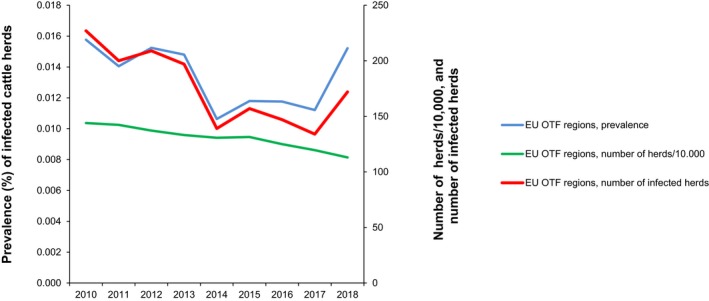
Proportion of cattle herds infected with bovine tuberculosis in OTF regions, EU, 2010–2018
- OTF: Officially bovine tuberculosis free in cattle.
During 2018 the 11 non‐OTF MS had in total, 975,453 cattle herds in non‐OTF regions and 18,801 (1.93%) were reported positive for bovine tuberculosis (Table 38). Five of these non‐OTF MS (Ireland, Italy, Portugal, Spain and the United Kingdom) had their eradication programmes co‐financed by the EU. The number of positive herds out of all herds reported by these MS in non‐OTF regions was 5,573 (4.97%) in Ireland (5,472 in 2017), 232 (0.43%) in Italy (312 in 2017), 77 (0.20%) in Portugal (87 in 2017), 2,384 (2.09) in Spain (2,461 during 2017) and 10,359 (12.23%) in the United Kingdom (10,334 in 2017). Reports concerned M. bovis except for Spain reporting M. tuberculosis complex‐positive herds. In total, 176 bovine tuberculosis‐positive herds were reported by four of the six non‐co‐financed MS (Table 38). One of these MS (Croatia) reported M. tuberculosis complex‐infected herds, two MS reported infection with M. bovis (Bulgaria and Greece), whereas Romania reported herds infected with M. tuberculosis complex or M. caprae.
From 2010 to 2018, the overall annual number (prevalence) of reported positive cattle herds in the non‐OTF regions increased from 17,814 (1.0%) to 18,801 (1.9%), respectively (Figure 35). This was a proportional respective increase by 5.5% and 84.0% of the annual number and prevalence of positive cattle herds, for that period 2010 to 2018. Concomitantly, the total number of cattle herds in those non‐OTF regions decreased by 40.5% from 1,638,694 in 2010 to 975,453 in 2018. When comparing 2018 with 2017 data, the annual number of positive cattle herds and the total number of cattle herds decreased by 0.3% and 4.6%, respectively, whereas the prevalence increased by 4.5%.
Figure 35.

Proportion of cattle herds positive for bovine tuberculosis in non‐OTF regions, EU, 2010–2018
- OTF: Officially bovine tuberculosis free in cattle.
Figure 36 displays trends during 2004–2018 in the reported prevalence of bovine tuberculosis test‐positive cattle herds in non‐OTF regions of five non‐OTF co‐financed MS and of one non‐OTF not co‐financed MS, Greece. The United Kingdom has reported in recent years an increasing prevalence of above 10% for Wales and for England, as well as for Northern Ireland. Greece, Ireland and Spain reported a low stalled prevalence between 2 and 5%, during recent years. Italy and Portugal reported very low (0.2–0.5%) stalled prevalence.
Figure 36.

Prevalence of bovine tuberculosis test‐positive cattle herds in non‐OTF regions of five co‐financed non‐OTF MSs and of one not co‐financed non‐OTF Member State Greece, 2004–2018
Bovine tuberculosis was not detected in 2018 in the non‐MS Iceland, Norway, Switzerland and Liechtenstein. Bovine tuberculosis was not detected in 2018 in the non‐MS Montenegro, whereas the Republic of North Macedonia reported 58 M. tuberculosis complex‐positive herds out of 17,592 (0.33%).
Complementary to 2018 reports from cattle, M. bovis was reported by countries in: pigs, sheep and goats, pets (cats and dogs), farmed alpacas, farmed llamas, farmed water buffalos, wild boars, badgers, wild and farmed deer and various zoo animal species such as antelopes, badgers and monkeys. M. caprae was reported in cattle and farmed deer.
5.5. Discussion
Tuberculosis due to M. bovis is a rare disease in humans in the EU because of decades of disease control in cattle and routine pasteurisation of cow's milk. Using the preliminary total number of tuberculosis cases, human M. bovis cases represented only a small proportion (0.4%) of all notified human tuberculosis cases that were reported from the 26 EU MS that reported on the causative species in 2018. The EU notification rate of M. bovis has ranged between 0.04 and 0.05 per 100,000 population between 2014 and 2018. In 2018, the notification rate of M. bovis in humans was the same in non‐OTF EU MS and OTF EU MS, but there was a larger proportion (64.9%) of cases of EU origin in non‐OTF EU MS than in OTF EU MS (42.1%).
During 2018, the overall EU proportion of cattle herds infected with, or positive for, bovine tuberculosis was 0.9%. Bovine tuberculosis was reported by 16 MS and was heterogeneous and much spatially clustered demonstrating that the situation in Europe regarding bovine tuberculosis infection, detection and control remained heterogeneous, as substantiated by EFSA (EFSA AHAW Panel, 2014).
Seventeen MS were OTF and in addition four non‐OTF MS had OTF regions. Twelve of these MS reported no case of bovine tuberculosis in cattle. In these OTF regions, the detection during 2018 of bovine tuberculosis‐infected herds remained a rare event, as in the previous years. Moreover, from 2010 to 2018, the overall annual number and prevalence of cattle herds reported infected in the OTF regions has been further steadily decreasing. Comparing 2018 with 2017 data, there were however 38 more infected herds compared with 2017, which was in major part due to France reporting 28 more infected herds for the year 2018 as compared with 2017.
All 11 non‐OTF MS except Cyprus and Malta reported detecting bovine tuberculosis during 2018 in their non‐OTF regions. From 2010 to 2018, the overall annual number of reported positive cattle herds in these non‐OTF regions proportionally increased by 5.5%, whereas the prevalence almost doubled (increase by 84.0%). Concomitantly, the total number of cattle herds in those non‐OTF regions was reduced to about half (decreased by 40.5%). When comparing 2018 with 2017 data, the annual number of positive cattle herds and the total number of cattle herds slightly decreased, whereas the prevalence slightly increased. This increase in prevalence can be partly explained by the increase in test‐positive cattle herds being detected in these regions along with an important decrease in the total number of cattle herds due to the gradual declaration of OTF status in regions within non‐OTF MS over this period. This overall increase can be further explained by the MS‐specific trends during recent years. The United Kingdom as reported an increasing prevalence of above 10% for Wales, England and Northern Ireland over recent years; Greece, Ireland and Spain reported a low stalled prevalence between 2 and 5%; whereas Italy and Portugal reported very low (0.2–0.5%) stalled prevalence. Other non‐OTF MS reported stable low to very low prevalence, to rare detection.
In the United Kingdom, M. bovis is widespread in England and Wales and in Northern Ireland and an epidemic in cattle has been ongoing for many years. A summary presentation on the situation can be found online.12 A major constraint to bovine tuberculosis eradication in cattle in those areas in which the infection is endemic in the Eurasian badger (Meles meles): this native wildlife species is a maintenance host of M. bovis. The challenge to successfully tackle bovine tuberculosis is also to address the reservoir of the disease in wildlife. There are wide regional variations in bovine tuberculosis frequency, distribution and epidemiology (largely determined by infection in badgers). Slight improvements were noted of key bovine tuberculosis epidemiological indicators in 2018 relative to 2017. Bovine tuberculosis remains one of the most serious and costly animal health problem for the UK cattle industry and taxpayer. Also Ireland has for many years faced the challenge of containing the spread of bovine tuberculosis. It introduced a badger vaccination policy in 2018 and is also, among other control measures, reducing the badger population. A summary presentation on the situation in Ireland can be found online.13
Stagnating or increasing trends in the prevalence of bovine tuberculosis‐positive cattle herds demonstrate that control and eradication of this disease is a challenge, owing to the complex interactions between the pathogen, hosts and the local environments (EFSA AHAW Panel, 2014). MS‐specific evaluations of status, trends and of the relevance of bovine tuberculosis as a source of disease for humans can be found in the 2018 Annual National Zoonoses Country Reports referenced in Section 5.5
In 2018 M. bovis was reported to be isolated – apart from bovine animals – from a wide range of animal species, both domestic and wild, reflecting that this causative agent of tuberculosis in cattle has a broad host range. M. bovis was reported to be recovered from cats and dogs. Other infected mammals such as cats, deer, wild boars and badgers can become infectious too, as can infect humans. M. caprae, recognised to cause bovine tuberculosis, was reported in cattle but also in wild boar and wild red deer. Austria reported M. caprae isolation from few bovine herds as well as from two tuberculosis cases in humans.
5.6. Related projects and Internet sources
| Subject | For more information see | |
|---|---|---|
| Humans | Surveillance Atlas | http://atlas.ecdc.europa.eu/public/index.aspx |
| EU case definitions | https://ecdc.europa.eu/en/infectious-diseases-public-health/surveillance-and-disease-data/eu-case-definitions | |
| Food‐ and waterborne diseases and zoonoses Programme | https://ecdc.europa.eu/en/about-us/who-we-are/disease-programmes/food-and-waterborne-diseases-and-zoonoses-programme | |
| European Food‐ and Waterborne Diseases and Zoonoses Network (FWD‐Net) | https://ecdc.europa.eu/en/about-us/partnerships-and-networks/disease-and-laboratory-networks/fwd-net | |
| European Tuberculosis Surveillance Network | http://ecdc.europa.eu/en/healthtopics/Tuberculosis/european_tuberculosis_surveillance_network/Pages/index.aspx | |
| Food/Animals | European Union Reference Laboratory for Bovine Tuberculosis | https://www.visavet.es/bovinetuberculosis/ |
| Summary Presentations on the situation as regards bovine tuberculosis control and eradication programmes in MSs; | https://ec.europa.eu/food/animals/health/regulatory_committee/presentations_en#20190708 | |
| Bovine tuberculosis – Austria | https://ec.europa.eu/food/sites/food/files/animals/docs/reg-com_ahw_20180712_pres_bov-bruc-erad_aut.pdf | |
| Bovine tuberculosis – Ireland | https://ec.europa.eu/food/sites/food/files/animals/docs/reg-com_ahw_20190924_bov-tub_erad_irl.pdf | |
| Bovine tuberculosis – Italy | https://ec.europa.eu/food/sites/food/files/animals/docs/reg-com_ahw_20190612_pres_bov-tub_ita.pdf | |
| Bovine tuberculosis – Malta | https://ec.europa.eu/food/sites/food/files/animals/docs/reg-com_ahw_20180228_tb_mlt.pdf | |
| Bovine tuberculosis – Portugal | https://ec.europa.eu/food/sites/food/files/animals/docs/reg-com_ahw_20190612_pres_bov-tub_por.pdf | |
| Bovine tuberculosis – Spain | https://ec.europa.eu/food/sites/food/files/animals/docs/reg-com_ahw_20190612_pres_bov-tub_esp.pdf | |
| Bovine tuberculosis – United Kingdom | https://ec.europa.eu/food/sites/food/files/animals/docs/reg-com_ahw_20190612_pres_bov-tub_gbr.pdf | |
| General information on EU Food Chain Funding | https://ec.europa.eu/food/funding_en | |
| 2003/467/EC: Commission Decision of 23 June 2003 establishing the official tuberculosis, brucellosis and enzootic‐bovine‐leukosis‐free status of certain MSs and regions of MSs as regards bovine herds (text with EEA relevance) (notified under document number C(2003) 1925) | https://eur-lex.europa.eu/eli/dec/2003/467/oj/eng | |
| General information on National Veterinary Programmes, in EU | https://ec.europa.eu/food/funding/animal-health/national-veterinary-programmes_en | |
| EU approved and co‐financed veterinary programmes for bovine tuberculosis carried out by the MS | http://ec.europa.eu/dgs/health_food-safety/funding/cff/animal_health/vet_progs_en.htm | |
| World Organisation for Animal health, Summary of Information on Bovine Tuberculosis | http://www.oie.int/fileadmin/Home/eng/Media_Center/docs/pdf/Disease_cards/BOVINE-TB-EN.pdf | |
| 2016 National Veterinary Programmes funded (co‐financed) by the EU for bovine tuberculosis (approved programmes and type of measures approved) | https://ec.europa.eu/food/sites/food/files/safety/docs/cff_animal_vet-progs_working_doc_12114_rev2_2016.pdf | |
| More information on EU approved and co‐financed eradication programmes for bovine tuberculosis in cattle carried out by the MS is available online at | http://ec.europa.eu/dgs/health_food-safety/funding/cff/animal_health/vet_progs_en.htm | |
| Annual national zoonoses country reports (reports of reporting countries on national trends and sources of zoonoses) | http://www.efsa.europa.eu/en/biological-hazards-data/reports | |
| Scientific Opinion of the EFSA Panel on Animal Health and Welfare (AHAW): Assessment of listing and categorisation of animal diseases within the framework of the Animal Health Law (Regulation (EU) No. 2016/429): bovine tuberculosis | https://www.efsa.europa.eu/en/efsajournal/pub/4959 | |
| EU Task Force on the eradication of animal diseases –bovine tuberculosis subgroup reports | https://ec.europa.eu/food/funding/animal-health/national-veterinary-programmes_en | |
| Bad Bug Book (Second Edition), Food‐borne Pathogenic Microorganisms and Natural Toxins Handbook, Center for Food Safety and Applied Nutrition, Food and Drug Administration (FDA), USA | https://www.fda.gov/food/foodborneillnesscontaminants/causesofillnessbadbugbook/ |
6. Brucella
6.1.
Tables and figures that are not presented in this section are published as supporting information to this report and are available as downloadable files at https://doi.org/10.5281/zenodo.3527706 and human tables and figures are retrievable using ECDC's Surveillance Atlas at http://atlas.ecdc.europa.eu/public/index.aspx
6.2. Key facts
In 2018, 358 confirmed brucellosis cases in humans were reported in the EU.
The EU notification rate was 0.08 cases per 100,000 population, which was the lowest notification rate reported since the beginning of the EU‐level surveillance.
Despite the declining trends, Greece, Italy, Portugal and Spain reported the highest notification rates and accounted for 70% of the brucellosis cases in the EU.
Most confirmed human cases were hospitalised and one death was reported in 2018.
No food‐borne brucellosis outbreak was reported for 2018 in EU. During 2005–2017, there were 16 FBOs due to Brucella reported in EU, of which four were due to cheeses and 12 reported due to ‘unknown’ food.
Compared with 2017, the total number of Brucella‐positive or ‐infected cattle herds, sheep flocks and goat herds in the not officially free regions further decreased by 13% and by 12%, respectively.
During recent years, the proportion of brucellosis‐positive cattle herds, sheep flocks and goat herds in not officially free regions in Italy and Portugal decreased. In Spain and Croatia, eradication of brucellosis in cattle, sheep and goats is within reach with almost no positive herds reported for these last years.
Brucellosis in cattle and in sheep and goats is still endemic in southern regions in Italy with the highest prevalence in Sicily and in Greece and Portugal. Greece reported the highest notification rate of confirmed cases in humans, 10 times higher than the EU average, while at the same time reporting an enzootic situation in animals: 1% infected cattle herds and 3% infected sheep and goats herds on the Greek islands whereas from Continental Greece data were lacking.
Brucellosis is still an animal health problem with public health relevance in southern Europe/in countries that are not officially free of brucellosis.
6.3. Surveillance and monitoring of Brucella in the EU
6.3.1. Humans
Notification of brucellosis in humans is mandatory in all MS, Iceland, Norway and Switzerland, except in Belgium that has another (not specified) system. The surveillance systems for brucellosis covers the whole population in all MS. In Belgium, full national coverage was set up in 2015 and rates before this date are not displayed. In Denmark, no surveillance system is in place for brucellosis and the disease is not notifiable nor reported at the EU level. All countries report case‐based data except Belgium and Bulgaria, which reported aggregated data. Both reporting formats were included to calculate numbers of cases, notification rates.
6.3.2. Food and animals
Brucella monitoring data from bovine animals and sheep and goats originating from the National Control and Eradication Programmes and/or Officially Free status
According to the Zoonoses Directive 2003/99/EC, MS must report bovine brucellosis and sheep and goat brucellosis annual monitoring data. These data originate from national control and surveillance programmes implemented by the MS in accordance with EU legislation. The reports submitted by the MS are based on Council Directive 64/432/EEC and subsequent legislation and are essential for the assessment of the epidemiological situation in MS and MS regions, whether declared officially brucellosis free in cattle (OBF) and/or officially B. melitensis free in sheep and goats (ObmF). Annual surveillance programmes are carried in OBF regions to confirm freedom from bovine brucellosis and in ObmF regions freedom from B. melitensis in sheep and goats, whereas in all non‐OBF and non‐ObmF regions control and eradication programmes for brucellosis in cattle and in sheep and goats are in place. These data are comparable across MS because the monitoring schemes are harmonised and the data collected and reported to EFSA originate from the census as sampling frame. In addition to trend analysis both at the EU level and at MS level and to trend watching and descriptive summaries, these data may also be used to assess the impact of control and eradication programmes (Table 1).
EU MS also need to notify outbreaks in terrestrial animals of bovine brucellosis and of caprine and ovine brucellosis (excluding Brucella ovis) in their OBF and/or ObmF regions to the EU ADNS10 and regular summaries are posted online.
Brucella monitoring data from food and animals other than bovine animals and sheep and goats
Brucella monitoring data from food and from animals other than bovine animals and sheep and goats, submitted to EFSA according to Chapter II (‘Monitoring of zoonoses and zoonotic agents’) of the Zoonoses Directive 2003/99/EC and collected without harmonised design, and allow for descriptive summaries at the EU level to be made. They preclude trend analyses and trend watching at the EU level (Table 1).
6.3.3. Food‐borne outbreaks of human brucellosis
The reporting of food‐borne brucellosis disease outbreaks in humans is mandatory according the Zoonoses Directive 2003/99/EC.
6.4. Results
6.4.1. Overview of key statistics, EU, 2014–2018
Table 39 summarises EU‐level statistics on human and animal brucellosis and on food investigated for Brucella, during 2014–2018. A more detailed description of these statistics is in the results section of this chapter and in the FBO.
Table 39.
Summary of Brucella statistics related to humans, major food categories and animals species, EU, 2014–2018
| 2018 | 2017 | 2016 | 2015 | 2014 | Data source | |
|---|---|---|---|---|---|---|
| Humans | ||||||
| Total number of confirmed cases | 358 | 378 | 530 | 437 | 460 | ECDC |
| Total number of confirmed cases/100,000 population (notification rates) | 0.08 | 0.09 | 0.11 | 0.09 | 0.09 | ECDC |
| Number of reporting MS | 26 | 26 | 27 | 27 | 27 | ECDC |
| Infection acquired in the EU | 229 | 247 | 194 | 281 | 325 | ECDC |
| Infection acquired outside the EU | 51 | 46 | 39 | 38 | 43 | ECDC |
| Unknown travel status or unknown country of infection | 78 | 85 | 297 | 118 | 92 | ECDC |
| Number of outbreak‐related cases | 0 | 2 | 0 | 2 | 7 | EFSA |
| Total number of outbreaks | 0 | 1 | 0 | 1 | 2 | EFSA |
| Food | ||||||
| Milk and milk products | ||||||
| Number of sampled units | 1,005 | 1,338 | 283 | 282 | 1,030 | EFSA |
| Number of reporting MS | 3 | 3 | 2 | 2 | 3 | EFSA |
| Animals | ||||||
| Bovine animals | ||||||
| Number of positive herds in OBF regions in OBF or non‐OBF MS | 3 | 0 | 2 | 4 | 2 | EFSA |
| Number of reporting OBF MS | 20 | 20 | 19 | 19 | 18 | EFSA |
| Number of positive herds in non‐OBF regions in non‐OBF MS | 563 | 648 | 808 | 938 | 879 | EFSA |
| Number of reporting non‐OBF MS | 8 | 8 | 9 | 9 | 10 | EFSA |
| Sheep and goats | ||||||
| Number of positive flocks/herds in ObmF regions in ObmF or non‐ ObmF MS | 0 | 7 | 2 | 10 | 3 | EFSA |
| Number of reporting ObmF MS | 20 | 20 | 20 | 20 | 19 | EFSA |
| Number of positive flocks/herds in non‐ObmF regions in ObmF MS | 620 | 815 | 870 | 1,094 | 1,133 | EFSA |
| Number of reporting non‐ObmF MS | 8 | 8 | 8 | 8 | 9 | EFSA |
ECDC: European Centre for Disease Prevention and Control; EFSA: European Food Safety Authority; MS: Member States; OBF/ObmF: Officially brucellosis free in cattle/Officially B. melitensis free in sheep and goats.
Reported food data of interest were categorised in the major category ‘milk and milk products’ and aggregated by year over the period 2013 to 2018 to get an overview, by year, of the amount of data sent. The numbers of sampled units reported and the number of reporting MS are extremely low. The annual animal data statistics displayed in Table 39 include the numbers of MS officially brucellosis free in cattle and/or officially B. melitensis free in sheep and goats and MS that are not officially free of these infections in ruminants and the number of flocks and herds remaining Brucella‐positive, during 2013–2018.
6.4.2. Humans brucellosis
In 2018, 26 MS provided data and information on brucellosis in humans. In total, 370 cases were reported in the EU. They included 358 confirmed cases, which was about the same level as in 2017. The notification rate was 0.08 cases per 100,000 population (Table 40) and this represents a slight decrease compared with 2017. Nine MS (Cyprus, Finland, Hungary, Ireland, Latvia, Lithuania, Luxembourg, Malta and Slovakia) and Iceland reported no human cases.
Table 40.
Reported human cases of brucellosis and notification rates per 100,000 population in the EU/EEA, by country and year, 2014–2018
| Country | 2018 | 2017 | 2016 | 2015 | 2014 | ||||||||
|---|---|---|---|---|---|---|---|---|---|---|---|---|---|
| National coveragea | Data formata | Total cases | Confirmed cases & rates | Confirmed cases & rates | Confirmed cases & rates | Confirmed cases & rates | Confirmed cases & rates | ||||||
| Cases | Rate | Cases | Rate | Cases | Rate | Cases | Rate | Cases | Rate | ||||
| Austria (OBF/ObmF)b | Y | C | 7 | 7 | 0.08 | 6 | 0.07 | 4 | 0.05 | 1 | 0.01 | 1 | 0.01 |
| Belgium (OBF/ObmF) | Y | A | 9 | 9 | 0.08 | 8 | 0.07 | 4 | 0.04 | 9 | 0.08 | 0 | – |
| Bulgaria | Y | A | 2 | 1 | 0.01 | 2 | 0.03 | 0 | 0.00 | 36 | 0.50 | 2 | 0.03 |
| Croatia | Y | C | 3 | 3 | 0.07 | 1 | 0.00 | 2 | 0.05 | 0 | 0.00 | 0 | 0.00 |
| Cyprus (OBF/ObmF) | Y | C | 0 | 0 | 0.00 | 0 | 0.02 | 0 | 0.00 | 0 | 0.00 | 1 | 0.02 |
| Czech Republic (OBF/ObmF) | Y | C | 4 | 4 | 0.04 | 1 | 0.01 | 1 | 0.01 | 0 | 0.00 | 0 | 0.00 |
| Denmarkc (OBF/ObmF) | – | – | – | – | – | – | – | – | – | – | – | – | – |
| Estonia (OBF/ObmF) | Y | C | 1 | 1 | 0.08 | 0 | 0.00 | 0 | 0.00 | 0 | 0.00 | 0 | 0.00 |
| Finland (OBF/ObmF) | Y | C | 0 | 0 | 0.00 | 1 | 0.02 | 0 | 0.00 | 0 | 0.00 | 1 | 0.02 |
| Franced :(OBF) | Y | C | 28 | 26 | 0.04 | 21 | 0.03 | 19 | 0.03 | 17 | 0.03 | 14 | 0.02 |
| Germany (OBF/ObmF) | Y | C | 37 | 37 | 0.04 | 41 | 0.05 | 36 | 0.04 | 44 | 0.05 | 45 | 0.06 |
| Greece | Y | C | 97 | 97 | 0.90 | 94 | 0.87 | 119 | 1.10 | 109 | 1.00 | 135 | 1.24 |
| Hungary (ObmF) | Y | C | 0 | 0 | 0.00 | 0 | 0.00 | 0 | 0.00 | 0 | 0.00 | 0 | 0.00 |
| Ireland (OBF/ObmF) | Y | C | 0 | 0 | 0.00 | 2 | 0.04 | 2 | 0.04 | 0 | 0.00 | 3 | 0.07 |
| Italye : | Y | C | 98 | 94 | 0.16 | 99 | 0.16 | 211 | 0.35 | 105 | 0.17 | 121 | 0.22 |
| Latvia (OBF/ObmF) | Y | C | 0 | 0 | 0.00 | 0 | 0.00 | 0 | 0.00 | 0 | 0.00 | 0 | 0.00 |
| Lithuania (OBF/ObmF) | Y | C | 0 | 0 | 0.00 | 0 | 0.00 | 0 | 0.00 | 0 | 0.00 | 0 | 0.00 |
| Luxembourg (OBF/ObmF) | Y | C | 0 | 0 | 0.00 | 0 | 0.00 | 1 | 0.17 | 0 | 0.00 | 0 | 0.00 |
| Malta (OBF) | Y | C | 0 | 0 | 0.00 | 0 | 0.00 | 0 | 0.00 | 0 | 0.00 | 0 | 0.00 |
| The Netherlands (OBF/ObmF) | Y | C | 5 | 5 | 0.03 | 2 | 0.01 | 5 | 0.03 | 7 | 0.04 | 1 | 0.01 |
| Poland (OBF/ObmF) | Y | C | 0 | 0 | 0.00 | 2 | 0.01 | 3 | 0.01 | 4 | 0.01 | 1 | 0.00 |
| Portugalf | Y | C | 19 | 19 | 0.18 | 16 | 0.16 | 50 | 0.48 | 46 | 0.44 | 50 | 0.48 |
| Romania (OBF/ObmF) | Y | C | 1 | 1 | 0.01 | 3 | 0.02 | 1 | 0.01 | 0 | 0.00 | 2 | 0.01 |
| Slovakia (OBF/ObmF) | Y | C | 0 | 0 | 0.00 | 1 | 0.02 | 1 | 0.02 | 1 | 0.02 | 0 | 0.00 |
| Slovenia (OBF/ObmF) | Y | C | 3 | 3 | 0.15 | 1 | 0.05 | 1 | 0.05 | 0 | 0.00 | 0 | 0.00 |
| Spaing | Y | C | 45 | 40 | 0.09 | 63 | 0.14 | 37 | 0.08 | 33 | 0.07 | 56 | 0.12 |
| Sweden (OBF/ObmF) | Y | C | 11 | 11 | 0.11 | 14 | 0.14 | 19 | 0.19 | 13 | 0.13 | 16 | 0.17 |
| United Kingdomh (ObmF) | – | – | – | – | – | – | – | 14 | 0.02 | 12 | 0.02 | 11 | 0.02 |
| EU Total | – | – | 370 | 358 | 0.08 | 378 | 0.09 | 530 | 0.11 | 437 | 0.09 | 460 | 0.09 |
| Icelandi | Y | C | 0 | 0 | 0.00 | 0 | 0.00 | 0 | 0.00 | 0 | 0.00 | 0 | 0.00 |
| Norway (OBF/ObmF) | Y | C | 3 | 3 | 0.06 | 3 | 0.01 | 4 | 0.08 | 2 | 0.04 | 2 | 0.04 |
| Switzerlandj :(OBF/ObmF) | Y | C | 5 | 5 | 0.06 | 9 | 0.11 | 7 | 0.08 | 1 | 0.01 | 3 | 0.04 |
Y: yes; N: no; A: aggregated data; C: case‐based data; –: no report.
OBF/ObmF: Officially brucellosis free in cattle/Officially B. melitensis free in sheep and goats.
No surveillance system.
In France, all but one of the continental departments are ObmF.
In Italy, 12 regions and 4 provinces are OBF and also 13 regions and 4 provinces are ObmF.
In Portugal, six islands of the Azores and the whole of the Algarve are OBF, whereas all nine Azores islands are ObmF.
In Spain, 10 autonomous communities and four provinces are OBF and 14 autonomous communities and 5 provinces are ObmF.
In the United Kingdom, England, Scotland, Wales, Northern Ireland and the Isle of Man are OBF.
In Iceland, which has no special agreement on animal health (status) with the EU, brucellosis (B. abortus, B. melitensis and B. suis) has never been reported.
Switzerland provided data directly to EFSA. The human data for Switzerland include data from Liechtenstein.
As in previous years the highest notification rates of brucellosis were reported in four MS that were non‐OBF and/or non‐ObmF (Table 38 and Table 40): Greece (0.90 cases per 100,000 population), Italy (0.16), Portugal (0.18) and Spain (0.09) together accounting for 69.8% of all confirmed cases reported in 2018. The lowest notification rates were observed in OBF and ObmF MS where brucellosis cases were mainly travel‐associated. Sweden, which has the status OBF/ObmF and had a relatively high notification rate (0.11 cases per 100,000 population) reported all confirmed brucellosis cases as travel associated.
Most brucellosis cases (81.8%) with known data on importation and travel destination were reported to be acquired in the EU (Table 39). Among the 58 travel‐associated cases with known probable country of infection, 51 (87.9%) travelled outside EU. The most common travel destinations of the imported cases outside the EU were Turkey 13 (22.4%), Iraq 15 (27.8%), Albania 4 (6.9%) and Bosnia and Herzegovina 4 (6.9%), respectively. Romania and Bulgaria were the most common destinations for travel‐related infection within the EU.
A clear seasonality was observed in the number of confirmed brucellosis cases in the EU/EEA with more cases reported from April to September. There was a significantly (p < 0.01) declining EU/EEA trend from 2009 to 2018. Three MS (Italy, Portugal and Spain) reported decreasing trends (p < 0.01), over the same period. During 2014–2018, the EU/EEA trend was not decreasing or increasing (Figure 37). Greece (p < 0.05) and Portugal (p < 0.01) reported a decreasing trend during 2014–2018. None of the countries observed an increasing trend from 2009 to 2018 or from 2014 to 2018. A high increase in number of confirmed cases in 2016 at the EU level was mainly due to increase of reported cases in one MS (Italy).
Figure 37.

Trend in reported confirmed human cases of brucellosis in the EU/EEA, by month, 2014–2018
- Source: Austria, Cyprus, the Czech Republic, Estonia, Finland, France, Germany, Greece, Hungary, Iceland, Ireland, Italy, Latvia, Lithuania, Malta, the Netherlands, Norway, Poland, Portugal, Romania, Slovakia, Slovenia, Spain and Sweden. Belgium, Bulgaria, Croatia, Luxembourg and the United Kingdom did not report data to the level of detail required for the analysis. Denmark does not have a surveillance system for this disease.
Nine MS provided data on hospitalisation, accounting for 44.4% of confirmed cases in the EU. On average, 71.1% of the confirmed brucellosis cases with known status were hospitalised. In seven of the nine countries reporting hospitalisation, the proportion of hospitalised cases ranged between 75% and 100%. One death due to brucellosis was reported by Spain in 2018 among 107 confirmed cases reported with outcome by the 10 MS (29.9% of all confirmed cases in the EU).
Brucella species information was missing for 68.4% of the 348 confirmed cases reported in the EU. Of the 110 cases with known species, 104 (94.6%) were infected by B. melitensis, six (5.5%) by B. abortus.
Figure 38 shows, for the year 2018, the number of domestically acquired confirmed brucellosis cases in humans overlaid with the prevalence of Brucella‐positive cattle, sheep and goat herds. The map shows that Greece, Italy, Portugal and Spain have a higher number of domestically acquired confirmed brucellosis cases in humans and a higher prevalence of Brucella‐positive ruminant herds.
Figure 38.

Number of domestically acquired confirmed brucellosis cases in humans and prevalence of Brucella test‐positive cattle, sheep and goat herds, EU, 2018
Human brucellosis cases associated with food‐borne outbreaks
No food‐borne or waterborne outbreak due to Brucella was reported in 2018. Table 41 summarises reported brucellosis outbreaks data during 2005–2018, by MS and by incriminated food vehicles. During 2005–2017, there were 16 FBOs due to Brucella reported in EU (no waterborne outbreaks), of which four were due to cheese and 12 reported as due to ‘unknown’ food.
Table 41.
Distribution of food‐borne outbreaks caused by Brucella, by food vehicle, EU, 2005–2018
| Food vehicle | Year | Member State | Strength of evidence of outbreak | N outbreaks | N Human cases (Illnesses) | N hospitalisations | N deaths |
|---|---|---|---|---|---|---|---|
| Cheese | 2008 | Greece (1), Spain (2) | Yes | 3 | 116 | 11 | 0 |
| Cheese | 2012 | France | Yes | 1 | 2 | 0 | 0 |
| Not Available | 2012 | Greece | No | 4 | 14 | 11 | 0 |
| Not Available | 2013 | Germany | No | 2 | 5 | 2 | 0 |
| Not Available | 2013 | Greece | No | 2 | 5 | 5 | 0 |
| Unknown | 2014 | Germany | No | 2 | 7 | 5 | 1 |
| Unknown | 2015 | Germany | No | 1 | 2 | 1 | 0 |
| Unknown | 2017 | Germany | No | 1 | 2 | 1 | 0 |
| – * | 2018 | – | – | – | – | – | – |
| Total | 16 | 153 | 36 | 1 |
FBO: food‐borne outbreak.
No FBO caused by Brucella reported.
6.4.3. Brucella in food
Very few 2018 Brucella monitoring data from food were submitted; in total from 1,009 sampling units by Italy (83.5%, N = 843), Portugal (16.0%, N = 161) and Spain (0.5%, N = 5). Data originated from raw milk from cows, ewes and goats, from milk from other animal species, from cheese and from ‘dairy products excluding cheeses’. In total, 26 Italian samples from sheep's milk tested positive to Brucella spp., by PCR.
6.4.4. Brucella in animals
Cattle
The country status of freedom from bovine brucellosis (OBF) is displayed in Table 38. Twenty MS were OBF in 2018. Of the eight non‐OBF MS, four had OBF regions:
In Italy: 12 regions and four provinces;
In Portugal: the whole of the Algarve, and six of the nine islands of the Azores;
In Spain: 10 autonomous communities and four provinces
In the United Kingdom: England, Scotland, Wales, Northern Ireland and the Isle of Man (Channel Islands Jersey and Guernsey are non‐OBF).
Four non‐OBF MS had no OBF region: Bulgaria, Croatia, Greece and Hungary.
Norway, Switzerland and Liechtenstein were OBF in accordance with EU legislation and. Iceland, which has no special agreement on animal health (status) with the EU, has never reported brucellosis due to B. abortus, B. melitensis or B. suis. Montenegro and the Republic of North Macedonia also reported data on brucellosis in their cattle.
During 2018, the overall EU proportion of cattle herds infected with, or positive for, bovine brucellosis remained a very rare event (0.03%, which was 566 out of 2,097,010 herds). Twenty‐two MS reported no case of brucellosis in cattle (Table 42). Bovine brucellosis was reported by six MS (Austria, Croatia, Greece, Italy, Portugal and Spain) and was so much spatially clustered: the infection is not reported by most MS and regions of the EU, whereas it is still present in a few MS in southern Europe with Sicily, in Italy, having the highest reported regional prevalence with 2.2% of positive herds.
Table 42.
Status of countries on bovine brucellosis and related prevalence, EU, 2018
| Member State (MS) | Officially brucellosis free in cattle | N (prevalence %) of infected herds in OBF regions | N (prevalence %) of test‐positive herds in non‐OBF regions |
|---|---|---|---|
| Austria | 2 (0.003) | – * | |
| Belgium | 0 | – | |
| Bulgaria | – | 0 | |
| Croatia | – | 1 (0.004) | |
| Cyprus | 0 | – | |
| Czech Republic | 0 | – | |
| Denmark | 0 | – | |
| Estonia | 0 | – | |
| Finland | 0 | – | |
| France | 0 | – | |
| Germany | 0 | – | |
| Greece | – | 122 (0.004) | |
| Hungary | – | 0 | |
| Ireland | 0 | – | |
| Italy | 1 (0.002) | 388 (1.286) | |
| Latvia | 0 | – | |
| Lithuania | 0 | – | |
| Luxembourg | 0 | – | |
| Malta | 0 | – | |
| Netherlands | 0 | – | |
| Poland | 0 | – | |
| Portugal | 0 | 49 (0.165) | |
| Romania | 0 | – | |
| Slovakia | 0 | – | |
| Slovenia | 0 | – | |
| Spain | 0 | 3 (0.004) | |
| Sweden | 0 | – | |
| United Kingdom | 0 | 0 | |
| EU Total | 3 (0.0002) | 563 (0.18) |
–: not applicable (no such regions).
OBF: Officially brucellosis free in cattle.
 , All regions of the MS are ObmF.
 , Not all regions of the MS are ObmF.
 , No region of the MS is ObmF.
In the EU OBF regions, there were, in total, 1,784,680 cattle herds in 2018. Austria reported to have detected brucellosis due to B. melitensis in two cattle herds. Italy reported also one positive herd. Bovine brucellosis was not detected in 2018 in the non‐MS: Iceland, Norway, Switzerland and Liechtenstein. During 2012–2018, there had been, respectively, nine, two, two, four, two, zero and two cattle herds reported infected in OBF regions, meaning that it was an extremely rare event (Figure 39).
Figure 39.
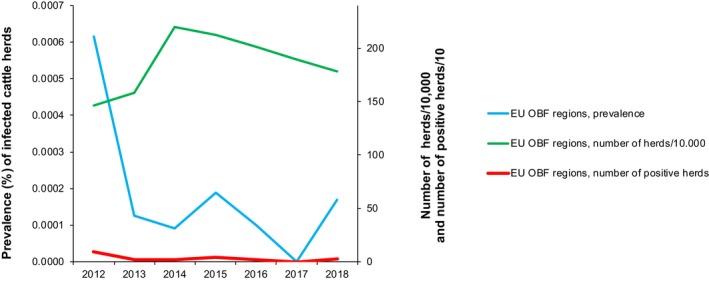
Proportion of Brucella–infected cattle herds, in OBF regions, EU, 2012–2018
- OBF: Officially brucellosis free in cattle.
During 2018, the eight non‐OBF MS had, in total, 312,330 cattle herds in their non‐OBF regions and 563 (0.18%) were reported positive for brucellosis (Table 42). Three of these non‐OBF MS (Italy, Portugal and Spain) had their eradication programmes co‐financed by the EU. The number of positive herds out of all herds reported by these MS in non‐OBF regions was: 388 in Italy (457 in 2017), 49 in Portugal (62 in 2017) and 3 in Spain (21 in 2017). Of the five non‐co‐financed non‐OBF MS, only Greece and Croatia reported infected herds: 122 (108 in 2017) and 1 (zero in 2017), respectively; whereas Bulgaria, Hungary and the United Kingdom did not report positive herds in 2018. Croatia reported for the last 3 years 2016, 2017 and 2018, respectively, zero, zero and one positive herd.
From 2012 to 2018, the overall annual number of reported positive cattle herds in the non‐OBF regions decreased by 52.3% from 1,181 to 563, whereas the prevalence increased by 77.5% from 0.10% to 0.18% (Figure 40). The latter is due to the drastic decrease in the total number of cattle herds from 1,162,978 to 312,330 during the same period, i.e. a decrease of 73.1%.
Figure 40.

Proportion of Brucella‐positive cattle herds, in non‐OBF regions, EU, 2012–2018
- Non‐OBF: Non‐officially brucellosis free in cattle.
When comparing 2018 data with 2017 data, the annual number of positive cattle herds and the prevalence decreased by 13.1% and 13.2%, respectively, whereas the total number of cattle herds increased by 0.1%.
Figure 41 displays trends during 2004–2018 in the reported prevalence of brucellosis test‐positive cattle herds in non‐OBF regions of three non‐OBF co‐financed MS (Italy, Spain and Portugal) and of one non‐OBF not co‐financed MS, Greece. The prevalence in Greece showed a huge variation across the years from a minimum 2% in 2008 to a maximum 12% in 2012. The trend in prevalence in Italy is decreasing and was 1.29% for the year 2018. Portugal and Spain showed a prevalence consistently decreasing from about 2% to below 0.2% and 0.01%, respectively, for the year 2018. Spain reported for the last 3 years 2016, 2017 and 2018, respectively, 26, 21 and 3 positive herds, meaning that in the coming years eradication of bovine brucellosis in Spain is within reach.
Figure 41.

Prevalence of Brucella test‐positive cattle herds, in Greece, Italy, Portugal and Spain, 2004–2018
The Republic of North Macedonia and Montenegro, which are pre‐accession countries, submitted national monitoring data on bovine brucellosis for the third consecutive year. The Republic of North Macedonia reported 55 positive out of 19,949 herds (0.28%) compared with 78 (0.35%) reported in 2017, whereas Montenegro did not report any positive herd in the last 2 years, out of 23,075 cattle herds present in the country.
Complementary to the 2018 national monitoring results for bovine brucellosis, the following isolates were reported from bovine animals: B. abortus biovar 3 and B. melitensis biovar 3 by Italy, and B. abortus by Serbia.
Sheep and goats
The country status of freedom from ovine and caprine brucellosis by B. melitensis (ObmF) is displayed in Table 43. Twenty MS were ObmF in 2018. Of the eight non‐ObmF MS, four had ObmF regions:
In France: all but one of the continental departments in France (due to Rev.1 vaccination against Brucella ovis) are ObmF and no cases of brucellosis have been reported in small ruminants since 2003;
In Italy: 13 regions and 4 provinces;
In Portugal: the Azores islands;
In Spain: 14 autonomous communities and 5 provinces.
Table 43.
Status of countries on ovine and caprine brucellosis and related prevalence, EU, 2018
| Member State (MS) | Officially brucellosis free in sheep and goats | N infected herds in ObmF regions | N (prevalence %) of test‐positive herds in non‐ObmF regions |
|---|---|---|---|
| Austria | 0 | – a | |
| Belgium | 0 | – | |
| Bulgaria | – | 1 (0.001%) | |
| Croatia | – | 9 (0.047%) | |
| Cyprus | 0 | – | |
| Czech Republic | 0 | – | |
| Denmark | 0 | – | |
| Estonia | 0 | – | |
| Finland | 0 | – | |
| France | 0 | 0 | |
| Germany | 0 | – | |
| Greece | – | 36 (2.592%) | |
| Hungary | 0 | – | |
| Ireland | 0 | – | |
| Italy | 0 | 311 (0.877%) | |
| Latvia | 0 | – | |
| Lithuania | 0 | – | |
| Luxembourg | 0 | – | |
| Malta | – | 0 | |
| Netherlands | 0 | – | |
| Poland | 0 | – | |
| Portugal | 0 | 260 (0.490%) | |
| Romania | 0 | – | |
| Slovakia | 0 | – | |
| Slovenia | 0 | – | |
| Spain | 0 | 3 (0.006%) | |
| Sweden | 0 | – | |
| United Kingdom | 0 | – | |
| EU Total | 0 | 620 (0.14) |
ObmF: Officially brucellosis free in cattle.
–: not applicable (no such regions).
 , All regions of the MS are ObmF.
 , Not all regions of the MS are ObmF.
 , No region of the MS is ObmF.
Four non‐ObmF MS had no ObmF region: Bulgaria, Croatia, Greece and Malta.
Norway, Switzerland and Liechtenstein were ObmF in accordance with EU legislation. Iceland, which has no special agreement on animal health (status) with the EU, has never reported brucellosis due to B. abortus, B. melitensis or B. suis. Montenegro and the Republic of North Macedonia also reported data on brucellosis in their sheep and goat herds.
During 2018, the overall EU proportion of sheep and goat herds infected with or positive for B. melitensis remained a very rare event (0.05%, which was 620 out of 1,275,868 herds). Twenty‐two MS reported no case of B. melitensis brucellosis in sheep and goat herds (Table 43). B. melitensis cases in sheep and goats herds were reported by six MS (Bulgaria, Croatia, Greece, Italy, Portugal and Spain) and was so much spatially clustered; the infection was not reported by most MS and regions of the EU, whereas it was still present in a few MS in southern Europe with Sicily, in Italy, having the highest reported regional prevalence with 2.4% of positive herds.
In the EU ObmF regions, there were in total 910,191 sheep and goat herds in 2018 and no case of B. melitensis in these herds was reported during 2018. B. melitensis was also not reported in 2018 by the non‐MS: Iceland, Norway, Switzerland and Liechtenstein. During 2012–2018, there has been, respectively, 5, 4, 3, 10, 2, 7 and 0 sheep and goat herds reported infected in ObmF regions, meaning it was an extremely rare event (Figure 42).
Figure 42.

Proportion of sheep flocks and goat herds infected with B. melitensis, in ObmF regions, EU, 2012–2018
- ObmF: Officially B. melitensis free in sheep and goats.
During 2018, the eight non‐ObmF MS had, in total, 448,660 sheep and goat herds in their non‐ObmF regions and 620 (0.14%) were reported positive to B. melitensis (Table 43). Five of these non‐ObmF MS (Croatia, Greece, Italy, Portugal and Spain) had their eradication programmes co‐financed by the EU. The number of positive flocks/herds reported by these MS was: nine in Croatia (5 in 2017), Greece 36 (27 in 2017), 311 in Italy (362 in 2017), 260 in Portugal (396 in 2017) and 3 in Spain (18 in 2017). Of the three non‐co‐financed non‐ObmF MS, Bulgaria reported one infected flock (six in 2017) whereas France and Malta did not report any positive case in 2018.
From 2012 to 2018, the overall annual number of reported positive sheep and goat herds in the non‐ObmF regions decreased by 63.4% from 1,693 to 620, whereas the prevalence decreased by 62.2% from 0.45% to 0.17% (Figure 43). The total number of sheep and goat herds decreased by 3.2% from 377,690 to 365,677 during the same period.
Figure 43.

Proportion of sheep flocks and goat herds positive for B. melitensis, in non‐ObmF regions, EU, 2012–2018
- Non‐ObmF: Non‐officially B. melitensis free in sheep and goats.
When comparing 2018 with 2017 data, the annual number of B. melitensis‐positive sheep and goat herds and the prevalence decreased by 11.5% and 14.8%, respectively, whereas the total number of herds increased by 5.4%.
Figure 44 displays trends during 2004–2018 in the reported prevalence of B. melitensis test‐positive sheep and goat herds in non‐ObmF regions of five non‐ObmF co‐financed MS. It is of note that, in 2016 and 2017, only vaccination was co‐financed in Greece. Also, for Greece, the monitoring data reported on brucellosis in sheep and goats are exclusively from the eradication programme that runs in the Greek islands. The prevalence in Greece showed a huge variation across years from a minimum 0.4% in 2015 to a maximum of 8.6% in 2012.
Figure 44.

Prevalence of Brucella melitensis test‐positive sheep and goat herds, in three co‐financed MS: Italy, Portugal and Spain, 2004–2018
Italy and Portugal reported a low (> 1–10%) to very low (0.1–1%) prevalence during this period, decreasing for both MS. Croatia and Spain reported a very low prevalence (0.1–1%) to a rare detection (< 0.1%) and both decreasing. Croatia and Spain reported for the last 3 years 2016, 2017 and 2018, respectively, 8, 5 and 9 and 49, 18 and 3 B. melitensis‐positive herds.
The Republic of North Macedonia and Montenegro, which are pre‐accession countries, submitted national monitoring data on ovine and caprine brucellosis for the third consecutive year. The former reported 112 positive out of 7,349 herds (1.5%) compared with 97 (1.2%) in 2017, whereas Montenegro did not report any positive flock or herd in the last 2 years, out of 6,966 sheep flocks and goat herds present in the country.
Complementary to the 2018 national monitoring results for ovine and caprine brucellosis, Italy reported B. ovis isolates from sheep.
Complementary to 2018 reports from cattle and from sheep and goats, Brucella species were reported from a wide range of animal species; Brucella spp. from breeding pigs and farmed water buffalos; B. abortus from pigs and wild boar; B. suis notably biovar 2 from wild deer, wild hares, breeding pigs, pigs from mixed herds not raised under controlled housing conditions, wild Pyrenean chamois and wild boars; B. canis from dogs (pet); B. ceti from dolphin; and unspecified Brucella species from breeding pigs, farmed water buffalos, wild badgers, wild deer, dogs (pet), dolphin, wild hares, pigs and boars (farmed and wild).
6.5. Discussion
Brucellosis is a rare disease in the EU, although severe with most of the human cases hospitalised. In 2018, the number of reported cases of brucellosis in humans and the EU notification rate was at the lowest level since the beginning of EU‐level surveillance in 2007. During 2018, the highest notification rates and most of the domestic brucellosis cases were reported from four MS (Greece, Italy, Portugal and Spain) that are not officially brucellosis free in cattle, sheep or goats. These four MS consistently reported the highest notification rates within the EU. Despite declining trends in Italy, Portugal and Spain since 2009 and in Greece since 2014, these four countries account for 70% of all confirmed brucellosis cases in the EU. Greece continued reporting notification rate over ten times higher than in average in the EU. A general decrease of cases has been notified in all regions in Italy in the last twenty years, however brucellosis remains an important health problem particularly in southern part of the country, reporting 89% of the annual cases (Facciolà et al., 2018). The most recent data on the incidence of brucellosis in south‐east Europe (Balkan countries) proved the persistence of brucellosis in the area. Bulgaria reported re‐emergence of brucellosis to the country, most probably related to import of infection from endemic areas in the near neighbouring countries, Greece and Macedonia (Karcheva et al., 2017). In the peak of human cases in 2015, the main risk factor was direct contact with sick animals and/or consumption of non‐pasteurised milk and milk products. In Croatia, cases have been sporadic and low in prevalence, and emerged only in animals and humans living close to the border of Bosnia and Herzegovina. These findings support the assumption that the illegal importation of animals is the main source of brucellosis in the country (Duvnjak et al., 2018). Non‐food‐borne transmission of brucellosis to humans also happens by direct contact with infected animals. Persons working with farm animals, including farmers, livestock breeders, butchers, abattoir workers and veterinarians, are known to be at increased risk of brucellosis in the endemic countries. A largest proportion of the human cases in EU MS occurred in working‐age males, possibly indicating occupational exposure. This finding is in agreement with a recent study in Greece by Fouskis et al. (2018), in which male patients was found to be related to high‐risk jobs and animal contact, while brucellosis in females was related to recent consumption of dairy products. These findings underline that brucellosis is still an animal health problem with public health relevance in some southern and south‐eastern EU MS.
Bovine brucellosis and ovine and caprine brucellosis have been eradicated by most EU MS and in the EU regions officially free from bovine brucellosis and ovine and caprine brucellosis, no infected herds were reported for the year 2018, except for two B. melitensis–infected cattle herds in Austria. As a result, human brucellosis has become quite rare in northern and western Europe, where most cases are travel associated. Imported cases are mainly in travellers, although an increased disease incidence may occur in recently arrived migrants in some MS (Norman et al., 2016; Georgi et al., 2017; Johansen et al., 2018), a large part arriving from endemic countries (Africa and Middle East). Since 2014, a significant increase of imported infections caused by B. melitensis has been noticed in Germany in patients predominantly originated from Middle East including Turkey and Syria (Georgi et al., 2017). The human B. melitensis cases that occurred in Sweden during the period 2008–2012 reflected the Swedish migration trends of groups from Iraq, Afghanistan and Somalia (Garofolo et al., 2016). Results from the national surveillance in France indicated that the most frequent at‐risk countries visited by human cases reported during the period 2004–2013 were mainly Mediterranean countries (Algeria, Turkey, Portugal, Morocco and Tunisia) (Mailles et al., 2016). Investigation of brucellosis in Norwegian patients from 1999 to 2016 demonstrated that cases were linked to travelling and migration from the Middle East, Asia or Africa, which in accordance with results from other countries and reflects similar travelling and migration patterns in northern Europe (Johansen et al., 2018).
As regards autochthonous human food‐borne illnesses in MS that are officially free of brucellosis, the question is raised as to the origin of these infections. Food‐borne exposure is normally limited to persons consuming unpasteurised milk, dairy products or undercooked meat from countries where brucellosis in animals is endemic. A recent study published by Jansen et al. (2019) based on samples from 2011 in Germany found Brucella‐positive raw milk cheeses being available at German retail level, so putting consumers at risk without travel history to endemic countries. They hypothesised that in Germany, which is officially free of Brucella in cattle, sheep and goats populations, there are uncontrolled imports of cheese (from endemic regions) that do not comply with food safety standards.
Reported food‐borne disease outbreaks due to Brucella have also become rare in large areas of the EU and for the year 2018 no single FBO due to Brucella was reported by the MS.
In food, very few monitoring data were reported during these last years by few non‐officially free MS Italy, Portugal and Spain. Only Italy reported positive findings in pasteurised milk ‘from other animal species or unspecified’ at processing plants.
In the EU non‐OBF regions the overall number of positive herds and prevalence of bovine brucellosis decreased both by 13% 2018 compared with 2017, whereas in sheep and goats in the non‐ObmF regions those proportions, respectively, decreased by 12% and 15% compared with 2017. At the level of the MS, the temporal trends of bovine, ovine and caprine brucellosis in not officially free regions in Italy and Portugal decreased in recent years. In Spain and Croatia, there were almost no positive herds reported these last years for these infections.
Bovine brucellosis and brucellosis due to B. melitensis in sheep and goat herds however remain endemic in southern regions in Italy with highest prevalence in Sicily and in Greece and Portugal. Greece reported the highest notification rate of confirmed cases in humans, 10 times higher than the EU average, while at the same time reporting an enzootic situation in animals: 1% infected cattle herds are 3% infected sheep and goats herds on the Greek islands whereas from Continental Greece data were lacking. The situation in Greece is however peculiar as vaccination programmes run against both brucellosis in cattle (in mountainous areas) and sheep and goats (on the mainland and some bigger islands). The reported Greek data pertain to unvaccinated areas and varied considerably from one year to another, which could be explained by the low number of reported tested samples compared to the ruminant population. As such, these data are less comparable with data from officially free regions from Italy, Portugal and Spain, because these MS apply the same monitoring programme with an exhaustive coverage of the national herd.
In‐depth information on the specific prevalence situations and their trends in the MS – and of brucellosis in cattle and sheep and goat as a source for humans – can be found in the 2018 Annual National Zoonoses Country Reports referenced in Section 5.5
In 2018, Brucella spp. were reported to be isolated from a wide range of animal species, both domestic and wild, reflecting the broad host range, primarily in mammals. France, bovine brucellosis officially free since 2005 with no cases reported in domestic/wild ruminants since 2003, reported isolations of B. melitensis from wild mountain goats (Alpine ibex or Capra ibex). Previously, Mick et al. (2014) reported on the risk of transmission to livestock and spill over of B. melitensis from wildlife to domestic ruminants and the sustainability of infection in Alpine ibex in a well‐delineated mountain area in the French Alps. To get insight into brucellosis in dogs in Europe, the database in Germany of a veterinary diagnostic laboratory which received samples from dogs for B. canis testing from 20 European countries, was investigated (2011–2016) (Buhmann et al., 2019). The laboratory received samples from 20 European countries for Brucella testing in dogs: 3.7% of submitted samples were Brucella spp. PCR‐positive (61/1,657), and B. canis antibodies were identified in 5.4% of submitted samples (150/2,764). Brucella spp. PCR‐positive samples originated from Spain (11.1% of submitted samples), Poland (6.7% of submitted samples) and rarely from Italy and France. Samples with B. canis antibodies originated from 13 European countries (Sweden, Belgium, Austria, Switzerland, Italy, Finland, Germany, Denmark, Hungary, Norway, Poland, France and the Netherlands). Buhman et al. concluded that infection with B. canis needs to be considered in dogs in Europe. Finally, in 2017, a strain of Brucella was isolated for the first time in animals from a French farm producing frogs for human consumption and identified as B. microti‐like. Following this first isolation, investigations were performed and high B. microti‐like prevalence values (higher than 90%) were obtained in frog samples in the commercial farm, and its presence was highlighted in the environmental samples except feed. These results showed that B. microti‐like organisms are able to colonise amphibians and persist in their environment. Its presence could constitute a possible risk for consumers and workers proving the importance of assessing (Jaÿ et al., 2019).
6.6. Related projects and Internet sources
| Subject | For more information see | |
|---|---|---|
| Humans | Surveillance Atlas | http://atlas.ecdc.europa.eu/public/index.aspx |
| EU case definitions | https://ecdc.europa.eu/en/infectious-diseases-public-health/surveillance-and-disease-data/eu-case-definitions | |
| Food‐ and waterborne diseases and zoonoses Programme | https://ecdc.europa.eu/en/about-us/who-we-are/disease-programmes/food-and-waterborne-diseases-and-zoonoses-programme | |
| European Food‐ and Waterborne Diseases and Zoonoses Network (FWD‐Net) | https://ecdc.europa.eu/en/about-us/partnerships-and-networks/disease-and-laboratory-networks/fwd-net | |
| Animals | EURL for Brucella | https://eurl-brucellosis.anses.fr/ |
| Summary Presentations on the situation as regards bovine brucellosis and brucellosis in sheep and goats control and eradication programmes in MSs | https://ec.europa.eu/food/animals/health/regulatory_committee/presentations_en#20190919 | |
| Brucellosis eradication – Croatia | https://ec.europa.eu/food/sites/food/files/animals/docs/reg-com_ahw_20190612_pres_bruc_hrv.pdf | |
| Brucellosis eradication – Greece | https://ec.europa.eu/food/sites/food/files/animals/docs/reg-com_ahw_20190612_pres_brucellosis-grc.pdf | |
| Brucellosis eradication – Italy | https://ec.europa.eu/food/sites/food/files/animals/docs/reg-com_ahw_20190612_pres_bruc_ita.pdf | |
| Brucellosis eradication – Portugal | https://ec.europa.eu/food/sites/food/files/animals/docs/reg-com_ahw_20190612_pres_bruc_por.pdf | |
| Brucellosis eradication – Spain | https://ec.europa.eu/food/sites/food/files/animals/docs/reg-com_ahw_20190612_pres_bov-bruc_esp.pdf and https://ec.europa.eu/food/sites/food/files/animals/docs/reg-com_ahw_20190612_pres_bruc_esp.pdf | |
| General information on EU Food Chain Funding | https://ec.europa.eu/food/funding_en | |
| 2003/467/EC: Commission Decision of 23 June 2003 establishing the official tuberculosis, brucellosis and enzootic‐bovine‐leukosis‐free status of certain MSs and regions of MSs as regards bovine herds (Text with EEA relevance) (notified under document number C(2003) 1925) | https://eur-lex.europa.eu/eli/dec/2003/467/oj/eng | |
| 93/52/EEC: Commission Decision of 21 December 1992 recording the compliance by certain MSs or regions with the requirements for brucellosis (B. melitensis) and according them the status of a Member State or region officially free of the disease | https://eur-lex.europa.eu/eli/dec/1993/52/oj/eng | |
| General information on National Veterinary Programmes, in EU | https://ec.europa.eu/food/funding/animal-health/national-veterinary-programmes_en | |
| EU approved and co‐financed veterinary programmes for bovine brucellosis and brucellosis in sheep and goats carried out by the MS | http://ec.europa.eu/dgs/health_food-safety/funding/cff/animal_health/vet_progs_en.htm | |
| World Organisation for Animal health, Summary of Information on Brucellosis | http://www.oie.int/fileadmin/Home/eng/Media_Center/docs/pdf/Disease_cards/BCLS-EN.pdf | |
| 2016 National Veterinary Programmes funded (co‐financed) by the EU for bovine brucellosis and in ovine and caprine animals brucellosis (approved programmes and type of measures approved) | https://ec.europa.eu/food/sites/food/files/safety/docs/cff_animal_vet-progs_working_doc_12114_rev2_2016.pdf | |
| EU Task Force on the eradication of animal diseases – Brucellosis subgroup reports | https://ec.europa.eu/food/funding/animal-health/national-veterinary-programmes_en | |
| Bad Bug Book (Second Edition), Food‐borne Pathogenic Microorganisms and Natural Toxins Handbook, Center for Food Safety and Applied Nutrition, Food and Drug Administration (FDA), USA | https://www.fda.gov/food/foodborneillnesscontaminants/causesofillnessbadbugbook/ |
7. Trichinella
7.1.
Tables and figures that are not presented in this section are published as supporting information to this report and are available as downloadable files at https://doi.org/10.5281/zenodo.3527706 and human tables and figures are retrievable using ECDC's Surveillance Atlas at http://atlas.ecdc.europa.eu/public/index.aspx
7.2. Key facts
In 2018, 66 confirmed trichinellosis cases in humans were reported in the EU.
The EU notification rate was 0.01 cases per 100,000 population, which was the lowest notification rate reported since the beginning of EU‐level surveillance.
Bulgaria reported the highest notification rate, followed by Romania.
There were in total in EU 114 trichinellosis food‐borne human cases reported to EFSA for 2018, due to 10 FBOs, which were mostly caused by pig meat and products thereof, as during previous years.
Trichinella spiralis was the only species reported to TESSy and originated from the reported confirmed cases from three MS. Trichinella britovi was reported to EFSA as the causative agent of an outbreak in Romania due to wild boar meat.
In 2018, no infection with Trichinella was reported in tested fattening pigs (76.6 million) and breeding pigs (0.5 million) kept under controlled housing conditions, confirming that the farming conditions are the key factor to prevent these pigs to be infected with this zoonosis.
In pigs not kept under controlled housing conditions, 0.0002% (248 out of 128.5 million) fattening pigs and 0.0003% (74 out of 25.1 million) breeding pigs tested positive to Trichinella. Romania accounted for most of these positive pigs followed by Croatia, Poland, Italy, Spain and France. Also during 2014–2018, these Trichinella infections were from free‐range and backyard pigs reared in rural EU regions.
No Trichinella infections were observed in domestic solipeds in the EU in 2018, as during previous years (2015–2017).
In total, 1,293 (0.09%) hunted wild boars tested positive. From 2014 to 2018, the reported EU prevalence of Trichinella‐positive wild boars fluctuated from one year to another, not exceeding 0.13%.
In 2018, the proportion of Trichinella‐positive red foxes (indicator animals) was 1.6%. From 2014 to 2018, the reported overall proportion fluctuated from one year to another, not exceeding 1.6%.
7.3. Surveillance and monitoring of Trichinella in the EU
7.3.1. Humans
The notification of Trichinella infections in humans is mandatory in all MS, Iceland, Norway and Switzerland, except in three MS (Belgium, France and the United Kingdom) having voluntary surveillance systems. No surveillance system for trichinellosis exists in Denmark. The surveillance systems for trichinellosis covers the whole population in all MS except in Belgium. All countries report case‐based data except Belgium and Bulgaria, which reported aggregated data. Both reporting formats were included to calculate numbers of cases and notification rates.
In humans, diagnosis of Trichinella infections is primarily based on clinical signs and symptoms and serology (indirect enzyme‐linked immunosorbent assay (i‐ELISA) and western blot) Histopathology on muscle biopsies is rarely performed.
7.3.2. Animals
Trichinella monitoring data from domestic pigs (both fattening and breeding animals), farmed wild boar and solipeds
According to the Commission Regulation No. 2015/1375 14, all Trichinella susceptible animals intended for human consumption in the EU, i.e. domestic pigs (both fattening and breeding animals), farmed wild boar and solipeds, should be tested for the presence of Trichinella larvae in the muscles unless carcasses are appropriately frozen to inactivate the parasite. It follows that data on Trichinella infections in these animals are comparable across MS because the monitoring schemes are harmonised and the data collected and reported to EFSA originate from census sampling. Domestic pigs, farmed and hunted wild boar and other wild animals (e.g. bears) that are not placed on the EU market (e.g. intended for own consumption) are exempted from the Commission Regulation No. 1375/2015 and their control falls under the national legislation. Commission Regulation (EU) No. 1375/2015 states that reporting of data for domestic swine shall, at least, provide specific information related to number of animals tested that were raised under controlled housing conditions as well as the number of breeding sows, boars and fattening pigs tested. Further, the Regulation states that a negligible risk status for a country or region is no longer recognised.
Trichinella monitoring data from animals other than domestic pigs, farmed wild boar and solipeds
MS should monitor the circulation of these nematodes in the main natural reservoir hosts (carnivore and omnivore animals) to acquire information on the risk of transmission to domestic animals and from these to humans and on introduction of new Trichinella species from non‐EU countries. However, monitoring data provided by the MS to EFSA are generated by non‐harmonised monitoring schemes across MS and for which no mandatory reporting requirements exist. As the main reservoir hosts of Trichinella are wild animals, their biology and ecology vary from one MS to another and from one region or habitat in the same MS to another due to the human and environmental impact on the ecosystems, resulting in different transmission patterns and prevalence of infection. Therefore, data from Trichinella in wild animals are not fully comparable between MS and the reported findings must therefore be interpreted with caution. These data allow descriptive summaries at the EU level but preclude subsequent data analysis such as assessing temporal and spatial trends.
7.3.3. Food‐borne outbreaks of human trichinellosis
The reporting of food‐borne trichinellosis disease outbreaks in humans is mandatory according to Zoonoses Directive 2003/99/EC.
7.4. Results
7.4.1. Overview of key statistics along the food chain, EU, 2014–2018
Table 44 summarises EU‐level statistics on human trichinellosis and on Trichinella in animals, during 2014–2018. Animal data of interest reported were classified into the major categories and aggregated by year to get an annual overview of the volume of data submitted.
Table 44.
Summary of Trichinella statistics related to humans and most important animal species, EU, 2014–2018
| 2018 | 2017 | 2016 | 2015 | 2014 | Data source | |
|---|---|---|---|---|---|---|
| Humans | ||||||
| Total number of confirmed cases | 66 | 168 | 101 | 155 | 324 | ECDC |
| Total number of confirmed cases/100,000 population (notification rates) | 0.01 | 0.03 | 0.02 | 0.03 | 0.06 | ECDC |
| Number of reporting MS | 27 | 27 | 27 | 27 | 27 | ECDC |
| Domestic EUa | 18 | 81 | 53 | 126 | 40 | ECDC |
| Non‐EU countriesb | 1 | 2 | 1 | 0 | 0 | ECDC |
| Unknown travel/importation | 47 | 85 | 47 | 29 | 284 | ECDC |
| Number of outbreak‐related cases | 114 | 199 | 27 | 123 | 187 | EFSA |
| Total number of outbreaks | 10 | 11 | 7 | 17 | 17 | EFSA |
| Animals | ||||||
| Domestic pigs RCHC c : | ||||||
| Number of unitsd tested | 77,795,253 | 72,227,074 | 62,594,969 | 55,329,437 | 32,184,427 | EFSA |
| % positive units | 0 | 0 | 0.00005 | 0 | 0.0004 | EFSA |
| Number of reporting MS | 15 | 14 | 16 | 14 | 10 | EFSA |
| Domestic pigs NRCHC e : | ||||||
| Number of units tested | 153,003,923 | 124,689,434 | 124,496,074 | 53,136,580 | 70,490,399 | EFSA |
| % positive units | 0.0002 | 0.0002 | 0.0002 | 0.0003 | 0.0001 | EFSA |
| Number of reporting MS | 25 | 25 | 24 | 16 | 16 | EFSA |
| Farmed wild boar: | ||||||
| Number of units tested | 6,343 | 17,799 | 31,039 | 32,360 | 41,710 | EFSA |
| % positive units | 0 | 0.7 | 0.3 | 0 | 0.2 | EFSA |
| Number of reporting MS | 7 | 8 | 8 | 9 | 10 | EFSA |
| Hunted wild boar: | ||||||
| Number of units tested | 1,465,788 | 1,398,905 | 1,400,393 | 875,539 | 891,159 | EFSA |
| % positive units | 0.09 | 0.09 | 0.05% | 0.07 | 0.13 | EFSA |
| Number of reporting MS | 23 | 22 | 20 | 20 | 20 | EFSA |
| Red foxes: | ||||||
| Number of animals tested | 6,612 | 6,486 | 7,785 | 7,902 | 10,447 | EFSA |
| % positive animals | 1.6 | 1.2 | 0.9 | 1.6 | 1.2 | EFSA |
| Number of reporting MS | 10 | 11 | 12 | 11 | 13 | EFSA |
ECDC: European Centre for Disease Prevention and Control; EFSA: European Food Safety Authority; MS: Member State.
Infections acquired in EU.
Infections acquired outside EU.
RCHC: raised under controlled housing conditions.
Units: animals and/or slaughter animal batches.
NRCHC: not raised under controlled housing conditions.
More detailed descriptions of these statistics are in the results section of this chapter and in the chapter on FBO.
7.4.2. Trichinellosis in humans
In 2018, 85 cases of trichinellosis, including 66 confirmed cases, were reported in 27 MS (Tables 44 and 45). The EU notification rate was 0.01 cases per 100,000 population, which represented a decrease of 66.7% compared with 2017 (0.03 cases per 100,000 population) and mainly due to the lower number of confirmed cases in Romania (−23), Croatia (−21) and Bulgaria (−10). In 2018, Bulgaria had the highest notification rate in the EU (0.64 cases per 100,000), followed by Romania (0.05 cases per 100,000 population). Together, Bulgaria and Romania accounted for 83.3% of all confirmed cases reported at the EU level in 2018. Nineteen MS reported zero confirmed cases in 2018 including four MS (Cyprus, Finland, Luxembourg and Malta) that have never reported any trichinellosis cases. Three other countries (the Czech Republic, the Netherlands and the United Kingdom) have reported only one case each since the beginning of EU‐level surveillance in 2007.
Table 45.
Reported human cases of trichinellosis and notification rates per 100,000 population in the EU/EEA, by country and year, 2014–2018
| Country | 2018 | 2017 | 2016 | 2015 | 2014 | ||||||||
|---|---|---|---|---|---|---|---|---|---|---|---|---|---|
| National coveragea | Data formata | Total cases | Confirmed cases & rates | Confirmed cases & rates | Confirmed cases & rates | Confirmed cases & rates | Confirmed cases & rates | ||||||
| Cases | Rate | Cases | Rate | Cases | Rate | Cases | Rate | Cases | Rate | ||||
| Austria | Y | C | 2 | 2 | 0.02 | 3 | 0.03 | 2 | 0.0 | 0 | 0.00 | 0 | 0.00 |
| Belgiumb | N | A | 3 | 0 | – | 0 | – | 0 | – | 0 | – | 16 | – |
| Bulgaria | Y | A | 45 | 45 | 0.64 | 55 | 0.77 | 35 | 0.49 | 22 | 0.31 | 60 | 0.83 |
| Croatia | Y | C | 0 | 0 | 0.00 | 21 | 0.51 | 5 | 0.12 | 3 | 0.07 | 3 | 0.07 |
| Cyprus | Y | C | 0 | 0 | 0.00 | 0 | 0.00 | 0 | 0.00 | 0 | 0.00 | 0 | 0.00 |
| Czech Republic | Y | C | 0 | 0 | 0.00 | 0 | 0.00 | 0 | 0.00 | 0 | 0.00 | 0 | 0.00 |
| Denmarkc | – | – | – | – | – | – | – | – | – | – | – | – | – |
| Estonia | Y | C | 0 | 0 | 0.00 | 0 | 0.00 | 0 | 0.00 | 2 | 0.15 | 0 | 0.00 |
| Finland | Y | C | 0 | 0 | 0.00 | 0 | 0.00 | 0 | 0.00 | 0 | 0.00 | 0 | 0.00 |
| France | Y | C | 0 | 0 | 0.00 | 8 | 0.01 | 3 | 0.00 | 3 | 0.00 | 0 | 0.00 |
| Germany | Y | C | 0 | 0 | 0.00 | 2 | 0.00 | 4 | 0.00 | 3 | 0.00 | 1 | 0.00 |
| Greece | Y | C | 0 | 0 | 0.00 | 1 | 0.01 | 0 | 0.00 | 0 | 0.00 | 0 | 0.00 |
| Hungary | Y | C | 2 | 2 | 0.02 | 0 | 0.00 | 0 | 0.00 | 0 | 0.00 | 0 | 0.00 |
| Ireland | Y | C | 0 | 0 | 0.00 | 0 | 0.00 | 0 | 0.00 | 0 | 0.00 | 0 | 0.00 |
| Italy | Y | C | 2 | 2 | 0.00 | 4 | 0.01 | 5 | 0.01 | 36 | 0.06 | 4 | 0.01 |
| Latvia | Y | C | 1 | 1 | 0.05 | 1 | 0.05 | 1 | 0.05 | 4 | 0.20 | 5 | 0.25 |
| Lithuania | Y | C | 0 | 0 | 0.00 | 9 | 0.32 | 1 | 0.03 | 21 | 0.72 | 5 | 0.17 |
| Luxembourg | Y | C | 0 | 0 | 0.00 | 0 | 0.00 | 0 | 0.00 | 0 | 0.00 | 0 | 0.00 |
| Malta | Y | C | 0 | 0 | 0.00 | 0 | 0.00 | 0 | 0.00 | 0 | 0.00 | 0 | 0.00 |
| Netherlands | Y | C | 0 | 0 | 0.00 | 0 | 0.00 | 0 | 0.00 | 0 | 0.00 | 0 | 0.00 |
| Poland | Y | C | 2 | 2 | 0.01 | 9 | 0.02 | 4 | 0.01 | 1 | 0.00 | 6 | 0.02 |
| Portugal | Y | C | 0 | 0 | 0.00 | 1 | 0.01 | 0 | 0.00 | 0 | 0.00 | 0 | 0.00 |
| Romania | Y | C | 25 | 10 | 0.05 | 48 | 0.24 | 26 | 0.13 | 55 | 0.28 | 221 | 1.11 |
| Slovakia | Y | C | 0 | 0 | 0.00 | 1 | 0.02 | 1 | 0.02 | 1 | 0.02 | 0 | 0.00 |
| Slovenia | Y | C | 0 | 0 | 0.00 | 0 | 0.00 | 0 | 0.00 | 0 | 0.00 | 0 | 0.00 |
| Spain | Y | C | 3 | 2 | 0.00 | 5 | 0.01 | 12 | 0.03 | 3 | 0.01 | 1 | 0.00 |
| Sweden | Y | C | 0 | 0 | 0.00 | 0 | 0.00 | 2 | 0.02 | 1 | 0.01 | 1 | 0.01 |
| United Kingdom | Y | C | 0 | 0 | 0.00 | 0 | 0.00 | 0 | 0.00 | 0 | 0.00 | 1 | 0.00 |
| EU Total | – | – | 85 | 66 | 0.01 | 168 | 0.03 | 101 | 0.02 | 155 | 0.03 | 324 | 0.06 |
| Iceland | Y | C | 0 | 0 | 0.00 | 0 | 0.00 | 0 | 0.00 | 0.0 | 0.00 | 0 | 0.00 |
| Norway | Y | C | 0 | 0 | 0.00 | 0 | 0.00 | 0 | 0.00 | 0.0 | 0.00 | 0 | 0.00 |
| Switzerlandd | Y | C | 0 | 0 | 0.00 | 1 | 0.01 | 0 | 0.00 | 2 | 0.02 | 0 | 0.00 |
Y: yes; N: no; A: aggregated data; C: case‐based data; –: no report.
Sentinel surveillance, disease not under formal surveillance. Notification not calculated.
No surveillance system.
Switzerland provided data directly to EFSA. The human data for Switzerland include data from Liechtenstein.
In 2018, only 18 cases (27.2%) of trichinellosis cases with known travel status were reported to be domestically acquired. Two MS reported three travel‐associated trichinellosis cases of which two cases were infected within EU and one case infected outside EU. In 47 cases (71.2%) no information was reported on importation and travel destination (Table 44).
The EU/EEA trend from 2009 to 2018 in confirmed cases of trichinellosis was substantially influenced by a number of smaller and larger outbreaks, often with peaks in January–February (Figure 45). The EU trend was significantly decreasing (p < 0.01) in 2014–2018. Between 2009 and 2018, Romania was the only country reporting a decreasing trend. No significant increasing trends were observed for any country during 2009–2018.
Figure 45.

Trend in reported confirmed human cases of trichinellosis in the EU/EEA by month, 2009–2018
- Source: Austria, Cyprus, the Czech Republic, Estonia, Finland, Germany, France, Greece, Hungary, Ireland, Italy, Latvia, Lithuania, Luxembourg, Malta, the Netherlands, Norway, Poland, Portugal, Romania, Slovakia, Slovenia, Spain, Sweden and the United Kingdom. Belgium, Bulgaria, Croatia and Iceland did not report data to the level of detail required for the analysis. Denmark does not have any formal surveillance system for the disease.
Of the eight MS reporting confirmed cases for 2018, six provided information on hospitalisation (nine, 13.6% of all confirmed cases reported in the EU). Six MS provided information on the outcome of their cases (18, 27.3% of all confirmed cases). No deaths due to trichinellosis were reported in 2018 among the 66 confirmed cases for which this information was available.
Species information was available for 13 (19.6%) of the reported confirmed cases from three MS. The only species reported was T. spiralis.
Human trichinellosis cases associated with food‐borne outbreaks
Trichinella was identified in 10 outbreaks affecting 114 people (FBO cases) in two MS, as reported to EFSA. Overall, for the year 2018, the number of reported human trichinellosis cases infected domestically and through travel within EU was 18 (Table 44), whereas 16 domestic (acquired within the country) cases were reported to the TESSy (Table 46). Table 46 shows data reported by countries to TESSy managed by ECDC and to the FBO database managed by EFSA. It is important to clarify that the case classification for reporting is different between these two databases. In TESSy, the cases reported are classified based on the EU case definition. All these cases visited a doctor and are either confirmed by laboratory test (confirmed case) or not (probable case and classification is based the clinical symptoms and epidemiological link). Cases that never visited a doctor are not reported to TESSy. Moreover, there may be missing probable cases in TESSy, as these data are not analysed or published and there is no incentive for reporting such cases. Information on which case is linked to an outbreak and which not, is not systematically collected. In practice, the cases reported to TESSy are considered mostly sporadic cases. In FBOs, cases can also be classified as confirmed or probable outbreak cases, but currently these specific data are not collected by EFSA.
Table 46.
Statistics related to the proportions of human food‐borne outbreak cases caused by Trichinella, EU/EFTA, 2018
| Country | ECDC | EFSA | ||||
|---|---|---|---|---|---|---|
| Confirmed human | Food‐borne outbreaks | |||||
| Total N | Travel related N | Domestic N | Unknown or missing N | Human cases (illnesses) N | FBO N | |
| Austria | 2 | 1 | 0 | 1 | a | – |
| Belgium | 0 | – b | – | 0 | – | – |
| Bulgaria | 45 | – | – | 45 | 50 | 4 |
| Croatia | 0 | 0 | 0 | 0 | – | – |
| Cyprus | 0 | 0 | 0 | 0 | – | – |
| Czech Republic | 0 | 0 | 0 | 0 | – | – |
| Denmark | – | – | – | – | – | – |
| Estonia | 0 | – | – | 0 | – | – |
| Finland | 0 | – | – | 0 | – | – |
| France | 0 | 0 | 0 | 0 | – | – |
| Germany | 0 | 0 | 0 | 0 | – | – |
| Greece | 0 | 0 | 0 | 0 | – | – |
| Hungary | 2 | 2 | 0 | 0 | – | – |
| Ireland | 0 | – | – | 0 | – | – |
| Italy | 2 | 0 | 2 | 0 | – | – |
| Latvia | 1 | 0 | 1 | 0 | – | – |
| Lithuania | 0 | 0 | 0 | 0 | – | – |
| Poland | 2 | 0 | 2 | 0 | – | – |
| Portugal | 0 | 0 | 0 | 0 | – | – |
| Romania | 10 | 0 | 10 | 0 | 64 | 6 |
| Slovakia | 0 | 0 | 0 | 0 | – | – |
| Slovenia | 0 | – | – | 0 | – | – |
| Spain | 2 | 0 | 1 | 1 | – | – |
| Sweden | 0 | – | – | 0 | – | – |
| United Kingdom | 0 | – | – | 0 | – | – |
| EU Total | 66 | 3 | 16 | 47 | 114 | 10 |
| Iceland | 0 | – | – | 0 | – | – |
| Norway | 0 | – | – | 0 | – | – |
| Switzerland | 0 | – | – | 0 | – | – |
| Bosnia‐Herzegovina | – | – | – | – | 9 | 1 |
ECDC: European Centre for Disease Prevention and Control; EFSA: European Food Safety Authority; FBO: food‐borne outbreaks.
No trichinellosis FBO reported.
No importation data reported.
All 10 Trichinella FBO (Tables 46 and 47) were reported as strong‐evidence outbreaks: there were no weak‐evidence outbreaks reported. They were reported by Romania (six) and Bulgaria (four). Five FBO reported by Romania involved, in total, 60 people which needed hospitalisation, these FBO were caused by Trichinella spiralis. A sixth FBO in Romania was caused by T. britovi and all four ill people were also hospitalised. Twelve of the 50 illnesses due to the four trichinellosis outbreaks reported by Bulgaria were hospitalised. Trichinellosis food‐borne disease outbreaks were, during 2018, mostly caused by pig meat and products thereof (Figure 46, Table 47), as during previous years. Further details and statistics for the trichinellosis FBO reported by two MS for 2018 are in the FBO chapter.
Table 47.
Distribution of strong‐evidence outbreaks caused by Trichinella, by food vehicle, by reporting MS, EU, 2017–2010 and 2018
| Food vehicle | 2018 | 2017–2010 | ||||||
|---|---|---|---|---|---|---|---|---|
| Reporting MS | N strong‐evidence FBO | % of total | Ranka | Reporting MS | N strong‐evidence FBO | % of total | Rank | |
| Pig meat and products thereof |
Romania (5), Bulgaria (4) |
9 | 90.0 | 1 |
Romania (37), Lithuania (12), Croatia (5), Latvia (4), France (3), Belgium (1), Poland (1), Spain (1) |
64 | 71.1 | 1 |
| Other or mixed red meat and products thereof | Romania | 1 | 10.0 | 2 |
Lithuania (6), Poland (6), Romania (3), Germany (1), Latvia (1) |
17 | 18.9 | 2 |
| Meat and meat products | – * | – | – | – |
Poland (5), Spain (2), Croatia (1) Germany (1) |
9 | 10.0 | 3 |
| Total | 10 | 100.0 | 90 | 100.0 | ||||
FBO: food‐borne outbreak; MS: Member State.
No FBO during 2018 caused by Trichinella reported with this food vehicle incriminated.
Rank of the food vehicle based on the number of strong‐evidence FBO where the food vehicle was incriminated (rank 1 is the highest rank meaning the most commonly incriminated).
Figure 46.

Total human cases in EU, EEA and CH (ECDC data) and in Bosnia and Herzegovina (EFSA food‐borne outbreaks data), 2018
- Countries in which human cases were reported due to FBO (EFSA data) are in colour according the food vehicle causing the outbreaks (‘pig meat’, ‘wild boar meat’ or ‘unknown’ food vehicle). The number of cases in each country indicates domestic trichinellosis cases (ECDC data); numbers in green box indicate the travel‐related trichinellosis human cases.
7.4.3. Trichinella infection in animals
Summary data reported by MS on the occurrence of Trichinella in pigs raised under controlled housing conditions and in pigs and farmed wild boar not raised under controlled housing conditions are given in Table 48.
Table 48.
Number of Trichinella‐positive/tested (% positive) domestic pigs and farmed wild boar in reporting MS and non‐MS, by housing conditions, EU, 2018
| No controlled housing conditions (NCHC) or not specified | Controlled housing conditions | ||||
|---|---|---|---|---|---|
| Country | Farmed wild boar | Fattening pigs | Breeding pigs | Fattening pigs | Breeding pigs |
| Austria | 0/993 | 0/5,036,524 | 0/87,418 | – | – |
| Belgium | – | – | 0/808,759 | 0/9,087,277 | – |
| Bulgaria | – | 0/29,037a | – | 0/515,145d | 0/4,275 |
| Croatia | – | 58/949,173 (< 0.01) |
74/16,560 (0.4) |
– | – |
| Cyprus | – | 0/545,280 | 0/10,967 | – | – |
| Czech Republic | – | 0/2,342,882 | – | – | – |
| Denmark | 0/528 | 0/683,697 | 0/288,549 | 0/16,750,770 | 0/221,034 |
| Estonia | – | 0/394,107 | – | 0/57,974 | – |
| Finland | 0/342 | 0/1,784,161 | 0/32,981 | 0/471 | 0/21 |
| France | 0/609 | 4/601,319 (< 0.01) | – | 0/4,043,549 | – |
| Germany | – | 0/56,942,423 | – | – | – |
| Greece | 0/1,423 | 0/1,010,419b | 0/20,591 | ||
| Hungary | – | 0/4,550,643 | 0/122,383 | – | – |
| Ireland | – | – | – | 0/3,367,859 | 0/95,332 |
| Italy | 0/1,607 | 8/160,205 (< 0.01)c | – | 0/9,958,713 | 0/119,906 |
| Latvia | – | 0/482,026 | – | – | – |
| Lithuania | – | – | 0/778,633e | ||
| Luxembourg | – | 0/156,810 | – | – | – |
| Malta | – | 0/52,236 | 0/1,025 | – | – |
| Netherlands | – | – | – | 0/15,782,576 | – |
| Poland | – |
39/22,724,461d (< 0.01) |
– | – | – |
| Portugal | – | 0/153,845 | 0/26,221 | 4,168,569– | – |
| Romania | – | 134/252,310 (0.05) | – | 0/4,582,070 | 0/6,950 |
| Slovakia | – | 0/643,660 | 0/9,663 | – | – |
| Slovenia | – | 0/243,682 | 0/1,916 | – | – |
| Spain | – | 5/27.731.834 (< 0.01) | 0/23,201,846 | – | |
| Sweden | – | 0/549,125 | 0/31,078 | 0/1,494,474 | 0/26,373 |
| United Kingdom | 0/841 | 0/456,915 | 0/496,715 | 0/6,007,436 | 0/14,722 |
| EU Total | 0/6,343 | 248/128,476,774 (< 0.01) | 74/25,156,672 (< 0.01) | 0/76,595,516 | 0/488,613 |
| Iceland | 0 | – | – | 0/76,922 | 0 |
| Norway | – | 0/1,699,000 | – | 0 | 0 |
| Republic of North Macedonia | 0 | – | – | 0/190,738 | 0 |
| Switzerland | – | 0/2,372,722 | 0/31,252 | 0 | 0 |
| Total non‐MS | 0 | 0/4,071,722 | 0/31,252 | 0/267,660 | 0 |
| TOTAL EU + non‐EU EUMS | 0/6,343 |
248/132,548,496 (< 0.01) |
74/25,187,924 (< 0.01) |
0/76,863,176 | 0/488,613 |
Including 45 pigs reported for own consumption.
Including 516 piglets.
Including 8/742 free‐range pigs.
Mixed herds.
Slaughter animal batch.
In 2018, 32 countries (all 28 MS and 4 non‐MS) provided information on Trichinella in domestic animals (pigs and/or farmed wild boar). Six MS (Romania, Croatia, Poland, Italy, Spain and France) reported positive findings in domestic pigs not raised under controlled housing conditions, whereas no positive findings were found in farmed wild boars.
Fourteen MS (Belgium, Bulgaria, Denmark, Estonia, Finland, France, Ireland, Italy, Latvia, the Netherlands, Portugal, Romania, Sweden and United Kingdom) and two non‐MS (Iceland and Republic of North Macedonia) reported data on breeding and fattening pigs raised under controlled housing conditions, no positive findings were reported.
In total, 76,595,516 fattening pigs and 488,613 breeding pigs from pigs kept under controlled housing conditions were tested for Trichinella spp. in 14 MS. None of these animals tested positive. Iceland and the Republic of North Macedonia tested 267,660 fattening pigs kept under controlled housing conditions and all were negative.
Twenty‐five MS and two non‐MS reported data on breeding and fattening pigs or farmed wild boar that were not raised under controlled housing conditions and six MS reported positive findings among fattening or breeding pigs (Table 5). In total, 248 (< 0.01%) fattening pigs and 74 (< 0.01%) breeding pigs were positive. Romania accounted for most positive pigs followed by Croatia, Poland, Italy, Spain and France. All farmed wild boars (6,343) tested negative. Norway and Switzerland tested 4,071,722 fattening pigs from not raised under controlled housing conditions and all tested negative (Table 5).
As shown in Figure 47, from 2012 to 2016 (5‐year period), Trichinella spp. were not documented in domestic pigs in 16 MS (Austria, Belgium, Cyprus, the Czech Republic, Denmark, Estonia, Finland, Hungary, Ireland, Luxembourg, Malta, the Netherlands, Portugal, Slovenia, Sweden and the United Kingdom) while this was the case in the other 12 MS (Bulgaria, Croatia, France, Germany, Greece, Italy, Latvia, Lithuania, Poland, Romania, Slovakia and Spain). In 2017 and 2018, Trichinella spp. were documented only in six MS (Bulgaria, Croatia, France, Poland, Romania and Spain and Croatia, France, Italy, Poland, Romania and Spain, respectively).
Figure 47.

Trichinella spp. in domestic pigs and farmed wild boar of 28 MS and three non‐MS (Iceland (IC), Norway (NO) and Switzerland (CH)), 2012–2018
As during 2017, 2016 and 2015, no positive findings were reported in domestic solipeds (140,482 animals tested and reported by 22 MS, Austria, Belgium, Bulgaria, the Czech Republic, Denmark, Estonia, Finland, France, Germany, Hungary, Ireland, Italy, Latvia, Luxembourg, Malta, the Netherlands, Portugal, Romania, Slovenia, Spain, Sweden and the United Kingdom) and in two non‐MS (Iceland and Switzerland).
Summary data for wild animals are given in Table 49. Sixteen MS (Belgium, Bulgaria, Croatia, the Czech Republic, Estonia, Finland, Germany, Hungary, Italy, Latvia, Poland, Portugal, Romania, Slovakia, Spain and Sweden) and one non‐MS (Republic of North Macedonia) reported positive findings in hunted wild boars (1,293 positive findings out of 1,465,482 animals tested (0.09%)). Ten MS and one non‐MS reported data on Trichinella in red foxes (Vulpes vulpes) with, in total, 108 (1.6%) positive out of 6,612 tested animals in six MS. Eight MS reported data on Trichinella in brown bears (Ursus arctos) with 29 (4%) positive out of 728 tested in five MS. Twenty‐three MS and two non‐MS reported data on Trichinella in other wild animals. Positive findings were detected in 10 species (badger, lynx, otter, wolverine, wolf, raccoon dog, marten, eagle, goshawk and jackal) from five MS and two non‐MS. The highest number of infected animals was observed in lynxes (57.1%), wolves (44.4%), raccoon dogs (39.7%) and martens (54,5%).
Table 49.
Number of Trichinella‐positive/tested (% positive) hunted wild boar or not specified wild boar, other wild animals and domestic solipeds, in reporting MS and non‐MS, EU, 2018
| Country | Positive/tested (% positive) | |||
|---|---|---|---|---|
| Hunted or not specified wild boar | Brown bears | Red foxes | Other wild animals and domestic solipeds | |
| Austria | 0/15,074 (0) | 0/2 (0) | 0/644 (0)a | |
| Belgium | 1/19,498 (< 0.01) | 0/9,167 (0)b | ||
| Bulgaria | 109/21,383 (0.5) | 0/136 (0)b | ||
| Croatia | 12/32,803 (0.03) | 1/37 (2.7) | 4/252 (1.6) | 2/2 (100)c |
| Cyprus | 0/107 (0) | |||
| Czech Republic | 4/146,686 (< 0.01) | 5/2,854 (0.1) | 0/150 (0)b | |
| Denmark | 0/1,351 (0)d | |||
| Estonia | 7/537 (1.3) | 7/36 (19.4) | 0/15 (0)b | |
| Finland | 2/970 (0.2) | 16/279 (5.7) | 77/180 (42.7) | 130/1,554 (8.3)e |
| France | 0/64,408 (0) | 0/9,050 (0)b | ||
| Germany | 22/454,466 (< 0.01) | 0/6,848 (0)b | ||
| Greece | 0/15 (0) | |||
| Hungary | 20/64,948 (0.03) | 4/434 (0.9) | 1/641 (0.1)f | |
| Ireland | 0/6,813 (0)b | |||
| Italy | 7/153,818 (< 0.01) | 0/2 (0) | 9/2,220 (0.4) | 30/40,697 (0.07)g |
| Latvia | 25/3,600 (0.7) | 1/65 (1.5)h | ||
| Luxembourg | 0/4,532 (0) | 0/91 (0) | 0/15 (0)b | |
| Malta | 0/4 (0)b | |||
| Netherlands | 0/4,572 (0) | 0/2,460 (0)i | ||
| Poland | 450/139,801 (0.32) | |||
| Portugal | 2/739 (0.3) | 0/853 (0)b | ||
| Romania | 166/16,925 (0.98) | 4/16 (25) | 0/29,958 (0)b | |
| Slovakia | 5/13,708 (0.03) | 0/18 (0) | 9/112 (8) | |
| Slovenia | 0/1,197 (0) | 1/108 (0.9) | 0/1,069 (0)b | |
| Spain | 452/199,472 (0.2) | 0/25,305 (0)b | ||
| Sweden | 9/106,055 (0.08) | 0/232 (0) | 10/2,437 (0.4)j | |
| United Kingdom | 0/581 (0) | 0/360 (0) | 0/2,771 (0)b | |
| EU Total | 1,293/1,465,482 (0.09) | 29/728 (4) | 108/6,612 (1.6) | 878/147,774 (0.6) |
| Republic of North Macedonia | 13/698 (1.8) | 0/7,553 (0)b | ||
| Switzerland | 0/5,904 (0) | 0/2 (0) | 0/11 (0) | 0/1,738 (0)k |
| Total non‐EU | 13/6,602 (0.2) | 0/2 (0) | 0/11 (0) | 0/9,291 (0) |
| Total EU and non‐EU | 1,306/1,472,390 (0.08) | 29/730 (4) | 108/6,623 (1.6) | 878/157,065 (5.6) |
0/27 badgers, 0/618 solipeds, domestic horses.
solipeds, domestic horses.
Meat from pig – meat products – fermented sausages.
0/1 badgers; 0/1,334 solipeds domestic horses; 0/12 wild seals; 0/3 wild marine mammals; 0/1 wild dolphin.
0/1 minks; 1/11 badgers; 0/2 animal zoo (bears); 24/42 lynx; 1/34 otters; 0/4 owls; 1/2 wolverine; 4/9 wolves; 0/8 beavers; 91/229 racoon dogs; 0/12 seals; 6/11 marten; 1/21 eagles; 0/1 polecats 0/1,149 solipeds; domestic horses; 1/18 goshawks.
1/16 jackals; 0/20 rats; 0/605 solipeds, domestic horses.
0/1 minks; 0/305 badgers; 0/1 lynx; 0/1 otter; 0/1 hedgehogs; 0/2 jackals; 0/2 wild cats; 30/153 wolves; 0/229 birds; 0/225 martens; 0/1 polecats; 0/39,774 solipeds, domestic horses; 0/1 magpies; 0/1 coypu.
1/1 wild lynx; 0/64 solipeds, domestic horses.
0/7 beavers; 0/2,453 solipeds, domestic horses.
0/2 animal zoo (0/1 tiger; 0/1 lion); 0/11 badgers; 6/53 lynx; 3/53 wolves; 0/4 beavers; 1/23 raccoon dogs; 0/2 seals; 0/1 deer; 0/2,324 solipeds, domestic horses.
0/4 badgers; 4/31 lynx; 1/7 wolves; 0/1,706 solipeds, domestic horses.
7.5. Discussion
Trichinellosis is a rare but serious human disease that is still present in the EU. Two‐thirds of the MS reported zero cases including four MS (Cyprus, Finland, Luxembourg and Malta) that had never reported any trichinellosis cases since the beginning of the EU‐level surveillance in 2007. The number of humans confirmed cases was more than 50% reduced in comparison with 2017.
Most human cases related to outbreaks were reported from a few MS mainly in countries in the eastern part of Europe and were domestically acquired. The EU/EEA trend for trichinellosis has been greatly affected by the number and size of disease outbreaks. Number of cases and EU notification rate has, however, been steadily decreasing for the last 5 years since 2014 and, in 2018, the lowest rate (0.01) was reported since the beginning of trichinellosis EU‐level surveillance in 2007. Despite the increase in cases and notification rate again in 2017, the 5‐year trend from 2014 to 2018 was significantly decreasing. The decrease was mainly due to a markedly reduced number of trichinellosis cases over the same period reported from Romania, which had experienced most Trichinella outbreaks in the previous years. The main reason of this reduction was the increasing number of pigs raised under controlled housing conditions, farmer's education, raising awareness about trichinellosis during the winter season and increased control at slaughtering of pigs not raised under controlled housing conditions. These measures strongly reduced the parasite biomass in the domestic habitat and so the risk of acquiring infection for humans. Despite the reduced numbers of human cases, two MS (Bulgaria and Romania) still reported the most confirmed cases in 2018. The recurring peak in trichinellosis cases in January and February reflects the higher consumption of various pork products during winter as well as in the wild boar hunting season. Nine (13.6%) of all confirmed cases reported in the EU were hospitalised with no fatal outcomes. Trichinella infections in humans are mainly linked to FBO and in 2018, as in 2017, more human cases were reported in EU in the data collection of FBO (N = 114) than as confirmed cases (N = 66). This difference is due to the different case classification for reporting between the two databases, TESSy managed by ECDC and FBO database managed by EFSA (see 7.3.2).
In 2018, 10 Trichinella outbreaks were reported by two MS (reporting rate < 0.01 outbreak per 100.000 population) and one outbreak by one non‐MS. In total, 114 patients were affected in the EU and nine in the non‐EU MS of which 76 were hospitalised. All of the outbreaks were reported with strong evidence and all but one of these were associated with ‘pig meat and products thereof’ (including four outbreaks involving meat from hunted wild boar), whereas one was due to ‘Other or mixed red meat and products thereof’. It is interesting to underline the four outbreaks reported in Bulgaria with 50 people involved in 2018, despite the absence of domestic pigs reported to be positive for Trichinella infection. This could be due to the high number farms in rural areas, in which backyard and free‐range pigs are raised not under controlled housing conditions for own consumption or for local market. In contrast, in 2018 Croatia reported no human cases, whereas 134 domestic pigs were found to be positive, in this case an increase in the knowledge of how to prevent human infection could be the cause. In the EU, most pigs are subject to official meat inspection at slaughter in accordance with Regulation No. 2015/1375; only pigs slaughtered for own consumption are not covered by the regulation. About 200 million pigs were tested for Trichinella in MS and non‐MS in 2018, out of about 246 million reared pigs in the EU (Marquer et al., 2014), with only 322 positive animals, about 1.3 per million reared pigs. Only six out of 28 MS reported Trichinella in pigs in 2018, with an overall prevalence of 0.00011%. All positive findings were from pigs not raised under controlled housing conditions. In the EU, infected pigs are usually clustered in five MS (Bulgaria, Croatia, Poland, Romania and Spain) and sporadic infections are documented in other MS (Pozio, 2014). In 2018, Romania accounted for the highest number of positive domestic pigs (134) followed by Croatia (132) Poland (39), Italy (eight), Spain (five) and France (four). Bulgaria did not report any positive finding for domestic pigs, whereas Croatia had an unexpectedly high number of infected pigs that were reared in farms expected to have a high level of biosecurity. However, the epidemiological investigations carried out after the detection of the positive animals evidenced a poor biosecurity due to possible contact with rodents and wildlife and were therefore categorised as ‘pigs not raised under controlled housing condition’. The reported number of Trichinella‐positive domestic pigs is an underestimation of the true number as most pigs at risk for this infection are slaughtered at home without any veterinary control and recording. EFSA has identified that non‐controlled housing condition is a main risk factor for Trichinella infections in domestic pigs and the risk of Trichinella infection in pigs from well managed officially recognised controlled housing conditions is considered negligible (EFSA and ECDC, 2011; EFSA BIOHAZ Panel, 2011a, 2013b).
In addition to domestic pigs, hunted wild boar are an important source of trichinellosis infections for humans. However, the prevalence of Trichinella spp. infections in this animal species has declined over the years due to the increased control for these pathogens in the domestic habitat. From 2012 to 2016, the prevalence of infection was reduced by threefold (from 0.13% in 2012 to 0.04% in 2016) but increased up to 0.08% in 2017 and to 0.09% in 2018 in the wild boar population. In 2018, Trichinella spp. were not detected in farmed wild boar, however the number of tested farmed wild boar decreased during the last years.
No positive findings were reported from solipeds in 2018. In the last 11 years, only four horses tested positive out of more than one million tested animals in 2008, 2010 and 2012 (EFSA and ECDC, 2011, 2012, 2013, 2014, 2015a). This extremely low (< 0.001%) prevalence could be related to the effective control which according to EFSA BIOHAZ Panel (2013d) should be maintained as long as there is no full and reliable solipeds traceability system in place.
Trichinella spp. circulate among wild animals in large parts of Europe. In 2018, 16 MS and one non‐MS reported positive findings in wild animals. The reporting of negative findings in other MS (10 MS and one non‐MS) could be explained by insufficient number of surveys, inadequate sample size, or investigations in regions in which environmental conditions, such as dry and hot summers, do not favour the transmission of these zoonotic nematodes among wildlife.
Red foxes, having a large and widespread population, can be considered as the main natural reservoir of Trichinella in Europe. The prevalence decreased by twofold the last 5 years (from 2% in 2013 to 1.1% in 2017) and then increased in 2018 (1.6%). In 2018, 10 MS and 1 non‐MS monitored Trichinella spp. infection in 6,623 red foxes and positive animals were detected in 6 MS. The proportion of positive samples from wildlife was higher in bears, lynxes, raccoon dogs and wolves, but their population size and distribution in Europe is generally limited to a few countries. Moreover, data gathered for red foxes as well as for other wild animals has not enough quality, as neither harmonised monitoring schemes across MS nor mandatory reporting requirements are in place for these animals. Therefore, data from Trichinella in wild animals are not fully comparable between MS and the reported findings must therefore be interpreted with caution. These data allow descriptive summaries at the EU level but preclude subsequent data analysis such as assessing temporal and spatial trends.
Identification of Trichinella larvae at the species level carried out in 2018, confirms that T. spiralis is more prevalent than T. britovi in swine and the opposite occurs in wild boar and carnivores (Pozio et al., 2009). However, since T. spiralis is patchily distributed, T. britovi and Trichinella pseudospiralis, were detected in swine in some countries. Trichinella nativa has been documented in wild carnivores of Finland and Sweden. T. pseudospiralis was documented in hunted wild boars and two falcons confirming its low prevalence in target animals (Pozio, 2016b).
There is a relationship between unawareness and low‐income of consumers, living in rural areas, inadequacy of local veterinary meat inspection services and the occurrence of Trichinella in domestic animals in the EU and non‐EU countries (Pozio, 2014). The increasing number of wild boar and red foxes and the spread of the raccoon dog population from eastern to western Europe and that of the jackal from southern‐eastern to northern‐western Europe may increase the prevalence of Trichinella circulating among wild animals (Alban et al., 2011; Széll et al., 2013).
7.6. Related projects and links
| Subject | For more information see | |
|---|---|---|
| Humans | Surveillance Atlas of trichinellosis in humans | http://ecdc.europa.eu/en/data-tools/atlas/Pages/atlas.aspx |
| FAO/WHO/OIE Guidelines for the surveillance, management, prevention and control of trichinellosis | http://www.trichinellosis.org/uploads/FAO-WHO-OIE_Guidelines.pdf | |
| International Trichinella Reference Center | http://www.iss.it/site/Trichinella/scripts/ | |
| International Commission on Trichinellosis | http://www.trichinellosis.org/ | |
| European Union Reference Laboratory for Parasites (humans and animals) | http://www.iss.it/crlp/ | |
| Animals | World Organisation for Animal health, Summary of Information on Trichinellosis | http://www.oie.int/fileadmin/Home/eng/Media_Center/docs/pdf/Disease_cards/TRICHI-EN.pdf |
| FAO/WHO/OIE Guidelines for the surveillance, management, prevention and control of trichinellosis | http://www.trichinellosis.org/uploads/FAO-WHO-OIE_Guidelines.pdf | |
| International Trichinella Reference Center | https://www.iss.it/site/Trichinella/ | |
| International Commission on Trichinellosis | http://www.trichinellosis.org/ | |
| Development of harmonised schemes for the monitoring and reporting of Trichinella in animals and foodstuffs in the European Union | http://www.efsa.europa.eu/sites/default/files/scientific_output/files/main_documents/35e.pdf | |
| OIE Manual Chapter 2.1.16. Trichinellosis | https://web.oie.int/eng/normes/MMANUAL/2008/pdf/2.01.16_TRICHINELLOSIS.pdf | |
| Commission Implementing Regulation (EU) 2015/1375 of 10 August 2015 laying down specific rules on official controls for Trichinella in meat | http://eur-lex.europa.eu/legal-content/EN/TXT/?uri=CELEX%3A32015R1375 | |
| Pig farming in the European Union: considerable variations from one Member State to another | http://ec.europa.eu/eurostat/statistics-explained/index.php/Pig_farming_sector_-_statistical_portrait_2014 |
8. Echinococcus
8.1.
Tables and figures that are not presented in this section are published as supporting information to this report and are available as downloadable files at https://doi.org/10.5281/zenodo.3527706 and human tables and figures are retrievable using ECDC's Surveillance Atlas at http://atlas.ecdc.europa.eu/public/index.aspx
8.2. Key facts
In 2018, 793 confirmed human echinococcosis cases were reported in the EU.
The EU notification rate was 0.21 cases per 100,000 population, which was at the same level as in previous 4 years.
Echinococcus granulosus accounted for 73% (402 cases) and Echinococcus multilocularis for 27% (146 cases).
Twenty‐three MS and two non‐MS provided 2018 monitoring data on Echinococcus in animals.
Thirteen MS reported data on 6,566 foxes examined for E. multilocularis and nine MS reported positive findings with an overall proportion of test‐positives of 18.8%.
Data of 2018 from Finland, Ireland, Malta, the United Kingdom and mainland Norway confirmed the free status of these countries for E. multilocularis in the context of Regulation (EU) No. 1152/2011.
For E. granulosus, 19 MS reported data from around 144.2 million animals which were mainly domestic livestock. The overall proportion of test‐positives was 0.13% and positive samples were reported by 12 MS. Positivity ranged from absence to a proportion positives from 0.49% to 18.8% in Bulgaria, Greece, Hungary, Italy, Poland, Spain and the United Kingdom. Positive samples were mainly (N = 142,860, 75.6%) from small ruminants (sheep and goats), whereas cattle constituted 11.9% of total positives and pigs 12.3% with most (84%) positive pigs reported by Poland.
8.3. Surveillance and monitoring of cystic and alveolar echinococcosis in humans and animals in the EU
8.3.1. Humans
Cases of both alveolar echinococcosis (AE) by E. multilocularis and cystic echinococcosis (CE) caused by E. granulosus sensu lato (s.l.) are reported jointly as echinococcosis, as the EU case definition does not distinguish between these two diseases. Countries can, however, report their cases by species and since 2019 (2018 data) by clinical presentation of the disease into the TESSy database. ECDC can differentiate between the two diseases based on that data. The notification of echinococcosis in humans is mandatory in most MS, Iceland and Norway, except for Belgium, France, the Netherlands and the United Kingdom, where reporting is based on a voluntary surveillance system. Denmark and Italy have no surveillance system for echinococcosis. In Switzerland, echinococcosis in humans is not notifiable. The surveillance systems for echinococcosis cover the whole population in all MS. In Belgium, full national coverage was set up in 2015 and rates before this date are not displayed. All countries report case‐based data except Belgium, Bulgaria and the Netherlands, which reported aggregated data. Both reporting formats were included to calculate numbers of cases and notification rates.
An attempt to collect harmonised clinical data in the EU on a voluntary basis is currently undertaken by the European Register of Cystic Echinococcosis (ERCE) (Rossi et al., 2016; http://www.heracles-fp7.eu/erce.html) and in the past with the European (Alveolar) Echinococcosis Registry (EurEchinoReg) (Kern et al., 2003).
Estimates of the real burden of these diseases are extremely difficult to calculate because of the long incubation period (months, years) and the non‐specific symptoms. A recent cross‐sectional ultrasound‐based survey, conducted in Romania and Bulgaria, estimated around 45,000 human CE infections in rural areas of these two endemic European countries (Tamarozzi et al., 2018).
8.3.2. Animals
Echinococcus multilocularis in Europe is mainly transmitted to humans by a sylvatic cycle that is wildlife based. Intermediate hosts (IHs) for E. multilocularis are small rodents (microtine or arvicolid), while definitive hosts (DHs) are mainly red foxes and, to a lesser extent, raccoon dogs, dogs and wolves.
Echinococcus granulosus sensu lato (s.l.) is a complex of species of cestode causing CE, in animals and humans. E. granulosus s.l. in Europe is mainly transmitted to humans by a pastoral cycle. IHs for E. granulosus s.l. are mainly livestock species (sheep, cattle, goats and secondarily pigs), while DHs are shepherd dogs (rarely wild canids). People become infected with AE and CE through the ingestion of eggs of the tapeworm prevalent in these DHs.
Surveillance for E. multilocularis in Europe is usually carried out on a voluntary basis, with the exception of the five reporting countries claiming to be free from this parasite according to Regulation (EU) No. 1152/2013. Surveillance is carried out in the main European DHs, the red fox (Vulpes vulpes). Four MS (Finland, Ireland, Malta and the United Kingdom) have demonstrated the absence of E. multilocularis through the implementation of an annual surveillance programme required in accordance with Regulation (EU) No. 1152/2011. One EEA State, mainland Norway (Svalbard excluded), also implements a surveillance programme in line with Regulation (EU) No. 1152/2011. In all other MS, data on E. multilocularis rely on whether findings are notifiable and if monitoring is in place or if studies on E. multilocularis are performed. As data on E. multilocularis in animals vary geographically (also within countries) and over time, reported cases of E. multilocularis are difficult to compare within and between countries. According to a recent meta‐analysis, based on studies published between 1900 and 2015, E. multilocularis has been documented in red foxes from 21 countries (Oksanen et al., 2016; Figure 48). Since 2015, this parasite has been also found in foxes and golden jackals from Croatia (Beck et al., 2018; Sindičić et al., 2018).
Figure 48.

Pooled prevalence of Echinococcus multilocularis in red and Arctic foxes within the EU and adjacent countries at national level depicting current epidemiological situation in Europe (Oksanen et al., 2016)
Surveillance of E. granulosus s.l. is usually carried out in livestock IHs during slaughterhouse inspections. In particular, necroscopy on sheep liver and lungs is used to detect the presence of parasitic cysts, while molecular PCR‐based methods are used to confirm and to identify genotype/species belonging to the Echinococcus genus (Siles‐Lucas et al., 2017). Although Commission Regulation (EU) No. 1152/2011 is present for E. multilocularis, no specific EU Regulation is in place for detecting E. granulosus s.l. in animals or humans, therefore surveillance for the latter parasite depends on national regulations.
Echinococcus granulosus s.l. monitoring data from livestock IHs (sheep and pigs) are based on programmed surveillance/monitoring. They are collected in a fully harmonised way and with harmonised reporting rules and therefore allow descriptive summaries at the EU level, trend watching and subsequent data analysis such as assessing spatial and temporal trends at the EU level (Table 1).
8.4. Results
8.4.1. Overview of key statistics, EU, 2014–2018
Table 50 summarises EU‐level statistics on human echinococcosis and on occurrence and prevalence of Echinococcus granulosus sensu lato and Echinococcus multilocularis in animals during 2014–2018. Animal data of interest reported were classified into the major categories and aggregated by year to get an annual overview of the volume of data submitted.
Table 50.
Summary of Echinococcus granulosus sensu lato and Echinococcus multilocularis/cystic and alveolar echinococcosis in humans and most important animal species, in the EU, 2014–2018
| 2018 | 2017 | 2016 | 2015 | 2014 | Data source | |
|---|---|---|---|---|---|---|
| Humans | ||||||
| Total number of confirmed cases | 793 | 850 | 843 | 887 | 820 | ECDC |
| Total number of confirmed cases/100,000 population (notification rates) | 0.21 | 0.19 | 0.22 | 0.20 | 0.19 | ECDC |
| Number of reporting MS | 25 | 26 | 25 | 26 | 26 | ECDC |
| Infection acquired in the EU | 190 | 207 | 167 | 163 | 99 | ECDC |
| Infection acquired outside the EU | 74 | 77 | 111 | 29 | 23 | ECDC |
| Unknown travel status or unknown country of infection | 529 | 566 | 565 | 695 | 698 | ECDC |
| Animals | ||||||
| Echinococcus multilocularis in red foxes | ||||||
| Number of animals tested | 6,566 | 7,148 | 4,561 | 5,371 | 7,280 | EFSA |
| % positive animals | 18.4 | 16.9 | 19.5 | 9.4 | 6.1 | EFSA |
| Number of reporting MS | 13 | 11 | 12 | 10 | 14 | EFSA |
| Echinococcus multilocularis in raccoon dogs | ||||||
| Number of animals tested | 330 | 342 | 483 | 475 | 407 | EFSA |
| % positive animals | 0 | 0 | 0 | 0 | 0.2 | EFSA |
| Number of reporting MS | 2 | 3 | 2 | 5 | 5 | EFSA |
| Echinococcus granulosus s.l. in dogs | ||||||
| Number of animals tested | 2,605 | 2,538 | 2,183 | 3,416 | 2,653 | EFSA |
| % positive animals | 0.1 | 0 | 0.4 | 0.2 | 0.3 | EFSA |
| Number of reporting MS | 6 | 7 | 5 | 7 | 7 | EFSA |
| Echinococcus granulosus s.l. in cattle | ||||||
| Number of animals tested | 9,919,636 | 8,904,179 | 6,998,069 | 5,636,424 | 5,262,909 | EFSA |
| % positive animals | 0.2 | 0.1 | 0.1 | <0.1 | 0.2 | EFSA |
| Number of reporting MS | 17 | 15 | 19 | 17 | 15 | EFSA |
| Echinococcus granulosus s.l. in sheep and goats | ||||||
| Number of animals tested | 38,870,401 | 36,823,053 | 9,940,092 | 6,701,470 | 13,335,803 | EFSA |
| % positive animals | 0.2 | 0.4 | 1.1 | 1.1 | 0.6 | EFSA |
| Number of reporting MS | 15 | 14 | 13 | 13 | 11 | EFSA |
ECDC: European Centre for Disease Prevention and Control; EFSA: European Food Safety Authority; MS: Member States.
8.4.2. Human echinococcosis
In 2018, 793 laboratory‐confirmed echinococcosis cases were reported in the EU by 25 MS (Table 51). Twenty‐four MS reported at least one confirmed case and four MS reported zero cases. The EU notification rate was 0.21 cases per 100,000 population, which was comparable with the previous 4 years. The highest notification rates were observed in Bulgaria with 2.92 cases per 100,000 population, followed by Lithuania with 1.78 and Latvia and Austria both with 0.52 cases per 100,000 population.
Table 51.
Reported human cases of cystic and alveolar echinococcosis and notification rates per 100,000 population in the EU/EFTA, by country and year, 2014–2018
| Country | 2018 | 2017 | 2016 | 2015 | 2014 | ||||||||
|---|---|---|---|---|---|---|---|---|---|---|---|---|---|
| National coveragea | Data formata | Total cases | Confirmed cases & rates | Confirmed cases & rates | Confirmed cases & rates | Confirmed cases & rates | Confirmed cases & rates | ||||||
| Cases | Rate | Cases | Rate | Cases | Rate | Cases | Rate | Cases | Rate | ||||
| Austria | Y | C | 46 | 46 | 0.52 | 50 | 0.6 | 26 | 0.3 | 8 | 0.09 | 14 | 0.17 |
| Belgium | Y | A | 14 | 14 | 0.12 | 12 | 0.1 | 17 | 0.2 | 9 | 0.08 | 15 | – |
| Bulgaria | Y | A | 206 | 206 | 2.92 | 218 | 3.1 | 269 | 3.8 | 313 | 4.35 | 302 | 4.17 |
| Croatia | Y | C | 7 | 4 | 0.10 | 15 | 0.4 | 9 | 0.2 | 7 | 0.17 | 20 | 0.47 |
| Cyprus | Y | C | 0 | 0 | 0.00 | 0 | 0.0 | 0 | 0.0 | 2 | 0.24 | 0 | 0.00 |
| Czech Republic | Y | C | 5 | 4 | 0.04 | 1 | 0.0 | 4 | 0.0 | 3 | 0.03 | 6 | 0.06 |
| Denmarkb | – | – | – | – | – | – | – | – | – | – | – | – | – |
| Estonia | Y | C | 0 | 0 | 0.00 | 1 | 0.1 | 0 | 0.0 | 0 | 0.00 | 1 | 0.08 |
| Finlandc | Y | C | 1 | 1 | 0.02 | 5 | 0.1 | 4 | 0.1 | 2 | 0.04 | 0 | 0.00 |
| France | Y | C | 62 | 62 | 0.09 | 53 | 0.1 | 38 | 0.1 | 48 | 0.07 | 32 | 0.05 |
| Germany | Y | C | 155 | 155 | 0.19 | 141 | 0.2 | 180 | 0.2 | 157 | 0.19 | 131 | 0.16 |
| Greece | Y | C | 11 | 11 | 0.10 | 15 | 0.1 | 18 | 0.2 | 13 | 0.12 | 13 | 0.12 |
| Hungary | Y | C | 9 | 9 | 0.09 | 14 | 0.1 | 5 | 0.1 | 2 | 0.02 | 2 | 0.02 |
| Irelandc | Y | C | 2 | 2 | 0.04 | 0 | 0.0 | 2 | 0.0 | 0 | 0.00 | 0 | 0.00 |
| Italyb | – | – | – | – | – | – | – | – | – | – | – | – | – |
| Latvia | Y | C | 10 | 10 | 0.52 | 6 | 0.3 | 11 | 0.6 | 10 | 0.50 | 13 | 0.65 |
| Lithuania | Y | C | 50 | 50 | 1.78 | 53 | 1.9 | 26 | 0.9 | 33 | 1.13 | 22 | 0.75 |
| Luxembourg | Y | C | 0 | 0 | 0.00 | 2 | 0.3 | 0 | 0.0 | 0 | 0.00 | 0 | 0.00 |
| Maltac | Y | C | 0 | 0 | 0.00 | 0 | 0.0 | 1 | 0.2 | 0 | 0.00 | 0 | 0.00 |
| Netherlands | Y | A | 42 | 42 | 0.24 | 38 | 0.2 | 33 | 0.2 | 64 | 0.00 | 30 | 0.18 |
| Poland | Y | C | 51 | 51 | 0.13 | 75 | 0.2 | 64 | 0.2 | 47 | 0.12 | 48 | 0.13 |
| Portugal | Y | C | 9 | 9 | 0.09 | 2 | 0.0 | 2 | 0.0 | 4 | 0.04 | 4 | 0.04 |
| Romania | Y | C | 4 | 4 | 0.02 | 14 | 0.1 | 13 | 0.1 | 18 | 0.09 | 31 | 0.16 |
| Slovakia | Y | C | 10 | 10 | 0.18 | 7 | 0.1 | 4 | 0.1 | 5 | 0.09 | 8 | 0.15 |
| Slovenia | Y | C | 6 | 6 | 0.29 | 7 | 0.3 | 3 | 0.1 | 7 | 0.34 | 5 | 0.24 |
| Spain | Y | C | 68 | 68 | 0.15 | 83 | 0.18 | 87 | 0.2 | 83 | 0.18 | 77 | 0.17 |
| Sweden | Y | C | 29 | 29 | 0.29 | 34 | 0.34 | 27 | 0.3 | 26 | 0.27 | 21 | 0.22 |
| United Kingdomc | – | – | – | – | – | 4 | 0.01 | – | – | 26 | 0.04 | 25 | 0.04 |
| EU Total | – | – | 797 | 793 | 0.21 | 850 | 0.19 | 843 | 0.22 | 887 | 0.20 | 820 | 0.19 |
| Iceland | Y | C | 0 | 0 | 0.00 | 0 | 0.00 | 0 | 0.00 | 0 | 0.00 | 0 | 0.00 |
| Norway | Y | C | 7 | 7 | 0.13 | 5 | 0.10 | 5 | 0.10 | 3 | 0.06 | 2 | 0.04 |
Y: yes; N: no; A: aggregated data; C: case‐based data; –: no report.
No surveillance system.
Finland, Ireland, Malta, the United Kingdom and mainland Norway have been declared free of E. multilocularis.
Most echinococcosis cases (66.7%) were reported without data about the travel status or unknown country of infection (Table 50). More than half of the cases (57.1%) with known travel status were domestically acquired. Five MS (the Czech Republic, Hungary, Latvia, Portugal and Slovakia) of the 11 MS reporting information on importation in 2018 notified 75%‐100% of their Echinococcus spp. cases as being domestically acquired. The highest proportion of travel‐related cases were reported by Germany (62.9%) and Sweden (91.7%). At a species level, E. multilocularis infections were more often reported domestic than E. granulosus s.l. infections (88.7% vs 34.1%). Among 96 travel‐associated cases of Echinococcus spp. with known origin of infection, most (61.1%) were reported as originating from outside the EU. Syria and Turkey were the most frequently reported probable country of infection, representing 30.2% of the imported cases in 2018. In the EU, Romania and Bulgaria were the most common probable country of infection.
In 2018, species information was provided for 548 confirmed echinococcosis cases (74.4%) by 14 MS. E. multilocularis accounted for 146 cases (26.6%), which was at the same level compared with 2017. There was a significant increasing (p < 0.01) trend of E. multilocularis in 2009–2018 but the trend did not show any significant increase or decrease in 2014–2018 (Figure 49). For 10 MS with available data for the whole period 2009–2018, Germany and Poland reported an increasing trend (p < 0.05) since 2009. Other MS reported no decreasing or increasing trends, either long‐term (2009–2018) or short‐term (2014–2018).
Figure 49.

Trend in reported confirmed human cases of E. multilocularis in the EU/EFTA, by month, 2009–2018
- Source: Austria, the Czech Republic, Estonia, France, Germany, Hungary, Latvia, Lithuania, Norway, Poland, Sweden and Slovakia. Belgium, Bulgaria, Croatia, Cyprus, Denmark, Finland, Greece, Iceland, Italy, Ireland, Luxembourg, Malta, the Netherlands, Portugal, Romania, Slovenia, Spain and the United Kingdom did not report data to the level of detail required for the analysis.
E. granulosus s.l. accounted for 73.4% (402 cases) of those with species information available (548 confirmed cases). Most cases (51.2%; 206 cases) were from Bulgaria. There was no overall increasing or decreasing trend of E. granulosus s.l. in the EU/EEA in long term during 2009–2018 but the trend was increasing between 2014 and 2018 (Figure 50). For 18 countries with available data for the whole period 2009–2018, Austria and Poland reported significantly increasing (p < 0.01) trends. Lithuania and Spain reported an increasing trend in 2014–2018. Bulgaria, which reported most of the cases in the EU in 2009–2018 (all cases were E. granulosus s.l.) was not included in the EU trend calculations since no monthly data were available. Cases from Bulgaria decreased by 36.2% from 323 cases to 206 cases in 2009–2018.
Figure 50.

Trend in reported confirmed human cases of E. granulosus s.l. in the EU/EFTA, by month, 2009–2018
- Source: Austria, the Czech Republic, Estonia, Finland, France, Germany, Greece, Hungary, Ireland, Latvia, Lithuania, Malta, Norway, Malta, Poland, Portugal, Romania, Slovakia, Slovenia, Spain and Sweden. Belgium, Bulgaria, Croatia, Cyprus, Denmark, Iceland, Italy Luxembourg, the Netherlands and the United Kingdom did not report data to the level of detail required for the analysis.
Thirteen MS provided information on hospitalisation, covering 29.6% of all confirmed cases of echinococcosis in the EU in 2018. The overall hospitalisation rate was 46.4%, a continuous decrease during the last 10 years from 100% in 2008, when only hospitalised cases were reported. In 2018, the highest proportions of hospitalised cases (78–100%) were reported in Greece, Ireland Poland, Portugal and Slovenia. No difference in hospitalisation between E. granulosus s.l. and E. multilocularis cases based on reporting by nine and six MS, respectively.
Information on the outcome of the cases was provided by 14 MS. One fatal case due to E. multilocularis was reported in Spain. This resulted in an EU case fatality of 1.1% among the 278 cases for which this information was reported (35.1% of all confirmed cases) in 2018.
8.4.3. Echinococcosis in animals
Table 52 summarises the most relevant DH and IH species tested for E. multilocularis, such as foxes, raccoon dogs, dogs, wolves, cats, beaver, voles, wild boar, coypu and pigs and results reported by MS and adjacent countries in 2018. In accordance with the Commission Regulation (EU) No. 1152/2011, surveillance of E. multilocularis is mainly focused on red foxes as DH.
Table 52.
Echinococcus multilocularis positive/tested (%) animals (wild and domestic) in EU/EEA, 2018
| Country | Foxes | Racoon Dog | Wolvesa | Dogsa | Catsa | Voles | Coypu | Beaver | Pigsa | Wild boars |
|---|---|---|---|---|---|---|---|---|---|---|
| Croatia | 50/244 (20.5%) | |||||||||
| Czech Republic | 706/2,905 (24.3%) | |||||||||
| Denmark | 1/203 (0.5%) | 0/18,108,470 | ||||||||
| Estonia | 0/537,632 | |||||||||
| Finland | 0/203 | 0/326 | 0/17 | 0/478 | 0/1,818,212 | |||||
| France | 183/388 (47.2%) | 1/1 (100%) | 0/55 | 1/19 (5.3%) | 0/14 | |||||
| Germany | 144/810 (1.7%) | |||||||||
| Hungary | 0/1 | 22/77 (28.6%) | ||||||||
| Ireland | 0/403 | |||||||||
| Italy | 0/1 | 0/6 | ||||||||
| Latvia | 0/482,026 | |||||||||
| Luxembourg | 20/84 (23.8%) | 0/156,110 | ||||||||
| Poland | 86/340 (25.3%) | 1/108 (0.9%) | 0/14 | 19,560/22,724,461 (0.09%) | ||||||
| Romania | 0/35 | |||||||||
| Slovakia | 39/145 (26.9%) | 17/42 (40.5%) | 0/2451 | 0/638 | 13/653,097 (0.002%) | |||||
| Slovenia | 1/245,598 (0.0004%) | |||||||||
| Sweden | 6/13 (46.2%) | 0/4 | 0/32 | 0/4 | 0/2,646,170 | |||||
| United Kingdom | 0/827 | |||||||||
| Total EU | 1,235/6,566 (18.8%) | 0/330 | 17/92 (18.5%) | 2/2,605 (0.1%) | 0/652 | 0/533 | 1/19 (5.3%) | 0/14 | 19,596/47,371,853 (0.04%) | |
| Norway | 0/537 | 0/31 | 0/1,699,000 | |||||||
| Switzerland | 31/71 (43.7%) | 0/3 | 9/37 (24.3%) | 0/2 | 1/3 (33.3%) | 29/91 (31.9%) | 1/2 (50%) | |||
| Total EFTA | 31/608 (5.1%) | 0/34 | 9/37 (24.3%) | 0/2 | 1/3 (33.3%) | 29/1,699,091 (0.002%) | 1/2 (50%) | |||
| Total EU + EFTA | 1,266/7,174 (17.7%) | 0/330 | 17/126 (13.5%) | 11/2,642 (0.4%) | 0/654 | 0/533 | 1/19 (5.3%) | 1/17 (5.9%) | 19,625/49,070,944 (0.004%) | 1/2 (50%) |
Dogs, cats, wolves and pigs for which the species level of Echinococcus was not specified were allocated in this table for those MS for which a circulation of E. multilocularis is known. Reported samples as ‘slaughter batch’ data and ‘animals from zoo’ were not included in the table.
Thirteen MS and two non‐MS (Norway and Switzerland) reported 2018 monitoring data on 6,566 and 608 foxes examined for E. multilocularis, respectively. Nine MS and one non‐MS (Switzerland) reported positive findings with a total proportion positives of 17.7%. Croatia (20.5%), the Czech Republic (24.3%), France (47.2%), the Luxembourg (23.9%), Poland (25.3%), Slovakia (26.9%), Sweden (46.2%) and Switzerland (43.7%) reported the highest proportion of positive samples. The Czech Republic (N = 706), France (N = 183) and Germany (N = 144) reported most infected foxes in Europe accounting for 83,64%.
In addition to foxes, E. multilocularis has been reported in 11 dogs (1 from France, 1 from Poland and 9 from Switzerland), 17 wolves from Slovakia, 1 coypu from France, and 1 beaver and 1 wild boar from Switzerland.
From the analyses results of pigs positive to Echinococcus spp. in endemic countries for AE (MS and non‐MS), only few parasites were identified at species level as E. multilocularis (two pigs in Hungary and 29 in Switzerland). The above‐mentioned endemic countries for AE (Hungary and Switzerland) are also co‐endemic for CE and that pigs are really good hosts for E. granulosus s.l., while E. multilocularis metacestode in pigs is usually abortive and used as sentinel for the presence of this parasite in the countries. Therefore, most of the parasites isolated in pigs from co‐endemic areas for AE and CE, not identified at species level, should be probably ascribed to E. granulosus s.l.
Such uncertainty in species identification in co‐endemic countries for E. multilocularis and E. granulosus s.l. also applies to dogs, cats and wolves. These findings are similar to those of recent years. Findings from most of the endemic countries fluctuated between years but, in most years, they reported positive findings. Fluctuations in reported numbers of infected animals are probably associated with investigational efforts performed in a particular year, rather than reflecting a change in true prevalence.
Belgium, Cyprus, Estonia, Ireland, Latvia and Norway did not report any finding of E. granulosus s.l. or E. multilocularis.
In total, 21 countries (19 MS and 2 non‐MS) reported data from 144,198,379 domestic and wild animals tested for E. granulosus s.l. of which 99.8% were domestic animals (sheep, cattle, goats, pigs, horses, water buffalos, dogs and cats) (Table 53). These data were obtained mainly from meat inspection performed at the slaughterhouse. Wild animals tested included deer, moose, mouflons, reindeer, water buffalo, wild boar, wolves and foxes. Twelve MS reported in total 188,757 (0.13%) positive samples mainly from domestic animals. These positive samples were mainly (N = 142,860, 75.6%) reported from small ruminants (sheep and goats with a ranging from absence to a proportion positives from 0.49% to 18.8% in Bulgaria, Greece, Hungary, Italy, Poland, Spain and the United Kingdom. From cattle, there were 22,411 positive animals (11.9% of total positives) reported by Bulgaria, Croatia, Greece, Hungary, Italy, Romania, Spain and UK. In pigs, there were 23,215 positive animals, which was 12.3% of the total positives and the vast majority, i.e. 84.3%, was reported by Poland.
Table 53.
Echinococcus granulosus sensu lato positive/tested (%) animals (domestic and wild), EU/EEA, 2018
| Country | Water buffalos | Pigsa | Wild boars | Wolvesa | Sheep | Goats | Sheep and goats | Catsa | Cattle (bovine animals) | Deer | Dogsa | Solipeds, domestic | Moose | Mouflons | Reindeer |
|---|---|---|---|---|---|---|---|---|---|---|---|---|---|---|---|
| Belgium | 0/922,797 | ||||||||||||||
| Bulgaria | 158/1,205,895 (0.01%) | 6,893/253,422 (2.8%) | 2,046/35,005 (5.8%) | ||||||||||||
| Croatia | 1/1 (100%) | 0/12 |
4/7 (57.1%) |
||||||||||||
| Cyprus | 0/20 | ||||||||||||||
| Denmark | 0/18,108,470 | 0/490,600 | |||||||||||||
| Estonia | 0/537,632 | 0/9,331 | 0/135 | 0/35,036 | 0/15 | ||||||||||
| Finland | 0/1,818,212 | 0/278 | 5/17 (29.4%) | 0/64,067 | 0/351 | 0/273,277 | 0/1,103 | 0/1,149 | 4/325 (1.2%) | 0/12 | 2/55,169 (0.004%) | ||||
| Greece | 2/201,978 (0.001%) | 8,142/763,824 (1.1%) | 1,344/273,029 (0.5%) | 1,080/44,417 (2.4%) | |||||||||||
| Hungary |
22/77 (28.6%) |
1/6 (16.7%) | 1/4 (25%) | 0/1 | |||||||||||
| Italy | 253/36,079 (0.7%) | 568/5,312,405 (0.01%) | 2/24,852 (0.008%) | 0/1 | 48,626/1,183,145 (4.1%) | 656/55,171 (1.2%) | 2,444/1,841,119 (0.1%) | 1/537 (0.2%) | 0/6 | 0/3,086 | |||||
| Latvia | 0/482,026 | 0/29,570 | 0/203 | 0/81,969 | 0/64 | ||||||||||
| Luxembourg | 0/156,110 | 0/26,893 | |||||||||||||
| Poland | 19560/22,724,461 (0.09%) | 1,787/58,117 (3.1%) | 0/14 | ||||||||||||
| Romania |
2/17 (1.2%) |
3/16 (18.8%) |
22/22 (100%) | 0/2 | 0/35 | ||||||||||
| Slovakia | 13/653,097 (0.002%) | 0/42 |
26/17,337 (0.2%) |
0/46 | 0/638 | 0/35,432 | 0/2,451 | ||||||||
| Slovenia | 1/245,598 (0.0004%) | 0/12,276 | 0/1,236 | 0/115,597 | 0/1,069 | ||||||||||
| Spain | 0/40,790,431 | 8/158,614 (0.005%) | 42,880/8,202,408 (0.5%) | 8,987/945,746 (1.0%) | 15,651/2,178,494 (0.7%) | 5/143,599 (0.003%) | 3/16,338 | 0/6798 | |||||||
| Sweden | 0/2,646,170 | 0/14,558 | 0/32 | 0/281,090 | 0/1,381 | 0/425,720 | 0/6,896 | 0/4 | 0/2,110 | 0/53,150 | |||||
| United Kingdom | 23,377/26,706,654 (0.1%) | 138/11,828 (1.2%) | 1163/3413949 (0.03%) | ||||||||||||
| Total EU | 253/36,079 (0.7%) | 23,215/94,882,580 (0.02%) | 8/198,302 (0.004%) | 5/92 (5.4%) | 124,842/37,327,853 (0.3%) | 11,125/1,289,126 (0.9%) | 6,893/253,422 (2.8%) | 0/652 | 22,411/9,920,338 (0.2%) | 6/152,138 (0.004%) | 0/2,496 | 3/23,831 (0.01%) | 4/325 (1.2%) | 0/6,830 | 2/108,319 (0.002%) |
| Norway | 0/1,699,000 | 0/31 | 0/1,313,000 | 0/24,500 | 0/318,000 | ||||||||||
| Switzerland | 0/2 | 0/3 | 0/2 | ||||||||||||
| Total EFTA | 0/1,699,000 | 0/34 | 0/1,313,000 | 0/24,500 | 0/2 | 0/318,000 | |||||||||
| Total EU + EFTA | 253/36,079 (0.7%) | 23,215/96,581,580 (0.02%) | 8/198,304 (0.004%) | 5/126 (4.0%) | 124,842/38,640,853 (0.3%) | 11,125/1,313,626 (0.8%) | 6,893/253,422 (2.8%) | 0/654 | 22,411/10,238,338 (0.2%) | 6/152,138 (0.004%) | 0/2,496 | 3/23,831 (0.01%) | 4/325 (1.2%) | 0/6,830 | 2/108,319 (0.002%) |
Dogs, cats, wolves and pigs for which the species level of Echinococcus was not specified were allocated in this table for those MS for which is known there is circulation of E. multilocularis. Meat from sheep, cattle and pigs (single food samples) were included. Slaughter batch data and animals from zoo were not included in the table.
Figures 51 and 52 show, respectively, the proportion of positive samples (cumulative for the period between 2014 and 2018) for different IHs of E. granulosus s.l. and its geographical distribution in the EU. Small ruminants (sheep and goats) contributed 76.0% of all positive samples and these were reported from a few countries with large animal populations (Bulgaria, Greece, Italy, Spain and the UK).
Figure 51.

Overall proportion (%) of Echinococcus granulosus s.l. positive cases, by intermediate host species, EU, 2014–2018
- Number of positive animals: sheep (N = 507,432), goats (N = 166,661), pigs (N = 149,913), cattle (N = 63,874), sheep and goats (N = 7,427), wild boars (N = 452), water buffalos (N = 376), domestic solipeds (N = 228), deer (N = 92), reindeer (N = 24), moose (N = 6) and mouflons (N = 2). The total number of positive animals for E. granulosus s.l. reported in this period was 896,487. Positive pigs could be overestimated in co‐endemic countries with E. multilocularis.
Figure 52.

Map of Europe showing the pooled number of Echinococcus granulosus s.l. positive cases in intermediate animal hosts detected in each MS during 2014–2018
- Intermediate hosts included in map are: cattle, deer, goats, horses, moose, mouflons, reindeer, sheep, water buffalos and wild boars.
- Legend: black > 10,000 positive cases; dark blue < 1,000 positive cases; light blue < 100 cases; yellow = 0 cases reported; white = data not reported. Pigs were excluded from Poland and Germany because of the co‐endemicity with E. multilocularis.
Cyprus, Finland, Italy, Spain and reported findings of E. granulosus s.l. in deer, moose, mouflons, reindeer, wild boar and water buffalos.
8.5. Discussion
The EU case definition does not differentiate between these two parasitic diseases in humans, CE and AE, caused by E. granulosus s.l. and E. multilocularis, respectively. These two species can, however, be reported separately to ECDC. Most MS reported species information through TESSy from 2008 to 2018. Since the beginning of the surveillance of human echinococcosis in the EU, E. granulosus s.l. has been more frequently reported than E. multilocularis, as expected by scientific literature reporting data in Europe. The EU notification rate of confirmed human echinococcosis cases was stable and the trends for E. multilocularis did not show any significant increase or decrease in the last 5 years since 2014. Bulgaria, which reports the highest notification rate has experienced an almost 70% decline of cases since the beginning of the EU‐level surveillance in 2007. In a few countries, the increase in the number of cases in the last few years could be explained by intensified surveillance and improved notification system for echinococcosis. The awareness of the disease among clinicians and the migration (people from endemic countries) may also have influenced the number of diagnosed cases in some countries. The EFSA AHAW Panel has stated in a scientific opinion that in many human cases, the diagnosis is established only as echinococcosis and the aetiological agent of the disease, E. multilocularis or E. granulosus s.l., is not determined (EFSA AHAW Panel, 2007). Distinction between infection with E. granulosus s.l. and E. multilocularis is needed because the two diseases require different clinical management and strategies for control. It should be also emphasised that the true prevalence of these diseases is extremely difficult to estimate due to the long incubation period (AE and CE), the high proportion of asymptomatic or paucisymptomatic carriers who never seek medical attention (CE) and the underreporting/misdiagnosed cases (AE and CE), factors, which contribute to their neglected status. For these reasons, the patchy data on the number of people affected by ‘echinococcosis’ currently reported by MS, represent the ‘tip of the iceberg’. The invisible portion includes asymptomatic carriers of CE and misdiagnosed cases of AE especially in recently discovered foci in which physicians do not have experience with these diseases.
As an example for this underreporting, data recently published in peer review journals reported around 34,000 hospitalisations of CE from Italy, France and Spain in 12‐, 16‐ and 12‐year periods, respectively (Brundu et al., 2014; van Cauteren et al., 2016; Herrador et al., 2016). More recently, an extended study conducted in Italy (which is currently not reporting any human CE cases to the EU annual zoonoses monitoring data collection) identified 21,050 hospital discharge records with CE diagnosis from 2001 to 2014 related to 12,619 patients (Piseddu et al., 2017). The median of CE hospitalisations per year in Italy was 848, which is equal to the total number of CE and AE cases reported by all the MS in the EU annual zoonoses monitoring data collection.
Population surveys provide more reliable and partly complementary data, enabling a more accurate estimate of infection burden. For instance, the Human CE ReseArch in CentraL and Eastern Societies (HERACLES) project ( http://www.heracles-fp7.eu/index.html) screened around 25,000 people by ultrasound surveys in the rural area of Bulgaria, Romani and Turkey in 2014–2015. The authors of this study estimated that about 45,000 people (7,872 in Bulgaria, 37,229 in Romania) living in these European rural areas might be infected with abdominal CE, a third of whom had active infection (Tamarozzi et al., 2018). The authors of this study, estimated that official statistics might underestimate the true value by 700‐fold for Romania and 10‐fold in Bulgaria. These published data and findings give an indication of the true magnitude of human CE as a public health problem and related costs in Europe.
Moreover, a recent opinion by EFSA (EFSA BIOHAZ Panel, 2018b) on public health risks associated with food‐borne parasites, highlighted a great uncertainty on source attribution for CE and AE. In fact, these parasitic infections were considered to be food‐borne ranging from around 4–40% for CE and 12–80% for AE.
In animals, in 2018, E. granulosus s.l., aetiological agent of CE and E. multilocularis, aetiological agent of AE, have been reported in 20 MS. The highest number of animals infected with E. granulosus s.l. was reported in Bulgaria, Spain, Greece, Poland and Italy and mainly observed in small ruminants.
The highest numbers of animals (mainly foxes) infected with E. multilocularis and reported to EFSA was noted in Croatia, Switzerland, France, Germany, Poland, the Czech Republic, Luxembourg and Slovakia. The surveillance of E. multilocularis in foxes is important to assess the prevalence in Europe, as the geographical distribution of E. multilocularis seems to be enlarged in the last decades. Whether the increased geographical distribution of E. multilocularis is due to an increased fox population in Europe (Oksanen et al., 2016), or the expansion of their habitat to urban areas (Deplazes et al., 2004) or it reflects an increased surveillance effort is difficult to disentangle, as there is a general lack of baseline data. Possibly, the parasite had already been present, but undetected, in small foci, which can rapidly expand with an increasing red fox population (EFSA AHAW Panel, 2015) and/or changing habitat.
In addition, the occurrence of E. multilocularis identified in 2018 in 12 countries (MS and non‐MS) must be interpreted with caution as many variables such as temperature, rainfall, humidity levels and soil have been identified as relevant factors that partially explain the distribution of the parasite. These factors may vary considerably, leading to local foci within MS. Also, in animals, notification is a requirement for reliable data and information on parasite speciation is very important for risk management efforts as E. granulosus s.l. and E. multilocularis have a different epidemiology and pose different health risks for humans. For E. granulosus s.l., a notification requirement would ensure that comparable data between MS are obtained from meat inspection of food‐producing animals. For E. multilocularis, a general notification requirement for all MS can be questioned, but it is required in countries free from this parasite, according to EU Regulation No. 1152/2011. In countries where the parasite is endemic, reporting each case gives no additional valuable information. Therefore, repeated surveys, as surveillance for E. multilocularis, can be a basis for follow‐up and monitoring (EFSA AHAW Panel, 2015).
More recently, E. multilocularis was detected in south‐western Italian Alps with eggs of this parasite molecularly identified in four faecal samples from two shepherd dogs and in five wolf faecal samples (Massolo et al., 2018). Such findings in dogs could pose a serious hazard due to its zoonotic potential.
Finally, it is noteworthy that, in general, reported data on animals and humans represent a substantial underestimation of the real burden of these two diseases in Europe considering that around 200 human cases and a few thousand human cases are expected annually for AE and CE, respectively (Conraths and Deplazes, 2015; Tamarozzi et al., 2018).
8.6. Related projects and Internet sources
| Subject | For more information see | |
|---|---|---|
| Humans | Surveillance Atlas of echinococcosis in humans | http://ecdc.europa.eu/en/data-tools/atlas/Pages/atlas.aspx |
| EU case definitions (all diseases) | https://ecdc.europa.eu/en/infectious-diseases-public-health/surveillance-and-disease-data/eu-case-definitions | |
| Food‐ and waterborne diseases and zoonoses Programme | https://ecdc.europa.eu/en/about-us/who-we-are/disease-programmes/food-and-waterborne-diseases-and-zoonoses-programme | |
| European Food‐ and Waterborne Diseases and Zoonoses Network (FWD‐Net) | https://ecdc.europa.eu/en/about-us/partnerships-and-networks/disease-and-laboratory-networks/fwd-net | |
| CDC – Echinococcosis – Centers for Disease Control and Prevention | https://www.cdc.gov/parasites/echinococcosis/index.html | |
| EFSA BIOHAZ Panel (EFSA Panel on Biological Hazards) | https://doi.org/10.2903/j.efsa.2018.5495 | |
| World Health Organization – Echinococcosis | http://www.who.int/echinococcosis/en/ | |
| New approach needed to tackle parasitic liver disease in Europe and Turkey | http://www.who.int/neglected_diseases/news/new-approach-needeed-to-tackle-echinococcosis-europe/en/ | |
| Prevalence of abdominal cystic echinococcosis in rural Bulgaria, Romania and Turkey: a cross‐sectional, ultrasound‐based, population study | https://www.sciencedirect.com/science/article/pii/S1473309918302214?via%3Dihub | |
| Human cystic Echinococcosis ReseArch in CentraL and Eastern Societies (HERACLES project) | http://www.heracles-fp7.eu/index.html | |
| European Register of Cystic Echinococcosis (ERCE) | http://www.heracles-fp7.eu/erce.html | |
| Humans and animals | ||
| WHO/OIE Manual on Echinococcosis in Humans and Animals: a Public Health Problem of Global Concern | http://apps.who.int/iris/bitstream/10665/42427/1/929044522X.pdf | |
| OIE Manual, Chapter 2.1.6. Echinococcosis (infection with Echinococcus granulosus and with E. multilocularis) | http://www.oie.int/fileadmin/Home/eng/Health_standards/tahm/2.01.06_ECHINOCOCCOSIS.pdf | |
| COMMISSION DELEGATED REGULATION (EU) No. 1152/2011 (preventive health measures for the control of Echinococcus multilocularis infection in dogs) | http://eur-lex.europa.eu/legal-content/EN/ALL/?uri=CELEX%3A32011R1152 | |
| European Union Reference Laboratory for Parasites (humans and animals) | http://www.iss.it/crlp/ | |
| Animals | EFSA Scientific Opinion: Echinococcus multilocularis infection in animals (Panel on Animal Health and Welfare) | http://onlinelibrary.wiley.com/doi/10.2903/j.efsa.2015.4373/pdf |
| EFSA External Scientific Report: Echinococcus multilocularis infection in animals GP/EFSA/AHAW/2012/01 | http://onlinelibrary.wiley.com/doi/10.2903/sp.efsa.2015.EN-882/pdf | |
| Annual national zoonoses country reports (reports of reporting countries on national trends and sources of zoonoses) | http://www.efsa.europa.eu/en/biological-hazards-data/reports |
Food‐ and waterborne outbreaks (according to Directive 2003/99/EC)
Tables and figures that are not presented in this section are published as supporting information to this report and are available as downloadable files at https://doi.org/10.5281/zenodo.3527706
1. Key facts
In 2018, 26 EU MS reported a total of 5,146 food‐borne (N = 5,098) and waterborne (N = 48) outbreaks, 48,365 human cases (illnesses), 4,588 hospitalisations and 40 deaths. Reported characteristics of those outbreaks varied importantly among MS. Although one MS less reported on outbreaks compared with 2017, the overall number of outbreaks increased. Also the number of outbreak‐related cases increased mainly due to outbreaks caused by Salmonella, norovirus, bacterial toxins other than Clostridium botulinum and Campylobacter.
The overall number of outbreak‐related deaths increased (N = 40; 21.2% more than 2017), which was mainly attributable to an increase in the number of listeriosis outbreaks and associated illnesses, hospitalisations and deaths, compared to previous years. L. monocytogenes was in 2018 responsible for two multicountry outbreaks involving many MS and which were characterised by a high hospitalisation rates and case fatalities. One of these outbreaks was associated with the consumption of contaminated frozen vegetables and impacted importantly on the media and on the public opinion.
Considering outbreaks with known causative agents, most were due to bacteria (57.0%) followed by bacterial toxins, (24.2%), viruses (13.5%), other causative agents (4.3%) and parasites (1.0%).
Salmonella was the agent most commonly identified accounting for about in three (30.7%) of total food‐borne and waterborne outbreaks in EU during 2018. The public health impact of salmonellosis outbreaks was high in 2018: 24 MS reported such outbreaks and Salmonella was the leading cause of outbreaks in 14 MS. Three MS (Poland, Slovakia and Spain) accounted together for 67% of all Salmonella FBOs (n = 1,581). Two of these MS (Poland and Slovakia) reported significantly increasing numbers of salmonellosis FBOs during 2014–2018. S. Enteritidis was the most frequently reported serovar causing 84.1% of the salmonellosis FBOs and overall one in five of all outbreaks in 2018. Outbreaks by S. Enteritidis increased by 36.3% compared with 2017 but this was mostly due to a single MS (Slovakia).
Sixteen MS reported a total of 389 food‐borne (n = 376) and waterborne (n = 13) outbreaks due to norovirus, compared to 211 in 2017. These outbreaks had in 2018 an important impact on the health systems, due to their large sizes (12 outbreaks caused more than 100 cases) and the high number of cases (N = 8,507; 17.6% of all outbreak‐related cases in the EU). Norovirus was the leading cause of outbreaks (food‐borne or waterborne) in four MS.
Food vehicles implicated in strong‐evidence outbreaks (N = 709; 13.8% of all outbreaks) were mostly of animal origin. ‘Eggs and egg products’ ranked first followed in decreasing order by ‘meat and meat products’, ‘fish and fishery products’, ‘mixed food’ and ‘milk and milk products’. FBO linked to ‘eggs and egg products’ increased significantly during 2015–2018. Twenty‐seven % of all strong‐evidence outbreaks were caused by food items mostly from non‐animal origin: ‘cereal products and legumes’, ‘vegetables (and juices)’, ‘fruits (and juices)’, ‘sweets and chocolate’, ‘herbs and spices’, ‘bakery products’, ‘buffet meals’ and tap water including well water.
The implication of ‘mixed foods’ in FBOs was remarkable since these caused the highest number of illnesses and deaths among strong‐evidence outbreaks. In addition, many MS identified ‘mixed food’ as the most frequent implicated food in strong‐evidence FBO.
Salmonella FBOs linked to consumption of ‘eggs and egg products’ was the agent/food pair that was associated in 2018 with the highest number of strong‐evidence outbreaks, illnesses and hospitalisations. However, only 10 MS reported Salmonella FBOs linked to ‘eggs and egg products’. Other important agent/food pairs include L. monocytogenes in ‘vegetables and juice’, Campylobacter and Shiga toxin‐producing E. coli (STEC) in ‘milk and milk products’, norovirus and marine biotoxins in ‘crustaceans, shellfish, molluscs and products thereof’.
Most of the strong‐evidence outbreaks took place in a domestic setting (N = 287; 40.5%). Still, most strong‐evidence outbreak‐related illnesses got exposed to contaminated foods in the setting ‘restaurant or cafe or pub or bar or hotel or catering service’ (N = 3,945; 28.1% of all strong‐evidence outbreak‐related cases).
2. Surveillance and monitoring of food‐borne and waterborne outbreaks in the EU
The reporting of information on food‐borne and waterborne outbreaks is mandatory for EU MS according to Directive 2003/99/EC. The aim of the data collection and analysis is to describe the causative agents and the foodstuffs implicated in the outbreaks, as well as the circumstances, the events and the potential risk factors that underlie the contamination of foodstuffs and the occurrence of the outbreaks. These data are collected annually by MS and reported to EFSA according to the standard agreed by MS (the EFSA Network for Zoonoses Monitoring data) and defined in an updated technical document issued each year by EFSA (EFSA, 2019d). The current system is known as European Union Food‐borne reporting system (EU‐FORS) and has been implemented since 2010.
The data collection includes any outbreaks deemed to implicate the consumption of food (including water) contaminated by either bacterium, virus, parasite, alga, fungus and products thereof, such as toxins and biological amines (e.g. histamine). The reporting is not limited to the causative agents whose transmission to humans occur primarily through food (e.g. Salmonella, Listeria), but also includes agents for which the food‐borne transmission is possible but usually accidental. Outbreaks caused by ingestion of drinking water are also deemed food‐borne as drinking water is defined as a food, in Regulation No. 178/2002/EC.
Outbreaks are categorised as having ‘strong evidence’ or ‘weak evidence’ based on the strength of proofs implicating a suspected food vehicle as the cause of the outbreak (EFSA, 2014b). For the former, it is compulsory to report a detailed data set describing the implicated food vehicle, contributory factors and source, while for the latter type of outbreaks this is an option. The evaluation of the strength of evidence implicating a suspected food vehicle in FBO, is based on the assessment of all available types of evidence related to illness and exposure information (i.e. microbiological, epidemiological, descriptive, environmental, based on traceability (tracing back/forward) of the investigated foodstuffs) and according to the EU‐FORS guidance and the last published manual for reporting on FBO (EFSA, 2014a,b, 2019d).
FBO surveillance activities and criteria are not fully harmonised among MS, although the data reporting rules follow the same standard EFSA harmonised specifications as specified above. Therefore, differences in sensitivity and type of outbreaks under surveillance may exist among. For this reason the difference in the numbers and types of reported outbreaks, as well as in the causative agents, type of outbreak, etc. may not necessarily reflect the level of food safety among MS.
3. Data analyses
All reported food‐borne and waterborne outbreaks are summarised in tables and figures. Data on reported FBO in the EU MS and non‐MS are separately and descriptively analysed for ‘strong‐evidence’ and for ‘weak‐evidence’ outbreaks. The impact of FBO on public health is described in terms of total number of outbreaks and reporting rate (per 100,000 population), number of cases (illnesses), number of hospitalisations and number of deaths.
MS reporting food‐borne and waterborne outbreaks are requested to evaluate the strength of evidence linking the consumption of a particular food to an outbreak. Evidence can be evaluated as being strong or weak. The strength of the evidence is based on a careful assessment of all available categories of evidence. The nature of evidence can be epidemiological, microbiological, descriptive environmental or based on product traceability (tracing back/forward) investigations. The strength of evidence reveals the level of uncertainty that affects the likelihood that a food item is truly the vehicle of the outbreak. In strong‐evidence FBO, the evidence supporting the link between a food source and the outbreak has a low level of uncertainty. In contrast, in weak‐evidence FBO this link is much more uncertain. For this reason, the distribution of food vehicles implicated in FBO, the setting (places of exposure to contaminated food) and pathogen/food vehicle pairs are described based on strong‐evidence FBO. The pattern of suspected food vehicles by causative agent is also summarised for weak‐evidence FBO based on the detailed data set that MS are allowed to report also for weak‐evidence FBO since 2014.
Causative agents, food vehicles and outbreak settings are summarised using multilevel hierarchical categorisation to optimise the description of the findings. A priority is given to the description of outbreaks caused by agents included in Annex IA of the Directive 99/20013/CE (Brucella, Salmonella, Campylobacter, Listeria, Shiga toxin‐producing E. coli and Trichinella), as they are considered top‐priority pathogens at the EU level. Food vehicles have been uniformly grouped following the general criteria adopted by EFSA for presenting data in this report. Place of exposures have been grouped to basically represent the different characteristics and level of risk connected to the setting and the process behind food preparation.
In tables and figures, sums and proportions (%) are the basic statistics used to describe the reported counts (numbers) of outbreaks. The rate of reported outbreaks per 100,000 population (‘outbreak reporting rate’) is calculated to compare MS independently on demographic size and variations and trends over years at the EU level. For estimations of the ‘reporting rate’ at supranational or EU level, the overall population has been calculated by summing the populations of only those MS that provided data on FBO. For FBO 2018 data, the 2018 resident population as informed by Eurostat (updated on 1 January 2019) has been used for this purpose, while for historical FBO data the analogous resident population was used, e.g. for 2017 FBO data the 2017 resident population was used.
Variations over time are described by comparison with different time frames. Short‐term variations are showed as absolute and relative (%) difference between 2018 and 2017. Long‐term variations are described by comparison with the mean annual values for the period 2010–2017. At the MS level, time trends were tested for statistical significance over the last 5 years (2014–2018) using the autoregressive integrated moving average (ARIMA) model. A p‐value ≤ 0.05 was considered to identify a statistically significant trend beyond chance. Due to major changes in the reporting specifications for FBO introduced in 2014 (EFSA, 2014a,b), time trends over years 2010–2018 should be interpreted with caution as data may be not fully comparable along years. Sankey diagrams depicted in the FBO section were produced using the free software R version 3.5.3 (GNU project r‐project.org).
4. Results and discussion
4.1. General overview
During 2018, 26 MS reported 5,146 food‐borne and waterborne outbreaks, 48,365 cases of illness, 4,588 outbreak‐related hospitalisations and 40 deaths. In addition, 143 FBO, 2,343 cases of illness, 213 hospitalisations were communicated by seven non‐MS (Bosnia and Herzegovina, Iceland, Montenegro, Norway, Republic of North Macedonia, Serbia and Switzerland). Slovenia communicated that no FBO were recorded in 2018, while Luxembourg and Netherlands did not report any data (Table 54). The overall, EU level, distribution over years of food‐borne and waterborne outbreaks and the outbreak‐related illnesses reported since 2010 are shown, respectively, in Figures 53 and 54. These seem to fluctuate over time.
Table 54.
Number of food‐borne and waterborne outbreaks, human cases, hospitalisations and deaths in reporting MSs and non‐MSs, 2018
| Country | Strong‐evidence outbreaks | Weak‐evidence outbreaks | Total outbreaks | Total cases | Mean outbreak size (cases/outbreak) | Outbreak Reporting Rate per 100,000 | |||||||||
|---|---|---|---|---|---|---|---|---|---|---|---|---|---|---|---|
| N | Cases | Hospitalised | Deaths | N | Cases | Hospitalised | Deaths | N | % of total | N | % of total | 2018 | 2010–2017 (mean) | ||
| Austria | 7 | 81 | 35 | 0 | 45 | 141 | 23 | 0 | 52 | 1.0 | 222 | 0.5 | 4.3 | 0.59 | 1.48 |
| Belgium | 8 | 584 | 0 | 0 | 389 | 1,632 | 23 | 0 | 397 | 7.7 | 2,216 | 4.6 | 5.6 | 3.48 | 2.71 |
| Bulgaria | 7 | 72 | 34 | 0 | 11 | 146 | 43 | 0 | 18 | 0.3 | 218 | 0.5 | 12.1 | 0.26 | 0.17 |
| Croatia | 3 | 48 | 8 | 0 | 21 | 362 | 12 | 0 | 24 | 0.5 | 410 | 0.8 | 17.1 | 0.58 | 1.26 |
| Cyprus | 0 | 0 | 0 | 0 | 2 | 35 | 7 | 0 | 2 | 0.0 | 35 | 0.1 | 17.5 | 0.23 | 0.41 |
| Czech Republic | 9 | 259 | 56 | 0 | 17 | 658 | 31 | 0 | 26 | 0.5 | 917 | 1.9 | 35.3 | 0.25 | 0.23 |
| Denmark | 14 | 283 | 61 | 0 | 51 | 1,328 | 29 | 0 | 65 | 1.3 | 1,611 | 3.3 | 24.8 | 1.12 | 1.11 |
| Estonia | 0 | 0 | 0 | 0 | 15 | 146 | 55 | 0 | 15 | 0.3 | 146 | 0.3 | 9.7 | 1.14 | 0.95 |
| Finland | 29 | 1,335 | 45 | 4 | 45 | 603 | 6 | 0 | 74 | 1.4 | 1,938 | 4.0 | 26.2 | 1.34 | 0.84 |
| France | 115 | 1,147 | 88 | 1 | 1,514 | 13,556 | 689 | 1 | 1,629 | 31.7 | 14,703 | 30.4 | 9.0 | 2.43 | 1.96 |
| Germany | 38 | 878 | 178 | 8 | 378 | 1,598 | 146 | 3 | 416 | 8.1 | 2,476 | 5.1 | 6.0 | 0.50 | 0.50 |
| Greece | 2 | 39 | 8 | 0 | 3 | 39 | 7 | 0 | 5 | 0.1 | 78 | 0.2 | 15.6 | 0.05 | 0.11 |
| Hungary | 14 | 842 | 39 | 0 | 27 | 852 | 32 | 0 | 41 | 0.8 | 1,694 | 3.5 | 41.3 | 0.42 | 1.15 |
| Ireland | 0 | 0 | 0 | 0 | 20 | 58 | 7 | 0 | 20 | 0.4 | 58 | 0.1 | 2.9 | 0.41 | 0.53 |
| Italy | 56 | 564 | 57 | 4 | 78 | 266 | 69 | 0 | 134 | 2.6 | 830 | 1.7 | 6.2 | 0.22 | 0.33 |
| Latvia | 3 | 68 | 35 | 1 | 30 | 392 | 51 | 0 | 33 | 0.6 | 460 | 1.0 | 13.9 | 1.71 | 14.03 |
| Lithuania | 3 | 56 | 6 | 0 | 33 | 130 | 88 | 0 | 36 | 0.7 | 186 | 0.4 | 5.2 | 1.28 | 3.68 |
| Luxembourg | – | – | 0.44 | ||||||||||||
| Malta | 1 | 3 | 2 | 0 | 46 | 209 | 0 | 0 | 47 | 0.9 | 212 | 0.4 | 4.5 | 9.88 | 8.36 |
| Netherlands | – | – | 2.15 | ||||||||||||
| Poland | 145 | 1,552 | 427 | 1 | 377 | 4,134 | 846 | 0 | 522 | 10.1 | 5,686 | 11.8 | 10.9 | 1.37 | 1.20 |
| Portugal | 3 | 388 | 47 | 0 | 8 | 371 | 8 | 0 | 11 | 0.2 | 759 | 1.6 | 69.0 | 0.11 | 0.15 |
| Romania | 24 | 655 | 306 | 1 | 5 | 83 | 18 | 0 | 29 | 0.6 | 738 | 1.5 | 25.4 | 0.15 | 0.09 |
| Slovakia | 25 | 454 | 92 | 0 | 779 | 2,571 | 379 | 1 | 804 | 15.6 | 3,025 | 6.3 | 3.8 | 14.77 | 9.27 |
| Slovenia | – | – | 0.30 | ||||||||||||
| Spain | 168 | 3,113 | 140 | 2 | 454 | 3,690 | 268 | 0 | 622 | 12.1 | 6,803 | 14.1 | 10.9 | 1.33 | 1.02 |
| Sweden | 19 | 514 | 4 | 4 | 56 | 725 | 0 | 0 | 75 | 1.5 | 1,237 | 2.6 | 16.5 | 0.74 | 3.10 |
| United Kingdom | 16 | 1,096 | 63 | 5 | 33 | 610 | 20 | 4 | 49 | 1.0 | 1,706 | 3.5 | 34.8 | 0.07 | 0.10 |
| EU Total | 709 | 14,030 | 1,731 | 31 | 4,437 | 34,335 | 2,857 | 9 | 5,146 | 100 | 48,365 | 100 | 9.4 | 1.04 | 1.07 |
| Bosnia and Herzegovina | 5 | 75 | 19 | 0 | 0 | 0 | 0 | 0 | 5 | – | 75 | – | 15.0 | 0.14 | – |
| Iceland | 4 | 92 | 3 | 0 | 1 | 10 | 0 | 0 | 5 | – | 102 | – | 20.4 | 1.43 | – |
| Montenegro | 2 | 83 | 0 | 0 | 6 | 104 | 18 | 0 | 8 | – | 187 | – | 23.4 | 1.29 | – |
| Norway | 8 | 158 | 1 | 0 | 36 | 881 | 0 | 0 | 44 | – | 1,039 | – | 23.6 | 0.83 | 1.01 |
| Republic of North Macedonia | 7 | 176 | 54 | 0 | 1 | 45 | 0 | 0 | 8 | – | 221 | – | 27.6 | 0.39 | – |
| Serbia | 61 | 562 | 113 | 0 | 0 | 0 | 0 | 0 | 61 | – | 562 | – | 9.2 | 0.87 | – |
| Switzerland | 5 | 33 | 3 | 0 | 7 | 124 | 2 | 0 | 12 | – | 157 | – | 13.1 | 0.14 | 0.12 |
Sweden reported one strong‐evidence listeriosis outbreak with one illness, which was due to a multicountry listeriosis outbreak.
Figure 53.

Number of food‐borne and waterborne outbreaks in reporting MS, EU, 2010–2018
- The number of reporting MS is mentioned in parentheses.
Figure 54.

Number of illnesses due to food‐borne and waterborne outbreaks in reporting MS, EU, 2010–2018
- Sweden reported one strong‐evidence listeriosis outbreak with one illness, which was due to a multicountry listeriosis outbreak.
Overall at the EU level, as compared with 2017, the number of illnesses increased mainly due to a higher number of outbreak‐related cases caused by Salmonella (+1,981 cases; 20.6% more than 2017), norovirus (+1,957; 29.9% more than 2017), bacterial toxins other than C. botulinum (+1,236; 14.6% more than 2017) and Campylobacter (+890 cases; 61.6% more than 2017). Also the number of hospitalisations slightly increased in 2018 (47 more; 1% increase). In terms of impact on health, the most important finding was the increase in outbreak‐related deaths (N = 40) with seven deaths more than in 2017 (+21.2%).
Sweden reported one strong‐evidence listeriosis outbreak with one illness, which was due to a multicountry listeriosis outbreak.
In 2018, the number of outbreaks reported by each MS varied importantly, with few MS accounting for most of the events. Altogether FBO reported by France, Slovakia, Spain, Poland, Germany accounted for more than three‐quarters of total number of FBO observed in the EU.
The EU reporting rate of food‐borne and waterborne outbreaks, which only considered the population of MS that provided data, was 1.04 outbreaks (per 100,000 population) which was an increase of 4.6% compared with 2017 but which was lower than the mean reporting rate during 2010–2018 (1.07). At the MS level, outbreak reporting rates varied importantly in 2018, ranging from 0.05 (Greece) to 14.8 (Slovakia) (median: 0.59 outbreaks per 100,000 population). For 16 MS the outbreak reporting rate decreased or remained quite stable (i.e. below 20% increase), while for nine MS (Belgium, Estonia, Finland, Italy, Latvia, Malta, Romania, Slovakia, Spain) an increase over 20% was observed. MS variations of the reporting rate compared with 2017 are represented in Figure 55.
Figure 55.

Food‐borne and waterborne outbreaks reporting rate (per 100,000 population) in 2018 (in parentheses), by EU Member State and % of difference compared with 2017 (green bars)
The number of cases per outbreak reported in the EU in 2018 ranged between 2 and 1,026, with an overall mean size of 9.4 cases per outbreak (Table 54). A large variability among MS in the mean outbreak size was observed and this may partly be explained by differences in reporting of MS on the ‘extent’ of outbreaks, either ‘household’ or ‘general’ (involving more than one household). Overall in 2018, there were 681 (13.2% of total outbreaks) household FBO and 2,319 (45.1%) general ones (involving cases from more than one household), but for 2,146 (41.7%) FBO this information was not reported. The distribution of the extent of FBO, by MS, is shown in Figure 56.
Figure 56.

Distribution of the extent of food‐borne and waterborne outbreaks, by Member State, EU, 2018
4.2. Overview of causative agents
4.2.1. During 2018
In 2018, a causative agent was identified in 3,923 food‐borne and waterborne outbreaks (76.2% of total outbreaks) causing 36,294 illnesses (75.0% of total illnesses). For about one in four (23.8%) of reported FBO the causative agent was ‘unknown’ or ‘unspecified’. A detailed overview on causative agents involved in food‐borne and waterborne outbreaks, and the associated illnesses, hospitalisations and deaths is shown in Table 55. Considering FBO with a known causative agent, bacteria were reported to have caused most outbreaks (N = 2,236; 57.0%) followed by bacterial toxins, (N = 950; 24.2%), viruses (N = 529; 13.5%), other causative agents (N = 167; 4.3%) and parasites (N = 41; 1.0%).
Table 55.
Number of food‐borne and waterborne outbreaks, human cases, hospitalisations and deaths per causative agents in reporting MS, EU, 2018
| Type of agent | Outbreaks | Cases of illness | ||||||||||
|---|---|---|---|---|---|---|---|---|---|---|---|---|
| Strong‐evidence outbreaks | Weak‐evidence outbreaks | Total outbreaks | % of total | Reporting rate per 100,000 | Human cases | Mean number per outbreak | Hospitalised | Deaths | ||||
| N | N | N | N | N | % of cases | N | % of cases | |||||
| Bacteria | Aeromonas | 1 | 0 | 1 | < 0.1 | < 0.1 | 7 | 7 | 2 | 28.5 | 0 | 0 |
| Campylobacter | 29 | 495 | 524 | 10.2 | 0.11 | 2,335 | 4.5 | 135 | 5.8 | 0 | 0 | |
| Enterococcus | 1 | 0 | 1 | 0.0 | < 0.01 | 4 | 4.0 | 4 | 100 | 0 | 0 | |
| Escherichia coli other than STEC | 5 | 4 | 9 | 0.2 | < 0.01 | 240 | 26.7 | 11 | 4.6 | 0 | 0 | |
| Leptospira | 0 | 1 | 1 | 0.0 | < 0.01 | 8 | 8.0 | 6 | 75.0 | 0 | 0 | |
| Listeria | 7 | 7 | 14 | 0.3 | < 0.01 | 158 | 11.3 | 98 | 61.6 | 21 | 13.2 | |
| Salmonella | 297 | 1,284 | 1,581 | 30.7 | 0.32 | 11,581 | 7.3 | 2,298 | 19.8 | 8 | 0.1 | |
| Shiga toxin‐producing E. coli | 5 | 43 | 48 | 0.9 | 0.01 | 381 | 7.9 | 36 | 9.4 | 0 | 0 | |
| Shigella | 2 | 31 | 33 | 0.6 | 0.01 | 472 | 14.3 | 63 | 13.3 | 0 | 0 | |
| Vibrio parahaemolyticus | 1 | 9 | 10 | 0.2 | < 0.01 | 31 | 3.1 | 0 | 0 | 0 | 0 | |
| Yersinia enterocolitica | 1 | 11 | 12 | 0.2 | < 0.01 | 58 | 4.8 | 7 | 12.1 | 0 | 0 | |
| Other unspecified bacteria | 2 | 1 | 3 | 0.1 | < 0.01 | 29 | 9.7 | 4 | 13.8 | 0 | 0 | |
| Subtotal | 350 | 1,886 | 2,236 | 43.5 | 0.45 | 15,298 | 6.8 | 2,662 | 17.4 | 29 | 0.2 | |
| Bacterial toxins | B. cereus | 31 | 67 | 98 | 1.9 | 0.02 | 1,539 | 15.7 | 111 | 7.2 | 1 | 0.1 |
| Clostridium botulinum | 8 | 7 | 15 | 0.3 | < 0.01 | 48 | 3.2 | 35 | 72.9 | 2 | 4.2 | |
| Clostridium perfringens | 28 | 43 | 71 | 1.4 | 0.01 | 1,783 | 25.1 | 18 | 1.0 | 2 | 0.1 | |
| Staphylococcus | 37 | 77 | 114 | 2.2 | 0.02 | 1,124 | 9.9 | 167 | 14.9 | 0 | 0 | |
| Bacterial toxins, unspecified | 16 | 636 | 652 | 12.7 | 0.13 | 5,232 | 8.0 | 203 | 3.9 | 1 | < 0.1 | |
| Subtotal | 120 | 830 | 950 | 18.5 | 0.19 | 9,726 | 10.2 | 534 | 5.5 | 6 | 0.1 | |
| Viruses | Adenovirus | 0 | 1 | 1 | 0.0 | < 0.01 | 2 | 2.0 | 0 | 0 | 0 | 0 |
| Flavivirus including tick‐borne encephalitis virus | 4 | 6 | 10 | 0.2 | < 0.01 | 34 | 3.4 | 29 | 85.3 | 0 | 0 | |
| Hepatitis A | 6 | 50 | 56 | 1.1 | 0.01 | 380 | 6.8 | 281 | 73.9 | 0 | 0 | |
| Hepatitis E | 0 | 3 | 3 | 0.1 | < 0.01 | 6 | 2.0 | 1 | 16.7 | 0 | 0 | |
| Norovirus and other caliciviruses | 84 | 305 | 389 | 7.6 | 0.08 | 8,507 | 21.9 | 219 | 2.6 | 2 | < 0.1 | |
| rotavirus | 11 | 9 | 20 | 0.4 | < 0.01 | 249 | 12.5 | 70 | 28.1 | 0 | 0 | |
| Other viruses, unspecified | 0 | 50 | 50 | 1.0 | 0.01 | 748 | 15.0 | 6 | 0.8 | 0 | 0 | |
| Subtotal | 105 | 424 | 529 | 10.3 | 0.11 | 9,926 | 18.8 | 606 | 6.1 | 2 | < 0.1 | |
| Parasites | Anisakis | 1 | 2 | 3 | 0.1 | < 0.01 | 20 | 6.7 | 1 | 5.0 | 0 | 0 |
| Cryptosporidium | 1 | 8 | 9 | 0.2 | < 0.01 | 43 | 4.8 | 1 | 2.3 | 0 | 0 | |
| Giardia | 1 | 17 | 18 | 0.3 | < 0.01 | 45 | 2.5 | 2 | 4.4 | 0 | 0 | |
| Trichinella | 10 | 0 | 10 | 0.2 | < 0.01 | 114 | 11.4 | 76 | 66.7 | 0 | 0 | |
| Taenia saginata | 0 | 1 | 1 | 0.0 | < 0.01 | 2 | 2.0 | 0 | – | 0 | 0 | |
| Subtotal | 13 | 28 | 41 | 0.8 | 0.01 | 224 | 5.5 | 80 | 35.7 | 0 | 0 | |
| Other causative agents | Histamine/Scombrotoxin | 24 | 56 | 80 | 1.6 | 0.02 | 488 | 6.1 | 115 | 23.6 | 0 | 0 |
| Marine biotoxins | 20 | 33 | 53 | 1.0 | 0.01 | 266 | 5.0 | 6 | 2.3 | 0 | 0 | |
| Mushroom toxins/Mycotoxins | 8 | 5 | 13 | 0.3 | < 0.01 | 71 | 5.5 | 26 | 36.6 | 3 | 4.2 | |
| Other causative agent/Unspecified | 16 | 5 | 21 | 0.4 | < 0.01 | 296 | 14.1 | 32 | 10.8 | 0 | 0 | |
| Subtotal | 68 | 99 | 167 | 3.2 | 0.03 | 1,121 | 6.7 | 179 | 16.0 | 3 | 0.3 | |
| Unknown | Unknown/Unspecified | 53 | 1,170 | 1,223 | 23.8 | 0.25 | 12,071 | 9.9 | 527 | 4.4 | 0 | 0 |
| Total (EU) | 709 | 4,437 | 5,146 | 100.0 | 1.04 | 48,365 | 9.4 | 4,588 | 9.5 | 40 | 0.1 | |
Sweden reported one strong‐evidence listeriosis outbreak with one illness, which was due to a multicountry listeriosis outbreak.
Escherichia coli include Escherichia coli (unspecified) (seven outbreaks), enteroinvasive E. coli (EIEC) (one outbreak), enterotoxigenic E. coli (ETEC) (one outbreak).
Marine biotoxins include ciguatoxin (12 outbreaks) and other unspecified toxins (41 outbreaks).
Other causative agent include atropine (10 outbreaks), lectin (6 outbreaks), monosodium glutamate (1 outbreak), chemical agents unspecified (1 outbreak) and other causative agents unspecified (3 outbreaks).
A high variability was observed among MS in causative agents reported in food‐borne and waterborne outbreaks, as well as in the extent and mean size of the epidemic outbreaks reported to EFSA. These differences depict an extremely heterogeneous geography of FBO across the EU which is likely to reflect true epidemiological differences, but also important differences in the approach to outbreak surveillance and reporting, in each reporting country.
Salmonella was the agent most commonly identified accounting for about one in three (30.7%) of total food‐borne and waterborne outbreaks in EU during 2018. Salmonella FBO also caused the highest number of illnesses (N = 11,581; 23.9% of all outbreak‐related illnesses) and hospitalisations (N = 2,298; 50.1% of all outbreak‐related hospitalisations). Outbreaks by Salmonella were reported by the most countries in Europe (24 MS and seven non‐MS) (Table 56) and in eight MS (Croatia, Cyprus, the Czech Republic, Estonia, Greece, Latvia, Lithuania, Poland) Salmonella was responsible for more than half of FBO (Figure 57). Among the 1,229 Salmonella outbreaks with available information on serovar, S. Enteritidis was the prevailing serovar (N = 1,032 or one in five of all outbreaks; 84.1% of salmonellosis FBO) followed by S. Typhimurium (N = 110; 9.0%) and S. Typhimurium, monophasic (N = 20; 1.6%), S. Newport (N = 15; 1.2%) and S. Infantis (N = 14; 1.1%). Each of the other remaining 25 serovar were reported in less than 0.3% of total Salmonella outbreaks with known serovar. Details of the serovars in Salmonella FBO are described in the Appendix. The number of FBO by S. Enteritidis increased by 36.3% compared with 2017, mostly due to a single MS (Slovakia), which reported in 2018, 231 outbreaks more than in the previous year (84.3% more than 2017).
Table 56.
Overview of countries reporting data on food‐borne and waterborne outbreaks, 2018
| Causative agent | Total number of reporting MS | Countries |
|---|---|---|
| Aeromonas | 1 | MS: ES |
| Campylobacter | 18 |
MS: BE, CE, CZ, DE, DK, ES, FI, FR, GB, HR, HU, IE, IT, LT, MT, PL, SE, SK; Non‐MS: NO, RS |
| Enterococcus | 2 |
MS: RO; Non‐MS NO |
| Escherichia coli other than STEC | 3 |
MS: DK, ES, RO; Non‐MS: MK |
| Listeria | 7 |
MS: AT, DE, DK, FI, GB, RO, SE; Non‐MS: NO |
| Leptospira | 1 | MS: ES |
| Salmonella | 24 |
All MS except: LU, NL, PT, SI; Non‐MS: BA, CH, IS, ME, MK, NO, RS |
| Shiga toxin‐producing E. coli (STEC) | 10 | MS: AT, BE, DE, DK, FR, GB, IE, IT, SE, SK |
| Shigella | 9 | MS: DE, ES, FR, GB, IE, LV, PL, SE, SK |
| Vibrio parahaemolyticus | 2 | MS: ES, FR |
| Yersinia | 7 |
MS: DE, ES, FI, FR, LT, SE, SK; Non‐MS: NO |
| Other bacterial agents, unspecified | 3 | MS: ES, HU, RO |
| Bacillus cereus | 12 |
MS: BE, DE, DK, ES, FI, FR, HU, IT, PL, PT, SE; Non‐MS: CH |
| Clostridium botulinum | 9 | MS: DE, DK, ES, FR, IT, PL, RO |
| Clostridium perfringens | 14 | MS: CZ, DE, DK, ES, FI, FR, GB, HR, HU, IT, MT |
| Staphylococcus | 15 |
MS: BG, CZ, DE, DK, ES, FR, GR, HR, HU, IT, LV, PL, PT, RO, SK; Non‐MS: MK, RS |
| Bacterial toxins, Unspecified | 1 | MS: FR |
| Adenovirus | 1 | MS: PL |
| Flavivirus | 3 | MS: LT, LV, SK |
| Hepatitis A | 7 | MS: AT, DE, DK, ES, IT, PL, SE |
| Hepatitis E | 1 | MS: DE |
| Norovirus including other calicivirus | 16 |
MS: AT, BE, CZ, DE, DK, ES, FI, FR, GB, HR, IT, LT, LV, MT, PL, SE; Non‐MS: IS, NO |
| Rotavirus | 4 |
MS: ES, LV, PL, PT; Non‐MS: ME |
| Other Viruses/Virus Unspecifieda | 2 | MS: FR, PL |
| Anisakis | 1 | MS: ES |
| Trichinella | 2 |
MS: BG, RO; Non‐MS: BA |
| Cryptosporidium | 3 |
MS: DE, FI, IE; Non‐MS: NO |
| Giardia | 5 | MS: DE, IE, IT, PL, SK |
| Taenia saginata | 1 | MS: PL |
| Trichinella | 2 | |
| Histamine/Scombrotoxin | 11 | MS: BE, DE, DK, ES, FI, FR, GB, HR, IT, MT, SE |
| Marine biotoxinsb | 2 | MS: ES, FR |
| Mushroom toxins/Mycotoxins | 4 | MS: DE, ES, IT, PL |
| Other causative agents, Unspecified | 7 | MS: BE, DK, ES, FR, HU, PL, SE |
| Unknown | 20 |
MS: BE, BG, CZ, DE, DK, ES, FI, FR, GB, GR, HR, HU, IT, LV, MT, PL, PT, RO, SE, SK; Non‐MS: CH, IS, ME, NO |
Note: the overview table contains all data reported by MS.
Other viruses include adenovirus and other unspecified viruses.
Marine biotoxins include ciguatoxin and other unspecified toxins.
Figure 57.

Frequency distribution of food‐borne and waterborne outbreaks (internal circle) and human cases involved in outbreaks (external circle), by reporting EU MS and non‐MS (bottom figure), by causative agent, 2018
- Sweden reported one strong‐evidence listeriosis outbreak with one illness, which was due to a multicountry listeriosis outbreak.
- Other bacterial agents include Aeromonas hydrophila, Escherichia coli, enteroinvasive Escherichia coli (EIEC), enterotoxigenic Escherichia coli (ETEC), Enterococcus, Leptospira spp., Shigella spp., Shigella flexneri, Shigella sonnei, Yersinia enterocolitica and other unspecified bacteria.
- Other viruses include adenovirus, flavivirus, hepatitis E, rotavirus and other unspecified viruses.
- Marine biotoxins include ciguatoxin and other unspecified toxins.
- Other parasites include Giardia intestinalis (lamblia), Giardia spp., Taenia saginata and other unspecified parasites.
- Other causative agent include atropine, lectin, monosodium glutamate, chemical agents unspecified.
The next most frequently reported agents were ‘bacterial toxins, unspecified’ and Campylobacter, which accounted for 12.7% and 10.2% of total food‐borne and waterborne outbreaks reported in the EU, respectively. Outbreaks by ‘bacterial toxins, unspecified’ were only reported by France, whereas Campylobacter FBO were reported by 18 MS (Table 56). Among Campylobacter outbreaks, C. jejuni was the most frequent species reported (273 outbreaks) and C. coli was identified in 18 outbreaks, whereas for 233 Campylobacter FBO the species information was lacking. Campylobacter was the leading cause of FBO in Austria and Germany where the number outbreaks slightly increased in 2018. Large Campylobacter outbreaks (> 100 cases of illness) were reported in Hungary, France and Sweden.
Outbreaks by bacterial toxins represented an important proportion of all FBO reported in the EU in 2018 (N = 950; 18.5% of all outbreaks). They were mainly contributed by France, which alone reported the vast majority of epidemic outbreaks by bacterial toxins other than C. botulinum (N = 799; 85.5% of outbreaks by bacterial toxins other than C. botulinum). Most of these, however, could not be attributed to a specific bacterial agent (N = 652). Outbreaks by C. botulinum were mainly reported by Italy.
Norovirus was the virus most frequently identified in food‐borne and waterborne outbreaks and was the fourth most commonly reported agent detected in outbreaks. Norovirus caused the second highest number of illnesses (N = 8,507; 17.6% of all outbreak‐related illnesses), after Salmonella. Norovirus outbreaks had an important impact on the health systems, because of the high number of outbreak‐related illnesses (N = 8,507; 17.6% of all outbreak‐related illnesses in the EU) and because of their large sizes (12 outbreaks involving more than 100 cases). In 2018, this agent was the leading cause of food‐borne and waterborne outbreaks in four MS and two non‐MS.
Hepatitis A and norovirus ranked second and third, after Salmonella, for the number of hospitalisations with 6.8% and 4.8% of all outbreak‐related hospitalisations reported in 2018.
Among the 40 fatal cases reported in food‐borne and waterborne outbreaks, L. monocytogenes was responsible for 21 deaths (52.5% of all outbreak‐related deaths), Salmonella for eight deaths (20%), bacterial toxins (Bacillus cereus, C. botulinum, Clostridium perfringens and other bacterial toxins, unspecified) for six deaths (15%). Three deaths (7.5% of all outbreak‐related deaths) were reported in FBO caused by ‘mushroom toxins/mycotoxins’ and two deaths (5.0%) due to norovirus FBO. L. monocytogenes was by far the agent with the highest case fatality rate among outbreak‐related illnesses (13.3%).
Among the 48 outbreaks caused by Shiga toxin‐producing E. coli (STEC), of which five were waterborne, nine were associated with STEC belonging to O157 serogroup, eight with STEC O26, two with STEC O103 and O145, each, and one with STEC O111. Three outbreaks were due to STEC not belonging to the so called ‘top‐five’ STEC serogroups (O157, O26, O103, O111 and O145). The remaining 23 STEC FBO were reported with no further detail than the causative agent being STEC. Shigella was detected in 33 outbreaks in the EU of whom 17 were caused by Shigella sonnei, five by Shigella flexneri and for 11 outbreaks the information was not available.
At the single country level, the ranking of causative agents implicated in food‐borne and waterborne outbreaks varied importantly. Figure 57 visualises the patterns of causative agents implicated in FBO and in illnesses by single MS and non‐MS. The most frequently reported agent was Salmonella for 14 MS and five non‐MS (Bosnia and Herzegovina, Croatia, Cyprus, the Czech Republic, Estonia, Greece, Hungary, Italy, Latvia, Lithuania, Malta, Montenegro, Poland, Republic of North Macedonia, Romania, Serbia, Slovakia, Spain, Switzerland), norovirus including other caliciviruses for four MS and two non‐MS (Denmark, Finland, Iceland, Norway, Sweden, United Kingdom), Campylobacter for two MS (Austria, Germany), B. cereus enterotoxins for two MS (Belgium, Portugal), Trichinella for two MS (Bulgaria, Romania), ‘bacterial toxins, unspecified’ for one MS (France) and Shiga toxin‐producing E. coli for one MS (Ireland).
The Sankey diagrams in Figure 58 and Figure 59, respectively, illustrate how the number of Salmonella FBO and non‐Salmonella FBO in the EU are distributed across the reporting MS in 2018.
Figure 58.

Sankey diagrams of the distribution of Salmonella food‐borne including waterborne outbreaks in the EU (N = 1,581), by reporting MS, 2018
Figure 59.

Sankey diagram of the distribution of food‐borne and waterborne outbreaks by causative agents other than Salmonella (N = 2,342), by reporting MSs, 2018. Outbreaks by Unknown/Unspecified causative agents (N = 1,223) are not shown
- Escherichia coli includes Escherichia coli (unspecified), enteroinvasive E. coli (EIEC), enterotoxigenic E. coli (ETEC). Other bacteria include Aeromonas hydrophila and other unspecified bacteria. Marine biotoxins include ciguatoxin and other unspecified toxins. Other causative agent include atropine, lectine, monosodium glutamate, chemical agents unspecified.
Variations within MS in the proportion of outbreaks by type of causative agents and compared with 2017, by agent's group are shown in Figures 60, 61, 62, 63. Among MS reporting Salmonella outbreaks, variations towards an increase prevailed, with 13 MS reporting more FBO in 2018 than in 2017. A similar pattern was observed for Campylobacter FBO, with eight MS reporting more outbreaks in 2018 than in 2017, including Germany that reported most of Campylobacter FBO among all MS and Italy, which had the highest relative increase. A drop in FBO by bacterial toxins was reported by 13 MS in 2018, even if France, which alone accounted for 85.5% of all FBO by bacterial toxins, reported a moderate increase in 2018 (17% more than 2017). The number of FBO by norovirus increased importantly in 2018, with 178 more outbreaks notified to EFSA than in 2017 (84.4% more than 2017) with major variations (more than a two‐fold increase) for six MS.
Figure 60.

Food‐borne and waterborne outbreaks reported in the EU in 2018, by reporting Member State and by type causative agent (bacteria) and % of difference compared with 2017
Figure 61.

Food‐borne and waterborne outbreaks reported in the EU in 2018, by reporting Member State and by type causative agent (bacterial toxins) and % of difference compared with 2017
- *Data from France are not shown because data on outbreaks by B. cereus, C. perfringens and Staphylococcus were differently coded in 2018 compared with 2017.
Figure 62.

Food‐borne and waterborne outbreaks reported in the EU in 2018, by reporting Member State and by type causative agent (viruses) and % of difference compared with 2017
Figure 63.

Food‐borne and waterborne outbreaks reported in the EU in 2018, by reporting Member State and by type causative agent (Other causative agents) and % of difference compared with 2017
Four MS reported in 2018 a number of FBO considerably higher than in 2017: Slovakia (+342; 74.0% outbreaks more than 2017); France (+251; 18.2% outbreaks more than in 2017); Spain (+207; 49.9% outbreaks more than 2017) and Belgium (+93; 30.6% outbreaks more than 2017). Conversely, outbreaks reported by Sweden (−269; 78.2% less than 2017) and Croatia (‐33; 57.9% less than 2017) were remarkably lower than in 2017. For both countries, however, in 2018 the average number of cases per outbreak was higher than in previous years. Moreover, the number of small outbreaks (< 10 cases involved) reported by Sweden in 2018 (n = 45; 60.0% of all outbreaks) were much lower compared with 2017 (n = 308; 90.1% of all outbreaks).
The increase of outbreaks observed in some MS seemed to be driven by different causative agents. In Slovakia, it was mainly due to Salmonella (+239; 79.0% more than 2017) and Campylobacter (+85 outbreaks; 72.6% more than 2017) and in France to norovirus (+119; 219% more than 2017) and to bacterial toxins other than C. botulinum (+116; 17.0%). Spain reported more FBO due to Salmonella (+58; 33.9% more than 2017), to norovirus (+37; +336% than 2017) and as well due to ‘unknown agents’ (+76; 55% more than 2017). In Belgium, ‘unknown agents’ represented the main cause of the increase in outbreaks (+93; 32.0% more than 2017).
4.2.2. Temporal trends, EU, 2010–2018
Figure 64 displays the temporal distribution (trend watching) of reported FBO, by the causative agent, during 2010–2018 in the EU. For many causative agents there do not seem to be clear trends. The annual numbers of FBO by Salmonella, Campylobacter, Bacterial toxins other than C. botulinum and norovirus were fairly stable over the whole period with minor annual fluctuations. The apparent increasing trend in numbers of Salmonella FBO during recent years should be interpreted with caution as it masks varying trends at the MS‐level, as shown in Figure 66. So, it is scarcely representative of a general EU tendency. Trends in FBO caused by less frequently reported agents are subject to sudden annual variations. This pattern is likely to reflect the low number of MS providing data and the high variability in reporting at the MS level. As an example, the positive trend in histamine outbreaks observed over years 2010–2017 was suddenly interrupted in 2018 due to a drop in FBO in just two MS (France and Spain).
Figure 64.

Number of food‐borne and waterborne outbreaks in reporting MS, by causative agent, EU, 2010–2018
- Other bacterial agents include Aeromonas hydrophila, Escherichia coli, enteroinvasive Escherichia coli (EIEC), enterotoxigenic Escherichia coli (ETEC), Enterococcus spp., Francisella spp., Leptospira spp., Shigella spp., Shigella flexneri, Shigella sonnei, Streptococcus spp.; Vibrio parahaemolyticus, Vibrio spp., Yersinia enterocolitica and other unspecified bacteria.
- Bacterial toxins other than Clostridium botulinum include toxins produced by Bacillus, Clostridium other than Clostridium botulinum and Staphylococcus and other unspecified bacterial toxins.
- Other viruses include adenovirus, flavivirus, hepatitis E, rotavirus, sapovirus and other unspecified viruses.
- Other parasites include Anisakis, Giardia intestinalis (lamblia), Giardia spp., Taenia saginata and other unspecified parasites.
- Marine biotoxins include ciguatoxin and other unspecified toxins.
Figure 66.

Reporting rate per 100,000 population of Salmonella food‐borne and waterborne outbreaks, by reporting Member State, 2010–2018
- Intensity of the line is proportional to the magnitude of outbreak reporting rate. Red boxes indicates statistically significant (p < 0.05) trends over years.
4.2.3. Temporal MS‐specific trends
MS‐specific trends in numbers of FBO, 2014–2018
For each reporting country, the distribution over the last 5 years (2014–2018) of food‐borne and waterborne outbreaks by causative agent was analysed to identify statistically significant trends. Results are displayed in Figure 65. There were no significant decreasing trends in numbers of Salmonella FBO during this recent period. For Poland and Slovakia the reported numbers of Salmonella FBO significantly increased. Austria reported a significantly decreasing annual number of Campylobacter FBO. Germany reported a significantly increasing annual number of FBO due to STEC.
Figure 65.

Number of food‐borne and waterborne outbreaks, by reporting MS and causative agents, 2014–2018
MS‐specific trends in numbers of Salmonella FBO, 2010–2018
The trend of Salmonella outbreaks within each MS is of particular interest because this agent has been the leading cause of FBO in the EU for years and because it is the only causative agent in the EU subject to specific NCP, at the primary production level. Figure 66 presents MS‐specific reporting rates of numbers of Salmonella FBO during the longer time period 2010–2018. Austria, Hungary and Lithuania reported a significantly decreasing trend, whereas there was no significant increasing trend for any MS.
4.3. Overview of implicated food vehicles
The description of food vehicles implicated in FBO in the EU is mainly, but not exclusively, limited to strong‐evidence outbreaks. Strong‐evidence outbreaks in the EU accounted in 2018 for 709 (13.8% of all reported outbreaks) and were reported by 22 MS (Austria, Belgium, Bulgaria, Croatia, the Czech Republic, Denmark, Finland, France, Germany, Greece, Hungary, Italy, Latvia, Lithuania, Malta, Poland, Portugal, Romania, Slovakia, Spain, Sweden, United Kingdom). In addition, seven non‐MS (Bosnia and Herzegovina, Iceland, Montenegro, Norway, Republic of North Macedonia, Serbia, Switzerland) reported 92 strong‐evidence outbreaks (Table 54).
The distribution of food‐borne and waterborne outbreaks reported in 2018 in the EU, by the strength of evidence and by causative agent is showed in Figure 67.
Figure 67.

Distribution of strong‐ and weak‐evidence food‐borne and waterborne outbreaks, per causative agent, EU, 2018
- Other bacterial agents include Aeromonas hydrophila, Escherichia coli, enteroinvasive Escherichia coli (EIEC), enterotoxigenic Escherichia coli (ETEC), Enterococcus, Leptospira spp., Shigella spp., Shigella flexneri, Shigella sonnei, Yersinia enterocolitica and other unspecified bacteria.
- Other viruses include adenovirus, flavivirus, Hepatitis E, rotavirus and other unspecified viruses.
- Marine biotoxins include ciguatoxin and other unspecified toxins.
- Other parasites include Giardia intestinalis (lamblia), Giardia spp., Taenia saginata and other unspecified parasites.
- Other causative agent include atropine, lectin, monosodium glutamate, chemical agents unspecified.
4.3.1. Implicated food vehicles in strong‐evidence food‐borne outbreaks, EU, 2018
A food source was reported in 701 (98.9%) strong‐evidence food‐borne and waterborne outbreaks. The implicated food vehicles are summarised in Table 57. The most implicated food group was ‘eggs and egg products’, which was identified in one out of five strong‐evidence outbreaks (N = 143; 20.2% of all strong‐evidence outbreaks; reported by 10 MS) and there were 43 more such outbreaks reported compared with 2017 corresponding to a 34.6% increase. Next most frequently reported were ‘meat and meat products’ (N = 124; 17.9%), ‘fish and fishery products’ (N = 113; 15.9%) and mixed food (N = 91; 12.8%). ‘Milk and milk products’ were implicated in 38 outbreaks (5.4%). Other food groups accounted together for 192 outbreaks (27.1%). The latter means that more than one out of four strong‐evidence outbreaks implicated one of the following food items (mostly including food of non‐animal origin): ‘cereal products and legumes’, ‘vegetables (and juices)’, ‘fruits (and juices)’, ‘sweets and chocolate’, ‘herbs and spices’, ‘bakery products’, ‘buffet meals’ and tap water including well water.
Table 57.
Frequency distribution of strong‐evidence food‐borne and waterborne outbreaks, by food vehicle, in reporting MS, EU, 2018
| Type of vehicle | Strong‐evidence outbreaks | Reporting Rate per 100,000 | ||||||
|---|---|---|---|---|---|---|---|---|
| N outbreaks | % of total outbreaks | N cases | % of total cases | MS reporting the food vehicle | 2018 | 2017–2010 (mean) | ||
| Eggs and egg products | 143 | 20.2 | 2,079 | 14.8 | 10 | 0.029 | 0.021 | |
| Meat and meat products (and products thereof) | ||||||||
| Subtotal | 124 | 17.5 | 2,264 | 16.1 | 18 | 0.025 | 0.028 | |
| Poultry meat | 43 | 6.1 | 924 | 6.6 | 18 | 0.009 | 0.010 | |
| Pig meat | 35 | 4.9 | 474 | 3.4 | 15 | 0.007 | 0.008 | |
| Meat and meat products, unspecified | 22 | 3.1 | 223 | 1.6 | 6 | 0.004 | 0.003 | |
| Bovine meat | 5 | 0.7 | 59 | 0.4 | 5 | 0.001 | 0.004 | |
| Sheep meat | 5 | 0.7 | 291 | 2.1 | 3 | 0.001 | < 0.001 | |
| Other or mixed red meat and products thereof | 14 | 2.0 | 293 | 2.1 | 5 | 0.003 | 0.003 | |
| Fish and fishery products | ||||||||
| Subtotal | 113 | 15.9 | 1,196 | 8.5 | 12 | 0.023 | 0.019 | |
| Crustaceans, shellfish, molluscs and products thereof | 77 | 10.9 | 919 | 6.5 | 8 | 0.016 | 0.008 | |
| Fish and fishery products | 36 | 5.1 | 277 | 2.0 | 10 | 0.007 | 0.011 | |
| Mixed food | 91 | 12.8 | 3,159 | 22.5 | 16 | 0.018 | 0.017 | |
| Other foods | ||||||||
| Subtotal | 59 | 8.3 | 1,132 | 8.1 | 11 | 0.012 | 0.011 | |
| Other foods/Unspecified | 42 | 5.9 | 834 | 5.9 | 10 | 0.008 | 0.009 | |
| Cereal products and legumes | 17 | 2.4 | 298 | 2.1 | 5 | 0.003 | 0.002 | |
| Food of non‐animal origin | ||||||||
| Subtotal | 56 | 7.9 | 1,083 | 7.7 | 11 | 0.011 | 0.011 | |
| Vegetables (and juices) | 31 | 4.4 | 626 | 4.5 | 8 | 0.006 | 0.006 | |
| Fruits (and juices) | 14 | 2.0 | 163 | 1.2 | 5 | 0.003 | 0.002 | |
| Sweets and chocolate | 10 | 1.4 | 260 | 1.9 | 3 | 0.002 | 0.003 | |
| Herbs and spices | 1 | 0.1 | 34 | 0.2 | 1 | < 0.001 | < 0.001 | |
| Bakery products | 34 | 4.8 | 365 | 2.6 | 5 | 0.007 | 0.006 | |
| Milk and milk products | ||||||||
| Subtotal | 38 | 5.4 | 232 | 1.7 | 9 | 0.008 | 0.008 | |
| Cheese | 20 | 2.8 | 90 | 0.6 | 5 | 0.004 | 0.004 | |
| Milk | 14 | 2.0 | 127 | 0.9 | 5 | 0.003 | 0.003 | |
| Dairy products (other than cheeses) | 4 | 0.6 | 15 | 0.1 | 1 | 0.001 | 0.001 | |
| Buffet meals | 24 | 3.4 | 803 | 5.7 | 6 | 0.005 | 0.004 | |
| Water | Tap water, including well water | 19 | 2.7 | 1,597 | 11.4 | 9 | 0.004 | 0.002 |
| Unknown | Unknown | 8 | 1.1 | 120 | 0.9 | 3 | 0.002 | < 0.001 |
| Total (EU) | 709 | 100 | 14,030 | 100 | 22 | 0.143 | 0.125 | |
Sweden reported one strong‐evidence listeriosis outbreak with one illness, which was due to a multicountry listeriosis outbreak.
In 2018, food items belonging to the ‘mixed food’ group caused the highest number of strong‐evidence outbreak illnesses (N = 3,159) which increased importantly compared with 2017 (+1,331 cases; 72.8% increase). Also, the number of strong‐evidence outbreak cases falling ill after consumption of ‘eggs and egg products’ increased importantly in 2018 compared with the previous period and doubled compared with 2017 (+1,044 cases; 101% increase).
At the MS level the pattern of food implicated in strong‐evidence outbreaks were highly variable. ‘Mixed food’ ranked first in seven MS and two non‐MS (Austria, Belgium, the Czech Republic, Denmark, Finland, Latvia, Portugal, Republic of North Macedonia, Switzerland), ‘eggs and egg products’ in four MS and one non‐MS (Italy, Poland, Slovakia, Serbia, Spain), ‘meat and meat products’ in two MS (Bulgaria and United Kingdom), ‘fish and fishery products’ in two MS and one non‐MS (France, Norway, Sweden), ‘milk and milk products’ in one MS (Germany), ‘other foods’ in one MS (Hungary) and ‘buffet meal’ in one MS (Romania). For the remaining countries the most frequently implicated food could not be summarised.
Distribution of causative agents by type of implicated food
The distribution of causative agents by type of food, in strong‐evidence food‐borne and waterborne outbreaks is shown in Figure 68. The picture indicates that consumptions of ‘eggs and eggs products’ as well as ‘bakery products’ were mainly associated with Salmonella outbreaks. In contrast, epidemic outbreaks by either ‘mixed food’, ‘other foods’ or ‘food of non‐animal origin’ were implicated in outbreaks by a large variety of causative agents.
Figure 68.

Frequency distribution of causative agents associated with strong‐evidence food‐borne and waterborne outbreaks, by food vehicle, in reporting MSs, EU, 2018
- Other bacterial agents include Aeromonas hydrophila, Escherichia coli, enteroinvasive Escherichia coli (EIEC), enterotoxigenic Escherichia coli (ETEC), Enterococcus, Leptospira spp., Shigella spp., Shigella flexneri, Shigella sonnei, Yersinia enterocolitica and other unspecified bacteria.
- Bacterial toxins other than Clostridium botulinum include toxins produced by Bacillus, Clostridium other than Clostridium botulinum and Staphylococcus and other unspecified bacterial toxins.
- Other viruses include adenovirus, flavivirus, hepatitis E, rotavirus and other unspecified viruses.
- Other parasites include Giardia intestinalis (lamblia), Giardia spp., Taenia saginata and other unspecified parasites.
- Marine biotoxins include ciguatoxin and other unspecified toxins.
- Other causative agent include atropine, lectin, monosodium glutamate, chemical agents unspecified.
- Meat and meat products include: bovine meat, pig meat, poultry meat, sheep meat, other or mixed red meat and products thereof, meat and meat products, unspecified.
- Fish and fishery products include: crustaceans, shellfish, molluscs and products thereof, fish and fish products.
- Other foods include: canned food products, cereal products and legumes, drinks, including bottled water, other foods, unspecified.
- Food of non‐animal origin include: fruits (and juices), herbs and spices, sweets and chocolate, vegetables (and juices).
- Milk and milk products include: cheese, dairy product (other than cheeses), milk.
Food vehicles implicated in strong‐evidence outbreaks varied importantly according to the causative agent of the outbreaks. The Sankey diagrams in Figures 69–74 display the food vehicles most frequently implicated in FBO caused by the different agents.
Figure 69.

Sankey diagrams of the distribution of food vehicles implicated in strong‐evidence food‐borne and waterborne outbreaks caused by Salmonella (N = 296), EU, 2018
- One outbreak by Salmonella Paratyphi has been excluded.
Figure 74.

Sankey diagrams of the distribution of food vehicles implicated in strong‐evidence food‐borne and waterborne outbreaks caused ‘other causative agents’ (N = 68), in the EU, 2018
- Marine biotoxins include ciguatoxin and other unspecified toxins.
- Other causative agent include atropine, lectin, monosodium glutamate, chemical agents unspecified.
Figure 70.

Sankey diagrams of the distribution of food vehicles implicated in strong‐evidence food‐borne and waterborne outbreaks caused by bacterial agents other than Salmonella (N = 53), in the EU, 2018
- Escherichia coli include Escherichia coli (unspecified), enteroinvasive E. coli (EIEC), enterotoxigenic E. coli (ETEC).
- Other bacteria include Aeromonas hydrophila and other unspecified bacteria.
Figure 71.

Sankey diagrams of the distribution of food vehicles implicated in strong‐evidence food‐borne and waterborne outbreaks caused by bacterial toxins (N = 120), in the EU, 2018
Figure 72.

Sankey diagrams of the distribution of food vehicles implicated in strong‐evidence food‐borne and waterborne outbreaks caused by viruses (N = 105), in the EU, 2018
- Outbreaks by viruses, Unspecified have been excluded.
Figure 73.

Sankey diagrams of the distribution of food vehicles implicated in strong‐evidence food‐borne and waterborne outbreaks caused by parasites (N = 13), in the EU, 2018
Top‐10 combinations of causative agents and food vehicles associated with the highest health impact in strong‐evidence food‐borne and waterborne outbreaks.
Tables 58–61 provide insight into the causative agent/food pairs that in 2018 were associated with the highest impact on public health in the EU, in terms of numbers of outbreaks (Table 58), cases (Table 59), outbreak‐related hospitalisations (Table 60) and outbreak‐related deaths (Table 61). In each of these tables, the 10 most reported causative agent/food pairs, at the EU level, are listed and ranked. Rank position occupied by the same combination in previous years (2010–2017) is also reported to provide rapid information on the temporal trend of occurrence.
Table 58.
Top‐10 pathogen/food vehicle pair causing the highest number of strong‐evidence food‐borne and waterborne outbreaks, in reporting MS, EU, 2018
| 2018 | 2017–2010 | Evolution (2018 vs 2017–2010)* | ||||||
|---|---|---|---|---|---|---|---|---|
| Rank | Causative agent | Food vehicle | N outbreaks | N reporting MS | Rank | N outbreaks (mean/year) | N reporting MS (mean/year) | |
| 1 | Salmonella spp. | Eggs and egg products | 135 | 10 | 1 | 98.9 | 9.6 | ↑ |
| 2 | Salmonella spp. | Meat and meat products | 54 | 15 | 2 | 55.0 | 11.2 | Stable |
| 3 | Norovirus and other calicivirus | Fish and fishery products | 44 | 7 | 6 | 23.4 | 6.1 | ↑↑ |
| 4 | Salmonella spp. | Bakery products | 29 | 3 | 4 | 24.5 | 4.8 | Stable |
| 5 | Salmonella spp. | Mixed food | 27 | 11 | 5 | 23.5 | 8.1 | Stable |
| 6 | Histamine/Scombrotoxin | Fish and fishery products | 23 | 9 | 3 | 34.0 | 6.5 | ↓ |
| 7 | Marine biotoxins | Fish and fishery products | 20 | 2 | 14 | 11.9 | 2.1 | ↑↑ |
| 8 | Salmonella spp. | Food of non‐animal origin | 16 | 6 | 11 | 15.1 | 5.0 | Stable |
| 9 | Campylobacter spp. | Meat and meat products | 10 | 10 | 8 | 17.6 | 5.0 | ↓ |
| 10 | Clostridium perfringens | Meat and meat products | 10 | 5 | 7 | 19.0 | 5.3 | ↓ |
Single arrow indicates variations between 25% and 50%; double arrows indicate variations > 50%; ‘stable’ value indicates variations between −25% and +25%.
Marine biotoxins include ciguatoxin and other unspecified toxins.
Meat and meat products include: Bovine meat, Pig meat, Poultry meat, Sheep meat, Other or mixed red meat and products thereof, Meat and Meat products, unspecified.
Fish and fishery products include: Crustaceans, shellfish, molluscs and products thereof, Fish and fish products.
Food of non‐animal origin include: Fruits (and juices), Herbs and spices, Sweets and chocolate, Vegetables (and juices).
Table 61.
Top‐10 pathogen/food vehicle pair causing the highest number of deaths, in strong‐evidence food‐borne and waterborne outbreaks, in reporting MS, EU, 2018
| 2018 | 2017–2010 | Evolution (2018 vs 2017–2010)* | ||||||
|---|---|---|---|---|---|---|---|---|
| Rank | Causative agent | Food vehicle | N deaths | N reporting MS | Rank | N deaths (mean/year) | N reporting MS (mean/year) | |
| 1 | Listeria monocytogenes | Meat and meat products | 5 | 1 | 3 | 1.4 | 0.7 | ↑↑ |
| 1 | Listeria monocytogenes | Food of non‐animal origin | 5 | 2 | 8 | 0.3 | 0.2 | ↑↑ |
| 2 | Listeria monocytogenes | Mixed food | 4 | 1 | 8 | 0.3 | 0.1 | ↑↑ |
| 3 | Mushroom toxins/Mycotoxins | Other foods | 3 | 2 | 6 | 0.4 | 0.4 | ↑↑ |
| 4 | Norovirus and other caliciviruses | Mixed food | 2 | 1 | – | – | – | – |
| 4 | Salmonella spp. | Bakery products | 2 | 2 | 8 | 0.1 | 0.1 | ↑↑ |
| 4 | Salmonella spp. | Eggs and egg products | 2 | 1 | 2 | 1.8 | 1.3 | Stable |
| 4 | Salmonella spp. | Meat and meat products | 2 | 1 | 2 | 1.8 | 0.9 | Stable |
| 5 | B. cereus | Food of non‐animal origin | 1 | 1 | – | – | – | – |
| 5 | C. botulinum | Food of non‐animal origin | 1 | 1 | 8 | 0.1 | 0.1 | ↑↑ |
| 5 | C. botulinum | Other foods | 1 | 1 | 6 | 0.4 | 0.3 | ↑↑ |
| 5 | C. perfringens | Meat and meat products | 1 | 1 | 4 | 0.9 | 0.6 | Stable |
| 5 | C. perfringens | Mixed food | 1 | 1 | – | – | – | – |
| 5 | Salmonella spp. | Mixed food | 1 | 1 | 3 | 1.4 | 0.8 | ↓ |
Single arrow indicates variations between 25% and 50%; double arrows indicate variations > 50%; ‘stable’ value indicates variations between −25% and +25%.
Meat and meat products include: bovine meat, pig meat, poultry meat, sheep meat, other or mixed red meat and products thereof, meat and meat products, unspecified.
Other foods include: canned food products, cereal products and legumes, drinks, including bottled water, other foods, unspecified.
Food of non‐animal origin includes: fruits (and juices), herbs and spices, sweets and chocolate, vegetables (and juices).
In years 2010/2017 Shiga toxin‐producing E. coli in ‘food of non‐animal origin’ (seven mean annual number of deaths) ranked first among the pathogen/food vehicle pairs causing the highest number of deaths.
Table 59.
Top‐10 pathogen/food vehicle pair causing the highest number of cases, in strong‐evidence food‐borne and waterborne outbreaks, in reporting MS, EU, 2018
| 2018 | 2017–2010 | Evolution (2018 vs 2017–2010)* | ||||||
|---|---|---|---|---|---|---|---|---|
| Rank | Causative agent | Food vehicle | N human cases | N reporting MS | Rank | N human cases (mean/year) | N reporting MS (mean/year) | |
| 1 | Salmonella spp. | Eggs and egg products | 1,989 | 10 | 5 | 1,054.6 | 9.6 | ↑↑ |
| 2 | Norovirus and other calicivirus | Water | 1,089 | 5 | 6 | 800.5 | 2.4 | ↑ |
| 3 | Salmonella spp. | Mixed food | 1,014 | 11 | 11 | 663.8 | 8.1 | ↑↑ |
| 4 | Salmonella spp. | Meat and meat products | 787 | 15 | 4 | 1,092.1 | 11.2 | ↓ |
| 5 | Norovirus and other calicivirus | Fish and fishery products | 736 | 7 | 16 | 305.9 | 6.1 | ↑↑ |
| 6 | Norovirus and other calicivirus | Mixed food | 735 | 3 | 8 | 663.8 | 6.8 | Stable |
| 7 | C. perfringens | Meat and meat products | 573 | 5 | 7 | 692.6 | 5.3 | Stable |
| 8 | B. cereus | Mixed food | 408 | 5 | 18 | 124.0 | 4.5 | ↑↑ |
| 9 | Norovirus and other calicivirus | Buffet meals | 399 | 5 | 10 | 488.0 | 3.2 | Stable |
| 10 | Salmonella spp. | Other foods | 343 | 6 | 14 | 343.9 | 5.2 | Stable |
Single arrow indicates variations between 25% and 50%; double arrows indicate variations > 50%; ‘stable’ value indicates variations between −25% and +25%.
Meat and meat products include: bovine meat, pig meat, poultry meat, sheep meat, other or mixed red meat and products thereof, meat and meat products, unspecified.
fish and fishery products include: crustaceans, shellfish, molluscs and products thereof, fish and fish products.
Other foods include: canned food products, cereal products and legumes, drinks, including bottled water, other foods, unspecified.
In years 2010/2017 Cryptosporidium in ‘water’ ranked first (4,100 mean annual number of human cases) and norovirus in ‘food of non‐animal origin’ ranked second (1,886 mean annual number of human cases) among the pathogen/food vehicle pairs causing the highest number of cases, reported by MS.
Table 60.
Top‐10 pathogen/food vehicle pair causing the highest number of hospitalisations, in strong‐evidence food‐borne and waterborne outbreaks, in reporting MS, EU, 2018
| 2018 | 2017–2010 | Evolution (2018 vs 2017–2010)* | ||||||
|---|---|---|---|---|---|---|---|---|
| Rank | Causative agent | Food vehicle | N hospitalised cases | N reporting MS | Rank | N hospitalised cases (mean/year) | N reporting MS (mean/year) | |
| 1 | Salmonella spp. | Eggs and egg products | 354 | 10 | 2 | 265.1 | 8.9 | ↑ |
| 2 | Salmonella spp. | Meat and meat products | 185 | 15 | 3 | 225.1 | 9.5 | Stable |
| 3 | Salmonella spp. | Buffet meals | 168 | 2 | 7 | 61.5 | 2.1 | ↑↑ |
| 4 | Salmonella spp. | Bakery products | 99 | 3 | 6 | 79.1 | 4.5 | ↑ |
| 5 | Salmonella spp. | Mixed food | 94 | 11 | 4 | 96.5 | 7.1 | Stable |
| 6 | Hepatitis A | Food of non‐animal origin | 80 | 4 | 21 | 12.1 | 0.8 | ↑↑ |
| 7 | Trichinella | Meat and meat products | 76 | 2 | 5 | 81.1 | 3.6 | Stable |
| 8 | Staphylococcus | Meat and meat products | 57 | 5 | 10 | 33.5 | 1.7 | ↑↑ |
| 9 | Staphylococcus | Mixed food | 47 | 9 | 11 | 29.3 | 2.8 | ↑↑ |
| 9 | B. cereus | Mixed food | 47 | 5 | 12 | 28.0 | 1.7 | ↑↑ |
Single arrow indicates variations between 25% and 50%; double arrows indicate variations > 50%; ‘stable’ value indicates variations between −25% and +25%.
Meat and meat products include: bovine meat, pig meat, poultry meat, sheep meat, other or mixed red meat and products thereof, meat and meat products, unspecified.
Food of non‐animal origin includes: fruits (and juices), herbs and spices, sweets and chocolate, vegetables (and juices).
In years 2010/2017, Shiga toxin‐producing E. coli in ‘food of non‐animal origin’ (319.1 mean annual number of hospitalisations) ranked first among the pathogen/food vehicle pairs causing the highest number of hospitalisations.
4.3.2. Temporal trends in implicated food vehicles in strong‐evidence FBO, EU
Figure 75 displays the numbers of reported strong‐evidence food‐borne and waterborne outbreaks by implicated food vehicle during 2010–2018, irrespective of the causative agent. Outbreaks implicating ‘milk’ increased significantly, whereas those due to ‘bovine meat’ decreased significantly. It may be that these trends are caused by changes in the contamination of foodstuffs at the point of consumption, but they could also be due changing consumer habits. There were no other statistically significant trends in outbreaks implicating other food groups during the longer period 2010–2018. However, during recent years, 2015–2018, the number of outbreaks due to ‘eggs and egg products’ increased significantly. This is of concern because it might raise questions on specific NCP at the primary production level (see Section 4.2.3). The increase was particularly important in Poland, Italy, Slovakia and Spain. As Figure 68 indicates that the consumption of ‘eggs and eggs products’ was mainly associated with Salmonella outbreaks, the increasing trend in number of FBO due to this food vehicle seemed to mirror the increase in recent years of Salmonella FBO at the EU level (Section 4.2.2). It may be stated once more that this apparent increase in numbers of Salmonella FBO during recent years should be interpreted with caution as it masks varying trends at the MS‐level, as shown in Figure 66.
Figure 75.

Number of food‐borne and waterborne outbreaks, by food vehicle implicated in strong‐evidence food‐borne and waterborne outbreaks, in reporting MS, 2010–2018
4.3.3. Implicated food vehicles in strong‐ and weak‐evidence food‐borne outbreaks, by causative agents, EU, 2018
In 2018, 21 MS reported information to EFSA on the suspected food vehicle in 2,522 weak‐evidence outbreaks (49.0% of all outbreaks). This amount represents an important source of information, which anyway should be interpreted with caution given the high level of uncertainty. Figure 76 presents the food vehicles implicated in strong‐ and weak‐evidence food‐borne and waterborne outbreaks, for each main causative agent. The implicated food vehicle was unknown for most of weak‐evidence outbreaks. However where the information was available, it is interesting to note that the ranking of food vehicles in strong‐evidence outbreaks was fairly consistent with those suspected in weak‐evidence outbreaks, for all the causative agents except for FBO by STEC and bacterial toxins. In this latter group, ‘other foods’, which include a large variety of items, were much more frequently suspect in weak‐evidence FBO. A similar finding was also evident for norovirus FBO. A reason for such discrepancy may be the difficulty of producing the evidence necessary to prove the link between the consumption of this particular type of foodstuff and the cases of illness. Alternatively whenever the involvement of more plausible food vehicles is excluded, based on results of epidemiological and microbiological investigation, then ‘other foods’ are suspected.
Figure 76.

Distribution of food vehicles implicated in strong‐ and weak‐evidence food‐borne and waterborne outbreaks, by causative agents, in the EU, 2018
4.4. Overview of places of exposure
In 2018, information on place of exposure (epidemic setting) was provided for 658 strong‐evidence food‐borne and waterborne outbreaks (92.8% of all strong‐evidence outbreaks) (Table 62). Although most of reported strong‐evidence FBO occurred at home (N = 287; 40.5% of strong‐evidence outbreaks) (Figure 77), ‘restaurant or cafe or pub or bar or hotel or catering service’ were the settings in which most outbreak cases got exposed to contaminated foods (N = 3,945; 28.1% of all strong‐evidence outbreak‐related cases), followed by domestic settings (household, N = 2,186; 15.6%) and school or kindergarten (N = 2,152; 15.3%). This pattern was also reported considering weak‐evidence outbreaks (Figure 78).
Table 62.
Frequency distribution of strong‐evidence food‐borne and waterborne outbreaks by place of exposure (setting), in reporting MS, EU, 2018
| Type of setting | Strong‐evidence outbreaks | Reporting rate per 100,000 | |||||
|---|---|---|---|---|---|---|---|
| N outbreaks | % of total | N human cases | % of total | 2018 | 2017–2010 (mean) | ||
| Household | 287 | 40.5 | 2,186 | 15.6 | 0.058 | 0.046 | |
| Restaurant, pub, street vendors, take‐away etc. | |||||||
| Subtotal | 196 | 27.6 | 4,258 | 30.3 | 0.040 | 0.033 | |
| Restaurant or cafe or pub or bar or hotel or catering service | 185 | 26.1 | 3,945 | 28.1 | 0.037 | 0.046 | |
| Take‐away or fast‐food outlet | 7 | 1.0 | 278 | 2.0 | 0.001 | 0.001 | |
| Mobile retailer or market/street vendor | 4 | 0.6 | 35 | 0.2 | 0.001 | 0.031 | |
| Canteen or Catering to workplace, school, hospital etc. | |||||||
| Subtotal | 95 | 13.4 | 4,266 | 30.4 | 0.019 | 0.020 | |
| School or kindergarten | 46 | 6.5 | 2,152 | 15.3 | 0.009 | 0.033 | |
| Residential institution (nursing home or prison or boarding school) | 23 | 3.2 | 649 | 4.6 | 0.005 | 0.009 | |
| Canteen or workplace catering | 19 | 2.7 | 879 | 6.3 | 0.004 | 0.004 | |
| Hospital or medical care facility | 7 | 1.0 | 586 | 4.2 | 0.001 | 0.005 | |
| Other settings | |||||||
| Subtotal | 80 | 11.3 | 2,467 | 17.6 | 0.016 | 0.015 | |
| Others | 41 | 5.8 | 957 | 6.8 | 0.008 | 0.020 | |
| Multiple places of exposure in one country | 17 | 2.4 | 1,042 | 7.4 | 0.003 | 0.008 | |
| Camp or picnic | 13 | 1.8 | 312 | 2.2 | 0.003 | 0.000 | |
| Multiple places of exposure in more than one country | 4 | 0.6 | 68 | 0.5 | 0.001 | 0.001 | |
| Farm | 3 | 0.4 | 26 | 0.2 | 0.001 | 0.002 | |
| Temporary mass catering (fairs or festivals) | 2 | 0.3 | 62 | 0.4 | < 0.001 | 0.001 | |
| Unknown | 51 | 7.2 | 853 | 6.1 | 0.010 | 0.015 | |
| Total (EU) | 709 | 100.0 | 14,030 | 100.0 | 0.143 | 0.128 | |
Figure 77.

Distribution of the number of strong‐ and weak‐evidence food‐borne and waterborne outbreaks, by place of exposure (setting), EU, 2018
- Other settings and multiple settings include Camp or picnic, Farm, Multiple places of exposure in more than one country, Multiple places of exposure in one country, Others unspecified, Temporary mass catering (fairs or festivals).
Figure 78.

Distribution of the number of cases involved in strong‐ and weak‐evidence food‐borne and waterborne outbreaks, by place of exposure (setting), EU, 2018
- Other settings and multiple settings include Camp or picnic, Farm, Multiple places of exposure in more than one country, Multiple places of exposure in one country, Others unspecified, Temporary mass catering (fairs or festivals).
Distribution of causative agents by place of exposure
Causative agents associated with strong‐evidence outbreaks had a different pattern of distribution in the various outbreak setting (Figure 79). In domestic settings, Salmonella predominated as the leading cause of food‐borne and waterborne outbreaks (63.4% of 287 outbreaks). In addition, outbreaks by Trichinella and C. botulinum were only reported in epidemic events occurred in this setting. Conversely, incidents leading to food contamination by bacterial toxins other than C. botulinum, which are frequently associated with wrong procedures of food preservation, were the most frequently reported agents in ‘canteen or catering to workplace, school, hospital etc.’ (45.0% of 95 outbreaks). Food‐borne and waterborne outbreaks linked to ‘restaurant, pub, street vendors, take‐away’ as well as ‘other settings and multiple settings’ had similar patterns of distribution of causative agents with more than half of the outbreaks caused by Salmonella and bacterial toxins other than C. botulinum. Norovirus was more frequently reported in ‘restaurant, pub, street vendors, take‐away’ than in any other setting (19.9% of 196 outbreaks)’.
Figure 79.

Distribution of strong‐evidence food‐borne and waterborne outbreaks, by place of exposure (setting) and by causative agent, in reporting MS, EU, 2018
- Canteen or Catering to Workplace, school, hospital etc. include: canteen or workplace catering, catering on aircraft or ship or train.
- Hospital or medical care facility, residential institution (nursing home or prison or boarding school), school or kindergarten.
- Restaurant, pub, street vendors, take‐away etc. include: mobile retailer or market/street vendor, restaurant or cafe or pub or bar or hotel or catering service, take‐away or fast‐food outlet.
- Other settings and multiple settings include: camp or picnic, farm, multiple places of exposure in more than one country, multiple places of exposure in one country, others, temporary mass catering (fairs or festivals).
4.5. Risk factors in strong‐evidence food‐borne outbreaks
Information on factors which had contributed to the occurrence of strong‐evidence outbreaks in different settings in the EU in 2018 are represented in Figure 80, although many of them lacked this information (N = 462; 65.1% of all strong‐evidence outbreaks).
Figure 80.

Frequency distribution of contributory factors in strong‐evidence food‐borne and waterborne outbreaks, by place of exposure (setting), in reporting MS, EU, 2018
- Canteen or Catering to Workplace, school, hospital etc. include: canteen or workplace catering, catering on aircraft or ship or train.
- Hospital or medical care facility, residential institution (nursing home or prison or boarding school), school or kindergarten.
- restaurant, pub, street vendors, take‐away etc. include: mobile retailer or market/street vendor, restaurant or cafe or pub or bar or hotel or catering service, take‐away or fast‐food outlet.
- Other settings and multiple settings include: camp or picnic, farm, multiple places of exposure in more than one country. Multiple places of exposure in one country, Others, Temporary mass catering (fairs or festivals).
Multicountry food‐borne outbreaks
In 2018, EFSA and ECDC coordinated the risk assessment during various outbreaks of food‐borne infections, involving multiple MS in the EU (Multicountry Rapid Outbreak Assessment, ROA). All these outbreaks were identified using WGS for characterisation of the isolates, which also allowed linking of historical retrospective cases that occurred well before the identification of the outbreaks. The most severe incident was caused by L. monocytogenes (serogroup IVb, ST6) and had a high echo in the media and public opinion. The outbreak was linked to the consumption of contaminated frozen corn and possibly of other frozen vegetables and involved many EU MS (Austria, Denmark, Finland, Sweden and the United Kingdom). It was first detected in autumn 2017 and communicated through the Epidemic Intelligence Information System (EPIS) platform by Finland that informed about L. monocytogenes clusters, with cases detected since 2016. Comparative analysis of clinical isolates from patients in other MS allowed these to identify other outbreak‐related cases. In total, 47 cases and nine deaths were attributed to the outbreak as of 15 June 2018. WGS analysis of non‐human L. monocytogenes isolates revealed a close genetic relationship with isolates obtained from frozen vegetables (mainly corn) produced during 2016, 2017 and 2018 and from environmental samples at the manufacturing plants, so revealing a persistent contamination of the production lines with the potential for cross‐contamination of other food products. Freezing food products at the production plant was halted in July 2018 and the marketing sale of frozen products manufactured since August 2016 was banned to contain the outbreak (EFSA and ECDC, 2018a,b,c,d).
A second prolonged outbreak by L. monocytogenes sequence type (ST) 8, was responsible of 12 notified clinical cases and four deaths (as of October 2018) in three MS (Denmark, Germany and France). In this outbreak, the consumption of RTE cold‐smoked salmon was implicated. At the time of investigation, no concluding evidence was available whether the contamination had taken place at the primary production level or at the salmon processing factory (EFSA and ECDC, 2018c).
S. Agona was responsible for two different multicountry outbreaks. The first, was detected in the United Kingdom in 2017 and involved 147 cases (as of June 2018) in five MS countries (United Kingdom, Finland, Denmark, Germany and Ireland). RTE containing raw cucumbers were the suspected food vehicle. A second S. Agona outbreak was identified in France in 2017 and involved also cases in Greece and Spain throughout 2018. The outbreak was associated with contaminated infant formula (powdered milk) of different brands. This contamination was traced back to a single processing company. Precautionary recall of all products manufactured by this company was adopted. All products manufactured by this company were recalled (EFSA and ECDC, 2018d).
4.6. Waterborne outbreaks
Waterborne outbreaks are disease outbreaks with ‘tap water, including well water’ as the implicated vehicle. ‘Drinks, including bottled water’, which were reported as being implicated in four MS (Belgium, Denmark, France, Hungary) outbreaks, are not included in these waterborne outbreaks.
Waterborne outbreaks increased in 2018 compared with 2017. Twelve MS (Belgium, Croatia, the Czech Republic, Finland, France, Greece, Hungary, Ireland, Poland, Romania, Spain, Sweden) reported 48 waterborne outbreaks for the year 2018 causing 1,804 illnesses, which were, respectively, 0.9% and 3.7% of the total of 5,146 outbreaks and 48,365 illnesses. The non‐MS Norway reported two waterborne outbreaks. Twenty‐one waterborne outbreaks were reported as strong‐evidence outbreaks by nine MS plus Norway and involved 1,690 cases with 81 hospitalisations. Agents detected in strong‐evidence outbreaks in MS and non‐MS (N = 21) were norovirus in nine outbreaks, hepatitis A, Campylobacter, S. Enteritidis, Enterococcus, pathogenic E. coli and Shigella sonnei in one outbreak, each. The agent was unknown in six outbreaks. Also, most of the weak‐evidence waterborne outbreaks (N = 29) reported by six MS (Belgium, Croatia, the Czech Republic, France, Ireland, Spain) were caused by norovirus (N = 6) followed by STEC (N = 5), Cryptosporidium (N = 3), and Campylobacter, Shigella, Hepatitis A, Giardia (1 outbreak, each). For 10 weak‐evidence waterborne outbreaks the agent remained unknown.
5. Concluding remarks
5.1. Health impact, causative agents and trends
Although less MS provided information on FBO than in 2017, an increase in the total number of both outbreaks (67 outbreaks more; 1.3% increase) and cases of illness (5,067 cases more; 11.7% increase) was observed. This increase falls within the range of variations observed in the last 10 years, at the EU level. In MS reporting a higher number of FBO compared with 2017, the drivers of such increase seems to be different and included various causative agents, in particular Salmonella, Campylobacter, norovirus, bacterial toxins but also unknown agents. In terms of impact on health, the most critical finding is the increase of the number of outbreak‐related deaths. This was due to the increase in the number of listeriosis outbreaks and associated cases, hospitalisations and deaths which in 2018 increased by almost two‐fold (cases), three‐fold (hospitalisations) and seven‐fold (deaths) compared with the mean values during 2010–2017. The increase was not only attributed to the large multicountry outbreak of Listeria monocytogenes serogroup IVb linked to frozen vegetables (corn) which involved many MS between autumn 2017 and summer 2018 (see Section 5.2) but also to other community‐wide general outbreaks that occurred at national level and involved multiple places of exposure in the same country. Data on listeriosis FBO collected in EU in the last years are relatively scarce and highly variable to allow drawing specific conclusions on the possibility that the 2018 surge represents the starting point of a stable increasing trend of listeriosis outbreaks. Nonetheless, this finding needs to be considered with particular concern given that the number of international alerts for listeriosis outbreaks and the reporting of large transboundary severe outbreaks of listeriosis documented in the literature has increased in recent years, world‐wide. Foodstuff implicated in Listeria multicountry outbreaks, belonged to a large variety of items including fish, cheese, cold meat and vegetables. This is another element of concern and renders control actions to specific targets of the food production and distribution chain challenging.
In 2018, the impact of Salmonella food‐borne and waterborne outbreaks continued to be high at the EU level. Salmonella was responsible for the highest number of outbreaks (almost one every three), illnesses (almost one every four) and hospitalisations (one every two). Outbreaks were reported by almost all MS and Salmonella was the leading cause of food‐borne and waterborne outbreaks for half of the MS. However, the data analysis highlighted important differences among MS in the reporting rate of Salmonella outbreaks in 2018 and in the temporal trends. Three MS (Slovakia, Spain and Poland) accounted altogether for more than two‐thirds of all Salmonella outbreaks detected in the EU in 2018. These differences need to be critically considered, for a correct interpretation of the tendency at the EU level. In this light, the significant increase in the number of Salmonella FBO observed for Slovakia and Poland over the last 5 years is a reason of particular concern. Among viruses, outbreaks by norovirus had an important increase in 2018, with major variations (more than two‐folds) observed for five MS. Interestingly, in MS where norovirus outbreaks had the highest impact, the reporting rate of Salmonella FBO was very low. These findings reveal the heterogeneous geography of FBO among MS which is likely to reflect true epidemiological differences, but also different approach to outbreak surveillance and reporting. Heterogeneity in surveillance of FBO is also revealed by the large variations by MS, in the reporting of FBO with ‘Unknown/Unspecified’ causative agent. Several reasons may explain the difference including late reporting of illness by consumers, failure to detect causative agents in patients or in the food, unavailability of clinical or food samples, delay in sample collection etc. This lack of information hampers a comprehensive understanding of the epidemiology of FBO at both the EU and MS level.
5.2. Sources and settings
In very recent years a significant increase in FBO by ‘eggs and egg products’ was observed in the EU and in 2018 this food group was the vehicle most frequently reported in FBO, with one every five strong‐evidence outbreaks linked to consumption of this foodstuff. Outbreaks by ‘eggs and eggs products’ were almost exclusively caused by Salmonella and this agent/food combination was responsible in 2018 of the highest number of illnesses and hospitalisations among FBO cases. This pooled estimate, however, does not correspond to similar patterns in many MS. Salmonella outbreaks linked to consumption of ‘eggs and egg products’ were observed in less than half of MS with strong‐evidence outbreaks reported (10 out of 22 MS). It primarily reflects the contributions of three MS (Poland, Slovakia, Spain) which altogether accounted for 74.8% of all strong‐evidence outbreaks implicating ‘eggs and egg products’ in the EU.
‘Meat and meat products’ were the second food group most frequently implicated. Also in this food group Salmonella was the leading FBO causative agent and ranked first in poultry meat, pig meat, sheep meat and bovine meat. These results are consistent with findings of the official controls, according to Regulation (EC) No. 2073/2005, which indicates poultry meat and other meat as the food items with the highest level of Salmonella‐positive samples.
In terms of food safety, these findings indicate the importance to continue implement NCP for Salmonella in the primary production, in particular in laying hens and to apply hygiene and manufacturing procedures to comply with the microbiological criteria at the FBOps downstream in the food chain. A recent EFSA opinion explored the impact on human salmonellosis if the target set of Salmonella prevalence for adult flocks of laying hens was reduced from 2 to 1%. Also education on the correct procedures for food handling, preparation, preservation and consumption should be communicated to general public to reduce the health impact of Salmonella in ‘eggs and egg products’, given that most of these type of FBO and a remarkable proportion of outbreak‐related illnesses and hospitalisations occur in domestic settings.
Hygiene and microbiological criteria apply to most of the agent/food pairs implicated in outbreaks having the highest health impact in 2018 in the EU. These FSC are implemented in the EU legislation to give guidance on the acceptability of foods and their manufacturing processes at certain points of the farm‐to fork chain. Beside Salmonella in various food categories, two microbiological criteria apply also to L. monocytogenes in RTE of animal and non‐animal origin, based on their ability to support (zero tolerance) or not, the growth of L. monocytogenes; Staphylococcal enterotoxins in cheese and other dairies, Histamine in fish and fish products. Also hygiene criteria regulate specific requirements for the processing of foodstuff implicated in pairs having a high health impact such as Campylobacter in poultry carcasses. These agent/food pairs accounted in 2018 for a large proportion of all reported strong‐evidence outbreaks.
Other important food/agent pairs emerged from the 2018 outbreak data analysis are not specifically subject to microbiological or hygiene requirements. These include L. monocytogenes in ‘vegetables and juice’, Campylobacter and Shiga toxin‐producing E. coli in ‘milk and milk products’, norovirus and marine biotoxins in ‘crustaceans, shellfish, molluscs and products thereof’ and bacterial toxins in particular C. perfringens and B. cereus in different food matrices.
Consumption of ‘vegetables (and juices)’ was reported in a small number of strong‐evidence outbreaks in 2018, but it was responsible for a high number of deaths. They were mostly associated with the large prolonged multicountry outbreak of listeriosis linked to frozen corn contamination. Vegetables and precut fruits (e.g. cantaloupe) are relatively unusual food sources for L. monocytogenes even if large and severe outbreaks have been documented world‐wide in recent years (Garner and Kathariou, 2016). In these episodes, incidents leading to contamination of the items consumed by patients had often occurred at the processing level which creates the conditions for cross‐contamination of large batches of products, similarly to what occur for foods of animal origin. When consumed raw, vegetables and precut fruits may represent outbreak food sources of particular concern. In fact whenever accidental contamination occurs, no or few points of mitigation exist from the primary production, or the food manufacturing step, up to the consumer level. Conversely, any processing such as freezing or drying aimed at prolonging the shelf life and making the trading of this foodstuff easier, create the potential conditions for cross‐border and/or prolonged international outbreaks to occur.
Consumption of ‘crustaceans, shellfish, molluscs and products thereof’ contaminated by norovirus contributed mostly to the increase of strong‐evidence outbreaks implicating ‘fish and fishery products’, in 2018. Norovirus contamination of sea‐foods peaks in years when pandemic strains emerge. In the absence of specific norovirus variants emerging in 2018, annual fluctuations in the occurrence of norovirus outbreaks in ‘crustaceans, shellfish, molluscs and products thereof’ may be explained by important seasonal variations and differences in the viral contamination among different production areas. Such variability was also observed in the baseline survey of norovirus in oysters which was carried out in the EU level between 2016 and 2018 (EFSA, 2016) and was identified as one of the issues to be considered for the potential application of microbiological criterion for norovirus in oyster (EFSA, 2019d).
A final remark concerns ‘mixed food’. This food group in 2018 was responsible for the highest number illnesses and deaths among strong‐evidence outbreaks at the EU level. In many MS, mixed food was implicated the most in strong‐evidence outbreaks. ‘Mixed food’ and also ‘other foods’, which were frequently suspect in weak‐evidence outbreaks, are a miscellaneous group of foodstuffs that include a large variety of multi‐ingredients and multiorigin items. This heterogeneity makes difficult the identification and the tracing back of both the primary food source contributing to the contamination of the final products and the mechanisms leading to the contamination and/or cross‐contamination of the products. In addition, FBO linked to consumption of ‘mixed foods’ were associated with a large range of causative agents including bacteria, viruses, bacterial toxins and histamine. These characteristics makes the control of mixed food outbreaks challenging for public health as they hamper the focus of control options on specific targets and steps of the food production/preparation chain. General recommendations for continuing improvement in the hygiene conditions of processing environment and manufacturing practices and a strict implementation of HACCP plans seem to be advisable as ‘mixed food’ items were connected in particular with outbreaks occurring in public settings such as restaurant or cafe or pub or bar or hotel or catering service as well as school or kindergarten.
Surveillance data on food‐borne (and waterborne) outbreaks in the EU: use and limitations
Interpretation and use of food‐borne and waterborne outbreak data at the EU level require a careful understanding of the main limitations and potential bias affecting the data collection and analysis. Under‐ascertainment and underreporting of outbreaks influence importantly the inference of results. As a matter of fact, the characterisation of causative agents, food sources, settings and risk factors most frequently implicated in FBO is carried out on outbreaks that could be identified and which may be limitedly representative of all the epidemic outbreaks truly occurring in the population. Moreover, the likelihood of detecting outbreaks, i.e. of establishing epidemiological links among single cases, depends on the structural and functional resources for the integrated surveillance of FBO which vary importantly among MS. In recent years, the switch to methods of next‐generation sequencing for genomic characterisation of pathogens has greatly improved the identification of outbreaks (e.g. listeriosis outbreak). However, these methods may not apply to all causative agents and may be not available in all countries.
The overall architecture and components of the surveillance system (e.g. case definition, the extent of outbreak under surveillance, diagnostic methods, food testing strategies) influence the likelihood for FBO identification and reporting and the efficacy of food source tracing. The lack of harmonisation hampers data comparability among countries and trend analysis at the supranational EU level. Pooled estimates at the EU level may be poorly informative and mask very different underlying epidemiological situations at the MS level. Aggregated estimates may reflect the different relative ‘weights’ of single MS, rather than representing a true EU picture. Figure 57 shows how different the patterns are of causative agents identified in FBO in the reporting countries. These differences may reflect either true epidemiological differences attributable, as an example, to different food consumption habits or a different sensitivity and functionality of the surveillance programmes. As an example policies for diagnostic testing of outbreak‐related cases and laboratory methods may vary importantly among MS, and this motivates carrying out FBO data analyses at the level of the MS.
Identification of food vehicles implicated in food‐borne and waterborne outbreaks is less critically affected by differences in sensitivity of monitoring programme for FBO in different MS. However, it is important to consider that the proportion of strong‐evidence outbreaks represents only a minority of all reported outbreaks (N = 709; 13.8%). As a consequence, conclusions on implicated food source drawn from strong‐evidence outbreaks may not apply to all outbreaks. Indeed, food source investigation in FBO is generally driven by evidence from previous outbreaks and prior plausibility leading to a lower probability for unusual food to be identified. This may overinflate the estimation of the implicated food source towards the most plausible/expected foods and underestimate rare or unusual sources that might remain undetected. Also differences among MS in the reporting of food description implicated in outbreaks may exist, especially for complex food.
6. Related projects and Internet sources
Zoonoses monitored according the epidemiological situation (Directive 2003/99/EC List B
1.
Tables and figures that are not presented in this section are published as supporting information to this report and are available as downloadable files at https://doi.org/10.5281/zenodo.3527706 and human tables and figures are retrievable using ECDC's Surveillance Atlas at http://atlas.ecdc.europa.eu/public/index.aspx
The summary of human 2018 data is available at:
https://www.ecdc.europa.eu/sites/default/files/documents/AER_for_2018-yersiniosis.pdf
2. Yersinia
2.1. Key facts
Yersiniosis was the fourth most commonly reported zoonosis in humans in 2018 with 6,699 confirmed cases reported in the EU.
The trend of human yersiniosis cases was stable in 2014–2018.
Overall, at the EU level, 58 yersiniosis food‐borne cases were reported to EFSA and 12 outbreaks. One was reported with strong‐evidence, by Sweden and was caused by pig meat and products thereof. During 2005–2018, food categories most reported to cause food‐borne yersiniosis outbreaks were ‘pig meat and products thereof’ and ‘other foods’.
Few MS (N = 12) reported food and/or animal monitoring data for investigations on Yersinia.
The highest occurrence was observed in pork and beef and products thereof.
No particular differences were observed between data reported in 2018 and those in the previous 4 years on total of unit sampled and number of reporting MS.
2.2. Surveillance and monitoring of Yersinia in the EU
2.2.1. Humans
An overview of the national surveillance systems for human yersiniosis is available at https://www.ecdc.europa.eu/sites/default/files/documents/AER_for_2018-yersiniosis.pdf
2.2.2. Food and animals
Although the reporting of Yersinia occurrence or prevalence in food and animals is not mandatory, MS can report monitoring data on Yersinia to the European Commission in accordance with the Zoonoses Directive 2003/99/EC. The Directive specifies that, in addition to the number of zoonoses and zoonotic agents, for which monitoring is mandatory, zoonoses such as yersiniosis and agents thereof shall also be monitored when the epidemiological situation so warrants. At present, there is no harmonised surveillance of Yersinia in the EU for food or animals and Yersinia food and animal monitoring data submitted by the MS to EFSA are collected without harmonised design. These data allow for descriptive summaries at the EU level to be made but they preclude trend analyses and trend watching at the EU level (Table 1). A scientific report of EFSA suggested technical specifications for the harmonised monitoring and reporting of Y. enterocolitica in slaughter pigs in the EU (EFSA, 2009c).
2.2.3. Food‐borne outbreaks of human yersiniosis
The reporting of food‐borne yersiniosis disease outbreaks in humans is mandatory according to the Zoonoses Directive 2003/99/EC.
2.3. Summary of the submitted data
In 2018, very few MS (N = 12) reported food and/or animal monitoring data for investigations on Yersinia. Results are summarised in Table 63. The highest occurrence was observed in their pork and beef meat products. No particular differences were observed between data reported in 2018 and those in the previous 4 years on total of unit sampled and number of reporting MS. In total, 287 (4.3%) out of 6,686 tested positive for Y. enterocolitica, the most relevant species for human infections. Among the positive Y. enterocolitica samples, 47 were from pig or pig meat and products thereof and 165 were from cattle, sheep or meat and products thereof.
Table 63.
Summary of Yersinia statistics related to food categories and animal species, reporting MS and non‐MS, EU, 2018
| N reporting MS/non‐MS) | N tested unitsa, EU | Proportion (%) Yersinia‐positive units, EU | ||
|---|---|---|---|---|
| Food | ||||
| Meat and products thereof | Pigs | 6/1 | 953 | 5.0 |
| Bovine | 3/1 | 10 | 30.0 | |
| Ovine | 1/0 | 10 | 0 | |
| Meat products, RTE | Pigs | 2/1 | 17 | 5.9 |
| Milk and dairy products | Cheeseb | 1/0 | 2 | 0 |
| Foods other than meat and meat products and milk and dairy products | 3/0 | 31 | 0 | |
| Animals | ||||
| Pigs | 6/1 | 2,340 | 0.4 | |
| Domestic livestock other than pigs[Link] | 5/1 | 12,708 | 1.7 | |
| Other animals species[Link] | 5/1 | 1,070 | 7.3 | |
The summary statistics were obtained summing all sampling units (single and batch samples).
Cheese was the only food of this food category.
Bovine animals, sheep, goats, farmed alpacas, farmed rabbits, farmed reindeers, donkeys, horses.
Cats and dogs, exotic pet animals, wildlife, zoo animals.
2.3.1.
Human yersiniosis cases associated with food‐borne outbreaks
There were 12 yersiniosis FBO reported for the year 2018 (Finland (2), France (1), Germany (3), Lithuania (1), Slovakia (2), Sweden (2) and Spain (1)). One of these outbreaks was reported with strong‐evidence, by Sweden and was caused by pig meat and products thereof. Table 64 presents an overview of reported strong‐evidence yersiniosis FBO data during 2005–2018, by MS and by incriminated food vehicle. The food categories most reported to cause these FBO were ‘pig meat and products thereof’ and ‘other foods’ (four each, 26.7% of the total of 15 outbreaks) (no waterborne outbreaks).
Table 64.
Distribution of strong‐evidence food‐borne outbreaks caused by Yersinia, by food vehicle, EU, 2005–2018
| Food vehicle | Year | Member State | N outbreaks | N illnesses | N hospitalisations | N deaths |
|---|---|---|---|---|---|---|
| Pig meat and products thereof | 2007 | Spain | 1 | 4 | 1 | 0 |
| Vegetables and juices and other products thereof | 2008 | Finland | 1 | 50 | 10 | 0 |
| Unknown | 2008 | France | 1 | 3 | 1 | 0 |
| Other foods | 2009 | Latvia (3), Portugal (1) | 4 | Latvia (6), Portugal (21) | (Portugal) 1 | (Portugal) 1 |
| Pig meat and products thereof | 2011 | Denmark | 1 | 7 | 0 | 0 |
| Meat and meat products | 2013 | Austria | 1 | 2 | 0 | 0 |
| Milk | 2014 | Finland | 1 | 55 | 4 | 0 |
| Pig meat and products thereof | 2015 | Lithuania | 1 | 2 | 0 | 0 |
| Vegetables and juices and products thereof | 2016 | Finland | 1 | 20 | 2 | 0 |
| Mixed food | 2017 | Denmark (1), Poland (1) | 2 | Denmark (80), Poland (13) | Denmark (6), Poland (2) | 0 |
| Pig meat and products thereof | 2018 | Sweden | 1 | 6 | 0 | 0 |
| Total | 15 | 269 | 27 | 1 |
FBO: food‐borne outbreak.
In 2018, Yersinia enterocolitica was identified in one strong‐evidence outbreak reported by Sweden affecting in total, six confirmed notified cases. In addition, Y. enterocolitica was notified by seven MS and one non‐MS being the causing agent of 13 weak‐evidence FBOs affecting together 70 people in EU, with seven hospitalised.
In addition to the scarcity of the reported data, probably due to the non‐compulsory reporting on Yersinia, the sampling and reporting rules are not harmonised, precluding trend analyses and trend watching, or inference beyond the sample statistics on trends or sources of Yersinia in food or animals. A scientific report of EFSA suggested technical specifications for the harmonised monitoring and reporting of Y. enterocolitica in slaughter pigs in the EU (EFSA, 2009c). Biotype and serotype of Y. enterocolitica were rarely reported in 2018. Due to the relevance of certain pathoserotypes in the epidemiology of Y. enterocolitica, the access of typing information would be extremely important for a correct assessment of the public health significance and pathogenicity of Y. enterocolitica for humans.
2.4. Related projects and Internet sources
| Subject | For more information see | |
|---|---|---|
| Humans | Fact sheet yersiniosis | https://www.cdc.gov/yersinia/faq.html |
| Surveillance Atlas | http://atlas.ecdc.europa.eu/public/index.aspx | |
| EU case definitions | https://ecdc.europa.eu/en/infectious-diseases-public-health/surveillance-and-disease-data/eu-case-definitions | |
| Food‐ and waterborne diseases and zoonoses Programme | https://ecdc.europa.eu/en/about-us/who-we-are/disease-programmes/food-and-waterborne-diseases-and-zoonoses-programme | |
| European Food‐ and Waterborne Diseases and Zoonoses Network (FWD‐Net) | https://ecdc.europa.eu/en/about-us/partnerships-and-networks/disease-and-laboratory-networks/fwd-net | |
| Food‐Animals | Monitoring and identification of human enteropathogenic Yersinia spp. – Scientific Opinion of the Panel on Biological Hazards | https://www.efsa.europa.eu/en/efsajournal/pub/595 |
| Annual national zoonoses country reports (reports of reporting countries on national trends and sauces of zoonoses) | http://www.efsa.europa.eu/en/biological-hazards-data/reports | |
| Bad Bug Book (Second Edition), Food‐borne Pathogenic Microorganisms and Natural Toxins Handbook, Center for Food Safety and Applied Nutrition, Food and Drug Administration (FDA), USA | https://www.fda.gov/food/foodborneillnesscontaminants/causesofillnessbadbugbook/ |
3. Toxoplasma gondii
3.1.
Tables and figures that are not presented in this section are published as supporting information to this report and are available as downloadable files at https://doi.org/10.5281/zenodo.3527706 and human tables and figures are retrievable using ECDC's Surveillance Atlas at http://atlas.ecdc.europa.eu/public/index.aspx
3.2. Key facts
Toxoplasma gondii is widely prevalent in humans and animals world‐wide. Virtually all warm‐blooded animals can act as IHs but the life cycle is only completed in the DHs: cats and other felines, including lynx which is present in Europe.
Only congenital toxoplasmosis is reported to ECDC. There is 2‐year delay in data reporting and the most recent data, which pertain to the year 2017, are available at: https://www.ecdc.europa.eu/sites/default/files/documents/AER_for_2017-toxoplasmosis.pdf
In 2017, 194 confirmed cases of congenital toxoplasmosis were reported in the EU/EEA, with France accounting for 78.9% of all confirmed cases due to the active screening of pregnant women.
No food‐borne toxoplasmosis outbreak was reported in 2018 in EU, and no such single FBO has ever been reported to EFSA since the start of its FBOs data collection in 2004.
Twelve MS and two non‐MS reported 2018 monitoring data on Toxoplasma infections in animals. The highest overall prevalence of Toxoplasma infections in animals was detected in small ruminants (sheep and goats; 18.3%; 12 MS reported data) and in cattle (27.8%; six MS reported). Most samples were obtained from clinical investigations. It is not possible to make a good estimate of the prevalence of Toxoplasma infections in animals due to the use of different diagnostic methods (indirect methods detecting antibodies vs direct methods), the different sampling schemes in the MS and the lack of information on the animals’ age and rearing conditions.
3.3. Surveillance and monitoring of Toxoplasma in the EU
3.3.1. Humans
An overview of the national surveillance systems for human congenital toxoplasmosis is available at https://www.ecdc.europa.eu/sites/default/files/documents/AER_for_2017-toxoplasmosis.pdf
3.3.2. Animals
No EU Regulation exists with relation to the surveillance and monitoring of Toxoplasma gondii in animals. Therefore, the available and reported information is strictly determined by national legislation and whether the countries have a mandatory reporting system after the detection of Toxoplasma gondii. The main animal species tested are small ruminants (goat and sheep), cattle, pigs and pet animals (cats and dogs) using samples from aborted animals (ruminants) or clinically suspected animals. Mainly blood samples but also samples from tissue and organs are analysed with either indirect methods to detect antibodies (ELISA, LAT, Complement Fixation Test (CFT) and Immunofluorescence Assay (IFA)) or direct methods (PCR and immunohistochemistry (IHC)). As the surveillance of Toxoplasma in animals is not harmonised, data on Toxoplasma only allow descriptive summaries to be made at the EU level. This is because the results submitted by different countries and from different regions within a country are mostly not directly comparable due to differences in sampling strategy, testing methods, as well as different sampling schemes. Both age of animals and production systems at farm level may influence the occurrence of Toxoplasma.
3.3.3. Food‐borne outbreaks of human toxoplasmosis
The reporting of food‐borne toxoplasmosis disease outbreaks in humans is mandatory according the Zoonoses Directive 2003/99/EC.
3.4. Summary of submitted data
Table 65 summarises statistics on congenital toxoplasmosis related to humans and Toxoplasma spp. detected in major animal species, respectively, during 2014–2018. Animal data of interest reported were classified into the major categories and aggregated by year to get an annual overview of the volume of data submitted.
Table 65.
Summary of congenital toxoplasmosis related to humans and Toxoplasma spp. detected in major animal species, EU, 2014–2018
| 2018 | 2017 | 2016 | 2015 | 2014 | Data source | |
|---|---|---|---|---|---|---|
| Humans | ||||||
| Total number of confirmed cases | NAa | 194 | 242 | 288 | 258 | ECDC |
| Total number of confirmed cases/100,000 live birth (notification rates) | NA | 5.3 | 6.7 | 8.3 | 7.4 | ECDC |
| Number of reporting MS | NA | 19 | 19 | 20 | 20 | ECDC |
| Infection acquired in the EU | NA | NA | 34 | 24 | 28 | ECDC |
| Infection acquired outside the EU | NA | NA | 0 | 0 | 1 | ECDC |
| Unknown travel status or unknown country of infection | NA | NA | 208 | 264 | 229 | ECDC |
| Animals (b) | ||||||
| Small ruminants (animal level) | ||||||
| Number of sampled units | 6,756 | 5,421 | 5,561 | 3,139 | 4,694 | EFSA |
| Proportion of positive units (%)a | 18.3 | 13.1 | 18.7 | 38.8 | 26.8 | EFSA |
| Number of reporting MS | 12 | 12 | 12 | 11 | 12 | EFSA |
| Cattle (animal level) | ||||||
| Number of sampled units | 158 | 2,163 | 451 | 1,177 | 1,000 | EFSA |
| Proportion of positive units (%)a | 27.8 | 10.5 | 3.3 | 4.2 | 6.2 | EFSA |
| Number of reporting MS | 6 | 7 | 8 | 7 | 9 | EFSA |
ECDC: European Centre for Disease Prevention and Control; EFSA: European Food Safety Authority; MS: Member States.
Not applicable.
For the summary statistics, indirect and direct diagnostic methods were taken together to calculate the proportion of positive units.
Available information discussed in the EFSA Scientific Opinion of food‐borne parasites (2018) suggests that food‐borne transmission accounts for 40–60% of the T. gondii infections.
Food‐borne transmission of Toxoplasma gondii is possible via a range of routes, including consumption of undercooked meat or, to a lesser extent, unpasteurised milk, from an infected animal or as a faecal contaminant. Although meat is considered to be the more usual source of food‐borne infection in Europe, based on risk factor studies, the exact contribution of different food‐borne routes is still a major research question.
3.4.1.
Human toxoplasmosis cases associated with food‐borne outbreaks
No food‐borne disease outbreak due to Toxoplasma was reported for 2018 in the EU and no single such FBO has been reported to EFSA since the start of the FBO reporting, in 2004.
3.4.2. Toxoplasma in animals
Thirteen MS (Austria, Finland, Germany, Greece, Hungary, Italy, Latvia, the Netherlands, Romania, Slovakia, Spain and the United Kingdom) and two non‐MS (Norway and Switzerland) provided monitoring data on Toxoplasma in livestock (small ruminants, cattle, solipeds and pigs).
In small ruminants (sheep and goats), 12 MS (Austria, Finland, Germany, Greece, Hungary, Italy, Latvia, the Netherlands, Romania, Slovakia, Spain and the United Kingdom) and two non‐MS (Norway, Switzerland) reported data. In total, 6,756 animals were tested and 1,237 were found to be positive (18.3%).
In cattle, six MS (Austria, Italy, Latvia, Slovakia, Spain and the United Kingdom) reported data on Toxoplasma‐specific antibodies. At animal level about 27.8% tested seropositive.
From pigs, four MS (Austria, Germany, Italy and the United Kingdom) reported monitoring data: in total 263 animals were tested and 58 (22%) were detected as positive during clinical investigations by one MS (Italy).
In pet animals (cats and dogs) 10 MS (Austria, Finland, Germany, Hungary, Italy, Latvia, the Netherlands, Poland, Romania and Slovakia) and one non‐MS (Switzerland) tested in total 3,051 animals (1,626 cats and 1,425 dogs) of which 335 were positive (11%) and obtained mainly from clinical investigations.
Four MS (Austria, Finland, Italy and Slovakia) reported on testing for Toxoplasma in wildlife. In total, 1,375 animals (mainly from Italy) were tested and 281 were positive (20.4%).
The 2018 monitoring data reported by MS from animals show that Toxoplasma is present in most livestock species across the EU. A fluctuating prevalence of Toxoplasma infection in small ruminants and an increasing prevalence based on a much small sample size in cattle occurred during the last 5 years. However the limitations of these surveillance data preclude any trend watching or trend analysis.
The current surveillance system of Toxoplasma in animals of EU is strongly affected by several important limitations: (i) small amount of tested animals; (ii) the use of different indirect and direct detection methods, which, in most cases have been not validated by an independent body; (iii) unknown age of tested animals; and (iv) no information on type of breeding. Furthermore, there is no relationship between the presence of anti‐Toxoplasma antibodies and infecting parasites in cattle and horses (Aroussi et al., 2015; Opsteegh et al., 2016). For pigs, poultry and small ruminants, serological methods could be useful for the detection of high risk animals/herds but not as an indicator of infection in individual animals, since the concordance between direct and indirect methods was estimated as low to moderate. All these limitations result in the lack of any scientific value of data provided by MS, and consequently of their use by the European Commission, MS and stakeholders. The data are mostly not directly comparable across MS.
3.5. Related projects and links
| Subject | For more information see | |
|---|---|---|
| Humans | ECDC Surveillance Atlas of Infectious | http://atlas.ecdc.europa.eu/public/index.aspx |
| EU case definitions | https://ecdc.europa.eu/en/infectious-diseases-public-health/surveillance-and-disease-data/eu-case-definitions | |
| European Union Reference Laboratory for Parasites | http://www.iss.it/crlp/ | |
| Guidelines for the Prevention and Treatment of Opportunistic Infections in HIV‐Infected Adults and Adolescents | https://aidsinfo.nih.gov/guidelines/html/4/adult-and-adolescent-oi-prevention-and-treatment-guidelines/322/toxo | |
| Animals | European Union Reference Laboratory for Parasites | http://www.iss.it/crlp/ |
| EFSA Scientific Opinion: Public health risks associated with food‐borne parasites | https://efsa.onlinelibrary.wiley.com/doi/epdf/10.2903/j.efsa.2018.5495 | |
| EFSA Scientific Opinion: Surveillance and monitoring of Toxoplasma in humans, food and animals | http://onlinelibrary.wiley.com/doi/10.2903/j.efsa.2007.583/epdf | |
| EFSA External Scientific Report: Relationship between seroprevalence in the main livestock species and presence of Toxoplasma gondii in meat (GP/EFSA/BIOHAZ/2013/01) An extensive literature review | http://onlinelibrary.wiley.com/doi/10.2903/sp.efsa.2016.EN-996/pdf | |
| EFSA Supporting Publication: Experimental studies on Toxoplasma gondii in the main livestock species (GP/EFSA/BIOHAZ/2013/01) Final report. M. Opsteegh, G. Schares, R. Blaga and J. van der Giessen | http://onlinelibrary.wiley.com/doi/10.2903/sp.efsa.2016.EN-995/abstract | |
| Annual national zoonoses country reports (reports of reporting countries on national trends and sources of zoonoses) | http://www.efsa.europa.eu/en/biological-hazards-data/reports | |
| OIE Manual Chapter 2.9.9.Toxoplasmosis | http://www.oie.int/fileadmin/Home/eng/Health_standards/tahm/2.09.09_TOXO.pdf | |
| Bad Bug Book (Second Edition), Food‐borne Pathogenic Microorganisms and Natural Toxins Handbook, Center for Food Safety and Applied Nutrition, Food and Drug Administration (FDA), USA | https://www.fda.gov/food/foodborneillnesscontaminants/causesofillnessbadbugbook/ |
4. Rabies
4.1.
Tables and figures that are not presented in this section are published as supporting information to this report and are available as downloadable files at https://doi.org/10.5281/zenodo.3527706 and human tables and figures are retrievable using ECDC's Surveillance Atlas at http://atlas.ecdc.europa.eu/public/index.aspx
The summary of human 2018 data is available at:
4.2. Key facts
For 2018, one human case of travel‐related rabies was reported by the United Kingdom with exposure in Morocco.
In 2018, five MS reported positive lyssavirus findings in bats of the European bat lyssavirus (EBLV), type 1 (EBLV‐1) and type 2 (EBLV‐2), and two further MS reported positive unspecified lyssavirus findings. Including the unspecified lyssavirus findings, in total, 45 cases were reported in bats.
In non‐flying terrestrial animals, eight cases of rabies involving two domestic animals and six foxes, were reported by three MS: Poland (four foxes), Lithuania (one fox) and Romania (one fox, one bovine animal and one dog).
Only one MS, Romania, reported cases in domestic animals.
One non‐EU country (Serbia) also reported a positive rabies case in a fox.
Although the number of rabies cases in foxes in the EU is still very low (N = 6), this number is larger than the total number reported in 2017 (N = 2) in a continuously decreasing sampling population.
4.2.1. Animals
The aim of wildlife rabies surveillance is to demonstrate the absence of disease, or to identify its presence or distribution, to allow timely dissemination of information for integrated action among different sectors such as public health and veterinary sectors.
According to Regulation (EU) No. 652/2014,15 multiannual programmes for eradication of rabies may be co‐financed by the EU. In 2018, 12 MS (Bulgaria, Croatia, Estonia, Finland, Greece, Hungary, Latvia, Lithuania, Poland, Romania, Slovakia and Slovenia) had approved eradication, control and surveillance programmes for rabies. A wildlife oral rabies vaccination campaign (ORV) is currently ongoing in these MS, as well as in some of the EU‐bordering countries. In wildlife, the surveillance of rabies is mainly carried out by the sampling and testing of ‘indicator animals’; these are animals that are found dead in their natural habitat and/or suspected animals from target species (foxes, badgers, raccoon dogs, etc.). The surveillance of healthy animals of the target species is also valuable for monitoring the ORV campaign.
In addition, the surveillance of rabies also relies on the analysis of routine clinical investigations in domestic animals (cattle, sheep, goats, rabbits, etc.) showing neurological clinical signs compatible with rabies and on evaluation of vaccination (rabies antibodies titres) in imported or travel‐related companion animals (mainly dogs and cats) from territories and non‐EU countries not included in Annex II of Regulation (EC) No. 577/2013.16
EU MS also need to notify outbreaks of infection with rabies virus in terrestrial animals to the EU ADNS.10
4.2.2. Data analyses
In this report, the results of the surveillance activities for rabies in wildlife are summarised for the major indicator/target species such as foxes, raccoon dogs and raccoons (Procyon lotor) and other wild species (badgers, deer, marten, rodents, jackals, lynx, bears, hares, hedgehogs, minks, wolverine, wild boar, squirrels, ferrets, otter, polecat, etc.).
Separate tables for dogs, cats and farmed domestic animals (cattle, small ruminants, solipeds, pigs, rabbits, ferrets) were also produced to summarise the surveillance activities in the different MS for canine/domestic rabies. These summary tables are in the supporting information to this report.
All data are summarised (aggregated) at MS level; if MS reported data only at regional level or only for some regions, the total number of tested animals are not integrated in the summary tables or maps as it was not clear whether all regions in the MS were tested or not.
4.3. Summary of submitted data
4.3.1. Overview of statistics, EU, 2014–2018
Table 66 below summarises rabies EU‐level statistics in humans and wild and domestic animals; for animals, the total number of samples taken from foxes, raccoon and raccoon dogs, dogs and bats, as well as the number of MS from which these samples originated, are shown.
Table 66.
Summary of rabies/Lyssavirus statistics related to humans and main animal species, EU, 2014–2018
| 2018 | 2017 | 2016 | 2015 | 2014 | Data Source | |
|---|---|---|---|---|---|---|
| Humans | ||||||
| Total number of confirmed cases | 1 | 1 | 1 | 0 | 3 | ECDC |
| Total number of confirmed cases/100,000 population (notification rates) | 0.00 | 0.00 | 0.00 | 0.00 | 0.00 | ECDC |
| Number of reporting countries | 28 | 28 | 27 | 28 | 28 | ECDC |
| Infection acquired in the EU | NA | 0 | 0 | – | 0 | ECDC |
| Infection acquired outside the EU | NA | 1 | 1 | – | 3 | ECDC |
| Unknown travel status or unknown country of infection | NA | 0 | 0 | – | 0 | ECDC |
| Animals | ||||||
| Foxes | ||||||
| Number of tested animalsa | 21,570 | 30,485 | 35,232 | 46,588 | 38,635 | EFSA |
| Number of reporting MS | 19 | 20 | 20 | 21 | 22 | EFSA |
| Raccoons and raccoon dogs | ||||||
| Number of tested animals | 1,364 | 1,004 | 1,172 | 637 | 673 | EFSA |
| Number of reporting MS | 9 | 9 | 7 | 7 | 10 | EFSA |
| Dogs | ||||||
| Number of tested animals | 2,097 | 2,334 | 2,469 | 2,784 | 2,758 | EFSA |
| Number of reporting MS | 23 | 22 | 24 | 22 | 22 | EFSA |
| Bats | ||||||
| Number of tested animals | 2,278 | 2,079 | 1,405 | 1,391 | 1,633 | EFSA |
| Number of reporting MS | 17 | 19 | 19 | 17 | 16 | EFSA |
ECDC: European Centre for Disease Prevention and Control; EFSA: European Food Safety Authority; MS: Member States; NA: Not applicable.
The number of tested animals do not include data submitted by MS without a national summary.
4.3.2. Humans
The human data are available at: https://www.ecdc.europa.eu/sites/default/files/documents/rabies-annual-epidemiological-report-2018.pdf
4.3.3. Rabies in animals
Wildlife rabies
In 2018, in total, 21,570 foxes (Vulpes vulpes) were investigated by 19 MS. Over 50% of the reported samples (55.4%) were taken by three MS: Romania, Poland and the Czech Republic. The test results from these samples showed six cases of rabies (one case of vaccine‐induced rabies was reported by Slovenia; this case was not included in the total). The MS reporting positive cases of rabies were Poland (four), Romania (one) and Lithuania (one). The geographical distribution and number of cases in foxes, as well as a choropleth map of the total number of foxes sampled per MS are shown in Figure 81. Three non‐EU countries also reported sampling results for foxes: Republic of North Macedonia, Serbia and Switzerland. Out of those, only Serbia reported one positive fox. Norway reported four positive Arctic (polar) foxes on the Svalbard and Jan Mayen Islands.
Figure 81.

Choropleth map of the number of tested foxes and number and geographical distribution of the reported rabies cases in foxes, by reporting country, EU, 2018
- Note: Norway reported four positive Arctic (polar) foxes on the Svalbard and Jan Mayen Islands.
As shown in Table 66, a large reduction in the number of samples taken from the main reservoir for rabies – foxes – shown over the last 4 years at a EU level. The total number of samples taken from foxes has been steadily decreasing since 2015, with the numbers shown for 2018 representing less than half (46%) of the total samples taken in 2015 (46,588). In a recent report from the Standing Group of Experts on Rabies in Europe under the GF‐TADs umbrella,17 a concern in terms of the monitoring and surveillance for rabies in certain areas, is raised. Appropriate surveillance is in this GF‐TADs report described as paramount and a recommendation for surveillance to be increased substantially in certain areas is made. Although a reduction in the number of samples taken from foxes is shown here, caution must be taken when interpreting this decrease in the sample size. As the numbers reported in Table 66 include all types of surveillance strategies (monitoring, suspect sampling, etc.) and these numbers are aggregated at a country level, the decrease in sample size could be the result of a smaller number of suspect cases throughout Europe due to a decrease in prevalence. Nonetheless, MS, especially those with a recent history of rabies, should ensure that a robust surveillance programme is in place capable of the early detection of any potential cases of rabies in their territories.
Sample results for 1,364 raccoons and raccoon dogs were reported by nine MS (Austria, the Czech Republic, Estonia, Finland, Latvia, Lithuania, Poland, Slovakia and Sweden). Most of these samples originated from raccoon dogs (only six originated from raccoons). All the samples reported were negative for rabies.
Seventeen MS reported sample results for 2,369 terrestrial wild animals other than foxes and other than raccoons and raccoon dogs. More than half of these samples (53.6%), were reported from Bulgaria, with 1,260 of these originating from jackals. Hungary and Italy also reported a small number of samples in jackals (81) The next most tested species were badgers (339), martens (306), roe deer (115) and wolves (61). Other species tested included: African wild dogs, bears, beavers, coypus, dormice, ferrets, hares, hedgehogs, lynx, mice, minks, moles, moose, otters, polecats, rabbits, reindeer, rodents, squirrels, volves, wild boards, wild cats and wolverine. No positive results were reported, apart from Norway reporting one positive reindeer on the Svalbard and Jan Mayen Islands.
These surveillance results from wild animals other than foxes demonstrated that a large number of animal species are monitored throughout Europe, with no positive results observed during 2018. This could give some reassurance that no other species are taking the space of foxes as rabies’ reservoirs, now that the prevalence in foxes is quite low.
In 2018, 17 MS and two non‐MS reported surveillance data on bats. In total, 2,278 bats were investigated in EU (Figure 82). Out of these, 45 samples tested positive in seven MS: Germany (17 unspecified), United Kingdom (eight EBLV‐2 and two EBLV‐1), France (seven EBLV‐1), Poland (five EBLV‐1), Spain (three EBLV‐1), the Netherlands (two EBLV‐1) and Hungary (one unspecified). Serbia and Switzerland also reported data on bats, with all samples being negative.
Figure 82.

Choropleth map of the number of tested bats and number and geographical distribution of the reported rabies cases in bats (unspecified, EBLV‐1 and EBLV‐2), by reporting country, EU, 2018
The results on bat rabies presented here are therefore in line with the previous years’ findings and confirm bats to be a reservoir for rabies, reaffirming in this way the public recommendation to handle bats with utmost caution, if at all. The public health hazard of bat rabies in Europe ought to not be underestimated.
Domestic/canine rabies
A unique case of rabies sampled under a ‘suspect sampling’ protocol was reported in a bovine animal in 2018, in Romania. Results for, in total, 596 samples were reported by 18 MS (mainly cattle, small ruminants and domestic solipeds). The number of samples taken from domestic farmed animals in 2018 was lower than the number taken in the previous 4 years and amounts to slightly over two‐thirds of the samples taken in 2017 (831 samples were tested in 2017).
One case of canine rabies was reported during 2018, in a dog, also in Romania. Here, 21 and 23 MS reported sampling results for cats (2,661) and dogs (2,097), respectively. The number of samples reported for both species remains very similar to the numbers reported the previous year.
These results indicate that, as in the previous years, a small number of cases are still occurring in domestic animals in Eastern Europe, indicating the persistence of an active wildlife reservoir in those areas.
In conclusion, the results from the rabies surveillance carried out by MS in 2018 highlight once more the very low number of positives rabies cases detected in non‐flying terrestrial animals in Europe (N = 8), with most of these cases located in border areas with Belarus, Ukraine and Moldova. Nonetheless, and as described in the GF‐TADs report, cases can still appear in areas far from the EU borders.
4.4. Related projects and Internet sources
5. Q fever
5.1.
Tables and figures that are not presented in this section are published as supporting information to this report and are available as downloadable files at https://doi.org/10.5281/zenodo.3527706 and human tables and figures are retrievable using ECDC's Surveillance Atlas at http://atlas.ecdc.europa.eu/public/index.aspx
5.2. Key facts
For 2018, 789 confirmed human cases of Q fever were reported in the EU. Spain reported the most cases (N = 313, more than one‐third of all confirmed cases) for the year 2018, followed by France and Germany (172 and 90, respectively).
Following an increasing trend in confirmed Q fever cases in humans with a peak observed in the EU in 2016, case numbers have started to decrease since 2017.
The EU notification rate in humans was 0.16 per 100,000 population, which was lower than in the previous 4 years.
In animals, cattle and small ruminants are mostly sampled due to clinical investigations of animals suspected to be infected by C. burnetii. Because there is no compulsory harmonised monitoring or surveillance in animals in the EU, data reported to EFSA do not allow it to follow or analyse trends for Q fever at the EU level or to compare national differences in proportions of test‐positive animals.
Sixteen MS and four non‐MS reported 2018 data for C. burnetii from cattle, sheep and goats and several other domestic and wild animal species. The overall proportion of test‐positive animals was 11% in sheep and goat (9.2% based on 2017 data), 6.9% in cattle (8.6% based on 2017 data) and 2.7% in other domestic and wild animals.
5.3. Surveillance and monitoring of Coxiella burnetii in the EU
5.3.1. Humans
Q fever in humans is a mandatory notifiable disease at the EU level and cases are reported through TESSy. For 2018, 27 EU MS, Iceland, Norway and Switzerland provided information on Q fever in humans. Twenty‐one EU countries used the EU case definition, whereas Denmark, France, Germany and Italy used another case definition. Belgium and Finland did not specify the case definition used.
Reporting is mandatory in 25 EU countries and voluntary in France and the UK. Disease surveillance is comprehensive and mostly passive except in the Czech Republic and Slovakia. Data reporting is case based except from Belgium and Bulgaria.
5.3.2. Animals
At the EU level there is no harmonised surveillance in place for Q fever in animals. The main animal species tested are cattle, goats and sheep. Samples are mostly blood samples, samples from aborted animals or milk or organs or tissues of animals suspected of being infected by C. burnetii. Also wild animal species are tested. Reporting on Q fever in animals is in most MS based on clinical investigation and monitoring. Few MS (Finland, Bulgaria, Norway, Belgium, Denmark and Romania) implemented a planned surveillance in cattle and small ruminants by regularly sampling and analysing the presence of C. burnetii‐specific antibodies in blood and milk samples. Italy performed a systematic survey to estimate the national seroprevalence or to confirm the presence of C. burnetii in blood or organ/tissue samples from domestic and wild animals analysed mainly via ELISA and microbiological tests.
Because Q fever monitoring data reported by MS to EFSA are generated by non‐harmonised monitoring schemes across MS with no mandatory reporting requirements, these data can only be used to make descriptive summaries. Indeed, the results submitted by MS are mostly not directly comparable due to differences in sampling strategy, testing (laboratory analytical) methods, coverage of the monitoring and sensitivity of the surveillance for C. burnetii. They preclude additional data analysis such as following or assessing EU‐level temporal and spatial trends.
5.4. Summary of submitted data
5.4.1. Overview of key statistics, EU, 2014–2018
Table 67 summarises EU‐level statistics on Q fever in humans and in major animal species, respectively, during 2014–2018. Animal data of interest reported were classified into the major categories and aggregated by year to get an annual overview of the volume of data submitted.
Table 67.
Summary of Coxiella burnetii statistics related to humans and major animal species, EU, 2014–2018a
| 2018 | 2017 | 2016 | 2015 | 2014 | Data source | |
|---|---|---|---|---|---|---|
| Humans | ||||||
| Total number of confirmed cases | 789 | 928 | 1,056 | 822 | 780 | ECDC |
| Total number of confirmed cases/100,000 population (notification rates) | 0.16 | 0.18 | 0.21 | 0.18 | 0.18 | ECDC |
| Number of reporting EU MS | 27 | 27 | 27 | 26 | 25 | ECDC |
| Infection acquired in the EU | 628 | 702 | 730 | 550 | 518 | ECDC |
| Infection acquired outside the EU | 12 | 8 | 29 | 8 | 21 | ECDC |
| Unknown travel status or unknown country of infection | 149 | 218 | 297 | 264 | 241 | ECDC |
| Animals | ||||||
| Sheep and goats | ||||||
| Number of sampled units | 6,386 | 4,245 | 8,323 | 10,054 | 9,005 | EFSA |
| % positive animals | 11.0 | 9.2 | 11.6 | 10.1 | 6.0 | EFSA |
| Number of reporting MS | 13 | 12 | 16 | 17 | 19 | EFSA |
| Cattle | ||||||
| Number of sampled units | 23,461 | 16,272 | 18,496 | 44,235 | 48,141 | EFSA |
| % positive animals | 7.6 | 8.6 | 6.0 | 11.0 | 9.1 | EFSA |
| Number of reporting MS | 15 | 15 | 16 | 17 | 19 | EFSA |
ECDC: European Centre for Disease Prevention and Control; EFSA: European Food Safety Authority; MS: Member States.
For the summary statistics indirect and direct diagnostic methods were taken together to calculate proportion of positive units.
Humans
In 2018 the number of Q fever cases in humans who acquired the infection in the EU decreased compared with 2017 but was higher than during 2015 and before.
Animal categories
In 2018, compared with the year 2017, the number of samples from animals submitted from sheep and goats and from cattle increased by 50.4% and by 44.2%, respectively. However, compared with the years 2014 and 2015, the number of submitted samples from animals tend to decrease and is the number of reporting MS. The overall proportions of positive samples ranged from 6.0% to 11.6% for sheep and goats and from 6.0% to 11.0% in cattle, during 2014–2018.
5.4.2. Coxiella burnetii in humans
Overall, 789 confirmed cases of Q fever were reported by 19 EU MS, five cases were reported by Norway and 52 cases were reported by Switzerland (Table 68). In 2018, Spain was the country that reported most confirmed cases (N = 313), followed by France and Germany (172 and 90, respectively).
Table 68.
Reported human cases of Q fever and notification rates per 100,000 population in the EU/EEA, by country and year, 2014–2018
| Country | 2018 | 2017 | 2016 | 2015 | 2014 | ||||||||
|---|---|---|---|---|---|---|---|---|---|---|---|---|---|
| National coveragea | Data formata | Total cases | Confirmed cases & rates | Confirmed cases & rates | Confirmed cases & rates | Confirmed cases & rates | Confirmed cases & rates | ||||||
| Cases | Rate | Cases | Rate | Cases | Rate | Cases | Rate | Cases | Rate | ||||
| Austriab | – | – | . | . | . | . | . | . | . | . | . | . | . |
| Belgium | Y | A | 18 | 6 | 0.05 | 7 | 0.06 | 16 | 0.1 | 8 | 0.07 | 3 | 0.03 |
| Bulgaria | Y | A | 47 | 45 | 0.64 | 28 | 0.39 | 17 | 0.2 | 15 | 0.21 | 15 | 0.21 |
| Croatia | Y | C | 16 | 11 | 0.27 | 23 | 0.55 | 8 | 0.2 | 14 | 0.33 | 21 | 0.49 |
| Cyprus | Y | C | 1 | 0 | 0.00 | 3 | 0.35 | 2 | 0.2 | 4 | 0.47 | 1 | 0.12 |
| Czech Republic | Y | C | 1 | 1 | 0.01 | 0 | 0.00 | 2 | 0.0 | 1 | 0.01 | 0 | 0.00 |
| Denmark | Y | C | 0 | 0 | 0.00 | 0 | 0.00 | 0 | 0.0 | 0 | 0.00 | . | . |
| Estonia | Y | C | 0 | 0 | 0.00 | 0 | 0.00 | 0 | 0.0 | 0 | 0.00 | 0 | 0.00 |
| Finland | Y | C | 2 | 2 | 0.04 | 4 | 0.07 | 2 | 0.0 | 3 | 0.05 | 0 | 0.00 |
| France | Y | C | 172 | 172 | 0.26 | 194 | 0.29 | 251 | 0.4 | 250 | 0.38 | 209 | 0.32 |
| Germany | Y | C | 93 | 90 | 0.11 | 107 | 0.13 | 270 | 0.3 | 310 | 0.38 | 238 | 0.29 |
| Greece | Y | C | 13 | 13 | 0.12 | 4 | 0.04 | 9 | 0.1 | 10 | 0.09 | 15 | 0.14 |
| Hungary | Y | C | 28 | 28 | 0.29 | 29 | 0.30 | 39 | 0.4 | 35 | 0.36 | 59 | 0.60 |
| Ireland | Y | C | 0 | 0 | 0.00 | 2 | 0.04 | 6 | 0.1 | 4 | 0.09 | 0 | 0.00 |
| Italy | Y | C | 1 | 1 | 0.00 | 7 | 0.01 | 3 | 0.0 | . | . | . | . |
| Latvia | Y | C | 0 | 0 | 0.00 | 0 | 0.00 | 0 | 0.0 | 1 | 0.05 | 3 | 0.15 |
| Lithuania | Y | C | 0 | 0 | 0.00 | 0 | 0.00 | 0 | 0.0 | 0 | 0.00 | 0 | 0.00 |
| Luxembourg | Y | C | 0 | 0 | 0.00 | 0 | 0.00 | 0 | 0.0 | 1 | 0.18 | 0 | 0.00 |
| Malta | Y | C | 2 | 2 | 0.42 | 0 | 0.00 | 0 | 0.0 | 0 | 0.00 | 0 | 0.00 |
| Netherlands | Y | C | 18 | 18 | 0.10 | 22 | 0.13 | 14 | 0.1 | 20 | 0.12 | 26 | 0.15 |
| Poland | Y | C | 0 | 0 | 0.00 | 0 | 0.00 | 0 | 0.0 | 0 | 0.00 | 1 | 0.00 |
| Portugal | Y | C | 36 | 36 | 0.35 | 48 | 0.47 | 17 | 0.2 | 20 | 0.19 | 25 | 0.24 |
| Romania | Y | C | 22 | 22 | 0.11 | 46 | 0.23 | 32 | 0.2 | 3 | 0.02 | 21 | 0.11 |
| Slovakia | Y | C | 2 | 2 | 0.04 | 0 | 0.00 | 0 | 0.0 | 0 | 0.00 | 1 | 0.02 |
| Slovenia | Y | C | 1 | 1 | 0.05 | 3 | 0.15 | 1 | 0.0 | 1 | 0.05 | 3 | 0.15 |
| Spain | Y | C | 418 | 313 | 0.67 | 379 | 0.81 | 330 | 0.7 | 97 | – | 77 | – |
| Sweden | Y | C | 7 | 7 | 0.07 | 1 | 0.01 | 3 | 0.0 | 4 | 0.04 | 2 | 0.02 |
| United Kingdom | Y | C | 19 | 19 | 0.03 | 21 | 0.03 | 34 | 0.1 | 21 | 0.03 | 60 | 0.09 |
| EU Total | – | – | 917 | 789 | 0.16 | 928 | 0.18 | 1056 | 0.21 | 822 | 0.18 | 780 | 0.18 |
| Iceland | Y | C | 0 | 0.00 | 0 | 0.00 | 0 | 0.00 | 0 | 0.00 | 0 | 0.00 | |
| Norway | Y | C | 5 | 5 | 0.09 | 4 | 0.08 | 2 | 0.04 | 1 | 0.02 | 1 | 0.02 |
| Switzerlandc | Y | C | 52 | 0.61 | 42 | 0.50 | 47 | 0.56 | 40 | 0.48 | 43 | 0.52 | |
Y: yes; N: no; A: aggregated data; C: case‐based data; –: no rate calculated.
Not notifiable, no surveillance system exists.
Switzerland provided data directly to EFSA. The human data for Switzerland include data from Liechtenstein.
The number of confirmed Q fever cases in 2018 was lower compared with the previous year 2017. The EU notification rate was 0.16 per 100,000 population, which is lower than the previous 4 years. In 2018, the highest notification rate (0.67 cases per 100,000 population) was observed in Spain, followed by Bulgaria (0.64), Malta (0.42), Portugal (0.35) and Hungary (0.29). An increasing trend in confirmed Q fever cases was observed in the EU over the period 2014–2016 with a peak in 2016. Next, case numbers have started to decrease since 2017 (Figure 83).
Figure 83.

Trend in reported confirmed human cases of Q fever in the EU/EEA by month, 2014–2018
- Source(s): Cyprus, Czech Republic, Estonia, Finland, France, Germany, Greece, Hungary, Iceland, Ireland, Latvia, Lithuania, Luxembourg, Malta, the Netherlands, Norway, Poland, Portugal, Romania, Slovakia, Slovenia, Spain, Sweden and the United Kingdom. Austria, Belgium, Bulgaria, Croatia, Denmark, Italy and Switzerland did not report data to the level of detail required for the analysis.
Nine countries (Cyprus, Denmark, Estonia, Iceland, Ireland, Latvia, Lithuania, Luxembourg and Poland) reported no human cases. A large majority (79.6%) of the Q fever cases was acquired in the EU. In total, eight travel‐associated cases were reported in people who had travelled to Argentina, Cape Verde, Indonesia, India, Iraq, Lebanon, Sri Lanka, Switzerland, Mauritius, Namibia and Turkey.
While France and Germany reported most of the confirmed cases until 2015, Spain started to report the highest number of cases annually since 2016. The increase in the number of human cases reported by Spain is most likely explained by a change in their reporting system: from voluntary to mandatory. In 2018, Spain accounted for more than a third of the overall number of cases. Case fatality has been increasing since 2016, with the highest number of fatal cases reported in 2018.
Between 2007 and 2010, the Netherlands experienced a large outbreak with more than 4,000 human cases (Schneeberger et al., 2014). The number of cases in the Netherlands returned to the pre‐outbreak level in 2013 and has remained low since then.
In 2018, cases occurred during the whole year but with a seasonal increase between April and August when 50% of the cases were reported.
Eight deaths due to Q fever were reported for 2018 in the EU (four cases in Spain, two in Germany and one in Hungary and Portugal), resulting in an EU case fatality of 1.7% among the 467 confirmed cases with reported outcome.
5.4.3. Coxiella burnetii in animals
Fifteen MS and three non‐MS provided data for sheep and goats, for 2018. In total, 5,219 holdings/flocks and 6,855 animals were tested of which, respectively, 2.8% and 10.8% tested positive for C. burnetii. Samples at animal level were mainly taken by Italy (N = 2,890) and Netherlands (N = 1,229); Poland tested the 80.8% of the holdings/flocks reported.
Fifteen MS and four non‐MS provided data for cattle for 2018. In total, 3,752 holdings/herds and 26,810 animals were tested, of which, respectively, 7.2% and 6.9% tested positive. Finland, Poland and Italy tested together 89% of the holdings/herds; Belgium, Italy, the Czech Republic, Switzerland and Slovakia accounted for 85% of the submitted animal results.
Six MS and two non‐MS reported data on animals other than sheep, goats and cattle. In total, 659 sample results were submitted originating from different domestic and wild animal species (Alpaca's, antelopes, buffalos, Cantabrian chamois, cats, deer, donkeys, dogs, dolphin, foxes, guinea pigs, hares, horses, lamas, monkeys, mouflons, otter, pigeons, pigs, rodents, stein bocks, water buffalos, weasel, wolves). Eleven water buffalos and six dogs were reported test‐positive by Italy and one zoo animal (Switzerland) tested positive (2.7%). Animal results were mainly submitted by Italy (N = 465; 20 different animal species), Norway (Alpacas, N = 118) and Slovakia (hares and zoo animals, N = 54).
The results obtained from animals — mainly from small ruminants and cattle — do not allow following or analysis of trends for Q fever at the EU level, because the results submitted by MS are mostly not directly comparable due to differences in sampling strategy, testing methods, coverage of the monitoring and sensitivity of the surveillance for C. burnetii. The regional variability within Europe highlights the importance of understanding risk factors that may operate at a local scale and may be subtle (Georgiev et al., 2013).
5.5. Related projects and Internet sources
6. West Nile virus
6.1.
Tables and figures that are not presented in this section are published as supporting information to this report and are available as downloadable files at https://doi.org/10.5281/zenodo.3527706 and human tables and figures are retrievable using ECDC's Surveillance Atlas at http://atlas.ecdc.europa.eu/public/index.aspx
6.2. Key facts
For 2018, 1,605 West Nile virus infections in humans were reported by 17 MS, of which 1,548 were locally acquired. Most locally acquired infections were reported by Italy, Greece and Romania, accounting, respectively, for 39%, 20% and 18% of the total number of reported infections in EU. The EU notification rate per 100,000 population in 2018 was 0.4 compared with 0.05 in 2017, which was a 7.7‐fold increase in human WNV infections.
There was a significant increase over the last 5 years (2014–2018) and over the last 10 years (2009–2018) for WNV infections in humans in the EU/EEA.
For the year 2018, 11 MS submitted WNV monitoring and surveillance data from birds to EFSA. Positive birds were reported by almost all countries. Twelve MS reported 315 WNV outbreaks in equids and birds to ADNS. Italy and Hungary, respectively, accounted for 49% and 30% of the number of those reported outbreaks. There were overall 351 affected equids.
During 2018, Germany and Romania reported for the first time WNF outbreaks in equids and/or birds to the ADNS.
Italy and Hungary reported in recent years an increasing number of WNV outbreaks in equids.
ADNS outbreaks data and surveillance data submitted to EFSA indicated WNV circulation during 2018 in countries in Central and Eastern Europe and in the Mediterranean basin. WNV infections of humans and equids occur now regularly in those countries.
6.3. Surveillance and monitoring of West Nile virus in the EU
West Nile fever, also known as ‘West Nile virus disease’, is an arboviral disease transmitted in natural conditions to humans and animals via infected mosquito bites (Diptera; Culicidae). The transmission period is typically between mid‐summer and early autumn when mosquitoes (predominantly Culex spp.) are most active and more abundant. The mosquitoes, in which the WNV replicates, acquire infection by feeding on viraemic birds. WNV is maintained in a bird–mosquito cycle, with birds acting as amplifying hosts. Apart from in humans, the virus can also emerge in equine species, which, as humans, are accidental hosts and which cannot in turn transmit the virus to the vectors. MS with areas that are typically prone to harbouring mosquitoes may be affected by both human cases and outbreaks in animals.
6.3.1. Humans
Human WNV infections data are collected through two complementary data collection processes. During the period of high mosquito abundance and activity (June–November), the MS report human infections timely to TESSy at ECDC (ECDC, 2018b). Complementary to this real‐time data collection, an annual data collection is carried out. Countries who did not detect any infections during the year are asked to report ‘zero cases’; all other countries are encouraged to report complementary data on detected infections if considered relevant.
For 2018, 26 EU MS, Iceland and Norway provided information on WNV infections in humans to TESSy. The EU case definition was used by 25 countries, Finland did not specify which case definition was used and France and the United Kingdom used an alternative case definition. All reporting countries had a comprehensive surveillance system. Reporting is compulsory in 26 EU/EEA countries and voluntary in France and the United Kingdom. Surveillance is passive, except in the Czech Republic, Portugal, Slovakia and the United Kingdom. All countries have a national coverage of reporting and case‐based reporting.
6.3.2. Animals
According to Directive 2003/99/EC,18 WNV infections in animals are not included in the zoonoses listed in Annex I, Part A of the Directive for which monitoring and surveillance activities as well as reporting are mandatory. Nevertheless, WNF is listed in Annex I, Part B (viruses transmitted by arthropods) to be monitored when to the epidemiological situation in a MS so warrants, in compliance with Article 4.1 of the same Directive. EFSA so is being provided with annual WNV monitoring data by MS that regularly or recently experienced WNV outbreaks (in animals or humans), or that are at high risk and having so put in place a surveillance system for early detection of the disease in animals. In addition to EU MS, Switzerland and Serbia submit reports on surveillance and monitoring activities in animals to EFSA. The heterogeneity in study designs and the variety of analytical methods used, make the reported WNV data from different countries not directly comparable. These data allow descriptive summaries at the EU level to be made (Table 1). Proposals for harmonised schemes for monitoring and reporting of WNV in animals can be found in an External Scientific Report submitted to EFSA (Mannelli et al., 2012).
Nonetheless, according to Council Directive 82/894/EEC19 it is mandatory for MS to notify outbreaks20 of WNF equine encephalomyelitis to the EU ADNS.10 Every week, each officially confirmed outbreak should be notified by the Veterinary Authority of the MS where it is occurred, to all other countries that are connected to the ADNS application. Report summaries and annual reports on disease outbreaks are available online on the ADNS webpage. Moreover, animal WNF outbreak data reported to the World Organisation for Animal Health (OIE) are publicly available on the World Animal Health Information Database (WAHIS interface).
6.4. Results
6.4.1. Overview of key statistics, EU, 2014–2018
Table 69 summarises EU‐level WNV infection statistics on humans and on birds and equids, during 2014–2018. More detailed descriptions of these statistics are in the results section of this chapter.
Table 69.
Summary of WNV infection statistics related to humans, birds and equidae, EU, 2014–2018
| 2018 | 2017 | 2016 | 2015 | 2014 | Data source | |
|---|---|---|---|---|---|---|
| Humans | ||||||
| Total number of cases | 1,605 | 208 | 240 | 128 | 78 | ECDC |
| Total number of cases/100,000 population (notification rates) | 0.38 | 0.05 | 0.06 | 0.03 | 0.02 | ECDC |
| Number of reporting MS | 26 | 26 | 26 | 26 | 24 | ECDC |
| Infection acquired in the EU | 1,567 | 205 | 227 | 122 | 76 | ECDC |
| Infection acquired outside the EU | 24 | 2 | 4 | 0 | 2 | ECDC |
| Unknown travel status or unknown country of infection | 14 | 1 | 9 | 6 | 0 | ECDC |
| Animals | ||||||
| Total number of outbreaks notified by MS in ADNS | 315 | 84 | 173 | 92 | 31 | ADNS |
| Total number of MS notified outbreaks to the ADNS | 12 | 7 | 5 | 6 | 4 | ADNS |
| Birds | ||||||
| Number of units tested | 14,216 | 11,525 | 8,258 | 8,594 | 10,246 | EFSA |
| Number of units positive for IgM by ELISA | 1 | 0 | 0 | 0 | –* | EFSA |
| Number of units positive in PCR | 425 | 93 | 75 | 74 | _* | EFSA |
| Number of countries reporting surveillance/monitoring data | 11 | 8 | 4 | 7 | 7 | EFSA |
| Number of outbreaks notified in ADNS | 22 | 0 | 0 | 0 | 0 | ADNS |
| Number of countries notified outbreaks to the ADNS | 6 | 0 | 0 | 0 | 0 | ADNS |
| Equids | ||||||
| Number of units tested | 13,785 | 11,670 | 9,751 | 12,619 | 13,751 | EFSA |
| Number of units positive for IgM by ELISA | 393 | 110 | 189 | 65 | 12 | EFSA |
| Number of units positive in PCR | 7 | 1 | 2 | 0 | 0 | EFSA |
| Number of countries reported data to EFSA | 12 | 12 | 9 | 9 | 12 | EFSA |
| Number of outbreaks notified in ADNS | 292 | 84 | 173 | 92 | 31 | ADNS |
| Number of countries notified outbreaks to the ADNS | 10 | 7 | 5 | 6 | 4 | ADNS |
ECDC: European Centre for Disease Prevention and Control; EFSA: European Food Safety Authority; MS: Member States.
ADNS: Animal Disease Notification System.
ELISA: enzyme‐linked immunosorbent assay.
PCR: Polymerase Chain Reaction (for the identification of the virus genome).
Analytical methods unknown or not available in positive results.
6.4.2. West Nile virus infections in humans
WNV infections occur seasonally with most occurring in the summer and early autumn. In total, 1,605 infections were reported by 17 MS in 2018, of which 1,548 (96%) were locally acquired (acquired in the reporting country) (Tables 69 and 70). Twenty‐four infections were acquired outside the EU with information about exposure in Algeria, Bosnia and Herzegovina, Serbia, Tunisia, Turkey and the United States of America.
Table 70.
Locally‐acquired human WNV infections and notification rates per 100,000 population in the EU/EEA and Switzerland, by country and year, 2014–2018
| Country | 2018 | 2017 | 2016 | 2015 | 2014 | ||||||||
|---|---|---|---|---|---|---|---|---|---|---|---|---|---|
| National coveragea | Data formata | Confirmed cases | Total cases & rates | Total cases & rates | Total cases & rates | Total cases & rates | Total cases & rates | ||||||
| Cases | Rate | Cases | Rate | Cases | Rate | Cases | Rate | Cases | Rate | ||||
| Austria | Y | C | 20 | 21 | 0.24 | 6 | 0.07 | 5 | 0.06 | 6 | 0.07 | 2 | 0.0 |
| Belgium | Y | C | 0 | 0 | 0.00 | 0 | 0.00 | 0 | 0.00 | 0 | 0.00 | 0 | 0.0 |
| Bulgaria | Y | C | 7 | 15 | 0.21 | 1 | 0.01 | 2 | 0.03 | 2 | 0.03 | 0 | 0.0 |
| Croatia | Y | C | 58 | 58 | 1.41 | 5 | 0.12 | 2 | 0.05 | 1 | 0.02 | 1 | 0.0 |
| Cyprus | Y | C | 1 | 1 | 0.12 | 0 | 0.00 | 1 | 0.12 | 0 | 0.00 | 0 | 0.0 |
| Czech Republic | Y | C | 5 | 5 | 0.05 | 0 | 0.00 | 0 | 0.00 | 0 | 0.00 | 0 | 0.0 |
| Denmarkb | – | – | . | . | . | . | . | . | . | . | . | . | . |
| Estonia | Y | C | 0 | 0 | 0.00 | 0 | 0.00 | 0 | 0.00 | 0 | 0.00 | 0 | 0.0 |
| Finland | Y | C | 0 | 0 | 0.00 | 0 | 0.00 | 0 | 0.00 | 0 | 0.00 | 0 | 0.0 |
| France | Y | C | 12 | 27 | 0.04 | 2 | 0.00 | 0 | 0.00 | 1 | 0.00 | 0 | 0.0 |
| Germany | – | – | . | . | . | . | . | . | . | . | . | . | . |
| Greece | Y | C | 195 | 315 | 2.93 | 48 | 0.45 | 0 | 0.00 | 0 | 0.00 | 15 | 0.1 |
| Hungary | Y | C | 132 | 215 | 2.20 | 20 | 0.20 | 44 | 0.45 | 18 | 0.18 | 10 | 0.1 |
| Ireland | Y | C | 0 | 0 | 0.00 | 0 | 0.00 | 0 | 0.00 | 0 | 0.00 | 0 | 0.0 |
| Italy | Y | C | 610 | 610 | 1.01 | 53 | 0.09 | 76 | 0.13 | 61 | 0.10 | 24 | 0.0 |
| Latvia | Y | C | 0 | 0 | 0.00 | 0 | 0.00 | 0 | 0.00 | 0 | 0.00 | 0 | 0.0 |
| Lithuania | Y | C | 0 | 0 | 0.00 | 0 | 0.00 | 0 | 0.00 | 0 | 0.00 | 0 | 0.0 |
| Luxembourg | Y | C | 0 | 0 | 0.00 | 0 | 0.00 | 0 | 0.00 | 0 | 0.00 | 0 | 0.0 |
| Malta | Y | C | 0 | 0 | 0.00 | 0 | 0.00 | 0 | 0.00 | 0 | 0.00 | 0 | 0.0 |
| Netherlands | Y | C | 0 | 0 | 0.00 | 0 | 0.00 | 0 | 0.00 | 0 | 0.00 | 0 | 0.0 |
| Poland | Y | C | 0 | 0 | 0.00 | 0 | 0.00 | 0 | 0.00 | 0 | 0.00 | 0 | 0.0 |
| Portugal | Y | C | 0 | 0 | 0.00 | 0 | 0.00 | 0 | 0.00 | 1 | 0.01 | . | . |
| Romania | Y | C | 267 | 277 | 1.42 | 66 | 0.34 | 93 | 0.47 | 32 | 0.16 | 23 | 0.1 |
| Slovakia | Y | C | 0 | 0 | 0.00 | 0 | 0.00 | 0 | 0.00 | 0 | 0.00 | 0 | 0.0 |
| Slovenia | Y | C | 4 | 4 | 0.19 | 0 | 0.00 | 0 | 0.00 | 0 | 0.00 | 0 | 0.0 |
| Spain | Y | C | 0 | 0 | 0.00 | 0 | 0.00 | 3 | 0.01 | 0 | 0.00 | 0 | 0.0 |
| Sweden | Y | C | 0 | 0 | 0.00 | 0 | 0.00 | 0 | 0.00 | 0 | 0.00 | 0 | 0.0 |
| United Kingdom | Y | C | 0 | 0 | 0.00 | 0 | 0.00 | 0 | 0.00 | 0 | 0.00 | 0 | 0.0 |
| EU Total | – | – | 1,311 | 1,548 | 0.37 | 201 | 0.05 | 226 | 0.05 | 122 | 0.03 | 75 | 0.02 |
| Iceland | – | – | – | – | – | – | – | – | – | – | – | – | – |
| Norway | Y | C | 0 | 0 | 0.00 | 0 | 0.00 | 0 | 0.00 | 0 | 0.00 | 0 | 0.00 |
| Switzerlandc | Y | C | 0 | 0 | 0.00 | 0 | 0.00 | 0 | 0.00 | 0 | 0.00 | 0 | 0.00 |
Y: yes; N: no; A: aggregated data; C: case‐based data;–: no rate calculated
Not notifiable, no surveillance system exists.
Switzerland provided data directly to EFSA. The human data for Switzerland include data from Liechtenstein.
For 2018, Austria, Bulgaria, Croatia, Cyprus, the Czech Republic, France, Greece, Hungary, Italy, Romania and Slovenia reported locally acquired infections. The Czech Republic and Slovakia reported locally acquired infections for the first time since 2014.
Most locally acquired infections were reported from Italy, Greece and Romania, with 39%, 20% and 18% of the total EU cases, respectively. The overall EU notification rate per 100,000 population in 2018 was 0.4 compared with 0.05 in 2017.
There was a significant (p < 0.05) increase over the last 5 years (2014–2018) and 10 years (2009–2018) for WNV infections in the EU/EEA, likely affected by the high increase of WNV infections in 2018 (Figure 84). Austria, the Czech Republic, France, Hungary, Italy and Romania reported an increasing trend in the last 10 years (2009–2018). At the country level, Austria, the Czech Republic, Greece, France, Hungary, Italy and Romania reported significantly (p < 0.05) increasing trends in the past 5 years (2014–2018).
Figure 84.

Trend in reported locally acquired human WNV infections in the EU/EEA, by month, 2009–2018
- Source: Austria, Belgium, Cyprus, Czech Republic, Estonia, Finland, France, Greece, Hungary, Ireland, Italy, Latvia, Lithuania, Luxembourg, Malta, the Netherlands, Norway, Poland, Romania, Slovakia, Slovenia, Spain, Sweden and the United Kingdom. Bulgaria, Croatia, Denmark, Germany, Iceland and Portugal did not report data to the level of detail required for the analysis.
Ten EU MS reporting locally acquired infections provided data on the hospitalisation status of their cases. Among the cases with known hospitalisation status (60% of total infections) in 2018, 89% (N = 826) were hospitalised. Among the infections with known clinical manifestations (99.7% of total infections), 64% (N = 992) were neuroinvasive and 5% (N = 83) of infections were asymptomatic blood donors compared with 77% (N = 199) and 7% (N = 18) in 2017, respectively. The remaining 468 cases (30%) were cases with non‐neurological symptoms. Data on the outcome of infections were provided by 11 EU MS. In 2018, 166 deaths among cases with WNV infections were reported, compared with 25 in 2017. The case fatality in 2018 was 11% (12% in 2017).
6.4.3. West Nile fever infections in animals
Annual monitoring and surveillance data reported to EFSA
In 2018 (see Tables 69 and 71) a total number of 14,216 samples from birds was tested for WNF, mostly wild birds but also fowl on farms, according to the surveillance and monitoring data reported to EFSA by 11 MS: Austria (38), Bulgaria (42), Cyprus (586), Denmark (814), France (41), Greece (69), Hungary (34), Italy (8,751), Romania (21), Spain (3,259) and the United Kingdom (561) and by two non‐MS: Serbia (365) and Switzerland (11). Positive birds were reported by all countries except Cyprus, Switzerland and United Kingdom. The reported species of the positive birds were: canaries, doves, ducks, eagles, fowl (Gallus gallus), goshawks, owls, pheasants, pigeons, starlings and birds of the family of Corvidae (e.g. crows, magpies, jays).
Table 71.
Summary of WNF surveillance data submitted to EFSA and WNF outbreaks notified to the ADNS, EU, 2018
| Birds | Equids | |||||||
|---|---|---|---|---|---|---|---|---|
| Member State | Data on Surveillance activities submitted to EFSA | N (%) outbreaks in ADNS | Data on Surveillance activities submitted to EFSA | N (%) outbreaks in ADNS | ||||
| N (%) units tested | N (%) units with positive results in ELISAa – IgM | N (%) units with positive results in PCRb | N (%) units tested | N (%) units with positive results in ELISAa– IgM | N (%) units with positive results in PCRb | |||
| Austria | 38 (0.27) | 0 | 3 (0.71) | NR | 8 (0.06) | 0 | 3 (42.86) | 2 (0.68) |
| Bulgaria | 42 (0.30) | 0 | 3 (0.71) | 1 (4.55) | 0 | 0 | 0 | 0 |
| Cyprus | 586 (4.12) | 0 | 0 | 0 | 80 (0.58) | 0 | 0 | 0 |
| Czech Republic* | 0 | 0 | 0 | 0 | 783 (5.68) | 0 | 0 | 0 |
| Croatia | NR | NR | NR | 2 (9.09) | NR | NR | NR | NR |
| Denmark | 814 (5.73) | 0 | 0 | 0 | 0 | 0 | 0 | 0 |
| France | 41 (0.29) | 0 | 4 (0.94) | 4 (18.18) | 29 (0.21) | 13 (3.31) | 0 | 13 (4.45) |
| Germany | NR | NR | NR | 10 (45.45) | NR | NR | NR | 2 (0.68) |
| Greece | 69 (0.49) | 0 | 48 (11.29) | 4 (18.18) | 1,455 (10.55) | 19 (4.83) | 0** | 15 (5.14) |
| Hungary*** | 34 (0.24) | 0 | 12 (2.82) | 0 | 336 (2.44) | 91 (23.16) | 3 (42.86) | 93 (31.85) |
| Italy | 8,751 (61.56) | 0 | 354 (83.29) | 0 | 9,538 (69.19) | 238 (60.56) | 0 | 154 (52.74) |
| Portugal | 0 | 0 | 0 | 0 | 24 (0.17) | 0** | 0 | 1 (0.34) |
| Romania | 21 (0.15) | 0 | 0 | 0 | 247 (1.79) | 18 (4.58) | 0 | 2 (0.68) |
| Slovakia | 0 | 0 | 0 | 0 | 122 (0.89) | 1 (0.25) | 0 | 0 |
| Spain | 3,259 (22.92) | 1 (100) | 1 (0.24) | 0 | 1,157 (8.39) | 13 (3.31) | 1 (14.29) | 9 (3.08) |
| Slovenia | NR | NR | NR | 1 (4.55) | NR | NR | NR | 1 (0.34) |
| United Kingdom | 561 (3.95) | 0 | 0 | 0 | 6 (0.04) | 0 | 0 | 0 |
| Total | 14,216 | 1 | 425 | 22 | 13,785 | 393 | 7 | 292 |
NR: No reporting to EFSA or to ADNS. These countries have not submitted data for the WNF surveillance activities to EFSA or have not notified outbreaks in the ADNS.
Czech Republic reported nine seroneutralisation positive tests for equines.
Hungary: two more positive results in birds with IHC.
Portugal: in the data submitted to EFSA, the reported analytical method was ELISA without specifying whether IgM or IgG antibodies were detected.
ELISA: enzyme‐linked immunosorbent assay.
PCR: polymerase chain reaction (for identification of the virus genome).
The analytical methods used for the reported positive results were mainly molecular methods based on PCR that detects the nucleic acid of WNV. In some cases, ELISA was the method used to detect immunoglobins IgG (Denmark and Romania). Hungary in addition to PCR methods reported positive results by IHC.
Furthermore, the results of 13,785 samples from equids (see Tables 69 and 71), almost all horses, were reported by 12 MS: Austria (8), Cyprus (80), the Czech Republic (783), France (29), Greece (1,455), Hungary (336), Italy (9,538), Portugal (24), Romania (247), Slovakia (122), Spain (1,157) and the United Kingdom (6) and two non‐MS: Serbia (2,511) and Switzerland (10). Positive results in equids were reported irrespective of the analytical method used by Austria, Cyprus, the Czech Republic, France, Greece, Hungary, Italy, Portugal, Slovakia and Spain.
The analytical methods used for the reported positive results are mainly the IgM‐capture ELISA and the real‐time PCR. Portugal reported positive results to ELISA without specifying the exact ELISA method and the Czech Republic reported positivity to the seroneutralisation test. Positive animals to serological test were unvaccinated or had an unknown vaccination status.
Moreover, the WNV was identified by PCR methods in four dogs (Greece), in one wild marten (Italy) and in one camel (Hungary).
WNV outbreaks reported to the EU Animal Disease Notification System
During 2018 there were 351 WNV‐affected equids reported in the ADNS (notifications from the Veterinary Authorities) and in total 315 outbreaks in different animal species. At the EU level the annual median number of reported affected equids and outbreaks during 2013–2018 was, respectively, 119 and 90. The ranges were, respectively, 36 to 315 and 31 to 315. The highest MS‐specific annual median number of affected equids and outbreaks over this period, respectively, 48 and 41, was reported by Italy. These numbers indicate that each outbreak only involved a few animals. For 2018, Italy accounted for 60.1% and 48.9% of the number of reported affected equids and outbreaks in EU.
Figure 85 displays trends during 2013–2018 the annual numbers of WNV‐affected equids, reported to ADNS, by MS and at the EU level. Italy and Hungary reported in recent years an increasing number of affected equids.
Figure 85.

Number of affected equids reported to the EU Animal Disease Notification System (ADNS), by reporting MS, EU, 2013–2018
During the WNV transmission season, weekly epidemiological WNV updates including the geographical distribution of human cases in the EU/EEA and EU neighbouring countries are published on the ECDC website (ECDC, 2019). These updates include a summary of the WNV transmission season, data from the ECDC Surveillance Atlas and three maps: (1) human WNV infections; (2) WNV outbreaks in equids; and (3) combined distribution of WNV infections among humans and outbreaks among equids. The latter map is in Figure 86.
Figure 86.

Distribution of West Nile virus infections among humans and outbreaks among equids in the EU, transmission season 2018. (Source: TESSy and ADNS)
In relation to WNF in animals, there exist two sources of information mainly used for this report: the data of the surveillance and monitoring activities submitted to EFSA and the data of the outbreaks notified to the ADNS. Table 71 includes joint data per each MS from both the above‐mentioned sources. In some cases, their comparison maybe subject to some discrepancies and the following points should be taken under consideration for the interpretation: (i) the data on surveillance activities include all the units that have been analysed with different types of methods; (ii) the data on ADNS include only the outbreaks for which the disease has been confirmed clinically or/and in the laboratory either with the detection of IgM antibodies (indicator of resent infection) or by PCR‐based methods; (iii) an outbreak can refer to more than one affected animal if they constitute a unique epidemiological unit and are identified at the same location; (iv) the positive results of the surveillance data refer to the positive results of ELISA to detect IgM antibodies and the positive results of PCR methods to detect the virus genome; and (v) some countries have not submitted data either to the ADNS or to EFSA.
Figure 87.

Geographical distribution of the WNF outbreaks during 2018 in EU, in equids (blue triangle) and birds (red rhombus) according to the notifications from the Veterinary Authorities submitted to the ADNS. There was one outbreak in dogs (green bullet). Source: ADNS, 2018
Member States’ evaluation of status on WNV and trends
More information on the evaluation of the status as regards WNV and trends are in the national zoonoses reports submitted in accordance with Directive 2003/99/EC, which are published on the EFSA website (available online at http://www.efsa.europa.eu/en/biological-hazards-data/reports) together with the EU Summary Report. Specific information on WNV in some countries was extracted by the above‐mentioned reports or found in the literature and are provided here below:
France
… In 2018, for the first time, hotspots of WNV human cases were identified in the south of continental France, with 25 human cases located in the county of Alpes‐Maritimes mainly associated with three bird deaths attributable to WNV in the same area. Seven horses with WNV neurological forms were also reported this year and mostly located in the Camargue area. In total, 13 equine cases were reported in France, mainly in the Gard department (7). WNV infections were also confirmed in Corsica, with human (two), equine (five) and bird (one) cases reported. One equine case was reported in the Bouche‐du‐Rhône department. The increase in case reporting in the county of Alpes‐Maritimes may be linked to the introduction of WNV lineage 2 strain (WNV isolates obtained from bird cases and genetically close to recent Italian lineage 2 isolates. The increase in case reporting in the county of Alpes‐Maritimes may be linked with the introduction of WNV lineage 2 strain (WNV isolates obtained from bird cases and genetically close to recent Italian lineage 2 isolates) ….
Germany
In 2018 Germany has notified to the ADNS 12 outbreaks: 10 concerned birds and two horses. WNF infection was detected for the first time in Germany in 2018 in resident wild and aviary birds such as common blackbirds, northern goshawks and great grey owls in Eastern and southern Germany (Ziegler et al., 2019). The causative WNV strain belonged to the central European subclade II (Ziegler et al., 2019). The WNV occurrence in Germany is most likely a consequence of unusual climatic conditions in Europe, which were characterised by an early start of a hot and rainless season in April/May 2018 that persisted at least until the beginning of September. Moreover, two equine cases (one fatal and one with recovery) were also diagnosed (Ziegler et al., 2019).
Greece
…Since 2010, a surveillance programme for WNF is in place in Greece. West Nile Fever is a disease of mandatory declaration. …The West Nile Fever (WNF) surveillance programme of Greece consists of active surveillance in equine and wild avian populations and passive surveillance in wild and domestic birds, in Equidae and in other domestic animals sensitive to WNF. The purpose of this programme is to protect public and animal health by determining the origin and the possible reservoirs of the causative agent (WNV), which areas of Greece are endemic or of high risk for an outbreak of an epizootic/epidemic and the appropriate preventive measures for the spread of an outbreak of the disease. …As regards the identification of WNF in dogs, Greece reported: ‘…Tissues samples by a dog with neurological signs that finally died, were tested (real‐time RT‐PCR) and found positive. Molecular testing from blood collected by other dogs (N = 40) of the same kennel revealed three positive samples (real‐time RT‐PCR). …
Hungary
In Hungary during 2018 there was an extend expand of outbreaks in equidae almost in the whole territory.
Italy
… In Italy since 2016 an integrated approach has been applied with the integration of veterinary and human surveillance activities in a unique national plan. Surveillance on animals and mosquitoes is focused on the early detection of the viral circulation. …To date, WNV circulation has been confirmed in 14 out of 20 Italian regions (Emilia Romagna, Veneto, Lombardy, Sardinia, Sicily, Friuli Venezia Giulia, Piedmont, Molise, Tuscany, Basilicata, Lazio, Apulia, Calabria and Liguria) in mosquitoes, birds and horses. … WN viral genome has been detected by RT‐PCR in 111 collected wild birds during 2018. During the last epidemic season, infected birds (wild birds) were collected in Emilia Romagna, Sardinia, Veneto Piemonte and Lombardy regions. Genetic analyses of WNV strain confirmed the circulation of lineage 2 … WN viral genome has been detected by RT‐PCR in … 244 resident birds during 2018. During the last epidemic season infected birds among the resident species were collected in Emilia Romagna, Piedmont, Veneto, Sardinia, Friuli Venezia Giulia and Lombardy regions. Genetic analyses of WNV strain confirmed the circulation of lineage 2 …From 2012 to date 13 outbreak of WND [West Nile disease] were reported in poultry (2018 included). …During the last epidemic season, 235 infected horses were identified and 38 of them in Piedmont, Sardinia, Emilia Romagna, Friuli Venezia Giulia, Veneto, Lombardy and Lazio regions developed neurological symptoms. Genetic analyses of the WNV strain identified in a dead horse has been clustered in viral lineage 2. … In the last epidemic season, 426 positive mosquitoes pool were collected between June and September in Lombardy, Emilia Romagna, Veneto, Friuli Venezia Giulia, Sardinia and Piedmont regions. Genetic analyses of WNV strain confirmed the circulation of lineage 2. …
6.5. Discussion
In 2018, a large number of human WNV infections was reported in the EU/EEA. The total number of reported WNV infections in 2018 exceeded, by far, the total number from the previous 4 years. Compared with the previous transmission season in 2017, there was a 7.7‐fold increase. Almost all countries with cases in 2018, reported their highest number of cases ever in 2018 (Aberle et al., 2018; Riccardo et al., 2018; Nagy et al., 2019). The highest number of WNV infections was reported by Italy, followed by Greece and Romania. The Czech Republic and Slovenia reported cases for the first time after their first cases in 2013. Cyprus also reported WNV infections for the second time; their first case was reported in 2016. The 2018 transmission season was longer than other years; an early disease onset of the first case (Haussig et al., 2018) as well as an unusually late date of onset of the last case was observed compared with previous years.
Although all mosquito‐borne autochthonous human cases during the current transmission season were reported from previously affected countries, the virus spread within the affected countries to Nomenclature of Territorial Units for Statistics (NUTS) 3 areas where no human autochthonous cases had been reported before. In all countries with autochthonous cases, WNV infections were reported from newly affected areas, with the exception of Cyprus. The case fatality as well as the proportion of cases with West Nile neuroinvasive disease was slightly lower compared with 2017.
In 2018, 14 MS have submitted to the EFSA data on surveillance activities on animals, while 12 MS notified outbreaks in animals in the ADNS. As during previous years, the 2018 data indicate WNV circulation in Central and Eastern Europe and in the Mediterranean basin: Austria, Bulgaria, Croatia, France, Germany, Greece, Hungary, Italy, Portugal, Romania, Slovenia and Spain. These reported observations are consistent with the OIE's conclusion that the occurrence of West Nile fever in humans and animals along with bird and mosquito surveillance for WNV activity demonstrates that the virus range has dramatically expanded including North, Central and South America as well as Europe and countries facing the Mediterranean Basin see Section 5.5. In 2018, Germany and Romania reported for the first‐time outbreaks of WNV in equidae and/or birds to the ADNS. During the previous years, seropositivity wad identified during the surveillance activities in both countries.
The study of Young et al. (2019), that co‐analysed human and equine WNV surveillance data from 2013 to 2017 at the EU level, indicates that the distribution patterns of WNV in the EU are extremely heterogeneous, ranging from countries with no human or equine cases to countries where the disease is endemic in human and equids. The diversity in the epidemiological situation of WNV infections between humans and equids is likely due to a series of factors, such as the difference in immunity and susceptibility of certain human (e.g. elderly and immunocompromised) and equine populations, the different local vector feeding behaviour and vector abundance and the differences in the sensitivity of surveillance systems. The occurrence of cases may also be influenced by the variability of the human or equine population densities, with more cases expected in areas with higher densities and the differences in exposure to mosquitoes with equids often being more exposed to mosquito bites as they are generally kept outside, especially during summer. The study found no evidence that occurrence of an equine case increases the likelihood of occurrence of human cases, however the detection of an equine case does indicate the presence of WNF virus in an area, placing humans at risk as well.
The risk of WNV transmission is complex and multifactorial; it concerns the virus, the vectors, the animal reservoirs, the environmental conditions, the human behaviour and the density of human and animal populations. Preventing or reducing of mosquito‐borne WNV transmission depends on successfully controlling the vector's abundance or interruption of human–vector contact. Human, animal and entomological WNF surveillance is crucial to allow the early detection of WNV infections in humans and take timely preventive measures. In horses, the development of WNV‐associated diseases is preventable with proper vaccination and protection against mosquito bites. It is important to take into consideration that the absence of cases and outbreaks does not imply the absence of the virus in the environment.
6.6. Related projects and Internet sources
| Subject | For more information see | |
|---|---|---|
| Humans | Surveillance Atlas | http://atlas.ecdc.europa.eu/public/index.aspx |
| EU case definitions | https://ecdc.europa.eu/en/infectious-diseases-public-health/surveillance-and-disease-data/eu-case-definitions | |
| Emerging and Vector‐borne Diseases Programme | https://ecdc.europa.eu/en/about-us/who-we-are/disease-programmes/emerging-and-vector-borne-diseases-programme | |
| Emerging Viral Diseases‐Expert Laboratory Network (EVD‐LabNet) | https://ecdc.europa.eu/en/about-us/partnerships-and-networks/disease-and-laboratory-networks/evd-labnet | |
| ECDC – Surveillance and disease data for West Nile virus infections | https://ecdc.europa.eu/en/west-nile-fever/surveillance-and-disease-data | |
| World Health Organization – West Nile virus fact sheet | http://www.who.int/mediacentre/factsheets/fs354/en/ | |
| ECDC – Fact sheet about West Nile virus infection | https://www.ecdc.europa.eu/en/west-nile-fever/facts/factsheet-about-west-nile-fever | |
| Animals | World Organisation for Animal Health (OIE), Summary of Information on West Nile fever | https://www.oie.int/animal-health-in-the-world/animal-diseases/west-nile-fever/ |
| OIE Reference Laboratory for West Nile Fever | http://www.izs.it/IZS/Centres_of_excellence/International_Centres/OIE_Reference_Laboratory_for_West_Nile_Fever | |
| Annual national zoonoses country reports (reports of reporting countries on national trends and sources of zoonoses) | http://www.efsa.europa.eu/en/biological-hazards-data/reports | |
| EU Animal Disease Notification System (ADNS) | https://ec.europa.eu/food/animals/animal-diseases/not-system_en#proc | |
| Vector‐borne diseases, Scientific Opinion of the Animal Health and Welfare Panel of EFSA, published 11 May 2017 | http://www.efsa.europa.eu/en/efsajournal/pub/4793 | |
| VectorNet, a joint initiative of the European Food Safety Authority (EFSA) and the European Centre for Disease Prevention and Control (ECDC), which started in May 2014. The project supports the collection of data on vectors and pathogens in vectors, related to both animal and human health | https://vectornet.ecdc.europa.eu/ | |
| An interactive presentation of WNF virus in Vector Born Diseases Story Maps application | https://efsa.maps.arcgis.com/apps/MapJournal/index.html?appid=512a03aa8df84d54a51bcb69d1b62735 | |
| Assessment of listing and categorisation of animal diseases within the framework of the Animal Health Law (Regulation(EU) No. 2016/429): West Nile fever, Vector‐borne diseases, Scientific Opinion of the Animal Health and Welfare Panel of EFSA, published 8 August 2017 | http://www.efsa.europa.eu/en/efsajournal/pub/4955 | |
| Summary Presentations on the situation as regards West Nile Fever in MS | https://ec.europa.eu/food/animals/health/regulatory_committee/presentations_en#20190919 | |
| West Nile Fever – Germany (2018) | https://ec.europa.eu/food/sites/food/files/animals/docs/reg-com_ahw_20180919_pres_wnf_deu.pdf |
7. Tularaemia
7.1.
Tables and figures that are not presented in this section are published as supporting information to this report and are available as downloadable files at https://doi.org/10.5281/zenodo.3527706 and human tables and figures are retrievable using ECDC's Surveillance Atlas at http://atlas.ecdc.europa.eu/public/index.aspx
The summary of human 2018 data is available at:
7.2. Key facts
For 2018, 383 human cases of tularaemia were reported in the EU, 300 (78%) of which were confirmed.
The EU notification rate for 2018 for human tularaemia cases was 0.06 cases per 100 000 population.
The male‐to‐female ratio was 1.7:1. As in previous years, the notification rate among males was higher in most age groups except for the age groups between 5 and 24 years.
No food‐borne disease outbreak was reported for 2018 in EU due to Francisella tularensis. During 2005–2017, there were three FBOs due to Francisella tularensis reported in the EU by Croatia, Germany and France. France reported it as a strong‐evidence FBO caused by ‘other, mixed or unspecified poultry meat and products thereof’.
Tularaemia in animals is rarely reported in EU as submission of the data to EFSA is on voluntary basis. In 2018, only two MS (Austria and Sweden) reported data on the occurrence of Francisella tularensis in hares. One non‐MS (Switzerland) also reported samples taken from other wild species (beavers, deer, monkeys and squirrels) kept in zoos or from their natural habitat.
In the EU, in total, 20 out of the 112 tested hares were positive (17.9%) and this is comparable with the reported data for EFSA in 2017 and 2016. The occurrence between the two reporting MS – Austria and Sweden – is comparable. In Switzerland, the occurrence of Francisella tularensis in the tested hares was higher (51%). None of the other tested species (N = 6) in Switzerland tested positive.
Greater efforts are needed to assess the extent of the true animal reservoir population of F. tularensis and to assess the occurrence of this zoonotic pathogen in the EU animal reservoir populations including the environment. Francisella spp. are widely present in the environment and a wide range of wild animals (e.g. hares, rabbits) but also vectors (e.g. ticks) could be used to enforce the passive surveillance in EU as they can be sources of infections for humans.
7.3. Surveillance and monitoring of tularaemia in the EU
7.3.1. Humans
An overview of the national surveillance systems for tularaemia in humans is available at https://www.ecdc.europa.eu/sites/default/files/documents/tularaemia-annual-epidemiological-report-2018.pdf
7.3.2. Animals
Among EU MS, Tularaemia in animals is not a reportable disease according to Council Directive 82/894/EEC on the notification of animal diseases within the EU amended and consolidated version 2013 01 01 but it is reportable to the OIE if a new disease event occurs in a country.
However the notification is mandatory by national law in the Netherlands, Sweden, Iceland and Switzerland. The monitoring data from animals on F. tularensis are voluntarily submitted by MS and EFTA countries to EFSA. The data are collected without harmonised design at the EU level and only allow for descriptive summaries and not for trend analyses and trend watching (Boelaert et al., 2016).
7.4. Results
7.4.1. Overview of key statistics, EU, 2014–2018
Table 72 summarises EU‐level statistics on human tularaemia and on tularaemia occurrence and prevalence in major animal species, respectively, during 2014–2018. Animal data of interest reported were classified into the major categories and aggregated by year to get an annual overview of the volume of data submitted.
Table 72.
Summary of tularaemia statistics related to humans and major animal species (brown hares) EU MS, 2014–2018
| 2018 | 2017 | 2016 | 2015 | 2014 | Data source | |
|---|---|---|---|---|---|---|
| Humans | ||||||
| Total number of confirmed cases | 300 | 321 | 1,056 | 1,080 | 482 | ECDC |
| Total number of confirmed cases/100,000 population (notification rates) | 0.06 | 0.06 | 0.21 | 0.23 | 0.10 | ECDC |
| Number of reporting EU MS | 27 | 27 | 26 | 25 | 26 | ECDC |
| Infection acquired in EU MS | NA | 253 | 326 | 902 | 396 | ECDC |
| Infection acquired outside EU MS | NA | 2 | 5 | 4 | 6 | ECDC |
| Unknown travel status or unknown country of infection | NA | 66 | 725 | 174 | 80 | ECDC |
| Animals (hares) | ||||||
| Total number of animals tested | 112 | 39 | 41 | 65 | 31 | EFSA |
| Proportion of positive animals | 17.9% | 17.9% | 14.6% | 47.7% | 6.5% | EFSA |
| Number of reporting EU MS | 2b | 1a | 1a | 1a | 1a | EFSA |
ECDC: European Centre for Disease Prevention and Control; EFSA: European Food Safety Authority.
NA: Not applicable.
Reporting MS is Sweden.
Reporting MS are Austria and Sweden.
7.4.2. Tularaemia in humans
The human data are available at: https://www.ecdc.europa.eu/sites/default/files/documents/tularaemia-annual-epidemiological-report-2018.pdf
Human cases associated with food‐borne outbreaks due to Francisella tularensis
No food‐borne disease outbreak was reported for 2018 in EU due to Francisella tularensis. During 2005–2017, there were three FBO due to Francisella tularensis reported in EU, by Croatia (year 2015, five illnesses, three hospitalisations and no deaths), Germany (year 2016, six illnesses, two hospitalisations and no deaths) and France (year 2012, three illnesses, no hospitalisations and no deaths. France reported it with strong evidence as regards the food incriminated, which was ‘other, mixed or unspecified poultry meat and products thereof.
7.4.3. Tularaemia in animals
In 2018, only two MS (Austria and Sweden) reported data on the occurrence of Francisella tularensis in hares. One non‐MS (Switzerland) also reported samples taken from other wild species (beavers, deer, monkeys and squirrels) kept in zoos or from their natural habitat.
In the EU in total 20 out of the 112 tested hares were positive (17.9%) and is comparable to the reported data to EFSA in 2017 and 2016. The occurrence between the two Austria and Sweden is comparable: Sweden reported five positive brown hares out of 32 tested and Austria reported 15 positives out of 80 tested hares. In Switzerland, the occurrence of Francisella tularensis in the tested hares was higher (51%). None of the other tested species (N = 6) by Switzerland tested positive.
7.5. Discussion
Tularaemia has terrestrial and aquatic ecological cycles with an extensive host range among animals including vertebrates and invertebrates. Lagomorphs of the genus Lepus and small rodents are considered reservoirs, but antibodies against F. tularensis have been detected in other wild animals, such as red fox and wild boar and domestic animals such as cat and dog (Hestvik et al., 2015; Maurin and Gyuranecz, 2016). As for humans, the animal species susceptible to tularaemia may be infected either through the terrestrial or the aquatic cycle. A study performed in the Netherlands during an outbreak in hares in 2015 to assess potential reservoirs and transmission routes of F. tularensis showed the importance of the environmental surveillance of water and its valuable use to monitor this pathogen (Janse et al., 2015). In 2016 and 2017, only Sweden reported data on hares obtained from passive surveillance. The proportion of positive hares decreased compared with 2015. Data from Sweden show that F. tularensis is still present in the wildlife and that hares (genus Lepus) are good indicator animals to monitor the occurrence. Wildlife may continue to play a role in the maintenance of F. tularensis in the ecological cycle and the occurrence of human cases.
In 2018, Austria, Sweden and Switzerland reported data to EFSA on the occurrence of F. tularensis in animals, mainly in hares. Sweden has reported cases of tularaemia in humans and animals since 1931. Ever since the first Swedish tularaemia case was reported, endemic areas have been identified in northern and central Sweden. In 2018, F. tularensis subsp. holarctica was detected in five European brown hares and none of the mountain hares. Four of the five hares had died of an acute disease spread to several organs, finally ending with sepsis. One hare had a slightly different presentation with fibrous pneumonia and pleuritis, but F. tularensis was only detected in the kidney pelvis and was not associated with the thoracic lesions. The tularaemic hares originated from Stockholm (one hare), from counties south and south‐west of Stockholm, Östergötland (two hares) and Västra Götaland (two hares). The number of cases in 2018 was approximately at the same level as in other years without outbreaks, for example seven cases in 2017, six in 2016 and two in 2014. This could be compared with the outbreak in the year 2015 when tularaemia was diagnosed in 31 hares, the majority coming from an outbreak area in Norrbotten. Austria reported tularaemia for the first time in 5 years. In Austria, there is an active tularaemia hotspot in far north‐eastern regions connected to the endemic territories in Slovakia and the Czech Republic, along the March and Thaya Rivers. There is another tularaemia hotspot in southern Burgenland and the neighbouring Styrian region, where the disease has been detected in hares. Sporadic cases of tularaemia are also possible in other Austrian regions. Individual tularaemia cases in hares and humans were also observed in Upper Austria.
It is clear that Francisella spp. are widely present in the environment and a wide range of wild animals (such as hares), but also vectors (e.g. ticks as illustrated in the previous chapter) could be used to enforce the passive surveillance in EU as they can be sources of infections in humans (WHO, 2007).
In accordance with the categorisation proposed by Boelaert et al. (2016) of the zoonoses monitoring data and possible analyses, tularaemia data (category III for animal data) generated by non‐EU harmonised monitoring schemes and reported to EFSA from a very limited number of EU MS and with a limited amount of tested samples preclude trend watching and trend analysis and they only allow a descriptive summary. Inference on the occurrence and prevalence of F. tularensis at animal level in the EU cannot be drawn from these data.
7.6. Related projects and links
| Subject | For more information see | |
|---|---|---|
| Humans | Surveillance Atlas of tularaemia in humans | http://ecdc.europa.eu/en/data-tools/atlas/Pages/atlas.aspx |
| European tularaemia case definition | http://eur-lex.europa.eu/legal-content/EN/TXT/PDF/?uri=CELEX:32012D0506&qid=1428573336660&from=EN#page=36 | |
| Factsheet on tularaemia in humans | https://ecdc.europa.eu/en/tularaemia/facts | |
| Guidelines on tularaemia by WHO | http://apps.who.int/iris/bitstream/10665/43793/1/9789241547376_eng.pdf | |
| Animals | Annual national zoonoses country reports (reports of reporting countries on national trends and sources of zoonoses) | http://www.efsa.europa.eu/en/biological-hazards-data/reports |
| Council Directive of 21 December 1982 on the notification of animal diseases within the EU (82/894/EEC). | http://eur-lex.europa.eu/legal-content/EN/TXT/?uri=CELEX%3A01982L0894-20130101 | |
| OIE – Terrestrial Animal Health Code Twenty‐seventh edition, 2018. Chapter 8.1.8. | https://rr-africa.oie.int/docspdf/en/Codes/en_csat-vol2.pdf | |
| OIE exceptional epidemiological events by region and year | http://www.oie.int/wahis_2/public/wahid.php/Countryinformation/Countryreports |
8. Other zoonoses and zoonotic agents
In 2018, among others, data on Anisakis, Bacillus, calicivirus, Chlamydia, Clostridium, Cryptosporidium, Cysticercus, Enterococcus, Erysipelothrix, Giardia, hepatitis A virus, Klebsiella, Leptospira, marine biotoxins, Proteus, Sarcocystis, Shigella, coagulase‐positive Staphylococcus and tick‐borne encephalitis virus were reported to EFSA.
8.1.
Tables and figures that are not presented in this section are published as supporting information to this report and are available as downloadable files at https://doi.org/10.5281/zenodo.3527706
8.2. Bacillus in food and animals and B. cereus enterotoxins in foods
Lithuania and Spain submitted 2018 data on Bacillus in food (N = 53) and Bulgaria and Greece on Bacillus in animals (N = 11). Lithuania reported one sample from spices and herbs at a processing plant, positive. Both Bulgaria and Greece reported Bacillus‐positive and Bacillus anthracis‐positive livestock (pigs, goats and cattle). The non‐MS the Republic of North Macedonia also submitted food and animal testing results for Bacillus and all tested negative.
Spain submitted data (N = 4) on B. cereus enterotoxins in ‘other processed products and prepared dishes’ in 2018 and all tested negative.
8.3. Calicivirus
Five MS (France, Portugal, Romania, Slovenia and Spain) reported on the occurrence of calicivirus (mainly norovirus) in live bivalve molluscs, mollusc shellfish and fruit and vegetables, mainly (N = 1,205). Portugal and Spain reported norovirus‐positive samples (N = 33) from live bivalve molluscs, mollusc shellfish and whole fruits.
8.4. Chlamydia spp.
Austria, Denmark and Greece reported in total, 1,587 sampling unit results for Chlamydia. One in five units were reported positive and were from: Psittacidae, pigeons, ducks, birds, goats, sheep, pigs and cattle. The non‐MS the Republic of North Macedonia also submitted animal testing results (N = 116) from domestic livestock and 58% were positive.
8.5. Clostridium spp.
Lithuania, Spain and the non‐MS the Republic of North Macedonia submitted, in total, 64 sampling unit results for Clostridium, from cheeses, honey and other processed products and prepared dishes, mainly. No positive results were reported.
From animals Greece and the non‐MS the Republic of North Macedonia submitted overall 77 samples and Greece reported positive domestic livestock mainly, while the Republic of North Macedonia found no positives.
8.6. Enterococcus
Spain was the only MS that reported data on non‐pathogenic Enterococcus in 2018. None of the samples (dried infant formula, N = 20) taken at retail level were positive.
8.7. Erysipelothrix
Spain submitted data on the occurrence of Erysipelothrix in 23,839,113 pigs inspected at slaughterhouse and 575 (0.002%) were found with signs of swine Erysipelas. This was comparable with 2017. Greece reported one pig that tested negative.
8.8. Proteus
Greece provided 2018 data from 267 animal samples (from cattle, goat and sheep) tested for Proteus and 3.7% were positive.
8.9. Staphylococcus spp
Eleven MS (Austria, Belgium, Croatia, Denmark, Germany, Greece, Italy, Poland, the Netherlands, Slovakia and Spain) and four non‐MS (Bosnia and Herzegovina, the Republic of North Macedonia, Norway and Switzerland) reported data on Staphylococcus spp. (S. aureus, S. intermedius and unspecified) in various animal (N = 6,058) and food (N = 15,598) products sampling units. Overall, from animals 18.9% and from food 8.4% were reported positive. Positive tested foods were; bakery products, cheeses made from cows’ milk, cheeses made from goats’ milk, cheeses made from mixed milk from cows, sheep and/or goats, cheeses made from unspecified milk or other animal milk, butter, fishery products, dried dietary foods for special medical purposes intended for infants below 6 months, meat from bovine animals, meat from broilers (Gallus gallus), meat from other animal species or not specified, meat from pig, meat from turkey, milk from other animal species or unspecified, milk from other animal species or unspecified, milk from cows, milk from goats, milk from sheep, other processed food products and prepared dishes, RTE salads and potable water.
8.10. Tick‐borne encephalitis virus (TBE)
Slovenia reported test results of, in total, 20 batches of raw milk, from goats and from sheep, taken at retail level for the presence of TBE and none were positive. This is in line with their results from milk samples tested in the previous years.
8.11. Anisakis, Cysticercus, Sarcocystis and other parasites
Spain reported data (N = 571) on raw fish or fishery products tested for Anisakis: 41 (7.2%) tested positive. Positive samples were from the processing level, wholesale, catering and retail.
Seven MS (Belgium, Bulgaria, Finland, Luxembourg, Slovenia, Spain and Sweden) submitted data (N = 605,611,416) on Cysticercus mainly based on reports from slaughterhouse surveillance, active monitoring or clinical investigations and overall 0.3% (208,218) were positive. Finland and Sweden reported no positive findings from pig and cattle carcasses (both MS) and wild boar carcasses (Finland). Slovenia found few (0.005% out of 115,597) positive cattle and no positive pigs. Bulgaria reported, respectively, 0.001%, 1.6% and 4% positive pigs, sheep and goats and cattle out of 1,205,895, 253,422 and 35,005 examined. In Belgium, 1,210 out of the 922,797 cattle (0.13%) inspected at the slaughterhouse showed bovine cysticercosis, caused by Taenia saginata. Luxembourg found 0.3% positive carcasses from cattle out 26,893 inspected. Spain provided data on Cysticercus in various animal species. Here, 113 (0.008%) out of 1,405,463 cattle, 0.004% out of 48,488,432 pigs, 4.3% out of 4,181,637 sheep and 2.2% out of 962,877 goats were positive for Cysticercus spp. Finally, 106,747 wild boars and 88,004 deer were inspected during hunting (clinical investigations) and eight (0.008%) and one (0.001%) were positive for Cysticercus spp., respectively. Examined carcasses from 4,317 wild mouflons were all negative.
In 2018, Belgium reported 922,797 bovine carcasses from slaughterhouse inspection for the presence of Sarcocystis and 80 (0.009%) were positive.
Spain reported no positive samples for Cryptosporidium or Giardia out of 20 vegetable samples tested.
8.12. Other
All reported samples for Leptospira (23,962 domestic livestock samples, Bulgaria), Shigella (70 fruit and vegetable samples from Slovenia) and Vibrio (10 food samples, Spain and the Republic of North Macedonia) were negative. Out of the 1,248 samples tested (from fruits and vegetables, meat, mussels and oysters) for hepatitis A virus (France, Romania, Slovenia and Spain), no sample was positive. Out of the 267 cattle tested for Klebsiella (Greece), two were positive.
8.13. Related projects and Internet sources
| Subject | For more information see | |
|---|---|---|
| Food | Bad Bug Book (Second Edition), Food‐borne Pathogenic Microorganisms and Natural Toxins Handbook, Center for Food Safety and Applied Nutrition, Food and Drug Administration (FDA), USA | https://www.fda.gov/food/foodborneillnesscontaminants/causesofillnessbadbugbook/ |
Microbiological contaminants subject to food safety criteria
This chapter summarises the 2018 information provided by reporting countries on microbiological contaminants in foods: histamine, staphylococcal enterotoxins and Cronobacter sakazakii for which FSC are set down in the EU legislation (Regulation No. 2073/2005).
8.1.
Tables and figures that are not presented in this section are published as supporting information to this report and are available as downloadable files at https://doi.org/10.5281/zenodo.3527706
8.1.1. Histamine
Histamine is an endogenous compound of the human body that can also be introduced from external sources such as contaminated food. If histamine reaches a critical threshold, it can lead to symptoms such as skin flushing, rash, gastrointestinal complaints and throbbing headache. Regulation No. 2073/2005 on microbiological criteria for foodstuffs defines FSC for histamine in food, at retail level, in two major food categories: ‘fishery products from fish species associated with a high amount of histidine’ (food category 1.25: n = 9; c = 2; m = 100 mg/kg; M = 200 mg/kg) and ‘Fishery products which have undergone enzyme maturation treatment in brine, manufactured from fish species associated with a high amount of histidine’ (food category 1.26: n = 9; c = 2; m = 200 mg/kg; M = 400 mg/kg).
As other foods subject to FSC, EFSA used the following specific testing data (in the context of Regulation (EC) No. 2073/2005) for trend watching:
Sampling context: surveillance, based on Regulation No. 2073/2005
Sampling unit type: single
Sampling stage: as appropriate
Sampling strategy: objective sampling
Sampler: official sampling.
Other data, having other specified options for the different data aspects (including sampling context other than based on Regulation No. 2073/2005), are summarised only and do not serve the purpose of trend watching or trend analyses.
In 2018, data (N = 1,009) on histamine in ‘fish, fishery products from fish species associated with a high amount of histidine’ were reported at retail by five MS (the Czech Republic, Estonia, Romania, Slovakia and Slovenia) based on official single samples from objective sampling and overall four (0.4%) were reported with quantified results exceeding 200 mg/kg. Data (N = 385) for histamine in ‘Fishery products which have undergone enzyme maturation treatment in brine, manufactured from fish species associated with a high amount of histidine’ were reported at retail by two MS (Romania and Spain) based on official single samples from objective sampling and overall five (1.3%) were reported with quantified results exceeding 400 mg/kg.
Portugal reported two samples of ‘fish sauce produced by fermentation of fishery products’ and both were reported with a histamine quantified result below 400 mg/kg.
8.1.2. Staphylococcal enterotoxins
Investigations for staphylococcal enterotoxins in food were reported for the year 2018 by seven MS (the Czech Republic, Italy, Portugal, Romania, Spain, Slovakia and Slovenia) and the non‐MS Bosnia and Herzegovina.
Romania, Slovakia and Slovenia together reported, in total, 815 single samples of food taken by National CAs at processing and the retail level, as objective sampling within the framework of Regulation No. 2073/2005 and four were found positive in Romania from samples from cheese made from sheep's milk.
Apart from these, altogether 3,908 food sampling unit results were submitted by the Czech Republic, Italy, Portugal, Romania, Spain, Slovakia, Slovenia and Bosnia and Herzegovina and 46 (1.2%) were positive for staphylococcal enterotoxins: (i) 24 milk and dairy products of which two at retail (cheeses in Italy and Romania) and 22 at processing level (cheeses in the Czech Republic, Spain and Italy) and ice cream in Slovakia); and (ii) 22 samples from other, diverse foods; RTE salads, other processed food products and prepared dishes, confectionery products and pastes, sandwiches, pasta‐based dishes, vegetable based dishes, potato based dishes, meat‐based dishes, RTE sprouts and liquid infant formula, were reported by the Czech Republic, Italy, Slovakia, Slovenia and Bosnia and Herzegovina.
8.1.3. Cronobacter sakazakii
Investigations for Cronobacter in food were reported by 11 MS (Belgium, Croatia, Cyprus, the Czech Republic, Germany, Hungary, the Netherlands, Portugal, Slovakia, Slovenia and Spain).
Slovakia and Slovenia together reported, in total, 99 single samples of infant formula and dietary foods for special medical purposes taken by National CAs at the retail level, as objective sampling within the framework of Regulation No. 2073/2005 and no were found to be positive. Apart from these, altogether 1,111 food sampling unit results were submitted by Belgium, Croatia, Cyprus, the Czech Republic, Germany, Hungary, the Netherlands, Portugal, Slovakia and Spain and 17 (1.5%) were Cronobacter sakazakii positive; one sample of ‘dried infant formula’ at retail in Belgium and 16 at processing plant level in the Czech Republic of which two were ‘foods for special nutritional uses – other food for infants and children’ and 14 were from dairy products excluding cheeses (milk powder and whey powder).
Abbreviations
- AE
alveolar echinococcosis
- AHAW
EFSA Panel on Animal Health and Welfare
- BIOHAZ
EFSA Panel on Biological Hazards
- CE
cystic echinococcosis
- CFT
complement fixation test
- CFU
colony forming unit
- CONTAM
EFSA Panel on Contaminants in the Food Chain
- DCF
Data Collection Framework
- EBLV
European bat lyssavirus
- ECDC
European Centre for Disease Prevention and Control
- EEA
European Economic Area
- EFTA
European Free Trade Association
- ELISA
enzyme‐linked immunosorbent assay
- ESRI
Economic and Social Research Institute
- EURL
European Union Reference Laboratory
- FAT
fluorescent antibody test
- HACCP
hazard analysis and critical control point
- HAV
hepatitis A virus
- HUS
haemolytic–uraemic syndrome
- i‐ELISA
indirect enzyme‐linked immunosorbent assay
- IFA
immunofluorescence assay
- IHC
immunohistochemistry
- ISO
International Organization for Standardization
- LHT
low heat‐treated
- MLST
multilocus sequence typing
- MRSA
methicillin‐resistant Staphylococcus aureus
- MS
Member State
- NCP
National Control Programme in poultry
- NMKL
Nordic Committee on Food Analysis
- NT
not typable
- OBF
official brucellosis free in cattle
- ObmF
official Brucella melitensis free in sheep and goats
- OIE
World Organisation for Animal Health
- OTF
official tuberculosis free in cattle
- PCR
polymerase chain reaction
- PFGE
pulsed‐field gel electrophoresis
- PHC
process hygiene criterion
- RTE
ready‐to‐eat
- RT‐PCR
reverse transcriptase‐polymerase chain reaction
- STEC
Shiga toxin‐producing Escherichia coli
- TESSy
The European Surveillance System
- VTEC
verocytotoxigenic Escherichia coli
- WNF
West Nile fever
- WNV
West Nile virus
- WAHID
World Animal Health Information Database
- WHO
World Health Organization
Country codes
- Albania
AL
- Austria
AT
- Belgium
BE
- Bosnia and Herzegovina
BA
- Bulgaria
BG
- Croatia
HR
- Cyprus
CY
- Czech Republic
CZ
- Denmark
DK
- Estonia
EE
- Finland
FI
- France
FR
- Germany
DE
- Greece
GR
- Hungary
HU
- Iceland
IS
- Ireland
IE
- Italy
IT
- Latvia
LV
- Liechtenstein
LI
- Lithuania
LT
- Luxembourg
LU
- Malta
MT
- Montenegro
ME
- Netherlands
NL
- Norway
NO
- Poland
PL
- Portugal
PT
- Republic of North Macedonia
MK
- Romania
RO
- Serbia
RS
- Slovakia
SK
- Slovenia
SI
- Spain
ES
- Sweden
SE
- Switzerland
CH
- United Kingdom
UK
Appendix A – Number of tested samples for the main ready‐to‐eat food categories, by reporting Member States and non‐Member States, in the EU, 2018
1.
Appendix B – Occurrence of L. monocytogenes at retail and processing stages combined in ready‐to‐eat food categories using a detection method, in the EU, 2016–2018
1.
EFSA and ECDC (European Food Safety Authority and European Centre for Disease Prevention and Control) , 2019. The European Union One Health 2018 Zoonoses Report. EFSA Journal 2019;17(12):5926, 276 pp. 10.2903/j.efsa.2019.5926
Requestor: European Commission
Question number: EFSA‐Q‐2019‐00006
Acknowledgements: EFSA and the ECDC wish to thank the members of the EFSA Scientific Network for Zoonoses Monitoring Data and of the ECDC Food and Waterborne Diseases and Zoonoses Network, the ECDC Emerging and Vector‐borne Diseases Network and the ECDC Tuberculosis Network, who provided the data and reviewed the report; the members of the Scientific Network for Zoonoses Monitoring Data for their endorsement of this scientific report; the EFSA staff members (Frank Boelaert, Henok Ayalew Tegegne, Anca Stoicescu, Winy Messens, Michaela Hempen, Mirko Rossi, Eleonora Sarno, Valentina Rizzi, Inmaculada Aznar, Sotiria‐Eleni Antoniou, Francesca Baldinelli and Yves Van der Stede) the ECDC staff members (Taina Niskanen, Johanna Young, Hanna Merk and Chantal Quinten) and the EFSA contractors: the Istituto Zooprofilattico Sperimentale delle Venezie, Italy (and staff members: Lisa Barco, Marzia Mancin, Angelica Garbo, Ilaria Patuzzi, Antonia Anna Lettini, Carmen Losasso and Claudio Mantovani), the Istituto Superiore di Sanita, Italy (and staff members: Stefano Morabito, Gaia Scavia, Arnold Knijn, Rosangela Tozzoli, Ornella Moro, Monica Gianfranceschi, Elisabetta Suffredini, Ilaria Di Bartolo, Elisabetta Delibato, Fabrizio Anniballi, Giovanni Ianiro, Ilaria Altieri and Antonella Maugliani), the European Union Reference Laboratory for Parasites (and staff members: Maria Angeles Gomez Morales, Adriano Casulli and Simone Cacciò), the WHO Collaborating Centre for the Epidemiology, Detection and Control of Cystic and Alveolar Echinococcosis (and staff member: Adriano Casulli), and the European Union Reference Laboratory for Listeria monocytogenes (the French agency for food, environmental and occupational health safety (ANSES) and staff member David Albert), for the support provided to this scientific report.
Approved: 19 November 2019
Notes
Directive 2003/99/EC of the European Parliament and of the Council of 17 November 2003 on the monitoring of zoonoses and zoonotic agents, amending Council Decision 90/424/EEC and repealing Council Directive 92/117/EEC. OJ L 325, 12 December 2003 pp. 31–40.
EFSA Registry of Questions: http://raw-app.efsa.eu.int:8080/raw-war/wicket/page?2
Decision No. 1082/2013/EU of the European Parliament and of the Council of 22 October 2013 on serious cross‐border threats to health and repealing Decision No. 2119/98/EC. OJ L 293, 5 November 2013, pp. 1–15.
Commission Implementing Decision 2018/945/EU on the communicable diseases and related special health issues to be covered by epidemiological surveillance as well as relevant case definitions. OJ L 170, 06 July 2018, pp. 1–74.
Based on the customs union treaty of the Principality of Liechtenstein with Switzerland, Liechtenstein is part of the Swiss customs territory. Due to the tight connection between the veterinary authorities of Liechtenstein and Switzerland as well as Liechtenstein's integration into the Swiss system in the veterinary field, in principal, all legislation, rules and data on contagious diseases are identical for both Switzerland and Liechtenstein. If not mentioned otherwise, the Swiss data include also the data from Liechtenstein.
Meaning official sampling using the same method and sampling area as food business operators. At least 49(a), random samples shall be taken in each slaughterhouse each year. This number of samples may be reduced in small slaughterhouses based on a risk evaluation.
Commission Regulation (EC) No. 2073/2005 of 15 November 2005 on microbiological criteria for foodstuffs. OJ L 338, 22 December 2005, pp. 1–26 as amended by Commission Regulation (EC) No. 2019/229 of 7 February 2019.
EFSA (European Food Safety Authority) and ECDC (European Centre for Disease Prevention and Control), 2017. The European Union summary report on trends and sources of zoonoses, zoonotic agents and food‐borne outbreaks in 2016. EFSA Journal 2017;15(12):5077, 228 pp. https://doi.org/10.2903/j.efsa.2017.5077
Also known as verotoxigenic, verocytotoxigenic, verotoxin‐producing, verocytotoxin‐producing E. coli (VTEC).
ADNS, the EU Animal Disease Notification System, see http://ec.europa.eu/food/animals/animal-diseases/not-system_en
During 2018, Austria was an OTF MS for all its regions and also covered by an EU co‐financed eradication programme for some single regions.
United Kingdom: report on the implementation of the bovine tuberculosis eradication programme in 2018, SCoPAFF meeting, Brussels, 12–13 June 2019. Online ( https://ec.europa.eu/food/sites/food/files/animals/docs/reg-com_ahw_20190612_pres_bov-tub_gbr.pdf)
SCoPAFF meeting, Brussels, 12–13 July 2018/2019. Online ( https://ec.europa.eu/food/sites/food/files/animals/docs/reg-com_ahw_20180712_pres_bov-tub_irl.pdf)
Commission Implementing Regulation (EU) 2015/1375 of 10 August 2015 laying down specific rules on official controls for Trichinella in meat (text with EEA relevance). OJ L 212, 11.8.2015, pp. 7–34.
Regulation (EU) No. 652/2014 of the European Parliament and of the Council of 15 May 2014 laying down provisions for the management of expenditure relating to the food chain, animal health and animal welfare, and relating to plant health and plant reproductive material, amending Council Directives 98/56/EC, 2000/29/EC and 2008/90/EC, Regulations (EC) No. 178/2002, (EC) No. 882/2004 and (EC) No. 396/2005 of the European Parliament and of the Council, Directive 2009/128/EC of the European Parliament and of the Council and Regulation (EC) No. 1107/2009 of the European Parliament and of the Council and repealing Council Decisions 66/399/EEC, 76/894/EEC and 2009/470/EC
OJ L 189, 27 June 2014, pp. 1–32.
Commission Implementing Regulation (EU) No. 577/2013 of 28 June 2013 on the model identification documents for the non‐commercial movement of dogs, cats and ferrets, the establishment of lists of territories and third countries and the format, layout and language requirements of the declarations attesting compliance with certain conditions provided for in Regulation (EU) No. 576/2013 of the European Parliament and of the Council. OJ L 178, 28 June 2013, pp. 109–148.
1st meeting of the Standing Group of Experts on Rabies in Europe, Global framework for the progressive control of transboundary animal diseases (2019). https://web.oie.int/RR-Europe/eng/Regprog/en_GF_TADS.htm
Directive 2003/99/EC of the European Parliament and of the Council of 17 November 2003 on the monitoring of zoonoses and zoonotic agents, amending Council Decision 90/424/EEC and repealing Council Directive 92/117/EEC http://data.europa.eu/eli/dir/2003/99/oj
Council Directive 82/894/EEC of 21 December 1982 on the notification of animal diseases within the Community http://data.europa.eu/eli/dir/1982/894/oj
Definitions of the terms outbreak and case (Article 4 Directive 82/894): ‘outbreak’ means the holding or place situated in the territory of the Community where animals are assembled and where one or more cases has or have been officially confirmed. While ‘case’ means the official confirmation of any of the diseases listed in Annex I of the Directive 82/894 in any animal or carcase.
References
- Aberle SW, Kolodziejek J, Jungbauer C, Stiasny K, Aberle JH, Zoufaly A, Hourfar MK, Weidner L and Nowotny N. 2018. Increase in human West Nile and Usutu virus infections, Austria, 2018. Eurosurveillance, 23, 10.2807/1560-7917.ES.2018.23.43.1800545 [DOI] [PMC free article] [PubMed] [Google Scholar]
- Alban L, Pozio E, Boes J, Boireau P, Boué F, Claes M, Cook AJC, Dorny P, Enemark HL, van der Giessen J, Hunt KR, Howell M, Kirjusina M, Nöckler K, Rossi P, Smith GC, Snow L, Taylor MA, Theodoropoulos G, Vallée I, Viera‐Pinto MM and Zimmer IA, 2011. Towards a standardised surveillance for Trichinella in the European Union. Preventive Veterinary Medicine, 99, 148–160. [DOI] [PubMed] [Google Scholar]
- Aroussi A, Vignoles P, Dalmay F, Wimel L, Darde M‐L, Mercier A and Ajzenberg D, 2015. Detection of Toxoplasma gondii DNA in horse meat from supermarkets in France and performance evaluation of two serological tests. Parasite, 22, 14. [DOI] [PMC free article] [PubMed] [Google Scholar]
- Beck R, Mihaljević Ž, Brezak R, Bosnić S, Janković IL and Deplazes P, 2018. First detection of Echinococcus multilocularis in Croatia. Parasitology Research, 117, 617–621. [DOI] [PubMed] [Google Scholar]
- Bless PJ, Schmutz C and Mäusezahl D, 2017. The recurrent campylobacteriosis epidemic over Christmas and New Year in European countries, 2006–2014. BMC Research Notes, 10, 266 10.1186/s13104-017-2587-8 [DOI] [PMC free article] [PubMed] [Google Scholar]
- Boelaert F, Amore G, Van der Stede Y and Hugas M, 2016. EU‐wide monitoring of biological hazards along the food chain: achievements, challenges and EFSA vision for the future. Current Opinion in Food Science, 12, 56–72. [Google Scholar]
- Brundu D, Piseddu T, Stegel G, Masu G, Ledda S and Masala G, 2014. Retrospective study of human cystic echinococcosis in Italy based on the analysis of hospital discharge records between 2001 and 2012. Acta Tropica, 140, 91–96. [DOI] [PubMed] [Google Scholar]
- Buchanan RL, Gorris LGM, Hayman MM, Jackson TC and Whiting RC, 2017. A review of Listeria monocytogenes: an update on outbreaks, virulence, dose–response, ecology, and risk assessments. Food Control, 75, 1–13. 10.1016/j.foodcont.2016.12.016 [DOI] [Google Scholar]
- Buhmann G, Paul F, Herbst W, Melzer F, Wolf G, Hartmann K and Fischer A, 2019. Canine Brucellosis: Insights Into the Epidemiologic Situation in Europe. Frontiers in Veterinary Science, 6, 151 10.3389/fvets.2019.00151 [DOI] [PMC free article] [PubMed] [Google Scholar]
- Carfora V, Alba P, Leekitcharoenphon P, Ballarò D, Cordaro G, Di Matteo P, Donati V, Ianzano A, Iurescia M, Stravino F, Tagliaferri T, Battisti A and Franco A, 2018. Colistin resistance mediated by mcr‐1 in ESBL‐producing, multidrug resistant Salmonella Infantis in broiler chicken industry, Italy (2016–2017). Frontiers in Microbiology, 9, 1880. Erratum in: Frontiers in Microbiology, 2018 9, 2395. [DOI] [PMC free article] [PubMed] [Google Scholar]
- van Cauteren D, Millon L, de Valk H and Grenouillet F, 2016. Retrospective study of human cystic echinococcosis over the past decade in France, using a nationwide hospital medical information database. Parasitol Research, 115, 4261–4265. [DOI] [PubMed] [Google Scholar]
- Clayton C and Hills M, 1993. Statistical Models in Epidemiology. ISBN 0‐19‐852221‐5. Oxford University Press, New York: p. 367. [Google Scholar]
- Conraths FJ and Deplazes P, 2015. Echinococcus multilocularis: Epidemiology, surveillance and state‐of‐the‐art diagnostics from a veterinary public health perspective. Veterinary Parasitology, 213, 149–161. [DOI] [PubMed] [Google Scholar]
- Deplazes P, Hegglin D, Gloor S and Romig T, 2004. Wilderness in the city: the urbanization of Echinococcus multilocularis . Trends in Parasitology, 20, 77–84. [DOI] [PubMed] [Google Scholar]
- DIN (Deutsches Institut Fur Normung E.V. ‐German National Standard‐), 2004. DIN 10167:2004 ‐03. Nachweis von Escherichia coli O157 in Fleisch und Fleischerzeugnissen. Detection of Escherichia coli O157 in meat and meat products.
- Dreyer M, Aguilar‐Bultet L, Rupp S, Guldimann C, Stephan R, Schock A, Otter A, Schüpbach G, Brisse S, Lecuit M, Frey J and Oevermann A, 2016. Listeria monocytogenes sequence type 1 is predominant in ruminant rhombencephalitis. Scientific Reports, 6, 36419 10.1038/srep36419 [DOI] [PMC free article] [PubMed] [Google Scholar]
- Duvnjak S, Račić I, Špičić S, Zdelar‐Tuk M, Reil I and Cvetnić Ž, 2018. Molecular epidemiology of Brucella melitensis strains causing outbreaks in Croatia and Bosnia and Herzegovina. Acta Veterinaria Hungarica, 66, 177–188. 10.1556/004.2018.017 [DOI] [PubMed] [Google Scholar]
- ECDC (European Centre for Disease Prevention and Control), 2016. Multi‐country outbreak of Salmonella Enteritidis phage types 8, MLVA type 2‐9‐7‐3‐2 and 2‐9‐6‐3‐2 infections – 27 October 2016. Stockholm: ECDC; 2016.
- ECDC (European Centre for Disease Prevention and Control), 2017a. Tularaemia: factsheet for health professionals. Last update 17 July 2017. Available online: https://ecdc.europa.eu/en/tularaemia/facts
- ECDC (European Centre for Disease Prevention and Control), 2017b. Re‐emerging multi‐country WGS‐defined outbreak of Salmonella Enteritidis, MLVA type 2‐12‐7‐3‐2 and 2‐14‐7‐3‐2 – 3 February 2017. Stockholm: ECDC; 2017a.
- ECDC (European Centre for Disease Prevention and Control), 2017c. Multi‐country outbreak of Salmonella Enteritidis phage types 8, MLVA type 2‐9‐7‐3‐2 and 2‐9‐6‐3‐2 infections – first update 7 March 2017. Stockholm: ECDC; 2017b.
- ECDC (European Centre for Disease Prevention and Control), 2018a. Multi‐country outbreak of Salmonella Enteritidis infections linked to Polish eggs – epidemiological update, 19 November, 2018. Stockholm: ECDC; 2018.
- ECDC (European Centre for Disease Prevention and Control), 2018b. Weekly updates: 2018 season. Available online: https://ecdc.europa.eu/en/west-nile-fever/surveillance-and-disease-data/disease-data-ecdc
- ECDC (European Centre for Disease Prevention and Control), 2019. West Nile fever data 2018. Available online: https://ecdc.europa.eu/en/west-nile-fever/surveillance-and-disease-data/disease-data-ecdc
- EFSA (European Food Safety Authority), 2009a. Statistical analysis of temporal and spatial trends of zoonotic agents in animals and food Part I: critical review of the statistical analysis carried out on the Community Summary Report 2006 data. EFSA Journal 2009;7(5):RN‐253, 77 pp. 10.2903/j.efsa.2009.253r [DOI] [Google Scholar]
- EFSA (European Food Safety Authority), 2009b. Scientific Report of EFSA on technical specifications for the monitoring and reporting of verotoxigenic Escherichia coli (STEC) on animals and food (STEC surveys on animals and food). EFSA Journal 2009;7:1366, 43 pp. 10.2903/j.efsa.2009.1366 [DOI] [Google Scholar]
- EFSA (European Food Safety Authority), 2009c. Technical specifications for harmonised national surveys of Yersinia enterocolitica in slaughter pigs on request of EFSA. EFSA Journal 2009;7(11):1374. 23 pp. 10.2903/j.efsa.2009.1374 [DOI] [Google Scholar]
- EFSA (European Food Safety Authority), 2011. Statistical analysis of temporal and spatial trends of zoonotic agents in animals and food. Part II: Applications of spatial analysis and further developments of temporal analysis. EFSA Journal 2011;9(8):2331, 72 pp. 10.2903/j.efsa.2011.2331 [DOI] [Google Scholar]
- EFSA (European Food Safety Authority), 2013. Analysis of the baseline survey on the prevalence of Listeria monocytogenes in certain ready‐to‐eat (RTE) foods in the EU, 2010–2011. Part A: Listeria monocytogenes prevalence estimates. EFSA Journal 2013;11(6):3241, 75 pp. 10.2903/j.efsa.2013.3241 [DOI] [Google Scholar]
- EFSA (European Food Safety Authority), 2014a. Scientific Opinion on the public health risks of table eggs due to deterioration and development of pathogens. EFSA Journal 2014;12(7):3782, 147 pp. 10.2903/j.efsa.2014.3782 [DOI] [Google Scholar]
- EFSA (European Food Safety Authority), 2014b. Update of the technical specifications for harmonised reporting of food‐borne outbreaks through the European Union reporting system in accordance with Directive 2003/99/EC. EFSA Journal 2014;12(3):3598, 25 pp. 10.2903/j.efsa.2014.3598 [DOI] [Google Scholar]
- EFSA (European Food Safety Authority), 2016. Scientific report on technical specifications for a European baseline survey on norovirus in oysters. EFSA Journal 2016;14(3):4414, 62 pp. 10.2903/j.efsa.2016.4414 [DOI] [Google Scholar]
- EFSA (European Food Safety Authority), 2017. Manual for reporting on zoonoses and zoonotic agents, within the framework of Directive 2003/99/EC, and on some other pathogenic microbiological agents for information deriving from the year 2016. EFSA Supporting Publication 2017:EN‐1175. 98 pp. 10.2903/sp.efsa.2017.EN-1175 [DOI] [Google Scholar]
- EFSA (European Food Safety Authority), Allende A, Barre L, Jacxsens L, Liebana E, Messens W, Sarno E and da Silva Felicio MT, 2018. Urgent scientific and technical assistance to provide recommendations for sampling and testing in the processing plants of frozen vegetables aiming at detecting Listeria monocytogenes . EFSA supporting publication 2018:EN‐1445. 41 pp. 10.2903/sp.efsa.2018.en-1445 [DOI] [Google Scholar]
- EFSA (European Food Safety Authority), Bocca V, Boelaert F, Beloeil P‐A, Gibin D, Guerra B and Stoicescu A‐V, 2019a. Data dictionary‐guidelines for reporting 2018 data on zoonoses, antimicrobial resistance and food‐borne outbreaks. EFSA Supporting Publication 2019:EN‐1557, 107 pp. 10.2903/sp.efsa.2019.en-1557 [DOI]
- EFSA (European Food Safety Authority), Boelaert F, Rizzi V and Stoicescu A‐V, 2019b. Manual for reporting on zoonoses and zoonotic agents, within the framework of Directive2003/99/EC, and on some other pathogenic microbiological agents for information derived from the year 2018. EFSA Supporting Publication 2019:EN‐1560, 59 pp. 10.2903/sp.efsa.2019.en-1560 [DOI] [Google Scholar]
- EFSA (European Food Safety Authority), Mulligan K and Stoicescu A‐V, 2019c. User manual for mapping Member State zoonoses standard terminology to EFSA standard terminology for information derived from the year 2018. EFSA Supporting Publication 2019:EN‐1561, 24 pp. 10.2903/sp.efsa.2019.en-1561 [DOI] [Google Scholar]
- EFSA (European Food Safety Authority), 2019d. Scientific report on analysis of the European baseline survey of norovirus in oysters. EFSA Journal 2019;17(7):5762, 99 pp. 10.2903/j.efsa.2019.5762 [DOI] [PMC free article] [PubMed] [Google Scholar]
- EFSA AHAW Panel (EFSA Panel on Animal Health and Welfare), 2007. Scientific Opinion of the Panel on Animal Health and Welfare (AHAW Panel) regarding the assessment of the risk of Echinococcosis introduction into the UK, Ireland, Sweden, Malta and Finland as a consequence of abandoning national rules. EFSA Journal 2007;7(1):441, 59 pp. 10.2903/j.efsa.2007.2441 [DOI] [Google Scholar]
- EFSA AHAW Panel (EFSA Panel on Animal Health and Welfare), 2014. Statement on a conceptual framework for bovine tuberculosis. EFSA Journal 2014;12(5):3711, 59 pp. 10.2903/j.efsa.2014.3711 [DOI] [Google Scholar]
- EFSA AHAW Panel (EFSA Panel on Animal Health and Welfare), 2015. Scientific Opinion on Echinococcus multilocularis infection in animals. EFSA Journal 2015;13(12):4373, 129 pp. 10.2903/j.efsa.2015.4373 [DOI] [Google Scholar]
- EFSA BIOHAZ Panel (EFSA Panel on Biological Hazards), 2010. Scientific Opinion on Quantification of the risk posed by broiler meat to human campylobacteriosis in the EU. EFSA Journal 2010;8(1):1437, 89 pp. 10.2903/j.efsa.2010.1437. Available online: http://www.efsa.europa.eu [DOI] [Google Scholar]
- EFSA BIOHAZ Panel (EFSA Panel on Biological Hazards), 2011a. Scientific Opinion on Campylobacter in broiler meat production: control options and performance objectives and/or targets at different stages of the food chain. EFSA Journal 2011;9(4):2105, 141 pp. 10.2903/j.efsa.2011.2105. Available online: http://www.efsa.europa.eu/efsajournal [DOI] [Google Scholar]
- EFSA BIOHAZ Panel (EFSA Panel on Biological Hazards), 2011b. Scientific Opinion on Contaminants in the Food Chain (CONTAM), and on Animal Health and Welfare (AHAW); Scientific Opinion on the public health hazards to be covered by inspection of meat (swine). EFSA Journal 2011;9(10):2351, 198 pp. 10.2903/j.efsa.2011.2351 [DOI] [Google Scholar]
- EFSA BIOHAZ Panel (EFSA Panel on Biological Hazards), 2013a. Scientific Opinion on the public health hazards to be covered by inspection of meat from sheep and goats. EFSA Journal 2013;11(6):3265, 186 pp. 10.2903/j.efsa.2013.3265 [DOI] [PMC free article] [PubMed] [Google Scholar]
- EFSA BIOHAZ Panel (EFSA Panel on Biological Hazards), 2013b. Scientific Opinion on STEC‐seropathotype and scientific criteria regarding pathogenicity assessment. EFSA Journal 2013;11(4):3138, 106 pp. 10.2903/j.efsa.2013.3138 [DOI] [Google Scholar]
- EFSA BIOHAZ Panel (EFSA Panel on Biological Hazards), 2013c. Scientific Opinion on the public health hazards to be covered by inspection of meat from farmed game. EFSA Journal 2013;11(6):3264, 181 pp. 10.2903/j.efsa.2013.3264 [DOI] [PMC free article] [PubMed] [Google Scholar]
- EFSA BIOHAZ Panel (EFSA Panel on Biological Hazards), 2013d. Scientific Opinion on the public health hazards to be covered by inspection of meat (solipeds). EFSA Journal 2013;11(6):3263, 161 pp. 10.2903/j.efsa.2013.3263 [DOI] [PMC free article] [PubMed] [Google Scholar]
- EFSA BIOHAZ Panel (EFSA Panel on Biological Hazards), 2018a. Scientific Opinion on Listeria monocytogenes contamination of ready‐to‐eat (RTE) foods and the risk for human health in the EU. EFSA Journal 2018;16(1):5134, 173 pp. 10.2903/j.efsa.2018.5134 [DOI] [PMC free article] [PubMed] [Google Scholar]
- EFSA BIOHAZ Panel (EFSA Panel on Biological Hazards), 2018b. Scientific Opinion on the public health risks associated with food‐borne parasites. EFSA Journal 2018;16(12):5495, 113 pp. 10.2903/j.efsa.2018.5495 [DOI] [PMC free article] [PubMed] [Google Scholar]
- EFSA BIOHAZ Panel (EFSA Panel on Biological Hazards), Koutsoumanis K, Allende A, Alvarez‐Ordonez A, Bolton D, Bover‐Cid S, Chemaly M, De Cesare A, Herman L, Hilbert F, Lindqvist R, Nauta M, Peixe L, Ru G, Simmons M, Skandamis P, Suffredini E, Dewulf J, Hald T, Michel V, Niskanen T, Ricci A, Snary E, Boelaert F, Messens W and Davies R, 2019. Scientific Opinion on the Salmonella control in poultry flocks and its public health impact. EFSA Journal 2019;17(2):5596, 155 pp. 10.2903/j.efsa.2019.5596 [DOI] [PMC free article] [PubMed] [Google Scholar]
- EFSA and ECDC (European Food Safety Authority and European Centre for Disease Prevention and Control), 2011. The European Union Summary Report on Trends and Sources of Zoonoses, Zoonotic Agents and Food‐borne Outbreaks in 2009. EFSA Journal 2011;9:2090, 378 pp. 10.2903/j.efsa.2011.2090 [DOI] [PMC free article] [PubMed] [Google Scholar]
- EFSA and ECDC (European Food Safety Authority and European Centre for Disease Prevention and Control), 2012. The European Union Summary Report on Trends and Sources of Zoonoses, Zoonotic Agents and Food‐borne Outbreaks in 2010. EFSA Journal 2012;10(3):2597, 442 pp. 10.2903/j.efsa.2012.2597 [DOI] [PMC free article] [PubMed] [Google Scholar]
- EFSA and ECDC (European Food Safety Authority and European Centre for Disease Prevention and Control), 2013. The European Union Summary Report on Trends and Sources of Zoonoses, Zoonotic Agents and Food‐borne Outbreaks in 2011. EFSA Journal 2013;11(4):3129, 250 pp. 10.2903/j.efsa.2013.3129 [DOI] [PMC free article] [PubMed] [Google Scholar]
- EFSA and ECDC (European Food Safety Authority and European Centre for Disease Prevention and Control), 2014. The European Union Summary Report on Trends and Sources of Zoonoses, Zoonotic Agents and Food‐borne Outbreaks in 2012. EFSA Journal 2014;12(2):3547, 312 pp. 10.2903/j.efsa.2014.3547 [DOI] [PMC free article] [PubMed] [Google Scholar]
- EFSA and ECDC (European Food Safety Authority and European Centre for Disease Prevention and Control), 2015a. The European Union Summary Report on Trends and Sources of Zoonoses, Zoonotic Agents and Food‐borne Outbreaks in 2013. EFSA Journal 2015;13(1):3991, 162 pp. 10.2903/j.efsa.2015.3991 [DOI] [PMC free article] [PubMed] [Google Scholar]
- EFSA and ECDC (European Food Safety Authority and European Centre for Disease Prevention and Control), 2015b. The European Union summary report on trends and sources of zoonoses, zoonotic agents and food‐borne outbreaks in 2014. EFSA Journal 2015;13(12):4329, 191 pp. 10.2903/j.efsa.2015.4329 [DOI] [PMC free article] [PubMed] [Google Scholar]
- EFSA and ECDC (European Food Safety Authority and European Centre for Disease Prevention and Control), 2016. The European Union summary report on trends and sources of zoonoses, zoonotic agents and food‐borne outbreaks in 2015. EFSA Journal 2016;14(12):4634, 231 pp. 10.2903/j.efsa.2016.4634 [DOI] [PMC free article] [PubMed] [Google Scholar]
- EFSA and ECDC (European Food Safety Authority and European Centre for Disease Prevention and Control), 2017a. The European Union summary report on trends and sources of zoonoses, zoonotic agents and food‐borne outbreaks in 2016. EFSA Journal 2017;15(12):5077, 228 pp. 10.2903/j.efsa.2017.5077 [DOI] [PMC free article] [PubMed] [Google Scholar]
- EFSA and ECDC (European Food Safety Authority and European Centre for Disease Prevention and Control), 2017b. Multi‐country outbreak of Salmonella Enteritidis infections linked to Polish eggs. EFSA Supporting Publication, 2017:EN‐1353, 21 pp. 10.2903/sp.efsa.2017.EN-1353 [DOI]
- EFSA and ECDC (European Food Safety Authority and European Centre for Disease Prevention and Control), 2017c. Multi‐country outbreak of Salmonella Enteritidis phage type 8, MLVA profile 2–9‐7–3‐2 and 2–9‐6–3‐2 infections. EFSA Supporting Publication 2017:EN‐1188. 22 pp. 10.2903/sp.efsa.2017.EN-1188 [DOI]
- EFSA and ECDC (European Food Safety Authority and European Centre for Disease Prevention and Control), 2018a. The European Union summary report on trends and sources of zoonoses, zoonotic agents and food‐borne outbreaks in 2017. EFSA Journal 2018;16(12):5500, 228 pp. 10.2903/j.efsa.2018.5500 [DOI] [PMC free article] [PubMed] [Google Scholar]
- EFSA and ECDC (European Food Safety Authority and European Centre for Disease Prevention and Control), 2018b. EFSA (European Food Safety Authority) and ECDC (European Centre forDisease Prevention and Control), 2018. Multi‐country outbreak ofListeria monocytogenesserogroupIVb, multi‐locus sequence type 6, infections linked to frozen corn and possibly to other frozenvegetables–firstupdate.EFSAsupportingpublication2018:EN‐1448.22 pp. 10.2903/sp.efsa.2018.EN-1448 [DOI] [Google Scholar]
- EFSA and ECDC (European Food Safety Authority and European Centre for Disease Prevention and Control), 2018c. Multi‐country outbreak of Listeria monocytogenes sequence type 8 infections linked to consumption of salmon products. EFSA Supporting Publication, 2018:EN‐1496. 14 pp. 10.2903/sp.efsa.2018.EN-1496 [DOI] [Google Scholar]
- EFSA and ECDC (European Food Safety Authority and European Centre for Disease Prevention and Control), 2018d. Multi‐country outbreak of Salmonella Agona infections linked to infant formula. EFSA Supporting Publication, 2018:EN‐1365, 9 pp. 10.2903/sp.efsa.2018.en-1365 [DOI] [Google Scholar]
- EUROSTAT , 2019. The share of elderly people continues to increase. Available online: https://ec.europa.eu/eurostat/statistics-explained/index.php/Population_structure_and_ageing#The_share_of_elderly_people_continues_to_increase
- Facciolà A, Palamara MAR, D'Andrea G, Marano F, Magliarditi D, Puglisi G, Picerno I, Di Pietro A and Visalli G, 2018. Brucellosis is a public health problem in southern Italy: Burden and epidemiological trend of human and animal disease. Journal of Infection and Public Health, 11, 861–866. 10.1016/j.jiph.2018.07.007 [DOI] [PubMed] [Google Scholar]
- Fouskis I, Sandalakis V, Christidou A, Tsatsaris A, Tzanakis N, Tselentis Y and Psaroulaki A, 2018. The epidemiology of Brucellosis in Greece, 2007‐2012: a ‘One Health’ approach. Transactions of the Royal Society of Tropical Medicine and Hygiene, 1;112(3), 124–135. 10.1093/trstmh/try031 [DOI] [PubMed] [Google Scholar]
- Franco A, Leekitcharoenphon P, Feltrin F, Alba P, Cordaro G, Iurescia M, Tolli R, D'Incau M, Staffolani M, Di Giannatale E, Hendriksen RS and Battisti A, 2015. Emergence of a clonal lineage of multidrug‐resistant ESBL‐producing Salmonella Infantis transmitted from broilers and broiler meat to humans in Italy between 2011 and 2014. PLoS ONE, 10, e0144802. [DOI] [PMC free article] [PubMed] [Google Scholar]
- Friesema I, van der Zwaluw K, Schuurman T, Kooistra‐Smid M, Franz E, van Duynhoven Y, van Pelt W, 2014. Emergence of Escherichia coli encoding Shiga toxin 2f in human Shiga toxin‐producing E. coli (STEC) infections in the Netherlands, January 2008 to December 2011. Eurosurveillance Weekly, 19, 26–32. 10.2807/1560-7917.ES2014.19.17.20787 [DOI] [PubMed] [Google Scholar]
- Fritsch L, Guillier L and Augustin JC, 2018. Next generation quantitative microbiological risk assessment: Refinement of the cold smoked salmon‐related listeriosis risk model by integrating genomic data. Microbial Risk Analysis, 10, 20–27. 10.1016/j.mran.2018.06.003 [DOI] [Google Scholar]
- Garner D and Kathariou S, 2016. Fresh produce‐associated listeriosis outbreaks, sources of concern, teachable moments, and insights. Journal of Food Protection 2016;79:337–344. . Review [DOI] [PubMed] [Google Scholar]
- Garofolo G, Fasanella A, Di Giannatal E, Platone I, Sacchini L, Persiani T, Boskani T, Rizzardi K and Wahab T, 2016. Cases of human brucellosis in Sweden linked to Middle East and Africa. BMC Research Notes., 9, 277 Available from https://www.ncbi.nlm.nih.gov/pmc/articles/PMC4869368. [DOI] [PMC free article] [PubMed] [Google Scholar]
- Georgi E, Walter MC, Pfalzgraf MT, Northoff BH, Holdt ML, Scholz HC, Zoeller L, Zange S and Antwerpen MH, 2017. Whole genome sequencing of Brucella melitensis isolated from 57 patients in Germany reveals high diversity in strains from Middle East. PLoS ONE, 12, e017542. [DOI] [PMC free article] [PubMed] [Google Scholar]
- Georgiev M, Afonso A, Neubauer H, Needham H, Thiery R, Rodolakis A, Roest H, Stark K, Stegeman J, Vellema P, van der Hoek W and More S, 2013. Q fever in humans and farm animals in four European countries, 1982 to 2010. Eurosurveillance, 18, pii: 20407. [PubMed] [Google Scholar]
- Grande L, Michelacci V, Bondì R, Gigliucci F, Franz E, Badouei MA, Schlager S, Minelli F, Tozzoli R, Caprioli A and Morabito S, 2016. Whole‐genome characterization and strain comparison of vt2f‐producing Escherichia coli causing hemolytic uremic syndrome. Emerging Infectious Diseases, 22, 2078–2086. 10.3201/eid2212.160017 [DOI] [PMC free article] [PubMed] [Google Scholar]
- Haussig JM, Young JJ, Gossner CM, Mezei E, Bella A, Sirbu A, et al., 2018. Early start of the West Nile fever transmission season 2018 in Europe. Eurosurveillance: bulletin Europeen sur les maladies transmissibles. [European Communicable Disease Bulletin], 23, 1800428 10.2807/1560-7917.ES.2018.23.32.1800428 [DOI] [PMC free article] [PubMed] [Google Scholar]
- Herrador Z, Siles‐Lucas M, Aparicio P, López‐Vélez R, Gherasim A, Garate T and Benito A, 2016. Cystic Echinococcosis epidemiology in Spain based on hospitalization records, 1997–2012. PLoS Neglected Tropical Diseases, 10, e0004942. [DOI] [PMC free article] [PubMed] [Google Scholar]
- Hestvik G, Warns‐Petit E, Smith LA, Fox NJ, Uhlhorn H, Artois M, Hannant D, Hutchings MR, Mattsson R, Yon L and Gavier‐Widen D, 2015. The status of tularemia in Europe in a one‐health context: a review. Epidemiology and Infection, 143, 2137–2160. 10.1017/s0950268814002398 [DOI] [PMC free article] [PubMed] [Google Scholar]
- ISO (International Organization for Standardization), 2012. Microbiology of food and animal feed. Real‐time polymerase chain reaction (PCR)‐based method for the detection of food‐borne pathogens. Horizontal method for the detection of shiga toxin‐producing Escherichia coli (STEC) and the determination of O157, O111, O26, O103 and O145 serogroups. ISO/TS 13136:2012. 22 pp.
- ISO (International Organization for Standardization), 2017a. ISO 11290‐1:2017. Microbiology of food and animal feeding stuffs. Horizontal method for the detection and enumeration of Listeria monocytogenes and Listeria spp. Part 1: Detection method.
- ISO (International Organization for Standardization), 2017b. ISO 11290‐2:2017. Microbiology of food and animal feeding stuffs. Horizontal method for the detection and enumeration of Listeria monocytogenes and Listeria spp. Part 2: Enumeration method.
- ISO (International Organization for Standardization), 2001. Microbiology of food and animal feeding stuffs – Horizontal method for the detection of Escherichia coli O157. ISO, 16654, 2001. [DOI] [PubMed] [Google Scholar]
- Janse I, Maas M, Rijks JM, Koene M, van der Plaats RQ, Engelsma M, van der Tas P, Braks M, Stroo A, Notermans DW, de Vries MC, Reubsaet F, Fanoy E, Swaan C, Kik MJ, IJzer J, Jaarsma RI, van Wieren S, de Roda‐Husman AM, van Passel M, Roest HJ and van der Giessen J, 2015. Environmental surveillance during an outbreak of tularaemia in hares, the Netherlands. Eurosurveillance Weekly, 22, pii: 30607. 10.2807/1560-7917.es.2017 [DOI] [PMC free article] [PubMed] [Google Scholar]
- Jansen W, Linard C, Noll M, Nöckler K and Al Dahouk S, 2019. Brucella‐positive raw milk cheese sold on the inner European market: a public health threat due to illegal import? Food Control, 100, 130–137. [Google Scholar]
- Jaÿ M, Freddi L, Mick V, Durand B, Girault G, Perrot L, Taunay B, Vuilmet T, Azam D, Ponsart C and Zanella G, 2019. Brucella microti‐like prevalence in French farms producing frogs. Transboundary and Emerging Diseases, 1–9. http://https ://doi.org/10.1111/tbed.13377 [DOI] [PubMed] [Google Scholar]
- Johansen TB, Scheffer L, Jensen VK, Bohlin J and Feruglio SL, 2018. Whole‐genome sequencing and antimicrobial resistance in Brucella melitensis from a Norwegian perspective. Science Reports, 8, 8538 10.1038/s41598-018-26906-3 [DOI] [PMC free article] [PubMed] [Google Scholar]
- Karacan Sever N and Akan M, 2019. Molecular analysis of virulence genes of Salmonella Infantis isolated from chickens and turkeys. Microbial Pathogenesis, 10.1016/j.micpath.2018.11.006 [DOI] [PubMed] [Google Scholar]
- Karcheva MD, Birdanova VA and Alexandrova ML, 2017. Human Brucellosis ‐ New Public Health Problem in Bulgaria. International Journal of Infectious Diseases and Therapy, 2, 66–71. 10.11648/j.ijidt.20170204.11 [DOI] [Google Scholar]
- Karmali MA, 2018. Factors in the emergence of serious human infections associated with highly pathogenic strains of shiga toxin‐producing Escherichia coli . International Journal of Medical Microbiology, 308, 1067–1072. 10.1016/j.ijmm.2018.08.005 [DOI] [PubMed] [Google Scholar]
- Kern P, Bardonnet K, Renner E, Auer H, Pawlowski Z, Ammann RW, Vuitton DA, Kern P, 2003. European echinococcosis registry: human alveolar echinococcosis, Europe, 1982–2000. Emerging Infectious Diseases, 9, 343–349. [DOI] [PMC free article] [PubMed] [Google Scholar]
- Mailles A, Garin‐Bastuji B, Lavigne JP, Jay M, Sotto A, Maurin M, Pelloux I, O'Callaghan D, Mick V, Vaillant V and De Valk H, 2016. Human brucellosis in France in the 21st century: Results from national surveillance 2004‐2013. Médecine et Maladies Infectieuses, 46, 411–418. 10.1016/j.medmal.2016.08.007 Epub 2016 Oct 4. [DOI] [PubMed] [Google Scholar]
- Mannelli A, Martello E, Tomassone L, Calzolari M, Casalone C, De Meneghi D, Dottori M, Estrada‐Peña A, Fabbi M, Ferreri L, Ferroglio E, Luini M, Nicolau Solano S, Ortega C, Pautasso A, Prati P and Vesco U, 2012. Inventory of available data and data sources and proposal for data collection on vector‐borne zoonoses in animals. EFSA Supporting Publication 2012:EN‐234, 189 pp. Available online: http://www.efsa.europa.eu/en/supporting/doc/234e.pdf [Google Scholar]
- Marquer P, Rabade T and Forti R, 2014. Pig farming in the European Union: considerable variations from one Member State to another. Statistics in Focus 15/2014. ISSN: 2314‐9647
- Massolo A, Valli D, Wassermann M, Cavallero S, D'Amelio S, Meriggi A, Torretta E, Serafini M, Casulli A, Zambon L, Boni CB, Ori M, Romig T and Macchioni F, 2018. Unexpected Echinococcus multilocularis infections in shepherd dogs and wolves in south‐western Italian Alps: A new endemic area? International Journal of Parasitology Parasites and Wildlife, 7, 309–316. [DOI] [PMC free article] [PubMed] [Google Scholar]
- Maurin M and Gyuranecz M, 2016. Tularaemia: clinical aspects in Europe. Lancet Infectious Diseases, 16, 113–124. [DOI] [PubMed] [Google Scholar]
- Maury MM, Tsai YH, Charlier C, Touchon M, Chenal‐Francisque V, Leclercq A, Criscuolo A, Gaultier C, Roussel S, Brisabois A, Disson O, Rocha EPC, Brisse S and Lecuit M, 2016. Uncovering Listeria monocytogenes hypervirulence by harnessing its biodiversity. Nature Genetics, 48, 308–313. 10.1038/ng.3501 [DOI] [PMC free article] [PubMed] [Google Scholar]
- Mick V, Le Carrou G, Corde Y, Game Y, Jay M and Garin‐Bastuji B, 2014. Brucella melitensis in France: persistence in wildlife and probable spillover from alpine ibex to domestic animals. PLoS ONE, 9, e94168 10.1371/journal.pone.0094168 [DOI] [PMC free article] [PubMed] [Google Scholar]
- Møller Nielsen E, Björkman JT, Kiil K, Grant K, Dallman T, Painset A, Amar C, Roussel S, Guillier L, Félix B, Rotariu O, Perez‐Reche F, Forbes K and Strachan N, 2017. Closing gaps for performing a risk assessment on Listeria monocytogenes in ready‐to‐eat (RTE) foods: activity 3, the comparison of isolates from different compartments along the food chain, and in humans using whole genome sequencing (WGS) analysis. EFSA Supporting Publication 2017:EN‐1151, 170 pp. 10.2903/sp.efsa.2017.en-1151 [DOI] [Google Scholar]
- Nagy A, Mezei E, Nagy O, Bakonyi T, Csonka N, Kaposi M, Koroknai A, Szonor K, Rigo Z, Molnar Z, Dánielisz Á and Takacs M, 2019. Extraordinary increase in West Nile virus cases and first confirmed human Usutu virus infection in Hungary, 2018. Eurosurveillance, 24 10.2807/1560-7917.ES.2019.24.28.1900038 [DOI] [PMC free article] [PubMed] [Google Scholar]
- NMKL (Nordisk Metodikkomité for Næringsmidler – Nordic Committee on Food Analysis), 2005. NMKL No. 164, 2nd Edn. 2005. Escherichia coli O157. Detection in food and feeding stuffs. Available online: http://www.nmkl.org/index.php?option=com_zoo&task=item&item_id=337&Itemid=319&lang=en
- Norman FF, Monge‐Maillo B, Chamorro‐Tojeiro S, Pérez‐Molina J‐A and López‐Vélez R, 2016. Imported brucellosis: a case series and literature review. Travel Medicine and Infectious Disease, 14, 182–199 Available from https://www.sciencedirect.com/science/article/pii/S1477893916300382?via%3Dihub. [DOI] [PubMed] [Google Scholar]
- Oksanen A, Siles‐Lucas M, Karamon J, Possenti A, Conraths FJ, Romig T, Wysocki P, Mannocci A, Mipatrini D, La Torre G, Boufana B and Casulli A, 2016. The geographical distribution and prevalence of Echinococcus multilocularis in animals within the European Union and adjacent countries: a systematic review and meta‐analysis. Parasites & Vectors, 9, 519. [DOI] [PMC free article] [PubMed] [Google Scholar]
- Opsteegh M, Maas M, Schares G and van der Giessen J, 2016. Relationship between seroprevalence in the main livestock species and presence of Toxoplasma gondii in meat (GP/EFSA/BIOHAZ/2013/01). An extensive literature review. Final report. EFSA Supporting Publication 2016:EN‐996, 294 pp. Available online: http://onlinelibrary.wiley.com/doi/10.2903/sp.efsa.2016.EN-996/pdf [Google Scholar]
- Pijnacker R, Dallman TJ, Tijsma ASL, Hawkins G, Larkin L, Kotila SM, Amore G, Amato E, Suzuki PM, Denayer S, Klamer S, Pászti J, McCormick J, Hartman H, Hughes GJ, Brandal LCT, Brown D, Mossong J, Jernberg C, Müller L, Palm D, Severi E, Gołębiowska J, Hunjak B, Owczarek S, Le Hello S, Garvey P, Mooijman K, Friesema IHM, van der Weijden C, van der Voort M, Rizzi V and Franz E, 2019. International Outbreak Investigation Team. An international outbreak of Salmonella enterica serotype Enteritidis linked to eggs from Poland: a microbiological and epidemiological study. Lancet Infect Disease, 19, 778–786. [DOI] [PubMed] [Google Scholar]
- Piseddu T, Brundu D, Stegel G, Loi F, Rolesu S, Masu G, Ledda S and Masala G, 2017. The disease burden of human cystic echinococcosis based on HDRs from 2001 to 2014 in Italy. PLoS Neglected Tropical Diseases, 11, e0005771. [DOI] [PMC free article] [PubMed] [Google Scholar]
- Pozio E, 2014. Searching for Trichinella: not all pigs are created equal. Trends in Parasitology, 30, 4–11. [DOI] [PubMed] [Google Scholar]
- Pozio E, 2016b. Trichinella pseudospiralis an elusive nematode. Veterinary Parasitology, 231, 97–101. 10.1016/j.vetpar.2016.03.021 [DOI] [PubMed] [Google Scholar]
- Pozio E, Rinaldi L, Marucci G, Musella V, Galati F, Cringoli G, Boireau P and La Rosa G, 2009. Hosts and habitats of Trichinella spiralis and Trichinella britovi in Europe. International Journal for Parasitology, 39, 71–79. [DOI] [PubMed] [Google Scholar]
- Riccardo F, Monaco F, Bella A, Savini G, Russo F, Cagarelli R, Dottori M, Rizzo C, Venturi G, Di Luca M and Pupella S, 2018An early start of West Nile virus seasonal transmission: the added value of One Heath surveillance in detecting early circulation and triggering timely response in Italy, June to July 2018. Eurosurveillance, 23, 10.2807/1560-7917.es.2018.23.32.1800427 [DOI] [PMC free article] [PubMed] [Google Scholar]
- Rossi P, Tamarozzi F, Galati F, Pozio E, Akhan O, Cretu CM, Vutova K, Siles‐Lucas M, Brunetti E and Casulli A; and HERACLES extended network , 2016. The first meeting of the European Register of Cystic Echinococcosis (ERCE). Parasite Vectors, 9, 243. [DOI] [PMC free article] [PubMed] [Google Scholar]
- Scheutz F, Teel LD, Beutin L, Piérard D, Buvens G, Karch H, Mellmann A, Caprioli A, Tozzoli R, Morabito S, Strockbine NA, Melton‐Celsa AR, Sanchez M, Persson S and O'Brien AD, 2012. Multicenter evaluation of a sequence‐based protocol for subtyping Shiga toxins and standardizing Stx nomenclature. Journal of Clinical Microbiology, 50, 2951–2963. 10.1128/JCM.00860-12 [DOI] [PMC free article] [PubMed] [Google Scholar]
- Schneeberger PM, Wintenberger C, Van der Hoek W and Stahl JP, 2014. Q fever in the Netherlands‐2007–2010: what we learned from the largest outbreak ever. Medecine et Maladies Infectieuses, 44, 339–353. 10.1016/j.medmal.2014.02.006 [DOI] [PubMed] [Google Scholar]
- Siles‐Lucas M, Casulli A, Conraths FJ and Müller N, 2017. Laboratory diagnosis of Echinococcus spp. in human patients and infected animals. Advances in Parasitology, 96, 159–257. [DOI] [PubMed] [Google Scholar]
- Sindičić M, Bujanić M, Štimac I, Martinković F, Tuškan N, Špehar M and Konjević D, 2018. First identification of Echinococcus multilocularis in golden jackals in Croatia. Acta Parasitology, 63, 654–656. [DOI] [PubMed] [Google Scholar]
- Széll Z, Marucci G, Pozio E and Sréter T, 2013. Echinococcus multilocularis and Trichinella spiralis in golden jackals (Canis aureus) of Hungary. Veterinary Parasitology, 197, 393–396. [DOI] [PubMed] [Google Scholar]
- Tamarozzi F, Akhan O, Cretu CM, Vutova K, Akinci D, Chipeva R, Ciftci T, Constantin CM, Fabiani M, Golemanov B, Janta D, Mihailescu P, Muhtarov M, Orsten S, Petrutescu M, Pezzotti P, Popa AC, Popa LG, Popa MI, Velev V, Siles‐Lucas M, Brunetti E and Casulli A, 2018. Prevalence of abdominal cystic echinococcosis in rural Bulgaria, Romania, and Turkey: a cross‐sectional, ultrasound‐based, population study from the HERACLES project. Lancet Infectious Diseases, 18, 769–778. [DOI] [PubMed] [Google Scholar]
- Teunis PF, Falkenhorst G, Ang CW, Strid MA, De Valk H, Sadkowska‐Todys M, Zota L, Kuusi M, Rota MC, Simonsen JB, Mølbak K, Van Duynhoven YT and Van Pelt W, 2013. Campylobacter seroconversion rates in selected countries in the European Union. Epidemiology and Infection, 141, 2051–2057. 10.1017/S0950268812002774 [DOI] [PMC free article] [PubMed] [Google Scholar]
- Vose DJ, 1998. The application of quantitative risk assessment to microbial food safety. Journal of Food Protection, 61, 640–648. 10.4315/0362-028X-61.5.640 [DOI] [PubMed] [Google Scholar]
- WHO (World Health Organization), 2007. Epidemic and pandemic alert and response, 2007. Guidelines on Tularaemia. Available online: https://www.cdc.gov/tularemia/resources/whotularemiamanual.pdf
- Young JJ, Coulombier D and Domanović D, 2019. European Union West Nile fever working group. In: Zeller H, Gossner CM (eds). One Health approach for West Nile virus surveillance in the European Union: relevance of equine data for blood safety. Eurosurveillance, 24, pii = 1800349. doi.org/10.2807/1560–7917.ES.2019.24.16.1800349 [DOI] [PMC free article] [PubMed]
- Ziegler U, Lühken R, Keller M, Cadar D, van der Grinten E, Michel F, Albrecht K, Eiden M, Rinder M, Lachmann L, Höper D, 2019. West Nile virus epizootic in Germany, 2018. Antiviral Research, 162, 39–43. 10.1016/j.antiviral.2018.12.005 [DOI] [PubMed] [Google Scholar]