



Abstract
Despite considering vast majority of the transcribed molecules as merely noise RNA in the last decades, recent advances in the field of molecular biology revealed the mysterious role of long non-coding RNAs (lncRNAs), as a massive part of functional non-protein-coding RNAs. As a crucial lncRNA, HOX antisense intergenic RNA (HOTAIR) has been shown to participate in different processes of normal cell development. Aberrant overexpression of this lncRNA contributes to breast cancer progression, through different molecular mechanisms. In this review, we briefly discuss the structure of HOTAIR in the context of genome and impact of this lncRNA on normal human development. We subsequently summarize the potential role of HOTAIR overexpression on different processes of breast cancer development. Ultimately, the relationship of this lncRNA with different therapeutic approaches is discussed.
Keywords: HOTAIR, lncRNA, Normal development, Breast cancer, Therapeutic approaches
Background
Investigating human biological system raises the question whether the limited number of genes, in the context of “central dogma of biology” hypothesis, could be the absolute cause of physiological and developmental complexity of human cells? Whilst almost 70–90% of the genomic DNA is estimated to be transcribed, only less than 2% of the genomic DNA is translated to proteins (reviewed by [1]). This implicates the fundamental role of non-coding RNAs (ncRNAs) in the human cell development and survival. In terms of size, ncRNAs are categorized in two classes: small non-coding RNAs and long non-coding RNAs [2]. The length of long non-coding RNAs (lncRNAs) is generally more than 200 nucleotides and they are usually transcribed by RNA polymerase II. ENCODE project estimates more than 28,000 lncRNAs encoded from human genome [3]. Although the function of several lncRNAs is yet undetermined, data show that many recognized lncRNAs contribute to diverse molecular mechanisms in the cells, such as gene methylation and histone modification [4, 5], DNA repair (reviewed by [6]), telomere length (reviewed by [7]), gene regulation (reviewed by [8]), cell cycle progression/arrest [9, 10] and cell differentiation [11]. Misregulation of lncRNAs could cause different abnormalities, including cancers [12]. As an example, the critical role of lncRNA MEG3 have been demonstrated to likely be mediated by epithelia-mesenchymal transition (EMT) in breast, liver, glioma, gastrointestinal, lung malignancies (reviewed by [13]). Among all other malignancies, development of breast cancer [14], as a leading cause of malignancy and mortality in women, worldwide [15] is influenced by many types of lncRNA. In this regards, several lncRNAs have been demonstrated to play oncogenic role in the malignant cells leading to tumourigenesis by participating in diverse processes including cell growth, proliferation, invasion, EMT and metastasis (reviewed by [16]). Within the last decade, HOTAIR has been introduced as a crucial oncogenic lncRNA contributing to different processes of breast cancer cell malignancy. Thus, navigating the functions and mechanisms of this lncRNA could further help find novel strategies to prevent or treat this malignancy.
In this review, we aim to briefly outlook the role of HOTAIR in breast cancer progression, as a new potential diagnostic and prognostic biomarker. For that, the structure of this lncRNA is generally described followed by highlighting its potential role in normal prenatal and postnatal developments. We next implicate the molecular function of HOTAIR in various processes of breast tumourigenesis. Ultimately, the relationship of HOTAIR to different therapeutic agents is discussed.
HOTAIR structure
In 2007, Rinn and colleagues discovered the lncRNA named HOTAIR, by using tailing array of HOXC gene locus. This molecule belongs to the long intergenic non-coding RNA (lincRNA) subclass and contains 2158 nucleotides and in human is located on chromosome 12q13.13, between HOXC11 and HOXC12 genes [17]. In human, it is only transcribed from antisense strand of the HOXC genes and partly overlaps with HOXC11 (Fig. 1). Despite the fact that nascent forms of this transcript could be spliced, capped and polyadenylated using RNA polymerase II, they do not generate any functional protein [17]. HOTAIR has been manifested as of the first lincRNA with trans-binding regulatory capability, contributing to regulation of the distant genes. Evolutionarily, transcription of HOTAIR has only been determined in mammalians, including all vertebrates [18].
Fig. 1.

Schematic location of HOTAIR. This lincRNA has been located at 12q13.13, between HOXC11 and HOXC12 genes, in the antisense strand. It contains six exons (including two domains in the exon 6). The promoter region of HOTAIR contains different binding factor location, including ER, IRF1 and NF-κB
In contrast to previous reports the mature transcript has recently been affiliated to almost 2.4 kb sequence length (https://www.ncbi.nlm.nih.gov/gene?Db=gene&Cmd=DetailsSearch&Term=100124700; 12 August 2018). Apart from the last exon bearing 1816 nucleotides length, the other exons carry short sequences. Despite several studies indicating that human HOTAIR is composed of six exons, recent data analyses introduce it with seven exons, while the last two exons are fairly contiguous to each other (Fig. 1); so that, they have been introduced as two domains of the exon 6 [19].
In terms of transcription, at least five different variants have thus far been detected which might be caused by different factors, like mode of alternative splicing in the related nascent RNA [20]. In addition, at least two alternative promoters have been reported, associating with expression of the HOTAIR in different human cells [21]. The principle differences of these transcript variants, in terms of expression level and function, are not yet quite clear. It has also been indicated that 18 enhancers contribute to the regulation of HOTAIR expression level [22].
In the genome context, secondary structure of the HOTAIR gene body (including exonic and intronic regions), not only coordinates in the establishment of different transcription variants, but also associates with regulation of HOTAIR expression levels. In addition to the body structure, flanking regions of this lincRNA might also contribute to the regulation of HOTAIR expression. For instance, as a suppressor protein, interferon regulatory factor 1 (IRF1) could bind into the related binding motifs of HOTAIR promoter at two positions of 53–64 and 136–148 bp (Fig. 1), upstream of transcription start site [23]. Lu and colleagues also showed that activating DNA methylation of a downstream intergenic CpG island -located between HOTAIR and HOXC12 gene- could alter transcription level of this lincRNA [24]. In silico analyses suggest that most of CpG islands overlap with the active promoter regions, among which there are several DNase I hypersensitive hotspots in some cell lines. Several tandem repeats and single nucleotide polymorphisms (SNP) have also been proposed within the regulatory sequence of this lincRNA [21]. Consistently, in vitro and in vivo studies have demonstrated the role some SNPs in regulation of HOTAIR expression level. Thus, rs920778 and rs12826786 polymorphisms correlate with HOTAIR up-regulation [25–27]. Considering the impact of some HOTAIR SNPs on elevating the corresponding transcription level and consequently cancer susceptibility, evidences suggest that it can be used as a predictive marker in evaluating risk of breast cancer [28, 29].
Similar to the other lncRNAs, appropriate interaction and function of HOATIR depends on the intricate space structures of this molecule. Computational and experimental analyses demonstrated that HOTAIR optimally forms a high-order secondary structure, consisting of four independent folded domains. Among these four, two domains have been suggested to interact with transcription factors via particular evolutionary conserved transcription factor binding sites (TFBS): a 200–300 nucleotides length region at the 5′ end of HOTAIR (probably containing 11 helices, 8 terminal loops and 3 junctions) and another region with 600–700 nucleotides at the 3′ end of this lincRNA. Presence of these domains in the molecular structure of HOTAIR proposes that HOTAIR might act as the scaffold, consequently bound to different transcription factors together [30, 31]. The features of this molecule could contribute to HOTAIR activity in various processes of cellular development.
Function of HOTAIR in normal development
Generally, an appreciable role is conceived for expression of HOTAIR in mammals; although several questions still remain to be elucidated. HOTAIR belongs to the conserved genomic region. This region is composed of several coding (including HOXC11 and HOXC12) and non-coding gene members of HOX family, that play essential role in patterning and maintenance of different body compartments, as well as the anterior–posterior axis positional identity [32]. Overall, HOTAIR is more conserved in primates than mammalians. This is likely due to some evolutionary procedure. In mammalians, the neighbour genes of HOTAIR are highly conserved. Among different mammalian species, HOTAIR is composed of two regions including rich conserved (i.e. exons 1, 3–5 as well as domain B of exon 6) and poorly conserved genomic area (exon 2 and exon 6 domain A). HOTAIR transcription nucleotides and structure are highly conserved. Curiously, 5′ domain of the exon 1 and 3′ end of the exon 6 domain B have consistent sequence and structure, binding to multiple transcription factors [18, 19]. These findings suggest that HOTAIR might play similar functions among different species. In this regard, despite the limited sequence conservation in some regions, similar role of HOTAIR in the regulation of human and mouse HOXD genes has been reported [33].
Developmentally, investigations on mouse revealed that Hotair is not expressed in the early stage of zygote, when the primary imprinted alleles are methylated [33]. Activity of this lincRNA commences from early stages of embryogenesis, likely soon after four-cells stage, when interaction of coding and non-coding RNA starts to contrive a natural configuration for embryonic development [34]. Thereupon, Hotair is expressed in a site specific pattern. Thus, it is transcribed in the genital bud and tail, in addition to the hindlimb bud and posterior trunk within E10.5–E13.5, subsequently contributing to development of lumbosacral region [17, 35]. Moreover, presence of this lincRNA has been observed in some particular mesenchymal cells as well as forelimb and wrist after E11.5 [33]. In human tissues, HOTAIR is highly expressed in skin and genital system (including testis, endometrium and prostate respectively). In addition to these tissues, expression of HOTAIR has been detected in lymph node, placenta, kidney, fat originating from mesenchymal cells and bladder (data are presented in https://www.ncbi.nlm.nih.gov/gene/100124700#gene-expression, 03 March 2020 according to [36]), however, this expression could be tissue- or cell-dependent in some organs. As a case, among the reproductive system tissues, expression of HOTAIR is observed in testis and endometrium, but not ovary. Further investigations have also revealed that HOTAIR expression in skin depends on the positional identity of fibroblast. Thus, foreskin and foot fibroblasts could express this lincRNA, in contrast to chest, lung and forearm [17].
Functionally, HOTAIR could take part different roles in the cells. These roles are regulated by different molecular mechanisms. Considering the potential capacity of lncRNAs in forming complex (secondary and tertiary) structures, HOTAIR could promote or compete (to inhibit function of other molecules), make a scaffold and construct a platform through different RNA-DNA, RNA–RNA (including HOTAIR-mRNAs or HOTAIR-microRNAs), RNA–protein interactions or epigenetically modification of histones in the cell.
Findings show that HOTAIR down-regulates two osteogenic-related genes, ALPL and BMP2. Additionally, it inactivates several calcification-related genes, proposing the negative role of this non-coding RNA in osteogenesis [37]. By activation of canonical Wnt signalling pathway, β-catenin regulates downstream target genes, contributing to embryonic skeletal development and bone regeneration upon the injury [38]. Curiously, it has been reported that recruiting Wnt/β-catenin signalling pathway could halve the expression of HOTAIR [37], further suggesting the likely negative impact of this lincRNA on osteogenesis.
Ability to behave as a molecular scaffold has turned this lincRNA into a crucial component required for regulation of several genes. Amid development, silencing expression of multifarious genes depends on the appropriate function of polycomb repressive complexes (PRCs), including PRC1 and PRC2. As a crucial class of these complexes, PRC2 is composed of four conserved core components (i.e. EZH1/EZH2, SUZ12, EED and histone chaperons, namely RbAp46/RbAp48) as well as several other proteins. To have an optimal activity, AEBP2, JARID2 and polycomb-like family members (PCLs) coordinate in the PRC2 complex (Fig. 2).
Fig. 2.

Schematic illustration of HOTAIR interactions with PRC2 and LSD1 complexes. To function as scaffold and platform, 5′ end of HOTAIR could epigenetically mediates interaction of PRC2 complex (including EZH2, EED, SUZ1 and different RbAp) and other accompaniment proteins with promoter region of the particular genes. Additionally, appropriate function of LSD1/CoREST/REST complex depends on the interaction with 3′ end of HOTAIR, leading to de-methylation of H3K4me2 at promoter region and suppression of the corresponding gene expression. TSS; transcription start site
AEBP2 is a zinc finger protein, co-localized with PRCs and bind to particular DNA site in some genes [39]. JARID2 is the other constituent of PCR2 complex, binding with EZH2 to enhance activity of the latter complex under defined conditions. This protein is able to bind to DNA with a slight bias towards CG-rich sequences, as a crucial region bound to PRC2 complex [40]. Cooperation of different polycomb-like family members (PCL1, PCL2 and PCL3) with EZH2 (as a histone methyltransferase), sometimes SUZ12 and RbAp46/rbAp48 is required for the PRC2 gene recruitment and regulation of enzyme activity [41]. These combinations could ultimately inhibit expression of many genes by catalysing H3 lysine 27 di- and tri-methylation (H3K27me2 and H3K27me3, respectively) [41]. Nevertheless, PRC2 complex is not individually able to perform the indicated function and this procedure is facilitated by interaction of PRC2 with particular domain of HOTAIR. In fact, PRC2 complex could efficiently determine and interact through EZH2/EED or SUZ12 with a fragment at 5′ end of HOTAIR, required for recognition of acting site by the other proteins [42–44]. In addition to PRC2, appropriate function of LSD1/CoREST/REST is indebted to the interaction of this protein complex with the HOTAIR 3′ domain (nucleotides 1500–2164) [44]. This interaction could lead to de-methylation of H3K4me2 and subsequently promoting repression of the relative genes, including Hoxd1, Hoxd3, Hoxd10, Hoxd11 and Hoxd13 [19, 33]. Summarizing the above evidences suggest bi-functional histone modification pattern of HOTAIR by methylating/de-methylating particular sites, especially on the benefit of silencing genes.
Apart from the cell nucleus, HOTAIR transcript is present in the cytoplasm [45, 46] where it could similarly serve a scaffold role in this compartment by assembling with two E3 ubiquitin ligases (named Dzip3 and Mex3b) through their RNA binding domains. This relatively encourages HOTAIR to act as platform facilitating interaction of Dzip3 and Mex3b with Ataxin-1 and Snurportin-1 respectively, causing ubiquitination and rapid decay of them due to recruitment of ubiquitin-mediated proteolysis. This might ultimately lead to cell senescence [47].
Further to the scaffold role, in less than 5% of the cases, HOTAIR facilitates interaction of PRC2 and LSD1 complexes by making a platform and bridging these two complexes [42]. It leads to repression of particular genes, through chromatin histone modification of H3K27 and H3K4. As a case, this crucial mechanistic interaction has been determined in epigenetically trans-acting regulation of HOXD genes cluster, located about 40 kb far away from HOTAIR genomic DNA position. Over the normal development, combination of PRC2 and LSD1 complexes with Hotair silences the chromatin state in this region, leading to repression of some HOXD gene members. Loss of Hotair could de-repress HOXD genes and consequently induce developmental aberration, including homeosis and metacarpal-carpal skeletal malformation in the mouse model [33]. In addition, individual interaction of HOTAIR with LSD1 complex, without observing significant impact of PRC2 complex on chromatin modification, could itself repress other specific genes [33]. It has been proposed that Hotair might accomplish histone modification through either direct regulation or indirect pleiotropic epigenetic state effects of some imprinted gene loci [33].
In addition to making scaffolds and/or platforms to enable interactions of DNA with multiplex proteins, evidences demonstrate the critical effect of HOTAIR activity on cell cycle progression and proliferation by regulating different molecules. Transcription of this lincRNA could control expression of different cell cycle-dependent kinase, namely CDK2 and CDK4 as well as Cyclin E and Cyclin D1 [48, 49]. Curiously, it has been shown that HOTAIR contributes to the function of Cyclin D1 through activity of STAT3. Although, the mechanism of this procedure still remains unclear, it is proposed that HOTAIR coordinates in a molecular pathway leading to promoting proliferation through activation of the CDK1/CDK2/STAT3 signalling cascade (Fig. 3). It has been demonstrated that CDK1 and CDK2 phosphorylate a threonine of EZH2 protein, as an important residue for appropriate function of this protein, in the context of PRC2 complex [50]. Interaction of HOTAIR with PRC2 complex promotes methylation in STAT3. This methylation plays role in phosphorylation of STAT3 tyrosine residue and activity of this protein [51]. Consequently, Cyclin D1 is recruited by activation of STAT3. Collaboration of Cyclin D1 with CDK4 and CDK6 contributes to post-translational phosphorylation of some proteins and activity of some necessary transcription factors for transition of G1 to S cell cycle [48]. Consistent to this hypothesis, findings revealed that down-regulation of HOTAIR could promote G1 cell cycle arrest [49]. So that, loss of this lincRNA promote expression of p27 leading to binding and prohibiting Cyclin D-CDK4 and Cyclin E-CDK2 activities [49] (Fig. 3). In addition to the key effect of HOTAIR on the activity of STAT3, findings suggest a positive feedback loop of STAT3 on promoter region of HOTAIR and elevating the lincRNA expression [52]. Expression of HOTAIR could also be regulated by interaction of IRF-1 transcription factor with promoter of this lincRNA. This mechanism leads to down-regulation of HOTAIR [53].
Fig. 3.
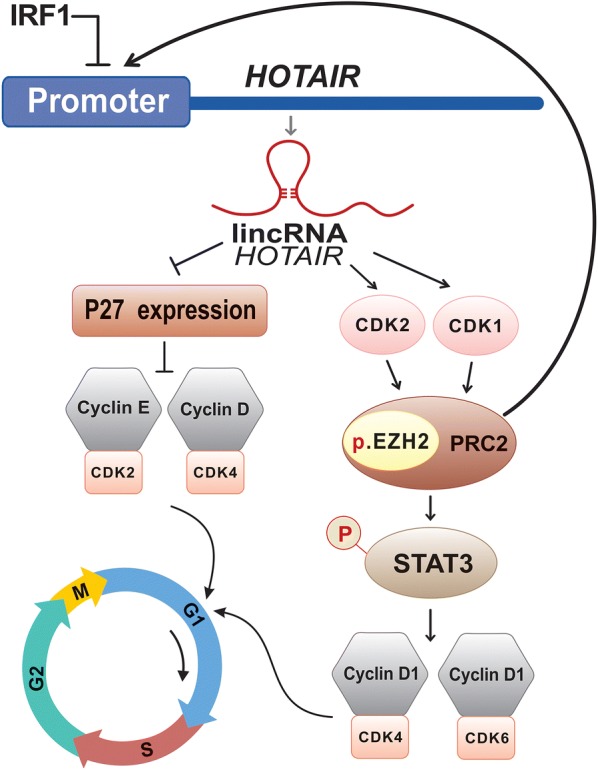
Molecular mechanisms of HOTAIR activity to promote cell proliferation. It is proposed that IRF-1 could negatively regulate HOTAIR expression. Activity of HOTAIR could induce CDK1 and CDK2 activity, leading to phosphorylation of EZH2 in the PRC2. Interaction of HOTAIR and PRC2 causes methylation of STAT3. This subsequently contributes to STAT3 phosphorylation, as activated form of protein, recruiting Cyclin D1. Additionally, could positively regulate HOTAIR activity, by affecting the corresponded gene promoter. Collaboration of Cyclin D1 with CDK4 and CDK6 coordinates in post-translational phosphorylation of some proteins and activity of some necessary transcription factors required for transition of G1 to S cell cycle. Alternatively, activity of HOTAIR could down-regulate p27. Defect of this protein could negatively promote activity of Cyclin D-CDK4 and Cyclin E-CDK2. This consequently promotes cell proliferation by contributing to G1 to S phase transition
Moreover, HOTAIR could function as a competitive endogenous RNA (ceRNA) to regulate several gene expressions through competing with microRNA binding sites, the phenomenon called microRNA sponge. Transcription of HOTAIR up-regulates expression of autophagy-related 3 (ATG3) and autophagy-related 7 (ATG7), likely through an indirect ceRNA effect and sponging miRNAs involved in the suppression of these two genes. This associates with promoting activity of autophagy mechanism, consequently leading to protecting cells against proliferation arrest [54].
HOTAIR aberration and breast cancer
Despite the indispensable role of HOTAIR in different molecular mechanisms of normal cell development, deregulation of this lincRNA is now determined in several abnormalities like cardiac disease and multiple sclerosis [37, 55]. Up-regulation of this molecule has also been correlated to poor prognosis, invasiveness and metastasis of several tumours, including breast, cervix, endometrial, lung, gastric, hepatocellular and pancreatic cancers as well as glioma. This phenomenon is coordinated by several proteins and noncoding RNA molecules, partially through similar mechanisms in different malignancies (Table 1). Negative impact of hyperactivity of HOTAIR has been shown on regulation of miR-141 and miR-326 in glioma cells [56, 57], as well as suppression of miR-141 in breast cancer cells [58]. Enforced transcription of HOTAIR could also promote proliferation, invasion and metastasis in gynaecological malignancies and breast cancer [59–61], through different mechanisms including up-regulation of BCL-W and sponging miR-206 [62]. In contrast, activity of miR-330-5p and miR-214-3p could repress HOTAIR [63]. GLOBOCAN 2018 reports breast cancer as the second most prevalent and the fourth leading cause of mortality worldwide, due to the malignancies [15]. Curiously, evidences have emphasised the crucial role of HOTAIR in cancer cell proliferation and metastasis as well as maintenance of breast cancer stem cells (bCSCs) and EMT. HOTAIR is also highly expressed in the CSCs obtained from two breast cancer cell lines: MCF-7 and MB-231, regulating self-renewal, proliferation, colony formation and migration by inhibiting miR-34a and subsequently up-regulating SOX2 [64]. Considering diverse functions of HOTAIR, we briefly discuss some important mechanisms whereby this lincRNA contributes to breast cancer progression.
Table 1.
Relationship of HOTAIR with other non-coding RNAs and proteins
| miR ID | Status | Function | Disease | Reference |
|---|---|---|---|---|
| miR-148a | Upstream | miR-148 activity represses HOTAIR expression by interacting with the corresponding promoter region | Breast cancer | [73] |
| miR-1 | Upstream | miR-1 supresses expression of HOTAIR and MAPK1 activity, prohibiting cell proliferation, invasion and migration | Ovarian cancer | [63] |
| miR-214-3p | Upstream | miR-214-3p supresses expression of HOTAIR and MAPK1 activity | Ovarian cancer | [63] |
| miR-330-5p | Upstream | miR-330-5p supresses expression of HOTAIR and MAPK1 activity | Ovarian cancer | [63] |
| miR-206 | Competing | Up-regulates BCL-W by sponging miR-206, elevating cell proliferation rate | Breast cancer | [62] |
| miR-130a | Competing | HOTAIR represses miR-130a, likely in a reciprocal negative feedback loop, competition in binding to similar RISC complex | Galbladder cancer | [65] |
| miR-34a | Downstream | HOTAIR epigenetically supresses miR-34a, leading to up-regulation of SOX2 and cell proliferation | Breast cancer | [64] |
| miR-7 | Downstream | HOTAIR supresses expression of HOXD10 and subsequent target, miR-7, ultimately promoting EMT process due to up-regulation of SETDB1 and STAT3 | Breast cancer | [78] |
| miR-20a-5p | Downstream | HOTAIR promotes cell growth, mobility and invasiveness via supressing miR-20a-5p and consequently up-regulating HMGA2 | Breast cancer | [83] |
| miR-218 | Downstream | HOTAIR induces radioresistance by reducing miR-218 expression level and apoptosis | Breast cancer | [102] |
| miR-138/204/217 | Downstream | HOTAIR directly antagonizes this complex, ultimately overexpressing EZH2 as a target of miR-138/217 | Renal cell carcinoma | [84] |
| miR-200c | Downstream | HOTAIR promotes epigenetic silencing of miR-200c, Through PRC2-EZH2 complex | Renal cell carcinoma | [84] |
| miR-141 | Downstream | HOTAIR epigenetically inhibits miR-141 expression | Glioma | [56] |
| miR-326 | Downstream | Inhibit miR-326 activity | Glioma | [57] |
Oncogenic role of HOTAIR
In several malignancies including breast cancer, evidences demonstrated intermediating oncogenic role of HOTAIR, on the benefit of c-Myc oncogenic pathway activity. Thus, c-Myc directly interacts with a putative binding site (E-box element) in HOTAIR promoter region and positively regulates activity of the latter lincRNA [65]. Subsequently, up-regulation of HOTAIR serves a scaffold role in histone demethylase LSD1 activity and directs interaction of HBXIP with c-Myc proteins. This lincRNA/protein complex could consequently mediate transcriptional activity of several c-Myc downstream target genes, including cyclin A, eIF4E and LDHA [66]. Additionally, HOTAIR overexpression negatively competes with miR-130a activity (as a non-coding RNA down-regulated in various malignancies), likely through a reciprocal feedback loop, for binding to the consistent RISC complex [65]. In terms of breast cancer progression, although different investigations have currently demonstrated the individual impact of HOTAIR, RISC components (e.g. Argonaute 2) or miR-130a [67, 68], no report has yet validated any correlation of HOTAIR with miR-130a and RISC, proposing investigation of this objective in future.
HOTAIR and PRC
It has been shown that hyperactivity of HOTAIR could promote breast cancer malignancy through interaction with PRC2 complex [69]. In the same context to embryonic fibroblast, overexpression of HOTAIR triggers PRC2 complex in epithelial malignant cells. This leads to H3k27me3 modification of the particular genomic region, deregulation of some genes and subsequently promoting malignant cell invasiveness and metastasis in a PRC2 dependent manner [70].
HOTAIR and estrogen
Findings obtained from a retrospective clinical study revealed strong association of HOTAIR overexpression with risk of metastasis in the estrogen receptor positive (ER+) breast cancer patients who diagnosed with primary tumours and received no adjuvant therapy, suggesting this lincRNA as a potential prognostic biomarker in this type of patients [71]. In line with this, studies on the MCF-7 (as an ER+/PR+ mammary gland epithelial cell line) demonstrated overexpression of HOTAIR on the benefits of malignant cell proliferation, growth and invasion. This consequence could be observed due to the estrogen activity, in the form of estradiol (E2). Eestrogen receptor (ER) plays key role in the process of inducing HOTAIR activity by E2. Thus, E2 could bind to the estrogen response element (ERE) region of the HOTAIR promoter through recruitment of ERs -particularly GPER- and other ER co-regulators, including histone methylases mixed lineage leukemia 1 (MLL1), MLL3 and CREB-binding protein/p300. This mechanism subsequently culminates in hyper-methylation of H3K4me3, histone acetylation, recruitment of RNA polymerase II in HOTAIR promoter region and consequently overexpression of this lincRNA [72, 73]. Contrarily, overexpression of miR-148a, in the absence of ER signalling, down-regulates HOTAIR [73]. It has also been shown that HOTAIR activity is sufficient to induce ER signalling in the malignant cells with poorly expressed estrogen, likely due to the intermediating action of ER by HOTAIR [74].
HOTAIR and tumour suppressor genes
Overexpression of HOTAIR could negatively regulate expression of some tumour suppressor genes, consequently leading to promote breast cancer cell proliferation, invasion and metastasis. It has been shown that down-regulation of HOTAIR significantly elevated p53 expression level and reduced expression of AKT and JNK in MCF-7 cell line. Induction of apoptosis, while exhibiting limited metastasis, invasion and proliferation capabilities in this cell line, might likely be due to the cell cycle arrest at G1 phase [64, 75]. Moreover, evidences demonstrated that expression of HOTAIR could negatively regulate p53 and p21 expressions in MCF-7 and MB-231 bCSCs, leading to cell cycle entry and proliferation, while down-regulation of this lincRNA caused activation of p21 and cell cycle arrest at G1 phase, likely by inhibiting CDK1, CDK2, CDK4 and CDK6 [64].
Demonstrating the negative role of BRCA1 in PRC2 complex activity [76] raised the question whether this crucial tumour suppressor gene could have any potential correlation with HOTAIR? Investigations showed that HOTAIR could carry action against BRCA1 to positively regulate PRC2 complex in breast cancer. In this mechanism, binding of BRCA1 to EZH2 -among the PRC2 complex- prohibits interaction of the latter protein with HOTAIR in malignant cells. With loss of BRCA1, HOTAIR competitively interacts with EZH2 via similar binding site to BRCA1, culminating in hypermethylation of H3K27me3 and PRC2 occupancy of the corresponding target sites in the breast luminal epithelial cancer cells [77].
Further studies also indicated negative effect of HOTAIR on miR-7 activity, in MCF-7 and MB-231 bCSCs cell lines. As a tumour suppressor microRNA, activity of miR-7 could inhibit oncogenic behaviour of SET domain bifurcated histone lysine methyltransferase I (SETDB1) in breast cancer. Negative regulation of miR-7, through HOTAIR activity, contributes to malignant cell proliferation, invasion and metastasis [78]. In addition to the indicated tumour suppressor genes, it has been determined that HOTAIR can mediate interaction of EZH2 with the specific region of PTEN [79]. Thus, this complex regulates promoter methylation of PTEN and repression of the gene expression, ultimately leading to induction of PI3K signalling pathway [80].
HOTAIR and oncogenes
Expression of HOTAIR in invasive malignant cells, on one hand, and down-regulation of this lincRNA in the malignant cells which have undergone apoptosis, on the other hand, propose HOTAIR direct/indirect role in positively modulating property of multiple oncogenes. HER2 is one of the crucial oncogenic biomarkers in the particular subgroup of breast tumours. Investigations demonstrated that HOTAIR is significantly up-regulated in HER2+ breast cancer cells [81]. No study has yet been performed to validate the correlation of HOTAIR and HER2 in breast cancer. However, positive effect of this lincRNA has been determined on the regulation of HER2 in gastric carcinoma cells. It was shown that HOTAIR acts as a ceRNA to sponge miR-331-3p and miR-124. Interestingly, HER2 expression is directly targeted by miR-331-3p. Thus, a positive correlation was determined between HOTAIR and HER2 expression in the HER2+ gastric malignancies [82], suggesting consistent mode of interaction in HER2+ breast cancer cells.
High-mobility group AT-hook 2 (HMGA2) is the other oncogenic protein highly expressed in breast malignancies. A positive regulation of HMGA2 was observed by activity of HOTAIR, as ceRNA for miR-20a-5p in breast cancer cells. This leads to overexpression of HMGA2, binding to AT-rich regions in DNA and chromatin modification to facilitate some transcriptional enhancer actions [83].
Activity of estrogen receptor beta (ERβ), as a key factor in progression and invasion of many cancer types, has been reported to up-regulate HOTAIR in renal cell carcinoma. Antagonizing behaviour of this lincRNA sponge the activity of miR-138/204/217 complex, among which miR-138/217 negatively regulate EZH2. This leads to up-regulation of EZH2 and epigenetically promoter silencing of miR-200c downstream of HOTAIR, consequently directing malignant cells to proliferation and invasion [84]. Interestingly, ERβ could play crucial role in breast cancer cells progression, particularly EMT and metastasis [85]. This suggests potential correlation of HOTAIR and ERβ in breast cancer and subsequently downstream molecules, miR-138/204/217 and miR-200c, in breast cancer, although, it still remains to be investigated.
Epithelial mesenchymal transition and HOTAIR
As an essential stage, EMT is involved in tumour invasion and metastasis. The important role of HOTAIR in metastasis raises the question whether there is any potential correlation between this lincRNA and EMT in breast cancer patients? Investigations showed that HOTAIR could indirectly inhibit miR-7 in bCSCs obtained from MCF-7 and MB-231 cell lines. This leads to overexpression of SETDB1, STAT3, c-Myc, twist and miR-9 [78] and down-regulation of E-cadherin [78, 86] on the benefit of EMT process (Fig. 4). HOTAIR also contributes to EMT and prometastatic activity of malignant cell via regulation of VEGF, MMP-9, β-cantenin and Vimentin [87]. Additionally, HOTAIR up-regulates expression of SNAIL, as a master regulator of EMT pathway, in breast cancer [70]. Subsequently, this lincRNA could mediate establishment of tripartite SNAIL/HOTAIR/EZH2 complex. Function of this constructive complex conveys a general chromatin modification to repress epithelial genes (like HNF4a, HNF1a and E-cadherin) in the EMT frame [88] (Fig. 4).
Fig. 4.

Effect of HOTAIR on epithelial-mesenchymal transition. HOTAIR could promote epithelial-mesenchymal transition (EMT) through at least three pathways. lincRNA HOTAIR activity could indirectly inhibit miR-7. This leads to overexpression of SETDB1, STAT3, c-Myc, twist and miR-9, while E-cadherin is down-regulated. HOTAIR activity could also promote prometastatic activity of cancer cells by regulating VEGF, MMP-9, β-catenin and Vimentin. Moreover, lincRNA HOTAIR could coordinate in tripartite SNAIl/HOTAIR/EZH2 complex. This complex involves in general chromatin modification to inhibit expression of the genes involved in epithelial formation (e.g. HNF4α, HNF1α and E-cadherin)
Negative correlation of HOTAIR and miR-148a has also been demonstrated to cause EMT and metastasis. In the triple negative and ER+ breast cancer cells, E2-GPER signal promotes HOTAIR expression. A particular site has been discerned to facilitate binding of this lincRNA to miR-148a. This leads to miR-148a sponge by HOTAIR [73]. Inhibition of this microRNA negatively regulates SNAIL2 expression. This subsequently might lead to down-regulation of E-cadherin, Caludin-1 and several adhesion molecules, consequently promoting EMT event and metastasis in malignancies [89].
Previous study on hepatocellular malignancy highlighted the remarkable effect of HOTAIR on the blockage of RNA binding motif protein 38 (RBM38), as a tumour suppressor gene [90]. Adding to this, disrupted expression level of RBM38 in breast cancer due to the silencing E-box element promoter region by SNAIL [91], propose the indirect effect of HOTAIR on regulation of this tumour suppressor gene. Inhibition of RBM38 activity could destabilize zonula occludens-1, consequently leading to induction of EMT and metastasis [91].
Curiously, evidences emphasize the crucial role of HOTAIR overexpression in breast cancer radioresistance through EMT induction. Using two different experiments, it has been demonstrated that HOTAIR activity reduced radiosensitivity of MB231 and SKBR3 breast cancer cell lines by down-regulation of the HOXD10 tumour suppressor gene and the corresponding pathway, PI3K/AKT-Bad [92, 93]. Down-regulation of HOXD10 also inhibits expression of miR-7 and subsequently a histone methyltransferase, SETDB1, inducing STAT3 function in EMT frame [78].
Considering the critical role of HOTAIR in promoting breast cancer development, through different mechanisms of action, we further discuss the potential relationship of HOTAIR with response to different combinational therapeutic agents, in the next section.
HOTAIR and treatment approaches
To date, resistance to different therapeutic approaches is one of the most important challenges of breast cancer treatment. Several evidences emphasize the crucial role of HOTAIR in breast cancer resistance [74, 92, 94]. Additionally, administrating some agents could down-regulate HOTAIR activity. Regarding that some therapeutic agents are commonly used in diverse malignancies, here, we generally discuss the relationship of HOTAIR to different treatment approaches in the cancer resistant and sensitive cells (Table 2).
Table 2.
Effect of some chemical drugs on the expression of HOTAIR
| Component | Drug category | Effect on HOTAIR | Comment | References |
|---|---|---|---|---|
| Calycosin | Phytostrogen isoflavon | Down-regulation | Induces apoptosis by down-regulating phosphorylation of HOTAIR upstream target, Akt | [116] |
| Genistein | Soy isofalvone | Down-regulation | Represses HOTAIR as well as NF-κB and Akt signalling pathways, while it overexpresses miR-141 | [116, 119] |
| BIO | Genistein nano-suspension | Down-regulation | Inhibits GSK3β and induces β-Catenin signalling, leading to down-regulation of HOTAIR | [37] |
| Delphinidin-3-glucoside | Anthocyanidin | Down-regulation | Induces apoptosis via activation of IRF1 and repression of Akt | [53] |
| Imatinib + Lapatinib | Anti-neoplastic agent | Down-regulation | Synergistically supress β-Catenin and subsequently HOTAIR expression | [117] |
| BML-284 | Wnt agonist | Down-regulation | Induces Wnt/β-Catenin signalling pathway and repression of HOTAIR | [37] |
| Bisphenol-A | estrogenic endocrine disrupting chemical | Up-regulation | Interferes with normal estrogen signalling pathway, leading to expression of HOTAIR by inducing the corresponding ERE promoter, in addition to particular histone modifications | [95] |
| Diethylstilbestrol | Synthetic estrogen | Up-regulation | Involved in normal estrogen signalling pathway and HOTAIR expression, through interaction with the corresponding ERE promoter and particular histone modifications | [95] |
| Gemcitabine | Anti-metabolite agents | Up-regulation | Through unknown mechanism, this agent up-regulates HOTAIR causing further malignant cell proliferation, self-renewal and migration | [104] |
HOTAIR and hormone therapy
Accumulating data indicate the potential role of HOTAIR in prohibiting the effect of several hormonal therapeutic agents. As previously indicated, HOTAIR activity directly fosters ER signalling in ER+ breast cancer cells to develop invasiveness and metastasis. Mechanistically, activity of HOTAIR elevates ER occupancy on chromatin and regulates the corresponding downstream genes. This mechanism further encourages drug-resistance in the cancer patients treated with Tamoxifen (as an ER competitive antagonist). It is proposed that HOTAIR could promote ER activity in the Tamoxifen resistant malignant breast cancer cells with lack of estrogen [74]. Additionally, administration of Bisphenol-A (BPA), as an endocrine disrupting chemical, and Diethylstilbestrol (DES), as a synthetic estrogen, facilitates HOTAIR activation both in vitro and in vivo by modifying histone methylation/acetylation status at the corresponding promoter, particularly ERE, region. This process is mediated by binding ERs, MLL1 and MLL3 to the HOTAIR promoter EREs, chromatin modification and consequently HOTAIR activity [95]. Further investigations on prostate cancer indicated castration-resistance due to the overexpression of HOTAIR. Thus, activity of this lincRNA induces a distinct mode of androgen receptor (AR) gene regulation through interaction with MDM2 (an E3 ubiquitin ligase), prohibiting the respected protein ubiquitination and consequently AR degradation; while, overexpression of HOTAIR is sufficient to activate androgen-independent AR and promote drug-resistance in the absence of androgen, through AR-mediated transcriptional pathway [96].
HOTAIR and radiotherapy
As an essential method of adjuvant therapy, radiation has been linked to HOTAIR in different cancers. Activity of this lincRNA could minimize radiosensitivity of colorectal cancer. Down-regulation of HOTAIR, in addition to treating colorectal malignant cells with irradiation, reduces MMP-2 and MMP-9 expressions, as two important factors involved in EMT and metastasis [97]. Investigations on pancreatic ductal adenocarcinoma cells revealed expression of HOTAIR. Expression of this lincRNA enhances radioresistance via negatively regulation of Wnt inhibitory factor 1 (WIF-1), culminating in further proliferation rate and less apoptosis [98]. Overexpression of HOTAIR can also increase HIF-1α expression in cervical cancer. Thus, HIF-1α induces malignant cell resistance to the radiation [99] (Table 3). Additionally, up-regulation of HOTAIR has been suggested to induce radioresistance in HeLa and C33A cells, in a competition, by prohibiting p21 activity, while up-regulation of p21 could neutralize the negative effect of HOTAIR activity on cell resistance against ionizing radiation [100].
Table 3.
Effect of HOTAIR overexpression on radiosensitivity of different cancer types
| Type of malignancy | Radiosensitivity | Molecular mechanism | Mode of action | Reference | |
|---|---|---|---|---|---|
| HOTAIR overexpression | Colorectal cancer | Reduction | MMP-2 and MMP-9 increase | Promoting EMT and metastasis | [97] |
| Pancreatic ductal carcinoma | Reduction | (WIF-1) decrease | Promoting proliferation, inhibiting apoptosis | [98] | |
| Cervical cancer | Reduction | HIF-1α increase, P21 decrease | Induce hypoxia and radioresistance | [99, 100] |
In breast cancer cells, studies demonstrated relation of HOTAIR expression level with metastasis free survival and enhancing rim fraction (ERF) radiogenomics score [91, 101]. It can also contribute to radioresistance by function as ceRNA. Mechanistically, HOTAIR expression competitively inhibits miR-218 activity. Down-regulation of HOTAIR leads to radiosensitivity of breast cancer cells, induction of DNA damage, cell cycle arrest and apoptosis by recruiting miR-218 [102].
HOTAIR and chemotherapy
Similar to radiotherapy and hormone therapy, HOTAIR activity could deregulate the mechanism of several commonly used chemotherapeutic such as carboplatin and gemcitabine in breast and other types of cancer [103–105]. Investigations on the stage II/III breast cancer patients who undergone neoadjuvant treatment, using taxan-based and/or anthracyclin-based chemical agents, showed correlation of the drug response to the level of circulating HOTAIR. Thus, more drug-resistance was observed in the patients with higher level of HOTAIR and conversely less chemo-resistance effect was determined in the patients with lower HOTAIR expression level [106].
Additionally, HOTAIR associates with Cisplatin drug resistance in gastric cancer via blocking expression of miR-126 and recruiting VEGFA/PI3K/AKT/MRP1 or PIK3R2/PI3K/AKT/MRP1 pathway. This process induces G1/S phase cell cycle progression and cell proliferation, but restrains malignant cell apoptosis [107]. HOTAIR also plays role in Cisplatin chemoresistance of lung adenocarcinoma cells by interacting with EZH2 and suppressing p21. This consequently prohibits cell cycle arrest at G0/G1 phase and apoptosis, while induces cell proliferation [108]. HOTAIR is also positively involved in chemoresistance of the small cell lung cancer cells treated with Cisplatin, Adriamycin and Etoposide, through epigenetically suppressing HOXA1 expression. Mechanistically, it has been proposed that HOTAIR could up-regulate activity of two DNA methyltrasnferases, DNMT1 and DNMT3b, combination of which hypermethylates HOXA1 gene promoter CpG islands and consequently silences the corresponding gene expression. Down-regulation of HOTAIR improves sensitivity of these malignant cells to the indicated chemical agents, through up-regulating HOXA1 expression, leading to tumour growth contraction as well as induction of cell cycle arrest and apoptosis [109]. In line with the presented malignancies, evidences revealed the effect of HOTAIR expression on promoting Cisplatin resistance in ovarian cancer [110]. This process is mediated by activating Wnt/β-Catenin signalling pathway, promoting proliferation and cell cycle progression, while it is arrested by Cisplatin at G1 phase with defect of HOTAIR [111]. Recently, investigations on colorectal cancer revealed that HOTAIR targets Wnt/β-Catenin pathway by sponging miR-203-3p, while presence of this microRNA can cause cell sensitivity to Cisplatin and Paclitaxel by blocking Wnt/β-Catenin pathway [112].
Moreover, it has been shown that HOTAIR is highly expressed in the 5FU drug resistant colorectal cancer cells. Thus, HOTAIR recruits EZH2 protein and this complex supress miR-218-2 by interacting with the corresponding promoter region. Lack of miR-281-2 could consequently lead to activation of NF-κB/TS signalling pathway [113]. Similarly, evidences demonstrate that overexpression of HOTAIR could cause platinum resistance of ovarian cancer by inducing NF-κB and downstream target gene, interleukin-6 (IL-6). Activity of the latter protein promotes BCL2, BCL-XL and XIAP to inhibit apoptosis 61). Consistently, activity of IL-6 has been linked to the resistance of Cisplatin and Carboplatin drugs in ovarian cancer cells [114]. Subsequently, another evidences further validated the correlation of HOTAIR expression with Carboplatin resistance in ovarian cancer [115].
These data emphasize the crucial role of HOTAIR in promoting resistance against some therapeutic agents, as an oncogenic lincRNA. In contrast to the above subjects, some chemical agents have thus far been recognized to induce sensitivity and cytotoxicity in the malignant cells, through negative regulation of HOTAIR (Table 2). In this context, evidences demonstrated that administration of isoflavone-based agents, including Calycosin and Genistein, play dose-dependently anti-tumour roles in breast cancer cells by inhibiting HOTAIR expression and phosphorylation of Akt causing suppression of PI3K/AkT signalling pathway and consequently defect of apoptosis inhibitors, BCL-2 family and casepases. This mechanism inhibits malignant cell proliferation and induces apoptosis [116, 117]. Combination of Imatinib and Lapatinib compounds could also been reported to repress HOTAIR expression in triple negative BC cells [118].
Recently, Newphew and colleagues has also been able to restore the chemical effect of platinum in the chemoresistant breast and ovarian cancer cells using a polypeptide nucleic acids (PNAs)-based approach, blocking EZH2 domain of HOTAIR. In this experiment, the PNAs inhibited HOTAIR-EZH2 activity, subsequently reducing expression of NF-κB and corresponding proteins, IL-6 and MMP-9, which consequently culminated in decrease of tumour formation and improvement of survival chance [119]. Therefore, these findings suggest HOTAIR, as a potential therapeutic target to prohibit tumourigenesis progress.
Conclusions and future prospective
Thanks to the instrumental developments and technology advances, some integral missions of lncRNAs in physiological and developmental systems of human cells have hitherto been discovered, although perturbation of these molecules can lead to different abnormalities, including cell malignancies. The present review posits that HOTAIR plays a significant role in normal development and survival of diverse tissue cells. Nonetheless, inappropriate expression of this lincRNA is able to promote malignant cell progression by deregulation of several crucial pathways. Here, we highlighted the impact of unfitting expression of HOTAIR in the survival and progression of breast cancer cells; in some cases, we also implicated the role of HOTAIR in other types of cancer to elucidate potential role of this lincRNA in breast cancer. It was implicated that HOTAIR could mimic oncogenic behaviour in several breast cancer patients, leading to the aberration of several molecular pathways, towards the malignant cell proliferation, invasion, EMT, metastasis as well as resistance against different therapeutic agents. Thus, finding an efficient therapeutic strategy to direct malignant cell apoptosis through down-regulation of HOTAIR could be considered as a future plan. In other words, understanding the underlying function and mechanisms of this lincRNA might not only suggest HOTAIR as a potential biomarker in prediction of breast cancer susceptibility and prognosis of the disease, but also help clinicians more appropriately perform patient management and find the most beneficial therapeutic approaches in the frame of personalized medicine.
Acknowledgements
The authors acknowledge Trabiat Modares University Research Department for supporting this project. Authors also thank Ms Marziyeh Aliabadi for her help in language editing of the manuscript.
Abbreviations
- AR
Androgen receptor
- ATG3
Autophagy-related 3
- ATG7
Autophagy-related 7
- bCSC
Breast cancer stem cell
- BPA
Bisphenol-A
- ceRNA
Competitive endogenous RNA
- DES
Diethylstilbestrol
- E2
Estradiol
- EMT
Epithelial–mesenchymal transition
- ER
Estrogen receptor
- ERE
Estrogen response element
- ERE
Estrogen response element
- ERF
Enhancing rim fraction
- ERβ
Estrogen receptor beta
- H3K27me2
H3 lysine 27 di-methylation
- H3K27me3
H3 lysine 27 tri-methylation
- HMGA2
High-mobility group AT-hook 2
- HOTAIR
HOX transcript antisense intergenic RNA
- IL-6
Interleukin-6
- IRF1
Interferon regulatory factor 1
- lincRNA
Long intergenic non-coding RNA
- lncRNA
Long non-coding RNA
- MLL1
Mixed lineage leukemia 1
- ncRNA
Non-coding RNA
- PCL
Polycomb-like
- PNAs
Polypeptide nucleic acids
- PRC
Polycomb repressive complex
- qRT-PCR
Quantitative reverse-transcription PCR
- RBM38
RNA binding motif protein 38
- SETDB1
SET domain bifurcated histone lysine methyltransferase I
- SNP
Single nucleotide polymorphism
- TFBS
Transcription factor binding sites
- TSS
Transcription start site
- WIF-1
Wnt inhibitory factor 1
Authors’ contributions
HM designed, supervised and approved the final manuscript. VEZ, designed, collected data and wrote the manuscript draft. RRP helped to illustrate the figures and some data collection. All authors read and approved the final manuscript.
Funding
This work was funded by the Tarbiat Modares University (Tehran, Iran) under Grant code no. IG-39711 to Prof. Hossein Mozdarani.
Availability of data and materials
Data sharing is not applicable to this article, as no datasets were generated or analysed during the current study.
Ethics approval and consent to participate
Not applicable.
Consent for publication
Not applicable.
Competing interests
Authors declare no conflict of interest.
Footnotes
Publisher's Note
Springer Nature remains neutral with regard to jurisdictional claims in published maps and institutional affiliations.
Hossein Mozdarani and Vahid Ezzatizadeh co-first author
References
- 1.Hajjari M, Salavaty A. HOTAIR: an oncogenic long non-coding RNA in different cancers. Cancer Biol Med. 2015;12(1):1–9. doi: 10.7497/j.issn.2095-3941.2015.0006. [DOI] [PMC free article] [PubMed] [Google Scholar]
- 2.Santosh B, Varshney A, Yadava PK. Non-coding RNAs: biological functions and applications. Cell Biochem Funct. 2015;33(1):14–22. doi: 10.1002/cbf.3079. [DOI] [PubMed] [Google Scholar]
- 3.Bhan A, Soleimani M, Mandal SS. Long noncoding RNA and cancer: a new paradigm. Cancer Res. 2017;77(15):3965–3981. doi: 10.1158/0008-5472.CAN-16-2634. [DOI] [PMC free article] [PubMed] [Google Scholar]
- 4.O’Leary VB, Hain S, Maugg D, Smida J, Azimzadeh O, Tapio S, et al. Long non-coding RNA PARTICLE bridges histone and DNA methylation. Sci Rep. 2017;7(1):1–12. doi: 10.1038/s41598-016-0028-x. [DOI] [PMC free article] [PubMed] [Google Scholar]
- 5.Song Y, Wang R, Li L-W, Liu X, Wang Y-F, Wang Q-X, et al. Long non-coding RNA HOTAIR mediates the switching of histone H3 lysine 27 acetylation to methylation to promote epithelial-to-mesenchymal transition in gastric cancer. Int J Oncol. 2019;54(1):77–86. doi: 10.3892/ijo.2018.4625. [DOI] [PMC free article] [PubMed] [Google Scholar]
- 6.Durut N, Scheid OM. The role of noncoding RNAs in double-strand break repair. Front Plant Sci. 2019;10:1155. doi: 10.3389/fpls.2019.01155. [DOI] [PMC free article] [PubMed] [Google Scholar]
- 7.Koch L. Non-coding RNA: a protective role for TERRA at telomeres. Nat Rev Genet. 2017;18(8):453. doi: 10.1038/nrg.2017.58. [DOI] [PubMed] [Google Scholar]
- 8.Fernandes JC, Acuña SM, Aoki JI, Floeter-Winter LM, Muxel SM. Long non-coding RNAs in the regulation of gene expression: physiology and disease. Non-coding RNA. 2019;5(1):17. doi: 10.3390/ncrna5010017. [DOI] [PMC free article] [PubMed] [Google Scholar]
- 9.Lu W, Yu J, Shi F, Zhang J, Huang R, Yin S, et al. The long non-coding RNA Snhg3 is essential for mouse embryonic stem cell self-renewal and pluripotency. Stem Cell Res Ther. 2019;10(1):157. doi: 10.1186/s13287-019-1270-5. [DOI] [PMC free article] [PubMed] [Google Scholar]
- 10.Yan Z, Ruoyu L, Xing L, Hua L, Yi Z, Yaqin P, et al. Long non-coding RNA GAS5 regulates the growth and metastasis of human cervical cancer cells via induction of apoptosis and cell cycle arrest. Archiv Biochem Biophys. 2020;24:108320. doi: 10.1016/j.abb.2020.108320. [DOI] [PubMed] [Google Scholar]
- 11.Zhao H-Y, Zhang S-T, Cheng X, Li H-M, Zhang L, He H, et al. Long non-coding RNA GAS5 promotes PC12 cells differentiation into Tuj1-positive neuron-like cells and induces cell cycle arrest. Neural Regen Res. 2019;14(12):2118. doi: 10.4103/1673-5374.262592. [DOI] [PMC free article] [PubMed] [Google Scholar]
- 12.Bhan A, Mandal SS. Long noncoding RNAs: emerging stars in gene regulation, epigenetics and human disease. ChemMedChem. 2014;9(9):1932–1956. doi: 10.1002/cmdc.201300534. [DOI] [PubMed] [Google Scholar]
- 13.Al-Rugeebah A, Alanazi M, Parine NR. MEG3: an oncogenic long non-coding RNA in different cancers. Pathol Oncol Res. 2019;2019:1–16. doi: 10.1007/s12253-019-00614-3. [DOI] [PubMed] [Google Scholar]
- 14.Liu Y, Sharma S, Watabe K. Roles of lncRNA in breast cancer. Front Biosci (Schol Ed). 2015;7:94–108. doi: 10.2741/s427. [DOI] [PMC free article] [PubMed] [Google Scholar]
- 15.Bray F, Ferlay J, Soerjomataram I, Siegel RL, Torre LA, Jemal A. Global cancer statistics 2018: GLOBOCAN estimates of incidence and mortality worldwide for 36 cancers in 185 countries. CA Cancer J Clin. 2018;68(6):394–424. doi: 10.3322/caac.21492. [DOI] [PubMed] [Google Scholar]
- 16.Zhou S, He Y, Yang S, Hu J, Zhang Q, Chen W, et al. The regulatory roles of lncRNAs in the process of breast cancer invasion and metastasis. Biosci Rep. 2018;38(5):BSR20180772. doi: 10.1042/BSR20180772. [DOI] [PMC free article] [PubMed] [Google Scholar]
- 17.Rinn JL, Kertesz M, Wang JK, Squazzo SL, Xu X, Brugmann SA, et al. Functional demarcation of active and silent chromatin domains in human HOX loci by noncoding RNAs. Cell. 2007;129(7):1311–1323. doi: 10.1016/j.cell.2007.05.022. [DOI] [PMC free article] [PubMed] [Google Scholar]
- 18.He S, Liu S, Zhu H. The sequence, structure and evolutionary features of HOTAIR in mammals. BMC Evol Biol. 2011;11:102. doi: 10.1186/1471-2148-11-102. [DOI] [PMC free article] [PubMed] [Google Scholar]
- 19.Cai B, Song XQ, Cai JP, Zhang S. HOTAIR: a cancer-related long non-coding RNA. Neoplasma. 2014;61(4):379–391. doi: 10.4149/neo_2014_075. [DOI] [PubMed] [Google Scholar]
- 20.Loewen G, Jayawickramarajah J, Zhuo Y, Shan B. Functions of lncRNA HOTAIR in lung cancer. J Hematol Oncol. 2014;7:90. doi: 10.1186/s13045-014-0090-4. [DOI] [PMC free article] [PubMed] [Google Scholar]
- 21.Hajjari M, Rahnama S. HOTAIR long non-coding RNA: characterizing the locus features by the in silico approaches. Genom Inf. 2017;15(4):170–177. doi: 10.5808/GI.2017.15.4.170. [DOI] [PMC free article] [PubMed] [Google Scholar]
- 22.Pawlowska E, Szczepanska J, Blasiak J. The long noncoding RNA HOTAIR in breast cancer: does autophagy play a role? Int J Mol Sci. 2017;18:11. doi: 10.3390/ijms18112317. [DOI] [PMC free article] [PubMed] [Google Scholar]
- 23.Yang G, Zhang S, Gao F, Liu Z, Lu M, Peng S, et al. Osteopontin enhances the expression of HOTAIR in cancer cells via IRF1. Biochem Biophys Acta. 2014;1839(9):837–848. doi: 10.1016/j.bbagrm.2014.06.020. [DOI] [PubMed] [Google Scholar]
- 24.Lu L, Zhu G, Zhang C, Deng Q, Katsaros D, Mayne ST, et al. Association of large noncoding RNA HOTAIR expression and its downstream intergenic CpG island methylation with survival in breast cancer. Breast Cancer Res Treat. 2012;136(3):875–883. doi: 10.1007/s10549-012-2314-z. [DOI] [PubMed] [Google Scholar]
- 25.Hassanzarei S, Hashemi M, Sattarifard H, Hashemi SM, Bahari G, Ghavami S. Genetic polymorphisms of HOTAIR gene are associated with the risk of breast cancer in a sample of southeast Iranian population. Tumour Biol. 2017;39(10):1010428317727539. doi: 10.1177/1010428317727539. [DOI] [PubMed] [Google Scholar]
- 26.Zhang X, Zhou L, Fu G, Sun F, Shi J, Wei J, et al. The identification of an ESCC susceptibility SNP rs920778 that regulates the expression of lncRNA HOTAIR via a novel intronic enhancer. Carcinogenesis. 2014;35(9):2062–2067. doi: 10.1093/carcin/bgu103. [DOI] [PubMed] [Google Scholar]
- 27.Qiu H, Liu Q, Li J, Wang X, Wang Y, Yuan Z, et al. Analysis of the association of HOTAIR single nucleotide polymorphism (rs920778) and risk of cervical cancer. APMIS. 2016;124(7):567–573. doi: 10.1111/apm.12550. [DOI] [PubMed] [Google Scholar]
- 28.Bayram S, Sumbul AT, Batmaci CY, Genc A. Effect of HOTAIR rs920778 polymorphism on breast cancer susceptibility and clinicopathologic features in a Turkish population. Tumour Biol. 2015;36(5):3863–3870. doi: 10.1007/s13277-014-3028-0. [DOI] [PubMed] [Google Scholar]
- 29.Bayram S, Sumbul AT, Dadas E. A functional HOTAIR rs12826786 C>T polymorphism is associated with breast cancer susceptibility and poor clinicopathological characteristics in a Turkish population: a hospital-based case-control study. Tumour Biol. 2016;37(4):5577–5584. doi: 10.1007/s13277-015-4430-y. [DOI] [PubMed] [Google Scholar]
- 30.Wang H, Zheng H, Wang C, Lu X, Zhao X, Li X. Insight into HOTAIR structural features and functions as landing pads for transcription regulation proteins. Biochem Biophys Res Commun. 2017;485(3):679–685. doi: 10.1016/j.bbrc.2017.02.100. [DOI] [PubMed] [Google Scholar]
- 31.Somarowthu S, Legiewicz M, Chillon I, Marcia M, Liu F, Pyle AM. HOTAIR forms an intricate and modular secondary structure. Mol Cell. 2015;58(2):353–361. doi: 10.1016/j.molcel.2015.03.006. [DOI] [PMC free article] [PubMed] [Google Scholar]
- 32.Selleri L, Bartolomei MS, Bickmore WA, He L, Stubbs L, Reik W, et al. A Hox-embedded long noncoding RNA: is it all hot air? PLoS Genet. 2016;12(12):e1006485. doi: 10.1371/journal.pgen.1006485. [DOI] [PMC free article] [PubMed] [Google Scholar]
- 33.Li L, Liu B, Wapinski OL, Tsai MC, Qu K, Zhang J, et al. Targeted disruption of Hotair leads to homeotic transformation and gene derepression. Cell Rep. 2013;5(1):3–12. doi: 10.1016/j.celrep.2013.09.003. [DOI] [PMC free article] [PubMed] [Google Scholar]
- 34.Hammer T, Lohbauer S. The master of genomic programs: HOTAIR in cellular development and cancer metastasis. Aquila. 2010;464(7291):1071–1076. [Google Scholar]
- 35.Schorderet P, Duboule D. Structural and functional differences in the long non-coding RNA hotair in mouse and human. PLoS Genet. 2011;7(5):e1002071. doi: 10.1371/journal.pgen.1002071. [DOI] [PMC free article] [PubMed] [Google Scholar]
- 36.Fagerberg L, Hallstrom BM, Oksvold P, Kampf C, Djureinovic D, Odeberg J, et al. Analysis of the human tissue-specific expression by genome-wide integration of transcriptomics and antibody-based proteomics. MCP. 2014;13(2):397–406. doi: 10.1074/mcp.M113.035600. [DOI] [PMC free article] [PubMed] [Google Scholar]
- 37.Carrion K, Dyo J, Patel V, Sasik R, Mohamed SA, Hardiman G, et al. The long non-coding HOTAIR is modulated by cyclic stretch and WNT/beta-CATENIN in human aortic valve cells and is a novel repressor of calcification genes. PLoS ONE. 2014;9(5):e96577. doi: 10.1371/journal.pone.0096577. [DOI] [PMC free article] [PubMed] [Google Scholar]
- 38.Long H, Sun B, Cheng L, Zhao S, Zhu Y, Zhao R, et al. miR-139-5p represses BMSC osteogenesis via targeting Wnt/beta-catenin signaling pathway. DNA Cell Biol. 2017;36(8):715–724. doi: 10.1089/dna.2017.3657. [DOI] [PubMed] [Google Scholar]
- 39.Kim H, Kang K, Kim J. AEBP2 as a potential targeting protein for polycomb repression complex PRC2. Nucleic Acids Res. 2009;37(9):2940–2950. doi: 10.1093/nar/gkp149. [DOI] [PMC free article] [PubMed] [Google Scholar]
- 40.Portoso M, Ragazzini R, Brencic Z, Moiani A, Michaud A, Vassilev I, et al. PRC2 is dispensable for HOTAIR-mediated transcriptional repression. EMBO J. 2017;36(8):981–994. doi: 10.15252/embj.201695335. [DOI] [PMC free article] [PubMed] [Google Scholar]
- 41.Margueron R, Reinberg D. The Polycomb complex PRC2 and its mark in life. Nature. 2011;469(7330):343–349. doi: 10.1038/nature09784. [DOI] [PMC free article] [PubMed] [Google Scholar]
- 42.Wu Y, Zhang L, Wang Y, Li H, Ren X, Wei F, et al. Long noncoding RNA HOTAIR involvement in cancer. Tumour Biol. 2014;35(10):9531–9538. doi: 10.1007/s13277-014-2523-7. [DOI] [PubMed] [Google Scholar]
- 43.Wu L, Murat P, Matak-Vinkovic D, Murrell A, Balasubramanian S. Binding interactions between long noncoding RNA HOTAIR and PRC2 proteins. Biochemistry. 2013;52(52):9519–9527. doi: 10.1021/bi401085h. [DOI] [PMC free article] [PubMed] [Google Scholar]
- 44.Tsai MC, Manor O, Wan Y, Mosammaparast N, Wang JK, Lan F, et al. Long noncoding RNA as modular scaffold of histone modification complexes. Science. 2010;329(5992):689–693. doi: 10.1126/science.1192002. [DOI] [PMC free article] [PubMed] [Google Scholar]
- 45.Dodd DW, Gagnon KT, Corey DR. Digital quantitation of potential therapeutic target RNAs. Nucleic Acid Ther. 2013;23(3):188–194. doi: 10.1089/nat.2013.0427. [DOI] [PMC free article] [PubMed] [Google Scholar]
- 46.Cantile M, Scognamiglio G, Marra L, Aquino G, Botti C, Falcone MR, et al. HOTAIR role in melanoma progression and its identification in the blood of patients with advanced disease. J Cell Physiol. 2017;232(12):3422–3432. doi: 10.1002/jcp.25789. [DOI] [PubMed] [Google Scholar]
- 47.Yoon JH, Abdelmohsen K, Kim J, Yang X, Martindale JL, Tominaga-Yamanaka K, et al. Scaffold function of long non-coding RNA HOTAIR in protein ubiquitination. Nat Commun. 2013;4:2939. doi: 10.1038/ncomms3939. [DOI] [PMC free article] [PubMed] [Google Scholar]
- 48.Zhou JJ, Cheng D, He XY, Meng Z, Li WZ, Chen RF. Knockdown of Hotair suppresses proliferation and cell cycle progression in hepatocellular carcinoma cell by downregulating CCND1 expression. Mol Med Rep. 2017;16(4):4980–4986. doi: 10.3892/mmr.2017.7162. [DOI] [PubMed] [Google Scholar]
- 49.Li E, Zhao Z, Ma B, Zhang J. Long noncoding RNA HOTAIR promotes the proliferation and metastasis of osteosarcoma cells through the AKT/mTOR signaling pathway. Exp Ther Med. 2017;14(6):5321–5328. doi: 10.3892/etm.2017.5248. [DOI] [PMC free article] [PubMed] [Google Scholar]
- 50.Zeng X, Chen S, Huang H. Phosphorylation of EZH2 by CDK1 and CDK2: a possible regulatory mechanism of transmission of the H3K27me3 epigenetic mark through cell divisions. Cell Cycle. 2011;10(4):579–583. doi: 10.4161/cc.10.4.14722. [DOI] [PMC free article] [PubMed] [Google Scholar]
- 51.Kim E, Kim M, Woo DH, Shin Y, Shin J, Chang N, et al. Phosphorylation of EZH2 activates STAT3 signaling via STAT3 methylation and promotes tumorigenicity of glioblastoma stem-like cells. Cancer Cell. 2013;23(6):839–852. doi: 10.1016/j.ccr.2013.04.008. [DOI] [PMC free article] [PubMed] [Google Scholar]
- 52.Liu Y, Luo F, Xu Y, Wang B, Zhao Y, Xu W, et al. Epithelial-mesenchymal transition and cancer stem cells, mediated by a long non-coding RNA, HOTAIR, are involved in cell malignant transformation induced by cigarette smoke extract. Toxicol Appl Pharmacol. 2015;282(1):9–19. doi: 10.1016/j.taap.2014.10.022. [DOI] [PubMed] [Google Scholar]
- 53.Yang X, Luo E, Liu X, Han B, Yu X, Peng X. Delphinidin-3-glucoside suppresses breast carcinogenesis by inactivating the Akt/HOTAIR signaling pathway. BMC Cancer. 2016;16:423. doi: 10.1186/s12885-016-2465-0. [DOI] [PMC free article] [PubMed] [Google Scholar]
- 54.Yang L, Zhang X, Li H, Liu J. The long noncoding RNA HOTAIR activates autophagy by upregulating ATG3 and ATG7 in hepatocellular carcinoma. Mol BioSyst. 2016;12(8):2605–2612. doi: 10.1039/C6MB00114A. [DOI] [PubMed] [Google Scholar]
- 55.Pahlevan Kakhki M, Nikravesh A, Shirvani Farsani Z, Sahraian MA, Behmanesh M. HOTAIR but not ANRIL long non-coding RNA contributes to the pathogenesis of multiple sclerosis. Immunology. 2018;153(4):479–487. doi: 10.1111/imm.12850. [DOI] [PMC free article] [PubMed] [Google Scholar]
- 56.Bian EB, Ma CC, He XJ, Wang C, Zong G, Wang HL, et al. Epigenetic modification of miR-141 regulates SKA2 by an endogenous ‘sponge’ HOTAIR in glioma. Oncotarget. 2016;7(21):30610–30625. doi: 10.18632/oncotarget.8895. [DOI] [PMC free article] [PubMed] [Google Scholar]
- 57.Ke J, Yao YL, Zheng J, Wang P, Liu YH, Ma J, et al. Knockdown of long non-coding RNA HOTAIR inhibits malignant biological behaviors of human glioma cells via modulation of miR-326. Oncotarget. 2015;6(26):21934–21949. doi: 10.18632/oncotarget.4290. [DOI] [PMC free article] [PubMed] [Google Scholar]
- 58.Li P, Xu T, Zhou X, Liao L, Pang G, Luo W, et al. Downregulation of miRNA-141 in breast cancer cells is associated with cell migration and invasion: involvement of ANP32E targeting. Cancer Med. 2017;6(3):662–672. doi: 10.1002/cam4.1024. [DOI] [PMC free article] [PubMed] [Google Scholar]
- 59.Sun MY, Zhu JY, Zhang CY, Zhang M, Song YN, Rahman K, et al. Autophagy regulated by lncRNA HOTAIR contributes to the cisplatin-induced resistance in endometrial cancer cells. Biotechnol Lett. 2017;39(10):1477–1484. doi: 10.1007/s10529-017-2392-4. [DOI] [PubMed] [Google Scholar]
- 60.Sharma Saha S, Roy Chowdhury R, Mondal NR, Chakravarty B, Chatterjee T, Roy S, et al. Identification of genetic variation in the lncRNA HOTAIR associated with HPV16-related cervical cancer pathogenesis. Cell Oncol. 2016;39(6):559–572. doi: 10.1007/s13402-016-0298-0. [DOI] [PMC free article] [PubMed] [Google Scholar]
- 61.Ozes AR, Miller DF, Ozes ON, Fang F, Liu Y, Matei D, et al. NF-kappaB-HOTAIR axis links DNA damage response, chemoresistance and cellular senescence in ovarian cancer. Oncogene. 2016;35(41):5350–5361. doi: 10.1038/onc.2016.75. [DOI] [PMC free article] [PubMed] [Google Scholar]
- 62.Ding W, Ren J, Ren H, Wang D. Long noncoding RNA HOTAIR modulates MiR-206-mediated Bcl-w signaling to facilitate cell proliferation in breast cancer. Sci Rep. 2017;7(1):17261. doi: 10.1038/s41598-017-17492-x. [DOI] [PMC free article] [PubMed] [Google Scholar]
- 63.Yiwei T, Hua H, Hui G, Mao M, Xiang L. HOTAIR interacting with MAPK1 regulates ovarian cancer skov3 cell proliferation, migration, and invasion. Med Sci Monit. 2015;21:1856–1863. doi: 10.12659/MSM.893528. [DOI] [PMC free article] [PubMed] [Google Scholar]
- 64.Deng J, Yang M, Jiang R, An N, Wang X, Liu B. Long non-coding RNA HOTAIR regulates the proliferation, self-renewal capacity, tumor formation and migration of the cancer stem-like cell (CSC) subpopulation enriched from breast cancer cells. PLoS ONE. 2017;12(1):e0170860. doi: 10.1371/journal.pone.0170860. [DOI] [PMC free article] [PubMed] [Google Scholar] [Retracted]
- 65.Ma MZ, Li CX, Zhang Y, Weng MZ, Zhang MD, Qin YY, et al. Long non-coding RNA HOTAIR, a c-Myc activated driver of malignancy, negatively regulates miRNA-130a in gallbladder cancer. Mol Cancer. 2014;13:156. doi: 10.1186/1476-4598-13-156. [DOI] [PMC free article] [PubMed] [Google Scholar]
- 66.Li Y, Wang Z, Shi H, Li H, Li L, Fang R, et al. HBXIP and LSD1 scaffolded by lncRNA hotair mediate transcriptional activation by c-Myc. Cancer Res. 2016;76(2):293–304. doi: 10.1158/0008-5472.CAN-14-3607. [DOI] [PubMed] [Google Scholar]
- 67.Pan Y, Wang R, Zhang F, Chen Y, Lv Q, Long G, et al. MicroRNA-130a inhibits cell proliferation, invasion and migration in human breast cancer by targeting the RAB5A. Int J Clin Exp Pathol. 2015;8(1):384–393. [PMC free article] [PubMed] [Google Scholar]
- 68.Conger AK, Martin EC, Yan TJ, Rhodes LV, Hoang VT, La J, et al. Argonaute 2 expression correlates with a luminal b breast cancer subtype and induces estrogen receptor alpha isoform variation. Noncod RNA. 2016;2(3):8. doi: 10.3390/ncrna2030008. [DOI] [PMC free article] [PubMed] [Google Scholar]
- 69.Ishibashi M, Kogo R, Shibata K, Sawada G, Takahashi Y, Kurashige J, et al. Clinical significance of the expression of long non-coding RNA HOTAIR in primary hepatocellular carcinoma. Oncol Rep. 2013;29(3):946–950. doi: 10.3892/or.2012.2219. [DOI] [PubMed] [Google Scholar]
- 70.Gupta RA, Shah N, Wang KC, Kim J, Horlings HM, Wong DJ, et al. Long non-coding RNA HOTAIR reprograms chromatin state to promote cancer metastasis. Nature. 2010;464(7291):1071–1076. doi: 10.1038/nature08975. [DOI] [PMC free article] [PubMed] [Google Scholar]
- 71.Sorensen KP, Thomassen M, Tan Q, Bak M, Cold S, Burton M, et al. Long non-coding RNA HOTAIR is an independent prognostic marker of metastasis in estrogen receptor-positive primary breast cancer. Breast Cancer Res Treat. 2013;142(3):529–536. doi: 10.1007/s10549-013-2776-7. [DOI] [PubMed] [Google Scholar]
- 72.Bhan A, Hussain I, Ansari KI, Kasiri S, Bashyal A, Mandal SS. Antisense transcript long noncoding RNA (lncRNA) HOTAIR is transcriptionally induced by estradiol. J Mol Biol. 2013;425(19):3707–3722. doi: 10.1016/j.jmb.2013.01.022. [DOI] [PMC free article] [PubMed] [Google Scholar]
- 73.Tao S, He H, Chen Q. Estradiol induces HOTAIR levels via GPER-mediated miR-148a inhibition in breast cancer. J Transl Med. 2015;13:131. doi: 10.1186/s12967-015-0489-x. [DOI] [PMC free article] [PubMed] [Google Scholar]
- 74.Xue X, Yang YA, Zhang A, Fong KW, Kim J, Song B, et al. LncRNA HOTAIR enhances ER signaling and confers tamoxifen resistance in breast cancer. Oncogene. 2016;35(21):2746–2755. doi: 10.1038/onc.2015.340. [DOI] [PMC free article] [PubMed] [Google Scholar]
- 75.Yu Y, Lv F, Liang D, Yang Q, Zhang B, Lin H, et al. HOTAIR may regulate proliferation, apoptosis, migration and invasion of MCF-7 cells through regulating the P53/Akt/JNK signaling pathway. Biomed Pharmacother. 2017;90:555–561. doi: 10.1016/j.biopha.2017.03.054. [DOI] [PubMed] [Google Scholar]
- 76.Wang L, Zeng X, Chen S, Ding L, Zhong J, Zhao JC, et al. BRCA1 is a negative modulator of the PRC2 complex. EMBO J. 2013;32(11):1584–1597. doi: 10.1038/emboj.2013.95. [DOI] [PMC free article] [PubMed] [Google Scholar]
- 77.Wang L, Huang H. EZH2 takes the stage when BRCA1 loses. Cell Cycle. 2013;12(23):3575–3576. doi: 10.4161/cc.26785. [DOI] [PMC free article] [PubMed] [Google Scholar]
- 78.Zhang H, Cai K, Wang J, Wang X, Cheng K, Shi F, et al. MiR-7, inhibited indirectly by lincRNA HOTAIR, directly inhibits SETDB1 and reverses the EMT of breast cancer stem cells by downregulating the STAT3 pathway. Stem Cells. 2014;32(11):2858–2868. doi: 10.1002/stem.1795. [DOI] [PubMed] [Google Scholar]
- 79.Han L, Zhang HC, Li L, Li CX, Di X, Qu X. Downregulation of long noncoding RNA HOTAIR and EZH2 induces apoptosis and inhibits proliferation, invasion, and migration of human breast cancer cells. Cancer Biother Radiopharm. 2018;33(6):241–251. doi: 10.1089/cbr.2017.2432. [DOI] [PubMed] [Google Scholar]
- 80.Li D, Feng J, Wu T, Wang Y, Sun Y, Ren J, et al. Long intergenic noncoding RNA HOTAIR is overexpressed and regulates PTEN methylation in laryngeal squamous cell carcinoma. Am J Pathol. 2013;182(1):64–70. doi: 10.1016/j.ajpath.2012.08.042. [DOI] [PubMed] [Google Scholar]
- 81.Su X, Malouf GG, Chen Y, Zhang J, Yao H, Valero V, et al. Comprehensive analysis of long non-coding RNAs in human breast cancer clinical subtypes. Oncotarget. 2014;5(20):9864–9876. doi: 10.18632/oncotarget.2454. [DOI] [PMC free article] [PubMed] [Google Scholar]
- 82.Liu XH, Sun M, Nie FQ, Ge YB, Zhang EB, Yin DD, et al. Lnc RNA HOTAIR functions as a competing endogenous RNA to regulate HER2 expression by sponging miR-331-3p in gastric cancer. Mol Cancer. 2014;13:92. doi: 10.1186/1476-4598-13-92. [DOI] [PMC free article] [PubMed] [Google Scholar]
- 83.Zhao W, Geng D, Li S, Chen Z, Sun M. LncRNA HOTAIR influences cell growth, migration, invasion, and apoptosis via the miR-20a-5p/HMGA2 axis in breast cancer. Cancer Med. 2018;7(3):842–855. doi: 10.1002/cam4.1353. [DOI] [PMC free article] [PubMed] [Google Scholar] [Retracted]
- 84.Ding J, Yeh CR, Sun Y, Lin C, Chou J, Ou Z, et al. Estrogen receptor beta promotes renal cell carcinoma progression via regulating LncRNA HOTAIR-miR-138/200c/204/217 associated CeRNA network. Oncogene. 2018;37(37):5037–5053. doi: 10.1038/s41388-018-0175-6. [DOI] [PubMed] [Google Scholar]
- 85.Piperigkou Z, Bouris P, Onisto M, Franchi M, Kletsas D, Theocharis AD, et al. Estrogen receptor beta modulates breast cancer cells functional properties, signaling and expression of matrix molecules. Matrix Biol. 2016;56:4–23. doi: 10.1016/j.matbio.2016.05.003. [DOI] [PubMed] [Google Scholar]
- 86.Ma L, Young J, Prabhala H, Pan E, Mestdagh P, Muth D, et al. miR-9, a MYC/MYCN-activated microRNA, regulates E-cadherin and cancer metastasis. Nat Cell Biol. 2010;12(3):247–256. doi: 10.1038/ncb2024. [DOI] [PMC free article] [PubMed] [Google Scholar]
- 87.Kim HJ, Lee DW, Yim GW, Nam EJ, Kim S, Kim SW, et al. Long non-coding RNA HOTAIR is associated with human cervical cancer progression. Int J Oncol. 2015;46(2):521–530. doi: 10.3892/ijo.2014.2758. [DOI] [PMC free article] [PubMed] [Google Scholar]
- 88.Battistelli C, Cicchini C, Santangelo L, Tramontano A, Grassi L, Gonzalez FJ, et al. The Snail repressor recruits EZH2 to specific genomic sites through the enrollment of the lncRNA HOTAIR in epithelial-to-mesenchymal transition. Oncogene. 2017;36(7):942–955. doi: 10.1038/onc.2016.260. [DOI] [PMC free article] [PubMed] [Google Scholar]
- 89.Xu F, Zhang J. Long non-coding RNA HOTAIR functions as miRNA sponge to promote the epithelial to mesenchymal transition in esophageal cancer. Biomed Pharmacother. 2017;90:888–896. doi: 10.1016/j.biopha.2017.03.103. [DOI] [PubMed] [Google Scholar]
- 90.Ding C, Cheng S, Yang Z, Lv Z, Xiao H, Du C, et al. Long non-coding RNA HOTAIR promotes cell migration and invasion via down-regulation of RNA binding motif protein 38 in hepatocellular carcinoma cells. Int J Mol Sci. 2014;15(3):4060–4076. doi: 10.3390/ijms15034060. [DOI] [PMC free article] [PubMed] [Google Scholar]
- 91.Wu J, Zhou XJ, Sun X, Xia TS, Li XX, Shi L, et al. RBM38 is involved in TGF-beta-induced epithelial-to-mesenchymal transition by stabilising zonula occludens-1 mRNA in breast cancer. Br J Cancer. 2017;117(5):675–684. doi: 10.1038/bjc.2017.204. [DOI] [PMC free article] [PubMed] [Google Scholar]
- 92.Zhou Y, Wang C, Liu X, Wu C, Yin H. Long non-coding RNA HOTAIR enhances radioresistance in MDA-MB231 breast cancer cells. Oncol Lett. 2017;13(3):1143–1148. doi: 10.3892/ol.2017.5587. [DOI] [PMC free article] [PubMed] [Google Scholar]
- 93.Zhou Y, Zhang C, Qin Q, Zhu H, Liu J, Cheng H, et al. Overexpression of long non-coding RNA HOTAIR enhances breast cancer radioresistance via RhoC-Akt pathway by targeting HOXD10. Int J Clin Exp Pathol. 2016;9(1):1–9. [Google Scholar]
- 94.Li Z, Qian J, Li J, Zhu C. Knockdown of lncRNA-HOTAIR downregulates the drug-resistance of breast cancer cells to doxorubicin via the PI3K/AKT/mTOR signaling pathway. Exp Ther Med. 2019;18(1):435–442. doi: 10.3892/etm.2019.7629. [DOI] [PMC free article] [PubMed] [Google Scholar]
- 95.Bhan A, Hussain I, Ansari KI, Bobzean SA, Perrotti LI, Mandal SS. Bisphenol-A and diethylstilbestrol exposure induces the expression of breast cancer associated long noncoding RNA HOTAIR in vitro and in vivo. J Steroid Biochem Mol Biol. 2014;141:160–170. doi: 10.1016/j.jsbmb.2014.02.002. [DOI] [PMC free article] [PubMed] [Google Scholar]
- 96.Zhang A, Zhao JC, Kim J, Fong KW, Yang YA, Chakravarti D, et al. LncRNA HOTAIR enhances the androgen-receptor-mediated transcriptional program and drives castration-resistant prostate cancer. Cell Rep. 2015;13(1):209–221. doi: 10.1016/j.celrep.2015.08.069. [DOI] [PMC free article] [PubMed] [Google Scholar]
- 97.Yang XD, Xu HT, Xu XH, Ru G, Liu W, Zhu JJ, et al. Knockdown of long non-coding RNA HOTAIR inhibits proliferation and invasiveness and improves radiosensitivity in colorectal cancer. Oncol Rep. 2016;35(1):479–487. doi: 10.3892/or.2015.4397. [DOI] [PubMed] [Google Scholar]
- 98.Jiang Y, Li Z, Zheng S, Chen H, Zhao X, Gao W, et al. The long non-coding RNA HOTAIR affects the radiosensitivity of pancreatic ductal adenocarcinoma by regulating the expression of Wnt inhibitory factor 1. Tumour Biol. 2016;37(3):3957–3967. doi: 10.1007/s13277-015-4234-0. [DOI] [PubMed] [Google Scholar]
- 99.Li N, Meng DD, Gao L, Xu Y, Liu PJ, Tian YW, et al. Overexpression of HOTAIR leads to radioresistance of human cervical cancer via promoting HIF-1alpha expression. Radiat Oncol. 2018;13(1):210. doi: 10.1186/s13014-018-1153-4. [DOI] [PMC free article] [PubMed] [Google Scholar]
- 100.Jing L, Yuan W, Ruofan D, Jinjin Y, Haifeng Q. HOTAIR enhanced aggressive biological behaviors and induced radio-resistance via inhibiting p21 in cervical cancer. Tumour Biol. 2015;36(5):3611–3619. doi: 10.1007/s13277-014-2998-2. [DOI] [PubMed] [Google Scholar]
- 101.Yamamoto S, Han W, Kim Y, Du L, Jamshidi N, Huang D, et al. Breast cancer: radiogenomic biomarker reveals associations among dynamic contrast-enhanced MR imaging, long noncoding RNA, and metastasis. Radiology. 2015;275(2):384–392. doi: 10.1148/radiol.15142698. [DOI] [PubMed] [Google Scholar]
- 102.Hu X, Ding D, Zhang J, Cui J. Knockdown of lncRNA HOTAIR sensitizes breast cancer cells to ionizing radiation through activating miR-218. Biosci Rep. 2019;39:4. doi: 10.1042/BSR20181038. [DOI] [PMC free article] [PubMed] [Google Scholar]
- 103.Teschendorff AE, Lee S-H, Jones A, Fiegl H, Kalwa M, Wagner W, et al. HOTAIR and its surrogate DNA methylation signature indicate carboplatin resistance in ovarian cancer. Genome Med. 2015;7(1):108. doi: 10.1186/s13073-015-0233-4. [DOI] [PMC free article] [PubMed] [Google Scholar]
- 104.Wang L, Dong P, Wang W, Huang M, Tian B. Gemcitabine treatment causes resistance and malignancy of pancreatic cancer stem-like cells via induction of lncRNA HOTAIR. Exp Ther Med. 2017;14(5):4773–4780. doi: 10.3892/etm.2017.5151. [DOI] [PMC free article] [PubMed] [Google Scholar]
- 105.Yardley D, Coleman R, Conte P, Cortes J, Brufsky A, Shtivelband M, et al. nab-Paclitaxel plus carboplatin or gemcitabine versus gemcitabine plus carboplatin as first-line treatment of patients with triple-negative metastatic breast cancer: results from the tnAcity trial. Ann Oncol. 2018;29(8):1763–1770. doi: 10.1093/annonc/mdy201. [DOI] [PMC free article] [PubMed] [Google Scholar]
- 106.Lv R, Zhang J, Zhang W, Huang Y, Wang N, Zhang Q, et al. Circulating HOTAIR expression predicts the clinical response to neoadjuvant chemotherapy in patients with breast cancer. Cancer Biomark. 2018;22(2):249–256. doi: 10.3233/CBM-171019. [DOI] [PMC free article] [PubMed] [Google Scholar]
- 107.Yan J, Dang Y, Liu S, Zhang Y, Zhang G. LncRNA HOTAIR promotes cisplatin resistance in gastric cancer by targeting miR-126 to activate the PI3K/AKT/MRP1 genes. Tumour Biol. 2016;37(12):16345–16355. doi: 10.1007/s13277-016-5448-5. [DOI] [PubMed] [Google Scholar]
- 108.Liu Z, Sun M, Lu K, Liu J, Zhang M, Wu W, et al. The long noncoding RNA HOTAIR contributes to cisplatin resistance of human lung adenocarcinoma cells via downregualtion of p21(WAF1/CIP1) expression. PloS ONE. 2013;8(10):e77293. doi: 10.1371/journal.pone.0077293. [DOI] [PMC free article] [PubMed] [Google Scholar]
- 109.Fang S, Gao H, Tong Y, Yang J, Tang R, Niu Y, et al. Long noncoding RNA-HOTAIR affects chemoresistance by regulating HOXA1 methylation in small cell lung cancer cells. Lab Investig. 2016;96(1):60–68. doi: 10.1038/labinvest.2015.123. [DOI] [PubMed] [Google Scholar]
- 110.Wang Y, Wang H, Song T, Zou Y, Jiang J, Fang L, et al. HOTAIR is a potential target for the treatment of cisplatinresistant ovarian cancer. Mol Med Rep. 2015;12(2):2211–2216. doi: 10.3892/mmr.2015.3562. [DOI] [PubMed] [Google Scholar]
- 111.Li J, Yang S, Su N, Wang Y, Yu J, Qiu H, et al. Overexpression of long non-coding RNA HOTAIR leads to chemoresistance by activating the Wnt/beta-catenin pathway in human ovarian cancer. Tumour Biol. 2016;37(2):2057–2065. doi: 10.1007/s13277-015-3998-6. [DOI] [PubMed] [Google Scholar]
- 112.Xiao Z, Qu Z, Chen Z, Fang Z, Zhou K, Huang Z, et al. LncRNA HOTAIR is a prognostic biomarker for the proliferation and chemoresistance of colorectal cancer via MiR-203a-3p-mediated Wnt/ss-catenin signaling pathway. Cell Physiol Biochem. 2018;46(3):1275–1285. doi: 10.1159/000489110. [DOI] [PubMed] [Google Scholar]
- 113.Li P, Zhang X, Wang L, Du L, Yang Y, Liu T, et al. lncRNA HOTAIR contributes to 5FU resistance through suppressing miR-218 and activating NF-kappaB/TS signaling in colorectal cancer. Mol Ther Nucleic Acids. 2017;8:356–369. doi: 10.1016/j.omtn.2017.07.007. [DOI] [PMC free article] [PubMed] [Google Scholar]
- 114.Dijkgraaf EM, Heusinkveld M, Tummers B, Vogelpoel LT, Goedemans R, Jha V, et al. Chemotherapy alters monocyte differentiation to favor generation of cancer-supporting M2 macrophages in the tumor microenvironment. Cancer Res. 2013;73(8):2480–2492. doi: 10.1158/0008-5472.CAN-12-3542. [DOI] [PubMed] [Google Scholar]
- 115.Teschendorff AE, Lee SH, Jones A, Fiegl H, Kalwa M, Wagner W, et al. HOTAIR and its surrogate DNA methylation signature indicate carboplatin resistance in ovarian cancer. Genome Med. 2015;7:108. doi: 10.1186/s13073-015-0233-4. [DOI] [PMC free article] [PubMed] [Google Scholar]
- 116.Chen J, Lin C, Yong W, Ye Y, Huang Z. Calycosin and genistein induce apoptosis by inactivation of HOTAIR/p-Akt signaling pathway in human breast cancer MCF-7 cells. Cell Physiol Biochem. 2015;35(2):722–728. doi: 10.1159/000369732. [DOI] [PubMed] [Google Scholar]
- 117.Chiyomaru T, Fukuhara S, Saini S, Majid S, Deng G, Shahryari V, et al. Long non-coding RNA HOTAIR is targeted and regulated by miR-141 in human cancer cells. J Biol Chem. 2014;289(18):12550–12565. doi: 10.1074/jbc.M113.488593. [DOI] [PMC free article] [PubMed] [Google Scholar]
- 118.Wang YL, Overstreet AM, Chen MS, Wang J, Zhao HJ, Ho PC, et al. Combined inhibition of EGFR and c-ABL suppresses the growth of triple-negative breast cancer growth through inhibition of HOTAIR. Oncotarget. 2015;6(13):11150–11161. doi: 10.18632/oncotarget.3441. [DOI] [PMC free article] [PubMed] [Google Scholar]
- 119.Ozes AR, Wang Y, Zong X, Fang F, Pilrose J, Nephew KP. Therapeutic targeting using tumor specific peptides inhibits long non-coding RNA HOTAIR activity in ovarian and breast cancer. Sci Rep. 2017;7(1):894. doi: 10.1038/s41598-017-00966-3. [DOI] [PMC free article] [PubMed] [Google Scholar]
Associated Data
This section collects any data citations, data availability statements, or supplementary materials included in this article.
Data Availability Statement
Data sharing is not applicable to this article, as no datasets were generated or analysed during the current study.