



Abstract
Nipah virus (NiV), a highly pathogenic member of the Paramyxoviridae which originated from bats, encodes for a fusion (F) protein which is proteolytically processed within endosomes by cathepsin L. We show here that sequence requirements for NiV F activation differ markedly from other para- or orthomyxoviral fusion proteins. In contrast to other viral fusion proteins with monobasic cleavage sites, processing of NiV F proteins with one single basic amino acid in the cleavage peptide by exogenous trypsin is very inefficient, and introduction of a consensus sequence for furin does not result in cleavage by this ubiquitous protease. In contrast, a multibasic cleavage peptide in the NiV F protein completely impairs proteolytic processing and the generation of biological activity.
Keywords: Nipah virus, Fusion protein, Cleavage, Cathepsin L, Furin, Trypsin
1. Introduction
Nipah virus (NiV), a highly pathogenic paramyxovirus, was isolated in 1999 after an outbreak of fatal encephalitis among pig farmers in Malaysia and Singapore (Chua et al., 1999, Chua, 2003). Old World fruit bats of the genus Pteropus have been identified as the natural host of NiV (Yob et al., 2001). Because of several unique genetic and biological characteristics, NiV and the closely related Hendra virus (HeV) form the genus Henipavirus within the Paramyxoviridae family (Wang et al., 2000).
NiV encodes for two envelope glycoproteins, the receptor-binding G protein and the fusion protein F. Activation of viral fusion proteins by host cell proteases is one of the important steps in the viral life cycle. It is known that cleavage of para- or orthomyxoviral fusion proteins at basic amino acid residues is a prerequisite for fusion activity and thus, for virus infectivity (Garten and Klenk, 2008, Klenk and Garten, 1994). F proteins of paramyxoviruses are synthesized as inactive precursors (F0) and have to be activated by proteolytic cleavage into the disulfide-linked subunits F1 and F2, thereby exposing the hydrophobic fusion peptide at the amino terminus of F1. For a long time, only two mechanisms of proteolytic activation in virus-infected cells have been known. Paramyxoviruses that cause systemic infections in vivo such as mumps or measles virus (MV) possess fusion glycoproteins with multiple basic amino acids at the cleavage site. These glycoproteins are ubiquitously activated in the Golgi compartment by furin. In contrast, viral fusion proteins such as the F protein of Sendai virus with only one basic residue at the cleavage site, so-called monobasic cleavage sites, cannot be activated during transport along the secretory pathway but are processed by extracellular trypsin-like proteases after reaching the cell surface or after being incorporated into budding virus particles. As a consequence, in vitro growth of viruses encoding fusion proteins with monobasic cleavage sites depends on the addition of trypsin to the cell culture medium. In vivo, replication of these viruses is restricted to the respiratory tract where suitable trypsin-like proteases are known to be expressed (Boettcher et al., 2006, Klenk and Garten, 1994, Tashiro et al., 1992). Although NiV and HeV possess F proteins with one basic amino acid at the cleavage site, virus infections are not restricted to the respiratory tract in vivo and do not require exogenous trypsin in cell culture (Chua et al., 1999, Hooper et al., 2001, Middleton et al., 2007, Moll et al., 2004a, Weingart et al., 2009). This suggests that henipaviruses do not depend on established cleavage mechanisms. In support of this idea, we showed earlier that unlike other viral fusion proteins neither a specific amino acid sequence immediately upstream of the cleavage site nor a basic residue directly at the cleavage site is required for proteolytic activation of the NiV F protein (Moll et al., 2004a). We furthermore revealed that F protein cleavage requires clathrin-mediated endocytosis due to a tyrosine-based internalization signal in its cytoplasmic tail (525YSRL) (Diederich et al., 2005, Vogt et al., 2005). Similar results were also obtained for the HeV F protein and finally, the endosomal/lysosomal protease cathepsin L has been identified as activating protease for both HeV and NiV (Craft and Dutch, 2005, Meulendyke et al., 2005, Pager and Dutch, 2005, Pager et al., 2006).
Aim of this study was to further elucidate the differences between henipa- and other paramyxoviruses in protease and sequence motif requirements. Whereas cleavage of systemically replicating paramyxoviruses by furin strictly depends on the presence of the consensus sequence R-X-R/K-R in the viral F protein, cathepsin L has no distinctive substrate recognition site (McGrath, 1999). By replacing the cleavage site by the corresponding sites of furin- or trypsin-cleavable measles virus F proteins, we wanted to assess if cleavage of NiV F by cathepsin L can be enhanced or replaced by trypsin or furin processing.
2. Materials and methods
2.1. Cells and transfections
MDCK (Madin-Darby canine kidney) cells were maintained in minimal essential medium (MEM; Gibco) containing 10% fetal calf serum (FCS), 100 units/ml penicillin, and 0.1 mg/ml streptomycin. Transfections of cell cultures with plasmid DNA were performed by using the cationic lipid transfection reagent Lipofectamine 2000 (Invitrogen) following the instructions of the supplier.
2.2. Plasmids and mutagenesis
cDNA fragments spanning the G and the F genes of the NiV genome (GenBank™ accession number No. AF212302) were cloned into the pczCFG5 vector as described earlier (Moll et al., 2004b). To allow detection of the F protein with commercially available antibodies, a tagged version of the F protein was established by inserting the amino acids YPYDVPDYA of the human influenza hemagglutinin, known as HA-tag, at the C-terminus. With the exception of the endocytosis-negative mutant NiV FYA (Vogt et al., 2005), all further NiV F mutants were based on the HA-tagged NiV F protein. The glycoprotein genes F and H of the measles virus Edmonston (MVEdm) strain were subcloned into the pCG vector as described previously (Moll et al., 2002). Mutant NiV F protein genes (NiV FYA, NiV Fcm1, NiV Fcm2, NiV Fg3, and NiV Fg3cm2) and MV F mutant (MV Fcm*) were generated by introducing site-specific mutations into either the double-stranded pczCGF5 NiV F plasmids or the pCG MV F plasmid using a QuikChange site-directed mutagenesis kit (Stratagene) as described by Moll et al. (2004b). Generation of the MV F protein with a monobasic cleavage site (MV Fcm) has been described earlier (Maisner et al., 2000).
2.3. Peptide cleavage assay
For the peptide cleavage assay a fluorogenic 13mer peptide mimicking the NiV F cleavage site (H2N-Abz-DLVGDVRLAGV-3-nitro-YA-CONH2; IMT, Marburg) was used to analyze in vitro cleavage by TPCK-treated trypsin (Sigma) and purified cathepsin L (CTSL) from human liver (Calbiochem). Enzymatic assays were carried out in 100 μl buffer (for trypsin: 25 mM Tris, 25 mM MES, 25 mM acetic acid, and 1 mM CaCl2 adjusted to pH 8; for CTSL: 50 mM ammonium acetate pH 5.5, 1 mM EDTA, and 1 mM DTT). The reactions contained 10 μM fluorogenic peptide and either trypsin at a final concentration of 1 μg or 0.5 μg (0.1 mU) cathepsin L, and were incubated at 37 °C for various time periods. Enzymatic activities were measured with a PerkinElmer LS55 luminescence spectrometer using an excitation wavelength set at 320 nm and emission wavelength set at 460 nm and indicated in relative fluorescence units (RFU).
2.4. Surface biotinylation
Parental and mutant NiV F or MV F proteins were transiently expressed in MDCK cells. At 6 h posttransfection (p.t.), culture medium was replaced by normal medium or by medium containing 0.5 μg of trypsin per ml. 18 h later, a surface biotinylation assay was performed essentially as described earlier (Moll et al., 2001). Cells were washed and incubated twice for 15 min at 4 °C with sulfo-N-hydroxysuccinimidobiotin (Calbiochem). After biotinylation, cells were washed with cold phosphate-buffered saline (PBS) containing 0.1 M glycine and with cold PBS and then lysed in 0.5 ml radioimmunoprecipitation assay (RIPA) buffer (1% Triton X-100, 1% sodium deoxycholate, 0.1% sodium dodecyl sulphate [SDS], 0.15 M NaCl, 10 mM EDTA, 10 mM iodoacetamide, 1 mM phenylmethylsulfonyl fluoride, 50 U of aprotinin/ml, 20 mM Tris–HCl, pH 8.5) followed by centrifugation for 45 min at 100,000 × g. F proteins were immunoprecipitated from cell lysates. For NiV F and F mutants, either an anti-HA-tag antibody (H6908,1:500; Sigma) or an F-specific antibody directed against amino acids 523 to 541 of the NiV F cytoplasmic domain (1:100; immunoGlobe Würzburg) were used. MV F proteins were immunoprecipitated using a monoclonal anti-F antibody A504 (1:500; kindly provided by J. Schneider-Schaulies). After incubation with 20 μl of a suspension of protein A-Sepharose CL-4B (Sigma), immune complexes were washed with RIPA buffer, suspended in reducing sample buffer for SDS polyacrylamide gel electrophoresis (PAGE), and separated on a 12% polyacrylamide gel. Proteins were blotted to nitrocellulose by semidry blot technique. After blocking of non-specific binding sites, biotinylated cell-surface proteins were visualized with peroxidase-conjugated streptavidin (1:2000; Amersham) and an enhanced chemiluminescence system (ECL; GE Healthcare).
2.5. Metabolic labeling
At 24 h p.t., MDCK cells expressing standard or mutant MV and NiV F proteins were incubated for 40 min with medium lacking cysteine and methionine followed by incubation with medium containing [35S]-cysteine and [35S]-methionine (Promix; Amersham) at a final concentration of 100 μCi/ml for 10 min. Subsequently, labeling medium was replaced by non-radioactive medium either without or with trypsin (0.5 μg/ml) or containing 25 μM of the peptidyl chloromethylketone Dec-RVKR-CMK (Bachem; Hallenberger et al., 1992) or 50 μM CA074ME (Sigma) for 2 or 3 h at 37 °C. Then, F proteins were immunoprecipitated from cell lysates as described above and subjected to SDS-PAGE under reducing conditions. Dried gels were exposed to Kodak BIOMAX films.
2.6. Fusion assay
To analyze the biological activity of parental and mutant NiV and MV F proteins, cells were cotransfected with plasmids bearing the genes encoding parental or mutant F proteins and NiV G or MV H, respectively. Cell-to-cell fusion was visualized as described earlier (Moll et al., 2002). Briefly, at 24 h p.t., cells were fixed with ethanol and stained with 1:10 diluted Giemsa staining solution. Representative microscopic fields were photographed.
3. Results
3.1. Trypsin cleaves a synthetic NiV F cleavage site peptide but does not process cell-surface-expressed full-length F protein
We have shown earlier via N-terminal sequencing that the NiV F protein is cleaved at the predicted cleavage site following the sequence HDLVGDVR109 (Moll et al., 2004a). The conserved basic arginine residue (R109) at the cleavage site (Fig. 1 ) strongly suggested that the NiV F protein can be activated by trypsin or trypsin-like proteases similar to other paramyxovirus F proteins with monobasic cleavage sites. This idea was clearly supported when we compared the ability of purified trypsin and cathepsin L (CTSL) to cleave a fluorogenic peptide mimicking the NiV F cleavage site (H2N-Abz-DLVGDVRLAGV-3-nitroYA-CONH2). In this in vitro peptide cleavage assay, fluorescence emission is quenched intramolecularly. Only after cleavage of the fluorogenic peptide dequenching occurs, and the resulting fluorescence emission can be quantitated. Fig. 2 demonstrates that both enzymes cleaved the fluorogenic peptide indicating that the NiV F cleavage peptide sequence can be recognized by trypsin in the in vitro assay. We then analyzed the effect of trypsin on processing of full-length NiV F protein transiently expressed in cell culture. For this, culture medium of MDCK cells transfected with pczCFG5 NiV F was replaced at 6 h p.t. by serum-free medium with or without trypsin (0.5 μg/ml). 18 h later, surface-expressed F proteins were labeled with biotin. After cell lysis, F proteins were immunoprecipitated and separated by SDS-PAGE under reducing conditions, transferred to nitrocellulose and visualized with peroxidase-conjugated streptavidin. As a control, MV Edmonston F protein (FEdm) which is cleaved by furin and a FEdm cleavage mutant (MV Fcm) were analyzed. In MV Fcm, the multibasic furin recognition motif of FEdm (RHKR) is changed to a monobasic cleavage site (NHNR, Fig. 1), and thus requires exogenous trypsin for activation (Maisner et al., 2000). Fig. 3A confirms that MV Fcm is only cleaved in the presence of trypsin, whereas surface-expressed MV FEdm has already been fully activated by endogenous furin, and cleavage cannot be further enhanced by trypsin in the culture medium. In contrast to the monobasic cleavage site in the MV F protein, trypsin did not affect the proteolytic processing of CTSL-cleaved NiV F wildtype protein. We neither observed significant trypsin cleavage if cathepsin-mediated activation was inhibited (Suppl. Fig. I). This indicates that even in the absence of functional cathepsin L activity, trypsin is not a potent NiV F activating protease. Since NiV F is known to undergo rapid endocytosis (Vogt et al., 2005), lack of cleavage by trypsin present in the cell culture medium might simply be due to the short half-time of the NiV F protein on the cell surface. To test this hypothesis, we analyzed trypsin cleavage of the endocytosis-negative mutant NiV FYA in which the tyrosines Y525, Y542, Y543 in the F cytoplasmic tail were replaced by alanines (Vogt et al., 2005). NiV FYA is no longer internalized via clathrin-coated pits and is therefore not cleaved by endosomal proteases (Diederich et al., 2005). Fig. 3A shows that cleavage of the non-endocytosed and thus predominantly uncleaved NiV FYA is slightly enhanced in the presence of exogenous trypsin. This indicates that the increased surface expression of NiV FYA allows an extended contact with the protease in the culture medium leading to improved F processing.
Fig. 1.

Alignment of NiV and MV F protein cleavage site mutants. Amino acid sequences around the cleavage site of NiV F and MV FEdm proteins analyzed in this study are presented. Boldfaced letters indicate amino acid residues exchanged in the standard NiV F and MV FEdm. The N-glycosylation site in the NiV F protein is underlined, N-glycan g3 is attached to asparagine at position 99 (N99). cm, cleavage mutant. Description of the mutants: MutantNiV FYA has no exchanges at the cleavage site but has two point mutations in the tyrosine-dependent internalization signals in the cytoplasmic tail (described previously in Diederich et al., 2005). NiV FYA is no longer endocytosed and cleaved by endosomal cathepsins. MutantNiVFcm1 represents a NiV F protein with the monobasic cleavage site of the trypsin-activatable measles virus F protein MV Fcm. MutantNiVFcm2 contains the multibasic furin cleavage site of the measles virus MV FEdm. MutantNiV Fg3 has a mutation in the N-glycosylation site but no exchanges at the cleavage site. MutantNiV Fg3cm2 lacks g3 due to a mutation in the N-glycosylation site and contains the multibasic furin-cleavage motif of the measles virus MV FEdm. MutantMVFcm is a MV F protein with a monobasic cleavage site that has been shown to be cleaved by trypsin (Maisner et al., 2000). MutantMVFcm* contains the monobasic cleavage peptide of the NiV F.
Fig. 2.
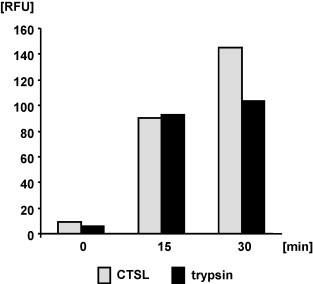
In vitro peptide cleavage assay. Cleavage of a fluorogenic peptide mimicking the NiV F cleavage site (H2N-Abz-DLVGDVRLAGV-3-nitroYA-CONH2) by trypsin and cathepsin L (CTSL) was analyzed. Reactions were carried out at 37 °C in 100 μl buffer containing 10 μM fluorogenic peptides and either trypsin (1 μg) or 0.5 μg (0.1 mU) CTSL. Enzymatic activity was measured with a PerkinElmer LS55 luminescence spectrometer (excitation 320 nm, emission 460 nm). Relative fluorescence units (RFU) versus hydrolysis time are plotted.
Fig. 3.
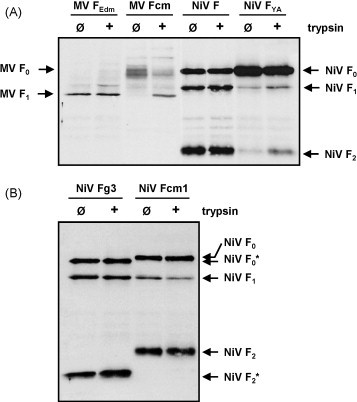
Influence of trypsin addition on the cleavage of MV F and NiV F proteins. MDCK cells were transfected in (A) with plasmids carrying the gene encoding for standard MV FEdm, the MV Fcm protein with a monobasic cleavage site, the wildtype NiV F protein, or the endocytosis-negative mutant NiV FYA protein. In (B), cells were transfected with pczCFG5 NiV Fg3 carrying a NiV F gene with a mutation in the N-glycosylation site, or with pczCFG5 NiV Fcm1 encoding for a NiV F gene with the multibasic cleavage site of MV FEdm. At 6 h p.t., the culture medium was replaced by medium without (Ø) or with (+) 0.5 μg of trypsin per ml. After 18 h, cells were surface labeled with biotin and lysed. Following immunoprecipitation, samples were subjected to SDS-PAGE under reducing conditions and blotted to nitrocellulose. Surface-labeled F proteins were visualized with streptavidin-peroxidase and chemiluminescence. F0* and F2*: lack of g3 results in faster migration (about 3 kD) of the uncleaved NiV F0 and the subunit NiV F2.
3.2. Neither the N-glycan adjacent to amino acids upstream of the cleavage peptide nor the amino acid composition itself influence F cleavage
Glycans near the cleavage site can interfere with proteolytic processing of fusion proteins (Deshpande et al., 1987, Eichler et al., 2006, Kawaoka et al., 1984, Ohuchi et al., 1989, Russell et al., 1989). Since NiV F possesses an N-glycan (g3) of the complex type attached to N99 and thus in close proximity to the cleavage site R109 (Moll et al., 2004b), we wanted to test if g3 sterically hinders trypsin recognition of the NiV F cleavage site. NiV Fg3, a mutant lacking g3 because of a T to G mutation in the N-glycosylation consensus sequence (NNT to NNG; Fig. 1) was therefore transiently expressed either in the absence or presence of trypsin and cleavage was analyzed by surface biotinylation. The finding that processing of NiV Fg3 was almost equally efficient in the absence and presence of trypsin (Fig. 3B) indicates that g3 neither influences CTSL activation nor enhances trypsin recognition of the NiV cleavage site. The observation that processing of the endocytosis-negative mutant NiV FYA by trypsin was not further increased in the absence of g3 (mutant NiV Fg3YA; Suppl. Fig. II), demonstrates that g3 depletion does not improve accessibility for trypsin even after extended contact with the protease in the culture medium. As it is known that activation by trypsin can be affected by changes in the amino acids upstream of the basic residue at the cleavage site (Schickli et al., 2005, Tashiro et al., 1991), we generated a NiV F protein called NiV Fcm1 (Fig. 1) with the sequence SRNHNR known to be cleaved in MV Fcm by trypsin. As shown in Fig. 3B, mutant NiV Fcm1 was cleaved and processing was not increased in the presence of trypsin. This indicates that NiV Fcm1 similar to wildtype NiV F is cleaved by CTSL and neither requires nor can be further processed by exogenous trypsin. Thus, the trypsin cleavage site of MV Fcm does not function in the context of the NiV F protein.
3.3. MV F protein with a NiV F cleavage peptide requires trypsin for activation
To test if the NiV F cleavage peptide is also recognized by CTSL when present in another paramyxoviral F protein, the HDLVGDVR peptide was introduced into the MV F protein (MV Fcm*, Fig. 1). To analyze F cleavage, MV F expressing cells were subjected to pulse-chase analysis. As shown in Fig. 4A, MV Fcm* is not cleaved in untreated cells within a chase period of 2 h indicating that the NiV cleavage peptide HDLVGDVR is not cleaved by intracellular host proteases in the context of the MV F protein. As with MV Fcm, mutant Fcm* is activated by exogenous trypsin. The fact that trypsin activation of MV Fcm* is less efficient than processing of MV Fcm suggests that the sequence upstream of the basic residue necessary for trypsin cleavage is less optimal in MV Fcm*. The same result was obtained when cleavage of MV Fcm and MV Fcm* was analyzed by surface biotinylation demonstrating that reduced trypsin cleavage of MV Fcm* was not due to a defective surface transport (data not shown).
Fig. 4.
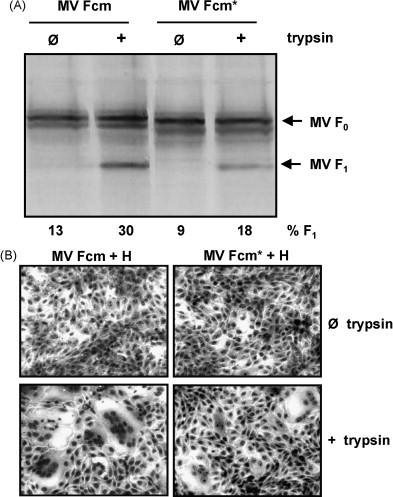
Cleavage and biological activity of mutant MV F proteins with monobasic cleavage sites in the absence and presence of trypsin. (A) MDCK cells were transfected with genes either encoding MV Fcm with a monobasic cleavage site (NHNR) known to be recognized by trypsin, or encoding MV Fcm*, a MV F protein with the cleavage peptide of NiV F (GDVR). Transfected cells were radiolabeled at 24 h p.t. with [35S]-methionine and -cysteine for 10 min and then incubated for 2 h in the absence (Ø) or presence (+) of 0.5 μg trypsin per ml. F proteins were immunoprecipitated from cell lysates, separated on a 12% SDS gel under reducing conditions, and subjected to autoradiography. (B) Cells were transfected with the MV H gene in combination with either the MV Fcm or the MV Fcm* gene. At 6 h p.t., the culture medium was replaced by medium without (Ø) or with (+) 0.5 μg trypsin per ml. After 18 h, cells were fixed with ethanol and incubated with Giemsa staining solution to visualize syncytium formation. Magnification, 63×.
To test the biological activity of the mutant MV F proteins, Fcm and Fcm* were coexpressed with the MV hemagglutinin (H), and syncytium formation was monitored at 24 h p.t. Fig. 4B shows that MV Fcm* like MV Fcm only induces cell-to-cell fusion in the presence of trypsin. As must be expected from the less efficient cleavage of MV Fcm*, syncytia formation induced by MV Fcm* is less pronounced than cell-to-cell fusion caused by MV Fcm. The results of the fusion assays confirm that trypsin is essentially required to generate a biologically active MV Fcm* protein and demonstrate that the cleavage motif of the NiV F protein does not function as a substrate for CTSL if it is presented in the context of the MV F protein. The lack of CTSL activation of MV Fcm* cannot be explained by the inability of the MV F protein to enter the endosomal compartment where CTSL is active since we have shown that the MV glycoproteins are efficiently endocytosed (Moll et al., 2001).
3.4. Transfer of a furin consensus motif generates a non-cleaved NiV F protein
We finally wanted to address the question if NiV F can function as substrate for the Golgi protease furin if a suitable consensus motif is present. Therefore, we generated a mutant NiV F protein in which the MV FEdm cleavage peptide SRRHKR was introduced (NiV Fcm2; Fig. 1). Analysis of proteolytic processing of the mutant unexpectedly revealed that NiV Fcm2 was not cleaved at all (Fig. 5A). Thus, introduction of a multibasic cleavage site not only fails to generate a furin-cleavable protein but also completely prevents cleavage by CTSL. To determine if the N-glycan g3 hinders recognition of the multibasic cleavage site in the NiV F protein by furin or CTSL or perturbs a structural feature so that it cannot serve as a substrate for these proteases, a g3 lacking Fcm2 mutant was generated (NiV Fg3cm2; Fig. 1). Interestingly, a small amount of NiV Fg3cm2 was found to be cleaved. Although g3 did not influence CTSL cleavage of the wildtype NiV F protein (Fig. 5A, NiV Fg3), processing of the NiV F mutant with a multibasic cleavage site was slightly improved in the absence of g3 (Fig. 5A, NiV Fg3cm2). Surface expression of the proteins was monitored by surface biotinylation demonstrating that all mutant NiV F proteins were transported to the cell surface with similar efficiencies (Fig. 5B). Thus, all mutants had passed the Golgi compartment where furin is located and active. To evaluate if the marginal differences in cleavage also affect the biological activity, fusion assays with cells coexpressing the NiV G protein together with either wildtype or mutant NiV F proteins were performed. As shown in Fig. 5C, wildtype NiV F protein and mutant NiV Fg3 could induce syncytium formation, whereas no cell-to-cell fusion was observed for the NiV Fcm2 mutant encoding the furin consensus sequence. In accordance with the observed minimal increase in cleavage, coexpression of NiV G and NiV Fg3cm2 resulted in the formation of a few very small syncytia. This suggests that g3 can have some modulating effect on cleavage efficiency and biological activation of mutant NiV F proteins even if it plays no crucial role in the proteolytic activation of wildtype NiV F. To determine which protease, CTSL or furin, is responsible for the minor cleavage of mutant NiV Fg3cm2, proteolytic processing of wildtype NiV F, mutant NiV Fg3cm2 and MV FEdm was analyzed in the presence of inhibitors either preventing CTSL-mediated cleavage (CA074ME; Montaser et al., 2002, Pager and Dutch, 2005), or interfering with furin cleavage (peptidyl chloromethylketone Dec-RVKR-CMK; Hallenberger et al., 1992). Pulse-chase analysis revealed that the furin inhibitor Dec-RVKR-CMK blocked MV FEdm cleavage but had no effect on NiV Fg3cm2 processing (Fig. 5D) showing that furin cannot recognize the multibasic cleavage peptide in the NiV F protein even in the absence of g3. In contrast, inhibition of CTSL by CA074ME completely abolished proteolytic activation of wildtype NiV F and NiV Fg3cm2 indicating that the furin consensus sequence in NiV Fg3cm2 is cleaved by CTSL, albeit very inefficiently.
Fig. 5.

Proteolytic processing of NiV F proteins by endogenous host cell proteases. (A) MDCK cells were transfected with genes encoding either for wildtype NiV F, for the g3-deficient mutant NiV Fg3, for mutant NiV Fcm2 containing the multibasic cleavage peptide of the MV FEdm, or for mutant NiV Fg3cm2, a g3-deficient protein with the multibasic cleavage peptide of the MV FEdm. At 24 h p.t., cells were metabolically labeled with [35S]-methionine and -cysteine for 10 min and incubated in non-radioactive medium for 3 h. After cell lysis, F proteins were immunoprecipitated and detected by autoradiography after separation on a 12% SDS gel under reducing conditions. NiV F0*: F0 of g3 lacking mutants migrates faster (about 3 kD). (B) MDCK cells expressing wildtype or mutant NiV F proteins were subjected to surface biotinylation as described in the legend to Fig. 3B. (C) Syncytium formation in MDCK cells expressing NiV G together with either NiV F, NiV Fg3, NiV Fcm2 or NiV Fg3cm2 was detected by Giemsa staining at 24 h p.t. Magnification, 63×. (D) MDCK cells were transfected with pczCFG5 NiV F, pczCFG5 NiV Fg3cm2, or pCG MV FEdm. At 24 h p.t., a pulse-chase analysis was carried out as described in the legend to Fig. 4A. Labeling was performed in the absence (control) or presence of either 50 μM CA074ME (CA074ME) or 25 μM Dec-RVKR-CMK (Dec-RVKR-CMK). F proteins were immunoprecipitated, separated by SDS-PAGE under reducing conditions, and subjected to autoradiography.
4. Discussion
We have shown here that the prerequisites for Nipah virus fusion (F) protein activation differ markedly from those of other paramyxoviral F- or orthomyxoviral HA proteins. The monobasic cleavage site in NiV F is not efficiently recognized by trypsin and introduction of a multibasic sequence does not allow cleavage by furin but rather prevents activation by any cellular protease. The observed differences in the cleavability of Nipah and measles virus F proteins with identical cleavage peptides indicate that the conformation around the cleavage sites substantially varies between these two paramyxoviral fusion proteins, either allowing exclusive activation of the substrate by cathepsin L, a cysteine protease, or selective cleavage by the serine proteases trypsin and furin. The description that NiV and HeV F proteins can also be cleaved in vitro by cathepsin B, another cysteine protease (Pager and Dutch, 2005, Pager et al., 2006), implies that conformation of henipavirus F proteins generally allows accessibility for cysteine proteases.
A report by Aguilar et al. (2006) revealed that N-glycans importantly define the F protein conformation. Glycosylation mutants were found to be more sensitive to antibody neutralization, to be resistant against peptide fusion inhibitors, and to have a decreased avidity for the NiV G protein. It was thus proposed that N-glycans of the F protein are required for tight association with the G protein, thereby limiting fusion activity (Aguilar et al., 2006). These data which clearly hint at the importance of glycosylation for NiV F conformation and fusion properties together with several reports that describe a direct influence of glycans near the cleavage site on fusion protein processing (Deshpande et al., 1987, Eichler et al., 2006, Russell et al., 1989) supported the idea that N-glycans in the NiV F, in particular g3, the glycan directly adjacent to the cleavage site, could be crucial factors determining the exceptional structural characteristics of the NiV F cleavage region. However, our results demonstrated that g3 is not involved in defining the accessibility for proteases. Cleavage of g3-depleted F protein by CTSL was not impaired and, activation by trypsin was not substantially enhanced (mutant Fg3). In addition, furin cleavage was still not possible, even after sequence adaptation (mutant Fg3cm2).
Many viral and cellular proteins are known to be processed by the cysteine proteases cathepsin L or B as well as by trypsin or furin-related prohormone convertases which belong to the family of serine proteases. For example, the viral superantigen 7 (vSag7) of the mouse mammary tumor virus can be processed by furin or by cathepsin L. However, activation by both enzymes has different sequence requirements and does likely not occur at exactly the same position (Denis et al., 2000). The requirement for pH-dependent cathepsin L cleavage to restore the fusion activity of the SARS coronavirus spike protein can be circumvented by trypsin treatment demonstrating that the spike protein provides recognition sites for both, cathepsins and trypsin (Simmons et al., 2005). Endosomal proteolysis by cathepsin L and B which converts the Ebola virus GP1 into a 19 kDa form is necessary to trigger fusion. The finding that thermolysin can also generate a 19 kDa form of GP1 suggests that the region in which cathepsin cleavage occurs is hypersensitive to protease digestion (Schornberg et al., 2006). Processing of prorenin to active renin involves proteolytic cleavage of a 43 amino acid segment following a di-basic cleavage site and can be mediated by trypsin or trypsin-like proteases as well as by cathepsin B (Higashimori et al., 1989, Jutras and Reudelhuber, 1999). In contrast to the proteins mentioned above in which furin- or trypsin-related enzymes and cathepsin L can cleave at the same or a very nearby cleavage site, functional NiV F processing can be achieved only by cathepsin L. Even after sequence adaptations at the cleavage peptide, NiV F cannot serve as substrate for trypsin or furin (Table 1 ).
Table 1.
Cleavability of NiV and MV F proteins by cathepsin L, furin and trypsin.
| Cleavage site sequence | Cleavage by |
|||
|---|---|---|---|---|
| Cathepsin L | Furin | Trypsin | ||
| NiVF | G-D-V-R | +++ | – | −/+a |
| NiVFcm1 | N-H-N-R | ++ | – | – |
| NiVFcm2 | R-H-K-R | – | – | –b |
| NiVFg3 | G-D-V-R | +++ | – | −/+a |
| NiVFg3cm2 | R-H-K-R | +/− | – | –b |
| MVFEdm | R-H-K-R | – | +++ | ++b |
| MVFcm | N-H-N-R | – | – | ++ |
| MV Fcm* | G-D-V-R | – | – | + |
Boldfaced letters indicate basic amino acids at the cleavage site.
The results on the cleavability of standard and mutant F proteins are summarized: +++ very efficient cleavage; ++ efficient cleavage; + cleavage clearly detectable; +/− cleavage barely detectable; – no cleavage.
Analysis of the endocytosis-negative mutants NiV FYA (Fig. 3A) and NiV Fg3YA (suppl. Fig. II) had revealed that the NiV F cleavage site is slightly processed if constitutively expressed on the cell surface.
Data not shown in this study.
In agreement with the fact that cathepsin L cleaves either N-terminal or between two basic residues (Hook et al., 2004), we previously observed that the monobasic cleavage site in the wildtype NiV F as well as a di-basic cleavage site (LVGDVRR) in the NiV FL110R mutant can function as substrate for cathepsin L (Moll et al., 2004a). The finding of this study that a NiV F protein with the multibasic cleavage site SRRHKR (mutant NiV Fcm2) is not activated suggests that cathepsin L tolerates only a limited number of basic residues in the cleavage peptide.
The most compelling evidence of a relationship between an intracellular ubiquitous cleavability of viral fusion proteins and systemic virus spread in vivo comes from naturally occurring strains of Newcastle disease virus and pneumotropic and pantropic Sendai virus variants as well as from studies on human and avian influenza viruses (Klenk and Garten, 1994, Peeters et al., 1999, Tashiro et al., 1988, Tashiro et al., 1990, Tashiro et al., 1992, Tumpey et al., 2005). Even if viruses such as human parainfluenza virus type 2 and 3 (HPIV-2/3) or recombinant human metapneumovirus with an artificial furin cleavage site do not spread outside of the respiratory tract despite their furin-cleavable F proteins (Biacchesi et al., 2006, Ortmann et al., 1994, Sakaguchi et al., 1994), ubiquitous activation of the NiV F protein is clearly one of the indispensable prerequisites for systemic virus spread in vivo. Such a non-restricted F cleavage is easily achieved by the Golgi protease furin. Therefore, the question is, why F proteins of henipaviruses are cleaved by endosomal cathepsins whereas fusion proteins of other systemically replicating ortho- or paramyxoviruses are generally processed by furin. Even paramyxoviruses isolated from reptilians have been shown to contain furin-cleavable F proteins (Franke et al., 2006). F proteins cleavable by furin always encounter their protease during transport through the secretory pathway to the cell surface and can thus be immediately incorporated into virus particles budding from the cell surface, which are then fully infectious. In contrast, before cathepsin L-dependent F proteins can be incorporated as fusion-active proteins they must undergo a cycle of endocytosis, pH-dependent cathepsin cleavage and subsequent F recycling to the cell surface. Even if this circuitous activation pathway leads to the production of infectious virus particles in which most of the incorporated F proteins are cleaved (Diederich et al., 2005), the absolute dependence on endosomal cathepsins does not appear to be an obvious advantage for a virus that needs a ubiquitous F activation. The use of cathepsins as processing enzymes might be due to the fact that henipaviruses have their natural reservoir in bats whose cellular proteases might be expressed and distributed differently. Since infectivity of NiV depends on sufficient amounts of cleaved F proteins in the virus envelope, it will be an important issue to analyze F activation in cells derived from bats, the natural host known to be asymptomatically infected in vivo (Middleton et al., 2007). The fact that SARS coronavirus and Ebola virus also use endosomal cathepsins for important replication steps and originate from bats (Leroy et al., 2005, Li et al., 2005, Simmons et al., 2005, Schornberg et al., 2006), might support the idea that the evolutionary origin is responsible for the exceptional protease requirements of henipaviruses.
Acknowledgements
We thank Markus Czub and Hana Weingartl for providing the NiV-specific guinea pig antiserum. We gratefully acknowledge the excellent technical assistance of Anja Heiner. We also thank Anna Maisa for help with the peptide cleavage assay and Wolfgang Garten and Hans-Dieter Klenk for helpful comments on the manuscript.
This work was supported by a grant of the German Research Foundation (DFG) to A.M. (MA1886/5-3 and SFB 593/TP B11).
Footnotes
Supplementary data associated with this article can be found, in the online version, at doi:10.1016/j.virusres.2009.07.020.
Appendix A. Supplementary data
References
- Aguilar H.C., Matreyek K.A., Filone C.M., Hashimi S.T., Levroney E.L., Negrete O.A., Bertolotti-Ciarlet A., Choi D.Y., McHardy I., Fulcher J.A., Su S.V., Wolf M.C., Kohatsu L., Baum L.G., Lee B. N-glycans on Nipah virus fusion protein protect against neutralization but reduce membrane fusion and viral entry. J. Virol. 2006;80(10):4878–4889. doi: 10.1128/JVI.80.10.4878-4889.2006. [DOI] [PMC free article] [PubMed] [Google Scholar]
- Biacchesi S., Pham Q.N., Skiadopoulos M.H., Murphy B.R., Collins P.L., Buchholz U.J. Modification of the trypsin-dependent cleavage activation site of the human metapneumovirus fusion protein to be trypsin independent does not increase replication or spread in rodents or nonhuman primates. J. Virol. 2006;80(12):5798–5806. doi: 10.1128/JVI.00294-06. [DOI] [PMC free article] [PubMed] [Google Scholar]
- Boettcher E., Matrosovich T., Beyerle M., Klenk H.D., Garten W., Matrosovich M. Proteolytic activation of influenza viruses by serine proteases TMPRSS2 and HAT from human airway epithelium. J. Virol. 2006;80(19):9896–9898. doi: 10.1128/JVI.01118-06. [DOI] [PMC free article] [PubMed] [Google Scholar]
- Chua K.B. Nipah virus outbreak in Malaysia. J. Clin. Virol. 2003;26(3):265–275. doi: 10.1016/s1386-6532(02)00268-8. [DOI] [PubMed] [Google Scholar]
- Chua K.B., Goh K.J., Wong K.T., Kamarulzaman A., Tan P.S., Ksiazek T.G., Zaki S.R., Paul G., Lam S.K., Tan C.T. Fatal encephalitis due to Nipah virus among pig-farmers in Malaysia. Lancet. 1999;354(9186):1257–1259. doi: 10.1016/S0140-6736(99)04299-3. [DOI] [PubMed] [Google Scholar]
- Craft W.W., Jr., Dutch R.E. Sequence motif upstream of the Hendra virus fusion protein cleavage site is not sufficient to promote efficient proteolytic processing. Virology. 2005;341(1):130–140. doi: 10.1016/j.virol.2005.07.004. [DOI] [PubMed] [Google Scholar]
- Denis F., Shoukry N.H., Delcourt M., Thibodeau J., Labrecque N., McGrath H., Munzer J.S., Seidah N.G., Sekaly R.P. Alternative proteolytic processing of mouse mammary tumor virus superantigens. J. Virol. 2000;74(7):3067–3073. doi: 10.1128/jvi.74.7.3067-3073.2000. [DOI] [PMC free article] [PubMed] [Google Scholar]
- Deshpande K.L., Fried V.A., Ando M., Webster R.G. Glycosylation affects cleavage of an H5N2 influenza virus hemagglutinin and regulates virulence. Proc. Natl. Acad. Sci. U.S.A. 1987;84(1):36–40. doi: 10.1073/pnas.84.1.36. [DOI] [PMC free article] [PubMed] [Google Scholar]
- Diederich S., Moll M., Klenk H.D., Maisner A. The nipah virus fusion protein is cleaved within the endosomal compartment. J. Biol. Chem. 2005;280(33):29899–29903. doi: 10.1074/jbc.M504598200. [DOI] [PubMed] [Google Scholar]
- Eichler R., Lenz O., Garten W., Strecker T. The role of single N-glycans in proteolytic processing and cell surface transport of the Lassa virus glycoprotein GP-C. Virol. J. 2006;3:41. doi: 10.1186/1743-422X-3-41. [DOI] [PMC free article] [PubMed] [Google Scholar]
- Franke J., Batts W.N., Ahne W., Kurath G., Winton J.R. Sequence motifs and prokaryotic expression of the reptilian paramyxovirus fusion protein. Arch. Virol. 2006;151(3):449–464. doi: 10.1007/s00705-005-0663-1. [DOI] [PMC free article] [PubMed] [Google Scholar]
- Garten W., Klenk H.-D. Cleavage activation of the influenza virus hemagglutinin and its role in pathogenesis. In: Klenk H.-D., Matrosovich M.N., Stech J., editors. vol. 27. Karger; Basel: 2008. pp. 156–167. (Avian Influenza). [Google Scholar]
- Hallenberger S., Bosch V., Angliker H., Shaw E., Klenk H.D., Garten W. Inhibition of furin-mediated cleavage activation of HIV-1 glycoprotein gp160. Nature. 1992;360(6402):358–361. doi: 10.1038/360358a0. [DOI] [PubMed] [Google Scholar]
- Higashimori K., Mizuno K., Nakajo S., Boehm F.H., Marcotte P.A., Egan D.A., Holleman W.H., Heusser C., Poisner A.M., Inagami T. Pure human inactive rennin. Evidence that native inactive renin is prorenin. J. Biol. Chem. 1989;264(25):14662–14667. [PubMed] [Google Scholar]
- Hook V., Yasothornsrikul S., Greenbaum D., Medzihradszky K.F., Troutner K., Toneff T., Bundey R., Logrinova A., Reinheckel T., Peters C., Bogyo M. Cathepsin L and Arg/Lys aminopeptidase: a distinct prohormone processing pathway for the biosynthesis of peptide neurotransmitters and hormones. Biol. Chem. 2004;385(6):473–480. doi: 10.1515/BC.2004.055. [DOI] [PubMed] [Google Scholar]
- Hooper P., Zaki S., Daniels P., Middleton D. Comparative pathology of the diseases caused by Hendra and Nipah viruses. Microbes Infect. 2001;3:315–322. doi: 10.1016/s1286-4579(01)01385-5. [DOI] [PubMed] [Google Scholar]
- Jutras I., Reudelhuber T.L. Prorenin processing by cathepsin B in vitro and in transfected cells. FEBS Lett. 1999;443(1):48–52. doi: 10.1016/s0014-5793(98)01672-x. [DOI] [PubMed] [Google Scholar]
- Kawaoka Y., Naeve C.W., Webster R.G. Is virulence of H5N2 influenza viruses in chickens associated with loss of carbohydrate from the hemagglutinin? Virology. 1984;139(2):303–316. doi: 10.1016/0042-6822(84)90376-3. [DOI] [PubMed] [Google Scholar]
- Klenk H.D., Garten W. Cold Spring Harbor Laboratory; Cold Spring Harbor, New York: 1994. Activation Cleavage of Viral Spike Proteins by Host Proteases, Cellular Receptors for Animal Viruses. pp. 241–280. [Google Scholar]
- Leroy E.M., Kumulungui B., Pourrut X., Rouquet P., Hassanin A., Yaba P., Delicat A., Paweska J.T., Gonzalez J.P., Swanepoel R. Fruit bats as reservoirs of Ebola virus. Nature. 2005;438(7068):575–576. doi: 10.1038/438575a. [DOI] [PubMed] [Google Scholar]
- Li W., Shi Z., Yu M., Ren W., Smith C., Epstein J.H., Wang H., Crameri G., Hu Z., Zhang H., Zhang J., McEachern J., Field H., Daszak P., Eaton B.T., Zhang S., Wang L.F. Bats are natural reservoirs of SARS-like coronaviruses. Science. 2005;310(5748):676–679. doi: 10.1126/science.1118391. [DOI] [PubMed] [Google Scholar]
- Maisner A., Mrkic B., Herrler G., Moll M., Billeter M.A., Cattaneo R., Klenk H.D. Recombinant measles virus requiring an exogenous protease for activation of infectivity. J. Gen. Virol. 2000;81(Pt 2):441–449. doi: 10.1099/0022-1317-81-2-441. [DOI] [PubMed] [Google Scholar]
- McGrath M.E. The lysosomal cysteine proteases. Annu. Rev. Biophys. Biomol. Struct. 1999;28:181–204. doi: 10.1146/annurev.biophys.28.1.181. [DOI] [PubMed] [Google Scholar]
- Meulendyke K.A., Wurth M.A., McCann R.O., Dutch R.E. Endocytosis plays a critical role in proteolytic processing of the Hendra virus fusion protein. J. Virol. 2005;79(20):12643–12649. doi: 10.1128/JVI.79.20.12643-12649.2005. [DOI] [PMC free article] [PubMed] [Google Scholar]
- Middleton D.J., Morrissy C.J., van der Heide B.M., Russell G.M., Braun M.A., Westbury H.A., Halpin K., Daniels P.W. Experimental Nipah virus infection in pteropid bats (Pteropus poliocephalus) J. Comp. Pathol. 2007;136(4):266–272. doi: 10.1016/j.jcpa.2007.03.002. [DOI] [PubMed] [Google Scholar]
- Moll M., Diederich S., Klenk H.D., Czub M., Maisner A. Ubiquitous activation of the Nipah virus fusion protein does not require a basic amino acid at the cleavage site. J. Virol. 2004;78(18):9705–9712. doi: 10.1128/JVI.78.18.9705-9712.2004. [DOI] [PMC free article] [PubMed] [Google Scholar]
- Moll M., Kaufmann A., Maisner A. Influence of N-glycans on processing and biological activity of the nipah virus fusion protein. J. Virol. 2004;78(13):7274–7278. doi: 10.1128/JVI.78.13.7274-7278.2004. [DOI] [PMC free article] [PubMed] [Google Scholar]
- Moll M., Klenk H.D., Herrler G., Maisner A. A single amino acid change in the cytoplasmic domains of measles virus glycoproteins H and F alters targeting, endocytosis, and cell fusion in polarized Madin-Darby canine kidney cells. J. Biol. Chem. 2001;276(21):17887–17894. doi: 10.1074/jbc.M010183200. [DOI] [PubMed] [Google Scholar]
- Moll M., Klenk H.D., Maisner A. Importance of the cytoplasmic tails of the measles virus glycoproteins for fusogenic activity and the generation of recombinant measles viruses. J. Virol. 2002;76(14):7174–7186. doi: 10.1128/JVI.76.14.7174-7186.2002. [DOI] [PMC free article] [PubMed] [Google Scholar]
- Montaser M., Lalmanach G., Mach L. CA-074, but not its methyl ester CA-074Me, is a selective inhibitor of cathepsin B within living cells. Biol. Chem. 2002;383(7–8):1305–1308. doi: 10.1515/BC.2002.147. [DOI] [PubMed] [Google Scholar]
- Ohuchi M., Orlich M., Ohuchi R., Simpson B.E., Garten W., Klenk H.D., Rott R. Mutations at the cleavage site of the hemagglutinin after the pathogenicity of influenza virus A/chick/Penn/83 (H5N2) Virology. 1989;168(2):274–280. doi: 10.1016/0042-6822(89)90267-5. [DOI] [PubMed] [Google Scholar]
- Ortmann D., Ohuchi M., Angliker H., Shaw E., Garten W., Klenk H.D. Proteolytic cleavage of wild type and mutants of the F protein of human parainfluenza virus type 3 by two subtilisin-like endoproteases, furin and Kex2. J. Virol. 1994;68(4):2772–2776. doi: 10.1128/jvi.68.4.2772-2776.1994. [DOI] [PMC free article] [PubMed] [Google Scholar]
- Pager C.T., Craft W.W., Jr., Patch J., Dutch R.E. A mature and fusogenic form of the Nipah virus fusion protein requires proteolytic processing by cathepsin L. Virology. 2006;346(2):251–257. doi: 10.1016/j.virol.2006.01.007. [DOI] [PMC free article] [PubMed] [Google Scholar]
- Pager C.T., Dutch R.E. Cathepsin L is involved in proteolytic processing of the Hendra virus fusion protein. J. Virol. 2005;79(20):12714–12720. doi: 10.1128/JVI.79.20.12714-12720.2005. [DOI] [PMC free article] [PubMed] [Google Scholar]
- Peeters B.P., de Leeuw O.S., Koch G., Gielkens A.L. Rescue of newcastle disease virus from cloned cDNA: evidence that cleavability of the fusion protein is a major determinant for virulence. J. Virol. 1999;73(6):5001–5009. doi: 10.1128/jvi.73.6.5001-5009.1999. [DOI] [PMC free article] [PubMed] [Google Scholar]
- Russell D.L., Dalrymple J.M., Johnston R.E. Sindbis virus mutations which coordinately affect glycoprotein processing, penetration, and virulence in mice. J. Virol. 1989;63(4):1619–1629. doi: 10.1128/jvi.63.4.1619-1629.1989. [DOI] [PMC free article] [PubMed] [Google Scholar]
- Sakaguchi T., Fujii Y., Kiyotani K., Yoshida T. Correlation of proteolytic cleavage of F protein precursors in paramyxoviruses with expression of the fur, PACE4 and PC6 genes in mammalian cells. J. Gen. Virol. 1994;75(Pt 10):2821–2827. doi: 10.1099/0022-1317-75-10-2821. [DOI] [PubMed] [Google Scholar]
- Schickli J.H., Kaur J., Ulbrandt N., Spaete R.R., Tang R.S. An S101P substitution in the putative cleavage motif of the human metapneumovirus fusion protein is a major determinant for trypsin-independent growth in vero cells and does not alter tissue tropism in hamsters. J. Virol. 2005;79(16):10678–10689. doi: 10.1128/JVI.79.16.10678-10689.2005. [DOI] [PMC free article] [PubMed] [Google Scholar]
- Schornberg K., Matsuyama S., Kabsch K., Delos S., Bouton A., White J. Role of endosomal cathepsins in entry mediated by the Ebola virus glycoprotein. J. Virol. 2006;80(8):4174–4178. doi: 10.1128/JVI.80.8.4174-4178.2006. [DOI] [PMC free article] [PubMed] [Google Scholar]
- Simmons G., Gosalia D.N., Rennekamp A.J., Reeves J.D., Diamond S.L., Bates P. Inhibitors of cathepsin L prevent severe acute respiratory syndrome coronavirus entry. Proc. Natl. Acad. Sci. U.S.A. 2005;102(33):11876–11881. doi: 10.1073/pnas.0505577102. [DOI] [PMC free article] [PubMed] [Google Scholar]
- Tashiro M., James I., Karri S., Wahn K., Tobita K., Klenk H.D., Rott R., Seto J.T. Pneumotropic revertants derived from a pantropic mutant, F1-R, of Sendai virus. Virology. 1991;184(1):227–234. doi: 10.1016/0042-6822(91)90839-4. [DOI] [PubMed] [Google Scholar]
- Tashiro M., Pritzer E., Khoshnan M.A., Yamakawa M., Kuroda K., Klenk H.D., Rott R., Seto J.T. Characterization of a pantropic variant of Sendai virus derived from a host range mutant. Virology. 1988;165(2):577–583. doi: 10.1016/0042-6822(88)90601-0. [DOI] [PubMed] [Google Scholar]
- Tashiro M., Yamakawa M., Tobita K., Klenk H.D., Rott R., Seto J.T. Organ tropism of Sendai virus in mice: proteolytic activation of the fusion glycoprotein in mouse organs and budding site at the bronchial epithelium. J. Virol. 1990;64(8):3627–3634. doi: 10.1128/jvi.64.8.3627-3634.1990. [DOI] [PMC free article] [PubMed] [Google Scholar]
- Tashiro M., Yokogoshi Y., Tobita K., Seto J.T., Rott R., Kido H. Tryptase Clara, an activating protease for Sendai virus in rat lungs, is involved in pneumopathogenicity. J. Virol. 1992;66(12):7211–7216. doi: 10.1128/jvi.66.12.7211-7216.1992. [DOI] [PMC free article] [PubMed] [Google Scholar]
- Tumpey T.M., Basler C.F., Aguilar P.V., Zeng H., Solorzano A., Swayne D.E., Cox N.J., Katz J.M., Taubenberger J.K., Palese P., Garcia-Sastre A. Characterization of the reconstructed 1918 Spanish influenza pandemic virus. Science. 2005;310(5745):77–80. doi: 10.1126/science.1119392. [DOI] [PubMed] [Google Scholar]
- Vogt C., Eickmann M., Diederich S., Moll M., Maisner A. Endocytosis of the nipah virus glycoproteins. J. Virol. 2005;79(6):3865–3872. doi: 10.1128/JVI.79.6.3865-3872.2005. [DOI] [PMC free article] [PubMed] [Google Scholar]
- Wang L.F., Yu M., Hansson E., Pritchard L.I., Shiell B., Michalski W.P., Eaton B.T. The exceptionally large genome of Hendra virus: support for creation of a new genus within the family Paramyxoviridae. J. Virol. 2000;74(21):9972–9979. doi: 10.1128/jvi.74.21.9972-9979.2000. [DOI] [PMC free article] [PubMed] [Google Scholar]
- Weingart H.M., Berhane Y., Czub M. Animal models of henipavirus infection: a review. Vet. J. 2009;181(3):211–220. doi: 10.1016/j.tvjl.2008.10.016. [DOI] [PubMed] [Google Scholar]
- Yob J.M., Field H., Rashdi A.M., Morrissy C., van der Heide B., Rota P., bin Adzhar A., White J., Daniels P., Jamaluddin A., Ksiazek T. Nipah virus infection in bats (order Chiroptera) in peninsular Malaysia. Emerg. Infect. Dis. 2001;7(3):439–441. doi: 10.3201/eid0703.010312. [DOI] [PMC free article] [PubMed] [Google Scholar]
Associated Data
This section collects any data citations, data availability statements, or supplementary materials included in this article.