



To the Editor
With the widespread Coronavirus Disease 2019 (COVID-19) pandemic, respiratory treatment and supportive care for the patients have become an important part of standard treatment. Endotracheal intubation is an essential step in airway management. During the intubation process, the patient’s cough may produce secretions and become a source of transmission to infect the caregivers and surrounding working area. Many intubation precautions and devices have been proposed,1 including medications, personal protective equipment (PPE), and barrier enclosure. A barrier enclosure has recently been proven to effectivelyminimize the spread of patients’ droplets and aerosols during intubation.2 However, in the scenario of suspicious/confirmed COVID-19 patients who need to undergo emergency surgery, extubation and emergence cough after general anesthesia areanother potential source of transmission, and might contaminate the operating room. The importance of COVID-19 extubation should be emphasized to minimize the potential virus infection during a surgery. Both level-3 PPE and negative pressure operating rooms are suggested for such cases.
Here we proposed a simple, carton-made, protective shield thatprovides an effective reductionof transmission of droplets and aerosols during both intubation and extubation. First, we used a carton made of corrugated fiberboard as an alternative to the transparent plastic cube; the design diagrams of theprotective shield are now available as anopen source at the aerosol block website.3 Then we used a transparent plastic wrap to cover the upper portion of the carton, which allows direct vision inside the shield (Figure 1). The advantage of corrugated fiberboard is the flexibility to tailor the size of theshield according to the patient’s appearance and surgical need. It is also easy to obtaincorrugated fiberboard cartons, and the shield is disposable after asingle use.
Figure 1.
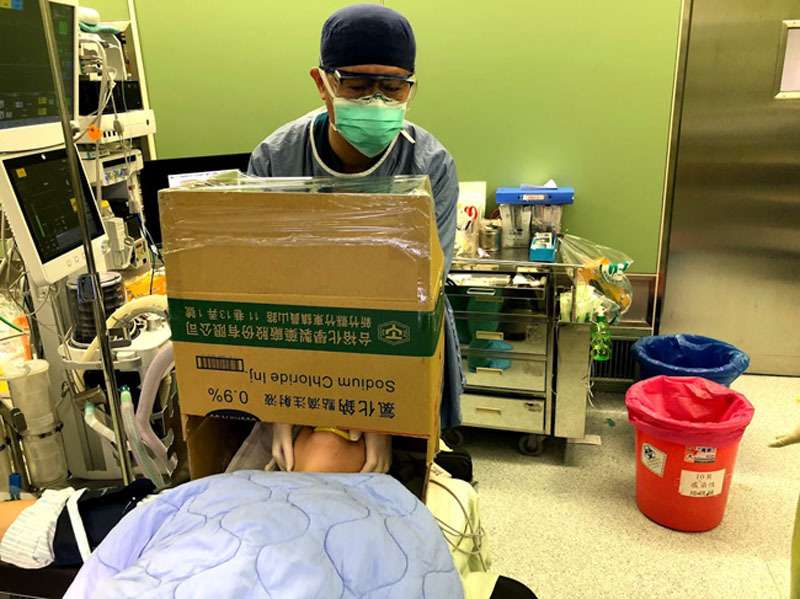
Carton-made protective shield with plastic wrap.
Before using, to avoid patient anxiety,we recommended communication with the patient describing the protective shield and why it is necessary in the anesthetic evaluation. Second, all the intubation devices (video laryngoscope with disposal blade is recommended) should be set inside the shield before induction, including anesthetic circuit and suction tube through the side ports of the shield. After preoxygenation, the laryngoscopist should perform a rapid sequence induction and intubation following COVID-19 perioperative management recommendations for the local institution. Communicating with thesurgeon is also important to ensure that the protective shield willnotoccupy the operation field. Afterthe shield interrupts operation,it should bediscarded and a new one prepared for extubation. At the end of general anesthesia, to avoid droplet and aerosol transmission from emergence cough,extubation should be performed inside the shield (Figure 2). Finally, the protective shield should bediscarded in accordance with contaminated waste.
Figure 2.
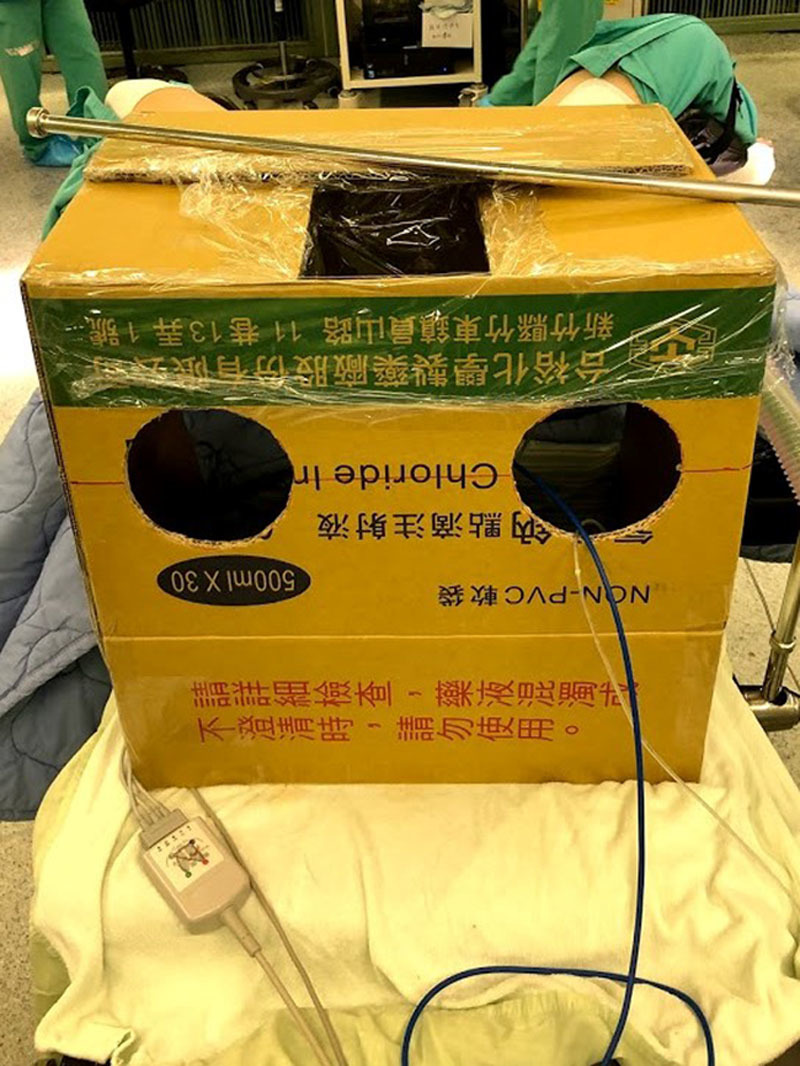
The protective shield can minimize droplet and aerosol transmission during extubation.
This pragmatic method is definitely not standard airway management of COVID-19. However, the protective shield has proven to be effectiveinminimizing the spread ofaerosols during intubation. Whenextubation of suspicious/confirmed COVID-19 after general anesthesia is needed, the adjunct protective shield may help minimize droplet and aerosol transmission and reduce operating room contamination.
Yu Yung Lai, MD
Chia Ming Chang, MD
Department of Anesthesiology
Dalin Tzu Chi Hospital
Buddhist Tzu Chi Medical Foundation
Chiayi, Taiwan
jamiechang95@gmail.com
REFERENCES
- 1.Orser BA. Recommendations for endotracheal intubationof COVID-19 patients. Anesth Analg. 2020;130:1109–1110 [DOI] [PMC free article] [PubMed] [Google Scholar]
- 2.Canelli R, Connor CW, Gonzalez M, Nozari A, Ortega R. Barrier enclosureduring endotracheal intubation. N Engl J Med. 2020. [Epub ahead of print]. [DOI] [PMC free article] [PubMed] [Google Scholar]
- 3.Aerosol Block. Available at: https://www.aerosolblock.org/. Accessed April 5, 2020.