



Abstract
Nucleosome positioning controls the accessible regions of chromatin and plays essential roles in DNA-templated processes. ATP driven remodeling enzymes are known to be crucial for its establishment in vivo, but their non-equilibrium nature has hindered the development of a unified theoretical framework for nucleosome positioning. Using a perturbation theory, we show that the effect of these enzymes can be well approximated by effective equilibrium models with rescaled temperatures and interactions. Numerical simulations support the accuracy of the theory in predicting both kinetic and steady-state quantities, including the effective temperature and the radial distribution function, in biologically relevant regimes. The energy landscape view emerging from our study provides an intuitive understanding for the impact of remodeling enzymes in either reinforcing or overwriting intrinsic signals for nucleosome positioning, and may help improve the accuracy of computational models for its prediction in silico.
The eukaryotic genome is packaged into nucleosomes that wrap approximately 147-base-pair (bp) stretch of DNA around histone proteins [1]. Remarkably, nucleosomes do not uniformly cover the whole genome but favor specific locations [2]. The precise position of nucleosomes along the DNA sequence is of critical importance for gene regulation as it determines which part of the genome is accessible [3, 4]. In particular, DNA segments occupied by histone proteins will occlude binding by regulatory factors and transcriptional machinery [3, 5–10]. In addition, nucleosome positioning may impact the stability of various nucleosome folding motifs [11–14] and correspondingly the compactness of higher order chromatin organization [15, 16]. Underpinning the molecular determinants of nucleosome positioning is, therefore, of fundamental interest and can provide insights into genome function.
Both DNA sequence and chromatin remodeling enzymes are crucial for establishing nucleosome positioning in vivo [17–21]. Significant progress has been made in understanding the impact of DNA sequence on nucleosome stability [9, 22], leading to the discovery of periodic dinucleotides (AT and TA) along the nucleosome length [23–25] and intrinsically stiff poly(dA:dT) tracts at nucleosome-depleted regions [26]. On the contrary, a complete understanding for the role of remodeling enzymes has yet to be established [27, 28] and conflicting views exist on whether they overwrite or reinforce positioning signals from the DNA sequence [29–32]. The challenge for theoretical studies of remodeling enzymes lies in the fact that they consume ATP to break the detailed balance and drive the system out of equilibrium [33]. Therefore, the thermodynamic analysis that finds great success for studying DNA sequence effect cannot be generalized straightforwardly [34, 35]. Though kinetic simulations have helped interpret experimental observations [30, 36, 37], a lack of analytical tools like those available for equilibrium systems has significantly hindered the building of intuition for remodeling enzymes. Here, we develop an analytical theory to provide a unified framework for studying the effect of remodeling enzymes, and to reconcile their combined role with intrinsic thermodynamic signals in positioning nucleosomes. In the following, we first introduce a kinetic model for nucleosome positioning that explicitly considers the effect of two different remodeling enzymes. We then show that kinetic and steady-state properties of this non-equilibrium system can be rigorously mapped onto an effective equilibrium model. Finally, results from numerical simulations are provided to validate the accuracy of the theory.
We used a one-dimensional lattice model to study nucleosome positioning, with each discrete site corresponding to one base pair of DNA (see Figure 1). The position of a nucleosome i is denoted by its dyad location as xi. A soft-core potential v(Δx) was applied between neighboring nucleosomes separated by Δx base pairs [38, 39]. It incurs a finite energetic cost for overlapping nucleosome configurations to account for both the excluded volume effect and transient DNA unwrapping. To focus on the role of remodeling enzymes, we did not explicitly model the DNA sequence effect, and assume that all lattice sites share the same binding affinity.
FIG. 1.
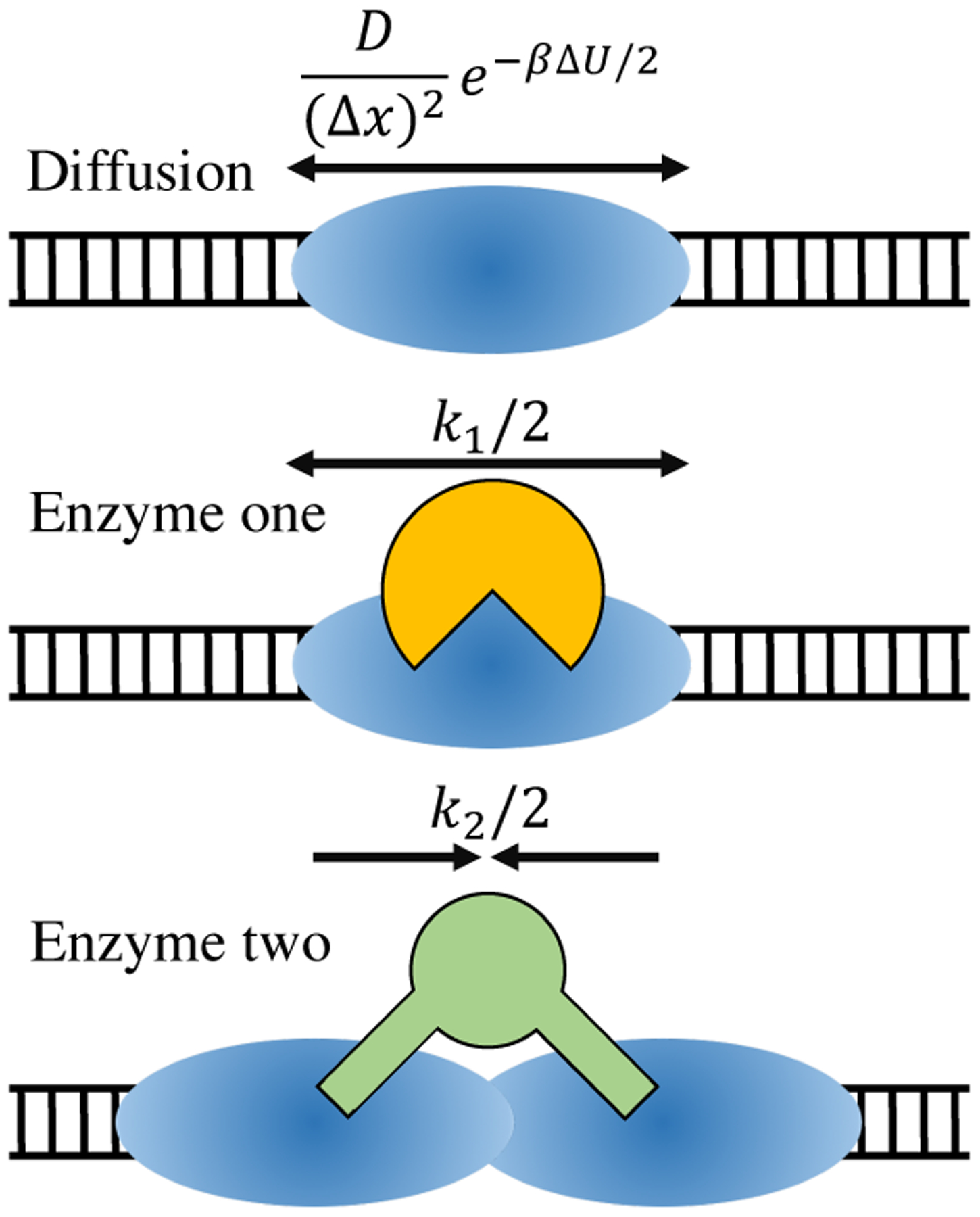
Illustration of the kinetic model for nucleosome positioning that includes diffusion (top), ATP-driven single-nucleosome remodeling (middle), and ATP-driven remodeling for a pair of nucleosomes (bottom). The DNA is drawn as a black ladder, with nucleosomes shown in blue oval and the two enzymes drawn in yellow and green respectively. The rates for an elementary step of different dynamics are shown above the arrows.
For simplicity, we considered systems with fixed nucleosome density and did not include nucleosome formation and disassembly processes. The kinetics of our model consists of only diffusion and active remodeling (see Figure 1). The diffusion rate was defined as , with D being the diffusion coefficient and Δx and ΔU as changes in the nucleosome position and interaction energy. Numerous enzymes have been discovered to organize nucleosomes along the DNA by consuming ATP, and we focus on two representative ones with distinct kinetics. Type one enzymes interact with a single nucleosome, and can move it to left or right by l base pairs with a rate of k1. These enzymes resemble the function of SWI/SNF [40] and can significantly fluidize nucleosomes to achieve high packing density [30]. Type two enzymes, on the other hand, interact with a pair of neighboring nucleosomes. It can bring them closer to each other and randomly move one of the nucleosomes by l base pairs at a rate of k2 if the two are within Δxmax = 332 bp [38]. A typical example for these enzymes is the ATP-utilizing chromatin assembly and remodeling factor (ACF) from the ISWI family, which is crucial for the regular spacing of nucleosomes near transcription start sites [41]. Since enzyme rates k1/2 are independent of the system’s energy, detailed balance is violated.
Our goal is to approximate both kinetic and steady-state properties of the above non-equilibrium system with effective equilibrium models. To make progress, we first describe the dynamical evolution of nucleosome positions x = {x1,x2, ⋯ , xn} with the following master equation
| (1) |
where Ψ(x, t) is the time dependent probability distribution function and is the many-body Fokker-Planck operator describing the diffusive dynamics of nucleosomes. is the non-equilibrium operator for remodeling enzymes. For type one enzymes, it adopts the following expression
| (2) |
where . Similarly, the non-equilibrium operator for type two enzymes can be written as
| (3) |
where Ci,i±1 = 1 for 0 < |xi − xi±1| ≤ Δxmax and 0 otherwise. We note that similar equations have been used by Wolynes and coworkers to study the effect of molecular motors on the actin network [42].
Next, following Wang and Wolynes [43, 44], we expand the probability distribution function Ψ(x, t)) in the powers of l up to the quadratic order. This leads to the following effective Fokker-Planck equation
| (4) |
For Type one enzymes, we have
| (5) |
For Type two enzymes, we have
| (6) |
where , and 〈·〉 represents ensemble averaging. Eqs. 5 and 6 are the main results of this manuscript, and they provide intuitive interpretations for the role of remodeling enzymes in nucleosome positioning. Type one enzymes elevate the system’s temperature without perturbing the underlying energy landscape. They may reinforce intrinsic positioning signals from inter-nucleosome interactions and the DNA sequence by accelerating the rate for the system to approach equilibrium [30]. On the other hand, type two enzymes give rise to an attractive potential between neighboring nucleosomes in addition to a rescaled temperature, and could alter nucleosome position significantly by overwriting thermodynamic effect [31].
To validate the accuracy of the derived effective equilibrium models, we carried out stochastic simulations of the full kinetic model using the Gillespie algorithm [45] to obtain “exact” non-equilibrium results. A 58800 bp long DNA with a total of 400 binding sites was used together with the periodic boundary condition. Only one type of enzymes is included in any given simulation in order to study their effects separately. We used a nucleosome density of 0.8 for simulations with type one enzymes and 0.5 for type two enzymes. These nucleosome densities were chosen to highlight the effect of the enzymes and do not affect our conclusions. More details of these simulations are provided in the Supporting Information (SI) [39].
We first determined the effective diffusion constants for type one enzymes from linear fitting of the mean-squared displacement. As shown in Figures 2a and S1a, at a fixed rate k1 = 1 s−1, simulated values for Deff (red dots) indeed closely follow the quadratic relationship with l as predicted in Eq. 5 (blue line). We further determined Deff for various enzyme rates k1 at l = 1 bp, and again found excellent agreement between theory (purple line) and numerical simulations (green triangles).
FIG. 2.
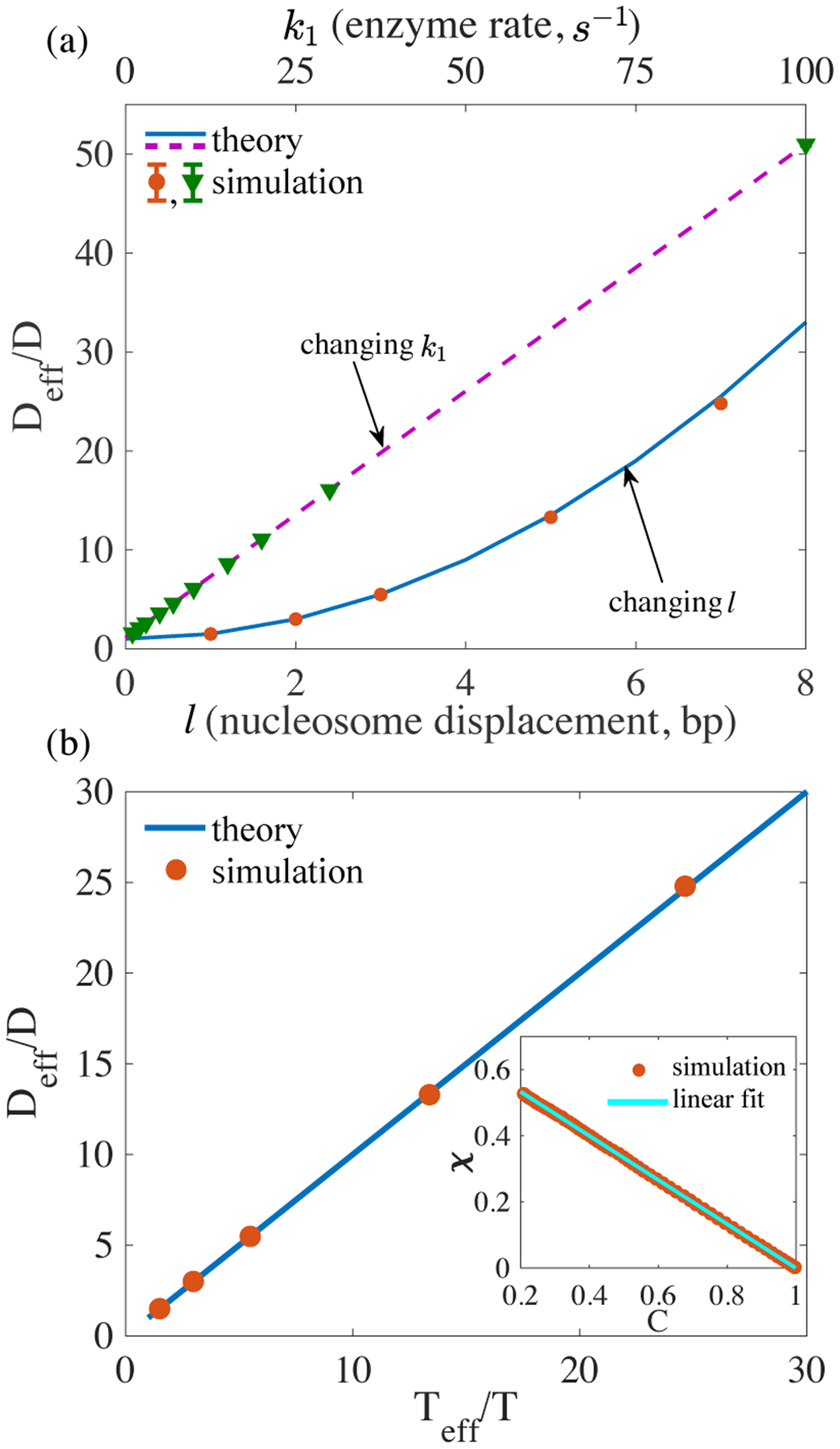
Comparison between simulated and theoretical values of Deff and Teff for type one enzymes. (a) Dependence of Deff on the enzyme rate k1 and step size l. (b) Teff determined as the fluctuation-dissipation ratio at l = 1, 2, 3, 5, 7 bp and k1 = 1 s−1. Error bars measured as standard deviation of the mean are comparable to the size of the symbols.
A notable result of the theory is that the fluctuation-dissipation relationship is satisfied with effective parameters. As a test, we determined the effective temperature using the fluctuation-dissipation ratio [46–49]. We define and . ϵj are random numbers with values of ±1 and the wave vector κ is chosen as the value for the first peak of the structure factor [39]. As shown in the inset of Figure 2b, a linear relationship is found between χ(t) and C(t). In the main frame, we plotted Teff for various values of l. The simulated values again agree well with theoretical predictions and Teff and Deff indeed follow a linear relationship.
To study the usefulness of the effective equilibrium model in predicting steady state quantities, we computed the radial distribution function (g(r)) using nucleosome configurations obtained from simulating type one enzymes at different step sizes. As shown in Figure 3 and Figure S2a as empty circles, consistent with higher effective temperatures, systems with larger step sizes gradually lose their structural ordering, and peaks in g(r) disappear. We further calculated g(r) for effective equilibrium models (cyan lines) using a matrix treatment of the grand partition function proposed by Poland [50], and found that they are in excellent agreement with the ones calculated from kinetic simulations.
FIG. 3.
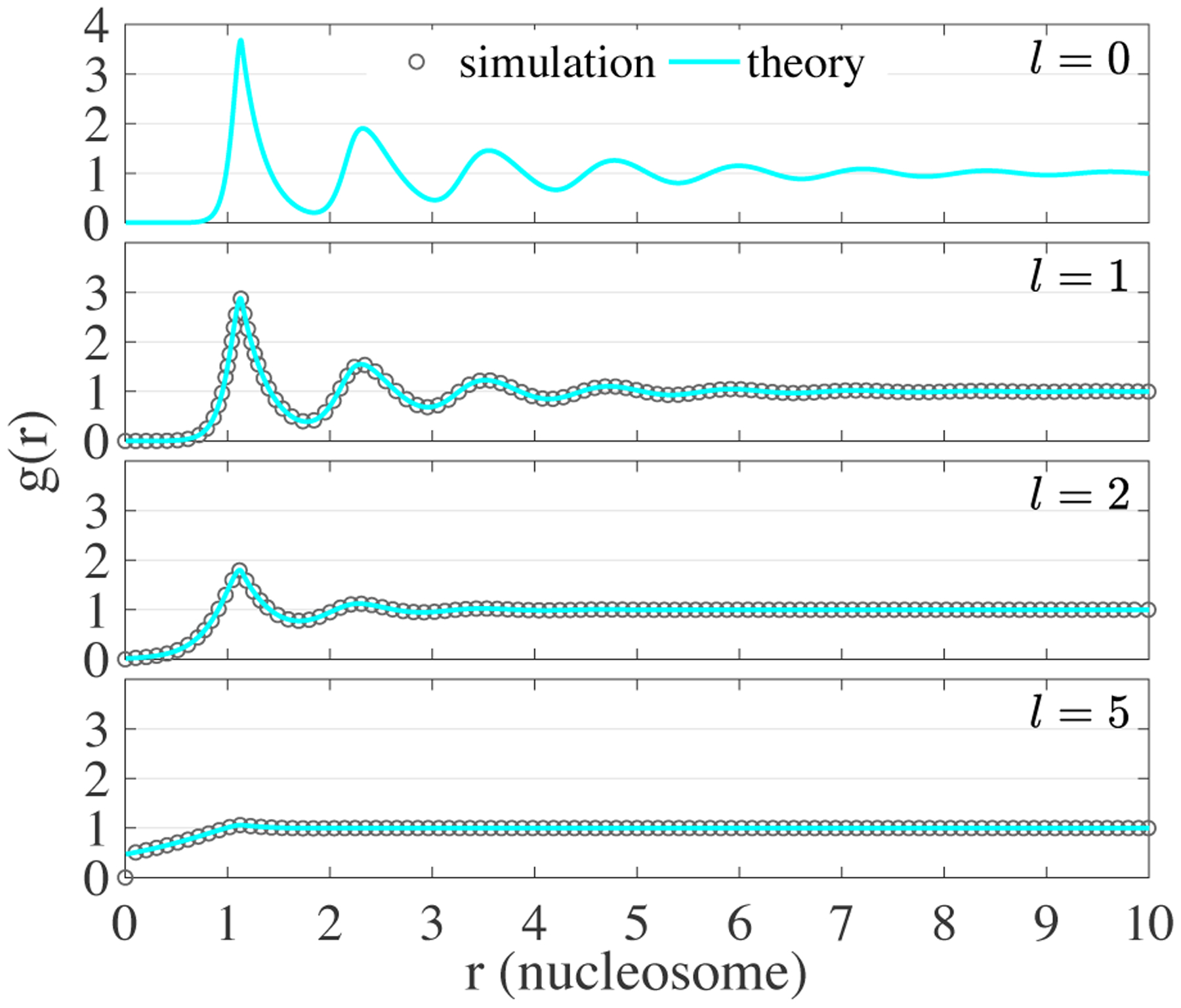
Comparison between radial distribution functions obtained from non-equilibrium simulations (empty circles) and from theoretical predictions of the effective equilibrium model (cyan lines) for type one enzymes with various step sizes.
Next we study the accuracy of the effective model in describing type two enzymes. As shown in Figure 4a, we observed an increase of the diffusion coefficient at larger l due to contributions from ATP driven nucleosome sliding (red dots). The theoretical results (blue dots) were calculated using Eq. 6 with steady state values for determined from non-equilibrium simulations. Though they agree well at small step sizes, theoretical results begin to deviate significantly from simulation values for l ≥ 5 bp. Similar behaviors are seen for Deff calculated at different enzyme remodeling rates k2 (purple and green triangles). Upon close inspection of simulated configurations, we found that the difference between theory and simulation is not due to a failure of the perturbative expansion, but can be attributed to the emergence of overlapping nucleosome configurations and rejection of remodeling steps that result in nucleosomes crossing each other (Figures S3). It’s worth noting that the biological value for l has been estimated to be around 1 bp [51], well within the regime where the theory works. We further followed the same approach as type one enzymes to calculate the effective temperature from the fluctuation dissipation ratio. As shown in Fig. 4(b), Teff again satisfies a linear relationship with Deff as predicted by Eq. 6.
FIG. 4.
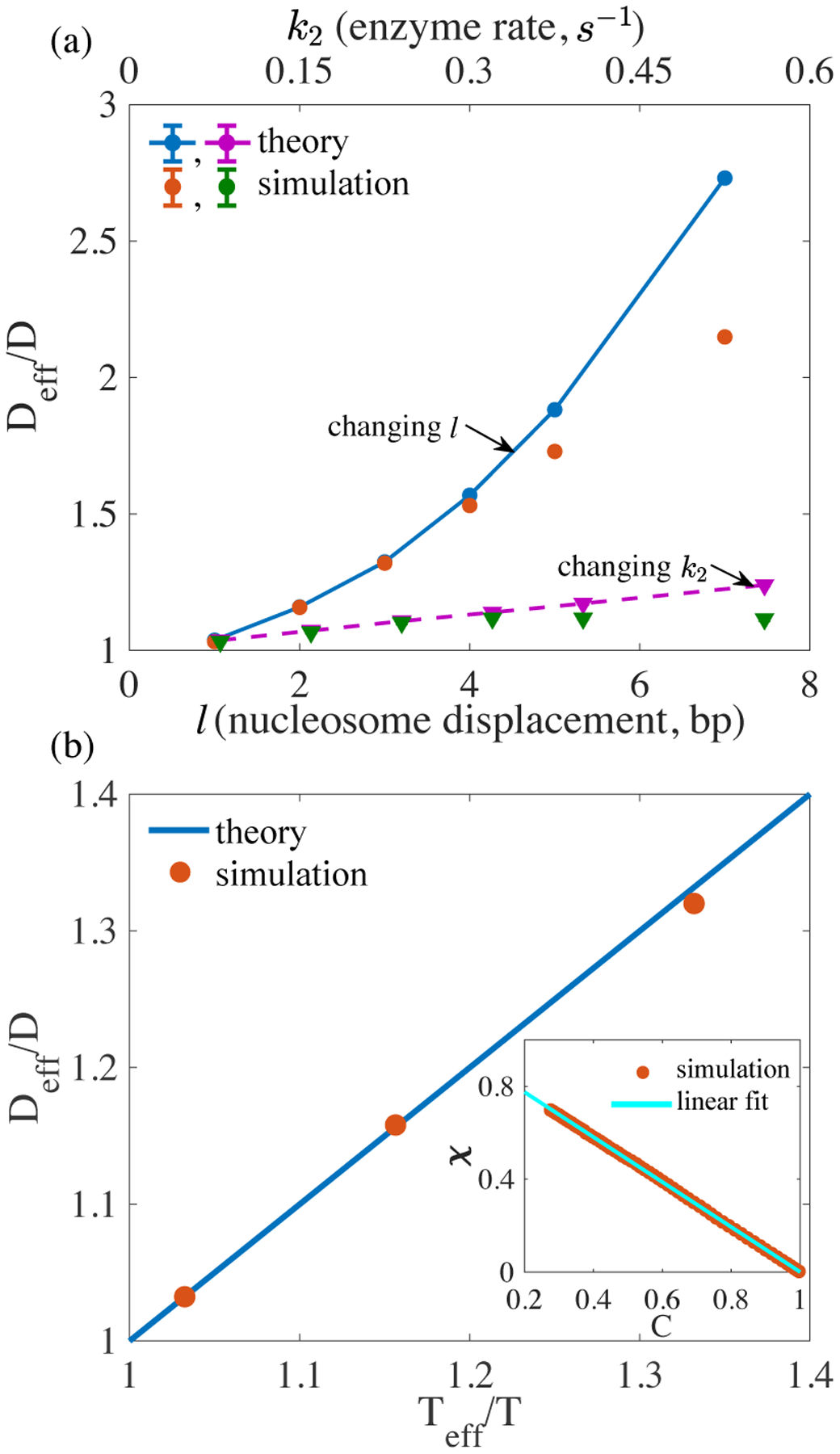
Comparison between simulated and theoretical values of Deff and Teff for type two enzymes. (a) Dependence of Deff on the enzyme rate k2 and step size l. (b) Teff determined as the fluctuation-dissipation ratio at l = 1, 2, 3 bp and k2 = 0.08 s−1. Error bars measured as standard deviation of the mean are comparable to the size of the symbols.
Type two enzymes significantly impact steady-state nucleosome positioning, and g(r) exhibits substantially more peaks even at l = 1 bp (empty circles in Figure 5). They lead to nucleosome clustering and can significantly increase the timescale needed to reach the steady state distribution for numerical simulations. We therefore limited our comparison between theory and simulation to small l values. For l = 1 and 2 bp, equilibrium g(r) determined from the effective models (cyan lines) are again in good agreement with steady state results. For l = 3 bp, we carried out stochastic simulations for both the full kinetic model (empty circles) and the effective model (red line) for 1.9 × 10⁸ s to calculate the g(r). These simulations are not long enough to reach steady state or equilibrium distributions, as the g(r) differs from the true equilibrium result determined from the partition function. However, the simulation results are in excellent agreement with each other, supporting the accuracy of the effective model in predicting time-dependent quantities (see also Figure S2b).
FIG. 5.
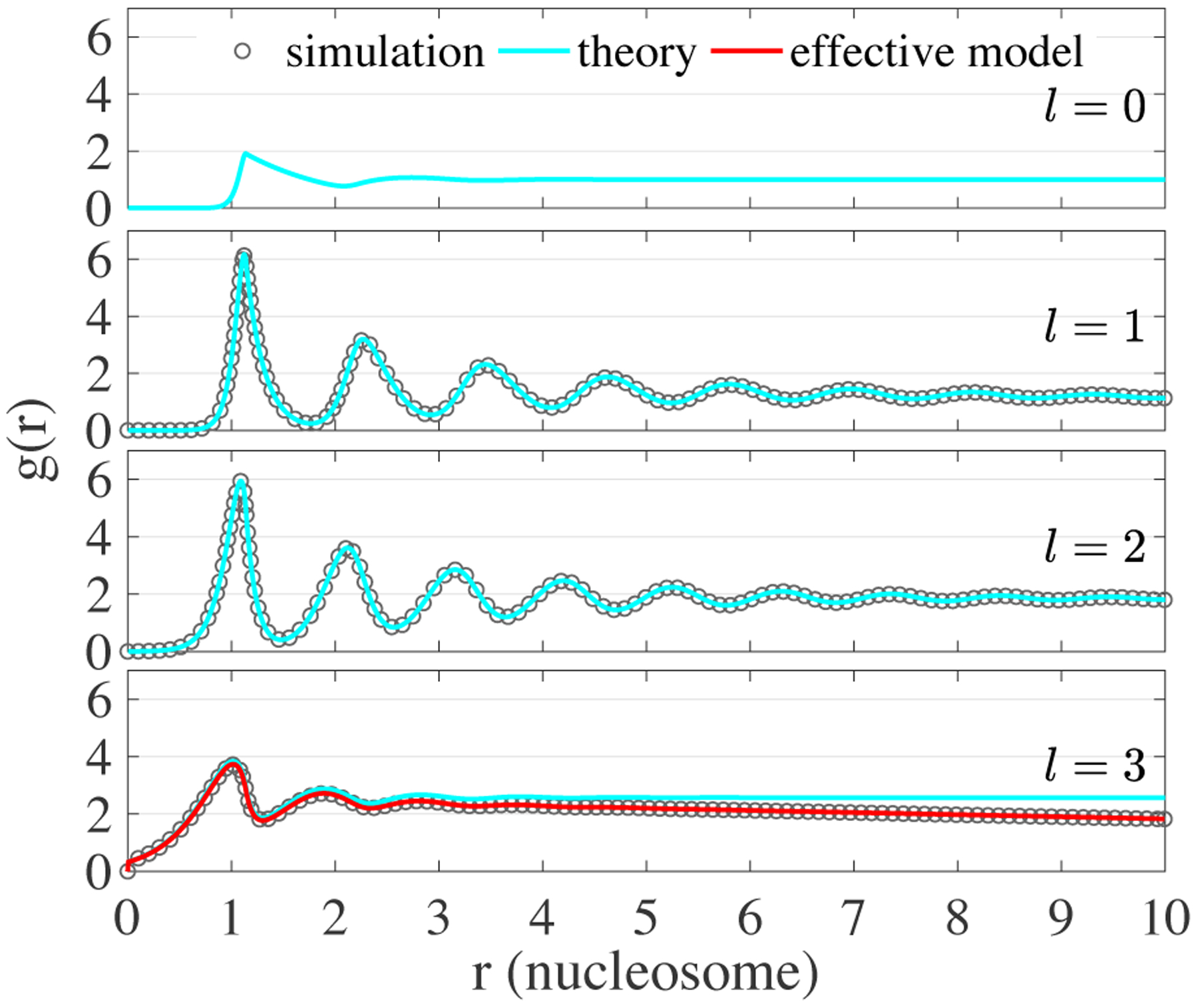
Comparison between radial distribution functions obtained from non-equilibrium simulations (empty circles) and from theoretical predictions of the effective equilibrium model (cyan lines) for type two enzymes with various step sizes. The red line for l = 3 bp was obtained from numerical simulations of the effective equilibrium model.
The perturbation theory, therefore, provides a powerful framework to study the role of remodeling enzymes in nucleosome positioning. It further suggests a straightforward strategy to incorporate the impact of remodeling enzymes into existing computational approaches [52–56] for improved prediction of nucleosome positioning in silico. In particular, the equilibrium framework adopted in many of these approaches can still be used in the presence of enzymes but with rescaled temperatures and interactions, the values of which can be determined from kinetic parameters of enzymes.
It is important to note that the theory presented here is general and can be directly applied to other nucleosome positioning models that include both types of enzymes (Figure S4), adopt a different energy form for inter-nucleosome interactions (Figure S5), or explicitly account for the effect of DNA sequence (Figures S6 and S7). Finally, we emphasize that ATP powered motors are crucial for many other essential biological processes [44, 57–61]. A general theory for these active, non-equilibrium systems does not exist and is actively sought-after by numerous researchers [34, 35]. The analytical theory presented here can potentially be a powerful tool for studying such systems and provide insights into their steady state behaviors.
Supplementary Material
Acknowledgments
We thank Jianshu Cao and Mehran Kardar for helpful discussions. This work was supported by the National Institutes of Health (Grant 1R35GM133580-01). Z.J. acknowledges the Amy Lin Shen Fellowship for financial support.
References
- [1].Richmond RK, Sargent DF, Richmond TJ, Luger K, and Mäder AW, Crystal structure of the nucleosome core particle at 2.8 Å resolution, Nature 389, 251 (1997). [DOI] [PubMed] [Google Scholar]
- [2].van Holde KE, Chromatin, Springer Series in Molecular Biology (Springer New York, New York, NY, 1989). [Google Scholar]
- [3].Bai L and Morozov AV, Gene regulation by nucleosome positioning, Trends Genet. 26, 476 (2010). [DOI] [PubMed] [Google Scholar]
- [4].Voong LN, Xi L, Wang J-P, and Wang X, Genome-wide Mapping of the Nucleosome Landscape by Micrococcal Nuclease and Chemical Mapping, Trends Genet. 33, 495 (2017). [DOI] [PMC free article] [PubMed] [Google Scholar]
- [5].Schiessel H, Widom J, Bruinsma RF, and Gelbart WM, Polymer Reptation and Nucleosome Repositioning, Phys. Rev. Lett 86, 4414 (2001). [DOI] [PubMed] [Google Scholar]
- [6].Möbius W, Neher RA, and Gerland U, Kinetic accessibility of buried DNA sites in nucleosomes, Phys. Rev. Lett 97, 208102 (2006). [DOI] [PubMed] [Google Scholar]
- [7].Chou T, Peeling and Sliding in Nucleosome Repositioning, Phys. Rev. Lett 99, 058105 (2007). [DOI] [PubMed] [Google Scholar]
- [8].Jiang C and Pugh BF, Nucleosome positioning and gene regulation: Advances through genomics, Nat. Rev. Genet 10, 161 (2009). [DOI] [PMC free article] [PubMed] [Google Scholar]
- [9].Freeman GS, Lequieu JP, Hinckley DM, Whitmer JK, and de Pablo JJ, DNA Shape Dominates Sequence Affinity in Nucleosome Formation, Phys. Rev. Lett 113, 168101 (2014). [DOI] [PubMed] [Google Scholar]
- [10].Parsons T and Zhang B, Critical role of histone tail entropy in nucleosome unwinding, J. Chem. Phys 150, 185103 (2019). [DOI] [PubMed] [Google Scholar]
- [11].Widom J, A relationship between the helical twist of DNA and the ordered positioning of nucleosomes in all eukaryotic cells., Proc. Natl. Acad. Sci 89, 1095 (1992). [DOI] [PMC free article] [PubMed] [Google Scholar]
- [12].Schlick T, Hayes J, and Grigoryev S, Toward Convergence of Experimental Studies and Theoretical Modeling of the Chromatin Fiber, J Biol Chem 287, 5183 (2012). [DOI] [PMC free article] [PubMed] [Google Scholar]
- [13].Tang Z, Luo OJJ, Li X, Zheng M, Zhu JJJ, Szalaj P, Trzaskoma P, Magalska A, Wlodarczyk J, Ruszczycki B, Michalski P, Piecuch E, Wang P, Wang D, Tian SZZ, Penrad-Mobayed M, Sachs LMM, Ruan X, Wei C-L, Liu ETT, Wilczynski GMM, Plewczynski D, Li G, and Ruan Y, CTCF-Mediated Human 3D Genome Architecture Reveals Chromatin Topology for Transcription, Cell 163, 1611 (2015). [DOI] [PMC free article] [PubMed] [Google Scholar]
- [14].Ohno M, Ando T, Priest DG, Kumar V, Yoshida Y, and Taniguchi Y, Sub-nucleosomal Genome Structure Reveals Distinct Nucleosome Folding Motifs, Cell 0, 520 (2019). [DOI] [PubMed] [Google Scholar]
- [15].Fransz P and De Jong H, From nucleosome to chromosome: A dynamic organization of genetic information, Plant J. 66, 4 (2011). [DOI] [PubMed] [Google Scholar]
- [16].Wiese O, Marenduzzo D, and Brackley CA, Nucleosome positions alone can be used to predict domains in yeast chromosomes, Proc. Natl. Acad. Sci , 201817829 (2019). [DOI] [PMC free article] [PubMed] [Google Scholar]
- [17].Segal E and Widom J, What controls nucleosome positions?, Trends Genet. 25, 335 (2009). [DOI] [PMC free article] [PubMed] [Google Scholar]
- [18].Struhl K and Segal E, Determinants of nucleosome positioning, Nat. Struct. Mol. Biol 20, 267 (2013). [DOI] [PMC free article] [PubMed] [Google Scholar]
- [19].Hughes AL and Rando OJ, Mechanisms Underlying Nucleosome Positioning In Vivo, Annu. Rev. Biophys 43, 41 (2014). [DOI] [PubMed] [Google Scholar]
- [20].Radman-Livaja M and Rando OJ, Nucleosome positioning: How is it established, and why does it matter?, Dev. Biol 339, 258 (2010). [DOI] [PMC free article] [PubMed] [Google Scholar]
- [21].Chereji RV and Clark DJ, Major Determinants of Nucleosome Positioning, Biophys. J 114, 2279 (2018). [DOI] [PMC free article] [PubMed] [Google Scholar]
- [22].Widom J, Role of DNA sequence in nucleosome stability and dynamics, Q. Rev. Biophys 34, 269 (2001). [DOI] [PubMed] [Google Scholar]
- [23].Satchwell SC, Drew HR, and Travers AA, Sequence periodicities in chicken nucleosome core DNA, J. Mol. Biol 191, 659 (1986). [DOI] [PubMed] [Google Scholar]
- [24].Schuster SC, Qi J, Albert I, Zanton SJ, Pugh BF, Mavrich TN, and Tomsho LP, Translational and rotational settings of H2A.Z nucleosomes across the Saccharomyces cerevisiae genome, Nature 446, 572 (2007). [DOI] [PubMed] [Google Scholar]
- [25].Segal E, Fondufe-Mittendorf Y, Chen L, Thåström A, Field Y, Moore IK, Wang JPZ, and Widom J, A genomic code for nucleosome positioning, Nature 442, 772 (2006). [DOI] [PMC free article] [PubMed] [Google Scholar]
- [26].Segal E and Widom J, Poly(dA:dT) tracts: major determinants of nucleosome organization, Curr. Opin. Struct. Biol 19, 65 (2009). [DOI] [PMC free article] [PubMed] [Google Scholar]
- [27].Krietenstein N, Wal M, Watanabe S, Park B, Peterson CL, Pugh BF, and Korber P, Genomic Nucleosome Organization Reconstituted with Pure Proteins, Cell 167, 709 (2016). [DOI] [PMC free article] [PubMed] [Google Scholar]
- [28].Narlikar GJJ, Sundaramoorthy R, and Owen-Hughes T, Mechanisms and functions of ATP-dependent chromatin-remodeling enzymes, Cell 154, 490 (2013). [DOI] [PMC free article] [PubMed] [Google Scholar]
- [29].Clapier CR, Iwasa J, Cairns BR, and Peterson CL, Mechanisms of action and regulation of ATP-dependent chromatin-remodelling complexes, Nat. Rev. Mol. Cell Biol 18, 407 (2017). [DOI] [PMC free article] [PubMed] [Google Scholar]
- [30].Padinhateeri R and Marko JF, Nucleosome positioning in a model of active chromatin remodeling enzymes, Proc. Natl. Acad. Sci 108, 7799 (2011). [DOI] [PMC free article] [PubMed] [Google Scholar]
- [31].Zhang Y, Moqtaderi Z, Rattner BP, Euskirchen G, Snyder M, Kadonaga JT, Liu XS, and Struhl K, Intrinsic histone-DNA interactions are not the major determinant of nucleosome positions in vivo, Nat. Struct. Mol. Biol 16, 847 (2009). [DOI] [PMC free article] [PubMed] [Google Scholar]
- [32].Kaplan N, Moore IK, Fondufe-Mittendorf Y, Gossett AJ, Tillo D, Field Y, LeProust EM, Hughes TR, Lieb JD, Widom J, and Segal E, The DNA-encoded nucleosome organization of a eukaryotic genome, Nature 458, 362 (2009). [DOI] [PMC free article] [PubMed] [Google Scholar]
- [33].Becker PB and Hörz W, ATP-Dependent Nucleosome Remodeling, Annu. Rev. Biochem 71, 247 (2002). [DOI] [PubMed] [Google Scholar]
- [34].Gnesotto FS, Mura F, Gladrow J, and Broedersz CP, Broken detailed balance and non-equilibrium dynamics in living systems: a review, Reports Prog. Phys 81, 066601 (2018). [DOI] [PubMed] [Google Scholar]
- [35].Seifert U, Stochastic thermodynamics, fluctuation theorems and molecular machines, Reports Prog. Phys 75 (2012). [DOI] [PubMed] [Google Scholar]
- [36].Florescu AM, Schiessel H, and Blossey R, Kinetic control of nucleosome displacement by ISWI/ACF chromatin remodelers, Phys. Rev. Lett 109, 1 (2012). [DOI] [PubMed] [Google Scholar]
- [37].Parmar JJ, Marko JF, and Padinhateeri R, Nucleosome positioning and kinetics near transcription-start-site barriers are controlled by interplay between active remodeling and DNA sequence, Nucleic Acids Res. 42, 128 (2014). [DOI] [PMC free article] [PubMed] [Google Scholar]
- [38].Osberg B, Rando OJ, Tsankov AM, Mobius W, and Gerland U, Toward a unified physical model of nucleosome patterns flanking transcription start sites, Proc. Natl. Acad. Sci 110, 5719 (2013). [DOI] [PMC free article] [PubMed] [Google Scholar]
- [39]. Supplemental Material, See Supplementary Material for details.
- [40].Owen-Hughes T, Whitehouse I, Flaus A, Cairns BR, White MF, and Workman JL, Nucleosome mobilization catalysed by the yeast SWI/SNF complex, Nature 400, 784 (1999). [DOI] [PubMed] [Google Scholar]
- [41].Zhang Z, Wippo CJ, Wal M, Ward E, Korber P, and Pugh BF, A Packing Mechanism for Nucleosome, Science 332, 977 (2011). [DOI] [PMC free article] [PubMed] [Google Scholar]
- [42].Shen T and Wolynes PG, Nonequilibrium statistical mechanical models for cytoskeletal assembly: Towards understanding tensegrity in cells, Phys. Rev. E - Stat. Nonlinear, Soft Matter Phys 72, 219 (2005). [DOI] [PubMed] [Google Scholar]
- [43].Wang S and Wolynes PG, Communication: Effective temperature and glassy dynamics of active matter, J. Chem. Phys 135, 219 (2011). [DOI] [PubMed] [Google Scholar]
- [44].Wang S and Wolynes PG, Tensegrity and motor-driven effective interactions in a model cytoskeleton, J. Chem. Phys 136, 219 (2012). [DOI] [PubMed] [Google Scholar]
- [45].Gillespie DT, Exact stochastic simulation of coupled chemical reactions, J. Phys. Chem 81, 2340 (1977). [Google Scholar]
- [46].Barrat JL and Berthier L, Fluctuation-dissipation relation in a sheared fluid, Phys. Rev. E - Stat. Nonlinear, Soft Matter Phys 63, 0125031 (2001). [DOI] [PubMed] [Google Scholar]
- [47].Berthier L and Barrat JL, Nonequilibrium dynamics and fluctuation-dissipation relation in a sheared fluid, J. Chem. Phys 116, 6228 (2002). [DOI] [PubMed] [Google Scholar]
- [48].Berthier L and Barrat JL, Shearing a Glassy Material: Numerical Tests of Non-equilibrium Mode-Coupling Approaches and Experimental Proposals, Phys. Rev. Lett 89, 1 (2002). [DOI] [PubMed] [Google Scholar]
- [49].Loi D, Mossa S, and Cugliandolo LF, Non-conservative forces and effective temperatures in active polymers, Soft Matter 7, 10193 (2011). [Google Scholar]
- [50].Poland D, Explicit relations for the radial distribution functions for one-dimensional lattice (arbitrary spacing) fluids and solutions, J. Stat. Phys 5, 159 (1972). [Google Scholar]
- [51].Hwang WL, Bartholomew B, Deindl S, Hota SK, Prasad P, Blosser TR, and Zhuang X, ISWI Remodelers Slide Nucleosomes with Coordinated Multi-Base-Pair Entry Steps and Single-Base-Pair Exit Steps, Cell 152, 442 (2013). [DOI] [PMC free article] [PubMed] [Google Scholar]
- [52].Miele V, Vaillant C, D’Aubenton-carafa Y, Thermes C, and Grange T, DNA physical properties determine nucleosome occupancy from yeast to fly, Nucleic Acids Res. 36, 3746 (2008). [DOI] [PMC free article] [PubMed] [Google Scholar]
- [53].Morozov AV, Fortney K, Gaykalova DA, Studitsky VM, Widom J, and Siggia ED, Using DNA mechanics to predict in vitro nucleosome positions and formation energies, Nucleic Acids Res. 37, 4707 (2009). [DOI] [PMC free article] [PubMed] [Google Scholar]
- [54].van der Heijden T, van Vugt JJFA, Logie C, and van Noort J, Sequence-based prediction of single nucleosome positioning and genome-wide nucleosome occupancy, Proc. Natl. Acad. Sci 109, E2514 LP (2012). [DOI] [PMC free article] [PubMed] [Google Scholar]
- [55].Lubliner S and Segal E, Modeling interactions between adjacent nucleosomes improves genome-wide predictions of nucleosome occupancy, Bioinformatics 25, 348 (2009). [DOI] [PMC free article] [PubMed] [Google Scholar]
- [56].Teif VB, Nucleosome positioning: Resources and tools online, Brief. Bioinform 17, 745 (2016). [DOI] [PubMed] [Google Scholar]
- [57].Mackintosh FC and Levine AJ, Nonequilibrium mechanics and dynamics of motor-activated gels, Phys. Rev. Lett 100, 1 (2008). [DOI] [PubMed] [Google Scholar]
- [58].Zhang B and Wolynes PG, Topology, structures, and energy landscapes of human chromosomes, Proc. Natl. Acad. Sci 112, 6062 (2015). [DOI] [PMC free article] [PubMed] [Google Scholar]
- [59].Zhang B and Wolynes PG, Genomic Energy Landscapes, Biophys. J 112, 427 (2017). [DOI] [PMC free article] [PubMed] [Google Scholar]
- [60].Qi Y and Zhang B, Predicting three-dimensional genome organization with chromatin states, PLOS Comput. Biol 15, e1007024 (2019). [DOI] [PMC free article] [PubMed] [Google Scholar]
- [61].Xie WJ and Zhang B, Learning the Formation Mechanism of Domain-Level Chromatin States with Epigenomics Data, Biophys. J 116, 2047 (2019). [DOI] [PMC free article] [PubMed] [Google Scholar]
Associated Data
This section collects any data citations, data availability statements, or supplementary materials included in this article.