
PLOS One logoLink to PLOS One
. 2020 May 6;15(5):e0232775. doi: 10.1371/journal.pone.0232775

Dual-light photodynamic therapy administered daily provides a sustained antibacterial effect on biofilm and prevents Streptococcus mutans adaptation

Sakari Nikinmaa 1,2, Heikki Alapulli 3, Petri Auvinen 4, Martti Vaara 5,6, Juha Rantala 2, Esko Kankuri 7, Timo Sorsa 3,8, Jukka Meurman 1,3, Tommi Pätilä 1,2,9,*
Editor: Michael R Hamblin10
PMCID: PMC7202659  PMID: 32374766

Abstract

Antibacterial photodynamic therapy (aPDT) and antibacterial blue light (aBL) are emerging treatment methods auxiliary to mechanical debridement for periodontitis. APDT provided with near-infrared (NIR) light in conjunction with an indocyanine green (ICG) photosensitizer has shown efficacy in several dental in-office-treatment protocols. In this study, we tested Streptococcus mutans biofilm sensitivity to either aPDT, aBL or their combination dual-light aPDT (simultaneous aPDT and aBL) exposure. Biofilm was cultured by pipetting diluted Streptococcus mutans suspension with growth medium on the bottom of well plates. Either aPDT (810 nm) or aBL (405 nm) or a dual-light aPDT (simultaneous 810 nm aPDT and 405 nm aBL) was applied with an ICG photosensitizer in cases of aPDT or dual-light, while keeping the total given radiant exposure constant at 100 J/cm2. Single-dose light exposures were given after one-day or four-day biofilm incubations. Also, a model of daily treatment was provided by repeating the same light dose daily on four-day and fourteen-day biofilm incubations. Finally, the antibacterial action of the dual-light aPDT with different energy ratios of 810 nm and 405 nm of light were examined on the single-day and four-day biofilm protocols. At the end of each experiment the bacterial viability was assessed by colony-forming unit method. Separate samples were prepared for confocal 3D biofilm imaging. On a one-day biofilm, the dual-light aPDT was significantly more efficient than aBL or aPDT, although all modalities were bactericidal. On a four-day biofilm, a single exposure of aPDT or dual-light aPDT was more efficient than aBL, resulting in a four logarithmic scale reduction in bacterial counts. Surprisingly, when the same amount of aPDT was repeated daily on a four-day or a fourteen-day biofilm, bacterial viability improved significantly. A similar improvement in bacterial viability was observed after repetitive aBL application. This viability improvement was eliminated when dual-light aPDT was applied. By changing the 405 nm to 810 nm radiant exposure ratio in dual-light aPDT, the increase in aBL improved the antibacterial action when the biofilm was older. In conclusion, when aPDT is administered repeatedly to S. mutans biofilm, a single wavelength-based aBL or aPDT leads to a significant biofilm adaptation and increased S. mutans viability. The combined use of aBL light in synchrony with aPDT arrests the adaptation and provides significantly improved and sustained antibacterial efficacy.

Introduction

Oral hygiene based on mechanical cleansing by removal of the biofilm has been proven to be the best method for the prevention of dental and periodontal disease [1]. While saliva contains some 700 different bacterial species, regularly performed mechanical biofilm removal essentially only leaves early-forming Streptococcal residual biofilm on the dental surface [2]. Dental and periodontal diseases result from prolonged biofilm infections [3]. Neglected hygiene is usually a factor in the complex multispecies biofilm required for the disease process. While caries essentially involves mainly gram-positive, Streptococcus-rich and carbohydrate fermenting biofilm, gingivitis, and periodontitis are related to gram-negative, proteolytic bacterial biofilm flora [4]. Sometimes genetic or environmental circumstances, such as virulent bacterial strains, may predispose one to disease despite reasonable dental hygiene [5].

Antibacterial photodynamic therapy (aPDT) and antibacterial blue light (aBL) have emerged as solutions for attacking dental biofilm [6,7]. These methods are based on light photon absorption by chromophores, leading to electron transfer reactions that ultimately result in the production of reactive oxygen species (ROS). Similarly, ROS are used in bacterial killing by polymorphonuclear leucocytes in the phagocytotic bacterial elimination process [8]. Antibacterial PDT combines an externally provided photo enhancer with a specific light wavelength to excite the nearby oxygen into a singlet state, which is mostly responsible for the antibacterial effect. Antibacterial blue light, however, is based on the same mechanism, but the electron transfer reaction occurs by inherent photosensitizers found within the bacteria themselves, mostly porphyrins and flavins. Certain Streptococcus species, including S. mutans, are vulnerable to aPDT due to poor ROS scavenging capacity, mostly reflecting the lack of catalase enzyme. On the other hand, aBL is particularly effective for those bacteria carrying the most abundant amount of blue-light absorbing porphyrins, such as the cell-surface black pigment, iron protoporphyrin IX, in the so-called black-pigmented bacteria group [9,10].

Indocyanine green (ICG) is a widely used aPDT photosensitizer in dentistry due to its low toxicity, non-ionizing properties, water solubility and light absorption at near-infrared (NIR) wavelengths, which have a good tissue penetration. Several studies have shown the efficacy of NIR 810 nm/ICG aPDT as an adjunctive periodontal treatment. In these studies, dosing has been infrequent, mostly due to the light administration requiring a dentist’s in-office equipment and expertise. Auspiciously, rapid development in light-emitting diode (LED) technology has allowed for the development of personal products for a light application used at home. In a home setting, the aPDT treatment can be self-administered by the patients themselves, on a more regular and frequent basis.

The antimicrobial efficacy of aPDT is evident for planktonic bacteria, whereas in biofilms, bacteria are more resistant to any antibacterial treatment [1113]. Furthermore, data on the effect of repetitive aPDT is sparse. Generally, bacteria are unable to produce resistance against aPDT and aBL, although some adaptation has been shown [7,1417]. In this study, we tested the efficacy and effect sustainability of aPDT and aBL in an S. mutans biofilm-model allowing for repeated daily treatment administrations. We compared aPDT or aBL head-to-head, and assessed the effect of their simultaneous application, called dual-light aPDT treatment. We also examined the bactericidal effect of different ratios of aPDT and aBL when the dual-light aPDT was applied. Finally, to analyze the aPDT action mechanism, we evaluated ICG adhesion to S. mutans bacteria, using absorption spectroscopy.

Materials and methods

Monospecies S. mutans biofilm model experiments were performed to study the effect of recurring photodynamic therapy during the biofilm formation process. A minimum of six biofilms for each experiment were grown in surface-treated, flat-bottom Nunclon Delta well plates (Thermo Fisher Scientific Inc, US), which have widely been used for in vitro biofilm formation of multiple different bacteria species [10,13,18], specifically, the S. mutans species [1820]. All the replicants in each study protocol were performed during the same day, simultaneously. This enabled to use the same S. mutans suspension, identical light exposure parameters, and provided exactly similar laboratory conditions. The biofilm experiments were divided into different setups based on biofilm maturation age and the therapy given.

Study protocols

Applications of both single- and dual-light therapies were scheduled to mimic the daily use of antibacterial light therapy at home for hygiene purposes. In all the experiments, the dosing was kept the same, meaning the total amount of light irradiance, the respective light energy applied, and the concentration of the ICG photosensitizer (if given) were identical. In the first setting, S. mutans biofilm was incubated for either one day or four days, and a single dose of light with ICG was applied at the end of the growth period. In the second setting, the biofilm was incubated for either four days or fourteen days, and a daily dose of light with ICG was applied during incubation. In each setting, the last treatment was followed by plating each well onto separate brain heart infusion (BHI)-agar dishes for colony-forming unit (CFU) counting. Study protocols are presented in Table 1.

Table 1. Study protocols.

Experiment Figure Repeats Number of treatments Radiant exposure (J/cm^2) Wavelenghts (nm) Irradiance 405 nm (mW/cm^2) Irradiance 810 nm (mW/cm^2) ICG (+/-) Biofilm age at the end of experiment (d)
aBL 1d 1 6 1 100 405 80 0 - 1
aPDT 1d 1 6 1 100 810 0 100 + 1
Dual-light 1d 1 6 1 100 405+810 50 50 + 1
Control 1d 1 5 N/A N/A N/A N/A N/A - 1
4 d single-dose aBL 2 6 1 100 405 80 0 - 4
4 d single-dose aPDT 2 6 1 100 810 0 100 + 4
4 d dual-light single dose 2 6 1 100 405+810 50 50 + 4
4 d daily-dose aBL 2 6 4 100 405 80 0 - 4
4 d daily-dose aPDT 2 6 4 100 810 0 100 + 4
4 d dual-light daily dose 2 6 4 100 405+810 50 50 + 4
4 d control 2 12 N/A N/A N/A N/A N/A - 4
14 d daily-dose aBL 3 6 14 100 405 80 0 - 14
14 d daily-dose aPDT 3 6 14 100 810 0 100 + 14
14 d dual-light daily dose 3 6 14 100 405+810 50 50 + 14
14 d control 3 6 N/A N/A N/A N/A N/A - 14
1 d single dose 1:3 4 12 1 100 405+810 42 135 + 1
1 d single dose 1:1 4 12 1 100 405+810 73 79 + 1
1 d single dose 3:1 4 12 1 100 405+810 130 38 + 1
Control 1d 4 6 N/A N/A N/A N/A N/A - 1
4 d single dose 1:3 4 12 1 100 405+810 42 135 + 4
4 d single dose 1:1 4 12 1 100 405+810 73 79 + 4
4 d single dose 3:1 4 12 1 100 405+810 130 38 + 4
4 d daily dose 1:3 4 6 4 100 405+810 42 135 + 4
4 d daily dose 1:1 4 6 4 100 405+810 73 79 + 4
4 d daily dose 3:1 4 6 4 100 405+810 130 38 + 4
4 d control 4 3 N/A N/A N/A N/A N/A - 4
aPDT 7 5 1 100 810 0 100 + 0
Control 7 3 1 100 810 0 100 - 0

Biofilm model

Streptococcus mutans (ATCC 25175) bacteria were grown for 18 h in an incubator (NuAire DH autoflow 5500, NuAire inc, US), at +36 degrees C, 5% CO2 in BHI broth (Bio-Rad 3564014, Bio-Rad Laboratories, Inc, US). The resulting bacterial suspension was diluted with a 0.9% NaCl solution until an optical density (OD) of 0.46 was reached. The optical density was measured by a spectrophotometer (Varian Cary 100 Bio UV-VIS, Agilent Technologies, Inc, US), and then with a Den 1 McFarland Densitometer (Biosan, Riga, Latvia).

Biofilms were grown in flat-bottom 96-well plates (Thermo Fisher Scientific Inc, US) by placing 100 μl of 0.46 OD S. mutans suspension in each well, with 100 μl of BHI-broth growth medium. The well plates were then incubated in a growth chamber (36°C, 5% CO2). The BHI-broth medium was changed daily to supply fresh growth medium and to wash away the debris. The change of the medium in each well was performed by removing 100 μl of the medium and replacing it with a similar amount of fresh BHI broth.

Light exposure

Before the light exposure took place, the growth medium was meticulously removed by pipetting and subsequently replaced with an equal amount of indocyanine green solution (Verdye, Diagnostic Green, GmBH), tittered to a concentration of 250 μg/ml. Absorption spectrum of ICG is provided below. The indocyanine green was left to incubate at room temperature and in the dark for 10 minutes. After this incubation period, the biofilm was washed with a 0.9% NaCl solution. Then, the 0.9% solution of NaCl was added to each well to reach a total volume of 200 μl. Light exposure was performed using specific, custom-made LED light sources (Lumichip Oy, Espoo, Finland). The exposure time was calculated from the determined light amount and known irradiances, which had been previously measured with a light energy meter (Thorlabs PM 100D with S121C sensor head, Thorlabs Inc, US) and a spectroradiometer (BTS256, Gigahertz-Optik GmbH, Germany), respectively. After the exposure, the BHI broth was changed. The emission spectra of the used light sources are presented in Table 2. The plates were then placed in the incubator, or, if the light exposure was final, the biofilm was removed for CFU counting, as described below. Excitation lights were applied with two single-wave LED light sources with peak intensities at 810 nm or at 405 nm, and with a dual-wave LED light chip simultaneously producing two separate peak intensities at 405 nm and at 810 nm.

Table 2. The emission spectra of the used light sources.

Wavelength (nm) Peak Wavelength (nm) 50% output low side (nm) 50% output high side (nm)
405 404 397 412
810 811 793 825

Antibacterial photodynamic therapy light exposure was administered at an 810-nm peak wavelength LED array on top of the well plate. The resulting light irradiance was 100 mW/cm2, and the provided light energy was 100 J/cm2. Antibacterial blue light was administered at a 405 nm peak wavelength LED array, with a resulting irradiance of 80 mW/cm2, and resulting light energy of 100 J/cm2. The dual light was administered with two light peaks identically placed and providing LED arrays on top of the well plate, producing a synchronous irradiance of 50 mW/cm2 for the 405 nm light, and 50mW/cm2 for the 810-nm light. The light energies produced were 50J/cm2 (405 nm) and 50J/cm2 (810 nm), respectively. To rule out the sample heating and subsequent effect on bacterial viability, temperature controls were measured (Omega HH41 Digital Thermometer, Omega Engineering, US) in the biofilm wells to confirm temperature levels below 35 degrees during the treatment, with a 100 mW/cm2 radiant flux.

We also tested the antibacterial efficacy of dual-light treatment in terms of different radiant exposure ratios of 405 nm to 810 nm, when the total amount of light was kept constant at 100 J/cm2. Three different light combinations were employed, with simultaneous use of the single-peak-emitting light sources. Firstly, a 1:1 radiant exposure ratio of aBL to aPDT was applied, with 70 mW/cm2 irradiance for the 405 nm light and 70 mW/cm2 for the 810 nm light, radiant exposures being at 50J/cm2 and at 50J/cm2, respectively. Secondly, a 3:1 radiant exposure ratio of aBL to aPDT was applied, with 130 mW/cm2 irradiance for the 405nm light and 40mW/cm2 for the 810nm light, the radiant exposures provided being at 75J/cm2 and at 25J/cm2, respectively. Thirdly, a 1:3 radiant exposure ratio of aBL to aPDT was applied, with 40mW/cm2 irradiance for the 405 nm light and 130 mW/cm2 for the 810 nm light, the radiant exposures being at 25 J/cm2 and at 75 J/cm2, respectively.

Colony-forming-unit counting

After the final light exposure, the entire biofilm from each well was collected and placed into a 1-ml test tube, forming 200 μl of suspension. After meticulous vortexing (Vortex-Genie, Scientific Industries Inc, US), a serial dilution assay ranging from 1:1 to 1:100 000 was performed, using sterile ART filter tips (Thermo Scientific, Waltham, US). To enumerate the viable cells, 100 μl of resulting biofilm dilutions were then evenly spread over an entire BHI agar plates, using a sterile L-shape rod. According to the observed biofilm mass in the bottom of the well in each experiment, the dilutions were performed accordingly. As an example, treated biofilms were most usually serially diluted from 1:1 to 1:104, and controls usually from105 to 106, with single plating from each dilution. Typically, a dilution where CFU count on plate was between 30 to 800, was considered the most reliable and selected for analysis. The CFU 0 results were obtained with 1:1 dilution factor.

The plates were then assembled into the incubator, the bacteria were grown for 48 h, and the plates were photographed (Canon D5 DSLR camera with Canon EF 24–70 mm f/4L lens, Canon, Japan) on a light table (Artgraph Light Pad Revolution 80, Artograph Inc, US). The entire surface of each plate was included in the image. Colony-forming units were assessed with Image J software from the single photograph (National Institute of Health, US).

Confocal scanning laser microscope (CSLM)

The structural organization of the biofilm was examined with confocal fluorescence imaging with a Leica TCS CARS SP 8X microscope (Leica Microsystems, Wetzlar, Germany), using HC PL APO CS2 20X/0.75 numerical-aperture multi immersion and HX PL APO CS2 63X/1.2 numerical-aperture water immersion objectives. The imaged biofilms were stained using a live/dead BacLight bacterial viability kit (Molecular Probes. Invitrogen, Eugene, Oregon, USA). The stains were prepared according to manufacturer directions and were left to incubate at room temperature and in the dark for 15 min prior to examination under the confocal scanning laser microscope (CSLM). Light excitation was performed with a two-laser system, a 488 nm Argon laser, and a 561 nm DPSS laser, the emission windows configured to exclude the excitation wavelength of the two lasers and to meet the emission wavelength of the live/dead fluorescence marker. The emission window for the 488-nm laser was set at 500 nm—530 nm, and for the 561-nm laser, at 620 nm—640 nm.

Absorption spectroscopy assessment of ICG within a Streptococcus mutans pellet

One ml of S. mutans suspension with 0.46 OD, corresponding approximately to 100x106 CFUs, was centrifuged for 5 minutes at 8000 rpm (Heraeus Megafuge 1.0, Thermo Scientific, Waltham, US) to the bottom of a 2-ml Eppendorf tube to form a 10-μl pellet. The supernatant was removed and replaced by a 1-mg/ml ICG solution to establish a total volume of 1 ml. The pellet was then mixed into the solution by vortexing for 60 seconds and left to incubate for 10 minutes, after which it was washed twice by centrifugation of the bacteria into a pellet and by replacing and vortexing the supernatant into a 0.9% NaCl solution. This was followed by re-centrifugation at 8000 rpm for 20 minutes. The S. mutans-formed pellet was vortexed into a fresh 0.9% NaCl solution to form 0.46 OD for an absorption spectroscopy analysis with a Gary 100 Bio UV-visible spectrophotometer (Varian Inc., Palo Alto, CA). For comparison purposes, an ICG 4 μg/ml NaCl 0.9% solution was used. The S. mutans 0.46 OD 0.9% NaCl solution suspension was used as a reference sample for the ICG/S. mutans suspension and 0.9% NaCl for the ICG 4 μg/ml NaCl 0.9% solution.

For antibacterial effectivity assessment, the 200ul of washed and resuspended ICG incubated bacteria solution was divided into 5 wells of Nunclon Delta well plates (Thermo Fisher Scientific Inc, US) followed by excitation with 810nm NIR LED light. Light intensity was 100 mW/cm^2 and the total delivered light dose was 100 J/cm^2. Control samples were prepared identically to treated samples excluding the ICG incubation step.

Statistical analysis

Colony-forming-unit counts were compared with the non-parametric Mann-Whitney U-test, using GraphPad Prism 8 software (GraphPad Software, San Diego, US).

Results

Single treatment of one-day biofilm

The one-day S. mutans biofilm exhibited significantly reduced viability when exposed to aBL, from a median of 19x106 CFUs (the range being 2.6x10⁶-34x106 CFUs) to a median of 1.65x10⁶ CFUs (the range being 0.08x10⁶- 10x106 CFUs) (p = 0.0455, Mann Whitney U-test). Antibacterial photodynamic therapy administered with an 810-nm light together with ICG resulted in a markedly better efficiency than did aBL, with a three logarithmic scale reduction in alive bacteria counts compared to the control biofilm, showing a median of 1.3x10³ CFUs (the range being 0.3x10³-47x103 CFUs) (p = 0.0025, Mann-Whitney U-test). However, when aBL and aPDT were combined via the dual-light aPDT, the median of alive bacteria decreased to 0 CFU (the range being 0–0.7x10³ CFUs) (p = 0.0043, Mann-Whitney test). The bactericidal effect of dual-light aPDT was significantly more efficient when compared to aPDT or aBL provided separately (p = 0.0064, p = 0.0022, respectively, Mann-Whitney U-test), see Fig 1.

Fig 1. Effect of single-dose application of aBL, aPDT or dual-light aPDT on one-day S. mutans biofilms.
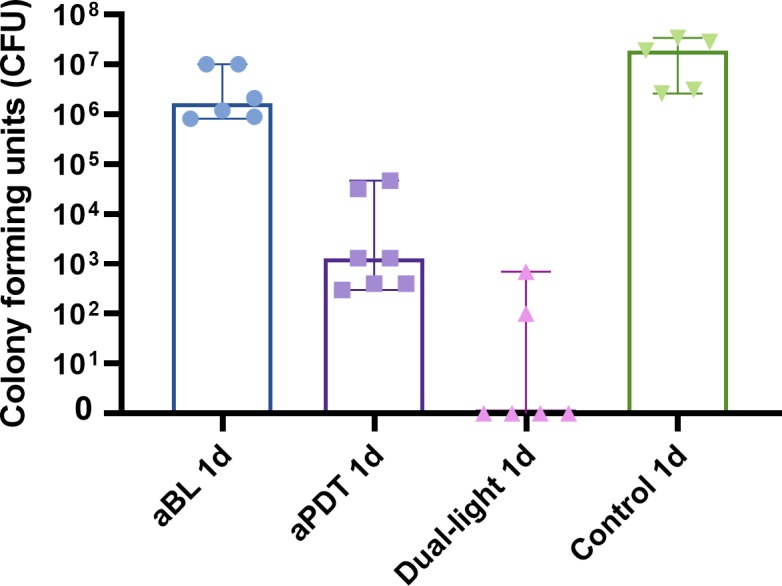
Fig 1

A one-day S. mutans biofilm was treated with a single-dose application of aBL, aPDT, or dual-light aPDT. The total amount of light irradiance was the same at 100 mW/cm2 for all three modalities (aBL vs. control, p = 0.045; aPDT vs. control, p = 0.0025; dual-light aPDT vs. control, p = p = 0.0043; aBL vs. dual-light aPDT, p = 0.0022; aPDT vs. dual-light aPDT, p = 0.0064; aBL vs. aPDT, p = 0.0012; Mann-Whitney U Test). The columns display medians. Each marking on the columns represents an independent assay. The T-bars show 95% confidence interval (CI). A detailed protocol and number of assays are shown at Table 1.

Single treatment of four-day biofilm

In the four-day biofilm model, where a single dose of aBL or aPDT was given at the end of the biofilm maturation period, the aBL reduced the alive bacteria counts to a median of 2.7x10⁶ CFUs (the range being 1.4x10⁶-17x106 CFUs), from a median of 28x106 CFUs (the range being 8.4x10⁶-68x106 CFUs) of the control biofilm (p = 0.0245, Mann-Whitney U-test). Again, the aPDT application was significantly more effective than the aBL one, leaving only a median of 2x10³ CFUs (the range being 0.1x10³-11x103CFUs) (p = 0.0022, aBL vs. aPDT, Mann-Whitney test). Similarly to the one-day biofilm test, the simultaneous application of aBL and aPDT in the dual-light aPDT group showed an improved bactericidal effect, leaving a median of 1.9x10³ CFUs (the range being 0.1-48x103 CFUs). There was no statistical difference between aPDT and dual-light aPDT (p = 0.7381, Mann-Whitney U-test) in the single-dose treatment of the four-day biofilm model. In general, the bacterial viability was better after the single-dose treatment of the four-day biofilm, when compared to the respectively treated one-day biofilms, see Fig 2.

Fig 2. Effect of single-dose or daily-dose application of aBL, aPDT or dual-light aPDT on four-day S. mutans.

Fig 2

A four-day biofilm was exposed to aBL, aPDT or dual-light aPDT as a single-dose exposure at the end of the biofilm maturation period or as a repetitive, daily-dose exposure repeating the same treatment dose. The columns display medians. Single-dose aBL vs. control, p = 0.025; single-dose aPDT vs. control, p = 0.0001; dual-light, single-dose aPDT vs. control, p = 0.0001; single- dose aBL vs. dual-light, single-dose aPDT, p = 0.0022; single-dose aPDT vs. dual-light, single-dose aPDT, p = 0.74; single-dose aBL vs. single-dose aPDT, p = 0.0022; daily-dose aBL vs. control, p = 0.35; daily-dose aPDT vs. control, p = 0.0001; dual-light, daily-dose aPDT vs. control, p = 0.0001; daily-dose aBL vs. dual-light, daily-dose aPDT, p = 0.00022; daily-dose aPDT vs. dual-light, daily-dose aPDT, p = 0.026; daily-dose aBL vs. daily-dose aPDT, p = 00022; single-dose aBL vs. daily-dose aBL, p = 0.0087; single-dose aPDT vs. daily-dose aPDT, p = 0.048; dual-light single dose vs. dual-light daily dose, p = 0.04; Mann-Whitney U Test.). The columns display medians. Each marking on the columns represents an independent assay. The T-bars show 95% confidence interval (CI). A detailed protocol and number of assays are shown at Table 1.

Daily treatment of four-day biofilm

A daily-dose repetitive application of aBL on the four-day biofilm model showed significantly improved bacterial viability, with a median of 18x106 CFUs (the range being 13x106-20x106 CFUs), when compared to the equivalent dose, i.e., a single-dose application of the aBL to a four-day matured biofilm, as described above (p = 0.0087, Mann-Whitney U-test). Similarly, a daily-dose repetitive application of aPDT left a median of 13.5x10³ CFUs (the range being 0.38x10³-1.0x10⁶ CFUs). This bacterial count is significantly more than in the four-day biofilm model, where the aPDT was applied as a single-dose treatment (p = 0.0476, Mann-Whitney U-test). However, the daily dose of combined aBL and aPDT in the dual-light aPDT group in the four-day biofilm model reduced the alive bacteria to a median of 9 CFUs (the range being 2-29x103 CFUs). Thus, unlike the aBL or aPDT application, the repeated dual-light aPDT application significantly reduced the biofilm viability when compared to the equivalent dose, i.e., the single-dose application of the same treatment (p = 0.0411, Mann-Whitney U-test), see Fig 2.

Daily treatment of fourteen-day biofilm

A daily-dose repetitive application of aBL in the fourteen-day biofilm model showed, similarly to the four-day biofilm model, significantly improved bacterial viability, with a median of 57.5x10⁶ CFUs (the range being 41x106-66x106 CFUs), when compared to the four-day biofilm treated with single-dose aBL (p = 0.0022), or even the four-day daily-dose repetitive aBL application (p = 0.0022). However, the fourteen-day daily-dose of aBL The daily dose of aPDT in the fourteen-day biofilm model similarly improved viability of the biofilm, with a median of 5.1 CFUs (the range being 0.8–7.8x10⁶ CFUs), when compared to the four-day biofilm treated by a single dose of aPDT (p = 0.0022) or a daily dose of aPDT (0.0087). In the fourteen-day biofilm model, again, the dual-light aPDT outperformed aBL or aPDT, with ongoing improvement in the bactericidal effect, leaving only 1725 CFUs (the range being 1–7.9x10⁶ CFUs), see Fig 3. No significant difference was observed among the dual-light fourteen-day daily-dose biofilm treatment, the four-day single-dose treatment, or the four-day daily-dose treatment (p = 0.8182 and p = 0.4199, respectively).

Fig 3. Effect of daily-dose application of aBL, aPDT, or dual-light aPDT on fourteen-day S. mutans biofilm.

Fig 3

An extended daily-dose study protocol of fourteen days was established to test the ability of the biofilm to adapt to a repetitive aBL or aPDT application (aBL vs control, p = 0.02; aPDT vs. control, p = 0.0022; aPDT vs. aBL, p = 0.0022). The dual-light, daily-dose light application showed the most effective antibacterial effect (dual-light vs. aBL, p = 0.0022, dual-light vs. aPDT, p = 0.0087; dual-light vs. control, p = 0.0022, Mann-Whitney U-Test). The columns display medians. Each marking on the columns represents an independent assay. The T-bars show 95% confidence interval (CI). A detailed protocol and number of assays are shown at Table 1.

Changing the energy ratio of aBL to aPDT lights while keeping the irradiance exposure constant

We analyzed the impact of changing the ratio of aBL to aPDT concerning dual-light aPDT antibacterial efficacy. In the one-day Streptococcus mutans biofilm, applying dual-light aPDT at a 1:1 irradiance ratio of aBL to aPDT light provided a median of 0 CFUs (the range being 0–500 CFUs), while a 3:1 irradiance ratio of aBL to aPDT light provided a median of 450 CFU count (the range being 0–7.8x10³ CFUs), and the 1:3 irradiance ratio of aBL to aPDT light provided a median of 700 CFUs (the range being 100-25x103 CFUs). In the four-day biofilm model, having a single dose of dual-light aPDT treatment, the 1:1 irradiance ratio of aBL to aPDT light left a median of 100 CFUs (the range being 0–77 103 CFUs); the 3:1 irradiance ratio of aBL to aPDT light provided 10.3x10³ CFUs (the range being 0-780x103 CFUs), and the 1:3 irradiance ratio of aBL to aPDT provided a median of 0 CFUs (the range being 0–2.2x10³ CFUs). Finally, In the daily, repetitive dual-light aPDT application, the 1:1 irradiance ratio of aBL to aPDT light left a median of 0 CFUs (the range being 0–400 CFUs); the 3:1 irradiance ratio of aBL to aPDT light left a median of 2.2x10³ CFUs (the range being 0-900x103 CFUs); and the 1:3 light irradiance ratio of aBL to aPDT light left a median of 100 CFUs (the range being 0-740x103 CFUs), see Fig 4.

Fig 4. Effect of change in the radiant exposure ratio of aBL to aPDT light in the antibacterial efficacy of the dual-light aPDT.

Fig 4

To assess the amount of blue light needed to increase the antibacterial efficacy of the aPDT, we established an experiment where the radiant exposure ratio of between aBL to aPDT was varied. Firstly, one-fourth of the total light irradiance was given as aBL (405 nm light) and three-fourths were given as aPDT (810 nm light). The exact amounts were 42 mW/cm2 for the aBL and 135 mW/cm2 for the aPDT, corresponding to a 1:3 ratio. Secondly, half of the total light irradiance was given as aBL (405 nm light) and half as aPDT (810 nm light), and the exact amounts were at 73 mW/cm2 for the aBL and 79 mW/cm2 for the aPDT, corresponding to 1:1 ratio. Thirdly, three-fourths of the total light irradiance were given as aBL (405nm light), and one fourth was given as aPDT (810nm light). The exact amounts in this case were at 130 mW/cm2 for the aBL and 38 mW/cm2 for the aPDT, corresponding to a 3:1 ratio. Single-day, single-dose, dual-light aPDT: 1:3 vs. 1:1, p = 0.003; 1:3 vs. 3:1, p = 0.43; 1:1 vs. 3:1; p<0.0001. Four-day, single-dose, dual-light aPDT: 1:3 vs. 1:1, p = 0.12; 1:3 vs. 3:1, p = 0.0057; 1:1 vs. 3:1; p = 0.067. Four-day, daily-dose aPDT: 1:3 vs. 1:1, p = 0.045; 1:3 vs. 3:1, p = 0.36; 1:1 vs. 3:1; p = 0.27; Mann-Whitney U Test.). The columns display medians. Each marking on the columns represents an independent assay. The T-bars show 95% confidence interval (CI). A detailed protocol and number of assays are shown at Table 1.

Confocal imaging of biofilms

With CSLM scanning, we were able to visualize the viability of the biofilm after each treatment protocol, see Fig 5. Multidimensional imaging of live (green) and dead (red) bacteria showed most of the live bacteria located at the basal layer of the biofilm, suggesting that this area is more protected against any treatment. In the four-day biofilm model, the surviving bacteria were located at the bottom of a fully developed, thick biofilm. However, when the treatment was applied repetitively for four days, the biofilm appeared visually thinner and denser. The biofilms exposed to repetitive aPDT showed sporadic patchy areas where living bacteria were scattered. These patches could not be found in the dual-light aPDT-treated biofilms, see Fig 5.

Fig 5. Confocal 3D images of the four-day maturated biofilms stained with live/dead bacterial staining.

Fig 5

A. A single-dose application of aPDT. B. A single dose application of dual-light aPDT, C. A daily-dose application of aPDT for four days. D. A daily-dose application of dual-light aPDT for four days. E. A control four-day S. mutans biofilm.

Absorption spectroscopy analysis of ICG adherence to Streptococcus mutans

Bacterial absorption difference between the ICG incubated S. mutans cells and the control S. mutans suspension in the 0.9% NaCl showed a 20-nm redshift of the absorption spectrum, when compared to the ICG absorption peak in water. Moreover, the absorption peak was lower, see Fig 6. The antibacterial effectivity of bacteria bound indocyanine green was investigated by exciting ICG bound bacteria with NIR light. Applying NIR light to ICG bound S. mutans bacterial significantly reduced bacterial viability, with a median of 21 CFUs (the range being 0–27 CFUs), when compared to the control sample with median of 13x106 (the range being 17x106-9.7x10⁶) (p = 0.0357, Mann-Whitney U test)., see Fig 7.

Fig 6. Absorption spectrometry of ICG adherence to S. mutans.

Fig 6

The absorption spectrum of ICG bound to S. mutans and the absorption spectrum of free ICG dissolved in 0.9% NaCl.

Fig 7. Antibacterial activity of S. mutans bound Indocyanine green.

Fig 7

ICG dyed S. mutans was excited with 810 nm light and compared to non-ICG dyed control. The light exposure resulted in significant reduction of CFU levels (aPDT vs control, p = 0.0357, Mann-Whitney U test)

Discussion

This is the first study demonstrating the superior efficacy of dual-light aPDT against S. mutans biofilm, when compared to aPDT or aBL. The simultaneous, synchronized application of an ICG/810 nm aPDT and 405 nm aBL resulted in a significantly improved antibacterial efficacy, the absolute CFU-count reduction constituting six logarithmic scales, and a persistent antibacterial effect. This persistent antibacterial effect has been nominated as substantivity, when applied to oral hygiene. Such substantivity, was not seen in the four-day repetitious aBL exposure, where bacterial CFU counts increased up to about five-fold when compared to a single-dose aBL application. The ability of S. mutans to adapt to the repetitive aBL treatment eventually resulted in viability comparable to the control biofilm.

Similarly, the retained antibacterial action abated when repeated aPDT was applied. Although aPDT showed a significantly better antibacterial effect compared to aBL in S. mutans biofilm, the biofilm adapted to repeated exposure with increased CFU counts of up to 100-fold when compared to the single-dose aPDT treatment. The response to the repeated adverse environmental stimuli developed in the very early stage, within the first few days or doses of repeated exposure. The dual-light aPDT thus markedly outperformed both aPDT and aBL in efficacy, but most importantly, the synchronized use was able to suppress the ability of the biofilm to adapt to the external stress. This suppression provided the persistent action required if the method were to be adapted for clinical use in dentistry.

We assessed the relative amount of blue light needed to improve the efficacy of aPDT. The increase of aBL-part in the given radiant exposure of dual-light aPDT decreased the absolute amount of the aPDT effect because the total amount of radiant exposure was kept constant. This increase in the aBL was effective against older biofilm, showing the 3:1 aBL ratio as being the most effective against four-day-old biofilm, but the repetitive dual-light dosing was most effective when the aBL ratio stood at 1:1 with the 810-nm light. Of the different blue light spectrums, we chose to use 405 nm aBL for two main reasons. Firstly, the antibacterial efficacy of 405 nm light has been shown to outperform longer aBL wavelengths in several studies [21]. Secondly, even in the visible light spectrum, there are variations in harmfulness to eyes with different light wavelengths, and eye safety improves at 405 nm light, as compared to 450 nm light or other aBL alternatives.

Various photosensitizers and excitating light combinations have been used against dental biofilms [6]. Indocyanine green, widely used and tested in dentistry, has been approved by the Food and Drug Administration in the United States of America for this purpose. It has been shown as a rather weak singlet oxygen provider, but it does possess a temperature-raising antibacterial ability within a biofilm. After light absorption, the ICG molecule can reach the ground state by releasing the energy through three different pathways. Firstly, the energy can convert into a fluorescence emission ranging from 750 nm to 950 nm. The spectrum maximums are approximately 780 nm in water and 810 nm in blood. Secondly, part of the energy is transferred to an ICG triplet state via intersystem crossing, being able to produce reactive oxygen species. The yield of triplet formation of ICG is 14% in water, and 11% in an aqueous albumin solution. The quantum yield of triplet formation of ICG is sufficiently high for generating efficient reactive oxygen species, particularly singlet oxygen. Thirdly, the energy can be transformed into heat within the ICG molecule itself by internal conversion. It has been estimated that as much as 85% of the absorbed energy could be converted into heat [22]. The ability of ICG to produce antibacterial action through different mechanisms provides an attractive safety feature, especially if aPDT were to be administered frequently. The thermal antibacterial mechanisms could also provide an additional benefit when antibacterial efficacy is provided in deep periodontal pockets, where oxygen is not readily available.

We ruled out the macroscopic heating effect of the sample by confirming temperature levels below 35°C degrees during each treatment. However, this confirmation does not rule out the temperature changes in the microenvironment, due to the inherent abilities of light absorbing ICG. Prokaryotic cells contain the same heat shock proteins as eukaryotic cells, enabling bacteria to cope against hostile environments. Heat stress has been shown to cause a distinct response in the S. mutans expression profile of multiple regulators and other functional genes [23,24]. The extracellular matrix architectural structure and the cells’ ability to bind are impaired due to heat. Glycosyltransferase (gtf)-c, which is responsible for generating only partially water-soluble glucan, is upregulated; but gtf-b, which is responsible for producing the water-soluble external environment, is not. This change is detectable as early as five to ten minutes after the heat exposure. Similar early responses in the S. mutans expression profile can be seen in other heat-responsive genes, such as grpE, dnaK, and fruR. Eventually, the upregulation of clpE and clpP aid the survival of the cells in the harsh conditions, including increased oxidative stress [24]. Antibacterial blue light has also been shown to alter the gene expression of S. mutans, upregulating several genes such as gtfB, brp, smu630, and comDE. It has been shown to increase the susceptibility of bacteria to ROS [25], which can further explain not only the adaptive mechanisms but also the additive bactericidal effect of the simultaneous use of aBL and aPDT.

Indocyanine green has photodecomposition properties [26], which has been suggested to have effect on cell viability. The green color of the biofilm disappeared during each the light exposure, indicating ICG degradation. We found no improvement in the antibacterial action when the possible degradation product remnants were left in the wells after washing the illuminated IGC away. The longer the cells were incubated in the residual ICG or its photodecomposition products (up to 14 days), the more viable the biofilm was. Indocyanine green has also shown a low stability of in aqueous solutions, for which we changed a new ICG medium for each illumination to provide a fresh ICG substate for the aPDT action.

We used spectroscopy to measure the ICG absorption properties in the S. mutans solution. To our knowledge, no previous work has been published to investigate this. Indocyanine green has been previously shown to undergo redshift of the absorption maximum from 780 nm in water to 805 nm in plasma upon binding to albumin in blood plasma or when binding to lipid structures [27,28]. We found that a similar redshift was also present in planktonic S. mutans solution, providing evidence of ICG adhering to bacterial proteins and membrane structures. The lower intensity peak was due to the higher ICG concentration in water compared to that of S. mutans-bound ICG. The antibacterial effect of the adhered ICG was estimated by subsequent light excitation, with an 810 nm LED light source resulting in total bacteria-killing with light intensities from or above 20 J/cm2. These results prove that the antibacterial activity is caused by the bacterial-bound ICG and not by the water-solubilized ICG. The antibacterial action of ICG was preserved in the bound ICG despite the lower ICG concentration, indicating the role of ICG binding to bacteria as the key treatment-targeting mechanism.

Conclusions

The ability of S. mutans to cope with ICG/810 nm aPDT was effectively eliminated by adding simultaneous aBL to the treatment. Antibacterial blue light was markedly less bactericidal than aPDT when similar light doses were compared, but aBL improved the antibacterial effect of aPDT and provided a sustained effect in repeated antibacterial treatment. The mechanism is an issue yet to be resolved. Based on our findings the amount of added 405 nm aBL for an increased antibacterial efficacy should be at least 50% of the radiant exposure given. Along the aging of the biofilm, an increase in the relative amount of aBL would be beneficial. To sum up, results from the present experiments open up new avenues for hypothesis generation and, more practically, for developing devices for biofilm control, especially in preventive dentistry.

Acknowledgments

We would like to thank our laboratory technician Saija Perovuo for excellent work.

Data Availability

All relevant data are within the paper.

Funding Statement

This paper is part of SN PhD studies at the Aalto University, Espoo, Finland. Koite Health has provided support in the form of salaries for author [SN] but did not have any additional role in the study design, data collection and analysis, decision to publish, or preparation of the manuscript. The specific roles of these authors are articulated in the ‘author contributions’ section.

References

  • 1.Claydon NC. Current concepts in toothbrushing and interdental cleaning. Available: http://168.176.239.58/cursos/odontologia/2016549/pdf/Claydon2008Cepilladoylimpiezainterdental.pdf [DOI] [PubMed]
  • 2.Chenicheri S, R U, Ramachandran R, Thomas V, Wood A. Insight into Oral Biofilm: Primary, Secondary and Residual Caries and Phyto-Challenged Solutions. Open Dent J. 2017;11: 312–333. 10.2174/1874210601711010312 [DOI] [PMC free article] [PubMed] [Google Scholar]
  • 3.Larsen T, Fiehn N-E. Dental biofilm infections—an update. APMIS. 2017;125: 376–384. 10.1111/apm.12688 [DOI] [PubMed] [Google Scholar]
  • 4.Socransky S, Haffajee A. Dental biofilms: difficult therapeutic targets. Periodontol 2000. 2002;28: 12–55. 10.1034/j.1600-0757.2002.280102.x [DOI] [PubMed] [Google Scholar]
  • 5.Esberg A, Sheng N, Mårell L, Claesson R, Persson K, Borén T, et al. Streptococcus Mutans Adhesin Biotypes that Match and Predict Individual Caries Development. EBioMedicine. 2017. 10.1016/j.ebiom.2017.09.027 [DOI] [PMC free article] [PubMed] [Google Scholar]
  • 6.Konopka K, Goslinski T. Photodynamic Therapy in Dentistry. J Dent Res. 2007;86: 694–707. 10.1177/154405910708600803 [DOI] [PubMed] [Google Scholar]
  • 7.Wang Y, Wang Y, Wang Y, Murray CK, Hamblin MR, Hooper DC, et al. Antimicrobial blue light inactivation of pathogenic microbes: State of the art. Drug Resist Updat. 2017;33–35: 1–22. 10.1016/j.drup.2017.10.002 [DOI] [PMC free article] [PubMed] [Google Scholar]
  • 8.Robinson JM. Phagocytic leukocytes and reactive oxygen species. Histochem Cell Biol. 2009;131: 465–469. 10.1007/s00418-009-0565-5 [DOI] [PubMed] [Google Scholar]
  • 9.Soukos NS, Som S, Abernethy AD, Ruggiero K, Dunham J, Lee C, et al. Phototargeting Oral Black-Pigmented Bacteria. Antimicrob Agents Chemother. 2005;49: 1391–1396. 10.1128/AAC.49.4.1391-1396.2005 [DOI] [PMC free article] [PubMed] [Google Scholar]
  • 10.Song H, Lee J, Um H, Chang B, Lee S, Lee M. Phototoxic effect of blue light on the planktonic and biofilm state of anaerobic periodontal pathogens. 2013; 72–78. [DOI] [PMC free article] [PubMed] [Google Scholar]
  • 11.Cieplik F, Deng D, Crielaard W, Buchalla W, Hellwig E, Al-Ahmad A, et al. Antimicrobial photodynamic therapy–what we know and what we don’t. Critical Reviews in Microbiology. 2018. 10.1080/1040841X.2018.1467876 [DOI] [PubMed] [Google Scholar]
  • 12.De Sousa DL, Lima RA, Zanin IC, Klein MI, Janal MN, Duarte S. Effect of twice-daily blue light treatment on matrix-rich biofilm development. PLoS One. 2015. 10.1371/journal.pone.0131941 [DOI] [PMC free article] [PubMed] [Google Scholar]
  • 13.Cruz CD, Shah S, Tammela P. Defining conditions for biofilm inhibition and eradication assays for Gram-positive clinical reference strains. BMC Microbiol. 2018;18: 1–9. 10.1186/s12866-017-1144-x [DOI] [PMC free article] [PubMed] [Google Scholar]
  • 14.Tegos GP, Hamblin MR. Phenothiazinium Antimicrobial Photosensitizers Are Substrates of Bacterial Multidrug Resistance Pumps. Antimicrob Agents Chemother. 2006;50: 196 10.1128/AAC.50.1.196-203.2006 [DOI] [PMC free article] [PubMed] [Google Scholar]
  • 15.Rineh A, Bremner JB, Hamblin MR, Ball AR, Tegos GP, Kelso MJ. Attaching NorA efflux pump inhibitors to methylene blue enhances antimicrobial photodynamic inactivation of Escherichia coli and Acinetobacter baumannii in vitro and in vivo. Bioorg Med Chem Lett. 2018;28: 2736–2740. 10.1016/j.bmcl.2018.02.041 [DOI] [PMC free article] [PubMed] [Google Scholar]
  • 16.Tavares A, Carvalho CMB, Faustino MA, Neves MGPMS, Tomé JPC, Tomé AC, et al. Antimicrobial photodynamic therapy: study of bacterial recovery viability and potential development of resistance after treatment. Mar Drugs. 2010;8: 91–105. 10.3390/md8010091 [DOI] [PMC free article] [PubMed] [Google Scholar]
  • 17.Guffey JS, Payne W, Jones T, Martin K. Evidence of resistance development by Staphylococcus aureus to an in vitro, multiple stage application of 405 nm light from a supraluminous diode array. Photomed Laser Surg. 2013;31: 179–182. 10.1089/pho.2012.3450 [DOI] [PubMed] [Google Scholar]
  • 18.Fekrazad R, Khoei F, Hakimiha N, Bahador A. Photoelimination of Streptococcus mutans with two methods of photodynamic and photothermal therapy. Photodiagnosis Photodyn Ther. 2013. 10.1016/j.pdpdt.2013.07.002 [DOI] [PubMed] [Google Scholar]
  • 19.Costa EM, Silva S, Tavaria FK, Pintado MM. Study of the effects of chitosan upon Streptococcus mutans adherence and biofilm formation. Anaerobe. 2013;20: 27–31. 10.1016/j.anaerobe.2013.02.002 [DOI] [PubMed] [Google Scholar]
  • 20.Lee YH, Park HW, Lee JH, Seo HW, Lee SY. The photodynamic therapy on Streptococcus mutans biofilms using erythrosine and dental halogen curing unit. Int J Oral Sci. 2013;4: 196–201. 10.1038/ijos.2012.63 [DOI] [PMC free article] [PubMed] [Google Scholar]
  • 21.Wang Y, Wang Y, Wang Y, Murray CK, Hamblin MR, Hooper DC, et al. Antimicrobial blue light inactivation of pathogenic microbes: State of the art. Drug Resist Updat. 2017;33–35: 1–22. 10.1016/j.drup.2017.10.002 [DOI] [PMC free article] [PubMed] [Google Scholar]
  • 22.Shafirstein G, Bäumler W, Hennings LJ, Siegel ER, Friedman R, Moreno MA, et al. Indocyanine green enhanced near-infrared laser treatment of murine mammary carcinoma. Int J Cancer. 2012;130: 1208–1215. 10.1002/ijc.26126 [DOI] [PMC free article] [PubMed] [Google Scholar]
  • 23.Tam K, Kinsinger N, Ayala P, Qi F, Shi W, Myung N V. Real-time monitoring of Streptococcus mutans biofilm formation using a quartz crystal microbalance. Caries Res. 2007;41: 474–83. 10.1159/000108321 [DOI] [PMC free article] [PubMed] [Google Scholar]
  • 24.Liu C, Niu Y, Zhou X, Zheng X, Wang S, Guo Q, et al. Streptococcus mutans copes with heat stress by multiple transcriptional regulons modulating virulence and energy metabolism. Sci Rep. 2015;5: 12929 10.1038/srep12929 [DOI] [PMC free article] [PubMed] [Google Scholar]
  • 25.Steinberg D, Moreinos D, Featherstone J, Shemesh M, Feuerstein O. Genetic and physiological effects of noncoherent visible light combined with hydrogen peroxide on Streptococcus mutans in biofilm. Antimicrob Agents Chemother. 2008;52: 2626–31. 10.1128/AAC.01666-07 [DOI] [PMC free article] [PubMed] [Google Scholar]
  • 26.Engel E, Schraml R, Maisch T, Kobuch K, Konig B, Szeimies RM, et al. Light-induced decomposition of indocyanine green. Investig Ophthalmol Vis Sci. 2008;49: 1777–1783. 10.1167/iovs.07-0911 [DOI] [PubMed] [Google Scholar]
  • 27.Hollins B, Noe B, Henderson JM. Fluorometric determination of indocyanine green in plasma. Clin Chem. 1987;33: 765–768. [PubMed] [Google Scholar]
  • 28.Yuan B, Chen N, Zhu Q. Emission and absorption properties of ICG in Intalipid dolution. J Biomed Opt. 2004;9: 497–503. 10.1117/1.1695411 [DOI] [PMC free article] [PubMed] [Google Scholar]

Decision Letter 0

Michael R Hamblin

4 Feb 2020

PONE-D-20-01567

Dual-light photodynamic therapy administered daily provides a sustained antibacterial effect on biofilm and prevents Streptococcus mutans adaptation

PLOS ONE

Dear Mr Patila,

Thank you for submitting your manuscript to PLOS ONE. After careful consideration, we feel that it has merit but does not fully meet PLOS ONE’s publication criteria as it currently stands. Therefore, we invite you to submit a revised version of the manuscript that addresses the points raised during the review process.

Please provide number of replicates and error bars, remove results description from figure legends, address photodecomposition of ICG and other comments of Rev 2.

We would appreciate receiving your revised manuscript by Mar 20 2020 11:59PM. When you are ready to submit your revision, log on to https://www.editorialmanager.com/pone/ and select the 'Submissions Needing Revision' folder to locate your manuscript file.

If you would like to make changes to your financial disclosure, please include your updated statement in your cover letter.

To enhance the reproducibility of your results, we recommend that if applicable you deposit your laboratory protocols in protocols.io, where a protocol can be assigned its own identifier (DOI) such that it can be cited independently in the future. For instructions see: http://journals.plos.org/plosone/s/submission-guidelines#loc-laboratory-protocols

Please include the following items when submitting your revised manuscript:

  • A rebuttal letter that responds to each point raised by the academic editor and reviewer(s). This letter should be uploaded as separate file and labeled 'Response to Reviewers'.

  • A marked-up copy of your manuscript that highlights changes made to the original version. This file should be uploaded as separate file and labeled 'Revised Manuscript with Track Changes'.

  • An unmarked version of your revised paper without tracked changes. This file should be uploaded as separate file and labeled 'Manuscript'.

Please note while forming your response, if your article is accepted, you may have the opportunity to make the peer review history publicly available. The record will include editor decision letters (with reviews) and your responses to reviewer comments. If eligible, we will contact you to opt in or out.

We look forward to receiving your revised manuscript.

Kind regards,

Michael R Hamblin

Academic Editor

PLOS ONE

Journal Requirements:

When submitting your revision, we need you to address these additional requirements:

1. Please ensure that your manuscript meets PLOS ONE's style requirements, including those for file naming. The PLOS ONE style templates can be found at http://www.plosone.org/attachments/PLOSOne_formatting_sample_main_body.pdf and http://www.plosone.org/attachments/PLOSOne_formatting_sample_title_authors_affiliations.pdf

2. Thank you for stating the following in the Competing Interests section: "No"

We note that one or more of the authors are employed by a commercial company: Koite Health Oy

a.     Please provide an amended Funding Statement declaring this commercial affiliation, as well as a statement regarding the Role of Funders in your study. If the funding organization did not play a role in the study design, data collection and analysis, decision to publish, or preparation of the manuscript and only provided financial support in the form of authors' salaries and/or research materials, please review your statements relating to the author contributions, and ensure you have specifically and accurately indicated the role(s) that these authors had in your study. You can update author roles in the Author Contributions section of the online submission form.

Please also include the following statement within your amended Funding Statement.

“The funder provided support in the form of salaries for authors [insert relevant initials], but did not have any additional role in the study design, data collection and analysis, decision to publish, or preparation of the manuscript. The specific roles of these authors are articulated in the ‘author contributions’ section.”

If your commercial affiliation did play a role in your study, please state and explain this role within your updated Funding Statement.

b. Please also provide an updated Competing Interests Statement declaring this commercial affiliation along with any other relevant declarations relating to employment, consultancy, patents, products in development, or marketed products, etc. 

Within your Competing Interests Statement, please confirm that this commercial affiliation does not alter your adherence to all PLOS ONE policies on sharing data and materials by including the following statement: "This does not alter our adherence to  PLOS ONE policies on sharing data and materials.” (as detailed online in our guide for authors http://journals.plos.org/plosone/s/competing-interests). If this adherence statement is not accurate and  there are restrictions on sharing of data and/or materials, please state these. Please note that we cannot proceed with consideration of your article until this information has been declared.

Please include both an updated Funding Statement and Competing Interests Statement in your cover letter. We will change the online submission form on your behalf.

Please know it is PLOS ONE policy for corresponding authors to declare, on behalf of all authors, all potential competing interests for the purposes of transparency. PLOS defines a competing interest as anything that interferes with, or could reasonably be perceived as interfering with, the full and objective presentation, peer review, editorial decision-making, or publication of research or non-research articles submitted to one of the journals. Competing interests can be financial or non-financial, professional, or personal. Competing interests can arise in relationship to an organization or another person. Please follow this link to our website for more details on competing interests: http://journals.plos.org/plosone/s/competing-interests

3. Thank you for stating the following in your Competing Interests section:  "No"

Please complete your Competing Interests on the online submission form to state any Competing Interests. If you have no competing interests, please state "The authors have declared that no competing interests exist.", as detailed online in our guide for authors at http://journals.plos.org/plosone/s/submit-now

This information should be included in your cover letter; we will change the online submission form on your behalf.

4. Thank you for stating the following financial disclosure: "No"

a)    Please provide an amended Funding Statement that declares *all* the funding or sources of support received during this specific study (whether external or internal to your organization) as detailed online in our guide for authors at http://journals.plos.org/plosone/s/submit-now

b)    Please state what role the funders took in the study.  If any authors received a salary from any of your funders, please state which authors and which funder. If the funders had no role, please state: "The funders had no role in study design, data collection and analysis, decision to publish, or preparation of the manuscript."

Please include your amended statements within your cover letter; we will change the online submission form on your behalf.

5. We note that you have included the phrase “data not shown” in your manuscript. Unfortunately, this does not meet our data sharing requirements. PLOS does not permit references to inaccessible data. We require that authors provide all relevant data within the paper, Supporting Information files, or in an acceptable, public repository. Please add a citation to support this phrase or upload the data that corresponds with these findings to a stable repository (such as Figshare or Dryad) and provide and URLs, DOIs, or accession numbers that may be used to access these data. Or, if the data are not a core part of the research being presented in your study, we ask that you remove the phrase that refers to these data.

6. Please upload a copy of Figure 7, to which you refer in your text on page 15. If the figure is no longer to be included as part of the submission please remove all reference to it within the text.

[Note: HTML markup is below. Please do not edit.]

Reviewers' comments:

Reviewer's Responses to Questions

Comments to the Author

1. Is the manuscript technically sound, and do the data support the conclusions?

The manuscript must describe a technically sound piece of scientific research with data that supports the conclusions. Experiments must have been conducted rigorously, with appropriate controls, replication, and sample sizes. The conclusions must be drawn appropriately based on the data presented.

Reviewer #1: Yes

Reviewer #2: Yes

**********

2. Has the statistical analysis been performed appropriately and rigorously?

Reviewer #1: Yes

Reviewer #2: Yes

**********

3. Have the authors made all data underlying the findings in their manuscript fully available?

The PLOS Data policy requires authors to make all data underlying the findings described in their manuscript fully available without restriction, with rare exception (please refer to the Data Availability Statement in the manuscript PDF file). The data should be provided as part of the manuscript or its supporting information, or deposited to a public repository. For example, in addition to summary statistics, the data points behind means, medians and variance measures should be available. If there are restrictions on publicly sharing data—e.g. participant privacy or use of data from a third party—those must be specified.

Reviewer #1: Yes

Reviewer #2: Yes

**********

4. Is the manuscript presented in an intelligible fashion and written in standard English?

PLOS ONE does not copyedit accepted manuscripts, so the language in submitted articles must be clear, correct, and unambiguous. Any typographical or grammatical errors should be corrected at revision, so please note any specific errors here.

Reviewer #1: Yes

Reviewer #2: Yes

**********

5. Review Comments to the Author

Please use the space provided to explain your answers to the questions above. You may also include additional comments for the author, including concerns about dual publication, research ethics, or publication ethics. (Please upload your review as an attachment if it exceeds 20,000 characters)

Reviewer #1: Manuscript No: PONE-D-20-01567

Manuscript Title: Dual-light photodynamic therapy administered daily provides a sustained antibacterial effect on biofilm and prevents Streptococcus mutans adaptation.

In this study, the authors tested the efficacy of repeated treatments of single and combined aPDT and aBL in an S. mutans biofilm-model.

The manuscript is on an emergent topic, photodynamic therapy as an alternative approach to inactivate pathogenic bacteria, addressing one of the major difficulties in developing effective protocols against bacterial biofilms.

The manuscript is well structured along the different sections. The results are credible, and the discussion is clear and focused. However, the experimental plan is not adequately described. There is no indication about the number of independent assays performed for each situation. Also, the number of replicates of the detection technique is not indicated. Moreover, no standard deviation values are showed in the figures.

The legends of figures are very long, the description of the results should be removed. For instance, in the Figure 1 legend, the text “Dual-light aPDT was more effective than peers, when one-day biofilm was treated” and “The aBL reduced the number of living bacteria significantly, but the antibacterial effect of aPDT was markedly better than that of aBL. The combination of the two, the dual-light aPDT, provided significantly greater antibacterial activity“, should be deleted.

The title can be something like: “Effect of single-dose application of aBL, aPDT or dual-light aPDT on S. mutans biofilms” …..

The standard deviation must be added to the figure and the number of independent assays must be indicated in the legend.

Minor editing on English is necessary.

Reviewer #2: In this manuscript the combination of aPDT with and without blue light illumination was investigated. The manuscript is of interest, but contains some drawbacks, which must be revised in order to improve the manuscript.

critics:

line 46-ff: "...Biofilms were scraped, diluted......After reincubation, ......, and confocal 3D biofilm immaging was performed". This must be specified in more details. The aPDT treated biofilm was scraped, and recultured again to Biofilms. What is the aim of this experiment? This is unclear and must be revised for a better understanding.

line 52: "milder response": How is this defined? Unclear. Please insert an adequate definition.

Materials and Methods section: I miss information about the number of independent experiments. How many values per each parameter did you investigate? Furthermore, I recommend to insert a table showin all investigated conditions and parameters. Which combination experiments were done using aPDT +/- blue light +/- ICG. Such information should be insereted within the revised version. I think it is a must have to understand how often the biofilms were illluminated.

Figure 1: Single illumination ???? Not clear. What is the difference between Dual-light 1D illumination vs. 4d dual-light daily dose (Figure 2). In both cases you achieved >5log10 steps of CFU reductions. This must be explained in more details.

Figure 4: The values within the brackets??? applied light intensities??? Please revise.

Please insert a more detailed summary. Which combination would you now recommend based of the given results? A clear take home message must be inserted.

General: It is known, that ICG is damaged during illumination. Did you measure absorption spectra prior and after illumination of ICG? For more details please see: Light-induced decomposition of indocyanine green. Engel E, Schraml R, Maisch T, Kobuch K, König B, Szeimies RM, Hillenkamp J, Bäumler W, Vasold R. Invest Ophthalmol Vis Sci. 2008 May;49(5):1777-83. doi: 10.1167/iovs.07-0911.

Do you think, that such a decomposition is influencing the efficacy of bacteria killing? Decomposition of ICG is a crucial factor, isn't it?

**********

6. PLOS authors have the option to publish the peer review history of their article (what does this mean?). If published, this will include your full peer review and any attached files.

If you choose “no”, your identity will remain anonymous but your review may still be made public.

Do you want your identity to be public for this peer review? For information about this choice, including consent withdrawal, please see our Privacy Policy.

Reviewer #1: Yes: Adelaide Almeida

Reviewer #2: No

[NOTE: If reviewer comments were submitted as an attachment file, they will be attached to this email and accessible via the submission site. Please log into your account, locate the manuscript record, and check for the action link "View Attachments". If this link does not appear, there are no attachment files to be viewed.]

While revising your submission, please upload your figure files to the Preflight Analysis and Conversion Engine (PACE) digital diagnostic tool, https://pacev2.apexcovantage.com/. PACE helps ensure that figures meet PLOS requirements. To use PACE, you must first register as a user. Registration is free. Then, login and navigate to the UPLOAD tab, where you will find detailed instructions on how to use the tool. If you encounter any issues or have any questions when using PACE, please email us at figures@plos.org. Please note that Supporting Information files do not need this step.

PLoS One. 2020 May 6;15(5):e0232775. doi: 10.1371/journal.pone.0232775.r002

Author response to Decision Letter 0


17 Mar 2020

PLOS ONE

Comments for editor and the reviewers:

Revision of the manuscript: ‘Dual-light photodynamic therapy administered daily provides a sustained antibacterial effect on biofilm and prevents Streptococcus mutans adaptation’

We kindly thank the Editor and the reviewers for their time and efforts to revise our manuscript. We found the advice and thoughts very relevant and are very glad for the help provided.

Editor

Q1: Please provide number of replicates and error bars, remove results description from figure legends, address photodecomposition of ICG and other comments of Rev 2.

A1: We have provided the number of replicates and error bars, and removed results description from figure legends, addressed photodecomposition of ICG and the other comments of Rev 2.

Q2: If you would like to make changes to your financial disclosure, please include your updated statement in your cover letter.

A: We have rephrased our financial disclosure in the cover letter.

Q3: To enhance the reproducibility of your results, we recommend that if applicable you deposit your laboratory protocols in protocols.io.

A3: We deposited our laboratory protocol at protocols.io, with the DOI: dx.doi.org/10.17504/protocols.io.bdp2i5qe

Q4& A4: Please find our rebuttal letter including responds to each point raised by the editor and reviewers. This letter has been uploaded as separate file and labelled 'Response to Reviewers'. We have uploaded a marked-up copy of your manuscript that highlighting the changes made to the original version. This file has been uploaded as separate file and labelled 'Revised Manuscript’ with ‘Track Changes'. The unmarked version of our revised paper without tracked changes has been uploaded as separate file and labelled 'Manuscript'

Editorial additional requirements:

Q1. We have rechecked, that our manuscript meets PLOS ONE's style requirements

Q2-4. We have provided the Competing Interest Statement and the Financial Disclosure in the Cover letter.

Q5. We note that you have included the phrase “data not shown” in your manuscript. Unfortunately, this does not meet our data sharing requirements. PLOS does not permit references to inaccessible data. We require that authors provide all relevant data within the paper, Supporting Information files, or in an acceptable, public repository. Please add a citation to support this phrase or upload the data that corresponds with these findings to a stable repository (such as Figshare or Dryad) and provide and URLs, DOIs, or accession numbers that may be used to access these data. Or, if the data are not a core part of the research being presented in your study, we ask that you remove the phrase that refers to these data.

A5: We have provided all relevant data within the paper, the “data not shown”, regarding the ICG adherence to mutans bacteria, is represented as figure 7, and discussed in text:

Line 355: “The antibacterial effectivity of bacteria bound indocyanine green was investigated by exciting ICG bound bacteria with NIR light. Applying NIR light to ICG bound S. mutans bacterial significantly reduced bacterial viability, with a median of 21 CFUs (the range being 0-27 CFUs), when compared to the control sample with median of 13x106 (the range being 17x106-9.7x10⁶) (p=0.0357, Mann-Whitney U test)., see Fig 7.”

And line 364: “Fig 7. Antibacterial activity of S. mutans bound Indocyanine green. ICG dyed Streptococcus mutans was excited with 810nm light and compared to non-ICG dyed control. The light exposure resulted in significant reduction of CFU levels (aPDT vs control, p = 0.0357, Mann-Whitney U test)”

Q6. Please upload a copy of Figure 7, to which you refer in your text on page 15. If the figure is no longer to be included as part of the submission, please remove all reference to it within the text.

A6: The Fig 7 was not part of the original submission and this reference has been removed from the text. However, we added information according to Answer 5 and a new Fig 7 file is referred in the text as described.

Reviewer 1

1.The manuscript is well structured along the different sections. The results are credible, and the discussion is clear and focused. However, the experimental plan is not adequately described. There is no indication about the number of independent assays performed for each situation. Also, the number of replicates of the detection technique is not indicated. Moreover, no standard deviation values are showed in the figures.

We had a short mention of the number of independent assays in the manuscript, line 109: “A minimum of six biofilms for each experiment were grown”. We had also provided this data in our figures as each dot represent an independent assay. Obviously, this was not enough, and we have additionally provided a ‘table 1’ to show the number of independent assays and included the study protocol for each experiment for more clear understanding for the reader.

Added in the text, line 120: “Study protocols are presented in Table 1.”

Table 1 legend: “Study protocols”

2. Also, the number of replicates of the detection technique is not indicated.

This is a good question.

1. All independent experiments were plated separately.

Added in the text, line 118: “In each setting, the last treatment was followed by plating each well onto separate brain heart infusion (BHI)-agar dishes for colony-forming unit (CFU) counting”

2. Because of the experience of our laboratory technician with over 20 years of bacterial laboratory work in GLP level laboratories, we could adjust the CFU assessment according to each sample, without the need for full dilution series. We have performed these studies for three years, which has provided us a good understanding of the procedure.

Added in the text, line 180: “According to the observed biofilm mass in the bottom of the well in each experiment, the dilutions were performed accordingly. As an example, treated biofilms were most usually serially diluted to from 1:1 to 1:104 and controls usually 105-106, with a single plating from each dilution.”

3. Each plate was entirely photographed and the CFU count was performed using J-image by a single analysis.

We revised the text for more clarity, line 176: “After the final light exposure, the entire biofilm from each well was collected and placed into a 1-ml test tube, forming 200 μl of suspension. After meticulous vortexing (Vortex-Genie, Scientific Industries Inc, US), a serial dilution assay ranging from 1:1 to 1:100 000 was performed, using sterile ART filter tips (Thermo Scientific, Waltham, US). To enumerate the viable cells, 100 μl of resulting biofilm dilutions were then evenly spread over an entire BHI agar plates, using a sterile L-shape rod. According to the observed biofilm mass in the bottom of the well in each experiment, the dilutions were performed accordingly. As an example, treated biofilms were most usually serially diluted from 1:1 to 1:104, and controls usually from105 to 106. Typically, a dilution where CFU count on plate was between 30 to 800 was considered the most reliable and selected for analysis.”

3. Moreover, no standard deviation values are showed in the figures.

Our data does not present Gaussian distribution. We have provided the statistical comparisons with non-linear tests, including median and range of each dataset. Thus, we are statistically unable to provide standard deviation of mean. We added 95% Confidence Interval (CI) error bars in the figures, while the colums represent the medians, and the dots show the range.

5.The legends of figures are very long, the description of the results should be removed. For instance, in the Figure 1 legend, the text “Dual-light aPDT was more effective than peers, when one-day biofilm was treated” and “The aBL reduced the number of living bacteria significantly, but the antibacterial effect of aPDT was markedly better than that of aBL. The combination of the two, the dual-light aPDT, provided significantly greater antibacterial activity“, should be deleted. The title can be something like: “Effect of single-dose application of aBL, aPDT or dual-light aPDT on S. mutans biofilms”

A5: This is a good comment. We have removed thoroughly the results description in all figure legends.

a. Fig 1 legend. Change in the text, line 242: The figure title has been changed according to suggestion. The descriptive text has been removed.

b. Fig 2 legend: Change in the text, line 261: The figure title has been changed to “Effect of single-dose or daily-dose application of aBL, aPDT or dual-light aPDT on four-day S. mutans” The descriptive text has been removed.

c. Fig 3 legend: Change in the text, line 298: The figure title has been changed to “Effect of daily-dose application of aBL, aPDT or dual-light aPDT on fourteen-day S. mutans biofilm” The descriptive text has been removed.

Fig 4 legend: Change in the text, line 321: The figure title has been changed to: Effect of change in the relative irradiance between aBL and aPDT light in the antibacterial efficacy of the dual-light aPDT. To assess the amount of blue light needed to increase the antibacterial efficacy of the aPDT, we established an experiment where the relative irradiance ratios between the aPDT and aBL were varied. Firstly, one-fourth of the total light irradiance was given as aBL (405nm light) and three-fourths were given as aPDT (810nm light). The exact amounts were 42mW/cm2 for the aBL and 135 mW/cm2 for the aPDT, corresponding to a 1:3 ratio. Secondly, half of the total light irradiance was given as aBL (405nm light) and half as aPDT (810nm light), and the exact amounts were at 73 mW/cm2 for the aBL and 79 mW/cm2 for the aPDT, corresponding to 1:1 ratio. Thirdly, three-fourths of the total light irradiance were given as aBL (405nm light), and one fourth was given as aPDT (810nm light). The exact amounts in this case were at 130mW/cm2 for the aBL and 38 mW/cm2 for the aPDT, corresponding to a 3:1 ratio. Single-day, single-dose, dual-light aPDT: 1:3 vs. 1:1, p=0.003; 1:3 vs. 3:1, p=0.43; 1:1 vs. 3:1; p<0.0001. Four-day, single-dose, dual-light aPDT: 1:3 vs. 1:1, p=0.12; 1:3 vs. 3:1, p=0.0057; 1:1 vs. 3:1; p=0.067. Four-day, daily-dose aPDT: 1:3 vs. 1:1, p=0.045; 1:3 vs. 3:1, p=0.36; 1:1 vs. 3:1; p=0.27; Mann-Whitney U Test. ). The columns display medians. Each marking on the columns represents an independent assay. The T-bars show 95% confidence interval (CI). A detailed protocol and number of assays are shown at Table 1.

d. ” The descriptive text of results has been removed.

e. Fig 5: the title was changed:, line 346: “Confocal 3D images of the four-day maturated biofilms stained with live/dead bacterial staining”. The descriptive text of results has been removed.

f. Fig 6: The title has changed, line 361; “Absorption spectrometry of ICG adherence to S. mutans”

Q6. The standard deviation must be added to the figure and the number of independent assays must be indicated in the legend.

A6: The number of independent assays are now provided in the table 1. The error bars as 95% confidence interval have been provided in the figures.

8.Minor editing on English is necessary.

We have re-edited the language

Reviewer #2:

Q1: In this manuscript the combination of aPDT with and without blue light illumination was investigated. The manuscript is of interest, but contains some drawbacks, which must be revised in order to improve the manuscript.

A1: We greatly appreciate your comments and efforts to improve our manuscript.

Q2: line 46-ff: "...Biofilms were scraped, diluted......After reincubation, ......, and confocal 3D biofilm immaging was performed". This must be specified in more details. The aPDT treated biofilm was scraped, and recultured again to Biofilms. What is the aim of this experiment? This is unclear and must be revised for a better understanding.

A2: Thank you for the comment. We have thoroughly revised the abstract text.

A2: line 52: "milder response": How is this defined? Unclear. Please insert an adequate definition.

A3: Good comment. We revised the abstract text according to suggestion.

Q4:Materials and Methods section: I miss information about the number of independent experiments. How many values per each parameter did you investigate? Furthermore, I recommend to insert a table showin all investigated conditions and parameters. Which combination experiments were done using aPDT +/- blue light +/- ICG. Such information should be insereted within the revised version. I think it is a must have to understand how often the biofilms were illluminated

A4: We have included the number of the independent experiments in the figures, but also provided a table for this (Table1.), which is needed to guide the reader through the article.

Q4: Figure 1: Single illumination ???? Not clear. What is the difference between Dual-light 1D illumination vs. 4d dual-light daily dose (Figure 2). In both cases you achieved >5log10 steps of CFU reductions. This must be explained in more details.

A4: We have provided a table to clarify this question, where we conclude the actual number of illuminations and the amount of light in each illumination. This simplifies the actual finding in our paper: If we give a single illumination on a biofilm, most of the bacteria are dead. But if we repeat this treatment with the same intensity for several days, the biofilm gets better.

Q5: Figure 4: The values within the brackets??? applied light intensities??? Please revise.

A5: We have provided this information in the figure legend. line 322: “To assess the amount of blue light needed to increase the antibacterial efficacy of the aPDT, we established an experiment where the relative irradiance ratios between the aPDT and aBL were varied. Firstly, one-fourth of the total light irradiance was given as aBL (405nm light) and three-fourths were given as aPDT (810nm light). The exact amounts were 42mW/cm2 for the aBL and 135 mW/cm2 for the aPDT, corresponding to a 1:3 ratio. Secondly, half of the total light irradiance was given as aBL (405nm light) and half as aPDT (810nm light), and the exact amounts were at 73 mW/cm2 for the aBL and 79 mW/cm2 for the aPDT, corresponding to 1:1 ratio. Thirdly, three-fourths of the total light irradiance were given as aBL (405nm light), and one fourth was given as aPDT (810nm light). The exact amounts in this case were at 130mW/cm2 for the aBL and 38 mW/cm2 for the aPDT, corresponding to a 3:1 ratio.” The descriptive text of results has been removed. Additionally, the Table 1 is provided to clarify the message.

Please insert a more detailed summary. Which combination would you now recommend based of the given results? A clear take home message must be inserted.

A5: We revised the conclusion, line 453: “The ability of S. mutans to cope with ICG/810-nm aPDT was effectively eliminated by adding simultaneous aBL to the treatment. Antibacterial blue light was markedly less bactericidal than aPDT when similar light doses were compared, but aBL improved the antibacterial effect of aPDT and provided a sustained effect in repeated antibacterial treatment. The mechanism is an issue yet to be resolved. The amount of added 405nm aBL for an increased antibacterial efficacy would be at least 50% of the total light energy given. Along the aging of the biofilm, an increase in the relative amount of aBL would be beneficial. To sum up, results from the present experiments open up new avenues for hypothesis generation and, more practically, for developing devices for biofilm control, especially in preventive dentistry.”

Q6: General: It is known, that ICG is damaged during illumination. Did you measure absorption spectra prior and after illumination of ICG? For more details please see: Light-induced decomposition of indocyanine green. Engel E, Schraml R, Maisch T, Kobuch K, König B, Szeimies RM, Hillenkamp J, Bäumler W, Vasold R. Invest Ophthalmol Vis Sci. 2008 May;49(5):1777-83. doi: 10.1167/iovs.07-0911.Do you think, that such a decomposition is influencing the efficacy of bacteria killing? Decomposition of ICG is a crucial factor, isn't it?

A6: This is an insightful comment, which we appreciate. We are well aware of the photo-decomposition of ICG and their properties. We also acknowledge the low stability of ICG in aqueous solutions. According to our study, we see no improvement in the antibacterial action when the possible degradation product remnants were left in the wells after washing the illuminated IGC away. For each illumination we changed a new ICG medium for the described ICG incubation period to provide a fresh ICG substate for the aPDT action. The green color of the biofilm disappeared during the light exposure, indicating ICG degradation after each exposure. If the photodecomposition would have an effect, the bacterial biofilm would have suffered the most in cases where the biofilm was in longest contact with the byproducts, but we saw the opposite.

1. We added in the discussion a paragraph about this: Line 431” Indocyanine green has photodecomposition properties [25], which has been suggested to have effect on cell viability. The green color of the biofilm disappeared during each the light exposure, indicating ICG degradation. We found no improvement in the antibacterial action when the possible degradation product remnants were left in the wells after washing the illuminated IGC away. The longer the cells were incubated in the residual ICG or its photodecomposition products (up to 14 days), the more viable the biofilm was. Indocyanine green has also shown a low stability of in aqueous solutions, for which we changed a new ICG medium for each illumination to provide a fresh ICG substate for the aPDT action.”

Attachment

Submitted filename: Response to Reviewers.docx

Decision Letter 1

Michael R Hamblin

12 Apr 2020

PONE-D-20-01567R1

Dual-light photodynamic therapy administered daily provides a sustained antibacterial effect on biofilm and prevents Streptococcus mutans adaptation

PLOS ONE

Dear Mr Patila,

Thank you for submitting your manuscript to PLOS ONE. After careful consideration, we feel that it has merit but does not fully meet PLOS ONE’s publication criteria as it currently stands. Therefore, we invite you to submit a revised version of the manuscript that addresses the points raised during the review process.

We would appreciate receiving your revised manuscript by May 27 2020 11:59PM. When you are ready to submit your revision, log on to https://www.editorialmanager.com/pone/ and select the 'Submissions Needing Revision' folder to locate your manuscript file.

If you would like to make changes to your financial disclosure, please include your updated statement in your cover letter.

To enhance the reproducibility of your results, we recommend that if applicable you deposit your laboratory protocols in protocols.io, where a protocol can be assigned its own identifier (DOI) such that it can be cited independently in the future. For instructions see: http://journals.plos.org/plosone/s/submission-guidelines#loc-laboratory-protocols

Please include the following items when submitting your revised manuscript:

  • A rebuttal letter that responds to each point raised by the academic editor and reviewer(s). This letter should be uploaded as separate file and labeled 'Response to Reviewers'.

  • A marked-up copy of your manuscript that highlights changes made to the original version. This file should be uploaded as separate file and labeled 'Revised Manuscript with Track Changes'.

  • An unmarked version of your revised paper without tracked changes. This file should be uploaded as separate file and labeled 'Manuscript'.

Please note while forming your response, if your article is accepted, you may have the opportunity to make the peer review history publicly available. The record will include editor decision letters (with reviews) and your responses to reviewer comments. If eligible, we will contact you to opt in or out.

We look forward to receiving your revised manuscript.

Kind regards,

Michael R Hamblin

Academic Editor

PLOS ONE

[Note: HTML markup is below. Please do not edit.]

Reviewers' comments:

Reviewer's Responses to Questions

Comments to the Author

1. If the authors have adequately addressed your comments raised in a previous round of review and you feel that this manuscript is now acceptable for publication, you may indicate that here to bypass the “Comments to the Author” section, enter your conflict of interest statement in the “Confidential to Editor” section, and submit your "Accept" recommendation.

Reviewer #2: All comments have been addressed

Reviewer #3: (No Response)

**********

2. Is the manuscript technically sound, and do the data support the conclusions?

The manuscript must describe a technically sound piece of scientific research with data that supports the conclusions. Experiments must have been conducted rigorously, with appropriate controls, replication, and sample sizes. The conclusions must be drawn appropriately based on the data presented.

Reviewer #2: Yes

Reviewer #3: Yes

**********

3. Has the statistical analysis been performed appropriately and rigorously?

Reviewer #2: Yes

Reviewer #3: Yes

**********

4. Have the authors made all data underlying the findings in their manuscript fully available?

The PLOS Data policy requires authors to make all data underlying the findings described in their manuscript fully available without restriction, with rare exception (please refer to the Data Availability Statement in the manuscript PDF file). The data should be provided as part of the manuscript or its supporting information, or deposited to a public repository. For example, in addition to summary statistics, the data points behind means, medians and variance measures should be available. If there are restrictions on publicly sharing data—e.g. participant privacy or use of data from a third party—those must be specified.

Reviewer #2: Yes

Reviewer #3: Yes

**********

5. Is the manuscript presented in an intelligible fashion and written in standard English?

PLOS ONE does not copyedit accepted manuscripts, so the language in submitted articles must be clear, correct, and unambiguous. Any typographical or grammatical errors should be corrected at revision, so please note any specific errors here.

Reviewer #2: Yes

Reviewer #3: Yes

**********

6. Review Comments to the Author

Please use the space provided to explain your answers to the questions above. You may also include additional comments for the author, including concerns about dual publication, research ethics, or publication ethics. (Please upload your review as an attachment if it exceeds 20,000 characters)

Reviewer #2: The revised version is now improved. All points and suggestions of the reviewer are fulfilled. The revised version can be now recommended for publication.

Reviewer #3: An interesting manuscript looking at the potentiated antimicrobial effects using a combination of PDT and aBL against S. mutans biofilm.

Before acceptance of the manuscript, the following points should be addressed.

Line 97 – the citations only seems to include resistance to PDT and not aBL, should add some aBL citations.

Line 106 –were the replicates performed independently on 6 different days?

Line 140 –it would be nice to have the absorption spectrum of the photosensitizer

Line 152 – add emission spectra of all light sources used

Line 154 – should be written 100 mW/cm2 instead of 100mW/cm2 – this should be changed for all within the manuscript.

Line 164 – what is meant by ‘relative amounts?’ the authors need to be very clear

Line 173 -what was the purpose of adjusting the irradiances using these ratios? was it  to ensure similar durations of exposure? Was duration of the treatment most important to the authors? I would have thought distributing ratio’s in terms of radiant exposure may have made more sense.

Line 239 - 0 colonies on the plate does not mean 0 CFU, you are limited by the threshold for detection based on the dilution factor. Please amend your figures to factor in the limit of detection.

Line 308 – again please be more specific than ‘relative amounts’.

**********

7. PLOS authors have the option to publish the peer review history of their article (what does this mean?). If published, this will include your full peer review and any attached files.

If you choose “no”, your identity will remain anonymous but your review may still be made public.

Do you want your identity to be public for this peer review? For information about this choice, including consent withdrawal, please see our Privacy Policy.

Reviewer #2: No

Reviewer #3: No

[NOTE: If reviewer comments were submitted as an attachment file, they will be attached to this email and accessible via the submission site. Please log into your account, locate the manuscript record, and check for the action link "View Attachments". If this link does not appear, there are no attachment files to be viewed.]

While revising your submission, please upload your figure files to the Preflight Analysis and Conversion Engine (PACE) digital diagnostic tool, https://pacev2.apexcovantage.com/. PACE helps ensure that figures meet PLOS requirements. To use PACE, you must first register as a user. Registration is free. Then, login and navigate to the UPLOAD tab, where you will find detailed instructions on how to use the tool. If you encounter any issues or have any questions when using PACE, please email us at figures@plos.org. Please note that Supporting Information files do not need this step.

PLoS One. 2020 May 6;15(5):e0232775. doi: 10.1371/journal.pone.0232775.r004

Author response to Decision Letter 1


18 Apr 2020

We kindly thank the editor, Mr Hamblin, and the reviewers for their time and efforts to revise our manuscript. We found the advice and thoughts very relevant and are very glad for the help provided.

Reviewer #2

1. The revised version is now improved. All points and suggestions of the reviewer are fulfilled. The revised version can be now recommended for publication.

We kindly thank you for your time and efforts to improve our publication.

Reviewer #3:

An interesting manuscript looking at the potentiated antimicrobial effects using a combination of PDT and aBL against S. mutans biofilm. Before acceptance of the manuscript, the following points should be addressed.

We kindly thank you for your interest towards our work and we greatly appreciate your help in improving our paper. The clear presentation of these comments helped us greatly to address the issues.

1. Line 97 – the citations only seems to include resistance to PDT and not aBL, should add some aBL citations.

A: We added the following citations, line 97:

Guffey SJ, Payne W, Jones T, and Martin K. Evidence of Resistance Development by Staphylococcus aureus to an In Vitro, Multiple Stage Application of 405 nm Light from a Supraluminous Diode Array Photomedicine and Laser Surgery. 2013, Vol. 31, No. 4

Yucheng Wang, Ying Wang,a,Yuguang Wang,a,e Clinton K. Murray,f, Michael R. Hamblin, David C. Hooper, and Tianhong Dai. Antimicrobial blue light inactivation of pathogenic microbes: state of the art Drug Resist Updat. 2017 Nov; 33-35: 1–22.

2. Line 106 –were the replicates performed independently on 6 different days?

We have performed all the experiments of a given study protocol during the same day, simultaneously. This enabled us to use the same S. mutans suspension, identical light exposure parameters and provided exactly similar laboratory conditions. We believe that the samples to be comparable with each other, the conditions should be kept as similar as possible.

Added in the text line 109: All the replicants in each study protocol were performed during the same day, simultaneously. This enabled to use the same S. mutans suspension, identical light exposure parameters, and provided exactly similar laboratory conditions.

3. Line 140 –it would be nice to have the absorption spectrum of the photosensitizer

A: Absorption spectrum of ICG can be seen under the title: ‘Absorption spectroscopy analysis of ICG adherence to Streptococcus mutans’ and seen in Fig 6.

Added in the text, line 142: Absorption spectrum of ICG is provided below.

4. Line 152 – add emission spectra of all light sources used

A: We provided Table 2 to provide this information.

Added in the text, line 153: The emission spectra of the used light sources are presented in Table 2.

5. Line 154 – should be written 100 mW/cm2 instead of 100mW/cm2 – this should be changed for all within the manuscript.

A: This change has been made. We did the same change from 100J/cm2 to 100 J/cm2 as well.

6. Line 164 – what is meant by ‘relative amounts?’ the authors need to be very clear

A: Good point, thank you. This definitely clarifies the message. We went through the paper to clear this problem.

Added in the text, line 166, among other changes: "We also tested the antibacterial efficacy of dual-light treatment in terms of different radiant exposure ratios of 405 nm to 810 nm, when the total amount of light was kept constant at 100 J/cm2."

7. Line 173 -what was the purpose of adjusting the irradiances using these ratios? was it to ensure similar durations of exposure? Was duration of the treatment most important to the authors? I would have thought distributing ratio’s in terms of radiant exposure may have made more sense.

A: This is a good point. The amount of radiant exposure (J/m2) was the constant of interest, and the changing irradiance (W/m2) ratios of aBL and aPDT light sources reflect to that. The text just doesn’t follow this idea clearly enough. We have carefully revised the manuscript, clearing the idea of radiant exposure being the changing ratio.

Changes in the text have been revised throughout, see especially paragraph starting at line 169.

8. Line 239 - 0 colonies on the plate does not mean 0 CFU, you are limited by the threshold for detection based on the dilution factor. Please amend your figures to factor in the limit of detection.

According to the observed biofilm mass in the bottom of the well in each experiment, the dilutions were performed accordingly. As an example, treated biofilms were most usually serially diluted to from 1:1 to 1:10^4 and controls usually 10^5-10^6, with a single plating from each dilution.

The CFU 0 results were obtained with 1:1 dilution factor. Biofilm from well was mechanically removed to 200ul of buffer from which 100ul was plated to agar. If bacteria were viable, they should form a countable colony to agar in two days. This means that in these l zero results there were no viable bacteria in plated 100ul of the sample. All experiments were done with identical biofilm extraction procedure and in 6 repeats to mitigate small statistical errors in sampling. The sampling errors are small compared to logarithmic differences between different treatments.

Added in the text, line 190: The CFU 0 results were obtained with 1:1 dilution factor.

9. Line 308 – again please be more specific than ‘relative amounts’.

A: Thank you for these comments, helping us to communicate our results more clearly.

We have thoroughly revised the manuscript regarding ‘relative amounts’, irradiance and radiant exposure. Please see the Manuscript track changes-version, line 53, line 171, line 315, line 331, line 398 and line 470.

Attachment

Submitted filename: Response to Reviewers2.docx

Decision Letter 2

Michael R Hamblin

22 Apr 2020

Dual-light photodynamic therapy administered daily provides a sustained antibacterial effect on biofilm and prevents Streptococcus mutans adaptation

PONE-D-20-01567R2

Dear Dr. Patila,

We are pleased to inform you that your manuscript has been judged scientifically suitable for publication and will be formally accepted for publication once it complies with all outstanding technical requirements.

Within one week, you will receive an e-mail containing information on the amendments required prior to publication. When all required modifications have been addressed, you will receive a formal acceptance letter and your manuscript will proceed to our production department and be scheduled for publication.

Shortly after the formal acceptance letter is sent, an invoice for payment will follow. To ensure an efficient production and billing process, please log into Editorial Manager at https://www.editorialmanager.com/pone/, click the "Update My Information" link at the top of the page, and update your user information. If you have any billing related questions, please contact our Author Billing department directly at authorbilling@plos.org.

If your institution or institutions have a press office, please notify them about your upcoming paper to enable them to help maximize its impact. If they will be preparing press materials for this manuscript, you must inform our press team as soon as possible and no later than 48 hours after receiving the formal acceptance. Your manuscript will remain under strict press embargo until 2 pm Eastern Time on the date of publication. For more information, please contact onepress@plos.org.

With kind regards,

Michael R Hamblin

Academic Editor

PLOS ONE

Additional Editor Comments (optional):

Reviewers' comments:

Acceptance letter

Michael R Hamblin

23 Apr 2020

PONE-D-20-01567R2

Dual-light photodynamic therapy administered daily provides a sustained antibacterial effect on biofilm and prevents Streptococcus mutans adaptation

Dear Dr. Pätilä:

I am pleased to inform you that your manuscript has been deemed suitable for publication in PLOS ONE. Congratulations! Your manuscript is now with our production department.

If your institution or institutions have a press office, please notify them about your upcoming paper at this point, to enable them to help maximize its impact. If they will be preparing press materials for this manuscript, please inform our press team within the next 48 hours. Your manuscript will remain under strict press embargo until 2 pm Eastern Time on the date of publication. For more information please contact onepress@plos.org.

For any other questions or concerns, please email plosone@plos.org.

Thank you for submitting your work to PLOS ONE.

With kind regards,

PLOS ONE Editorial Office Staff

on behalf of

Dr. Michael R Hamblin

Academic Editor

PLOS ONE

Associated Data

    This section collects any data citations, data availability statements, or supplementary materials included in this article.

    Supplementary Materials

    Attachment

    Submitted filename: Response to Reviewers.docx

    Attachment

    Submitted filename: Response to Reviewers2.docx

    Data Availability Statement

    All relevant data are within the paper.


    Articles from PLoS ONE are provided here courtesy of PLOS

    RESOURCES