


Abstract
This meta-analysis mainly summarized the studies reporting an association between statin use and cancer-specific mortality and recurrence or progression of cancer patients.
We systematically searched for studies about the statin used in cancer patients in electronic databases, including PubMed, Web of Science, Cochrane, Clinical Trials, from inception through the November 2019. A total of 60 studies which included 953,177 participants were eligible with 233,322 cancer patients used statin. Our analysis selected studies presented with outcome based on hazard ratios (HRs) and 95% confidence intervals (CIs) of cancer-specific mortality and cancer recurrence-free survival or progression-free survival. Heterogeneity between the studies was examined using I2 statistics, and sensitivity analyses were conducted to assess the robustness of the findings. All statistical analyses were performed using RevMan software (version 5.3).
The use of statin was potentially associated with a decline in cancer-specific mortality in cancer patients (HR = 0.78; 95% CI: 0.74, 0.84; n = 39; I2 = 85%). Furthermore, statin use was associated with improved recurrence-free survival (HR = 0.87; 95% CI: 0.78,0.97; n = 23; I2 = 64%), but not with improvement in progression-free survival (HR = 1.05; 95% CI: 0.95,1.16; n = 14; I2 = 38%).
The meta-analysis demonstrated that statin use could exhibit potential survival benefit in the prognosis of cancer patients. But our results are conservative for statins to improve disease recurrence and progression. These findings should be assessed in a prospective randomized cohort.
Keywords: cancer specific mortality, HMG-CoA inhibitors, recurrence, statin
1. Introduction
Statins are inhibitors of the 3-hydroxy-3-methylglutaryl-CoA reductase, the rate-limiting enzyme of this pathway, are often used as a lipid-lowering drug to reduce cholesterol levels, as well as preventing heart disease and stroke.[1] Statin therapy is recommended for the treatment of hyperlipidemia as well as the primary and secondary prevention of cardiovascular diseases, include ischemic coronary artery disease and heart failure.[2] Cancer is not 1 condition but a variety of diseases caused by different cellular derangements. It is well known that statins were related to suppressing tumor growth and metastases and inducing apoptosis.[3–5] At the same time, some studies have found statin may induce metabolic modulation in tumors through inhibition of monocarboxylate transporters function.[6] These seem to support the beneficial effect and the mechanism of statin use on cancer patients. Based on these findings, several studies demonstrated that persistent use of statins was associated with a lower cancer risk.[7,8] However, we also found some studies shown that statins may increase the risk of cancer.[9,10]
We focused primarily on cancer-related mortality among studies, and secondly collected the literatures on recurrence or progression. Cohort studies[11,12] suggested the use of statins improved cancer overall survival. However, other cohort studies did not suggest the beneficial effects of statin use on prognosis.[13,14] In addition, there were meta-analyses that clarified the relationship between all-cause mortality or survival rates in cancer patients and statin use.[15–17] Similarly, with regards to the recurrence of cancer, use of statins was suggestive of a decreased risk of recurrence.[18,19] However, according to their results, the current opinion, on the prognostic role of statin in cancer is still controversial. Finally, we carried out a meta-analysis to assess whether statins were associated with cancer-specific mortality and cancer recurrence or progression.
2. Materials and methods
2.1. Search strategy and study selection
An electronic search of PubMed, Web of Science, Cochrane, Clinical Trials databases for all about statin and cancer prognosis studies was selected. The last search was updated in November 2019. Application search engines was chrome. Key words were carried out using the following search terms: “Hydroxymethylglutaryl-CoA Reductase Inhibitors, HMG-CoA Reductase Inhibitors or statin ” and “cancer, carcinoma, tumor or neoplasms” and “recurrence, mortality and prognosis or outcome ”. The search was limited to English language articles.
The search was conducted by 2 authors (Yang and Shen). We read titles and abstracts of all candidate articles. Articles were independently read and checked for inclusion criteria of articles in this study. Any disagreements were resolved through consensus with a third investigator (Zhou).
2.2. Selection criteria
All studies investigating the association between statin use and cancer-specific mortality or recurrence were considered relevant to this meta-analysis. Studies were eligible if all the following inclusion criteria were fulfilled:
-
(1)
The study was an original observational study,
-
(2)
the study evaluated the association between statin use and cancer-specific mortality, recurrence or progression,
-
(3)
The results estimated hazard ratio (HR)with corresponding 95% confidence intervals (95% Cls),
-
(4)
published as a full paper in English.
However, studies were not included if they were reviews, letters, or case reports. If duplicated samples of population were identified in different studies, the largest 1 was included.
2.3. Data extraction and study quality assessment
The following data was collected by two reviewers independently: name of first author, publishing time, study design, number of participants, cancer sites, period of follow-up, country/database, adjusted variables, the HR estimates and its 95% Cis. The main findings reported in each study were organized into 1 table.
As only observational studies were included in our study selection process, Newcastle–Ottawa scale [20] which was recommended for case-control and cohort studies by the Cochrane Collaboration was used to assess the risk of bias. We chose studies which a minimum score was 7 representing the lowest risk of bias.
2.4. Statistical analyses
The results of interest were based on cancer-specific mortality using statins before or after cancer diagnosis. The inverse variance method was used to pool the hazard ratios (HRs) for effect of statin on outcomes in cancer patients. If studies reported risk estimate at cancer-specific mortality(CSM) and all-cause mortality, the risk estimates for CSM were calculated first. If there were estimates for CSM based on statin use before cancer diagnosis, we considered the estimates as a subgroup of mortality studies. We also carried out the subgroup analysis by cancer types. The I2 statistic was used to assess the heterogeneity across studies. If significant or substantial heterogeneity was found (I2 > 50%), the random-effect model was considered more appropriate for statistical analysis. If not, a fixed model would be preferred. All statistical analyses were performed with RevMan software (version 5.3). The potential publication bias was assessed by funnel plot visual inspection for all comparisons.
2.5. Subgroup analysis and sensitivity analysis
In all the 60 studies, we found ten articles with data on the relationship between pre-diagnostic statin use and cancer-related mortality. Meanwhile, subgroup analysis and sensitivity analysis were performed according to tumor location, follow-up time, complications and drug combination.
3. Results
3.1. Study characteristics and publication bias
By the initial search, including PubMed, Science of Science identified 2,642 potentially relevant articles. We also searched the Cochrane Library and Clinical Trials, which were 16, 8 eligible studies, respectively. Then, 519 articles were excluded due to repetition. After carefully reading the subject and abstract of the article, 1756 articles were excluded due to the apparent lack of relevance. Then exclude review, letters, non-English studies and meta-analysis, with a total of 178 full-text articles. Finally, we exclude articles that are inconsistent with the results indicators we are studying. This meta-analysis includes 60 articles (Fig. 1).[14,16,21–78] One of the articles[70] was divided into 2 sets of data by Lipophilic statin and hydrophilic statin. Authors identified 60 potential studies for full-text review, with excellent agreement between authors. The main features of eligible studies are summarized in Table 1.
Figure 1.
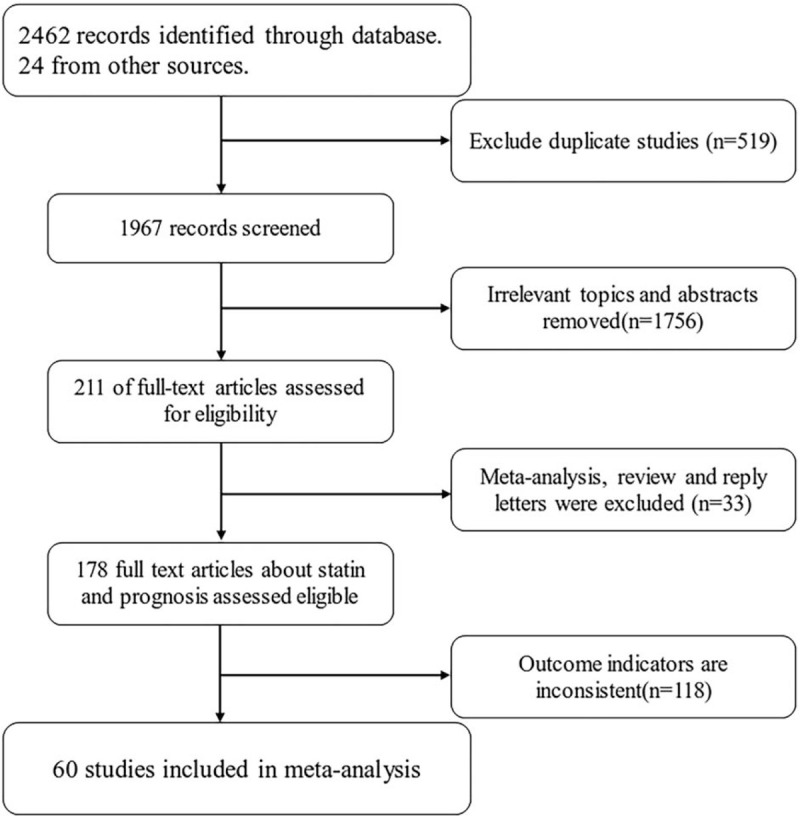
Flow chart representing the selection process.
Table 1.
Characteristics of included studies.

There were 56 cohort studies and 4 case–control studies included in the meta-analysis.[16,23,36,64] There was nine prospective cohort in all cohort studies, and 47 retrospective cohort. Of the 60 studies, 38 investigated the association of statin use with cancer-specific mortality and 23 investigated the association of cancer recurrence, and 13 looked at cancer progression-free survival. The total statin use cases were 233,322, most from western country. Eight studies [16,23,32,37,38,43,48,65] lacked follow-up period or did not describe the specific time of follow-up.
The shape of funnel plot showed asymmetry of included studies. Potential publication bias was revealed through it (Fig. 2).
Figure 2.
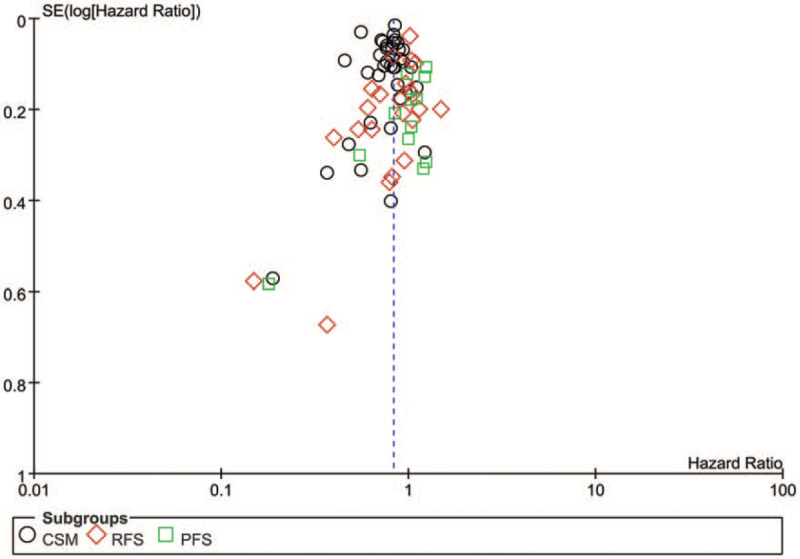
Funnel plot of studies in meta-analysis.
3.2. Cancer-specific mortality
The main result of the present meta-analysis was as follows: A meta-analysis of 38 studies, include 39 data showed a reduction in cancer-specific mortality in statin users (HR = 0.78; 95% CI: 0.74, 0.84; I2 = 85%). (Fig. 3). Subgroup analysis according to the treatment strategy was performed. Eleven studies [22,25,26,28,33,40,41,47,50,62,63] investigated the association between pre-diagnostic statin use and CSM, the summarized HR was 0.81 (95%CI = 0.75,0.88). Seven studies about breast cancer-specific mortality draw a conclusion was HR (0.79;95% CI: 0.63– 0.99), there were 7 colorectal cancer studies about Smythe pooled HR was 0.76 (95% CI:0.67–0.86). And then subgroup of prostate cancer-specific mortality outcome was HR (0.72;95% CI: 0.61 – 0.85).
Figure 3.
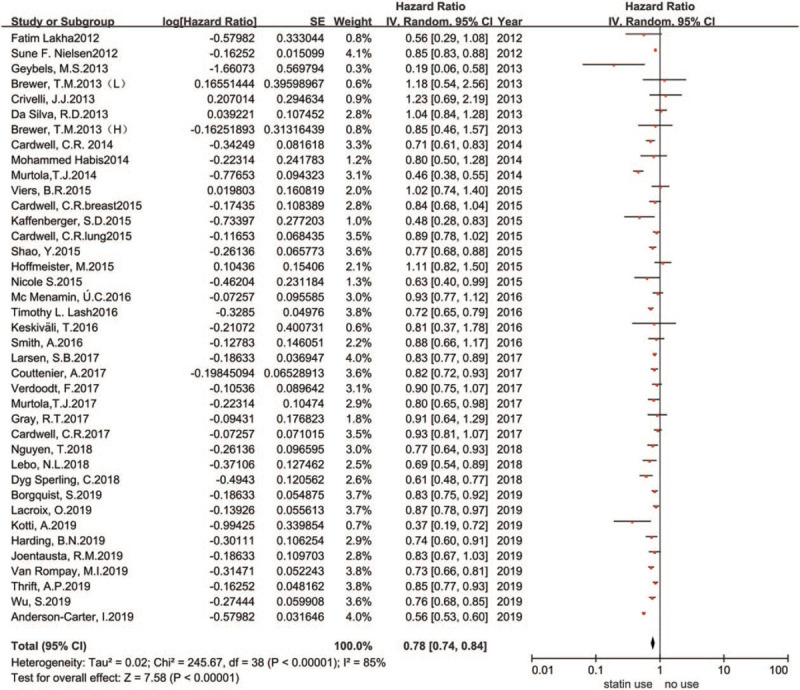
Forest plot of statin use and cancer-specific mortality.
3.3. Cancer recurrence
In total, 23 studies were included in the analysis of cancer recurrence. Statin use was associated with reduced cancer recurrence (HR = 0.87; 95% CI: 0.78,0.97; n = 23; I2 = 64%) (Fig. 4). In subgroup analysis, for 9 studies investigated the association between statin use and prostate cancer recurrence, the summarized HR was 0.89 (95%CI = 0.74,1.07). Perhaps the use of statins could not improve cancer-specific recurrence in prostate cancer.
Figure 4.
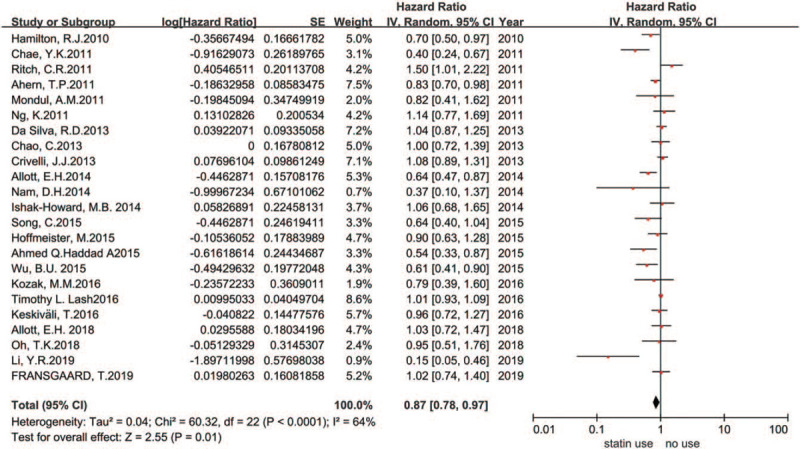
Forest plot of association between statin use and RFS (recurrence-free survival).
3.4. Progression-free survival
In this meta-analysis, there are 13 articles containing the outcome index for progression-free survival. Since an article examined hydrophilic statins and lipophilic statins, 14 sets of data were included. We draw a conclusion in this analysis that statin use was not associated with reduced cancer progression-free survival (HR = 1.05; 95% CI: 0.95,1.16; n = 14; I2 = 38%). (Fig. 5)
Figure 5.
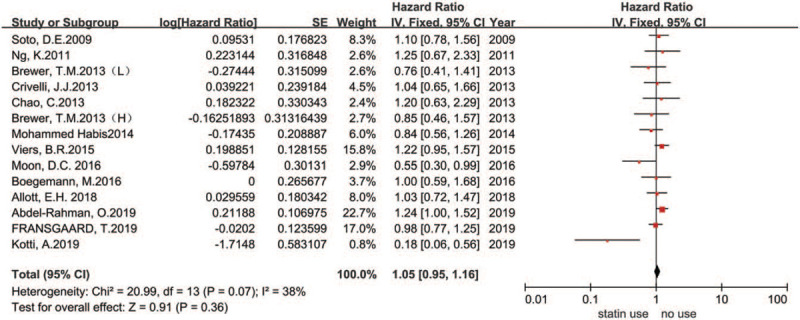
Forest plot of association between statin use and PFS (progression-free survival).
3.5. Sensitivity analyses of CSM and recurrence
Due to the high heterogeneity of this research, we performed 5 sensitivity analyses. In the first sensitivity analysis of CSM, 10 studies with median 5 years or longer follow-up duration were included, (pooled HR, 0.80; 95% CI: 0.73 to 0.87). In the second sensitivity analysis of CSM, 20 studies that provided adjustments to concomitant drug were included (pooled HR, 0.82; 95% CI: 0.77 to 0.87). The concomitant drug included aspirin, other nonsteroidal anti-inflammatory drugs, angiotensin converting enzyme inhibitor, beta-blockers. Another analysis of 19 studies that adjusted for comorbidity (pooled HR, 0.81; 95% CI: 0.77 to 0.86). The comorbidity included cardiovascular, diabetes, respiratory, hypertension and stroke. In cancer recurrence, we performed 2 analyses including an average follow-up of more than 5 years and adjusted for combination medication. The result was 0.79 (95%CI = 0.63,0.99) and 0.88 (95%CI = 0.75,1.03) respectively. All subgroup and sensitivity analysis data were shown in Table 2.
Table 2.
Summary pooled HR (95% CI) for subgroups and sensitivity analyses of cancer-specific mortality (CSM) or recurrence-free survival (RFS) using random-effects models.

4. Discussion
In our main analysis of CSM, based on 38 observational studies, we found that cancer patients taking statin have a modest reduction in cancer-cause mortality with heterogeneity across studies. Subgroup analysis enhanced the impact of statin exposure on the risk of pre-diagnosis of cancer. Sensitivity analyses suggested that the CSM result remained statistically significant when combined with estimates of studies that adjusted for using concomitant drug or comorbidity, as well as studies that included longer follow-up periods, the association between statin use and survival benefits became insignificant. In our analysis of cancer RFS or PFS, based on 23 and 13 observational studies separate, indicated that statins have no significant relationship with cancer recurrence or progression. Sensitivity analyses of recurrence on longer follow-up period showed little chance of reducing recurrence based on the forest plot.
Statins are commonly used to reduce cholesterol levels and are associated with a decrease in the prevalence of cardiovascular events, they lower cholesterol by inhibiting HMG-CoA reductase, the rate-limiting enzyme of the mevalonate pathway for de novo synthesis of cholesterol. And statins may have potential influence on the cancer development and progression. Some previous studies have reported the relationship between statin use and cancer risk. They studied clinical trials and literature on breast cancer, colorectal cancer, lung cancer, prostate cancer, and female reproductive organ cancer. They pointed out that trials and epidemiological studies were more feasible for cancer prognosis than event risk[79,80]. These also provided the basis for the starting point of our article. As was well known, cholesterol-synthesis pathway had great significance for cellular functions, including protein synthesis, signaling, maintaining membrane integrity, and cell-cycle progression. It was recently found that statins were involved in the onset and progression of cancer by blocking the conversion of HMG-CoA into mevalonate, to modify and activate proteins [39] and to induce tumor-specific apoptosis .[81] Statins inhibit the production of mevalonate by inhibiting HMG-CoA reductase, thereby reducing farnesyl pyrophosphate, geranyl pyrophosphate, as an intermediate of the mevalonate pathway. These intermediates regulate various cellular functions such as cell signaling pathways, cellular respiration, glycoprotein production, and cell membrane composition .[82] A study of colorectal cancer suggested that the use of statins may be associated with a cancer prognosis based on KRAS mutation status .[83] Statins favorably impede mutp53–tumor growth. And DNAJA1 could be a crucial downstream effector of statin-induced mutp53 degradation via CHIP .[84] Statins acted differently in malignant and metastatic cancer cells by perturbing various intracellular key components like iron, NO and ROS .[85] Some had developed biomarker that identifying an initial signature for statin sensitivity in human cancer cell lines and tumors,[86] they demonstrated that membrane E-cadherin was a marker of statin-resistant cells. Similar study identified vimentin as a direct molecular target that mediates simvastatin-induced cell death in 2 different cancer cell lines .[87] They found Vimentin as a potential determinant of the sensitivity of cancer cells to statin .[87,88] It is stated above that statins can affect the growth and apoptosis of cancer cells in a variety of ways.
Before our study, a recently published meta-analysis conducted by Mei Z et al involving 1,111,407 patients in 95 cohorts arrived at similar conclusions .[89] They compared the main outcome all-cause mortality in the paper. Then we primarily analyzed the CSM and recurrence free survival indicators, all the included studies were published in recent years, which could decrease variability in confounders such as diagnostic methods and treatment of cancers. Furthermore, high quality study with 7 or more NOS scores included in our study. Although we reached similar conclusions, however, the literature included in such analysis were observational studies, the above and our findings still did not demonstrate whether the use of statins is directly related to improved survival. Farooqi, M.A.M. et al systematically reviewed and meta-analyzed the effects between statins and cancer survival outcomes in randomized clinical trials. They pointed out that for patients with advanced cancer and a prognosis of less than 2 years, the addition of statins to standard anticancer treatment does not seem to improve overall survival or progression-free survival[90]. In our study, CMS results with a follow-up time of more than 5 years were HR, 0.80; 95% CI: 0.73 to 0.87, The result of PFS for more than 5 years follow-up period was 0.79 (95% CI = 0.63, 0.99). Perhaps patients with a better prognosis such as the breast cancer, prostate cancer may benefit from long-term statin treatment.
Several potential limitations deserve comment. First, significant between study heterogeneity, which may be resulted from different study designs, population sample, cancer sites and adjusted variables. Although the multivariate Cox proportional hazards model is the most commonly used method in survival analysis, the confounding covariates are different between studies. The study included a large difference in follow-up time. For example, pancreatic cancer [28,32,43] which limited by survival time did not indicate how long the period was, and the rest follow-up period ranged from 2 to 5 years and above, which may cause 1 of the factors of greater heterogeneity. Second, potential publication bias was revealed through funnel plot, which indicated that potential missing publications was existing. We found that the use of statins seemed associated with improved CSM with significant publication bias. Limited number of studies and different cancer sites may account for the asymmetry. Although almost all included studies provided adjusted estimates considering important confounders, residual confounding may be an issue for biasing the results. Third, the included studies were different in terms of definitions of drug exposure, and most studies did not show that whether the use of statin was pre-diagnosis or post-diagnosis, Lipophilic statin and hydrophilic statin, which may lead to a part of the heterogeneity between the studies. At the same time, we also found that people who had given statins for other reasons before the diagnosis had a lower mortality rate. Statins are a relatively heterogeneous class of drugs, particularly when considering their effects unrelated to cholesterol lowering. Different doses of statins or specific statins may have different effects on cancer prognosis. We are unable to obtain such data. Fourth, the data from prostate cancer recurrence obtained from this study were biochemical recurrence. But prostate cancer biochemical recurrence may be different from other cancers. Statins may influence prostate biology through non-cholesterol-mediated, or direct, pathways too. More studies may lead to the opposite conclusion. Fifth, sensitivity analysis of CSM showed that the associations were almost consistent among these results when stratified according to median follow-up time (>5 years), concomitant drug, and cancer comorbidity. But this result did not show a significant difference in cancer recurrence. Finally, the confounding factors included in each document such as age, comorbidity, status, sex, treatment, BMI, smoking, and so on are still unpredictable.
5. Conclusions
In summary, the results of this meta-analysis suggest that the use of statins may moderately reduce cancer-specific mortality. However, caution must be exercised in interpreting these questions, as we still cannot rule out the limitations of potential methodological individual studies. And there may be biases in introducing these findings. Many of the treatments that are beneficial for non-random cohort analysis have shown no benefit when tested in randomized clinical trials. More clinical studies especially randomized controlled trials, are warranted to confirm these associations. The mechanism by which statins interact with cancer also requires further research.
Acknowledgments
The authors thank Yin, Yuzhen and Yang Hang for assisting in the preparation and revision of this manuscript. We are grateful to all our colleagues in the Department of oncology, The Affiliated Jiangsu Shengze Hospital of Nanjing Medical University, for their help in this study.
Author contributions
Conceptualization: Wei Zhu, Yan Chen.
Data curation: Yueqin Shao, Hong Zhou.
Formal analysis: Ying Shen.
Supervision: Chunyu Li.
Writing – original draft: Jing Yang.
Footnotes
Abbreviations: CIs = confidence intervals, HRs = hazard ratios.
How to cite this article: Yang J, Li C, Shen Y, Zhou H, Shao Y, Zhu W, Chen Y. Impact of statin use on cancer-specific mortality and recurrence: a meta-analysis of 60 observational studies. Medicine. 2020;99:14(e19596).
JY and CL these authors contributed equally to this work.
This work was supported by the National Natural Foundation of China [Grant number: 81672400; 81571873]; the key medical talents of Jiangsu province [grant number: ZDRCA2016016]
The authors state that they have obtained appropriate institutional review board approval or have followed the principles outlined in the Declaration of Helsinki for all human or animal experimental investigations. In addition, for investigations involving human subjects, informed consent has been obtained from the participants involved. All analyses were based on previous published studies; thus, no ethical approval and patient consent were required.
The authors have no conflicts of interest to disclose.
References
- [1].Matusewicz L, Meissner J, Toporkiewicz M, et al. The effect of statins on cancer cells--review. Tumour Biol 2015;36:4889–904. [DOI] [PubMed] [Google Scholar]
- [2].Lipinski MJ, Abbate A, Fuster V, et al. Drug insight: statins for nonischemic heart failure--evidence and potential mechanisms. Nat Clin Pract Cardiovasc 2007;4:196–205. [DOI] [PubMed] [Google Scholar]
- [3].Rao S, Porter DC, Chen X, et al. Lovastatin-mediated G1 arrest is through inhibition of the proteasome, independent of hydroxymethyl glutaryl-CoA reductase. Proc Natl Acad Sci U S A 1999;96:7797–802. [DOI] [PMC free article] [PubMed] [Google Scholar]
- [4].Hoque A, Chen H, Xu XC. Statin induces apoptosis and cell growth arrest in prostate cancer cells. Cancer Epidemiol Biomarkers Prev 2008;17:88–94. [DOI] [PubMed] [Google Scholar]
- [5].Liu H, Liang SL, Kumar S, et al. Statins induce apoptosis in ovarian cancer cells through activation of JNK and enhancement of Bim expression. Cancer Chemother Pharmacol 2009;63:997–1005. [DOI] [PubMed] [Google Scholar]
- [6].Mehibel M, Ortiz-Martinez F, Voelxen N, et al. Statin-induced metabolic reprogramming in head and neck cancer: a biomarker for targeting monocarboxylate transporters. Sci Rep 2018;8:16804. [DOI] [PMC free article] [PubMed] [Google Scholar]
- [7].Lutski M, Shalev V, Porath A, et al. Continuation with statin therapy and the risk of primary cancer: a population-based study. Prev Chronic Dis 2012;9:E137. [DOI] [PMC free article] [PubMed] [Google Scholar]
- [8].Walker EJ, Ko AH, Holly EA, et al. Statin use and risk of pancreatic cancer: results from a large, clinic-based case-control study. Cancer 2015;121:1287–94. [DOI] [PMC free article] [PubMed] [Google Scholar]
- [9].Gutt R, Tonlaar N, Kunnavakkam R, et al. Statin use and risk of prostate cancer recurrence in men treated with radiation therapy. J Clin Oncol 2010;28:2653–9. [DOI] [PubMed] [Google Scholar]
- [10].Kwan ML, Habel LA, Flick ED, et al. Post-diagnosis statin use and breast cancer recurrence in a prospective cohort study of early stage breast cancer survivors. Breast Cancer Res Treat 2008;109:573–9. [DOI] [PMC free article] [PubMed] [Google Scholar]
- [11].McDougall JA, Malone KE, Daling JR, et al. Long-term statin use and risk of ductal and lobular breast cancer among women 55 to 74 years of age. Cancer Epidemiol Biomarkers Prev 2013;22:1529–37. [DOI] [PMC free article] [PubMed] [Google Scholar]
- [12].Morote J, Celma A, Planas J, et al. Role of serum cholesterol and statin use in the risk of prostate cancer detection and tumor aggressiveness. Int J Mol Sci 2014;15:13615–23. [DOI] [PMC free article] [PubMed] [Google Scholar]
- [13].Wang A, Aragaki AK, Tang JY, et al. Statin use and all-cancer survival: prospective results from the Women's Health Initiative. British journal of cancer 2016;115:129–35. [DOI] [PMC free article] [PubMed] [Google Scholar]
- [14].Couttenier A, Lacroix O, Vaes E, et al. Statin use is associated with improved survival in ovarian cancer: a retrospective population-based study. PloS One 2017;12:e0189233. [DOI] [PMC free article] [PubMed] [Google Scholar]
- [15].Shaitelman SF, Stauder MC, Allen P, et al. Impact of statin use on outcomes in triple negative breast cancer. J Cancer 2017;8:2026–32. [DOI] [PMC free article] [PubMed] [Google Scholar]
- [16].Lakha F, Theodoratou E, Farrington SM, et al. Statin use and association with colorectal cancer survival and risk: case control study with prescription data linkage. BMC cancer 2012;12:487. [DOI] [PMC free article] [PubMed] [Google Scholar]
- [17].Jian-Yu E, Graber JM, Lu SE, et al. Effect of metformin and statin use on survival in pancreatic cancer patients: a systematic literature review and meta-analysis. Curr Med Chem 2018;25:2595–607. [DOI] [PMC free article] [PubMed] [Google Scholar]
- [18].Ling Y, Yang L, Huang H, et al. Prognostic significance of statin use in colorectal cancer: a systematic review and meta-analysis. Medicine 2015;94:e908. [DOI] [PMC free article] [PubMed] [Google Scholar]
- [19].Bardou M, Barkun A, Martel M. Effect of statin therapy on colorectal cancer. Gut 2010;59:1572–85. [DOI] [PubMed] [Google Scholar]
- [20].Lo CK, Mertz D, Loeb M. Newcastle-Ottawa Scale: comparing reviewers’ to authors’ assessments. BMC Med Res Methodol 2014;14:45. [DOI] [PMC free article] [PubMed] [Google Scholar]
- [21].Van Rompay MI, Solomon KR, Nickel JC, et al. Prostate cancer incidence and mortality among men using statins and non-statin lipid-lowering medications, European journal of cancer (Oxford. England: 1990) 2019;112:118–26. [DOI] [PMC free article] [PubMed] [Google Scholar]
- [22].Borgquist S, Broberg P, Tojjar J, et al. Statin use and breast cancer survival - a Swedish nationwide study. BMC cancer 2019;19:54. [DOI] [PMC free article] [PubMed] [Google Scholar]
- [23].Fransgaard T, Hallas J, Thygesen LC, et al. Association of statin use and oncological outcomes after neoadjuvant radiotherapy in patients with rectal cancer. Anticancer Res 2019;39:2177–82. [DOI] [PubMed] [Google Scholar]
- [24].Anderson-Carter I, Posielski N, Liou JI, et al. The impact of statins in combination with androgen deprivation therapy in patients with advanced prostate cancer: A large observational study. Urol Oncol 2019;37:130–7. [DOI] [PMC free article] [PubMed] [Google Scholar]
- [25].Thrift AP, Natarajan Y, Liu Y, et al. Statin use after diagnosis of hepatocellular carcinoma is associated with decreased mortality. Clin Gastroenterol Hepatol 2019;17:2117–25. [DOI] [PMC free article] [PubMed] [Google Scholar]
- [26].Lacroix O, Couttenier A, Vaes E, et al. Statin use after diagnosis is associated with an increased survival in esophageal cancer patients: a Belgian population-based study. Cancer Causes Control 2019;30:385–93. [DOI] [PubMed] [Google Scholar]
- [27].Wu SY, Fang SC, Shih HJ, et al. Mortality associated with statins in men with advanced prostate cancer treated with androgen deprivation therapy. Eur J Cancer 2019;112:109–17. [DOI] [PubMed] [Google Scholar]
- [28].Joentausta RM, Rannikko A, Murtola TJ. Prostate cancer survival among statin users after prostatectomy in a Finnish nationwide cohort. The Prostate 2019;79:583–91. [DOI] [PubMed] [Google Scholar]
- [29].Kotti A, Holmqvist A, Albertsson M, et al. Survival benefit of statins in older patients with rectal cancer: a Swedish population-based cohort study. J Geriatr Oncol 2019;10:690–7. [DOI] [PubMed] [Google Scholar]
- [30].Harding BN, Delaney JA, Urban RR, et al. Use of statin medications following diagnosis in relation to survival among women with ovarian cancer. Cancer Epidemiol Biomarkers Prev 2019;28:1127–33. [DOI] [PubMed] [Google Scholar]
- [31].Li YR, Ro V, Steel L, et al. Impact of long-term lipid-lowering therapy on clinical outcomes in breast cancer. Breast Cancer Res Treat 2019;176:669–77. [DOI] [PubMed] [Google Scholar]
- [32].Abdel-Rahman O. Statin treatment and outcomes of metastatic pancreatic cancer: a pooled analysis of two phase III studies. Clin Transl Oncol 2019;21:810–6. [DOI] [PubMed] [Google Scholar]
- [33].Sperling CD, Verdoodt F, Kjaer Hansen M, et al. Statin use and mortality among endometrial cancer patients: a Danish nationwide cohort study. Int J Cancer 2018;143:2668–76. [DOI] [PubMed] [Google Scholar]
- [34].2018;Allott EH, Farnan L, Steck SE, et al. Statin use, high cholesterol and prostate cancer progression; results from HCaP-NC, The Prostate. 78:857–64. [DOI] [PubMed] [Google Scholar]
- [35].Oh TK, Kim K, Jheon S, et al. Impact of statin use on recurrence or survival after surgical curative resection of non-small cell lung cancer. Cancer Control 2018;25:1073274818778000. [DOI] [PMC free article] [PubMed] [Google Scholar]
- [36].Lebo NL, Griffiths R, Hall S, et al. Effect of statin use on oncologic outcomes in head and neck squamous cell carcinoma. Head Neck 2018;40:1697–706. [DOI] [PubMed] [Google Scholar]
- [37].Nguyen T, Khan A, Liu Y, et al. The association between statin use after diagnosis and mortality risk in patients with esophageal cancer: a retrospective cohort study of United States Veterans. Am J Gastroenterol 2018;113:1310. [DOI] [PubMed] [Google Scholar]
- [38].Gray RT, Loughrey MB, Bankhead P, et al. Statin use, candidate mevalonate pathway biomarkers, and colon cancer survival in a population-based cohort study, British journal of cancer 2017;116:1652–9. [DOI] [PMC free article] [PubMed] [Google Scholar]
- [39].Larsen SB, Dehlendorff C, Skriver C, et al. Postdiagnosis statin use and mortality in Danish patients with prostate cancer. J Clin Oncol 2017;35:3290–7. [DOI] [PubMed] [Google Scholar]
- [40].Cardwell CR, Spence AD, Hughes CM, et al. Statin use after esophageal cancer diagnosis and survival: a population based cohort study. Cancer Epidemiol 2017;48:124–30. [DOI] [PubMed] [Google Scholar]
- [41].Murtola TJ, Peltomaa AI, Talala K, et al. Statin use and prostate cancer survival in the finnish randomized study of screening for prostate cancer. Eur Urol Focus 2017;3:212–20. [DOI] [PubMed] [Google Scholar]
- [42].Verdoodt F, Kjaer Hansen M, Kjaer SK, et al. Statin use and mortality among ovarian cancer patients: a population-based cohort study. Int J Cancer 2017;141:279–86. [DOI] [PubMed] [Google Scholar]
- [43].Moon do C, Lee HS, Lee YI, et al. Concomitant statin use has a favorable effect on gemcitabine-erlotinib combination chemotherapy for advanced pancreatic cancer. Yonsei Med J 2016;57:1124–30. [DOI] [PMC free article] [PubMed] [Google Scholar]
- [44].Kozak MM, Anderson EM, von Eyben R, et al. Statin and metformin use prolongs survival in patients with resectable pancreatic cancer. Pancreas 2016;45:64–70. [DOI] [PubMed] [Google Scholar]
- [45].Mc Menamin UC, Murray LJ, Hughes CM, et al. Statin use and breast cancer survival: a nationwide cohort study in Scotland. BMC cancer 2016;16:600. [DOI] [PMC free article] [PubMed] [Google Scholar]
- [46].Smith A, Murphy L, Sharp L, et al. De novo post-diagnosis statin use, breast cancer-specific and overall mortality in women with stage I-III breast cancer. Br J Cancer 2016;115:592–8. [DOI] [PMC free article] [PubMed] [Google Scholar]
- [47].Keskivali T, Kujala P, Visakorpi T, et al. Statin use and risk of disease recurrence and death after radical prostatectomy. Prostate 2016;76:469–78. [DOI] [PubMed] [Google Scholar]
- [48].Lash TL, Riis AH, Ostenfeld EB, et al. Associations of statin use with colorectal cancer recurrence and mortality in a Danish cohort. Am J Epidemiol 2017;186:679–87. [DOI] [PubMed] [Google Scholar]
- [49].Boegemann M, Schlack K, Fischer AK, et al. Influence of statins on survival outcome in patients with metastatic castration resistant prostate cancer treated with abiraterone acetate. PloS One 2016;11:e0161959. [DOI] [PMC free article] [PubMed] [Google Scholar]
- [50].Cardwell CR, Mc Menamin U, Hughes CM, et al. Statin use and survival from lung cancer: a population-based cohort study. Cancer Epidemiol Biomarkers Prev 2015;24:833–41. [DOI] [PubMed] [Google Scholar]
- [51].Hoffmeister M, Jansen L, Rudolph A, et al. Statin use and survival after colorectal cancer: the importance of comprehensive confounder adjustment. J Natl Cancer Inst 2015;107:djv045. [DOI] [PubMed] [Google Scholar]
- [52].Nevadunsky NS, Van Arsdale A, Strickler HD, et al. Association between statin use and endometrial cancer survival. Obstet Gynecol 2015;126:144–50. [DOI] [PubMed] [Google Scholar]
- [53].Viers BR, Houston Thompson R, Psutka SP, et al. The association of statin therapy with clinicopathologic outcomes and survival among patients with localized renal cell carcinoma undergoing nephrectomy. Urol Oncol 2015;33:388.e311–88. [DOI] [PubMed] [Google Scholar]
- [54].Song C, Park S, Park J, et al. Statin use after radical prostatectomy reduces biochemical recurrence in men with prostate cancer. Prostate 2015;75:211–7. [DOI] [PubMed] [Google Scholar]
- [55].Haddad AQ, Jiang L, Cadeddu JA, et al. Statin use and serum lipid levels are associated with survival outcomes after surgery for renal cell carcinoma. Urology 2015;86:1146–52. [DOI] [PubMed] [Google Scholar]
- [56].Cardwell CR, Hicks BM, Hughes C, et al. Statin use after diagnosis of breast cancer and survival: a population-based cohort study. Epidemiology 2015;26:68–78. [DOI] [PubMed] [Google Scholar]
- [57].Kaffenberger SD, Lin-Tsai O, Stratton KL, et al. Statin use is associated with improved survival in patients undergoing surgery for renal cell carcinoma. Urol Oncol 2015;33:21.e11–7. [DOI] [PMC free article] [PubMed] [Google Scholar]
- [58].Wu BU, Chang J, Jeon CY, et al. Impact of statin use on survival in patients undergoing resection for early-stage pancreatic cancer. Am J Gastroenterol 2015;110:1233–9. [DOI] [PMC free article] [PubMed] [Google Scholar]
- [59].Shao YY, Hsu CH, Yeh KH, et al. Statin use is associated with improved prognosis of colorectal cancer in Taiwan. Clin Colorectal Cancer 2015;14:177–84.e4. [DOI] [PubMed] [Google Scholar]
- [60].Ishak-Howard MB, Okoth LA, Cooney KA. Statin use and the risk of recurrence after radical prostatectomy in a cohort of men with inherited and/or early-onset forms of prostate cancer. Urology 2014;83:1356–61. [DOI] [PMC free article] [PubMed] [Google Scholar]
- [61].Allott EH, Howard LE, Cooperberg MR, et al. Postoperative statin use and risk of biochemical recurrence following radical prostatectomy: results from the Shared Equal Access Regional Cancer Hospital (SEARCH) database. BJU Int 2014;114:661–6. [DOI] [PMC free article] [PubMed] [Google Scholar]
- [62].Murtola TJ, Visvanathan K, Artama M, et al. Statin use and breast cancer survival: a nationwide cohort study from Finland. PloS One 2014;9:e110231. [DOI] [PMC free article] [PubMed] [Google Scholar]
- [63].Cardwell CR, Hicks BM, Hughes C, et al. Statin use after colorectal cancer diagnosis and survival: a population-based cohort study. J Clin Oncol 2014;32:3177–83. [DOI] [PubMed] [Google Scholar]
- [64].Nam DH, Lee H, Park JC, et al. Long-term statin therapy improves oncological outcome after radical gastrectomy for stage II and III gastric cancer. Anticancer Res 2014;34:355–61. [PubMed] [Google Scholar]
- [65].Habis M, Wroblewski K, Bradaric M, et al. Statin therapy is associated with improved survival in patients with non-serous-papillary epithelial ovarian cancer: a retrospective cohort analysis. PloS One 2014;9:e104521. [DOI] [PMC free article] [PubMed] [Google Scholar]
- [66].Crivelli JJ, Xylinas E, Kluth LA, et al. Effect of statin use on outcomes of non-muscle-invasive bladder cancer. BJU Int 2013;112:E4–12. [DOI] [PubMed] [Google Scholar]
- [67].Geybels MS, Wright JL, Holt SK, et al. Statin use in relation to prostate cancer outcomes in a population-based patient cohort study. Prostate 2013;73:1214–22. [DOI] [PMC free article] [PubMed] [Google Scholar]
- [68].da Silva RD, Xylinas E, Kluth L, et al. Impact of statin use on oncologic outcomes in patients with urothelial carcinoma of the bladder treated with radical cystectomy. J Urol 2013;190:487–92. [DOI] [PubMed] [Google Scholar]
- [69].Chao C, Jacobsen SJ, Xu L, et al. Use of statins and prostate cancer recurrence among patients treated with radical prostatectomy. BJU Int 2013;111:954–62. [DOI] [PubMed] [Google Scholar]
- [70].Brewer TM, Masuda H, Liu DD, et al. Statin use in primary inflammatory breast cancer: a cohort study. Br J Cancer 2013;109:318–24. [DOI] [PMC free article] [PubMed] [Google Scholar]
- [71].Nielsen SF, Nordestgaard BG, Bojesen SE. Statin use and reduced cancer-related mortality. N Engl J Med 2012;367:1792–802. [DOI] [PubMed] [Google Scholar]
- [72].Ng K, Ogino S, Meyerhardt JA, et al. Relationship between statin use and colon cancer recurrence and survival: results from CALGB 89803. J Natl Cancer Inst 2011;103:1540–51. [DOI] [PMC free article] [PubMed] [Google Scholar]
- [73].Mondul AM, Han M, Humphreys EB, et al. Association of statin use with pathological tumor characteristics and prostate cancer recurrence after surgery. J Urol 2011;185:1268–73. [DOI] [PMC free article] [PubMed] [Google Scholar]
- [74].Chae YK, Valsecchi ME, Kim J, et al. Reduced Risk of Breast Cancer Recurrence in Patients Using ACE Inhibitors, ARBs, and/or Statins. Cancer Invest 2011;29:585–93. [DOI] [PubMed] [Google Scholar]
- [75].Ahern TP, Pedersen L, Tarp M, et al. Statin prescriptions and breast cancer recurrence risk: a Danish nationwide prospective cohort study. J Natl Cancer Inst 2011;103:1461–8. [DOI] [PMC free article] [PubMed] [Google Scholar]
- [76].Ritch CR, Hruby G, Badani KK, et al. Effect of statin use on biochemical outcome following radical prostatectomy. BJU Int 2011;108:E211–216. [DOI] [PubMed] [Google Scholar]
- [77].Hamilton RJ, Banez LL, Aronson WJ, et al. Statin medication use and the risk of biochemical recurrence after radical prostatectomy: results from the Shared Equal Access Regional Cancer Hospital (SEARCH) Database. Cancer 2010;116:3389–98. [DOI] [PMC free article] [PubMed] [Google Scholar]
- [78].Soto DE, Daignault S, Sandler HM, et al. No effect of statins on biochemical outcomes after radiotherapy for localized prostate cancer. Urology 2009;73:158–62. [DOI] [PubMed] [Google Scholar]
- [79].Boudreau DM, Yu O, Johnson J. Statin use and cancer risk: a comprehensive review. Expert Opin Drug Saf 2010;9:603–21. [DOI] [PMC free article] [PubMed] [Google Scholar]
- [80].Dwivedi P, Rodriguez J, Ibe NU, et al. Deletion of the N- or C-terminal helix of apolipophorin III to create a four-helix bundle protein. Biochemistry 2016;55:3607–15. [DOI] [PMC free article] [PubMed] [Google Scholar]
- [81].Longo J, Mullen PJ, Yu R, et al. An actionable sterol-regulated feedback loop modulates statin sensitivity in prostate cancer. Mol Metab 2019;25:119–30. [DOI] [PMC free article] [PubMed] [Google Scholar]
- [82].Fujiwara D, Tsubaki M, Takeda T, et al. Statins induce apoptosis through inhibition of Ras signaling pathways and enhancement of Bim and p27 expression in human hematopoietic tumor cells. Tumour Biol 2017;39:1010428317734947. [DOI] [PubMed] [Google Scholar]
- [83].Raghu VK, Beckwitt CH, Warita K, et al. Biomarker identification for statin sensitivity of cancer cell lines. Biochem Biophys Res Commun 2018;495:659–65. [DOI] [PMC free article] [PubMed] [Google Scholar]
- [84].Parrales A, Ranjan A, Iyer SV, et al. DNAJA1 controls the fate of misfolded mutant p53 through the mevalonate pathway. Nat Cell Biol 2016;18:1233–43. [DOI] [PMC free article] [PubMed] [Google Scholar]
- [85].Lee JE, Baba Y, Ng K, et al. Statin use and colorectal cancer risk according to molecular subtypes in two large prospective cohort studies. Cancer Prev Res 2011;4:1808–15. [DOI] [PMC free article] [PubMed] [Google Scholar]
- [86].Mei Z, Liang M, Li L, et al. Effects of statins on cancer mortality and progression: A systematic review and meta-analysis of 95 cohorts including 1,111,407 individuals. Int J Cancer 2017;140:1068–81. [DOI] [PubMed] [Google Scholar]
- [87].Trogden KP, Battaglia RA, Kabiraj P, et al. An image-based small-molecule screen identifies vimentin as a pharmacologically relevant target of simvastatin in cancer cells. FASEB 2018;32:2841–54. [DOI] [PMC free article] [PubMed] [Google Scholar]
- [88].Warita K, Warita T, Beckwitt CH, et al. Statin-induced mevalonate pathway inhibition attenuates the growth of mesenchymal-like cancer cells that lack functional E-cadherin mediated cell cohesion. Sci Rep 2014;4:7593. [DOI] [PMC free article] [PubMed] [Google Scholar]
- [89].Liao JK. Isoprenoids as mediators of the biological effects of statins. J Clin Invest 2002;110:285–8. [DOI] [PMC free article] [PubMed] [Google Scholar]
- [90].Farooqi MAM, Malhotra N, Mukherjee SD, et al. Statin therapy in the treatment of active cancer: a systematic review and meta-analysis of randomized controlled trials. PloS One 2018;13:e0209486. [DOI] [PMC free article] [PubMed] [Google Scholar]