



Abstract
Orthoptera are capable of threat of agriculture, human health and resists to all pesticides used. This problem is become an objectif of many research's. Pesticide resistance is the adaptation of insects to this materials resulting in decreased susceptibility to that chemical. In other hand, insects develop a resistance through natural selection such chemically transformation, physiological phenomena and genetic. In our study, natural chitin was extracted from cuticle of orthoptera insect (southern of Algeria) using a chemical strategy consists on hydrochloric acid, sodium hydroxide and hydrogen peroxide. The average yield of extracted chitin (96.95% w) indicates that the cuticles of orthoptera are a rich source of chitin. Cuticle exhibit a heterogeneous morphology characterized by a compact structure with well-defined fibrous. For extracted chitin and after demineralization, we can appreciate important changes in the surface of material. We observed round shaped black spots indicated that they are composed almost exclusively by K2O and CaO (cuticle) in the other hand we observed several white taches behind black spots, here we suggest that white taches present chitin extracted. The most resistant orthoptera are the ones to survive and transform their properties by chemical process such as transformation of chitin to chitosan and physiological development such as age. In this study, we have found that the first generation has a great resistance to insecticides. After insecticide application we observed a descendant's resistance decreased a larger because sensitive insects have been selectively killed. After repeated applications resistant insects may comprise the minority. Finally we can said, insecticide resistance can be found in many types and we can conclude that physiological resistance and chemical resistance coexist together and cannot separate. In the physiological resistance, the insect populations may develop the ability to avoid or reduce lethal insecticide exposure. In contrast, chemical resistance refers to modification mechanisms, including reduced cuticle penetration and decreased or increased target site sensitivity. The extracted chitin sample and chitosan were characterized by several characterizations such as X-ray diffraction, scanning electron microscopy SEM, FTIR and 1HRMN spectroscopy.
Keywords: Orthoptera, Chitin, Chitosan, Insect, Resistance, Pesticide, Arid region, Cuticle
Specifications table
| Subject | Polymer chemistry, Chemical engineering |
| Specific subject area | Biological sciences, polymer chemistry, Chemical engineering, materials science, ecology. |
| Type of data | Table of sampling, Image, Figure of extracted and synthesized materials, extract yield. |
| How data were acquired | Morphology of product: SEM microgram Crystallographic properties :XRD Chemical composition: XRF. Structure of extracted and synthesized materials : 1HNMR |
| Data format | images, Tables and figures |
| Parameters for data collection | Materials prepared and synthesized was analyzed by their elemental composition as well as the morphological, crystalographic properties and structure. Parameters for the initial structures are provided in this article. |
| Description of data collection | Extracted chitin and synthesized chitosan from cuticle of orthoptera were used as new environmentally materials who can provide us with explanations on the resistance of orthoptera to pesticides. |
| Data source location | Republic algerian democratic and popular |
| Data accessibility | Data are supplied with this article |
| Related research article | BRAHIMI Djamel1*, MESLI Lotfi1 and RAHMOUNI Abdelkader2. Orthoptera fauna diversity in the arid region of Naama (Southern west of Algeria). Revue Agrobiologic.(2019)9(1) :1292-1301. |
Value of the data
-
•
The data in this article will be informative to extracted of chitin and preparation of chitosan based on cuticle of orthoptera as raw material for study resistance phenomena of orthoptera at pesticides.
-
•
Described dataset in this paper provides new idea to understand chemical and physiological phenomena explaining in when and how insect resist of pesticide. By using these data researchers can make comparisons with other resistance phenomena.
-
•
Extraction of chitin and preparation of chitosan by these method employed in this Data article can be used as a reference for future studies to know the resistance of insects to pesticides.
-
•
The Data obtained in this work can be effectively applied for all insects mostly of orthoptera.
-
•
The data can be highlighted for further studies in development of better strategy for insect resistance to pesticide.
1. Data Description
The Orthoptera for each station is studied with transects method. 13 samples were taken from August 2015 until August 2017. The number of mature individuals belonging to each locust species is counted separately [1]. Described dataset in this paper provides new idea to understand chemical and physiological phenomena how insect resist of pesticide [2]. The extracted chitin and synthesized chitosan of in these studies were confirmed by 1HNMR, XRF, XRD, and SEM [3]. Scheme. 1 describes of extracted chitin from cuticle of orthoptera. Scheme. 2 describes of synthesized chitosan from cuticle of orthoptera as raw materials. Table. 1 describes chemical composition of the chitin extracted from cuticle of orthoptera.). Tables. 2,3 and 4 describes duration of struggle and resistance percentage (%) resistance of orthoptera against the different insecticides. Fig. 1 describes the XRD pattern of extracted chitin and synthesized chitosan from cuticle of orthoptera. Fig. 2 describes SEM micrographs of the cuticle, chitin and chitosan of orthoptera (southern of Algeria). Fig. 3 describes 1HNMR spectra of extracted chitin and synthesized chitosan from cuticle of orthoptera. Fig. 4 describes 1H-NMR spectrum of prepared chitosan from natural chitin of orthoptera in (DMSO).
Scheme 1.

Describes of extracted chitin from cuticle of orthoptera in three steps
Scheme 2.

Describes of synthesized chitosan from cuticle of orthoptera fauna as raw material.
Table 1.
Chemical composition of the chitin extracted from cuticle of orthoptera
| No. | element | result (% by weight) | oxide | result (% by weight) |
|---|---|---|---|---|
| 1 | Al | 0.482 | Al2O3 | 0.9112 |
| 2 | Si | 3.03 | Sio2 | 6.4716 |
| 3 | P | 7.87 | P2O5 | 18.0222 |
| 4 | S | 6.13 | SO3 | 15.3044 |
| 5 | Cl | 6.71 | / | / |
| 6 | K | 25.5 | K2O | 30.7407 |
| 7 | Ca | 8.57 | CaO | 11.9886 |
| 8 | Fe | 5.38 | Fe2O3 | 7.6969 |
| 9 | Ni | 0.76 | NiO | 0.9672 |
| 10 | Cu | 0.31 | CuO | 0.3877 |
| 11 | Zn | 0.474 | ZnO | 0.5905 |
| 12 | Br | 0.213 | / | / |
Table 2.
Duration of struggle and resistance percentage (%) of orthoptera against the organophosphates insecticide
| Samples | Age | Insecticide | Duration of struggle (2015) | Resistance percentage (%) |
|---|---|---|---|---|
| 1 |  |
Organophosphates | 36 hours | 35 |
| 2 |  |
Organophosphates | 15 hours | 21 |
| 3 | 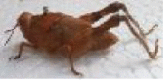 |
Organophosphates | 05 hours | 2 |
| 4 | 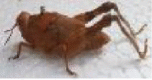 |
Organophosphates | 1 hour | 0 |
Table 3.
Duration of struggle and resistance percentage (%) of orthoptera against the fenitrothion insecticide.
| Samples | Age | Insecticide | Duration of struggle(2017) | Resistance percentage (%) |
|---|---|---|---|---|
| 1 | 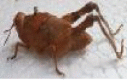 |
Fenitrothion | 48 hours | 39 |
| 2 |  |
Fenitrothion | 18 hours | 20 |
| 3 | 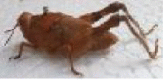 |
Fenitrothion | 8hours | 02 |
| 4 |  |
Fenitrothion | 2 hours | 00 |
Table 4.
Duration of struggle and resistance percentage (%) of orthoptera against the ethyl-chlorpyriphos insecticide.
| Samples | Age | Insecticide | Duration of struggle(2019) | Resistance percentage (%) |
|---|---|---|---|---|
| 1 |  |
Ethyl-chlorpyriphos | 45 hours | 46 |
| 2 |  |
Ethyl-chlorpyriphos | 27 hours | 19 |
| 3 |  |
Ethyl-chlorpyriphos | 6 hours | 04 |
| 4 |  |
Ethyl-chlorpyriphos | 2 hours | 00 |
Fig. 1.

XRD pattern of extracted chitin and synthesized chitosan from cuticle of orthoptera.
Fig. 2.

SEM micrographs of the cuticle, chitin and chitosan of orthoptera (southern of Algeria).
Fig. 3.

1H-NMR spectra of extracted chitin from cuticle of orthoptera in (DMSO).
Fig. 4.

1H-NMR spectra of synthesized chitosan from natural chitin of orthoptera in (DMSO).
2. Experimental Design, Materials, and Methods
2.1. Chemical and material
All reagents in this work were of analytical grade and used as received without further purification. Sodium hydroxide (NaOH) and chlorhydric acid (HCl) were used as initiator from sigma Aldrich (French). The cuticle of orthoptera used in this work came from a quarry located in Naama (southern west of Algeria) [4].
2.2. Study site
2.2.1. Station of Mecheria
This station is located on the southern slopes of Jebel antar in north of the town of mecheria at (longitude 0° west and latitude 33° North). The vegetation covers in this station are (Stipa tenacissima, Peganum harmala and Aleppo pine) [5].
2.2.2. Station of ben ammar
It is located at forty kilometer (40 Km) north of the mecheria city at ( longitude 0° west and latitude 33° north), the vegetation species in this station are (Stipa tenacissima, tamarix gallica and ziziphus lotus) [6].
2.2.3. Wetland of Ain ben khelil
The resort is a wetland listed by ramsar. Its is localized at (longitude 0° west and latitude 33° north). The water of wetland concerned two hundred hectares surrounded by several units or peripheral areas; immediate area of water is characterized by tamarix and alfa formation. The gausses diagram and Ombrothermic bagnouls shows the dry period in the naama region is longer from april until October during the period (1985-2012). The rainfall climagramme emberger quotient (Q2) show that three stations located in the fresh winter upper arid area [7].
2.2.4. Study of Orthoptera
The Study of orthoptera for each station is studied with transects methods. Thirteen samples were taken from August (2015) until August (2017). The number of mature individuals belonging to each locust species is counted separately. The collected specimens were preserved by both dry and wet preservation methods. The determination of orthoptera species is based on the chopard key (1943), and the acridoidea catalog of north west africa of Louveaux, A. & al. (1987) [8].
2.3. Extraction of chitin from cuticle of orthoptera
Orthoptera cuticle was suspended in 10% of chlorhydric acid (HCl) solution at room temperature for two hours. Deproteinization of cuticle was done by treating the demineralized cuticle with 10 % of sodium hydroxide (NaOH) at 100°C for two hours. After the incubation time, the residue product was washed to neutrality in running tap water and vacuum dried. Finally the product obtained was chitin (white powder, yield 96.95%) [9].
2.4. Chemical transformation of chitin to chitosan
Chitin obtained was deacetylatied by 50 % of sodium hydroxide( NaOH) solution at 80 to 100°C temperature for two hours, the obtained product was washed several time under mechanical stirring with water to neutrality, rinsed with deionized water then filtered, vacuum dried and grinded to obtained chitosan(white powder yielded 98.23 %) [10].
Acknowledgments
The work was performed using the equipment of the center of research scientific and technics in analysis chemical and physical (CRAPC). This work was supported by the DGRSDT of Algeria republic and was carried out within the State Program of second national forum.
Conflict of Interest
The authors declare that they have no known competing financial interests or personal relationships that could have appeared to influence the work reported in this paper.
Footnotes
Supplementary material associated with this article can be found, in the online version, at doi:10.1016/j.dib.2020.105659.
Appendix. Supplementary materials
References
- 1.Chopard L. Contribution to the study of orthoptera, North Africa (4th grade) French Review of Entomology. 1943:144–146. [Google Scholar]
- 2.T.M. Brown. Counter measures for insecticide resistance. Bull. Entomol. Soc. America.27(1981)198-202.
- 3.A.L. Devonshire, G.D. Moores, and R.H. French-Constant. Detection os insecticide resistance by immunological estimation of carboxylesterase activity in Myzus persicae (Sulzer) and cross reaction of antiserum with Phorodon numuli (Schrank) (Hemiptera: Aphidae). Bull. Ent. Res.76(1986) 97-107.
- 4.Mistshenko L. The knowledge of grasshoppers of the ochrilidia genus. (Orthoptera, Acrididae) Entomological Journal of the USSR LXV. 1986;(4):709–717. [Google Scholar]
- 5.Louveaux A, Benhalima T. Catalogue of Orthoptera Acridoidea North Africa west. Bull. Soc. ent. Fr. 1987:73–87. [Google Scholar]
- 6.R.V. Gunning. Comparison of the two bio-assay techniques for larvae of helicoverpa sp. (Lepidoptera: Noctuidae). J. Econ. Entomol., 86(1993) 234-238.
- 7.Enayati A.A., Ranson H., Hemingway J. Insect glutathione transferases and insecticide resistance. Insect Molecular Biology. 2005;14(1):3–8. doi: 10.1111/j.1365-2583.2004.00529.x. [DOI] [PubMed] [Google Scholar]
- 8.Harrat A., Moussi A. Inventory of the locust wildlife in two habitats in eastern Algeria. Science & Technology. 2007;(C. 26):99–105. [Google Scholar]
- 9.Sukhoruchenko G.I., Dolzhenko V.I. Problems of resistance development in arthropod pests of agricultural crops in Russia. EPPO Bulletin. 2008;38(1):119–126. [Google Scholar]
- 10.Harrat A., MOUSSI A. Inventory of the locust wildlife in two habitats in eastern Algeria. Science & Technology C. 2007;26:99–105. [Google Scholar]
Associated Data
This section collects any data citations, data availability statements, or supplementary materials included in this article.