



A 51-year-old man was referred to the dermatology department for a painful lesion on the abdominal wall that had appeared 1 year before as a slow-growing, inconspicuous papule. The patient was otherwise asymptomatic. On examination, he had a hard erythematous nodule on the umbilical region, measuring 35 × 25 mm, with central crusting (Fig. 1) and a palpable deep component whose limits exceeded those of the superficial lesion. Skin biopsy revealed an adenocarcinoma with intestinal-type immunohistochemical profile. Exploratory laparotomy revealed large and diffuse peritoneal implants and a petrous gallbladder suggestive of a primary neoformation. The patient died 6 weeks after diagnosis due to the tumor progression.
Figure 1.
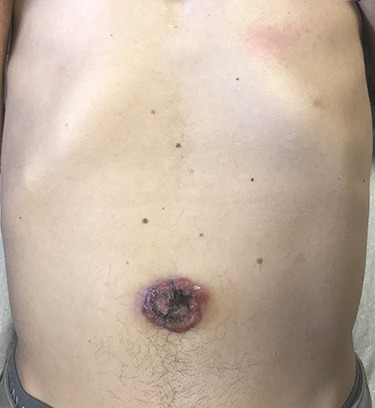
A solitary erythematous nodule with central crusting and irregular borders on the umbilical region.
Sister Mary Joseph’s nodule is a palpable nodular lesion of the umbilical region resulting from an abdominal or pelvic malignant neoplasm [1]. It is usually associated with an advanced stage tumor, with peritoneal metastases and a poor clinical prognosis [2].
CONFLICT OF INTEREST
None declared.
FUNDING
The author(s) received no financial support for the research, authorship and/or publication of this article.
ETHICAL APPROVAL
The case is exempt from ethical approval in this institution.
INFORMED CONSENT
Written informed consent was obtained from the patient for publication of this case report and accompanying images. A copy of the written consent is available for review on request.
REFERENCES
- 1. Key JD, Shephard DA, Walters W. Sister Mary Joseph's nodule and its relationship to diagnosis of carcinoma of the umbilicus. Minn Med 1976;59:561–6. [PubMed] [Google Scholar]
- 2. Abu-Hilal M, Newman JS. Sister Mary Joseph and her nodule: historical and clinical perspective. Am J Med Sci 2009;337:271–3. doi: 10.1097/MAJ.0b013e3181954187. [DOI] [PubMed] [Google Scholar]