



Abstract
Introduction:
Early life adversity (ELA) can result in negative health-outcomes, including internalizing and externalizing problems. Evidence suggests that adolescence is a critical developmental period for processing ELA. Identity formation, which is crucial to this developmental period, may moderate the effect between ELA and these problems. One potential moderating variable associated with identity formation is the latent construct Prospective Self, comprised of future-oriented attitudes and behaviors.
Methods:
Participants are from the first wave of an ongoing longitudinal study designed to characterize behavioral and cognitive correlates of risk behavior trajectories. A community sample of 10th and 12th grade adolescents (N = 2017, 55% female) were recruited from nine public school districts across eight Southeastern Michigan counties in the United States. Data were collected in schools during school hours or after school via self-report, computer-administered surveys. Structural equation modeling was utilized to assess Prospective Self as a latent construct and to evaluate the relationship between ELA, internalizing and externalizing problems, and Prospective Self.
Results:
Preliminary findings indicated a satisfactory fit for the construct Prospective Self. The predicted negative associations between Prospective Self and internalizing and externalizing problems were found and evidence of moderation was observed for externalizing problems, such that the effects of ELA (i.e., childhood maltreatment) on externalizing problems were lower for individuals with higher levels of Prospective Self.
Conclusions:
These results indicate a role thatProspective Self may play in supporting resilience against externalizing problems associated with ELA among adolescents.
Keywords: Adolescence, Adverse Childhood Experiences, Internalizing and Externalizing Problems, Self-concept, Adolescent Health, Early Life Adversity
Early life adversity (ELA) involves exposure to circumstances that deviate from what is generally expected during early development, and that require significant adaptation to overcome (Duffy, McLaughlin, and Green, 2018). Examples of ELA include instances of sexual, emotional, and physical abuse, and growing up in impoverished conditions. ELA is associated with a number of negative life outcomes, including increased levels of serious behavioral and emotional problems (Garmezy & Rutter, 1983; Collishaw et al., 2007). Adverse experiences that are specifically linked to internalizing and externalizing problems— two broadband dimensions of psychopathology— include childhood maltreatment, family stress (including economic hardship), and community stress. In particular, experiencing physical or emotional maltreatment (Litrownik et al., 2003; Mills et al., 2013), living in a household where the highest education of one or more parents is high school or less (Zhang, 2012), in a household receiving public assistance (Björkenstam, Kosidou, & Björkenstam, 2017), and/or in an economically disadvantaged community (Appleton et al., 2012), have all been found to be predictors of future internalizing and externalizing problems.
Internalizing and externalizing problems associated with ELA may emerge during the challenges presented in the critical developmental period of adolescence. The adolescent transition is a time when academic pressure increases, work-related problems may arise, relationships change or are lost, the influence of peers increases, and a higher frequency of experimentation and exploration occurs, among a multitude of other psychological and social milestones (Lerner & Steinberg, 2004). If adaption to these new life circumstances is not successful, then it may leave adolescents vulnerable to several domains of psychopathology. Psychopathological outcomes during adolescence may vary by sex (Curran, Adamson, Rosato, Cock & Leavey, 2018), race and ethnicity (Briggs, Quinn, Orellana & Miller, 2015), and age (e.g. early versus late adolescence) (Leebens & Williamson, 2017), but are generally accepted as a major, universal public health concern (World Health Organization [WHO], 2005).
Given the significance of these changes during adolescence, researchers have examined how overcoming some of these unique developmental challenges in adolescence may reduce internalizing and externalizing problems associated with ELA. In a recent review of 50 years of resilience science (Masten & Barnes, 2018), identified an initial major area of work focused on studying the subgroup of adolescents who grew up in adverse conditions but did not end up experiencing behavioral or emotional problems, that is, youth who experience positive outcomes despite early adversity. From the outset, research into the construct of resilience identified key protective interpersonal and interpersonal factors, including experiencing a positive relationship with a competent adult, having good learning and problem-solving skills, being engaging to other people, and having areas of competency and perceived efficacy values by self or society (Garmezy & Masten, 1990; Masten, Best, & Garmezy, 1990). Subsequent research included more detailed investigation of these developmental trajectories with a focus on the set of intrapersonal and interpersonal processes that work together to promote positive adaptation to challenging situations (Luthar & Zigler, 1991; Luthar, Crossman, & Small, 2015; Masten, 2001; Masten & Barnes, 2018; Masten et al., 1999; Zimmerman, 2013). Derived from longitudinal studies of individuals growing up in contexts of disadvantage showing that those who display resilience in general demonstrate fewer psychological problems (Masten, 2001). Key compensatory and protective factors have been identified as contributors to better mental health outcomes, such as one’s own academic skills (Steinhausen & Metzke, 2001), self-efficacy, coping skills, and competence (Fergus & Zimmerman, 2005), positive relationships with peers (Steinhausen & Metzke, 2001), and parental support (Werner & Johnson, 2004; Afifi & MacMillian, 2011). Research has also indicated that resilience becomes more difficult to attain when there are multiple sources of ELA (Sameroff, Gutman, & Peck, 2003), thus implying a need to include multiple measures of adversity.
Despite evidence that both intrapersonal and interpersonal characteristics contribute to adolescent resilience, many current measures of resilience are often broadly defined based principally on environmental factors that promote positive development, such as the presence of social and familial support. As Afifi & MacMillian (2011) argue in their review of protective factors, familial and environmental factors appear to be more readily the targets of current intervention because these factors seem to be more responsive to change. While intrapersonal factors such as IQ, may be less amenable to intervention than external factors, other intrapersonal factors such as social competence, problem solving skills, and perceived self-efficacy (Masten, Best, & Garmezy, 1990) may be no less important, and thus the role of intrapersonal factors of resilience merits closer research attention. Further research is crucial to understand whether intrapersonal characteristics, in addition to external factors, may be a viable target for fostering resilience during adolescence.
A particularly important component of intrapersonal resilience during adolescence may arise from the more sophisticated sense of identity development during this critical period. Pfeifer and Berkman (2018) argue that identity development can inform neurodevelopment because, during adolescence, higher order cognitive process are maturing and adolescents are often tasked with drawing on these processes to make informed reward-based decisions. Future self-representations especially may motivate self-regulatory behavior, as they require one to weigh the risks and benefits associated with a more distant reward (Hoyle & Sherrill, 2006; Steinberg et al., 2018).
Prospective Self as a Factor of Resilience
Several models derived from Erikson’s stage theory posit adolescence as a critical period of identity development. These models (Berzonsky, 2011; Johnson, Blum & Cheng, 2014; Marcia, 1966; Shavelson, Hubner & Stanton, 1976) share the assumption that the outcomes of an adolescent’s decisions are what contribute to one’s emerging idea of self. The construct of “Prospective Self” proposed here captures the foundation upon which adolescents make these decisions that ultimately inform their self-identity. In the current study, Prospective Self is measured using three concurrent factors of the adolescent self that guide goal-oriented behavior and positive decision-making (Johnson et al., 2014), and may thus serve to increase the likelihood of the emergence of a positive perception of identity and purpose while mitigating the risk for future internalizing and externalizing problems. These three factors are future-orientation, academic aspirations, and exhibiting resistance to peer influence.
Future-oriented attitudes independently decrease the risk for development of internalizing and externalizing problems (Hirsch et al., 2006; Johnson et al. 2014) and predict one’s ability to overcome prior adverse experiences (Cui et al., 2020; Oshri, Duprey, Kogan, Carlson & Liu, 2018; Ostaszewski & Zimmerman, 2006). Academic aspirations— such as a desire to pursue a college degree after high school— have been linked to stronger self-regulatory skills and less frequent engagement in risky behaviors (Carroll et al., 2009). Maintaining a resistance to peer influence is associated with a heightened sense of autonomy, more mature cognitive development, and a higher degree of functional neural connectivity that contributes to executive control (Paus et al., 2008). Incorporating future orientation, academic aspirations, and resistance to peer influence together into one construct may identify one’s goal-oriented thoughts, ability to imagine a future self, and ability to maintain one’s planned trajectory despite the influence of others.
Focusing on the combination of these three components of the developing adolescent may further identify factors of resilience that are specifically pertinent to adolescent identity development, in that they guide decision-making, combine both individual and social aspects of development, and may have further implications for protecting against the risk for internalizing and externalizing problems associated with ELA.
Current Study
Among a large and diverse group of adolescents (N = 2017), we investigated the links between self-reported experiences of ELA and internalizing and externalizing problems in adolescence and the potential role of Prospective Self in moderating the strength of this link. The four hypotheses of the present study are: (1) Prospective Self can be characterized as a coherent latent construct; (2) ELA (that is, childhood maltreatment and a less advantaged social environment) will be positively related to internalizing and externalizing problems; (3) Prospective Self will be negatively related to internalizing and externalizing problems; and (4) Prospective Self will moderate the effects of ELA on internalizing and externalizing problems during adolescence.
Method
Study characteristics are briefly summarized here with additional details described elsewhere (Demidenko, Huntley, Matrz, & Keating, 2019).
Participants
Participants are from the first wave of an ongoing longitudinal study designed to characterize behavioral and cognitive correlates of risk behavior trajectories. A quota sampling method was used to increase diversity and representativeness. The sample included 10th and 12th grade students recruited from nine public school districts across eight Southeastern Michigan counties (Table 1). Data were collected between mid-March 2015 and mid-February 2016 yielding a total sample of 2017 youth with a response rate of 88.5% among those who provided active parental consent by returning the consent forms to their schools.
Table 1.
Demographic characteristics of study sample (N = 2017).
| Demographic Information | |
|---|---|
| Age, M (SD) | 16.8 (1.1) |
| Sex, n (%) female | 1110 (55.0) |
| Race, n (%) | |
| Black Non-Hispanic | 452 (22.4) |
| Hispanic | 161 (8.0) |
| Other Non-Hispanic | 301 (14.9) |
| White Non-Hispanic | 1103 (54.7) |
| Current level of education, n (%) | |
| 10th grade | 985 (48.8) |
| 12th grade | 1032 (51.2) |
Study Design and Procedures.
Study procedures were approved by the University Institutional Review Board and were designed to protect students’ privacy by allowing confidential and voluntary participation. An initial pool of schools was selected to yield a diversity of school populations across socioeconomic status (SES) and racial/ethnic backgrounds. The initial pool was selected to obtain an approximation of population proportions at the state level. Additional schools were added to the sampling pool, such that they were similar in population characteristics to those schools that declined to participate. This replacement process continued until a sufficient sample size was achieved.
Parents of eligible participants were initially contacted by mail and provided with a study brochure and an informed consent document, and both active parental consent and adolescent assent for participation were obtained. Of 5009 eligible participants contacted by mail through their schools, 2278 (45.8%) of students provided parental consent by returning consent forms to their schools, and 2017 (88.5%) of those who had parental consent participated. Data were collected in schools during school hours or after school via self-report surveys administered using computer assisted interviewing (Illume version: 5.1.1.18300).
Study participants completed two 45-minute, computer administered surveys over the course of two consecutive days. Day one included self-report questionnaires assessing psychosocial constructs associated with behavioral misadventure including frequency of various health risk behaviors (e.g., risky driving, substance use, sexual behavior). Day two included a battery of cognitive tasks that measured impulsivity, decision-making, and working memory (data not shown). Among the students completing day one, 1929 students (95.7%) completed day two. Makeup sessions were made available to students when possible. Upon completion of the survey, participants were compensated with $50 for their time.
Self-report Measures
Early life adversity (ELA).
Informed by the Adverse Childhood Experiences Study (ACEs; Felitti et al., 1998) and findings that multiple sources of early adversity are cumulative (Sameroff et al, 2003), the measures of ELA used in this study includes indicators of childhood maltreatment, as well as several social environment indicators of family and community-level adversity associated with behavioral outcomes (Williams & Merten, 2015). Exploratory factor analysis (described below) indicated that for the ELA measures included in this study, ELA was best characterized by two latent constructs, childhood maltreatment and the social environment.
Exposure to emotional, physical and sexual abuse was assessed using the Childhood Trauma Scale – Short Form (CTQ-SF; Bernstein & Fink, 1998; Bernstein et al., 2003). The CTQ-SF is a self-report measurement that utilizes 28 items from the original 70-item Childhood Trauma Questionnaire (CTQ; Bernstein et al., 1994). The CTQ-SF is comprised of questions about physical, sexual, and emotional abuse that are reported retrospectively. Higher scores indicate greater levels of maltreatment. Reliability and validity of the CTQ-SF have been documented in adolescent and adult and samples with α = .66 – .92 (Bernstein & Fink, 1998; Bernstein et al., 2003; Scher, Forde, McQuaid & Stein, 2004; Thombs et al., 2007). In the present study, Cronbach’s alphas of .86, .64, .89, .92 were obtained for the total scale, physical abuse, emotional abuse and sexual abuse subscales, respectively.
Social environment was assessed based on family utilization of public assistance, level of parental education, and community economic distress. Public assistance was measured using a single dichotomous variable, gauging whether or not the participant’s family has received public assistance of any kind (Do your parents, or the most important person in raising you, receive public assistance [by public assistance, we mean: welfare, Bridge Card, EBT, disability benefits, etc.]?) (Cunningham et al., 2014).
Parent education was measured, with low levels of education used to estimate adversity. Participants were asked to report the level of education completed by each of their parents. Response options included: grade school or less (1), some high school (2), completed high school (3), some college (4), completed college (5), graduate or professional school after college (6), and don’t know or does not apply (7). Scores of both parents, if available, were averaged together with higher scores indicating more education (Bachman, O’Malley, Johnston, Schulenberg & Wallace, 2011; Schulenberg et al., 2005).
The DCI evaluates economic well-being across several metrics derived from data from the U.S. Census Bureau’s American Community Survey 5-Year Estimates for 2011–2015 and Business Patterns data from the years 2011 and 2015 and captures 99% of the U.S. population. Components of the DCI include: percentage of the population without a high school diploma in adults 25 years and older, housing vacancy rate, percentage of adults (age 25–64) not working, percent of population living below the poverty line, median income ratio as a percentage of state median income, percent change in the number of job changes within the community, and the percent change in the number of business establishments within a community. DCI scores reflect economic well-being with higher scores indicating more economic distressed. DCI scores fall into the following quintiles: prosperous (values below 20.0), comfortable (values ranging from 20.0 to 40.0), mid-tier (values ranging from 40.0 to 60.0), at risk (values ranging from 60.0 to 80.0), and distressed (scores over 80.). DCI scores were linked to study participants by zip code.
Internalizing and externalizing problems.
Internalizing and externalizing problems were assessed using The Youth Self-Report (YSR; Achenbach & Rescorla, 2001). The YSR is a widely utilized, 112-item self-report measure assessing emotional and behavioral difficulties in 11–18 year-olds. The YSR includes two broadband scales: internalizing problems (e.g. withdrawn/depressed; raw scores range from 0 – 62; sample M = 13.9, SD = 10.0, min. = 0, max. = 52) and externalizing problems (e.g. attentional deficit/hyper activity problems, oppositional defiant problems; raw scores range from 0 – 64; sample M = 9.0, SD = 7.6, min. = 0, max. = 52). Raw scores were normalized to provide a common metric with higher scores indicating greater internalizing (T scores range from 50 – 100; sample M = 54.4, SD = 11.5, min. = 50, max. = 90) and externalizing problems (T scores range from 50 – 100; sample M = 51.1, SD = 10.1, min. = 50, max. = 80). Validity and reliability of the YSR broadband, syndrome, and DSM-oriented scales have been well documented (Achenbach, 2013; Achenbach & Rescorla, 2001) with adequate internal consistency (α = .70 - .86) and test-retest reliability (α = .67 - .88). In the present study, Cronbach’s alphas of .91 and .88 were obtained for the internalizing and externalizing scales, respectively.
Prospective Self.
Prospective Self is hypothesized as a latent construct made up of the following measures: (a) the Resistance to Peer Influence Scale (Steinberg & Monahan, 2007), (b) the Future Orientation Scale (Steinberg et al., 2009), and (c) academic aspirations. Summary information regarding these measures can be found in Table 2.
Table 2.
Summary information for Early Life Adversity (ELA) and Prospective Self
| Early life adversity indicators | |
|---|---|
| CTQ-SF | M (SD) |
| Emotional abuse | 8.44 (4.69) |
| Physical abuse | 6.56 (2.42) |
| Sexual abuse | 5.54 (2.32) |
| Parent education | 4.10 (1.10) |
| Distressed Communities Index (DCI) | 50.8 (25.9) |
| n (%) | |
| Family receiving public assistance | 479 (23.7) |
| DCI 5th Quintile | 272 (13.2) |
| Prospective Self | |
| Future Orientation Scale | M (SD) |
| Planning ahead | 2.68 (0.54) |
| Time perspective | 2.77 (0.52) |
| Anticipation of future consequences | 2.92 (0.49) |
| Resistance to peer influence | 3.05 (0.56) |
| Academic aspirations | 2.36 (0.81) |
Note. CTQ-SF indicates Childhood Trauma Scale – Short Form.
The Resistance to Peer Influence Scale (RPI; Steinberg & Monahan, 2007) is a 10-item self-report measure that assesses how well participants resist the influence of their peers. The format of assessment is based on the work of Harter (1982), designed to minimize social desirability by presenting a series of statement pairs separated by the word BUT with respondents instructed to choose the best descriptor followed by instructions to indicate the extent to which the descriptor is true. Responses range from one to four and a total score yielding a maximum total of 4 based on an unweighted average of all valid items with higher scores indicating a stronger resistance to peer influence. The RPI has demonstrated adequate reliability and validity in a pediatric and adult sample, with α = .70 - .76. In the present study, the RPI scale had a Cronbach’s alphas of .77.
The Future Orientation Scale (FOS; Steinberg et al., 2009) is a 15-item self-report used to measure the extent of future orientation based on three, five-item subscales: time perspective, anticipation of future consequences, and degree of future planning. Similar in format to the RPI, this scale presents respondents with a series of statement pairs separated by the word BUT and respondents are instructed to choose the best descriptor followed by instructions to indicate the extent to which the descriptor is true. Responses yield a maximum total score of 4 based on an unweighted average of all valid items with higher scores indicating greater future orientation. Studies have found the FOS to have acceptable internal consistency with α = .80, .55, .62, .70 for the total scale, time perspective, anticipation of future consequences and planning ahead subscales, respectively (Steinberg et al., 2009). In the present study, Cronbach’s alphas of .77, .70, .55, .62 were obtained for the total scale, time perspective, anticipation of future consequences and planning ahead subscales, respectively. For our sample, a model with the three five-item subscales provided a better fit to the data rather than a single 15-item factor.
Academic aspirations were assessed using a single item (Suppose you could do just what you’d like and nothing stood in your way. How many of the following things would you WANT to do?) [Attend a technical or vocational school; Serve in the armed forces; Graduate from a two-year college program; Graduate from a four-year college program; Attend graduate or professional school after college; None of the above]). From this single item we quantified the desire to finish high school (0), attend a two-year college program or technical/vocational school (1), attend a four-year undergraduate degree program (2), or pursue a graduate or professional degree beyond college (3). High scores indicated higher academic aspirations.
Analysis
Using Mplus version 8.0 (Muthén & Muthén, Los Angles, CA) an exploratory factor analysis (EFA) was used to characterize the underlying factor structure of the early life adversity (ELA) indicators and a confirmatory factor analysis (CFA) was used to evaluate the hypothesized Prospective Self construct. Factor analysis was executed using an oblique rotation (geomin) with factor extraction was based on a combination of methods (Fabrigar, Wegener, MacCallum, & Strahan, 1999), including examination of the scree plot of eigenvalues from the reduced correlation matrix, interpretability of factors, multiple model fit indices, and parallel analysis (Hayton, Allen, & Scarpello, 2004). A comparative fit index (CFI), root mean square error of approximation (RMSEA) with 90% confidence interval, and a standardized root mean square residual (SRMR) were utilized to assess model fit with the chi-square difference test used to evaluate between the one and two factor models. Structural equation modeling (SEM) using Mplus was used to examine the relationships between the two ELA latent variables (i.e., childhood maltreatment and social environment), Prospective Self, and internalizing and externalizing problems. Race (White non-Hispanic and non-White), grade (10th and 12th grade), and sex (male and female) were included as covariates. SEM was conducted in Mplus utilizing a maximum likelihood estimator with robust standard errors (ESTIMATOR = MLR). Latent variable interactions were specified by using the XWITH option of the MODEL command (Asparouhov & Muthen, 2019; Muthén & Muthén, 2017). To illustrate interactions with Prospective self the LOOP plots option was utilized ((Muthén & Muthén, 2017) to graph low, average and high Prospective Self, with low representing 1 SD below and high representing 1 SD above the mean for Prospective Self. The main effects model and moderation model were compared using Akaike (AIC) values. Models were adjusted for clustering at the participant level. Missing data were handled using full information maximum likelihood (FIML), which retains all participants in the dataset and uses all available data they provided to estimate relationships, thereby limiting bias that may be introduced by dropping the participant from the analysis due to item-level missingness. Because estimates of mediation generate bias with cross-sectional data, mediation analysis was not warranted for the current study (Maxwell, Cole & Mitchell, 2011).
Results
Preliminary Results
Table 1 summarizes the demographic characteristics of the study sample. Table 2 contains summary information for the indicators of ELA and Prospective Self used as our independent variables in subsequent models. EFA indicated that the ELA indicators were best described by a two factor model (CFI = .98, RMSEA = .05, 90% CI RMSEA = .04 - .06, SRMR = .05) rather than a one factor model (CFI = .73, RMSEA = .13, 90% CI RMSEA = .12 - .14, SRMR = .15) as indicated by an improvement in fit indices and a chi-square difference test (p < .001). CFA indicated a satisfactory fit for the construct Prospective Self (CFI = .98, RMSEA = .03, 90% CI RMSEA = .02 −.03, SRMR = .02), supporting the first hypothesis that Prospective Self is a unidimensional construct. A factor score was derived from the CFA to assess the correlation among Prospective Self, childhood maltreatment, social environment, and internalizing and externalizing problems. As shown in Table 3, a significant negative association was observed between Prospective Self and childhood maltreatment, Prospective Self and social environment, and between Prospective Self and both internalizing and externalizing problems. In addition, childhood maltreatment was positively associated with both externalizing and internalizing problems. Similarly, social environment was positively associated with internalizing problems. However, social environment was negatively associated with externalizing problems, i.e., a less aversive social environment was associated with more externalizing problems. These results indicate partial support for the second and third hypotheses.
Table 3.
Means (M), standard deviations (SD) and Pearson correlation coefficients among variables for sample (N = 2017)
| M | SD | 1 | 2 | 3 | 4 | |
|---|---|---|---|---|---|---|
| 1.) Childhood maltreatment | 0 | 1 | - | |||
| 2.) Social environment | 0 | 1 | 17*** | - | ||
| 3.) Prospective Self | 0 | 1 | −.08*** | −.11*** | - | |
| 4.) YSR Externalizing Problems | 51.1 | 10.1 | 42*** | −.10*** | −.35*** | - |
| 5.) YSR Internalizing Problems | 54.4 | 11.5 | 46*** | 14*** | −.10** | .51*** |
Note. Variables 1, 2, and 3 are standardized factor scores. YSR indicates Youth Self Report.
p < .001.
Primary Results
SEM main effects and interactions.
SEM indicated a satisfactory fit for the overall main effects model (Figure 1). For every one-unit increase in childhood maltreatment (with Prospective Self and social environment held constant) there was found to be a significant increase in internalizing and externalizing problems by .60 and .47 standard deviations respectively. For every one-unit increase in social environment (with childhood maltreatment and Prospective Self held constant), there was found to be a significant decrease in externalizing problems by .05 standard deviations. For every one-unit increase in Prospective Self (with childhood maltreatment and social environment held constant) there was a decrease of externalizing problems by .40 standard deviations. Inclusion of interaction terms improved model fit (Figure 2), as indicated by a slightly lower AIC value. Evidence of moderation was observed for externalizing problems, such that the effects of childhood maltreatment were lower for individuals with a greater Prospective Self score (Figure 3): for every one-unit increase in adversity score, Prospective Self reduced adversity’s effect on externalizing problems by .36 standard deviations, providing partial support for hypothesis four. A modest interaction was also observed between the social environment and Prospective Self indicating that externalizing problems were associated with lower levels of Prospective Self when adversity associated with the social environment was low (Fig 4).
Figure 1.

Main effects model between child maltreatment, social environment and Prospective Self predicting internalizing (R2 = .44) and externalizing (R2 = .44) problems (RMSEA = .03, 90% CI RMSEA = .02 - .03, SRMR = .07, CFI = .87, AIC = 64236.7). All values are standardized coefficients. Latent constructs are shown in ellipses, and observed variables are shown in rectangles. Dotted lines indicate a non-significant path (p > .05).
*p < .05. **p < .01. ***p < .001.
Figure 2.

Moderation model of childhood maltreatment, social environment, Prospective Self and their interactions predicting internalizing (R2 = .49) and externalizing (R2 = .81) problems (AIC = 64134.9). All values are standardized coefficients. Latent constructs are shown in ellipses, and observed variables are shown in rectangles. Dotted lines indicate a non-significant path (p > .05).
*p < .05. **p < .01. ***p < .001.
Figure 3.
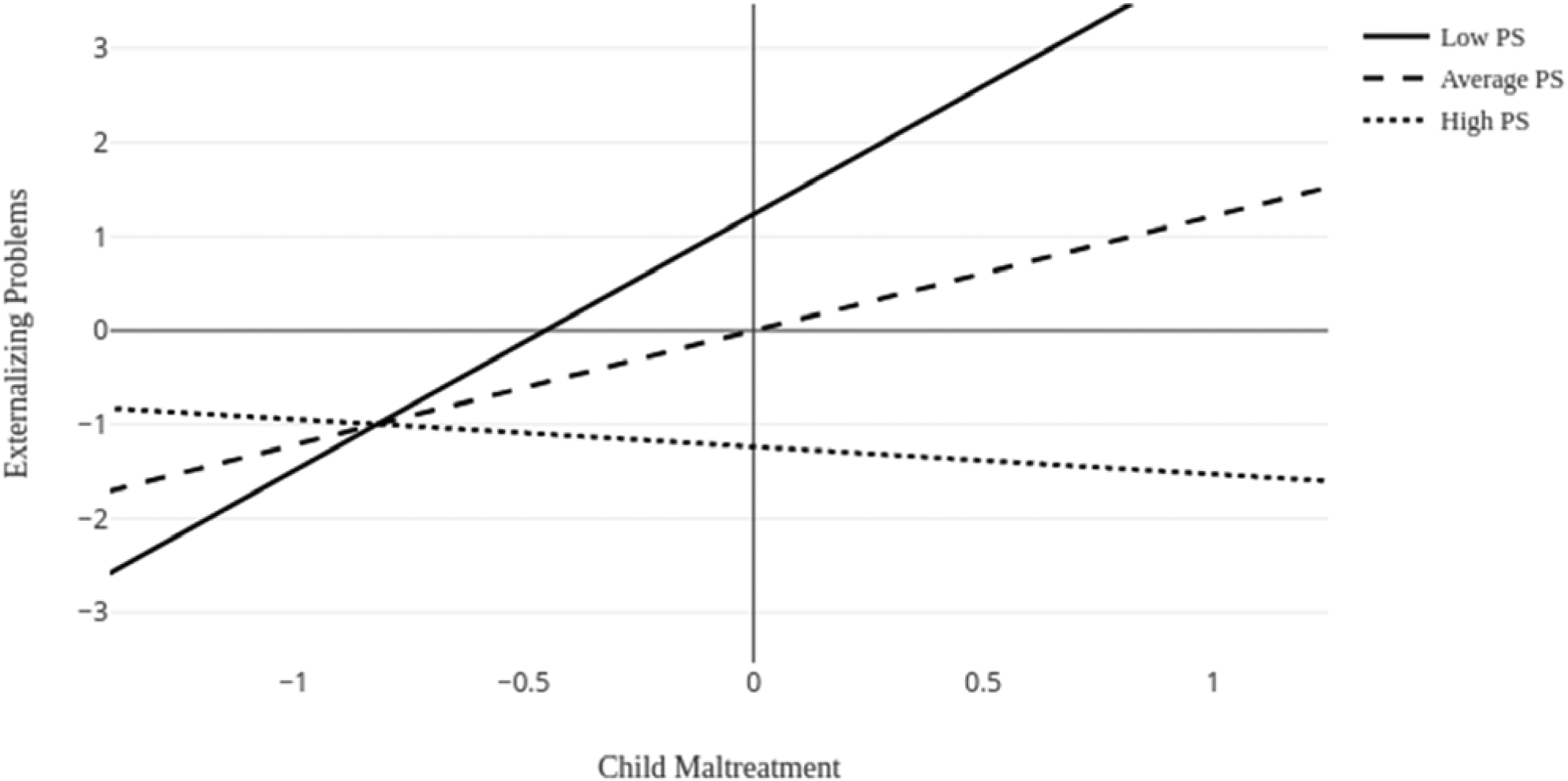
Plot of interaction effect between childhood maltreatment and externalizing problems with Prospective Self (PS) as a moderator. The X- and Y-axes depict a continuous range of standardized childhood maltreatment and externalizing problem scores respectively, with zero representing the mean with low indicating 1 SD below and high indicating 1 SD above the mean. Scores for externalizing problems fell within three standard deviations of the mean.
Figure 4.

Plot of interaction effect between social environment and externalizing problems with Prospective Self (PS) as a moderator. The X- and Y-axes depict a continuous range of standardized social environment and externalizing problem scores respectively, with zero representing the mean with low indicating 1 SD below and high indicating 1 SD above the mean. Scores for externalizing problems fell within three standard deviations of the mean. More positive mean social environment scores depict higher adversity while more negative mean scores depict lower adversity.
Covariates.
In addition to our main independent variable, three important covariates were identified: grade, race, and sex (Figure 1). Being in 12th grade relative to 10th grade corresponded with an increased engagement in externalizing problems. Being White non-Hispanic relative to other racial and ethnic backgrounds corresponded with higher rates of internalizing problems. Separate models including indicators of ethnic minority group membership (i.e. Black non-Hispanic, Latinx, and Other non-Hispanic) indicated few and small effects of these groups on internalizing and externalizing problems (Supplemental Figure 1–2). Being male relative to female corresponded with fewer internalizing problems. The covariate effects are accounted for in the SEM models.
Discussion
Despite strong associations between ELA and the development of internalizing and externalizing problems, previous research has shown that many disadvantaged youth display resilience. These youth experience fewer psychological problems and many achieve healthy developmental outcomes later in life notwithstanding exposure to adversity (Masten, 2001; Masten & Barnes, 2018). While previous studies have examined resilience based on social environment factors that promote positive development, especially those associated with supportive social connections, fewer studies have focused on intrapersonal characteristics during adolescence that may also contribute to the complex mechanisms of resilience. The present study of Prospective Self highlights one potential mechanism associated with resilience that arises from an individual’s emergent sense of self and identity, an important aspect of the developmental period of adolescence.
The construct of Prospective Self is supported by a combination of resilience theory and Erickson’s theory of psychosocial development, and is similar to the Information-Style of identity processing (Berzonsky, 2011) in that it is associated with a self-reflective stance. However, unlike the Information-Style measure, it focuses more directly on goal-directed manifestations.
The underlying processes that link having a future-oriented identity to patterns of behavior adjustment in adolescents with ELA may be related to the significant cognitive maturation that occurs during adolescence (Pfeifer & Berkman, 2018). While more research is needed to further understand how identity development can inform neurocognitive development, the information uncovered in this study is helpful to navigate potential targets for psychosocial intervention and promotion of adolescent resilience. Interventions that specifically encourage peer refusal skills, (Nichols, Graber, Brooks-Gunn & Botvin, 2006), positive future-oriented thinking (Santilli, Nota & Hartung, 2019; Schmieg, Ewing, Hendershot & Bryan, 2011), Possible Selves (Oyserman, Bybee, & Terry, 2006), and/or provide adolescents with access to school-based trauma programs (Mannarino, Cohen, Deblinger, Runyon & Steer, 2012) may foster resilience to prior adversity and prevent psychopathological outcomes during adolescence.
The preliminary results identify Prospective Self as being successful in combining characteristics of adolescent self-identity that relate to positive developmental outcomes. CFA for Prospective Self was satisfactory, and the multiple indicators of Prospective Self contribute to a latent construct that captures several key characteristics associated with the adolescent self. In addition, the preliminary results also reiterate what other studies have observed about ELA and psychopathology (Litrownik et al., 2003; Mills et al., 2013; Bacikova-Sleskova, Benka & Orosoa, 2015; Björkenstam, Kosidou, & Björkenstam, 2017), such that ELA correlated strongly with internalizing and externalizing problems. These results support the first three hypotheses of this study. In addition, these results also replicate previous observations on differences in psychopathology outcomes by race (Briggs, Quinn, Orellana & Miller, 2015), sex (Curran, Adamson, Rosato, Cock & Leavey, 2018), and age (Leebens & Williamson, 2017), important factors that may have further implications for possible intervention and future research.
The SEM analysis for the main effects model builds off of the findings from the Pearson correlations. Childhood maltreatment, but not social environment, was positively predictive of higher internalizing and externalizing problem scores. Prospective Self was negatively predictive of externalizing problems, but not internalizing problems, and to both indicators of ELA. These results provide partial support for the second and third hypotheses. The SEM moderation analysis introduced the interaction terms of ELA with Prospective Self, and found significant moderation for childhood maltreatment and externalizing problems, but not internalizing problems, providing partial support the fourth hypothesis.
Although prior research suggests that previous life stressors are predictors of both internalizing and externalizing problems, and these show high rates of concurrence (Kessler, Chiu, Demler & Walters, 2005; McConaughy & Skiba, 1993), the results from the SEM moderation analysis show differences between the relationship of Prospective Self and childhood maltreatment with internalizing problems (NS), and externalizing problems (p < .001). One possible reason for this may arise from the different mechanisms underlying externalizing problems and internalizing problems. There is growing research that links externalizing problems more with behavior-regulation issues compared to internalizing problems, such that children and adolescents who experience externalizing problems exhibit “undercontrolled” coping behaviors, impulsivity, and sensation-seeking (Robins, John, Caspi, Moffitt & Stouthamer-Loeber, 1996; Salekin & Lynam, 2010), while children and adolescents with internalizing problems are argued to be overly “constrained” and non-impulsive (Eisenberg et al., 2009). Prospective Self may specifically engage goal-oriented behavior, providing individuals with a greater sense of control and self-regulation, and this may in turn more readily moderate these “undercontrolled” behaviors. Additionally, one possible explanation for the null effect for the moderation of internalizing problems comes from a model of relation between self-concept and social functioning in adolescence (Ybrandt, 2008). In this model, a lack of self-autonomy and self-control were directly related to externalizing problems but indirectly related to internalizing problems through a secondary self-negative variable. This suggests that internalizing problems may contain another layer of complexity that is not readily moderated directly via a sense of Prospective Self, but rather through other mechanisms not accounted for in this model.
Limitations and Future Directions for Research
The current study identified an important factor of resilience during adolescence using a large, diverse sample of adolescents. There are, however, several limitations.
Interestingly, the interaction observed between Prospective Self and social environment was not in the direction we had predicted. The moderation model indicated that youth with low levels of Prospective Self were vulnerable to externalizing problems when the social environment was characterized by less adverse experiences (e.g., higher parental education and low community distress)(Fig 4). Although low levels of adversity and affluence have been associated with externalizing problems in adolescents (Lund & Dearing, 2012; Luthar & Latendresse, 2005a, 2005b; Patrick et al., 2013; Patrick, Wightman, Schoeni, & Schulenberg, 2012) this finding indicates that the relationship between social environment, Prospective Self and externalizing problems may not be as straightforward as originally predicted. This deserves careful consideration and additional investigation into the specific relationship between adolescent self-identity and the social environment. Additionally, longitudinal data in future analyses may further illuminate other developmental trajectories of Prospective Self over time.
While the current study includes a broad range of adversity which includes childhood maltreatment, socioeconomic adversity, and community-level disadvantage, utilizing additional indicators of adversity may paint a more comprehensive picture of the social environment and “lived experience” (Rogoff, Dahl, & Callanan, 2018) during early development. The current study also does not include precise temporal information regarding ELA, as it includes both retrospective and contemporaneous information.
Finally, the smaller CFI values for the main effects model is likely due to a lack of specificity within the model. It is possible that a covariate that we did not include in our model would improve these indices in a future study. In addition, alternative models evaluating indirect effects of grade, race and sex on Prospective Self, Childhood Maltreatment and the Social Environment could have been included. As an exploratory analysis (data not shown) these indirect paths were evaluated and resulted in a model with worse fit (RMSEA = .033, RMSEA 90% CI = .029 - .038, CFI = .78, SRMR = .069). Moreover, the estimated R2 values indicated that sex, grade and race accounted for only a negligible amount of variance explained for Prospective Self (2.4 %) and Childhood Maltreatment (2.7 %). Therefore, these indirect effects were not considered further. In addition, estimates of mediation have the potential to generate bias with cross-sectional data (Maxwell, Cole & Mitchell, 2011).
Conclusion
Based on prior research suggesting that certain factors during adolescence may buffer the risk for future internalizing and externalizing problems, this study sought to understand the role of Prospective Self in supporting resilience associated with these problems among adolescents affected by early life adversity (ELA). Empirical support for Prospective Self as a protective factor of resilience was obtained, and it was found to moderate the effects of prior childhood maltreatment on externalizing problems. The results of the current study may help to guide decisions regarding intervention by family members, educators, mental health providers and other community members by providing a better understanding of ways in which adolescents overcome adversity. For youth experiencing adversity, cultivation of Prospective Self through interventions promoting peer refusal skills, academic goals and motivation, and positive future-oriented thinking may foster better developmental outcomes during adolescence and lower the risk for externalizing problems. Prospective Self may even have implications for better outcomes across the spectrum of adversity, meaning there may be benefits even for youth who have experienced somewhat lower levels of adversity.
Prospective Self has important implications for early prevention of externalizing problems and as a potential tool to help promote mental health in adolescence. However, more research is needed to further characterize the developmental trajectories of Prospective Self, especially in relation to the social environment. Future directions should include longitudinal data in analyses, and the utilization of additional factors of adversity and covariates to help build upon the comprehensiveness of the current study evaluating the role of Prospective Self. This study demonstrates that intra-individual characteristics can moderate the effects of early life adversity, and marks Prospective Self as a potential target for intervention to help lower the risk of externalizing problems.
Supplementary Material
Acknowledgments
This research was supported, in part, by a grant from the Eunice Kennedy Shriver National Institute of Child Health & Human Development (NICHD) grant (R01HD075806; D.P. Keating, Principal Investigator). The authors thank Peter Batra, Michael Clark, Meredith House, Kyle Kwaiser, Kathleen LaDronka, Rebecca Loomis, and the U-M Survey Research Operations staff for their generous support. Portions of these data were presented at the 2018 Society for Research on Adolescence biennial meeting.
Footnotes
Publisher's Disclaimer: This is a PDF file of an unedited manuscript that has been accepted for publication. As a service to our customers we are providing this early version of the manuscript. The manuscript will undergo copyediting, typesetting, and review of the resulting proof before it is published in its final form. Please note that during the production process errors may be discovered which could affect the content, and all legal disclaimers that apply to the journal pertain.
Conflict of Interest
The authors declare that they have no conflict of interest.
References
- Achenbach TM (2013). DSM Guide for the ASEBA. Burlington, VT: University of Vermont, Research Center for Children, Youth, & Families. [Google Scholar]
- Achenbach TM, & Rescorla LA (2001). The Manual for the ASEBA School-Age Forms & Profiles. Burlington, VT: University of Vermont, Research Center for Children, Youth, and Families. [Google Scholar]
- Afifi TO, & Macmillan HL (2011). Resilience following child maltreatment: a review of protective factors. The Canadian Journal of Psychiatry, 56(5), 266–272. doi: 10.1177/070674371105600505 [DOI] [PubMed] [Google Scholar]
- Appleton AA, Buka SL, McCormick MC, Koenen KC, Loucks EB, & Kubzansky LD (2012). The association between childhood emotional functioning and adulthood inflammation is modified by early-life socioeconomic status. Health Psychology, 31(4), 413–422. doi: 10.1037/a0027300 [DOI] [PMC free article] [PubMed] [Google Scholar]
- Asparouhov T, & Muthen B (2019). Latent variable interactions using maximum-likelihood and Bayesian estimation for single- and two-level models. Mplus Web Notes: No. 23 Retrieved May 3, 2019 from: http://www.statmodel.com/examples/webnotes/webnote%2023.pdf
- Bachman JG, O’Malley PM, Johnston LD, Schulenberg JE, & Wallace JM (2011). Racial/ethnic differences in the relationship between parental education and substance use among U.S. 8th-, 10th-, and 12th-grade students: findings from the Monitoring the Future project. Journal of Studies on Alcohol and Drugs, 72(2), 279–285. doi: 10.15288/jsad.2011.72.279 [DOI] [PMC free article] [PubMed] [Google Scholar]
- Bacikova-Sleskova M, Benka J, & Orosova O (2015). Parental employment status and adolescents’ health: the role of financial situation, parent-adolescent relationship and adolescents’ resilience. Psychology & Health, 30(4), 400–422. doi: 10.1080/08870446.2014.976645 [DOI] [PubMed] [Google Scholar]
- Bernstein DP, & Fink L (1998). Childhood Trauma Questionnaire: a retrospective self-report manual. San Antonio, TX: The Psychological Corporation. [Google Scholar]
- Bernstein DP, Laura F, Handelsman L, Foote J, Lovejoy M, Wenzel K, … Ruggiero J (1994). Initial reliability and validity of a new retrospective measure of child abuse and neglect. The American Journal of Psychiatry, 151(8), 1132–1136. doi: 10.1176/ajp.151.8.1132 [DOI] [PubMed] [Google Scholar]
- Bernstein DP, Stein JA, Newcomb MD, Walker E, Pogge D, Ahluvalia T, … Zule W (2003). Development and validation of a brief screening version of the Childhood Trauma Questionnaire. Child Abuse & Neglect, 27(2), 169–190. doi: 10.1016/S0145-2134(02)00541-0 [DOI] [PubMed] [Google Scholar]
- Berzonsky MD (2011). A social-cognitive perspective on identity construction In Schwartz SJ, Luyckx K, & Vignoles VL (Eds.), Handbook of identity theory and research., Vols. 1 and 2 (pp. 55–76). New York, NY: Springer Science + Business Media. doi: 10.1007/978-1-4419-7988-9_3 [DOI] [Google Scholar]
- Björkenstam C, Kosidou K, & Björkenstam E (2017). Childhood adversity and risk of suicide: cohort study of 548 721 adolescents and young adults in Sweden. BMJ: British Medical Journal, 357. doi: 10.1136/bmj.j1334 [DOI] [PubMed] [Google Scholar]
- Briggs HE, Quinn A, Orellana ER, & Miller KM (2015). Community Adversity and Children’s Mental Health: Moderating Effects of Caregiver Service Utilization and Race on Children’s Internalizing and Externalizing Problems. Child and Adolescent Social Work Journal, 32(6), 555–565. doi: 10.1007/s10560-015-0395-3 [DOI] [Google Scholar]
- Carroll A, Houghton S, Wood R, Unsworth K, Hattie J, Gordon L, & Bower J (2009). Self-efficacy and academic achievement in Australian high school students: the mediating effects of academic aspirations and delinquency. Journal of Adolescence, 32(4), 797–817. doi: 10.1016/j.adolescence.2008.10.009 [DOI] [PubMed] [Google Scholar]
- Collishaw S, Pickles A, Messer J, Rutter M, Shearer C, & Maughan B (2007). Resilience to adult psychopathology following childhood maltreatment: Evidence from a community sample. Child Abuse & Neglect, 31(3), 211–229. doi: 10.1016/j.chiabu.2007.02.004 [DOI] [PubMed] [Google Scholar]
- Cui Z, Oshri A, Liu S, Smith EP, & Kogan SM (2020). Child Maltreatment and Resilience: The Promotive and Protective Role of Future Orientation. Journal of Youth and Adolescence. doi: 10.1007/s10964-020-01227-9 [DOI] [PubMed] [Google Scholar]
- Cunningham RM, Ranney M, Newton M, Woodhull W, Zimmerman M, & Walton MA (2014). Characteristics of Youth Seeking Emergency Care for Assault Injuries. Pediatrics, 133(1), e96–e105. doi: 10.1542/peds.2013-1864 [DOI] [PMC free article] [PubMed] [Google Scholar]
- Curran E, Adamson G, Rosato M, De Cock P, & Leavey G (2018). Profiles of childhood trauma and psychopathology: US National Epidemiologic Survey. Social Psychiatry and Psychiatric Epidemiology, 53(11), 1207–1219. doi: 10.1007/s00127-018-1525-y [DOI] [PubMed] [Google Scholar]
- Demidenko M, Huntley E, Matrz M, Keating D Adolescent Health Risk Behaviors: Convergent, Discriminant and Predictive Validity of Self-Report and Cognitive Measures Journal of Youth and Adolescence, 48 (9) (2019), pp. 1765–1783, 10.1007/s10964-019-01057-4 [DOI] [PMC free article] [PubMed] [Google Scholar]
- Duffy KA, McLaughlin KA, & Green PA (2018). Early life adversity and health-risk behaviors: proposed psychological and neural mechanisms. Annals of the New York Academy of Sciences, 1428(1), 151–169. doi: 10.1111/nyas.13928 [DOI] [PMC free article] [PubMed] [Google Scholar]
- Eisenberg N, Valiente C, Spinrad TL, Liew J, Zhou Q, Losoya SH, … Cumberland A (2009). Longitudinal relations of children’s effortful control, impulsivity, and negative emotionality to their externalizing, internalizing, and co-occurring behavior problems. Developmental Psychology, 45(4), 988–1008. doi: 10.1037/a0016213 [DOI] [PMC free article] [PubMed] [Google Scholar]
- Fabrigar LR, Wegener DT, MacCallum RC, & Strahan EJ (1999). Evaluating the use of exploratory factor analysis in psychological research. Psychological Methods, 4, 272–299. doi: 10.1037/1082989X.4.3.272 [DOI] [Google Scholar]
- Felitti VJ, Anda RF, Nordenberg D, Williamson DF, Spitz AM, Edwards V, … Marks JS (1998). Relationship of childhood abuse and household dysfunction to many of the leading causes of death in adults. The Adverse Childhood Experiences (ACE) Study. American Journal of Preventive Medicine, 14(4), 245–258. doi: 10.1016/S0749-3797(98)00017-8 [DOI] [PubMed] [Google Scholar]
- Fergus S, & Zimmerman MA (2005). Adolescent resilience: A framework for understanding healthy development in the face of risk. Annual Review Public Health, 26, 399–419. doi: 10.1146/annurev.publhealth.26.021304.144357 [DOI] [PubMed] [Google Scholar]
- Garmezy N, & Rutter M (1983). Stress, coping, and development in children (Johns Hopkins paperbacks ed.). Baltimore: Johns Hopkins University Press. [Google Scholar]
- Garmezy N, & Masten A (1990). The adaptation of children to a stressful world: Mastery of fear In Arnold LE (Ed.), Childhood stress. (pp. 460–473). New York: Wiley. [Google Scholar]
- Harter S (1982). The Perceived Competence Scale for Children. Child Development, 53(1), 87–97. doi: 10.2307/1129640 [DOI] [Google Scholar]
- Hayton JC, Allen DG, & Scarpello V (2004). Factor retention decisions in exploratory factor analysis: A tutorial on parallel analysis. Organizational Research Methods, 7, 191–2015. doi: 10.1177/1094428104263675 [DOI] [Google Scholar]
- Hirsch JK, Duberstein PR, Conner KR, Heisel MJ, Beckman A, Franus N, & Conwell Y (2006). Future Orientation and Suicide Ideation and Attempts in Depressed Adults Ages 50 and Over. The American Journal of Geriatric Psychiatry, 14(9), 752–757. doi: 10.1097/01.JGP.0000209219.06017.62 [DOI] [PubMed] [Google Scholar]
- Hoyle RH, & Sherrill MR (2006). Future orientation in the self-system: possible selves, self-regulation, and behavior. Journal of Personality, 74(6), 1673–1696. doi: 10.1111/j.1467-6494.2006.00424.x [DOI] [PubMed] [Google Scholar]
- Johnson SR, Blum RW, & Cheng TL (2014). Future orientation: a construct with implications for adolescent health and wellbeing. International Journal of Adolescent Medicine and Health, 26(4), 459–468. doi: 10.1515/ijamh-2013-0333 [DOI] [PMC free article] [PubMed] [Google Scholar]
- Kessler RC, Chiu WT, Demler O, Merikangas KR, & Walters EE (2005). Prevalence, severity, and comorbidity of 12-month DSM-IV disorders in the National Comorbidity Survey Replication. Archives of General Psychiatry, 62(6), 617–627. doi: 10.1001/archpsyc.62.6.617 [DOI] [PMC free article] [PubMed] [Google Scholar]
- Leebens PK, & Williamson ED (2017). Developmental Psychopathology: Risk and Resilience in the Transition to Young Adulthood. Child and Adolescent Psychiatric Clinics of North America, 26(2), 143–156. doi: 10.1016/j.chc.2016.12.001 [DOI] [PubMed] [Google Scholar]
- Lerner RM, & Steinberg L (2004). Handbook of adolescent psychology, 2nd ed. Hoboken, New Jersey: John Wiley & Sons Inc. [Google Scholar]
- Litrownik AJ, Newton R, Hunter WM, English D, & Everson MD (2003). Exposure to Family Violence in Young At-Risk Children: A Longitudinal Look at the Effects of Victimization and Witnessed Physical and Psychological Aggression. Journal of Family Violence, 18(1), 59–73. doi: 10.1023/a:1021405515323 [DOI] [Google Scholar]
- Lund TJ, & Dearing E (2012). Is Growing Up Affluent Risky for Adolescents or Is the Problem Growing Up in an Affluent Neighborhood? Journal of Research on Adolescence, 23, 274–282. doi: 10.1111/j.1532-7795.2012.00829.x [DOI] [Google Scholar]
- Luthar SS, & Zigler E (1991). Vulnerability and competence: a review of research on resilience in childhood. The American Journal of Orthopsychiatry, 61(1), 6–22. doi: 10.1037/h0079218 [DOI] [PMC free article] [PubMed] [Google Scholar]
- Luthar SS, & Latendresse SJ (2005a). Children of the Affluent: Challenges to Well-Being. Current Directions in Psychological Science, 14(1), 49–53. doi: 10.1111/j.0963-7214.2005.00333.x [DOI] [PMC free article] [PubMed] [Google Scholar]
- Luthar SS, & Latendresse SJ (2005b). Comparable “risks” at the socioeconomic status extremes: preadolescents’ perceptions of parenting. Developmental Psychopathology, 17(1), 207–230. doi: 10.1017/s095457940505011x [DOI] [PMC free article] [PubMed] [Google Scholar]
- Luthar SS, Crossman EJ, & Small P (2015). Resilience and Adversity In Lerner RM (Ed.), Handbook of Child Psychology and Developmental Science (7th ed., Vol. 3, pp. 247–286): Wiley. doi: 10.1002/9781118963418.childpsy307 [DOI] [Google Scholar]
- Mannarino AP, Cohen JA, Deblinger E, Runyon MK, & Steer RA (2012). Trauma-focused cognitive-behavioral therapy for children: sustained impact of treatment 6 and 12 months later. Child Maltreatreatment, 17(3), 231–241. doi: 10.1177/1077559512451787 [DOI] [PMC free article] [PubMed] [Google Scholar]
- Marcia JE (1966). Development and validation of ego-identity status. Journal of Personality and Social Psychology, 3(5), 551–558. doi: 10.1037/h0023281 [DOI] [PubMed] [Google Scholar]
- Masten AS, Best KM, & Garmezy N (1990). Resilience and development: Contributions from the study of children who overcome adversity. Development and Psychopathology, 2(4), 425–444. doi: 10.1017/S0954579400005812 [DOI] [Google Scholar]
- Masten AS, Hubbard JJ, Gest SD, Tellegen A, Garmezy N, & Ramirez M (1999). Competence in the context of adversity: pathways to resilience and maladaptation from childhood to late adolescence. Development and Psychopatholgy, 11(1), 143–169. doi: 10.1017/s0954579499001996 [DOI] [PubMed] [Google Scholar]
- Masten AS (2001). Ordinary magic. Resilience processes in development. American Psychologist, 56(3), 227–238. doi: 10.1037/0003-066X.56.3.227 [DOI] [PubMed] [Google Scholar]
- Masten AS, & Barnes AJ (2018). Resilience in Children: Developmental Perspectives. Children (Basel), 5(7). doi: 10.3390/children5070098 [DOI] [PMC free article] [PubMed] [Google Scholar]
- Maxwell SE, Cole DA, & Mitchell MA (2011). Bias in cross-sectional analyses of longitudinal mediation: Partial and complete mediation under an autoregressive model. Multivariate Behavioral Research, 46(5), 816–841. doi: 10.1080/00273171.2011.606716 [DOI] [PubMed] [Google Scholar]
- McConaughy SH, & Skiba RJ (1993). Comorbidity of externalizing and internalizing problems. School Psychology Review, 22(3), 421–436. [Google Scholar]
- Mills R, Scott J, Alati R, O’Callaghan M, Najman JM, & Strathearn L (2013). Child maltreatment and adolescent mental health problems in a large birth cohort. Child Abuse & Neglect, 37(5), 292–302. doi: 10.1016/j.chiabu.2012.11.008 [DOI] [PMC free article] [PubMed] [Google Scholar]
- Muthén LK, & Muthén BO (1998–2017). Mplus User’s Guide. Eighth Edition Los Angeles, CA: Muthén & Muthén. [Google Scholar]
- Nichols TR, Graber JA, Brooks-Gunn J, & Botvin GJ (2006). Ways to say no: refusal skill strategies among urban adolescents. American Journal of Health Behavior, 30(3), 227–236. doi: 10.5555/ajhb.2006.30.3.227 [DOI] [PubMed] [Google Scholar]
- Oshri A, Duprey EB, Kogan SM, Carlson MW, & Liu S (2018). Growth patterns of future orientation among maltreated youth: A prospective examination of the emergence of resilience. Developmental Psychology, 54(8), 1456–1471. doi: 10.1037/dev0000528 [DOI] [PMC free article] [PubMed] [Google Scholar]
- Ostaszewski K, & Zimmerman MA (2006). The Effects of Cumulative Risks and Promotive Factors on Urban Adolescent Alcohol and Other Drug Use: A Longitudinal Study of Resiliency. American Journal of Community Psychology, 38(3–4), 251–262. doi: 10.1007/s10464-006-9076-x [DOI] [PubMed] [Google Scholar]
- Osyerman D, Bybee D, Terry K. (2006) Possible Selves and academic outcomes: How and when Possible Selves impel action. Journal of Personality and Social Psychology, 91(1):188–204. doi: 10.1037/0022-3514.91.1.188 [DOI] [PubMed] [Google Scholar]
- Patrick ME, Schulenberg JE, Martz ME, Maggs JL, O’Malley PM, & Johnston LD (2013). Extreme binge drinking among 12th-grade students in the United States: prevalence and predictors. JAMA Pediatrics, 167(11), 1019–1025. doi: 10.1001/jamapediatrics.2013.2392 [DOI] [PMC free article] [PubMed] [Google Scholar]
- Patrick ME, Wightman P, Schoeni RF, & Schulenberg JE (2012). Socioeconomic status and substance use among young adults: a comparison across constructs and drugs. Journal of Studies on Alcohol and Drugs, 73(5), 772–782. doi: 10.15288/jsad.2012.73.772 [DOI] [PMC free article] [PubMed] [Google Scholar]
- Paus T, Toro R, Leonard G, Lerner JV, Lerner RM, Perron M, … Steinberg L (2008). Morphological properties of the action-observation cortical network in adolescents with low and high resistance to peer influence. Society for Neuroscience, 3(3–4), 303–316. doi: 10.1080/17470910701563558 [DOI] [PubMed] [Google Scholar]
- Pfeifer JH, & Berkman ET (2018). The Development of Self and Identity in Adolescence: Neural Evidence and Implications for a Value-Based Choice Perspective on Motivated Behavior. Child Development Perspectives, 12(3), 158–164. doi: 10.1111/cdep.12279 [DOI] [PMC free article] [PubMed] [Google Scholar]
- Robins R, John P, Caspi O, Moffitt, T. A,E, & Stouthamer-Loeber M (1996). Resilient, Overcontrolled, and Undercontrolled Boys: Three Replicable Personality Types (Vol. 70). [DOI] [PubMed] [Google Scholar]
- Rogoff B, Dahl A, & Callanan M (2018). The importance of understanding children’s lived experience. Developmental Review, 50, 5–15. doi: 10.1016/j.dr.2018.05.006 [DOI] [Google Scholar]
- Salekin RT, & Lynam DR (2010). Child and adolescent psychopathy: The road ahead In Salekin RT & Lynam DR (Eds.), Handbook of child and adolescent psychopathy (p. 401–420). New York, NY: Guilford Press [Google Scholar]
- Sameroff A, Gutman LM, & Peck SC (2003). Adaptation among youth facing multiple risks: Prospective research findings In Luthar SS (Ed.), Resilience and vulnerability: Adaptation in the context of childhood adversities (pp. 346–391). Cambridge, U.K.; New York: Cambridge University Press. [Google Scholar]
- Santilli S, Nota L, & Hartung PJ (2019). Efficacy of a group career construction intervention with early adolescent youth. Journal of Vocational Behavior, 111, 49–58. doi: 10.1016/j.jvb.2018.06.007 [DOI] [Google Scholar]
- Scher CD, Forde DR, McQuaid JR, & Stein MB (2004). Prevalence and demographic correlates of childhood maltreatment in an adult community sample. Child Abuse & Neglegt, 28(2), 167–180. doi: 10.1016/j.chiabu.2003.09.012 [DOI] [PubMed] [Google Scholar]
- Schmiege SJ, Ewing SWF, Hendershot CS, & Bryan AD (2011). Positive outlook as a moderator of the effectiveness of an HIV/STI intervention with adolescents in detention. Health Education Research, 26(3), 432–442. doi: 10.1093/her/cyq060. [DOI] [PMC free article] [PubMed] [Google Scholar]
- Schulenberg JE, Merline AC, Johnston LD, O’Malley PM, Bachman JG, & Laetz VB (2005). Trajectories of Marijuana use during the Transition to Adulthood: The Big Picture Based on National Panel Data. Journal of Drug Issues, 35(2), 255–280. doi: 10.1177/002204260503500203 [DOI] [PMC free article] [PubMed] [Google Scholar]
- Shavelson RJ, Hubner JJ, & Stanton GC (1976). Self-Concept: Validation of Construct Interpretations. Review of Educational Research, 46(3), 407–441. doi: 10.3102/00346543046003407 [DOI] [Google Scholar]
- Steinberg L, Graham S, O’Brien L, Woolard J, Cauffman E, & Banich M (2009). Age Differences in Future Orientation and Delay Discounting. Child Development, 80(1), 28–44. doi: 10.1111/j.1467-8624.2008.01244.x [DOI] [PubMed] [Google Scholar]
- Steinberg L, Icenogle G, Shulman EP, Breiner K, Chein J, Bacchini D, … Takash HMS (2018). Around the world, adolescence is a time of heightened sensation seeking and immature self-regulation. Developmental Science, 21(2). doi: 10.1111/desc.12532 [DOI] [PMC free article] [PubMed] [Google Scholar]
- Steinberg L, & Monahan KC (2007). Age differences in resistance to peer influence. Developmental Psychobiology, 43(6), 1531–1543. doi: 10.1037/0012-1649.43.6.1531 [DOI] [PMC free article] [PubMed] [Google Scholar]
- Steinhausen H-C, & Metzke CW (2001). Risk, compensatory, vulnerability, and protective factors influencing mental health in adolescence. Journal of Youth and Adolescence, 30(3), 259–280. doi: 10.1023/A:1010471210790. [DOI] [Google Scholar]
- Thombs BD, Bennett W, Ziegelstein RC, Bernstein DP, Scher CD, & Forde DR (2007). Cultural sensitivity in screening adults for a history of childhood abuse: evidence from a community sample. Journal of General Internal Medicine, 22(3), 368–373. doi: 10.1007/s11606-006-0026-y [DOI] [PMC free article] [PubMed] [Google Scholar]
- Werner EE, & Johnson JL (2004). The role of caring adults in the lives of children of alcoholics. Substance Use & Misuse, 39, 699–720. doi: 10.1081/JA-120034012 [DOI] [PubMed] [Google Scholar]
- World Health Organization Department of Mental Health, Substance Abuse, World Psychiatric Association, International Association for Child, Adolescent Psychiatry, & Allied Professions. (2005). Atlas: child and adolescent mental health resources: global concerns, implications for the future. Retrieved from: https://www.who.int/mental_health/resources/Child_ado_atlas.pdf
- Williams AL, & Merten MJ (2015). Characteristics of early community adversity, social resources, and adolescent long-term mental health. Journal of Community Psychology, 43(2), 125–141. doi: 10.1002/jcop.21669 [DOI] [Google Scholar]
- Ybrandt H (2008). The relation between self-concept and social functioning in adolescence. Journal of Adolescence, 31(1), 1–16. doi: 10.1016/j.adolescence.2007.03.004 [DOI] [PubMed] [Google Scholar]
- Zhang X (2012). The effects of parental education and family income on mother-child relationships, father-child relationships, and family environments in the People’s Republic of China. Family Process, 51(4), 483–497. doi: 10.1111/j.1545-5300.2011.01380. [DOI] [PubMed] [Google Scholar]
- Zimmerman MA (2013). Resiliency theory: a strengths-based approach to research and practice for adolescent health. Health education & behavior: the official publication of the Society for Public Health Education, 40(4), 381–383. doi: 10.1177/1090198113493782 [DOI] [PMC free article] [PubMed] [Google Scholar]
Associated Data
This section collects any data citations, data availability statements, or supplementary materials included in this article.