



Abstract
We study the qualitative behavior of nonlinear Dirac equations arising in quantum field theory on complete Riemannian manifolds. In particular, we derive monotonicity formulas and Liouville theorems for solutions of these equations. Finally, we extend our analysis to Dirac-harmonic maps with curvature term.
Introduction and Results
In quantum field theory spinors are employed to model fermions. The equations that govern the behavior of fermions are both linear and nonlinear Dirac equations. A Dirac equation with vanishing right hand side describes a free massless fermion and linear Dirac equations describe free fermions having a mass. However, to model the interaction of fermions one has to take into account nonlinearities.
In mathematical terms spinors are sections in a vector bundle, the spinor bundle, which is defined on a Riemannian spin manifold. The spin condition is of topological nature and ensures the existence of the spinor bundle . The mathematical analysis of linear and nonlinear Dirac equations comes with two kinds of difficulties: First of all, the Dirac operator is of first order, such that tools like the maximum principle are not available. Secondly, in contrast to the Laplacian, the Dirac operator has its spectrum on the whole real line.
Below we give a list of action functionals that arise in quantum field theory. Their critical points all lead to nonlinear Dirac equations. To this end let be the classical Dirac operator on a Riemannian spin manifold of dimension and an orthonormal basis of . Furthermore, let be the Clifford multiplication of spinors with tangent vectors and the complex volume form. Moreover, we fix a hermitian scalar product on the spinor bundle.
- The Soler model [35] describes fermions that interact by a quartic term in the action functional. In quantum field theory this model is usually studied on four-dimensional Minkowski space:
- The Thirring model [36] describes the self-interaction of fermions in two-dimensional Minkowski space:
- The Nambu–Jona-Lasinio model [33] is a model for interacting fermions with chiral symmetry. It also contains a quartic interaction term and is defined on an even-dimensional spacetime:
Note that this model does not have a term proportional to in the action functional. - The Gross–Neveu model with N flavors [22] is a model for interacting fermions in two-dimensional Minkowski space:
The spinors that we are considering here are twisted spinors, more precisely . - The nonlinear supersymmetric sigma model in quantum field theory consists of a map between two Riemannian manifolds and and a spinor along that map. Moreover, is the curvature tensor on and
 denotes the corresponding Dirac operator. The action functional under consideration is
The critical points of this functional became known in the mathematics literature as Dirac-harmonic maps with curvature term. In contrast to the physics literature this mathematical version of the nonlinear supersymmetric sigma model employs commuting spinors while in physics anticommuting spinors are used.
In the models (1)–(4) from above the real parameter can be interpreted as mass, whereas the real constant describes the strength of interaction. All of the models listed above lead to nonlinear Dirac equations of the form
| 1.1 |
Note that in the physics literature Clifford multiplication is usually expressed as matrix multiplication with and the complex volume element is referred to as . In contrast to the physics literature we will always assume that spinors are commuting, whereas in the physics literature they are mostly assumed to be Grassmann-valued. For simplicity we will mainly focus on the Soler model.
Several existence results for equations of the form (1.1) are available: In [23] existence results for nonlinear Dirac equations on compact spin manifolds are obtained. For existence results for nonlinear Dirac equation with critical exponent on compact spin manifolds, that is
with , have been obtained in [24]. For this equation is known as the spinorial Yamabe equation. In particular, this equation is interesting for since it is closely related to conformally immersed constant mean curvature surfaces in . Moreover, existence results for the spinorial Yamabe equation have been obtained on [26] and on [25] for . For a spectral and geometric analysis of the spinorial Yamabe equation we refer to [1]. The regularity of weak solutions of equations of the form (1.1) can be established with the tools from [37] and [24], Appendix A.
Let us give an overview on the structure and the main results of the article:
In Sect. 2 we study general properties of nonlinear Dirac equations. In particular, we recall the construction for identifying spinor bundles belonging to different metrics and use it to derive the stress-energy tensor for the Soler model.
In Sect. 3 we study nonlinear Dirac equations on closed Riemannian surfaces. The first main result is Theorem 3.1 which states that for solutions of equations of the form (1.1) for which the -norm of is sufficiently small on a disc all norms can be controlled on a smaller disc . Moreover, in Proposition 3.5 we present an estimate on the nodal set of solutions of (1.1) and Proposition 3.8 shows that solutions of equations of the form (1.1) must be trivial if and is sufficiently small.
In Sect. 4 we investigate nonlinear Dirac equations on complete noncompact Riemannian manifolds. First, we will prove Theorem 4.1 which states that stationary solutions of equations of the form (1.1) with finite energy must be trivial if . Moreover, in Proposition 4.5 we show that for for critical points of the Soler model the quantity is almost monotone increasing in . Moreover, we discuss the problems that arise when trying to extend the analysis to the case of a Riemannian manifold. Finally, in Theorem 4.13 we show that critical points of the Soler model on a complete noncompact Riemannian manifold with positive Ricci curvature satisfying an additional energy condition must be trivial.
In Sect. 5 we focus on Dirac-harmonic maps with curvature term from complete manifolds. The latter consist of a pair of a map between two Riemannian manifolds and a vector spinor defined along that map. First, we will show that stationary Dirac-harmonic maps with curvature term from to target spaces with positive sectional curvature must be trivial if a certain energy is finite (Theorem 5.5). Moreover, in the case that , we will establish an almost monotonicity formula (Proposition 5.13) and also discuss its extension to the case of a Riemannian manifold. Finally, we show that Dirac-harmonic maps with curvature term from complete Riemannian manifolds with positive Ricci curvature to target manifolds with negative sectional curvature must be trivial if a certain energy is finite and a certain inequality relating Ricci curvature and energy holds (Theorem 5.18).
Nonlinear Dirac Equations on Riemannian Manifolds
Let be a Riemannian spin manifold of dimension . A Riemannian manifold admits a spin structure if the second Stiefel–Whitney class of its tangent bundle vanishes.
We briefly recall the basic notions from spin geometry, for a detailed introduction to spin geometry we refer to the book [31].
We fix a spin structure on the manifold and consider the spinor bundle . On the spinor bundle we have the Clifford multiplication of spinors with tangent vectors denoted by . Moreover, we fix a hermitian scalar product on the spinor bundle and denote its real part by . Clifford multiplication is skew-symmetric
for all and . Moreover, the Clifford relations
| 2.1 |
hold for all . The Dirac operator is defined as the composition of first applying the covariant derivative on the spinor bundle followed by Clifford multiplication. More precisely, it is given by
where is an orthonormal basis of . Sometimes we will make use of the Einstein summation convention and just sum over repeated indices. The Dirac operator is of first order, elliptic and self-adjoint with respect to the -norm. Hence, if is compact the Dirac operator has a real and discrete spectrum.
The square of the Dirac operator satisfies the Schroedinger–Lichnerowicz formula
| 2.2 |
where denotes the scalar curvature of the manifold .
After having recalled the basic definitions from spin geometry we will focus on the analysis of the following action functional (which is the first one from the introduction)
| 2.3 |
Its critical points are given by
| 2.4 |
It turns out that is the right function space for weak solutions of (2.4).
Definition 2.1
We call a weak solution if it solves (2.4) in a distributional sense.
The analytic structure of the other action functionals listed in the introduction is the same as the one of (2.3). Due to this reason many of the results that will be obtained for solutions of (2.4) can easily be generalized to critical points of the other models.
The equation (2.4) is also interesting from a geometric point of view since it interpolates between eigenspinors () and a non-linear Dirac equation () that arises in the study of CMC immersions from surfaces into .
In the following we want to vary the action functional (2.3) (and later on also other similar functionals) with respect to the metric . There had been many isolated mathematical results in the literature how to carry out this calculation before a first complete framework for the Riemannian case was established in [6]. Later, this was generalized to the pseudo-Riemannian case in [4].
We will now give a brief survey on how to identify spinor bundles belonging to different metrics recalling the methods that were established in [6]. However, our presentation of these methods is motivated from the one of [30], Chapter 2.
Suppose we have two spinor bundles and corresponding to different metrics and . There exists a unique positive definite tensor field uniquely determined by the requirement , where . Let and be the oriented orthonormal frame bundles of and . Then induces an equivariant isomorphism via the assignment . We fix a spin structure of and think of it as a -bundle. The pull-back of via the isomorphism induces a -bundle . Moreover, we get a Spin-equivariant isomorphism such that the following diagram commutes:
 |
Making use of this construction we obtain the following
Lemma 2.2
There exist natural isomorphisms
that satisfy
for all and .
In order to calculate the variation of the Dirac operator with respect to the metric we need the following objects: Let be the space of all symmetric -tensor fields on . Any element of induces a -tensor field via . We denote the Dirac operator on by for a small parameter . Moreover, we will use the notation , which can be thought of as push-forward of to . Applying the technical construction outlined above let us now recall the following classic result from [6]:
Lemma 2.3
The variation of the Dirac-energy with respect to the metric is given by
| 2.5 |
where the tensor on the right hand side is the stress-energy tensor associated to the Dirac energy.
Proof
A proof can be found in [6, Sect. III].
Definition 2.4
A weak solution of (2.4) is called stationary if it is also a critical point of with respect to domain variations.
Proposition 2.5
A stationary solution of (2.3) satisfies
| 2.6 |
where is a smooth element of .
Proof
Let be a symmetric -tensor and some small number. Recall that the variation of the volume-element is given by
| 2.7 |
Moreover, as acts as an isometry on the spinor bundle we obtain
Now, we calculate
where we used (2.5) in the first step and the equation for the spinor , that is (2.4), in the second step completing the proof.
For a smooth solution of (2.4) we thus obtain the stress-energy tensor
| 2.8 |
Its trace can easily be computed to be
Note that the stress-energy tensor is traceless for and since it arises from a conformally invariant action functional in that case.
Lemma 2.6
Suppose that is a smooth solution of (2.4). Then the stress-energy tensor (2.8) is symmetric and divergence-free.
Proof
We choose a local orthonormal basis of such that at the considered point. To show that the stress-energy tensor is divergence-free we calculate
By a direct computation we find
where we used that is a solution of (2.4). Thus, we obtain
Using (2.2) and (2.4) we find that
which completes the proof.
Remark 2.7
Every smooth solution of (2.4) is also stationary. We will give a short proof of this statement where we reverse the calculation performed in the proof of Lemma 2.6.
Hence, suppose we have a smooth solution of (2.4). Differentiating (2.4) with respect to and taking the scalar product with we find
Recall that for a solution of (2.4) we have and together with the arguments used in the proof of Lemma 2.6 this leads to
Testing this equation with a smooth function and using integration by parts we obtain
which is exactly the condition of being stationary (2.6).
We will often make use of the following Bochner-type equation
Lemma 2.8
Let be a smooth solution of (2.4). Then the following formula holds
| 2.9 |
Proof
By a direct calculation we find
where we used (2.2). Moreover, we obtain
| 2.10 |
where we used that is a solution of (2.4).
Let us recall the following definitions:
Definition 2.9
A spinor is called twistor spinor if it satisfies
| 2.11 |
for all vector fields . The spinor is called Killing spinor if it is both a twistor spinor and an eigenspinor of the Dirac operator, that is
| 2.12 |
with .
It is well known that Killing spinors have constant norm, that is . However, here we have the following
Lemma 2.10
Suppose that is a solution of (2.4) and a twistor spinor. Then has constant norm.
Proof
We calculate for an arbitrary
where we first used that is a twistor spinor and then used that is a solution of (2.4). The statement then follows from the skew-symmetry of the Clifford multiplication.
Example 2.11
Suppose that is a Killing spinor with constant . Then it is a solution of (2.4). However, this above approach is rather restrictive since only few Riemannian manifolds admit Killing spinors [2].
Proposition 2.12
Suppose that is a smooth solution of (2.4) and also a twistor spinor. Then the stress-energy tensor (2.8) acquires the form
| 2.13 |
In particular, the stress-energy tensor is just a multiple of the metric.
Proof
We consider the stress-energy tensor (2.8) and use the fact that is a twistor spinor, that is
Nonlinear Dirac Equations on Closed Surfaces
In this section we will derive several properties of solutions of (2.4) on closed Riemannian surfaces. First, we derive a local energy estimate for smooth solutions of (2.4). Our result is similar to the energy estimate that was obtained in [19], Theorem 2.1, which corresponds to (2.4) with . We obtain the following
Theorem 3.1
Let be a smooth solution of (2.4). If then
| 3.1 |
for all and . The constant depends on .
The statement of the above Theorem would also hold true if was only a weak solution of (2.4), that is . By the regularity theory presented in [37] a distributional solution of (2.4) with is actually smooth if .
We will divide the proof into two Lemmas, the result then follows by iterating the procedure outlined below.
Lemma 3.2
Let be a smooth solution of (2.4). If then for all and all we have
| 3.2 |
where the constant depends on .
Proof
Choose a cut-off function with , and . Then we have
We set and by making use of elliptic estimates for first order equations we obtain
We set for . By the Hölder inequality we get
Applying the Sobolev embedding theorem in two dimensions we find
Using the small energy assumption we get
For any we can find some such that .
Lemma 3.3
Let be a smooth solution of (2.4). If then for all and all we have
| 3.3 |
where the constant depends on .
Proof
Again, choose a cut-off function with , and . Setting we locally have
We obtain the following inequality
which yields
| 3.4 |
By a direct computation we find
and also
This yields
On the disc we have , hence we find
| 3.5 |
Using (3.2) and (3.4) we obtain
and the same bound applies to the first and the last two terms of (3.5). Thus, we obtain by setting in (3.2) and applying the Sobolev embedding theorem
for all . In particular, this implies
At this point we may set in (3.5) and find
which proves the result.
Remark 3.4
In the case that the equation (2.4) arises from a conformally invariant action functional and is scale invariant. This scale invariance can be exploited to show that solutions of (2.4) cannot have isolated singularities, see [19], Theorem 3.1.
By the main result of [3] we know that the nodal set of solutions to (2.4) on closed surfaces is discrete. The next Proposition gives an upper bound on their nodal set.
Proposition 3.5
Suppose that is a smooth solution of (2.4) that is not identically zero. Then the following inequality holds
| 3.6 |
where is the Euler characteristic of the surface. Moreover, denotes an estimate on the nodal set
where is the order of vanishing of at the point .
Proof
Throughout the proof we assume that . Now, we recall the following inequality (see [12], Lemma 2.1 and references therein for a detailed derivation)
with the stress-energy tensor for the Dirac action . Using (2.10) we find
We can estimate the stress-energy tensor as
which yields
where denotes the Gaussian curvature of . By integrating over and using that for a function with discrete zero set
we obtain the result.
Remark 3.6
The estimate on the nodal set (3.6) generalizes the estimates on the nodal set for eigenspinors [12] and on solutions to non-linear Dirac equations [1], Proposition 8.4.
Corollary 3.7
- Due to the last Proposition we obtain the following upper bound on the nodal set of solutions to (2.4)
- We also obtain a vanishing result for surfaces of positive Euler characteristic: More precisely, if
then we get a contradiction from (3.6) forcing to be trivial.
Using the Sobolev embedding theorem we can obtain another variant of the last statement from the previous Corollary.
Proposition 3.8
Let be a smooth solution of (2.4) with . Suppose that there do not exist harmonic spinors on . There exists some depending on such that whenever and
| 3.7 |
we have .
Proof
By assumption is not in the spectrum of and we can estimate
where denotes the smallest eigenvalue of the Dirac operator. Making use of elliptic estimates for first order equations we find
where we made use of the assumptions. Thus, for small enough has to vanish.
Remark 3.9
The regularity theory for Dirac-type equations on Riemannian manifolds is well-established, see for example the -theory developed in [5]. Recently, it could be substantially extended in [18] to also include higher -norms. Using this recent regularity theory for Dirac equations [18, Theorem 1.1] it should be possible to get rid of the requirement that is not supposed to admit harmonic spinors in Proposition 3.8. However, Theorem 1.1 in [18] is formulated for boundary value problems of Dirac-type operators and it would be necessary to obtain a variant of this result for closed manifolds. Having such a result at hand the proof of Proposition 3.8 could be simplified in such a way that one does not need the condition of having no harmonic spinors.
However, it seems that a variant of [18, Theorem 1.1] on closed manifolds, which would be a global statement, could not help to improve Theorem 3.1 as this theorem is of a local nature and Proposition 3.8 shows that demanding globally forces to be trivial.
The higher-dimensional case
Proposition 3.10
Suppose that is a closed Riemannian spin manifold with positive scalar curvature. Suppose that is a smooth solution of (2.4) with small energy, that is
| 3.8 |
Then vanishes identically.
Proof
We use the Bochner formula (2.9) and calculate
using the assumption. Hence is a subharmonic function and due to the maximum principle it has to be constant. Thus, we obtain
and the result follows by making use of the assumption.
Nonlinear Dirac Equations on Complete Manifolds
In this section we study the behavior of solutions of (2.4) on complete manifolds. We will derive several monotonicity formulas and, as an application, we obtain Liouville theorems.
A Liouville Theorem for stationary solutions
In this section we will derive a vanishing theorem for stationary solutions of (2.4).
Theorem 4.1
Suppose that with . Let be a stationary solution of (2.4). If and
| 4.1 |
then vanishes identically.
Proof
We will first show the result for . Choose such that for , for and . In addition, we choose , where . Then, we set
and inserting this into (2.6) we obtain
Using the equation for we get
The right hand side can be controlled as follows
First, we consider the case that and . Making use of the assumptions on and by the properties of the cut-off function we obtain
such that we get
Taking the limit and making use of the finite energy assumption we obtain
yielding the result. The case and follows similarly. By applying the Theorem of Cartan–Hadamard the proof carries over to hyperbolic space.
Remark 4.2
In particular, the last Proposition applies in the case , which corresponds to being an eigenspinor with eigenvalue . Thus, there does not exist an eigenspinor satisfying
with eigenvalue on for .
Monotonicity formulas for smooth solutions
In this section we will derive a monotonicity formula for smooth solutions of (2.4) on complete Riemannian manifolds. We will make use of the fact that the stress-energy tensor (2.8) is divergence free, whenever is a solution of (2.4). First of all, let us recall the following facts: A vector field is called conformal if
where denotes the Lie-derivative of the metric with respect to and is a smooth function.
Lemma 4.3
Let be a symmetric 2-tensor. For any vector field the following formula holds
| 4.2 |
If is a conformal vector field, then the second term on the right hand side acquires the form
| 4.3 |
By integrating over a compact region , making use of Stokes theorem, we obtain
Lemma 4.4
Let be a Riemannian manifold and be a compact region with smooth boundary. Then, for any symmetric -tensor and any vector field the following formula holds
| 4.4 |
where denotes the normal to . The same formula holds for a conformal vector field if we replace the second term on the right hand by (4.3).
We now derive a type of monotonicity formula for smooth solutions of (2.4) in .
Proposition 4.5
(Monotonicity formula in ) Let be a smooth solution of (2.4) on . Let be a geodesic ball around the point and . Then the following monotonicity formula holds
| 4.5 |
Proof
For we choose the conformal vector field with . In this case we have , thus
where we used (4.3) and (4.4). Making use of the coarea formula we can rewrite this as
and integrating with respect to yields the result.
Remark 4.6
The previous monotonicity formula also holds if was only a weak solution of (2.4), that is .
We now aim at generalizing the monotonicity formula (4.5) to the case of a complete Riemannian spin manifold. Note that, in general, the vector field will not be conformal. We fix a point and consider a ball with geodesic radius around that point, where denotes the Riemannian distance function. Moreover, will refer to the injectivity radius of . Using geodesic polar coordinates we decompose the metric in with the help of the Gauss Lemma as
In the following we will frequently make use of the Hessian of the Riemannian distance function. Since the Hessian is a symmetric bilinear form we may diagonalize it, its eigenvalues will be denoted by . Thus, we may write
| 4.6 |
We denote its largest eigenvalue by . The eigenvalues of the Hessian of the Riemannian distance function depend on the geometry of the manifold and, in general, they cannot be computed explicitly. For some explicit estimates on in terms of geometric data we refer to [32], Lemma 3.2.
Lemma 4.7
Let be a complete Riemannian spin manifold and suppose that is a smooth solution of (2.4). Then the following formula holds
| 4.7 |
Proof
Inserting the stress-energy tensor (2.8) into (4.4) and choosing the vector field we obtain the following equation
Without loss of generality we assume that is the largest eigenvalue of . Diagonalizing the Hessian of the Riemannian distance function we may rewrite
which yields the claim.
Remark 4.8
The problematic contributions in the monotonicity-type formulas (4.5) and (4.7) are the indefinite terms and . To give them a definite sign we could assume that is both a solution of (2.4) and a twistor spinor. In this case we would have
The right hand side of this equation is positive for . However, we have already seen that under the assumptions from above is equal to a constant and in this case the monotonicity formula contains no interesting information. Moreover, regarding the second term, we would get
Remark 4.9
It would be desirable to estimate the term in (4.7) in terms of geometric data of the manifold and the right hand side of (2.4). Unfortunately, this only seems to be possible if all eigenvalues of the Hessian of the Riemann distance function would be equal.
Proposition 4.10
Let be a complete Riemannian spin manifold and suppose that is a smooth solution of (2.4). Then for all , the following type of monotonicity formula holds
| 4.8 |
where is given by (4.6).
Proof
Using (4.7) and the coarea formula we find
Integrating with respect to and using integration by parts
yields the claim.
Remark 4.11
Remark 4.12
It seems very difficult to obtain a Liouville Theorem from the monotonicity formula (4.8) without posing many conditions on the solution of (2.4).
A Liouville Theorem for complete manifolds with positive Ricci curvature
In this section we will prove a Liouville theorem for smooth solutions of (2.4) on complete noncompact manifolds with positive Ricci curvature. Our result is motivated from a similar result for harmonic maps, see [34], Theorem 1. We set .
Theorem 4.13
Let be a complete noncompact Riemannian spin manifold with positive Ricci curvature. Suppose that
| 4.9 |
If is a smooth solution of (2.4) with finite energy then vanishes identically.
Proof
Making use of the assumption the Bochner formula (2.9) yields
| 4.10 |
In addition, by the Cauchy–Schwarz inequality we find
| 4.11 |
We fix a positive number and calculate
where we used (4.10) and (4.11). Let be an arbitrary function on with compact support. We obtain
Now let be a point in and let be geodesic balls centered at with radii and . We choose a cutoff function satisfying
In addition, we choose such that
for a positive constant . Then, we find
We therefore obtain
We set and find
Letting we get
Now, letting and under the assumption that the energy is finite, we have
hence the energy has to be constant. If , then the volume of would have to be finite. However, by Theorem 7 of [39] the volume of a complete and noncompact Riemannian manifold with nonnegative Ricci curvature is infinite. Hence , which yields the result.
Note, that Theorem 4.13 also holds in the case , which gives us the following vanishing result for eigenspinors:
Corollary 4.14
Suppose that is a smooth solution of on a complete noncompact manifold with positive Ricci curvature. If
and is finite then vanishes identically.
Dirac-Harmonic Maps with Curvature Term from Complete Manifolds
Dirac-harmonic maps with curvature term arise as critical points of part of the supersymmetric nonlinear -model from quantum field theory [20], p. 268, the only difference being that in contrast to the physics literature standard, that is commuting, spinors are used. They form a pair of a map from a Riemann spin manifold to another Riemannian manifold coupled with a vector spinor. For a two-dimensional domain they belong to the class of conformally invariant variational problems. The conformal invariance gives rise to a removable singularity theorem [10] and an energy identity [27]. Conservation laws for Dirac-harmonic maps with curvature term were established in [11] and a vanishing result for the latter under small-energy assumptions was derived in [13]. For Dirac-wave maps with curvature term (which are Dirac-harmonic maps with curvature term from a domain with Lorentzian metric) on expanding spacetimes an existence result could be achieved in [14].
The mathematical study of the supersymmetric nonlinear -model with standard spinors was initiated in [16], where the notion of Dirac-harmonic maps was introduced. The full action of the supersymmetric nonlinear -model contains two additional terms: Taking into account an additional two-form in the action functional the resulting equations were studied in [7], Dirac-harmonic maps with curvature term to target spaces with torsion are analyzed in [9].
Most of the results presented in this section still hold true if we would consider the full supersymmetric nonlinear -model. Let us give some more details in support of this statement: The central ingredient in the derivation of various monotonicity formulas and Liouville theorems will be the stress-energy tensor. An additional two-form contribution in the action functional would not give a contribution to the stress-energy tensor as it does not depend on the metric of the domain, see [7, Sect. 3] for more details. Moreover, if we would consider a connection with torsion on the target manifold we would get the same stress-energy tensor, see [9, Sect. 4], and all results that will be formulated in this section still hold if we formulate the curvature assumptions taking into account the connection with torsion.
Let us again emphasize that in the physics literature anticommuting spinors are employed while the mathematical references stated above and the present article consider standard commuting spinors.
In the following we still assume that is a complete Riemannian spin manifold and another Riemannian manifold. Whenever we will make use of indices we use Latin letters for indices related to and Greek letters for indices related to . Let be a map and let be the pull-back of the tangent bundle from . We consider the twisted bundle , on this bundle we obtain a connection induced from and , which will be denoted by . Sections in are called vector spinors. On we have a scalar product induced from and , we will denote its real part by . The twisted Dirac operator acting on vector spinors is defined as
 |
Note that the operator  is still elliptic. Moreover, we assume that the connection on is metric, thus
  is also self-adjoint with respect to the -norm if is compact. The action functional for Dirac-harmonic maps with curvature term is given by
 |
5.1 |
Here, denotes the curvature tensor of the manifold . The factor in front of the curvature term is required by supersymmetry, see [20]. The indices are contracted as
which ensures that the functional is real valued. The critical points of the action functional (5.1) are given by
| 5.2 |
 |
5.3 |
where is the tension field of the map and represents the musical isomorphism. For a derivation see [15], Sect. II and [8], Proposition 2.1.
Solutions of the system (5.2), (5.3) are called Dirac-harmonic maps with curvature term.
The correct function space for weak solutions of (5.2), (5.3) is
For the domain being a closed surface it was shown in [8] that a weak solution of (5.2), (5.3) is smooth. This was later extended to higher dimensions in [28], see also [29] for the regularity of Dirac-harmonic maps with curvature term coupled to a gravitino.
For smooth solutions of (5.2), (5.3) on a closed Riemannian surface a vanishing result was obtained in [8], Lemma 4.9. More precisely, it was shown that a smooth Dirac-harmonic map with curvature term with small energy from a closed surface that does not admit “standard” harmonic spinors must be trivial. Using the recent regularity for vector spinors [18], Theorem 1.2 it should be possible to prove this result without the assumption that is not allowed to have harmonic spinors. However, Theorem 1.2 in [18] is formulated for the case of a domain manifold with boundary and one would require a version for closed manifolds.
Definition 5.1
A weak Dirac-harmonic map with curvature term is called stationary if it is also a critical point of with respect to domain variations.
To obtain the formula for stationary Dirac-harmonic maps with curvature term we make use of the same methods as before. Since the twist bundle does not depend on the metric on we can use the same methods as in Sect. 2. Thus, let be a smooth element of Sym. Again, we will use the notation .
Lemma 5.2
The following formula for the variation of the twisted Dirac-energy with respect to the metric holds
 |
5.4 |
with the stress-energy tensor associated to the twisted Dirac energy on the right hand side.
At this point we are ready to compute the variation of the action functional (5.1) with respect to the metric.
Proposition 5.3
Let the pair be a weak Dirac-harmonic map with curvature term. Then is a stationary Dirac-harmonic map with curvature term if for any smooth symmetric -tensor the following formula holds
| 5.5 |
Proof
We calculate
where is a symmetric -tensor and some small number. Using the variation of the volume-element (2.7) we obtain the variation of the Dirichlet energy
Note that we get a minus sign in the first term since such that we have to vary the metric on the cotangent bundle. As a second step, we compute the variation of the Dirac energy using (5.4) and (2.7) yielding
 |
Finally, for the term involving the curvature tensor of the target and the four spinors we obtain
where we used that acts as an isometry on the spinor bundle in the first step. Adding up the three contributions and using the fact that is a weak Dirac-harmonic map with curvature term yields the result.
A Liouville Theorem for stationary solutions
It is well known that a stationary harmonic map with finite Dirichlet energy is a constant map [21], Sect. 5. This result was generalized to stationary Dirac-harmonic maps and here we generalize it to stationary Dirac-harmonic maps with curvature term by adding a curvature assumption.
A similar result for smooth Dirac-harmonic maps with curvature term was already obtained in [15], Theorem 1.2. Let us point out in some more detail the similarities and differences between the methods of proof used in [15] and in the present article. In the proof of Theorem 1.2 in [15] the authors calculate the Lie-derivative of the energy density of (5.1) with respect to a conformal vector field . In order to carry out the Lie-derivative of the terms involving spinors in (5.1) they also apply the methods of [6]. After having obtained a formula for the Lie-derivative of the energy density of (5.1) they multiply it with a suitable cutoff function and the result follows after integration by parts. Although our method of proof formally looks very different it has the same core ideas. At its heart is on the one hand the stress-energy tensor which was also derived using the methods of [6] and on the other hand we also crucially require the existence of a conformal vector field. However, it seems that the advantage of our method is that we do not require to have a smooth solution of (5.2), (5.3). On the other hand both proofs require the existence of a conformal vector field such that they can only work on Riemannian manifolds with a sufficient amount of symmetry.
First, we will give the following remark following the proof of Theorem 3.1 in [13].
Remark 5.4
In this section we will often consider the quantity
| 5.6 |
and it will be crucial for our arguments that this expression is positive.
- In the case that is a constant map we can consider and set . It is easy to check that this pair satisfies
due to the skew symmetry of the Riemann curvature tensor regardless of any curvature assumptions on the target. Hence, in this case the system (5.2), (5.3) would reduce to
where denotes the standard Dirac operator on . - However, for a pair that is not of the form from above the term will be different from zero. A careful inspection reveals that for N having positive sectional curvature we have
see [15, Proof of Theorem 1.2] for more details.
Theorem 5.5
Let with and suppose that is a stationary Dirac-harmonic maps with curvature term satisfying
| 5.7 |
If has positive sectional curvature then is constant and vanishes identically.
Proof
Let be a smooth cut-off function satisfying for , for and . In addition, we choose with . Hence, we find
Inserting this into (5.5) and using that is a weak solution of the system (5.2), (5.3) we obtain
By the properties of the cut-off function we find (see the proof of Theorem 4.1 for more details)
Due to the finite energy assumption and the fact that , taking the limit yields
At this point we need to make a case distinction as in Remark 5.4. In the first case the statement follows from Theorem 4.1 with and in the second case we are done since has positive sectional curvature. To obtain the result for hyperbolic space we again apply the theorem of Cartan–Hadamard.
Monotonicity formulas and Liouville Theorems
In this section we derive a monotonicity formula for Dirac-harmonic maps with curvature term building on their stress-energy tensor. For simplicity, we will mostly assume that is a smooth Dirac-harmonic map with curvature term. From (5.5) we obtain the stress-energy tensor for the functional as
| 5.8 |
It is well-known that the stress-energy tensor (5.8) is divergence free in the case of a two-dimensional domain whenever solves the equation for Dirac-harmonic maps with curvature term. This question was first addressed in [8], Proposition 3.2. However, in the calculation carried out in that reference a real-part in front of the third term is missing. This issue was later clarified and corrected in [27], Lemma 4.1.
For the sake of completeness and in order to also include the case of a higher-dimensional domain manifold we will give another proof that (5.8) is divergence free.
Lemma 5.6
Suppose that is a smooth solution of (5.2), (5.3). Then the stress-energy tensor (5.8) is divergence-free.
Proof
First, we replace the last term in (5.8) using (5.3). To shorten the notation we will write for the connection on . Then the stress-energy tensor acquires the form
 |
We choose a local orthonormal basis of such that at the considered point. By a direct calculation we find
| 5.9 |
where we have used (5.2) in the second step. Then, we calculate
 |
5.10 |
Recall that
 |
such that
 |
5.11 |
In order to manipulate the term involving the connection Laplacian on we recall the Weitzenböck formula for the twisted Dirac operator  which is given by
 |
This allows us to conclude that
 |
We proceed by calculating
 |
where we have used that is a solution of (5.3) twice. The first term on the right hand side can further be manipulated as
In addition, we find
A careful inspection of this term reveals that it is both real and imaginary and thus has to vanish except in the cases or . Consequently, we find
Combining the previous equations we find
| 5.12 |
Putting together (5.9), (5.10), (5.11) and (5.12) then yields the claim.
For a Dirac-harmonic map with curvature term the trace of (5.8) can easily be computed and gives
Hence, we will consider the following energy
and study its monotonicity. Note that we need to make a case distinction as in Remark 5.4 in order to obtain the positivity of .
Proposition 5.7
(Monotonicity formula in ). Let be a smooth solution of (5.2), (5.3) for . Let be a geodesic ball around the point and . Then the following following monotonicity formula holds
| 5.13 |
Proof
For we choose the conformal vector field with . In this case we have , thus we obtain
where we used (4.3) and (4.4). This can be rewritten as
and by applying the coarea formula we find
The result then follows by integration with respect to .
Remark 5.8
The last statement also holds if is a weak Dirac-harmonic map with curvature term, that is for . It this case we can require higher integrability assumptions on as in [38], Proposition 4.5 to get the following result: Let the pair be a weak Dirac-harmonic map with curvature term in some domain . In addition, suppose that for , then
Here, the constant only depends on .
A possible application of this monotonicity formula for stationary Dirac-harmonic maps with curvature term is to calculate the Hausdorff dimension of their singular set. For Dirac-harmonic maps this has been carried out in [38], Proposition 4.5 and was recently extended to Dirac-harmonic maps with curvature term in [28] and furthermore to Dirac-harmonic maps with curvature term coupled to a gravitino in [29].
To derive a monotonicity formula on a Riemannian manifold we again fix a point and consider a ball with geodesic radius around that point, where denotes the Riemannian distance function.
Lemma 5.9
Let be a smooth solution of the system (5.2), (5.3). Then the following formula holds
| 5.14 |
where .
Proof
We apply (4.4) using (5.8), which yields
Diagonalizing the Hessian of the Riemann distance function then yields the claim.
Again, the presence of the Dirac-Term on the right hand side of (5.14) is an obstacle to a monotonicity formula. We can try to improve the result if we assume that the solution of (5.3) has some additional structure.
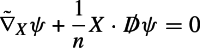
Definition 5.10
We call a vector twistor spinor if it satisfies
 |
5.15 |
for all vector fields .
Remark 5.11
If we assume that is both a vector twistor spinor and a solution of (5.3) we find
for all vector fields . Moreover, a direct calculation yields
On the other hand we find
Consequently the above expression is both purely imaginary and also purely real and thus has to vanish, meaning that has constant norm. Thus, this approach does not lead to an interesting monotonicity formula.
Only the last term on the right hand side of (5.14) has a definite sign and we can estimate it as follows
where denotes the largest eigenvalue of .
Without loss of generality we assume that and rewrite
 |
Using (5.3) this gives us the following inequality
| 5.16 |
Proposition 5.12
Let be a smooth solution of the system (5.2), (5.3). Then for all , the following monotonicity type formula holds
| 5.17 |
Proof
Combining (5.14) and (5.16) we find
Making use of the coarea formula this can be rewritten as
Integrating with respect to and using integration by parts
completes the proof.
Remark 5.13
In the case of we have and . In this case we have equality in (5.17) and (5.17) reduces to (5.13).
Remark 5.14
Again, it seems very difficult to obtain a Liouville Theorem from the monotonicity formula (5.17) without posing a lot of restrictions on the solution.
A Liouville Theorem for a domain with positive Ricci curvature
In this section we derive a vanishing theorem for Dirac-harmonic maps with curvature term under an energy and curvature assumption, similar to Theorem 4.13. To this end we set
Lemma 5.15
(Bochner formulas). Let be a smooth solution of the system (5.2), (5.3). Then the following Bochner formulas hold
| 5.18 |
| 5.19 |
where is an orthonormal basis of .
Proof
We choose a local orthonormal basis of such that at the considered point. The fist equation follows by a direct calculation using the Weitzenböck formula for the twisted Dirac-operator  , that is
 |
where denotes the connection Laplacian on the vector bundle . To obtain the second equation we recall the following Bochner formula for a map
Moreover, by a direct calculation we obtain
which concludes the proof.
Corollary 5.16
Let be a smooth solution of the system (5.2), (5.3). Then the following estimate holds:
| 5.20 |
where are positive constants that depend only on the geometry of and .
Proof
Making use of the Bochner formulas we find
where denotes a lower bound for the Ricci curvature of and an upper bound for the sectional curvature of . By application of Young’s inequality we find
| 5.21 |
with positive constants . The statement then follows by applying Young’s inequality again.
Remark 5.17
The analytic structure of (5.20) is the same as in the case of harmonic maps.
If we want to derive a Liouville Theorem from (5.20) making only assumptions on the geometry of and we would require that both and . However, it can easily be checked that we cannot achieve such an estimate since the curvature tensor of appears on the right hand side of the system (5.2) and (5.3).
However, we can give a Liouville theorem under similar assumptions as in Theorem 4.13. A similar Theorem for Dirac-harmonic maps was obtained in [17], Theorem 4.
Theorem 5.18
Let be a complete noncompact Riemannian spin manifold and be a Riemannian manifold with nonpositive curvature. Suppose that is a Dirac-harmonic map with curvature term with finite energy . If
| 5.22 |
with the constants
then maps to a point and vanishes identically.
Proof
First of all we note that
| 5.23 |
If we put in (5.21) we find
Making use of the assumption (5.22) this yields
| 5.24 |
for a positive constant . We fix a positive number such that
where we used (5.23) and (5.24). The rest of the proof is identical to the proof of Theorem 4.13.
Acknowledgements
Open access funding provided by Austrian Science Fund (FWF). The author gratefully acknowledges the support of the Austrian Science Fund (FWF) through the project P30749-N35 “Geometric variational problems from string theory”.
Footnotes
Publisher's Note
Springer Nature remains neutral with regard to jurisdictional claims in published maps and institutional affiliations.
References
- 1.Ammann B. The smallest Dirac eigenvalue in a spin-conformal class and cmc immersions. Commun. Anal. Geom. 2009;17(3):429–479. doi: 10.4310/CAG.2009.v17.n3.a2. [DOI] [Google Scholar]
- 2.Bär C. Real Killing spinors and holonomy. Commun. Math. Phys. 1993;154(3):509–521. doi: 10.1007/BF02102106. [DOI] [Google Scholar]
- 3.Bär C. Zero sets of solutions to semilinear elliptic systems of first order. Invent. Math. 1999;138(1):183–202. doi: 10.1007/s002220050346. [DOI] [Google Scholar]
- 4.Bär C, Gauduchon P, Moroianu A. Generalized cylinders in semi-Riemannian and spin geometry. Math. Z. 2005;249(3):545–580. doi: 10.1007/s00209-004-0718-0. [DOI] [Google Scholar]
- 5.Bartnik RA, Chruściel PT. Boundary value problems for Dirac-type equations. J. Reine Angew. Math. 2005;579:13–73. doi: 10.1515/crll.2005.2005.579.13. [DOI] [Google Scholar]
- 6.Bourguignon J-P, Gauduchon P. Spineurs, opérateurs de Dirac et variations de métriques. Commun. Math. Phys. 1992;144(3):581–599. doi: 10.1007/BF02099184. [DOI] [Google Scholar]
- 7.Branding V. Magnetic Dirac-harmonic maps. Anal. Math. Phys. 2015;5(1):23–37. doi: 10.1007/s13324-014-0081-1. [DOI] [Google Scholar]
- 8.Branding V. Some aspects of Dirac-harmonic maps with curvature term. Differ. Geom. Appl. 2015;40:1–13. doi: 10.1016/j.difgeo.2015.01.008. [DOI] [Google Scholar]
- 9.Branding V. Dirac-harmonic maps with torsion. Commun. Contemp. Math. 2016;18(4):1550064. doi: 10.1142/S0219199715500649. [DOI] [Google Scholar]
- 10.Branding V. Energy estimates for the supersymmetric nonlinear sigma model and applications. Potential Anal. 2016;45(4):737–754. doi: 10.1007/s11118-016-9564-z. [DOI] [Google Scholar]
- 11.Branding V. On conservation laws for the supersymmetric sigma model. Results Math. 2017;72(4):2181–2201. doi: 10.1007/s00025-017-0756-7. [DOI] [Google Scholar]
- 12.Branding V. An estimate on the nodal set of eigenspinors on closed surfaces. Math. Z. 2018;288(1–2):1–10. doi: 10.1007/s00209-017-1873-4. [DOI] [Google Scholar]
- 13.Branding V. A vanishing result for the supersymmetric nonlinear sigma model in higher dimensions. J. Geom. Phys. 2018;134:1–10. doi: 10.1016/j.geomphys.2018.08.003. [DOI] [Google Scholar]
- 14.Branding, V., Kröncke, K.: Global existence of Dirac-wave maps with curvature term on expanding spacetimes. Calc. Var. Partial Differ. Equ. 57(5):Art. 119, 30, (2018) [DOI] [PMC free article] [PubMed]
- 15.Chen Q, Jost J, Wang G. Liouville theorems for Dirac-harmonic maps. J. Math. Phys. 2007;48(11):113517. doi: 10.1063/1.2809266. [DOI] [Google Scholar]
- 16.Chen Q, Jost J, Li J, Wang G. Dirac-harmonic maps. Math. Z. 2006;254(2):409–432. doi: 10.1007/s00209-006-0961-7. [DOI] [Google Scholar]
- 17.Chen Q, Jost J, Sun L. Gradient estimates and Liouville theorems for Dirac-harmonic maps. J. Geom. Phys. 2014;76:66–78. doi: 10.1016/j.geomphys.2013.10.011. [DOI] [Google Scholar]
- 18.Chen Q, Jost J, Sun L, Zhu M. Estimates for solutions of Dirac equations and an application to a geometric elliptic-parabolic problem. J. Eur. Math. Soc. (JEMS) 2019;21(3):665–707. doi: 10.4171/JEMS/847. [DOI] [Google Scholar]
- 19.Chen Q, Jost J, Wang G. Nonlinear Dirac equations on Riemann surfaces. Ann. Global Anal. Geom. 2008;33(3):253–270. doi: 10.1007/s10455-007-9084-6. [DOI] [Google Scholar]
- 20.Deligne, P., Etingof, P., Freed, D.S., Jeffrey, L.C., Kazhdan, D., Morgan, J.W., Morrison, D.R., Witten, E. (eds.): Quantum Fields and Strings: A course for Mathematicians. Vol. 1, 2. American Mathematical Society, Providence, RI; Institute for Advanced Study (IAS), Princeton, NJ. Material from the Special Year on Quantum Field Theory held at the Institute for Advanced Study, Princeton, NJ, 1996–1997 (1999)
- 21.Garber W-D, Ruijsenaars SNM, Seiler E, Burns D. On finite action solutions of the nonlinear -model. Ann. Phys. 1979;119(2):305–325. doi: 10.1016/0003-4916(79)90189-1. [DOI] [Google Scholar]
- 22.Gross DJ, Neveu A. Dynamical symmetry breaking in asymptotically free field theories. Phys. Rev. D. 1974;10:3235–3253. doi: 10.1103/PhysRevD.10.3235. [DOI] [Google Scholar]
- 23.Isobe T. Existence results for solutions to nonlinear Dirac equations on compact spin manifolds. Manuscr. Math. 2011;135(3–4):329–360. doi: 10.1007/s00229-010-0417-6. [DOI] [Google Scholar]
- 24.Isobe T. Nonlinear Dirac equations with critical nonlinearities on compact spin manifolds. J. Funct. Anal. 2011;260(1):253–307. doi: 10.1016/j.jfa.2010.09.008. [DOI] [Google Scholar]
- 25.Isobe T. A perturbation method for spinorial Yamabe type equations on and its application. Math. Ann. 2013;355(4):1255–1299. doi: 10.1007/s00208-012-0818-9. [DOI] [Google Scholar]
- 26.Isobe T. Spinorial Yamabe type equations on via Conley index. Adv. Nonlinear Stud. 2015;15(1):39–60. doi: 10.1515/ans-2015-0103. [DOI] [Google Scholar]
- 27.Jost, J., Liu , L., Zhu, M.: Geometric analysis of the action functional of the nonlinear super symmetric sigma model. Preprint, Max Planck Institute for Mathematics in the Sciences (2015)
- 28.Jost, J., Liu, L., Zhu, M.: Regularity of Dirac-harmonic maps with -curvature term in higher dimensions. Calc. Var. Partial Differ. Equ. 58(6), 187 (2019)
- 29.Jost, J., Wu, R., Zhu, M.: Partial regularity for a nonlinear sigma model with gravitino in higher dimensions. Calc. Var. Partial Differ. Equ. 57(3):Art. 85, 17 (2018)
- 30.Kim EC, Friedrich T. The Einstein–Dirac equation on Riemannian spin manifolds. J. Geom. Phys. 2000;33(1–2):128–172. doi: 10.1016/S0393-0440(99)00043-1. [DOI] [Google Scholar]
- 31.Lawson HB, Jr, Michelsohn M-L. Spin Geometry. Princeton Mathematical Series. Princeton, NJ: Princeton University Press; 1989. [Google Scholar]
- 32.Lin H, Yang G, Ren Y, Chong T. Monotonicity formulae and Liouville theorems of harmonic maps with potential. J. Geom. Phys. 2012;62(9):1939–1948. doi: 10.1016/j.geomphys.2012.04.008. [DOI] [Google Scholar]
- 33.Nambu Y, Jona-Lasinio G. Dynamical model of elementary particles based on an analogy with superconductivity. I. Phys. Rev. 1961;122:345–358. doi: 10.1103/PhysRev.122.345. [DOI] [Google Scholar]
- 34.Schoen R, Yau ST. Harmonic maps and the topology of stable hypersurfaces and manifolds with non-negative Ricci curvature. Comment. Math. Helv. 1976;51(3):333–341. doi: 10.1007/BF02568161. [DOI] [Google Scholar]
- 35.Soler M. Classical, stable, nonlinear spinor field with positive rest energy. Phys. Rev. D. 1970;1:2766–2769. doi: 10.1103/PhysRevD.1.2766. [DOI] [Google Scholar]
- 36.Thirring WE. A soluble relativistic field theory. Ann. Phys. 1958;3:91–112. doi: 10.1016/0003-4916(58)90015-0. [DOI] [Google Scholar]
- 37.Wang C. A remark on nonlinear Dirac equations. Proc. Am. Math. Soc. 2010;138(10):3753–3758. doi: 10.1090/S0002-9939-10-10438-9. [DOI] [Google Scholar]
- 38.Wang C, Deliang X. Regularity of Dirac-harmonic maps. Int. Math. Res. Not. IMRN. 2009;20:3759–3792. [Google Scholar]
- 39.Yau ST. Some function-theoretic properties of complete Riemannian manifold and their applications to geometry. Indiana Univ. Math. J. 1976;25(7):659–670. doi: 10.1512/iumj.1976.25.25051. [DOI] [Google Scholar]