



Abstract
ABSTRACT
Sports ultrasound (US) training is required in sports medicine fellowships. US is taught through a combination of self-directed learning, didactic lectures, and “in-person” training sessions. “Hands-on” formal instruction is thought to be a vital component of US skill acquisition. However, during a pandemic and social distancing practices, “in-person” ultrasound training sessions are not possible. Display of ultrasound machine image and probe positioning can be shared in real time through virtual platforms, which allows for direct instructor education and feedback. This virtual method of US teaching may be complementary to traditional US teaching methods in the future.
ABSTRACT
“Hands-on” teaching is an important part of sports ultrasound (US) education in sports medicine fellowships. However, physical distancing requirements during a global pandemic have resulted in cancellation and/or postponement of “in-person” educational sessions, US conferences, and clinical diagnostic and interventional US cases that enhance US training. In order for “hands-on” sports US teaching to continue during these uncertain times, the educational model must be adapted. The use of virtual meeting platforms to display US images is possible, and this not only allows for instructor demonstration, but also gives the instructor an opportunity to observe the learner scanning and provide direct feedback in real-time. Moving forward, virtual US teaching methods will likely continue to be of educational value, as they provide increased access to individualized instruction from skilled instructors and eliminate travel time and cost of conferences and instructional sessions.
KEY WORDS: ultrasound, sports medicine, virtual education
BACKGROUND
Sports ultrasound (US) training is a required component of sports medicine fellowships.1 Historically, sports US has been taught through “in-person” formal didactics and mentored clinical experience as well as various self-directed supplementary learning methods. “In-person” didactic education occurs as part of a structured fellowship curriculum and at local, regional, or national US conferences. Self-directed learning utilizes textbooks and web-based videos (American Medical Society of Sports Ultrasound Curriculum, American Institute of Ultrasound in Medicine webinars, etc.) that are readily available. Additionally, self-directed US scanning sessions should be performed using clinic-based US units outside of work hours or with portable US units at home. These sessions allow for “hands-on” practice with the opportunity to save normal images that an instructor can later review. However, in addition to these methods, mentored “in-person” US practice sessions are vital for developing proficiency in sports US.1 Barriers to “in-person” US scanning with direct mentorship do exist and include lack of access to skilled instructors, no formal didactic sessions at one’s training institution, and inability to attend US conferences due to cost or lack of time away from work.
CHALLENGES OF A GLOBAL PANDEMIC
Barriers to US learning are amplified during a global pandemic, where shortages of instructors due to quarantine restrictions, clinic closures, as well as cancellations of “in-person” US practice sessions and conferences negatively affect US learning. While the self-directed learning methods described above can continue to be utilized during times of social distancing and quarantine, “in-person” direct mentorship during “hands-on” didactic teaching sessions and conferences is limited or impossible. In order to continue US training during a pandemic, teaching methods must be adapted.
USE OF VIRTUAL PLATFORMS
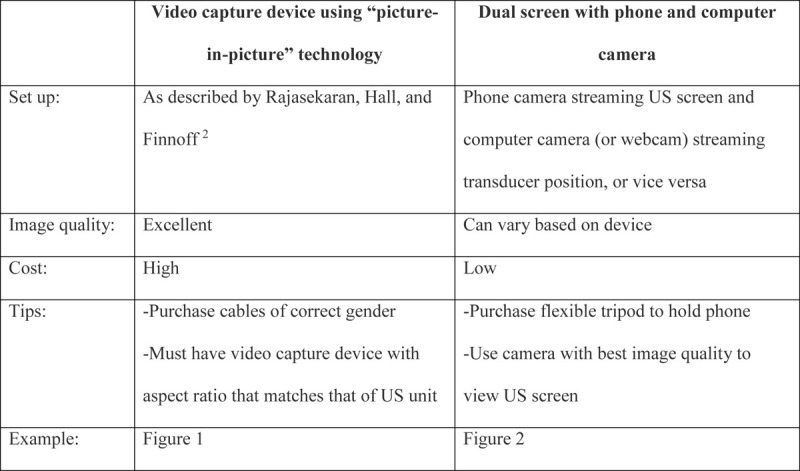
Sports US teaching can be conducted through various virtual meeting platforms (such as Skype, Zoom, FaceTime, Microsoft Teams, etc.) that can display real-time US images, providing an alternative teaching method that does not require in-person training sessions or live clinic patients.2,3 Picture-in-picture display of the transducer placement and the US screen can be obtained by connecting the US unit to a computer and then streaming it live on a virtual meeting platform (Figure 1).4 A less costly option involves using two personal electronic devices (e.g. phone camera and computer camera or webcam) to obtain separate images that are simultaneously streamed through a virtual meeting platform (Figure 2). With these methods, the instructor can view both images, allowing them to verbally guide transducer manipulation (e.g. “translate, “rotate”, etc), optimize images, and even quiz the learner in real time while providing immediate feedback. These methods are compared in Table 1.
Figure 1.
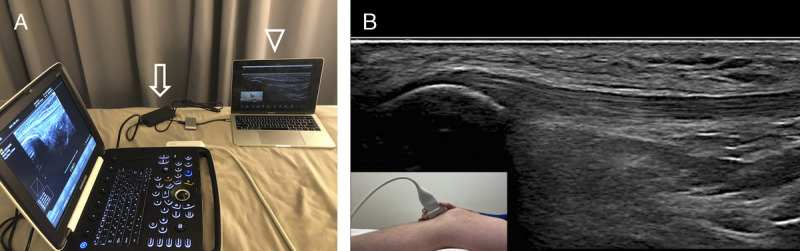
Picture-in-picture method. A: Ultrasound (US) machine is directly connected using machine-specific electronic cables and a video capture device (arrow) to a computer (triangle) to display the US screen while the computer camera or mounted webcam displays probe placement. This method utilizes only one camera. B: The image created with the picture-in-picture display.
Figure 2.
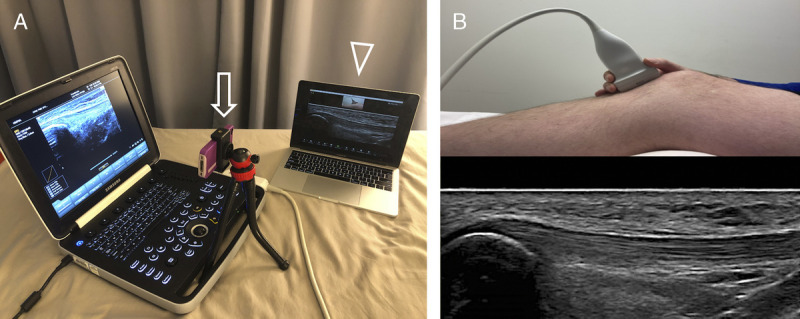
Two camera method. A: One camera, in this image, a cell phone on a tripod (arrow), displays the ultrasound machine while another camera, in this image, a computer with a camera (triangle), is used to display probe placement. This method utilizes two separate cameras that are both separately connected to the virtual streaming platform. B: The image created using the two camera method.
Table 1.
Comparison of image capture techniques for virtual display.
Additionally, virtual platforms can be used to teach basic injection principles. Ballistics gel or other “home-made” injection models 5–7 can be used to practice procedural skills including needle tracking and target acquisition. These procedural skills can be practiced individually or with an instructor virtually observing and offering real-time guidance and feedback.
BARRIERS TO VIRTUAL US LEARNING
While the advantages of virtual US learning are described above, barriers and disadvantages to this method of learning do exist and should be considered. These include lack of US access, inability of an instructor to physically reposition the transducer for image optimization during instructional sessions, and lack of technological capabilities. Nonetheless, these barriers can be overcome. If there is no access to a portable US unit, the use of an US in a less busy or closed clinic is possible. Transducer re-positioning can be guided by verbal instruction using the methods described previously. The lack of technological capabilities could also be a barrier, but most basic virtual meeting platforms are free and the use of both a computer and phone camera circumvent the need for technological expertise and expensive equipment required to create a picture-in-picture image.4
US EDUCATION MOVING FORWARD
Despite difficulties with continuing US training during a pandemic, these virtual methods of teaching provide a way to overcome previous barriers to “in-person” US sessions. Virtual US teaching also increases access to mentorship by skilled instructors, allows for collaboration of didactic sessions across institutions, and enhances one’s ability to gain individualized US instruction without physically attending US conferences. In the future, these virtual opportunities should be considered complementary to traditional US teaching methods.
CONCLUSION
During a pandemic, there are unprecedented barriers to “in-person” sports US training with social distancing measures and clinic closures. However, diagnostic and interventional US training can continue through virtual methods that allow for real-time, individualized instruction. The addition of virtual US education to the current educational methods may positively change the way we offer US education in the future.
Footnotes
ACKNOWLEDGEMENTS: None.
COMPETEING INTERESTS: All authors have no competing interests.
FUNDING: No relevant funding.
REFERENCES:
- 1.Finnoff JT, Berkoff D, Brennan F, et al. American Medical Society for Sports Medicine recommended sports ultrasound curriculum for sports medicine fellowships. Br J Sports Med 2015;49:145–50. doi: 10.1136/bjsports-2014-094220 [published Online First: 2014/11/02] [DOI] [PubMed] [Google Scholar]
- 2.Drake NT, B Best video conferencing software 2020: paid and free solutions for business [Internet article]. 2020. [03/23/2020:[Available from: https://www.techradar.com/best/best-video-conferencing-software.
- 3.Barbosa TBM. Zoom: An innovative solution for the live-online virtual classroom. HETS Online Journal 2019;9 [Google Scholar]
- 4.Rajasekaran S, Hall MM, Finnoff JT. An Introduction to Recording, Editing, and Streaming Picture-in-Picture Ultrasound Videos. Pm r 2016;8:817–20. doi: 10.1016/j.pmrj.2016.03.006 [published Online First: 2016/08/22] [DOI] [PubMed] [Google Scholar]
- 5.Bude RO, Adler RS. An easily made, low-cost, tissue-like ultrasound phantom material. J Clin Ultrasound 1995;23:271–3. doi: 10.1002/jcu.1870230413 [published Online First: 1995/05/01] [DOI] [PubMed] [Google Scholar]
- 6.Charnoff J, Naqvi U, Weaver M, et al. Resident Education of Ultrasound-Guided Procedures: A Homemade Practice Model Pilot Study. Am J Phys Med Rehabil 2019;98:e116–e18. doi: 10.1097/phm.0000000000001259 [published Online First: 2019/07/04] [DOI] [PubMed] [Google Scholar]
- 7.Farjad Sultan S, Shorten G, Iohom G. Simulators for training in ultrasound guided procedures. Med Ultrason 2013;15:125–31. doi: 10.11152/mu.2013.2066.152.sfs1gs2 [published Online First: 2013/05/25] [DOI] [PubMed] [Google Scholar]