



Abstract
The coronavirus 2019 (COVID-19) pandemic has resulted in a surge of patients with acute respiratory distress syndrome (ARDS). Prone positioning may be used in such patients to optimize oxygenation. Severe infections may leave survivors with significant functional impairment necessitating rehabilitation. Those who have experienced prolonged prone positioning are at increased risk for complications not typically associated with critical illness. This case report describes the course and clinical findings of a survivor of ARDS due to COVID-19 who was prone positioned while in intensive care and subsequently admitted to an inpatient rehabilitation facility. Her related complications, as well as those described in the literature, are reviewed. Critical elements of a comprehensive rehabilitation treatment plan for those who have been prone positioned, including implementation of preventive strategies, as well as early recognition and treatment of related injuries, will be described.
Key Words: Rehabilitation, Corona Virus, Pressure Ulcer, Brachial Plexus Neuropathies
Introduction
Survivors of acute respiratory distress syndrome (ARDS) secondary to infection with the novel coronavirus (COVID-19) often experience significant functional impairments necessitating rehabilitation.1 Unique challenges may be encountered among survivors who have undergone prolonged prone-positioning to improve oxygenation. In this report, we present the case of an adult woman who developed complications secondary to prone-positioning while hospitalized for severe COVID-19 infection. This report highlights potential adverse effects from the use of this intervention that rehabilitation professionals caring for those with the virus should be aware of to aid in the implementation of preventive strategies while in intensive care settings as well to facilitate their prompt recognition and treatment while receiving rehabilitation.
Case Description
A 41 year-old woman presented to the emergency room in late March of 2020 with a two-day history of fevers, chills, and shortness of breath. She was morbidly obese with a past medical history notable for cardiomyopathy, type 2 diabetes mellitus, and hypertension. Her arterial blood gas revealed hypoxemia and hypercarbia, and chest x-ray revealed bibasilar opacities and a prominent interstitial pattern. She was intubated and admitted to an intensive care unit (ICU), where she received care for ARDS and multi-system organ failure in the setting of septic shock. Polymerase chain reaction analysis of her nasopharyngeal swab sample subsequently returned positive for COVID-19.
Due to persistent hypoxemia despite full ventilatory support, she was prone-positioned six days following her admission. Supination was attempted two days later, but she was re-proned secondary to worsening oxygen saturation levels. Four days after being placed in prone position for the second time, she was noted to have a dilated, non-reactive left pupil. Prone positioning was aborted due to its potential to result in increased intracranial pressure. Computed tomography of her brain was without acute intracranial pathology at that time.
Her condition improved and she was successfully extubated after six weeks in the ICU. Two weeks later, she was admitted for intensive inpatient rehabilitation. She was able to maintain adequate oxygen saturations on room air. She had persistent tachycardia, for which she required a beta blocker. She was alert, fully oriented, and able to follow complex commands. Both pupils were equal and reactive to light and accommodation.
In addition to an unstageable sacral pressure injury, she had a large eschar over the sternum extending to the right ribs, as seen in Figure 1. Additionally, she had a number of facial wounds, including tissue loss of the lower lip, left nare and left maxillary region.
Figure 1.
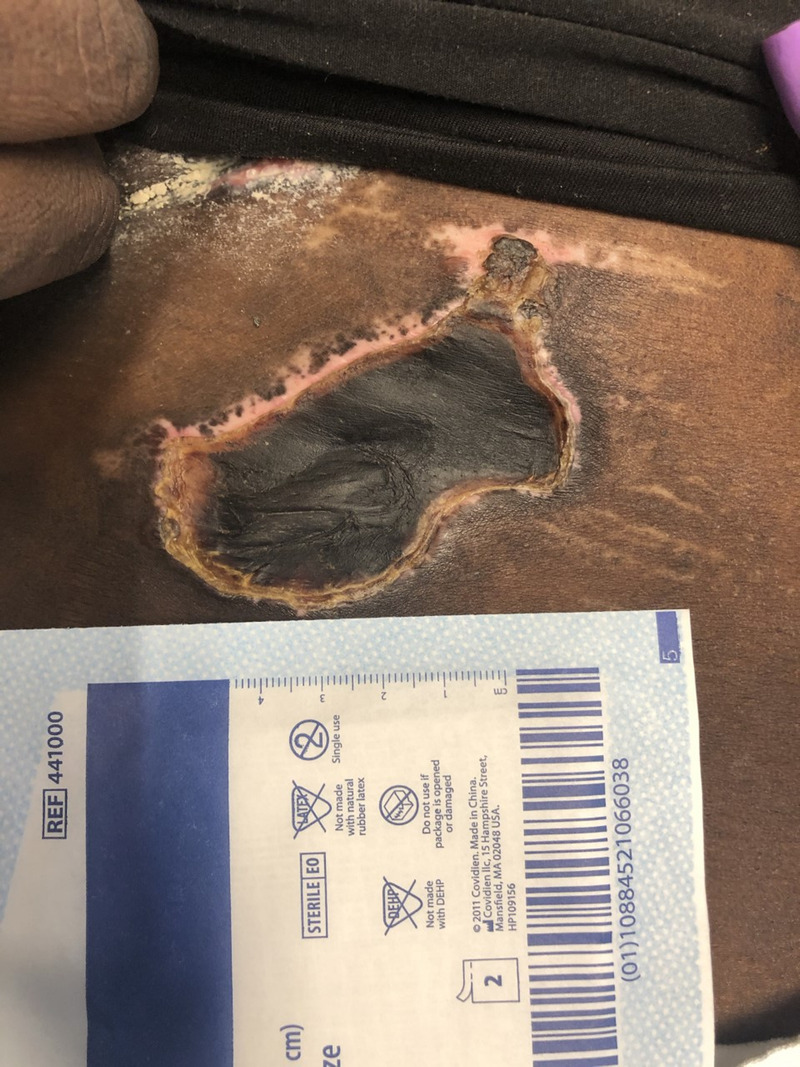
An unstable pressure ulcer covered in eschar, approximately 6x7x2 cm, overlays the inferior right sternal border and the costal portions of ribs 5-7.
Her physical examination was also remarkable for prominent left deltoid atrophy, weakness of left shoulder abduction and external rotation and left elbow flexion, and reduced sensation over the distal radial forearm. Her upper extremities reflexes were preserved and symmetric in the biceps, brachioradialis, and triceps. She had no current or prior history of cervical spine disorders and on physical examination, she had preserved and pain-free range of motion. She had limited and painful active range of motion of her left shoulder, however passive range of motion was full, and x-ray was without evidence of subluxation. Patient was referred for outpatient electrodiagnostic evaluation for suspected brachial plexopathy, a known potential complication of prone positioning.
Discussion
Since the first reported case of COVID-19 in December 2019, more than 5 million people worldwide have been infected.2 Preliminary data reveals up to 17% of patients develop ARDS requiring mechanical ventilation.3 Despite optimal medical management, ARDS carries a mortality rate as high as 60%.4 Patients who are critically ill secondary to COVID-19 infection may have clinical characteristics that may render them refractory to conventional mechanical ventilation including: hypercapnia, hypoxemia, low lung expandability, and acute right heart dysfunction.5 The use of prone positioning in such patients may result in improved oxygenation and survival. This was demonstrated in a multicenter, randomized, controlled trial by Guérin et al. in which 237 patients with severe ARDS underwent early prone positioning for at least 16 hours a day. 90-day mortality was significantly lower in the prone group compared to the group that was kept supine (23.6%, 41.0%, P<.001).4
Though the benefits of its use likely far outweigh the risks, placing patients with ARDS in prone position may put them at risk for complications, including pressure injuries of the skin and soft tissues, displaced intravenous access, and endotracheal tube obstruction.6 Such complications are rare, however, affected patients may have long-lasting impediments towards functional recovery without proper rehabilitation intervention.
Airway Complications
Intubated patients placed in prone position are at risk for endotracheal obstruction and impaired mucus clearance. A systematic and meta-analysis review by Munshi et al. evaluating three studies with 1,594 participants found that patients in prone position have an increased risk of endotracheal tube obstruction.6 Moreover, intubation can cause derangement in mucociliary function leading to impaired mucus clearance. This is exacerbated by critically ill patients having decreased muscle strength to assist with mucus clearance resulting in retained secretions.7 Early bedside interventions with therapies in the intensive care setting to preserve muscle function have been found to be safe and feasible.8 Breathing techniques can assist in diaphragmatic training to strengthen expiratory muscles, prevent atelectasis, and complications such as pneumonia. Rehabilitation consultants evaluating COVID-19 patients prone-positioned in such settings should consider implementing such techniques when the affected patients are capable of performing them.
Pressure Injuries
Patients placed in prone position in intensive care settings are at increased risk for pressure injuries in comparison to those kept in supine position, and their injuries may occur in uncommon, ventral locations.9 Anatomical locations exposed to prolonged pressure such as cheekbones and the anterior thorax are often involved, as they were in the patient described here. Other sites reported include the iliac crests, breasts, and knees.10 Dudek et al. described a case of bilateral anterior superior iliac spine pressure injuries in a 27-year-old patient who spent 65 days in intensive care and underwent prone positioning.11 The patient’s pressure injuries eventually healed after 9 months of wound care.
Risk factors for the development of prone-related pressure injuries include high body mass index (>28.4 kg m2), male sex, and age greater than sixty.9 Clinicians must remain astute and perform detailed skin examinations. Optimization of nutritional intake and proper wound care can prevent infections, as well decrease the hospital length of stay and risk of future complications. Early enteral nutritional support has been found to be safe; however, patients should be monitored for signs of aspiration, vomiting, or intolerance due to impaired gut motility.12 Importantly, patient and family education on wound care and offloading techniques should be implemented early in the rehabilitation course.
Facial Injuries
Facial edema and ocular complications have also been reported in patients who have been put in prone position for surgical procedures and/or respiratory failure.13 Vision loss can occur as a result of increased orbital pressure or direct trauma to underlying structures.14 Additionally, oropharyngeal edema can arise from prolonged pronation.14 As a result, patients may have difficulty with communication or swallowing due to localized edema. Trejo-Gabriel-Galan et al. described a case of dysphagia in a 48 year old man following prone positioning for 18 hours a day for 2 days.15 The authors hypothesized that cranial nerves IX-XII could have been damaged as a result of compression from the U-shape padding used on the face or hyperextension of the neck causing traction on the cranial nerves.
Preventive techniques such as the use of silicone face foams and other head and neck supports are vital to avoid facial injuries, including pressure injuries.16 Early ophthalmologic intervention may be warranted with new deficits such as blurry vision or impaired extraocular movements. Therapy sessions to educate patients on compensatory swallowing techniques and safely advancing a patient’s diet are crucial for the timely restoration of function and prevention of aspiration pneumonitis.
Peripheral Nerve Injuries
Nerve injuries are uncommon following prone positioning, but brachial plexus injuries have been reported. Less than one percent of patients sustain neurological injuries when prone positioning is used during surgery.17,18 Goettler et al. described two cases of brachial plexopathy from prone position ventilation with gradual improvement following therapy. Their report highlights two individuals, a 34-year-old woman prone for 12 hours daily for 6 days due to severe ARDS and a 52-year-old man prone for 90 minutes daily for dressing changes due to necrotizing fasciitis.18
Brachial plexus injuries often develop in patients whose shoulders are positioned in abduction with external rotation and posteriorly displaced.18 This position causes compression and stretching of the brachial plexus, usually affecting the upper nerve roots or trunk.19 As such, unilateral deficits in sensation or strength should alert clinicians to the possibility of brachial plexus injury. Preventive efforts with proper positioning can mitigate the risk of neurological injury. Rehabilitation of plexus injuries should focus on preventing muscle atrophy, pain management, and address impairments related to activities of daily living or prior occupation.20 The optimal multidisciplinary team may include physiatry for oversight of therapy services, medication prescriptions and pain control procedures; physical therapy for mobility, functional electrical stimulation and strengthening; occupational therapy for activity and work-related modifications; and psychology for adjustment and coping mechanisms.
Other Complications
Critically ill patients with COVID-19 are at risk for a multitude of neurological and musculoskeletal conditions, including critical illness polyneuropathy and myopathy, ICU-acquired weakness, and contractures.1 It is noted that shoulder and hip contractures, in particular, have been reported as complications of prone positioning.18
Conclusion
Prone position may improve oxygenation and survival among patients with acute respiratory distress syndrome secondary to COVID-19 infection. As rehabilitation professionals are increasingly being called upon to provide care to the critically ill as well as survivors of the disease, it is essential for them to be aware of potential complications of prone positioning, including airway obstruction, pressure injuries, and brachial plexopathies. Preventive measures, including instruction in breathing techniques, offloading pressure points, and avoidance of pressure and traction on the shoulder while proning, should be implemented in intensive care settings whenever possible. Rehabilitation physicians caring for COVID-19 survivors who were kept in prone position should be vigilant in the inspection of skin of the face and anterior body as well as the examination of the upper extremities to identify and treat resulting pressure and brachial plexus injuries.
Footnotes
1Drs. Le and Rosales contributed equally to this manuscript and share first authorship.
Author Disclosures: All authors report having no competing interests nor any financial benefits with regards this manuscript. No funding, grants, nor equipment were provided. This case has not been presented in any form in the past.
Patient Consent: The patient described in this report has provided written informed consent granting the authors permission to share photographs and details of her case.
References
- 1.Simpson R, Robinson L. Rehabilitation following critical illness in people with COVID-19 infection. American Journal of Physical Medicine & Rehabilitation. 2020:1. doi: 10.1097/phm.0000000000001443. [DOI] [PMC free article] [PubMed] [Google Scholar]
- 2.WHO Coronavirus Disease (COVID-19) Dashboard World Health Organization. https://covid19.who.int/. Accessed May 28, 2020.
- 3.Chen N, Zhou M, Dong X, et al. Epidemiological and clinical characteristics of 99 cases of 2019 novel coronavirus pneumonia in Wuhan, China: a descriptive study. The Lancet. 2020;395:507–513. doi: 10.1016/s0140-6736(20)30211-7. [DOI] [PMC free article] [PubMed] [Google Scholar]
- 4.Guérin C, Reignier J, Richard JC, et al. Prone positioning in severe acute respiratory distress syndrome. N Engl J Med. 2013;368:2159–2168. doi: 10.1056/NEJMoa1214103 [DOI] [PubMed] [Google Scholar]
- 5.Pan C, Zhang W, Du B, Qiu HB, Huang YZ. Zhonghua Nei Ke Za Zhi. 2020;59:E007. doi: 10.3760/cma.j.cn112138-20200304-00184 [DOI] [PubMed] [Google Scholar]
- 6.Munshi L, Sorbo LD, Adhikari NKJ, et al. Prone Position for Acute Respiratory Distress Syndrome. A Systematic Review and Meta-Analysis. Annals of the American Thoracic Society. 2017;14(Supplement_4). doi: 10.1513/annalsats.201704-343ot. [DOI] [PubMed] [Google Scholar]
- 7.Ambrosino N, Makhabah DN. Comprehensive physiotherapy management in ARDS. Minerva Anestesiol. 2013;79:554–563. [PubMed] [Google Scholar]
- 8.Jonghe BD. Paresis Acquired in the Intensive Care Unit: A Prospective Multicenter Study. Jama. 2002;288:2859. doi: 10.1001/jama.288.22.2859. [DOI] [PubMed] [Google Scholar]
- 9.Girard R, Baboi L, Ayzac L, Richard JC, Guérin C; Proseva trial group. The impact of patient positioning on pressure ulcers in patients with severe ARDS: results from a multicentre randomised controlled trial on prone positioning. Intensive Care Med. 2014;40:397–403. doi: 10.1007/s00134-013-3188-1 [DOI] [PubMed] [Google Scholar]
- 10.Gattinoni L, Tognoni G, Pesenti A, et al. Effect of prone positioning on the survival of patients with acute respiratory failure. N Engl J Med. 2001;345:568–573. doi: 10.1056/NEJMoa010043 [DOI] [PubMed] [Google Scholar]
- 11.Dudek NL, Buenger UR, Trudel G. Bilateral anterior superior iliac spine pressure ulcers: a case report. Arch Phys Med Rehabil. 2002;83:1459–1461. doi: 10.1053/apmr.2002.34617 [DOI] [PubMed] [Google Scholar]
- 12.Saez de la Fuente I, Saez de la Fuente J, Quintana Estelles MD, et al. Enteral Nutrition in Patients Receiving Mechanical Ventilation in a Prone Position. JPEN J Parenter Enteral Nutr. 2016;40:250–255. doi: 10.1177/0148607114553232 [DOI] [PubMed] [Google Scholar]
- 13.Guérin C, Beuret P, Constantin JM, et al. A prospective international observational prevalence study on prone positioning of ARDS patients: the APRONET (ARDS Prone Position Network) study. Intensive Care Med. 2018;44:22–37. doi: 10.1007/s00134-017-4996-5 [DOI] [PubMed] [Google Scholar]
- 14.Kwee MM, Ho YH, Rozen WM. The prone position during surgery and its complications: a systematic review and evidence-based guidelines. Int Surg. 2015;100:292–303. doi: 10.9738/INTSURG-D-13-00256.1 [DOI] [PMC free article] [PubMed] [Google Scholar]
- 15.Trejo-Gabriel-Galan JM, Perea-Rodriguez ME, Aicua-Rapun I, Martinez-Barrio E. Lower Cranial Nerves Paralysis Following Prone-Position Mechanical Ventilation. Crit Care Med. 2017;45:e865–e866. doi: 10.1097/CCM.0000000000002411 [DOI] [PubMed] [Google Scholar]
- 16.Kim RS, Mullins K. Preventing Facial Pressure Ulcers in Acute Respiratory Distress Syndrome (ARDS). J Wound Ostomy Continence Nurs. 2016;43:427–429. doi: 10.1097/WON.0000000000000247 [DOI] [PubMed] [Google Scholar]
- 17.Parks BJ. Postoperative peripheral neuropathies. Surgery. 1973;74:348–357. [PubMed] [Google Scholar]
- 18.Goettler CE, Pryor JP, Reilly PM. Brachial plexopathy after prone positioning. Crit Care. 2002;6:540–542. doi: 10.1186/cc1823 [DOI] [PMC free article] [PubMed] [Google Scholar]
- 19.Kamel I, Barnette R. Positioning patients for spine surgery: Avoiding uncommon position-related complications. World J Orthop. 2014;5:425–443. Published 2014 Sep 18. doi: 10.5312/wjo.v5.i4.425 [DOI] [PMC free article] [PubMed] [Google Scholar]
- 20.Smania N, Berto G, La Marchina E, et al. Rehabilitation of brachial plexus injuries in adults and children. Eur J Phys Rehabil Med. 2012;48:483–506. [PubMed] [Google Scholar]