



Abstract
Background
Hospital staff are vulnerable and at high risk of novel coronavirus disease (COVID-19) infection. The aim of this study was to monitor the psychological distress in hospital staff and examine the relationship between the psychological distress and possible causes during the COVID-19 epidemic.
Methods
An online survey was conducted from February 1 to February 14, 2020. Hospital staff from five national COVID-19 designated hospitals in Chongqing participated. Data collected included demographics and stress responses to COVID-19: 1) the impact of event scale to measure psychological stress reactions; 2) generalized anxiety disorder 7 to measure anxiety symptoms; 3) Patient Health Questionnaire 9 to measure depression symptoms; 4) Yale-Brown Obsessive-Compulsive Scale to measure obsessive-compulsive symptoms (OCS); and 5) Patient Health Questionnaire 15 to measure somatization symptoms. Multiple logistic regression analysis was used to identify factors that were correlated with psychological distress.
Results
Hospital staff that participated in this study were identified as either doctors or nurses. A total of 456 respondents completed the questionnaires with a response rate of 91.2%. The mean age was 30.67 ± 7.48 years (range, 17 to 64 years). Of all respondents, 29.4% were men. Of the staff surveyed, 43.2% had stress reaction syndrome. The highest prevalence of psychological distress was OCS (37.5%), followed by somatization symptoms (33.3%), anxiety symptoms (31.6%), and depression symptoms (29.6%). Univariate analyses indicated that female subjects, middle aged subjects, subjects in the low income group, and subjects working in isolation wards were prone to experience psychological distress. Multiple logistic regression analysis showed “Reluctant to work or considered resignation” (odds ratio [OR], 5.192; 95%CI, 2.396–11.250; P < .001), “Afraid to go home because of fear of infecting family” (OR, 2.099; 95%CI, 1.299–3.391; P = .002) “Uncertainty about frequent modification of infection and control procedures” (OR, 1.583; 95%CI, 1.061–2.363; P = .025), and“Social support” (OR, 1.754; 95%CI, 1.041–2.956; P = .035) were correlated with psychological reactions. “Reluctant to work or considered resignation” and “Afraid to go home because of fear of infecting family” were associated with a higher risk of symptoms of Anxiety (OR, 3.622; 95% CI, 1.882–6.973; P < .001; OR, 1.803; 95% CI, 1.069–3.039; P = .027), OCS (OR, 5.241; 95% CI, 2.545–10.793; P < .001; OR, 1.999; 95% CI, 1.217–3.282; P = .006) and somatization (OR, 5.177; 95% CI, 2.595–10.329; P < .001; OR, 1.749; 95% CI, 1.051–2.91; P = .031). “Stigmatization and rejection in neighborhood because of hospital work”, “Reluctant to work or considered resignation” and “Uncertainty about frequent modification of infection and control procedures” were associated with a higher risk of symptoms of Depression(OR, 2.297; 95% CI, 1.138–4.637; P = .020; OR, 3.134; 95% CI, 1.635–6.006; P = .001; OR, 1.645; 95% CI, 1.075–2.517; P = .022).
Conclusions
Hospital staff showed different prevalence of psychological distress during the COVID-19 epidemic. Our study confirmed the severity of negative psychological distress on hospital staff and identified factors associated with negative psychological distress that can be used to provide valuable information for psychological interventions to improve the mental health of vulnerable groups during the COVID-19 epidemic.
Keywords: Viral infection, COVID-19, Mental health, Hospital staff
Abbreviations: OCS, Obsessive-compulsive symptoms; SARS, Severe Acute Respiratory Syndrome
Highlights
-
•
Hospital staff showed psychological distress in the COVID-19 epidemic in Chongqing.
-
•
We confirmed the severity of negative psychological distress on hospital staff.
-
•
Factors associated with negative psychological distress were identified.
1. Introduction
In December 2019, a pneumonia associated with the 2019 novel coronavirus (2019-nCoV) emerged in Wuhan, China. It spread rapidly to many countries worldwide, with the number of confirmed cases increasing daily. The 2019-nCoV infection was of clustering onset, is typically transmitted through respiratory droplets or close contact, and can result in severe and even fatal respiratory diseases such as acute respiratory distress syndrome [1]. As of May 14, 2020, a total of 82,933 confirmed cases and 4633 deaths were reported by the National Health Commission of China (http://en.nhc.gov.cn/). The high infectious potential and mortality rate of the outbreak of 2019-nCoV in China have caused public panic and mental health stress. Mental health problems such as stress, anxiety, depressive symptoms, insomnia, denial, anger, and fear are growing due to misinformation and unfounded rumors [2,3]. Since the declaration of the coronavirus 2019 (COVID-19) outbreak, increased prevalence of psychological distress has been reported in the general population; a study that included 1210 respondents from 194 cities in China revealed that 53.8% of respondents rated the psychological distress of the outbreak as moderate or severe [4].
The COVID-19 outbreak and public health response substantially changed hospital working conditions. The increasing number of patients and suspected cases increased the clinical treatment burden. Repeated modification of infection-control procedures and recommendations increased the uncertainty [5,6]. Hospital staff spend hours putting on and removing airtight protective equipment daily, which adds to the exhaustion. Furthermore, hospital staff are worried about the effects of quarantine and contagion on family members and friends. Healthcare facilities have become highly stressful environments. Hospital staff are at elevated risk of contracting the novel coronavirus disease (COVID-19), and approximately over 3000 hospital staffers have already contracted the disease in China. Reduced accessibility to formal psychological support, less first-hand medical information on the outbreak, and less intensive training on personal protective equipment and infection-control measures were sources of stress in healthcare workers [7]. These changes experienced by hospital staff could trigger mental disorders, including anxiety and depressive disorders, which in turn could be more detrimental than the consequences of the 2019-nCoV epidemic itself.
Hence, the biggest challenge in public health emergencies may not only be the technical problems of treatment but also elusive psychological problems [8,9]. A notable example would be the psychological sequelae observed during the Severe Acute Respiratory Syndrome (SARS) outbreak in 2003 [10,11]. Studies on the COVID-19 outbreak revealed that healthcare workers experienced acute stress reactions [11,12]. On returning to work after the outbreak of COVID-19, 10.8% respondents including medical staff met the diagnosis criteria of post-traumatic stress disorder (PTSD) [13]. Hence, for healthcare sectors, in addition to disease interventions, methods to deal with the psychological barriers of hospital staff and performing psychological crisis intervention are urgently required. However, there is a lack of formal mental health services in China because of lockdown and quarantine measures [14]. Psychological crisis intervention for medical personnel only has been promoted by the internet and social media (e.g., WeChat and Weibo), in which strategies for dealing with psychological distress at the beginning of the outbreak were shared [15].
Despite the large volume of epidemiological literature regarding disease outbreaks, there is limited information available on mental health problems in hospital staff during the maximum point of the COVID-19 epidemic in China. In the present study, the psychological states of hospital staff in the five national COVID-19 designated hospitals in Chongqing were evaluated using a self-administered questionnaire. Moreover, possible risk factors for psychological crisis were discussed. This survey was conducted during the COVID-19 outbreak to provide the results of the psychological coping capabilities of staff members and provide important insights into the psychological issues that could be used to inform, design, and benchmark psychological crisis measures.
2. Methods
2.1. Setting and sampling
This is a cross-sectional study performed via an online survey conducted between February 1 and February 14, 2020. This survey period corresponded with the highest point of the COVID-19 epidemic in China. The study was performed in five national COVID-19 designated hospitals in Chongqing randomly. The urban districts included Yuzhong, Jiangbei, Dadukou, Nan'an, and Yubei districts.
A clustered sampling method was employed. A random-number grid was used to select 100 eligible doctors and nurses in each hospital according to the job numbers of the doctors and nurses. Prior to the survey, all participants were informed that participation in this survey was voluntary. In addition, all participants were informed of the purpose and significance of the study. Each participant who agreed to participate signed an informed consent form. The questionnaire was completed using an anonymous online questionnaire-Questionnaire Software. All data were anonymized. This study was approved by the ethics committees of the third affiliated hospital, Chongqing Medical University.
2.2. Data collection instrument
Investigation tools: A self-designed test questionnaire combined with international general psychological assessment scales was employed. The self-designed test questionnaire included general information on the participants (sex, age, nationality, marital status, annual income, educational level, job titles, occupation, and workplace) and tested the participants' reactions to COVID-19-related factors. The international general psychological assessment scales included (1) Impact of Event Scale-Revised (IES-R) to measure psychological reactions; (2) Generalized Anxiety Disorder 7 (GAD-7) to measure anxiety symptoms; (3) Patient Health Questionnaire 9 (PHQ-9) to measure depression symptoms; (4) Yale-Brown Obsessive-Compulsive Scale to measure obsessive-compulsive symptoms (OCS); and (5) Patient Health Questionnaire 15 (PHQ-15) to measure somatization symptoms. The factor test was designed according to the DSM-IV criteria and related emotional and behavioral changes feedback from the psychological intervention experts. Score points were designed as follows: respondents answered with “Yes” or “No” to each of the following questions, and if they answered “Yes”, they scored 1; otherwise, if they answered “No”, they scored 0. Six questions were included: (1) Whether the participant had to be quarantined at work? (2) Stigmatization and rejection in neighborhood because of hospital work? (3) Reluctant to work or considered resignation? (4) Afraid to go home because of fear of infecting family? (5) Uncertainty about frequent modification of infection and control procedures? (6) Social support? Participants were also asked whether they had experienced insomnia or psychiatric disorders prior to COVID-19 and whether they had organic diseases (those who replied positively were automatically excluded by the platform).
The psychological reactions of COVID-19 were measured using the Impact of Event Scale-Revised (IES-R). The IES-R is a self-administered questionnaire that has been well-validated in the Chinese population for determining the extent of psychological impact after exposure to a public health crisis within one week of exposure [16]. The total IES-R score was graded for severity from normal (0−23), mild (24–32), moderate (33–36), and severe psychological impact (>37) [17]. We focused on symptoms of depression, anxiety, somatization, and obsessive-compulsive disorder for all participants, using the Chinese versions of validated measurement tools. Accordingly, the 9-item Patient Health Questionnaire (PHQ-9; range, 0–27) [18], the 7-item Generalized Anxiety Disorder (GAD-7) scale (range, 0–21) [12], the 15-item somatization symptom (PHQ-15; range, 0–30) [19,20], and the 10-item Yale-Brown Obsessive-Compulsive Scale (Y-BOCS; range, 0–40) [21] were used to assess the severity of symptoms of depression, anxiety, somatization, and OCS, respectively. The total scores of these measurement tools were interpreted as follows: PHQ-9, normal (0–4), mild (5–9), moderate (10–14), and severe (15–21) depression; GAD-7, normal (0–4), mild (5–9), moderate (10–14), and severe (15–21) anxiety; Y-BOCS, normal (0–5), mild (6–15), moderate (16–25), and severe (26–40); PHQ-15, normal (0–4), mild (5–9), moderate (10–14), and severe (15–30) [12,[17], [18], [19], [20], [21]].
2.3. Statistical analysis
All statistical analyses were completed using SPSS18.0 statistical software. Reliability of the self-questionnaire was evaluated using Cronbach's α. Continuous and normally distributed variables were expressed as mean ± SD. Variables that were not normally distributed were expressed as medians with interquartile ranges (IQR). Categorical data were described using frequencies and percentages. Chi-squared tests were used to analyze the univariate relationship among demographic characteristics and behavioral and emotional responses of the hospital staff. The nonparametric Mann–Whitney U test and Kruskal–Wallis test were applied to compare the severity of each symptom between 2 or more groups. Multiple logistic regression analysis was used to identify possible factors independently associated with IES-R, depression symptoms, anxiety symptoms, somatization symptoms, and OCS.
3. Results
3.1. Background characteristics
Hospital staff that participated in this study were identified as either doctors or nurses. A total of 456 respondents completed the questionnaires, with a response rate of 91.2%. The reliability of the self-questionnaire was good (Cronbach α = 0.82) for the participants' reactions to COVID-19-related factors. The mean age was 30.67 ± 7.48 years (range, 17 to 64 years). Of all respondents, 29.4% were men; 68.1% received an education equivalent to or greater than undergraduate level; 53.1% were currently married or were cohabitating with someone; 57.2% were nurses, and 42.8% were doctors. Approximately 21.2% reported having worked in an isolation ward, had direct contact with COVID-19 patients, and had been quarantined at work (Table 1 ).
Table 1.
Background characteristics of the respondents.
| Number of respondents (N = 456) | Percent (%) | |
|---|---|---|
| Sex | ||
| Man | 134 | 29.4 |
| Women | 322 | 70.6 |
| Age group (Y) | ||
| ≤30 | 267 | 58.6 |
| 31–49 | 177 | 38.8 |
| ≥50 | 12 | 2.6 |
| Nationality | ||
| Han | 434 | 95.2 |
| Other | 22 | 4.8 |
| Educational level | ||
| Junior college or below | 144 | 31.6 |
| Undergraduate | 212 | 46.5 |
| Postgraduate or above | 100 | 21.9 |
| Marital status | ||
| Bachelordom | 214 | 46.9 |
| Married | 242 | 53.1 |
| Annual income(RMB) | ||
| <50,000 | 147 | 32.2 |
| 50,000-100,000 | 106 | 23.3 |
| >100,000 | 203 | 44.5 |
| Workplace | ||
| Isolation ward | 96 | 21.1 |
| General ward | 360 | 78.9 |
| Occupation | ||
| Doctors | 195 | 42.8 |
| Nurses | 261 | 57.2 |
| Job title | ||
| Junior | 316 | 69.3 |
| Middle | 107 | 23.5 |
| Senior | 33 | 7.2 |
Note: 100USD = 708.24RMB.
3.2. Psychological distress
Fig. 1 shows that 43.2% of the hospital staff surveyed showed psychological distress. The symptoms of psychological distress included anxiety symptoms, depression symptoms, OCS, and somatization symptoms. The highest prevalence of psychological distress was OCS (37.5%), followed by somatization symptoms (33.3%), anxiety (31.6%), and depression (29.6%).
Fig. 1.
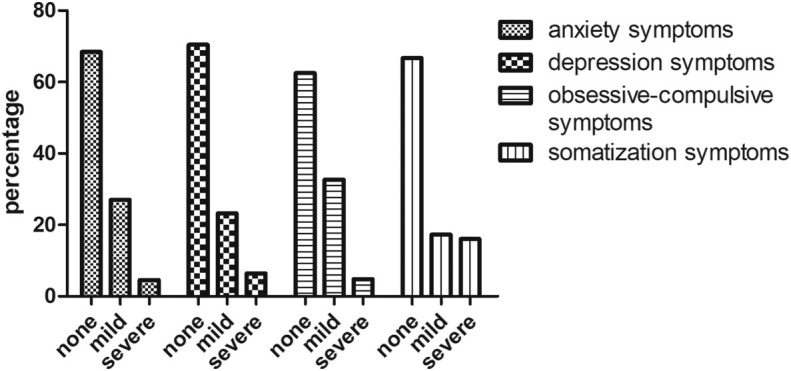
The general stress responses and prevalence of psychological distress.
3.3. Univariate analyses
The results of the univariate analysis (Table 2 ) indicate that among the sociodemographic factors, women were associated with a higher incidence rate of psychological distress, especially in terms of anxiety symptoms (P = 0.019), OCS (P = 0.038), and somatization symptoms (P = 0.038). Upon further analysis, females had more severe symptoms, separately into 5.6% with anxiety, 6.2% with OCS, and 18% with somatization symptoms. Post-hoc test with multiple comparison correction suggested women showed a higher anxiety rate in mild group (P = 0.016 < 0.0167, Bonferroni's corrected). Approximately 42.3% of the patients with high OCS levels were adults aged between 30 and 49 years. Lower income groups were associated with a higher incidence rate of psychological distress, especially in terms of anxiety symptoms (P = 0.028) and depression symptoms (P = 0.005); there was no significant association with OCS and somatization symptoms. For example, among the group with moderate-severe anxiety, 34% of the subjects had an income of less than 50,000 per year(100USD = 708.24RMB).Post-hoc test with multiple comparison correction suggested compared to higher income group, there were a higher incidence rate of moderate and severe psychological reactions (IES-R) and depression symptoms in lower income group. (P = 0.001; P = 0.002; P = 0.001<0.0006, Bonferroni's corrected). Of the 96 isolation ward health workers, 40.7% had symptoms of anxiety and 37.5% symptoms of depression. A post-hoc test with multiple comparison correction revealed that compared to the no psychological distress group, moderate and severe anxiety, depression, and psychological reactions (IES-R) were observed in a greater number of hospital staff from the isolation ward than in those from the general ward. (P = 0.014; P = 0.004; P = 0.001 < 0.0167, Bonferroni's corrected).
Table 2.
Univariate associations between psychological distress and related factors (N = 456).
| Psychological reaction |
Anxiety symptoms |
Depression |
OCS |
Somatization symptoms |
||||||||||||||||
|---|---|---|---|---|---|---|---|---|---|---|---|---|---|---|---|---|---|---|---|---|
| (IES-R) |
(GAD-7) |
(PHQ-9) |
(Y-BOCS) |
(PHQ-15) |
||||||||||||||||
| Sub-clinic | Mild | Moderate-severe | P value | None | Mild | Moderate-severe | P value | None | Mild | Moderate-severe | P value | None | Mild | Moderate-severe | P value | None | Mild | Moderate-severe | P value | |
| Total | 259(56.8%) | 148(32.5%) | 49(10.7%) | 312(68.4%) | 123(27.0%) | 21(4.6%) | 321(70.4%) | 106(23.2%) | 29(6.4%) | 285(62.5%) | 149(32.7%) | 22(4.8%) | 304(66.7%) | 79(17.3%) | 73(16.0%) | |||||
| Sex | 0.631 | 0.019⁎ | 0.370 | 0.038⁎ | 0.038⁎ | |||||||||||||||
| Man | 80(59.7%) | 42(32.3%) | 12(9.0%) | 104(77.6%) | 27(20.1%) | 3(2.2%) | 100(74.6%) | 28(20.9%) | 6(4.5%) | 93(69.4%) | 39(29.1%) | 2(1.5%) | 101(75.4%) | 18(13.4%) | 15(11.2%) | |||||
| Women | 179(55.6%) | 106(32.9%) | 37(11.5%) | 208(64.6%) | 96(29.8%) | 18(5.6%) | 221(68.6%) | 78(24.2%) | 23(7.1%) | 192(59.6%) | 110(34.2%) | 20(6.2%) | 203(63.0%) | 61(18.9%) | 58(18.0%) | |||||
| Age group | 0.207 | 0.198 | 0.191 | 0.044⁎ | 0.278 | |||||||||||||||
| ≤30 | 161(60.3%) | 77(28.8%) | 29(10.9%) | 191(71.5%) | 63(23.6%) | 13(4.9%) | 195(73.0%) | 56(21.0%) | 16(6.0%) | 173(64.8%) | 77(28.8%) | 17(6.4%) | 187(70.0%) | 39(14.6%) | 41(15.4%) | |||||
| 31–49 | 90(50.9%) | 67(37.9%) | 20(11.3%) | 111(62.7%) | 58(32.8%) | 8(4.5%) | 115(65.0%) | 49(27.7%) | 13(7.3%) | 102(57.6%) | 70(39.5%) | 5(2.8%) | 108(61.0%) | 38(21.5%) | 31(17.5%) | |||||
| ≥50 | 8(66.7%) | 4(33.3%) | 0(0%) | 10(83.3%) | 2(16.7%) | 0(0.0%) | 11(91.7%) | 1(8.3%) | 0(0.0%) | 10(83.3%) | 2(16.7%) | 0(0.0%) | 9(75.0%) | 2(16.7%) | 1(8.3%) | |||||
| Nationality | 0.496 | 0.420 | 0.354 | 0.544 | 0.649 | |||||||||||||||
| Han | 247(56.9%) | 142(32.7%) | 45(10.4%) | 296(68.2%) | 119(27.4%) | 19(4.4%) | 307(70.7%) | 101(23.3%) | 26(6.0%) | 271(62.4%) | 141(32.5%) | 22(5.1%) | 290(66.8%) | 76(17.5%) | 68(15.7%) | |||||
| Other | 12(54.5%) | 6(27.3%) | 4(18.2%) | 16(72.7%) | 4(18.2%) | 2(9.1%) | 14(63.6%) | 5(22.7%) | 3(13.6%) | 14(63.6%) | 8(36.4%) | 0(0.0%) | 14(63.6%) | 3(13.6%) | 5(22.7%) | |||||
| Educational level | 0.105 | 0.067 | 0.076 | 0.040⁎ | 0.049⁎ | |||||||||||||||
| Junior college or below | 95(66.0%) | 37(25.7%) | 12(8.3%) | 110(76.4%) | 32(22.2%) | 2(1.4%) | 114(79.2%) | 24(16.7%) | 6(4.2%) | 105(72.9%) | 35(24.3%) | 4(2.8%) | 109(75.7%) | 19(13.2%) | 16(11.1%) | |||||
| Undergraduate | 114(53.8%) | 74(34.9%) | 24(11.3%) | 137(64.6%) | 63(29.7%) | 12(5.7%) | 142(67.0%) | 56(26.4%) | 14(6.6%) | 122(57.5%) | 78(36.8%) | 12(5.7%) | 134(63.2%) | 37(17.5%) | 41(19.3%) | |||||
| Postgraduate or above | 50(50.0%) | 37(37.0%) | 13(13.0%) | 65(65.0%) | 28(28.0%) | 7(7.0%) | 65(65.0%) | 26(26.0%) | 9(9.0%) | 58(58.0%) | 36(36.0%) | 6(6.0%) | 61(61.0%) | 23(23.0%) | 16(16.0%) | |||||
| Marital status | 0.111 | 0.674 | 0.425 | 0.418 | 0.418 | |||||||||||||||
| Bachelordom | 130(60.7%) | 59(27.6%) | 25(11.7%) | 149(69.6%) | 54(25.2%) | 11(5.1%) | 153(71.5%) | 45(21.0%) | 16(7.5%) | 135(63.1%) | 66(30.8%) | 13(6.1%) | 149(69.6%) | 35(16.4%) | 30(14.0%) | |||||
| Married | 129(53.3%) | 89(36.6%) | 24(9.9%) | 163(67.4%) | 69(28.5%) | 10(4.1%) | 168(69.4%) | 61(25.2%) | 13(5.4%) | 150(62.0%) | 83(34.3%) | 9(3.7%) | 155(64.0%) | 44(18.2%) | 43(17.8%) | |||||
| Annual income(RMB) | 0.017⁎ | 0.028⁎ | 0.005⁎ | 0.839 | 0.801 | |||||||||||||||
| <50,000 | 73(49.7%) | 49(33.3%) | 25(17.0%) | 97(66.0%) | 39(26.5%) | 11(7.5%) | 91(61.9%) | 40(27.2%) | 16(10.9%) | 91(62.8%) | 49(33.8%) | 5(3.4%) | 97(66.9%) | 22(15.2%) | 26(17.9%) | |||||
| 50,000-100,000 | 61(57.5%) | 33(31.1%) | 12(11.3%) | 64(60.4%) | 36(34.0%) | 6(5.7%) | 71(67.0%) | 29(27.4%) | 6(5.7%) | 62(59.6%) | 36(34.6%) | 6(5.8%) | 59(66.3%) | 21(20.2%) | 14(13.5%) | |||||
| >100,000 | 125(61.6%) | 66(32.5%) | 12(5.9%) | 151(74.4%) | 48(23.6%) | 4(2.0%) | 159(78.3%) | 37(18.2%) | 7(3.4%) | 132(63.8%) | 64(30.9%) | 11(5.3%) | 138(66.7%) | 36(17.4%) | 33(15.9%) | |||||
| Workplace | 0.004⁎ | 0.016⁎ | 0.015⁎ | 0.243 | 0.493 | |||||||||||||||
| Isolation ward | 43(44.8%) | 35(36.5%) | 18(18.8%) | 57(59.4%) | 30(31.3%) | 9(9.4%) | 60(62.5%) | 24(25.0%) | 12(12.5%) | 54(56.3%) | 35(36.5%) | 7(7.3%) | 60(62.5%) | 17(17.7%) | 19(19.8%) | |||||
| General ward | 216(60.0%) | 113(31.4%) | 31(8.6%) | 255(70.8%) | 93(25.8%) | 12(3.3%) | 261(72.5%) | 82(22.8%) | 17(4.7%) | 231(64.2%) | 114(31.7%) | 15(4.2%) | 244(67.8%) | 62(17.2%) | 54(15.0%) | |||||
| Occupation | 0.740 | 0.390 | 0.825 | 0.921 | 0.095 | |||||||||||||||
| Doctors | 107(54.9%) | 67(34.4%) | 21(10.8%) | 132(67.7%) | 51(26.2%) | 12(6.2%) | 136(69.7%) | 45(23.1%) | 14(7.2%) | 123(63.1%) | 62(31.8%) | 10(5.1%) | 126(64.6%) | 42(21.5%) | 27(13.8%) | |||||
| Nurses | 152(58.2%) | 81(31.0%) | 28(10.7%) | 180(69.0%) | 72(27.6%) | 9(3.4%) | 185(70.9%) | 61(23.4%) | 15(5.7%) | 162(62.1%) | 87(33.3%) | 12(4.6%) | 178(68.2%) | 37(14.2%) | 46(17.6%) | |||||
| Job title | 0.521 | 0.237 | 0.529 | 0.440 | 0.387 | |||||||||||||||
| Junior | 186(58.9%) | 97(30.7%) | 33(10.4%) | 223(70.6%) | 76(24.1%) | 17(5.4%) | 226(71.5%) | 68(21.5%) | 22(7.0%) | 202(63.9%) | 97(30.7%) | 17(5.4%) | 218(69.0%) | 49(15.5%) | 49(15.5%) | |||||
| Middle | 54(50.5%) | 39(36.4%) | 14(13.1%) | 67(62.6%) | 37(34.6%) | 3(2.8%) | 74(69.2%) | 27(25.2%) | 6(5.6%) | 64(59.8%) | 38(35.5%) | 5(4.7%) | 64(59.8%) | 25(23.4%) | 18(16.8%) | |||||
| Senior | 19(57.6%) | 12(36.4%) | 2(6.1%) | 22(66.7%) | 10(30.3%) | 1(3.0%) | 21(63.6%) | 11(33.3%) | 1(3.0%) | 19(57.6%) | 14(42.4%) | 0(0.0%) | 22(66.7%) | 5(15.2%) | 6(18.2%) | |||||
Note: 100USD = 708.24RMB; Impact of event scale-revised, OCS: obsessive-compulsive symptoms.
P<0.05.
The median (IQR) scores on the IES-R for psychological reactions, the GAD-7 for anxiety symptoms, the PHQ-9 for depression symptoms, the Y-BOCS for OCS, and the PHQ-15 for somatization symptoms for all respondents were 6.0(1.0–16.0), 2.0(0–5.57), 1(0–5.0), 2.5(0–8.0), and 2(0–7.0), respectively (Table 3 ). Compared with men, women had higher scores on scales measuring symptoms of anxiety, depression, and obsessive-compulsive disorder (median [IQR] GAD-7 score, 1.0 [0–4.0] vs 2.0[0–6.0]; P = 0.003; median [IQR] PHQ-9 score, 0[0–5.0] vs 1(0–6.0); P = 0.046; median [IQR] Y-BOCS score, 1.0[0–6.25] vs 3.0[0–8.0]; P = 0.003). Hospital staff from the isolation ward reported higher scores on scales measuring symptoms of IES-R, depression symptoms, OCS, and somatization symptoms (median [IQR] IES-R score, 0 [1–19.75] vs 6 [1.0–15.0]; P = 0.006; median [IQR] depression score, 3.0 [0–6.75] vs 1.0 [0–5.0]; P = 0.01; median [IQR] Y-BOCS score, 4 [0.25–9.0] vs 2.0 [0–8.0]; P = 0.047; median [IQR] PHQ-15 score, 3.0 [0–8.0] vs 1.0 [0–6.75]; P = 0.048). There were no differences in the different occupations or job titles for scores of all the psychological distress(P > 0.05) (Table3).
Table 3.
Scores of IES-R,GAD-7,PHQ-9, Y-BOCS and PHQ-15 in total cohort and subgroups.
| Sex |
Workplace |
Occupation |
Job title |
|||||||||||
|---|---|---|---|---|---|---|---|---|---|---|---|---|---|---|
| Median (IQR) |
Median (IQR) |
Median (IQR) |
Median (IQR) |
|||||||||||
| Total score | Male | Female | P value | Isolation ward | General ward | P value | Doctors | Nurses | P value | Junior | Middle | Senior | P value | |
| N | 456 | 134 | 322 | 96 | 360 | 195 | 261 | 316 | 107 | 33 | ||||
| IES-R | 6(1–16) | 5(0–16.25) | 7(1–16) | 0.065 | 10(1–19.75) | 6(1–15) | 0.006⁎ | 7(1–17) | 6(1–16) | 0.377 | 6(1–16) | 8(1–17) | 6(2–17) | 0.258 |
| GAD-7 | 2(0–7) | 1(0–4) | 2(0–6) | 0.003⁎ | 2(0–6.75) | 1(0–5) | 0.067 | 2(0–5) | 1(0–6) | 0.702 | 2(0–5) | 2(0–6) | 2(0–6.5) | 0.497 |
| PHQ-9 | 2(0–5.75) | 0(0–5) | 1(0–6) | 0.046⁎ | 3(0–6.75) | 1(0–5) | 0.01⁎ | 1(0–5) | 1(0–5) | 0.824 | 1(0–5) | 1(0–5) | 1(0–6) | 0.791 |
| Y-BOCS | 1(0–5) | 1(0–6.25) | 3(0–8) | 0.003⁎ | 4(0.25–9) | 2(0–8) | 0.047⁎ | 2(0–8) | 3(0–8) | 0.53 | 2(0–8) | 3(0–8) | 3(0–8) | 0.633 |
| PHQ-15 | 2.5(0–8) | 1(0–4.25) | 2(0–7) | 0.059 | 3(0–8) | 1(0–6.75) | 0.048⁎ | 2(0–7) | 1(0–7) | 0.422 | 1(0–7) | 3(0–7) | 3(1–7) | 0.104 |
Note: IQR: interquartile ranges.
P<0.05.
3.4. Multiple logistic regression
Results of the multiple logistic regression analysis for factors associated with psychological distress related to the COVID-19 crisis are presented in Table 4 . Factors related to psychological reactions (IES-R) included (1) Reluctant to work or considered resignation (odds ratio [OR], 5.192; 95%CI, 2.396–11.250; P < 0.001); (2) Afraid to go home because of fear of infecting family (OR, 2.099; 95% CI = 1.299–3.391; P = 0.002); (3) Uncertainty about frequent modification of infection and control procedures (OR, 1.583; 95%CI, 1.061–2.363; P = 0.025); and (4) Social support (OR, 1.754; 95%CI, 1.041–2.956; P = 0.035). Factors related to Anxiety included: (1) Reluctant to work or considered resignation (OR, 3.622; 95% CI, 1.882–6.973; P < 0.001) and (2) Afraid to go home because of fear of infecting family (OR, 1.803; 95% CI, 1.069–3.039; P = 0.027). Factors related to depression included: (1) Stigmatization and rejection in neighborhood because of hospital work (OR, 2.297; 95% CI, 1.138–4.637; P = 0.020); (2) Reluctant to work or considered resignation (OR, 3.134; 95% CI, 1.635–6.006; P = 0.001) and (3) Uncertainty about frequent modification of infection and control procedures (OR, 1.645; 95% CI, 1.075–2.517; P = 0.022). Factors related to OCS included: (1) Reluctant to work or considered resignation (OR, 5.241; 95% CI, 2.545–10.793; P < 0.001) and (2) Afraid to go home because of fear of infecting family (OR, 1.999; 95% CI, 1.217–3.282; P = 0.006). Factors related to somatization included: (1) Reluctant to work or considered resignation (OR, 5.177; 95% CI, 2.595–10.329; P < 0.001) and (2) Afraid to go home because of fear of infecting family (OR, 1.749; 95% CI, 1.051–2.91; P = 0.031).
Table 4.
Multiple logistic regression analysis for factors associated with psychological distress related to the COVID-19 crisis.
| Variables | B | SE | Waldχ2 | P | AOR (95%CI) |
|---|---|---|---|---|---|
| Psychological reaction | |||||
| Whether be quarantined at work | 0.385 | 0.255 | 2.268 | 0.132 | 1.469(0.891–2.423) |
| Stigmatization and rejection in neighborhood because of hospital work? | 0.533 | 0.369 | 2.087 | 0.149 | 1.705(0.827–3.516) |
| Reluctant to work or considered resignation | 1.647 | 0.395 | 17.423 | <0.001⁎ | 5.192(2.396–11.250) |
| Afraid to go home because of fear of infecting family | 0.741 | 0.245 | 9.181 | 0.002⁎ | 2.099(1.299–3.391) |
| Uncertainty about frequent modification of infection and control procedures | 0.459 | 0.204 | 5.051 | 0.025⁎ | 1.583(1.061–2.363) |
| Social support | 0.562 | 0.266 | 4.455 | 0.035⁎ | 1.754(1.041–2.956) |
| Anxiety symptoms | |||||
| Whether be quarantined at work | 0.312 | 0.258 | 1.455 | 0.228 | 1.366(0.823–2.267) |
| Stigmatization and rejection in neighborhood because of hospital work? | 0.284 | 0.363 | 0.613 | 0.434 | 1.329(0.652–2.709) |
| Reluctant to work or considered resignation | 1.287 | 0.334 | 14.834 | <0.001⁎ | 3.622(1.882–6.973) |
| Afraid to go home because of fear of infecting family | 0.589 | 0.266 | 4.892 | 0.027⁎ | 1.803(1.069–3.039) |
| Uncertainty about frequent modification of infection and control procedures | 0.35 | 0.213 | 2.693 | 0.101 | 1.419(0.934–2.154) |
| Social support | 0.482 | 0.266 | 3.286 | 0.07 | 1.619(0.962–2.725) |
| Depression symptoms | |||||
| Whether be quarantined at work | 0.228 | 0.263 | 0.754 | 0.385 | 1.256(0.751–2.103) |
| Stigmatization and rejection in neighborhood because of hospital work? | 0.831 | 0.358 | 5.38 | 0.02⁎ | 2.297(1.138–4.637) |
| Reluctant to work or considered resignation | 1.142 | 0.332 | 11.849 | 0.001⁎ | 3.134(1.635–6.006) |
| Afraid to go home because of fear of infecting family | 0.274 | 0.264 | 1.075 | 0.3 | 1.315(0.784–2.206) |
| Uncertainty about frequent modification of infection and control procedures | 0.498 | 0.217 | 5.268 | 0.022⁎ | 1.645(1.075–2.517) |
| Social support | 0.522 | 0.269 | 3.779 | 0.052 | 1.686(0.996–2.855) |
| OCS | |||||
| Whether be quarantined at work | 0.131 | 0.258 | 0.256 | 0.613 | 1.139(0.687–1.889) |
| Stigmatization and rejection in neighborhood because of hospital work? | 0.611 | 0.359 | 2.9 | 0.089 | 1.842(0.912–3.72) |
| Reluctant to work or considered resignation | 1.656 | 0.369 | 20.2 | <0.001⁎ | 5.241(2.545–10.793) |
| Afraid to go home because of fear of infecting family | 0.693 | 0.253 | 7.495 | 0.006⁎ | 1.999(1.217–3.282) |
| Uncertainty about frequent modification of infection and control procedures | 0.062 | 0.208 | 0.089 | 0.765 | 1.064(0.708–1.598) |
| Social support | 0.489 | 0.265 | 3.411 | 0.065 | 1.631(0.971–2.74) |
| Somatization symptoms | |||||
| Whether be quarantined at work | 0.046 | 0.263 | 0.03 | 0.862 | 1.047(0.625–1.752) |
| Stigmatization and rejection in neighborhood because of hospital work? | 0.349 | 0.362 | 0.93 | 0.335 | 1.418(0.697–2.881) |
| Reluctant to work or considered resignation | 1.644 | 0.352 | 21.777 | <0.001⁎ | 5.177(2.595–10.329) |
| Afraid to go home because of fear of infecting family | 0.559 | 0.26 | 4.628 | 0.031⁎ | 1.749(1.051–2.91) |
| Uncertainty about frequent modification of infection and control procedures | 0.282 | 0.212 | 1.773 | 0.183 | 1.325(0.876–2.006) |
| Social support | 0.392 | 0.268 | 2.138 | 0.144 | 1.48(0.875–2.504) |
Note: OCS: obsessive-compulsive symptoms.
P < 0.05.
4. Discussion
Chongqing is adjacent to Wuhan geographically. Before travel bans were imposed on January 23, 2020, about 210,000 migrant workers from Wuhan returned to Chongqing to celebrate the Spring Festival. Therefore, the situation regarding the final trend of the epidemic in Chongqing at that time was unclear. Using data from a survey conducted on hospital staff from the five COVID-19 designated hospitals in Chongqing, we analyzed the initial psychological distresses of the hospital staff on February 2020, just two weeks into the outbreak of COVID-19 in the country. We attempted to identify the factors that were associated with a lower level of psychological impact.
Moderate to severe psychological symptoms were found among the hospital staff during the COVID-19 outbreak in our study. There was in contrast to the similar level psychological reactions according to the IES-R in our study and Chew NWS et al. [11]. Compared to this, our study had similar prevalence rates of moderate to severe depression symptoms (6.4% versus 5.3%), but lower prevalence rates of moderate to severe anxiety symptoms (4.6% versus 8.7%) [11]. We analyzed the possible reasons for the differences in results due to the different scales assessed and the differences in sampling times and region. Our research was conducted just after the outbreak had reached its peak, which was a critical time of uncertainty. With similar prevalence of psychological outcomes in both countries, the observed findings regarding the psychological and physical symptoms were more likely generalizable.
Our study further found that men were associated with lower IES-R scores but women were associated with higher stress, anxiety, and depression scores. This result is consistent with that reported in other studies during the COVID-19 outbreak [4,22]. Women are significantly more likely than men to develop anxiety symptoms (30.5% vs. 19.2%) or OCS (3.1% vs. 2.0%) throughout their lifespan [23,24]. Evidence from various fields has emerged suggesting that estradiol and progesterone may play a significant part in the generation of these differences in sex [25]. Social factors can also increase the female vulnerability to stress and stress-related pathology. In China, females contribute more to the family than men. Our results suggest that attention should be paid to the psychological needs of the female subpopulation during a pandemic. Understanding the differences in sex in the determinants of anxiety and depression symptoms during a pandemic is crucial for developing standard policies and practices.
The COVID-19 epidemic negatively affected peoples' physical and mental well-being, as well as the economy. It was estimated that Asian states lost USD 12–18 billion as the SARS crisis affected travel, tourism, and retail sales [26,27]. Our survey found that compared to the higher income group, the lower income group was more likely to encounter economic difficulties had higher depression levels. In addition, the increased expenditure on prevention and healthcare and difficulty in purchasing necessities had a negative economic impact on families [28]. To reduce the spread of the virus among people, Chinese authorities have taken measures to control the disease, covering travel and leisure pursuits, delaying the return to work, reducing commercial activity, and allowing home quarantine. These measures are bound to increase the economic burden on the public. In addition, the low income population tends to have a low educational background and lack of understanding of diseases, and such people are more likely to believe rumors, leading to anxiety and panic. Hence, because the lower income group is more likely to suffer from physical illness, mental distress, and economic burden, they are more likely to experience depression symptoms.
As expected, persons who experienced greater contact with COVID-19 patients while working in the isolation units showed greater levels of distress, which is consistent with the results of previous studies examining the mental health effects of the SARS outbreak. Studies on the psychological effects of quarantine during the SARS outbreaks in China, Canada, and Taiwan reported that experiencing quarantine was a strong predictor of negative psychological effects, such as depression and post-traumatic stress disorder [[29], [30], [31]]. These results are understandable owing to the high risk of infection, direct exposure, fatigue, and sleep deprivation associated with quarantine situations [32]. While quarantining in China was often a group affair during this COVID-19 outbreak, certain skilled ICU and infectious disease medical staff volunteered to work in isolation wards. These individuals already had a strong psychological reserve and are aware that their contribution to society would be valued by many patients they worked with. Regardless, our results suggested a higher incidence of psychological distress, especially in terms of anxiety and depression, in people who worked in the isolation wards. In view of the experience and lessons of SARS, various measures to relieve the mental pressure of medical staff in isolation wards in Chongqing have been undertaken, including the following: (1) In the distribution of rescue materials, priority is given to all the protective facilities in the isolation wards. This is plausible, given their high rate of confidence in infection-control practices, compared to that needed for low-risk general wards. (2) To prevent fatigue, medical staff in the isolation wards carried out a 4-h shift system to guarantee sufficient rest time, which was a different approach to that taken during the SARS outbreak [33]. (3) Psychologists and psychiatrists use the internet and social media to share strategies for dealing with psychological stress in isolation wards [34]. Those working in general wards also experienced certain anxiety (29.1%) and depression (27.5%). This could be due to the uncertainty of whether there were patients potentially in the viral incubation period or those exhibiting atypical symptoms of the disease in the general ward; only secondary protection is utilized in ordinary wards.
Different from the SARS outbreak, 8.3% participants reported that they had encountered COVID-19-related discrimination. On the contrary, hospital staff were hailed as heroes in harm's way and highly praised and respected. Our multiple logistic regression analysis determined that “Afraid to go home because of fear of infecting family” and “Reluctant to work or considered resignation” were the main related factors to the psychological distress. Ninety-seven staff members did not go home after work during the outbreak for fear of infecting their families. This is largely due to the clustering of COVID-19. It should be noted that in our survey, the factor of “Uncertainty about frequent modification of infection and control procedures” was also related to psychological distress. Hospital staff also showed a lack of sufficient knowledge regarding newly emerging diseases, especially in the beginning of the outbreak, when the disease was unknown, lethal, and spreading rapidly. Similar to SARS, hospital staff reported experiencing significantly more insomnia, exhaustion, and uncertainty regarding the frequent modifications in infection-control procedures.
The study has some limitations. First, this study is limited by its cross-sectional nature; this prevented us from making causal inferences. Compared with Wuhan, Chongqing is not the center of the epidemic, and our research can only partly reflect the situation. Second, this study did not explore several psychiatric symptoms including suicidal ideation and psychotic experience, as reported in other COVID-19 studies [13]. Third, owing to the stringent hospital infection-control protocols to minimize contact between hospital staff, the questionnaire had to be self-administered and information provided on symptoms was not verified by a medical professional. Our findings do, however, provide valuable information for policy makers and mental health professionals worldwide regarding the psychological distress faced by individuals after an infectious disease outbreak. Forth, years of experience of being a doctor or a nurse may make the participants cope with the COVID-19 differently. In particular, those who have been experienced SARS may have strong mind to deal with COVID-19. However, our study did not investigate the clinical experience time of the participants, even the experience with SARS.
Data availability
The data that support the findings of this study are available in: https://www.wjx.cn/report/56715570.aspx.
Financial support
This work was supported by the National Natural Science Foundation of China (grant number 81801071), and the Foundation and Foreword of Chongqing Science and Technology Commission (grant number cstc2018jcyjAX0170), and “Novel coronavirus pneumonia” emergency research project (grant number CQMUNCP0210).
Declaration of Competing Interest
None.
Acknowledgements
We thank the hospital staff in the five hospitals for this survey research.
References
- 1.Chen N., Zhou M., Dong X. Epidemiological and clinical characteristics of 99 cases of 2019 novel coronavirus pneumonia in Wuhan, China: a descriptive study. Lancet. 2020;395(10223):507–513. doi: 10.1016/S0140-6736(20)30211-7. [DOI] [PMC free article] [PubMed] [Google Scholar]
- 2.Ren S.Y., Gao R.D., Chen Y.L. Fear can be more harmful than the severe acute respiratory syndrome coronavirus 2 in controlling the corona virus disease 2019 epidemic. World J Clin Cases. 2020;8(4):652–657. doi: 10.12998/wjcc.v8.i4.652. [DOI] [PMC free article] [PubMed] [Google Scholar]
- 3.Ahorsu D.K., Lin C.Y., Imani V., Saffari M., Griffiths M.D., Pakpour A.H. The fear of COVID-19 scale: development and initial validation. Int J Ment Health Addict. 2020:1–9. doi: 10.1007/s11469-020-00270-8. [DOI] [PMC free article] [PubMed] [Google Scholar]
- 4.Wang C., Pan R., Wan X. Immediate psychological responses and associated factors during the initial stage of the 2019 coronavirus disease (COVID-19) epidemic among the general population in China. Int J Environ Res Public Health. 2020;17:5. doi: 10.3390/ijerph17051729. [DOI] [PMC free article] [PubMed] [Google Scholar]
- 5.Jin Y.H., Cai L., Cheng Z.S. A rapid advice guideline for the diagnosis and treatment of 2019 novel coronavirus (2019-nCoV) infected pneumonia (standard version) Mil Med Res. 2020;7(1):4. doi: 10.1186/s40779-020-0233-6. [DOI] [PMC free article] [PubMed] [Google Scholar]
- 6.Bao Y., Sun Y., Meng S., Shi J., Lu L. 2019-nCoV epidemic: address mental health care to empower society. Lancet. 2020;395(10224):e37–e38. doi: 10.1016/S0140-6736(20)30309-3. [DOI] [PMC free article] [PubMed] [Google Scholar]
- 7.Tan B.Y.Q., Chew N.W.S., Lee G.K.H. Psychological Impact of the COVID-19 Pandemic on Health Care Workers in Singapore. Ann Intern Med. 2020;173(4):317–320. doi: 10.7326/M20-1083. In press. [DOI] [PMC free article] [PubMed] [Google Scholar]
- 8.Ko C.H., Yen C.F., Yen J.Y., Yang M.J. Psychosocial impact among the public of the severe acute respiratory syndrome epidemic in Taiwan. Psychiatry Clin Neurosci. 2006;60(4):397–403. doi: 10.1111/j.1440-1819.2006.01522.x. [DOI] [PubMed] [Google Scholar]
- 9.Chan K.S., Zheng J.P., Mok Y.W. SARS: prognosis, outcome and sequelae. Respirology. 2003;8(Suppl):S36–S40. doi: 10.1046/j.1440-1843.2003.00522.x. [DOI] [PMC free article] [PubMed] [Google Scholar]
- 10.McAlonan G.M., Lee A.M., Cheung V. Immediate and sustained psychological impact of an emerging infectious disease outbreak on health care workers. Can J Psychiatr. 2007;52(4):241–247. doi: 10.1177/070674370705200406. [DOI] [PubMed] [Google Scholar]
- 11.Chew N.W.S., Lee G.K.H., Tan B.Y.Q. A multinational, Multicentre Study on the Psychological Outcomes and Associated Physical Symptoms Amongst Healthcare Workers During COVID-19 Outbreak. Brain Behav Immun. 2020;88:559–565. doi: 10.1016/j.bbi.2020.04.049. In press. [DOI] [PMC free article] [PubMed] [Google Scholar]
- 12.Lai J., Ma S., Wang Y. Factors associated with mental health outcomes among health care workers exposed to coronavirus disease 2019. JAMA Netw Open. 2020;3(3) doi: 10.1001/jamanetworkopen.2020.3976. [DOI] [PMC free article] [PubMed] [Google Scholar]
- 13.Tan W., Hao F., McIntyre R.S. Is returning to work during the COVID-19 pandemic stressful? A study on immediate mental health status and psychoneuroimmunity prevention measures of Chinese workforce. Brain Behav Immun. 2020;87:84–92. doi: 10.1016/j.bbi.2020.04.055. [DOI] [PMC free article] [PubMed] [Google Scholar]
- 14.Hao F., Tan W., Jiang L. Do psychiatric patients experience more psychiatric symptoms during COVID-19 pandemic and lockdown? A case-control study with service and research implications for immunopsychiatry. Brain Behav Immun. 2020;87:100–106. doi: 10.1016/j.bbi.2020.04.069. [DOI] [PMC free article] [PubMed] [Google Scholar]
- 15.Min Y.G., Hong Y.H. Treatment-related fluctuations in subacute inflammatory demyelinating polyneuropathy. eNeurologicalSci. 2020;18:100224. doi: 10.1016/j.ensci.2020.100224. [DOI] [PMC free article] [PubMed] [Google Scholar]
- 16.Zhang M.W., Ho C., Fang P., Lu Y., Ho R.C. Usage of social media and smartphone application in assessment of physical and psychological well-being of individuals in times of a major air pollution crisis. JMIR Mhealth Uhealth. 2014;2(1) doi: 10.2196/mhealth.2827. [DOI] [PMC free article] [PubMed] [Google Scholar]
- 17.Creamer M., Bell R., Failla S. Psychometric properties of the impact of event scale - revised. Behav Res Ther. 2003;41(12):1489–1496. doi: 10.1016/j.brat.2003.07.010. [DOI] [PubMed] [Google Scholar]
- 18.Zhang Y.L., Liang W., Chen Z.M. Validity and reliability of patient health questionnaire-9 and patient health questionnaire-2 to screen for depression among college students in China. Asia Pac Psychiatry. 2013;5(4):268–275. doi: 10.1111/appy.12103. [DOI] [PubMed] [Google Scholar]
- 19.Zhang L., Fritzsche K., Liu Y. Validation of the Chinese version of the PHQ-15 in a tertiary hospital. BMC Psychiatry. 2016;16:89. doi: 10.1186/s12888-016-0798-5. [DOI] [PMC free article] [PubMed] [Google Scholar]
- 20.Wang Y., Murray A.M., Toussaint A.K. Why is the recognition rate of psychological distress under-estimated in general hospitals? A cross-sectional observational study in China. Medicine (Baltimore) 2019;98(27) doi: 10.1097/MD.0000000000016274. [DOI] [PMC free article] [PubMed] [Google Scholar]
- 21.Goodman W.K., Price L.H., Rasmussen S.A. The Yale-Brown obsessive compulsive scale. I. Development, use, and reliability. Arch Gen Psychiatry. 1989;46(11):1006–1011. doi: 10.1001/archpsyc.1989.01810110048007. [DOI] [PubMed] [Google Scholar]
- 22.Wang C., Pan R., Wan X. A longitudinal study on the mental health of general population during the COVID-19 epidemic in China. Brain Behav Immun. 2020;87:40–48. doi: 10.1016/j.bbi.2020.04.028. [DOI] [PMC free article] [PubMed] [Google Scholar]
- 23.McLean C.P., Asnaani A., Litz B.T., Hofmann S.G. Gender differences in anxiety disorders: prevalence, course of illness, comorbidity and burden of illness. J Psychiatr Res. 2011;45(8):1027–1035. doi: 10.1016/j.jpsychires.2011.03.006. [DOI] [PMC free article] [PubMed] [Google Scholar]
- 24.Bruce S.E., Yonkers K.A., Otto M.W. Influence of psychiatric comorbidity on recovery and recurrence in generalized anxiety disorder, social phobia, and panic disorder: a 12-year prospective study. Am J Psychiatry. 2005;162(6):1179–1187. doi: 10.1176/appi.ajp.162.6.1179. [DOI] [PMC free article] [PubMed] [Google Scholar]
- 25.Li S.H., Graham B.M. Why are women so vulnerable to anxiety, trauma-related and stress-related disorders? The potential role of sex hormones. Lancet Psychiatry. 2017;4(1):73–82. doi: 10.1016/S2215-0366(16)30358-3. [DOI] [PubMed] [Google Scholar]
- 26.Wishnick E. Dilemmas of securitization and health risk management in the People’s Republic of China: the cases of SARS and avian influenza. Health Policy Plan. 2010;25(6):454–466. doi: 10.1093/heapol/czq065. [DOI] [PubMed] [Google Scholar]
- 27.Beutels P., Jia N., Zhou Q.Y., Smith R., Cao W.C., de Vlas S.J. The economic impact of SARS in Beijing, China. Tropical Med Int Health. 2009;14(Suppl. 1):85–91. doi: 10.1111/j.1365-3156.2008.02210.x. [DOI] [PubMed] [Google Scholar]
- 28.Ho C.S., Chee C.Y., Ho R.C. Mental health strategies to combat the psychological impact of COVID-19 beyond paranoia and panic. Ann Acad Med Singap. 2020;49(3):155–160. [PubMed] [Google Scholar]
- 29.Peng E.Y., Lee M.B., Tsai S.T. Population-based post-crisis psychological distress: an example from the SARS outbreak in Taiwan. J Formos Med Assoc. 2010;109(7):524–532. doi: 10.1016/S0929-6646(10)60087-3. [DOI] [PMC free article] [PubMed] [Google Scholar]
- 30.Hawryluck L., Gold W.L., Robinson S., Pogorski S., Galea S., Styra R. SARS control and psychological effects of quarantine, Toronto, Canada. Emerg Infect Dis. 2004;10(7):1206–1212. doi: 10.3201/eid1007.030703. [DOI] [PMC free article] [PubMed] [Google Scholar]
- 31.Chen C.S., Wu H.Y., Yang P., Yen C.F. Psychological distress of nurses in Taiwan who worked during the outbreak of SARS. Psychiatr Serv. 2005;56(1):76–79. doi: 10.1176/appi.ps.56.1.76. [DOI] [PubMed] [Google Scholar]
- 32.Chua S.E., Cheung V., Cheung C. Psychological effects of the SARS outbreak in Hong Kong on high-risk health care workers. Can J Psychiatr. 2004;49(6):391–393. doi: 10.1177/070674370404900609. [DOI] [PubMed] [Google Scholar]
- 33.Lam M.H., Wing Y.K., Yu M.W. Mental morbidities and chronic fatigue in severe acute respiratory syndrome survivors: long-term follow-up. Arch Intern Med. 2009;169(22):2142–2147. doi: 10.1001/archinternmed.2009.384. [DOI] [PubMed] [Google Scholar]
- 34.Kang L., Li Y., Hu S. The mental health of medical workers in Wuhan, China dealing with the 2019 novel coronavirus. Lancet Psychiatry. 2020;7(3):e14. doi: 10.1016/S2215-0366(20)30047-X. [DOI] [PMC free article] [PubMed] [Google Scholar]
Associated Data
This section collects any data citations, data availability statements, or supplementary materials included in this article.
Data Availability Statement
The data that support the findings of this study are available in: https://www.wjx.cn/report/56715570.aspx.