



Abstract
The conclusions of the European Food Safety Authority (EFSA) following the peer review of the initial risk assessments carried out by the competent authorities of the rapporteur Member State, Austria, and co‐rapporteur Member State, Malta, for the pesticide active substance abamectin are reported. The context of the peer review was that required by Commission Implementing Regulation (EU) No 844/2012, as amended by Commission Implementing Regulation (EU) No 2018/1659. The conclusions were reached on the basis of the evaluation of the representative uses of abamectin as an insecticide and acaricide on tomato and strawberry. The reliable end points appropriate for use in regulatory risk assessment are presented. Missing information identified as being required by the regulatory framework is listed. Concerns are identified.
Keywords: abamectin, peer review, risk assessment, pesticide, insecticide, acaricide
Summary
Commission Implementing Regulation (EU) No 844/2012, as amended by Commission Implementing Regulation (EU) No 2018/1659, lays down the procedure for the renewal of the approval of active substances submitted under Article 14 of Regulation (EC) No 1107/2009. The list of those substances is established in Commission Implementing Regulation (EU) No 686/2012 as amended by Commission Implementing Regulation (EU) No 2016/183. Abamectin is one of the active substances listed in that Regulation.
In accordance with Article 1 of Regulation (EU) No 844/2012, the rapporteur Member State (RMS), Austria, and co‐rapporteur Member State (co‐RMS), Malta, received an application from the Abamectin Task Force comprising Industrias Afrasa, S.A., Lainco, S.A., Probelte S.A.U., Rotam Agrochem International Co Ltd and SAPEC Agro, S.A. for the renewal of approval of the active substance abamectin.
An initial evaluation of the dossier on abamectin was provided by the RMS in the renewal assessment report (RAR) and subsequently, a peer review of the pesticide risk assessment on the RMS evaluation was conducted by EFSA in accordance with Article 13 of Commission Implementing Regulation (EU) No 844/2012, as amended by Commission Implementing Regulation (EU) No 2018/1659. The following conclusions are derived.
The uses of abamectin according to the representative uses as an insecticide and acaricide on tomato and strawberry in permanent greenhouses and walk‐in tunnels, as proposed at European union (EU) level result in a sufficient insecticidal and acaricidal efficacy against the target organisms.
The assessment of the data package revealed no issues that need to be included as critical areas of concern with respect to the identity, physical, chemical and technical properties of abamectin or the respective formulation.
In the area of mammalian toxicology and non‐dietary exposure, no critical areas of concern were identified.
The assessment of the data package revealed no issues that could not be finalised or that need to be included as critical areas of concern with respect to residues in food and feed for the representative uses in SEU, besides the fact that consumer risk assessment cannot be finalised due to the data gap identified in the Fate section with respect of drinking water. Consumer risk assessment cannot be finalised for the representative uses in NEU since a data gap has been identified for residue trials performed under these conditions. The MRL proposed in Article 12 of Regulation (EC) No 396/2005 (EFSA, 2014b) will need to be revised as for change of toxicological reference values (ADI and acute reference dose (ARfD)), since it is envisaged that acute risk may be identified for some of the crops.
The data available on environmental fate and behaviour are sufficient to carry out the required environmental exposure assessments at EU level, with the notable exception that a data gap was identified for information on the effect of water treatment processes on the nature of residues of both the active substance and its identified metabolites potentially present in surface water, when surface water is abstracted for the production of drinking water. This gap leads to the consumer risk assessment from the consumption of drinking water being not finalised for all the representative uses.
In the area of ecotoxicology, a critical area of concern has been identified regarding the chronic risk to aquatic invertebrates from abamectin for all the uses in permanent greenhouses and in walk‐in tunnels. In addition, a high risk was identified for walk‐in tunnels uses for birds and mammals, aquatic invertebrates (for the metabolite 8‐carboxy‐6‐hydroxy avermectin B1a in permanent greenhouses as well), honeybees non‐target arthropods, earthworms and other soil macroorganisms.
Based on the available information, abamectin does not meet the ED criteria for both humans and non‐target organisms.
Background
Commission Implementing Regulation (EU) No 844/20121, as amended by Commission Implementing Regulation (EU) No 2018/16592, (hereinafter referred to as ‘the Regulation’), lays down the provisions for the procedure of the renewal of the approval of active substances, submitted under Article 14 of Regulation (EC) No 1107/20093. This regulates for the European Food Safety Authority (EFSA) the procedure for organising the consultation of Member States, the applicant(s) and the public on the initial evaluation provided by the rapporteur Member State (RMS) and/or co‐rapporteur Member State (co‐RMS) in the renewal assessment report (RAR), and the organisation of an expert consultation where appropriate.
In accordance with Article 13 of the Regulation, unless formally informed by the European Commission that a conclusion is not necessary, EFSA is required to adopt a conclusion on whether the active substance can be expected to meet the approval criteria provided for in Article 4 of Regulation (EC) No 1107/2009 within 5 months from the end of the period provided for the submission of written comments, subject to an extension of an additional 3 months where additional information is required to be submitted by the applicant(s) in accordance with Article 13(3). Furthermore, in accordance with Article 13(3a), where the information available in the dossier is not sufficient to conclude the assessment on whether the approval criteria for endocrine disruption are met, additional information can be requested to be submitted in a period of minimum 3 months, not exceeding 30 months, depending on the type of information requested.
In accordance with Article 1 of the Regulation, the RMS, Austria, and co‐RMS, Malta, received an application from the Abamectin Task Force comprising Industrias Afrasa, S.A., Lainco, S.A., Probelte S.A.U., Rotam Agrochem International Co Ltd and SAPEC Agro, S.A. for the renewal of approval of the active substance abamectin. Complying with Article 8 of the Regulation, the RMS checked the completeness of the dossier and informed the applicants, the co‐RMS (Malta), the European Commission and EFSA about the admissibility.
The RMS provided its initial evaluation of the dossier on abamectin in the RAR, which was received by EFSA on 17 April 2019 (Austria, 2019).
In accordance with Article 12 of the Regulation, EFSA distributed the RAR to the Member States and the applicants, the Abamectin Task Force comprising Industrias Afrasa, S.A., Lainco, S.A., Probelte S.A.U., Rotam Agrochem International Co Ltd and SAPEC Agro, S.A., for consultation and comments on 29 May 2019. EFSA also provided comments. In addition, EFSA conducted a public consultation on the RAR. EFSA collated and forwarded all comments received to the European Commission on 29 July 2019. At the same time, the collated comments were forwarded to the RMS for compilation and evaluation in the format of reporting table. In addition, the applicants were invited to respond to the comments received. The comments and the applicants’ response were evaluated by the RMS in column 3.
The need for expert consultation and the necessity for additional information to be submitted by the applicants in accordance with Article 13(3) of the Regulation were considered in a telephone conference between EFSA, the RMS and co‐RMS on 11 October 2019. On the basis of the comments received, the applicants’ response to the comments and the RMS's evaluation thereof, it was concluded that additional information should be requested from the applicants, and that EFSA should conduct an expert consultation in the areas of mammalian toxicology, residues, environmental fate and behaviour and ecotoxicology.
The outcome of the telephone conference, together with EFSA's further consideration of the comments, is reflected in the conclusions set out in column 4 of the reporting table. All points that were identified as unresolved at the end of the comment evaluation phase and which required further consideration, including those issues to be considered in an expert consultation, were compiled by EFSA in the format of an evaluation table.
The conclusions arising from the consideration by EFSA, and as appropriate by the RMS, of the points identified in the evaluation table, together with the outcome of the expert consultation and the written consultation on the assessment of additional information, where these took place, were reported in the final column of the evaluation table.
A final consultation on the conclusions arising from the peer review of the risk assessment took place with Member States via a written procedure in June 2020.
This conclusion report summarises the outcome of the peer review of the risk assessment of the active substance and the representative formulation, evaluated on the basis of the representative uses of abamectin as an insecticide and acaricide on tomato and strawberry, as proposed by the applicants. In accordance with Article 12(2) of Regulation (EC) No 1107/2009, risk mitigation options identified in the RAR and considered during the peer review are presented in the conclusion.
A list of the relevant end points for the active substance and the formulation is provided in Appendix A.
A key supporting document to this conclusion is the peer review report (EFSA, 2020), which is a compilation of the documentation developed to evaluate and address all issues raised in the peer review, from the initial commenting phase to the conclusion. The peer review report comprises the following documents, in which all views expressed during the course of the peer review, including minority views, where applicable, can be found:
the comments received on the RAR;
the reporting table (17 October 2019);
the evaluation table (23 June 2020);
the report(s) of the scientific consultation with Member State experts (where relevant);
the comments received on the assessment of the additional information (where relevant);
the comments received on the draft EFSA conclusion.
Given the importance of the RAR, including its revisions (Austria, 2020), and the peer review report, both documents are considered as background documents to this conclusion and thus are made publicly available.
It is recommended that this conclusion and its background documents would not be accepted to support any registration outside the EU for which the applicant has not demonstrated that it has regulatory access to the information on which this conclusion report is based.
The active substance and the formulated product
Abamectin is the ISO common name for mixture of ≥ 80% avermectin B1a: (10E,14E,16E)‐(1R,4S,5′S,6S,6′R,8R,12S,13S,20R,21R,24S)‐6′‐[(S)‐sec‐butyl]‐21,24‐dihydroxy‐5′,11,13,22‐tetramethyl‐2‐oxo‐(3,7,19‐trioxatetracyclo[15.6.1.14,8.020,24]pentacosa‐10,14,16,22‐tetraene)‐6‐spiro‐2′‐(5′,6′‐dihydro‐2′H‐pyran)‐12‐yl 2,6‐dideoxy‐4‐O‐(2,6‐dideoxy‐3‐O‐methyl‐α‐L‐arabino‐hexopyranosyl)‐3‐O‐methyl‐α‐L‐arabino‐hexopyranoside and ≤ 20% avermectin B1b: (10E,14E,16E)‐(1R,4S,5′S,6S,6′R,8R,12S,13S,20R,21R,24S)‐21,24‐dihydroxy‐6′‐isopropyl‐5′,11,13,22‐tetramethyl‐2‐oxo‐(3,7,19‐trioxatetracyclo[15.6.1.14,8.020,24]pentacosa‐10,14,16,22‐tetraene)‐6‐spiro‐2′‐(5′,6′‐dihydro‐2′H‐pyran)‐12‐yl 2,6‐dideoxy‐4‐O‐(2,6‐dideoxy‐3‐O‐methyl‐α‐L‐arabino‐hexopyranosyl)‐3‐O‐methyl‐α‐L‐arabino‐hexopyranoside (IUPAC).
The representative formulated product for the evaluation was ‘Abamectin 1.8% EC’, an emulsifiable concentrate (EC) containing 18 g/L abamectin.
The representative uses evaluated were spray applications as insecticide and acaricide against dipteran leafminers and mites in permanent greenhouses and walk‐in tunnels (that are closed at the time the application is made) with soil‐bound growing systems of tomato and strawberry. Full details of the GAPs can be found in the list of end points in Appendix A.
Data were submitted to conclude that the uses of abamectin according to the representative uses proposed at EU level result in a sufficient efficacy against the target organisms, following the guidance document SANCO/2012/11251‐rev. 4 (European Commission, 2014b).
A data gap has been identified for a search of the scientific peer‐reviewed open literature on the active substance and its relevant metabolites, dealing with side effects on health and published within the 10 years before the date of submission of the dossier, to be conducted and reported in accordance with EFSA guidance on the submission of scientific peer‐reviewed open literature for the approval of pesticide active substances under Regulation (EC) No 1107/2009 (EFSA, 2011).
Conclusions of the evaluation
1. Identity, physical/chemical/technical properties and methods of analysis
The following guidance documents were followed in the production of this conclusion: European Commission, 2000a,b, 2010, 2012.
The proposed specifications for the minimum purity are based on batch data from industrial scale production and on quality control (QC) data. The proposed minimum purity of abamectin was 850 g/kg (sum of avermectin B1a and avermectin B1b), containing minimum 800 g/kg avermectin B1a and maximum 200 g/kg avermectin B1b. It should be emphasised that based on the batch data, a higher minimum purity could have been proposed (minimum 900 g/kg abamectin, with a minimum content of avermectin B1a of 840 g/kg and maximum content of avermectin B1b of 50 g/kg). FAO specification does not exist for this substance.
The main data regarding the identity of abamectin and its physical and chemical properties are given in Appendix A. A data gap was identified for the determination of the emulsion stability of the representative formulation according to MT 36.3.
Adequate analytical methods are available for risk assessment in plants and soil and for the determination of abamectin in the technical material and in the representative formulations as well as for the determination of the respective impurities in the technical material. For the other matrices, new methods used in risk assessment were not submitted.
The residue definition for monitoring in plant matrices was defined as sum of avermectin B1a, [8,9‐Z]‐isomer of avermectin B1a and avermectin B1b, expressed as avermectin B1a. The compounds of the residue definition can be determined by high‐pressure liquid chromatography with tandem mass spectrometry (HPLC‐MS/MS) (QuEChERS multi‐residue method) with an LOQ of 0.002 mg/kg for each compound. The residue definition for food of animal origin is avermectin B1a, covered by legal provisions in force for abamectin from veterinary uses. Avermectin B1a, avermectin B1b and [8,9‐Z]‐isomer of avermectin B1a can be determined by HPLC‐MS/MS (QuEChERS multi‐residue method) in animal matrices (milk, eggs, muscle, fat and kidney) with an LOQ of 0.002 mg/kg for each compound.
The residue definition for monitoring in soil is defined as avermectin B1a, avermectin B1b, 8a‐oxo‐avermectin B1a (NOA 448111), 8a‐hydroxy‐avermectin B1a (NOA 448112), 4′′‐oxo‐avermectin B1a (NOA 426289), 4,8a‐dihydroxy‐avermectin B1a (NOA 457464) and 8a‐oxo‐4‐hydroxy‐avermectin B1a (NOA 457465). Adequate HPLC‐MS/MS method exists for monitoring all the components of the residue definition with an LOQ of 0.002 mg/kg for each substance, except for NOA 426289, which is a metabolite that can be determined also by HPLC‐MS/MS with an LOQ of 0.1 μg/kg.
The monitoring residue definition for water (drinking, ground and surface) was defined as avermectin B1a, avermectin B1b, 8a‐oxo‐avermectin B1a (NOA 448111), 8a‐hydroxy‐avermectin B1a (NOA 448112), 4”‐oxo‐avermectin B1a (NOA 426289), 4,8a‐dihydroxy‐avermectin B1a (NOA 457464) and 8a‐oxo‐4‐hydroxy‐avermectin B1a (NOA 457465). All the compounds of the residue definition can be monitored by HPLC‐MS/MS with an LOQ of 0.1 μg/L for each. A data gap was, however, identified for an analytical method for the enforcement of the relevant limits based on the lowest effect concentrations for aquatic invertebrates.
Avermectin B1a and avermectin B1b in air can be determined by HPLC‐MS/MS with an LOQ of 0.05 μg/m3 for each analyte.
The residue definition in body fluids and tissues was defined as sum of avermectin B1a, [8,9‐Z]‐isomer of avermectin B1a and avermectin B1b, expressed as avermectin B1a. The QuEChERS multi‐residue analytical method can be used for monitoring the compounds of the residue definition with an LOQ of 0.002 mg/kg for all analytes in all matrices.
2. Mammalian toxicity
The toxicological profile of the active substance abamectin, sum of avermectin B1a (min 800 g/kg) and avermectin B1b (max 200 g/kg), was discussed at the Pesticides Peer Review Experts’ Meetings PREV 25 in March 2020; and based on the following guidance documents: SANCO/221/2000 – rev. 10‐final (European Commission, 2003), SANCO/10597/2003 – rev. 10.1 (European Commission, 2012), Guidance on Dermal Absorption (EFSA PPR Panel, 2017), Guidance on the assessment of exposure of operators, workers, residents and bystanders in risk assessment for plant protection products (EFSA, 2014c) and Guidance on the Application of the CLP Criteria (ECHA, 2017).
The toxicological profile of abamectin relied upon toxicity studies that were considered representative of the old technical specification for the active substance and associated impurities. The same technical specification was proposed for the renewal.
In the toxicokinetic studies in rats, the systemic bioavailability of avermectin B1a was estimated to be 86% after oral administration and there was no evidence for accumulation. Avermectin B1a was distributed throughout all major organs and tissues and excreted almost exclusively in the faeces (more than 92%). The main metabolic pathway included demethylation, hydroxylation, cleavage of the oleandrosyl ring and oxidation reactions. A comparative metabolism and kinetic study with avermectin B1b showed the same toxicokinetic profile as avermectin B1a. The evaluation of the in vitro public literature studies in human and rat microsomes leads to the conclusion that the metabolism of abamectin in human and rats is comparable.
With regard to acute toxicity, abamectin is very toxic to rat by oral and inhalation administration with a harmonised classification4 as H300 ‘Fatal if swallowed’ and H330 ‘Fatal if inhaled’, with characteristic signs of toxicity ranging from tremors and ataxia to mortality. Based on a dermal LD50, the criteria for classification as H312 ‘Harmful in contact with skin’ may also be met. There was no evidence neither of skin or eye irritation nor of skin sensitisation.
In the short‐term dietary studies with both abamectin and avermectin B1a, all species showed characteristic signs of central nervous system (CNS) toxicity. The dog was the most sensitive species and showed a very steep dose response for clinical signs of neurotoxicity and mortality (MTD was clearly exceeded at 2.0 mg/kg body weight (bw) per day, lowest observable adverse effect level (LOAEL) at 0.5 mg/kg bw per day), without histopathological findings correlating to the nervous tissues. A no observed adverse effect level (NOAEL) of 0.25 mg/kg bw per day was set for the dog 18‐week (with avermectin B1a) and dog 53‐week studies (with abamectin) based on CNT toxicity. In a 30‐day rat inhalation study, an NOAEL was set at 0.577 μg/L (0.11 mg/kg bw per day) based on the increased incidence in clinical signs and reduced motor activity in females. The harmonised classification of abamectin as STOT RE 1, H372 ‘Causes damage to the nervous system through prolonged or repeated exposure’ also took these findings into account. The relevant long‐term oral NOAEL is 1.5 mg/kg bw per day from the 2‐year rat study, based on CNS toxicity. Abamectin showed no carcinogenic potential in rats or mice. Based on the available genotoxicity studies, abamectin is unlikely to be mutagenic or clastogenic. However, a data gap to address the aneugenicity potential was set based on the lack of micronucleus study in vitro and/or in vivo,5 without triggering a critical concern since aneugenicity is considered a threshold mechanism, and therefore, the setting of reference values is possible.
With regard to the reproductive toxicity of abamectin, the parental and reproductive NOAEL in the rat multigeneration study was set at 0.4 mg/kg bw per day (highest dose) in the absence of treatment related effects; and an offspring NOAEL of 0.12 mg/kg bw per day was identified based on an increased pup mortality, retarded body weight gain and transient retinal anomalies. In the developmental toxicity studies, the developmental NOAEL was set at 0.8 mg/kg bw per day based on cleft palate, effects on the sex ratio, on lumbar rib and lumbar count variation in rats; and at 0.5 mg/kg bw per day based on an increased incidence clubbed forefoot and an increased number of resorptions, a delayed ossification and an excess of incidences of cleft palate and of omphalocele in rabbits. The maternal NOAELs were set at 1.6 mg/kg bw per day, based on the absence of effects in the highest dose group in rats and at 1.0 mg/kg bw per day, based on decreased water and food consumption and weight loss during gestation in rabbits. The harmonised classification4 based on these teratogenic observations in rats and rabbits is Repr. 2, H361d ‘Suspected of damaging the unborn child’.
In regard to neurotoxicity of abamectin, the NOAEL for acute neurotoxicity was 0.5 mg/kg bw, based on a reduced splay reflex in rat, while the NOAEL for chronic neurotoxicity was set at 1.6 mg/kg bw per day, based on clinical signs (i.e. irregular breathing, upward curvature of the spine, reduced righting reflex, reduced splay reflex and sides pinched observed in the combined 90‐day with neurotoxicity study from short‐term toxicity). The maternal NOAEL for the two developmental neurotoxicity studies was 0.4 mg/kg bw per day, while an overall neurodevelopmental LOAEL was set at 0.12 mg/kg bw per day based on decrease in body weight and delay in vaginal opening in both studies.
The abamectin acceptable daily intake (ADI), the acute reference dose (ARfD) and (acute) acceptable operator exposure level (A)AOEL are 0.0012 mg/kg bw per day based on the neurodevelopmental LOAEL of the developmental neurotoxicity studies. All values were derived with applying an uncertainty factor of 100.6
For the non‐dietary exposure estimates, the dermal absorption values of abamectin in ‘Abamectin 1.8% EC’ were 11% for the concentrate and of 4.8% for the dilution (1:10), based on an in vitro study with human skin combined with experts’ judgement on the available evidence.7 The majority of the experts agreed that the dermal absorption is not expected to increase with higher dilutions. During the written procedure on the draft conclusion, one expert noted that the evidence of non‐increased dermal absorption with dilution was not sufficiently demonstrated.
For the representative uses of ‘Abamectin 1.8% EC’ in protected production systems (permanent greenhouse and walk‐in tunnels) of strawberry and tomato, the operator exposure estimates were below the AOEL with the Dutch model when including the use of coverall and gloves during mixing/loading and application, while these estimates were below the AOEL with the ECPA greenhouse model without use of personal protective equipment. It is noted that neither of these two models have been validated at EU level. The worker exposure estimates with the EFSA calculator were below the AOEL with the use of gloves during re‐entry activities. For bystanders and residents, the exposure from uses in permanent greenhouse or walk‐in tunnels (when closed during application) can be considered as limited to vapour and is below the AOEL for adults and children with the EFSA calculator. During the written procedure on the draft conclusion, one expert noted that the exposure pathways to spray drift (droplets) and surface deposits from emissions of aerosols should also be considered: as a result according to this approach, the exposure estimated for bystanders and residents is not expected to be above than the (A)AOEL.
The toxicological profile of metabolites found as food residues or reaching levels in soil triggering consideration for groundwater exposure was concluded during the experts’ meeting, based on experimental data, QSAR analysis, grouping and read‐across. Several studies were performed with the [8,9‐Z]‐isomer of avermectin B1a and showed the same toxicological profile as the parent abamectin. For 24‐hydroxymethyl‐avermectin B1 and the monosaccharide of avermectin B1 [NOA 419150] genotoxicity and general toxicity were considered covered by the parent based on read‐across analysis, considering thus that aneugenicity is a data gap for the metabolites as well.
3. Residues
The assessment in the residue section is based on the OECD following documents: OECD 2009, 2011, European Commission, 2011 and JMPR (2004, 2007). Abamectin was discussed in Pesticides Peer Review Experts’ Teleconference PREV 27.
Metabolism in primary crops was investigated in the fruit (tomato‐under field and greenhouse conditions, citrus), leafy (celery) and pulses/oilseeds (cotton) crop groups using foliar applications only. Despite some deficiencies in relation to the complete characterisation of residue in cotton seed grain, and considering the prominent effect of photolysis in the transformation of abamectin, it was concluded that these three metabolism studies were sufficient to establish the residue definition for all plant commodities for foliar applications. The residue definition for monitoring and risk assessment is set as: sum of avermectin B1a, avermectin B1b and [8,9‐Z]‐isomer of avermectin B1a, expressed as avermectin B1a.
With regard to the representative uses, significant residues in rotational crops are not expected, provided that abamectin is used according to the supported GAPs. In the framework of the initial peer review, the residue definition derived from the metabolism studies conducted with foliar applications, was also considered applicable to rotational crops. However, due to the assumed role of photolysis in the available metabolism studies, a data gap8 to confirm the residue definition for soil applied uses was identified in the previous peer review. This data gap was not addressed in the remit of the renewal review, since it is not relevant to the representative uses covered by the assessment in this EFSA's conclusion.
The residue definition, as derived for primary crops, also applies to processed commodities resulting from the representative uses. However, and on a case‐by‐case basis and pending upon the type of processing and type of crop, the contribution of processed commodities and toxicological burden contribution of the processed commodities, the metabolite NOA 419150 might become relevant and will need to be considered for the risk assessment of other uses of abamectin.
Regarding the representative uses, residue definitions are not required for livestock matrices. The peer review agreed to set the default residue definition in line with the veterinary uses as avermectin B1a to be the suitable marker of the residues for products of animal origin. A dietary burden calculation for fish with the Fraunhofer Model 2.0.3 showed that the trigger will not be exceeded and residues in fish do not need to be further considered.
The representative uses in SEU were fully supported by the available data. However, since photolysis is considered to play a significant role on the degradation of abamectin components and in order to cover the most critical situation for the consumer exposure assessment, which is the NEU GAP, a data gap was identified for the submission of four additional residue trials on tomatoes and four additional residue trials on strawberries compliant with the NEU GAP. In addition, due to the significant effect of photolysis on the residue levels, a particular condition for abamectin to be used only within the period of March–October is proposed.
It is noted that the representative GAP application rates for tomatoes and strawberries are below to the application rate of what was identified as critical EU‐GAP in the framework of the review of the existing MRLs of abamectin according to the Article 12 of Regulation (EC) No 396/20059 (EFSA, 2014b). New (lower) MRLs are proposed in this conclusion for tomato and strawberries (tomatoes 0.015 mg/kg vs. 0.09 in Commission Regulation (EU) 2018/151410; strawberries 0.07 mg/kg vs. 0.15 mg /kg in Commission Regulation (EU) 2018/1514.
The chronic and acute exposure assessment for abamectin was performed with regard to the residues (STMR, HR, resp.) observed in supervised field trials available for the representative uses. The chronic consumer intake was calculated to be 2.71 of the ADI (PRIMo 2) or 3% (tomatoes) of the ADI (PRIMo 3.1). The highest acute intake related to the crops under consideration was estimated to be 53.3% (PRIMo 2) or 56% (PRIMo 3.1) of the ARfD for strawberries.
Consumer risk assessment is not finalised as appropriate information to address the effect of water treatment processes on the nature of the residues that might be present in surface water, when surface water is abstracted for drinking water (see Section 4). In addition, the consumer risk assessment cannot be considered finalised regarding the NEU uses (see Section 9).
Following Commission Regulation (EU) No 283/201311 regarding the requirement to consider the exposure arising from sources other than the plant protection active substance it is noted that the pesticide emamectin (composed of derivatives of avermectin B1a and B1b) and the veterinary drug ivermectin (avermectin B1a and B1b in a different proportion than in abamectin) share some components and/or the same mode of action and similar routes of exposure are expected and will need to be taken into account when the overall exposure to these compounds is considered.
The MRL proposed in Article 12 of Regulation (EC) No 396/2005 (EFSA, 2014b) will need to be revised since it is envisaged that acute risk may be identified for some of the crops as for change of toxicological reference values (ADI and ARfD).
4. Environmental fate and behaviour
Abamectin was discussed at the Pesticides Peer Review Experts’ Teleconference 12 in March 2020.
Due to the small difference in the structure, the fate and behaviour of avermectin B1a in soil, water and air is considered to cover avermectin B1b and both their consequent [8,9‐Z] isomers (EFSA, 2016) which are minor aqueous photolysis transformation products.
The rates of dissipation and degradation in the environmental matrices investigated were estimated using FOCUS (2006) kinetics guidance. In soil laboratory incubations under aerobic conditions in the dark, avermectin B1a exhibited moderate persistence, forming the major (> 10% applied radioactivity (AR)) metabolites 8a‐oxo‐avermectin B1a (NOA 448111, max. 17.0% AR) which exhibited moderate to medium persistence, 8a‐hydroxy‐avermectin B1a (NOA 448112, max. 22.0% AR) which exhibited moderate persistence and 4”‐oxo‐avermectin B1a (NOA 426289, max. 12% AR), which exhibited low to moderate persistence. However, for this metabolite, soil degradation end points were available for only two soils, and then, a data gap was identified for soil incubation to address the degradation rate of 4”‐oxo‐avermectin B1a (NOA 426289) in one additional soil in accordance with the data requirements of Commission Regulation (EU) No 283/2013 (see Section 8). The metabolites 4,8‐dihydroxy‐avermectin B1a (NOA 457464 or M6, max. 9.9% AR) which exhibited moderate to medium persistence, 8a‐oxo‐4‐hydroxy‐avermectin B1a (NOA 457465, max. 9.9% AR) which exhibited moderate to high persistence and 8‐carboxy‐6‐hydroxy‐avermectin B1a (M4, max. 9.0% AR), which exhibited moderate persistence were all above 5% AR at two subsequent sampling points, so triggered further consideration in the exposure assessment. Mineralisation of the [23‐14C]‐avermectin B1a radiolabel to carbon dioxide accounted for 4.1–14.0% AR after 91 days. The formation of unextractable residues (not extracted by acetonitrile/water) for this radiolabel accounted for 17.0–39.1% AR after 91 days.
In anaerobic soil incubations, avermectin B1a was essentially stable. In the laboratory soil photolysis study, novel photodegradation products were not identified.
In satisfactory field dissipation studies carried out at three sites in Germany and two in the France (spray application to the soil surface on bare soil plots in late spring and early summer), avermectin B1a exhibited very low to low persistence. Sample analyses were carried out for avermectin B1a in soil samples from all sites and for metabolites 8a‐oxo‐avermectin B1a (NOA 448111), 8a‐hydroxy‐avermectin B1a (NOA 448112), 4,8a‐dihydroxy‐avermectin B1a (NOA 457464 or M6) and 8a‐oxo‐4‐hydroxy‐avermectin B1a (NOA 457465) in soil samples from one site. None of the metabolites were found under field conditions at this trial site. The field data were not normalised to FOCUS reference conditions (20°C and pF2 soil moisture) and end points were not combined with lab values to derive modelling end points. A data gap was identified for metabolites 8a‐oxo‐avermectin B1a (NOA 448111), 4,8a‐dihydroxy‐avermectin B1a (NOA 457464) and 4‐hydroxy‐8a‐oxo‐avermectin B1a (NOA 457465) for information from two more field trial sites (see Section 8). The EU level assessments for the metabolites for the representative uses assessed have been completed using the available laboratory soil degradation endpoints.
Avermectin B1a was immobile in soil. It was concluded that the adsorption of avermectin B1a was not pH dependent. Metabolites 8a‐oxo‐avermectin B1a (NOA 448111) and 8a‐oxo‐4‐hydroxy‐avermectin B1a (NOA 457465) exhibited slight mobility to immobility in soil. Metabolites 8a‐hydroxy‐avermectin B1a (NOA 448112) and 4,8a‐dihydroxy‐avermectin B1a (NOA 457464 or M6) exhibited low to slight mobility in soil. Metabolite 4’’‐oxo‐avermectin B1a (NOA 426289) exhibited low mobility to immobile in soil. It was concluded that the adsorption of all these metabolites was not pH dependent. Experimental batch sorption study was not available for metabolite 8‐carboxy‐6‐hydroxy‐avermectin B1a (M4). Therefore, a data gap was identified for a batch sorption study to address the adsorption of this metabolite in at least three soils in accordance with the data requirements of Commission Regulation (EU) No 283/201311 (see Section 8).
In laboratory incubations in dark aerobic natural sediment water systems, avermectin B1a exhibited moderate to medium persistence partitioning to sediment forming three major metabolites 8a‐oxo‐Avermectin B1a (NOA 448111, max. 9% AR in sediment after 117 days and max. 8% AR in water after 7 days), 8a‐hydroxy‐Avermectin B1a (NOA 448112, max. 7% AR in sediment after 97 days and only max. 3% AR in water after 62 days) and 4”‐oxo‐Avermectin B1a (NOA 426289, max. 7% AR in sediment and max. 6% AR in water after 29 days). The unextractable sediment fraction accounted for 16–23.2% AR at the study end. Mineralisation of abamectin accounted for 3.0–7% AR at the end of the study. The rate of decline of avermectin B1a in a laboratory sterile aqueous photolysis experiment showed a significant degradation process relative to that occurred in the aerobic sediment water incubations. Avermectin B1a was photolytically degraded in sterile aqueous media forming no major transformation products. [8,9‐Z]‐avermectin B1a (NOA427011) was a minor sterile aqueous transformation product. The strong and expected rapid adsorption capacity of the precursor abamectin components to sediment would mean that it is expected that there would be negligible opportunity for [8,9‐Z]‐avermectin B1a or [8,9‐Z]‐avermectin B1b to be formed in natural water systems.
The necessary surface water and sediment exposure assessments (predicted environmental concentrations (PEC)) were carried out for abamectin and its metabolites 8a‐oxo‐avermectin B1a (NOA 448111), 8a‐hydroxy‐avermectin B1a (NOA 448112), 4”‐oxo‐avermectin B1a (NOA 426289), 4,8‐dihydroxy‐avermectin B1a (NOA 457464, M6), 4‐hydroxy‐8‐oxo‐avermectin B1a (NOA 457465) and 8‐carboxy‐6‐hydroxy‐avermectin B1a (M4) using the FOCUS (FOCUS, 2001) step 1 and step 2 approach (version 3.2 of the steps 1–2 in FOCUS calculator) for all representative uses.
For the representative uses in walk‐in tunnels, step 3 (FOCUS, 2001) and step 4 calculations were available12 for abamectin and its metabolites, for the drainage scenarios as recommended by the EFSA guidance (EFSA, 2014a). The step 4 calculations appropriately followed the FOCUS (FOCUS, 2007) guidance, with no‐spray drift buffer zones (distance between a tunnel and a water body) of up to 20 m being implemented for the drainage scenarios (representing an 86–93% spray drift reduction). An MS Excel spreadsheet was appropriately used to implement these mitigation measures in the simulations. The experts at the meeting discussed the applicants’ proposed exposure assessment where it was proposed that the walk‐in tunnels were closed at the time of application. The applicant suggested that such mitigation would reduce the exposure to surface water and therefore suggested that there would be no input via spray‐drift. Although the experts agreed that such mitigation would reduce the exposure to surface water via spray‐drift, it was considered that the available exposure estimates did not account for other mechanisms of emission from the field to the surface water which are inexplicitly accounted for in the ‘spray‐drift’ values (which would be better termed off‐field emission values). As such, the experts did not agree that the available exposure assessment, assuming no emission via ‘spray‐drift’ was appropriate.13
For the representative uses in permanent greenhouses, calculations were available for abamectin and its metabolites using the GEM model (Greenhouse Emission Model – version 3.3.2) (Step 3, EFSA, 2014a). It should be noted that the GEM model and scenario definition used were an EU guidance agreed example scenario reflecting Dutch conditions for high technology (permanent) greenhouses. However, it also needs to be noted that it may not be representative for the range of these structure types present in all EU territories.
The necessary groundwater exposure assessments, for the representative uses, were carried out using FOCUS (European Commission, 2014a) scenarios and the models PEARL 4.4.4, PELMO 5.5.3 and MACRO 5.5.4.12 The potential for groundwater exposure from the representative uses by avermectin B1a and its metabolites above the parametric drinking water limit of 0.1 μg/L was concluded to be low in geoclimatic situations that are represented by all nine FOCUS groundwater scenarios.
The applicant did not provide appropriate information to address the effect of water treatments processes on the nature of the residues that might be present in surface water, when surface water is abstracted for drinking water. This has led to the identification of a data gap (see Section 8) and results in the consumer risk assessment not being finalised (see Section 9).
The PEC in soil, surface water, sediment and groundwater covering the representative uses assessed can be found in Appendix A of this conclusion.
5. Ecotoxicology
The risk assessment was based on the following documents: European Commission (2002a,b), SETAC et al. (2001), EFSA (2009), EFSA PPR Panel (2013) and EFSA (2013). According to Regulation (EU) No. 283/2013, data should be provided regarding the acute and chronic toxicity to honeybees and data to address the development of honeybee brood and larvae. As the European Commission (2002a) does not provide a risk assessment scheme which is able to use the chronic toxicity data for adult honeybees and the honeybee brood, when performing the risk assessment according to European Commission (2002a), the risk to adult honeybees from chronic toxicity and the risk to bee brood, could not be finalised due to the lack of a risk assessment scheme. Therefore, the EFSA (2013) was used for risk assessment in order to reach a conclusion for the representative uses.
Abamectin has been discussed by the experts in ecotoxicology during the Pesticides Peer Review Experts’ Meeting PREV 26 (March 2020).
The batches used in the ecotoxicity studies were considered sufficiently representative of the proposed (and old) technical specification.
Abamectin is a mixture of two compounds, avermectin B1a and B1b, with avermectin B1a purity ≥ 80%. Most of the ecotoxicity studies were conducted with this mixture and it was considered that the potential differences in ecotoxicity between the two compounds are not significant.
For the representative uses in permanent greenhouses, by considering that the exposure is expected to be negligible, low risk was concluded to birds, mammals, bees, non‐target arthropods, earthworms and other soil macroorganisms, soil microorganisms and non‐target terrestrial plants. A high risk to introduced pollinators was indicated with the available data.
Acute and long‐term oral toxicity data for birds and mammals were available with the active substance abamectin.
Based on the available data and risk assessment, low acute risk from dietary exposure to birds was concluded for the uses in walk‐in tunnels (tier 1). High long‐term risk to birds was concluded at tier 1 for the uses in walk‐in tunnels,14 with the exception of small granivorous and omnivorous birds (BBCH ≥ 50) in tomato and small omnivorous birds (BBCH ≥ 40) in strawberries. Reliable refinements were not available for the scenarios for which high risk was indicated.
A low acute risk was indicated for mammals for the uses in walk‐in tunnels, with the exception of frugivorous and small herbivorous mammals in tomatoes and for small (BBCH ≥ 40) and large (BBCH: 10–39) herbivorous mammals in strawberries for which a high acute risk was indicated (tier 1). High long‐term risk to mammals was also concluded at tier 1 for the uses in walk‐in tunnels.
A low risk to birds and mammals from secondary poisoning was concluded for abamectin and the metabolite 8‐carboxy‐6‐hydroxy‐avermectin B1a for the uses in walk‐in tunnels. Assuming that the metabolite is 10 times of higher toxicity than the parent, the risk to the fish‐eating birds and mammals from the metabolite 4”‐oxo‐avermectin B1a was assessed as low while for the risk to earthworm‐eating birds and mammals from this metabolite, this screening was not sufficient to indicate low risk (data gap).
With regard to the representative uses for which low risk for abamectin could not be concluded for birds and mammals, refined risk assessments were not available. Instead, it was proposed by the applicant that risk mitigation measures should be established, i.e. closing the walk‐in tunnels and keeping them closed for 15 days. However, the experts considered that the exact period could not be established due to the lack of suitable data and needs to be further decided at MS level. For the metabolite 4”‐oxo‐avermectin B1a, the experts14 noted that mitigation of closing the tunnels for 15 days would not address the risk via secondary poisoning to birds and mammals from 4”‐oxo‐avermectin B1a when exposure could occur some time after application.
The risk to birds and mammals from consumption of contaminated water was low for all the representative uses.
A risk assessment for birds and mammals was not available for plant metabolites (data gap).
Acute and chronic toxicity studies were conducted with aquatic organisms (fish, aquatic invertebrates and algae) for the active substance abamectin, the pertinent surface water and sediment metabolites, and the representative formulation.
A low acute risk to fish was indicated at (FOCUS) Step 3 for all the representative uses of abamectin. The chronic risk to fish from abamectin was assessed as low (Step 3, using the GEM model and representative scenario) for the uses in permanent greenhouses. Low chronic risk to fish was indicated for the uses in walk‐in tunnel at FOCUS Step 4 provided that suitable mitigation measures (i.e. 10 m no spray zone between a tunnel and water body) are employed.
The acute risk to aquatic invertebrates from abamectin was assessed as high at tier 1, and therefore, it was refined based on a refined end point (Hazard Concentration 5, HC5) derived from species sensitivity distribution.15 On this basis, low acute risk to aquatic invertebrates was indicated for all the uses in permanent greenhouses using the exposure estimate from the GEM model and representative scenario. The acute risk to aquatic invertebrates was concluded as high at FOCUS Step 4 (20 m no‐spray buffer zone) for the uses in walk‐in tunnels.
The chronic risk to aquatic invertebrates from abamectin was assessed based on the available data with Daphnia sp. However, further data are required to confirm that the most sensitive invertebrate species based on acute data (a crustacean species) is covered by the chronic risk assessment available.15 On the basis of these data and risk assessment, a high chronic risk to aquatic invertebrates from abamectin was indicated for all the uses in permanent greenhouses and in walk‐in tunnels (FOCUS Step 4, 20 m no‐spray buffer zone) (critical area of concern).
The risk to algae from abamectin was assessed to be low for all the representative uses.
Low risk to sediment‐dwelling organisms from abamectin and the pertinent sediment metabolites was indicated for all the representative uses.
The acute and chronic risk to fish as well as the risk to algae from all the pertinent surface‐water metabolites was assessed to be low for all the representative uses. The acute and chronic risk to aquatic invertebrates from the surface water metabolites of abamectin for all the representative uses, was low at Step 3, except for the metabolite 8‐carboxy‐6‐hydroxy‐avermectin B1a. For this metabolite high acute and chronic risk (Step 3) was indicated for uses in permanent greenhouses. For the uses in walk‐in tunnels, low (acute and chronic) risk can be concluded for 8‐carboxy‐4‐hydroxy‐avermectin B1a at FOCUS Step 4 (10 m no spray buffer zone).
Sufficient acute oral and chronic toxicity data were available with adult honeybees and abamectin. There were also toxicity data (8 days) on honeybee larvae with the representative formulation. Based on this, and considering additional information RMS concluded the data requirement to be sufficiently addressed. However, available data were not reliable or sufficient in EFSA view to address effects on larvae development, i.e. 22 days (data gap). Valid data were not available on acute contact toxicity to honeybees (data gap).
The acute oral risk to honeybees in accordance with European Commission, 2002a was high. The risk to honeybees was also assessed in accordance with EFSA, 2013, and a high acute oral and chronic risk to adult honeybees and honeybee larvae (chronic oral) was concluded at tier 1 for the representative uses of abamectin in walk‐in tunnels with the exception of exposure to treated crops at BBCH ≥ 70.
Available data (i.e. aged residue studies, field study with honeybees and greenhouse study with bumblebee) indicated that toxicity decreases with increasing ageing time of residues but were not sufficiently reliable for specifying risk mitigation measures (i.e. waiting periods for opening following application) for the uses in walk‐in tunnels.
Data on the assessment of sublethal effects on honeybees (hypopharyngeal glands (HPG)) were not available (data gap).
An assessment of the accumulative effects was not available.
A high acute oral and chronic risk to (adult and larvae) honeybees, on the basis of the screening assessment for exposure to residues of abamectin in guttation fluids, could not be excluded (data gap). A low acute oral and chronic risk to adult honeybees from exposure to residues of abamectin in surface water was indicated. Low chronic risk to honeybee larvae from exposure via surface water was not demonstrated. An assessment of the exposure via residues in puddle water was not available. However, considering all the available data and assessments, a high risk to adult honeybee (acute oral and chronic) and to honeybee larvae (chronic) could not be excluded for the puddle scenario (data gap).
Metabolites of abamectin are present in vegetative plant parts mainly on leaves. Toxicity data were not provided to address the risk to bees from exposure to metabolites (data gap). Based on worst‐case assumptions and assessment, high risk from exposure of bees to plant metabolites of abamectin could not be excluded.
Standard toxicity data were not available for bumblebees and solitary bees. An extended laboratory study with bumblebees exposed to dry residues of the representative formulation applied as foliar spray to apple leaves addressed only contact toxicity. Although it also showed a decreased mortality with the ageing of residues, the study was considered insufficient to exclude risk to beneficial pollinators introduced to permanent greenhouses.
For non‐target terrestrial arthropods, extended laboratory studies with fresh and aged residues for the two standard test species Typhlodromus pyri and Aphidius ropalosiphi and two additional species (Orius laevigatus and Poecilus cupreus) were available with the representative formulation.
For the uses in walk‐in tunnels, the risk assessment for non‐target arthropods was assessed in the same manner as would be done for a field use i.e. a consideration of the risk to in‐field and off‐field populations of non‐target arthropods. On the basis of the available tier 2 risk assessment, a high risk to in‐field populations was indicated. No further data was available to address the identified risk.
Low off‐field risk to non‐target terrestrial arthropods was identified at tier 2 from exposure to abamectin for the representative uses in tomatoes (crop height < 50 cm) and strawberries provided that risk mitigation measures are implemented (10 m no‐spray buffer zones or 90% drift‐reducing nozzles or closing the tunnels at the time of application). High off‐field risk to non‐target terrestrial arthropods could not be excluded with mitigation measures (20 m no‐spray buffer zones or 90% drift‐reducing nozzles) for tomatoes (crop height > 50 cm). In the case that mitigation measures are taken to ensure the tunnels are closed at the time of application then a low risk to off‐field populations of non‐target arthropods may be concluded. Such mitigation does not address the identified in‐field risk.
For earthworms and other soil macroorganisms, experimental data were available with the representative formulation and Eisenia foetida,16 Folsomia candida and Hypoaspis aquleifer. The risk to earthworm and collembolan from abamectin was assessed to be high for the representative uses in walk‐in tunnels. Suitable higher tier data or refinements were not available.16 The risk to soil mites was assessed as low. Experimental data were available for the representative formulation with soil microorganisms and low risk from abamectin was concluded for the uses in walk‐in tunnels.
For the use in walk‐in tunnels, there are six soil metabolites for which a risk assessment for soil organisms is needed (8a‐hydroxy‐avermectin B1a, 8a‐oxo‐avermectin B1a, 4”‐oxo‐avermectin B1a, 4,8a‐dihydroxy‐avermectin B1a, 8a‐oxo‐4‐hydroxy‐avermectin B1a, 8‐carboxy‐6‐hydroxy avermectin B1a). There were toxicity data and risk assessment with earthworms and other soil macroorganisms and the metabolite 8a‐hydroxy‐avermectin B1a that indicated low risk. Toxicity data were not available with the remaining five pertinent soil metabolites of abamectin. Based on a screening‐level assessment, the risk to soil mite from metabolites was indicated to be low, whereas high risk was not excluded to earthworm and soil macroorganisms (collembolan) for all soil metabolites except 8a‐hydroxy‐avermectin B1a collembolans (data gap). For soil microorganisms, data and risk assessment were available only with the metabolite 8a‐hydroxy‐avermectin B1a and a low risk was also indicated. No data were available with the remaining pertinent soil metabolites. Based on screening‐level assessment, a low risk was indicated, for the use in walk‐in tunnels.
For the use to permanent greenhouses, the exposure assessment indicated that there may be exposure to the persistent soil metabolite 8a‐oxo‐4‐hydroxy‐avermectin B1a (in the case the greenhouse is removed). A low risk to soil organisms was concluded on the basis of the available assessments.
A vegetative vigour study was available with the representative formulation and the risk to non‐target terrestrial plants was assessed as low for all the representative uses.
Reliable data were not available with abamectin regarding effects on biological methods in sewage treatment plants (data gap relevant for the permanent greenhouses).
6. Endocrine disruption properties
With regard to the assessment of the endocrine disruption potential of abamectin for humans according to the ECHA/EFSA guidance (2018), for the T‐modality the data set is complete and no adversity has been observed and no T‐related endocrine activity has been detected. All the experts agreed that abamectin is not an ED for the T‐modality. Regarding the EAS‐modalities, the majority of the experts concluded that based on the lack of adversity in an incomplete data set and lack of endocrine activity in a complete data set, this substance is not ED for the EAS‐modalities.
For wild mammals as non‐target organisms, the conclusion drawn for humans based on mammalian studies also applies.
For non‐target organisms other than mammals, for the T‐modality, a level 3 test according to OECD 231 (Amphibian Metamorphosis Assay) was available. No effects were observed on parameters like developmental stage and thyroid histopathology. As a result, the endocrine activity through the T‐modality is considered negative, and therefore, T‐mediated adversity is unlikely.
For the EAS‐modalities, a Fish Short‐Term Reproduction Assay (FSTRA) according to OECD 229 was available. No statistically significant effects were observed in any of the measured parameters. Although the study presented some deficiencies,17 considering all the available information (i.e. level 2 studies negative, outcome of the ED assessment for humans and mammals) EAS‐mediated adversity is considered unlikely based on the lack of endocrine activity through the EAS‐modalities.
Based on the available information on humans and non‐target organisms, abamectin does not meet the ED criteria according to points 3.6.5 and 3.8.2 of Annex II to Regulation (EC) No 1107/2009.
7. Overview of the risk assessment of compounds listed in residue definitions triggering assessment of effects data for the environmental compartments (Tables 1, 2, 3, 4)
Table 1.
Soil
| Compound (name and/or code) | Persistence | Ecotoxicology |
|---|---|---|
| Avermectin B 1a |
Moderate persistence Single first‐order and FOMC DT50 12.4‐49.3 days (DT90 52.7–164 days, 20°C 40–45% MWHC soil moisture) Very low to low persistence Field dissipation studies single first‐order and biphasic kinetics DT50 0.32–1.7 days (DT90 0.86–15.5 days) |
High risk to earthworm and collembolan for uses in walk‐in tunnels |
| 8a‐oxo-avermectin B1a (NOA 448111) |
Moderate to medium persistence Single first‐order kinetics DT50 43.9–68.4 days (DT90 146–237 days, 20°C 40–45% MWHC soil moisture) |
Data gap for earthworm and other soil macroorganisms (collembolan) for uses in walk‐in tunnels |
| 8a‐hydroxy‐avermectin B1a (NOA 448112) |
Moderate persistence Single first‐order kinetics DT50 16.9–57.3 days (DT90 56–190 days, 20°C 40–45% MWHC soil moisture) |
Low risk to soil organisms for both permanent and walk‐in tunnels |
| 4,8‐dihydroxy‐avermectin B1a (NOA 457464, M6) |
Moderate to medium persistence Single first‐order kinetics DT50 44.5–74 days (DT90 148–246 days, 20°C 40% MWHC soil moisture) |
Data gap for earthworm and other soil macroorganisms (collembolan) for uses in walk‐in tunnels |
| 8a‐oxo-4‐hydroxy‐avermectin B1a (NOA 457465) |
Moderate to high persistence Single first‐order kinetics DT50 50.5–181 days (DT90 168–602 days, 20°C 40% MWHC soil moisture) |
Data gap for earthworm and other soil macroorganisms (collembolan) for uses in walk‐in tunnels |
| 4”‐oxo-avermectin B1a (NOA 426289) |
Low to moderate persistence Single first‐order kinetics DT50 5.5–35.0 days (DT90 18.2–116 days, 20°C 45% MWHC soil moisture) |
Data gap for earthworm and other soil macroorganisms (collembolan) for uses in walk‐in tunnels |
| 8‐carboxy‐6-hydroxy‐avermectin B1a (M4) |
Moderate persistence Single first‐order kinetics DT50 31.3–31.9 days (DT90 104–106 days, 20°C 45% MWHC soil moisture) |
Data gap for earthworm and other soil macroorganisms (collembolan) for uses in walk‐in tunnels |
Table 2.
Groundwater
| Compound (name and/or code) | Mobility in soil | > 0.1 μg/L at 1 m depth for the representative usesa | Pesticidal activity | Toxicological relevance |
|---|---|---|---|---|
| Avermectin B 1a |
Immobile KFOC 5701‐7893 mL/g |
No | Yes | Yes |
| 8a‐oxo-avermectin B1a (NOA 448111) |
Slight mobile to immobile KFOC 3027‐5052 mL/g |
No | Assessment not triggered for the representative uses | Not triggered |
| 8a‐hydroxy‐avermectin B1a (NOA 448112) |
Low to slight mobility KFOC 1098‐3104 mL/g |
No | Assessment not triggered for the representative uses | Not triggered |
| 4,8‐dihydroxy‐avermectin B1a (NOA 457464, M6) |
Low to slight mobility KFOC 1082‐2423 mL/g |
No | Assessment not triggered for the representative uses | Not triggered |
| 8a‐oxo-4‐hydroxy‐avermectin B1a (NOA 457465) |
Slight mobile to immobile KFOC 2573‐5813 mL/g |
No | Assessment not triggered for the representative uses | Not triggered |
| 4”‐oxo-avermectin B1a (NOA 426289) |
Low mobility to immobile KFOC 1427‐6142 mL/g |
No | Assessment not triggered for the representative uses | Not triggered |
| 8‐carboxy‐6-hydroxy‐avermectin B1a (M4) | Data gap | No | Assessment not triggered for the representative uses | Not triggered |
FOCUS scenarios or relevant lysimeter.
Table 3.
Surface water and sediment
| Compound (name and/or code) | Ecotoxicology |
|---|---|
| Avermectin B 1a |
High chronic risk to aquatic invertebrates (all uses) High acute risk to aquatic invertebrates in walk‐in tunnels Low acute risk to aquatic invertebrates in permanent greenhouse Low risk to fish (acute), algae and sediment‐dwelling organisms (all uses) Low chronic risk to fish in permanent greenhouse and with mitigation for the walk‐in tunnels’ uses |
| 8a‐oxo-Avermectin B1a (NOA448111) (soil, water/sediment) | Low risk to fish, aquatic invertebrates, algae and sediment‐dwelling organisms (all uses) |
| 8a‐hydroxy‐Avermectin B1a (NOA448112) (soil, water/sediment) | Low risk to fish, aquatic invertebrates, algae and sediment‐dwelling organisms (all uses) |
| 4,8‐dihydroxy‐Avermectin B1a (NOA457464, M6) (soil) | Low risk to fish, aquatic invertebrates, algae and sediment‐dwelling organisms (all uses) |
| 8a‐oxo-4‐hydroxy‐Avermectin B1a (NOA457465) (soil) | Low risk to fish, aquatic invertebrates, algae and sediment‐dwelling organisms (all uses) |
| 4”‐oxo-Avermectin B1a (NOA426289) (soil, water/sediment) | Low risk to fish, aquatic invertebrates, algae and sediment‐dwelling organisms (all uses) |
| 8‐carboxy‐6-hydroxy‐Avermectin B1a (M4) (soil) |
High risk to aquatic invertebrates for the uses in permanent greenhouse Low risk with mitigation to aquatic invertebrates for uses in walk‐in tunnels Low risk to fish, algae and sediment‐dwelling organisms (all uses) |
Table 4.
Air
| Compound (name and/or code) | Toxicology |
|---|---|
| Abamectin | LC50 less than 0.21 mg/L |
8. Data gaps
This is a list of data gaps identified during the peer review process, including those areas in which a study may have been made available during the peer review process but not considered for procedural reasons (without prejudice to the provisions of Article 56 of Regulation (EC) No 1107/2009 concerning information on potentially harmful effects).
A search of the scientific peer‐reviewed open literature on the active substance and its relevant metabolites, dealing with side effects on health and published within the 10 years before the date of submission of the dossier, to be conducted and reported in accordance with EFSA guidance on the submission of scientific peer‐reviewed open literature for the approval of pesticide active substances under Regulation (EC) No 1107/2009 (EFSA, 2011; relevant for all representative uses evaluated).
Determination of the emulsion stability of the representative formulation according to MT 36.3 (relevant for all representative uses evaluated; see Section 1).
Analytical method for the enforcement of the relevant limits based on the lowest effect concentrations for aquatic invertebrates (relevant for all representative uses evaluated; see Sections 1 and 5).
Toxicological assessment of abamectin aneugenicity potential (relevant for all representative uses evaluated; see Section 2).
Toxicological assessment of aneugenicity potential of [8,9‐Z]-isomer of avermectin B1, 24‐hydroxymethyl‐avermectin B1 and monosaccharide of avermectin B1 [NOA 419150] metabolites (relevant for all representative uses evaluated; see Section 2).
In order to cover the most critical situation for the consumer exposure assessment, four additional residue trials on tomatoes and four additional residue trials on strawberries compliant with the NEU GAP (relevant for all representative uses in NEU; see Section 3).
An aerobic soil degradation study to address the degradation rate of metabolite 4”‐oxo-avermectin B1a (NOA 426289) in one additional soil (relevant for all representative uses evaluated; see Section 4).
Field dissipation studies measuring metabolites 8a-oxo‐avermectin B1a (NOA 448111), 4,8a‐dihydroxy‐avermectin B1a (NOA 457464) and 4‐hydroxy‐8a-oxo‐avermectin B1a (NOA 457465) in two field trial sites (relevant for all representative uses evaluated; see Section 4).
A batch sorption study to address the adsorption of metabolite 8‐carboxy‐6-hydroxy‐avermectin B1a (M4) in at least three soils (relevant for all representative uses evaluated; see Section 4).
The effect of water treatment processes on the nature of residues present in surface, when surface water is abstracted for drinking water (Article 4 (approval criteria for active substances) 3. (b) of Regulation (EC) No 1107/2009) has not been assessed (relevant for all representative uses evaluated; see Section 4).
A proper summary and evaluation of the study by Stamm (1998) in reference to Austria, 2020 and more information on the transport via air were not provided in the amended RAR (data gap not relevant to finalise the risk assessment for the representative uses; see Section 4, Open point 4.48 in Evaluation table (EFSA, 2020)).
Data to address the risk to earthworm‐eating birds and mammals from the metabolite 4”‐oxo-avermectin B1a (relevant for the representative uses in walk‐in tunnels evaluated; see Section 5).
Data to address the risk to birds and mammals from plant metabolites (relevant for the representative uses in walk‐in tunnels evaluated; see Section 5).
Data to address the effects on honeybee larvae development (relevant for the representative uses in walk‐in tunnels evaluated; see Section 5).
Data on acute contact toxicity to honeybee (relevant for the representative uses in walk‐in tunnels evaluated; see Section 5).
Data on the assessment of sublethal effects on honeybees (hypopharyngeal glands (HPG)) (relevant for the representative uses in walk‐in tunnels evaluated; see Section 5).
Data to address the risk to bees from exposure to metabolites (relevant for the representative uses in walk‐in tunnels evaluated; see Section 5).
Data to address the risk to bees from exposure to guttation fluid and puddle water (relevant for the representative uses in walk‐in tunnels evaluated; see Section 5).
Data to address the risk to earthworm and other soil macroorganisms (collembolan) from the pertinent soil metabolites: 8a-oxo‐avermectin B1a, 4”‐oxo-avermectin B1a, 4,8a‐dihydroxy‐avermectin B1a, 8a-oxo‐4-hydroxy‐avermectin B1a, 8‐carboxy‐6-hydroxy avermectin B1a (relevant for the representative uses in walk‐in tunnels evaluated; see Section 5).
Data on effects on biological methods in sewage treatment plants (relevant for the representative uses in permanent greenhouses evaluated; see Section 5).
9. Particular conditions proposed to be taken into account to manage the risk(s) identified
Use of gloves by workers during re‐entry activities is necessary to have exposure estimates below the AOEL (see Section 2).
A particular condition of use to apply only within the period of March–October is proposed. In addition, until the data gap for additional residue trials performed under NEU conditions is fulfilled, the use is proposed to be restricted to SEU (see Section 3).
10. Concerns
10.1. Issues that could not be finalised
An issue is listed as ‘could not be finalised’ if there is not enough information available to perform an assessment, even at the lowest tier level, for the representative uses in line with the uniform principles in accordance with Article 29(6) of Regulation (EC) No 1107/2009 and as set out in Commission Regulation (EU) No 546/201118 and if the issue is of such importance that it could, when finalised, become a concern (which would also be listed as a critical area of concern if it is of relevance to all representative uses).
An issue is also listed as ‘could not be finalised’ if the available information is considered insufficient to conclude on whether the active substance can be expected to meet the approval criteria provided for in Article 4 of Regulation (EC) No 1107/2009.
-
1
Consumer risk assessment not finalised as appropriate information to address the effect of water treatments processes on the nature of the residues that might be present in surface water, when surface water is abstracted for drinking water, is missing (see Sections 3 and 4).
-
2
Consumer risk assessment not finalised for uses in NEU (see Section 3).
10.2. Critical areas of concern
An issue is listed as a critical area of concern if there is enough information available to perform an assessment for the representative uses in line with the uniform principles in accordance with Article 29(6) of Regulation (EC) No 1107/2009 and as set out in Commission Regulation (EU) No 546/2011, and if this assessment does not permit the conclusion that, for at least one of the representative uses, it may be expected that a plant protection product containing the active substance will not have any harmful effect on human or animal health or on groundwater, or any unacceptable influence on the environment.
An issue is also listed as a critical area of concern if the assessment at a higher tier level could not be finalised due to lack of information, and if the assessment performed at the lower tier level does not permit the conclusion that, for at least one of the representative uses, it may be expected that a plant protection product containing the active substance will not have any harmful effect on human or animal health or on groundwater, or any unacceptable influence on the environment.
An issue is also listed as a critical area of concern if, in the light of current scientific and technical knowledge using guidance documents available at the time of application, the active substance is not expected to meet the approval criteria provided for in Article 4 of Regulation (EC) No 1107/2009.
-
3
High chronic risk to aquatic invertebrates from abamectin was indicated for all the uses in permanent greenhouses (Step 3) or in walk‐in tunnels (Step 4, 20 m no‐spray buffer zone) (see Section 5).
10.3. Overview of the concerns identified for each representative use considered (Table 5)
Table 5.
Overview of concerns
| Representative use | Use on tomato and strawberry in walk‐in tunnels | Use on tomato and strawberry in permanent greenhouses | |
|---|---|---|---|
| Operator risk | Risk identified | ||
| Assessment not finalised | |||
| Worker risk | Risk identified | ||
| Assessment not finalised | |||
| Resident/bystander risk | Risk identified | ||
| Assessment not finalised | |||
| Consumer risk | Risk identified | ||
| Assessment not finalised | X1,2 * | X1,2 * | |
| Risk to wild non‐target terrestrial vertebrates | Risk identified | X | |
| Assessment not finalised | |||
| Risk to wild non‐target terrestrial organisms other than vertebrates | Risk identified | X | |
| Assessment not finalised | |||
| Risk to aquatic organisms | Risk identified | X3 | X3 |
| Assessment not finalised | |||
| Groundwater exposure to active substance | Legal parametric value breached | ||
| Assessment not finalised | |||
| Groundwater exposure to metabolites | Legal parametric value breacheda | ||
| Parametric value of 10 μg/Lb breached | |||
| Assessment not finalised | |||
The superscript numbers relate to the numbered points indicated in Sections 10.1 and 10.2. Where there is no superscript number, see Sections 2–7 for further information.
When the consideration for classification made in the context of this evaluation under Regulation (EC) No 1107/2009 is confirmed under Regulation (EC) No 1272/2008 of the European Parliament and of the Council of 16 December 2008.
Value for non‐relevant metabolites prescribed in SANCO/221/2000‐rev. 10 final, European Commission, 2003.
The superscript ‘2’ refers only to assessment not finalised of NEU uses meaning that for SEU uses, the assessment is finalised (with respect to residue in crops, only drinking water pending).
(If a particular condition proposed to be taken into account to manage an identified risk, as listed in Section 8, has been evaluated as being effective, then ‘risk identified’ is not indicated in Table 5.)
Abbreviations
- 1/n
slope of Freundlich isotherm
- λ
wavelength
- ε
decadic molar extinction coefficient
- a.s.
active substance
- ADE
actual dermal exposure
- ADI
acceptable daily intake
- AF
assessment factor
- AOEL
acceptable operator exposure level
- AP
alkaline phosphatase
- AR
applied radioactivity
- AR
androgen receptor
- ARfD
acute reference dose
- bw
body weight
- DT50
period required for 50% dissipation (define method of estimation)
- DT90
period required for 90% dissipation (define method of estimation)
- EEC
European Economic Community
- FAO
Food and Agriculture Organization of the United Nations
- FID
flame ionisation detector
- FIR
food intake rate
- FOB
functional observation battery
- FOCUS
Forum for the Co‐ordination of Pesticide Fate Models and their Use
- GAP
Good Agricultural Practice
- GC
gas chromatography
- GCPF
Global Crop Protection Federation (formerly known as International Group of National Associations of Manufacturers of Agrochemical Products; GIFAP)
- GGT
gamma glutamyl transferase
- GM
geometric mean
- GS
growth stage
- GSH
glutathione
- Hb
haemoglobin
- HPLC‐MS/MS
high‐pressure liquid chromatography with tandem mass spectrometry
- HQ
hazard quotient
- HR
hazard rate
- IEDI
international estimated daily intake
- IESTI
international estimated short‐term intake
- ISO
International Organization for Standardization
- IUPAC
International Union of Pure and Applied Chemistry
- iv
intravenous
- JMPR
Joint Meeting of the FAO Panel of Experts on Pesticide Residues in Food and the Environment and the WHO Expert Group on Pesticide Residues (Joint Meeting on Pesticide Residues)
- LC
liquid chromatography
- LC50
lethal concentration, median
- LC‐MS
liquid chromatography–mass spectrometry
- LC‐MS-MS
liquid chromatography with tandem mass spectrometry
- LD50
lethal dose, median; dosis letalis media
- LOAEL
lowest observable adverse effect level
- LOD
limit of detection
- LOQ
limit of quantification
- M/L
mixing and loading
- MAF
multiple application factor
- MCH
mean corpuscular haemoglobin
- MCHC
mean corpuscular haemoglobin concentration
- MCV
mean corpuscular volume
- M&K
Maximisation test of Magnusson & Kligman
- mm
millimetre (also used for mean measured concentrations)
- mN
milli‐Newton
- MOA
mode of action
- MRL
maximum residue level
- MS
mass spectrometry
- MSDS
material safety data sheet
- MTD
maximum tolerated dose
- MWHC
maximum water‐holding capacity
- NESTI
national estimated short‐term intake
- NOAEC
no observed adverse effect concentration
- NOAEL
no observed adverse effect level
- NOEC
no observed effect concentration
- NOEL
no observed effect level
- NPD
nitrogen–phosphorus detector
- OECD
Organisation for Economic Co‐operation and Development
- OM
organic matter content
- Pa
pascal
- PD
proportion of different food types
- PEC
predicted environmental concentration
- PPE
personal protective equipment
- ppm
parts per million (10–6)
- PT
proportion of diet obtained in the treated area
- PTT
partial thromboplastin time
- QSAR
quantitative structure–activity relationship
- r2
coefficient of determination
- RAC
regulatory acceptable concentration
- RAR
Renewal Assessment Report
- RBC
red blood cells
- REACH
Registration, Evaluation, Authorisation of Chemicals Regulation
- RPE
respiratory protective equipment
- RUD
residue per unit dose
- SC
suspension concentrate
- SD
standard deviation
- SFO
single first‐order
- SMILES
simplified molecular‐input line‐entry system
- SPG
specific protection goal
- SSD
species sensitivity distribution
- STMR
supervised trials median residue
- t1/2
half‐life (define method of estimation)
- TER
toxicity exposure ratio
- TERA
toxicity exposure ratio for acute exposure
- TERLT
toxicity exposure ratio following chronic exposure
- TERST
toxicity exposure ratio following repeated exposure
- TK
technical concentrate
- TLV
threshold limit value
- WHO
World Health Organization
Appendix A – List of end points for the active substance and the representative formulation
1.
Appendix A can be found in the online version of this output (‘Supporting information’ section): https://doi.org/10.2903/j.efsa.2020.6227
Appendix B – Used compound codes
1.
| Code/trivial namea | IUPAC name/SMILES notation/InChiKeyb | Structural formulac |
|---|---|---|
| avermectin B1a |
(10E,14E,16E)‐(1R,4S,5′S,6S,6′R,8R,12S,13S,20R,21R,24S)‐6′‐[(S)‐sec‐butyl]‐21,24‐dihydroxy‐5′,11,13,22‐tetramethyl‐2‐oxo‐(3,7,19‐trioxatetracyclo[15.6.1.14,8.020,24]pentacosa‐10,14,16,22‐tetraene)‐6‐spiro‐2′‐(5′,6′‐dihydro‐2′H‐pyran)‐12‐yl 2,6‐dideoxy‐4‐O‐(2,6‐dideoxy‐3‐O‐methyl‐α‐L‐arabino‐hexopyranosyl)‐3‐O‐methyl‐α‐L‐arabino‐hexopyranoside CO[C@@H]1C[C@@H](O[C@@H](C)[C@@H]1O)O[C@@H]1[C@@H](OC)C[C@@H](O[C@H]1C)O[C@@H]1C(C) = CC[C@@H]2C[C@H](OC(=O)[C@@H]3C=C(C)[C@@H](O)[C@H]4OCC(=CC=C[C@@H]1C)[C@@]34O)C[C@@]1(O2)C=C[C@H](C)[C@H](O1)[C@@H](C)CC RRZXIRBKKLTSOM‐XPNPUAGNSA‐N |

|
| avermectin B1b |
(10E,14E,16E)‐(1R,4S,5′S,6S,6′R,8R,12S,13S,20R,21R,24S)‐21,24‐dihydroxy‐6′‐isopropyl‐5′,11,13,22‐tetramethyl‐2‐oxo‐(3,7,19‐trioxatetracyclo[15.6.1.14,8.020,24]pentacosa‐10,14,16,22‐tetraene)‐6‐spiro‐2′‐(5′,6′‐dihydro‐2′H‐pyran)‐12‐yl 2,6‐dideoxy‐4‐O‐(2,6‐dideoxy‐3‐O‐methyl‐α‐L‐arabino‐hexopyranosyl)‐3‐O‐methyl‐α‐L‐arabino‐hexopyranoside CO[C@H]1C[C@@H](O[C@@H](C)[C@@H]1O)O[C@@H]1[C@@H](OC)C[C@@H](O[C@H]1C)O[C@@H]1C(C) = CC[C@@H]2C[C@H](OC(=O)[C@@H]3C=C(C)[C@@H](O)[C@H]4OCC(=CC=C[C@@H]1C)[C@@]34O)C[C@@]1(O2)C=C[C@H](C)[C@H](O1)C(C)C ZFUKERYTFURFGA‐PVVXTEPVSA‐N |

|
|
[8,9‐Z]‐isomer of avermectin B1a (NOA427011) |
[2’S,2a(3)E,4E,5’S,6S,6’R,7S,8Z,11R,15S,17aR,20R,20aR,20bS]‐6’‐[(2S)‐butan‐2‐yl]‐20,20b‐dihydroxy‐5’,6,8,19‐tetramethyl‐17‐oxo‐5’,6,6’,10,11,14,15,17,17a,20,20a,20b‐dodecahydro‐2H,7H‐spiro[11,15‐methanofuro[4,3,2‐pq][2,6]benzodioxacyclooctadecine‐13,2’‐pyran]‐7‐yl 2,6‐dideoxy‐4‐O‐(2,6‐dideoxy‐3‐O‐methyl‐α‐L‐arabino‐hexopyranosyl)‐3‐O‐methyl‐α‐L‐arabino‐hexopyranoside CO[C@H]1C[C@@H](O[C@@H](C)[C@@H]1O)O[C@@H]1[C@@H](OC)C[C@@H](O[C@H]1C)O[C@@H]1C(C) = CC[C@@H]2C[C@H](OC(=O)[C@@H]3C=C(C)[C@@H](O)[C@H]4OCC(=CC=C[C@@H]1C)[C@@]34O)C[C@@]1(O2)C=C[C@H](C)[C@H](O1)[C@@H](C)CC RRZXIRBKKLTSOM‐RVQYPMJNSA‐N |

|
| 8a‐oxo‐avermectin B1a (NOA448111) |
[2’S,2a(3)Z,4E,5’S,6S,6’R,7S,8E,11R,15S,17aR,20R,20aR,20bS]‐6’‐[(2S)‐butan‐2‐yl]‐20,20b‐dihydroxy‐5’,6,8,19‐tetramethyl‐2,17‐dioxo‐5’,6,6’,10,11,14,15,17,17a,20,20a,20b‐dodecahydro‐2H,7H‐spiro[11,15‐methanofuro[4,3,2‐pq][2,6]benzodioxacyclooctadecine‐13,2’‐pyran]‐7‐yl 2,6‐dideoxy‐4‐O‐(2,6‐dideoxy‐3‐O‐methyl‐α‐L‐arabino‐hexopyranosyl)‐3‐O‐methyl‐α‐L‐arabino‐hexopyranoside CO[C@H]1C[C@@H](O[C@@H](C)[C@@H]1O)O[C@@H]1[C@@H](OC)C[C@@H](O[C@H]1C)O[C@@H]1C(C) = CC[C@@H]2C[C@H](OC(=O)[C@@H]3C=C(C)[C@@H](O)[C@H]4OC(=O)C(=CC=C[C@@H]1C)[C@@]34O)C[C@@]1(O2)C=C[C@H](C)[C@H](O1)[C@@H](C)CC XDZJLYBYTBXNKA‐NZWFHOADSA‐N |

|
| 8a‐hydroxy‐avermectin B1a (NOA448112), |
[2’S,2a(3)Z,4E,5’S,6S,6’R,7S,8E,11R,15S,17aR,20R,20aR,20bS]‐6’‐[(2S)‐butan‐2‐yl]‐2,20,20b‐trihydroxy‐5’,6,8,19‐tetramethyl‐17‐oxo‐5’,6,6’,10,11,14,15,17,17a,20,20a,20b‐dodecahydro‐2H,7H‐spiro[11,15‐methanofuro[4,3,2‐pq][2,6]benzodioxacyclooctadecine‐13,2’‐pyran]‐7‐yl 2,6‐dideoxy‐4‐O‐(2,6‐dideoxy‐3‐O‐methyl‐α‐L‐arabino‐hexopyranosyl)‐3‐O‐methyl‐α‐L‐arabino‐hexopyranoside CO[C@H]1C[C@@H](O[C@@H](C)[C@@H]1O)O[C@@H]1[C@@H](OC)C[C@@H](O[C@H]1C)O[C@@H]1C(C) = CC[C@@H]2C[C@H](OC(=O)[C@@H]3C=C(C)[C@@H](O)[C@H]4OC(O)C(=CC=C[C@@H]1C)[C@@]34O)C[C@@]1(O2)C=C[C@H](C)[C@H](O1)[C@@H](C)CC ORIHAMOZRDYFCM‐UIPRHDOASA‐N |

|
| 4”‐oxo‐avermectin B1a (NOA426289), |
[2’S,2a(3)E,4E,5’S,6S,6’R,7S,8E,11R,15S,17aR,20R,20aR,20bS]‐6’‐[(2S)‐butan‐2‐yl]‐20,20b‐dihydroxy‐5’,6,8,19‐tetramethyl‐17‐oxo‐5’,6,6’,10,11,14,15,17,17a,20,20a,20b‐dodecahydro‐2H,7H‐spiro[11,15‐methanofuro[4,3,2‐pq][2,6]benzodioxacyclooctadecine‐13,2’‐pyran]‐7‐yl 2,6‐dideoxy‐4‐O‐(2,6‐dideoxy‐3‐O‐methyl‐α‐L‐threo‐hexopyranosyl‐4‐ulose)‐3‐O‐methyl‐α‐L‐arabino‐hexopyranoside CO[C@H]1C[C@@H](O[C@@H](C)C1 = O)O[C@@H]1[C@@H](OC)C[C@@H](O[C@H]1C)O[C@@H]1C(C) = CC[C@@H]2C[C@H](OC(=O)[C@@H]3C=C(C)[C@@H](O)[C@H]4OCC(=CC=C[C@@H]1C)[C@@]34O)C[C@@]1(O2)C=C[C@H](C)[C@H](O1)[C@@H](C)CC GPAWMCYJUHBIBY‐JMQJWMQBSA‐N |

|
| 4,8a‐dihydroxy‐avermectin B1a (NOA457464) |
[2’S,2a(3)Z,4E,5’S,6S,6’R,7S,8E,11R,15S,20S,20aR,20bR]‐6’‐[(2S)‐butan‐2‐yl]‐2,19,20,20b‐tetrahydroxy‐5’,6,8,19‐tetramethyl‐17‐oxo‐5’,6,6’,10,11,14,15,17,19,20,20a,20b‐dodecahydro‐2H,7H‐spiro[11,15‐methanofuro[4,3,2‐pq][2,6]benzodioxacyclooctadecine‐13,2’‐pyran]‐7‐yl 2,6‐dideoxy‐4‐O‐(2,6‐dideoxy‐3‐O‐methyl‐α‐L‐arabino‐hexopyranosyl)‐3‐O‐methyl‐α‐L‐arabino‐hexopyranoside CO[C@H]1C[C@@H](O[C@@H](C)[C@@H]1O)O[C@@H]1[C@@H](OC)C[C@@H](O[C@H]1C)O[C@@H]1C(C) = CC[C@@H]2C[C@H](OC(=O)C3 = CC(C)(O)[C@@H](O)[C@H]4OC(O)C(=CC=C[C@@H]1C)[C@@]34O)C[C@@]1(O2)C=C[C@H](C)[C@H](O1)[C@@H](C)CC OMBXABPRGJUCIC‐LJCFFTHASA‐N |
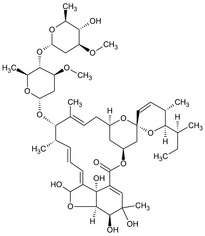
|
| 8a‐oxo‐4‐hydroxy‐avermectin B1a (NOA457465) |
[2’S,2a(3)Z,4E,5’S,6S,6’R,7S,8E,11R,15S,20S,20aR,20bR]‐6’‐[(2S)‐butan‐2‐yl]‐19,20,20b‐trihydroxy‐5’,6,8,19‐tetramethyl‐2,17‐dioxo‐5’,6,6’,10,11,14,15,17,19,20,20a,20b‐dodecahydro‐2H,7H‐spiro[11,15‐methanofuro[4,3,2‐pq][2,6]benzodioxacyclooctadecine‐13,2’‐pyran]‐7‐yl 2,6‐dideoxy‐4‐O‐(2,6‐dideoxy‐3‐O‐methyl‐α‐L‐arabino‐hexopyranosyl)‐3‐O‐methyl‐α‐L‐arabino‐hexopyranoside CO[C@H]1C[C@@H](O[C@@H](C)[C@@H]1O)O[C@@H]1[C@@H](OC)C[C@@H](O[C@H]1C)O[C@@H]1C(C) = CC[C@@H]2C[C@H](OC(=O)C3 = CC(C)(O)[C@@H](O)[C@H]4OC(=O)C(=CC=C[C@@H]1C)[C@@]34O)C[C@@]1(O2)C=C[C@H](C)[C@H](O1)[C@@H](C)CC ZYBQZTRBRQQAOX‐ISFARDRNSA‐N |

|
| 8‐carboxy‐6‐hydroxy‐avermectin B1a (M4) |
(2’S,3S,5’S,6’R,7R,9E,11S,12S,13E,15Z,16aS,18R,20aR)‐6’‐[(2S)‐butan‐2‐yl]‐11‐{[2,6‐dideoxy‐4‐O‐(2,6‐dideoxy‐3‐O‐methyl‐α‐L‐arabino‐hexopyranosyl)‐3‐O‐methyl‐α‐L‐arabino‐hexopyranosyl]oxy}‐16a,17,18‐trihydroxy‐5’,10,12,19‐tetramethyl‐1‐oxo‐3,4,5’,6’,7,8,11,12,16a,17,18,20a‐dodecahydro‐1H‐spiro[3,7‐methano[2,6]benzodioxacyclooctadecine‐5,2’‐pyran]‐16‐carboxylic acid CO[C@H]1C[C@@H](O[C@@H](C)[C@@H]1O)O[C@@H]1[C@@H](OC)C[C@@H](O[C@H]1C)O[C@H]1[C@@H](C)C=CC=C(C(=O)O)[C@@]2(O)[C@@H](C=C(C)[C@@H](O)C2O)C(=O)O[C@H]2C[C@H](O[C@]3(C2)C=C[C@H](C)[C@H](O3)[C@@H](C)CC)CC=C1C IPJDARSZWCALRL‐DSJCMUTNSA‐N |

|
The metabolite name in bold is the name used in the conclusion.
ACD/Name 2019.1.1 ACD/Labs 2019 Release (File version N05E41, Build 110555, 18 Jul 2019).
ACD/ChemSketch 2019.1.1 ACD/Labs 2019 Release (File version C05H41, Build 110712, 24 Jul 2019).
Supporting information
List of end points for the active substance and the representative formulation
Suggested citation: EFSA (European Food Safety Authority) , Anastassiadou M, Arena M, Auteri D, Brancato A, Bura L, Carrasco Cabrera L, Chaideftou E, Chiusolo A, Crivellente F, De Lentdecker C, Egsmose M, Fait G, Greco L, Ippolito A, Istace F, Jarrah S, Kardassi D, Leuschner R, Lostia A, Lythgo C, Magrans O, Mangas I, Miron I, Molnar T, Padovani L, Parra Morte JM, Pedersen R, R Hermine, Santos M, S Rachel, Sturma J, Szentes C, Terron A, Tiramani M, Vagenende B and Villamar‐Bouza L, 2020. Conclusion on the peer review of the pesticide risk assessment of the active substance abamectin. EFSA Journal 2020;18(8):6227, 28 pp. 10.2903/j.efsa.2020.6227
Requestor: European Commission
Question number: EFSA‐Q‐2016‐00691
Acknowledgements: EFSA wishes to thank the rapporteur Member State, Austria, for the preparatory work on this scientific output.
Adopted: 15 July 2020
Notes
Commission Implementing Regulation (EU) No 844/2012 of 18 September 2012 setting out the provisions necessary for the implementation of the renewal procedure for active substances, as provided for in Regulation (EC) No 1107/2009 of the European Parliament and of the Council concerning the placing of plant protection products on the market. OJ L 252, 19.9.2012, p. 26–32.
Commission Implementing Regulation (EU) No 2018/1659 of 7 November 2018 amending Implementing Regulation (EU) No 844/2012 in view of the scientific criteria for the determination of endocrine disrupting properties introduced by Regulation (EU) 2018/605.
Regulation (EC) No 1107/2009 of 21 October 2009 of the European Parliament and of the Council concerning the placing of plant protection products on the market and repealing Council Directives 79/117/EEC and 91/414/EEC. OJ L 309, 24.11.2009, p. 1–50.
Regulation (EC) No 1272/2008 of the European Parliament and of the Council of 16 December 2008 on classification, labelling and packaging of substances and mixtures, amending and repealing Directives 67/548/EEC and 1999/45/EC, and amending Regulation (EC) No 1907/2006. OJ L 353, 31.12.2008, p. 1–1355.
Experts’ consultation 2.1 in the Report of Pesticides Peer Review Experts’ meeting 25 (March 2020).
Experts’ consultation 2.7 in the Report of Pesticides Peer Review Experts’ meeting 25 (March 2020).
Experts’ consultation 2.8 in the Report of Pesticides Peer Review Experts’ meeting 25 (March 2020).
Data requirements were previously identified by EFSA for nematicide uses and seed treatment applications. In particular, for residues section, metabolism studies with seed applications to support the seed application uses in tomato, lettuce, soya bean, beet, corn, cotton and carrot were requested by EFSA (EFSA, 2016) and would be needed in case these uses were to be supported in the future.
Regulation (EC) No 396/2005 of the European Parliament and of the Council of 23 February 2005 on maximum residue levels of pesticides in or on food and feed of plant and animal origin and amending Council Directive 91/414/EEC. OJ L 70, 16.3.2005, p. 1–16.
Commission Regulation (EU) 2018/1514 of 10 October 2018 amending Annexes II, III and IV to Regulation (EC) No 396/2005 of the European Parliament and of the Council as regards maximum residue levels for abamectin, acibenzolar‐S‐methyl, clopyralid, emamectin, fenhexamid, fenpyrazamine, fluazifop‐P, isofetamid, Pasteuria nishizawae Pn1, talc E553B and tebuconazole in or on certain products. OJ L 256, 12.10.2018, p. 8–32.
Commission Regulation (EU) No 283/2013 of 1 March 2013 setting out the data requirements for active substances, in accordance with Regulation (EC) No 1107/2009 of the European Parliament and of the Council concerning the placing of plant protection products on the market. OJ L 93, 3.4.2013, p. 1–84.
Simulations utilised the agreed Q10 of 2.58 (following EFSA, 2008) and Walker equation coefficient of 0.7.
Experts’ consultation 4.6 of the Report of the Pesticide Peer Review TC 12.
Experts’ consultation 5.1 of the Report of the Pesticides Peer Review Experts’ Meeting 26 (March 2020).
Experts’ consultation 5.2 of the Report of the Pesticides Peer Review Experts’ Meeting 26 (March 2020).
Experts’ consultation 5.3 of the Report of the Pesticides Peer Review Experts’ Meeting 26 (March 2020).
See experts’ consultation 5.4 of the report of the Pesticide Peer Review meeting 26.
Commission Regulation (EU) No 546/2011 of 10 June 2011 implementing Regulation (EC) No 1107/2009 of the European Parliament and of the Council as regards uniform principles for evaluation and authorisation of plant protection products. OJ L 155, 11.6.2011, p. 127–175.
References
- Austria , 2019. Renewal Assessment Report (RAR) on the active substance abamectin prepared by the rapporteur Member State Austria, in the framework of Commission Implementing Regulation (EU) No 844/2012, March 2019. Available online: www.efsa.europa.eu
- Austria , 2020. Revised Renewal Assessment Report (RAR) on abamectin prepared by the rapporteur Member State Austria in the framework of Commission Implementing Regulation (EU) No 844/2012, April 2020. Available online: www.efsa.europa.eu
- ECHA (European Chemicals Agency), 2017. Guidance on the Application of the CLP Criteria; Guidance to Regulation (EC) No 1272/2008 on classification, labelling and packaging (CLP) of substances and mixtures. Version 5.0, July 2017. Reference: ECHA‐17-G-21‐EN; ISBN: 978‐92-9020‐050-5; available online: https://echa.europa.eu/guidance-documents/guidance-on-clp
- ECHA and EFSA (European Chemicals Agency and European Food Safety Authority) with the technical support of the Joint Research Centre (JRC) , Andersson N, Arena M, Auteri D, Barmaz S, Grignard E, Kienzler A, Lepper P, Lostia AM, Munn S, Parra Morte JM, Pellizzato F, Tarazona J, Terron A and Van der Linden S, 2018. Guidance for the identification of endocrine disruptors in the context of Regulations (EU) No 528/2012 and (EC) No 1107/2009. EFSA Journal 2018;16(6):5311,135 pp. 10.2903/j.efsa.2018.5311.echa-18-g-01-en [DOI] [PMC free article] [PubMed] [Google Scholar]
- EFSA (European Food Safety Authority), 2008. Opinion on a request from EFSA related to the default Q10 value used to describe the temperature effect on transformation rates of pesticides in soil. EFSA Journal 2008;6(1):622, 32 pp. 10.2903/j.efsa.2008.622 [DOI] [Google Scholar]
- EFSA (European Food Safety Authority), 2009. Guidance on Risk Assessment for Birds and Mammals on request from EFSA. EFSA Journal 2009;7(12):1438, 358 pp. 10.2903/j.efsa.2009.1438 [DOI] [Google Scholar]
- EFSA (European Food Safety Authority), 2011. Submission of scientific peer‐reviewed open literature for the approval of pesticide active substances under Regulation (EC) No 1107/2009. EFSA Journal 2011;9(2):2092, 49 pp. 10.2903/j.efsa.2011.2092 [DOI] [Google Scholar]
- EFSA (European Food Safety Authority), 2013. EFSA Guidance Document on the risk assessment of plant protection products on bees (Apis mellifera, Bombus spp. and solitary bees). EFSA Journal 2013;11(7):3295, 268 pp., 10.2903/j.efsa.2013.3295 [DOI] [PMC free article] [PubMed] [Google Scholar]
- EFSA (European Food Safety Authority), 2014a. EFSA Guidance Document on clustering and ranking of emissions of active substances of plant protection products and transformation products of these active substances from protected crops (greenhouses and crops grown under cover) to relevant environmental compartments. EFSA Journal 2014;12(3):3615, 43 pp., 10.2903/j.efsa.2014.3615 [DOI] [Google Scholar]
- EFSA (European Food Safety Authority), 2014b. Reasoned opinion on the review of the existing maximum residue levels (MRLs) for abamectin according to Article 12 of Regulation (EC) No 396/2005. EFSA Journal 2014;12(9):3823, 84 pp. 10.2903/j.efsa.2014.3823 [DOI] [Google Scholar]
- EFSA (European Food Safety Authority), 2014c. Guidance on the assessment of exposure of operators, workers, residents and bystanders in risk assessment for plant protection products. EFSA Journal 2014;12(10):3874, 55 pp. 10.2903/j.efsa.2014.3874. Available online: www.efsa.europa.eu/efsajournal [DOI] [PMC free article] [PubMed] [Google Scholar]
- EFSA (European Food Safety Authority), 2016. Conclusion on the peer review of the pesticide risk assessment of the active substance abamectin. EFSA Journal 2016;14(5):4491, 24 pp. 10.2903/j.efsa.2016.4491 [DOI] [Google Scholar]
- EFSA (European Food Safety Authority), 2020. Peer review report to the conclusion regarding the peer review of the pesticide risk assessment of the active substance abamectin. Available online: www.efsa.europa.eu
- EFSA PPR Panel (EFSA Panel on Plant Protection Products and their Residues), 2013. Guidance on tiered risk assessment for plant protection products for aquatic organisms in edge‐of‐field surface waters. EFSA Journal 2013;11(7):3290, 186 pp. 10.2903/j.efsa.2013.3290 [DOI] [Google Scholar]
- EFSA PPR Panel (EFSA Panel on Plant Protection Products and their Residues), 2017. Guidance on dermal absorption. EFSA Journal 2017;15(6):4873, 30 pp. 10.2903/j.efsa.2017.4873 [DOI] [Google Scholar]
- European Commission , 2000a. Residues: guidance for generating and reporting methods of analysis in support of pre‐registration data requirements for Annex II (Part A, Section 4) and Annex III (Part A, Section 5) of Directive 91/414. SANCO/3029/99‐rev. 4, 11 July 2000.
- European Commission , 2000b. Technical material and preparations: guidance for generating and reporting methods of analysis in support of pre‐ and post‐registration data requirements for Annex II (Part A, Section 4) and Annex III (Part A, Section 5) of Directive 91/414. SANCO/3030/99‐rev. 4, 11 July 2000.
- European Commission , 2002a. Guidance Document on Terrestrial Ecotoxicology Under Council Directive 91/414/EEC. SANCO/10329/2002-rev. 2 final, 17 October 2002.
- European Commission , 2002b. Guidance Document on Aquatic Ecotoxicology Under Council Directive 91/414/EEC. SANCO/3268/2001‐rev. 4 final, 17 October 2002.
- European Commission , 2003. Guidance Document on Assessment of the Relevance of Metabolites in Groundwater of Substances Regulated under Council Directive 91/414/EEC. SANCO/221/2000‐rev. 10 final, 25 February 2003.
- European Commission , 2008. Review report for the active substance abamectin. Finalised in the Standing Committee on the Food Chain and Animal Health at its meeting on 11 July 2008 in view of the inclusion of abamectin in Annex I of Council Directive 91/414/EEC. SANCO/138/08‐Final, 11 July 2008, 10 pp.
- European Commission , 2010. Guidance Document on residue analytical methods. SANCO/825/00‐rev. 8.1, 16 November 2010.
- European Commission , 2011. Guidelines on comparability, extrapolation, group tolerances and data requirements for setting MRLs. SANCO 7525/VI/95‐rev. 9. March 2011. p 1–46.
- European Commission , 2012. Guidance document on the assessment of the equivalence of technical materials of substances regulated under Regulation (EC) No 1107/2009. SANCO/10597/2003-rev. 10.1, 13 July 2012.
- European Commission , 2014a. Assessing potential for movement of active substances and their metabolites to ground water in the EU. Report of the FOCUS Workgroup. EC Document Reference SANCO/13144/2010-v. 3, 613 pp., as outlined in Generic guidance for tier 1 FOCUS groundwater assessment, v. 2.2, May 2014.
- European Commission , 2014b. Guidance document on the renewal of approval of active substances to be assessed in compliance with Regulation (EU) No 844/2012. SANCO/2012/11251‐rev. 4, 12 December 2014.
- FOCUS (Forum for the Co‐ordination of Pesticide Fate Models and their Use), 2001. FOCUS surface water scenarios in the EU evaluation process under 91/414/EEC. Report of the FOCUS Working Group on Surface Water Scenarios. EC Document Reference SANCO/4802/2001‐rev. 2, 245 pp., as updated by Generic guidance for FOCUS surface water scenarios, v. 1.4, May 2015.
- FOCUS (Forum for the Co‐ordination of Pesticide Fate Models and their Use), 2006. Guidance document on estimating persistence and degradation kinetics from environmental fate studies on pesticides in EU Registration Report of the FOCUS Work Group on Degradation Kinetics. EC Document Reference SANCO/10058/2005-v. 2.0, 434 pp., as updated by the Generic guidance for Estimating Persistence and Degradation Kinetics from Environmental Fate Studies on Pesticides in EU Registration, v. 1.1, December 2014.
- FOCUS (Forum for the Co‐ordination of Pesticide Fate Models and their Use), 2007. Landscape and mitigation factors in aquatic risk assessment. Volume 1. Extended summary and recommendations. Report of the FOCUS Working Group on Landscape and Mitigation Factors in Ecological Risk Assessment. EC Document Reference SANCO/10422/2005 v. 2.0, 169 pp.
- JMPR (Joint Meeting on Pesticide Residues), 2004. Report of the Joint Meeting of the FAO Panel of Experts on Pesticide Residues in Food and the Environment and the WHO Core Assessment Group on Pesticide Residues, Rome, Italy, 20–29 September 2004, 383 pp.
- JMPR (Joint Meeting on Pesticide Residues), 2007. Report of the Joint Meeting of the FAO Panel of Experts on Pesticide Residues in Food and the Environment and the WHO Core Assessment Group on Pesticide Residues, Geneva, Switzerland, 18–27 September 2007, 164 pp.
- OECD (Organisation for Economic Co‐operation and Development), 2009. Guidance document on overview of residue chemistry studies. ENV/JM/MONO(2009)31, 28 July 2009.
- OECD (Organisation for Economic Co‐operation and Development), 2011. OECD MRL calculator: spreadsheet for single data set and spreadsheet for multiple data set, 2 March 2011. In: Pesticide Publications/Publications on Pesticide Residues. Available online: www.oecd.org
- SETAC (Society of Environmental Toxicology and Chemistry), Candolfi MP, Barrett KL, Campbell PJ, Forster R, Grandy N, Huet MC, Lewis G, Oomen PA, Schmuck R and Vogt H (eds), 2001. Guidance document on regulatory testing and risk assessment procedures for plant protection products with non‐target arthropods. ESCORT 2 workshop.
Associated Data
This section collects any data citations, data availability statements, or supplementary materials included in this article.
Supplementary Materials
List of end points for the active substance and the representative formulation