



Abstract
Black females are disproportionately affected by HIV/STIs, though individual-level sexual risk factors do not appear to explain racial/ethnic HIV incidence rate disparities. The current study examined the roles of attachment representations, working models of self and others, with psychosocial risk factors related to population-level sexual network features in association with risky sexual behaviors. A total of 560 Black emerging adult females (M age= 20.58, SD = 1.89) enrolling in a behavioral HIV prevention intervention trial completed the baseline assessment used in the current analyses. A series of multiple mediator models examined indirect effects of working models of self and others on sexual risk engagement through the following psychosocial HIV/STI risk factor: (a) partner communication self-efficacy, (b) fear of condom negotiation, (c) peer norms for risky sexual behavior, (d) partner trust, and (e) sex-related alcohol expectancies. Results indicated indirect effects of working model of self on: condom use with boyfriend/main partner through peer norms for risky sex (ab = .08 ,95% CI [.02, .17]); any alcohol use prior to sex through peer norms for risky sex (ab = −.06, 95% CI [−.12, −.02]); and alcohol use prior to sex through sex-related alcohol expectancies (ab = −.13, 95% CI [−.21, −.05]). Findings indicated direct associations between working model of self and all the psychosocial HIV/STI risk factors included in the mediation models. Working model of self may help identify Black females elevated risk for HIV/STI through these psychosocial risk factors.
Keywords: attachment, emerging adulthood, risky sexual behavior, HIV prevention, Black, females
Introduction
Human immunodeficiency virus (HIV) and sexually transmitted infection (STI) prevalence is elevated among Black females in the United States (U.S.) (Centers for Disease Control and Prevention [CDC], 2018a). Epidemiological surveillance data (CDC, 2018c, 2018d) suggest the ages of 18–25 years, also known as emerging adulthood (Arnett, 2000, 2007), represent a critical period across racial/ethnic demographics for sexual risk-taking (Fergus, Zimmerman, & Caldwell, 2007). Though sexual behaviors that heighten HIV/STI risk are prevalent among emerging adults (Pflieger, Cook, Niccolai, & Connell, 2013), racial/ethnic HIV/STI disparities, as other studies (e.g., Hallfors, Iritani, Miller, & Bauer, 2007) have shown, are not explained by individual-level behavioral risk. Several studies indicate, compared with White and Latina females, Black emerging adult females are perhaps in fact less likely to engage in some risky sexual behaviors (e.g., anal sex; Haydon, Herring, Prinstein, & Halpern, 2012) and more likely to use condoms (Fergus, et al., 2007; Pflieger, et al., 2013).
Sexual networks, or groupings of individuals linked directly and indirectly through sexual contact (Adimora et al., 2003)., determine individual-level exposure risk, population-level dynamics of HIV/STI transmission, and sexual relationship patterns that facilitate infection spread (Morris, Kurth, Hamilton, Moody, & Wakefield, 2009). As explained by some (Adimora and Schoenbach, 2005; Kretzschmar, 2000), network structure is attributed to the influence of social contexts, including economic oppression (Adimora, Schoenbach, & Doherty, 2006) and Black male incarceration (Pouget, Kershaw, Niccolai, Ickovics, & Blankenship, 2010). What has been demonstrated by previous research is that Black populations, compared with other racial/ethnic groups, may tend to have smaller and more densely intraconnected sexual networks (Adimora and Schoenbach, 2002), inasmuch as Black individuals are more likely to have Black sexual partners only (Morris, et al., 2009), while at the same time male to female ratio is lowest in the U.S. among Blacks (U.S. Census Bureau., 2000; Tillerson, 2008). In general, evidence supports the view that gender ratio imbalance is associated with higher prevalence of concurrent heterosexual partnerships, along with racially-concordant sexual partnerships among both Black adult (Adimora et al., 2013; Laumann and Youm, 1999) and Black emerging adult populations (Morris, et al., 2009). These patterns only accelerate the spread of HIV/STI infection through sexual networks, but also relatively confine the spread to within Black populations (Adimora and Schoenbach, 2005; Adimora, et al., 2006). What is more, gender imbalance ingrains heterosexual relationship power dynamics (Newsome and Airhihenbuwa, 2013) associated with diminished Black female safer sex negotiating power, which when combined with elevated partner concurrency among Black males, heighten population-level HIV/STI exposures (Andrasik, Nguyen, George, & Kajumulo, 2014; Ferguson, Quinn, Eng, & Sandelowski, 2006; Johnson, 2017; Morris, et al., 2009).
Several experts, including Amaro (1995), Wingood and DiClemente (2000) have emphasized female HIV/STI vulnerability is linked to gender-based relational power imbalances. Miller (2012) proposed that the relational self, which regards abilities to form and further enhance interpersonal relationships, is the fundamental self-structure for females, and Amaro (1995) has argued, “(a) the centrality of connection to others as a core aspect of self, (b) the degree to which conflict in relationships [especially conflict related to safer sex negotiation] and fear of disconnection is threatening to women, (c) the degree of mutuality in the relationship with the male partner, (d) skills and comfort in dealing with conflict, and (e) the degree to which pregnancy and childbearing are perceived as avenues for further connecting with male partners” (p. 443) are critical to HIV/STI risk. Research that indicates perceptions of gender imbalance and sexual partnership norms (e.g., partner concurrency, decreased male emotional attachment to partners) may increase Black females’ engagement in risky sexual behaviors (e.g., unprotected sex; Cose, 2003; Ferguson, et al., 2006; McDaniel, DiPrete, Buchmann, & Shwed, 2011), and evidence that emotional need for romantic connection contributes more than personal risk protection to Black females’ sexual decision-making (Wyatt et al., 2000) support this view.
Emerging adulthood is a critical period for the development of relationship skills, emotion regulation, and ‘relational self’ in romantic contexts (Doherty and Feeney, 2004; Lapsley and Woodbury, 2015). Adult romantic relationships are attachments (Hazan, Shaver, & Bragshaw, 1988; Mikulincer and Shaver, 2007), similar to infant-caregiver attachments (Ainsworth, 1989; Bowlby, 1988). Emerging adults shift from primary caregivers to romantic partners as primary attachment figures (Doherty and Feeney, 2004; Umemura, Lacinová, Macek, & Kunnen, 2017) and construct adult attachment representations using information from existing attachment representations, or internal working models of attachment (Collins and Read, 1994). These models include beliefs, attitudes and expectations in terms of others’ reliability and responsiveness to attachment needs (i.e., working model of others), and the self’s lovability and worthiness (i.e., working model of self; (Collins, Clark, & Shaver, 1996; Mikulincer and Shaver, 2007). In addition, models of self and others enable simulation of interpersonal dynamics and prediction of possible outcomes, and are adapted based on new experiences (Mikulincer and Shaver, 2007). Thus, working models shape interpretations of relational dynamics and guide responses to relational events (Mikulincer and Shaver, 2003). Poor model of self indicated by low self-worth and lack of self-love corresponds to attachment anxiety, while poor model of others designated by distrust of others’ reliability or good will corresponds to avoidance (Bartholomew and Horowitz, 1991; Fraley, Waller, & Brennan, 2000). Secure adult attachment involves positive models of both self and others, whereas insecure attachment denotes either a poor model of self (preoccupied), poor model of others (dismissive), or both (fearful; Bartholomew and Horowitz, 1991).
Attachment insecurity may promote engagement in risky sexual behavior by prompting strategies for maintaining security, including avoiding rejection (e.g., fear of negotiating condom use, deferring to partners’ decisions about condom use) or seeking intimacy (e.g., satisfying sexual desires of partner, being exploited by promises of emotional attachment in exchange for unprotected sex, partner concurrency acceptance (Ferguson, et al., 2006; Newsome and Airhihenbuwa, 2013). To secure intimacy, Black emerging adult females may prefer unprotected sex with partners, as non-condom use is perceived as a sign of trust and commitment (Wingood and DiClemente, 1998). Females with insecure attachment representations may also be more likely to experience relationship norm violations (e.g., infidelity, inequity) which reinforce insecurities (Feeney, 2005), due their tendency to have relationships consistent with insecure beliefs (Doumas, Pearson, Elgin, & McKinley, 2008). Fear of negative partner reactions and partner concurrency acceptance are connected to relational power inequity and heighten Black female HIV/STI risk (Newsome and Airhihenbuwa, 2013; Sharpe et al., 2012). While features of insecure attachment (e.g., fear of rejection, intimacy seeking) are believed to elevate female HIV/STI risk (Amaro, 1995), and insecure attachment has been associated with unprotected sex (Cooper et al., 2006; Feeney, Peterson, Gallois, & Terry, 2000), there is a lack of research examining the role of working models of self and others in association with relational inequity and engagement in risky sexual behaviors among Black emerging adult females.
Based on insecure attachment representations, emerging adult females experiencing gender power inequity may fear and avoid rejection, struggle with condom negotiation and partner communication, seek intimacy through unprotected sex, and endorse social norms for unprotected sex. The aim of this study was to examine the association between working model of self and others in relation to risky sexual behavior engagement and HIV/STI risk factors among emerging adult Black females. We hypothesized that negative working model of self and positive working model of others would be associated with inconsistent condom use, and unprotected sex with primary partners. We further hypothesized that these associations would be mediated by fear of condom negotiation, low partner communication self-efficacy, endorsement of peer norms for risky sexual behavior, and partner trust. Research also indicates insecure attachment is associated with sex-related alcohol expectancies (Hutton et al., 2015), substance use prior to sexual encounters (Kiene, Barta, Tennen, & Armeli, 2009; Leigh, 2002).Thus, we also hypothesized that negative working model of self and positive working model of others would be associated with alcohol use prior to sex, and that this association would be mediated by fear of condom negotiation, low partner communication self-efficacy, endorsement of peer norms for risky sexual behavior, and sex-related alcohol expectancies.
Method
Participants and Procedures
Participants (N = 560; M age = 20.58, SD = 1.89) recruited via community outreach (January 2012-February 2014) in a large Southeastern U.S. city for an HIV-risk reduction intervention trial were screened for eligibility and provided written informed consent prior to baseline assessment. The sample included young women aged 18–24 who self-identified as Black and met the following criteria: not married or pregnant, consumed alcohol on ≥3 occasions within 90 days prior, and had unprotected vaginal sex with a male within 90 days prior. The X Institutional Review Board approved all study procedures. The current study includes only the baseline assessment data collected via audio computer-assisted self-interview (ACASI) prior to randomization. See Table 1 for descriptive sample characteristics.
Table 1.
Demographic Characteristics of Participants (N = 560)
| Demographic Variable | N (%) | Reported Range |
|---|---|---|
| Age M (SD) | 20.58 (1.89) | 17-24 |
| Number of forms of government aid M (SD) | 1.35 (0.93) | 0-4 |
| Currently employed | 152 (27.14) | -- |
| Highest level of education | ||
| At least a high school degree or GED | 370 (66.1) | -- |
| Has a boyfriend or main partner | 473 (84.46) | -- |
| Current relationship duration (months)a M (SD) | 20.55 (23.64) | 0-144 |
N = 473 reporting; this measure was assessed only among participants reporting relationship status as currently in a relationship.
Measures
Sociodemographics.
Participants reported age, employment status, education level, government assistance received by household within past year, current relationship status and relationship duration with current partner.
Working models of self and others.
Participants rated each of the four descriptions presented by The Relationship Questionnaire (RQ; Bartholomew and Horowitz, 1991), corresponding with secure, preoccupied, fearful and dismissive attachment on a four-point scale (1-not at all like me; 4-very much like me). Scores for working models of self and others were obtained from participants’ ratings (Griffin and Bartholomew, 1994)4, with higher working model of self and working model of others scores indicating more favorable representations characterized by self-worth and lovability, and reliability and trustworthiness of others.
Risky sexual behaviors.
Proportion condom use for vaginal sex (past 3 months) calculated as the number of times a condom was used during vaginal sex divided by the number of vaginal sex episodes in the past 3 months. Participants endorsing a current boyfriend/main partner reported condom use with boyfriend or main partner at the most recent sexual encounter (yes/no). Frequency of alcohol use prior to sexual encounters (past 3 months) was reported on a five-point scale (1-never; 5-always), and a dichotomized variable indicating any alcohol use prior to sexual encounters was created. For descriptive purposes, participants reported number of lifetime and recent (past 3 months) male sexual partners, as well as condom use at the most recent sexual encounters involving and not involving alcohol (yes/no).
Psychosocial HIV/STI risk factors.
For the following measures, item responses were summed, with higher scores indicating greater: partner communication self-efficacy, fear of communicating with partners about condom use, perceptions of risky sexual norms among peers, trusting of current boyfriend/main partner, and expectancy of desirable sex-related effects of alcohol.
Partner communication self-efficacy.
Participants responded to the six-item subscale of the Partner Communication History measure (Wingood and DiClemente, 1998) on a four-point scale (1-very hard; 4-very easy).
Fear of condom negotiation.
Participants responded to seven items (DiClemente et al., 2001) on a five-point scale (1-never; 5-always).
Peer norms for risky sexual behavior.
Participants responded to five items (Stanton et al., 1995) on a five-point scale (1-none; 5- all).
Partner trust.
Participants responded to three items from the Partner Trust Scale (Rempel, Holmes, & Zanna, 1985) on a seven-point scale (1-strongly disagree; 7-strongly agree).
Alcohol expectancies.
Participants responded to eight items from The Comprehensive Effects of Alcohol questionnaire (Fromme, Stroot, & Kaplan, 1993). Four items assessed endorsement of sex-related alcohol expectancies on a four-point scale (1- disagree; 4-agree), and four items indicated subjective evaluations of each effect on a five-point scale (1-bad; 5-good).
Results
Analytic Approach
Bivariate correlational analyses indicated minimal multicollinearity among mediators (see Table 2). A multiple mediation model including working model of self and working model others as simultaneous predictors was analyzed for each risky sexual behavior outcome using The PROCESS macro for SPSS (Hayes, 2013). Coefficients were estimated using ordinary least squares and logistic path analyses, and indirect effects were provided using the product of coefficients method for mediation (Shrout, 2002). Bootstrapped 95% confidence intervals were estimated for indirect effect significance testing. Figures 1-3 depict the covariates and mediators included in each model.
Table 2.
Correlations between Study Variables among Participants (N = 560)
| 1 | 2 | 3 | 4 | 5 | 6 | 7 | 8 | 9 | 10 | 11 | 12 | 13 | 14 | 15 | 16 | |
|---|---|---|---|---|---|---|---|---|---|---|---|---|---|---|---|---|
| 1. Agea | -- | |||||||||||||||
| 2. Government aida | .005 | -- | ||||||||||||||
| 3. Current relationship durationa,d | .022*** | .026 | -- | |||||||||||||
| 4. Relationship statusb | .027 | .073 | .c | -- | ||||||||||||
| 5. Educationb | .192*** | −.156*** | .033 | −.081 | -- | |||||||||||
| 6. Employment statusb | .134** | −.125** | .088 | .007 | .289*** | -- | ||||||||||
| 7. Working model of selfa | .023 | −.058 | .053 | .005 | .086* | .064 | -- | |||||||||
| 8. Working model of othersa | .054 | .025 | .046 | .047 | .038 | .007 | .138** | -- | ||||||||
| 9. Fear of condom negotiationa | −.026 | .066 | −.104* | −.026 | −.147** | −.059 | −.228*** | −.044 | -- | |||||||
| 10. Partner communication self-efficacya | .042 | −.031 | .119** | .076 | .045 | .050 | .257*** | .025 | −.530*** | -- | ||||||
| 11. Peer-norms for risky sexa | −.011 | .013 | −.004 | −.050 | −.003 | −.030 | −.146** | −.044 | .331*** | −.294*** | -- | |||||
| 12. Sex-related alcohol expectanciesa | .044 | .000 | −.017 | −.089* | .018 | .048 | −.176*** | −.007 | .337*** | −.314*** | .370*** | -- | ||||
| 13 Partner trusta,d | −.091* | −.085 | .082 | .c | .062 | .052 | .202*** | .096* | −.303*** | .350*** | −.167*** | −.275*** | -- | |||
| 14. Proportion condom use (vaginal sex)a,e | −.012 | −.135** | −.164*** | −.140** | .046 | .012 | −.058 | .026 | −.050 | .008 | −.045 | .020 | −.044 | -- | ||
| 15. Condom use with boyfriend/main partnerb,f | −.087 | −.040 | −.141** | .c | −.029 | −.023 | −.048 | .018 | −.054 | .050 | −.194*** | −.063 | −.003 | .373** | -- | |
| 16. Any alcohol use before sexb | .132** | .063 | .039 | .022 | .006 | .038 | −.022 | .017 | .123** | −.075 | .222*** | .288* | −.064 | −.062 | −.089 | -- |
Note. Pearson’s r coefficients were calculated to assess correlation between two continuous variables; Correlation between two dichotomous variables was assessed by phi coefficient calculations; and correlation between a continuous and a dichotomous variable was assessed by point-biserial coefficient.
Indicates a continuous variable.
Indicates a dichotomous categorical variable.
Coefficient cannot be computed because one of the variables is constant.
N = 473 reporting; this measure was only assessed among those currently in a relationship.
N = 548 reporting.
N = 462; this measure was only assessed among those currently in a relationship.
p < .05,
p < .01,
p < .001.
Figure 1.
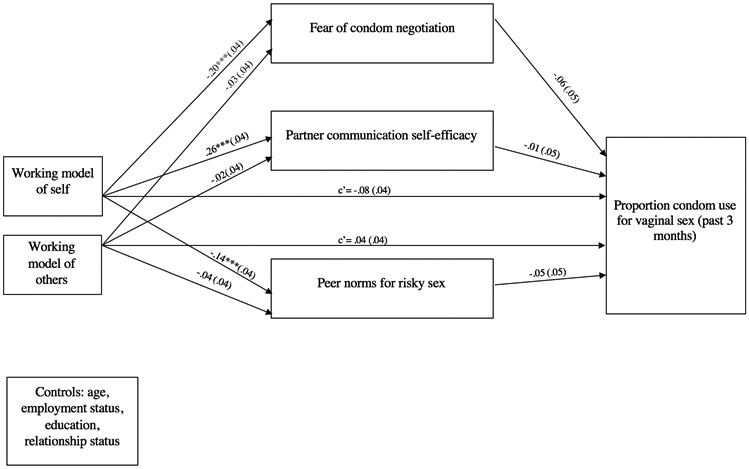
Multiple mediation model predicting proportion condom use for vaginal sex (past 3 months). Standardized bootstrapped regression coefficients are provided along paths with standard errors in parentheses.
*** p < .001.
Figure 3.
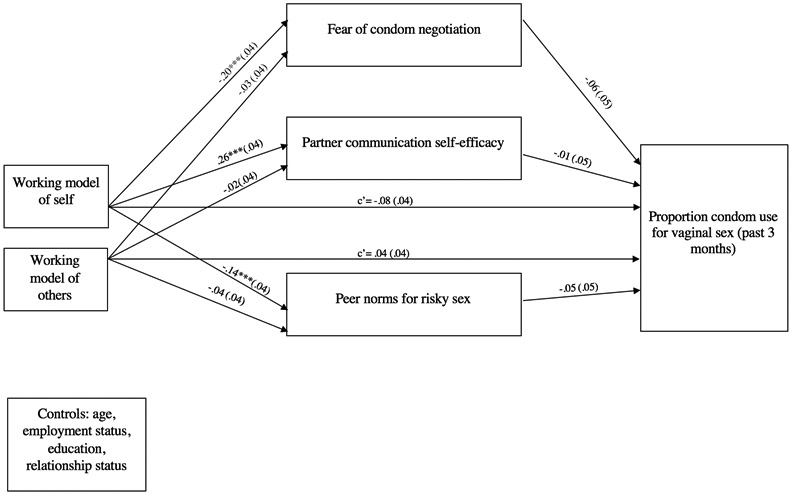
Multiple mediation model predicting any alcohol use prior to sexual encounters (past 3 months). Standardized bootstrapped regression coefficients are provided along paths with standard errors in parentheses.
*** p < .001.
Sample Description
Sample sociodemographic characteristics are provided in Table 1. Mean number of lifetime and recent sexual partners were approximately 13 (SD = 18.48) and 2 (SD = 3.03), respectively (see Table 3). A majority reported having not used condoms at the most recent sexual encounter involving alcohol (65.78%), not involving alcohol (64.29%) and, among those in relationships, with a main partner (75.76%).
Table 3.
Self-reported Engagement in Risky Sexual Behaviors among Participants (N = 560)
| RSB Variables | N (%) | Reported Range |
|---|---|---|
| Proportion condom use for vaginal sex (past 3 months)a M (SD) | .33 (0.31) | 0-.96 |
| Number of sexual partners (lifetime) M (SD) | 12.83 (18.48) | 1-200 |
| Number of sexual partners (past 3 months) M (SD) | 2.36 (3.03) | 1-34 |
| Frequency of drinking alcohol before having sexual intercourse (past 3 months) | ||
| Never | 148 (26.43) | -- |
| Almost never | 96 (17.14) | -- |
| Sometimes | 224 (40.00) | -- |
| Almost always | 62 (11.07) | -- |
| Always | 30 (5.36) | -- |
| Did not use a condom at most recent sexual encounter involving alcoholb | 271 (65.78) | -- |
| Did not use a condom at most recent sexual encounter not involving alcohol | 360 (64.29) | -- |
| Did not use condom with boyfriend/main partner are most recent sexual encounterc | 350 (75.76) | -- |
N = 548.
N = 412 reporting; this measures was only assessed among those reporting they have ever consumed alcohol before having sex.
N = 462 reporting; this measure was assessed only among participants reporting relationship status as currently in a relationship.
Mediation Models Predicting Self-reported Sexual Risk Engagement
Proportion condom use for vaginal sex.
Working model of others was not associated with any mediators. Working model of self was positively associated with partner communication self-efficacy, and negatively associated with fear of condom negotiation and peer norms for risky sexual behavior; though, none of the mediators were associated with this sexual risk outcome (see Figure 1). Neither working model of self nor working model of others were associated with the outcome in the mediated model, and no indirect effects were indicated (see Table 4).
Table 4.
Indirect Effects of Working Model of Self and Working Model of Others on Self-reported Engagement in Risky Sexual Behaviors
| Working model of self |
Working model of others |
|||||||
|---|---|---|---|---|---|---|---|---|
| 95% Confidence Interval |
95% Confidence Interval |
|||||||
| Mediator | Parameter estimatea |
SE | Lower | Upper | Parameter estimateb |
SE | Lower | Upper |
| Proportion condom use for vaginal sex (past 3 months) | ||||||||
| Fear of condom negotiation | .01 | .01 | −.01 | .04 | .00 | .00 | .00 | .02 |
| Partner communication self-efficacy | .00 | .01 | −.03 | .02 | .00 | .00 | .00 | .01 |
| Peer norms for risky sex | .01 | .01 | .00 | .02 | .00 | .00 | .00 | .01 |
| Condom use at most recent sexual encounter with boyfriend/main partner | ||||||||
| Fear of condom negotiation | .03 | .04 | −.04 | .12 | .00 | .01 | −.01 | .05 |
| Partner communication self-efficacy | .02 | .04 | −.06 | .10 | .00 | .01 | −.03 | .01 |
| Peer norms for risky sex | .08* | .04 | .02 | .17 | .03 | .03 | −.02 | .09 |
| Partner trust | −.02 | .02 | −.07 | .02 | −.01 | .01 | −.04 | .01 |
| Any alcohol use prior to sexual encounters (past 3 months) | ||||||||
| Fear of condom negotiation | −.02 | .03 | −.11 | .03 | .00 | .01 | −.03 | .01 |
| Partner communication self-efficacy | .02 | .04 | −.05 | .10 | .00 | .01 | −.03 | .00 |
| Peer norms for risky sex | −.06* | .03 | −.12 | −.02 | −.02 | .02 | −.06 | .02 |
| Sex-related alcohol expectancies | −.13* | .04 | −.21 | −05 | .01 | .03 | −.04 | .07 |
Controlling for covariates, working model of others, and other mediators.
Controlling for covariates, working model of self, and other mediators.
p < .05 (significant indirect effect).
Condom use at the most recent sexual encounter with boyfriend/main partner.
Working model of others was not associated with any mediators. Working model of self was positively associated with partner communication self-efficacy and partner trust, and negatively associated with fear of condom negotiation and peer norms for risky sexual behavior (see Figure 2). Endorsement of risky peer norms was the only mediator associated with this sexual risk outcome. An indirect effect of working model of self on condom use with boyfriend/main partner through risky peer norms observed (see Table 4), such that lower working model of self scores were associated with greater endorsement of risky sexual norms among peers, which in turn was associated with reduced odds of condom use at the most recent sexual encounter with boyfriend/main partner.
Figure 2.
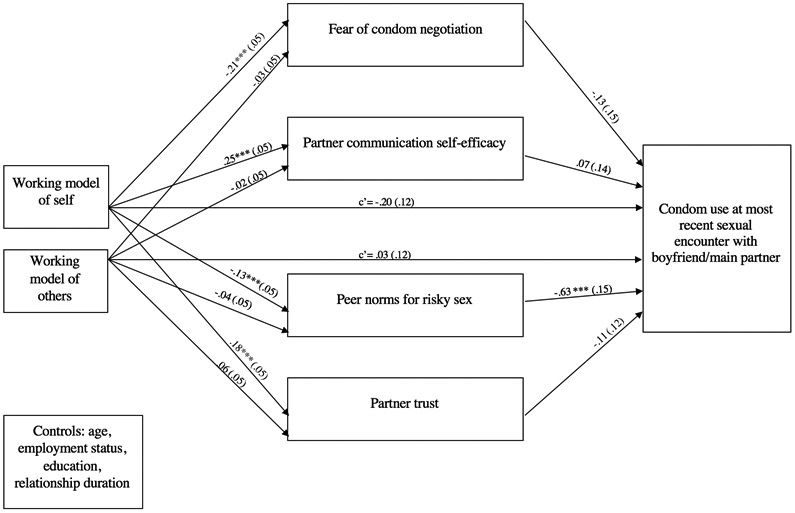
Multiple mediation model predicting condom use at last sexual encounter with boyfriend/main partner (N = 462). Standardized bootstrapped regression coefficients are provided along paths with standard errors in parentheses.
*** p < .001.
Alcohol use prior to any sexual encounter (past 3 months).
Working model of others was not associated with any mediators. Working model of self was positively associated with partner communication self-efficacy, and negatively associated with fear of condom negotiation, peer norms, and sex-related alcohol expectancies (see Figure 3). Peer norms and sex-related alcohol expectancies were associated with this sexual risk behavioral outcome, and results supported indirect effects of working model of self on any alcohol use prior to sex through these mediators (see Table 4), such that lower working model of self scores were associated with greater endorsement of risky sexual norms among peers and endorsement of desirable sex-related alcohol effects, which in turn were associated with increased odds of any alcohol use prior to sex.
Discussion
HIV/STI disparities exist among Black females during emerging adulthood (CDC, 2018a, 2018b, 2018c). Racial/ethnic disparities in HIV incidence are not explained by individual risk engagement alone (Cavazos-Rehg, et al., 2009; Pflieger, et al., 2013; Tillerson, 2008) and are influenced by structural factors, such as gender ratio imbalance and gender power inequity (Adimora and Schoenbach, 2005; Adimora, et al., 2006; Friedman, Cooper, & Osborne, 2009). The current study examined the role of attachment constructs, working model of self and others, on risky sexual behavior outcomes through psychosocial HIV/STI risk factors associated with gender power inequity.
Results point to high levels of unprotected sex, with a majority of participants reporting a current boyfriend or main partner. This is consistent with findings of elevated levels of non-condom use among Black females with steady sexual partners (Crosby et al., 2000; Kanu et al., 2009). Although non-condom use may signify relationship trust and commitment (Conley and Rabinowitz, 2004), partner trust was not associated with unprotected sex with a steady partner; however, longer relationship duration (covariate) and greater endorsement of peer norms for risky sexual behavior were, which suggests Black females may engage in unprotected sex with primary partners, not necessarily because they experience a sense of trust, but because they are behaving according to the unwritten rule that unprotected sex implies trust (Hammer, Fisher, Fitzgerald, & Fisher, 1996), and perhaps attempting to construct an outward sense of commitment (Newsome and Airhihenbuwa, 2013).
Moreover, poorer working model of self was associated with reduced odds of condom use at the most recent sexual encounter with primary partner through greater endorsement of peer norms for risky sex. In general, poorer working model of self may indicate low self-worth, perceived unlovability, and/or perceived unworthiness of others’ love, which may translate to fear of rejection and/or seeking excessive intimacy. The current findings suggest that Black emerging adult females with poorer models of self may be more norm compliant, consistent with prior evidence that anxiously attached individuals use sex to avoid rejection and be reassured of partner’s interest (Tracy, Shaver, Albino, & Cooper, 2003). Emerging adults may perceive less risk associated with unprotected sex in primary partnerships. However, those with poor working model of self may be more likely to choose attachment avoidant partners (poor working model of others; Collins and Read, 1990), which may increase unprotected sex and having partners who are engaged in concurrent sexual relationships.
There was also an indirect effect of poorer working model of self on increased odds of any alcohol use prior to sex through greater endorsement of risky sexual norms among peers. These findings are consistent with the social norms theory of risk appraisal (Berkowitz, 2003) and evidence that peer norms for risky sexual behavior are associated with engagement in risky sexual behavior (Boone and Lefkowitz, 2004). Gender ratio imbalance promotes a set of unwritten relationship rules or ‘norms’ that elevate HIV/STI risk among Black females (Ferguson, et al., 2006; Fullilove, Fullilove III, Haynes, & Gross, 1990). It could be that females who are motivated by fear of rejection (Collins, et al., 1996; Ferguson, et al., 2006) are especially prone to elevated HIV/STI risk. Poorer working model of self also indirectly affected increased odds of any alcohol use prior to sex through greater endorsement of beliefs that alcohol produces desirable sex-related effects. Black emerging adult females may consume alcohol prior to sex based on the belief that alcohol increases sexual confidence and/or reduces embarrassment or inhibition (Hutton et al., 2015), and it appears that those with poorer models of self may be inclined to seek these effects, perhaps to augment sexual performance and increase satisfaction with male sexual desires.
Across mediation models, poorer working model of self was associated with all the psychosocial HIV/STI risk factors indicative of gender power inequity: lower partner communication self-efficacy, greater fears related to condom negotiation, greater endorsement of peer norms for risky sexual behavior, lower partner trust, and greater sex-related alcohol expectancies, whereas working model of others was not, suggesting gender power inequity may be internalized in terms of personal powerlessness rather than others’ powerfulness. That few of these psychosocial risk factors were directly associated with risky sexual behavior outcomes (including condom use) is inconsistent with the extant literature. I may be that there was insufficient variation in condom use and relationship status that diminished the ability to detect certain direct and indirect effects.
Limitations
Several limitations of the current study should be noted. Assessing the four attachment models by single-items may measure a narrower range of beliefs and behaviors characterizing models. Multi-item measures of adult attachment constructs may provide more comprehensive and accurate assessment (Shaver and Fraley, 2004). The current sample consisted of Black emerging adults who reported recent alcohol consumption and unprotected sex, a majority of whom were in a relationship with a primary partner; thus, results may not generalize to males, females of other racial/ethnic backgrounds, females not in relationships or who do not consume alcohol. Cross-sectional data also assumes that working models were relatively stable and concurrent with sexual outcomes.
Conclusions
Efficacious, gender- and culturally-tailored behavioral HIV prevention interventions for Black female emerging adults often target psychosocial HIV/STI risk factors associated with relational gender inequity. The current study proposed that adult attachment representations, working models of self and others, might be associated with risky sexual behavior through HIV/STI risk factors related to power inequity. Findings indicated poorer model of self (i.e., low self-worth, perceived unlovability, perceived unworthiness of others’ love) was indirectly associated with sexual risk engagement through peer norms for risky sex and sex-related alcohol expectancies, as well as was directly associated with psychosocial HIV/STI risk relevant to disparate relationship power between males. Model of self may indicate Black female youths at elevated risk for HIV/STI risk through its association psychosocial risk factors, particularly endorsement social norms.
Acknowledgments
Funding: This work was supported by the National Institute on Alcohol Abuse and Alcoholism under Grant R01AA018096 (PI: Ralph J. DiClemente).
Biography
1. Dr. Ralph DiClemente was trained as a health psychologist at the University of California, San Francisco where he received his PhD in 1984. A primary focus of his research has been Developing interventions to reduce the risk of HIV/STD among vulnerable populations.
2. Dr. Jennifer Brown received her PhD from Syracuse University in 2012. Her research focuses on the intersection of substance use, Hepatitis C, and HIV.
3. Nicole Gause, M.A., is a doctoral student at the University of Cincinnati, with a primary research interest in public health issues, including opioid addiction and HIV.
Footnotes
Data availability statement: Access to data available upon request to senior author (Ralph J. DiClemente)
Working model of self scores obtained by ratings of (secure + dismissive) - (preoccupied + fearful); Working model of others scores obtained by ratings of (secure + preoccupied - (dismissive + fearful).
Declaration of interest statement
The authors declare that they have no conflict of interest.
References
- Adimora AA, & Schoenbach VJ (2002). Contextual factors and the black-white disparity in heterosexual HIV transmission. Epidemiology, 13(6), pp. 707–712. [DOI] [PubMed] [Google Scholar]
- Adimora AA, & Schoenbach VJ (2005). Social context, sexual networks, and racial disparities in rates of sexually transmitted infections. The Journal of infectious diseases, 191(Supplement_1), pp. S115–S122. [DOI] [PubMed] [Google Scholar]
- Adimora AA, Schoenbach VJ, & Doherty IA (2006). HIV and African Americans in the southern United States: sexual networks and social context. Sexually Transmitted Diseases, 33(7), pp. S39–S45. [DOI] [PubMed] [Google Scholar]
- Adimora AA, Schoenbach VJ, Martinson FE, Donaldson KH, Stancil TR, & Fullilove RE (2003). Concurrent partnerships among rural African Americans with recently reported heterosexually transmitted HIV infection. JAIDS Journal of Acquired Immune Deficiency Syndromes, 34(4), pp. 423–429. [DOI] [PubMed] [Google Scholar]
- Adimora AA, Schoenbach VJ, Taylor EM, Khan MR, Schwartz RJ, & Miller WC (2013). Sex ratio, poverty, and concurrent partnerships among men and women in the United States: a multilevel analysis. Annals of epidemiology, 23(11), pp. 716–719. [DOI] [PMC free article] [PubMed] [Google Scholar]
- Ainsworth MS (1989). Attachments beyond infancy. American psychologist, 44(4), p 709. [DOI] [PubMed] [Google Scholar]
- Amaro H (1995). Love, sex, and power: Considering women’s realities in HIV prevention. American psychologist, 50(6), p 437. [DOI] [PubMed] [Google Scholar]
- Andrasik MP, Nguyen HV, George WH, & Kajumulo KF (2014). Sexual decision making in the absence of choice: The African American female dating experience. Journal of health disparities research and practice, 7(7), p 66. [PMC free article] [PubMed] [Google Scholar]
- Arnett JJ (2000). Emerging adulthood: A theory of development from the late teens through the twenties. American psychologist, 55(5), p 469. [PubMed] [Google Scholar]
- Arnett JJ (2007). Emerging adulthood: What is it, and what is it good for? Child development perspectives, 1(2), pp. 68–73. [Google Scholar]
- Bartholomew K, & Horowitz LM (1991). Attachment styles among young adults: a test of a four-category model. Journal of personality and social psychology, 61(2), p 226. [DOI] [PubMed] [Google Scholar]
- Berkowitz AD (2003). Applications of social norms theory to other health and social justice issues. The social norms approach to preventing school and college age substance abuse: A handbook for educators, counselors, and clinicians, pp. 259–279. [Google Scholar]
- Boone TL, & Lefkowitz ES (2004). Safer sex and the health belief model: Considering the contributions of peer norms and socialization factors. Journal of Psychology & Human Sexuality, 16(1), pp. 51–68. [Google Scholar]
- Bowlby J (1988). A Secure Base. Parent-Child Attachment and Healthy Human Development. New York: (Basic Books; ) 1988. [Google Scholar]
- United States Census Bureau. (2000). Male-female ratio by race alone or in combination and Hispanic or Latino origin for the United States: 2000 (PHC-T-11). . http://www.census.gov/population/www/cen2000/briefs/phc-t11/index.html
- Cavazos-Rehg PA, Krauss MJ, Spitznagel EL, Schootman M, Bucholz KK, Peipert JF, . . . Bierut LJ (2009). Age of sexual debut among US adolescents. Contraception, 80(2), pp. 158–162. [DOI] [PMC free article] [PubMed] [Google Scholar]
- Centers for Disease Control and Prevention. (2018a). HIV Among African Americans. Retrieved from https://www.cdc.gov/hiv/group/racialethnic/africanamericans/index.html.
- Centers for Disease Control and Prevention. (2018b). HIV Among Youth. Retrieved from https://www.cdc.gov/hiv/group/age/youth/index.html.
- Centers for Disease Control and Prevention. (2018c). HUV Surveillance Report, 2017. https://www.cdc.gov/hiv/library/reports/hiv-surveillance.html
- Centers for Disease Control and Prevention. (2018d). STDs in Racial and Ethnic Minorities. Retrieved from https://www.cdc.gov/std/stats17/minorities.htm.
- Collins N, Clark CL, & Shaver PR (1996). Attachment styles and internal working models of self and relationship partners In Fletcher GJO & Fitness J (Eds.), Knowledge structures in close relationships: A social psychological approach (pp. 25–62). Mahway, NJ: Lawrence Erlbaum Associates. [Google Scholar]
- Collins NL, & Read SJ (1990). Adult attachment, working models, and relationship quality in dating couples. Journal of personality and social psychology, 58(4), p 644. [DOI] [PubMed] [Google Scholar]
- Collins NL, & Read SJ (1994). Cognitive representations of attachment: The structure and function of working models. [Google Scholar]
- Conley TD, & Rabinowitz JL (2004). Scripts, close relationships, and symbolic meanings of contraceptives. Personal Relationships, 11(4), pp. 539–558. [Google Scholar]
- Cooper ML, Pioli M, Levitt A, Talley AE, Micheas L, & Collins NL (2006). Attachment styles, sex motives, and sexual behavior. Dynamics of romantic love: Attachment, caregiving, and sex, pp. 243–274. [Google Scholar]
- Cose E (2003). RACE: The Black Gender Gap. NEWSWEEK-AMERICAN EDITION-, 141(9), pp. 46–51. [Google Scholar]
- Crosby RA, DiClemente RJ, Wingood GM, Sionean C, Cobb BK, & Harrington K (2000). Correlates of unprotected vaginal sex among African American female adolescents: importance of relationship dynamics. Archives of Pediatrics & Adolescent Medicine, 154(9), pp. 893–899. [DOI] [PubMed] [Google Scholar]
- DiClemente RJ, Wingood GM, Crosby RA, Sionean C, Brown LK, Rothbaum B, . . . Davies, S. (2001). A prospective study of psychological distress and sexual risk behavior among black adolescent females. Pediatrics, 108(5), pp. E85–E85. Retrieved from http://search.ebscohost.com/login.aspx?direct=true&db=cmedm&AN=11694669&site=ehost-live [DOI] [PubMed] [Google Scholar]
- Doherty NA, & Feeney JA (2004). The composition of attachment networks throughout the adult years. Personal Relationships, 11(4), pp. 469–488. [Google Scholar]
- Doumas DM, Pearson CL, Elgin JE, & McKinley LL (2008). Adult attachment as a risk factor for intimate partner violence: The “mispairing” of partners’ attachment styles. Journal of interpersonal violence, 23(5), pp. 616–634. [DOI] [PubMed] [Google Scholar]
- Feeney JA (2005). Hurt feelings in couple relationships: Exploring the role of attachment and perceptions of personal injury. Personal Relationships, 12(2), pp. 253–271. [Google Scholar]
- Feeney JA, Noller P, & Patty J (1993). Adolescents’ interactions with the opposite sex: Influence of attachment style and gender. Journal of adolescence, 16(2), p 169. [DOI] [PubMed] [Google Scholar]
- Feeney JA, Peterson C, Gallois C, & Terry DJ (2000). Attachment style as a piedictor of sexual attitudes and behavior in late Adolescence. Psychology & health, 14(6), pp. 1105–1122. [DOI] [PubMed] [Google Scholar]
- Fergus S, Zimmerman MA, & Caldwell CH (2007). Growth trajectories of sexual risk behavior in adolescence and young adulthood. American Journal Of Public Health, 97(6), pp. 1096–1101. [DOI] [PMC free article] [PubMed] [Google Scholar]
- Ferguson YO, Quinn SC, Eng E, & Sandelowski M (2006). The gender ratio imbalance and its relationship to risk of HIV/AIDS among African American women at historically black colleges and universities. AIDS care, 18(4), pp. 323–331. [DOI] [PubMed] [Google Scholar]
- Fraley RC, Waller NG, & Brennan KA (2000). An item response theory analysis of self-report measures of adult attachment. Journal of personality and social psychology, 78(2), p 350. [DOI] [PubMed] [Google Scholar]
- Friedman SR, Cooper HL, & Osborne AH (2009). Structural and social contexts of HIV risk among African Americans. American Journal Of Public Health, 99(6), pp. 1002–1008. [DOI] [PMC free article] [PubMed] [Google Scholar]
- Fromme K, Stroot E, & Kaplan D (1993). Comprehensive effects of alcohol: development and psychometric assessment of a new expectancy questionnaire (English). Psychological assessment, 5(1), pp. 19–26. [Google Scholar]
- Fullilove MT, Fullilove III RE, Haynes K, & Gross S (1990). Black women and AIDS prevention: A view towards understanding the gender rules. Journal of Sex Research, 27(1), pp. 47–64. [Google Scholar]
- Garofalo R, Herrick A, Mustanski BS, & Donenberg GR (2007). Tip of the iceberg: Young men who have sex with men, the Internet, and HIV risk. American Journal Of Public Health, 97(6), pp. 1113–1117. [DOI] [PMC free article] [PubMed] [Google Scholar]
- Griffin DW, & Bartholomew K (1994). Models of the self and other: Fundamental dimensions underlying measures of adult attachment. Journal of personality and social psychology, 67(3), pp. 430–445. [Google Scholar]
- Hallfors DD, Iritani BJ, Miller WC, & Bauer DJ (2007). Sexual and drug behavior patterns and HIV and STD racial disparities: the need for new directions. American Journal Of Public Health, 97(1), pp. 125–132. [DOI] [PMC free article] [PubMed] [Google Scholar]
- Hammer JC, Fisher JD, Fitzgerald P, & Fisher WA (1996). When Two Heads Aren’t Better Than One: AIDS Risk Behavior in College‐Age Couples 1. Journal of Applied Social Psychology, 26(5), pp. 375–397. [Google Scholar]
- Haydon AA, Herring AH, Prinstein MJ, & Halpern CT (2012). Beyond age at first sex: Patterns of emerging sexual behavior in adolescence and young adulthood. Journal of Adolescent Health, 50(5), pp. 456–463. [DOI] [PMC free article] [PubMed] [Google Scholar]
- Hayes AF (2013). Introduction to mediation, moderation, and conditional process analysis: A regression-based approach: Guilford Press. [Google Scholar]
- Hazan C, Shaver P, & Bragshaw D (Eds.). (1988). Love as attachment: The integration of tree behavioural systems. New Haven, CT: Yale University Press. [Google Scholar]
- Huang DYC, Murphy DA, & Hser Y-I (2012). Developmental Trajectory of Sexual Risk Behaviors from Adolescence to Young Adulthood. Youth & Society, 44(4), pp. 479–499. [DOI] [PMC free article] [PubMed] [Google Scholar]
- Hutton HE, McCaul ME, Norris J, Valliant JD, Abrefa-Gyan T, & Chander G (2015). Sex-related alcohol expectancies among African American women attending an urban STI clinic. Journal of Sex Research, 52(5), pp. 580–589. [DOI] [PMC free article] [PubMed] [Google Scholar]
- Johnson JM (2017). Social norms, gender ratio imbalance, perceptions of risk, and the sexual behaviors of African American women at historically Black colleges and universities. Journal of African American Studies, 21(2), pp. 203–215. [Google Scholar]
- Kanu M, Williams C, Hepler N, Okwumabua J, Wong SP, Liu N, . . . Bennett, L. (2009). The Likelihood of Condom Use with Steady and Casual Partners Among Low-Income African Americans. Journal of the National Society of Allied Health, 6(7), pp. 40–49. [Google Scholar]
- Kiene SM, Barta WD, Tennen H, & Armeli S (2009). Alcohol, helping young adults to have unprotected sex with casual partners: Findings from a daily diary study of alcohol use and sexual behavior. Journal of Adolescent Health, 44(1), pp. 73–80. [DOI] [PMC free article] [PubMed] [Google Scholar]
- Kretzschmar M (2000). Sexual network structure and sexually transmitted disease prevention: a modeling perspective. Sexually Transmitted Diseases, 27(10), pp. 627–635. [DOI] [PubMed] [Google Scholar]
- Lapsley D, & Woodbury RD (2015). Social cognitive development in emerging adulthood. The Oxford handbook of emerging adulthood, pp. 142–159. [Google Scholar]
- Laumann EO, & Youm Y (1999). Racial/ethnic group differences in the prevalence of sexually transmitted diseases in the United States: a network explanation. Sexually Transmitted Diseases, 26(5), pp. 250–261. [DOI] [PubMed] [Google Scholar]
- Leichliter JS, Chandra A, Liddon N, Fenton KA, & Aral SO (2007). Prevalence and correlates of heterosexual anal and oral sex in adolescents and adults in the United States. Journal of Infectious Diseases, 196(12), pp. 1852–1859. [DOI] [PubMed] [Google Scholar]
- Leigh BC (2002). Alcohol and condom use: a meta-analysis of event-level studies. Sexually Transmitted Diseases, 29(8), pp. 476–482 477. [DOI] [PubMed] [Google Scholar]
- McDaniel A, DiPrete TA, Buchmann C, & Shwed U (2011). The black gender gap in educational attainment: Historical trends and racial comparisons. Demography, 48(3), pp. 889–914. [DOI] [PubMed] [Google Scholar]
- Mikulincer M, & Shaver PR (2003). The attachment behavioral system in adulthood: Activation, psychodynamics, and interpersonal processes. Advances in experimental social psychology, 35, pp. 53–152. [Google Scholar]
- Mikulincer M, & Shaver PR (2007). Attachment in adulthood: Structure, dynamics, and change: Guilford Press. [Google Scholar]
- Miller JB (2012). Toward a new psychology of women: Beacon Press. [Google Scholar]
- Morris M, Kurth AE, Hamilton DT, Moody J, & Wakefield S (2009). Concurrent partnerships and HIV prevalence disparities by race: linking science and public health practice. American Journal Of Public Health, 99(6), pp. 1023–1031. [DOI] [PMC free article] [PubMed] [Google Scholar]
- Newsome V, & Airhihenbuwa CO (2013). Gender ratio imbalance effects on HIV risk behaviors in African American women. Health promotion practice, 14(3), pp. 459–463. [DOI] [PMC free article] [PubMed] [Google Scholar]
- Pflieger JC, Cook EC, Niccolai LM, & Connell CM (2013). Racial/ethnic differences in patterns of sexual risk behavior and rates of sexually transmitted infections among female young adults. American Journal Of Public Health, 103(5), pp. 903–909. [DOI] [PMC free article] [PubMed] [Google Scholar]
- Rempel JK, Holmes JG, & Zanna MP (1985). Trust in close relationships. Journal of personality and social psychology, 49(1), p 95. [PubMed] [Google Scholar]
- Sharpe TT, Voûte C, Rose MA, Cleveland J, Dean HD, & Fenton K (2012). Social determinants of HIV/AIDS and sexually transmitted diseases among black women: implications for health equity. Journal of Women’s Health, 21(3), pp. 249–254. [DOI] [PubMed] [Google Scholar]
- Stanton B, Black M, Feigelman S, Ricardo I, Galbraith J, Li X, . . . Nesbitt R (1995). Development of a culturally, theoretically and developmentally based survey instrument for assessing risk behaviors among African-American early adolescents living in urban low-income neighborhoods. AIDS Education and Prevention [PubMed] [Google Scholar]
- Tillerson K (2008). Explaining racial disparities in HIV/AIDS incidence among women in the US: A systematic review. Statistics in medicine, 27(20), pp. 4132–4143. [DOI] [PMC free article] [PubMed] [Google Scholar]
- Tracy JL, Shaver PR, Albino AW, & Cooper ML (Eds.). (2003). Attachment styles and adolescent sexuality. Hillsdale, NJ: Erlbaum. [Google Scholar]
- Umemura T, Lacinová L, Macek P, & Kunnen ES (2017). Longitudinal changes in emerging adults’ attachment preferences for their mother, father, friends, and romantic partner: Focusing on the start and end of romantic relationships. International Journal of Behavioral Development, 41(1), pp. 136–142. [Google Scholar]
- Wingood GM, & DiClemente RJ (1998). Partner influences and gender‐related factors associated with noncondom use among young adult African American women. American journal of community psychology, 26(1), pp. 29–51. [DOI] [PubMed] [Google Scholar]
- Wingood GM, & DiClemente RJ (2000). Application of the theory of gender and power to examine HIV-related exposures, risk factors, and effective interventions for women. Health Education & Behavior, 27(5), pp. 539–565. [DOI] [PubMed] [Google Scholar]
- Wyatt GE, Carmona JV, Loeb TB, Guthrie D, Chin D, & Gordon G (2000). Factors affecting HIV contraceptive decision-making among women. Sex Roles, 42(7–8), pp. 495–521. [Google Scholar]