



Abstract
In recent decades, the chemistry of stable silylenes (R2Si:) has evolved significantly. The first major development in this chemistry was the isolation of a silicocene which is stabilized by the Cp* (Cp* = η5‐C5Me5) ligand in 1986 and subsequently the isolation of a first N‐heterocyclic silylene (NHSi:) in 1994. Since the groundbreaking discoveries, a large number of isolable cyclic silylenes and higher coordinated silylenes, i.e. Si(II) compounds with coordination number greater than two, have been prepared and the properties investigated. However, the first isolable two‐coordinate acyclic silylene was finally reported in 2012. The achievements in the synthesis of acyclic silylenes have allowed for the utilization of silylenes in small molecule activation including inert H2 activation, a process previously exclusive to transition metals. This minireview highlights the developments in silylene chemistry, specifically two‐coordinate acyclic silylenes, including experimental and computational studies which investigate the extremely high reactivity of the acyclic silylenes.
Keywords: Silylenes, Acyclic compounds, Reaction mechanisms, Small molecule activation, Silicon
Silylenes (:SiR2), the heavier analogues of carbenes (:CR2), have recently shown fascinating modes of reactivity, which are conventionally the domain of transition‐metal complexes. This minireview focuses on the developments in silylene chemistry, specifically two‐coordinate acyclic silylenes, including experimental and computational studies attempting to investigate the remarkable high reactivity of the acyclic silylenes.
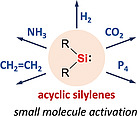
1. Introduction
The cleavage of rigid σ‐bonds, such as H–H bond, is a key step in a lot of important catalytic processes, conventionally the domain of transition metals.1 The ability of transition metals to bind reversibly with various functional groups enables transition‐metal complexes to perform as effective catalysts. In recent decades, the field of main‐group compounds has grown significantly and a variety of low‐valent main‐group compounds which show interesting reactivity have been reported.2 Silicon, the second most abundant element in the Earth's crust, is especially of interest due to its high natural abundance and low‐toxicity. Bond activation reactions using low‐valent silicon species in place of transition‐metal complexes are of importance, as the former are more environmentally friendly and cost‐effective than the latter. Over the past four decades, many low‐valent silicon compounds have been prepared using sterically demanding ligands (kinetic stabilization) and/or electronically stabilizing ligands based on heteroatom substituents (thermodynamic stabilization).3 Silylenes (:SiR2), the silicon analogues of carbenes (:CR2), have gained much attention due to their propensity to selectively activate small molecules.[2e] While the ground electronic state of carbenes (singlet or triplet) depends on the nature of the pendent substituents, silylenes generally exhibit a singlet ground state.4 The frontier molecular orbitals of singlet‐state silylenes consist of a high energy lone pair (HOMO) and an available vacant p‐orbital (LUMO). This dual donor/acceptor character (ambiphilicity) mimics the frontier d‐orbitals found in transition metals.[2a] As such, the activation of inert molecules (such as H2) using silylenes has been shown to be possible, a process previously exclusive to transition metals.
In general, silylenes are of high reactivity, have short lifetimes and tend to undergo facile dimerization, oligomerization or polymerization. For example, silylenes bearing sterically bulky substituents such as Mes (Mes = 2,4,6‐Me3C6H2), dimerize to form the corresponding disilenes (R2Si=SiR2).5 Therefore, kinetic and/or thermodynamic stabilization is required to isolate such silylenes as stable compounds. One of important developments in main‐group chemistry was the isolation of a disilene Mes2Si=SiMes2 which was formed through the dimerization of the transient divalent silylene :SiMes2 at 77 K.6 Since the groundbreaking discovery, a variety of isolable cyclic silylenes and functionalized silylenes with a higher coordinated silicon(II) atom have been reported to date (Figure 1). One of the significant developments in the chemistry of stable silylenes is the isolation of the dodecamethylsilicocene :SiCp*2 (1) (Cp* = η5‐C5Me5) as a Si(II) compound with higher coordination number by Jutzi and co‐workers in 1986.7 Silicocene 1 is stabilized using the thermodynamic stabilization effect of the Cp* ligands. In 1994, Denk and co‐workers reported the first stable two‐coordinate N‐heterocyclic silylene (NHSi) 2,8 which is the silicon analogue of the stable N‐heterocyclic carbene (NHC) isolated by Arduengo and co‐workers in 1991.9 Subsequent to this, the groups of Lappert and Gehrhus succeeded in isolating the benzo‐fused silylenes 3.10 In 2006, the six‐membered NHSi 4 was described by Driess and co‐workers.11 Roesky and co‐workers reported the first base‐free bis‐silylene 5 in 2011.12 A large number of examples of NHSi's, which are stabilized by the effect of cyclic systems along with the interaction from the lone pairs on the directly bonded nitrogen atoms to the vacant 3p orbital on the silicon atom, were reported.13 In 1999, Kira and co‐workers succeeded in the synthesis of the first isolable cyclic dialkylsilylene 6 using the kinetic stabilization effect by the sterically bulky dialkyl based helmet‐type ligand.14 Furthermore, Driess and co‐workers reported the synthesis of carbocyclic silylenes 7 bearing two phosphonium ylides which exhibit comparable aromatic character.15
Figure 1.
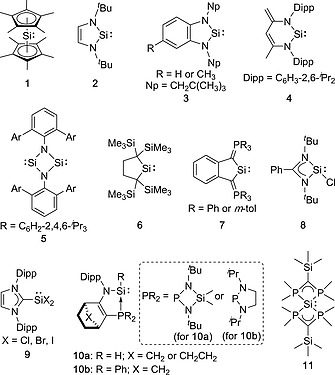
Selected examples of isolable silylenes stabilized by thermodynamic and/or kinetic stabilization effects.
Apart from these cyclic silylenes, a number of Lewis base stabilized silylenes have been prepared.16 In this decade, many studies on three coordinate Si(II) compounds have been demonstrated and their interesting electronic features and fascinating reactivity have been revealed. A significant discovery in this field was the synthesis of three coordinate silylenes bearing halogens [:SiX2(L)] (X = halogen) which are widely used as precursors to synthesize novel silicon compounds. In 2006, the first example of isolable monomeric chlorosilylene (:SiCl[PhC(NtBu)2]) 8 stabilized by an amidinate ligand was reported by Roesky and co‐workers.17 NHC‐stabilized dihalosilylenes [:SiX2(NHC) (X = halogen)] 9 are also indispensable building blocks in synthetic chemistry.[16c], 18 Another remarkable recent achievement in such three coordinate systems are the preparation of hydrosilylenes [:Si(H)R] which are attractive compounds for applications in catalytic transformations such as the hydrosilylation of alkenes, alkynes and carbonyl compounds. There are only a few examples of isolated hydrosilylenes without using Lewis acid stabilization.19 Kato and Baceiredo reported the isolation of a three coordinate Si(II) hydride 10a which is stabilized by an intramolecular phosphine coordination.[19a] Similarly, the phenyl‐substituted silylene 10b stabilized by a similar phosphine based ligand was isolated.20 In addition, four coordinate silicon(II) compounds, e.g. tetraphosphorus coordinated Si(II) compound (11), have been reported.21 While many isolable cyclic silylenes13, 22 and Lewis base stabilized silylenes16 have been described to date, only a few examples of simple dicoordinate acyclic silylenes are known, because the isolation of such silylenes as stable compounds is synthetically challenging due to their highly reactive nature.
In a previous theoretical study, Wang and Ma investigated the small molecule activation, specifically H2, to the variety of cyclic and acyclic silylenes.23 Some of the key factors which influence the reactivity of silylenes towards H2 activation are the HOMO–LUMO and singlet–triplet gaps. In the case of NHSi's which exhibit large HOMO–LUMO and singlet–triplet energy gaps, high activation energies are required to reach the corresponding product. Another important factor in the reaction behavior of silylenes is the geometry around the silicon center, especially the angle at the silicon atom. When the ring strain is large, a higher barrier is required in breaking a H2 molecule. For instance, the activation energy for the three‐membered silylene ring, silacyclopropenylidene (53.15 kcal/mol), is much higher compared with that of the acyclic dimethylsilylene (:SiMe2) (13.31 kcal/mol) due to the ring strain along with the 2π‐electrons‐delocalization on the C–C–Si ring (Figure 2). Similarly, in the case of nitrogen‐substituted systems, the higher activation barrier (63.46 kcal/mol) for the N‐heterocyclic silylene is required to reach the product than that (45.59 kcal/mol) of the diaminosilylene [:Si(NH2)2].23 It is also found that the splitting of H2 with acyclic silylenes is more exothermic (–50.89 kcal/mol for dimethylsilylene, –23.34 kcal/mol for diaminosilylene) than that of cyclic silylenes (–18.65 kcal/mol for silacyclopropenylidene, –6.65 kcal/mol for N‐heterocyclic silylene). In a recent computational study, Kuriakose and Vanka investigated the single site small molecule activation by acyclic silylenes and the undesired side reaction.24 In these systems during H2 splitting the undesired side reaction, which leads to decomposition of the silylenes forming the products :Si(H)R' and HR (decomposition reaction), would be competitive to the desired reaction in which both hydrogen atoms bind to the same atom to form the tetravalent RSi(R')H2 product (single site reaction) (R/R' = thiolato/thiolato, boryl/amido, or silyl/amido). The study indicated that the angle at the silicon center also affects the preference of silylenes for the single site or the decomposition pathway. When the angle becomes even smaller, the dissociation pathway is favored over the single site pathway significantly.
Figure 2.
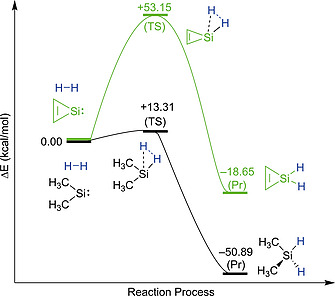
The activation energy and the exothermic energy for the H2 insertion reaction with the acyclic silylene (black line) and the cyclic silylene (light green line), calculated at the B3LYP/6‐311+G** level of theory.23 Transition state (TS), addition product (Pr).
In the last three decades, the chemistry of stable silylenes has grown significantly and has been subject to many recent reviews regarding isolable cyclic silylenes,13, 22 functionalized silylenes with higher coordinate silicon(II) centers,16 and their application towards small molecule activation and catalytic reactions.[2c], 25 Despite recent progress, the activation of inert molecules such as H2 using silylenes remains scarce. The computational studies implied that acyclic silylenes with a highly obtuse angle at the silicon center would have a low‐lying triplet excited state and allow for the activation of inert molecules. Therefore, the study of such silylenes may open new doors to the reactivity of main‐group compounds as transition metal mimics. The focus of this minireview is the properties and key reactivity highlights from simple dicoordinate acyclic silylenes.
2. Synthesis
Although a variety of isolable cyclic and Lewis base stabilized silylenes have been studied, only a handful of isolable dicoordinate acyclic silylenes have been reported. While diamino substituted acyclic silylenes have been observed by NMR and UV/Vis spectroscopy, these compounds are unstable at ambient temperature.26 The first examples of isolable dicoordinate acyclic silylenes 14 and 17a were reported in 2012.27, 28 (Scheme 1 and Scheme 2). The sterically demanding boryl‐substituted silylene :Si{B(NDippCH)2}{N(SiMe3)‐Dipp} (14) (Dipp = 2,6‐iPr2C6H3), was prepared by the reaction of a tribromo(amino)silane 12 with two equivalents of lithiumboryl reagent 13.27 Alternatively, 12 reacts readily with two equivalents of hypersilylpotassium [K(THF)2][Si(SiMe3)3] to give the corresponding silyl‐substituted silylene :Si{Si(SiMe3)3}{N(SiMe3)‐Dipp} (15) (Scheme 1).29 In the solid state, both silylenes 14 and 15 exhibit remarkable thermal robustness (T d = ca. 140 °C for 14 and 15). The synthesis of an extensive series of arylthio substituted silylenes 17a–c was reported (Scheme 2).28, 30 Bis(arylthiolato)silylene :Si(SArMe6)2 (17a) [ArMe6 = 2,6‐(2,4,6‐Me3C6H2)2C6H3] was synthesized by the reduction of Br2Si(SArMe6)2 17a with Jones' Mg(I)–Mg(I) complex [(Nacnac)Mg]2 {Nacnac = HC‐[(Me)CN(Mes)]2}.28 Silylene 17a was found to be stable up to 146 °C. However, attempts to synthesize the silylenes :Si(SAriPr4)2 (17b) [AriPr4 = 2,6‐(2,6‐iPr2C6H3)2C6H3] and :Si(SAriPr6)2 (17c) [AriPr6 = 2,6‐(2,4,6‐iPr3C6H2)2C6H3] were unsuccessful due to the bulkier substituents.30 Alternatively, the reduction of the dibromobisthiolato Si(IV), Br2Si(SAriPr4)2 16b and Br2Si(SAriPr6)2 16c, with Rieke's magnesium31 and a catalytic amount of anthracene afforded the silylenes :Si(SAriPr4)2 (17b) and :Si(SAriPr6)2 (17c). The attempt to synthesize the silylene :Si(SArMe6)2 (17a) by the reduction using only Rieke's magnesium was unsuccessful. Only amide substituted silylene :Si(TBoN)2 (19) stabilized by two extremely bulky boryl‐amido ligands, [N(SiMe3){B(DAB)}]– [TBoN; DAB = (DippNCH)2], was synthesized by the groups of Jones and Aldridge (Scheme 3).32 The reaction of Li[TBoN] 18 with the dichlorosilylene :SiCl2(IPr) (9) [IPr = :C(HCNDipp)2] gave a mixture of the silylene :Si(TBoN)2 19 and IPr in a ratio of 1:1. Silylene 19 is thermally stable both in the solid state (m.p. 152–160 °C) and in hydrocarbon solutions at room temperature. Recently, our group succeeded in isolating the first example of acyclic neutral silanone which contain a planar three‐coordinate Si atom.33 Interestingly, while silanone 20 is stable in the solid state at ambient temperature, a solution (C6D6 or [D8]THF) of 20 is fully converted into the imino(siloxy)silylene :Si(OSitBu3)(IPrN) (21) at room temperature within 48h (Scheme 4). The Aldridge group reported the bis(boryloxy) silylene :Si[(HCDippN)2BO]2 (24) (Scheme 5). The reaction of 22 with half an equivalent of SiI4 furnished the intermediate [(HCDippN)2BO]2SiI2 23. Subsequent reduction of 23 with Jones' reagent at 80 °C resulted in the formation of the bis(boryloxy) silylene 24 which is thermally stable at 80 °C over several days.34 The Rivard group utilized a bulky vinylic ligand [(MeIPr)CH]–, (MeIPr = (MeCNDipp)2C) to generate the vinyl(silyl)silylene 27 stabilized by a carbon‐based donor. The treatment of a toluene solution of (MeIPrCH)SiBr3 (26) with two equivalents of [K(THF)2][Si(SiMe3)3] afforded the silylene 27 (Scheme 6).35 Compound 27 is remarkably stable both in the solid state (m.p. 110–112 °C) and in benzene solution at ambient temperature for a couple of months.
Scheme 1.
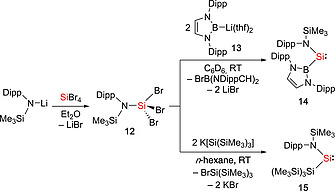
Synthesis of amido(boryl)silylene 14 and amido(silyl)silylene 15.
Scheme 2.
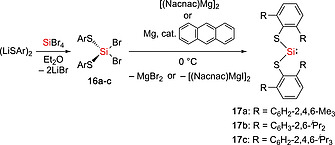
Synthesis of bis(arylthiolato)silylenes 17a–c.
Scheme 3.
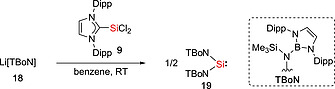
Synthesis of bis(amido)silylene 19.
Scheme 4.
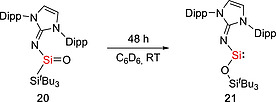
Synthesis of imino(siloxy)silylene 21.
Scheme 5.
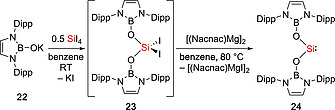
Synthesis of bis(boryloxy) silylene 24.
Scheme 6.
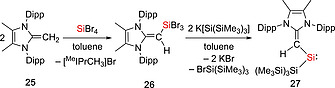
Synthesis of vinyl(silyl)silylene 27.
Some disilenes (R2Si=SiR2) are in equilibrium with their monomeric silylene (:SiR2) form in solution and are therefore synthetically equivalent to silylenes.36, 37 The dissociation energy of the Si=Si double bond in disilenes depends on the singlet–triplet energy gap of the corresponding monomer, therefore the nature of substituents at the silicon atom play important roles. Whilst electropositive and π‐accepting substituents stabilize the triplet state and the Si=Si double bond in the disilenes, electronegative and π‐donating substituents stabilize the singlet and induce to the dissociation of disilenes into the corresponding silylenes.36 Additionally, in some disilenes, the Si=Si bond is weakened by the steric repulsion between the sterically bulky substituents, leading to the dynamic disilene‐silylene equilibria.37 The first example of the disilene‐silylene equilibrium was reported in 1993.38 Disilenes Tbt(Mes)Si=Si(Mes)Tbt (28, 29) (Tbt = 2,4,6‐[CH(SiMe3)2]3C6H2) bearing sterically bulky substituents was found to undergo thermal dissociation which resulted in the formation of the corresponding silylene :Si(Mes)Tbt (30) (Scheme 7). It was found that the silylene :Si(Mes)Tbt (30) can be trapped with aryl isocyanides ArCN [Ar = Tbt, 2,4,6‐(CHMe2)3C6H2, or 2,4,6‐tBu3C6H2] to give the corresponding silylene‐isocyanide complexes [Tbt(Mes)Si‐CNAr], which are the first isolable silylene‐Lewis base complexes and can act as a masked silylene.[38c] In addition, some other silicon compounds behave as masked silylenes.39 The groups of Scheschkewitz and Rzepa reported the isolation of a disilenyl silylene stabilized by an NHC (33) which coexists in equilibrium with the isomeric cyclotrisilene 31 and the free NHC 32 in solution (Scheme 8).[39a], [39b] With regard to this field, our group has demonstrated that DMAP‐stabilized silylenes, :Si(SiR3)(SiR'3)(DMAP) [36a: SiR3 = SitBu3, SiR'3 = Si(SiMe3)3, 36b: SiR3 = SiR'3 = SiMetBu2, 36c: SiR3 = SiR'3 = Si(SiMe3)3] (DMAP = 4‐N,N‐dimethylaminopyridine), act as masked silylenes and react with small molecules such as H2 and ethylene at 65 °C (Scheme 9).[39c] In addition, the dynamic equilibria between silepins 38a–b and imino(silyl)silylenes :Si(IPrN){Si(SiMe3)3} (37a) and :Si(IPrN)(tBu3) (37b) are revealed by experimental and computational studies (Scheme 10).33, 40 The intramolecular insertion reaction of the in situ generated silylenes 37a and 37b into the C=C bond of the aromatic ligand framework resulted in the formation of silepins 38a and 38b. Reactivity studies revealed that silepin 38a, serving as silylene 37a in situ, is capable of the activation of small molecules (vide infra). Our group also presented an isolable bis(silyl)silylene 40 which is in equilibria with the corresponding tetrasilyldisilene 41. The reaction of dibromosilane {(TMS)3Si}(tBu3Si)SiBr2 (39) with KC8 afforded an equilibrium mixture of 40 and 41 (Scheme 11).41 These compounds 38 and 41 can behave as synthetic alternatives to acyclic silylenes.
Scheme 7.
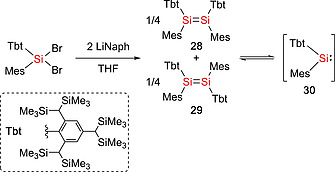
Dynamic equilibrium between disilenes (28 and 29) and silylene 30.
Scheme 8.
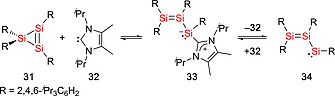
Equilibrium of cyclotrisilene 31 and N‐heterocyclic carbene 32 with NHC‐coordinated disilenyl silylene 33.
Scheme 9.
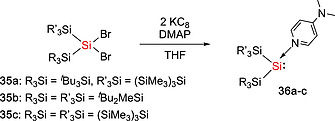
Synthesis of DMAP‐stabilized silylenes 36a–c.
Scheme 10.
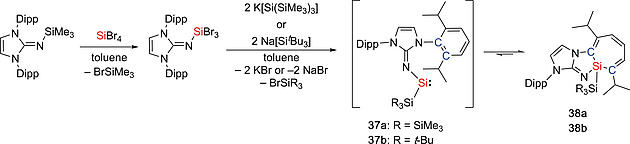
Dynamic equilibria between silepins 38a–b and imino(silyl)silylenes 37a–b.
Scheme 11.

Dynamic equilibrium between disilene 41 and bis(silyl)silylene 40.
3. Properties
Several examples of stable two‐coordinate acyclic silylenes have been structurally characterized using single‐crystal X‐ray diffraction analysis. The information can help to explain the compound's reactivity and stability. Selected structural parameters of these acyclic silylenes are shown in Table 1.
Table 1.
Selected structural parameters, spectroscopic data, and HOMO–LUMO and singlet–triplet energy gaps for the acyclic silylenes
| ∠E–Si–E'/° | d(Si–E)/Å | 29Si chemical shifts (δ) | λ max[nm] | HOMO–LUMO gap [eV] | Singlet–triplet gap (kJ/mol) | |
|---|---|---|---|---|---|---|
| :Si{B(NDippCH)2}{N(SiMe3)‐Dipp} (14) | B–Si–N | Si–B: 2.066(1) | +439.7 | – | 2.04a | 103.9a |
| 109.7(1) | Si–N: 1.731(1) | |||||
| :Si(SArMe6)2 (17a) | S–Si–S | Si–S: 2.1607(5) | +285.5 | 382 | 4.26b | – |
| 90.519(19) | Si–S: 2.1560(5) | |||||
| :Si(SAriPr4)2 (17b) | S–Si–S | Si–S: 2.137(1) | +270.4 | 405 | – | – |
| 85.08(5) | Si–S: 2.137(1) | |||||
| :Si(SAriPr6)2 (17c) | S–Si–S | Si–S: 2.089(9)c | +270.9 | 411 | – | – |
| 84.8(1) | ||||||
| :Si{Si(SiMe3)3}{N(SiMe3)‐Dipp} (15) | N–Si–Si | Si–Si: 2.386(1) | +438.2 | – | 1.99a | 103.7a |
| 116.91(5) | Si–N: 1.720(1) | +467.5 | ||||
| :Si(TBoN)2 (19) | N–Si–N | Si–N: 1.7495(10) | +204.6 | 385 | 2.55d | 158.3d |
| 110.94(5) | Si–N: 1.7432(10) | |||||
| :Si(OSitBu3)(IPrN) (21) | N–Si–O | Si–N: 1.661(2) | +58.9 | 328 | 4.33e | – |
| 103.56(8) | Si–O: 1.643(1) | |||||
| :Si[(HCDippN)2BO]2 (24) | O–Si–O | Si–O: 1.6074(14) | +35.5 | 348 | 5.45f | – |
| 100.02(8) | Si–O: 1.6052(14) | |||||
| :Si(MeIPrCH){Si(SiMe3)3} (27) | C–Si–Si | Si–C: 1.798(2) | +432.9 | 583 | 4.79g | – |
| 101.59(7) | Si–Si: 2.404(1) | |||||
| :Si(IPrN){Si(SiMe3)3} (37a) | – | – | +300.0 | 612 | 2.96h | 103.9h |
| :Si(SitBu3){Si(SiMe3)3} (40) | – | – | – | – | 4.18i | 10.5i |
| :Si[Ga(Br)L]2 (46) | – | – | – | – | 2.7j | 5.9j |
Calculated at the PBE/TZ2P level of theory.
Calculated at the PBE1PBE/def2‐TZVP level of theory.
Averaged value.
Calculations at the BP86/TZP level of theory were performed on the molecule with its Dipp substituents replaced by 2,6‐dimethylphenyl groups.
Calculated at the B3LYP/6‐311+G(d) level of theory.
Calculated at the PBE1PBE/TZVP level of theory.
Calculated at the M06‐2X/def2‐TZVP level of theory. See the reference.42
Calculations at the B3LYP/6‐311+G(d,p) level of theory were performed on the molecule with its Dipp substituents replaced by phenyl groups.
Calculated at the M06‐2X/6‐31+G(d,p) level of theory.
Calculated at the B3LYP‐D3(BJ)/6‐311G(d,p), def2‐TZVP (Ga and Br) level of theory.
The angles for the silicon centers in silylenes 14, 15, and 19 [109.7(1)° (14), 116.91(5)° (15), 110.94(5)° (19)] are wider than those in NHSi's [86.02(6)°–99.31(5)°].8, 10, 11, 12, 13 Silylenes bearing electronegative siloxy (21) and boryloxy (24) substituents and the vinyl(silyl)silylene (27) exhibit narrower bond angles [103.56(8)° (21); 100.02(8)° (24); 101.59(7)° (27)] than those found in other reported acyclic silylenes. These results suggested the presence of a high degree of s‐character at the lone pair of the silicon center in silylenes. While the angles for the silicon center in the imino(siloxy)silylene 21 and the bis(boryloxy)silylene 24 are similar to each other, the Si–O distances in 24 [1.6074(14) Å and 1.6052(14) Å] are relatively shorter than that in 21 [1.643(1) Å]. This is likely because of the more strongly electron‐donating NHI (N‐heterocyclic imine) ligand leading to the dominant p‐donor contribution in 21 while 24 has two O‐donor ligands. Owing to oxygen's small atomic radius, the obtuse O–Si–O angle in the bis(boryloxy)silylene 24 [100.02(8)°] is wider than the S–Si–S angles in the bis(arylthiolato)silylenes 17a–c [90.52(2)° (17a), 85.08(5)° (17b), 84.8(1)° (17c)] due to the increased steric repulsion between the bulky boryloxy ligands and charge repulsion between the lone pairs. Additionally, the geometry of silylenes has an effect on the HOMO–LUMO energy, as silylenes which have wider E–Si–E' angles tend to exhibit smaller HOMO–LUMO energy gaps (Table 1). Previous computational studies imply silylenes which exhibit small HOMO–LUMO gaps and coordinative flexibility should be ideal for selective activation of relatively unreactive small molecules.
Further information regarding the chemical bonding in silylenes is gained by the 29Si NMR spectrum (Table 1). The 29Si NMR chemical shifts for the two‐coordinate silicon center of the acyclic bis(amido)silylene 19 (+204.6 ppm) is downfield shifted relative to those in NHSi's (δ = 78–119 ppm).43 In the case of NHSi's, the lone pairs on the nitrogen atoms are parallel to the empty 3p orbital on the silicon atom leading to an efficient π‐overlap and increased shielding of the silylene resonance. Similarly, bis(arylthiolato)silylenes 17a–c and imino(silyl)silylene 37a show a downfield shift in the 29Si NMR spectrum [+285.5 (17a), +270.4 (17b), +270.9 (17c), +300.0 (37a) ppm]. These results suggested much less π‐donation from the sulfur or nitrogen atoms to the vacant p orbital on the silicon atom relative to that in NHSi's. Furthermore, amido(boryl)silylene 14, amido(silyl)silylene 15, and vinyl(silyl)silylene 27, which have the wider E–Si–E' angle [101.59(7)°–116.91(5)°] compared with those of the bis(arylthiolato)silylenes 17a–c [84.8(1)°–90.52(2)°] and NHSi's [86.02(6)°–99.31(5)°], show an enormous downfield signal [+439.7 (14), +438.2, +467.5 (15), +432.9 (27)] in the 29Si NMR spectrum. The results indicate a significantly large electrophilicity of the divalent silicon center which is reminiscent of that observed in the dialkyl‐substituted cyclic silylene 6 (567.4 ppm).14 The 29Si NMR spectrum of 21 and 24 feature a significantly highfield resonance [+58.9 (21), +35.5 (24) ppm] compared to other dicoordinate acyclic silylenes, which suggests additional π‐donation by the siloxy or boryloxy ligands.
4. Small Molecule Activation with Acyclic Silylenes
As mentioned in the introduction, low‐valent main‐group compounds such as silylenes bearing a high energy HOMO and an energetically accessible LUMO can mimic the reactivity of transition metal complexes. The ability of transition metals to facilitate the activation of small molecules (H2, CO, alkenes etc.) has enabled the widespread development of homogeneous transition metal catalysis. Recently, key catalytic reaction steps (oxidative addition, insertion reactions, reductive elimination) have been reported for the low‐valent main‐group compounds.2 However, the cleavage of rigid σ‐bonds such as H–H by main‐group compounds remain scarce. Silylenes are of extremely high reactivity due to the high‐energy lone‐pair on silicon (HOMO) and the low‐lying vacant p orbital (LUMO) that enable to activate these small molecules. Acyclic silylenes are expected to exhibit high reactivity relative to their cyclic counterparts due to their wide E–Si–E' angles and small HOMO–LUMO gaps. In this section, the small molecule activation by two‐coordinate acyclic silylenes is outlined.
4.1 Activation of H2
The cleavage of dihydrogen is a key step in numerous homogeneous catalytic processes such as the hydrogenation of unsaturated organic compounds and hydroformylation reactions.44 Additionally, the adsorption/regeneration of H2 is important processes in potential hydrogen storage materials.45 This desirable reactivity towards H2 is generally mediated by transition metals, however it has recently been demonstrated that reduced main‐group centers exhibit this reactivity as well.
Previous theoretical studies on the reactivity of a variety of cyclic and acyclic silylenes towards the H2 activation revealed that the electronic structure features (HOMO–LUMO or singlet–triplet energy gaps) in these silylenes have effect on the accessibility of H2 activation.23 N‐Heterocyclic silylenes, bis(arylthiolato)silylene :Si(SArMe6)2 (17a),28 bis(amido)silylene :Si(TBoN)2 (19),32 and imino(siloxy)silylene :Si(OSitBu3)(IPrN) (21)33 have shown no reaction toward H2 due to their large HOMO–LUMO gaps (and its heavily sterically protected silylene center). The first example of the H2 activation with a silylene was reported in 2012. Amido(boryl)silylene :Si{B(NDippCH)2}{N(SiMe3)‐Dipp} (14) was found to undergo H2 activation at mild conditions, affording the dihydrosilane H2Si{B(NDippCH)2}{N(SiMe3)‐Dipp} (42) (Scheme 12).27 Similarly, amido(silyl)silylene :Si{Si(SiMe3)3}{N(SiMe3)‐Dipp} (15) has shown reaction towards H2 at ambient temperatures to yield the corresponding dihydrosilane H2Si{Si(SiMe3)3}{N(SiMe3)‐Dipp} (43).29 More recently, our group performed the activation of H2 with the N‐heterocyclic imino‐ligated silepin 38a, serving as silylene 37a in situ, which resulted in the formation of the corresponding dihydrosilane 44.40 The π‐donating substituents (amido or NHI ligands) in silylenes 14, 15, and 37a lead to a decreased HOMO–LUMO gap [2.04 eV (14), 1.99 eV (15), 2.96 eV (37a)], which allows for the activation of inert molecules. Furthermore, the disilene 41/silylene 40 equilibrium mixture was also found to activate H2 under very mild conditions (–40 °C).41 Interestingly, the HOMO–LUMO energy gap in the singlet bis(silyl)silylene 40 (4.18 eV) is comparably larger than those of acyclic silylenes, which are able to activate H2, and similar to those of acyclic silylenes 17a (4.26 eV) and 21 (4.33 eV), which have shown no reaction toward H2. The singlet–triplet energy gap (10.5 kJ/mol) for bis(silyl)silylene 40 is small due to the effect of the electropositive bulky silyl substituents. Very recently, the groups of Schulz and Schreiner reported H2 splitting by a silylene intermediate :Si[Ga(Br)L]2 (L = HC[C(Me)N(2,6‐iPr2C6H3)]2) (46).46 The treatment of [L(Br)Ga]2SiBr2 with an equimolar amount of LGa at 60 °C under H2 resulted in the formation of the dihydrosilane H2Si[Ga(Br)L]2 (47). Silylene 46 exhibits the lowest HOMO–LUMO gap energy (2.7 eV) and smallest singlet–triplet gap (5.9 kJ/mol).
Scheme 12.
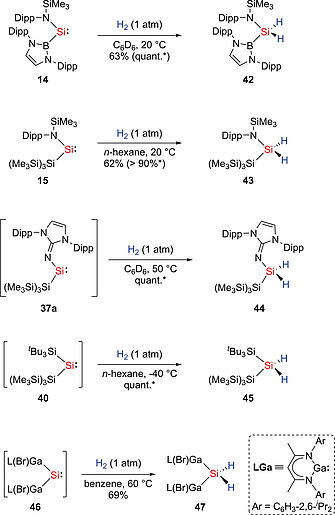
Activation of H2 by acyclic silylenes. *Estimated yield by NMR spectroscopy.
4.2 Activation of NH3
Although many examples of H2 activation by transition metal complexes have been reported, N–H bond activation is more challenging as Werner‐type complexes are readily formed in the reaction with Lewis basic amines.47 The activation of the N–H bonds of ammonia has attracted attention for applications in catalytic transformations such as hydroamination. While very few of examples of N–H bond activation by transition metal complexes are known, it has been revealed that many low‐valent main‐group compounds undergo such activation processes.[47b]
Bis(amido)silylene 19 reacts with NH3 to yield triaminosilane 50 together with the secondary amine TBoNH (48) (Scheme 13).32 The plausible mechanism involves the formation of diaminosilylene 49 via a σ‐bond metathesis reaction between 19 and NH3, followed by the oxidation addition to NH3 to afford the triaminosilane 50.48 This observation is in agreement with a previously computed σ‐bond metathesis H2 activation pathway mediated by silylene.24 Recently, our group reported the reactivity of the imino(siloxy)silylene 21.49 The reaction of silylene 21 with 1 equivalent of NH3 affords the hydroamination product 51. It is of note that compound 51 even reacts with excessive amounts of NH3 to yield an unidentified mixture. In the reaction, IPrNH and (H2N)(tBu3SiO)Si(H)(NH2) were formed, similar σ‐bond metathesis reaction to that observed for the bis(amido)silylene 19.
Scheme 13.
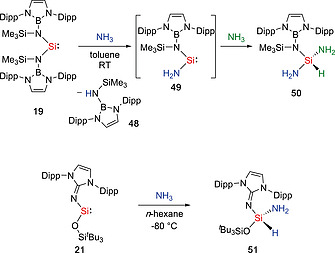
Activation of NH3 by acyclic silylenes.
4.3 C–O Bond Activation
Carbon dioxide is a potent greenhouse gas in the atmosphere and a versatile feedstock for chemical or material production.50 To date, many studies on carbon capture and storage (CCS) of CO2 along with its chemical activation and utilization as a C1 source have been demonstrated. While transition metals have been utilized in most CO2 activation, the development of transition‐metal free and eco‐friendly systems have been underexplored. Currently, some low‐valent silicon compounds which undergo CO2 activation have been reported.51
Our group found that silepin 38a, which behaves as dormant form of imino(silyl)silylene 37a, rapidly reacts with CO2 under mild conditions (1 atm, r.t., within 1h) to afford the corresponding silicon carbonate 53 (Scheme 14).40 Comparable to mechanisms described in literature,[51e], 52 it is plausible that the transient silanone (O=Si(IPrN){Si(SiMe3)3}) was formed by the oxidative addition of CO2 and extrusion of CO, followed by the cycloaddition of another molecule of CO2. While such compounds tend to dimerize,51 our group demonstrated that the isolation of the first four‐coordinate, monomeric silicon carbonate 53 in high yields. The reaction of 14 with CO2 under mild conditions (1 atm, r.t.) resulted in the formation of the (trimethylsiloxy)iminosilane {(HCDippN)2B}Si(NDipp)(OSiMe3) (52).53 It is plausible that the in situ generation of the silanone [O=Si{B(NDippCH)2}{N(SiMe3)‐Dipp}],54 followed by silyl group migration than the bimolecular reaction with CO2 yields the carbonate.55 Silylene 14 also reacts with CO at ambient temperature to yield 54 which was characterized by standard spectroscopic techniques and X‐ray crystallographic analysis (Scheme 15).53 Compound 54 contains two Si(IV) centers, which bind to one carbon and two oxygen atoms derived from CO, along with the amide ligand. Although the activation of carbon monoxide and formation of the stable carbonyl complexes under mild condition is well known for transition‐metal complexes, such reaction is virtually unknown for main‐group compounds. Recently, the groups of Schulz and Schreiner reported the isolation of the silylene carbonyl complex [L(Br)Ga]2Si:–CO (55) (L = HC[C(Me)N(2,6‐iPr2C6H3)]2). The reaction of GaL with SiBr4 under a CO atmosphere, generates the silylene [L(Br)Ga]2Si: (46) in situ, subsequently affording the silylene carbonyl complex 55.46 Compound 55 is remarkably stable both in the solid state (T d = 176–177 °C) and in solution, no decomposition was observed in toluene solution up to 80 °C. Furthermore, silylene carbonyl complex 55 acts as a masked silylene and reacts with H2 to give the dihydrosilane H2Si[Ga(Br)L]2 (47).
Scheme 14.
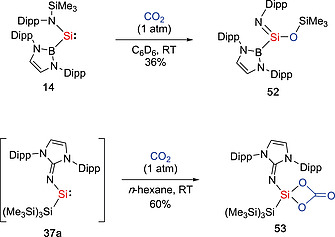
Activation of CO2 by acyclic silylenes.
Scheme 15.
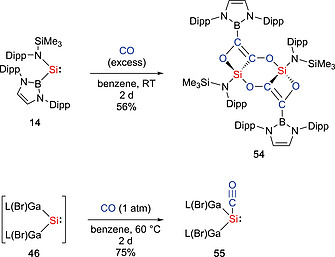
Activation of CO by acyclic silylenes.
4.4 C=C and C≡C Bonds Activation
The activation of small organic molecules and the formation of C–C bonds is a fundamentally important process for transformation of simple molecules into essential chemical compounds in both academia and industry.56 For this purpose, transition metal catalysts have been utilized and a large number of useful catalysts have been developed. On the one hand, the catalytic bond activation and C–C bond formation are challenging for main group compounds as their oxidation states vary in a much narrower range. Recently, some main group element compounds have shown the activation of C–C bonds in neutral organic molecules such as alkenes alkynes as well as its dynamic equilibrium that is a key step in catalytic processes. Furthermore, it was demonstrated that catalytic activation of alkynes, followed by the formation of C–C bonds by utilizing low‐valent main‐group compounds is also possible.57
Silylenes are well known to undergo cycloaddition reactions with unsaturated C–C bonds.13, 43 Similarly, silylenes 21, 37a, and 40 reacted with ethylene under mild conditions (1 atm, r.t.) to form the corresponding cycloaddition products 56, 59, and 60 (Scheme 16).33, 40, 41 In the case of silylene 15, the reaction with ethylene at ambient temperatures gave the silirane product Si{CH2–CH2}{NDipp(SiMe3)}{Si(SiMe3)3} (57) in high yields. Furthermore, when compound 57 was heated to 60 °C under an ethylene atmosphere, an exceptional insertion of ethylene into Si–Si bond occurred to yield the modified silirane Si{CH2–CH2}{NDipp(SiMe3)}{CH2–CH2–Si(SiMe3)3} (58).58 A NMR experiment with deuterated ethylene indicated that the reaction proceeds via migratory insertion of the coordinated ethylene into the Si–Si bond, followed by the formation of the silirane with a C2D4 molecule. The groups of Power and Tuononen found that silylenes 17a and 17b also react with ethylene or alkynes to afford the [1+2] cycloaddition products 61a, 61b, and 62b (Scheme 17).59 Interestingly, the ethylene addition products 61a and 61b were found to undergo reversible reactions with ethylene under ambient conditions. Notably, while many main‐group compounds can react with ethylene under mild conditions, the reversible reaction, which is a key step in catalytic cycles, remains rare.60 Products 61a and 61b were characterized using NMR spectroscopy (61a and 61b) and X‐ray crystallographic analysis (61b). Van't Hoff analysis of the association of ethylene with 17b, as determined by variable‐temperature 1H NMR spectroscopy, revealed a small value of Gibbs free energy (ΔG assn = –24.9 kJ/mol at 300 K), which is comparably more favorable compared with that for the reaction of the phosphine supported Si(II) complex reported by the groups of Kato and Baceiredo (–3.0 kJ/mol).[60b] Similarly, the rare reversibility between Si(II) and Si(IV) compounds was found in silylenes 37a and 37b which undergo an intermolecular insertion reaction into the C=C bond of the aromatic ligand framework to give silepins 38a and 38b. The equilibrium between 37a and 38a was revealed by experimental and computational studies.
Scheme 16.
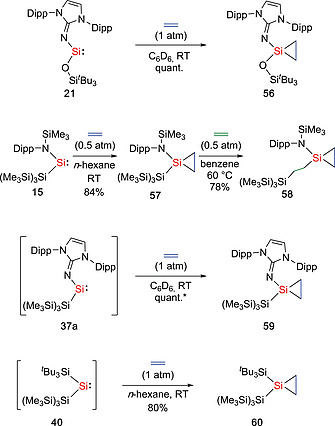
Activation of ethylene by acyclic silylenes. *Estimated yield by NMR spectroscopy.
Scheme 17.
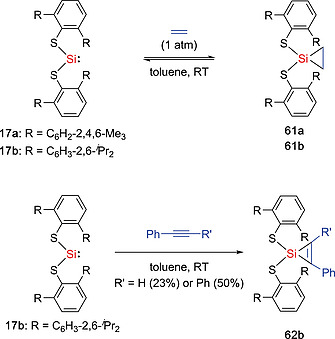
Equilibrium reactions with ethylene and activation of alkynes by acyclic silylenes 17a–b.
4.5 Activation of P4
White phosphorus (P4), which is easily obtained by the reduction of phosphate rock, is widely used as a starting material to synthesize organophosphorus compounds. In industrial processes, phosphorus chloride (PCln) and phosphoryl chloride (POCl3) are precursors to organo‐phosphorus products are prepared by the chlorination or oxychlorination of white phosphorus.61 The eco‐friendly and atom efficient method of direct conversion of white phosphorus to phosphine containing products has also been considered.62 Currently, it was demonstrated that direct catalytic transformation of P4 into organo‐phosphorus compounds using a transition metal complex is possible.63 However, the stoichiometric and catalytic reaction of white phosphorus under mild conditions is challenging for both transition metal and main group compounds.
While several cyclic silylenes can react with P4, in most cases, the oxidative addition of a single P–P bond at the silicon center is observed,64 and the controlled reaction of P4 by main‐group compounds remains scarce.[61a], 65 The treatment of the vinyl(silyl)silylene 27 with P4 resulted in the formation of (MeIPrCH)Si(P4){Si(SiMe3)3} (63) (Scheme 18).35 It is plausible that compound 63 was formed by the oxidative addition of a P–P bond of P4 to silylene 27 with subsequent 1,2‐silyl migration. In this reaction, the cleavage of two P–P bonds of P4 and the regioselective formation of four new Si–P bonds were observed. In addition, imino(siloxy)silylene 21 was found to occur via the oxidative addition of 1 equivalent of P4 to give (IPrN)(tBu3SiO)Si(P4) (64), which is different from that observed for the vinyl(silyl)silylene 27.49
Scheme 18.
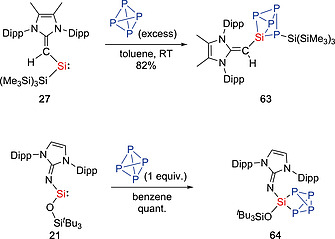
Activation of P4 by acyclic silylenes.
5. Summary and Outlook
Since the discovery of Jutzi's silicocene and Denk's NHSi, various cyclic silylenes and Lewis base stabilized silylenes have been reported. However, isolable two‐coordinate acyclic silylenes had been considered to be transient and non‐isolable compounds for a long time. The recent synthesis of stable acyclic silylenes has unlocked a new avenue in silicon chemistry, enabling metallomimetic behavior of this Earth‐abundant element. In this minireview, we mainly focused on the two‐coordinate acyclic silylene chemistry containing synthesis, properties, and application for small molecule activation. Acyclic silylenes bearing wide E–Si–E' angles and small HOMO–LUMO gaps are of extremely high reactivity which lead to the activation of important small molecules such as H2, NH3, ethylene, and CO2. Interestingly, while bis(silyl)silylene 40 exhibits a relatively large HOMO–LUMO gap (4.18 eV), 40 was found to occur the activation of H2. The singlet–triplet gap of 40 is comparatively small (10.5 kJ/mol). In addition, it was revealed that bis(arylthiolato)silylenes 17a and 17b show equilibrium reactions with ethylene at room temperature which is a key step in catalytic processes and is rare for silicon due to the unfavorable reduction of Si(IV) to Si(II).
These results for acyclic silylenes indicate the potential of main group compounds for future applications in the realms of catalytic and materials science. This study is inspiring for the molecular design of new silicon compounds which enable small molecule activation and the unprecedented cleavage of N–N bond in dinitrogen, N2. Acyclic silylenes are of extremely high reactivity due to the high‐energy lone‐pair on silicon (HOMO) and a low‐lying vacant p‐orbital (LUMO) which may interact with an empty π* orbital and an n‐orbital (a lone pair) on N2 leading to a weakening of the N–N bond. Furthermore, the hydrogenation and transfer hydrogenation of unsaturated molecules such as alkenes and alkynes mediated by acyclic silylenes is expected to be feasible. These studies imply that the steric and electronic tuning of the substituents enable the control of hydrogenation reactions. The accessibility of both Si(II) and Si(IV) oxidation states may lead to the utilization of silicon compounds in catalysts.
Acknowledgements
This project has received funding from the European Union's Horizon 2020 research and innovation programme under the Marie Skłodowska‐Curie grant agreement No 754462 (Fellowship SF), as well as the WACKER Chemie AG and the European Research Council (SILION 637394). Open access funding enabled and organized by Projekt DEAL.
Biographies
Shiori Fujimori obtained her M.Sc. and Ph.D. degree in chemistry in 2019 at Kyoto University under the supervision of Prof. Norihiro Tokitoh on the synthesis of novel aromatic compounds containing heavier group 14 element. In October 2019, she was awarded a Eurotech‐Marie Curie Fellowship for low‐valent silicon chemistry and joined the group of Prof. Inoue at the TU München.

Shigeyoshi Inoue studied at the University of Tsukuba and carried out his doctoral studies under the supervision of Prof. Akira Sekiguchi, obtaining his Ph.D. in 2008. As a Humboldt grantee as well as a JSPS grantee, he spent the academic years 2008–2010 at the TU Berlin in the group of Prof. Matthias Drieß. In 2010, he established an independent research group within the framework of the Sofja Kovalevskaja program at the TU Berlin. Since 2015 he has been on the faculty at the TU München. His current research interests focus on the synthesis, characterization, and reactivity investigation of compounds containing low‐valent main group elements with unusual structures and unique electronic properties, with the goal of finding novel applications in synthesis and catalysis. A particular emphasis is placed on low‐valent silicon and aluminium compounds.

References
- 1.For instance on σ‐bond activation by transition metals, see: a) Lyons T. W. and Sanford M. S., Chem. Rev, 2010, 110, 1147–1169; [DOI] [PMC free article] [PubMed] [Google Scholar]; b) Ackermann L., Chem. Rev, 2011, 111, 1315–1345; [DOI] [PubMed] [Google Scholar]; c) Partyka D. V., Chem. Rev, 2011, 111, 1529–1595; [DOI] [PubMed] [Google Scholar]; d) Arockiam P. B., Bruneau C. and Dixneuf P. H., Chem. Rev, 2012, 112, 5879–5918. [DOI] [PubMed] [Google Scholar]
- 2.For selected recent reviews on main‐group compounds for small molecule activation and catalysis, see: a) Power P. P., Nature, 2010, 463, 171–177;20075912 [Google Scholar]; b) Power P. P., Acc. Chem. Res, 2011, 44, 627–637; [DOI] [PubMed] [Google Scholar]; c) Yao S., Xiong Y. and Driess M., Organometallics, 2011, 30, 1748–1767; [Google Scholar]; d) Yadav S., Saha S. and Sen S. S., ChemCatChem, 2016, 8, 486–501; [Google Scholar]; e) Chu T. and Nikonov G. I., Chem. Rev, 2018, 118, 3608–3680; [DOI] [PubMed] [Google Scholar]; f) Hadlington T. J., Driess M. and Jones C., Chem. Soc. Rev, 2018, 47, 4176–4197; [DOI] [PubMed] [Google Scholar]; g) Weetman C. and Inoue S., ChemCatChem, 2018, 10, 4213–4228; [Google Scholar]; h) Melen R. L., Science, 2019, 363, 479–484. [DOI] [PubMed] [Google Scholar]
- 3.For selected recent reviews on low‐valent silicon compounds, see: a) Kira M., J. Organomet. Chem, 2004, 689, 4475–4488; [Google Scholar]; b) Fischer R. C. and Power P. P., Chem. Rev, 2010, 110, 3877–3923; [DOI] [PubMed] [Google Scholar]; c) Mondal K. C., Roy S. and Roesky H. W., Chem. Soc. Rev, 2016, 45, 1080–1111; [DOI] [PubMed] [Google Scholar]; d) Guo J.‐D. and Sasamori T., Chem. Asian J, 2018, 13, 3800–3817. [DOI] [PubMed] [Google Scholar]
- 4. Apeloig Y., Pauncz R., Karni M., West R., Steiner W. and Chapman D., Organometallics, 2003, 22, 3250–3256. [Google Scholar]
- 5.For selected recent reviews on disilenes, see: a) Rammo A. and Scheschkewitz D., Chem. Eur. J, 2018, 24, 6866–6885; [DOI] [PubMed] [Google Scholar]; b) Matsuo T. and Hayakawa N., Sci. Technol. Adv. Mater, 2018, 19, 108–129; [DOI] [PMC free article] [PubMed] [Google Scholar]; c) Kira M. and Iwamoto T., Adv. Organomet. Chem, 2006, 54, 73–148. [Google Scholar]
- 6. West R., Fink M. J. and Michl J., Science, 1981, 214, 1343–1344. [DOI] [PubMed] [Google Scholar]
- 7. Jutzi P., Kanne D. and Krüger C., Angew. Chem. Int. Ed. Engl, 1986, 25, 164–164; [Google Scholar]; Angew. Chem, 1986, 98, 163. [Google Scholar]
- 8. Denk M., Lennon R., Hayashi R., West R., Belyakov A. V., Verne H. P., Haaland A., Wagner M. and Metzler N., J. Am. Chem. Soc, 1994, 116, 2691–2692. [Google Scholar]
- 9. Arduengo A. J. III, Harlow R. L. and Kline M., J. Am. Chem. Soc, 1991, 113, 361–363. [Google Scholar]
- 10. Gehrhus B., Lappert M. F., Heinicke J., Boese R. and Bläser D., J. Chem. Soc., Chem. Commun, 1995, 1931–1932. [Google Scholar]
- 11. Driess M., Yao S., Brym M., van Wüllen C. and Lentz D., J. Am. Chem. Soc, 2006, 128, 9628–9629. [DOI] [PubMed] [Google Scholar]
- 12. Ghadwal R. S., Roesky H. W., Pröpper K., Dittrich B., Klein S. and Frenking G., Angew. Chem. Int. Ed, 2011, 50, 5374–5378; [DOI] [PubMed] [Google Scholar]; Angew. Chem, 2011, 123, 5486. [Google Scholar]
- 13.For selected reviews on NHSi's, see: a) Haaf M., Schmedake T. A. and West R., Acc. Chem. Res, 2000, 33, 704–714; [DOI] [PubMed] [Google Scholar]; b) Gehrhus B. and Lappert M. F., J. Organomet. Chem, 2001, 617–618, 209–223; [Google Scholar]; c) Asay M., Jones C. and Driess M., Chem. Rev, 2011, 111, 354–396; [DOI] [PubMed] [Google Scholar]; d) Kong L., Zhang J., Song H. and Cui C., Dalton Trans, 2009, 5444–5446; [DOI] [PubMed] [Google Scholar]; e) Zark P., Schäfer A., Mitra A., Haase D., Saak W., West R. and Müller T., J. Organomet. Chem, 2010, 695, 398–408; [Google Scholar]; f) Kosai T., Ishida S. and Iwamoto T., Angew. Chem. Int. Ed, 2016, 55, 15554–15558; [DOI] [PubMed] [Google Scholar]; Angew. Chem, 2016, 128, 15783. [Google Scholar]
- 14. Kira M., Ishida S., Iwamoto T. and Kabuto C., J. Am. Chem. Soc, 1999, 121, 9722–9723. [Google Scholar]
- 15. Asay M., Inoue S. and Driess M., Angew. Chem. Int. Ed, 2011, 50, 9589–9592; [DOI] [PubMed] [Google Scholar]; Angew. Chem, 2011, 123, 9763. [Google Scholar]
- 16.For selected reviews on silicon(II) compounds with coordination number greater than two, see: a) Sen S. S., Khan S., Nagendran S. and Roesky H. W., Acc. Chem. Res, 2012, 45, 578–587; [DOI] [PubMed] [Google Scholar]; b) Sen S. S., Khan S., Samuel P. P. and Roesky H. W., Chem. Sci, 2012, 3, 659–682; [Google Scholar]; c) Ghadwal R. S., Azhakar R. and Roesky H. W., Acc. Chem. Res, 2013, 46, 444–456. [DOI] [PubMed] [Google Scholar]
- 17. So C.‐W., Roesky H. W., Magull J. and Oswald R. B., Angew. Chem. Int. Ed, 2006, 45, 3948–3950; [DOI] [PubMed] [Google Scholar]; Angew. Chem, 2006, 118, 4052. [Google Scholar]
- 18.a) Ghadwal R. S., Roesky H. W., Merkel S., Henn J. and Stalke D., Angew. Chem. Int. Ed, 2009, 48, 5683–5686; [DOI] [PubMed] [Google Scholar]; Angew. Chem, 2009, 121, 5793; [Google Scholar]; b) Filippou A. C., Chernov O. and Schnakenburg G., Angew. Chem. Int. Ed, 2009, 48, 5687–5690; [DOI] [PubMed] [Google Scholar]; Angew. Chem, 2009, 121, 5797; [Google Scholar]; c) Filippou A. C., Lebedev Y. N., Chernov O., Straßmann M. and Schnakenburg G., Angew. Chem. Int. Ed, 2013, 52, 6974–6978; [DOI] [PubMed] [Google Scholar]; Angew. Chem, 2013, 125, 7112. [Google Scholar]
- 19.a) Rodriguez R., Gau D., Contie Y., Kato T., Saffon‐Merceron N. and Baceiredo A., Angew. Chem. Int. Ed, 2011, 50, 11492–11495; [DOI] [PubMed] [Google Scholar]; Angew. Chem, 2011, 123, 11694; [Google Scholar]; b) Inoue S. and Eisenhut C., J. Am. Chem. Soc, 2013, 135, 18315–18318; [DOI] [PubMed] [Google Scholar]; c) Lutters D., Severin C., Schmidtmann M. and Müller T., J. Am. Chem. Soc, 2016, 138, 6061–6067. [DOI] [PubMed] [Google Scholar]
- 20. Gau D., Kato T., Saffon‐Merceron N., Cossío F. P. and Baceiredo A., J. Am. Chem. Soc, 2009, 131, 8762–8763. [DOI] [PubMed] [Google Scholar]
- 21. Karsch H. H., Keller U., Gamper S. and Müller G., Angew. Chem. Int. Ed. Engl, 1990, 29, 295–296; [Google Scholar]; Angew. Chem, 1990, 102, 297. [Google Scholar]
- 22. Kira M., Chem. Commun, 2010, 46, 2893–2903. [DOI] [PubMed] [Google Scholar]
- 23. Wang Y. and Ma J., J. Organomet. Chem, 2009, 694, 2567–2575. [Google Scholar]
- 24. Kuriakose N. and Vanka K., Dalton Trans, 2014, 43, 2194–2201. [DOI] [PubMed] [Google Scholar]
- 25.a) Blom B., Gallego D. and Driess M., Inorg. Chem. Front, 2014, 1, 134–148; [Google Scholar]; b) Raoufmoghaddam S., Zhou Y.‐P., Wang Y. and Driess M., J. Organomet. Chem, 2017, 829, 2–10; [Google Scholar]; c) Zhou Y.‐P. and Driess M., Angew. Chem. Int. Ed, 2019, 58, 3715–3728; [DOI] [PubMed] [Google Scholar]; Angew. Chem, 2019, 131, 3753. [Google Scholar]
- 26.a) Tsutsui S., Sakamoto K. and Kira M., J. Am. Chem. Soc, 1998, 120, 9955–9956; [Google Scholar]; b) Lee G.‐H., West R. and Müller T., J. Am. Chem. Soc, 2003, 125, 8114–8115. [DOI] [PubMed] [Google Scholar]
- 27. Protchenko A. V., Birjkumar K. H., Dange D., Schwarz A. D., Vidovic D., Jones C., Kaltsoyannis N., Mountford P. and Aldridge S., J. Am. Chem. Soc, 2012, 134, 6500–6503. [DOI] [PubMed] [Google Scholar]
- 28. Rekken B. D., Brown T. M., Fettinger J. C., Tuononen H. M. and Power P. P., J. Am. Chem. Soc, 2012, 134, 6504–6507. [DOI] [PubMed] [Google Scholar]
- 29. Protchenko A. V., Schwarz A. D., Blake M. P., Jones C., Kaltsoyannis N., Mountford P. and Aldridge S., Angew. Chem. Int. Ed, 2013, 52, 568–571; [DOI] [PubMed] [Google Scholar]; Angew. Chem, 2013, 125, 596. [Google Scholar]
- 30. Rekken B. D., Brown T. M., Fettinger J. C., Lips F., Tuononen H. M., Herber R. H. and Power P. P., J. Am. Chem. Soc, 2013, 135, 10134–10148. [DOI] [PubMed] [Google Scholar]
- 31.a) Rieke R. D. and Hudnall P. M., J. Am. Chem. Soc, 1972, 94, 7178–7179; [Google Scholar]; b) Rachon J. and Walborsky H. M., Tetrahedron Lett, 1989, 30, 7345–7348. [Google Scholar]
- 32. Hadlington T. J., Abdalla J. A. B., Tirfoin R., Aldridge S. and Jones C., Chem. Commun, 2016, 52, 1717–1720. [DOI] [PubMed] [Google Scholar]
- 33. Wendel D., Reiter D., Porzelt A., Altmann P. J., Inoue S. and Rieger B., J. Am. Chem. Soc, 2017, 139, 17193–17198. [DOI] [PubMed] [Google Scholar]
- 34. Loh Y. K., Ying L., Fuentes M. Á., Do D. C. H. and Aldridge S., Angew. Chem. Int. Ed, 2019, 58, 4847–4851; [DOI] [PubMed] [Google Scholar]; Angew. Chem, 2019, 131, 4901. [Google Scholar]
- 35. Roy M. M. D., Ferguson M. J., McDonald R., Zhou Y. and Rivard E., Chem. Sci, 2019, 10, 6476–6481. [DOI] [PMC free article] [PubMed] [Google Scholar]
- 36.For examples on equilibrium between amide‐substituted silylenes and their dimers, see: a) Sakamoto K., Tsutsui S., Sakurai H. and Kira M., Bull. Chem. Soc. Jpn, 1997, 70, 253–260; [Google Scholar]; b) Takahashi M., Tsutsui S., Sakamoto K., Kira M., Müller T. and Apeloig Y., J. Am. Chem. Soc, 2001, 123, 347–348; [DOI] [PubMed] [Google Scholar]; c) Schmedake T. A., Haaf M., Apeloig Y., Müller T., Bukalov S. and West R., J. Am. Chem. Soc, 1999, 121, 9479–9480; [Google Scholar]; d) Jutzi P., Mix A., Neumann B., Rummel B., Schoeller W. W., Stammler H.‐G. and Rozhenko A. B., J. Am. Chem. Soc, 2009, 131, 12137–12143. [DOI] [PubMed] [Google Scholar]
- 37.For examples on sterically overcrowded disilene‐silylene equilibria, see: a) Tsutsui S., Tanaka H., Kwon E., Matsumoto S. and Sakamoto K., Organometallics, 2004, 23, 5659–5661; [Google Scholar]; b) Tsutsui S., Kwon E., Tanaka H., Matsumoto S. and Sakamoto K., Organometallics, 2005, 24, 4629–4638; [Google Scholar]; c) Suzuki K., Matsuo T., Hashizume D. and Tamao K., J. Am. Chem. Soc, 2011, 133, 19710–19713; [DOI] [PubMed] [Google Scholar]; d) Abe T., Tanaka R., Ishida S., Kira M. and Iwamoto T., J. Am. Chem. Soc, 2012, 134, 20029–20032. [DOI] [PubMed] [Google Scholar]
- 38.a) Tokitoh N., Suzuki H., Okazaki R. and Ogawa K., J. Am. Chem. Soc, 1993, 115, 10428–10429; [Google Scholar]; b) Suzuki H., Tokitoh N. and Okazaki R., Bull. Chem. Soc. Jpn, 1995, 68, 2471–2481; [Google Scholar]; c) Takeda N., Suzuki H., Tokitoh N., Okazaki R. and Nagase S., J. Am. Chem. Soc, 1997, 119, 1456–1457. [Google Scholar]
- 39.a) Cowley M. J., Huch V., Rzepa H. S. and Scheschkewitz D., Nat. Chem, 2013, 5, 876–879; [DOI] [PubMed] [Google Scholar]; b) Zhao H., Leszczyńska K., Klemmer L., Huch V., Zimmer M. and Scheschkewitz D., Angew. Chem. Int. Ed, 2018, 57, 2445–2449; [DOI] [PubMed] [Google Scholar]; Angew. Chem, 2018, 130, 2470; [Google Scholar]; c) Holzner R., Reiter D., Frisch P. and Inoue S., RSC Adv, 2020, 10, 3402–3406. [DOI] [PMC free article] [PubMed] [Google Scholar]
- 40. Wendel D., Porzelt A., Herz F. A. D., Sarkar D., Jandl C., Inoue S. and Rieger B., J. Am. Chem. Soc, 2017, 139, 8134–8137. [DOI] [PubMed] [Google Scholar]
- 41. Reiter D., Holzner R., Porzelt A., Altmann P. J., Frisch P. and Inoue S., J. Am. Chem. Soc, 2019, 141, 13536–13546. [DOI] [PubMed] [Google Scholar]
- 42.The value of HOMO–LUMO gap in vinyl(silyl)silylene 27 was obtained from the authors.
- 43. Mizuhata Y., Sasamori T. and Tokitoh N., Chem. Rev, 2009, 109, 3479–3511. [DOI] [PubMed] [Google Scholar]
- 44.a) Dyson P. J., Dalton Trans, 2003, 2964–2974; [Google Scholar]; b) Crespo‐Quesada M., Cárdenas‐Lizana F., Dessimoz A.‐L. and Kiwi‐Minsker L., ACS Catal, 2012, 2, 1773–1786; [Google Scholar]; c) Franke R., Selent D. and Börner A., Chem. Rev, 2012, 112, 5675–5732; [DOI] [PubMed] [Google Scholar]; d) Delgado J. A., Benkirane O., Claver C., Curulla‐Ferré D. and Godard C., Dalton Trans, 2017, 46, 12381–12403. [DOI] [PubMed] [Google Scholar]
- 45.a) Satyapal S., Petrovic J., Read C., Thomas G. and Ordaz G., Catal. Today, 2007, 120, 246–256; [Google Scholar]; b) Hamilton C. W., Baker R. T., Staubitz A. and Manners I., Chem. Soc. Rev, 2009, 38, 279–293. [DOI] [PubMed] [Google Scholar]
- 46. Ganesamoorthy C., Schoening J., Wölper C., Song L., Schreine P. R. and Schulz S., Nat. Chem, 2020, 12, 608–614. [DOI] [PubMed] [Google Scholar]
- 47.a) Roundhill D. M., Chem. Rev, 1992, 92, 1–27; [Google Scholar]; b) v. d. Vlugt J. I., Chem. Soc. Rev, 2010, 39, 2302–2322; [DOI] [PubMed] [Google Scholar]; c) Klinkenberg J. L. and Hartwig J. F., Angew. Chem. Int. Ed, 2011, 50, 86–95; [DOI] [PMC free article] [PubMed] [Google Scholar]; Angew. Chem, 2011, 123, 88. [Google Scholar]
- 48.For related chemistry involving stannylenes, see: Peng Y., Guo J.‐D., Ellis B. D., Zhu Z., Fettinger J. C., Nagase S. and Power P. P., J. Am. Chem. Soc, 2009, 131, 16272–16282. [DOI] [PubMed] [Google Scholar]
- 49. Reiter D., Frisch P., Wendel D., Hörmann F. M. and Inoue S., Dalton Trans, 2020, 49, 7060–7068. [DOI] [PubMed] [Google Scholar]
- 50.a) Dibenedetto A., Angelini A. and Stufano P., J. Chem. Technol. Biotechnol, 2014, 89, 334–353; [Google Scholar]; b) Dang S., Yang H., Gao P., Wang H., Li X., Wei W. and Sun Y., Catal. Today, 2019, 330, 61–75. [Google Scholar]
- 51.Recent examples of activation of CO2 by low‐valent silicon compounds, see: a) Burchert A., Yao S., Müller R., Schattenberg C., Xiong Y., Kaupp M. and Driess M., Angew. Chem. Int. Ed, 2017, 56, 1894–1897; [DOI] [PubMed] [Google Scholar]; Angew. Chem, 2017, 129, 1920; [Google Scholar]; b) Mück F. M., Baus J. A., Nutz M., Burschka C., Poater J., Bickelhaupt F. M. and Tacke R., Chem. Eur. J, 2015, 21, 16665–16672; [DOI] [PubMed] [Google Scholar]; c) Wang Y., Chen M., Xie Y., Wei P., III H. F. Schaefer and Robinson G. H., J. Am. Chem. Soc, 2015, 137, 8396–8399; [DOI] [PubMed] [Google Scholar]; d) Junold K., Nutz M., Baus J. A., Burschka C., Guerra C. F., Bickelhaupt F. M. and Tacke R., Chem. Eur. J, 2014, 20, 9319–9329; [DOI] [PubMed] [Google Scholar]; e) Liu X., Xiao X.‐Q., Xu Z., Yang X., Li Z., Dong Z., Yan C., Lai G. and Kira M., Organometallics, 2014, 33, 5434–5439; [Google Scholar]; f) Gau D., Rodriguez R., Kato T., Saffon‐Merceron N., d. Cózar A., Cossío F. P. and Baceiredo A., Angew. Chem. Int. Ed, 2011, 50, 1092–1096; [DOI] [PubMed] [Google Scholar]; Angew. Chem, 2011, 123, 1124. [Google Scholar]
- 52. Jutzi P., Eikenberg D., Möhrke A., Neumann B. and Stammler H.‐G., Organometallics, 1996, 15, 753–759. [Google Scholar]
- 53. Protchenko A. V., Vasko P., Do D. C. H., Hicks J., Fuentes M. Á., Jones C. and Aldridge S., Angew. Chem. Int. Ed, 2019, 58, 1808–1812; [DOI] [PubMed] [Google Scholar]; Angew. Chem, 2019, 131, 1822. [Google Scholar]
- 54.Examples of structurally characterized three‐coordinate silanones, see: a) Filippou A. C., Baars B., Chernov O., Lebedev Y. N. and Schnakenburg G., Angew. Chem. Int. Ed, 2014, 53, 565–570; [DOI] [PubMed] [Google Scholar]; Angew. Chem, 2014, 126, 576; [Google Scholar]; b) Alvarado‐Beltran I., Rosas‐Sánchez A., Baceiredo A., Saffon‐Merceron N., Branchadell V. and Kato T., Angew. Chem. Int. Ed, 2017, 56, 10481–10485; [DOI] [PubMed] [Google Scholar]; Angew. Chem, 2017, 129, 10617; [Google Scholar]; c) Rosas‐Sánchez A., Alvarado‐Beltran I., Baceiredo A., Saffon‐Merceron N., Massou S., Hashizume D., Branchadell V. and Kato T., Angew. Chem. Int. Ed, 2017, 56, 15916–15920; [DOI] [PubMed] [Google Scholar]; Angew. Chem, 2017, 129, 16132. [Google Scholar]
- 55. Hadlington T. J., Szilvási T. and Driess M., Angew. Chem. Int. Ed, 2017, 56, 14282–14286; [DOI] [PubMed] [Google Scholar]; Angew. Chem, 2017, 129, 14470. [Google Scholar]
- 56.a) Miyaura N. and Suzuki A., Chem. Rev, 1995, 95, 2457–2483; [Google Scholar]; b) Miyaura N., Bull. Chem. Soc. Jpn, 2008, 81, 1535–1553; [Google Scholar]; c) Inglesby P. A. and Evans P. A., Chem. Soc. Rev, 2010, 39, 2791–2805. [DOI] [PubMed] [Google Scholar]
- 57. Sugahara T., Guo J.‐D., Sasamori T., Nagase S. and Tokitoh N., Angew. Chem. Int. Ed, 2018, 57, 3499–3503; [DOI] [PubMed] [Google Scholar]; Angew. Chem, 2018, 130, 3557. [Google Scholar]
- 58. Wendel D., Eisenreich W., Jandl C., Pöthig A. and Rieger B., Organometallics, 2016, 35, 1–4. [Google Scholar]
- 59.a) Lips F., Fettinger J. C., Mansikkamäki A., Tuononen H. M. and Power P. P., J. Am. Chem. Soc, 2014, 136, 634–637; [DOI] [PubMed] [Google Scholar]; b) Lips F., Mansikkamäki A., Fettinger J. C., Tuononen H. M. and Power P. P., Organometallics, 2014, 33, 6253–6258. [Google Scholar]
- 60.a) Peng Y., Ellis B. D., Wang X., Fettinger J. C. and Power P. P., Science, 2009, 325, 1668–1670; [DOI] [PubMed] [Google Scholar]; b) Rodriguez R., Gau D., Kato T., Saffon‐Merceron N., De Cózar A., Cossió F. P. and Baceiredo A., Angew. Chem. Int. Ed, 2011, 50, 10414–10416; [DOI] [PubMed] [Google Scholar]; Angew. Chem, 2011, 123, 10598. [Google Scholar]
- 61.a) Scheer M., Balaźs G. and Seitz A., Chem. Rev, 2010, 110, 4236–4256; [DOI] [PubMed] [Google Scholar]; b) Cossairt B. M., Piro N. A. and Cummins C. C., Chem. Rev, 2010, 110, 4164–4177. [DOI] [PubMed] [Google Scholar]
- 62. Geeson M. B. and Cummins C. C., Science, 2018, 359, 1383–1385. [DOI] [PubMed] [Google Scholar]
- 63. Lennert U., Arockiam P. B., Streitferdt V., Scott D. J., Rödl C., Gschwind R. M. and Wolf R., Nat. Catal, 2019, 2, 1101–1106. [DOI] [PMC free article] [PubMed] [Google Scholar]
- 64.a) Driess M., Fanta A. D., Powell D. R. and West R., Angew. Chem. Int. Ed. Engl, 1989, 28, 1038–1040; [Google Scholar]; Angew. Chem, 1989, 101, 1087; [Google Scholar]; b) Xiong Y., Yao S., Brym M. and Driess M., Angew. Chem. Int. Ed, 2007, 46, 4511–4513; [DOI] [PubMed] [Google Scholar]; Angew. Chem, 2007, 119, 4595; [Google Scholar]; c) Sen S. S., Khan S., Roesky H. W., Kratzert D., Meindl K., Henn J., Stalke D., Demers J.‐P. and Lange A., Angew. Chem. Int. Ed, 2011, 50, 2322–2325; [DOI] [PubMed] [Google Scholar]; Angew. Chem, 2011, 123, 2370. [Google Scholar]
- 65.For selected reviews of P4 activation by main‐group elements, see: a) Khan S., Sen S. S. and Roesky H. W., Chem. Commun, 2012, 48, 2169–2179; [DOI] [PubMed] [Google Scholar]; b) Borger J. E., Ehlers A. W., Slootweg J. C. and Lammertsma K., Chem. Eur. J, 2017, 23, 11738–11746. [DOI] [PMC free article] [PubMed] [Google Scholar]