



Abstract
At the intersection of quantum theory and relativity lies the possibility of a clock experiencing a superposition of proper times. We consider quantum clocks constructed from the internal degrees of relativistic particles that move through curved spacetime. The probability that one clock reads a given proper time conditioned on another clock reading a different proper time is derived. From this conditional probability distribution, it is shown that when the center-of-mass of these clocks move in localized momentum wave packets they observe classical time dilation. We then illustrate a quantum correction to the time dilation observed by a clock moving in a superposition of localized momentum wave packets that has the potential to be observed in experiment. The Helstrom-Holevo lower bound is used to derive a proper time-energy/mass uncertainty relation.
Subject terms: Quantum information, Quantum mechanics, Quantum metrology, Theoretical physics
The usual definition of external time is unlikely to survive if we want to unite quantum mechanics and relativity. Here the authors consider two quantum clocks moving in curved spacetime and formulate the probability distribution that relates their proper times, allowing them to explore quantum time dilation.
Introduction
What allowed Einstein to transcend Newton’s absolute time was his insistence that time is what is shown by a clock1:
“[Time is] considered measurable by a clock (ideal periodic process) of negligible spatial extent. The time of an event taking place at a point is then defined as the time shown on the clock simultaneous with the event.”
Bridgman highlighted the significance of this definition of time2:
“Einstein, in seizing on the act of the observer as the essence of the situation, is actually adopting a new point of view as to what the concepts of physics should be, namely, the operational view.”
Extending the operational view to quantum theory, one is led to define time through measurements of quantum systems serving as clocks3. Such descriptions of quantum clocks have been developed in the context of quantum metrology4–7. In this regard, time observables are identified with positive-operator valued measures (POVMs) that transform covariantly with respect to the group of time translations acting on the employed clock system8,9. This covariance property ensures that these time observables give the optimal estimate of the time experienced by the clock; that is, they saturate the Cramer–Rao bound10. Furthermore, covariant time observables allow for a rigorous formulation of the time-energy uncertainty relation4–7, circumvent Pauli’s infamous objection to the construction of a time operator11,12, and play an important role in relational quantum dynamics13–17.
Given that clocks are ultimately quantum systems, they too are subject to the superposition principle. In a relativistic context, this leads to the possibility of clocks experiencing a superposition of proper times. Such scenarios have been investigated in the context of relativistic clock interferometry18, in which two branches of a matter-wave interferometer experience different proper times on account of either special or general relativistic time dilation19–26. Such a setup leads to a signature of matter experiencing a superposition of proper times through a decrease in interferometric visibility. Other work has focused on quantum variants of the twin-paradox27,28 and exhibiting nonclassical effects in relativistic scenarios29–36.
We introduce a proper time observable defined as a covariant POVM on the internal degrees of freedom of a relativistic particle moving through curved spacetime. This allows us to consider two relativistic quantum clocks, A and B, and construct the probability that A reads a particular proper time conditioned on B reading a different proper time. To compute this probability distribution we extend the Page–Wootters approach37,38 to relational quantum dynamics to the case of a relativistic particle with internal degrees of freedom. We then consider two clocks prepared in localized momentum wave packets and demonstrate that they observe on average classical time dilation in accordance with special relativity. We then illustrate a quantum time dilation effect that occurs when one clock moves in a superposition of two localized momentum wave packets: On average, the proper time of a clock moving in a coherent superposition of momenta is distinct from that of the corresponding classical mixture, see Fig. 1. We describe the average quantum correction to the classical time dilation observed by such a superposed clock. In addition, our description of proper time as a covariant POVM allows for both proper time and particle mass to be treated as dynamical quantum observables, leading to a time-energy/mass uncertainty relation.
Fig. 1. Quantum time dilation.
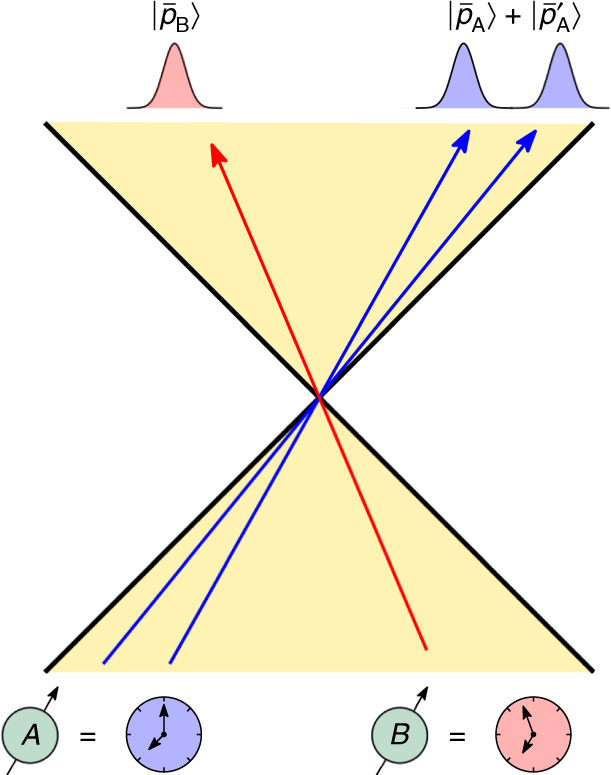
Two clocks are depicted as moving in Minkowski space. Clock B is moving in a localized momentum wave packet with average momentum , while clock A is moving in a superposition of localized momentum wave packets with average momentum and . Clock A experiences a quantum contribution to the time dilation it observes relative to clock B due to its nonclassical state of motion.
Results
Page–Wootters description of a relativistic particle with an internal degree of freedom
In adhering to the operational view espoused earlier, we employ the Page–Wootters formulation of quantum dynamics in which time enters like any other quantum observable. One considers a state of a clock C and a system S that lives in the physical Hilbert space . This Hilbert space is defined as the Cauchy completion of the set of solutions to the constraint equation:
| 1 |
where and denote the Hamiltonians of C and S. One then associates with C a time observable defined as a POVM:
| 2 |
where is a positive operator on known as an effect operator, G the group generated by HC, and will be referred to as a clock state associated with a measurement of the clock yielding the time t. What makes TC a time observable is that the effect operators transform covariantly with respect to the group generated by HC5–7,9
| 3 |
where . This covariance condition implies that . One then defines a state of S by conditioning on C reading the time t
| 4 |
It then follows from Eqs. (1) and (3),
| 5 |
which describes the evolution of S relative to C.
As described in the “Methods” section, a relativistic particle with an internal clock degree of freedom can be described by the Hilbert space , where , , and are Hilbert spaces associated respectively with the temporal, center-of-mass, and internal clock degrees of freedom of the particle. When the relativistic particle has positive energy, the physical state satisfies Eq. (1) with HC = Pt equal to the momentum operator on and
| 6 |
where P2 := ηijPiPj, ηij the Minkowski metric, and m the rest mass of the particle. Equation (5) then becomes the relativistic Schrödinger equation and the state may be interpreted as the state of the center-of-mass and internal clock of the particle at the time t, interpreted as the time of an inertial frame observing the particle with respect to which the center-of-mass degrees of freedom are defined. With this identification, the dynamics implied by the Page–Wootters formalism is in agreement with previous descriptions of a relativistic particle with internal degrees of freedom19,31,39.
We note that in the “Methods” section the above analysis in the Page–Wootters formalism is generalized to the case of a stationary curved spacetime and in Supplementary Note 1 the Klein–Gordon equation is recovered. Further justification of the Page–Wootters formalism is provided in Supplementary Note 2.
Proper time observables
We now make precise how the internal degrees of freedom of the relativistic particle introduced in the previous section constitute a clock by introducing a proper time observable. We define a clock to be the quadruple:
| 7 |
the elements of which are the clock Hilbert space , a fiducial state ρ, Hamiltonian Hclock, and time observable Tclock. Similar to the definition of TC above, Tclock is defined as a POVM that transforms covariantly with respect to the group action . The physical significance of the covariance condition in Eq. (3) is that it implies the time observable satisfies the following two physical properties commonly associated with a clock, which we state in a theorem.
Theorem 1 (Desiderata of physical clocks) Let Tclock be a covariant time observable relative to the group generated by Hclock, ρ be a fiducial state such that , and . The following two physical properties of such a time observable follow:
Tclock is an unbiased estimator of the parameter τ such that .
The variance of the time observable is independent of the parameter τ, i.e., .
Proof Statements 1 and 2 follow directly from the covariance property of Tclock; see Supplementary Note 3.
This theorem justifies interpreting Tclock as a time observable: when a time observable is measured on a quantum clock, we expect on average that it estimates the elapsed time τ unitarily encoded in ρ(τ). Also, the variance of this measurement should be independent of the time τ being estimated.
Taking this notion of a clock and applying it to the relativistic particle model introduced in the previous section, we may construct a proper time observable that transforms covariantly with respect to the internal clock Hamiltonian Hclock of the particle. As explained in the “Methods” section, such a Hamiltonian generates a unitary evolution of the internal clock degrees of freedom of the particle, and thus a time observable Tclock that transforms covariantly with respect to the group generated by Hclock will measure the particle’s proper time.
Proper time-energy/mass uncertainty relation
For an unbiased estimator, like the proper time observable Tclock introduced in the previous section, the Helstrom–Holevo lower bound4,5 places the fundamental limit on the variance of the proper time measured by the clock
| 8 |
where is the variance of Hclock on the fiducial state ρ. Equation (8) is a time-energy uncertainty relation between the proper time estimated by Tclock and a measurement of the clock’s energy Hclock. Now consider the related mass observable defined by the self-adjoint operator Mclock: = m + Hclock/c2 (e.g.,19). From Eq. (8), an uncertainty relation between this mass observable and proper time follows
| 9 |
where denotes the standard deviation of the observable A. This inequality gives the ultimate bound on the precision of any measurement of proper time.
The time-energy/mass inequality above can be saturated using the optimal proper time observable provided that the effect operators Eclock(τ) defining Tclock are proportional to “projection” operators
| 10 |
for such that ∫G Eclock(dτ) = Iclock, where Hclock is the generator of proper time translations, and is the clock state corresponding to the proper time τ. Here the motivation is that measurements not described by one-dimensional projectors have less resolution6, however, note that the clock states are not necessarily orthogonal, .
It turns out that covariant observables satisfying Eq. (10) constitute an optimal measurement to estimate the parameter τ unitarily encoded in the state ρ(τ):= Uclock(τ)ρUclock(τ)†, provided that the fiducial state is pure and
| 11 |
where and is a real function of τ such that 6. Such a proper time observable Tclock is optimal in the sense that it maximizes the so-called Fisher information10, which quantifies how well two slightly different values of proper time can be distinguished given a particular quantum measurement. For the effect operatrors Eclock and the fiducial state in Eq. (11), we have
| 12 |
The covariance condition, , ensures that the Fisher information is independent of τ.
Let us point out a connection between our above construction of a proper time observable and quantum speed limits. From the fact that 40, together with Eq. (12), we can conclude that the covariant proper time observable in fact saturates the so-called Mandelstam and Tamm inequality. That is
| 13 |
where τ⊥ is the time that passes before the initial state of a system evolves under the Hamiltonian Hclock into an orthogonal state.
We remark that in this construction both proper time and mass are treated as genuine quantum observables; the former as a covariant POVM Tclock and the latter as a self-adjoint operator Mclock. Such a formulation of proper time and mass in the regime of relativistic quantum mechanics has been argued as necessary by Greenberger41,42.
Classical and quantum time dilation
Let us now consider two relativistic particles A and B, each with an internal degree of freedom serving as a clock, and . Suppose these clocks move through Minkowski space and are described by the physical state , which satisfies two copies of Eq. (1), one for each clock, as detailed in the “Methods” section. To probe time dilation effects between these clocks we consider the probability that clock A reads the proper time τA conditioned on clock B reading the proper time τB. This conditional probability is evaluated using the physical state and the Born rule as follows
| 14 |
To evaluate this probability distribution note that the clock states defined below Eq. (2) form a basis dense in , and thus a physical state may be expanded as
| 15 |
where , Hn is the Hamiltonian given in Eq. (6), and in writing Eq. (15) we have supposed that the conditional state at t = 0 is unentangled, . Further suppose that the center-of-mass and internal clock degrees of freedom of both particles are unentangled, , where is the initial state of the center-of-mass of the particle. Suppose that , so that we may consider an ideal clock such that and Tn are the momentum and position operators on . Such clocks represent a commonly used idealization in which the time observable is sharp, that is, the clock states are orthogonal and so outcomes of different clock measurements are perfectly distinguishable. Note that , from which it follows that the effect operators satisfy the covariance relation . We employ such clocks for their mathematical simplicity in illustrating the quantum time dilation effect, however we stress that for any covariant time observable, on account of Eq. (14), a quantum time dilation effect is expected (e.g., see ref. 43).
By substituting Eq. (15) into Eq. (14), the probability that A reads τA conditioned on B reading τB can be evaluated to leading relativistic order in the center-of-mass momentum 〈Pn/mc〉 and internal clock energy
| 16 |
where is the average nonrelativistic kinetic energy of the nth particle and we have assumed the fiducial states of the clocks to be Gaussian wave packets centered at τ = 0 and have a width σ in the clock state (i.e., position) basis. As described by this probability distribution, the average proper time read by clock A conditioned on clock B indicating the time τB is
| 17 |
and the variance in such a measurement is
| 18 |
As might have been anticipated, the variance in a measurement of TA is proportional to σ2, which quantifies the spread in the fiducial clock state.
Now suppose that the center-of-mass of both clocks are prepared in a Gaussian state localized around an average momentum with spread Δn > 0,
| 19 |
for which . It follows that the observed average time dilation between two such clocks is
| 20 |
If instead the two clocks were classical, moving with momenta and corresponding to the average velocity of the momentum wave packets of the clocks just considered, then to leading relativistic order the proper time τA read by A given that B reads the proper time τB is
| 21 |
where . Therefore, upon comparison with Eq. (20) and supposing that ΔA = ΔB, quantum clocks whose center-of-mass are prepared in Gaussian wave packets localized around a particular momentum agree on average with classical time dilation described by special relativity.
It is natural to now ask: Does a quantum contribution to the time dilation observed by these clocks arise if the center-of-mass of one of the clocks moves in a superposition of momenta? To answer this question, suppose that the center-of-mass state of A begins in a superposition of two Gaussian wave packets with average momenta and ,
| 22 |
where θ ∈ [0, π/2), ϕ ∈ [0, π], and and are defined in Eq. (19). Further, suppose that the center-of-mass degree of freedom of clock B is again prepared in a Gaussian wave packet with average momentum as in Eq. (19). Using Eq. (17), the average time read by A conditioned on B reading τB is
| 23 |
where
| 24 |
leads to the classical time dilation expected by a clock moving in a statistical mixture of momenta and with probabilities and , and
| 25 |
which quantifies the quantum contribution to the time dilation between A and B. As expected, if either or , then the quantum contribution vanishes, . This is expected given that in these cases the center-of-mass of the clock particle is no longer a superposition of momentum wave packets; see Eq. (22). From Eq. (24) it is clear that choosing ΔA = ΔB and results in , and thus any observed time dilation between clocks A and B would be a result of the quantum contribution .
To illustrate the behavior of quantum time dilation stemming from the nonclassicality of the center-of-mass state of clock A, the quantity is plotted in Fig. 2. For simplicity the one-dimensional case is exhibited by supposing and with . Figure 2a shows the behavior of as a function of the difference in the average momentum of each wave packet comprising the momentum superposition in Eq. (22) for different values of their total momentum . It is seen that quantum time dilation can be either positive or negative, corresponding to increasing or decreasing the total time dilation experienced by the clock compared to an equivalent clock moving in a classical mixture of the same momenta wave packets. Further, there is an optimal difference in the average momentum of the two wave packets popt; as the total average momentum of the wave packets increases, the magnitude of and popt increase.
Fig. 2. Magnitude of quantum time dilation.

The strength of the quantum time dilation effect is plotted in a as a function of the momenta difference , where and denote the average momentum of the wave packets comprising the superposition state in Eq. (22) for θ = π/8, and in b as a function of superposition weight θ for . Different values of the average total momentum are shown and ΔA/mc = 0.01 in all cases. The thin black line in plot a traces the trajectory of the optimal momentum difference for different total momentum .
Figure 2b is a plot of as a function of θ quantifying the weight of each momentum wave packet comprising the superposition in Eq. (22) for a fixed value of the difference in average momentum of each wave packet . It is observed that when , is positive for all values of θ and reaches its maximum value at θ = π/4. As the total average momentum increases, decreases for 0 < θ < π/4 and increases for π/4 < θ < π/2 with the largest negative value at θ ≈ π/8 and largest positive value at θ ≈ 3π/8.
Quantum time dilation in experiment
Consider the two clock particles to be 87Rb atoms, which have a mass of m = 1.4 × 10⁻²⁵ kg and atomic radius of r = ℏ/ΔA = 2.5 × 10⁻¹⁰ m. Suppose these clock particles can be prepared in a superposition of momentum wave packets such that , corresponding to each branch of the momentum superposition moving at average velocities of m s−1 and m s−1. We note that (classical) special relativistic time dilation has been observed with atomic clocks moving at these velocities44,45, and perhaps the momentum superposition can be prepared by a momentum beam splitter realized using coherent momentum exchange between atoms and light46,47. Supposing that θ = 3π/4 and ϕ = 0 results in . Assuming that the resolution of the clock formed by the internal degrees of freedom of the 87Rb atoms is 10−14 s, corresponding to the resolution of 87Rb atomic clocks48, it is seen from Eq. (17) that the coherence time of the momentum superposition must be on the order of 10 s to observe a quantum time dilation effect. We note that the required coherence time is comparable to coherence times of the superpositions created in the experiments of Kasevich et al.49, which are on the order of seconds.
Concretely, one might imagine observing quantum time dilation in a spectroscopic experiment using the width of an emission line, which is inversely proportional to the lifetime of the associated excited state, as a quantum clock. Indeed, it has recently been shown that the lifetime of an excited hydrogen-like atom moving in a superposition of relativistic momenta experiences quantum time dilation in accordance with Eq. (25)43. Alternatively, Bushev et al.24 have proposed to use the spin precession of a single electron in a Penning trap as a clock to observe nonclassical relativistic time dilation effects, and it is conceivable that such a clock might be able to witness the quantum time dilation effect discussed here. Similar remarks apply to the ion trap atomic clock discussed in the ref. 32.
Discussion
We considered the internal degrees of freedom of relativistic particles to function as clocks that track their proper time. In doing so we constructed an optimal covariant proper time observable which gives an unbiased estimate of the clock’s proper time. It was shown that the Helstrom–Holevo lower bound4,5 implies a time-energy uncertainty relation between the proper time read by such a clock and a measurement of its energy. From this relation, we derived an uncertainty relation between proper time and mass, which provided the ultimate bound on the precision of any measurement of proper time. This yielded a consistent treatment of mass and proper time as quantum observables related by an uncertainty relation, resolving past issues with such an approach41,42. The approach adopted here differs in that we construct a proper time observable Tclock in terms of a covariant POVM rather than a self-adjoint operator. Using the standard Born rule, the conditional probability distribution that one such clock reads the proper time τA conditioned on another clock reading the proper time τB was derived in Eq. (14).
We then specialized to two such clock particles moving through Minkowski space and evaluated the leading-order relativistic correction to this conditional probability distribution. It was shown that on average these quantum clocks measure a time dilation consistent with special relativity when the state of their center-of-mass is localized in momentum space. However, when the state of their center-of-mass is in a superposition of such localized momentum states, we demonstrated that a quantum time dilation effect occurs. We exhibited how this quantum time dilation depends on the parameters defining the momentum superposition and gave an order of magnitude estimate for the size of this effect. We conclude that quantum time dilation may be observable with present day technology, but note that the experimental feasibility of observing this effect remains to be explored.
It should be noted that the conditional probability distribution in Eq. (14) associated with clocks reading different times was a nonperturbative expression for clocks in arbitrary nonclassical states in a curved spacetime. It thus remains to investigate the effect of other nonclassical features of the clock particles such as shared entanglement among the clocks and spatial superpositions. In regard to the latter, it will be interesting to recover previous relativistic time dilation effects in quantum systems related to particles prepared in spatial superpositions and each branch in the superposition experiencing a different proper time due to gravitational time dilation18–20,34,50. We emphasize that the quantum time dilation effect described here differs from these results in that it is a consequence of a momentum superposition rather than gravitational time dilation. Nonetheless, it will be interesting to examine such gravitational time dilation effects in the framework developed above and make connections with previous literature on quantum aspects of the equivalence principle51–53. We also note that while we exhibited the quantum time dilation effect for a specific clock model, based on the preceding analysis in terms covariant time observables it is expected that any clock will witness quantum time dilation. Given this, it will be fruitful to examine our results in relation to other models of quantum clocks that have been considered3,32,54–57 and establish whether quantum time dilation is universal, affecting all clocks in the same way, like its classical counterpart.
Another avenue of exploration is the construction of relativistic quantum reference frames from the relativistic clock particles considered here15,58–61. In particular, one might define relational coordinates with respect to a reference particle and examine the corresponding relational quantum theory and the possibility of changing between different reference frames62–69. Related is the perspective-neutral interpretation of the Hamiltonian constraint in terms of which a formalism for changing clock reference systems has recently been developed35,70–72.
Methods
Constraint description of relativistic particles with internal degrees of freedom
We present a Hamiltonian constraint formulation of N relativistic particles with internal degrees of freedom. A complementary approach has been taken in ref. 31.
Consider a system of N free relativistic particles each carrying a set of internal degrees of freedom, labeled collectively by the configuration variables qn and their conjugate momentum (n = 1, …, N), and suppose these particles are moving through a curved spacetime described by the metric gμν. The action describing such a system is S = ∑n∫ dτn Ln(τn), where
| 26 |
is the Lagrangian associated with the nth particle, τn and mn denote respectively this particle’s proper time and rest mass, and is the Hamiltonian governing its internal degrees of freedom. We use these internal degrees of freedom as a clock tracking the nth particle’s proper time. Note that Eq. (26) specifies that generates an evolution of the internal degrees of freedom of the nth particle with respect to its proper time. Let denote the spacetime position of the nth particle’s center-of-mass relative to an inertial observer, see Fig. 3.
Fig. 3. Degrees of freedom of nth particle.

The temporal degrees of freedom and center-of-mass degrees of freedom of the nth relativistic particle are depicted. This particle carries an internal degree of freedom that is used to construct a clock which measures the nth particle’s proper time.
The differential proper time dτn along the nth particle’s world line , parametrized in terms of an arbitrary parameter tn, is
| 27 |
where the over dot denotes differentiation with respect to tn and we have used the dimensionless shorthand . In terms of the parameters tn the action takes the form
| 28 |
This action is invariant under changes of the world line parameters tn, as long as there is a one-to-one correspondence between tn and τn. This invariance allows for the action to instead be parameterized in terms of a single parameter t, which is connected to the nth particle’s proper time through a monotonically increasing function fn(τn): = t. Expressed in terms of the single parameter t73, the action in Eq. (28) is S = ∫ dt L(t), where
| 29 |
This Lagrangian treats the temporal, spatial, and internal degrees of freedom as dynamical variables on equal footing described by an extended phase space interpreted as the description of the particles with respect to an inertial observer.
The Hamiltonian associated with L(t) is constructed by a Legendre transform of Eq. (29), which yields
| 30 |
where is the momentum conjugate to the nth particle’s spacetime position defined as
| 31 |
where we have defined the mass function , comprised of the nondynamic rest mass mn and the dynamic mass implied by mass-energy equivalence. Upon substituting Eq. (31) into the Hamiltonian H, we see that each term in Eq. (30) is constrained to vanish
| 32 |
where ≈ means Hn vanishes as a constraint74. Furthermore, using Eq. (31), the N constraints in Eq. (32) can be expressed as
| 33 |
This is a collection of primary first class constraints, which are quadratic in the particles’ momentum and are a manifestation of the Lorentz invariance of the action defined by Eq. (26).
Similar to70,71, each of these constraints may be factorized as , where is defined as
| 34 |
and
| 35 |
In Eq. (34) we have assumed the time-space components of the metric vanish, g0i = 0. Such an assumption is not necessary, however, to illustrate the quantum time dilation effect we consider clocks in Minkowski space for which this is the case and hence we make this assumption for simplicity.
By construction, the momentum conjugate to the nth particle’s spacetime coordinates satisfy the canonical Poisson relations . This implies that the canonical momentum generates translations in the spacetime coordinate . Moreover, if it is the case that , it follows that , which is the generator of translations in the nth particle’s time coordinate. Said another way, ±hn is the Hamiltonian for both the center-of-mass and internal degrees of freedom of the nth particle, generating an evolution of these degrees of freedom with respect to the time , interpreted as the time measured by an inertial observer employing the coordinate system xμ.
In what follows, we will employ Dirac’s canonical quantization scheme74–76. We promote the phase space variables of the nth particle to operators acting on appropriate Hilbert spaces: and become canonically conjugate self-adjoint operators acting on the Hilbert space associated with the nth particle’s temporal degree of freedom; and become canonically conjugate operators acting on the Hilbert space associated with the nth particle’s center-of-mass degrees of freedom; and qn and become canonically conjugate operators acting on the Hilbert space associated with the nth particle’s internal degrees of freedom. The Hilbert space describing the nth particle is thus .
The constraint functions in Eqs. (32) and (33) become operators and acting on . The quantum analog of the constraints is to demand that physical states of the theory are annihilated by these constraint operators
| 36 |
where is a physical state that is an element of the physical Hilbert space 77,78. The physical Hilbert space is introduced because the spectrum of is continuous around zero, which implies solutions to Eq. (36) are not normalizable in the kinematical Hilbert space . To fully specify a physical inner product must be defined, which is done in Eq. (39). Note that because , it follows if either or .
The Page–Wootters formulation of N relativistic particles
In this subsection, we recover the standard formulation of relativistic quantum mechanics with respect to a center-of-mass (coordinate) time using the Page–Wootters formalism. To do so, the physical state of N particles is normalized on a spatial hypersurface by projecting a physical state onto a subspace in which the temporal degree of freedom of each particle is in an eigenstate state of the operator associated with the eigenvalue in the spectrum of , . Explicitly,
| 37 |
where IS denotes the identity on , is a projector onto the subspace of in which the temporal degree of freedom of each particle is in a definite temporal state associated with the eigenvalue t. Equation (36) defines the conditional state
| 38 |
which describes the state of the center-of-mass and internal degrees of freedom of N particles conditioned on their temporal degree of freedom being in the state . We demand that this state is normalized 〈ψS(t)∣ψS(t)〉 = 1 for all . This implies that the physical states are normalized with respect to the inner product14
| 39 |
for all .
Note that the set constitutes a projective valued measure (PVM) on the Hilbert space , since and ∫ dt Πt = I0, where I0 is the identity on . Given this observation and the definition of the conditional state in Eq. (38), it is seen that the physical state is entangled relative to ,
| 40 |
We emphasize that this entanglement is with respect to a partitioning of the kinematical Hilbert space , and thus is not physical (i.e., not gauge invariant)16.
We consider physical states that satisfy
| 41 |
for all n, where hn is the operator equivalent of Eq. (35). This amounts to demanding that the conditional state of the system has positive energy as measured by hn.
We now show that the conditional state , defined in Eq. (38), satisfies the Schrödinger equation in the parameter t. Recall that , and hence the operators generate translations in ,
| 42 |
where and are eigenkets of the operator with respective eigenvalues t and . Now consider how changes with the parameter t:
| 43 |
where denotes the identity operator on all of the Hilbert spaces for which n ≠ m and the derivative with respect to t was evaluated using Eq. (42). The constraint can be rewritten as
| 44 |
for all m, where hm is the operator equivalent of Eq. (35) acting on and is the identity on . Substituting Eq. (44) into Eq. (43) yields
| 45 |
where the second equality is obtained using Eq. (40). Equation (45) asserts that the conditional state satisfies the Schrödinger equation
| 46 |
where is the relativistic of all N particles.
Leading relativistic expansion of the conditional time probability distribution
The Hamiltonian in Eq. (35) can be expressed as
| 47 |
where we have specialized to Minkowski space, dropped an overall constant mc2, and defined the center-of-mass Hamiltonian and the leading order relativistic contribution
| 48 |
which is derived by expanding Eq. (35) in both Pn/mc and .
Let us define the free evolution of the center-of-mass and internal clock degrees of freedom respectively as
| 49 |
and
| 50 |
for n ∈ {A, B}. Then the reduced state of the clock to leading relativistic order is
| 51 |
Using Eq. (51) the integrands defining the conditional probability distribution in Eq. (14) may be evaluated perturbatively
| 52 |
Suppose that the fiducial state of the clock is Gaussian with a spread σ, then the first term in Eq. (52) is
| 53 |
where we used the orthogonality of the clock states, , which holds for an ideal clock.
Defining , the trace in the second term of Eq. (52) is
| 54 |
It follows from the covariance relation in Eq. (3) that the clock states satisfy
| 55 |
which implies that is the displacement operator in the representation10. This observation allows us to evaluate the probability amplitudes in Eq. (54)
| 56 |
which simplifies Eq. (54) to
| 57 |
and together with Eq. (53), Eq. (52) reduces to
| 58 |
Using Eq. (58) the conditional probability defined in Eq. (14) can be evaluated, yielding Eq. (16)
| 59 |
Had we instead considered the particle to be a two-level atom, the clock would have been defined by , Hclock = Ωσz, and the covariant time observable with respect to the group generated by Ωσz, i.e., , where . For such clock states, we have , leading to a modification of the last equality in Eq. (53) and the results that follow. Nonetheless, a similar analysis should lead to an analogous quantum time dilation effect that will be modified by the specific details of the clock. The details of clocks described by discrete spectrum Hamiltonians and the associated covariant time observables have recently been discussed in a related context16.
Supplementary information
Acknowledgements
This work was supported by the Natural Sciences and Engineering Research Council of Canada and the Dartmouth Society of Fellows. We’d like to thank Philipp A. Höhn and Maximilian P. E. Lock for useful discussions.
Author contributions
A.R.H.S. and M.A. jointly conceived the ideas presented and contributed to writing this article.
Data availability
Data sharing not applicable to this article as no datasets were generated or analysed.
Competing interests
The authors declare no competing interests.
Footnotes
Peer review information Nature Communications thanks Lorenzo Maccone and the other anonymous reviewer(s) for their contribution to the peer review of this work.
Publisher’s note Springer Nature remains neutral with regard to jurisdictional claims in published maps and institutional affiliations.
Contributor Information
Alexander R. H. Smith, Email: arhsmith@anselm.edu
Mehdi Ahmadi, Email: mahmadi@scu.edu.
Supplementary information
Supplementary information is available for this paper at 10.1038/s41467-020-18264-4.
References
- 1.Einstein, A. Out of My Later Years 39–46 (Wings Books, New York, 1996).
- 2.Bridgman PW. The Logic of Modern Physics. Oxford: Macmillan; 1927. [Google Scholar]
- 3.Peres A. Measurement of time by quantum clocks. Am. J. Phys. 1980;48:552–557. doi: 10.1119/1.12061. [DOI] [Google Scholar]
- 4.Helstrom, C. W. Quantum Detection and Estimation Theory, Vol. 123 of Mathematics in Science and Engineering (Academic Press, New York, 1976).
- 5.Holevo, A. S. Probabilistic and Statistical Aspects of Quantum Theory, Vol. 1 of Statistics and Probability (North-Holland, Amsterdam, 1982).
- 6.Braunstein SL, Caves CM. Statistical distance and the geometry of quantum states. Phys. Rev. Lett. 1994;72:3439–3443. doi: 10.1103/PhysRevLett.72.3439. [DOI] [PubMed] [Google Scholar]
- 7.Braunstein SL, Caves CM, Milburn GJ. Generalized uncertainty relations: theory, examples, and Lorentz invariance. Ann. Phys. 1996;247:135–173. doi: 10.1006/aphy.1996.0040. [DOI] [Google Scholar]
- 8.Busch, P., Grabowski, M. & Lahti, P. J. Operational Quantum Physics, Vol. 31 of Lecture Notes in Physics Monographs (Springer, Berlin, 1997).
- 9.Busch, P., Lahti, P. J., Pellonpää, J.-P. & Ylinen, K. Quantum Measurement: Theoretical and Mathematical Physics (Springer, New York, 2016).
- 10.Wiseman HM, Milburn GJ. Quantum Measurement and Control. Cambridge: Cambridge University Press; 2010. [Google Scholar]
- 11.Pauli W. General Principles of Quantum Mechanics. Berlin: Springer; 1980. [Google Scholar]
- 12.Busch P, Grabowski M, Lahti PJ. Time observables in quantum theory. Phys. Lett. A. 1994;191:357–361. doi: 10.1016/0375-9601(94)90785-4. [DOI] [Google Scholar]
- 13.Brunetti R, Fredenhagen K, Hoge M. Time in quantum physics: from an external parameter to an intrinsic observable. Found. Phys. 2010;40:1368–1378. doi: 10.1007/s10701-009-9400-z. [DOI] [Google Scholar]
- 14.Smith ARH, Ahmadi M. Quantizing time: interacting clocks and systems. Quantum. 2019;3:160. doi: 10.22331/q-2019-07-08-160. [DOI] [Google Scholar]
- 15.Loveridge L, Miyadera T, Busch P. Symmetry, reference frames, and relational quantities in quantum mechanics. Found. Phys. 2018;48:135–198. doi: 10.1007/s10701-018-0138-3. [DOI] [Google Scholar]
- 16.Höhn, P. A., Smith, A. R. H. & Lock, M. P. E. The trinity of relational quantum dynamics. Preprint at https://arxiv.org/abs/1912.00033 (2019).
- 17.Höhn, P. A., Smith, A. R. H. & Lock, M. P. E. Equivalence of approaches to relational quantum dynamics in relativistic settings. Preprint at http://arxiv.org/abs/2007.00580v1 (2020).
- 18.Zych M, Costa F, Pikovski I, Brukner Č. Quantum interferometric visibility as a witness of general relativistic proper time. Nat. Commun. 2011;2:505. doi: 10.1038/ncomms1498. [DOI] [PMC free article] [PubMed] [Google Scholar]
- 19.Zych M, Costa F, Pikovski I, Ralph TC, Brukner Č. General relativistic effects in quantum interference of photons. Class. Quantum Grav. 2012;29:224010. doi: 10.1088/0264-9381/29/22/224010. [DOI] [Google Scholar]
- 20.Pikovski I, Zych M, Costa F, Brukner Č. Universal decoherence due to gravitational time dilation. Nat. Phys. 2015;11:668–672. doi: 10.1038/nphys3366. [DOI] [Google Scholar]
- 21.Margalit Y, et al. A self-interfering clock as a “which path” witness. Science. 2015;349:1205–1208. doi: 10.1126/science.aac6498. [DOI] [PubMed] [Google Scholar]
- 22.Pang BH, Chen Y, Khalili FY. Universal decoherence under gravity: a perspective through the equivalence principle. Phys. Rev. Lett. 2016;117:090401. doi: 10.1103/PhysRevLett.117.090401. [DOI] [PubMed] [Google Scholar]
- 23.Zych M, Pikovski I, Costa F, Brukner Č. General relativistic effects in quantum interference of "clocks”. J. Phys. 2016;723:012044. [Google Scholar]
- 24.Bushev PA, Cole JH, Sholokhov D, Kukharchyk N, Zych M. Single electron relativistic clock interferometer. N. J. Phys. 2016;18:093050. doi: 10.1088/1367-2630/18/9/093050. [DOI] [Google Scholar]
- 25.Loriani S, et al. Interference of clocks: a quantum twin paradox. Sci. Adv. 2019;5:eaax8966. doi: 10.1126/sciadv.aax8966. [DOI] [PMC free article] [PubMed] [Google Scholar]
- 26.Roura A. Gravitational redshift in Quantum-clock interferometry. Phys. Rev. X. 2020;10:021014. [Google Scholar]
- 27.Vedral V, Morikoshi F. Schrödinger’s cat meets Einstein’s twins: a superposition of different clock times. Int. J. Theor. Phys. 2008;47:2126–2129. doi: 10.1007/s10773-007-9568-y. [DOI] [Google Scholar]
- 28.Lindkvist J, et al. Twin paradox with macroscopic clocks in superconducting circuits. Phys. Rev. A. 2014;90:052113. doi: 10.1103/PhysRevA.90.052113. [DOI] [Google Scholar]
- 29.Lock, M. P. E., Fuentes, I., Renner, R. & Stupar, S. Time in Physics, Tutorials, Schools, and Workshops in the Mathematical Sciences 51–68 (Springer, Cham, 2017).
- 30.Ruiz EC, Giacomini F, Brukner Č. Entanglement of quantum clocks through gravity. PNAS. 2017;114:E2303–E2309. doi: 10.1073/pnas.1616427114. [DOI] [PMC free article] [PubMed] [Google Scholar]
- 31.Zych M, Rudnicki Ł, Pikovski I. Gravitational mass of composite systems. Phys. Rev. D. 2019;99:104029. doi: 10.1103/PhysRevD.99.104029. [DOI] [Google Scholar]
- 32.Paige AJ, Plato ADK, Kim MS. Classical and nonclassical time dilation for Quantum clocks. Phys. Rev. Lett. 2020;124:160602. doi: 10.1103/PhysRevLett.124.160602. [DOI] [PubMed] [Google Scholar]
- 33.Lock MPE, Fuentes I. Quantum and classical effects in a light-clock falling in Schwarzschild geometry. Class. Quantum Grav. 2019;36:175007. doi: 10.1088/1361-6382/ab32b1. [DOI] [Google Scholar]
- 34.Khandelwal, S., Lock, M. P. E. & Woods, M. P. Universal quantum modifications to general relativistic time dilation in delocalised clocks. Quantum4, 309 (2020).
- 35.Höhn PA. Switching internal times and a new perspective on the ‘wave function of the universe’. Universe. 2019;5:116. doi: 10.3390/universe5050116. [DOI] [Google Scholar]
- 36.Castro-Ruiz E, Giacomini F, Belenchia A, Brukner Č. Quantum clocks and the temporal localisability of events in the presence of gravitating quantum systems. Nat. Commun. 2020;11:2672. doi: 10.1038/s41467-020-16013-1. [DOI] [PMC free article] [PubMed] [Google Scholar]
- 37.Page DN, Wootters WK. Evolution without evolution: dynamics described by stationary observables. Phys. Rev. D. 1983;27:2885. doi: 10.1103/PhysRevD.27.2885. [DOI] [Google Scholar]
- 38.Wootters WK. "Time” replaced by quantum correlations. Int. J. Theor. Phys. 1984;23:701–711. doi: 10.1007/BF02214098. [DOI] [Google Scholar]
- 39.Sonnleitner M, Barnett SM. Mass-energy and anomalous friction in quantum optics. Phys. Rev. A. 2018;98:042106. doi: 10.1103/PhysRevA.98.042106. [DOI] [Google Scholar]
- 40.Fröwis F. Kind of entanglement that speeds up quantum evolution. Phys. Rev. A. 2012;85:052127. doi: 10.1103/PhysRevA.85.052127. [DOI] [Google Scholar]
- 41.Greenberger, D. M. Conceptual problems related to time and mass in quantum theory. Preprint at https://arxiv.org/abs/1011.3709 (2010).
- 42.Greenberger, D. M. The case for mass and proper time as dynamical variables. https://phaidra.univie.ac.at/detail_object/o:911991 (2018).
- 43.Grochowski, P. T., Smith, A. R. H., Dragan, A. & Dȩbski, K. Quantum time dilation in atomic spectra. Preprint at https://arxiv.org/abs/2006.10084 (2020).
- 44.Reinhardt S, et al. Test of relativistic time dilation with fast optical atomic clocks at different velocities. Nat. Phys. 2007;3:861–864. doi: 10.1038/nphys778. [DOI] [Google Scholar]
- 45.Chou CW, Hume DB, Rosenband T, Wineland DJ. Optical clocks and relativity. Science. 2010;329:1630–1633. doi: 10.1126/science.1192720. [DOI] [PubMed] [Google Scholar]
- 46.Berman, P. R. Atom Interferometry (Academic Press, Cambridge, 1997).
- 47.Cladé P, Guellati-Khélifa S, Nez F, Biraben F. Large momentum beamsplitter using Bloch oscillations. Phys. Rev. Lett. 2009;102:240402. doi: 10.1103/PhysRevLett.102.240402. [DOI] [PubMed] [Google Scholar]
- 48.Camparo J. The rubidium atomic clock and basic research. Phys. Today. 2007;60:33–39. doi: 10.1063/1.2812121. [DOI] [Google Scholar]
- 49.Kovachy T, et al. Quantum superposition at the half-metre scale. Nature. 2015;528:530–533. doi: 10.1038/nature16155. [DOI] [PubMed] [Google Scholar]
- 50.Anastopoulos C, Hu B-L. Equivalence principle for quantum systems: dephasing and phase shift of free-falling particles. Class. Quant. Grav. 2018;35:035011. doi: 10.1088/1361-6382/aaa0e8. [DOI] [Google Scholar]
- 51.Viola L, Onofrio R. Testing the equivalence principle through freely falling quantum objects. Phys. Rev. D. 1997;55:455–462. doi: 10.1103/PhysRevD.55.455. [DOI] [Google Scholar]
- 52.Zych M, Brukner Č. Quantum formulation of the Einstein equivalence principle. Nat. Phys. 2018;14:1027. doi: 10.1038/s41567-018-0197-6. [DOI] [Google Scholar]
- 53.Hardy, L. Implementation of the Quantum Equivalence Principle. In: Progress and Visions in Quantum Theory in View of Gravity. Birkhäuser, Cham. (eds Finster, F., Giulini, D., Kleiner, J. & Tolksdorf, J.) 10.1007/978-3-030-38941-3_8 (2020).
- 54.Salecker H, Wigner EP. Quantum limitations of the measurement of space-time distances. Phys. Rev. 1958;109:571–577. doi: 10.1103/PhysRev.109.571. [DOI] [Google Scholar]
- 55.Bužek V, Derka R, Massar S. Optimal Quantum clocks. Phys. Rev. Lett. 1999;82:2207–2210. doi: 10.1103/PhysRevLett.82.2207. [DOI] [Google Scholar]
- 56.Erker P, et al. Autonomous Quantum clocks: does thermodynamics limit our ability to measure time? Phys. Rev. X. 2017;7:031022. [Google Scholar]
- 57.Woods, M. P., Silva, R. & Oppenheim, J. Autonomous Quantum machines and finite-sized clocks. Ann. Henri Poincaré20, 125–218 (2018).
- 58.Bartlett SD, Terno DR. Relativistically invariant quantum information. Phys. Rev. A. 2005;71:012302. doi: 10.1103/PhysRevA.71.012302. [DOI] [Google Scholar]
- 59.Bartlett SD, Rudolph T, Spekkens RW. Reference frames, superselection rules, and quantum information. Rev. Mod. Phys. 2007;79:555. doi: 10.1103/RevModPhys.79.555. [DOI] [Google Scholar]
- 60.Bartlett SD, Rudolph T, Spekkens RW, Turner PS. Quantum communication using a bounded-size quantum reference frame. N. J. Phys. 2009;11:063013. doi: 10.1088/1367-2630/11/6/063013. [DOI] [Google Scholar]
- 61.Ahmadi M, Smith ARH, Dragan A. Communication between inertial observers with partially correlated reference frames. Phys. Rev. A. 2015;92:062319. doi: 10.1103/PhysRevA.92.062319. [DOI] [Google Scholar]
- 62.Poulin D. Toy model for a relational formulation of Quantum theory. Int. J. Theor. Phys. 2006;45:1189. doi: 10.1007/s10773-006-9052-0. [DOI] [Google Scholar]
- 63.Angelo RM, Brunner N, Popescu S, Short AJ, Skrzypczyk P. Physics within a quantum reference frame. J. Phys. A. 2011;44:145304. doi: 10.1088/1751-8113/44/14/145304. [DOI] [Google Scholar]
- 64.Palmer MC, Girelli F, Bartlett SD. Changing quantum reference frames. Phys. Rev. A. 2014;89:052121. doi: 10.1103/PhysRevA.89.052121. [DOI] [Google Scholar]
- 65.Šafránek D, Ahmadi M, Fuentes I. Quantum parameter estimation with imperfect reference frames. N. J. Phys. 2015;17:033012. doi: 10.1088/1367-2630/17/3/033012. [DOI] [Google Scholar]
- 66.Smith ARH, Piani M, Mann RB. Quantum reference frames associated with non-compact groups: the case of translations and boosts, and the role of mass. Phys. Rev. A. 2016;94:012333. doi: 10.1103/PhysRevA.94.012333. [DOI] [Google Scholar]
- 67.Smith ARH. Communicating without shared reference frames. Phys. Rev. A. 2019;99:052315. doi: 10.1103/PhysRevA.99.052315. [DOI] [Google Scholar]
- 68.Giacomini F, Castro-Ruiz E, Brukner Č. Relativistic quantum reference frames: the operational meaning of spin. Phys. Rev. Lett. 2018;123:090404. doi: 10.1103/PhysRevLett.123.090404. [DOI] [PubMed] [Google Scholar]
- 69.Giacomini F, Castro-Ruiz E, Brukner Č. Quantum mechanics and the covariance of physical laws in quantum reference frames. Nat. Commun. 2019;10:494. doi: 10.1038/s41467-018-08155-0. [DOI] [PMC free article] [PubMed] [Google Scholar]
- 70.Vanrietvelde A, Höhn PA, Giacomini F, Castro-Ruiz E. A change of perspective: switching quantum reference frames via a perspective-neutral framework. Quantum. 2020;4:225. doi: 10.22331/q-2020-01-27-225. [DOI] [Google Scholar]
- 71.Höhn, P. A. & Vanrietvelde, A. How to switch between relational quantum clocks. Preprint at https://arxiv.org/abs/1810.04153 (2018).
- 72.Vanrietvelde, A., Höhn, P. A. & Giacomini, F. Switching quantum reference frames in the N-body problem and the absence of global relational perspectives. Preprint at https://arxiv.org/abs/1809.05093 (2018).
- 73.Marnelius R. Lagrangian and Hamiltonian formulation of relativistic particle mechanics. Phys. Rev. D. 1974;10:2535–2553. doi: 10.1103/PhysRevD.10.2535. [DOI] [Google Scholar]
- 74.Dirac, P. A. M. Lectures on Quantum Mechanics (Belfer Graduate School of Science, Yeshiva University, New York, 1964).
- 75.Ashtekar, A. Lectures on Non-Perturbative Canonical Gravity, Vol. 6 of Physics and Cosmology (World Scientific, Singapore, 1991).
- 76.Marolf, D. The Ninth Marcel Grossmann Meeting 1348–1349 (World Scientific, Singapore, 2002).
- 77.Rovelli C. Quantum Gravity. Cambridge: Cambridge University Press; 2004. [Google Scholar]
- 78.Kiefer C. Quantum Gravity. 3rd edn. Oxford: Oxford University Press; 2012. [Google Scholar]
Associated Data
This section collects any data citations, data availability statements, or supplementary materials included in this article.
Supplementary Materials
Data Availability Statement
Data sharing not applicable to this article as no datasets were generated or analysed.