



Abstract
Cutaneous leishmaniasis is a skin disease that pretends with skin lesions, mainly ulcers, on exposed parts of the body. It’s caused mainly by parasites belonging to the genus Leishmania, such as L. tropica. Medicinal plants, which have sparked recent researches attention, consider one of the richest sources of active compounds against the Leishmania parasite including Peganum harmala. This study was conducted to investigate the antileishmanial effect of different extracts of Peganum harmala grown in Syria, particularly the methanolic extract of seeds and roots as well as its alkaloid fractions on Leishmania tropica promastigotes growth in vitro. After culturing promastigotes and incubating with extracts for 72 h, the surviving promastigotes were counted. The half maximal (50%) inhibitory concentration (IC50) was determined. The experiments were repeated at least three times. The in vitro experiment has demonstrated a concentration-dependent decrease of parasites number caused by the extracts with an IC50 value of 18.61 ± 0.87 µg/mL and 16.41 ± 0.71 µg/mL for the methanolic extract of seeds and roots respectively. While the IC50 of the alkaloid fractions of seeds and roots were 4.97 ± 0.43 μg/mL and 9.23 ± 0.86 μg/mL respectively. There was a significant difference between all extracts and Glucantime which had IC50 = 32.62 ± 0.66 µg/mL.
Keywords: Cutaneous leishmaniasis, Leishmania tropica, Peganum harmala, Medicinal plants, Alkaloids, Glucantime
Introduction
Leishmaniasis is a disease remains a real public health problem if it is untreated. It's caused by a protozoa parasite from over 20 Leishmania species. The parasites transmitted through the bites of infected female phlebotomine sandflies, causing three clinical forms, cutaneous leishmaniasis (CL), mucocutaneous (MCL) and, visceral leishmaniasis (VL), depending mainly on the species of the parasite (WHO 2019a). Leishmaniasis is endemic in 88 countries. Statistics have shown that 90% of visceral leishmaniasis cases occur in suburban and poor rural areas of Bangladesh, India, Nepal, Sudan, and Brazil. While, the burden of cutaneous leishmaniasis (90% of cases) occur in Afghanistan, Algeria, Brazil, Iran, Peru, Saudi Arabia and Syria (Desjeux 2004). The popular term Aleppo boil describes the historic importance of CL in Syria (Rehman et al. 2018). In spite of CL had been controlled well and well-documented in Syria, its incidence has significantly increased since the beginning of the conflict; however, there is a lack of documentation (Hayani et al. 2015). There are many treatment approaches for leishmaniasis. Pentavalent antimonials such as sodium stibogluconate, have long been the basis of anti-leishmanial chemotherapy. In spite of their efficacy, antimonials have several downsides, for example, their undesirable way of administration (intramuscular or intravenous injection), their toxicity, and the increasing incidence of resistance. The second line drugs such as amphotericin B, paromomycin and miltefosine have many limitations of either cost, specific toxicities and need for parenteral administration (Ghorbani and Farhoudi 2018). Other therapeutic choices include pentamidine and azole antifungals (Sundar and Chakravarty 2015). Upon these facts about chemotherapy, there is a real need to get a new treatment approaches. Medicinal plants seem to be good sources of novel drugs because of their efficacy, safety, and low costs (Maleki et al. 2017). Natural product researches have paved a way to get a rich source of drug categories against leishmaniasis; moreover, alkaloid compounds have been considered one of the most effective (Mishra et al. 2009). Harmal or Syrian Rue (Fig. 1) is a common name of Peganum harmala L. plant (Khan et al. 2013) which belongs to Nitrariaceae family (Zhang and Chi 2019). It is a perennial herbaceous plant native to dry areas ranging between the Eastern Mediterranean to North India, it is also found in the Eastern Iranian region, North Africa, Middle East, China and some regions of the Western USA (Khan et al. 2013). The phytochemical compounds from P. harmala are alkaloids, flavonoids, and anthraquinones (Li et al. 2017). The total alkaloid content of P. harmala varied between 2 and 5% (mainly β–carboline and quinazoline alkaloids). Seeds and roots contain the highest levels of alkaloids, whereas the stems and leaves contain the lowest, and it is absent in flowers (Asgarpanah and Ramezanloo 2012). Previous studies focused on the antileishmanial effect of P. harmala seeds extracts on L. major (Rahimi-Moghaddam et al. 2011; Mirzaie et al. 2007). Till now, the activity of P. harmala spread in Syria (especially the root extracts) hadn't been studied before, as a result, this study aimed to compare between the efficacy of the roots and seeds extracts of P. harmala spread in Syria on L. tropica promastigotes in vitro.
Fig. 1.
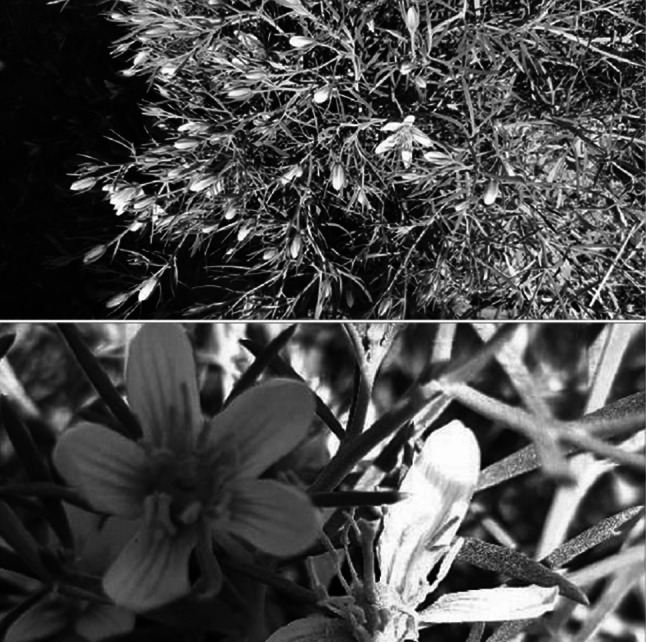
Peganum harmala L. and it’s flower
Materials and methods
Preparation of extracts from P. harmala seeds and roots
Aerial parts and Roots of P. harmala were collected from Around countryside of Al Sweida, Syria in October 2017. The plant was verified by the taxonomist Dr. Emad Al Kadi from the faculty of science, Damascus University. The seeds were separated from their capsule and air-dried with roots at room temperature and kept in a dark amber-colored bottle until processed (Figs. 2 and 3). Dried plant materials (100 g) were crushed and then extracted with 500 mL methanol (99.9%) in a soxhlet apparatus (60 °C) for 24 h (Farouk et al. 2008). After that, the extract was filtered and concentrated with the rotary evaporator under low pressure at a temperature of 45 °C. So, we obtained methanolic seeds extract (MS) and methanolic roots extract (MR). The alkaloid fractions from seeds and roots prepared from dry methanol extract using ethyl acetate as organic solvent and sodium bicarbonate as an alkaline agent according to the method described by Brobst et al. (2009). As a result, we obtained alkaloid seed fraction (AS) and alkaloid root fraction (AR). The purification of alkaloids fractions was confirmed using a simple spectrophotometric assay, based on the reaction with Bromocresol Green (Fadhil et al. 2007).
Fig. 2.

P. harmala fruit and seeds
Fig. 3.

P. harmala roots
Parasite preparation
The strain of L. tropica obtained from the Center for Epidemiological and Biological Studies of Leishmaniasis Parasites, Damascus University. Promastigotes were cultured at 26 °C in RPMI-1640 supplemented with 10% heat-inactivated fetal bovine serum (FBS) (Gibco). The parasites were transferred from a previous cultured medium with a concentration of 30 million parasites/mL in the late Logarithmic phase to obtain a new cultured medium containing 4 million parasites/mL and were incubated at 26 °C to use in this experiment.
Antileishmanial activity assessment
Promastigote viability (%) was determined according to the method described by Feily et al. (2012) with some modifications. Optimization experiment was done using serial concentration (10, 20, 30, 40, 50) µg/mL from each extract to find out the suitable concentration (IC50). In 96-well plate, 50 µL of intact live L. tropica promastigotes (4 × 10⁶ promastigotes/mL) in the stationary growth phase were seeded. Then, 2.5 µL of each extract concentration (MS, MR, AS, AR,) was added to wells in duplicate. The volume was completed to 100 µL with the culture medium. The plate was incubated for 72 h at 26 °C. For negative control, 2.5 μL of DMSO was added to 50 µL of the previous culture. The volume was completed to 100 µL with the culture medium. So, DMSO percentage in the well was 2.5%. Some wells treated with Glucantime with various concentrations (15, 30, 60, 90) µg/mL, at the same number of parasites (Feily et al. 2012). All tests were performed in triplicate.
At the end of incubation, the surviving promastigotes were counted in a Neubauer’s chamber. Half maximal (50%) inhibitory concentration (IC50) was determined as the concentration of the extract which was necessary to inhibit 50% of parasite growth (Feily et al. 2012).
Statistical analysis
To compare the efficacy of different extracts from Peganum harmala on L.tropica promastigotes using Glucantime as a positive control, the univariate analysis of variance (one way ANOVA) and the Tukey’s HSD test were used. Differences were accepted as significant when P value < 0.05. To determine IC50 values for P. harmala extracts and Glucantime, the concentration-viability curve was plotted. IC50 values of three experiments were expressed as mean ± SEM. All statistical analyses were done using Prism software, version 5.03.
Results
Extraction yield
The yield of methanolic seed extract (MS) and methanolic root extract (MR) were found to be 21.65 and 8.35 g/100 g respectively (w/w of dry plant). Regarding the alkaloid fractions of seeds (AS) and roots (AR), the yield were found to be 6.63 and 2 g/100 g respectively (w/w of dry plant).
Antileishmanial activity assessment
Different concentrations from MS, MR extracts (10, 20, 30, 40, 50) µg/mL and AS fraction (0.1, 0.5, 1, 5, 10) μg/mL and AR fraction (2, 5, 10, 15, 20) μg/mL were added in the 96-well plate according to the protocol we mentioned in the material and methods section to determine the IC50 values. The viability percent of L. tropica promastigotes in the presence of different concentrations of MS, MR extracts are presented in Fig. 4, and for AS, AR fractions are presented in Figs. 5 and 6 respectively. IC50 values of examined P. harmala extracts and Glucantime were shown in Table 1.
Fig. 4.
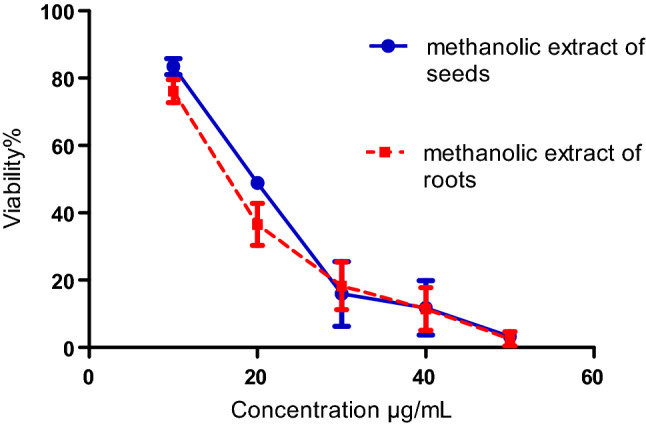
The viability of L. tropica promastigotes in the presence of different concentrations of methanolic extracts of P. harmala seeds and roots
Fig. 5.

The viability of L. tropica promastigotes in the presence of different concentrations of alkaloid fraction from P. harmala seeds
Fig. 6.
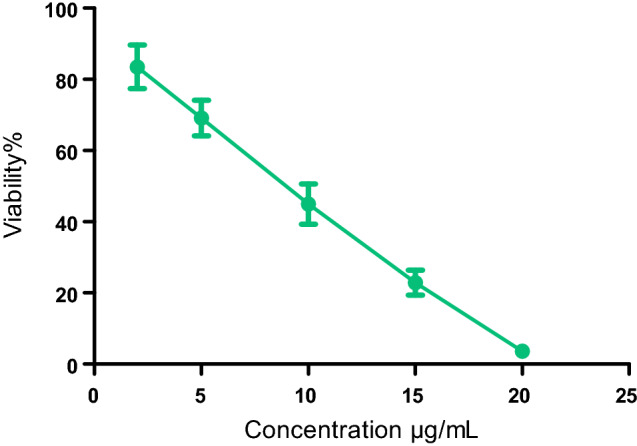
The viability of L. tropica promastigotes in the presence of different concentrations of alkaloid fraction from P. harmala root
Table 1.
IC50 values of different extracts of P. harmala seeds and roots and Glucantime
| The extract examined | IC50 value ± SEM (µg/mL) |
|---|---|
| Methanolic extract of seeds (MS) | 18.61 ± 0.87 |
| Methanolic extract of roots (MR) | 16.41 ± 0.71 |
| Alkaloid fraction of seeds (AS) | 4.97 ± 0.43 |
| Alkaloid fraction of roots (AR) | 9.23 ± 0.86 |
| Glucantime | 32.62 ± 0.66 |
According to one-way ANOVA analysis and Tukey’s HSD test, there is a significant difference between Glucantime and all extracts of P. harmala (from the seeds and the roots) with P value < 0.0001. Furthermore, The alkaloid fractions of the two parts are significantly different from corresponding methanolic extract with a P value < 0.0001. On the other hand, the alkaloid seed fraction differs significantly from the root one with a P value < 0.01. There is no significant difference between the two methanolic extracts of seeds and roots.
Discussion
Cutaneous leishmaniasis is the most common clinical manifestation of leishmaniasis. WHO reports refer that between 600,000 and 1 million new cases occur worldwide annually (WHO 2019a). In Syria, Anthroponotic CL is endemic in the Northwest regions, particularly Aleppo and its surroundings. The causative parasite is L. tropica and the vector Ph. sergenti (WHO 2019b). Leishmaniasis treatment approaches still insufficient to eliminate this infection (Ghorbani and Farhoudi 2018). Therefore, the development of novel drugs becomes a critical issue these days. Medicinal plants considered one of the most promising science subjects that can participate in the future progress of medicine to tackle this problem (Maleki et al. 2017). This study has investigated the antileishmanial effect of different extracts from Peganum harmala (grown in Syria) seeds and roots (Which had not been studied before) on the growth of L. tropica promastigotes in vitro. All extracts examined in this study have demonstrated an inhibitory effect on L. tropica promastigotes after 72 h of incubation with a significant difference in comparison to Glucantime (P < 0.0001). This indicates to the effective activity of Peganum harmala on L. tropica promastigotes. This study has demonstrated that alkaloid fractions have an IC50 value significantly lower than the corresponding methanolic extract after 72 h incubation (P < 0.0001). This refers to the principal role of alkaloid compounds in inhibiting the growth of L. tropica promastigotes. As a consequence, the antileishmanial effect of the two parts of Peganum harmala (seeds and roots) are probably attributed to these compounds. In comparison between the seeds and roots extracts, there was no significant difference between methanolic extracts. While the IC50 of alkaloid seed fraction has decreased considerably in comparison with alkaloid root fraction (P < 0.01). This could be attributed to the difference between total alkaloid content and the profile of alkaloid compounds in seeds and roots of P. harmala (Herraiz et al. 2017, 2010). Various studies showed the antileishmanial activity of Peganum harmala seeds extracts on L. major promastigotes, Rahimi-Moghaddam et al. (2011) have studied the antileishmanial activity of Peganum harmala seeds extract on the in vitro growth of L. major promastigotes. Their study showed that P. harmala seed extract inhibited the growth of promastigote forms of L. major in vitro after 24 h incubation with an IC50 of 59.4 µg/mL. These results haven't been compatible with Mirzaie et al. (2007), in which IC50 value of the extract against L. major promastigotes have been demonstrated to be about 1832 μg/mL after 72 h incubation. This difference might emerge due to plant collection parameters (locality, season, etc.), methods of extraction they used and/or conditions of in vitro experiments (Rahimi-Moghaddam et al. 2011). P. harmala, especially its seeds and roots, contains several alkaloids including β-carbolines (harmaline, harmine, harmalol, and harmane) and quinazoline derivatives (vasicine and vasicinone) (Asgarpanah and Ramezanloo 2012). Results obtained from Di Giorgio et al. (2004) have explained that some of the β-carboline alkaloid compounds could have interesting in vitro antileishmanial activities. Harmane and harmine reveal a moderate antiproliferative activity toward human monocytes and exerted a weak antileishmanial activity toward the promastigote and the amastigote forms of L. infantum. Conversely, harmaline did not have toxicity toward human cells and Leishmania promastigotes, however, it exerted a strong antileishmanial activity toward the intracellular amastigote form of the parasite. Khaliq et al. (2009) have demonstrated that peganine has an in vitro inhibitory effect on promastigotes of L. donovani as well as intracellular amastigotes residing within murine macrophages and exhibited in vivo activity, 79.6 (± 8.07)% against VL in hamsters at a dose of 100 mg/kg. Based on the study conducted by Sobhani et al. (2002), P. harmala seed extract has inhibited human DNA topoisomerase I, as well as docking study (Misra et al. 2008) which has suggested that peganine inhibits the DNA topoisomerase I by directly interacting with the enzyme, the antileishmanial activity of P. harmala extracts may be attributed to its effects on topoisomerase I in L.tropica as DNA topoisomerases play a key role in cellular processes affecting the topology and organization of intracellular DNA in Kinetoplastid (Das et al. 2008).
In conclusion, Peganum harmala seeds and roots extracts exhibit in vitro activity against L. tropica promastigotes. The alkaloid fractions have a more inhibitory effect than the other extracts. As a result, the alkaloid compounds could be responsible for this effect.
Acknowledgement
This study was supported by a Center for Epidemiological and Biological Studies of Leishmaniasis Parasites, Damascus University.
Author contributions
MM has carried out the laboratory work, perform the Graph pad, Prism analysis, and drafted the first manuscript. SH has supervised the antileishmanial section, KM (My master supervisor) has supervised the extraction section and checked the whole manuscript.
Compliance with ethical standards
Conflict of interest
The authors declare that they have no conflict of interest.
Footnotes
Publisher's Note
Springer Nature remains neutral with regard to jurisdictional claims in published maps and institutional affiliations.
References
- Asgarpanah J, Ramezanloo F. Chemistry, pharmacology and medicinal properties of Peganum harmala L. Afr J Pharm Pharmacol. 2012;6(22):1573–1580. doi: 10.5897/ajpp11.876. [DOI] [Google Scholar]
- Brobst A, Lewis J, Klett B, Haustein C, Shriver J. The free base extraction of harmaline from Penganum harmala. Am J Undergrad Res. 2009;8:2–3. doi: 10.33697/ajur.2009.013. [DOI] [Google Scholar]
- Das BB, Ganguly A, Majumder HK. DNA topoisomerases of Leishmania: the potential targets for anti-leishmanial therapy. In: Majumder HK, editor. Drug targets in Kinetoplastid parasites. New York: Springer Science and Business Media; 2008. pp. 103–115. [DOI] [PubMed] [Google Scholar]
- Desjeux P. Leishmaniasis: current situation and new perspectives. Comp Immunol Microbiol Infect Dis. 2004;27(5):305–318. doi: 10.1016/j.cimid.2004.03.004. [DOI] [PubMed] [Google Scholar]
- Di Giorgio C, Delmas F, Ollivier E, Elias R, Balansard G, Timon-David P. In vitro activity of the β-carboline alkaloids harmane, harmine, and harmaline toward parasites of the species Leishmania infantum. Exp Parasitol. 2004;106(3–4):67–74. doi: 10.1016/j.exppara.2004.04.002. [DOI] [PubMed] [Google Scholar]
- Fadhil S, Reza MH, Rouhollah G, Reza VRM. Spectrophotometric determination of total alkaloids in Peganum harmala L. using bromocresol green. Res J Phytochem. 2007;1(2):79–82. doi: 10.3923/rjphyto.2007.79.82. [DOI] [Google Scholar]
- Farouk L, Laroubi A, Aboufatima R, Benharref A, Chait A. Evaluation of the analgesic effect of alkaloid extract of Peganum harmala L.: possible mechanisms involved. J Ethnopharmacol. 2008;115(3):449–454. doi: 10.1016/j.jep.2007.10.014. [DOI] [PubMed] [Google Scholar]
- Feily A, Saki J, Maraghi S, Moosavi Z, Khademvatan S, Siahpoosh A. In vitro activity of green tea extract against Leishmania major promastigotes. Int J Clin Pharmacol Ther. 2012;50(3):233–236. doi: 10.5414/CP201571. [DOI] [PubMed] [Google Scholar]
- Ghorbani M, Farhoudi R. Leishmaniasis in humans: drug or vaccine therapy? Drug Des Devel Ther. 2018;12:25. doi: 10.2147/DDDT.S146521. [DOI] [PMC free article] [PubMed] [Google Scholar]
- Hayani K, Dandashli A, Weisshaar E. Cutaneous leishmaniasis in Syria: clinical features, current status and the effects of war. Acta Derm Venereol. 2015;95(1):62–66. doi: 10.2340/00015555-1988. [DOI] [PubMed] [Google Scholar]
- Herraiz T, González D, Ancín-Azpilicueta C, Arán VJ, Guillén H. β-Carboline alkaloids in Peganum harmala and inhibition of human monoamine oxidase (MAO) Food Chem Toxicol. 2010;48(3):839–845. doi: 10.1016/j.fct.009.12.019. [DOI] [PubMed] [Google Scholar]
- Herraiz T, Guillén H, Arán VJ, Salgado A. Identification, occurrence and activity of quinazoline alkaloids in Peganum harmala. Food Chem Toxicol. 2017;103:261–269. doi: 10.1016/j.fct.2017.03.010. [DOI] [PubMed] [Google Scholar]
- Khaliq T, Misra P, Gupta S, Reddy KP, Kant R, Maulik PR, Narender T. Peganine hydrochloride dihydrate an orally active antileishmanial agent. Bioorg Med Chem Lett. 2009;19(9):2585–2586. doi: 10.1016/j.bmcl.2009.03.039. [DOI] [PubMed] [Google Scholar]
- Khan FA, Maalik A, Iqbal Z, Malik I. Recent pharmacological developments in β-carboline alkaloid “harmaline”. Eur J Pharmacol. 2013;721(1–3):391–394. doi: 10.1016/j.ejphar.2013.05.003. [DOI] [PubMed] [Google Scholar]
- Li S, Cheng X, Wang C. A review on traditional uses, phytochemistry, pharmacology, pharmacokinetics and toxicology of the genus Peganum. J Ethnopharmacol. 2017;203:127–162. doi: 10.1016/j.jep.2017.03.049. [DOI] [PubMed] [Google Scholar]
- Maleki F, Zarebavani M, Mohebali M, Dayer MS, Hajialiani F, Tabatabaie F. In vitro and in vivo susceptibility of Leishmania major to some medicinal plants. Asian Pac J Trop Biomed. 2017;7(1):37–42. doi: 10.1016/j.apjtb.2016.11.008. [DOI] [Google Scholar]
- Mirzaie M, Nosratabadi SJ, Derakhshanfar A, Sharif I. Antileishmanial activity of Peganum harmala extract on the in vitro growth of Leishmania major promastigotes in comparison to a trivalent antimony drug. Vet Arh. 2007;77(4):365. [Google Scholar]
- Mishra BB, Kale RR, Singh RK, Tiwari VK. Alkaloids: future prospective to combat leishmaniasis. Fitoterapia. 2009;80(2):81–90. doi: 10.1016/j.fitote.2008.10.009. [DOI] [PubMed] [Google Scholar]
- Misra P, Khaliq T, Dixit A, SenGupta S, Samant M, Kumari S, Narender T. Antileishmanial activity mediated by apoptosis and structure-based target study of peganine hydrochloride dihydrate: an approach for rational drug design. J Antimicrob Chemother. 2008;62(5):998–1002. doi: 10.1093/jac/dkn319. [DOI] [PubMed] [Google Scholar]
- Rahimi-Moghaddam P, Ebrahimi SA, Ourmazdi H, Selseleh M, Karjalian M, Haj-Hassani G, Shafiei M (2011) In vitro and in vivo activities of Peganum harmala extract against Leishmania major. J Res Med Sci. 16(8): 1032. https://www.ncbi.nlm.nih.gov/pmc/articles/PMC3263080/. [PMC free article] [PubMed]
- Rehman K, Walochnik J, Mischlinger J, Alassil B, Allan R, Ramharter M. Leishmaniasis in northern Syria during civil war. Emerg Infect Dis. 2018;24(11):1973. doi: 10.3201/eid2411.172146. [DOI] [PMC free article] [PubMed] [Google Scholar]
- Sobhani AM, Ebrahimi SA, Mahmoudian M. An in vitro evaluation of human DNA topoisomerase I inhibition by Peganum harmala L. seeds extract and its beta-carboline alkaloids. J Pharm Pharm Sci. 2002;5(1):19–23. [PubMed] [Google Scholar]
- Sundar S, Chakravarty J. An update on pharmacotherapy for leishmaniasis. Expert Opin Pharmacother. 2015;16(2):237–252. doi: 10.1517/14656566.2015.973850. [DOI] [PMC free article] [PubMed] [Google Scholar]
- WHO (2019a) Fact sheet, leishmaniasis, https://www.who.int/news-room/factsheets/detail/leishmaniasis. Accessed 30 Jul 2019
- WHO (2019b) Neglected tropical diseases. https://www.emro.who.int/neglected-tropical-diseases/countries/cl-syria.html. Accessed 30 Jul 2019
- Zhang G, Chi X. The complete chloroplast genome of Peganum harmala. Mitochondrial DNA Part B. 2019;4(1):1784–1785. doi: 10.1080/23802359.2019.1612289. [DOI] [Google Scholar]