



Highlights
-
•
Performance was not negatively affected when students faced Emergency Remote Teaching.
-
•
Experimental groups who transitioned to ERT performed better than control groups.
-
•
Students’ sense of responsibility was enhanced by the ERT state.
1. Introduction
1.1. Problem statement and purpose
2020 is the year of the SARS-COV-2 generated pandemic, which is the single most unprecedented, and devastating global experience in the year, the decade, and perhaps the human history. Dealing with this pandemic has created serious challenges for all industries, including the educational landscape. To cope with the pandemic, many educational institutions in the United States have resorted to Emergency Remote Teaching (ERT), which is essentially shifting face to face courses to alternate or online delivery modes, to provide instruction during a crisis situation, until it has abated [1], [8], [39]. While ERT has been used in other countries before 2020 [20], it has been widely adapted in the United States in 2020 to deal with the SARS-COV-2 pandemic [17]. This movement to ERT is deemed necessary for medical reasons, but there are those who are concerned that this move to online environments might impact academic success rates, if sustained over longer periods [53].
That is because, although ERT and online/distance education environments are distinct entities, they are often mistaken to be synonymous, which is why skeptics may believe that ERT, like traditional digitized learning is not as high quality as face to face (f2f) instruction, and may not lead to desirable academic success [14], [39], [87], [88]). This is a stigma that is counterproductive to efficient support of ERT. Additionally, when evaluation parameters used for distance/online education is applied to ERT, it may lead to unfair and unsubstantiated notions that prevent its acceptance more readily. To better grasp the issue, it is crucial to examine the key differences between ERT and distance/online learning, which are briefed below.
Distance /online learning is a complex process in terms of design, analysis and time taken to develop and implement courses and programs. Because it has been around for decades, it has evolved and morphed into a multidimensional procedure that needs meticulous planning, evolvement, and evaluation. It is aimed to provide meaningful learning experiences to students who may not otherwise have the option to attend college, due to personal or professional responsibilities. Students of distance/online courses and programs usually choose to join voluntarily, and designers of such programs purposefully plan for them to be online from the start [6], [39]. In contrast ERT is, as the name implies, an emergency/crisis based need to move teaching and learning to alternative environments until the crisis is averted or ended. The skill set required to operate in an ERT situation is quite distinct from that of a distance/online environment. Most importantly, unlike fully online environments that operate on distinctly different set of rules than face to face, ERT uses several practices and features of face to face teaching, but does so using alternative methods [9], [39].
Given the newness of the issue, there is a significant gap in the literature on all aspects of ERT related to the SARS-COV-2 pandemic, but most of all on information related to its impact on student performances. Thus there is a call for “future research to examine, in up-close detail, the effects and consequences of the expansion and embedding of digital technologies and media in education systems, institutions and practices across the world” ([86]; p.107). The purpose of this study is to add to the literature and provide crucial insights into the impact of the SARS pandemic induced ERT on learner performance, using a quantitative research approach with experimental design. . The research question examined, using data from 397 students, is:
What effect does current ERT measures to deal with the SARS-COV-2 pandemic have on learners and their performance?
1.2. Negative perceptions of remote learning is corrupting ERT reputation
As is evident from the literature, remote learning comes with the associated stigma of being less valuable to academic success than face to face learning. Views on the superior quality of face to face education versus online have been shared by educators and learners who believe that learners benefit more from the intimate, face to face engagement that online environments cannot replicate. Many subscribe to the belief that online or distance learning may not provide learners with opportunities for academic success with the same robustness as face to face education [11], [12], [29], [46], [57], [92]. In the context of 2 year community colleges, Coates et al. [19] suggest against any policies that encourage moving to online as they believe “such policies might not be an efficient use of resources and that the students might not be well-served by such policies” (p.545). Brown's and Liedholm's [10] study show that online students did not perform as well as face to face learners. Ellis et al. [24] believe that online discussions should be enhanced by fusing face to face discussions, which are ‘well established learning activities” (p.280). Okdie et al. [63] suggest that face to face interaction is superior to computer generated interaction because, “FtF [face to face] interaction, and the abundance of social cues inherent in it, make it a better conduit by which individuals may gauge characteristics of others” (p.157). There is strong suggestion in the literature that students and faculty prefer face to face over online/distance learning, for what they perceive to be difficult subjects. Studies suggest that students in face to face courses could have higher academic success as they feel they learn better from direct instruction and instructor presence [7], [26], [42], [43], [51], [67]. Based on such assumptions, moving to ERT is raising questions related to its efficacy and the impact it can have on all stakeholders in higher education in terms of health, political, economic, social and psychological elements [3], [73], [86]. However, skeptics of ERT who believe it is less than face to face may fail to realize that ERT uses several practices and features of face to face teaching, but does so using alternative methods [9], [39]. As succinctly expressed by Hodges et al. [39], ERT, involves the use of fully remote teaching solutions for instruction or education that would otherwise be delivered face-to-face or as blended or hybrid courses and that will return to that format once the crisis or emergency has abated. The primary objective in these circumstances is not to re-create a robust educational ecosystem but rather to provide temporary access to instruction and instructional supports in a manner that is quick to set up and is reliably available during an emergency or crisis. When we understand ERT in this manner, we can start to divorce it from "online learning” (p.6).
1.3. Need statement
The question that is not being addressed is whether moving face to face courses to online delivery when maintaining ERT could affect students’ academic success, particularly in negative ways. This is a relevant query, given the current pandemic situation, which necessitates transitioning to remote options to maintain social distancing as a means to control the virus’ spread, and the value stakeholders place on face to face instruction as opposed to online counterparts. The polarity of the situation requires specific knowledge to be resolved. Knowing whether students’ academic success is negatively impacted by the transition to online is critical to understanding what measures we must take to help students succeed in the current situation, and whether reopening campuses and reverting to face to face models could ensure greater academic success, as opposed to sustaining the online delivery models. A key factor that should be included in academe related decisions is the degree of effect any given situation may have on student grades, given that grades are used extensively by educational institutions as an indicator of academic success and wellbeing [31], [91]. “Academic achievement is almost entirely measured with grades (by course or assignment) and GPA. This is unsurprising since grades and GPA measures are by far the most readily available assessments for institutions” ([91], p.7).
Yet not enough is being done to investigate the 2020 ERT's effect on grades, while making critical decisions like reopening campuses. Although there is some evidence in the current literature regarding the negative emotional and psychological effects of pandemic- induced social distancing and ERT on stakeholders [15], [54], [56], [93], there is little information on whether this is affecting students’ performances negatively. Performance and grades are considered important indicators of academic success, which is why there is a great need for more tangible evidence that ERT related online learning is indeed harmful for learners’ performances, since this may be useful to make informed decisions on developing strategies to adjust learning environments to serve stakeholders safely and productively.
1.4. Key terms explained
For the purposes of this study, the term social distancing refers to only the time frame relevant to the SARS-COV-2, as opposed to social distancing in any other context. This is appropriate given the problem statement discussed earlier. A pandemic disease is identified by the degree of geographical influence, high attack rates, and high communicability [61]. The current pandemic is the result of “The emergence of severe acute respiratory syndrome coronavirus 2 (SARS-COV-2; previously provisionally named 2019 novel coronavirus or 2019-nCoV) disease (COVID-19) in China at the end of 2019” ([49], p. 2).
Social distancing in the context of pandemics relate to steps taken to initiate a “social contact network–focused mitigation” to offer protection against the spread of a disease in the absence or shortage of medical means to control it ([33], p.1671) .The purpose of such social distancing currently is to “to reduce transmission, thereby delaying the epidemic peak, reducing the size of the epidemic peak, and spreading cases over a longer time to relieve pressure on the healthcare system” ([28], p. 976).
1.5. Current literature brief
While the effects of social distancing and resultant ERT measures due to the current pandemic are being discussed and articulated, there is little to no conversations with respect to performance outcomes in higher education in this context. This was established after a review of approximately 2700 articles on Google Scholar using key phrase searches of ‘COVID 19 social distancing effects and performance outcomes’, ‘Emergency Remote Teaching’, and ‘COVID 19 social distancing effects and academic performance’. Gonzalez et al's [35] examination of the effect that this pandemic has on higher education students from Spain, is the closest fit to the purpose of this study. Based on their study, Gonzalez et al. [35] suggest that “higher scores are expected due to the COVID-19 confinement that can be directly related to a real improvement in students learning” (p.22).
Other topics relate to the effects of social distancing, including emotional and mental health [30], [64], [74], [89], as well as socio-economic ramifications [4], [5], [40], [58], [65]. In the context of learning, a few studies were found relating to medical and K-12 education. Van Lancker and Parolin [83] discuss the effect of school closures on children's food insecurity. Sintema [77] suggests that the closures may have a negative effect on K-12 STEM student population in Zambia, based on a qualitative, interview-based study. No quantitative or performance output data was used for Sintema [77]. Several articles discuss medical education in the context of COVID 19, and include topics on new strategies to teach medical students, assessment and evaluation, and general impact on learners [70], [75], [78], [80], [84].
2. Materials and methods
2.1. Design and participants
The study examined the effects of the SARS-COV-2 pandemic related ERT on learners’ grades, using an Experimental design with data collected from 397 students enrolled in undergraduate, face to face courses of a large college system in the Midwest Region of the United States. Participants included four professors who taught Business, English, Computer Programming and Communication disciplines. Experimental groups were students who directly experienced ERT when their face to face classes were moved online to accommodate social distancing protocols. Control groups were students who either attended college in 2019 or attended the first 8-week courses in spring 2020 semester, which is why these courses were not moved to online. Control group students did not experience the ERT environments and social distancing through course participation due to the current pandemic, since they attended normal schedules face to face. The course content and major assessment methods and materials were same for both experimental and control groups within disciplines. However, the materials and assessments differed, based on the disciplines. All course materials adhered to the institution's curriculum goals and requirements.
When moving courses to online, professors initiated fully online, asynchronous delivery, combined with the option of synchronous lecture delivery in real time (as per the original class schedule for face to face) through technology such as Zoom and WebEx. For Business, Computer Programming and English courses, students had the option to submit work in person or online before the ERT. During the ERT they were required to submit all work online. For Communication courses, some work was to be submitted online and others in person before the social distancing and moving to online delivery. Thereafter, all assignments, including in-person presentations, were delivered online. Three professors also reduced their response time to students’ questions and offered appointments during weekends and evenings as student needed. One professor added weekly work, which was not part of the original course package, to mark online attendance.
2.2. Data instruments
Upon receiving IRB approval from the institution's Human Research Department, the researcher contacted the professors via phone, informing them of the study's purpose, scope, voluntary and confidential nature. Each participant was asked to randomly select two or more courses using a code generated for Course Reference Numbers (CRN) for the sections that they had taught. Additionally, participants shared student perceptions of the ERT experience from their respective courses using excerpts from course discussion forums and personal communications between the faculty and students. These instruments were used to evaluate student views on ERT, which could help analyze the how and why of the performance grades. The three caveats for the course selection were:
-
1.
Courses should have been taught within 2019 and 2020
-
2.
Selected courses must have the same major assignments and subject matter, irrespective of the year they were taught
-
3.
All courses were originally planned for face to face delivery
This ensured that data was a mix of students who had experienced pre and post pandemic situations, and that different teaching styles and subject matter were represented in the sample. Participants shared deidentified gradebooks from the randomly selected courses. All student identification details were removed and only the grade points, as well as course details including schedule and assignments were provided. Given the wide range of course schedules, both between and within subjects’ data was available as per the following categories:
-
•
Students who attended courses in 2019 and were not exposed to the ERT.
-
•
Students who attended 16-week courses from January 2020 to May 2020. Courses were moved to online delivery from April 2020. The same students experienced pre and post ERT.
-
•
Students who attended first 8-week courses in 2020 (January to March) and did not experience ERT.
-
•
Students who attended the second 8-week courses 2020 (March to May), which were moved to ERT delivery.
2.3. Data analysis
The research question examined in this study is: What effect does current ERT measures to deal with the SARS-COV-2 pandemic have on learners and their performances? Both within and between subjects’ data were used for a comprehensive and in-depth analysis. The H 0 was that the ERT environment caused by the transition of face to face courses to online due to the current pandemic will not have any effect on students’ grades. The H a was that the ERT environment will affect students’ grades negatively. Alpha-level were set at 5% (= .05). The confidence level for tests was set at 95%.
Independent variable t Test was used for between subjects, while Paired t Test was used for within subjects. Regarding subject matter differentials, Communication and Computer Programming students were only from 2020, while English and Business students were from both 2019 and 2020. To determine the statistical and practical significance of the experiment, the effect size was interpreted by considering the outcome being studied [82], using effect size tests as suggested by Durlak [22]. The American Psychological Association encourages reporting all relevant results, and when required, use original units, such as mean differences, and/or standardized or units-free measure to report effects. This is because effects “are often most easily understood when reported in original units” ([2], p.34). It is important to not only report results, but also interpret them, which means conclusions should be based on more than simple accept-reject statements based on p value. Instead, the focus of the analysis should be on the size and importance of the effects [45].
To examine what the odds were that face to face transition to online would impact grades, this study used suggestions made by the National Center for Special Education Research of the U.S Department of Education [55]. Odds Ratio were calculated with 80%+ as the desired range based on the institution's and general standards for Higher Education assessments in the United States [41], using the formula (a/b)/(c/d), where a=desired experimental, b=undesired experimental, c=desired control, and d=undesired control scores). Cohen's d effect, using Ray and Shadish's [68] Method 2, was also calculated. The significance levels were determined by the following criteria: Small=0.2. Medium =0.5, Large =0.8.
Significance of the ERT transition's effect in terms of grades was also calculated using frequency distribution of grades for three classes: High (highest numerical class), Medium (second highest numerical class), and Low (all others). The tables are available in the Results section.
3. Results
3.1. Between subjects pre and post ERT
The sample included all cases from all subjects. There were 190 students from control and 207 from experimental. Based on the t Test results of p>0.5 (two-tailed P value = 0.5136) the null could not be rejected. As per the t Test results, the grades from the control group and experimental group have no statistically significant differences. The effect size as per Cohen's d was 0.069, which is not significant.
However, the significance in terms of performance grades using the frequency of grades distribution indicate the following:
Using these as the determining values for positive and negative outcomes, the results indicate that the experimental group performed better than the control group as follows:
-
•
Experimental group had a significantly greater percentage of high grades than control group in the highest range (27% versus 18.9%)
-
•
Experimental group had a smaller percentage of lowest grades versus the control group (30% versus 39.5%)
-
•
Experimental group had same percentage of medium grades versus the control group (42% versus 41.6%)
The odds of higher performance were in favor of the experimental group, calculated with 80%+ as the desired range based on the institution's and general standards for Higher Education assessments in the United States [41], using the formula (a/b)/(c/d), where a=desired experimental, b=undesired experimental, c=desired control, and d=undesired control scores)=(131/76)/(106/84)=1.37. Based on this analysis, the overall performance of the experimental group was higher than the control.
3.2. Within subjects communication
The sample included 43 students who participated in 16-week courses in spring 2020. The courses were moved to online from face to face in April 2020. The within subjects, Paired sample t-Test results indicate that there is no statistically significant difference between the grades of pre and post exposure to the pandemic related social distancing. Based on the p>.05 (p=.38) the null could not be rejected for this data set. Effect size is at low significance based on Cohen's d at 0.195 (paired).
However, the significance in terms of performance grades using the frequency of grades distribution indicate the following:
Using these as the determining values for positive and negative outcomes, the results indicate that the experimental group performed better than the control group as follows:
-
•
Experimental group had a significantly greater percentage of high grades than control group in the highest range (34.9 % versus 18.6%)
-
•
Experimental group had a significantly smaller percentage of lowest grades versus the control group (13.9% versus 27.9%)
-
•
Experimental group had slightly lower percentage of medium grades versus the control group (51.2% versus 53.5%)
3.3. Within subjects computer programming
The sample included 28 students who participated in 16-week courses, which were moved to online from face to face in April 2020. The within subjects, paired sample t-Test results indicate that there was no statistically significant difference between the grades of pre and post exposure to the pandemic related social distancing. Based on the p>.05 (p=.56) the null could not be rejected for this data set.
However, the significance in terms of performance grades using the frequency of grades distribution indicate the following:
Using these as the determining values for positive and negative outcomes, the results indicate that the experimental group performed significantly better than the control group as follows:
-
•
Experimental group had a significantly greater percentage of high grades than control group in the highest range (50 % versus 17.9%)
-
•
Experimental group had a significantly smaller percentage of lowest grades versus the control group (10.1% versus 28.6%)
-
•
Experimental group had significantly lower percentage of medium grades versus the control group (39.3% versus 53.6%)
3.4. Student perception
Based on the excerpts shared by the participants, when discussing their ERT experience students expressed both negative and positive views. Using keywords and phrases, 17 codified categories emerge that encompass students’ reactions to the ERT situation. Fig. 1 provides a graph of the results. Fig. 2 displays the positive-negative remarks map and Fig. 3 shows a pie chart of the positive vs negative distribution. As revealed in Fig. 1, participants found ERT to be significantly negative, even though some positive elements were also mentioned. The number of comments per category indicate that there were 559 negative and 288 positive remarks. As shown in Fig. 4 when discussing teaching strategies there were 373 positive remarks and 472 negative ones. As revealed in Tables 7 and 8 , and Figs. 1 and 4, students found communication to be a key factor in making their experiences positive or negative. Additionally, there were concerns about collaborative and group work.
Table 1.
Pre-Post Mean, SD, SEM.
| Control | Experimental |
|---|---|
| M 75.41 | M 77 |
| SD 21.01 | SD 24 |
| SEM 1.52 | SEM 1.65 |
Table 2.
Pre-Post Frequency Table.
| Control | Experimental | ||||
|---|---|---|---|---|---|
| Frequency Distribution Table |
Frequency Distribution Table |
||||
| Class | Count | Percentage | Class | Count | Percentage |
| 0 - 12.99 | 6 | 3.2 | 0 - 12.99 | 13 | 6.3 |
| 13 - 25.99 | 3 | 1.6 | 13 - 25.99 | 4 | 1.9 |
| 26 - 38.99 | 8 | 4.2 | 26 - 38.99 | 2 | 1 |
| 39 - 51.99 | 8 | 4.2 | 39 - 51.99 | 4 | 1.9 |
| 52 - 64.99 | 8 | 4.2 | 52 - 64.99 | 6 | 2.9 |
| 65 - 77.99 | 42 | 22.1 | 65 - 77.99 | 35 | 16.9 |
| 78 - 90.99 | 79 | 41.6 | 78 - 90.99 | 87 | 42 |
| 91 - 103.99 | 36 | 18.9 | 91 - 103.99 | 56 | 27.1 |
| Total | 190 | 100 | Total | 207 | 100 |
Table 3.
Within Subjects for Communication Mean, SD.
| Control (pre ERT) | Experimental (post ERT) |
|---|---|
| M 82.28 | M 80.33 |
| SD 9.96 | SD 13.01 |
Table 4.
Communication Frequency Table.
| Control | Experimental | ||||
|---|---|---|---|---|---|
| Frequency Distribution Table |
Frequency Distribution Table |
||||
| Class | Count | Percentage | Class | Count | Percentage |
| 49 - 58.99 | 1 | 2.3 | 20 - 32.99 | 1 | 2.3 |
| 59 - 68.99 | 4 | 9.3 | 33 - 45.99 | 1 | 2.3 |
| 69 - 78.99 | 7 | 16.3 | 46 - 58.99 | 1 | 2.3 |
| 79 - 88.99 | 23 | 53.5 | 59 - 71.99 | 3 | 7 |
| 89 - 98.99 | 8 | 18.6 | 72 - 84.99 | 22 | 51.2 |
| Total | 43 | 100 | 85 - 97.99 | 15 | 34.9 |
| Total | 43 | 100 | |||
Table 5.
Computer Programming Mean, SD.
| Control | Experimental |
|---|---|
| M 91.92 | M 90.6 |
| SD 5.92 | SD 11.36 |
Table 6.
Frequency Table for Computer Programming.
| Control | Experimental | ||||
|---|---|---|---|---|---|
| Frequency Distribution Table |
Frequency Distribution Table |
||||
| Class | Count | Percentage | Class | Count | Percentage |
| 69 - 75.99 | 1 | 3.6 | 40 - 52.99 | 1 | 3.6 |
| 76 - 82.99 | 0 | 0 | 53 - 65.99 | 0 | 0 |
| 83 - 89.99 | 7 | 25 | 66 - 78.99 | 2 | 7.1 |
| 90 - 96.99 | 15 | 53.6 | 79 - 91.99 | 11 | 39.3 |
| 97 - 103.99 | 5 | 17.9 | 92 - 104.99 | 14 | 50 |
| Total | 28 | 100.1 | Total | 28 | 100 |
Fig. 1.
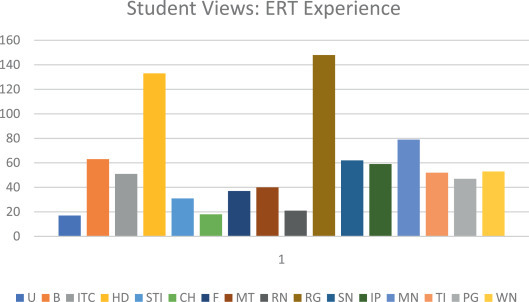
Student Views of ERT Experience.
Fig. 2.

Positive-Negative Perception Map.
Fig. 3.

Positive-Negative Pie of ERT Experience.
Fig. 4.

Graph of Student Views of Teaching.
Table 7.
Excerpt Data Coding: Student Views on Overall ERT Experience.
| Keywords/phrases samples | Codes | Numbers |
|---|---|---|
| 1 The experience with remote instruction was unchanged | Unchanged=U | 17 |
| 2. It is surprisingly better | Better =B | 63 |
| 3. Everything after the transition that wasn't directly related to an assignment was pointless busy work, more work afterwards, too many things to take care of: schedule, internet, time | Increased Time Consumption =ITC | 51 |
| 4. This transition was very difficult. It was messy, and it felt like a train wreck, much harder to learn, too difficult to learn in online, was quite challenging | Highly difficult=HD | 133 |
| 5. This class kinda falls on its face without the classroom student-professor interaction, as we stop really digging into each topic, and kinda just go through class motions, not being able to talk to teachers in class makes it harder, struggling with online set up | Lack of Student -Teacher Interaction makes it harder=STI | 31 |
| 6. Groupwork was difficult due to different time zones, very hard o collaborate with teams, two of my group did not participate at all | Collaboration is harder online =CH | 18 |
| 7. Flexibility | Online is good due to flexibility=F | 37 |
| 8. More time to work on assignments | More time for course work is good =MT | 40 |
| 9. More responsibility as a student is tough | Increased responsibilities is hard= RN | 21 |
| 10. More responsibility as a student is good, being more responsible helps my procrastination | Increased responsibilities is good=RG | 148 |
| 11. Less structured, | Less structured is bad=SN | 62 |
| 12. More procrastination | Increased procrastination+ IP | 59 |
| 13. Hard to watch online lectures and not able to ask questions in real time | Online materials are hard to consume=MN | 79 |
| 14. Technical issues, had low bandwidth that made video recording and movie making hard, my computer did not have enough juice to want videos sometimes. | Technical issues=TI | 52 |
| 15. More productive and focused when learning from home | At home makes for greater productivity=PG | 47 |
| 16. For working students, managing work and studies is tougher | Work life balance is harder=WN | 53 |
Table 8.
Excerpt Data Coding: Students View on Teaching.
| Keywords/phrases samples | Codes | Numbers |
|---|---|---|
| Would like instructors to show more sympathy; There was an excessive amount of busy work in the class as a whole. do 3 weekly assignments to mark attendance and that was terrible | Empathy and sympathy=ES | 53 |
| Instructor has emailed us weekly about what is due, updates us each week with the assignments that are due; I felt like we were kept up to date well in terms of due dates.. I really liked the weekly emails of what needs to be done as keeping all of the assignments in check without being in class was quite difficult. | Clear communication of work=CCW | 201 |
| Instructor was also easy to communicate with | Ease of student-teacher interaction= STI | 172 |
| The group project is what gave me the most headaches regarding online learning. Groupwork was difficult due to different time zones, everything else was fine | Groupwork Issues= GI Different Time Zone Issues=TZI |
161 42 |
| I believe the grading scale should have been weighted differently to compensate for us not being in class | Unrelaxed Grading Scale Issue=UGI | 176 |
4. Discussion
This study examined the effects of SARS-COV-2 related ERT on learners’ performance. Based on the review of the literature, the assumption was that ERT could affect learners’ performance negatively. However, the data analysis suggests otherwise. The statistical results indicate that students performed equally or significantly higher when situated in the ERT environment. There was no evidence to suggest that ERT environments led to lower performance grades. This is especially noteworthy when examined in the light of the data on students’ views of their ERT experience, which was mostly negative. As the data revealed, students found the ERT experience to be seriously difficult due to multiple factors including greater time commitment, difficulties consuming online course materials and less structured environments that increased their responsibilities as learners. However, and perhaps due to these challenges, their grades were not negatively impacted. This could be attributable to concepts of VUCA and Flow states brought on by the pandemic crisis, which could have generated engagement and drive to succeed and survive. Below is a discussion of how VUCA and Flow elements could possibly be the catalyst for generating higher performances in students facing ERT.
4.1. Theoretical significance. connections to VUCA States
The study's findings indicate strong connections to principles derived from concepts of VUCA, propounded by the US Army War College [44], [52]. Regarding VUCA, the term was coined in the late1990’s and was a military-derived acronym [52]. “The acronym, VUCA, stands for Volatility (rapidly changing contexts and conditions), Uncertainty (information missing that is critical to problem solving), Complexity (multiple factors difficult to categorize or control), and Ambiguity (vague data subject to multiple interpretation” ([69], p.16). Research suggests that VUCA can manifest in short term, sudden crisis events, and can motivate people to cope with the associated stress by creating flow states, self-compassion, mindfulness, and learning opportunities [59], [60], [85]. Crisis situations can create enhanced learning opportunities through the possibility of “intracrisis learning, that is, learning that seeks to improve response during a single crisis episode” ([59], p.189).
To further elucidate the key terms, the volatility relates to unprecedented and unpredictable nature, speed, and scope of change. This leads to uncertainty characterized by the inability to predict issues and events or how they will unfold. The volatility and uncertainty exponentially increase the complexity of the situation, where prior examples or casualties are absent or extremely hard to come by. Finally, the three conditions make it hard or impossible to accurately predict threats and opportunities, leading to ambiguity [52]. However, despite its negative connotations, VUCA can bring forth positive outcomes through “dilemma flipping” (p. 10) which is essentially taking the confusions and challenges and turning it into opportunities for growth, because not doing so will lead to outcomes people cannot afford [44].
The pandemic heightened the elements of VUCA in the learners’ worlds, thrusting them into a crisis mode and generating intracrisis management and learning opportunities. As the excerpt data suggest, learners felt more responsible, which many of them believed was beneficial in dealing with procrastination and creating greater structure in their learning process. Faced with the consequences of being more deeply responsible for their course work could have engendered the push needed to make learners work more diligently towards completing course work and graduating from the courses. Given the uncertainty of the future due to the pandemic, learners may not have been inclined to give up or lax their commitment. “In areas in which actors perceive themselves as being closely accountable, crises prompt them to process information effectively…. Actual crisis experience helps, giving responders an ability to deal with pressure, to engage in sensemaking” ([60], p.352). Concentrating on their learning could have been one way to reduce the distraction of focusing on the volatility, uncertainty, complexity, and ambiguity of their situation.
4.2. Theoretical significance: connections to flow state
The study's findings indicate strong connections to principles derived from concepts of VUCA as explained above, as well as the Flow State of Mihaly Csikszentmihalyi [62]. Flow is identified as the “experience of complete absorption in the present moment” ([62], p.195). This state is reached when people are presented with rigorous and unique challenges, possess a set of skills that can be used to deal with the challenge, and are provided with clear goals and immediate feedback about their progress in meeting the goals and dealing with the challenges. When in this state, people experience their situations moment to moment, characterized by intense focus on the present moments, and the realization that the ‘experience of the activity is intrinsically rewarding, and often such that the end goal is juts an excuse for the process” ([62], p.196). Essentially, a Flow state induces supreme action using all available skills to deal with an original challenge. These challenges were brought on by the VUCA state, as discussed in the previous sub section.
The pandemic generated a uniquely challenging state of existence within which institutions were forced to adopt ERT. Students experienced their learning in an acute moment to moment immersion. The key condition for flow experiences to occur is that the individuals use their existing skills to deal with a significant challenge or crisis, which in turn provides intrinsic motivation and enjoyment or relief from stress . In the context of learning, students are significantly more engaged and concentrate much harder when presented with unique, unprecedented challenges in their learning. Additionally, a sense of self-worth and pride in being able to accomplish hard tasks is germane to challenge generated motivation and engagement [48]. “Engagement resembling flow experiences reflect a state of complete absorption in a challenging activity with no psychic energy left for distractions” ([38], p. 171).
In the context of this study, it is possible that the VUCA challenges (as explained above) created in the wake of the pandemic induced ERT, generated flow states in learners. Given that the sample was from undergraduate students, it is likely that they were digital natives who had technological competencies and were using devices and software for personal and academic purposes [32], [36], [66]. Thus, they possessed the skills needed to overcome the challenges of transitioning to a remote learning environment from face to face. Based on the student views, only 52 remarks were made pertaining to technology. Out of those the majority related to issues such as internet access or low output devices. There were no comments pertaining to the lack of knowledge or competencies to use technology. The process of moving suddenly from face to face to remote created challenges of learning that students were able to deal with through their resilience and skills.
Additionally, in the context of this study it is critical to note that the correlation was not just with regards to the Flow concepts that a person's engagement with a task is causally related to the skills possessed to counter a challenge [18], and that when skill and difficulty are roughly proportional, people enter Flow states [16], [18]. Rather, the study's findings transcended the notion of skills compatibility with challenges, to exemplify why “As there are situational as well as personal moderators regarding the relation between skills–demands compatibility and flow experience, a measure of skills–demands balance should not be used (or interpreted) as a measure of the flow experience per se” ([50], p. 67).
In the study's context, it is possible that students were in the flow state, not just because they had skills sets to deal with ERT demands, but also because of the intrinsic motivation of engaging in their learning more robustly to deal with the trauma of the pandemic crisis, emulating an Autotelic Experience with “… intense concentration, clear goals and feedback, a balance of challenge and skill, merging of actions and awareness, a sense of control, and enjoyment in flow states” ([71], p.3). To gain more control of their VUCA environments, students focused on gaining control over their learning, leading to higher performance. “ …flow is characterized by high concentration and a sense of control, which are facilitators of performance [23]. As such, flow is a highly functional state and should result in better performance by itself” ([50], p. 78).
4.3. Practical significance
To discuss the practical significance of this study's findings, it should be viewed through the lens of policy and decision making for strategies to move forward and sustain academic rigor as the pandemic continues to wreak havoc. A key concern relating to the current ERT situation is whether it could and should be sustained long term, at least till such time as vaccinations and other medical necessities are available. To make informed decisions on such crucial matters, institutions and the education industry must evaluate the effects of the ERT on learners. This study provides vital insights into the effects of learners’ performance by suggesting that learners performed equally or better when faced with ERT. This is particularly significant, given the challenges of evaluating ERT strategies.
In the context of the current pandemic, the evaluation of ERT measures has been problematic, leading to assumptions and speculations about its efficacy, when concrete and credible evidence is required to make informed decisions about how institutions must move forward. Burgess and Sievertsen [13] state that it may not be possible to precisely estimate how much the social distancing interruption will affect learning. However, they do believe that “these interruptions will not just be a short-term issue but can also have long-term consequences for the affected cohorts and are likely to increase inequality”. With such perceptions, it is not surprising that there are growing concerns regarding continued ERT options, and sustained movement to online formats to accommodate social distancing, which some fear may have detrimental effects on the wellbeing of the educational industry and overall experiences of learners, including academic wellbeing and performance [21], [27]. Crawford et al. [17] discuss related concerns such as the availability of internet and sufficient bandwidth, geopolitical constraints, and the lack of skillset to design effective online courses. It is also feared that not moving back to campus learning and continued online delivery could “lead to less quality assurance activities while the focus is on revenue mitigation” ([17], p. 12).
This belief that ERT based online learning could result in lower academic success could and has influenced major academic decisions, which may or may not be conducive to our society's overall wellbeing and safety. For example, in the light of such concerns, many higher education administrators are contemplating or deciding to reopen campuses as early as fall 2020. According to a survey conducted by Axios, 65% of students want to come back to college, despite the absence of vaccines or other viable safety measures against the virus. The catch is that “The college experience isn't exactly about sheltering in place and keeping six feet away from people, so college administrators will have to solve the public health challenges if they expect to bring students back” [72]. As such, careful consideration must be given to how institutions handle the pandemic situation moving forward [39], [86].
While some are planning to open with social distancing regulations, others have decided to open in full [37]. This is despite the warnings from healthcare experts and organizations that a hasty return to social mingling could result in a resurgence of the pandemic, and that continued social distancing could help mitigate the spread (The [79], [81]). “If the cause for the decline is mainly social distancing policies, and if we have not achieved herd immunity, then reopening businesses may lead to additional severe outbreaks of COVID-19” ([47], p.3). Even though institutions may plan to enforce safe distancing, the practical applicability and execution of such a plan may be far from adequate, leading to a pandemic resurgence and putting lives at risk, when operating from home could save lives [25], [34], [76]. The findings of this study suggest that it may not be necessary to rush to reopen colleges to restore face to face classrooms, since learners can continue to be academically successful even under ERT. Instead, institutions must spend time and resources to strategize effective ways to deploy and administer ERT, while continuing to research ways to overcome the challenges of mass technology infusion in classrooms and maintaining safe social distancing when colleges do reopen, which is critical to the welfare of all.
4.4. Pedagogical and practitioner significance
In addition to the theoretical and practical insights, based on the practice measures used by the participant professors, the findings suggest some ways to elevate the ERT experience for learners and ensure their continued success. Some key suggestions are provided below.
-
•
When selecting lecture delivery options, think of providing learners with both synchronous and asynchronous options. As evident from the data, all participating professors had provided some form of real time interaction, along with online materials that students could consume own their own time. This flexibility and choice may have been a key contributor to defeat negative performance.
-
•
Think of keeping the class learning materials and assignments, as close to the original, face to face version as possible. This will help mitigate the disruption. Based on the data, only one professor had made alterations to the assignments and added weekly work to mark attendance, which was ill received by the learners.
-
•
Wherever possible, and keeping the ethical parameters, think of relaxing grading rigor, even while keeping the original grade calculation formulas. Accommodations could include allowing students to resubmit some work for higher credit, being more flexible on submission deadlines, and/or offering alternatives for earning extra credits.
-
•
Be cognizant of technology constrains and use multi-modal and multi-media artifacts. For instance, some students may not have access to high speed internet at home, and so may be unable to view videos or other artifacts that require greater bandwidth. For such students it may be helpful to have access to the same or similar information through more conventional means such as pdf and text.
-
•
A key concern and driving factor for success, as revealed in this study's data, was the ease and level of communication between professors and students. All professors shortened their response time by half (12-24 hrs. instead of 48 hours norm) and took appointments during weekends and evenings. This seemed to be of great help and a motivating factor for students. Think of being more robust and prompter than normal routines, when dealing with student responses during ERT.
-
•
Be sympathetic and empathetic. Everyone is a victim of a crisis such as the SARS-COV-2 pandemic. The data from this study revealed that students wanted to discuss emotional, personal, and family issues more openly with their professors. Giving them a few moments of time and listening to their issues could made a difference in their motivation.
-
•
Use mass and personalized communication tools to ensure higher instructor presence in the remote classrooms. Depending on what LMS the institution is using, think of adopting tools such as announcements, class conversations and messages to not only inform students of course related items, but also of the crisis related news and information. It is perfectly all right to talk about the pandemic, since it gives students a sense that the professors are part of the dynamics as well. This creates a sense of camaraderie and familial rapport.
5. Conclusion
The current pandemic is uniquely challenging for higher education and all its stakeholders. The crisis has made extraordinary demands on learners, faculty, administrators and staff, who are still dealing with the challenges as best as they can. These collaborative and individual efforts to handle the pandemic in ways that keeps the rigor of education alive will bring forth wisdom and knowledge that will sustain long after the virus is no more. Higher education, like the rest of the world, has been living in a VUCA state for some time now. However, the SARS-COV-2 pandemic and associated ERT measures have opened up a much needed gateway for educational institutions to research and find useful and viable ways to develop symbiotic plans using pedagogical, technological, economic, social and geopolitical elements that could safely and surely propel the industry into the future, while dealing effectively with volatility, uncertainty, complexity and ambiguity. This study availed of this opportunity to investigate a crucial question regarding ERT. While the purpose of this study is not to support or denigrate remote or face to face teaching, it is a sure step towards unravelling the intricacies and surprises of remote learning experience brought on by a crisis. The findings rest on the positive side of remote teaching, indicating no negative impact of remote transitioning on learner grades. This by no means implies a push for remote learning without doing deeper dives into its pros and cons. However, it does imply, and strongly so that because ERT is born out of a crisis, it can create motivational factors that might circumvent some of the negatives associated with online education. This is certainly a nudge in the right direction and a precursor to future research on evaluating the positives and negatives of ERT. The end game can, and should be to investigate new models of ERT application to convert “volatility into ‘Vision’ and uncertainty into ‘Understanding’, complexity into ‘Clarity’ and ambiguity into ‘Agility’” [90].
Declaration of Competing Interest
None.
Footnotes
Supplementary material associated with this article can be found, in the online version, at doi:10.1016/j.caeo.2020.100016.
Appendix. Supplementary materials
References
- 1.Affouneh S., Salha S., Khlaif Z.N. Designing quality e-learning environments for emergency remote teaching in coronavirus crisis. Med Sci. 2020;11(2):1–3. [Google Scholar]
- 2.American Psychological Association . American Psychological Association; Washington, DC: 2010. Publication manual of the American Psychological Association (6th ed.) [Google Scholar]
- 3.Araújo F.J., de Lima L.S., Cidade P.I., Nobre C.B., Neto M.L. Impact of Sars-Cov-2 and its reverberation in global higher education and mental health. Psychiatry Research. 2020;288 doi: 10.1016/j.psychres.2020.112977. [DOI] [PMC free article] [PubMed] [Google Scholar]
- 4.Atkeson A.G. What will be the economic impact of COVID-19? Rough estimates of disease scenarios. 2020 doi: 10.21034/sr.595. [DOI] [Google Scholar]
- 5.Barua S. Understanding Coronanomics: The economic implications of the coronavirus (COVID-19) pandemic. SSRN Electronic Journal. 2020 doi: 10.2139/ssrn.3566477. [DOI] [Google Scholar]
- 6.Author 2016.
- 7.Bejerano A.R. National Communication Association; 2016, December 15. Face-to-face or online instruction? face-to-face is better. [Google Scholar]; https://www.natcom.org/communication-currents/face-face-or-online-instruction-face-face-better.
- 8.Bozkurt A., Sharma R.C. Emergency remote teaching in a time of global crisis due to CoronaVirus pandemic. Asian Journal of Distance Education. 2020;15(1) [Google Scholar]
- 9.Bozkurt A., Jung I., Xiao J., Vladimirschi V., Schuwer R., Egorov G.…Rodes V. A global outlook to the interruption of education due to COVID-19 Pandemic: Navigating in a time of uncertainty and crisis. Asian Journal of Distance Education. 2020;15(1):1–126. [Google Scholar]
- 10.Brown B.W., Liedholm C.E. Can web courses replace the classroom in principles of microeconomics. American Economic Review. 2002;92(2):444–448. doi: 10.1257/000282802320191778. [DOI] [Google Scholar]
- 11.Burgan M. Vol. 2006. Johns Hopkins University Press; Baltimore, Md: 2006. (What ever happened to the faculty? Drift and decision in higher education). [Google Scholar]
- 12.Burgess O. Cyborg teaching: The transferable benefits of teaching online for the face-to-face classroom. Journal of Online Learning and Teaching. 2015;11(1):136. [Google Scholar]
- 13.Burgess S., Sievertsen H.H. Schools, skills, and learning: The impact of COVID-19 on education. VoxEu. org. 2020;1 https://voxeu.org/article/impact-covid-19-education [Google Scholar]
- 14.Butz N.T., Stupnisky R.H., Peterson E.S., Majerus M.M. Motivation in synchronous hybrid graduate business programs: A self-determination approach to contrasting online and on-campus students. Journal of Online Learning & Teaching. 2014;10(2):211–227. [Google Scholar]
- 15.Cao W., Fang Z., Hou G., Han M., Xu X., Dong J., Zheng J. The psychological impact of the COVID-19 epidemic on college students in China. Psychiatry Research. 2020;287 doi: 10.1016/j.psychres.2020.112934. [DOI] [PMC free article] [PubMed] [Google Scholar]
- 16.Cowley B., Charles D., Black M., Hickey R. Toward an understanding of flow in video games. Computers in Entertainment. 2008;6(2):1. doi: 10.1145/1371216.1371223. [DOI] [Google Scholar]
- 17.Crawford J., Butler-Henderson K., Rudolph J., Glowatz M. COVID-19: 20 Countries' Higher Education Intra-Period Digital Pedagogy Responses. Journal of Applied Teaching and Learning (JALT) 2020;3(1) [Google Scholar]
- 18.Csikszentmihalyi M. Jossey-Bass; 1975. Beyond Boredom and Anxiety. [Google Scholar]
- 19.Coates D., Humphreys B.R., Kane J., Vachris M.A. No significant distance” between face-to-face and online instruction: Evidence from principles of economics. Economics of Education Review. 2004;23(5):533–546. doi: 10.1016/j.econedurev.2004.02.002. [DOI] [Google Scholar]
- 20.Davies L., Bentrovato D. International Institute for Educational Planning; Bosnia and Herzegovina, Cambodia, Liberia: 2011. Understanding education's role in fragility; Synthesis of four situational analyses of education and fragility: Afghanistan. (2011) [Google Scholar]
- 21.DePietro A. Here's a look at the impact of coronavirus (covid-19) on colleges and universities in the u.s. Forbes. 2020 https://www.forbes.com/sites/andrewdepietro/2020/04/30/impact-coronavirus-covid-19-colleges-universities/#760b13f461a6 [Google Scholar]
- 22.Durlak J.A. How to select, calculate, and interpret effect sizes. Journal of Pediatric Psychology. 2009;34(9):917–928. doi: 10.1093/jpepsy/jsp004. [DOI] [PubMed] [Google Scholar]
- 23.Eklund R.C. Preparing to compete: A season-long investigation with collegiate wrestlers. The Sport Psychologist. 1996;10(2):111–131. doi: 10.1123/tsp.10.2.111. [DOI] [Google Scholar]
- 24.Ellis R.A., Goodyear P., Calvo R.A., Prosser M. Engineering students' conceptions of and approaches to learning through discussions in face-to-face and online contexts. Learning and Instruction. 2008;18(3):267–282. doi: 10.1016/j.learninstruc.2007.06.001. [DOI] [Google Scholar]
- 25.Fauci A.S., Lane H.C., Redfield R.R. COVID-19 — Navigating the uncharted. New England Journal of Medicine. 2020;382(13):1268–1269. doi: 10.1056/nejme2002387. [DOI] [PMC free article] [PubMed] [Google Scholar]
- 26.Ferguson J., Tryjankowski A.M. Online versus face‐to‐face learning: Looking at modes of instruction in master's‐level courses. Journal of Further and Higher Education. 2009;33(3):219–228. doi: 10.1080/03098770903026149. [DOI] [Google Scholar]
- 27.Flack C.B., Walker L., Bickerstaff A., Earle H., Margetts C. Educator perspectives on the impact of COVID-19 on teaching and learning in Australia and New Zealand. Melbourne, Australia. Pivot Professional Learning. 2020 https://www.pivotpl.com/wp-content/uploads/2020/04/Pivot_StateofEducation_2020_White-Paper.pdf [Google Scholar]
- 28.Fong M.W., Gao H., Wong J.Y., Xiao J., Shiu E.Y., Ryu S., Cowling B.J. Nonpharmaceutical measures for pandemic influenza in Nonhealthcare settings—Social distancing measures. Emerging Infectious Diseases. 2020;26(5):976–984. doi: 10.3201/eid2605.190995. [DOI] [PMC free article] [PubMed] [Google Scholar]
- 29.Francis M.K., Wormington S.V., Hulleman C. The costs of online learning: Examining differences in motivation and academic outcomes in online and face-to-face community college developmental mathematics courses. Frontiers in Psychology. 2019;10 doi: 10.3389/fpsyg.2019.02054. [DOI] [PMC free article] [PubMed] [Google Scholar]
- 30.Galea S., Merchant R.M., Lurie N. The mental health consequences of COVID-19 and physical distancing. JAMA Internal Medicine. 2020 doi: 10.1001/jamainternmed.2020.1562. [DOI] [PubMed] [Google Scholar]
- 31.Gifford D.D., Briceno-Perriott J., Mianzo F. Locus of control: Academic achievement and retention in a sample of university first-year students. Journal of College Admission. 2006;191:18–25. [Google Scholar]
- 32.Gikas J., Grant M.M. Mobile computing devices in higher education: Student perspectives on learning with cellphones, smartphones & social media. The Internet and Higher Education. 2013;19:18–26. [Google Scholar]
- 33.Glass R., Glass L., Beyeler W., Min H. Targeted social distancing designs for pandemic influenza. Emerging Infectious Diseases. 2006;12(11):1671–1681. doi: 10.3201/eid1211.060255. [DOI] [PMC free article] [PubMed] [Google Scholar]
- 34.Gostic K., Gomez A.C., Mummah R.O., Kucharski A.J., Lloyd-Smith J.O. Estimated effectiveness of symptom and risk screening to prevent the spread of COVID-19. Elife. 2020;9:e55570. doi: 10.7554/eLife.55570. [DOI] [PMC free article] [PubMed] [Google Scholar]
- 35.Gonzalez, T., De la Rubia, M., Hincz, K., Lopez, M. C., Subirats, L., Fort, S., & Sacha, G. M. (2020). Influence of COVID-19 confinement in students’ performance in higher education. 10.35542/osf.io/9zuac [DOI] [PMC free article] [PubMed]
- 36.Gu X., Zhu Y., Guo X. Meeting the “Digital Natives”: Understanding the acceptance of technology in classrooms. Educational Technology & Society. 2013;16(1):392–402. [Google Scholar]
- 37.Hadden J. What the top 25 colleges and universities in the US have said about their plans to reopen in fall 2020, from postponing the semester to offering more remote coursework. Business Insider. 2020, May 19 https://www.businessinsider.com/how-major-us-colleges-plan-reopen-for-fall-2020-semester-2020-5 [Google Scholar]
- 38.Hamari J., Shernoff D.J., Rowe E., Coller B., Asbell-Clarke J., Edwards T. Challenging games help students learn: An empirical study on engagement, flow and immersion in game-based learning. Computers in Human Behavior. 2016;54:170–179. doi: 10.1016/j.chb.2015.07.045. [DOI] [Google Scholar]
- 39.Hodges C., Moore S., Lockee B., Trust T., Bond A. The difference between emergency remote teaching and online learning. Educause Review. 2020;27 https://medicine.hofstra.edu/pdf/faculty/facdev/facdev-article.pdf [Google Scholar]
- 40.Hopman J., Allegranzi B., Mehtar S. Managing COVID-19 in low- and middle-income countries. JAMA. 2020;323(16):1549. doi: 10.1001/jama.2020.4169. [DOI] [PubMed] [Google Scholar]
- 41.International Affairs Office. (2008). Structure of the U.S. Education System: U.S. Grading Systems. Retrieved from U.S Department of Education website: https://www2.ed.gov/about/offices/list/ous/international/usnei/us/grading.doc.
- 42.Jaggars S.S. Choosing between online and face-to-face courses: Community college student voices. American Journal of Distance Education. 2014;28(1):27–38. doi: 10.1080/08923647.2014.867697. [DOI] [Google Scholar]
- 43.Jaggars S.S. In: Handbook of Distance Education. 3rd ed. Moore M.G., editor. Routledge; New York: 2012. Online learning in community colleges; pp. 594–608. Edited by. Edited by. [Google Scholar]
- 44.Johansen B., Euchner J. Navigating the VUCA world. Research-Technology Management. 2015;56(1):10–15. doi: 10.5437/08956308X5601003. [DOI] [Google Scholar]
- 45.Kalinowski P., Fidler F. Interpreting significance: The differences between statistical significance, effect size, and practical importance. Newborn and Infant Nursing Reviews. 2010;10(1):50–54. doi: 10.1053/j.nainr.2009.12.007. [DOI] [Google Scholar]
- 46.Kemp N., Grieve R. Face-to-face or face-to-screen? Undergraduates' opinions and test performance in classroom vs. online learning. Frontiers in Psychology. 2014;5 doi: 10.3389/fpsyg.2014.01278. [DOI] [PMC free article] [PubMed] [Google Scholar]
- 47.Kopecky K.A., Zha T. Federal Reserve Bank of Atlanta; 2020. Impacts of COVID-19: Mitigation Efforts versus Herd Immunity. (No. 2020-3) [Google Scholar]
- 48.Kuh G.D., Kinzie J., Schuh J.H., Whitt E.J. John Wiley & Sons; 2011. Student success in college: Creating conditions that matter. [Google Scholar]
- 49.Lai C., Shih T., Ko W., Tang H., Hsueh P. Severe acute respiratory syndrome coronavirus 2 (SARS-Cov-2) and coronavirus disease-2019 (COVID-19): The epidemic and the challenges. International Journal of Antimicrobial Agents. 2020;55(3) doi: 10.1016/j.ijantimicag.2020.105924. [DOI] [PMC free article] [PubMed] [Google Scholar]
- 50.Landhäußer A., Keller J. Advances in flow research. Springer; New York, NY: 2012. Flow and its affective, cognitive, and performance-related consequences; pp. 65–85.https://link.springer.com/chapter/10.1007/978-1-4614-2359-1_4 [Google Scholar]
- 51.Larson D.K., Sung C. Comparing student performance: Online versus blended versus face-to-face. Online Learning. 2019;13(1) doi: 10.24059/olj.v13i1.1675. [DOI] [Google Scholar]
- 52.Lawrence K. Developing leaders in a VUCA environment. UNC Executive Development. 2013:1–15. http://laszlo-zsolnai.net/sites/default/files/3/documents/Reading%203%20Developing-leaders-in-a-vuca-environment.pdf [Google Scholar]
- 53.Lederman D. The Shift to Remote Learning: The Human Element. Inside Higher Ed. 2020, March 25 https://www.insidehighered.com/digital-learning/article/2020/03/25/how-shift-remote-learning-might-affect-students-instructors-and [Google Scholar]
- 54.Lee J. Mental health effects of school closures during COVID-19. The Lancet Child & Adolescent Health. 2020;4(6):421. doi: 10.1016/s2352-4642(20)30109-7. [DOI] [PMC free article] [PubMed] [Google Scholar]
- 55.Lipsey, M.W., Puzio, K., Yun, C., Hebert, M.A., Steinka-Fry, K., Cole, M.W.,... Busick, M.D. (2012). Translating the Statistical Representation of the Effects of Education Interventions Into More Readily Interpretable Forms (ED-IES-09-C-0021). Retrieved from National Center for Special Education Research, Institute of Education Sciences website: https://ies.ed.gov/ncser/pubs/20133000/pdf/20133000.pdf.
- 56.Liu X., Liu J., Zhong X. Psychological state of college students during COVID-19 epidemic. SSRN Electronic Journal. 2020 doi: 10.2139/ssrn.3552814. [DOI] [Google Scholar]
- 57.Marshall S. More face to face, less face to screen. The Chronicle of Higher Education. 2001, February 3 https://www.chronicle.com/article/More-Face-to-Face-Less/126163 [Google Scholar]
- 58.Mhlanga, D., & Ndhlovu, E. (2020). Socio-economic implications of the COVID-19 pandemic on smallholder livelihoods in Zimbabwe. doi:10.20944/preprints202004.0219.v1.
- 59.Moynihan D.P. From Intercrisis to Intracrisis learning. Journal of Contingencies and Crisis Management. 2009;17(3):189–198. doi: 10.1111/j.1468-5973.2009.00579.x. [DOI] [Google Scholar]
- 60.Moynihan D.P. Learning under uncertainty: Networks in crisis management. Public Administration Review. 2008;68(2):350–365. doi: 10.1111/j.1540-6210.2007.00867.x. [DOI] [Google Scholar]
- 61.Morens D.M, Folkers G.K, Fauci A.S. What Is a Pandemic? The Journal of Infectious Diseases. 2009;200(Issue 7 (1)):1018–1021. doi: 10.1086/644537. [DOI] [PubMed] [Google Scholar]
- 62.Nakamura J., Csikszentmihalyi M. In: The Oxford handbook of positive psychology. 2nd ed. Lopez S.J., Snyder C.R., editors. 2012. Flow theory and research; pp. 195–206. [DOI] [Google Scholar]
- 63.Okdie B.M., Guadagno R.E., Bernieri F.J., Geers A.L., Mclarney-Vesotski A.R. Getting to know you: Face-to-face versus online interactions. Computers in Human Behavior. 2011;27(1):153–159. doi: 10.1016/j.chb.2010.07.017. [DOI] [Google Scholar]
- 64.Oosterhoff, B., Palmer, C., Wilson, J., & Shook, N. (2020). Adolescents’ motivations to engage in social distancing during the COVID-19 pandemic: Associations with mental and social health. 10.31234/osf.io/jd2kq [DOI] [PMC free article] [PubMed]
- 65.Pacheco D. The risks of COVID-19 spread rapidly in low- and middle-income countries: The Brazilian scenario. SSRN Electronic Journal. 2020 doi: 10.2139/ssrn.3564390. [DOI] [Google Scholar]
- 66.Prensky M. Corwin; Thousand Oaks, CA: 2010. Teaching digital natives: Partnering for real learning. [Google Scholar]
- 67.Public Agenda. 2013. Not yet sold: What employers and community college students think about online education. https://files.eric.ed.gov/fulltext/ED547410.pdf.
- 68.Ray J.W., Shadish W.R. How interchangeable are different estimators of effect size? Journal of Consulting and Clinical Psychology. 1996;64:1316–1325. doi: 10.1037//0022-006x.64.6.1316. [DOI] [PubMed] [Google Scholar]
- 69.Reeves T.C., Reeves P.M. Educational technology research in a VUCA world. Educational Technology. 2015:26–30. https://www.jstor.org/stable/44430353 [Google Scholar]
- 70.Rose S. Medical student education in the time of COVID-19. JAMA. 2020 doi: 10.1001/jama.2020.5227. [DOI] [PubMed] [Google Scholar]
- 71.Ross S.R., Keiser H.N. Autotelic personality through a five-factor lens: Individual differences in flow-propensity. Personality and Individual Differences. 2014;59:3–8. doi: 10.1016/j.paid.2013.09.029. [DOI] [Google Scholar]
- 72.Rothschild N. Axios; 2020, May 13. 65% of college students would attend class in fall even without vaccine. [Google Scholar]; https://www.axios.com/college-students-attend-class-fall-6e67fcec-3e9d-4a2d-92b7-be48cbe244f6.html?stream=top.
- 73.Rundle A.G., Park Y., Herbstman J.B., Kinsey E.W., Wang Y.C. COVID‐19–related school closings and risk of weight gain among children. Obesity. 2020;28(6):1008–1009. doi: 10.1002/oby.22813. [DOI] [PMC free article] [PubMed] [Google Scholar]
- 74.Santos C.F. Reflections about the impact of the SARS-COV-2/COVID-19 pandemic on mental health. Brazilian Journal of Psychiatry. 2020 doi: 10.1590/1516-4446-2020-0981. [DOI] [PMC free article] [PubMed] [Google Scholar]
- 75.Sabzwari S. Rethinking assessment in medical education in the time of COVID-19. MedEdPublish. 2020;9(1) doi: 10.15694/mep.2020.000080.1. [DOI] [Google Scholar]
- 76.Sen-Crowe B., McKenney M., Elkbuli A. Social distancing during the COVID-19 pandemic: Staying home save lives. The American Journal of Emergency Medicine. 2020 doi: 10.1016/j.ajem.2020.03.063. [DOI] [PMC free article] [PubMed] [Google Scholar]
- 77.Sintema E.J. Effect of COVID-19 on the performance of grade 12 students: Implications for STEM education. Eurasia Journal of Mathematics. Science and Technology Education. 2020;16(7) doi: 10.29333/ejmste/7893. [DOI] [Google Scholar]
- 78.Theoret C., Ming X. Our education, our concerns: Medical student education impact due to COVID‐19. Medical Education. 2020 doi: 10.1111/medu.14181. [DOI] [PMC free article] [PubMed] [Google Scholar]
- 79.Lancet The. COVID-19 in the USA: A question of time. The Lancet. 2020;395(10232):1229. doi: 10.1016/s0140-6736(20)30863-1. [DOI] [PMC free article] [PubMed] [Google Scholar]
- 80.Tokuç B., VaroL G. Medical education in Turkey in the time of COVID-19. Balkan Medical Journal. 2020 doi: 10.4274/balkanmedj.galenos.2020.2020.4.003. [DOI] [PMC free article] [PubMed] [Google Scholar]
- 81.Top health experts paint bleak picture of pandemic . World News & Multimedia.; 2020, May 12. The New York Times - Breaking News. [Google Scholar]; https://www.nytimes.com/2020/05/12/us/coronavirus-live-news-updates.html.
- 82.Vacha-Haase T., Thompson B. How to estimate and interpret various effect sizes. Journal of Counseling Psychology. 2004;51(4):473–481. doi: 10.1037/0022-0167.51.4.473. [DOI] [Google Scholar]
- 83.Van Lancker W., Parolin Z. COVID-19, school closures, and child poverty: A social crisis in the making. The Lancet Public Health. 2020;5(5):e243–e244. doi: 10.1016/s2468-2667(20)30084-0. [DOI] [PMC free article] [PubMed] [Google Scholar]
- 84.Watson A., McKinnon T., Prior S., Richards L., Green C.A. COVID-19: Time for a bold new strategy for medical education. Medical Education Online. 2020;25(1) doi: 10.1080/10872981.2020.1764741. [DOI] [PMC free article] [PubMed] [Google Scholar]
- 85.Wickremasinghe, N. (2017). It's not my fault but it is my problem: The role of self compassion in a VUCA world. https://www.linkedin.com/pulse/its-my-fault-problem-role-self-compassion-vuca-world-wickremasinghe/.
- 86.Williamson B., Eynon R., Potter J. Pandemic politics, pedagogies and practices: Digital technologies and distance education during the coronavirus emergency. Learning, Media and Technology. 2020;45(2):107–114. doi: 10.1080/17439884.2020.1761641. [DOI] [Google Scholar]
- 87.Wilson D., Allen D. Success rates of online versus traditional college students. Research in Higher Education Journal. 2011;14 [Google Scholar]
- 88.Wolff B.G., Wood-Kustanowitz A.M., Ashkenazi J.M. Student performance at a community college: Mode of delivery, employment, and academic skills as predictors of success. Journal of Online Learning and Teaching. 2014;10(2) [Google Scholar]
- 89.Wolff, W., Martarelli, C., Schüler, J., & Bieleke, M. (2020). High boredom proneness and low trait self-control impair adherence to social distancing guidelines during the COVID-19 pandemic. 10.31234/osf.io/jcf95 [DOI] [PMC free article] [PubMed]
- 90.Yadav R., Joshi M. A Comparative Case Study of K12 Institution towards Imparting Entrepreneurship Education in a VUCA world. Advances In Management & Digital Sciences. 2019;1(1):274–287. [Google Scholar]
- 91.York T.T., Gibson C., Rankin S. Defining and measuring academic success. Practical Assessment, Research, and Evaluation. 2015;20(1):5. https://scholarworks.umass.edu/cgi/viewcontent.cgi?article=1260&context=pare [Google Scholar]
- 92.Young, T., & Hill, S. R. (2018). How online and face-to-face group learning affect test scores and group participation. 10.31234/osf.io/au4nk
- 93.Zhai, Y., & Du, X. (2020). Addressing collegiate mental health amid COVID-19 pandemic. Psychiatry Research, 288, 113003. 10.1016/j.psychres.2020.113003. [DOI] [PMC free article] [PubMed]
Associated Data
This section collects any data citations, data availability statements, or supplementary materials included in this article.