



Abstract
Background:
Risky riding is one of the major contributing factors in road fatalities. The present study aimed to explore the risky riding behaviors and its correlates in two-wheeler riding young men, as ascertained from pillion riders' perspective.
Materials and Methods:
A survey that captured perspective of pillion riders about two-wheeler riding young men with whom they used to pillion ride most frequently was administered on 115 subjects. The survey consisted of items pertaining to risky riding, perceived impact of negative emotion on riding, expression of negative emotion on roads in response to frustrating situations, road traffic accidents, and pillions' strategies to reduce anger/stress in their two-wheeler riders.
Results:
Two-wheeler riders who comprised young men were categorized into two groups: (i) high-risk riding group (n = 54 [48%]) and (ii) low-risk riding group (n = 61 [52%]) based on the subjective report of risky riding behaviors by their pillion riders. The results showed that negative emotions were perceived to have adverse influence on riding in persons with high-risky riding. Pillion riders reported that two-wheeler riding young men with high-risky riding expressed more aggressive behaviors (verbal and nonverbal) while riding in response to frustrating situations and also experienced near misses and minor accidents more frequently than their counterparts. Pillion riders reported utilizing various strategies to regulate emotions and behaviors of two-wheeler riders.
Conclusions:
The present study highlights assessing risky riding and their correlates from pillion riders' perspective and strengthening their positive influence on two-wheeler riding. It has significant implications in minimizing risky behaviors on roads and enhancing road safety.
Keywords: Negative emotions, pillion riders, risky riding, road-traffic accidents, two-wheeler riding
INTRODUCTION
Young and male two-wheeler riders are considered to be at risk for road traffic accidents due to involvement in more risky behaviors and traffic violation.[1,2] Several studies have reported that young two-wheeler riders often involve in traffic violation on road which are highly associated with road accidents.[3,4] Injury incidents are high in two-wheeler riders and their pillion riders associated with any road accident because there is no vehicle-shield protection available like other vehicles (for example, car and bus).[5]
In Asian and European countries, motorized two-wheeler vehicles represent a large portion due to a convenient means of transportation.[6,7] As far as the Indian scenario is concerned, India ranks 4th in terms of vehicular population and two-wheelers constitute up to 73.5% of the total vehicular population.[8] There is a concern for vulnerability to accidents and increasing rate of risky riding/driving in connection with growing numbers of two-wheeler commuters.[6]
Individual factors such as attitude toward riding could be one of the important factors from road safety perspective. Studies have reported that motorcyclists who engage in risky riding are more likely to experience road crashes or accidents.[9,10] The existing literature suggests the importance of social influences, perceived status, and peer norms in shaping youth attitudes and behaviors.[11,12] A study examining the role of parent and peer influences[13] found that peer norms and anticipated peer rewards were significant predictors of risky driving. Similarly, it has been found that the presence of risk-accepting/risk-averse peers and exposure to peer communicated safety norms can influence risk-taking behaviors in young person.[14,15]
In the above background, pillion riders' perspectives and observation of young riders can provide an important vantage point from which to examine young riders' road behaviors. This can provide leads on developing road safety interventions. There are no studies from India which examine pillion riders' perspectives. The present study was exploratory in nature and aimed to explore the risky riding behaviors and its correlates in two-wheeler riding young men, as ascertained from pillion riders' perspective.
MATERIALS AND METHODS
Participants and procedure
The present study used a purposive sampling method. The perspectives of pillion riders about their two-wheeler riders with whom they used to pillion ride most frequently were explored using a pillion rider survey. Urban college youth formed the study population. The sample consisted of 115 subjects, recruited from nine different colleges from two urban cities of India (i.e., Bengaluru and New Delhi). The choice of colleges and sampling of youth from different courses within these colleges was based on the availability of permission. An attempt was made to recruit youth in diverse courses and class sections. All youth who reported to be pillion riders in the class sections visited by the researchers (as per available permission from authorities) and who provided informed consent were recruited in the study. The study was initiated after it was cleared for ethical aspects by the Institute Ethics Committee of the first author and the procedures followed were in accordance with the Helsinki Declaration.
Measures
Demographic data sheet
A demographic data sheet was prepared to document demographic information of pillion riders such as age, education, gender, and frequency of pillion ride as well as the basic details of the riders about whom they responded in the survey.
Pillion-riders' survey
The pillion riders' survey questionnaire was developed on the basis of three focus group discussions involving undergraduate and postgraduate college students and a literature review. The items that were generated were reviewed for content validation by three mental health professionals having more than 15 years of clinical service and their suggestions were taken in account in finalizing the survey items. The survey items captured various aspects related to two-wheeler riding. The various sections of the survey are briefly described below.
Risky riding behaviors
A section of the survey explored pillion-riders' observations of their two-wheeler rider's risky riding and traffic violation behaviors. It has 9 items with 4-point Likert scale, ranging from “Never/Rarely” scored as 1 to “Most of the time” scored as 4. Both positive and reverse scoring items were included. The question preceding these items was “How often do you observe him engage in the following behaviors while riding?”' (A general stem was used for all the items: “While pillion riding with him I have observed that he…” (e.g., tends to ride fast even if he is not in a hurry, engages in chasing/competing, uses indication while turning/changing lanes, and uses horns when needed, etc.). These items together formed a scale with a good internal consistency reliability (Cronbach's alpha = 0.76).
Impact of negative emotion on riding and aggressive responses to frustrating situations
Another section examined the perceived impact of negative emotions on riding and rider's behaviors on road in response to frustrating situations. Perceived impact of negative emotions on riding was explored by a single item, “Do you find that anger or negative emotions affect his riding” with response options “Yes” or “No.” Aggressive responses to frustrating situations while riding were assessed by 12-item, 5-point Likert scale, ranging from “Never/rarely” scored as 0 to “Almost always” scored as 4. The items were preceded by a general stem, “While pillion riding with him, I have observed him that he tends to…… when he is irritated/angry”, (e.g., “sound horn repeatedly” and “gives an angry look at the other driver who caused irritation”, etc.). These items together formed a scale with a good internal consistency reliability (Cronbach's alpha = 0.85). It was significantly correlated with total scores on risky riding (r = 0.58, P < 0.01).
Accidents during the past 6 months
A section inquired about pillion riders' experiences of any near miss or narrow escape from an accident, accident with minor injury or damage to vehicle during the past 6 months, and serious accident (major injury/damage) during the past 1 year while pillion riding with the target person. The responses were framed on 4-point Likert scale, ranging from “Never” scored as 1 to “many times” scored as 4.
Pillion-riders' strategies to regulate negative emotion of two-wheeler rider
Strategies that may be used by pillion-riders to reduce anger/irritation/stress in the two-wheeler riders when riding were also explored in the study. For this purpose, a checklist with seven options was used (e.g., “I try to distract him to other unrelated topics,” “I tell him to calm down,” and “I tell him to take it easy or ignored it,” etc.).
Data analysis
Data were analyzed using the Statistical Package for the Social Sciences, version 15 for Windows (SPSS-15, SPSS Inc., Chicago, USA). Descriptive statistics, Chi-square test, and independent t-test were applied to examine demographic variables and to compare the subgroups with high and low scores on risky riding behaviors.
RESULTS
Sample characteristics
The sample consisted of 115 pillion-riders comprising both males and females (male: 28 [24.3%] and female: 87 [75.7%]). Participant's age ranged between 17 and 28 years with a mean of 20.28 (standard deviation [SD] = 2.10). Participant's education ranged between 13 and 17 years with a mean of 14.81 (SD = 0.95). Majority reported being a pillion rider most frequently, i.e., almost daily to few days in a week (n = 56 [57.4%]), while others reported being a pillion rider once in a week to less than once in a week. Majority of pillion-riders (82.6%) reported that they do not ride a two-wheeler themselves. Forty eight percent of the participants identified the young rider with whom they rode most frequently to be a friend/classmate, while 52% reported this rider to be a relative. About 31% of the riders identified by pillion-riders were students, while 67% were working, and 2% were job seekers.
Risky riding
The top four risky riding behaviors as perceived by pillion riders (n = 115) in their two-wheeler riders are shown in Figure 1a. We divided overall sample into two subgroups, based on the total score on risky riding behavior scale. The median split was used to arrive at subgroups which were named as (i) high-risk riding (HRR) group (n = 54, 48%), represented by those pillion-riders who have reported that their two-wheeler rider has high risky riding (score 14 ≥on risky-riding behavior scale) and (ii) low-risk riding (LRR) group (n = 61, 52%), represented by those pillion-riders who have reported that their two-wheeler rider has low risky riding (score 13 ≤ on risky riding behavior scale). These two subgroups were compared on various factors related with an aggressive riding behavior as described subsequently.
Figure 1.

(a) Most prevalent risky riding behavior and aggressive expressions in response to frustrating situations in two-wheeler riding young men. (b) Aggressive expressions on road in response to frustrating situations in high-risk riding and low-risk riding groups. ***P < 0.001(two-tailed), **P < 0.01, *P < 0.05 (two-tailed); HRR group: High-risk riding group, LRR group: Low-risk riding group
Impact of negative emotion on riding
There was a significant association between perceived impacts of negative emotions on two-wheeler riders with high versus LRR subgroups. A higher proportion of individuals in HRR subgroup were reported to be affected by negative emotions while riding than their counterparts, as per pillion riders [Table 1].
Table 1.
Perceived impact of negative emotion on riding and aggressive expressions in response to frustrating situations while riding in high- and low-risk riding groups
| Responses | High risk riding group | Low risk riding group | χ2/tP |
|---|---|---|---|
| Perceived impact of negative emotions on riding | |||
| Yes (%) | 50 | 29 | χ2=5.32P=0.02* |
| No | 50 | 71 | |
| Aggressive expressions in response to frustrating situations while riding | |||
| Aggressive expressions scale (total score), mean±SD | 15.22±8.38 | 8.72±6.35 | t=−4.59P=0.001*** |
***P<0.001 (two-tailed), **P<0.01, *P<0.05 (two-tailed). SD: Standard deviation
Aggressive expression on road in response to negative emotion/frustration
Figure 1a shows highly prevalent aggressive expressions on road in response to negative emotions/frustration in two-wheeler riders as reported by pillion-riders (n = 115). Further, the results indicated that there was a statistically significant difference between the two subgroups on aggressive expressions on road in response to frustrating situations [Table 1]. Figure 1b shows that there was a significant difference between the groups on the aggressive expression scale. The high-risk riding group had significantly higher total scores on aggressive responses to frustrations on roads as compared to the low risky riding group (t = 4.6, P = 0.001).
Road traffic accidents with risky riding
Incidents of road traffic accidents and near miss during the past 6 months were also examined in the study. Table 2 shows that pillion-riders who reported risky riding in their two-wheeler riders also reported significantly a greater number of near miss and accidents with minor injury compared to LRR subgroup. However, there was no statistically significant difference between the two groups in regard to the serious accident (major injury/damage) during the past 1 year.
Table 2.
Risky riding and road traffic accidents in both the groups
| Responses | High risk riding group (%) | Low risk riding group (%) | χ2, P |
|---|---|---|---|
| Near miss in past 6 months | |||
| Never | 52 | 85 | 23.53, 0.001*** |
| Yes (once or twice to many times) | 48 | 15 | |
| Accidents with minor injury in past 6 months | |||
| Never | 78 | 91 | 6.45, 0.011** |
| Yes (once or twice to many times) | 22 | 9 | |
| Serious accidents with major injury/damage in last 1 year | |||
| Never | 94 | 98 | 1.17, 0.279 |
| Yes (once or twice to many times) | 6 | 2 | |
***P<0.001 (two-tailed), **P<0.01, *P<0.05 (two-tailed)
Strategies to regulate negative emotion of two-wheeler riders by their pillion-riders
Figure 2 shows the topmost as well as the least used strategies used by the pillion-riders to regulate negative emotions (anger/irritations/stress) of their two-wheeler riders. Topmost used strategies were “telling to calm down,” “take it easy or ignore,” and “call his attention to ride safely.” The least used strategies were telling “not to stoop to the level of others” and “accept” that there are frustrating situations while riding.
Figure 2.
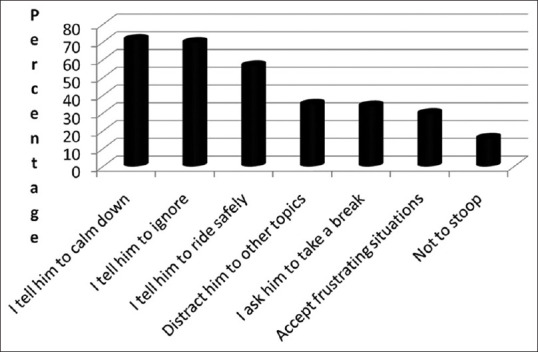
Strategies used by pillion-riders to regulate negative emotion in their two-wheeler riding young men
DISCUSSION
The present study explored the correlates of risky riding behaviors in two-wheeler riding young men from pillion riders' perspective. The results suggest that negative emotions are more likely to adversely affect riding behaviors of two-wheeler riders with high risky riding compared to those with low risky riding. Furthermore, pillion-riders reported that two-wheeler riders with high risky riding style express more aggressive behaviors in response to frustrating situations on the road. These results were in convergence with the larger study findings based on the self-report data of young two-wheeler riders.[16,17] Studies have reported that negative emotions can adversely impact riding.[18,19] This is particularly important in case of young riders/drivers who may experience intense emotion and may have relatively high probability of accidents.[19] Difficulties in emotion regulation may increase the likelihood of aggressive or risky driving behavior.[20,21] Aggressive expressions on road whether it is verbal or nonverbal may lead to crashes and accidents.[22,23] From brain maturation perspective, studies have demonstrated that young adults take more risks due to an impaired cognitive control mechanism.[24,25] Individual differences in brain maturation and executive control can have an impact on driving performance.[26,27] Similarly, difficulty in negative emotion regulation and poor coping skills may lead to a high probability of road accidents.[28]
Risk taking and traffic violation behaviors may increase likelihood of road crashes.[4] The results showed that there was a statistically significant difference between the two groups in terms of road traffic injuries during the previous 6 months. More incidents of near miss and accidents with minor injury were reported in two-wheeler riders with high risky riding than in those with low risky riding. The present study also explored strategies used by pillion-riders to regulate negative emotion in two-wheeler riders. The pillion-riders perceived that using strategies such as making him calm down or ignore the frustrating situation and bringing rider's attention to ride safely could be more effective to reduce two-wheeler rider's negative emotion and its impact on riding style. Managing negative emotion is an important aspect from road safety perspective. Several studies have reported that difficulties in emotion regulation may increase the likelihood of aggressive or risky driving behaviors on roads.[20,21]
The present study has a few limitations that need to be considered. Availability of self-reports of two-wheeler riders about whom they reported would have helped understanding the convergences and divergences between these two sources of information. The study was limited to college-going youth in an urban context. Further studies can help in examining generalizability of the findings to youth in other contexts and other age groups. Its limitations notwithstanding, this is perhaps the first study from India that documents the perspectives of pillion-riders regarding road behaviors of two-wheeler riding young men in urban India. The study has several implications for future research and practice.
Safe riding attitudes and driving behaviors are best promoted from school/college years to be effective. For example, deviant behaviors and risky attitude toward the road use has been observed in young adults long before they learned to ride/drive.[29] It would be worth examining the impact of a brief skill training program to two-wheeler riders and pillion riders to deal effectively with negative emotions that may arise while riding. This may help in minimizing the adverse impact of negative emotions on riding behaviors. The study also suggests that pillion riders tend to spontaneously engage in strategies to regulate emotions and behaviors of two-wheeler riders. This indicates the scope of utilizing pillion riders in road safety programs to positively impact peer norms related to riding, skills for effectively regulating emotions, and behaviors of two-wheeler riders in ways that may decrease aggressive responding on road and enhance road safety.
CONCLUSIONS
This study highlights the importance of considering behavioral and emotional factors in designing interventions for minimizing risky behaviors on the roads. Furthermore, it highlights the scope of assessments and intervention with pillion riders for promoting road safety.
Financial support and sponsorship
The authors gratefully acknowledge the funding support provided by the Council of Scientific and industrial Research for undertaking the larger study on which this article is based.
Conflicts of interest
There are no conflicts of interest.
Acknowledgment
The present study was part of a larger research project funded by the Council of Scientific and Industrial Research, New Delhi, and has been carried out at the Department of Clinical Psychology, National Institute of Mental Health and Neurosciences, Bangalore. We acknowledge the support of the principals of the colleges for giving permission for conducting the survey and the teaching staff of respective departments/classes for facilitating the data collection in the classroom setting.
REFERENCES
- 1.Chang HL, Yeh TH. Motorcyclist accident involvement by age, gender, and risky behaviors in Taipei, Taiwan. Transportation Research Part F: Traffic Psychol Behav. 2007;10:109–22. [Google Scholar]
- 2.Wong JT, Chung YS, Huang SH. Determinants behind young motorcyclists' risky riding behavior. Accident Analysis Prevention. 2010;42:275–81. doi: 10.1016/j.aap.2009.08.004. [DOI] [PubMed] [Google Scholar]
- 3.Cheng AS, Liu KP, Tulliani N. Relationship between driving-violation behaviours and risk perception in motorcycle accidents. Hong Kong J Occupat Ther. 2015;25:32–8. [Google Scholar]
- 4.Lucidi F, Giannini AM, Sgalla R, Mallia L, Devoto A, Reichmann S. Young novice driver subtypes: Relationship to driving violations, errors and lapses. Accident Analysis Prevent. 2010;42:1689–96. doi: 10.1016/j.aap.2010.04.008. [DOI] [PubMed] [Google Scholar]
- 5.Cheng AS, Ng TC. Risky driving and the perception of motorcycle accident causes among Chinese motorcyclists in hong kong. Traffic Injury Prevent. 2012;13:485–92. doi: 10.1080/15389588.2012.671981. [DOI] [PubMed] [Google Scholar]
- 6.Kanchan T, Kulkarni V, Bakkannavar SM, Kumar N, Unnikrishnan B. Analysis of fatal road traffic accidents in a coastal township of South India. J Forensic Legal Med. 2012;19:448–51. doi: 10.1016/j.jflm.2012.02.031. [DOI] [PubMed] [Google Scholar]
- 7.Iodice P, Senatore A. Road transport emission inventory in a regional area by using experimental two-wheelers emission factors. Proceed World Congress Eng. 2013;1:681–5. [Google Scholar]
- 8.Gururaj G, Gautham MS. Advancing Road Safety in India-Implementation is the Key (Summary) Bengaluru: Bengaluru National Institute of Mental Health and Neuro Sciences; 2017. [Google Scholar]
- 9.Broughton PS, Fuller R, Stradling S, Gormley M, Kinnear N, O'dolan C, et al. Conditions for speeding behaviour: A comparison of car drivers and powered two wheeled riders. Transportation Research Part F: Traffic Psychol Behav. 2009;12:417–27. [Google Scholar]
- 10.Steg L, Brussel A. Accidents, aberrant behaviours, and speeding of young moped riders. Transportation Research Part F: Traffic Psychol Behav. 2009;12:503–11. [Google Scholar]
- 11.Kobus K. Peers and adolescent smoking. Addiction. 2003;98(Suppl 1):37–55. doi: 10.1046/j.1360-0443.98.s1.4.x. [DOI] [PubMed] [Google Scholar]
- 12.Engstrom I. Passenger influence on young drivers. In: Dorn L, editor. Driver Behaviour and Training. Burlington: Ashgate; 2003. [Google Scholar]
- 13.Scott-Parker B, Watson B, King M. Exploring how Parents and Peers Influence the Behaviour of Young Drivers Australasian Road Safety Research, Policing and Education Conference; Sydney Convention and Exhibition Centre, Sydney. 2009 [Google Scholar]
- 14.Bingham CR, Simons-Morton BG, Pradhan AK, Li K, Almani F, Falk EB, et al. Peer Passenger Norms and Pressure: Experimental Effects on Simulated Driving Among Teenage Males. Transportation research Part F. Traffic Psychol Behav. 2016;41:124–37. doi: 10.1016/j.trf.2016.06.007. [DOI] [PMC free article] [PubMed] [Google Scholar]
- 15.Morrongiello BA, Seasons M, Pogrebtsova E, Stewart J, Feliz J. Using peer communicated norms about safety to reduce injury-risk behaviors by children. J Pediat Psychol. 2017;42:748–58. doi: 10.1093/jpepsy/jsx050. [DOI] [PubMed] [Google Scholar]
- 16.Mehrotra S, Sudhir PM, Sharma MK, Chakraborty N, Michael RJ, Kumar R, et al. Emotions and two-wheeler riding: Perspectives of College-going youth riders. J Indian Acad Appl Psychol. 2016;42:272–80. [Google Scholar]
- 17.Michael RJ, Sharma MK, Mehrotra S, Banu H, Kumar R, Sudhir PM, et al. Inclination to speeding and its correlates among two-wheeler riding Indian youth. Industrial Psych J. 2014;23:105–10. doi: 10.4103/0972-6748.151676. [DOI] [PMC free article] [PubMed] [Google Scholar]
- 18.Arnett J, Irwin C, Halpern-Felsher B. Developmental sources of crash risk in young drivers. Injury Prevent. 2002;8(Suppl 2):ii17–23. doi: 10.1136/ip.8.suppl_2.ii17. [DOI] [PMC free article] [PubMed] [Google Scholar]
- 19.Harré N. Risk evaluation, driving, and adolescents: A typology. Develop Rev. 2000;20:206–26. [Google Scholar]
- 20.Trógolo MA, Melchior F, Medrano LA. The role of difficulties in emotion regulation on driving behavior. J Behav Health Soc Issues. 2014;6:107–17. [Google Scholar]
- 21.Arnau-Sabates L, Sala-Roca J, Jariot-Garcia M. Emotional abilities as predictors of risky driving behavior among a cohort of middle aged drivers. Accid Analysis Prevent. 2012;45:818–25. doi: 10.1016/j.aap.2011.07.021. [DOI] [PubMed] [Google Scholar]
- 22.Sullman MJ. The expression of anger on the road. Safety Sci. 2015;72:153–9. [Google Scholar]
- 23.Deffenbacher JL. Anger, aggression, and risky behavior on the road: A preliminary study of urban and rural differences. J Appl Soc Psychol. 2008;38:22–36. [Google Scholar]
- 24.Barbalat G, Domenech P, Vernet M, Fourneret P. Risk-taking in adolescence: A neuroeconomics approach. L'Ecephale. 2010;36:147–54. doi: 10.1016/j.encep.2009.06.004. [DOI] [PubMed] [Google Scholar]
- 25.Bingham CR, Shope JT, Zakrajsek J, Raghunathan TE. Problem driving behavior and psychosocial maturation in young adulthood. Accid Analysis Prevent. 2008;40:1758–64. doi: 10.1016/j.aap.2008.06.014. [DOI] [PMC free article] [PubMed] [Google Scholar]
- 26.Mantyla T, Karlsson MJ, Marklund M. Executive control functions in simulated driving. Appl Neuropsychol. 2009;16:11–8. doi: 10.1080/09084280802644086. [DOI] [PubMed] [Google Scholar]
- 27.Keating DP. Understanding adolescent development: Implications for driving safety. J Safety Res. 2007;38:147–57. doi: 10.1016/j.jsr.2007.02.002. [DOI] [PubMed] [Google Scholar]
- 28.El Chliaoutakis J, Demakakos P, Tzamalouka G, Bakou V, Koumaki M, Darviri C. Aggressive behavior while driving as predictor of self-reported car crashes. J Safety Res. 2002;33:431–43. doi: 10.1016/s0022-4375(02)00053-1. [DOI] [PubMed] [Google Scholar]
- 29.Waylen AE, McKenna FP. Risky attitudes towards road use in pre-drivers. Accid Analysis Prevent. 2008;40:905–11. doi: 10.1016/j.aap.2007.10.005. [DOI] [PubMed] [Google Scholar]