



All changed, changed utterly
W. B. Yeats
The COVID‐19 pandemic has had a monumental impact on healthcare delivery. Dermatology is a high‐volume, outpatient‐based, visual specialty, with complex patients and therapies. We summarize the adaptation in a dermatology department in Cork, Ireland, carried out to enhance safety and streamline practice (Fig. 1).
Figure 1.
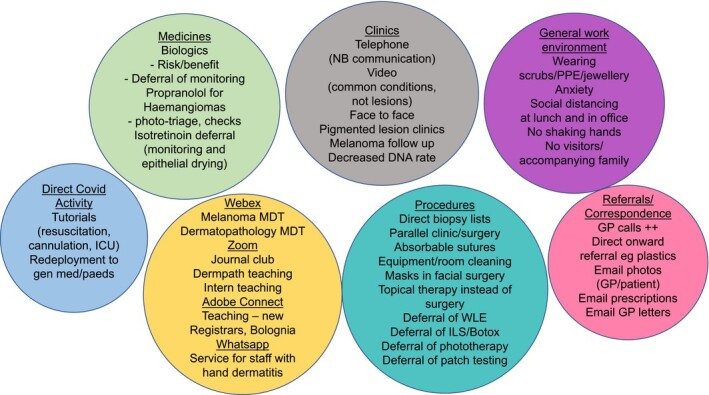
Summary of departmental changes.
Pre‐COVID‐19 surge, tutorials were organized to re‐skill staff in resuscitation, emergencies, practical skills, analgesia, end‐of‐life care and personal protective equipment (PPE) use. Medical staff volunteered in ‘COVID pods’. Dissemination of ‘fake news’ was confronted.1
During the COVID‐19 surge, clinics were converted to teledermatology, with training to avoid communication pitfalls. ‘Did not attend’ rates decreased from 15% pre‐COVID to ‘did not answer’ rates of 2%. Video consultations were introduced for common conditions such as psoriasis, eczema or acne. Lesions were excluded from video review due to the need for dermoscopy and/or biopsy. Face‐to‐face (FTF) reviews were held according to clinical necessity. Pigmented lesion clinics continued due to the risk of missed melanomas,2 with same‐day excisions. Melanoma follow‐up clinics were held off‐site.
Patients requiring surgery were generally higher risk (older and/or immunosuppressed). The number of ‘direct biopsy’ appointments was increased. Parallel clinics/biopsy lists were run. Absorbable sutures were used. Topical therapy (e.g. 5‐fluorouracil) was prescribed instead of cryotherapy or surgery. Wide local excisions were deferred, as were intralesional steroid and neuromodulator injections. Phototherapy and patch testing were initially deferred and then re‐introduced on a restricted basis. The 48‐hour assessment was performed at home.
Patients were counselled on the unknown effects of immunomodulatory therapy on the acquisition and severity of COVID‐19 and the risk of severe untreated inflammatory skin disease. Influenza and pneumococcal vaccination was promoted. Blood monitoring was rationalized. An established photo‐triage system for infantile haemangiomas continued.3 Isotretinoin therapy was cautiously initiated during the crisis, due to the need for frequent monitoring and the unknown risk of retinoid‐induced epithelial drying. Female patients attended for urinary pregnancy testing, blood β‐human chorionic gonadotrophin testing, or performed home urinary testing.
Video consultations were performed using a medical reporting platform (T Pro Health, Dublin, Ireland). Video conferencing platforms were used for melanoma and dermatopathology multidisciplinary meetings (Webex, Milpitas, CA, USA) and for dermatopathology teaching, journal club and tutorials (Zoom, San Jose, CA, USA) and Adobe Connect (Adobe Inc., San Jose, CA, USA) was used for nationwide teaching for trainees and lectures from external sites. A Whatsapp (Whatsapp Inc., Menlo Park, CA, USA) service was established for healthcare workers who developed skin problems related to hand hygiene or PPE.
A photo‐advice service for general practitioners (GPs) was offered for emergencies. Prescriptions were emailed directly to pharmacies and letters were emailed directly to GPs.
Scrubs became uniform and PPE was donned and doffed. Anxiety was particularly palpable at the onset of the crisis. Social distancing was enforced, shaking hands was suspended and visitors were limited.
Following the COVID‐19 surge, major efforts are being made to reduce the impact on outpatient waiting times (Table 1). FTF reviews are being re‐introduced, and patients with lesions are seen in a ‘see and treat’ clinic, while patients on biologics attend virtual clinics. Undergraduate teaching Is conducted virtually.4
Table 1.
Comparison between 2019 and 2020 of outpatient statistics in the department of dermatology, South Infirmary Victoria University Hospital Cork from 1 January to 30 September for 2019 and 2020.
| 2019 | 2020 | Difference, n (%) | |
| Waiting list on 1 January, n | 3984 | 3283 | −701 (−17.6) |
| Between 1 January and 30 September | |||
| Referrals received, n | 6923 | 5539 | −1384 (−20) |
| New patients | |||
| Total seen, n | 5094 | 3630 | −1774 (−34.8) |
| New FTF (non‐PLC), n (%) | 2019 (39.6) | 1110 (30.6) | −909 (−45) |
| New PLC, n (%) | 3075 (60.4) | 2210 (60.9) | −865 (−28.1) |
| New virtual, n (%) | 0 (0) | 310 (8.5) | +310 (N/A) |
| Return patients | |||
| Total seen, n | 6272 | 6539 | +267 (+4.3) |
| Return FTF, n (%) | 6272 (100) | 3376 (51.6) | −2896 (−46.2) |
| Return virtual, n (%) | 0 | 3163 (48.4) | +3163 (N/A) |
| Total patients seen, n | 11 366 | 10 169 | −1197 (−10.5) |
| Did not attend/answer, n (%) | |||
| New FTF | 914 (15) | 553 (14) | −1 |
| New virtual | N/A | 25 (8) | |
| Return FTF | 1032 (14) | 581 (14) | No change |
| Return virtual | N/A | 47 (1.5) | |
| Total DNA | 1946 (15) | 1206 (11) | −4 |
| Waiting list 30 September, n | 3491 | 3247 | −244 (−7) |
FTF, face‐to‐face; PLC, pigmented lesion clinic.
In conclusion, COVID‐19 has had a devastating impact on global healthcare. We have outlined our adaptations, which successfully negotiated an unprecedented clinical environment.
Contributor Information
C. O’Connor, Department of Dermatology South Infirmary Victoria University Hospital Cork Ireland Department of Medicine University College Cork Cork Ireland.
G. O’Connell, Department of Dermatology South Infirmary Victoria University Hospital Cork Ireland
E. Nic Dhonncha, Department of Dermatology South Infirmary Victoria University Hospital Cork Ireland
L. Roche, Department of Dermatology South Infirmary Victoria University Hospital Cork Ireland
C. Quinlan, Department of Dermatology South Infirmary Victoria University Hospital Cork Ireland
L. A. Murphy, Department of Dermatology South Infirmary Victoria University Hospital Cork Ireland
C. Gleeson, Department of Dermatology South Infirmary Victoria University Hospital Cork Ireland
M. Bennett, Department of Dermatology South Infirmary Victoria University Hospital Cork Ireland
J. Bourke, Department of Dermatology South Infirmary Victoria University Hospital Cork Ireland Department of Medicine University College Cork Cork Ireland.
M. Murphy, Department of Dermatology South Infirmary Victoria University Hospital Cork Ireland Department of Medicine University College Cork Cork Ireland.
References
- O'Connor C, Murphy M. Going viral: doctors must tackle fake news in the covid‐19 pandemic. BMJ 2020; 369: m1587. [DOI] [PubMed] [Google Scholar]
- Quinlan C, Gill R, Murphy M. Increasing melanoma awareness among health and social care professionals in secondary care in an era of reduced skin cancer referrals. Clin Exp Dermatol 2020; 45: 920–1. [DOI] [PMC free article] [PubMed] [Google Scholar]
- Flynn A, O’Connor C, Murphy M. Photo‐triage of infantile hemangiomas: potential to reduce healthcare exposure in the COVID19 pandemic. J Dermatolog Treat 2020. 10.1080/09546634.2020.1808153 [DOI] [PubMed] [Google Scholar]
- Nic Dhonncha E, Murphy M. Learning new ways of teaching and assessment: the impact of COVID‐19 on undergraduate dermatology education. Clin Exp Dermatol 2020; 46: 170–1. 10.1111/ced.14364 [DOI] [PMC free article] [PubMed] [Google Scholar]