



The whole world is battling an unprecedented strain of outbreaks imposed by a novel Coronavirus (SARS-CoV-2). Within a short span of time, it has successfully spread from China to the rest of the world. High transmissibility of this virus among the naive population with zero herd immunity allowed it to become pandemic. Recent literature have reported co-infections of SARS-CoV-2 and other respiratory pathogens [1,2]. As influenza is the most common virus during winters, its high prevalence could be the reason for co-infection. More studies are warranted to establish the simultaneous effect of SARS-CoV-2 and other infections that may influence disease outcomes.
Tropical and sub-tropical countries face annual epidemics of dengue, chikungunya, and other respiratory infections. Every year, these diseases put a huge burden on health care settings. Due to the similar initial symptoms, diagnostic challenges will be faced by clinicians during concurrent outbreaks of COVID-19 and these endemic diseases. Different pathogens in a clinical specimen may interfere with the target virus, resulting in misdiagnosis. Also, cross-reactive antibodies may lead to misleading serological results. A recent report from Singapore has described the false-positive serological results for dengue in two patients, which were later found to be positive for SARS-CoV-2[3]. False-positive dengue serology can have serious implications for patients. Another report from Thailand has described a patient who was initially diagnosed with dengue fever, but later found to be co-infected with SARS-CoV-2[4]. And in a patient from Pakistan with COVID-19 like symptoms and travel history to high-risk areas, SARS CoV-2 was found to be negative, but later found seropositive for dengue and measles[5]. This highlights the importance of alternate diagnoses of tropical infections and complete respiratory panel by the clinicians during the current pandemic.
This is a serious issue demanding urgent consideration, as amidst the SARS CoV-2 infections, other viral infections will severely affect public health. It is likely to complicate the already burdened healthcare system with increased incidence of multiple co-infections. Complex interactions may occur upon co-infections, as it can cause competition between the viruses for existing resources leading to viral enhancement or inhibition or no effect[6]. Upon co-infection, recombination events can occur between viruses which can affect transmission rates, course of disease as well as response to antivirals in a host[7]. This has always been the unexplained phenomenon with regard to disease severity as host immunity also drives viral co-infection outcome. Therefore, with the continuing expansion of COVID-19, health care system needs to be sensitized to face enormous challenges of these regular outbreaks in the near future. One must not lower the guard against these co-circulating infections to prevent the occurrence of new outbreaks.
In view of the respiratory and arboviral co-infections, increasing and multiplexing the diagnostic capacities, and intensifying surveillance measures will lead to the management of outbreaks to a certain degree. To tackle this novel pandemic, clinicians have to be updated with current epidemiological trends, case definitions, alternate possible diagnoses, and treatment regimens. Coherence between integrated vector control measures and sanitization done during COVID-19 like fogging and spraying could manage the situation (Figure 1). Until the development of a safe and efficacious antiviral and/or vaccine, early diagnosis, symptomatic treatment, and preventive measures like social distancing, use of masks are the key to break the transmission chain and limit further spread.
Figure 1.
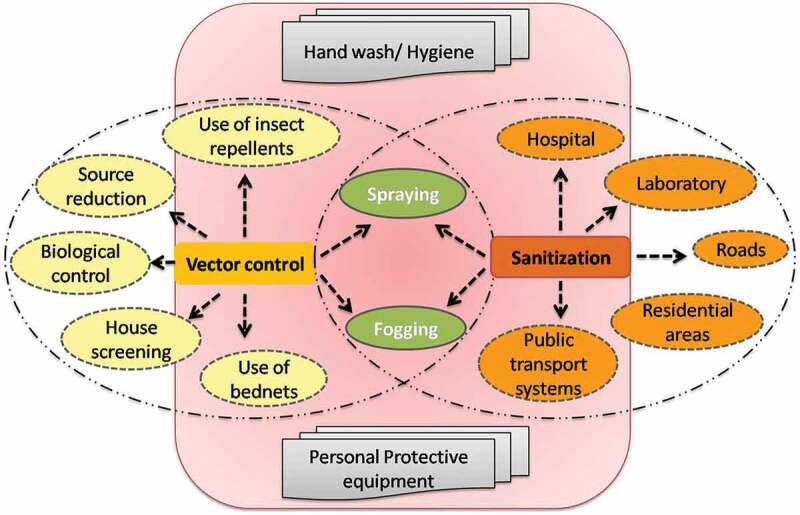
Coherence between integrated vector control measures and sanitization done for COVID-19. Vector control measures like house screening, use of bed nets, source reduction, biological control and use of insect repellents are shown in one group. For containment of SARS-CoV-2, sanitization measures in hospitals, laboratories, roads, residential areas and public transport systems are shown in another group. The overlapping zone representing spraying and fogging is common in both the groups. Also, following the hygiene practices and use of personal protective equipment during vector control and sanitization could lead to the management of these infections to a certain degree
Author contributions
A.A. conceived and drafted the manuscript, constructed the figure, D.C. and P.K.D. reviewed the manuscript and provided suggestions.
Disclosure statement
No potential conflict of interest was reported by the authors.
References
- [1].Konala VM, Adapa S, Gayam V, et al. Co-infection with Influenza A and COVID-19. 2020;7:5. Eur J Case Rep Intern Med [DOI] [PMC free article] [PubMed] [Google Scholar]
- [2].Wu X, Cai Y, Huang X, et al. Co-infection with SARS-CoV-2 and influenza A virus in patient with pneumonia, China. Emerg Infect Dis. 2020;26(6):1324. [DOI] [PMC free article] [PubMed] [Google Scholar]
- [3].Yan G, Lee CK, Lam LT, et al. Covert COVID-19 and false-positive dengue serology in Singapore. Lancet Infect Dis. 2020;20(5):536. [DOI] [PMC free article] [PubMed] [Google Scholar]
- [4].Ratnarathon AC, Pongpirul K, Pongpirul WA, et al. Potential dual dengue and SARS-CoV-2 infection in Thailand: a case study. Heliyon. 2020;6(6):e04175. [DOI] [PMC free article] [PubMed] [Google Scholar]
- [5].Bokhari SMMA, Mahmood F, Bokhari SMSA.. Case report: diagnosis of novel coronavirus disease (COVID-19) versus tropical diseases in Pakistan. Am J Trop Med Hyg. 2020; 103(1):77-78, tpmd200356. [DOI] [PMC free article] [PubMed] [Google Scholar]
- [6].Vogels CB, Rückert C, Cavany SM, et al. Arbovirus coinfection and co-transmission: A neglected public health concern? PLoS Biol. 2019;17(1):e3000130. [DOI] [PMC free article] [PubMed] [Google Scholar]
- [7].Ojosnegros Martos S, Beerenwinkel N, Domingo E.. Competition-colonization dynamics: an ecology approach to quasispecies dynamics and virulence evolution in RNA viruses. Commun Integr Biol. 2010;3:333–336. [DOI] [PMC free article] [PubMed] [Google Scholar]