



Abstract
Background
The acquisition of reusable medical devices through loaner system is a worldwide phenomenon. Single-use implants, such as orthopaedic screws, that remain in the surgical tray are subjected to multiple handling and reprocessing until they are implanted. Exposure to physical, chemical and biological agents may compromise their quality/safety and favor biofilm formation. The aim of this study was to assess the surface integrity and microbiological conditions of patient-ready orthopaedic surgical implants (least used cortical screws), provided through loaner system.
Methods
After full reprocessing, clinical trays used for small fragment surgery (3,5) provided through loaner system to a large Brazilian teaching hospital were randomly selected between August to November 2019. Trays were opened in a biological safety cabinet and the least frequently used cortical screws (numbers 10 and 38), therefore, the ones most exposed to biological, chemical and physical agents, were randomly removed and subjected to bacterial culture (n = 3 screws/tray, 9 trays) and Scanning Electron Microscopy (SEM) (n= 1 screw/tray, 5 trays). The 27 screws were individually cultured in Tryptic Soy Broth (TSB), sonicated and vortexed, and incubated at 35oC for up to 28 days (screws were left in TSB). Positive cultures were plate out for automated bacteria identification.
Results
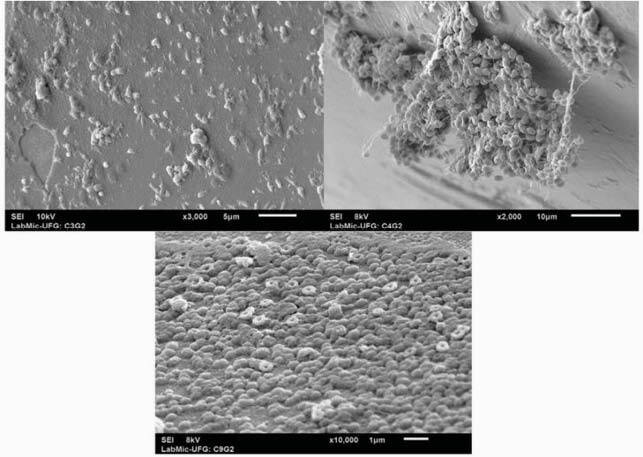
Bacterial growth was identified in 2/27 screws. Three bacterial species were isolated, Staphylococcus hominis resistant to rifampicin and Kocuria rhizophila (screw A), and Micrococcus luteus (Screw B). Structural damage and soil were visualized on all screws subjected to SEM (5/5). Extensive biofilms were detected on three screws (3/5) (Figure 1).
Figure 1. Scanning electron micrographs of patient-ready orthopaedic implants (screws), acquired through loaner system showing extensive biofilm, with incorporated bacilli/rods and/or cocci shape bacteria.
Conclusion
Recovery of bacteria, biofilm accumulation and structural damage were detected on patient-ready least frequently used orthopaedic cortical screws. Screws frequently remain in surgical trays for multiple reprocessing, thus, they are repeatedly exposed to contamination and possible damage. These findings point to the need to discuss and review the way these single-use implants are currently made available for surgery.
Disclosures
All Authors: No reported disclosures